Review

Clathrate Hydrates as Hydrogen Storage Systems: An Overview Through a Bibliometric Analysis

1
CIRIAF-Interuniversity Research Centre, University of Perugia, Via G. Duranti 63, 06125 Perugia, Italy
2
Civil and Environmental Engineering Department, University of Perugia, Via G. Duranti 93, 06125 Perugia, Italy
*
Author to whom correspondence should be addressed.
Energies 2026, 19(9), 2038; https://doi.org/10.3390/en19092038
Submission received: 12 March 2026 / Revised: 14 April 2026 / Accepted: 21 April 2026 / Published: 23 April 2026

Abstract

Hydrogen is a key energy carrier for the transition to renewable energy, but its storage remains a major challenge, mainly due to the energy requirements for its production and to its low volumetric energy density under ambient conditions. Clathrate hydrates have recently emerged as a promising medium for gas storage, yet their potential for hydrogen storage is still underexplored. This study presents a comprehensive bibliometric analysis of hydrogen storage research, focusing on clathrate hydrates. The analysis, based on publications indexed in Scopus over the past decades, reveals that research on gas hydrates is mature and interdisciplinary, encompassing hydrate formation, thermodynamics, and production from natural reservoirs. In contrast, hydrogen hydrates remain a marginal and emerging research area, characterized by limited scientific output and weak connections to dominant storage strategies such as metal hydrides, metal–organic frameworks, and adsorptive materials. The results highlight key research gaps, including a limited understanding of formation kinetics, thermodynamic stability under practical conditions, and challenges related to scalability and system integration. These findings suggest that targeted research efforts addressing these bottlenecks could support the development of hydrate-based systems as complementary solutions within the broader hydrogen storage landscape.

1. Introduction

Nowadays, climate change and the urgent need to reduce greenhouse gas emissions are driving a profound transformation of the global energy system. In this context, the concept of sustainability [1] has become a central pillar of energy policies worldwide, fostering the transition from fossil-fuel-based systems towards low-carbon and renewable energy sources. Among the different energy carriers proposed to support this transition, hydrogen is widely recognized as a key vector for achieving deep decarbonization across multiple sectors, including power generation [2], transportation [3], and industrial processes [4].
However, despite its high gravimetric energy density and clean end-use characteristics, the large-scale deployment of hydrogen technologies is still strongly limited by challenges related to its storage and transportation [5]. Hydrogen is characterized by a low volumetric energy density under ambient conditions, requiring either high-pressure compression, liquefaction at cryogenic temperatures, or solid-state storage solutions, each of which presents significant technical, economic, and safety constraints. As a result, the development of efficient, safe, and cost-effective hydrogen storage systems remains one of the main bottlenecks for the realization of a hydrogen-based energy system [6].
In recent years, clathrate hydrates have emerged as a promising alternative for gas storage [7]. Gas hydrates are ice-like solid crystalline compounds, where water molecules form hydrogen bonds with the surrounding ones and form solid structures, while the gaseous molecules fit the cavities present within the solid lattice. Gaseous molecules are commonly referred as “hosts” and promote the formation of these solid structures, which, thanks to their presence, are feasible even at thermodynamic conditions that are unsuitable for the formation of ice. Conversely, the molecules of water are named “hosts” [8]. Hydrogen hydrates have attracted increasing attention due to their potential advantages, such as moderate storage pressures compared with compressed gas systems, intrinsic safety, and the possibility of tuning storage capacity through the use of promoters and mixed gas systems. These characteristics make hydrate-based storage an appealing option for stationary applications, seasonal energy storage, and the integration of hydrogen with renewable energy sources [9].
Nevertheless, several challenges still hinder the practical implementation of hydrogen storage using hydrates. These include the relatively low hydrogen storage capacity, slow formation kinetics, strict thermodynamic conditions, and issues related to scalability and system integration [10]. Consequently, extensive research efforts have been devoted to improving hydrate formation through thermodynamic promoters, kinetic additives, porous media, and novel reactor configurations. This growing interest has led to a rapid increase in the number of scientific publications addressing different aspects of hydrogen hydrate storage.
From the numerous papers available in the literature, several review articles have been published, focusing on specific topics such as hydrate thermodynamics, formation kinetics, material additives, or reactor design [11,12,13]. However, a comprehensive overview capable of quantitatively identifying the main contributors, collaborations, and emerging research hotspots in the field of hydrogen storage using hydrates is still lacking.
In this regard, bibliometric analysis [14] has recently been recognized as a powerful tool to investigate the scientific development of a given research field. This approach allows for a quantitative evaluation of publication trends; leading authors, institutions and countries; and a qualitative assessment of research directions through keyword co-occurrence and network analysis. Bibliometric methods have been successfully applied to analyze research trends in hydrogen production and storage, energy storage technologies, and other emerging energy-related topics.
Therefore, the aim of this paper is to provide a comprehensive bibliometric review of the research on hydrogen storage using clathrate hydrates. By analyzing the evolution of scientific publications, research networks, and thematic trends, this study seeks to identify the main research hotspots, gaps, and future perspectives in this field. The results are expected to serve as a valuable reference for researchers and policymakers, supporting the development of hydrate-based hydrogen storage technologies and guiding future research efforts.

2. Materials and Methods

For this work, Scopus was selected as the reference database due to its wide multidisciplinary coverage, standardized indexing procedures, and its extensive use and validation in bibliometric analyses reported in the scientific literature [15]. To investigate the application of gas hydrates as hydrogen storage systems, two queries were conducted in the Scopus database, as shown in Table 1. The first query was used to retrieve papers related to clathrate hydrates as gas storage systems.
The terms “gas hydrates” and “clathrate hydrates” were considered to be synonymous, since gas hydrates specifically represent clathrate-type hydrates in which gas molecules are physically encaged within a water cage.
The keywords used in the first query are intended to exclude purely geological, mineralogical, or descriptive studies and instead focus on research addressing gas accumulation and trapping in hydrate structures. Accordingly, the terms “gas storage,” “gas recovery,” and “gas sequestration” were included. In addition, the keywords “replacement” and “exchange” were incorporated to capture studies investigating molecular exchange mechanisms within hydrate cavities. Finally, the term “Cretaceous” was excluded, as it primarily refers to studies on Cretaceous formations, paleoenvironmental reconstructions, and sedimentary basin evolution, which are unrelated to storage/recovery processes or energy applications and would therefore divert from the focus of this study. The second search query focuses on hydrogen storage systems. The objective in this case was to analyze the various storage options without considering hydrogen production or purely microscopic and chemical studies. For this reason, terms such as “hydrogen storage system” “hydrogen storage technolog*”, and “hydrogen storage method*” were included, rather than the more general term “hydrogen storage,” which encompasses numerous concepts beyond the scope of this research. At the same time, terms such as “fuel cell”, “combustion”, “hydrogen production”, “power-to-gas”, “water splitting”, and “electrolysis” were excluded, as they relate to hydrogen production or direct utilization rather than its storage. In this work, bibliometric information was employed to examine the evolution and main trends of scientific publications within the investigated research domain. To detect potential research gaps and thematic relationships, a keyword-based visual mapping approach was adopted using the open-source software VOSviewer (version 1.6.20). This software enables the construction and visualization of bibliometric networks by analyzing relationships among different entities in scientific publications. These relationships may include co-authorship links, keyword co-occurrence, citation patterns, bibliographic coupling, and co-citation networks. The mapping process can be applied to various units of analysis, such as authors, affiliations, countries, and keywords. One of the main strengths of VOSviewer lies in its ability to generate intuitive graphical representations of complex bibliometric data, which can be readily exported and further processed using external tools [16]. Moreover, the software is widely appreciated for its user-friendly interface and accessibility, allowing reliable cluster-based bibliometric analyses even for users without advanced expertise in clustering techniques or specialized software [17]. Owing to these features, VOSviewer is broadly recognized as a robust and validated tool for identifying knowledge gaps and emerging research directions within scientific literature. Its effectiveness has already been demonstrated in numerous bibliometric studies, particularly in the fields of hydrogen storage [18,19,20] as well as in research addressing gas hydrate frameworks [21,22,23].
In this study, the results of the keyword co-occurrence analysis are presented through network visualizations. Each node in the network corresponds to an author-provided keyword, represented by a colored circle whose size reflects its frequency of occurrence or overall link strength. Different colors indicate distinct thematic clusters, while the spatial distance between nodes represents the degree of relatedness among keywords. Finally, the two predefined search queries were combined and jointly analyzed within VOSviewer to identify intersections between the two research topics and to highlight potential gaps and opportunities for future investigation.

3. Results

This section presents the results of the bibliometric analysis conducted according to the methodology described in Section 2.

3.1. Clathrate Hydrates as Gas Storage Systems

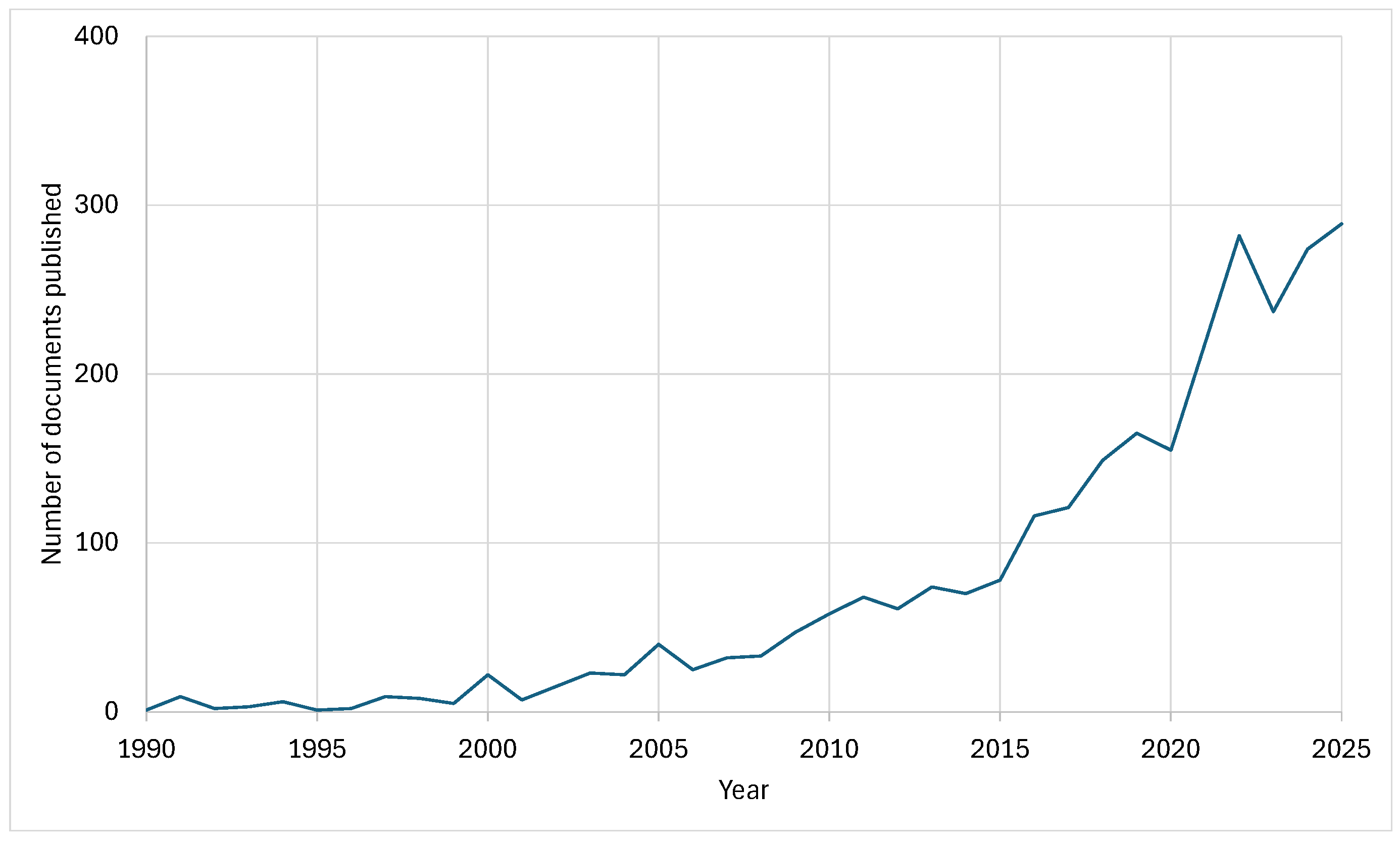
Figure 1 illustrates the annual number of publications in the field of clathrate hydrates as gas storage systems, illustrating the year-by-year evolution of the research activity in this field. The trend indicates a rapid increase beginning in 2000, with approximately 300 papers published in 2025. This demonstrates that clathrate hydrates are gaining momentum in gas storage applications, becoming a pivotal component of the energy sector.
Figure 2 illustrates the cumulative number of publications for the main regions contributing to research on clathrate hydrates. The data show that, since 2017, China has markedly increased its scientific output, surpassing both the United States, which began publishing in this field as early as 1990, and the EU-27 countries. This upward trend can be attributed to the launch of an offshore methane hydrate production campaign conducted by the China Geological Survey, which triggered a new phase of intensive scientific research and engineering efforts aimed at developing robust production technologies [24,25]. In China, the most highly cited publications primarily address the CO2–CH4 replacement mechanism [26,27,28], hydrate formation in the presence of promoters [29,30], and their decomposition processes [31].
The most highly cited papers in the United States focus on clathrate hydrate formation in the presence of surfactants [32], their fundamental properties and applications [33], and their dissociation behavior [34,35] and potential use as energy storage systems [36,37]. The increase in the trend of publications in USA after 2000 can be attributed to the US federal program on methane hydrates, which culminated in 2000 with the Methane Hydrate Research and Development Act, with the aim of implementing the latter as a future energy resource [38]. The most highly cited research on this topic in Europe addresses the properties and advantages of clathrate hydrates [39,40], their application in gas storage [41], and their formation under the influence of inhibitors and promoters [42,43].
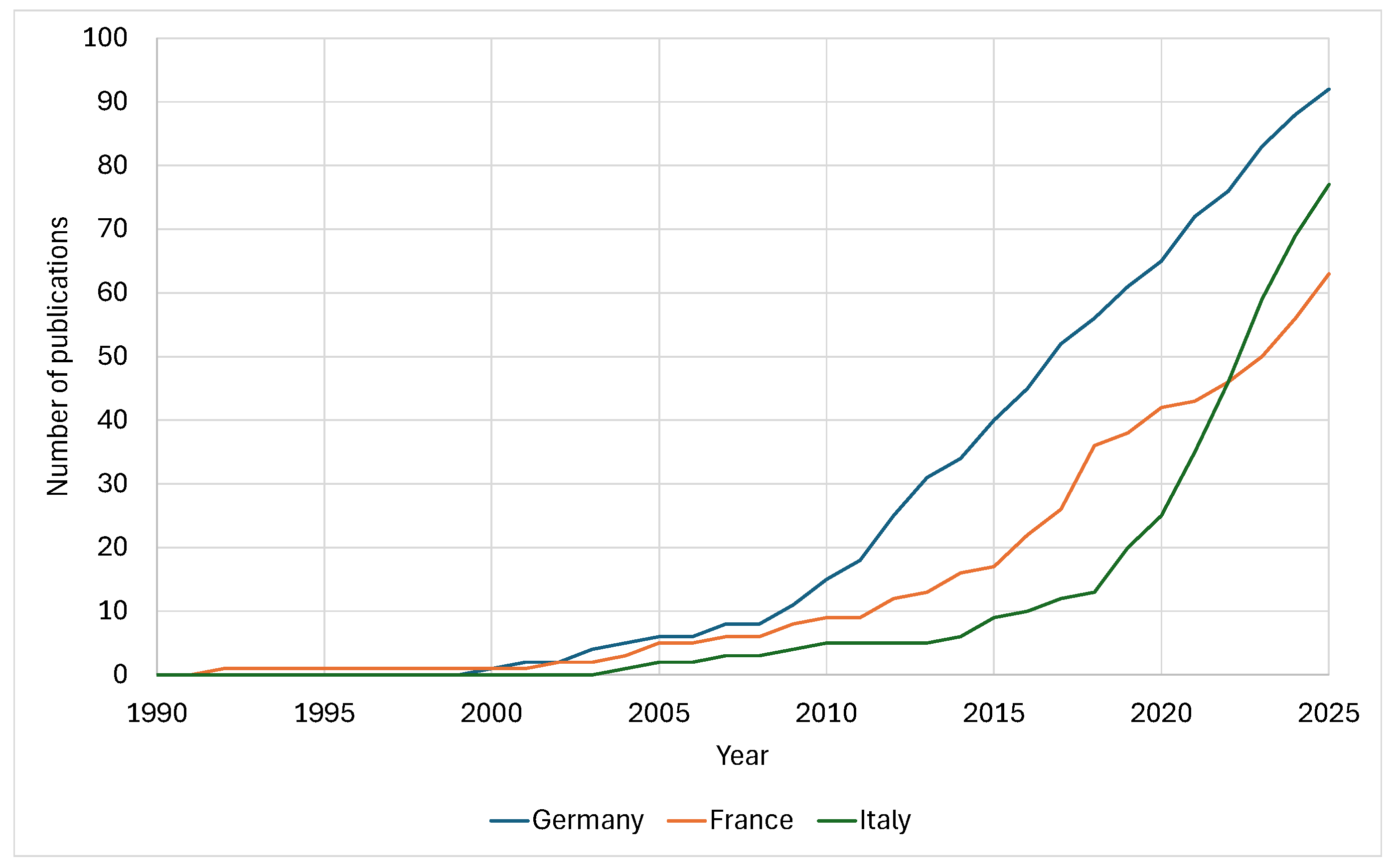
Figure 3 shows the cumulative number of publications from 1990 to 2025 for the three main EU-27 countries with the highest publication output: France, Germany and Italy. As of 2025, Germany is the European country with the highest number of publications on this topic. The most highly cited studies focus on the decomposition of gas hydrates [44], production strategies for hydrocarbons from gas hydrate-bearing sediments [45], and the utilization and storage of carbon dioxide in subsea hydrate deposits [46].
Italy follows, with its principal publications focusing on the optimization of the CH4–CO2 replacement process [47,48], particularly with regard to thermal stimulation, energy efficiency, and carbon balance sustainability, rather than on the development of full-scale production technologies [49,50,51].
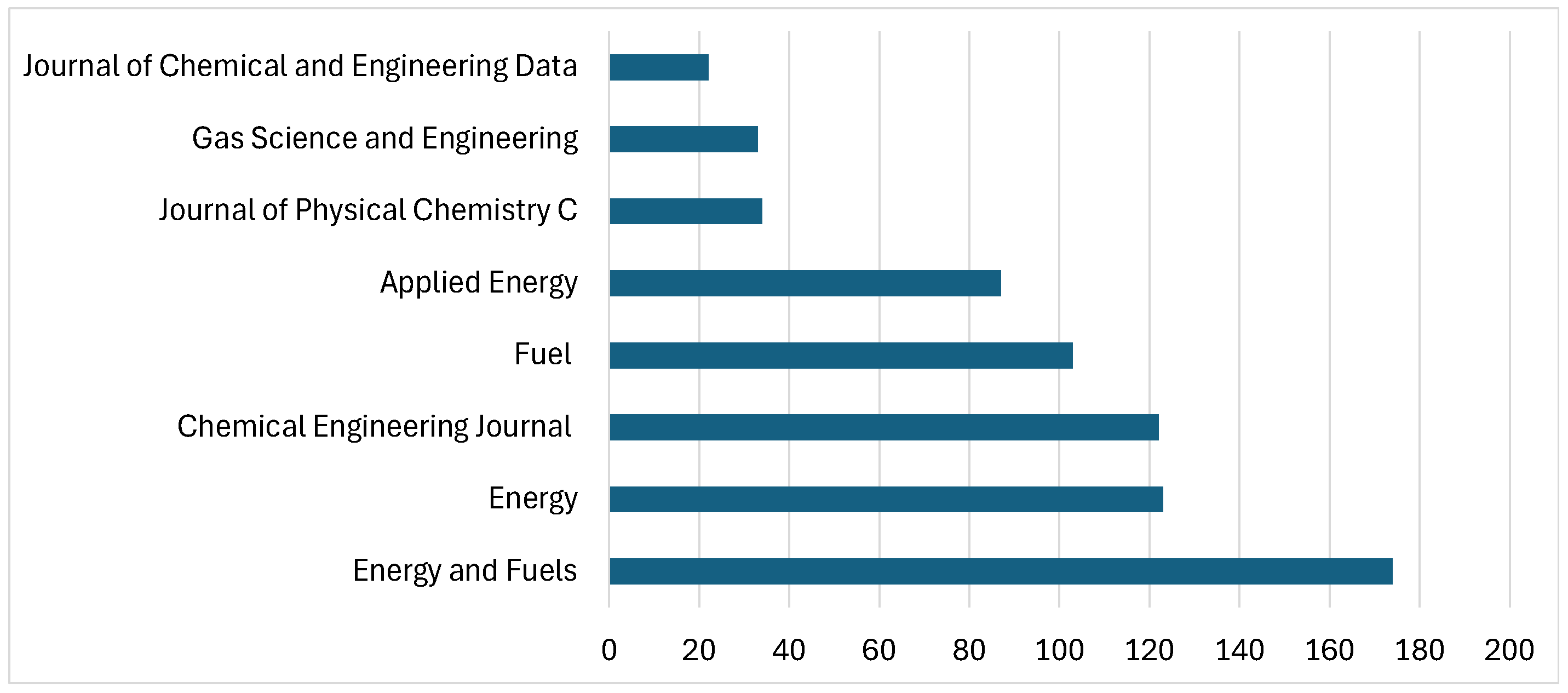
Figure 4 presents the journals with the highest number of publications in the field of gas hydrates. Energy and Fuels is the leading journal, with 174 publications. It is noteworthy that, overall, non-open access journals account for the highest publication output in this field.
Table 2 and Table 3 list the leading institutions and authors publishing in the field of gas hydrates. As previously noted, China ranks first in terms of publication output, as evidenced by the top five affiliations by number of publications, all of which are Chinese institutions. The leading affiliation is the Ministry of Education of the People’s Republic of China, with 278 publications. However, the most prolific author is Yongchen Song of Dalian University of Technology, whose research primarily focuses on gas hydrate deposits and sedimentary systems [52,53,54].
Furthermore, it is worth noting that Alberto Maria Gambelli and Federico Rossi, both affiliated with the University of Perugia, are among the most highly cited authors in this field. Their research output significantly contributes to making the University of Perugia the leading European institution in terms of the number of publications on gas hydrates.
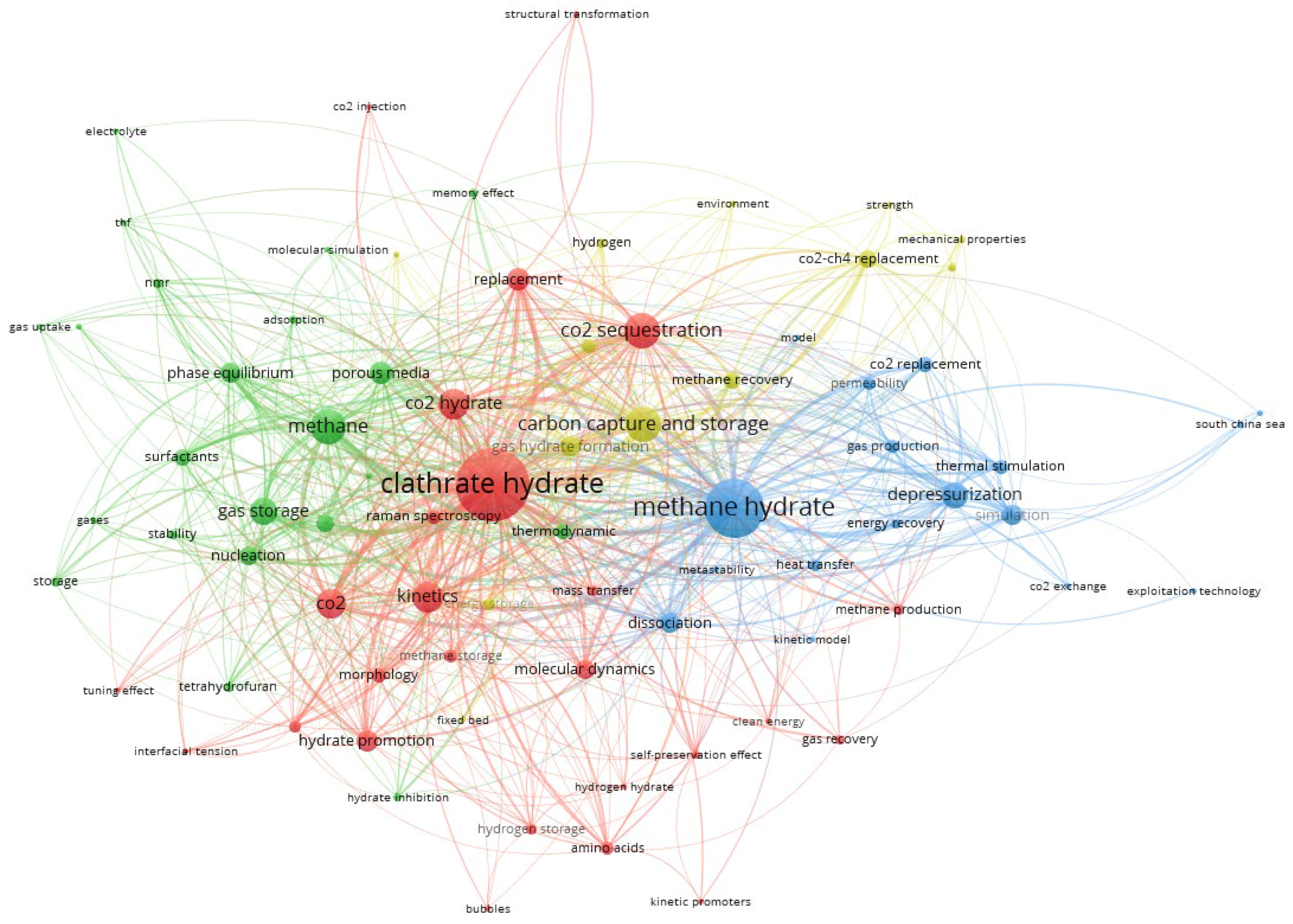
Figure 5 presents the keyword co-occurrence network generated using VOSviewer software for the first query, which focuses on clathrate hydrates in the context of gas storage. The visualization illustrates how thematically related keywords are grouped into clusters, representing major research areas. To obtain the network shown in the figure, a minimum occurrence threshold of six was applied to the keywords. The central red cluster represents the theoretical and chemical core of the field. It includes key terms such as “clathrate hydrate”, which appears as the most prominent and centrally positioned keyword, as well as “CO2 sequestration”, “carbon capture and storage”, “CO2”, “replacement,” and “hydrate promotion.” These terms refer to studies addressing formation and dissociation thermodynamics, promotion and inhibition mechanisms, and carbon dioxide accumulation and sequestration processes. The central position of this cluster within the network highlights its pivotal role in the scientific literature on gas hydrates. The green cluster on the left side of the figure comprises major nodes such as “methane”, “gas storage”, “porous media”, “phase equilibrium”, “nucleation”, “stability”, and “surfactants”, denoting an experimental research domain focused on optimizing hydrate formation and storage performance. The blue cluster is characterized by keywords such as “gas production,” “energy recovery”, “thermal stimulation”, “permeability”, “simulation”, and “South China Sea”, indicating a predominantly geotechnical and application-oriented research domain focused on production from natural sediments and reservoirs. The inclusion of “South China Sea” further suggests a substantial Chinese research contribution, reflecting the strategic importance of this region in methane hydrate exploitation activities. Finally, the yellow cluster includes keywords such as “CO2–CH4 replacement”, “mechanical properties”, “strength”, “model”, and “environment”, which denote studies addressing mechanical stability during gas replacement processes, sediment integrity, and associated environmental impacts. This cluster acts as a bridging domain between the red cluster (carbon capture and storage-oriented research) and the blue cluster (production-focused studies), linking fundamental thermodynamic investigations with applied geo-mechanical and operational considerations.
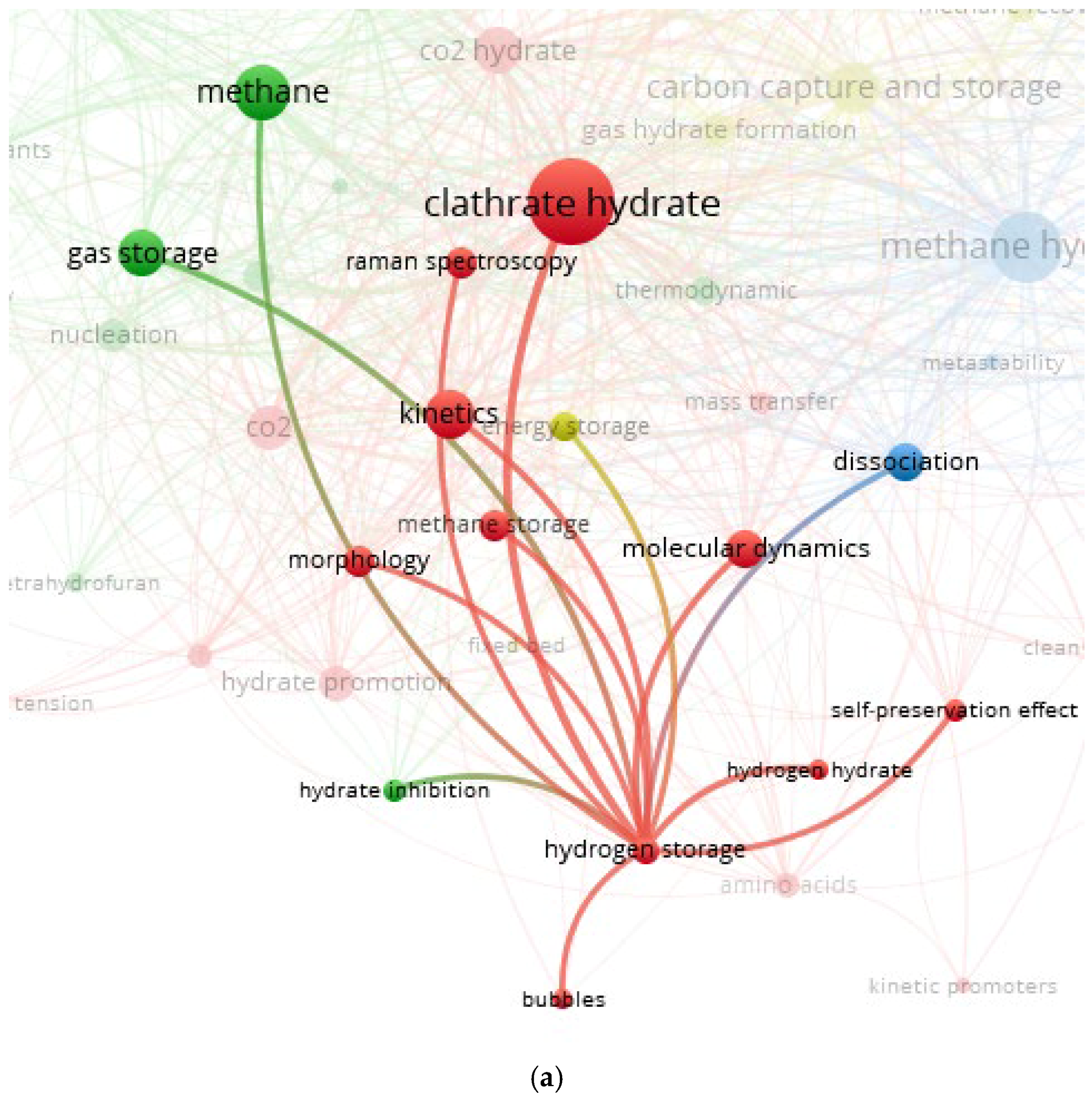
Among the identified keywords, “hydrogen storage” and “hydrogen hydrate”, located within the red cluster, as well as “hydrogen” in the yellow cluster, are of particular relevance. The keyword “hydrogen storage” (Figure 6a) exhibits its strongest links with “gas storage”, “methane”, and “methane storage”. Unsurprisingly, the primary studies associated with this keyword focus on the use of methane hydrates as stable gas storage systems, highlighting their potential applicability to hydrogen storage [55,56].
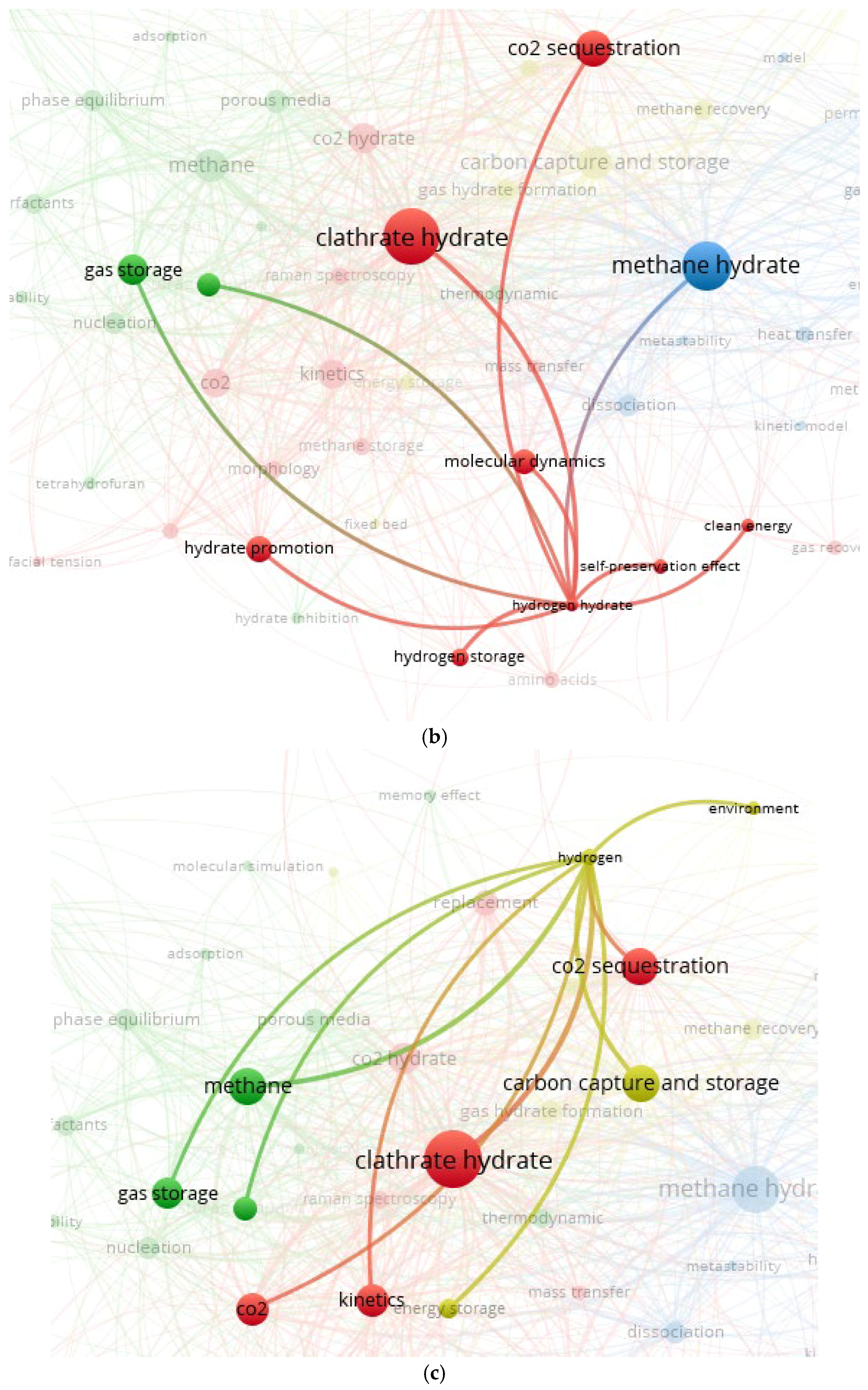
As further evidenced by the keywords “gas storage” and “clean energy”, the most highly cited studies associated with these terms primarily consist of review articles that assess hydrates as potential materials for hydrogen storage. However, the relatively small node size and their peripheral position within the network suggest that this topic has not yet been extensively explored in the literature, a conclusion further supported by the limited number of publications available on the subject.
With regard to the keyword “hydrogen” (Figure 6c) it is linked to “CO2–CH4 replacement”, “mechanical properties”, “environment”, “model”, “hydrate promotion”, and “carbon capture and storage”. This pattern suggests that hydrogen appears in literature as a gas component in mixed systems [57,58], often in association with carbon dioxide in hydrate-based studies, and in analyses concerning the sequestration and storage of gas mixtures [59,60]. In addition, the keywords “hydrogen” and “hydrogen storage” are increasingly associated with recent studies specifically addressing hydrate-based hydrogen storage, focusing on improving the formation conditions, kinetics, and storage performance. For instance, Wang et al. [61] investigated the role of thermodynamic promoters and additive mixtures (e.g., THF, TBAB, SF6) in enhancing hydrate formation conditions, demonstrating significant improvements in phase equilibrium and stability. In addition, Fan et al. [62] explored advanced porous media systems, such as pre-wetted bamboo charcoal, demonstrating that the use of porous structures and staged hydrogen injection strategies can significantly enhance both the storage capacity and formation kinetics of the hydrate, and resulted in markedly faster hydrogen uptake rates through improved gas–liquid contact and mass transfer. Complementary approaches include the development of hydrate solid solutions with tailored lattice structures, as reported by Chen et al. [63], where synergistic integration of TBAB and SF6 in the hydrate induce lattice distortion, modifying the cage dynamics and enabling improved hydrogen diffusion, faster formation kinetics, and enhanced storage performance through controlled structural defects and double cage occupancy.
From a broader perspective, recent reviews (e.g., Chen et al. [64]) also position hydrate-based hydrogen storage among the solid-state storage technologies, highlighting its advantages in terms of cost and environmental impact, despite current limitations in storage capacity compared with alternative materials such as metal hydrides and MOFs.

3.2. Hydrogen Storage Systems

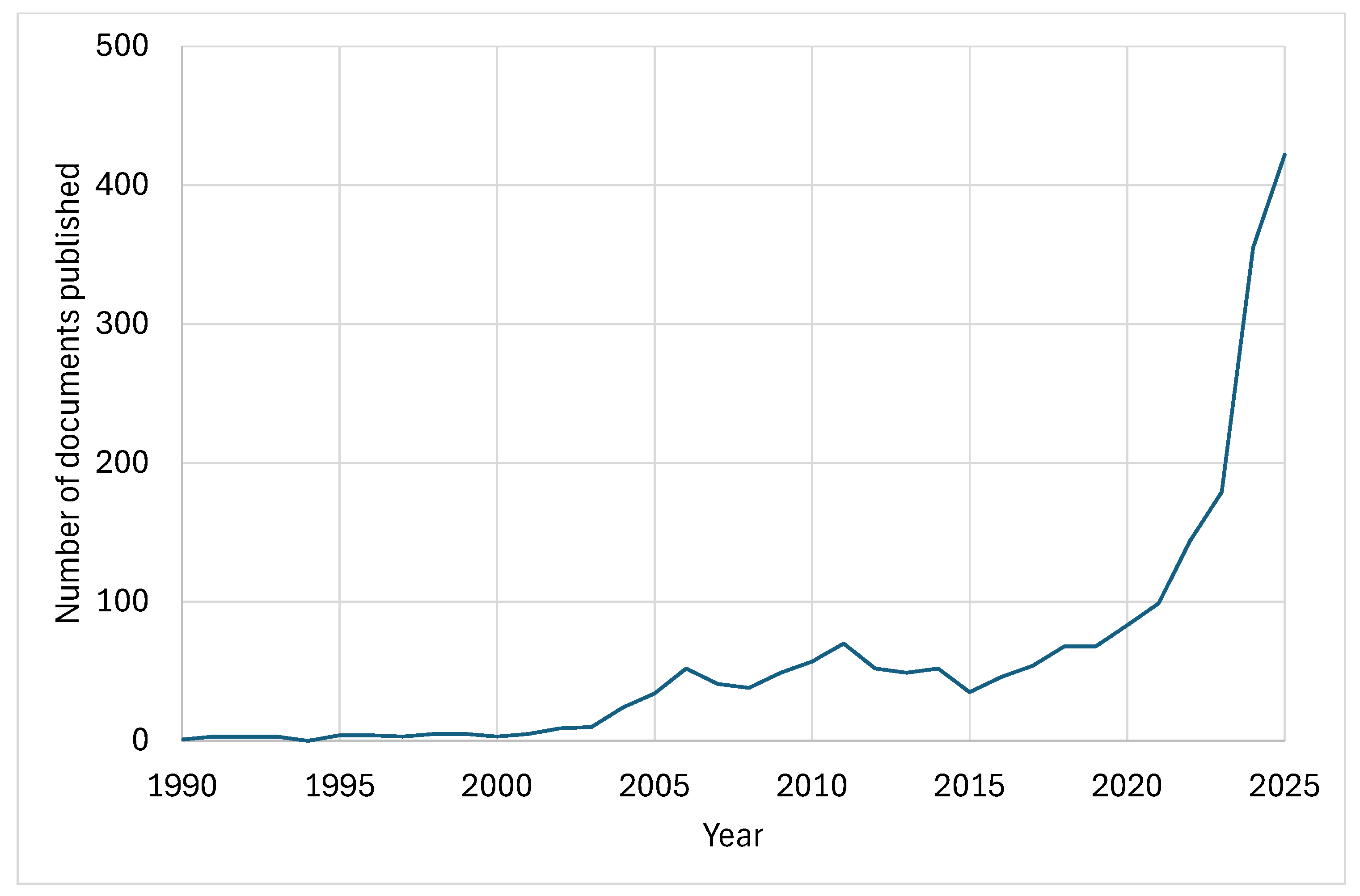
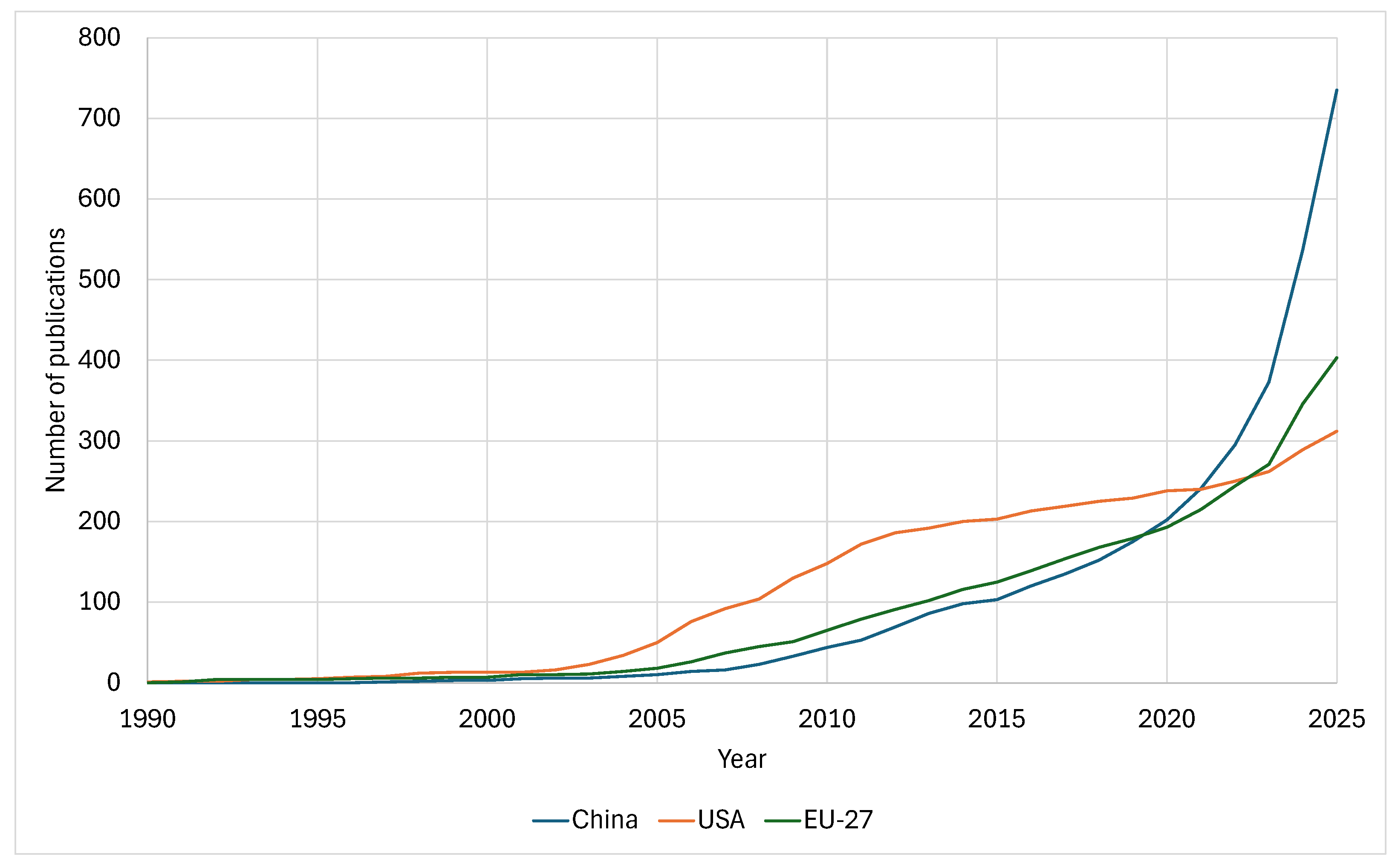
The annual number of publications per year in the field of hydrogen storage systems is shown in Figure 7 to illustrate the year-by-year evolution of the research activity in this field. As can be observed, starting in 2020, the trend increased significantly, reaching 427 publications by 2025. This growth is largely attributable to China, where scientific research on hydrogen production and storage has expanded considerably in recent years [65,66], as illustrated in Figure 8. It shows the cumulative number of publications about hydrogen storage systems for the territories with the highest publication output. This surge is mainly driven by the targets established by the Chinese government through the release of the Outline of the 14th Five-Year Plan for National Economic and Social Development and Vision 2035 of the People’s Republic of China [67] and the Medium- and Long-Term Development Plan for the Hydrogen Energy Industry (2021–2035) [67], which set out specific goals for the development and integration of hydrogen into the national energy system.
In China, the most highly cited articles on this topic focus on hydrogen storage technologies based on nanomaterials [68,69], carbon nanotubes [70,71], and high-pressure storage systems [72,73].
China is followed by the European Union Member States, with more than 400 publications projected by 2025. A marked increase has also been observed since 2020, likely driven by investment programs supporting renewable energy and hydrogen technologies, such as the European Green Deal and Horizon 2020 [74], which have contributed to the growth in scientific output. The most highly cited European papers on hydrogen storage systems focus on metal hydride-based storage technologies [75] and review articles discussing the development and prospects of various hydrogen storage approaches [76,77,78]. The United States has historically been ahead of both Europe and China in scientific developments in the field of hydrogen storage. This leadership is largely attributable to programs supported by the US Department of Energy (DOE) [79,80], which have focused on high-density hydrogen storage materials, storage systems for motor vehicles, safety, and related infrastructure. Initiatives such as the FreedomCAR & Fuel Partnership (2003–2011) [81] have significantly stimulated research and development on hydrogen storage materials, resulting in a substantial body of scientific literature. The most highly cited publications on hydrogen storage systems in the United States focus on storage technologies based on nanomaterials [82,83,84], metal–organic frameworks (MOFs) [85], and ammonia borane [86].
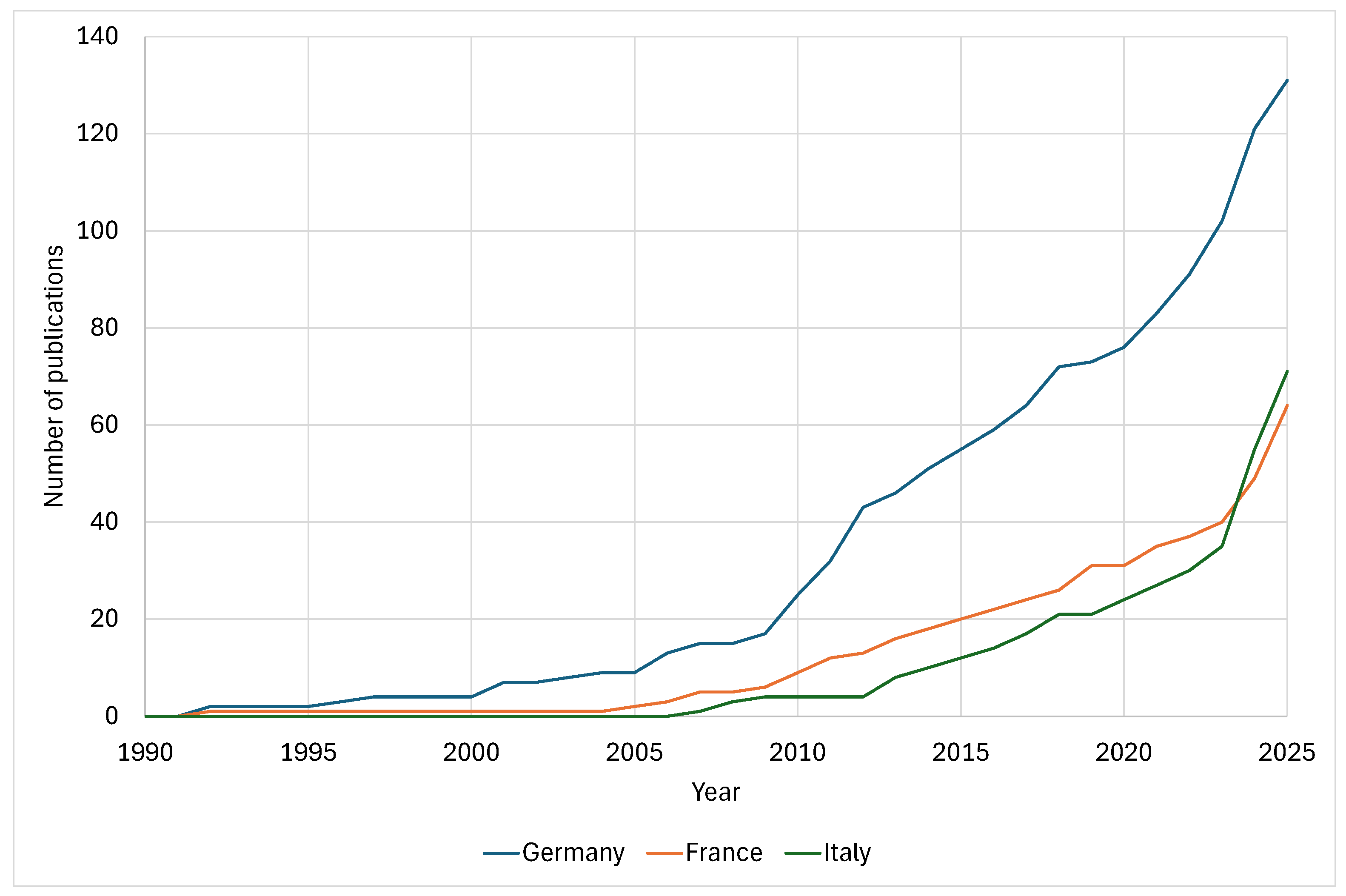
Figure 9 presents the cumulative number of publications from 1990 to 2025 for the three EU-27 countries with highest publication output on hydrogen storage systems. As of 2025, Germany leads in terms of publication output, with 131 papers published. The main research topics include hydrogen storage using metal hydrides [87], cryogenic-compatible pressure vessels [88], and chemical carriers such as bicarbonates and formats [89].
Italy follows, with studies focusing on the catalytic reduction of CO2 as a potential hydrogen storage pathway [90], review articles on the main hydrogen storage systems [91], and research on compressed hydrogen gas storage [92]. Finally, in France, the most highly cited papers mainly consist of overviews of different hydrogen storage technologies [93,94] and studies on storage systems based on nanomaterials [95].
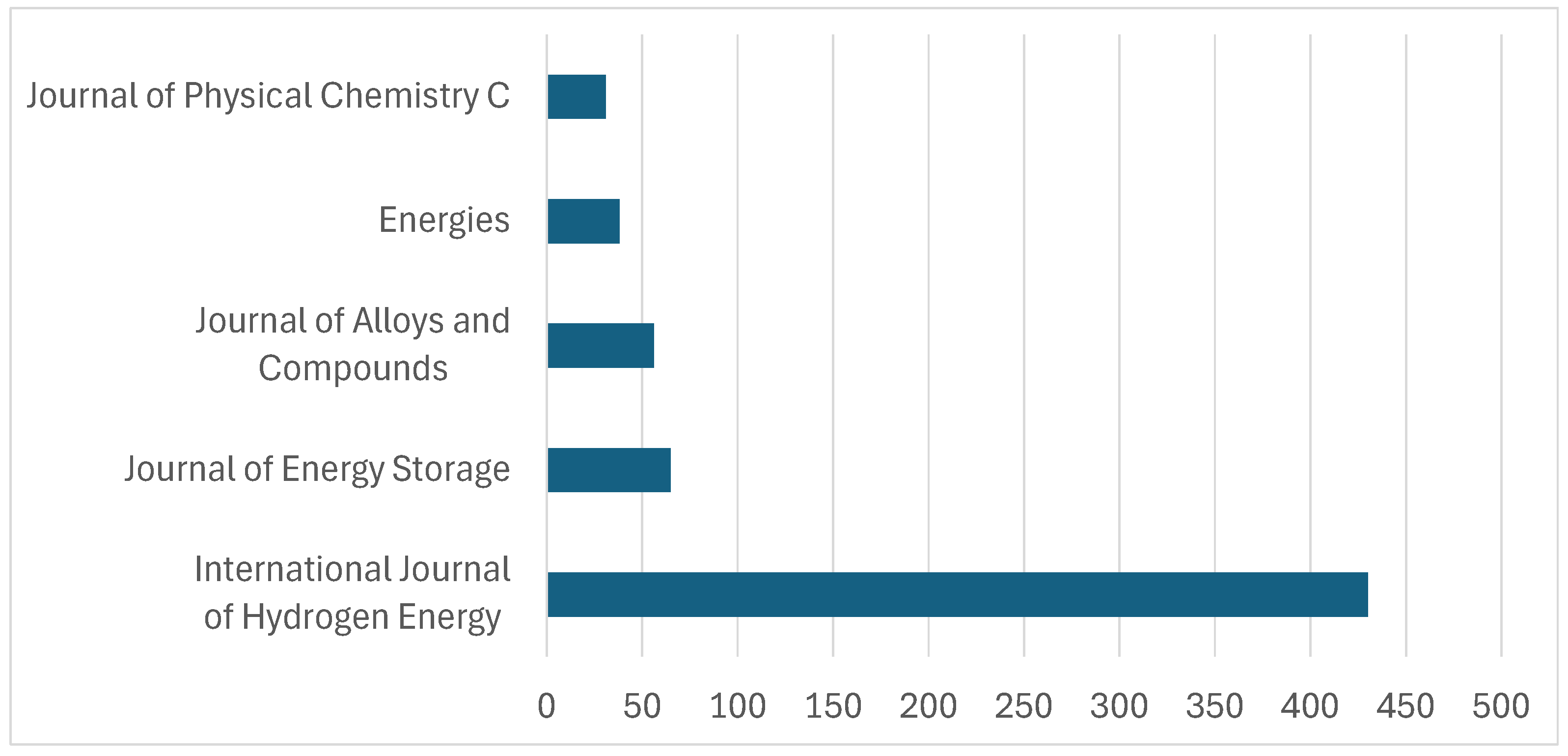
Figure 10 presents the journals with the highest number of publications in the field of hydrogen storage systems. As of 2025, the leading journal is International Journal of Hydrogen Energy, with 430 publications. The most highly cited article in this journal is by Abe et al. [96] and consists of a comprehensive review of hydrogen, its economic aspects, and potential storage systems. It is also noteworthy that Energies ranks among the top five journals, with 38 open-access publications.
Table 4 and Table 5 present the institutions and authors with the highest number of publications in the field of hydrogen storage systems, respectively. As noted in the previous section, China dominates this research area, with the largest number of highly productive institutions. The leading institutions are the Chinese Academy of Sciences and Zhejiang University, each with 66 publications. The most highly cited contributions are associated with the works of Zhang et al. [69] and Zheng et al., respectively [97].
The Université du Québec à Trois-Rivières is also noteworthy, with 36 publications. The author with the highest number of publications is Professor Takayuki Ichikawa of Hiroshima University. His research on hydrogen storage primarily focuses on hydrogen desorption reactions [98,99], as well as the synthesis and decomposition of metal amides [99] and magnesium hydrides [100].
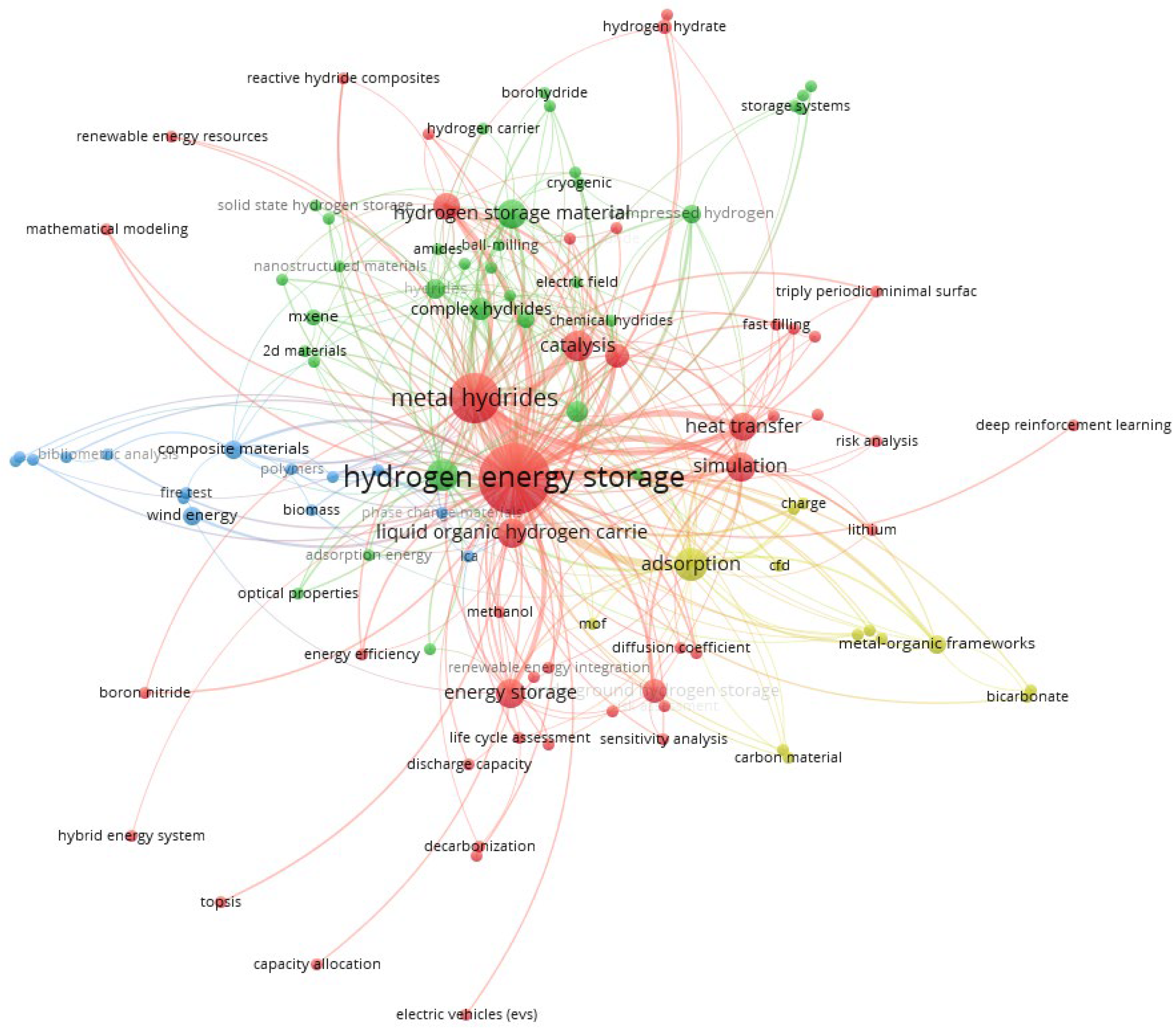
Figure 11 illustrates the network visualization of author-provided keywords derived from the query on hydrogen storage systems and processed using VOSviewer. In this analysis, a minimum occurrence threshold of four was applied. As shown in the figure, the network is organized into four distinct clusters of items.
The green cluster represents the domain of advanced materials and nanostructures. It includes keywords such as “nanostructured materials”, “borohydrides”, “2D materials”, and “complex hydrides”, indicating research focused on the development of novel high-capacity materials, nanostructured systems, and hybrid storage materials.
The yellow cluster contains keywords such as “metal–organic framework”, “carbon material”, and “adsorption”, and is therefore associated with adsorptive hydrogen storage, porous materials, specific surface area optimization, and diffusion modeling.
Finally, the blue cluster appears more peripheral and relates to systems’ integration, composite materials, and broader energy system contexts, as reflected by the keywords “composite materials”, “wind energy”, “biomass”, and “polymers”.
The red cluster represents the technological core of the domain. The dominant nodes include “hydrogen energy storage”, which acts as the central hub, as well as “hydrogen storage materials”, “metal hydrides”, and “liquid organic hydrogen carrier”. This cluster therefore encompasses research on solid-state storage materials (particularly metal hydrides); complex and composite materials; liquid organic hydrogen carriers (LOHCs); catalysis, modeling, and simulation; and heat transport in hydrogen storage systems. Consequently, it represents a strongly materials science-driven domain with a clear engineering and application-oriented focus.
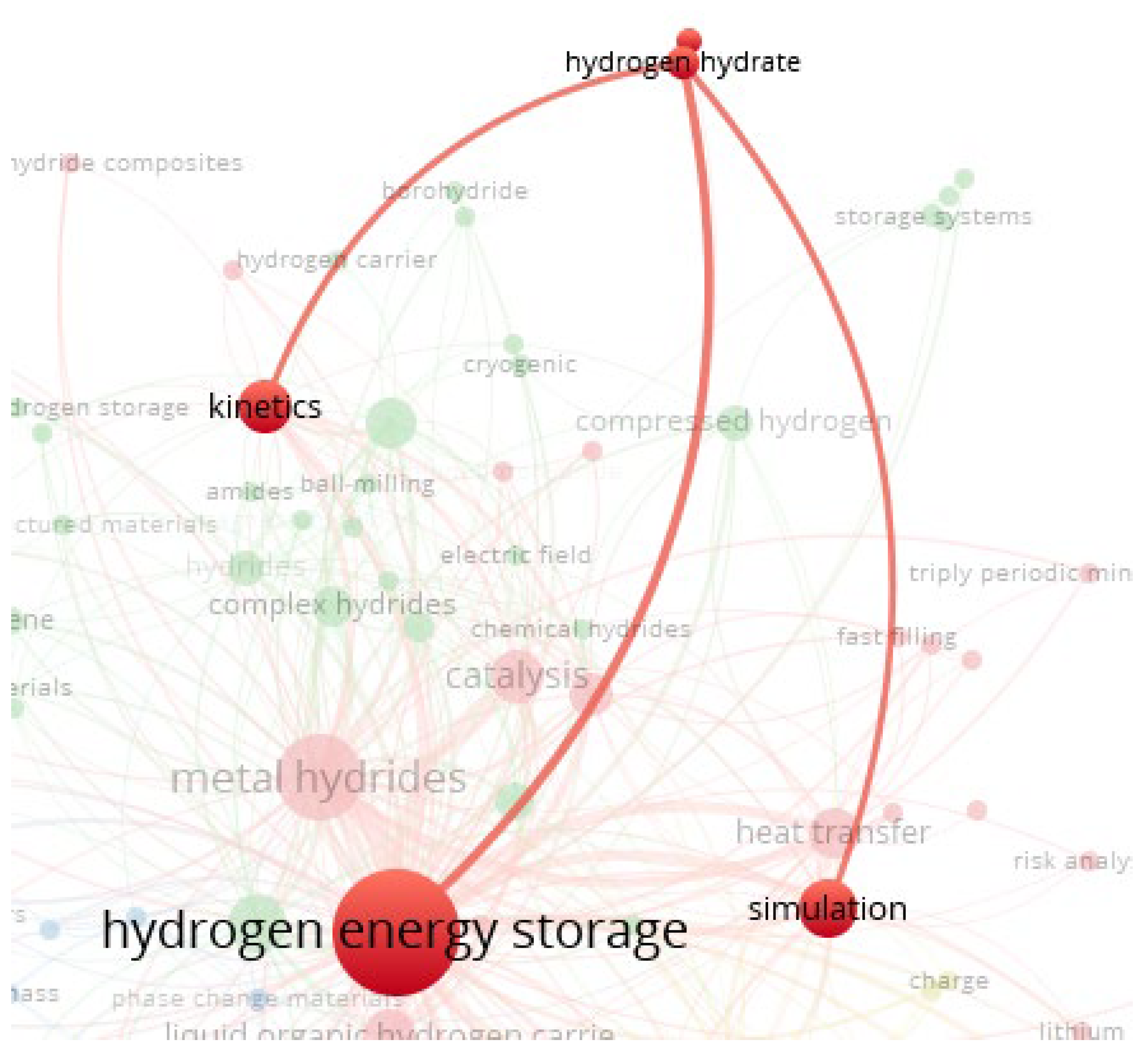
The keyword “hydrogen hydrate” (Figure 12) is particularly noteworthy among the items in the red cluster. Its presence within this cluster is significant, as it is positioned within the technological core associated with solid storage materials. The absence of this keyword from the other clusters suggests that hydrogen hydrates are not currently framed within research on frontier materials (green cluster) or adsorptive storage systems (yellow cluster). Moreover, the node associated with “hydrogen hydrate” is relatively small and peripheral, with only a limited number of connections. This pattern indicates that the volume of research in this area remains relatively limited and that a broad semantic network has not yet developed. Such characteristics are typically associated with emerging topics or highly specialized lines of research.
This interpretation is supported by the fact that the keyword has only three links within the network. The first is with “hydrogen energy storage”, indicating that studies on hydrogen hydrates are almost always discussed in the context of their potential as a hydrogen storage technology [101].
The link to “kinetics” is also particularly indicative. In the case of hydrogen hydrates, the main challenges include long nucleation times, low formation rates, and the requirement for severe pressure conditions. Consequently, much of the research focuses on their formation kinetics [102], the use of promoters [103,104], and nucleation mechanisms [105], which explains the direct connection between these keywords.
It is particularly noteworthy that no links are observed with keywords such as “porous media,” “surfactants,” “metal hydrides,” “adsorption,” or “carbon materials.” This absence of connections suggests that hydrogen hydrates have not yet been integrated into the main hydrogen storage strategies, which are currently dominated by technologies based on metal hydrides, metal–organic frameworks (MOFs), compressed hydrogen, and liquid hydrogen.

4. Conclusions

Hydrogen is a key energy carrier in the transition to renewable energy sources. However, one of its main limitations is storage, due to its low volumetric energy density under ambient conditions. This necessitates either high-pressure compression, liquefaction at cryogenic temperatures, or solid-state storage solutions, each of which presents significant technical, economic, and safety challenges.
This study provides a bibliometric assessment of research on hydrogen storage, with a specific focus on clathrate hydrates. The analysis highlights clear geographical trends, with China currently leading scientific production in gas hydrate research, while the United States and the European Union maintain strong contributions to hydrogen storage technologies. From a bibliometric perspective, gas hydrate research appears as a mature and highly interdisciplinary field, with well-established domains such as thermodynamics, natural reservoir production, and carbon capture and storage. In contrast, hydrate-based hydrogen storage emerges as a marginal and weakly connected research area. Keywords related to hydrogen hydrates remain peripheral in the co-occurrence network and show limited integration with the dominant hydrogen storage technologies, such as metal hydrides, metal–organic frameworks, and adsorption-based systems.
This lack of integration highlights a gap but also suggests a potential complementarity between hydrate-based systems and established storage technologies. In particular, hydrate-based hydrogen storage may offer alternative pathways under specific operating conditions or in combination with other storage approaches.
Based on the trends identified, several future research directions can be outlined: (i) improving the understanding of hydrogen hydrates’ formation kinetics and growth mechanisms, (ii) enhancing thermodynamic stability under practical operating conditions, (iii) developing efficient promoters and hybrid systems to increase storage capacity, (iv) investigating scalability and system-level integration for real-world applications, and (v) strengthening the connection between hydrate-based storage and mainstream hydrogen technologies.
Overall, this bibliometric analysis provides a structured overview of the current state of research and identifies key gaps and opportunities. By clarifying the position of hydrogen hydrates within the broader hydrogen storage landscape, this work offers a useful reference for guiding future research efforts in this emerging field.

Author Contributions

Conceptualization, L.B. and A.M.G.; methodology, L.B.; validation, A.M.G. and F.R.; formal analysis, L.B.; investigation, L.B., L.C. and A.M.G.; resources, F.R.; data curation, L.B.; writing—original draft preparation, L.B., A.M.G., and F.R.; writing—review and editing, L.B., L.C. and A.M.G.; visualization, L.B.; supervision, F.R.; project administration, F.R.; funding acquisition, F.R. All authors have read and agreed to the published version of the manuscript.

Funding

The authors gratefully acknowledge financial support derived by the PNRR project entitled “High Efficiency Hydrogen Storage (HEHS)”.

Data Availability Statement

All data used for this review study are already included in the text.

Acknowledgments

The authors acknowledge the technical and material contribution of AiZoOn Technology Consulting and Nippon Gases Industrial Srl.

Conflicts of Interest

The authors declare no conflicts of interest.

References

  1. Owusu, P.A.; Asumadu-Sarkodie, S. A Review of Renewable Energy Sources, Sustainability Issues and Climate Change Mitigation. Cogent Eng. 2016, 3, 1167990. [Google Scholar] [CrossRef]
  2. Hosseini, S.E.; Wahid, M.A. Hydrogen Production from Renewable and Sustainable Energy Resources: Promising Green Energy Carrier for Clean Development. Renew. Sustain. Energy Rev. 2016, 57, 850–866. [Google Scholar] [CrossRef]
  3. Cano, Z.P.; Banham, D.; Ye, S.; Hintennach, A.; Lu, J.; Fowler, M.; Chen, Z. Batteries and Fuel Cells for Emerging Electric Vehicle Markets. Nat. Energy 2018, 3, 279–289. [Google Scholar] [CrossRef]
  4. Staffell, I.; Scamman, D.; Velazquez Abad, A.; Balcombe, P.; Dodds, P.E.; Ekins, P.; Shah, N.; Ward, K.R. The Role of Hydrogen and Fuel Cells in the Global Energy System. Energy Environ. Sci. 2019, 12, 463–491. [Google Scholar] [CrossRef]
  5. Sun, Y.; Shen, C.; Lai, Q.; Liu, W.; Wang, D.-W.; Aguey-Zinsou, K.-F. Tailoring Magnesium Based Materials for Hydrogen Storage through Synthesis: Current State of the Art. Energy Storage Mater. 2018, 10, 168–198. [Google Scholar] [CrossRef]
  6. Bu, F.; Wang, Z.; Wajid, A.; Zhai, R.; Liu, T.; Li, Y.; Ji, X.; Liu, X.; Ding, S.; Cheng, Y.; et al. Solid–State Hydrogen Storage Materials with Excellent Selective Hydrogen Adsorption in the Presence of Alkanes, Oxygen, and Carbon Dioxide by Atomic Layer Amorphous Al2O3 Encapsulation. Nano-Micro Lett. 2026, 18, 78. [Google Scholar] [CrossRef]
  7. Gambelli, A.M.; Rossi, F.; Cotana, F. Gas Hydrates as High-Efficiency Storage System: Perspectives and Potentialities. Energies 2022, 15, 8728. [Google Scholar] [CrossRef]
  8. Sloan, E.D.; Koh, C.A. Clathrate Hydrates of Natural Gases; CRC Press: Boca Raton, FL, USA, 2008; ISBN 0849390788. [Google Scholar]
  9. Veluswamy, H.P.; Kumar, R.; Linga, P. Hydrogen Storage in Clathrate Hydrates: Current State of the Art and Future Directions. Appl. Energy 2014, 122, 112–132. [Google Scholar] [CrossRef]
  10. Makogon, Y.F. Natural Gas Hydrates—A Promising Source of Energy. J. Nat. Gas Sci. Eng. 2010, 2, 49–59. [Google Scholar] [CrossRef]
  11. Sloan, E.D. Fundamental Principles and Applications of Natural Gas Hydrates. Nature 2003, 426, 353–359. [Google Scholar] [CrossRef]
  12. Boswell, R.; Collett, T.S. Current Perspectives on Gas Hydrate Resources. Energy Environ. Sci. 2011, 4, 1206–1215. [Google Scholar] [CrossRef]
  13. Aminu, M.D.; Nabavi, S.A.; Rochelle, C.A.; Manovic, V. A Review of Developments in Carbon Dioxide Storage. Appl. Energy 2017, 208, 1389–1419. [Google Scholar] [CrossRef]
  14. Linnenluecke, M.K.; Marrone, M.; Singh, A.K. Conducting Systematic Literature Reviews and Bibliometric Analyses. Aust. J. Manag. 2020, 45, 175–194. [Google Scholar] [CrossRef]
  15. Cabeza, L.F.; Chàfer, M.; Mata, É. Comparative Analysis of Web of Science and Scopus on the Energy Efficiency and Climate Impact of Buildings. Energies 2020, 13, 409. [Google Scholar] [CrossRef]
  16. Moral-Muñoz, J.A.; Herrera-Viedma, E.; Santisteban-Espejo, A.; Cobo, M.J. Software Tools for Conducting Bibliometric Analysis in Science: An up-to-Date Review. Prof. Inf. 2020, 29, 4. [Google Scholar] [CrossRef]
  17. van Eck, N.J.; Waltman, L. Citation-Based Clustering of Publications Using CitNetExplorer and VOSviewer. Scientometrics 2017, 111, 1053–1070. [Google Scholar] [CrossRef]
  18. Agyekum, E.B.; Nutakor, C.; Khan, T.; Adegboye, O.R.; Odoi-Yorke, F.; Okonkwo, P.C. Analyzing the Research Trends in the Direction of Hydrogen Storage—A Look into the Past, Present and Future for the Various Technologies. Int. J. Hydrogen Energy 2024, 74, 259–275. [Google Scholar] [CrossRef]
  19. Osman, S.H.; Mat Yatim, N.S.; Jehan Elham, O.S.; Shaari, N.; Zakaria, Z. Three Decades of Hydrogen Energy Research: A Bibliometric Analysis on the Evolution of Green Hydrogen Technologies. Sustain. Energy Fuels 2025, 9, 3182–3202. [Google Scholar] [CrossRef]
  20. Huang, L.; Hou, Z.; Fang, Y.; Luo, J.; Wu, L.; Wang, Q.; Guo, Y.; Zhang, X.; Shi, T.; Liu, J. The Development, Frontier and Prospect of Large-Scale Underground Energy Storage: A Bibliometric Review. J. Energy Storage 2024, 103, 114293. [Google Scholar] [CrossRef]
  21. Atta, M.R.; Al-Mahmodi, A.F.; Lal, B.; Abdulrab, H.; Khor, S.F. Artificial Intelligence and Machine Learning in Thermodynamic Gas Hydrate Studies: A Review. Energy Fuels 2025, 39, 18287–18310. [Google Scholar] [CrossRef]
  22. Xu, J.; Tang, M.; Liu, T.; Fan, L. Technological Paradigm-Based Development Strategy towards Natural Gas Hydrate Technology. Energy 2024, 289, 129956. [Google Scholar] [CrossRef]
  23. Borri, E.; Hua, N.; Sciacovelli, A.; Wu, D.; Ding, Y.; Li, Y.; Brancato, V.; Zhang, Y.; Frazzica, A.; Li, W.; et al. Phase Change Slurries for Cooling and Storage: An Overview of Research Trends and Gaps. Energies 2022, 15, 6873. [Google Scholar] [CrossRef]
  24. Li, J.; Ye, J.; Qin, X.; Qiu, H.; Wu, N.; Lu, H.; Xie, W.; Lu, J.; Peng, F.; Xu, Z.; et al. The First Offshore Natural Gas Hydrate Production Test in South China Sea. China Geol. 2018, 1, 5–16. [Google Scholar] [CrossRef]
  25. Yu, T.; Guan, G.; Wang, D.; Song, Y.; Abudula, A. Numerical Investigation on the Long-Term Gas Production Behavior at the 2017 Shenhu Methane Hydrate Production Site. Appl. Energy 2021, 285, 116466. [Google Scholar] [CrossRef]
  26. Bai, D.; Zhang, X.; Chen, G.; Wang, W. Replacement Mechanism of Methane Hydrate with Carbon Dioxide from Microsecond Molecular Dynamics Simulations. Energy Environ. Sci. 2012, 5, 7033. [Google Scholar] [CrossRef]
  27. Zhang, L.; Yang, L.; Wang, J.; Zhao, J.; Dong, H.; Yang, M.; Liu, Y.; Song, Y. Enhanced CH4 Recovery and CO2 Storage via Thermal Stimulation in the CH4/CO2 Replacement of Methane Hydrate. Chem. Eng. J. 2017, 308, 40–49. [Google Scholar] [CrossRef]
  28. Yu, Y.-S.; Zhang, X.; Liu, J.-W.; Lee, Y.; Li, X.-S. Natural Gas Hydrate Resources and Hydrate Technologies: A Review and Analysis of the Associated Energy and Global Warming Challenges. Energy Environ. Sci. 2021, 14, 5611–5668. [Google Scholar] [CrossRef]
  29. He, Y.; Sun, M.-T.; Chen, C.; Zhang, G.-D.; Chao, K.; Lin, Y.; Wang, F. Surfactant-Based Promotion to Gas Hydrate Formation for Energy Storage. J. Mater. Chem. A Mater. 2019, 7, 21634–21661. [Google Scholar] [CrossRef]
  30. Sun, Z.; Wang, R.; Ma, R.; Guo, K.; Fan, S. Natural Gas Storage in Hydrates with the Presence of Promoters. Energy Convers. Manag. 2003, 44, 2733–2742. [Google Scholar] [CrossRef]
  31. Yuan, Q.; Sun, C.-Y.; Yang, X.; Ma, P.-C.; Ma, Z.-W.; Liu, B.; Ma, Q.-L.; Yang, L.-Y.; Chen, G.-J. Recovery of Methane from Hydrate Reservoir with Gaseous Carbon Dioxide Using a Three-Dimensional Middle-Size Reactor. Energy 2012, 40, 47–58. [Google Scholar] [CrossRef]
  32. Zhong, Y.; Rogers, R.E. Surfactant Effects on Gas Hydrate Formation. Chem. Eng. Sci. 2000, 55, 4175–4187. [Google Scholar] [CrossRef]
  33. Koh, C.A.; Sloan, E.D.; Sum, A.K.; Wu, D.T. Fundamentals and Applications of Gas Hydrates. Annu. Rev. Chem. Biomol. Eng. 2011, 2, 237–257. [Google Scholar] [CrossRef]
  34. Kumar, A.; Maini, B.; Bishnoi, P.R.; Clarke, M.; Zatsepina, O.; Srinivasan, S. Experimental Determination of Permeability in the Presence of Hydrates and Its Effect on the Dissociation Characteristics of Gas Hydrates in Porous Media. J. Pet. Sci. Eng. 2010, 70, 114–122. [Google Scholar] [CrossRef]
  35. Goel, N. In Situ Methane Hydrate Dissociation with Carbon Dioxide Sequestration: Current Knowledge and Issues. J. Pet. Sci. Eng. 2006, 51, 169–184. [Google Scholar] [CrossRef]
  36. Veluswamy, H.P.; Wong, A.J.H.; Babu, P.; Kumar, R.; Kulprathipanja, S.; Rangsunvigit, P.; Linga, P. Rapid Methane Hydrate Formation to Develop a Cost Effective Large Scale Energy Storage System. Chem. Eng. J. 2016, 290, 161–173. [Google Scholar] [CrossRef]
  37. Khokhar, A.A.; Gudmundsson, J.S.; Sloan, E.D. Gas Storage in Structure H Hydrates. Fluid Phase Equilib. 1998, 150–151, 383–392. [Google Scholar] [CrossRef]
  38. National Academies. Charting the Future of Methane Hydrate Research in the United States; The National Academies Press: Washington, DC, USA, 2000. [Google Scholar]
  39. English, N.J.; MacElroy, J.M.D. Perspectives on Molecular Simulation of Clathrate Hydrates: Progress, Prospects and Challenges. Chem. Eng. Sci. 2015, 121, 133–156. [Google Scholar] [CrossRef]
  40. Chatti, I.; Delahaye, A.; Fournaison, L.; Petitet, J.-P. Benefits and Drawbacks of Clathrate Hydrates: A Review of Their Areas of Interest. Energy Convers. Manag. 2005, 46, 1333–1343. [Google Scholar] [CrossRef]
  41. Kumar, K.V.; Preuss, K.; Titirici, M.-M.; Rodríguez-Reinoso, F. Nanoporous Materials for the Onboard Storage of Natural Gas. Chem. Rev. 2017, 117, 1796–1825. [Google Scholar] [CrossRef]
  42. Mekala, P.; Busch, M.; Mech, D.; Patel, R.S.; Sangwai, J.S. Effect of Silica Sand Size on the Formation Kinetics of CO2 Hydrate in Porous Media in the Presence of Pure Water and Seawater Relevant for CO2 Sequestration. J. Pet. Sci. Eng. 2014, 122, 1–9. [Google Scholar] [CrossRef]
  43. Nasir, Q.; Suleman, H.; Elsheikh, Y.A. A Review on the Role and Impact of Various Additives as Promoters/Inhibitors for Gas Hydrate Formation. J. Nat. Gas Sci. Eng. 2020, 76, 103211. [Google Scholar] [CrossRef]
  44. Yang, L.; Falenty, A.; Chaouachi, M.; Haberthür, D.; Kuhs, W.F. Synchrotron X-Ray Computed Microtomography Study on Gas Hydrate Decomposition in a Sedimentary Matrix. Geochem. Geophys. Geosystems 2016, 17, 3717–3732. [Google Scholar] [CrossRef]
  45. Schicks, J.M.; Spangenberg, E.; Giese, R.; Steinhauer, B.; Klump, J.; Luzi, M. New Approaches for the Production of Hydrocarbons from Hydrate Bearing Sediments. Energies 2011, 4, 151–172. [Google Scholar] [CrossRef]
  46. Luo, J.; Xie, Y.; Hou, M.Z.; Xiong, Y.; Wu, X.; Lüddeke, C.T.; Huang, L. Advances in Subsea Carbon Dioxide Utilization and Storage. Energy Rev. 2023, 2, 100016. [Google Scholar] [CrossRef]
  47. Rossi, F.; Gambelli, A.M.; Sharma, D.K.; Castellani, B.; Nicolini, A.; Castaldi, M.J. Experiments on Methane Hydrates Formation in Seabed Deposits and Gas Recovery Adopting Carbon Dioxide Replacement Strategies. Appl. Therm. Eng. 2019, 148, 371–381. [Google Scholar] [CrossRef]
  48. Gambelli, A.M.; Rossi, F. Natural Gas Hydrates: Comparison between Two Different Applications of Thermal Stimulation for Performing CO2 Replacement. Energy 2019, 172, 423–434. [Google Scholar] [CrossRef]
  49. Gambelli, A.M.; Castellani, B.; Nicolini, A.; Rossi, F. Experimental Study on Natural Gas Hydrate Exploitation: Optimization of Methane Recovery, Carbon Dioxide Storage and Deposit Structure Preservation. J. Pet. Sci. Eng. 2019, 177, 594–601. [Google Scholar] [CrossRef]
  50. Li, Y.; Gambelli, A.M.; Rossi, F. Experimental study on the effect of SDS and micron copper particles mixture on carbon dioxide hydrates formation. Energies 2022, 15, 6540. [Google Scholar] [CrossRef]
  51. Cannone, S.F.; Lanzini, A.; Santarelli, M. A Review on CO2 Capture Technologies with Focus on CO2-Enhanced Methane Recovery from Hydrates. Energies 2021, 14, 387. [Google Scholar] [CrossRef]
  52. Sun, X.; Luo, T.; Wang, L.; Wang, H.; Song, Y.; Li, Y. Numerical Simulation of Gas Recovery from a Low-Permeability Hydrate Reservoir by Depressurization. Appl. Energy 2019, 250, 7–18. [Google Scholar] [CrossRef]
  53. Wu, P.; Li, Y.; Sun, X.; Liu, W.; Song, Y. Mechanical Characteristics of Hydrate-Bearing Sediment: A Review. Energy Fuels 2021, 35, 1041–1057. [Google Scholar] [CrossRef]
  54. Wang, B.; Fan, Z.; Wang, P.; Liu, Y.; Zhao, J.; Song, Y. Analysis of Depressurization Mode on Gas Recovery from Methane Hydrate Deposits and the Concomitant Ice Generation. Appl. Energy 2018, 227, 624–633. [Google Scholar] [CrossRef]
  55. Lang, X.; Fan, S.; Wang, Y. Intensification of Methane and Hydrogen Storage in Clathrate Hydrate and Future Prospect. J. Nat. Gas Chem. 2010, 19, 203–209. [Google Scholar] [CrossRef]
  56. Bhattacharjee, G.; Veluswamy, H.P.; Kumar, A.; Linga, P. Stability Analysis of Methane Hydrates for Gas Storage Application. Chem. Eng. J. 2021, 415, 128927. [Google Scholar] [CrossRef]
  57. Hashimoto, S.; Murayama, S.; Sugahara, T.; Sato, H.; Ohgaki, K. Thermodynamic and Raman Spectroscopic Studies on Tetra-n-Butyl Ammonium Mixtures Containing Gas Hydrates. Chem. Eng. Sci. 2006, 61, 7884–7888. [Google Scholar] [CrossRef]
  58. Hashimoto, S.; Sugahara, T.; Moritoki, M.; Sato, H.; Ohgaki, K. Thermodynamic Stability of Hydrogen Tetra-n-Butyl Ammonium Bromide Mixed Gas Hydrate in Nonstoichiometric Aqueous Solutions. Chem. Eng. Sci. 2008, 63, 1092–1097. [Google Scholar] [CrossRef]
  59. Park, S.; Lee, S.; Lee, Y.; Seo, Y. CO2 Capture from Simulated Fuel Gas Mixtures Using Semiclathrate Hydrates Formed by Quaternary Ammonium Salts. Environ. Sci. Technol. 2013, 47, 7571–7577. [Google Scholar] [CrossRef]
  60. Adeyemo, A.; Kumar, R.; Linga, P.; Ripmeester, J.; Englezos, P. Capture of Carbon Dioxide from Flue or Fuel Gas Mixtures by Clathrate Crystallization in a Silica Gel Column. Int. J. Greenh. Gas Control 2010, 4, 478–485. [Google Scholar] [CrossRef]
  61. Wang, Y.; Chen, S.; Li, X.; Lang, X.; Li, G.; Fan, S. Hydrate Phase Equilibrium of Hydrogen with THP, DCM, TBAB+THF and Sulfur Hexafluoride +TBAB Aqueous Solution Systems. Fluid Phase Equilib. 2025, 590, 114282. [Google Scholar] [CrossRef]
  62. Fan, Z.; Wang, Y.; Lang, X.; Li, G.; Dong, X.; Fan, S. High-Capacity and Rapid Hydrogen Storage in 1,3-Dioxolane-H2 Hydrate via Pre-Wetted Bamboo Charcoal. Int. J. Hydrogen Energy 2026, 219, 154003. [Google Scholar] [CrossRef]
  63. Chen, S.; Li, X.; Wang, Y.; Fan, S.; Lang, X.; Lu, H.; Li, G. Efficient Hydrogen Storage in Hydrate Solid Solution: Structural Insights and Performance. Int. J. Hydrogen Energy 2026, 204, 153331. [Google Scholar] [CrossRef]
  64. Chen, G.; Liang, D.; Kang, Z.; Fan, J.; Fan, S.; Zhou, X. Review of Hydrogen Storage in Solid-State Materials. Energies 2025, 18, 2930. [Google Scholar] [CrossRef]
  65. Zhang, G.; Jiang, Z. Overview of Hydrogen Storage and Transportation Technology in China. Unconv. Resour. 2023, 3, 291–296. [Google Scholar] [CrossRef]
  66. Hua, Z.; Gao, W.; Chi, S.; Wang, X.; Zheng, J. Development Status and Challenges of High-Pressure Gaseous Hydrogen Storage Vessels and Cylinders in China. Renew. Sustain. Energy Rev. 2025, 214, 115567. [Google Scholar] [CrossRef]
  67. Liu, Q. Prospects for China’s Economic Development During the 14th Five-Year Plan Period. In Annual Report on China’s Petroleum, Gas and New Energy Industry; Springer: Singapore, 2022; pp. 3–24. [Google Scholar]
  68. Yu, X.; Tang, Z.; Sun, D.; Ouyang, L.; Zhu, M. Recent Advances and Remaining Challenges of Nanostructured Materials for Hydrogen Storage Applications. Prog. Mater. Sci. 2017, 88, 1–48. [Google Scholar] [CrossRef]
  69. Zhang, Q.; Uchaker, E.; Candelaria, S.L.; Cao, G. Nanomaterials for Energy Conversion and Storage. Chem. Soc. Rev. 2013, 42, 3127. [Google Scholar] [CrossRef]
  70. Liu, C.; Chen, Y.; Wu, C.-Z.; Xu, S.-T.; Cheng, H.-M. Hydrogen Storage in Carbon Nanotubes Revisited. Carbon 2010, 48, 452–455. [Google Scholar] [CrossRef]
  71. Ma, R.; Bando, Y.; Zhu, H.; Sato, T.; Xu, C.; Wu, D. Hydrogen Uptake in Boron Nitride Nanotubes at Room Temperature. J. Am. Chem. Soc. 2002, 124, 7672–7673. [Google Scholar] [CrossRef]
  72. Zhou, L. Progress and Problems in Hydrogen Storage Methods. Renew. Sustain. Energy Rev. 2005, 9, 395–408. [Google Scholar] [CrossRef]
  73. Yanxing, Z.; Maoqiong, G.; Yuan, Z.; Xueqiang, D.; Jun, S. Thermodynamics Analysis of Hydrogen Storage Based on Compressed Gaseous Hydrogen, Liquid Hydrogen and Cryo-Compressed Hydrogen. Int. J. Hydrogen Energy 2019, 44, 16833–16840. [Google Scholar] [CrossRef]
  74. Horizon 2020, The EU Framework Programme for Research and Innovation. Available online: https://research-and-innovation.ec.europa.eu/funding/funding-opportunities/funding-programmes-and-open-calls/horizon-2020_en (accessed on 2 April 2024).
  75. Bogdanović, B.; Schwickardi, M. Ti-Doped Alkali Metal Aluminium Hydrides as Potential Novel Reversible Hydrogen Storage Materials. J. Alloys Compd. 1997, 253–254, 1–9. [Google Scholar] [CrossRef]
  76. Barthelemy, H.; Weber, M.; Barbier, F. Hydrogen Storage: Recent Improvements and Industrial Perspectives. Int. J. Hydrogen Energy 2017, 42, 7254–7262. [Google Scholar] [CrossRef]
  77. Hassan, I.A.; Ramadan, H.S.; Saleh, M.A.; Hissel, D. Hydrogen Storage Technologies for Stationary and Mobile Applications: Review, Analysis and Perspectives. Renew. Sustain. Energy Rev. 2021, 149, 111311. [Google Scholar] [CrossRef]
  78. Gambelli, A.M.; Rossi, F. Review on the usage of small-chain hydrocarbons (C2–C4) as aid gases for improving the efficiency of hydrate-based techniques. Energies 2023, 16, 3576. [Google Scholar] [CrossRef]
  79. Satyapal, S.; Petrovic, J.; Read, C.; Thomas, G.; Ordaz, G. The U.S. Department of Energy’s National Hydrogen Storage Project: Progress towards Meeting Hydrogen-Powered Vehicle Requirements. Catal. Today 2007, 120, 246–256. [Google Scholar] [CrossRef]
  80. Thomas, G. Overview of Storage Development DOE Hydrogen Program. In Proceedings of the U.S. DOE Hydrogen Program 2000 Annual Review, San Ramon, CA, USA, 9–11 May 2000. [Google Scholar]
  81. FreedomCAR and Fuel Partnership Plan—March 2006. Available online: https://www1.eere.energy.gov/vehiclesandfuels/pdfs/program/fc_fuel_partnership_plan.pdf (accessed on 5 March 2026).
  82. Chambers, A.; Park, C.; Baker, R.T.K.; Rodriguez, N.M. Hydrogen Storage in Graphite Nanofibers. J. Phys. Chem. B 1998, 102, 4253–4256. [Google Scholar] [CrossRef]
  83. Bérubé, V.; Radtke, G.; Dresselhaus, M.; Chen, G. Size Effects on the Hydrogen Storage Properties of Nanostructured Metal Hydrides: A Review. Int. J. Energy Res. 2007, 31, 637–663. [Google Scholar] [CrossRef]
  84. Yürüm, Y.; Taralp, A.; Veziroglu, T.N. Storage of Hydrogen in Nanostructured Carbon Materials. Int. J. Hydrogen Energy 2009, 34, 3784–3798. [Google Scholar] [CrossRef]
  85. Collins, D.J.; Zhou, H.-C. Hydrogen Storage in Metal–Organic Frameworks. J. Mater. Chem. 2007, 17, 3154. [Google Scholar] [CrossRef]
  86. Bluhm, M.E.; Bradley, M.G.; Butterick, R.; Kusari, U.; Sneddon, L.G. Amineborane-Based Chemical Hydrogen Storage: Enhanced Ammonia Borane Dehydrogenation in Ionic Liquids. J. Am. Chem. Soc. 2006, 128, 7748–7749. [Google Scholar] [CrossRef]
  87. Skripnyuk, V.M.; Rabkin, E.; Estrin, Y.; Lapovok, R. The Effect of Ball Milling and Equal Channel Angular Pressing on the Hydrogen Absorption/Desorption Properties of Mg–4.95 Wt% Zn–0.71 Wt% Zr (ZK60) Alloy. Acta Mater. 2004, 52, 405–414. [Google Scholar] [CrossRef]
  88. Aceves, S.M.; Espinosa-Loza, F.; Ledesma-Orozco, E.; Ross, T.O.; Weisberg, A.H.; Brunner, T.C.; Kircher, O. High-Density Automotive Hydrogen Storage with Cryogenic Capable Pressure Vessels. Int. J. Hydrogen Energy 2010, 35, 1219–1226. [Google Scholar] [CrossRef]
  89. Boddien, A.; Gärtner, F.; Federsel, C.; Sponholz, P.; Mellmann, D.; Jackstell, R.; Junge, H.; Beller, M. CO2—“Neutral” Hydrogen Storage Based on Bicarbonates and Formates. Angew. Chem. Int. Ed. 2011, 50, 6411–6414. [Google Scholar] [CrossRef]
  90. Bertini, F.; Glatz, M.; Gorgas, N.; Stöger, B.; Peruzzini, M.; Veiros, L.F.; Kirchner, K.; Gonsalvi, L. Carbon Dioxide Hydrogenation Catalysed by Well-Defined Mn(i) PNP Pincer Hydride Complexes. Chem. Sci. 2017, 8, 5024–5029. [Google Scholar] [CrossRef] [PubMed]
  91. Magliano, A.; Perez Carrera, C.; Pappalardo, C.M.; Guida, D.; Berardi, V.P. A Comprehensive Literature Review on Hydrogen Tanks: Storage, Safety, and Structural Integrity. Appl. Sci. 2024, 14, 9348. [Google Scholar] [CrossRef]
  92. Franco, A.; Giovannini, C. Hydrogen Gas Compression for Efficient Storage: Balancing Energy and Increasing Density. Hydrogen 2024, 5, 293–311. [Google Scholar] [CrossRef]
  93. D’Ambra, F.; Gébel, G. Literature Review: State-of-the-Art Hydrogen Storage Technologies and Liquid Organic Hydrogen Carrier (LOHC) Development. Sci. Technol. Energy Transit. 2023, 78, 32. [Google Scholar] [CrossRef]
  94. Altaf, M.; Demirci, U.B.; Haldar, A.K. Review of Solid-State Hydrogen Storage: Materials Categorisation, Recent Developments, Challenges and Industrial Perspectives. Energy Rep. 2025, 13, 5746–5772. [Google Scholar] [CrossRef]
  95. Yin, L.-W.; Bando, Y.; Golberg, D.; Gloter, A.; Li, M.-S.; Yuan, X.; Sekiguchi, T. Porous BCN Nanotubular Fibers: Growth and Spatially Resolved Cathodoluminescence. J. Am. Chem. Soc. 2005, 127, 16354–16355. [Google Scholar] [CrossRef]
  96. Abe, J.O.; Popoola, A.P.I.; Ajenifuja, E.; Popoola, O.M. Hydrogen Energy, Economy and Storage: Review and Recommendation. Int. J. Hydrogen Energy 2019, 44, 15072–15086. [Google Scholar] [CrossRef]
  97. Zheng, J.; Liu, X.; Xu, P.; Liu, P.; Zhao, Y.; Yang, J. Development of High Pressure Gaseous Hydrogen Storage Technologies. Int. J. Hydrogen Energy 2012, 37, 1048–1057. [Google Scholar] [CrossRef]
  98. Ichikawa, T.; Hanada, N.; Isobe, S.; Leng, H.; Fujii, H. Mechanism of Novel Reaction from LiNH2 and LiH to Li2NH and H2 as a Promising Hydrogen Storage System. J. Phys. Chem. B 2004, 108, 7887–7892. [Google Scholar] [CrossRef]
  99. Leng, H.Y.; Ichikawa, T.; Hino, S.; Hanada, N.; Isobe, S.; Fujii, H. Synthesis and Decomposition Reactions of Metal Amides in Metal–N–H Hydrogen Storage System. J. Power Sources 2006, 156, 166–170. [Google Scholar] [CrossRef]
  100. Jain, A.; Agarwal, S.; Kumar, S.; Yamaguchi, S.; Miyaoka, H.; Kojima, Y.; Ichikawa, T. How Does TiF4 Affect the Decomposition of MgH2 and Its Complex Variants?—An XPS Investigation. J. Mater. Chem. A Mater. 2017, 5, 15543–15551. [Google Scholar] [CrossRef]
  101. Yu, C.; Fan, S.; Lang, X.; Wang, Y.; Li, G.; Wang, S. Hydrogen and Chemical Energy Storage in Gas Hydrate at Mild Conditions. Int. J. Hydrogen Energy 2020, 45, 14915–14921. [Google Scholar] [CrossRef]
  102. Lang, X.; Zheng, C.; Fan, S.; Wang, Y.; Li, G.; Wang, S.; Yu, C. “Similar Self-Preservation” and Decomposition Kinetics of Tetrahydrofuran-Hydrogen Hydrate Particles. Int. J. Hydrogen Energy 2022, 47, 8457–8466. [Google Scholar] [CrossRef]
  103. Guo, Y.; Wu, W.; Hao, B.; Zheng, Q. Formation of Hydrogen Hydrate in the Presence of Thermodynamic Promoters: A Review and Prospects. Int. J. Hydrogen Energy 2024, 60, 1462–1480. [Google Scholar] [CrossRef]
  104. Xu, J.; Yang, X.; Chen, J.; Meng, Z.; Wang, X.; Wang, B.; Wang, J.; Wang, Y.; Qu, J.; Qi, Y.; et al. Molecular Study on the Growth Mechanism of CO2-H2 Binary Hydrate Promoted by Electric Field. Fuel 2024, 363, 130924. [Google Scholar] [CrossRef]
  105. Liu, X.; Liu, Z.; Wei, N.; Li, K.; Dou, B.; Yang, M.; Song, Y. Molecular Dynamics Simulation on Hydrate-Based Hydrogen Storage: A Review from the Perspective of Hydrate Nucleation and Growth. Appl. Energy 2025, 396, 126346. [Google Scholar] [CrossRef]
Figure 1. Number of papers published per year on clathrate hydrates.
Energies 19 02038 g001
Figure 2. Number of publications over the years on clathrate hydrates as gas storage systems registered in the three most productive areas (China, USA, EU-27).
Energies 19 02038 g002
Figure 3. Number of publications over the years on clathrate hydrates as gas storage systems for the three most productive EU-27 countries, namely Germany, Italy, and France.
Energies 19 02038 g003
Figure 4. Main journals reporting studies on clathrate hydrates as gas storage systems, selected and ordered per number of publications.
Energies 19 02038 g004
Figure 5. Network visualization of author keywords on “clathrate hydrates as gas storage systems”, elaborated with VOSviewer.
Energies 19 02038 g005
Figure 6. Co-occurrence and links concerning the keywords (a) “hydrogen storage”, (b) “hydrogen hydrate”, and (c) “hydrogen”.
Energies 19 02038 g006aEnergies 19 02038 g006b
Figure 7. Number of papers published per year on hydrogen storage systems.
Energies 19 02038 g007
Figure 8. Number of publications over the years on hydrogen storage systems for China, the USA, and EU-27.
Energies 19 02038 g008
Figure 9. Number of publications over the years on hydrogen storage systems for the three most productive EU-27 countries.
Energies 19 02038 g009
Figure 10. Main journals reporting studies on hydrogen storage systems, selected and ordered per number of publications.
Energies 19 02038 g010
Figure 11. Network visualization of author-provided keywords on “hydrogen storage systems” elaborated with VOSviewer.
Energies 19 02038 g011
Figure 12. Zoomed image highlighting the co-occurrence and links concerning the keyword “hydrogen hydrate”.
Energies 19 02038 g012
Table 1. List of queries used for the Scopus database (last accessed 26 February 2026).
TopicQuery
Clathrate hydrates as gas storage systems(“clathrate hydrat*” OR “gas hydrat*”) AND (“gas storage” OR “gas recovery” OR “sequestration” OR “replacement” OR “exchange”) AND NOT (“cretaceous”)
Hydrogen storage systems(“hydrogen storage system*” OR “hydrogen storage technolog*” OR “hydrogen storage method*”) AND NOT (“fuel cell*” OR combustion OR engine OR “hydrogen production” OR “water splitting” OR “battery storage” OR electrolysis OR “power to gas” OR “power-to-gas”)
Table 2. Academic institutions with the highest numbers of papers published on clathrate hydrates as gas storage systems.
Affiliation# PublicationsCountry
Chinese Academy of Sciences388China
Ministry of Education of the People’s Republic of China278China
Dalian University of Technology178China
China University of Petroleum-Beijing 138China
China University of Petroleum (East China)98China
Table 3. Researchers showing the highest scientific production on clathrate hydrates as gas storage systems.
Author Name# PublicationsAffiliationCountry
Song, Y.108Dalian University of
Technology
China
Linga, P.79National University
of Singapore
Singapore
Zhao, J.60Dalian University of
Technology
China
Gambelli, A.M.54Università degli Studi
di Perugia
Italy
Yang, M.52Dalian University of
Technology
China
Chen, G.J.52China University of Petroleum
-Beijing
China
Seo, Y.50Ulsan National Institute of Science
and Technology
South Korea
Zhang, L.47Dalian University of
Technology
China
Li, X.S.47Guangzhou Institute of Energy Conversion of the Chinese Academy of SciencesChina
Rossi F. 44Università degli Studi
di Perugia
Italy
Table 4. Academic institutions with the highest numbers of papers published on hydrogen storage systems.
Affiliation# PublicationsCountry
Chinese Academy of Sciences66China
Zhejiang University66China
Ministry of Education of the
People’s Republic of China
59China
Xi’an Jiaotong University36China
Université du Québec à
Trois-Rivières
33Canada
Table 5. Researchers showing the highest scientific production on hydrogen storage systems.
Author Name# PublicationsAffiliationCountry
Ichikawa, T.29Hiroshima UniversityJapan
Xiao, J.24Université du Québec à
Trois-Rivières
Canada
Chahine, R. 24Université du Québec à
Trois-Rivières
Canada
Bénard, P. 23Université du Québec à
Trois-Rivières
Canada
Kojima, Y. 20Hiroshima UniversityJapan
Klassen, T. 19Helmholtz-Zentrum
Hereon GmbH
Germany
Dornheim, M. 18Helmholtz-Zentrum
Hereon GmbH
Germany
Liu, Y.15School of Materials Science and
Engineering Zhejiang University
China
Anton, D.L.15Savannah River National
Laboratory
United States
Pan, H.14Zhejiang UniversityChina
Disclaimer/Publisher’s Note: The statements, opinions and data contained in all publications are solely those of the individual author(s) and contributor(s) and not of MDPI and/or the editor(s). MDPI and/or the editor(s) disclaim responsibility for any injury to people or property resulting from any ideas, methods, instructions or products referred to in the content.