Unlocking Seasonal Capacity Value: A Sub-Annual Capacity Market for Economic Robustness

Abstract
1. Introduction
1.1. Motivation
1.2. Literature Review
1.3. Contributions
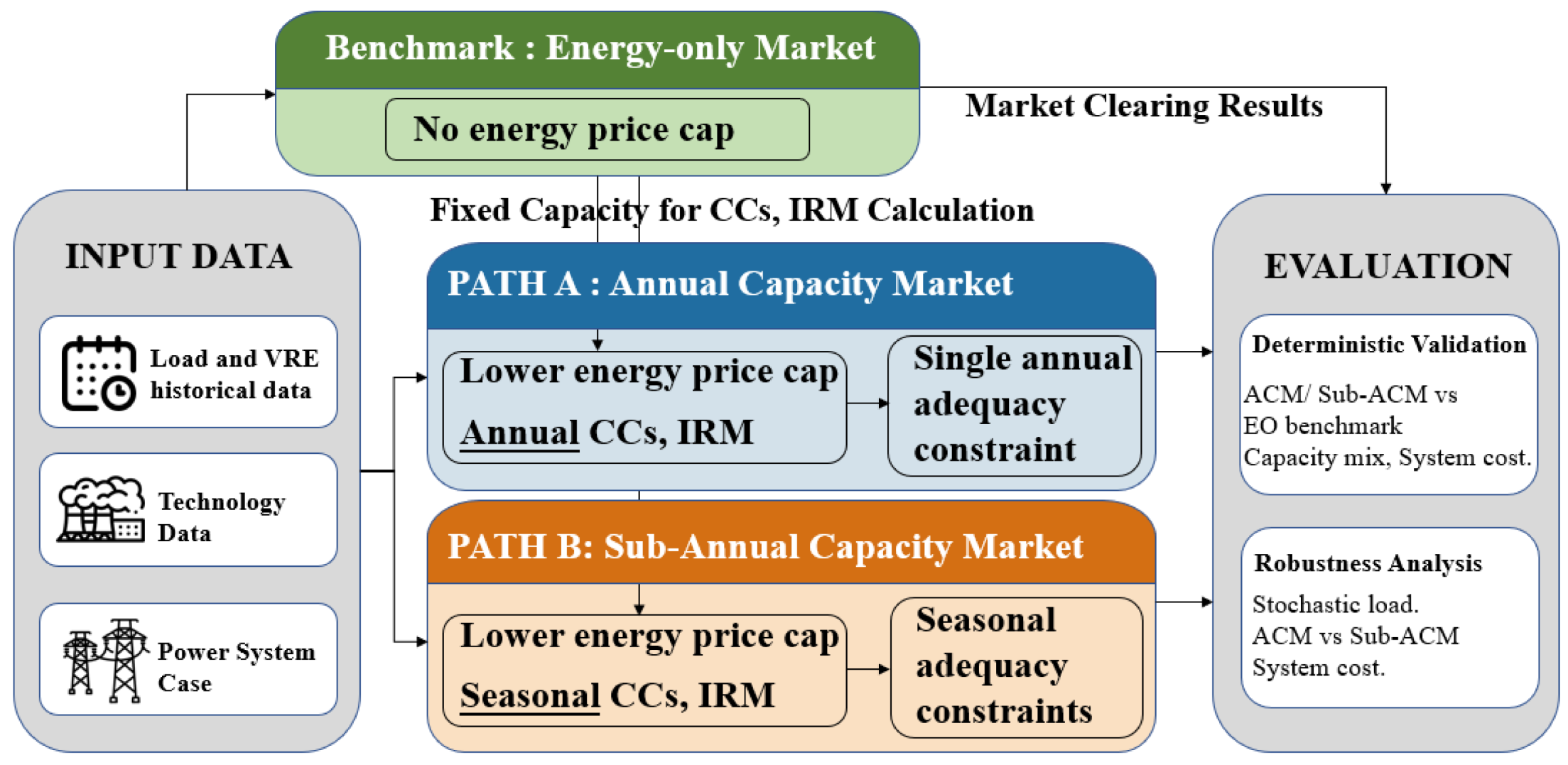
- Feasibility Analysis of a Sub-Annual Capacity Market. We establish a unified workflow that starts from an uncapped Energy-Only benchmark representing the cost-minimizing adequacy outcome under ideal price signals. Based on this benchmark, we compute phase-specific capacity credits using a marginal ELCC formulation and embed these credits into ACM and SubACM clearing models for a consistent comparison under price-capped settings. Relative to prior studies that examine accreditation or market design separately, this framework links reliability valuation and procurement design within one model structure.
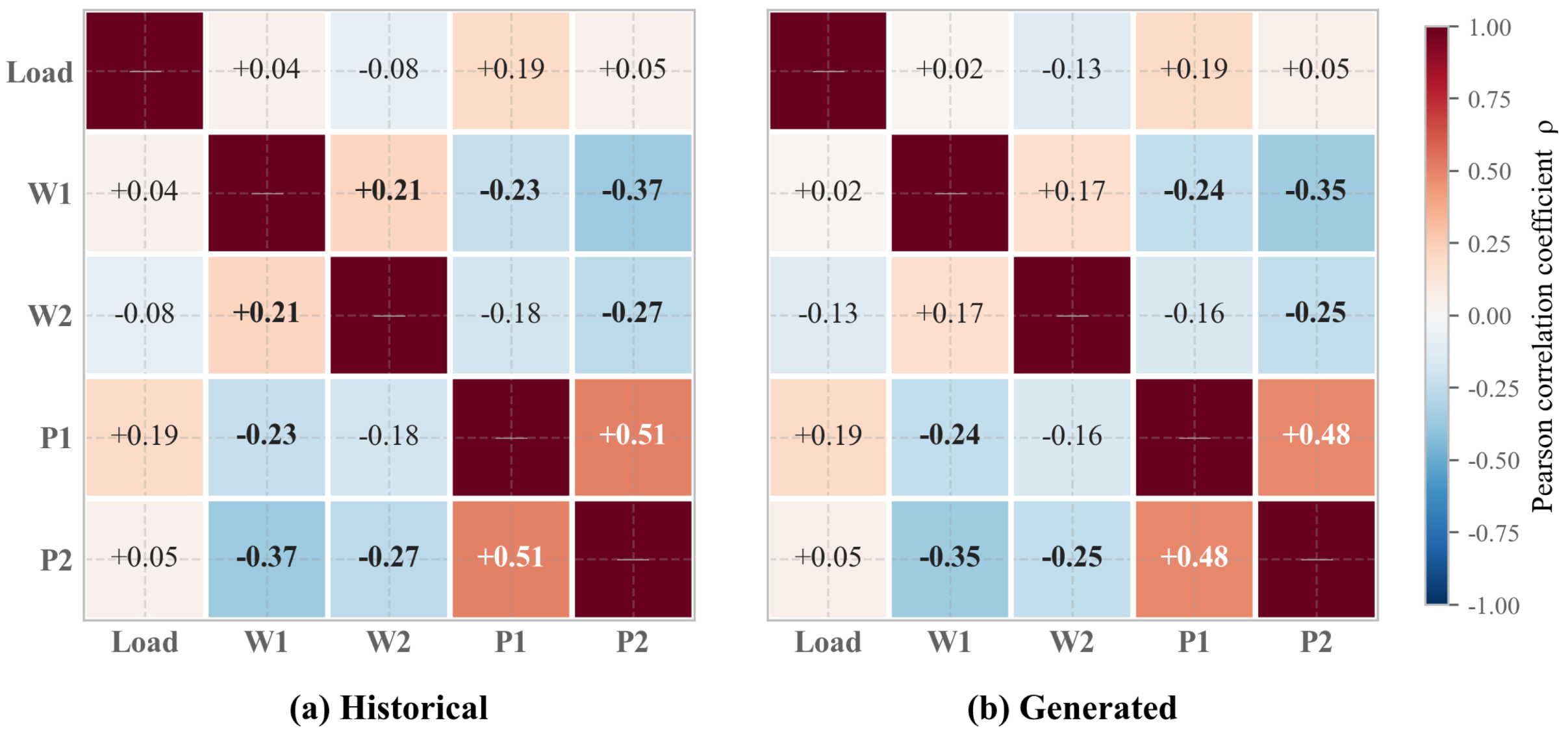
- Economic Efficiency Assessment of Phase-Based Design. We explicitly account for uncertainty by constructing a large ensemble of stochastic scenarios that jointly perturb load, wind, and solar profiles, and using them to evaluate economic performance under ex-ante parameter mismatch. This setting goes beyond the predominantly conceptual discussion in the seasonal-capacity literature and is used to verify whether SubACM remains more robust than ACM when realized operating conditions deviate from forecasts.
- Empirical Evaluation with Real-World Data. Using data from the Shanxi power system, we quantify how phase-based procurement changes accreditation outcomes, investment composition, and system cost performance. The results show that SubACM improves temporal value recognition and delivers more stable economic outcomes under stochastic conditions, thereby providing quantitative and policy-relevant evidence for market reform in high-renewable systems with pronounced seasonal asymmetry.
2. Methodology
2.1. Overall Framework
2.2. Energy-Only Market Model
2.2.1. Objective Function
2.2.2. System Constraints
2.2.3. Thermal Generation Constraints
2.2.4. Renewable Constraints
2.2.5. Energy Storage Constraints
2.3. Capacity Credit Calculation
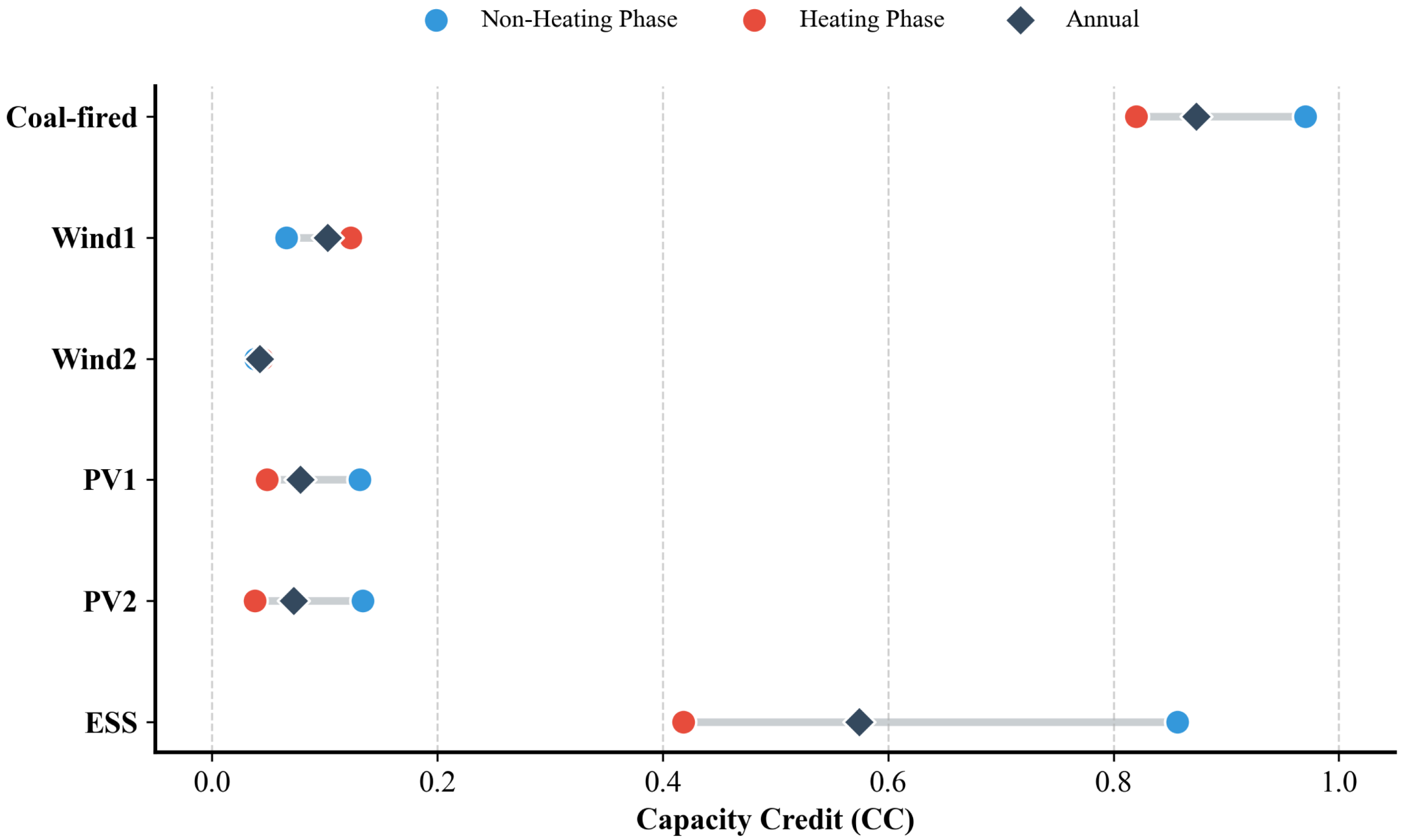
- Annual CC (applied in the ACM): Computed using full-year simulation data, yielding a single, static reliability value for each technology. This value is applied uniformly throughout the year, implicitly smoothing out seasonal variations in resource adequacy contributions.
- Phase-specific CC (applied in the SubACM): Computed independently for each defined operational phase (e.g., heating season vs. non-heating season). This approach captures the time-varying reliability value of resources under distinct operating constraints (such as heating-season thermal output limitations) and fluctuating renewable availability, thereby providing a more precise signal for capacity remuneration.
2.4. Capacity Market Models
2.4.1. Annual Capacity Market
2.4.2. Sub-Annual Capacity Market
3. Case Study
3.1. Case Study Data
3.2. Scenario Definitions
- (1)
- Validation of Market Effectiveness
- (2)
- Economic Efficiency under Uncertainty
3.3. Case Study Results
3.3.1. Capacity Credit Accreditation
3.3.2. Market Clearing Results
3.3.3. Economic Efficiency Under Uncertainty
4. Discussion
4.1. Institutional Implementation of Sub-Annual Capacity Products
4.2. Limitations
5. Conclusions
Author Contributions
Funding
Institutional Review Board Statement
Informed Consent Statement
Data Availability Statement
Acknowledgments
Conflicts of Interest
Abbreviations
| SubACM | Sub-Annual Capacity Market |
| ACM | Annual Capacity Market |
| EO | Energy-Only |
| VRE | Variable Renewable Energy |
| ELCC | Effective Load Carrying Capability |
| PV | Photovoltaic |
| LOLE | Loss of Load Expectation |
| EENS | Expected Energy Not Served |
| ISO | Independent System Operator |
| IRM | Installed Reserve Margin |
| CHP | Combined Heat and Power |
| CC | Capacity Credit |
| MRI | Marginal Reliability Impact |
| ESS | Energy Storage System |
| VOLL | Value of Lost Load |
| EFC | Effective Firm Capacity |
References
- Newbery, D. Missing money and missing markets: Reliability, capacity auctions and interconnectors. Energy Policy 2016, 94, 401–410. [Google Scholar] [CrossRef]
- PJM Interconnection LLC. PJM Manual 18: PJM Capacity Market. Available online: https://www.pjm.com/-/media/DotCom/documents/manuals/m18.pdf (accessed on 11 February 2026).
- Cramton, P.; Stoft, S. A capacity market that makes sense. Electric. J. 2005, 18, 43–54. [Google Scholar] [CrossRef]
- Chen, X.; Kang, C.; O’Malley, M.; Xia, Q.; Bai, J.; Liu, C.; Li, H. Increasing the flexibility of combined heat and power for wind power integration in China: Modeling and implications. IEEE Trans. Power Syst. 2014, 30, 1848–1857. [Google Scholar] [CrossRef]
- Newell, S.; Spees, K.; Yang, Y.; Metzler, E.; Pedtke, J.I. Opportunities to More Efficiently Meet Seasonal Capacity Needs in PJM; Brattle Group: Cambridge, MA, USA, 2018. [Google Scholar]
- Kozlova, M.; Overland, I. Combining capacity mechanisms and renewable energy support: A review of the international experience. Renew. Sustain. Energy Rev. 2022, 155, 111878. [Google Scholar] [CrossRef]
- Duggan, J.E., Jr. Capacity market mechanism analyses: A literature review. Curr. Sustain. Renew. Energy Rep. 2020, 7, 186–192. [Google Scholar] [CrossRef]
- Cramton, P.; Ockenfels, A.; Stoft, S. Capacity market fundamentals. Econ. Energy Environ. Policy 2013, 2, 27–46. [Google Scholar] [CrossRef]
- Petitet, M.; Finon, D.; Janssen, T. Capacity adequacy in power markets facing energy transition: A comparison of scarcity pricing and capacity mechanism. Energy Policy 2017, 103, 30–46. [Google Scholar] [CrossRef]
- Keppler, J.H. Rationales for capacity remuneration mechanisms: Security of supply externalities and asymmetric investment incentives. Energy Policy 2017, 105, 562–570. [Google Scholar] [CrossRef]
- Hobbs, B.F.; Inon, J.G.; Hu, M.C.; Stoft, S.E. Capacity markets: Review and a dynamic assessment of demand-curve approaches. In Proceedings of the IEEE Power Engineering Society General Meeting, San Francisco, CA, USA, 12–16 June 2005; pp. 514–522. [Google Scholar]
- Bonaldo, C.; Fontini, F.; Moretto, M. The energy transition and the value of capacity remuneration mechanisms. Energy Econ. 2024, 139, 107882. [Google Scholar] [CrossRef]
- Garver, L.L. Effective load carrying capability of generating units. IEEE Trans. Power Appar. Syst. 1966, PAS-85, 910–919. [Google Scholar] [CrossRef]
- Zhang, N.; Yu, Y.; Fang, C.; Su, Y.; Kang, C. Power system adequacy with variable resources: A capacity credit perspective. IEEE Trans. Reliab. 2023, 73, 53–58. [Google Scholar] [CrossRef]
- Wang, S.; Zheng, N.; Bothwell, C.D.; Xu, Q.; Kasina, S.; Hobbs, B.F. Crediting variable renewable energy and energy storage in capacity markets: Effects of unit commitment and storage operation. IEEE Trans. Power Syst. 2021, 37, 617–628. [Google Scholar] [CrossRef]
- Aagaard, T.; Kleit, A.N. Marginal vs. average effective load carrying capability: How should capacity markets deal with alternative generation forms? Util. Policy 2023, 84, 101654. [Google Scholar] [CrossRef]
- Bialek, S.; Unel, B. Will you be there for me the whole time? On the importance of obligation periods in design of capacity markets. Electric. J. 2019, 32, 21–26. [Google Scholar] [CrossRef]
- Murphy, S.; Lavin, L.; Apt, J. Resource adequacy implications of temperature-dependent electric generator availability. Appl. Energy 2020, 262, 114424. [Google Scholar] [CrossRef]
- PJM Interconnection, L.L.C. PJM Comments Regarding the Seasonal Capacity Market Issue Charge. 2025. Available online: https://www.pjm.com/-/media/DotCom/committees-groups/committees/mrc/2025/20250723/20250723-item-05---4-pjm-comments-regarding-the-seasonal-capacity-market-issue-charge.pdf (accessed on 11 February 2026).
- ISO New England Inc. Regional Update to the Vermont House Energy Committee. 2026. Available online: https://www.iso-ne.com/static-assets/documents/100031/2026_01_22_vt_house_energy_isone_regional_update.pdf (accessed on 11 February 2026).
- Midcontinent Independent System Operator (MISO). Resource Adequacy. Available online: https://www.misoenergy.org/planning/resource-adequacy2/resource-adequacy/#t=10&p=0&s=FileName&sd=desc (accessed on 11 February 2026).
- Mehrtash, M.; Hobbs, B.F.; Ela, E. Reserve and energy scarcity pricing in United States power markets: A comparative review of principles and practices. Renew. Sustain. Energy Rev. 2023, 183, 113465. [Google Scholar] [CrossRef]
- Kasina, B.G.S. Essays on Unit Commitment and Interregional Cooperation in Transmission Planning. Ph.D. Thesis, Johns Hopkins University, Baltimore, MD, USA, 2017. [Google Scholar]
- Lorca, A.; Sun, X.A. Multistage robust unit commitment with dynamic uncertainty sets and energy storage. IEEE Trans. Power Syst. 2016, 32, 1678–1688. [Google Scholar] [CrossRef]
- Xu, B.; Zhao, J.; Zheng, T.; Litvinov, E.; Kirschen, D.S. Factoring the cycle aging cost of batteries participating in electricity markets. IEEE Trans. Power Syst. 2018, 33, 2248–2259. [Google Scholar] [CrossRef]
- Electric Power Planning and Engineering Institute. Reference Cost Indicators for Quota Design of Thermal Power Engineering; Electric Power Planning and Engineering Institute: Beijing, China, 2024. (In Chinese) [Google Scholar]



| Resource Type | Investment Cost (CNY/MW/Year) | Variable Cost (CNY/MWh) | Start-Up Cost (CNY/MW) |
|---|---|---|---|
| Coal-fired | 531,530 | 256 | 1000 |
| Wind | 462,090 | / | / |
| PV | 327,000 | / | / |
| ESS | 99,216 | 200 | / |
| Name | Description |
|---|---|
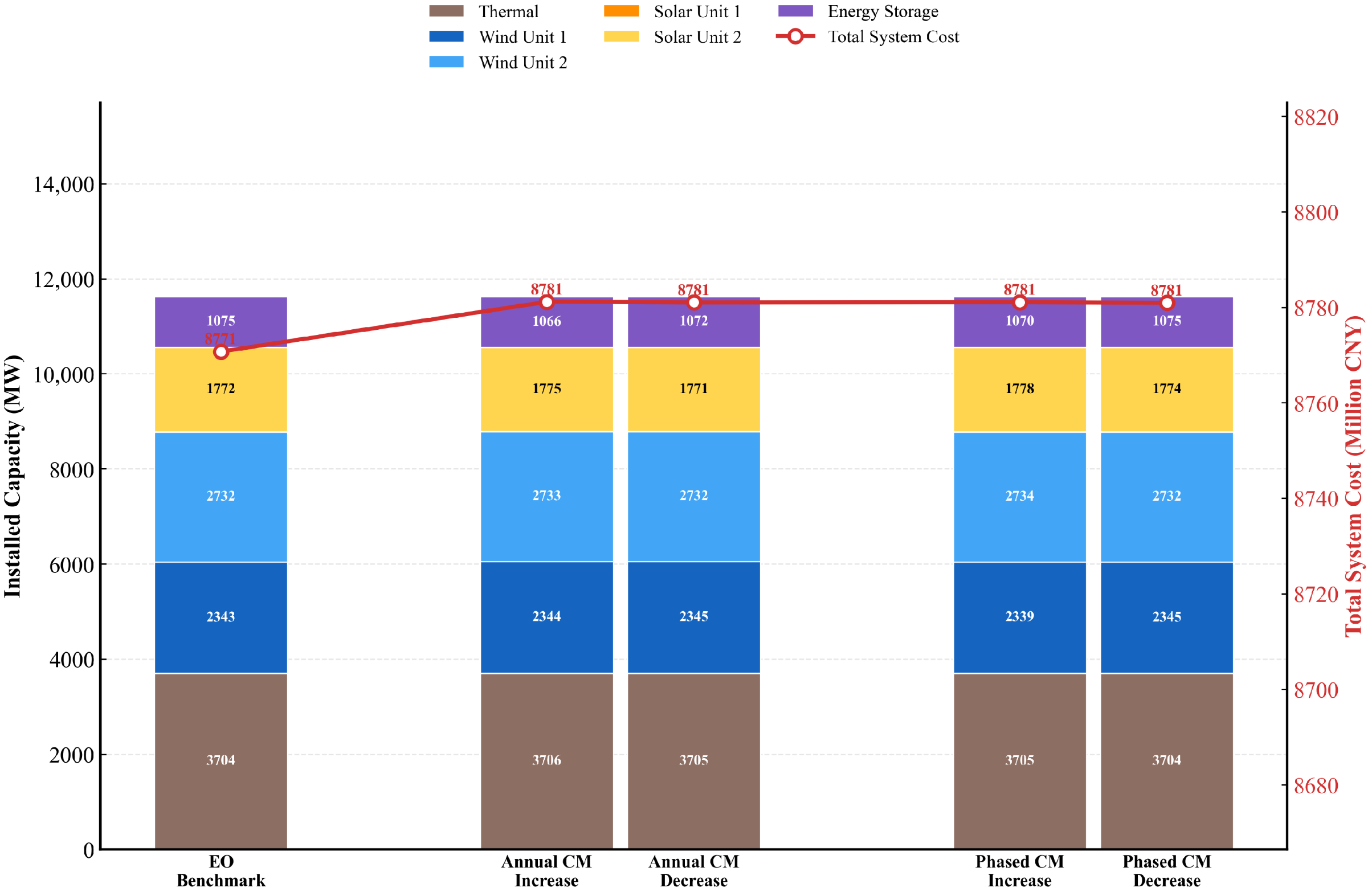
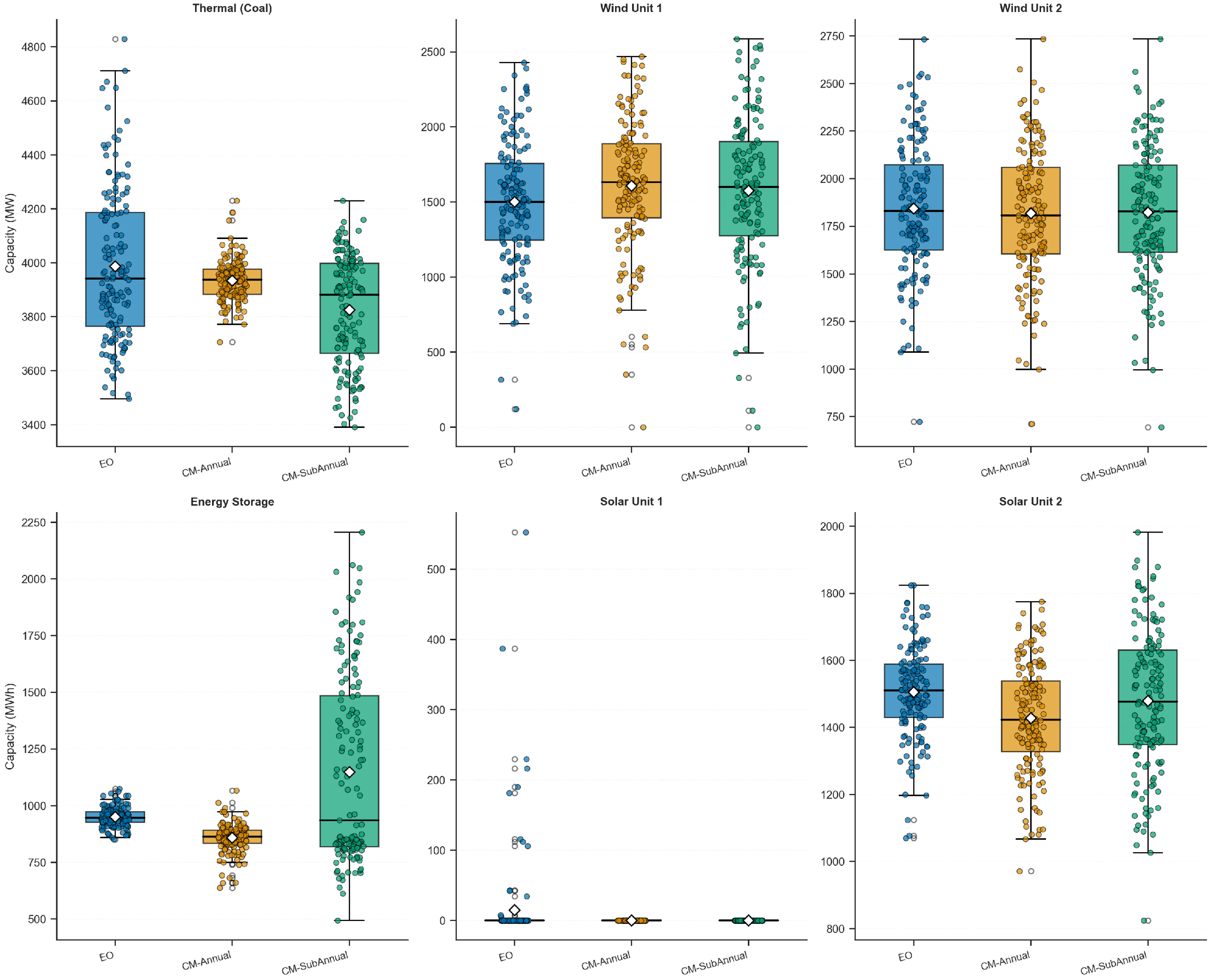
| Energy-Only Market (EO) | A generation expansion planning model integrated with system dispatch operations. The absence of price caps facilitates a theoretical optimal planning solution, yielding the minimum system cost. The generation expansion outcome in the EO scenario is used to calculate the CCs of generation resources. |
| Annual Capacity Market (ACM) | Using CCs calculated from the EO case, the annual IRM is derived from EO planning outcomes and CCs by solving Equation (19). On this basis, ACM sets VOLL to CNY 1500/MWh and clears the market to determine the installed capacity configuration and system cost. |
| Sub-Annual Capacity Market (SubACM) | Every operational year is partitioned into two distinct phases: Non-heating(April–October) and Heating (November–March), aligned with official heating season definitions. After solving phase-specific CCs and IRM, SubACM sets VOLL to CNY 1500/MWh and clears the market under constraints Equation (20) to determine the installed capacity configuration and system cost. |
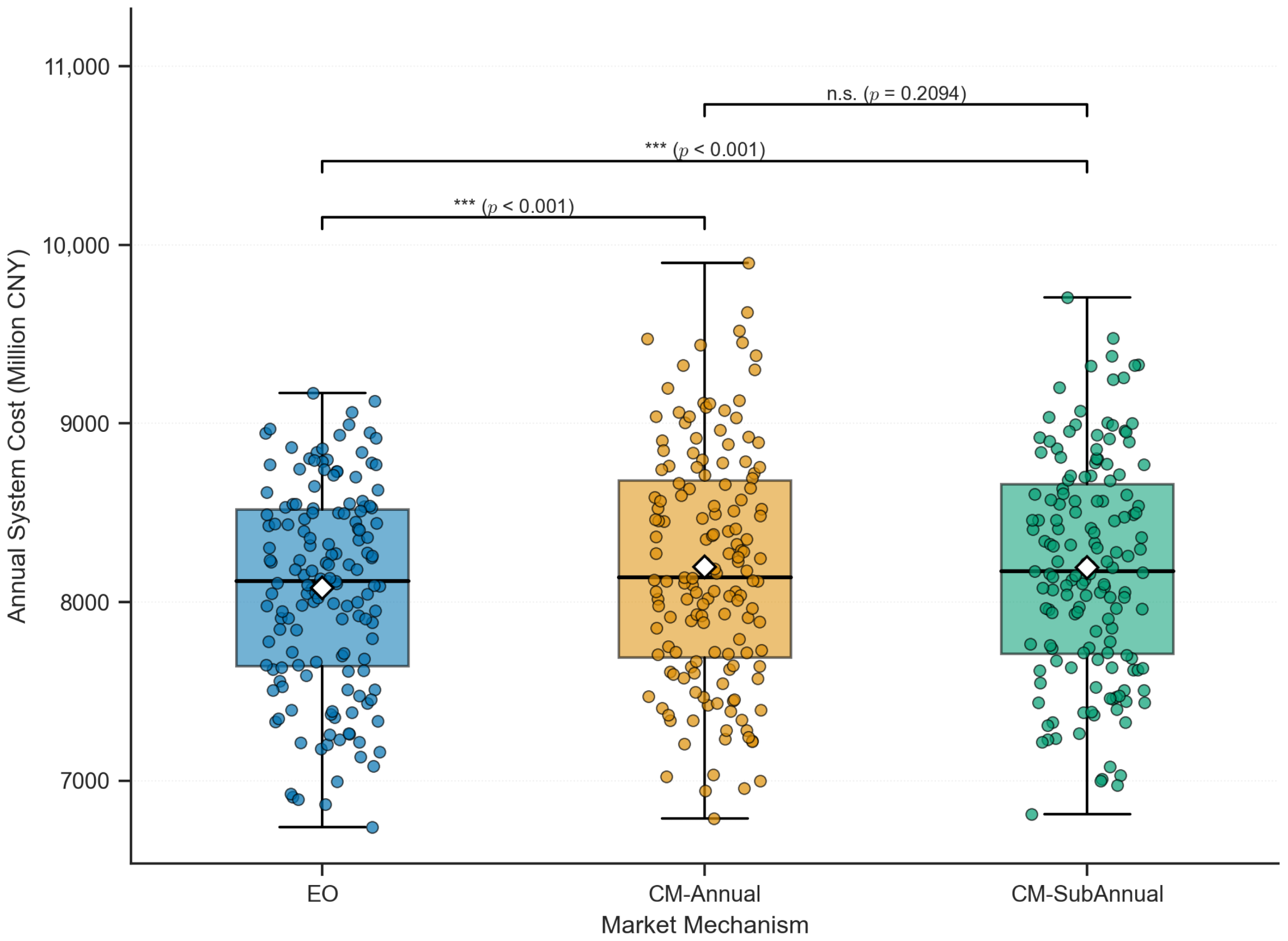
| Statistic | EO | ACM | SubACM |
|---|---|---|---|
| Mean | 8079 | 8196 | 8194 |
| Std. dev. | 568 | 656 | 615 |
| Median | 8119 | 8137 | 8172 |
| 95% CI | [7988, 8170] | [8090, 8301] | [8095, 8293] |
| IQR | 878 | 991 | 947 |
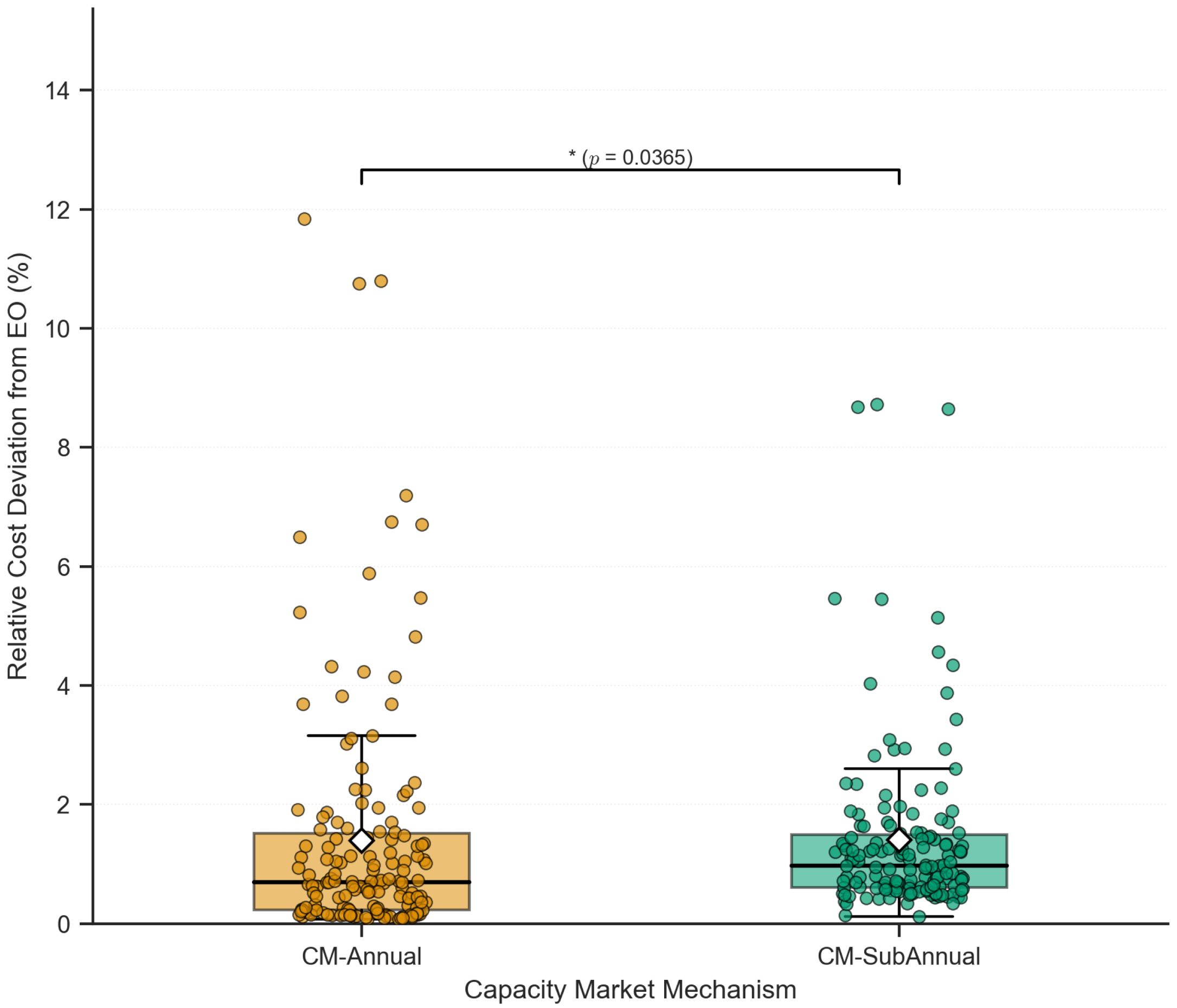
| ACM | SubACM | Ratio (ACM/SubACM) | |
|---|---|---|---|
| Dispersion metrics | |||
| Std. dev. (%) | 2.04 | 1.44 | 1.41 |
| IQR (%) | 1.28 | 0.89 | 1.44 |
| Range (%) | 11.77 | 8.61 | 1.37 |
| Variance | 4.15 | 2.08 | 2.00 |
| Statistic | Two-Tailed | One-Tailed | |
| Hypothesis tests for equal dispersion | |||
| Levene (median-based) | 0.087 | 0.044 * | |
| Ansari–Bradley | 0.012 * | 0.006 ** | |
| Metric | ACM | SubACM | Ratio |
|---|---|---|---|
| Scenarios with | 13.2% (20/151) | 7.9% (12/151) | 1.67 |
| Scenarios with | 6.6% (10/151) | 4.0% (6/151) | 1.67 |
| Maximum deviation | 11.84% | 8.72% | 1.36 |
Disclaimer/Publisher’s Note: The statements, opinions and data contained in all publications are solely those of the individual author(s) and contributor(s) and not of MDPI and/or the editor(s). MDPI and/or the editor(s) disclaim responsibility for any injury to people or property resulting from any ideas, methods, instructions or products referred to in the content. |
© 2026 by the authors. Licensee MDPI, Basel, Switzerland. This article is an open access article distributed under the terms and conditions of the Creative Commons Attribution (CC BY) license.
Share and Cite
Meng, Q.; Zhang, S.; Zhao, X.; Zou, P.; Zhi, H. Unlocking Seasonal Capacity Value: A Sub-Annual Capacity Market for Economic Robustness. Energies 2026, 19, 1924. https://doi.org/10.3390/en19081924
Meng Q, Zhang S, Zhao X, Zou P, Zhi H. Unlocking Seasonal Capacity Value: A Sub-Annual Capacity Market for Economic Robustness. Energies. 2026; 19(8):1924. https://doi.org/10.3390/en19081924
Chicago/Turabian StyleMeng, Qingmeng, Shuailong Zhang, Xingquan Zhao, Peng Zou, and Huiqiang Zhi. 2026. "Unlocking Seasonal Capacity Value: A Sub-Annual Capacity Market for Economic Robustness" Energies 19, no. 8: 1924. https://doi.org/10.3390/en19081924
APA StyleMeng, Q., Zhang, S., Zhao, X., Zou, P., & Zhi, H. (2026). Unlocking Seasonal Capacity Value: A Sub-Annual Capacity Market for Economic Robustness. Energies, 19(8), 1924. https://doi.org/10.3390/en19081924