1. Introduction
Against the backdrop of global climate change mitigation efforts, the restructuring of energy systems is accelerating. To promote energy independence, improve public health, and mitigate climate change, the production of various energy-related materials—lithium, cobalt, and nickel for batteries; rare earth elements for wind turbines and electric motors; and silicon for solar panels—must be significantly scaled up [
1]. Concurrently, the large-scale deployment of new energy equipment inevitably triggers a wave of mass decommissioning. Wind turbine blades have a design lifespan of approximately 20–25 years, photovoltaic modules typically serve for 25–30 years, and lithium-ion batteries in electric vehicles generally last 5–8 years [
2,
3,
4]. Without efficient recycling and utilisation, these end-of-life devices not only represent resource wastage but may also cause severe environmental issues.
Retired new energy components possess significant resource recovery value. Lithium battery anodes contain precious metals such as lithium, cobalt, nickel, and manganese, while cathodes contain valuable graphite materials. Photovoltaic modules contain silver, silicon, copper, and high-purity glass. Wind turbine blades contain high-performance composite materials such as glass fibre and carbon fibre [
5,
6,
7]. Achieving efficient recycling of these resources represents both an effective pathway for resource reutilisation and an imperative requirement for establishing a green, low-carbon circular economy system. The recovery of these end-of-life devices can yield considerable economic value.
Nevertheless, the recycling of end-of-life renewable energy components faces numerous technical challenges. These devices predominantly feature multi-material composite structures: lithium battery electrode materials are tightly bonded to current collectors via organic binders [
8]; photovoltaic modules comprise multi-layered composite encapsulation involving glass, encapsulation films, solar cells, and backsheets [
9]; while wind turbine blades are high-strength composites formed from resin matrices reinforced with fibres [
10]. Conventional recycling methods such as mechanical crushing, chemical leaching, or conventional pyrolysis often suffer from high energy consumption, lengthy processing times, and significant risks of secondary pollution [
11,
12,
13]. For composite materials like waste lithium batteries, photovoltaic panels, and wind turbine blades, efficient material disassembly and selective recovery of valuable components remain core challenges for sustainable recycling [
14].
As an emerging green heating method, microwave technology has attracted widespread attention in the field of waste treatment in recent years; its unique heating characteristics offer new insights into solving the challenges of recycling end-of-life new energy devices. Unlike conventional conduction and convection heating methods, microwaves utilise the dielectric loss effect to transfer energy directly into the material’s interior, bypassing the thermal conduction process. This enables both bulk heating and selective heating—that is, targeted heating of components within the device that exhibit high microwave absorption (such as lithium-ion battery electrode materials, photovoltaic encapsulation films, and the resin matrix of wind turbine blades), whilst components with low microwave absorption (such as glass and metal current collectors) remain at relatively low temperatures [
13,
14] (fk1.1). This characteristic not only significantly improves heating efficiency and reduces energy consumption but also minimises the oxidation and loss of valuable components, making it well-suited to the recycling requirements of complex composite structures. Currently, microwave-assisted recycling technology has achieved significant progress in fields such as lithium-ion batteries, photovoltaic modules and wind turbine blades; however, existing research has largely focused on single recycling processes for individual components, lacking systematic organisation and comparative analysis, and a standardised process system has yet to be established.
Microwave-induced plasma technology utilises microwave energy to drive a microwave plasma generator, ionising gas to form a high-energy, low-temperature plasma composed of electrons, ions, free radicals and excited-state molecules. Through intense chemical reactions between the highly reactive particles in the plasma and the components of the waste, this technology can efficiently decompose and degrade various types of solid waste. simultaneously disrupting the stable structures of metal oxides in electronic waste to facilitate the efficient extraction of valuable metals, whilst also enabling the precise degradation of toxic and hazardous components within solid waste [
7]. Consequently, this technology is well-suited for the recycling of end-of-life components from renewable energy systems.
This paper is explicitly defined as a review of the application of microwave technology in the recycling of end-of-life new energy devices. Its scope covers three typical categories of end-of-life devices: lithium-ion batteries, photovoltaic modules and wind turbine blades. It focuses on the process principles, technical pathways and application outcomes of microwave-assisted recycling, and does not cover other end-of-life new energy devices (such as lead-acid energy storage batteries) or other recycling technologies (such as ultrasound-assisted recycling). The novelty and core contributions of this review are primarily reflected in three aspects: firstly, it overcomes the limitations of existing research by systematically reviewing the application of microwave-assisted technology in the recycling of these three typical types of end-of-life renewable energy components, presenting core process pathways—such as microwave-assisted pyrolysis, delamination, leaching and regeneration—in a structured manner, and clarifying the applicable scenarios and technical key points of different processes; secondly, through structured comparisons, it clearly elucidates the technical advantages and shortcomings of microwave-assisted recycling methods relative to traditional recycling methods, thereby providing theoretical support for technology selection; thirdly, it summarises the core bottlenecks currently facing microwave-assisted recycling technology, proposes future directions for technological development, and fills the research gap in existing reviews regarding the lack of process details and systematic comparisons. This paper aims to systematically review research on the application of microwave technology in the recycling of end-of-life new energy devices from multiple dimensions, including technical principles, application scenarios, process comparisons, challenges faced and development trends, thereby providing a reference and support for in-depth research, technical optimisation and large-scale promotion in this field.
2. Principles of Microwave Heating and Its Advantages in Resource Recovery from End-of-Life New Energy Devices
2.1. Principles of Microwave Heating
Microwaves are electromagnetic waves with frequencies ranging from 300 MHz to 300 GHz [
15]. The principle of microwave heating involves materials converting electromagnetic energy into thermal energy through dielectric loss within an alternating electromagnetic field. This process primarily involves two mechanisms: dipole polarisation and ionic conduction.
The dipole polarisation mechanism primarily acts on components containing polar molecules or polar groups, which closely match the characteristics of the target components to be separated into the three categories of decommissioned devices. In the microwave frequency range, polar molecules (such as water molecules and polymer chains) attempt to rapidly align themselves with the direction of the alternating electric field; however, due to intermolecular forces and the frequency of the electric field, changes in molecular orientation lag behind changes in the electric field, leading to frictional collisions between molecules and consequently converting electromagnetic energy into thermal energy [
13]. Consequently, a defining characteristic of microwave heating is its in-ward-to-outward heating mechanism: electromagnetic energy can directly penetrate materials to a certain depth, converting into thermal energy within the material itself, unlike conventional heating which relies on thermal conduction transferring heat from the surface inward [
16,
17]. This heating method yields rapid temperature rise, relatively uniform temperature distribution, and low thermal inertia [
18].
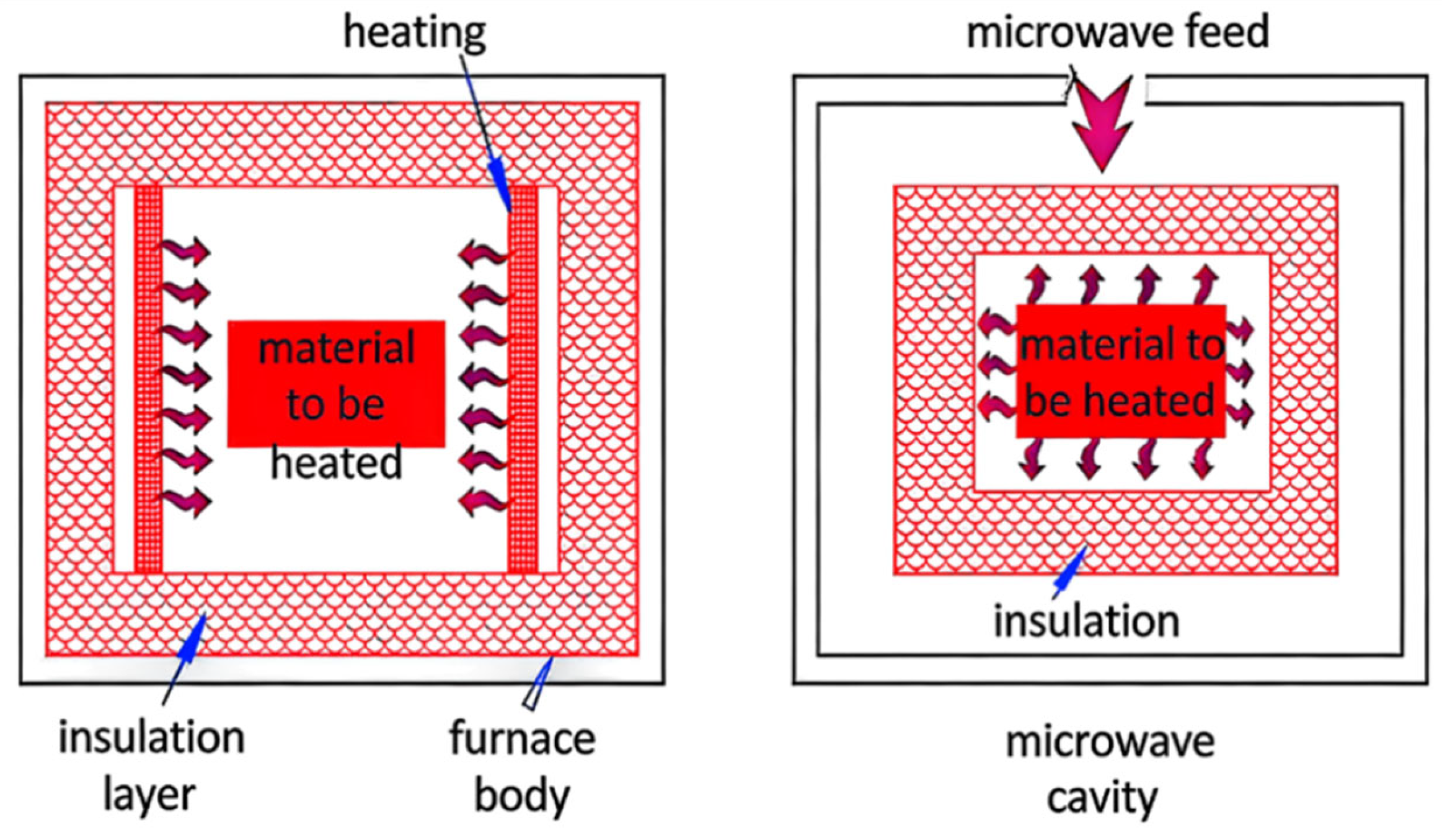
Figure 1 illustrates the distinction between conventional heating and microwave heating mechanisms. In end-of-life components from the new energy sector, the organic binders and electrolytes in lithium-ion batteries, the encapsulation films (EVA/PVB) in photovoltaic modules, and the resin matrices in wind turbine blades all contain a large number of polar molecules or polar groups. These can efficiently absorb microwave energy via the dipole polarisation mechanism, leading to rapid heating, softening or degradation. Conversely, the copper and aluminium current collectors in lithium-ion batteries, the glass and solar cells in photovoltaic modules, and the glass fibre and carbon fibre in wind turbine blades contain extremely low levels of polar components. Consequently, the dipole polarisation effect is weak, and they absorb almost no microwave energy, remaining at low temperatures. This differential absorption characteristic enables the precise separation of target components from valuable components.
The ionic conduction mechanism is primarily applicable to materials containing free ions or charge carriers, ensuring the efficient extraction of valuable components [
19]. In materials such as carbon materials and semiconductors that contain free ions or charge carriers, under the influence of an alternating electromagnetic field, ions undergo directional migration and collide with one another, thereby generating Joule heat [
20]. During the recycling of lithium-ion batteries, the graphite (a carbon material) in the electrode powder contains a large number of charge carriers. Through the ionic conduction mechanism, it can absorb microwave energy, thereby not only causing itself to heat up rapidly but also accelerating the reaction rate between the leaching reagent and valuable metals such as lithium, cobalt and nickel. This reduces the leaching temperature and minimises reagent consumption, whilst simultaneously preventing the loss of graphite material due to high-temperature oxidation, thereby significantly improving the purity of the recovered material. Furthermore, microwave heating enables the selective heating of solid adsorbent materials, leading to the formation of minute ’hot spots’ (locally elevated temperature zones), thereby enhancing the efficiency of adsorbent regeneration [
21].
2.2. Advantages of Microwave Technology in Recycling End-of-Life New Energy Devices
Different materials exhibit varying microwave absorption capacities. Common materials in new energy devices, such as carbon-based materials, certain metal oxides, and polar polymers, absorb microwaves strongly. Conversely, glass and certain ceramic materials are either transparent to microwaves or absorb them weakly [
15,
22]. This selectivity enables microwaves to primarily heat the target components (such as organic binders requiring pyrolysis) while minimising energy input to other constituents, thereby achieving rapid separation of composite materials.
It is worth noting that a material’s microwave absorption capacity is not only dependent on the type of material but also exhibits a significant coupling relationship with the frequency of the electromagnetic waves. The absorption coefficient of a specific material varies with changes in the frequency of the electromagnetic waves, displaying distinct frequency-dependent characteristics. For different types of materials used in new energy devices, there exists an optimal frequency range that maximises microwave absorption efficiency. Specifically, for carbon-based materials (such as graphite in lithium-ion battery electrodes), the absorption coefficient peaks within the 2.45–5.8 GHz frequency range, which aligns with the microwave frequencies commonly used in industrial applications. For polar polymers (such as the EVA encapsulant film in photovoltaic modules), the optimal absorption frequency is closely related to the dipole moment of their molecular chains. By adjusting the electromagnetic wave frequency to match the dipole oscillation frequency of the polymer, microwave absorption efficiency can be significantly enhanced. Consequently, in the practical application of microwave-assisted recycling of decommissioned new energy devices, the microwave frequency can be precisely adjusted according to the material composition of the target device, thereby maximising the absorption of microwave energy by the target components and further improving material separation and resource recovery efficiency.
At the same time, the spatial distribution of electromagnetic waves within the shielded cavity also has a significant impact on the uniformity of material heating during the recycling process. Within a sealed, shielded microwave cavity, electromagnetic waves form standing waves due to reflection and superposition off the cavity walls, resulting in an unevenly distributed spatial field strength with distinct maxima (peaks) and minima (troughs). Materials located in the peak regions absorb more microwave energy and reach higher temperatures, whilst those in the trough regions absorb less energy and remain at relatively lower temperatures; this directly leads to uneven heating of the materials. For composite materials derived from decommissioned new energy components (such as wind turbine blades with non-uniform thickness or lithium-ion battery modules with complex structures), this uneven heating not only reduces the efficiency of component separation but may also cause localised overheating of valuable components (such as carbon fibres and precious metals), thereby leading to performance degradation or loss. To address this issue, practical solutions include optimising the microwave cavity structure, installing waveguides or agitators to disrupt standing wave patterns, and adjusting the placement of materials to position them as far as possible within regions of uniform field strength. These measures can effectively improve the uniformity of microwave heating, ensure the stability of the recovery process, and maximise both the recovery rate and quality of valuable components.
Furthermore, microwave heating offers rapid temperature rise and short processing times. For instance, Alhashim et al. employed a choline chloride (ChCl):ethylene glycol (EG) dual-layer emulsion (DLE) under microwave assistance to achieve ultra-fast selective extraction of lithium from cathode composites of various commercial lithium-ion batteries. Leaching efficiency exceeded 50% within 30 s and approached 100% within 30 min [
23].
Owing to its high heating efficiency and short processing times, microwave heating also offers lower energy consumption compared to conventional heating methods. For instance, Yu-Fong Huang et al. achieved over 90% weight reduction in CIGS solar cells via microwave pyrolysis, noting that the required temperatures were significantly lower than those for conventional pyrolysis [
24].
3. Microwave Recycling of End-of-Life Photovoltaic Devices
Over the past decade, photovoltaic technology has been regarded as an environmentally friendly solution, achieving widespread adoption within a short timeframe. Photovoltaic modules have experienced rapid growth at an annual rate of 50% [
25]. According to IREA, conventional end-of-life (reaching decommissioning) and premature degradation (deteriorating before end-of-life) will generate 1.7 to 8 million tonnes of photovoltaic waste by 2030, rising to 60 to 78 million tonnes by 2050. The cumulative photovoltaic installed capacity during these periods will reach 1630 GW and 4500 GW respectively. This is particularly pertinent for c-Si photovoltaic modules, which command over 85–90% market share and will retain significant prominence in the foreseeable future. Consequently, the proper disposal of end-of-life c-Si PV modules has become a focal point of research. Traditional pyrolysis methods are time-consuming, energy-intensive, and generate significant pollution [
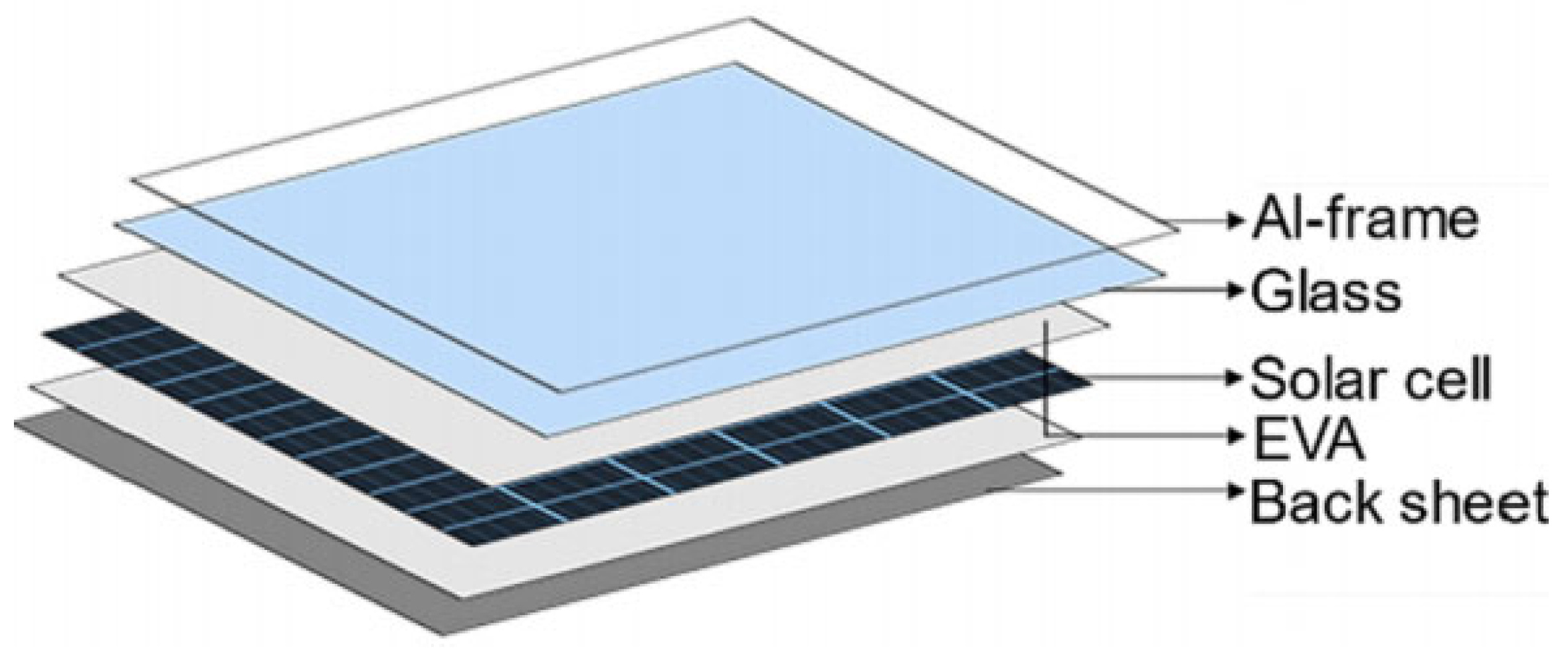
26]. Microwave technology, through its selective heating, enables superior ablation when separating the multi-layered structures of photovoltaic devices (as shown in
Figure 2). This effect maximises the potential for recycling waste photovoltaic components [
27]. Moreover, compared to conventional pyrolysis processes, microwave pyrolysis significantly enhances heating efficiency, translating to reduced energy consumption and lower costs [
28].
3.1. Microwave Pyrolysis
When the battery and panel are effectively separated, valuable materials such as silicon, silver, and copper can be recovered more efficiently. However, the most challenging aspect of existing recycling processes lies precisely in achieving this layer-by-layer separation.
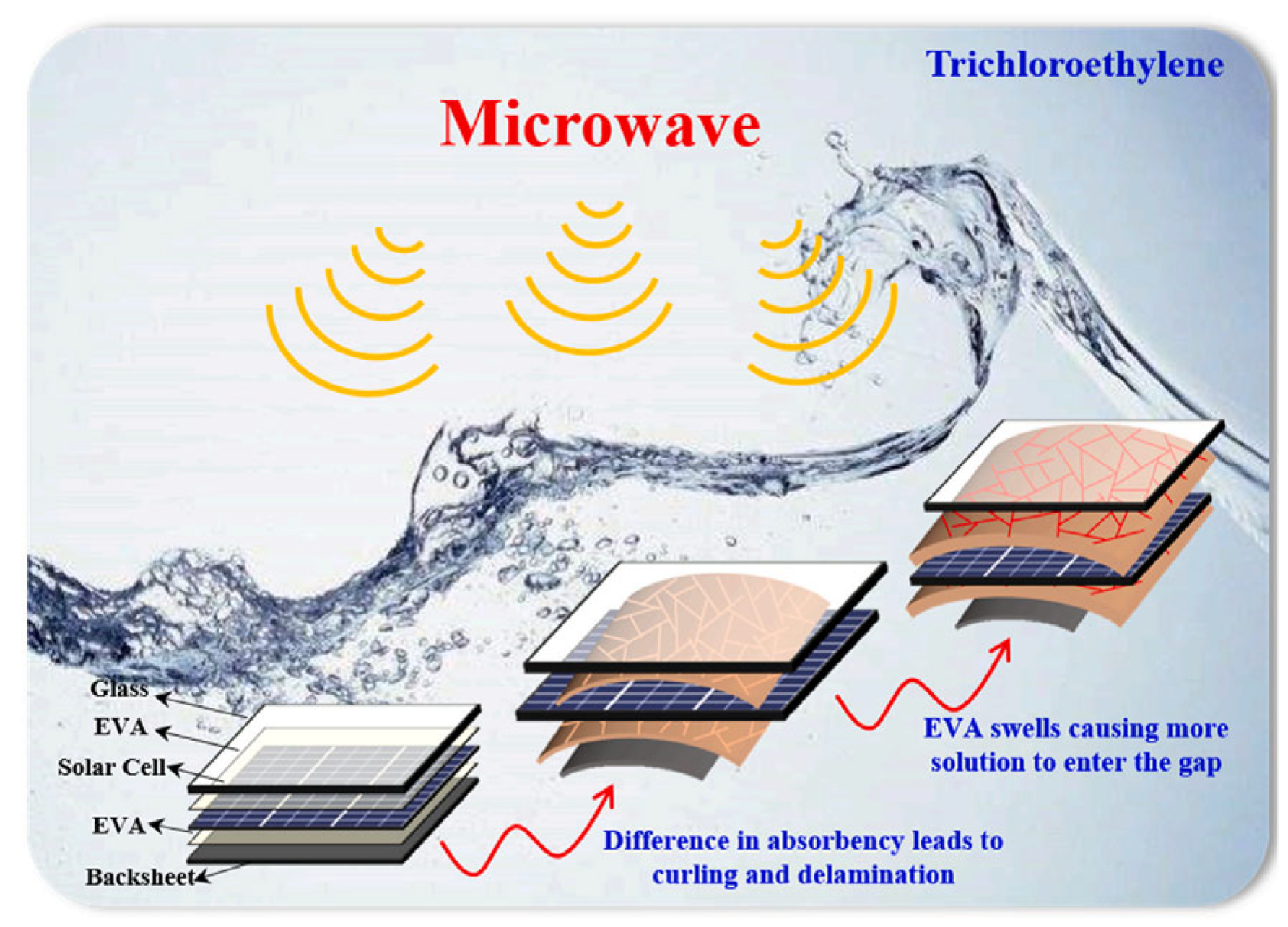
When microwaves are applied, polar molecules directly absorb microwave energy, inducing ultra-high-frequency vibrations that heat them from within. Sheng Pang et al. observed that the anti-reflective coating on silicon wafers exhibits strong polarity. Addressing the time-consuming nature of chemical separation methods for photovoltaic panels, they innovatively proposed a new technique leveraging microwave-enhanced swelling of EVA film to achieve efficient panel separation. This approach capitalises on differences in microwave absorption, thermal expansion coefficients, and the principle of like dissolves like among the panel’s diverse components. By investigating the effects of swelling agent type, concentration, solid–liquid ratio, reaction time, temperature, and external fields on separation efficiency, they determined optimal conditions: 4 mol/L trichloroethylene as swelling agent, 70 °C reaction temperature, and 50 g/L solid–liquid ratio, achieving complete panel separation within two hours [
29]. As illustrated in
Figure 3, this research also elucidated the mechanism of microwave-enhanced EVA swelling.
Current research on pyrolytic photovoltaic modules (e.g., Sheng Pang et al.) predominantly relies on swelling agents to separate EVA from glass. However, reducing solvent usage holds significant industrial importance. Guanghui Yan et al. pioneered the solvent vapour technique, which employs vapour channels to yield intact products during pyrolysis. Given that ester solvents markedly enhance EVA swelling [
31], and ethyl acetate is low-toxicity, cost-effective, and has a low boiling point, it was employed as the vapour generator. Integrating this technique with pyrolysis, glass-free photovoltaic modules were pyrolysed at 500 °C for one hour under a nitrogen atmosphere, yielding clean silicon cells and high-quality glass [
32]. Given the advantages of microwave pyrolysis, including its high selectivity, future research should further explore microwave applications in the aforementioned pyrolysis processes.
3.2. Microwave-Assisted Recovery of Valuable Materials
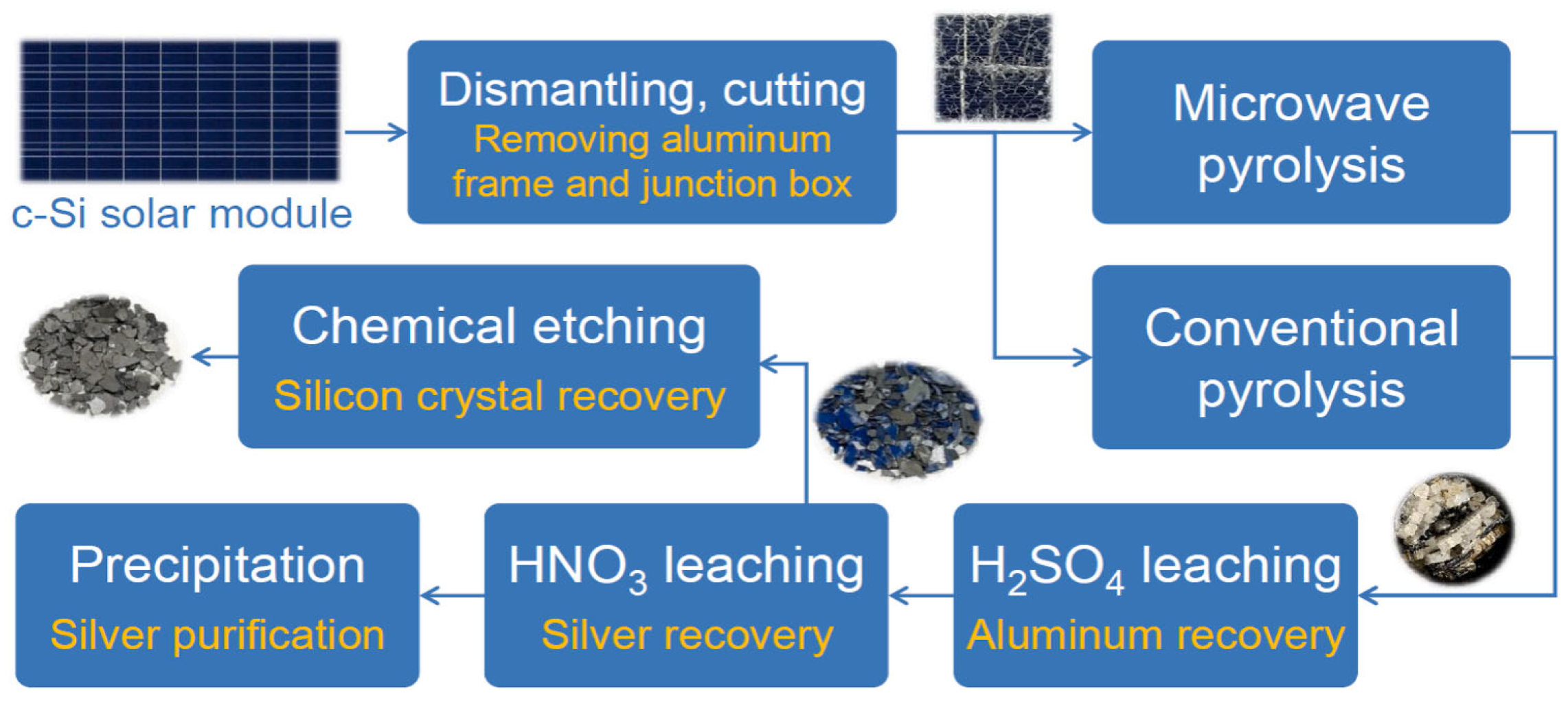
Discarded c-Si solar modules contain silver, copper, aluminium, silicon, glass, and other valuable components. Failure to recover and reuse these modules would result in substantial economic losses [
33]. The main recycling process for photovoltaic panel recycling is shown in
Figure 4.
XuYu-Fong Huang et al. investigated methods including microwave pyrolysis, two-stage acid leaching, precipitation, and chemical etching to achieve resource recovery from c-Si solar modules. This research demonstrated that, following microwave pretreatment combined with acid leaching and precipitation, near-complete recovery of aluminium frames, glass, and metal wires was achievable. Recovery rates for aluminium, silver, and silicon crystals ranged between 83% and 96%, with purities exceeding 99% [
27]. This resource recovery rate surpasses that of conventional pyrolysis, demonstrating the application value of microwaves in assisting the recovery of valuable materials from solar photovoltaics.
Given their mineralogical nature, metals within PVPs (whether in metallic or alloy form) require oxidising agents (such as H
2O
2) to dissolve. Microwave (MW) irradiation further enhances the leaching efficiency of target metals, reduces leaching time, and provides a faster heating process compared to conventional trough and/or pressure leaching methods [
34]. Panagiotis Xanthopoulos et al. first subjected PVP residues to microwave irradiation at 80 °C, followed by leaching with a mixture of hydrochloric acid, sodium chloride, and water. Optimal leaching efficiency was achieved at: [HCl] = 0.5 mol L
−1, [NaCl] = 200 g L
−1, [H
2O
2] = 7.5 wt%, for 60 min. The overall recovery rates for copper, zinc, and lead reached 81.2%, 96.4%, and 77.1%, respectively [
35].
The former employs chemical methods to recover metallic materials from discarded photovoltaic devices following microwave pyrolysis, while the latter incorporates microwaves into the leaching process. Both approaches demonstrate that microwave technology enhances recovery rates, fully showcasing its potential for assisting in the recovery of valuable materials from discarded solar cells.
3.3. Microwave Recycling of Photovoltaic Cells and Lithium Batteries
Achieving efficient photovoltaic cell recycling hinges critically on reusing high-purity silicon, the core material in solar cells. Regarding spent lithium-ion battery recovery, electrode material recycling primarily focuses on metallic components in cathodes, with anode materials receiving scant attention. Composed mainly of graphite, these anodes offer lower added value and prove more challenging to regenerate [
36,
37,
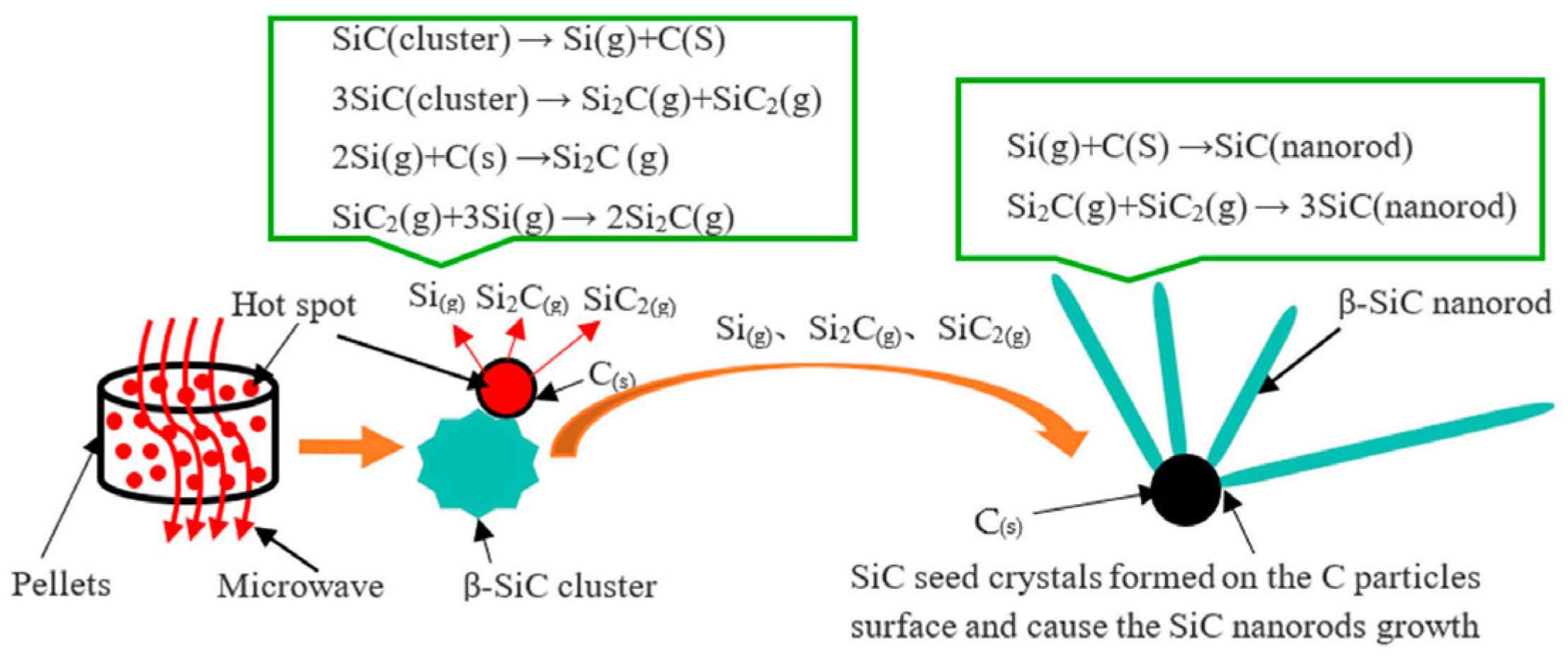
38]. Addressing these dual challenges, Min Zhao et al. employed microwave sintering technology to recycle both photovoltaic panels and lithium batteries. This approach successfully produced high-purity β-SiC from these electronic waste streams, as shown in
Figure 5. The simplified process proved more time-efficient and cost-effective than existing methods, while also delivering significantly reduced CO
2 emissions compared to conventional techniques [
39].
This method successfully integrates the comprehensive recycling of two types of waste, yielding high-value-added products, and represents an ideal resource recovery treatment approach.
3.4. Evaluation of Microwave-Assisted Recycling of Photovoltaic Devices
3.4.1. Comparative Analysis: Microwave Pyrolysis Versus Conventional Pyrolysis
Traditional pyrolysis has a well-established body of research and industrial applications in the field of waste crystalline silicon photovoltaic module treatment, whereas microwave pyrolysis, as an emerging technology, whilst demonstrating unique advantages, also has limitations that cannot be overlooked. The differences between the two in several respects warrant in-depth comparison. In terms of heating mechanisms, conventional pyrolysis relies on thermal conduction and convection, with heat gradually transferred from the surface of the material to its interior, representing a typical ‘surface-to-core’ heating model; microwave pyrolysis, however, is based on the principle of dielectric heating, enabling volumetric and selective heating of polar components within the material (such as EVA and anti-reflective coatings). This difference in mechanism confers theoretical advantages to microwave pyrolysis in terms of heating uniformity and heating rates [
28]. In terms of energy consumption, conventional pyrolysis requires heating the entire furnace chamber, resulting in higher energy consumption, whereas microwave pyrolysis heats only the polar components, theoretically leading to lower energy consumption. However, it should be noted that quantitative data on the energy-saving effects of microwave pyrolysis are scarce in the existing literature, and its actual energy consumption advantages require further verification. In terms of processing time, a complete batch of conventional pyrolysis typically takes 4 to 6 h [
26], whereas studies indicate that microwave pyrolysis can reduce processing time to 1 to 2 h [
29,
32], representing a 50–75% reduction in time; this is currently one of its most distinct engineering advantages. Regarding EVA removal efficiency, traditional pyrolysis often leaves residual EVA, resulting in moderate removal efficiency, whereas microwave pyrolysis, when combined with a swelling agent, can achieve highly efficient EVA removal [
29]; however, this effect is highly dependent on the optimisation of the solvent system and is not guaranteed under all conditions. In terms of glass recovery quality, glass is prone to cracking or surface contamination during conventional pyrolysis, which affects its reuse value; in contrast, microwave pyrolysis—particularly when employing the solvent vapour method—is able to maintain glass integrity effectively, enabling the recovery of high-quality glass [
32]. Regarding solvent consumption, traditional pyrolysis typically involves low to moderate levels, whilst microwave pyrolysis may reach medium to high levels in certain processes (such as when using trichloroethylene as a swelling agent); however, the solvent vapour method [
32] can significantly reduce the generation of liquid waste, a point worthy of note. In terms of scalability, traditional pyrolysis already has examples of industrial application (such as pyrolysis furnaces), and its path to scale-up is relatively clear; microwave pyrolysis, however, remains primarily at the laboratory scale and faces significant engineering challenges in areas such as waveguide design, chamber optimisation and continuous production. This represents one of the most prominent research gaps in current microwave technology. In terms of capital costs, traditional pyrolysis equipment falls within the medium to high range, and relatively mature estimation models already exist within the industry. Conversely, the capital costs of microwave pyrolysis remain unclear at present; however, given the requirement for specialised equipment such as microwave generators, waveguides and shielding, these costs are expected to be significantly higher than those of traditional pyrolysis. A comprehensive comparison (As shown in
Table 1) of the above indicates that, under laboratory conditions, microwave pyrolysis does indeed outperform traditional pyrolysis in terms of processing speed, selectivity and product quality.
However, no research has yet succeeded in developing an industrialised, continuous microwave treatment process for waste photovoltaic modules; although traditional pyrolysis has higher energy consumption, it remains the only pyrolysis technology currently in industrial application.
3.4.2. Limitations and Uncertainties of Existing Research
Although existing studies have demonstrated the potential of microwave technology, there are clear limitations in terms of methodology, data reporting and engineering scale-up. Firstly, most studies (e.g., [
29,
32,
35]) do not provide parameters of statistical variability (such as standard deviation and the number of repetitions). For example, Sheng Pang et al. claim ‘complete separation within two hours’, but do not specify whether this result is from a single experiment or has been verified repeatedly; the lack of uncertainty intervals makes it difficult to assess industrial reproducibility. Secondly, the environmental burden of solvents cannot be overlooked: the microwave-assisted swelling method relies on trichloroethylene [
29], a chlorinated solvent that is toxic and persistent in the environment, which runs counter to the original aim of ‘green recycling’; the ethyl acetate solvent vapour method [
32] is less toxic, but the literature does not discuss its recovery system, and the overall environmental footprint remains unclear. Thirdly, all cited studies utilised laboratory-prepared or finely sorted components, whereas actual waste contains degraded encapsulant, shattered glass, mixed component types, and contaminants such as lead solder and flame retardants; the performance of microwave treatment on such heterogeneous feedstock has not been investigated at all. Fourthly, Huang et al. [
27] reported silver recovery rates of 83–96% and a purity of >99%, but the material balance was incomplete, failing to specify whether silver from the solder bands and front-side grid lines was recovered separately; traditional pyrolysis typically yields silver recovery rates of 70–85% [
33], and the performance improvement offered by microwaves requires independent verification. Fifth, the engineering challenges specific to microwave processing have been systematically overlooked: the hot-spot effect caused by metal grid lines (localised melting or arcing), the non-uniform swelling of EVA due to standing wave modes, and the reflection and impedance mismatch issues associated with multi-layer dielectric materials (glass + silicon + metal)—these are well-known in the field of microwave processing of composite materials, yet are conspicuously absent from the literature on photovoltaic recycling.
3.4.3. Challenges of Scalability and Cost-Effectiveness
The scale-up process from laboratory-scale batch reactors (typically with a processing volume of less than 1 L) to industrial continuous systems (e.g., with a processing capacity of 1 to 5 tonnes per hour) faces significant obstacles on multiple fronts. With regard to cavity design, large multi-mode microwave cavities are prone to uneven heating; however, there are currently no cavity design solutions optimised for the geometric features and material properties of photovoltaic modules. In terms of throughput, the limited penetration depth of microwaves restricts the effective thickness that can be processed in a single pass, whilst the behaviour of stacked modules within the microwave field has not yet been investigated. In terms of energy efficiency, the conversion efficiency of microwave energy to thermal energy tends to decrease as the scale of processing increases; however, reliable industrial-grade energy efficiency data is currently lacking. Regarding safety, metal electrodes may trigger arc discharges, whilst solvent vapours pose a risk of ignition; yet, no preliminary risk assessments addressing these safety issues have been reported in the existing literature. In terms of cost, microwave generators (magnetrons) have a limited service life, typically ranging from 5000 to 10,000 h, and the capital cost of industrial microwave systems—including specialised equipment such as waveguides, applicators and electromagnetic shielding—is estimated to be two to five times that of a conventional electric furnace of equivalent power. Even if microwave pyrolysis achieves a 50% energy saving, the high initial investment may still undermine economic viability. It should be noted in particular that there are currently no peer-reviewed techno-economic assessments of microwave photovoltaic recycling systems, which constitutes a key research gap in this field.
4. Microwave Recycling of Retired Wind Turbine Blades
Over the past two decades, wind energy has seen widespread adoption, with global wind power capacity projected to reach 2015 gigawatts by 2030 [
30]. Each gigawatt of installed capacity requires approximately 10,000 tonnes of blade material [
40]. Unlike the mechanical components of wind turbines, which are readily recyclable and possess economic value [
41], wind turbine blades (WTBs) are constructed from resin-based composite materials. It is projected that 43 million tonnes of waste WTBs will accumulate by 2050 [
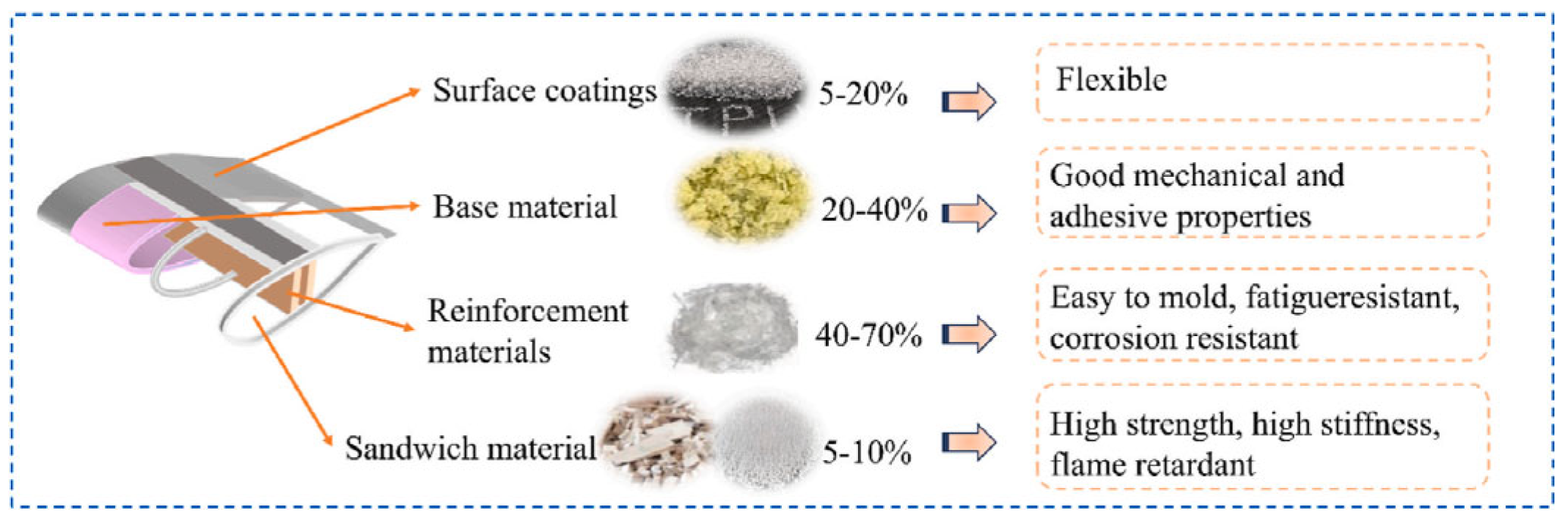
42]. The primary raw materials for wind turbine blades comprise resin matrix materials, reinforcing fibres, core materials, and coatings, as illustrated in
Figure 6. Lightweight, high-strength, corrosion-resistant and customisable composites are the preferred materials for large wind turbine blades, with glass fibre reinforced composites (GFRP) and carbon fibre reinforced composites (CFRP) being widely applied in blade manufacturing [
43]. Efficiently recovering these fibres from decommissioned wind turbine blades has become a significant research focus.
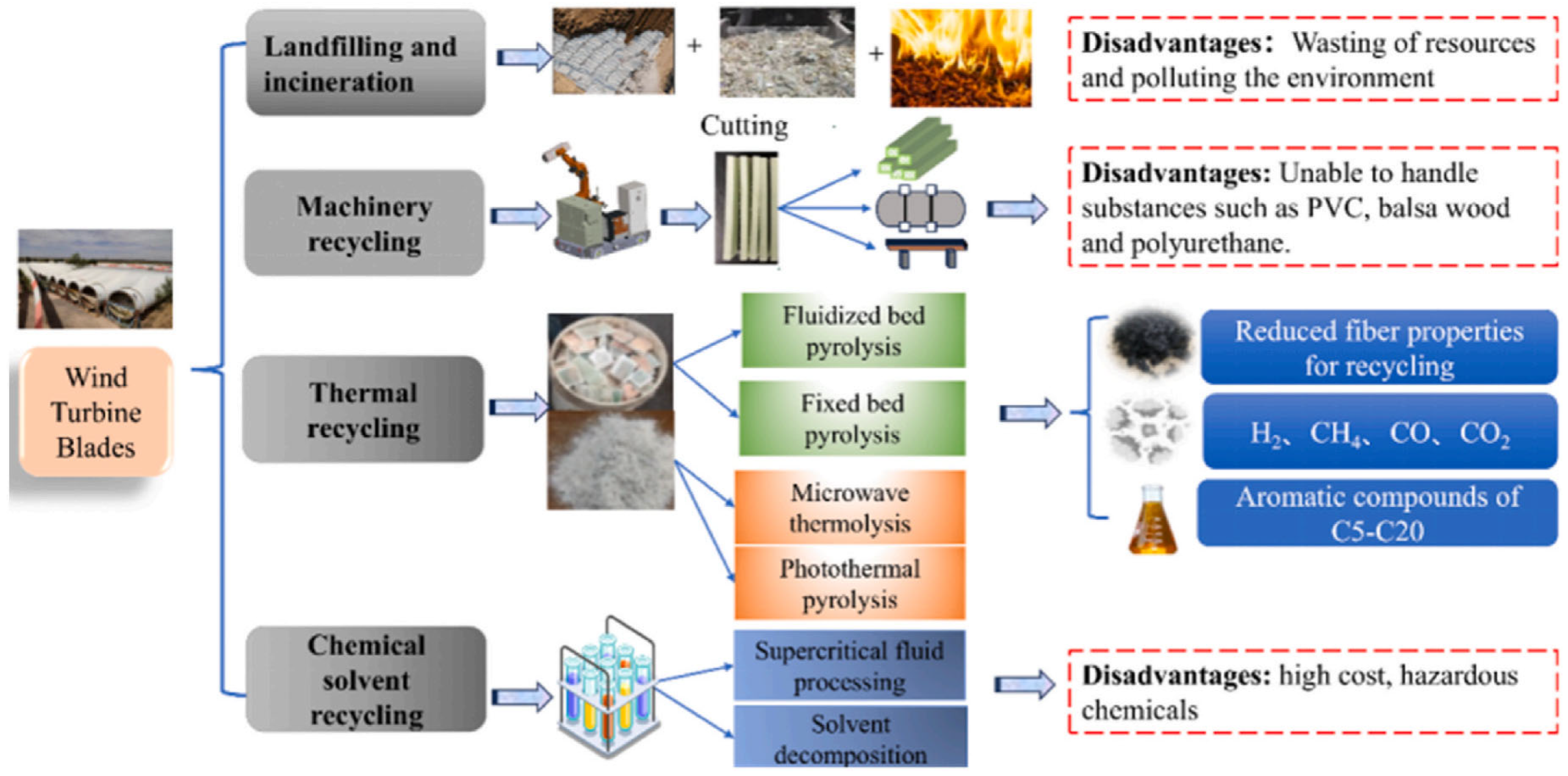
Current waste treatment methods encompass landfill disposal, physical recycling, chemical solvent recovery, and pyrolytic recycling [
44] (as illustrated in
Figure 7). Landfill disposal consumes land resources and releases harmful substances, leading many nations to prohibit this practice due to sustainability concerns [
30,
45]. Existing physical recycling methods are limited to cutting materials into structural components or pulverising them for use as construction fillers. The resulting recycled fibres are predominantly short and exhibit poor performance, restricting their reusability and overall value [
44,
46]; Chemical solvent recycling technologies convert thermosetting resins into their original monomers or other useful chemicals. These typically require pre-treatment (grinding) to shorten fibre lengths, but may introduce fibre defects [
47,
48]. The chemical processes can also damage fibre surfaces, further degrading quality. Pyrolytic recovery enables resin cracking and separation at lower temperatures compared to the preceding methods, achieving more complete glass fibre recovery while generating combustible gases and liquid tar. It also better preserves the fibres’ mechanical properties. Microwave pyrolysis, owing to its rapid heating rates, uniform heat transfer, and low energy consumption, has become a widely adopted method among various heating applications [
49].
4.1. Pyrolysis Combining Microwaves with Absorbers and Catalysts
The application of microwaves significantly reduces pyrolysis energy consumption. Microwave pyrolysis technology enables materials to be heated from the inside out. The resin in blades rapidly absorbs microwave radiation energy, thereby enhancing decomposition efficiency. Consequently, numerous studies exploring microwave-based pyrolysis of fan blades have been conducted.
Table 2 lists several microwave-assisted synergistic pyrolysis experiments.
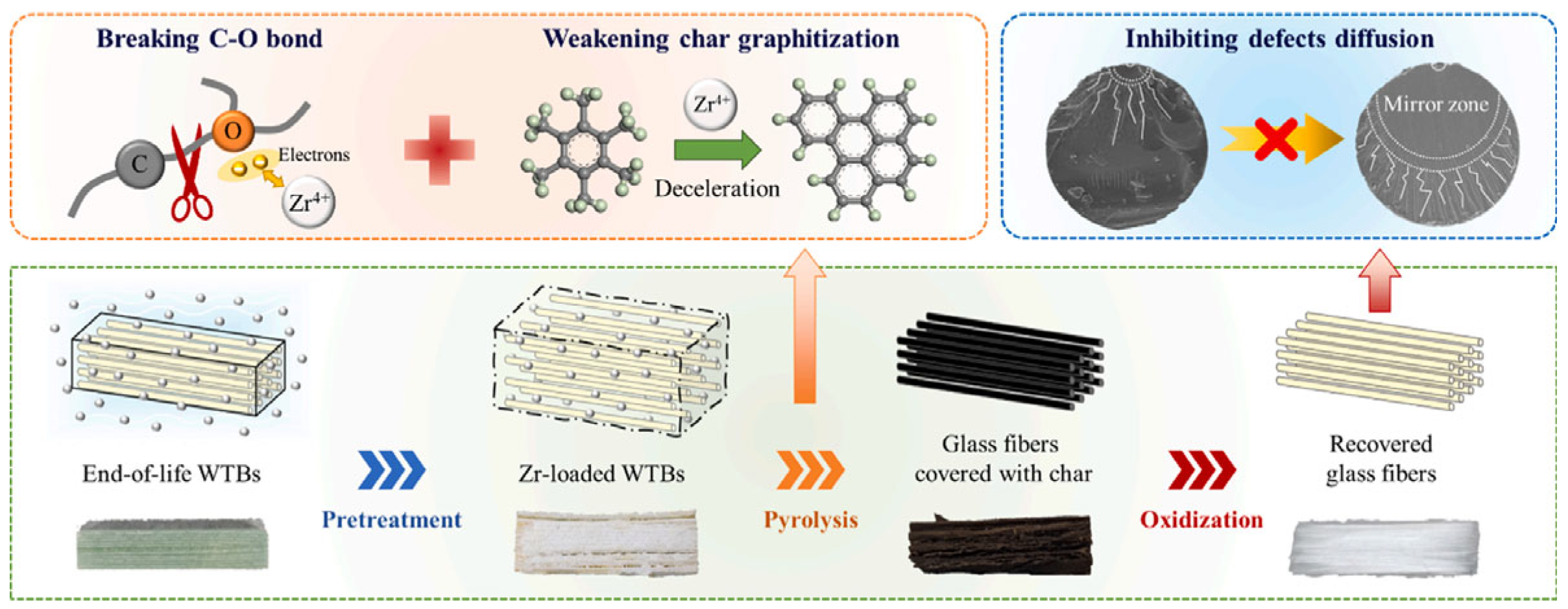
Additionally, Qiang Lu et al. employed transition metal-assisted pyrolysis to recover glass fibres from end-of-life wind turbine blades [
53], with the specific mechanism illustrated in
Figure 8. Ji-hong Li et al. utilised metal oxides (such as NiO/Al
2O
3 and CuO/Al
2O
3 catalysts) for pyrolytic catalysis to selectively produce phenol from wind turbine blades [
54], both yielding favourable outcomes. Combining transition metals with microwave-assisted pyrolysis for wind turbine blades also presents a promising research avenue.
Comparing microwave-assisted pyrolysis with conventional two-step pyrolysis for recovering carbon fibres from CFRP (carbon fibre reinforced plastic) composites, the microwave-assisted method achieves higher carbon fibre recovery rates [
55] at temperatures 50 °C lower than the traditional approach and with pyrolysis times reduced to just 12.7% of the conventional duration. while the recovered fibres exhibit superior properties. The energy demand for traditional wind turbine blade pyrolysis is approximately 21.2 MJ/kg [
56], whereas microwave pyrolysis requires only about 10 MJ/kg.
4.2. Pyrolysis Under Microwave-Assisted Molten Salt Systems
The incorporation of microwave irradiation, in conjunction with diverse catalyst systems, enhances selectivity towards additional products. Within the microwave molten salt system, the primary products from gas-phase pyrolysis comprise combustible gases such as H
2, CO, and alkanes, whilst liquid-phase products are dominated by phenols and aromatic hydrocarbons [
57]. Within certain limits, increasing temperature elevates gas yield whilst correspondingly reducing yields of oils and pyrolysis carbon [
6]. By adjusting temperature and duration, the composition of pyrolysis gases and oils can be controlled, enabling effective recovery and utilisation of high-value-added products, which holds promising research prospects.
Yiyao Ren et al. investigated carbon fibre recovery under combined microwave heating and ZnCl
2/NaCl molten salt treatment. The epoxy resin matrix rapidly degraded within 20 min at 300 °C, followed by oxidation in air to remove pyrolytic carbon formed on the carbon fibre surface during this process. Experimental results indicate that the surface morphology and microstructure of the regenerated carbon fibre (RCF) remain largely unchanged, with tensile strength and tensile modulus retained at 87.8% and 94.6% of the original carbon fibre respectively. Concurrently, this method increases hydrogen production (accounting for 65.35% of total pyrolysis gas) [
6], rendering the process highly valuable.
Junjie Shu et al. employed a microwave-assisted fused carbonate pyrolysis method. A 10-min microwave pyrolysis at 350 °C followed by 20 min of oxidation at 450 °C enabled the recovered carbon fibres (RCFs) to retain 98.81% of the tensile strength of the virgin carbon fibres (VCFs). Concurrently, the tensile modulus of the RCFs increased by 14.70%, with a carbon fibre recovery rate as high as 98.44%. The primary products of the gas-phase pyrolysis comprised combustible gases such as H
2, CO, and alkanes, while liquid-phase products were dominated by phenols and aromatic hydrocarbons. By adjusting temperature and duration, the composition of pyrolysis gases and oil products could be controlled, enabling comprehensive utilisation with high added value [
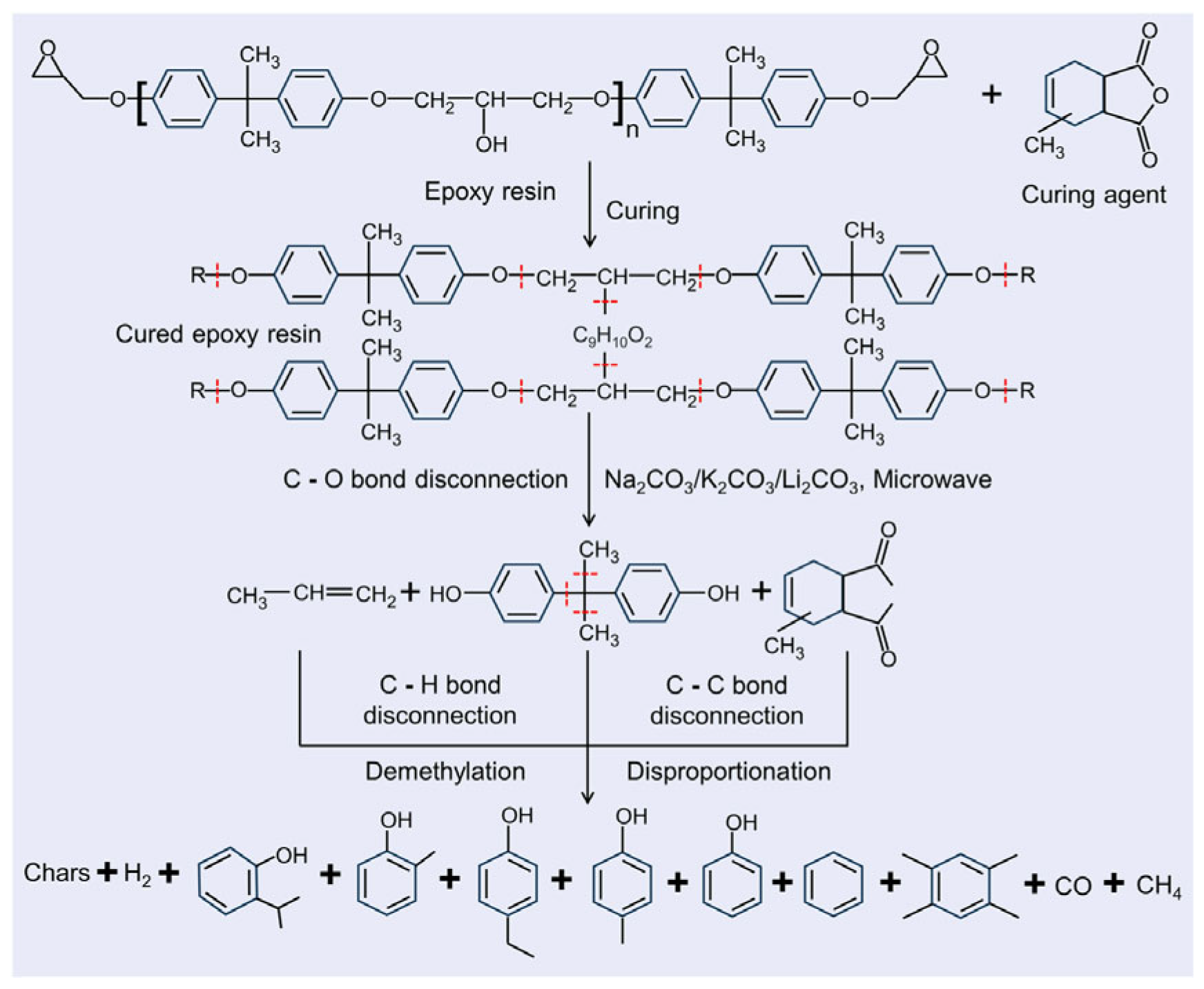
57]. The reaction mechanism is illustrated in
Figure 9.
4.3. Effects of Different Reaction Atmospheres on Pyrolysis
Ming-xin Xu et al. investigated the pyrolysis of wind turbine blades under varying atmospheres and its impact on recovered glass fibres. Their experimental data revealed that in a nitrogen atmosphere, the primary gaseous components in WTB pyrolysis products comprised carbon dioxide, methane, and carbon monoxide, with a pyrolysis oil yield of 14.88 wt%. enabling recovery of multiple phenolic compounds. The glass fibres obtained from the solid products yielded pure glass fibres after oxidation treatment. Under water vapour (H
2O) conditions, water vapour acted as a gasification agent, accelerating the cracking reaction of epoxy resin. This not only increased the yield of pyrolysis gases and phenolic products but also effectively suppressed the formation of pyrolysis coke. Furthermore, the reactivity of residual coke is enhanced, facilitating oxidation. However, during subsequent oxidation, surface defects caused by thermal oxidative diffusion slightly reduce the tensile strength of recovered glass fibre by 5.97%. However, carbon dioxide (CO
2), owing to its insufficient gasification activity and high specific heat capacity, resulted in incomplete epoxy resin pyrolysis. This inhibited the yield of pyrolysis gases and phenolic products. Furthermore, CO
2 promoted the accumulation of resin residues and pyrolysis coke, exacerbating thermal oxidation diffusion of surface defects and uneven heating during post-oxidation. Ultimately, this led to a substantial 16.02% reduction in the tensile strength of the recovered fibres [
58].
4.4. Evaluation of Microwave-Assisted Pyrolysis for the Recovery of Wind Turbine Blades
4.4.1. A Comparative Analysis of Microwave-Assisted Pyrolysis and Conventional Pyrolysis
Existing literature indicates that microwave-assisted pyrolysis offers several quantifiable advantages over conventional pyrolysis methods in the field of waste wind turbine blade recycling, as shown in
Table 3.
However, there is still insufficient understanding of its limitations. In terms of energy consumption, the energy requirement for conventional wind turbine blade pyrolysis is approximately 21.2 MJ/kg [
56], whereas microwave pyrolysis requires only about 10 MJ/kg, representing an energy saving of nearly 50%. In terms of processing time, the microwave-assisted method can reduce pyrolysis time to 12.7% of the conventional duration, whilst simultaneously lowering the reaction temperature by approximately 50 °C [
55]. Regarding the quality of recovered fibres, glass fibres recovered via activated carbon-assisted microwave pyrolysis achieved a tensile strength of 901.7 MPa, exceeding that of fibres obtained by conventional pyrolysis [
52]; meanwhile, carbon fibres recovered under a microwave-assisted molten salt system retained 98.81% of the original fibre’s tensile strength, with the tensile modulus even increasing by 14.70% [
57]. These data appear to provide ample evidence of the superiority of microwave technology. However, the aforementioned comparisons suffer from several methodological issues. Firstly, the energy consumption and time data for conventional pyrolysis are often derived from early or non-optimised processes, whereas studies on microwave pyrolysis employ laboratory-optimised conditions; consequently, the two are not being compared at the same level of technological maturity. Secondly, most studies (e.g., [
49,
51,
52]) report optimal results under ideal laboratory conditions without providing statistical distributions within the range of process variations, which means that conclusions regarding ‘superiority’ lack support from uncertainty intervals. Furthermore, traditional pyrolysis has a track record of mature operation at industrial scale, whereas all data on the advantages of microwave pyrolysis originate from experiments on a gram- to kilogram-scale, so there is currently no empirical evidence to confirm whether its energy efficiency and time advantages can be maintained upon upscaling.
4.4.2. Major Limitations and Uncertainties in Existing Research
Existing studies exhibit significant shortcomings in terms of experimental design and reporting standards. Most microwave-assisted pyrolysis experiments (such as those listed in
Table 1) fail to report the number of repetitions or standard deviations. For example, although Ren et al. [
6] and Shu et al. [
57] achieved impressive fibre property retention rates, neither study specified whether these results were derived from a single experiment or represented the average of multiple repetitions. The lack of information on statistical variability makes it difficult to conduct meaningful cross-comparisons between different studies, let alone assess the industrial reproducibility of the process.
Regarding the introduction of absorbers and catalysts, existing studies generally incorporate materials such as activated carbon, graphene, silicon carbide or zeolites to enhance microwave absorption [
50,
51,
52]. However, in industrial applications, these additives entail additional material costs and post-processing steps. More critically, carbon fibres themselves possess good microwave absorption capabilities [
50], yet studies often use carbon fibre-reinforced composites in conjunction with added microwave absorbers without examining the contribution of the carbon fibres themselves to microwave pyrolysis; consequently, it is difficult to ascertain the net benefit of the added absorbers. Similarly, whilst transition metal and metal oxide catalysts [
53,
54] can improve the selectivity of specific products, the issues of catalyst separation and recovery following the reaction have not been addressed.
Regarding the engineering feasibility of molten salt systems, although microwave-assisted molten salt pyrolysis [
6,
57] demonstrates excellent performance in terms of fibre property retention and hydrogen yield, the scalability of this method faces significant challenges. The heating behaviour and dielectric properties of molten salts in a microwave field vary significantly with temperature, making it difficult to ensure temperature uniformity in large-scale reactors. Furthermore, issues such as corrosion of the reactor by the molten salt, the separation of the salt from solid products, and the regeneration and recycling of the molten salt have not been addressed in existing research.
4.4.3. Scalability Challenges and Research Gaps
In terms of reactor design, wind turbine blades can measure tens of metres in length; even after pre-processing by fragmentation, the particle size remains far greater than the penetration depth of microwaves (typically on the centimetre scale). This implies that industrial microwave reactors must be capable of processing such materials; however, existing studies have all utilised small-scale samples or powdered materials [
49,
50,
51,
52,
57,
58], thereby completely sidestepping this fundamental engineering constraint. In terms of continuous processing, the annual volume of discarded wind turbine blades is projected to reach 43 million tonnes by 2050 [
42]; such a massive scale of processing necessitates a continuous, high-throughput process. However, existing microwave pyrolysis research has been conducted exclusively as batch operations; the design of continuous microwave pyrolysis reactors, as well as mechanisms for feeding and discharging, and microwave sealing and leak-prevention technologies, remain unexplored. Regarding the economies of scale in energy efficiency, the electrical-to-microwave conversion efficiency of microwave generators typically ranges between 60% and 75%, and declines as power increases and magnetrons age. The ‘low energy consumption’ reported in laboratory studies often calculates only the net thermal energy demand of the pyrolysis process, without accounting for the electrical energy consumption of the microwave generator and its cooling energy requirements. A comprehensive industrial-scale techno-economic assessment should include a full-process energy balance; however, such studies are entirely absent from the literature. With regard to safety, the carbon fibres in wind turbine blades are conductive and may generate arc discharges in a microwave field; combustible gases and solvent vapours produced during the pyrolysis process pose an explosion risk; and molten salt systems involve the safe handling of high-temperature corrosive media. No systematic assessment of the aforementioned safety issues or risk mitigation strategies has been identified in the existing literature.
5. Microwave Recycling of End-of-Life Lithium Batteries
Lithium-ion batteries (LIBs) are extensively deployed in electric vehicles and grid energy storage systems, becoming increasingly prevalent with the growing demand for renewable energy [
59]. Due to their finite operational lifespan, the volume of spent lithium-ion batteries (SLIBs) is steadily rising, projected to reach 5 million tonnes by 2030 [
60]. Common lithium-ion battery types (classified by cathode material) include LiCoO
2 (LCO), LiMnO
2 (LMO), LiNixCoyMnzO
2 (NCM), and LiFePO
4 (LFP) [
5]. Research indicates that many precious metals in end-of-life lithium batteries exhibit higher concentrations than industrial ores, typically containing 5–20% cobalt, 5–10% nickel, 5–7% lithium, and 5–10% copper, aluminium, and iron, with a value reaching up to US
$7708 per tonne [
61,
62]. Current recycling processes primarily encompass pre-treatment, metal extraction, and metal separation [
63]. Commercially available anode materials presently include graphite, hard carbon, and soft carbon. Graphite dominates this market, accounting for approximately 98% of anode materials [
64]. As a critical strategic resource dubbed ‘black gold’, the direct disposal or incineration of spent graphite not only constitutes significant resource wastage but also generates environmental concerns such as carbon emissions. Existing recovery methods focus primarily on reclaiming valuable metals, while graphite anode materials are typically discarded or burned as fuel, resulting in substantial waste of valuable carbonaceous material [
65].
5.1. Microwave-Assisted Recovery of Precious Metals
Among existing methods for recovering precious metals from lithium batteries, pyrometallurgical processes exhibit high energy consumption, generate substantial waste gases and slag, and yield only alloy intermediates with low recovery efficiency. Hydrometallurgical approaches require large quantities of acids, entail cumbersome separation and purification steps for the resulting solutions, and produce waste liquids that impose significant environmental burdens [
5]. Compared to conventional thermal processing, microwave technology offers two primary advantages: it conserves the energy required by traditional heating processes while operating faster and with lower energy consumption than conventional heating techniques [
66,
67], making it a superior alternative to traditional pyrometallurgy.
Table 4 lists some existing studies employing microwave technology for metal recovery.
Metal extraction constitutes the core objective in lithium battery recycling. Microwave technology achieves highly efficient selective extraction of metals such as lithium, cobalt, nickel, and manganese by synergistically integrating diverse leaching systems.
5.2. Microwave-Assisted Recovery of Graphite and Other Carbon Materials
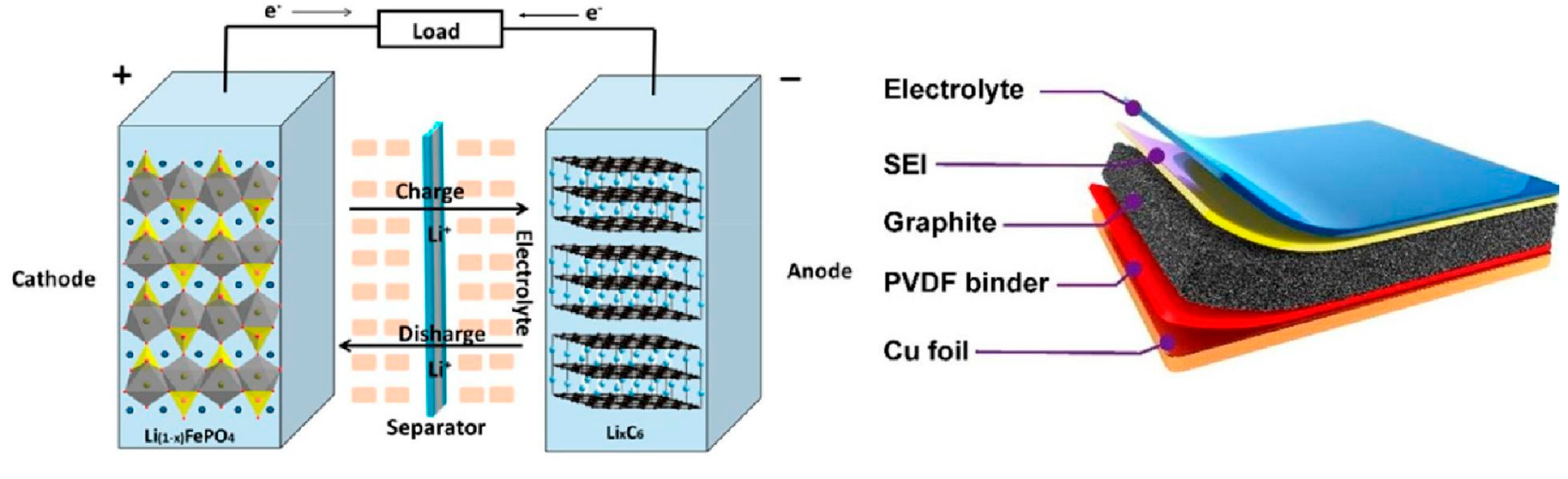
Based on the operating principles of lithium-ion batteries and their anode structure (see
Figure 10), current methods for reusing or regenerating waste graphite primarily involve acid leaching to remove impurities and high-temperature restoration. Although certain chemical treatment processes exist, thermal processing remains crucial for waste graphite recovery. Microwave heating differs from conventional methods reliant on thermal conduction, convection, and radiation. It operates by inducing frictional collisions between polar molecules and free ions/electrons. Specific mechanisms include dipole polarisation and ionic polarisation/Joule heating, delivering exceptional heating effects characterised by rapidity, selectivity, uniformity, and ease of control.
Microwave irradiation of graphite not only induces rapid heating processes (exceeding 1000 °C within seconds) but also generates localised hotspots and superheating effects. These are modulated by arc plasma to remove impurities and reconstruct the graphite structure. Yuwen et al. demonstrated that applying 20–30 s of microwave irradiation (800 W) to LIB anodes in a nitrogen atmosphere effectively removes binders and electrolyte, separating copper foil from spent graphite [
73].
Concurrently, microwave-assisted synthesis enables the production of graphite intercalation compounds (GICs), expanded graphite (EG), graphene, and porous graphene. Wei et al. employed microwave-assisted oxidation intercalation, utilising H
2SO
4 and K
2S
2O
8 as intercalants and oxidants respectively, to efficiently synthesise GICs [
74], subsequently employed as precursors for EG preparation. The rapid heating process and thermal shock effect of microwave-graphite interactions facilitate efficient impurity removal, structural repair, and expansion of graphite interlayer spacing. Furthermore, microwave thermal shock offers innovative approaches for efficient intercalation, expansion, exfoliation, and reduction in graphite.
5.3. Microwave-Assisted Lithium Battery Regeneration
Furthermore, research has focused on refurbishing and reassembling spent lithium cobalt oxides, with regenerated LIBs exhibiting discharge capacities of approximately 130 mAh g
−1 [
75]. Nie et al. screened regenerated batteries after 12 h of annealing at 900 °C, achieving a discharge capacity of 152.4 mAh g
−1 [
76]. Concurrently, Yang et al. employed LiOH-KOH molten salt to repair LiCoO
2 and remove impurities from spent LIBs. The regenerated LIBs exhibited a discharge capacity of 149.1 mAh g
−1, which remained at 138.7 mAh g
−1 after 100 cycles [
77]. LiCoO
2 batteries regenerated via LiOH-KOH-LiCO
3 molten salt also achieved a discharge capacity of 144.5 mAh g
−1 [
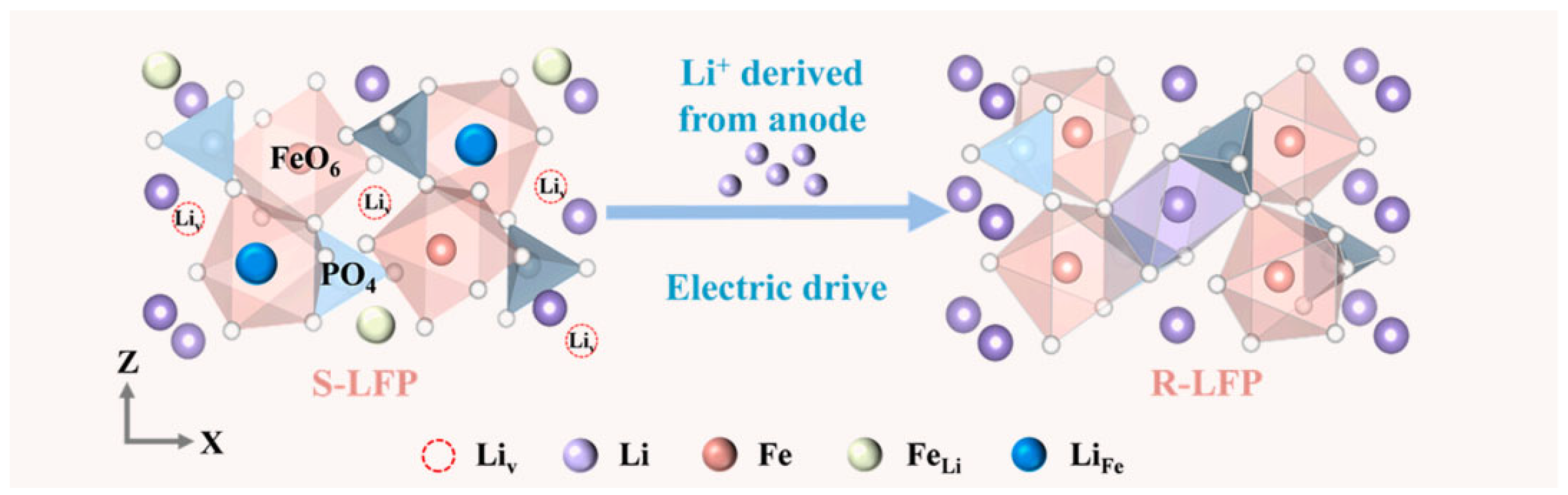
78], though excess inorganic salts required removal. Yingpan Yang et al. employed an electrolyte system utilising spent LFP (lithium iron phosphate) cathodes and anodes for charge–discharge cycles. The anode underwent delithiation to yield FePO
4 (FP), whilst Li
+ ions from the anode were simultaneously intercalated into the spent LFP cathodes to achieve regeneration (as illustrated in
Figure 11). The regenerated LFP exhibited high recovery capacity (136.5 mAh/g at 1C) and excellent stability (95.32% capacity retention after 300 cycles at 5C) [
79]. Annealing following hydrothermal treatment proved an effective method for replenishing lithium in waste LiCoO
2. offering flexibility in raw material selection without requiring calculation of lithium loss in waste LiCoO
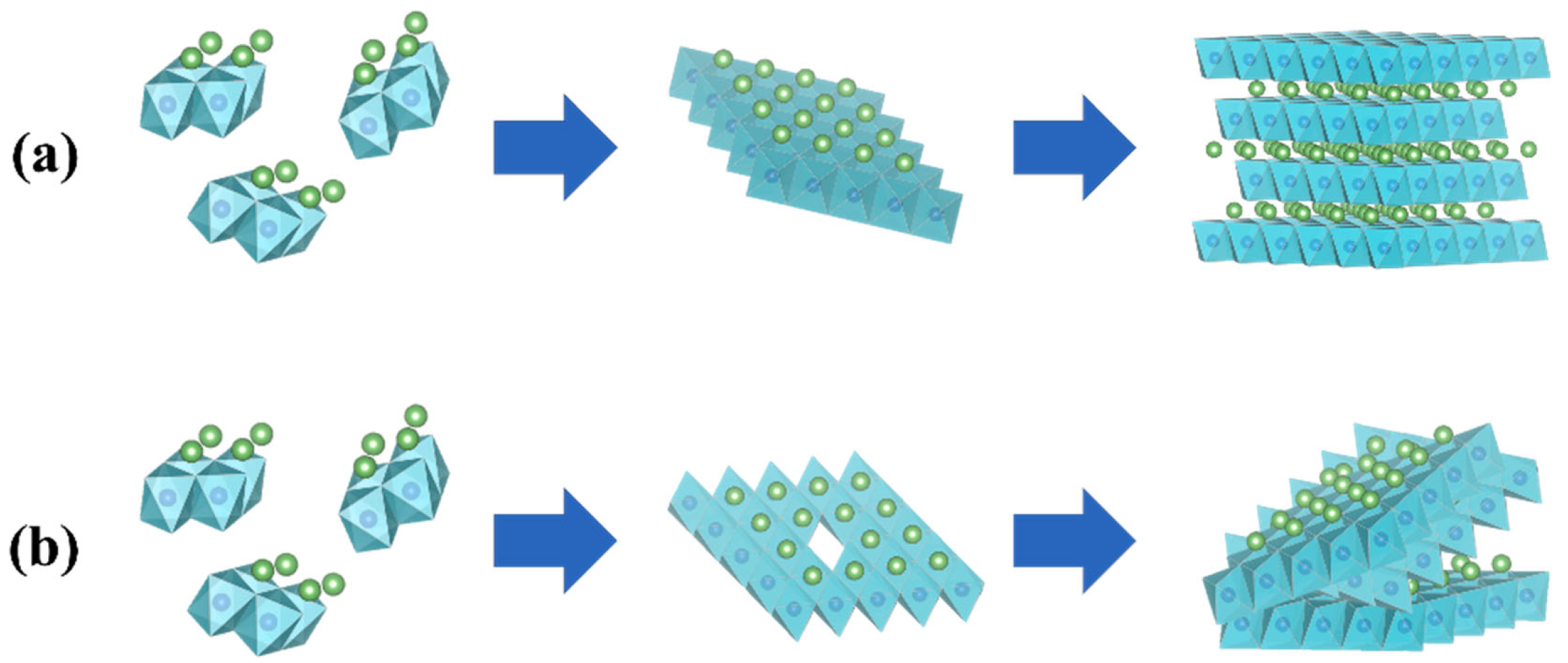
2. Meanwhile, Yang Liu et al. pioneered a microwave-assisted hydrothermal process by combining microwave irradiation with hydrothermal treatment. This approach shortens reaction time, improves internal structure, and homogenises the particle size distribution of lithium cobalt oxide (as shown in
Figure 12), facilitating the construction of high-capacity, high-rate-performance batteries using recycled lithium cobalt oxide (LiCoO
2) [
80].
5.4. Evaluation of Microwave Recycling Technology for Waste Lithium-Ion Batteries
5.4.1. Comparative Analysis of Microwave-Assisted Recovery and Conventional Methods
Existing literature suggests that microwave technology offers potential advantages over conventional pyrometallurgical and hydrometallurgical methods in the recovery of precious metals from waste lithium-ion batteries, as shown in
Table 5 [
66,
67].
However, this assertion warrants careful scrutiny. In terms of energy consumption and processing speed, microwave heating enables rapid temperature rise, and the literature reports that its energy consumption is lower than that of conventional heating methods [
66,
67]. However, these comparisons often suffer from issues of incomparability: energy consumption data for conventional pyrometallurgy typically originate from industrial-scale operations, whereas microwave experiments are conducted under small-scale laboratory conditions, with a significant disparity in their Technology Readiness Levels (TRL). Regarding metal extraction efficiency, Cornelio et al. [
68] employed a microwave-assisted carbon thermal reduction reaction, significantly enhancing the solubility of lithium, cobalt, manganese and nickel in weak acid solutions; Liu et al. [
68] found that mechanical activation and microwave reduction exhibit a synergistic enhancement effect on the selective extraction of lithium; Liu et al. [
69] employed a microwave-assisted eutectic solvent system to achieve extraction efficiencies of nearly 100% for lithium and cobalt. Whilst these figures are numerically impressive, none have been directly compared with conventional methods under identical feedstock, scale and analytical conditions. For example, under optimised conditions, traditional hydrometallurgical processes can also achieve extraction efficiencies of 90–95% for lithium and cobalt; whether the ‘close to 100%’ claimed by microwave methods constitutes a substantial breakthrough remains to be independently verified. Furthermore, existing studies have not provided a systematic marginal benefit analysis regarding the differences in the usage of eutectic solvents or acid solutions, as well as reaction conditions (temperature, time, solid–liquid ratio), between the microwave-assisted extraction process and traditional methods. Consequently, it is impossible to determine whether the contribution of microwaves represents a ‘qualitative leap’ or merely a ‘quantitative optimisation’.
5.4.2. Major Limitations and Uncertainties in Existing Studies
Existing studies share several common limitations in terms of experimental design and data reporting. Firstly, none of the studies listed in
Table 2 report the number of replicates or parameters of statistical variability. For example, although Cornelio et al. [
68] and Liu et al. [
69] reported high extraction yields, they did not provide standard deviations or confidence intervals, making it impossible to assess the reproducibility of these results. Given the significant variation in the raw material composition of end-of-life lithium-ion batteries (with significant differences in cathode material composition and impurity content between batteries of different brands, with different cycling histories, and varying degrees of ageing), laboratory results lacking statistical information are of limited use in guiding actual production. Secondly, during microwave-assisted extraction, factors such as microwave power, frequency, cavity design and sample positioning have a significant impact on heating uniformity and reaction kinetics; however, descriptions of these experimental conditions in the existing literature are often insufficiently detailed, making it difficult to achieve direct comparisons across studies or to replicate the experiments.
In the recovery of graphite and carbon materials, microwave treatment can achieve rapid heating to temperatures exceeding 1000 °C within seconds, generating localised hotspots and overheating effects, which are utilised to remove impurities and reconstruct the graphite structure [
73]. However, there are clear challenges regarding the controllability of this technology: whilst microwave-induced arc plasma aids in impurity removal, it may also lead to localised over-oxidation or structural damage to the graphite. Yuwen et al. [
73] employed microwave irradiation at 800 W for 20–30 s under a nitrogen atmosphere; however, they did not systematically investigate the effects of different combinations of treatment time and power on graphite purity, lattice integrity and electrochemical performance. Furthermore, whilst microwave-assisted synthesis of materials such as expanded graphite and graphene [
74] has demonstrated technical potential, existing research has not addressed whether the yield, purity and consistency of these high-value-added products can be maintained under scaled-up conditions.
Regarding the regeneration of lithium-ion battery cathode materials, although traditional high-temperature annealing (e.g., Nie et al. [
76] treated at 900 °C for 12 h) and molten salt restoration methods [
77,
78] can achieve a certain degree of capacity recovery, they suffer from issues such as high energy consumption, long processing times, and the need to remove excess inorganic salts. Yang et al. [
79] employed an electrochemical relithiation method to regenerate lithium iron phosphate, achieving a capacity of 136.5 mAh/g at 1C and a capacity retention of 95.32% after 300 cycles at 5C. This method avoids high-temperature treatment but increases the complexity of the electrochemical process. Liu et al. [
80] were the first to apply a microwave-assisted hydrothermal method to the regeneration of lithium cobaltate, claiming that it could shorten reaction times, improve internal structure, and homogenise particle size distribution. However, this study did not provide systematic comparative data with the conventional hydrothermal method under identical conditions, nor did it address whether microwave irradiation might cause localised overheating, leading to non-uniform material properties. More critically, the scaling-up issues associated with the microwave-assisted hydrothermal method—including the uniformity of microwave field distribution in large-volume reactors, the precise control of reaction temperature and pressure, and the feasibility of continuous production—were not addressed.
5.4.3. Scalability Challenges and Engineering Gaps
With regard to material heterogeneity, the sources of waste lithium-ion batteries are complex, encompassing different manufacturers, battery types (LCO, LMO, NCM, LFP, etc.), states of ageing, and varying degrees of mechanical damage. Existing research has utilised single-type battery materials that have undergone meticulous sorting and pre-treatment, whereas actual recycling plants are confronted with highly mixed feedstocks. The response of different cathode materials (which possess varying dielectric properties) to microwave fields differs, and this may lead to selective or uneven heating during the processing of mixed batches of materials; this issue has not yet been investigated at all. Regarding pre-treatment requirements, microwave-assisted extraction typically necessitates the crushing, screening or mechanical activation of battery materials [
68]; these pre-treatment steps themselves consume energy and incur costs, yet are often overlooked in the narrative of ‘microwave energy savings’. A comprehensive life-cycle assessment should encompass the full energy and material balance from battery disassembly to material regeneration; however, such studies remain absent from the literature. Regarding the scaling up of microwave equipment, industrial-scale microwave reactors need to process batches of battery materials ranging from kilograms to tonnes. The limited penetration depth of microwaves (typically on the centimetre scale) implies significant temperature gradients within large-volume reactors. Currently, there are no design, optimisation or operational data available for high-power microwave reactors specifically intended for waste lithium-ion battery powders or black mass. With regard to safety and environmental risks, residual electrolytes (typically lithium salts such as LiPF
6) in waste lithium-ion battery materials may decompose upon contact with water or when heated, producing highly toxic and corrosive gases such as HF; the risk of fire or explosion caused by arcing, localised overheating, and vapours from organic solvents during microwave processing has not been systematically assessed in the existing literature.
6. Technical Challenges and Outlook
Microwave technology demonstrates unique developmental potential in the resource recovery of end-of-life new energy devices. Leveraging its efficient and precise internal heating characteristics, microwave technology offers novel technical pathways for the effective recycling of complex, multi-component end-of-life components such as photovoltaic modules, wind turbine blades, and spent lithium-ion batteries. Leveraging the advantage of selective heating, microwaves can rapidly act upon components such as polar binders within layered composite structures, causing their swift degradation or deactivation. This facilitates the effective separation of multi-layered materials. Simultaneously, microwave technology enhances the leaching kinetics of valuable metals, increasing both the leaching rate and recovery efficiency. Compared to conventional pyrolysis, calcination, or mechanochemical combined recovery processes, microwave-assisted recycling significantly reduces process energy consumption and minimises the use of strong acids, alkalis, and other chemical reagents. This approach mitigates secondary pollution risks, positioning it as a key technology driving the renewable energy recycling sector towards green, low-carbon development. As the renewable energy industry continues to expand, a substantial volume of devices will soon enter concentrated decommissioning cycles. Microwave recycling technology is poised to play an increasingly vital role in achieving large-scale, efficient, and low-carbon resource circulation.
Although microwave technology has demonstrated promising results in laboratory and pilot-scale applications, its scaling up for industrial and continuous processing still faces several critical bottlenecks. On the one hand, microwave heating efficacy is highly dependent on the dielectric properties of the material. Retired new energy devices typically exhibit complex compositions, non-uniform morphology, and significant variations in dielectric parameters. This can readily lead to localised overheating or insufficient heating, directly impacting material separation efficiency, metal recovery rates, and overall operational economics. On the other hand, existing microwave reaction apparatus predominantly adopts laboratory-scale batch configurations, exhibiting limited adaptability when processing large-scale, irregular components such as wind turbine blades. This hinders the achievement of continuous, high-volume processing. Concurrently, the integration and system coupling between microwave pretreatment units and upstream mechanical sorting processes, as well as downstream hydrometallurgical or pyrometallurgical operations, remain inadequate, constraining improvements in overall process efficiency. Consequently, future research should prioritise developing methods for uniformly heating multi-component materials within microwave fields. This can be achieved through multi-physics field simulation, material modification, and optimising energy delivery methods to improve heating uniformity. Simultaneously, research into the microscopic mechanisms of microwave–material interactions should be deepened to clarify specific roles in binder decomposition, metal activation, and phase structure evolution, thereby providing theoretical support for process optimisation.
Moreover, current precious metal recovery processes predominantly rely on complex solvent extraction systems. This not only elevates recovery costs but also introduces environmental and safety concerns, including organic solvent depletion and waste liquid treatment. Consequently, developing low-toxicity, high-efficiency, and environmentally friendly green extraction technologies to replace or simplify traditional solvent extraction processes represents another critical area requiring breakthroughs in the future.
7. Conclusions
This paper systematically reviews the research progress, operational mechanisms, and current applications of microwave technology in the recycling of new energy devices such as end-of-life lithium-ion batteries, photovoltaic modules, and wind turbine blades, elucidating its significant value within green, low-carbon recycling systems. Leveraging bulk heating through dielectric loss and selective heating characteristics, microwave technology effectively addresses issues inherent in conventional recycling processes, such as high energy consumption, poor selectivity, and susceptibility to material damage. It demonstrates distinct advantages in lithium battery electrode dissociation, removal of EVA adhesive films from photovoltaic modules, and resin pyrolysis with fibre recovery from wind turbine blades, offering a reliable technical pathway for the efficient resource recovery of end-of-life new energy devices. Currently, microwave-assisted recycling has completed mechanism validation and process optimisation at the laboratory level, establishing a technical pathway encompassing dismantling, pyrolysis, catalytic leaching, and material regeneration. It demonstrates promising application potential in enhancing separation efficiency, reducing energy consumption, and improving product purity. However, scaling up for industrial application remains constrained by factors including insufficient fundamental dielectric property data, immature continuous processing equipment, and unclear coupling mechanisms with conventional processes, leaving a gap before stable industrial operation can be achieved. Future microwave recycling technology will pursue continuous advancement in high-value recovery, intelligent operation, and large-scale implementation. Breakthroughs will be achieved through multi-material synergistic recovery, online monitoring and intelligent control, continuous equipment development, and process integration, gradually transitioning from laboratory research to engineering applications. Overall, microwave technology possesses unique advantages in addressing critical challenges within the new energy sector, including the complex disassembly of composite structures in end-of-life devices, low recovery rates of valuable components, and elevated environmental risks. Leveraging its characteristics of high efficiency, environmental friendliness, and strong selectivity, this technology holds promise for providing crucial technical support to the new energy industry’s green development throughout the entire lifecycle and the achievement of carbon neutrality and carbon peaking objectives through multidisciplinary collaboration and synergistic technological innovation.