1. Introduction
Power systems are undergoing extensive decarbonisation, which is primarily driven by global CO2 emission targets and by the deployment of utility-scale and distributed photovoltaic (PV) generation. In 2023, global renewable energy additions reached nearly 510 GW, representing the fastest growth rate in two decades [
1]. Worldwide PV installations are now above 1.6 TW with a sustained annual growth rate in the range of 20–35%. The increase in PV injection is fundamentally changing the dynamic behaviour of the transmission power systems due to the displacement of synchronous generators, resulting in reduced system inertia, fault levels, and reactive power headroom [
2,
3]. In low-inertia, converter-dominated systems, voltage and rotor angle stability become strongly impacted by the control behaviour of the power electronic systems. The remaining synchronous machines are put under greater stress and experience deeper voltage depressions, slower post-fault recovery, and larger electromechanical swings under contingency states in comparison to typical older power systems [
4]. Modern international codes require distributed energy resources to ride through faults, remain connected, and provide dynamic voltage support across an array of disturbances. In effect, non-synchronous generation functions as an active stabilising source as opposed to a passive disturbance [
5].
Such systems are effectively analysed using benchmark models such as the IEEE 9-bus and 39-bus networks; however, they need to be modified to reflect high PV penetrations and the corresponding reduction in system strength thereof [
6]. Recent work focuses on modernised test systems that include converter-based generation, weakened tie-in lines, and revised fault levels that capture converter-dominated dynamics [
7]. These additional systems are complemented by standards such as IEC 60909-0, which provide consistent methods to calculate fault levels and overall system strength under both balanced and unbalanced faults [
8]. The introduction of high degrees of PV penetration has resulted in a combination of lower short-circuit current, tighter voltage limits, and more complex protection requirements, which have motivated electrical power utilities to explore dedicated grid support devices that can restore strength and resilience at critical buses.
Three classes of grid support technologies are explored in this paper: Flexible AC Transmission System (FACTS) controllers, specifically static synchronous compensators (STATCOMs) and static VAR compensators (SVCs), which provide fast, controllable reactive power and significantly improve steady-state voltage profiles and dynamic voltage support following faults or large PV ramps [
9,
10]. Synchronous condensers (SCs), which are implemented as unloaded synchronous machines connected to the grid, contribute short-circuit current, inertia and controllable reactive power, which improve voltage stability margins and the effectiveness of protection schemes in weak systems [
11]. In more recent times, battery energy storage systems (BESS) equipped with grid-forming (GFM) inverters have been proposed as a flexible modern alternative which makes use of droop-based control, which can emulate inertial response and provide fast frequency and voltage support in addition to absorbing or supplying reactive power which addresses system strength and frequency stability [
12,
13].
Although there is considerable literature on individual device types, STATCOMs and SVCs within the FACTS domain, SCs for system-strength enhancement, and BESS with GFM control for low-inertia grids, comparative studies that place all four technologies under identical conditions and similar sizes remain limited. Much of the existing literature displays work that focuses on distribution level feeders using single converter technologies or on a narrow set of three-phase faults, which rarely quantifies the collective impact of these devices on voltage and rotor angle stability within a common transmission level benchmark [
9,
13,
14]. Composite voltage-disturbance metrics and transient voltage response criteria are well established in the literature. In parallel, IEC 60909-0 provides consistent short-circuit strength quantification, while IEEE Std 1547-2018 specifies ride through and support expectations for inverter-based resources [
5,
8]. However, comparative studies that place STATCOM, SVC, synchronous condensers, and grid-forming BESS under identical PV-dominated operating conditions and that report a consistent, baseline normalised set of simulation-extractable indices spanning voltage recovery and frequency disturbance remain limited. This paper addresses that practical gap by defining DVRI and FDRI as repeatable indices for technology ranking under a fixed disturbance set at a weak PV bus in the IEEE 9-bus benchmark.
This research paper addresses the highlighted gap by embedding a large utility-scale PV plant at one of the weaker load buses of the IEEE 9-bus system, comparing the performance of grid support options (STATCOM, SVC, SC, and BESS-GFM) under balanced and unbalanced disturbances. The study employs RMS-type dynamic simulations in accordance with established power system stability analysis techniques [
3,
15]. This is combined with fault level and system metrics, which are informed by the IEC 60909-0 short-circuit calculation framework, to evaluate each device in terms of depth, duration of voltage depression at the PV bus, voltage recovery time as per limits and rotor angle deviation and damping of the SC. This paper defines a set of composite performance indices that aggregate these outcomes into comparable voltage resilience, rotor angle stability, and system strength metrics. This framework provides a quantitative basis for assessing the relative impact of SCs, STATCOMs, SVCs, and BESS-GFM in strengthening a weak PV-dominated transmission network.
2. Study System
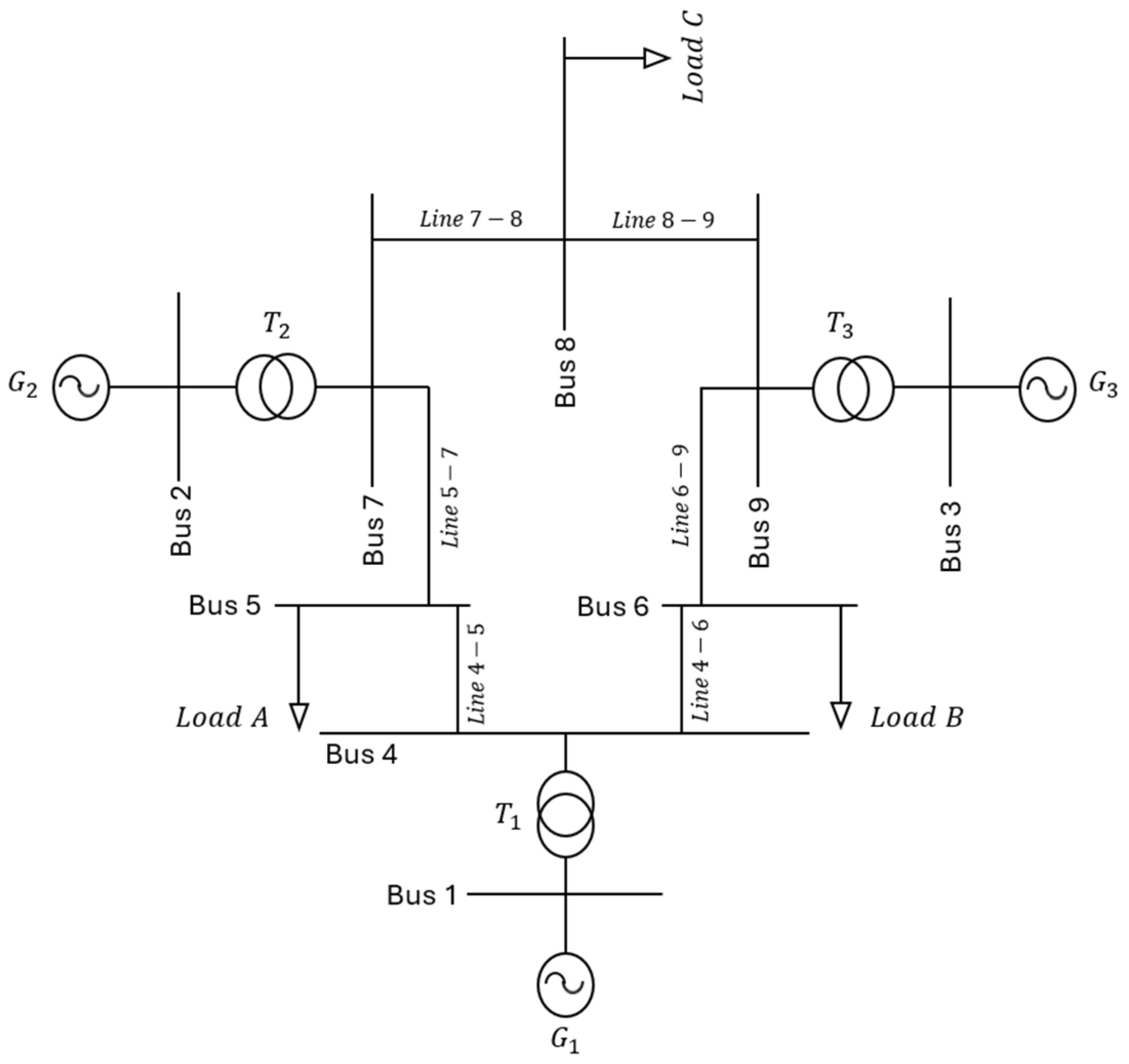
This investigation is conducted on the IEEE 9-bus system, which consists of three synchronous generators, three loads and three transmission buses that are interconnected through 230 kV lines and load tap-changing transformers. The IEEE 9-bus system was introduced in the book Power System Control and Stability by P.M. Anderson and A.A. Fouad, as depicted in
Figure 1 [
4]. The base data follow the standard IEEE 9-bus specification, allowing comparisons with existing stability studies on this benchmark.
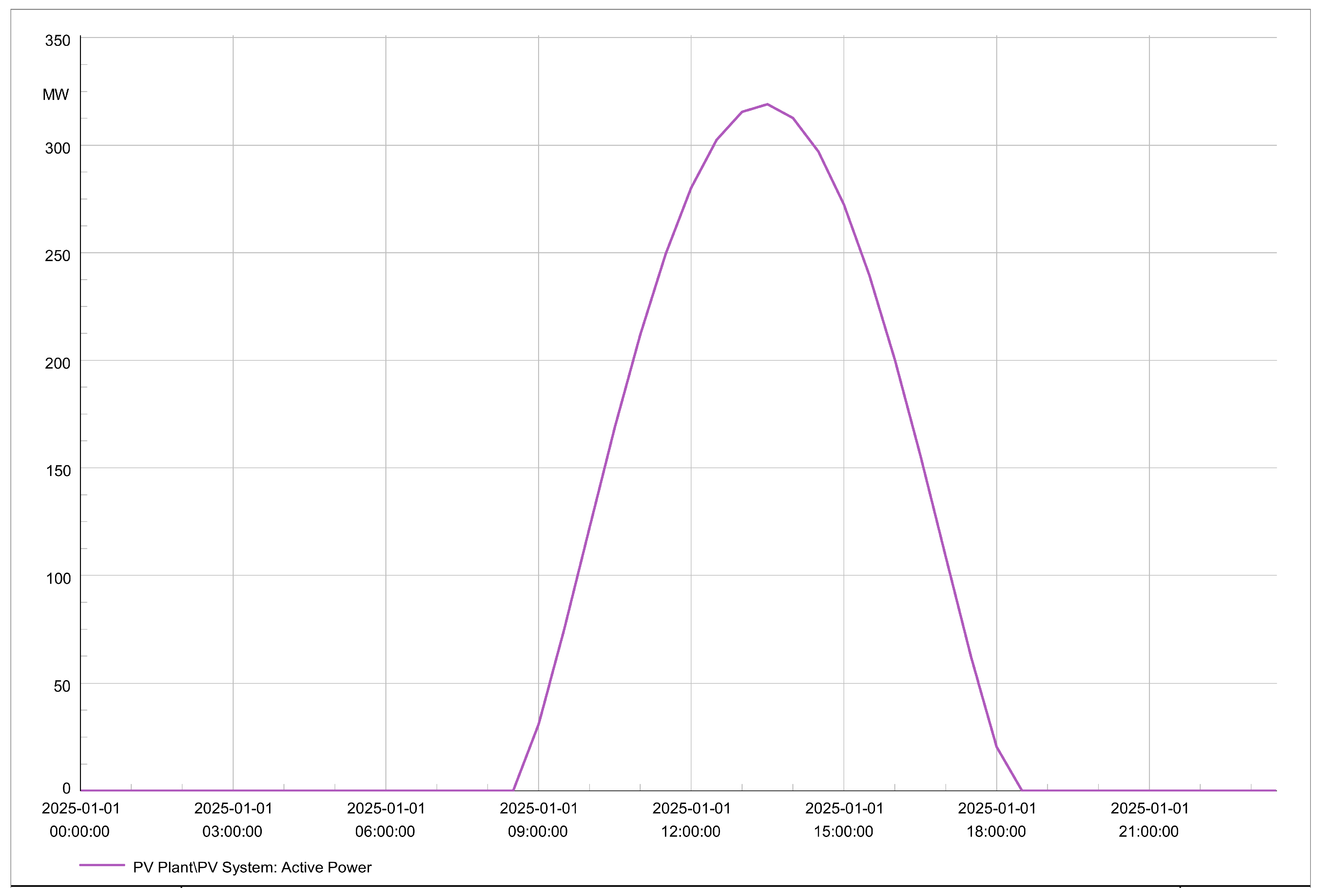
A single utility-scale PV is connected to the weakest load bus (Bus 5). This bus is deliberately chosen, as it is situated at the end of a relatively long transmission corridor and therefore exhibits the highest sensitivity to voltage disturbances and changes in system strength. The PV plant is modelled as a grid-following inverter with unity power factor and reactive power control in steady-state and full ride through capability in accordance with modern grid code practice. The active power output is increased to a maximum of 320 MW during peak solar irradiance (13:30) as per
Figure 2, whilst the generators are ramped down in proportion to maintain overall power balance. This results in a stressed, PV-dominated operating condition in which Bus 5 becomes heavily dependent on the supply of reactive power support, and the PV bus short-circuit level relative to the wider system.
The PV plant is modelled in DIgSILENT PowerFactory 2023 SP5 using an RMS grid-following converter model with PLL (phase-locked loop) based synchronisation, inner dq current control and outer active and reactive controllers. In steady-state the plant follows the irradiance profile in
Figure 2 and operates at a unity power factor. During disturbances, the controller enforces a converter current magnitude limit. Reactive current is prioritised to support voltage, and active current is curtailed as necessary within the current limit. The PV plant remains connected during simulated faults, ensuring that the results reflect the behaviour of the support devices rather than PV disconnection being a solution. This ideology is consistent with ride through and inverter interconnection requirements in IEEE 1547-2018 [
5].
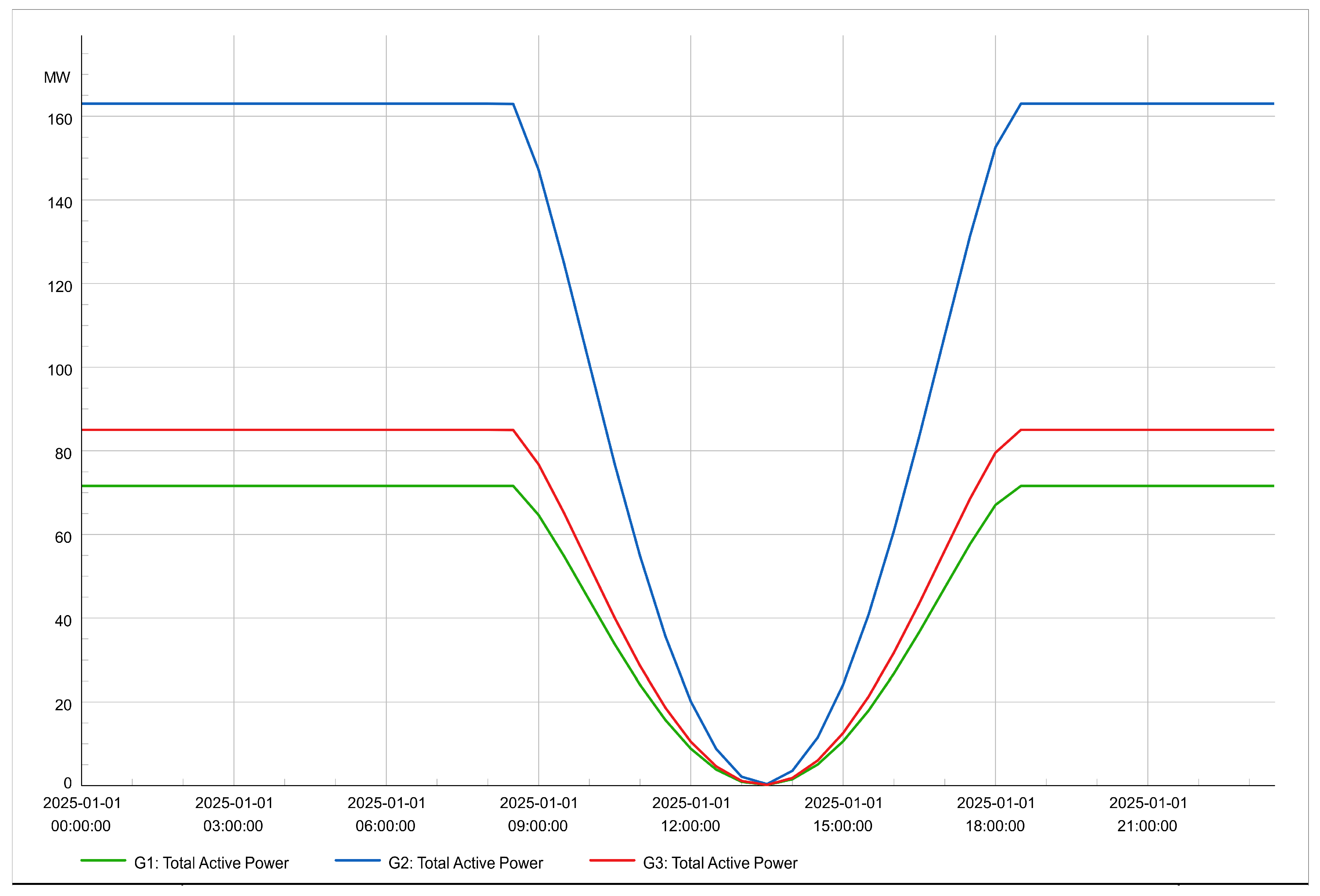
The generator output in
Figure 3 shows how increasing the PV penetration progressively will ultimately displace synchronous generation. Before sunrise, the three generators operate at their base load: the hydro pump storage unit produces 72 MW (G1), the large hard coal unit produces 162 MW (G2), and the smaller hard coal unit produces 84 MW. Once the PV plant ramps up after 8 am, the system operator reduces the active power output of all three units to maintain system power balance. This results in a significant reduction in synchronous generation between 09:00 and 15:00, which is in line with the period of maximum PV injection. The electrical data for the three generators and the reactive compensation devices are summarised in
Table 1.
The electromechanical dynamics of the synchronous machines are represented through the inertia constant
, defined as the ratio of stored kinetic energy at rated speed to the machine MVA rating. The inertia constants of the IEEE 9-bus generators were obtained directly from the machine data used in the PowerFactory dynamic models and are summarised in
Table 1.
Hydro generator G1 exhibits the largest inertia constant (
s), reflecting the higher rotating mass typical of hydraulic turbine generator sets. The steam units G2 and G3 exhibit lower inertia values (
s and
respectively), which is consistent with typical thermal plant characteristics. The corresponding stored kinetic energies at rated speed are also reported to provide traceability of the dynamic model parameters [
3,
4].
These inertia values determine the initial electromechanical response of the system following active power imbalance events and directly influence the rate of change of frequency (RoCoF) observed during PV trip and reconnection disturbances.
As PV penetration increases, synchronous generation is progressively displaced, reducing the aggregate rotating inertia available to arrest frequency deviations. In the present study, the PV plant is modelled as a converter-interfaced source and therefore does not contribute to physical rotational inertia. Consequently, system frequency dynamics are increasingly governed by the remaining synchronous machines and any fast frequency support provided by grid-forming or grid-following converter controls. This reduction in effective inertia is one of the primary causes of increased RoCoF and deeper frequency excursions in high PV operating conditions.
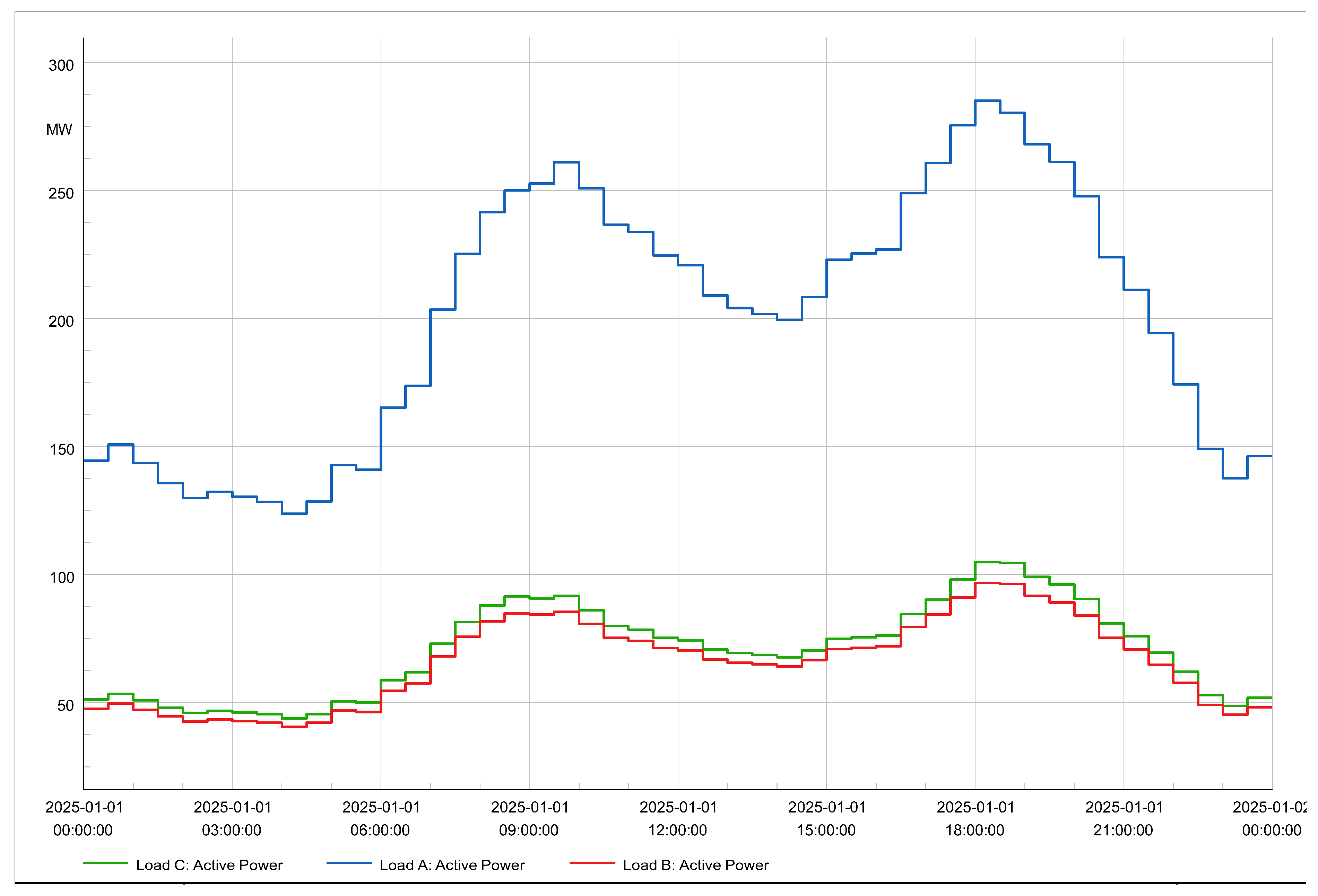
The loading that is implemented in the IEEE 9-bus system follows a realistic 24-h demand profile as depicted in
Figure 4, where loads A, B, and C represent distinct load centres. Load A is connected to Bus 5 and is the largest and most influential load with a 300 MW evening peak. This load drives the main power transfers through the transmission lines 5-7 and 4-5. Load B is connected to Bus 6 and behaves similar to a tie-in load, which balances the output of synchronous machines G1 and G3. It is the smallest of the three loads with a 90 MW evening peak. Load C is connected to Bus 8 and is a medium-sized centrally located load relative to the others. It peaks at 100 MW during evening peaks.
Reactive grid support is provided by four devices included in this study: STATCOM, SVC, SC, and BESS-GFM, which are individually connected to Bus 5 of the IEEE 9-bus system to compare their behaviour in response to an increase in renewable energy penetration. All the devices are operated in voltage control mode with a 1.035 pu. setpoint at the point of connection, which is within the NRS 048 limits [
16]. The SVC makes use of six 10 MVAr capacitor banks for stepwise reactive power adjustment, whilst the STATCOM offers continuous converter-based reactive power modulation. The SC also offers continuous reactive power support and is modelled with an inertia constant
H = 3.5 s. Unlike converter-based reactive power devices, the SC contributes rotational inertia in addition to reactive power support. The condenser model therefore includes a machine inertia constant, which contributes directly to the system’s electromechanical energy storage and affects the initial frequency trajectory following disturbances. This inertial contribution is absent from STATCOM and SVC technologies and must therefore be considered when interpreting the comparative frequency results. The BESS-GFM is sized and controlled such that its voltage support is limited by the inverter current, which is consistent with a 0.8 power factor capability when providing bidirectional reactive power support with the full specifications listed in
Table 2.
To ensure a controlled comparison at the weak PV bus, all four technologies were aligned to the same reactive power capability (±100 MVAr) and identical voltage control settings . This alignment was used only to normalise the reactive support duty required from each device and to isolate differences in dynamic voltage control response.
This common MVAr basis does not imply equivalent overall dynamic capability. The synchronous condenser remains a synchronous rotating machine with inherent fault current contribution, whereas the STATCOM is a converter-based shunt compensator with response bounded by current limits. The SVC is also a shunt VAR device but with voltage-dependent susceptance and switching dynamics. The BESS-GFM differs further in that it can provide both active and reactive support subject to grid-forming control priorities, converter apparent power limits, current limits, and available stored energy. The comparison should, therefore, be interpreted as a reactive support normalised technical benchmark, rather than as a claim of full physical, operational, or economic equivalence.
For the STATCOM, the dynamic response is governed by a PLL-based grid-following control structure together with a finite converter current limit, as summarised in
Table A1. During fast switching events such as PV trips and restorations, the controller prioritises reactive current injection to restore the local bus voltage. If the reactive current demand rises sharply at the instant of PV reconnection, the converter current can approach its limit and temporarily saturate. Under these conditions, the STATCOM response is dominated by voltage-restoration duty, and the associated PLL and converter-control interaction can produce short-duration local frequency and RoCoF excursions at Bus 5, even though the device remains effective for voltage support.
For the BESS-GFM, the converter was represented with a 170 MVA apparent power rating, a dynamic power factor reference of 0.8, and a current limit of 1.01 pu. These settings define the short-term dynamic envelope within which active and reactive support can be delivered during disturbances. In grid-forming inverter implementations this operating envelope may be governed either by current priority control, where active power delivery is preserved while reactive current saturates, or by voltage priority control, where reactive current is prioritised to maintain terminal voltage during disturbances. Because the analysed events occur over a short transient timescale, the reported response is governed primarily by converter apparent power and current limits, while battery energy capacity is not the binding constraint within the simulated window. A sufficient minimum SOC reserve was assumed to sustain the grid-forming response over the disturbance duration.
The detailed controller parameterisation and internal dynamic model settings used in the simulations are provided in
Table A1 in
Appendix A. This table reports the specific control structure, synchronisation approach, measurement locations, controller gains, filter constants, converter limits, virtual impedance parameters, and stabilisation settings applied to each technology to ensure full transparency and reproducibility of the implemented models.
All modelled lines have a length of 2 km, and their details are summarised in
Table 3.
Section 3 establishes the disturbance models and a brief theoretical background required to interpret the comparative results. Specifically, a three-phase fault is used as the benchmark for a severe contingency for electromechanical stress and voltage recovery at the weak PV bus, while a single-line-to-ground fault is included to quantify unbalanced effects through current and voltage sequence components. This ensures that the unified time-domain metrics in
Section 4 can be traced back to simulation drivers (system strength, Thevenin impedance, and sequence-network behaviour) rather than treated as standalone simulation outputs [
3,
7,
8].
4. Simulation Results and Discussion
This section presents the dynamic simulation results for the IEEE 9-bus system with a large-scale PV plant connected to weak load Bus 5, together with various reactive power support devices (STATCOM, SVC, SC, and BESS-GFM) connected individually to the same bus in PowerFactory 2023 SP5. The RMS studies were conducted at 13:30, corresponding to the maximum PV output for the day, using an integration step of 0.001 s (1 Ms) over varying simulation durations. Balanced and unbalanced disturbances were applied, as well as loss and restoration of the PV plant. The technologies were then compared in terms of bus voltage sequence behaviour, recovery time, and rotor angle stability. Additional metrics were defined to assess the fundamental performance of each device and its contribution to overall system strength under high PV penetration.
To assess the robustness of the comparative conclusions to operating conditions, multiple operating points in addition to the peak PV case are evaluated. Three operating points are selected from the 24-h profiles to represent moderate PV output (09:00) and higher synchronous dispatch (higher inertia/short-circuit strength); peak PV output (13:30) (lowest synchronous dispatch); and evening/high-load conditions with low PV output (18:30) (higher synchronous dispatch but higher loading). For each operating point, the same disturbance set is applied and the DVRI/FDRI indices are recomputed for each technology.
The rotor angle analysis was undertaken with respect to G2, as it is the largest conventional generator whose electromechanical behaviour is representative of what occurs when a large PV plant at Bus 5 disturbs the network. G2 is strongly associated with the power flow through Bus 5 and exhibits significant rotor angle excursions and is therefore treated as the critical machine. The rotor angle deviation, as per Equation (4), was used in this study, where
is the pre-fault angle, which is used as a common reference for all cases. This removes any minor differences in the steady-state operating point between the baseline and each reactive device such that
starts from zero and only displays the swing induced by the respective disturbance and its subsequent damping. The chosen approach is in line with standard synchronous machine modelling, where the mechanical states are expressed in deviation form around a synchronous machine’s operating point, which is used as a state vector of a multi-machine model. Recently, transient stability studies making use of the IEEE 9-bus system report on rotor angle performance as depicted in Equation (5) to effectively quantify the actual post-fault swing caused by control action. Making use of
in this study aligns the plots for G2 with international practices and allows for the effective comparison of the impacts caused by the STATCOM, SVC, SC, and BESS-GFM [
31,
32,
33,
34].
where
Δδ(
t) is the rotor angle deviation of generator G2,
δ(
t) is the instantaneous rotor angle, and
δ(
) is the pre-disturbance (reference) rotor angle at time
.
where
is the maximum rotor angle deviation of G2 over the post-disturbance observation window,
is the maximum rotor angle attained in that window, and
is the pre-disturbance reference angle.
4.1. Three-Phase Fault
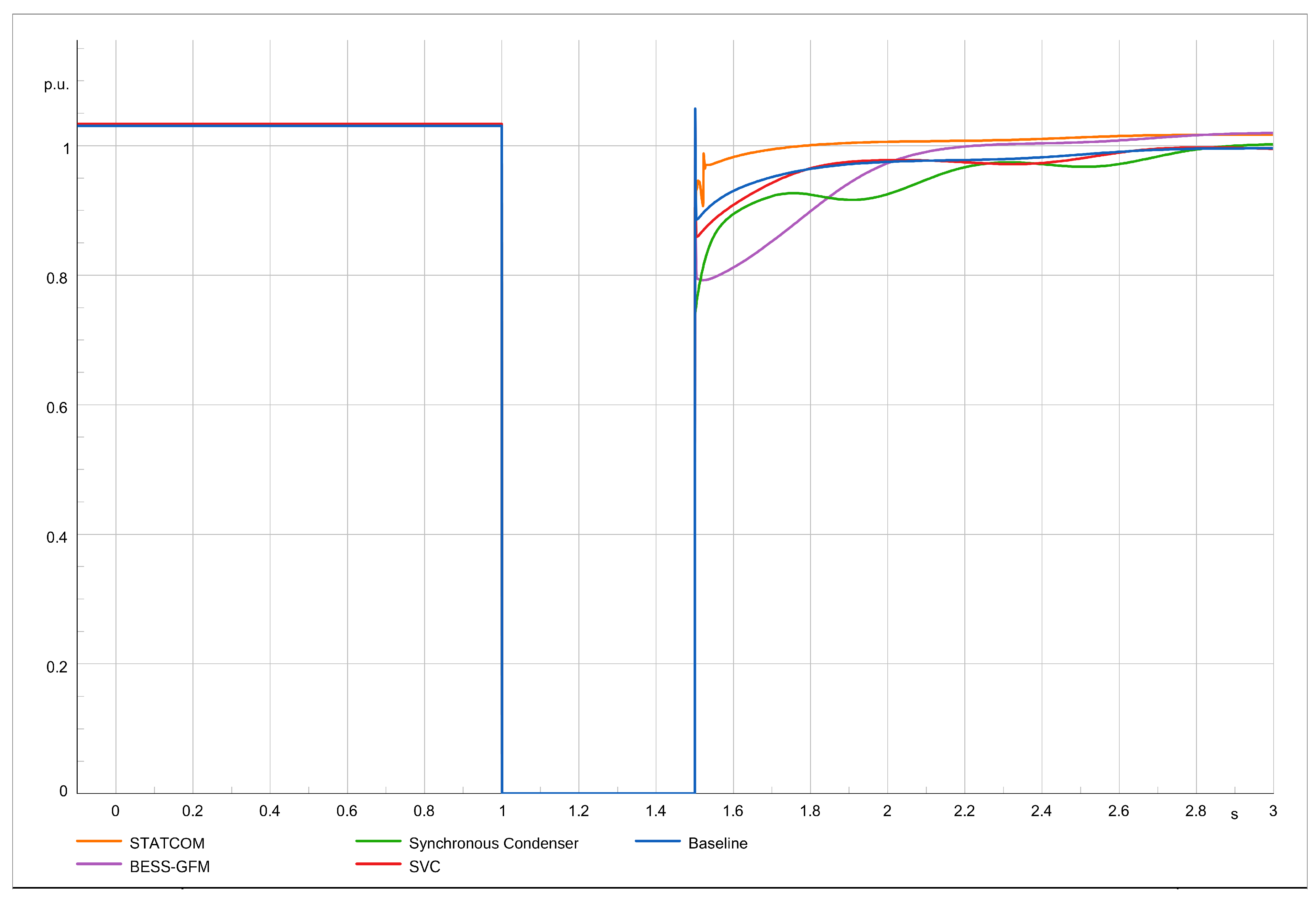
A zero impedance three-phase fault was introduced at Bus 5 at 1 s and shortly cleared at 1.5 s, with the simulation repeated for each of the reactive power devices (STATCOM, SVC, SC, and BESS-GFM).
Figure 5 depicts the voltage at Bus 5; initially, the bus voltage is maintained around 1.035 pu. for all scenarios and is quickly depressed to zero pu. during the fault. Once the fault has been cleared, the differences between the various technologies become clear, with the baseline (no additional reactive power device in service) experiencing the greatest overshoot, peaking just above the 1.05 pu. mark and thereafter decaying towards an undervoltage state below the one pu. mark. Both the SVC and BESS-GFM also display a slight overshoot of around 5% above the nominal and settle at 1 pu., which does show improvement but remains dynamic to an extent. The STATCOM and SC, on the other hand, facilitate voltages that are more controlled, with the STATCOM restoring the bus voltage to around 1.02 pu. extremely fast with minimal overshoot and a relatively smooth profile through to 3 s, whilst the SC settling closer to 1 pu. displays small oscillations along the way. The STATCOM provides the best dynamic support in comparison to the other devices in response to a three-phase short-circuit.
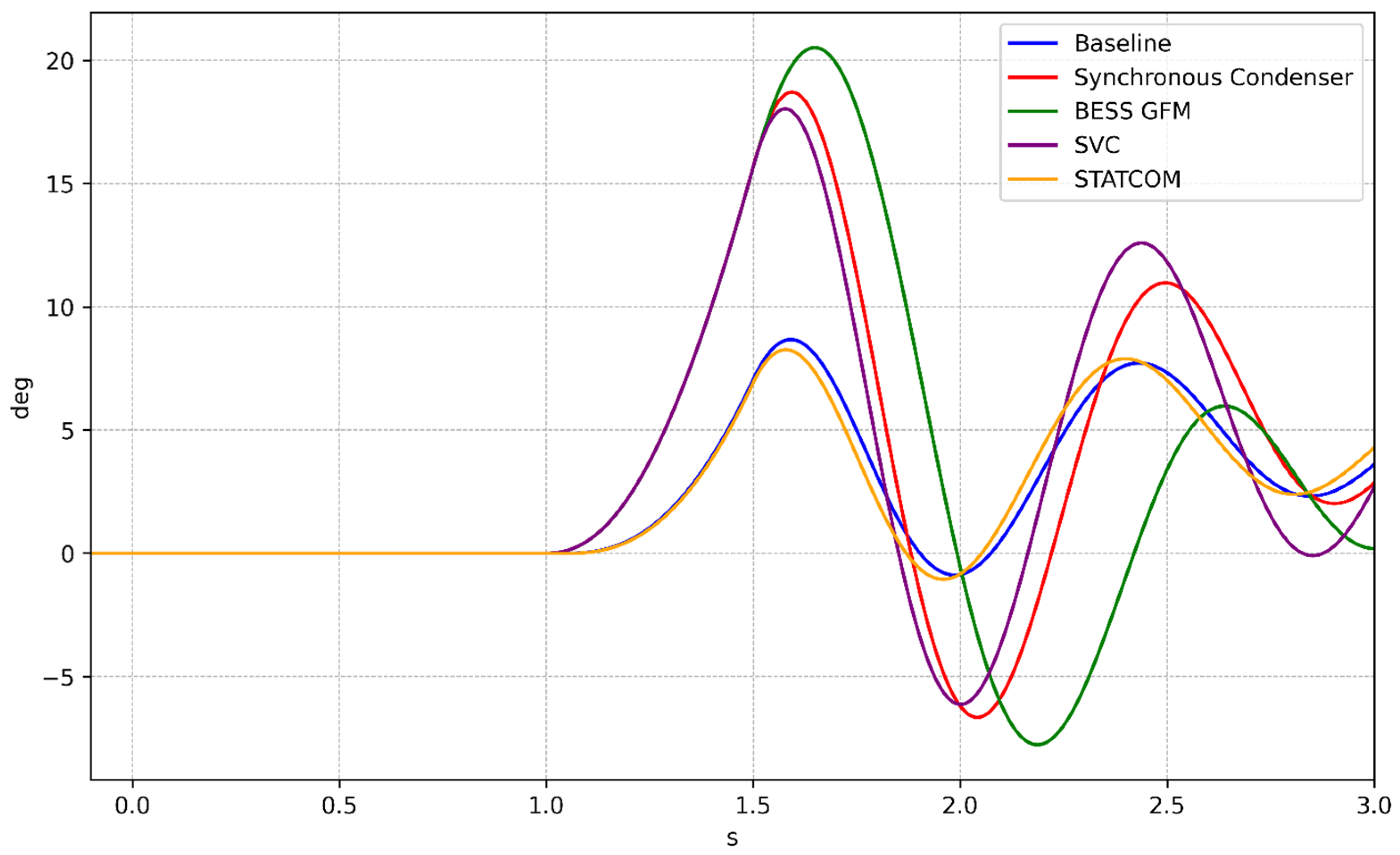
Figure 6 depicts the change in rotor angle swing of G2 relative to its own pre-fault angle. During the fault, the voltage at Bus 5 collapses towards zero, significantly reducing the electrical power transfer capability of the network. The electrical power produced by G2 drops sharply whilst the mechanical torque from the turbine remains unchanged, as depicted by Equations (6) and (7) [
3]. The electrical torque drops below the mechanical torque during the fault, resulting in a positive accelerating torque
that causes generator G2 to accelerate and the rotor angle to increase in all cases. The BESS-GFM causes G2 to reach the largest initial swing, peaking at around 20 degrees above pre-fault levels. Due to its fast grid-forming control capability, it can hold the faulted area stronger whilst keeping some power transfer capability before over-reinstating the voltage during the clearing of the fault. This causes G2 to experience a greater change in synchronising torque, resulting in the greatest angle.
Both the SC and SVC also cause large initial swings just under 20 degrees and inject significant reactive power during voltage recovery, which increases the electrical power, thereby reducing acceleration during the fault and producing a stronger decelerating torque after clearing.
Both the baseline scenario and STATCOM display the smallest initial swing; in the baseline case, it is primarily due to there being no reactive power device connected to Bus 5, which weakens the transfer and causes a moderate acceleration of G2. In the case of the STATCOM, it displays the best damping of subsequent oscillations. The net change of
remains minimal, which ultimately displays more favourable rotor angle swing stability.
Once the fault has been cleared, both the Bus 5 voltage and power transfer capability increase rapidly such that the electrical power overshoots and the electrical torque exceed the mechanical torque. The rotor angle therefore swings back and decelerates going into the negative region relative to its pre-fault condition.
The BESS-GFM, SVC, and SC show the deepest negative dips between −5° and −8°, which is consistent with their larger first-swing deviation and the resulting overshoot past the pre-fault reference during the reversal. The BESS-GFM response is the most weakly damped in rotor angle terms, exhibiting the largest oscillations and slowest settling. The SVC displayed the second largest positive swing post-recovery simply due to voltage-dependent susceptance and slower effective response, and its effectiveness increases as voltage recovers. The SC, on the other hand, has a smaller second positive swing than the SVC due to the inertia of the rotating mass and subsequent mechanical damping in addition, which corresponds to less oscillatory energy.
Both the baseline and STATCOM exhibit only a small negative minimum, corresponding to a significantly smaller energy shift. A smaller second swing is displayed with a small range; the STATCOM closely follows the baseline with broadly similar damping and small swing magnitudes, implying that it improved the voltage at Bus 5 with minimalistic impact on the mechanical swing of G2. In all the tested scenarios, there was no loss of synchronism of G2.
To support the interpretation of the rotor angle response, additional transient stability indicators were extracted from the RMS simulations. Specifically, the accelerating power of generator G2 was evaluated using the exported turbine mechanical power and electrical air-gap power signals obtained from the PowerFactory simulations.
Accelerating power was calculated directly from the electromechanical power imbalance equation illustrated in Equation (8).
which represents the difference between the mechanical int power and the electrical power delivered to the network. This quantity governs rotor acceleration according to the swing equation and is therefore directly linked to the observed rotor angle trajectory [
3,
4].
For each simulation timestep
, accelerating power was calculated from the exported signals as
. To further quantify the disturbance impact, the accumulated accelerating energy during the fault interval was estimated using numerical integration as per Equation (9).
where
represents the RMS simulation timestep. This term corresponds to the net kinetic-energy change imparted to the generator rotor during the disturbance.
Physically, larger positive values of the accelerating energy integral indicate greater rotor acceleration and therefore a larger rotor angle excursion following fault clearing. Conversely, a smaller accelerating power imbalance results in reduced kinetic energy gain and a more limited first swing as depicted in
Table 6.
The accelerating power indicators in
Table 6 explain the relative rotor angle behaviour observed in
Figure 6. Cases with a larger magnitude of negative accelerating power and greater fault period energy exchange correspond to larger rotor angle excursions and more pronounced oscillations. This is reflected in the BESS-GFM, SVC and synchronous-condenser cases, which show slightly larger accelerating energy magnitudes of −0.056 pu.·s and, correspondingly, larger first swing deviations.
By contrast, the baseline and STATCOM cases exhibit a smaller energy imbalance during the fault period of −0.053 pu.·s, which results in a more limited kinetic energy exchange and therefore smaller rotor angle swings. The STATCOM response closely follows the baseline case, indicating that its reactive-power support improves voltage recovery with minimal influence on the electromechanical dynamics of generator G2.
Overall, the accelerating-power metrics provide a consistent physical explanation for the rotor angle trajectories shown in
Figure 6. Technologies associated with greater accelerating-energy exchange produce larger rotor angle deviations, whereas cases with smaller energy imbalance exhibit more restrained swings and faster damping. In all scenarios, generator G2 remained synchronised with the system, confirming that transient stability was maintained under the tested disturbance.
To further support the interpretation of the rotor angle behaviour, an additional column presenting the synchronising torque indicator (pu./deg) is included for comparison. This coefficient represents the slope of the electrical power–angle relationship and therefore quantifies the synchronising torque that restores the generator rotor towards its equilibrium position following a disturbance. Devices associated with a larger value provide stronger synchronising torque, which improves the ability of the machine to resist rotor angle deviation and promotes faster damping of oscillations. Conversely, smaller values indicate a weaker electromechanical restoring effect and are typically associated with larger rotor angle excursions. The inclusion of this indicator therefore provides a quantitative link between the observed rotor angle deviations and the underlying power angle characteristics of the system under each device scenario.
Accelerating power analysis is presented only for the three-phase fault because it represents the most severe disturbance case, producing the largest electromechanical imbalance and therefore the most informative rotor angle response for comparative stability assessment.
4.1.1. Metrics
Post-Fault Voltage Dip Depth
Understanding the post-fault depth
is of great significance, as it provides an important metric that can be used to compare the performance of each reactive power device as represented by Equation (10). This metric measures the lowest voltage reached at a specific busbar after a fault has been cleared relative to the pre-fault operating voltage. The metric is expressed as a percentage and describes the severity of the disturbance. This parameter is also important in terms of compliance, as transmission planning criteria have specific low voltage thresholds and limits on the duration that the system remains at low voltage, making this metric an important indicator alongside recovery time metrics [
35,
36,
37,
38].
The disturbance thresholds used in this study are aligned with commonly adopted grid code and planning practices. In particular, the interpretation of post-fault voltage behaviour follows the ride through philosophy of IEEE Std 1547-2018, while the representation of network faults and associated current behaviour is consistent with the IEC 60909 short-circuit framework [
24,
38].
where
is the post-fault voltage dip depth expressed as a percentage,
is the pre-fault operating voltage magnitude at the monitored bus (pu.), U(t) is the bus voltage magnitude (pu.) as a function of time t during the post-fault observation window,
is the fault clearing time,
is the end time of the evaluation window, and
is the minimum bus voltage reached within that post-fault window.
The metric was calculated for each of the reactive power devices as stipulated in
Table 7. The STATCOM had performed the best in terms of post-fault performance, displaying the smallest dip of 21.94% due to the converter being able to inject reactive current rapidly during undervoltage conditions, with the SC following straight after at 28.56%, primarily due to the field system delivering reactive output but being constrained by the excitation dynamics and limiters. The BESS-GFM performed the worst due to its inverter current limits in line with the prioritised droop settings’ restrictive reactive current delay, whilst the SVC had displayed better performance than the storage; however, its susceptance-based VAR support is less effective during severe voltage depressions, resulting in both devices falling short of the baseline.
Post-Fault Recovery Time
Understanding the end of dip or recovery thresholds pertaining to each device allows for the measurement of how quickly the voltage returns to a specific threshold that must be sustained for a specified dwell time on a desired bus, typically governed by international standards. Equations (11) and (12) mathematically represent the earliest simulation-based post-fault clearing time at which the monitored bus positive-sequence voltage magnitude
meets or exceeds a sustained limit of 0.9 pu. or 0.95 pu. This metric provides a pragmatic, comparable statistic across the various reactive power devices tested in this study [
16,
35,
37].
where
is the post-fault recovery time to the 0.9 pu. threshold, t is time,
is the fault clearing time, and U(t) is the monitored bus positive-sequence voltage magnitude (pu.).
where
is the post-fault recovery time to the 0.95 pu. threshold, t is time,
is the fault clearing time, and U(t) is the monitored bus positive-sequence voltage magnitude (pu.).
The post-fault recovery time in relation to the three-phase fault for the various technologies is shown in
Table 8, where reported values are bounded by the simulation time step, with the device ranking being a key outcome; the minimum non-zero recovery time that can be reported is approximately 0.001 s, and any differences smaller than this are not distinguishable. The table shows that after the fault has been cleared, the voltage returns to 0.9 pu. almost immediately, within one simulation timestep for most of the cases, with the STATCOM achieving the fastest recovery time and the baseline displaying 0.0282 s, coming in second. The SVC and SC follow closely, with the BESS-GFM coming in last. For the 0.95 pu. benchmark, the STATCOM once again performs the best, whilst on the other hand, the SC performs the worst, taking 0.61 s to reach a sustained 0.95 pu. which is primarily due to the excitation system response and reactive current behaviour under post-fault network conditions. The baseline and SVC display similar clearing times, with the BESS-GFM taking twice as long.
Undervoltage Area
The
is a severity index that finds the integral of the voltage shortfall below a selected threshold of 0.9 pu. as per this study over a defined window to capture depth x duration as a single scalar quantity as illustrated in Equation (13). A brief shallow dip yields a smaller value, whilst a deep undervoltage results in a larger value. The clipping threshold of 0.9 is in line with national benchmarks in typical voltage dip assessments. The severity index is defensible in the comparison of the various reactive power devices tested in this paper and is an adaptation of the voltage sag energy definition from IEEE 1564 [
16,
35,
39].
where
is the post-fault undervoltage area (pu. s), U(t) is the monitored bus positive-sequence voltage magnitude (pu.), 0.9 is the undervoltage threshold (pu.),
is the fault clearing time,
is the end of the post-fault evaluation window, and max(0.9 − U(t), 0) is the clipped voltage shortfall below 0.9 pu.
From
Table 9, it can be noted that the STATCOM provides the best voltage resilience with an exceedingly small voltage area of
and with a noticeably short duration below 0.9 pu. for 1.8 m.s, which illustrates its fast, controllable converter-based reactive current injection that very quickly alleviates the voltage dip even though it reaches 0.8 pu. On the other hand, the BESS-GFM performs the worst by a significant margin with an undervoltage area of 0.0193 pu.s and is below 0.9 pu. for 0.3 s, which is primarily due to its converter current limits and control priorities. The SC’s performance is midway with an area of 0.00527 pu.s, which is primarily due to its effective response being governed by field forcing dynamics and limits even though it can provide substantial vars; however, the SC is worse than baseline on these post-fault undervoltage metrics and not as good as the STATCOM. The SVC’s area of 0.00165 is better than both the SC and BESS-GFM; however, it remains worse than the baseline case and exhibits a lower minimum post-fault voltage of 0.511 pu. together with a longer duration below 0.9 pu. of 0.077 s, which indicates reduced effectiveness under severe voltage depression compared to the STATCOM.
Composite Severity Metric
This study proposes a dynamic voltage resilience index (DVRI), which is a valuable composite metric that can be used to effectively rank reactive power devices using three post-fault criteria, including: dip depth
, undervoltage area
and normalised recovery time as described in Equations (14)–(18).
represents the prolonged restoration which is practically used in utility planning criteria and short-term voltage stability assessments which measure the time to reach a nominal threshold of 0.95 pu. with the algorithm included in
Appendix C [
37,
40,
41].
captures the worst-case sag magnitude, while the
captures the cumulative exposure that falls below the planning threshold, which is consistent with area-based severity indices and transient voltage response criteria [
35,
37,
38,
39]. The composite score represented in Equation (14) is intentionally structured to make use of established magnitude concepts used in voltage disturbance assessments. This metric is a bespoke composite index defined for this study; however, it remains consistent with established practices that evaluate voltage disturbances using both magnitude and duration. The weights
can vary based on a grid code preference between dip depth, undervoltage severity or recovery time; however, a default of equal weights was selected for this study. Note that
is a weighted composite formed from a percentage-based dip-depth term; a time-averaged undervoltage shortfall term, and a normalised recovery delay term; therefore, the absolute magnitude of
is scale-dependent, and the metric is used here for relative ranking of technologies under a fixed set of thresholds and weights.
is non-negative and increases as any of the subcomponents of the metric worsen. The DVRI, as represented in Equation (19), provides a dimensionless, baseline normalisation improvement measure. This normalisation removes scale dependence on the specific operating point and allows direct ranking of technologies under a fixed contingency, threshold, and weighting, which is the intended planning application rather than an absolute protection setting. The DVRI articulates performance as an improvement or decline relative to the baseline scenario which has no devices in service [
16,
35,
37,
40,
41].
where
is the composite post-fault severity score,
,
, and
are weighting coefficients (with
+
+
= 1),
is the post-fault dip depth (%),
is the post-fault undervoltage area (pu.s) evaluated over the window
to
,
is the fault clearing time,
is the end of the post-fault evaluation window, and
is the earliest time after clearing at which the monitored bus positive-sequence voltage U(t) reaches and sustains 0.95 pu.
where
,
, and
are weighting specifies equal weighting of the dip-depth, undervoltage-area, and recovery delay terms, with
.
Because the three subcomponents in Equation (14) quantify different disturbance attributes, each term is expressed in an appropriate, dimensionless form prior to aggregation. We therefore normalise each component against the baseline case evaluated under the same contingency and observation window. Let the baseline values be
,
, and
base. The normalised components are defined in Equations (16)–(18).
The composite voltage-severity score is then formed as depicted in Equation (19).
Equal weights (
w1 =
w2 =
w3 = 1/3) are retained as a neutral baseline because they balance the three disturbance descriptors most used in planning criteria: magnitude, exposure, and recovery delay.
where DVRI is the dynamic voltage resilience index (dimensionless),
is the composite score for the device case, and
is the composite score for the baseline case, with DVRI > 0 indicating improved post-fault resilience relative to baseline and DVRI < 0 indicating degraded resilience.
Table 10 displays the results from this paper; one observation it is conclusive that the STATCOM provides the strongest post-fault resilience, achieving the lowest composite score
of 0.0783 and the only positive DVRI of 0.512, which is consistent with its fast converter-based, bidirectional reactive current injection that almost instantly addresses the voltage depression. On the other hand, both the BESS-GFM and the SVC perform worse than baseline due to the post-fault undervoltage area being relatively high, primarily due to the inverter current limits and droop settings for the GFM device and the voltage susceptance limits for the SVC under very low voltage conditions; therefore, resulting in their var support being restricted. The SC performs the worst of all tested technologies with a DVRI of −0.444, which is primarily due to the large recovery time consequence of 2.11 s, which is consistent with an excitation system-dominated response where the support provided heavily depends on the automatic voltage regulator (AVR), which manipulates the field excitation in order to hold a reference voltage in addition to field forcing ceilings. This directly impacts the SCs’ performance, causing slower restoration despite improving the minimum post-fault voltage significantly relative to baseline. To connect the IEC 60909 strength concepts to the time-domain indices used in this study,
Table 4 shows that cases with higher initial symmetrical short-circuit current
(equivalently lower Thevenin impedance
) at Bus 5 tend to exhibit smaller undervoltage exposure and shorter recovery delay. These effects reduce the composite voltage disturbance severity score
and therefore increase the resulting DVRI value. This provides a direct interpretive bridge between classical grid strength measures based on fault level and the post-fault voltage resilience quantified by the proposed DVRI metric. In this way, DVRI complements conventional short-circuit strength metrics by translating the static fault-level characteristics of the network into a dynamic resilience measure derived from time-domain voltage behaviour.
Applying the metrics as illustrated above to the unbalanced fault scenarios, such as the single-phase-to-ground and double-line-to-ground faults, resulted in relatively small undervoltage exposure areas and nearly identical recovery times across the technologies. This occurs because the positive-sequence voltage remains above the 0.9 pu. benchmark for most of the disturbance period. Consequently, the DVRI metric is most discriminating against severe symmetric disturbances where the positive-sequence voltage collapse dominates the system response. For unbalanced faults, system stress is more appropriately interpreted through the behaviour of sequence quantities. In this study, unbalanced events are therefore evaluated using the resulting positive-sequence voltage behaviour together with the magnitude and temporal characteristics of the negative-sequence current, which provides a direct indicator of unbalanced network stress and associated impacts on synchronous machines and converter interfaces.
To assess robustness to weight selection, a weight sensitivity analysis is performed by sampling {
w1,
w2, and
w3} uniformly over the feasible simplex and recomputing
Jv and DVRI for each technology. This produces a rank frequency which is reported in
Table 11. To evaluate robustness to weight selection, a Monte Carlo sampling procedure was applied where the weight triplet {
w1,
w2, and
w3} was sampled uniformly over the feasible simplex using a Dirichlet distribution with a detailed algorithm included in
Appendix C. For each sampled weight combination, the composite score
was recomputed for every technology, and the resulting DVRI values were ranked. Repeating this process over many samples (200,000 iterations) yields the rank-frequency distribution, which quantifies how often each technology appears in each ranking position. This procedure follows widespread practice in multi-criteria decision analysis where Monte Carlo weight sampling is used to evaluate ranking robustness included in
Appendix C. Under the three-phase fault at Bus 5, the STATCOM is Pareto-dominant across the three sub-metrics and therefore remains top-ranked for all feasible weights, while the ordering among the remaining devices depends on the relative emphasis placed on exposure vs. recovery delay [
42,
43].
Composite Severity Metric Operating Point Sensitivity
To assess how sensitive the composite index is to dispatch conditions, the DVRI calculation in
Section 4 is repeated at the three operating points defined in
Section 4. The resulting DVRI values are summarised in
Table 12 for each technology. If the monitored voltage does not return to 0.95 pu. within the evaluation window, the recovery component is treated as right-censored and assigned the maximum normalised penalty over the observation horizon.
Overall, the STATCOM shows the most reliable improvement in voltage recovery across all operating points and remains the best-performing option in every case with DVRI = 0.097981, 0.512289, and 0.362997. The behaviour of the other technologies changes with operating point. In Case 1, the SVC provides only a small improvement with DVRI = 0.009964, while both BESS-GFM and the SC perform worse than the baseline. In Case 2, the SC becomes beneficial with DVRI = 0.125821 and ranks second, whereas BESS-GFM and the SVC remain negative. In Case 3, both BESS-GFM and the SVC show improvements with DVRI = 0.127855 and 0.125821, while the SC becomes detrimental with DVRI = −0.334394.
These results indicate that the absolute DVRI magnitude varies with the operating point, which is consistent with fault severity changing as PV output and synchronous displacement vary. However, the main conclusion is stable over the tested range that the STATCOM consistently delivers the strongest composite improvement.
4.2. Single-Phase-to-Ground Fault
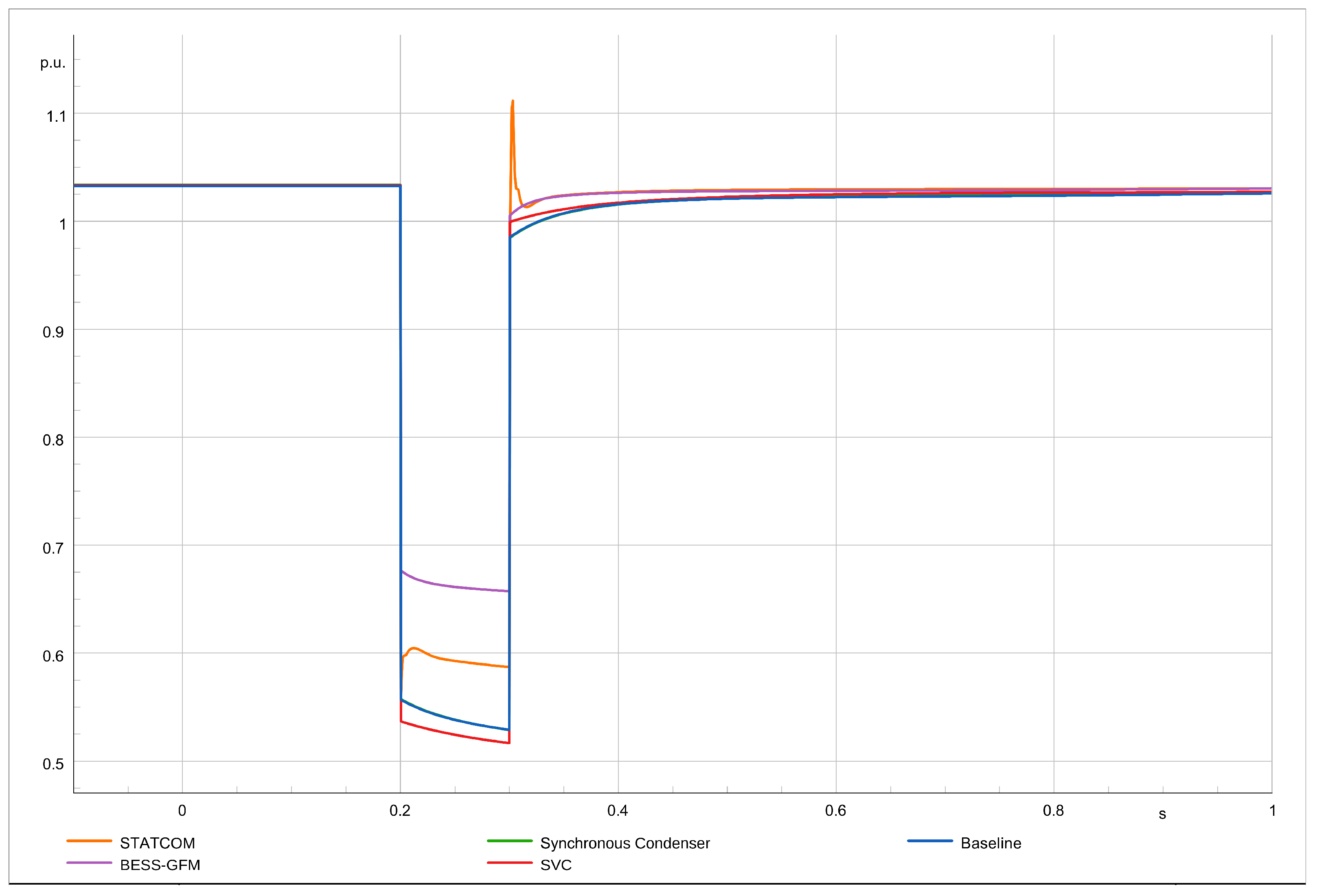
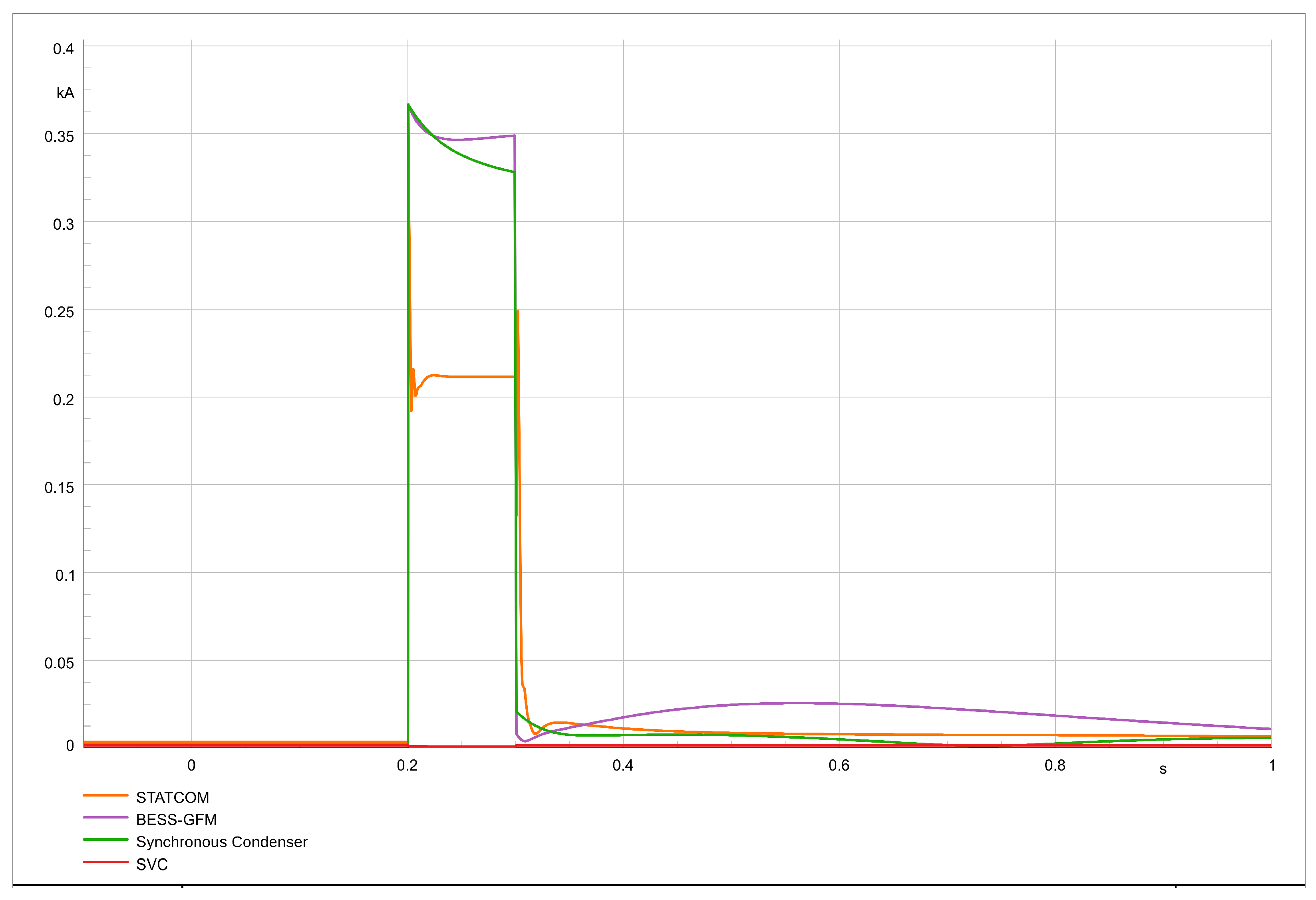
A single-phase-to-ground fault was applied to Bus 5 at 0.2 s and cleared shortly thereafter at 0.3 s for each reactive power device (STATCOM, SVC, SC, BESS-GFM). During the fault, the STATCOM held the bus voltage (V
1) as per
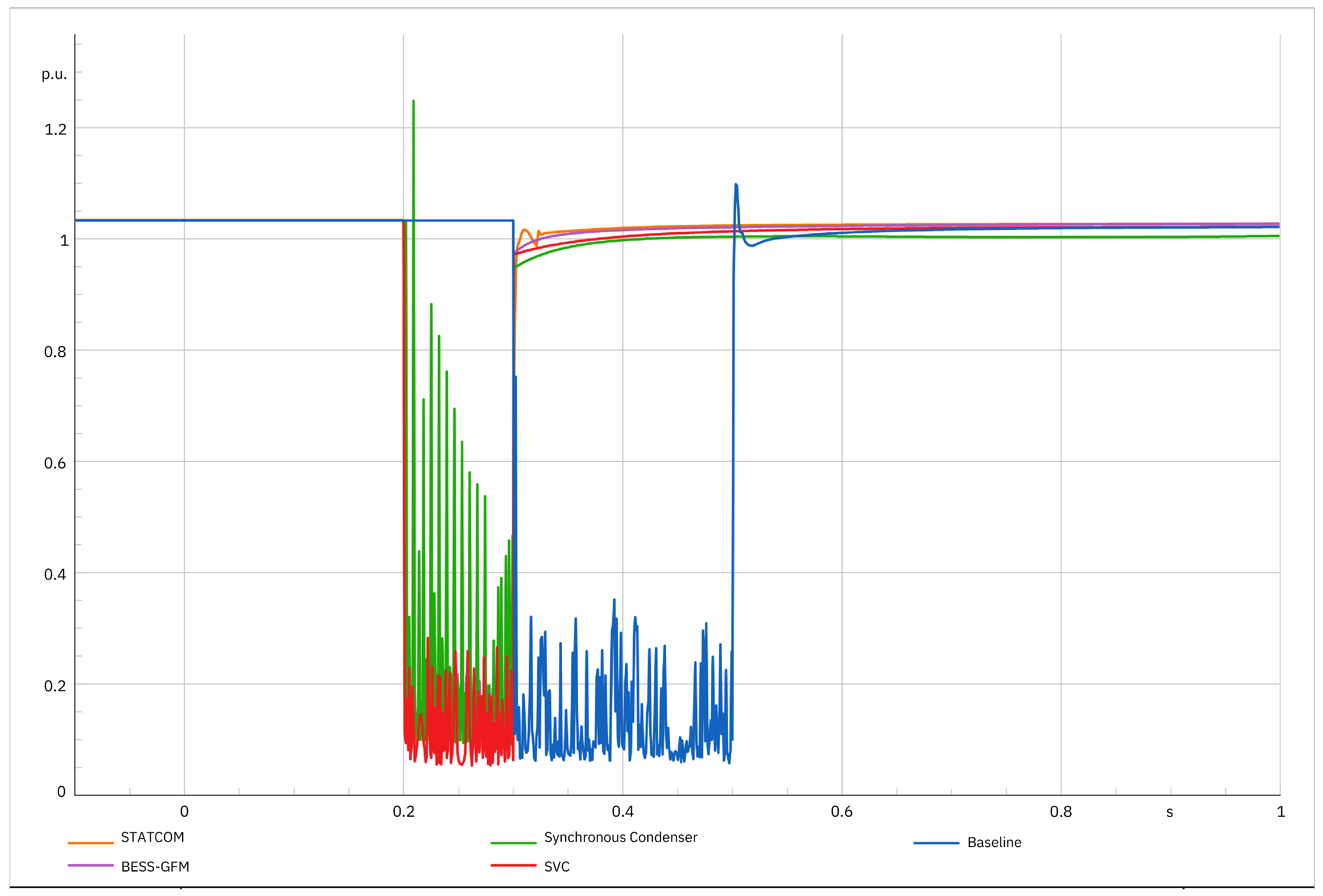
Figure 7 relatively high at around 0.6 pu. and at fault clearing, it overshoots with the voltage reaching slightly above 1.1 pu. before settling to pre-fault voltages shortly thereafter. The shape resembles fast closed-loop voltage regulation and effective reactive power injection once the fault has been removed, with the overshoot driven by a controller transient. The positive-sequence current (I
1) as per
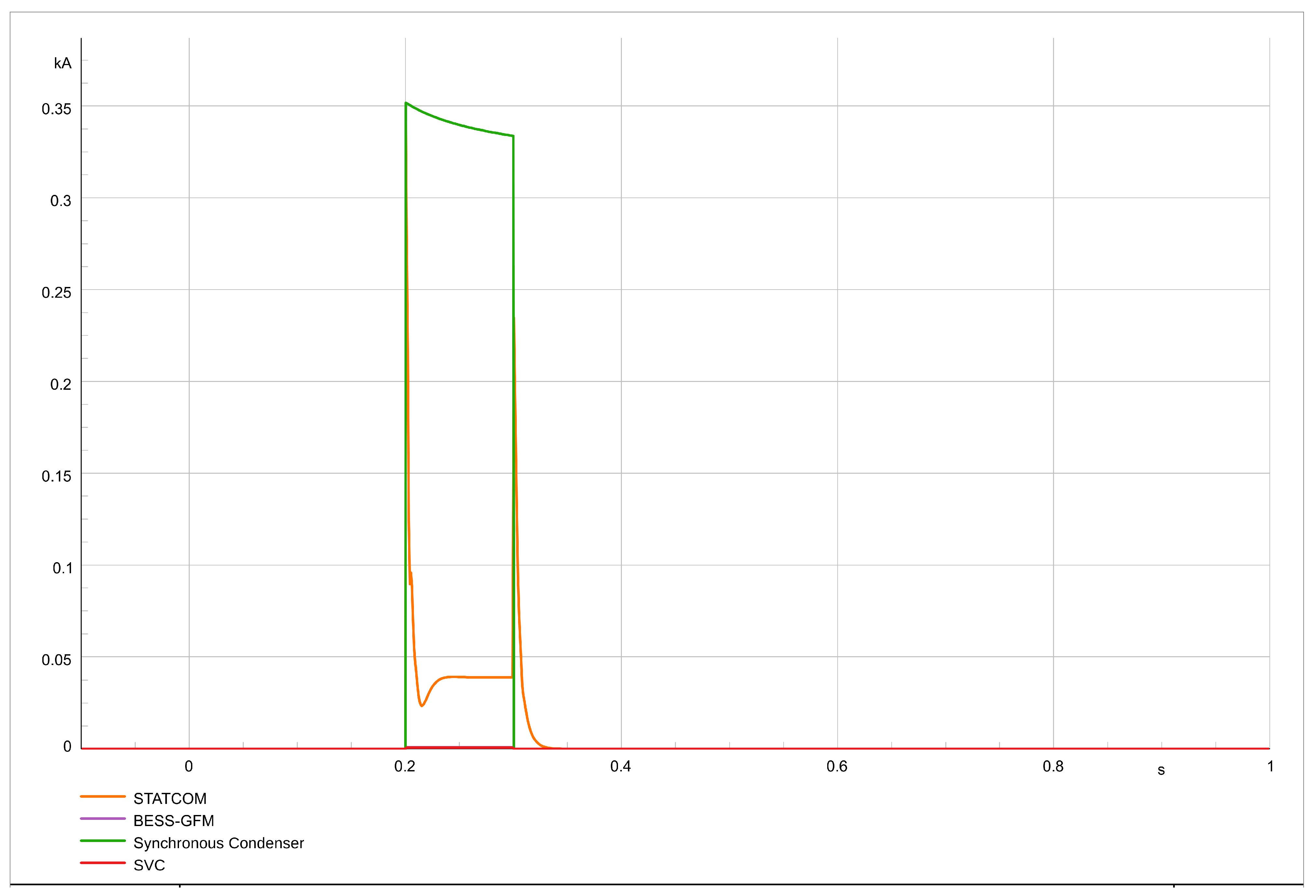
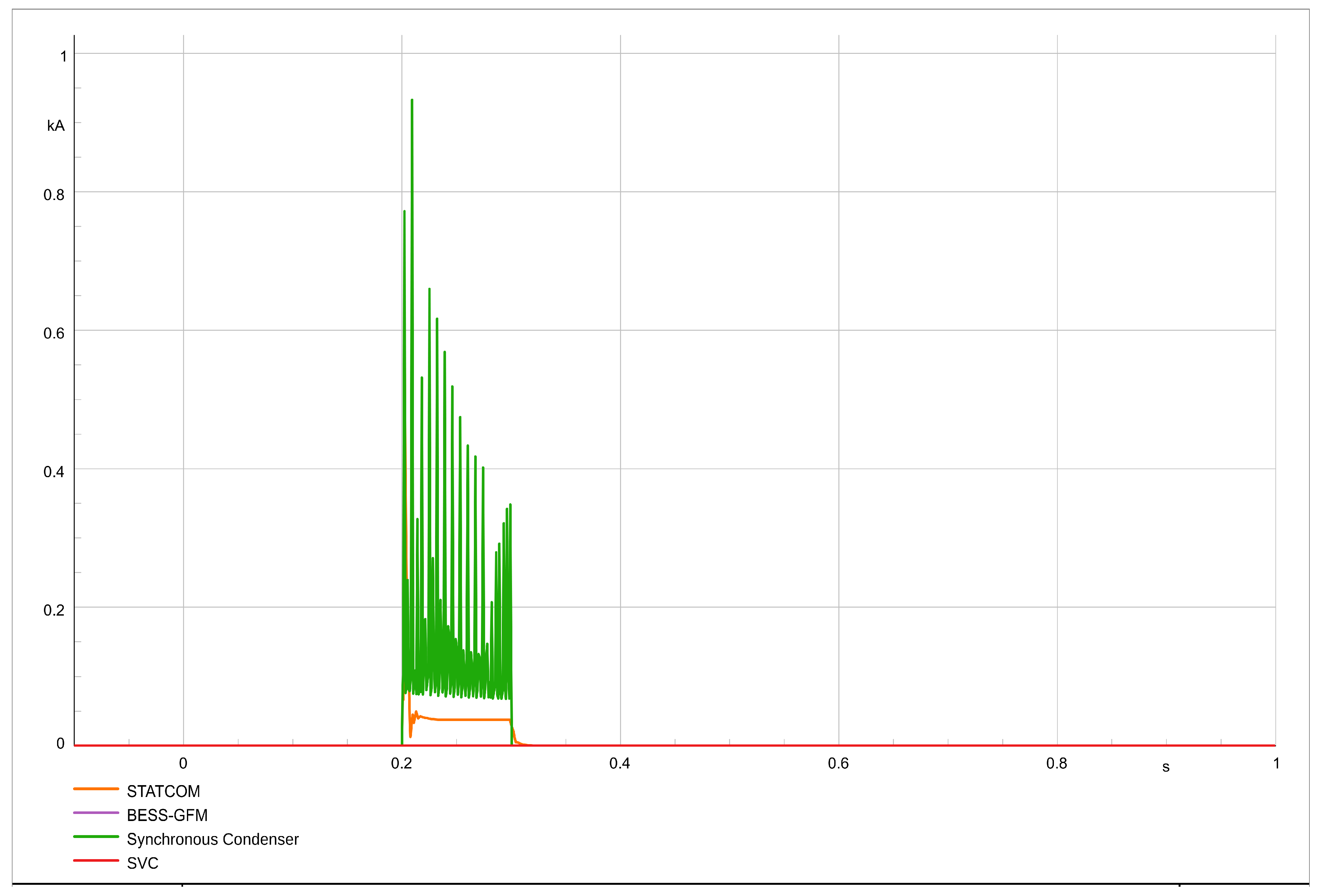
Figure 8 illustrates that the current stays relatively small, peaking at approximately 0.367 kA, which is consistent with a STATCOM being current limited and primarily only injecting controlled reactive current as opposed to contributing to a larger fault current. The negative-sequence current (I
2) as per
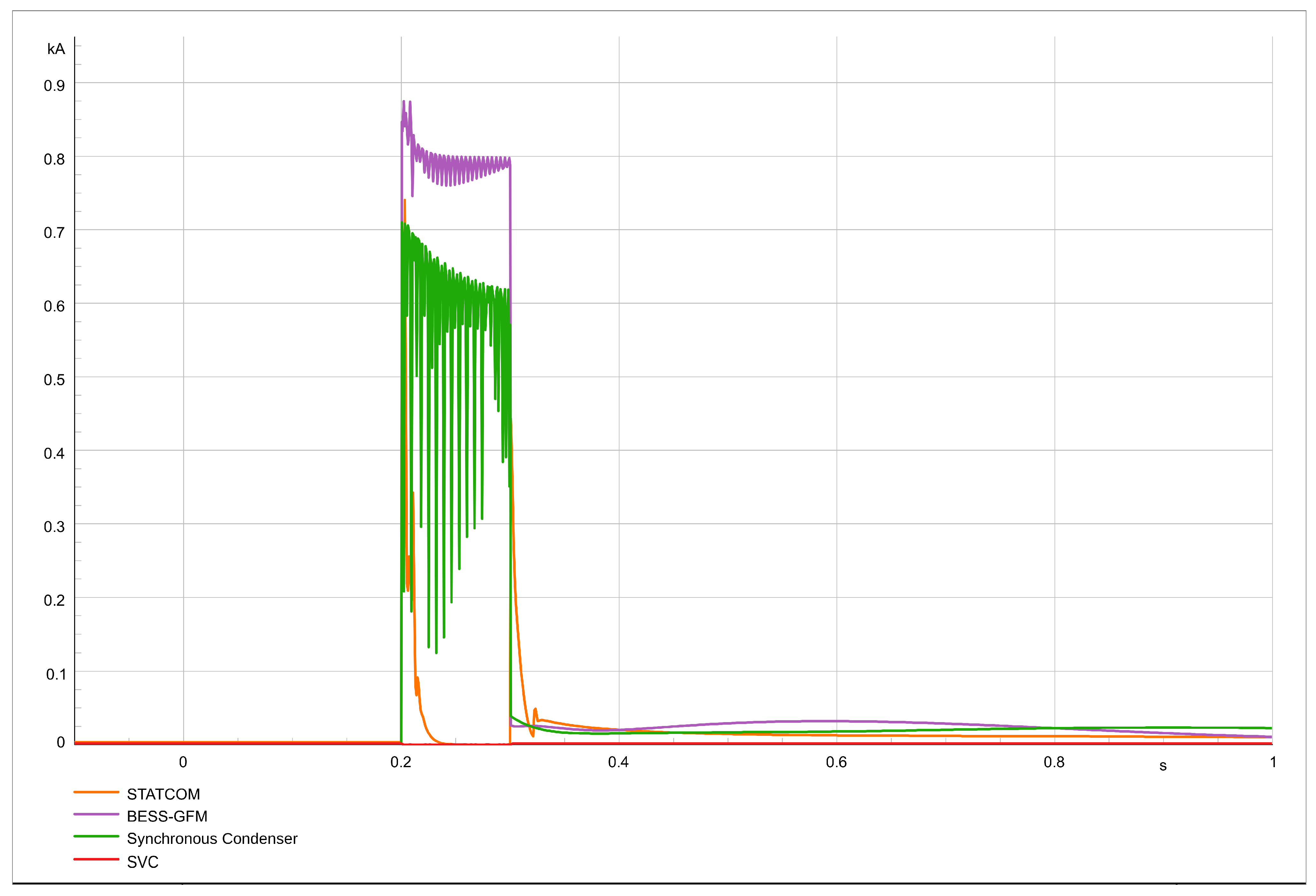
Figure 9 displays that the STATCOM causes an initial spike followed by a reduction during the fault itself and a slight increase at the point of restoration, tapering down to zero thereafter, which fits a controller that prioritises reactive support and does not completely cancel negative-sequence current.
The BESS-GFM holds the highest V1 during the fault at around 0.66 pu. and thereafter returns very smoothly to just above the 1 pu. mark, stabilising at pre-fault voltages thereafter. This behaviour illustrates the ability of a strong source being able to effectively support the positive-sequence network during the disturbance and post-fault clearing. The BESS-GFM rises on the I1 plot, rising to a level comparable to the other current limited devices during the fault, peaking at approximately 0.36 kA and stabilising shortly thereafter once the fault is cleared. This is the primary reason it produces the best V1, as this alludes to the control dynamics configured such that the converter is allowed to supply strong positive-sequence current during the fault. I2 essentially remains at zero at approximately 0.00089 kA, which is consistent with inverter protection that suppresses negative-sequence current injection to avoid thermal stress even whilst simultaneously providing I1 support.
The SC improves V1 relative to baseline and does not exhibit the spike synonymous with controller-driven devices and overshoot as seen with the STATCOM, which is expected with voltage support being provided through an excitation response as opposed to an instantaneous converter-based response. In respect to I1, the SC peaks at approximately 0.36 kA during the fault, which reflects the SC’s fault current contribution governed by the transient reactances. The SC has the largest I2 compared to all technologies, peaking at approximately 0.35 kA, which is expected from an unbalanced fault, as an SC cannot block negative-sequence current the way a converter can, which implies that I2 is dictated by the negative-sequence network and will remain elevated until such time as the fault is cleared.
The SVC displays the lowest V
1 during the fault, which is even lower than the baseline and recovers toward pre-fault voltages once the fault has been cleared. This behaviour is consistent with SVCs, which are less effective under depressed voltage conditions during faults, as their reactive injection is a controllable susceptance where the reactive power output is voltage-dependent and therefore reduced when the reference voltage is low. The SVC contributes little to I
1 peaking at approximately 0.0016 kA, which is also consistent with a shunt susceptance compared to a source behind a reactance. The negative-sequence current is essentially zero, contributing approximately 0.00073 kA during the fault, which matches a balanced three-phase shunt model that has almost no contribution to negative-sequence components.
Table 13 quantifies this effect; the SC exhibits the highest |I
2| peak during the single-line-to-ground fault at fault implementation and fault clearing, whereas the converter-based devices limit negative-sequence current via control and protection, resulting in a lower |I
2| peak.
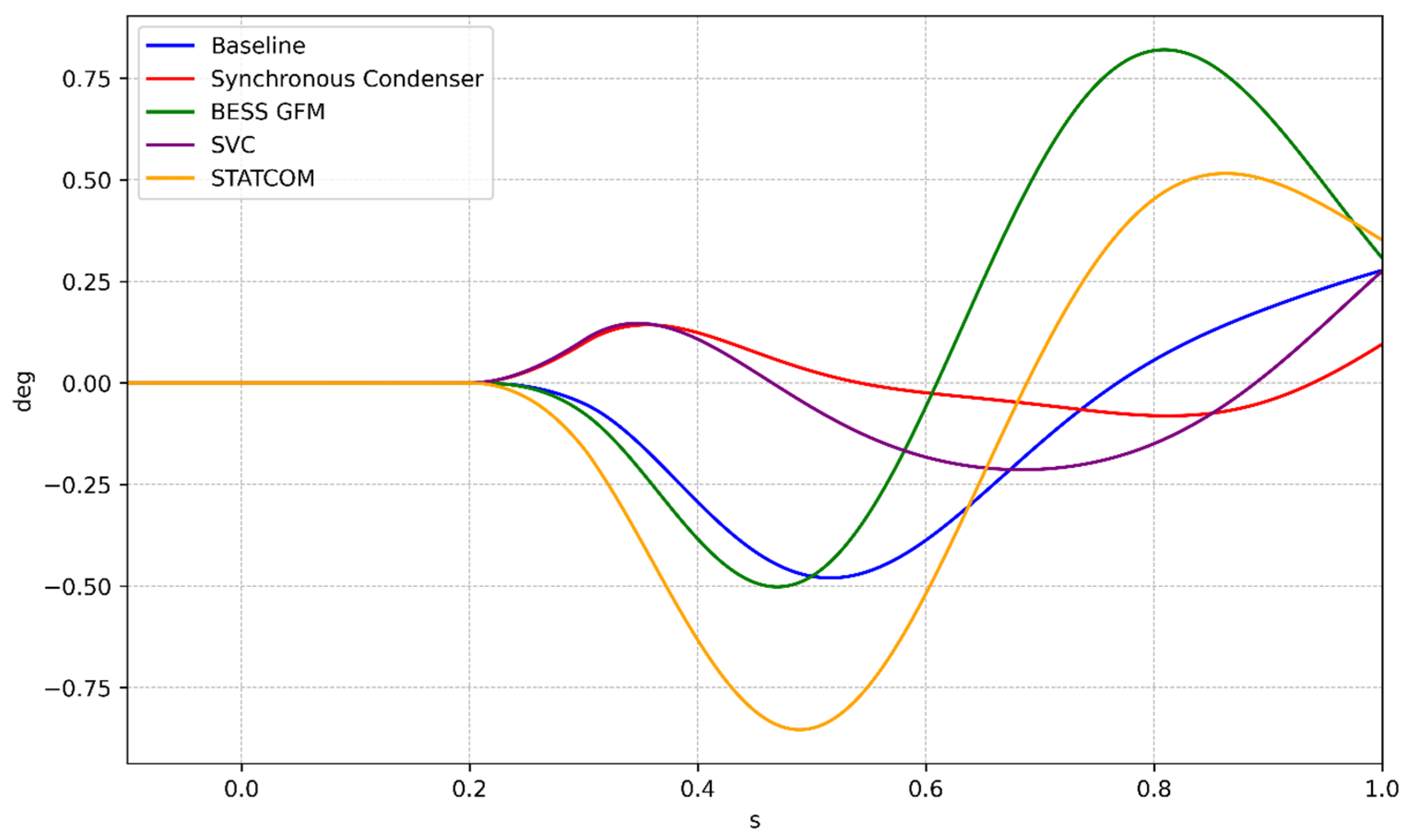
Figure 10 describes the change in the rotor angle swing of G2 in response to the single-phase-to-ground fault. The disturbance is weak regarding positive-sequence power; the deviations in the swing are therefore small. Immediately after the fault had been introduced at 0.2 s, the baseline, BESS-GFM and STATCOM all move into the negative region, indicating that G2 temporarily lags its pre-fault reference angle, consistent with a brief net decelerating tendency over this interval as depicted by Equations (17) and (18). The STATCOM caused the largest negative dip of around −0.85°, with the BESS-GFM and baseline following at approximately −0.5°. The STATCOM and BESS-GFM disturb the active power balance more in response to the single-phase fault compared to the baseline case without any additional reactive power device in service. Both the SVC and SC cause a small positive increase, with the SVC going negative sooner than the SC. The SC exhibits a small initial positive deviation, indicating that G2 briefly leads its pre-fault reference angle during the early fault period.
Once the fault has been cleared, all the devices, including the baseline, result in a zero crossing and swing positive as the network recovers and electrical power momentarily overshoots. The BESS-GFM shows the highest positive angle deviation in the second swing of around +0.8°, with the STATCOM next at +0.5°, followed by the baseline and SVC. The SC, again, is the least disturbed in the second swing, having a minimal impact on G2. The SC remains the least disturbed and stays closest to the pre-fault reference throughout, in addition to the SVC having a low impact, while the BESS-GFM and STATCOM produce slightly larger swings but with very small magnitudes, primarily due to their converter-driven torque changes in response to the unbalanced single-phase-to-ground fault.
4.3. Double-Line-to-Ground Fault
In the instance of a double-line-to-ground fault introduced at Bus 5 at 0.3 s and cleared at 0.5 s, the STATCOM’s positive-sequence voltage component (V
1) as per
Figure 11 experiences a greater collapse in comparison to the single-phase-to-ground fault since two phases are involved with the fault impacting the positive, negative and zero-sequence networks; however, the STATCOM recovers quickly to pre-fault voltage levels once the fault has been cleared. This behaviour is consistent with converter-based voltage regulation with only a small overshoot, which reflects robust control and current limiting as opposed to sustained overvoltage capability. The positive-sequence current (I
1) represented by
Figure 12 displays limited contribution from the STATCOM, peaking at approximately 0.367 kA, which is consistent with a current limited device that injects controlled reactive current as opposed to contributing to larger short-circuit currents such as a synchronous machine. The negative-sequence current (I
2) as shown in
Figure 13 displays limited contribution by the STATCOM at approximately 0.341 kA, which illustrates the controller prioritising positive-sequence voltage support and limiting unbalanced current injection.
The BESS-GFM displays one of the highest V1 values post-fault clearing, which is consistent with the grid-forming ability to provide strong positive-sequence support and rapid post-fault recovery. The BESS-GFM’s contribution to I1 is among the highest in comparison to the devices peaking at approximately 0.366 kA, which explains the improved V1, as the grid-forming control allows the inverter to regulate voltage strongly during disturbance conditions. The near-zero behaviour of I2 at approximately 0.00089 kA is in line with the inverter protection that suppresses negative-sequence injection during unbalance; BESS-GFM, therefore, supports the balanced components strongly and does not significantly impact the unbalanced component.
The SC shows a smooth and strong post-recovery of V1 and slightly lower ramping, which is expected with the excitation driven voltage support as opposed to converter-based support. During the fault, the SC tries to maintain V1 with a slight overshoot shortly after the fault is introduced, and this is primarily due to strong excitation driven reactive current injection paired with phasor estimation during unbalanced transients. The SC contributes approximately 0.366 kA to the fault current as seen by I1 during the event; this is expected due to the SC providing short-circuit current typically governed by the transient reactances and network impedance. The SC caused the largest spikes during the fault, as seen in I2 peaking at approximately 0.352 kA, which is due to SCs naturally conducting negative-sequence current set by the negative-sequence network and being unable to block I2, which is why unbalanced faults such as the double-line-to-ground fault are important in understanding rotating machine thermal stresses.
The SVC’s ability to improve V1 is evident post-fault clearing; during the fault, there is very little impact, as its contribution at the faulted bus is limited due to its reactive power output being voltage-dependent, so when the voltage is extremely low, the reactive support provided is reduced, so it cannot push V1 up to acceptable levels as a current injecting converter. The SVC’s contribution to I1 remains close to zero, peaking at approximately 0.0016 kA, which is an indication that the SVC is not a strong source of fault current and behaves as a controllable susceptance that does not inject negative-sequence current. Its benefit is mainly through post voltage support once the fault has been cleared.
The baseline depicts the inherent network response and shows significant voltage depression with fault recovery noted only after clearing but controlled by the system strength and existing voltage control. In the absence of a reactive power source, it displays the lowest post-fault margin in addition to the slowest settling.
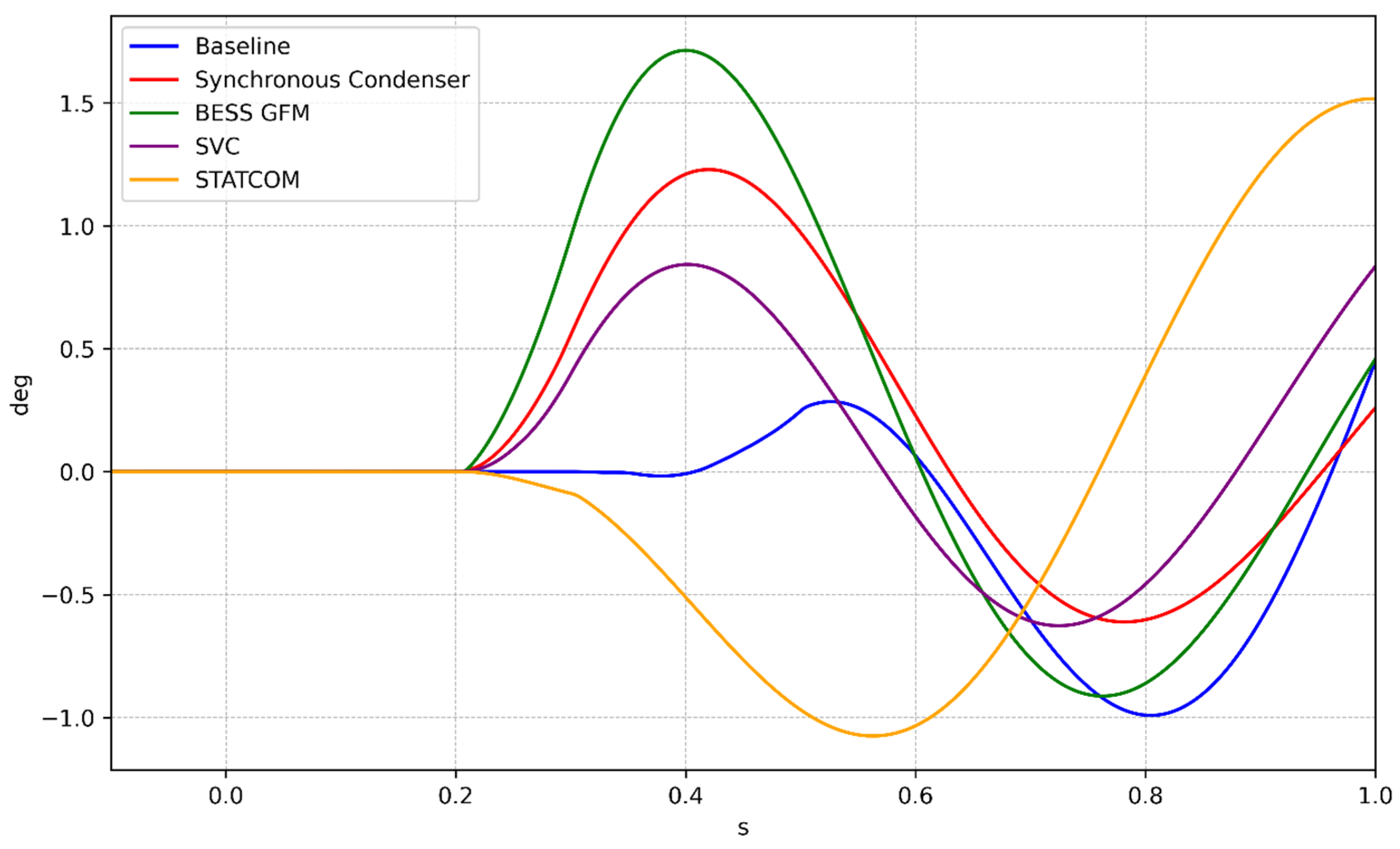
During such time as the double-line-to-ground fault is applied, the positive-sequence network strength is reduced. The BESS-GFM displays the largest positive first swing, peaking around 1.7 degrees as displayed in
Figure 14; this is closely followed by the SC peaking at 1.2 degrees and lastly the SVC peaking at 0.85 degrees. These devices exhibit similar first swing behaviour, producing a positive rotor angle deviation relative to the reference, as shown in
Figure 14. The baseline exhibits a comparatively small first swing peak of around 0.3° relative to the other technologies. The STATCOM exhibits a pronounced negative deviation during the first swing at −1.0°, indicating that G2 temporarily lags the pre-fault reference angle.
During the second swing, post-fault clearing, the responses converge toward a zero crossing, and most cases swing into the negative region, with minima occurring around 0.75 s to 0.85 s. The baseline and BESS-GFM reach the deepest negative dips at −1.0° and −0.9°, respectively, while the SC and SVC exhibit shallower minimums of −0.6°. The SC and SVC have smaller negative dips during the second swing, while the STATCOM reaches a comparable negative minimum earlier and then recovers rapidly, indicating a faster post-fault rebound. It can also be noted that the STATCOM shows the largest positive overshoot, larger than the BESS, SVC, and SC, showing the largest positive rebound by 1.0 s.
Following the completion of the three-phase fault and the unbalanced fault assessment, the additional contingencies were prioritised for their maximum technical value and influence on the system. The double-line-to-ground fault was chosen, as it illustrates the most severe unbalanced fault, causing a more significant voltage depression and stronger negative-sequence impact compared to the line-to-line fault, providing a more informative assessment for voltage resilience and sequence current behaviour. The line-to-line fault was not evaluated separately, as it was expected to be less impactful and would not change the conclusion.
4.4. PV Plant Trip
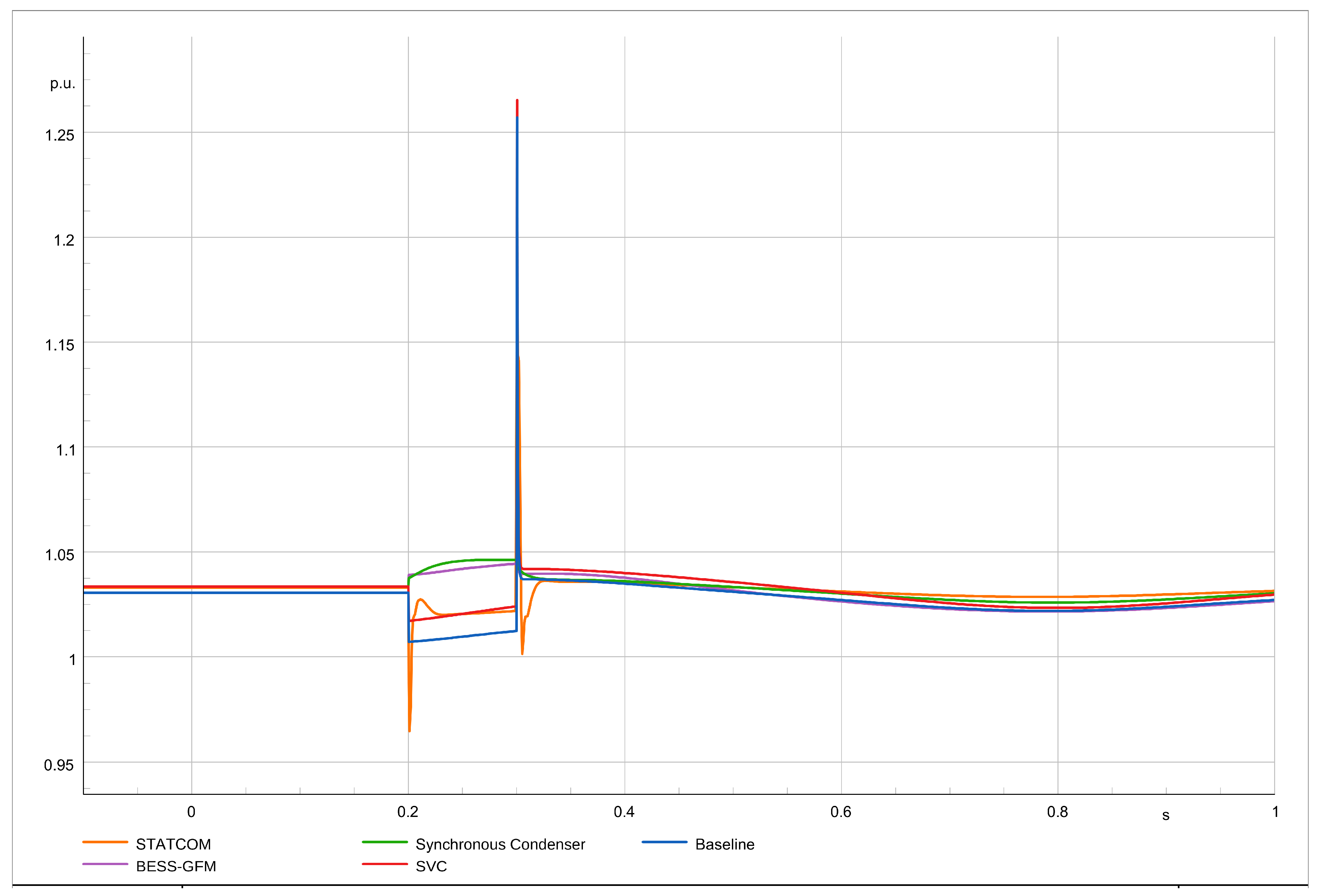
A PV plant balanced trip was modelled such that the entire 320 MW plant was tripped at 0.2 s and the plant was restored at 0.3 s. Prior to the trip, the STATCOM’s positive-sequence voltage component (
) as per
Figure 15 was at 1.033 pu. During the trip, the voltage depressed to 0.965 pu. before recovering close to pre-trip voltage levels. At 0.3 s, when the PV plant was reconnected, the voltage momentarily overshot to 1.197 pu. and then settled to 1.031 pu., illustrating the ability of the STATCOM to transition quickly from providing reactive power to absorbing reactive power.
The BESS-GFM’s pre-fault voltage measures at 1.034 pu. and during the fault at 0.2 s, it does not exhibit a dip but rather a small voltage rise at the instance of the trip, which is due to the grid-forming inverter increasing support with both active and reactive power to compensate for the loss of the PV plant and reduce the voltage drop across the network. When the PV plant is restored peaks at 1.148 pu. and then saturates at 1.025 pu., which is in line with droop control rebalancing the system after a significant generation step, and the converter reduces its support less abruptly than a STATCOM.
The SC maintains a pre-fault of 1.034 pu. However, during the trip at 0.2 s, the voltage increases to 1.046 pu., which illustrates the SC’s AVR-driven reactive support increasing the network’s voltage to effectively dissolve the impact caused by a loss of PV generation. Once the fault has been cleared, the peak is reduced to 1.043 pu. As the system responds to the PV generation returning to service, the voltage then saturates to 1.029 pu., which is primarily due to the excitation system dynamics and the machine’s electromagnetic inertia providing a smoother, damped voltage response.
The SVC starts at 1.033 pu., and when the PV trips, this voltage then drops to 1.017 pu. and remains at 1.02 pu. through the outage, which is an improvement over baseline but not as good in comparison to the SC. The reason for this is the SVC’s operation as a controllable shunt susceptance whose reactive support is limited by the voltage behaviours in addition to control limit constraints during abrupt generator outages. During the reconnection of the PV, there is a small spike to 1.265 pu., which is due to minimal overcompensation; the controller then takes a finite time to reduce the susceptance that was applicable during the trip and effectively damp the voltage.
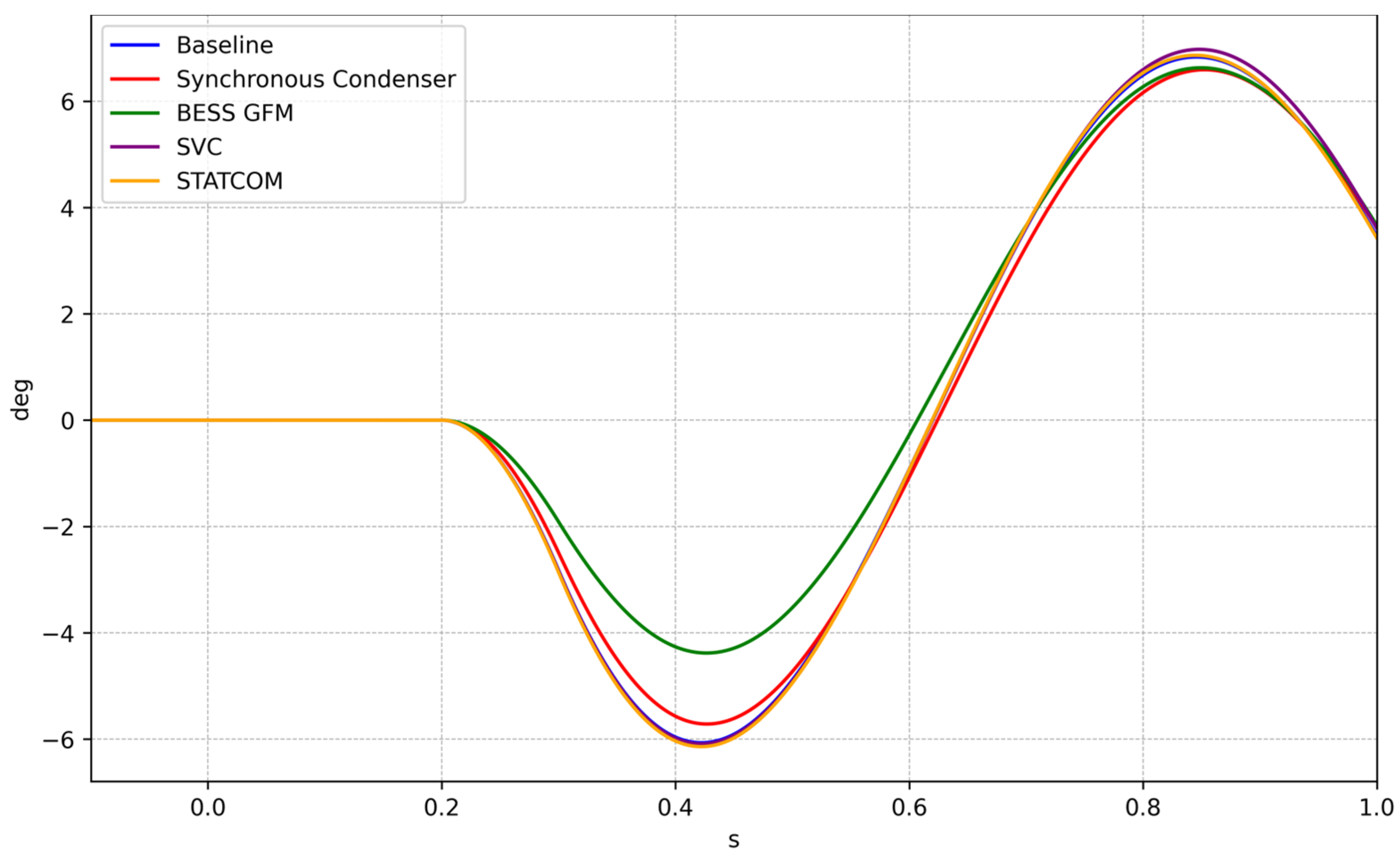
The change in rotor angle swing Δδ as depicted in
Figure 16 below illustrates that the remaining synchronous generators must supply the missing active power caused by the trip of the PV plant. Immediately after the trip, G2 is required to pick up additional electrical power, so the electrical torque demand increases and is consistent with a brief net decelerating tendency as described by Equations (5) and (15), producing a brief decelerating tendency and a negative Δδ(t). All five graphs display similar trajectories during the first swing with the baseline, SVC and STATCOM displaying a more negative change compared to the others.
Once the PV plant has been restored, for a short duration, there is too much generation consistent with a brief net accelerating tendency during restoration. This trajectory is similar for all devices. The rotor initially decelerated when the PV tripped, followed by acceleration during restoration and overshoot. The differences are marginal, with the BESS-GFM causing a slightly smaller negative and positive swing due to its grid-forming ability and DC link, which can also absorb or supply active power during the trip transient, which causes less of an imbalance. The SC, SVC, and STATCOM behave very similarly overall, with no specific configuration or operation resulting in any notable change.
The observed comparative trends align with published engineering experience and planning guidance. Converter-based STATCOMs provide rapid, controllable reactive current support even during depressed voltages, whereas SVCs’ reactive output reduces with voltage due to their shunt susceptance operation. SCs increase short-circuit current and contribute to dynamic voltage support, but excitation dynamics and negative-sequence thermal limits can constrain recovery in response to unbalanced faults. These behaviours are widely reported in comparative FACTS/SC assessments and utility transient voltage criteria [
10,
11,
14,
37].
4.4.1. Frequency Impact Due to PV Plant Trips and ROCOF Assessment
Large PV plants may disconnect from the grid due to protection operations, voltage/frequency ride through limits or control interactions during network disturbances. A PV trip causes an abrupt reduction in active power injection, creating an immediate generation vs. load imbalance that excites a transient frequency disturbance. In this study the frequency impact is assessed using the local Bus 5 electrical frequency trace obtained from the RMS simulation, which provides a consistent comparative indicator of disturbance severity across technologies during PV switching events. Relevant interconnection and measurement requirements for frequency and RoCoF reporting are referenced in IEEE Std 1547-2018 [
5,
44,
45].
IEEE Std 1547-2018 specifies abnormal operating performance requirements for DER, including frequency-related ride through and trip behaviour where RoCoF is evaluated; it is treated as a windowed rate of change using a 0.1 s averaging window [
5]. Other measurement standards such as IEC 60255-118-1:2018 and IEEE C37.118.1 define both frequency and RoCoF as reportable quantities, with compliance and evaluation requirements for dynamic conditions [
46,
47,
48].
RoCoF is widely used as it captures the initial severity of a disturbance before the controls fully react. Soon after a PV trip, the local electrical frequency slope is impacted by a lack of inertia and a net power deficit. RoCoF is used in this paper as a primary indicator of the instantaneous frequency impact of PV switching events, as it captures the initial frequency ramp immediately after an active power imbalance. In this work, RoCoF is computed as a windowed frequency slope over an estimation window
, consistent with synchrophasor applications in which RoCoF is reported as a rate of change of frequency derived from windowed frequency estimates under dynamic conditions [
47,
48].
System frequency is evaluated at the monitored bus within the RMS simulation environment and cross-checked against the system centre of inertia frequency to ensure consistency of the disturbance measurements.
The electrical frequency at Bus 5 was monitored using the PowerFactory variable m:fehz (Electrical Frequency in Hz). Frequency deviation (Δf) was calculated relative to the nominal system frequency of 60 Hz, while the rate of change of frequency (RoCoF) was obtained numerically from the time derivative of the frequency signal.
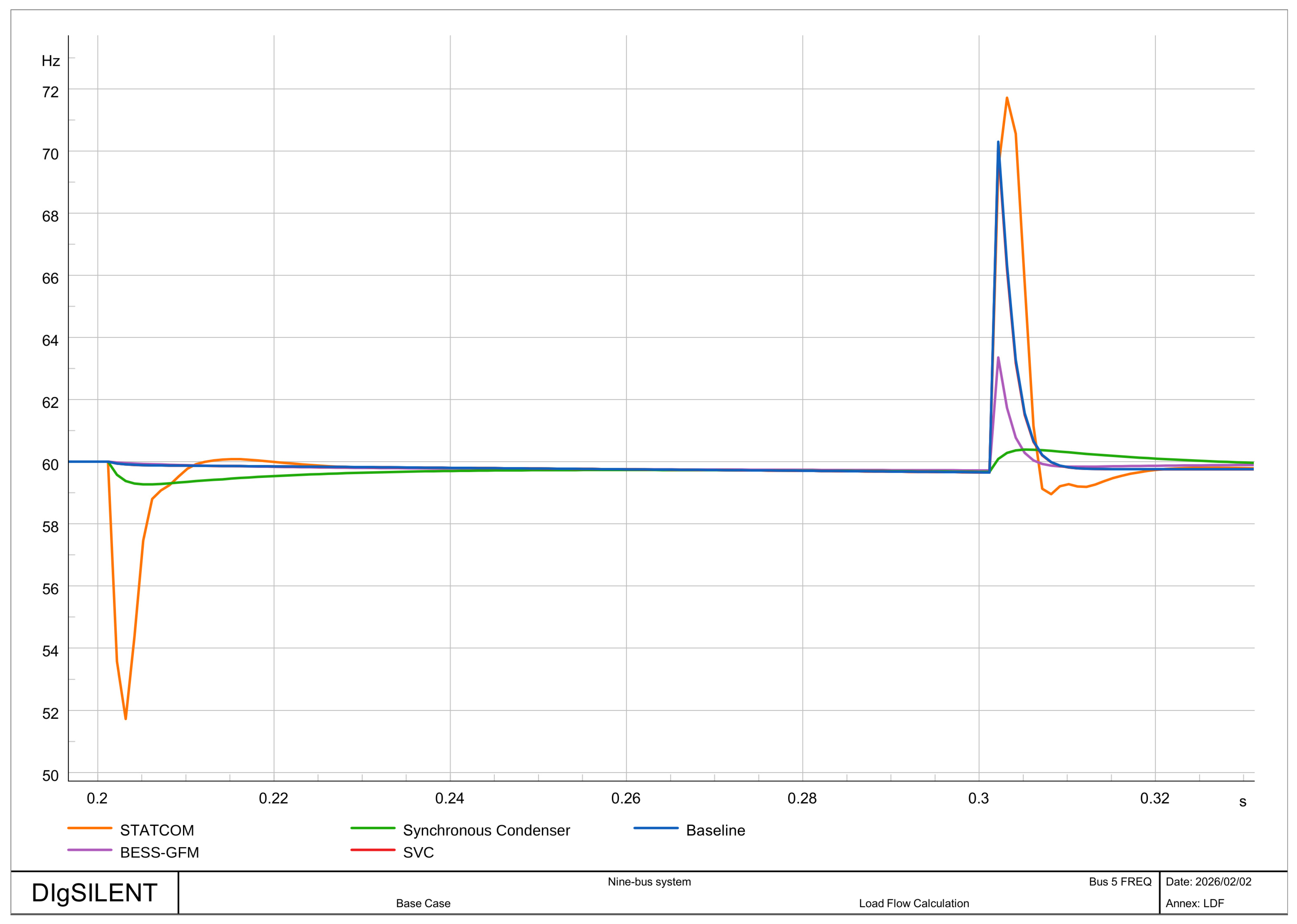
The Bus 5 electrical frequency trace f(t) as depicted in
Figure 17 is obtained from the RMS simulation output, and RoCoF is evaluated during the initial PV trip at 0.2 s and PV close at 0.3 s events for each technology case to enable a like-for-like comparison. Equation (21) depicts the RoCoF as the time derivative of frequency and provides the earliest quantitative indicator of an active power imbalance.
where RoCoF is defined as the time derivative of the measured electrical frequency at the monitored bus,
is frequency in Hz, and
is time in s, resulting in RoCoF in Hz/s. In this work, RoCoF is estimated from discretely sampled simulation data and is treated as the continuous time definition that the numerical estimator approximates.
Immediately after a disturbance, an active-power imbalance causes the local electrical frequency to deviate, with low-inertia conditions generally producing larger initial slopes for the same imbalance. Because RoCoF is sensitive to measurement noise and estimator dynamics, a windowed derivative is used as in Equation (22). A discrete-time implementation for sampled data
is given in Equation (23), where the lag
is selected to satisfy a minimum window constraint
and this study uses
[
5].
where
is the windowed RoCoF estimate at sample time
in Hz/s, computed over an averaging window of length
in s. Here
is the measured frequency at
in Hz and
is the measured frequency
seconds earlier in Hz,
is the RoCoF estimation (averaging) window length and
denotes the discrete sampling instant.
where
is the discrete-time RoCoF estimate at sample index
in Hz/s,
is the sampled frequency at index
in Hz and
is the timestamp associated with sample
in s. The integer lag
(samples) is selected as the smallest integer such that the window length satisfies
(equivalently
), ensuring the earlier sample is at least
seconds prior to the current sample. Here
is the RoCoF estimation window length in s and
is the integer sample index
An Adapted Metric to Quantify PV Trip Severity (FDRI)
The proposed frequency severity metric consolidates the three disturbance attributes most used in frequency stability assessments, which include magnitude, rate, and persistence, into a single, comparable scalar for PV switching with a detailed algorithm included in
Appendix D. The deviation is defined as Equation (24), which represents all results to the nominal frequency used by operational limits. For each open and close event, the peak excursion represented by Equation (25) captures the proximity to unacceptable frequency bands. The peak ramp is depicted by Equation (26) and captures the initial frequency slope using a windowed RoCoF definition that is consistent with IEEE 1547-2018 for reporting RoCoF [
5]. The exposure term
is represented by Equation (27), which adds a depth duration measure, reflecting how long the system remains displaced after the switching event [
49,
50].
where
is the frequency deviation from nominal at time t in Hz,
is the measured electrical frequency at Bus 5 at time
in Hz,
is the nominal system frequency in Hz, and t is the time in s.
where
is the maximum absolute frequency deviation during event
in Hz,
is the frequency deviation defined in Hz,
denotes the event (PV open or PV close),
is the event start time (switching instant) in s, and
is the post-event evaluation window length in s. The interval
is the time window over which the maximum is evaluated.
where
is the maximum absolute windowed RoCoF during event
in Hz/s,
is the windowed RoCoF estimate at time
in Hz/s computed using an averaging window of length
in s,
denotes the event (PV open or PV close),
is the event start time (switching instant) in s and
is the post event evaluation window length in s. The interval
is the time window over which the maximum is evaluated.
where
is the frequency-deviation exposure for event
in Hz·s,
is the frequency deviation from Equation (24) in Hz,
denotes the event (PV open or PV close),
is the event start time in s, and
is the event-specific evaluation window length in s. The interval
defines the time window over which the exposure is accumulated.
These event-wise components are combined into a dimensionless composite score
as depicted by Equation (28), by summating the PV open and close contributions and applying explicit normalisation. The weights w1, w2, and w3 provide a transparent way to balance the magnitude term, the RoCoF term, and the area term. Finally, the baseline referenced index FDRI (Frequency Disturbance Relative Index), as represented by Equation (29), converts the composite severity into an intuitive performance measure where a positive FDRI indicates that the technology reduces overall frequency disturbance severity relative to baseline across both PV switching events. These metrics preserve interpretability, as each term in
maps directly to a standard disturbance descriptor (
).
where J is the dimensionless composite frequency severity score combining PV-open and PV-close effects;
are non-negative weighting factors that balance the deviation term, RoCoF term, and area term (typically
);
and
are the peak deviations from Equation (25) for PV-open and PV-close in Hz;
is the nominal system frequency in Hz;
are the peak windowed RoCoF values from Equation (26) in Hz/s;
is a reference RoCoF scaling constant used for normalisation in Hz/s;
are the exposure terms from Equation (27) for PV-open and PV-close in Hz.s; and
are the evaluation window lengths in s, where
and
. The exposure term
is normalised by the pooled duration
, yielding a dimensionless mean absolute frequency deviation across both PV switching events.
FDRI is the Frequency Disturbance Relative Index (dimensionless), is the composite severity score for the baseline case (no technology), and is the composite severity score from Equation (28) for the technology case being evaluated.
As shown in
Figure 17 and
Table 14, all cases experience an under-frequency response following the PV trip, although the severity varies significantly when assessed using the Bus 5 disturbance descriptors.
The observed differences in frequency response across technologies must be interpreted in the context of the available synchronous inertia in the system, as summarised in
Table 1, together with the fast control response of converter-interfaced devices.
The STATCOM case exhibits the most severe response, with an exceptionally large trip deviation characterised by a peak frequency deviation of 8.279 Hz and the highest trip RoCoF stress of 82.649 Hz/s. In contrast, BESS-GFM produces the least disturbed response, with a peak frequency deviation of 0.280 Hz and a peak trip RoCoF of 2.792 Hz/s.
The SC shows a moderate trip response with a peak deviation of 0.733 Hz and a peak trip RoCoF of 7.317 Hz/s. The SVC and baseline cases perform similarly, both showing relatively small disturbances closely aligned with the trip event. The baseline exhibits a peak deviation of 0.343 Hz and a peak trip RoCoF of 3.406 Hz/s, while the SVC shows 0.346 Hz and 3.432 Hz/s, respectively.
During PV reconnection, the dominant disturbance shifts to an over-frequency transient accompanied by a significant RoCoF event. Under these conditions, the baseline and SVC cases experience the highest stress, with baseline values of Δf = 10.302 Hz and RoCoF = 104.462 Hz/s, while the SVC shows Δf = 10.143 Hz and RoCoF = 102.922 Hz/s.
The STATCOM case again exhibits the most extreme behaviour, with a reconnection frequency deviation of 11.719 Hz and a peak RoCoF of 199.982 Hz/s. In contrast, BESS-GFM substantially limits both the frequency deviation and RoCoF, producing values of 3.360 Hz and 34.322 Hz/s, respectively. The synchronous condenser provides the most damped response, with a reconnection deviation of 0.389 Hz and a peak RoCoF of 11.218 Hz/s.
These behaviours are reflected in the composite disturbance severity score and the resulting FDRI ranking relative to the baseline. The SC achieves the best overall performance with an FDRI of 0.83, primarily because the device contributes rotational inertia and increased short-circuit strength, which naturally dampens both frequency excursions and RoCoF stress.
The BESS-GFM ranks second with an FDRI of 0.66, reflecting its ability to emulate droop and virtual inertia behaviour while delivering fast active and reactive power support.
The STATCOM performs worse than the baseline in the present FDRI formulation because the local Bus 5 frequency estimate exhibits the largest reconnection transient. This transient response is also influenced by converter current saturation during the voltage restoration phase, where reactive current injection approaches the converter limit and temporarily constrains active power exchange. For a grid-following STATCOM in a weak network, this behaviour is consistent with PLL estimation sensitivity and rapid converter control interaction during the switching event. This provides a plausible explanation for why the STATCOM performs well in DVRI yet poorly in the frequency-based metric, consistent with the behaviour reported for PLL-based converters in weak grid and high RoCoF conditions. This contrast highlights that strong voltage support does not necessarily translate into improved frequency resilience, particularly when the device is implemented as a PLL-based grid-following converter rather than an inertia or grid-forming capable source [
48,
49,
51].
Similar to the DVRI formulation, the FDRI components are evaluated in a commensurate dimensionless form prior to aggregation. In this work the RoCoF scaling constant
is taken as the peak baseline RoCoF observed under the same PV open/close contingency at 13:30, ensuring that the RoCoF term represents a direct multiple of the baseline disturbance level. To verify that the composite ranking is not dependent on a specific weighting choice, a weight-sensitivity analysis is performed by sampling the feasible weight set
uniformly over the simplex (
) using Monte Carlo sampling (200,000 samples). For each sampled weight vector, the composite severity score
and corresponding FDRI are recomputed, and the resulting technology ranking recorded, and the associated algorithm is included in
Appendix D. The ranked frequency distribution is reported in
Table 15. The results show that the SC is consistently the top-ranked device due to its strongly damped frequency response and low RoCoF during both PV trip and reconnection events, while BESS-GFM consistently occupies the second position due to its ability to provide fast active-power support through virtual inertia and droop control. The SVC and baseline cases interchange the lower rankings depending on whether greater emphasis is placed on RoCoF magnitude or disturbance exposure, whereas the STATCOM remains the worst performer across all weight selections due to its large reconnection transient and associated RoCoF stress.
FDRI Operating Point Sensitivity
To evaluate how the frequency-based disturbance resilience metric responds to changes in system operating conditions, the FDRI calculation described in
Section 4 is repeated for the same three operating points used in the DVRI analysis. These operating points correspond to different PV output levels and therefore different levels of synchronous displacement within the network. The resulting FDRI values are summarised in
Table 16 for each technology.
The FDRI metric captures the composite severity of frequency excursions following the disturbance by combining peak frequency deviation, peak RoCoF, and frequency deviation exposure components into a single normalised index relative to the baseline case. Positive values indicate an improvement in frequency disturbance resilience compared with the baseline, while negative values indicate a deterioration.
Across all operating points, the STATCOM consistently exhibits the most adverse relative behaviour in terms of the FDRI metric with values of −14.300680, −1.618861, and −35.371642 for Cases 1 to 3, respectively. Although the visible frequency traces only show modest spikes, the composite index is sensitive to short-duration RoCoF excursions, which strongly influence the integrated RoCoF component of the metric. Because the baseline frequency response is relatively smooth, the normalised FDRI becomes strongly negative when these sharper transient slopes occur.
The performance of the other technologies varies with operating point. In Case 1, both the BESS-GFM and the SC provide measurable improvements relative to the baseline, with FDRI values of 0.655932 and 0.828255, respectively. The SVC provides only a marginal improvement with 0.014044, indicating a response similar to the baseline.
In Case 2, the relative behaviour shifts. The BESS-GFM and SVC remain beneficial, with FDRI values of 0.318030 and 0.045043, respectively, while the SC shows only a small improvement of 0.125821. In this higher PV output condition, the frequency disturbance is more strongly influenced by converter-based support devices.
In Case 3, corresponding to the lowest PV penetration, the BESS-GFM and SC again improve the composite frequency response, with FDRI values of 0.023176 and 0.028392, respectively. In contrast, the SVC becomes detrimental with a value of −0.608551, indicating that its reactive power-based response is less effective under this operating condition.
Overall, the results show that the absolute magnitude of the FDRI metric varies significantly with operating point, reflecting the dependence of frequency disturbance behaviour on the underlying generation mix and system inertia. In particular, the index becomes more sensitive when the baseline frequency disturbance is small because the normalised formulation amplifies relative differences between technologies. Despite this sensitivity, the comparison still provides useful insight into how each technology modifies the composite frequency response under different dispatch conditions.
FDRI Operating Point Inertia Sensitivity
A frequency sensitivity study was performed at the 09:00 operating point by scaling the inertia constants of all synchronous generators simultaneously by
as displayed in
Table 17, while keeping the network configuration, dispatch pattern, and disturbance definition unchanged. This isolates the effect of aggregate synchronous inertia on frequency deviation, RoCoF, and FDRI.
Table 18 shows that, across the tested inertia range, BESS-GFM consistently provides the strongest improvement in frequency resilience, with FDRI increasing from 0.615 at
H-50 to 0.673 at
H-150. In contrast, the STATCOM exhibits increasingly negative FDRI values as synchronous inertia increases, indicating limited contribution to frequency disturbance mitigation. The SVC remains close to the baseline case across all scenarios, while the SC shows a modest positive FDRI at lower inertia levels before transitioning to slightly negative values as system inertia increases.
5. Conclusions
This paper contributes a repeatable, simulation-extractable metric set for comparative assessment of grid support options in a PV-dominated IEEE 9-bus system. The proposed DVRI and FDRI are baseline normalised composite indices that summarise magnitude, exposure, and recovery attributes for voltage and frequency disturbances under a fixed disturbance set. The indices are intended as planning-orientated ranking tools rather than new analytical stability criteria.
The assessment conducted using the IEEE 9-bus system confirms that as synchronous generation in a system becomes displaced by elevated levels of PV penetration, the system strength reduces. There is an increase in sensitivity to disturbances and an overall reduction in post-fault voltage resilience. Using the post-fault metrics of dip depth, undervoltage area below 0.9 pu., sustained recovery to 0.9 pu. and 0.95 pu., as well as DVRI, the STATCOM performed better than the other devices under three-phase symmetrical fault conditions, achieving the fastest sustained recovery and lowest composite severity. The SC provided good voltage support through its excitation-driven reactive capability and improved fault level contribution; however, it exhibited slower restoration to pre-fault voltage levels and carried significant negative-sequence current under unbalanced fault conditions, which highlights the importance of negative-sequence stress considerations. The SVC improved steady-state regulation but was ineffective during depressed voltages due to its voltage-dependent reactive power output. The BESS-GFM response was strongly influenced by current limits and control priorities, resulting in performance that varies relative to the baseline depending on the applied fault. Holistically the results from this study show that no single technology is optimal for all objectives. Converter-based reactive power support devices are ideal for rapid voltage recovery, whilst synchronous solutions add much needed system strength and inertia but are often constrained by excitation dynamics and unbalance currents. The FDRI results confirm that frequency-based rankings do not follow voltage based DVRI trends, since the two indices reflect various aspects of disturbance response. In this study, converter control and estimation dynamics were shown to drive significant local Bus 5 frequency and RoCoF excursions during switching and post-fault recovery, even when voltage recovery was favourable. The proposed baseline normalised composite indices, therefore, provide a transparent and repeatable framework for technology ranking in high PV penetration planning studies.
All devices were normalised to an equal ±100 MVAr reactive support basis at the weak PV bus to enable a controlled comparison of voltage support behaviour. This basis improves comparability, but it should not be interpreted as implying equivalent inertia, fault current capability, converter limits, energy capacity, control structure, or lifecycle cost across the assessed technologies.
Future work will extend the technical benchmarking into a comprehensive financial assessment aligned with utility financial planning practices, incorporating losses and energy impacts, maintenance and replacement cycles, tariff and revenue assumptions, and risk-based valuation to rank technologies for high PV penetration networks.