Review

Optimization Strategies for Flexibility-Oriented Supply–Demand Matching in Industrial Park Integrated Energy Supply Systems: A Review of Modeling, Scheduling, and Flexibility Utilization


1
College of Energy Engineering, Zhejiang University, Hangzhou 310027, China
2
School of Information and Electrical Engineering, Hangzhou City University, Hangzhou 310015, China
3
Key Laboratory of Cleaner Intelligent Control on Coal & Electricity, Ministry of Education, Taiyuan University of Technology, Taiyuan 030024, China
4
State Key Laboratory of Alternate Electrical Power System with Renewable Energy Sources, North China Electric Power University, Beijing 102206, China
*
Authors to whom correspondence should be addressed.
Energies 2026, 19(8), 1903; https://doi.org/10.3390/en19081903
Submission received: 14 March 2026 / Revised: 30 March 2026 / Accepted: 9 April 2026 / Published: 14 April 2026

Abstract

The low-carbon transition of industrial parks is driving an increasing demand for advanced energy systems. Integrated energy supply systems (IESSs), which couple multiple energy forms, offer a critical pathway to alleviate the high-carbon intensity of energy structures and supply–demand imbalances in industrial parks by enhancing energy efficiency and reducing carbon emissions. The rapid advancement of energy storage technologies, multi-energy system modeling, and advanced energy management strategies has further propelled the research and application of IESSs. This review comprehensively delineates the distinctions between IESSs and traditional energy systems, highlighting the architecture and operational characteristics of IESSs to elucidate the impacts of multi-energy coupling and source–grid–load–storage interactions. We examine existing equipment and system modeling approaches and load modeling methods, and discuss modeling techniques for variable operating conditions. We analyze operational optimization methods for IESSs under deterministic, multi-time-scale, and uncertain conditions, and investigate the utilization mechanisms of flexibility resources across source–grid–load–storage links to illustrate how system flexibility supports dynamic supply–demand coordination. The review also identifies emerging trends in AI-driven IESS operation, highlighting the integration of physics-informed modeling, large language models, and multi-agent systems. This review establishes a unified analytical perspective for flexible supply–demand matching within IESSs, offering theoretical support for the development of future low-carbon industrial energy systems.

1. Introduction

Industrial parks (IPs), which serve as vital economic drivers, contributing 21.4% to global gross domestic product (GDP) in 2022 [1], have attracted increasing attention for their energy consumption and carbon emissions. Notably, China hosts over 14,000 IPs, including 2543 [2] listed at the national and provincial levels. These parks contribute to more than 50% of the national industrial output value [3] and account for approximately 30% of the nation’s total carbon emissions [4]. However, current energy systems in these parks still rely heavily on traditional fossil fuels, resulting in low overall energy efficiency. For instance, coal-fired power generation accounts for 87% of total installed capacity, with approximately 62% of these units having capacities below 50 MW [3], leading to high energy consumption per unit of GDP. Meanwhile, as distributed renewable energy is gradually integrated into park energy systems, the traditional “generation-following-load” power supply paradigm struggles to adapt to the volatility of renewable energy and the dynamic changes in user loads. Therefore, enhancing the operational efficiency and supply–demand coordination capabilities of energy systems in IPs has become a critical topic for achieving a low-carbon energy transition.
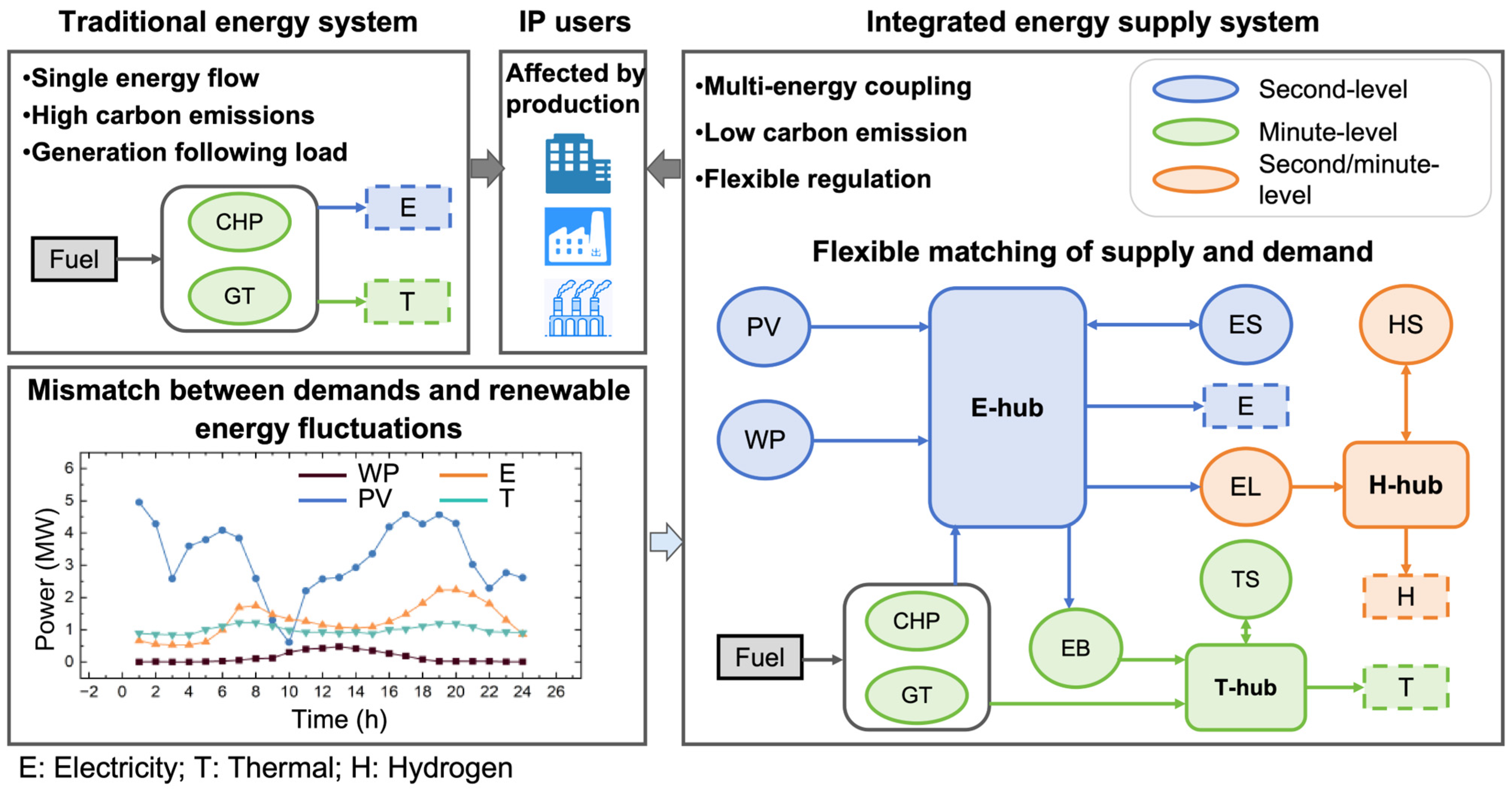
To address the aforementioned issues, the integrated energy supply system (IESS) has emerged as a significant direction for the development of energy systems in IPs (Figure 1). By integrating various energy forms—such as electricity, heat, and hydrogen—these systems achieve the synergistic utilization and optimized management of multiple energies [5]. In a typical IESS, multiple energy forms are flexibly coupled through conversion and storage equipment, thereby promoting energy cascade utilization and enhancing overall efficiency [6]. However, with the rising penetration of renewable energy and the diversification of terminal load structures, the supply–demand coordination of IESSs faces deep-seated technical challenges: on one hand, the strong volatility and uncertainty of renewable energy impart dynamic characteristics to energy supply [7]; on the other hand, flexibility resources such as energy storage and demand response (DR) exhibit significant differences in response speed and regulation capability [8], while different energy forms like electricity and heat possess distinct time-scale characteristics [9]. These inherent characteristics make it difficult for traditional energy scheduling methods to achieve efficient collaborative operation of multi-energy systems, underscoring the need to develop a flexible supply–demand matching mechanism.
In the specific context of IP, these technical challenges are further amplified. Industrial loads typically exhibit high power density, strong periodicity, and strict production constraints, leading to pronounced peak–valley differences and extreme requirements for supply reliability. Simultaneously, the access to large-scale distributed energy and storage systems is transforming park energy systems from traditional unidirectional supply structures into multi-energy interactive networks. Against this backdrop, IESSs in IPs face three specific challenges during large-scale application: (1) Complexity of industrial-grade multi-energy equipment modeling: Unlike urban energy systems, IPs rely heavily on large-scale combined heat and power (CHP) units and multi-level heat cascading. Accurately characterizing the nonlinear thermodynamic behaviors and coupling characteristics of these large industrial units significantly increases the dimensionality and complexity of system modeling. (2) Challenges in scheduling optimization under rigid constraints: Due to the tight coupling between energy loads, production processes, and scheduling plans in IP, energy supply scheduling cannot arbitrarily shift loads, and the requirements for operational safety are exceptionally high. Consequently, operational optimization must ensure strict supply reliability, thereby adding to the complexity of balancing economic efficiency and energy security across multiple time scales. (3) Constrained coordination of flexible resources: Extracting DR potential from continuous industrial production is subject to significant limitations. It remains a significant challenge to safely utilize the thermal inertia of industrial pipelines and equipment without disrupting strict manufacturing operations.
To address these challenges, future energy systems in IP must gradually evolve from traditional independent supply models to IESS capable of multi-energy synergy and supply–demand interaction. In this new system, the energy supply and user demand sides collaborate dynamically through information technology and intelligent scheduling, thereby enhancing the system’s overall flexibility and operational efficiency.
In recent years, research on the modeling and operational scheduling of IESS has been increasing, with numerous review papers summarizing related technologies. However, existing reviews mostly focus on urban energy systems or electricity-dominated energy systems, while research on IESSs in IPs—characterized by high energy consumption and complexity—remains relatively limited. In particular, there is a lack of research on IESSs coupling electricity, heat, and hydrogen.
Crucially, existing studies often approach the subject from a component-oriented or method-oriented perspective, treating modeling [10,11,12,13], scheduling [14,15,16,17,18], and flexible management [19,20,21] as isolated technical silos. While they provide comprehensive lists of algorithms, they often overlook the critical role of flexibility utilization in buffering the supply–demand balance. In contrast, this review adopts a flexible supply–demand matching perspective. We posit that in dynamic environments, simply optimizing algorithms is insufficient. Dynamism needs to be considered during modeling and optimization. Meanwhile, identifying flexible resources, characterizing the system’s flexibility boundaries, and elucidating interaction mechanisms are crucial for providing the necessary buffering for IESSs. Furthermore, although there are reviews of flexibility resources in the building energy sector [22], IP energy systems possess unique features, including more diverse source-side energy conversion equipment and specialized flexibility resources such as thermal networks. As shown in Table 1, gaps remain in the existing literature on IESSs in IPs, particularly regarding the application of emerging data-driven methods and artificial intelligence technologies in supply–demand matching.
This paper focuses on the flexible supply–demand matching problem in electricity–heat–hydrogen IESSs within IPs, conducting a systematic review of related research from three aspects: system modeling, scheduling optimization, and flexibility resource utilization. Compared with traditional energy systems, IESSs in IPs are characterized by deep multi-energy coupling, complex load structures, and frequent supply–demand interactions. These characteristics not only increase the potential flexibility of system operation but also introduce new modeling and optimization challenges. Therefore, a systematic review of this issue helps not only to summarize existing research findings but also to provide theoretical references for the optimal design and operational management of future energy systems.
The main contributions of this paper are as follows:
(1)
A systematic review of multi-energy system modeling approaches for IESSs in IPs under dynamic supply–demand conditions, including the modeling methods for conventional operating conditions and variable operating conditions.
(2)
An overview of scheduling optimization methods for IESS, summarizing recent developments in deterministic optimization, uncertainty-aware optimization, and multi-time-scale coordination strategies.
(3)
An analysis of the roles and mechanisms of flexibility resources in flexible supply–demand matching, focusing on the coordinated utilization of source–network–load–storage resources.

2. Framework of Flexible Supply–Demand Matching in IESS

2.1. Architecture of Industrial Park Integrated Energy Supply Systems

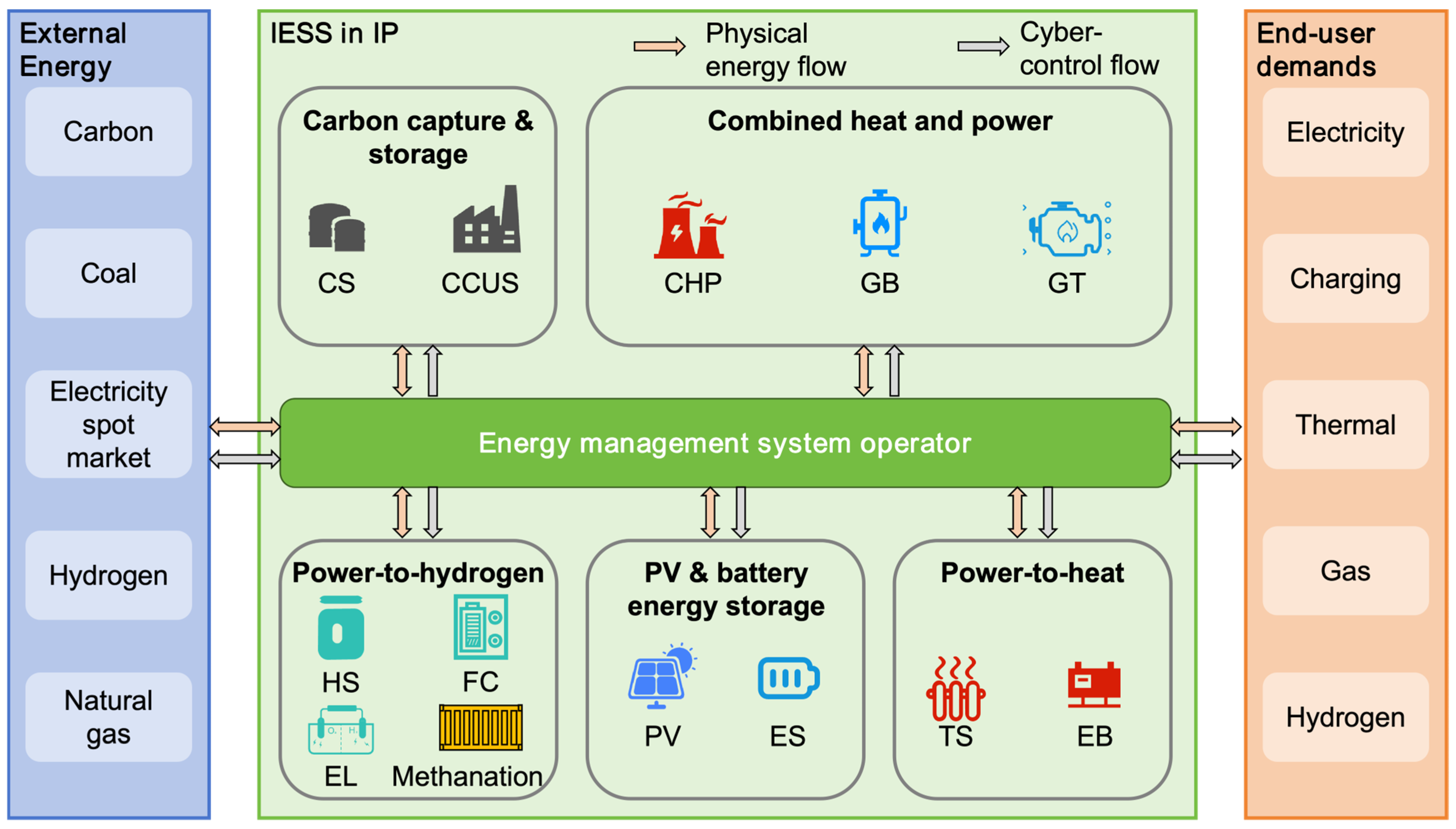
IESSs in IPs integrate diverse technologies to enable flexible multi-energy coupling for low-carbon operation, such as CHP units, photovoltaic generation, and power-to-gas (P2G). As illustrated in Figure 2, the system relies on CHP as its core supply and uses conversion equipment to interconnect the electricity, heat, gas, and carbon networks. This architecture facilitates carbon management through CO2 recycling and enriches energy pathways via hydrogen technologies, while integrated storage enhances system flexibility.
Despite sharing similar equipment with urban energy systems, what truly distinguishes an IESS in an IP context is the unique industrial demands and operational constraints. Industrial production often strictly requires process heat at specific, multi-grade temperature levels. Compared to residential heating, this necessitates more complex thermal cascading configurations and higher requirements for load-prediction accuracy and for matching multi-grade thermal demands. Moreover, energy demand is largely governed by the load patterns of associated production equipment. Unlike the stochastic nature of urban energy consumption, industrial loads are tightly coupled with continuous or batch manufacturing schedules, posing challenges for characterizing and utilizing flexibility. Furthermore, since any interruption in energy supply directly impacts industrial productivity, IESS scheduling strategies require higher standards for uncertainty handling and modeling accuracy to ensure operational security.
By coordinating equipment operations and accounting for these specific industrial constraints, IESSs can improve overall energy efficiency, expand the capacity to accommodate renewable energy, and provide diversified energy products for industrial users.

2.2. Flexible Resources in Supply and Demand Sides

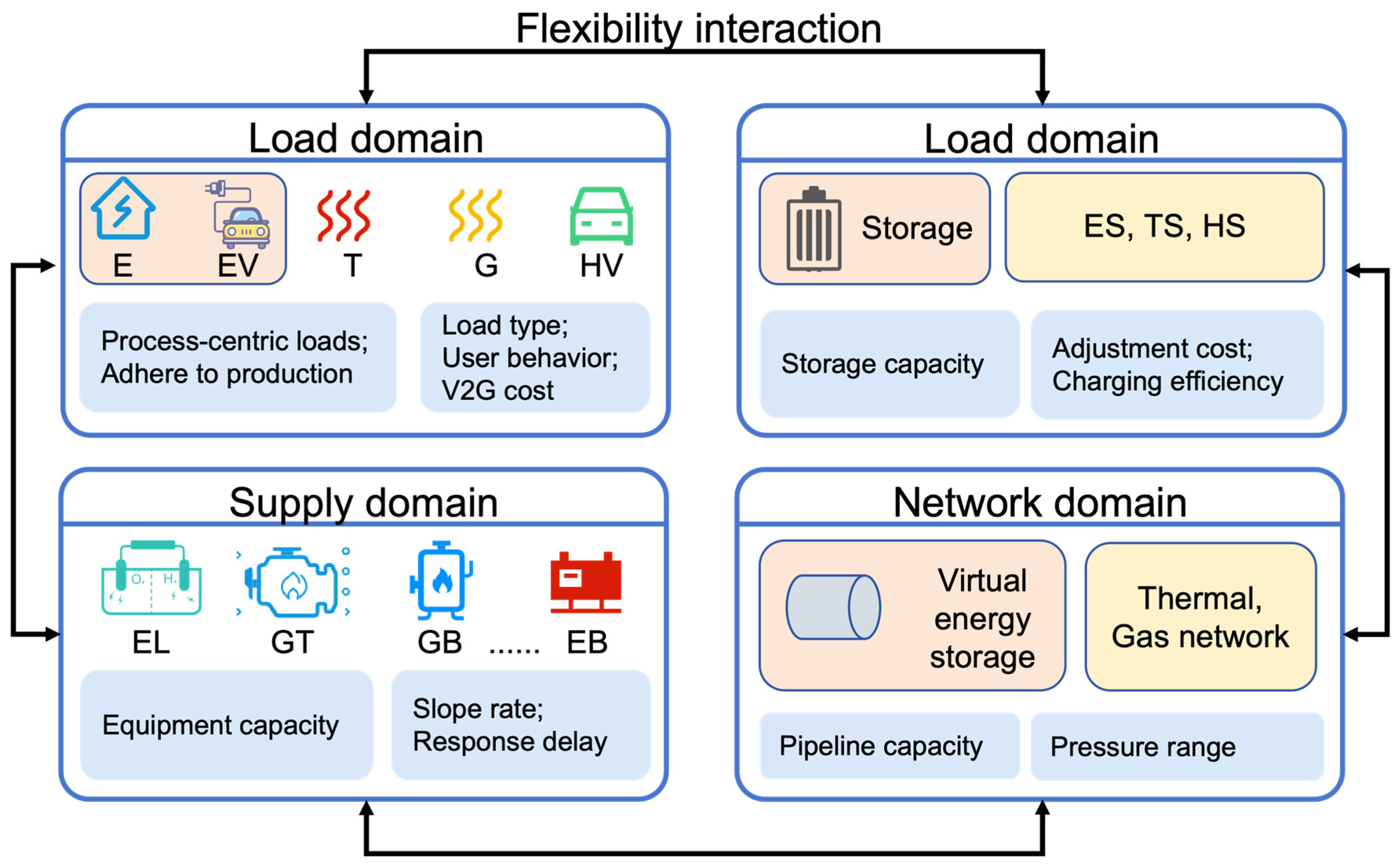
Flexible supply–demand matching in IESS relies on various flexibility resources distributed across the source–network–load–storage structure (Figure 3). These resources can adjust energy supply or demand within certain operational limits, thereby enhancing the system’s capability to respond to uncertainties and load fluctuations.
On the supply side, flexibility is mainly provided by dispatchable generation units, energy conversion equipment, and energy storage systems. For example, CHP units can adjust electricity and heat outputs within feasible operating regions, while P2G equipment and electric boilers enable energy conversion among electricity, gas, and heat. Energy storage systems, including electrical and thermal storage, can shift energy across time and mitigate supply–demand imbalances.
On the demand side, flexibility is mainly derived from DR and IDR mechanisms. Industrial users can adjust electricity, heating, or cooling consumption in response to price signals or system operation requirements. In addition, flexible loads such as electric vehicle charging, industrial production processes, and building thermal loads provide additional adjustment capabilities.
Furthermore, the inherent physical properties of different energy carriers also introduce implicit flexibility. For instance, thermal networks and buildings exhibit thermal inertia, while gas networks possess storage capability due to gas compressibility. These characteristics provide additional temporal flexibility for supply–demand coordination.

2.3. Supply–Demand Matching Mechanisms

Flexible supply–demand matching in IESSs involves bidirectional adjustments on both supply and demand sides. On the supply side, dispatchable generators, energy storage systems, and multi-energy conversion equipment can modify energy outputs across different energy carriers. On the demand side, DR mechanisms enable energy consumption patterns to be adjusted in response to system conditions.
By integrating these flexibility resources, IESSs can dynamically regulate both supply and demand to maintain system balance. In addition, the operational costs associated with different flexibility resources, such as energy storage degradation costs or DR incentives, are typically incorporated into optimization objectives. Through coordinated optimization, the system can determine the most cost-effective combination of supply-side and demand-side adjustments.
Therefore, flexible supply–demand matching in IESSs is essentially a coordinated regulation process involving multi-energy networks, flexible resources, and optimization-based decision-making mechanisms.

2.4. Research Framework of This Review

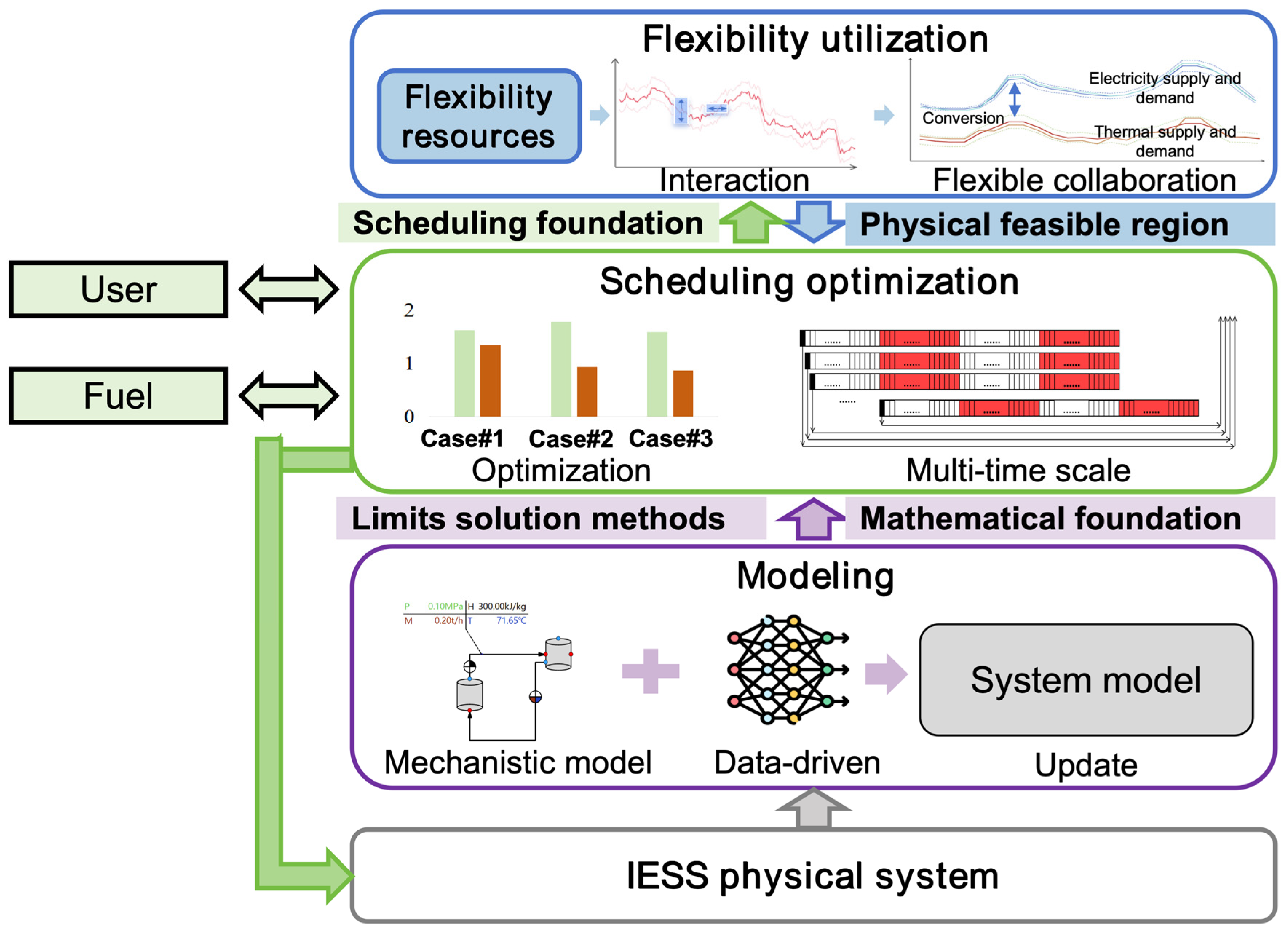
To systematically analyze the flexible supply–demand matching problem in IESSs, this paper establishes a unified analytical framework, as illustrated in Figure 4. The framework organizes existing studies from three interconnected perspectives: system modeling, scheduling optimization, and flexibility utilization.
Among them, system modeling focuses on describing the physical structure and multi-energy coupling characteristics of IESSs, including the interactions among different energy networks and conversion devices. Scheduling optimization aims to determine optimal operational strategies under multiple objectives and constraints, enabling efficient and reliable system operation. Flexibility utilization investigates how various flexibility resources across the source–grid–load–storage chain can be exploited to support dynamic supply–demand matching.
These three pillars do not exist in isolation; rather, they constitute tight constraints and interdependencies. First, the choice of modeling approach strictly limits the solution space of dispatch strategies. For instance, adopting high-fidelity nonlinear physical models (Section 3) often renders traditional mathematical programming solvers computationally intractable (Section 4), compelling decision-makers to rely on heuristic algorithms. Conversely, simplified linear models enable rapid global optimization but may generate physically infeasible dispatch commands under extreme operating conditions. Second, flexibility quantification directly defines the boundaries of dispatch decisions and system operation. The precise identification of flexibility resources (Section 5) determines the dispatch algorithm’s aggressiveness in load shifting. If flexibility quantification is inaccurate, the dispatch system may over-allocate expensive physical energy storage or miss opportunities to utilize existing low-cost thermal buffering capabilities. In summary, these three pillars form a closed-loop logic: modeling lays the mathematical foundation, flexibility defines the physically feasible region, and dispatch optimization executes dynamic supply–demand matching within that region.
It is important to note that this article is structured as a narrative review. Given the multidimensional nature of IESSs, a narrative approach allows for a holistic synthesis of interconnected concepts across modeling, optimization, and AI applications. To ensure comprehensive coverage, the literature search was primarily conducted using major academic databases, including Scopus, the Web of Science Core Collection, and IEEE Xplore. The search utilized combinations of keywords such as: (“integrated energy system” OR “multi-energy system”) AND (“industrial park” OR “modeling” OR “optimization” OR “flexibility” OR “artificial intelligence”). The primary time window for literature selection was 2022–2026. Articles were ultimately selected based on their direct relevance to the core themes of flexible supply–demand matching and methodological innovation.
Based on this framework, the remainder of the paper is organized as follows. Section 3 reviews modeling approaches for IESSs. Section 4 summarizes scheduling optimization methods for multi-energy systems. Section 5 discusses flexibility utilization mechanisms and strategies. Finally, Section 6 outlines key challenges and future research directions, followed by conclusions in Section 7.

3. Modeling of Integrated Energy Supply Systems

IESSs are characterized by diverse equipment types, complex energy coupling relationships, and intricate system structures. Therefore, prior to conducting operational scheduling decision-making, it is essential to review the state-of-the-art in equipment and system modeling, user-side load forecasting, and off-design condition modeling.

3.1. Equipment and System Modeling

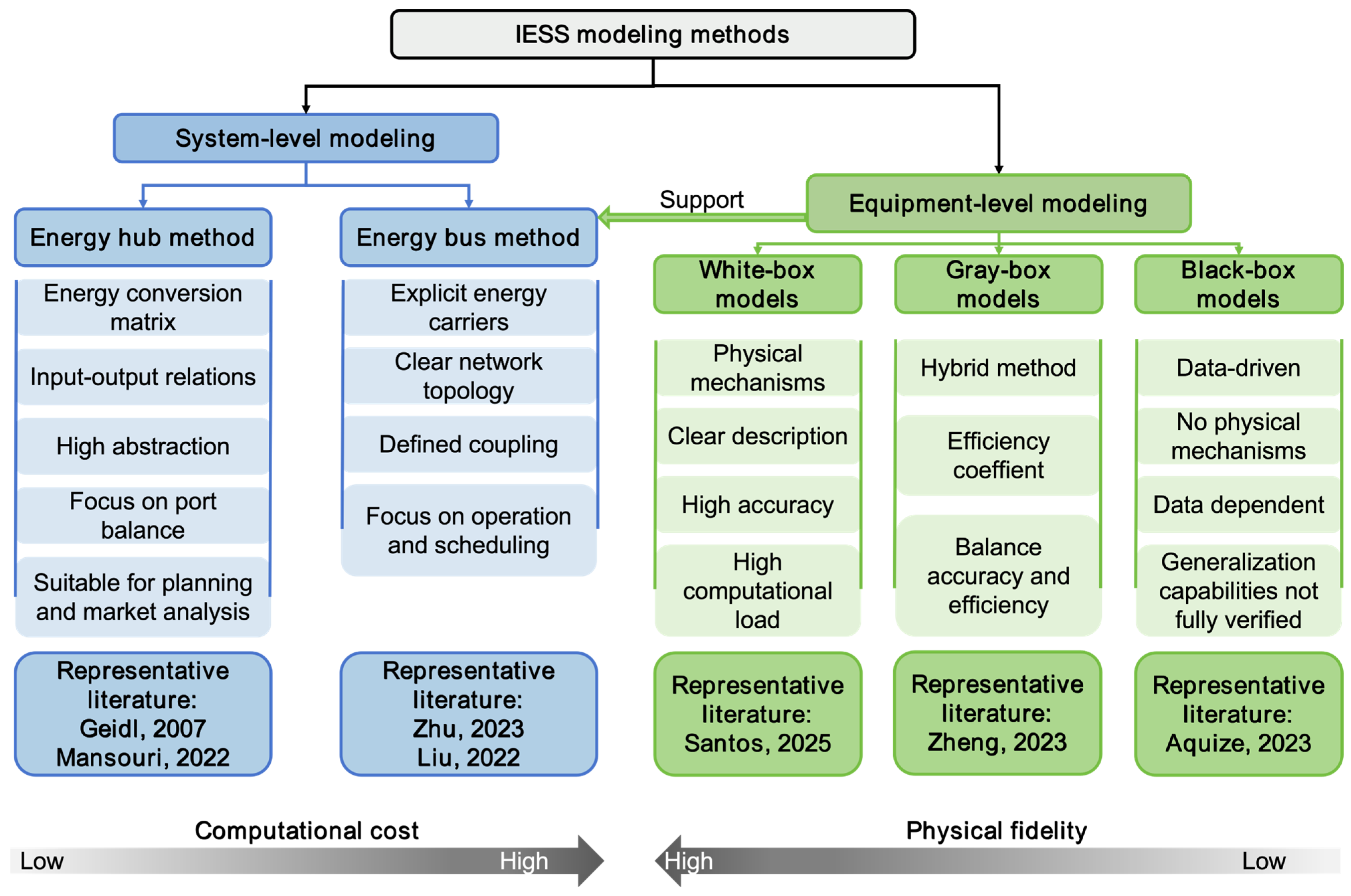
Establishing mathematical models capable of characterizing the physical behavior of IESSs is a prerequisite for operational optimization and scheduling. In general, modeling approaches can be divided into two levels (Figure 5): system-level modeling and equipment-level modeling.
At the system level, two representative paradigms are widely adopted: the energy hub method and the energy bus method.
The energy hub concept was first proposed by Geidl et al. [23], who modeled an IESS as a generalized unit capable of converting, storing, and distributing multiple energy carriers. In this framework, coupling relationships among electricity, heat, and gas are described using an energy conversion matrix, enabling the representation of multi-energy supply–demand interactions through input–output balance equations. Based on this concept, Mansouri et al. [24] extended the energy hub model by incorporating energy storage and DR, while Nasir et al. [25] investigated day-ahead scheduling considering renewable generation and electricity price uncertainties. Additional studies have also applied the energy hub framework to IESS design and operation [26]. Due to its concise formulation and strong scalability, the energy hub method has been widely applied in regional energy planning and multi-energy market analysis. However, the high level of abstraction inevitably leads to the loss of detailed energy-flow information, limiting its ability to describe internal process dynamics and multi-time-scale characteristics.
The energy bus method constructs system models by explicitly representing different energy carriers as buses and integrating detailed models of energy conversion devices. Electricity, heat, gas, and cooling are typically treated as basic buses, and energy balance equations are established at each bus to describe energy flows and coupling relationships. Zhu et al. [27] applied the energy bus framework to an IESS combined with a multi-output organic Rankine cycle and hybrid energy storage, while Liu et al. [28] developed equipment models and network constraints for electricity–thermal–gas energy systems. Similar modeling structures have also been adopted in combined cooling, heating, and power systems [29]. Compared with the energy hub method, the energy bus framework provides a clearer representation of system topology and equipment interactions, enabling more detailed descriptions of energy conversion processes. Consequently, it is widely used in IESS modeling and operational scheduling studies.
The effectiveness of energy bus-based system models largely depends on the accuracy of internal equipment models. In IESS, equipment generally includes energy production units, energy conversion equipment, energy storage systems, and demand-side loads. According to the level of physical knowledge incorporated into the modeling process, equipment modeling methods can be classified into white-box, black-box, and gray-box approaches.
White-box modeling is based on mechanistic principles and requires detailed descriptions of thermodynamic processes and mass–energy balance relationships. For example, Santos et al. [30] established a dynamic mechanism model for Carnot batteries, while Kefer et al. [31] implemented a residential energy system model representation based on genetic programming. Other studies have applied mechanistic modeling to refrigeration systems and waste heat recovery processes [32,33]. Although mechanistic models can achieve high accuracy after calibration, they usually involve complex nonlinear equations and numerous parameters, resulting in high computational burdens and limited adaptability to real-time operating conditions.
Black-box modeling methods based on data-driven techniques have been increasingly adopted. These models establish input–output relationships directly from operational data without explicitly describing internal physical mechanisms. Aquize et al. [34] proposed a recurrent neural network-based identification method for gas turbines, while Elsheikh et al. [35] investigated the application of artificial neural networks in solar energy systems. In addition, Souliotis et al. [36] developed a solar water heater model based on artificial neural networks. Data-driven models can effectively capture nonlinear characteristics and reduce modeling complexity, but their performance depends heavily on data quality and training procedures, and they generally lack physical interpretability.
Figure 5. IESS modeling methods [23,24,27,28,30,34,37].
Energies 19 01903 g005
Gray-box modeling combines mechanistic knowledge with data-driven approaches to balance accuracy and computational efficiency. A common implementation is the coefficient-based method, which uses simplified efficiency or performance coefficients to describe energy conversion relationships. For example, Zheng et al. [37] modeled equipment such as CHP units and compressors using energy efficiency coefficients, while Lyu et al. [38] and Gu et al. [39] employed conversion coefficients to characterize energy equipment in IESSs. More recently, hybrid modeling strategies integrating mechanistic knowledge with data-driven learning have also been explored to improve model adaptability [40].
Overall, modeling choices dictate the fundamental trade-off between mathematical tractability and physical accuracy in flexibility-oriented scheduling. At the system level, highly abstracted energy hub models ensure high MILP tractability but sacrifice accuracy by neglecting network dynamics, often overestimating actual flexibility. Conversely, dynamic energy bus models accurately capture spatial flexibility but introduce severe nonlinearities that drastically reduce computational speed. Thus, energy hubs suit high-level multi-system planning, while energy buses are more appropriate for the operational scheduling of a single industrial IESS.
At the equipment level, the choice between linear and nonlinear, or steady-state and dynamic models, is equally critical. Approximating equipment with constant efficiency guarantees fast real-time scheduling but misses part-load degradation and transient delays. In contrast, incorporating dynamic white-box or nonlinear gray-box models accurately quantifies true flexibility bounds but typically renders scheduling problems non-convex, necessitating heuristic or AI-driven solvers. Therefore, studies focusing on the dynamic control of a single equipment unit should adopt dynamic white-box or nonlinear gray-box models. When constructing system-level energy bus scheduling frameworks, gray-box models are generally preferred to strike a practical balance between solving efficiency and model accuracy.

3.2. Load Modeling

User-side load represents an important boundary condition for decision-making in IESSs. Accurate load modeling is therefore essential for mitigating demand uncertainty and supporting supply–demand interactive scheduling. In general, load modeling methods (Table 2) can be categorized into feature-based approaches, time-series approaches, and hybrid approaches that combine both types of information.
Feature-based forecasting methods primarily rely on external factors, such as historical load characteristics, electricity prices, and weather conditions. For example, Zhang et al. [41] proposed a comprehensive load forecasting approach based on least squares support vector machines, incorporating both load and price signals as predictive features.
In contrast, time-series methods focus on extracting temporal patterns from historical load data. Dong et al. [42] utilized a gated recurrent unit to predict the cooling, heating, and electrical loads of IESSs. Khan et al. [47] employed an adaptive neuro-fuzzy inference model to forecast heat load.
Hybrid approaches further combine feature information with temporal dependencies. Yin et al. [43] developed a hybrid forecasting model that uses both historical load features and time-series information. Other studies have incorporated external factors, such as weather variables, to improve forecasting performance [7].
With the rapid development of machine learning techniques, more advanced forecasting models have been introduced into energy system applications. Ensemble learning methods have been widely adopted to improve prediction robustness. Ribeiro et al. [44] proposed an ensemble-based load forecasting framework that integrates multiple algorithms through techniques such as bootstrapping and cross-validation. Similarly, Li et al. [45] achieved joint source–load price prediction by integrating multi-task learning, multi-column convolutional neural networks, sequential convolutional attention modules, and long short-term memory networks. Considering the coupling relationships among multiple energy carriers, recent studies have also explored multi-energy load forecasting methods. Li et al. [48] applied a two-stage dual-attention spatiotemporal joint network to forecast electricity, heat, and natural gas demand. At the same time, Wang et al. [46] implemented a joint forecasting framework based on an encoder–decoder architecture.
Although existing studies have significantly improved forecasting accuracy through algorithmic innovations, most research primarily focuses on predictive performance. In practical IESS operation, however, forecasting accuracy alone does not necessarily lead to improved operational decisions. For supply–demand matching and optimal scheduling, it is equally important to integrate load forecasting with operational optimization models and decision-making processes. Therefore, future research should pay more attention to the coordination between load forecasting and operational scheduling in IESSs.

3.3. Variable Operating Condition Modeling

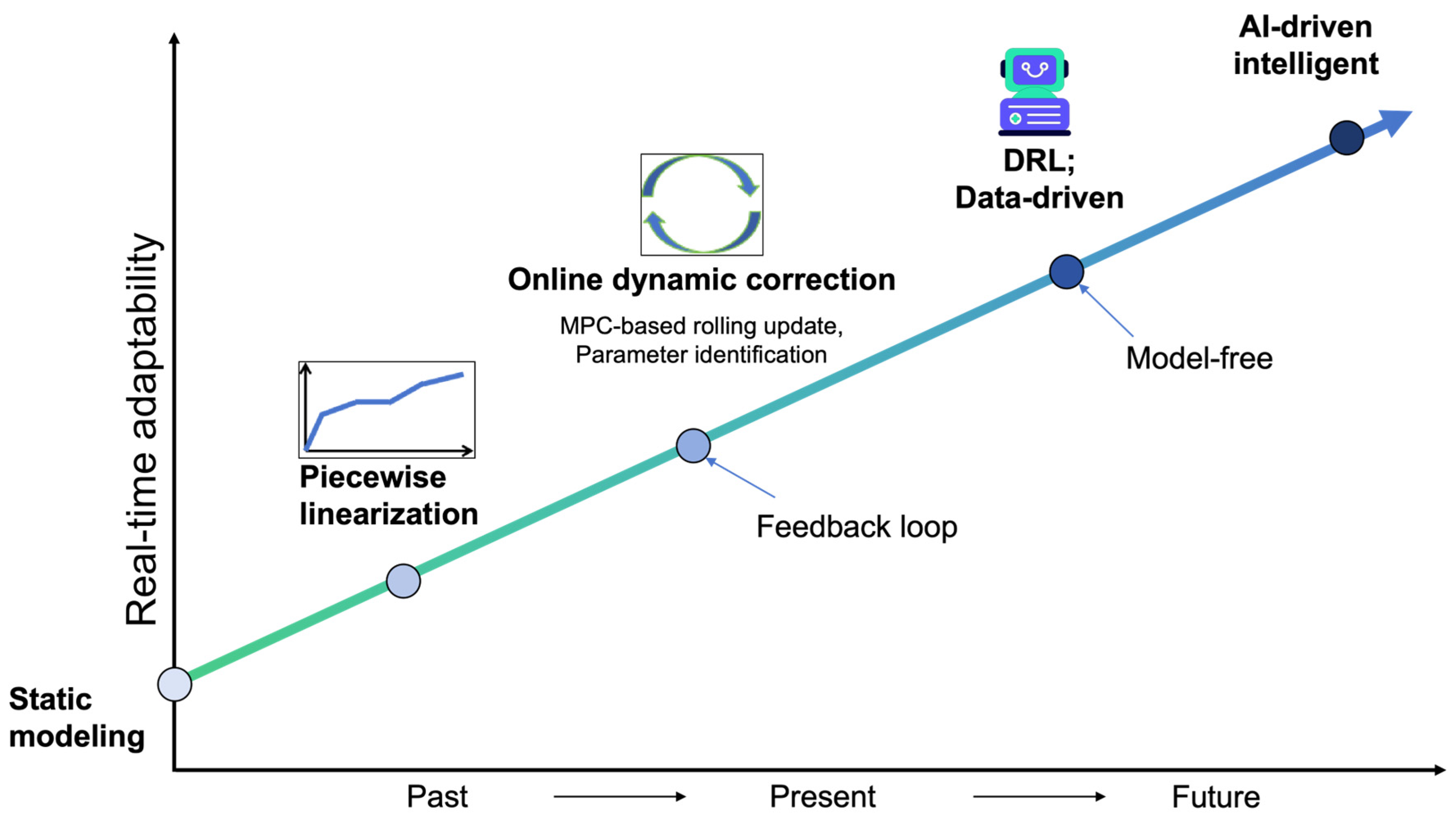
Unlike the normal-condition IESS models reviewed previously, modeling equipment under off-design conditions remains challenging, driving recent studies to refine efficiency coefficients and thermal inertia for units like CCHP and gas turbines [49,50]. To address the challenges of off-design behavior, existing studies typically employ three categories of modeling strategies (Figure 6): piecewise modeling methods, online dynamic correction, and data-driven adaptive methods.
The piecewise modeling method, particularly piecewise linearization, has been widely adopted to describe equipment performance under off-design conditions. In this approach, nonlinear characteristic curves of energy conversion equipment are divided into multiple operating regions and approximated using linear segments. For example, Benzaama et al. [51] proposed a piecewise affine autoregressive model to describe the thermal dynamics of residential buildings. Although piecewise models improve the representation of nonlinear equipment characteristics, they are typically developed offline and therefore have limited adaptability to real-time operating conditions. To enhance adaptability, several studies have introduced adaptive modeling strategies. Qin et al. [52] proposed an adaptive piecewise linearization method that dynamically approximates the nonlinear characteristics of equipment during operation. Rahbar et al. [53] further improved the efficiency of online optimization by refining the optimization formulations and introducing additional constraints. Reddy et al. [54] proposed a method based on adaptive extreme learning machines to capture the operating state changes in photovoltaic energy systems.
Another widely used approach is online dynamic correction, such as the rolling update strategy based on model predictive control (MPC). MPC enables dynamic model updating through rolling horizon optimization and feedback correction. Gu et al. [55] applied MPC-based rolling optimization to reduce prediction errors in renewable generation and load forecasting. Turk et al. [56] also demonstrated that MPC can effectively mitigate the impact of discrepancies between system models and actual equipment operation.
More recently, data-driven adaptive methods, like deep reinforcement learning (DRL) methods, have been explored to enhance model adaptability under uncertain operating conditions. Jimenez et al. [57] proposed a model-free DRL approach that can directly learn control policies from system interactions without relying on explicit equipment models. Yang et al. [58] further introduced an online recursive Markov chain framework to capture stochastic environmental dynamics better. Through dynamic reward mechanisms, DRL-based approaches can adapt to environmental uncertainties and have shown potential for model-free optimization in energy systems. Nevertheless, existing DRL applications often still rely on simplified equipment models with fixed coefficients [59]. Moreover, the design of appropriate operational constraints to ensure realistic system behavior remains a challenging problem.
While piecewise modeling is currently the dominant method, there is an urgent need to improve model adaptability and constraint representation to bridge the gap between theoretical models and practical industrial applications. Therefore, more standardized off-design modeling approaches specific to IP are required.

3.4. Critical Synthesis and Discussion: Focus on Modeling

Isolating system foundational modeling, load forecasting, and off-design condition modeling often undermines the reliability of dispatch results. A core challenge in current IESS modeling lies in the mismatch between prediction resolution, physical fidelity, and computational tractability, highlighting the importance of selecting the appropriate model granularity.
First, a significant disconnect exists between load forecasting (Section 3.2) and system modeling (Section 3.1 and Section 3.3). Many studies employ advanced techniques such as deep learning to improve load forecasting accuracy, but these predicted values are typically fed into simplified static energy hub models. Transient load dynamics inevitably force physical equipment into off-design operation. If the underlying equipment models assume nominal, time-invariant efficiency, the accuracy achieved in load forecasting is negated during the execution phase, leading to physically infeasible dispatch commands and an overestimation of actual system flexibility.
Second, increased physical realism in modeling leads to greater computational difficulty. The literature indicates that utilizing detailed energy bus frameworks (Section 3.1) combined with data-driven online model updates under off-design conditions (Section 3.3) can generate highly implementable operational strategies. This is particularly critical for complex energy systems coupling multiple energy carriers. However, simultaneously tracking detailed energy bus flows and dynamically updating nonlinear equipment efficiencies increases the complexity of the optimization problem. Such high-fidelity modeling often renders real-time operational dispatch computationally intractable.
In conclusion, achieving optimal dispatch requires a shift towards a decision-oriented collaborative modeling paradigm. Rather than independently pursuing ultimate accuracy in either load forecasting or equipment mechanisms, it is essential to strictly harmonize the modeling granularity of loads, system mechanisms, and off-design conditions. The granularity of load forecasting must align with the operational sensitivity of equipment models, and the solving capabilities of downstream dispatch algorithms must constrain both.

4. Scheduling Optimization Methods

Driven by large-scale grid integration of renewable energy and market price signals, IESSs are evolving towards intelligent, flexible regulation and real-time supply-and-demand interaction to enhance the efficiency of energy resource allocation. However, the inherent complexity and diversity make the real-time, efficient, accurate, and dynamic matching of energy supply and demand increasingly challenging [60]. Therefore, when conducting operational scheduling decision-making for IESSs, it is essential to review the current state of research on deterministic scheduling optimization, multi-time-scale optimization, and uncertainty optimization, thereby providing support for dynamic decision-making in operational scheduling.

4.1. Deterministic Optimization

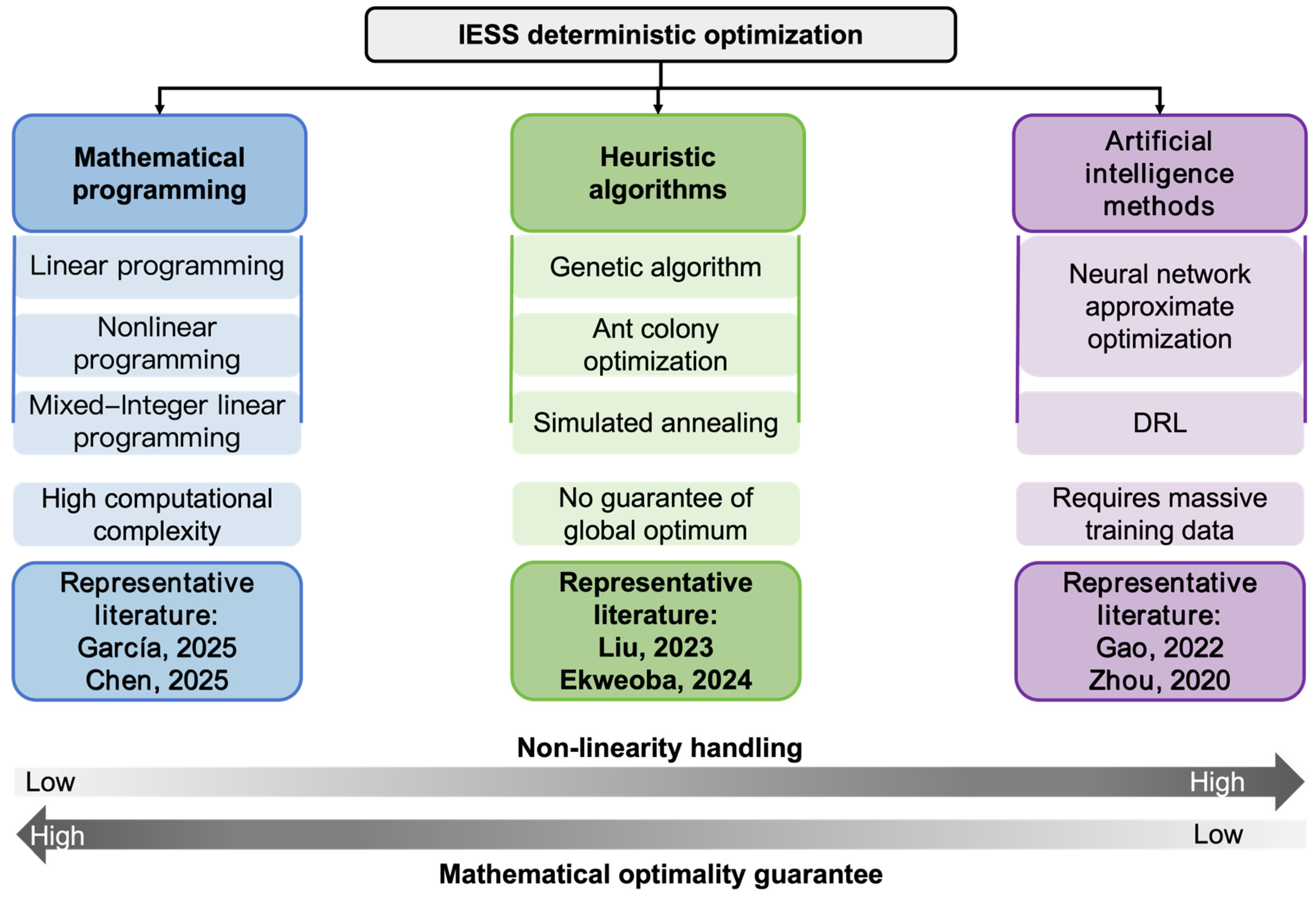
Deterministic optimization methods are widely used to determine optimal operational strategies for energy conversion units, storage, and loads. These methods can generally be classified into three categories (Figure 7): mathematical programming methods, heuristic algorithms, and artificial intelligence (AI)-based approaches.
Mathematical programming remains the most commonly used technique for IESS scheduling optimization due to its solid theoretical foundation and the availability of efficient solvers. Depending on the mathematical characteristics of the optimization model, these methods include linear programming, nonlinear programming, quadratic programming, and dynamic programming. In many practical applications, IESS scheduling problems are formulated as mixed-integer optimization models. For example, García et al. [61] formulated the energy management of microgrids as a mixed-integer linear programming (MILP) optimization problem. Chen et al. [62] developed an MILP-based optimization model for data center IESSs, achieving improvements in both energy-saving rates and the coefficient of performance of heat pumps. These optimization models are typically solved using commercial solvers such as Gurobi 11.0 or CPLEX 20.1.0. Although mathematical programming methods can provide globally optimal solutions for well-structured models, their computational complexity increases significantly with system-scale and nonlinear constraints.
Heuristic algorithms are often applied to large-scale or highly nonlinear scheduling problems. These algorithms search for near-optimal solutions through iterative evolution and stochastic exploration. Representative methods include genetic algorithms, ant colony optimization, and simulated annealing. For instance, Liu et al. [63] used a non-dominated ranking genetic algorithm to achieve multi-objective optimal operation of an IESS, while Ekweoba et al. [64] applied genetic algorithms to optimize floating platform systems. Compared with mathematical programming methods, heuristic algorithms have greater flexibility in handling nonlinear and non-convex problems. However, they generally require longer computational time and cannot guarantee global optimality.
Artificial intelligence methods have gradually been introduced into scheduling optimization. AI-based approaches mainly include data-driven optimization frameworks and reinforcement learning-based decision-making methods. Gao et al. [65] proposed a neural network-based framework to approximate optimization solutions, thereby improving computational efficiency. Meanwhile, DRL has been used to learn optimal control strategies through interactions with the environment. Zhou et al. [66] applied DRL to the operational scheduling of combined heat and power systems, demonstrating its potential to handle complex decision spaces. Despite these advantages, AI-based methods usually require large amounts of training data and still face challenges in constraint representation and model interpretability.
From the perspective of optimization objectives, existing studies mainly focus on minimizing economic costs and on multi-objective optimization that considers environmental impacts. Typical works include Li et al. [67], Wang et al. [68], and Dong et al. [69], who all considered multiple objectives such as economic cost, actual carbon emissions, and new energy utilization rates.
Furthermore, recent studies have expanded the scope of optimization from traditional electric–thermal systems to more complex multi-energy systems that include electricity, heat, gas, and hydrogen [70].
In summary, mathematical programming methods remain the dominant approach for deterministic scheduling due to their accuracy and mature solution tools. Heuristic algorithms provide greater flexibility for complex nonlinear problems, while AI-based methods offer new opportunities for solving high-dimensional scheduling tasks. Selecting appropriate optimization methods, therefore, requires balancing computational efficiency, model complexity, and data availability.

4.2. Uncertainty-Aware Optimization

Uncertainty is an inherent feature of IESSs and mainly arises from renewable energy generation, load demand fluctuations, market price variations, and equipment operational conditions. Su et al. [71] attempted to model these uncertainties in their research. Ignoring these uncertainties may lead to suboptimal scheduling decisions and supply–demand imbalances. Theoretical frameworks for handling these uncertainties can be explicitly classified into three categories based on uncertainty characterization and data dependency: probabilistic methods, non-probabilistic methods, and hybrid methods.
The first category is probabilistic methods, which rely on precise probability distributions. Among them, stochastic optimization is the most widely used approach. This method represents uncertain parameters using probability distributions and typically employs scenario-based analysis or chance-constrained programming. For instance, Su et al. [72] developed stochastic models for an IESS and a two-stage optimization framework to evaluate supply reliability under coupled uncertainties.
The second category comprises non-probabilistic methods, suitable for cases where accurate probability distributions are difficult to obtain. Fuzzy set theory represents uncertain parameters using membership functions and has been widely applied in energy management problems [73,74]. Evidence theory extends this concept by allowing uncertainty to be described using interval probabilities [75]. In addition, interval optimization [76] represents uncertain parameters as bounded intervals without requiring detailed statistical information. Robust optimization is another commonly used approach [77]. Unlike stochastic optimization, which focuses on expected performance, robust optimization seeks solutions that remain feasible under worst-case realizations of uncertain parameters. Aslani et al. [78] applied robust optimization to integrated electricity–heating–cooling systems, considering electric vehicle charging uncertainties.
The third category involves hybrid uncertainty modeling approaches [79,80,81]. These methods combine multiple techniques, such as stochastic optimization with interval analysis or fuzzy theory, to improve decision robustness under complex uncertainty environments. Although these approaches provide greater flexibility, they also increase model complexity and computational burden.
In the specific context of IPs, not all uncertainties carry the same risk. Consequently, different uncertainty profiles require matching with specific optimization methodologies: (1) Industrial loads (highest criticality): IPs must strictly satisfy the fluctuations of rigid loads to avoid production safety issues. Therefore, robust optimization is the most appropriate method for addressing the uncertainty in industrial loads. (2) Renewable energy output (high criticality): Distributionally robust optimization or chance-constrained methods can be employed to balance renewable energy fluctuations without being overly conservative. (3) Market prices (moderate criticality): Price changes affect the economic performance of IESSs rather than personnel safety. Therefore, stochastic optimization is the most suitable approach to maximize expected profits.

4.3. Multi-Time-Scale Scheduling

Different energy carriers in IESSs exhibit significantly different dynamic characteristics, which makes multi-time-scale scheduling an important research topic. Electricity requires an instantaneous supply–demand balance, whereas other energy carriers, such as heat and gas, often have slower dynamic responses and inherent storage capabilities. For instance, heating systems typically require longer response times to adjust their operating states compared with electrical systems. If these differences are not properly considered, scheduling strategies may fail to respond effectively to load fluctuations.
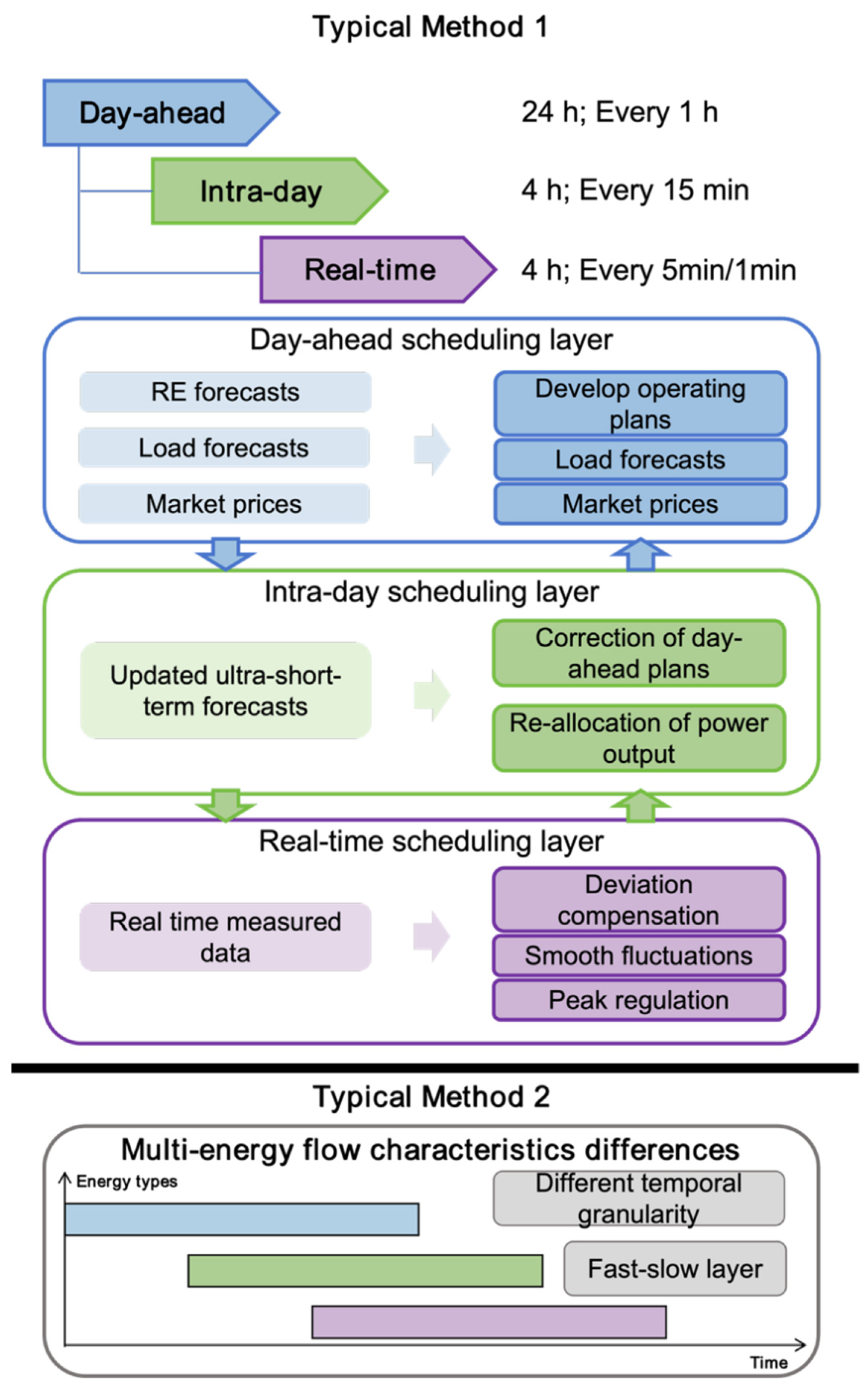
To address this issue, existing multi-time-scale scheduling frameworks can be explicitly classified into two categories based on whether they explicitly differentiate the physical response speeds of heterogeneous energy flows (Figure 8): Time-horizonal hierarchical scheduling and dynamics-driven asynchronous scheduling.
Time-horizonal hierarchical scheduling: This traditional approach adopts the “day-ahead, intra-day, and real-time” multi-stage structure commonly used in pure power systems. It sequentially decomposes the optimization window to handle forecast uncertainties. For example, Qian et al. [82] proposed a three-stage rolling method, and Chen et al. [83] developed a similar framework for electric–thermal–hydrogen systems. However, a critical limitation of this paradigm is that it often forces all energy carriers to be dispatched synchronously at the same time-step resolution within each stage, neglecting the inherent thermal inertia of heating networks.
Dynamics-driven asynchronous scheduling: To address the physical realities of multi-energy coupling, this advanced framework explicitly decouples the system into fast- and slow-response models based on energy-flow properties. It uses large time steps for sluggish thermal/gas networks to exploit their buffering capacity, while simultaneously using fine-grained time steps for the electrical network to ensure strict real-time balance. For instance, Seenumani et al. [84] developed a two-time-scale framework separating fast and slow dynamics, and Yang et al. [85] proposed a dual-time-scale MPC strategy specifically to coordinate slow heating quality with fast operational flexibility. In addition, several studies have investigated the influence of time resolution on scheduling performance. Larger time steps can capture long-term system interactions but may increase uncertainty, while smaller time steps improve control accuracy at the cost of higher computational complexity [86,87].
As the integration of P2G and carbon capture, utilization, and storage (CCUS) deepens, shifting from traditional time-horizonal stages to true dynamics-driven asynchronous scheduling is essential for accurately capturing the flexibility of low-carbon IESSs without causing a state-space explosion.

4.4. Critical Synthesis and Discussion: Focus on Scheduling Optimization

The choice of optimization algorithm is not merely a mathematical preference but a fundamental driver of divergent dispatch results. Regarding deterministic algorithms, significant discrepancies in dispatch results emerge when dealing with highly nonlinear energy conversion processes. Under simplified linear assumptions, mathematical programming and heuristic algorithms typically converge to similar economic costs. However, in multi-energy systems characterized by coupled nonlinearities, differences become apparent. To maintain the global optimality guarantee of MILP solvers, researchers are often compelled to linearize the efficiency curves of electrolyzers or thermal units extensively. Consequently, the resulting mathematical optimal solution often deviates from physical reality. In contrast, while heuristic algorithms can preserve nonlinear physical constraints, they often converge to local suboptimal solutions from an economic perspective. Therefore, a trade-off is required between a mathematically rigorous solution derived from an inaccurate physical model and a mathematically suboptimal solution derived from an accurate physical model.
Furthermore, the treatment of uncertainty impacts the system’s economy and security, thereby leading to distinct dispatch strategies. Stochastic and robust optimization address the same dispatch problem under different risk philosophies. The literature indicates that stochastic models typically yield lower day-ahead operating costs by optimizing for expected scenarios. However, under severe, unpredictable fluctuations in renewable energy, such plans often incur high real-time penalty costs. In contrast, robust optimization structurally anticipates the worst-case scenario, ensuring the system is immune to fluctuations in all boundary conditions, but systematically elevates baseline operating costs. The convergence of these two approaches remains an unresolved challenge, with the choice relying heavily on the decision-maker’s subjective risk preference rather than objective system parameters.
Finally, multi-time-scale scheduling reveals the contradiction between uniform algorithmic time steps and differentiated physical dynamics. Handling fast-response electrical dynamics and slow-response thermal–hydrogen dynamics within a single, uniform temporal resolution inevitably necessitates compromise. High-resolution time steps capture electrical volatility but lead to a surge in computational burden and over-regulation of thermal inertia; conversely, low-resolution time steps smooth renewable output spikes but may result in potentially dangerous violations of electrical constraints during real-time operation.

5. Flexibility Utilization in Integrated Energy Supply Systems

IESSs involve multiple energy carriers such as electricity, heat, gas, hydrogen, and cooling. The inherent differences among these energy forms in temporal and spatial characteristics create challenges for operational scheduling while simultaneously providing opportunities for flexible system operation. Compared with traditional single-energy systems, IESSs possess greater flexibility due to multi-energy coupling, diversified energy conversion pathways, and bidirectional interactions between supply and demand. Therefore, understanding flexibility resources, interaction mechanisms, and coordinated scheduling strategies is essential for improving system adaptability and energy efficiency. This section reviews current research progress on the utilization of flexibility in IESSs from three perspectives: flexibility resources, interaction mechanisms, and coordinated flexible scheduling.

5.1. Flexibility Resources

Traditional power systems relying on a single energy carrier have limited capability to handle the variability and uncertainty of renewable energy generation. As renewable penetration increases, maintaining system reliability and managing load fluctuations become more challenging [88]. To enhance system flexibility, various technologies have been introduced into IESSs, including energy storage, energy conversion equipment, intrinsic characteristics, and DR technologies.
Energy storage plays a central role. Energy storage can effectively buffer fluctuations in renewable energy output and provide additional operational flexibility. For instance, Prajapati et al. [89] investigated the reliability improvement achieved by integrating energy storage into power systems and analyzed the relationship between storage capacity and congestion mitigation. Similarly, Bazdar et al. [90] showed that aggregating energy storage within IESSs can mitigate renewable energy uncertainty and improve economic and environmental performance. In addition to conventional electrochemical storage, emerging technologies such as liquid air energy storage have also been explored. Vecchi et al. [91] demonstrated that liquid compressed air energy storage (LAES) can enhance the operational flexibility of electric–thermal–cooling systems through multi-energy coupling.
In addition to energy storage technologies, energy conversion equipment also provides important flexibility resources. Equipment such as CHP units, electric boilers, and heat pumps enable energy conversion across different carriers and support multi-energy complementary operation. For instance, Ding et al. [92] leveraged the full-mode operation of CHP units to enhance system flexibility. Onodera et al. [93] elucidated the systemic impact of P2X technology as a flexibility option in integrated renewable energy systems, specifically investigating its influence on system structure and energy costs. Kauko et al. [94] demonstrated that implementing power-to-heat in heating-dominated regions improves system flexibility. Additionally, Yuan et al. [95] found that CCUS technologies can provide additional peak-shaving capability while reducing carbon emissions. The coordinated operation of P2G and CCUS has been shown to increase system revenue and renewable energy utilization [96].
In addition to physical equipment, the inherent characteristics of different energy carriers also provide flexibility. Energy flow networks exhibit flexibility potential in the longitudinal dimension through pipeline storage space and pressure regulation, and in the lateral dimension through the flow inertia and flow velocity differences in energy carriers. For example, the thermal inertia of buildings and heating networks can act as virtual thermal storage, allowing temporal shifting of heating demand [97,98]. Studies have shown that thermal inertia in building structures [99] and heating systems [100] can effectively support flexible operation by delaying heat demand without significantly affecting user comfort. Similarly, the compressibility of natural gas pipelines provides buffering capacity that can accommodate short-term fluctuations in gas supply and demand [101].
To quantify the temporal flexibility of these resources, existing studies typically abstract them into a unified generalized battery model using state-of-charge (SOC) balance equations:
S O C t + 1 = S O C t + μ c h a P c h a , t E d t P d i s , t E μ d i s d t
where S O C t represents the state of charge at time t; μ c h a and μ d i s denote the charging and discharging efficiencies, respectively; P c h a , t and P d i s , t are the charging and discharging powers, respectively; E is the capacity; and d t is the time interval.
While this unified formulation facilitates the construction of convex optimization models, it involves significant simplifications: it ignores the spatial distributions of temperature, pressure, and flow rate for fluid-based carriers, and assumes fixed efficiencies that overlook the nonlinear relationship between depth of discharge and degradation. Consequently, these simplified models tend to overestimate actual flexibility and underestimate asset degradation costs.
Demand-side flexibility also plays an important role in IESS operation. In traditional power systems, this flexibility is commonly achieved through DR, in which users adjust their electricity consumption in response to price signals or control strategies. For example, Mohseni et al. [102,103] developed a microgrid planning model considering user comfort and DR participation. Elgamal et al. [104] proposed an optimal scheduling scheme incorporating shiftable loads. However, because IESSs involve multiple energy carriers, the concept of integrated DR (IDR) has been proposed to extend traditional DR mechanisms. Under IDR, users can adjust both the quantity and type of energy consumed, enabling coordinated responses across electricity, heating, cooling [105,106], and natural gas demands [107]. However, unlike residential applications, extracting IDR from IP requires specialized process-centric strategies, as shifting industrial loads must strictly adhere to production quotas, shift schedules, and safety constraints.
As shown in Table 3, flexibility resources in IESSs originate from multiple sources, including energy storage devices, energy conversion equipment, intrinsic energy carrier characteristics, and demand-side response mechanisms. These resources collectively expand the operational flexibility of IESSs. Nevertheless, effectively identifying, quantifying, and utilizing these flexibility resources remains an important research challenge.

5.2. Interaction Mechanisms

Existing studies primarily classify the interaction mechanisms of IESS flexibility resources into the synergistic complementarity between coupled equipment, and the response potential of demand-side flexible loads.
For example, Hu et al. [108] proposed a method for calculating the upward and downward adjustment spaces for supply-side flexible resources and incorporated DR to schedule flexible loads. Ao et al. [109] verified that the interaction between electric/absorption heat pumps and combined heat and power systems can enhance waste heat recovery and system flexibility. Similarly, Li et al. [110] demonstrated that thermal storage systems can decouple electricity, heating, and cooling scheduling in CHP-based energy systems, thereby improving system flexibility.
Multi-energy coupling technologies further enrich these interaction mechanisms. Mansour-Saatloo et al. [111] studied the interaction between electricity and hydrogen supply systems through technologies such as power-to-hydrogen and energy storage. Jalilian et al. [112] analyzed the coordinated interaction among cooling, heating, electricity, gas, and water systems in integrated energy networks. In addition, the flexibility provided by electric vehicles and building loads has attracted increasing attention. For example, Salehi et al. [113] investigated the interaction among electric vehicles, energy storage devices, and renewable generation, while Hurwitz et al. [114] analyzed the role of building load flexibility in IESSs.
These studies indicate that flexibility resources in IESSs are not independent but interact dynamically through multiple coupling pathways. However, most existing studies focus primarily on electricity-centered systems. The interaction mechanisms among different flexibility resources in fully integrated multi-energy systems still require further investigation.

5.3. Coordinated Flexible Scheduling

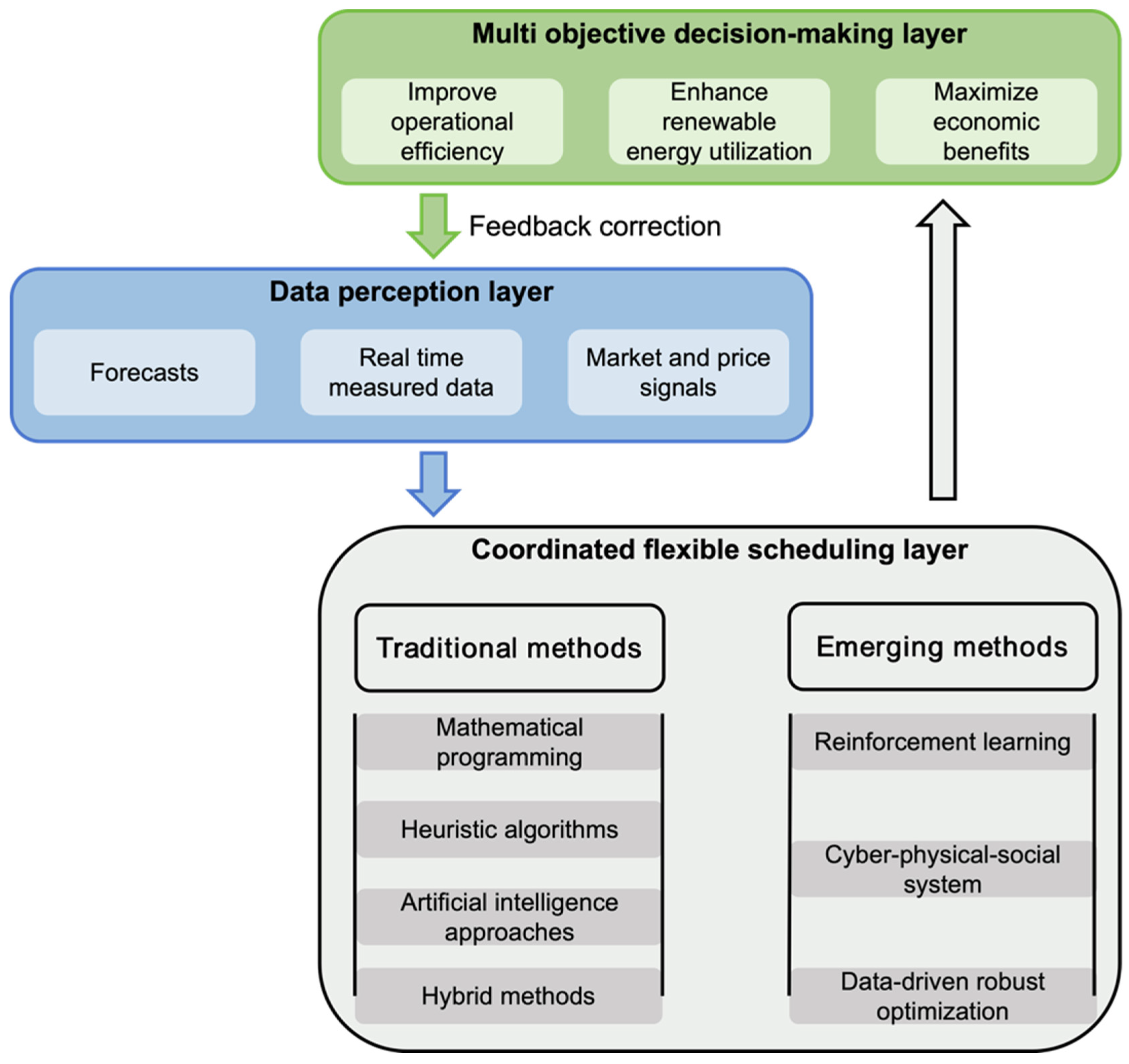
Coordinated flexible scheduling aims to optimize system operation by simultaneously considering flexibility resources, interaction mechanisms, and system constraints. The objective is to improve operational efficiency, enhance renewable energy utilization, and maximize economic benefits through coordinated resource allocation.
To successfully achieve these scheduling objectives, establishing accurate and consistent quantitative metrics to evaluate flexibility is a fundamental prerequisite. Currently, the literature generally evaluates IESS flexibility across two levels. At the equipment level, metrics are defined relatively consistently: ramping capability and up/down regulation ranges for energy production units; sheddable/shiftable ratios for demand-side resources; and adjustable capacity for energy storage. However, at the system level, metrics remain highly inconsistent, often relying on diverse optimization-based or polyhedral projection methods to quantify aggregate bounds. Furthermore, some critical indicators are currently overlooked, such as the economic cost of flexibility utilization, long- and short-term regulatory capabilities, and metrics that consider system exergy.
Once flexibility is properly quantified, various optimization methods (Figure 9) can be applied, including mathematical programming, heuristic algorithms, artificial intelligence approaches, and hybrid methods.
For instance, Ding et al. [115] proposed a stochastic scheduling optimization model for an IESS that integrates power-to-ammonia and energy storage to achieve cost-effective, flexible system operation. Xiao et al. [116] developed a stochastic dominance-constrained operation strategy utilizing flexible resources.
Recently, digital technologies have also been incorporated into flexible scheduling frameworks. Song et al. [117] proposed a cyber–physical–social system framework that integrates DR, electricity markets, and distribution networks via blockchain technology. Zhai et al. [118] further proposed a data-driven robust optimization method to utilize multiple flexibility resources under uncertain conditions. Su et al. [119] combine deep-learning-based customer response modeling, network simulation, and multi-objective decision-making to smooth loads and improve efficiency.
Although significant progress has been made in coordinated flexible scheduling of IESSs, several challenges remain. The increasing diversity and complexity of flexibility resources introduce higher computational requirements and modeling difficulties. Moreover, effectively integrating different flexibility resources while maintaining computational efficiency and system reliability remains an important research direction for future IESS operation.

5.4. Critical Synthesis and Discussion: Focus on Flexibility Utilization

The effectiveness of flexibility resources depends on the time scale of supply–demand imbalances and system constraints. First, there is a distinct disparity between response speed and transfer capability among physical resources. Conventional energy storage is highly effective at mitigating high-frequency, short-duration fluctuations in renewable energy due to its rapid response. However, high capital costs limit its economic viability for long-term, large-scale energy transfer. Conversely, the inherent thermal inertia of buildings and heating networks offers immense capacity at near-zero marginal cost. These thermal resources are undoubtedly the most effective choice for day-ahead to intra-day peak shifting; although their dynamic response is slower, they can effectively defer thermal demand without compromising user comfort.
Second, the evaluation of multi-energy conversion and IDR illustrates the contradiction between cross-energy capabilities and cost constraints. Power-to-X technologies provide significant flexibility through cross-energy vector coupling and seasonal storage, acting as a vital buffer during periods of renewable energy overgeneration. However, their conversion efficiency losses render them economically sensitive to electricity prices. On the other hand, IDR offers highly cost-effective flexibility from the demand side. Nevertheless, the actual dispatchability of IDR is stochastic, strictly limited by human comfort constraints and user willingness to participate.
Based on the literature analysis in Section 5.1, Section 5.2 and Section 5.3, the optimal operation of IESSs cannot rely on a single type of flexibility resource. A strategy based on sequential, hierarchical utilization is emerging as a consensus: prioritizing the use of low-marginal-cost IDR and thermal inertia for baseline load shifting, utilizing cross-vector conversion to absorb structural excess power, and strictly reserving expensive electrochemical storage for real-time frequency regulation and rapid ramping response.

6. Future Research Directions and Way Forward

Future research on flexible supply–demand matching in IESSs will likely focus on five key directions: modeling, intelligent scheduling, emerging AI tools, distributed flexibility integration, and market-oriented mechanisms.

6.1. High-Fidelity and Adaptive Modeling

High-fidelity and adaptive modeling will be essential for improving the reliability of operational scheduling in IESSs. In industrial park environments, the performance of key equipment such as combined heat and power units, electrolyzers, and energy storage systems may vary significantly with operating conditions, environmental factors, and equipment aging. Emerging technologies such as hybrid physics–data modeling, digital twins, and online parameter identification provide promising approaches for dynamically updating equipment models using real-time operational data. However, balancing model accuracy and computational efficiency while ensuring robustness for large-scale system operation remains an important research challenge. Specifically, a critical problem is developing physics-informed [120,121] AI models that accurately capture the nonlinear thermodynamic degradation of equipment without violating the convexity requirements of rapid, real-time solvers.

6.2. AI-Driven Scheduling and Autonomous Energy Management

As systems scale, AI is increasingly integrated with traditional optimization to enhance adaptability. Key integration pathways include: (1) using deep learning for surrogate modeling of complex equipment to maintain tractability within MILP/MPC frameworks; (2) utilizing DRL to generate learned policies for millisecond-level response; and (3) employing large language models (LLMs) to translate operational intents into mathematical constraints.
IESSs are evolving towards autonomous management driven by multi-agent networks. However, a critical challenge lies in designing distributed multi-agent methods for open energy networks, where the number of participating agents fluctuates dynamically due to autonomous plug-and-play behaviors, heterogeneous resource availability, or communication interruptions [122]. Guaranteeing algorithm convergence and dynamic consistency under these time-varying topologies remains a key mathematical bottleneck. Furthermore, at the individual-agent level, it is crucial to design neural network architectures that structurally enforce physical constraints, such as energy and mass conservation, rather than merely treating these laws as soft penalty terms in loss functions.

6.3. Integration of Large Language Models for Energy System Operation

The rapid development of LLMs offers new opportunities for intelligent IESS operation [123]. Unlike traditional methods focused on numerical data, LLMs integrate textual knowledge and heterogeneous data to support tasks such as decision assistance, anomaly diagnosis, and multi-agent coordination. However, challenges regarding reliability and domain alignment persist. Furthermore, given the paramount importance of data privacy in IPs, developing localized retrieval-augmented frameworks to integrate unstructured logs and SCADA data for fault diagnosis and operational analysis is both significant and challenging.

6.4. Coordination with Broader Flexible Resources

Future industrial park energy systems are expected to interact with a wider range of distributed flexibility resources. Emerging energy infrastructures, such as electric and hydrogen vehicles and distributed energy storage, can provide additional flexibility through mechanisms such as vehicle-to-grid (V2G) interactions [124] and hydrogen energy networks. These resources enable cross-sector energy coupling between transportation, electricity, and hydrogen systems, thereby expanding the flexibility space for supply–demand matching. However, the large-scale, spatial distribution, and behavioral uncertainty of these resources introduce new challenges for system coordination and control. Unlike stochastic residential charging, industrial fleet availability is rigidly constrained by shift-dependent logistics and production schedules, making traditional V2G models inapplicable. Furthermore, developing unified degradation models that accurately quantify the hidden lifespan costs when these distributed mobile storage units simultaneously participate in both high-frequency grid regulation and deep industrial peak-shaving remains a critical unresolved challenge.

6.5. Market-Oriented Flexibility and Supply–Demand Interaction

Market mechanisms are crucial for coordinating IESS interactions, enabling flexible resources like storage and conversion equipment to unlock economic value across electricity, heat, and carbon markets. However, existing studies predominantly focus on centralized technical optimization rather than decentralized market behaviors. Moving beyond generic incentive schemes, a specific problem is formulating peer-to-peer pricing mechanisms [125] that explicitly value the temperature grade of industrial thermal energy, rather than merely its total heat quantity. Additionally, a critical unresolved challenge lies in designing coupled clearing algorithms [126] for joint electricity–heat–carbon markets. These mathematical models must accurately allocate the dynamic carbon-reduction benefits of cross-sectoral technologies among heterogeneous industrial stakeholders [127], strictly preventing the double-counting of emission credits during multi-agent trading.

7. Conclusions

This review provides a comprehensive overview of the key technologies and challenges associated with IESSs in IPs. Unlike traditional approaches that treat modeling, scheduling, and flexibility as isolated technical tracks, this review argues that successful IESS deployment demands a shift from algorithm-centric, generic energy management to production-process-centric co-optimization. Currently, while advanced mathematical models and AI-driven scheduling algorithms are proliferating in academic simulations, their adoption by actual industrial operators remains limited. This gap arises because existing models often oversimplify the nonlinear thermodynamic characteristics of large-scale equipment and overestimate the availability of flexible resources. In reality, industrial energy demand is strictly determined by production processes. Consequently, any scheduling algorithm that risks production downtime or violates rigid reliability constraints—regardless of its mathematical optimality—is practically infeasible. To address this bottleneck, future research must abandon idealized assumptions of unconstrained flexibility and instead focus on developing adaptive, physics-informed frameworks that mathematically guarantee industrial production safety while achieving multi-energy synergy.
Finally, it is important to acknowledge the inherent limitations of this review. Regarding scope boundaries, this paper focuses primarily on operational scheduling and flexibility utilization, largely omitting long-term capacity expansion planning and detailed component-level thermodynamic design. Additionally, the literature search was confined to English-language articles in major academic databases, which may introduce selection bias by inadvertently excluding valuable non-English regional studies and industry reports. Furthermore, while the reviewed case studies are predominantly contextualized within Chinese IPs, the underlying modeling and optimization frameworks possess strong transferability to other global climatic and regulatory contexts. In the future, by integrating advanced information technologies, artificial intelligence methods, and market mechanisms—and rigorously validating these frameworks under specific industrial constraints and diverse geographic contexts—IESSs are expected to achieve more flexible, efficient, and sustainable operation, providing significant support for the energy transition and low-carbon development of IPs.

Author Contributions

Conceptualization, X.L. (Xueru Lin), X.L. (Xiaojie Lin) and W.Z.; methodology, X.L. (Xueru Lin); validation, W.Z. and J.L.; formal analysis, X.L. (Xueru Lin); investigation, X.L. (Xueru Lin); resources, X.L. (Xueru Lin); writing—original draft preparation, X.L. (Xueru Lin); writing—review and editing, X.L. (Xiaojie Lin), J.L. and W.Z.; visualization, X.L. (Xueru Lin); supervision, J.L., X.T., H.Z. and W.Z.; project administration, J.L.; funding acquisition, X.T. All authors have read and agreed to the published version of the manuscript.

Funding

This work was funded by the National Key R&D Program of China (Grant No. 2024YFB4206500), the Key Laboratory of Cleaner Intelligent Control on Coal & Electricity, Ministry of Education, P.R. China (Grant No. CICCE202510), and the State Key Laboratory of Alternate Electrical Power System with Renewable Energy Sources (Grant No. LAPS25016).

Data Availability Statement

Data sharing is not applicable.

Conflicts of Interest

The authors declare no conflict of interest.

Nomenclature Acronyms

EElectricity
TThermal
HHydrogen
GGas
CHPCogeneration unit
GTGas turbine
PVPhotovoltaic
P2GPower-to-gas
V2GVehicle-to-grid
MPCModel predictive control
DRLDeep reinforcement learning
MILPMixed-integer linear programming
GDPGross domestic product
ESElectricity storage
TSThermal storage
HSHydrogen storage
WPWind power
ELElectrolyzer
IPsIndustrial parks
IESSIntegrated energy supply system
MLMachine learning
DRDemand response
IDRIntegrated demand response
LAESLiquid compressed air energy storage
CCUSCarbon capture, utilization, and storage
SOCState of charge

References

  1. UNIDO Statistics. International Yearbook of Industrial Statistics 2023. UNIDO Statistics. 2023. Available online: https://stat.unido.org/publications/international-yearbook-industrial-statistics-2023 (accessed on 27 March 2026).
  2. National Development and Reform Commission, Ministry of Science and Technology, Ministry of Natural Resources, Ministry of Housing and Urban-Rural Development, Ministry of Commerce, and General Administration of Customs. China Development Zone Audit and Announcement Directory (2018 Edition). Announcement No. 4 [2018] of the National Development and Reform Commission. February 2018. Available online: https://www.gov.cn/zhengce/zhengceku/2018-12/31/content_5434045.htm (accessed on 27 March 2026).
  3. Tian, J.; Sang, J.; Chen, Y.; Chen, L. Review of energy efficiency improvement in Chinese industrial parks. Energy China 2022, 44, 20–26. [Google Scholar]
  4. Chen, L. Report on Green and Low-Carbon Development of Industrial Parks in China (2023). School of Environment, Tsinghua University. Available online: https://www.env.tsinghua.edu.cn/info/1129/8369.htm (accessed on 27 March 2026).
  5. Wang, L.; Lin, J.; Dong, H.; Wang, Y.; Zeng, M. Demand response comprehensive incentive mechanism-based multi-time scale optimization scheduling for park integrated energy system. Energy 2023, 270, 126893. [Google Scholar] [CrossRef]
  6. Bartolucci, L.; Cordiner, S.; Mulone, V.; Pasquale, S.; Sbarra, A. Design and management strategies for low emission building-scale multi energy systems. Energy 2022, 239, 122160. [Google Scholar] [CrossRef]
  7. You, M.; Wang, Q.; Sun, H.; Castro, I.; Jiang, J. Digital twins based day-ahead integrated energy system scheduling under load and renewable energy uncertainties. Appl. Energy 2022, 305, 117899. [Google Scholar] [CrossRef]
  8. Zhang, Y.; Zhao, H.; Qi, Z.; Li, B. A two-stage low-carbon economic coordinated dispatching model for generation-load-storage resources considering flexible supply-demand balance. Appl. Energy 2024, 373, 123981. [Google Scholar] [CrossRef]
  9. Zhang, S.; Pan, G.; Li, B.; Gu, W.; Fu, J.; Sun, Y. Multi-timescale security evaluation and regulation of integrated electricity and heating system. IEEE Trans. Smart Grid 2025, 16, 1088–1099. [Google Scholar] [CrossRef]
  10. Fodstad, M.; del Granado, P.C.; Hellemo, L.; Knudsen, B.R.; Pisciella, P.; Silvast, A.; Bordin, C.; Schmidt, S.; Straus, J. Next frontiers in energy system modelling: A review on challenges and the state of the art. Renew. Sustain. Energy Rev. 2022, 160, 112246. [Google Scholar] [CrossRef]
  11. Horak, D.; Hainoun, A.; Neugebauer, G.; Stoeglehner, G. A review of spatio-temporal urban energy system modeling for urban decarbonization strategy formulation. Renew. Sustain. Energy Rev. 2022, 162, 112426. [Google Scholar] [CrossRef]
  12. Hassan, Q.; Algburi, S.; Sameen, A.Z.; Salman, H.M.; Jaszczur, M. A review of hybrid renewable energy systems: Solar and wind-powered solutions: Challenges, opportunities, and policy implications. Results Eng. 2023, 20, 101621. [Google Scholar] [CrossRef]
  13. Lin, Y.; Tang, J.; Guo, J.; Wu, S.; Li, Z. Advancing AI-Enabled Techniques in Energy System Modeling: A Review of Data-Driven, Mechanism-Driven, and Hybrid Modeling Approaches. Energies 2025, 18, 845. [Google Scholar] [CrossRef]
  14. Teichgraeber, H.; Brandt, A.R. Time-series aggregation for the optimization of energy systems: Goals, challenges, approaches, and opportunities. Renew. Sustain. Energy Rev. 2022, 157, 111984. [Google Scholar] [CrossRef]
  15. Thirunavukkarasu, M.; Sawle, Y.; Lala, H. A comprehensive review on optimization of hybrid renewable energy systems using various optimization techniques. Renew. Sustain. Energy Rev. 2023, 176, 113192. [Google Scholar] [CrossRef]
  16. Zhu, Y.; Li, X.; Ma, Y.; Long, Z.; Liu, H.; E, J. A comprehensive review of microgrids with hydrogen energy systems: Energy management strategies and system optimization. Renew. Sustain. Energy Rev. 2026, 229, 116635. [Google Scholar] [CrossRef]
  17. Reza, M.; Fattah, I.; Wang, J.; Hannan, M.; Zainal, B.; Ong, H.C.; Mahlia, T. Hydrogen-based hybrid energy system: A review of technologies, optimization approaches, objectives, constraints, applications, and outstanding issues. Renew. Sustain. Energy Rev. 2026, 226, 116192. [Google Scholar] [CrossRef]
  18. Wang, Y.; Peng, D.; Qu, B.; Shui, J.; Wang, D. Multi-interested entities in integrated energy system: A review on collaborative optimization strategies. Neurocomputing 2026, 666, 132281. [Google Scholar] [CrossRef]
  19. Khan, T.; Yu, M.; Waseem, M. Review on recent optimization strategies for hybrid renewable energy system with hydrogen technologies: State of the art, trends and future directions. Int. J. Hydrogen Energy 2022, 47, 25155–25201. [Google Scholar] [CrossRef]
  20. Alabi, T.M.; Aghimien, E.I.; Agbajor, F.D.; Yang, Z.; Lu, L.; Adeoye, A.R.; Gopaluni, B. A review on the integrated optimization techniques and machine learning approaches for modeling, prediction, and decision making on integrated energy systems. Renew. Energy 2022, 194, 822–849. [Google Scholar] [CrossRef]
  21. Mohtasim, M.S.; Das, B.K.; Paul, U.K.; Kibria, M.G.; Hossain, M.S. Hybrid renewable multi-generation system optimization: Attaining sustainable development goals. Renew. Sustain. Energy Rev. 2025, 212, 115415. [Google Scholar] [CrossRef]
  22. Dawes, G.; Kirant-Mitić, T.; Jiang, Z.; Le Dréau, J.; Cai, H.; Cui, J.; Townsend, J.; Bampoulas, A.; Li, R.; Lopes, R.A.; et al. Energy flexibility at multi-building scales: A review of the dominant factors and their uncertainties. Energy Build. 2025, 346, 116157. [Google Scholar] [CrossRef]
  23. Geidl, M.; Koeppel, G.; Favre-Perrod, P.; Klockl, B.; Andersson, G.; Frohlich, K. Energy hubs for the future. IEEE Power Energy Mag. 2007, 5, 24–30. [Google Scholar] [CrossRef]
  24. Mansouri, S.A.; Nematbakhsh, E.; Ahmarinejad, A.; Jordehi, A.R.; Javadi, M.S.; Matin, S.A.A. A Multi-objective dynamic framework for design of energy hub by considering energy storage system, power-to-gas technology and integrated demand response program. J. Energy Storage 2022, 50, 104206. [Google Scholar] [CrossRef]
  25. Nasir, M.; Jordehi, A.R.; Tostado-Véliz, M.; Tabar, V.S.; Mansouri, S.A.; Jurado, F. Operation of energy hubs with storage systems, solar, wind and biomass units connected to demand response aggregators. Sustain. Cities Soc. 2022, 83, 103974. [Google Scholar] [CrossRef]
  26. Akbari, E.; Shabestari, S.F.M.; Pirouzi, S.; Jadidoleslam, M. Network flexibility regulation by renewable energy hubs using flexibility pricing-based energy management. Renew. Energy 2023, 206, 295–308. [Google Scholar] [CrossRef]
  27. Zhu, Y.; Xu, Y.; Chen, H.; Guo, H.; Zhang, H.; Zhou, X.; Shen, H. Optimal dispatch of a novel integrated energy system combined with multi-output organic Rankine cycle and hybrid energy storage. Appl. Energy 2023, 343, 121113. [Google Scholar] [CrossRef]
  28. Liu, L.-N.; Yang, G.-H. Distributed Optimal Energy Management for Integrated Energy Systems. IEEE Trans. Ind. Inform. 2022, 18, 6569–6580. [Google Scholar] [CrossRef]
  29. Cui, Q.; Ma, P.; Huang, L.; Shu, J.; Luv, J.; Lu, L. Effect of device models on the multiobjective optimal operation of CCHP microgrids considering shiftable loads. Appl. Energy 2020, 275, 115369. [Google Scholar] [CrossRef]
  30. Santos, M.; André, J.; Mendes, R.; Ribeiro, J.B. Thermo-economic optimization of a Carnot Battery under transient conditions. Appl. Therm. Eng. 2025, 269, 126080. [Google Scholar] [CrossRef]
  31. Kefer, K.; Hanghofer, R.; Kefer, P.; Stöger, M.; Hofer, B.; Affenzeller, M.; Winkler, S. Simulation-Based Optimization of Residential Energy Flows Using White Box Modeling by Genetic Programming. Energy Build. 2022, 258, 111829. [Google Scholar] [CrossRef]
  32. Kefer, K.; Hanghofer, R.; Kefer, P.; Stöger, M.; Hofer, B.; Affenzeller, M.; Winkler, S. Grey-box and ANN-based building models for multistep-ahead prediction of indoor temperature to implement model predictive control. Eng. Appl. Artif. Intell. 2023, 126, 107115. [Google Scholar] [CrossRef]
  33. Sani, A.G.; Najafi, H.; Azimi, S.S. Dynamic thermal modeling of the refrigerated liquified CO2 tanker in carbon capture, utilization, and storage chain: A truck transport case study. Appl. Energy 2022, 326, 119990. [Google Scholar] [CrossRef]
  34. Aquize, R.; Cajahuaringa, A.; Machuca, J.; Mauricio, D.; Villanueva, J.M.M. System identification methodology of a gas turbine based on artificial recurrent neural networks. Sensors 2023, 23, 2231. [Google Scholar] [CrossRef]
  35. Elsheikh, A.H.; Sharshir, S.W.; Elaziz, M.A.; Kabeel, A.E.; Wang, G.; Zhang, H. Modeling of solar energy systems using artificial neural network: A comprehensive review. Sol. Energy 2019, 180, 622–639. [Google Scholar] [CrossRef]
  36. Souliotis, M.; Kalogirou, S.; Tripanagnostopoulos, Y. Modelling of an ICS solar water heater using artificial neural networks and TRNSYS. Renew. Energy 2009, 34, 1333–1339. [Google Scholar] [CrossRef]
  37. Zheng, J.H.; Xiao, W.; Wu, C.Q.; Li, Z.; Wang, L.X.; Wu, Q.H. A gradient descent direction based-cumulants method for probabilistic energy flow analysis of individual-based integrated energy systems. Energy 2023, 265, 126290. [Google Scholar] [CrossRef]
  38. Lyu, X.; Liu, T.; Liu, X.; He, C.; Nan, L.; Zeng, H. Low-carbon robust economic dispatch of park-level integrated energy system considering price-based demand response and vehicle-to-grid. Energy 2023, 263, 125739. [Google Scholar] [CrossRef]
  39. Gu, H.; Li, Y.; Yu, J.; Wu, C.; Song, T.; Xu, J. Bi-level optimal low-carbon economic dispatch for an industrial park with consideration of multi-energy price incentives. Appl. Energy 2020, 262, 114276. [Google Scholar] [CrossRef]
  40. Guo, W.; Sun, Z.; Vilsen, S.B.; Meng, J.; Stroe, D.I. Review of ‘grey box’ lifetime modeling for lithium-ion battery: Combining physics and data-driven methods. J. Energy Storage 2022, 56, 105992. [Google Scholar] [CrossRef]
  41. Zhang, Y.; Deng, C.; Zhao, R.; Leto, S. A novel integrated price and load forecasting method in smart grid environment based on multi-level structure. Eng. Appl. Artif. Intell. 2020, 95, 103852. [Google Scholar] [CrossRef]
  42. Dong, F.; Wang, J.; Xu, H.; Zhang, X. A robust real-time energy scheduling strategy of integrated energy system based on multi-step interval prediction of uncertainties. Energy 2024, 300, 131639. [Google Scholar] [CrossRef]
  43. Yin, L.; Xie, J. Multi-temporal-spatial-scale temporal convolution network for short-term load forecasting of power systems. Appl. Energy 2021, 283, 116328. [Google Scholar] [CrossRef]
  44. Ribeiro, G.T.; Mariani, V.C.; Coelho, L.D.S. Enhanced ensemble structures using wavelet neural networks applied to short-term load forecasting. Eng. Appl. Artif. Intell. 2019, 82, 272–281. [Google Scholar] [CrossRef]
  45. Li, K.; Mu, Y.; Yang, F.; Wang, H.; Yan, Y.; Zhang, C. Joint forecasting of source-load-price for integrated energy system based on multi-task learning and hybrid attention mechanism. Appl. Energy 2024, 360, 122821. [Google Scholar] [CrossRef]
  46. Wang, C.; Wang, Y.; Ding, Z.; Zheng, T.; Hu, J.; Zhang, K. A Transformer-Based Method of Multienergy Load Forecasting in Integrated Energy System. IEEE Trans. Smart Grid 2022, 13, 2703–2714. [Google Scholar] [CrossRef]
  47. Khan, O.; Parvez, M.; Seraj, M.; Yahya, Z.; Devarajan, Y.; Nagappan, B. Optimising building heat load prediction using advanced control strategies and Artificial Intelligence for HVAC system. Therm. Sci. Eng. Prog. 2024, 49, 102484. [Google Scholar] [CrossRef]
  48. Li, X.; Zhang, K.; Luo, Z.; Yang, G. Two-stage dual-attention spatiotemporal joint network model for multi-energy load prediction of integrated energy system. Sustain. Energy Technol. Assess. 2024, 72, 104085. [Google Scholar] [CrossRef]
  49. Zhu, X.; Yang, J.; Pan, X.; Li, G.; Rao, Y. Regional integrated energy system energy management in an industrial park considering energy stepped utilization. Energy 2020, 201, 117589. [Google Scholar] [CrossRef]
  50. Zhang, T.; Li, M.-J.; Ni, J.-W.; Qian, C.-C. Study of dynamic performance of PEMFC-based CCHP system in a data center based on real-time load and a novel synergistic control method with variable working conditions. Energy 2024, 300, 131637. [Google Scholar] [CrossRef]
  51. Benzaama, M.H.; Rajaoarisoa, L.H.; Ajib, B.; Lecoeuche, S. A data-driven methodology to predict thermal behavior of residential buildings using piecewise linear models. J. Build. Eng. 2020, 32, 101523. [Google Scholar] [CrossRef]
  52. Qin, C.; Zhao, J.; Chen, L.; Liu, Y.; Wang, W. An adaptive piecewise linearized weighted directed graph for the modeling and operational optimization of integrated energy systems. Energy 2022, 244, 122616. [Google Scholar] [CrossRef]
  53. Rahbar, K.; Xu, J.; Zhang, R. Real-Time Energy Storage Management for Renewable Integration in Microgrid: An Off-Line Optimization Approach. IEEE Trans. Smart Grid 2015, 6, 124–134. [Google Scholar] [CrossRef]
  54. Reddy, K.H. Adaptive extreme learning machine using soft computing fuzzy propositions—Validating operating state of solar energy system. Appl. Soft Comput. 2024, 164, 111966. [Google Scholar] [CrossRef]
  55. Gu, W.; Wang, Z.; Wu, Z.; Luo, Z.; Tang, Y.; Wang, J. An Online Optimal Dispatch Schedule for CCHP Microgrids Based on Model Predictive Control. IEEE Trans. Smart Grid 2017, 8, 2332–2342. [Google Scholar] [CrossRef]
  56. Turk, A.; Wu, Q.; Zhang, M. Model predictive control based real-time scheduling for balancing multiple uncertainties in integrated energy system with power-to-x. Int. J. Electr. Power Energy Syst. 2021, 130, 107015. [Google Scholar] [CrossRef]
  57. Jimenez, D.; Angulo, A.; Street, A.; Mancilla-David, F. A closed-loop data-driven optimization framework for the unit commitment problem: A Q-learning approach under real-time operation. Appl. Energy 2023, 330, 120348. [Google Scholar] [CrossRef]
  58. Yang, N.; Han, L.; Xiang, C.; Liu, H.; Ma, T.; Ruan, S. Real-Time Energy Management for a Hybrid Electric Vehicle Based on Heuristic Search. IEEE Trans. Veh. Technol. 2022, 71, 12635–12647. [Google Scholar] [CrossRef]
  59. Wen, D.; Aziz, M. Data-driven energy management system for flexible operation of hydrogen/ammonia-based energy hub: A deep reinforcement learning approach. Energy Convers. Manag. 2023, 291, 117323. [Google Scholar] [CrossRef]
  60. Zhou, K.; Chu, Y.; Hu, R. Energy supply-demand interaction model integrating uncertainty forecasting and peer-to-peer energy trading. Energy 2023, 285, 129436. [Google Scholar] [CrossRef]
  61. García, S.; Bracco, S.; Parejo, A.; Fresia, M.; Guerrero, J.I.; León, C. Cost-Effective Operation of Microgrids: A MILP-Based Energy Management System for Active and Reactive Power Control. Int. J. Electr. Power Energy Syst. 2025, 165, 110458. [Google Scholar] [CrossRef]
  62. Chen, S.; Zhang, Q.; Zhai, J.; Liu, H.; Chen, G.; Lei, J.; Liao, S. MILP optimization of the multi-heat pump waste heat recovery system integrated with full-free cooling data center through lake water. Energy 2025, 318, 134823. [Google Scholar] [CrossRef]
  63. Liu, S.; Song, L.; Wang, T.; Hao, Y.; Dai, B.; Wang, Z. Negative carbon optimal scheduling of integrated energy system using a non-dominant sorting genetic algorithm. Energy Convers. Manag. 2023, 291, 117345. [Google Scholar] [CrossRef]
  64. Ekweoba, C.; El Montoya, D.; Galera, L.; Costa, S.; Thomas, S.; Savin, A.; Temiz, I. Geometry optimization of a floating platform with an integrated system of wave energy converters using a genetic algorithm. Renew. Energy 2024, 231, 120869. [Google Scholar] [CrossRef]
  65. Gao, S.; Xiang, C.; Yu, M.; Tan, K.T.; Lee, T.H. Online Optimal Power Scheduling of a Microgrid via Imitation Learning. IEEE Trans. Smart Grid 2022, 13, 861–876. [Google Scholar] [CrossRef]
  66. Zhou, S.; Hu, Z.; Gu, W.; Jiang, M.; Chen, M.; Hong, Q.; Booth, C. Combined heat and power system intelligent economic dispatch: A deep reinforcement learning approach. Int. J. Electr. Power Energy Syst. 2020, 120, 106016. [Google Scholar] [CrossRef]
  67. Li, Y.; Hu, W.; Zhang, F.; Li, Y. Multi-objective collaborative operation optimization of park-level integrated energy system clusters considering green power forecasting and trading. Energy 2025, 319, 135055. [Google Scholar] [CrossRef]
  68. Wang, J.; Cheng, Z.; Zhang, J.; Zhang, D. Multi-objective optimization for low-carbon and economical scheduling in integrated energy system using hybrid time-scale approaches. Electr. Power Syst. Res. 2026, 253, 112526. [Google Scholar] [CrossRef]
  69. Dong, Y.; Wang, C.; Zhang, H.; Zhou, X. A novel multi-objective optimization framework for optimal integrated energy system planning with demand response under multiple uncertainties. Inf. Sci. 2024, 663, 120252. [Google Scholar] [CrossRef]
  70. Huang, Y.; Wang, Y.; Liu, N. A two-stage energy management for heat-electricity integrated energy system considering dynamic pricing of Stackelberg game and operation strategy optimization. Energy 2022, 244, 122576. [Google Scholar] [CrossRef]
  71. Su, H.; Zio, E.; Zhang, J. A Method for the Risk Analysis of Energy Supply in Integrated Energy Systems. In Proceedings of the 30th European Safety and Reliability Conference and 15th Probabilistic Safety Assessment and Management Conference, Research Publishing Services, Singapore, 1–5 November 2020; Research Publishing: Milano, Italy, 2020; pp. 1829–1835. [Google Scholar] [CrossRef]
  72. Su, H.; Zio, E.; Zhang, J.; Li, Z.; Wang, H.; Zhang, F.; Chi, L.; Fan, L.; Wang, W. A systematic method for the analysis of energy supply reliability in complex Integrated Energy Systems considering uncertainties of renewable energies, demands and operations. J. Clean. Prod. 2020, 267, 122117. [Google Scholar] [CrossRef]
  73. Zimmermann, H.-J. Fuzzy set theory. WIREs Comput. Stat. 2010, 2, 317–332. [Google Scholar] [CrossRef]
  74. Zhou, X.; Tan, W.; Sun, Y.; Huang, T.; Yang, C. Multi-objective optimization and decision making for integrated energy system using STA and fuzzy TOPSIS. Expert Syst. Appl. 2024, 240, 122539. [Google Scholar] [CrossRef]
  75. Jiao, Z.; Gong, H.; Wang, Y. A D-S Evidence Theory-Based Relay Protection System Hidden Failures Detection Method in Smart Grid. IEEE Trans. Smart Grid 2018, 9, 2118–2126. [Google Scholar] [CrossRef]
  76. Moore, R.E.; Kearfott, R.B.; Cloud, M.J. Introduction to Interval Analysis; Society for Industrial and Applied Mathematics: Philadelphia, PA, USA, 2009. [Google Scholar] [CrossRef]
  77. Wald, A. Statistical Decision Functions. Ann. Math. Stat. 1949, 20, 165–205. [Google Scholar] [CrossRef]
  78. Aslani, M.; Mashayekhi, M.; Hashemi-Dezaki, H.; Ketabi, A. Robust optimal operation of energy hub incorporating integrated thermal and electrical demand response programs under various electric vehicle charging modes. Appl. Energy 2022, 321, 119344. [Google Scholar] [CrossRef]
  79. Yang, X.; Wang, X.; Deng, Y.; Mei, L.; Deng, F.; Zhang, Z. Integrated energy system scheduling model based on non-complete interval multi-objective fuzzy optimization. Renew. Energy 2023, 218, 119289. [Google Scholar] [CrossRef]
  80. Sun, Q.; Fu, Y.; Lin, H.; Wennersten, R. A novel integrated stochastic programming-information gap decision theory (IGDT) approach for optimization of integrated energy systems (IESs) with multiple uncertainties. Appl. Energy 2022, 314, 119002. [Google Scholar] [CrossRef]
  81. Dong, Y.; Zhang, H.; Ma, P.; Wang, C.; Zhou, X. A hybrid robust-interval optimization approach for integrated energy systems planning under uncertainties. Energy 2023, 274, 127267. [Google Scholar] [CrossRef]
  82. Qian, J.; Guo, Y.; Wu, D.; Liu, A.; Han, Z.; Liu, Z.; Zhang, S.; Yang, X. Research on multi-time scale optimization of integrated energy system based on multiple energy storage. J. Energy Storage 2024, 102, 113892. [Google Scholar] [CrossRef]
  83. Chen, Z.; Li, Z.; Lin, D.; Xie, C.; Wang, Z. Multi-Time-Scale Optimal Scheduling of Integrated Energy System with Electric-Thermal-Hydrogen Hybrid Energy Storage Under Wind and Solar Uncertainties. J. Mod. Power Syst. Clean Energy 2025, 13, 904–914. [Google Scholar] [CrossRef]
  84. Seenumani, G.; Sun, J.; Peng, H. Real-Time Power Management of Integrated Power Systems in All Electric Ships Leveraging Multi Time Scale Property. IEEE Trans. Control. Syst. Technol. 2012, 20, 232–240. [Google Scholar] [CrossRef]
  85. Yang, C.; Zhu, Y.; Zhou, J.; Zhao, J.; Bu, R.; Feng, G. Dynamic flexibility optimization of integrated energy system based on two-timescale model predictive control. Energy 2023, 276, 127501. [Google Scholar] [CrossRef]
  86. Shirizadeh, B.; Quirion, P. Do multi-sector energy system optimization models need hourly temporal resolution? A case study with an investment and dispatch model applied to France. Appl. Energy 2022, 305, 117951. [Google Scholar] [CrossRef]
  87. Wang, X.; Han, L.; Wang, C.; Yu, H.; Yu, X. A time-scale adaptive dispatching strategy considering the matching of time characteristics and dispatching periods of the integrated energy system. Energy 2023, 267, 126584. [Google Scholar] [CrossRef]
  88. Pal, P.; Krishnamoorthy, P.A.; Rukmani, D.K.; Antony, S.J.; Ocheme, S.; Subramanian, U.; Elavarasan, R.M.; Das, N.; Hasanien, H.M. Optimal Dispatch Strategy of Virtual Power Plant for Day-Ahead Market Framework. Appl. Sci. 2021, 11, 3814. [Google Scholar] [CrossRef]
  89. Prajapati, V.K.; Mahajan, V. Reliability assessment and congestion management of power system with energy storage system and uncertain renewable resources. Energy 2021, 215, 119134. [Google Scholar] [CrossRef]
  90. Bazdar, E.; Sameti, M.; Nasiri, F.; Haghighat, F. Compressed air energy storage in integrated energy systems: A review. Renew. Sustain. Energy Rev. 2022, 167, 112701. [Google Scholar] [CrossRef]
  91. Vecchi, A.; Li, Y.; Mancarella, P.; Sciacovelli, A. Multi-energy liquid air energy storage: A novel solution for flexible operation of districts with thermal networks. Energy Convers. Manag. 2021, 238, 114161. [Google Scholar] [CrossRef]
  92. Ding, S.; Gu, W.; Lu, S.; Chen, X.; Yu, R. Improving Operational Flexibility of Integrated Energy Systems Through Operating Conditions Optimization of CHP Units. CSEE J. Power Energy Syst. 2023, 9, 1854–1865. [Google Scholar] [CrossRef]
  93. Onodera, H.; Delage, R.; Nakata, T. Systematic effects of flexible power-to-X operation in a renewable energy system—A case study from Japan. Energy Convers. Manag. X 2023, 20, 100416. [Google Scholar] [CrossRef]
  94. Kauko, H.; Brækken, A.; Askeland, M. Flexibility through power-to-heat in local integrated energy systems with renewable electricity generation and seasonal thermal energy storage. Energy 2024, 313, 134017. [Google Scholar] [CrossRef]
  95. Yuan, G.; Liu, H.; Yu, J.; Liu, X.; Fang, F. Combined Heat and Power Optimal Dispatching in Virtual Power Plant With Carbon Capture Cogeneration Unit. Zhongguo Dianji Gongcheng Xuebao/Proc. Chin. Soc. Electr. Eng. 2022, 42, 4440–4448. [Google Scholar] [CrossRef]
  96. Tan, C.; Wang, J.; Geng, S.; Pu, L.; Tan, Z. Three-level market optimization model of virtual power plant with carbon capture equipment considering copula-CVaR theory. Energy 2021, 237, 121620. [Google Scholar] [CrossRef]
  97. Troitzsch, S.; Sreepathi, B.K.; Huynh, T.P.; Moine, A.; Hanif, S.; Fonseca, J.; Hamacher, T. Optimal electric-distribution-grid planning considering the demand-side flexibility of thermal building systems for a test case in Singapore. Appl. Energy 2020, 273, 114917. [Google Scholar] [CrossRef]
  98. Liu, X.; Hou, M.; Sun, S.; Wang, J.; Sun, Q.; Dong, C. Multi-time scale optimal scheduling of integrated electricity and district heating systems considering thermal comfort of users: An enhanced-interval optimization method. Energy 2022, 254, 124311. [Google Scholar] [CrossRef]
  99. Benzaama, M.H.; Rajaoarisoa, L.H.; Lekhal, M.C.; Menhoudj, S.; Mokhtari, A.M. Thermal inertia and energy efficiency assessment of Direct Solar Floor system using a switching-linear model. Appl. Energy 2021, 300, 117363. [Google Scholar] [CrossRef]
  100. Zhong, W.; Zhang, S.; Lin, X.; Wang, J.; Zhou, Y. Quantitative study on steam system thermal inertia based on a dynamic hydraulic analytical model. J. Clean Prod. 2023, 403, 136864. [Google Scholar] [CrossRef]
  101. Xi, Y.; Fang, J.; Chen, Z.; Zeng, Q.; Lund, H. Optimal coordination of flexible resources in the gas-heat-electricity integrated energy system. Energy 2021, 223, 119729. [Google Scholar] [CrossRef]
  102. Mohseni, S.; Brent, A.C.; Kelly, S.; Browne, W.N.; Burmester, D. Strategic design optimisation of multi-energy-storage-technology micro-grids considering a two-stage game-theoretic market for demand response aggregation. Appl. Energy 2021, 287, 116563. [Google Scholar] [CrossRef]
  103. Yu, W.; Ke, L.; Shuzhen, L.; Xin, M.; Chenghui, Z. A bi-level scheduling strategy for integrated energy systems considering integrated demand response and energy storage co-optimization. J. Energy Storage 2023, 66, 107508. [Google Scholar] [CrossRef]
  104. Elgamal, M.; Korovkin, N.; Menaem, A.A.; Elmitwally, A. Day-ahead complex power scheduling in a reconfigurable hybrid-energy islanded microgrid with responsive demand considering uncertainty and different load models. Appl. Energy 2022, 309, 118416. [Google Scholar] [CrossRef]
  105. Mansouri, S.; Ahmarinejad, A.; Sheidaei, F.; Javadi, M.; Jordehi, A.R.; Nezhad, A.E.; Catalão, J. A multi-stage joint planning and operation model for energy hubs considering integrated demand response programs. Int. J. Electr. Power Energy Syst. 2022, 140, 108103. [Google Scholar] [CrossRef]
  106. Pan, C.; Jin, T.; Li, N.; Wang, G.; Hou, X.; Gu, Y. Multi-objective and two-stage optimization study of integrated energy systems considering P2G and integrated demand responses. Energy 2023, 270, 126846. [Google Scholar] [CrossRef]
  107. Su, H.; Zio, E.; Zhang, J.; Chi, L.; Li, X.; Zhang, Z. A systematic data-driven Demand Side Management method for smart natural gas supply systems. Energy Convers. Manag. 2019, 185, 368–383. [Google Scholar] [CrossRef]
  108. Hu, C.; Wang, H.; Li, C. Integrated energy system modeling and optimal scheduling strategy for supply and demand side resource flexibility. Renew. Energy 2026, 256, 124073. [Google Scholar] [CrossRef]
  109. Ao, X.; Zhang, J.; Yan, R.; He, Y.; Long, C.; Geng, X.; Zhang, Y.; Fan, J.; Liu, T. More flexibility and waste heat recovery of a combined heat and power system for renewable consumption and higher efficiency. Energy 2025, 315, 134392. [Google Scholar] [CrossRef]
  110. Li, Z.; Xu, Y. Optimal coordinated energy dispatch of a multi-energy microgrid in grid-connected and islanded modes. Appl. Energy 2018, 210, 974–986. [Google Scholar] [CrossRef]
  111. Mansour-Saatloo, A.; Pezhmani, Y.; Mirzaei, M.A.; Mohammadi-Ivatloo, B.; Zare, K.; Marzband, M.; Anvari-Moghaddam, A. Robust decentralized optimization of Multi-Microgrids integrated with Power-to-X technologies. Appl. Energy 2021, 304, 117635. [Google Scholar] [CrossRef]
  112. Jalilian, F.; Mirzaei, M.A.; Zare, K.; Mohammadi-Ivatloo, B.; Marzband, M.; Anvari-Moghaddam, A. Multi-energy microgrids: An optimal despatch model for water-energy nexus. Sustain. Cities Soc. 2022, 77, 103573. [Google Scholar] [CrossRef]
  113. Salehi, J.; Namvar, A.; Gazijahani, F.S. Scenario-based Co-Optimization of neighboring multi carrier smart buildings under demand response exchange. J. Clean. Prod. 2019, 235, 1483–1498. [Google Scholar] [CrossRef]
  114. Hurwitz, Z.L.; Dubief, Y.; Almassalkhi, M. Economic efficiency and carbon emissions in multi-energy systems with flexible buildings. Int. J. Electr. Power Energy Syst. 2020, 123, 106114. [Google Scholar] [CrossRef]
  115. Ding, J.; Wang, J.; Zhao, N.; Yang, J. Stochastic scheduling optimization of integrated energy system incorporating power and ammonia energy storages for cost-effective and flexible operation. Int. J. Hydrogen Energy 2026, 197, 152626. [Google Scholar] [CrossRef]
  116. Xiao, D.; Lin, Z.; Wu, Q.; Meng, A.; Yin, H.; Lin, Z. Risk-factor-oriented stochastic dominance approach for industrial integrated energy system operation leveraging physical and financial flexible resources. Appl. Energy 2025, 377, 124347. [Google Scholar] [CrossRef]
  117. Zhai, J.; Wang, S.; Guo, L.; Jiang, Y.; Kang, Z.; Jones, C.N. Data-driven distributionally robust joint chance-constrained energy management for multi-energy microgrid. Appl. Energy 2022, 326, 119939. [Google Scholar] [CrossRef]
  118. Song, M.; Cai, Y.; Gao, C.; Chen, T.; Yao, Y.; Ming, H. Transactive energy in power distribution systems: Paving the path towards cyber-physical-social system. Int. J. Electr. Power Energy Syst. 2022, 142, 108289. [Google Scholar] [CrossRef]
  119. Su, H.; Chi, L.; Zio, E.; Li, Z.; Fan, L.; Yang, Z.; Liu, Z.; Zhang, J. An integrated, systematic data-driven supply-demand side management method for smart integrated energy systems. Energy 2021, 235, 121416. [Google Scholar] [CrossRef]
  120. Wang, D.; Hu, W.; Wang, W. Physics-informed neural networks with continuous-time thermal modelling for model predictive control of building energy systems in demand response. Energy Build. 2026, 352, 116864. [Google Scholar] [CrossRef]
  121. Huang, B.; Wang, J. Applications of Physics-Informed Neural Networks in Power Systems—A Review. IEEE Trans. Power Syst. 2023, 38, 572–588. [Google Scholar] [CrossRef]
  122. Deplano, D.; Bastianello, N.; Franceschelli, M.; Johansson, K.H. Optimization and Learning in Open Multi-Agent Systems. IEEE Trans. Autom. Control. 2026, 1–16. [Google Scholar] [CrossRef]
  123. Zhou, X.; Cheng, Y.; Lu, H.; Liu, W.; Xu, Y.; Zhao, J. LLM-Augmented Multi-Agent System for Trading Behavior Modeling in Coupled Electricity-Carbon Markets. J. Mod. Power Syst. Clean Energy 2026, 1–14. [Google Scholar] [CrossRef]
  124. Liu, F.; Liang, W.; Nematbakhsh, E.; Lin, C.-T. Integrating energy hubs into smart cities using a decentralized optimization framework: Advancing the transition to low-carbon urban energy systems. Sustain. Cities Soc. 2026, 138, 107201. [Google Scholar] [CrossRef]
  125. Wu, S.; Guo, H.; Wang, F.; Shi, T.; Deng, Y.; Zhang, X.; Yang, Y.; Ren, L. Promoting sustainable P2P energy trading among microgrids via a fair and adaptive pricing mechanism. Renew. Energy 2026, 262, 125360. [Google Scholar] [CrossRef]
  126. Li, L.; Li, D.; Zhang, Y.; Zhou, S.; Song, J.; Yu, L.; Wang, W.; Wang, Y. Low-carbon economic optimization of park integrated energy system under hybrid market regulation: A multi-scenario dispatch system integrating ladder-type carbon trading and green certificate trading. Expert Syst. Appl. 2026, 297, 129232. [Google Scholar] [CrossRef]
  127. Gaza, C.K.M.T.; Giudici, H.; Falk, K. Enhancing Industrial Energy Management: Improving Efficiency and Stakeholder Satisfaction. In Proceedings of the 2024 Conference on Systems Engineering Research, Tucson, AZ, USA, 25–27 March 2024; Salado, A., Valerdi, R., Steiner, R., Head, L., Eds.; Springer Nature: Cham, Switzerland, 2024; pp. 85–101. [Google Scholar] [CrossRef]
Figure 1. Industrial integrated energy supply system under dynamic supply–demand.
Energies 19 01903 g001
Figure 2. A typical architecture of an industrial park IESS.
Energies 19 01903 g002
Figure 3. Multi-segment flexible resources in an IESS.
Energies 19 01903 g003
Figure 4. The flowchart of this review.
Energies 19 01903 g004
Figure 6. Variable operating condition modeling methods.
Energies 19 01903 g006
Figure 7. Deterministic optimization methods [61,62,63,64,65,66].
Energies 19 01903 g007
Figure 8. Multi-time-scale scheduling methods.
Energies 19 01903 g008
Figure 9. Coordinated flexible scheduling methods.
Energies 19 01903 g009
Table 1. Comparison with the existing review papers.
RefYearsScenarioEnergy TypesModeling FocusSchedulingFlexibilityHighlights
[10]2022Generic energy systemsE, T, GSpatiotemporal and uncertainty modeling××Analyzed modeling challenges: spatiotemporal, uncertainty, multi-energy
[11]2022Urban energy systemsE, T, GSpatiotemporal modeling××Proposed a multi-criteria modeling evaluation method
[12]2023Hybrid renewable energy systemsEStatic modeling××Analyzed the impact of policies
[13]2025MicrogridsE, TData, mechanism, and hybrid approaches××Employed AI-enabled modeling methods
[14]2022Local energy systemsE×Time-resolution impacts×Analyzed the impact of time resolution
[15]2023Hybrid renewable energy systemsE, H×Various optimization algorithms×Analyzed various optimization methods
[16]2026MicrogridsE, H×Multi-objective optimization×Addressed interdependencies among configuration, control, and objectives
[17]2026Hydrogen-based hybrid systemsE, H×Objectives, constraints, and optimization methods×Detailed objectives and constraints of hydrogen-based systems
[18]2026Generic energy systemsE, T, G×Game theory and multi-objective×Considered different stakeholders
[19]2022Hybrid renewable energy systemsEStatic modelingVarious optimization methods×Found hybrid optimization superior to single methods
[20]2022Generic energy systemsE, T, GCoupling matrix modelML-based scheduling×Utilized machine learning techniques
[21]2025Generic energy systemsE, T, HStatic modelingVarious optimization methods×Considered freshwater needs
[22]2025Building energy systemE, T××Uncertainty managementInvestigated factors affecting building energy flexibility
This paper2026IPE, T, G, HVariable operation conditionsMulti-timescaleMulti-segment flexibilityPrioritized flexibility and its utilization mechanisms
Table 2. Comparison of different load modeling methods.
CategoryCore ConceptTypical TechniquesAdvantagesLimitationsExample
Feature-based methodsModeling based on external influencing factorsLeast squares support vector machine Clear causal relationships, easy to understandHeavy reliance on feature engineering; high requirements for data qualityZhang et al. [41]
Time-series methodsExtracting patterns based on historical dataGated recurrent unit No requirement for extra variables; capable of capturing temporal dependenciesInsensitive to external abrupt changesDong et al. [42]
Hybrid methodsCombining feature information with temporal dependenciesHybrid forecasting modelsIncorporating multi-source information; relatively high accuracyIncreased model complexityYin et al. [43]
More advanced methodsEnsemble learning, deep learning, and joint forecastingMulti-task learning CNN-LSTMHigh accuracy; capable of handling coupling relationshipsBlack-box nature; poor interpretabilityRibeiro et al. [44]; Li et al. [45]; Wang et al. [46]
Table 3. Comparison of characteristics of different flexibility resources in IESSs.
Flexibility Resource CategoryRepresentative TechnologiesMaturity LevelFlexibility MechanismResponse SpeedAdvantagesLimitations
Energy storageLi-ion batteries [89] Demonstrated in practiceTemporal energy shiftingFast (ms~s)High efficiency; precise controlHigh investment cost; degradation issues
LAES [91]Pilot-scale/partial demonstration
Energy conversionCHP, heat pump [92,94]Demonstrated in practiceMulti-energy substitutionMedium (min~h)Multi-energy coupling; carbon reductionSubject to thermodynamic constraints
P2X [93]Pilot-scale/partial demonstration
Intrinsic characteristicsThermal inertia [97,98,99,100,101]Simulation-dominantVirtual storage/bufferingSlow (min~h)Low cost; utilizing existing infrastructureLimited capacity; subject to comfort/safety limits
DRDR [102,104];
IDR [105,106]
Simple load shifting is demonstrated; complex process DR is simulation-dominantLoad adjustment and substitutionMedium/
fast
User-centric; market-drivenUncertainty in user behavior
Disclaimer/Publisher’s Note: The statements, opinions and data contained in all publications are solely those of the individual author(s) and contributor(s) and not of MDPI and/or the editor(s). MDPI and/or the editor(s) disclaim responsibility for any injury to people or property resulting from any ideas, methods, instructions or products referred to in the content.