Article

Operando Impedance Signatures of Lithium-Ion Battery Solid Electrolyte Interphase Formation

by
Duncan Tyree
,
Haofeng Su
,
Ningyue Mao
and
Xuan Zhou
*
Department of Electrical and Computer Engineering, University of Michigan-Dearborn, 4901 Evergreen Rd, Dearborn, MI 48128, USA
*
Author to whom correspondence should be addressed.
Energies 2026, 19(8), 1895; https://doi.org/10.3390/en19081895
Submission received: 23 February 2026 / Revised: 2 April 2026 / Accepted: 9 April 2026 / Published: 14 April 2026

Abstract

The formation of lithium-ion batteries (LIBs) directly affects the properties of the solid electrolyte interphase (SEI) layer, which in turn affects cell performance, lifetime, and safety. Therefore, measurement of SEI properties during formation is a topic of great interest for LIB manufacturing. EIS has previously been applied to half-cell and three-electrode configurations for this purpose; however, these results have been questioned due to the potential non-linearity of the EIS measurement. Additionally, the limited application of the method to half cells and three-electrode cells limits the application of this method to production lines, where only two-electrode full cells are manufactured. In this work, we compare dynamic and steady-state EIS measurements during the formation cycling of NMC532/graphite coin cells. DRT analysis is used to distinguish the time constants of the two electrodes for equivalent circuit modeling. The main findings of this work are that dynamic EIS (DEIS) measurements only significantly affect the frequency response below ~30 Hz. Additionally, time constants and effective capacitance are unaffected by DEIS. We conclude that DEIS remains a promising technique for studying SEI formation in a two-electrode configuration and may be applicable on production lines for rapid diagnostics or even tracking SEI growth in real time.

1. Introduction

Since their invention, lithium-ion batteries (LIBs) have seen an ever-increasing number of uses. Recently, their role in the renewable energy and automotive industries has become more significant as the world tries to address key issues with renewable energy reliability and transportation decarbonization. Different applications of LIBs have different demands for consistency and durability; however, all applications require them to be safe under normal operating conditions. Currently, production of LIBs is a long, energy intensive process, which was responsible for about 0.03 Gigaton (Gt) CO2-eq of greenhouse gas emissions in 2020. That amount was recently projected to increase to over 1 Gt CO2-eq in the next decade [1]. Most of the time spent on battery manufacturing is spent on formation, which can take days or even weeks to complete depending on the cell chemistry, purpose, and manufacturer [2].
Formation is the process of cycling a battery for the first time and building the solid electrolyte interphase (SEI) layer. The SEI is a crucial component of lithium-ion batteries which serves multiple, safety-critical purposes. It is responsible for preventing lithium dendrite formation, preventing lithium plating, and preventing further reduction in the electrolyte by the anode [2,3,4,5]. Therefore, understanding and controlling SEI formation is crucial to optimizing formation protocols. The effects of different formation protocols on SEI growth are typically studied using lengthy experiments or postmortem studies, but operando and in situ methods are becoming more popular to directly observe the electrochemical reactions in real time [6]. Among the most practical operando techniques for batteries is dynamic electrochemical impedance spectroscopy (DEIS). Dynamic EIS refers to EIS measurements taken during operation of the cell instead of at a steady state. This technique has previously been applied to study a variety of battery systems and was recently employed to study lithium metal batteries [7].
Electrochemical impedance spectroscopy (EIS) is traditionally applied to electrochemical systems which are in thermodynamic equilibrium or steady state, where the cell is not changing significantly over time, to ensure linearity of the results. Linearity refers to the output signal being linearly related to the input signal [8]. In the case of batteries, which behave non-linearly, a pseudo-linear EIS response can be achieved by choosing an input amplitude that is much smaller than the cell potential or applied current. In this way, the cell is not perturbed significantly from the steady-state, and the resulting measurement is approximately linear. Additionally, the cell potential and current should not change over time to avoid transient effects in the EIS data. In the field of batteries, however, it is important to understand cell dynamics in real time. DEIS has previously been proposed and utilized for this purpose [7] despite concerns about the validity of measurements under transient conditions [9]. Furthermore, the practicality of EIS for non-invasive studies on SEI formation and cell aging has been demonstrated [10,11,12,13,14].
In this article, we present the results of an experiment in which the difference between DEIS and steady-state EIS (SSEIS) was quantified during the formation procedure of five NMC532/graphite coin cells. The resulting data was then used to study electrolyte decomposition, anode resistance, and cathode resistance using a combination of distribution of relaxation times (DRT) and equivalent circuit modeling (ECM). This study shows the promise of this technique to study the evolution of lithium-ion batteries during formation by tracking internal resistance and electrolyte decomposition. Additionally, the data generated from this technique could be used to develop machine learning models and optimized formation procedures in the future [15,16,17].

2. Methods and Materials

2.1. Theoretical Motivation

To make use of EIS data, equivalent circuit modeling is commonly applied to extract information that can be used to gain physical insight into the electrochemical kinetics of the system. Equivalent circuit models typically rely on serial and parallel combinations of resistors with impedance Z f   =   R and constant phase elements with impedance given by Z f   =   1 Q 2 π i f α   . For a resistor and capacitor in parallel, the total impedance is given by
Z R Q = 1 1 R + Q 2 π i f α ,
where R is the resistance, f is the frequency, α is the constant phase shift, and Q is similar to a capacitance with units of [ F s α 1 ]. To eliminate arbitrariness in the fitting process, analysis of the distribution of relaxation times (DRT) can be used to obtain time constants of the observed electrochemical processes. Therefore, it is useful to recast the impedance of an RQ pair in terms of its time constant. Considering the units of R are [ Ω ], and the units of Q are [ F s α 1 ], the combination of R Q 1 α yields a time constant with units of [s]. This is because the unit [F] can be replaced with an equivalent [ s Ω 1 ]. When this substitution is made, the resulting units of Q are [ s α Ω 1 ]. Therefore, the time constant is obtained from R Q 1 α since [ Ω Ω 1 s α 1 α ] = [ s ] . Given the equation for this time constant of a parallel RQ circuit [18], τ R Q = R Q 1 α , Equation (1) can be rewritten as [19]
Z R Q = R 1 + 2 π i f τ R Q α
Constant phase elements, while useful for fitting the data, need to be converted to an effective capacitance to yield physically useful information. Using the definition of a time constant for a parallel RC circuit, τ R C =   R C , and the previous definition for the time constant of an RQ pair, the effective capacitance of an RQ circuit can be derived as [18]
C e f f = R Q 1 α R sin α π 2  
The numerator of Equation (3) is simply the time constant for an RQ pair, which is beneficial considering that fitting Equation (2) to an impedance spectra directly yields the time constant of the RQ pair. Therefore, Equation (3) can be simplified to
C e f f = τ R Q R sin α π 2   ,
which is the equation used to obtain effective capacitance values in this work. Finally, effective capacitance can be used to calculate the thickness of the capacitive layer (i.e., the SEI layer) using Equation (25) from Ref. [20].

2.2. Materials and Cell Preparation

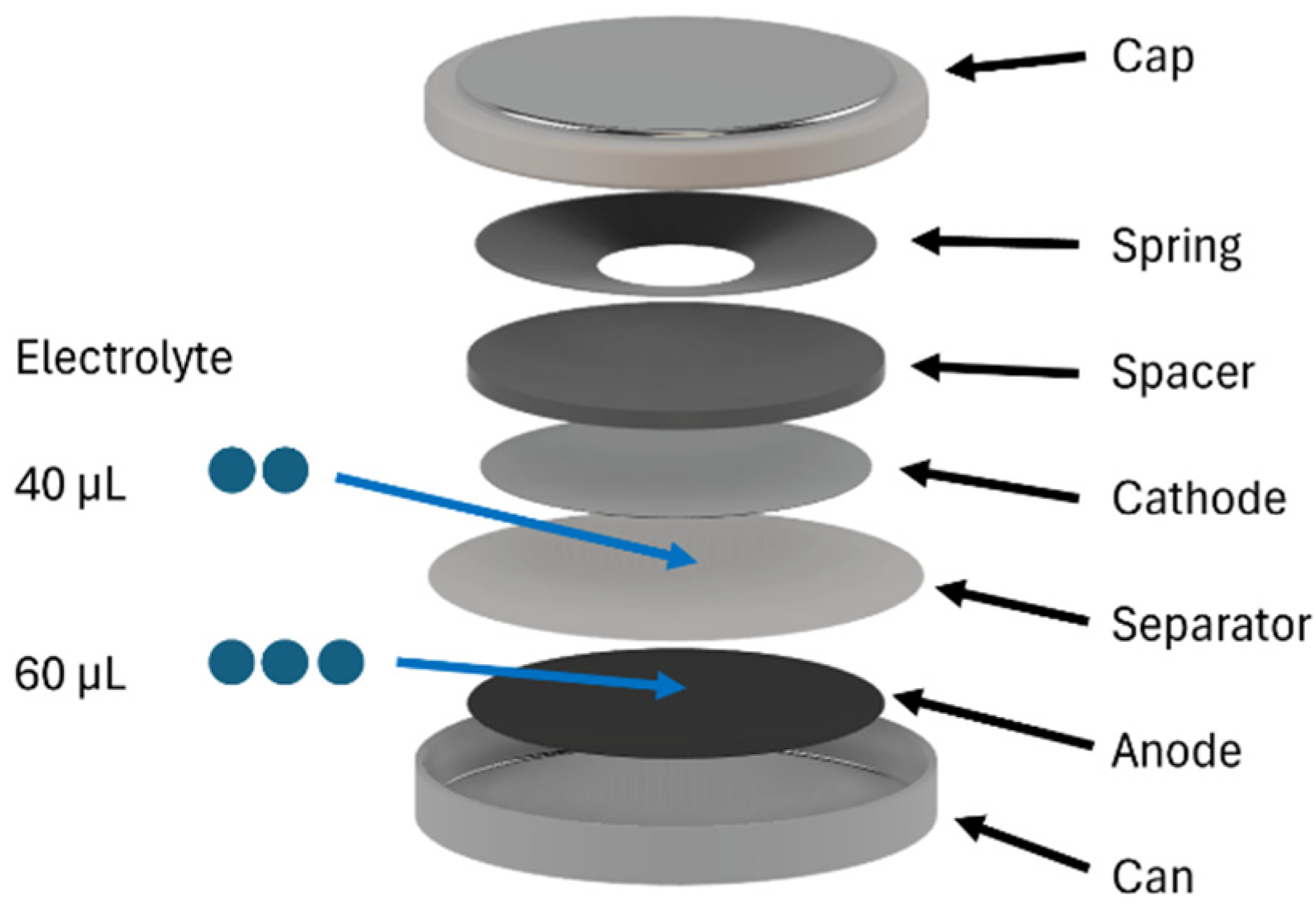
In this work, the main objective was to determine whether DEIS can be used to study SEI formation by comparing it with SSEIS during the formation procedure of five lithium-ion coin cells. The five LiNi0.5Mn0.3Co0.2O2 (NMC532)/graphite coin cells were assembled in a glovebox under an inert argon environment. The NMC532 cathode and graphite anode were both purchased premade from MTI Corp (Richmond, CA, USA). The electrolyte consisted of 1 M LiPF6 in ethylene carbonate (EC): dimethyl carbonate (DMC): ethyl methyl carbonate (EMC) 1:1:1 vol% with 1 wt% vinylene carbonate (VC) (MTI Corp. KJ Group, Richmond, CA, USA). CR2032 format coin cells were assembled from 19 mm diameter anode and 14 mm diameter cathode with 19 mm diameter, 16 µm thick polypropylene separator (MTI Corp.) as shown in Figure 1. The anode was purchased precut into discs. Immediately after assembly, the cells were placed into a BioLogic (Seysinnet-Pariset, France) CCH-8 coin-cell holder which was connected to a BioLogic VMP3 potentiostat. Twenty-four hours of wetting time was allowed, during which the cells were monitored, and their impedance was measured using EIS every 10 min.

2.3. Formation and Impedance Spectroscopy

To compare the steady-state and dynamic EIS measurements, the following formation procedure was applied to all five cells after the wetting process ended. Formation began with a constant-current (CC) charge. Once the cells reached 2.8 V during this first charge, a two second constant voltage (CV) hold at 2.8 V was applied for conditioning and was followed by the first DEIS measurement. After the DEIS measurement, a one-hour rest phase was allowed so the cell could reach a steady-state. Another EIS measurement was then taken while the cell was in a steady state condition. The cell was then subsequently charged in increments of 0.1 V, and the DEIS and SSEIS measurements were repeated at each voltage until the cell reached its maximum voltage of 4.2 V. At 4.2 V, another CV hold was applied until the magnitude of current fell below C/100. EIS measurements were taken at the beginning and end of this CV step. This entire procedure was then repeated during each of the following discharge and charge steps which, incrementally, brought the cell down to 2.7 V and back up to 4.2 V, respectively. All EIS measurements utilized a 10 mV amplitude, over a frequency range of 500 kHz to 0.5 Hz, with logarithmic spacing, ten points per decade, two measurements per frequency, and drift correction enabled.

3. Data Processing and Equivalent Circuit Modeling

3.1. Data Processing and Validation

Data processing was conducted automatically in python using pyimpspec ver. 5.1.2 for data validation and DRT analysis and impedancy.py ver. 1.7.1 for equivalent circuit modeling [19,21]. After the validation and modeling steps, the schemdraw ver. 0.22, PIL ver. 12.1.1, matplotlib ver. 3.10.8, and impedance.py packages were used to generate the plots in this manuscript.
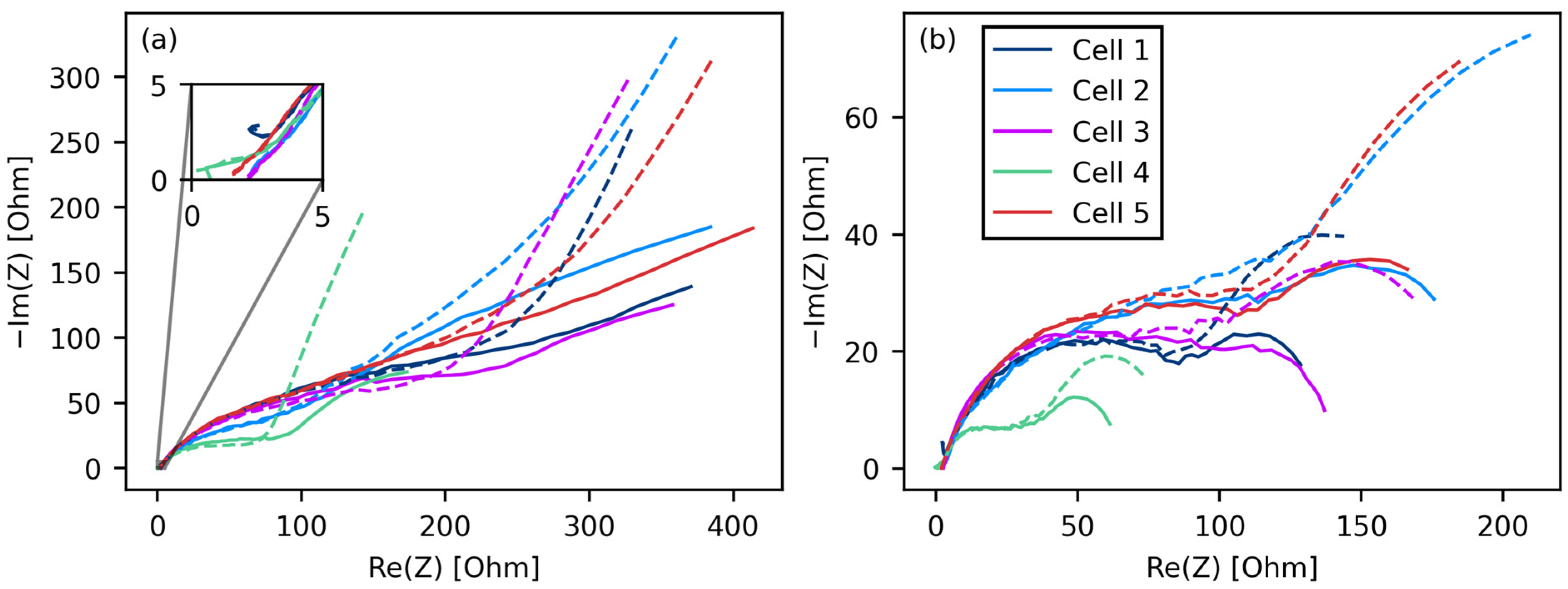
The first step in processing the data was inspection of the high-frequency data to determine if any noise was present. Figure 2a shows example EIS data of the cells taken at 2.8 V during the first charge step. The inset of this subfigure shows how the high-frequency EIS data contained noise. To prevent this noise from affecting the equivalent circuit modeling results, the data was truncated at 50 kHz.
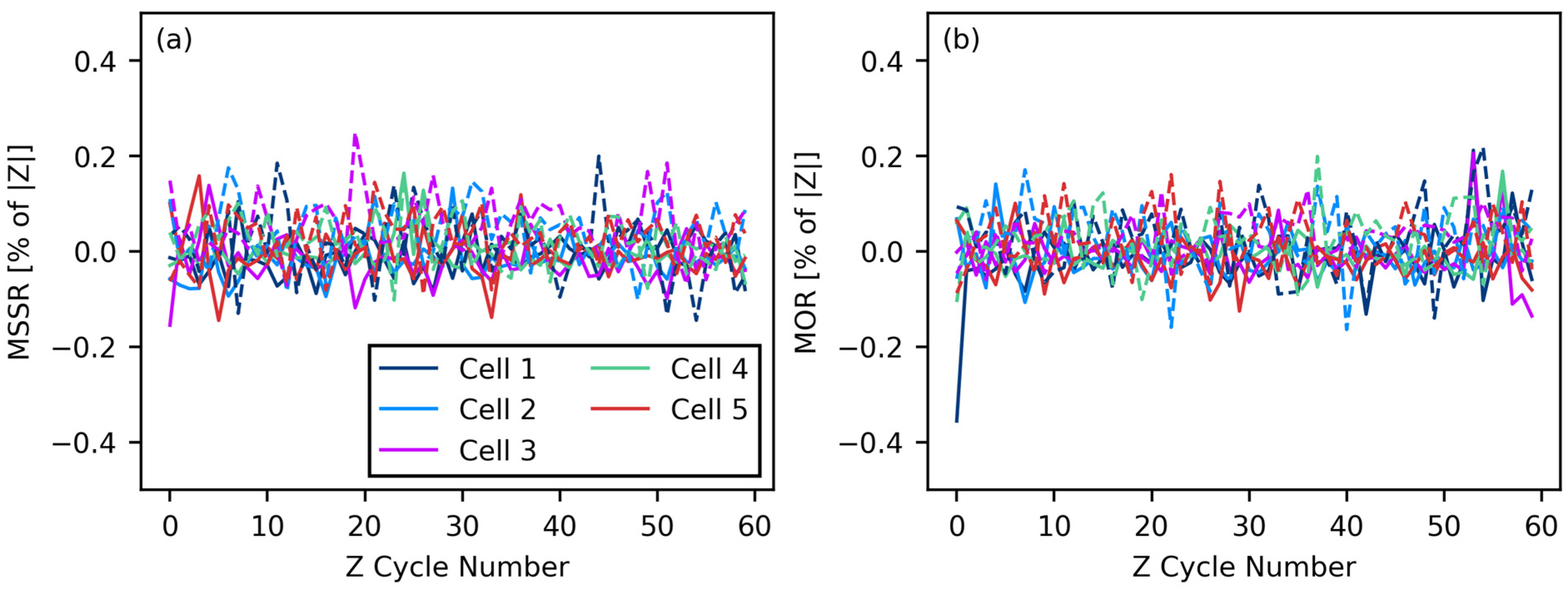
The next step of data processing was to verify that the dynamic state did not lead to non-linear impedance spectra, which would prevent equivalent circuit modeling from yielding useful results [9]. For this purpose, Kramers-Kronig (KK) linearity testing, as implemented in the pyimpspec package, was used to verify the linearity of all EIS data prior to fitting. In all KK testing, pyimpspec’s default settings were used, and serial capacitance was enabled [22,23,24,25,26]. Figure 3 shows the KK testing results for all five cells in both dynamic (a) and steady states (b). The five coin-cells were compared using the mean of their residuals resulting from the KK tests. It can be seen in both Figure 3a,b that, except for very few outliers, none of the mean residuals exceeded 0.2% of the modulus of impedance. This shows that the data is linear according to the KK analysis. Additionally, there is no trend to either positive or negative mean residual values, which further indicates that charging and discharging had little to no effect on the linearity of these cells. However, while these cells may have been relatively unaffected by charging and discharging, there are key aspects of this experiment which restrict our ability to generalize this conclusion. First is that the applied current was small at C/10. It is expected that higher currents may have a larger effect on the results. Additionally, these experiments were conducted under ambient conditions in the lab. It is also expected that elevated or reduced temperatures would have a significant effect on the results since temperature affects reaction rates within the cells. With this limitation in mind, we will now explain how the DRT and ECM methods were used to extract useful information from the EIS spectra.

3.2. Distribution of Relaxation Times and Equivalent Circuit Modeling

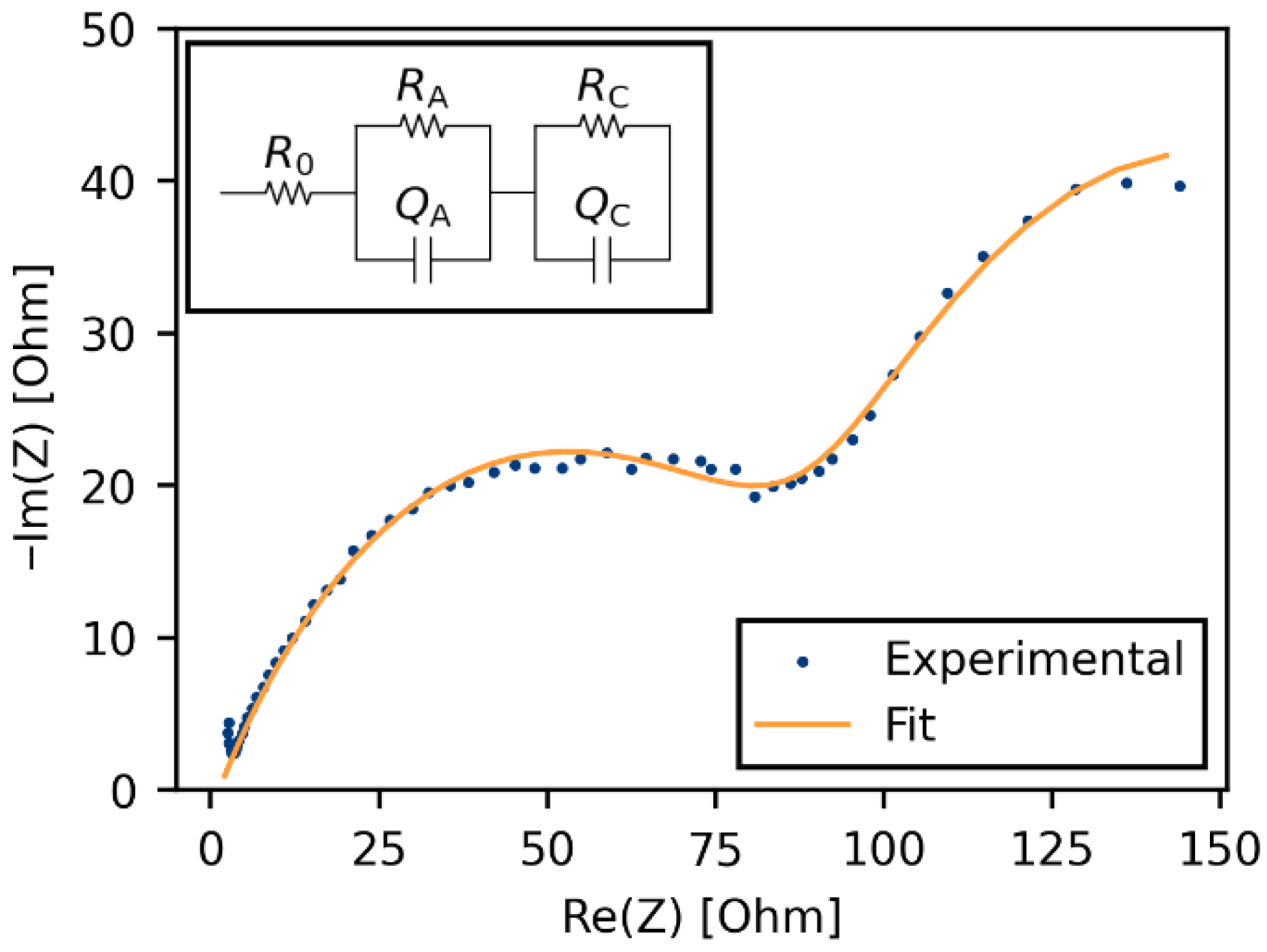
Our equivalent circuit modeling approach started with a qualitative investigation of the raw data using Nyquist representation. Some example data is shown in Figure 2a,b. Figure 2a shows the impedance measured at 2.8 V during the first charge, and Figure 2b shows the impedance measured at 3.4 V during the first charge. In all these impedance spectra, only two semicircles are apparent. Despite the frequency range of the impedance measurement reaching a low frequency of 0.5 Hz, diffusion data did not show up in the Nyquist plot. For this reason, we chose the equivalent circuit model shown in the inset of Figure 4. The two RQ pairs were used to model the effects of the two electrodes which make up each cell, and the R 0 term accounts for the impedance of the electrolyte. It should be noted that, since diffusion effects are neglected, this model is a simplification of the actual cell behavior.
Due to the large number of free parameters that make up a typical equivalent circuit model, the R 0 term tends to yield an inaccurate electrolyte impedance. Additionally, the large number of modeling parameters allows for many combinations of parameter solutions with the same goodness of fit. Our method, therefore, employed a three-stage fitting algorithm in which only the high frequency impedance is fit during the first step using a simplified equivalent circuit model consisting of only the electrolyte impedance and one RQ pair. Afterward, the pyimpspec package was used to calculate the DRT of the EIS spectrum using the Tikhonov regularization with radial basis function (TRRBF) discretization [21,26,27,28,29]. A gaussian radial basis function was selected, and the DRT was calculated using 1000 samples and L-curve cross-validation to optimize the regularization parameter. A sum of two gaussian functions was then fit to the γ log 10 τ data to extract the dominant time constants. Afterward, the values of R 0 and the two time-constants associated with the two RQ pairs were used as initial guesses for the corresponding circuit elements in the full equivalent circuit model. Fitting the ECM to the experimental data utilized scipy’s non-linear, least squares fitting (NLLSF) algorithm, as implemented by the impedance.py code [19,30]. Since the results obtained with the NLLSF algorithm can be sensitive to boundary and initial conditions, all fitting was conducted using the same initial guess and the same bounds on every parameter for the simplified first pass at fitting the data. During the second pass, the same held true, with the exception of the R 0 and time constant parameters, whose values were only allowed to vary by ±20% of the initial guess. Additionally, throughout the fitting process, χ 2 was weighted by square of the modulus of impedance, Z 2 .

4. Results and Discussion

In the present study, we have applied both the DEIS technique and conventional SSEIS techniques during the formation cycling of five NMC/graphite coin cells. One of the main issues with DEIS is that the excited state could lead to a significant difference in impedance spectra compared to the conventional SSEIS technique. In this section, we aim to show that, at least under our testing conditions, there is virtually no difference between the impedance spectra obtained using the two different methods. Additionally, the utility of this method for studying the SEI formation process of lithium-ion batteries will be demonstrated through the DRT and ECM results.
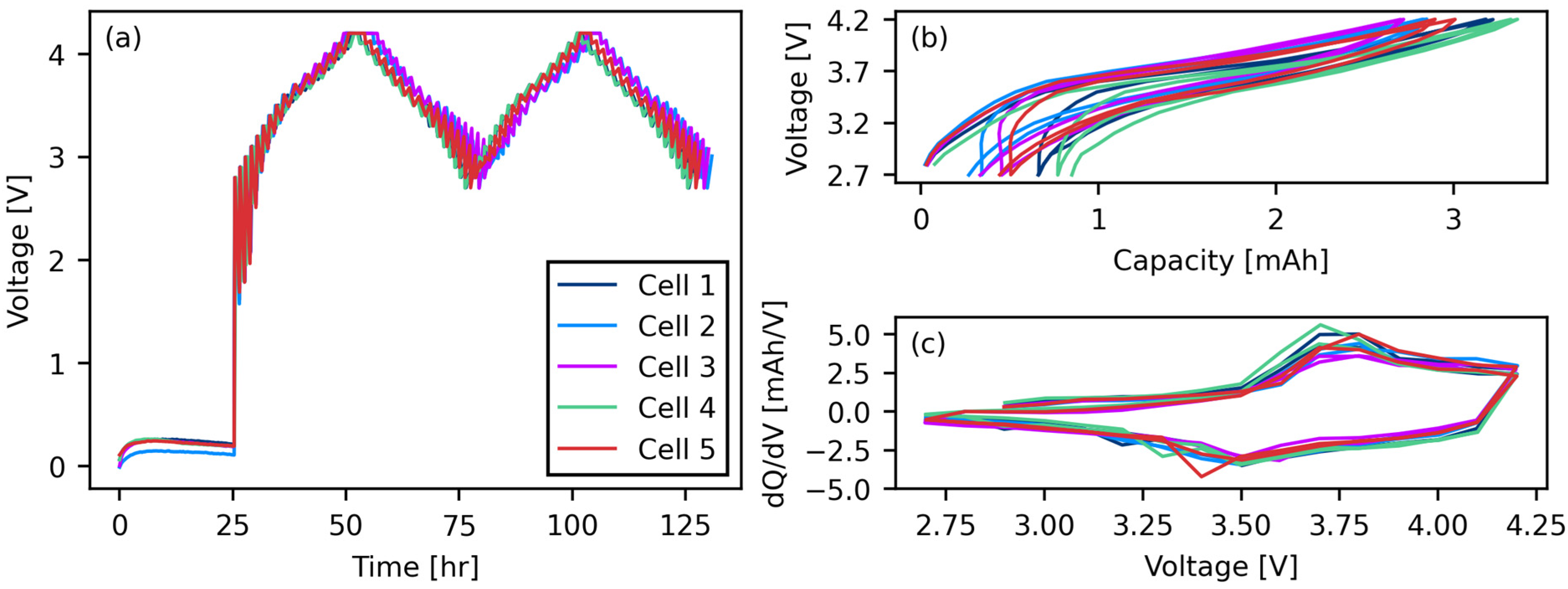
Figure 5 shows the voltage vs. time (a), voltage vs. capacity (b), and differential capacity vs. voltage (c) for all five coin-cells. Figure 5a shows the voltage vs. time which has a saw-tooth pattern for all five coin-cells. This pattern comes from resting steps allotted to each cell between DEIS and SSEIS measurements. At some states of charge (SOCs), and especially at low SOCs, there is a substantial voltage drop due to these rest steps. Consequently, there is a significant difference between the DEIS and SSEIS data at low frequencies. An example of this can be seen in Figure 2b. Upon comparison of all three subplots in Figure 5, it is clear that the coin cells are consistent with each other in terms of their time-series behavior. Additionally, the data in Figure 5c is consistent with available data in the literature [31]. Consistency in the time domain, however, does not guarantee consistency in the frequency domain.
Figure 2 shows sample EIS measurements made on the cells. Figure 2a shows EIS data taken at 2.8 V during the first charging step of the cells, and Figure 2b shows impedance data taken at 3.4 V during the first charging step. In both subplots, the dynamic and steady states are distinguished using solid and dashed lines, respectively. In both subplots, all five coin-cells show the same behavior, with the dynamic measurement having lower overall impedance than the steady-state measurement. However, this effect does not persist at all SOCs and only affects the low frequency data (<30 Hz). This behavior is counter-intuitive, but it has been previously observed in the literature [32]. Charge transfer processes can be affected by current through the cell. In the dynamic state, the impedance is lower due to a higher current. After the one-hour rest period, the current decreases to near zero, resulting in a larger impedance. Despite the low frequency effects, the DEIS technique remains a useful tool for studying formation. In the remainder of this section, the results of all DEIS and SSEIS measurements taken for this work will be studied using DRT and ECM methods. As will be seen later, the difference between the DEIS and SSEIS spectra does not affect the effective capacitance results or estimated SEI thickness.
As described in the equivalent circuit modeling section of this paper, our modeling approach began with a qualitative analysis to determine what type of model is appropriate for this data. The equivalent circuit model used to process all the EIS results is shown in the inset of Figure 4. Qualitatively, all the EIS data had two semi-circles when displayed as a Nyquist plot. This analysis was further confirmed by DRT, which generally showed one shallow peak at high frequencies and one sharp peak at low frequencies. These peaks are located at time constants which correspond to electrode charge-transfer processes. More information about the fitting procedure can be found in the Equivalent circuit modeling section of the paper.
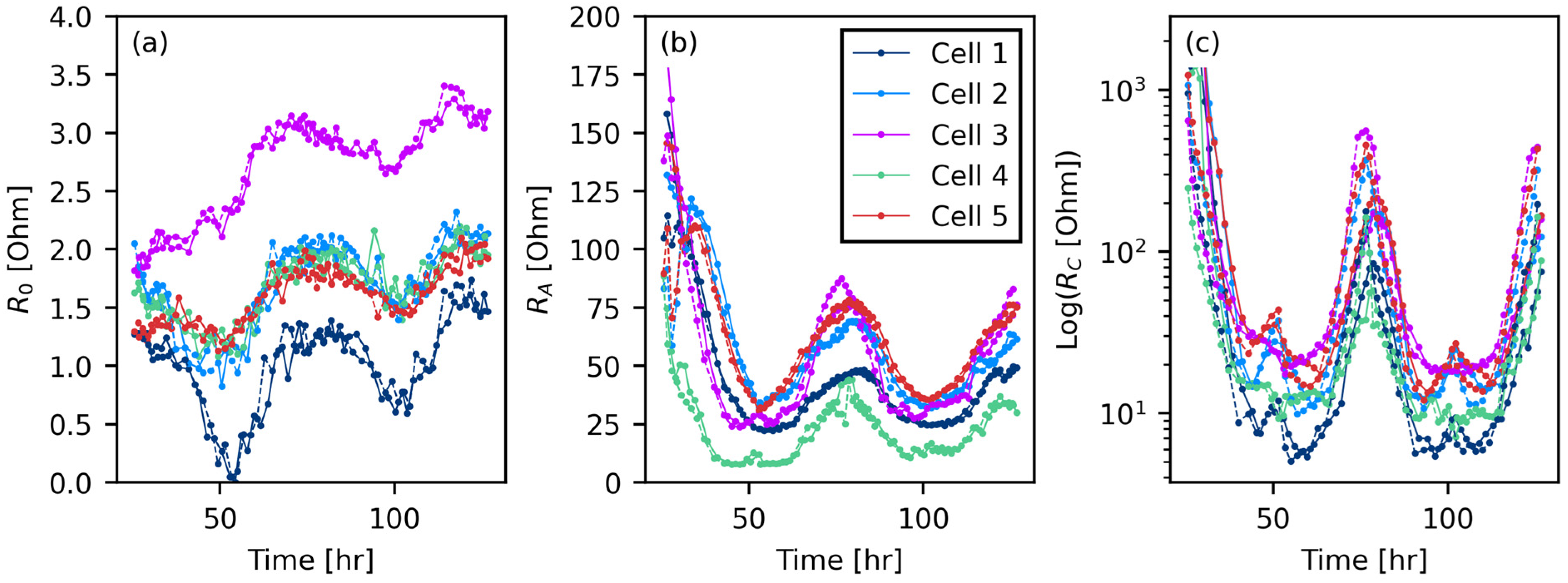
Figure 6 shows the resulting resistance values obtained by fitting the ECM to each of the measured impedance spectra. Figure 6a shows how R 0 , which is associated with ionic conductivity of the electrolyte, changes during the formation procedure. In the figure, all five cells show the same behavior, with local minima occurring at roughly 50 h and 100 h. This phenomenon is strong evidence that the fluctuation of R 0 is not from atmospheric effects within the lab since those fluctuations would occur much more rapidly. A better explanation is that the fluctuation of R 0 is caused by the changing SOC of the anode. Specifically, the 50 h and 100 h marks correspond to 100% SOC (4.2 V) which can be seen in Figure 5a. In addition to this apparent SOC dependence, R 0 increased gradually over time for all five cells, which cannot be explained by this SOC dependence. It is known that, during the SEI formation process, the electrolyte is decomposed by the anode to form components of the SEI layer [33,34]. These SEI formation reactions are irreversible [34], so their effect on the electrolyte is also permanent. Since R 0 is correlated with cell SOC and increases irreversibly, we propose that this SOC dependence is due to the expansion and contraction of the anode while the irreversible increase is associated with electrolyte degradation. It has previously been shown, both theoretically and experimentally, that graphite volume can increase by up to 13% during charging [35]. This volume increase leads to a significant decrease in separator thickness, which in turn leads to a significant decrease in bulk resistance. To quantify the change in bulk impedance, we use the equation
R 0 = τ 2 l S L σ i o n ϵ A C S   ,
where τ is the tortuosity, l S L is the straight-line distance through the separator (i.e., its thickness), σ i o n is the ionic conductivity of the electrolyte, ϵ is the porosity of the separator, and A C S is the electrode’s cross-sectional area. This equation is simply the resistance through a cylindrical conductor modified by tortuosity and porosity to account for the separator geometry. The manufacturer-provided separator porosity is 0.35. We can then use the Maxwell porosity–tortuosity relationship, τ 2 = 3 ϵ 2 , to obtain a value of ~1.32 for τ 2 . The separators used in this work were 16 µm thick, so l S L = 0.0016 cm. The overlapping electrode area is equal to the cathode area, which is 1.539 cm2. Finally, the manufacturer-provided ionic conductivity of the electrolyte is 2.7 ± 0.5 mS/cm or 0.0027 ± 0.0005 S/cm. Accounting for the variability of the ionic conductivity, we obtain an estimated bulk impedance of 1.45   ±   0.23 0.33 Ω which is in excellent agreement with the initial bulk impedance of the coin cells. Next, if it is assumed that the anode expands only in the axial direction, then the percent change in electrode thickness will be equal to the percent change in electrode volume. The graphite coating thickness was 59 µm, so an increase of 13% would lead to a thickness change of 7.67 µm. To accommodate this expansion, the separator would need to shrink by the same amount, which would mean a 48% thickness decrease. From Equation (5), we can see that the bulk impedance would also have to decrease by 48%. This result is consistent with the experimental data shown in Figure 6a for the bulk impedance, with the exception of cells one and three which showed anomalous behavior. It was previously argued that bulk resistance is sensitive to electrode expansion, which leads to increased pressure within the cell. Since the anomalous bulk impedance of these two cells still exhibited the same qualities as the other cells, the variation in bulk impedance likely comes from variations in stack pressure.
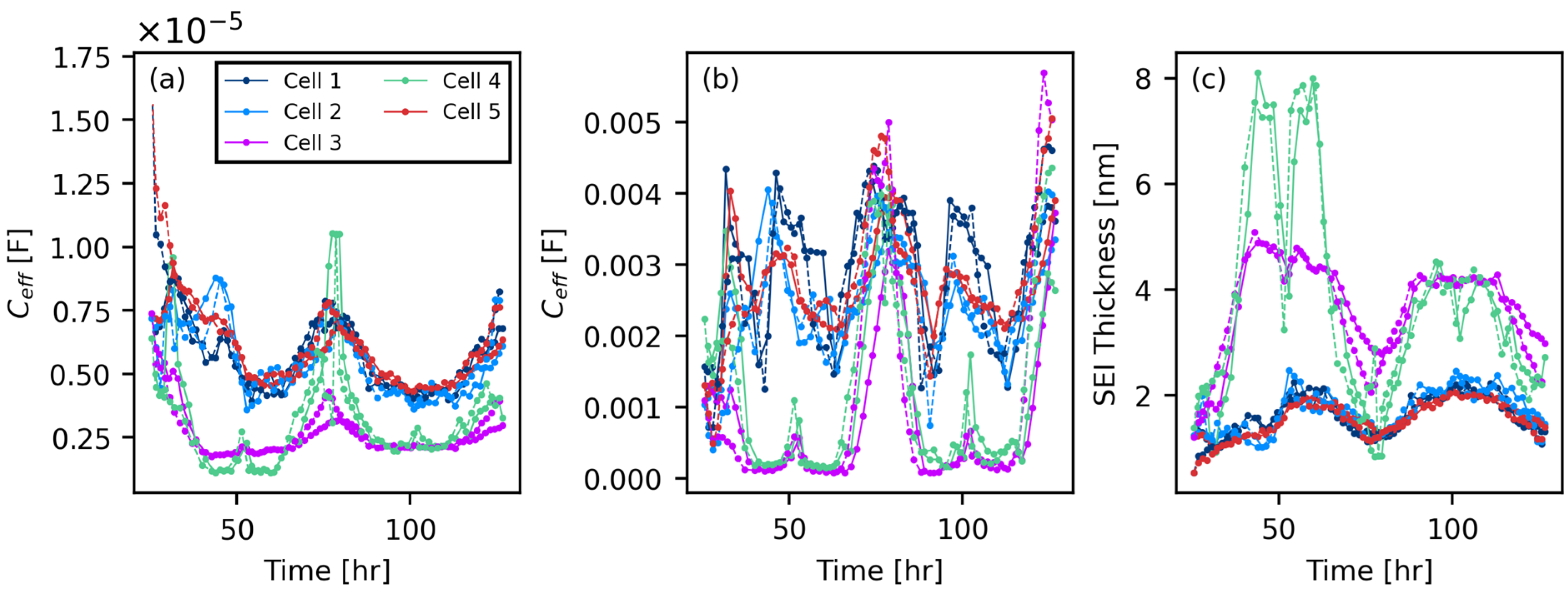
The anode and cathode resistances, associated with charge transfer processes, are shown in Figure 6b and c, respectively. In these plots, both the cathode and anode have a nonlinear relationship with SOC. Such non-linear relationships have been explored previously in the literature [36], and the behavior of the five cells presented here is similar. What is more interesting is that, despite significant differences in the impedance spectra between the dynamic and steady-state measurements, there is little to no difference between the fitted parameters in each of these states. Similarly, there is very little difference between the dynamic and steady states in the effective capacitance data shown in Figure 7.
Figure 7c also shows the calculated SEI layer thickness, which grew to about two nm for most of the cells. In this figure, it is apparent that the SEI thickness depends on the SOC in some way. In addition to this SOC dependence, the SEI thickness increases slowly over time as expected. While the origin of this SOC-dependent SEI thickness is unknown, the overall behavior of the SEI is as expected, and it is left to future experiments to determine the origin of this phenomenon.

5. Conclusions

In this work, we have presented the results of an experiment which compared DEIS measurements with SSEIS. The experiment was motivated by the need for rapid, operando techniques for measuring the SEI formation of lithium-ion full cells. After discussion of the validity of these dynamic measurements, the experimental data was fit, using a combination of distribution of relaxation times analysis and equivalent circuit modeling, to extract information about charge transfer processes, electrolyte decomposition, and SEI layer thickness. Unlike previously used techniques, this method allows for operando tracking of SEI formation and battery quality, and could reduce or eliminate the need for lengthy performance tests after formation. Overall, in this work, the promise and practicality of this technique to study battery formation has been demonstrated. In future studies, this method will be used to study the effects of different formation procedures and their relationship to battery lifecycle and aging. Additionally, the coupling between internal pressure and the different equivalent circuit model parameters may be studied using embedded sensors. Finally, machine learning techniques may be applied to elucidate the effects of formation protocols on SEI formation as well as the relationships between SEI thickness, morphology, composition, and cycle life.

Author Contributions

Conceptualization, D.T. and X.Z.; methodology, D.T.; validation, D.T.; formal analysis, D.T.; investigation, D.T.; data curation, D.T.; writing—original draft preparation, D.T.; writing—review and editing, D.T., H.S. and N.M.; visualization, D.T.; supervision, X.Z.; project administration, X.Z.; funding acquisition, X.Z. All authors have read and agreed to the published version of the manuscript.

Funding

The research presented in this paper is sponsored by the National Science Foundation (Project Grant ECCS 2346856) and a University of Michigan—Dearborn Startup Package.

Data Availability Statement

The experimental data and modeling results will be made available upon request. Experimental data can be made available in both the original BioLogic file format and CSV format. The modeling results can be made available in both CSV format and as an Excel workbook.

Conflicts of Interest

The authors declare no conflicts of interest.

Abbreviations

The following abbreviations are used in this manuscript:
EISElectrochemical impedance spectroscopy
DEISDynamic electrochemical impedance spectroscopy
SSEISSteady-state electrochemical impedance spectroscopy
DRTDistribution of relaxation times
LIBLithium-ion battery
SEISolid electrolyte interphase
GtGigaton
NMC532LiNi0.5Mn0.3Co0.2O2
ECEthylene carbonate
EMCEthyl methyl carbonate
DMCDimethyl carbonate
VCVinylene carbonate
CCConstant current
CVConstant voltage
CCCVConstant current, constant voltage
TRRBFTikhonov regularization with radial basis function
NLLSFNon-linear, least-squares fitting
AIArtificial intelligence
SOCState of charge
ECMEquivalent circuit model
KKKramers-Kronig
SLStraight line
CSCross-section

References

  1. Kallitsis, E.; Lindsay, J.J.; Chordia, M.; Wu, B.; Offer, G.J.; Edge, J.S. Think Global Act Local: The Dependency of Global Lithium-Ion Battery Emissions on Production Location and Material Sources. J. Clean. Prod. 2024, 449, 141725. [Google Scholar] [CrossRef]
  2. An, S.J.; Li, J.; Daniel, C.; Mohanty, D.; Nagpure, S.; Wood, D.L. The State of Understanding of the Lithium-Ion-Battery Graphite Solid Electrolyte Interphase (SEI) and Its Relationship to Formation Cycling. Carbon 2016, 105, 52–76. [Google Scholar] [CrossRef]
  3. Heiskanen, S.K.; Kim, J.; Lucht, B.L. Generation and Evolution of the Solid Electrolyte Interphase of Lithium-Ion Batteries. Joule 2019, 3, 2322–2333. [Google Scholar] [CrossRef]
  4. Park, S.; Chaudhary, R.; Han, S.A.; Qutaish, H.; Moon, J.; Park, M.-S.; Kim, J.H. Ionic Conductivity and Mechanical Properties of the Solid Electrolyte Interphase in Lithium Metal Batteries. Energy Mater. 2023, 3, 300005. [Google Scholar] [CrossRef]
  5. Weng, A.; Mohtat, P.; Attia, P.M.; Sulzer, V.; Lee, S.; Less, G.; Stefanopoulou, A. Predicting the Impact of Formation Protocols on Battery Lifetime Immediately after Manufacturing. Joule 2021, 5, 2971–2992. [Google Scholar] [CrossRef]
  6. Dorri, M.; Anil Kumar, M.R.; Zaghib, K. In Operando and in Situ Characterization Tools for Advanced Rechargeable Batteries: Effects of Electrode Origin and Electrolyte. J. Power Sources 2025, 658, 238188. [Google Scholar] [CrossRef]
  7. Drvarič Talian, S.; Kapun, G.; Moškon, J.; Dominko, R.; Gaberšček, M. Operando Impedance Spectroscopy with Combined Dynamic Measurements and Overvoltage Analysis in Lithium Metal Batteries. Nat. Commun. 2025, 16, 1629. [Google Scholar] [CrossRef]
  8. Lazanas, A.C.; Prodromidis, M.I. Electrochemical Impedance Spectroscopy─A Tutorial. ACS Meas. Sci. Au 2023, 3, 162–193. [Google Scholar] [CrossRef]
  9. Qu, D.; Ji, W.; Qu, H. Probing Process Kinetics in Batteries with Electrochemical Impedance Spectroscopy. Commun. Mater. 2022, 3, 61. [Google Scholar] [CrossRef]
  10. Ovejas, V.J.; Cuadras, A. Impedance Characterization of an LCO-NMC/Graphite Cell: Ohmic Conduction, Sei Transport and Charge-Transfer Phenomenon. Batteries 2018, 4, 43. [Google Scholar] [CrossRef]
  11. Iurilli, P.; Brivio, C.; Wood, V. On the Use of Electrochemical Impedance Spectroscopy to Characterize and Model the Aging Phenomena of Lithium-Ion Batteries: A Critical Review. J. Power Sources 2021, 505, 229860. [Google Scholar] [CrossRef]
  12. Kiani, S.; Gharibi, H.; Javadian, S.; Zhiani, M.; Kashani, H. The Effect of the SEI Layer on the Electrochemical Impedance in the Graphite/Li[Ni0.5Mn0.3Co0.2]O2 Lithium-Ion Full Cells. Appl. Surf. Sci. 2023, 633, 157638. [Google Scholar] [CrossRef]
  13. Wang, P.; Yan, D.; Wang, C.; Ding, H.; Dong, H.; Wang, J.; Wu, S.; Cui, X.; Li, C.; Zhao, D.; et al. Study of the Formation and Evolution of Solid Electrolyte Interface via In-Situ Electrochemical Impedance Spectroscopy. Appl. Surf. Sci. 2022, 596, 153572. [Google Scholar] [CrossRef]
  14. Zhang, S.S.; Xu, K.; Jow, T.R. EIS Study on the Formation of Solid Electrolyte Interface in Li-Ion Battery. Electrochim. Acta 2006, 51, 1636–1640. [Google Scholar] [CrossRef]
  15. Zhang, Y.; Tang, Q.; Zhang, Y.; Wang, J.; Stimming, U.; Lee, A.A. Identifying Degradation Patterns of Lithium Ion Batteries from Impedance Spectroscopy Using Machine Learning. Nat. Commun. 2020, 11, 1706. [Google Scholar] [CrossRef]
  16. Stroe, D.I.; Swierczynski, M.; Stroe, A.I.; Kaer, S.K.; Teodorescu, R. Lithium-Ion Battery Power Degradation Modelling by Electrochemical Impedance Spectroscopy. IET Renew. Power Gener. 2017, 11, 1136–1141. [Google Scholar] [CrossRef]
  17. Günter, F.J.; Habedank, J.B.; Schreiner, D.; Neuwirth, T.; Gilles, R.; Reinhart, G. Introduction to Electrochemical Impedance Spectroscopy as a Measurement Method for the Wetting Degree of Lithium-Ion Cells. J. Electrochem. Soc. 2018, 165, A3249–A3256. [Google Scholar] [CrossRef]
  18. Chang, B.Y. Conversion of a Constant Phase Element to an Equivalent Capacitor. J. Electrochem. Sci. Technol. 2020, 11, 318–321. [Google Scholar] [CrossRef]
  19. Murbach, M.; Gerwe, B.; Dawson-Elli, N.; Tsui, L. Impedance.Py: A Python Package for Electrochemical Impedance Analysis. J. Open Source Softw. 2020, 5, 2349. [Google Scholar] [CrossRef]
  20. Hirschorn, B.; Orazem, M.E.; Tribollet, B.; Vivier, V.; Frateur, I.; Musiani, M. Determination of Effective Capacitance and Film Thickness from Constant-Phase-Element Parameters. Electrochim. Acta 2010, 55, 6218–6227. [Google Scholar] [CrossRef]
  21. Yrjänä, V. Pyimpspec-Python Package for Electrochemical Impedance Spectroscopy; Zenodo: Geneva, Switzerland, 2022. [Google Scholar]
  22. Schönleber, M.; Klotz, D.; Ivers-Tiffée, E. A Method for Improving the Robustness of Linear Kramers-Kronig Validity Tests. Electrochim. Acta 2014, 131, 20–27. [Google Scholar] [CrossRef]
  23. Baranova, E.A.; Kuznetsov, O.; Boukamp, B.A. A Linear Kronig-Kramers Transform Test for Immittance Data Validation. J. Electrochem. Soc. 1995, 142, 1885–1894. [Google Scholar]
  24. Plank, C.; Ruther, T.; Danzer, M.A. Detection of Non-Linearity and Non-Stationarity in Impedance Spectra Using an Extended Kramers-Kronig Test without Overfitting. In Proceedings of International Workshop on Impedance Spectroscopy, IWIS 2022; Institute of Electrical and Electronics Engineers Inc.: New York, NY, USA, 2022; pp. 1–6. [Google Scholar]
  25. Yrjänä, V.; Bobacka, J. Methods for Automating and Improving the Robustness of Linear Kramers–Kronig Tests for the Purposes of Validating Immittance Spectra. Electrochim. Acta 2024, 504, 144951. [Google Scholar] [CrossRef]
  26. Maradesa, A.; Py, B.; Wan, T.H.; Effat, M.B.; Ciucci, F. Selecting the Regularization Parameter in the Distribution of Relaxation Times. J. Electrochem. Soc. 2023, 170, 030502. [Google Scholar] [CrossRef]
  27. Ciucci, F.; Chen, C. Analysis of Electrochemical Impedance Spectroscopy Data Using the Distribution of Relaxation Times: A Bayesian and Hierarchical Bayesian Approach. Electrochim. Acta 2015, 167, 439–454. [Google Scholar] [CrossRef]
  28. Wan, T.H.; Saccoccio, M.; Chen, C.; Ciucci, F. Influence of the Discretization Methods on the Distribution of Relaxation Times Deconvolution: Implementing Radial Basis Functions with DRTtools. Electrochim. Acta 2015, 184, 483–499. [Google Scholar] [CrossRef]
  29. Effat, M.B.; Ciucci, F. Bayesian and Hierarchical Bayesian Based Regularization for Deconvolving the Distribution of Relaxation Times from Electrochemical Impedance Spectroscopy Data. Electrochim. Acta 2017, 247, 1117–1129. [Google Scholar] [CrossRef]
  30. Virtanen, P.; Gommers, R.; Oliphant, T.E.; Haberland, M.; Reddy, T.; Cournapeau, D.; Burovski, E.; Peterson, P.; Weckesser, W.; Bright, J.; et al. SciPy 1.0: Fundamental Algorithms for Scientific Computing in Python. Nat. Methods 2020, 17, 261–272. [Google Scholar] [CrossRef]
  31. Choi, J.; Dong, L.; Yu, C.Y.; O’Meara, C.; Lee, E.; Kim, J.H. Relationship of Chemical Composition and Moisture Sensitivity in LiNixMnyCo1−X−YO2 for Lithium-Ion Batteries. J. Electrochem. Energy Convers. Storage 2021, 18, 041011. [Google Scholar] [CrossRef]
  32. Geng, A.; Hu, H.; Chen, J.; Ge, Y.; Peng, Y.; Wang, K.; Pan, P.; He, Z. Dynamic Electrochemical Impedance Spectroscopy Measurement for Operando State Monitoring of Lithium-Ion Batteries. IEEE Trans. Instrum. Meas. 2025, 74, 3528413. [Google Scholar] [CrossRef]
  33. Spotte-Smith, E.W.C.; Petrocelli, T.B.; Patel, H.D.; Blau, S.M.; Persson, K.A. Elementary Decomposition Mechanisms of Lithium Hexafluorophosphate in Battery Electrolytes and Interphases. ACS Energy Lett. 2023, 8, 347–355. [Google Scholar] [CrossRef]
  34. Lundström, R.; Gogoi, N.; Melin, T.; Berg, E.J. Unveiling Reaction Pathways of Ethylene Carbonate and Vinylene Carbonate in Li-Ion Batteries. J. Phys. Chem. C 2024, 128, 8147–8153. [Google Scholar] [CrossRef]
  35. Schweidler, S.; De Biasi, L.; Schiele, A.; Hartmann, P.; Brezesinski, T.; Janek, J. Volume Changes of Graphite Anodes Revisited: A Combined Operando X-Ray Diffraction and in Situ Pressure Analysis Study. J. Phys. Chem. C 2018, 122, 8829–8835. [Google Scholar] [CrossRef]
  36. Teufl, T.; Pritzl, D.; Solchenbach, S.; Gasteiger, H.A.; Mendez, M.A. Editors’ Choice—State of Charge Dependent Resistance Build-Up in Li- and Mn-Rich Layered Oxides during Lithium Extraction and Insertion. J. Electrochem. Soc. 2019, 166, A1275–A1284. [Google Scholar] [CrossRef]
Figure 1. 3D Model of the cell assembly. The model is not to scale.
Energies 19 01895 g001
Figure 2. Sample EIS data are shown in subplots (a,b). Specifically, the impedance measured at 2.8 V during the first charging step is shown in (a), while the impedance at 3.4 V during the first charging step is shown in (b). Additionally, in (a), an inset shows the high frequency data, highlighting the observed high frequency noise in the measurements. Due to this noise, data for frequencies above 50 kHz were omitted from the fitting procedure. Subfigure (b) shows the difference between steady-state and operando measurements persists up even at 3.4 V and beyond. Solid and dashed lines represent the operando and steady-state EIS measurements, respectively.
Energies 19 01895 g002
Figure 3. Results of the Kramers-Kronig testing across all steady-state impedance measurements are shown in (a), while the Kramers-Kronig results for the operando measurements are shown in (b). It is clear that both the mean steady-state residuals (MSSR) and mean operando residuals (MOR) both stay below 0.2% of the modulus of impedance. Solid and dashed lines represent the real and imaginary parts of impedance, respectively.
Energies 19 01895 g003
Figure 4. An example of the fitting results is shown in the figure above. In the inset, the equivalent circuit used to fit all the data in this work is shown.
Energies 19 01895 g004
Figure 5. Results of a basic analysis of consistency are shown. Subfigure (a) shows the voltage vs. time measured during the experiment. Subfigure (b) shows the voltage vs. capacity of all five cells, while the calculated differential capacity is shown in (c). Overall, the five cells are consistent with each other in terms of time-series data.
Energies 19 01895 g005
Figure 6. Results of the equivalent circuit modeling approach are shown in the three plots. Subfigure (a) shows the results for the R 0 parameter, while subfigures (b,c) show the anode and cathode resistance, respectively. Subfigure (c) displays the resistance on a log scale due to large range of resistance values. Solid and dashed lines represent steady-state and dynamic measurements, respectively.
Energies 19 01895 g006
Figure 7. Calculated effective capacitance values for C 1 and C 2 are shown in subfigures (a,b), respectively. Subfigure (c) shows the estimated SEI thickness. Dynamic and steady-state data are distinguished using dashed and solid lines, respectively.
Energies 19 01895 g007
Disclaimer/Publisher’s Note: The statements, opinions and data contained in all publications are solely those of the individual author(s) and contributor(s) and not of MDPI and/or the editor(s). MDPI and/or the editor(s) disclaim responsibility for any injury to people or property resulting from any ideas, methods, instructions or products referred to in the content.