Article

Parametric Clear-Sky Solar Irradiance Model with Improved Diffuse Flux Estimation

Faculty of Physics and Mathematics, West University of Timisoara, V. Pârvan 4, 300223 Timișoara, Romania
*
Author to whom correspondence should be addressed.
Energies 2026, 19(8), 1842; https://doi.org/10.3390/en19081842
Submission received: 1 March 2026 / Revised: 28 March 2026 / Accepted: 4 April 2026 / Published: 9 April 2026

Abstract

Achieving a balance between accuracy and computational efficiency in solar energy flux estimation models remains a key challenge in atmospheric radiative transfer research. Given the high computational cost of spectral models, a widely used simplification strategy consists of parameterizing atmospheric spectral transmittances through wavelength-averaging formulations. This study introduces a Clear-Sky Multivariable (CSMV) broadband parametric model derived from the Leckner spectral model for estimating the three components of solar irradiance under clear-sky conditions: direct normal irradiance (DNI), diffuse irradiance (Gd), and global irradiance (G). The model development follows a two-stage procedure. First, discrete broadband transmittances are obtained by applying an independent spectral integration scheme to the transmittances of the source spectral model. In the second stage, these discrete values are fitted with analytical functions expressed solely in terms of atmospheric state parameters, yielding wavelength-independent broadband formulations. While the overall development framework follows a classical parameterization approach, the calculation of the diffuse component introduces a novel way of estimating the fraction of aerosol scattering directed toward the ground. The model was tested against data collected from eight radiometric stations distributed across six continents and benchmarked against two well-established reference models. Overall, the results indicate a high level of accuracy and demonstrate the practical applicability of the model.

1. Introduction

In the current energy landscape, solar energy is becoming increasingly important in the context of reducing carbon dioxide emissions associated with electricity generation from conventional sources such as coal and natural gas [1]. The generation of electricity through photovoltaic panels is subject to unpredictable fluctuations due to meteorological variability and climate change. To enhance solar energy predictability, models for solar resource estimation and forecasting play a central role in improving predictability [2]. The maximum potential of photovoltaic energy conversion is achieved under clear-sky conditions. Consequently, models designed to estimate solar energy flux on the surface under such conditions have attracted significant attention in solar engineering [3].
Recent studies [4] highlight the diversity of clear-sky irradiance models, ranging from physically based radiative transfer models to simplified parametric and data-driven approaches. These models differ significantly in terms of input requirements, computational cost, and accuracy, depending on the atmospheric conditions and application context. Even earlier reviews [5] (Gueymard, 2012) and [6] (Torres, 2019) similarly classify clear-sky models into radiative transfer (physical) models and semi-empirical (parametric) models. In recent years, data-driven and machine learning approaches have gained increasing attention as alternatives to traditional clear-sky models, due to their ability to capture complex, non-linear relationships between atmospheric variables and solar irradiance [7].
Radiative transfer models explicitly simulate the physics of solar radiation propagation through the atmosphere, offering high accuracy but typically requiring substantial computational resources and detailed input parameters. Parametric models, on the other hand, provide a simplified approach to estimating broadband solar irradiance using a limited set of atmospheric parameters and solar geometry factors.
To date, more than one hundred parametric clear-sky irradiance models have been proposed, ranging from simple formulations based exclusively on solar geometry [8] to highly sophisticated models comprising dozens of equations and requiring detailed atmospheric and meteorological inputs. For example, REST2 is a parametric clear sky model developed over two spectral bands using an independent integration scheme [9]. Similarly, PEM is based on three spectral bands and employs the same integration approach [10], whereas SPARTA is formulated over two spectral bands using a hybrid integration scheme [11]. The hybrid integration scheme used in the development of the SPARTA model represents a relaxed form of the interdependent scheme, relying on a prescribed atmospheric state. In contrast, the pure interdependent spectral integration scheme is employed in the development of the IIAT_L and IIAT_S parametric models [12].
Despite the extensive development of both radiative transfer and parametric models, accurately representing the diffuse component of solar irradiance remains a persistent challenge. Parametric models, while computationally efficient, often show significant deviations under certain atmospheric conditions due to simplifications in the treatment of scattering and absorption processes. In this context, the present work aims to improve the estimation of the diffuse irradiance component within a parametric framework, enhancing both accuracy and applicability while maintaining the low input requirements characteristic of these models.
A substantial subset of radiative transfer (physical) models consists of spectral models, which express solar irradiance as a function of wavelength [13,14]. By explicitly accounting for wavelength-dependent absorption and scattering processes in the atmosphere, spectral models provide higher accuracy in estimating solar irradiance. However, this increased fidelity comes at the cost of substantially greater computational effort.
This work presents a parametric model derived from a spectral reference, specifically the Leckner model [13]. The methodology builds on an independent integration scheme originally introduced by Molineaux and Ineichen [15]. The resulting model features a compact analytical formulation, minimal computational requirements, and an accuracy comparable to that of other widely used models in the field. Its key distinguishing feature is a novel approach for estimating the diffuse component of irradiance resulting from aerosol scattering. In summary, this work makes three main contributions: (1) the derivation of a new broadband parametric model; (2) the development of a novel analytical formulation for aerosol scattering fraction; and (3) the validation of the model across multiple climatic regions.
This paper is organized as follows. In the second section, the steps undertaken in developing the model and the defining equations of the model itself are presented. In the third section its performance is evaluated through comparison with measured data and two widely accepted broadband models, namely REST2 [9] and McClear [16], across eight stations situated in distinct climatic zones. The main conclusions are presented in the final section.

2. Proposal for a New Clear Sky Solar Irradiance Model

This section presents the spectral model used to estimate solar spectral irradiance, which forms the basis for the development of the proposed broadband parametric model. An independent integration scheme is then described, through which the spectral atmospheric transmittances of the reference model are converted into corresponding broadband transmittances. The model formulation is completed by calculating the direct, diffuse, and global components of solar irradiance. At this stage, a novel approach is introduced for estimating the aerosol scattering fraction toward the ground.
The source model is the Leckner spectral model [13], which estimates the three components of spectral solar irradiance at ground level under clear-sky conditions: direct, diffuse, and global. The Leckner model accounts for five attenuation factors affecting solar radiation as it passes through the Earth’s atmosphere: ozone absorption, water vapor absorption, absorption by the mixed gases, Rayleigh scattering, and aerosol attenuation. Corresponding to each attenuation factor, a specific atmospheric transmittance is defined, which depends on wavelength and, where applicable, on the parameter that quantifies the respective attenuating factor.
The transmittance due to ozone absorption [13] is defined by
τ O 3 λ = exp m l K λ
where λ is the wavelength, K ( λ )   [ c m 1 ] the ozone absorption coefficients [13], l  [ c m · a t m ] the total column ozone content and m the optical atmospheric mass.
The transmittance associated with water vapor absorption [13] is given by
τ w λ = exp 0.2385 m w K w ( λ ) 1 + 20.07 m w K w ( λ ) 0.45
where K w ( λ )   [ c m 1 ] denotes the water vapor absorption coefficients [13] and w  [ c m ] is the total column water vapor content.
The transmittance associated with mixed gases absorption [13] is given by
τ g λ = exp 1.41 m K g λ 1 + 118.3 m K g λ 0.45
where K g ( λ )   k m 1 is the absorption coefficients associated with mixed gases [13].
The transmittance associated with Rayleigh scattering [13] is given by
τ R λ = exp 0.008735 λ 4.08 m p / p 0
where p is the atmospheric pressure and p 0 the normal atmospheric pressure. τ R ( λ ) is a continuous function of wavelength.
The transmittance associated with aerosols attenuation is given by
τ a λ = exp m β λ α
Here, α is the Ångström exponent, and β is the turbidity coefficient; together, they define the optical properties of aerosols content in the atmosphere. The function τ a ( λ ) is also continuous function of wavelength.
The Leckner model calculates the direct normal solar irradiance at ground level by applying the product of the transmittances to the spectral solar irradiance at the top of the atmosphere G e x t ( λ ) :
D N I λ = G e x t λ τ R λ τ O 3 λ τ g λ τ w λ τ a λ
The diffuse irradiance is evaluated as [13]:
G d λ = γ G e x t λ τ w λ τ g λ τ O 3 λ 1 τ R λ τ a λ cos θ z
In this equation γ = 1 / 2 is the downward fraction of the scattered radiation and θ z is the zenital angle.
Finally, the global spectral irradiance on a horizontal surface is obtained by summing the horizontal projection of the direct normal component and the diffuse component:
G ( λ ) = D N I ( λ ) cos θ z + G d ( λ )
The development of our parametric model for estimating solar energy flux under clear-sky conditions follows a two-stage procedure.
In the first stage, discrete broadband transmittances are derived by independently integrating scheme applied to the spectral transmittances from the source spectral model.
τ ¯ k = 0 G e x t λ τ k λ d λ 0 G e x t λ d λ
In this integral [15], which represents a weighted average of the spectral transmittance by the extraterrestrial spectral irradiance, the index k denotes the five attenuation processes included in the source spectral model ( k = O 3 ,   w ,   g ,   R , a ).
The discrete broadband values were computed on predefined grids of the relevant atmospheric parameters by numerically evaluating Equation (9) over the wavelength intervals provided in the Leckner dataset ( 0.29 4.0   μ m ). The parameter space was defined as follows: total column ozone l in the range 0.01–3 c m · a t m , water vapor content w between 0.1 and 4.5 cm, Ångström exponent α between 0 and 3, turbidity coefficient β   between 0.01 and 3, and optical atmospheric mass m   between 0.5 and 5.
In the second stage, the discrete broadband transmittances obtained by integrating over wavelength were fitted with continuous functions, whose independent variables are the optical atmospheric mass and parameters characterizing the atmospheric attenuation factors. All calculations were performed using scripts developed in R (version 4.5.2).
The resulting functions that define the broadband transmittances in the proposed model are:
τ ¯ O 3 m , l = 1 0.01543 l 0.25 0.0001372 m 0.75 0.03896 m l 0.68 1 0.01446 l 0.1 + 0.001042 m 0.15 0.01346 m l 0.28
τ ¯ w m , w = 1 + 0.1221107 w 0.36 + 0.0097977 m + 0.524285 m w 0.26 1 + 0.1287524 w 0.37 + 0.0098063 m + 0.6960652 m w 0.3
τ ¯ g m = exp 0.01328 m 0.35 + 0.00001137 m 2.1
τ ¯ R m = exp 0.0033062 m 1.9 0.10135 m 0.85
τ ¯ a m , α , β = 0.3571 e m β 0.45 α + 0.4276 e m β 0.82 α + 0.2135 e m β 1.78 α
Here, as in Leckner’s work, the extraterrestrial spectral irradiance at the mean Sun-Earth distance, along with the corresponding spectral intervals published by Thekaekara [17], are used.
The calculation of the direct normal broadband irradiance remains consistent with the methodology established by the source spectral model [13]:
D N I = G C S ε J τ ¯ O 3 m , l τ ¯ R m τ ¯ g m τ ¯ w m , w τ ¯ a m , α , β
In this equation G S C = 1361.1   W / m 2 is the solar constant and ε ( J ) the Spencer correction for Earth’s orbital eccentricity [18] with J being the Julian day.
The calculation of the diffuse irradiance component in the proposed model no longer follows the formulation given in Equation (7) of the source Leckner model. Instead, the diffuse irradiance is constructed as the sum of two distinct contributions: one associated with Rayleigh scattering by air molecules and the other corresponding to aerosol scattering [19]. The multiply reflected radiation between the ground and the atmosphere was neglected.
G d = γ G C S ε J τ ¯ O 3 m , l τ ¯ g m τ ¯ w m , w 1 τ ¯ R m τ ¯ a m , α , β cos θ z + F c ω 0 G C S ε J τ ¯ O 3 m , l τ ¯ g m τ ¯ w m , w 1 τ ¯ a m , α , β τ ¯ R m cos θ z
In the first term of Equation (16), corresponding to Rayleigh scattering, the fraction of scattering directed toward the ground is taken as γ = 1 / 2 , as in the Leckner model. In the second term, associated with aerosol scattering, ω 0 represents the single-scattering albedo, while F c denotes the fraction of aerosol scattering directed toward the ground.
The aerosol scattering downward fraction is modeled using two components: one that depends on the optical atmospheric mass through the sine of the Sun’s elevation angle h , and another obtained by integrating the Henyey–Greenstein phase function [20] up to the Sun’s elevation angle. The resulting analytical expression is given by
F c = 1 sin h 0.5 1 g 2 2 g 1 1 g 1 1 + g 2 2 g cos h
where g is the asymmetry factor.
To the best of our knowledge, this formulation provides a novel analytical expression for the downward aerosol scattering fraction, as it consistently incorporates both the optical atmospheric mass dependence and the solid angle restriction of the scattered radiation reaching ground level.
Finally, the broadband global irradiance on a horizontal surface is calculated as the sum of direct and diffuse components:
G = D N I cos θ z + G d
We will refer to the proposed model, defined by Equations (10)–(18), as the Clear-Sky Multivariable Model, hereafter abbreviated as CSMV.

3. Model Accuracy

In this section, the proposed model (CSMV) is validated by applying it to measured data and by comparing its performance with that of two reference models: REST2 [9] and McClear [16].

3.1. Dataset

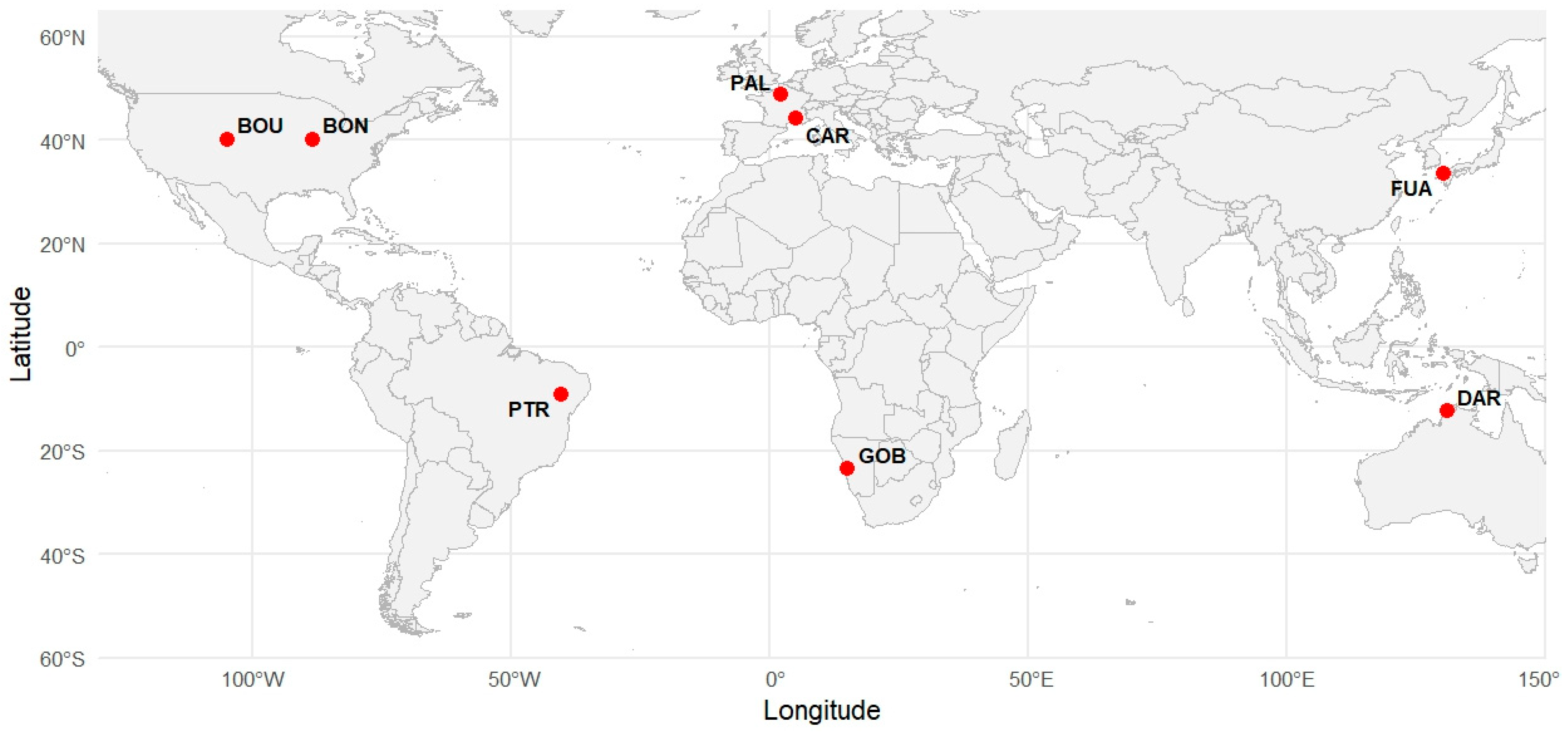
The performance of all three models was evaluated against measurements from eight stations across various climate zones. Each selected location hosts both a radiometric Baseline Surface Radiation Network (BSRN) station [21] and an Aerosol Robotic Network (AERONET) station [22]. Radiometric data were obtained from BSRN, while atmospheric parameters such as the Ångström turbidity coefficient (β), Ångström exponent (α), and water vapor column content (w) were retrieved from AERONET. The geographical coordinates of the stations, the Koppen–Geiger climate zone [23], and the number of records available at each station are provided in Table 1.
The spatial distribution of the eight selected stations is depicted in Figure 1.

3.2. Results

The accuracy of the proposed model is assessed by comparison with two existing models: REST2 [9], a complex and highly regarded model, and McClear [16], a black-box model that requires only geographic coordinates as input and provides a convenient and robust estimation framework, although its accuracy may be lower than that of more physically detailed models. The REST2 model [9] was developed using the same independent integration scheme as our model; however, its parameterization is based on the SMARTS2 spectral model [14] and is performed over two disjoint spectral bands: the ultraviolet–visible (UV–VIS) band (0.29–0.70 μm) and the infrared (IR) band (0.70–4.0 μm). REST2 incorporates detailed representations of atmospheric absorption by ozone, water vapor, and other trace gases, as well as aerosol scattering effects using empirically derived coefficients. The model has been extensively validated against a benchmark dataset of ground-based measurements, demonstrating high accuracy and robustness in estimating clear-sky solar irradiance [3].
The proposed broadband parametric model offers several key innovations compared to REST2. Unlike REST2, which treats the UV–VIS and IR bands separately, the proposed model uses a single compact analytical formulation for the entire spectral range, enabling efficient calculation of the direct, diffuse, and global components of solar irradiance. A novel procedure for estimating the aerosol scattering fraction toward the ground further improves the representation of atmospheric effects. Importantly, the model is purely physically based and does not require calibration on observational data, making it broadly applicable across diverse climatic conditions while maintaining accuracy comparable to REST2.
The McClear model [16] is a physical clear-sky model based on look-up-tables established with the radiative transfer model libRadtran. It is designed for operational simplicity, requiring only the user’s geographic coordinates as input, while relying on atmospheric parameters provided by external datasets. In practice, McClear is most commonly employed in conjunction with CAMS-derived inputs, including three-hourly aerosol properties and daily total column contents of water vapor and ozone [24]. This approach enables efficient and automated estimation of surface solar irradiance; however, the model accuracy strongly depends on the quality and temporal resolution of the atmospheric data input. In addition, the use of precomputed look-up tables limits the flexibility of the model and does not provide an explicit analytical formulation of the radiative processes. In contrast, the proposed CSMV model is based on a compact analytical formulation, which directly represents atmospheric transmittances without relying on external datasets or precomputed tables.
The accuracy of CSMV, REST2, and McClear was assessed using two statistical indicators commonly employed in solar radiation modeling: the normalized root mean square error (nRMSE) and the normalized mean bias error (nMBE).
n R M S E = 100 × N i = 1 N c i m i 2 1 / 2 i = 1 N m i
n M B E = 100 × i = 1 N c i m i i = 1 N m i
In the equations above, c and m denote the computed and measured values, respectively, while N represents the sample size.
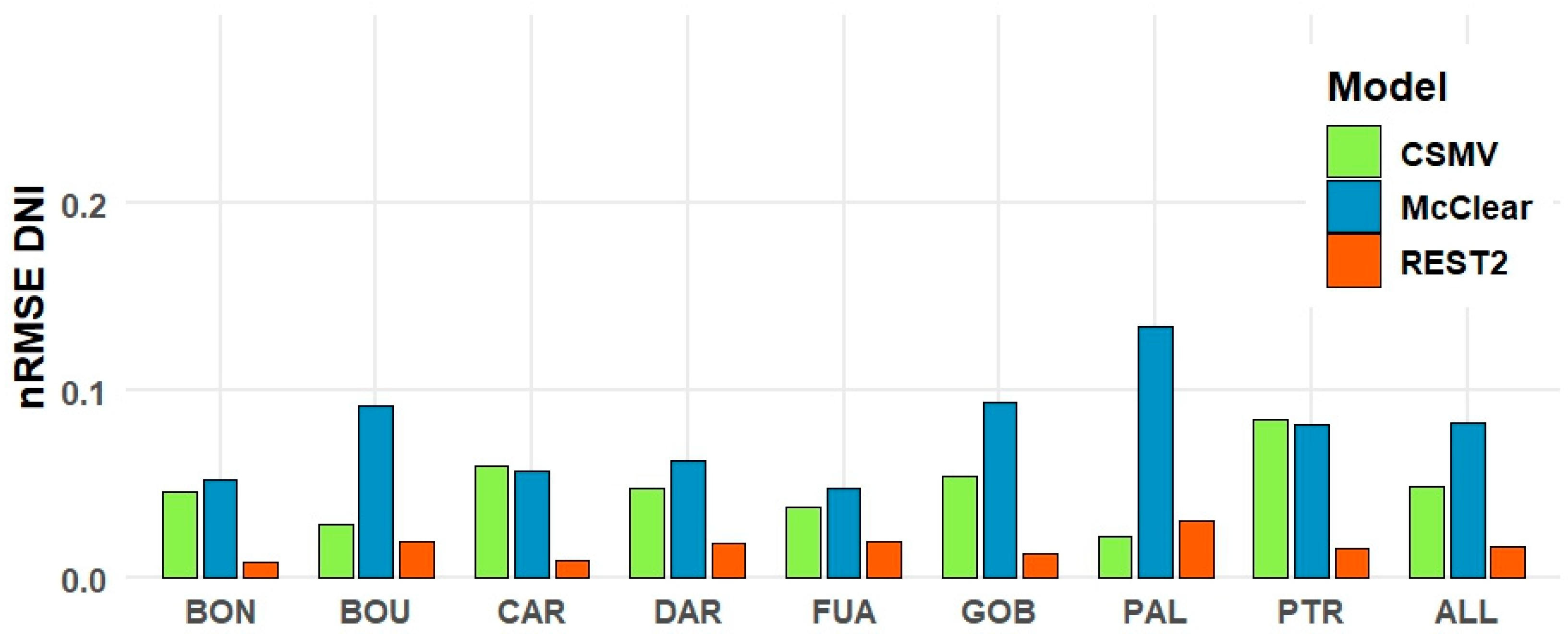
Figure 2 presents the results of testing CSMV, REST2, and McClear models for the estimation of direct-normal irradiance (DNI) across all eight stations. Visually, it can be observed that the performance of the CSMV model closely matches that of REST2. Notably, at the Palaiseau station, CSMV demonstrates the highest accuracy among all models. This station is characterized by relatively high turbidity (mean β = 0.29) and the presence of coarse aerosols (α < 0.53) (see Table A2 in Appendix A). The poorest performance of the CSMV model is observed at the Petrolina station, which stands out due to the highest values of the asymmetry factor g and very low turbidity (β < 0.046) (see Table A2).
The normalized root mean square error (nRMSE) values for the CSMV model range from 2.20% to 8.45%. In comparison, the REST2 model yields lower nRMSE values, between 0.84% and 3.00%. Conversely, the user-friendly McClear model exhibits higher nRMSE values, ranging from 4.82% to 13.37%.
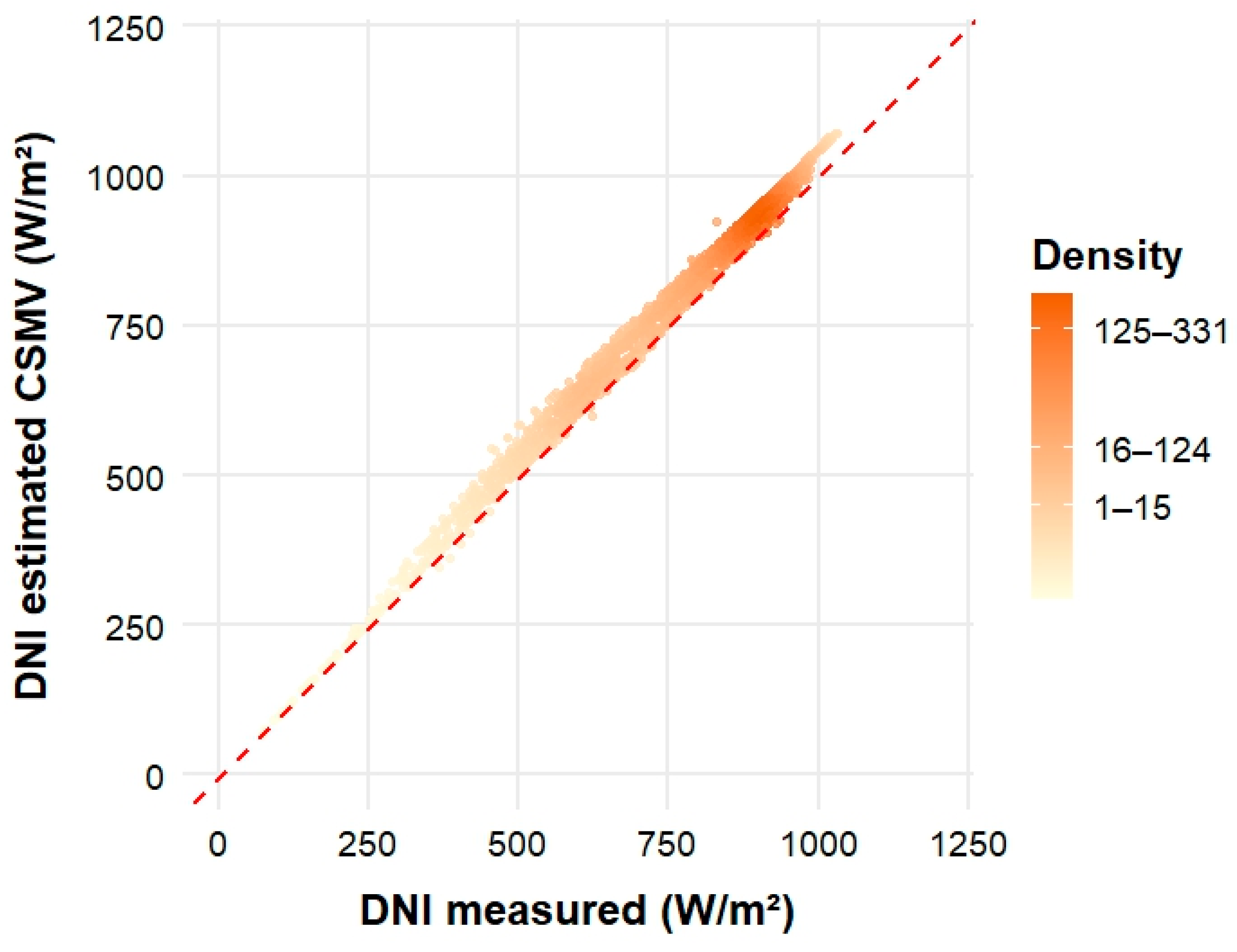
In terms of the normalized mean bias error (nMBE), the CSMV model produces values from 1.89% to 8.31%. Since all the values are positive, the model shows a tendency to overestimate DNI.
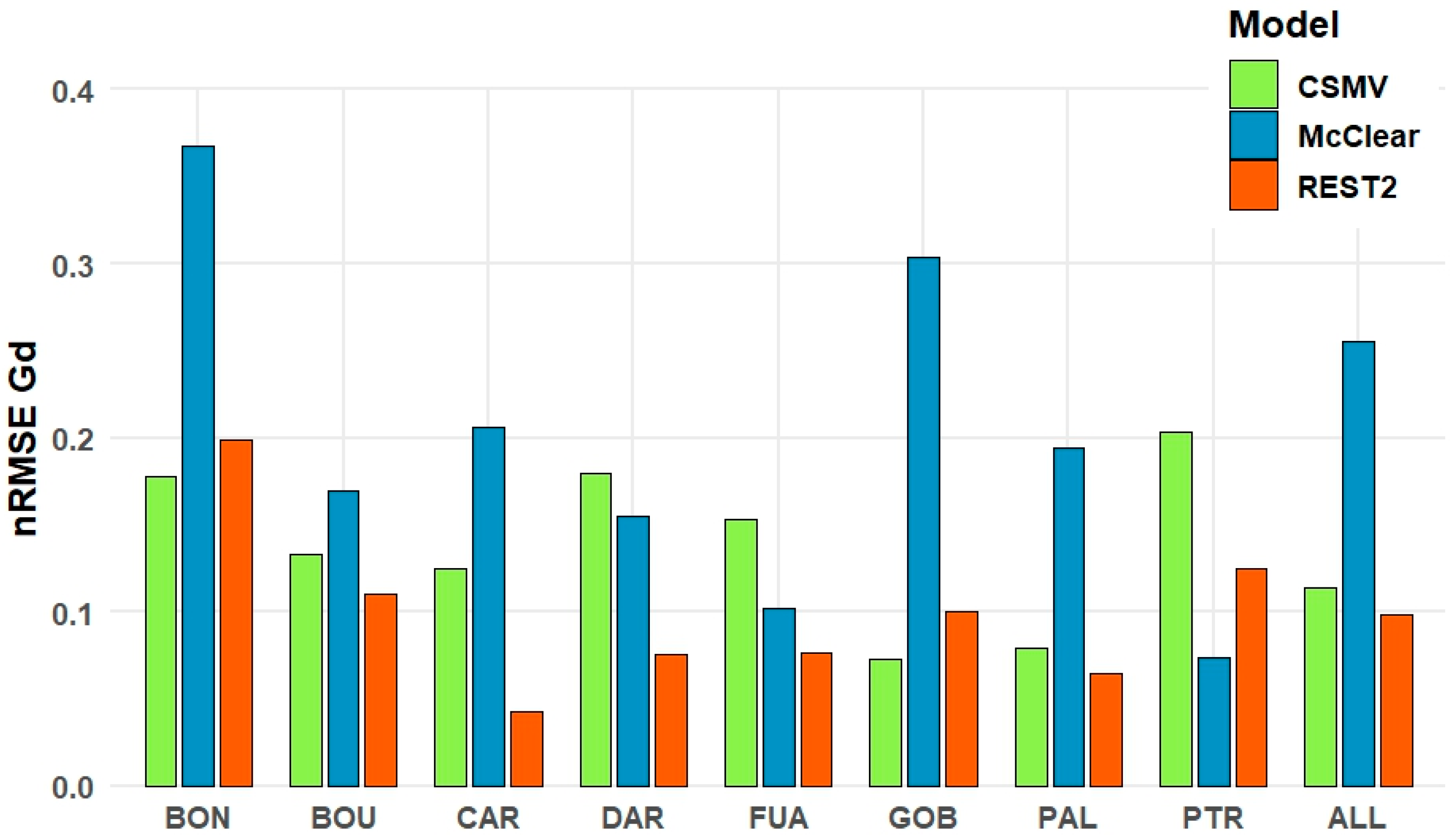
Figure 3 presents the results of testing CSMV, REST2 and McClear models in estimating the diffuse solar irradiance across all eight stations. The diffuse component is widely recognized as the most challenging to estimate due to its strong dependence on atmospheric scattering. Despite this, the performance of the CSMV model remains close to that of REST2 at four out of the eight stations. Moreover, at the Bondville and Gobabeb stations, CSMV demonstrates the highest accuracy among the three models. The normalized root mean square error (nRMSE) values for CSMV range from 7.27% to 20.35%, while REST2 achieves lower nRMSE values between 4.24% and 19.90%. In contrast, the McClear model yields significantly higher nRMSE values, ranging from 7.35% and 36.72%.
The proposed CSMV model yields good performance, with nRMSE values of approximately 7% at the Palaiseau and Gobabeb stations, which together contribute more than 700 out of the 2000 data samples used in the evaluation. Notably, the Palaiseau station is distinguished by the highest atmospheric turbidity coefficient (max β = 0.45) and low Ångström exponent (α < 0.53), whereas the Gobabeb station is characterized by comparatively high atmospheric turbidity (max β = 0.20 ) and medium Ångström exponent α values. The influence of atmospheric turbidity on collectable solar energy is substantial and cannot be neglected in solar resource assessment [25]. Also, a strong dependence of the diffuse-to-direct beam irradiance ratio on the Ångström exponent has been established in Reference [26]. These two stations stand out not only for their high turbidity but also for their elevated single-scattering albedo values (mean ω0 > 0.93), indicating strong aerosol scattering. As a result, the proposed model achieves its highest accuracy for the diffuse irradiance component at these sites, since the large scattering contribution is well captured by the model’s formulation. For the ALL dataset, the resulting nRMSE is 11.4%, which is close to the value obtained with the REST2 model (9.82%). Given that the diffuse solar irradiance represents the most challenging component to estimate, this level of accuracy confirms the robustness of the proposed approach. For comparison, the parametric model SPARTA, validated using radiometric data from three locations, reports an nRMSE of 10% [11].
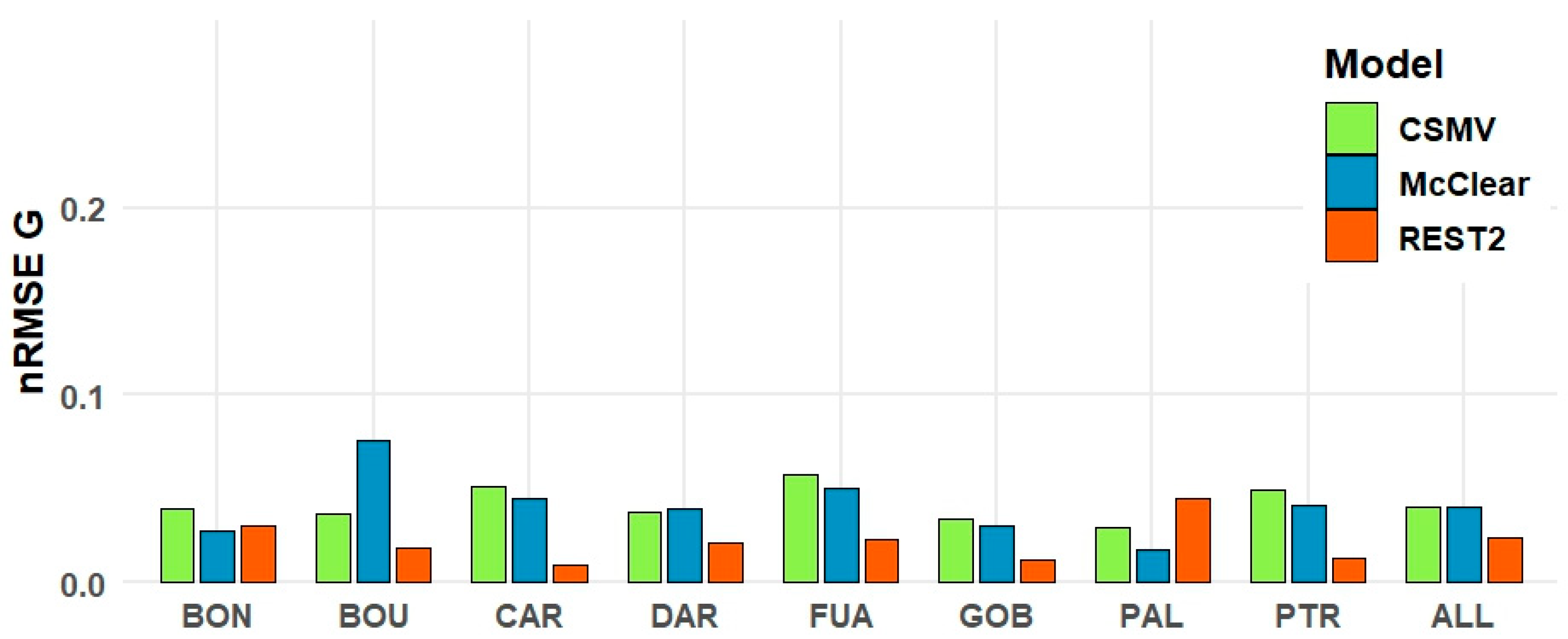
Figure 4 presents the results of testing CSMV, REST2 and McClear in estimating the global solar irradiance across all stations. The nRMSE values achieved by the CSMV model fall within the range of 2.88% to 5.77% demonstrating consistent and accurate performance under various conditions. In comparison, REST2 yields slightly lower nRMSE values, ranging from 0.92% to 4.49%. The McClear model shows a similar degree of accuracy for this component, with nRMSE values between 1.73% and 7.59%. Accurate estimates (nRMSE < 10%) of the global solar irradiance component obtained with the McClear model were reported in a study using measurements from 13 sites in South Africa [27]. All three models provide highly accurate estimates of the global component, with nRMSE values remaining below 8%.
The complete set of results employed for generating the graphs is provided in the Table A1 found in Appendix A.
The proposed CSMV model appears to offer a balanced trade-off between performance and accessibility. In this context, accessibility refers to both the effort required to obtain the necessary input data, and the computational time needed to implement the model equations.
Following the station-by-station performance analysis, it is appropriate to provide an overall assessment of the CSMV model’s capabilities across all tested locations.
Figure 5 illustrates the average performance of the CSMV model across all stations, with estimates of direct normal irradiance plotted against the corresponding measured data. Visual inspection confirms the strong agreement between estimated and observed data.
When aggregated over all stations (labelled as “ALL” in Figure 2), the CSMV model achieves a nRMSE of 4.89% and nMBE of 4.34%, indicating consistent and moderately positive bias in the estimates. The tendency to overestimate was also observed in the results separated for each station.
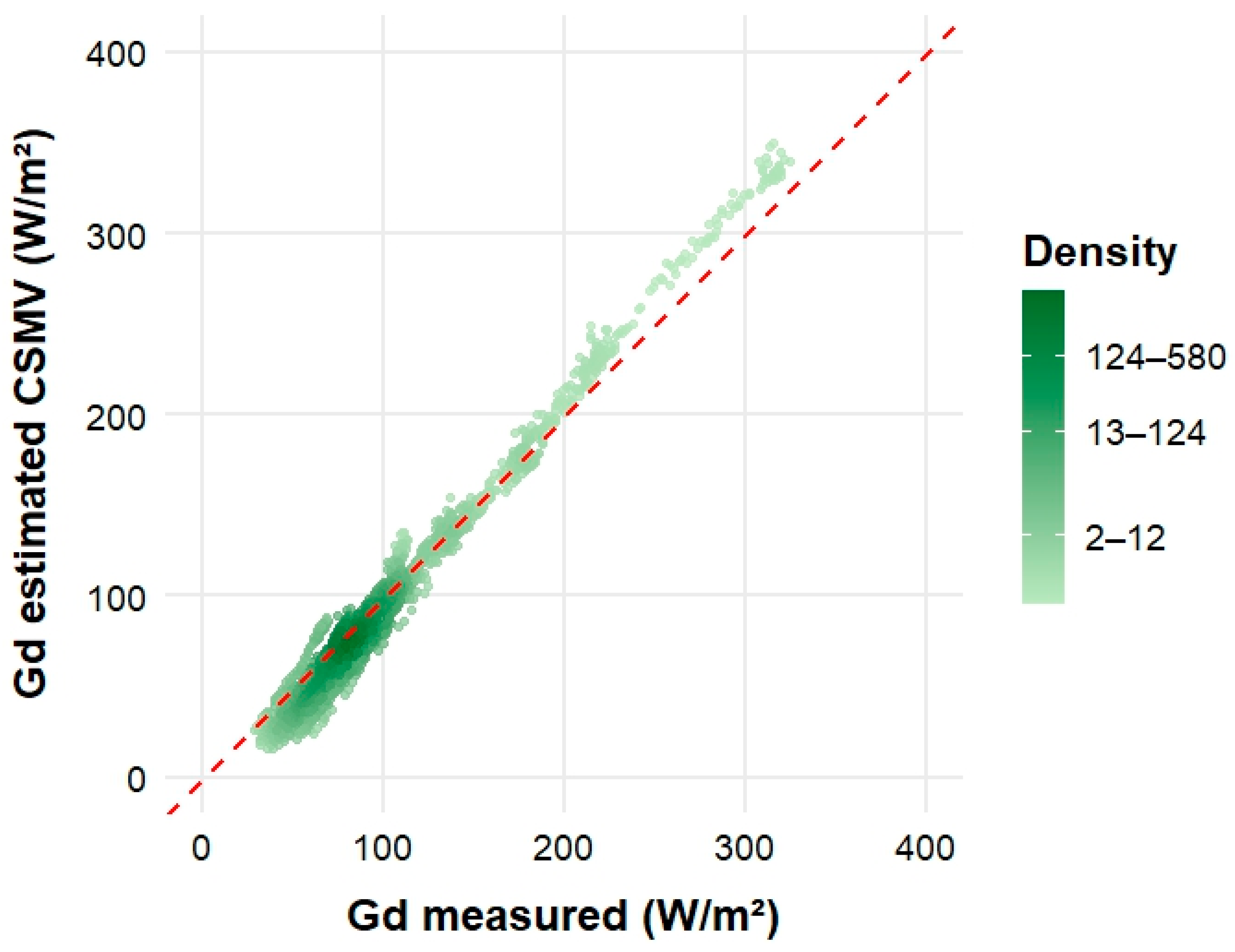
Figure 6 focuses on the diffuse component of solar irradiance, showing CSMV estimates plotted against the corresponding measured values. Visual inspection reveals increased difficulty in accurately estimating this component.
When averaged across all stations (labelled as “ALL” in Figure 3), the model yields a nRMSE of 11.40% and a nMBE of –4.31%, indicating a moderately underestimation. This negative bias is most pronounced at low diffuse irradiance values, likely due to the complex and variable nature of atmospheric scattering.
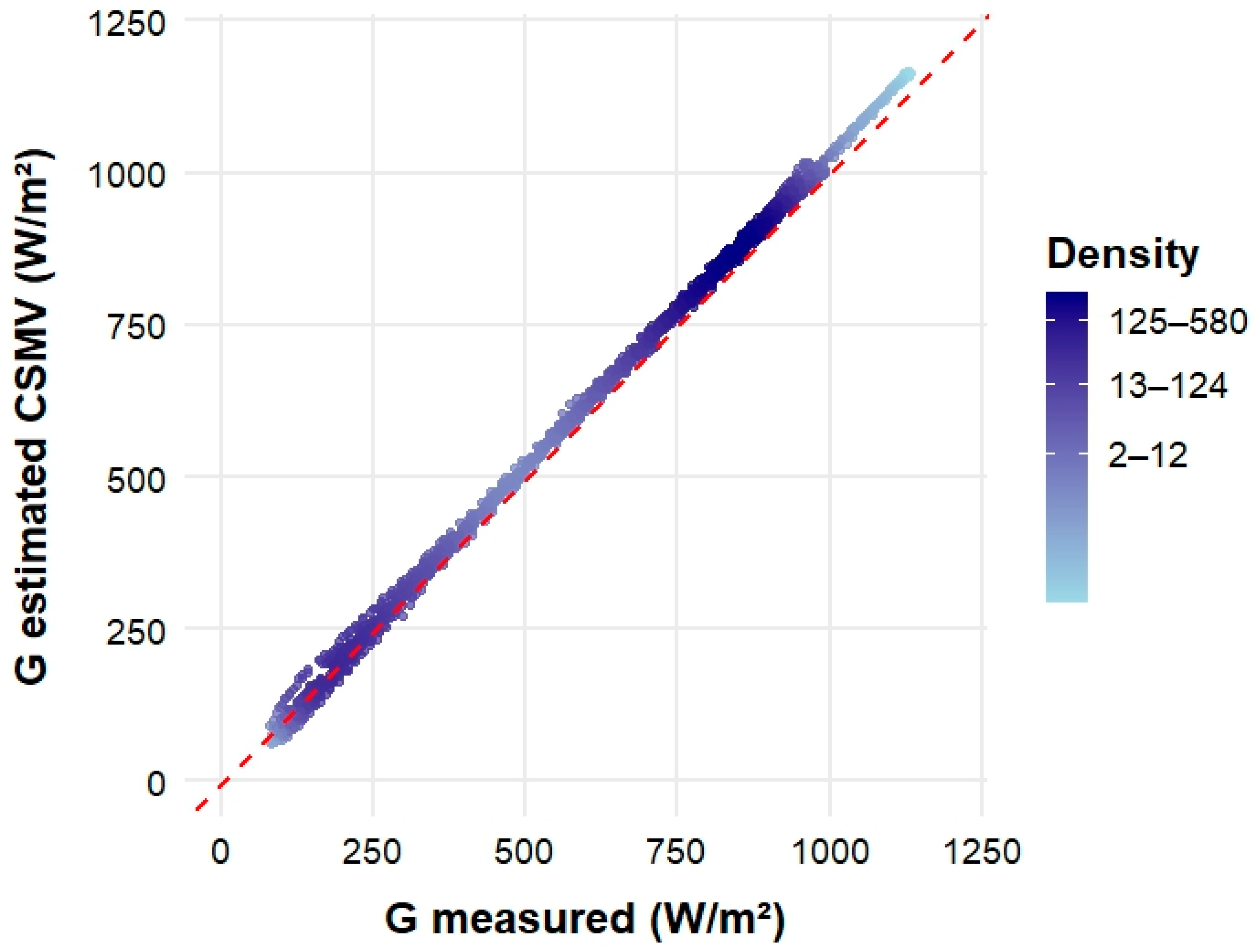
Figure 7 presents the global irradiance values estimated by the CSMV model in comparison with measured values from the aggregated dataset (labelled “ALL” in Figure 4). For global irradiance, the model achieves a normalized root mean square error (nRMSE) of 3.99% and a normalized mean bias error (nMBE) of 2.86%, indicating strong overall agreement. Visual inspection suggests that the estimation quality is generally high, likely due to a compensatory effect: the overestimation of the direct-normal component partially offsets the underestimation of the diffuse component, resulting in improved accuracy for the global irradiance values.

4. Conclusions

The proposed CSMV model distinguishes itself through its practical applicability, computational efficiency, and reliable performance in estimating solar irradiance across a range of climatic conditions. Its parametric formulation enables rapid implementation while maintaining physical interpretability, making it a suitable tool for both research and operational applications in solar energy and atmospheric sciences.
The CSMV was developed based on an independent integration scheme applied to Leckner’s spectral model, enabling the derivation of broadband atmospheric transmittances. It retains the physical structure of the original model, without requiring empirical calibration against specific datasets. CSMV is defined by a system of five analytical equations (for specific atmospheric transmittances), each corresponding to one of the principal atmospheric attenuation processes considered in the source spectral model.
The proposed model differs from the Leckner model in the approach used to estimate the broadband diffuse irradiance. Unlike the Leckner formulation, it accounts for the fact that aerosols not only scatter but also absorb solar radiation. An innovative aspect of the model lies in the formula (Equation (17)) used to compute the fraction of aerosol scattering directed toward the ground. This formulation incorporates two factors: the first accounts for the optical atmospheric mass and allows for an intensification of the scattering process as the optical path length through the atmosphere increases; the second factor arises from the integration of the phase function with an upper limit imposed by the solar elevation angle, thereby constraining the solid angle of scattering toward the ground as the solar elevation decreases.
The model’s performance was evaluated at eight stations representing diverse climate zones. Comparisons with the more complex REST2 model highlight CSMV’s advantage in terms of accessibility and ease of use. Meanwhile, its comparison with the McClear model emphasizes the relatively high level of accuracy achieved by CSMV. These results demonstrate that CSMV offers a favorable balance between precision and usability.

Author Contributions

Conceptualization, E.P. and V.S.; methodology, E.P. and V.S.; software, V.S. and E.P.; data curation, V.S. and E.P.; writing—original draft preparation, E.P. and V.S. All authors have read and agreed to the published version of the manuscript.

Funding

The authors declare that no funds, grants, or other support were received during the preparation of this manuscript.

Data Availability Statement

The data presented in the study are openly available in Baseline Solar Radiation Network; https://bsrn.awi.de/ (accessed on 1 February 2026) and AERONET, https://aeronet.gsfc.nasa.gov/ (accessed on 1 February 2026).

Conflicts of Interest

The authors declare no conflicts of interest.

Appendix A

Table A1. Normalized root mean square error (nRMSE) and normalized mean bias error (nMBE), expressed as percentages, for the estimation of direct-normal (DNI), diffuse (Gd), and global (G) irradiance using the CSMV, REST2, and McClear models at each station. Best nRMSE and nMBE values are in bold.
StationModelDNI nRMSEGd nRMSEG nRMSEDNI nMBEGd nMBEG nMBE
BONCSMV4.63%17.77%3.96%4.53%−15.78%3.68%
REST20.84%19.90%3.02%−0.67%−17.11%−0.58%
McClear5.21%36.72%2.77%−4.84%33.70%2.28%
BOUCSMV2.84%13.30%3.65%2.32%−11.82%2.68%
REST21.91%11.05%1.79%−0.53%−9.29%0.89%
McClear9.17%16.99%7.59%8.39%−13.54%7.06%
CARCSMV5.95%12.49%5.09%5.76%−5.45%3.52%
REST20.93%4.24%0.92%−0.22%3.02%0.53%
McClear5.68%20.59%4.51%0.74%15.15%3.73%
DARCSMV4.73%17.98%3.71%4.46%−10.33%2.51%
REST21.82%7.52%2.11%−1.41%4.15%0.21%
McClear6.25%15.50%3.94%1.29%9.54%3.16%
FUACSMV3.81%15.27%5.77%3.00%−2.06%3.28%
REST21.89%7.67%2.30%−0.48%4.85%1.69%
McClear4.82%10.24%5.07%3.00%3.15%4.14%
GOBCSMV5.40%7.27%3.38%5.35%−4.98%2.69%
REST21.31%10.01%1.19%1.23%−8.97%−1.00%
McClear9.37%30.37%3.04%5.12%−3.56%2.58%
PALCSMV2.20%7.90%2.88%1.89%3.52%1.63%
REST23.00%6.45%4.49%−2.79%−5.06%−4.13%
McClear13.37%19.38%1.73%8.09%−12.04%−0.02%
PTRCSMV8.45%20.35%4.894%8.31%15.46%4.15%
REST21.54%12.48%1.31%1.51%11.40%−1.03%
McClear8.16%7.35%4.15%8.05%6.97%3.43%
ALLCSMV4.89%11.40%3.99%4.34%−4.31%2.86%
REST21.54%9.82%1.31%1.51%11.40%−1.03%
McClear8.23%25.52%3.99%3.32%0.85%3.01%
Table A2. Statistical summary (minimum, mean, and maximum) of the Ångström exponent (α), turbidity coefficient (β), single-scattering albedo ( ω 0 ), and asymmetry factor (g) at each station.
StationModel α β ω 0 g
BONmin0.9270.0190.5720.601
mean1.3880.0280.6860.692
max1.6230.0850.9410.738
BOUmin0.6990.0230.7020.616
mean1.0530.0380.7950.654
max1.40.0690.8780.714
CARmin0.6430.0230.8460.562
mean1.4950.0540.9320.634
max1.8140.1030.9980.713
DARmin0.2550.0290.6690.576
mean0.8850.0520.7690.65
max1.4160.1330.9110.726
FUAmin0.4680.050.9190.643
mean0.6870.0820.9390.679
max1.1540.1090.9870.726
GOBmin0.2040.0230.8480.675
mean0.6250.080.9350.728
max1.2550.2020.9790.773
PALmin0.10.1570.9270.706
mean0.3040.2930.9530.738
max0.5320.4550.9680.781
PTRmin0.4020.0280.7770.742
mean0.4950.0360.8280.764
max0.6370.0460.8740.791
ALLmin0.10.0190.5720.562
mean0.9090.0880.8630.689
max1.8140.4550.9980.791

References

  1. Mackay, M. Solar Energy: An Introduction; Oxford University Press: Oxford, UK, 2015. [Google Scholar]
  2. Latif, S.D.; Hui, L.E.; Ahmed, A.N.; Sherif, M.; El-Shafie, A. Forecasting solar power generation as a renewable energy utilizing various machine learning models. Theor. Appl. Climatol. 2025, 156, 369. [Google Scholar] [CrossRef]
  3. Sun, X.; Bright, J.M.; Gueymard, C.A.; Bai, X.; Acord, B.; Wang, P. Worldwide performance assessment of 95 direct and diffuse clear-sky irradiance models using principal component analysis. Renew. Sustain. Energy Rev. 2021, 135, 110087. [Google Scholar] [CrossRef]
  4. Yang, Y.; Liu, X.; Wu, Y. Review of solar spectral irradiance modelling at ground level: Current methods and machine learning opportunities. Energy 2026, 344, 139967. [Google Scholar] [CrossRef]
  5. Gueymard, C.A. Clear-sky irradiance predictions for solar resource mapping and large-scale applications: Improved validation methodology and detailed performance analysis of 18 broadband radiative models. Sol. Energy 2012, 86, 2145–2169. [Google Scholar] [CrossRef]
  6. Antonanzas-Torres, F.; Urraca, R.; Polo, J.; Perpiñán-Lamigueiro, O.; Escobar, R. Clear sky solar irradiance models: A review of seventy models. Renew. Sustain. Energy Rev. 2019, 107, 374–387. [Google Scholar] [CrossRef]
  7. Wang, S.; Peng, J.; Zou, B.; Xue, P.; Tan, Y.; Zhang, Q.; Zhou, J. Estimation of solar spectral irradiance using spectral skewness based on integrated sky-ground observation. Renew. Energy 2026, 256, 124417. [Google Scholar] [CrossRef]
  8. Biga, A.J.; Rosa, R. Contribution to the study of the solar radiation climate of Lisbon. Sol. Energy 1979, 23, 61–67. [Google Scholar] [CrossRef]
  9. Gueymard, C.A. REST2: High-performance solar radiation model for cloudless-sky irradiance, illuminance, and photosynthetically active radiation—Validation with a benchmark dataset. Sol. Energy 2008, 82, 272–285. [Google Scholar] [CrossRef]
  10. Paulescu, E.; Paulescu, M. A new clear sky solar irradiance model. Renew. Energy 2021, 179, 2094–2103. [Google Scholar] [CrossRef]
  11. Ruiz-Arias, J.A. SPARTA: Solar parameterization for the radiative transfer of the cloudless atmosphere. Renew. Sustain. Energy Rev. 2023, 188, 113833. [Google Scholar] [CrossRef]
  12. Paulescu, E.; Velimirovici, L.; Paulescu, M. Clear sky solar irradiance models derived through interdependent parameterization. Renew. Energy 2025, 250, 123371. [Google Scholar] [CrossRef]
  13. Leckner, B. The spectral distribution of solar radiation at the earth’s surface—Elements of a model. Sol. Energy 1978, 20, 143–150. [Google Scholar] [CrossRef]
  14. Gueymard, C.A. SMARTS2 A Simple Model of the Atmospheric Radiative Transfer of Sunshine: Algorithms and Performance Assessment; Florida Solar Energy Center Rep. FSEC-PF-270-95; Florida Solar Energy Center: Cocoa, FL, USA, 1995. [Google Scholar]
  15. Molineaux, B.; Ineichen, P. On the broad band transmittance of direct irradiance in a cloudless sky and its application to the parameterization of atmospheric turbidity. Sol. Energy 1996, 56, 553–563. [Google Scholar] [CrossRef]
  16. Lefevre, M.; Oumbe, A.; Blanc, P.; Espinar, B.; Gschwind, B.; Qu, Z.; Wald, L.; Schroedter-Homscheidt, M.; Hoyer-Klick, C.; Arola, A.; et al. McClear: A new model estimating downwelling solar radiation at ground level in clear-sky conditions. Atmos. Meas. Tech. 2013, 6, 2403–2418. [Google Scholar] [CrossRef]
  17. Thekaekara, M.P. Solar energy outside the earth’s atmosphere. Sol. Energy 1973, 14, 109–127. [Google Scholar] [CrossRef]
  18. Spencer, W. Fourier series representation of the position of the sun. Search 1971, 2, 172. [Google Scholar]
  19. Iqbal, M. An Introduction to Solar Radiation; Academic Press: London, UK, 1983. [Google Scholar]
  20. Henyey, L.; Greenstein, J.L. Diffuse radiation in the galaxy. Astrophys. J. 1941, 93, 70–83. [Google Scholar] [CrossRef]
  21. Driemel, A.; Augustine, J.; Behrens, K.; Colle, S.; Cox, C.; Cuevas-Agull’o, E.; Denn, F.M.; Duprat, T.; Fukuda, M.; Grobe, H.; et al. Baseline surface radiation network (BSRN): Structure and data description (1992–2017). Earth Syst. Sci. Data 2018, 10, 1491–1501. [Google Scholar] [CrossRef]
  22. Giles, D.M.; Sinyuk, A.; Sorokin, M.G.; Schafer, J.S.; Smirnov, A.; Slutsker, I.; Eck, T.F.; Holben, B.N.; Lewis, J.R.; Campbell, J.R.; et al. Advancements in the Aerosol Robotic Network (AERONET) Version 3 database–automated near-real-time quality control algorithm with improved cloud screening for Sun photometer aerosol optical depth (AOD) measurements. Atmos. Meas. Technol. 2019, 12, 169–209. [Google Scholar] [CrossRef]
  23. Kottek, M.; Grieser, J.; Beck, C.; Rudolf, B.; Rubel, F. World Map of the Köppen-Geiger climate classification updated. Meteorol. Z. 2006, 15, 259–263. [Google Scholar] [CrossRef] [PubMed]
  24. Gschwind, B.; Wald, L.; Blanc, P.; Lefevre, M.; Schroedter-Homscheidt, M.; Arola, A. Improving the McClear model estimating the downwelling solar radiation at ground level in cloud-free conditions-McClear-v3. Meteorol. Z. 2019, 28, 147–163. [Google Scholar] [CrossRef]
  25. Calinoiu, D.G.; Stefu, N.; Paulescu, M.; Trif-Tordai, G.; Mares, M.; Paulescu, E.; Boata, R.; Pop, N.; Pacurar, A. Evaluation of errors made in solar irradiance estimation due to averaging the Angstrom turbidity coefficient. Atmos. Res. 2014, 150, 69–78. [Google Scholar] [CrossRef]
  26. Kaskaoutis, D.G.; Kambezidis, H.G.; Dumka, U.C.; Psiloglou, B.E. Dependence of the spectral diffuse-direct irradiance ratio on aerosol spectral distribution and single scattering albedo. Atmos. Res. 2016, 178–179, 84–94. [Google Scholar] [CrossRef]
  27. Mabasa, B.; Lysko, M.D.; Tazvinga, H.; Zwane, N.; Moloi, S.J. The Performance Assessment of Six Global Horizontal Irradiance Clear Sky Models in Six Climatological Regions in South Africa. Energies 2021, 14, 2583. [Google Scholar] [CrossRef]
Figure 1. Location on the world map of the stations from which data were collected. Each station is indicated by the BSRN index.
Energies 19 01842 g001
Figure 2. The statistical indicator, nRMSE, of accuracy for the estimation of direct-normal irradiance (DNI) under clear-sky conditions with the new model CSMV and the reference models REST2 and McClear.
Energies 19 01842 g002
Figure 3. The statistical indicator, nRMSE, of accuracy for the estimation of diffuse irradiance (Gd) under clear-sky conditions with the new model CSMV and the reference models REST2 and McClear.
Energies 19 01842 g003
Figure 4. The statistical indicator, nRMSE, of accuracy for the estimation of global irradiance (G) under clear-sky conditions with the new model CSMV and the reference models REST2 and McClear.
Energies 19 01842 g004
Figure 5. Comparison between modeled and measured direct normal irradiance (DNI) on ALL dataset, with the proposed CSMV. Dashed line indicates perfect agreement between modeled and measured irradiance.
Energies 19 01842 g005
Figure 6. Comparison between modeled and measured diffuse horizontal irradiance (Gd) on ALL dataset, with the proposed CSMV. Dashed line indicates perfect agreement between modeled and measured irradiance.
Energies 19 01842 g006
Figure 7. Comparison between modeled and measured global horizontal irradiance (G) on ALL dataset, with the proposed CSMV. Dashed line indicates perfect agreement between modeled and measured irradiance.
Energies 19 01842 g007
Table 1. Summary of stations from which data were collected. N denotes the number of records available from each station. The climate zone is indicated according to the Köppen–Geiger classification.
StationClimateBSRN
Index
BSRN StationAERONET StationN
Lat.
[deg]
Long.
[deg]
Alt.
[m]
Lat.
[deg]
Long.
[deg]
Alt.
[m]
Bondville (USA)DfaBON40.06−88.3621340.06−88.36213275
Boulder (USA)DfbBOU40.05−105.0157740.05−105.01577279
Carpentras (France)CsaCAR44.085.0510044.085.05100315
Darwin (Australia)AwDAR−12.42130.8930−12.42130.8930216
Fukuoka (Japan)CfaFUA33.58130.37333.58130.373122
Gobabeb (Namibia)BshGOB−23.5615.04407−23.5615.04407453
Palaiseau (France)CfbPAL48.712.2015648.702.20156281
Petrolina (Brazil)BshPTR−9.07−40.32387−9.07−40.3238765
Disclaimer/Publisher’s Note: The statements, opinions and data contained in all publications are solely those of the individual author(s) and contributor(s) and not of MDPI and/or the editor(s). MDPI and/or the editor(s) disclaim responsibility for any injury to people or property resulting from any ideas, methods, instructions or products referred to in the content.