Bibliometric Analysis of Hydrothermal Co-Processing of Biomass for Energy Generation



Abstract
1. Introduction
2. Bibliometric Approach
Keyword Analysis and Research Themes
3. Biomass and Interaction
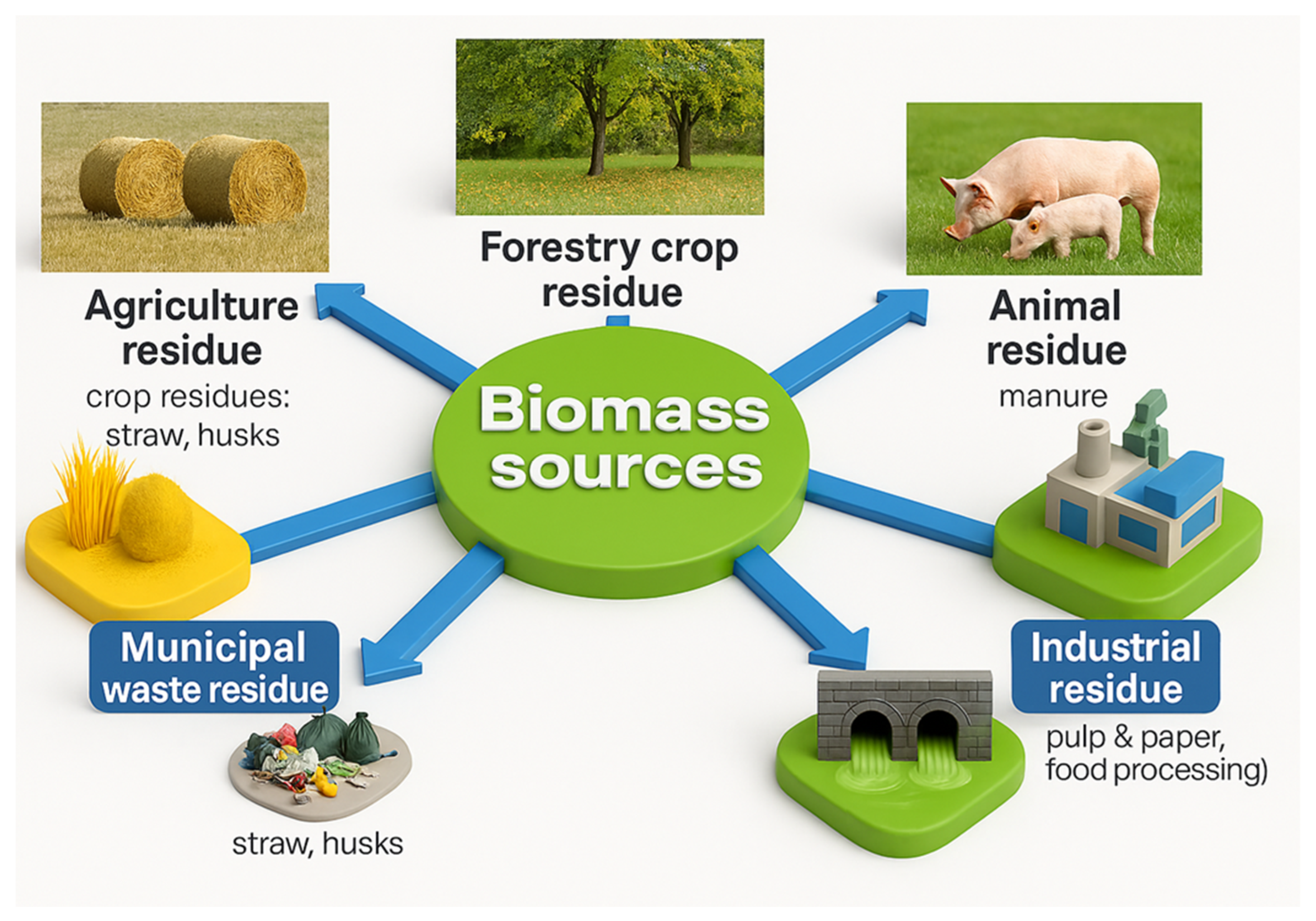
3.1. Classification and Characteristics of Biomass
3.1.1. Agricultural Biomass
3.1.2. Forest Residues
3.1.3. Livestock Waste
3.1.4. Algae Biomass
3.1.5. Sewage and Municipal Solid Waste
3.1.6. Plastic Waste
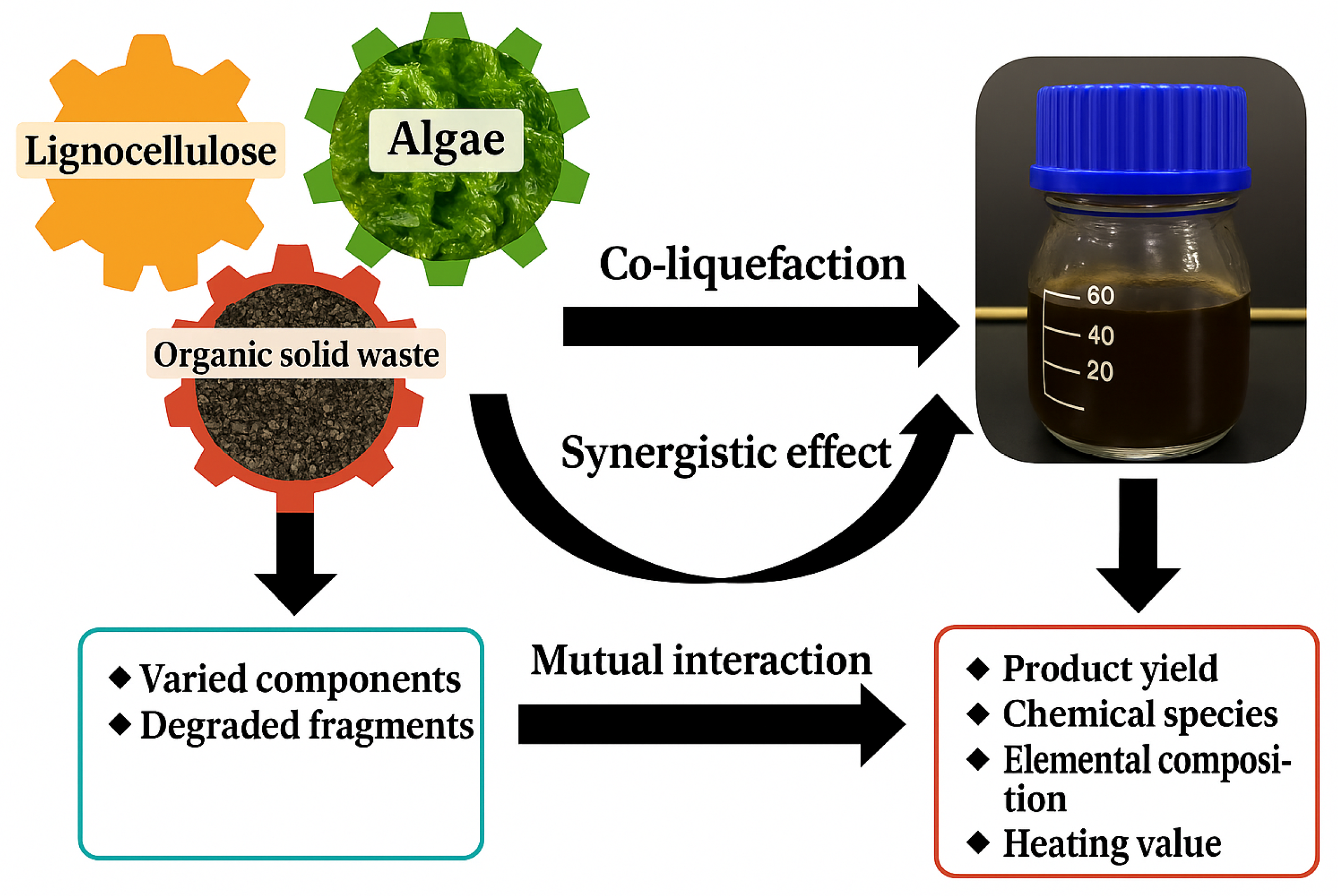
3.2. Synergistic Interaction Among Biomass Feedstocks
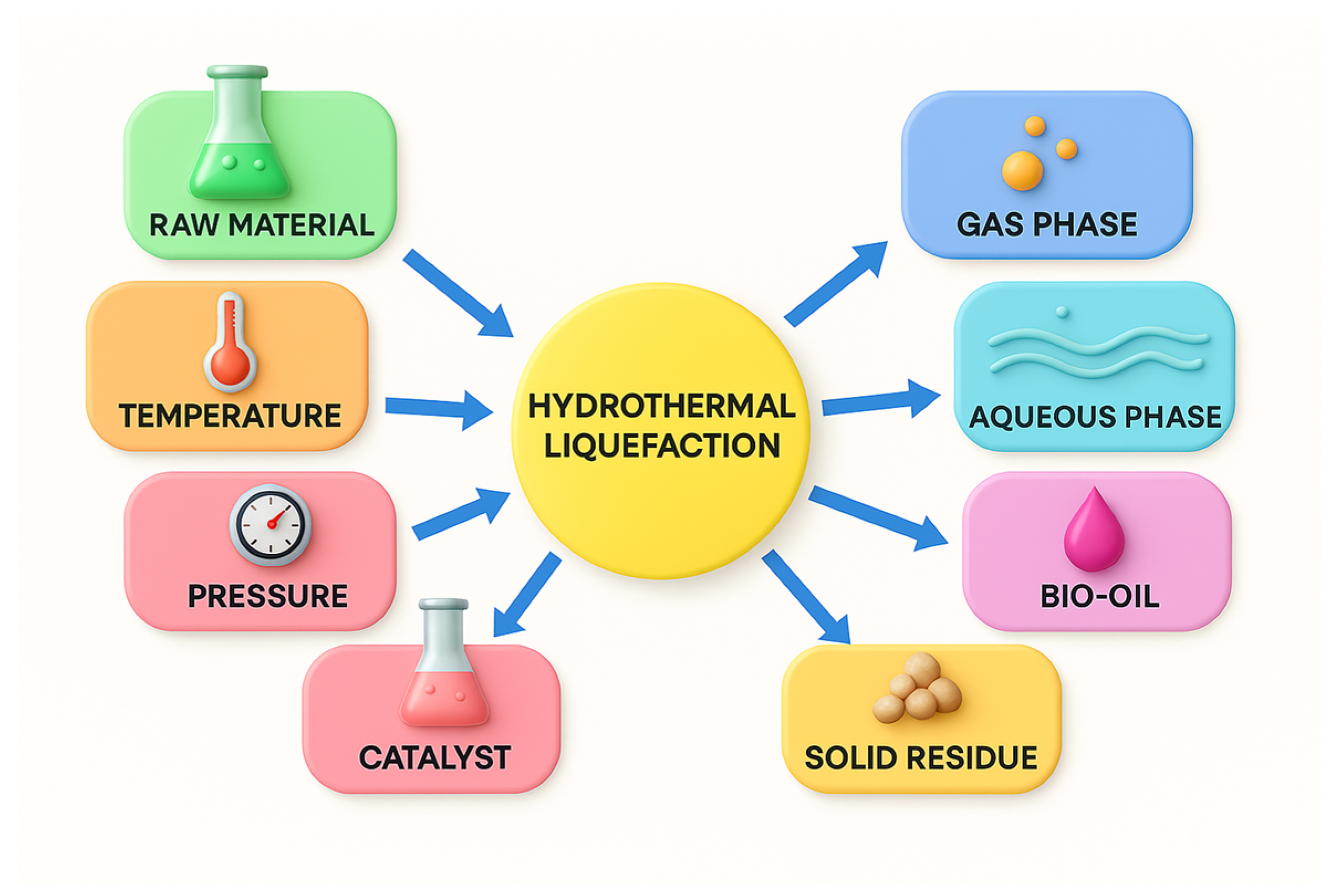
4. Overview of Hydrothermal Liquefaction (HTL)
4.1. Hydrothermal Co-Liquefaction

4.1.1. Co-Liquefaction of Sewage Sludge with Various Feedstocks
4.1.2. Hydrothermal Co-Liquefaction of Algae with Other Biomass
4.1.3. Hydrothermal Co-Liquefaction of Lignocellulosic Biomass and Other Types of Feedstocks
4.1.4. Hydrothermal Co-Liquefaction of Organic Waste and Other Biomass
4.1.5. Hydrothermal Co-Liquefaction of Plastic Waste and Other Biomass
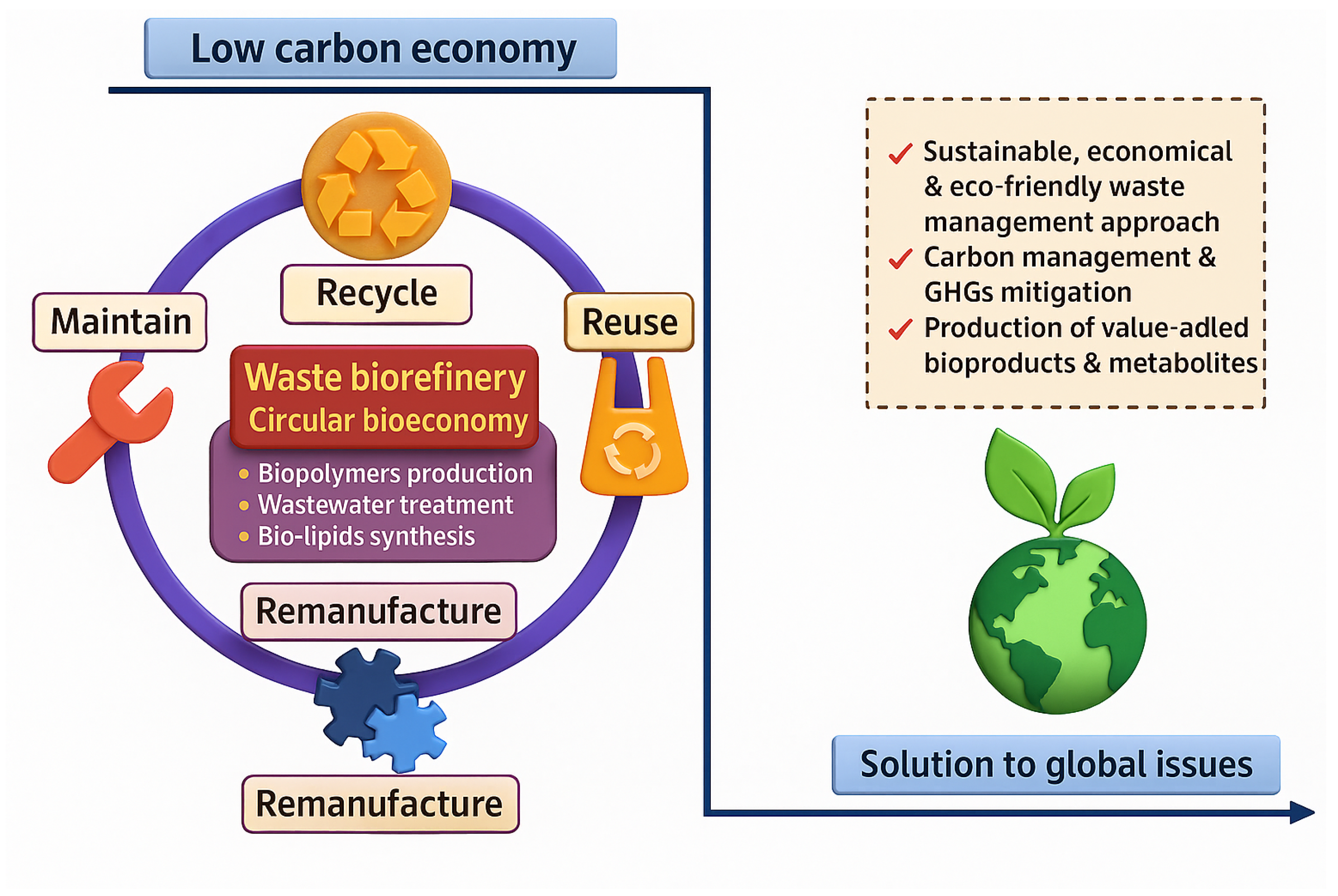
5. Waste-to-Energy and Circular Economy
5.1. Circular Economy and Sustainable Development Goals
5.2. Techno-Economic and Life-Cycle Considerations of Co-HTL
6. Integration and Hybrid Approach
6.1. Integration of Anaerobic Digestion and Hydrothermal Liquefaction/Carbonisation
6.2. Integration of Hydrothermal Liquefaction and Anaerobic Digestion
7. Challenges Facing HTL Technology
- Economic and technical feasibility—High equipment costs, energy demand, and feedstock logistics are significant barriers to commercialisation. Techno-economic assessments indicate that reducing these costs is essential for making HTL competitive with conventional fuels [192].
- Feedstock variability—The inconsistency in biomass chemical composition and physical properties poses a challenge for continuous operation and reliable biofuel production [193,194]. Co-liquefaction of feedstock can mitigate some variability issues, but understanding the interactions between different feedstocks is necessary to optimise processing conditions [122].
- Complexity of bio-oil composition—HTL-derived biocrude contains a complex mixture of organic compounds, making refining challenging and affecting the stability and quality of the bio-oil, necessitating advanced purification techniques [195].
- Reactor material constraints and formation of unwanted products—The HTL reactor requires high-temperature and -pressure conditions, which can be challenging and costly. Inefficient heat and mass transfer within the reactor can affect conversion efficiency and selectivity, leading to lower yields and higher costs for product separation and purification [196].
- Catalyst deactivation—Heterogeneous catalysts can suffer from deactivation due to fouling, sintering, and poisoning, which reduces their effectiveness over time. They can be regenerated and reused, though this can be complex and costly [197].
8. Research Outlook and Conclusions
8.1. Research Outlook
8.2. Conclusions
Author Contributions
Funding
Data Availability Statement
Acknowledgments
Conflicts of Interest
References
- Madikizela, M.; Isa, Y.M. Effect of operating conditions on the hydrothermal valorization of sewage sludge. Biofuels Bioprod. Biorefining 2023, 17, 403–414. [Google Scholar] [CrossRef]
- Kamyab, S.; Ataei, S.A.; Tabatabaee, M.; Mirhosseinei, S.A. Optimization of bio-hydrogen production in dark fermentation using activated sludge and date syrup as inexpensive substrate. Int. J. Green Energy 2019, 16, 763–769. [Google Scholar] [CrossRef]
- Kalak, T. Potential use of industrial biomass waste as a sustainable energy source in the future. Energies 2023, 16, 1783. [Google Scholar] [CrossRef]
- Déniel, M.; Haarlemmer, G.; Roubaud, A.; Weiss-Hortala, E.; Fages, J. Bio-oil production from food processing residues: Improving the bio-oil yield and quality by aqueous phase recycle in hydrothermal liquefaction of blackcurrant (Ribes nigrum L.) Pomace. Energy Fuels 2016, 30, 4895–4904. [Google Scholar] [CrossRef]
- Cao, L.; Zhang, C.; Chen, H.; Tsang, D.C.; Luo, G.; Zhang, S.; Chen, J. Hydrothermal liquefaction of agricultural and forestry wastes: State-of-the-art review and future prospects. Bioresour. Technol. 2017, 245, 1184–1193. [Google Scholar] [CrossRef]
- Yan, W.-H.; Duan, -G.; Wang, F.; Xu, Y.-P. Composition of the bio-oil from the hydrothermal liquefaction of duckweed and the influence of the extraction solvents. Fuel 2016, 185, 229–235. [Google Scholar] [CrossRef]
- Raikova, S.; Smith-Baedorf, H.; Bransgrove, R.; Barlow, O.; Santomauro, F.; Wagner, J.L.; Allen, M.J.; Bryan, C.G.; Sapsford, D.; Chuck, C.J. Assessing hydrothermal liquefaction for the production of bio-oil and enhanced metal recovery from microalgae cultivated on acid mine drainage. Fuel Process. Technol. 2016, 142, 219–227. [Google Scholar] [CrossRef]
- Kaloudas, D.; Pavlova, N.; Penchovsky, R. Lignocellulose, algal biomass, biofuels and biohydrogen: A review. Environ. Chem. Lett. 2021, 142, 2809–2824. [Google Scholar] [CrossRef]
- Adedeji, O.M.; Russack, J.S.; Molnar, L.A.; Bauer, S.K. Co-hydrothermal liquefaction of sewage sludge and beverage waste for high-quality bio-energy production. Fuel 2021, 324, 124757. [Google Scholar] [CrossRef]
- Sharma, S.; Kundu, A.; Basu, S.; Shetti, N.; Aminabhavi, T.M. Sustainable environmental management and related biofuel technologies. J. Environ. Manag. 2020, 273, 111096. [Google Scholar] [CrossRef] [PubMed]
- Nigam, S.; Singh, A. Production of liquid biofuels from renewable resources. Prog. Energy Combust. Sci. 2011, 37, 52–68. [Google Scholar] [CrossRef]
- Alhazmi, H.; Loy, A.C.M. A review on environmental assessment of conversion of agriculture waste to bio-energy via different thermochemical routes: Current and future trends. Bioresour. Technol. Rep. 2021, 14, 100682. [Google Scholar] [CrossRef]
- Astolfi, A.L.; Rempel, A.; Cavanhi, V.A.F.; Alves, M.; Deamici, K.M.; Colla, L.M.; Costa, J.A.V. Simultaneous saccharification and fermentation of Spirulina sp. and corn starch for the production of bioethanol and obtaining biopeptides with high antioxidant activity. Bioresour. Technol. 2020, 301, 122698. [Google Scholar] [CrossRef]
- Awogbemi, O.; Kallon, D.V.V.; Onuh, E.I.; Aigbodion, V.S. An Overview of the Classification, Production and Utilization of Biofuels for Internal Combustion Engine Applications. Energies 2021, 14, 5687. [Google Scholar] [CrossRef]
- Kumar, V.; Nanda, M.; Joshi, H.C.; Singh, A.; Sharma, S.; Verma, M. Production of biodiesel and bioethanol using algal biomass harvested from fresh water river. Renew. Energy 2018, 116, 606–612. [Google Scholar] [CrossRef]
- Akhtar, J.; Amin, N.A.S. A review on process conditions for optimum bio-oil yield in hydrothermal liquefaction of biomass. Renew. Sustain. Energy Rev. 2011, 15, 1615–1624. [Google Scholar] [CrossRef]
- Garcia, A.; Monsalve-Serrano, J.; Villalta, D.; Guzman-Mendoza, M. Parametric assessment of the effect of oxygenated low carbon fuels in a light-duty compression ignition engine. Fuel Process. Technol. 2022, 229, 107199. [Google Scholar] [CrossRef]
- Sharma, A.; Singh, G.; O’Donovan, A.; Sharma, M.; Kaur, A.; Arya, S.K. A review on development of a greener approach via One-Pot tandem catalysis for biofuels production. Fuel 2023, 350, 128837. [Google Scholar] [CrossRef]
- Gan, Y.; Lu, Z.; He, X.; Wang, M.; Amer, A.A. Cradle-to-grave lifecycle analysis of greenhouse gas emissions of light-duty passenger vehicles in china: Towards a carbon-neutral future. Sustainability 2023, 15, 2627. [Google Scholar] [CrossRef]
- Ramirez, J.A.; Brown, R.J.; Rainey, T.J. A Review of Hydrothermal Liquefaction Bio-Crude Properties and Prospects for Upgrading to Transportation Fuels. Energies 2015, 8, 6765–6794. [Google Scholar] [CrossRef]
- Chaudhary, V.; Awadakkam, S.; Churchill, J.G.B.; Borugadda, V.B.; Dalai, A.K. Production of sustainable biocrude from Canadian agricultural biomass: Process optimization and product characterization. Fuel Process. Technol. 2024, 261, 108108. [Google Scholar] [CrossRef]
- Teoh, R.H.; Mahajan, A.S.; Moharir, S.R.; Manaf, N.A.; Shi, S.; Thangalazhy-Gopakumar, S. A review on hydrothermal treatments for solid, liquid and gaseous fuel production from biomass. Energy Nexus 2024, 14, 100301. [Google Scholar] [CrossRef]
- Tursi, A. A review on biomass: Importance, chemistry, classification, and conversion. Biofuel Res. J. 2019, 6, 962–979. [Google Scholar] [CrossRef]
- Ali, J.; Rasheed, T.; Afreen, M.; Anwar, M.T.; Nawaz, Z.; Anwar, H.; Rizwan, K. Modalities for conversion of waste to energy—Challenges and perspectives. Sci. Total Environ. 2020, 727, 138610. [Google Scholar] [CrossRef]
- Saleem, M. Possibility of utilizing agriculture biomass as a renewable and sustainable future energy source. Heliyon 2022, 8, e08905. [Google Scholar] [CrossRef]
- Zhu, Z.; Rosendahl, L.; Toor, S.S.; Yu, D.; Chen, G. Hydrothermal liquefaction of barley straw to bio-crude oil: Effects of reaction temperature and aqueous phase recirculation. Appl. Energy 2015, 137, 183–192. [Google Scholar] [CrossRef]
- Xu, Z.-X.; Cheng, J.-H.; He, Z.-X.; Wang, Q.; Shao, Y.-W.; Hu, X. Hydrothermal liquefaction of cellulose in ammonia/water. Bioresour. Technol. 2019, 278, 311–317. [Google Scholar] [CrossRef] [PubMed]
- de Caprariis, B.; Scarsella, M.; Bavasso, I.; Bracciale, M.; Tai, L.; De Filippis, P.; Ni, E.O. Zn and Fe on hydrothermal liquefaction of cellulose: Impact on bio-crude yield and composition. J. Anal. Appl. Pyrolysis 2021, 157, 105225. [Google Scholar] [CrossRef]
- Xu, Y.-H.; Li, M.-F. Hydrothermal liquefaction of lignocellulose for value-added products: Mechanism, parameter and production application. Bioresour. Technol. 2021, 342, 126035. [Google Scholar] [CrossRef]
- Jatoi, A.S.; Shah, A.A.; Ahmed, J.; Rehman, S.; Sultan, S.H.; Shah, A.K.; Raza, A.; Mubarak, N.M.; Hashmi, Z.; Usto, M.A.; et al. Hydrothermal Liquefaction of Lignocellulosic and Protein-Containing Biomass: A Comprehensive Review. Catalysts 2022, 12, 1621. [Google Scholar] [CrossRef]
- Biswas, B.; Kumar, A.; Kaur, R.; Krishna, B.B.; Bhaskar, T. Catalytic hydrothermal liquefaction of alkali lignin over activated bio-char supported bimetallic catalyst. Bioresour. Technol. 2021, 337, 125439. [Google Scholar] [CrossRef] [PubMed]
- Katongtung, T.; Phromphithak, S.; Onsree, T.; Tippayawong, N.; Lauterbach, J. Bio-oil production from hydrothermal liquefaction of Pennisetum purpureum × Pennisetum typhoideum. Energy Rep. 2022, 8, 1170–1176. [Google Scholar] [CrossRef]
- Tirumareddy, P.; Patra, B.R.; Borugadda, V.B.; Dalai, A.K. Co-hydrothermal liquefaction of waste biomass: Comparison of various feedstocks and process optimization. Bioresour. Technol. Rep. 2024, 27, 101898. [Google Scholar] [CrossRef]
- Silva, R.S.; da Silva, R.A., Jr.; de Andrade, F.M.; Acácio Neto, P.N.; do Nascimento, R.M.; Santos, J.M.; Stragevitch, L.; Pimentel, M.F.; Simoes, D.A.; Danielski, L. Hydrothermal Liquefaction of Sugarcane Bagasse and Straw: Effect of Operational Conditions on Product Fractionation and Bio-Oil Composition. Energies 2024, 17, 5439. [Google Scholar] [CrossRef]
- Saengsuriwong, R.; Onsree, T.; Phromphithak, S.; Tippayawong, N. Conversion of tobacco processing waste to biocrude oil via hydrothermal liquefaction in a multiple batch reactor. Clean Technol. Environ. Policy 2023, 25, 397–407. [Google Scholar] [CrossRef]
- Zhang, Y.; Minaret, J.; Yuan, Z.; Dutta, A.; Xu, C. Mild Hydrothermal Liquefaction of High Water Content Agricultural Residue for Bio-Crude Oil Production: A Parametric Study. Energies 2018, 11, 3129. [Google Scholar] [CrossRef]
- Seehar, T.H.; Toor, S.S.; Shah, A.A.; Pedersen, T.H.; Rosendahl, L.A. Biocrude Production from Wheat Straw at Sub and Supercritical Hydrothermal Liquefaction. Energies 2020, 13, 3114. [Google Scholar] [CrossRef]
- Durak, H.; Genel, S. Catalytic hydrothermal liquefaction of Lactuca scariola with a heterogeneous catalyst: The investigation of temperature, reaction time and synergistic effect of catalysts. Bioresour. Technol. 2020, 309, 123375. [Google Scholar] [CrossRef]
- Malins, K.; Kampars, V.; Brinks, J.; Neibolte, I.; Murnieks, R.; Kampare, R. Bio-oil from thermo-chemical hydro-liquefaction of wet sewage sludge. Bioresour. Technol. 2015, 187, 23–29. [Google Scholar] [CrossRef]
- Singh, R.; Prakash, A.; Balagurumurthy, B.; Singh, R.; Saran, S.; Bhaskar, T. Hydrothermal liquefaction of agricultural and forest biomass residue: Comparative study. J. Mater. Cycles Waste Manag. 2015, 17, 442–452. [Google Scholar] [CrossRef]
- Mathanker, A.; Pudasainee, D.; Kumar, A.; Gupta, R. Hydrothermal liquefaction of lignocellulosic biomass feedstock to produce biofuels: Parametric study and products characterization. Fuel 2020, 271, 117534. [Google Scholar] [CrossRef]
- Jindal, M.K.; Jha, M.K. Catalytic Hydrothermal Liquefaction of Waste Furniture Sawdust to Bio-oil. Indian Chem. Eng. 2016, 58, 157–171. [Google Scholar] [CrossRef]
- Ding, Y.; Shan, B.; Cao, X.; Liu, Y.; Huang, M.; Tang, B. Development of bio oil and bio asphalt by hydrothermal liquefaction using lignocellulose. J. Clean. Prod. 2021, 288, 125586. [Google Scholar] [CrossRef]
- Tian, Y.; Wang, F.; Djandja, J.O.; Zhang, S.-L.; Xu, Y.-P.; Duan, P.-G. Hydrothermal liquefaction of crop straws: Effect of feedstock composition. Fuel 2020, 265, 116946. [Google Scholar] [CrossRef]
- Pena-Vergara, G.; Castro, L.R.; Gasparetto, C.A.; Bizzo, W.A. Energy from planted forest and its residues characterization in Brazil. Energy 2022, 239, 122243. [Google Scholar] [CrossRef]
- Yang, J.; He, Q.; Yang, L. A review on hydrothermal co-liquefaction of biomass. Appl. Energy 2019, 250, 926–945. [Google Scholar] [CrossRef]
- Wang, Y.; Wang, H.; Lin, H.; Zheng, Y.; Zhao, J.; Pelletier, A.; Li, K. Effects of solvents and catalysts in liquefaction of pinewood sawdust for the production of bio-oils. Biomass Bioenergy 2013, 59, 158–167. [Google Scholar]
- Acaru, S.F.; Abdullah, R.; Lim, R.C. Sustainable Valorization of Wood Residue for the Production of Biofuel Materials Via Continuous Flow Hydrothermal Liquefaction. Waste Biomass Valorization 2023, 14, 3081–3095. [Google Scholar] [CrossRef]
- Seehar, T.H.; Toor, S.S.; Shah, A.A.; Nielsen, A.H.; Pedersen, T.H.; Rosendahl, L.A. Catalytic hydrothermal liquefaction of contaminated construction wood waste for biocrude production and investigation of fate of heavy metals. Fuel Process. Technol. 2021, 212, 106621. [Google Scholar] [CrossRef]
- Jindal, M.K.; Jha, M.K. Effect of process parameters on hydrothermal liquefaction of waste furniture sawdust for bio-oil production. RSC Adv. 2016, 6, 41772–41780. [Google Scholar] [CrossRef]
- Hardi, F.; Mäkelä, M.; Yoshikawa, K. Non-catalytic hydrothermal liquefaction of pine sawdust using experimental design: Material balances and products analysis. Appl. Energy 2017, 204, 1026–1034. [Google Scholar] [CrossRef]
- Feng, S.; Yuan, Z.; Leitch, M.; Xu, C.C. Hydrothermal liquefaction of barks into bio-crude–Effects of species and ash content/composition. Fuel 2014, 116, 214–220. [Google Scholar] [CrossRef]
- Liu, H.-M.; Li, M.-F. Hydrothermal Liquefaction of Cypress: Effect of Water Amount on Structural Characteristics of the Solid Residue. Chem. Eng. Technol. 2014, 37, 95–102. [Google Scholar] [CrossRef]
- Bai, J.; Li, L.; Chen, Z.; Chang, C.; Pang, S.; Li, P. Study on the optimization of hydrothermal liquefaction performance of tobacco stem and the high value utilization of catalytic products. Energy 2023, 281, 128283. [Google Scholar] [CrossRef]
- Haarlemmer, G.; Guizani, C.; Anouti, S.; Déniel, M.; Roubaud, A.; Valin, S. Analysis and comparison of bio-oils obtained by hydrothermal liquefaction and fast pyrolysis of beech wood. Fuel 2016, 174, 180–188. [Google Scholar] [CrossRef]
- Gökkaya, D.S.; Sert, M.; Sağlam, M.; Yüksel, M.; Ballice, L. Hydrothermal gasification of the isolated hemicellulose and sawdust of the white poplar (Populus alba L.). J. Supercrit. Fluids 2020, 162, 104846. [Google Scholar] [CrossRef]
- Chen, W.-T.; Qian, W.; Zhang, Y.; Mazur, Z.; Kuo, C.-T.; Scheppe, K.; Schideman, L.C.; Sharma, B.K. Effect of ash on hydrothermal liquefaction of high-ash content algal biomass. Algal Res. 2017, 25, 297–306. [Google Scholar] [CrossRef]
- Liu, Q.; Zhang, G.; Liu, M.; Kong, G.; Xu, R.; Han, L.; Zhang, X. Fast hydrothermal liquefaction coupled with homogeneous catalysts to valorize livestock manure for enhanced biocrude oil and hydrochar production. Renew. Energy 2022, 198, 521–533. [Google Scholar] [CrossRef]
- Li, H.; Lu, J.; Zhang, Y.; Liu, Z. Hydrothermal liquefaction of typical livestock manures in China: Biocrude oil production and migration of heavy metals. J. Anal. Appl. Pyrolysis 2018, 135, 133–140. [Google Scholar] [CrossRef]
- Tushar, M.S.; Dutta, A.; Xu, C.C. Catalytic supercritical gasification of biocrude from hydrothermal liquefaction of cattle manure. Appl. Catal. B Environ. 2016, 189, 119–132. [Google Scholar] [CrossRef]
- Hu, Y.; Qi, L.; Rao, K.T.V.; Zhao, B.; Li, H.; Zeng, Y.; Xu, C.C. Supercritical water gasification of biocrude oil from low-temperature liquefaction of algal lipid extraction residue. Fuel 2020, 276, 118017. [Google Scholar] [CrossRef]
- Barreiro, D.L.; Prins, W.; Ronsse, F.; Brilman, W. Hydrothermal liquefaction (HTL) of microalgae for biofuel production: State of the art review and future prospects. Biomass Bioenergy 2013, 53, 113–127. [Google Scholar]
- Cheng, F.; Cui, Z.; Chen, L.; Jarvis, J.; Paz, N.; Schaub, T.; Nirmalakhandan, N.; Brewer, C.E. Hydrothermal liquefaction of high-and low-lipid algae: Bio-crude oil chemistry. Appl. Energy 2017, 206, 278–292. [Google Scholar] [CrossRef]
- Jiang, D.; Wang, S.; Li, H.; Xu, L.; Hu, X.; Barati, B.; Zheng, A. Insight into the mechanism of glycerol dehydration and subsequent pyridine synthesis. ACS Sustain. Chem. Eng. 2021, 9, 3095–3103. [Google Scholar] [CrossRef]
- Gollakota, A.; Kishore, N.; Gu, S. A review on hydrothermal liquefaction of biomass. Renew. Sustain. Energy Rev. 2018, 81, 1378–1392. [Google Scholar] [CrossRef]
- Changi, S.M.; Faeth, J.L.; Mo, N.; Savage, E. Hydrothermal reactions of biomolecules relevant for microalgae liquefaction. Ind. Eng. Chem. Res. 2015, 54, 11733–11758. [Google Scholar] [CrossRef]
- Parsa, M.; Jalilzadeh, H.; Pazoki, M.; Ghasemzadeh, R.; Abduli, M. Hydrothermal liquefaction of Gracilaria gracilis and Cladophora glomerata macro-algae for biocrude production. Bioresour. Technol. 2018, 250, 26–34. [Google Scholar] [CrossRef]
- Eboibi, B.E.-O.; Lewis, D.M.; Ashman, J.; Chinnasamy, S. Hydrothermal liquefaction of microalgae for biocrude production: Improving the biocrude properties with vacuum distillation. Bioresour. Technol. 2014, 174, 212–221. [Google Scholar] [CrossRef]
- Shakya, R.; Whelen, J.; Adhikari, S.; Mahadevan, R.; Neupane, S. Effect of temperature and Na2CO3 catalyst on hydrothermal liquefaction of algae. Algal Res. 2015, 12, 80–90. [Google Scholar] [CrossRef]
- Fonts, I.; Gea, G.; Azuara, M.; Ábrego, J.; Arauzo, J. Sewage sludge pyrolysis for liquid production: A review. Renew. Sustain. Energy Rev. 2012, 16, 2781–2805. [Google Scholar] [CrossRef]
- Rahman, T.; Jahromi, H.; Roy, P.; Adhikari, S.; Hassani, E.; Oh, T.-S. Hydrothermal liquefaction of municipal sewage sludge: Effect of red mud catalyst in ethylene and inert ambiences. Energy Convers. Manag. 2021, 245, 114615. [Google Scholar] [CrossRef]
- Li, R.; Ma, Z.; Yang, T.; Li, B.; Wei, L.; Sun, Y. Sub–supercritical liquefaction of municipal wet sewage sludge to produce bio-oil: Effect of different organic–water mixed solvents. J. Supercrit. Fluids 2018, 138, 115–123. [Google Scholar] [CrossRef]
- Jahromi, H.; Rahman, T.; Roy, P.; Adhikari, S. Hydrotreatment of solvent-extracted biocrude from hydrothermal liquefaction of municipal sewage sludge. Energy Convers. Manag. 2022, 263, 115719. [Google Scholar] [CrossRef]
- Huang, H.-J.; Yuan, X.-Z.; Li, B.-T.; Xiao, Y.-D.; Zeng, G.-M. Thermochemical liquefaction characteristics of sewage sludge in different organic solvents. J. Anal. Appl. Pyrolysis 2014, 109, 176–184. [Google Scholar] [CrossRef]
- Thomsen, L.B.S.; Carvalho, N.; Passos, J.S.D.; Anastasakis, K.; Bester, K.; Biller, P. Hydrothermal liquefaction of sewage sludge; energy considerations and fate of micropollutants during pilot scale processing. Water Res. 2020, 183, 116101. [Google Scholar] [CrossRef]
- Zhang, W.; Liang, Y. Hydrothermal liquefaction of sewage sludge–effect of four reagents on relevant parameters related to biocrude and PFAS. J. Environ. Chem. Eng. 2022, 10, 107092. [Google Scholar] [CrossRef]
- Thomsen, L.B.S.; Anastasakis, K.; Biller, P. Hydrothermal liquefaction potential of wastewater treatment sludges: Effect of wastewater treatment plant and sludge nature on products distribution. Fuel 2024, 355, 129525. [Google Scholar] [CrossRef]
- Okoligwe, O.; Radu, T.; Leaper, M.C.; Wagner, J.L. Characterization of municipal solid waste residues for hydrothermal liquefaction into liquid transportation fuels. Waste Manag. 2022, 140, 133–142. [Google Scholar] [CrossRef]
- Aragon-Briceño, C.; Pożarlik, A.; Bramer, E.; Brem, G.; Wang, S.; Wen, Y.; Yang, W.; Pawlak-Kruczek, H.; Niedźwiecki, Ł.; Urbanowska, A. Integration of hydrothermal carbonization treatment for water and energy recovery from organic fraction of municipal solid waste digestate. Renew. Energy 2022, 184, 577–591. [Google Scholar] [CrossRef]
- He, M.; Zhu, X.; Dutta, S.; Khanal, S.K.; Lee, K.T.; Masek, O.; Tsang, D.C. Catalytic co-hydrothermal carbonization of food waste digestate and yard waste for energy application and nutrient recovery. Bioresour. Technol. 2022, 344, 126395. [Google Scholar] [CrossRef] [PubMed]
- Motavaf, B.; Savage, E. Effect of process variables on food waste valorization via hydrothermal liquefaction. ACS EST Eng. 2021, 1, 363–374. [Google Scholar] [CrossRef]
- Khan, M.; Sultana, M.; Al-Mamun, M.; Hasan, M. Pyrolytic waste plastic oil and its diesel blend: Fuel characterization. J. Environ. Public Health 2016, 2016, 7869080. [Google Scholar] [CrossRef]
- Arjanggi, R.D.; Kansedo, J. Recent advancement and prospective of waste plastics as biodiesel additives: A review. J. Energy Inst. 2020, 93, 934–952. [Google Scholar] [CrossRef]
- Pedersen, T.H.; Conti, F. Improving the circular economy via hydrothermal processing of high-density waste plastics. Waste Manag. 2017, 68, 24–31. [Google Scholar] [CrossRef]
- Wu, X.; Liang, J.; Wu, Y.; Hu, H.; Huang, S.; Wu, K. Co-liquefaction of microalgae and polypropylene in sub-/super-critical water. RSC Adv. 2017, 7, 13768–13776. [Google Scholar] [CrossRef]
- Wang, B.; Huang, Y.; Zhang, J. Hydrothermal liquefaction of lignite, wheat straw and plastic waste in sub-critical water for oil: Product distribution. J. Anal. Appl. Pyrolysis 2014, 110, 382–389. [Google Scholar] [CrossRef]
- Triyono, B.; Prawisudha, P.; Aziz, M.; Pasek, A.D.; Yoshikawa, K. Utilization of mixed organic-plastic municipal solid waste as renewable solid fuel employing wet torrefaction. Waste Manag. 2019, 95, 1–9. [Google Scholar] [CrossRef]
- Baisch, J.S.; Djadjo, C.L.; Nunes, É.J.A.; de Oliveira Carneiro, L.; Tres, M.V.; Zabot, G.L. Promising products based on hydrothermal liquefaction of agricultural biomass: An overview. Discov. Appl. Sci. 2025, 7, 430. [Google Scholar] [CrossRef]
- Sharma, S.; Meena, K.; Nayak, C.; Burande, C.G.; Shrivastava, A.; Chaturvedi, R. Enhancing biogas production from lignocellulosic biomass: Challenges, innovations, and sustainability pathways. Environ. Prog. Sustain. Energy 2025, e70251. [Google Scholar] [CrossRef]
- Shija, G.E. Environmentally significant non-agricultural biomass for sustainable bioenergy: Sources, conversion, and environmental benefits. Next Energy 2026, 10, 100501. [Google Scholar] [CrossRef]
- Obeid, F.; Van, T.C.; Guo, B.; Surawski, N.C.; Hornung, U.; Brown, R.J.; Ramirez, J.A.; Thomas-Hall, S.R.; Stephens, E.; Hankamer, B.; et al. The fate of nitrogen and sulphur during co-liquefaction of algae and bagasse: Experimental and multi-criterion decision analysis. Biomass Bioenergy 2021, 151, 106119. [Google Scholar] [CrossRef]
- Huang, H.J.; Chang, Y.C.; Lai, F.Y.; Zhou, C.F.; Pan, Z.Q.; Xiao, X.F.; Wang, J.X.; Zhou, C.H. Co-liquefaction of sewage sludge and rice straw/wood sawdust: The effect of process parameters on the yields/properties of bio-oil and biochar products. Energy 2019, 173, 140–150. [Google Scholar] [CrossRef]
- Wang, A.; Yu, P.; Wang, D.; Sun, H.; Hu, B.; Ma, X.; Tu, S. Effects of high-temperature fermentation liquid and mechanically dewatering liquid on algal-bacterial granular sludge: Granular characteristics, pollutant removal and algal-bacterial structure. Biochem. Eng. J. 2026, 227, 110028. [Google Scholar] [CrossRef]
- Wang, Z.; Huang, J.; Wang, B.; Hu, W.; Xie, D.; Liu, S.; Qiao, Y. Co-hydrothermal carbonization of sewage sludge and model compounds of food waste: Influence of mutual interaction on nitrogen transformation. Sci. Total Environ. 2022, 807, 150997. [Google Scholar] [CrossRef]
- Baloyi, H.; Patel, B. A review of the co-liquefaction of biomass feedstocks and plastic wastes for biofuel production. Biofuels Bioprod. Biorefining 2024, 18, 1799–1820. [Google Scholar] [CrossRef]
- Weligama Thuppahige, R.T.; Jaburegoda Pathiranage, S.R.; Widanagamage, G.W.; Fraga, G.; Roe, P.; Atanda, L.; Moghaddam, L. Thermochemical conversion of sunn hemp biomass and mixed plastic waste via co-liquefaction. J. Clean. Prod. 2026, 540, 147500. [Google Scholar] [CrossRef]
- Onwudili, J.A.; Williams, T. Catalytic and non-catalytic low-pressure hydrothermal liquefaction of pinewood sawdust, polyolefin plastics and their mixtures. J. Clean. Prod. 2023, 430, 139733. [Google Scholar] [CrossRef]
- Venkatachalam, C.D.; Ravichandran, S.R.; Sengottian, M. Lignocellulosic and algal biomass for bio-crude production using hydrothermal liquefaction: Conversion techniques, mechanism and process conditions: A review. Environ. Eng. Res. 2022, 27, 137–153. [Google Scholar] [CrossRef]
- Ghavami, N.; Özdenkçi, K.; Salierno, G.; Björklund-Sänkiaho, M.; De Blasio, C. Analysis of operational issues in hydrothermal liquefaction and supercritical water gasification processes: A review. Biomass Convers. Biorefinery 2023, 13, 12367–12394. [Google Scholar] [CrossRef]
- Liu, H.; Basar, I.A.; Eskicioglu, C. Hydrothermal liquefaction for sludge-to-energy conversion: An evaluation of biocrude production and management of waste streams. Energy 2023, 281, 128268. [Google Scholar] [CrossRef]
- Saengsuriwong, R.; Onsree, T.; Phromphithak, S.; Tippayawong, N. Biocrude oil production via hydrothermal liquefaction of food waste in a simplified high-throughput reactor. Bioresour. Technol. 2021, 341, 125750. [Google Scholar] [CrossRef]
- Evcil, T.; Tekin, K.; Ucar, S.; Karagoz, S. Hydrothermal liquefaction of olive oil residues. Sustain. Chem. Pharm. 2021, 22, 100476. [Google Scholar] [CrossRef]
- Chen, Y.; Cao, X.; Zhu, S.; Tian, F.; Xu, Y.; Zhu, C.; Dong, L. Synergistic hydrothermal liquefaction of wheat stalk with homogeneous and heterogeneous catalyst at low temperature. Bioresour. Technol. 2019, 278, 92–98. [Google Scholar] [CrossRef]
- Zhu, Z.; Guo, X.; Rosendahl, L.; Toor, S.S.; Zhang, S.; Sun, Z.; Lu, S.; Zhao, J.; Yang, J.; Chen, G. Fast hydrothermal liquefaction of barley straw: Reaction products and pathways. Biomass Bioenergy 2022, 165, 106587. [Google Scholar] [CrossRef]
- Wang, Z.-C.; Hou, X.-K.; Wang, Y.-B.; Collins, E.; Duan, P.-G. Hydrothermal liquefaction of soybean straw: Effect of steam explosion pretreatment and reaction media. Fuel 2023, 339, 127418. [Google Scholar] [CrossRef]
- Harisankar, S.; Mohan, R.V.; Choudhary, V.; Vinu, R. Effect of water quality on the yield and quality of the products from hydrothermal liquefaction and carbonization of rice straw. Bioresour. Technol. 2022, 351, 127031. [Google Scholar] [CrossRef]
- Jena, U.; Eboibi, B.E.; Das, K. Co-solvent assisted hydrothermal liquefaction of algal biomass and biocrude upgrading. Fuels 2022, 3, 326–341. [Google Scholar] [CrossRef]
- Divyabharathi, R.; Subramanian, P. Hydrothermal liquefaction of paddy straw for biocrude production. Mater. Today Proc. 2021, 45, 603–606. [Google Scholar] [CrossRef]
- Yang, J.; He, Q.S.; Niu, H.; Astatkie, T.; Corscadden, K.; Shi, R. Statistical clarification of the hydrothermal co-liquefaction effect and investigation on the influence of process variables on the co-liquefaction effect. Ind. Eng. Chem. Res. 2020, 59, 2839–2848. [Google Scholar]
- Durak, H. Comprehensive Assessment of Thermochemical Processes for Sustainable Waste Management and Resource Recovery. Processes 2023, 11, 2092. [Google Scholar] [CrossRef]
- Feng, H.; He, Z.; Zhang, B.; Chen, H.; Wang, Q.; Kandasamy, S. Synergistic bio-oil production from hydrothermal co-liquefaction of Spirulina platensis and α-Cellulose. Energy 2019, 174, 1283–1291. [Google Scholar] [CrossRef]
- Yang, L.; Havard, P.; Corscadden, K.; Xu, C.C.; Wang, X. Co-liquefaction of spent coffee grounds and lignocellulosic feedstocks. Bioresour. Technol. 2017, 237, 108–121. [Google Scholar] [CrossRef]
- Li, Q.; Yuan, X.; Hu, X.; Meers, E.; Ong, H.C.; Chen, W.-H.; Duan, P.; Zhang, S.; Lee, K.B.; Ok, Y.S. Co-liquefaction of mixed biomass feedstocks for bio-oil production: A critical review. Renew. Sustain. Energy Rev. 2022, 154, 111814. [Google Scholar] [CrossRef]
- Mishra, S.; Mohanty, K. Co-HTL of domestic sewage sludge and wastewater treatment derived microalgal biomass—An integrated biorefinery approach for sustainable biocrude production. Energy Convers. Manag. 2020, 204, 112312. [Google Scholar] [CrossRef]
- Xu, D.; Wang, Y.; Lin, G.; Guo, S.; Wang, S.; Wu, Z. Co-hydrothermal liquefaction of microalgae and sewage sludge in subcritical water: Ash effects on bio-oil production. Renew. Energy 2019, 138, 1143–1151. [Google Scholar] [CrossRef]
- Qian, L.; Ma, X.; Zhao, S.; Yuan, C.; Zhang, B.; Ding, X.; Tian, B.; Wang, S. Fast hydrothermal co-liquefaction of high-ash sludge and Chlorella for biocrude production. Algal Res. 2024, 82, 103613. [Google Scholar] [CrossRef]
- Zhang, G.; Liu, Q.; Li, X.; Kong, G.; Cao, T.; Cheng, Q.; Zhang, Z.; Zhang, X.; Han, L. Catalytic hydrothermal co-liquefaction of sewage sludge and agricultural biomass for promoting advanced biocrude production. J. Clean. Prod. 2023, 428, 139470. [Google Scholar] [CrossRef]
- Zhang, G.; Wang, K.; Liu, Q.; Han, L.; Zhang, X. A Comprehensive Hydrothermal Co-Liquefaction of Diverse Biowastes for Energy-Dense Biocrude Production: Synergistic and Antagonistic Effects. Int. J. Environ. Res. Public Health 2022, 19, 10499. [Google Scholar] [CrossRef]
- Wang, W.; Du, H.; Huang, Y.; Wang, S.; Liu, C.; Li, J.; Zhang, J.; Lu, S.; Wang, H.; Meng, H. Enhanced biocrude production from hydrothermal conversion of municipal sewage sludge via co-liquefaction with various model feedstocks. RSC Adv. 2022, 12, 20379–20386. [Google Scholar] [CrossRef] [PubMed]
- Leng, L.; Li, J.; Yuan, X.; Li, J.; Han, P.; Hong, Y.; Wei, F.; Zhou, W. Beneficial synergistic effect on bio-oil production from co-liquefaction of sewage sludge and lignocellulosic biomass. Bioresour. Technol. 2018, 251, 49–56. [Google Scholar] [CrossRef]
- Castello, D.; Pedersen, T.H.; Rosendahl, L.A. Continuous hydrothermal liquefaction of biomass: A critical review. Energies 2018, 11, 3165. [Google Scholar] [CrossRef]
- Ali Shah, A.; Toor, S.S.; Seehar, T.H.; Sadetmahaleh, K.K.; Pedersen, T.H.; Nielsen, A.H.; Rosendahl, L.A. Bio-crude production through co-hydrothermal processing of swine manure with sewage sludge to enhance pumpability. Fuel 2021, 288, 119407. [Google Scholar] [CrossRef]
- Hossain, M.R.; Khalekuzzaman, M.; Kabir, S.B.; Islam, M.B.; Bari, Q.H. Enhancing faecal sludge derived biocrude quality and productivity using peat biomass through co-hydrothermal liquefaction. J. Clean. Prod. 2022, 335, 130371. [Google Scholar] [CrossRef]
- Jin, B.; Duan, P.; Xu, Y.; Wang, F.; Fan, Y. Co-liquefaction of micro-and macroalgae in subcritical water. Bioresour. Technol. 2013, 149, 103–110. [Google Scholar]
- Yuan, C.; Wang, S.; Cao, B.; Hu, Y.; Abomohra, A.E.-F.; Wang, Q.; Qian, L.; Liu, L.; Liu, X.; He, Z. Optimization of hydrothermal co-liquefaction of seaweeds with lignocellulosic biomass: Merging 2nd and 3rd generation feedstocks for enhanced bio-oil production. Energy 2019, 173, 413–422. [Google Scholar] [CrossRef]
- Saral, J.S.; Ranganathan, P. A hydrothermal co-liquefaction of Spirulina platensis with rice husk, coconut shell and HDPE for biocrude production. Bioresour. Technol. 2022, 363, 127911. [Google Scholar] [CrossRef]
- Zhang, S.; Li, J.; Wang, J.; Zhang, F.; Wang, Z.; Liu, H. Co–Deoxy-Liquefaction of Macroalgae and Lignocellulosic Biomass for Production of High–quality Liquid Oil. ChemistrySelect 2017, 2, 1820–1824. [Google Scholar] [CrossRef]
- Wang, L.; Chang, Y.; Li, A. Hydrothermal carbonization for energy-efficient processing of sewage sludge: A review. Renew. Sustain. Energy Rev. 2019, 108, 423. [Google Scholar] [CrossRef]
- Liu, Q.; Xu, R.; Yan, C.; Han, L.; Lei, H.; Ruan, R.; Zhang, X. Fast hydrothermal co-liquefaction of corn stover and cow manure for biocrude and hydrochar production. Bioresour. Technol. 2021, 340, 125630. [Google Scholar] [CrossRef]
- Sharma, K.; Shah, A.A.; Toor, S.S.; Seehar, T.H.; Pedersen, T.H.; Rosendahl, L.A. Co-Hydrothermal Liquefaction of Lignocellulosic Biomass in Supercritical Water. Energies 2021, 14, 1708. [Google Scholar] [CrossRef]
- Xia, J.; Han, L.; Zhang, C.; Guo, H.; Rong, N.; Baloch, H.A.; Wu, P.; Xu, G.; Ma, K. Hydrothermal co-liquefaction of rice straw and Nannochloropsis: The interaction effect on mechanism, product distribution and composition. J. Anal. Appl. Pyrolysis 2022, 161, 105368. [Google Scholar] [CrossRef]
- Zhao, B.; Wang, H.; Hu, Y.; Gao, J.; Zhao, G.; Ray, M.B.; Xu, C.C. Hydrothermal Co-Liquefaction of Lignite and Lignocellulosic Biomass with the Addition of Formic Acid: Study on Product Distribution, Characteristics, and Synergistic Effects. Ind. Eng. Chem. Res. 2020, 59, 21663–21675. [Google Scholar] [CrossRef]
- Han, L.; Yin, X.; Qi, Z.; Ding, H.; Mao, S.; Shen, Z.; Qiu, T.; Xin, L.; Shao, Y.; Yan, M. Hydrothermal co-liquefaction of corn cob and Nannochloropsis sp. with Fe & Ni/Hβ catalyst: An examination on synergistic effect, products’ distribution and catalytic mechanism. J. Anal. Appl. Pyrolysis 2025, 190, 107146. [Google Scholar] [CrossRef]
- Li, Y.; Tian, C.; Zhang, N.; Zhao, A.; Bai, X.; Yi, W.; Fu, P. Hydrothermal Liquefaction of Cornstalk by Reusing Pyroligneous Acid: Synergistic Effects on Biocrude Oil Formation and Solid Residue Accumulation. Energy Fuels 2022, 36, 435–449. [Google Scholar] [CrossRef]
- He, S.; Wang, J.; Cheng, Z.; Dong, H.; Yan, B.; Chen, G. Synergetic effect and primary reaction network of corn cob and cattle manure in single and mixed hydrothermal liquefaction. J. Anal. Appl. Pyrolysis 2021, 155, 105076. [Google Scholar] [CrossRef]
- Hu, Y.; Hu, M.; Jiang, H.; Yu, P.; Yang, W. Co-liquefaction of livestock manure and food waste: Synergistic effects and product combustion performance. Appl. Energy 2023, 341, 121073. [Google Scholar] [CrossRef]
- Opu, R.K.; Hossain, M.R.; Monir, M.S.H.; Shanto, R.H.; Osman, M.S. Co-liquefaction of faecal sludge and water hyacinth: Exploring the fuel characteristics of biocrude including thermal maturation and petroleum fractionation. Biomass Bioenergy 2023, 173, 106785. [Google Scholar] [CrossRef]
- Passos, J.S.D.; Matayeva, A.; Biller, P. Synergies during hydrothermal liquefaction of cow manure and wheat straw. J. Environ. Chem. Eng. 2022, 10, 108181. [Google Scholar] [CrossRef]
- Chen, W.-T.; Zhang, Y.; Zhang, J.; Schideman, L.; Yu, G.; Zhang, P.; Minarick, M. Co-liquefaction of swine manure and mixed-culture algal biomass from a wastewater treatment system to produce bio-crude oil. Appl. Energy 2014, 128, 209–216. [Google Scholar] [CrossRef]
- Kabir, S.B.; Khalekuzzaman, M. Co-liquefaction of organic solid waste with fecal sludge for producing petroleum-like biocrude for an integrated waste to energy approach. J. Clean. Prod. 2022, 354, 131718. [Google Scholar] [CrossRef]
- Feuerbach, S.; Toor, S.S.; Costa, A.; Paradela, F.; Marques, A.A.S.; Castello, D. Hydrothermal Co-Liquefaction of Food and Plastic Waste for Biocrude Production. Energies 2024, 17, 2098. [Google Scholar] [CrossRef]
- Yuan, Z.; Jia, G.; Cui, X.; Song, X.; Wang, C.; Zhao, P.; Ragauskas, A.J. Effects of temperature and time on supercritical methanol Co-Liquefaction of rice straw and linear low-density polyethylene wastes. Energy 2022, 245, 123315. [Google Scholar] [CrossRef]
- Hongthong, S.; Raikova, S.; Leese, H.S.; Chuck, C.J. Co-processing of common plastics with pistachio hulls via hydrothermal liquefaction. Waste Manag. 2020, 102, 351–361. [Google Scholar] [CrossRef]
- Baloch, H.A.; Siddiqui, M.T.H.; Nizamuddin, S.; Mubarak, N.; Khalid, M.; Srinivasan, M.; Griffin, G. Catalytic co-liquefaction of sugarcane bagasse and polyethylene for bio-oil production under supercritical conditions: Effect of catalysts. J. Anal. Appl. Pyrolysis 2021, 153, 104944. [Google Scholar] [CrossRef]
- Yang, M.; Chen, L.; Wang, J.; Msigwa, G.; Osman, A.I.; Fawzy, S.; Rooney, D.W.; Yap, P.-S. Circular economy strategies for combating climate change and other environmental issues. Environ. Chem. Lett. 2023, 21, 55–80. [Google Scholar] [CrossRef]
- De Pascale, A.; Arbolino, R.; Szopik-Depczyńska, K.; Limosani, M.; Ioppolo, G. A systematic review for measuring circular economy: The 61 indicators. J. Clean. Prod. 2021, 281, 124942. [Google Scholar] [CrossRef]
- Morseletto, P. Targets for a circular economy. Resour. Conserv. Recycl. 2020, 153, 104553. [Google Scholar] [CrossRef]
- Kirchherr, J.; Reike, D.; Hekkert, M. Conceptualizing the circular economy: An analysis of 114 definitions. Resour. Conserv. Recycl. 2017, 127, 221–232. [Google Scholar] [CrossRef]
- Balaman, Ş.Y.; Wright, D.G.; Scott, J.; Matopoulos, A. Network design and technology management for waste to energy production: An integrated optimization framework under the principles of circular economy. Energy 2018, 143, 911–933. [Google Scholar] [CrossRef]
- Haase, M.; Wulf, C.; Baumann, M.; Ersoy, H.; Koj, J.; Harzendorf, F.; Mesa Estrada, L.S. Multi-criteria decision analysis for prospective sustainability assessment of alternative technologies and fuels for individual motorized transport. Clean Technol. Environ. Policy 2022, 24, 3171–3197. [Google Scholar] [CrossRef]
- Leong, H.Y.; Chang, C.-K.; Khoo, K.S.; Chew, K.W.; Chia, S.R.; Lim, J.W.; Chang, J.-S.; Show, P.L. Waste biorefinery towards a sustainable circular bioeconomy: A solution to global issues. Biotechnol. Biofuels 2021, 14, 87. [Google Scholar] [CrossRef]
- Gugliucci, W.; Pepe, O.; Ventorino, V. Biomass conversion strategies and wastewater reuse: A deep focus on hydrothermal liquefaction as a circular economy approach. Chem. Biol. Technol. Agric. 2024, 11, 177. [Google Scholar] [CrossRef]
- Li, S.-Y.; Ng, I.-S.; Chen, T.; Chiang, C.-J.; Chao, Y.-P. Biorefining of protein waste for production of sustainable fuels and chemicals. Biotechnol. Biofuels 2018, 11, 256. [Google Scholar] [CrossRef] [PubMed]
- AlQattan, N.; Acheampong, M.; Jaward, F.M.; Ertem, F.C.; Vijayakumar, N.; Bello, T. Reviewing the potential of Waste-to-Energy (WTE) technologies for Sustainable Development Goal (SDG) numbers seven and eleven. Renew. Energy Focus 2018, 27, 97–110. [Google Scholar] [CrossRef]
- Psomopoulos, C.S.; Bourka, A.; Themelis, N.J. Waste-to-energy: A review of the status and benefits in USA. Waste Manag. 2009, 29, 1718–1724. [Google Scholar] [CrossRef]
- Arthur, R.; Baidoo, M.F.; Antwi, E. Biogas as a potential renewable energy source: A Ghanaian case study. Renew. Energy 2011, 36, 1510–1516. [Google Scholar] [CrossRef]
- Desmond, P.; Asamba, M. Accelerating the Transition to a Circular Economy in Africa: Case Studies from Kenya and South Africa. In The Circular Economy and the Global South; Routledge: Milton Park, UK, 2019; pp. 152–172. [Google Scholar]
- Herdlevær, K.M.; Barth, T. Optimizing Formic Acid-Assisted Co-HTL of Digested Sewage Sludge and Lignocellulosic Waste for Enhanced Bio-Crude Yield and Energy Recovery. Energies 2024, 17, 258. [Google Scholar] [CrossRef]
- He, S.; Wang, S.; Wang, J.; Abbas, Z.; Yan, B.; Chen, G.; Cheng, Z. Study on synergistic effect and reaction pathway in the co-hydrothermal liquefaction of cattle manure and corn cob based on principal component analysis. Biomass Bioenergy 2024, 186, 107264. [Google Scholar] [CrossRef]
- Ocampo, D.; Gómez, E.A.; Ríos, L.A.; Vargas, G.J. Effects of the use of acetone as co-solvent on the financial viability of bio-crude production by hydrothermal liquefaction of CO2 captured by microalgae. J. CO2 Util. 2024, 89, 102960. [Google Scholar] [CrossRef]
- Pedersen, T.H.; Hansen, N.H.; Pérez, O.M.; Cabezas, D.E.V.; Rosendahl, L.A. Renewable hydrocarbon fuels from hydrothermal liquefaction: A techno-economic analysis. Biofuels Bioprod. Biorefining 2018, 12, 213–223. [Google Scholar] [CrossRef]
- Saba, A.; McGaughy, K.; Reza, M.T. Techno-economic assessment of co-hydrothermal carbonization of a coal-Miscanthus blend. Energies 2019, 12, 630. [Google Scholar] [CrossRef]
- Elhassan, M.; Kooh, M.R.R.; Chau, Y.F.C.; Abdullah, R. Techno-economic and life cycle analysis of hydrothermal liquefaction: A case study on Shorea sawdust. Biomass Convers. Biorefinery 2025, 15, 17591–17614. [Google Scholar] [CrossRef]
- Kumar, A.; Watkins, J.D.; Cronin, D.; Schmidt, A.J.; Santosa, D.M.; Yang, Z.; Heyne, J.; Valdez, P.J. Hydrothermal liquefaction of wastewater-grown algae to produce synthetic aviation fuel: A combined experimental study and techno-economic assessment. Energy Convers. Manag. X 2025, 27, 101096. [Google Scholar] [CrossRef]
- Jiang, Y.; Mevawala, C.; Li, S.; Schmidt, A.; Billing, J.; Thorson, M.; Snowden-Swan, L. Uncertainty analysis for techno-economic and life-cycle assessment of wet waste hydrothermal liquefaction with centralized upgrading to produce fuel blendstocks. J. Environ. Chem. Eng. 2023, 11, 109706. [Google Scholar] [CrossRef]
- Zhang, X.; Zhan, L.; Lin, M.; Zeng, Y.; Li, R.; Wu, Y. Production of acid-free bio-oil through improved co-HTL of sludge and microalgae: Experiment and life cycle assessment. J. Clean. Prod. 2022, 379, 134668. [Google Scholar] [CrossRef]
- Ong, M.Y.; Nomanbhay, S.; Jassinnee, M.; Tan, Y.H.; Chai, M.K. Hydrothermal Liquefaction of Algae with Plastic Waste for Bio-Oil Production: A Mini Review. IOP Conf. Ser. Earth Environ. Sci. 2025, 1560, 12008. [Google Scholar] [CrossRef]
- Wang, T.; Dai, Y.; Shang, H.; Si, B.; Sanginova, O.; Yu, Y. Life cycle assessment of integrated hydrothermal liquefication of food waste with biological process toward bio-oil production. Biomass Convers. Biorefinery 2025, 15, 14075–14088. [Google Scholar] [CrossRef]
- Liu, Z.; Wei, Y.; Wang, J.; Yang, T.; Wang, S.; Li, B.; Li, Y.; Liu, S. Analysis of the carbon emission reduction potential of straw hydrothermal liquefaction technology in 30 provinces of China. Clean Coal Technol. 2024, 30, 96–105. [Google Scholar] [CrossRef]
- Chan, Y.H.; Tan, R.R.; Yusup, S.; Lam, H.L.; Quitain, A.T. Comparative life cycle assessment (LCA) of bio-oil production from fast pyrolysis and hydrothermal liquefaction of oil palm empty fruit bunch (EFB). Clean Technol. Environ. Policy 2016, 18, 1759–1768. [Google Scholar] [CrossRef]
- Subbiah, G.; Singh, R.P.; Sulakshana, C.; Samantaray, S.; Saxena, S.; DP, S.; Suman, P.N.; Priya, K.P. Waste-to-hydrogen technologies: Advances in catalytic; thermochemical, and biochemical conversion pathways for a circular hydrogen economy. Results Eng. 2025, 28, 107157. [Google Scholar] [CrossRef]
- Hidalgo, D.; Urueña, A.; Martín-Marroquín, J.M.; Díez, D. Integrated Approach for Biomass Conversion Using Thermochemical Routes with Anaerobic Digestion and Syngas Fermentation. Sustainability 2025, 17, 3615. [Google Scholar] [CrossRef]
- Shahzad, H.M.A.; Singh, R.P.; Sulakshana, C.; Samantaray, S.; Saxena, S.; Dp, S.; Suman, P.N.; Priya, K.P. Thermochemical and biochemical conversion of agricultural waste for bioenergy production: An updated review. Discov. Environ. 2024, 2, 134. [Google Scholar] [CrossRef]
- Raheem, A.; He, Q.; Ding, L.; Dastyar, W.; Yu, G. Evaluating performance of pyrolysis and gasification processes of agriculture residues-derived hydrochar: Effect of hydrothermal carbonization. J. Clean. Prod. 2022, 338, 130578. [Google Scholar] [CrossRef]
- Seyedi, S.; Venkiteshwaran, K.; Zitomer, D. Current status of biomethane production using aqueous liquid from pyrolysis and hydrothermal liquefaction of sewage sludge and similar biomass. Rev. Environ. Sci. Bio/Technol. 2021, 20, 237–255. [Google Scholar]
- Stöcker, M. Perspectives for thermochemical conversions of lignocellulosic biomass. Small 2024, 20, 2302495. [Google Scholar] [CrossRef]
- Lin, M.; Li, F.; Li, X.; Rong, X.; Oh, K. Biochar-clay, biochar-microorganism and biochar-enzyme composites for environmental remediation: A review. Environ. Chem. Lett. 2023, 21, 1837–1862. [Google Scholar] [CrossRef]
- Aragón-Briceño, C.; Ross, A.B.; Camargo-Valero, M.A. Evaluation and comparison of product yields and bio-methane potential in sewage digestate following hydrothermal treatment. Appl. Energy 2017, 208, 1357–1369. [Google Scholar] [CrossRef]
- Okoro, O.V.; Sun, Z.; Birch, J. 10—Thermal depolymerization of biogas digestate as a viable digestate processing and resource recovery strategy. In Advances in Eco-Fuels for a Sustainable Environment; Azad, K., Ed.; Woodhead Publishing: Cambridge, UK, 2019; pp. 277–308. [Google Scholar]
- Tito, E.; Landi, D.; Demichelis, F.; Pipitone, G.; Bensaid, S.; Pirone, R. Hydrothermal liquefaction of digestate from the organic fraction of municipal solid waste: Optimization of operating parameters. Energy Convers. Manag. 2025, 336, 119881. [Google Scholar] [CrossRef]
- Klüpfel, C.; Herklotz, B.; Biller, P. Influence of processing conditions and biochemical composition on the hydrothermal liquefaction of digested urban and agricultural wastes. Fuel 2023, 352, 129016. [Google Scholar] [CrossRef]
- Niknejad, P.; Azizi, S.M.M.; Hillier, K.; Gupta, R.; Dhar, B.R. Biodegradability and transformation of biodegradable disposables in high-solids anaerobic digestion followed by hydrothermal liquefaction. Resour. Conserv. Recycl. 2023, 193, 106979. [Google Scholar] [CrossRef]
- Tatla, H.K.; Niknejad, P.; Ismail, S.; Khan, M.A.; Gupta, R.; Dhar, B.R. A comprehensive assessment of Integrating anaerobic digestion and hydrothermal liquefaction Processes: Harnessing energy from sewage sludge. Energy Convers. Manag. 2024, 322, 119187. [Google Scholar] [CrossRef]
- Okoro, O.V.; Sun, Z.; Birch, J. Prognostic Assessment of the Viability of Hydrothermal Liquefaction as a Post-Resource Recovery Step after Enhanced Biomethane Generation Using Co-Digestion Technologies. Appl. Sci. 2018, 8, 2290. [Google Scholar] [CrossRef]
- Robazza, A.; Neumann, A. Energy recovery from syngas and pyrolysis wastewaters with anaerobic mixed cultures. Bioresour. Bioprocess. 2024, 11, 76. [Google Scholar] [CrossRef] [PubMed]
- Adedeji, O.M.; Jahan, K. Removal of pollutants from aqueous product of Co-hydrothermal liquefaction: Adsorption and isotherm studies. Chemosphere 2023, 321, 138165. [Google Scholar] [CrossRef] [PubMed]
- Fernandez, S.; Srinivas, K.; Schmidt, A.J.; Swita, M.S.; Ahring, B.K. Anaerobic digestion of organic fraction from hydrothermal liquefied algae wastewater byproduct. Bioresour. Technol. 2018, 247, 250–258. [Google Scholar] [CrossRef]
- Azarmina, N.; Eskicioglu, C. Anaerobic co-digestion of hydrothermal liquefaction of aqueous phase with municipal sludge and dewatering centrate. J. Environ. Manag. 2025, 375, 124254. [Google Scholar] [CrossRef]
- Egerland Bueno, B.; Américo Soares, L.; Quispe-Arpasi, D.; Kimiko Sakamoto, I.; Zhang, Y.; Amancio Varesche, M.B.; Ribeiro, R.; Tommaso, G. Anaerobic digestion of aqueous phase from hydrothermal liquefaction of Spirulina using biostimulated sludge. Bioresour. Technol. 2020, 312, 123552. [Google Scholar] [CrossRef]
- Cox, A.E.; Eskicioglu, C. Ammonia recovery via stripping from hydrothermal liquefaction aqueous from sludge for anaerobic co-digestion pretreatment. Chem. Eng. J. 2024, 496, 153715. [Google Scholar] [CrossRef]
- Adedeji, O.M.; Bauer, S.K.; Jahan, K. Anaerobic digestion of aqueous product of co-hydrothermal liquefaction of beverage waste and sewage sludge: Reduction of toxicity and energy assessment. Energy Convers. Manag. 2023, 290, 117228. [Google Scholar] [CrossRef]
- Aamir, M.; Mahmood, Z.; Nisar, A.; Farid, A.; Khan, T.A.; Abbas, M.; Ismaeel, M.; Shah, S.A.R.; Waseem, M. Performance Evaluation of Sustainable Soil Stabilization Process Using Waste Materials. Processes 2019, 7, 378. [Google Scholar] [CrossRef]
- Yan, J.; Oyedeji, O.; Leal, J.H.; Donohoe, B.S.; Semelsberger, T.A.; Li, C.; Hoover, A.N.; Webb, E.; Bose, E.A.; Zeng, Y. Characterizing Variability in Lignocellulosic Biomass: A Review. ACS Sustain. Chem. Eng. 2020, 8, 8059–8085. [Google Scholar] [CrossRef]
- Mansuri, S.Q.; Shekhawat, V.S. Hydrothermal liquefaction: Exploring feedstock for sustainable biofuel production. Environ. Exp. Biol. 2024, 22, 135–147. [Google Scholar] [CrossRef]
- Gronwald, F.; Wang, L. Advancing Renewable Energy: The Prospects of Hydrothermal Liquefaction (HTL) for Biomass into Bio-oil Conversion. Int. J. Environ. Eng. Educ. 2024, 6, 132–144. [Google Scholar] [CrossRef]
- Mazhkoo, S.; Soltanian, S.; Odebiyi, H.O.; Norouzi, O.; Ubene, M.; Hayder, A.; Pourali, O.; Santos, R.M.; Brown, R.C.; Dutta, A. Process intensification in hydrothermal liquefaction of biomass: A review. J. Environ. Chem. Eng. 2025, 13, 115722. [Google Scholar] [CrossRef]
- Qiu, B.; Tao, X.; Wang, Y.; Zhang, D.; Chu, H. Hydrothermal liquefaction for preparation of liquid fuels and chemicals: Solvent effects, catalysts regulation and thermochemical conversion processes. Green Energy Environ. 2025, 10, 1727–1750. [Google Scholar] [CrossRef]



| Country | Scopus | Web of Science |
|---|---|---|
| United States | 1104 | 1117 |
| China | 978 | 2356 |
| Spain | 625 | 1016 |
| Italy | 534 | 884 |
| United Kingdom | 466 | 947 |
| Germany | 461 | 795 |
| Sweden | 256 | 566 |
| Netherlands | 159 | 522 |
| India | 152 | 558 |
| France | 128 | 567 |
| Australia | 122 | 377 |
| Brazil | 104 | 553 |
| Canada | 102 | 405 |
| Denmark | 71 | 271 |
| South Korea | 69 | 320 |
| Poland | 68 | 628 |
| Finland | 66 | 316 |
| Switzerland | 57 | 191 |
| South Africa | 52 | 201 |
| Austria | 47 | 223 |
| Greece | 42 | 168 |
| Pakistan | 41 | 208 |
| Japan | 40 | 291 |
| Norway | 37 | 215 |
| Mexico | 36 | 190 |
| Czech Republic | 32 | 130 |
| Ireland | 30 | 117 |
| Turkey | 29 | 120 |
| Colombia | 27 | 161 |
| Egypt | 20 | 156 |
| Ethiopia | 19 | 50 |
| Nigeria | 18 | 121 |
| Morocco | 14 | 44 |
| Ghana | 11 | 38 |
| Kenya | 11 | 28 |
| Agricultural Biomass | Operating Conditions | Biocrude Yield (wt.%db) | HHV (MJ/kg) | References |
|---|---|---|---|---|
| Giant juncao grass | T = 250–350 °C, t = 30 min | 50 | 27.7–30.8 | [32] |
| Mustard flour | T = 280 °C, time = 30 mi | 38 | 37–39 | [33] |
| Sugarcane bagasse | T = 300–350 °C, time = 0–30 min | 36 | - | [34] |
| Tobacco waste | T = 280–340 °C, time = 15–45 min | 52 | 28 | [35] |
| Barley straw | T = 285 °C, time = 45 min | 42.70 | 30.70 | [21] |
| Tomato plant residues (TPR) | T = 220–280 °C, time = 15–60 min | 45.1 | 18.5 | [36] |
| Wheat straw | 350–400 | 32.34 | 35 | [37] |
| Lactuca scariola plants | T = 220–300 °C, time = 0–30 min. | 10.49–12.5 | 24–30 | [38] |
| Olive oil residues | 250–350 | 38.9–47.8 | 31.42–35 | [39] |
| Pine wood | T = 280 °C, time = 15 min | 24–34 | - | [40] |
| Corn stover | 250–375 | 29.25 | 35.13 | [41] |
| Sawdust | T = 280 °C, time = 15 min | 34.9 | 31.77 | [42] |
| Sawdust | 250 | 52.3 | [43] | |
| Soybean straw | 320 | 15.8 | 32.98 | [44] |
Disclaimer/Publisher’s Note: The statements, opinions and data contained in all publications are solely those of the individual author(s) and contributor(s) and not of MDPI and/or the editor(s). MDPI and/or the editor(s) disclaim responsibility for any injury to people or property resulting from any ideas, methods, instructions or products referred to in the content. |
© 2026 by the authors. Licensee MDPI, Basel, Switzerland. This article is an open access article distributed under the terms and conditions of the Creative Commons Attribution (CC BY) license.
Share and Cite
Oluwafemi Fatokun, V.; Tetteh, E.K.; Rathilal, S. Bibliometric Analysis of Hydrothermal Co-Processing of Biomass for Energy Generation. Energies 2026, 19, 1843. https://doi.org/10.3390/en19081843
Oluwafemi Fatokun V, Tetteh EK, Rathilal S. Bibliometric Analysis of Hydrothermal Co-Processing of Biomass for Energy Generation. Energies. 2026; 19(8):1843. https://doi.org/10.3390/en19081843
Chicago/Turabian StyleOluwafemi Fatokun, Victor, Emmanuel Kweinor Tetteh, and Sudesh Rathilal. 2026. "Bibliometric Analysis of Hydrothermal Co-Processing of Biomass for Energy Generation" Energies 19, no. 8: 1843. https://doi.org/10.3390/en19081843
APA StyleOluwafemi Fatokun, V., Tetteh, E. K., & Rathilal, S. (2026). Bibliometric Analysis of Hydrothermal Co-Processing of Biomass for Energy Generation. Energies, 19(8), 1843. https://doi.org/10.3390/en19081843