1. Introduction
With the global energy crisis and environmental issues becoming increasingly prominent, the penetration rate of distributed generation (DG) in microgrids has been continuously rising. Due to its intermittent operation and low efficiency, the system inertia has been decreasing, posing a potential threat to system stability [
1]. In order to address the above issues, the grid-forming (GFM) control actively provides voltage and frequency support, achieving self-sufficiency of resources in islanded mode. Compared to droop control and the virtual synchronous generator (VSG), the virtual oscillator control (VOC) [
2,
3,
4] realizes state synchronization by using nonlinear oscillator equations, exhibiting more advantageous dynamic performance. Furthermore, the inherent first-order characteristic of the VOC dynamic model limits the system’s dynamic adjustment capability against external disturbances. The dispatchable virtual oscillator control (dVOC) method contributes to adjustable power setpoints of VOC and offers a harmonic-free trajectory and nimbler dynamic performance. References [
2,
5] provide inertial support for DG and enhance system stability simultaneously by introducing a virtual inertia link.
Distributed microgrids rely on the primary control layer to ensure the stability of frequency and voltage, keeping them within the reasonable operating range. However, microgrid systems employing droop control or VSG as the primary control layer may experience deviations in frequency and voltage from their reference values when facing sudden load changes caused by impact loads, and accurate power sharing cannot be achieved due to differences in line impedances. The secondary control layer restores the system states to the rated values without steady-state error by compensating for the nominal values of voltage and frequency from the primary control [
6], thus making up for the deviations of the primary control.
Typically, the secondary control layer of microgrids adopts a centralized structure, a decentralized structure, or a distributed structure [
7,
8,
9]. Distributed control integrates the comprehensive advantages of the two former structures. Under this control structure, each DG processes the locally measured data and the data broadcast by adjacent nodes, then makes a comprehensive decision and sends out control signals, thus achieving the global optimization goal [
10]. The application of distributed control in microgrids can effectively avoid the risk of single-point damage inherent in centralized control [
11].
Based on the aforementioned distributed control architecture, various distributed strategies have been proposed in [
12,
13,
14]. By leveraging sparse communication networks, each DG exchanges voltage, frequency or power information with adjacent nodes, thereby achieving the secondary control objectives of microgrids. A leader–follower consensus framework was proposed in [
12] to ensure the coordinated control of all DGs. Under this framework, one or more nodes act as leaders, while the other nodes follow the leaders to ensure convergence to the reference values. For traditional secondary control based on consensus algorithms, the system variables will gradually converge to the desired setpoints, but fail to accurately reach these target values within the expected time [
13]. In [
14], the issues of frequency and voltage regulation as well as active and reactive power sharing in microgrids are addressed by combining the Distributed Averaging Proportional-Integral (DAPI) controller for frequency with a newly proposed voltage DAPI controller, forming a distributed dual-controller system that can meet the plug-and-play requirements. However, due to its linear characteristics, it is difficult to balance dynamic performance and stability during parameter tuning. To solve the problem of convergence speed, finite-time control is introduced in [
15], which enhances the system’s recovery capability against disturbances. Nevertheless, the discontinuity of the controller in finite-time control may induce oscillation phenomena in practical systems. Oscillations not only affect the control accuracy, but also may compromise system stability.
Compared with conventional droop control and VSG-based control, VOC exhibits faster dynamic characteristics [
4]. As a result, the secondary control layer in dVOC-based microgrids faces higher requirements in terms of dynamic response and coordinated regulation. Compared with the above distributed secondary control strategies, the model predictive control (MPC) features fast dynamic performance and provides a more systematic framework for future-state prediction, multi-objective coordination, and explicit penalty on excessive control actions. The MPC method predicts the future system state trajectories based on the discrete-time model of the system, and achieves multi-objective optimization by solving the cost function [
16]. Compared with the above control strategies, microgrids under MPC exhibit accurate steady-state tracking and fast transient characteristics [
17]. Meanwhile, multi-objective optimization and explicit constraint handling can be achieved by designing the cost function [
18]. In [
19], the balance between economic optimality and stability is adjusted by introducing a risk coefficient into the cost function, but this also makes the smoothness of control unguaranteed. Based on this, the cost function is redesigned by adding a control action penalty item in this paper to balance reference tracking, distributed coordination, and transient smoothness.
Existing MPC-based microgrid secondary control approaches share the receding-horizon optimization idea with the present work, but their control structures are different from the proposed framework. For instance, the distributed predictive controller in [
18] is built on droop and power-transfer equations and explicitly incorporates communication connectivity and latency into the prediction model, while its control objectives focus on frequency and voltage regulation together with power consensus. In contrast, the proposed method is developed directly for dVOC-based microgrids. The nonlinear dVOC dynamics, augmented by a PD-based virtual inertia link, are successively linearized online and then used to construct the local prediction model. In addition, unlike VSG-based MPC approaches such as [
17], where MPC is designed around VSG dynamics and optimized power increments are superposed on the VSG power reference, the present controller generates distributed secondary compensation signals for the voltage and frequency references of dVOC-based DGs. Therefore, the main methodological contribution of this work lies in embedding a distributed receding-horizon optimizer into a dVOC-oriented secondary-control structure, with explicit coordination, tracking, and control-increment smoothing in the cost function.
The main contributions of this work are summarized as follows:
- (a)
The DMPC discrete-time model of the dVOC-based microgrids is established, while the PD controller is introduced in each DG inverter to enhance its inertia performance. This model enables the DMPC to accurately predict the system state trajectory, thereby calculating the optimal control action sequence.
- (b)
The DMPC cost function is designed by introducing consensus constraint and tracking error terms to improve the coordination performance and tracking accuracy of inverters; the quadratic programming (QP) formulation is used to solve the optimization problem and generate distributed secondary compensation signals for voltage and frequency.
- (c)
The proposed method simultaneously achieves dynamic consensus speed and steady-state tracking accuracy with load changes and communication topology changes; additionally, its system performance is superior to that of other control algorithms.
The structure of this paper is as follows.
Section 2 establishes the system configuration and modeling of the distributed microgrid. In
Section 3, the proposed secondary control strategy based on the DMPC control strategy is addressed.
Section 4 verifies the effectiveness of the proposed strategy through simulation experiments.
Section 5 summarizes this paper and describes the future work.
2. System Configuration and Modeling of dVOC-Based Microgrids
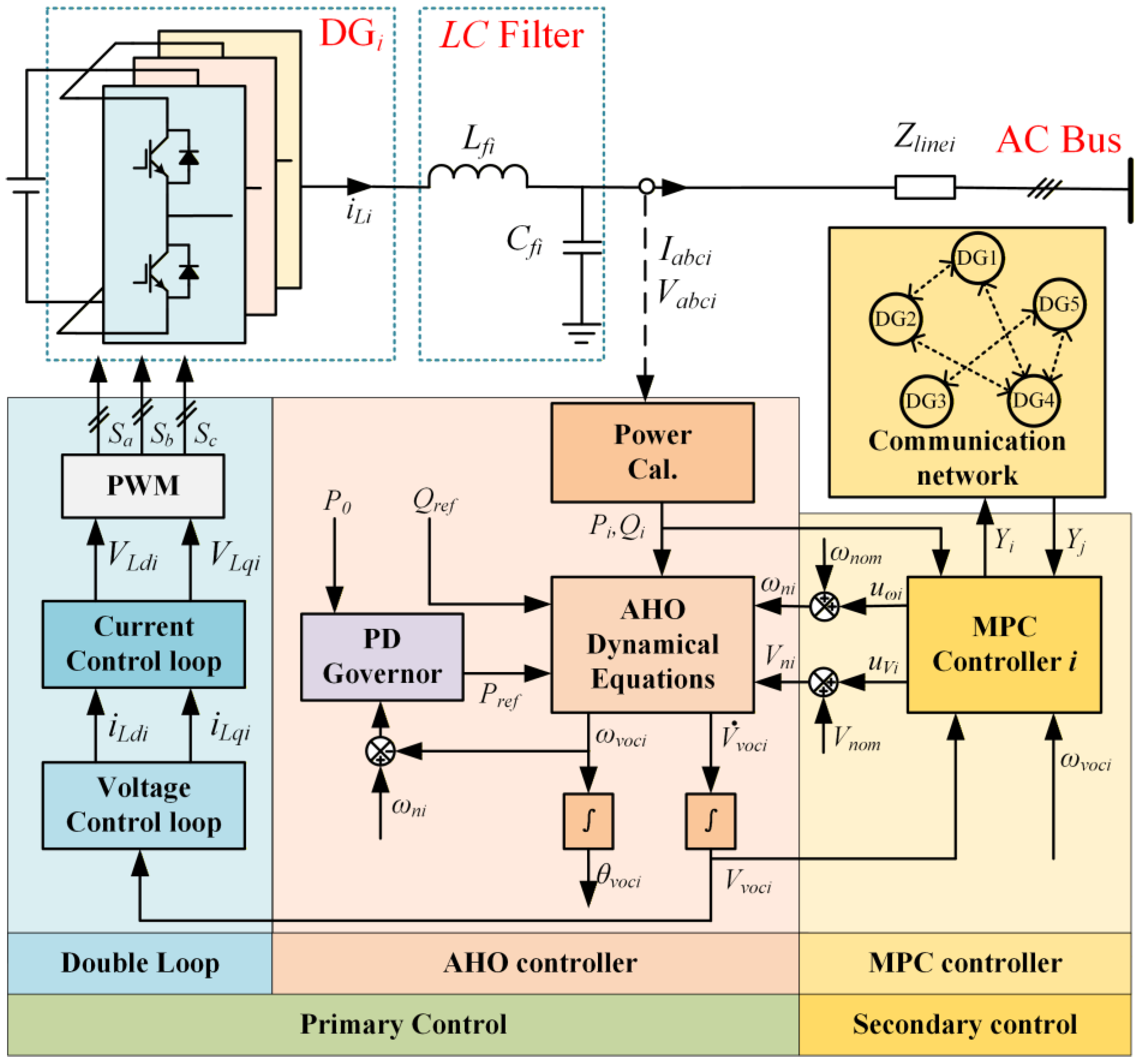
As shown in
Figure 1, the three-phase DG inverters are connected to the AC bus of the microgrid via
LC filters and equivalent grid impedance
Zlinei, where
Lfi and
Cfi denote the inductance and capacitance of the
LC filter, respectively.
Vabci and
Iabci represent the output three-phase voltage and the output current of the
ith DG inverter, and
corresponds to the current on the
ith DG inverter side, respectively.
In microgrids, the frequency and voltage stability of DGs are usually guaranteed by local primary controllers, while the distributed secondary controller is to eliminate deviations induced by the primary control. In this paper, the Andronov–Hopf (AHO) dVOC control strategy is used in the primary controllers for each DG, in which a voltage reference signal capable of autonomous regulation is constructed by directly integrating the power reference commands into the nonlinear dynamic model, thereby facilitating precise control over the inverter output power. The distributed MPC method is adopted for each secondary controller; the prediction sequence of neighbor nodes, Yj, is requisite. Additionally, it facilitates information exchange with other MPC controllers via communication nodes.
2.1. Modeling of the Communication Network
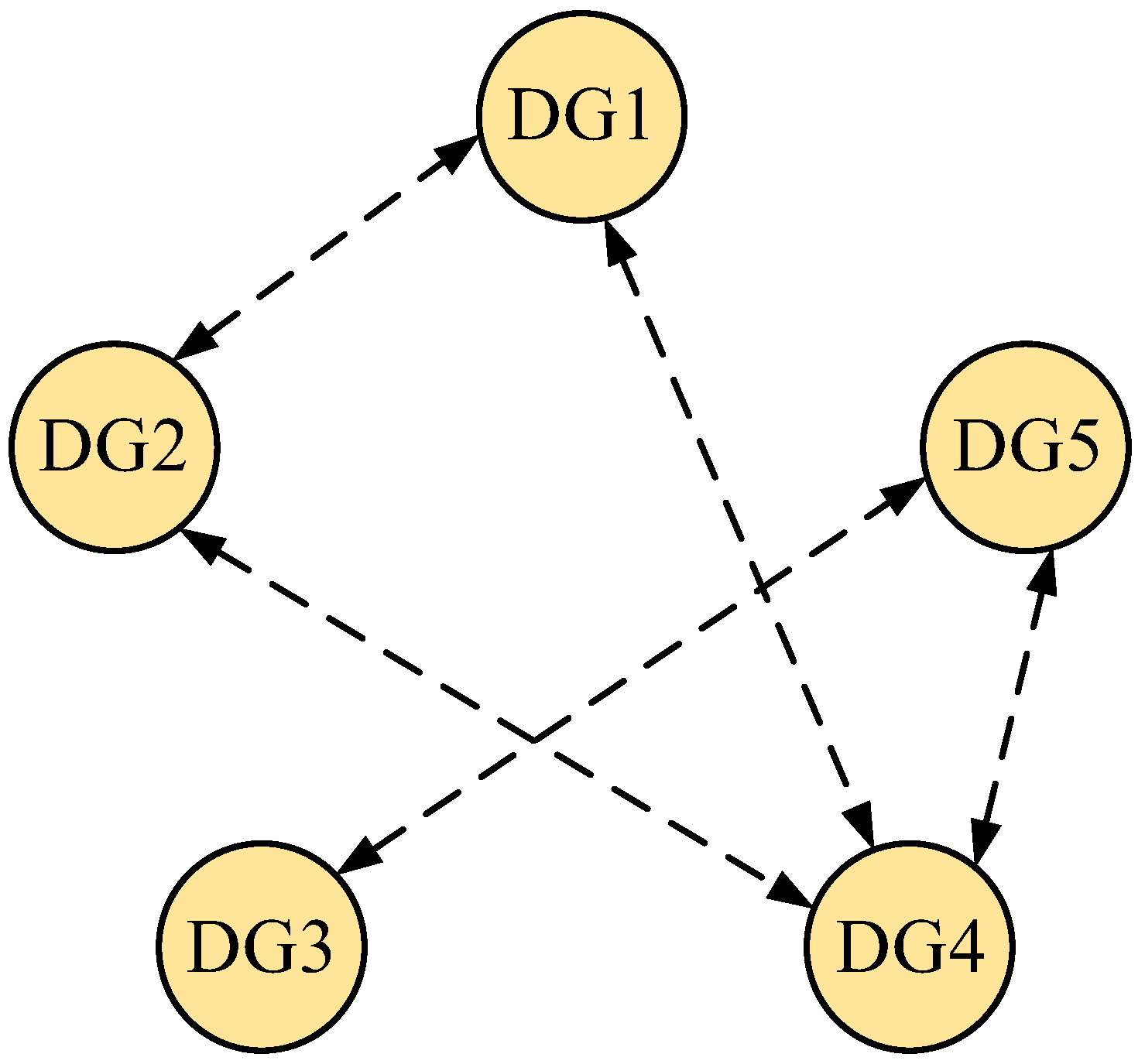
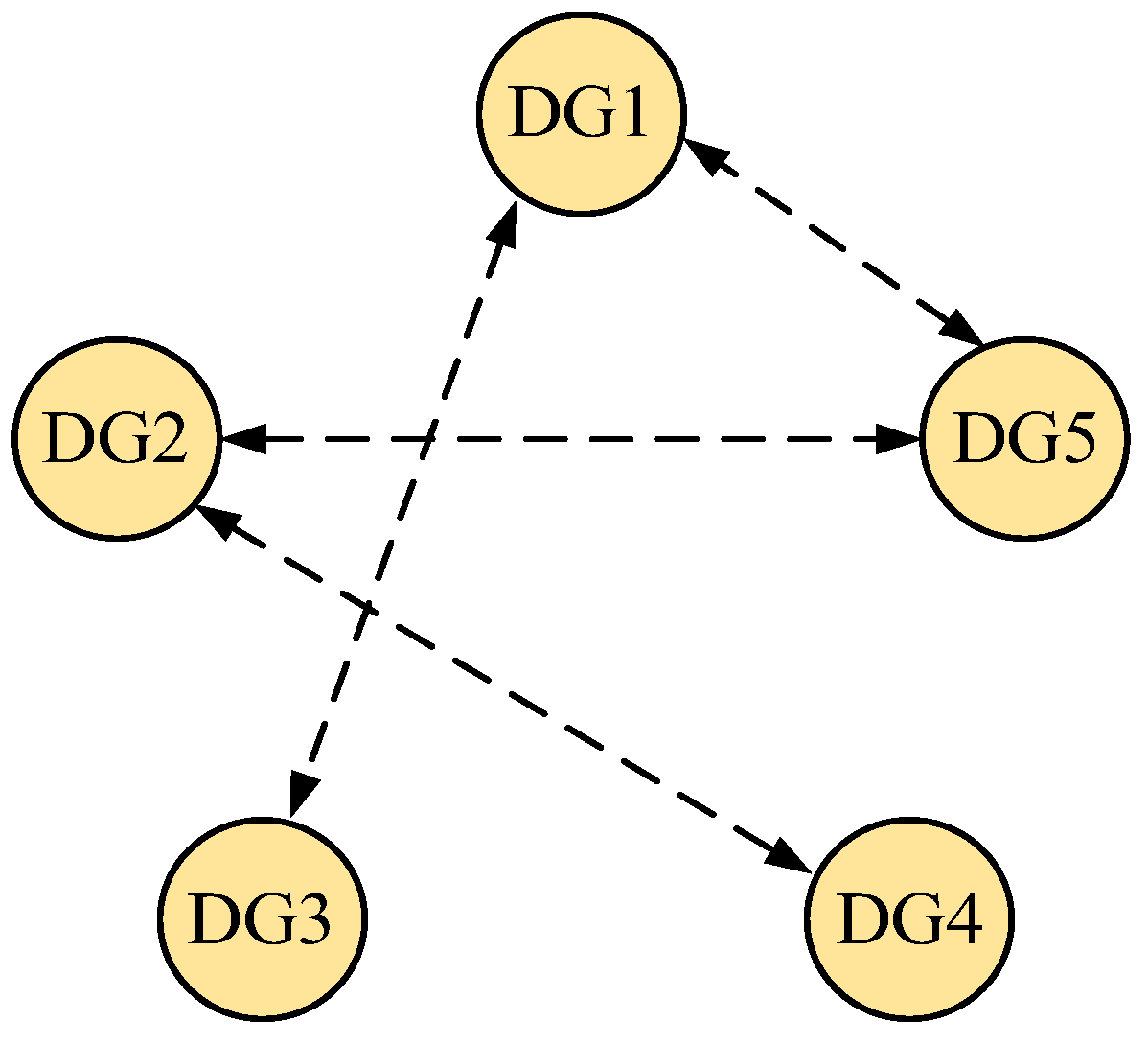
In this paper, the communication network comprising nodes is modeled as an undirected graph . Specifically, the node set represents the distributed MPC controllers in microgrids, while the edge set describes the communication links among these controllers. The existence of a direct information transmission channel between node and node is denoted as . The adjacency matrix is defined as , where the entry characterizes the connectivity between two nodes: if , then , with its value representing the communication weight between the nodes; otherwise, . Also, in this full-duplex communication network. Furthermore, for any arbitrary node , the neighbor set is defined as , which comprises all neighbor nodes capable of exchanging data with node . Assume there exists a virtual leader (node 0), and define the leader adjacent matrix as B = diag{b1, b2,…, bN}, in which bi = 1 if there is an edge from node 0 to node i; otherwise, bi = 0.
As shown in
Figure 2, the adjacency matrix is described as
2.2. Modeling of the dVOC Inverter
As discussed in [
20], the dynamic model of the
ith dVOC inverter is described as follows:
where
,
and
are the angle, angle frequency and voltage generated by the
ith dVOC inverter, respectively.
and
represent the reference values of active power and reactive power,
and
represent the output active power and reactive power, respectively.
and
are the nominal values of voltage and angular frequency of dVOC, respectively.
is the convergence coefficient, and
and
denote the voltage regulation coefficient and current regulation coefficient, respectively.
In order to enhance the inertial performance of the dVOC inverter, a PD controller is introduced in the power control link [
5], thus the improved dynamic model of AHO is given as follows:
where
and
are the proportional coefficient and derivative coefficient of the PD controller, respectively. In this paper, the VOC parameters
,
,
,
,
,
,
and
are identical for each DG.
2.3. Modeling of dVOC-Based Microgrids
Due to the nonlinear terms in the dVOC inverter model as shown in (3), modeling linearization is necessary to design the MPC controller. A first-order Taylor expansion of
around the operating point
yields
where
,
, and
correspond to the Jacobian matrices of
,
,
, and
, and
α denotes the higher-order terms, respectively.
Here, for the
ith dVOC inverter, take the state vector
, the input vector
, and the disturbance vector
. By neglecting the higher-order terms
α and subtracting
from both sides of (4), the linearized model is derived as
where
For the optimization at the k-th sampling instant, the operating point of the i-th DG is updated by using the latest available system variables from the previous sampling instant, i.e., xi(k) = xi(k − 1), ui(k) = ui(k − 1), and di(k) = di(k − 1). Accordingly, the nonlinear dVOC dynamics are re-linearized at each prediction window around the updated operating point, and the resulting local linear model is used for prediction within the current horizon.
4. Simulation Results
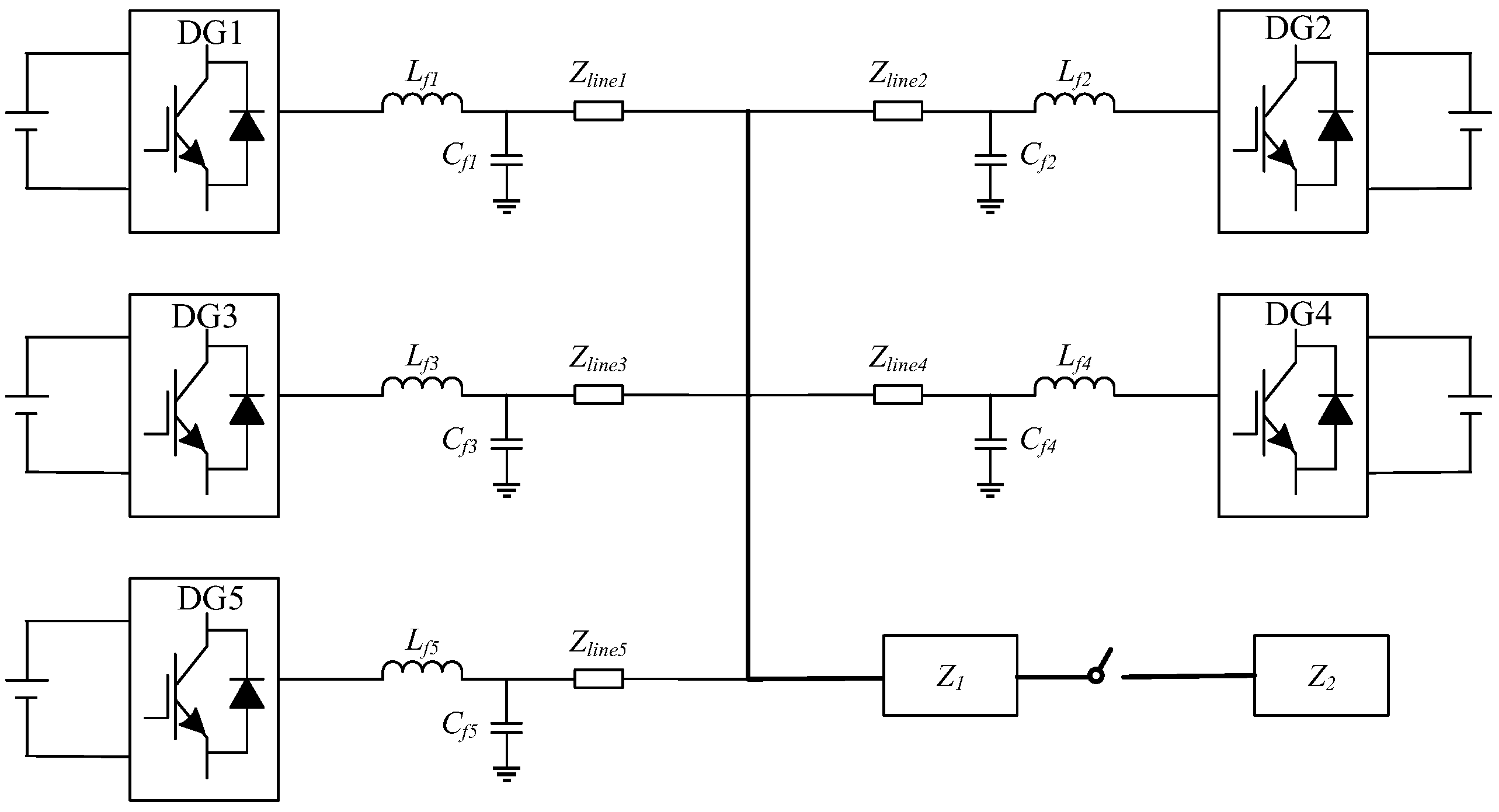
To verify the effectiveness, robustness, and superiority of the proposed DMPC secondary control strategy in the dVOC-based microgrids, a simulation model comprising five DGs, as shown in
Figure 3, was established on the Matlab/Simulink (Release 2022b, MathWorks, Natick, MA, USA) platform. The main system parameters and controller parameters are presented in
Table 1,
Table 2,
Table 3 and
Table 4. The weighting factors used in the cost function were heuristically tuned to manage the tradeoff among frequency restoration, voltage regulation, consensus coordination, and control smoothness, and, when necessary, to give priority to one control objective over the others. In this work, the same tuning principle was applied to all DGs. The remaining differences among the weighting parameters of different DGs were mainly introduced to account for the different line impedances and the resulting differences in electrical coupling strength. The simulations are conducted with four cases: effectiveness verification under load variation conditions, robustness verification against communication topology transformation, comparative analysis with other control strategies, and plug-and-play performance verification.
4.1. Case I: Load Changes
The communication topology and adjacency matrix of the simulation are shown in
Figure 2. The simulation steps are set as follows: the secondary control is activated at
; load
Z2 is connected at
, and load
Z2 is disconnected at
.
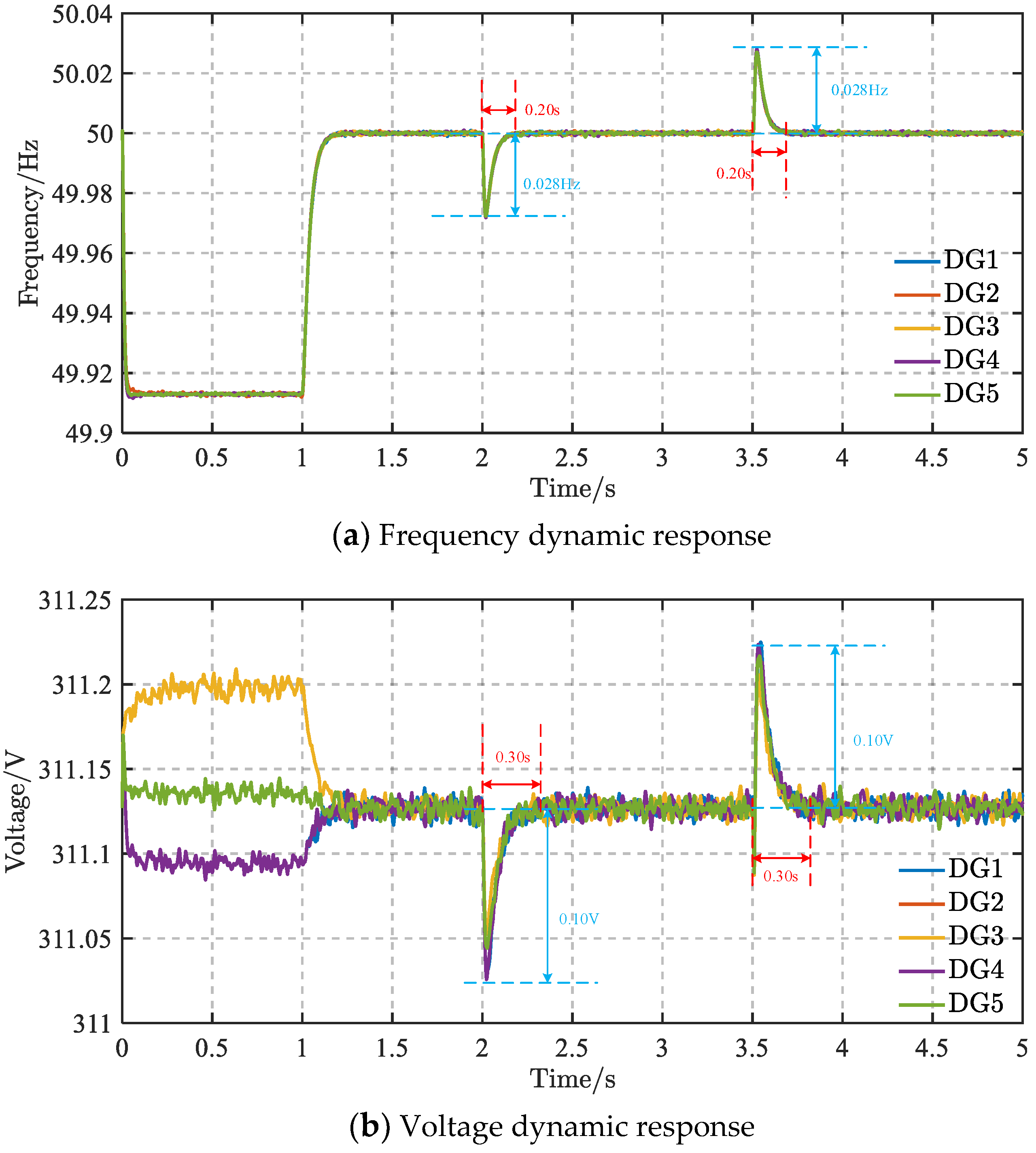
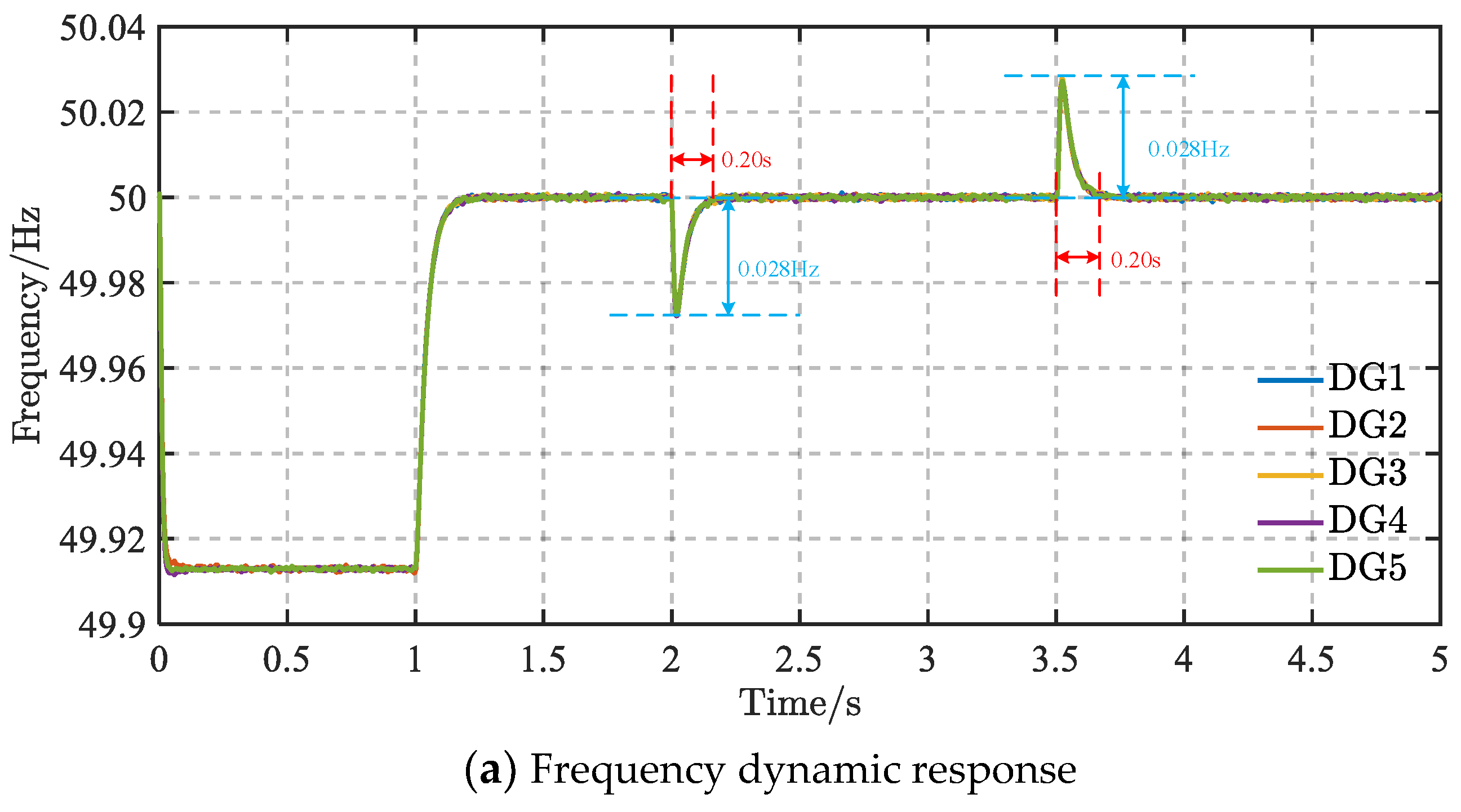
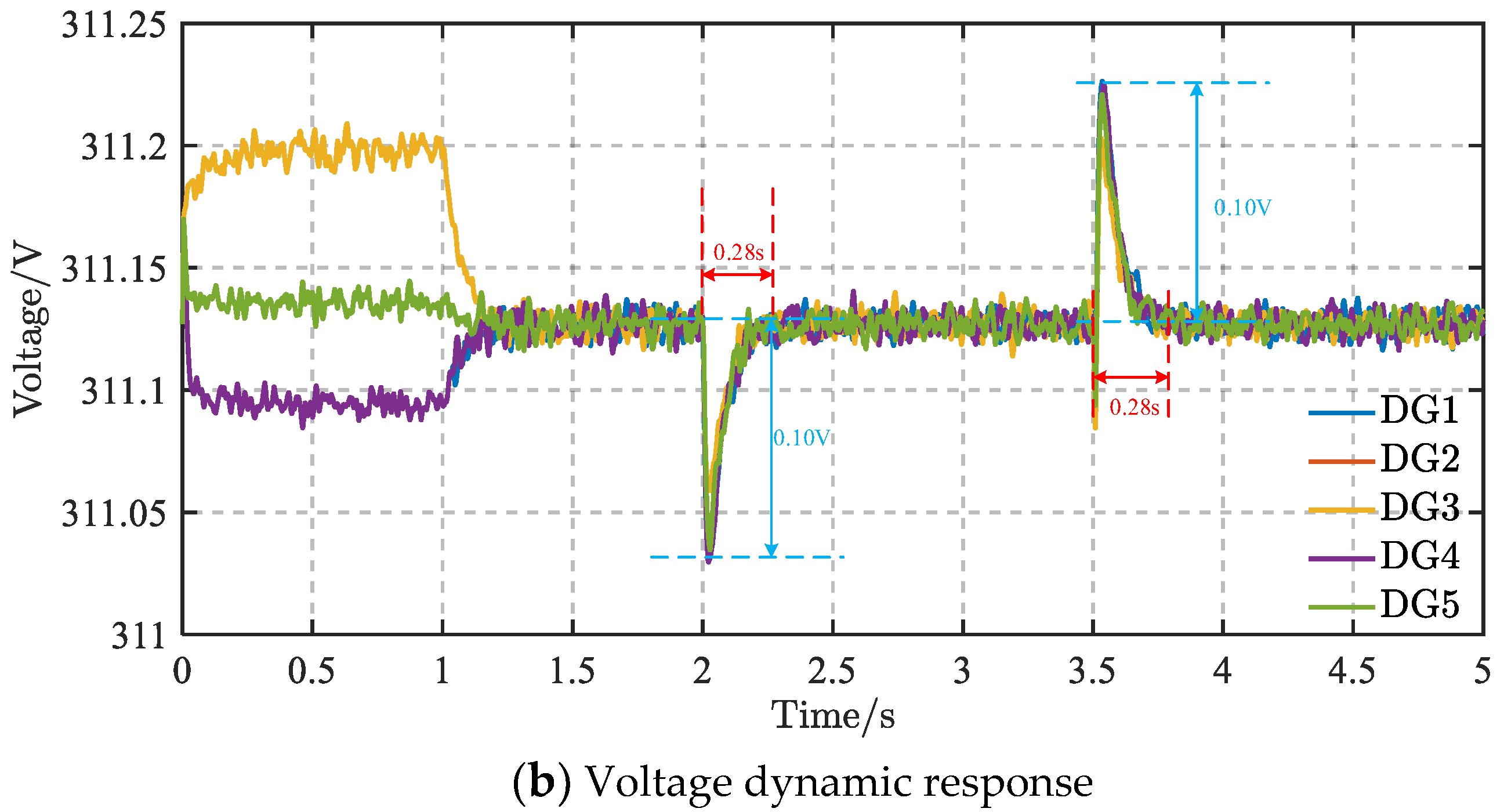
Figure 4 illustrates the dynamic response processes of the system frequency and voltage.
Figure 4a shows that before
t = 1.0 s, only the PD-VOC primary control is active, the system frequency stabilizes at 49.91 Hz with a steady-state frequency deviation. Moreover, due to the differences in line impedance of each DG, the voltage amplitude of each DG fails to achieve consensus. When the secondary controller with DMPC is active at
t = 1.0 s, the system frequency smoothly recovers to the rated value of 50 Hz within 0.20 s, and the voltage of each DG rapidly achieves consensus and converges to the reference value.
Under the sudden load change conditions at
and
, the DMPC exhibits strong anti-disturbance capability. The frequency fluctuations caused by the sudden connection and disconnection of the loads are rapidly suppressed; the maximum dynamic deviation is controlled within a certain range. As marked in
Figure 4a, the maximum frequency deviation is 0.028 Hz at both load switching instants, and the corresponding settling time is about 0.20 s. As shown in
Figure 4b, the maximum voltage deviation is 0.10 V and the voltage settling time is about 0.30 s for both load connection and disconnection. No significant overshoot is observed throughout the process, which verified the effectiveness of the DMPC method under load change conditions.
4.2. Case II: Communication Topology Change
Distributed control relies on the connectivity of the communication network. To verify the robustness of the proposed strategy against changes in the communication network structure, the communication topology is changed as shown in
Figure 5, and the load changes as in Case I.
Figure 6 illustrates the frequency and voltage dynamic response with the changed communication topology.
Comparing the waveforms in
Figure 4 (original topology) with those in
Figure 6 (changed topology in
Figure 5), despite significant topological changes, the system’s performance remains largely unaffected with the original control parameters. Specifically, under the changed communication topology, the maximum frequency deviation at t = 2 s and t = 3.5 s remains 0.028 Hz, and the corresponding settling time remains about 0.20 s, which is consistent with the results under the original topology. Similarly, the maximum voltage deviation remains 0.10 V, while the voltage settling time is about 0.28 s under both load switching events, which is very close to the 0.30 s obtained under the original topology. This indicates that even if the communication topology changes, the proposed DMPC strategy still achieves the global optimization objective through information interaction between neighbors, exhibiting a certain communication robustness.
4.3. Case III: Comparative Analysis
To further highlight the superiority of the proposed DMPC strategy, it is compared with the consensus algorithm and finite-time control under the same operating conditions. Both the consensus algorithm controller [
14] and the finite-time controller [
22] are implemented on exactly the same dVOC-based microgrid model as the proposed DMPC strategy. All compared controllers use the same system parameters, the same communication topology, the same load switching events, and the same initial conditions.
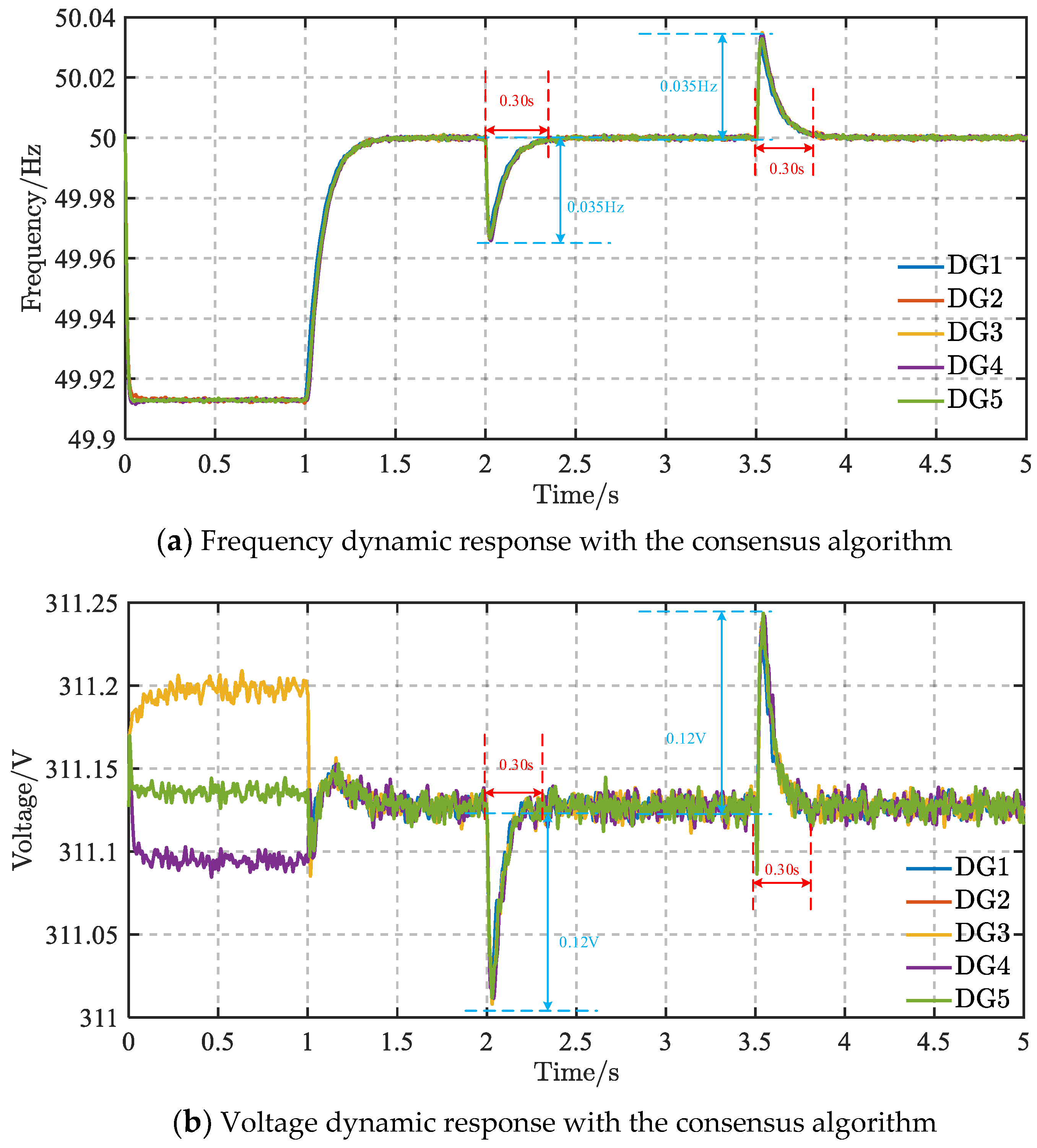
Figure 7 illustrates the dynamic responses of frequency and voltage for the consensus algorithm and finite-time control, respectively.
Since the consensus algorithm is based on the principle of asymptotic convergence, it usually cannot guarantee the convergence time. At the load disturbance moments of and , the maximum frequency deviation under the consensus controller is 0.035 Hz and the corresponding settling time is 0.30 s, and the maximum voltage deviation under the consensus algorithm controller is 0.12 V with a settling time of 0.30 s. As can be seen from the simulation results, although this algorithm can also achieve frequency recovery and voltage consensus eventually, its settling time is significantly longer than that of the proposed DMPC strategy, with a larger transient fluctuation amplitude. In contrast, MPC leverages the predictive model to perceive changes in system states in advance and perform receding horizon optimization on control variables, thus significantly improving the speed of dynamic response.
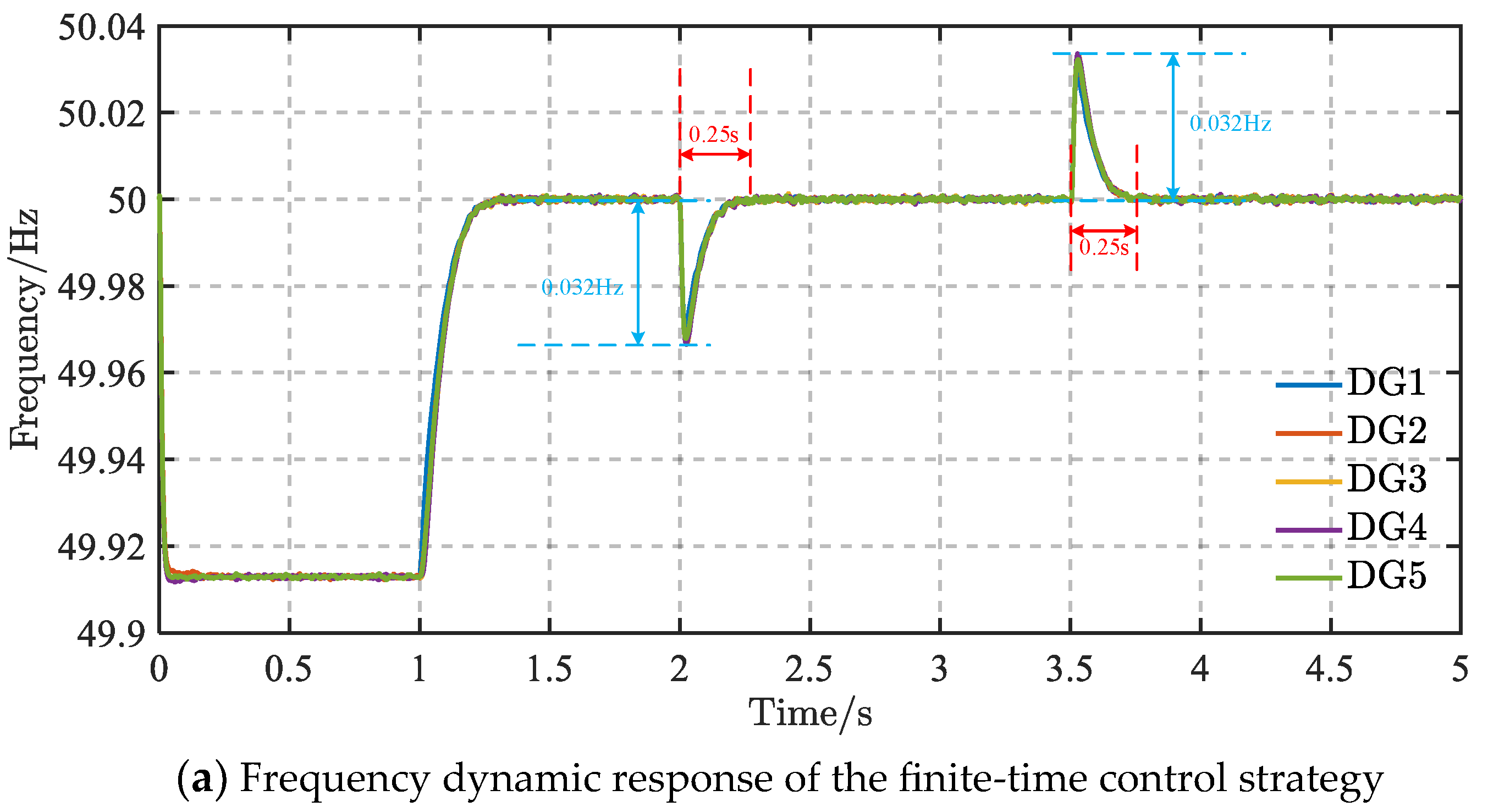
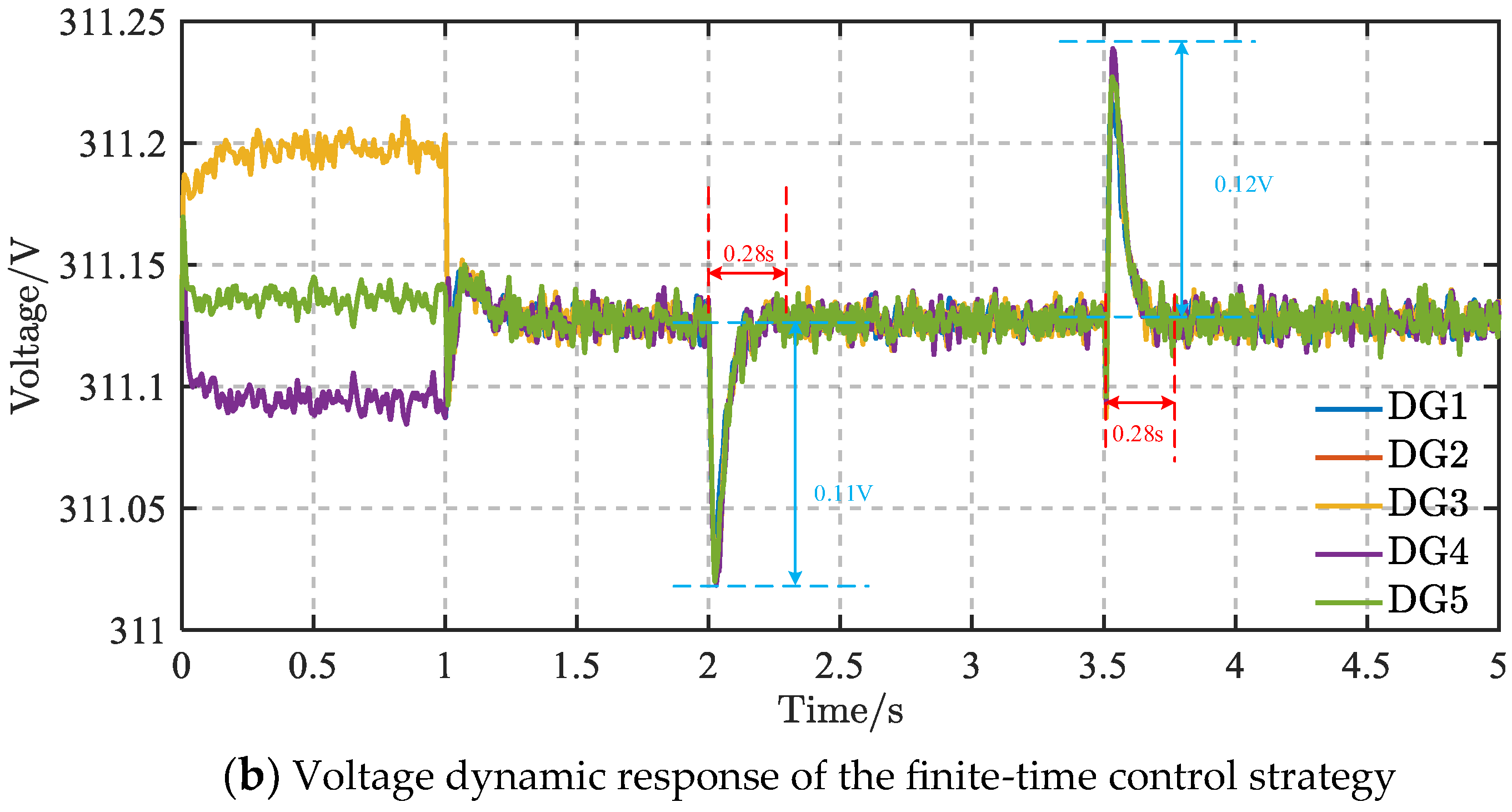
The finite-time control method achieves faster convergence speed by virtue of the nonlinear characteristics of fractional powers. As shown in
Figure 8, the finite-time controller yields a maximum frequency deviation of 0.032 Hz and a settling time of 0.25 s at both load disturbance instants. For the voltage response, the finite-time controller produces maximum deviations of 0.11 V and 0.12 V with a settling time of about 0.28 s. The simulation results show that although finite-time control also stabilizes the system in a relatively short time, the DMPC strategy ensures a smoother control process while maintaining comparable rapidity. Especially at the moment of load disconnection at
, the overshoot peaks of voltage and frequency under the DMPC strategy are slightly lower than those under finite-time control. This is because the DMPC cost function comprehensively performs weighted optimization on control increments and state deviations, which effectively avoids excessive control actions while ensuring fast dynamic response, thus achieving an optimal trade-off between rapidity and smoothness. Therefore, the distributed MPC secondary control strategy outperforms the traditional consensus algorithm in terms of dynamic response speed and surpasses finite-time control in terms of control process smoothness.
4.4. Case IV: Plug-and-Play Capability
To further verify the plug-and-play capability of the proposed DMPC strategy, the simulation process is arranged as follows: the secondary control is activated at
t = 0.5 s; DG5 is disconnected from the main loop at
t = 1.0 s;
Z2 is connected at
t = 2.0 s; DG5 is reconnected at
t = 3.0 s; and
Z2 is disconnected at
t = 4.0 s.
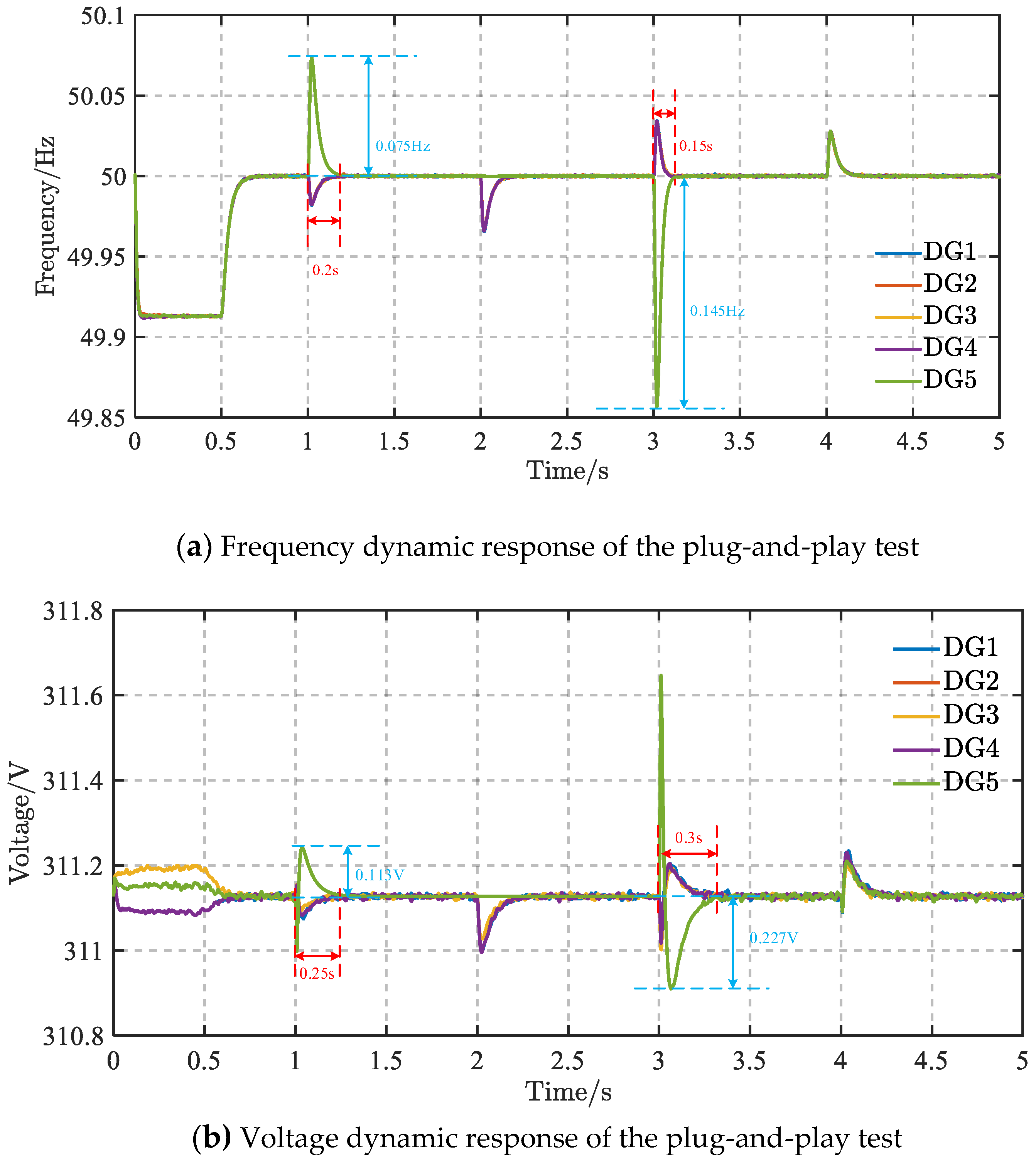
Figure 9 shows the dynamic responses of the system frequency and voltage during the whole process.
As shown in
Figure 9a, after the secondary controller is activated, the system frequency is rapidly restored from the steady-state deviation under primary control to the rated value of 50 Hz. When the communication links related to DG5 are disconnected at
t = 1.0 s, the system experiences a transient fluctuation, but the maximum frequency deviation is only about 0.075 Hz, and the frequency recovers to the consensus value within approximately 0.2 s. At
t = 3.0 s, when DG5 is reconnected to the communication network, the transient disturbance becomes relatively larger; however, the maximum frequency deviation is still limited to about 0.145 Hz, and the recovery time is about 0.15 s. In addition, the disturbances introduced at
t = 2.0 s and
t = 4.0 s only cause slight fluctuations, which are quickly suppressed without sustained oscillations.
Figure 9b further shows that the voltage amplitudes of all DGs remain well regulated throughout the plug-and-play process. At
t = 1.0 s, the maximum voltage deviation is approximately 0.113 V, and the voltage settles within about 0.25 s. When the communication links of DG5 are restored at
t = 3.0 s, the maximum voltage deviation is about 0.227 V, and the voltage returns to the consensus value within approximately 0.3 s. Although temporary spikes appear during the plug-out and re-plugging operations, the voltage of each DG rapidly reconverges, and no obvious steady-state error is observed. Therefore, the proposed DMPC strategy can maintain stable frequency regulation and voltage consensus under plug-and-play events, demonstrating strong adaptability and robustness to communication network reconfiguration.
5. Conclusions
This paper proposes a DMPC secondary control strategy to address the challenges of frequency restoration and voltage sharing in the dVOC microgrids. Firstly, accurate prediction of the system’s future state trajectory is achieved by discretizing the VOC dynamic equations. Subsequently, a consensus term and a tracking error term are incorporated into the cost function. By adjusting the weighting functions, an optimal trade-off between dynamic consensus speed and steady-state tracking precision is realized through the receding horizon optimization mechanism. Simulation results demonstrate that under sudden load variations, the proposed strategy rapidly eliminates steady-state deviations resulting from primary control. Moreover, compared with other methods, it exhibits a smoother transient process while ensuring fast convergence. Under the changed communication topology, similar dynamic performance is maintained, indicating good adaptability of the proposed DMPC strategy to the tested network reconfiguration scenario. In the plug-and-play test, the proposed method also maintains stable frequency regulation and voltage consensus, with the main transient indices remaining within acceptable ranges under DG disconnection and reconnection events.
Future work will focus on introducing additional compensation terms into the cost function to cope with non-ideal conditions such as communication delays and three-phase unbalances.