Article

Efficiency-Based CLLC Bidirectional DC-DC Converter Using Copolar Switching

1
Department of Mechanical Engineering, College of Engineering, National Yang-Ming Chiao-Tung University, Hsinchu 30010, Taiwan
2
Department of Material Science and Engineering, International College of Semiconductor Technology, National Yang-Ming Chiao-Tung University, Hsinchu 30010, Taiwan
3
Institute of Pioneer Semiconductor Innovation, National Yang-Ming Chiao-Tung University, Hsinchu 30010, Taiwan
4
Elan Microelectronics Corporation, No. 12, Innovation 1st Rd., Hsinchu Science Park, Hsinchu 30076, Taiwan
*
Author to whom correspondence should be addressed.
Energies 2026, 19(8), 1820; https://doi.org/10.3390/en19081820
Submission received: 5 March 2026 / Revised: 29 March 2026 / Accepted: 3 April 2026 / Published: 8 April 2026
(This article belongs to the Section F1: Electrical Power System)

Abstract

This paper introduces a novel switching method called copolar switching, designed to maintain high power efficiency in CLLC bidirectional chargers across different modes of operation. The proposed method sets the switching frequency close to the resonance of the LC tank within the CLLC circuit, ensuring efficient power conversion in both the forward (charging) and reverse (discharging) modes. Using Fourier series analysis and circuit theory, the necessary duty cycle for achieving the target efficiency is derived and applied to the full bridge on the high-voltage side in reverse mode. Copolar switching ensures that the entire CLLC circuit operates at a single resonant frequency, addressing the conventional issue of unbalanced efficiency between forward and reverse power conversions. A prototype circuit was designed for power conversion between 400 V and 48 V. Experimental results demonstrate 1 kW power conversion with 97% efficiency in forward mode and 800 W conversion with the same efficiency in reverse mode. Additionally, the copolar switching method shows potential for applications requiring voltage output adjustments, such as converting between 400 V and 50 V.

1. Introduction

Owing to the consideration of power conversion efficiency, bidirectional energy transfer in both the forward (charging) mode and the reverse (discharging) mode is a key requirement in many emerging power-conversion applications [1], including on-board chargers (OBC), battery storage systems [2,3], and distributed 48 V architectures for data centers [4]. In this context, a single-stage topology that can operate efficiently in both the charging and discharging directions is highly desirable because it reduces the component count and improves the volumetric density compared with cascaded unidirectional converters. The CLLC resonant converter has gained considerable attention for this purpose because its symmetrical two-tank LC resonant topology offers galvanic isolation, soft switching (ZVS/ZCS) over a wide load range, and inherent bidirectional power flow, making it a preferred choice for high-efficiency DC electrification systems, battery energy storage interfaces, and high-density server power supplies [5,6,7]. The two LC resonant tanks within the CLLC circuit are typically designed to compromise between the two opposite directions of the power flow. In practice, achieving comparable efficiency in both the forward and reverse modes remain challenging. When resonant tanks are tuned for optimal operation in the forward direction, the reverse flow tends to deviate from the resonant point, resulting in increased circulating current and higher device losses [5,8]. Conversely, tuning the circuit for optimal reverse operation can degrade performance in the forward mode. Several strategies have been proposed for achieving bidirectional charging in CLLC converters. One approach involves adding an extra boost buck circuit stage at the input of the high-voltage side or the output of the low-voltage side [9]. Although this can support power flow in both directions, it increases the number of transistors and passive components, thereby degrading the overall power efficiency. Another method applies frequency modulation to achieve different voltage conversion gains depending on the power flow direction, as observed from the high-voltage side [10,11]. However, this strategy sacrifices resonance in one of the operating modes, which limits power delivery and increases circulating loss. A third technique attempts to modify the transformer turn ratio dynamically [12]; however, this requires an additional double-throw switch and extra magnetic components, ultimately reducing the system’s power density and increasing design complexity. Recent attempts to increase the efficiency of bidirectional CLLC converters can be classified into three principal areas.
  • Device technology: Replacing Si MOSFETs with GaN HEMTs enables higher switching frequencies, which allows smaller resonant components and reduces both parasitic capacitance and switching losses [13,14,15].
  • Magnetic design: Integrating the high-frequency transformer into the resonant network jointly optimizes its leakage and magnetizing inductances, which cuts magnetic component count and pushes conversion efficiency beyond 96% [16,17,18].
  • Control strategies: Variable-frequency or hybrid phase-shift modulation broadens the soft-switching window over wide input and output-voltage ranges, several prototypes have reported peak bidirectional efficiencies of 95–97% [19,20,21,22]. In addition to circuit-level approaches, modulation strategies play a critical role in the performance of CLLC converters. Existing control methods can be broadly categorized into constant-frequency and variable-frequency approaches. Constant-frequency methods, such as phase-shift modulation (PSM) [23,24] and pulse-width modulation (PWM) [25,26], regulate power by adjusting the phase relationship or duty cycle of the switching signals while maintaining a fixed switching frequency. These methods are attractive for practical implementation but may suffer from limited gain range or increased circulating current. On the other hand, variable-frequency control, such as pulse frequency modulation (PFM), regulates the converter by shifting the operating point along the resonant tank characteristics, enabling wide voltage regulation. However, it introduces challenges in magnetic design and may degrade performance under light-load conditions. Hybrid modulation strategies combining these approaches have also been proposed to extend the operating range, but they often increase control complexity [20,21,22].
Despite these advances, most solutions rely on a broad frequency sweep, which may complicate EMI compliance due to variations in switching frequency. Since the common-mode (CM) noise in CLLC converters is strongly related to the phase difference determined by the ratio of switching frequency to resonant frequency, deviation from the resonant condition leads to increased noise amplitude [27]. The remainder of this paper is organized as follows. Section 2 presents the structure of the proposed bidirectional CLLC converter, including its simplified model and switching strategies. Section 3 focuses on reverse-mode operation using the proposed copolar PWM method and compares it with the forward mode. Section 4 presents a simulation and experimental results to verify the proposed method. Finally, Section 5 concludes the paper.

2. CLLC DC-DC Converter

2.1. Simplified DC/DC Converter

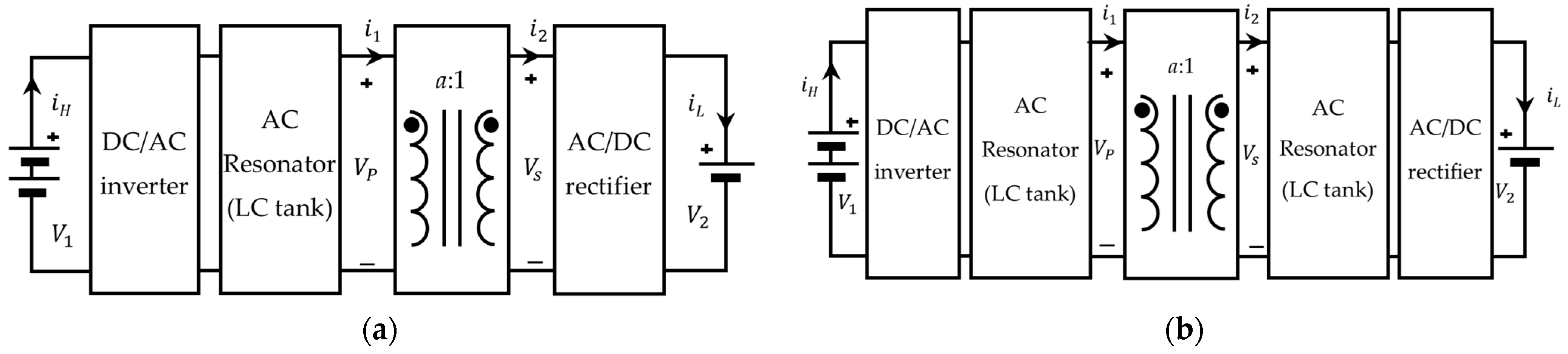
The LLC converter consists of a DC/AC inverter, a resonant tank, a transformer, and an AC/DC converter, as shown in Figure 1a. It converts the high-voltage DC input V 1 into a low-voltage output V 2 . In forward mode, the inverter generates a square-wave signal, which is converted into a sinusoidal waveform by the resonant tank. The transformer adjusts the voltage level, and the AC/DC converter rectifies it to the DC output V 2   . The individual submodules are basic electrical elements. However, the overall CLLC system requires proper impedance matching among components in Figure 1b. In addition, the converter operates bidirectionally, where the DC/AC inverter and AC/DC converter interchange roles, and the resonator supports power transfer in both directions. The currents labeled in Figure 1 consist of DC currents i H and i L , and AC currents i 1 and i 2 . All currents were in opposite flow directions, as shown in the reverse mode of operation, that is, discharging from the low-voltage side to the high-voltage side.
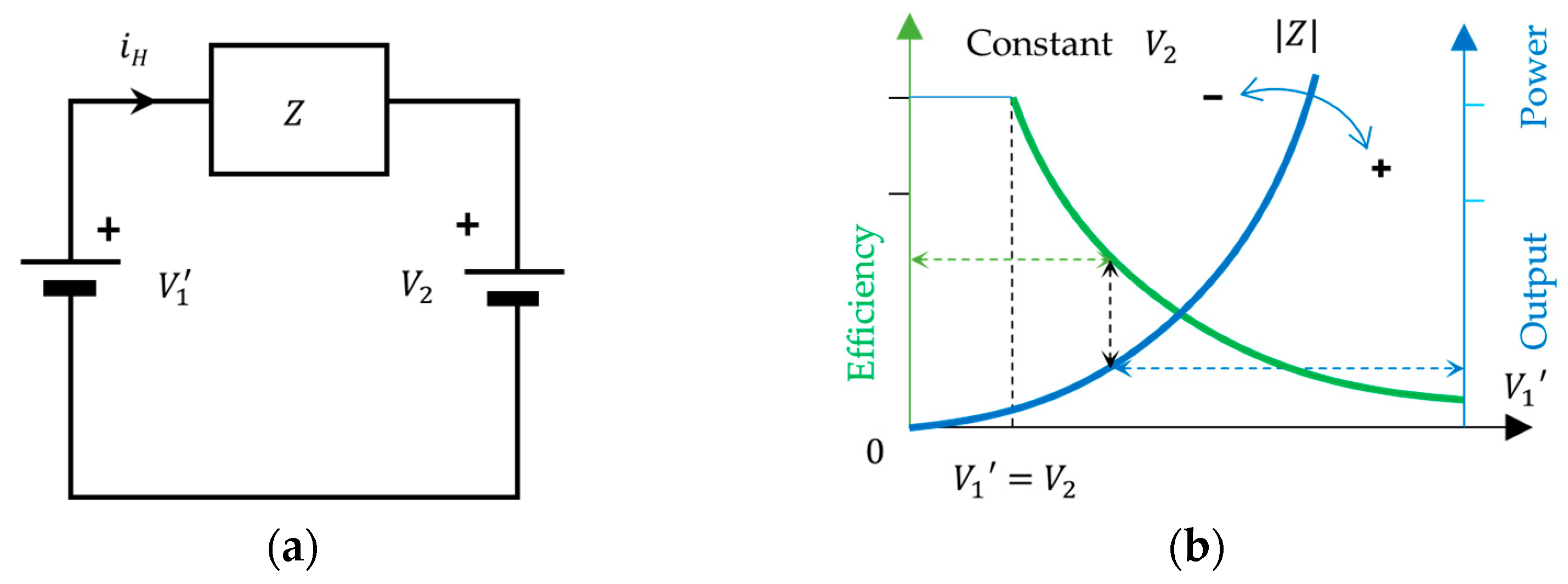
The DC/AC inverter can be implemented as a half-bridge or a full-bridge circuit. In a half-bridge configuration, the mid-point of the bridge switches between V 1 and 0 , generating a square wave signal. In a full-bridge configuration, the midpoint switches between V 1 and V 1 . The switching frequency is set close to the resonant frequency to maximize power transfer. When the magnetization current of the transformer is ignored, the equivalent circuit can be simplified as a DC/DC conversion scheme, as shown in Figure 2a. The voltage difference between batteries V 1 and V 2 is absorbed by the on-resistance R of the switch in Figure 2b. The power output from the high-voltage input V 1 to the low-voltage output input V 2 can be derived as follows:
P o u t = V 1 V 2 V 2 | Z |   w h e n   V 1 > V 2
The power conversion efficiency is then derived as follows.
η = P o u t P i n = P o u t V 1 V 2 2   | Z | + P o u t   = V 2 V 1
The above equations collectively indicate that while increasing the voltage difference can enhance the power output, it simultaneously reduces power efficiency. When the output DC voltage V 2 is specified, an efficiency-oriented DC-DC converter design relates the power output to the desired efficiency through the impedance | Z | , as shown below:
P o u t = 1 | Z | 1 η η V 2 2
This indicates that reducing the resistance is crucial for increasing power output. In the design stage, the input voltage V 1 is determined based on the required efficiency η using (2), and the maximum output power is constrained by the circuit impedance | Z | . Conversely, starting from the P o u t specification, the efficiency can be calculated based on the circuit impedance | Z | , as illustrated on the right-hand side of Figure 2. In a CLLC converter, the input voltage of the DC/DC conversion can be formulated as follows.
V 1 = V s + V 2
V s is the root-mean-square (RMS) value of the AC component of the output shown on the secondary side when V p denotes the RMS value of the AC component of the input on the primary side of the transformer, as shown in Figure 1. The reason for the RMS value V s to exist in (4) is that the transformer automatically generates its DC bias V 2 and the AC component is always rectified into a positive sinusoidal DC waveform during the forward (charging) mode. The efficiency of the CLLC converter during charging was calculated as follows.
η = V 2 V s + V 2
The power output is calculated as,
P o u t = I H · V 2
I H denotes the DC input current, which is calculated as follows.
I H = V s | Z |

2.2. Full Bridge CLLC Circuit

2.2.1. Circuit Topology

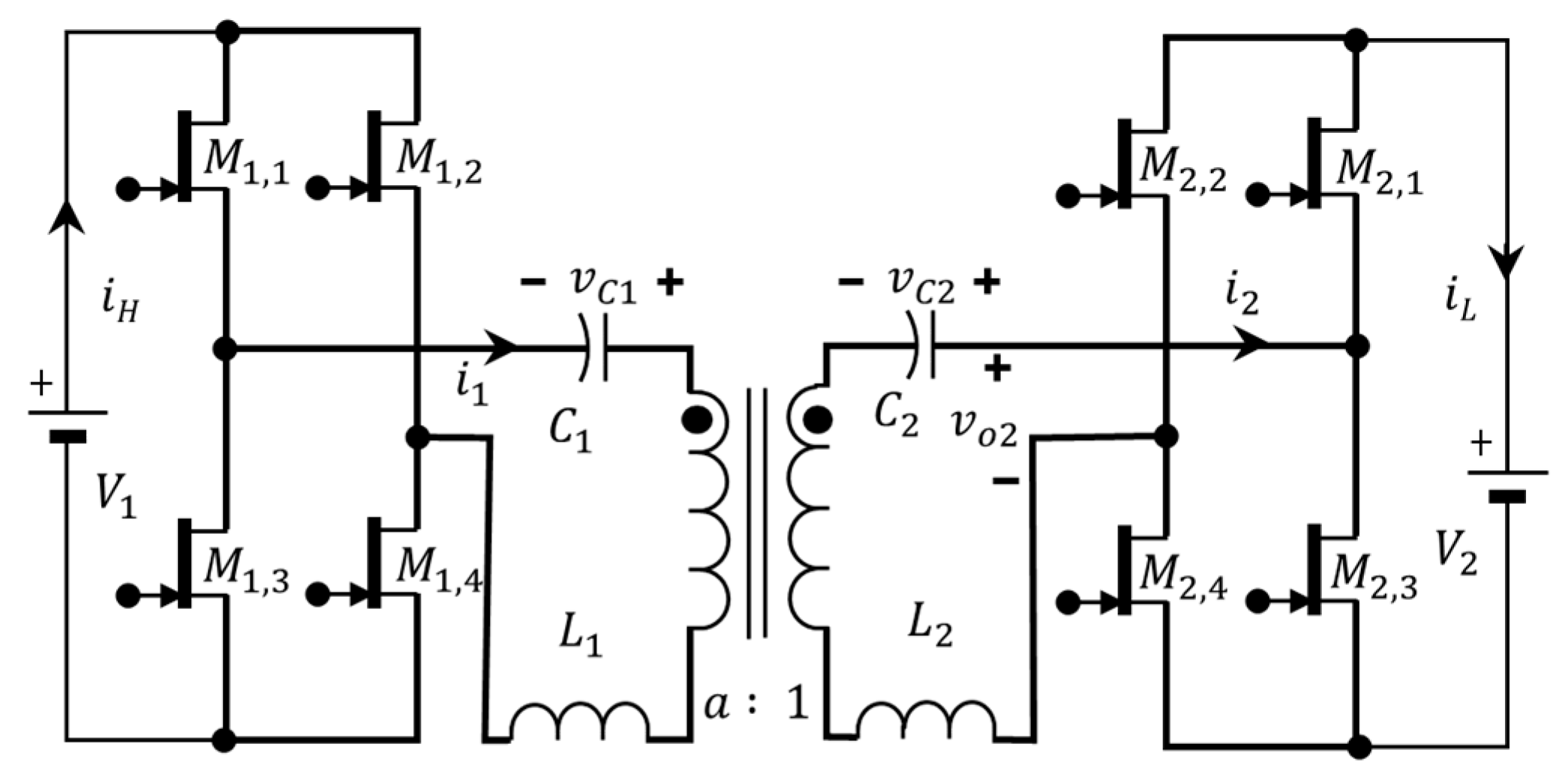
Unlike the LLC circuit, the CLLC circuit distributes the capacitor and leakage inductance to both sides of the transformer, as shown in Figure 3. These components serve as resonators, converting the square wave into a sinusoidal wave, which facilitates voltage transformation through the voltage transformer. Although the circuit is topologically symmetric, sharing the resonator across the transformer results in quantitative asymmetry due to the voltage difference between its terminals. The left side of the transformer is the high-voltage side, and the right side is the low-voltage side. The left side of the transformer is the high-voltage side, and the right side is the low-voltage side. Power flowing from the high-voltage side to the low-voltage side defines forward (charging), while the opposite direction corresponds to reverse (discharging). In either mode, the circuit includes a DC/AC inverter, AC resonator, voltage transformer, and AC/DC converter; only the roles of the DC/AC inverter and AC/DC converter are reversed.
The distributed capacitances, C 1 and C 2 , and resonant inductances L 1 and L 2 , forming individual LC tanks with the same resonant frequency, are preferable for creating a bidirectional charger and are constrained as follows.
L 1 L 2 = C 2 C 1 = a 2   ( i . e . ,   t r a n s f o r m e r   t u r n   r a t i o )
The resonant frequency ω 1 is of the series LC tank is derived as follows.
ω 1 = 1 L 1 C 1 = 1 L 2 C 2

2.2.2. Circuit Modeling

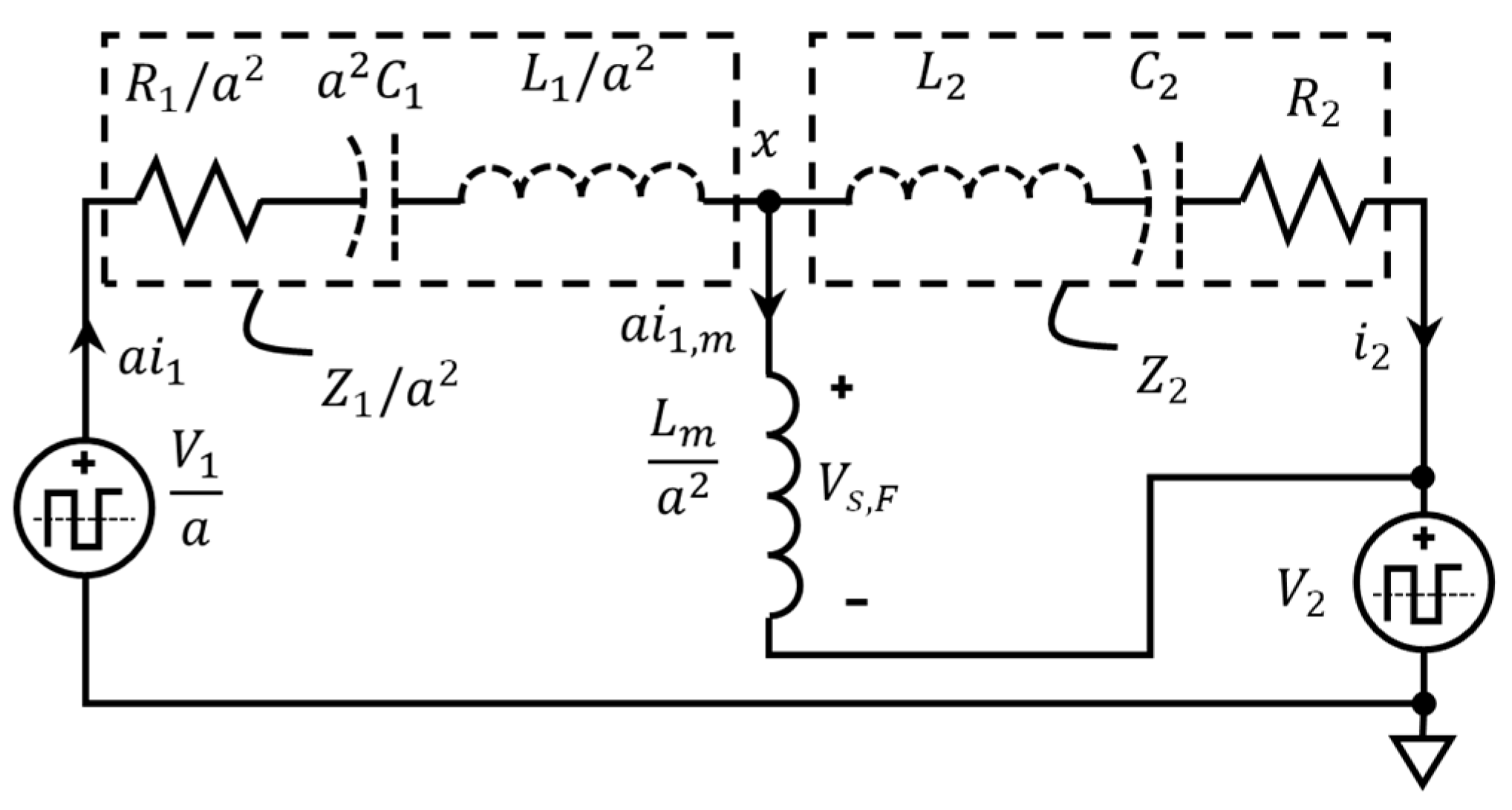
The series LC exhibits zero impedance when the switching frequency ω 0 matches the series resonance frequency ω 1 . A transformer is inserted between the LC tanks, and its winding inductance is split into magnetization inductance and leakage inductance. The equivalent AC circuit for the forward mode, that is, V 1 > a V 2 , is represented in Figure 4.
The impedance of the series LC tanks on both the high- and low-voltage sides is eliminated at the resonant switching frequency. The full bridges on both the high- and low-voltage sides converted the DC voltages into square waves on their respective sides. The square wave pulse trains are in-phase when the duty on both full-bridges is 50%. The bipolar switching method is used to control the full-bridge circuit. Node x represents the midpoint in the equivalent circuit, and its nodal voltage, denoted by V x is derived, providing that ω 0 L m Z 1 ,   Z 2 .
V x = β V 1 a + ( 1 β ) V 2
The magnetization current can be derived by solving the AC circuit shown in Figure 4 as follows.
I 1 , m = V x V 2 j ω 0 L m = a j ω 0 L m · β V 1 a V 2
Impedance ratio β is the voltage divider ratio according to the transformer equivalent circuit shown in Figure 4.
β = a 2 Z 2 a 2 Z 2 + Z 1
Impedance Z 2 accounts for at least the resistance of the full-bridge switches, R 2 , and the mismatched series resonance with the equivalent series resistance (ESR) of the LC tank on the low-voltage side, whose nominal value in this study is 150 m Ω . Impedance Z 1 also accounts for at least the resistance of the full-bridge switches, R 1 , and the mismatched series resonance with the equivalent series resistance (ESR) of the LC tank on the high-voltage side, whose nominal value in this study is 6 Ω . The magnetization inductance, that is, the primary winding inductance L m on the high-voltage side, is 350 µH, and the switch frequency is 250 kHz (=1.57 Mrad/s). The impedance ratio, β is calculated to be 0.58. The forward-mode charging currents I 2 , F are derived as follows.
I 2 , F = V 1 a V x Z 1 a 2 a I 1 , m a 2 Z 1 1 β V 1 a V 2 = V 1 a V 2 Z 2 + Z 1 / a 2
The on-resistance of the high-voltage side full-bridge switches is higher than that of the low-voltage side full-bridge switches because both the channel resistance and breakdown voltage are proportional to the drain-source distance of the GaN HEMT. The impedance ratio β associated with voltage V 1 , output voltage V 2 and turn ratio a determines the forward voltage V s , F of the DC-DC converter in (4).
V s , F = I 2 , F Z 2 = β V 1 a V 2

2.2.3. Design Considerations

The turn ratio a in this study was 7.32, the input voltage V 1 was 400 V and the output voltage was 48 V. The voltage as an input to the low-voltage-side battery is calculated from (14) as 3.85 V. The power efficiency calculated from (5) was 92.5%. The primary current derived from (7) is I H = 3 A . The power output calculated from (6) was 1.2 kW. The magnetization current calculated from (11) is 0.054 A, which is less than 2%. The results are listed in Table 1. Under the same circuit condition, only change the output voltage to 50 V, the efficiency becomes 95% with 900 W power output.
The majority of the impedance in both Z 1 and Z 2 arises from the mismatch between the switching frequency and resonance frequencies of the LC tanks on either side of the transformer. These impedances govern Equations (12)–(14) and therefore determine both the power output and power efficiency. High impedances reduce the output current I 2 , thereby decreasing the power output. The power efficiency is influenced only by the factor β which is only the ratio of the impedances; as β increases, the power efficiency decreases. In conclusion, achieving a precise switching frequency to enhance the resonance in LC tanks is key to attaining both high power output and high efficiency.

2.3. Switching Strategies

The forward mode uses either bipolar or unipolar switching to generate true square voltage waves, characterized by a 50% duty cycle (equal high and low periods) on both sides of the CLLC converter. The difference between bipolar and unipolar switching lies in the low voltage level: in bipolar switching, the low voltage level is − V D D , whereas in unipolar switching, it is 0 V. Therefore, bipolar switching can double the charging power as unipolar switching can. When the CLLC converter circuit is fixed with its turn ratio, the high-voltage side voltage V 1 divided by the turn-ratio a should be higher than the low-voltage side voltage V 2 to yield a positive current flow into the low-voltage side, according to (13). When the high-voltage side uses unipolar switching, the low-voltage side uses bipolar switching. The forward mode may revert to a reverse mode because the voltage swing on the high-voltage side is subjected to input square waves from V 1 to zero, and the low-voltage side is subjected to an input square wave from V 2 to V 2 . This is equivalent to reducing the high-side voltage by half in the equivalent circuit, as shown in Figure 4. Theoretically, it is possible to switch the forward mode into the reverse mode by swapping the switching strategies on both sides of the CLLC converter; in this case, we may set the turn ratio to be exactly the voltage ratio between high-voltage V 1 and low-voltage V 2 .
a = A V 1 V 2
A denotes the voltage gain of the DC-DC converter. However, it yields a very poor power conversion efficiency verified through the parameters in Table 1 by changing V 1 to 800 V when unipolar switching is applied on the low-voltage side. The RMS voltage derived from (14) is V s , F = 0.58 × 48 = 27.84 V and power efficiency derived from (5) that η = 48 / ( 48 + 27.84 ) is 63%.

3. CLLC Reverse Mode

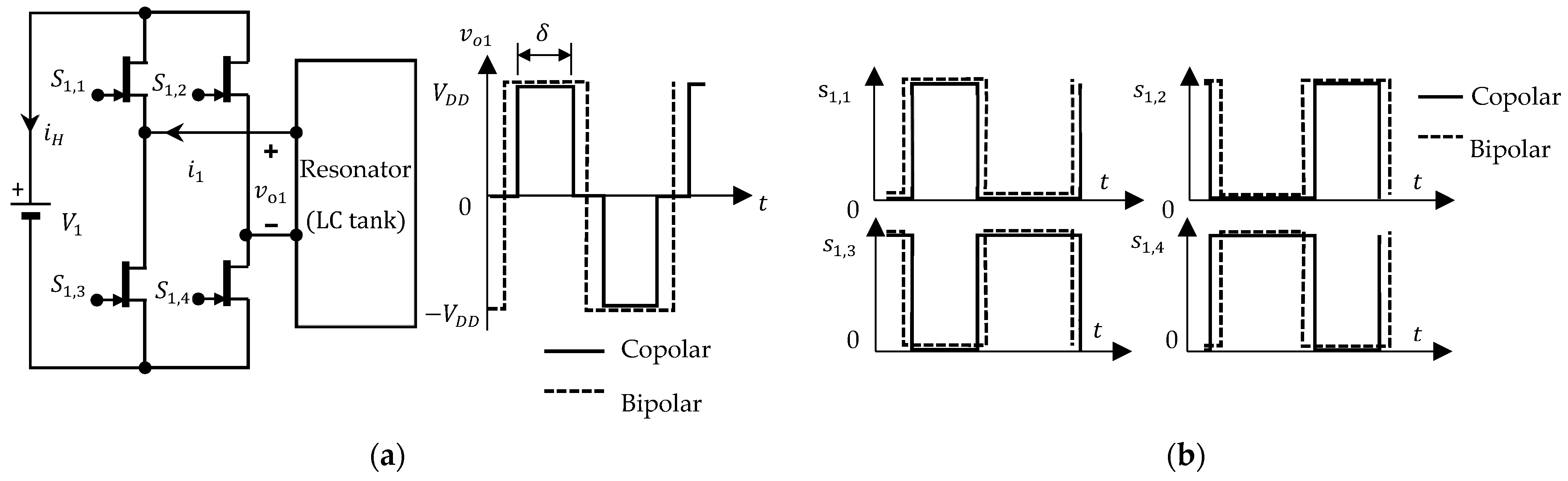
The following section introduces a copolar switching strategy for achieving bidirectional charging at a fixed switching frequency. As shown in Figure 5a, the currents i 1 and i H are labeled in opposite directions via the reverse mode compared to those shown in Figure 3 via the forward mode.

3.1. Copolar PWM Switching

Copolar switching is a hybrid of bipolar and unipolar switching [28] featuring three voltage states: V D D , 0, and − V D D . As shown in Figure 5a, the copolar switching generates an asymmetric voltage waveform, which consists of δ × 100 % of V D D and − V D D time, and ( 1 δ ) × 100 % of 0 V with respect to time. The corresponding switch control of the four switches in the full-bridge circuit, as shown in Figure 5b, is expressed as follows.
s 1,3 ¯ = s 1,1 = V G G , 1 4 δ 2 T t < 1 4 + δ 2 T 0 , e l s e s 1,4 ¯ = s 1,2 = V G G , ( 3 4 δ 2 ) T t < ( 3 4 + δ 2 ) T 0 , e l s e
The square-wave function v o 1 ( t ) can be modeled using different Heaviside step functions H x , which are activated at different times by copolar and bipolar switching. The square wave function v o 1 , b i p o l a r t , generated by bipolar switching with 50% duty, is expressed as follows.
v o 1 , b i p o l a r t V D D = 2 H t 2 H ( t T 2 ) 1
On the other hand, the square wave v o 1 , c o p o l a r t , generated by copolar switching is expressed as follows.
v o 1 , c o p o l a r t V D D = H t ( 1 4 δ 2 ) T H t ( 1 4 + δ 2 ) T H t ( 3 4 δ 2 ) T + H t ( 3 4 + δ 2 ) T
The Fourier series of the Heaviside step functions H x is as follows.
H x d = a 0 + n = 1 a n cos 2 π n x T + n = 1 b n sin 2 π n x T
Since v a t via unipolar switching is an asymmetric function over the time period T , the coefficients of the cosine components vanish. The coefficient of the sine component in (19) is derived as follows.
b n = 2 T 0 T H x σ T sin 2 π n x T d x = 2 T σ T T sin 2 π n x T d x = 1 n π ( 1 c o s ( 2 π n σ ) )
The switching frequency is related to the period time of the Fourier series by the equation ω o = 2 π / T . The Fourier series is then expressed as follows.
v o 1 , c o p o l a r t = 4 V 1 π n = 1,3 , 5 , ( 1 ) n + 1 · sin δ n π n sin n ω o t
Substituting δ = 50 % , we obtain the first mode of the sine component b 1 , c o p o l a r , which is identical to the first mode of the sine component for bipolar switching as follows.
v o 1 , b i p o l a r t = 4 V 1 π n = 1,3 , 5 , 1 n sin n ω o t
The magnitude of the first mode, n = 1 , of the bipolar switching is 4 V D D π , whereas for the copolar switching it is 4 V D D π · sin δ n π . The full-bridge output voltage v o 1 is the input to the AC resonator. The current i 1 of the LC tank can be obtained from a convolution of the input function to the admittance, the reciprocal of impedance, of the LC tank as follows.
i 1 t = C 1 · 0 t v o 1 ( t τ ) s i n ( ω 1 τ ) d t
When the switching frequency ω 0 matches its series resonance frequency ω 1 , the magnitudes of sinusoidal current i 1 t of copolar and bipolar switching are governed by the first mode of the sine component of the Fourier series, b 1 in (20), as follows.
I 1 , c o p o l a r I 1 , b i p o l a r = b 1 b i p o l a r b 1 c o p o l a r = ρ = sin δ π

3.2. Reverse Mode via Copolar PWM Switching

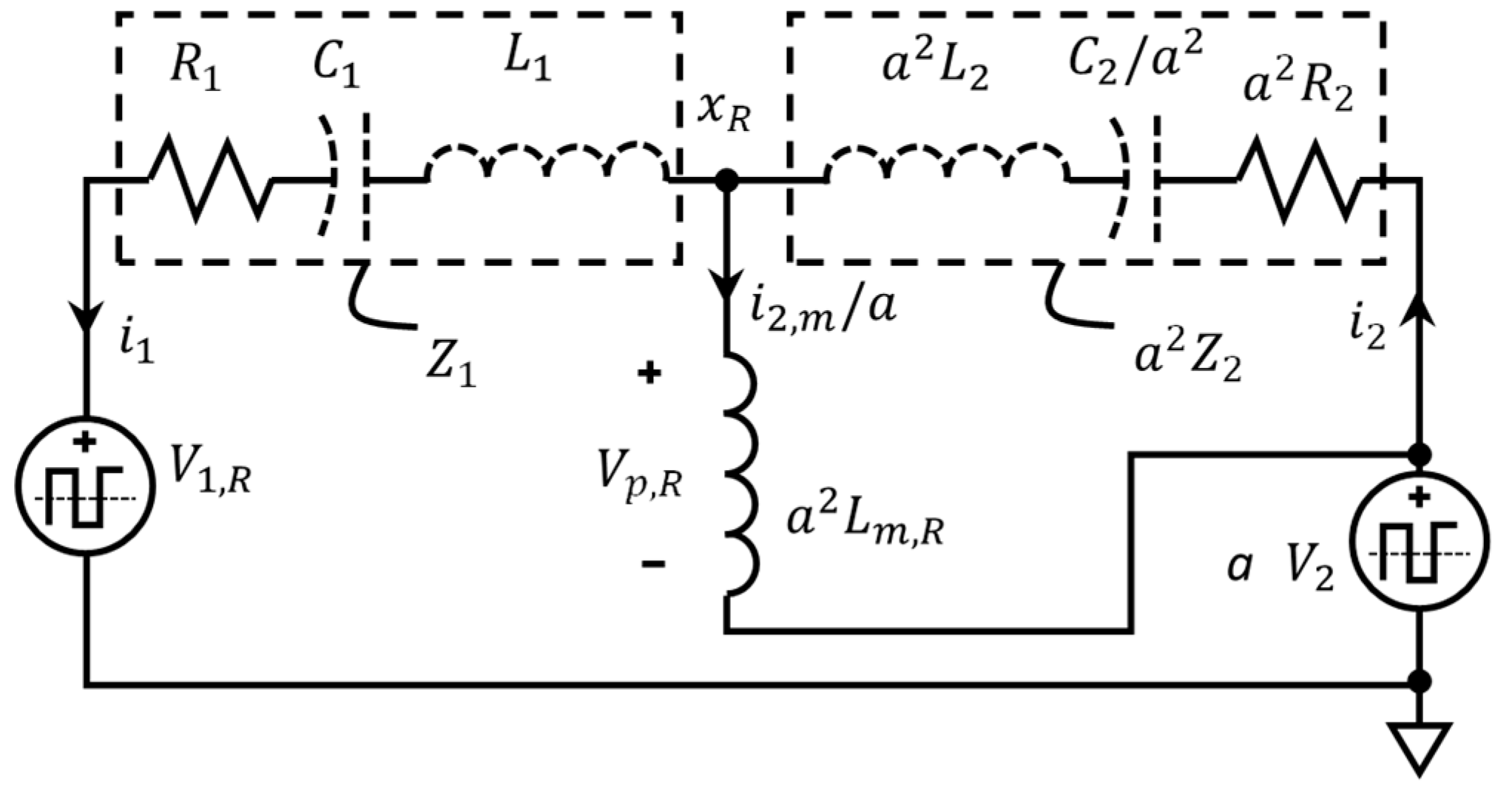
The equivalent circuit of the CLLC converter in the reverse (discharging) mode, discharging the low-voltage side battery to the high-voltage power-grid, is shown in Figure 6. The high-voltage side voltage level is adjustable using the copolar switching as follows.
V 1 , R = ρ V 1
Node x R represents the midpoint in the equivalent circuit, and its nodal voltage is denoted as V x , R .
V x , R = β V 1 , R + 1 β a V 2
The magnetization current can be derived by solving the AC circuit shown in Figure 6 as follows.
I 2 , m = V x , R V 1 , R a j ω 0 L m , R = 1 a j ω 0 L m , R · 1 β ( a V 2 V 1 , R )
In the above equation, it is observed that the discharging mechanism, discharging from the low-voltage side to the high-voltage side, is enabled if the voltage condition of reverse mode a V 2 V 1 , R > 0 is valid. Substituting (24) into (25), and applying this voltage condition, the duty ratio δ for copolar switching can be derived as follows.
δ < 1 π sin 1 a V 2 V 1
Since the secondary winding of the transformer maintains a relationship with the primary winding, disregarding the effects of leakage inductance and resistance may still be a concern, as follows.
L m L m , R = a 2
The magnetization current in (27) can be formulated in terms of the primary winding magnetization inductance as follows.
I 2 , m = a j ω 0 L m · 1 β ( a V 2 V 1 , R )
The reverse mode discharging current I 1 , R is derived as follows.
I 1 , R = a V 2 V x , R a 2 Z 2 I 2 , m a = β a 2 Z 2 1 β j ω 0 L m a V 2 V 1 , R
Since j ω 0 L m > > Z 1 , the above equation is simplified as follows.
I 1 , R = a V 2 V 1 , R a 2 Z 2 + Z 1
The secondary-side voltage V s , R of the transformer in (26) is also determined by the impedance ratio β associated with the voltage a V 2 and the output voltage V 1 , R stated in (25).
V s , R = I 1 , R Z 1 a = β V 2 V 1 , R a

3.3. Comparison of Forward and Reverse Mode

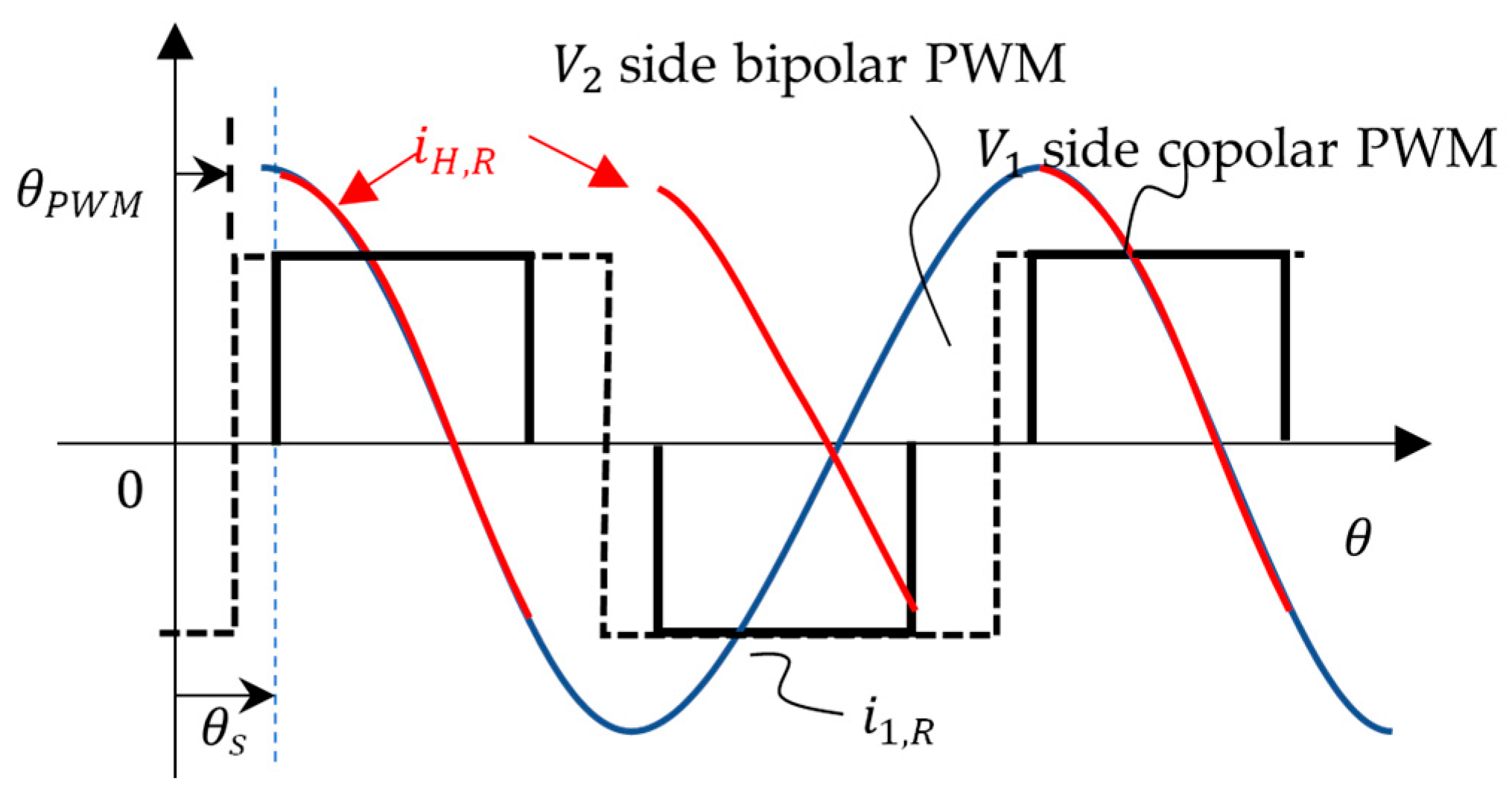
In the reverse mode, a useful means to control the current output to the high-voltage side is the phase shift between the high-voltage side switching and the low-voltage side switching. As shown in Figure 7, applying different PWM phase shifts θ P W M of the switching control on the low-voltage side yields different output current phases θ s under the high-voltage-side rectification. The relation between the LC tank current i 1 , R and the high-side current i H , R can be expressed as follows, provided that I 1 , R denotes the average DC current when i 1 is completely rectified.
I H , R = 1 2 θ s θ s + 2 π δ I 1 , R c o s θ   d θ
The output current phase θ s is indeed a function of PWM phase shift θ P W M .
θ s = f θ P W M
Controlling the PWM phase shift θ P W M in the microprocessor to yield θ s = π / 2 . We can obtain a DC current i H , R with an average DC current value as follows.
I H , R = 1 + s i n 2 π δ π 2 2 I 1 , R
The power efficiency of the reverse mode is derived as below:
η R = V 1 , R a V s , R + V 1 , R = 1 β ( a ρ A 1 ) + 1
where A = V 1 / V 2 . Following a similar line of reasoning, the power efficiency of forward mode in (5) and (14) can be formulated as follows.
η F = V 2 β V 1 a V 2 + V 2 = 1 β A a 1 + 1
In order to ensure that the forward mode and reverse mode achieve the same efficiency, i.e., η = η F = η R , the duty control δ is derived from (37) and (38).
sin δ π ρ = a A 2
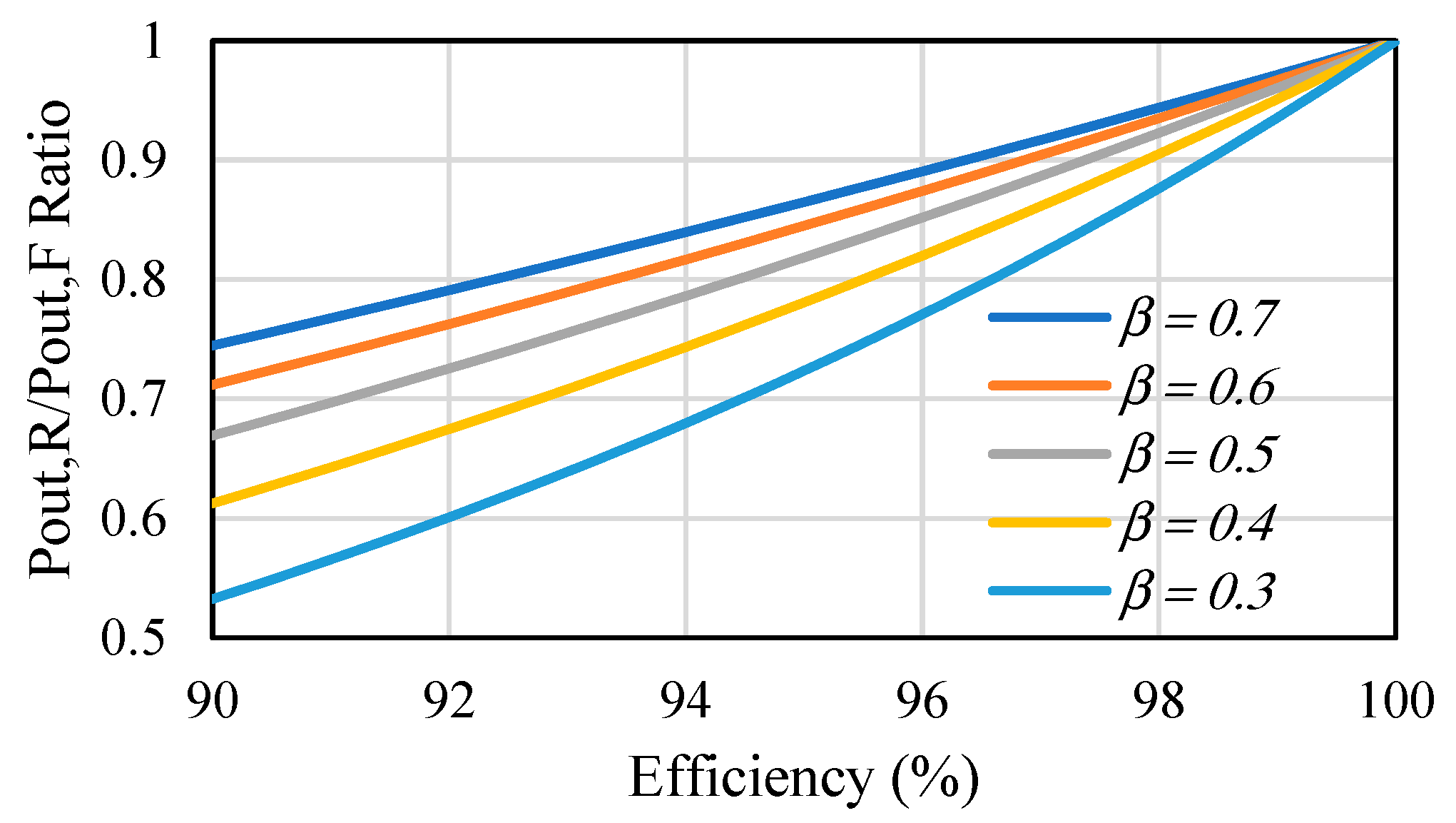
Using the parameters a and A listed in Table 1, which yield a / A = 0.88 as an example, we calculated δ = 28%. The output power P o u t , R of the reverse (discharging) mode is reduced due to the efficiency-based design, i.e., η = η F = η R utilizing the copolar switching, which is derived from (25), (32), (34), (38) and (39) as follows.
P o u t , R P o u t , F = I 1 , R V 1 , R I 2 , F V 2 = 1 + 1 β 1 η 1
As shown in Figure 8, the power ratio is unity for 100% power efficiency; however, the imbalance of LC tank impedances on the high-voltage and low-voltage sides in practical implementation can affect the power ratio. It implies that a high impedance ratio β can increase the power ratio. Substituted the impedance ratio β = 0.58 in (12), the discharging power in the reverse mode is 1 kW when the charging power is 1.2 kW at the power efficiency of 95%.

4. Simulation and Experiment Result

4.1. Simulation

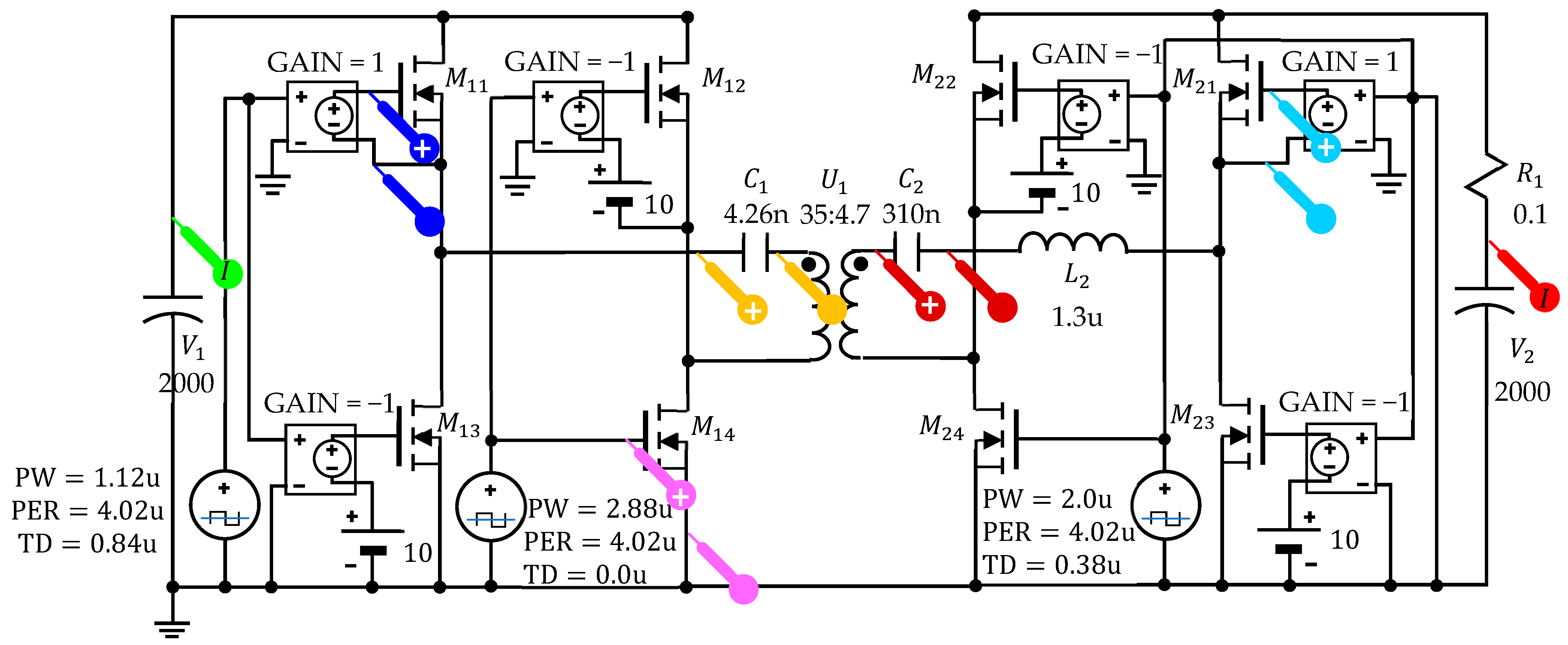
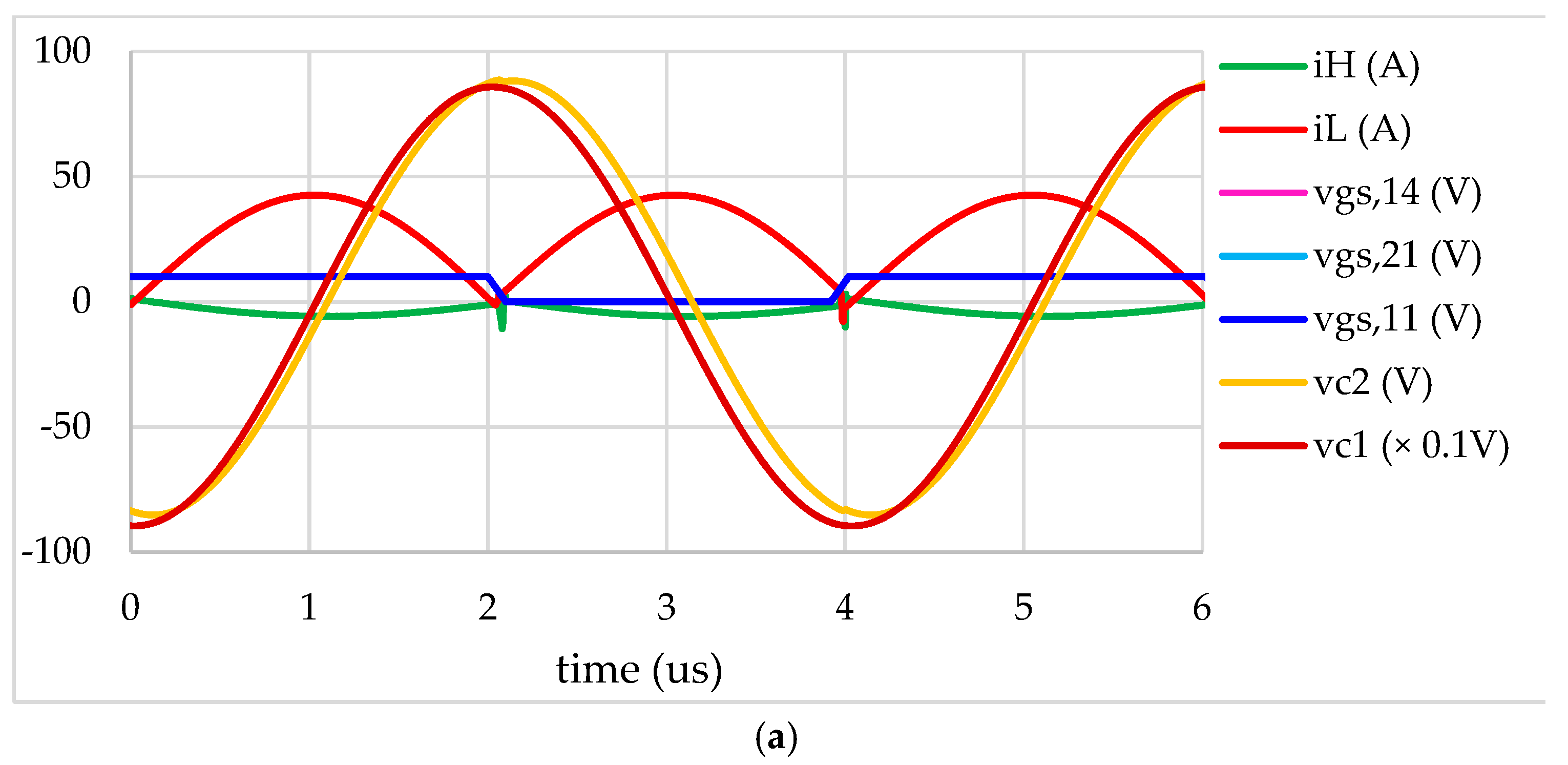
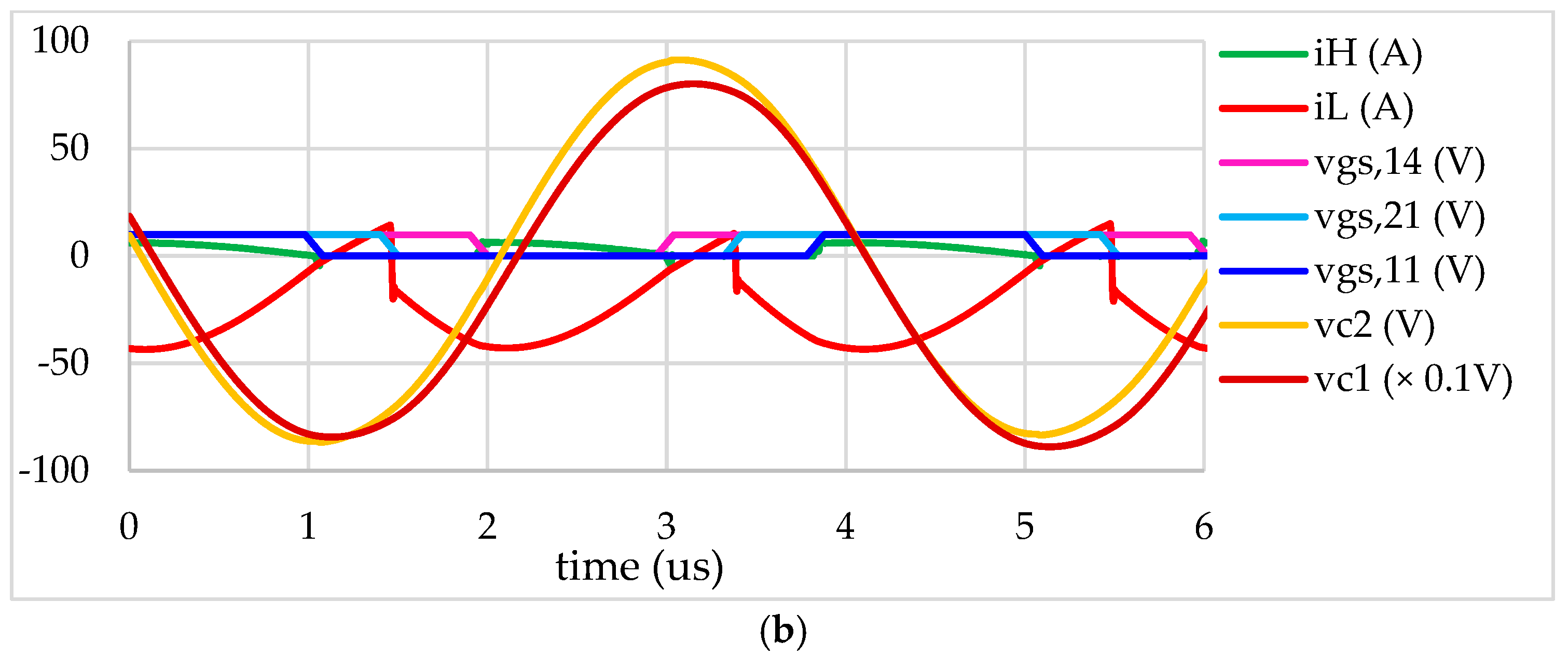
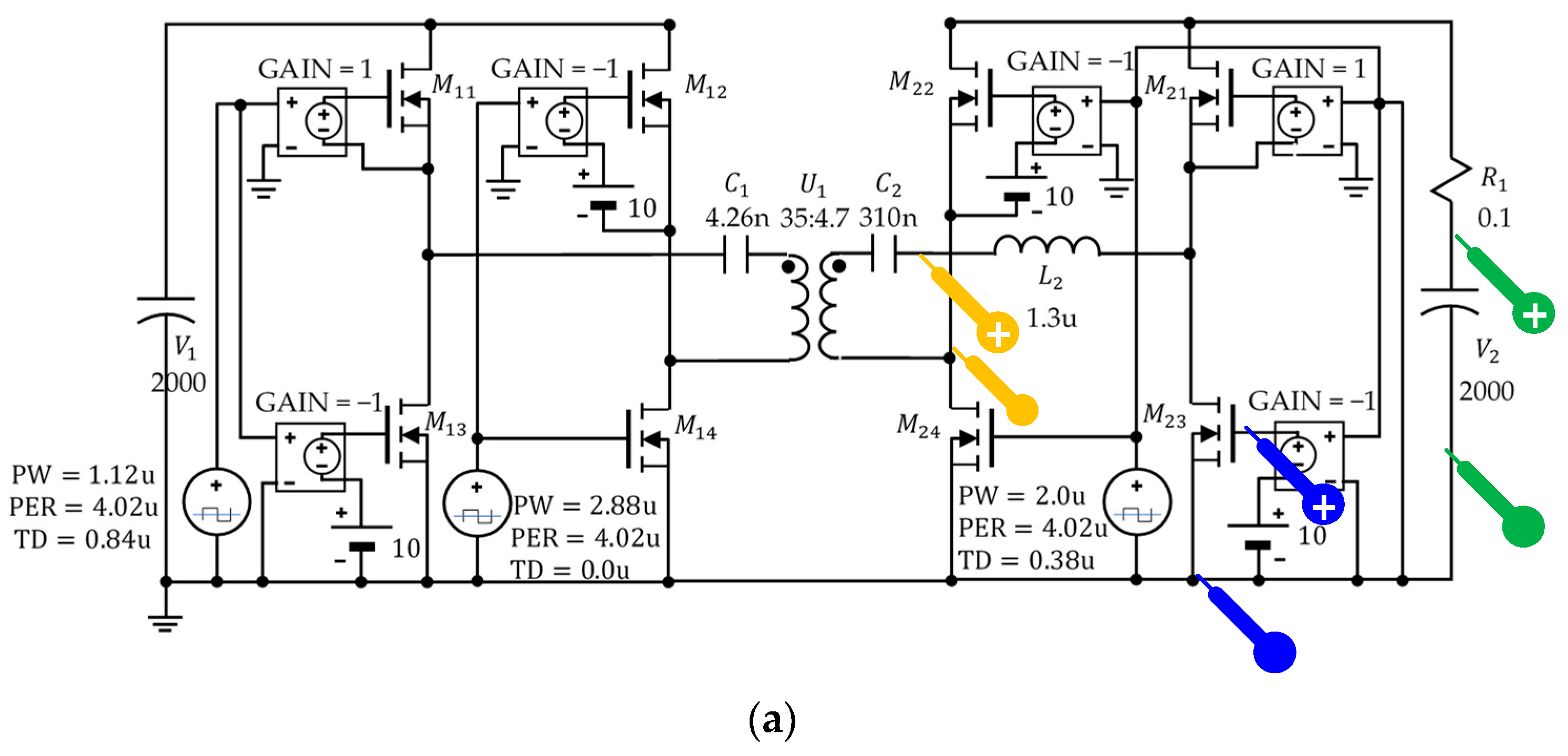
The CLLC converter circuit was analyzed using OrCAD PSpice, as shown in Figure 9, and the parameters are listed in Table 2. The major power losses that affect power efficiency are the equivalent series resistance (ESR) of the capacitors, inductors, and transformer coils. These power losses were not modeled in our equivalent circuit for the theoretical model, which is also component selection and PCB design-dependent in actual implementation. In the simulation model, we included the ESR effect by adding a resistor R 1 = 0.1 Ω on the low-voltage side as the load output, whose power loss was eventually excluded from the power efficiency calculation for comparison with the theoretical results. The quality of the resonances in the LC tanks of the CLLC is essential for the power efficiency and power output rating. Because of the impedance mismatch between the two sides of the transformers, the resonance oscillations can present a phase shift between the capacitor voltages v c 1 and v c 2 . As shown in Figure 10a, the phase difference between capacitor voltages v c 1 and v c 2 is within 15 o when both capacitor voltages are centered at 0 V in the forward mode. The charging currents i H and i L are in the state of zero-current switching (ZCS) when the full-bridge circuit changes its states. During the forward mode of charging the low-voltage side, all transistors were synchronized with 50% duty ratio. As shown in Figure 10b, the phase difference between capacitor voltages v c 1 and v c 2 is slightly higher than that in the forward mode. The charging currents i H and i L are no longer in the ZCS status. During the reverse mode of discharging the low-voltage side, the transistors on the high-voltage side are controlled using the copolar switching with duty ratio 28% when those on the low-voltage side remain the bipolar switching. Table 2 compares the results. From the power output point of view, we found that the copolar switching reduces the power output, as stated in (40), and the power output ratio is 1.016/1.357 = 75%. According to the result shown in Figure 8, the impedance ratio β = 0.35 is obtained for the simulation when both of the modes are with a similar power efficiency around 94.5%.

4.2. Experiment

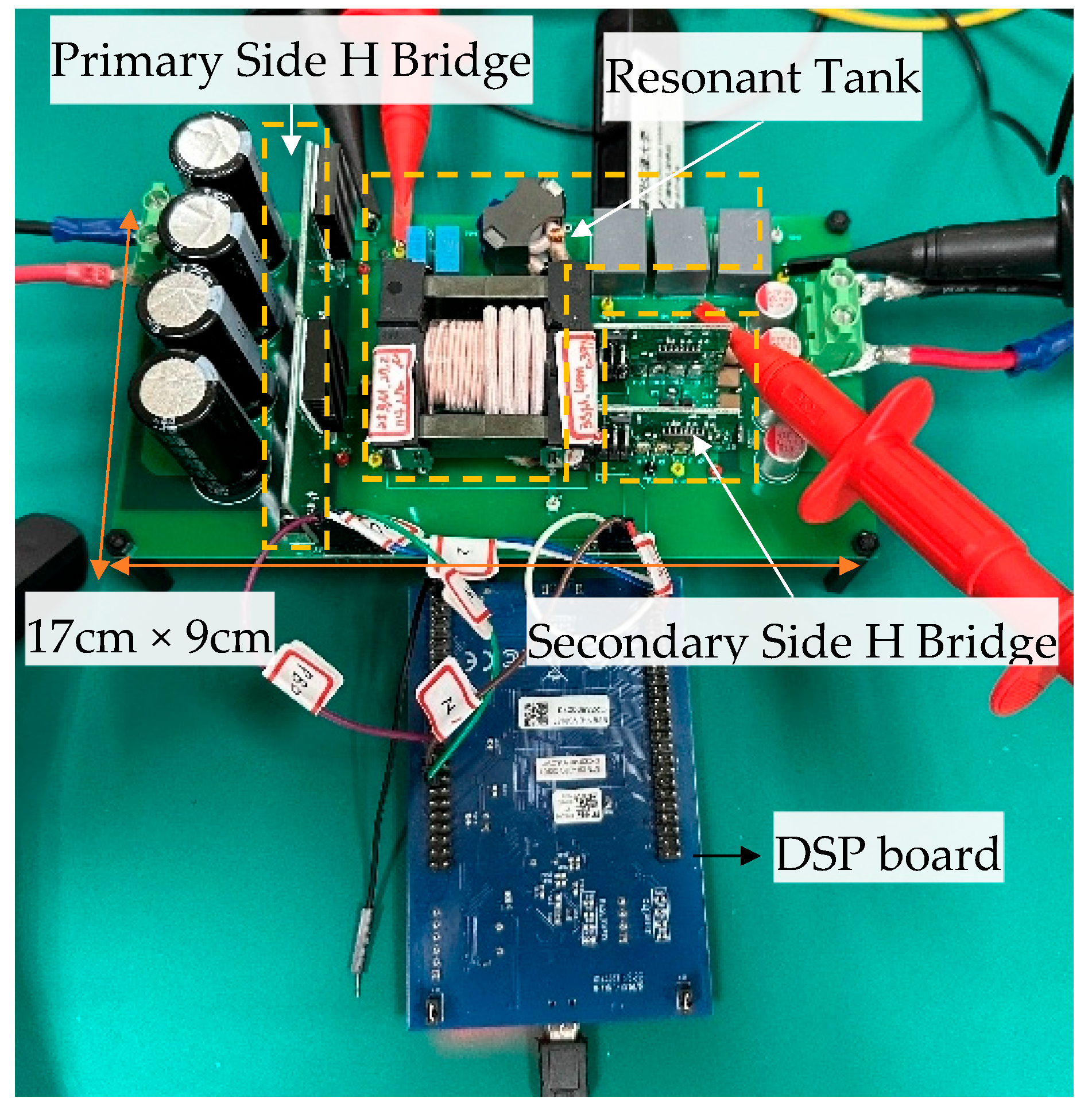
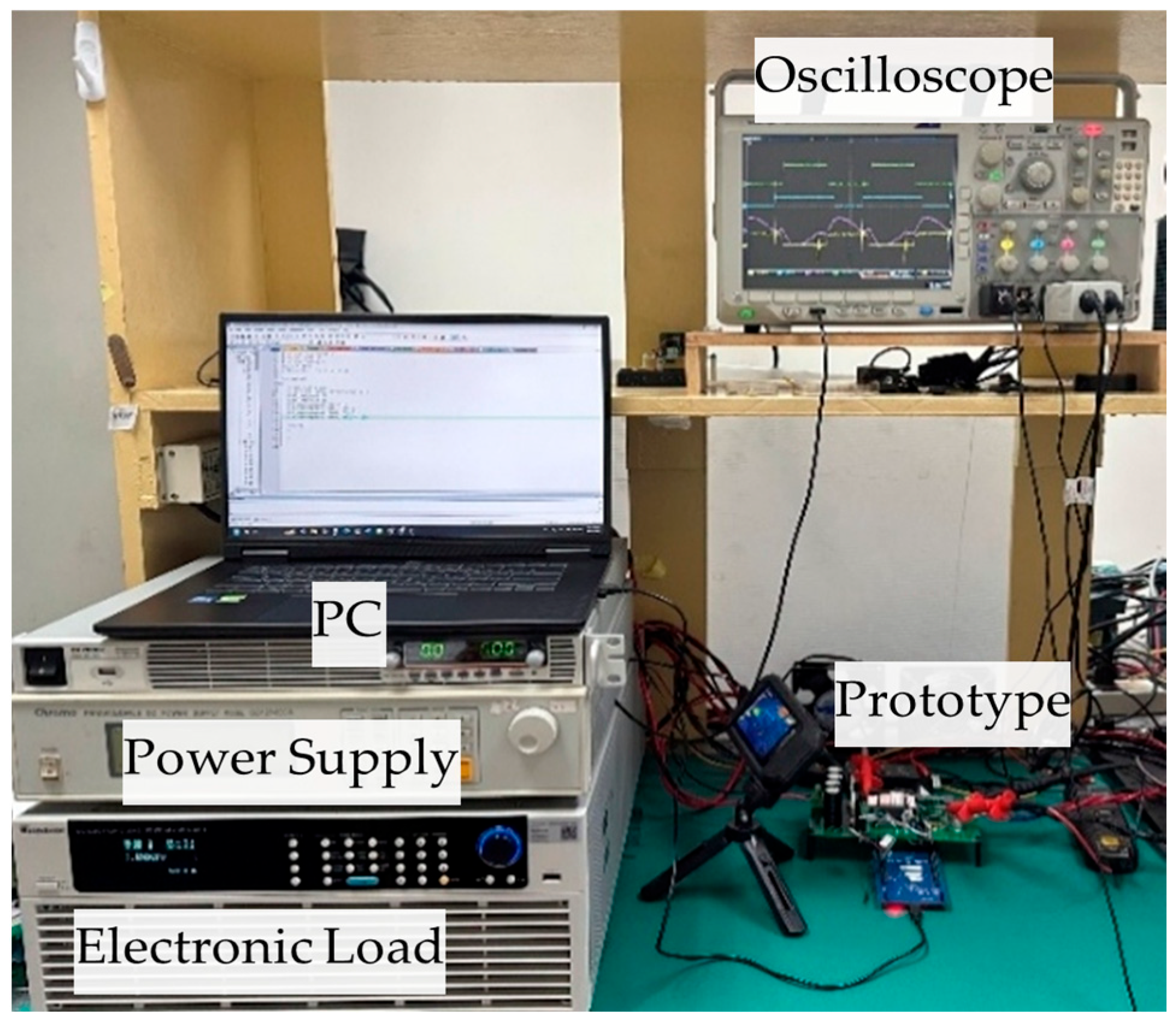
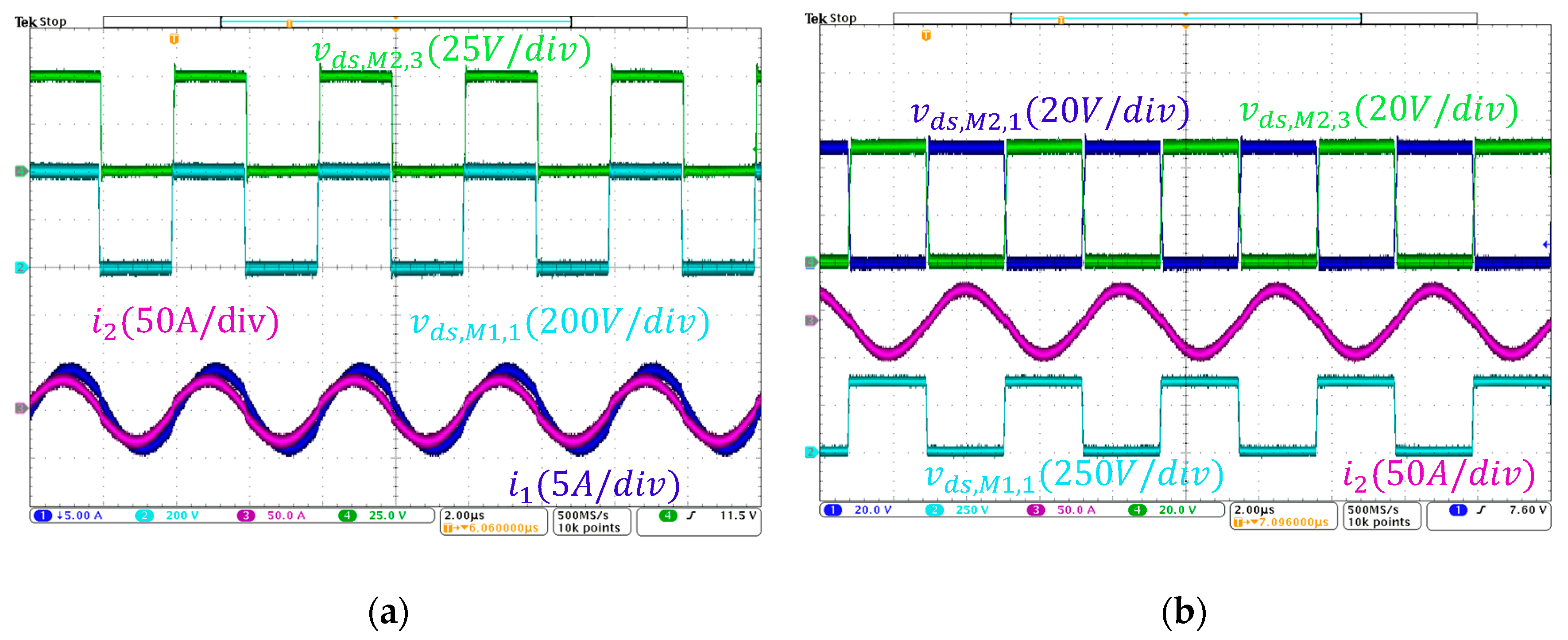
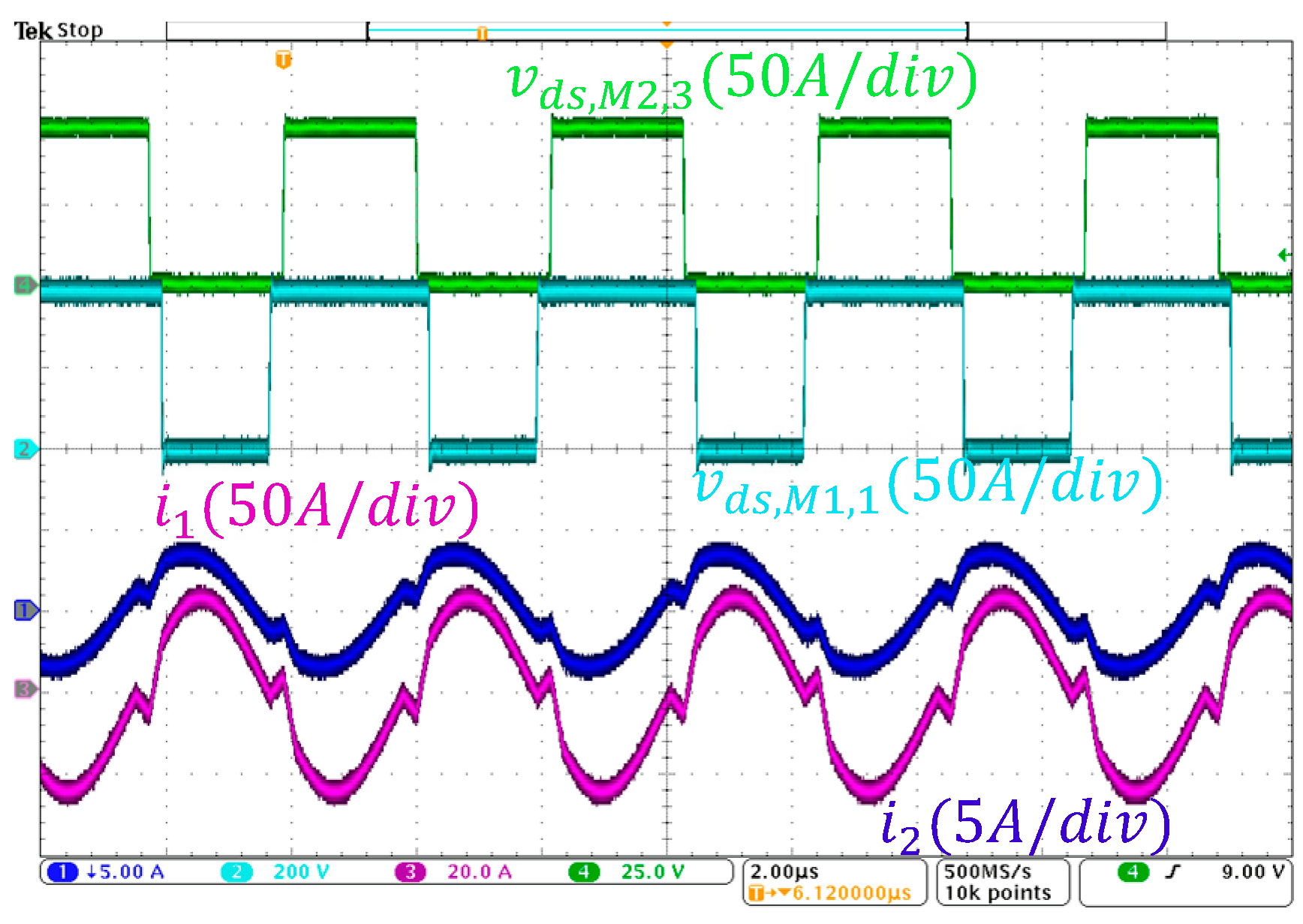
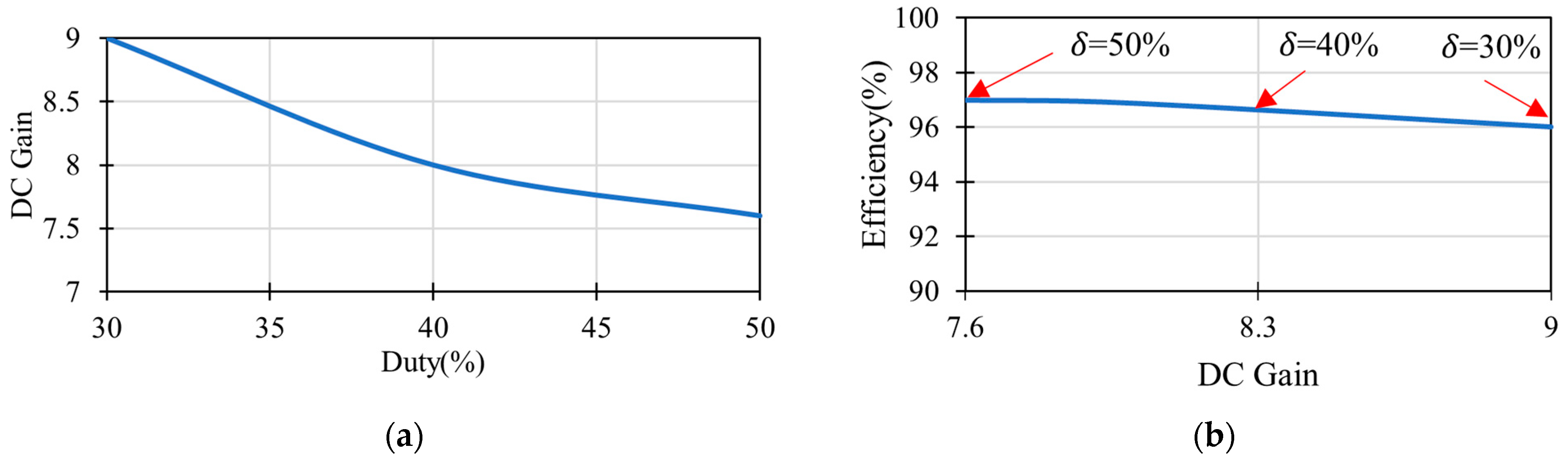
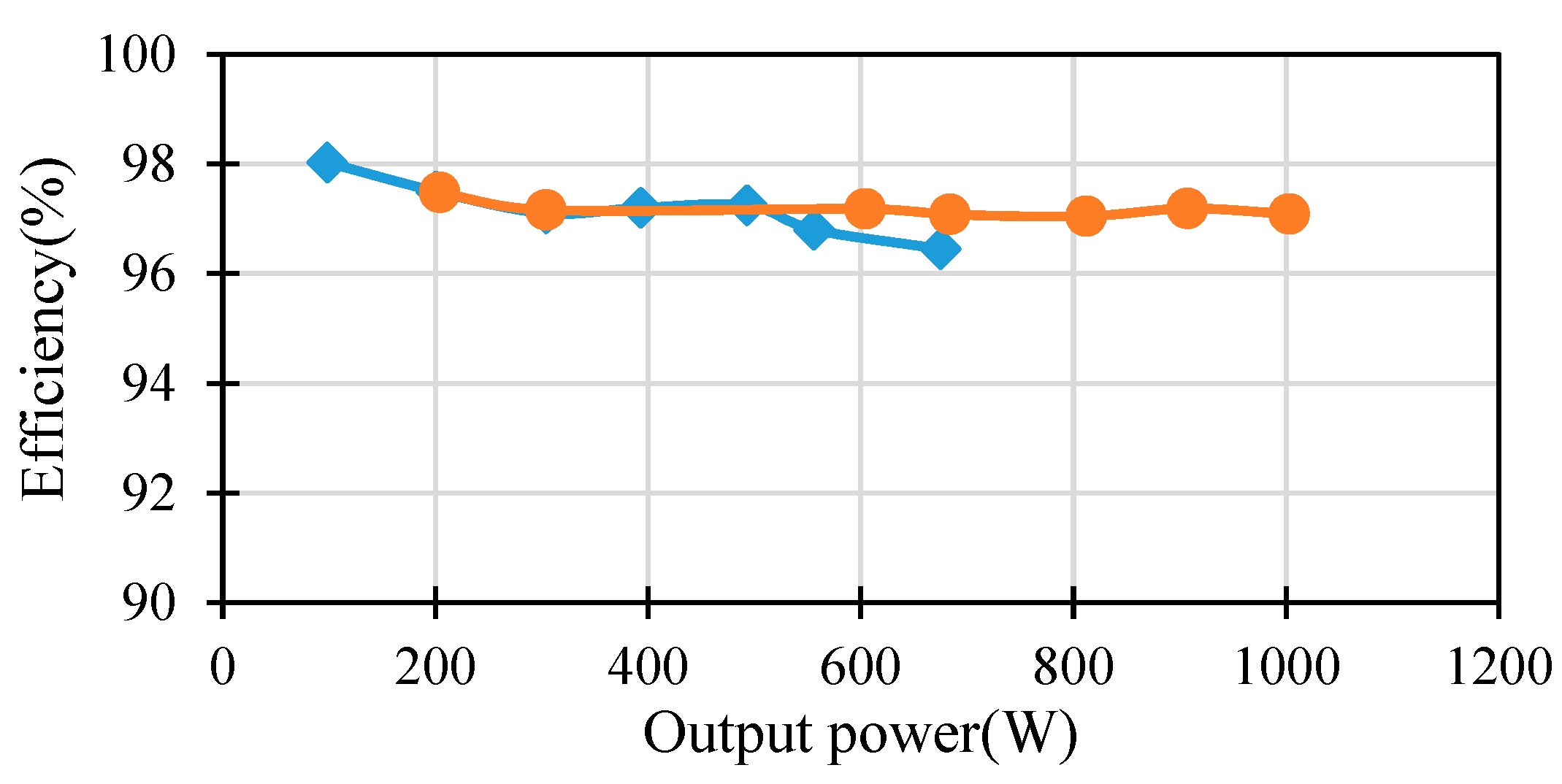
In the experimental setup shown in Figure 11, the mother board consists of the transformer, capacitors, low-side inductor, and slots for inserting full-bridge daughter cards. On the high-voltage-side full-bridge card, we used four cascade GaN HEMTs fabricated in the NYCU with the parameters listed in Table 3. For the low-voltage-side full-bridge card, we used EPC GaN HEMTs with the parameters listed in Table 3. The high-voltage transistor fabricated in the NYCU features a high breakdown voltage of 1 kV and low parasitic capacitances. The low-voltage transistor made of EPC has a low on-resistance of 2   m Ω . To verify the proposed copolar PWM switching strategy, a prototype of the CLLC resonant converter is built based on the specifications listed in Table 3, as shown in Figure 11. The experimental setup is shown in Figure 12. Four oscilloscope channels were used to monitor the primary-side voltage and the resonant current. In the forward mode, the power supply is connected to V 1 and provides a constant voltage of 400 V, whereas the electronic load is connected to V 2 and operated in the constant resistance mode. The efficiency was calculated by dividing the output power read from the electronic load by the input power measured from the power supply. The waveform in Figure 13a corresponds to the forward mode, measured at an output power of 1 kW. In contrast, Figure 13b shows the waveform measured under reverse-mode operation, where the power supply is connected to V 2 with a fixed voltage of 48 V, and the electronic load is connected to V 1 . It can be observed that the high-side drain voltages V d s , M 2,1 (blue) and V d s , M 2,3 (green) only reach 376 V, which is insufficient to achieve the target of 400 V. To address this issue, copolar switching was employed to adjust the duty ratio at a fixed switching frequency on the primary side. As shown in Figure 14, when the gate-source duty of GaN switch M 1,1 is reduced to 40%, the conduction interval of V d s , M 1,1 (cyan) is shortened, as opposed to the 50% duty in reverse mode shown in Figure 13b. The adjustment results in a V 1 voltage of 384 V. Further tuning the duty to 37% increases the output voltage to the desired 400 V. Figure 15a shows the variation in DC gain with respect to the duty ratio in reverse mode at fixed switching frequency. During reverse operation, the duty ratio is adjusted based on the instantaneous battery voltage at V 1 to achieve the desired charging effect. When V2 is fixed at 48 V, the resulting charging voltage at V 1 can be regulated within the range 365–432 V. Figure 15b shows the relationship between the efficiency of the common-polarity switch and the DC gain at different duty cycles (30%, 40%, and 50%). It can be seen that the efficiency is highest at a duty cycle of 50%, followed by 40% and 30%. This trend is due to the reduction in circulating current in the circuit (similar to a unipolar switch) when operating at high duty cycles. Figure 16 shows the efficiency versus output power for both forward (orange) and reverse (blue) modes. The forward mode maintains higher and more stable efficiency, while the reverse mode shows slightly lower efficiency at higher output power, likely due to increased circulating current and conduction losses. Due to varying input voltage conditions, the duty cycle of the coupling switch also changes. Both of these variations affect the soft-switching state, meaning the charging currents i H and i L will not be able to maintain a zero-current switching (ZCS) state. To achieve ZCS in all voltage applications, we allow a phase difference between the pulse width modulation (PWM) on the high-voltage and low-voltage sides. By adjusting the phase shift, θ P W M as shown in Table 2, the soft-switching state can be maintained.

5. Discussion

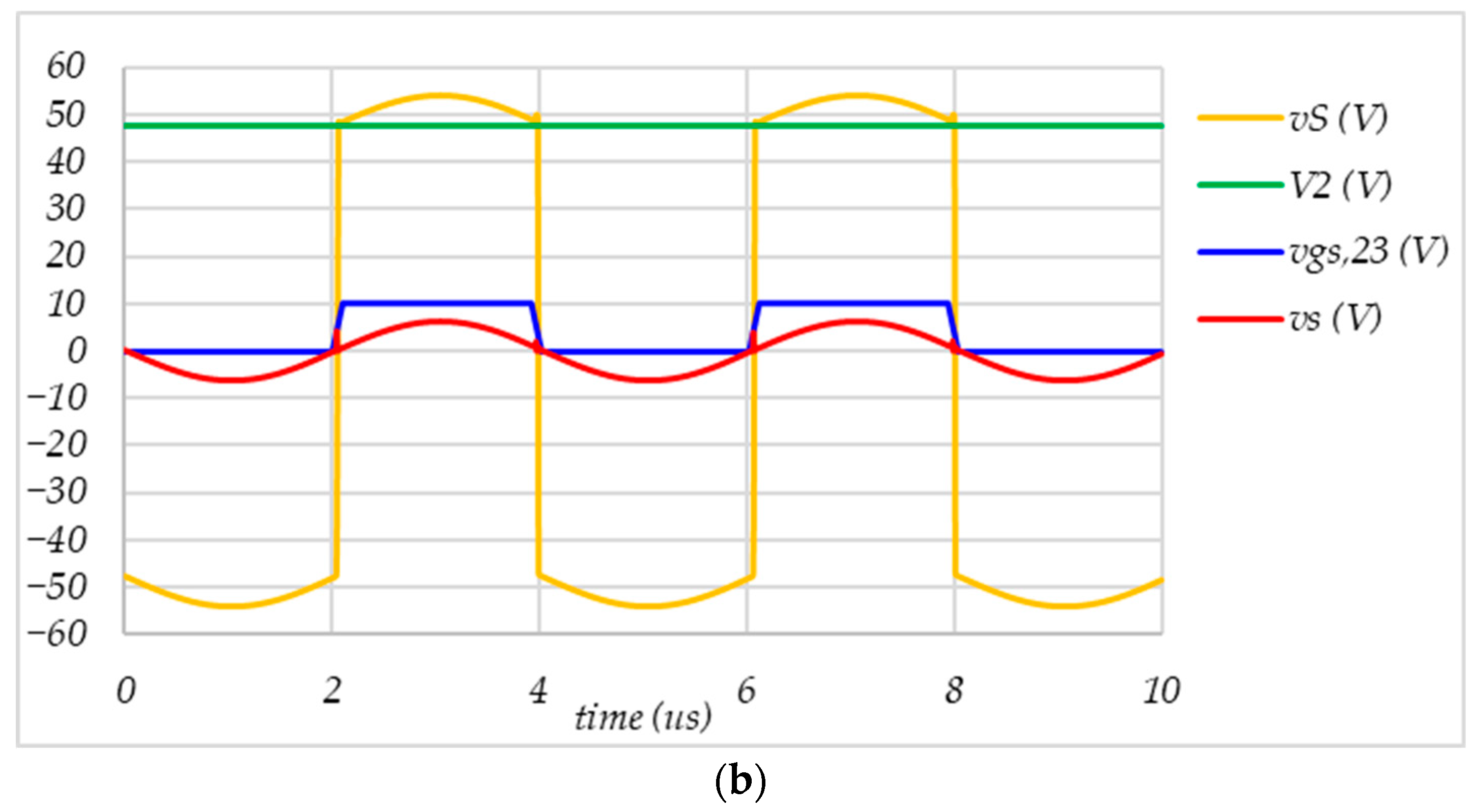
Equation (5) introduces the root-mean-square (RMS) value of the AC component v S as the differential DC voltage into the efficiency calculation of the CLLC converter charging process. This equivalence is actually observed through the simulation results of the transformer secondary winding output v S (yellow trace) and the output DC voltage V 2 (green trace) as shown in Figure 17. A switch on the low-voltage side controls the rectification, which determines the sign of v S . The secondary winding output v S is the superposition of a square wave pulse sequence ± V 2 and an AC voltage v s as shown by the red trace in Figure 17b, where v s = v S ( ± V 2 ) . V s is the root-mean-square (RMS) value of v s . Figure 2 demonstrates the efficiency and output power of DC-DC converter from V 1 = V s + V 2 to V 2 . This DC-DC converter analogy is applied to the power efficiency evaluation in (37) and (38) using the theoretical derivation of V p and V S , respectively. The transformer does indeed only convert the AC component v p to v s , and the DC component is not included in the transformer magnetization, thus deriving the magnetization current I 1 , m in (11).
Following the DC and AC superposition theory, where the magnetization of the transformer core only accounts for the AC component of the CLLC circuit, the magnetization current I 1 , m shown in Figure 4 as an equivalent circuit is very small due to a small AC voltage v s . Both simulations and experiments have verified that the magnetizing current is less than 3% of the high-side current I H calculated in Table 1. The model simplification presented in Section 2.1, where the magnetizing current is neglected, represents an assumption that is valid under specific operating conditions, including near-resonant sinusoidal steady state and low on-resistance GaN devices, as stated in our earlier study [12]. After simplification, the voltage of V x is then determined using the impedance ratio β defined in (12), where node x represents the midpoint in the equivalent circuit. The limitation during discharge derived in (40) is based on the value of impedance ratio β ; the output power in discharging mode compared to the output power in the charging mode is inversely proportional to β . Therefore, a smaller Z 1 value can generate greater output power, which means that the lower on-resistance of the high-voltage-side GaN device helps to improve the output power in discharge mode.
In CLLC converters, most modulation strategies can be described by three fundamental degrees of freedom: switching frequency, duty cycle, and phase shift in Table 4. Although these methods ultimately affect the effective fundamental component of the excitation voltage, their physical mechanisms are different. Frequency modulation (PFM) adjusts the operating point along the resonant tank gain curve, thereby changing the voltage gain. In contrast, duty-cycle and phase-shift modulation directly modify the fundamental component by altering the switching waveform. Furthermore, in bidirectional CLLC converters, phase shift not only influences the fundamental amplitude but also governs the phase relationship between the primary and secondary voltages, which determines the direction and magnitude of power transfer.
This paper proposed a copolar switching, a duty-cycle method, which can simultaneously achieve different mode switching and adjust the output voltage to adapt to practical applications, such as battery charging, where constant current mode and constant voltage mode are required under different charging states. When one of the high-side voltage and the low-side voltage is used as a control input and the other as a control command, bidirectional control needs to maintain constant efficiency. However, since the equivalent circuit of the transformer is different when viewed from both sides of winding, the efficiency of the charging (forward) mode and the current (reverse) mode also differs. This paper analyzes how to achieve balanced efficiency duty cycle control in (39) and what the power output ratio limit is in (40). Equation (39) shows us that the transformer turns ratio a and voltage ratio A determine the conduction mode, that is, a = A is the zero-conduction mode, a A is the continuous mode; otherwise the converter is in the discontinuous mode. Therefore, the choice of transformer turns ratio is crucial for the selection of charging and discharging modes. In this case study, we chose a = 7.32 and A = 8.33 , which allows for continuous current mode during the 400 V to 48 V conversion process in charging mode. At the same time, we limit the voltage ratio A = 7.32 to the minimum value for DC-DC conversion, which may be a weakness of the copolar switching method compared to other control methods.

6. Conclusions

This paper introduces a copolar switching method that can be used in the reverse (discharging) mode of a CLLC DC/DC bidirectional converter. The copolar switching modulates a high voltage into a medium voltage that allows the low-voltage side to back-charge the high-voltage-side battery. Efficiency-based control is used to calculate the duty in the copolar switching to maintain the same efficiency in both the forward and reverse modes of charging (or discharging). In the experiments, the converter delivered up to 1 kW in forward mode and 675 W in reverse mode while maintaining an efficiency above 97% and 96%, respectively. The forward mode can possess a power efficiency higher than that of the reverse mode because the forward mode has a zero-voltage switching (ZVS) capability to minimize the switching loss. Because the component count in the proposed CLLC circuit is minimized, the power density of the CLLC, including the DSP board, which produces the PWM of the switching control, achieves the target of 33 W/in2. Bidirectional charging enables electric vehicles to operate as mobile distributed energy storage units, but the trend towards higher voltages (such as 800 V battery energy storage systems) still needs to be followed. In future research, for 800 V applications requiring breakdown voltages of 1.2 kV or even 1.7 kV, we are developing GaN HEMTs with such high breakdown voltages. Furthermore, transformers occupy a large portion of the charger’s volume, reducing power density and thus requiring a redesign to make them more compact within the charger.

Author Contributions

Conceptualization, W.-H.C.; Methodology, W.-H.C.; Investigation, C.-H.C. and Y.-T.H.; Validation, Y.-T.H., C.-H.C. and W.-H.C.; Data Curation, Y.-T.H.; Writing—Original Draft, Y.-T.H., C.-H.C. and W.-H.C.; Writing—Review & Editing, Y.-T.H., W.-Y.S., C.-C.H. and W.-H.C.; Formal analysis, Y.-T.H. and W.-H.C.; Software, Y.-T.H. and W.-H.C.; Visualization, W.-Y.S. and C.-C.H.; Supervision, W.-Y.S., C.-H.C., C.-C.H. and W.-H.C.; Project Administration, E.Y.C.; Resources, E.Y.C.; Funding Acquisition, E.Y.C. All authors have read and agreed to the published version of the manuscript.

Funding

This research was funded by the National Science and Technology Council (NSTC), Taiwan, grant numbers NSTC 113-2640-E-A49-007 and NSTC 113-2622-8-A49-012-SB.

Data Availability Statement

The original contributions presented in the study are included in the article, further inquiries can be directed to the corresponding author.

Acknowledgments

The authors also thank Kai-En Lin for their help in the experimental setup.

Conflicts of Interest

Author Wen-Yuh Shieh and Chi-Chun Haung were employed by the company ELAN Microelectronics (Taiwan). The remaining authors declare that the research was conducted in the absence of any commercial or financial relationships that could be construed as a potential conflict of interest.

Nomenclature

aTurn ratio
b 1 b i p o l a r Fundamental Fourier coefficient
b 1 c o p o l a r Fundamental Fourier coefficient
H t Heaviside step Function
I H DC input current (A)
I 1 , m Magnetization current (A)
I 2 , F Forward-mode charging current(A)
I 1 , c o p o l a r Fundamental component amplitude of resonant current (A)
I 1 , b i p o l a r Fundamental component amplitude of resonant current (A)
i 1 t LC tank current (A)
I H , R Reverse DC output current (A)
I 1 , R Reverse mode discharging current (A)
L m , R Magnetizing inductance referred to the secondary side.
P o u t Output power (W)
P o u t , R Reverse mode power output (W)
P o u t , F Forward mode power output (W)
s 1,3 ¯ =   s 1,1 Gate signal (V)
s 1,4 ¯ = s 1,2 Gate signal (V)
V 1 High voltage DC input (V)
V 1 Equivalent voltage (V)
V 2 Low voltage DC output
V s RMS value on the secondary side (V)
V p RMS value on the primary side (V)
V x Nodal voltage (V)
V s , F Forward secondary-side voltage (V)
V s , R Reverse secondary-side voltage (V)
V G G Gate drive input voltage (V)
V D D V 1 voltage (V)
v o 1 , c o p o l a r t Square Wave function
v o 1 , b i p o l a r t Square Wave function
Z Circuit impedance
Z 1 Impedance
Z 2 Impedance
η Efficiency
η R Reverse mode efficiency (%)
η F Forward mode efficiency (%)
β Impedance ratio
ρ Current ratio

References

  1. Alatai, S.; Salem, M.; Ishak, D.; Das, H.S.; Alhuyi Nazari, M.; Bughneda, A.; Kamarol, M. A review on state-of-the-art power converters: Bidirectional, resonant, multilevel converters and their derivatives. Appl. Sci. 2021, 11, 10172. [Google Scholar] [CrossRef]
  2. Arunkumari, T.; Indragandhi, V. An overview of high voltage conversion ratio DC-DC converter configurations used in DC micro-grid architectures. Renew. Sustain. Energy Rev. 2017, 77, 670–687. [Google Scholar] [CrossRef]
  3. Wang, R.; Feng, W.; Nordman, B.; Gerber, D.; Li, Y.; Kang, J.; Hao, B.; Brown, R. Technology standards for direct current microgrids in buildings: A review. Renew. Sustain. Energy Rev. 2025, 211, 115278. [Google Scholar] [CrossRef]
  4. Chen, S.; Zhang, G.; Samson, S.Y.; Mei, Y.; Zhang, Y. A review of isolated bidirectional DC-DC converters for data centers. Chin. J. Electr. Eng. 2023, 9, 1–22. [Google Scholar] [CrossRef]
  5. Zhao, L.; Pei, Y.; Wang, L.; Pei, L.; Cao, W.; Gan, Y. Design methodology of bidirectional resonant CLLC charger for wide voltage range based on parameter equivalent and time domain model. IEEE Trans. Power Electron. 2022, 37, 12041–12064. [Google Scholar] [CrossRef]
  6. Min, J.; Ordonez, M. Bidirectional resonant CLLC charger for wide battery voltage range: Asymmetric parameters methodology. IEEE Trans. Power Electron. 2020, 36, 6662–6673. [Google Scholar] [CrossRef]
  7. Zhao, C.; Jin, F.; Li, Z.; Hsieh, Y.-H.; Lee, F.C.; Li, Q. Design Consideration for CLLC Converter with High Power and Wide Gain Range. In Proceedings of the 2023 IEEE Applied Power Electronics Conference and Exposition (APEC), Orlando, FL, USA, 19–23 March 2023; IEEE: New York, NY, USA, 2023; pp. 1–6. [Google Scholar]
  8. Chiou, G.-J.; He, C.-Y.; Chen, J.-Y.; Chien, C.-Y. Implementation of an interleaved bidirectional cllc resonant full-bridge dc-dc converter based on 48-volt bus. In Proceedings of the 2021 IEEE International Future Energy Electronics Conference (IFEEC), Taipei, Taiwan, 16–19 November 2021; IEEE: New York, NY, USA, 2021; pp. 1–6. [Google Scholar]
  9. Kim, E.-S.; Oh, J.-S. High-efficiency bidirectional LLC resonant converter with primary auxiliary windings. Energies 2019, 12, 4692. [Google Scholar] [CrossRef]
  10. Chen, N.; Chen, M.; Li, B.; Wang, X.; Sun, X.; Zhang, D.; Jiang, F.; Han, J. Synchronous rectification based on resonant inductor voltage for CLLC bidirectional converter. IEEE Trans. Power Electron. 2021, 37, 547–561. [Google Scholar] [CrossRef]
  11. Chen, R.; Shi, S.; Zhang, C.; Shi, W. 11 kW High-efficiency bidirectional CLLC converter with 1200 V SiC MOSFET. In Proceedings of the PCIM Asia 2021, International Exhibition and Conference for Power Electronics, Intelligent Motion, Renewable Energy and Energy Management, Shenzhen, China, 9–11 September 2021; VDE: Offenbach am Main, Germany, 2021; pp. 1–9. [Google Scholar]
  12. Shieh, Y.-T.; Wu, C.-C.; Jeng, S.-L.; Liu, C.-Y.; Hsieh, S.-Y.; Haung, C.-C.; Shieh, W.-Y.; Chieng, W.-H.; Chang, E.-Y. A turn-ratio-changing half-bridge CLLC DC–DC bidirectional battery charger using a GaN HEMT. Energies 2023, 16, 5928. [Google Scholar] [CrossRef]
  13. Liu, Y.; Du, G.; Wang, X.; Lei, Y. Analysis and design of high-efficiency bidirectional GaN-based CLLC resonant converter. Energies 2019, 12, 3859. [Google Scholar] [CrossRef]
  14. Ammar, A.M.; Ali, K.; Rogers, D.J. A bidirectional GaN-based CLLC converter for plug-in electric vehicles on-board chargers. In Proceedings of the IECON 2020 The 46th Annual Conference of the IEEE Industrial Electronics Society, Singapore, 18–21 October 2020; IEEE: New York, NY, USA, 2020; pp. 1129–1135. [Google Scholar]
  15. Zhu, T.; Zhuo, F.; Zhao, F.; Wang, F.; Song, R.; Wang, M. Analysis of GaN based full-bridge CLLC resonant converter considering output capacitances under light-load conditions. In Proceedings of the 2020 IEEE 9th International Power Electronics and Motion Control Conference (IPEMC2020-ECCE Asia), Nanjing, China, 29 November 2020—2 December 2020; IEEE: New York, NY, USA, 2020; pp. 2319–2324. [Google Scholar]
  16. He, P.; Mallik, A.; Sankar, A.; Khaligh, A. Design of a 1-MHz high-efficiency high-power-density bidirectional GaN-based CLLC converter for electric vehicles. IEEE Trans. Veh. Technol. 2018, 68, 213–223. [Google Scholar] [CrossRef]
  17. Bartecka, M.; Kłos, M.; Paska, J. Effective design methodology of CLLC resonant converter based on the minimal area product of high-frequency transformer. Energies 2023, 17, 55. [Google Scholar] [CrossRef]
  18. Gadelrab, R.; Lee, F.C. PCB-based magnetic integration and design optimization for three-phase LLC. IEEE Trans. Power Electron. 2023, 38, 14037–14049. [Google Scholar] [CrossRef]
  19. Jin, P.; Zhang, J.; Lu, Y.; Guo, Y.; Lei, G.; Zhu, J. Variable frequency isolated bidirectional CLLC resonant converter with voltage controlled variable capacitors. IEEE Trans. Ind. Electron. 2022, 70, 8907–8917. [Google Scholar] [CrossRef]
  20. Li, L.; Cao, Y.; Hou, L.; Mao, T.; Ning, W. PFM-PS hybrid control strategy CLLC resonant converter research. In Proceedings of the 2023 8th Asia Conference on Power and Electrical Engineering (ACPEE), Tianjin, China, 14-16 April 2023; IEEE: New York, NY, USA, 2023; pp. 1278–1284. [Google Scholar]
  21. Shi, Z.; Tang, Y.; Davari, P. On-board charger applications: A new hybrid control strategy for bidirectional CLLC resonant converter. Int. J. Circuit Theory Appl. 2024, 52, 3154–3169. [Google Scholar] [CrossRef]
  22. Tran, T.N.T.; Wang, J.-M. A Hybrid Bidirectional Full-Bridge CLLC Resonant Converter With Dual-Resonant Frequency for Enhancing Efficiency at Light-to-Medium Loads. IEEE J. Emerg. Sel. Top. Power Electron. 2024, 13, 119–135. [Google Scholar] [CrossRef]
  23. Hua, W.; Wu, H.; Yu, Z.; Xing, Y.; Sun, K. A phase-shift modulation strategy for a bidirectional CLLC resonant converter. In Proceedings of the 2019 10th International Conference on Power Electronics and ECCE Asia (ICPE 2019-ECCE Asia), Busan, Republic of Korea, 27–30 May 2019; IEEE: New York, NY, USA, 2019; pp. 1–6. [Google Scholar]
  24. Zhu, T.; Zhuo, F.; Zhao, F.; Wang, F.; Yi, H.; Zhao, T. Optimization of extended phase-shift control for full-bridge CLLC resonant converter with improved light-load efficiency. IEEE Trans. Power Electron. 2020, 35, 11129–11142. [Google Scholar] [CrossRef]
  25. Zhu, T.; Zhuo, F.; Zhao, F.; Yu, K.; Wang, F.; Song, R. A novel APWM control scheme for GaN based full-bridge CLLC resonant converter with improved light-load efficiency. In Proceedings of the 2020 IEEE Applied Power Electronics Conference and Exposition (APEC), New Orleans, LA, USA, 15–19 March 2020; IEEE: New York, NY, USA, 2020; pp. 2081–2085. [Google Scholar]
  26. Zong, S.; Luo, H.; Li, W.; Deng, Y.; He, X. Asymmetrical duty cycle-controlled LLC resonant converter with equivalent switching frequency doubler. IEEE Trans. Power Electron. 2015, 31, 4963–4973. [Google Scholar] [CrossRef]
  27. Lin, K.; Lin, S.; Huang, C.; Chen, W. Analysis and optimized design of conducted common-mode EMI characteristics of CLLC circuits. In Proceedings of the CPSS Transactions on Power Electronics and Applications, Cairo, Egypt, 2–6 November 2026. [Google Scholar]
  28. Shieh, Y.-T.; Liou, G.-T.; Jeng, S.-L.; Chieng, W.-H.; Lai, J.; Chang, E.-Y. Copolar Synchronous Switching Method for BLDC Motor Control in EV Application; IEEE Access: Piscataway, NJ, USA, 2025. [Google Scholar]
  29. Zou, S.; Lu, J.; Mallik, A.; Khaligh, A. Bi-directional CLLC converter with synchronous rectification for plug-in electric vehicles. IEEE Trans. Ind. Appl. 2017, 54, 998–1005. [Google Scholar] [CrossRef]
Figure 1. (a) LLC and (b) CLLC circuit modules.
Energies 19 01820 g001
Figure 2. (a) DC/DC converter. (b) Output power and efficiency.
Energies 19 01820 g002
Figure 3. Full-bridge CLLC circuit.
Energies 19 01820 g003
Figure 4. Equivalent circuit of the resonator and transformer model in forward mode.
Energies 19 01820 g004
Figure 5. (a) Voltage output from the LC tank and (b) switch control in reverse mode.
Energies 19 01820 g005
Figure 6. Equivalent circuit of the resonator and transformer model in reverse mode.
Energies 19 01820 g006
Figure 7. PWM phase shift control.
Energies 19 01820 g007
Figure 8. Power ratio versus power efficiency when a/A = 0.88.
Energies 19 01820 g008
Figure 9. PSpice model of CLLC converter circuit.
Energies 19 01820 g009
Figure 10. Simulation results of (a) forward under bipolar switching (b) reverse mode under copolar switching.
Energies 19 01820 g010aEnergies 19 01820 g010b
Figure 11. Experiment of prototype.
Energies 19 01820 g011
Figure 12. Experiment platform.
Energies 19 01820 g012
Figure 13. Waveform of CLLC converter under 1 kW load condition. (a) Forward mode ( V 1 = 400 V, V 2 = 48 V, Duty = 50%). (b) Reverse mode ( V 1 = 375 V, V 2 = 48 V, Duty = 50%).
Energies 19 01820 g013
Figure 14. Waveform of CLLC converter under 600 W load condition in reverse mode ( V 1 = 384 V, V 2 = 48 V, Duty = 40%).
Energies 19 01820 g014
Figure 15. (a) Variation in DC gain with respect to duty ratio in reverse mode at fixed switching frequency 250 kHz. (b) Efficiency versus DC gain under Copolar switching (500 W).
Energies 19 01820 g015
Figure 16. Efficiency of forward mode (orange) under V 1 = 400 V and V 2 = 48 V and reverse mode (blue) under V 1 = 385 V and V 2 = 48 V .
Energies 19 01820 g016
Figure 17. AC component of transformer secondary winding output v S . (a) Simulation circuit and (b) output waveforms.
Energies 19 01820 g017aEnergies 19 01820 g017b
Table 1. Theoretical evaluation of a CLLC in forward mode.
SymbolDescriptionValueEquation
β Impedance ratio0.58case study
a Turn-ratio7.32case study
V 1 High-side voltage400 Vcase study
V 2 Low-side voltage48 Vcase study
A Voltage Gain = V 1 / V 2 8.33(15)
V s , F AC RMS voltage3.85 V(14)
η Power efficiency92.5%(5)
I H Input DC average current3 A(7)
P o u t Charging power1.2 kW(6)
I 1 , m Magnetization current0.054 A(11)
Table 2. Parameters of the simulation.
SymbolDescriptionUnitValue
L m Magnetization inductanceuH350
L 1 High-voltage-side inductanceuH95
C 1 High-voltage-side capacitancenF4.26
L 2 Low-voltage-side inductanceuH1.3
C 2 Low-voltage-side capacitancenF310
a Turn-ratio 7.44
V 1 High voltageV400
V 2 Low voltageV48
A Voltage Gain = V 2 / V 1 8.33
f s Switching frequencykHz250
P o u t , F Forward mode power outputW1357
η F Forward mode efficiency%94.5
δ Copolar duty in reverse mode%28
θ P W M PWM phase-shift in reverse modeRadian0.594
P o u t , R Reverse mode power outputW1.016
η R Reverse mode efficiency%94.7
Table 3. CLLC circuit parameters.
SymbolDescriptionUnitValue
a Turn-ratio 7.6
L m ( μ H ) Magnetization InductanceμH250
L 1 ( μ H ) High-voltage-side inductanceμF27
L 2 ( μ H ) Low-voltage-side inductancekHz250
C 1 ( n F ) High-voltage-side capacitancenFB32671L0822J000
C 2 ( n F ) Low-voltage-side capacitancenFR76QR3330SE30J
M 1 , ( 1 ~ 4 ) High-voltage-side GaN NYCU GaN(650 V, 150 mΩ)
M 2 ,   ( 1 ~ 4 ) Low-voltage-side GaN EPC2302
Gate Driver IC Stdriveg600
Table 4. Comparison of modulation strategies for CLLC converters.
MethodRefs.Control DegreeGainAdvantage
Pulse frequency Modulation (PFM)[29]Frequency (f) G P F M ( f , Q , k ) wide regulation range
Phase-Shift Modulation (PSM)[23,24]Phase (φ) c o s ( φ 2 ) Fixed-frequency operation;
relatively simple implementation
Hybrid Modulation
(PFM + PSM/PWM)
[20,21,22]f, φ, Duty (δ) G P F M ( f , Q , k ) ×
c o s ( φ 2 )
Flexible control; extended ZVS range; improved performance
Proposed Method δ s i n ( δ π ) Fixed-frequency operation;
relatively simple implementation
Disclaimer/Publisher’s Note: The statements, opinions and data contained in all publications are solely those of the individual author(s) and contributor(s) and not of MDPI and/or the editor(s). MDPI and/or the editor(s) disclaim responsibility for any injury to people or property resulting from any ideas, methods, instructions or products referred to in the content.