Article

Sodium Stoichiometry-Driven P2/O3 Biphase Layered Oxides with Enhanced Na+ Kinetics and Structural Stability for Sodium-Ion Batteries

1
Chengdu Institute of Organic Chemistry, Chinese Academy of Sciences, Chengdu 610041, China
2
University of Chinese Academy of Sciences, Beijing 100039, China
*
Authors to whom correspondence should be addressed.
Energies 2026, 19(8), 1816; https://doi.org/10.3390/en19081816
Submission received: 7 March 2026 / Revised: 25 March 2026 / Accepted: 28 March 2026 / Published: 8 April 2026
(This article belongs to the Section D2: Electrochem: Batteries, Fuel Cells, Capacitors)

Abstract

P2/O3-type Ni/Mn-based layered oxides are regarded as promising cathode materials for sodium-ion batteries (SIBs) because of their high energy density. However, their practical application is limited by low initial Coulombic efficiency, sluggish Na+ kinetics, transition-metal dissolution/migration and irreversible phase transitions during cycling. Herein, a controlled P2 phase was achieved through elemental ratio regulation, enabling systematic synthesis of a series of NaxNi0.4Co0.1Mn0.5O2(x-NCMO) materials with tailored P2/O3 ratios. The optimized composition (x = 0.8), containing 16.6% P2 and 83.4% O3 phases, achieves an optimal phase equilibrium, thereby maximizing the synergistic coupling between the two layered polymorphs. This biphasic architecture demonstrates significantly enhanced Na+ transport kinetics and exceptional electrochemical performance, high initial capacity of 168.65 mAh g−1 and excellent rate performance, maintaining 84.88 mAh g−1 at 10 C, outperforming most reported P2/O3 biphasic cathodes. Structural analysis and electrochemical analysis reveal that elemental ratio regulation modulates the TM–O electronic structure, promotes electronic transport, and accelerates Na+ migration. These effects collectively reduce polarization, stabilize the structure, and thereby improve rate capability and long-term cycling capacity retention. This work provides an effective design strategy for designing high-performance layered oxide cathodes with improved structural and interfacial stability.

1. Introduction

In recent years, sodium-ion batteries have gradually found applications in large-scale energy storage. Their development focus has shifted from emphasizing cost advantages and cycle life alone to balancing performance with adaptability across diverse scenarios. Compared to large-scale energy storage, power batteries rely more heavily on rapid charge/discharge capabilities, stable output at high rates, long-term cycle stability, and low-temperature performance. Therefore, achieving synergistic optimization of high electron/ion transport efficiency and structural stability while enhancing energy density has become crucial for advancing sodium-ion batteries from energy storage systems to power battery systems. Continuous improvements in rate performance not only broaden their application scope but also lay the material foundation for practical implementation in low-speed electric vehicles and light-duty power scenarios. Among all components of SIBs, the cathode material plays a pivotal role in determining the energy density, cycling durability, cost-effectiveness, and overall electrochemical performance of the battery [1,2]. Layered transition-metal oxides (NaxMO2, M = Mn, Fe, Co, Ni, Cu, Zn, etc.) have attracted extensive attention due to their simple synthesis routes and high specific capacities, making them one of the most widely studied cathode families.
Within layered oxide cathodes, the P2-type and O3-type structures are the most representative. Each offers distinct advantages: Compared to P2-type materials, O3-type oxides generally exhibit higher theoretical capacities because of their higher sodium content [3,4,5]. However, in O3-type structures, Na+ ions occupy octahedral sites and migrate via tetrahedral intermediates, forming three-dimensional diffusion pathways with relatively high energy barriers [6]. In contrast, P2-type materials feature Na+ ions in prismatic sites migrating via face-sharing tetrahedral sites, enabling predominantly two-dimensional diffusion with much lower activation energies [7]. As a result, P2-type cathodes typically display higher Na+ kinetics coefficients and superior rate performance [8].
However, layered oxide cathodes still confront several challenges [9]. These advantages are challenged by complex phase transitions during Na+ extraction, such as the O3–P3 transition, which cause abrupt changes in lattice parameters and unit-cell volume [10]. The resulting structural fluctuations cause mechanical degradation, crack formation, and progressive capacity fading. In addition, transition-metal dissolution and migration—especially in Mn-based compositions—deteriorate structural stability. Mn3+-induced Jahn–Teller distortion and subsequent manganese dissolution during cycling severely compromise the cathode framework and lead to rapid performance decay [11]. Other drawbacks, including poor air stability and significant irreversible capacity loss, also hinder the practical application of layered oxide cathodes in sodium-ion batteries [12].
To address these challenges and improve the electrochemical properties of NaxMO2 layered oxides, various strategies have been proposed for achieving high capacity, including cation doping (e.g., Al [13], Ti, Li [14]), surface coatings (e.g., NaCaPO4 [15], ZrO2 [16], carbon layers), and interface modification [17,18]. Currently, the performance optimization of cathode materials for SIBs has evolved from previous modification strategies (elemental doping and surface coating) to intrinsic structural regulation centered on crystal structure [19], phase composition [20], and defect chemistry [21]. This approach enables synergistic enhancement of structural stability and Na+ transport kinetics at the material’s fundamental level. To address structural stability and high-capacity challenges, Gao et al. [22] ingeniously leveraged the properties of high-entropy materials. By introducing multiple metal ions into conventional cathode materials, they achieved precise control over the electron density surrounding oxygen atoms, thereby strengthening the bonding between transition metals and oxygen. This structural optimization not only effectively suppressed the P3−O1 phase transition at high voltages but also facilitated the formation of an O3/P3 interleaved growth structure. Experimental results demonstrate that the Na0.846K0.049Zn0.081Ni0.322Fe0.102Mn0.398Ti0.097O2 (HENM) cathode material exhibits outstanding stability at a high voltage of 4.3 V, achieving a specific capacity of 160.2 mAh/g and an energy density of 155.1 Wh kg−1. Furthermore, this material exhibits outstanding thermal and air stability, which holds significant practical importance. The findings of this study demonstrate that the high-entropy regulation strategy can effectively address structural stability issues in sodium-ion battery cathode materials under high-voltage conditions, providing novel insights and methodologies for developing high-performance sodium-ion battery cathode materials. Although these approaches can mitigate specific drawbacks, they are often insufficient to simultaneously resolve the multiple structural and kinetic limitations inherent to layered oxides. As a result, attention has shifted toward the design of biphase P2/O3-layered cathodes that leverage the complementary advantages of the two stacking sequences [15,23,24,25,26,27]. More recently, Huang et al. [27] revealed how rational phase and compositional engineering can unlock the full potential of P2/O3 biphasic-layered oxides for high-performance sodium-ion batteries. Through the synergistic introduction of Zn2+/Ti4+ dual dopants and precise control over calcination conditions, they established strong coupling between the P2 and O3 phases, enabling an unusual yet highly favorable redistribution of Na+ from Na-rich O3 regions to Na-deficient P2 domains. This redistribution not only widens the prismatic diffusion channels in the P2 phase but also lowers the Na content in the O3 phase, effectively suppressing H+/Na+ exchange and greatly improving moisture stability. Additionally, the dual dopants stabilize lattice oxygen, suppress high-voltage phase transitions, and substantially reduce O2/CO2 gas evolution, thereby preserving structural integrity and minimizing electrolyte degradation. As a result, the optimized intergrown P2/O3 material (NNZMT) delivers a high discharge capacity of 144.8 mAh g−1, a median voltage of 3.42 V, and remarkable cycling durability, retaining 77.3% capacity after 1000 cycles at 2000 mA g−1. To understand the synergistic benefits of the P2/O3 two-phase system, Shen et al. [28] studied a model system consisting of NaxZn0.07Ni0.30Mn0.53Ti0.10O2 (x = 0.70, 0.76, 0.82, 0.88, 1.00) as a model system, established a volcano-type relationship between phase composition and rate-dependent performance, and revealed the mechanism of ion acceleration transport induced by the interface between the two phases in the P2/O3 biphasic structure, indicating that a balanced phase composition can maximize the synergistic advantages of the P2 and O3 phases. The optimized P2/O3-Na0.82 (52.83% P2, 47.17% O3) exhibits excellent electrochemical performance, with a reversible specific capacity of 143 mAh g−1 at 0.2C (1C = 100 mA g−1) and 100 mAh g−1 at 10C. Zheng et al. [29] successfully synthesized single-crystalline biphasic O3/P2-NNMO cathode material through a solvent-tuning strategy. They demonstrated that the synergistic effects at the biphasic interface can effectively buffer the anisotropic strain generated during charging and discharging, suppress layer slippage and transition metal migration, and significantly reduce the formation of grain boundary cracks, thereby achieving excellent cycling stability and rate performance at high voltages. O3/P2-NNMO(NaNi0.5Mn0.5O2) achieved a high reversible capacity of 117.2 mAh g−1 and an excellent retention rate of 75% after 100 cycles. Kang et al. [30] developed an NaxCoO2 coating with oxygen reduction capability by combining cobalt surface treatment with a subsurface P2/O3 composite, thereby constructing a customized restructuring layer. By creating a structurally controllable surface restructuring layer, they significantly improved the structural stability and interfacial integrity of O3-NaNi0.2Fe0.4Mn0.4O2 (NFM) under high-voltage conditions. This reconstruction layer effectively suppressed interlayer slippage and irreversible phase transformations, reduced interfacial side reactions and transition metal dissolution, while maintaining ion and electron transport pathways, thereby significantly enhancing the material’s cycling stability and rate performance. Consequently, NFMC exhibits a reversible capacity of 132.9 mAh g−1 at 0.1C (2.0–4.0 V) and maintains a capacity retention of 80.78% after 500 cycles at 1C, significantly outperforming the 49.76% capacity retention of NFM. When tested over a wider voltage range (2.0–4.3 V), the capacity retention rates after 200 and 300 cycles at a 1C current reached 61.15% and 53%, both higher than those of NFM (51.5% and 38%). Collectively, these studies provide new mechanistic insights and scalable design principles. However, no approach has yet succeeded in simultaneously enhancing material structural stability while improving capacity. Building on these advances, the development of finely tuned P2/O3 intergrowth structures—particularly through sodium content regulation and transition-metal doping—offers a promising pathway to further enhance the structural integrity and rate capability of layered oxide cathode materials [31,32,33].
In this study, a series of high-capacity, initial-coulombic-efficiency Co-doped layered oxides, NaxNi0.4Co0.1Mn0.5O2 (x = 0.9, 0.85, 0.8, 0.75, 0.7), were synthesized, in which the proportion of the P2/O3 phases was regulated by adjusting the sodium content and Co doping. Changes in Na content significantly regulate interlayer electrostatic shielding and the coordination environment of Na sites, thereby altering the relative stability of O3 and P2 stacking. When Na defects increase or Na/vacancy ordering induces local stress and electric field inhomogeneities, TM-O layer slip becomes more likely to occur. This reduces the free energy difference between P2 and O3, leading to stable two-phase coexistence. Therefore, a decrease in Na content induces a structural transformation from a pure O3 phase to a mixed P2/O3 biphasic configuration. X-ray diffraction (XRD) and X-ray photoelectron spectroscopy (XPS) were employed to investigate the influence of Na stoichiometry on phase composition and transition-metal oxidation states. Subsequently, density of states (DOS) analysis was employed to further elucidate the effects of cobalt doping on the electronic structure. Furthermore, electrochemical impedance spectroscopy (EIS) and the galvanostatic intermittent titration technique (GITT) were conducted to determine the Na+ kinetics coefficients, providing deeper insight into the role of phase composition in governing structural stability and sodium-ion transport kinetics.

2. Materials and Methods

2.1. Materials Preparation

NaxMn0.5Co0.1Ni0.4O2 were synthesized by a co-precipitation method. Firstly, MnSO4·H2O (Aladdin), NiSO4·6H2O (Aladdin), and CoSO4·7H2O (Aladdin) were mixed in a 2 mol/L solution in a molar proportion of Mn: Ni: Co of 0.5: 0.4: 0.1 to form solution A. Subsequently, 2 mol/L Na2CO3 (McClean) was mixed utilizing a specified quantity of sodium citrate for the creation of solution B. Then, solutions A and B were added to a reactor using a peristaltic pump at a specific rate, while maintaining a stirring rate of 1200 r/min, a reaction temperature of 55 °C, and a pH near 8. Nitrogen was used for protection throughout the reaction. After the reaction concluded, the product underwent 20 h of aging. Following removal, it was subjected to multiple washings and finally dried to yield the material Mn0.5Co0.1Ni0.4CO3 (NCM). Finally, the dried powder was mixed with an excess of 5% Na2CO3 with varying stoichiometric ratios and underwent sintering at a temperature of 500 °C for a duration of 5 h, followed by an additional sintering at 850 °C for 12 h, followed by natural cooling, both processes conducted in an oxygen-rich atmosphere, resulting in the production of NaxMn0.5Co0.1Ni0.4O2 (x-NCMO). Meanwhile, under the same experimental conditions as described above, the material Mn0.5Ni0.5CO3 (NM) was first prepared by coprecipitation, followed by the preparation of the material Na0.8Mn0.5Ni0.5O2 (0.8-NMO) through sodium sintering.

2.2. Material Characterization

Utilizing a Rigaku Ultima IV (Tokyo, Japan) powder X-ray diffractometer (XRD) armed with Cu Kα radiation operated at 40 kV, a comprehensive examination was performed to analyze the crystalline structures, orientations, and transitional phases. The scanning range spanned from 10° to 80° with a scanning rate of 1°/min. The XRD data underwent refinement through FULLPROF, where the Gaussian–Lorentzian function corrected the peak-type parameters. For surface topography, compositional analysis, surface and interface evaluation, as well as particle size and shape analysis, a ZEISS Sigma 300 (Oberkochen, Germany) scanning electron microscope (SEM) was utilized. Additionally, a JEOL JEM-2100Plus (Eindhoven, The Netherlands) transmission electron microscope (TEM) provided insights into crystal structure, lattice defects, grain boundaries, and atomic arrangements. To analyze surface chemical composition and chemical state, using a Thermo Scientific K-Alpha (East Grinstead, UK) X-ray photoelectron spectrometer (XPS), thorough electronic structure analyses were carried out (utilizing the C 1s peak at 284.8 eV as the benchmark, all elemental spectra were referenced accordingly.).

2.3. Electrochemical Measurement

After thoroughly mixing the active material, conductive carbon black, and polyvinylidene fluoride in a mass ratio of 8:1:1, the mixture was coated onto an aluminum foil. It was then placed in a vacuum oven at 105 °C for drying. Once dried, the electrode sheets were cut into circular electrodes with a diameter of 12 mm and weighed (active material loading: approximately 2 mg). Subsequently, in a glove box with both water and oxygen content less than 0.1 ppm, CR-2032 coin-type half-cells were assembled using metal sodium as the counter electrode, a separator (Celgard 2325, Charlotte, NC, USA), and an electrolyte (composed of 1 M NaClO4 dissolved in Polycarbonate with 5% FEC). The instruments used for battery testing and GITT testing were NEWARE 4000 (Shenzhen, China). For cyclic voltammetry (CV) (2–4.2 V, 0.1 mV/s, 25 °C) and electrochemical impedance spectroscopy (EIS) testing (10 mHz–100 kHz, AC voltage 5 mV, 25 °C), the instrument used was the MULTI AUTOLAB M204 (Utrecht, The Netherlands).

3. Results and Discussion

3.1. Microstructural Evolution and Structural Characterization

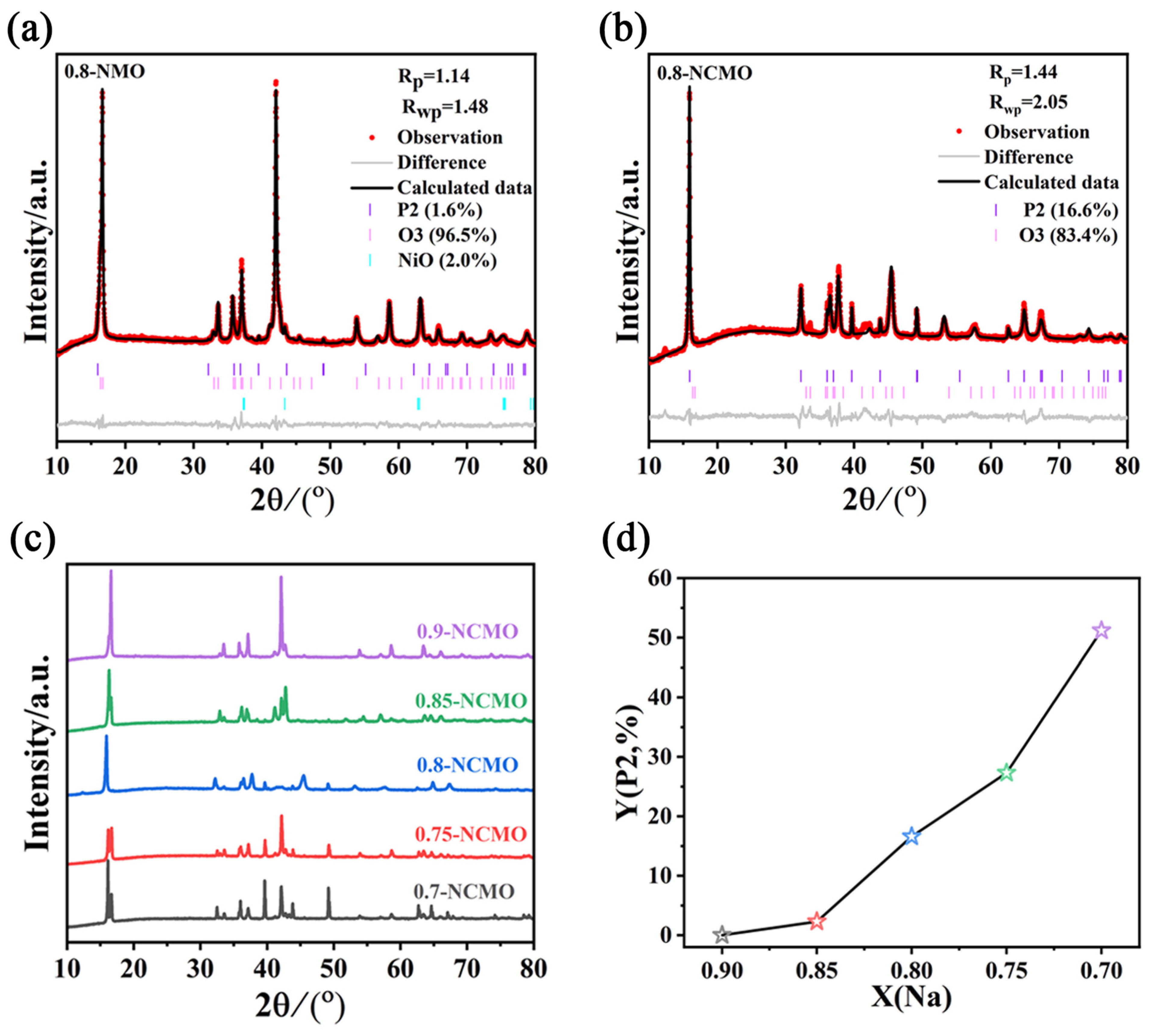
Due to the distinct structural characteristics of the P2 and O3 phases and their fundamentally different Na+ kinetics pathways [28,34], and motivated by these intrinsic advantages, our strategy aims to construct a P2/O3 biphase system, thereby achieving a synergistic integration of the complementary properties of the two phases and realizing a “1 + 1 > 2” effect. Moreover, the coherent interfacial matching and periodic lattice arrangements between the two phases are expected to induce unique Na+ migration mechanisms that cannot be obtained in single-phase materials. Based on this hypothesis, we systematically investigated the influence of different P2/O3 phase ratios on the electrochemical behavior. As described in the experimental section, we synthesized a series of layered oxides: NaxNi0.4Co0.1Mn0.5O2 (x = 0.9, 0.85, 0.8, 0.75, 0.7) and Na0.8Ni0.5Mn0.5O2. These are a series of materials designated as 0.9-NCMO, 0.85-NCMO, 0.8-NCMO, 0.75-NCMO, 0.7-NCMO, and 0.8-NMO, respectively. Cobalt is known to stabilize layered structures in lithium-ion batteries, but its role in sodium-ion batteries is less studied. We added a small amount of cobalt to stabilize the transition metal layer structure. A significant synergistic effect exists between Co-doping and sodium content regulation. Sodium content determines the sample’s thermodynamic phase region. Co doping adjusts the stability of the transition metal layer and its slip behavior. This synergy stabilizes the composition at phase boundaries, turning abrupt irreversible phase transitions into gradual, reversible structural changes. Direct comparison of cobalt-doped and undoped samples with identical sodium content (Na = 0.8) using X-ray diffraction (XRD) (Figure 1a,b) shows that both materials have Bragg reflections of the P2 (P63/mmc) and O3 (R-3m) phases. Under the same Na content conditions, Co doping changes the phase stability mechanism, converting the system from nearly monophasic O3 to stable P2/O3 coexistence. Regarding the cobalt doping comparison, as shown in Table 1, the P2 phase fraction in the 0.8-NCMO sample increased from 1.6% to 16.60%, while the O3 phase fraction decreased from 96.50% to 83.40% compared to the 0.8-NMO sample. It also suppresses the formation of NiO impurity phases. This result suggests that Co doping enhances structural tunability and thermodynamic stability by affecting the transition metal layer and its slip behavior. Next, X-ray diffraction (XRD) was employed to elucidate the structural evolution induced by varying sodium content. As shown in Figure 1c and Figure S1 and Table 1 (detailed Rietveld refinement as Tables S2–S7), a distinct phase transition is observed as the Na content decreases: the x = 0.9 sample exhibits a single O3 phase with an R-3m symmetry, whereas samples with x = 0.85–0.70 display the characteristic Bragg reflections of both P2 and O3 phases, unequivocally confirming the formation of a biphasic structure. This compositional evolution aligns well with the cationic potential framework, wherein increasing Na content lowers the average cationic potential of the host lattice, strengthens the electrostatic interaction between Na+ and O2- layers, and thereby preferentially stabilizes the O3 stacking sequence. This result is consistent with that shown in Figure 1d [34]. Notably, the relative amount of NiO impurity increases with the expansion of the P2 fraction. This phenomenon is consistent with previous findings that P2-type oxides generally possess lower Ni/Mn ratios and lower Na contents compared with O3-type analogs. Consequently, Na deficiency during synthesis results in an excess of Ni2+, which tends to segregate and crystallize as NiO during high-temperature calcination [26].
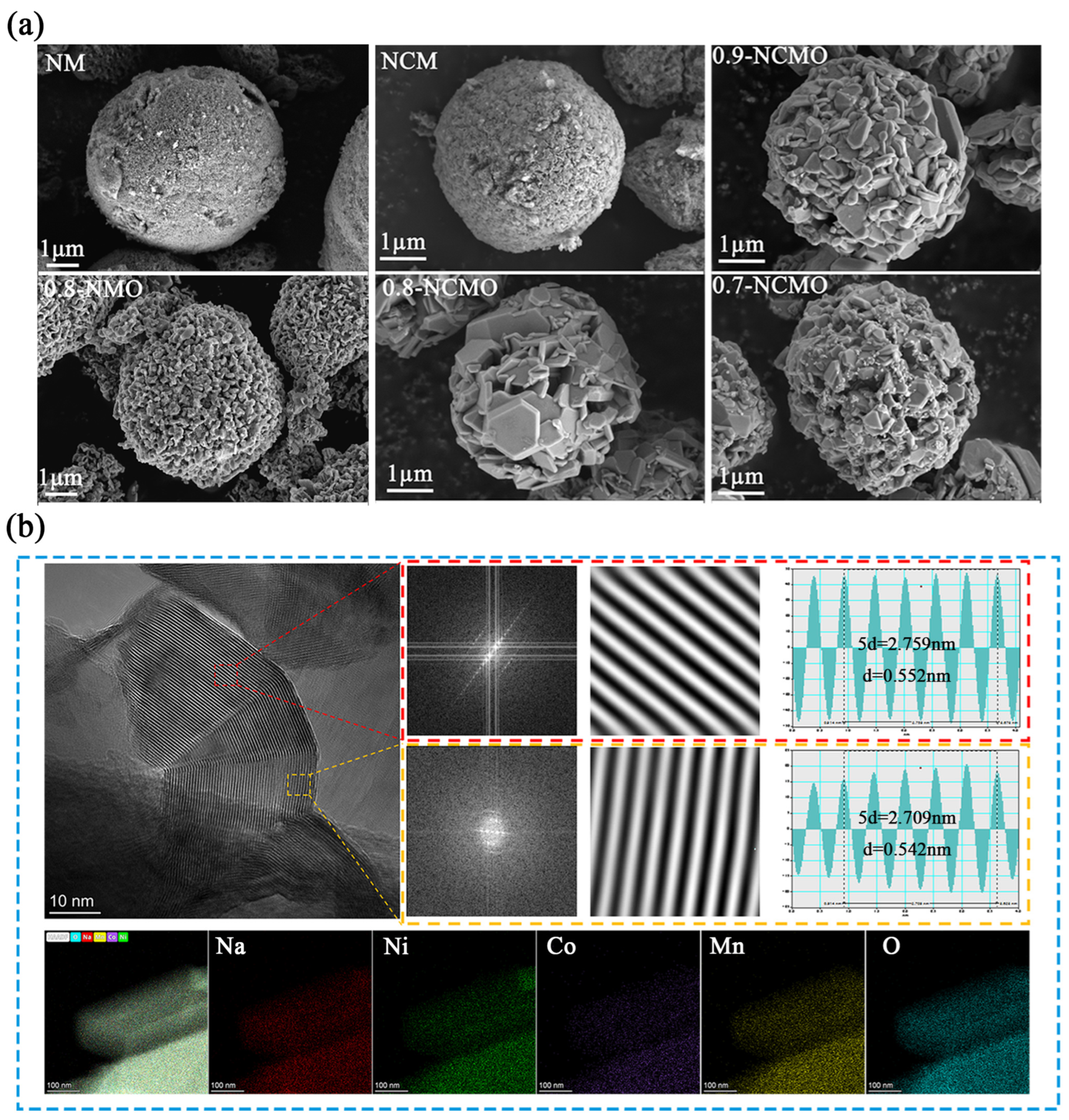
To elucidate the structural and morphological origins underlying the electrochemical behavior of the materials, we investigated and directly compared the microstructures of Co-doped and undoped samples synthesized with identical sodium content (Na = 0.8). Scanning electron microscopy (SEM) images (Figure 2a) and energy-dispersive X-ray spectroscopy (EDS) (Figure S4) elemental mapping reveal that, compared to Co-doped samples, undoped cobalt samples exhibit irregular primary particle morphology with smaller sizes and relatively loose secondary particle structures. This morphological difference indicates that Co-doped effectively regulates crystal growth behavior and mitigates the disordered release of structural stress, consistent with the P2/O3 coexistence structure revealed by XRD and the heteropolar suppression results. We then systematically investigated the microstructures of five samples with different sodium contents (0.9-NCMO, 0.85-NCMO, 0.8-NCMO, 0.75-NCMO, and 0.7-NCMO). Scanning electron microscopy (SEM) images (Figure 2a and Figure S2) and energy-dispersive X-ray spectroscopy (EDS) elemental mapping (Figure S3 and Table S1) show that all samples possess broadly similar morphologies: the primary crystallites adopt a hexagonal plate-like geometry and assemble into secondary particles with diameters of approximately 3–5 μm. This morphological invariance across different Na contents indicates that sodium stoichiometry exerts negligible influence on the formation of primary grains, thereby suggesting that particle morphology is not the principal determinant of the observed variations in electrochemical performance. High-resolution transmission electron microscopy (HRTEM) was subsequently employed to probe the atomic-scale structural characteristics (Figure 2b). In the case of the 0.8-NCMO, distinct lattice spacings of 0.552 Å and 0.542 Å were observed, corresponding, respectively, to the (002) plane of the P2 phase and the (003) plane of the O3 phase—fully consistent with the XRD Rietveld refinement results. These findings confirm that 0.8-NCMO features a nanoscale coexistence of P2 and O3 domains, as opposed to a simple physical mixture of two discrete phases. Moreover, the HRTEM images reveal pronounced interfacial distortions at the boundaries between the P2 and O3 domains, providing compelling evidence for a pervasive topological P2/O3 intergrowth—a coherently interfaced, lattice-matched composite structure that emerges spontaneously during crystal growth. EDS further verifies the homogeneous distribution of Na, Ni, Mn, Co, and O throughout the particle interior. Taken together, the multiscale structural analyses, spanning from micrometer-level morphology to atomic-resolution lattice characterization, unequivocally substantiate the formation of a topologically intergrown P2/O3 architecture in the 0.8-NCMO.
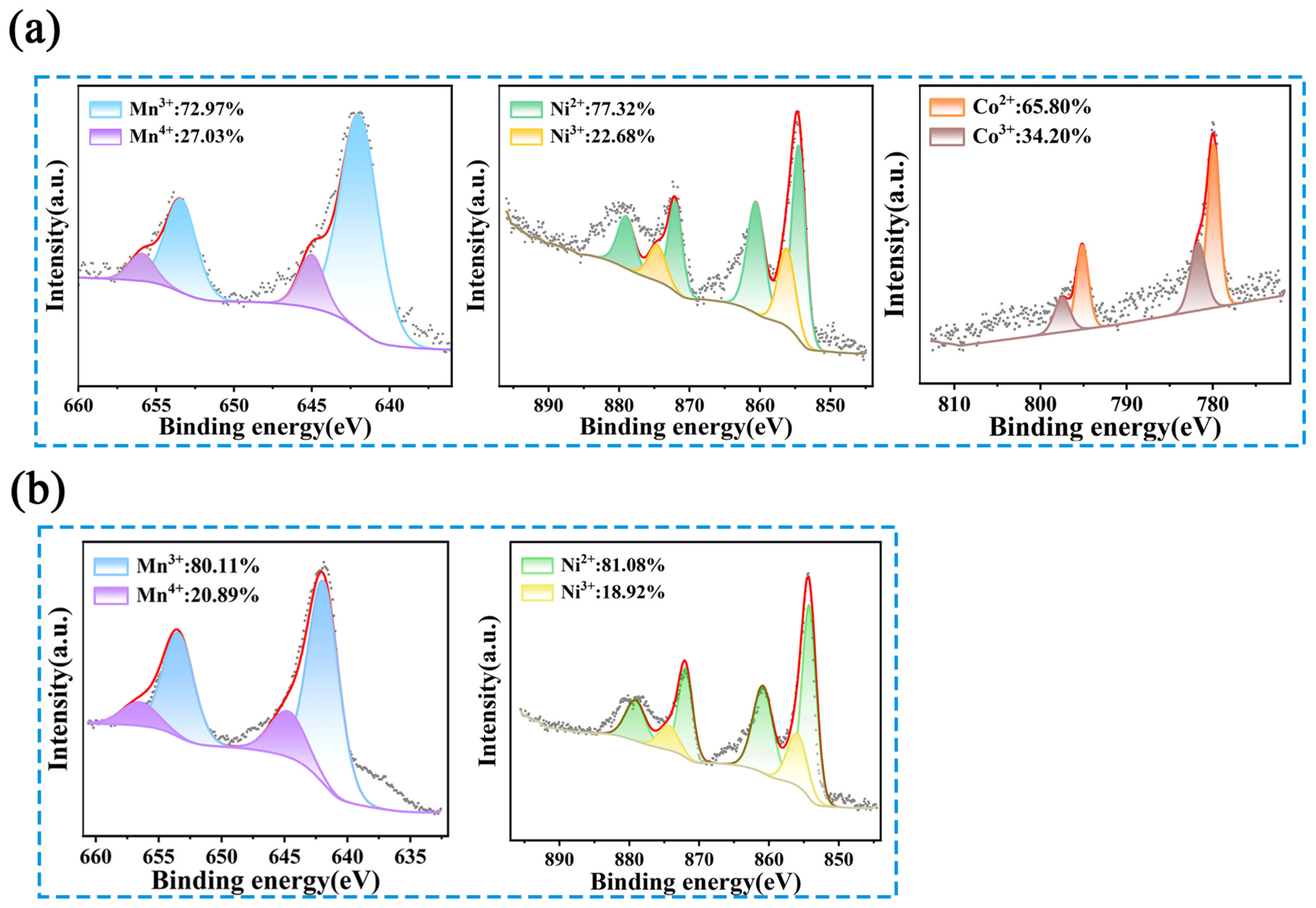
We employed X-ray photoelectron spectroscopy (XPS) to systematically investigate the electronic configurations and local coordination environments of co-doped and undoped samples under identical sodium content (Na = 0.8) conditions. XPS analysis [35,36] (Figure 3a,b) revealed that Co-doping reduces the proportion of nickel in the composition, significantly altering the valence state distribution of transition metals. The relative proportion of Ni2+ in the Ni 2p spectrum is markedly decreased, indicating that Co3+ participates in charge compensation and effectively suppresses Ni2+ enrichment. This strengthens the TM-O bond, stabilizes the layered structure, and consequently reduces the likelihood of forming nickel monoxide impurity phases. Co-doping enhances the covalent character of the TM–O bond, modulates the electronic structure, and further improves the material’s surface and structural stability. We then investigated the electronic configurations and local coordination environments of five samples with different sodium contents. The high-resolution Ni 2p, Mn 2p, and Co 2p spectra (Figure 2a and Figure S4) reveal the presence of Ni2+/Ni3+, Mn3+/Mn4+, and Co2+/Co3+ redox couples in all samples. To maintain charge neutrality within the lattice, the average oxidation state of the transition metals gradually increases as the Na content decreases. This trend suggests strengthened electrostatic interactions within the TMO2 slabs, which help mitigate the structural instability typically induced by excessive Jahn–Teller-active Mn3+ ions [37,38,39]. The pronounced reduction in Mn3+ concentration is particularly beneficial, as it suppresses local octahedral distortion and reduces the migration of Mn into Na layers—two critical factors known to trigger structural degradation and accelerate capacity degradation in Mn-rich layered oxides. In addition, the coexistence of mixed-valence Ni2+/Ni3+ and Co2+/Co3+ indicates a more flexible charge-compensation mechanism during Na+ extraction, enabling smoother redox transitions and diminishing the driving force for detrimental slab gliding or O3–P3 structural transitions [32]. For the Na-rich 0.8-NCMO sample, the predominance of low-valence Ni2+, Mn3+, and Co2+ suggests a more stable local bonding environment, which is expected to better accommodate the strain associated with Na+ (de)intercalation. Overall, the XPS results demonstrate that elemental regulation not only adjusts the oxidation-state distribution of transition metals but also effectively suppresses Jahn–Teller distortion and reduces cation migration. This electronic-structure optimization significantly enhances the structural robustness and cycling stability of the P2/O3 biphase cathode.

3.2. Analysis of Electrochemical Performance

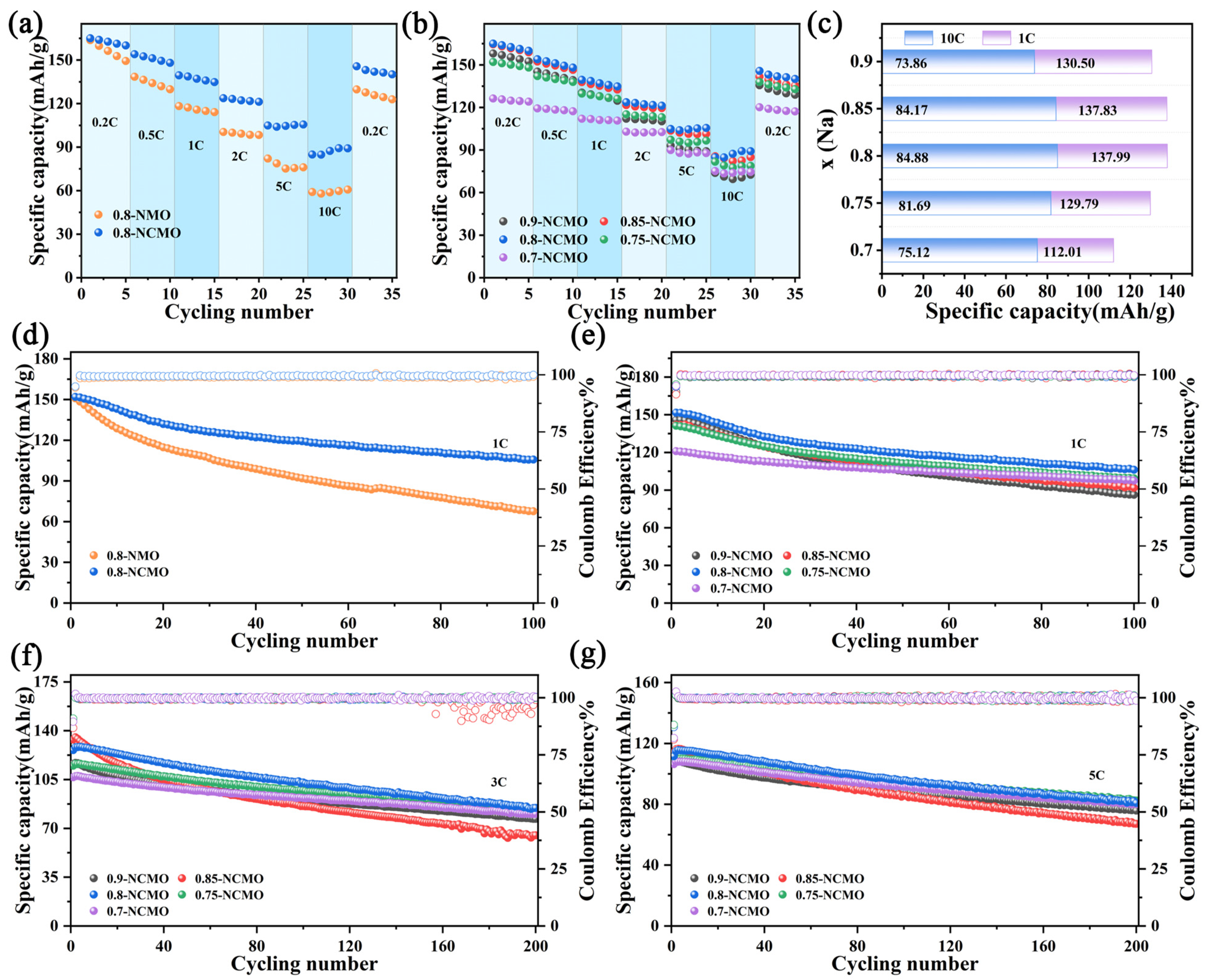
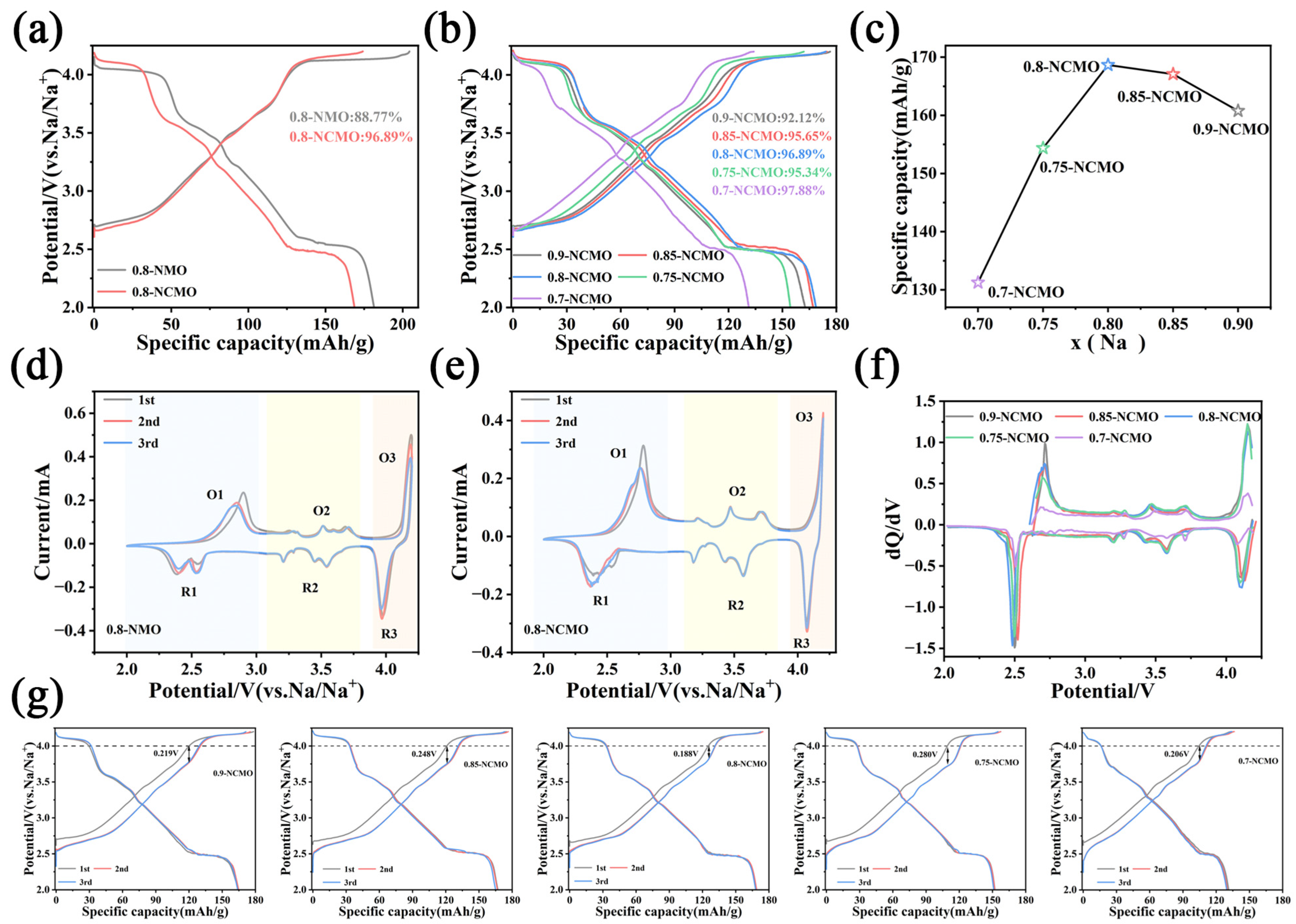
We systematically evaluated the electrochemical performance of the six cathode materials in Na half-cells (2.0–4.2 V vs. Na+/Na) to establish the correlation between structural characteristics and electrochemical behavior. First, rate performance tests were conducted on Co-doped and undoped samples. Figure 4a demonstrates that compared to the undoped cobalt sample, the Co-doped material exhibits superior capacity retention and lower voltage polarization at medium-to-high rates. This performance enhancement is primarily attributed to the fact that, when sodium content is at the phase boundary, cobalt doping facilitates the formation of a P2/O3 coexisting structure. This structure provides more favorable diffusion pathways for Na+, while the controllable layer slip behavior prevents structural blockage at high rates. Next, Figure 4b displays the rate performance of five cathode materials with different sodium contents measured at current densities of 0.2, 0.5, 1, 2, 5 and 10 C (1 C = 140 mA g−1). At 10 C, the 0.9-NCMO, 0.85-NCMO, 0.8-NCMO, 0.75-NCMO, and 0.7-NCMO cathodes deliver capacities of 73.86, 84.17, 84.88, 81.69, and 75.12 mAh g−1, corresponding to capacity retentions of 56.60%, 61.07%, 61.51%, 62.94%, and 67.07% relative to their capacities at 1 C, respectively. Notably, the rate-performance trend across the series reveals that higher P2 phase contents lead to enhanced rate capability, indicating that a P2:O3 phase ratio approaching a 1:1 balance yields optimal high-rate performance, albeit with a pronounced reduction in specific capacity. These results confirm that combining P2-type and O3-type structures effectively enhances reversible capacity and Na+ kinetics. In particular, 0.7-NCMO exhibits a distinct advantage over previously reported P2/O3 biphase layered oxides in terms of rate performance. However, when considering both capacity and rate capability, 0.8-NCMO demonstrates the most balanced and superior overall electrochemical performance.
Subsequently, long-term cycling tests were conducted to evaluate the impact of cobalt doping on the reversibility and structural stability of this cathode material. At a current density of 1 C, the 0.8-NMO sample exhibited a capacity retention rate of 44.80% after 100 cycles (Figure 4d). At higher current densities of 3 C and 5 C, the 0.8-NMO samples exhibited capacity retention rates of 40.02% and 51.27%, respectively, after 200 cycles (Figure S6 and Table S8). The results indicate that, compared to the undoped cobalt sample, the Co-doped material exhibits higher capacity retention and a more stable coulombic efficiency during long-term cycling tests. These results indicate that cobalt doping enhances the material’s structural stability, thereby improving its long-term cycling performance. Next, long-term cycling tests were subsequently performed to evaluate the influence of phase structure on the reversibility and structural stability of the five cathode materials. At a current density of 1 C, the capacity retention after 100 cycles for 0.9-NCMO, 0.85-NCMO, 0.8-NCMO, 0.75-NCMO, and 0.7-NCMO reaches 59.14%, 64.62%, 69.99%, 70.33%, and 80.70%, respectively, demonstrating that the optimized biphase structures exhibit markedly enhanced structural stability compared with the single-phase O3 material (Figure 4c,d). Even at higher current densities of 3 C and 5 C, the 0.8-NCMO sample maintains excellent cycling performance, delivering capacity retentions of 67.09% and 72.45% after 200 cycles, respectively (Figure 4f,g and Table S8).
Subsequently, we conducted a comprehensive evaluation of the electrochemical behavior and kinetics of a series of cathode materials. First, compared to undoped cobalt samples, cobalt-doped materials exhibited smaller oxidation/reduction peak potential differences and better multi-cycle overlap in cyclic voltammetry (CV) curves (Figure 5d), indicating higher reversibility and superior kinetic characteristics in their electrochemical reactions. Particularly in the medium-to-high voltage range, the reaction peaks of cobalt-doped samples were smoother and more stable, indicating that Co-doping effectively modulated the phase transition process and reduced polarization. This finding is highly consistent with their P2/O3 coexisting structure and excellent rate and cycling performance. Simultaneously, the first-cycle charge–discharge curves (Figure 5a) reveal that although the initial discharge capacity of the Co-doped samples is slightly reduced, their first-cycle coulombic efficiency is significantly enhanced. This indicates that cobalt doping effectively suppresses initial irreversible reactions and improves reaction reversibility. Next, the initial three constant current charge–discharge (GCD) curves at 0.1 C, CV curves at 0.1 mV s−1, and corresponding differential capacity (dQ/dV) curves for the five samples with different sodium contents are shown in Figure 5e–g. The differences in capacity among the samples primarily originate from the distinct contributions of the two major voltage plateaus, which are consistent with the redox peaks observed in both the CV and dQ/dV curves. All five materials exhibit similar electrochemical signatures. The low-voltage region below 4.0 V corresponds to the Ni2+/Ni3+ redox process, accompanied by Na+/vacancy ordering transitions that hinder Na+ kinetics. A weak peak appearing in the 2.7–3.8 V region is attributed to a local gliding transition within the O3 host structure (O3 → O3′) [40,41]. This intermediate transition arises from electrostatic modulation induced by Ni2+/Ni3+ oxidation, resulting in slight and reversible TM–O slab shifts; thus, it manifests only as a low-intensity CV feature. The peaks observed between 2.0 and 2.7 V are mainly associated with Na+/vacancy ordering processes. The reversible capacities of 0.7-NCMO, 0.75-NCMO, 0.8-NCMO, 0.85-NCMO, and 0.9-NCMO reach 131.24, 154.37, 168.65, 167.08, and 162.63 mAh g−1 (Figure 5b). Despite identical TM content ratios, varying Na stoichiometry (x) alters the upper limit of reversible Na deintercalation/intercalation, the composition of the P2/O3 phase, and its phase transition pathway. This simultaneously regulates Na/vacancy ordering, ion diffusion, and interfacial charge transfer dynamics, while influencing defect chemistry (oxygen vacancy, TM migration/co-intercalation) and the extent of surface side reactions. Consequently, within the same testing window, this series of samples exhibits distinct specific capacity and polarization behavior. Notably, 0.8-NCMO exhibits a charging capacity comparable to that of the pure O3-phase 0.9-NCMO, while its discharge capacity surpasses that of the O3 benchmark. Comparison of the GCD curves reveals that 0.8-NCMO displays significantly reduced voltage polarization (Figure 5g), indicating that the P2/O3 biphase architecture enhances overall Na+ kinetics efficiency. The improved Na+ transport facilitates deeper charge storage within the 0.8-NCMO structure, enabling a charging capacity approaching that of the O3 phase rather than an intermediate value between 0.7-NCMO and 0.9-NCMO. Simultaneously, the discharge capacity exceeds that of 0.9-NCMO, further confirming the superior kinetic behavior imparted by the P2/O3 biphase configuration. On the other hand, compared with the undoped sample, the Co-doped material exhibits smaller potential separations between anodic and cathodic peaks and much better overlap of successive CV curves, indicating enhanced electrochemical reversibility and reduced polarization. Notably, the redox features in the medium- and high-voltage regions become more stable and smoother upon Co doping. This finding suggests that the phase transition is effectively regulated, consistent with the formation of a P2/O3 coexisting structure.
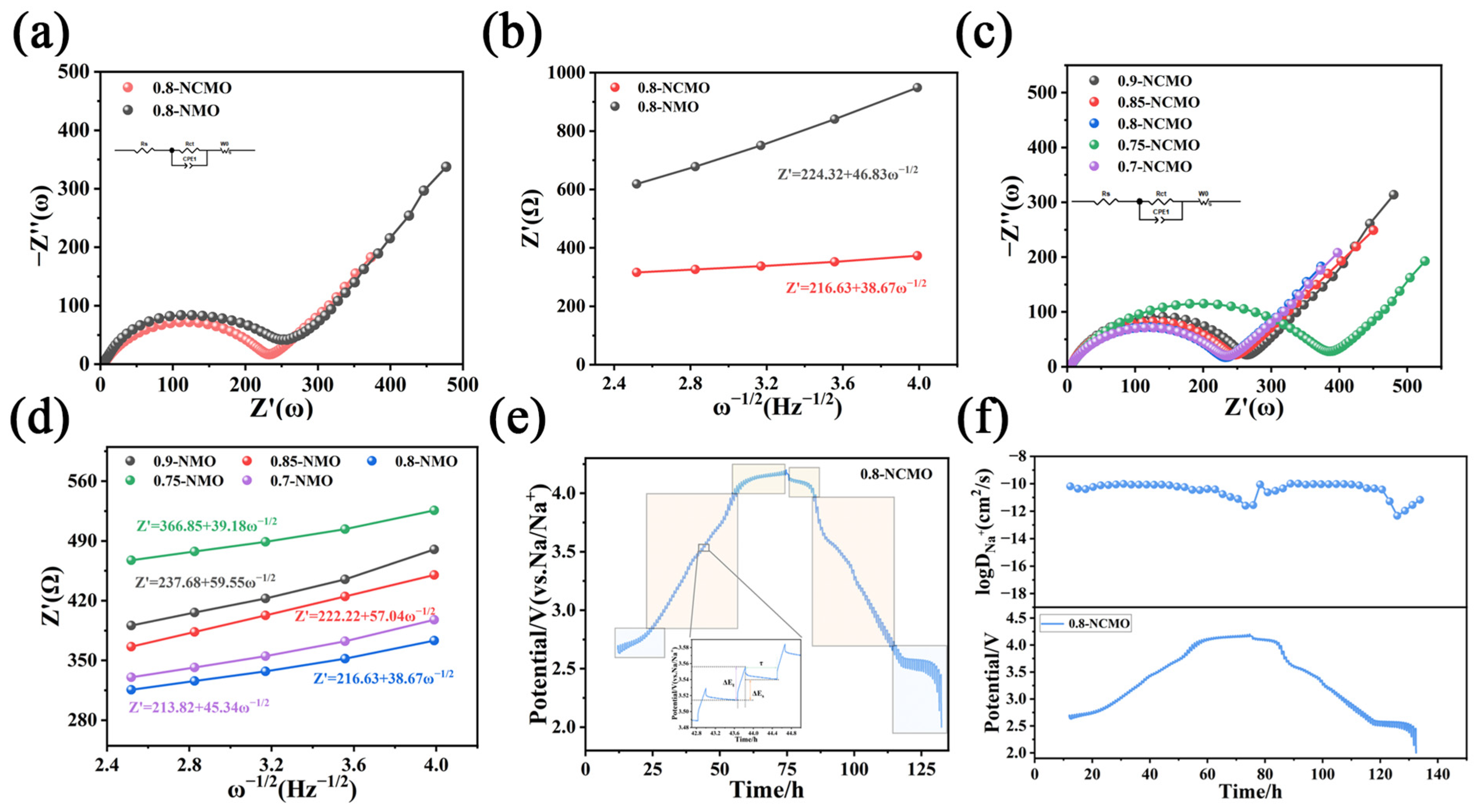
The sodium-ion diffusion coefficient (DNₐ+) was evaluated using electrochemical impedance spectroscopy (EIS). The EIS spectra collected during the initial cycle, along with the corresponding Warburg plots and the calculated DNₐ+ values, are displayed in Figure 6a–d (the detailed calculation procedure is provided in the Supporting Information). First, as shown in Figure 6a, the cobalt-doped sample (0.8-NCMO) exhibits significantly lower charge-transfer impedance in the mid-frequency range, demonstrating superior interfacial charge-transport properties compared to the undoped sample (0.8-NMO). Furthermore, the linear fit of Z′ versus ω−1/2 in Figure 5b indicates that the cobalt-doped sample exhibits a smaller Warburg coefficient, suggesting lower Na+ kinetics resistance and more favorable kinetics. These results demonstrate that Co doping effectively reduces polarization by simultaneously improving electron transport and ion diffusion processes, thereby enhancing the material’s rate performance and cycling stability. Subsequently, five materials with different sodium contents were tested, the experimental results show in Figure 6c,d, and the Table S9 that 0.8-NCMO exhibits a DNₐ+ of 1.14 × 10⁻¹⁴ cm2 s−1, indicating a pronounced enhancement in Na+ kinetics. This improvement can be attributed to the synergistic ion-transport advantages and cooperative growth characteristics of the two phases. As discussed earlier, the P2 and O3 phases offer distinct Na+ migration pathways; when they topologically intergrow within a single crystallite, their coherent interfaces form an interconnected network of ion-conduction channels. This architecture preserves the fast, low-barrier prismatic diffusion pathways of the P2 phase while simultaneously benefiting from the structurally robust octahedral framework of the O3 phase. Moreover, the topological intergrowth ensures lattice continuity and reduces interfacial mismatch, effectively lowering diffusion resistance across P2/O3 boundaries and promoting more homogeneous charge distribution during cycling. The presence of P2 domains also suppresses Na+/vacancy ordering in the O3 matrix, further reducing the diffusion energy barrier and mitigating kinetic polarization [41]. Collectively, these effects significantly accelerate Na+ migration, confirming that the P2/O3 biphase configuration enables smoother and more efficient Na+ kinetics, as observed in 0.8-NCMO. In addition, the Na+ kinetics coefficients during the charge–discharge process were further quantified using the galvanostatic intermittent titration technique (GITT), providing deeper insight into the Na+-transport kinetics at different states of charge. The GITT profiles and the corresponding Na+ kinetics coefficients (DNa+) for the five cathode samples during the first cycle are presented in Figure 6e,f and Figure S8, revealing pronounced kinetic distinctions arising from their different phase compositions. Among them, 0.8-NCMO exhibits the highest and most stable DNa+ values (~10−12–10−13 cm2 s−1) across the entire voltage range, significantly outperforming the O3-dominant 0.9-NCMO and the P2-rich 0.7-NCMO. This superior Na+ transport stems from its topologically integrated P2/O3 architecture, in which the P2 component provides low-energy-barrier, two-dimensional prismatic diffusion pathways, while the O3 component maintains structural robustness; coherent lattice matching at the P2/O3 interface further minimizes interfacial diffusion resistance. In contrast, 0.9-NCMO shows a marked drop in DNa+ at high voltages due to O3→O3′→P3 slab gliding during deep desodiation, whereas 0.7-NCMO suffers from more pronounced fluctuations in kinetics owing to its compromised structural stability. Collectively, these results demonstrate that an optimized P2/O3 phase ratio effectively balances structural integrity and ionic transport, enabling 0.8-NCMO to achieve the most favorable Na+ kinetics among all compositions.
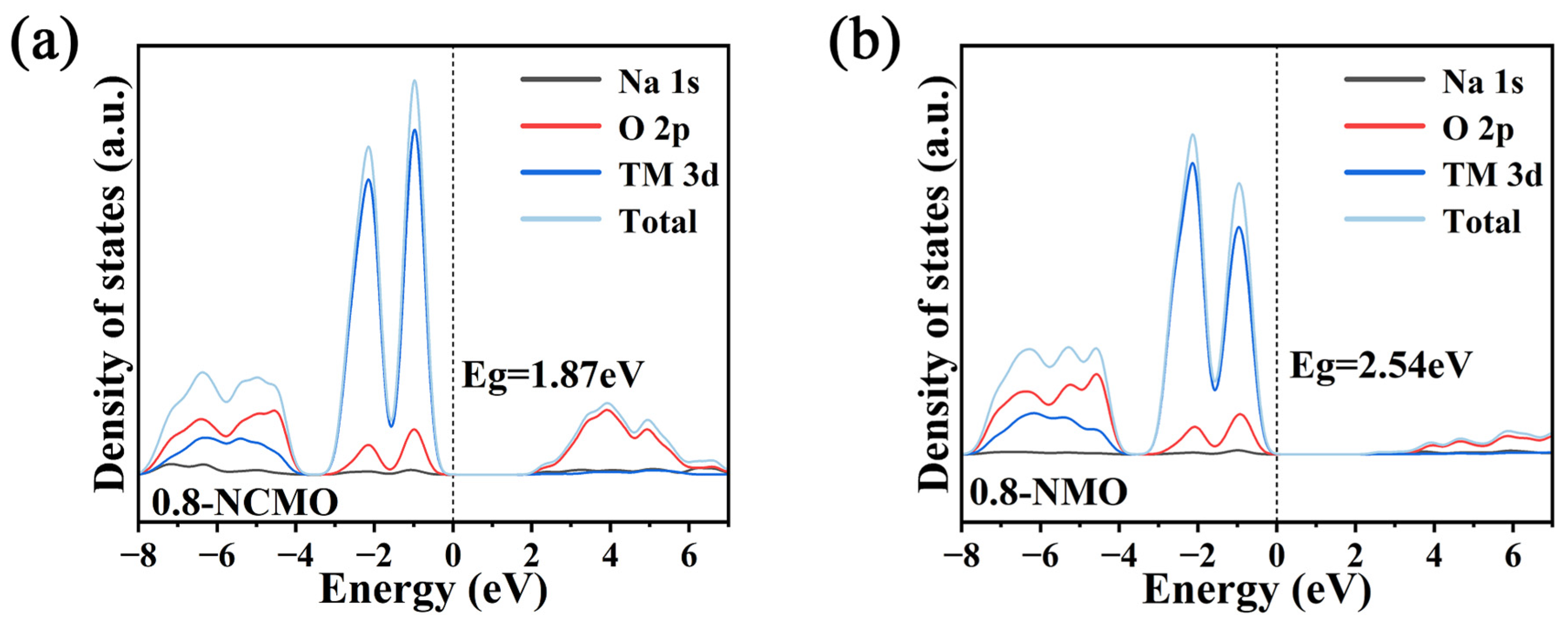
From the perspective of electronic structure, density functional theory (DFT) calculations further reveal the regulatory effect of Co doping on the material’s intrinsic electronic transport behavior. The ease of electronic excitation and transport in the material can be determined by the energy gap between the valence band maximum (VBM) and the conduction band minimum (CBM). The calculation results show that the bandgaps of 0.8-NCMO (Figure 7a) and 0.8-NMO (Figure 7b) are 1.87 eV and 2.54 eV, respectively. Co doping significantly narrows the bandgap, indicating that the energy required for interband electronic transitions is reduced, which is conducive to enhancing electronic conductivity. Concurrently, 0.8-NCMO exhibits a higher TM 3d state density near the Fermi level, along with enhanced TM–O orbital hybridization, indicating strengthened electronic coupling between transition metals and oxygen and increased electron delocalization. The enhanced orbital overlap helps improve charge transfer capability and reduce electronic transport resistance. This modulation of the electronic structure provides an intrinsic basis for the enhancement of the material’s conductivity and the acceleration of reaction kinetics, consistent with the trends in kinetic improvement revealed by EIS and GITT.
To further evaluate the performance of the optimized 0.8-NCMO, a comparison with recently reported P2/O3 biphasic cathodes was conducted under similar testing conditions (Table S10). Most of these materials exhibit initial capacities in the range of 140–165 mAh g−1, with noticeable capacity decay at high-rates. By comparison, the present sample delivers 168.65 mAh g−1 and maintains 84.88 mAh g−1 at 10 C, indicating improved rate performance while preserving high capacity. The enhancement arises from controlled phase equilibrium between P2 and O3 components, which strengthens structural stability and facilitates Na+ transport without relying on additional surface modification.

3.3. Post-Cycling Characterization of Surface and Bulk Properties

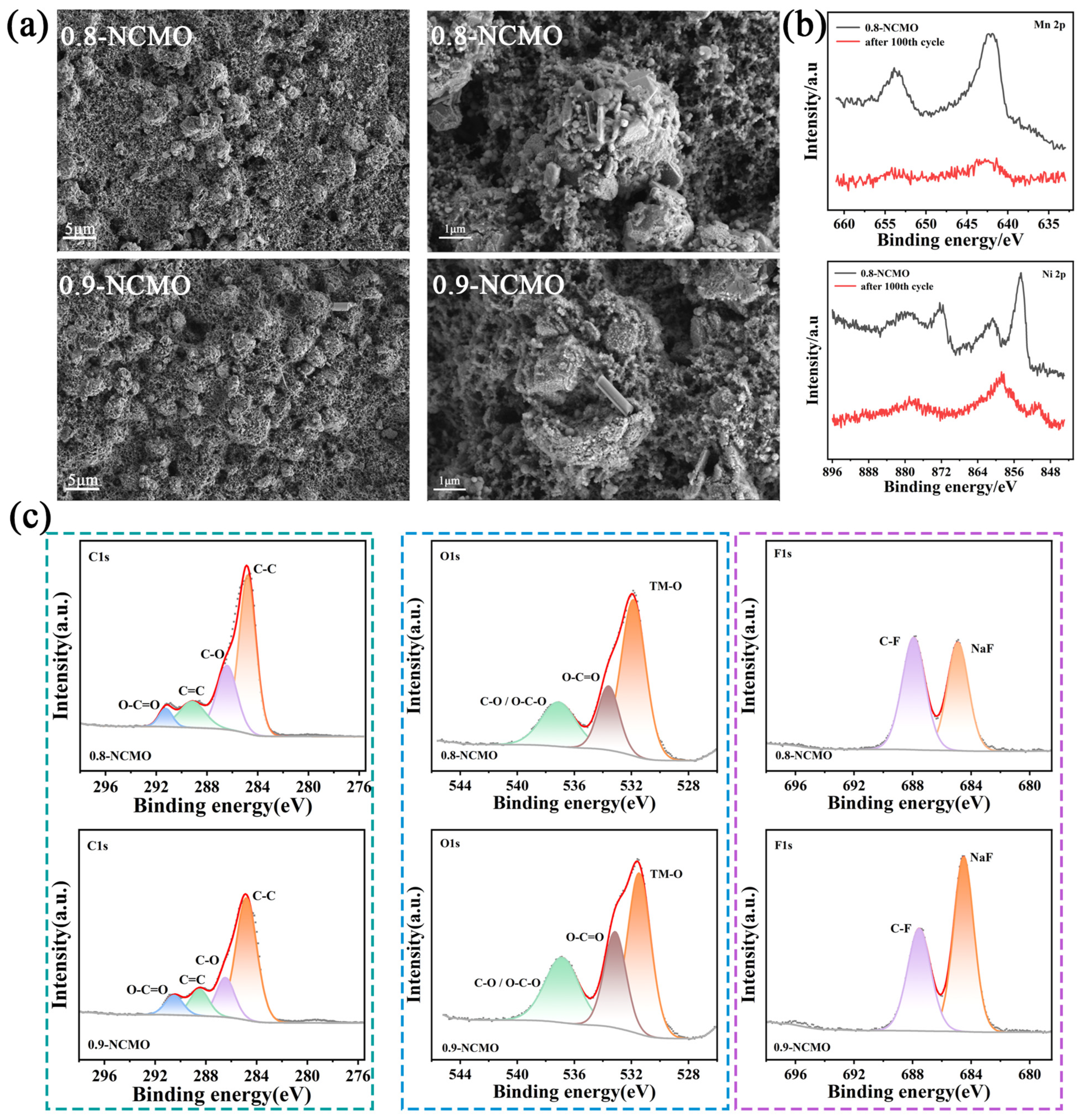
To investigate how surface chemical evolution and structural stability influence the electrochemical performance of the cathode materials, SEM and XPS analyses were conducted on the five samples after 100 cycles at 1C. As shown in the SEM images (Figure 8a), the cycled electrodes exhibit pronounced morphological differences that directly reflect the impact of phase composition on long-term structural integrity. After extended cycling, the pristine O3-type material displays severe surface roughening, edge fragmentation, and intergranular microcracks, features typically associated with O3 → O3′ → P3 slab gliding and anisotropic volume changes during repeated Na+ intercalation. In contrast, the P2/O3 biphase electrodes retain well-defined secondary-particle morphology with less crack formation. The preserved grain boundaries and smoother surfaces observed for the 0.8-NCMO sample further indicate reduced electrolyte corrosion and fewer parasitic reactions, consistent with its superior cycling stability. These results suggest that the topological intergrowth between P2 and O3 phases effectively buffers interlayer shear stress during Na+ (de)intercalation, thereby mitigating mechanically induced degradation. XPS analysis after long-term cycling provides critical insights into the evolution of surface chemistry, interfacial stability, and electrolyte decomposition behavior [42,43]. As shown in the XPS images (Figure 8b,c), for the O3-rich electrodes, the C 1s spectra exhibit significantly intensified signals corresponding to organic degradation products such as ROCO2Na (≈289.2 eV) and PC-derived C–O/C=O groups, indicating severe electrolyte decomposition and parasitic surface reactions during repeated cycling. Consistently, the O 1s region shows enhanced contributions from surface carbonates (O–C=O) and from organic oxygen species, confirming the accumulation of a thick, unstable CEI layer. The F 1s spectra further reveal prominent NaF formation, along with additional organic fluorides (C–F), suggesting substantial decomposition of NaClO4 and the growth of fluorine-rich CEI components. In contrast, the P2/O3 biphasic electrode—specifically the 0.8-NCMO sample—exhibits markedly suppressed formation of these degradation products. The C 1s spectra show much lower proportions of carbonate and polymeric C–O species, indicative of a thinner, more stable CEI. The attenuated O–C=O signal in the O 1s region demonstrates minimized solvent degradation and reduced oxygen-containing organic residues. Additionally, the F 1s spectra show significantly reduced NaF and organic fluoride intensities, implying that the biphasic structure mitigates salt decomposition and suppresses fluorine-rich CEI accumulation. This improved interfacial stability is closely associated with the P2/O3 intergrown framework, which maintains a more coherent, less reactive surface during cycling, thereby reducing parasitic reactions. Moreover, the Ni 2p and Mn 2p spectra of the cycled electrodes remain nearly identical to those of the pristine samples, suggesting that the bulk oxidation states and structural integrity are preserved. Together, the SEM and XPS results show that the P2/O3 intergrown structure stabilizes both bulk and interfacial chemistry, greatly enhancing the long-term cycling durability of the electrode.

4. Conclusions and Future Perspectives

In summary, we designed a series of nickel–manganese-based layered oxides, NaxNi0.4Co0.1Mn0.5O2 (x = 0.9–0.7) through simple elemental adjustments and systematically established the correlation between phase composition and electrochemical performance. Our results reveal that an optimized phase-balanced state maximizes the synergistic effect of the P2/O3 biphase configuration. Among all samples, 0.8-NCMO (P2:O3 = 16.6%:83.4%) demonstrated outstanding electrochemical performance. Compared to the initial coulombic efficiency of 88.77% for nickel–manganese-based materials with equivalent sodium content, this material achieved an initial coulombic efficiency of 96.89%, a high discharge capacity of 168.65 mAh g−1, and a capacity retention of 69.99% after 100 cycles at 1 C, significantly surpassing the other compositions. Overall, this study demonstrates that sodium-content regulation determines the thermodynamic phase region of the material, while Co incorporation regulates the stability of the transition-metal layers and the associated layer-sliding behavior. Their cooperative effect stabilizes the phase-boundary composition and promotes the formation of a controllable P2/O3 coexisting structure, with rational engineering of a P2/O3 biphase structure, effectively enhancing the structural stability and Na+-transport kinetics of layered oxide cathodes.
Overall, the constructed nickel–manganese layered oxide achieves synergistic improvements in capacity, initial coulombic efficiency, and rate performance through phase structure regulation via moderate cobalt doping and sodium content control. While ensuring structural stability, the material maintains stable capacity output under high-rate conditions, exhibiting favorable kinetic characteristics. Although this approach incurs slightly higher costs compared to applications in energy storage, it remains competitively advantageous relative to power-type lithium batteries. This work provides structural design insights and material foundations for the application of nickel–manganese-based sodium-ion cathode materials in sodium-ion battery power systems.
Future work may focus on optimizing intergrowth interfaces and exploring high-entropy or multi-principal-element designs to further expand the compositional landscape. Moreover, advanced in situ/operando characterization and theoretical modeling will be crucial for elucidating phase-evolution mechanisms and guiding rational structural optimization. These insights establish a solid foundation for the development of next-generation high-performance sodium-ion battery cathode materials.

Supplementary Materials

The following supporting information can be downloaded at https://www.mdpi.com/article/10.3390/en19081816/s1, Figure S1. Rietveld refinement patterns of (a) 0.9-NCMO, (b) 0.85-NCMO, (c) 0.75-NCMO, (d) 0.7-NCMO. Figure S2. SEM images of (a–c) NCM, (d–f) 0.9-NCMO, (g–i) 0.85-NCMO, (j–l) 0.8-NCMO, (m–o) 0.75-NCMO, (p–r) 0.7-NCMO. Figure S3. SEM mapping images of (a) NCM, (b) 0.9-NCMO, (c) 0.85-NCMO, (d) 0.8-NCMO, (e) 0.75-NCMO, (f) 0.7-NCMO. Figure S4. SEM images of (a–c) NM55, (d–f) 0.8-NMO and SEM mapping images of (g) NM55, (h) 0.8-NMO. Figure S5. The XPS spectra of Ni 2p, Co 2p, Mn 2p for(a) 0.9-NCMO, (b) 0.85-NCMO, (c) 0.75-NCMO, (d) 0.7-NCMO. Figure S6. Long-term cycling performance of 0.8-NCMO; (a) cycling performance over 200 cycles at 3 C (2.0–4.2 V); and (b) cycling performance over 200 cycles at 5 C (2.0–4.2 V). Figure S7. CV curves of 0.9-NCMO (a), 0.85-NCMO (b), 0.75-NCMO (c) and 0.7-NCMO (d) at a scan rate of 0.1 mV s−1, 2.0–4.2 V. Figure S8. GITT profile of 0.9-NCMO (a), 0.85-NCMO (b), 0.75-NCMO (c) and 0.7-NCMO (d) the derived Na+ diffusion coefficients as a function of state of charge. Table S1. EDS quantification of 0.8-NCMO. Table S2. Precise crystal structure information of 0.9-NCMO sample obtained by Rietveld refinement calculations. Table S3. Precise crystal structure information of 0.85-NCMO sample obtained by Rietveld refinement calculations. Table S4. Precise crystal structure information of 0.8-NCMO sample obtained by Rietveld refinement calculations. Table S5. Precise crystal structure information of 0.75-NCMO sample obtained by Rietveld refinement calculations. Table S6. Precise crystal structure information of 0.7-NCMO sample obtained by Rietveld refinement calculations. Table S7. Precise crystal structure information of 0.8-NMO sample obtained by Rietveld refinement calculations. Table S8. Capacity retention Data for 0.9-NCMO,0.85-NCMO,0.8-NCMO, 0.75-NCMO,0.7-NCMO. Table S9. EIS Fitting Data for 0.9-NCMO,0.85-NCMO,0.8-NCMO, 0.75-NCMO,0.7-NCMO after 1 cycles at 0.1C. Table S10. Comparison of electrochemical performance between this study and previously reported layered oxides cathode material. Ref. [44].

Author Contributions

Conceptualization, J.M., H.W. and G.P.; methodology, J.M., H.W. and G.P.; software, J.M., H.W. and G.P.; validation, J.M., H.W. and G.P.; formal analysis, J.M., Y.Z., H.W., G.P. and X.Y.; investigation, H.W. and J.M.; resources, J.M., H.W. and G.P.; data curation, J.M. and H.W.; writing—original draft preparation, J.M. and H.W.; writing—review and editing, H.W. and J.M.; visualization, J.M.; supervision, H.W. and G.P.; project administration, H.W. and G.P.; funding acquisition, H.W., G.P. and J.M. All authors have read and agreed to the published version of the manuscript.

Funding

This work was supported by Western Young Scholars Project, Chinese Academy of Sciences (Z1669-13), and the APC was fully funded by Jie Miao.

Data Availability Statement

Upon reasonable request, the datasets supporting the conclusions of this study can be obtained from the corresponding author.

Acknowledgments

The authors have reviewed and edited the output and take full responsibility for the content of this publication.

Conflicts of Interest

The authors declare no competing financial interests.

Abbreviations

The following abbreviations are used in this manuscript:
CEICathode electrolyte interphase
CVCyclic voltammetry
DNa+Sodium-ion diffusion coefficient
DOSDensity of States
EDSEnergy-dispersive X-ray spectroscopy
EISElectrochemical impedance spectroscopy
GCDGalvanostatic Charge–Discharge
GITTGalvanostatic intermittent titration technique
HRTEMHigh-resolution transmission electron microscopy
ICEInitial Coulombic efficiency
NCMMn0.5Co0.1Ni0.4CO3
NNMn0.5Ni0.5CO3
SEMScanning electron microscopy
TMTransition metal
XPSX-ray photoelectron spectroscopy
XRDX-ray diffraction
x-NMONaxNi0.5Mn0.5O2 (x = 0.8)
x-NCMONaxNi0.4Co0.1Mn0.5O2 (x = 0.9, 0.85, 0.8, 0.75, 0.7)

References

  1. Yang, L.; Yin, X.; Wang, J.; Sun, Y.; Li, Y.; Zhang, Z.; Liu, Z.; Huang, S.M.; Adelhelm, P.; Zhou, D. Substitution and electrochemistry in layered oxide cathode materials for sodium-ion batteries. Nat. Rev. Chem. 2026, 10, 196–211. [Google Scholar] [CrossRef] [Scilit]
  2. Ahangari, M.; Zhou, M.; Luo, H. Review of Layered Transition Metal Oxide Materials for Cathodes in Sodium-Ion Batteries. Micromachines 2025, 16, 137. [Google Scholar] [CrossRef] [Scilit] [PubMed]
  3. Zuo, W.; Innocenti, A.; Zarrabeitia, M.; Bresser, D.; Yang, Y.; Passerini, S. Layered Oxide Cathodes for Sodium-Ion Batteries: Storage Mechanism, Electrochemistry, and Techno-economics. Acc. Chem. Res. 2023, 56, 284–296. [Google Scholar] [CrossRef] [Scilit] [PubMed]
  4. Nair, N.; Nair, S.V.; Baskar, S. High Na-content P2 and P2-O3 layered oxide cathodes for high performance Na-ion batteries. Mater. Lett. 2024, 354, 135397. [Google Scholar] [CrossRef] [Scilit]
  5. Bianchini, M.; Gonzalo, E.; Drewett, N.E.; Ortiz-Vitoriano, N.; López del Amo, J.M.; Bonilla, F.J.; Acebedo, B.; Rojo, T. Layered P2–O3 sodium-ion cathodes derived from earth abundant elements. J. Mater. Chem. A 2018, 6, 3552–3559. [Google Scholar] [CrossRef] [Scilit]
  6. Li, M.; Zhuo, H.; Lei, J.; Guo, Y.; Yuan, Y.; Wang, K.; Liao, Z.; Xia, W.; Geng, D.; Sun, X.; et al. Unravelling the structure-stability interplay of O3-type layered sodium cathode materials via precision spacing engineering. Nat. Commun. 2025, 16, 2010. [Google Scholar] [CrossRef] [Scilit]
  7. Jiang, N.; Sun, L.R.; Wang, H.L.; Wu, Z.H.; Jiao, P.X.; Zhang, K. Recent advances in P2-type Ni–Mn-based layered oxide cathodes for sodium-ion batteries. Chin. J. Eng. 2023, 45, 1071–1085. [Google Scholar] [CrossRef]
  8. Mo, Y.; Ong, S.P.; Ceder, G. Insights into Diffusion Mechanisms in P2 Layered Oxide Materials by First-Principles Calculations. Chem. Mater. 2014, 26, 5208–5214. [Google Scholar] [CrossRef] [Scilit]
  9. Li, Y.; Liu, G.; Che, J.; Chen, L.; Wang, X.; Wang, G.; Lei, L.; Hou, J.; Li, S.; Wang, J.; et al. Review on layered oxide cathodes for sodium-ion batteries: Degradation mechanisms, modification strategies, and applications. Interdiscip. Mater. 2024, 4, 24–51. [Google Scholar] [CrossRef] [Scilit]
  10. Guo, S.; Sun, Y.; Yi, J.; Zhu, K.; Liu, P.; Zhu, Y.; Zhu, G.-z.; Chen, M.; Ishida, M.; Zhou, H. Understanding sodium-ion diffusion in layered P2 and P3 oxides via experiments and first-principles calculations: A bridge between crystal structure and electrochemical performance. NPG Asia Mater. 2016, 8, e266. [Google Scholar] [CrossRef] [Scilit]
  11. Forero-Saboya, J.; Zhou, Y.; Browne, S.; Moiseev, I.A.; Pablos, C.; Abou-Rjeily, J.; Mboup, A.; Alphen, C.; Zhang, L.; Li, B.; et al. O3- vs P2-type Nax(Ni,Zn,Mn,Ti)O2 layered oxides: Comparative study on electrode-electrolyte reactivity and structural stability for cycling performance. Energy Storage Mater. 2025, 80, 104423. [Google Scholar] [CrossRef] [Scilit]
  12. Cheng, Z.; Du, T.; Cao, L.; Liu, Y.; Wang, H. Recent Advances in Enhancing Air Stability of Layered Oxide Cathodes for Sodium-Ion Batteries via High-Entropy Strategies. Metals 2025, 15, 646. [Google Scholar] [CrossRef] [Scilit]
  13. Vasavan, H.N.; Badole, M.; Saxena, S.; Srihari, V.; Das, A.K.; Gami, P.; Dagar, N.; Deswal, S.; Kumar, P.; Poswal, H.K.; et al. Rational design of an optimal Al-substituted layered oxide cathode for Na-ion batteries. Electrochim. Acta 2024, 494, 144457. [Google Scholar] [CrossRef] [Scilit]
  14. Li, L.; Su, G.; Lu, C.; Ma, X.; Ma, L.; Wang, H.; Cao, Z. Effect of lithium doping in P2-Type layered oxide cathodes on the electrochemical performances of Sodium-Ion batteries. Chem. Eng. J. 2022, 446, 136923. [Google Scholar] [CrossRef] [Scilit]
  15. Liang, X.; Song, X.; Sun, H.H.; Kim, H.; Kim, M.C.; Sun, Y.K. High-energy and long-life O3-type layered cathode material for sodium-ion batteries. Nat. Commun. 2025, 16, 3050. [Google Scholar] [CrossRef] [Scilit]
  16. Ding, Y.; Guo, M.; Xu, H.; Lu, S.; Liu, T.; Yu, Z. Surface coating and bulk doping synergistically stabilize O3-type layered oxide cathodes for long-life sodium-ion batteries. J. Alloys Compd. 2025, 1042, 183943. [Google Scholar] [CrossRef] [Scilit]
  17. Habib, L.; Suo, G.; Li, J.; Lin, C.; Luo, X.; Yang, G.; Kalkozova, Z.K.; Naseem, K. Interface and structural modulation stabilization strategies for layered transition metal oxide cathodes in sodium-ion batteries. Energy Storage Mater. 2026, 84, 104863. [Google Scholar] [CrossRef] [Scilit]
  18. Huang, W.; Li, W.; Zhang, M.; Guan, X.; Jiang, Y.; Yin, W.; Cao, X.; Pan, Q.; Hu, S.; Wang, H.; et al. Synergistic bulk/interface engineering enables high- voltage cycling of O3-type layered oxides cathode material in sodium-ion batteries. Energy Storage Mater. 2026, 86, 105018. [Google Scholar] [CrossRef] [Scilit]
  19. Wei, G.-X.; Zhu, X.; Zhang, X.-Y.; Liu, M.; Wang, P.-F. Review on single-crystalline oxide cathode materials for next-generation Na-ion batteries. Energy Storage Mater. 2026, 86, 104957. [Google Scholar] [CrossRef] [Scilit]
  20. Li, F.; Dong, M.; Bian, H.; Hou, P.; Lin, Z.; Wang, L.; Xu, X. Biphasic and Triphasic Oxide Cathode Materials for Advanced Na-Ion Batteries. ACS Energy Lett. 2026, 11, 2599–2635. [Google Scholar] [CrossRef] [Scilit]
  21. Zhang, Z.; Hou, M.; Yu, J.; Jiao, P.; Liu, J.; Deng, Y.; Che, M.; Zhao, J.; Liang, Z.; He, L.; et al. Manipulating the Dispersed Domain of Pinning Dopants in Layered Oxide Cathodes for Sodium-Ion Batteries. Angew. Chem. Int. Ed. 2026, 65, e20105. [Google Scholar] [CrossRef] [Scilit]
  22. Gao, S.; Huang, Y.; Geng, J.; Hu, W.; Feng, K.; Zhong, J.; Yu, C.; Li, F. Reversible Phase Transition of an Oxide Cathode in High-Voltage Sodium-Ion Batteries. ACS Energy Lett. 2025, 10, 4140–4147. [Google Scholar] [CrossRef] [Scilit]
  23. Fan, Z.; Li, Y.; Pan, J.; Zhou, Z.; Li, W.; Yang, T.; Zhang, H.; Shu, C.; Hua, W.; Wu, Y.; et al. Recent progress and perspectives on composite structural layered transition metal oxides for sodium-ion batteries. EES Batter. 2025, 1, 100–118. [Google Scholar] [CrossRef] [Scilit]
  24. Li, M.; Lin, W.; Ji, Y.; Guan, L.; Qiu, L.; Chen, Y.; Lu, Q.; Ding, X. Recent progress in high-voltage P2-Na (x) TMO(2) materials and their future perspectives. RSC Adv. 2024, 14, 24797–24814. [Google Scholar] [CrossRef] [Scilit]
  25. Kong, L.Y.; Li, Z.Q.; Liu, H.X.; Li, X.Y.; Zhu, Y.F.; Li, J.Y.; Tan, P.; Yang, M.; Mao, J.F.; Pang, W.K.; et al. High Energy Density Heterostructured Sodium Layered Oxide Cathodes Enabled by Mechanical-Chemical Coupling Effect. Angew. Chem. Int. Ed. Engl. 2025, 64, e202517300. [Google Scholar] [CrossRef] [Scilit]
  26. Ma, X.; Guo, H.; Gao, J.; Hu, X.; Li, Z.; Sun, K.; Chen, D. Manipulating of P2/O3 Composite Sodium Layered Oxide Cathode through Ti Substitution and Synthesis Temperature. Nanomaterials 2023, 13, 1349. [Google Scholar] [CrossRef] [Scilit] [PubMed]
  27. Huang, J.; Li, W.; Ye, D.; Xu, L.; Wu, W.; Wu, X. Designing ultrastable P2/O3-type layered oxides for sodium ion batteries by regulating Na distribution and oxygen redox chemistry. J. Energy Chem. 2024, 94, 466–476. [Google Scholar] [CrossRef] [Scilit]
  28. Shen, M.-Y.; Zhu, Z.-J.; Niu, W.; Wu, T.; Li, W.-C.; Lu, A.-H. Revealing the origins of superior ion diffusion in biphasic layered oxide cathode for sodium-ion batteries. Mater. Sci. Eng. R: Rep. 2025, 167, 101110. [Google Scholar] [CrossRef] [Scilit]
  29. Zheng, L.; Zhang, Y.; Zheng, Z.; Liu, Y.; Wang, M.; Wang, H.; Liu, H.; Yang, J. Single-Crystalline Biphasic Layered Cathodes for Sodium-Ion Batteries. Small 2026, e14662. [Google Scholar] [CrossRef] [Scilit] [PubMed]
  30. Kang, B.; Zhang, M.; Fan, H.; Jiang, Y.; Guan, X.; Wang, M.; Pan, Q.; Hu, S.; Huang, Y.; Wang, H.; et al. Cobalt Surface Treatment Induces Tailored Reconstructed Layer to Enhance High-Voltage Cycling Stability of O3-Type Layered Oxide Cathodes for Sodium-Ion Batteries. Adv. Funct. Mater. 2026, e31556. [Google Scholar] [CrossRef] [Scilit]
  31. Peng, B.; Chen, Y.; Zhao, L.; Zeng, S.; Wan, G.; Wang, F.; Zhang, X.; Wang, W.; Zhang, G. Regulating the local chemical environment in layered O3-NaNi0.5Mn0.5O2 achieves practicable cathode for sodium-ion batteries. Energy Storage Mater. 2023, 56, 631–641. [Google Scholar] [CrossRef] [Scilit]
  32. Thottungal, A.; Surendran, A.; Enale, H.; Sarapulova, A.; Ganesan, M.; Murugan, P.; Mangold, S.; Dolotko, O.; Knapp, M.; Dixon, D.; et al. Tuning the upper cut-off voltage for enabling Co3+/Co2+ redox in a P2/P3/spinel composite cathode material for sodium-ion batteries: An in operando study. J. Power Sources 2026, 662, 238803. [Google Scholar] [CrossRef] [Scilit]
  33. Xu, H.; Xie, C.; Chen, H.; Song, T.; Lan, Y.; Wu, N.; Zhou, X.; Kidkhunthod, P.; Kang, L.; Han, X.; et al. Improving the high-voltage high-rate performance of a P2 layered oxide cathode by a dual-ion doping strategy for sodium-ion batteries. J. Mater. Chem. A 2024, 12, 21114–21123. [Google Scholar] [CrossRef] [Scilit]
  34. Zhao, C.; Wang, Q.; Yao, Z.; Wang, J.; Sánchez-Lengeling, B.; Ding, F.; Qi, X.; Lu, Y.; Bai, X.; Li, B.; et al. Rational design of layered oxide materials for sodium-ion batteries. Science 2020, 370, 708–711. [Google Scholar] [CrossRef] [Scilit] [PubMed]
  35. Garcia, J.C.; Bareño, J.; Chen, G.; Croy, J.R.; Iddir, H. Strain-driven surface reconstruction and cation segregation in layered Li(Ni1-x-yMnxCoy)O2 (NMC) cathode materials. Phys. Chem. Chem. Phys. 2020, 22, 24490–24497. [Google Scholar] [CrossRef] [Scilit]
  36. Biesinger, M.C.; Payne, B.P.; Grosvenor, A.P.; Lau, L.W.M.; Gerson, A.R.; Smart, R.S.C. Resolving surface chemical states in XPS analysis of first row transition metals, oxides and hydroxides: Cr, Mn, Fe, Co and Ni. Appl. Surf. Sci. 2011, 257, 2717–2730. [Google Scholar] [CrossRef] [Scilit]
  37. Li, Q.; Li, Y.; Zhou, Q.; Long, B.; Wang, Y.; Li, Y.; Qiu, Z.; Wang, Z.; Zhang, Y.; Wu, C.; et al. Mitigating Jahn–Teller Distortion toward High-Capacity P2-Type Layered Oxide Cathodes for Sodium-Ion Batteries. Adv. Funct. Mater. 2025, 36, e14451. [Google Scholar] [CrossRef] [Scilit]
  38. Li, L.Y.; Shen, M.Y.; Wang, J.S.; Wu, T.; Li, W.C. Mitigating Jahn-Teller Effect of Mn-Based Layered Oxide Cathodes for Sodium-Ion Batteries by Regulation of Coordination Chemistry. ACS Appl. Mater. Interfaces 2025, 17, 35631–35640. [Google Scholar] [CrossRef] [Scilit]
  39. Li, Y.J.; Zhu, Y.F.; Chen, B.B.; Jia, X.B.; Xin, H.; Zhao, G.Z.; Zhu, G.; Dou, S.X.; Xiao, Y. Jahn-Teller Effect in Sodium Layered Oxide Cathodes: Inducement Mechanisms, Mitigation Strategies, and Rational Utilizations. Adv. Funct. Mater. 2025, 35, 2504096. [Google Scholar] [CrossRef] [Scilit]
  40. Li, Z.; Deng, X.; Zhang, Y.; Wang, X. A novel O3 type NaNi0.5Mn0.5O2 positive electrode material with pillar effect for sodium ion batteries. J. Alloys Compd. 2025, 1028, 180683. [Google Scholar] [CrossRef] [Scilit]
  41. Wang, P.-F.; Yao, H.-R.; Liu, X.-Y.; Yin, Y.-X.; Zhang, J.-N.; Wen, Y.; Yu, X.; Gu, L.; Guo, Y.-G. Na+/vacancy disordering promises high-rate Na-ion batteries. Sci. Adv. 2018, 4, eaar6018. [Google Scholar] [CrossRef] [Scilit] [PubMed]
  42. Zhao, C.; Yao, Z.; Wang, Q.; Li, H.; Wang, J.; Liu, M.; Ganapathy, S.; Lu, Y.; Cabana, J.; Li, B.; et al. Revealing High Na-Content P2-Type Layered Oxides as Advanced Sodium-Ion Cathodes. J. Am. Chem. Soc. 2020, 142, 5742–5750. [Google Scholar] [CrossRef] [Scilit]
  43. Zhang, T.; Ji, H.; Hou, X.; Ji, W.; Fang, H.; Huang, Z.; Chen, G.; Yang, T.; Chu, M.; Xu, S.; et al. Promoting the performances of P2-type sodium layered cathode by inducing Na site rearrangement. Nano Energy 2022, 100, 107482. [Google Scholar] [CrossRef] [Scilit]
  44. Jamil, S.; Mudasar, F.; Yuan, T.; Fasehullah, M.; Ali, G.; Chae, K.H.; Voznyy, O.; Zhan, Y.; Xu, M. Sb-Doped Biphasic P2/O3-Type Mn-Rich Layered Oxide Cathode Material for High-Performance Sodium-Ion Batteries. ACS Appl. Mater. Interfaces 2024, 16, 14669–14679. [Google Scholar] [CrossRef] [Scilit] [PubMed]
Figure 1. Rietveld-refined XRD pattern of 0.8-NMO (a) and 0.8-NCMO (b); (c) XRD patterns images of 0.9-NCMO, 0.85-NCMO, 0.8-NCMO, 0.75-NCMO, 0.7-NCMO and (d) relationship between Sodium Content and P2 Phase Content.
Energies 19 01816 g001
Figure 2. (a) SEM image of 0.9-NCMO, 0.8-NCMO, 0.9-NCMO, and 0.8-NMO; (b) HRTEM-EDS mapping of 0.8-NCMO.
Energies 19 01816 g002
Figure 3. High-resolution XPS spectra of Mn 2p, Ni 2p, and Co 2p of 0.8-NCMO (a) and 0.8-NMO (b).
Energies 19 01816 g003
Figure 4. (a) Rate capability at various C-rates of the 0.8-NMO and 0.8-NCMO. (b) Rate capability at various C-rates of the five samples; (c) comparison of first-cycle discharge capacities at different Na contents and comparison of cycling capacities over 100 cycles. (d) Long-term cycling performance at 1 C (2.0–4.2 V) of 0.8-NMO and 0.8-NCMO. (e) Long-term cycling performance at 1 C (2.0–4.2 V) of 0.9-NCMO, 0.85-NCMO, 0.8-NCMO, 0.75-NCMO, and 0.7-NCMO; (f) cycling performance over 200 cycles at 3 C (2.0–4.2 V); and (g) cycling performance over 200 cycles at 5 C (2.0–4.2 V).
Energies 19 01816 g004
Figure 5. (a) First-cycle charge–discharge profiles and initial coulombic efficiencies of 0.8-NCMO and 0.8-NMO. (b) First-cycle charge–discharge profiles and initial coulombic efficiencies of the five samples; (c) comparison of first-cycle discharge capacities at different Na contents; and cyclic voltammogram of 0.8-NMO (d) and 0.8-NCMO (e) recorded at 0.1 mV s−1 within 2.0–4.2 V. (f) First-cycle differential capacity (dQ/dV) profiles of the five compositions, highlighting the evolution of redox processes and phase transitions. (g) First three activation charge–discharge curves at 0.1 C for 0.8-NMO, 0.9-NCMO, 0.85-NCMO, 0.8-NCMO, 0.75-NCMO, and 0.7-NCMO (with 4.0 V marked as the reference line for determining the voltage hysteresis).
Energies 19 01816 g005
Figure 6. (a) Nyquist plots of 0.8-NCMO and 0.8-NMO after one activation cycle at 0.1 C. (b) Warburg plots (Z′ vs. ω−1/2) used for Na+ kinetics analysis. (c) Nyquist plots of 0.7-NCMO, 0.75-NCMO, 0.8-NCMO, 0.85-NCMO, and 0.9-NCMO after one activation cycle at 0.1 C. (d) Warburg plots (Z′ vs. ω−1/2) used for Na+ kinetics analysis. (e) GITT profile of 0.8-NCMO. (f) Derived Na+ kinetics coefficients versus state of charge.
Energies 19 01816 g006
Figure 7. Density of States (DOS) for the pristine 0.8-NCMO (a) and 0.8-NMO (b).
Energies 19 01816 g007
Figure 8. (a) SEM images of the 0.8-NCMO and 0.9-NCMO electrodes after 100 cycles at 1C; (b) high-resolution Mn 2p and Ni 2p XPS spectra of the electrodes before and after 100 cycles at 1C; (c) C 1s, O 1s, and F 1s XPS spectra of the 0.8-NCMO and 0.9-NCMO electrodes after 100 cycles at 1C.
Energies 19 01816 g008
Table 1. Refined cell parameter outcomes from Rietveld analysis of the prepared samples.
Samplea (Å)c (Å)O3a (Å)c (Å)P2NiORWPRP
0.8-NMO2.94516.03396.50%2.89011.1491.60%01.481.14
0.9-NCMO2.93316.067100.00%00001.391.02
0.85-NCMO2.87016.68697.70%2.87911.0622.30%01.651.23
0.8-NCMO2.87016.68683.40%2.87111.08116.60%02.051.44
0.75-NCMO2.93516.05471.00%2.88511.04927.30%1.70%1.441.09
0.7-NCMO2.93716.04844.60%2.88611.05051.20%4.20%1.250.96
Disclaimer/Publisher’s Note: The statements, opinions and data contained in all publications are solely those of the individual author(s) and contributor(s) and not of MDPI and/or the editor(s). MDPI and/or the editor(s) disclaim responsibility for any injury to people or property resulting from any ideas, methods, instructions or products referred to in the content.