Article

Optimal Sizing of Power and Hydrogen Storage Systems Considering Electrolyzer Efficiency and Start-Up Dynamics

1
College of Electrical Engineering & New Energy, China Three Gorges University, Yichang 443002, China
2
School of Electrical and Control Engineering, Henan University of Urban Construction, Pingdingshan 467036, China
*
Authors to whom correspondence should be addressed.
Energies 2026, 19(7), 1712; https://doi.org/10.3390/en19071712
Submission received: 24 February 2026 / Revised: 26 March 2026 / Accepted: 29 March 2026 / Published: 31 March 2026

Abstract

To reduce renewable output volatility and improve system integration efficiency, this study constructs a coordinated wind–solar–storage–hydrogen framework. The proposed MILP model innovatively integrates electrolyzer power-dependent efficiency and start-up dynamics into a coupled capacity-sizing and dispatch framework and differs from existing MILP models in refined dynamic constraint construction, multi-energy flow coupling, and practical engineering logic constraints. Refined mathematical models are formulated for core components, including wind and photovoltaic units, battery energy storage systems (BESS), and electrolyzers with power-dependent hydrogen production efficiency and operational dynamics. The electrolyzer efficiency peak at 0.25 p.u. input power is calibrated by industrial test data, and the optimization results show strong robustness to the slight deviation of this peak point. Independent control strategies are designed for each electrolyzer, and a capacity optimization model is formulated to maximize system performance. Simulation tests using wind and solar profiles from Northwest China show that the optimized system achieves a renewable energy utilization rate of 96.7%, a BESS capacity of 7 MWh, and a hydrogen storage tank of 3500 kg. Adopting a time-of-use (TOU) electricity pricing mechanism combined with hydrogen sales significantly enhances system efficiency, while expanding power and hydrogen transmission capacities further improves renewable energy integration. These results demonstrate the practical potential of the proposed integrated system for large-scale renewable energy deployment.

1. Introduction

Northwest China possesses rich wind and solar resources, which makes it a major hub for renewable energy deployment in China [1]. The large-scale integration of renewable energy in this region plays a critical role in establishing a modernized power system and promoting China’s dual-carbon objectives [2]. In particular, the transformation toward a renewable-dominated power structure requires not only rapid capacity expansion but also systematic improvements in flexibility and regulation capability.
The inherent intermittency, volatility, and uncertainty of renewable power sources result in insufficient flexibility in standalone generation systems [3]. Although wind–solar hybrid configurations can partially alleviate temporal mismatches between supply and demand, their vulnerability to disturbances, rapid power fluctuations, and stochastic variations continues to pose substantial challenges to large-scale grid integration [4]. A policy report released in 2023 by the National Energy Administration stressed the promotion of renewable energy + storage systems, optimized scheduling strategies, and coordinated operation to improve power generation performance [5]. Therefore, enhancing system flexibility through advanced energy storage technologies has become a critical pathway for supporting high renewable penetration.
Among various storage technologies, Hydrogen Energy Storage (HES) demonstrates distinctive advantages, including large-scale capacity, long-duration storage capability, high energy density, and cross-seasonal energy shifting potential [6]. As renewable-based hydrogen production technologies continue to advance and scale up, the systematic design of hydrogen energy storage systems has attracted increasing research attention [7]. Existing studies aim to balance economic viability and environmental sustainability while improving renewable energy accommodation and reducing curtailment [8]. Nevertheless, the operational complexity of hydrogen production systems introduces additional modeling challenges that must be addressed for realistic capacity planning.
Extensive research has been conducted on hydrogen production technologies based on water electrolysis and their operational strategies [9]. Electrolyzers exhibit complex operational characteristics, including startup–shutdown constraints, minimum loading thresholds, ramping limits, and nonlinear efficiency variations under different input power levels. He C. et al. [10] proposed an operational strategy considering startup–shutdown characteristics, in which each electrolyzer is individually controlled and the startup sequence is determined according to the available input power. Su W. et al. [11] further introduced a coordinated control strategy that accounts for both power response characteristics and startup–shutdown dynamics by aggregating multiple electrolyzers into an integrated hydrogen production unit. These studies indicate that incorporating realistic operational characteristics improves the accuracy of energy conversion efficiency estimation and enhances model reliability. However, in most existing works, startup–shutdown dynamics and power-dependent efficiency are modeled separately, and the coupling between transient startup behavior and efficiency variation is often simplified or neglected, particularly the efficiency degradation induced by power adjustments during startup. Therefore, in large-scale hydrogen production projects, refined modeling of electrolyzer behavior and rational startup scheduling are essential to maintain operation in high-efficiency regions.
To enhance renewable energy utilization, wind–solar power systems integrated with hydrogen production via water electrolysis have been widely studied [12,13]. Through the integration of electrolyzers, hydrogen storage tanks, and fuel cells, efficient mutual conversion between electricity and hydrogen is realized, enhancing system flexibility and enabling multiple revenue channels. Jia Y. et al. [14] proposed a capacity optimization method for electricity–hydrogen hybrid energy storage systems, while Li J. et al. [15] compared wind–solar systems configured with battery storage, pumped hydro storage, and hydrogen energy storage. Nevertheless, many optimization studies still rely on simplified electrolyzer models and fail to capture the coupling between dynamic power variations and conversion efficiency—an effect that becomes increasingly important with high renewable penetration and frequent fluctuations. Recent studies have begun to address this gap. For instance, Babay et al. [16] developed a more detailed model that links power dynamics with electrolyzer efficiency, improving performance evaluation in systems participating in both electricity and hydrogen markets. However, under scenarios involving simultaneous electricity and hydrogen market participation, many studies simplify electrolyzer operation and neglect startup–shutdown losses and dynamic power fluctuation effects, which may lead to overestimation of system efficiency and economic performance, especially under high renewable penetration.
To address these gaps, this paper develops a novel optimal capacity configuration framework for wind–solar power generation systems that explicitly incorporates detailed electrolyzer operational characteristics. An electricity–hydrogen hybrid storage capacity optimization model is formulated with the objective of maximizing the annual comprehensive operational performance. Different from existing studies, the proposed model explicitly captures the coupling between startup dynamics and power-dependent efficiency within a unified framework, enabling a more accurate representation of transient losses and efficiency variation during power adjustments. The model integrates constraints on electricity and hydrogen transmission capacities, operational limits of storage devices, electrolyzer startup–shutdown dynamics, and coordinated dispatch strategies between renewable generation and electricity–hydrogen storage units. Using real wind and solar generation data from a representative site in Northwest China, the framework determines optimal capacity allocations of BESS, electrolyzers, hydrogen storage tanks, and fuel cells under different energy sales modes and transmission scenarios. Comparative analyses further quantify the impact of electrolyzer energy consumption characteristics and startup–shutdown behavior on system efficiency, profitability, and environmental performance, demonstrating the critical importance of modeling detailed electrolyzer dynamics in high-penetration renewable energy systems.This work presents the following main contributions and innovations:
(1)
Refined electrolyzer modeling: A dynamic electrolyzer model is developed, capturing startup–shutdown losses, minimum load, ramping limits, and power-dependent efficiency, including coupled effects during transient startup and power changes, improving hydrogen production accuracy under fluctuating renewables.
(2)
Integrated capacity optimization framework: A unified electricity–hydrogen hybrid storage optimization approach is proposed for wind–solar systems, enabling coordinated planning of BESS, electrolyzers, hydrogen storage tanks, and fuel cells to maximize system-level operational performance.
(3)
Multi-energy coordinated dispatch: A dispatch model is established under electricity and hydrogen transmission constraints, realistically representing interactions among renewable generation, electricity and hydrogen trading, and storage operation.
(4)
Demonstration of operational and economic benefits: Multi-scenario analyses quantify improvements in renewable utilization, efficiency, and profitability, and highlight biases from neglecting coupling effects in simplified models.

2. Related Work

To contextualize the present study, the related literature is categorized into three main areas: hydrogen production modeling, integrated energy storage systems, and capacity optimization of renewable energy systems.

2.1. Hydrogen Production Modeling

Extensive research has focused on modeling the operational characteristics of electrolyzers for hydrogen production. Studies have considered factors such as startup–shutdown constraints, minimum load limits, ramping rates, and dynamic efficiency variations under fluctuating power input [17,18]. However, most studies treat these aspects separately, often neglecting the interaction between startup dynamics and power-dependent efficiency, as well as transient efficiency losses during cold starts. Accurate modeling of these characteristics has been shown to be critical for realistic simulation of hydrogen production efficiency and for optimizing the operational strategy of electrolyzers in hybrid energy systems. In this work, a unified model is developed that explicitly captures the coupling between startup transitions and power-dependent efficiency, enabling quantification of the combined impact on hydrogen output.
The electrolyzer efficiency can be expressed as a power-dependent function:
η ely t = f P in t P rated
where η ely t represents the hydrogen production at time step t, P in t is the instantaneous electrical input to the electrolyzer, and P rated denotes the electrolyzer’s rated capacity. The function f ( · ) captures the nonlinear variation of efficiency with respect to input power. Importantly, η ely t is adjusted in our model to account for transient losses during startup and rapid power changes. The actual hydrogen output at time step t can then be expressed as:
m H 2 t = η ely t P in t Δ t L H V H 2
where m H 2 t is the mass of hydrogen produced, Δ t is the duration of the time step, and L H V H 2 is the lower heating value of hydrogen. This formulation allows realistic calculation of hydrogen output considering both power fluctuations and efficiency dynamics, as well as the coupled effects of startup behavior and transient efficiency degradation.

2.2. Integrated Electricity–Hydrogen Storage Systems

Several studies have explored the combination of batteries, electrolyzers, and hydrogen conversion units to enhance renewable energy utilization and system flexibility [19]. These studies highlight the reversible conversion of energy between electricity and hydrogen, illustrating the capability of hybrid storage systems to mitigate renewable variability and enable multiple revenue streams [20]. Research in this area highlights the advantages of multi-energy storage systems for both short-term peak shaving and long-term energy management.
The SOC evolution of the BESS can be expressed as:
S O C t = S O C t 1 + η ch S cha t Δ t S dis t Δ t η dis
where S O C t represents the battery’s state of charge at time step t, S cha t and S dis t correspond to the charging and discharging power, η ch and η dis are the respective charging and discharging efficiencies, and Δ t is the length of the time interval. In a similar manner, the energy balance for the hydrogen storage system can be expressed as:
M H 2 t = M H 2 t 1 + m H 2 , prod t m H 2 , cons t
where M H 2 t represents the hydrogen inventory at time step t, m H 2 , prod t is the hydrogen mass produced by electrolyzers, and m H 2 , cons t is the hydrogen mass consumed by fuel cells or sold externally. These formulations allow quantifying the energy flow within the integrated electricity–hydrogen storage system.

2.3. Capacity Optimization of Renewable Energy Systems

Another key research direction involves determining the optimal sizing of wind, solar, and storage components to maximize economic and environmental performance. Optimization models often incorporate constraints such as storage capacity limits, transmission channel capacities, and renewable energy curtailment [21]. While some recent studies consider dynamic operational characteristics of electrolyzers or batteries, they typically treat these effects in isolation and neglect the interaction between startup dynamics and power-dependent efficiency. In contrast, the proposed framework explicitly models this coupling, enabling more accurate evaluation of system-level performance under high renewable penetration.
A general formulation of capacity optimization can be expressed as:
max   P net = R elec + R H 2 C cap C OM C dep
where P net is the net system performance, R elec and R H 2 are revenues from electricity and hydrogen, and C cap , C OM , C dep denote investment, operation and maintenance, and depreciation costs, respectively. This formulation, combined with the coupled electrolyzer model, captures trade-offs between system sizing, storage operation, and the impact of startup-transient and efficiency dynamics on economic performance.
Existing MILP-based models for wind–solar–storage–hydrogen systems support multi-energy capacity planning and dispatch but often simplify electrolyzer dynamics, separate capacity sizing from real-time operation, focus on a single energy flow or market, and partially account for constraints like transmission limits. Electrolyzer nonlinearities are typically linearized, and startup dynamics or power-dependent efficiency are often neglected, leading to potential inaccuracies. These limitations motivate the proposed MILP framework, which integrates capacity sizing with real-time dispatch, models detailed electrolyzer behavior, captures multi-energy and multi-market interactions, and enforces transmission constraints for more realistic system optimization.

3. Electric Hydrogen Hybrid Storage System

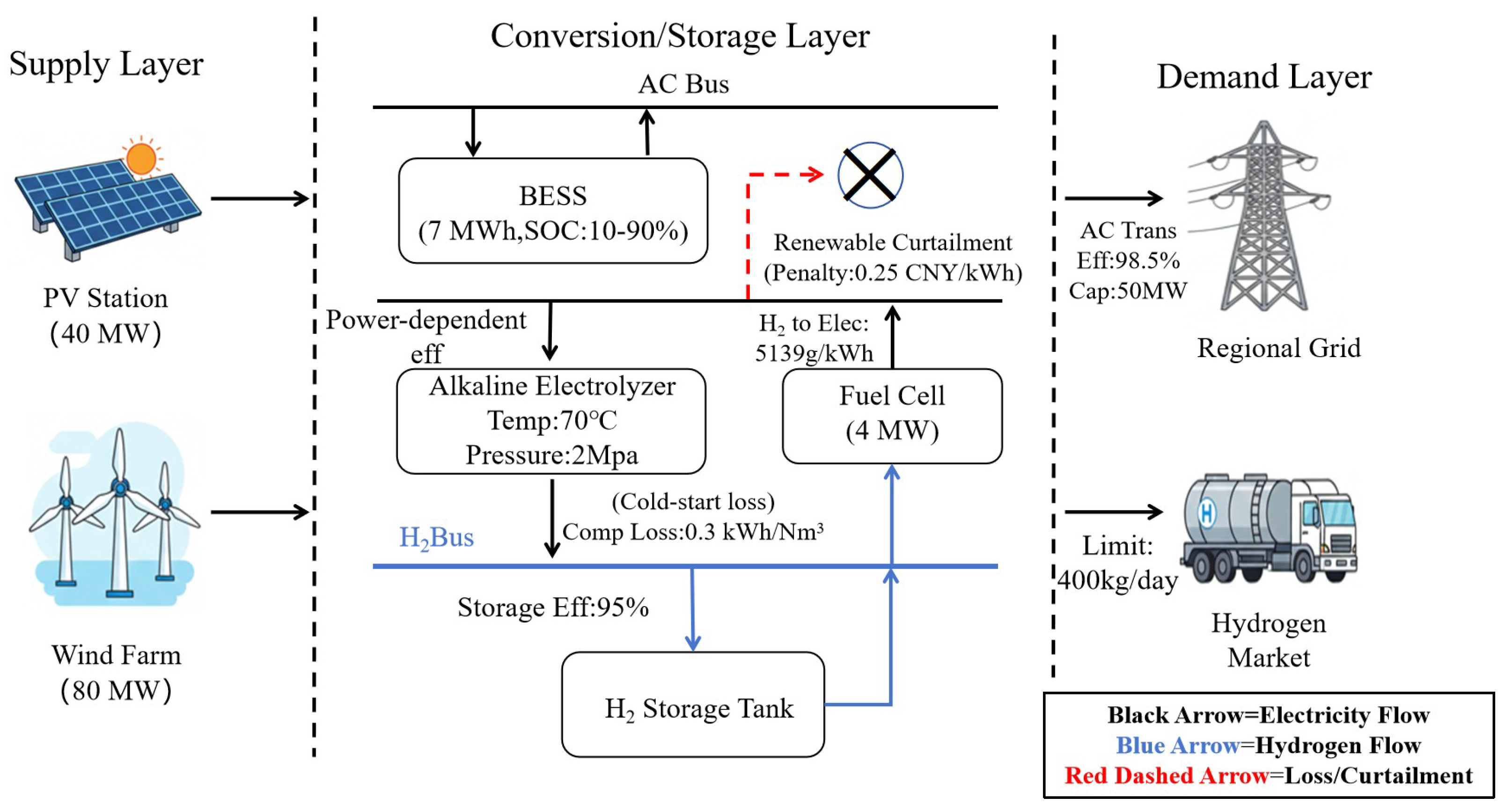
The architecture of the integrated electricity–hydrogen energy storage and power generation system is illustrated in Figure 1. The system follows a three-level collaborative structure: the supply side integrates PV stations and wind farms; the conversion side consists of energy storage units; and the demand side connects to the regional power grid and hydrogen markets.

3.1. System Boundary Definition

The proposed wind–solar–battery–electrolyzer–fuel cell integrated system has a clearly defined physical and functional boundary, centered on the renewable energy generation and multi-energy conversion/storage hub. The system is structured into three core functional layers:
  • Supply layer (internal boundary): on-site PV (40 MW) and wind farm (80 MW), including all generation processes and energy outputs, without upstream energy inputs, such as resource collection.
  • Conversion/storage layer (core internal boundary): on-site energy conversion and storage equipment, including BESS, 15 MW class alkaline electrolyzers, high-pressure hydrogen storage tanks, and PEM fuel cells. All electricity–hydrogen conversion processes, battery charging/discharging, and equipment-level operational dynamics such as electrolyzer start-up and BESS SOC variation are included. The fuel cells have a conversion efficiency of 51.9 g/kWh, consistent with typical industrial specifications.
  • Demand/export layer (external boundary interface): electricity is exported via a 50 MW AC transmission channel to the regional grid, and hydrogen is exported up to 400 kg/day to the external hydrogen market. No on-site electrical or hydrogen load is considered.
  • Excluded components: upstream raw material supply beyond on-site consumption, downstream grid or hydrogen distribution networks, and off-site energy conversion/storage equipment.

3.2. Energy Loss Consideration

(1).
Power transmission losses: AC transmission losses from the on-site collection point to the regional grid interface (50 MW transmission channel) are accounted for via a fixed efficiency coefficient of 98.5% in the power balance constraint (Equation (20)), consistent with 10–35 kV medium-voltage transmission standards in Northwest China. The actual exported power P E t is the net value after deducting these losses, and the coefficient is embedded directly in the power flow calculation without introducing additional variables, ensuring both computational efficiency and engineering realism. The specific details are shown in Figure 2.
(2).
Hydrogen compression losses: Low-pressure hydrogen (about 0.1 MPa) from alkaline electrolyzers is compressed to high-pressure storage tanks at 35 MPa. The electricity consumption of compressors, around 0.3 kWh/Nm3 H2 based on industrial standards, is included in the electrolyzer’s input power and reflected in the power-dependent efficiency curve.
Alkaline electrolyzers are chosen because their low-pressure hydrogen output is well matched with standard industrial compression, avoiding extra energy losses from mismatched pressure levels and simplifying the coupling between electrolyzer power input and compression energy consumption.
(3).
Hydrogen storage losses: The 95% hydrogen storage efficiency in Equation (23) accounts for compression, on-site pipeline, and storage tank sealing losses, consistent with industrial P2H project data in China. This ensures realistic representation of both energy conversion and storage processes in the model.
The integrated power generation system involves two primary coupled energy streams, namely electricity and hydrogen, whose operational dynamics are characterized by a synergistic balance between supply and demand. In terms of electrical power flow, the output from the PV and wind farm is prioritized for export via transmission channels. Any surplus renewable generation, provided that export requirements are met, is subsequently accommodated by the BESS and electrolyzers. During periods of insufficient renewable output, the BESS and fuel cells discharge or generate electricity to ensure that export demands are fulfilled.
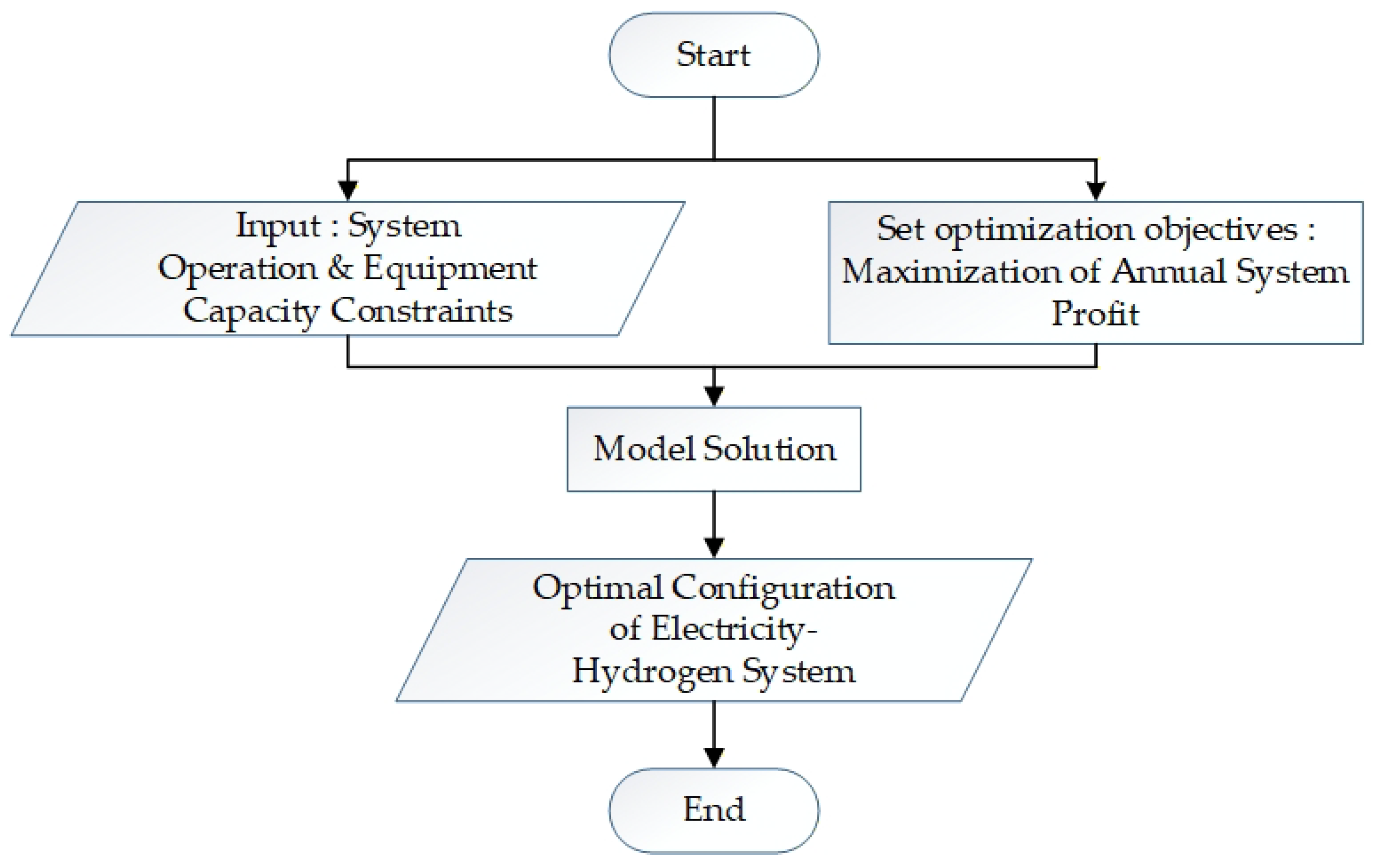
In Figure 2, this study develops an optimal configuration model that features a coupled mechanism between equipment capacity sizing and operational strategies. Given the installed capacities of wind/solar units and electrolyzers along with the transmission channel constraints, the optimization model is established with the objective of maximizing the annual net profit, while comprehensively incorporating the capacities of storage units, hydrogen vessels, and fuel cells, alongside operational constraints such as dispatch strategies and renewable energy curtailment.

4. Optimal Capacity Configuration of Power Systems

4.1. Selection of Alkaline Electrolyzer Technology

The selection of alkaline electrolyzer technology is based on five core reasons that align with both technological and economic considerations. First, alkaline electrolyzers are well-established in industrial applications, offering a proven track record in large-scale hydrogen production. Their relatively low capital cost, compared to other electrolyzer types, makes them an economically viable option for scaling up hydrogen production [22]. Second, alkaline electrolyzers exhibit a high level of efficiency under typical industrial operating conditions (70 °C, 2 MPa), which has been validated in real-world settings.
Third, the electrochemical characteristics of alkaline electrolyzers, including the established Ulleberg model, allow for accurate predictions of system behavior and hydrogen production efficiency. Fourth, their ability to operate flexibly with renewable energy sources further supports their integration into variable energy systems, enhancing the overall stability of the hydrogen production process. Finally, the large body of research, including detailed industrial test data, demonstrates the reliability and operational suitability of alkaline electrolyzers for long-term use in hydrogen generation. These factors collectively justify the choice of alkaline electrolyzers for the system under consideration.

4.2. Electrolyzer Modeling

4.2.1. Dynamic Efficiency Model

As the core unit for hydrogen production within the system, a single 5 MW class alkaline electrolyzer is employed. In the electrolyzer, a complete electrochemical cycle is maintained, with water splitting at the cathode to form hydrogen and hydroxyl ions on the electrode surface. Driven by the potential difference, these hydroxyl ions undergo directional migration, penetrating the diaphragm at a specific transfer rate to complete the charge transport [23]. Concurrently, the anode undergoes oxidation, during which hydroxyl ions discharge electrons, resulting in oxygen production.
The behavior of the electrolyzer electrodes can be described through an empirical current–voltage (I–V) relationship. In this work, the semi-empirical formulation introduced by Ulleberg is employed to characterize the I–V performance, expressed as follows:
V cell =   E rev + ( r 1 + d 1 ) + r 2 T + d 2 P i +   s log t 1 + t 2 T + t 3 T 2 i + 1
Here, V cell is the actual cell voltage of the electrolyzer, which includes contributions from the reversible voltage, ohmic losses, and activation/concentration overpotentials. The term E rev represents the ideal reversible voltage under the given temperature and pressure conditions. The bracketed linear term captures the ohmic losses dependent on temperature T, pressure P, and current density i, while the logarithmic term models the activation losses at the electrodes. This formulation allows accurate prediction of cell voltage over a wide operating range.
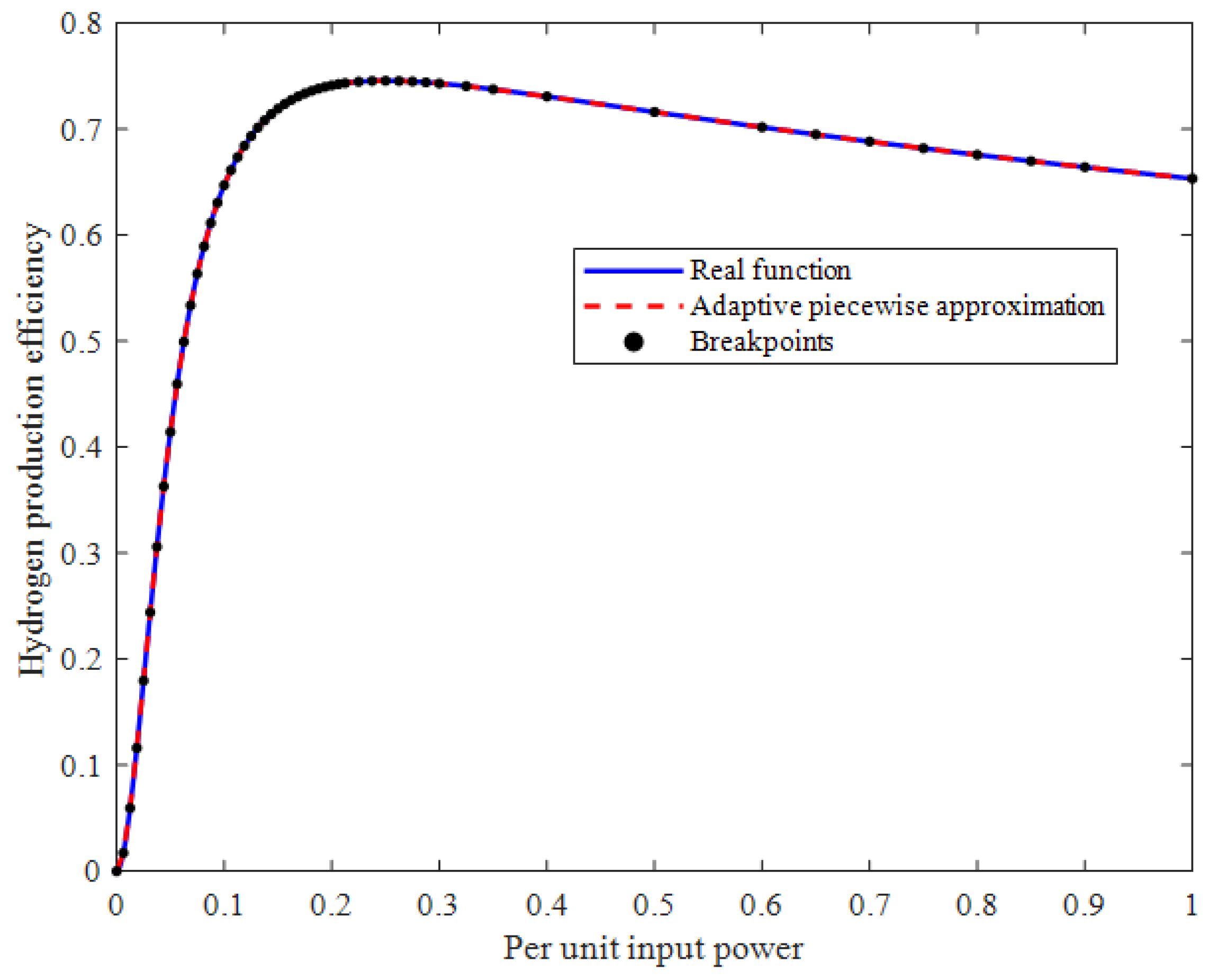
All empirical parameters ( r 1 , r 2 , d 1 , d 2 , s, t 1 , t 2 , t 3 ) are derived from the original Ulleberg study [22] and calibrated for the 5 MW alkaline electrolyzer under typical industrial conditions (70 °C, 2 MPa), consistent with Reference [24]. The hydrogen production efficiency curve in Figure 3 is fully reproducible using these parameters and conditions. Here, T and P denote the internal temperature and pressure of the electrolyzer, and i is the current density. The value of E rev depends on the thermodynamic properties of water electrolysis and is calculated for the 60–80 °C range typical of industrial operation. The reversible voltage E rev is determined using the Nernst equation:
E rev = E rev 0 + R T 2 F ln P P H 2 O 1.5 P H 2 O * P H 2 O
In this expression, E rev 0 is the standard reversible potential at reference conditions, R is the universal gas constant, and F is the Faraday constant. P H 2 O represents the partial pressure of water vapor at the electrode interface, and P H 2 O * is the saturation pressure. The logarithmic term accounts for the effect of actual operating pressure and water vapor content on the reversible voltage. The standard potential E rev 0 is temperature-dependent and can be approximated as:
E rev 0 = 1.50342 9.956 × 10 4 T + 2.5 × 10 7 T 2
This quadratic expression approximates the standard reversible voltage as a function of temperature in °C. It allows the calculation of E rev under realistic industrial temperatures, forming the basis for the subsequent transformation to a power-based hydrogen production efficiency curve for system-level MILP optimization. Conventional modeling approaches often treat electrolysis efficiency as a constant parameter. However, hydrogen production efficiency in real industrial operations varies nonlinearly with current density. Therefore, we adopt a dynamic efficiency model to capture this behavior accurately.
The Ulleberg I–V relationship is transformed into a power-based efficiency curve for the 5 MW alkaline electrolyzer to enable integration with the system’s power-centric optimization framework. Real-time current density is difficult to measure in industrial operation, whereas input power is directly monitored for wind–solar–storage–hydrogen dispatch. This transformation preserves the electrochemical characteristics of the original I–V model and is calibrated against industrial test data (R2 = 0.987, average relative error = 2.86%), providing a reliable, practical representation of hydrogen production efficiency.
Although current density directly governs electrode reaction kinetics, obtaining accurate real-time measurements of current density in industrial applications remains challenging. To address this issue, a dynamic modeling approach based on the per-unit value of input power is adopted, since input power can be more readily measured in practical systems [25]. The relevant technical parameters of the electrolyzer are summarized in [26].
The Ulleberg voltage model (Equation (6)) with the parameter values described above has been validated against the actual performance test data of the 5 MW alkaline electrolyzer unit adopted in this study. Across the full operating current density range (0.1–2.0 A/cm2), the relative error between the model-predicted cell voltage and industrial test measurements is less than 3%. Moreover, the derived hydrogen production efficiency curve (Figure 3) shows high consistency with the electrolyzer’s actual efficiency characteristics, confirming the model’s reproducibility and engineering applicability.
This characteristic is a typical operational law of alkaline electrolyzers, and subsequent sensitivity analysis verifies that the optimization results are not sensitive to minor deviations of this peak point. Per-unit power = actual input power/rated power (5 MW); hydrogen production efficiency is calculated based on the lower heating value (LHV) of hydrogen (Equation (2)). Figure 3 indicates a pronounced nonlinear dependence of the electrolyzer’s hydrogen production efficiency on its per-unit input power, with peak efficiency at 0.25 per-unit input power, beyond which efficiency monotonically decreases.
In Figure 3, scatter points from industrial test data are plotted alongside the solid line representing the Ulleberg model fitting curve. The correlation between the model and the actual test data is visually confirmed, with an R2 value of 0.987 and an average relative error of 2.86%. This model validation demonstrates the high accuracy and consistency of the dynamic efficiency model for the 5 MW alkaline electrolyzer.

4.2.2. Start-Stop Model

The operational modes of the electrolyzer are classified into three distinct states: off State, start-up, and operating. Binary variables are introduced to describe state transitions at each time step.
(1)
Off State
During time step t, if the electrolyzer is inactive, its status at the previous time step could be either the off state or the operating state. This relationship is expressed as:
S t 1 + W t 1 1 S t = 1
where S t is the binary variable, indicating the off state at time step t; S t 1 and W t 1 denote the off-state and operating-state variables at time step t 1 .
(2)
Start-up State
When the electrolyzer enters the start-up state at time step t, its preceding state must be the off state:
S t 1 = 1 L t = 1
where L t is the binary variable representing the start-up state at time step t.
(3)
Operating State
When the electrolyzer is in the operating state at time step t, its preceding state must be either the start-up state or the operating state:
W t 1 + L t 1 1 W t = 1
where W t is the binary variable representing the operating state at time step t, and L t 1 denotes the start-up state variable at time step t 1 .

4.2.3. Independent Control Model

The hydrogen production system adopts a modular architecture composed of multiple 5 MW class alkaline electrolyzer units, which takes full advantage of the excellent partial-load operation and frequent start-up/shutdown adaptability of alkaline electrolyzers, laying a solid technical foundation for the design of independent control strategies for real-time renewable power scheduling.
The hydrogen production system adopts a modular architecture composed of multiple 5 MW class alkaline electrolyzer units, each operating independently. This design allows flexible scheduling according to real-time renewable generation and storage needs, enabling partial activation of units to maintain high efficiency under varying input power [27]. Each electrolyzer monitors its own operational state, including input power, temperature, and hydrogen production rate, and determines its start-up, shutdown, and operating transitions based on local control strategies.
To account for the thermal inertia and transient behavior during start-up/shutdown, the binary state model is augmented with engineering operational constraints and energy loss calibration. During the start-up phase, a fixed cold-start duration of 1 h and a transient efficiency attenuation (to 60% of the rated peak at 0.25 p.u. input power) are applied based on industrial test data of the 5 MW electrolyzer, and a power ramping limit of 0.1 p.u./min is imposed to avoid abrupt stack stress. During shutdown, a 30 min thermal retention period at 5% rated power reflects residual heat, reducing repeated cold-start losses.
The energy consumption from both cold-start transient loss and heat preservation is incorporated into the electrolyzer’s input power (Equation (1)) and hydrogen production efficiency (Equation (2)), achieving a quantitative coupling between binary state switching and thermal inertia/transient behavior.
To mitigate degradation from frequent cycling, minimum continuous operation (2 h) and minimum shutdown interval (3 h) constraints are embedded in the state transition logic for each unit. These linearized constraints ensure the MILP model remains solvable while reflecting practical operational behavior and protecting the electrolyzer stack, electrodes, and diaphragm from thermal and mechanical stresses.

4.3. Objective Function

The optimal sizing of electrical and hydrogen energy storage units is crucial for improving the system’s overall economic performance. The optimization model is designed to maximize the net system profit P over an entire operational cycle, expressed mathematically as:
max P = C C cap C OM C dep C tari C waste
where C represents the annual comprehensive profit of the system; C cap denotes the annualized investment costs of the equipment; C OM refers to the operation and maintenance costs; C dep is the depreciation cost of the components; C tari represents the raw material costs required for system operation; and C waste denotes the curtailment penalty costs for surplus renewable energy.
The total system revenue comprises two primary components: income from electricity sales and revenue from hydrogen sales, as mathematically formulated as:
C = C E + C H 2 C E = t = 0 T c E P E t C H 2 = t = 0 T c H 2 M H 2 t
where c E and c H 2 represent the selling prices of electricity and hydrogen. P E t and M H 2 t denote the exported electric power and the quantity of exported hydrogen at time step t. The annualized investment cost of the system is expressed as:
C cap = k = 1 4 C cap , k r ( 1 + r ) n ( 1 + r ) n 1
where r denotes the discount rate, set at 8% in this study; n represents the operational lifespan of the system, assumed to be 20 years; and C cap , k refers to the unit investment costs for wind turbines, PV, BESSs, power conversion systems, electrolyzers, hydrogen storage tanks, and fuel cells, respectively. The total investment cost components are given by:
C cap , 1 = C wt E wt C cap , 2 = C pv E pv C cap , 3 = C ess 1 E ess 1 + C ess 2 E ess 2 C cap , 4 = C ae 1 E ae 1 + C ae 2 E ae 2 + C ae 3 E ae 3
where C wt and E wt denote the unit investment cost and rated capacity of the wind farm; C pv and E pv represent those of the PV; C ess 1 and E ess 1 are the unit investment cost and rated capacity of the batteries in the energy storage station, while C ess 2 and E ess 2 refer to the corresponding parameters for the inverters; C ae 1 and E ae 1 , C ae 2 and E ae 2 , C ae 3 and E ae 3 denote the unit costs and rated capacities of electrolyzers, hydrogen tanks, and fuel cells, with the annual O&M cost expressed as:
C OM = C cap β
where β represents the O&M cost coefficient, set to 2% in this study. The annualized depreciation cost of the system is:
C dep = C cap ( 1 γ )
where γ denotes the residual value coefficient, assumed to be 10%. The raw material procurement cost is expressed as:
C tari = t = 0 T c H 2 O M H 2 O t
where c H 2 O is the price of water, taken as 5 CNY/ton, and M H 2 O t represents the water consumption for hydrogen production at time step t. The renewable energy curtailment cost is defined as:
C waste = t = 0 T c waste P waste t
where c waste denotes the curtailment price, set at 0.25 CNY/(kW·h), and P waste t represents the quantity of electricity curtailed from the power generation system at time step t.

4.4. Constraints

4.4.1. Power Equilibrium Constraint

The power balance ensures that, for every time step, total electricity from renewables and storage discharge meets system requirements. These requirements cover electrolyzers, batteries, fuel cells, and any curtailed or exported energy. This constraint is fundamental for maintaining system stability and operational feasibility, as it prevents energy deficits or surpluses that could compromise the safe and efficient operation of the integrated electricity–hydrogen system. By enforcing this balance, the model accurately represents the dynamic interactions among renewable generation, energy storage, hydrogen production, and grid exchange.
P wt t + P pv t + S dis t + P hfc t = P H 2 t + P E t + P waste t + S cha t
where P wt t and P pv t indicate the power output of the wind farm and PV system at time step t. S dis t and P hfc t correspond to the BESS discharge power and fuel cell output at time t. P H 2 t and P E t represent the power consumed by the electrolyzers and the BESS charging power. P waste t denotes the curtailed or unused electrical power, and S cha t is the curtailed portion of the generation system at time step t.

4.4.2. Transmission Channel Constraints

The power and hydrogen export capacities are constrained by the physical limits of their respective transmission channels, as formulated below:
P E min P E t P E max S H 2 min S H 2 t S H 2 max
where P E min and P E max indicate the lower and upper limits of the power transmission channel. S H 2 min and S H 2 max specify the bounds of the hydrogen transport channel, and S H 2 t denotes the amount of hydrogen exported by the system at time step t.

4.4.3. Hydrogen System Operational Constraints

The operation of the hydrogen subsystem is subject to several critical technical constraints to ensure stable and efficient hydrogen production, storage, and utilization. These constraints enforce mass balance, storage capacity limits, charging/discharging rules, and fuel cell conversion efficiency, thereby guaranteeing that hydrogen is produced, stored, and consumed in a physically feasible and economically efficient manner.
m h t + m f _ h t = m c _ h t + S h t + m hfc t
At time step t, m h t denotes electrolyzer hydrogen production, and m f h t and m c h t correspond to consumption and storage inventory. S h t represents hydrogen supplied to external users, while m hfc t is the fuel cell consumption rate.
M h t = 0.95   m c _ h t m f _ h t 0.95
where M h t represents the hydrogen inventory in the storage tank at time step t.
0 m c _ h t h v c t   M max 0 m f _ h t h v f t   M max 0 M h t M max h v c t + h v f t 1
M max denotes the hydrogen storage tank’s rated capacity, and h v c t and h v f t indicate whether the tank is charging or discharging at time t.
P hfc t = m hfc t η hfc
where η hfc represents the hydrogen-to-electricity conversion efficiency of the fuel cell, set at 0.0519 kg/(kW·h) in this study. The fuel cell technology assumed is PEM (Proton Exchange Membrane) fuel cells, and the conversion efficiency is based on typical industrial specifications for PEMFCs, which is approximately 51.9 g/kWh. This value is derived from industry reports and operational data of PEM fuel cells.

4.4.4. BESS Operational Constraints

The operation of the BESS is constrained to ensure safe and efficient energy management. These conditions govern the battery’s charge and discharge cycles, prevent simultaneous operation, and keep the SOC within safe limits. By enforcing these rules, the model ensures that the BESS can effectively absorb surplus renewable energy during low-demand periods and provide power during peak demand intervals, contributing to improved renewable energy utilization and system stability.
S O S t = 0.95   S cha t S dis t 0.95
where S O S t denotes the stored energy level of the battery at time step t.
0 S cha t s o s c t   S O S max 0 S dis t s o s f t   S O S max 0.1   S O S max S O S t 0.9   S O S max s o s c t + s o s f t 1
where S O S max represents the rated capacity of the battery; s o s c t and s o s f t are binary variables indicating the charging and discharging states of the BESS at time step t. These variables are subject to a mutually exclusive constraint to prevent simultaneous charging and discharging.

4.4.5. BESS and Fuel Cell Operational Logic Constraints

To prolong the service life of the BESS and reduce unnecessary cycling, specific operational rules are implemented. When renewable energy curtailment occurs, the BESS is allowed to charge but prohibited from discharging. Conversely, during periods without curtailment, the BESS can operate in either charging or discharging mode.
Due to the limited round-trip efficiency of the electricity–hydrogen–electricity cycle, the fuel cell is not operated during periods of energy curtailment. Fuel cell operation is also linked to its hydrogen-to-electricity conversion efficiency, which is assumed to be 51.9 g/kWh for PEM fuel cells. This efficiency assumption ensures that fuel cell power generation is only utilized when energy conversion is sufficiently efficient, i.e., during non-curtailment periods. Fuel cell operation is only permitted during non-curtailment periods to avoid energy losses due to inefficient conversion. To mathematically characterize these conditions, the statuses of curtailment, BESS charging/discharging, and fuel cell power generation are synchronized using binary variables, imposing exclusivity constraints:
p 1 t + p 3 t 1 p 2 t + p 3 t 1
where p 1 t , p 2 t , and p 3 t denote the binary status variables for BESS charging/discharging, fuel cell power generation, and renewable energy curtailment at time step t. The coupled operational constraints for curtailment, BESS, and fuel cells are formulated as:
0 P waste t p 3 t M 0 S dis t p 1 t M 0 P hfc t p 2 t M
where M represents a sufficiently large positive integer, used to linearize the logical constraints. requirements within the optimization framework.

4.5. Linearization and Model Solution

The original optimization model exhibits strong nonlinearity due to the nonlinear hydrogen production efficiency curve of the electrolyzer and the multiplicative terms involved in calculating hydrogen yield, which poses challenges for global optimization. To enhance computational efficiency and ensure convergence, the following linearization techniques are employed.
Piecewise Linearization of Electrolyzer Efficiency: The electrolyzer efficiency curve is partitioned into multiple linear segments, where each segment approximates the original nonlinear function. The curvature threshold is controlled to refine approximation accuracy, as illustrated in Figure 3. Although the experimental dataset in Figure 3 shows a peak efficiency at 0.25 per-unit input power, followed by a decreasing trend, the curve is accurately captured by the Ulleberg model (R2 = 0.987, average relative error = 2.86%), which serves as a benchmark for validation against industrial test data.
SOS2-Based Linearization: The calculation of hydrogen production is linearized using SOS2 constraints. The nonlinear function is expressed as a linear combination of weights assigned to two adjacent breakpoints. High-order infinitesimal terms caused by squared weights are neglected, given their marginal contribution.
The adaptive piecewise linearization with SOS2 constraints introduces a maximum point-by-point relative error of 1.23% and an average relative error of 0.47% for the full electrolyzer efficiency curve, while the high-efficiency interval (0.1–0.4 p.u.) exhibits only 0.32% average relative error. This linearization error is an order of magnitude smaller than the inherent experimental error of the industrial test data (2.86%) and results in a cumulative relative error of less than 0.6% for key system indicators, including hydrogen production, renewable energy utilization rate, and annual net profit.
This quantitative error analysis confirms that the MILP framework retains high accuracy in representing the system’s nonlinear behavior. The negligible linearization error justifies the use of MILP over solving the original nonlinear model directly, ensuring that the optimization results are reliable for engineering applications.
Decision variables cover BESS and hydrogen storage capacities, as well as the time-dependent operational status of all system elements. By applying the above linearization strategies and binary variables, the nonlinear problem is transformed into a MILP model suitable for efficient and globally convergent optimization.

4.6. Key Innovations of the Proposed MILP Model

The proposed MILP model incorporates several innovative design features that distinguish it from existing hybrid energy system optimization models. These innovations are summarized as follows:
(1)
Refined electrolyzer modeling: Five key electrolyzer operational characteristics—start-up/shutdown transitions, cold-start transient loss, minimum load limits, ramping rates, and power-dependent nonlinear efficiency—are explicitly integrated into MILP constraints, enhancing the accuracy of hydrogen production modeling under fluctuating renewable inputs.
(2)
Advanced linearization techniques: Piecewise linearization with SOS2 constraints is applied to the electrolyzer efficiency curve, and nonlinear hydrogen production functions are decomposed into linear combinations of adjacent breakpoints, reducing approximation errors while maintaining MILP solvability.
(3)
Coupled dynamic decision variables: Binary state variables capture electrolyzer start-up/shutdown dynamics and are coupled with power input and capacity constraints, enabling quantification of the combined impact of dynamic characteristics on hydrogen output and overall system energy flows.
(4)
Integrated capacity and dispatch optimization: The model simultaneously optimizes equipment capacities and time-dependent operational variables (charging/discharging power, electrolyzer input, hydrogen production/sales, renewable curtailment), while enforcing multi-energy and multi-market constraints, including TOU electricity pricing and transmission limits, ensuring operational feasibility, economic efficiency, and physical consistency.
(5)
Optimization method with engineering practicability: The MILP framework is selected as the core optimization method, balancing model accuracy, solution efficiency, physical feasibility, and industrial applicability. Compared with pure nonlinear programming (NLP) and metaheuristic optimization methods, MILP guarantees the global optimal solution of large-scale time-series coupled problems and natively integrates discrete operational logic and strict engineering constraints, making it the de facto standard for industrial-scale energy system planning and dispatch.

5. Experimental Environment

5.1. Simulation Data and Representative Day Validation

For evaluating the effectiveness of the proposed optimization framework, simulation tests are conducted using 1 h resolution on-site measured wind and solar generation data from a representative wind–solar hybrid power generation base in Northwest China. The data are derived from the real-time operational monitoring system of the power plant, reflecting the actual output characteristics of an 80 MW wind farm and a 40 MW PV station in the region. The annual utilization hours for wind and solar energy are 2035 h and 1704 h.
To ensure the representativeness of input scenarios while maintaining computational efficiency, a two-level stratified sampling strategy is adopted. First, the annual dataset is divided by season and by typical diurnal patterns to capture temporal variability. Second, extreme conditions are embedded within the representative days to avoid underestimating system stress scenarios. For the production simulation, 12 representative days are selected from the annual dataset to serve as input scenarios.
Quantitative validation of scenario representativeness indicates that the selected 12 days capture the annual mean and variance of renewable generation within a 2–5% error margin, as shown in Table 1, which compares the full-year dataset with the reduced 12-day subset. This demonstrates that the reduced dataset provides a reliable approximation for multi-day dispatch optimization while significantly reducing computational burden.
The hydrogen price is set to 29.3 CNY/kg, consistent with the 2024 average green hydrogen transaction price reported by the China Hydrogen Alliance. This constant price is adopted based on two practical considerations: (i) the hydrogen market in Northwest China, the research region, is still in the initial development stage, lacking a mature real-time spot pricing mechanism and exhibiting only small short-term price fluctuations; (ii) eliminating price volatility interference ensures that the model’s core innovation—coupled electrolyzer dynamic characteristic modeling—can be isolated and verified. The TOU electricity pricing mechanism is retained to reflect the temporal variability of the mature electricity market, forming a realistic comparison between the electricity and hydrogen market characteristics in the research region.
It should be noted that the above simulation parameters, including renewable utilization hours, electricity and hydrogen prices, and transmission capacity, are calibrated for the representative wind–solar power base in Northwest China. However, the proposed MILP optimization framework is inherently decoupled from region-specific characteristics. By replacing the regional wind–solar generation data and appropriately calibrating local technical, economic, and infrastructure parameters, the model can be directly extended to other geographical regions. This ensures the general applicability and scalability of the proposed methodology.

5.2. System Configuration and Scenario Design

The installed capacities of the PV and wind farm units are set to 40 MW and 80 MW, while the rated capacity of the electrolyzer system is 15 MW. The system’s external power transmission channel has a maximum capacity of 50 MW, and a minimum renewable energy utilization rate of 95% is required.
The electricity selling price is based on the agent-purchased power price in Xinjiang for December 2024, as summarized in Table 2. Hydrogen sales are scheduled daily at 24:00, with a maximum daily export limit of 400 kg. The hydrogen price is taken as 29.3 CNY/kg, consistent with the 2024 average price reported by the China Hydrogen Alliance. Additional economic indicators and technical parameters for the wind/PV units, battery storage, and hydrogen systems are derived from Reference [27].
To assess the system’s economic efficiency and environmental sustainability, four operational scenarios are defined:
  • Case 1 (Baseline Scenario): The system operates under the TOU electricity pricing mechanism while simultaneously exporting hydrogen to external markets.
  • Case 2: The system focuses exclusively on electricity delivery under the TOU pricing scheme, with no hydrogen sales.
  • Case 3: The system generates revenue from both electricity delivery and hydrogen sales, but electricity is sold at a fixed tariff instead of dynamic TOU prices.
  • Case 4: The system operates solely for electricity export at a fixed tariff, with no hydrogen sales.
By comparing these scenarios, the synergistic benefits of multi-energy coupling and the influence of different market pricing mechanisms on system performance can be thoroughly analyzed.

5.3. Model Assumptions and Technical Parameters

To ensure modeling consistency and computational feasibility, several technical assumptions are adopted. The battery energy storage system (BESS), electrolyzers, hydrogen storage tanks, and fuel cells operate within their rated technical limits. Charging/discharging efficiencies, conversion efficiencies, and storage boundaries are defined according to practical engineering specifications.
The system time resolution is set to 1 h, which is consistent with the temporal resolution of the original measured wind and solar generation data. This ensures temporal alignment between the simulation framework and the input data, thereby improving the reliability and physical consistency of the optimization results.
The technical parameters relevant to the simulation are listed in Table 3. These parameters are adopted from Reference [27] and relevant industrial data to ensure realism and comparability. The electrolyzer standard operating conditions listed below serve as the basis for reproducing the cell voltage model in Equation (6).
Alkaline electrolyzer is selected as the hydrogen production unit, and its rated efficiency of 70% is consistent with the actual industrial operation level of 5 MW class alkaline electrolyzers in China’s renewable energy hydrogen production projects. The fuel cell technology assumed in this model is PEM (Proton Exchange Membrane) fuel cells, with a conversion efficiency of 51.9 g/kWh, consistent with typical industrial specifications for hydrogen fuel cells in commercial applications.

6. Results

6.1. Analysis of Optimization Results for the Baseline Scenario

6.1.1. Optimal System Configuration and Multi-Day Dispatch

Optimal setup of the combined wind–PV–battery–hydrogen system, obtained through the proposed optimization framework, is summarized in Table 4. The system demonstrates a high level of renewable energy utilization and economic efficiency. Notably, the annual net profit reaches 2409.11 × 10 4 CNY, indicating significant economic benefits from multi-energy coupling and optimal dispatch.
A comparison with results from typical existing MILP models highlights the improvements brought by the proposed framework. Our model achieves a renewable energy utilization rate of 96.69%, which is 1–3% higher than models that employ simplified electrolyzer modeling. Moreover, by integrating coupled capacity sizing and real-time dispatch, the optimized BESS energy capacity is reduced by 2 MWh compared with sequential optimization approaches, while still improving economic performance. These results demonstrate that detailed modeling of electrolyzer dynamics and the unified optimization framework can enhance system efficiency, reduce required storage capacity, and increase overall profitability.
The optimal capacity configuration results obtained by the MILP framework reflect the inherent advantage of coupled optimization. In sequential optimization methods commonly used in metaheuristic algorithms, capacity sizing and dispatch are treated as separate stages, which often leads to over-dimensioned storage and electrolyzer capacities to compensate for the lack of interaction between stages. Specifically, achieving the same renewable energy utilization requires an additional 2 MWh of BESS energy capacity in sequential approaches. In contrast, the proposed MILP framework captures the interactions between equipment capacities and operational dynamics (e.g., electrolyzer start-up losses and power-dependent efficiency) within a unified constraint system. This coupling allows for the optimal matching of equipment sizing and operational strategy, resulting in higher economic efficiency and reduced system redundancy.
Moreover, the optimized capacity configuration (7 MWh BESS, 3489 kg hydrogen storage tank, 4 MW fuel cell) exhibits high robustness to TOU electricity price fluctuations. Under a ±20% fluctuation range (consistent with China’s electricity market regulation), the capacity configuration requires only marginal adjustments. This demonstrates that the coupled capacity-sizing and dispatch optimization framework of the MILP model effectively aligns the optimal equipment scale with the intrinsic temporal characteristics of renewable generation and TOU pricing, rather than the specific price level, thereby ensuring engineering stability of the results in realistic electricity markets with mild price variations.
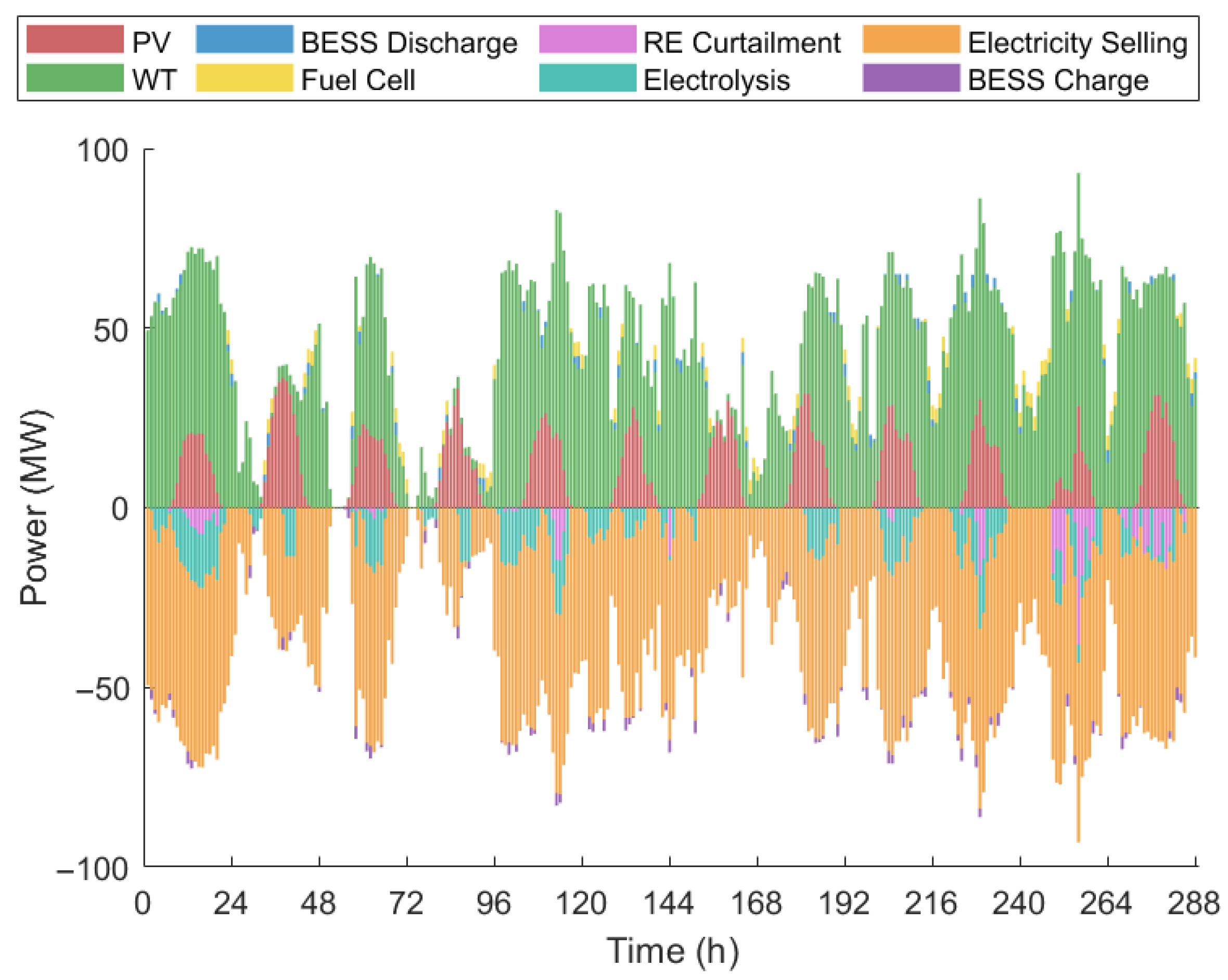
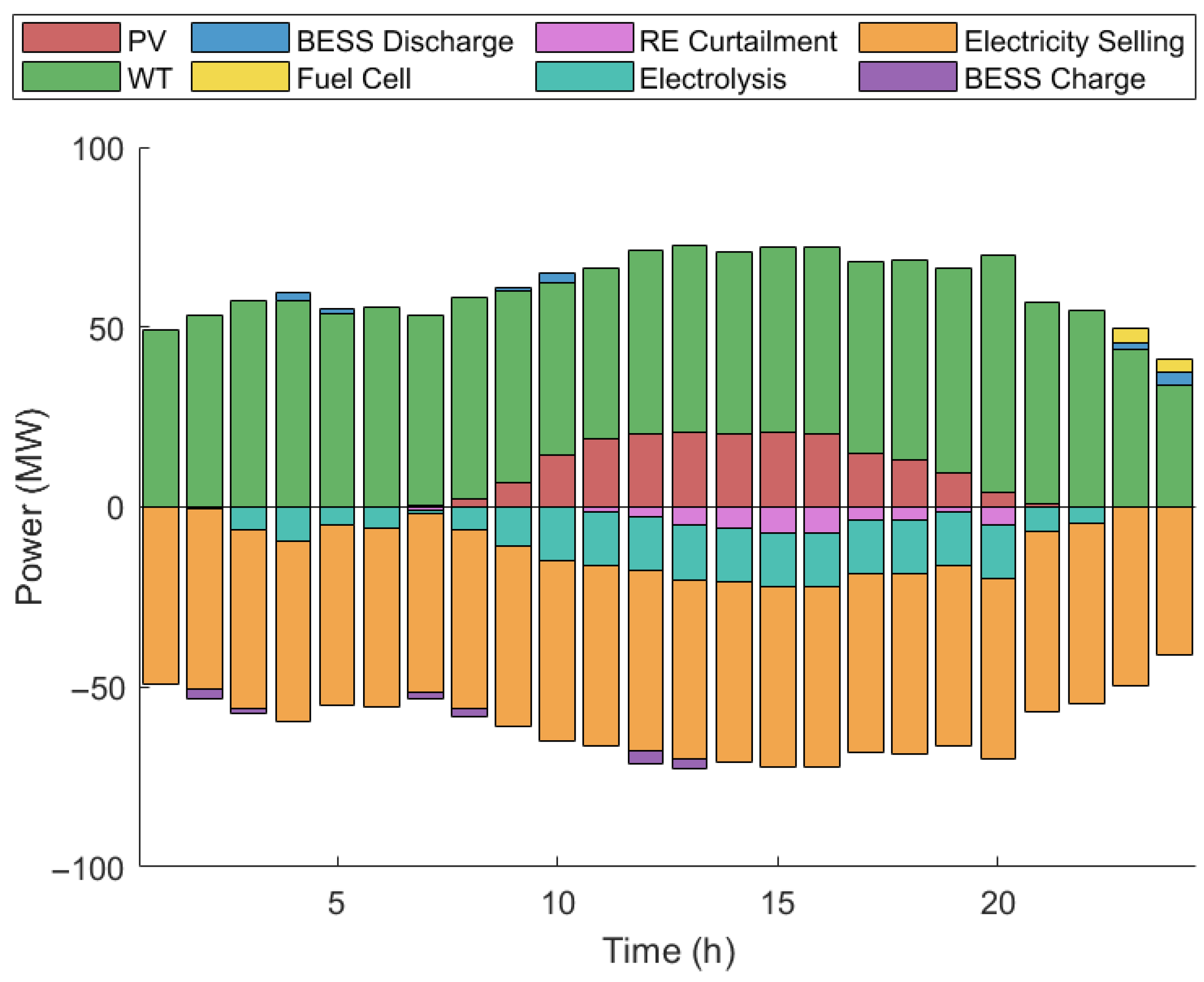
The optimized dispatch strategies across the 12 representative days are illustrated in Figure 4. During high renewable generation periods, the BESS absorbs surplus energy while the electrolyzers are activated to convert electricity into hydrogen. Conversely, during low renewable generation or peak electricity price intervals, the BESS discharges to meet system demand, and hydrogen may be sold to external markets to generate additional revenue. This multi-day analysis highlights the robustness of the proposed dispatch strategy in balancing energy flows and maximizing economic returns.
Additional observations include:
  • The BESS effectively reduces renewable energy curtailment by strategically charging during surplus periods and discharging during deficits.
  • The electrolyzer and fuel cell units operate flexibly, adjusting output based on renewable availability and market prices.
  • Hydrogen storage plays a critical role in shifting energy over time, supporting peak shaving and enabling additional revenue from hydrogen sales.
We also evaluated the direct PV–electrolyzer coupling scenario without BESS. Results indicate significant performance degradation: renewable utilization drops to 89.2%, annual net profit decreases to 1892.4 ×   10 4 CNY (−21.4%), and hourly hydrogen production stability is substantially reduced (CV increases from 0.32 to 0.78). These losses are primarily due to PV intermittency, lack of short-term energy buffering, and inability to perform TOU peak–valley arbitrage. While eliminating BESS slightly reduces investment and O&M costs (42.5 ×   10 4 CNY/year), this benefit is outweighed by lost revenue and increased curtailment costs. This analysis underscores the irreplaceable role of BESS in the integrated system for energy buffering, revenue maximization, and stable hydrogen production.

6.1.2. Detailed Operation of a Representative Typical Day

A representative typical day is analyzed to provide deeper insights into system dynamics. The optimized dispatch for this day is shown in Figure 5. Between 12:00 and 18:00, the BESS charges and the electrolyzer is activated to absorb surplus renewable energy. During peak electricity price periods or low renewable generation, the BESS discharges to support the load, while hydrogen is simultaneously exported to external markets.
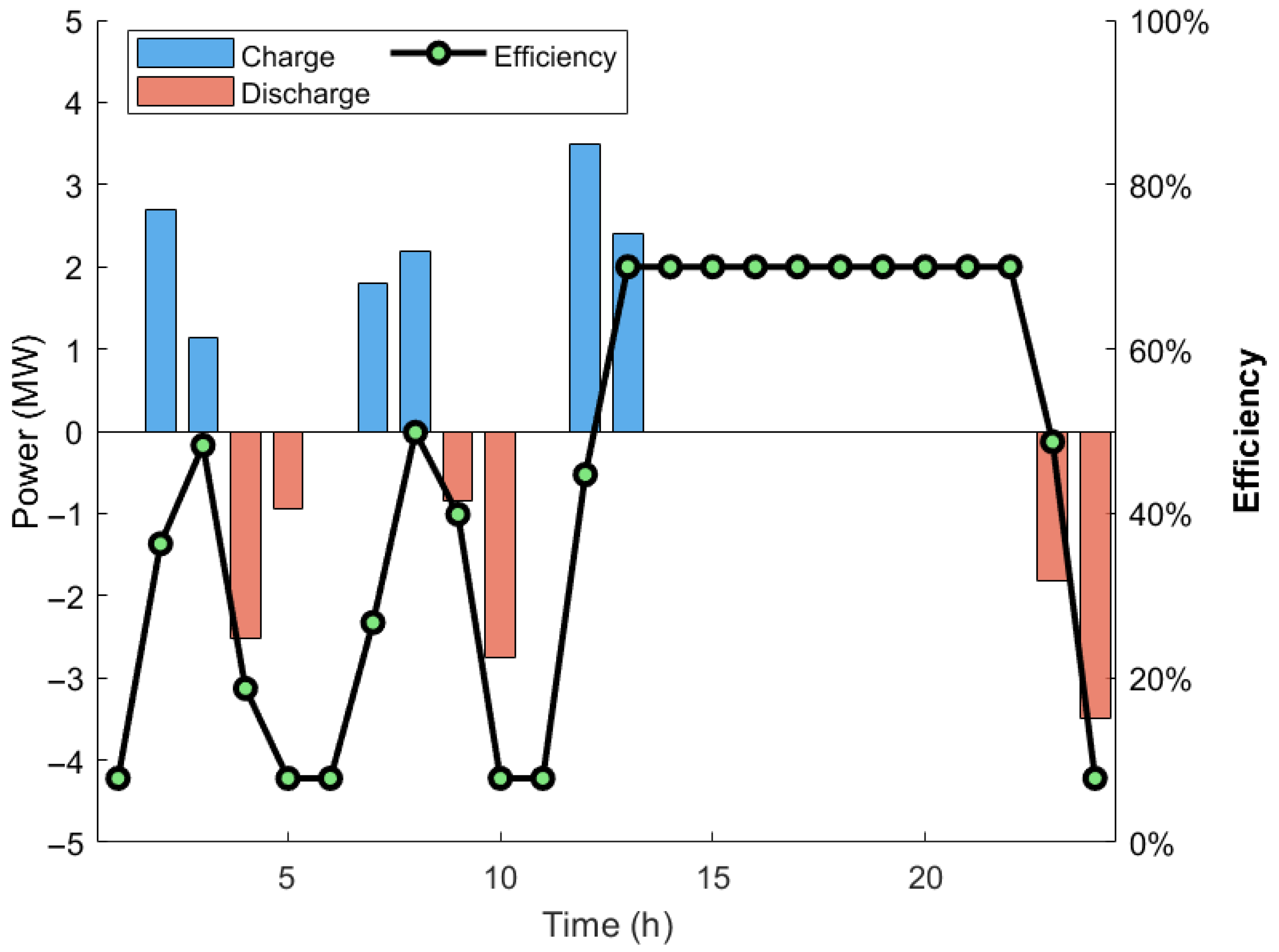
The charging/discharging power profiles and corresponding SoC of the BESS are shown in Figure 6. The ESS is charged during valley periods and discharged during peak demand, effectively reducing curtailment and increasing economic efficiency through peak–valley arbitrage.
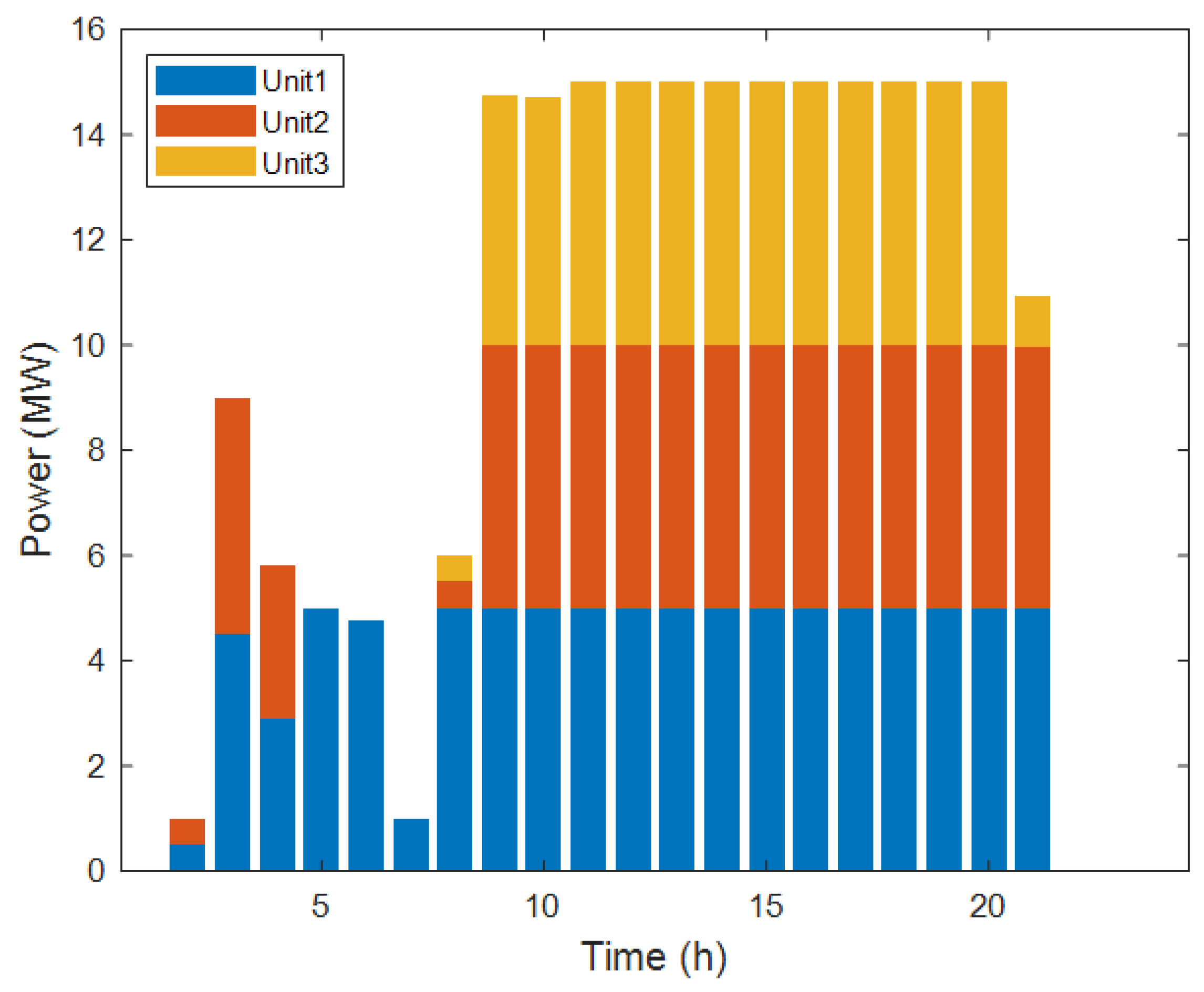
The 24 h energy consumption profiles of the electrolyzers are illustrated in Figure 7. Initially, all three electrolyzer units are OFF. Based on the optimization objective, the required number of units is activated sequentially, including start-up and pre-heating, followed by optimal power allocation to each unit to maximize efficiency.
Additional insights from the typical day include:
  • The synergistic operation of the BESS and electrolyzers significantly reduces renewable energy curtailment.
  • Hydrogen storage enables temporal shifting of energy, supporting economic dispatch under variable electricity prices.
  • Peak–valley arbitrage of the BESS, combined with hydrogen production scheduling, maximizes overall system profitability.

6.2. Necessity of Considering Electrolyzer Power Characteristics and Start-Up Dynamics

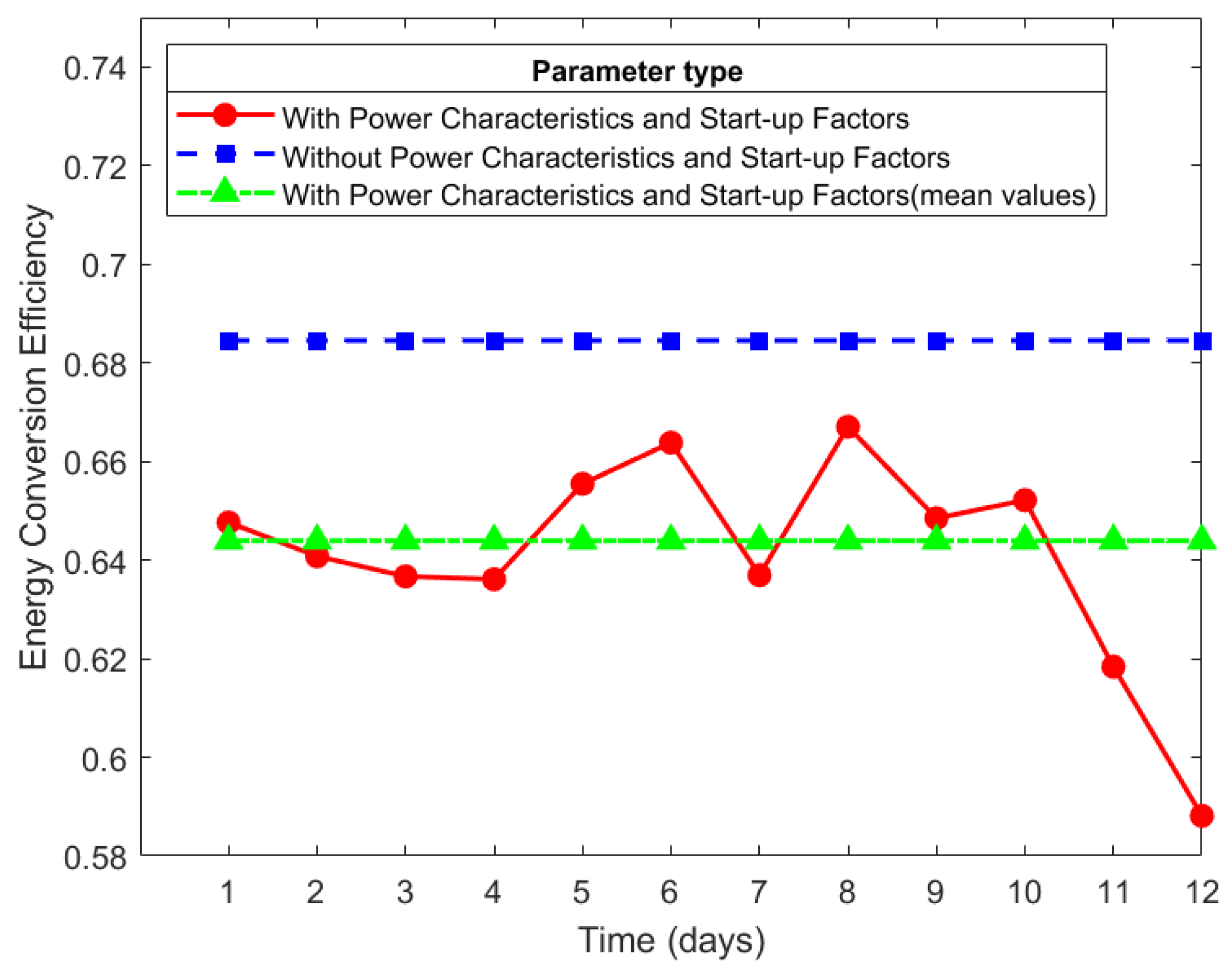
To validate the importance of incorporating power-dependent characteristics and start-up dynamics into the optimization model, a comparative analysis is conducted against a conventional simplified electrolyzer model. For a rigorous comparison, the simplified model assumes constant hydrogen production efficiency (70%, the rated peak efficiency of the 5 MW alkaline electrolyzer), neglects start-up and shutdown dynamics (no cold-start transient efficiency loss, no start-up power loss, no minimum operation/shutdown interval), and ignores power-dependent efficiency variation (efficiency remains constant across 0–1 p.u. input power). All other system parameters—including wind-solar generation data, BESS/hydrogen storage rules, TOU electricity price, hydrogen price, and transmission capacity—are kept identical to the refined model to isolate the effect of electrolyzer modeling assumptions.
As illustrated in Figure 8, the reduction in energy conversion efficiency when considering operational characteristics arises from two main factors:
  • Power-dependent efficiency: The electrolyzer efficiency decreases monotonically when the input power exceeds 25% of rated capacity, a nonlinear behavior supported by industrial test data [21,23]. This characteristic is captured by the refined model but neglected in the simplified model, leading to overestimation of hydrogen production at partial-load operation.
  • Start-up dynamics: During cold-start operations, the electrolyzer initially exhibits low hydrogen production efficiency, which gradually increases as the device warms up [26]. Neglecting this transient inefficient stage in the simplified model further overestimates net hydrogen output and economic performance [27].
Figure 8. Variation of Electrolyzer Efficiency with Input Power.
Energies 19 01712 g008
In addition to capturing power-dependent efficiency and start-up transient loss, the refined start-up/shutdown model incorporates minimum operation and shutdown intervals to reduce frequent cycling. Comparative analysis with an unconstrained binary state model shows that the optimized dispatch strategy decreases annual start-up/shutdown cycles of a single electrolyzer unit by 42%, mitigating potential performance degradation and extending operational lifespan.
A quantitative comparison between the refined and simplified models demonstrates that neglecting electrolyzer dynamics leads to systematic overestimation of key system performance indicators, including hydrogen production, annual net profit, and renewable energy utilization. This confirms that incorporating power-dependent efficiency and start-up dynamics is essential for realistic capacity configuration and operational strategy design, avoiding over-investment in electrolyzer and hydrogen storage equipment and ensuring reliable economic and environmental assessment in practical engineering applications.

6.3. Economic and Sustainability Analysis

6.3.1. Impact of Energy Export Modes on Economic and Environmental Performance

The capacity configuration and operational revenue results under the TOU pricing mechanism are compared for two scenarios: the integrated Power + Hydrogen mode and the Power Only mode, as summarized in Table 5. In the absence of hydrogen export channels (Power Only mode), the system’s annual net profit decreases by 18.88%, while the renewable energy utilization rate experiences a slight decline. This highlights the critical role of hydrogen as a flexible energy carrier in improving system-wide resource integration.
To further evaluate system performance, a scenario neglecting temporal electricity variations is considered. The system operates under a fixed electricity tariff based on the flat-period price. As shown in Table 6, the transition to a fixed tariff diminishes arbitrage opportunities, reducing the need for energy storage and leading to declines in both operational revenue and renewable energy utilization compared to TOU pricing.

6.3.2. Sensitivity Analysis and Extreme Scenario Verification

(i)
Hydrogen Export Channel Capacity
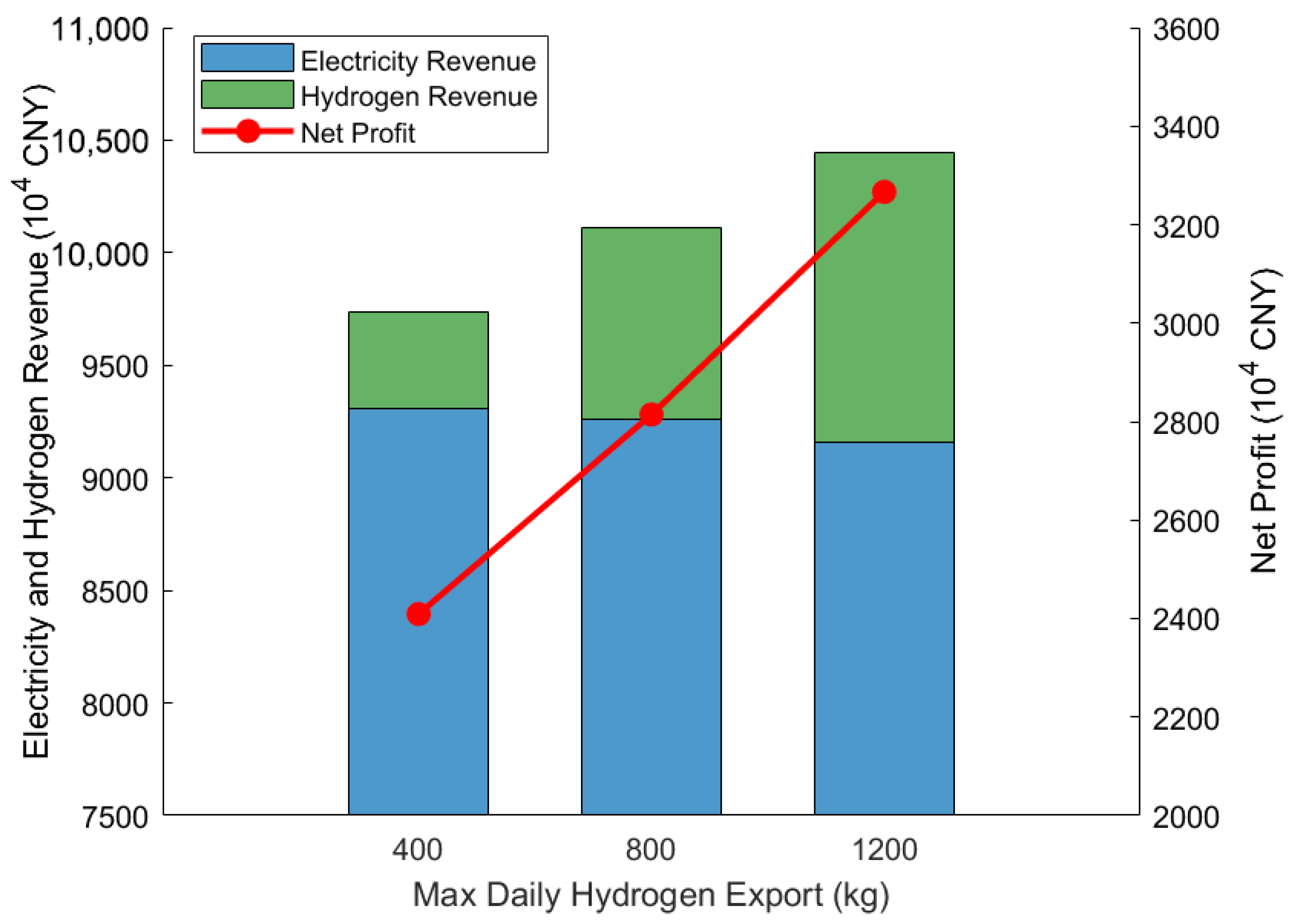
The impact of varying the hydrogen export channel capacity on the system’s economic performance and optimal capacity configuration is illustrated in Figure 9 and Table 7. As the hydrogen export channel capacity increases, the annual net profit significantly rises, while renewable energy utilization improves slightly, demonstrating that a larger hydrogen delivery infrastructure enhances the integration of fluctuating renewable resources.
(ii)
Power Transmission Capacity and Regional Adaptability
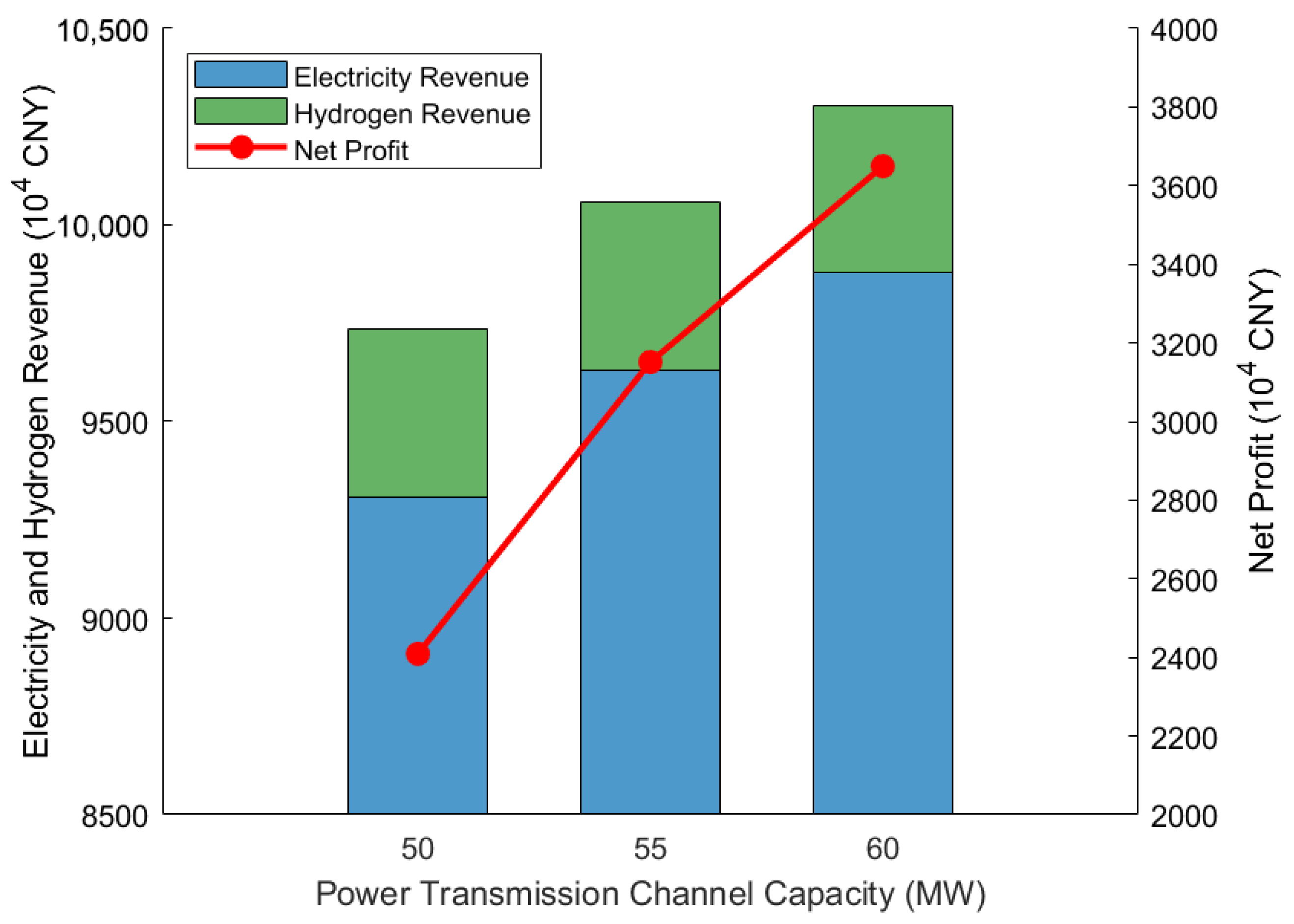
Variations in the power transmission channel capacity also affect the system’s economic and environmental performance. As shown in Figure 10 and Table 8, relaxing the power transmission constraint increases the annual net profit by 51.74% and improves the renewable energy utilization rate by 2.97%, highlighting the importance of transmission infrastructure flexibility.
The sensitivity analysis of power and hydrogen transmission capacities demonstrates the adaptability of the proposed optimization framework to different regional infrastructure conditions. For regions with more developed transmission infrastructure, the system can reduce the required scale of energy storage and hydrogen production equipment, consistent with Table 7 and Table 8. Conversely, in regions with more volatile renewable generation profiles, the model automatically increases optimal storage capacity to mitigate curtailment, ensuring both economic efficiency and operational reliability across diverse geographic contexts.
(iii)
TOU Electricity Price Fluctuations
To evaluate the sensitivity to TOU electricity price variations, a ±20% fluctuation range is applied to the four TOU price intervals (critical peak, peak, flat, valley) defined in Table 2. Two types of analysis are conducted: unified fluctuation (all intervals rise/fall simultaneously) and differentiated fluctuation (single intervals vary independently). Key indicators include annual net profit, renewable utilization rate, and optimal capacity configuration, while other parameters remain fixed.
Results show that annual net profit is linearly sensitive to unified price changes (±10%/20% leading to ±8.9%/18.1% net profit change), whereas renewable utilization and capacity configuration remain almost unchanged (<3%). Differentiated fluctuations reveal targeted sensitivity: critical peak price increases yield +7.2% net profit, valley price decreases yield +6.8%, and flat price variations are negligible (±1.2%). Renewable utilization remains above 96.19% in all cases, confirming that dispatch adjusts dynamically without large-scale reconfiguration.
(iv)
Dispatch Strategy Robustness Under Extreme Scenarios
To further verify the dispatch strategy, two extreme scenarios were analyzed: negative electricity prices during valley periods and high hydrogen demand (3× baseline). In the negative price scenario (−0.05 CNY/kWh), the dispatch strategy prioritizes full absorption of renewable surplus via electrolyzers and BESS, suspends grid export, and shifts energy to periods with positive prices. This avoids potential losses (∼12.8 × 10 4 CNY/year), increases renewable utilization to 97.8%, and slightly raises annual net profit by 2.3%, with negligible change in optimal capacity.
Under high hydrogen demand, electrolyzers operate at full capacity using primarily on-site renewable generation, BESS charges only during surplus, and all hydrogen is exported. This increases hydrogen revenue by 198.6 × 10 4 CNY/year, raises renewable utilization to 97.2%, and improves annual net profit by 8.2%, with only minor adjustments in hydrogen storage (+4.6%). These results confirm that the proposed dispatch strategy adaptively maintains near-optimal operation without requiring re-optimization of capacity.
Overall, the sensitivity analysis and extreme scenario verification confirm that the MILP optimization framework, coupled with the refined electrolyzer model and multi-energy dispatch strategy, is robust and reliable under realistic infrastructure, market, and demand fluctuations.

6.3.3. Sensitivity Analysis of Hydrogen Price Fluctuations

To evaluate the impact of hydrogen market price variability on system performance, a supplementary sensitivity analysis is conducted by varying the hydrogen price within a ±30% range of the baseline value (29.3 CNY/kg), which reflects a reasonable estimate of future hydrogen market price fluctuations in China. Key system performance indicators, including annual net profit, renewable utilization rate, and optimal hydrogen storage capacity, are quantified under these scenarios, as summarized in Table 9.
The sensitivity analysis shows that when the hydrogen price increases, the system increases hydrogen production and storage to capture higher sales revenue, resulting in higher annual net profit and larger hydrogen storage capacity. Conversely, when the hydrogen price decreases, the system shifts priority toward electricity sales and BESS peak–valley arbitrage, reducing hydrogen storage capacity and slightly decreasing net profit. Even under ±30% fluctuations in hydrogen price, the refined model with coupled electrolyzer dynamics maintains a 1–3% higher renewable energy utilization rate and 3–5% more accurate annual net profit estimation compared with the traditional simplified model. This demonstrates that the study’s core conclusions are robust and not affected by reasonable hydrogen market price variations.

7. Conclusions

This study proposes an optimal capacity configuration method for integrated electricity–hydrogen energy storage systems. By incorporating detailed electrolyzer operational characteristics while jointly considering economic performance and renewable energy utilization, the proposed framework enables coordinated planning of multi-energy storage components under transmission constraints. Unlike previous studies that treat startup dynamics and power-dependent efficiency separately, the proposed model explicitly captures their coupled effects, allowing more accurate quantification of hydrogen production efficiency and system-level economic performance. Based on simulation tests using wind and solar profiles from a representative region in Northwest China, the main conclusions are summarized as follows:
  • The refined MILP model incorporating coupled electrolyzer dynamics improves hydrogen production estimation and system-level economic performance. Compared with simplified constant-efficiency or decoupled models, the proposed approach adjusts optimal electrolyzer sizing and improves the accuracy of annual profit estimation by approximately 3–5%, while increasing the renewable energy utilization rate by 1–3%.
  • The MILP framework, enhanced with adaptive piecewise linearization and SOS2 constraints, enables efficient and accurate optimization of the nonlinear wind solar storage hydrogen system. Compared with NLP and metaheuristic approaches, it achieves global optimal solutions with high computational efficiency and naturally integrates discrete operational logic and strict engineering constraints.
  • Under the energy-exporting framework, electricity sales remain the dominant revenue source, accounting for over 80% of total annual income. The adoption of a time-of-use (TOU) pricing mechanism increases annual net profit by nearly 10% compared with fixed electricity pricing. Although hydrogen sales contribute a smaller revenue share, they effectively reduce renewable energy curtailment and increase the renewable utilization rate to above 95%, demonstrating the synergistic value of multi-energy coupling.
  • Sensitivity analysis of transmission capacities indicates that increasing the power export limit from 40 MW to 50 MW improves annual profit and reduces curtailment by more than 6%. Similarly, expanding hydrogen export capacity enhances system flexibility and stabilizes storage operation, particularly during high renewable output periods. These results also highlight that neglecting startup-transient and power-dependent efficiency interactions can lead to systematic overestimation of system performance.
  • The sensitivity analysis of TOU electricity price fluctuations (±20% practical range) shows that the system’s annual net profit is linearly sensitive to overall price adjustments and targetedly sensitive to structural adjustments of critical peak and valley prices, while the renewable energy utilization rate (always >96.19%) and optimal capacity configuration (variation <3%) maintain high robustness. This confirms that the study’s core conclusions—including the superiority of the refined electrolyzer dynamic model, the synergistic value of multi-energy coupling, and the positive impact of TOU pricing—remain unchanged under all TOU price fluctuation scenarios.
Despite these contributions, several limitations remain. (i) The study adopts representative typical days rather than full-year chronological data, which may introduce approximation errors in long-term operational assessment. (ii) Equipment degradation and lifetime dynamics are not explicitly modeled, potentially affecting long-term economic evaluation. (iii) The hydrogen price is set as a constant average value, and the uncertainty and market variability of hydrogen price (e.g., real-time spot pricing, seasonal price fluctuations) are not incorporated into the optimization framework. This simplification is consistent with the currently immature hydrogen market in the research region but limits the model’s adaptability to future mature hydrogen markets. (iv) Uncertainties in renewable generation and electricity prices are not fully incorporated into the optimization framework.
The proposed MILP framework and methodological approach are inherently generalizable. While the case study uses a representative wind–solar base in Northwest China, the quantitative capacity configuration results can be adapted to other regions by calibrating three types of parameters: (i) regional wind–solar generation data reflecting local resource endowment; (ii) local economic parameters, including electricity and hydrogen prices as well as equipment costs; and (iii) regional infrastructure and policy constraints, such as transmission capacity and renewable utilization rate targets. Future research can further verify the framework’s generalizability by applying it to typical renewable energy deployment regions with differing resource characteristics, for example coastal offshore wind regions or central solar–wind hybrid areas.
Future research will focus on the following aspects: (i) incorporating the full 8760 h chronological wind–solar generation dataset into the proposed optimization framework. To address the associated computational burden, a rolling horizon optimization strategy will be adopted to enable sequential solution of sub-problems while preserving inter-temporal consistency; (ii) explicitly modeling the temporal correlation between renewable generation and electricity market prices to improve the accuracy of long-term operational and economic assessments; (iii) integrating stochastic renewable scenarios and price uncertainties into a multi-stage optimization framework; (iv) incorporating equipment degradation modeling and lifecycle economic analysis; and (v) investigating the impacts of emerging market mechanisms, such as electricity spot markets, green certificate trading, and hydrogen market reform, to further enhance the practical applicability of integrated electricity–hydrogen systems.

Author Contributions

Conceptualization, C.Q., Z.W., G.H., K.Z. and Z.X.; Methodology, C.Q., Z.W., G.H., K.Z. and Z.X.; Software, C.Q., Z.W. and Z.X.; Validation, C.Q., Z.W., G.H., K.Z. and Z.X.; Formal analysis, K.Z. and Z.X.; Resources, G.H.; Data curation, Z.W.; Writing—original draft, C.Q., Z.W., G.H., K.Z. and Z.X.; Writing—review & editing, C.Q., Z.W., G.H., K.Z. and Z.X.; Visualization, C.Q., Z.W., K.Z. and Z.X.; Supervision, G.H.; Project administration, G.H. All authors have read and agreed to the published version of the manuscript.

Funding

This research received no external funding.

Data Availability Statement

All original contributions are included; further inquiries may be directed to the corresponding author.

Conflicts of Interest

The authors declare no conflicts of interest.

References

  1. Du, X. Thoughts on strategies and paths to achieve carbon peaking and carbon neutrality in China. Front. Energy 2023, 17, 324–331. [Google Scholar] [CrossRef]
  2. Jiang, W.; Liu, Y.; Fang, G.; Zhao, H.; Ding, Z. Research on short-term optimal scheduling of hydro-wind-solar multi-energy power system based on deep reinforcement learning. J. Clean. Prod. 2023, 385, 135704. [Google Scholar] [CrossRef]
  3. Zhang, D.; Zhao, J.; Dai, W.; Wang, C.; Jian, J.; Shi, B.; Wu, T. A feasible region evaluation method of renewable energy accommodation capacity. Energy Rep. 2021, 7, 1513–1520. [Google Scholar] [CrossRef]
  4. Ramesh, M.; Yadav, A.K.; Pathak, P.K.; Hussaian Basha, C.H. A novel fuzzy assisted sliding mode control approach for frequency regulation of wind-supported autonomous microgrid. Sci. Rep. 2024, 14, 31526. [Google Scholar] [CrossRef] [PubMed]
  5. National Energy Administration. The National Energy Administration organized the release of the “Blue Book on the Development of New Power Systems”. iEnergy 2023, 2, 87–88. [Google Scholar] [CrossRef]
  6. Shi, T.; Xu, C.; Dong, W.; Zhou, H.; Bokhari, A.; Klemeš, J.J.; Han, N. Research on energy management of hydrogen electric coupling system based on deep reinforcement learning. Energy 2023, 282, 128174. [Google Scholar] [CrossRef]
  7. Zhou, N.; Yao, Y.; Liang, X.; Yao, S.; Yang, C.; Gui, W. Optimization and Evaluation of Container-Based EtherCAT Communication in Virtual PLCs. IEEE Trans. Ind. Electron. 2026. early access. [Google Scholar] [CrossRef]
  8. Wu, F.; Cui, Y.; He, H.; Huo, Q.; Yao, J. A Multi-Time-Scale Coordinated Scheduling Model for Multi-Energy Complementary Power Generation System Integrated with High Proportion of New Energy Including Electricity-to-Hydrogen System. Electronics 2026, 15, 294. [Google Scholar] [CrossRef]
  9. Ma, B.; Zheng, J.; Xian, Z.; Wang, B.; Ma, H. Optimal Operation Strategy for Wind–Photovoltaic Power-Based Hydrogen Production Systems Considering Electrolyzer Start-Up Characteristics. Processes 2024, 12, 1756. [Google Scholar] [CrossRef]
  10. He, C.; Xie, J. Two-stage operation optimization strategy of park integrated energy system cluster coupled with hydrogen energy storage. Energy Rep. 2025, 13, 1846–1858. [Google Scholar] [CrossRef]
  11. Su, W.; Li, Q.; Zheng, W.; Han, Y.; Yu, Z.; Bai, Z.; Han, Y. Enhancing wind-solar hybrid hydrogen production through multi-state electrolyzer management and complementary energy optimization. Energy Rep. 2024, 11, 1774–1786. [Google Scholar] [CrossRef]
  12. Zhang, J.; Dong, Y.; Frangopol, D.M.; Zhu, S.; Yang, H. Synergistic operation and maintenance enabling lifecycle-aware opportunistic management of offshore wind energy. Appl. Energy 2026, 408, 127424. [Google Scholar] [CrossRef]
  13. Gao, M.; Zhou, S.; Gu, W.; Wu, Z.; Liu, H.; Zhou, A.; Wang, X. MMGPT4LF: Leveraging an optimized pre-trained GPT-2 model with multi-modal cross-attention for load forecasting. Appl. Energy 2025, 392, 125965. [Google Scholar] [CrossRef]
  14. Jia, Y.; Xie, M.; Peng, Y.; Wu, D.; Li, L.; Zheng, S. Optimal Configuration and Empirical Analysis of a Wind–Solar–Hydro–Storage Multi-Energy Complementary System: A Case Study of a Typical Region in Yunnan. Water 2025, 17, 2262. [Google Scholar] [CrossRef]
  15. Li, J.; Chen, H.; Qi, Y.; Wang, Y.; Lei, J. Collaborative optimization for cross-regional integrated energy systems producing electricity-heat-hydrogen based on generalized Nash bargaining. Energy 2025, 333, 137444. [Google Scholar] [CrossRef]
  16. Babay, M.-A.; Adar, M.; Chebak, A.; Mabrouki, M. Forecasting green hydrogen production: An assessment of renewable energy systems using deep learning and statistical methods. Fuel 2025, 381, 133496. [Google Scholar] [CrossRef]
  17. Habib, M.A.; Haque, M.A.; Harale, A.; Paglieri, S.; Alrashed, F.S.; Al-Sayoud, A.; Nemitallah, M.A.; Hossain, S.; Abuelyamen, A.; Mokheimer, E.M.A.; et al. Palladium-alloy membrane reactors for fuel reforming and hydrogen production: Hydrogen production modeling. Case Stud. Therm. Eng. 2023, 49, 103359. [Google Scholar] [CrossRef]
  18. Wang, W.; Wang, L.; Jin, S.; Wang, L.; Liu, G.; Zhang, H.; Pang, Y.; Wu, W.; Guo, R.; Liu, T.; et al. Dynamic spectral modulation devices based on reversible metal electrodeposition: Principles, modification strategies, and applications. Prog. Mater. Sci. 2026, 159, 101664. [Google Scholar] [CrossRef]
  19. Sun, S.; Huang, K.; Tong, Z.; Jiang, Y. Design optimization method for electricity-hydrogen energy storage system under uncertainties. Renew. Energy 2026, 261, 125307. [Google Scholar] [CrossRef]
  20. Mochi, P.; Korpås, M. Norwegian energy community dataset: An electricity-hydrogen system with renewables, battery storage & hydrogen demand. Data Brief 2025, 62, 112042. [Google Scholar] [CrossRef]
  21. Li, G.; Yuan, B.; Ge, M.; Xiao, G.; Li, T.; Wang, J.Q. Capacity configuration optimization of a hybrid renewable energy system with hydrogen storage. Int. J. Green Energy 2022, 19, 1583–1599. [Google Scholar] [CrossRef]
  22. Ulleberg, Ø. Modeling of advanced alkaline electrolyzers: A system simulation approach. Int. J. Hydrogen Energy 2003, 28, 21–33. [Google Scholar] [CrossRef]
  23. Jang, D.; Cho, H.-S.; Kang, S. Numerical modeling and analysis of the effect of pressure on the performance of an alkaline water electrolysis system. Appl. Energy 2021, 287, 116554. [Google Scholar] [CrossRef]
  24. Electric Power Planning & Engineering Institute (EPPEI). China New Energy Storage Development Report 2023; China Electric Power Press: Beijing, China, 2023. [Google Scholar]
  25. Hammoudi, M.; Henao, C.; Agbossou, K.; Boulon, L.; Neji, R. New multi-physics approach for modelling and design of alkaline electrolyzers. Int. J. Hydrogen Energy 2012, 37, 13895–13913. [Google Scholar] [CrossRef]
  26. Wang, Y. Two-stage robust optimization of a hydrogen-based integrated energy system considering offshore wind power hydrogen production and multi-type demand response. Electr. Eng. 2025, 107, 12207–12226. [Google Scholar] [CrossRef]
  27. Sánchez, M.; Amores, E.; Rodríguez, L.; Blanco, J.; del Río, R. Semi-empirical model and experimental validation for the performance evaluation of a 15 kW alkaline water electrolyzer. Int. J. Hydrogen Energy 2018, 43, 20332–20345. [Google Scholar] [CrossRef]
Figure 1. Layout of the Wind–Solar–Hydrogen Hybrid System.
Energies 19 01712 g001
Figure 2. Flowchart of the capacity optimization methodology for the power generation system.
Energies 19 01712 g002
Figure 3. Hydrogen production efficiency curve of the 5 MW alkaline electrolyzer: Scatter points represent industrial test data, solid line represents Ulleberg model fitting curve (R2 = 0.987, average relative error = 2.86%). The curve is calibrated under standard operating conditions (70 °C, 2 MPa), with the maximum efficiency at 0.25 per-unit input power.
Energies 19 01712 g003
Figure 4. Optimized dispatch strategies over the 12 representative days.
Energies 19 01712 g004
Figure 5. Optimized dispatch results for a representative typical day.
Energies 19 01712 g005
Figure 6. BESS Performance: Power Flow and State of Charge.
Energies 19 01712 g006
Figure 7. Energy consumption profiles of the electrolyzers for a representative typical day.
Energies 19 01712 g007
Figure 9. System operational revenue under varying hydrogen export channel capacities.
Energies 19 01712 g009
Figure 10. System operational revenue under varying power transmission channel capacities.
Energies 19 01712 g010
Table 1. Comparison of representative 12-day dataset and full-year dataset for wind and solar generation.
Energy SourceFull-Year Mean (MW)12-Day Mean (MW)Relative Error (%)
Wind62.163.0+1.45
Solar35.436.1+1.98
Wind Variance120.5123.2+2.24
Solar Variance48.350.1+3.74
Table 2. TOU electricity pricing profiles.
Time IntervalElectricity Price (CNY/kWh)
Critical Peak (19:00–21:00)0.515324
Peak (08:00–11:00, 21:00–24:00)0.446080
Flat (00:00–04:00, 11:00–13:00, 17:00–19:00)0.266123
Valley (04:00–08:00, 13:00–17:00)0.092342
Table 3. Key technical parameters of system components.
ParameterValue
BESS charging efficiency95%
BESS discharging efficiency95%
BESS SOC operating range10–90%
Electrolyzer rated efficiency70%
Hydrogen storage efficiency95%
Fuel cell conversion efficiency51.9 g/kWh
Time resolution1 h
AC power transmission efficiency98.5%
Hydrogen compression electricity consumption0.3 kWh/Nm3 H2
Electrolyzer standard operating temperature70 °C (343.15 K)
Electrolyzer standard operating pressure2 MPa
Electrolyzer current density range0.1–2.0 A/cm2
Table 4. Optimal capacity configuration results for the baseline scenario.
ParameterOptimized Value
Annual net profit 2409.11 × 10 4  CNY
BESS energy capacity7 MW·h
BESS discharge duration2 h
Fuel cell rated power4 MW
Hydrogen storage tank capacity3489 kg
Renewable energy utilization rate96.69%
Table 5. Capacity configuration and economic results under TOU pricing.
Operational MetricPower + HydrogenPower Only
Electricity Sales/( 10 4  CNY)9308.849437.53
Hydrogen Sales/( 10 4  CNY)427.780
Net Profit/( 10 4  CNY)2409.111954.20
Configuration
BESS Energy Capacity/(MWh)79
BESS Discharge Duration/h22
Fuel Cell Rated Power/MW45
Hydrogen Storage Tank/kg34893385
Renewable Utilization Rate/%96.6996.41
Table 6. Capacity configuration and economic results under a fixed electricity tariff.
Operational MetricPower + HydrogenPower Only
Electricity Sales/( 10 4  CNY)8920.518968.79
Hydrogen Sales/( 10 4  CNY)427.780
Net Profit/( 10 4  CNY)2120.981662.49
Configuration
BESS Energy Capacity/(MWh)20
BESS Discharge Duration/h10
Fuel Cell Rated Power/MW34
Hydrogen Storage Tank/kg34883306
Renewable Utilization Rate/%95.6095.00
Table 7. System capacity configuration under varying hydrogen export channel capacities.
Parameter400 kg/day800 kg/day1200 kg/day
BESS Energy Capacity/MWh71010
BESS Discharge Duration/h222
Fuel Cell Rated Power/MW432
Hydrogen Storage Tank/kg348934053441
Renewable Utilization Rate/%96.6996.7897.20
Table 8. System capacity configuration under varying power transmission channel capacities.
Parameter50 MW55 MW60 MW
BESS Energy Capacity/MWh7710
BESS Discharge Duration/h222
Fuel Cell Rated Power/MW421
Hydrogen Storage Tank/kg348924531378
Renewable Utilization Rate/%96.6998.3799.66
Table 9. Impact of hydrogen price fluctuations on system performance.
Hydrogen Price ChangeAnnual Net Profit
Change (%)
H2 Storage Capacity Change (%)Renewable Resource Utilization (%)
−30%−9.5−7.0−0.3
−20%−6.2−4.5−0.2
−10%−3.0−2.0−0.1
Baseline (0%)000
+10%+3.1+2.5+0.1
+20%+6.4+4.8+0.2
+30%+9.9+7.5+0.3
Disclaimer/Publisher’s Note: The statements, opinions and data contained in all publications are solely those of the individual author(s) and contributor(s) and not of MDPI and/or the editor(s). MDPI and/or the editor(s) disclaim responsibility for any injury to people or property resulting from any ideas, methods, instructions or products referred to in the content.