Review

Urban Building Energy Modelling: A Review on the Integration of Geographic Information Systems and Remote Sensing


SDG11Lab, Interuniversity Department of Regional and Urban Studies and Planning, Politecnico di Torino, 10125 Torino, Italy
*
Author to whom correspondence should be addressed.
Energies 2026, 19(7), 1667; https://doi.org/10.3390/en19071667
Submission received: 9 March 2026 / Revised: 25 March 2026 / Accepted: 26 March 2026 / Published: 28 March 2026
(This article belongs to the Special Issue Digital Engineering for Future Smart Cities)

Abstract

Decarbonising the building sector is an energy policy priority due to its major contribution to global energy consumption and related emissions. Accurate energy modelling is crucial, with significant scientific advancements being made in the last decade. As data gathering is a primary bottleneck, the potential of Geographic Information Systems and Remote Sensing for streamlining data acquisition and integrating data sources has gained specific interest. This study aims to identify prevailing trends in scales, inputs, and outputs of energy modelling, focusing on Remote Sensing and Geographic Information Systems applications. A structured literature review was conducted, encompassing screening, textual analysis, and findings synthesis to identify key research trends. The results highlight a predominance of the neighbourhood scale (54%) and the reliance on building geometries as principal input (91% of studies). Remote Sensing, used in 36% of cases, is employed for defining geometric (41%) and non-geometric (45%) attributes, while 17% of studies leverage it to determine climatic variables. EnergyPlus remains the most widespread simulation engine (37%), frequently coupled with construction archetypes (50% of cases) to address data gaps. The increasing integration of these technologies in energy modelling is expected to diversify the number of inputs, ultimately enhancing output accuracy, scalability, and generalisability.

1. Introduction

Buildings consume one third of global final energy consumption, resulting in 26% of energy-related emissions worldwide [1]. Given the possibility of reducing these emissions cost-effectively, different policies have addressed the decarbonisation of the building stock.
The Agenda 2030 [2] aims for an increase in the energy renovation rate (target 7.2), but it is the European Union acting as a frontrunner on the topic. The latest recast of the Energy Efficiency Directive [3] introduced the “energy efficiency first” principle, requiring all policies to consider potential effects on energy efficiency. The Energy Performance of Buildings Directive [4] and the Renovation Wave Strategy [5] defined clear targets for energy renovation—35 million buildings by 2030—starting from the least-performing. The final goal is to achieve a widespread presence of Zero Energy Buildings, producing a neutral—or positive—balance between produced and consumed energy.
In order to comply with the requirements identified at the international scale, professionals and Public Administrations need efficient tools supporting the definition of the current state of energy performance across the whole building stock and the identification of potential measures for energy retrofitting. As existing energy classification frameworks are heavily affected by data gaps—the coverage of Energy Performance Certificates, an official scheme in the European Union, is limited to 30–50% [6]—there is a need for accurate energy modelling. Urban Building Energy Modelling is a complex discipline, composed of both top-down and bottom-up models [7] to quantify the energy performance and consumption of aggregate groups of buildings. Bottom-up models have gained increasing attention recently, thanks to higher performance accuracies in disaggregated analyses. Still, their main obstacle is the requirement for extensive data collection [8]. Fremouw et al. [9] identified two key drivers leading to difficulties in data acquisition, namely, problems related to spatial and temporal resolution, and socio-economic issues. Remote Sensing (RS) can support data gathering, reducing the acquisition costs and providing extensive and continuous information on a study area. Geographic Information Systems (GISs) are powerful tools for overlapping and integrating different information layers, even on different scales and with different spatial resolutions [10]. GIS technology is instrumental for the realisation of site-specific Urban Building Energy Models (UBEMs), returning geolocated information on building energy consumption and production.
Extensive work has been carried out on the systematic classification of UBEM processes [7,11], with some studies focusing specifically on the applications of specific RS platforms [12]. However, a comprehensive assessment of the synergy between GIS and RS with UBEMs has yet to be fully addressed. This mainly derives from the limited body of scientific papers on the topic: Scopus returns 1538 documents on UBEMs, 403,874 on Remote Sensing, 208,775 on GIS, and 80,737 on thermography, while the number of papers employing RS, GIS, or thermography for UBEMs drop to 138. Nevertheless, the relevance of the topic, with the possibility of diversifying the inputs and refining the model accuracy, results in growing interest on the topic. Building upon this research gap—the lack of comprehensive reviews on RS and GIS applications for UBEMs—this study analyses the literature on the topic of RS and GIS as a support for Urban Building Energy Modelling, exploring how the two are integrated in the UBEM process. Inputs, simulation platforms, and outputs are considered, aiming to define the main trends in GIS-based UBEMs, and exploring how RS data can support the procedures.
After Section 2, presenting the research methodology and the framework of the studies, the study is structured in two parts. These consider the principal applications of RS in UBEMs and the simulation processes, focusing on the full energy modelling pipeline. Discussion and conclusions synthesise the principal findings and position them in the existing literature.

2. Research Outline and Methodology

The analysed studies were accessed from Scopus, a database including both scientific papers and conference proceedings managed and curated by Elsevier. The query—which is based on title, abstract, and keywords—focuses on Urban Building Energy Models first, considering also alternative formulations, including Urban Energy Models and Urban-Scale Energy Models, with the corresponding acronyms. The second part of the query considers Remote Sensing—with specific attention to thermography, also included among the keywords, given by its potential in estimating specific building characteristics [13]—and Geographic Information Systems. Indeed, while the primary focus of the research is on Remote Sensing (RS), often GIS is instrumental for elaborating RS data before using them into UBEMs. Moreover, it allows for including the grey literature which, despite not having its primary focus on RS, leverages it in a geospatial environment. In all cases, RS aspects were considered separately from those related to GIS and energy modelling, decomposing hybrid methodologies in their components.
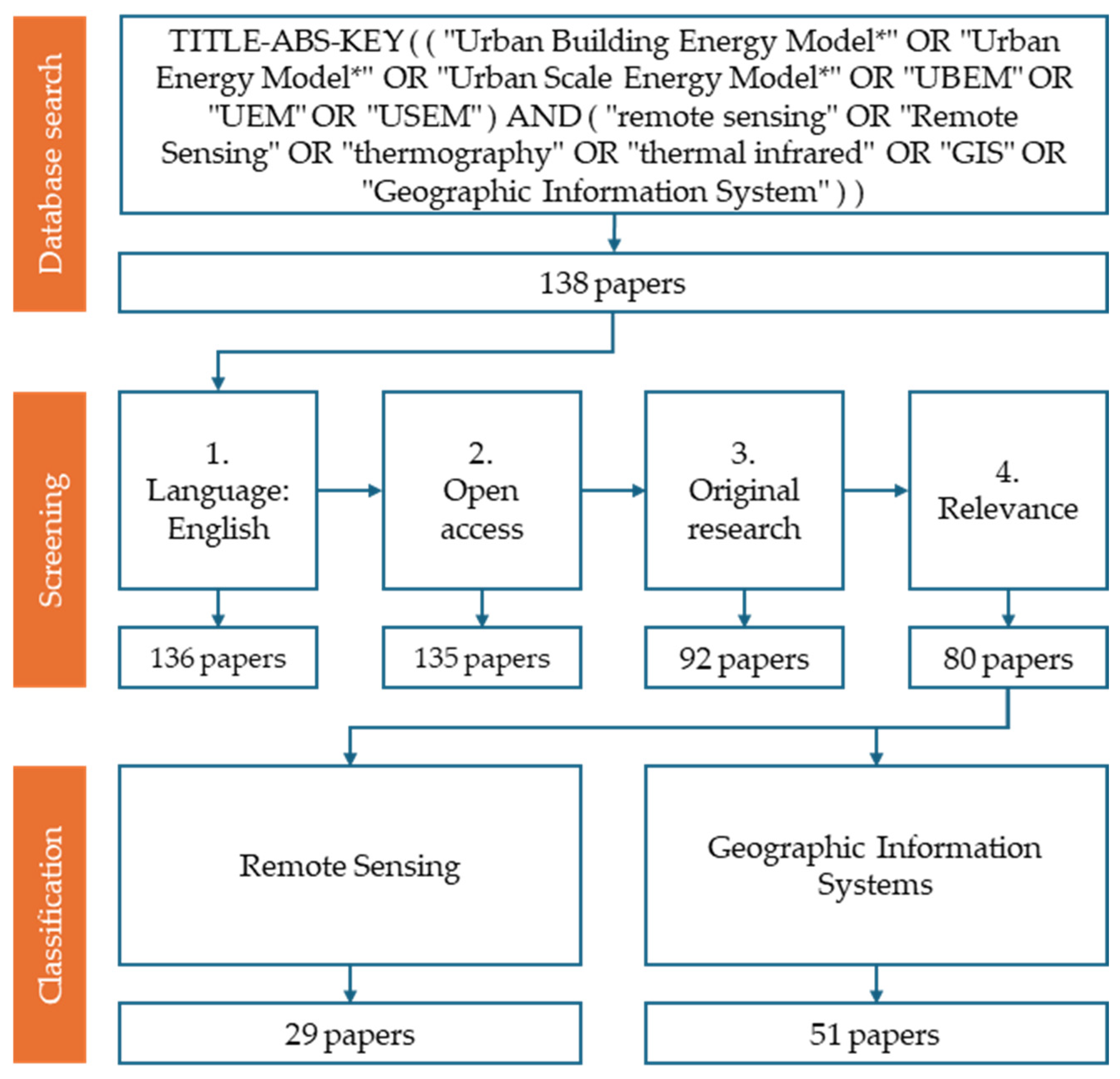
The filtering and selection process is shown in Figure 1. Based on the initial search query, the Scopus database yielded 138 papers. These records were screened according to four inclusion criteria: i) published in English; ii) available via open access; iii) thematic relevance to the current review; and iv) original research (excluding literature reviews). This resulted in the exclusion of 58 papers, specifically 2 written in languages other than English (Persian and Chinese), 1 because of paywalls, 43 because of thematic misalignment (e.g., studies employing thermography for material characterisation without references to the city scale), and 12 reviews.
Finally, the resulting 80 studies, shown in Table 1, were categorised based on the technology of interest: 29 studies are employing RS data, while the remaining 51 are producing geospatial energy models without RS data and are included in the GIS category.
The analysis is pivoted on the assessment of inputs, tools, and outputs, aiming to provide a comprehensive evaluation of the whole energy modelling process. In some cases, the analysis encompasses all papers, while in others only the papers covering a given topic (such as RS or specific inputs) are considered. Moreover, specific aspects are tackled by observing a sub-sample only, according to the investigated parameter (such as the RS platform or additional inputs).
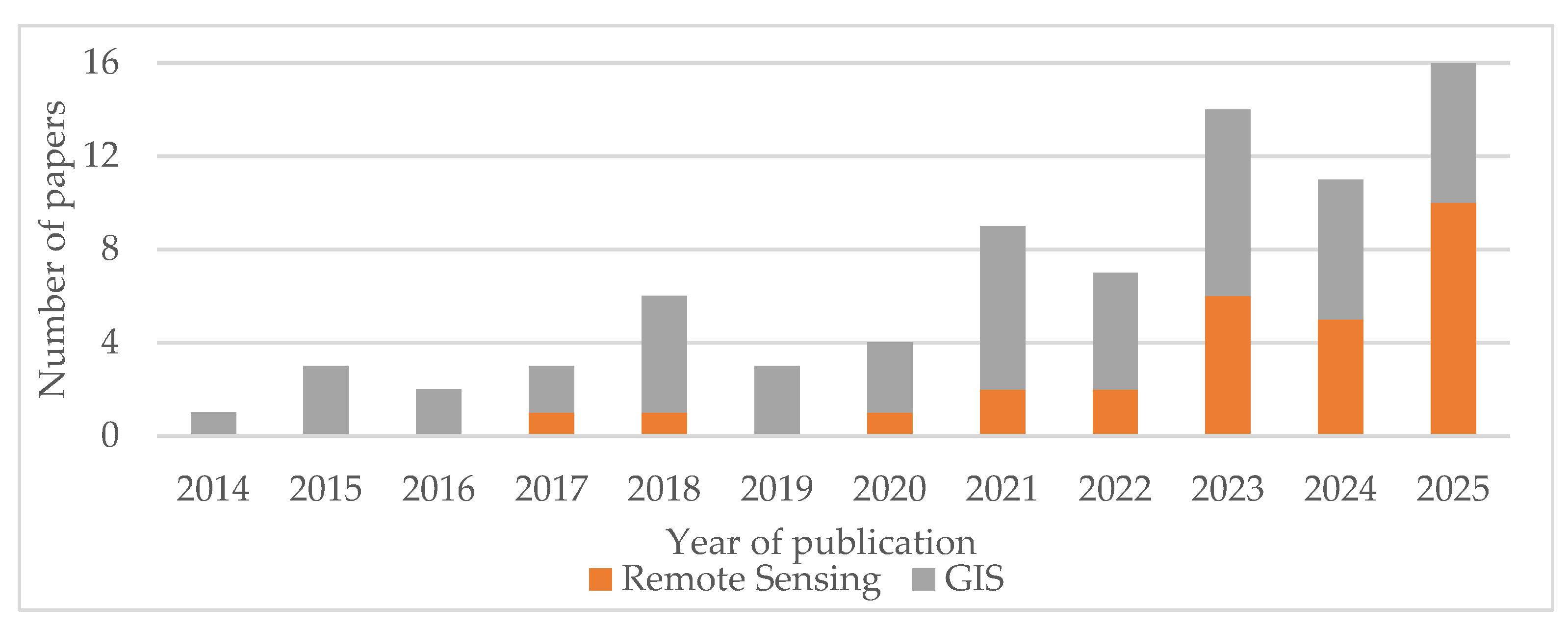
Figure 2 analyses the publication trends across the years, distinguishing between the two principal categories—RS and GIS. First, the novelty of the topic clearly emerges, with the first paper, published in 2014, introducing GIS as an alternative to Building Energy Modelling for wide-scale analyses [67]. In the last three years the yearly publications on the topic have more than doubled, from 7 in 2022 to 16 in 2025. Similarly, it can be noted that the publications on Remote Sensing for UBEMs have seen a gradual increase, from the first in 2017 [69] to the 10 of 2025, more than those published in the GIS context. This comes unsurprisingly, with RS gaining attention in the recent years due to increasing data availability—with new missions, such as Sentinel-5, launched in 2025—and knowledge on the topic.
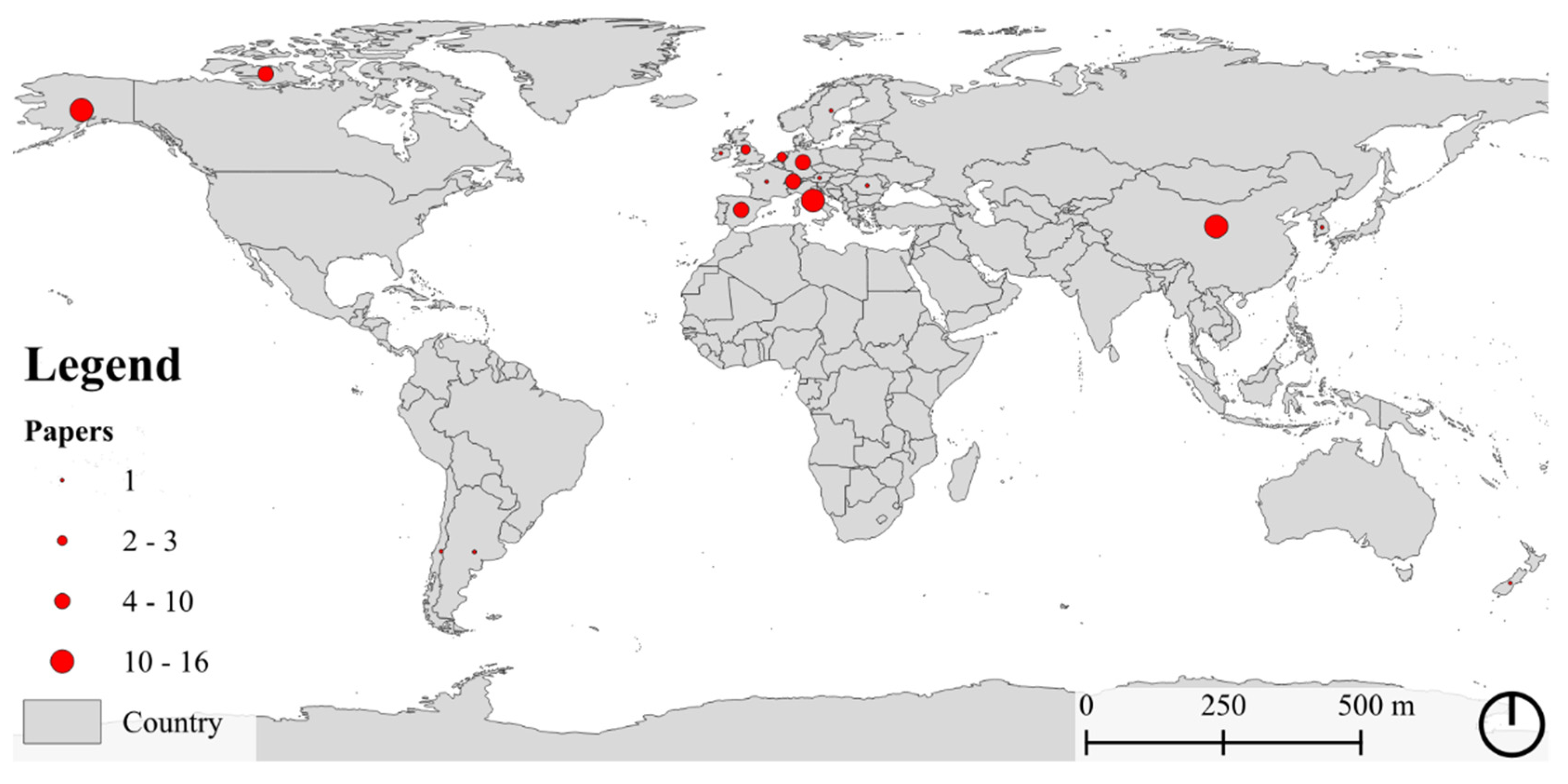
Second, the spatial distribution of the studies is observed, and shown in Figure 3. A total of 16 papers use Italy as a case study, followed by China (14) and the USA (10). Overall, a prevalence of Europe can be noted, with more than half of the papers (57.5%) published in the continent. The Americas follow, with 18 studies. In one instance, a single study covers Germany, Italy, and Switzerland simultaneously, tackling the challenges related to inconsistent data availability across these three countries [53]. A total of 239 scholars contributed to the research; among them, Prof. Yixing Chen (Hunan University, China) and Prof. Guglielmina Mutani (Politecnico di Torino, Italy) emerged as the most prolific authors, with 12 papers each. The latter is also the most recurrent as first author, with six papers.
As for the type of paper, a general prevalence of journal articles (58) over conference papers (22) can be observed. In particular, the two principal sources are Sustainable Cities and Society (14 papers) and Energy and Buildings (13 papers), both published by Elsevier. Among the conferences, five articles are included in the proceedings of the Building Simulation Conference.
The analysis of scope and scale follows to give an overview on the principal frameworks of the analysed studies.

2.1. Scope

The first aspect to be analysed is the scope of the papers. A total of 55 studies (69%) focus on energy consumption analysis, which is a key concept in UBEMs. However, while the vast majority is using existing energy modelling tools, in 14 cases—none of which consider Remote Sensing—a new tool is introduced. For example, this is the case for FlexiGIS [14] or GeoBEM [90]. In some cases, the developed tools are also used in other studies: this is the case for AutoBPS, introduced by Deng et al. [8] and later used in Zhao et al. [91]. Additionally, several studies focus on specific aspects of UBEMs, such as input definition [27,70], accuracy [76], or validation [38]. A specific group is focusing on archetyping, with Li & Feng [50] and Yu et al. [89] working on archetype definition. Moreover, Li et al. [51] apply Deep Learning to RS imagery for building age prediction, while Suppa et al. [75] leverage Google Street View images for defining the window-to-wall ratio.
In some cases, the focus is on the quantification of specific parameters for UBEMs. First, the impact of climate is considered in four papers. Three papers [20,30,83] analyse the impacts of Climate Change, introducing alternative Typical Meteorological Years for estimating future consumption. In another case [85], RS is leveraged to model microclimate accurately, thus defining its effects on UBEM results. Similarly, Hashemi et al. [43] model the effects of vegetation on energy consumption, by integrating tree inventories in UBEMs.
Another group of papers simulates the effects of renovations on energy consumption. This is the case for García-López et al. [39] and Zhao et al. [92], both evaluating renovation strategies at the neighbourhood level. Blázquez et al. [22] assess the impact of the potential introduction of a new building protocol, while Song & Chen [72] look for the energy-saving potential of cool roofs on Xiamen city (58 km2). Finally, Nature-based Solutions are also explored, with Wang et al. [82] working on city-scale energy saving of green roofs.
Finally, some papers integrate the production potential with UBEMs, thus assessing the opportunity to create Positive Energy Districts [68] or Energy Communities [21,23]. Similarly, Keena et al. [48] explore the potential for circularity beyond the energy system, in a study which encompasses various aspects of sustainable housing.

2.2. Scale

Similarly to what was observed for the scope, a general prevalence of a scale of analysis emerges. It is the neighbourhood scale, with 43 studies, followed by the city scale, 30. In two cases the analysis is limited to the building scale: in Song et al. [70] the focus is on the definition of necessary parameters for energy modelling on a wide scale, while Yoon et al. [88] explore the tools to be used for accurate 3D modelling.
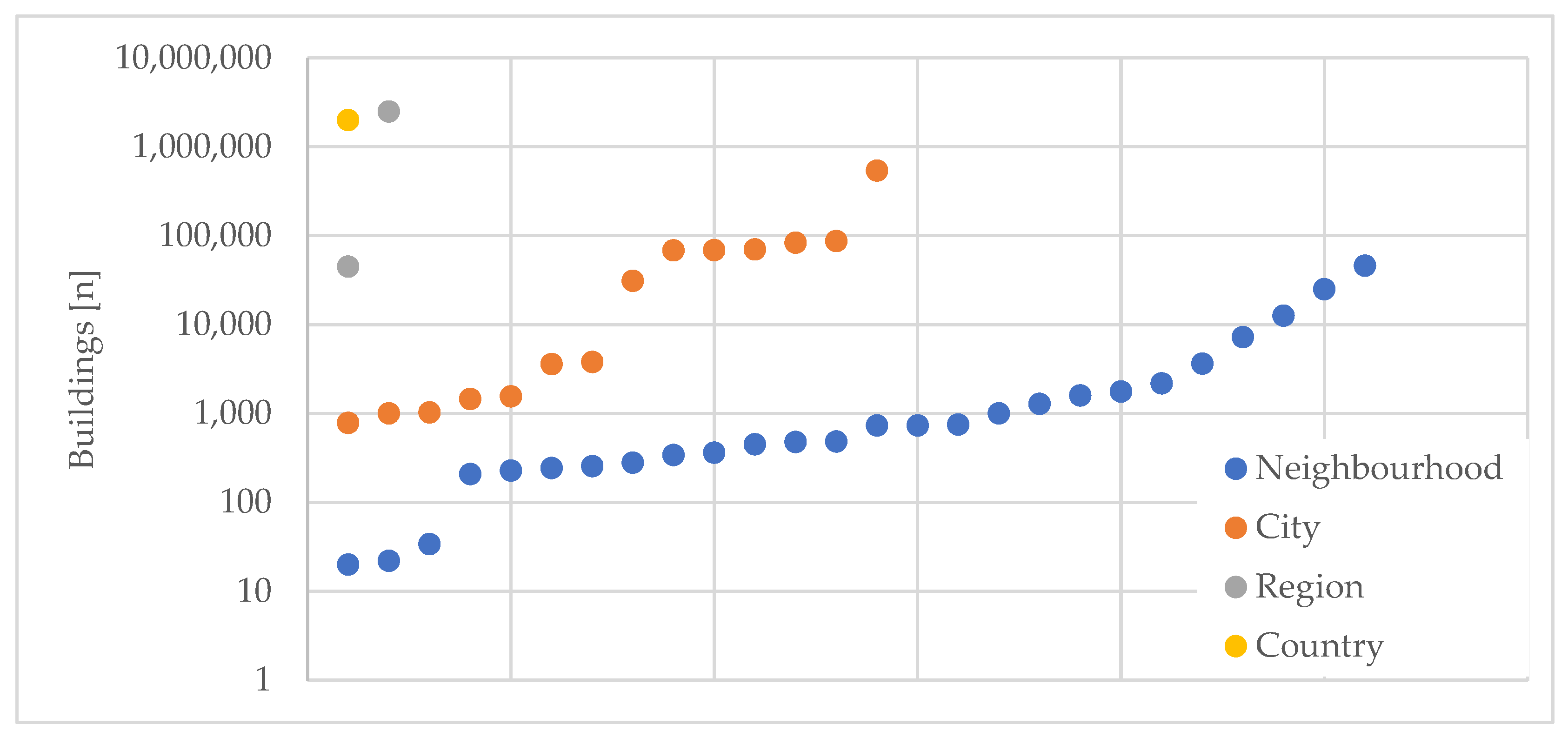
However, varying the national context often entails a shift in the perceived dimensions of urban scales, as the classification of “neighbourhood” and “city” is not universally standardised. Indeed, as shown in Figure 4, there is a general overlap between neighbourhood and city scales. While for “neighbourhood” authors address areas as little as 20 buildings [44], Manhattan—case study of Quan et al. [64]—counts 49,500 buildings. Similarly, cities range from approximately 1000 buildings (in Jaén, Spain, selecting only the residential ones) [38] to more than 500,000 (Shanghai, China) [71].
Three studies work at a higher level. One is addressing the building stock of the region of Sheffield (UK) [87], while a second [84] analyses the building stock of Massachusetts. Finally, the third is considering a whole country, Ireland, through a data-driven approach [16].

3. Results: Use of Remote Sensing in UBEM Literature

3.1. Applications of RS for UBEMs

As mentioned in Section 2, Remote Sensing is quite new to the topic of Urban Building Energy Modelling. First, it is relevant to analyse what are the principal applications of RS for UBEMs. Out of 29 papers, 15 alternative uses have been explored. While in most cases RS is used for a single application at a time, in the literature it is possible to observe research with multiple uses of RS at once.
The most recurring use is the definition of the building age, carried out by analysing time series. In the case of Düsseldorf, the survey and cadastral office of the City has provided aerial pictures to cross-check the building age, originally estimated based on field interviews [89]. As for the studies considering satellite pictures, those used in a specific case [51] date back to the 1980s. On the contrary, the recent development of Shanghai (China) allows for considering pictures acquired from 2004 only, as done by Song et al. [70].
In the same study, Song et al. [70] use RS also to extract the building footprints. This is the second most recurring use, together with the height definition. Indeed, automatic and semi-automatic segmentation tools makes it possible to extract building footprints easily. Moreover, the increasing spatial resolution of modern satellites allows for constant refinements of the results, together with innovative Deep Learning techniques, such as those used by Sun et al. [74]. Similarly, it is possible to compute building height—another crucial geometric parameter—in different ways. A common approach is based on LiDAR point clouds, from which 3D models and Digital Elevation Models can be derived [46,63]. Nonetheless, satellite imagery is used by Sun et al. [74] despite its lower resolution, reducing the accuracy in building height estimates. On the contrary, high resolutions can be obtained with drone acquisitions, such as that carried out for the research by Yoon et al. [88].
The envelope quality definition follows, with three works by the same research group [17,18,19] and research by Dochev et al. [32] leveraging infrared thermography for the definition of the thermal qualities of the envelope. Going beyond the use of thermal transmittance (u-value), these studies use the thermal properties of the envelope as a key driver of energy performance. Additional studies focus on different characteristics of the building, such as the type [25,84], the window-to-wall ratio [32,75], or the retrofit state [46].
Finally, RS data have been used for the definition of weather parameters. It is specifically the case of Dougherty et al. [34] and Worthy et al. [85] for the definition of microclimatic conditions. Similarly, Mutani et al. [53] have calculated Land Surface Temperature. With the literature on RS widely acknowledging the calculation of spectral indices, the same study uses satellite data for the calculation of albedo and the Normalised Difference Vegetation Index [53]. Similarly, Johari et al. [46] extract vegetation, and Song et al. [73] compute roof reflectance.

3.2. Remote Sensing Configurations

In the 29 studies working with remotely-sensed data, the information on acquisition platforms, sources, and wavelengths is generally limited. Indeed, 24 describe the acquisition platform, while only 10 report the used bands.
In most cases (11), the acquisition platform is a satellite, with a wide variety of sources. The most recurring ones are Landsat, Sentinel, and Tianditu, the official cartographic platform of the government of the People’s Republic of China. As for Landsat, Mutani et al. [53] use data from Landsat 7, while in two other cases [25,34] Landsat 8 is used. Dougherty and Jain [34] use the bands from 1 (Ultra Blue) to 7 (SWIR 2), in addition to Band 10 (Thermal Infrared 1), while Chen et al. [25] do not specify the used bands. In the former, the different bands are calculated for the calculation of spectral indices (such as the Normalised Difference Vegetation Index), for the surface reflectance assessment and to derive the Land Surface Temperature, in the framework of microclimate modelling. Sentinel-2 (in particular, Sentinel-2A) data are used by Song and Chen [72], with six bands (Blue, Green, Red, Near Infrared, and Shortwave Infrared 1 and 2) used for calculating roof reflectance and the remaining seven employed for pre-elaboration and calibration. In addition to Landsat data, Dougherty and Jain [34] combine Sentinel-1 (Synthetic Aperture Radar data) with Sentinel-2, using the former for the classification of materials and the latter for the definition of multiple characteristics of the urban environment (such as vegetation based on Red and Near Infrared and reflectance on longer wavelengths with Shortwave 1 and 2).
In three other cases, Google Earth data are used. Google Earth couples satellite data—from Landsat 8, Sentinel-2, and commercial satellites as WorldView—with pictures acquired by plane or drone. This allows for a greater resolution—up to 10 cm—in specific areas, such as cities. Deng et al. [27] use Google Earth only, accessing time series for the vintage estimation and contemporary datasets for the validation of the building function. In the remaining two cases [70,72] this source is coupled with additional datasets, such as Tianditu, Sentinel, Amap, and Baidu. The last two sources offer a resolution of 50 cm and a more frequent update rate compared to Google Earth in Shanghai, China.
In nine cases, the acquisition platform is an airplane. Planes ensure higher spatial resolution compared to satellites and a greater acquisition speed compared to drones. Three of them [17,18,19] use Mid-Wave Infrared (MWIR) for the calculation of building surface temperature, returned with a spatial resolution equal to 25 cm. Other infrared bands used in the selected sample are Thermal Infrared [32] and Near Infrared [42]. In the last two cases, infrared imagery is used jointly with RGB pictures, employed also in Blázquez et al. [22] and Li et al. [51]. RGB imagery provides the maximum spatial resolution, with a Ground Sampling Distance up to 8 cm [32,42].
In one case [88] there is a joint use of Unmanned Aerial Vehicles and an airplane. The former is used for accurate geometry modelling, while the latter represents the baseline for the evaluation of accuracy refinement obtained through the use of drones.
Finally, in three cases [46,50,63] the technology for the acquisition, the LiDAR, is mentioned while not making the platform explicit. This comes in contrast with Suppa et al. [75], which used a plane for the LiDAR acquisition.

4. Results: UBEM Process

4.1. Inputs

Beyond the inputs provided through Remote Sensing, the analysed studies employ different geospatial data for the definition of Urban Building Energy Models. Unsurprisingly, nearly all studies (91%) require the input of building geometries. In some cases only footprints are provided, while in others attributes—such as height or use—are required. Sources are varied, but there is a widespread use of Volunteered Geographic Information—such as OpenStreetMap [75]—and authoritative data—such as those collected by the EUBUCCO project on the European scale [51].
While buildings per se are sufficient for the estimation of final energy consumption, specific uses—in particular heating and cooling—depend heavily on the surrounding conditions. For this reason, 31 papers (39%) input weather variables in addition to building geometries. As mentioned before, some studies resorted to RS for the estimation of microclimate conditions, while others used Typical Meteorological Years, such as that provided by PVGIS [65].
Moreover, different authors have acknowledged the differences between energy consumption estimates and real values, the so-called energy performance gap. This has multiple causes, from errors in the characterisation of building envelope and energy systems to inaccuracies in weather data and occupancy schedules [93]. For this reason, 11 cases introduced metred data in the research. Nevertheless, the availability of such information is limited or restricted for privacy reasons; furthermore, rigorous quality checks are necessary to mitigate the impact of metring errors and data anomalies. Therefore, in some cases metred data are accessed only in aggregate form [57,58]; in others they cover only a single energy carrier, such as district heating [79]. When it is not possible to access real values, energy certificates are also employed (nine occurrences). While including modelled values, certificates are the results of accurate analyses, often implying site visits and measurements, which employ trusted platforms.
Other inputs are related to the definition of specific building attributes. This is the case for
  • Points of Interest (seven occurrences), land cover maps (six occurrences), and cadastral data (three occurrences), used to define the building use;
  • Building standards and regulations (seven occurrences), meant to fill gaps in building materials and characteristics (e.g., thickness of the walls);
  • Census data (nine occurrences), used for the definition of building occupancy;
  • Digital Elevation Models (two occurrences), which can be used for the building height calculation [36,41].
In other cases, the research is centred on specific data. It is the case of urban infrastructure, in two studies carried out in Germany going beyond energy consumption by including an assessment of distribution networks [15,66]. Similarly, Hashemi et al. [43] collected tree inventories to be integrated into UBEMs.

4.2. Archetype Definition

As previously mentioned, a major obstacle for UBEMs is disaggregate data gathering. For this reason, several scholars resort to representative archetypes [94]. Among the selected papers, 41 make use of archetypes, based on 11 different parameters. In some cases, archetypes are based on data gathered for the purpose of the study, while in other cases authors refer to existing databases, e.g., Prades-Gil et al. [63] use the results of the TABULA project, while Keena et al. [48] used archetypes realised by the Canadian statistical institute.
The most recurring parameter for archetype definition is the building age (27 papers). While it is difficult to gather accurate information on the specific construction year, there is a wide availability of databases reporting periods of construction, with different categorisations based on source and place, e.g., Anselmo et al. adopted the classification by the Italian Statistical Agency [19]. In three additional cases, the period of construction is either coupled with the retrofit state [36,42] or substituted by it [68]. The second most frequent parameter is building type, identified in 14 cases. Although definitions vary, it is generally conceptualised as a combination of use and morphology. Notably, both parameters are also analysed independently in six and nine studies, respectively. As for the morphology, the main quantitative indicator is the Surface-to-Volume ratio. Torabi Moghadam et al. [78] provide a classification in four morphology classes based on this parameter. The Surface-to-Volume ratio is influenced not only by the external walls—to be extracted considering shared surfaces among neighbouring buildings—but also by the building dimensions. The dimension, calculated based on both the Gross Floor Area and the footprint area, is used for archetyping in 10 papers. Height is generally considered in metres, with some exceptions where the number of floors is used as a proxy [68,75].
Finally, it is possible to point out four studies introducing parameters not used elsewhere:
  • Ghiassi et al. [41] considered a set of descriptive indicators including geometries, solar gains, thermal qualities, and operational parameters;
  • Deng et al. [8] introduced the climatic zone in the AutoBPS tool for clustering buildings in similar surrounding conditions;
  • Mutani et al. [58] considered the energy performance classification in a study based on Energy Performance Certificates;
  • Sessa et al. [68] used building orientation, as correlated to solar gains.

4.3. UBEM Tool

The principal tool used in the selected studies is EnergyPlus, developed by the US Department of Energy. It is a physics-based program, calculating dynamic thermal loads and energy performance with hourly and sub-hourly resolutions. In 18 cases it is directly used, while in an additional 12 cases it is called through external tools. This is the case for UMI and AutoBPS (four occurrences each). The former is a Rhino-based tool designed by the MIT Sustainable Design Lab, specifically intended for the neighbourhood scale to assess the impact of urban form on energy consumption. AutoBPS, introduced by Deng et al. [8], is an automated framework for streamlining generation and execution of large-scale UBEMs. Other examples of tools employing the EnergyPlus calculation engine are Honeybee, used twice [86,87], and Simstock, used by Barone et al. [21].
Another relevant group of papers is not using tools but choosing a white box approach, with the development of dedicated equations. These can be as simple as the multiplication of the Gross Floor Area by the Energy Use Intensity [57,69] or more structured. This is the case for three studies adapting equations from EN IS 13790 [26,61,62] and a fourth one based on ISO 52016 [63]. In other cases, equations are derived by adapting authoritative tools for energy performance calculations [64] or calculation methods published in the literature [36]. Furthermore, five studies employ Machine Learning techniques for UBEMs.
Finally, it is to be mentioned that some studies combine different tools. CitySim (used twice alone) is combined with Machine Learning in Montazeri et al. [52] and Todeschi et al. [76], where they are coupled also with a bottom-up engineering approach (through an equation developed by the authors). In another case, CitySim is combined with SimStadt and a GIS-based approach [53].
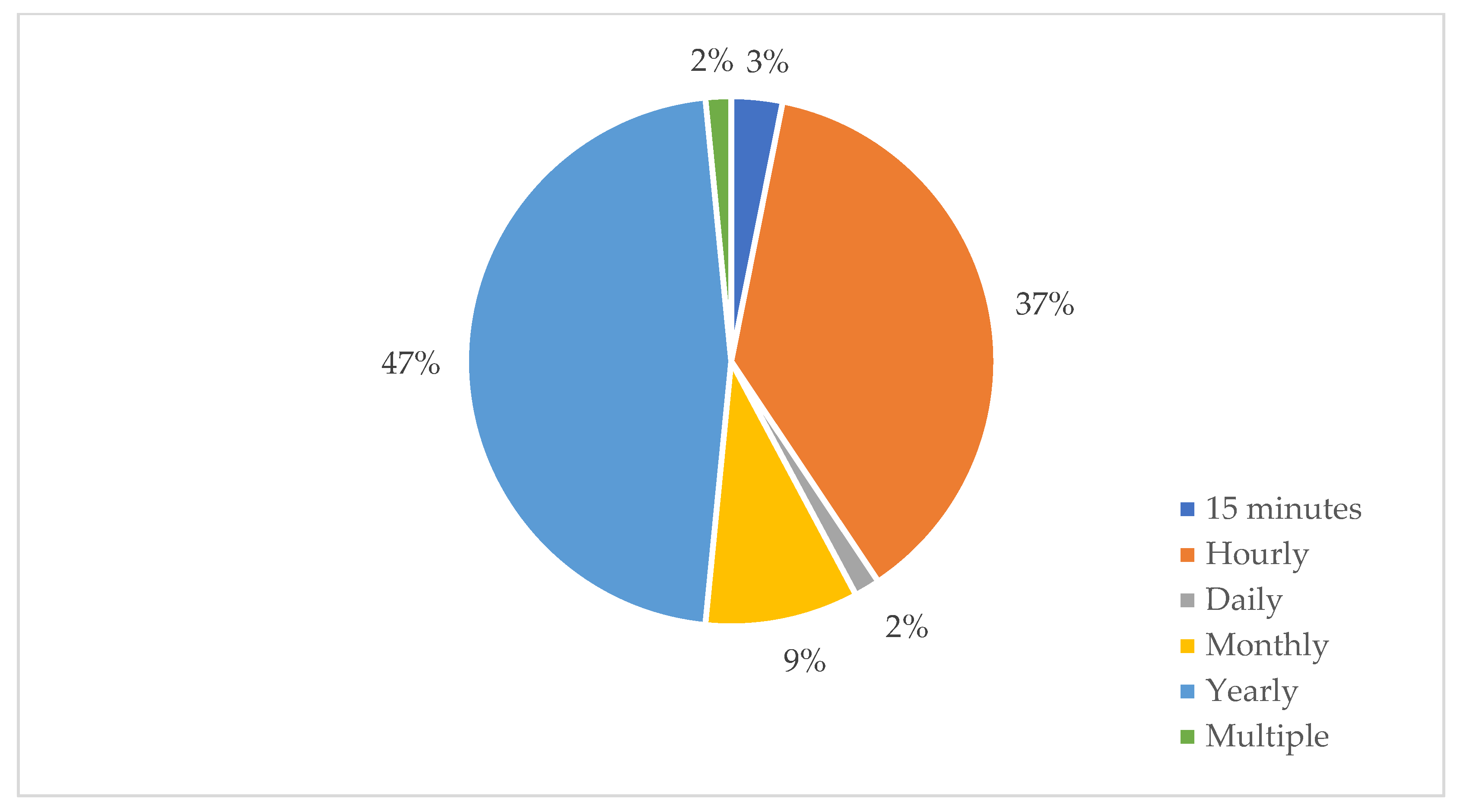
Directly correlated with the tool is the temporal resolution, with the breakdown shown in Figure 5. Most of the studies are situated at two extremes, with 41% of the studies with hourly or sub-hourly resolution and 47% observing aggregate annual results.
Alhamwi et al. [14,15] developed FlexiGIS, which is the only tool among those analysed with sub-hourly resolution, working on time steps of 15 min. On the other hand, the maximum flexibility is offered by the approach provided by Chen et al. [25], with resolutions from hourly to yearly. The framework is completed with six studies carried out with monthly resolution and a single one [78] observing daily trends.

4.4. Results Validation

Finally, it is necessary to consider if and how results have been validated. Exactly 50% of the papers have validated the results.
A total of 18 studies use metred data in this phase, with another three [17,18,19] resorting to information contained in energy certificates. Other validation approaches that are used thrice are the comparison with values gathered from the literature [8,29,91] and the use of a subset of the training database, typical of Machine Learning processes [16,34,75].
An alternative approach is the comparison with alternative simulation tools. García-López et al. [39] and Prades-Gil et al. [63] use EnergyPlus to this end, while Mutani et al. [56] employ CitySim. García-López et al. [38] validate the results on single buildings with two tools for energy certification officially approved by the Spanish authorities. Similarly, Rodríguez-Álvarez et al. [65] perform validation on a single building by applying the ASHRAE methodology.
A final group of papers validates results against legislative standards (two occurrences) or authoritative reports (five cases).

5. Discussion and Conclusions

This research provided an overview on GIS-based Urban Building Energy Modelling, with specific attention to Remote Sensing applications. Despite the growing interest in the field, the existing studies are limited to less than 20 publications per year, compared to the 600 on general UBEM applications [95]. Nevertheless, given the expanding capabilities deriving from the increasing number and quality of RS data, a sharp increase is likely to be observed in the near future.
In summary, it emerged that the field of GIS-based UBEMs is characterised by the presence of clear trends in terms of scales, RS platforms, used inputs, and modelling tools. In detail, a general simplification of district-scale analyses was observed, with geometric—and in some cases climatic—variables being used for the estimation of energy consumptions, often resorting to EnergyPlus as calculation engine. Still, a wide variety of alternatives remains. First, it was observed that beyond the general scope of Urban Building Energy Modelling there is a growing number of studies focusing on specific aspects, such as the definition of input parameters, the refinement of building archetypes, or the development of new tools solving the problems given by the most diffused existing tools. Moreover, the topic of Climate Change was tackled by four studies, indicating special awareness on the issue. As for the scales, it was observed how a potentially unlimited number of buildings can be included in the simulations, with examples up to the country scale.
While the use of RS in UBEMs remains limited (36% of the total studies), it clearly emerges how satellite and aerial imagery can be leveraged especially for building characterisation. In particular, across the analysed studies there is a general use of RS for the definition of building geometry and age, with specific studies introducing innovative elements, such as the application of Machine Learning for the definition of the window-to-wall ratio and the extraction of weather variables. Furthermore, image elaboration (e.g., with the calculation of spectral indices) and segmentation can support the semantic enrichment of building geometries, with the possibility of open access to RS data favouring a growing integration into UBEM processes. Although airborne acquisition remains highly relevant, a transition towards satellite-based monitoring is underway, facilitated by increasingly competitive spatial, temporal, and spectral resolutions.
In their literature review on the potential of RS and GIS in UBEMs, Anand & Deb [12] divided UBEM variables into physical, climatic, and occupant and appliance-related, highlighting that RS contributes the most to the variables of the first group. Nevertheless, based on the present findings, some differences emerged. In particular, while the authors present the definition of building age as a task which can be carried out statically from both satellite and UAV data, the present findings demonstrate both the need of time series and a general prevalence of satellite data. This is mostly motivated by a wider availability of time series, such as that used in Shanghai covering the period 2004–2022 [70]. Moreover, where longer time series are required, as in the case of Düsseldorf [89], historical pictures were generally acquired by plane rather than UAV. A similar overestimation of the UAV potential can be observed for climatic variables, for which there is a general prevalence of satellite uses. Nevertheless, these have intrinsic limitations, e.g., instead of the air temperature, in some cases [53] studies resort to Land Surface Temperature. Regarding indoor air temperature, Anand & Deb highlight the limited potential of satellite data for its estimation. In the reviewed literature, this value is typically assumed as a constant, even in the studies using thermography as a proxy for the quality of the envelope [19,32]. Finally, the present findings confirm the limited or null potential observed by Anand & Deb for occupant and appliance-related variables.
The existing literature also demonstrates how a UBEM requires a relatively low number of inputs, with building geometries often being sufficient for basic elaborations. Nevertheless, it was demonstrated that several parameters can be inputted as well, from weather variables to information on surrounding conditions. In case of limited data availability, the most common answer is archetyping. This is often based on building age, type, and morphology, but some scholars introduced additional variables, such as the climatic zone and the energy performance class.
Based on the relevance of UBEMs in energy planning and the continuous efforts to improve model accuracy, future works should focus on the effective integration of Remote Sensing. In particular, taking geometric reconstruction for granted—with studies considering the definition of either footprint or height representing 41% of the total—future research should shift to automated semantic enrichment from RS. Beyond the estimation of building age (observed in seven cases), the RS potential for the identification of building materials, window extraction, and the quantification of the rooftop solar potential remains underexplored. Second, a significant opportunity lies in the possibility to have multi-temporal data, with high temporal resolution and a relative low cost. Integrating RS data into UBEM workflows allows for large-scale model calibration and validation, increasing and diversifying the number of inputs and refining the model accuracy. While a relevant number of tools and procedures and adequate validation strategies emerged, intrinsic limitations remain, in particular for data gathering. This results in the definition of a present trade-off between cost- and time-effectiveness and model accuracy. The incremental integration of RS data into the UBEM process paves the way for shifting this trade-off to higher accuracy, thanks to quick and open access to an increasing set of input parameters. Finally, it is possible to integrate streamlined processes into Urban Digital Twins, with dynamic simulations being performed at pre-defined ratios.
Beyond scientific advancements, the integration of RS and GIS into UBEM workflows carries significant broader relevance. First, it was mentioned that UBEMs are often instrumental for policymaking, as they provide a robust evidence base for retrofit prioritisation by identifying the worst-performing buildings and potential savings. This is particularly relevant in light of the limited coverage of traditional energy performance classification schemes, such as Energy Performance Certificates in Europe. Simultaneously, the scalability potential offered by RS-informed energy models can support district heating planning and grid stability. Utility companies can leverage energy modelling to define both the current and future scenarios, modifying peak loads and optimising energy infrastructures. Automated data pipelines and Urban Digital Twins are crucial for urban branding, with key impacts on people lives as well as on the economic stability of Public Administrations and utility providers.

Author Contributions

Conceptualisation, S.A.; methodology, S.A. and P.B.; investigation S.A.; resources, S.A.; data curation, S.A.; writing—original draft preparation, S.A.; writing—review and editing, P.B.; supervision, P.B.; funding acquisition P.B. All authors have read and agreed to the published version of the manuscript.

Funding

This research received no external funding.

Data Availability Statement

All scientific papers included in this review were accessed through Scopus (scopus.com).

Acknowledgments

This paper reports part of the work developed within the project NODES, which has received funding from the MUR—M4C2 1.5 of PNRR with grant agreement no. ECS00000036. Further, this work was developed in accordance with the framework agreement between the City of Turin and the Polytechnic of Turin, signed on 9 February 2023 and renewed on 6 March 2025, for the realisation of pilot projects towards the implementation of a Digital Twin.

Conflicts of Interest

The authors declare no conflicts of interest.

Abbreviations

The following abbreviations are used in this manuscript:
GISGeographic Information System
RSRemote Sensing
UAVUnmanned Aerial Vehicle
UBEMUrban Building Energy Model

References

  1. International Energy Agency. Tracking Clean Energy Progress 2023; International Energy Agency: Paris, France, 2023.
  2. United Nations. Transforming Our World: The 2030 Agenda for Sustainable Development; United Nations: New York, NY, USA, 2015.
  3. European Parliament and Council. Directive (EU) 2023/1791 of the European Parliament and of the Council of 13 September 2023 on Energy Efficiency and Amending Regulation (EU) 2023/955 (Recast); European Parliament and Council: Strasbourg, France, 2023. [Google Scholar]
  4. European Parliament and Council. Directive (EU) 2024/1275 of the European Parliament and of the Council of 24 April 2024 on the Energy Performance of Buildings (Recast); European Parliament and Council: Strasbourg, France, 2024. [Google Scholar]
  5. European Commission. Communication from the Commission to the European Parliament, the European Council, the European Economic and Social Committee and the Committee of the Regions. A Renovation Wave for Europe—Greening Our Buildings, Creating Jobs, Improving Lives (COM/2020/662 Final); European Commission: Brussels, Belgium, 2020.
  6. Pasichnyi, O.; Wallin, J.; Levihn, F.; Shahrokni, H.; Kordas, O. Energy Performance Certificates—New Opportunities for Data-Enabled Urban Energy Policy Instruments? Energy Policy 2019, 127, 486–499. [Google Scholar] [CrossRef]
  7. Ferrando, M.; Causone, F.; Hong, T.; Chen, Y. Urban Building Energy Modeling (UBEM) Tools: A State-of-the-Art Review of Bottom-up Physics-Based Approaches. Sustain. Cities Soc. 2020, 62, 102408. [Google Scholar] [CrossRef]
  8. Deng, Z.; Chen, Y.; Yang, J.; Causone, F. AutoBPS: A Tool for Urban Building Energy Modeling to Support Energy Efficiency Improvement at City-Scale. Energy Build. 2023, 282, 112794. [Google Scholar] [CrossRef]
  9. Fremouw, M.; Bagaini, A.; De Pascali, P. Energy Potential Mapping: Open Data in Support of Urban Transition Planning. Energies 2020, 13, 1264. [Google Scholar] [CrossRef]
  10. Yu, H.; Wang, M.; Lin, X.; Guo, H.; Liu, H.; Zhao, Y.; Wang, H.; Li, C.; Jing, R. Prioritizing Urban Planning Factors on Community Energy Performance Based on GIS-Informed Building Energy Modeling. Energy Build. 2021, 249, 111191. [Google Scholar] [CrossRef]
  11. Zhou, J.; Li, J.; Xie, J.; Dong, X.; Wang, K.; Jing, R.; Tang, R.; Wang, M. State-of-the-Art Review of Urban Building Energy Modelling on Supporting Sustainable Development Goals. Appl. Energy 2025, 402, 126924. [Google Scholar] [CrossRef]
  12. Anand, A.; Deb, C. The Potential of Remote Sensing and GIS in Urban Building Energy Modelling. Energy Built Environ. 2024, 5, 957–969. [Google Scholar] [CrossRef]
  13. Martin, M.; Chong, A.; Biljecki, F.; Miller, C. Infrared Thermography in the Built Environment: A Multi-Scale Review. Renew. Sustain. Energy Rev. 2022, 165, 112540. [Google Scholar] [CrossRef]
  14. Alhamwi, A.; Medjroubi, W.; Vogt, T.; Agert, C. FlexiGIS: An Open Source GIS-Based Platform for the Optimisation of Flexibility Options in Urban Energy Systems. Energy Procedia 2018, 152, 941–946. [Google Scholar] [CrossRef]
  15. Alhamwi, A.; Medjroubi, W.; Vogt, T.; Agert, C. Development of a GIS-Based Platform for the Allocation and Optimisation of Distributed Storage in Urban Energy Systems. Appl. Energy 2019, 251, 113360. [Google Scholar] [CrossRef]
  16. Ali, U.; Shamsi, M.H.; Bohacek, M.; Purcell, K.; Hoare, C.; Mangina, E.; O’Donnell, J. A Data-Driven Approach for Multi-Scale GIS-Based Building Energy Modeling for Analysis, Planning and Support Decision Making. Appl. Energy 2020, 279, 115834. [Google Scholar] [CrossRef]
  17. Anselmo, S.; Ferrara, M.; Corgnati, S.P.; Boccardo, P. Aerial Urban Observation to Enhance Energy Assessment and Planning towards Climate-Neutrality: A Pilot Application to the City of Turin. Sustain. Cities Soc. 2023, 99, 104938. [Google Scholar] [CrossRef]
  18. Anselmo, S.; Ferrara, M.; Boccardo, P.; Corgnati, S.P. Aerial Thermography for Multi-Dimensional Urban Energy Assessment and Planning. In Multiphysics and Multiscale Building Physics; Springer: Singapore, 2025; pp. 119–124. [Google Scholar]
  19. Anselmo, S.; Boccardo, P.; Corgnati, S.P.; Ferrara, M. Integration of Aerial Thermography and Energy Performance Certificates for the Estimation of Energy Consumption in Cities. Energy Build. 2025, 336, 115644. [Google Scholar] [CrossRef]
  20. Apostolopoulou, A.; Jimenez-Bescos, C.; Cavazzi, S.; Boyd, D. Impact of Climate Change on the Heating Demand of Buildings. A District Level Approach. Environ. Clim. Technol. 2023, 27, 900–911. [Google Scholar] [CrossRef]
  21. Barone, G.; Buonomano, A.; Del Papa, G.; Forzano, C.; Giuzio, G.F.; Maka, R.; Palombo, A.; Russo, G. Planning Deep Integration of Energy Communities in Urban Context: A GIS Approach to Optimise Renewables, Storage Systems and Demand Aggregation. In Proceedings of the 2024 3rd International Conference on Energy Transition in the Mediterranean Area (SyNERGY MED); IEEE: New York, NY, USA, 2024; pp. 1–5. [Google Scholar]
  22. Blázquez, T.; Suárez, R.; Ferrari, S.; Sendra, J.J. Addressing the Potential for Improvement of Urban Building Stock: A Protocol Applied to a Mediterranean Spanish Case. Sustain. Cities Soc. 2021, 71, 102967. [Google Scholar] [CrossRef]
  23. Buonomano, A.; Giuzio, G.F.; Maka, R.; Russo, G.; Zizzania, S. GIS-Driven Planning of Energy Communities: Optimising Renewables, Storage, and Demand Aggregation in Urban Areas. Renew. Energy 2026, 256, 124521. [Google Scholar] [CrossRef]
  24. Cerezo Davila, C.; Reinhart, C.F.; Bemis, J.L. Modeling Boston: A Workflow for the Efficient Generation and Maintenance of Urban Building Energy Models from Existing Geospatial Datasets. Energy 2016, 117, 237–250. [Google Scholar] [CrossRef]
  25. Chen, L.; Zheng, Y.; Yu, J.; Peng, Y.; Li, R.; Han, S. A GIS-Based Approach for Urban Building Energy Modeling under Climate Change with High Spatial and Temporal Resolution. Energies 2024, 17, 4313. [Google Scholar] [CrossRef]
  26. de Rubeis, T.; Giacchetti, L.; Paoletti, D.; Ambrosini, D. Building Energy Performance Analysis at Urban Scale: A Supporting Tool for Energy Strategies and Urban Building Energy Rating Identification. Sustain. Cities Soc. 2021, 74, 103220. [Google Scholar] [CrossRef]
  27. Deng, Z.; Chen, Y.; Pan, X.; Peng, Z.; Yang, J. Integrating GIS-Based Point of Interest and Community Boundary Datasets for Urban Building Energy Modeling. Energies 2021, 14, 1049. [Google Scholar] [CrossRef]
  28. Deng, Z.; Chen, Y.; Yang, J.; Chen, Z. Archetype Identification and Urban Building Energy Modeling for City-Scale Buildings Based on GIS Datasets. Build. Simul. 2022, 15, 1547–1559. [Google Scholar] [CrossRef]
  29. Deng, Z.; Chen, X.; Yang, J.; Chen, Y. Development of Urban Building Energy Models in Hong Kong Based on Open-Source Datasets. In Proceedings of the Building Simulation 2023: 18th Conference of IBPSA, Shanghai, China, 4–6 September 2023. [Google Scholar]
  30. Deng, Z.; Javanroodi, K.; Nik, V.M.; Chen, Y. Using Urban Building Energy Modeling to Quantify the Energy Performance of Residential Buildings under Climate Change. Build. Simul. 2023, 16, 1629–1643. [Google Scholar] [CrossRef]
  31. Desogus, G.; Congiu, E.; Carrus, A.S. GIS and UBEM: Analysing the Buildings Stock Open Data for Urban Energy Modelling. In Proceedings of the 11th International Conference of Ar.Tec. (Scientific Society of Architectural Engineering); Springer: Cham, Switzerland, 2025; pp. 267–282. [Google Scholar]
  32. Dochev, I.; Gorzalka, P.; Weiler, V.; Estevam Schmiedt, J.; Linkiewicz, M.; Eicker, U.; Hoffschmidt, B.; Peters, I.; Schröter, B. Calculating Urban Heat Demands: An Analysis of Two Modelling Approaches and Remote Sensing for Input Data and Validation. Energy Build. 2020, 226, 110378. [Google Scholar] [CrossRef]
  33. Dogan, T.; Reinhart, C. Shoeboxer: An Algorithm for Abstracted Rapid Multi-Zone Urban Building Energy Model Generation and Simulation. Energy Build. 2017, 140, 140–153. [Google Scholar] [CrossRef]
  34. Dougherty, T.R.; Jain, R.K. TOM.D: Taking Advantage of Microclimate Data for Urban Building Energy Modeling. Adv. Appl. Energy 2023, 10, 100138. [Google Scholar] [CrossRef]
  35. Ferrari, S.; Zagarella, F.; Caputo, P.; Dall’O’, G. A GIS-Based Procedure for Estimating the Energy Demand Profiles of Buildings towards Urban Energy Policies. Energies 2021, 14, 5445. [Google Scholar] [CrossRef]
  36. Fonseca, J.A.; Schlueter, A. Integrated Model for Characterization of Spatiotemporal Building Energy Consumption Patterns in Neighborhoods and City Districts. Appl. Energy 2015, 142, 247–265. [Google Scholar] [CrossRef]
  37. Fonseca, J.A.; Nguyen, T.-A.; Schlueter, A.; Marechal, F. City Energy Analyst (CEA): Integrated Framework for Analysis and Optimization of Building Energy Systems in Neighborhoods and City Districts. Energy Build. 2016, 113, 202–226. [Google Scholar] [CrossRef]
  38. García-López, J.; Sendra, J.J.; Domínguez-Amarillo, S. Validating ‘GIS-UBEM’—A Residential Open Data-Driven Urban Building Energy Model. Sustainability 2024, 16, 2599. [Google Scholar] [CrossRef]
  39. García-López, J.; Hernández-Valencia, M.; Roa-Fernández, J.; Mascort-Albea, E.J.; Herrera-Limones, R. Balancing Construction and Operational Carbon Emissions: Evaluating Neighbourhood Renovation Strategies. J. Build. Eng. 2024, 94, 109993. [Google Scholar] [CrossRef]
  40. Garreau, E.; Abdelouadoud, Y.; Herrera, E.; Keilholz, W.; Kyriakodis, G.-E.; Partenay, V.; Riederer, P. District MOdeller and SIMulator (DIMOSIM)—A Dynamic Simulation Platform Based on a Bottom-up Approach for District and Territory Energetic Assessment. Energy Build. 2021, 251, 111354. [Google Scholar] [CrossRef]
  41. Ghiassi, N.; Tahmasebi, F.; Mahdavi, A. Harnessing Buildings’ Operational Diversity in a Computational Framework for High-Resolution Urban Energy Modeling. Build. Simul. 2017, 10, 1005–1021. [Google Scholar] [CrossRef]
  42. Gorzalka, P.; Garbasevschi, O.M.; Estevam Schmiedt, J.; Droin, A.; Linkiewicz, M.; Wurm, M.; Hoffschmidt, B. Collecting Data for Urban Building Energy Modelling by Remote Sensing and Machine Learning. In Proceedings of the 17th IBPSA Conference, Bruges, Belgium, 1–3 September 2021. [Google Scholar]
  43. Hashemi, F.; Marmur, B.; Passe, U.; Thompson, J. Developing a Workflow to Integrate Tree Inventory Data into Urban Energy Models. Simul. Ser. 2018, 50, 261–266. [Google Scholar] [CrossRef]
  44. Hong, T.; Luo, X. Modeling Building Energy Performance in Urban Context. In Proceedings of the 2018 Building Performance Analysis Conference and SimBuild Co-Organized by ASHRAE and IBPSA-USA, Chicago, IL, USA, 26–28 September 2018; Volume 8, pp. 100–106. [Google Scholar]
  45. HosseiniHaghighi, S.; de Uribarri, P.M.Á.; Padsala, R.; Eicker, U. Characterizing and Structuring Urban GIS Data for Housing Stock Energy Modelling and Retrofitting. Energy Build. 2022, 256, 111706. [Google Scholar] [CrossRef]
  46. Johari, F.; Shadram, F.; Widén, J. Urban Building Energy Modeling from Geo-Referenced Energy Performance Certificate Data: Development, Calibration, and Validation. Sustain. Cities Soc. 2023, 96, 104664. [Google Scholar] [CrossRef]
  47. Katal, A.; Mortezazadeh, M.; Wang, L.; Yu, H. Urban Building Energy and Microclimate Modeling—From 3D City Generation to Dynamic Simulations. Energy 2022, 251, 123817. [Google Scholar] [CrossRef]
  48. Keena, N.; Friedman, A.; Parsaee, M.; Klein, A. Data Visualization for a Circular Economy: Designing a Web Application for Sustainable Housing. Technol. Archit. + Des. 2023, 7, 262–281. [Google Scholar] [CrossRef]
  49. Krietemeyer, B.; El Kontar, R. A Method for Integrating an UBEM with GIS for Spatiotemporal Visualization and Analysis. In Proceedings of the 10th Annual Symposium on Simulation for Architecture and Urban Design Conference SimAUD, Atlanta, GA, USA, 7–9 April 2019. [Google Scholar]
  50. Li, Y.; Feng, H. Pathways to Urban Net Zero Energy Buildings in Canada: A Comprehensive GIS-Based Framework Using Open Data. Sustain. Cities Soc. 2025, 122, 106263. [Google Scholar] [CrossRef]
  51. Li, Q.; Xu, G.; Gu, Z. Deep Learning and Remote Sensing for Scalable Building Age Prediction in Urban Energy Modeling. Energy Build. 2025, 347, 116303. [Google Scholar] [CrossRef]
  52. Montazeri, A.; Kämpf, J.H.; Mutani, G. Data Driven Urban Building Energy Modeling with Machine Learning in Satom CH. In Proceedings of the 2023 IEEE 6th International Conference and Workshop Óbuda on Electrical and Power Engineering (CANDO-EPE); IEEE: New York, NY, USA, 2023; pp. 000113–000118. [Google Scholar]
  53. Mutani, G.; Todeschi, V.; Kampf, J.; Coors, V.; Fitzky, M. Building Energy Consumption Modeling at Urban Scale: Three Case Studies in Europe for Residential Buildings. In Proceedings of the 2018 IEEE International Telecommunications Energy Conference (INTELEC); IEEE: New York, NY, USA, 2018; pp. 1–8. [Google Scholar]
  54. Mutani, G.; Todeschi, V. Urban Building Energy Modeling: An Hourly Energy Balance Model of Residential Buildings at a District Scale. J. Phys. Conf. Ser. 2020, 1599, 012035. [Google Scholar] [CrossRef]
  55. Mutani, G.; Todeschi, V. GIS-Based Urban Energy Modelling and Energy Efficiency Scenarios Using the Energy Performance Certificate Database. Energy Effic. 2021, 14, 47. [Google Scholar] [CrossRef]
  56. Mutani, G.; Todeschi, V.; Santantonio, S. Urban-Scale Energy Models: The Relationship between Cooling Energy Demand and Urban Form. J. Phys. Conf. Ser. 2022, 2177, 012016. [Google Scholar] [CrossRef]
  57. Mutani, G.; Alehasin, M.; Yang, H.; Zhang, X.; Felmer, G. Urban Building Energy Modeling to Support Climate-Sensitive Planning in the Suburban Areas of Santiago de Chile. Buildings 2024, 14, 185. [Google Scholar] [CrossRef]
  58. Mutani, G.; Ghanipour, M.; Zabetitarghi, G.; Arboit, M.E. Developing a Top-Down Statistical Urban Building Energy Model for Space Heating in Mendoza, Argentina. In Proceedings of the 2024 IEEE 7th International Conference and Workshop Óbuda on Electrical and Power Engineering (CANDO-EPE); IEEE: New York, NY, USA, 2024; pp. 269–274. [Google Scholar]
  59. Nageler, P.; Koch, A.; Mauthner, F.; Leusbrock, I.; Mach, T.; Hochenauer, C.; Heimrath, R. Comparison of Dynamic Urban Building Energy Models (UBEM): Sigmoid Energy Signature and Physical Modelling Approach. Energy Build. 2018, 179, 333–343. [Google Scholar] [CrossRef]
  60. Nouvel, R.; Mastrucci, A.; Leopold, U.; Baume, O.; Coors, V.; Eicker, U. Combining GIS-Based Statistical and Engineering Urban Heat Consumption Models: Towards a New Framework for Multi-Scale Policy Support. Energy Build. 2015, 107, 204–212. [Google Scholar] [CrossRef]
  61. Pili, S.; Poggi, F.; Frau, C. A Methodological Approach for a Home Occupants Centred Web Tool to Support Buildings Energy Retrofitting Process. E3S Web Conf. 2021, 312, 02001. [Google Scholar] [CrossRef]
  62. Pili, S.; Desogus, G.; Poggi, F.; Frau, C.; Dessì, A. A Geographical Abacus of the Urban Building Heritage Based on Volunteered Geographic Information (VGI). In Proceedings of the International Conference on Computational Science and Its Applications; Springer: Cham, Switzerland, 2021; pp. 163–173. [Google Scholar]
  63. Prades-Gil, C.; Viana-Fons, J.D.; Masip, X.; Cazorla-Marín, A.; Gómez-Navarro, T. An Agile Heating and Cooling Energy Demand Model for Residential Buildings. Case Study in a Mediterranean City Residential Sector. Renew. Sustain. Energy Rev. 2023, 175, 113166. [Google Scholar] [CrossRef]
  64. Quan, S.J.; Li, Q.; Augenbroe, G.; Brown, J.; Yang, P.P.-J. A GIS-Based Energy Balance Modeling System for Urban Solar Buildings. Energy Procedia 2015, 75, 2946–2952. [Google Scholar] [CrossRef]
  65. Rodríguez-Álvarez, J.; Rodríguez-Luaces, M.Á.; Varela-Rodeiro, T.; Alvaredo-López, N.; Lamas-Sardiña, V. LITHEUM. A Web-Based Lighting and Thermal Urban Model for City Energy Assessment. Sustain. Cities Soc. 2025, 130, 106603. [Google Scholar] [CrossRef]
  66. Schiefelbein, J.; Rudnick, J.; Scholl, A.; Remmen, P.; Fuchs, M.; Müller, D. Automated Urban Energy System Modeling and Thermal Building Simulation Based on OpenStreetMap Data Sets. Build. Environ. 2019, 149, 630–639. [Google Scholar] [CrossRef]
  67. Sehrawat, P.; Kensek, K. Urban Energy Modeling: GIS as an Alternative to BIM. In Proceedings of the ASHRAE/IBPSA-USA Building Simulation Conference, Atlanta, GA, USA, 10–12 September 2014; Volume 6, pp. 235–242. [Google Scholar]
  68. Sessa, E.; Brunetti, A.; Ciulla, G.; Guarino, F.; Longo, S.; Cellura, M.; Dragomir, A.; Papina, C. Towards Positive Energy District Assessment: The Case Study of Bucharest. Energy 2025, 325, 136208. [Google Scholar] [CrossRef]
  69. Sobieraj, D.; Mendieta, X.; McArthur, J.J. GIS Data Extraction and Visualization to Support Urban Building Energy Modelling. In Proceedings of the Building Simulation 2017: 15th Conference of IBPSA, San Francisco, CA, USA, 7–9 August 2017. [Google Scholar]
  70. Song, C.; Chen, Y.; Deng, Z.; Yuan, Y. Assessing the Potential of Open Data for Expanding the Urban Building Dataset: A Case Study in Huangpu District, Shanghai. In Proceedings of the Building Simulation 2023: 18th Conference of IBPSA, Shanghai, China, 4–6 September 2023. [Google Scholar]
  71. Song, C.; Deng, Z.; Zhao, W.; Yuan, Y.; Liu, M.; Xu, S.; Chen, Y. Developing Urban Building Energy Models for Shanghai City with Multi-Source Open Data. Sustain. Cities Soc. 2024, 106, 105425. [Google Scholar] [CrossRef]
  72. Song, C.; Chen, Y. Energy-Saving Potential of Cool Roofs at the Urban Scale: A Case Study of Xiamen City. Energy Build. 2025, 344, 116034. [Google Scholar] [CrossRef]
  73. Song, C.; Yang, J.; Wang, Z.; Li, R.; Pang, X.; Chen, Y. CityEL: A Web-Based Platform to Support City-Scale Building Energy Efficiency Based on AutoBPS. Sustain. Cities Soc. 2025, 120, 106147. [Google Scholar] [CrossRef]
  74. Sun, Z.; Gao, Y.; Yang, J.; Chen, Y.; Guo, B.H.W. Development of Urban Building Energy Models for Wellington City in New Zealand with Detailed Survey Data on Envelope Thermal Characteristics. Energy Build. 2024, 321, 114647. [Google Scholar] [CrossRef]
  75. Suppa, A.R.; Aliberti, A.; Bottero, M.C.; Corrado, V. Detecting Window-to-Wall Ratio for Urban-Scale Building Simulations Using Deep Learning with Street View Imagery and an Automatic Classification Algorithm. Build. Simul. 2025, 18, 2175–2199. [Google Scholar] [CrossRef]
  76. Todeschi, V.; Boghetti, R.; Kämpf, J.H.; Mutani, G. Evaluation of Urban-Scale Building Energy-Use Models and Tools—Application for the City of Fribourg, Switzerland. Sustainability 2021, 13, 1595. [Google Scholar] [CrossRef]
  77. Todeschi, V.; Javanroodi, K.; Castello, R.; Mohajeri, N.; Mutani, G.; Scartezzini, J.-L. Impact of the COVID-19 Pandemic on the Energy Performance of Residential Neighborhoods and Their Occupancy Behavior. Sustain. Cities Soc. 2022, 82, 103896. [Google Scholar] [CrossRef]
  78. Torabi Moghadam, S.; Toniolo, J.; Mutani, G.; Lombardi, P. A GIS-Statistical Approach for Assessing Built Environment Energy Use at Urban Scale. Sustain. Cities Soc. 2018, 37, 70–84. [Google Scholar] [CrossRef]
  79. Usta, Y.; Montazeri, A.; Mutani, G. Feasibility Analysis of Integrating Solar Thermal Technologies into District Heating Network with Urban Building Energy Modeling. Energy Build. 2025, 338, 115661. [Google Scholar] [CrossRef]
  80. Vecchi, F.; Berardi, U.; Mutani, G. Data-Driven Urban Building Energy Models for the Platform of Toronto. Energy Effic. 2023, 16, 26. [Google Scholar] [CrossRef]
  81. Wang, C.-K.; Tindemans, S.; Miller, C.; Agugiaro, G.; Stoter, J. Bayesian Calibration at the Urban Scale: A Case Study on a Large Residential Heating Demand Application in Amsterdam. J. Build. Perform. Simul. 2020, 13, 347–361. [Google Scholar] [CrossRef]
  82. Wang, M.; Yu, H.; Liu, Y.; Lin, J.; Zhong, X.; Tang, Y.; Guo, H.; Jing, R. Unlock City-Scale Energy Saving and Peak Load Shaving Potential of Green Roofs by GIS-Informed Urban Building Energy Modelling. Appl. Energy 2024, 366, 123315. [Google Scholar] [CrossRef]
  83. Wang, M.; Zhou, J.; Liang, Y.; Yu, H.; Jing, R. Climate Change Impacts on City-Scale Building Energy Performance Based on GIS-Informed Urban Building Energy Modelling. Sustain. Cities Soc. 2025, 125, 106331. [Google Scholar] [CrossRef]
  84. Wolk, S.; Reinhart, C. Semantic Building Energy Modeling: Analysis across Geospatial Scales. Build. Environ. 2025, 276, 112883. [Google Scholar] [CrossRef]
  85. Worthy, A.; Ashayeri, M.; Abbasabadi, N. Leveraging Earth Observational Data Products and Machine Learning to Enhance Urban Building Energy Modeling (UBEM) with Microclimate Effects. Sustain. Cities Soc. 2025, 130, 106544. [Google Scholar] [CrossRef]
  86. Xu, H.; Wang, T.-H. An Integrated Parametric Generation and Computational Workflow to Support Sustainable City Planning. In Proceedings of the 27th CAADRIA Conference, Sydney, Australia, 9–15 April 2022; pp. 535–544. [Google Scholar]
  87. Xu, H.; Wang, T.-H. A Generative Computational Workflow to Develop Actionable Renovation Strategies for Renewable Built Environments: A Case Study of Sheffield. Int. J. Archit. Comput. 2023, 21, 516–535. [Google Scholar] [CrossRef]
  88. Yoon, J.; Kim, Y.; Lee, S.; Shin, M. UAV-Based Automated 3D Modeling Framework Using Deep Learning for Building Energy Modeling. Sustain. Cities Soc. 2024, 101, 105169. [Google Scholar] [CrossRef]
  89. Yu, Q.; Mills, G.; Ketzler, G.; Leuchner, M. Developing an Urban Geographic Archetype Dataset to Support Energy Retrofit Strategy on Residential Buildings in Düsseldorf, Germany. Energy Rep. 2025, 14, 282–293. [Google Scholar] [CrossRef]
  90. Zhang, S.; Chen, L.; Xu, L.; Wang, Z. GeoBEM: A Geospatial Computing Empowered Framework for Urban-Scale Building Energy Modeling. Sustain. Cities Soc. 2025, 121, 106203. [Google Scholar] [CrossRef]
  91. Zhao, W.; Deng, Z.; Chen, Y. Building Energy Consumption and Peak Load Reduction Potential of Mixed-Use Community through Urban Building Energy Modeling. In Proceedings of the Building Simulation 2023: 18th Conference of IBPSA, Shanghai, China, 4–6 September 2023. [Google Scholar]
  92. Zhao, W.; Deng, Z.; Ji, Y.; Song, C.; Yuan, Y.; Wang, Z.; Chen, Y. Analysis of Peak Demand Reduction and Energy Saving in a Mixed-Use Community through Urban Building Energy Modeling. Energies 2024, 17, 1214. [Google Scholar] [CrossRef]
  93. Zheng, Z.; Zhou, J.; Jiaqin, Z.; Yang, Y.; Xu, F.; Liu, H. Review of the Building Energy Performance Gap from Simulation and Building Lifecycle Perspectives: Magnitude, Causes and Solutions. Dev. Built Environ. 2024, 17, 100345. [Google Scholar] [CrossRef]
  94. Malhotra, A.; Bischof, J.; Nichersu, A.; Häfele, K.-H.; Exenberger, J.; Sood, D.; Allan, J.; Frisch, J.; van Treeck, C.; O’Donnell, J.; et al. Information Modelling for Urban Building Energy Simulation—A Taxonomic Review. Build. Environ. 2022, 208, 108552. [Google Scholar] [CrossRef]
  95. Salvalai, G.; Zhu, Y.; Maria Sesana, M. From Building Energy Modeling to Urban Building Energy Modeling: A Review of Recent Research Trend and Simulation Tools. Energy Build. 2024, 319, 114500. [Google Scholar] [CrossRef]
Figure 1. Review workflow.
Energies 19 01667 g001
Figure 2. Publications per year, divided by topic.
Energies 19 01667 g002
Figure 3. Spatial distribution of the analysed papers.
Energies 19 01667 g003
Figure 4. Number of buildings considered in the analysed studies, divided by scale.
Energies 19 01667 g004
Figure 5. Temporal resolution of 64 studies.
Energies 19 01667 g005
Table 1. List of papers considered in this study.
ReferenceAuthorsYearTopicCountryScale
[14]Alhamwi et al.2018GISGermanyCity
[15]Alhamwi et al.2019GISGermanyCity
[16]Ali et al.2020GISIrelandCountry
[17]Anselmo et al.2023RSItalyNeighbourhood
[18]Anselmo et al.2025RSItalyNeighbourhood
[19]Anselmo et al.2025RSItalyNeighbourhood
[20]Apostolopoulou et al.2023GISUnited KingdomNeighbourhood
[21]Barone et al.2024GISItalyNeighbourhood
[22]Blázquez et al.2021RSSpainCity
[23]Buonomano et al.2026RSItalyNeighbourhood
[24]Cerezo Davila et al.2016GISUSACity
[25]Chen et al.2024RSChinaNeighbourhood
[26]de Rubeis et al.2021GISItalyCity
[27]Deng et al.2021RSChinaNeighbourhood
[28]Deng et al.2022RSChinaCity
[29]Deng et al.2023GISChinaNeighbourhood
[30]Deng et al.2023GISChinaNeighbourhood
[8]Deng et al.2023GISSwitzerlandNeighbourhood
[31]Desogus et al.2025GISItalyNeighbourhood
[32]Dochev et al.2020RSGermanyNeighbourhood
[33]Dogan et al.2017GISUSANeighbourhood
[34]Dougherty et al.2023RSUSACity
[35]Ferrari et al.2021GISItalyCity
[36]Fonseca et al.2015GISSwitzerlandNeighbourhood
[37]Fonseca et al.2016GISSwitzerlandNeighbourhood
[38]García-López et al.2024GISSpainCity
[39]García-López et al.2024GISSpainNeighbourhood
[40]Garreau et al.2021GISFranceNeighbourhood
[41]Ghiassi et al.2017GISAustriaNeighbourhood
[42]Gorzalka et al.2022RSGermanyNeighbourhood
[43]Hashemi et al.2018GISUSANeighbourhood
[44]Hong et al.2018GISUSANeighbourhood
[45]HosseiniHaghighi et al.2022GISCanadaCity
[46]Johari et al.2023RSSwedenCity
[47]Katal et al.2022GISCanadaNeighbourhood
[48]Keena et al.2023GISCanadaCity
[49]Krietemeyer et al.2019GISUSANeighbourhood
[50]Li et al.2025RSCanadaCity
[51]Li et al.2025RSGermanyCity
[52]Montazeri et al.2023GISSwitzerlandNeighbourhood
[53]Mutani et al.2018RSMultipleMultiple
[54]Mutani et al.2020GISItalyNeighbourhood
[55]Mutani et al.2021GISItalyCity
[56]Mutani et al.2022GISItalyNeighbourhood
[57]Mutani et al.2024GISChileNeighbourhood
[58]Mutani et al.2024GISArgentinaCity
[59]Nageler et al.2018GISSpainNeighbourhood
[60]Nouvel et al.2015GISThe NetherlandsNeighbourhood
[61]Pili et al.2021GISItalyCity
[62]Pili et al.2021GISItalyCity
[63]Prades-Gil et al.2023RSSpainCity
[64]Quan et al.2015GISUSANeighbourhood
[65]Rodríguez-Álvarez et al.2025RSSpainMultiple
[66]Schiefelbein et al.2019GISGermanyNeighbourhood
[67]Sehrawat et al.2014GISUSANeighbourhood
[68]Sessa et al.2025GISRomaniaNeighbourhood
[69]Sobieraj et al.2017RSCanadaNeighbourhood
[70]Song et al.2023RSChinaBuilding
[71]Song et al.2024RSChinaCity
[72]Song et al.2025RSChinaCity
[73]Song et al.2025GISChinaNeighbourhood
[74]Sun et al.2024RSNew ZealandCity
[75]Suppa et al.2025RSItalyNeighbourhood
[76]Todeschi et al.2021GISSwitzerlandCity
[77]Todeschi et al.2022GISSwitzerlandNeighbourhood
[78]Torabi Moghadam et al.2018GISItalyCity
[79]Usta et al.2025GISItalyCity
[80]Vecchi et al.2023GISCanadaNeighbourhood
[81]Wang et al.2020GISThe NetherlandsNeighbourhood
[82]Wang et al.2024RSChinaNeighbourhood
[83]Wang et al.2025GISChinaCity
[84]Wolk et al.2025RSUSARegion
[85]Worthy et al.2025RSUSACity
[86]Xu et al.2022GISUnited KingdomCity
[87]Xu et al.2023GISUnited KingdomRegion
[88]Yoon et al.2024RSRepublic of KoreaBuilding
[89]Yu et al.2025RSGermanyNeighbourhood
[90]Zhang et al.2025GISChinaCity
[91]Zhao et al.2023RSChinaNeighbourhood
[92]Zhao et al.2024GISChinaCity
Disclaimer/Publisher’s Note: The statements, opinions and data contained in all publications are solely those of the individual author(s) and contributor(s) and not of MDPI and/or the editor(s). MDPI and/or the editor(s) disclaim responsibility for any injury to people or property resulting from any ideas, methods, instructions or products referred to in the content.