Next Article in Journal
Vortex-Induced Vibration Energy Harvesting for Road Vehicle Suspensions: Modeling, Prototyping, and Experimental Validation
Previous Article in Journal
Effect of Pressure on the Selectivity of Supercritical CO2 Extraction During the Fractionation of a Fatty Acid Ethyl Ester Mixture: Numerical Simulation and Experiment
 
 
Due to scheduled maintenance work on our servers, there may be short service disruptions on this website between 11:00 and 12:00 CEST on March 28th.
Article

Optimal Sizing of Local Photovoltaic Systems in Cement Plants Under Multi-Timescale Demand Response

by
Yujing Li
1,
Youzhuo Zheng
2 and
Siyang Liao
1,*
1
The School of Electrical Engineering, Wuhan University, Wuhan 430072, China
2
Electric Power Science Research Institute, Guizhou Power Grid Co., Ltd., Guiyang 550002, China
*
Author to whom correspondence should be addressed.
Energies 2026, 19(7), 1635; https://doi.org/10.3390/en19071635
Submission received: 12 February 2026 / Revised: 18 March 2026 / Accepted: 23 March 2026 / Published: 26 March 2026

Abstract

This paper addresses the low-carbon transformation needs of the high-energy-consuming industry of cement and proposes a planning method that integrates photovoltaic capacity planning and multi-time-scale demand response. The aim of this method is to minimize the total system cost throughout the entire life cycle, including the investment cost of photovoltaic and the expected operating cost considering demand response. A multi-time-scale demand response model that precisely describes the temporal coupling of the cement production process, inventory dynamics, and hourly/weekly scenarios was constructed. By establishing a two-layer stochastic optimization framework and using the typical scenario method to handle the uncertainties of photovoltaic output and market demand, the coordinated optimization of photovoltaic configuration and load flexibility was achieved. Based on a case study of a typical cement plant in China, it is shown that, compared with traditional planning methods, the proposed method can significantly increase the photovoltaic consumption rate, reduce electricity costs, and effectively quantify the system’s demand response capability, providing a theoretical basis and practical tools for industrial users to achieve “source-load” coordinated low-carbon planning.

1. Introduction

Driven by the global energy transition and the goal of carbon neutrality, demand response has become a core means for enhancing energy flexibility and optimizing load management in the construction of a new power system [1,2,3]. The International Energy Agency defines demand response as “guiding users to actively adjust their electricity usage through price signals or incentive mechanisms” [4,5]. In recent years, major economies around the world have incorporated demand response into their national energy strategies: In 2021, North America and the US Department of Energy collaborated through the “Excellent Plant Program” to significantly improve the energy efficiency of high-load industrial users [6]. The Electricity Demand Response Implementation Plan issued by Fujian Province, China, in 2022 guided industrial users to participate in peak shaving through subsidies, forming a response capacity accounting for 5% of the province’s maximum electricity load. Case studies show that the food retail industry in Mannheim, Germany, achieved 17 megawatts of flexible regulation through intelligent temperature control, accounting for 4% of the city’s peak load, providing a key support for wind power grid connection [7]. Thus, demand response has evolved from a theoretical concept to a crucial implementation tool [8,9], aggregating dispersed user-side resources to ensure the safe and stable operation of the new power system [10,11].
Scholars have conducted extensive research on demand response, mainly categorizing it into three aspects: operational safety, low-carbon environmental protection, and market economy. In the dimension of grid safety operation, reference [12] established an optimization scheduling model for microgrids, using game theory methods to minimize the system operation cost. In the dimension of low-carbon environmental protection, reference [13] evaluated the demand response potential of Denmark under a 100% renewable energy scenario using the the energy systems analysis model EnergyPLAN providing a basis for low-carbon transformation. The improvement of the “energy adjustment-carbon adjustment-price adjustment” tripartite evaluation system further promoted the achievement of carbon reduction in the power system. In the economic and market dimension, reference [14] systematically reviewed the business models and benefit assessment methods of demand response to facilitate economic analysis. The research on market mechanisms compared different types of triggering mechanisms and found that price-based and incentive-based demand responses can be coordinated to increase user participation rates. Reference [15] proposed a DR potential assessment model based on temporal and spatial availability, achieving quantitative economic assessment of typical load scenarios in Germany. These studies did not consider specific load types but regarded all loads with demand response capabilities in the regional power grid as a whole.
The industrial sector is the main source of energy consumption and carbon emissions. It has a large load capacity and strong adjustable potential, making it an important battlefield for demand response applications [16,17]. Existing research has gradually expanded to the refined modeling and strategy design of typical industrial loads. In reference [18], a method based on profiling was proposed, which can effectively identify potential consumers for different demand response tasks using historical load data. As research progresses, scholars have gradually focused on typical high-energy-consuming industrial loads and conducted more targeted explorations. In terms of electrolytic aluminum load, references [19,20] proposed a joint optimization scheduling method involving electrolytic aluminum load and energy storage. Through the coordination scheduling of the day-ahead and day-to-day periods, it effectively improves the level of new energy consumption. In terms of the load of the steel industry, reference [21] proposed RTN scheduling models to achieve refined responses for short-process electric furnace steelmaking. Current research on industrial demand response has shown a trend of deepening from system-level modeling to process-level and from single control to multi-strategy collaboration. However, most of the above research focuses on manufacturing processes such as steel and electrolytic aluminum, and the attention paid to the cement industry is relatively insufficient.
The cement industry, as a typical high-energy-consuming industry, has a vast potential for demand response, which is increasingly becoming a key factor in global energy transition and the stability of the power market [22,23]. However, current research in this field is relatively limited and has significant limitations. Reference [24] constructed a dynamic optimization model based on the cement crushing process to solve the problem of traditional market particle size restrictions, but it was limited to a single production process and did not finely construct the entire cement production process. Reference [25] analyzed the advanced energy management system (EMS) model of cement plants, through daily scheduling optimization to reduce electricity costs and carbon emissions, but it “blackboxed” the complex continuous production process and mainly focused on short-term operational efficiency. Current research mostly focuses on a single aspect such as photovoltaic or load and short-term operation, lacking a systematic analysis of the dynamic coupling mechanism of photovoltaic and refined cement production over multiple time scales, especially lacking a multi-time-scale collaborative optimization perspective from planning to scheduling, from hours to seasons. This deficiency not only limits cement enterprises in ensuring production safety and continuity, but also limits the in-depth exploration of the economic value potential of demand response.
In response to the aforementioned research gaps, this paper proposes a new method for optimal sizing of local photovoltaic systems in cement plants under multi-timescale demand response. This method constructs a “source-load” collaborative optimization framework that aligns with the production processes of cement plants. Through typical scenario analysis, this method can fully exploit the elastic potential of each production stage and achieve efficient utilization of photovoltaic power, significantly reducing the total cost. The main contributions of this study are as follows:
  • A refined modeling method for the entire production process of cement plants is proposed. Unlike traditional research approaches that treat industrial loads as a whole or simply aggregate them, this method meticulously depicts the time coupling relationships and physical constraints between key production stages, thereby ensuring the safety of cement production operations during demand response.
  • A multi-timescale decision-making framework for the coordinated optimization of photovoltaic capacity configuration and production operation scheduling is established. This framework integrates multi-time-scale optimization from long-term planning to short-term scheduling, providing unified decision support for system economy and photovoltaic consumption.

2. The Multi-Time-Scale Characteristic Framework of the Cement–Solar Photovoltaic System

This section aims to present the overall research framework for the collaborative optimization of distributed photovoltaic planning and demand response in cement plants, as well as the demand response mechanism of cement load. Firstly, a comprehensive research framework diagram is used to illustrate the logical structure of the multi-time-scale two-layer optimization model; secondly, the electricity consumption characteristics of the entire cement production process, the feasibility of demand response, the coupling relationship of processes, and the time scale characteristics are deeply analyzed, and the economic benefits of the collaboration between photovoltaic and cement are demonstrated. The model construction aims to minimize the total cost throughout the entire life cycle, integrating typical day (hourly resolution) and typical year (weekly resolution) scenarios, ensuring the practicality and rigor of the model.

2.1. Research Framework

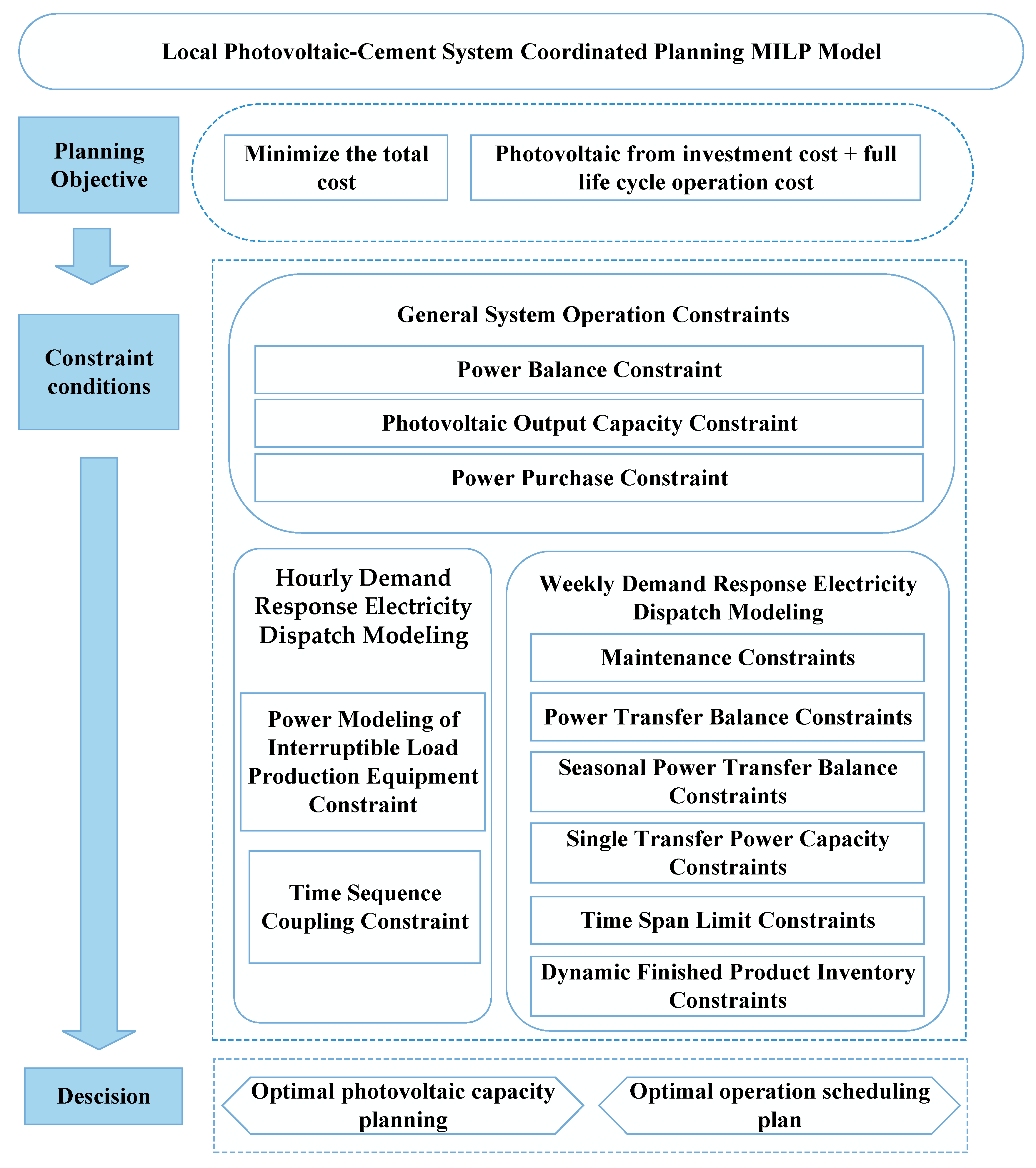
This study proposes a two-layer optimization framework and establishes the Local Photovoltaic—Cement System Coordinated Planning MILP Mode, aiming to achieve the optimal economic performance throughout the entire life cycle of the system and enhance the model’s robustness through the “planning–operation” collaborative design paradigm, in order to solve the collaborative problem of local photovoltaic planning and operation in cement plants. The core of this framework lies in integrating photovoltaic capacity planning with multi-time-scale operation optimization. Its logical structure is shown in Figure 1.
This framework adopts a multi-layer decision-making architecture consisting of a planning layer, a typical day operation layer, and a typical year operation layer. It not only considers the economic feasibility of the initial investment but also precisely depicts the temporal characteristics of photovoltaic output and load demand, thereby providing methodological support for the scientific deployment and efficient operation of local photovoltaic systems in cement plants.
The planning layer, as the first stage of the framework, focuses on the macro-decision-making of photovoltaic installed capacity. This layer uses the unit capacity cost and total investment cost of photovoltaic as the core evaluation indicators and optimizes to determine the optimal installation capacity to answer the top-level planning question of “how much photovoltaic capacity to configure”.
Under the photovoltaic capacity boundaries provided by the planning layer, the operation layer builds two types of optimization models, namely the typical day scenario and the typical year scenario, for different time scales of operation characteristics. The objective of these models is to minimize the system operation cost. The typical day model adopts an hourly time resolution, precisely depicting the daily output fluctuations of photovoltaic, the intraday changes in load, and the short-term adjustment capabilities of demand response resources. The typical year model adopts a weekly time resolution and focuses on reflecting seasonal changes in light, annual load trends, and the long-term transfer characteristics of demand response resources. By parallel processing these two different precision operation scenarios, the model can simultaneously capture the impact of short-term flexible scheduling and medium–long-term operation strategies on economic performance.
This method introduces a combined weight integration mechanism for the results of multi-time-scale optimization. In traditional planning, operation simulations are often conducted using only a single time scale, which makes it difficult to comprehensively coordinate short-term responses and long-term benefits. This study, however, assigns corresponding weights to the typical day optimization results and the typical year optimization results, integrating them into a unified “aggregated operation cost”. This design not only reflects the different contributions of different time-scale operation strategies to the total life cycle cost but also enhances the model’s adaptability in different operating states and the accuracy of overall economic performance assessment.
Finally, the weighted aggregated operation cost is added to the total investment cost of the planning layer, forming the total life cycle cost as the optimization objective function. The economic results are fed back to the capacity decision-making process of the planning layer to form a closed-loop iterative optimization, thereby dynamically correcting the photovoltaic installed capacity and ensuring that the system minimizes the total cost over a period of 10 years or even longer.
In summary, this planning method integrates “planning–operation” collaborative design, multi-time-scale operation optimization, and a cost integration strategy based on combined weights. It not only effectively characterizes the value of demand response in short-term regulation and long-term transfer but also significantly improves the economic efficiency and robustness of distributed photovoltaic system planning. Its fundamental purpose is to provide a set of distributed energy planning tools that balance technical feasibility and economic optimality for high-energy-consuming cement industries, promoting the consumption of clean energy, reducing enterprise energy costs, and facilitating the green and low-carbon transformation of the industrial sector.

2.2. The Mechanism of Demand Response for Cement Load

Cement production is a continuous process involving multiple coupled procedures, and the new dry process is widely adopted. The entire process mainly includes the division of the entire cement production process into key procedures and processes such as raw material crushing, raw meal grinding, fuel grinding, clinker firing, and cement grinding. The main processing equipment corresponding to each procedure is the raw material crusher (RMC), raw meal grinder (RMG), fuel grinder (FG), rotary kiln (CF), and cement grinder (CG).
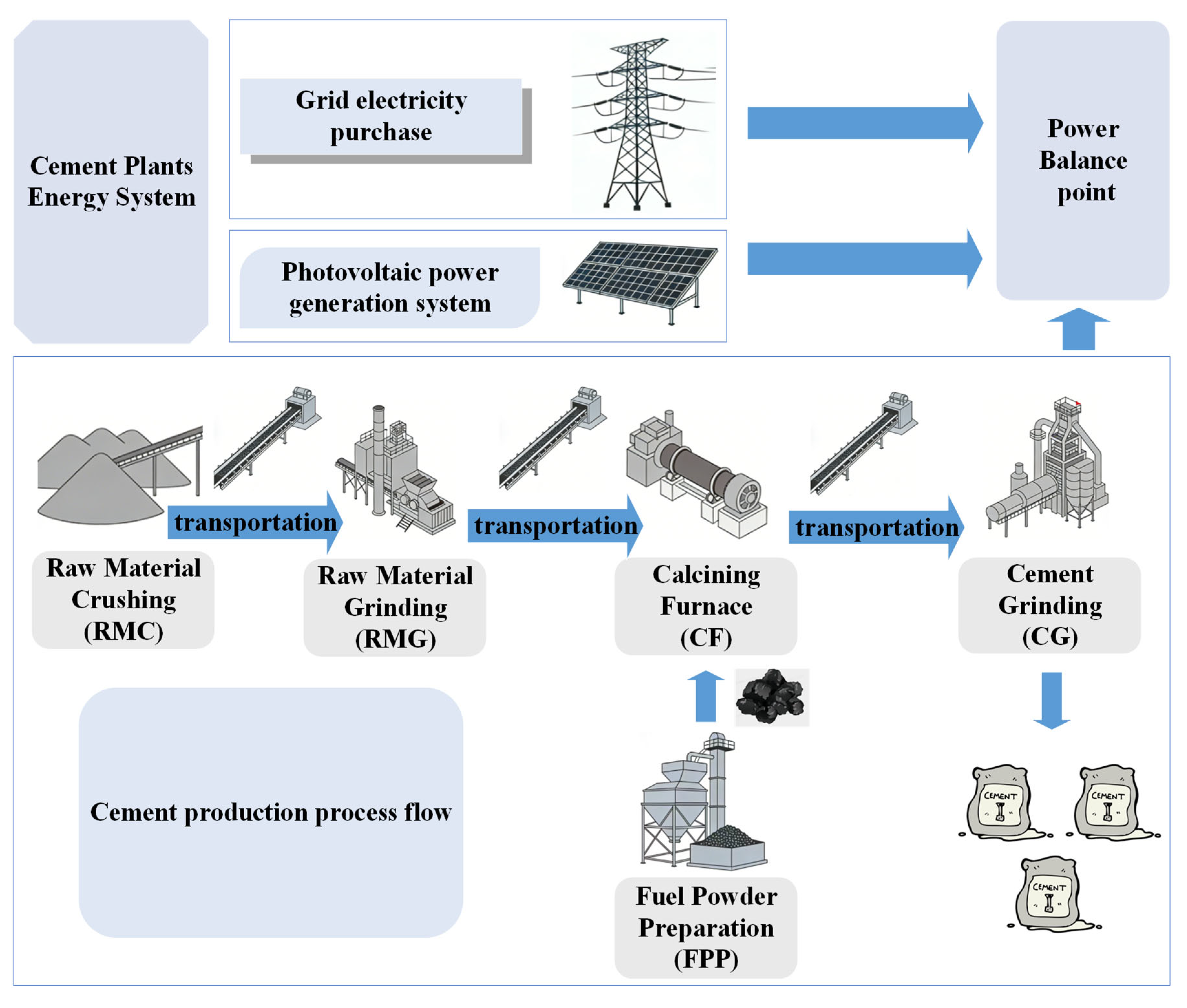
Among them, RMC, RMG, FPP, and CG are all physically classified as grinding or crushing equipment. Their operation must ensure that the output particle size meets strict process requirements; so, they are equipment that can only be started or stopped but cannot be flexibly adjusted in power during operation; CF, as the core high-temperature reaction equipment, has extremely high thermal inertia. During normal production, it must maintain continuous and stable operation and has almost no flexibility for adjustment. These procedures are not operated independently but have strict temporal sequences and material coupling relationships. This relationship determines the characteristics of the overall plant’s power consumption load and the potential and constraints for implementing demand response. The overall mechanism is shown in Figure 2.
As shown in the cement production process module in Figure 2, cement production is a continuous industrial process that is strictly coupled in a sequential and parallel manner. The process begins with the RMC stage, where large raw materials are crushed, consuming a considerable amount of electrical power P t , s R M C . After that, the crushed materials are transported to the downstream RMG stage via the delay t 1 , where they are ground into raw materials that require higher electrical power consumption P t , s R M G . Since the materials must be processed sequentially, the start and stop of the crushing process directly affect the feeding of raw materials for the subsequent grinding process. These two processes are coupled through the delay t 1 and the intermediate buffer storage, allowing the crushing process to be flexibly adjusted on an hourly scale, providing the possibility for short-term demand response. At the same time, the parallel FPP process prepares coal powder, consuming electrical power P t , s F P P , and its product provides fuel for the next process CF. Meanwhile, the RMG process produces raw materials for the cement, which enters the core rotary kiln for calcination after the delay t 2 . Calcination is a high-temperature chemical reaction process that requires stable and continuous thermal power (provided by the fuel) and a large amount of electrical power P t , s C F to drive the kiln body. Its thermal inertia is extremely high; so, it has almost no regulatory elasticity. The calcined clinker then enters the final CG process after the delay t 3 , consuming power P t , s C G to complete the production of finished products. This process can achieve load transfer by adjusting the grinding plan. Throughout the process, the output of the upstream processes is the input of the downstream processes. The arrows indicate the downstream processes, with the starting point of the arrows being the upstream processes. Through the coupling of delays t 1 , t 2 , t 3 and material flow, each link determines the adjustable characteristics of the plant’s total electricity load on multiple time scales.
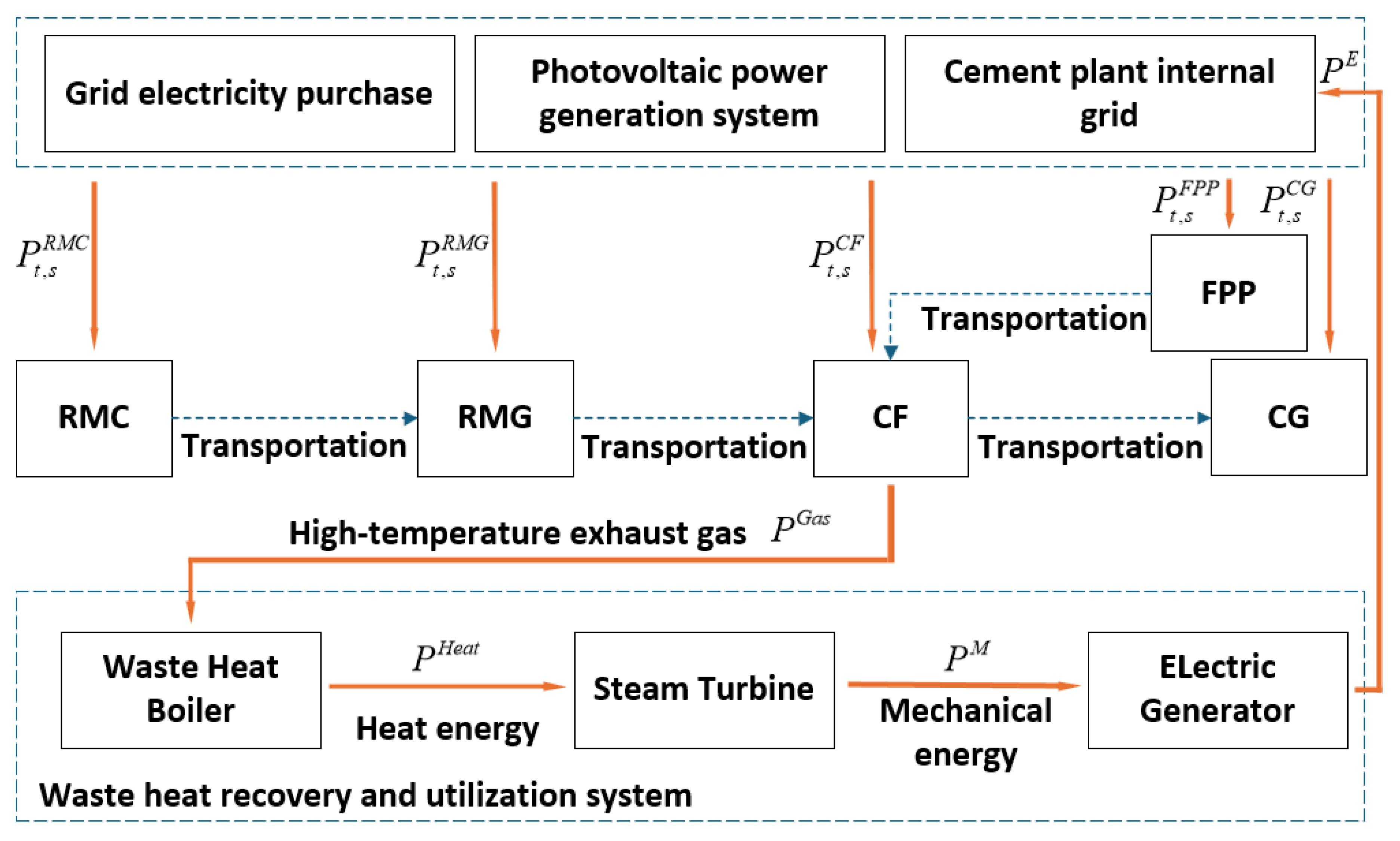
Meanwhile, as shown in Figure 3, the cement production process utilizes rotary kilns for waste heat power generation. The rotary kiln waste heat recovery system consists of a waste heat boiler, a steam turbine, and a generator. The high-temperature gas discharged from the rotary kiln is introduced into the rotary kiln waste heat boiler through pipelines. The thermal energy contained in the high-temperature gas is P G a s . In the boiler, the exhaust gas exchanges heat with the water in the pipes, causing the exhaust gas temperature to drop and the water to be heated. Eventually, high-temperature and high-pressure steam with a thermal energy of P H e a t is generated and sent to the steam turbine. The high-temperature and high-pressure steam drives the blades of the steam turbine to rotate, converting the thermal energy into mechanical energy P M . The steam turbine drives the synchronous generator to rotate, ultimately converting the mechanical energy into electrical energy P E . The electricity generated by the generator is ultimately transmitted through cables to the internal power grid of the cement plant to supply power to the equipment.
Previous literature has conducted some explorations on demand response in the cement industry, but the limitations are obvious. Reference [22] established a mixed integer linear programming model for cement plants to guide the load transfer of processes such as cement grinding using time-varying electricity price signals, treating the cement plant as a whole for overall modeling. Reference [23] mainly achieved the demand response of cement plants by adjusting the load of individual interruptible production processes, without considering all the processes in cement production. The existing demand response models for cement plants mostly treat the production process as a whole or focus only on a single process, lacking the detailed modeling of the strict temporal coupling and material dynamic balance relationship of the “raw material crushing-clinker grindingclinker calcination-cement grinding” entire process. This simplified treatment may lead to two limitations: in terms of safety, it may plan response instructions that violate the production sequence, such as interrupting grinding when the raw material reserve is insufficient, or arranging inappropriate interruptions due to ignoring the thermal inertia of the rotary kiln, thereby affecting production safety and planning; in terms of economy, it may not fully exploit the coordinated response potential of multiple elastic links in the process, because the general model cannot identify the independent adjustable nature of these links under temporal constraints, thus losing the potential for more precise economic optimization that could have been obtained. This study and the existing research both consider the core element of interruptible load, but the fundamental difference lies in embedding the demand response mechanism deeply into the specific physical scenarios and process constraints of cement production. By constructing a production process model that precisely depicts the temporal coupling of multiple processes, inventory dynamics, and multiple time scales (hour/week), this study not only makes the implementation of demand response more in line with industrial reality and ensures production safety, but more importantly, by revealing and utilizing the inherent elasticity within the process, it provides a more accurate and reliable quantitative basis for maximizing the integration of photovoltaic power consumption and economic benefits from the “source-load” collaborative planning level.
Based on these characteristics, demand response can be divided into two time scales: hourly demand response and weekly demand response, as shown in the demand response time scale module in Figure 2. For elastic processes such as RMC, RMG, FPP, and CG, in typical day scenarios (hourly resolution), these devices are started and stopped in real time to balance the volatility of photovoltaic output. The resulting demand response cost C s d e m a n d is the sum of the compensation costs for each device’s interruption; in the weekly response, there are CF maintenance and seasonal electricity transfer. In the typical year model, by defining the balance constraints of monthly interruption power E m i n t and compensation power E m c o m p , annual-scale optimization is ensured.
In distributed photovoltaic planning, the matching degree of photovoltaic output and cement load in time sequence is often analyzed to find the balance point, and this is used to determine the configuration capacity of photovoltaic power. Specifically, the photovoltaic power P t , s P V or E w P V can directly supply the cement equipment, reducing the power P t , s g r i d or electricity E w g r i d purchased from the grid, and lowering the purchase cost; at the same time, demand response uses the interruption of loads to absorb the surplus of photovoltaic power, avoiding the penalty of photovoltaic power loss c t , s P V ( P t , s P V m a x P t , s P V ) . This synergy is implemented in the full life cycle model by weighting the photovoltaic investment cost C P V t o t a l and operation cost, achieving the optimal net present value. For example, in the typical day scenario, the peak output period of photovoltaic power can interrupt RMC or CG, and the saved electricity can be used to compensate users, improving the overall economic efficiency.
In conclusion, the demand response mechanism for cement load is based on the electricity characteristics of multiple processes, through time sequence coupling and multiple time scale optimization, and forms synergy with photovoltaic planning, providing a physical basis for model construction.

3. Photovoltaic–Cement System Coordinated Planning Model

3.1. Hourly Demand Response Power Dispatch Modeling

3.1.1. Typical Daily Scene Model

This paper establishes a typical daily scenario model, with the upper layer being the photovoltaic capacity planning problem and the lower layer being the system operation optimization problem. Formula (1) defines the double-layer optimization objective of the planning model, which is to minimize the total investment cost of the photovoltaic system and the expected value of the weighted daily operation cost of all typical scenarios.
min C P V t o t a l + s = 1 S π s C s O P
where C P V t o t a l represents the total investment cost of photovoltaic; C s O P represents the operation cost of scenario s ; π s represents the occurrence weight of scenario s ; and S represents the total number of scenarios.
Formula (2) calculates the total investment cost of the photovoltaic system, whose value is the product of the total installed capacity of photovoltaic units and the unit capacity investment cost:
C P V t o t a l = n P V C P V
where n P V represents the photovoltaic installation capacity (kW); and C P V represents the unit capacity investment cost (CNY/kW).
Formula (3) defines the total operation cost under a specific operation scenario s. This cost consists of the purchase cost from the power grid, the compensation cost paid to users to incentivize load interruption (demand response cost), and the penalty cost for insufficient power consumption capacity:
C s O P = t c t , s g r i d P t , s g r i d + C s d e m a n d + t c t , s P V P t . s P V m a x P t , s P V
Formula (4) calculates the interruptible cost in the demand response project, which is the sum of the compensation fees for each main production equipment (RMC, RMG, FPP, CF, CG) for the interruption event. The compensation fee for each piece of equipment is determined jointly by its unit interruption compensation rate and the interruption status of the equipment during the scheduling period:
C s d e m a n d = c s R M C i n t 1 U t , s R M C + c s R M G i n t 1 U t , s R M G + c s F P P i n t 1 U t , s F P P + c s C F i n t 1 U t , s C F + c s C G i n t 1 U t , s C G
where C PVtotal represents the total cost of photovoltaic panel configuration; C s OP represents the operation cost of scenario s ; P t , s g r i d represents the power purchased from the upper-level power grid by the cement power plant at time t in the typical operation scenario s ; c t , s g r i d represents the real-time of the upper-level power grid at time t in the typical operation scenario s ; C s demand represents the cost of demand response in the typical operation scenario s ; c t , s P V represents the curtailment penalty cost in the typical operation scenario s at time t ; and c s R M C i n t ,   c s R M G i n t ,   c s F P P i n t ,   c s C G i n t represents the interruption cost of each equipment (RMC, RMG, FPP, CG) in the scenario s .

3.1.2. Power Balance Constraint

The total of the actual photovoltaic power output of scene s in period t and the power purchased from the higher-level grid is balanced with the fixed load and demand response load of scene s in period t .
P t , s P V + P t , s g r i d = P t , s L + P t , s d e m a n d
P t , s P V = p t , s PV n PV
where P t , s P V represents the actual photovoltaic power output of scene s in period t ; P t , s L represents the fixed load of scene s in period t ; and p t , s P V represents the unit actual photovoltaic power output of scene s in period t .

3.1.3. Photovoltaic Output Capacity Constraint

The actual photovoltaic power output of scene s in period t cannot exceed the maximum photovoltaic power output of scene s in period t .
0 P t , s PV p t , s P V m a x n PV
P t . s P V m a x = p t , s P V m a x n PV
where p t , s P V m a x represents the maximum unit photovoltaic power output of scene s in period t ; and P t , s P V m a x represents the maximum photovoltaic power output of scene s in period t .

3.1.4. Power Purchase Constraint

In the typical operation scene s , the power purchased from the higher-level grid by the cement power plant at time t cannot exceed the maximum allowable power purchase of the grid:
0 P t , s grid P gridmax
where P g r i d m a x represents the maximum allowable power purchase of the grid.

3.1.5. Power Modeling of Interruptible Load Production Equipment Constraint

In the typical scene s , the total interruptible load power for period t is the sum of the power consumption of all available production equipment (RMC, RMG, FPP, CF, CG):
P t , s demand = P t , s R M C + P t , s R M G + P t , s F P P + P t , s C F + P t , s C G
Formula (11) indicates that the power consumption of equipment RMC in period t and scene s is determined jointly by the proportion coefficient of this equipment in the total interruptible load, the total interruptible load power, and the operating status of the equipment.
P t , s R M C = U t , s R M C α R M C P t , s demandbase
Formulas (12)–(15) and so on follow this pattern.
P t , s R M G = U t , s R M G α R M G P t , s demandbase
P t , s F P P = U t , s F P P α F P P P t , s demandbase
P t , s C F = U t , s C F α C F P t , s demandbase
P t , s C G = U t , s C G α C G P t , s demandbase
where U t , s i represents the operating status of equipment i in scene s and period t ; P t , s d e m a n d represents the total interruptible load power in scene s and period t ; P t , s demandbase represents the total interruptible load power value when all interruptible equipment is running (U = 1), determined based on historical data or equipment rated power; and α d e v i c e represents the proportion of the power of the equipment in the total interruptible power base P t , s demandbase when the equipment is running, satisfying α R M C + α R M G + α F P P + α C F + α C G = 1 .

3.1.6. Time Sequence Coupling Constraint

The coupling of cement production processes has a delayed nature. After the upstream process is completed, it takes a certain transmission time for the downstream process to start. Among them, the process from raw material crushing to raw material grinding requires t 1 periods, the process from raw material grinding to rotary kiln requires t 2 periods, and the process from rotary kiln to cement grinding requires t 3 periods. To ensure the rationality and continuity of the cement production process flow, constraints are established on the start-up sequence relationship between equipment:
Raw material crushing (RMC) and clinker grinding (RMG) time sequence coupling constraint:
U t , s R M C U t + t 1 , s R M G
Raw material grinding (RMG) and rotary kiln (CF) time sequence coupling constraint:
U t , s R M G U t + t 2 , s C F
Rotary kiln (CF) and cement grinding (CG) time sequence coupling constraint:
U t , s C F U t + t 3 , s C G

3.2. Weekly Demand Response Electricity Dispatch Modeling

3.2.1. Typical Year Scenario Model

Formula (19) defines the typical year scenario objective function of the planning model, which is to minimize the total investment cost of the photovoltaic system and the expected value of the total annual operation cost in all typical scenarios. This model takes the typical week (every two weeks) as the minimum scheduling unit, and all variables and parameters are aggregated values on a weekly basis.
min C P V t o t a l + w = 1 26 C w O P
where C w O P represents the scenario operation cost of the w-th typical week.
Formula (20) calculates the total investment cost of the photovoltaic system for one year, and its value is the product of the total installation quantity of the photovoltaic units and the unit capacity investment cost:
C P V t o t a l = n P V C P V
Formula (21) defines the total operation cost of the typical week. This cost consists of three parts: the purchase cost from the power grid, the compensation cost paid to users to encourage load interruption (demand response cost), and the penalty cost for power curtailment due to insufficient capacity:
C w O P = c w g r i d E w g r i d + C w d e m a n d + c P V a b ( E w P V m a x E w P V )
where E w g r i d is the purchased electricity quantity of the w-th typical week; and E w P V m a x and E w P V are the maximum photovoltaic power generation and actual power generation of the w-th typical week, respectively.

3.2.2. Twenty-Six Typical Week Scenarios and Setting of DR Electricity Parameters

To establish the typical year optimization model, the 52 weeks of a year are divided into 26 typical week scenarios, with each two weeks as a time unit, W = {1, 2,..., 26}.
The electricity demand of each typical week scenario is determined by multiplying the base electricity quantity by the seasonal proportion coefficient.
E w b a s e = d = 1 14 t = 1 T P t , w b a s e Δ t
E w d e m a n d = β w E w b a s e
where E w b a s e is the base electricity demand of the w-th typical week (kWh); P t , w b a s e is the base power of the w-th typical week period t (kW); β w is the weight of the w-th typical week; and E w d e m a n d is the electricity demand of the w-th typical week under different characteristics.

3.2.3. Power Balance Constraints

The system power balance constraints are established to ensure the conservation of energy in the system. For each typical week w, the following is true:
E w P V + E w g r i d = E w L + E w d e m a n d
where E w P V represents the actual power generation of the photovoltaic system in the week (kWh); E w g r i d represents the weekly electricity purchased from the grid (kWh); and E w L represents the weekly fixed load electricity consumption (basic electricity consumption in the factory, such as lighting, etc.) (kWh).

3.2.4. Photovoltaic Output Power Constraints

The actual power generation of the photovoltaic system is limited by its installed capacity and natural conditions. The constraints are as follows:
0 E w P V e w P V m a x n P V
E W P V m a x = e w P V m a x n PV
where e w P V m a x is the maximum theoretical power generation per unit of photovoltaic capacity (kWh/kW); and n P V is the planned installed capacity of photovoltaic (kW).

3.2.5. Grid Purchase Power Constraints

The daily electricity purchase from the grid is limited by the maximum purchase power stipulated in the contract:
0 E w g r i d E g r i d m a x
where E g r i d m a x is the maximum instantaneous purchase power of the grid in the typical week w (kWh).

3.2.6. Maintenance Constraints

Considering the maintenance U w C F = 0 requirements for cement production, the maintenance constraints are added to the typical year model: The first typical week (two weeks) CF is completely shut down [26], and the decision variables for the average operating state of the week:
U 1 C F = 0

3.2.7. Power Transfer Balance Constraints

The demand response cost in the typical week scenario s is composed of the interruption compensation costs of each production equipment:
C w d e m a n d = c w R M C i n t E w R M C i n t + c w R M G i n t E w R M G i n t + c w F P P i n t E w F P P i n t + c w C F i n t E w C F i n t + c w C G i n t E w C G i n t
where c w d e v i c e i n t is the interruption compensation rate; and E w d e v i c e i n t is the interruption power of the equipment in the typical week w.
The actual interruption power in the typical week w is:
E w i n t = d e v i c e α d e v i c e E w D R ( 1 U w d e v i c e )
where X is the interruption power demand of all equipment during normal operation.
The total interruptible load power of the w-th typical week is the sum of the power consumption of all interruptible production equipment (RMC, RMG, FPP, CF, CG):
E w d e m a n d = E w R M C + E w R M G + E w F P P + E w C F + E w C G
Formula (32) indicates that the power consumption of equipment RMC in the w-th typical week is determined jointly by the proportion coefficient of this equipment in the total interruptible load, the total interruptible load power, and the operating state (0–1 variable) of the equipment.
E w R M C = U w R M C α R M C E w D R
Formulas (33)–(36) and so on follow this pattern.
E w R M G = U w R M G α R M G E w D R
E w F P P = U w F P P α F P P E w D R
E w C F = U w C F α C F E w D R
E w C G = U w C G α C G E w D R
where α d e v i c e represents the proportion of the power of the equipment in the total interruptible power E w D R , and it satisfies α R M C + α R M G + α F P P + α C F + α C G = 1 .

3.2.8. Seasonal Power Transfer Balance Constraints

Set the time window m i , m j to ensure the balance of total power transfer within this time range:
E m i n t = w W m E w i n t
m = m i m j ( E m i n t E m c o m p ) = 0
where E m i n t is the actual interruption power in the month m ; E m c o m p is the additional power consumed in this month to make up for the interruption in previous months; m i and m j define the time window of power transfer; and W m is the set of all typical weeks w belonging to the m-th month.

3.2.9. Single Transfer Power Capacity Constraints

Limit the maximum transfer power within adjacent or specific time intervals:
| E m i n t E m c o m p | E m a x t r a n s f e r

3.2.10. Time Span Limit Constraints

Ensure that the power transfer is completed within a certain time frame to avoid indefinite delays:
E m i n t E m c o m p k = m + 1 m + Δ m m a x E k c o m p
where Δ m m a x represents the maximum delay in months, which can be set according to specific requirements.

3.2.11. Dynamic Finished Product Inventory Constraints

The current finished product inventory is calculated based on the finished product inventory of the previous typical week scenario, the cement grinding CG production volume, and the fixed cement finished product demand volume:
K w C G = K w 1 C G + U w C G k C G G D e m a n d w
K 0 C G = K 26 C G = η
where K w C G represents the finished product inventory of the wth typical week; and D e m a n d w represents the demand volume of the wth typical week.
At any time (regardless of whether the rotary kiln CF is under maintenance), it is necessary to ensure that the finished product inventory is sufficient and meets the fixed cement finished product demand:
K w C G 0
At any time, the existing finished product inventory should not exceed the capacity limit of the finished product inventory:
K w C G K C G m a x
where K C G m a x represents the capacity limit of the finished product inventory.

3.3. Distributed Photovoltaic Power Generation Planning Modeling for Cement Plants

Formula (45) defines the two-layer optimization objective of the distributed photovoltaic planning model for the cement plant, assuming that the lifespan of the distributed photovoltaic system in the cement plant is 10 years, minimizing the expected value of the total investment cost of the photovoltaic system and the total life cycle operation cost in all typical scenarios, in order to achieve the economic optimality throughout the life cycle.
min 5 × 365 × C P V t o t a l + s = 1 S π s C s O P + 5 × C P V t o t a l + w = 1 26 C w O P
Formula (46) calculates the total investment cost of the photovoltaic system, whose value is the product of the total installed capacity of the photovoltaic units and the unit capacity investment cost:
C P V t o t a l = n P V C P V
Formula (47) defines the total operation cost under a specific operating scenario s, which consists of the purchase cost from the power grid, the compensation cost (demand response cost) paid to users to incentivize load interruption, and the curtailment penalty cost due to insufficient grid capacity:
C s O P = t c t , s g r i d P t , s g r i d + C s d e m a n d + t c t , s P V P t . s P V m a x P t , s P V
Formula (48) calculates the interruptible cost in the demand response project, which is the sum of the compensation fees for each main production equipment (RMC, RMG, FPP, CF, CG) for the interruption events. The compensation fee for each equipment is determined jointly by its unit interruption compensation rate and the interruption status of the equipment during the scheduling period:
C s d e m a n d = c s R M C i n t 1 U t , s R M C + c s R M G i n t 1 U t , s R M G + c s F P P i n t 1 U t , s F P P + c s C F i n t 1 U t , s C F + c s C G i n t 1 U t , s C G
Formula (49) defines the total operation cost of a typical week, which consists of the purchase cost from the power grid, the compensation cost (demand response cost) paid to users to incentivize load interruption, and the curtailment penalty cost due to insufficient grid capacity:
C w O P = c w g r i d E w g r i d + C w d e m a n d + c P V a b ( E w P V m a x E w P V )
The constraints are satisfied by the above Equations (5)–(18) and (22)–(44).

4. Case Study

4.1. Parameter Setting

To evaluate the integration effect of photovoltaic (PV) systems and demand response (DR) in industrial users, this study constructed a multi-time-scale planning model. The case study focused on the power supply system of a typical industrial user (such as a cement plant), with planning periods covering hourly, weekly, and multi-scale combinations. As shown in Table 1, the test system parameters were derived from actual industrial electricity consumption data, including load curves, PV output characteristics, grid electricity prices, and equipment operation constraints. The basic data settings are as follows.
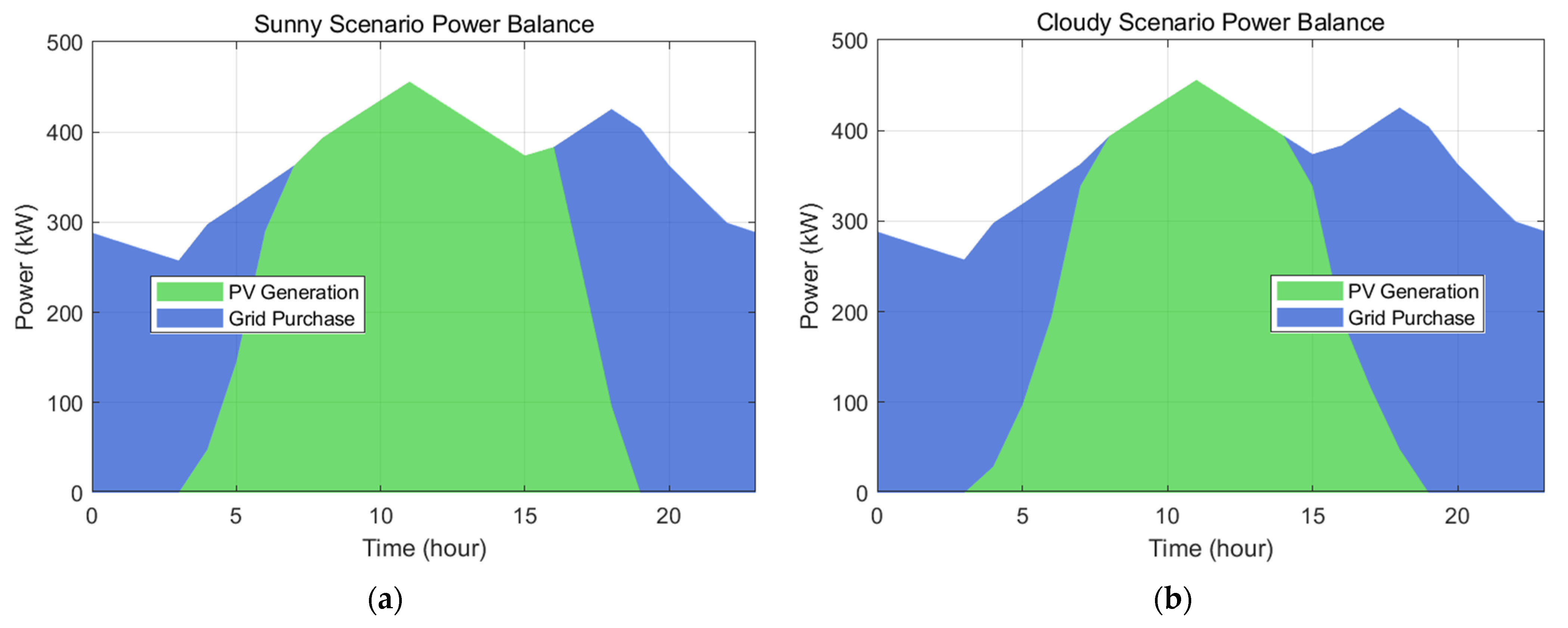
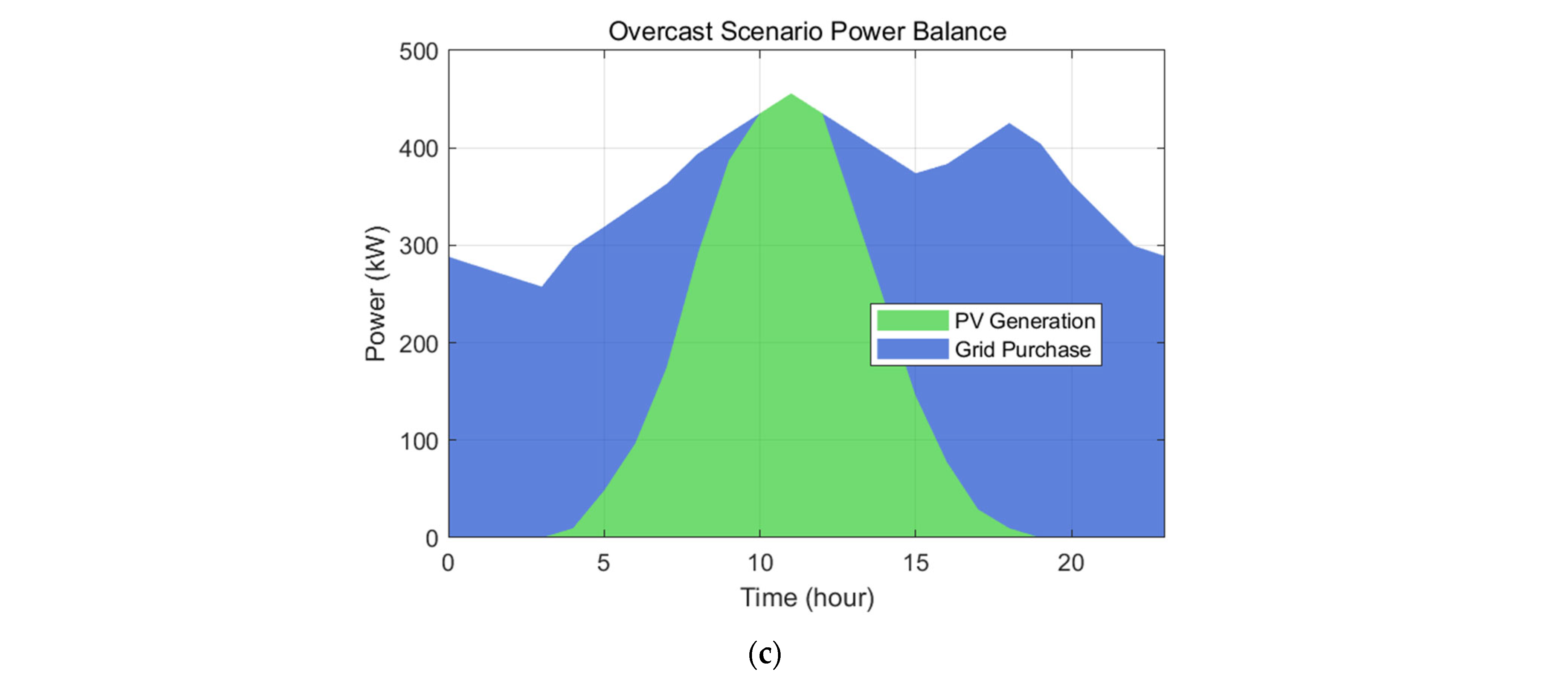
In terms of time scales, Case 1 was the basic PV planning; Case 2 was the integration of PV and hourly demand response, both using hourly planning, considering three typical scenarios including sunny days, cloudy days, and cloudy days, with weights of 0.4, 0.4, and 0.2, respectively; Case 3 was the integration of PV and weekly demand response, using weekly planning; Case 4 was the weighted planning of PV and multi-scale combinations, combining five-year hourly and five-year weekly planning to form a ten-year comprehensive planning. In terms of PV parameters, the annual unit investment cost of PV was 200 CNY/kW (with a ten-year operation cycle), and the curtailment penalty cost was 0.8 CNY/kWh. The PV output scenarios were generated based on actual light data, with peak output coefficients of 1.0 (sunny days), 0.75 (cloudy days), and 0.48 (cloudy days).
The time-of-use electricity price structure was 5.0 CNY/kWh for peak hours, 3.5 CNY/kWh for flat hours, and 1.5 CNY/kWh for off-peak hours. The upper limit of grid purchase power was set at 10,000 kW to ensure system reliability. The fixed load curve reflects industrial electricity consumption habits, with significant peaks in the morning and evening, and a low peak in the night; the interruptible load base curve was based on equipment operation requirements, with a peak load of 440 kW, a valley load of 250 kW, and an average load of 347.5 kW. The demand response parameters involved interruptible equipment including raw material grinding (RMC), coal grinding (RMG), etc., with an interruption compensation cost of 80–160 CNY/hour. The proportion of equipment power to the base load was set at 20–25%, and the time sequence coupling constraints ensured production continuity.
The optimization objective was to minimize the total cost, including PV investment cost, grid purchase cost, curtailment penalty cost, and demand response cost. The constraints included power balance, equipment operation status, inventory management, and time window constraints with a maximum delay compensation month number Δ m max = 3 .
This study analyzed four cases as follows:
Case 1: Basic PV planning without demand response.
Case 2: PV and hourly demand response.
Case 3: PV and weekly demand response.
Case 4: Weighted planning of PV and hourly and weekly combinations.

4.2. Simulation Results and Analysis

In this section, case studies were conducted to verify the proposed method. The computational tasks were executed on a personal computer equipped with a 12th Gen Intel Core i7-1260P processor at 2.10 GHz and 16.0 GB of RAM. The mixed-integer linear programming models central to this work were implemented and solved using the MATLAB programming environment in conjunction with the CPLEX optimization solver (version 12.10) [27,28,29].
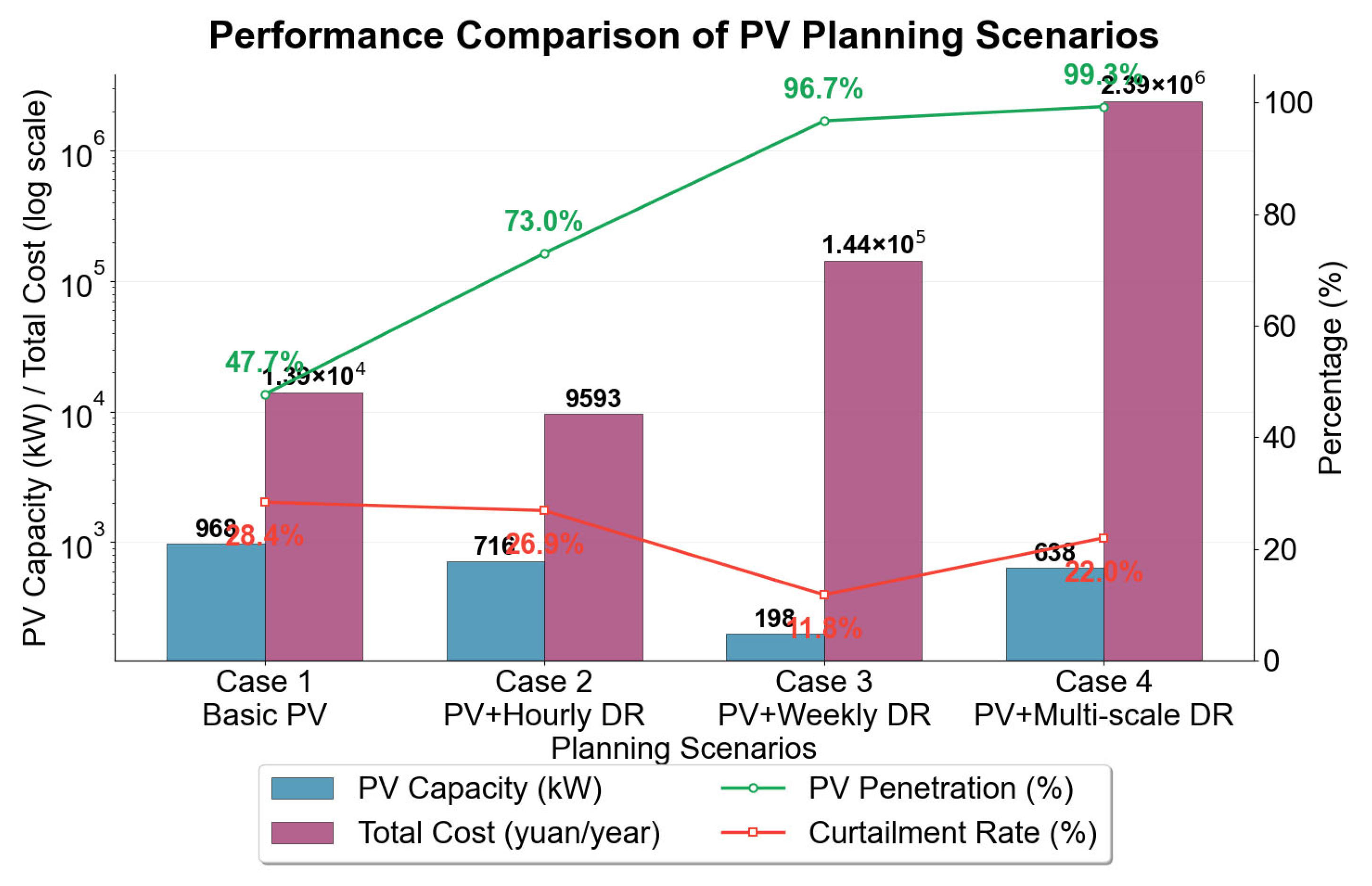
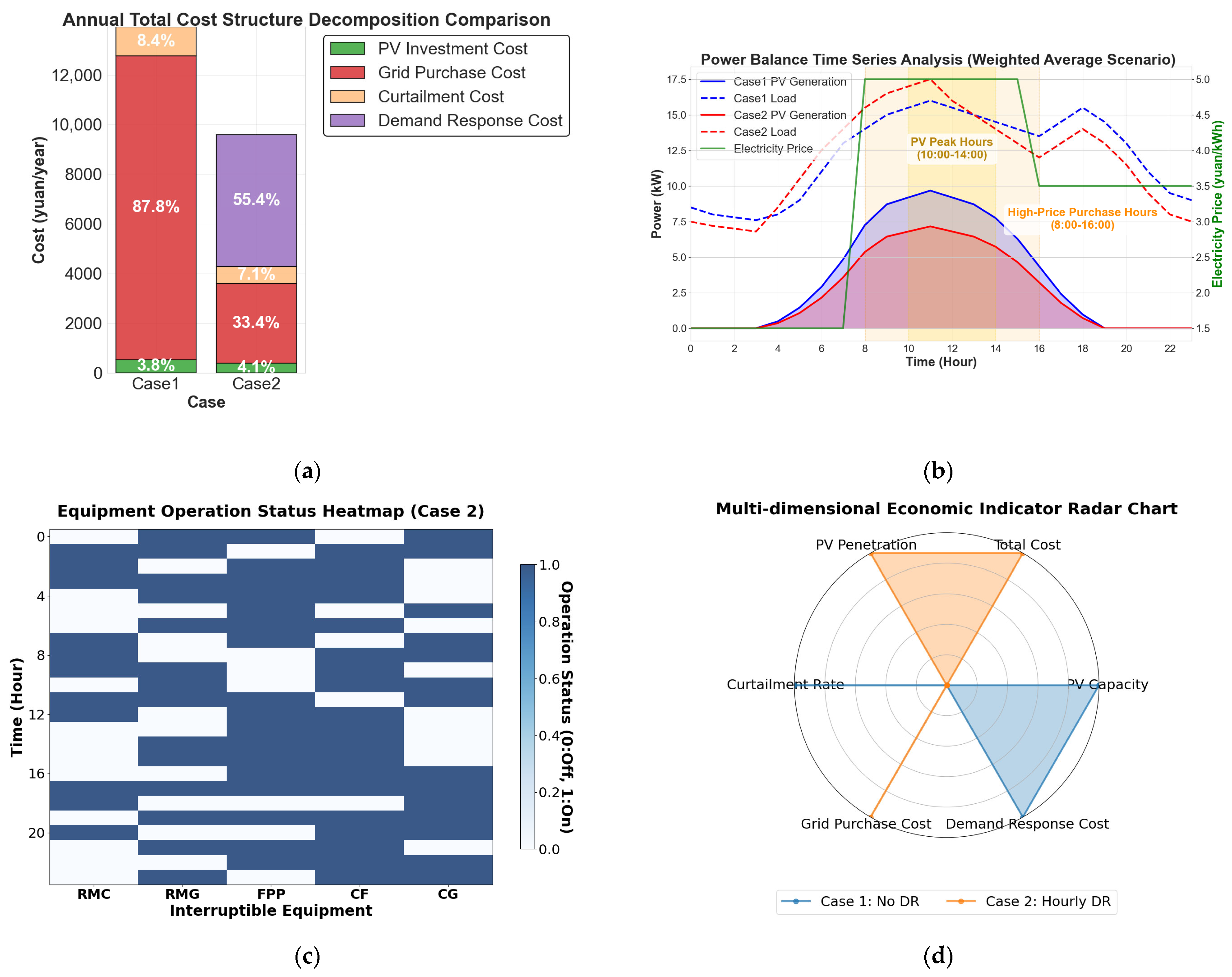
To comprehensively evaluate the performance of different planning strategies, this paper summarizes the key optimization indicators of four cases, including photovoltaic capacity, cost structure, photovoltaic penetration rate, and grid-connected failure rate, as shown in Table 2 and Figure 4. All cost data were normalized to annualized values to ensure comparability. Meanwhile, the simulation results were verified for the robustness of the model through convergence tests and parameter sensitivity analysis.
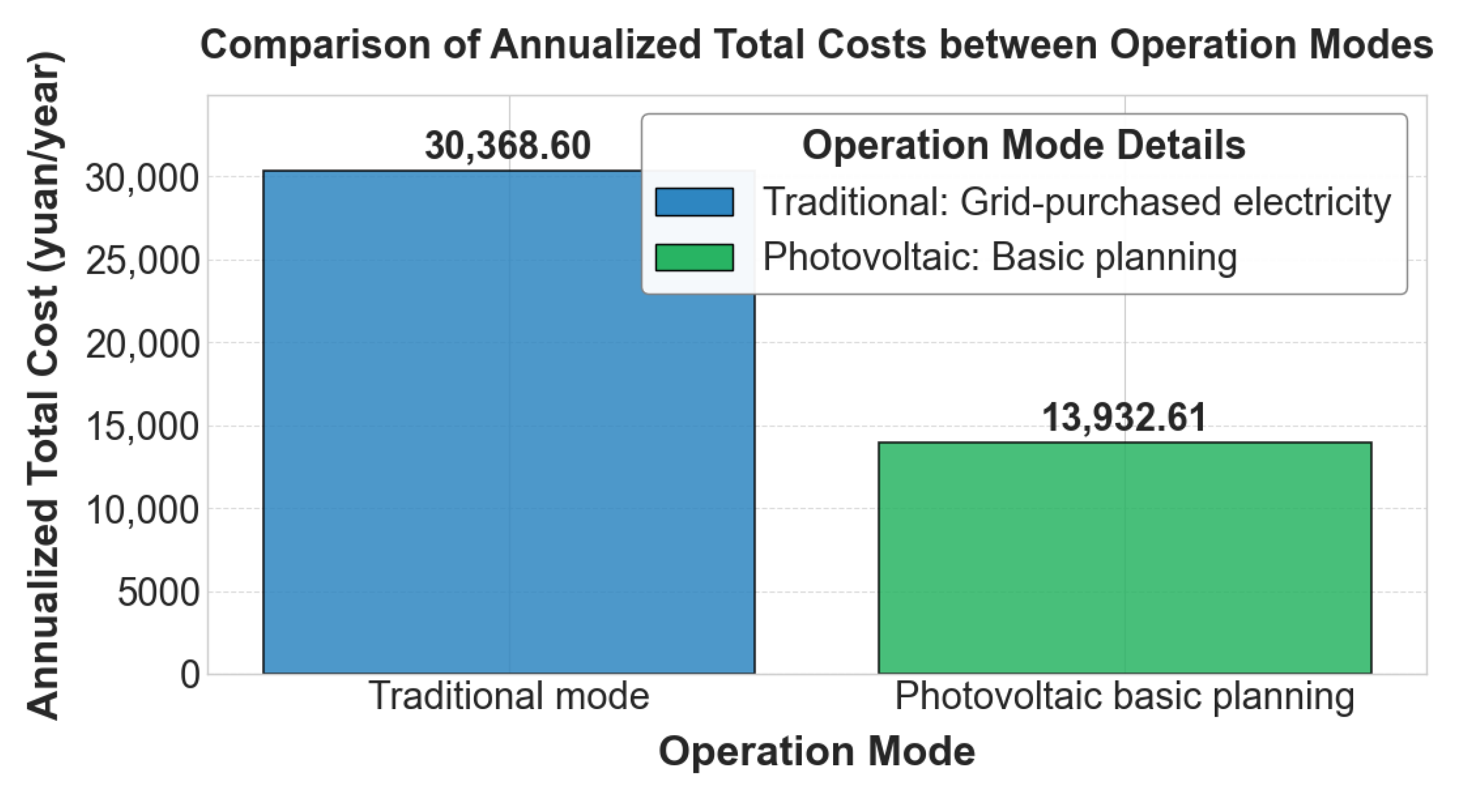
Under the traditional model of completely relying on imported electricity, through simulation analysis, the annual total operating cost of the cement factory was as high as CNY 30,368.60. However, after introducing the basic photovoltaic planning, even without configuring demand response, the annual total cost of the system dropped sharply to CNY 13,932.61, a reduction of 54.1% (Figure 5). This significant economic benefit improvement is mainly due to the structural substitution of high-priced grid electricity by distributed photovoltaic power. The daytime double-peak characteristic of the cement industry load coincides with the peak electricity price period of the grid, resulting in high electricity purchase costs under the traditional model. In Case 1, the 968 kW photovoltaic system configured provided an average annual power penetration rate of 47.7%, directly replacing a large amount of high-priced imported electricity during peak hours with clean electricity at zero fuel cost. Although there was a fixed photovoltaic investment cost, it accounted for only about 3.81% of the total cost, much lower than the saved electricity purchase expenses, thereby triggering a fundamental optimization of the system cost structure. Comparative analysis shows that, for high-energy-consuming users such as cement factories, introducing distributed photovoltaic is the most direct and effective way to achieve cost savings, and its economic essence is the substitution of low marginal cost energy for high marginal cost energy.

4.2.1. Case 1: Photovoltaic Infrastructure Planning (Without Demand Response) and Its Mechanism Analysis

Case 1 serves as the benchmark scenario, with a planned photovoltaic capacity of 968 kW, an annual total cost of CNY 13,900, a photovoltaic penetration rate of 47.7%, and a grid-connected loss rate of 28.4%. This scenario reflects the fundamental contradiction of photovoltaic integration without flexible regulation capabilities. In this case, the grid-connected loss rate is relatively high, and the main reason lies in the mismatch between the photovoltaic output and the industrial load on the time scale, as shown in Figure 6. The industrial load curve typically exhibits a “double peak” characteristic, while photovoltaic power generation is concentrated during the sunny midday. Without DR regulation, during the midday when photovoltaic power generation is at its peak, it may not be the peak load, resulting in some photovoltaic power not being immediately absorbed. Moreover, since the optimization model aims to minimize the total cost, when the grid-connected loss cost is lower than the cost of purchasing electricity during the peak load period, the model will choose to rationally discard the photovoltaic power. Through parameter sensitivity analysis, when the grid-connected loss cost coefficient increases from 0.8 CNY/kWh to 1.2 CNY/kWh, the grid-connected loss rate drops to 19.3%, confirming that the grid-connected loss behavior is an economic choice under the current cost structure. At the same time, the 968 kW capacity configuration is the result of a trade-off between investment cost and operation cost. Although increasing the photovoltaic capacity can increase the power generation, in the presence of grid-connected loss costs and fixed load curves, excessive investment will lead to an exacerbation of grid-connected loss, and thus become uneconomical. A 47.7% photovoltaic penetration rate indicates that under rigid load conditions, nearly half of the electricity consumption can be provided by photovoltaic power, but further increasing the penetration rate will be severely constrained by the shape of the load curve.

4.2.2. Case 2: Analysis of Photovoltaic and Hourly Demand Response and Its Synergistic Effects

After the introduction of hourly-level DR, significant changes occurred in the system performance: the photovoltaic capacity decreased to 716 kW, the total cost dropped by 31.2% to CNY 0.96 ten thousand, the photovoltaic penetration rate increased to 73.0%, and the grid-connected rate of photovoltaics decreased slightly to 26.9% (Table 3). The reasons for these changes are that hourly-level DR provided short-term load flexibility and enabled the re-synchronization of photovoltaic power generation and electricity demand on the intraday scale.
Compared with Case 1, the photovoltaic capacity in Case 2 is reduced, but the penetration rate has significantly increased (Figure 7). This is the “capacity reduction and efficiency improvement” phenomenon of demand response. DR improves the capacity of photovoltaic power consumption through load transfer. Specifically, in Case 1, the load is rigid and cannot be adjusted, and the system can only adapt passively through the source side. In Case 2, the load is provided elasticity through DR, and the system can actively adjust the load curve to adapt to the output of photovoltaic power. In Case 2, hourly DR interrupts adjustable equipment such as RMC (raw material grinding) and RMG (coal grinding), transferring some peak load to the peak power generation period of photovoltaic. For example, the optimization results show that the average operating rates of RMC and RMG are 59.2% and 63.3%, respectively, meaning that, for nearly 40% of the time, these loads are effectively regulated. This “peak shaving and valley filling” effect enables photovoltaic power to be more fully utilized in the time dimension; so, it can meet more actual electricity demand with a smaller photovoltaic capacity, and the penetration rate naturally increases. At the same time, the total cost of Case 2 decreases mainly due to the reduction in high-priced grid power purchase. Because the effective consumption of photovoltaic power replaces the power supply of the grid during peak electricity prices. While the rejection rate of Case 2 only decreases from 28.4% in Case 1 to 26.9%, the improvement is not significant, which reflects the limitations of hourly DR in addressing intraday volatility. Although DR can smooth the load curve within a day, it cannot cope with energy imbalance on a daily or longer time scale. For example, on the first sunny day after continuous rainy days, the output of photovoltaic power increases sharply, but the regulation capacity of hourly DR has been largely used in the previous period, which may lead to the light curtailment during this period. The sensitivity analysis shows that, when the peak difference in electricity prices increases, the willingness of DR to regulate increases, and the light curtailment rate can be further reduced, indicating that the electricity price signal can motivate DR and improve consumption.

4.2.3. Case 3: Photovoltaics and Weekly Demand Response and Its Cross-Period Optimization Mechanism

Case 3 adopts a weekly planning approach, reducing the photovoltaic capacity to an extremely low level of 198 kW, yet the photovoltaic penetration rate is as high as 96.7%, and the power loss rate has significantly decreased to 11.8%. The core mechanism behind this is that the weekly DR achieves energy transfer and balance across time periods through inventory management. In this case, the phenomenon of “low capacity but high penetration” occurred, and the weekly planning was no longer confined to the load transfer within a single day, but was carried out globally on a “weekly” basis for optimization. The model adjusted the production plan to store the energy from the sufficient photovoltaic periods in the form of “product inventory”, and consumed the inventory to meet the demand when the photovoltaic power was insufficient. This is equivalent to building a “virtual energy storage” system with “products” as the carrier on a weekly scale. Therefore, the system’s dependence on instantaneous photovoltaic output was greatly reduced, and there was no need to configure a large-capacity photovoltaic system to meet the electricity demand at each moment; only 198 kW of photovoltaic capacity was sufficient to produce enough electricity within a week, thus achieving an extremely high annual penetration rate. However, although Case 3 had the highest penetration rate, its total cost was much higher than Case 2. This is because the “virtual energy storage” function of weekly DR comes with a higher regulation cost. Frequent starting and stopping of equipment and maintaining inventory levels will incur additional expenses. Moreover, to meet the weekly balance, it may be necessary to maintain a high operating rate during average working days when the photovoltaic output is normal, giving up the opportunity to interrupt to save costs during the periods with extremely high electricity prices.

4.2.4. Case 4: The Collaborative Value of Photovoltaic + Multi-Scale Demand Response

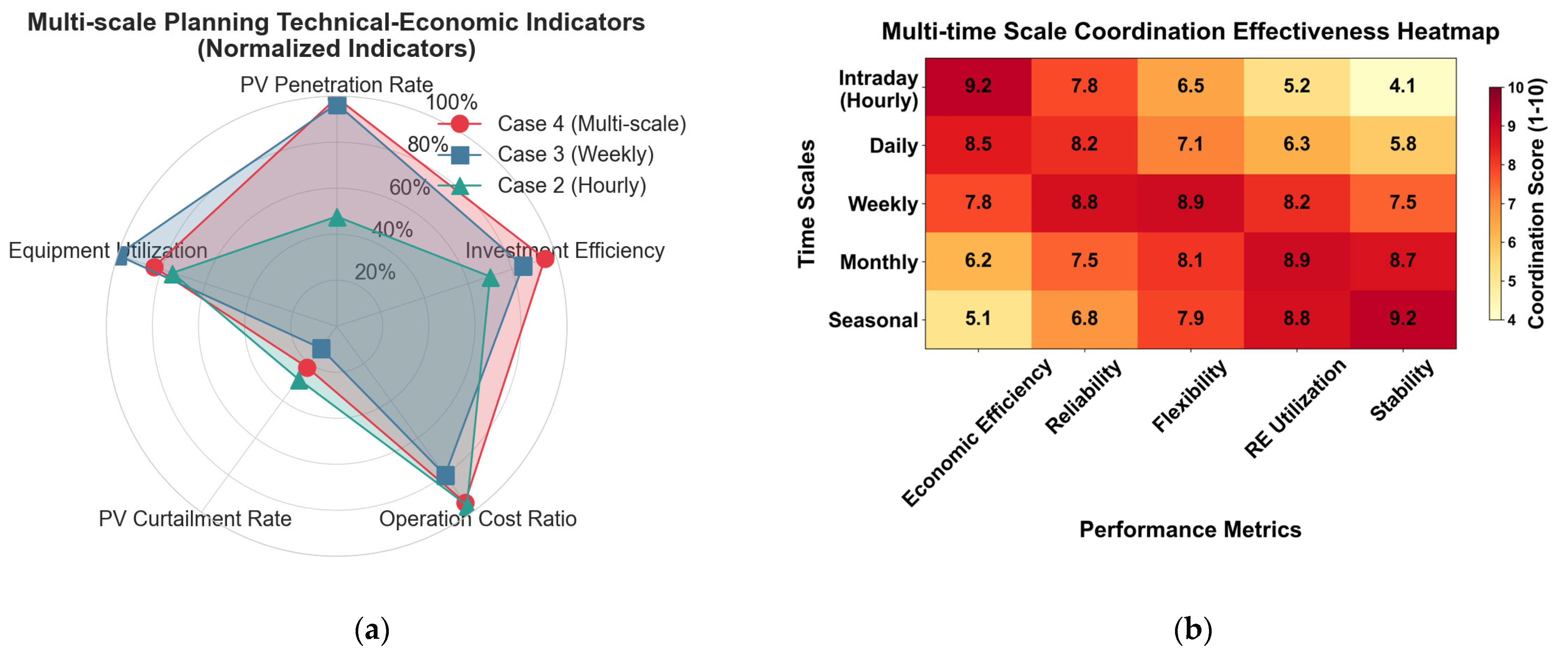
Case 4 integrates hourly and weekly DR, with a photovoltaic capacity of 638 kW, a total cost of CNY 2.3874 million per year over 10 years, a photovoltaic penetration rate of 99.3%, and a power loss rate of 22.0%. This case demonstrates the value of the synergy of multi-time-scale flexible resources. The advantage of multi-scale planning lies in balancing short-term economic benefits and long-term stability. The typical daily scenario focuses on hourly DR, responding quickly to intraday price fluctuations to minimize operating costs; the typical annual scenario leverages the advantages of weekly DR, using inventory management to address seasonal energy imbalance and ensure the annual-scale energy self-sufficiency rate. The 638 kW photovoltaic capacity is between Case 2 and Case 3, indicating that the model has found a balance point between “short-term regulatory economy” and “long-term energy balance guarantee”, and the comparison of various indicators is shown in Figure 8.
The data of 99.3% penetration rate and 22.0% of light waste rate reflect that the system in Case 4 maintains a very high proportion of new energy while still retaining certain operational flexibility to cope with uncertainties. The “weekly planning” part of Case 4 achieves energy transfer across time periods through the “virtual energy storage” mechanism, resulting in a relatively high penetration rate of photovoltaic power, while the high light waste rate reflects the contradiction between long-term energy balance guarantee and short-term volatility, which is a rational economic choice for the system under multiple constraints. Firstly, to ensure economic power supply throughout the year, especially in winter, sufficient photovoltaic capacity must be installed to meet the electricity demand in the least sunny seasons. However, in sunny seasons, the same photovoltaic capacity will generate far more electricity than needed. Due to the limited capacity of “virtual energy storage” (inventory) in the model, which cannot fully store these excess energies, some must be discarded. This is the “seasonal light waste” that must be borne to ensure the reliability of power supply throughout the year. Then, in the objective function and parameter settings, the cost of light waste is much lower than the peak price. When there are a few extreme excess situations, the model will judge that compared to the cost of significantly adjusting production plans or adding energy storage facilities to accommodate these excess electricity, directly bearing the light waste penalty is a more economical choice. Finally, comparing this case with Case 3, it can be observed that the light waste rate of Case 3 is only 11.8%, lower than that of Case 4. This is because the photovoltaic capacity of Case 3 is smaller, and its planning goal is more focused on achieving the best balance under a given capacity. As multi-scale planning, Case 4’s capacity planning needs to take into account the economicity of DR at the hourly level and the long-term balance at the weekly level, resulting in a higher capacity configuration and its consequent light waste.
The annualized total cost of this case is relatively high, with a total cost of CNY 2.3874 million over 10 years. The cost structure shows that the operating cost accounts for 94.70% of the total, while the photovoltaic investment cost only accounts for 5.30%. This indicates that the multi-scale planning scheme shifts the cost focus and reduces the reliance on one-time fixed asset investment through more refined operation management, which is in line with the trend of lean operation of the energy system. The investment payback period is only 0.4 years, and the investment efficiency is high.
In conclusion, the simulation results and analysis show that the introduction of demand response significantly increases the penetration rate of photovoltaic power, offsetting the intermittency of photovoltaic power through load flexibility, fundamentally changing the optimization planning logic of the photovoltaic system. Load flexibility is a valuable resource, and its value lies in being able to resolve mismatches in time between photovoltaic output and electricity demand. Different time scales of DR solve different levels of contradictions: hourly DR optimizes economicity on a daily basis, weekly DR guarantees long-term energy balance, and multi-scale DR achieves a balance between economy and reliability through coordination. In the context of energy transition, exploring and utilizing flexible resources on the load side is of crucial significance for the safe and economic operation of high-proportion new energy power systems.

4.3. Planning Cycle Sensitivity Analysis

To assess the impact of the planning cycle settings on the optimal configuration of the photovoltaic energy storage system, this study extended the planning cycle from the base 10-year period to 8 years, 12 years, 14 years, and 16 years for sensitivity analysis. In the analysis, a key systematic adjustment was the method of converting the unit investment in photovoltaics: the initial total system investment (assumed to be 2000 CNY/kW) needs to be evenly allocated over the entire planning period in terms of annual and daily levels. Therefore, the change in the planning cycle (T) directly alters the key parameters in the cost model. The annual conversion cost is = 2000/T (CNY/kW/year), and the daily conversion cost is 2000/T/365 (CNY/kW/day). For example, when T is shortened from 10 years to 8 years, the annual conversion cost increases from 200 CNY/kW/year to 250 CNY/kW/year, and the daily cost increases from 0.5479 CNY/kW/day to 0.6849 CNY/kW/day. This setting makes the planning cycle not only represent the time span but also become the core variable that regulates the intensity of investment cost allocation and thereby affects the economic assessment of the system’s entire life cycle.
The optimization results under each planning cycle are shown in Table 4.
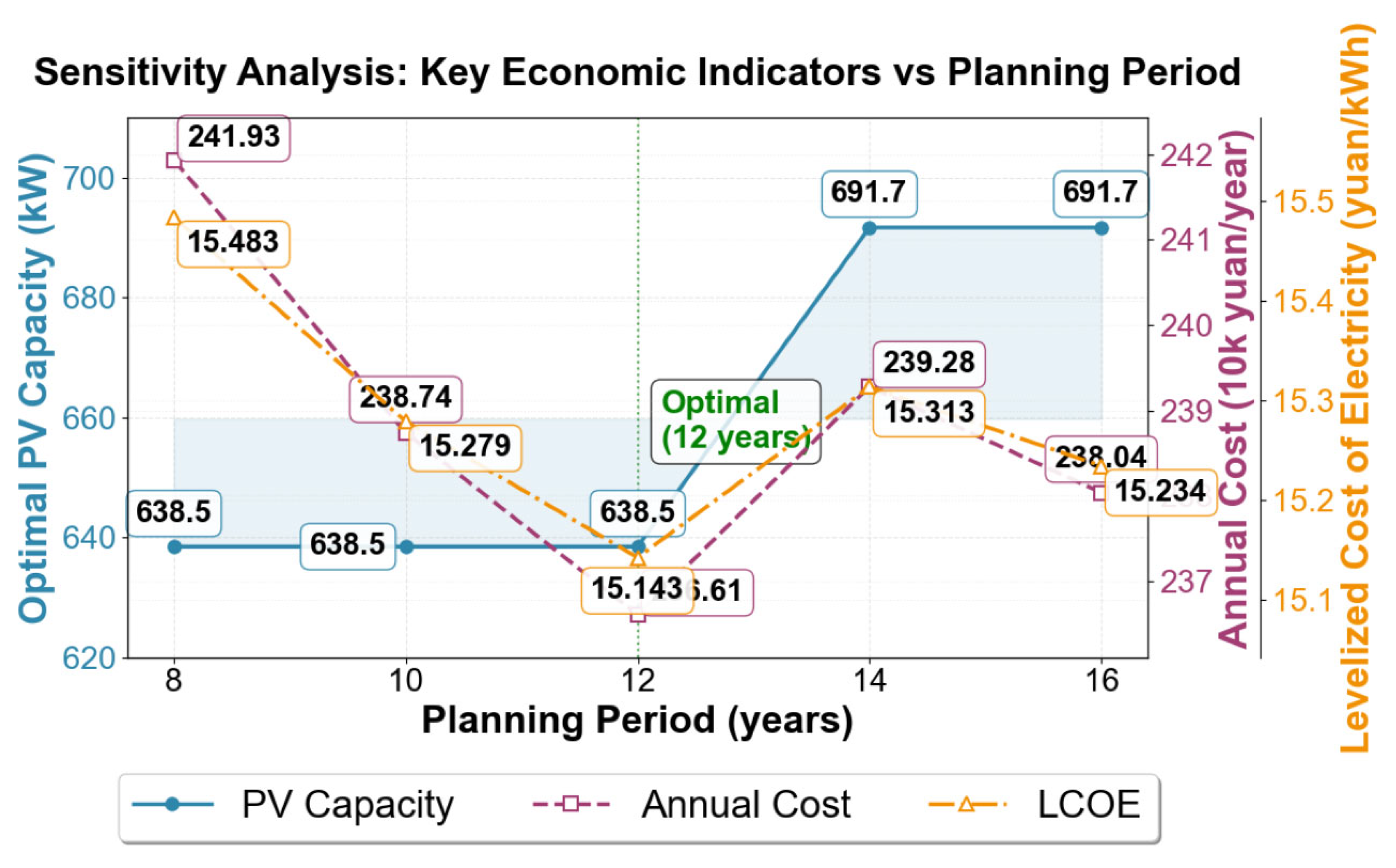
By combining the trend in Figure 9 with the data in Table 4, it can be seen that the planning period has a regular impact on system configuration and economy. The optimal capacity of photovoltaic power generation shows a distinct “stepwise” transition feature, stabilizing at 638.5 kW during the period of 8 to 12 years. When the period extends to 14 years, it jumps to 691.7 kW and remains stable. This phenomenon indicates that there is a critical economic threshold for system optimization. Within a shorter period (such as 8–12 years), the higher annual average investment cost of photovoltaic power generation inhibits the expansion of capacity, and the increase in photovoltaic capacity brings a power generation benefit that is difficult to cover the sharply increased annual average investment cost due to the shortened period. The model tends to maintain a conservative configuration to control investment risks. Once the period exceeds the critical point (in this study, it is between 12 and 14 years), the significant reduction in annual average investment cost and the longer payback period jointly act, making it economically feasible to expand capacity to improve energy self-sufficiency, thereby triggering a configuration transition.
The annualized cost and the cost per kilowatt-hour change with the planning period in a “U-shaped” curve, both reaching the lowest point in the 12-year period. This non-linear trajectory is the result of the dynamic balance between the “effect of cost sharing” and the “cumulative effect of long-term operating costs”. During the cost reduction stage (8–12 years), the photovoltaic capacity remains unchanged, and the extension of the period mainly manifests as distributing the initial investment over more years, thereby continuously reducing the annual average depreciation cost and leading to the downward trend of the total cost. During the cost recovery stage (12–16 years), although the cost-sharing effect still exists, its marginal returns decrease. At the same time, after the capacity jumps, the related operation, insurance, and other operating costs increase and accumulate over a longer operation period. This effect gradually takes the lead, leading to a slow recovery of economic indicators after reaching the optimal value. Therefore, the 12-year period is the turning point where the balance between cost sharing and long-term cost accumulation risks is optimal.
It is worth noting that the system shows a relatively low overall sensitivity to changes in the planning period. The chart shows that the photovoltaic capacity only jumps at specific thresholds, and within a wide range of 8-year period changes, the fluctuation range of the annualized cost is only 2.36 to 2.42 million CNY per year, and the fluctuation range of the cost per kilowatt-hour is 15.043 to 15.583 CNY/kWh, with relatively limited changes. This stability stems from the unique cost structure of the project: the initial photovoltaic investment accounts for a very low proportion (3.6–6.6%) of the total cost, while the operating cost accounts for an extremely high proportion (93.4–96.4%). Therefore, changes in the planning period through the influence of a very small initial investment distribution have a limited impact on the total cost. The system’s economy is mainly dominated by operating costs and is insensitive to changes in the external assessment period, making the core economic indicators highly robust to changes in the external assessment period.
Based on the above analysis, the planning period systematically changes the economic evaluation of different configuration schemes throughout the life cycle. For the case of this study, a 12-year planning period achieves the optimal balance of economy, and is the preferred solution for minimizing the cost per kilowatt-hour. If the project goal is more focused on increasing the proportion of renewable energy or matching a long-term stable policy framework, a 14-year planning scheme can be chosen to obtain a higher installed capacity, but it must accept a slight economic cost. The low sensitivity characteristic of the system also means that decision deviations near the optimal period have controllable impacts on the economy, reducing the risks brought by the uncertainty of planning period estimation. This study confirms the importance of conducting period sensitivity analysis for identifying economic turning points and supporting robust investment decisions.

5. Conclusions

This study has confirmed that integrating multi-time-scale demand response and photovoltaic planning into a cement plant can bring significant economic and operational safety benefits. Case studies have shown that merely introducing photovoltaic power generation can reduce the annualized total cost by 54.1%. When photovoltaic power generation is combined with demand response, a 26.0% reduction in photovoltaic capacity and a 25.3% increase in penetration rate to 73.0% can be achieved for each hour of demand response, resulting in a further 31.2% reduction in total costs. The comprehensive multi-scale planning scheme achieves a high photovoltaic penetration rate of 99.3% over a 10-year period, and the system economic efficiency is not sensitive to the length of the planning cycle. The optimal levelized cost per kilowatt-hour is 15.1425 CNY per kilowatt-hour. The core of this method is to embed the demand response mechanism into the physical and time constraints of cement production, and to solve the mismatch between intermittent photovoltaic output and continuous industrial demand through multi-time-scale coordination.
This method provides a theoretical basis and practical tools for the cement industry to achieve source-load coordinated low-carbon planning and has the potential to be extended to a wider range of industrial sectors. Its framework can be adjusted by model parameters to quickly adapt to different scales and process flows of cement production facilities. For other high-energy-consuming industries such as steel and electrolytic aluminum, a similar methodology can be followed: in-depth study of the production process, analysis of power consumption characteristics and time-scale features, detailed modeling, and construction of a planning operation collaborative optimization model to explore the value of load flexibility resources in promoting the absorption of new energy and reducing energy consumption costs.

Author Contributions

Conceptualization, Y.L. and S.L.; Methodology, Y.L.; data curation, Y.Z. and S.L.; validation, Y.L. software, Y.L.; formal analysis, S.L.; visualization, Y.L.; resources, S.L.; writing, Y.L. All authors have read and agreed to the published version of the manuscript.

Funding

This research was funded by Guizhou Provincial Science and Technology Project (grant number Guizhou Science and Technology Cooperation Support [2023] General 292) and Southern Power Grid Company’s Science and Technology Project (grant number 060000KC24010012).

Data Availability Statement

The original contributions presented in the study are included in the article; further inquiries can be directed to the corresponding author.

Conflicts of Interest

Author Youzhuo Zheng was employed by the company Guizhou Power Grid Co., Ltd. The remaining authors declare that the research was conducted in the absence of any commercial or financial relationships that could be construed as a potential conflict of interest. The funders had no role in the design of the study; in the collection, analyses, or interpretation of data; in the writing of the manuscript; or in the decision to publish the results.

Abbreviations

The following abbreviations are used in this manuscript:
Sets
S Set of scenarios
T Set of time
W Set of typical weeks
M Set of months
W m Set of all typical weeks w belonging to the m-th month
Parameters
π s Occurrence weight of scenario s
C P V Unit capacity investment cost CNY/kW
c t , s g r i d Real time of the upper-level power grid at time t in the typical operation scenario s CNY/kW
c t , s P V Curtailment penalty cost in the typical operation scenario s at time t CNY/kW
c s R M C i n t Interruption cost of equipment RMC in the scenario s CNY
c s R M G i n t Interruption cost of equipment RMG in the scenario s CNY
c s F P P i n t Interruption cost of equipment FPP in the scenario s CNY
c s C G i n t Interruption cost of equipment CG in the scenario s CNY
P t , s L Fixed load of scene s in period t kW
p t , s P V m a x Maximum unit photovoltaic power output of scene s in period t kW
P g r i d m a x Maximum allowable power purchase of the gridkW
P t , s demandbase Total interruptible load power value when all interruptible equipment is runningkW
α d e v i c e Proportion of the power of the equipment in the total interruptible power base when the equipment is running
t 1 Number of periods required for the process from raw material crushing to raw material grindinghour
t 2 Number of periods required for the process from raw material grinding to the rotary kiln hour
t 3 Number of periods required for the process from the rotary kiln to cement grindinghour
E w P V m a x Maximum photovoltaic power generation of the w-th typical weekkWh
E w b a s e Base electricity demand of the w-th typical weekkWh
P t , w b a s e Base power of the w-th typical week period t kW
β w Weight of the w-th typical week
E w d e m a n d Electricity demand of the w-th typical week under different characteristicskWh
E w L Weekly fixed load electricity consumption kWh
e w P V m a x Maximum theoretical power generation per unit of photovoltaic capacitykWh/kW
E g r i d m a x Maximum instantaneous purchase power of the grid in the typical week w kWh
c w d e v i c e i n t Interruption compensation rateCNY/kWh
E w D R Total interruptible powerkWh
E m a x t r a n s f e r Maximum transfer powerkWh
m i Time window of power transfermonth
Δ m m a x Maximum delay in monthsmonth
D e m a n d w Demand volume of the wth typical weekton
K C G m a x Capacity limit of the finished product inventoryton
Variables
C P V t o t a l Total investment cost of photovoltaicCNY
C s O P Operation cost of scenario s CNY
n P V Photovoltaic installation capacity kW
P t , s g r i d Power purchased from the upper-level power grid by the cement power plant at time t in the typical operation scenario s kW
C s demand Cost of demand response in the typical operation scenario s CNY
P t , s P V Actual photovoltaic power output of scene s in period t kW
P t , s P V m a x Maximum photovoltaic power output of scene s in period t kW
U t , s i Operating status of equipment i in scene s and period t
P t , s d e m a n d Total interruptible load power in scene s and period t kW
C w O P Scenario operation cost of the w-th typical weekCNY
E w g r i d Purchased electricity quantity of the w-th typical weekkWh
E w P V Actual power generation of the w-th typical weekkWh
E w d e v i c e i n t Interruption power of the equipment in the typical week wkWh
E w i n t Interruption power demand of all equipment during normal operationkWh
E w d e m a n d Total interruptible load power of the w-th typical week is the sum of the power consumption of all interruptible production equipmentkWh
E m i n t Actual interruption power in the month m kWh
E m c o m p Additional power consumed in this month to make up for the interruption in previous monthskWh
K w C G Finished product inventory of the wth typical weekton
k C G G A process conversion coefficient that represents the amount of final cement product output per unit of semi-finished product from the cement grinding processton

References

  1. Alhussein, S.N.B.; Barzamini, R.; Ebrahimi, M.R.; Farahani, S.S.S.; Arabian, M.; Aliyu, A.M.; Sohani, B. Revolutionizing Demand Response Management: Empowering Consumers through Power Aggregator and Right of Flexibility. Energies 2024, 17, 1419. [Google Scholar] [CrossRef]
  2. Ramesh, A.V.; Li, X. Enhancing System Flexibility through Corrective Demand Response in Security-Constrained Unit Commitment. In Proceedings of the 2020 52nd North American Power Symposium (NAPS), Tempe, AZ, USA, 11 April 2021; IEEE: Piscataway, NJ, USA, 2021; pp. 1–6. [Google Scholar]
  3. Karimi, H.; Gharehpetian, G.B.; Ahmadiahangar, R.; Rosin, A. Optimal Energy Management of Grid-Connected Multi-Microgrid Systems Considering Demand-Side Flexibility: A Two-Stage Multi-Objective Approach. Electr. Power Syst. Res. 2023, 214, 108902. [Google Scholar] [CrossRef]
  4. Wang, D.; Hu, Q.; Jia, H.; Hou, K.; Du, W.; Chen, N.; Wang, X.; Fan, M. Integrated Demand Response in District Electricity-Heating Network Considering Double Auction Retail Energy Market Based on Demand-Side Energy Stations. Appl. Energy 2019, 248, 656–678. [Google Scholar] [CrossRef]
  5. Leithon, J.; Sun, S.; Lim, T.J. Demand Response and Renewable Energy Management Using Continuous-Time Optimization. IEEE Trans. Sustain. Energy 2018, 9, 991–1000. [Google Scholar] [CrossRef]
  6. LADWP: Using Demand Response to Support Los Angeles’ Grid and Reduce Emissions|Better Buildings & Better Plants Initiative. Available online: https://betterbuildingssolutioncenter.energy.gov/implementation-models/ladwp-using-demand-response-support-los-angeles-grid-and-reduce-emissions (accessed on 7 January 2026).
  7. Grein, A.; Pehnt, M. Load Management for Refrigeration Systems: Potentials and Barriers. Energy Policy 2011, 39, 5598–5608. [Google Scholar] [CrossRef]
  8. Chantzis, G.; Giama, E.; Nižetić, S.; Papadopoulos, A.M. The Potential of Demand Response as a Tool for Decarbonization in the Energy Transition. Energy Build. 2023, 296, 113255. [Google Scholar] [CrossRef]
  9. Rodríguez-García, J.; Álvarez-Bel, C.; Carbonell-Carretero, J.-F.; Alcázar-Ortega, M.; Peñalvo-López, E. A Novel Tool for the Evaluation and Assessment of Demand Response Activities in the Industrial Sector. Energy 2016, 113, 1136–1146. [Google Scholar] [CrossRef]
  10. Pan, T.; Li, C.; Yang, C.; Meng, Z.; Wang, Z.; Zhu, Z. Multiagent, Multitimescale Aggregated Regulation Method for Demand Response Considering Spatial–Temporal Complementarity of User-Side Resources. Glob. Energy Interconnect. 2025, 8, 240–257. [Google Scholar] [CrossRef]
  11. Wang, L.; Huang, H.; Yu, H.; Wang, Y.; Pan, T.; Cao, W. Demand Response Autonomous Decision-Making Method Considering Regulation Command Communication Delay and Reliability. J. Electr. Eng. Technol. 2025, 20, 3723–3740. [Google Scholar] [CrossRef]
  12. Nwulu, N.I.; Xia, X. Optimal Dispatch for a Microgrid Incorporating Renewables and Demand Response. Renew. Energy 2017, 101, 16–28. [Google Scholar] [CrossRef]
  13. Kwon, P.S.; Østergaard, P. Assessment and Evaluation of Flexible Demand in a Danish Future Energy Scenario. Appl. Energy 2014, 134, 309–320. [Google Scholar] [CrossRef]
  14. Zakariazadeh, A.; Jadid, S.; Siano, P. Stochastic Multi-Objective Operational Planning of Smart Distribution Systems Considering Demand Response Programs. Electr. Power Syst. Res. 2014, 111, 156–168. [Google Scholar] [CrossRef]
  15. Müller, T.; Möst, D. Demand Response Potential: Available When Needed? Energy Policy 2018, 115, 181–198. [Google Scholar] [CrossRef]
  16. Ma, R.; Bu, S. Evaluation and Mitigation of Carbon Emissions in Energy Industry. Renew. Sustain. Energy Rev. 2025, 212, 115329. [Google Scholar] [CrossRef]
  17. Guo, W.; Wang, Q.; Liu, H.; Desire, W.A. Multi-Energy Collaborative Optimization of Park Integrated Energy System Considering Carbon Emission and Demand Response. Energy Rep. 2023, 9, 3683–3694. [Google Scholar] [CrossRef]
  18. Zhang, Y.; Ling, Z.; Liu, M.; Gang, W.; Su, L. An Energy Portrait-Based Identification Method of Building Users for Demand Response. Buildings 2024, 14, 2534. [Google Scholar] [CrossRef]
  19. Nebel, A.; Krüger, C.; Janßen, T.; Saurat, M.; Kiefer, S.; Arnold, K. Comparison of the Effects of Industrial Demand Side Management and Other Flexibilities on the Performance of the Energy System. Energies 2020, 13, 4448. [Google Scholar] [CrossRef]
  20. Zheng, W.; Yu, P.; Xu, Z.; Fan, T.; Liu, H.; Yu, M.; Zhang, J.; Li, J. Day-Ahead Intra-Day Economic Dispatch Methodology Accounting for the Participation of Electrolytic Aluminum Loads and Energy Storage in Power System Peaking. In Proceedings of the 2024 IEEE 2nd International Conference on Power Science and Technology (ICPST), Dali, China, 9 May 2024; IEEE: Piscataway, NJ, USA, 2024; pp. 2201–2206. [Google Scholar]
  21. Wu, D.; Zhou, P.; Zhou, C.Q. Evaluation of Pulverized Coal Utilization in a Blast Furnace by Numerical Simulation and Grey Relational Analysis. Appl. Energy 2019, 250, 1686–1695. [Google Scholar] [CrossRef]
  22. Mossie, A.T.; Khatiwada, D.; Palm, B.; Bekele, G. Energy Demand Flexibility Potential in Cement Industries: How Does It Contribute to Energy Supply Security and Environmental Sustainability? Appl. Energy 2025, 377, 124608. [Google Scholar] [CrossRef]
  23. Golmohamadi, H. Demand-Side Management in Industrial Sector: A Review of Heavy Industries. Renew. Sustain. Energy Rev. 2022, 156, 111963. [Google Scholar] [CrossRef]
  24. Summerbell, D.L.; Khripko, D.; Barlow, C.; Hesselbach, J. Cost and Carbon Reductions from Industrial Demand-Side Management: Study of Potential Savings at a Cement Plant. Appl. Energy 2017, 197, 100–113. [Google Scholar] [CrossRef]
  25. Laurini, B.; Zong, Y.; Træholt, C.; Perumal, S. Advanced Energy Management System for Demand Response in the Cement Industry. In Proceedings of the 2024 IEEE PES Innovative Smart Grid Technologies Europe (ISGT EUROPE), Dubrovnik, Croatia, 14 October 2024; IEEE: Piscataway, NJ, USA, 2024; pp. 1–6. [Google Scholar]
  26. Mujumdar, K.S.; Ranade, V.V. CFD Modeling of Rotary Cement Kilns. Asia-Pac. J. Chem. Eng. 2008, 3, 106–118. [Google Scholar] [CrossRef]
  27. IBM ILOG CPLEX Optimization Studio. Available online: https://www.ibm.com/cn-zh/products/ilog-cplex-optimization-studio (accessed on 14 March 2026).
  28. Sahih, A.Z.; Shahmiri, S.; Momtazi, M.; Zohreh, M. Optimization of Fleet Size and Determining the Optimal Allocation of Wagons in Minerals Transport Network: A Case Study of Iran’s Railway System. J. Rail Transp. Plan. Manag. 2023, 28, 100414. [Google Scholar] [CrossRef]
  29. Jahed, A.; Moghaddam, R.T. Mathematical Modeling for a Flexible Manufacturing Scheduling Problem in an Intelligent Transportation System. Iran. J. Manag. Stud. 2021, 14, 189–208. [Google Scholar] [CrossRef]
Figure 1. A MILP model for local photovoltaic—cement system coordinated planning. Arrow: Indicates logical dependency and data flow. Defines the one-way solving logic from planning goals, through constraints, to ultimately generating decisions, reflecting the structured relationship between the objective function, constraint set, and decision variables in the MILP model. Dashed box: Defines the modular framework of the model. The three core components (objective, constraints, and decisions) are distinguished by solid lines. Solid line box: Used for secondary classification within the constraint conditions.
Energies 19 01635 g001
Figure 2. The mechanism diagram of demand response for cement load. The arrows in the figure clearly distinguish two types of flows: energy flow and material flow. Energy flow arrow (upper figure): Points from “Cement production process flow”, “grid power purchase” and “photovoltaic power generation system” to “electricity balance point’, indicating the input and balance of electrical energy. Material flow arrow (as shown in the figure below): Marked with “transportation’, it connects processes such as crushing, grinding, calcination, and grinding, indicating the continuous transmission of solid materials.
Energies 19 01635 g002
Figure 3. The electrical supply diagram for the facility.
Energies 19 01635 g003
Figure 4. Summary chart comparing the performance of various planning cases.
Energies 19 01635 g004
Figure 5. Summary chart comparing the total cost between operation modes.
Energies 19 01635 g005
Figure 6. (a) Power balance diagram on sunny days. (b) Power balance diagram on cloudy days. (c) Power balance diagram on overcast days.
Energies 19 01635 g006aEnergies 19 01635 g006b
Figure 7. (a) Annual total cost structure breakdown comparison chart. (b) Power balance time series analysis chart. (c) Heatmap of equipment operating status. (d) Radar chart of multi-dimensional economic indicators.
Energies 19 01635 g007
Figure 8. (a) Radar chart of technical and economic indicators. (b) Time-scale coordination effect heat map. Red shading = The area inside the red line for Case 4 (Multi-scale). Blue shading = The area inside the blue line for Case 3 (Weekly). Green shading = The area inside the green line for Case 2 (Hourly).
Energies 19 01635 g008
Figure 9. Trend comparison line chart of multiple indicators. The blue shaded area in the figure represents the filled region between the photovoltaic capacity curve and its average value, which is used to visually display the fluctuations of the photovoltaic capacity relative to the average level.
Energies 19 01635 g009
Table 1. System planning parameter table.
Parameter CategoryParameter NameValue/Range
Time ScalePlanning CycleHourly T = 24 h
Weekly W = 26 weeks
Photovoltaic ParametersUnit Investment Cost2000 1
Curtailment Penalty Cost0.8
Peak Output CoefficientSunny 1.0
Cloudy 0.75
Overcast 0.48
Electricity Price ParametersTime-of-use Electricity Pricing StructurePeak 5.0
Mid-range 3.5
Low 1.5
Power Grid ParametersUpper Limit of Purchased Power Capacity10,000
Load ParametersFixed Load CurvePeak power: 16.0
average: 12.2
Interruptible Load BasePeak power: 440
average: 347.5
Demand Response ParametersInterrupt Compensation CostRMC 100, RMG 120, FPP 140, CF 160, CG 160
Equipment Power RatioRMC 0.25, RMG 0.20, FPP 0.15, CF 0.20, CG 0.20
Inventory ParametersMaximum Inventory Capacity10,000
Weekly Production Volume200
Initial Inventory2000
Constraint ConditionsEquipment Operating Status0–1 variable
Time Window Constraint3
1 The unit investment cost of photovoltaic capacity is 2000 CNY per kW. With a 10-year operation cycle, it is converted to 200 CNY per kW per year, and 200/365 = 0.55 CNY per kW per day.
Table 2. Summary table of performance comparison for all planning cases.
IndicatorsCase 1Case 2Case 3Case 4 *
Total Cost (CNY/year)13,932.619592.65143,590.592,387,364.40
Percentage of Photovoltaic Investment Cost (%)3.814.0927.535.30
Percentage of Operating Cost (%)96.1995.9172.4794.70
* Case 4 represents the annualized total cost over the 10-year planning period.
Table 3. Detailed comparison data table of case 1 and case 2.
IndicatorsCase 1: No DRCase 2: Hourly DRChange Amount
Photovoltaic Capacity (kW)968716−252 kW
Total Cost (CNY/year)13,932.619592.65−31.2%
Photovoltaic Penetration Rate (%)47.773.0+25.3 pp
Light Curtailment Rate (%)28.426.9−1.5 pp
Table 4. Optimization results data table for different planning cycles.
Planning Period (Years)Optimal Photovoltaic Capacity (kW)Annualized Cost (Ten Thousand CNY/year)Cost per Kilowatt-Hour (CNY/kWh)
8638.5241.9315.4830
10638.5238.7415.2787
12638.5236.6115.1425
14691.7239.2815.3133
16691.7238.0415.2342
Disclaimer/Publisher’s Note: The statements, opinions and data contained in all publications are solely those of the individual author(s) and contributor(s) and not of MDPI and/or the editor(s). MDPI and/or the editor(s) disclaim responsibility for any injury to people or property resulting from any ideas, methods, instructions or products referred to in the content.