1. Introduction
Currently, almost all nations prioritize sustainable economic growth, based on the rational use of resources, accessible and clean energy, environment and climate-friendly policies. These objectives are contradictory to some degree and determine the need for trade-offs among economic development, environmental sustainability, and energy production and use. The problem requires obtaining the compromising solutions that ensure integration and balance of goals and priorities in growth, energy, resource use, and environmental protection.
Research on achieving economic growth through the efficient use of resources, including energy resources, started as early as the 1960s, with the concept of economic decoupling. The main goal of research on the economic–energy–environment (3E) nexus is to examine the complex relationships among economic growth, energy consumption, and environmental emissions while seeking solutions to balance the conflicting objectives.
Decoupling studies are increasing rapidly, covering the various regions and countries [
1,
2,
3]. Economic decoupling allows us to analyze economic growth from a sustainability perspective and to design justified transition policies. Application-oriented and pragmatic studies on the relationships between economic development, energy resources, and emissions have increased significantly in recent decades [
4,
5,
6]. These studies use various indicators, including GDP, GDP per capita, total energy consumption, energy use per capita, and emissions—particularly CO
2.
Considering the characteristics of sustainable development and economic decoupling outlined above, this article examines methods for progressively adopting an integrated approach to implement the decoupling concept. This approach entails evaluating a nation’s degree of economic decoupling, analyzing the interrelation between economic growth, energy consumption, and emissions, and employing energy transition scenarios. These steps will facilitate the establishment of the requisite conditions for the practical application of the decoupling concept. Despite extensive research on energy–growth–emissions decoupling, there are several deficiencies in the solution of this problem for oil-producing economies: these countries with structurally embedded hydrocarbon revenues remain underexplored; existing studies often rely on single analytical frameworks (such as econometric tests or index-based metrics) without adequately assessing feasibility and decision robustness under uncertainty; and there is a lack of unified frameworks that properly address the complex interplay between ongoing fossil fuel dependence and the expansion of renewable energy sources. This study addresses the abovementioned gaps by developing an integrated framework that combines nexus analysis, fuzzy transition scenarios, probabilistic feasibility assessments, and multi-criteria decision making. The solution of the problem based on the case of Azerbaijan entails the following:
- -
Proposes a scenario-based energy decoupling framework for oil-producing economies, in which oil and gas play a key role in GDP generation, exports, and energy supply;
- -
Integrates economic growth, energy production, and emissions within a unified assessment that merges decoupling analysis, fuzzy scenario construction, scenarios’ probabilistic feasibility evaluations, and multi-criteria decision making;
- -
Identifies a reliable transition pathway for Azerbaijan that balances renewable energy expansion with a relatively constrained role of natural gas, compromising institutional, environmental, technological, and investment constraints.
From the point of view of the transition to green energy, reducing the impact of oil and gas production on the environment, and reducing the dependence of the country’s economic growth on the production and export of oil and gas, Azerbaijan is an exemplary case for researchers. Although data and solutions are country-specific, the approach can be adapted to other resource-dependent economies with similar structures, provided local data and expert inputs are incorporated. Beyond its technological and environmental dimensions, the global energy transition is increasingly associated with economic security, environmental security, and social stability. For resource-dependent economies, the challenge is not only to reduce emissions, but also to preserve macroeconomic resilience, fiscal sustainability, employment, and affordable energy access during the transition period. International experience shows that transition strategies are more viable when environmental objectives are aligned with energy-system reliability, social acceptability, and long-term economic adaptation. In this sense, the case of Azerbaijan should be interpreted not only as a national decoupling problem, but also as part of the broader debate on how oil-dependent economies can manage gradual and secure transition pathways.
The energy transition is characterized by long time horizons, structural uncertainty, technological change, and strong interdependencies among social, economic, environmental, and political factors. These features substantially increase decision-making complexity and limit the applicability of deterministic planning approaches. As a result, scenario-based methods have been widely adopted to support long-term strategic decision making under uncertainty. On the other hand, the scenario-based approach has demonstrated robustness and adaptability [
7,
8]. The scenario approach, enhanced with fuzzy and probabilistic tools, is well suited to address high uncertainty in energy policy development. These methods help overcome data incompleteness, subjectivity, and diverse stakeholder preferences—especially when statistical data is scarce. To handle the problem’s complexity, this study combines: (i) fuzzy probabilistic assessments of scenario feasibility; (ii) fuzzy rules reasoning to define criteria values of alternatives; and (iii) MCDM methods, specifically PROMETHEE, WPM, and EDAS for the final scoring and ranking of the selected scenarios.
The remainder of this article is organized as follows:
Section 2 reviews the literature on economic growth and energy use decoupling, the relationship between economic development, energy, and emissions, and scenario approaches for long-term economic growth and energy decision making.
Section 3 elaborates on the methodology, including an overview of the approach, the Tapio model, energy resources and their utilization levels, decision criteria, resource evaluation, feasibility assessments of alternatives, scenario structure and probabilities, and the integrated use of MCDM with probabilistic methods.
Section 4 discusses the results, and this article concludes with a discussion and final remarks.
2. Literature Review
This study is based on an analysis of the decoupling of economic growth and energy use; an examination of the interrelations between economic development, energy, and emissions; and the development of energy transition scenarios and scenario-based decision making.
2.1. Economic Growth and Energy Use Decoupling
Decoupling growth from energy consumption, reducing emissions, and shifting to renewable energy sources are essential for sustainable development [
9,
10,
11]. Despite increased research on decoupling, environmental protection, and resource/energy use [
12,
13,
14,
15], there is no consensus on the causal relationship between energy consumption and economic growth [
9]. A review [
14] draws conclusions that economic systems depend on primary energy, materials, and waste; the correlation between energy and GDP is complex and heterogeneous; and the monetary system and the physical economy are closely interrelated. Developed countries generally exhibit more stable decoupling patterns, while the developmental stage strongly influences outcomes [
1]. In [
15,
16,
17], decoupling patterns are analyzed for regions and countries with similar and different levels of development. Investigation of energy–economy relationships identifies various shapes of decoupling [
16,
18]. In [
19], eight categories of decoupling and coupling are introduced. Studies of the causal relationships between energy consumption and economic growth yield contradictory results: study [
20] does not confirm the existence of a stable macroeconomic relationship, while study [
21] provides evidence of heterogeneous relationships across different types of energy consumption. Energy consumption can simultaneously stimulate the economy and cause environmental damage [
22]. Empirical data do not confirm the effectiveness of “green” growth as a universal solution to environmental crises [
23]. In [
24], it is proposed to shift the priorities of environmental policy from efficiency to sufficiency. Analysis of 130 countries [
2] shows that decoupling economic growth from fossil fuel use is possible in all cases. An examination of more than 300 papers in [
15] shows that decarbonization and dematerialization do not hinder economic growth, and various tools can be used for analysis.
Recent decoupling research emphasizes the importance of considering embodied emissions in international trade and burden-shifting effects. Input–output and trade-based approaches demonstrate that apparent domestic decoupling may partially result from relocating carbon-intensive production abroad rather than genuine structural change. These studies highlight that production-based indicators alone may underestimate the true environmental footprint of economic growth in open economies. While such approaches provide valuable insights, they require detailed trade and sectoral data that are often unavailable or highly uncertain for long-term scenario analysis in resource-dependent economies [
25,
26].
2.2. Nexus Between Economic Growth, Energy, and Emissions
The nexus between economic growth, energy consumption, and GHG emissions has been extensively investigated across multiple spatial scales, including global, regional, and national levels. The data presented in
Table 1 reflect substantial heterogeneity.
Studies not listed in the above table are primarily concerned with comparative or general analyses. Comparative studies between South Asian developing economies and G7 countries reveal that energy consumption strongly promotes economic growth in both groups, while CO
2 emissions positively affect growth. However, renewable electricity generation is associated with emission reductions only in advanced economies [
41]. For G20 and OECD countries, the analysis demonstrates that economic growth alone does not guarantee environmental improvement without structural changes in the energy mix [
42]. Country-specific analyses provide the most detailed insights. Studies on Saudi Arabia identify energy consumption as a major driver of emissions, while renewable energy contributes to emission reductions [
43,
44]. Similar conclusions are reported for India, Bangladesh, Nigeria, and Vietnam, where economic growth and fossil energy use worsen environmental quality, reinforcing the need for cleaner energy transitions and low-carbon development strategies [
45,
46,
47,
48].
Overall, the literature demonstrates the absence of a universal growth–energy–emissions relationship. The direction and magnitude of interactions depend on economic development level, energy structure, institutional quality, and technological progress. These findings highlight the necessity for differentiated and region-specific energy and climate policies rather than uniform policy prescriptions.
2.3. Applications of the Scenario Approach in Long-Term Decisions
Scenario development approaches vary widely [
8,
49], and a comparative assessment of major scenario schools is provided in [
50], and foundational principles of scenario planning and its organizational applications are discussed in [
7,
40]. To promote transition pathways, several studies integrate scenario planning with energy-system models [
51]. Participatory multi-criteria analysis and scenario planning have been used to assess energy transition options with stakeholders [
52]. A TIMES-based model provided quantitative energy scenarios that matched socioeconomic stories in Portugal [
53]. The scenario approach is used to consider uncertainties in long-term planning, and PROMETHEE balanced economic, environmental and social goals [
54]. EnergyPlan has been used to develop long-term, renewable-focused energy transition scenarios for Iran [
55]. These studies show that data availability limits long-term planning. In broader methodological integrations, orientation scenarios lead analysis without direct decision-maker engagement, whereas decision scenarios openly combine stakeholder preferences and numerous analytical methodologies to increase robustness [
56]. Machine learning techniques have been applied to forecast global natural gas production under alternative economic and price scenarios, indicating a potential production peak between 2034 and 2046 [
57]. At the same time, scholars emphasize that energy scenarios function as “fictional expectations,” combining narrative plausibility with quantitative precision to guide decision making and shape energy-system trajectories [
58]. Integrating decoupling analysis with scenario-based stochastic modeling, a recent work from Poland demonstrates how scenario approaches can inform flexible, low-emission energy policies at both national and EU levels [
59].
The literature confirms that scenario-based approaches provide a robust and flexible framework for addressing the complexity and uncertainty inherent in long-term energy and sustainability decisions. By combining qualitative narratives with quantitative modeling and decision-support tools, scenario analysis enables policymakers and planners to explore alternative futures and design adaptive strategies for sustainable energy transitions.
The literature shows that long-term energy transition planning cannot be judged only by emission reduction or energy-efficiency performance. Transition pathways must also be assessed in terms of economic stability, environmental protection, affordability, social acceptance, and institutional readiness. International practice suggests that transition policies are more effective when decarbonization goals are pursued together with energy-system reliability and investment continuity. This is especially important for oil-dependent economies, where such policies may directly affect exports, fiscal revenues, employment, and the overall energy structure.
3. Materials and Methods
3.1. General Description of the Approach
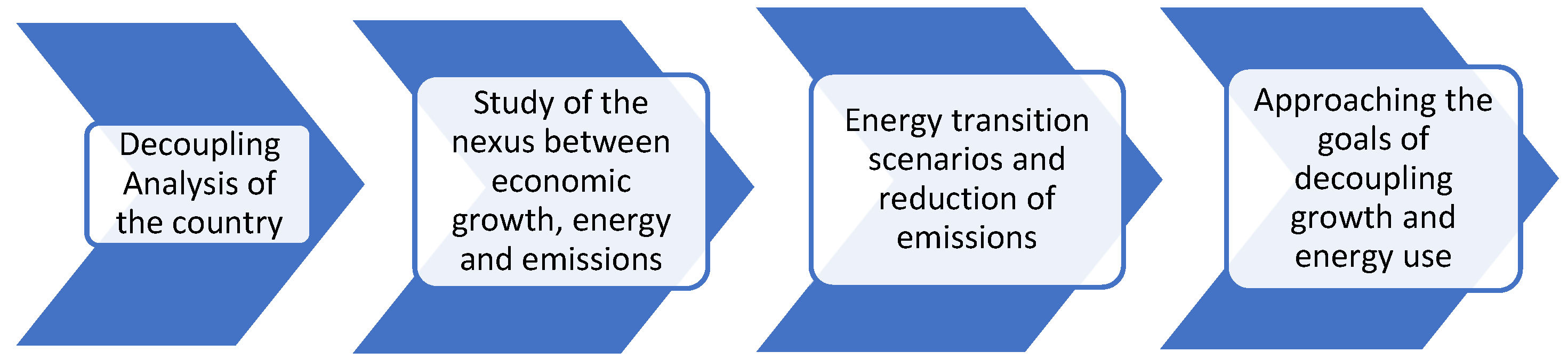
Implementing a controlled process of decoupling economic growth, energy use, and emissions at the country level requires sequential solutions to the interrelated and interdependent problems presented at the macro level in
Figure 1.
This process requires several sequential steps: conducting a country-level study of decoupling, developing policies based on an analysis of the nexus between economic growth, energy, and emissions, dividing the long-term process into sub-processes and sub-periods, gradually shifting energy use toward renewables, and making decisions regarding future improvements in resource and technology utilization. During the transition period, particular attention must be paid to replacing fossil energy with renewable sources, since hydrocarbons still account for more than 59 percent of electricity production [
49]. Given the long-term nature of the problem and the inherent uncertainties, the scenario approach, characterized by flexibility and adaptability, appears to be the most effective and reliable method.
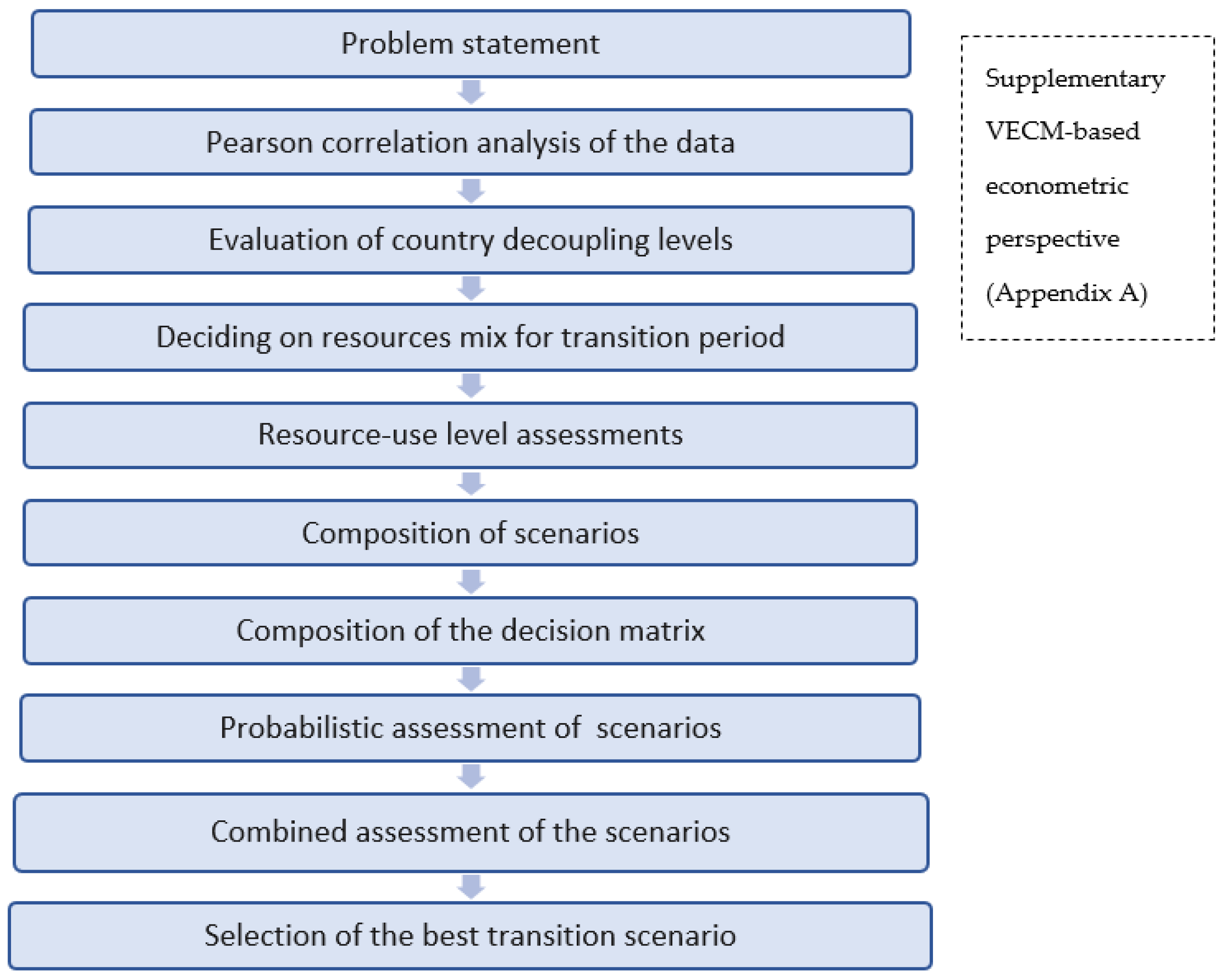
Applying the scenario approach to the decoupling of economic growth, energy use, and emission reduction requires implementing a multi-step solution process.
Figure 2 presents the research chart outlining the logical sequence of procedures, integrating statistical analysis, decoupling evaluation, and scenario-based policy development.
The problem considered in this study is long-term in nature, develops under a highly uncertain decision environment, and has no sufficiently stable historical analog that could be directly extrapolated. Conventional econometric approaches are useful for identifying short-run relationships in systems with relatively stable structure and dynamics, but they are less suitable for describing long-term transition processes under deep uncertainty and structural change. For this reason, this paper relies on a scenario-based framework combined with fuzzy assessments and multi-criteria decision-making methods, which are better suited to feasibility-oriented analysis. Correlation analysis is used here as an exploratory step for identifying empirical relationships among economic growth, energy production, and emissions. A supplementary VECM-based econometric perspective with structural-break considerations is presented in
Appendix A, but it is not part of the main decision framework.
The procedures and approaches employed within this framework are described in the following sections.
3.2. Tapio Model as a Framework for Decoupling Analysis and Evaluations
When selecting methods for studying decoupling, it is essential to consider that the choice depends on the specific research goals. The most used techniques in decoupling-related studies include the Logarithmic Mean Divisia Index (LMDI), the Environmental Kuznets Curve (EKC), and the Tapio model. The LMDI method effectively breaks down changes in an indicator into its contributing factors. The EKC approach assumes an inverted U-shaped relationship between pollution and per capita income. However, results from the Kuznets Curve sometimes conflict; sometimes, the relationship appears as an inverted N-shaped curve. Due to the phenomenon’s complexity, it is crucial to understand that dependencies among economic, energy, and environmental indicators develop over long periods. In many instances, it is not possible to establish reliable generalized relationships from limited data.
From a mathematical perspective, the Tapio model provides a stronger rationale for describing the relationship between economic and environmental indicators. Its main feature is that the elasticity indicators used in this model are piecewise linear approximations of the derivatives of curves that illustrate the dependencies’ dynamics. The Tapio model allows for the identification of consistent patterns from the available data. The Tapio model for analyzing the decoupling of economic growth and resource use [
1,
19] can be expressed as follows:
where
—the elasticity of the resource R with respect to the growth (GDP);
—the base value of the resource;
—the value of the resource at time t;
—the base value of GDP;
—the value of GDP at time t.
As noted in the Introduction, researchers have applied different classifications of decoupling, including eight, five, or three levels [
1,
11,
19]. In the five-level model [
1], the classification depends on the signs of Δ and the value of elasticity, and the conditions are as follows:
Negative coupling (NC):
Coupling (C):
Negative decoupling (ND):
Relative decoupling (RD):
Absolute decoupling (AD):
3.3. Energy Resources and Their Evaluations
The present study examines the decoupling of economic and energy growth from emissions in an oil- and natural gas-producing country. We assume that, in decoupling, the government should reduce energy consumption per unit of GDP and simultaneously decrease emissions, not only by lowering energy consumption but also by gradually replacing fossil fuels with renewable energy sources.
The starting point is the decision about which energy resources to use within the considered time horizon. This decision must reflect national priorities, resource availability, economic and environmental constraints, and long-term goals. Generally, production and consumption levels of energy resources are controllable, allowing for adjustments in their use. Since the primary goal of transition scenarios is to find pathways for energy-system development that gradually disconnect economic growth from energy use and emissions from per capita GDP, it is essential to define an appropriate mix of energy resources for the country. Under these conditions, it is more effective to include a limited number of resource-use levels in the decision model that are both achievable and relevant for sustainable development.
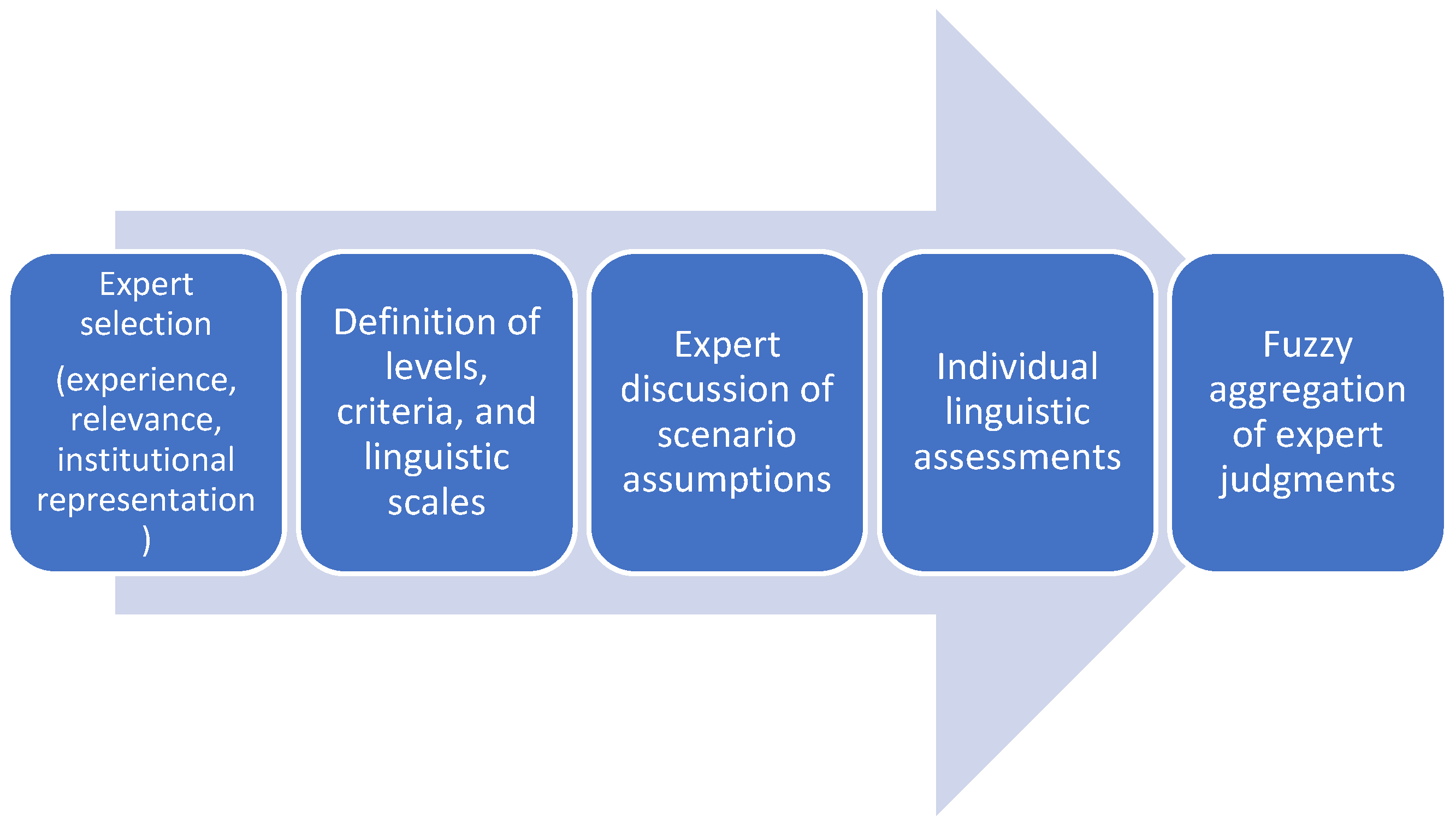
Given the scarcity of reliable data, especially regarding future expectations, a group of experts analyzed and evaluated potential levels of resource use. The group, including representatives from relevant government bodies, universities, and the energy sector, was formed in accordance with requirements for at least 10 years of experience in energy decision-making, practice in similar processes at the national or regional level, and balanced institutional representation. Within the framework of this study, experts were used to identify resources and potential future use levels and to define criteria for assessing energy transition scenarios. The expert panel was used as a structured source of model inputs for the evaluation framework. The final group evaluations were obtained through the aggregation of expert linguistic judgments in a fuzzy environment. Individual assessments were expressed in linguistic terms and then incorporated into the fuzzy evaluation procedure to derive the group-level inputs used in the subsequent scenario analysis. Thus, the expert-based component of this study does not rely on a single individual judgment or on an informal discussion outcome, but on the structured aggregation of linguistic evaluations within the adopted fuzzy framework. A schematic summary of the expert judgment and aggregation stage is presented in
Scheme 1Generally, the usage levels of alternatives can be described by introducing linguistic variables (LVr) such as
Decrease Very Significantly (
DVS),
Decrease Significantly (
DS),
Decrease Moderately (
DM),
Maintain as Usual (
MU),
Increase Moderately (
IM),
Increase Significantly (
IS), and
Increase Very Significantly (
IVS). Using seven linguistic terms covers the full range of potential changes, from a reduction to zero to several times the base production level. The matching seven triangular fuzzy numbers are (
0,
0,
1), (
0,
1,
2), (
1,
2,
3), (
2,
3,
4), (
3,
4,
5), (
4,
5,
6), and (
6,
7,
7). Long-term decisions require multi-dimensional analysis that considers social, technological, ecological, economic, and political factors, with the level of detail depending on the specific context. Based on an examination of relevant studies [
60,
61], the criteria selected for scenario evaluations include government policies and regulations (
C1), acceptance by society (
C2), labor impact (
C3), cost-effectiveness (
C4), spillover effects (
C5), technology efficiency and reliability (
C6), the availability of resources (
C7), and impact on the environment concerning emissions (
C8). For the linguistic evaluation of these criteria, the following nine terms (values) are used:
Extremely Low (
EL),
Very Low (
VL),
Low (
L),
Below Average (
BA),
Average (
A),
Above Average (
AA),
High (
H),
Very High (
VH), and
Extremely High (
EH). These linguistic terms can be correspondingly quantified through nine fuzzy triangular numbers—(
0,
1,
2), (
1,
2,
3), (
2,
3,
4), (
3,
4,
5), (
4,
5,
6), (
5,
6,
7), (
6,
7,
8), (
7,
8,
9), and (
8,
9,
10). The level of resource is related to the factors (criteria) values mentioned above, and the application of fuzzy rules can formalize it. For a single-period modeling, the resource
i (
i =
1, …,
N) that has been used on level
l (l = 1, …,
L) is closed with a composition of relevant
k criteria values (
k =
1, …,
K). In our case, K = 8 (number of considered criteria), and the fuzzy rule can be presented as follows:
A set of rules like (2) allows for the evaluation of all resource use levels.
3.4. Formation of Scenarios and Assessment of Their Feasibility
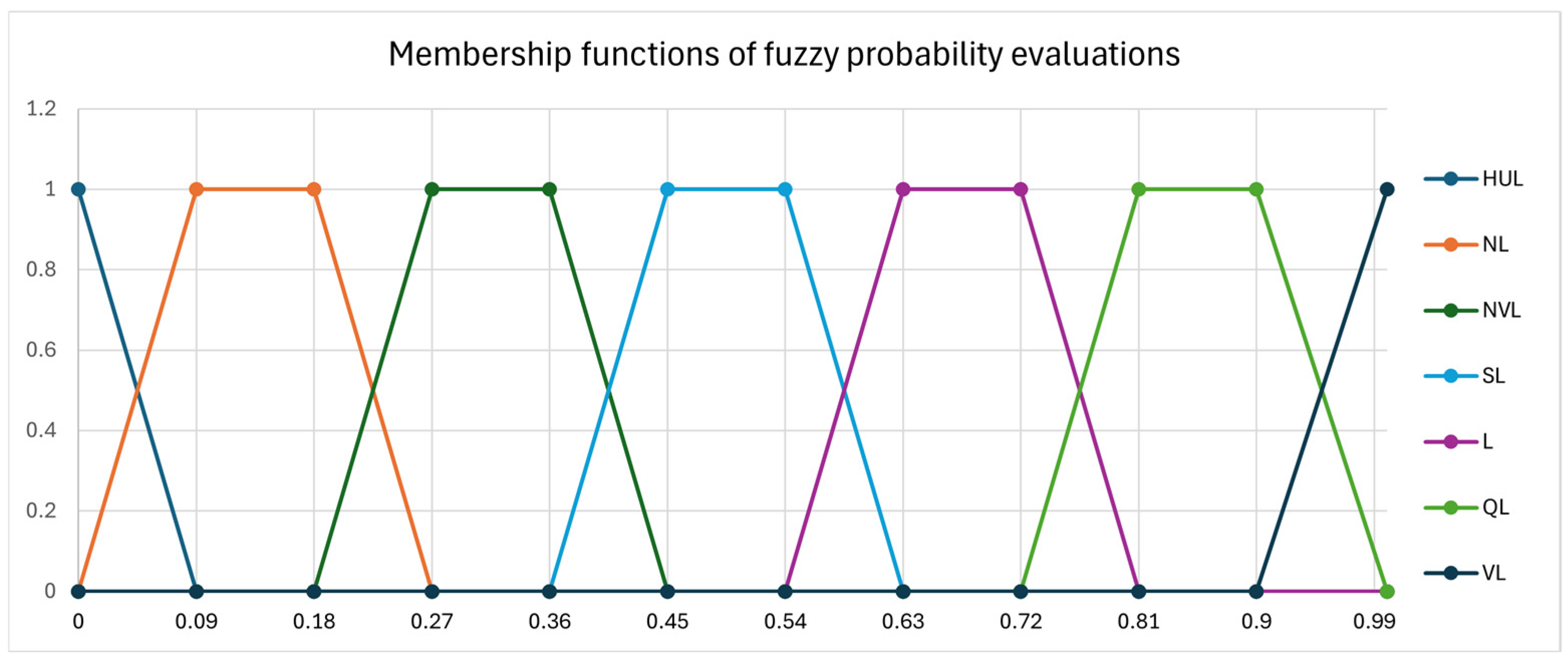
Different levels of energy-resource use represent alternatives. The analysis of alternatives focuses on their feasibility and the probability of achieving feasibility. Since most planned implementation levels have no precedent, the only viable method for assessing feasibility is to rely on subjective probabilities provided by experts. For evaluating subjective probabilities associated with resource-use levels, experts employ five linguistic values, i.e.,
Highly Unlikely (
HUL),
Not Likely(
NL),
Not Very Likely (
NVL),
Somewhat Likely (
SL),
Likely(
L),
Quite Likely(
QL), and
Highly Likely(
HL), approximated by trapezoidal fuzzy numbers with partial overlaps in adjacent ranges, as presented in
Figure 3.
The composition of the energy-resource mix for the transition period and the formation of scenarios require a systematic approach that accounts for the complexity of the transition, potential conflicts of interest among stakeholders, the role and position of each resource during the transition, the possible phases of resource development (growth, stagnation, or decline), and the influence of social, technological, ecological, economic, and political (STEEP) factors. In all cases, scenarios must at least ensure that the country’s energy demand is met. As a starting point, it is necessary to define the use levels of each resource that are of interest for decision making.
A scenario
Sq can be expressed as a set of resources
i =
1, …,
N used at levels
l =
1, …,
M:
After the scenarios are composed, their probabilities can be calculated as the product of the probabilities of the alternatives included in each scenario. Trapezoidal or triangular fuzzy numbers can approximate subjective probabilities.
The inner product of two trapezoidal fuzzy numbers can be calculated as [
62]:
Here, = (a, b, c, d) and = (e, f, g, h).
Fuzzy probabilistic assessments of scenarios can be defuzzified by applying the graded mean integration representation of L–R-type fuzzy numbers [
63]. For a generalized trapezoidal fuzzy number P(A), the formula is:
A generalized triangular fuzzy number, as a special case of the trapezoidal form, is given by:
Based on the calculated probabilities, scenarios are ranked according to their feasibility.
The number of evaluated scenarios is constrained by feasibility considerations rather than combinatorial completeness. Although the full combination of resources and usage levels generates a large scenario space, only scenarios exceeding a minimum feasibility probability threshold are retained for decision analysis. Scenarios that are of interest for policy developers and decision makers are predetermined by technology and resource availability, institutional policy and feasibility, investment capabilities and expert judgments, ensuring that proposed and evaluated scenarios are realistic and policy-relevant.
3.5. Application of MCDM Methods for Scenario Evaluation
Three MCDM methods are applied to assess transition scenarios to enhance the reliability of the energy transition task. The results of these assessments are then compared and combined.
A general MCDM problem, in which scenarios are treated as alternatives, can be expressed as follows:
where S is a finite set of scenarios {
}, and
is the set of criteria used to evaluate the scenarios.
For scenario evaluation and selection, three different methods are used: outranking (preference modeling), PROMETHEE, analyzes trade-offs and incomparability by measuring pairwise superiority considering preference functions; Multi-Attribute Utility Theory-based WPM measures total efficiency without full compensation by calculating overall value or utility as a product of criteria; and Distance-based EDAS identifies scenarios that significantly exceed the “typical” ones by measuring the deviation from the Average across all scenarios.
The criterion weights reflect the relative importance of the criteria in a scenario evaluation. In the present study, these weights were taken from the fuzzy criterion weights reported in [
61] after defuzzification and normalization. Because the ranking results may vary with the choice of weights, alternative weight sets were also considered in the sensitivity analysis.
3.5.1. PROMETHEE Method
When assessing energy transition scenarios, it is important to consider decision-makers’ preferences. PROMETHEE [
64], designed with preferences in mind, was chosen to address this issue, with its results directly reflecting stakeholders’ stated preferences. To complete the task, it is first necessary to construct an evaluation table in which all scenarios are assessed with respect to the selected decision criteria. Such a table forms (
Table 2) the basis for pairwise comparisons of alternatives, preference function calculations, and subsequent determination of positive, negative, and net preference flows.
The next step is to model preferences based on the preference function P
i(
ci(
sq),
ci(
sQ)), which reflects how much the alternative
sq is preferable compared to the alternative
sQ for each criterion. The value of the function is calculated according to the following formula:
An overall preference index π(a, b) can be computed, taking all the criteria into account, which is called aggregation:
Considering all criteria, this outranking preference index determines the preference intensity of in relation to .
The preference strength of over can be determined similarly, considering all criteria.
Then, positive, negative, and net preference flows have been calculated in accordance with the formulas:
Ranking the alternatives in the decreasing order of their net flow values enables the identification of the best scenario. To combine the PROMETHEE method with probabilistic approaches, the range of net flow values must be transformed into positive numbers while preserving the proportions of the ordered sequence. The transformed values are normalized and scaled to the [0, 1] interval.
3.5.2. Weighted Product Method
The Weighted Product Method (WPM) is multiplicative, where a very low score for one criterion sharply reduces the overall score and prevents the selection of options with critical shortcomings. The method is reliable and requires minimal preprocessing, which does not require complex normalization schemes.
The method is applied through the following sequence of steps. First, a decision matrix is constructed based on evaluating
q scenarios concerning
k criteria.
| | Criterion1 | … | Criterionk |
| Scenario1 | c1(s1) | | ck(s1) |
| … | … | … | … |
| Scenarioq | c1(sQ) | | ck(sQ) |
Second, DM is normalized. To normalize benefit criteria, the value of the alternative should be divided by the maximum value of that criterion among all alternatives. For cost criteria, the criterion’s minimum value should be divided by the value of the alternative.
Then, scenario scores are calculated as the product of the normalized assessments for each criterion, considering its importance, using the formula given below:
Finally, the scenarios are ranked accordingly to score values.
3.5.3. Evaluation Based on Distance from Average Solution Method
Evaluation Based on Distance from Average Solution (EDAS) [
65] assesses alternatives by measuring their proximity to the mean solution for each criterion; if an alternative is better than the Average, it receives a positive rating; otherwise, it receives a negative rating.
Upon establishing the decision matrix, calculate the Average Solution (AV) for each criterion.
Calculate Positive (PDA) and Negative (NDA) Distance from Average for each alternative and form PDA and NDA matrices:
- 3.
Calculate the weighted sum of PDA and NDA for each alternative.
- 5.
Calculate appraisal score (AS) for each alternative and rank according to the AS value (a higher value is better).
In the present study, EDAS plays a complementary role within the combined MCDM framework. Unlike PROMETHEE, which focuses on pairwise preference relations, and WPM, which emphasizes multiplicative performance across all criteria, EDAS evaluates each scenario relative to the average profile of the feasible scenario set. This property is useful for the current problem because it highlights whether a transition pathway performs systematically above or below the typical scenario under the selected criteria. Therefore, EDAS adds an additional benchmark-oriented perspective to the final ranking.
4. Results
4.1. Analysis of Economic and Energy Indicators and Emissions
The statistical analysis carried out in this research was limited to 1992–2024 since data from earlier years are irrelevant to Azerbaijan’s current economic and political system. Data before 1992 correspond to a period when Azerbaijan had only limited sovereignty, lacked an independent economy, and functioned within a completely different economic and political framework.
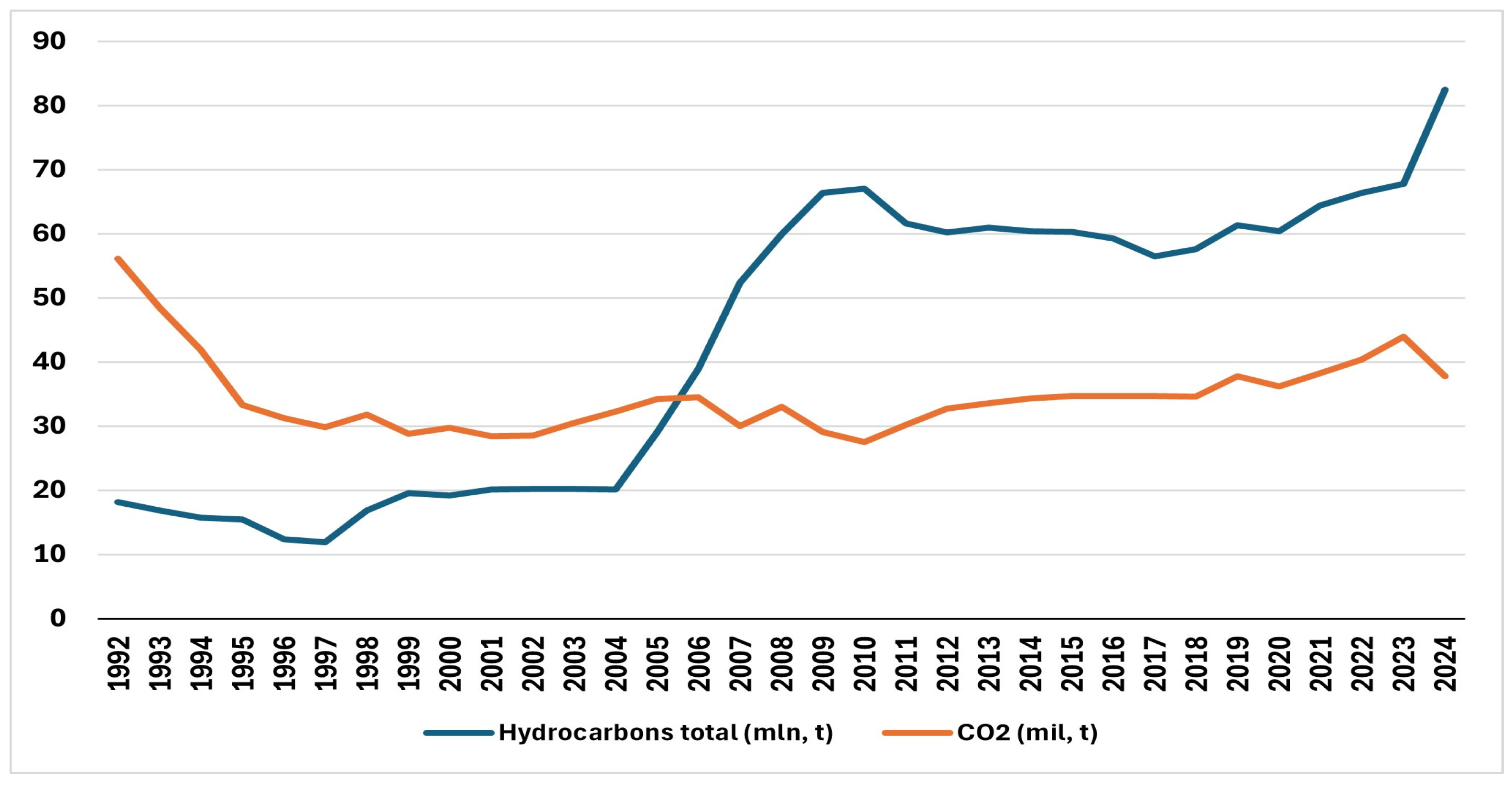
The data analysis presented in
Figure 4,
Figure 5 and
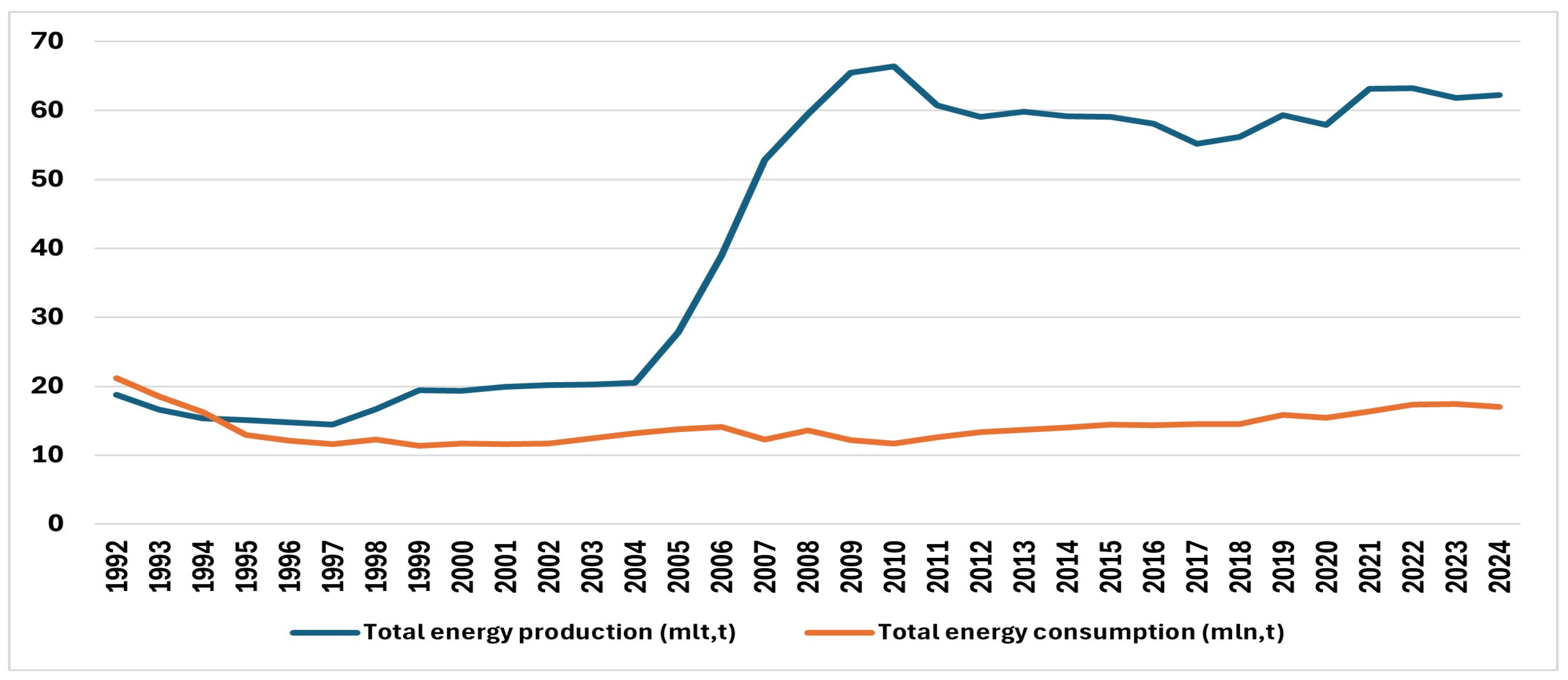
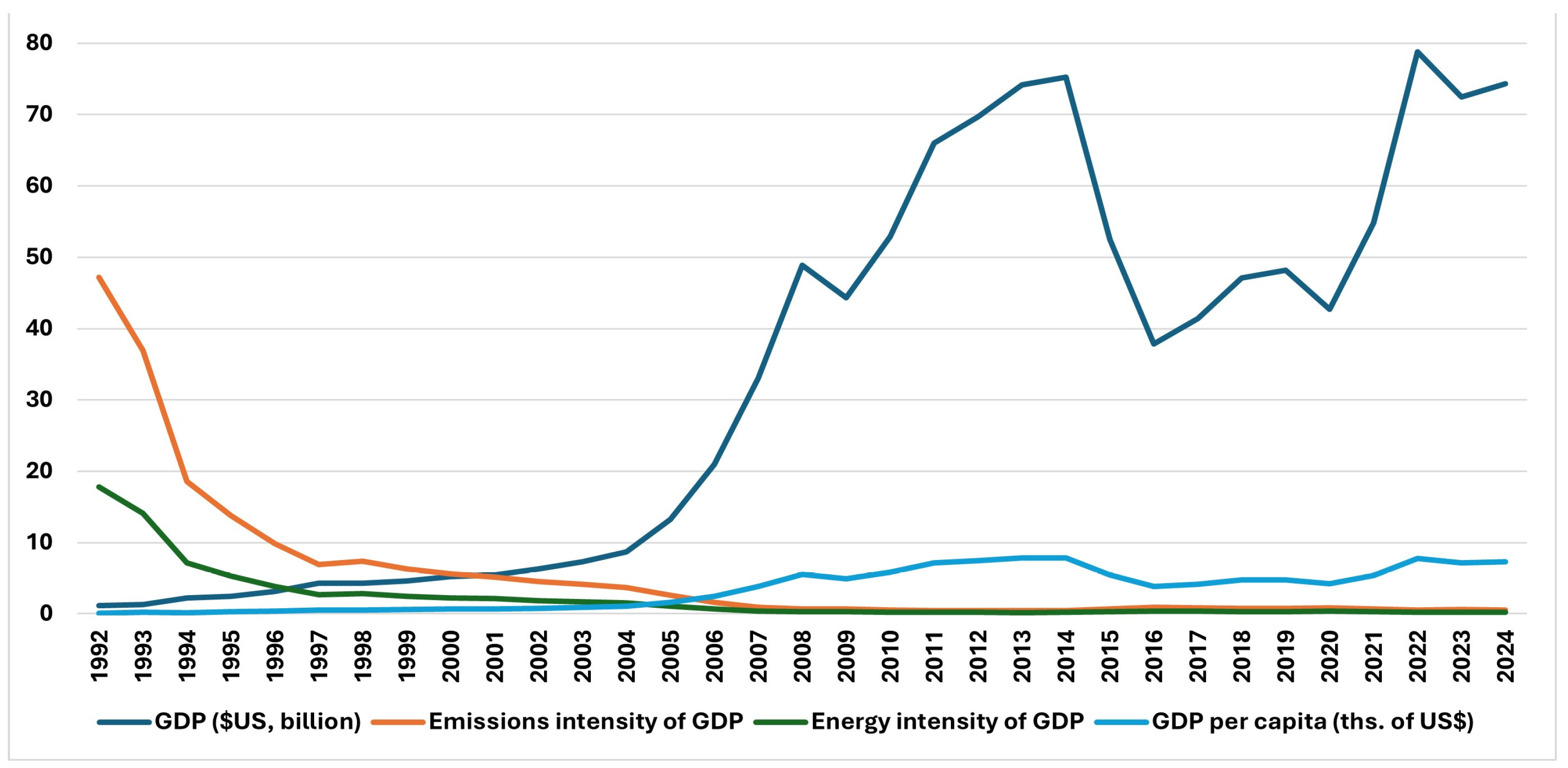
Figure 6 reveals several regularities. Over the last three decades, alternating periods of growth and stagnation can be observed in total energy and hydrocarbon (oil and natural gas) production. However, the overall trend is an increase in production. GDP (in US
$) steadily grew until 2014, followed by a decline between 2015 and 2020, and a subsequent recovery in 2021. Emissions and the energy intensity of GDP have generally shown a downward trend, while GDP has continued to grow.
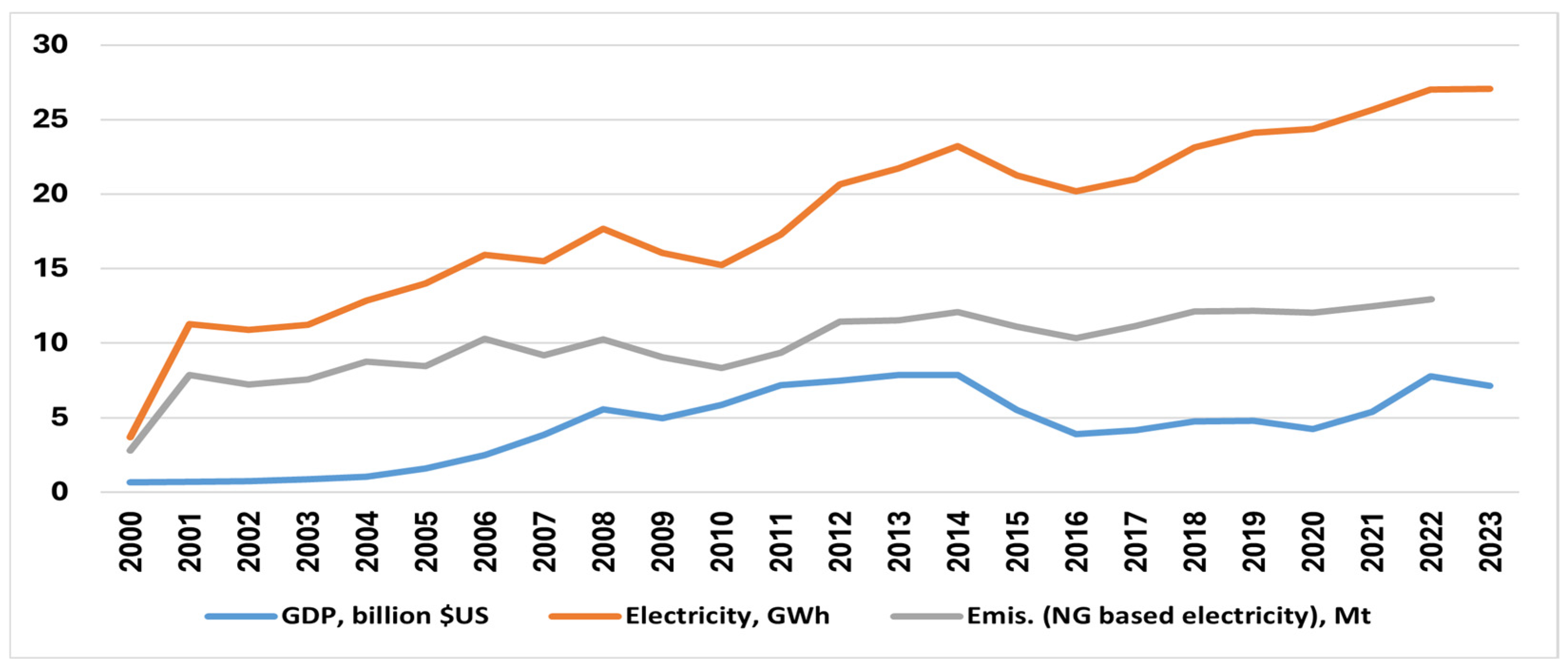
Given that 92 percent of electricity production in the Azerbaijan Republic is currently based on natural gas, an additional analysis was conducted to examine the relationships among GDP, electricity generation, and emissions. The dynamics of these indicators for 2000–2023 are presented in
Figure 7.
Figure 4,
Figure 5,
Figure 6 and
Figure 7 illustrate the structural background against which the subsequent statistical and scenario analysis is conducted.
Figure 4 and
Figure 5 show that hydrocarbon and total energy production generally increased over the long term, although with visible phases of stagnation and adjustment. At the same time,
Figure 6 indicates that GDP increased more strongly than emissions intensity and energy intensity, which is consistent with partial but unstable decoupling rather than a fully established transition to low-carbon growth.
Figure 7 further shows that electricity generation based on natural gas remains closely tied to both economic activity and emissions dynamics. Taken together, these visual trends support the interpretation that Azerbaijan is undergoing a gradual structural transition, but still remains strongly influenced by fossil energy dependence, especially in power generation.
A Pearson correlation analysis was conducted as a preliminary step to explore relationships among the selected economic, energy, and environmental indicators, and the results are presented in
Table 3. The strongest positive correlations are observed for GDP-Oil&NG (r = 0.941), GDP-TE (r = 0.932), GDP p.c.-TEP (r = 0.936), and especially CO
2-NGBE (r = 0.971), all with very low
p-values. By contrast, the remaining indicator pairs display weaker or statistically insignificant relationships. These results indicate that Azerbaijan’s growth and emissions structure remain closely associated with hydrocarbon production and natural gas-based electricity generation.
The significant correlations observed in the above cases are primarily explained by the high share of oil and natural gas in Azerbaijan’s GDP. Despite a gradual decline, in 2024, the share of oil and gas still accounted for 30.6 percent of GDP and 86 percent of national exports.
At the current phase of the country’s economic development, statistical data do not support the hypothesis that the Ecological Kuznets Curve exists. Statistical data analysis and decoupling estimations using the five-level Tapio model (based on Formula (1)) revealed unstable decoupling patterns typical of developing countries and transition economies.
The five-level Tapio results reported in
Table 4 show that Azerbaijan has not yet achieved a stable decoupling trajectory. For CO
2 emissions relative to per capita GDP, the dominant classes are coupling (40.6%) and absolute decoupling (34.4%), whereas for total energy consumption relative to GDP, the most frequent outcomes are relative decoupling (46.9%) and negative decoupling (31.2%). These distributions indicate that decoupling remains uneven and unstable, which justifies the use of a gradual and feasibility-oriented transition strategy rather than an abrupt policy shift.
The data analysis shows that, during the last thirty years, Azerbaijan has had a progressive decrease in oil production, an increase in natural gas production, and a general rise in hydrocarbon output, predominantly propelled by natural gas. Projections for the forthcoming decade, derived from exponential smoothing, suggest a 60 percent increase in natural gas output with confidence intervals of ±30 percent, and a 30 percent rise in oil production with confidence intervals of ±40 percent. The projections seem credible in terms of practicality; moreover, given the current and anticipated investments in the oil and natural gas industry, hydrocarbon output in Azerbaijan by the end of the next decade may surpass the projected figures.
4.2. Development and Evaluation of Energy Transition Scenarios
Given these circumstances, the significant role of oil and gas in the national economy, and the global primary energy demand outlook outlined in [
66], the list of alternatives for the transition scenarios was expanded to include oil production levels. In most cases, the resource-use levels considered in the scenarios are introduced as alternatives for the first time and therefore lack historical precedent. Under such conditions, objective probability assessments based on frequentist approaches are not feasible, and subjective evaluations remain the only acceptable option. The most effective method for determining subjective probabilities is the use of linguistic variables and fuzzy logic. The variables presented in
Section 3.4 were applied for the linguistic description of subjective probabilities. Based on the potential resource-use levels described in
Section 3.3, and considering expected capacity, available technology, and economic and environmental constraints, the expert group evaluated the probability of feasibility for each resource-use level (
Table 5).
Based on the subjective probabilities provided by experts, the feasibility probability for each scenario (including the production levels of five energy resources) was calculated using Formulas (3) and (4). Twelve scenarios with probabilities greater than or equal to 0.5 were selected among 7776 possible scenarios (due to five resources and six levels) for inclusion in the decision matrix. A feasibility threshold of 0.5 was used only to preselect sufficiently plausible scenarios from the full combinatorial set before applying the MCDM methods. This threshold served as a minimum admissibility level for further analysis rather than as a final optimality criterion, since a higher cutoff at the screening stage could exclude policy-relevant scenarios that remain feasible under uncertainty. These scenarios are presented in
Table 6. Only scenarios assessed as more feasible are included in subsequent calculations.
Relying solely on probabilistic ranking to make decisions may not always produce the desired results. It is essential to distinguish between the likelihood of a scenario and its overall optimality: the most probable outcome is not necessarily the best with respect to stated goals, sustainability standards, or resource efficiency. Therefore, the best scenario is chosen using multi-criteria approaches that allow for a comprehensive evaluation and comparison of options based on a weighted set of key indicators, balancing risks, costs, and potential benefits.
The linguistic terms introduced in
Section 3.3 were applied to estimate the criteria. The criteria for scenario evaluations include government policies and regulations (C
1), acceptance by society (C
2), labor impact (C
3), cost-effectiveness (C
4), spillover effects (C
5), technology efficiency and reliability (C
6), the availability of resources (C
7), and impact on the environment concerning emissions (C
8).
Since a scenario represents a combination of different resources, its overall evaluation depends on assessing the resource-use levels selected for that scenario.
- (1)
If NG is MU Then C1 is A and C2 is VH and C3 is L and C4 is A and C5 is L and C6 is AA and C7 is EH and C8 is H
- (2)
If NG is IM Then C1 is AA and C2 is H and C3 is BA and C4 is A and C5 is BA and C6 is AA and C7 is VH and C8 is A
- (3)
If Wind is IS Then C1 is H and C2 is H and C3 is H and C4 is H and C5 is H and C6 is H and C7 is VH and C8 is H
- (4)
If Wind is IM Then C1 is AA and C2 is H and C3 is A and C4 is A and C5 is A and C6 is H and C7 is EH and C8 is A
- (5)
If Solar is IS Then C1 is H and C2 is H and C3 is AA and C4 is H and C5 is AA and C6 is H and C7 is VH and C8 is H
- (6)
If Solar is IVS Then C1 is H and C2 is VH and C3 is H and C4 is VH and C5 is H and C6 is H and C7 is H and C8 is VH
- (7)
If Hydro is MU Then C1 is L and C2 is A and C3 is EL and C4 is A and C5 is EL and C6 is AA and C7 is H and C8 is AA
- (8)
If Hydro is IM Then C1 is H and C2 is H and C3 is BA and C4 is H and C5 is L and C6 is H and C7 is AA and C8 is H
- (9)
If Oil is DM Then C1 is A and C2 is AA and C3 is A and C4 is AA and C5 is A and C6 is AA and C7 is AA and C8 is H
- (10)
If Oil is DS Then C1 is BA and C2 is AA and C3 is AA and C4 is A and C5 is BA and C6 is A and C7 is A and C8 is VH
- (11)
If Oil is MU Then C1 is A and C2 is H and C3 is BA and C4 is A and C5 is A and C6 is AA and C7 is AA and C8 is A
Using fuzzy IF–THEN inference and defuzzification (Formula (5)), the criterion values for the feasible scenarios in
Table 6 and the decision matrix in
Table 7 are obtained.
Using criteria values based on [
60,
61] for the main calculations, the following normalized weight vector was used:
Additional weight vectors were tested separately in the sensitivity analysis.
Using calculation procedures from
Section 3.5.1 and Formulas (6)–(8) for PROMETHEE net flow;
Section 3.5.2 and Formula (9) for WPM scores; and
Section 3.5.3 and Formulas (10)–(13) for EDAS, appraisal scores are defined. The criterion values used in the multi-criteria evaluation are reported in
Table 7, while the baseline ranking results obtained by PROMETHEE, WPM, and EDAS are shown in
Table 8. As can be seen, Scenario S4 is ranked first by all three methods, which indicates a high degree of agreement across the applied decision-making procedures.
4.3. Sensitivity Analysis
Three different weight combinations were used for the sensitivity analysis of scenario evaluation. Initially, the three MCDM methods were recalculated with equal weights. This resulted in an average variability in weight of 65%. There was a significant increase in the weights (up to 90% of the initial values) for criteria with lower initial weights—C1–C3, C5, and C6—and a decrease in the weights (up to 40%) for criteria with higher primary weights—C4, C7, and C8.
Subsequently, the average of the initial and equal weights was used to adjust the weights for subsequent calculations. This yielded an average variability relative to the initial weights of 34%, an increase of 48% for low initial weights, and a decrease of 20% for high initial weights.
The results of calculations using three different MCDM methods with varying weights are shown in
Table 9.
The sensitivity results reported in
Table 9 show that the leading position of Scenario S4 remains stable under the initial, equal, and modified weight structures. This supports the conclusion that the preferred transition pathway is not an artifact of a single weighting assumption.
Calculating the Kendall concordance coefficient W using the following formula yields the following results:
where n—the number of alternatives (
i =
1, …,
n);
M—the number of rankings (j = 1, …, m);
Ri—the sum of ranks for the i-th alternative across all rankings;
—the average sum of ranks;
Tj—the correction to tiers.
There are no related ranks in the table,
Tj = 0 for all
j, and the formula simplifies to:
Applying Formula (15), coefficient W = 0.92 (concordance is high), and according to the value with degree of freedom df = 11, concordance of ranks is statistically significant.
It should be noted that all three combinations of methods identified Scenario S4 as the best option, and Scenarios S5 and S6 share second and third places. Scenario S4 recommends maintaining natural gas as usual, increasing significantly solar, increasing moderately wind and hydro, and decreasing moderately oil production. This outcome can be interpreted as reflecting the decisive role and potential of solar energy in increasing total energy production, given the significant capacity of this renewable resource in the country and its contribution to environmental protection. As for natural gas, increasing its production requires substantial investments and long-term export contracts, not to mention its environmental impacts. Wind, as a green energy resource, is of interest as well; however, its potential capacity is approximately five times lower than that of solar energy, and it is difficult to increase the production of both resources simultaneously, given their technological differences and investment-related constraints. Hydro in the country has a certain growth potential, especially for small hydro stations, and this option can contribute to a certain extent to the country’s energy transition. As for oil, all three scenarios are expecting and suggesting a decrease in oil production in the country. This is due to a combination of natural production declines, global trends and market uncertainty, the high cost of oil production in the country, and the significant negative impact on the environment. In addition, it is necessary to underline that the priority of any scenario significantly depends on the interplays of criteria in MCDM and the probabilities of scenarios’ feasibility. The second-best scenario recommends increasing wind energy production significantly; it is achievable but requires additional investments. The third-best scenario suggests increasing moderate NG production. The recommendation to increase natural gas production, despite the priority of emission reduction, is apparently explained by the role of NG in the country’s economy and ongoing trends in global NG production and forecasts. However, this achievable option will require addressing serious challenges in investment, long-term contracts, and transportation.
5. Discussion
The analysis of results shows that the combined approach developed in this paper provides a foundation for achieving decoupling of economic growth, energy use, and emissions in an oil-producing country. It ensures a smoother transition without abrupt and undesirable changes in economic growth, energy production, or supply. Considering that, according to most experts, the global peak of natural gas production will not be reached for at least two decades, and possibly later, while oil production is already approaching its peak, the solution obtained for Azerbaijan appears both natural and justified.
The proposed solution makes it possible to support the country’s economic growth during the transition period, stabilize or slightly increase natural gas and electricity exports, significantly expand the production and use of renewable energy, reduce emissions, and lay the foundations for achieving stable relative decoupling of economic growth, energy use, and emissions. An important advantage of the approach is that the combination of multi-criteria and probabilistic scenario assessments allows for solutions that remain robust under conditions of significant variability in both external circumstances and the probabilities of scenario implementation. As shown in [
1] and confirmed by our analysis (
Table 3), developing countries typically demonstrate unstable and irregular patterns of decoupling. Stable decoupling requires consistent policies, and the combined approach presented here provides an opportunity to obtain reliable solutions for the transition period.
Significant differences exist between fossil fuel-producing, -exporting, and -consuming countries. Countries primarily consuming fossil resources must focus on replacing conventional energy production technologies and facilities with green technologies and renewable resources. Oil-producing countries face this challenge as well, but they must also restructure their economies to compensate for the loss of oil and natural gas revenues, which retain a significant share of GDP and exports.
In 2022, fossil energy accounted for 55.8 percent of energy in Europe, 80 percent in North America, 99 percent in Eastern regions, and 80–86 percent globally [
66,
67,
68,
69]. It becomes clear that decoupling economic growth, energy use, and emissions requires several decades. A pragmatic and realistic starting point is not the declaration of absolute decoupling, but the development and implementation of policies to transition to renewable and green energy. In 2024, natural gas’s share of Azerbaijan’s electricity production was approximately 86 percent [
66,
67,
68,
69]. The results in
Table 3 indicate a very strong link between natural gas-based electricity generation and CO
2 emissions (r = 0.971). At the same time,
Table 4 shows that Azerbaijan has not yet reached a stable decoupling pattern. When the feasible scenarios are compared, S4 ranks the highest in
Table 7 and
Table 8, and this result does not change in
Table 9 under alternative weighting assumptions. In practical terms, this points to a gradual transition pathway built on renewable growth, lower oil dependence, and controlled use of natural gas.
The combined use of PROMETHEE, WPM, and EDAS reduces dependence on a single evaluation logic and allows the scenario rankings to be checked from different methodological angles. PROMETHEE captures preference relations, WPM penalizes weak performance on important criteria, and EDAS compares each option with the average scenario profile. In the present study, the convergence of results across these methods, together with the sensitivity analysis under alternative weight structures, shows that the priority of Scenario S4 is stable rather than method-specific.
Although Scenario S4 is identified as the optimal transition pathway, its implementation is associated with significant investment and institutional requirements. Large-scale deployment of solar and supporting grid infrastructure requires substantial upfront capital expenditures, while maintaining natural gas production at current levels necessitates long-term supply and export contracts to ensure revenue stability and system reliability during the transition period. These contractual arrangements are critical for mitigating investment risks, stabilizing cash flows, and financing renewable energy expansion. Therefore, the feasibility of Scenario S4 depends not only on resource availability but also on sustained investment commitments and long-term policy and contractual frameworks. The supplementary econometric perspective supports the interpretation that Azerbaijan’s economic growth remains structurally linked to hydrocarbon production and related emissions, while also drawing attention to the role of structural regime shifts in shaping the country’s transition trajectory.
This paper differs from many related studies in the way the analysis is organized. It does not stop at measuring decoupling or ranking scenarios separately, but links nexus analysis, decoupling assessment, fuzzy scenario development, feasibility screening, and multi-criteria evaluation in one sequence. This is especially relevant for oil-dependent economies, where transition options have to be assessed not only by environmental effect, but also by feasibility under existing institutional and energy-system conditions.
The assessment of renewable energy potential must also account for system-level constraints that can limit large-scale integration. In the case of solar energy, grid bottlenecks, variability, curtailment risks, and the need for additional balancing and storage capacities may reduce its effective contribution. Without parallel investments in grid modernization, flexibility mechanisms, and energy storage, high shares of intermittent renewables can adversely affect system stability and economic performance. Acknowledging these constraints provides a more realistic evaluation of the transition pathways and highlights the importance of coordinated infrastructure and policy development.
The present analysis adopts a production-based, country-level perspective to evaluate decoupling pathways relevant for national energy and economic policy. While burden-shifting and embodied emissions in trade represent important dimensions of global sustainability, incorporating them requires multi-regional input–output frameworks that are beyond the scope of this study. Nevertheless, the proposed scenario-based framework can be extended in future research by integrating trade-adjusted emissions and interregional supply-chain effects, allowing for a more comprehensive assessment of decoupling in open, resource-exporting economies.
6. Conclusions
The problem of gradually decoupling economic growth, energy use, and emissions in an oil-producing country was formulated and addressed through the case study of Azerbaijan. This paper presents an integrated approach that combines country-level analysis of the nexus between economic growth, energy production and consumption, and emissions with energy transition scenarios, along with multi-criteria and probabilistic evaluations of these scenarios. Combining scenario assessments enables the identification of an optimal compromise solution from both multi-criteria and feasibility perspectives.
The inclusion of hydrocarbons in the scenarios alongside renewable energy sources, and, in particular, the recommendation to stabilize natural gas production, reflects global economic and energy-sector trends, expert opinions, and the current realities of Azerbaijan’s economy. While replacing hydrocarbons with renewable sources is an inevitable requirement for environmental protection, the pace of transition that can realistically be achieved is much slower than previously assumed.
The methodology proposed in this study can be used by both researchers and policymakers to compare possible decoupling pathways at the national and regional levels. Its practical advantage is that it does not focus only on environmental outcomes, but also takes into account whether a given pathway is realistic under economic and institutional conditions. In the case of Azerbaijan, the results point to a gradual transition based on the expansion of renewable energy and a measured decline in hydrocarbon dependence.
This study has some limitations that should be acknowledged. First, the analysis is conducted at a macro level and does not explicitly model detailed technology-specific or sector-coupling dynamics. Second, scenario feasibility assessments rely on expert-based subjective probabilities due to the limited availability of long-term empirical data. Finally, institutional and market dynamics are represented implicitly rather than through formal market modeling. Nevertheless, the proposed framework is expandable and can be extended by incorporating detailed energy-system models, micro-level technological assessments, and country-specific institutional analyses, allowing its application to other oil-dependent and resource-intensive economies.
Given that the objective of this study is scenario-based decision support, a full-scale econometric causality analysis is not included in the main body of this paper. At the same time, a supplementary VECM-based econometric perspective with structural-break considerations is included in
Appendix A. This appendix does not replace the scenario analysis, but provides an additional dynamic view of the long-run interaction among growth, hydrocarbon dependence, and emissions in Azerbaijan.
While the proposed scenarios focus on macro-level energy transitions, the robustness of Scenario S4 can be further enhanced through complementary micro-level technological solutions [
70,
71]. Decentralized energy recovery technologies, such as energy-recovering turbines integrated into municipal water distribution systems, can provide a stable and non-intermittent source of renewable electricity. Unlike solar and wind generation, such technologies operate continuously and can improve system flexibility. Moreover, co-optimization of power and water distribution systems enables simultaneous hydropower generation and pressure regulation, reducing overall system costs and contributing to the economic viability of the transition. Incorporating such cross-sectoral solutions can strengthen decoupling efforts by diversifying renewable energy sources and reducing reliance on large-scale infrastructure alone.