Advancing Offshore Wind Capacity Through Turbine Size Scaling


Abstract
1. Introduction
2. Definitions and Scales of Offshore Wind Industry Development
2.1. Explanation of Three Scaling Levels
- (a)
- Turbine scale (rated generator capacity)
- (b)
- Project scale (total capacity of wind farm)
- (c)
- Market scale (global regulatory pipeline and ambitions)
2.2. Relationship Between Scales and Their Impact on Cost and Efficiency
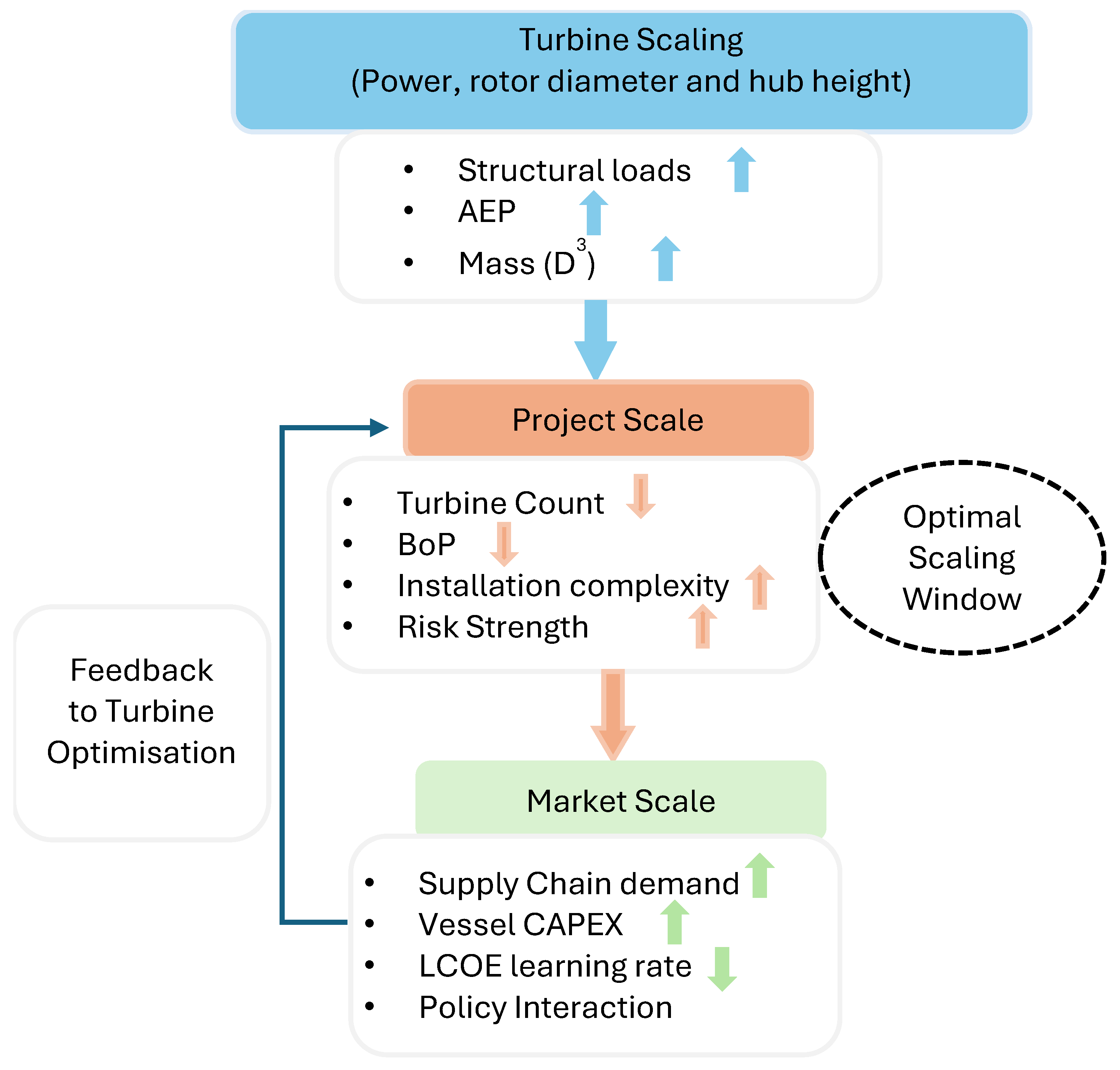
2.2.1. Turbine—Project: Component Scaling to System Effects
2.2.2. Project—Turbine: Farm Design Filters Optimal Size
2.2.3. Market—Project/Turbine: Policy and Supply-Chain Scaling
- (a)
- Conceptual Cost–Energy Scaling Model Linking Turbine Rating to LCOE
- CAPEX is the total capital expenditure;
- OPEX is the annual operational expenditure;
- AEP is the annual energy production;
- CRF is the capital recovery factor reflecting financing assumptions.
- (b)
- Energy Scaling with Turbine Size
- is rated power;
- is capacity factor.
- (c)
- CAPEX Decomposition and Scaling Behaviour
- (d)
- Turbine Cost Scaling
- (e)
- Balance-of-Plant Scaling
- (f)
- Structural and Logistical Scaling Constraints
- (g)
- Existence of an Optimal Turbine Size
2.2.4. Cost Pathways and Diminishing Returns
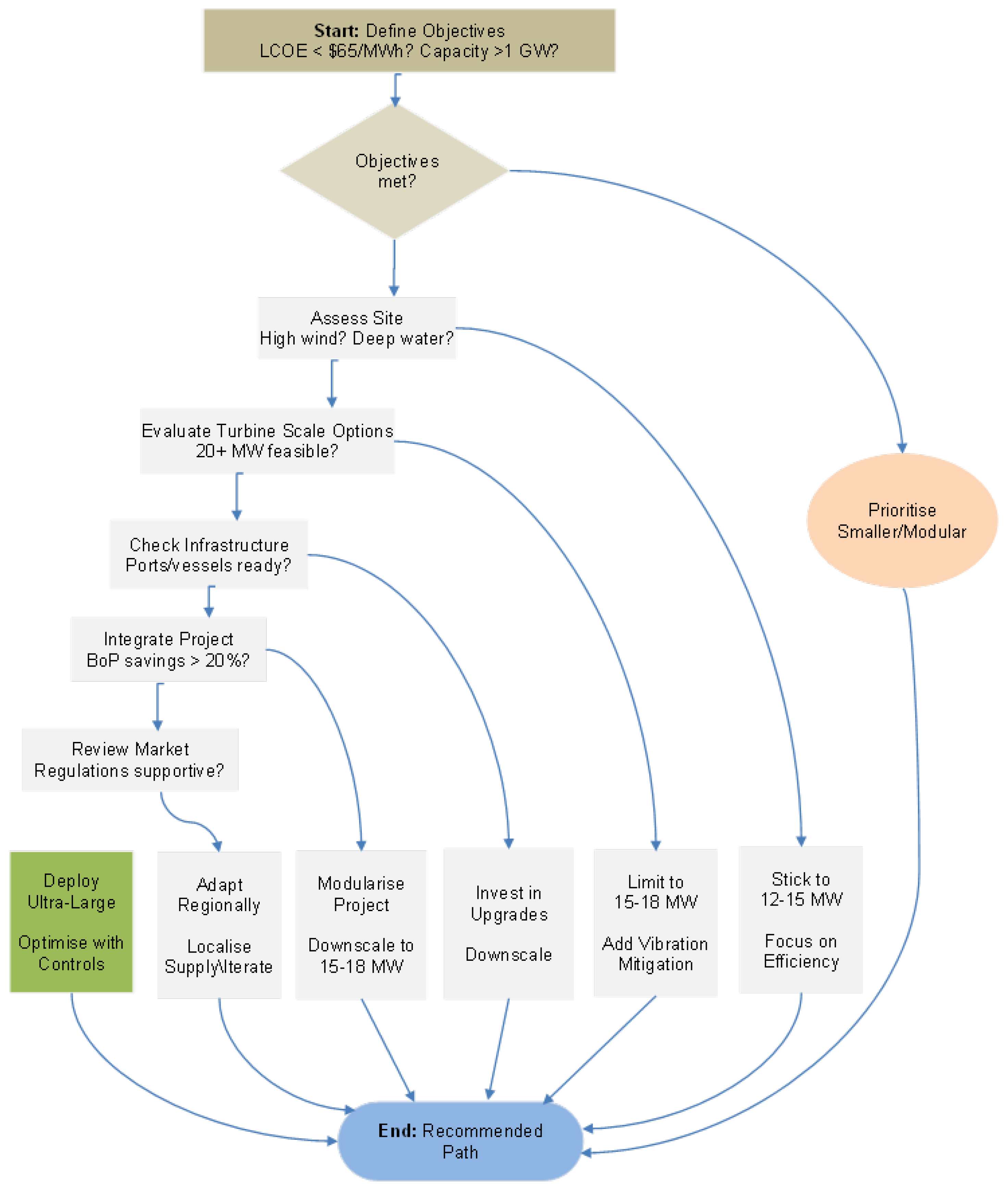
2.2.5. Practical Synthesis for Optimisation
2.3. Sensitivity Analysis of Key Techno-Economic Parameters
- Structural steel prices, affecting turbine and foundation CAPEX;
- Mean wind speed at hub height, influencing annual energy production;
- Installation vessel day rates, affecting balance-of-plant installation costs.
3. Trends in Turbine Size Growth

| Europe | China | USA | Asia–Pacific (Excluding China) | Latin America, Africa | |
|---|---|---|---|---|---|
| Turbine Size (MW) | 14–18 (commercially deployed) | 18–26 (prototypes dominant) | 12–18 (early commercial deployment) | 10–15 (progressive upscaling) | 8–15 (initial deployments) |
| Rotor Diameter (m) | 220–260 | 260–300+ | 200–260 | 180–236 | 160–220 |
| Foundation Type | Fixed-bottom (monopile/jacket) Floating (semisubmersible) emerging | Floating (semisubmersible) advanced large-monopile | Fixed-bottom (monopile/jacket) Floating planned | Fixed (monopile/jacket) Floating pilots | Fixed-bottom |
| Water Depth Ranges (m) | Fixed: 0–60 m. Floating: >50–200+ m | Fixed: 0–50 m. Floating: 40–200+ m | Fixed: 20–60 m. Floating: >50–200+ m | Fixed: 0–60 m. Floating: >50–200+ m | Fixed: 0–50 m (pilots) |
| Project Scale (GW) | 1–3 (individual); Up to 5+ GW clusters | 2–5+ GW (large-scale clusters) | 0.8–2 GW (individual); 3–5 GW (clusters) | 0.5–2 (nearly projected) scaling to 3+ | 0.1–1 (pilots); 1–3 (future) |
| Key System Optimisation Drivers | Mature port and installation infrastructure; standardised turbine platforms; cross-project learning effects | Massive domestic supply chain, fast permitting, state-driven, 20+ MW push (Mingyang, Dongfang) | Jones Act constraints; port and vessel upgrades; incremental turbine scaling | Design adaptation for extreme weather (e.g., typhoons); localisation strategies; regional supply-chain development | Pilot projects; international finance; limited infrastructure |
| Projected LCOE Range (USD/MWh) | 70–100 (fixed-bottom) 120–180 (early floating) | 60–90, target <70 by 2030 | 100–150 (fixed-bottom) 150–200+ (floating) | 80–130 (target decline post-2030) | 120–200+ (initial commercial phase) |
| Technology Status | Commercially deployed/firm orders | Commercial + prototype | Early commercial deployment | Commercial/scaling phase | Announced/pilot projects |
| Primary Drivers of LCOE Variability | Wind resource (8–11 m/s), WACC 4–7%, port maturity, installation vessel availability, foundation type | State-backed financing, lower WACC, domestic supply-chain integration, shallow-water dominance | WACC 7–10%, Jones Act vessel constraints, port upgrade CAPEX, immature supply chain | Typhoon-resistant design, extreme-wind loading, localisation requirements, grid connection costs | High financing risk, limited port infrastructure, small project scale, higher logistics costs |
| Sources | [4,5] | [4,40] | [4,28] | [4] | [4] |
4. Technical Drivers for Turbine Upscaling
4.1. Reduction in Turbine Count for a Given Farm Capacity
4.2. Increased Energy Capture from Higher Hub Heights and Larger Rotors
4.3. Cost Reductions per Megawatt Through Capacity Scale
5. Benefits of Turbine Upscaling
5.1. Reduction in Turbine Count for a Given Farm Capacity
5.2. Increased Energy Capture from Higher Hub Heights and Larger Rotors
5.3. Cost Reductions per Megawatt Through Capacity Scale
6. Challenges and Limitations
6.1. Physical Constraints: Square–Cube Law Governing Power vs. Weight
6.2. Increasing Infrastructure and Logistical Costs
6.3. Technological Risks Related to New Platforms and Immature Technology
7. Infrastructure and Supply-Chain Role
7.1. Port, Installation Vessel, and Manufacturing Capacity Requirements
7.2. Market-Specific Infrastructure Comparisons (China, US, Europe)
7.3. Need for Significant Infrastructure Investment Tied to Turbine Size
8. Optimising Turbine Size Relative to Market Scale
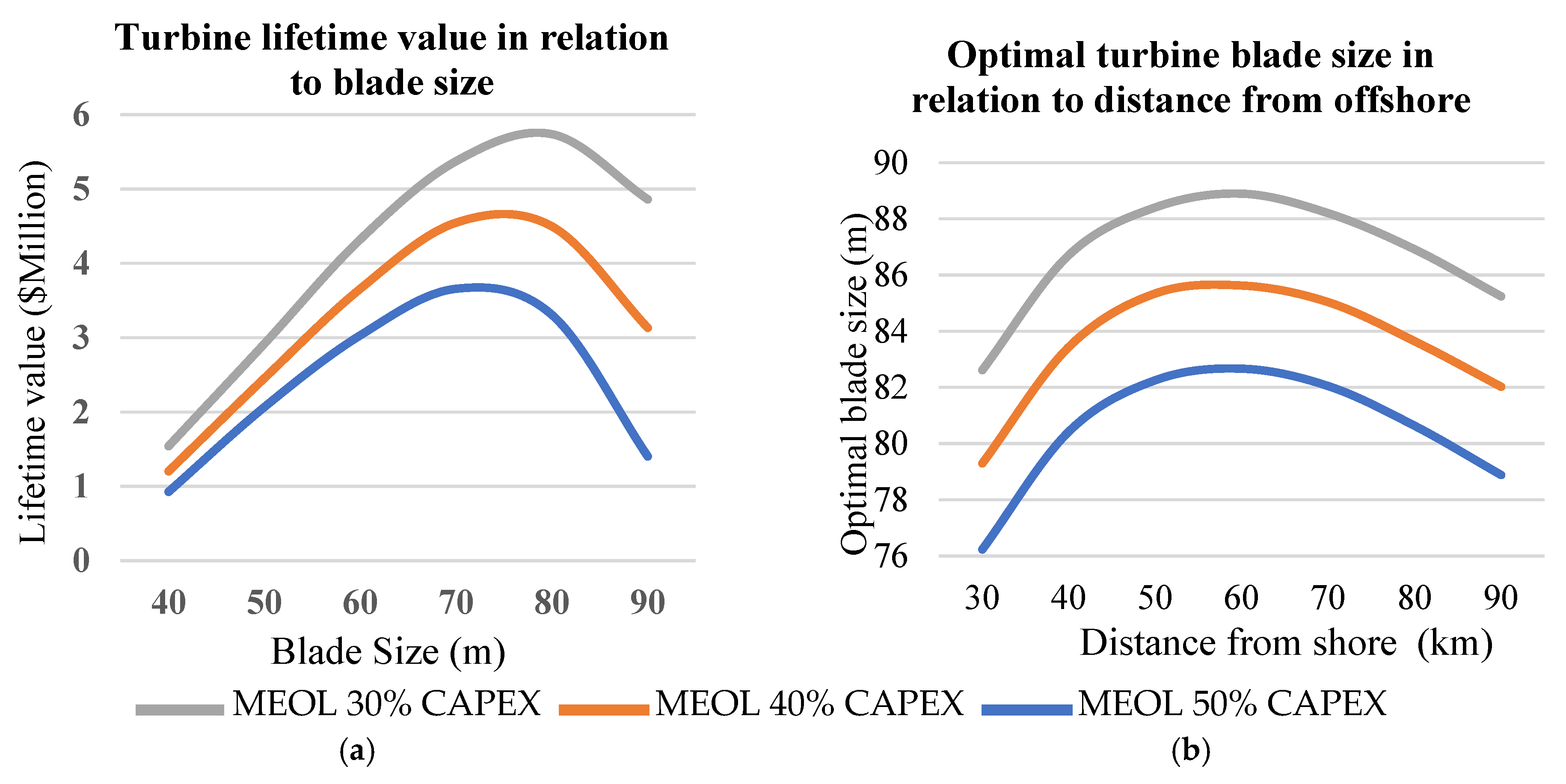
8.1. Economic Analysis of Cost Efficiency Versus Turbine Size
Economic Analysis—Model and Sensitivity
- CAPEX = €2.30 M/MW.
- OPEX = €85,000 /MW/year.
- Capacity factor = 57%.
- CRF = 0.0858.
- 18 MW: CAPEX = €2.23 M/MW, OPEX = €83,000, CF = 58.8% → LCOE ≈ €64/MWh, a reduction of ~6% relative to the baseline.
- 20 MW: CAPEX = €2.18 M/MW, OPEX = €82,000, CF = 60% → LCOE ≈ €61/MWh (−10.3%).
- 22 MW (peak efficiency): CAPEX = €2.20 M/MW, OPEX = €83,000, CF = 61% → LCOE ≈ €60/MWh, representing the minimum within the evaluated range (~12% reduction).
- 25 MW: CAPEX = €2.35 M/MW, OPEX = €90,000, CF = 62% → LCOE ≈ €64/MWh, indicating diminishing returns as structural mass, BoP complexity, and installation logistics costs escalate.
8.2. Importance of Technology Maturity and Market Size in Cost Reduction
8.3. Flexible Multi-Market Turbine Sizing Strategies
9. Digitalisation and Digital-Twin Frameworks for Offshore Wind Optimisation
9.1. Operational Digitalisation and Fleet-Level Analytics
9.2. Physics-Based Digital Twins for Structural Monitoring and Load Reconstruction
9.3. Implications for Floating and Ultra-Large Turbines
10. Socioeconomic Considerations in Wind Energy Deployment
11. Ecodesign and Digital Lifecycle Optimisation for Sustainable Turbine Upscaling
11.1. Material Intensity Under Square–Cube Scaling
11.2. Sensitivity of Optimal Turbine Size to Steel Price Volatility
11.3. Rotor Diameter vs. Wind Resistance Trade-Off in Extreme Environments
11.4. Digital-Twin-Enabled RUL Modelling and Mass Optimisation
11.5. Circular Design and Decommissioning Economics
11.6. Sustainable Scaling Window
12. Future Perspectives and Strategic Considerations
12.1. Potential and Limits of Ultra-Large Offshore Wind Turbines (20+ MW)
12.2. Multi-Scale and Multi-Market Approaches to Offshore Wind Development
12.3. Importance of Industry-Wide Coordination to Manage Upscaling Risks
13. Conclusions
Author Contributions
Funding
Data Availability Statement
Conflicts of Interest
References
- Musial, W.; Spitsen, P.; Duffy, P.; Beiter, P.; Shields, M.; Heimiller, D.; Robertson, A. Offshore Wind Market Report: 2024 Edition; Report No. NREL/TP-5000-90525; National Renewable Energy Laboratory: Golden, CO, USA, 2024. [Google Scholar]
- Jonkman, J.; Butterfield, S.; Musial, W.; Scott, G. Definition of a 5-MW Reference Wind Turbine for Offshore System Development; National Renewable Energy Laboratory: Golden, CO, USA, 2009. [Google Scholar] [CrossRef]
- Musial, W. Scaling the Offshore Wind Industry and Optimizing Turbine Size; National Renewable Energy Laboratory (NREL): Golden, CO, USA, 2024. [Google Scholar]
- Global Wind Energy Council (GWEC). Global Offshore Wind Report 2025; Global Wind Energy Council: Brussels, Belgium, 2025. [Google Scholar]
- International Renewable Energy Agency (IRENA). Renewable Power Generation Costs in 2024; IRENA: Abu Dhabi, United Arab Emirates, 2025. [Google Scholar]
- World Forum Offshore Wind. Global Offshore Wind Report HY1 2023; World Forum Offshore Wind: Hamburg, Germany, 2023; Available online: https://wfo-global.org/wp-content/uploads/2023/10/WFO-Global-Offshore-Wind-Report-HY1-2023-1.pdf (accessed on 2 November 2025).
- Equinor. The World’s Largest Floating Offshore Wind Farm Officially Opened. 23 August 2023. Available online: https://www.equinor.com/news/20230823-hywind-tampen-officially-opened (accessed on 22 January 2026).
- Memija, A. Scotland’s 450 MW Neart na Gaoithe Offshore Wind Farm Fully Operational; OffshoreWIND.biz: Rotterdam, The Netherlands, 2025; Available online: https://www.offshorewind.biz/2025/07/25/scotlands-450-mw-neart-na-gaoithe-offshore-wind-farm-fully-operational/ (accessed on 21 January 2026).
- Memija, A. Ørsted Selects Construction Base for Hornsea 3 Offshore Wind Farm; OffshoreWIND.biz: Rotterdam, The Netherlands, 2025. Available online: https://www.offshorewind.biz/2025/07/16/orsted-selects-construction-base-for-hornsea-3-offshore-wind-farm/ (accessed on 2 January 2026).
- Pacific Northwest National Laboratory (PNNL). Coastal Virginia Offshore Wind (CVOW). Tethys. Available online: https://tethys.pnnl.gov/wind-project-sites/coastal-virginia-offshore-wind-cvow (accessed on 2 January 2026).
- PGE Baltica. Information on Baltica 2 Project. Available online: https://pgebaltica.pl/en/about-us/key-information-about-our-projects/baltica-2 (accessed on 27 January 2026).
- Revolution Wind. Revolution Wind Completes Installation of Project’s First Offshore Wind Turbine. 3 September 2024. Available online: https://revolution-wind.com/news/2024/09/revolution-wind-completes-installation-of-projects-first-offshore-wind-turbine (accessed on 27 January 2026).
- West of Orkney Windfarm. About the West of Orkney Windfarm Project. Available online: https://www.westoforkney.com/project (accessed on 30 January 2026).
- ORLEN. ORLEN Strengthens Offshore Wind Position as Baltic East Wins URE Auction. 18 December 2025. Available online: https://www.orlen.pl/en/about-the-company/media/press-releases/current/2025/December-2025/ORLEN-strengthens-offshore-wind-position-as-Baltic-East-wins-URE-auction (accessed on 21 January 2026).
- Sam, A.; Atalay, A.; Luk, V.W. The Life of Giants: A Life-Cycle View of Wind Turbines; INSEAD Publishing: Fontainebleau, France, 2024; Available online: https://knowledge.insead.edu/operations/life-giants-life-cycle-view-wind-turbines (accessed on 13 January 2026).
- Offshore Wind Energy. Offshore Wind Farm Database Report 026. Available online: https://www.offshorewindenergy.org/COD/reports/report-files/report_026.pdf (accessed on 19 March 2025).
- Lemming, J.; Morthorst, P.E.; Clausen, N.-E.; Jensen, P.H. Contribution to the Chapter on Wind Power. In Energy Technology Perspectives 2008; International Energy Agency (IEA): Paris, France, 2008. Available online: https://www.osti.gov/etdeweb/servlets/purl/948612 (accessed on 15 January 2025).
- Liu, Y. Design of a Superconducting DC Wind Generator; KIT Scientific Publishing: Karlsruhe, Germany, 2020. [Google Scholar] [CrossRef]
- Wind Turbine Models. Siemens SWT-6.0-154 Wind Turbine. Available online: https://en.wind-turbine-models.com/turbines/657-siemens-swt-6-0-154 (accessed on 2 May 2025).
- Siemens Gamesa Renewable Energy. Offshore Wind Turbines Product Brochure. Available online: https://assets.new.siemens.com/siemens/assets/api/uuid:1c690d9444b15f1a542d0e3166f43a90814743f2/d6-offshore-brochure-en.pdf (accessed on 22 May 2025).
- TGS. MHI Vestas V164-8.0 MW Offshore wind Turbine. Available online: https://www.tgs4c.com/wind-farms/turbine-mhi-vestas-offshore-wind-v164-8.0-mw-tid89.html (accessed on 15 January 2026).
- GE Vernova. Haliade-X Offshore Wind Turbine (12 MW Platform). Available online: https://pl.wind-turbine-models.com/turbines/1809-ge-vernova-ge-haliade-x-12-mw (accessed on 30 January 2026).
- Siemens Gamesa Renewable Energy. SG 14-222 DD Offshore Wind Turbine. Available online: https://pl.wind-turbine-models.com/turbines/2266-siemens-gamesa-sg-14-222-dd (accessed on 30 January 2026).
- Gaertner, E.; Rinker, J.; Sethuraman, L.; Zahle, F.; Anderson, B.; Barter, G.; Abbas, N.; Meng, F.; Bortolotti, P.; Skrzypinski, W.; et al. Definition of the IEA 15-Megawatt Offshore Reference Wind Turbine; Report No. NREL/TP-5000-75698; National Renewable Energy Laboratory: Golden, CO, USA, 2020. [Google Scholar]
- Bak, C.; Zahle, F.; Bitsche, R.; Kim, T.; Yde, A.; Henriksen, L.C.; Hansen, M.H.; Blasques, J.P.A.A.; Gaunaa, M.; Natarajan, A. The DTU 10-MW Reference Wind Turbine; Technical Report/Monograph. 2013. Available online: https://orbit.dtu.dk/en/publications/the-dtu-10-mw-reference-wind-turbine (accessed on 4 January 2026).
- Passon, P.; Kühn, M.; Butterfield, S.; Jonkman, J.; Camp, T.; Larsen, T.J. OC3—Benchmark exercise of aero-elastic offshore wind turbine codes. J. Phys. Conf. Ser. 2007, 75, 012071. [Google Scholar] [CrossRef]
- IEC 61400-3; Wind Energy Generation Systems—Part 3: Design Requirements for Offshore Wind Turbines. International Electrotechnical Commission: Geneva, Switzerland, 2019.
- Fuchs, R.; Zuckerman, G.; Duffy, P.; Shields, M.; Musial, W.; Beiter, P.; Cooperman, A.; Bredenkamp, S. The Cost of Offshore Wind Energy in the United States from 2025 to 2050; Report No. NREL/TP-5000-88988; National Renewable Energy Laboratory: Golden, CO, USA, 2024. [Google Scholar]
- Satymov, R.; Bogdanov, D.; Breyer, C. Techno-economics of offshore wind power in global resolution. Appl. Energy 2025, 393, 125980. [Google Scholar] [CrossRef]
- Zahle, F.; Barlas, A.; Lønbæk, K.; Bortolotti, P.; Zalkind, D.; Wang, L.; Labuschagne, C.; Sethuraman, L.; Barter, G. Definition of the IEA 22-Megawatt Offshore Reference Wind Turbine; IEA Wind TCP: Copenhagen, Denmark, 2024; Available online: https://iea-wind.org/wp-content/uploads/2024/04/iea-22-280-rwt-report.pdf (accessed on 12 January 2026).
- Shields, M.; Beiter, P.; Nunemaker, J.; Cooperman, A.; Duffy, P. Impacts of turbine and plant upsizing on the levelized cost of energy for offshore wind. Appl. Energy 2021, 298, 117189. [Google Scholar] [CrossRef]
- Baumann-Ouyang, A.; Butt, J.A.; Varga, M.; Wieser, A. MIMO-SAR interferometric measurements for wind turbine tower deformation monitoring. Energies 2023, 16, 1518. [Google Scholar] [CrossRef]
- Mitka, B.; Klapa, P.; Gniadek, J. Use of terrestrial laser scanning for measurements of wind power stations. Geomatics Environ. Eng. 2019, 13, 39–54. [Google Scholar] [CrossRef]
- Helming, P.; von Freyberg, A.; Sorg, M.; Fischer, A. Wind turbine tower deformation measurement using terrestrial laser scanning on a 3.4 MW wind turbine. Energies 2021, 14, 3255. [Google Scholar] [CrossRef]
- Marble River Wind. Computer Model of Proposed Turbine Vestas V112; EDP Towns of Clinton and Ellenburg—Clinton County: New York, NY, USA, 2010; Available online: https://www.edp.com/sites/default/files/document/2025-04/Exhibit11M-Clinton.pdf (accessed on 27 January 2026).
- Lai, Y.; He, B.; Ding, J.; Lyu, N.; Yang, Y. Effects of tower-top acceleration feedback control on the dynamic response of support structures of a 15 MW monopile-type wind turbine. Front. Energy Res. 2025, 13, 1646687. [Google Scholar] [CrossRef]
- Atilgan Turkmen, B.; Germirli Babuna, F. Life cycle environmental impacts of wind turbines: A path to sustainability with challenges. Sustainability 2024, 16, 5365. [Google Scholar] [CrossRef]
- Li, J.; Li, Z.; Jiang, Y.; Tang, Y. Typhoon resistance analysis of offshore wind turbines: A review. Atmosphere 2022, 13, 451. [Google Scholar] [CrossRef]
- Zhang, D.; Zhong, X.; Wei, K. On structural loads and responses of monopile offshore wind turbines under typhoons: Numerical case study of Super Typhoon Chan-hom. Case Stud. Constr. Mater. 2025, 23, e05031. [Google Scholar] [CrossRef]
- OffshoreWIND.biz. Offshore Wind Turbines in 2025: China Continues Leading in Single-Unit Capacity, Vestas’s 15 MW Turbine Installed at Offshore Wind Farms; OffshoreWIND.biz: Rotterdam, The Netherlands, 2026; Available online: https://www.offshorewind.biz/2026/01/01/offshore-wind-turbines-in-2025-china-continues-leading-in-single-unit-capacity-vestass-15-mw-turbine-installed-at-offshore-wind-farms/ (accessed on 27 January 2026).
- MingYang Smart Energy. Leading Innovation: MingYang Smart Energy Launches MySE 16.0-242, the World’s Largest Offshore Hybrid-Drive Wind Turbine. 20 August 2021. Available online: https://en.myse.com.cn/news/info.aspx?itemid=1228 (accessed on 7 January 2026).
- Buljan, A. Mingyang Produces ‘World’s Longest’ Anti-Typhoon Offshore Wind Turbine Blade; OffshoreWIND.biz: Rotterdam, The Netherlands, 2022; Available online: https://www.offshorewind.biz/2022/12/19/mingyang-produces-worlds-longest-anti-typhoon-offshore-wind-turbine-blade/ (accessed on 27 January 2026).
- Dibra, B.; Finucane, Z.; Foley, B.; Hall, R.; Damiani, R.; Maples, B.; Parker, Z.; Robertson, A.; Scott, G.; Stehly, T.; et al. (Eds.) Hurricane Resilient Wind Plant Concept Study: Final Report; NREL/TP-5000-66869; National Renewable Energy Laboratory: Golden, CO, USA, 2016. Available online: https://docs.nrel.gov/docs/fy17osti/66869.pdf (accessed on 27 January 2026).
- Liu, H.; Luo, Y.; Sun, H.; Han, Y.; Hu, P. Typhoon multi-stage effects on coupled dynamic responses of a 15 megawatt floating offshore wind turbine. Phys. Fluids 2025, 37, 127140. [Google Scholar] [CrossRef]
- Bodini, N.; Optis, M.; Rossol, M.; Rybchuk, A.; Redfern, S. National Offshore Wind Dataset (NOW-23); National Renewable Energy Laboratory: Golden, CO, USA, 2023; Available online: https://data.openei.org/submissions/4500 (accessed on 25 December 2025).
- Stehly, T.; Duffy, P.; Beiter, P. Cost of Wind Energy Review: 2024 Edition; National Renewable Energy Laboratory: Golden, CO, USA, 2024. [Google Scholar]
- WindEurope. Wind Energy in Europe: 2023 Statistics and the Outlook for 2024–2030; WindEurope: Brussels, Belgium, 2023; Available online: https://windeurope.org/data/products/wind-energy-in-europe-2023-statistics-and-the-outlook-for-2024-2030/ (accessed on 27 January 2026).
- Martynowicz, P. Nonlinear optimal-based vibration control for systems with MR tuned vibration absorbers. J. Low Freq. Noise Vib. Act. Control 2019, 38, 1607–1628. [Google Scholar] [CrossRef]
- Gołdasz, J.; Sapiński, B.; Jastrzębski, Ł. Assessment of the Magnetic Hysteretic Behaviour of MR Dampers through Sensorless Measurements. Shock Vib. 2018, 2018, 3740208. [Google Scholar] [CrossRef]
- Gołdasz, J.; Sapiński, B.; Jastrzębski, Ł.; Kubik, M. Dual Hysteresis Model of MR Dampers. Front. Mater. 2020, 7, 236. [Google Scholar] [CrossRef]
- Martynowicz, P. Real-time implementation of nonlinear optimal-based vibration control for a wind turbine model. J. Low Freq. Noise Vib. Act. Control 2019, 38, 1635–1650. [Google Scholar] [CrossRef]
- Martynowicz, P. Nonlinear Optimal-Based Vibration Control of a Wind Turbine Tower Using Hybrid vs. Magnetorheological Tuned Vibration Absorber. Energies 2021, 14, 5145. [Google Scholar] [CrossRef]
- Martynowicz, P. Experimental study on the optimal-based vibration control of a wind turbine tower using a small-scale electric drive with MR damper support. Energies 2022, 15, 9530. [Google Scholar] [CrossRef]
- Martynowicz, P.; Katsaounis, G.M.; Mavrakos, S.A. Comparison of Floating Offshore Wind Turbine Tower Deflection Mitigation Methods Using Nonlinear Optimal-Based Reduced-Stroke Tuned Vibration Absorber. Energies 2024, 17, 1507. [Google Scholar] [CrossRef]
- Martynowicz, P.; Ślimak, P.; Katsaounis, G.M. TLP-supported NREL 5 MW floating offshore wind turbine tower vibration reduction under aligned and misaligned wind-wave excitations. Energies 2025, 18, 2092. [Google Scholar] [CrossRef]
- Martynowicz, P. Vibration Mitigation of Flexible Structures via Enhanced Optimal Control Strategies: Experimental Validation on a Scaled Monopile-Supported Wind Turbine Tower–Nacelle Model. Zenodo 2026. [Google Scholar] [CrossRef]
- International Renewable Energy Agency (IRENA). Floating Offshore Wind Outlook; IRENA: Abu Dhabi, United Arab Emirates, 2024. [Google Scholar]
- Beiter, P.; Duffy, P.; Shields, M.; Musial, W. Offshore Wind Market Report: 2023 Edition; National Renewable Energy Laboratory: Golden, CO, USA, 2023. Available online: https://www.energy.gov/sites/default/files/2023-09/doe-offshore-wind-market-report-2023-edition.pdf (accessed on 11 January 2026).
- International Renewable Energy Agency (IRENA). Renewable Power Generation Costs in 2023; IRENA: Abu Dhabi, United Arab Emirates, 2024. [Google Scholar]
- U.S. Department of Energy; Wind Energy Technologies Office. Learning a Better Way to Forecast Wind and Solar Energy Costs. 17 October 2022. Available online: https://www.energy.gov/eere/wind/articles/learning-better-way-forecast-wind-and-solar-energy-costs (accessed on 20 January 2026).
- Yılmaz, Ö.C.; van Casterl, N.; Weygaerts, T.; Barbetti, L.; Moerman, D. Offshore wind farm decommissioning costs: A case study for the Belgian part of the North Sea. In Proceedings of the WindEurope Annual Event 2025, Copenhagen, Denmark, 8–10 April 2025; Poster PO.217. Available online: https://windeurope.org/annual2025/conference/posters/PO217/ (accessed on 27 January 2026).
- Zhao, Y.; Tao, Y.; Chen, Y.; Yan, J.; Zeng, Z. Increasing extreme winds challenge offshore wind energy resilience. Nat. Commun. 2025, 16, 9529. [Google Scholar] [CrossRef]
- Bloomberg. Offshore wind’s next big problem: Not enough ships. Am. J. Transp. 2024. Available online: https://www.ajot.com/news/offshore-windas-next-big-problem-not-enough-ships (accessed on 27 February 2026).
- Barchart. 1 Company to Profit from the Offshore Wind Vessel Shortage. 2 April 2024. Available online: https://www.barchart.com/story/news/25214836/1-company-to-profit-from-the-offshore-wind-vessel-shortage (accessed on 27 February 2026).
- Rosslowe, C.; Petrovich, B. Wind Sector Challenges Are Blowing Over; Ember Energy Report/European Electricity Review; Ember: London, UK, 2025; Available online: https://ember-energy.org/latest-insights/european-electricity-review-2025/wind-sector-challenges-are-blowing-over (accessed on 17 January 2026).
- Tamarindo Group. Wind Farm Owners: How to Cut the Impact of Gearbox Failure. 16 February 2015. Available online: https://tamarindo.global/insight/analysis/wind-turbine-gearbox-failure/ (accessed on 20 January 2026).
- Bowden, J. Too Many Turbines, Too Few Vessels: Could Lack of Heavy-Lift Vessels Slow Europe’s Offshore Wind Ambitions? Breakbulk. 2024. Available online: https://breakbulk.com/articles/too-many-turbines-too-few-vessels (accessed on 23 January 2026).
- Donnelly, O.; Carroll, J.; Howland, M. Analysing the cost impact of failure rates for the next generation of offshore wind turbines. Wind Energy 2024, 27, 695–710. [Google Scholar] [CrossRef]
- Gelbart, Y. Why Offshore Wind Turbines Fail and the Market Impact of Heavy Maintenance. Spinergie (blog). 19 September 2025. Available online: https://www.spinergie.com/blog/why-offshore-wind-turbines-fail-and-the-market-impact-of-heavy-maintenance (accessed on 20 January 2026).
- Pulikollu, R.V.; Erdman, W.; McLaughlin, J.; Alewine, K.; Sheng, S.; Bezner, J. Wind Turbine Generator Reliability Analysis to Reduce Operations and Maintenance (O&M) Costs; NREL/TP-5000-86721; National Renewable Energy Laboratory: Golden, CO, USA, 2023. [Google Scholar] [CrossRef]
- ABJ Drones. From Erosion to Lightning the Offshore Turbine Blade Faces It All. 7 October 2025. Available online: https://abjdrones.com/from-erosion-to-lightning-the-offshore-turbine-blade-faces-it-all/ (accessed on 21 January 2026).
- Mott MacDonald. Future Port Talbot. Available online: https://www.mottmac.com/en-us/projects/future-port-talbot/ (accessed on 27 January 2026).
- Buljan, A. Havfram Set to Order Installation Vessel for 20+ MW Offshore Wind Turbines; OffshoreWIND.biz: Rotterdam, The Netherlands, 2021; Available online: https://www.offshorewind.biz/2021/09/27/havfram-set-to-order-installation-vessel-for-20-mw-offshore-wind-turbines/ (accessed on 21 January 2026).
- Memija, A. 26 MW Wind Turbine Installation Vessel Delivered in China; OffshoreWIND.biz: Rotterdam, The Netherlands, 2024; Available online: https://www.offshorewind.biz/2024/08/29/26-mw-wind-turbine-installation-vessel-delivered-in-china/ (accessed on 21 January 2026).
- Larson, A. Offshore Wind Industry Posts Record Growth Amid U.S. Policy Setbacks. POWER. 9 February 2026. Available online: https://www.powermag.com/offshore-wind-industry-posts-record-growth-amid-u-s-policy-setbacks/ (accessed on 21 January 2026).
- Kroul, B. The Cost of California’s Offshore Wind. Stanford University, PH240: Introduction to the Physics of Energy (Fall 2022 coursework). 9 October 2023. Available online: http://large.stanford.edu/courses/2022/ph240/kroul2/ (accessed on 21 January 2026).
- Market Data Forecast. North America Offshore Wind Energy Market Size & Share 2033. 2026. Available online: https://www.marketdataforecast.com/market-reports/north-america-offshore-wind-energy-market (accessed on 21 January 2026).
- WindEurope. Investment in Ports for Offshore Wind. 15 November 2020. European Commission, Directorate-General for Maritime Affairs and Fisheries, Maritime Forum. Available online: https://maritime-forum.ec.europa.eu/contents/investment-ports-offshore-wind_en (accessed on 20 January 2026).
- WindEurope. Investments in Port Facilities Could Help Offshore Wind Cut Costs by 5.3%. 27 September 2018. Available online: https://windeurope.org/news/investments-in-port-facilities-could-help-offshore-wind-cut-costs-by-5-3-percent/ (accessed on 2 January 2026).
- Siemens Gamesa Renewable Energy. SG 14-236 Offshore Wind Turbine. Available online: https://www.siemensgamesa.com/global/en/home/products-and-services/offshore/wind-turbine-sg-14-236-dd.html (accessed on 20 December 2025).
- Alves Ribeiro, J.; Alves Ribeiro, B.; Pimenta, F.; Tavares, S.M.O.; Zhang, J.; Ahmed, F. Offshore wind turbine tower design and optimization: A review and AI-driven future directions. Appl. Energy 2025, 397, 126294. [Google Scholar] [CrossRef]
- Alam, F.; Jin, Y.; Hu, X. Current status and future prospects of commercial wind power generation. Energies 2025, 18, 6068. [Google Scholar] [CrossRef]
- Barter, G.E.; Sethuraman, L.; Bortolotti, P.; Keller, J.; Torrey, D.A. Beyond 15 MW: A cost of energy perspective on the next generation of drivetrain technologies for offshore wind turbines. Appl. Energy 2023, 344, 121272. [Google Scholar] [CrossRef]
- Mordor Intelligence. Offshore Wind Turbine Market Size & Share Analysis—Growth Trends and Forecast (2025–2030); Mordor Intelligence: Hyderabad, India, 2025; Available online: https://www.mordorintelligence.com/industry-reports/offshore-wind-turbine-market (accessed on 2 January 2026).
- RenewableUK. Global Offshore Wind Pipeline June 2025; EnergyPulse (RenewableUK): London, UK, 2025; Available online: https://www.renewableuk.com/energypulse/reports/global-offshore-wind-pipeline-june-2025/ (accessed on 21 January 2026).
- IEC 62541; OPC Unified Architecture. International Electrotechnical Commission: Geneva, Switzerland, 2020.
- Haghshenas, A.; Hasan, A.; Osen, O.; Mikalsen, E.T. Predictive digital twin for offshore wind farms. Energy Inform. 2023, 6, 1. [Google Scholar] [CrossRef]
- World Forum Offshore Wind. Digitalising Floating Offshore Wind (White Paper). October 2025. Available online: https://peak-wind.com/wp-content/uploads/2025/11/Digitalising-Floating-Wind.pdf (accessed on 23 January 2026).
- Pastor-Sanchez, A.; Garcia-Espinosa, J.; Di Capua, D.; Servan-Camas, B.; Berdugo-Parada, I. Real-time digital twin for structural health monitoring of floating offshore wind turbines. J. Mar. Sci. Eng. 2025, 13, 1953. [Google Scholar] [CrossRef]
- Balhar, K.K.; Lal, D.D. Leveraging AI for Predictive Maintenance in Wind Energy with GreenBridge. GreenBridge (blog). 27 March 2025. Available online: https://greenbridge.ai/blog-ai-predictive-maintenance-wind-energy (accessed on 21 January 2026).
- Thompson, L. Revolutionizing Energy Grid Maintenance: How Artificial Intelligence Is Transforming the Future. Argonne National Laboratory. 28 May 2024. Available online: https://www.anl.gov/article/revolutionizing-energy-grid-maintenance-how-artificial-intelligence-is-transforming-the-future (accessed on 21 January 2026).
- DNV. Digitalization Tools Tackling Headwinds. Available online: https://www.dnv.com/article/digitalization-tools-tackling-headwinds (accessed on 22 January 2026).
- WindEurope. Wind Energy Digitalisation Towards 2030. 22 November 2021. Available online: https://windeurope.org/data/product/wind-energy-digitalisation-towards-2030 (accessed on 27 February 2026).
- Leon-Medina, J.X.; Tibaduiza, D.A. Digital twin technology in wind turbine components: A review. Intell. Syst. Appl. 2025, 26, 200535. [Google Scholar] [CrossRef]
- Goel, D. A systematic approach to digitalizing offshore wind O&M. In Proceedings of the WindEurope Annual Event 2025, Copenhagen, Denmark, 9 April 2025; Poster PO.004. Available online: https://windeurope.org/annual2025/conference/posters/PO004/ (accessed on 7 January 2026).
- Lalli, S.; Blumensaat, M. Enhance asset performance by digital O&M. In Proceedings of the WindEurope Annual Event 2025, Copenhagen, Denmark, 9 April 2025; Poster PO.007. Available online: https://windeurope.org/annual2025/conference/posters/PO007/ (accessed on 21 January 2026).
- Cadoret, A.; Collet, D.; Cousin, A.; Bonfils, N.; Guy, N.; Leroy, J.-M.; Roguet, E.; Caleyron, F.; Le Corré, V.; Pfister, J.-L. Enhancing structural health monitoring with digital models. In Proceedings of the WindEurope Annual Event 2025, Copenhagen, Denmark, 9 April 2025; Poster PO.188. Available online: https://windeurope.org/annual2025/conference/posters/PO18 (accessed on 24 December 2025).
- Davoust, S.; Delaunay, F. Automated yaw misalignment detection based on satellite imagery and numerical weather models. In Proceedings of the WindEurope Annual Event 2025, Copenhagen, Denmark, 9 April 2025; Poster PO.195. Available online: https://windeurope.org/annual2025/conference/posters/PO195 (accessed on 27 January 2026).
- Alexandre, A. Improved floating wind design collaboration with a unified simulation toolchain. In Proceedings of the WindEurope Annual Event 2025, Copenhagen, Denmark, 8–10 April 2025; Poster PO.070. Available online: https://windeurope.org/annual2025/conference/posters/PO070/ (accessed on 20 January 2026).
- Astolfi, D.; Juliano, S.; Pasetti, M.; Lombardi, A.; Terzi, L.; Castellani, F.; Vaccaro, A. A comprehensive framework based on SCADA data analysis about static errors affecting wind turbine performance. In Proceedings of the WindEurope Annual Event 2025, Copenhagen, Denmark, 8–10 April 2025; Poster PO.172. Available online: https://windeurope.org/annual2025/conference/posters/PO172 (accessed on 27 January 2026).
- Pacheco-Blazquez, R.; Garcia-Espinosa, J.; Di Capua, D.; Pastor-Sanchez, A. A digital twin for assessing the remaining useful life of offshore wind turbine structures. J. Mar. Sci. Eng. 2024, 12, 573. [Google Scholar] [CrossRef]
- Ibrahim, M.; Rassõlkin, A.; Vaimann, T.; Kallaste, A.; Zakis, J.; Hyunh, V.K.; Pomarnacki, R. Digital twin as a virtual sensor for wind turbine applications. Energies 2023, 16, 6246. [Google Scholar] [CrossRef]
- Taze, I.E.; Hoda, M.A.; Miquelez, I.; Maddaloni, P.; Eftekhar Azam, S. A review of digital twinning applications for floating offshore wind turbines: Insights, innovations, and implementation. Energies 2025, 18, 3369. [Google Scholar] [CrossRef]
- Leiren, M.D.; Aakre, S.; Linnerud, K.; Julsrud, T.E.; Di Nucci, M.-R.; Krug, M. Community acceptance of wind energy developments: Experience from wind energy scarce regions in Europe. Sustainability 2020, 12, 1754. [Google Scholar] [CrossRef]
- De Luca, E.; Nardi, C.; Giuffrida, L.G.; Krug, M.; Di Nucci, M.R. Explaining factors leading to community acceptance of wind energy: Results of an expert assessment. Energies 2020, 13, 2119. [Google Scholar] [CrossRef]
- Chomać-Pierzecka, E. Offshore energy development in Poland—Social and economic dimensions. Energies 2024, 17, 2068. [Google Scholar] [CrossRef]
- New Jersey Wind Port. New Jersey Economic Development Authority. Economic Benefits. Available online: https://njwindport.njeda.gov/economic-benefits/ (accessed on 23 December 2025).
- Tegen, S.; Keyser, D.; Miles, J.; Zammit, D.; Loomis, D. Offshore Wind Jobs and Economic Development Impacts in the United States: Four Regional Scenarios; NREL/TP-5000-61315; National Renewable Energy Laboratory: Golden, CO, USA, 2015. Available online: https://www.nrel.gov/docs/fy15osti/61315.pdf (accessed on 27 January 2026).
- Carallo, G.A.; Casa, M.; Kelly, C.; Alsaadi, M. Comparative life cycle assessment (LCA) of traditional and new sustainable wind blade construction. Sustainability 2025, 17, 2026. [Google Scholar] [CrossRef]
- Stehly, T.; Duffy, P.; Beiter, P. 2022 Cost of Wind Energy Review; National Renewable Energy Laboratory: Golden, CO, USA, 2023. Available online: https://docs.nlr.gov/docs/fy24osti/88335.pdf (accessed on 11 January 2026).
- Awada, A.; Younes, R.; Ilinca, A. Review of vibration control methods for wind turbines. Energies 2021, 14, 3058. [Google Scholar] [CrossRef]
- Lai, Y.; Wu, X.; Wang, B.; Zhang, Y.; Wang, W.; Li, X. Evaluation of tuned mass damper for offshore wind turbine using coupled fatigue analysis method. Energies 2025, 18, 4788. [Google Scholar] [CrossRef]
- An, J.; Zou, Z.; Chen, G.; Sun, Y.; Liu, R.; Zheng, L. An IoT-based life cycle assessment platform of wind turbines. Sensors 2021, 21, 1233. [Google Scholar] [CrossRef]
- Kabir, M.; Young, M.H.; Gülen, G.; Singh, S. Assessing avoided burden and net environmental impact by recycling and repurposing of retiring wind turbines. Environments 2025, 12, 396. [Google Scholar] [CrossRef]
- Adedipe, T.; Shafiee, M. An economic assessment framework for decommissioning of offshore wind farms using a cost breakdown structure. Int. J. Life Cycle Assess. 2021, 26, 344–370. [Google Scholar] [CrossRef]
- ORE Catapult. Sustainable Decommissioning: Wind Turbine Blade Recycling Report from Phase 1 of the Energy Transition Alliance Blade Recycling Project; Offshore Renewable Energy (ORE) Catapult: Glasgow, UK, 2021; Available online: https://ore.catapult.org.uk/wp-content/uploads/2021/03/CORE_Full_Blade_Report_web.pdf (accessed on 12 January 2026).
- Topham, E. Offshore Wind Farm Decommissioning Best Practice. RICS Land Journal. 21 May 2020. Available online: https://ww3.rics.org/uk/en/journals/land-journal/offshore-wind-farm-decommissioning-best-practice.html (accessed on 7 January 2026).
- Offshore Staff. ReWind Pilot Cuts Cost and Time of Planning Wind Turbine Decommissioning. Offshore Magazine. 21 February 2024. Available online: https://www.offshore-mag.com/decommissioning/article/14305575/dnv-rewind-pilot-cuts-cost-and-time-of-planning-wind-turbine-decommissioning (accessed on 29 May 2025).
- Mancini, S.; Bloothoofd, J.; Donnelly, G. Offshore Wind Farm Decommissioning Cost Estimates: Simulating Removal and Transport of the Subsystems of a Hypothetical Offshore Wind Farm Site Representative for the Dutch Roadmap 21GW; TNO 2025 R11554; TNO: Petten, The Netherlands, 2025; Available online: https://publications.tno.nl/publication/34645671/IokAEuCy/TNO-2025-R11554.pdf (accessed on 26 December 2025).
- Hu, Y.; Zhang, Y.-X.; Wang, Y.; Li, G.; Liu, X. Wind Turbine Blade Recycling: A Review of the Recovery and High-Value Utilization of Decommissioned Wind Turbine Blades. Resour. Conserv. Recycl. 2024, 210, 107813. [Google Scholar] [CrossRef]
- Global Wind Energy Council (GWEC). Supply Side Data; GWEC Market Intelligence: Brussels, Belgium, 2024; Available online: https://marketintelligence.gwec.net (accessed on 16 January 2026).
- Doerffer, K.; Bałdowska-Witos, P.; Pysz, M.; Doerffer, P.; Tomporowski, A. Manufacturing and recycling impact on environmental life cycle assessment of innovative wind power plant Part 1/2. Materials 2021, 14, 220. [Google Scholar] [CrossRef] [PubMed]
- Smith, M.; Shoaib, N.; Lal, P. Life cycle assessment of New Jersey offshore wind. Wind Energy Sci. 2025, 10, 1389–1402. [Google Scholar] [CrossRef]
- Verma, S.; Paul, A.R.; Haque, N. Selected environmental impact indicators assessment of wind energy in India using a life cycle assessment. Energies 2022, 15, 3944. [Google Scholar] [CrossRef]
- Sierra-Montoya, M.; Muñoz Liesa, J.; Pérez-Sánchez, L.À.; Ripa, M.; Madrid-López, C. WindTrace: Assessing the environmental impacts of wind energy designs with a parametric life cycle inventory model. J. Ind. Ecol. 2025, 29, 2024–2038. [Google Scholar] [CrossRef]
- Li, C.; Mogollón, J.M.; Tukker, A.; Steubing, B. Environmental impacts of global offshore wind energy development until 2040. Environ. Sci. Technol. 2022, 56, 11567–11577. [Google Scholar] [CrossRef]
- Caduff, M.; Huijbregts, M.A.J.; Althaus, H.-J.; Koehler, A.; Hellweg, S. Wind power electricity: The bigger the turbine, the greener the electricity? Environ. Sci. Technol. 2012, 46, 4725–4733. [Google Scholar] [CrossRef]
- Buljan, A. ‘World’s First’ 20 MW Wind Turbine Installed Offshore; OffshoreWIND.biz: Rotterdam, The Netherlands, 2026; Available online: https://www.offshorewind.biz/2026/01/15/worlds-first-20-mw-wind-turbine-installed-offshore/ (accessed on 21 January 2026).
- Lim, J.; Trowbridge, M. AB 525 Port Readiness Plan: Final Report; California State Lands Commission; Moffatt & Nichol: Sacramento, CA, USA, 2023; Available online: https://slcprdwordpressstorage.blob.core.windows.net/wordpressdata/2023/07/AB525-Port-Readiness-Plan_acc.pdf (accessed on 27 January 2026).
- Uttley, E.; Martin-Venner, K.; Scott, M.; Boyd Williams, S. Offshore Wind Port and Manufacturing Investment Models; Public Report; Floating Offshore Wind Centre of Excellence/ORE Catapult: Aberdeen, UK, 2024; Available online: https://fowcoe.co.uk/wp-content/uploads/2024/03/FOW-CoE-PR50-Port-Infrastructure-and-Manufacturing-Investment-Models.pdf (accessed on 13 January 2026).


| Parameter | 12 MW Turbine | 15 MW Turbine |
|---|---|---|
| Turbine count | 83 | 67 |
| Capacity factor | 52% | 57% |
| BoP cost per MW | Higher | Lower |
| Structural mass intensity | Moderate | Higher |
| Net LCOE effect | Baseline | −5–10% (if no logistics bottleneck) |
| Project | Country | Status Category | Source |
|---|---|---|---|
| Hywind Tampen | Norway | Operational | [7] |
| Neart na Gaoithe | UK (Scotland) | Operational | [8] |
| Hornsea 3 | UK | Under Construction | [9] |
| Coastal Virginia Offshore Wind | USA | Under Construction | [10] |
| Baltica 2 | Poland | Under Construction | [11] |
| Revolution Wind | USA | Under Construction | [12] |
| West of Orkney Windfarm | UK (Scotland) | Leased/Consented | [13] |
| Baltic East | Poland | Consented/Pre-construction | [14] |
| Metric | 2010 | 2011 | 2012 | 2013 | 2014 | 2015 | 2016 | 2017 | 2018 | 2019 | 2020 | 2021 | 2022 | 2023 |
|---|---|---|---|---|---|---|---|---|---|---|---|---|---|---|
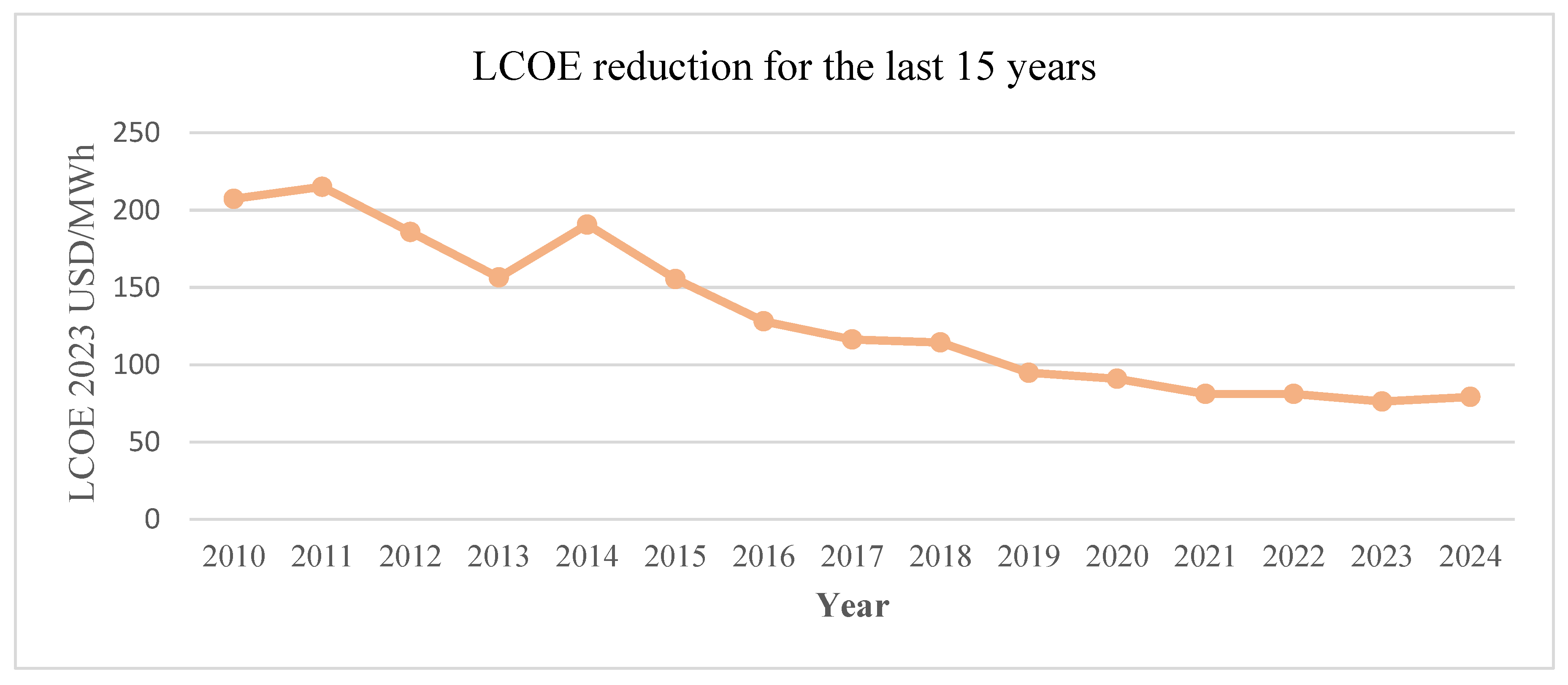
| Offshore Wind LCOE (2023 USD/kWh) | 0.203 | 0.212 | 0.179 | 0.153 | 0.186 | 0.152 | 0.126 | 0.115 | 0.108 | 0.093 | 0.09 | 0.08 | 0.08 | 0.075 |
| Parameter Change | Impact on CAPEX/AEP | LCOE Change | Implication For Turbine Scaling |
|---|---|---|---|
| Steel price +10% | Turbine and foundation CAPEX increase | LCOE +3–4% | Reduces economic advantage of 20 MW turbines |
| Steel price +20% | CAPEX strongly increases | LCOE +6–8% | Optimal turbine size shifts toward 12–15 MW |
| Mean wind speed +10% | AEP increase | LCOE −7–9% | Larger turbines become more favourable |
| Mean wind speed −10% | AEP decrease | LCOE +8–10% | Scaling benefits diminish |
| Vessel day rate +10% | Installation cost increase | LCOE +2–3% | Minor effect on optimal turbine size |
| Vessel day rate +30% | Installation CAPEX rise | LCOE +5–6% | Larger turbines become more attractive (fewer installations) |
| Platform 1 | Platform 2 | Platform 3 | |
|---|---|---|---|
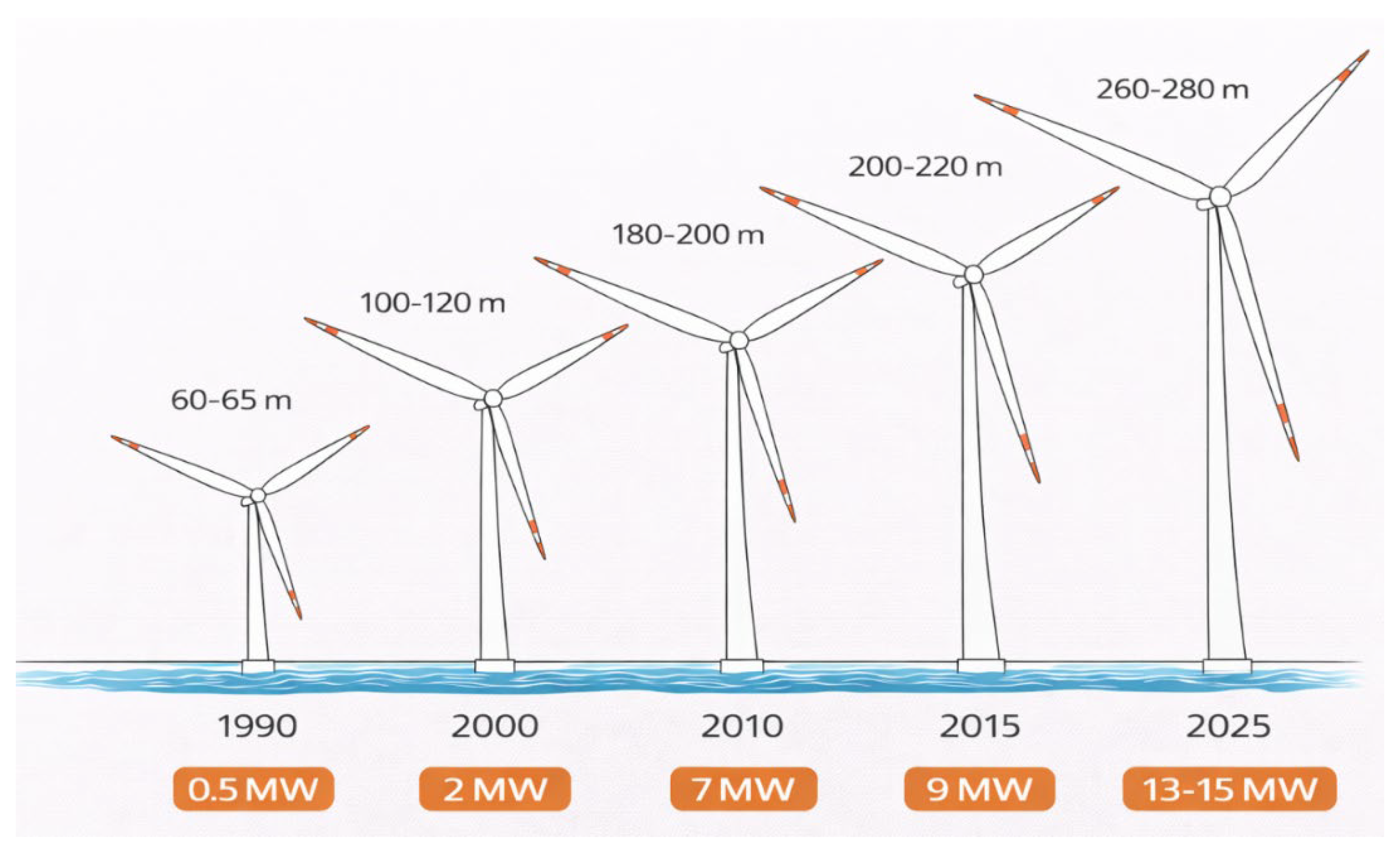
| Period | 1990–2005 | 2010–2018 | 2020–present |
| Rated Capacity (MW) | 0.5–2 | 5–11 | 12–18 |
| Rotor Diameter (m) | 60–80 | 150–170 | 220–240 |
| Hub Height (m) | 50–65 | 105–140 | 130–150 |
| Swept Area (m2) | 2800–5000 | 17,000–25,000 | 38,000–46,000 |
| Drivetrain Type | Geared, asynchronous | Direct-drive or hybrid | Direct-drive (permanent magnet) |
| Foundation Type | Monopile | Monopile, Jacket | XL Monopile, Jacket, Hybrid Floating |
| Energy yield | <5 GWh | 40 GWh | 60–80 GWh |
| Examples: | Bonus 450 kW (Vindeby, 1991), Vestas V66-2.0 MW (Horns Rev 1, 2002) [16,17] | Siemens SWT-6.0-154 (6 MW, direct-drive), MHI Vestas V164-8.0 (8 MW) [18,19,20,21] | GE Haliade-X 12 MW, Siemens Gamesa SG 14-222 DD, Vestas V236-15 MW [22,23] |
| Parameter | 5 MW—NREL OC3/OC4 | 10 MW—DTU FOWT | 15 MW—IEA Wind FOWT | Unit |
|---|---|---|---|---|
| Hub height | 90 | 119 | 150 | m |
| Rotor diameter | 128 | 178.3 | 240 | m |
| Mean wind speed at hub height | 13.0 | 13.5 | 13.9 | m/s |
| Mean generator power | 4.17 | 9.5–10 | 14–15 | MW |
| Mean rotor thrust | 643.6 | 900–1100 | 1600 | kN |
| Blade-root flapwise bending moment | 8.3 × 10⁵ | (1.2–1.6) × 106 | (2.0–2.7) × 106 | Nm |
| Maximum dynamic blade tip deflection | 4.24–5.5 | 6–8 | 22.8 | m |
| Normalised blade deflection (divided by rotor radius) | 0.066–0.086 | 0.076 | 0.19 | — |
| Tower-tip fore–aft displacement | 0.21 | ≈0.35 | ≈0.50 | m |
| Platform surge—mean | 4.5–5.0 | 3–5 | 4–6 | m |
| Platform surge—maximum | 8–10 | 6–9 | 8–12 | m |
| Platform pitch—mean | 4.0–5.0 | 1.5–3.0 | 2.0–4.0 | deg |
| Platform pitch—maximum | 8–10 | 5–7 | 6–10 | deg |
| Simulation software | FAST-v 6.10a-jmj & AeroDyn -v12.58 | HAWC2 | WISDEM and enriched by OpenFAST, HAWC2 | — |
| Wind/wave/TI | 13 m/s/[Hs ~3–5 m, Tp ~10 s [26]]/10–15% (IEC Class) | 11.4 m/s/ Hs ~3–5 m, Tp ~10 s, 7–15% | 10.59 m/s/Hs ~3–6 m, Tp ~10–12 s/TI: 10–15% | — |
| Control settings | Collective pitch PI controller. Variable speed, optimal TSR below rated (λ ≈ 7.55–8) | Collective pitch PI controller. Variable speed, optimal TSR tracking (λ ≈ 7.5) | Collective pitch via ROSCO. Variable speed, optimal TSR below rated (λ ≈ 7.5–8) | — |
| Averaging duration/definition of “mean/max” | 600–1000 s (10–~17 min) simulations, exclude 100–200 s transients | 600–1800 s (10–30 min) simulations | 600–1000 s (10 min standard) | — |
| Parameter | 15 MW | 20 MW (est.) | 25 MW (est.) | Unit |
|---|---|---|---|---|
| Rotor diameter | 240 | 270–280 | 300+ | m |
| Hub height | 150 | 165–175 | 180–200 | m |
| Mean rotor thrust | 1600 | 2000–3000 | 2500–2800 | kN |
| Blade-root bending moment | 2.0–2.7 × 10⁶ | 3.2–3.8 × 10⁶ | 4.5–5.5 × 10⁶ | Nm |
| Nacelle mass | 700–800 | 900–1100 | 1200–1400 | t |
| Installation crane capacity | ~1500 | 2500+ | 3000+ | t |
| Estimated CAPEX change vs. 15 MW | baseline | +6–10% | +15–25% | – |
| Parameter | 15 MW | 20 MW | 25 MW |
|---|---|---|---|
| Rated power (relative) | 1.00 | 1.33 | 1.67 |
| Rotor diameter (relative) | 1.00 | 1.12–1.15 | 1.25 |
| Swept area (relative) | 1.00 | 1.25 | 1.56 |
| Blade mass (est.) | 1.00 | 1.40–1.60 | 1.80–2.10 |
| Root bending moment | 1.00 | 1.45–1.70 | 1.90–2.20 |
| Turbine/Configuration | Support Type | Hub Height [m] | Max. Tower-Tip Displacement [m] | Normalised Deflection [-] | Max Base Bending Moment [MNm] |
|---|---|---|---|---|---|
| NREL 5 MW (No TMD) | Floating—tension-leg platform (TLP) | 90 | 2.050 | 0.0228 | — |
| IEA 15 MW, Baseline without blade-pitch control | Fixed-bottom—monopile | 150 | 0.95 | 0.00633 | 500 |
| IEA 15 MW with blade-pitch control | Fixed-bottom—monopile | 150 | 1.48 | 0.00987 | 720 |
| CAPEX Component | Share of Total CAPEX (%) | Cost Range (USD/kW) | Notes |
|---|---|---|---|
| Turbine (nacelle, rotor, tower) | 35–45 | 900–1200 | OEM supply, ex-works |
| Foundation & substructure | 20–30 | 500–800 | Monopile/jacket, excl. scour |
| Electrical infrastructure (array + export cable + substation) | 15–20 | 400–600 | Offshore + onshore substation |
| Installation & logistics | 8–15 | 200–400 | Vessel day-rates sensitive |
| Development & project management | 5–8 | 100–200 | Permitting, engineering |
| Contingency & insurance | 3–5 | — | Risk-dependent |
| Period | Turbine Rating (MW) | Baseline CAPEX (€M/MW) | Baseline LCOE (€/MWh) | Structural Vibration Issues | Mitigation Strategy | DEL Reduction (%) | Fatigue Life Impact (%) | Indicative LCOE Impact [5] |
|---|---|---|---|---|---|---|---|---|
| Early 2000s | 2–3 | >4.0 | >150–180 | Limited tower–blade coupling, conservative design margins | Passive structural damping | 2–5 | 3–8 | <1 |
| 2010s | 6–8 | 2.8–3.0 | <100 | Increased tower height and side to side vibrations, fatigue-driven design | Passive TMD (tower or nacelle) | 5–10 | 8–10 | 1–2 |
| 2010s | 6–8 | 2.8–3.0 | <100 | Variable operational conditions, multiple vibration modes | MR-based, Semi-active TMD/TVA | 8–12 | 10–18 | 1–3 |
| 2020s | 12–15 | 2.0–2.5 | 50–70 | Strong aero-hydro-servo-elastic coupling, wave–wind interaction | Passive TMD (optimised) | 5–10 | 8–15 | 1–2 |
| 2020s | 12–15 | 2.0–2.5 | 50–70 | Multi-mode vibration, narrow design margins | MR-based, Semi-active TMD/TVA | 8–15 | 12–20 | 1–3 |
| 2020s (Floating) | 10–15 | 3.0–4.5 | 80–120 | Platform tower coupling, low-frequency resonance | MR-based/hybrid TMD/TVA | 10–18 | 15–25 | 2–4 |
| Aspect | Passive TMD/TVA (Reference) Simulation [55] Experiment [53] Experiment [56] | H-MR-TVA Simulation [55] | H-MR-TVA Scaled Land-Based Experiment [53] | H-MR-TVA Scaled Monopile-Supported Experiment [56] | Key Implication |
|---|---|---|---|---|---|
| Absorber mass | 20 t | 10 t (−50%) | — | — | Significant top-mass reduction |
| 13.7 t | — | 13.7 t | — | Significant efficiency gain | |
| 34 t | — | — | 34 t | ||
| Control strategy | Passive, fixed tuning | Hybrid (H-MR-TVA) | Real-time adaptability | ||
| Maximum tower deflection (aligned) | Baseline | −11% | −57% (steady-state harmonic) | −47% (steady-state harmonic) | Superior maximum response mitigation |
| Maximum tower deflection (misaligned) | Baseline | −4.3%/−4.8% (45°/90°) | Robust under multidirectional loading | ||
| RMS tower deflection (aligned) | Baseline | −4.2% | — | −41% | Improved fatigue-related performance |
| TVA stroke demand | High | −18.6% (aligned), −22.2%/−34.4% (misaligned) | +22% (steady-state harmonic) | +1.9% (steady-state harmonic) | Controlled space and mechanical limits |
| Overall efficiency | Mass-dependent | Control-dominated | Control-dominated performance, partially decoupled from mass | ||
| Parameter | 15 MW (Base) | 20 MW (k ≈ 1.155, D ≈ 277 m, Blade Length ≈ 135 m) | 25 MW (k ≈ 1.291, D ≈ 310 m, Blade Length ≈ 151 m) |
|---|---|---|---|
| Blade Mass (~D3) | 65 t | 65 × (1.155) 3 = 100 t | 65 × (1.291) 3 = 140 t |
| Blade-Root Bending Moment (~D3) | 180 MN·m | 180 × (1.155) 3 = 277 MN·m | 180 × (1.291) 3 = 387 MN·m |
| Nacelle Mass (~D3, approximate) | 821 t | 821 × (1.155) 3 = 1265 t | 821 × (1.291) 3 = 1770 t |
Disclaimer/Publisher’s Note: The statements, opinions and data contained in all publications are solely those of the individual author(s) and contributor(s) and not of MDPI and/or the editor(s). MDPI and/or the editor(s) disclaim responsibility for any injury to people or property resulting from any ideas, methods, instructions or products referred to in the content. |
© 2026 by the authors. Licensee MDPI, Basel, Switzerland. This article is an open access article distributed under the terms and conditions of the Creative Commons Attribution (CC BY) license.
Share and Cite
Martynowicz, P.; Ślimak, P.; Kumsa, D.K. Advancing Offshore Wind Capacity Through Turbine Size Scaling. Energies 2026, 19, 1625. https://doi.org/10.3390/en19071625
Martynowicz P, Ślimak P, Kumsa DK. Advancing Offshore Wind Capacity Through Turbine Size Scaling. Energies. 2026; 19(7):1625. https://doi.org/10.3390/en19071625
Chicago/Turabian StyleMartynowicz, Paweł, Piotr Ślimak, and Desta Kalbessa Kumsa. 2026. "Advancing Offshore Wind Capacity Through Turbine Size Scaling" Energies 19, no. 7: 1625. https://doi.org/10.3390/en19071625
APA StyleMartynowicz, P., Ślimak, P., & Kumsa, D. K. (2026). Advancing Offshore Wind Capacity Through Turbine Size Scaling. Energies, 19(7), 1625. https://doi.org/10.3390/en19071625