1. Introduction
The maritime industry is on the verge of significant changes that will transform the sector in the coming years. Driven by an increasingly pressing regulatory environment aimed at reducing greenhouse gas (GHG) emissions, the transition to a net-zero emissions framework is underway. The revised IMO GHG Strategy adopted in July 2023 (Resolution MEPC.377(80)) introduced a target whereby zero- and near-zero-emission fuels, energy sources, and technologies should contribute at least 5–10% of the total energy demand of international shipping by 2030. The strategy sets an objective of achieving net-zero GHG emissions from international shipping by or around 2050. In addition, it recalls the 2018 Strategy and may be replaced in the future by an updated IMO GHG Strategy in 2028 [
1,
2]. Key mechanisms, including the EU Emissions Trading System (EU ETS), FuelEU Maritime, and the IMO’s Net-Zero Framework (NZF), have emerged as policy instruments.
Among the various alternatives and solutions, Onboard Carbon Capture and Storage (OCCS) appears to be a vital option for reducing emissions and promoting the development of a green supply chain within the shipping industry. Ιt is expected that fossil-based fuel vessels will remain in use until the net-zero target is achieved in 2050 [
3]. OCCS seems to be one of the most promising short-term solutions for reducing emissions from the existing fleet of ships that run on conventional marine fuels. Although studies indicate that the technology can be safely applied to ships, it still requires further development and optimization before it can be used and integrated into shipping. Furthermore, wider application also depends on its commercial competitiveness compared to other decarbonization options. In general, OCCS might be a commercially attractive solution in cases of high capture rates, low fuel costs, and low CO
2 storage costs [
4]. Even though carbon capture technology is advanced, there are still significant risks that need to be dealt with before a large-scale commercial application on board a vessel. The main risks include additional energy demand onboard, potential cargo loss, delays in developing a regulatory framework or market for acquiring credits for CO
2 reduction, and a lag in onshore infrastructure development [
3].
Although the integration of an OCCS system alters the ship’s energy balance, its impact should be assessed in terms of overall carbon efficiency per unit of transport work, not just fuel consumption. Despite the fact that the process of capturing and managing CO2 entails additional energy demand, the substantial reduction in net emissions leads to an improvement in carbon intensity indicators, shifting the focus from fuel efficiency to carbon efficiency. The possibility of thermodynamic integration with heat recovery and boil-off gas management systems in LNG carriers allows for partial compensation of the energy load, thereby enhancing the ship’s overall exergy utilization. Under this approach, OCCS is not simply an additional emission control technology, but a mechanism for reorganizing energy and environmental performance, where optimization is defined in terms of net CO2 emissions per transport service and not exclusively in terms of specific fuel consumption.
Despite the obvious environmental benefits, the sustainability of implementing OCCS solutions on ships, taking into account the quantification of all current legislation in economic terms, has not been adequately evaluated in existing literature. The aim of this research study is to conduct a comparative techno-economic and regulatory compliance assessment of an LNG carrier operating with and without OCCS. A technical analysis is carried out for both cases, based on calculations of fuel consumption and emissions. The existing legislation for the EU ETS, FuelEU Maritime, and the IMO NZF framework has been reviewed, and the corresponding penalties for each case are calculated in accordance with the respective consumption and emission profiles. In order to assess the economic viability of the OCCS investment, key financial indicators are calculated, including the discounted payback period, Net Present Value (NPV) and Internal Rate of Return (IRR).
The rest of this paper is organized as follows:
Section 2 outlines the current legislation at the international and European levels.
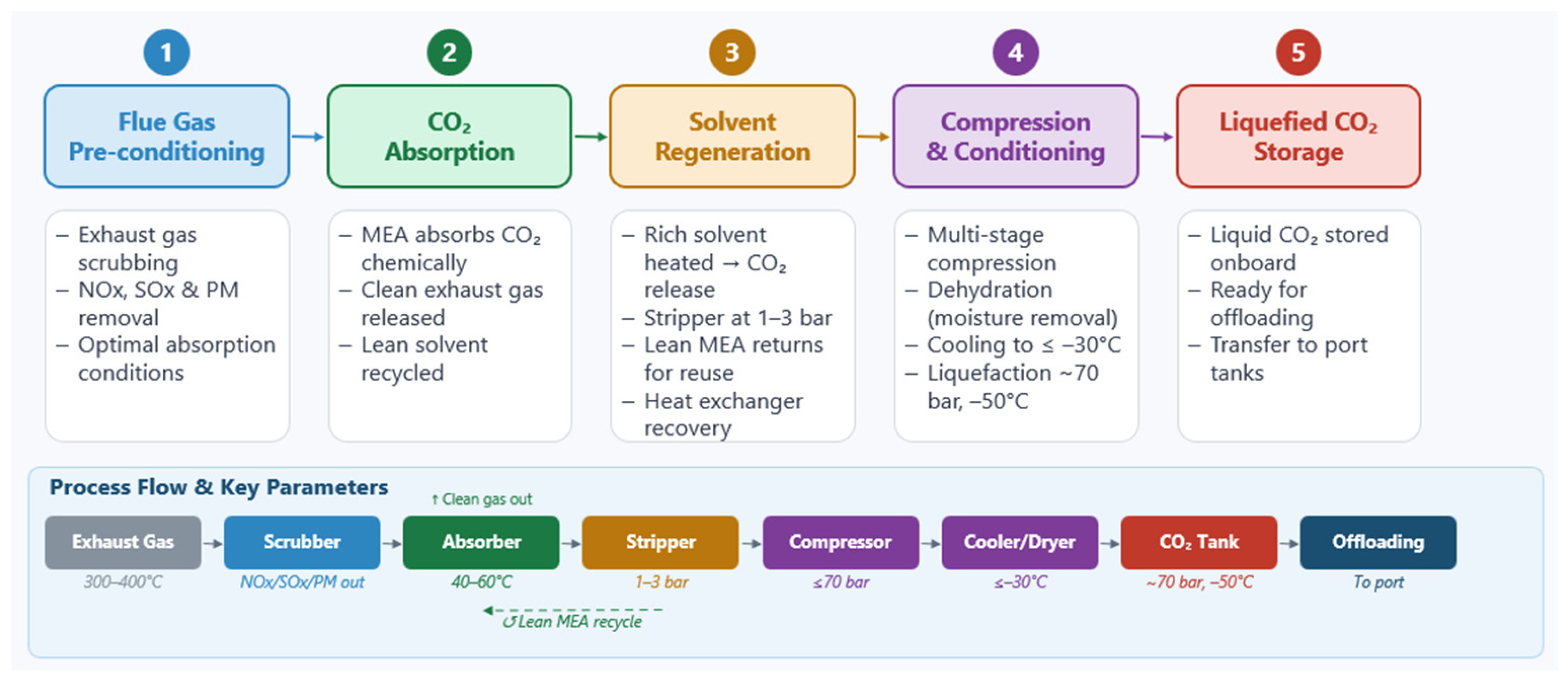
Section 3 provides a brief description of the onboard carbon capture system and summarizes relevant case studies from the literature. The examined case study and the methodological approach are presented in
Section 4. The results of the economic evaluation are set out in
Section 5, with the conclusions coming in
Section 6.
2. Regulations Background
Since 2018, the International Maritime Organization (IMO) has been contributing to the global effort to address climate change by adopting strategies to reduce GHG emissions from ships. The latest, 2023 IMO GHG Strategy, includes the use of zero- or near-zero GHG-emission technologies, fuels, and energy sources for at least 5–10% of the energy consumed by international shipping by 2030. GHG emissions from international shipping should become net 0 by or around 2050. By 2030, the international shipping sector must set an average reduction in carbon intensity by at least 40%. These targets were operationalized by introducing short-term measures, effective from January 2023, including the Energy Efficiency Existing Ship Index (EEXI) and the Carbon Intensity Indicator (CII) rating system. All ships that are subject to the IMO’s Data Collection System (DCS) must develop and maintain a detailed energy efficiency plan that is tailored to their CII performance. In general, the 2023 Strategy outlines the timeline for adopting the package of measures and the updated IMO GHG Strategy for 2028 [
5].
As part of its wider decarbonization programme, the IMO has introduced the Net-Zero Framework (NZF), which includes two key regulatory instruments: the Global Fuel Standard (GFS) and the Global Economic Measure (GEM). The GFS requires ships to progressively reduce their annual GFI, defined as the amount of greenhouse gas emissions generated per unit of energy consumed, using a well-to-wake accounting approach. Vessels that exceed their allowable GFI thresholds will be required to purchase ‘remedial units’ to offset their excess emissions. Conversely, ships operating below the Direct Compliance Target will be eligible to generate ‘surplus units’. In order to facilitate this credit-based mechanism, the IMO intends to set up the IMO Net-Zero Fund [
6].
The MEPC (Marine Environment Protection Committee) is the IMO’s main body responsible for dealing with the environmental impact of international shipping, particularly with regard to pollution control and climate change mitigation. At MEPC 83, amendments to MARPOL (MARitime POLlution Convention) Annex VI were agreed to strengthen regulatory flexibility for the implementation of fuel- and technology-based emission reduction strategies. As part of the efforts to reduce carbon intensity, MEPC 83 set annual CII reduction factors for the period 2027–2030. These factors apply to liquefied natural gas (LNG) carriers with a Gross Register Tonnage (GRT) above 5000, and the targets will gradually increase from 13.625% in 2027 to 21.500% in 2030. The overall objective of the NZF package is to facilitate the progressive reduction of GHG emissions from international shipping at the earliest possible time, and this objective aligns with the emission reduction pathways set out in the IMO’s 2023 strategy [
7].
Furthermore, in 2021, the European Commission (EC) introduced the ‘Fit for 55’ legislative package, which affects the shipping sector through the EU ETS. According to the EU ETS, shipping companies are required to Monitor, Report, and Verify (MRV) the carbon dioxide (CO
2) emissions produced by their vessels during designated voyages [
8]. The FuelEU Maritime Regulation operates as a central pillar of the Fit for 55 package. The main objective for vessels exceeding 5000 GT is to control their emissions by setting progressive limits on GHG intensity in ship energy use, effective from 1 January 2025. A penalty (FuelEU Penalty) is calculated based on the amount of non-compliant VLSFO, in grams of CO
2 equivalent (gCO
2eq) [
9].
5. Results
The economic viability of OCCS across the vessel’s lifespan is influenced by the vessel’s operating characteristics, such as time at sea, engine running hours, and load profiles for both the main and auxiliary engines. Key input parameters such as LNG prices and CAPEX for OCCS equipment may vary significantly over time.
Table 3 provides a breakdown of the CAPEX from the manufacturer and shipyard, as supplied by a shipping company. The values for the loan-to-investment ratio and interest rates were selected as they are standard figures commonly used in maritime industry investments.
For the purposes of this case study, it is assumed that annual inflows are generated from the sale of captured CO
2. The equation used to calculate the total yearly inflow from captured CO
2 is:
For the calculations, it has been considered that the yearly GHGI of the vessel is 81.4 gCO
2 eq/MJ, as it has been calculated previously, without following IMOs 2024 Guidelines because as mentioned by IMO the term eoccs will need “further methodological guidance to be developed by the Organization” [
5].
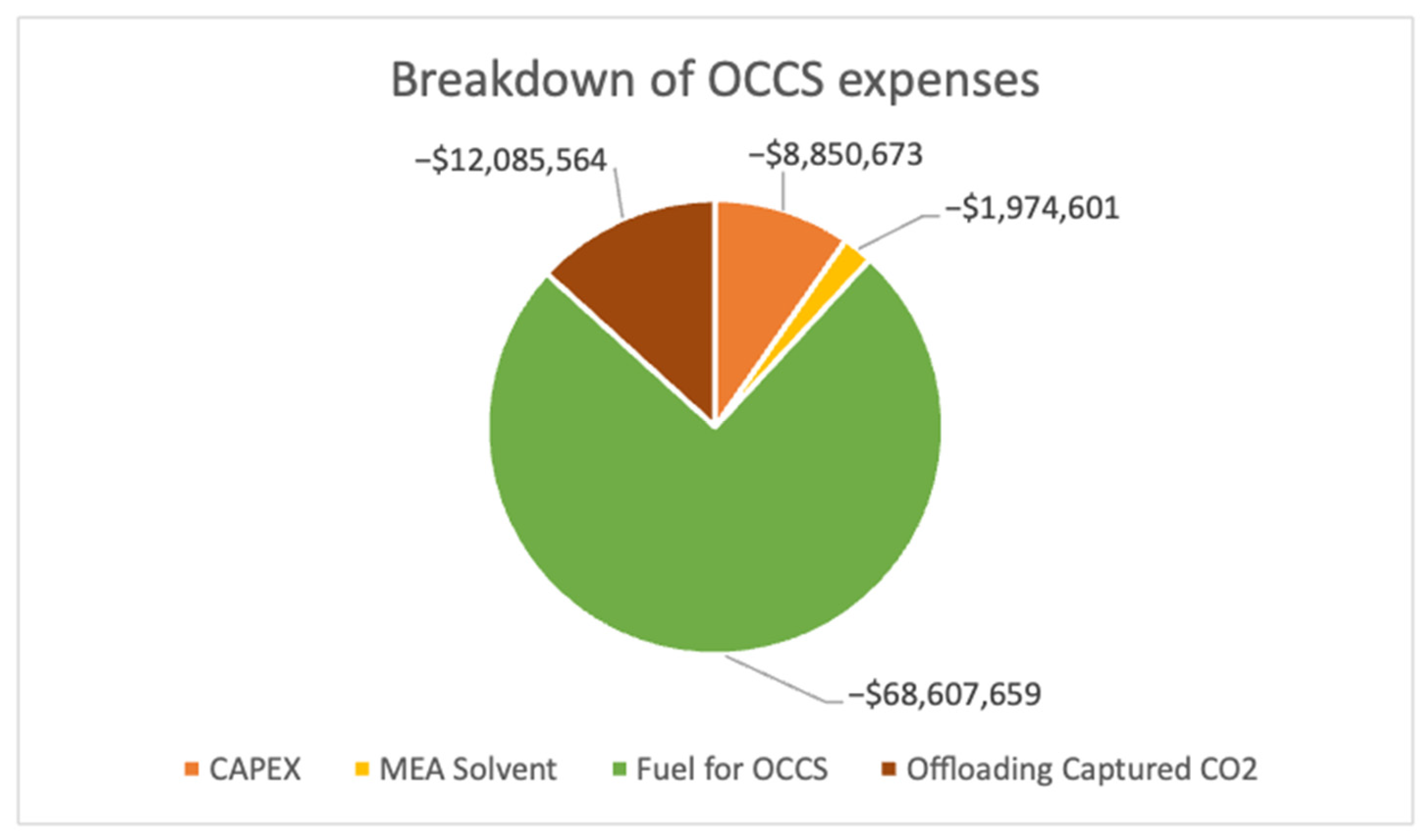
Operational Expenditures (OPEX) in the 2nd Case differentiate by including the MEA solvent cost, the additional fuel needed for OCCS and the offloading cost for captured CO
2 (
Figure 3).
For the MEA solvent yearly expenses, the following equation has been adopted:
For the MEA price, an average value based on North American (USD 1.3/kg) and European market (USD 1.4/kg) data for 2025 was considered [
35]. The scenario of a 1% increase is applied for subsequent years, in line with the approach used for other projected price increases. For MEA consumption, the Filling Amount for MEA and Number of exchanges due to Degradation, the manufacturer’s estimation is applied as follows: MEA solvent consumption: 1.5 kg/t, Filling amount for MEA solvent—Solvent mass flow (30% MEA): 68 t and two exchanges due to degradation per year. In addition, the estimated annual depreciation rate of 1% is taken into account when calculating economic feasibility.
The additional fuel needed for OCCS is calculated by the following adopted equation:
where P is the Bunkering price calculated as an average of the fuel prices in Houston and Rotterdam for each fuel in early 2025 (for LSMGO USD 741/t and for LNG USD 827/t) [
36], g is the annual growth rate for the 1% scenario and C is the additional consumption that the vessel has due to OCCS (
Table 4).
For offloading costs, the following equation is adopted:
The analysis shows that most operating costs result from increased fuel consumption driven by the energy requirements of the OCCS. Costs relating to the management of captured CO
2, such as offloading and solvent consumption, represent a smaller percentage of total OPEX. This observation is consistent with existing literature, which emphasizes that the energy penalty is the primary cost factor for carbon capture systems, whereas CO
2 management costs are comparatively lower [
38].
Based on the above input data and including a charter rate of USD 34,000/day [
39] for the examined voyage, the Net Present Value (NPV) for the 2nd Case appears to be negative, −USD 184,251.435.
As mentioned previously, the term e
occs plays a crucial role in determining the final results. The resolution of the MEPC.391(81) adopted on 22 March 2024, states that the Tank-to-Wake Greenhouse Gas Intensity should be calculated as follows:
where
is the Greenhouse Gas Intensity value with the same methodology as previously,
= 0, the emissions credits haven’t been generated by biomass growth and
= 0, the emissions credits from the used captured CO
2 as carbon stock will not produce synthetic fuels. In this study, the S
FC and S
FCCU parameters are set to zero because the system under consideration is based on the combustion of fossil LNG, and the captured CO
2 is not used to produce synthetic fuels or other products. These conditions mainly apply to biogenic carbon or carbon capture and utilization processes, as noted in the relevant literature on the calculation of emissions in CCS/CCU systems [
40]. As a result, the formula can be written as follows:
Up to date no official framework or standardized approach has been established for calculating the
eoccs variable. The objective of this approach (Case 3) is to demonstrate how
eoccs could contribute to reducing the well-to-wake greenhouse gas intensity (GHGI) and, consequently, the associated IMO NZF penalties (
Table 5). This will provide shipowners with tangible benefits if they implement OCCS technologies on their vessels. An attempt is made to determine the coefficient
eoccs in an objective and easily calculable manner, accounting for the ratio of emissions from installing the OCCS to the corresponding fuel consumption.
Table 5 illustrates how this proposal was implemented. The results of the new GHGI calculation are significantly lower than those of previous calculations, reflecting the real benefit of reducing emissions through the installation of OCCS.
The obtained results resonate with a corresponding study by IMO in MEPC 83-INF.9 [
7] with a baseline GHG intensity of 69.9 gCO
2eq/MJ for methanol and 79.3 gCO
2eq/MJ for HFO. When OCCS is integrated, the study similarly reports reductions to 45.3 gCO
2eq/MJ and 51.7 gCO
2eq/MJ. In this particular case, with GHGI
TtW 2024 Guidelines 26.05 gCO
2eq/MJ, the NPV is positive at USD 13,443,693, the Internal Rate of Return (IRR) is 81.73%, and the payback period is 3 years.
Sensitivity Analysis: Fuel Cost
The largest component of the OCCS operational expenditures is attributed to the additional fuel required for its operation. This sensitivity analysis examines the impact of variations in the annual fuel price growth rate on the financial indicators obtained in the 3rd Case. Although global energy market forecasts often report higher compound annual growth rates (CAGR), particularly for LNG when examined as a traded commodity, the long-term price growth of marine fuels typically evolves more gradually. This is due to sector-specific constraints, including regulated fuel specifications, supply chain inertia, competition in the bunker market, and limited short-term demand elasticity.
For LNG, the selected values of 2.5% (pessimistic scenario), 1.5% (central scenario), and 1.0% (optimistic scenario) are conservative and operationally relevant price-growth trajectories. LNG prices do not necessarily follow the CAGR of basic commodities, as they are significantly influenced by long-term contracts, infrastructure bottlenecks, regional market segmentation, and price-formation mechanisms unrelated to pure demand growth. For the LSMGO, the selected growth rates of 1.5% (pessimistic scenario), 1.0% (central scenario), and 0.5% (optimistic scenario) reflect the anticipated long-term stabilization of marine fuel prices derived from petroleum as the sector gradually transitions to low-carbon alternatives. By selecting these moderate and differentiated CAGRs, the sensitivity analysis captures a realistic range of fuel-price pathways faced by LNG carriers over multi-decade horizons.
Table 6 presents the results of the sensitivity analysis, which show that they are similar to the initial calculations, except for the pessimistic scenario, where the results are negative, as expected.
6. Discussion
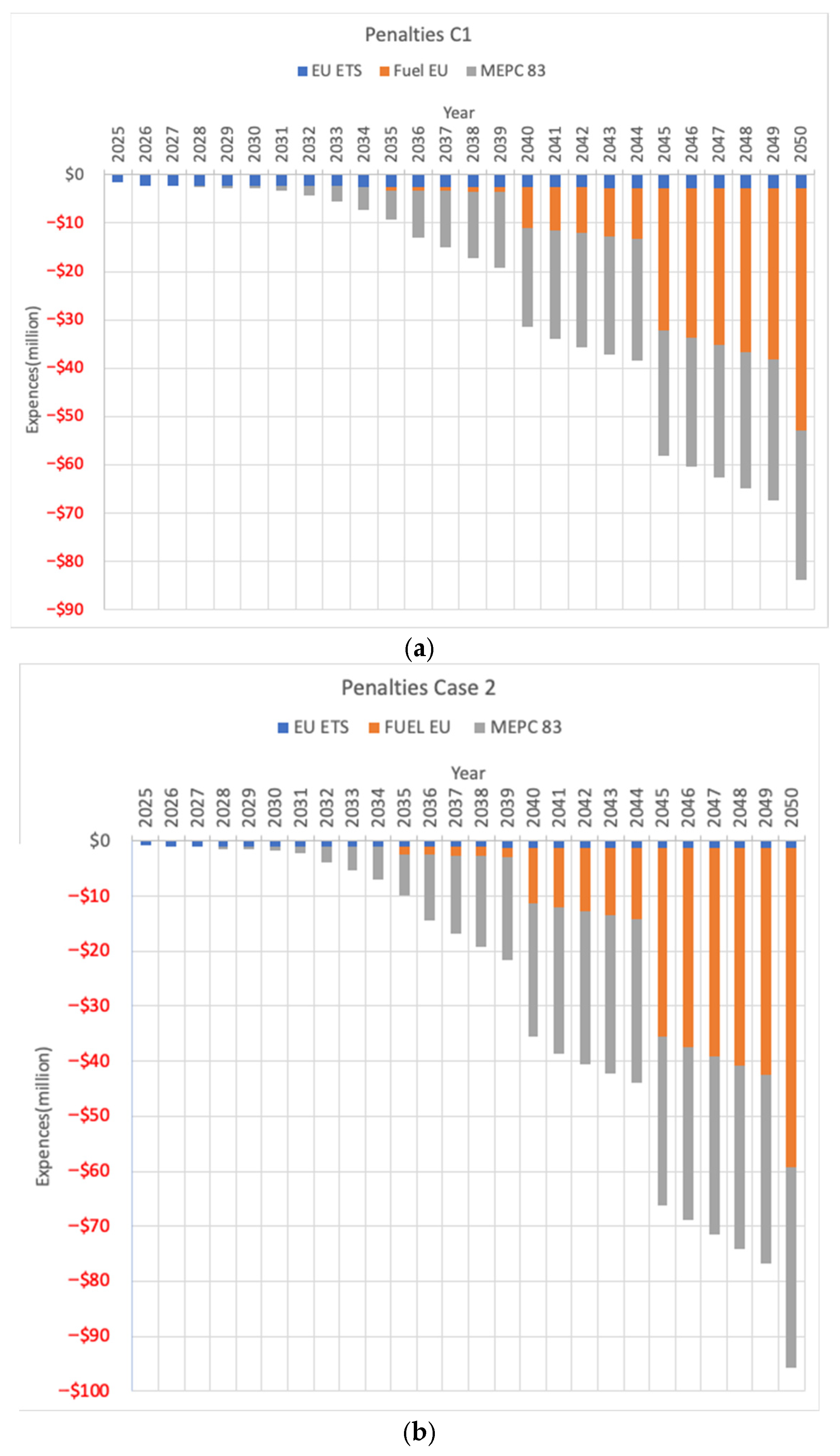
The aim of this research was to conduct a comparative techno-economic and regulatory compliance assessment of an LNG carrier operating with and without OCCS. A technical analysis was carried out for both cases, resulting in the calculation of fuel consumption and emissions for Case 1 (without OCCS) and Case 2 (with OCCS). Existing legislation for the EU ETS, FuelEU Maritime, and the IMO NZF framework has been reviewed, and the corresponding penalties for each case were calculated based on their respective consumption and emission profiles.
EU ETS penalties are applied based on emissions, whereas FuelEU Maritime and IMO NZF penalties are applied by placing the primary emphasis on fuel consumption and determining emissions solely through fuel CO2 emission factors. Therefore, while the outcome of OCCS is desirable, the way these penalties are calculated results in disproportionate penalties for OCCS, since the system increases fuel consumption despite substantially lowering net emissions.
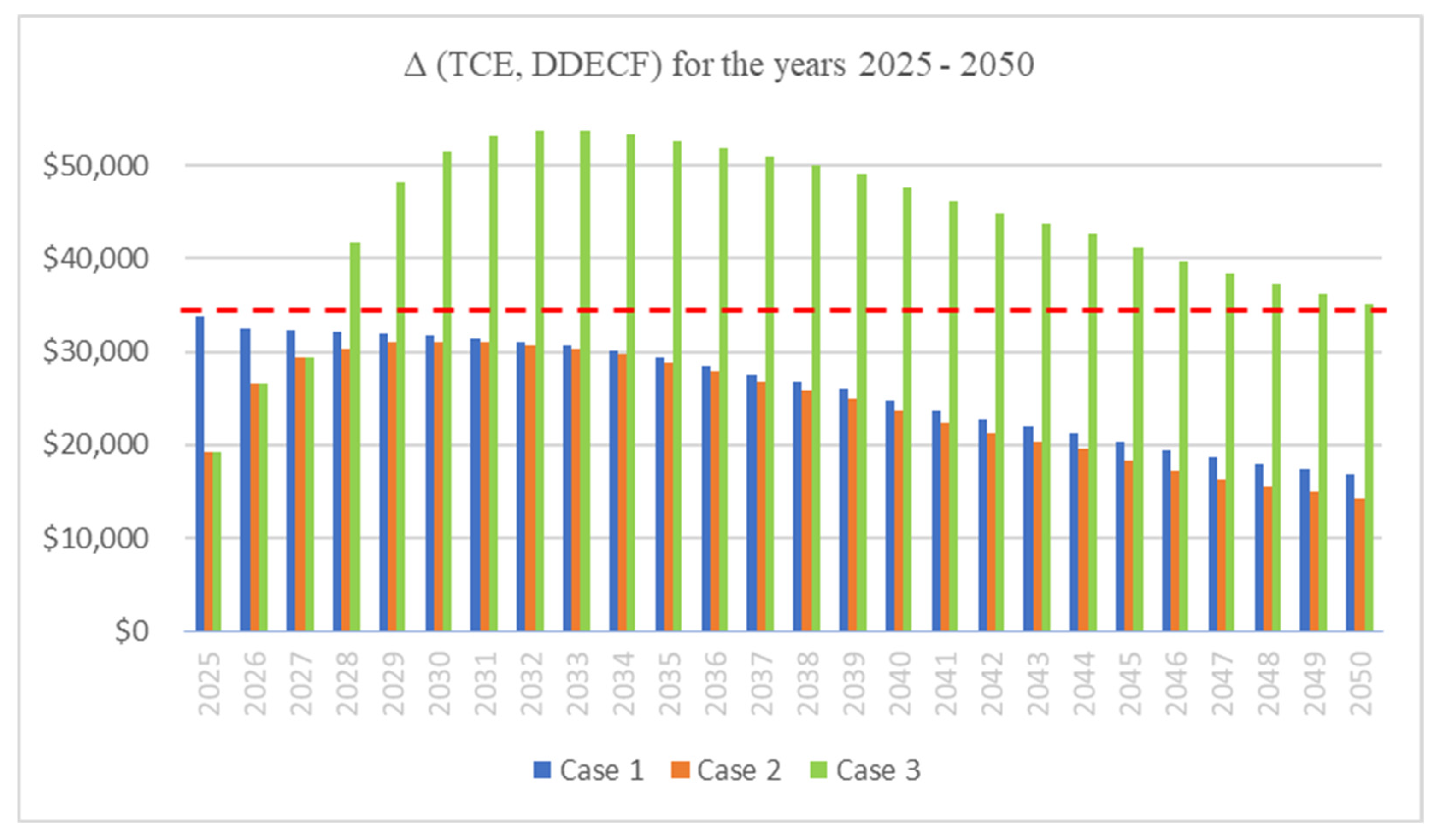
To assess the impact of regulatory penalties, this study introduces the concept of daily Discounted Equivalent Cash Flow (here called: DDECF). This index enables a direct comparison to be made between the cost of penalties and the Time Charter Equivalent (TCE) of the ship for the examined route. The difference between this index and the benchmark TCE value of USD 34,000, called Δ(TCE, DDEFC) here, indicates that the penalties are already financially unsustainable for the vessel in Case 1, and that they would be even more so in Case 2. Furthermore, an additional analysis was performed using the 2024 IMO guidelines (Case 3), which propose a method for adjusting the GHGI by crediting vessels equipped with OCCS with a reduction equal to eoccs/LCV. Although the guidelines do not specify how eoccs should be calculated, this analysis considered an assumption and a methodological proposal.
The Δ(TCE, DDECF) results presented in
Figure 4, reflect the substantial financial burden imposed on the operator by the penalties, which could reach up to 50% of the TCE by the year 2050. In Case 2, the Δ value worsens rather than improves, reflecting the increased penalties associated with increased consumption caused by the OCCS unit. By contrast, Case 3 shows that if the proposed IMO guidelines are adopted as regulations, the operator would benefit from clear financial incentives to adopt OCCS.
Applying OCCS to the examined LNG carrier increased total fuel consumption by 16%. However, as noted in
Section 3.2, the optimized thermal integration of the OCCS with the ship’s energy systems is under research, through the utilization of waste heat, for example, from the auxiliary engines, as investigated by Wohtlan et al. [
21]. Furthermore, using advanced solvents or solvent mixtures, such as AMP-PZ blends instead of conventional MEA, can reduce thermal requirements and lower energy consumption in the OCCS studied by Jeong et al. [
15].
These results, combined with the absence of targeted funding for the integration of carbon capture systems and other decarbonization technologies on ships, prevent operators from aligning with the IMO’s NZF’s interim targets for 2050. Despite their commitment to decarbonization and the global green transition, operators are unable to contribute constructively. It is important to recognize that, beyond regulatory and financial considerations, major technological transitions in the maritime sector inherently require long timeframes. Notable examples include LNG, which took approximately 40–60 years to evolve from a specialized traded commodity into a widely used marine fuel supported by established infrastructure in major global ports.
Despite the comprehensive regulatory and financial assessment, the study is subject to certain limitations. The analysis is based on specific assumptions about future fuel prices, emission allowances, and technological costs up to 2050. Furthermore, the assessment was carried out based on the operating profile of the LNG carrier, which may not fully reflect the variability of other actual operational scenarios.
7. Conclusions
In conclusion, although OCCS is a highly promising solution for decarbonizing the maritime industry, it is not currently economically feasible. Current EU and IMO policies tend to prioritize e-fuels, even though large volumes of these fuels are not yet available for shipping and zero-emission fuels currently represent only a very small proportion of the global marine fuel mix. The future viability of OCCS depends on clear regulatory guidelines and effective incentives that reward early adopters while offsetting investment and operational costs. As new regulatory frameworks emerge, this study provides a baseline for evaluating future technological and legislative developments, supporting informed decision-making as the industry transitions towards net zero.
Furthermore, the potential widespread application of OCCS must overcome two more challenges. One issue is that ports are hesitant to invest in the necessary unloading infrastructure until a sufficient proportion of ships are fitted with carbon capture technology. On the contrary, shipowners are reluctant to install OCCS systems on their ships until robust and reliable unloading infrastructure has been established in ports.
The current analysis was based on the vessel’s annual operational profile, derived from actual voyage data from the previous year. However, ship operations are typically characterized by dynamic changes in main engine load. These changes occur during manoeuvres, port stays, or changes in weather conditions, and will directly affect CO2 capture efficiency. Investigating the dynamic operation of OCCS systems under variable conditions could be the subject of future research.
The attempt to determine the term eoccs into the GHGITtW calculation highlights a fundamental methodological issue: the incomplete recognition of carbon capture at the ship level by current emission intensity indicators. Although this study is based on the well-to-wake emissions intensity indicator in accordance with the current regulatory framework, integrating a comprehensive, process-based life cycle assessment (LCA) could provide a deeper understanding of the overall environmental impact of OCCS. In particular, an expanded LCA would allow for the assessment of emissions associated with the manufacture and replacement of equipment, the production and regeneration of solvents, and the transport and final storage or utilization of captured CO2. Furthermore, comparing regulatory WtW factors with analytical LCA data could reveal discrepancies in system boundaries and emission allocation methods. Such an approach for future research will provide a coherent basis for the overall assessment of OCCS at the value chain level and will support the development of technology-neutral and environmentally consistent regulatory mechanisms.