

An Energy-Efficient Control Allocation Strategy for PTC Heater-Based Electric Vehicle Cabin Thermal Management



Abstract
1. Introduction
2. HVAC and Cabin System Model
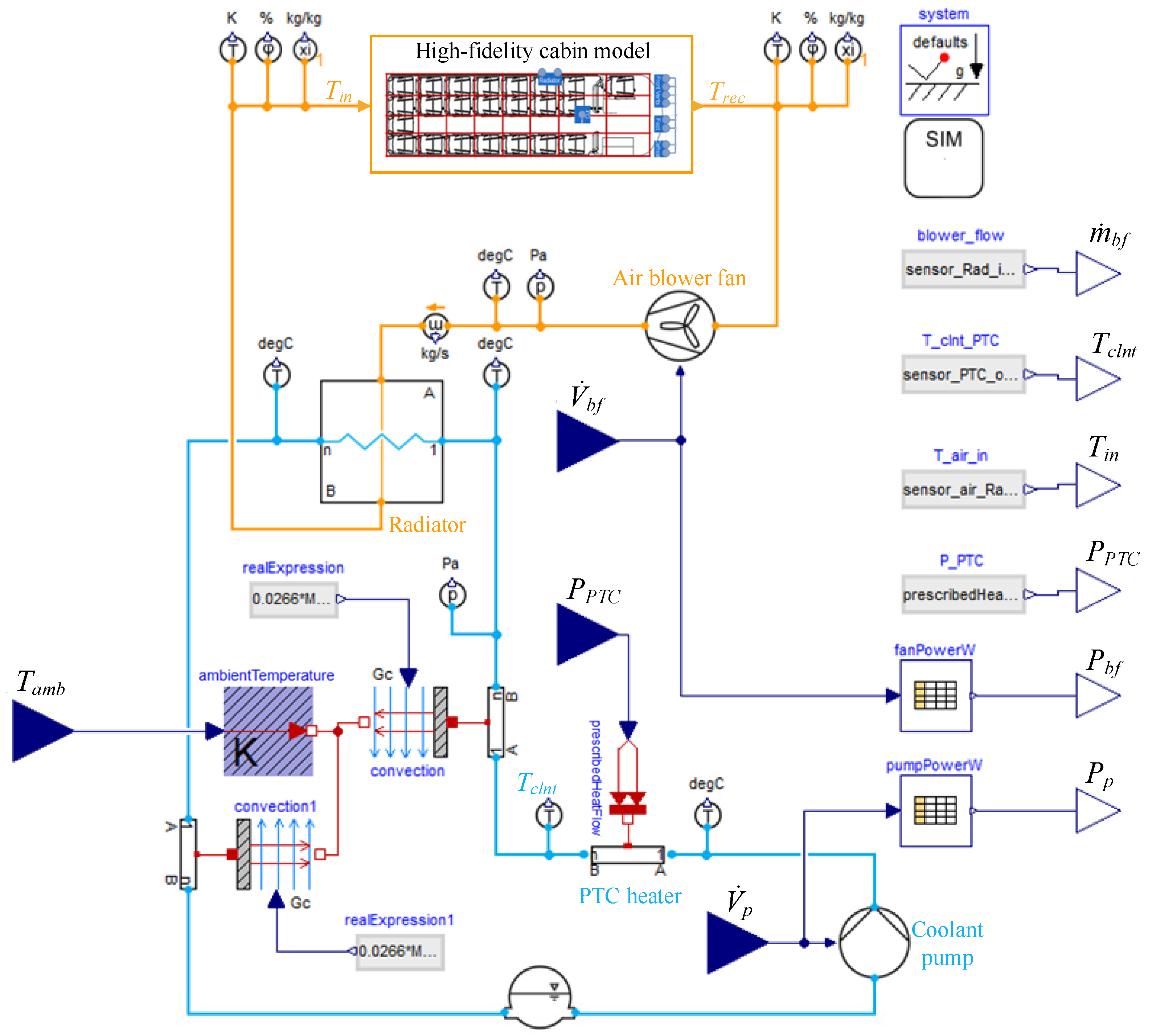
2.1. High-Fidelity Model
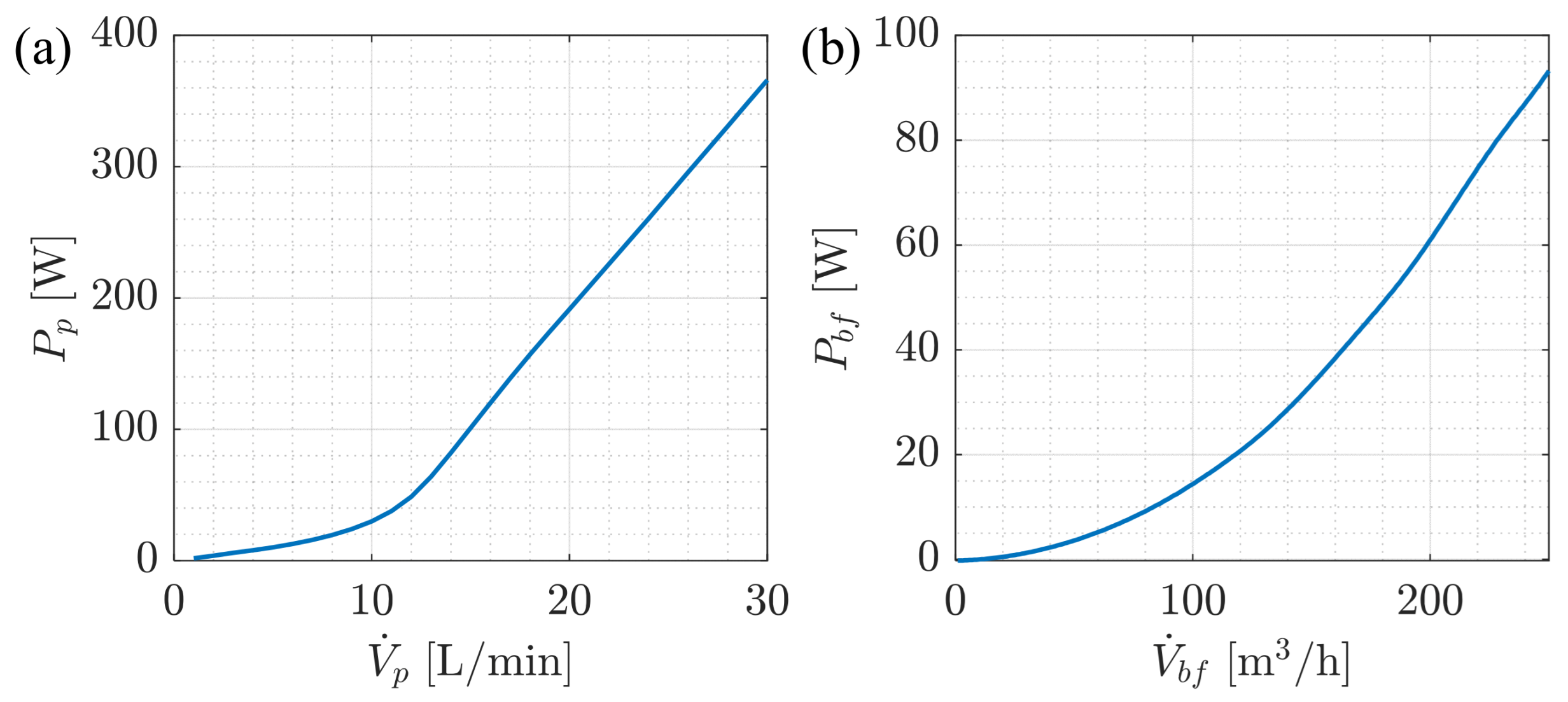
2.1.1. HVAC Model
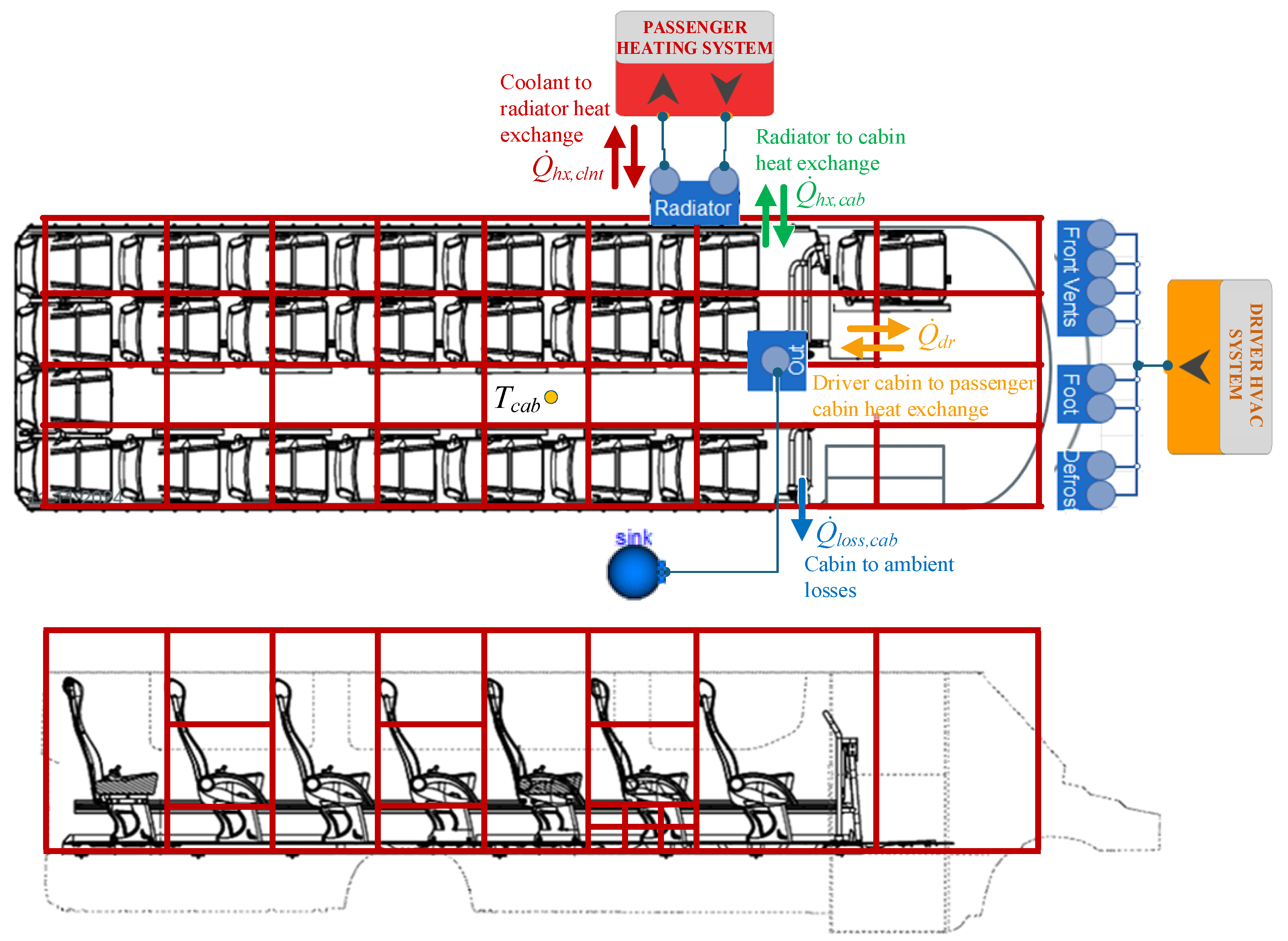
2.1.2. Cabin Model
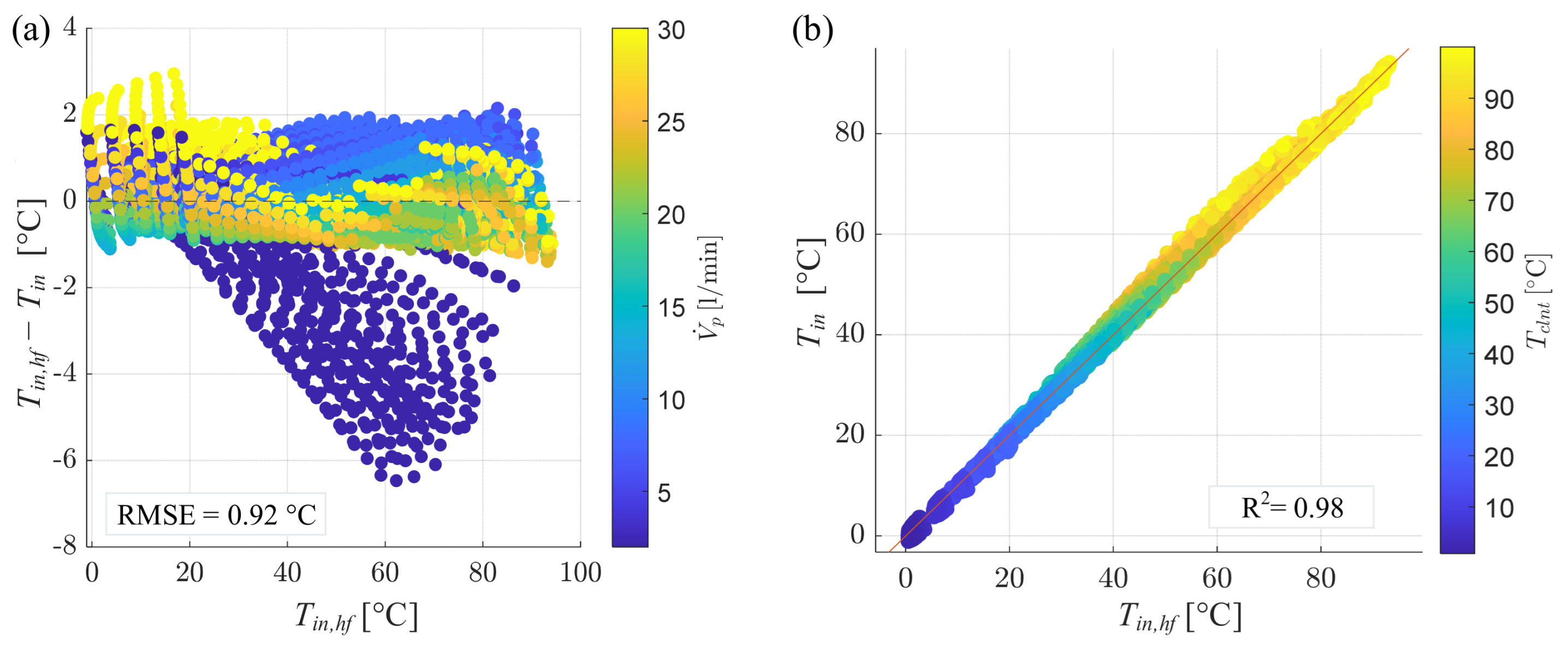
2.2. Reduced-Order Model
3. Control Trajectory Optimization
3.1. Optimization Problem Formulation
3.2. Optimization Results
4. HVAC Control
4.1. Overview of Control System Structure
4.2. Optimal Control Allocation Maps
4.2.1. Optimization Dataset
4.2.2. Optimization
| Algorithm 1. Grid-Search Algorithm |
| FOR each cabin temperature : |
| • From dataset build linear interpolant functions of output allocation variables: |
| FOR each target heating level W: |
| Inf //Initializing optimal/minimal power consumption |
| FOR each point in : |
| • Find that minimizes |
| • Check if point satisfies: |
| • |
| • |
| • |
| IF point satisfies constraints AND |
| • |
| • Store |
| IF no feasible point is found: //Find feasible point minimizing |
| = Inf //Initialization |
| FOR each point in : |
| FOR grid |
| • Check feasibility |
| • |
| • |
| • Evaluate |
| • IF point is feasible AND |
| • |
| • Store |
4.2.3. Control Allocation Maps
4.3. Low-Level Control
4.3.1. HVAC System Model
4.3.2. Controller Tuning and Verification
4.3.3. Coolant Temperature Safety Mechanism
4.4. Control Trajectory Optimization-Inspired Rule-Based Control Strategy
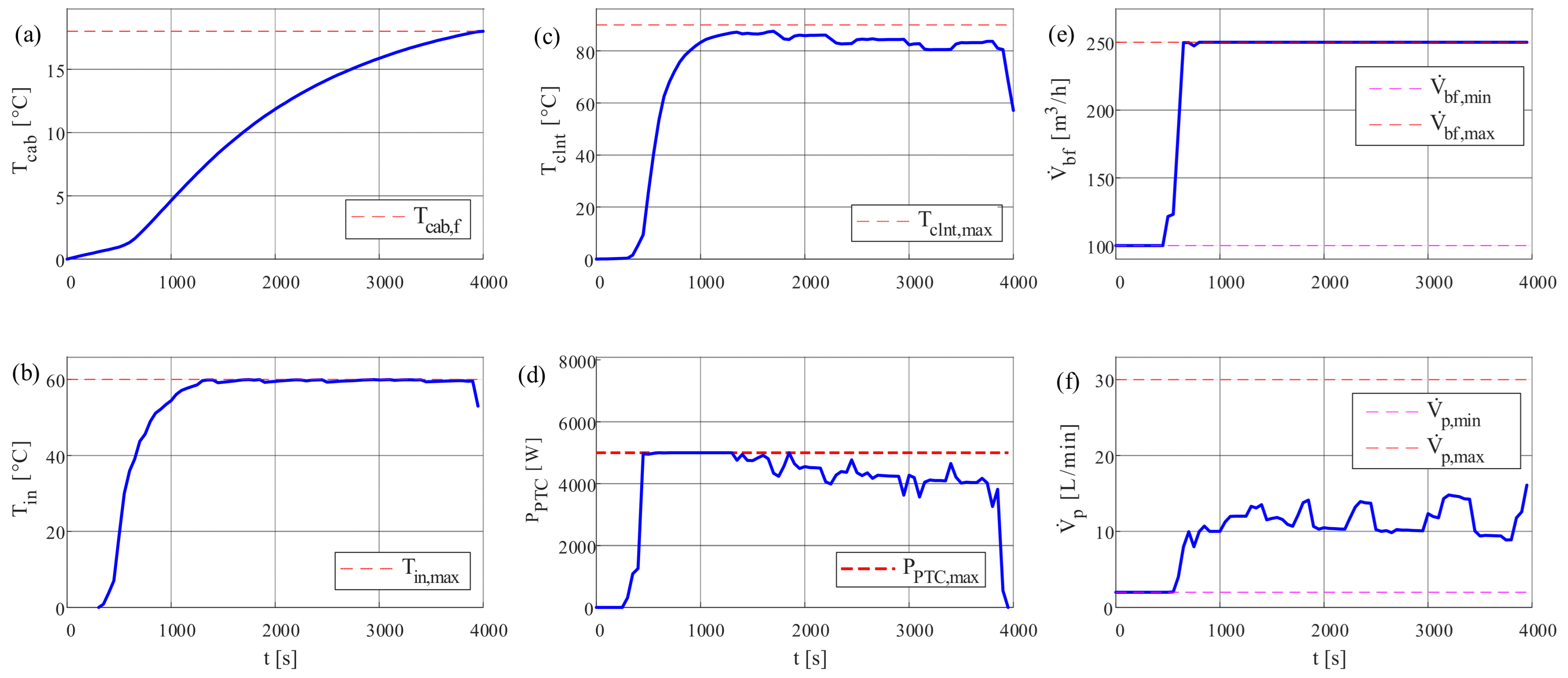
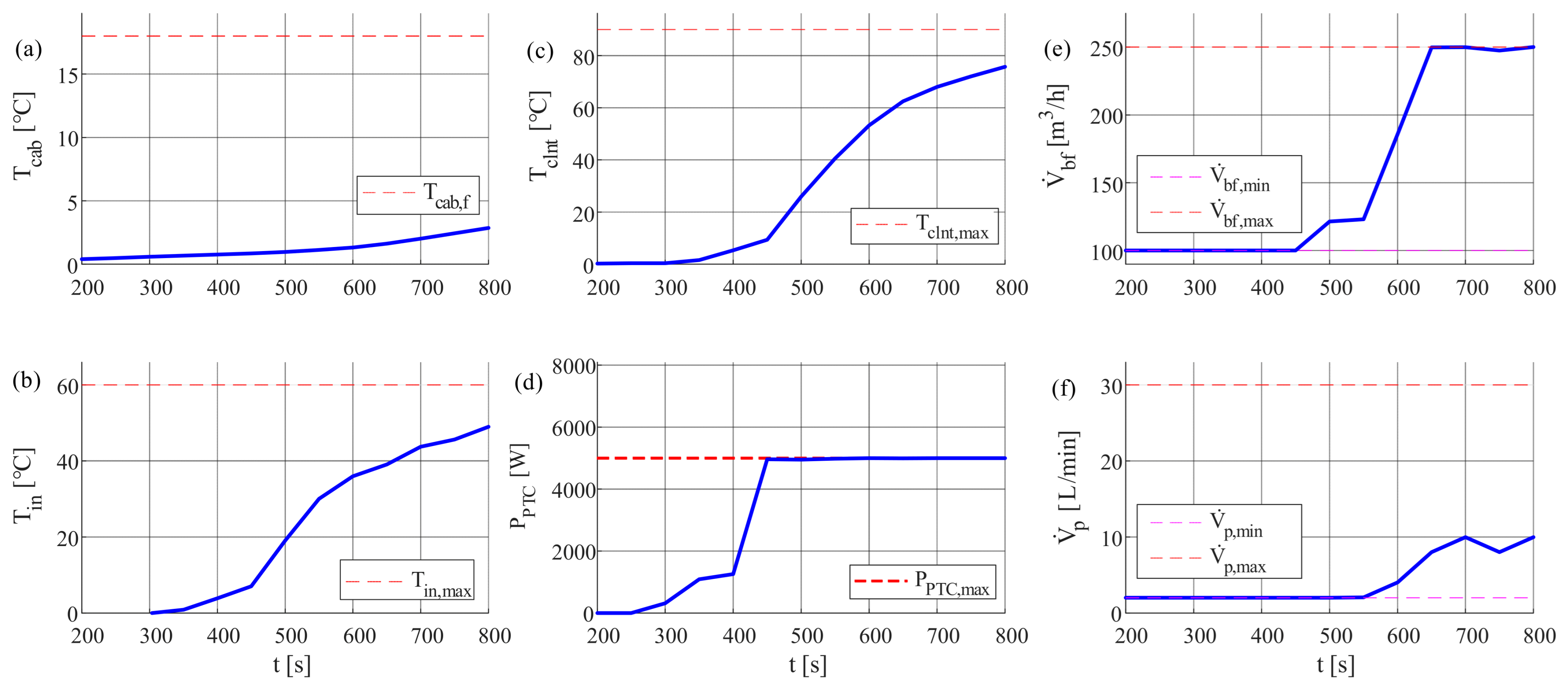
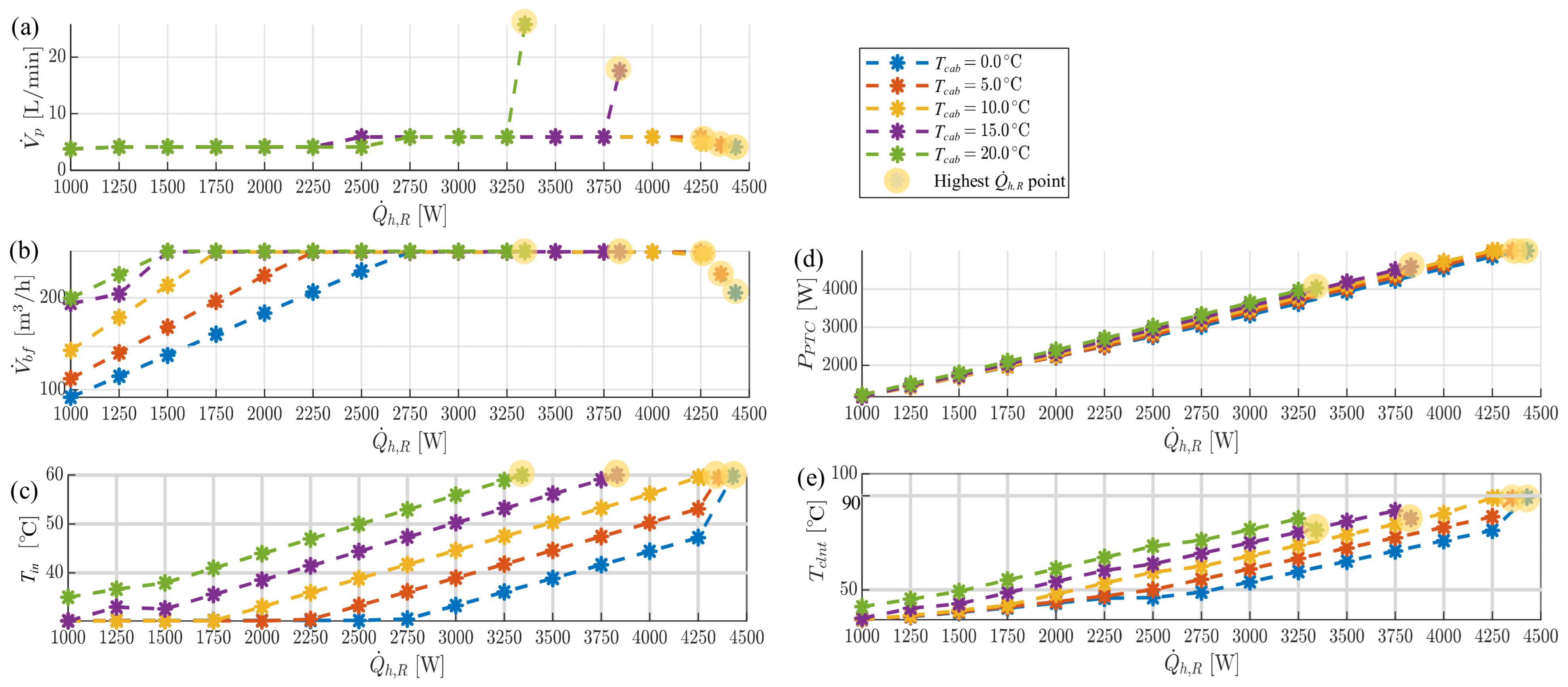
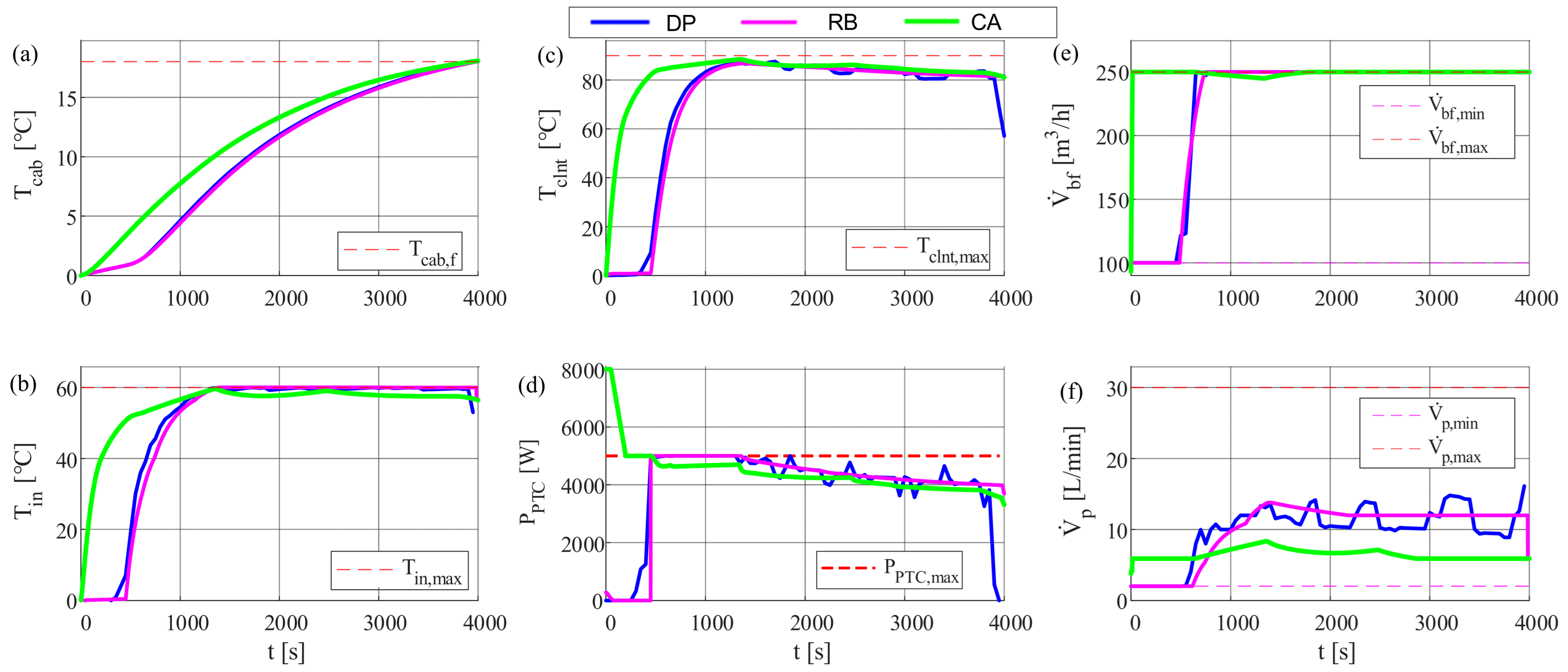
- The rise in the blower fan flow is delayed with respect to PTC power , while the pump flow is further delayed with respect to blower fan flow (Figure 8).
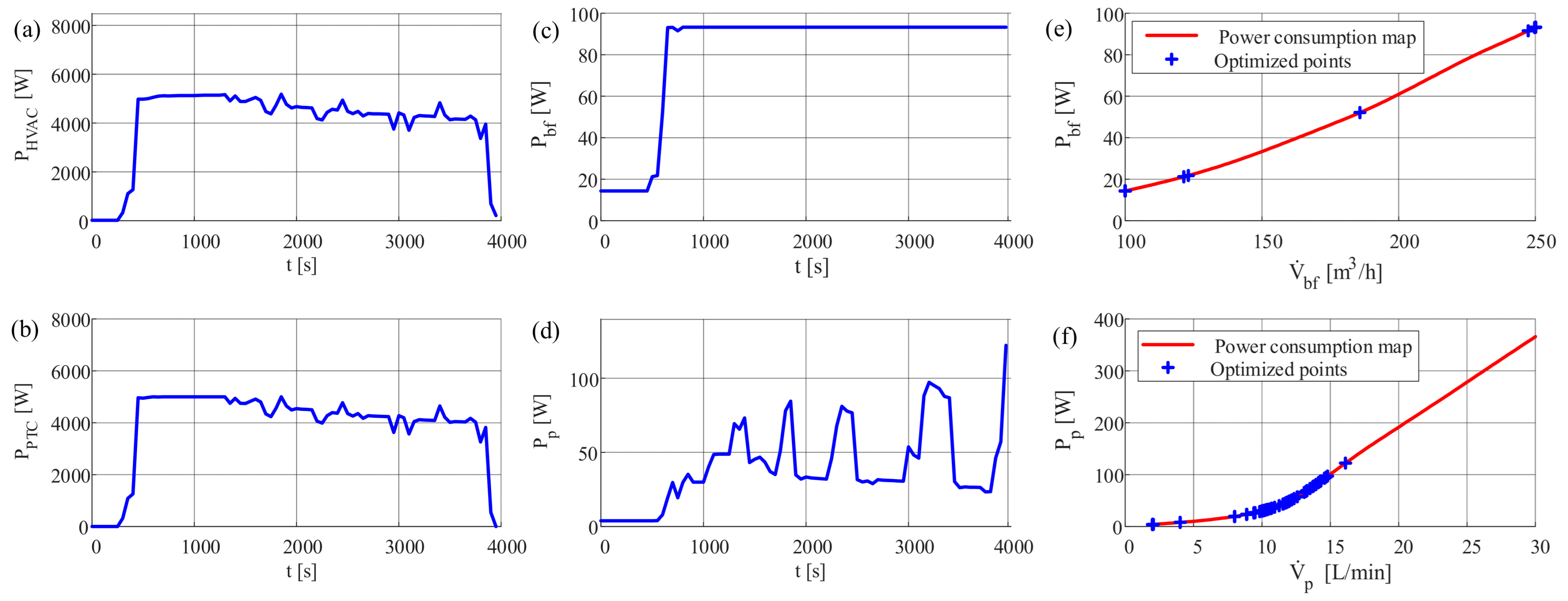
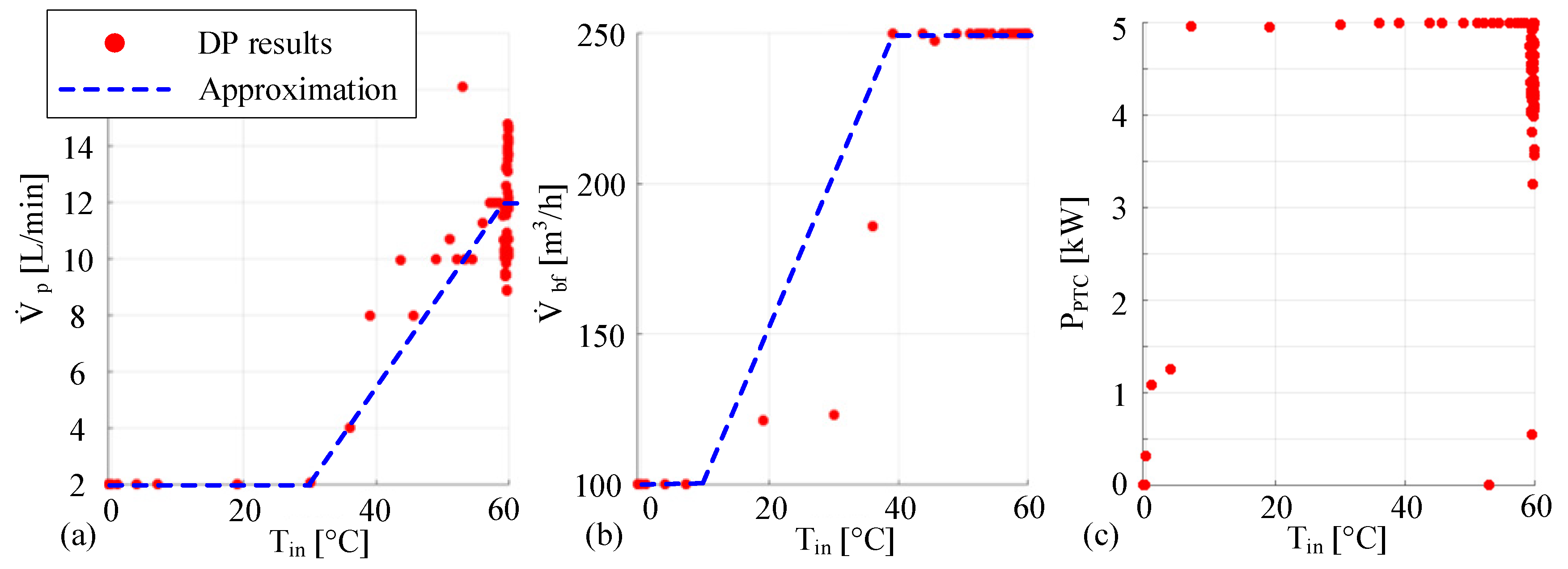
- The blower fan and pump flows, and , can be closely related to the inlet cabin air temperature (Figure 9a,b).
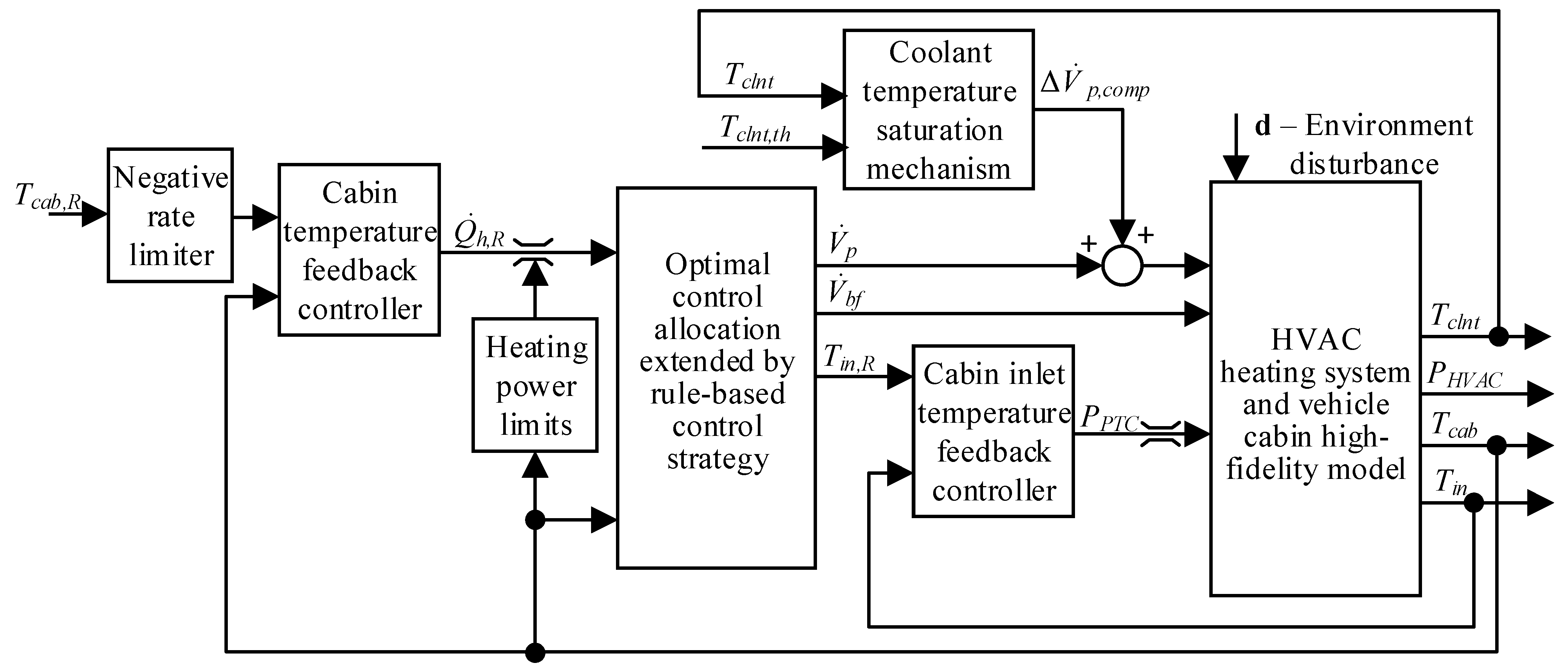
- The inlet temperature is kept around its limit value , while is adjusted by the inner inlet temperature controller (Figure 6).
5. Superimposed Cabin Temperature Control
5.1. Process Identification
5.2. Controller Parameter Optimization
5.3. Simulation Results
6. Verification Against Industry Baseline
6.1. Stationary Conditions
6.2. Heat-Up Conditions
7. Verification of Rule-Based Controller Extension
7.1. Reduced-Order Model-Based Verification
7.2. High-Fidelity Model-Based Verification
8. Conclusions
Author Contributions
Funding
Data Availability Statement
Conflicts of Interest
Abbreviations
| CA | Control allocation |
| DP | Dynamic programming |
| EV | Electric vehicle |
| HVAC | Heating ventilation and air conditioning |
| PI | Proportional–integral |
| RB | Rule-based |
| RH | Relative humidity |
| PTC | Positive temperature coefficient |
Nomenclature
| Symbols | |
| Heat transfer parameter [W/K] | |
| b | Regression model parameter [-] |
| Specific heat capacity at constant pressure [J/kgK] | |
| Heat capacity [J/K] | |
| Transfer function [-] | |
| Cost function [-] | |
| Penalization factor, proportional gain [-] | |
| Discrete-time step [-] | |
| Power [W] | |
| Correlation factor [-] | |
| Heat flow [W] | |
| Weighting coefficient [-] | |
| Laplace operator [-] | |
| Temperature [°C] | |
| Time [s] | |
| Control input [-] | |
| Volume flow [m3/s] | |
| Discrete-time Laplace operator [-] | |
| Difference [-] | |
| Density [kg/m3] | |
| Time constant [s] | |
| Subscripts | |
| Ambient | |
| Blower fan | |
| Cabin air | |
| Coolant | |
| Delay | |
| Heating | |
| Heat exchanger | |
| Cabin inlet air | |
| Pump | |
| R | Reference |
| Recirculation | |
| Coolant | |
| Threshold |
References
- König, A.; Mayer, S.; Nicoletti, L.; Tumphart, S.; Lienkamp, M. The impact of HVAC on the development of autonomous and electric vehicle concepts. Energies 2022, 15, 441. [Google Scholar] [CrossRef]
- Mądziel, M.; Campisi, T. Predicting Auxiliary Energy Demand in Electric Vehicles Using Physics-Based and Machine Learning Models. Energies 2025, 18, 6092. [Google Scholar] [CrossRef]
- Fei, F.; Wang, D. PTC power control of electric vehicle thermal management system based on neural network feedforward. Appl. Therm. Eng. 2024, 253, 123803. [Google Scholar] [CrossRef]
- De Nunzio, G.; Sciarretta, A.; Steiner, A.; Mladek, A. Thermal management optimization of a heat-pump-based HVAC system for cabin conditioning in electric vehicles. In Proceedings of the 2018 Thirteenth International Conference on Ecological Vehicles and Renewable Energies (EVER), Monte Carlo, Monaco, 10–12 April 2018; pp. 1–7. [Google Scholar] [CrossRef]
- Liu, X.-A.; Zhang, F.; Zhang, Z.; Huang, Y.; Chen, L.; Li, X. A three-heat source segmented heating control strategy based on waste heat recovery technology for electric vehicles. Energy Convers. Manag. 2024, 300, 117932. [Google Scholar] [CrossRef]
- Cvok, I.; Škugor, B.; Deur, J. Control trajectory optimisation and optimal control of an electric vehicle HVAC system for favourable efficiency and thermal comfort. Optim. Eng. 2021, 22, 83–102. [Google Scholar] [CrossRef]
- Khayyam, H.; Kouzani, A.Z.; Hu, E.J.; Nahavandi, S. Coordinated energy management of vehicle air conditioning system. Appl. Therm. Eng. 2011, 31, 750–764. [Google Scholar] [CrossRef]
- Rigatos, G.; Siano, P.; Cuccurullo, G.; Abbaszadeh, M. Nonlinear optimal control of heat pumps in electric vehicles. Sci. Technol. Built Environ. 2025, 31, 563–580. [Google Scholar] [CrossRef]
- Alizadeh, M.; Dhale, S.; Emadi, A. A critical review and future prospects of control-oriented HVAC modeling strategies in electric vehicles. IEEE Trans. Transp. Electrific. 2024, 10, 7214–7235. [Google Scholar] [CrossRef]
- He, L.; Li, P.; Zhang, Y.; Jing, H.; Gu, Z. Intelligent control of electric vehicle air conditioning system based on deep reinforcement learning. Appl. Therm. Eng. 2024, 245, 122817. [Google Scholar] [CrossRef]
- Lajunen, A.; Yang, Y.; Emadi, A. Review of cabin thermal management for electrified passenger vehicles. IEEE Trans. Veh. Technol. 2020, 69, 6025–6040. [Google Scholar] [CrossRef]
- Cvok, I.; Ratković, I.; Deur, J. Optimisation of control input allocation maps for electric vehicle heat pump-based cabin heating systems. Energies 2020, 13, 5131. [Google Scholar] [CrossRef]
- Cvok, I.; Ratković, I.; Deur, J. Multi-objective optimisation-based design of an electric vehicle cabin heating control system for improved thermal comfort and driving range. Energies 2021, 14, 1203. [Google Scholar] [CrossRef]
- Rao, A. Trajectory optimization: A survey. In Optimization and Optimal Control in Automotive Systems; Waschl, H., Kolmanovsky, I., Steinbuch, M., del Re, L., Eds.; Lecture Notes in Control and Information Sciences, 455; Springer: Cham, Switzerland, 2014. [Google Scholar] [CrossRef]
- Bellman, R.E.; Dreyfus, S.E. Applied Dynamic Programming; Princeton University Press: Princeton, NJ, USA, 1962. [Google Scholar]
- Yan, M.; He, H.; Sun, C.; Jia, H.; Li, M. Stochastic dynamic programming of air conditioning system under time-varying passenger condition for electric bus. Energy Procedia 2016, 104, 360–365. [Google Scholar] [CrossRef]
- Rostiti, C.; Stockar, S.; Canova, M. A Rule-Based Control for Fuel-Efficient Automotive Air Conditioning Systems; SAE Technical Paper 2015-01-0366; SAE International: Warrendale, PA, USA, 2015. [Google Scholar] [CrossRef]
- Kibalama, D.; Liu, Y.; Stockar, S.; Canova, M. Model predictive control for automotive climate control systems via value function approximation. IEEE Control Syst. Lett. 2022, 6, 1820–1825. [Google Scholar] [CrossRef]
- Zhang, Q.; Stockar, S.; Canova, M. Energy-optimal control of an automotive air conditioning system for ancillary load reduction. IEEE Trans. Control Syst. Technol. 2016, 24, 67–80. [Google Scholar] [CrossRef]
- Cvok, I.; Deur, J. Control Trajectory Optimization of Electric Vehicle Heat Pump-Based Cabin Heating System; SAE Technical Paper 2025-01-8144; SAE International: Warrendale, PA, USA, 2015. [Google Scholar] [CrossRef]
- Schaut, S.; Sawodny, O. Thermal management for the cabin of a battery electric vehicle considering passengers’ comfort. IEEE Trans. Control Syst. Technol. 2020, 28, 1476–1492. [Google Scholar] [CrossRef]
- Cvok, I.; Deur, J. Nonlinear model predictive control of electric vehicle cabin cooling system for improved thermal comfort and efficiency. In Proceedings of the 2022 European Control Conference (ECC), London, UK, 12–15 July 2022; pp. 1759–1764. [Google Scholar] [CrossRef]
- Grden, L.; Cvok, I.; Deur, J. Nonlinear Model Predictive Control of an Electric Vehicle Heat Pump System for Improved Energy Efficiency. In Proceedings of the 20th Conference on Sustainable Development of Energy, Water and Environment Systems (SDEWES), Dubrovnik, Croatia, 5–10 October 2025. [Google Scholar]
- Hajidavalloo, M.R.; Chen, J.; Hu, Q.; Song, Z.; Yin, X.; Li, Z. NMPC-based integrated thermal management of battery and cabin for electric vehicles in cold weather conditions. IEEE Trans. Intell. Veh. 2023, 8, 4208–4222. [Google Scholar] [CrossRef]
- Jia, C.; Liu, W.; Chau, K.T.; He, H.; Zhou, J.; Niu, S. Passenger-aware reinforcement learning for efficient and robust energy management of fuel cell buses. eTransportation 2026, 27, 100537. [Google Scholar] [CrossRef]
- Widmer, F.; Ritter, A.; Achermann, M.; Büeler, F.; Bagajo, J.; Onder, C.H. Highly efficient year-round energy and comfort optimization of HVAC systems in electric city buses. IFAC-PapersOnLine 2023, 56, 10656–10663. [Google Scholar] [CrossRef]
- Widmer, F.; van Dooren, S.; Onder, C.H. Optimization of the energy–comfort trade-off of HVAC systems in electric city buses based on a steady-state model. Control. Eng. Pract. 2025, 154, 106158. [Google Scholar] [CrossRef]
- Zhang, N.; Lu, Y.; Ouderji, Z.H.; Yu, Z. Review of heat pump integrated energy systems for future zero-emission vehicles. Energy 2023, 273, 127101. [Google Scholar] [CrossRef]
- Zhang, Z.; Li, W.; Shi, J.; Chen, J. A study on electric vehicle heat pump systems in cold climates. Energies 2016, 9, 881. [Google Scholar] [CrossRef]
- Lian, Y.; Ling, H.; Zhu, J.; Lv, J.; Xie, Z. Thermal management optimization strategy of electric vehicle based on dynamic programming. Control Eng. Pract. 2023, 137, 105562. [Google Scholar] [CrossRef]
- Ji, H.; Cai, J.; Pei, J.; He, X.; Guo, F.; Wang, Y. Research on heat pump PTC coupling heating strategy for electric vehicle. Automot. Eng. 2022, 44, 1563–1570. [Google Scholar] [CrossRef]
- Bäuml, T.; Maric, I.; Dvorak, D.; Šimić, D.; Konrad, J. Modelling and experimental validation of the heating system and the thermal cabin model of an electric minibus. In Proceedings of the 20th Conference on Sustainable Development of Energy, Water and Environment Systems (SDEWES), Dubrovnik, Croatia, 5–10 October 2025. [Google Scholar]
- Szikora, M.; Milcevic, M.; Acker, L.; Bäuml, T. Measurement Results of Initial Vehicle Identification; Deliverable 5.1; MINDED Project, European Commission Horizon Europe Programme. 2025. Available online: https://zenodo.org/records/15796792 (accessed on 5 March 2026).
- Burnham, K.P.; Anderson, D.R. Model Selection and Multimodel Inference: A Practical Information-Theoretic Approach, 2nd ed.; Springer: New York, NY, USA, 2002. [Google Scholar]
- Leonhard, W. Control of Electrical Drives, 3rd ed.; Springer: Berlin/Heidelberg, Germany, 2001. [Google Scholar]
- Deur, J.; Pavković, D. Fundamentals of Electrical Drive Controls. UNESCO Encycl. Life Support Syst. 2012, 6, 21. [Google Scholar]
- Isermann, R. Digital Control Systems; Springer: Berlin/Heidelberg, Germany, 1981. [Google Scholar]



| Actuator Grid Resolution and Imposed Limits |
|---|
| W |
| m3/h |
| L/min |
| Industry baseline | 674.5 (0.0%) | 156.9 (0.0%) | 93.25 (0.0%) | 988.4 (0.0%) |
| CA | 686.8 (1.8%) | 12.4 (−92.1%) | 93.25 (0.0%) | 792.4 (−19.8%) |
| Control Strategy | Results at t = 600 s | Results at t = 9300 s | ||||
|---|---|---|---|---|---|---|
| Industry Baseline | 7.50 (0.0%) | 50.5 (0.0%) | 0.892 (0.0%) | 19.35 (0.0%) | 75.28 (0.0%) | 10.353 (0.0%) |
| CA | 6.40 (−14.6%) | 58.05 (14.9%) | 6.383 (−5.2%) | 19.47 (0.6%) | 85.75 (13.91%) | 10.526 (1.6%) |
| CA Boost | 7.26 (−3.2%) | 59.79 (18.4%) | 6.402 (6.1%) | 19.49 (0.7%) | 86.18 (14.48%) | 10.609 (1.7%) |
| CA | DP | RB | |
|---|---|---|---|
| [°C] | 18.07 (0.0%) | 18.01 (−0.34%) | 18.02 (−0.27%) |
| [kWh] | 0.103 (0.0%) | 0.090 (−12.5%) | 0.091 (−12.1%) |
| [kWh] | 0.016 (0.0%) | 0.045 (+181%) | 0.046 (+189.4%) |
| [kWh] | 4.890 (0.0%) | 4.344 (−11.2%) | 4.440 (−9.2%) |
| [kWh] | 5.009 (0.0%) | 4.479 (−10.6%) | 4.577 (−8.6%) |
| [s] | [kWh] | [kWh] | [kWh] | [kWh] | |
|---|---|---|---|---|---|
| CA | 5680 (0.0%) | 0.1463 (0.0%) | 0.0194 (0.0%) | 6.9064 (0.0%) | 7.0720 (0.0%) |
| RB | 4785 (−15.6%) | 0.1208 (−17.4%) | 0.0570 (+193.8%) | 6.0241 (−12.8%) | 6.2018 (−12.3%) |
Disclaimer/Publisher’s Note: The statements, opinions and data contained in all publications are solely those of the individual author(s) and contributor(s) and not of MDPI and/or the editor(s). MDPI and/or the editor(s) disclaim responsibility for any injury to people or property resulting from any ideas, methods, instructions or products referred to in the content. |
© 2026 by the authors. Licensee MDPI, Basel, Switzerland. This article is an open access article distributed under the terms and conditions of the Creative Commons Attribution (CC BY) license.
Share and Cite
Grden, L.; Škugor, B.; Deur, J.; Cvok, I. An Energy-Efficient Control Allocation Strategy for PTC Heater-Based Electric Vehicle Cabin Thermal Management. Energies 2026, 19, 1592. https://doi.org/10.3390/en19071592
Grden L, Škugor B, Deur J, Cvok I. An Energy-Efficient Control Allocation Strategy for PTC Heater-Based Electric Vehicle Cabin Thermal Management. Energies. 2026; 19(7):1592. https://doi.org/10.3390/en19071592
Chicago/Turabian StyleGrden, Luka, Branimir Škugor, Joško Deur, and Ivan Cvok. 2026. "An Energy-Efficient Control Allocation Strategy for PTC Heater-Based Electric Vehicle Cabin Thermal Management" Energies 19, no. 7: 1592. https://doi.org/10.3390/en19071592
APA StyleGrden, L., Škugor, B., Deur, J., & Cvok, I. (2026). An Energy-Efficient Control Allocation Strategy for PTC Heater-Based Electric Vehicle Cabin Thermal Management. Energies, 19(7), 1592. https://doi.org/10.3390/en19071592