Article

Environmental Impact and Material Demand of Direct Current-Based Grid and Charging Infrastructures in Large-Scale Future Applications

Chair for Energy System Economics, Institute for Future Energy Consumer Needs and Behavior, RWTH Aachen University, 52074 Aachen, Germany
*
Author to whom correspondence should be addressed.
Energies 2026, 19(7), 1595; https://doi.org/10.3390/en19071595
Submission received: 25 February 2026 / Revised: 15 March 2026 / Accepted: 18 March 2026 / Published: 24 March 2026

Abstract

The electrification of mobility increases the need for efficient local distribution and charging infrastructures. In this context, direct current (DC) architectures may reduce conversion stages, transmission losses, and material demand compared with alternating current (AC) systems. This study aims to quantify the environmental implications of AC- and DC-based grid and charging infrastructures for large-scale rollout in Germany. For this purpose, a dynamic life-cycle assessment (DLCA) is conducted for parking garages, parcel centers, and delivery bases over the period 2023–2045, covering the production and use phases with respect to global warming potential (GWP) and material demand. The results show that DC configurations achieve lower total GWP across all application contexts investigated. For parking garages, DC reduces total GWP by 9.3% compared with AC, while for parcel logistics facilities the reduction amounts to 5.7%. Copper is identified as the dominant material driver, and DC reduces copper demand by 17.1–58.7% depending on the application. A screening-based supply-risk assessment further indicates the elevated relevance of copper due to rising demand and Germany’s import dependence. Overall, the findings provide quantitative evidence that DC-based infrastructures can reduce both environmental impacts and copper demand in large-scale charging infrastructure deployment.

1. Motivation and Introduction

The global commitment to the Paris Agreement establishes the imperative to limit the increase in global average surface temperature to a maximum of 1.5 °C above preindustrial levels. Achieving this goal requires rapid and sustained emission reductions across all major sectors [1]. Germany has therefore set ambitious long-term climate targets, aiming for greenhouse gas neutrality by 2045 [2]. The transport sector remains one of the most challenging domains: in 2024, renewable energy accounted for only 7.3% of its final energy consumption, underscoring the need for transformative electrification pathways [3]. Electrification of road freight and passenger mobility is widely recognized as a key strategy for reducing transport-related emissions, contingent on the deployment of a dense, high-performance charging infrastructure capable of meeting future demand. Nevertheless, the adoption of charging infrastructure depends strongly on socioeconomic factors, as shown by Wendlinger et al. [4].
As renewable energy sources such as photovoltaic systems generate direct current (DC), and electric vehicles (EVs) store energy in DC batteries, conventional alternating current (AC) distribution networks require multiple AC-DC and DC-AC conversion stages. These conversion processes introduce efficiency losses and additional material requirements [5]. DC-based local distribution grids can mitigate these drawbacks by reducing conversion steps and transmission losses, thereby improving the overall system efficiency [6,7]. Such benefits are particularly relevant for applications with high charging power densities on limited spatial footprints, including parking garages and parcel logistics hubs—both of which are expected to experience significant increases in electrified vehicle activity. They represent high-demand, space-constrained charging environments that can be consistently extrapolated to a national rollout, enabling the assessment of long-term AC-DC differences in life-cycle impacts and material requirements under realistic deployment pathways.
In practice, charging infrastructures are often hybrid rather than purely AC- or DC-based. The present study therefore compares two internally consistent reference architectures to isolate architecture-specific life-cycle and material effects under application-specific charging demands. Construction and investment costs are outside the scope of this assessment.
Despite growing interest in DC distribution technologies, there remains limited understanding of their long-term environmental implications and material resource demands when deployed at a national scale. In particular, little research has examined how the material-intensive components of large-scale charging and grid infrastructures interact with global resource market dynamics. This is especially relevant for critical materials such as copper, aluminum, and selected polymers, where rising global demand and declining ore grades may constrain future availability.
This study addresses these gaps by conducting a dynamic life-cycle assessment (DLCA) of DC- and AC-based grid and charging infrastructures for two representative high-demand applications—parking garages and logistics facilities—projected through 2045. The analysis accounts for temporal changes in energy and material inputs, evaluates exposure to emerging global resource constraints, and quantifies the potential environmental and resource reductions that may arise from scaling and synergy effects. The research is guided by three central questions:
(1)
What are the future environmental impacts of DC- and AC-based distribution and charging infrastructures for parking garages and logistic facilities in Germany?
(2)
Which materials dominate production-related demand under large-scale AC and DC rollout, and what does this imply for Germany’s supply-risk exposure given global market trends?
(3)
What reduction potentials can be achieved through scaling or synergy effects in large-scale DC-based infrastructure deployment?
By integrating environmental assessment, system-level performance analysis, and resource economics, this work provides one of the first holistic evaluations of the ecological and strategic implications of DC-based grid and charging infrastructures in large-scale future applications. The remainder of the paper is structured as follows: Section 2 reviews the relevant literature and derives the research gap addressed in this study. Section 3 describes the methodological framework, including system boundaries, scenarios, and the modeling of AC- and DC-based distribution and charging infrastructures on a macro-level (nationwide stock and rollout). Section 4 presents the results for environmental impacts and material demands. Section 5 discusses the findings, including robustness across configurations, implications, and limitations. Finally, Section 6 concludes and provides an outlook on future research needs and policy-relevant directions.

2. Literature Review

Research on the environmental performance of emerging energy and charging systems increasingly emphasizes the need to capture temporal technological evolution. DLCA has therefore become an important methodological development, extending conventional LCA by incorporating time-dependent technological, systemic, and background changes. Several studies propose frameworks for integrating such dynamic parameters. Weyand et al., for example, introduce a prospective DLCA scheme for scaling laboratory-stage technologies using predefined development pathways in both foreground and background systems [8]. While this approach is valuable for exploratory assessments of early-stage energy technologies, it is not directly applicable to mature grid and charging infrastructures deployed on national scales. Pehnt [9] demonstrates another DLCA approach by adjusting a baseline LCA with assumed improvements in technology, process efficiencies, and energy systems. However, these analyses do not address hybrid AC-DC architectures, nor do they explicitly model long-term deployment trajectories. Notably, no published study applies DLCA to a comparative assessment of AC- and DC-based distribution and charging infrastructures over multi-decadal time horizons, indicating a clear methodological gap.
A second relevant body of literature concerns scaling effects, although the focus is predominantly economic. Techno-economic analyses frequently quantify how increasing production volumes influence cost structures, as in the work of Gollinger [10] for photovoltaic and wind power technologies or Dorn et al. [11] for glass manufacturing. Environmental scaling effects, in contrast, remain underexplored. Particularly absent are studies investigating how large-scale manufacturing of grid and charging infrastructure components affects their environmental impacts, despite the fact that rapid expansion of charging networks is expected to drive significant industrial scaling. Comparative LCA analyses are increasingly used to systematically evaluate environmental impacts across technologies and pathways. Kockel et al. emphasize the importance of addressing uncertainties in environmental assessments, demonstrating how the explicit consideration of key techno-economic and regional parameters enhances the robustness of LCA results [12]. Integrating sensitivity analyses to account for uncertainties is essential for transparent and reliable comparisons.
Comparative analyses of AC and DC charging and distribution infrastructures constitute a distinct research strand, but the underlying results are largely driven by electricity supply and operational assumptions rather than hardware alone. Studies on BEV charging consistently identify the electricity mix as a dominant determinant of charging-related impacts [13,14], which is corroborated by long-term, multi-country assessments across Europe [15]. When charging infrastructure is explicitly included, manufacturing impacts can be relevant in specific contexts [16,17] and may exhibit material-related hotspots, especially for critical inputs, even if they are often smaller than use-phase electricity effects [18].
Within AC-DC comparisons, the literature highlights trade-offs between power level, conversion losses, and material intensity. For charging options, home charging tends to show lower impacts than public AC/DC solutions, while the use phase remains dominant and higher charging power can increase impacts via conversion losses [19]. Device-level comparisons report lower impacts for DC off-board charging normalized per delivered energy relative to AC on-board charging in the studied configurations [20]. More DC-focused LCAs emphasize that conclusions depend strongly on utilization, boundary definitions, and the efficiency chain, and argue for system-level modeling [6,7]. Beyond LCA, fast-charging overview and feasibility work frames implementation challenges and grid integration constraints [21,22,23], and V2G assessments show that bidirectional charging can influence future system emissions trajectories [24]. A recent parking garage case study extends AC-DC comparisons to a high-density setting but remains static and does not address long-term rollout dynamics or material demand implications [25].
Despite the breadth of related work, several critical knowledge gaps remain. First, dynamic, multi-decadal comparisons of AC- and DC-based distribution and charging infrastructures at deployment scale are largely missing. Existing LCAs comparing AC-DC systems typically represent static snapshots or focus on isolated components and sites, while dynamic LCA approaches are mostly applied to early-stage technologies rather than mature grid and charging infrastructures. Consequently, the long-term environmental implications of large-scale DC deployment remain insufficiently quantified. Second, while scaling effects are well established in techno-economic analyses of energy technologies, their environmental counterparts are rarely addressed. In particular, the literature provides limited evidence on how industrial scaling, learning effects, or production synergies for power-electronic and grid components may alter life-cycle impacts and mitigation potentials. Third, material demand and resource security are insufficiently integrated into environmental assessments of charging and grid rollouts. Large-scale deployment requires substantial quantities of copper, aluminum, steel, and polymers, yet few studies connect prospective infrastructure material needs with evolving resource constraints and supply risks (e.g., increasing global demand and potential declines in ore grades).
Finally, the literature rarely generalizes site-specific findings to national rollout scenarios. Case studies on individual parking garages or logistics facilities provide valuable insights, but systematic evidence is limited on how AC-DC trade-offs in environmental impacts and material efficiency vary across configurations and evolve under realistic EV adoption and utilization trajectories. Taken together, these gaps motivate a comprehensive, dynamic, and system-level assessment that jointly evaluates environmental impacts and material requirements of AC- and DC-based distribution and charging infrastructures under long-term, national-scale deployment pathways.

3. Methodology and Data Processing

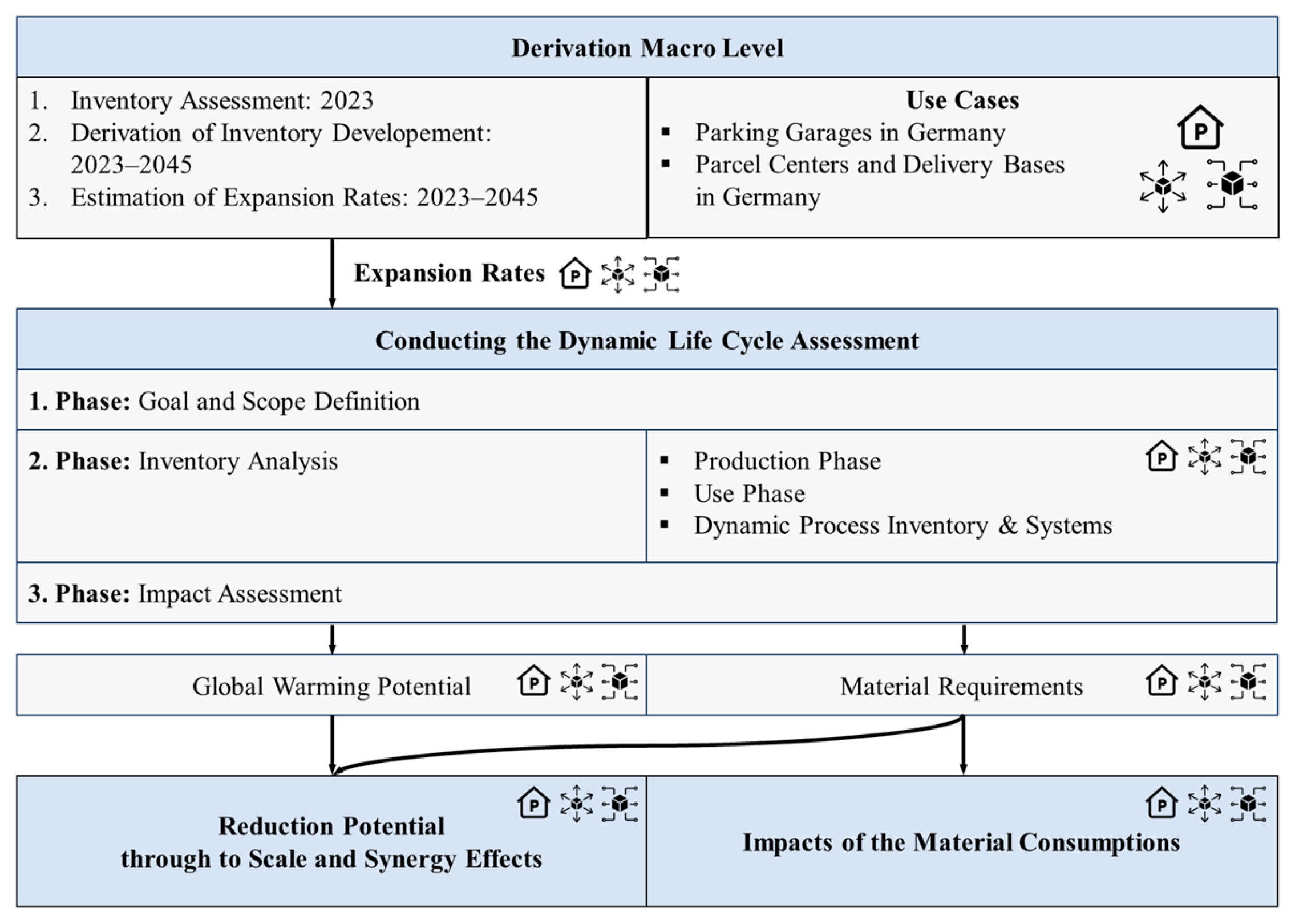
The following chapter outlines the methodological approach used to address the research questions presented in Section 1. The analysis begins with the derivation of the macro-level development for the two application cases, parking garages and parcel logistics facilities in Germany (Section 3.1). This includes determining the current stock, projecting stock development of parking garages, parcel centers and delivery bases until 2045, and estimating annual expansion rates (see Figure 1).
Based on these expansion rates, a DLCA in accordance with DIN EN ISO 14040 [26] and DIN EN ISO 14044 [27] is carried out (Section 3.2). This comprises defining the goal and scope, establishing the life-cycle inventory for production and use phases including the integration of temporal dynamics, and conducting the impact assessment. Section 3.3 describes the procedure for estimating potential resource scarcity effects resulting from nationwide infrastructure deployment, while Section 3.4 outlines the approach used to assess scaling and synergy effects and the related potential for reducing environmental impacts.

3.1. Derivation of the Macro-Level

In the following, the nationwide macro-level is derived for three German application contexts: parking garages, parcel centers and delivery bases. First, the existing stock in the base year 2023 is estimated and projected from 2023 to 2045. Second, electrification trajectories are derived for the same period. Combining stock development and electrification yields annual build-out rates for the required grid and charging infrastructure through 2045.

3.1.1. Application Case: Parking Garages in Germany

To derive the macro-level for parking garages in Germany, the existing stock in the base year 2023 is first estimated and subsequently projected to 2045. Public and semi-public parking garages and underground garages are treated equivalently. The stock estimation is based on per capita ratios (parking garages per inhabitant and parking spaces per inhabitant) derived from 15–20 reference cities per settlement type (large cities, medium-sized cities, small cities, and municipalities) [28]. Parking garage inventories are compiled from online parking-search platforms and official municipal sources and grouped into size classes S/M/L based on a boxplot analysis of garages in the 13 largest German cities. Applying the derived ratios to the national population structure yields an estimated current stock of 2302 parking garages of size class S (≤350 spaces), 1163 parking garages of class M (351–700 spaces), and 316 parking garages of class L (>700 spaces). Intermediate results and consolidated macro-level inputs used in this study are shown in Table A1 in Appendix A.
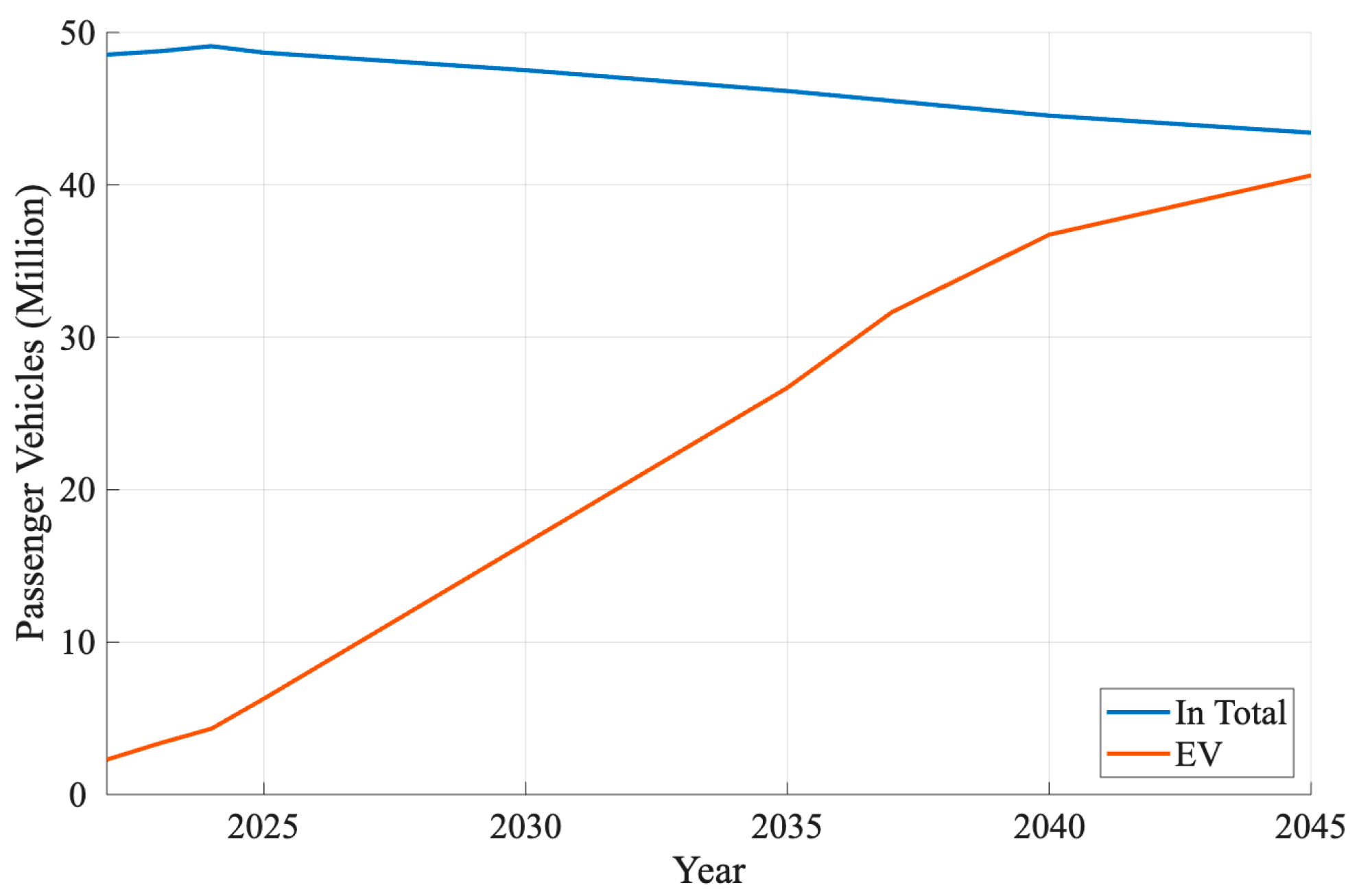
Stock development from 2023 to 2045 is approximated using projected trends in the German (electric) passenger-car fleet. Specifically, the mean trajectory across several recent studies is used, the underlying scenario overview is provided in Table A2 and the resulting trajectory is shown in Figure A1 in Appendix A. This synthesis indicates an ~11% decline in passenger cars by 2045, which is translated into a dimensioning requirement of ~89% of today’s stock for the parking garage application case (without implying closure of the remaining share). Charging infrastructure build-out within parking garages is derived from the German Building Electric Mobility Infrastructure Act (GEIG) [29]. From 2025, non-residential buildings undergoing major renovation must provide conduits enabling later installation for 20% of spaces, while new non-residential buildings must be prepared for 33% of spaces. These requirements motivate Scenario 33 (share of spaces equipped with charging points). Annual additions of grid and charging infrastructure are obtained by combining stock evolution and the electrification trajectory, assuming a gradual build-out aligned with BEV diffusion and a garage-wise expansion approach. Charging technology shares follow Elsobki et al. [25] with 95% 22 kW and 5% 150 kW charging points. These shares reflect the application-specific charging demand in parking garages. The AC-DC comparison therefore refers to alternative infrastructure architectures serving this demand, rather than to exclusively AC- or DC-only real-world deployment.
With two charging points per charging station and a simultaneity factor of 0.5, two 11 kW points correspond to one 22 kW station and two 75 kW points to one 150 kW station under full utilization. The resulting annual build-out rates of charging stations, which are determined by the projected annual addition rates of electric vehicles (EVs) and charging infrastructure in line with development and expansion targets, are reported in Table 1.

3.1.2. Application Case: Parcel Centers and Delivery Bases in Germany

Parcel logistics are represented by a pre-haul-main-haul-post-haul structure: N1 delivery vehicles (≤3.5 t) collect and distribute parcels between customers and delivery bases (pre-/post-haul), while N2 (3.5–12 t) and N3 (>12 t) trucks transport parcels between parcel centers (main haul). Because fleet composition, charging regimes, and thus infrastructure requirements differ, delivery bases (N1 charging) and parcel centers (N2/N3 charging) are modeled separately [30,31]. The 2023 facility stock is approximated using the networks of the six largest parcel service providers in Germany (DHL, Hermes, DPD, GLS, UPS, Amazon), which jointly account for ~98% of the market share [32]. Parcel centers are classified into four size classes (XL, L + M, S, XS) based on sorting capacity, network role, and satellite-based size indicators. The XL reference class is defined based on the two DHL parcel centers in Bochum and Obertshausen, and the parameters for the smaller classes are scaled relative to this XL reference using sorting capacity as the scaling variable [33,34]. Delivery bases are grouped into three size classes (L, M, S), with the number of loading bays used as the primary proxy for dispatched vehicles per wave; detailed allocations and size characteristics are documented in Table A3 Appendix A. The resulting 2023 facility counts by size class are summarized in Table 2.
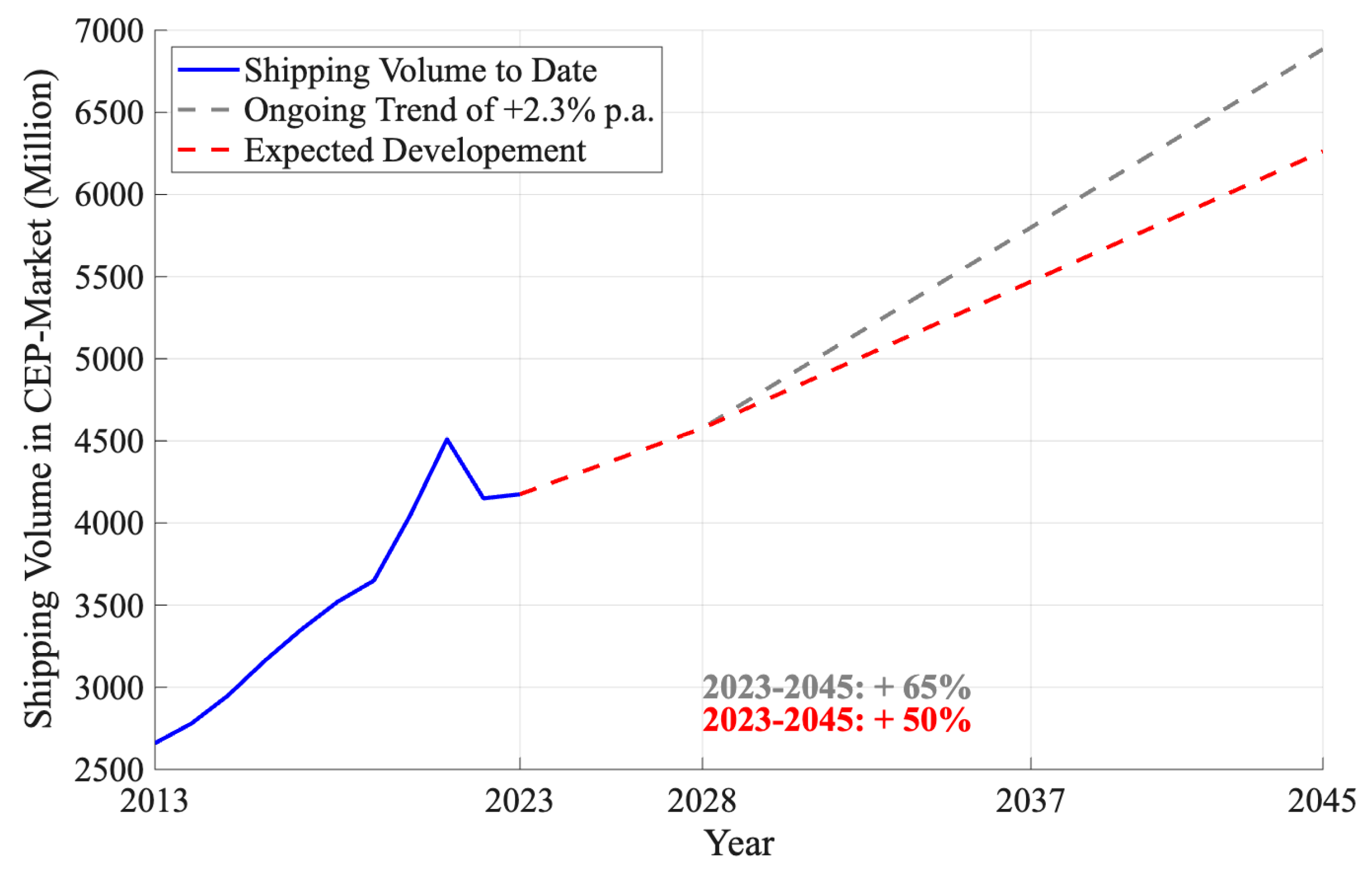
Plausibility of the derived stock is checked against sector totals. For 2023, the CEP (courier, express, parcel) market reports 4175 million parcels/year [35], assuming 305 operating days and a 86.5% parcel share. This corresponds to ~11.8 million parcels/day, while the aggregated sorting capacity of all parcel centers amounts to ~16.8 million parcels/day, leaving headroom for peak periods. The implied market share distribution (e.g., ~42.4% sorted in DHL parcel centers) and the derived 22,464 N2/N3 vehicles are consistent with literature-based benchmarks [31]. For delivery bases, published counts vary substantially. Therefore, the DHL delivery-base stock is adjusted upward to match an assumed total of 100,000 delivery vehicles in the parcel market, while maintaining consistency with market shares and throughput [31]. Parcel volumes are assumed to increase by 50% by 2045 based on a conservative extrapolation of the German Parcel and Express Logistics Association’s growth expectations (2.3% p.a. to 2028) beyond 2028 [35]. This volume growth is translated into a 27.4% increase in the number of parcel centers and delivery bases by 2045 (treated as proportional to the increase in vehicle numbers), implying that 54.8% of the volume increase is met via capacity expansion (additional facilities) and 45.2% via productivity gains within existing infrastructure (Table 2) [33,35].
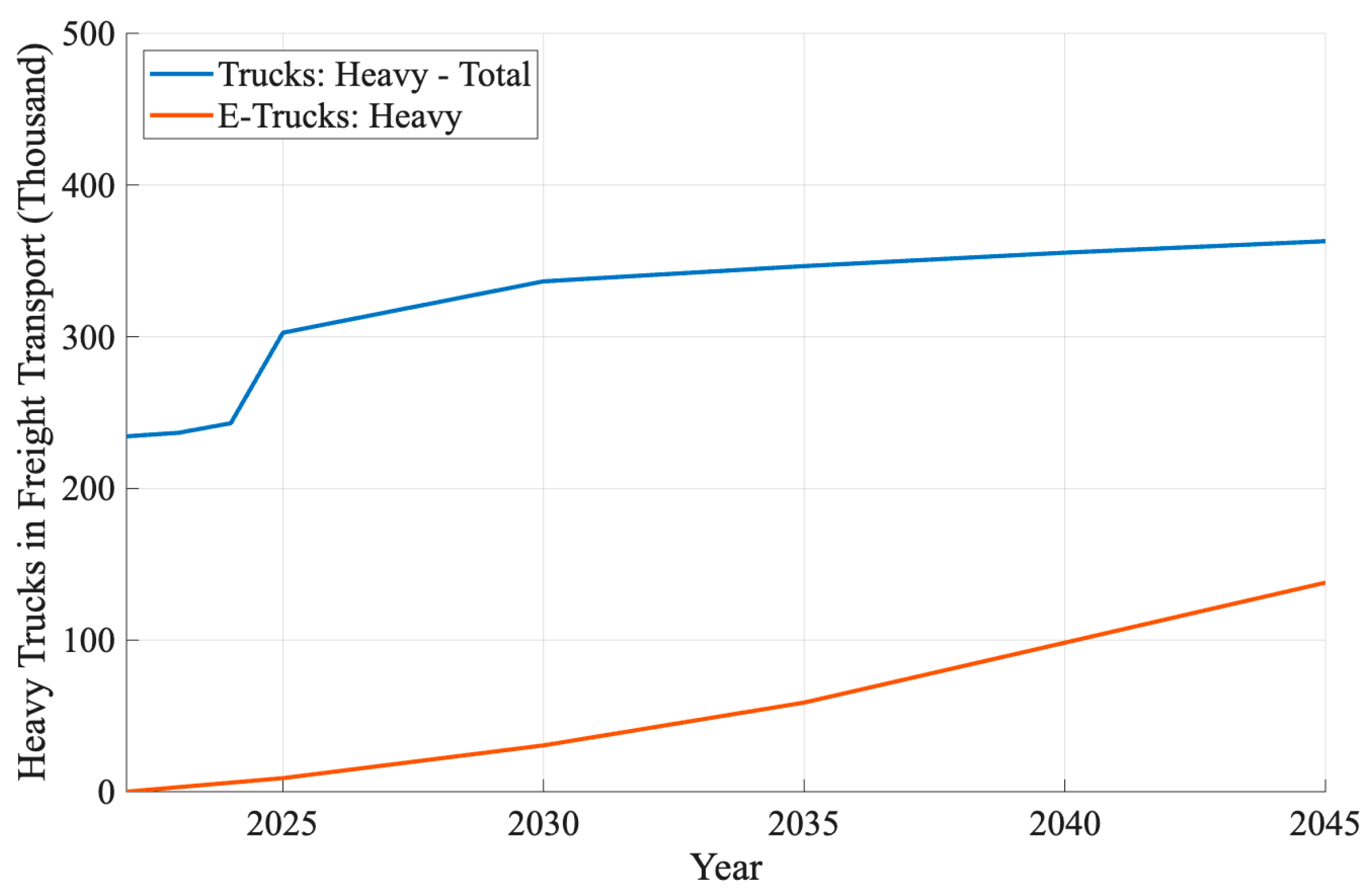
Main-haul electrification follows scenario-based projections of Göckeler et al. [36] for N3 trucks (>12 t) (Figure A3). To ensure operational continuity, charging and grid infrastructure are assumed to be expanded ahead of vehicle diffusion in three build-out waves: (i) 2023 sized to 2030 demand, (ii) 2030 sized to 2037 demand, and (iii) 2037 sized to 2045 demand [36,37]. Each wave is modeled as the construction of a new local distribution network rather than incremental extension, reflecting the assumption of a fixed transformer size and avoiding systematic overdimensioning if 2045 capacity were installed already in 2023. Additionally, later deployment benefits from lower upstream impacts as production and background systems improve over time. Charging powers of 1000 kW, 500 kW and 350 kW are adopted from Elsobki et al. [25]. Utilization is constrained by logistics operations and regulatory requirements: trucks typically have on-site parking durations of ~30 min due to swap-body handling, such that charging is primarily feasible when arrivals coincide with mandated breaks. A charging power of 1000 kW represents main-haul requirements (~400 km of recharging within a break), whereas 500/350 kW mainly serves post-haul top-up charging. These assumptions reflect heterogeneous charging requirements within parcel logistics and are modeled application-specifically in the AC-DC comparison. The resulting build-out rates are summarized in Table 3.
Pre-/post-haul electrification of the N1 delivery fleet is assumed to be technically feasible. Infrastructure roll-out is modeled as base-wise full electrification, i.e., delivery bases are upgraded in discrete steps rather than incrementally, to avoid repeated retrofit downtime. The roll-out follows the diffusion trajectory derived from DHL sustainability targets [38]. The number of charging points is set to half the number of loading bays, assuming load management across up to three delivery waves, scheduled over two days. Vehicle and charging assumptions are based on the StreetScooter Work XL (max. 11 kW charging power) and each 22 kW charging station is represented by two 11 kW charging points [39]. This setup represents a low-power charging regime with longer dwell times and thus complements the higher-power parcel-center case. A two-day operating window yields an available range of 113 km per vehicle under a State of Charge (SOC) window of 80% to 20% (with the manufacturer-rated range assumed at 100% SOC). The resulting build-out rates by delivery-base size class are reported in Table 4.

3.2. Conducting the DLCA

This section describes the three phases of the DLCA conducted in this study. First, Section 3.2.1 defines the goal and scope of the DLCA. Second, the life-cycle inventory analysis specifies the relevant material and energy flows for both the production and use phases for the two application contexts in an inventory analysis and introduces the time-dependent parameters considered (Section 3.2.2). Third, the life-cycle impact assessment translates the inventory results into impact-category indicator results using the corresponding characterization factors (Section 3.2.3).

3.2.1. Phase 1: Goal and Scope Definition

This life-cycle assessment quantifies the future environmental impacts of DC- and AC-based grid and charging infrastructures for nationwide parking garages and parcel centers and delivery bases and compares the resulting impacts across the alternative technical architectures. The comparison is based on stylized reference configurations and does not imply that real facilities are deployed as exclusively AC- or DC-only systems. Rather, the two architectures serve as analytical benchmark cases. Hybrid AC/DC configurations and techno-economic aspects such as construction and investment costs are not explicitly modeled.
The system boundary is Germany and the time horizon spans 2023–2045. The product system is bounded upstream at the medium-voltage transformer terminals and downstream at the charging cables. It comprises (i) the grid connection and local distribution infrastructure and (ii) the charging infrastructure. In the AC configuration, the grid system includes the transformer and grid-connection cable. The DC configuration additionally includes a central AC-DC converter. Charging infrastructure includes the charging stations and all required subcomponents [7,25]. Deployment quantities (commissioning year, sizing, and number of installations) are taken from the macro-level build-out derived in Section 3.1. In the parcel logistics case, parcel centers and delivery bases are modeled separately due to distinct sizing and charging regimes.
The assessment covers the production and use (operation) stages. Transport and end-of-life are excluded because the literature suggests minor contributions [19,20] and component lifetimes are assumed to exceed the study horizon (see Table A4 in Appendix A). Given the multi-decadal scope, the inventory is implemented dynamically to reflect time-dependent changes in manufacturing and electricity supply. Foreground inventories are compiled from manufacturer information and underlying engineering work [5,25], and background processes are modeled using ecoinvent v3.7.1. [40]. Impacts are calculated in openLCA v2.2.0 using ReCiPe 2016 Midpoint (H) [41] and reported for GWP (kg CO2-eq.) and mineral resource scarcity (kg Cu-eq.). Two functional units are applied: (i) the aggregate infrastructure deployed over 2023–2045 and (ii) delivered electricity (kWh) for comparability with reviewed LCA studies introduced in Section 2.

3.2.2. Phase 2: Inventory Analysis

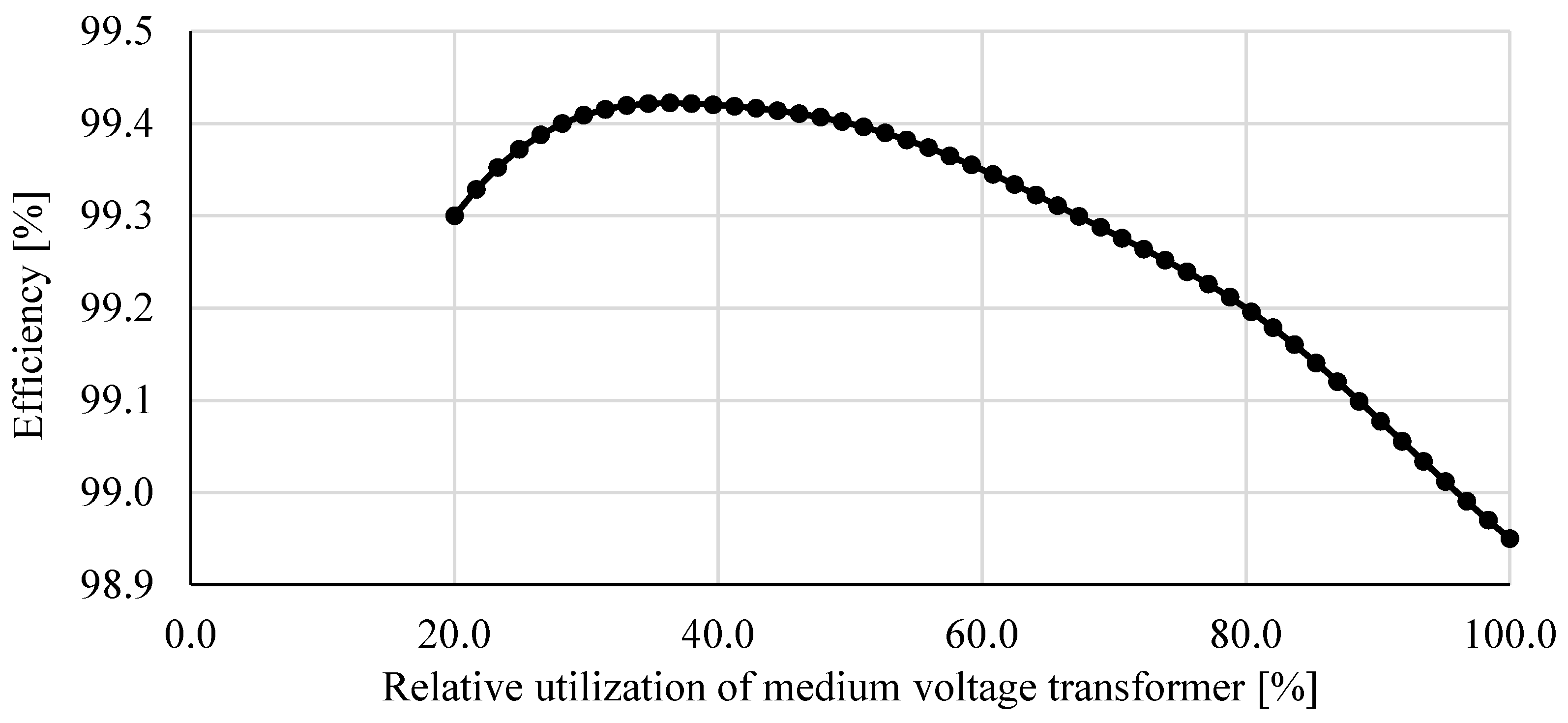
In the life-cycle inventory (LCI) analysis, all relevant input and output data—i.e., energy, material, and product flows—are systematically compiled for the grid and charging infrastructures considered in both application contexts. Key technical assumptions applied consistently across the production and use phases are summarized in Table 5. The illustration reports efficiency ranges over the relevant operating-load domain, whereas the use-phase calculations apply the underlying load-dependent efficiency curves. The subsequent sections describe inventory modeling separately for the production and use (operation) phases for each application case.
Production Phase
Production-phase impacts are quantified by translating the macro-level build-out rates (Section 3.1) into component quantities for each application context and for both AC- and DC-based architectures. Product datasheets were systematically evaluated in a micro-level engineering assessment to derive subcomponent structures and material compositions [25]. Component demand for parking garage configurations is reported in Table A5. Parcel center component quantities are documented in Table A6, while delivery-base dimensioning and component quantities by expansion wave are provided in Table A7 in Appendix A. For the AC-DC conversion stage within charging stations, a constant efficiency of 0.90 is assumed in the revised baseline case based on representative datasheets [25]. To test the sensitivity of the comparative results to lower and higher converter performance, additional sensitivity cases with efficiencies of 0.85 and 0.95 are evaluated. The detailed subcomponent inventory and underlying material flow data are available from the authors upon request.
To capture time dependence in production, inventories are compiled for the reference years 2023, 2030, 2037, and 2045 and updated with the dynamic factors described in Section 3.1. Intermediate years are obtained by interpolation and results are cumulated over 2023–2045. For parcel centers, infrastructure deployment occurs in three discrete expansion waves; hence, production impacts are calculated per wave and summed over the study horizon, with dynamic factors applied from the later waves onward. Material demand associated with large-scale manufacturing is derived at component level using mineral resource scarcity as a screening metric: for each component, subcomponents contributing >5% to the component’s resource-scarcity score are identified and their material inputs are aggregated. Time-dependent material-efficiency improvements (Section 3.4) are applied to future reference years prior to interpolation and aggregation.
Use Phase
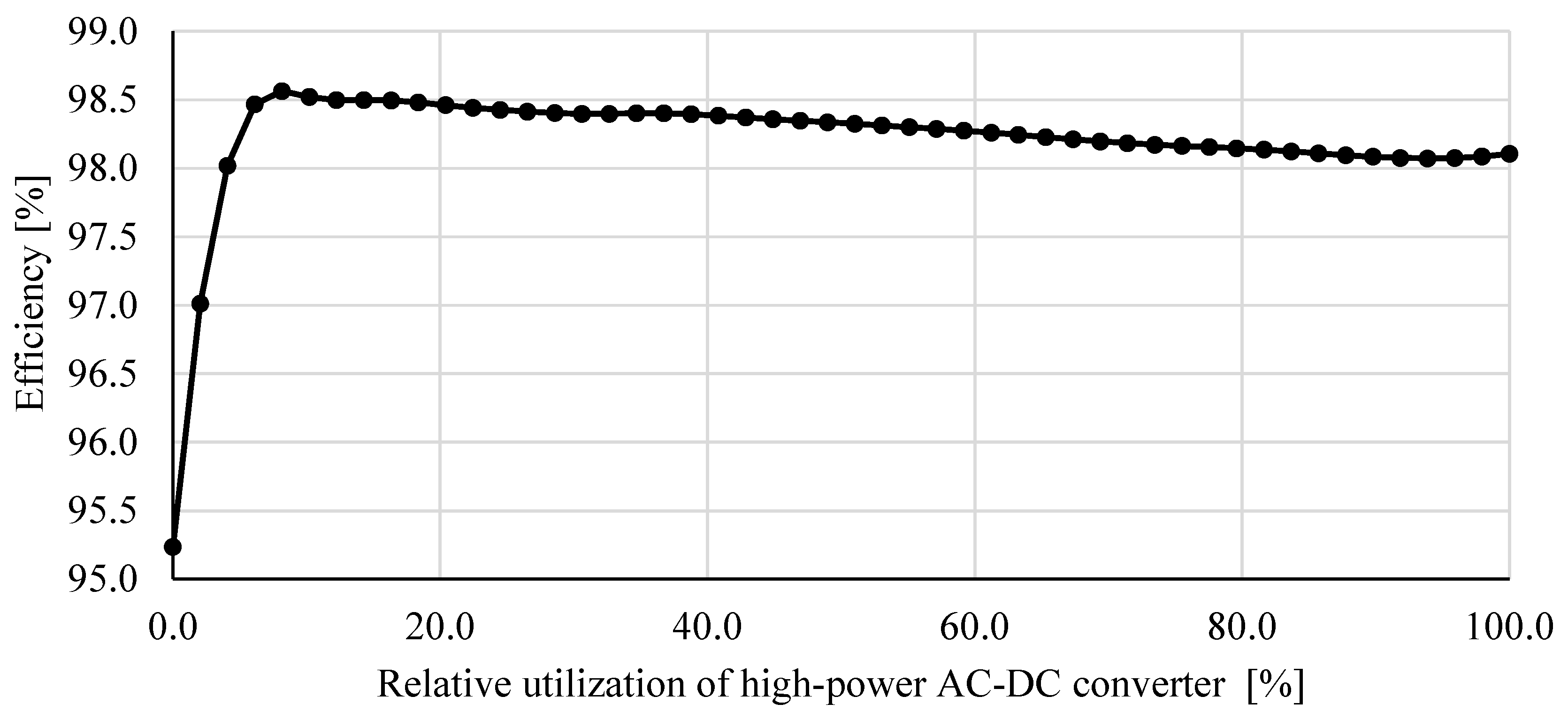
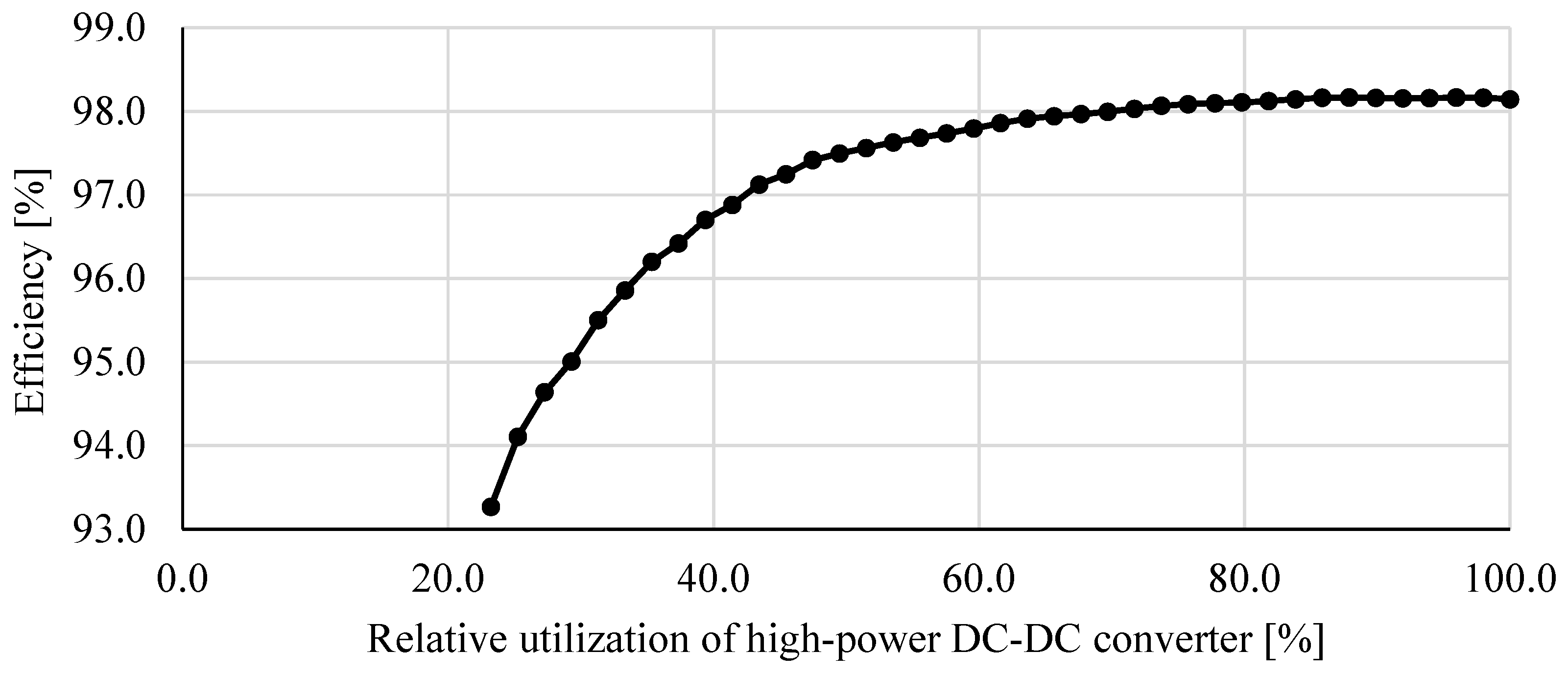
In the use phase, environmental impacts are primarily driven by electricity supply, and the analysis therefore focuses on GWP. For each application context, annual 15 min load profiles at the grid connection point are generated by combining parking and charging behavior profiles with SOC-dependent charging power curves. Differences between AC- and DC-based architectures are represented through conversion, transformer, and cable losses, resulting in architecture-specific electricity demand and operational GWP. Converter and transformer losses are modeled using load-dependent efficiency curves for the central AC-DC converters, the DC-DC converters, and the power transformers, with efficiencies evaluated at each 15 min time step as a function of the instantaneous load ratio using the parameterizations provided in Appendix A, Figure A6, Figure A7 and Figure A8 [25]. Operational GWP is then quantified by coupling the 15 min load profile with corresponding 15 min electricity-supply emission factors and aggregating over the year. The time series for 2023 and 2030 are in line with Elsobki et al. [25]. For 2037 and 2045, the time series is derived from ENTSO-E primary-energy projections [42] combined with ecoinvent GWP factors [40].
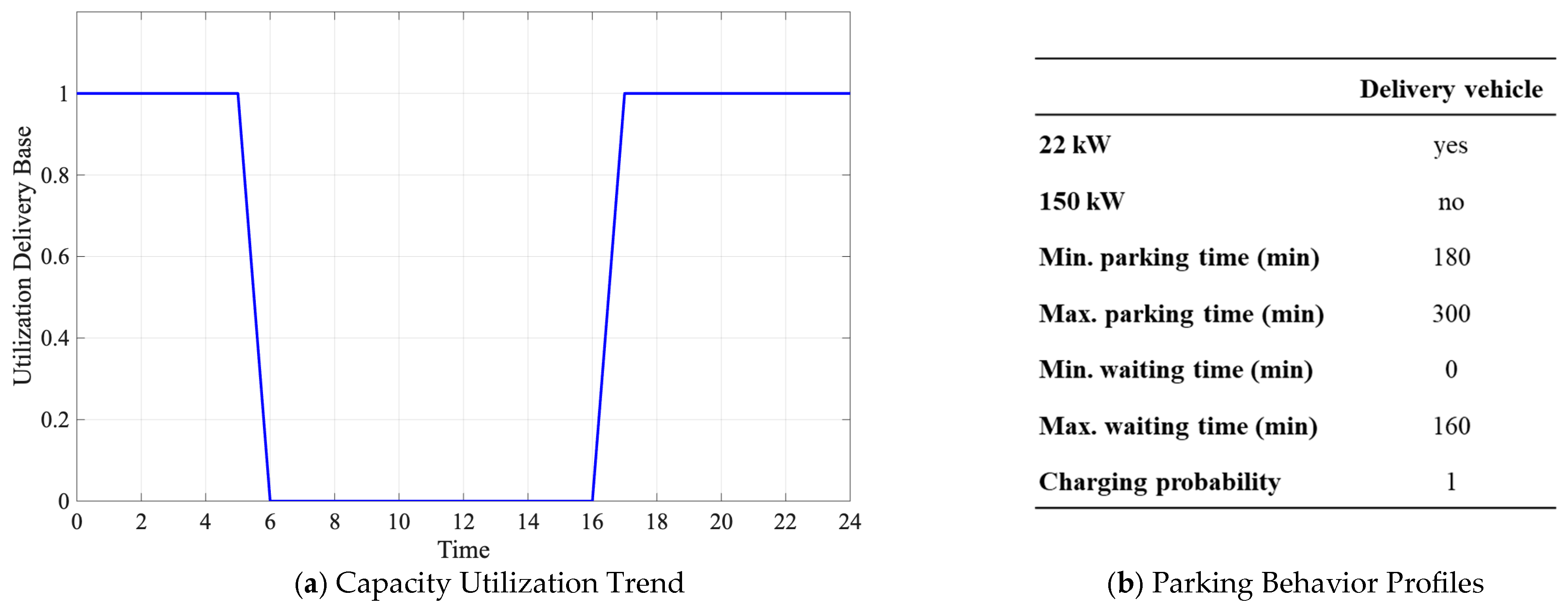
In parking garages, seven parking behavior profiles are implemented and weighted over the year using a typical weekday/weekend distribution (Table A8) [43,44]. The BEV fleet is represented by a set of representative passenger-car models selected based on segment prevalence and technical characteristics (Renault ZOE, Opel Mokka-e, Tesla Model 3, and Audi Q8 e-tron), and charging is modeled as a function of station capacity and SOC-dependent power curves [45]. To capture user and vehicle variability, the arrival SOC is sampled from a uniform distribution between 20% and 80%, and charging demand is evaluated using a Monte Carlo approach. The resulting time-dependent BEV fleet share follows Figure A1. Within parcel centers and delivery bases, the use-phase calculation follows the same 15 min approach but with application-specific profiles and vehicles. For delivery bases, each vehicle is represented by a Ford StreetScooter Work XL [39]; profile parameters are given in Figure 2. Delivery is modeled in up to three waves, implying an overnight charging window with 100% utilization from 17:00 to 06:00 [25,46]. Delivery bases are assumed to be fully electrified and returning vehicles arrive at 20% SOC. Due to missing SOC-dependent charging data for the StreetScooter, the Opel Mokka-e curve at 11 kW is used as a proxy [45]. This simplification may affect the detailed temporal charging profile and the resulting operational losses.
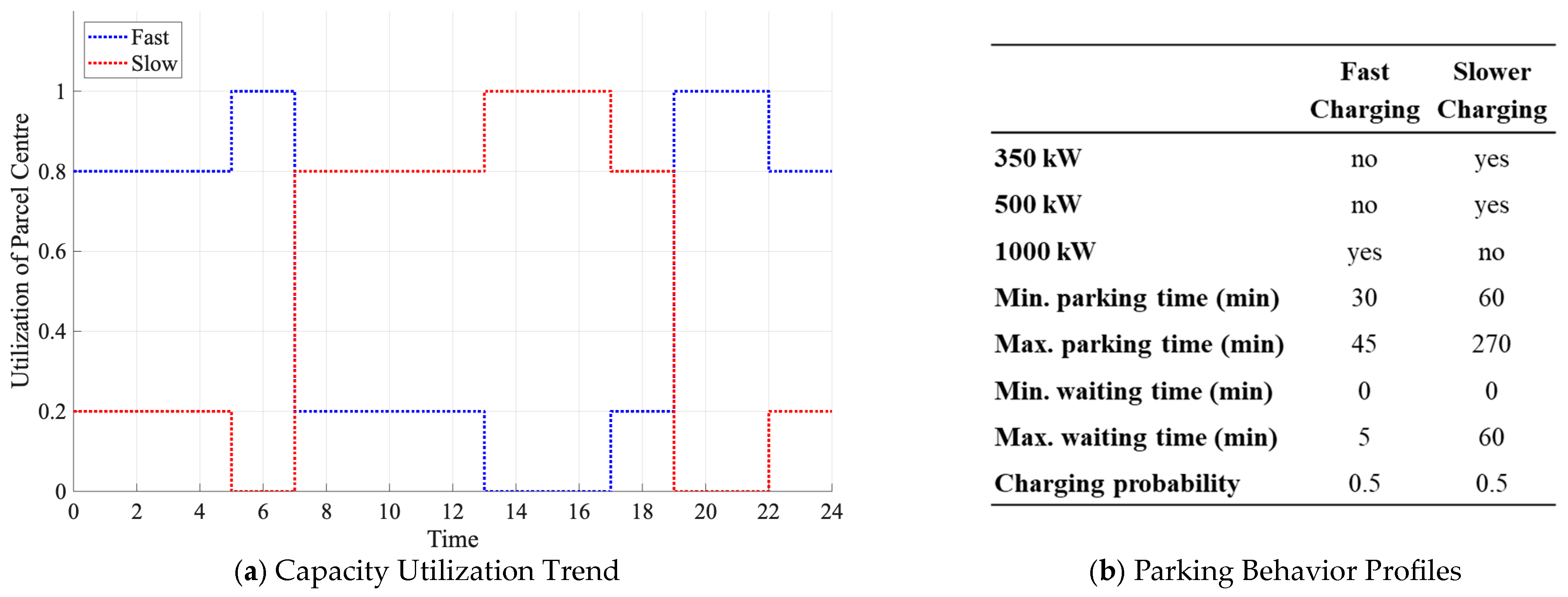
For parcel centers, profiles distinguish fast charging (1000 kW) vs. slower charging (500/350 kW). Megawatt charging is assumed mainly from ~18:00 to ~06:00 to reflect cases where main-haul arrivals coincide with regulated breaks and a rapid recharge enabling ~400 km is required (see Section 3.1.2 and Figure 3). Moreover, 500/350 kW charging represents shorter top-ups for pre-/post-haul operations. Trucks are represented by a Mercedes eActros (600 kWh). Due to missing SOC-dependent charging data for the selected truck application, the Audi Q8 e-tron 55 quattro curve is scaled to 1000/500/350 kW. This proxy may not fully represent truck-specific high-power charging behavior and may therefore affect peak loads, charging duration, and associated conversion and cable losses. Arrival SOC is fixed at 20%, and electric-truck shares follow Figure A3.
Dynamic Process Inventory and Systems
Because the study horizon (2023–2045) spans a period in which the environmental profile of grid and charging infrastructures is expected to change, the conventional LCI is extended by explicitly accounting for time dependence. Following the DLCA concept introduced in Section 3.2, time dependence is implemented in two layers: (i) a dynamic foreground inventory (dynamic process inventory) and (ii) dynamic background systems (dynamic systems), i.e., time-varying upstream conditions. In the foreground system, the inventory is recalculated for the reference years 2030, 2037, and 2045 by applying literature-based energy-efficiency and material-efficiency improvement factors to the production of relevant components and precursors (Table A9 in Appendix A). Energy efficiency reflects general technological and industrial process improvements (e.g., cross-cutting technologies) [47], while material efficiency captures material-saving potentials in manufacturing [48]. To avoid applying dynamic factors indiscriminately, a preparatory micro-level screening identifies the components and subcomponents that cumulatively account for 90% of GWP and mineral resource scarcity. Dynamic factors are applied only to this subset. The efficiency factors are implemented in openLCA as global parameters and mapped to the corresponding inventory exchanges, where appropriate, factors are transferred to analogous materials.
In the background system, future changes in global electricity supply are represented by scaling electricity generation from nuclear, natural gas, coal, and renewables for the reference years 2030, 2037, and 2045 relative to 2022, using literature-derived regional development factors [49]. These factors are implemented in openLCA by adapting the corresponding ecoinvent electricity supply processes. For tractability, per continent, the regions with the highest electricity production are used as representatives.

3.2.3. Phase 3: Impact Assessment

In the life-cycle impact assessment (LCIA), the life-cycle inventory results are assigned to impact categories and quantified using characterization factors (see Section 3.2). This study reports results for GWP (kg CO2-eq.) and mineral resource scarcity (kg Cu-eq.). Mineral resource scarcity is expressed in kg Cu-eq. and therefore does not directly indicate which specific raw materials drive the result. Accordingly, this indicator is used as a screening metric to identify material-relevant hotspots. The underlying inventory, material, and product flows of the dominant components are then examined to derive explicit material demand estimates.

3.3. Estimating the Impact on Material and Resource Requirements

This section describes the methodological approach used to evaluate potential raw-material supply risks associated with a nationwide rollout of AC- and DC-based grid and charging infrastructures in Germany, and the implications for Germany’s supply dependence. First, the most material-relevant resources are identified from the production inventories by selecting the five materials with the highest cumulative demand across all application cases. For each of these key materials, the analysis (i) links the material demand to the corresponding upstream raw materials, and (ii) characterizes Germany’s current supply situation using indicators such as domestic production, import dependence, and recycling rates. This is complemented by a global perspective that considers expected developments in world production and demand up to 2045. Combining both perspectives enables a structured screening of potential scarcity risks and supply vulnerabilities for Germany, including a review of currently pursued mitigation measures. Finally, the material implications of DC-based infrastructures are benchmarked against AC-based variants to evaluate potential advantages and disadvantages with respect to resource conservation [50].

3.4. Estimating Reduction Potentials from Scale and Synergy Effects

To approximate potential reductions in environmental impacts from scale and synergy effects, we apply literature-based learning assumptions and restrict the analysis to effects plausibly occurring within Germany (DLCA system boundary). Scale effects are therefore only considered for components (or major subcomponents) with domestic production capacity—grid-connection cables, transformers, rectifiers, and charging stations—and upstream scale effects in raw-material extraction and precursor production are excluded. Because component ratings are unchanged between single sites and nationwide deployment, size-related economies of scale are neglected and only quantity-driven learning/efficiency gains are considered [51]. For mature technologies (cables, transformers), additional learning is assumed to be limited, whereas charging stations and rectifiers are assigned a simplified learning rate of 15% per doubling of cumulative production, derived from energy technology learning rates and consistent with Göllinger [10]. No distinction is made between AC and DC chargers, and learning is assumed to apply across power classes. Doublings are operationalized using the diffusion of battery-electric passenger cars in Germany as a proxy for charging-station production scaling. Based on the scenarios in Table A2, cumulative unit reductions of 15% (2026), 30% (~2030), and 45% (~2037) are assumed, and 45% is also applied to 2045.
These reductions are mapped to proportional decreases in energy and material inputs per unit, guided by a representative charging-station cost structure (~34% materials, ~60% energy/labor, ~6% permitting [52]) and assuming constant shares. The adjusted inventories are then used to quantify reductions in GWP and mineral resource scarcity for charging stations and rectifiers under the scaling case.

4. Results

This section addresses the research questions of the study by presenting and synthesizing the results. Section 4.1 reports the environmental impacts (GWP) of a nationwide rollout of AC- and DC-based grid and charging infrastructures for the three application contexts. Section 4.2 summarizes the associated material demand, while Section 4.3 discusses critical materials and the resulting supply-risk implications for Germany in light of global market developments. Finally, Section 4.4 quantifies the influence of scale and synergy effects on the estimated impacts through 2045.

4.1. Results of the DLCA

Section 4.1 presents the DLCA results (2023–2045) for parking garages, parcel centers and delivery bases, including reduction potentials and sensitivity results.

4.1.1. Parking Garages in Germany

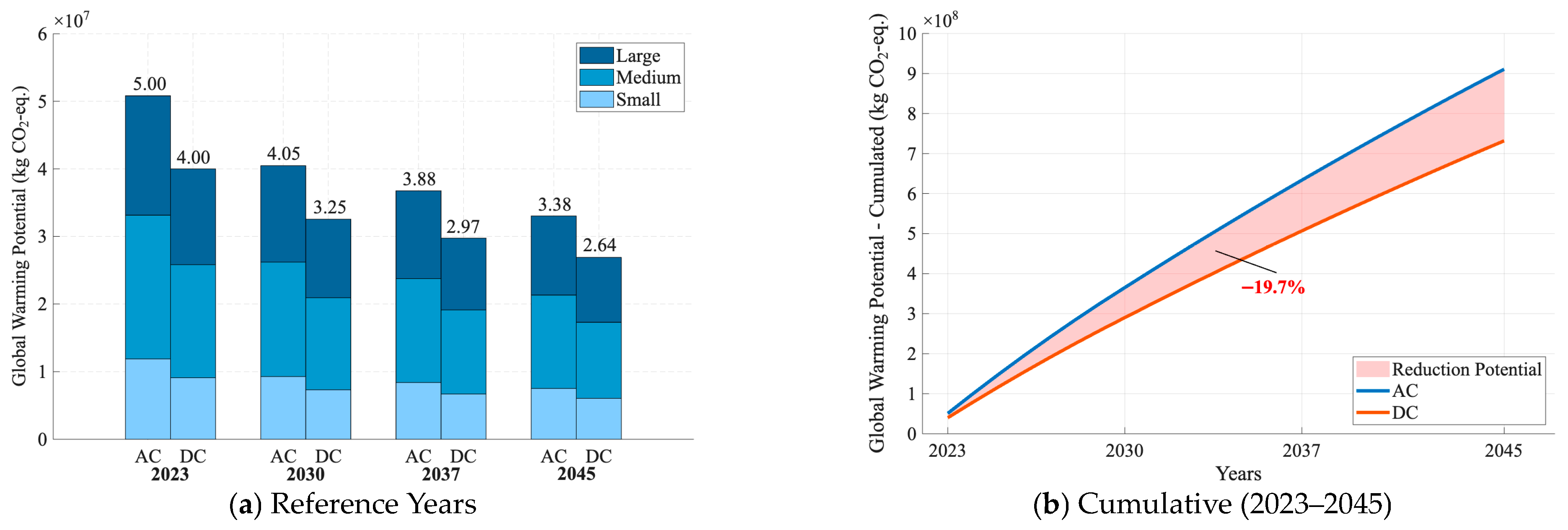
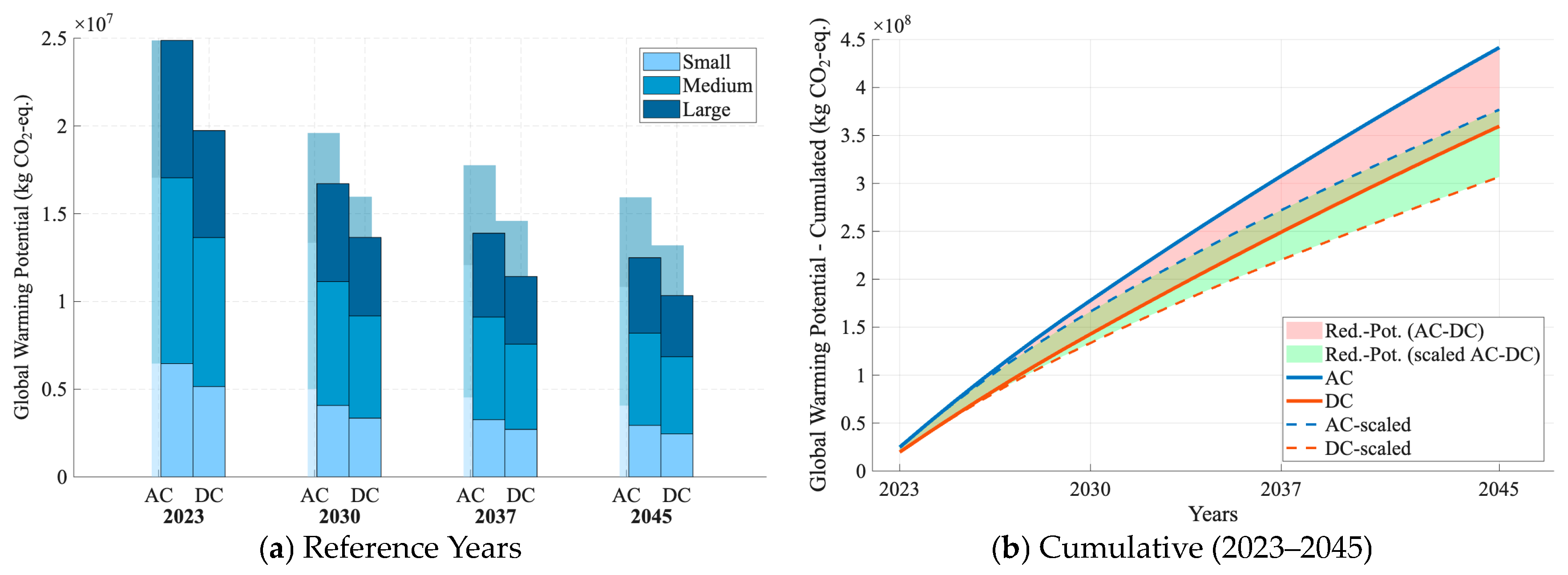
The GWP associated with manufacturing the grid-connection and charging infrastructure deployed in German parking garages up to 2045 is reported in Figure 4, including results for the reference years and the cumulative total over the assessment horizon. The production-phase GWP decreases over time, reflecting assumed improvements in energy and material efficiency as well as changes in the electricity supply mix. Overall, a DC-based configuration reduces production-phase GWP by 19.7% compared to the AC-based baseline.
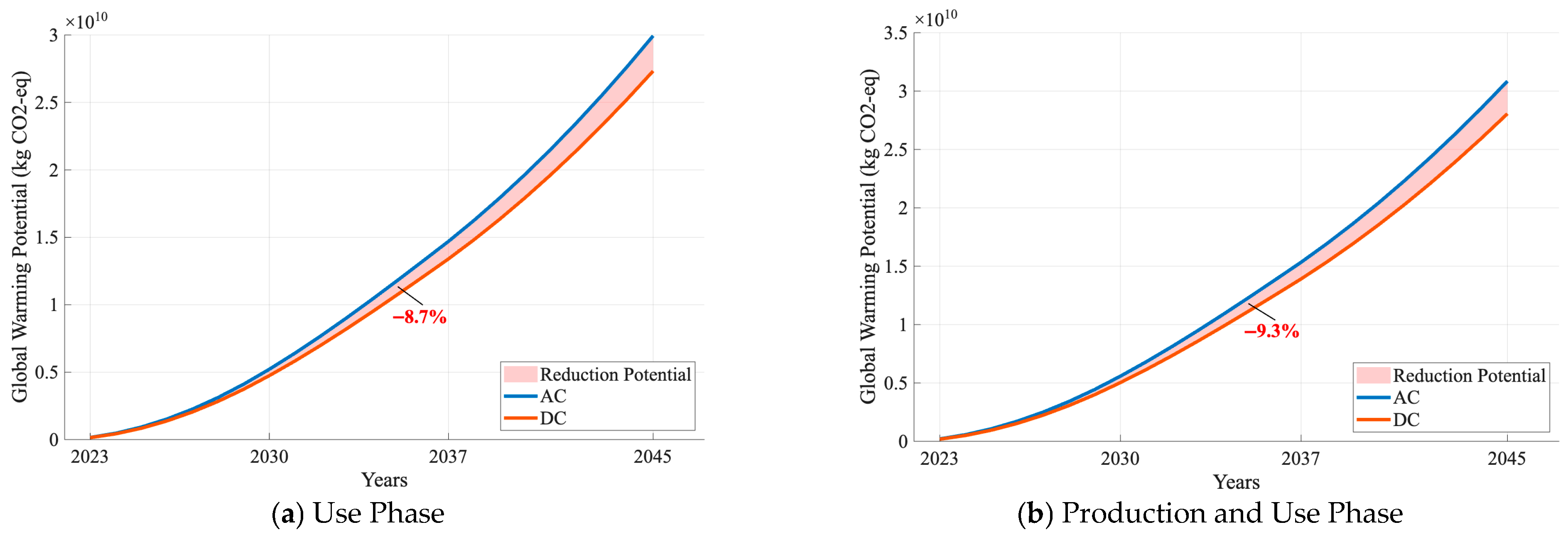
The results indicate that grid components (notably grid-connection cables and the transformer) constitute a major share of manufacturing impacts. While DC cabling has a lower per-unit manufacturing GWP than AC cabling, the net cable-related reduction decreases at higher system power, because each additional rectifier requires additional DC cable runs between the parking garage node and the rectifier (i.e., incremental cabling per 200 kW step). In contrast, the DC-related reduction for charging stations remains approximately constant with increasing installed capacity, and the rectifier’s manufacturing impact increases sub-proportionally, improving the overall DC–AC balance despite the diminishing cable benefit (see Figure A4). Figure 5 shows that the use phase dominates total GWP (97.9% for AC and 98.0% for DC), so the overall reduction is primarily driven by operational electricity demand and its time-dependent emission intensity. A DC-based configuration yields an approximately 8.7% lower use-phase GWP and 9.3% lower total GWP (production and use) compared with AC.
The lower operational GWP of DC is explained by (i) reduced transmission losses in DC cables and (ii) lower conversion losses due to the higher (load-dependent) efficiency of a central AC-DC converter compared with the distributed AC-DC conversion inside AC charging stations. The temporal profile reflects the cumulative rollout of infrastructures over time and increasing BEV shares, counteracted by declining grid-emission factors toward 2045.

4.1.2. Parcel Centers and Delivery Bases in Germany

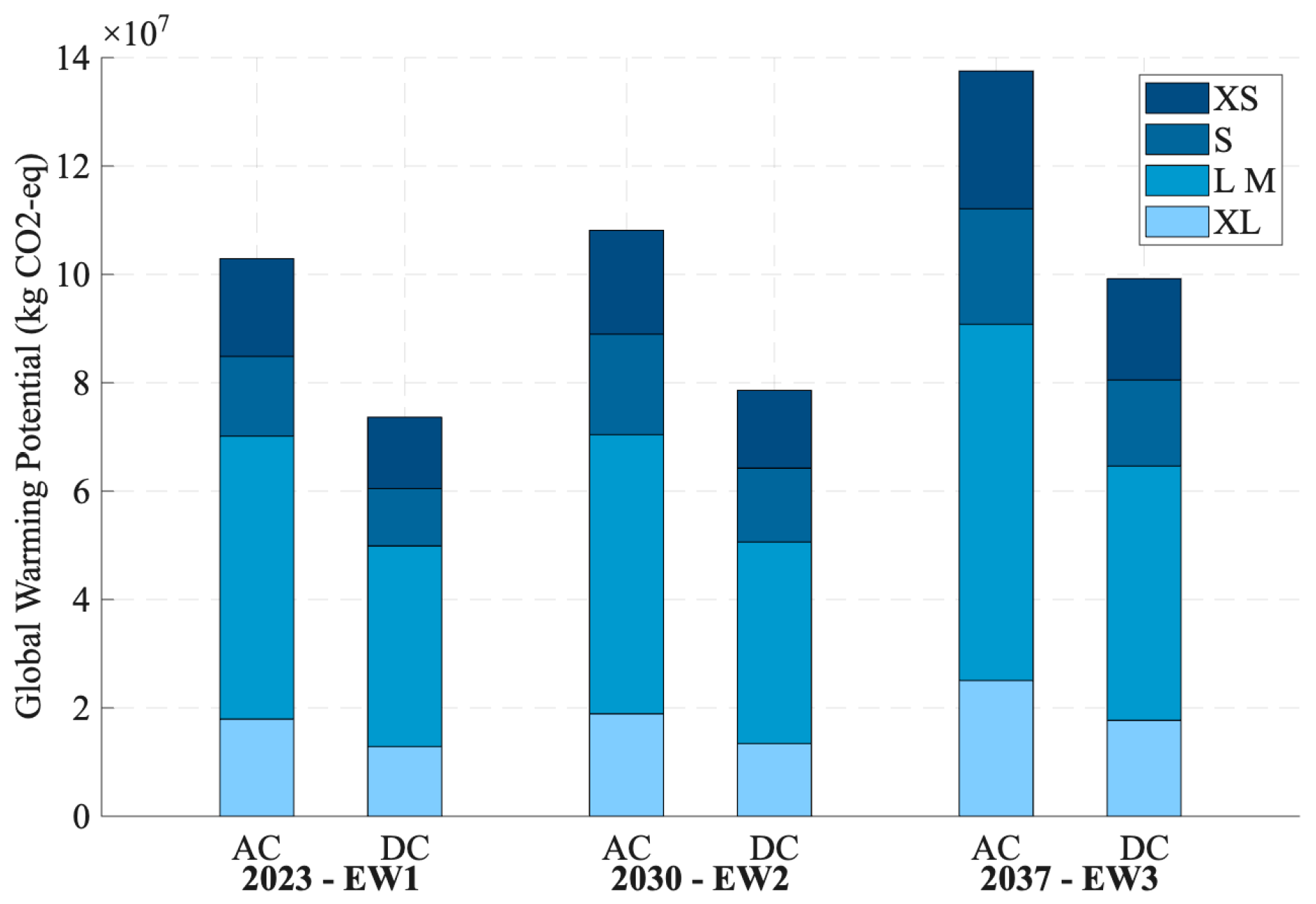
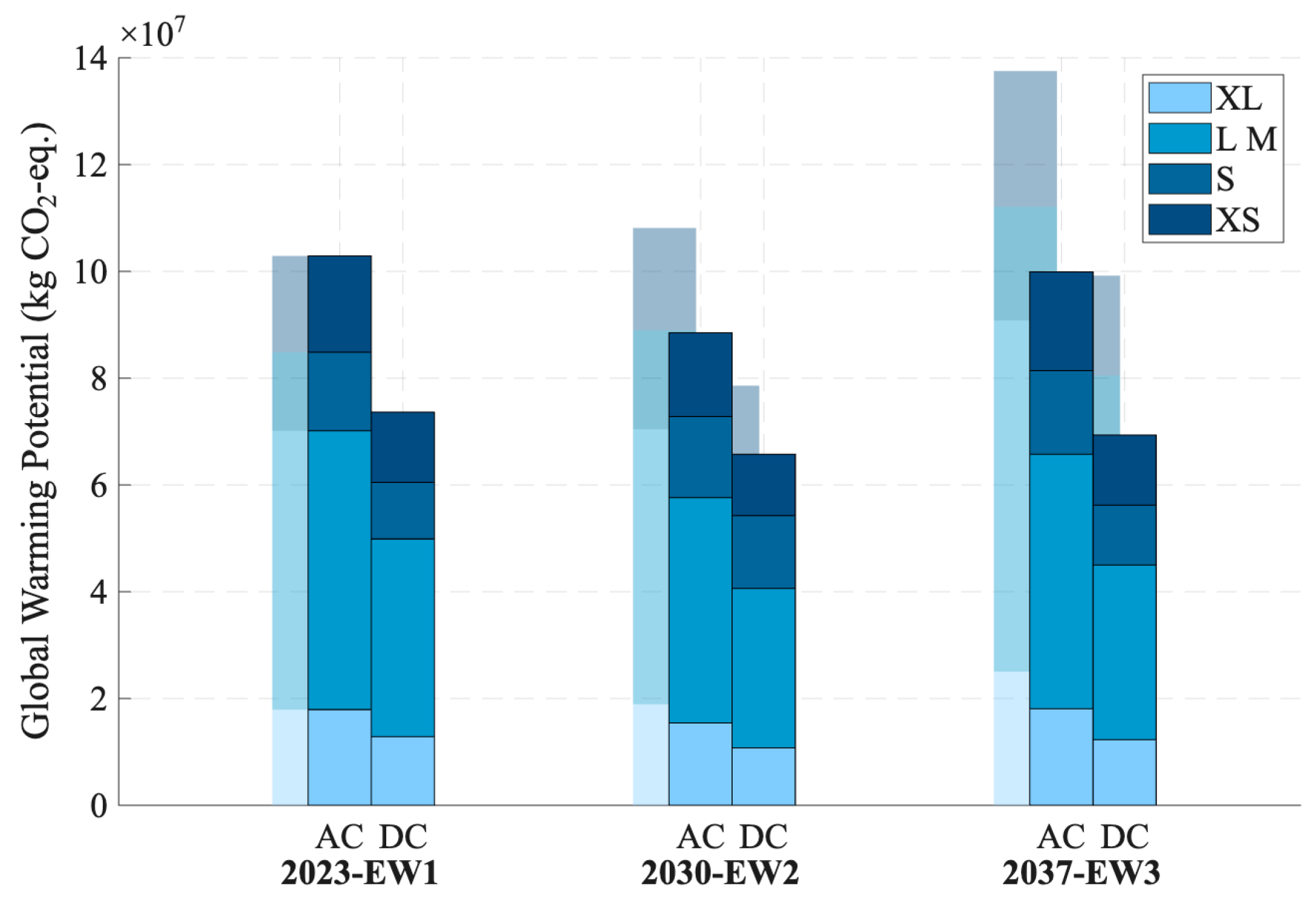
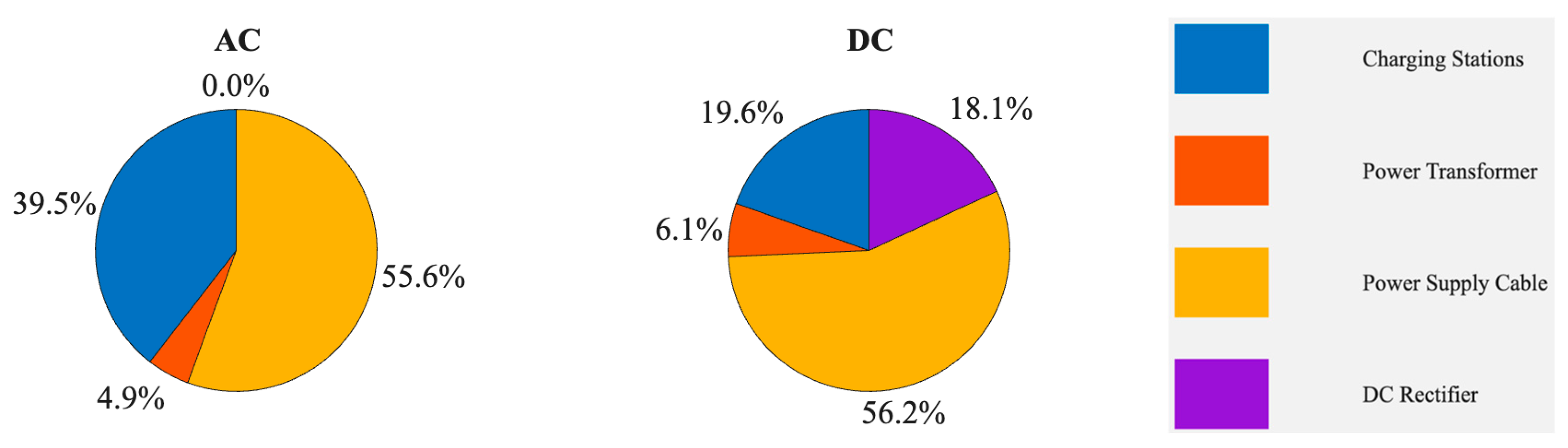
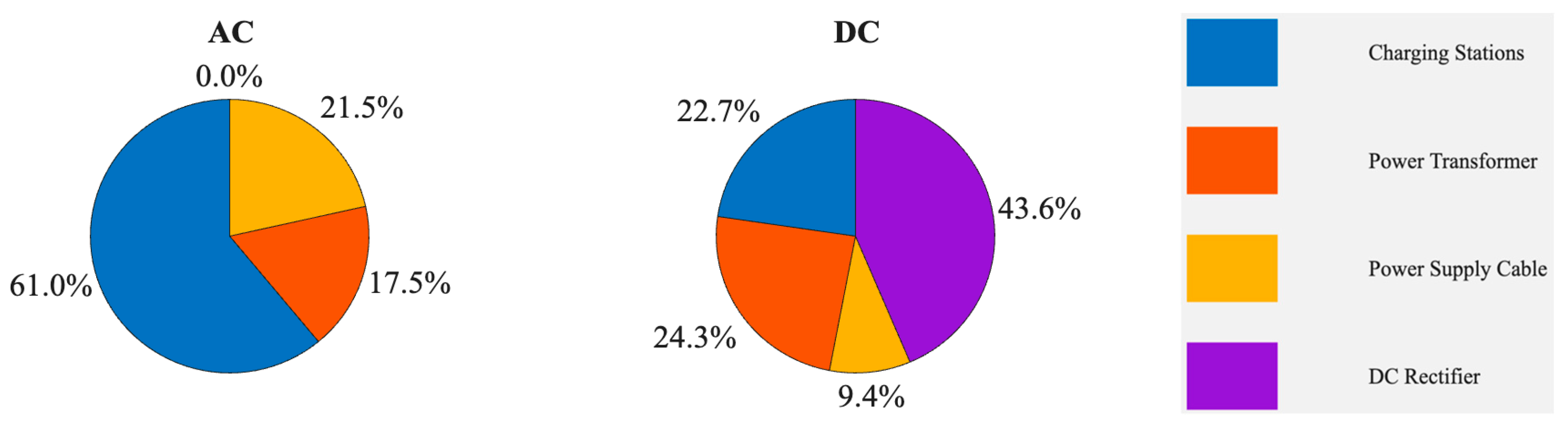
For parcel centers, manufacturing impacts occur exclusively in the three expansion-wave years (2023, 2030, 2037) (Figure 6). Installed charging power increases substantially between waves (second wave: 1.8×, third wave: 1.99× relative to the first), but production GWP rises less than proportionally because of the assumed time-dependent efficiency improvements and changing background conditions: from the first to the third wave, production GWP increases by 37.7% (DC) and 39.8% (AC). Over all waves, a DC-based configuration reduces parcel-center production GWP by 27.9% compared with AC (Figure 6), with energy-normalized results reported for 433.639 TWh delivered by 2045. Component attribution indicates that large DC-AC reductions in charging stations (−73.2%) and grid cables (−68.4%) outweigh the additional burden of the central rectifier in the DC case (see Figure A5).
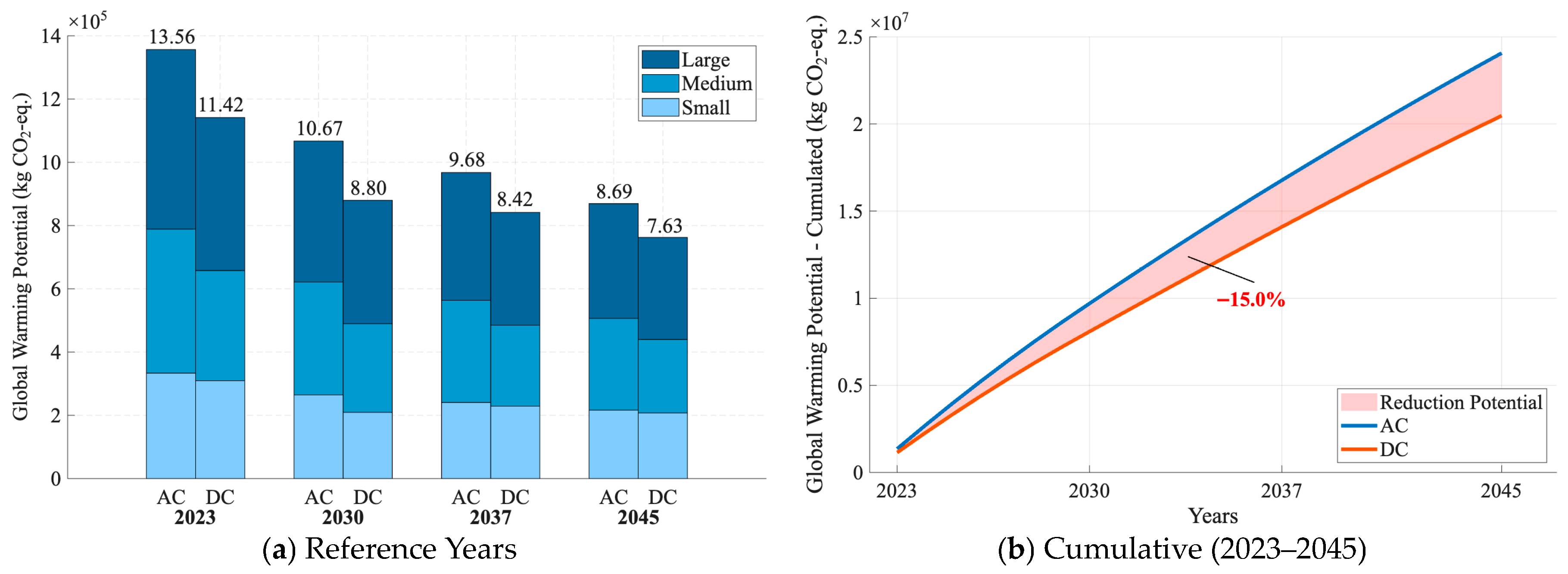
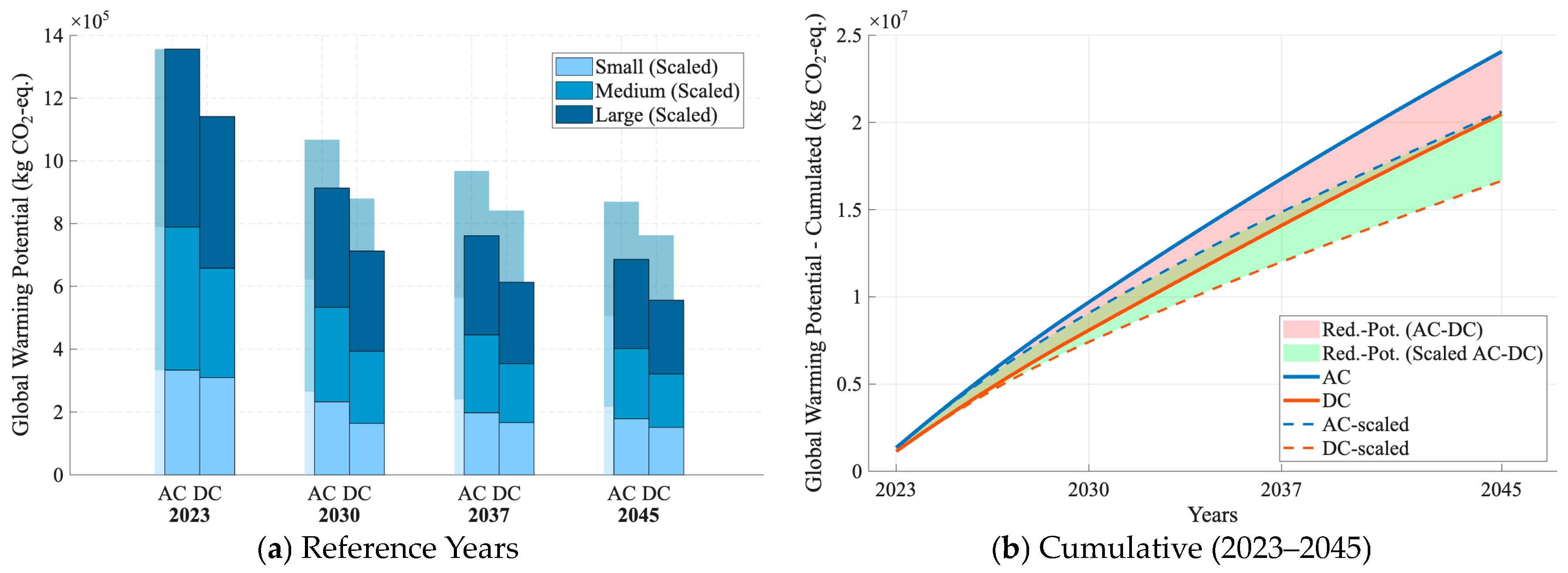
For delivery bases, production results are shown for reference years and cumulatively in Figure 7. Over 2023–2045, adopting DC reduces production-phase GWP by 15.0%, reflecting the same trade-off: additional impacts from centralized conversion equipment are compensated by lower impacts from charging stations and cabling.
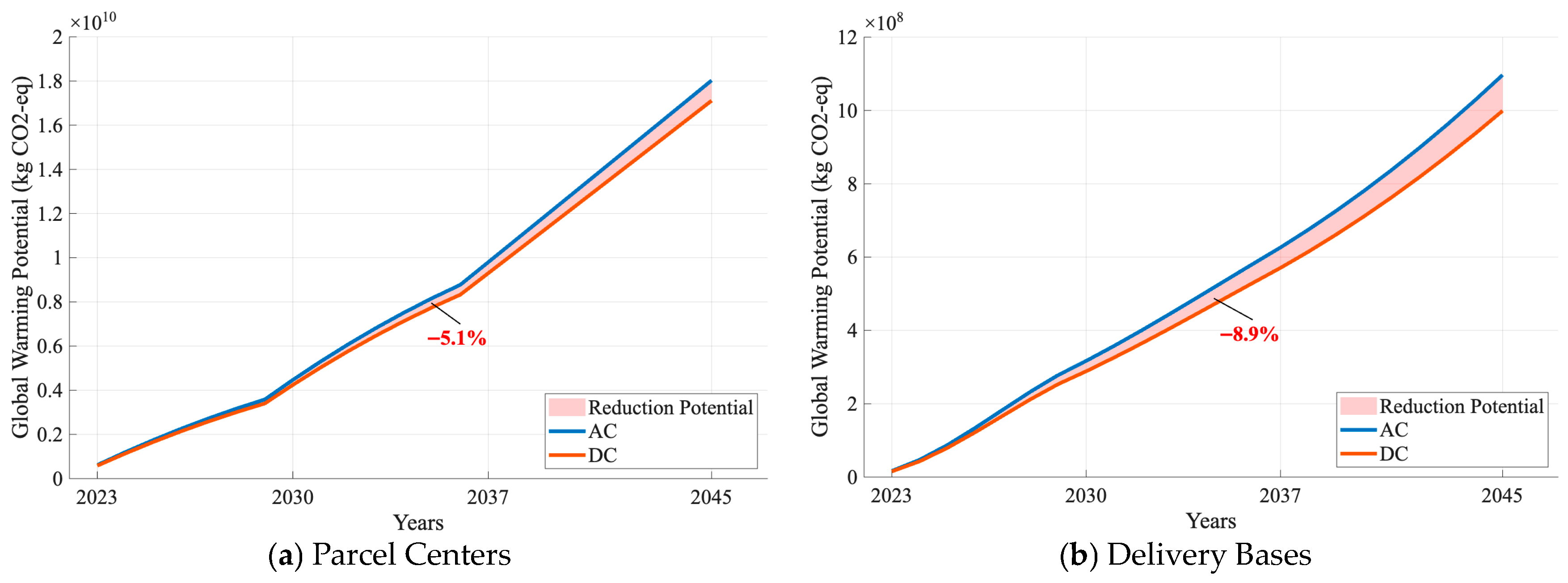
In the use phase, parcel centers exhibit stepwise increases aligned with the expansion waves (Figure 8), whereas delivery bases show a smoother trajectory due to gradual rollout. Over the full horizon, DC reduces use-phase GWP by 5.1% for parcel centers and 8.9% for delivery bases, primarily due to higher conversion efficiency of the central AC-DC converter and lower losses in DC cables.
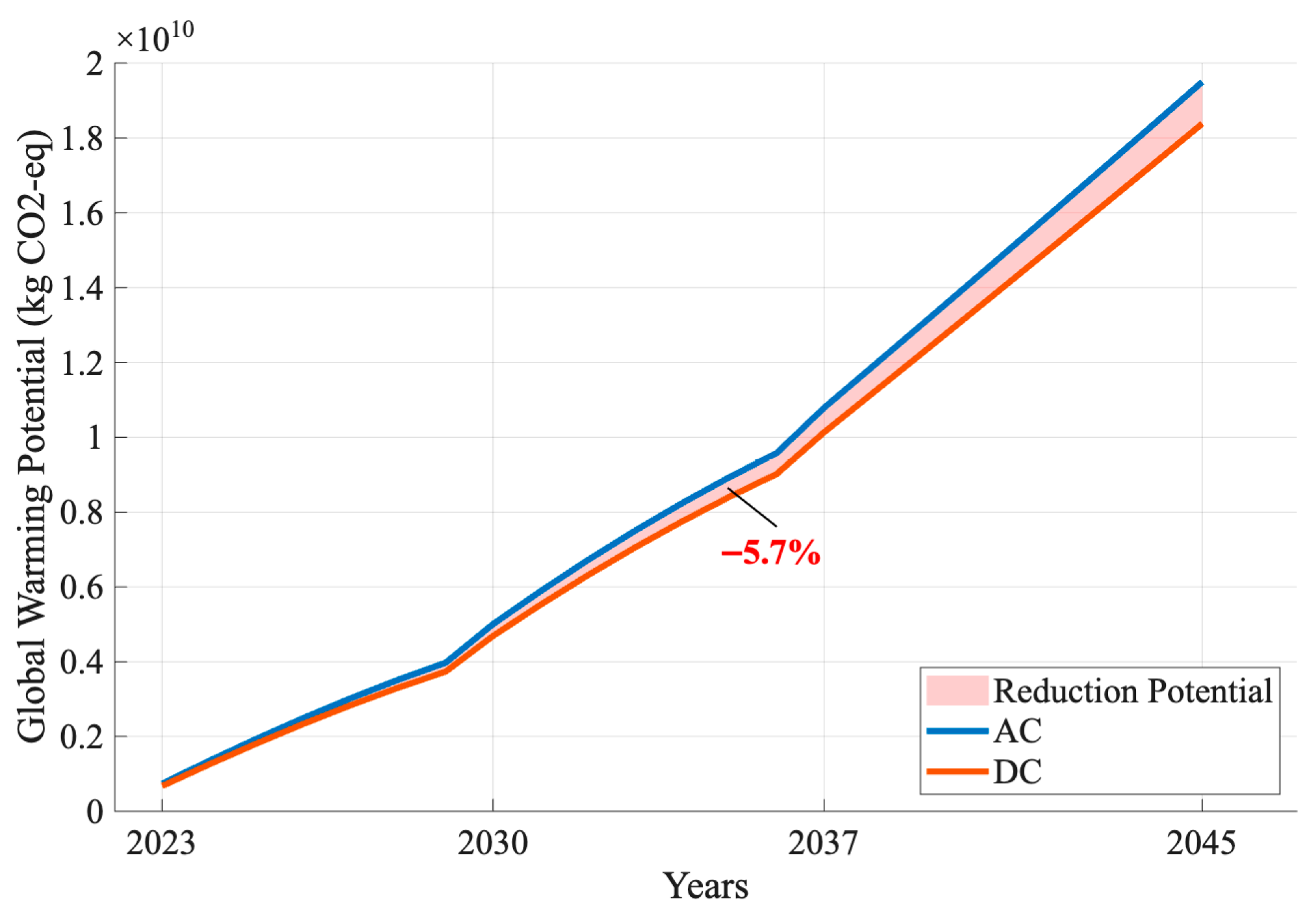
Aggregating parcel centers and delivery bases and combining production and use phase show that total GWP is dominated by the parcel-center use phase (Figure 9). Delivery bases contribute only 5.7% (AC) and 5.5% (DC) of total system GWP. Overall, the DC configuration achieves a 5.7% reduction in total GWP relative to AC, with energy-normalized results based on 454.118 TWh delivered by 2045.

4.1.3. Reduction Potentials and Sensitivity Analysis

To interpret the drivers of the DC–AC difference and assess robustness, we (i) decompose the production-phase reduction potential at the micro level (single parking garage configuration) into its main component contributions and (ii) perform targeted sensitivity analyses for key technical parameters. For the transformer, no reduction potential arises because it is identical in AC and DC configurations. In contrast, DC-designed charging stations exhibit a pronounced reduction potential due to the omission of LCL filters and per-station AC-DC conversion: 62.8% for 22 kW and 56.5% for 150 kW charging stations (micro-level comparison). This contribution scales approximately proportionally with the number of charging stations. A similar trend holds for cabling, where DC layouts reduce conductor and insulation demand in cable sections that allow a direct AC-to-DC substitution. However, the reduction is not fully transferable to upstream sections (from transformer/rectifier to the internal node) because AC and DC topologies differ and additional rectifier-related cable runs can be required. A key counteracting contribution is the central rectifier: the DC architecture enables the above reductions but introduces additional manufacturing impacts. Because rectifiers are modeled as modular units and one additional rectifier is required per +200 kW increase in total system power, the net reduction potential exhibits a step-like behavior [25]. The overall production-phase reduction potential therefore depends strongly on the utilization of installed rectifier capacity: higher total power tends to reduce the relative penalty of the rectifier additions.
The reduction values achieved in this macro-level analysis are consistent with the findings of our published working paper at the micro level, which reported savings of approximately 66% for 22 kW wallboxes and 58% for 150 kW charging stations in a single parking garage configuration [25]. For the macro-scale assessment, we assume that this step-wise dependence averages out across heterogeneous infrastructure configurations and rectifier utilization levels. In this study, sensitivity analyses are conducted for two key parameters: the simultaneity factor and the efficiency of the AC-DC converter within the charging station. Both analyses are carried out representatively using the parking garage grid and charging infrastructures.
Sensitivity 1: Simultaneity Factor (Production Phase)
The simultaneity factor affects the dimensioning power of the infrastructure at a given number of charging points. On the macro-level, increasing simultaneity from 0.3 to 0.75 raises the GWP impacts in both architectures. However, the sensitivity is markedly higher for DC (+27.5%) than for AC (+4.6%). Consequently, the DC reduction potential in the production phase decreases with increasing simultaneity. This effect is explained by the rectifier-driven exchange relationship: higher simultaneity increases required total power and thus the number of rectifiers, while the number of charging stations (and their reduction potential) remains constant (Table 6).
Sensitivity 2: AC-DC Converter Efficiency of AC Charging Stations (Use Phase)
Because use-phase impacts dominate life-cycle GWP, we also test the influence of the assumed efficiency of the AC-DC converter within AC charging stations (Table 7). A higher converter efficiency improves the overall efficiency and reduces use-phase impacts of the AC architecture, while the DC architecture remains unaffected (no AC-DC converter in the DC charging station). As a result, the DC advantage in use-phase GWP decreases with higher assumed AC-DC converter efficiency.

4.2. Material Requirements and Resource-Intensive Components

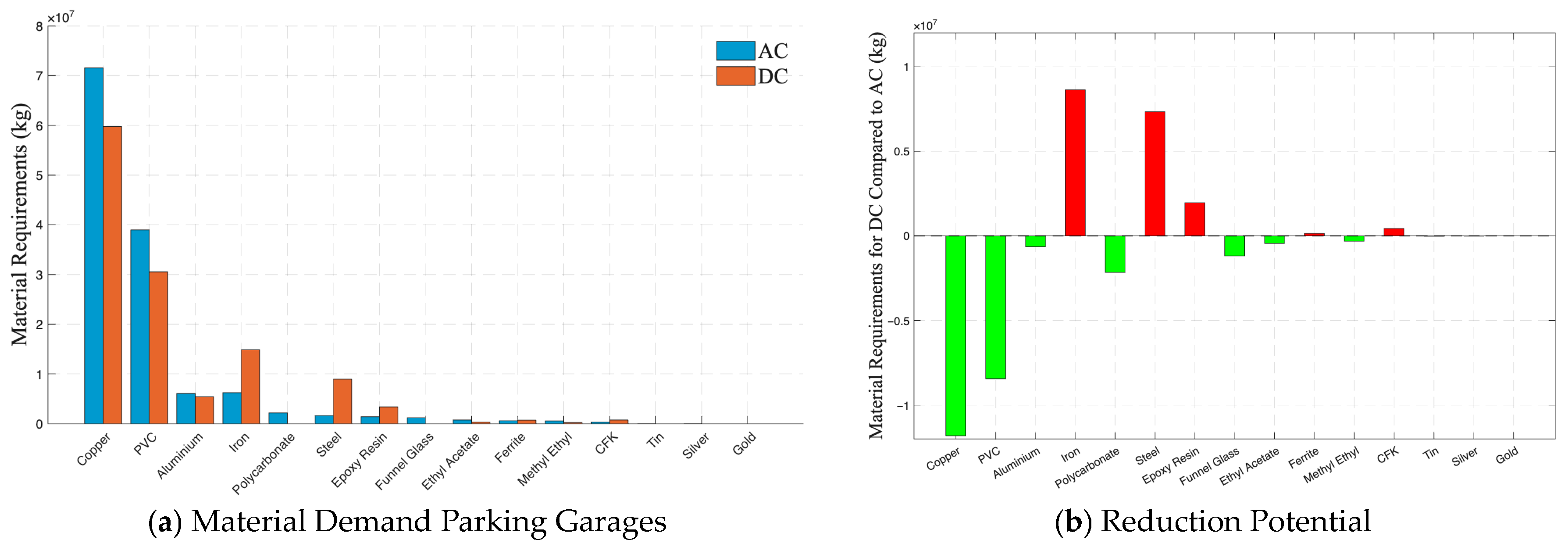
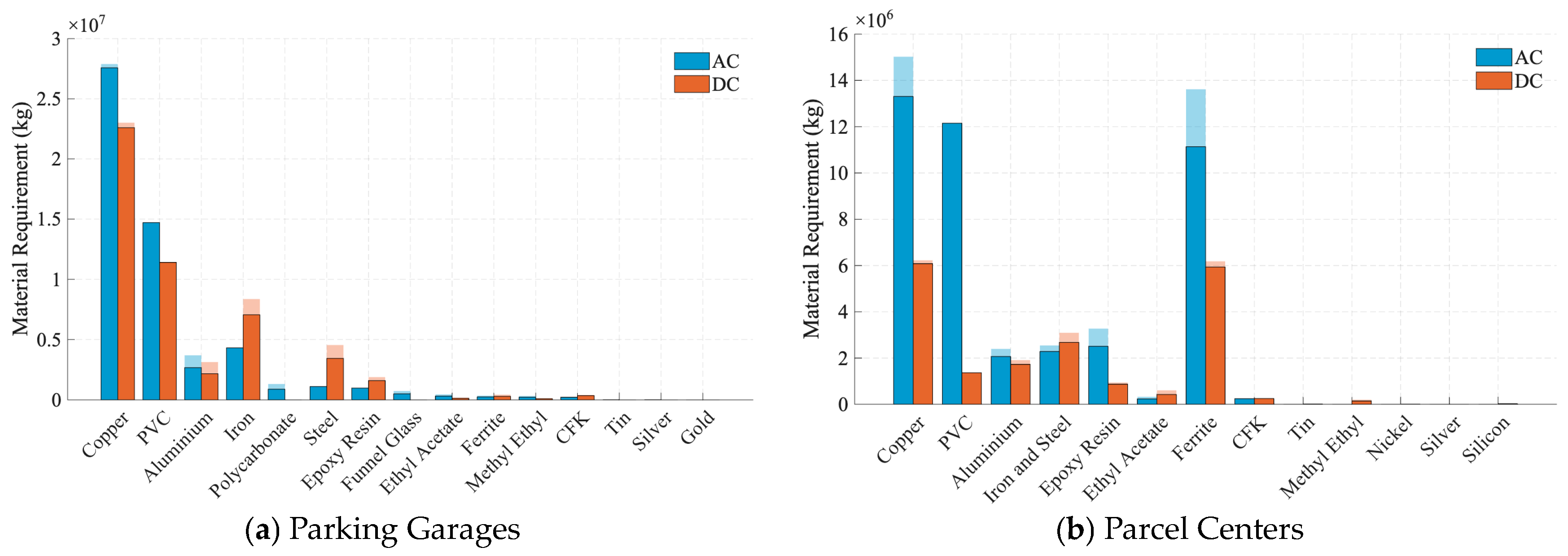
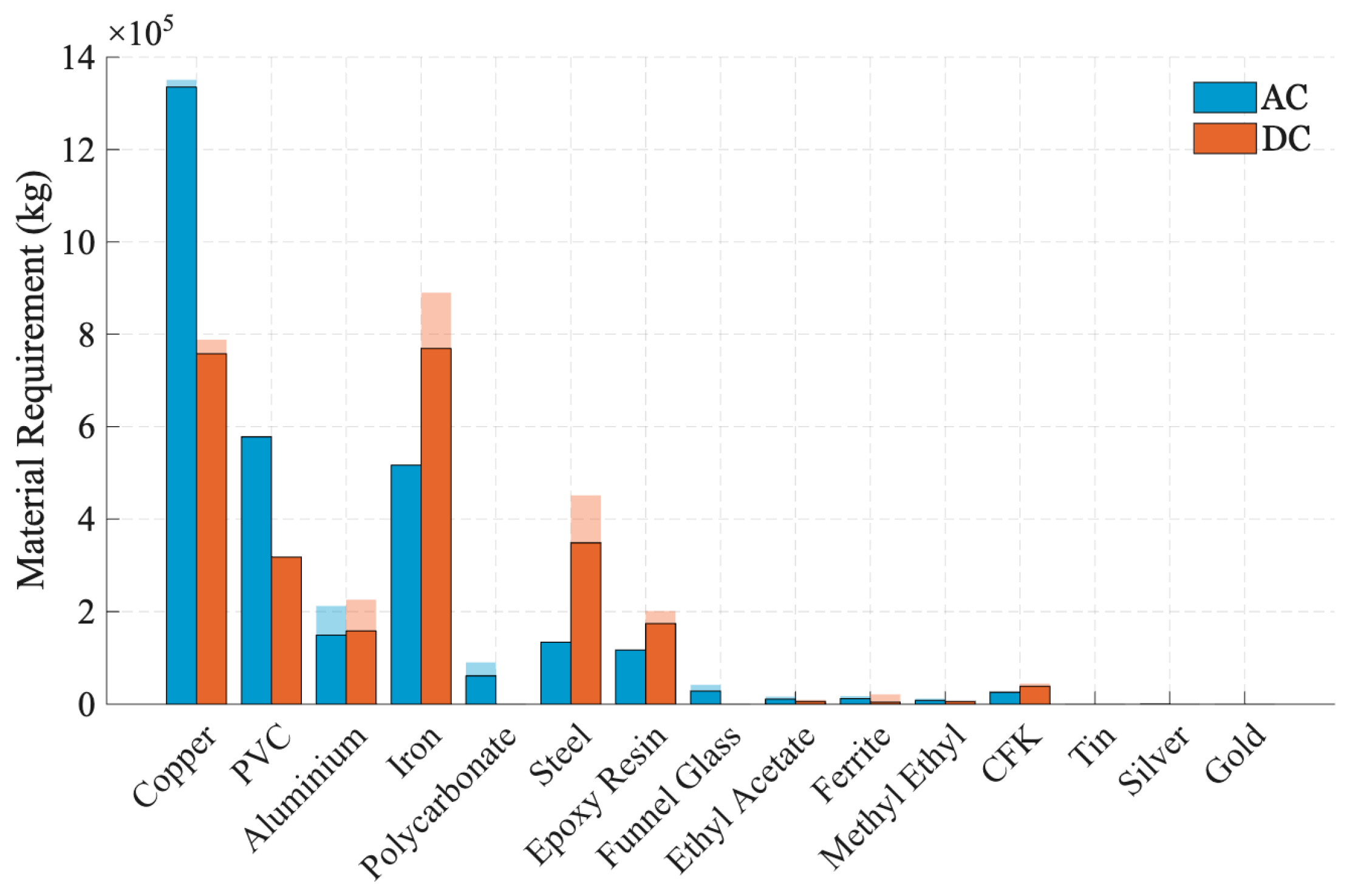
This section summarizes the material requirements associated with the production of the nationwide rollout of grid and charging infrastructures up to 2045. Across the full rollout, material demand is dominated by copper and PVC, primarily driven by grid-connection cabling (conductor and insulation). Aluminum is mainly attributable to charging-station housings and selected power-electronic assemblies, whereas iron and steel are largely associated with the transformer and—under DC architectures—additional central rectifier hardware. Comparing AC vs. DC, the results indicate a consistent trade-off: DC reduces copper- and PVC-intensive cabling demand due to fewer conductors and reduced cable cross-sections, while iron and steel demand increases because the rectifier represents the dominant steel-intensive DC-specific component. In addition, DC reduces the demand for materials associated with per-station filters and conversion, reflecting the omission of LCL filters and decentralized AC-DC conversion stages. Beyond copper and PVC, the comparison also reveals application-specific shifts for aluminum and ferrous materials, depending on the respective topology and rectifier-capacity requirements. For parking garages, the DC configuration reduces copper demand by 17.1% relative to AC (Figure 10), while PVC demand decreases accordingly due to lower insulation requirements in DC cabling. In addition, DC reduces aluminum demand by 10.6%, and increases iron demand by 139.0% and steel demand by 455.0%.
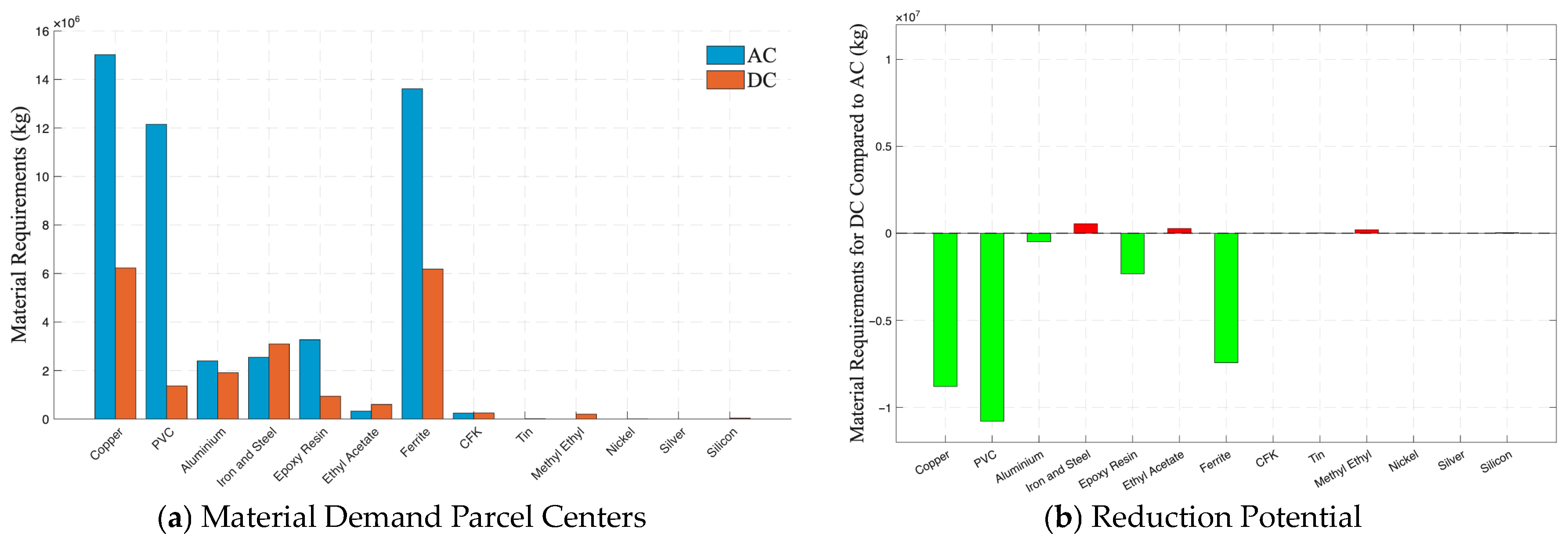
For both parcel logistics applications, copper and PVC remain the largest contributors, again reflecting the importance of cabling. For parcel centers, a DC-based design yields marked reductions in cabling-related materials, with a 58.7% decrease in copper and an 88.8% decrease in PVC relative to AC. Ferrite demand is also reduced (−55.4%) due to smaller charging-station designs in the DC case. Aluminum demand is 20.3% lower in the DC configuration. By contrast, AC shows a 21.5% lower combined iron and steel demand, as DC requires additional rectifier capacity (Figure 11).
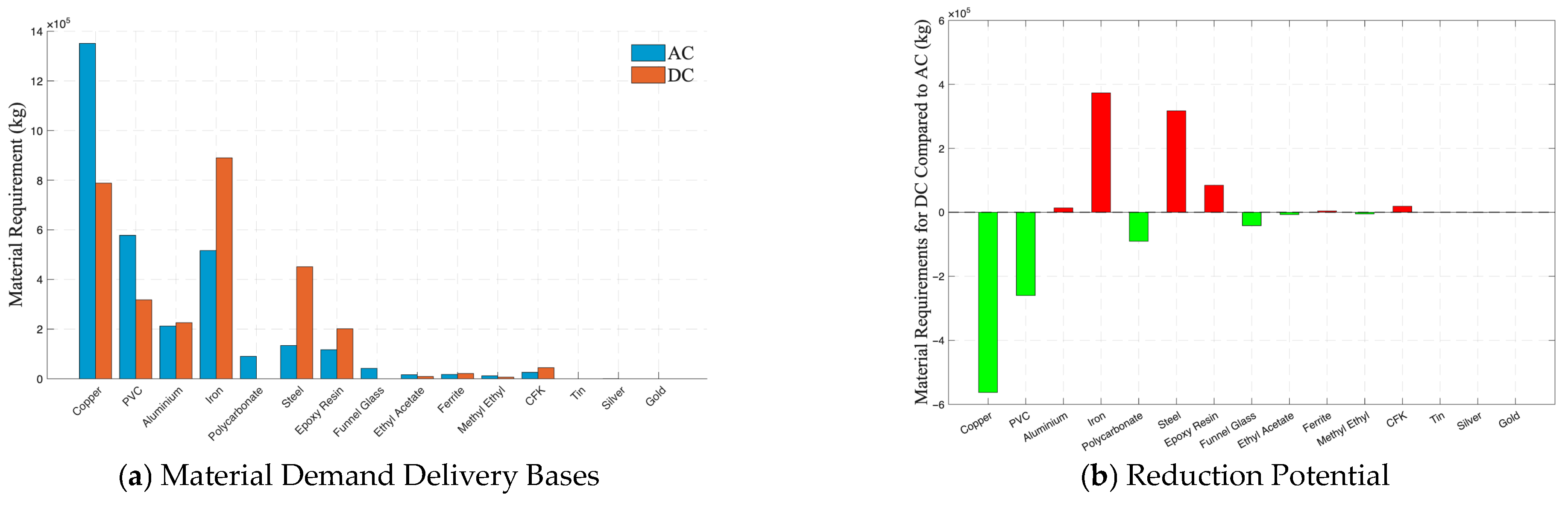
For delivery bases, the pattern mirrors parking garages: a DC configuration reduces copper by 41.6% and PVC by 44.9%, while iron/steel increases are driven by the production of the additional rectifiers. However, unlike in parking garages and parcel centers, aluminum demand is 6.5% lower in the AC configuration. In addition, AC shows clearly lower ferrous-material demand: DC increases iron demand by 72.3% and steel demand by 236.6%. Overall, the parcel logistics results confirm that DC architectures mainly shift material demand away from copper/PVC-intensive cabling toward steel-intensive central conversion equipment, with the balance depending on the application-specific topology and rectifier capacity requirements (Figure 12).

4.3. Critical Materials and Supply-Risk Implications

The nationwide rollout of grid and charging infrastructures is primarily driven by four material groups: copper, aluminum, iron/steel, and PVC. For Germany, this is relevant because the domestic supply of many metals and industrial minerals is structurally import-dependent, and policy increasingly emphasizes recycling and diversified sourcing to mitigate price and supply risks [53,54].
A screening assessment of global supply–demand developments indicates that copper is the most critical of the four materials for the 2023–2045 horizon. Copper is classified as a critical/strategic raw material at the European Union level [55] and is essential across many clean-energy technologies, while demand is projected to rise strongly over the coming decades [56]. At the same time, declining ore grades and ramp-up times for new mining projects can create temporary tightness (rather than a physical absence of resources), implying a plausible risk of elevated prices and supply constraints during the transition [56]. Germany’s high import dependence for copper and its semi-finished products amplify this exposure [54].
For aluminum, the key issue is less geological scarcity than energy-intensive primary production and associated competitiveness: known bauxite reserves are considered sufficient for very long time horizons [57], but domestic and EU primary aluminum production has declined amid high energy costs, increasing reliance on imports and reinforcing the role of recycling [54,58]. Iron/steel is not classified as critical in the cited framework [55] and Germany maintains significant industrial capacity [54]. Therefore, this work does not identify iron/steel scarcity as a constraining factor for the rollout. PVC depends on petrochemical feedstocks; while Germany can source salt domestically, crude-oil supply remains import-based. Nevertheless, given the assumed reserve horizon and market availability, no oil-driven scarcity constraint is inferred within the study scope [54,59].
Combining these findings with the material demand results (Section 4.2) supports a clear interpretation: DC-based architectures reduce copper (and aluminum to a smaller extent) relative to AC, at the expense of higher steel-intensive central conversion equipment in some configurations. From a resource-security perspective, copper savings are particularly relevant because copper is both strategically important and most exposed to near- to mid-term market tightness [55,56].

4.4. Influence of Scale and Synergy Effects

To assess how manufacturing scale-up and learning could modify the baseline DLCA results, the scale and synergy assumptions derived in Section 3.4 are applied only to the production phase and only to charging stations and rectifiers. No scale or synergy effects are assumed for operation because the infrastructures are spatially distributed and operated independently. The global warming potentials of producing grid and charging infrastructures in a nationwide expansion scenario for parking garages, parcel centers, and delivery hubs, both with and without consideration of scaling and synergy effects, are shown in Figure 13, Figure 14 and Figure 15. Faded bars represent the potential without these effects, while highlighted bars indicate the potentials including scaling and synergy effects. For parking garages, the assumed learning effects are translated into time-dependent reduction factors. Cumulatively over 2023–2045 (Figure 13), this corresponds to a 14.7% reduction in production-phase impacts for both AC and DC configurations. The near-identical AC/DC reductions reflect that, in both architectures, a comparable share of production impacts is attributable to the components subject to learning (charging stations in AC, charging stations plus rectifiers in DC).
For parcel centers (three deployment waves), reductions amount to −18.1% (AC) and −19.8% (DC) in the second wave and −27.3% and −30.1% in the third wave, as shown in Figure 14. Cumulatively, production-phase GWP decreases by −16.4% (AC) and −18.1% (DC), although the absolute reduction is larger in AC than in DC because the AC baseline is higher.
For delivery bases (Figure 15), learning yields larger relative benefits for DC because both charging stations and rectifiers are affected: cumulative −14.3% (AC) and −18.7% (DC).
Consistent with the modeling setup, material demand reductions occur only for materials embodied in charging stations and rectifiers. For parking garages (Figure 16), the reduction potential therefore concentrates on metals and polymers associated with power-electronic hardware (notably aluminum and copper and—only in the DC case—iron/steel via rectifier learning), whereas materials dominated by grid components (e.g., transformer and fixed upstream cabling sections) are largely unaffected by the learning assumption. For parcel centers (Figure 16), the largest modeled savings occur in the AC case (notably copper, ferrites, epoxy resin, aluminum, and iron/steel), while the DC case shows smaller incremental reductions because DC charging stations and rectifiers have lower baseline material requirements in the underlying inventories.
For delivery bases (Figure 17), learning-induced savings are modest in AC but higher in DC due to the additional contribution from rectifier manufacturing (notably iron/steel and associated resin and metal inputs). Beyond the quantified learning effects, the literature indicates further (unmodeled) synergy levers—e.g., bundling transport and site preparation and cross-site maintenance and installation management—which may reduce impacts but are outside the present DLCA quantification scope.

5. Discussion

The results show that DC-based grid and charging infrastructures reduce life-cycle GWP relative to AC across all investigated macro-scale rollout scenarios to 2045. Total GWP is reduced by 14.0% for parking garages and by 10.9% for parcel centers and delivery bases combined. This advantage can be explained by a structural exchange relationship. DC architecture introduces additional production impacts from centralized conversion equipment (rectifiers), but they also reduce impacts from charging stations by avoiding decentralized AC-DC conversion and associated filter hardware. Depending on the topology, DC systems can further reduce cabling-related impacts through lower conductor demand and changed insulation requirements. At the component level, rectifiers are modeled modularly. As a result, net production benefits can change in a stepwise manner with installed power and with rectifier-capacity utilization. This mechanism is consistent with the micro-level engineering logic used to derive the exchange relationship and explains why production-phase AC-DC differences vary across application contexts [6,7,25].
A key methodological insight is that dynamic effects matter, but their influence is component-share dependent. The implemented improvements in energy and material efficiency and the evolving electricity background reduce production-related impacts across reference years, yet the relative DC-AC response differs by application. Where rectifiers contribute a comparatively larger share of production impacts (e.g., parcel centers), assumed efficiency and background updates can shift DC results more strongly. Where charging stations and cables dominate, the balance is driven mainly by the achievable reductions in these components. While the adopted dynamic parameterization relies on generalized assumptions, this level of simplification is pragmatic given the effort required to parameterize consistent multi-decadal changes in both foreground and background systems.
Across all application contexts, the use phase dominates total GWP, implying that overall differences are primarily governed by operational losses (conversion and cable losses) and by the assumed temporal development of electricity-system emission intensity. This aligns with the broader LCA literature, which typically identifies electricity supply and use-phase conditions as the main determinants of charging-related climate impacts (e.g., [13,14,15,19]). Under these conditions, absolute CO2-eq. savings are not universal but depend on the selected time horizon and background pathway. Relative AC-DC differences are therefore the more transferable metric for interpretation and comparison.
The sensitivity analysis corroborates that the AC-DC comparison is particularly responsive to parameters that directly determine sizing and loss chains, especially the simultaneity factor and the assumed efficiency of the AC-DC converter within AC charging stations. In the revised assessment, the baseline assumption for this converter stage is set to 0.90, and additional sensitivity cases with 0.85 and 0.95 are evaluated. The results show that higher AC-DC conversion efficiency narrows the quantitative AC-DC gap, whereas lower efficiency widens it. However, time-dependent efficiency improvements of converter stages were not modeled explicitly. In a comparative DLCA, such a refinement would need to be implemented consistently for all relevant power-electronic components in both AC and DC architectures rather than for a single converter stage only. In DC architecture, simultaneity interacts with modular rectifier sizing and thus affects how strongly additional rectifier hardware offsets reductions in stations and cabling. These parameters should therefore be prioritized for empirical constraint and scenario refinement, especially in high-utilization settings where peak coincidence and converter part-load behavior are decisive.
Differences in reduction magnitudes between application contexts also reflect heterogeneous load profiles and application-specific operational assumptions. Time-resolved profiles improve realism relative to static use-phase assumptions by capturing temporal variability in electricity-supply emissions. However, operational modeling for delivery bases and parcel centers is constrained by limited SOC-dependent charging data for commercial vehicles, requiring proxy charging curves derived from passenger-car data. Because commercial vehicles differ in battery capacity, charging duration, and thermal-management behavior, this simplification may affect the temporal distribution of charging loads and thus conversion and cable losses. The resulting uncertainty is expected to be most relevant for high-power charging at parcel centers, whereas it is less critical for the low-power overnight charging modeled for delivery bases. More representative commercial-vehicle charging data would improve the robustness of future assessments.
A further boundary condition is that the study compares stylized AC- and DC-based reference architectures rather than hybrid site designs. Real-world deployments may combine AC and DC charging depending on operational requirements. The reported results should therefore be interpreted as benchmark differences between reference architectures.
Material demand results consistently identify copper as the dominant driver, reflecting its pervasive role as conductor material in cables and its presence in multiple infrastructure components. Across the investigated applications, DC configurations reduce copper demand by 17.1–58.7% relative to AC, while shifting part of the material demand from copper- and PVC-intensive cabling toward more iron/steel-intensive centralized conversion hardware (rectifiers). This shift is physically plausible and consistent with the lower conductor count in DC cable layouts. Significant material demand also remains for PVC, aluminum, and iron/steel. However, the material demand estimates are derived from hotspot screening of subcomponents (thresholded by their contribution to the resource-scarcity indicator). Therefore, large changes in individual materials—especially insulation-related materials—should be interpreted cautiously and verified using more detailed cable and component inventories.
Finally, the modeled learning-based scale and synergy effects suggest that manufacturing scale-up can further reduce production impacts for charging stations and rectifiers, with slightly stronger relative effects in DC where rectifiers contribute. These estimates remain screening-level because economic learning is mapped to proportional reductions in inventory inputs. Rectifier learning had to be assumed analogously due to missing production-volume data, and future manufacturing may occur outside Germany, which would limit domestically attributable learning within the system boundary. Moreover, macro-scale operational synergies—such as coordinated charging, load management, and flexibility provision—were not quantified and could further influence comparative outcomes, representing a clear direction for future work.

6. Conclusions and Outlook

This study quantified the future global warming potential (GWP) and material demand of a nationwide rollout in Germany (2023–2045) of AC- and DC-based grid and charging infrastructures for parking garages and parcel logistics facilities (parcel centers and delivery bases). A dynamic life-cycle assessment (DLCA) framework was applied, incorporating time-dependent changes in manufacturing and electricity supply, and focusing on the production and use phases.
Across the full horizon, DC-based architectures yield lower total GWP. For parking garages with charging points at every third parking space, DC reduces total GWP by 9.3% relative to AC. For parcel logistics, DC reduces total GWP by 5.7% when parcel centers and delivery bases are combined. These reductions are driven primarily by lower operational losses (DC cabling and centralized conversion), while production-phase impacts reflect an exchange relationship in which additional rectifier burdens are offset by reductions in charging stations and parts of the cabling system.
Material demand results identify copper as the dominant resource driver, followed by relevant contributions from PVC, aluminum, and iron/steel. Across the investigated applications, DC-based infrastructures reduce copper demand by 17.1–58.7% and generally lower PVC-related cabling demand, while effects on aluminum are smaller and application-dependent. At the same time, DC partly shifts material demand toward iron- and steel-intensive centralized conversion equipment, such that trade-offs remain for ferrous materials depending on the respective topology and rectifier capacity.
A screening-based supply-risk assessment indicates that copper is the most critical material over 2023–2045, given rising demand, supply expansion constraints, and Germany’s import dependence. In this context, the copper savings enabled by DC architectures represent a relevant lever to mitigate supply-risk exposure. Learning-based scale and synergy effects for charging-station and rectifier manufacturing further reduce production-phase impacts, lowering production-phase GWP by approximately 14–18% and reducing material demand for key power-electronic inputs.
Future work should refine operational modeling by incorporating vehicle-specific SOC-dependent charging data for commercial vehicles and more realistic future charging power assumptions, extend the analysis to additional application contexts, and broaden the environmental scope beyond GWP and mineral resource scarcity. Quantifying potential use-phase synergies, such as load management and flexibility provision, remains an important next step. Moreover, integrating representative low-voltage grid clusters, as developed by Weiß et al. [60], could improve the derivation of realistic rollout scenarios by accounting for regional and structural grid diversity, thereby enhancing the robustness and transferability of future assessments. Hybrid AC/DC site configurations and techno-economic aspects such as construction and investment costs should likewise be addressed in future research.

Author Contributions

P.D.: Conceptualization, Data curation, Formal analysis, Investigation, Methodology, Resources, Software, Visualization, Validation, Writing—original draft, Writing—review and editing. M.E.: Conceptualization, Data curation, Formal analysis, Investigation, Methodology, Resources, Software, Visualization, Validation, Writing—original draft, Writing—review and editing. T.L.: Data curation, Investigation, Methodology, Resources, Software, Visualization, Writing—original draft. A.P.: Conceptualization, Project administration, Supervision, Validation, Writing—review and editing. All authors have read and agreed to the published version of the manuscript.

Funding

This research was funded by the German Federal Ministry for Economic Affairs and Climate Action (BMWK) in the IDEAL research project, “Innovative DC Technology for Sustainable Integration of Modern Charging Infrastructure for Electric Mobility”, grant number 01MV21008A.

Data Availability Statement

The original contributions presented in this study are included in the article. Further inquiries can be directed to the corresponding author.

Acknowledgments

We would like to acknowledge the technical and collaborative support from the Research Association for Flexible Electrical Networks (FEN Aachen), which contributed expertise and resources to this work. During the preparation of this work the authors used DeepL Pro 2026 and RWTH OpenAI GPT 5 to improve readability and language. After using these tools/services, the authors reviewed and edited the content as needed and take full responsibility for the content of the publication.

Conflicts of Interest

The authors declare that they have no known competing financial interests or personal relationships that could have appeared to influence the work reported in this paper.

Appendix A

Table A1. Estimated stock of parking garages in Germany by city type (as of 2023): shares and absolute numbers for small (S), medium (M), and large (L) parking garages.
City TypeShare by Size (%)Number of Parking Garages (No.)
SMLSML
Large cities51.6%32.6%15.8%342216104
Other large cities42.8%42.8%14.5%29229299
Medium-sized cities64.6%29.2%6.2%1176532113
Small towns80%20%0%4921230
Municipalities000
Germany (total)23021163316
Table A2. Scenarios for the development of (electrified) passenger transport in Germany (selection).
StudyScenarioSource
BDI climate paths‘light’, ‘medium’, ‘heavy’[61]
BMWK‘LFS-TN-H2-G’, ‘BMWK-LFS-TN-PtG/PtL’, ‘LFS-TN-Electric’[62]
dena‘KN100’, ‘Electrons’, ‘Molecules’[47]
SKN Agora‘KN2045’, ‘KN2050’[63]
BEE‘TREND’, ‘AMBIT’, ‘REGIO’[64]
Adiadne‘REMod’, ‘VECTOR21’, ‘REMind’[65]
Figure A1. Scenario-based mean forecast of the passenger-car fleet in Germany up to 2045, showing total passenger vehicles and the electric vehicle (EV) fleet (based on the study evaluation, see Appendix A Table A1).
Energies 19 01595 g0a1
Table A3. Key characteristics of parcel centers and delivery bases by size category, including sorting capacity (parcel centers), loading gates, vehicle fleet size, and main-haul ramps (delivery bases).
Facility TypeSize CategorySorting Capacity Loading GatesTrucksDelivery
Vehicles
Main-Haul Ramps
1/hNo.No.No.No.
Parcel centersXL50,000330400
Parcel centersM + L32,000212256
Parcel centersS20,000132160
Parcel centersXS15,000100120
Delivery basesL 60 18012
Delivery basesM 40 1204
Delivery basesS 20 402
Figure A2. Development of shipment volume in the German CEP market up to 2023 and assumed trend extrapolations to 2045, comparing a continuation of the historical growth rate (+2.3% p.a.) with the scenario-based expected development [31,35].
Energies 19 01595 g0a2
Figure A3. Projected development of the German N3 truck fleet (>12 t) up to 2045, showing total N3 trucks and battery-electric N3 trucks [36,46].
Energies 19 01595 g0a3
Table A4. Lifetimes of components and subcomponents with the highest failure probabilities in grid and charging infrastructures.
ComponentSubcomponentLifetimeInformation
Charging infrastructureCapacitor~65 yearsFailure rate per one million hours = 1.76 [66]
Grid transformerIGBT, MOSFET, capacitors32 years[67,68]
Cable40–318 yearsDepending on operating temperature level [69]
Table A5. Component counts and key parameters for parking garage grid and charging infrastructure in Germany for the annual build-out rates applied in this study (2023–2025), comparing AC and DC configurations by parking garage size class (S/M/L), including converters, charging points (22 kW and 150 kW), power transformers, and material mass (conductor and insulation).
Parking GaragesConvertersCharging Stations (No.)Power TransformerMaterial Mass (kg)
TypeNo.No.22 kW150 kWNo.kVAkgConductorInsulation
AC (S)98 3121630184044212421
DC (S)9833121630184033491829
AC (M)51 78411600394025,20214,246
DC (M)51778411600394020,64911,180
AC (L)14 156913150711098,37056,023
DC (L)1414156913150711081,91544,294
Table A6. Component counts and key parameters for parcel-center grid and charging infrastructure in Germany, dimensioned based on the modeled 2045 parcel-center stock (transformer rating 3150 kVA), comparing AC and DC configurations across expansion waves (EW1–EW3) and parcel-center size categories (XS, S, L/M, XL), including converters, charging stations (1000/500/350 kW), power transformers, and material mass (conductor and insulation).
Parcel CentersConvertersCharging Stations (No.)Power
Transformer
Material Mass (kg)
Type/Expansion Wave (EW)No.No.1000 kW500 kW350 kWNo.ConductorInsulation
XS EW1 AC41 2212624411,267
XS EW1 DC413221229261244
XS EW2 AC41 2422999018,027
XS EW2 DC415242246811990
XS EW3 AC41 452313,73724,787
XS EW3 DC417452364372737
S EW1 AC27 23328741.615,773
S EW1 DC274452240961742
S EW2 AC27 452313,73724,787
S EW2 DC277452364372737
S EW3 AC27 563417,48331,547
S EW3 DC279563481923483
L/M EW1 AC56 453314,98627,039
L/M EW1 DC567453370222985
L/M EW2 AC56 573418,73233,800
L/M EW2 DC569573487773732
L/M EW3 AC56 7105527,47449,573
L/M EW3 DC56137105512,8735474
XL EW1 AC13 684422,47840,560
XL EW1 DC1311684410,5334478
XL EW2 AC13 8115629,97154,079
XL EW2 DC13148115614,0445971
XL EW3 AC13 12168844,95681,120
XL EW3 DC132112168821,0668957
Table A7. Component counts and key parameters for delivery-base grid and charging infrastructure in Germany, comparing AC and DC configurations by delivery-base size class (S/M/L), including converters, 22 kW charging points, transformers, and material mass (conductor and insulation).
Delivery BasesConvertersCharging Stations (No.)Power TransformerMaterial Mass (kg)
TypeNo.No.22 kWNo.kVAkgConductorInsulation
AC (S)16 51160880884401
DC (S)16151160880343198
AC (M)14 1011608801196581
DC (M)141101160880593341
AC (L)11 151250123021771034
DC (L)11215125012301249575
Table A8. Use-phase parking behavior profiles for parking garages, including charging power availability, parking and waiting times, and charging probability for each profile [43,44].
ParameterJobLongMediumShortVery ShortLong-ServiceLoading
22 kW availableyesyesyesyesyesyesno
150 kW availablenononoyesyesyesyes
Min. parking time (min)36036018060201015
Max. parking time (min)480480360180602020
Min. waiting time (min)5555315
Max. waiting time (min)101010105310
Charging probability1111111
Table A9. DLCA assumptions: energy-efficiency improvements (EE) and material-efficiency improvements (ME) by material for 2030, 2037, and 2045 [47,48] (n.a.—not available).
Material203020372045
EEMEEEMEEEME
Copper−4%−2%−6.5%−4%−9%−6%
Aluminum−0%−2%−5.5%−4%−11%−6%
Iron and steel−0%−2%−4%−4%−8%−6%
Rubber/plastics−21%−2%−27.5%−4%−34%−6%
Paper−3%−1%−5.5%−2%−8%−3%
Glass−6%−1%−9.5%−2%−13%−3%
Olefins−3%n.a.−3.5%n.a.−4%n.a.
Methanol/chemical products−3%−2%−3.5%−4%−4%−6%
Naphtha−3%n.a.−3.5%n.a.−4%n.a.
Cross-cutting technologies−10.5%n.a.−13.8%n.a.−17%n.a.
Electronic componentsn.a.−2%n.a.−4%n.a.−6%
Figure A4. Component-wise contribution to production-phase GWP (kg CO2-eq.) of parking garages grid and charging infrastructure in Germany, comparing AC and DC configurations (charging stations, grid transformer, grid connection cable, and rectifier).
Energies 19 01595 g0a4
Figure A5. Component-wise contribution to production-phase GWP (kg CO2-eq.) of parcel-center infrastructure in Germany, comparing AC and DC configurations (charging stations, power transformer, power supply cable, and DC rectifier).
Energies 19 01595 g0a5
Figure A6. Load-dependent efficiency curve of the selected high-power AC-DC converters, shown as a function of relative utilization (% of rated power).
Energies 19 01595 g0a6
Figure A7. Load-dependent efficiency curve of the selected high-power DC–DC converters, shown as a function of relative utilization (% of rated power).
Energies 19 01595 g0a7
Figure A8. Load-dependent efficiency curve of the selected medium-voltage power transformers, shown as a function of relative utilization (% of rated power).
Energies 19 01595 g0a8

References

  1. Federal Ministry for the Environment, Nature Conservation, Building and Nuclear Safety, Climate Action Plan 2050: Principles and Goals of the German Government’s Climate Policy. 2016. Available online: https://unfccc.int/sites/default/files/resource/Klimaschutzplan_2050_eng_bf.pdf (accessed on 18 February 2026).
  2. Bundesministerium für Digitales und Verkehr, Masterplan Ladeinfrastruktur II der Bundesregierung. 2022. Available online: https://www.bmv.de/SharedDocs/DE/Anlage/G/masterplan-ladeinfrastruktur-2.pdf?__blob=publicationFile (accessed on 11 December 2025).
  3. Bundesministerium für Wirtschaft und Klimaschutz, Erneuerbare Energien in Zahlen: Nationale und Internationale Entwicklung im Jahr 2024. 2025. Available online: https://www.bundeswirtschaftsministerium.de/Redaktion/DE/Publikationen/Energie/erneuerbare-energien-in-zahlen-2024.pdf?__blob=publicationFile&v=6 (accessed on 18 February 2026).
  4. Wendlinger, E.; Hinterstocker, M.; Praktiknjo, A. The flexibility divide—How socioeconomic conditions shape grid-based flexibility in Germany. Energy Res. Soc. Sci. 2026, 131, 104482. [Google Scholar] [CrossRef]
  5. Doppelbauer, M. Grundlagen der Elektromobilität—Technik, Praxis, Energie und Umwelt, 2nd ed.; Springer Fachmedien: Wiesbaden, Germany, 2020. [Google Scholar] [CrossRef]
  6. Kockel, C.; Nolting, L.; Goldbeck, R.; Wulf, C.; DeDoncker, R.W.; Praktiknjo, A. A scalable life cycle assessment of alternating and direct current microgrids in office buildings. Appl. Energy 2022, 305, 117878. [Google Scholar] [CrossRef]
  7. Kockel, C.; Mortimer, B.; DeDoncker, R.W.; Praktiknjo, A. Umweltauswirkungen von gleichstrombasierten Ladeinfrastruktursystemen. In Proceedings of the 17th Symposium Energieinnovation, Graz, Austria, 16–18 February 2022. [Google Scholar]
  8. Weyand, S.; Kawajiri, K.; Mortan, C.; Schebek, L. Scheme for generating upscaling scenarios of emerging functional materials based energy technologies in prospective LCA (UpFunMatLCA). J. Ind. Ecol. 2023, 27, 676–692. [Google Scholar] [CrossRef]
  9. Pehnt, M. Dynamic life cycle assessment (LCA) of renewable energy technologies. Renew. Energy 2006, 31, 55–71. [Google Scholar] [CrossRef]
  10. Göllinger, T. Technoökonomie der Energiewende; Springer Vieweg: Wiesbaden, Germany, 2022. [Google Scholar] [CrossRef]
  11. Dorn, C.; Behrend, R.; Giannopoulos, D.; Krause, H. Ein ökologischer Technologie-Vergleich mittels LCA-erweiterten KPIs für die Glasproduktion unter Berücksichtigung von Skaleneffekten. uwf 2016, 24, 49–54. [Google Scholar] [CrossRef]
  12. Kockel, C.; Kulawik, J.; Wohlleben, D.; Praktiknjo, A. Which Way to Choose? A Generic Modular Life Cycle Assessment for Hydrogen Production and Import Pathways to Germany. Energy J. 2024, 45, 215–239. [Google Scholar] [CrossRef]
  13. McLaren, J.; Miller, J.; O’Shaughnessy, E.; Wood, E.; Shapiro, E. CO2 emissions associated with electric vehicle charging: The impact of electricity generation mix, charging infrastructure availability and vehicle type. Electr. J. 2016, 29, 72–88. [Google Scholar] [CrossRef]
  14. Rapa, M.; Gobbi, L.; Ruggieri, R. Environmental and Economic Sustain-ability of Electric Vehicles: Life Cycle Assessment and Life Cycle Costing Evaluation of Electricity Sources. Energies 2020, 13, 6292. [Google Scholar] [CrossRef]
  15. Burchart-Korol, D.; Jursova, S.; Fołega, P.; Pustejovska, P. Life cycle impact assessment of electric vehicle battery charging in European Union countries. J. Clean. Prod. 2020, 257, 120476. [Google Scholar] [CrossRef]
  16. Nansai, K.; Tohno, S.; Kono, M.; Kasahara, M.; Moriguchi, Y. Life-cycle analysis of charging infrastructure for electric vehicles. Appl. Energy 2001, 70, 251–265. [Google Scholar] [CrossRef]
  17. Lucas, A.; Silva, C.A.; Neto, R.C. Life cycle analysis of energy supply infrastructure for conventional and electric vehicles. Energy Policy 2012, 41, 537–547. [Google Scholar] [CrossRef]
  18. Mulrow, J.; Grubert, E. Greenhouse gas emissions embodied in electric vehicle charging infrastructure: A method and case study of Georgia, US 2021–2050. Environ. Res. Infrastruct. Sustain. 2023, 3, 015013. [Google Scholar] [CrossRef]
  19. Zhang, Z.; Sun, X.; Ding, N.; Yang, J. Life cycle environmental assessment of charging infrastructure for electric vehicles in China. J. Clean. Prod. 2019, 227, 932–941. [Google Scholar] [CrossRef]
  20. Kabus, M.; Nolting, L.; Mortimer, B.; Koj, J.C.; Kuckshinrichs, W.; DeDoncker, R.W.; Praktiknjo, A. Environmental Impacts of Charging Concepts for Battery Electric Vehicles: A Comparison of On-Board and Off-Board Charging Systems Based on a Life Cycle Assessment. Energies 2020, 13, 6508. [Google Scholar] [CrossRef]
  21. Franzese, P.; Patel, D.D.; Mohamed, A.A.S.; Iannuzzi, D.; Fahimi, B.; Risso, M.; Miller, J.M. Fast DC Charging Infrastructures for Electric Vehicles: Overview of Technologies, Standards, and Challenges. IEEE Trans. Transp. Electrific. 2023, 9, 3780–3800. [Google Scholar] [CrossRef]
  22. Mortimer, B.J.; Bach, A.D.; Hecht, C.; Sauer, D.U.; de Doncker, R.W. Public Charging Infrastructure in Germany: A Utilization and Profitability Analysis. J. Mod. Power Syst. Clean Energy 2021, 10, 1750–1760. [Google Scholar] [CrossRef]
  23. Mortimer, B.J.; Hecht, C.; Goldbeck, R.; Sauer, D.U.; DeDoncker, R.W. Electric Vehicle Public Charging Infrastructure Planning Using Real-World Charging Data. World Electr. Veh. J. 2022, 13, 94. [Google Scholar] [CrossRef]
  24. Wohlschlager, D.; Haas, S.; Neitz-Regett, A. Comparative environmental impact assessment of ICT for smart charging of electric vehicles in Germany. Procedia CIRP 2022, 105, 583–588. [Google Scholar] [CrossRef]
  25. Elsobki, M.; Daun, P.; Rietfort, L.; Herzog, F.; de Doncker, R.; Praktiknjo, A. Ecological Impact of DC grid and charging infrastructure: Comparative Life-Cycle Assessment of DC-and AC-based systems in the use case of a parking garage. SSRN 2025. [Google Scholar] [CrossRef]
  26. DIN Deutsches Institut für Normung. Umweltmanagement—Öko-Bilanz—Grundsätze und Rahmenbedingungen; DIN: Berlin, Germany, 2021. [Google Scholar]
  27. DIN Deutsches Institut für Normung. Umweltmanagement—Öko-Bilanz—Anforderungen und Anleitungen; DIN: Berlin, Germany, 2021. [Google Scholar]
  28. Milbert, A.; Porsche, L. Kleinstädte in Deutschland; Bundesinstitut für Bau-, Stadt und Raumforschung (BBSR) im Bundesamt für Bauwesen und Raumordnung (BBR): Bonn, Germany, 2021; Available online: https://www.bbsr.bund.de/BBSR/DE/veroeffentlichungen/sonderveroeffentlichungen/2021/kleinstaedte-in-deutschland-dl.pdf?__blob=publicationFile&v=2 (accessed on 5 July 2025).
  29. Bundesministerium der Justiz, Gesetz zum Aufbau Einer Gebäudeintegrierten Lade- und Leitungsinfrastruktur für die Elektromobilität (Gebäude-Elektromobilitätsinfrastruktur-Gesetz-GEIG). 2021. Available online: https://www.gesetze-im-internet.de/geig/ (accessed on 2 February 2026).
  30. Bogdanksi, R. Quantitative Untersuchung der Konsolidierten Zustellung auf der Letzten Meile am Beispiel Zweier KEP-Unternhemen in den Städten; Nürnberg und München Bundesverband Paket und Expresslogistik, e.V. (BIEK): Berlin, Germany, 2019. [Google Scholar]
  31. Bundesverband Paket- und Expresslogistik e.V. KEP-Studie 2023—Analyse des Marktes in Deutschland; Bundesverband Paket- und Expresslogistik e.V.: Berlin, Germany, 2023; Available online: https://bpex-ev.de/files/biek/downloads/papiere/BIEK_KEP-Studie_2023.pdf (accessed on 24 November 2025).
  32. Bundesnetzagentur für Elektrizität, Gas, Telekommunikation, Post und Eisenbahnen, Paketmarktbericht 2021. 2022. Available online: https://www.bundesnetzagentur.de/SharedDocs/Mediathek/Berichte/2022/Paketmarktbericht2021.pdf?__blob=publicationFile&v=1 (accessed on 4 January 2026).
  33. KE-Consult Kurte & Esser GbR. KEP Bringt’s Nachhaltig—Grundlegende Kennzahlen zur Nachhaltigkeit in der Kurier-, Express- und Paketbranche; Bundesverband Paket- und Expresslogistik: Berlin, Germany, 2024. [Google Scholar]
  34. Kienzler, H.; Auf der Maur, A.; Altenberg, S.; Esser, K.; Kurte, J. Marktanalyse Urbane Wirtschaftsverkehre in Deutschland—Endbericht. 2019. Available online: https://www.now-gmbh.de/wp-content/uploads/2020/09/now_marktanalyse-urbaner-wirtschaftsverkehr-1.pdf (accessed on 19 November 2025).
  35. Bundesverband Paket; Expresslogistik e, V. (BPEX); KE-CONSULT Kurte u. 20 Jahre KEP: Dynamik. Tempo. Wachstum, KEP-Studie 2024—Analyse des Marktes in Deutschland; Bundesverband Paket- und Expresslogistik e.V.: Berlin, Germany, 2024; Available online: https://www.bpex-ev.de/files/biek/downloads/papiere/BPEX_KEP-Studie_2024.pdf (accessed on 8 January 2026).
  36. Göckeler, K.; Steinbach, I.; Görz, W.; Hacker, F.; Mottschall, M. StratES—Szenarien für die Elektrifizierung des Straßengüterverkehrs. 2023. Available online: https://www.oeko.de/fileadmin/oekodoc/StratES-Szenarien-Elektrifizierung-Strassengueterverkehr.pdf (accessed on 8 January 2026).
  37. Verband der Automobilindustrie e.V. Branchenpapier—Dekarbonisierung des Straßengüterverkehrs—Passende Rahmenbedingungen und Schnelle Umsetzung des Masterplans Ladeinfrastruktur II. 2022. Available online: https://www.zvei.org/fileadmin/user_upload/Presse_und_Medien/Publikationen/2022/Juli/Branchenpapier_Masterplan_LI_2/221116_Branchenpapier_Dekarbonisierung_des_Strassengueterverkehrs.pdf (accessed on 2 June 2025).
  38. Deutsche Post AG. Sustainability—Connecting People. Improving Lives, 2024. 2023. Available online: https://group.dhl.com/content/dam/deutschepostdhl/en/media-center/investors/documents/presentations/2023/DHL-Group-2023-ESG-Presentation.pdf (accessed on 5 June 2025).
  39. Deutsche Post DHL Group. Daten und Fakten—StreetScooter WORK XL, 2018. 2018. Available online: https://group.dhl.com/content/dam/deutschepostdhl/de/media-center/media-relations/documents/2018/fact-sheet-streetscooter-work-xl-ford-de-20181009.pdf (accessed on 6 June 2025).
  40. Ecoinvent. Ecoinvent v3.7.1. 2020. Available online: https://ecoinvent.org/the-ecoinvent-database/data-releases/ecoinvent-3-7-1/ (accessed on 16 September 2024).
  41. Huijbregts, M.A.J.; Steinmann, Z.J.N.; Elshout, P.M.F.; Stam, G.; Verones, F.; Vieira, M.; Zijp, M.; Hollander, A.; van Zelm, R. ReCiPe2016: A harmonised life cycle impact assessment method at midpoint and endpoint level. Int. J. Life Cycle Assess. 2017, 22, 138–147. [Google Scholar] [CrossRef]
  42. ENTSOG and ENTSO-E, TYNDP 2024 Scenarios: Sceanrio—DE50, Simulator—Plexos, Date—22.03.24; Status—2009, o.D. 2024. Available online: https://2024.entsos-tyndp-scenarios.eu/download/ (accessed on 23 August 2025).
  43. Castellucci, V.; Wallberg, A.; Flygare, C. Potential of Load Shifting in a Parking Garage with Electric Vehicle Chargers, Local Energy Production and Storage. World Electr. Veh. J. 2022, 13, 166. [Google Scholar] [CrossRef]
  44. Nobis, C.; Kuhnimhof, T. Mobilität in Deutschland—MiD Ergebnisbericht; Studie von Infas, DLR, IVT und Infas 360 im Auftrag des Bundesministers für Verkehr und Digitale Infrastruktur; Bundesministerium für Verkehr und Digitale Infrastruktur: Bonn, Germany, 2018; Available online: https://www.bmv.de/SharedDocs/DE/Anlage/G/mid-ergebnisbericht.pdf?__blob=publicationFile (accessed on 28 May 2025).
  45. Electric Vehicle Database. EV Database (9-Five-9 Ventures BV). 2024. Available online: https://ev-database.org/de/ (accessed on 10 November 2024).
  46. Nationale Leitstelle Ladeinfrastruktur, Einfach Laden am Depot: Leitfaden für den Aufbau von Ladeinfrastruktur für Schwere Nutzfahrzeuge. 2023. Available online: https://www.now-gmbh.de/wp-content/uploads/2023/11/Einfach-laden-am-Depot_Leitfaden.pdf (accessed on 17 January 2026).
  47. Deutsche Energie-Agentur GmbH. Dena-Leitstudie Aufbruch Klimaneutralität. Dena, 2021. 2021. Available online: https://www.dena.de/fileadmin/dena/Publikationen/PDFs/2021/Abschlussbericht_dena-Leitstudie_Aufbruch_Klimaneutralitaet.pdf (accessed on 18 December 2024).
  48. Schröter, M.; Lerch, C.; Jäger, A. Materialeffizienz in der Produktion: Einsparpotenziale und Verbreitung von Konzepten zur Materialeinsparung im Verarbeitenden Gewerbe; Fraunhofer ISI: Karlsruhe, Germany, 2011. [Google Scholar] [CrossRef]
  49. IEA. World Energy Outlook 2023. 2025. Available online: https://iea.blob.core.windows.net/assets/86ede39e-4436-42d7-ba2a-edf61467e070/WorldEnergyOutlook2023.pdf (accessed on 10 October 2025).
  50. Umweltbundesamt, Schaltanlagen, 2025. Available online: https://www.umweltbundesamt.de/themen/klima-energie/fluorierte-treibhausgase-fckw/schaltanlagen-0 (accessed on 10 August 2025).
  51. Ziegler, M. Synergieeffekte bei Unternehmenskäufen; Deutscher Universitätsverlag Wiesbaden: Wiesbaden, Germany, 1997. [Google Scholar] [CrossRef]
  52. Nelder, C.; Rogers, E. Reducing EV Charging Infrastructure Costs. 2019. Available online: https://rmi.org/insight/reducing-ev-charging-infrastructure-costs (accessed on 6 September 2025).
  53. Henning, S.; Szurlies, M.; Graupner, T.; Eicke, C. Kritische Mineralische Rohstoffe in Deutschland: Gewinnung und Exploration. 2024. Available online: https://www.deutsche-rohstoffagentur.de/DE/Gemeinsames/Produkte/Downloads/Commodity_Top_News/Rohstoffwirtschaft/73_Kritische_mineralische_Rohstoffe.pdf? (accessed on 16 November 2025).
  54. BGR—Bundesanstalt für Geowissenschaften und Rohstoffe. Deutschland—Rohstoffsituation 2023; Bundesanstalt für Geowissenschaften und Rohstoffe (BGR): Hannover, Germany, 2024; Available online: https://www.bgr.bund.de/DE/Themen/Rohstoffe/Downloads/Downloads-MR/rohsit-2023.pdf?__blob=publicationFile&v=3 (accessed on 28 June 2025).
  55. European Parliament and Council of the European Union, Regulation (EU) 2024/1252 of the European Parliament and of the Council of 11 April 2024 establishing a framework for ensuring a secure and sustainable supply of critical raw materials and amending Regulations (EU) No 168/2013, (EU) 2018/858, (EU) 2018/1724 and (EU) 2019/1020. Off. J. Eur. Union 2024, 1–67. Available online: https://eur-lex.europa.eu/legal-content/EN/TXT/PDF/?uri=OJ:L_202401252 (accessed on 14 September 2025).
  56. IEA. The Role of Critical Minerals in Clean Energy Transitions—World Energy Outlook Special Report. 2022. Available online: https://iea.blob.core.windows.net/assets/ffd2a83b-8c30-4e9d-980a-52b6d9a86fdc/TheRoleofCriticalMineralsinCleanEnergyTransitions.pdf (accessed on 12 April 2025).
  57. Vasters, J.; Franken, G. Aluminium Informationen zur Nachhaltigkeit; Bundesanstalt für Geowissenschaften und Rohstoffe (BGR): Hanover, Germany, 2020. [Google Scholar] [CrossRef]
  58. Kürschner, K.; Schreiter, B.; Schwidder, S.; Wohlert, J. Branchenanalyse Aluminiumindustrie: Strukturen, Trends und Herausforderungen, Working Paper Forschungsförderung, No.230. 2021. Available online: https://www.econstor.eu/bitstream/10419/246267/1/1776264185.pdf (accessed on 18 October 2025).
  59. Bundesverband Erdgas, Erdöl und Geoenergie e.V. Erdöl—Ressourcen zu Reserven Machen, 2023. 2023. Available online: https://www.bveg.de/die-branche/erdgas-und-erdoel-in-deutschland/erdoelreserven-in-deutschland/ (accessed on 19 January 2025).
  60. Weiß, A.; Wendlinger, E.; Hecker, M.; Praktiknjo, A. Determination, Evaluation, and Validation of Representative Low-Voltage Distribution Grid Clusters. Energies 2024, 17, 4433. [Google Scholar] [CrossRef]
  61. Boston Consulting Group. Klimapfade 2.0 Ein Wirtschaftsprogramm für Klima und Zukunft, 2021. 2021. Available online: https://web-assets.bcg.com/58/57/2042392542079ff8c9ee2cb74278/klimapfade-study-german.pdf (accessed on 15 December 2024).
  62. Gnann, T.; Speth, D.; Wietschel, M. Langfristszenarien für die Transformation des Energiesystems und Deutschland—Treibhausgasneutrale Orientierungsszenarien O45- Ergebnisse Verkehr, 2024. Available online: https://langfristszenarien.de/enertile-explorer-wAssets/docs/LFS3_O45_Verkehr_Webinar_short.pdf (accessed on 5 December 2025).
  63. Prognos, Öko-Institut, Wuppertal-Institut, Klimaneutrales Deutschland 2045. Wie Deutschland Seine Klimaziele Schon vor 2050 Erreichen Kann—Langfassung im Auftrag von Stiftung Klimaneutralität, Agora Energiewende und Agora Verkehrswende, 2021. 2021. Available online: https://www.agora-verkehrswende.de/fileadmin/Projekte/2021/KNDE_2045_Langfassung/Klimaneutrales_Deutschland_2045_Langfassung.pdf (accessed on 18 December 2024).
  64. Bundesverband Erneuerbare Energie e.V. BEE-Mobilitätsszenarien 2045- Eine Analyse von drei Szenarien zum Umsetzen der Klimaschutzziele bis 2045, 2024. 2024. Available online: https://www.bee-ev.de/fileadmin/Redaktion/Dokumente/Meldungen/Studien/2024/20240313_BEE_Studie_Mobilitaetsszenarien.pdf (accessed on 19 December 2024).
  65. Luderer, G.; Kost, C.; Sörgel, D. Aridne-Report: Deutschland auf dem Weg zur Klimaneutralität 2045—Szenarien und Pfade im Modellvergleich. 2021. Available online: https://publications.pik-potsdam.de/pubman/item/item_26056 (accessed on 19 December 2024).
  66. Ghavami, M.; Essakiappan, S.; Singh, C. A framework for reliability evaluation of electric vehicle charging stations. In Proceedings of the 2016 IEEE Power and Energy Society General Meeting (PESGM), Boston, MA, USA, 17–21 July 2016; pp. 1–5. [Google Scholar] [CrossRef]
  67. Lee, J. An Analysis of Power Transformer Failures Using the Mixed Weibull Statistics. 2020. Available online: https://ieeexplore.ieee.org/stampPDF/getPDF.jsp?tp=&arnumber=9275753&ref=aHR0cHM6Ly9pZWVleHBsb3JlLmllZWUub3JnL2RvY3VtZW50LzkyNzU3NTM= (accessed on 29 August 2025).
  68. Tu, P.; Yao, S.; Wang, P.; Goel, L. Hierarchical Reliability Modeling of an Islanded Hybrid AC/DC Microgrid. In Proceedings of the 2018 IEEE International Conference on Probabilistic Methods Applied to Power Systems (PMAPS), Boise, ID, USA, 24–28 June 2018; pp. 1–5. [Google Scholar] [CrossRef]
  69. Mutepe, R.; Thango, B.; Bokoro, P. Practical Study on the Lifetime Prediction of High Voltage Cross-Linked Polyethylene Cable (XLPE) using Thermal Aging. In Proceedings of the 2023 31st Southern African Universities Power Engineering Conference (SAUPEC), Johannesburg, South Africa, 24–26 January 2023; pp. 1–4. [Google Scholar] [CrossRef]
Figure 1. Overview of the methodological framework: macro-level inventory and expansion rate derivation for the investigated German use cases, followed by the DLCA to quantify global warming potential (GWP) and material requirements, including scale and synergy effects.
Energies 19 01595 g001
Figure 2. Assumptions and profiles used to represent delivery-base operations: (a) illustrative capacity utilization trend over a 24 h period, (b) parking behavior parameters for delivery vehicles (charging power availability, parking and waiting times, and charging probability).
Energies 19 01595 g002
Figure 3. Assumptions and profiles used to represent parcel-center operations: (a) illustrative capacity utilization trends for fast and slower charging over a 24 h period, (b) parking behavior parameters for both charging profiles (available charging power levels, parking and waiting times, and charging probability).
Energies 19 01595 g003
Figure 4. GWP (kg CO2-eq.) in the production phase of parking garage grid and charging infrastructure in Germany: (a) reference years (2023, 2030, 2037, 2045) by size class, (b) cumulative 2023–2045 AC vs. DC including DC reduction potential.
Energies 19 01595 g004
Figure 5. GWP (kg CO2-eq.) of parking garages in Germany: (a) use phase, (b) production and use phase, comparing AC vs. DC and showing the DC reduction potential.
Energies 19 01595 g005
Figure 6. Production-phase GWP (kg CO2-eq.) of parcel-center grid and charging infrastructure in Germany, comparing AC vs. DC across expansion waves (EW1–EW3) and disaggregated by parcel-center size category (XL, L/M, S, XS).
Energies 19 01595 g006
Figure 7. Production-phase GWP (kg CO2-eq.) of delivery bases infrastructure in Germany: (a) reference years by size class; (b) cumulative 2023–2045 AC vs. DC with DC reduction potential.
Energies 19 01595 g007
Figure 8. Use-phase GWP (kg CO2-eq.) of parcel centers and delivery bases in Germany, comparing AC vs. DC and indicating the DC reduction potential: (a) parcel centers, (b) delivery bases.
Energies 19 01595 g008
Figure 9. GWP (kg CO2-eq.) for parcel centers and delivery bases in Germany, combining production and use phase impacts over 2023–2045 (AC vs. DC) and indicating the overall DC reduction potential.
Energies 19 01595 g009
Figure 10. Material demand of parking garage grid and charging infrastructure in Germany: (a) total material requirements for AC vs. DC, (b) material reduction potential of the DC-based design relative to AC (Δ in kg by material).
Energies 19 01595 g010
Figure 11. Material demand of parcel-center grid and charging infrastructure in Germany: (a) total material requirements for AC vs. DC, (b) material reduction potential of the DC-based design relative to AC (Δ in kg by material).
Energies 19 01595 g011
Figure 12. Material demand of delivery-base grid and charging infrastructure in Germany: (a) total material requirements for AC vs. DC; (b) material reduction potential of the DC-based design relative to AC (Δ in kg by material).
Energies 19 01595 g012
Figure 13. Scale and synergy effects on production-phase GWP (kg CO2-eq.) of parking garage infrastructure in Germany: (a) reference years by size class, (b) cumulative 2023–2045 AC vs. DC with scaled trajectories and corresponding reduction potentials.
Energies 19 01595 g013
Figure 14. Scale and synergy effects on production-phase GWP (kg CO2-eq.) of parcel centers in Germany: AC vs. DC results across expansion waves (EW1–EW3), disaggregated by parcel-center size category (XL, L/M, S, XS).
Energies 19 01595 g014
Figure 15. Scale and synergy effects on production-phase GWP (kg CO2-eq.) of delivery bases in Germany: (a) reference years by size class and (b) cumulative 2023–2045 AC vs. DC with scaled trajectories and reduction potentials.
Energies 19 01595 g015
Figure 16. Scale and synergy effects on production-phase material demand (kg) in Germany: AC vs. DC comparison disaggregated by material for (a) parking garages and (b) parcel centers.
Energies 19 01595 g016
Figure 17. Scale and synergy effects on production-phase material demand (kg) of delivery bases in Germany: AC vs. DC comparison disaggregated by material.
Energies 19 01595 g017
Table 1. Annual additions of charging points in parking garages in Germany (Scenario 33), resulting from the assumed annual expansion of a share of the existing parking garage stock, differentiated by parking garage size (S/M/L) and charging power (11 kW, 75 kW).
YearParking Garages SParking Garages MParking Garages L
No.11 kW75 kWNo.11 kW75 kWNo.11 kW75 kW
2023986245115681431218
2045986245115681431218
Table 2. Modeled stock development of parcel centers and delivery bases in Germany by size category from 2023 to 2045, used as macro-level input in this DLCA.
Facility TypeSize Category20232045
Parcel centersXL1013
M + L4456
S2127
XS3241
Delivery basesL198251
M256325
S293372
Table 3. Expansion waves (EW) of grid and charging infrastructure roll-out in parcel centers up to 2045, differentiated by parcel center size and installed charging capacity (1000 kW, 500 kW, 350 kW).
Year/Expansion WaveParcel Center Size1000 kW500 kW350 kW
2023—EW 1XL684
2030—EW 28115
2037—EW 312168
2023—EW 1M + L453
2030—EW 2573
2037—EW 37105
2023—EW 1S232
2030—EW 2452
2037—EW 3563
2023—EW 1XS221
2030—EW 2242
2037—EW 3452
Table 4. Annual additions of charging points in delivery bases in Germany, based on the assumed annual expansion of a share of the existing delivery-base stock, differentiated by delivery-base size (L/M/S) and charging power (11 kW).
YearDelivery Bases LDelivery Bases MDelivery Bases S
No.11 kWNo.11 kWNo.11 kW
2023113014201610
2045113014201610
Table 5. Overview of key technical assumptions and efficiencies used in the infrastructure assessment across the three facility types (parking garages, parcel centers, and delivery bases), applied consistently in both the production and use phases.
ParameterAssumptions
Parking GaragesParcel CentersDelivery Bases
Simultaneity factor0.510.5
Number of charging points per charging station212
Transformer efficiency range0.9902–0.9936
Central rectifier efficiency range0.9526–0.9852
DC-DC converter efficiency range0.9322–0.9815
AC-DC converter efficiency (const.)0.90
Low-voltage grid efficiency (const.)0.94
Available transformers160–3150 kVA3150 kVA160–3150 kVA
Distance between grid transformer and charging hub30 m800 m200 m
Cooling Charging StationsAir cooling
Enclosure materialAluminum
Table 6. Sensitivity analysis of the simultaneity factor: DC reduction potential in the production phase for the tested simultaneity factors (0.30, 0.50, 0.75).
Simultaneity FactorDC Reduction Potential
0.3026.2%
0.5019.7%
0.758.8%
Table 7. Sensitivity analysis of the AC-DC converter efficiency within the charging station: tested efficiency values and resulting DC reduction potential in the use phase.
ParameterValueDC Reduction Potential
AC-DC converter, lower sensitivity efficiency0.8513.7%
AC-DC converter, initial efficiency0.908.7%
AC-DC converter, upper sensitivity efficiency0.953.5%
Disclaimer/Publisher’s Note: The statements, opinions and data contained in all publications are solely those of the individual author(s) and contributor(s) and not of MDPI and/or the editor(s). MDPI and/or the editor(s) disclaim responsibility for any injury to people or property resulting from any ideas, methods, instructions or products referred to in the content.