Article

From Price-Taker to Price-Setter: Quantifying the Dynamic Market Power Threshold for Wind Energy in Oligopolistic Markets

by
Alvin Arturo Henao Pérez
* and
Luceny Guzman
Industrial Engineering Program, Universidad del Norte, Puerto Colombia 081007, Colombia
*
Author to whom correspondence should be addressed.
Energies 2026, 19(6), 1557; https://doi.org/10.3390/en19061557
Submission received: 2 February 2026 / Revised: 15 March 2026 / Accepted: 18 March 2026 / Published: 21 March 2026

Abstract

As wind power penetration increases, understanding its potential to exercise unilateral market power is critical. This dynamic is particularly relevant in systems like the Colombian wholesale electricity market, which is characterized by a strong dependence on reservoir-based hydropower and a concentrated oligopolistic structure. However, evaluating the threshold where a renewable generator transitions from a price-taker to a price-setter remains challenging. This article explores this strategic transition and its market implications. By isolating a wind agent’s actions against a competitive hydro-thermal fringe using a discretized bi-level approach, we analyze how physical capacity withholding strategies might evolve under varying wind availability and system stress. The findings suggest that wind market power operates across three dynamic regimes: (i) a defensive “Price-Support” strategy during low demand, where capacity may be withheld to prevent price collapses; (ii) a “Scarcity Creation” tipping point during peak demand (observed around a 20% wind availability factor), which appears to incentivize fractional withholding to force expensive thermal dispatch; and iii) a return to “Volume Maximization” when abundant wind renders manipulation economically suboptimal. Ultimately, these results indicate that renewable market power is highly transient and conditional on meteorological profiles, suggesting that regulators could benefit from shifting toward predictive, weather-driven market surveillance.

1. Introduction

The global energy transition, a critical response to climate change and energy security, has established renewable energies as pillars of new generation policies. Two main objectives drive this shift: achieving zero carbon emissions by 2050, which requires renewables to reach at least 88% of the energy mix [1], and strengthening energy security by reducing dependence on vulnerable energy sources [2]. This transition is further supported by legally binding international agreements and national laws that formalize these commitments [3,4].
Among renewable energies, wind power has emerged as one of the most dynamic generation sources, both in terms of reducing CO2 emissions [5] and competing in the spot market to maximize profit [5,6]. The interdependence of bidding strategies—where the decision of one participant directly affects the outcomes of all others—makes determining optimal bids a highly complex problem. This strategic interdependence is particularly relevant in decentralized electricity markets, where individual offers jointly determine market clearing prices and dispatch outcomes.
In addition, the massive entry of generators with marginal costs close to zero (such as wind and solar) is expected to displace more expensive generators and put downward pressure on energy prices in the spot market. Evidence shows that in systems with high penetration of renewables, prices are low and can even be negative [7], a phenomenon termed “cannibalization” [8].
However, the expectation of low market prices is not necessarily true, particularly in systems with opportunity-cost resources like hydropower or those operating under scarcity pricing mechanisms [9]. The situation can be aggravated if a few agents control generation capacity enabling them to exercise market power by physically or financially withholding supply to raise prices [10].
The electricity sector exhibits several structural characteristics that facilitate this behavior, including demand inelasticity, network constraints, and barriers to entry. Firms with diversified portfolios (controlling both conventional and renewable generation) can offset their losses in the merit order by withholding their conventional energy supply when renewable output is abundant [10]. This context raises a critical question: what happens when high levels of renewable capacity are not atomized but are instead concentrated among a few powerful agents?
The literature on market power in electricity markets is extensive, but its focus has evolved with the rapid expansion of variable renewable energy (VRE). Counterintuively, recent research confirms that VRE producers can exert market power as their installed capacity increases, leading to higher-than-expected spot price [11,12]. Existing studies frequently rely on stochastic optimization to define optimal bidding strategies for a single renewable producer, using bilevel optimization frameworks [13] or analyzing the role of risk aversion in strategic behavior [14]. These approaches are effective for capturing individual incentives and contributions to the system, but it is recognized that they are limited when strategic interactions among multiple large agents become relevant.
When generation capacity is concentrated, game theory becomes essential to capture strategic interdependencies among participants [15]. Several established contributions have already adopted Equilibrium Problems with Equilibrium Constraints (EPECs) to represent multi-agent strategic behavior in electricity markets [16,17]. However, despite this methodological progress, more research is necessary to provide a clear characterization of how and when a renewable generator—particularly a wind producer—transitions from behaving as a price-taker to acting as a dominant agent within a strategic, multi-technology setting. In particular, existing EPEC-based studies tend to focus on demonstrating the existence of strategic behavior, rather than on identifying the wind availability threshold at which such behavior becomes economically relevant. These multi-agent frameworks can obscure the particular, unilateral thresholds of a specific technology due to cross-strategic interactions.
To cleanly isolate and evaluate the specific tipping point at which a wind generator transitions from a price-taker to a price-setter, this study proposes a discretized bi-level optimization approach structured as a Mathematical Program with Equilibrium Constraints (MPEC). By modeling a strategic wind agent against a competitive hydro-thermal fringe, this methodology eliminates the confounding noise of multi-leader interactions, allowing a high-resolution analysis of the renewable agent’s unilateral behavior.
While the existing literature on market power predominantly focuses on “scarcity hoarding”—where conventional agents withhold capacity to induce price spikes during peak demand [18,19]—research on “defensive capacity hoarding” remains comparatively scarce. Defensive hoarding occurs when renewable generators withhold output not necessarily to create scarcity, but to prevent the market-clearing price from collapsing to zero due to their own near-zero marginal cost, a phenomenon deeply linked to the merit-order effect [20,21]. A key aim of this paper is to explore how these two distinct dimensions might not be mutually exclusive. Instead, our framework suggests that, under certain conditions, a single wind agent could dynamically alternate between defensive price-support and scarcity creation, depending largely on the interplay between wind availability and system demand.
This article seeks to contribute to existing literature in three main ways:
  • Methodological isolation: We employ a high-resolution discretized MPEC method (Grid Search) against a competitive fringe, we aim to isolate the wind availability threshold (the tipping point) at which a renewable producer might transition from a price-taker to a strategic agent, avoiding the numerical artifacts often associated with continuous EPECs.
  • Characterization of Strategic Mechanisms: Our results suggest that physical capacity withholding is not monolithic, but rather evolves through three distinct behavioral regimes: a defensive “Price-Support” strategy to mitigate price collapses, a “Scarcity Creation” threshold that facilitates price spikes, and a return to competitive “Volume Maximization”.
  • Meteorological Demand Interaction: We analyze market power structurally through the interaction of exogenous meteorological conditions (wind availability factor, C F W and demand pressure, highlighting that renewable market power tends to be conditional rather than absolute.

1.1. The Colombian Case

Colombia is in a decisive phase of its energy transition. The goal is to diversify a matrix historically dependent on hydropower (vulnerable to El Niño) and meet decarbonization goals through the large-scale integration of renewable energy sources, mainly wind and solar. The country is adding hundreds of megawatts of new capacity through auctions and incentives aiming to reduce electricity prices. However, most generation is concentrated in a few companies. As shown in Table 1, a small group of agents controls 60% of Colombia’s generation [22]. In 2024, total generation reached 83,267.3 GWh/yr.
The main players control large reservoir-based hydropower plants, giving them a key advantage: they can store water and choose when to generate. During droughts or shortages like El Niño, this stored energy becomes highly valuable, and their decisions strongly influence electricity prices.
The selection of a stylized baseline inspired by the Colombian electricity market provides a highly targeted case study. The Colombian wholesale electricity market is characterized by a strong dependence on reservoir-based hydropower and a concentrated oligopolistic structure [23]. The previous literature on the Colombian market has documented the strategic behavior of these hydro-dominant firms, particularly their reliance on physical withholding during drought events (e.g., the “El Niño” phenomenon). However, as the country accelerates its integration of non-conventional renewable energy—primarily large-scale wind projects—understanding how this nascent intermittent capacity might interact with the existing concentrated hydro-thermal fringe represents a critical, underexplored dimension in the regional literature.

1.2. Modeling Unilateral Market Power: An MPEC and Competitive Fringe Approach

Analyzing strategic behavior in wholesale electricity markets is frequently approached using bi-level optimization [24]. While EPECs are valuable for modeling oligopolistic interactions among strategic leaders [25], these continuous frameworks often encounter severe numerical challenges—such as non-convexities and multiple equilibria—particularly when dealing with step-function bidding curves. More importantly, multi-agent strategic noise can make it difficult to pinpoint unilateral thresholds, such as the specific tipping point of a single technology.
To cleanly isolate the market power potential of wind generation, this study structures the problem as a Mathematical Program with Equilibrium Constraints (MPEC). In this Stackelberg-type formulation, the strategic wind generator acts as the single upper-level leader, while the remaining thermal and hydro generators are modeled as a “competitive fringe” [26,27]. This fringe is assumed to bid its available capacity at its true marginal cost, allowing the lower-level Independent System Operator (ISO) to clear the market without the confounding effects of rival strategic withholding.
Furthermore, rather than relying on standard continuous solvers—which typically replace the lower-level optimization with Karush–Kuhn–Tucker (KKT) conditions but frequently fail to find global optima in markets with discontinuous step-prices [28,29]—this study employs a high-resolution discretized search space [30]. While traditional discretization attempts to overcome these non-convexities using Mixed-Integer Linear Programming (MILP) reformulations, such as Big-M algebraic methods, these approaches are notoriously sensitive to parameter tuning and can suffer from heavy computational burdens [31]. In contrast to these MILP approximations, the Discretized Best-Response (Grid Search) approach applied in this study bypasses KKT relaxations and Big-M sensitivities entirely. By evaluating the strategic agent’s profit function across discrete withholding levels, this approach comprehensively maps the profit landscape. This ensures the identification of the global optima strategy and captures sharp economic discontinuities, such as severe profit degradation, when withholding becomes suboptimal.

2. Materials and Methods

This work utilizes a MPEC model to evaluate the strategic behavior of a wind power producer. The framework simulates a mixed hydro-thermal-wind system to identify the specific wind availability threshold at which a renewable generator transitions from a price-taker to a price-setter through physical capacity withholding.
The generation mix consists of four generation typologies: wind (W), low-cost Hydro (H), medium-cost thermal (T1), and high-cost thermal (T2). To evaluate the market dynamics, the total system capacity is defined at 100 MW. The installed capacities for the base generation are 45 MW for H and 20 MW for T1. The wind generator (W) has a maximum nameplate installed capacity of 60 MW. However, because its maximum physical availability is dictated by the wind availability factor ( C F W ≤ 0.55), its actual available capacity never exceeds 33 MW in our scenarios. Consequently, T2 acts as a dynamic residual capacity—expanding or contracting depending on the wind state—to ensure the total physical capacity of the system strictly sums to 100 MW under any evaluated scenario.
It is important to clarify that the 100 MW system configuration and the assumption of a perfectly competitive fringe are stylized theoretical constructs rather than a direct empirical replica of the Colombian power system. While the Colombian market is structurally oligopolistic and highly concentrated, assuming rival generators act as pure price-takers is a deliberate methodological choice. This baseline is designed exclusively to isolate the pure unilateral market power threshold of the wind agent, eliminating the confounding noise of multi-leader oligopolistic interactions that occur in reality. Therefore, these parameters are intended for a high-resolution theoretical simulation to map the boundaries of strategic behavior, rather than to forecast exact real-world market clearing volumes.
Table 2 details the short-run marginal costs for each technology. The combined thermal capacity (T1 + T2) is designed to exceed hydro capacity—reaching up to 55 MW of thermal versus 45 MW of hydro during zero-wind conditions. This reflects typical market structures where the system becomes reliant on thermal generation during periods of hydrological scarcity (e.g., El Niño phenomenon).
To observe the strategic behavior of W under varying conditions, the system is tested under two distinct demand scenarios (60 MW and 75 MW) and multiple ex-ante Wind Availability Factors ( C F W ) ranging from 0.10 to 0.55.
It is important to note that the demand levels of 60 MW and 75 MW are not intended to represent the absolute peak and valley loads of the real Colombian interconnected system (which operates in the gigawatt scale). Rather, within our 100 MW stylized baseline, these two values were strategically selected to represent distinct system stress ratios: 60 MW simulates a low-stress, oversupplied regime where cheap generation dominates, while 75 MW represents a high-stress, scarcity condition where the system critically depends on expensive peaking thermal units. Testing across these structural extremes allows us to observe how strategic behavior shifts fundamentally with system tightness.

2.1. Model Assumptions

  • Strategic Structure: The market is modeled as a leader-follower game. The wind generator (W) acts as the single leader, while the remaining generators (H, T1, T2) constitute a non-strategic competitive fringe.
    Justification: This asymmetric structure isolates the specific market power threshold of the wind generator. By neutralizing the strategic behavior of traditional generators, the model guarantees that any observed manipulation is exclusively attributable to the renewable agent’s actions, providing a clean and quantifiable identification of its tipping point without confounding oligopolistic coordination.
  • Competitive fringe: Generators in the competitive fringe act as pure price-takers, offering 100% of their available capacity at their true marginal cost.
    Justification: Assuming traditional generators bid their true short-run marginal costs reflects a perfectly competitive or strictly monitored baseline scenario. This is a standard approach in MPEC literature [13] to evaluate the maximum disruptive potential of a new dominant entrant (the wind agent) against a disciplined market background.
  • Bidding constraints: each generator submits a single quantity-price pair. The wind generator offers its market volume at $0/MWh to ensure priority dispatch.
    Justification: Wind power inherently has near-zero short-run marginal operating costs. Bidding at $0/MWh ensures priority dispatch in the merit order, aligning the model with the reality of renewable energy markets where the primary mechanism for exercising power market is physical capacity withholding (reducing offered volume) rather than financial withholding (artificially marking up bids).
  • Physical availability: The maximum generation feasible for W is dictated ex-ante by the physical Wind Availability Factor ( C F W ).
    Justification: Unlike dispatchable thermal plants, meteorological conditions bound renewable output. Explicitly separating the ex-ante physical availability ( C F W ) from the ex-post commercial dispatch ensures the model accurately respects the natural constraints of wind energy before any strategic market behavior is applied.
  • System Constraints: The model focuses on energy market clearance; we decided to omit network transmission constraints to isolate the pure market power threshold. Demand is inelastic and the electric system must fully cover it.
    Justification: The omission of transmission constraints prevents the emergence of local market power, ensuring the calculated thresholds reflect true system-wide structural dominance. Furthermore, short-term wholesale electricity demand is inelastic, justifying a fixed-demand assumption to accurately stress-test the market structure under scarcity conditions. However, ignoring demand elasticity is a recognized limitation; the gradual integration of demand response mechanisms in real electricity markets could theoretically penalize artificial price spikes and potentially mitigate the market power thresholds identified in this article.

2.2. Mathematical Model

The model is structured as a bilevel optimization model where the strategic leader anticipates the dispatch decisions of the Independent System Operator (ISO).
Sets and Indices:
I = { W ,   H ,   T 1 ,   T 2 } : Set of all generators (Wind, Hydro, Thermal 1, Thermal 2).
F = { H ,   T 1 ,   T 2 } : the competitive fringe.
i I : Index for each generator.
Parameters:
D : Total energy demand [MWh].
Q i m a x : Maximum installed capacity of generator i [MWh].
c i : Short-run marginal production cost of generator i [$/MWh].
C F W : Wind Availability Factor, where C F W :   [ 0,1 ] .

2.2.1. Upper Level—Strategic Leader Problem (Wind Generator)

The wind generator seeks to maximize its profit π W , defined as the spot market price multiplied by its dispatched quantity. The strategic decision variable is s , representing the percentage of available physical capacity strategically withheld from the market,
max s π W ( s ) = p s p o t × q W d i s p a t c h
subject to
q W o f f e r e d = Q W m a x × C F W × ( 1 s )
p W o f f e r e d = 0
s   ϵ   [ 0,1 ]

2.2.2. Competitive Fringe Behavior

The non-strategic generators f F act as price-takers, offering their maximum available capacity at their true marginal cost:
q f o f f e r e d = Q f m a x   f F
p f o f f e r e d = c f   f F

2.2.3. Lower Level—Follower Problem (ISO Market Clearing)

The system operator minimizes the total cost of energy dispatched to meet demand, taking the quantities and prices offered from both the leader and the fringe as given parameters,
min q i dispatch i I p i o f f e r e d × q i d i s p a t c h
subject to
i I q i d i s p a t c h = D   :   p s p o t
0 q i d i s p a t c h q i o f f e r e d   i   I

2.2.4. Solution Approach: Discretized Best-Response Algorithm

Standard continuous optimization methods (such as replacing the lower level with KKT conditions) often face convergence challenges in this context because the upper-level profit function π W ( s ) is highly non-convex due to the step-function nature of market clearing prices. To robustly identify the specific wind availability threshold where strategic behavior emerges, this study implements a high-resolution Discretized Best-Response algorithm.
This computational approach evaluates the strategic wind agent’s profit function across the feasible strategy space to identify the global optimum, bypassing the numerical artifacts common in continuous gradient-based solvers.

2.2.5. Computational Environment and Reproducibility

The lower-level dispatch problem was formulated in Python 3.10 using the Pyomo modeling language and solved via the COIN-OR Branch and Cut (CBC) linear programming solver. The algorithm was executed in a cloud-based Python 3.10.12 environment (Google Colab). To manage floating-point arithmetic during the iterative profit comparison and correctly trigger the tie-breaking rule, a numerical precision tolerance of ε = 0.001 was applied. The computational runtime to evaluate the 101 discrete strategies (1% step size) for a single demand and available scenario is less than 5 s. It is important to clarify that our results are strictly bound to this evaluated discrete grid. While the 1% resolution (0.01 step size) provides sufficient economic granularity to characterize the strategic regimes without excessive computational burden, the theoretical continuous optimum is inherently located within this discretization step. Therefore, identified thresholds and optimal strategies represent the global optimum over the evaluated discrete grid, rather than an absolute continuous mathematical exactness.
The selection of a 1% discretization step size (s = 0.01) is both computationally efficient and theoretically grounded. In real-world wholesale markets, generators do not bid continuous infinitesimal fractions of energy; they submit discrete block offers (e.g., 0.5 MW or 1 MW blocks). A 1% resolution on a 60 MW capacity translates to 0.6 MW increments, accurately mirroring these real-world minimum bidding increments while providing sufficient economic granularity to map the sharp profit discontinuities without unnecessary computation overhead.

2.3. Solution Algorithm

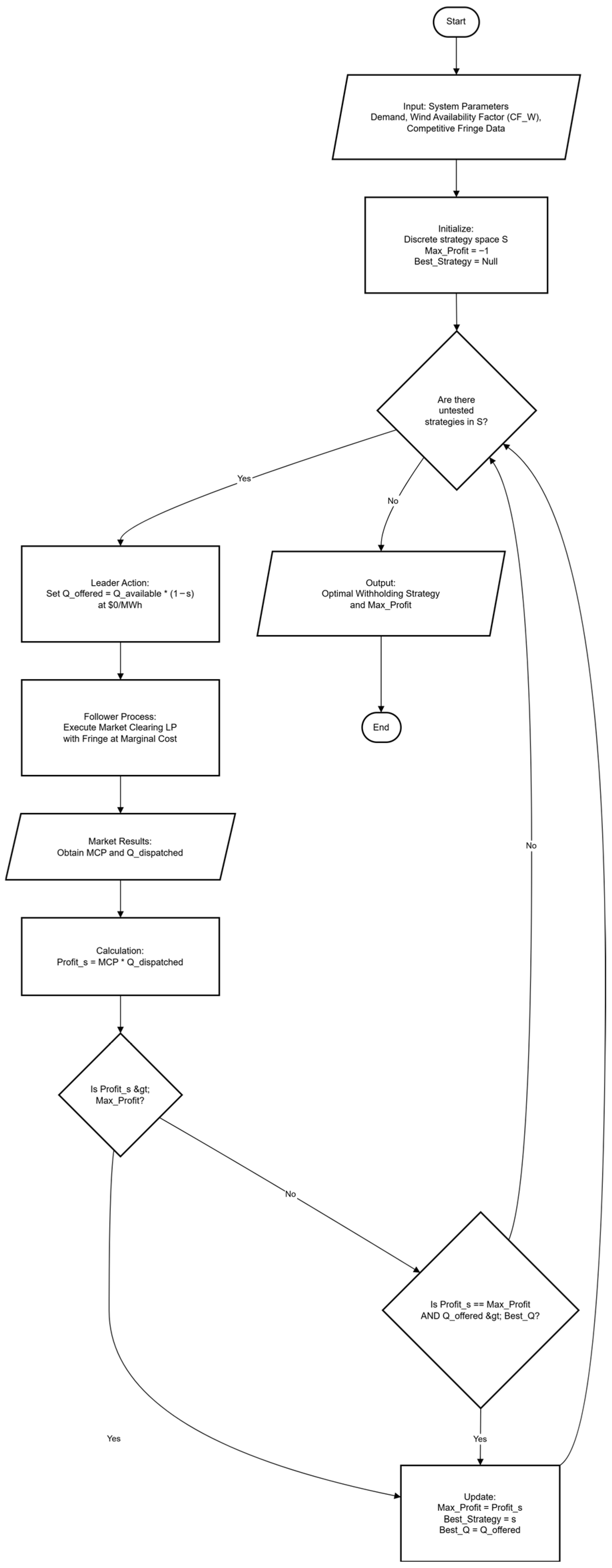
To solve the proposed MPEC and identify the strategic tipping point where unilateral power occurs, we implemented a high-resolution discretized search algorithm. This computational approach evaluates the strategic wind agent’s profit function across the entire feasible strategy space, looking for the identification of the global optimum while avoiding the numeric artifacts common in continuous gradient-based solvers. The algorithm proceeds as follows (see Figure 1 and Algorithm 1):
  • Initialization: The algorithm defines a discrete strategy space S representing the physical capacity withholding levels. In our implementation, S ranges from 0 (0% withholding, full competitive behavior) to 1 (100% withholding), with a step size of 0.01 (1% resolution). The variables tracking maximum profit and the best strategy are initialized to zero.
  • Iterative Strategy Evaluation (Upper level): For each candidate strategy s S , the algorithm simulates the leader’s action. The wind generator calculates its physical available capacity based on the specific wind capacity factor scenario ( Q a v a i l a b l e ). It then sets its offered market quantity as Q o f f e r e d = Q a v a i l a b l e ( 1 s ) and bids this volume into the market at its true marginal cost of $0/MWh.
  • Market Clearing (lower level): the follower problem is executed. The Independent System Operator (ISO) clears the market by solving a Linear Programming (LP) economic dispatch model. In this step, the rival generators (the competitive fridge) are assumed to bid their full available capacities at their respective short-run marginal costs.
  • Profit Calculation: The LP solver returns the Market Clearing Price (MCP) and the specific quantity dispatched to the wind agent ( Q d i s p a t c h e d ). The strategic profit for the evaluated state is calculated as the product of the MCP and Q d i s p a t c h e d ).
  • Decision Rule and Tie-Breaking: The algorithm compares the profit of the current strategy against the highest profit found so far. If the current profit is strictly greater, the optimal strategy and the maximum profit are updated. If the current profit equals the maximum profit (within a tight numerical tolerance), a tie-breaking rule is applied: the algorithm selects the strategy that yields a higher dispatched volume (i.e., a lower withholding level s). This explicitly models a rational agent who avoids unnecessary market distortion and regulatory scrutiny when no additional financial gain is achieved.
  • Output: Once all strategies in S are evaluated, the algorithm outputs the global optimal withholding strategy and the corresponding maximum profit for that specific demand and wind availability scenario.
The code made in Python is available in the Supplementary Materials.
Algorithm 1: Discretized Best-Response Market Clearing
  • Initialize: Define strategy space S= [0, 0.01, …, 1.0]. Set M a x p r o f i t = 1 , B e s t _ S t r a t e g y = N u l l
  • For each withholding strategy s in S:
  • Leader Action: Calculate available physical capacity ( Q a v a i l a b l e ) based on C F W . Set wind offered quantity Q o f f e r e d = Q a v a i l a b l e × ( 1 s ) at $0/MWh
  • Follower action: Execute Market Clearing Linear Program (ISO dispatch). Rival competitive fringe bids full capacity at true marginal cost.
  • Calculate: Obtain Market Clearing Price (MCP) and wind dispatched quantity. Calculate P r o f i t s = M C P × Q d i s p a t c h e d .
  • Decision Rule: If P r o f i t s > M a x _ P r o f i t : Update M a x _ P r o f i t = P r o f i t s , and B e s t _ S t r a t e g y = s
  • Else if P r o f i t s = = M a x _ P r o f i t (within tolerance): Select strategy yielding higher Q o f f e r e d (tie-breaking rule to minimize regulatory risk).
  • Output: B e s t _ S t r a t e g y and corresponding M a x _ P r o f i t

3. Results

The application of the discretized MPEC model successfully isolated the unilateral market power of the strategic wind generator. By modeling rival thermal and hydro units as competitive fringe, the noise of cross-strategic interactions was eliminated, allowing for the identification of the withholding-induced price-setting threshold—the tipping point—where wind generation transitions from a price-taker to a dominant price-setter.
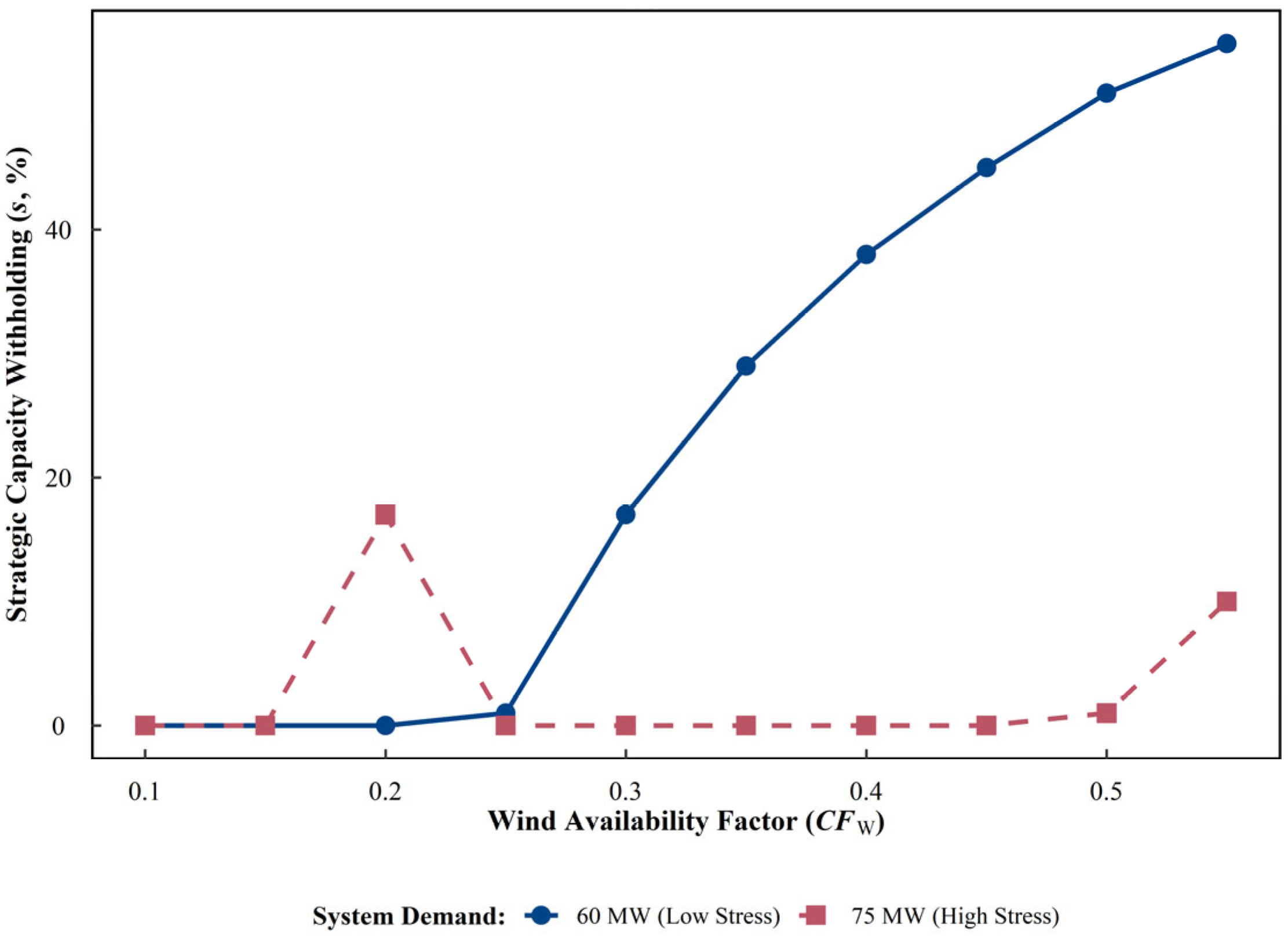
The simulated data reveals that the strategic behavior of the wind agent is not monolithic. Instead, it transitions dynamically across three distinct operational regimes, heavily dependent on the interactions between exogenous wind availability ( C F W ) and the system’s demand stress (Figure 2).
To provide a clear quantitative mapping of the sensitivity analysis across varying wind availabilities and system stress conditions, Table 3 summarizes the critical tipping points extracted from the discretized best-response algorithm.
As shown in Table 3, the optimal strategy heavily depends on the interaction between wind availability and system demand. Under the 60 MW low-stress scenario, when wind availability is low ( C F W = 0.10), the agent acts competitively, dispatching its full available volume. However, when wind becomes abundant ( C F W = 0.35), the agent strategically withholds 33.3% of its physical capacity purely as a defensive measure to prevent the market-clearing price from collapsing to $0/MWh, maintaining it at $60/MWh. Conversely, under the 75 MW high-stress scenario, the scarcity creation tipping point emerges at C F W = 0.20. Here, withholding 16.7% of its capacity forces the dispatch of the expensive T2 unit, spiking the price to $80/MWh. Yet, just a slight increase in physical availability to C F W = 0.25 renders this manipulation economically sub-optimal due to the high volume of energy displaced, prompting an abrupt return to 0% withholding.

3.1. Regime A: Defensive: Price-Support Withholding

Under low-stress system conditions (Demand 60 MW), the algorithm identified significant and substantial capacity withholding by the wind agent, particularly as wind availability increases. For instance, at a wind availability factor of C F W = 0.35, the agent optimally withholds 33.3% of its physical capacity.
Economically, this behavior does not aim to create artificial scarcity to spike prices above normal levels. Instead, it constitutes a defensive “Price-Support” strategy. By deliberately curtailing its market injection, the wind generator prevents the market-clearing algorithm from dismissing the marginal thermal unit (T1, offering at $60/MWh). If the strategic agent were to act completely competitive (s = 0%) and offer its full available capacity, the excess supply would cause the system marginal price to collapse to the $0/MWh cost of the hydro generator. This finding highlights a critical nuance in renewable market power: oversupply conditions can paradoxically trigger the highest volumetric manipulation of the market, purely as a mechanism to avoid zero-price clearing.

3.2. Regime B: Scarcity Creation Tipping Point

The tipping point of the active market power was identified exclusively under high-stress conditions (Demand 75 MW). The model pinpointed this threshold at the specific availability factor of C F W = 0.2.
In this critical and narrow window, the wind agent executes a withholding strategy of 16.7% of its available energy. This fractional withholding perfectly bridges the required supply gap to exhaust the cheaper generation mix (Hydro and T1), forcibly triggering the dispatch of the expensive peak thermal unit (T2). Consequently, the unilateral action of the wind agent drives the spot market price from $60/MWh to $80/MWh. This result indicates that renewable market power is highly conditional and transient, emerging not merely when wind penetration is high, but when it perfectly aligns with the vulnerability of the thermal merit order.

3.3. Regime C: Return to Competitive Volume Maximization

An unexpected but highly rational economic behavior emerges immediately after the tipping point is surpassed. When wind availability increases from C F W = 0.20 to C F W = 0.25 under the same high-demand scenario, the strategic withholding abruptly drops to 0%, signaling a complete return to competitive, price-taking behavior.
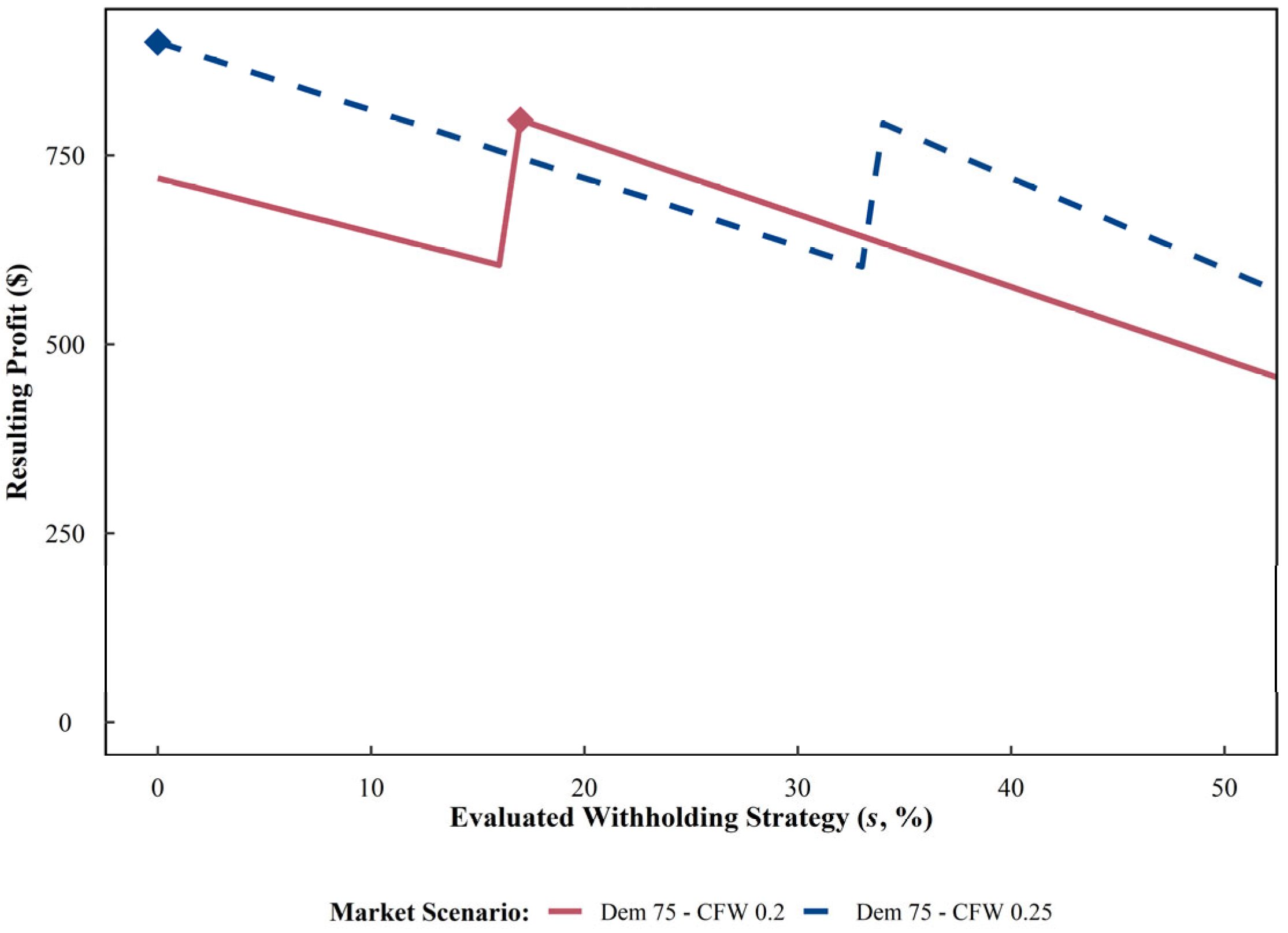
Figure 3 illustrates the economic rationale behind this shift by detailing the sharp discontinuity and non-convexity of the agent’s profit function. At C F W = 0.25, for the wind agent to artificially force the clearing price to $80/MWh, it would need to withhold a disproportionate volume of its now-abundant energy. The discretized best-response search shows that the financial loss from this displaced volume heavily outweighs the marginal revenue gained from the higher price. Therefore, the profit function experiences an abrupt decline if excessive withholding is pursued. Facing this profit degradation, a rational agent abandons market manipulation and maximizes its revenue by selling its entire available volume at the standard $60/MWh clearing price. This transition validates the robustness of the proposed MPEC algorithm, as it captures the specific boundary where the marginal cost of withheld volume exceeds its price-setting benefits.

4. Discussion

4.1. Economic Significance of the Strategic Regimes

Classical empirical analyses of liberalized electricity markets have extensively documented how dominant firms strategically withhold capacity to exploit steep segments of the aggregate supply curve, primarily focusing on conventional thermal and hydro portfolios [18,32,33]. The prevailing literature often associates high renewable penetration strictly with a merit-order effect that inherently suppresses wholesale electricity prices. However, the application of discretized MPEC framework reveals a more complex economic reality: renewable market power is conditional, non-linear, and dual in nature. The identification of the specific tipping point at C F W = 0.20 under high demand carries significant practical implications. In the real electricity market, a 20% capacity factor does not represent an extreme or rare meteorological anomaly; rather, it corresponds to a highly typical, standard operational day for onshore wind farms (which globally average capacity factors between 25% and 40%). This suggests that a strategic wind producer does not necessarily need a massive weather event or extraordinary physical availability to transition into a price-setter. Instead, the risk of market power exertion could be present under everyday meteorological conditions, provided that this ordinary wind availability aligns with the vulnerability of the thermal merit order during peak demand.
Furthermore, the transition from scarcity creation back to competitive volume maximization highlights the strict economic rationality governed by opportunity costs. As shown by the profit degradation (Figure 3) when withholding excessive capacity, the mathematical model adheres to microeconomic logic: market manipulation ceases when marginal cost of displaced volume outweighs the marginal revenue from a forced price spike.

4.2. Policy and Regulatory Implications

These findings suggest a potential paradigm shift in regulatory market surveillance. Traditional metrics for assessing market concentration, such as the static Herfindahl-Hirscman Index (HHI), are primarily based on installed capacity or historical annual generation. Consequently, they may be inadequate for capturing the highly transient nature of intermittent renewables. A firm might exhibit a low HHI, appearing benign on an annual basis, yet hold significant temporary market power during specific hours of strategic meteorological alignment.
To address this, regulators and Independent System Operators (ISOs) could benefit from transitioning toward predictive, weather-driven surveillance models. By cross-referencing day-ahead short-term forecasts with identified tipping points (e.g., forecasting a C F W = 0.2 during peak-load hours), regulators could activate pre-defined early-warning protocols. This dynamic approach could offer an advantage over traditional price cap mechanisms. While permanent price-caps can distort long-term investment signals and exacerbate the “missing money” problem for generator, dynamic monitoring allows for targeted, temporary mitigation measures—such as enhanced bid auditing or temporary must-offer rules—only when the meteorological and demand conditions suggest a credible risk of market manipulation.
Under deterministic assumptions, market power manifests strong temporal dynamics and context-dependent intensity. During low-demand periods, regulators must be aware that capacity withholding (Regime A: Price-Support) is utilized to prevent prices from collapsing to zero. This indicates that the short-term energy-only market may struggle to adequately remunerate renewables without mechanisms or long-term contracts. As highlighted by literature on institutional design for renewable integration, adapting capacity mechanisms and exploring hybrid market architectures is relevant [34,35,36]. These institutional frameworks are necessary to ensure generator revenue sufficiently while mitigating the structural market power induced by generation intermittency.
To ground these recommendations within the actual regulatory framework of Colombia, these dynamics triggers could be integrated into the existing market surveillance protocols of the CREG (Energy and Gas Regulation Commission) and the SIC (Superintendency of Industry and Commerce). For instance, rather than imposing permanent structural limits on market share, XM (the Colombian Independent System Operator) could leverage its centralized forecasting system. When XM’s day-ahead dispatch indicates wind availability approaching the critical C F W = 0.20 threshold during high-stress hours, temporary must-offer rules could be activated for the forecasted available volume. Furthermore, the agent’s bids could be subjected to the same rigorous ex-post auditing currently applied to thermal generators declaring forced outages.
Finally, recognizing the “Defensive Hoarding” regime highlights a structural challenge: the short -term energy-only market may struggle to adequately remunerate renewables without price collapsing. Thus, the ongoing evolution of Colombia’s Reliability Charge (Cargo por Confiabilidad) should ensure that intermittent renewables receive adequate, long-term capacity payments, thereby mitigating the financial incentive to engage in short-term defensive capacity withholding.

4.3. Limitations and Future Research

While the discretized MPEC formulation with a competitive fringe successfully isolates the specific tipping point of unilateral wind market power, it introduces specific limitations that define the scope of these findings. Addressing these boundaries highlights critical pathways for future research:
  • Strategic Interactions among market leaders: By assuming rival thermal and hydro generators act purely as price-takers, the model intentionally suppresses the multi-leader oligopolistic interactions present in concentrated settings like the Colombian market. Future research should extend this baseline using advanced Equilibrium Problems with Equilibrium Constraints (EPECs) to assess how strategic interdependence alters these thresholds.
  • Integration of uncertainty modeling: Wind power availability is modeled deterministically to map physical boundaries ex-ante ( C F W ). This simplification neglects empirically significant sources of uncertainty, such as wind speed forecasting errors and intraday variability. Methodological advances in wind power uncertainty modeling, particularly scenario-based stochastic programming and the integration of probabilistic forecasting [37,38], are necessary steps. Transitioning from this deterministic baseline to robust stochastic optimization framework will allow future studies to evaluate strategic responses across diverse probabilistic scenarios.
  • Empirical calibration and validation: Model outcomes currently rely on stylized parameter assumptions. Where feasible, future studies should aim to calibrate and validate these tipping points using operational data from the Colombian electricity market (e.g., XM clearing prices, verified wind generation time series, and real system load profiles).
  • Systematic Parameter Sensitivity: While the extensive evaluation of C F W and demand stress levels serves as our primary sensitivity analysis for volume thresholds, the current baseline fixes marginal generation costs and assumes inelastic demand. Future multilayer models should systematically explore varied costs spreads between thermal and hydro units, as well as the integration of demand elasticity, to observe how these economic parameters shift the specific numerical coordinates of the identified tipping points.
  • Additionally, expanding the model to include network transmission constraints and energy storage systems represents an important avenue for extending this framework. Finally, as power systems transition toward high DER (Distributed Energy Resource) retail participation, future research should explore how novel market designs—such as hourly electricity rights, yield derivatives, and Blockchain-based architectures [39]—interact with or potentially mitigate the unilateral market power thresholds identified in this study.

5. Conclusions

This study successfully identifies and quantifies the specific wind availability threshold—the tipping point—at which a wind generator transitions from a passive price-taker to a dominant price-setter. By shifting from a continuous equilibrium problem to a high-resolution discretized Mathematical Program with Equilibrium Constraints (MPEC), the analysis overcame numerical instabilities and isolated the unilateral strategic behavior of the renewable agent.
The results show that wind market power evolves through three distinct regimes depending on system stress and wind availability: (i) a defensive “Price-Support” strategy during oversupply, (ii) a Scarcity Creation tipping point during peak demand, and (iii) a return to volume maximization. These findings suggest that renewable market power is highly transient and dictated by the alignment of weather profiles with the thermal merit order. Ultimately, this research provides regulators with some ideas to implement dynamic, forecast-driven market surveillance, ensuring market efficiency without stifling the economic viability of the energy transition.

Supplementary Materials

The following supporting information can be downloaded at https://www.mdpi.com/article/10.3390/en19061557/s1, Python Code.

Author Contributions

Conceptualization, A.A.H.P. and L.G.; methodology, A.A.H.P.; software, A.A.H.P.; validation, L.G.; formal analysis, A.A.H.P. and L.G.; investigation, L.G.; data curation, L.G.; writing—original draft preparation, A.A.H.P.; writing—review and editing, L.G.; visualization, A.A.H.P. All authors have read and agreed to the published version of the manuscript.

Funding

This research received no external funding.

Data Availability Statement

The Python code used to obtain the results shown in this article can be found in the Supplementary Materials.

Acknowledgments

During the preparation of this manuscript, the authors used Gemini, version 3.1 Pro, for the purposes of optimizing code snippets and reviewing the text for coherence and readability. The authors have reviewed and edited the output and take full responsibility for the content of this publication.

Conflicts of Interest

The authors declare no conflicts of interest.

References

  1. Net Zero by 2050—Analysis—IEA. Available online: https://www.iea.org/reports/net-zero-by-2050 (accessed on 26 June 2025).
  2. International Energy Agency. “World Energy Outlook 2024,” Paris, 2024. Available online: https://www.iea.org/reports/world-energy-outlook-2024 (accessed on 26 June 2025).
  3. Sands, P. The United Nations framework convention on climate change. Rev. Eur. Comp. Int’l Envtl. L. 1992, 1, 270. [Google Scholar] [CrossRef]
  4. Agreement, P. Paris Agreement. In Report of the Conference of the Parties to the United Nations Framework Convention on Climate Change (21st session, 2015: Paris). p. 2. Available online: https://digitallibrary.un.org/record/831052?v=pdf (accessed on 1 February 2026).
  5. Long, Y.; Chen, Y.; Xu, C.; Li, Z.; Liu, Y.; Wang, H. The role of global installed wind energy in mitigating CO2 emission and temperature rising. J. Clean. Prod. 2023, 423, 138778. [Google Scholar] [CrossRef]
  6. Ghanbari, S.; Bahramara, S.; Golpîra, H. Modeling market trading strategies of the intermediary entity for microgrids: A reinforcement learning-based approach. Electr. Power Syst. Res. 2024, 227, 109989. [Google Scholar] [CrossRef]
  7. Heptonstall, P.J.; Gross, R.J.K. A systematic review of the costs and impacts of integrating variable renewables into power grids. Nat. Energy 2021, 6, 72–83. [Google Scholar] [CrossRef]
  8. Reichenberg, L.; Ekholm, T.; Boomsma, T. Revenue and risk of variable renewable electricity investment: The cannibalization effect under high market penetration. Energy 2023, 284, 128419. [Google Scholar] [CrossRef]
  9. Zhou, Z.; Botterud, A.; Levin, T. Price Formation in Zero-Carbon Electricity Markets: The Role of Hydropower; Argonne National Laboratory: Argonne, IL, USA, 2022. [Google Scholar] [CrossRef]
  10. Pham, T. Market Power Issues in Liberalized Wholesale Electricity Markets: A Review of the Literature with a Look into the Future. Rev. Econ. Polit. 2019, 129, 325–354. [Google Scholar] [CrossRef]
  11. Zhu, W.; Wu, W.; Zhang, J.; Liu, S. Analysis of Strategic Bidding Behavior of Renewable Energy Participation in Electricity Spot Markets. In 2024 4th Power System and Green Energy Conference (PSGEC); IEEE: Piscataway, NJ, USA, 2024; pp. 552–556. [Google Scholar] [CrossRef]
  12. Guo, H.; Chen, Q.; Fang, X.; Liu, K.; Xia, Q.; Kang, C. Efficiency Loss for Variable Renewable Energy Incurred by Competition in Electricity Markets. IEEE Trans. Sustain. Energy 2020, 11, 1951–1964. [Google Scholar] [CrossRef]
  13. Dai, T.; Qiao, W. Optimal Bidding Strategy of a Strategic Wind Power Producer in the Short-Term Market. IEEE Trans. Sustain. Energy 2015, 6, 707–719. [Google Scholar] [CrossRef]
  14. Kenis, M.; Höschle, H.; Bruninx, K. Strategic bidding of wind power producers in electricity markets in presence of information sharing. Energy Econ. 2022, 110, 106036. [Google Scholar] [CrossRef]
  15. Cheng, L.; Huang, P.; Zhang, M.; Yang, R.; Wang, Y. Optimizing electricity markets through game-theoretical methods: Strategic and policy implications for power purchasing and generation enterprises. Mathematics 2025, 13, 373. [Google Scholar] [CrossRef]
  16. Pozo, D.; Contreras, J. Finding multiple nash equilibria in pool-based markets: A stochastic EPEC approach. IEEE Trans. Power Syst. 2011, 26, 1744–1752. [Google Scholar] [CrossRef]
  17. Luna, J.P.; Sagastizábal, C.; Filiberti, J.; Gabriel, S.A.; Solodov, M.V. Regularized equilibrium problems with equilibrium constraints with application to energy markets. SIAM J. Optim. 2023, 33, 1767–1796. [Google Scholar] [CrossRef]
  18. Borenstein, S.; Bushnell, J.B.; Wolak, F.A. Measuring market inefficiencies in California’s restructured wholesale electricity market. Am. Econ. Rev. 2002, 92, 1376–1405. [Google Scholar] [CrossRef]
  19. Joskow, P.L.; Kahn, E. quantitative analysis of pricing behavior in California’s wholesale electricity market during summer 2000. Energy J. 2002, 23, 1–35. [Google Scholar] [CrossRef]
  20. Brown, D.P.; Eckert, A. Analyzing firm behavior in restructured electricity markets: Empirical challenges with a residual demand analysis. Int. J. Ind. Organ. 2021, 74, 102676. [Google Scholar] [CrossRef]
  21. Sensfuß, F.; Ragwitz, M.; Genoese, M. The merit-order effect: A detailed analysis of the price effect of renewable electricity generation on spot market prices in Germany. Energy Policy 2008, 36, 3086–3094. [Google Scholar] [CrossRef]
  22. XM. Reporte Integral de Sostenibilidad, Operación y Mercado 2024; p. 384. Available online: https://www.xm.com.co/reporte-integral-de-sostenibilidad-operacion-y-mercado-2024 (accessed on 20 July 2025).
  23. Arango, S.; Dyner, I.; Larsen, E.R. Lessons from deregulation: Understanding electricity markets in South America. Util. Policy 2006, 14, 196–207. [Google Scholar] [CrossRef]
  24. Pozo, D.; Sauma, E.; Contreras, J. Basic theoretical foundations and insights on bilevel models and their applications to power systems. Ann. Oper. Res. 2017, 254, 303–334. [Google Scholar] [CrossRef]
  25. Gabriel, S.A.; Conejo, A.J.; Fuller, J.D.; Hobbs, B.F.; Ruiz, C. Complementarity Modeling in Energy Markets; Springer Science & Business Media: Heidelberg, Germany, 2012. [Google Scholar]
  26. Baringo, L.; Conejo, A.J. Strategic offering for a wind power producer. IEEE Trans. Power Syst. 2013, 28, 4645–4654. [Google Scholar] [CrossRef]
  27. He, Q.; Lin, Z.; Chen, H.; Dai, X.; Li, Y.; Zeng, X. Bi-Level Optimization Based Two-Stage Market Clearing Model Considering Guaranteed Accommodation of Renewable Energy Generation. Prot. Control Mod. Power Syst. 2022, 7, 1–13. [Google Scholar] [CrossRef]
  28. Gabriel, S.A.; Leuthold, F.U. Solving discretely-constrained MPEC problems with applications in electric power markets. Energy Econ. 2010, 32, 3–14. [Google Scholar] [CrossRef]
  29. Tómasson, E.; Hesamzadeh, M.R.; Wolak, F.A. Optimal offer-bid strategy of an energy storage portfolio: A linear quasi-relaxation approach. Appl. Energy 2020, 260, 114251. [Google Scholar] [CrossRef]
  30. Taheri, S.; Kekatos, V.; Veeramachaneni, S. Strategic generation investment in energy markets: A multiparametric programming approach. IEEE Trans. Power Syst. 2021, 37, 2590–2600. [Google Scholar] [CrossRef]
  31. Pineda, S.; Morales, J.M. Solving linear bilevel problems using big-Ms: Not all that glitters is gold. IEEE Trans. Power Syst. 2019, 34, 2469–2471. [Google Scholar] [CrossRef]
  32. Wolak, F.A. An empirical analysis of the impact of hedge contracts on bidding behavior in a competitive electricity market. Int. Econ. J. 2000, 14, 1–39. [Google Scholar] [CrossRef]
  33. Bushnell, J.B.; Mansur, E.T.; Saravia, C. Vertical arrangements, market structure, and competition: An analysis of restructured US electricity markets. Am. Econ. Rev. 2008, 98, 237–266. [Google Scholar] [CrossRef]
  34. Joskow, P.L. Capacity payments in imperfect electricity markets: Need and design. Util. Policy 2008, 16, 159–170. [Google Scholar] [CrossRef]
  35. Cramton, P.; Ockenfels, A.; Stoft, S. Capacity market fundamentals. Econ. Energy Environ. Policy 2013, 2, 27–46. [Google Scholar] [CrossRef]
  36. Levin, T.; Botterud, A. Electricity market design for generator revenue sufficiency with increased variable generation. Energy Policy 2015, 87, 392–406. [Google Scholar] [CrossRef]
  37. Zugno, M.; Morales, J.M.; Pinson, P.; Madsen, H. A bilevel model for electricity retailers’ participation in a demand response market environment. Energy Econ. 2013, 36, 182–197. [Google Scholar] [CrossRef]
  38. Morales, J.M.; Conejo, A.J.; Madsen, H.; Pinson, P.; Zugno, M. Integrating Renewables in Electricity Markets: Operational Problems; Springer Science & Business Media: Heidelberg, Germany, 2013. [Google Scholar]
  39. Evdokimov, V.; Kudin, A.; Chikhladze, V.; Artemchuk, V. A Blockchain Architecture for Hourly Electricity Rights and Yield Derivatives. FinTech 2025, 5, 2. [Google Scholar] [CrossRef]
Figure 1. Algorithm flowchart to solve MPEC model.
Energies 19 01557 g001
Figure 2. Optimal Capacity Withholding strategies under varying wind availability and demand scenarios.
Energies 19 01557 g002
Figure 3. Evaluation of the non-convex profit function and the strict sub-optimality of excessive capacity withholding.
Energies 19 01557 g003
Table 1. Agents of generation in Colombia 1.
Agent of GenerationReal Generation (GWh)Participation 2024 (%)
Empresas públicas de Medellín20,962.825.18
Enel Colombia14,051.216.87
Isagen S.A. E.S.P13,038.415.66
Termobarranquilla S.A. E.S.P4225.75.11
Generadora y Comercializadora de Energía del Caribe S.A. E.S.P4152.34.99
Aes Colombia & Cia. S.C.A. E.S.P3096.53.72
Prime Termoflores S.A.S E.S.P3039.63.65
Other agents20,700.824.9
1 Note: data sourced from XM (the Colombian Independent System Operator) official operational reports for the year 2024; market participation is calculated as the percentage of total real generation effectively dispatched to the National Interconnected System.
Table 2. Marginal cost by technology.
Generation TypeMarginal Cost $/MWh
Low-cost hydro technology (H)0
Wind technology (W)0
Medium-cost thermal technology (T1)60
State-of-the-art thermal technology (T2)80
Table 3. Optimal Strategic Withholding (s) and Market Outcomes under varying C F W and System Demand (wind generator has a maximum installed capacity of 60 MW).
System DemandWind Avail. Factor ( C F W )Physical Avail. (MW)Strategic Withholding (s, %)Dispatched Vol. (MW)Market Price ($/MWh)Strategic Regime Observed
60 MW (Low Stress)0.106.00.0%6.060Competitive (Volume Max)
60 MW (Low Stress)0.3521.033.3%14.060Defensive (Price Support)
75 MW (High Stress)0.106.00.0%6.080Competitive (Volume Max)
75 MW (High Stress)0.2012.016.7%10.080Scarcity Creation (Tipping Point)
75 MW (High Stress)0.2515.00.0%15.060Competitive (Volume Max)
Disclaimer/Publisher’s Note: The statements, opinions and data contained in all publications are solely those of the individual author(s) and contributor(s) and not of MDPI and/or the editor(s). MDPI and/or the editor(s) disclaim responsibility for any injury to people or property resulting from any ideas, methods, instructions or products referred to in the content.