Information Mining Based on Seasonal and Trend Decomposition Using Loess for Non-Continuous EV Charging Prediction



Abstract
1. Introduction
- Proposes a time-series segmentation method for user internal behavior patterns based on statistical significance. By detecting distribution breakpoints across multidimensional features, it unsupervisedly identifies consistent sub-sequences within a single user’s charging data to isolate noise caused by heterogeneous pattern mixing.
- A continuous-time reconstruction mechanism is designed based on a physics-inspired energy decay model. This mechanism converts discrete charging event sequences into an evenly spaced daily energy consumption series that conforms to the underlying patterns of electricity usage, thereby establishing a structured, continuous data foundation for subsequent time-series decomposition.
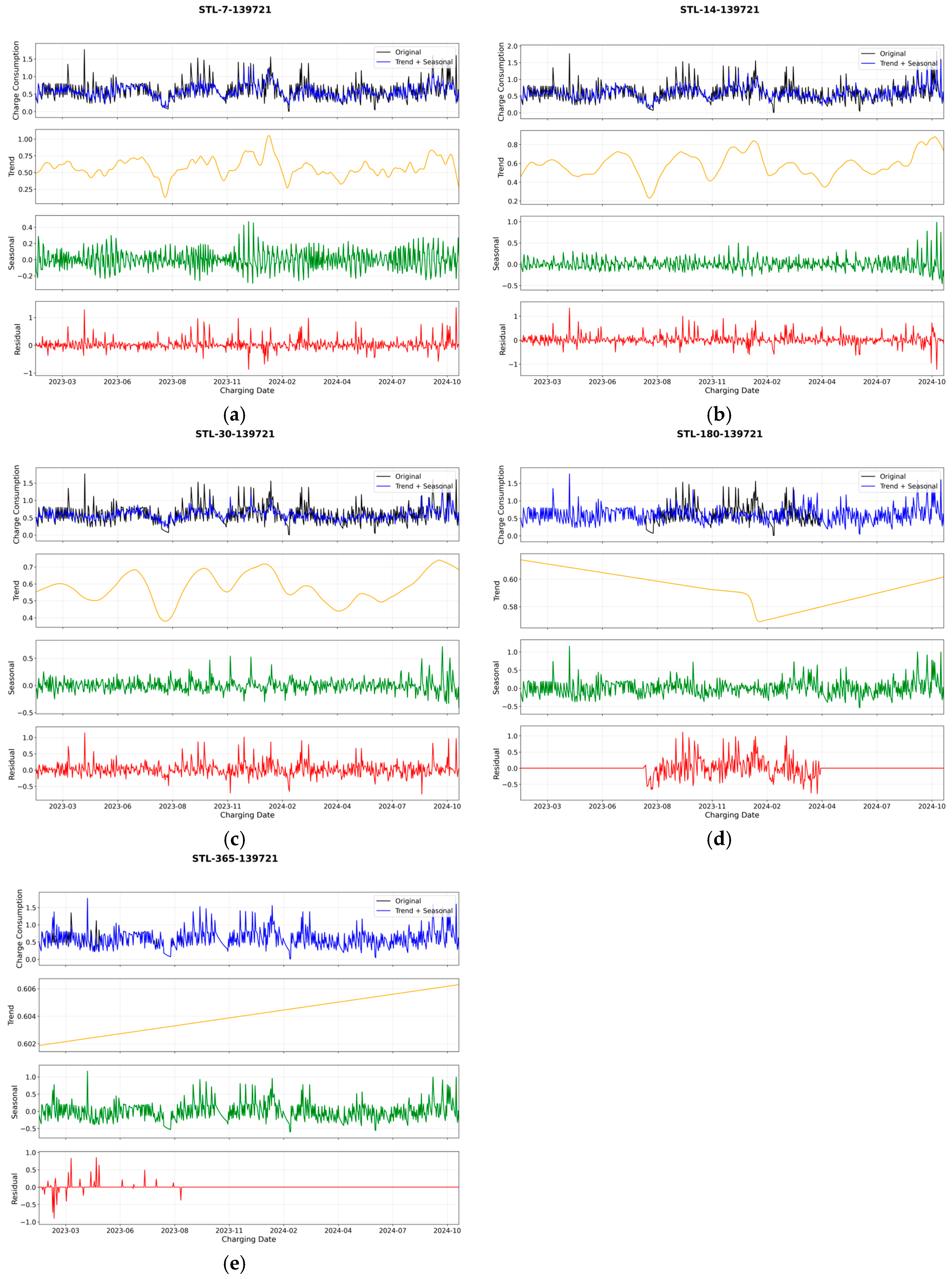
- Develop a predictive model integrating time-series decomposition with deep learning. Utilize STL (seasonal and trend decomposition using Loess) time-series decomposition techniques to extract trend components with clear physical significance from reconstructed sequences. Feed this feature as a key input into the LSTM for learning, thereby enhancing the model’s ability to capture patterns in charging consumption fluctuations.
2. Related Work
2.1. Research on User Charging Behaviors and Pattern Recognition
2.2. Temporal Reconstruction of Non-Continuous Charging Data
2.3. Charging Consumption Prediction Model and the Features Used
3. Data Description and Feature Construction
3.1. Data Source and Preprocessing
3.2. Feature Definition and Calculation
4. User Charging Behavior Pattern Recognition
4.1. Time-Series Segmentation Method Based on Statistical Significance Testing
- (1)
- Input and sorting: For each target user, sort all charging orders in ascending order by “Minimum Creation Time of The Order” to obtain a time series with data volume M. Each data point corresponds to a feature vector {, , …, } of length N (N = 14), where represents a feature as described in Section 3.2. These features encompass five major categories: Order Time-related features, Power and Electrical features, features of the Charging Process, Behavioral–Temporal features, and Environmental features. Select 14 features from this set: Weekday, Workday, Average Charging Power, Maximum Charging Power, Average Charging Current, Average Charging Voltage, Charging Duration, Charging Consumption, Charging Efficiency, Power Peak Distribution, Power-to-Consumption Ratio, the Next Charging Interval, Average Temperature, and Maximum Temperature.
- (2)
- Candidate split point iteration: Successively consider each position i in the time-series data where ≤ i ≤ M − as a candidate split point. Here, represents the minimum segment length threshold, set to 20 in this paper.
- (3)
- Mann–Whitney U test: At each candidate point i, the sequence is divided into two sub-segments: {, , …, } and {, , …, }. A Mann–Whitney U test [12] is performed on each feature separately within and . This method does not require data to follow a specific distribution (such as normal distribution), making it more suitable for field data with unknown distribution patterns, such as charging behavior.
- (4)
- Split point determination: Record the number F of features for which the null hypothesis is rejected at significance level , where the null hypothesis states that the distributions of the two segments are identical. Calculate the proportion of significant features , where 14 is the total number of features. If exceeds the preset threshold (set at 0.75 in this study), the candidate point i is deemed to exhibit a change in behavioral pattern and is designated as a split point.
- (5)
- Time interval supplementation: Considering that prolonged interruptions (e.g., vehicle idling, battery replacement) serve as explicit behavioral pattern switching signals, we introduce supplementary rules. If the time interval between two consecutive charging behaviors exceeds the maximum threshold (set at 60 days in this study), a split point is inserted at that interval regardless of statistical test outcomes.
4.2. Comparative Experiments and Results Analysis
5. Reconstruction of Equidistant Time-Series Data
5.1. Charging Consumption Degradation Function Modeling
5.2. Charge Sequence Reconstruction Process
- (1)
- Data preparation: After completing the user behavior pattern recognition in Section 4, we selected the pattern with the highest data volume under the same user for subsequent experiments. Each charging record contains three pieces of information: the start time of charging, the amount of charge Q for this session, and the number of days d until the next charge. If multiple charging sessions occur on the same day, add their respective charge amounts together. The total sum shall be recorded as the day’s charge amount.
- (2)
- Segment-by-segment reconstruction: We process each charging interval in turn, filling in the missing battery charge values for the intermediate dates within each interval.
- (a)
- Constructing the synthetic point: Use Formula (2) to generate the synthetic electricity value for each day within this interval.
- (b)
- Fitting parameters: Using synthetic points, nonlinear least-squares fitting is employed to obtain the parameters , C, and A that characterize the attenuation behavior of this interval.
- (c)
- Calculate the reconstruction value: Substitute the fitted parameters into Formula (1) to compute the reconstruction battery charge value for each day (from day 1 to day d-1) within this interval.
- (d)
- Mark charging days: Generate a corresponding “charging mark” sequence. Mark dates with actual charging events as 1, and mark all other dates reconstructed by the model as 0.
- (3)
- Sequence concatenation: Reconstruct the daily charge consumption sequence from all charging intervals for this user and the corresponding charging event sequence. Concatenate them in chronological order to obtain an equidistant (one data point per day) continuous time series.
6. Charge Consumption Time-Series Decomposition
6.1. STL Decomposition Method
6.2. Analysis of Decomposition Results
7. Predictive Model and Experimental Analysis
7.1. Experimental Design and Evaluation Indicators
7.2. Analysis of Prediction Performance of Different LSTM Network Structures
7.3. Analysis of Prediction Performance After Incorporating STL Decomposition of Features
8. Conclusions and Prospects
Author Contributions
Funding
Institutional Review Board Statement
Informed Consent Statement
Data Availability Statement
Conflicts of Interest
References
- Chemali, E.; Kollmeyer, P.J.; Preindl, M.; Emadi, A. State-of-charge estimation of Li-ion batteries using deep neural networks: A machine learning approach. J. Power Sources 2018, 400, 242–255. [Google Scholar] [CrossRef]
- Ma, Y.; Shan, C.; Gao, J.; Chen, H. A novel method for state of health estimation of lithium-ion batteries based on improved LSTM and health indicators extraction. Energy 2022, 251, 123973. [Google Scholar] [CrossRef]
- Märtz, A.; Langenmayr, U.; Ried, S.; Seddig, K.; Jochem, P. Charging behavior of electric vehicles: Temporal clustering based on real-world data. Energies 2022, 15, 6575. [Google Scholar] [CrossRef]
- Kim, K.; Kim, G.; Yoo, J.; Heo, J.; Cho, J.; Ryu, S.; Kim, J. Data-driven clustering analysis for representative electric vehicle charging profile in South Korea. Sensors 2024, 24, 6800. [Google Scholar] [CrossRef] [PubMed]
- Wang, R.; Xu, Z.; Chen, Z.; Zhong, M. Revealing charging patterns of electric vehicles with intrinsic usage heterogeneity. Transp. Res. Part D Transp. Environ. 2026, 150, 105101. [Google Scholar] [CrossRef]
- Ahn, H.; Sun, K.; Kim, K.P. Comparison of missing data imputation methods in time series forecasting. Comput. Mater. Contin. 2022, 70, 767–779. [Google Scholar] [CrossRef]
- Huang, Q.; Li, J.; Xu, Q.; He, C.; Yang, C.; Cai, L.; Xu, Q.; Xiang, L.; Zou, X.; Li, X. State of charge estimation in batteries for electric vehicle based on Levenberg–Marquardt algorithm and Kalman filter. World Electr. Veh. J. 2024, 15, 391. [Google Scholar] [CrossRef]
- Cui, J.; Kuang, W.; Geng, K.; Bi, A.; Bi, F.; Zheng, X.; Lin, C. Advanced short-term load forecasting with XGBoost-RF feature selection and CNN-GRU. Processes 2024, 12, 2466. [Google Scholar] [CrossRef]
- Sreekumar, A.V.; Lekshmi, R.R. Electric vehicle charging station demand prediction model deploying data slotting. Results Eng. 2024, 24, 103095. [Google Scholar] [CrossRef]
- Xin, F.; Yang, X.; Wang, B.; Xu, R.; Mei, F.; Zheng, J. Research on electric vehicle charging load prediction method based on spectral clustering and deep learning network. Front. Energy Res. 2024, 12, 1294453. [Google Scholar] [CrossRef]
- Hussain, A.; Lu, Q.C.; Rizvi, S.S.; Wang, S.; Kwon, S.J. Short-term demand forecasting of electric vehicle charging stations using context-aware temporal transformer model. Sci. Rep. 2025, 15, 36652. [Google Scholar] [CrossRef] [PubMed]
- Dinneen, L.C.; Blakesley, B.C. Algorithm AS 62: A generator for the sampling distribution of the Mann–Whitney U statistic. J. R. Stat. Soc. Ser. C (Appl. Stat.) 1973, 22, 269–273. [Google Scholar] [CrossRef]
- Kanungo, T.; Mount, D.M.; Netanyahu, N.S.; Piatko, C.D.; Silverman, R.; Wu, A.Y. An efficient k-means clustering algorithm: Analysis and implementation. IEEE Trans. Pattern Anal. Mach. Intell. 2002, 24, 881–892. [Google Scholar] [CrossRef]
- Kuyuk, H.S.; Yildirim, E.; Dogan, E.; Horasan, G. Application of k-means and Gaussian mixture model for classification of seismic activities in Istanbul. Nonlinear Process. Geophys. 2012, 19, 411–419. [Google Scholar] [CrossRef]
- Wang, J.; Liu, P.; Hicks-Garner, J.; Sherman, E.; Soukiazian, S.; Verbrugge, M.; Tataria, H.; Musser, J.; Finamore, P. Cycle-life model for graphite–LiFePO4 cells. J. Power Sources 2011, 196, 3942–3948. [Google Scholar] [CrossRef]
- Zhu, J.G.; Sun, Z.C.; Wei, X.Z.; Dai, H.F. A new lithium-ion battery internal temperature on-line estimate method based on electrochemical impedance spectroscopy measurement. J. Power Sources 2015, 274, 990–1004. [Google Scholar] [CrossRef]
- Cu, Y.; Wang, K.; Zhang, L.; Liu, Z.; Liu, Y.; Mo, L. A time series decomposition-based interpretable electricity price forecasting method. Energies 2025, 18, 664. [Google Scholar] [CrossRef]


| Variable Name | Data Interpretation |
|---|---|
| User ID | User unique identifier, used to distinguish different users. |
| Order Number | One charging process corresponds to one order number. |
| Charging Consumption | Unit: kilowatt-hour (kWh), record once every 10 min during charging process. |
| Creation Date | The data format is “Year-Month-Day Hour:Minute:Second”, and it is recorded every 10 min during the charging process. |
| Charging Voltage of The Charging Station | Unit: Volt (V), record once every 10 min during charging process. |
| Charging Current of The Charging Station | Unit: Ampere (A), record once every 10 min during charging process. |
| Charging Power of The Charging Station | Unit: Watt (W), record once every 10 min during charging process. |
| Charging Temperature of The Charging Station | Unit: Kelvin (K), record once every 10 min during charging process. |
| Charging Status | Indicates whether the charging process has been completed normally. |
| Feature Classification | Variable Name | Data Interpretation | Calculation Formula |
|---|---|---|---|
| Order Time-related features | User ID | User unique identifier, used to distinguish different users. | / |
| Order Number | One charging process corresponds to one order number. | / | |
| Minimum Creation Time of The Order | Indicates the start time of the order. | ||
| Maximum Creation Time of The Order | Indicates the end time of the order. | ||
| Weekday | Range of values: 1–7. Map the “0–6 encoding” of Python 3 to “1–7 encoding”. | ||
| Workday | According to the regular working days in China (Monday to Friday), working days are represented by 1 and weekends by 0. | ||
| Power and Electrical features | Average Charging Power | Unit: Watt (W), the average value of all power sampling points during the order period. | |
| Maximum Charging Power | Unit: Watt (W), the maximum value of all power sampling points during the order period. | ||
| Average Charging Current | Unit: Ampere (A), the average value of all current sampling points during the order period. | ||
| Average Charging Voltage | Unit: Volt (V), the average value of all voltage sampling points during the order period. | ||
| Features of The Charging Process | Charging Duration | Unit: Minutes, duration of the charging process | |
| Charging Consumption | Unit: kilowatt-hour (kWh), maximum value of all charging Consumption sampling points during the order period. | ||
| Charging Efficiency | Measure the ratio between the actual charging capacity and the theoretical charging energy (Dimensionless). | ||
| Power Peak Distribution | Count the number of sampling points where the power reaches its maximum value, which reflects the duration of high power (Count). | ||
| Power-to-Consumption Ratio | Indicates the average power level corresponding to the unit charging Consumption (Dimensionless). | ||
| Behavioral–Temporal features | The Last Charging Interval | Unit: Days, the interval between the start time of the current order and the start time of the previous order. | |
| The Next Charging Interval | Unit: Days, the interval between the start time of the current order and the start time of the next order. | ||
| Environmental features | Average Temperature | Unit: Kelvin (K), the average values of all temperature sampling points during the order period. | |
| Maximum Temperature | Unit: Kelvin (K), the maximum values of all temperature sampling points during the order period. |
| Pattern Recognition Quantity | Order Number | K-Means | GMM |
|---|---|---|---|
| 1 | 171 | 0 | 0 |
| 2 | 162 | 197 | 276 |
| 3 | 99 | 55 | 72 |
| 4 | 37 | 27 | 33 |
| 5 | 20 | 24 | 21 |
| 6 | 5 | 24 | 24 |
| 7 | 5 | 28 | 18 |
| 8 | 0 | 47 | 15 |
| 9 | 1 | 40 | 9 |
| 10 | 0 | 58 | 32 |
| Experiment Number | Number of LSTM Layers | Number of Neurons | MAE | RMSE | MAPE (%) | SMAPE (%) | R2 |
|---|---|---|---|---|---|---|---|
| 1 | 1 | 64 | 0.0231 | 0.0682 | 2.78 | 3.18 | 0.9051 |
| 2 | 2 | 64 | 0.0520 | 0.0731 | 8.15 | 8.14 | 0.8910 |
| 3 | 3 | 64 | 0.0377 | 0.0666 | 5.82 | 5.99 | 0.9096 |
| 4 | 1 | 128 | 0.0512 | 0.0725 | 8.04 | 8.04 | 0.8928 |
| 5 | 2 | 128 | 0.0236 | 0.0654 | 3.10 | 3.46 | 0.9128 |
| 6 | 3 | 128 | 0.0270 | 0.0673 | 3.38 | 3.76 | 0.9078 |
| 7 | 1 | 256 | 0.0273 | 0.0692 | 3.21 | 3.63 | 0.9024 |
| 8 | 2 | 256 | 0.0302 | 0.0645 | 4.66 | 4.90 | 0.9151 |
| 9 | 3 | 256 | 0.0356 | 0.0707 | 4.65 | 5.03 | 0.8980 |
| 10 (without pattern recognition) | 1 | 64 | 0.0636 | 0.1347 | 7.00 | 7.56 | 0.8309 |
| Experiment Number | Feature | Forecast Target | MAE | RMSE | MAPE (%) | SMAPE (%) | R2 |
|---|---|---|---|---|---|---|---|
| 11 | Trend (period = 7) | Trend (period = 7) | 0.0117 | 0.0156 | 2.15 | 2.13 | 0.9932 |
| 12 | Seasonal (period = 7) | Seasonal (period = 7) | 0.0005 | 0.0005 | / | / | / |
| 13 | Trend, Seasonal (period = 7) | Charging Consumption | 0.0227 | 0.03026 | 2.77 | 2.84 | 0.9743 |
| 14 | Trend (period = 14) | Trend (period = 14) | 0.0119 | 0.0171 | 1.61 | 1.63 | 0.9919 |
| 15 | Seasonal (period = 14) | Seasonal (period = 14) | 0.0010 | 0.0015 | / | / | / |
| 16 | Trend, Seasonal (period = 14) | Charging Consumption | 0.0198 | 0.0254 | 2.68 | 2.70 | 0.9851 |
| 17 | Trend (period = 30) | Trend (period = 30) | 0.0420 | 0.0460 | 6.60 | 6.36 | 0.9396 |
| 18 | Seasonal (period = 30) | Seasonal (period = 30) | 0.0242 | 0.0758 | / | / | / |
| 19 | Trend, Seasonal (period = 30) | Charging Consumption | 0.0558 | 0.0645 | 7.81 | 7.48 | 0.8958 |
Disclaimer/Publisher’s Note: The statements, opinions and data contained in all publications are solely those of the individual author(s) and contributor(s) and not of MDPI and/or the editor(s). MDPI and/or the editor(s) disclaim responsibility for any injury to people or property resulting from any ideas, methods, instructions or products referred to in the content. |
© 2026 by the authors. Licensee MDPI, Basel, Switzerland. This article is an open access article distributed under the terms and conditions of the Creative Commons Attribution (CC BY) license.
Share and Cite
Zheng, Y.; Guo, D.; Li, Z.; Liu, Y.; Li, X. Information Mining Based on Seasonal and Trend Decomposition Using Loess for Non-Continuous EV Charging Prediction. Energies 2026, 19, 1556. https://doi.org/10.3390/en19061556
Zheng Y, Guo D, Li Z, Liu Y, Li X. Information Mining Based on Seasonal and Trend Decomposition Using Loess for Non-Continuous EV Charging Prediction. Energies. 2026; 19(6):1556. https://doi.org/10.3390/en19061556
Chicago/Turabian StyleZheng, Yunqian, Danhuai Guo, Zongliang Li, Yizhuo Liu, and Xunchun Li. 2026. "Information Mining Based on Seasonal and Trend Decomposition Using Loess for Non-Continuous EV Charging Prediction" Energies 19, no. 6: 1556. https://doi.org/10.3390/en19061556
APA StyleZheng, Y., Guo, D., Li, Z., Liu, Y., & Li, X. (2026). Information Mining Based on Seasonal and Trend Decomposition Using Loess for Non-Continuous EV Charging Prediction. Energies, 19(6), 1556. https://doi.org/10.3390/en19061556