1. Introduction
Consumer expectations are becoming an increasingly important factor that shapes companies’ decisions on energy transition, especially in the SME sector (enterprises that employ fewer than 250 persons and that have an annual turnover not exceeding EUR 50 million, and/or an annual balance sheet total not exceeding EUR 43 million [
1]). In the face of growing regulatory pressure and rising energy prices, consumer behaviour acts as a market mechanism that reinforces or accelerates the implementation of energy-efficient and low-carbon solutions. From an energy perspective, consumers influence businesses not through abstract declarations of intent, but through specific purchasing preferences, contractual requirements and a willingness to bear the costs associated with higher energy efficiency of products and services. The attitude–behaviour gap is a well-studied phenomenon in the context of sustainable consumption. Comparisons between customers’ declared intentions to purchase and their actual willingness to pay for sustainability or ethics attributes in products reveal that declarations are not reliable enough to be used as predictors of behaviour. It has been demonstrated that customers’ declarations tend to overstate, to a considerable extent, their actual willingness to pay (see, among others: [
2,
3,
4]). In relation to SMEs, one might ask whether companies in this sector anticipate this attitude–behavior gap and base their actions on tangible signals rather than consumer declarations. In this sector, while entrepreneurs typically do not use the theoretical concept of the ‘attitude–behavior gap’, they learn it empirically. Due to prevalent direct customer contact, they are able to quickly spot discrepancies between customers’ declarations and purchase decisions on a practical, day-to-day basis; for example, customers may prefer organic products in principle but fail to pay a premium for them. This leads to the practical conclusion that their declarations are not entirely reliable as a basis for business decisions. The reasons for SMEs’ reliance on tangible signals also include limited resources, which makes mistakes relatively costly.
One of the key aspects of customer expectations is growing environmental awareness, which translates into increased interest in products manufactured in an energy-efficient manner, using RES and with a limited carbon footprint [
5,
6]. Consumers have long viewed energy efficiency and the use of RES as indicators of corporate environmental responsibility, which influences their purchasing decisions in both business-to-consumer (B2C) and business-to-business (B2B) markets [
7]. For SMEs, this means that energy aspects must be taken into account not only as a cost optimisation factor, but also as a competitive factor.
An important mechanism linking consumer expectations with companies’ energy decisions is the willingness to pay a higher price for products and services with better environmental parameters. Research shows that some consumers accept higher prices in exchange for reduced energy consumption, the use of RES or reduced emissions in the production process [
6]. From the perspective of SMEs, this means the possibility of partially transferring energy investment costs to the market, which reduces the perceived financial risk of implementation and encourages decisions to modernise energy infrastructure.
SMEs implement numerous visible initiatives that serve as signals to consumers in the studied area, such as the use of certificates, transparent communication of raw material origin, and highlighting the environmental characteristics of products are effective. These initiatives serve as signals of credibility in an environment of information asymmetry. Consumers, unable to directly verify ‘hidden’ attributes related to sustainability, base their decisions on observable indicators, which are perceived as more difficult to imitate and therefore more reliable. In the case of SMEs, this approach is consistent with the findings regarding the attitude–behavior gap. Instead of relying on declarative consumer preferences, which have limited predictive value, SMEs focus on stimuli that influence actual market choices. Visible initiatives therefore serve a dual function: on the one hand, they respond to observed patterns of consumer behavior, and on the other, they act as a mechanism for guiding these behaviors by reducing uncertainty and increasing the perception of the value of the products offered.
At the same time, the literature highlights the role of signalling pro-environmental actions as a mechanism for reducing information asymmetry between businesses and consumers [
8,
9]. In the context of energy transition, these signals take the form of visible and measurable actions, such as the use of RES, reduction of energy consumption or implementation of energy-efficient technologies. For SMEs, these actions often serve a more important signalling function than formal communication tools, such as extensive reporting or certification, which involve additional costs and organisational requirements [
10].
As a result, consumer expectations influence the energy transition of SMEs in a selective and pragmatic manner. Companies focus primarily on energy solutions that are visible to customers, economically justifiable and relatively easy to implement, such as improving energy efficiency or using renewable energy sources. This mechanism reinforces the importance of consumers as a factor accelerating the energy transition of SMEs, complementing regulatory and cost pressures [
11].
2. Energy Transition of SMEs
The energy transition represents a strategic and operational change for SMEs, involving improvements in energy efficiency, decarbonisation of processes, integration of RES and implementation of energy management tools. In practice, SMEs review and modify their energy practices to reduce emissions across the value chain, adapting to both environmental goals and market conditions [
12,
13]. The use of RES and smart grid solutions can simultaneously reduce the carbon footprint and stabilise operating costs by optimising energy consumption [
14].
The adaptive nature of transformation in SMEs is strongly linked to external pressure. One of the most important factors is rising energy prices, which increase the importance of cost-effective efficiency measures and investments in own energy sources [
12]. At the same time, regulatory pressure is growing, including reporting requirements and emission reduction targets, which are prompting companies to incorporate sustainability elements into their business models and resilience strategies [
15,
16]. In the EU, the context is set by, among other things, the European Green Deal and the Fit for 55 package, which reinforce the direction of change through emission reduction targets and instruments promoting energy efficiency and RES [
17]. Although many SMEs are not directly subject to the EU Emissions Trading System, market mechanisms and indirect cost and contractual pressures can influence companies’ investment and operational decisions [
18].
Supply chains and growing environmental, social, and governance (ESG) requirements are an important mechanism for the transmission of regulations. As large companies that are subject to disclosure requirements increase their demands on suppliers, SMEs are increasingly faced with the need to provide environmental data and implement energy efficiency improvement practices [
19]. In this context, the Corporate Sustainability Reporting Directive may further increase indirect pressure: even if SMEs do not report directly, as suppliers they are included in the processes of measuring and reducing emissions in the value chain [
20]. At the same time, financial institutions and public programmes create incentives through sustainable financing criteria, facilitating access to capital for low-carbon projects. The role of market factors is not limited to regulation. Consumer expectations in the B2C and B2B sectors are driving demand for low-carbon, energy-efficient and responsibly manufactured products, which can translate into competitive advantages for SMEs implementing energy solutions [
21,
22]. Research indicates that a company’s perceived commitment to sustainable development—including energy efficiency strategies and the integration of RES—can increase brand trust and influence purchasing decisions [
23]. As a result, energy investments serve not only a cost function, but also a reputational and relational function in the market [
21].
At the same time, the energy transition of SMEs is constrained by co-occurring barriers: financial, competence and regulatory. High initial costs and longer payback periods constitute a persistent investment barrier, especially for micro- and small companies that prefer a short payback horizon [
24,
25,
26]. Limited access to external financing and insufficient fiscal incentives may further reinforce these barriers [
27,
28]. Competence gaps are equally important: a lack of internal technical and managerial knowledge in the field of energy limits the ability to evaluate technologies and implement audit recommendations [
29,
30,
31,
32]. In addition, regulatory uncertainty and administrative complexity can discourage long-term investment decisions, favouring a focus on short-term operational needs [
33,
34,
35].
The energy transition of SMEs is also consistent with the logic of the circular economy, in which resource efficiency and waste reduction strengthen the rationale for efficiency and decarbonisation measures [
36,
37]. Thanks to their proximity to the market and local value networks, SMEs can adapt sustainable development goals to regional conditions, although the effectiveness of these measures depends on cooperation with stakeholders and the availability of stable support mechanisms. The social dimension of the transition is linked to improving local environmental conditions and strengthening the legitimacy of actions through stakeholder engagement [
37,
38].
3. Energy Transition as a Strategic Challenge for SMEs
Energy transition is one of the key elements of sustainable development strategies for businesses, particularly in the SME sector. From an operational perspective, it means a gradual change in energy use through improved energy efficiency, the implementation of RES, and reduced emissions in production and service processes. Although the regulatory and institutional frameworks have long set the general direction for these changes, market factors, in particular the expectations of consumers and contractors, are now playing an increasingly important role in shaping the strategic decisions of SMEs [
5,
39].
In the SME sector, which accounts for a significant proportion of employment and added value in the European economy, consumers are no longer merely recipients of products and services. Through their purchasing preferences and contractual requirements, they are becoming a significant source of pressure for the implementation of energy-efficient and low-carbon solutions. As shown by the results of empirical studies, the vast majority of the surveyed companies recognise growing customer expectations in terms of energy transition, with the highest ratings given to expectations regarding energy consumption reduction and the use of renewable energy sources [
6,
21].
This indicates that SMEs perceive the energy transition primarily through the lens of operational activities that bring measurable energy benefits, which is consistent with the findings cited earlier in the literature. The increase in consumer environmental awareness is reflected not only in the growing demand for energy-efficient products and services, but also in products manufactured in an environmentally responsible manner [
40]. Research shows that an increasing proportion of customers are willing to pay a higher price (on average 9.7%) for products and services from companies that reduce their carbon footprint, especially when this reduction is linked to real actions [
6,
41]. The results of the research confirm that companies identify this mechanism as an important competitive factor, while attaching less importance to formal environmental communication tools.
Regulatory pressure resulting from the European Union’s climate and energy policy remains an important context for SME sustainability strategies. Although most SMEs are not directly subject to the EU Emissions Trading System, they are increasingly required to indirectly comply with environmental requirements through their relationships with larger entities in supply chains [
39]. They are expected to improve energy efficiency, invest in renewable energy sources and reduce emissions throughout the value chain, as confirmed by analyses of the role of eco-innovation and public funding [
42].
In response to the conditions described above, SMEs base their sustainable development strategies on three interrelated dimensions: innovation, communication and cooperation. Innovative strategies primarily involve the implementation of energy-efficient technologies and renewable energy sources, i.e., photovoltaic installations, modernisation of energy infrastructure and electrification of transport. It should be noted that these are the solutions most often implemented or planned by SMEs, which confirms their perceived availability and compliance with customer expectations [
43].
Communication strategies focus on informing stakeholders about actions that relate to energy and the environment, including through certification, reporting and product labelling. At the same time, it is pointed out that for many SMEs, communicating the effects of their actions is secondary to the technical solutions themselves. Companies assume that energy-efficient products and services are a sufficient signal of environmental commitment, and that excessive formalisation of communication may be perceived as an attempt at greenwashing [
8,
44,
45,
46].
Innovation and communication strategies are complemented by cooperation strategies, which involve collaboration with other entities in order to reduce energy investment costs and increase access to knowledge and technology. These activities include energy clusters, joint energy purchases and partnerships with public and scientific institutions [
11,
47]. Activities in this area show that cooperative strategies are still relatively rarely used by SMEs. Unfortunately, this indicates untapped potential for cooperation in the energy transition process, which may be due to the lack of experience of the parties involved in such activities.
In summary, SMEs’ sustainable development strategies that relate to energy transition are pragmatic and selective. Companies focus on activities and solutions that deliver measurable energy savings and cost reductions in line with customer expectations and market and regulatory pressures. It can be concluded that the integration of technological innovations, based on limited but reliable communication and cooperation with the economic environment, remains a key challenge for further deepening the energy transition in the SME sector [
48].
4. Innovations in Energy Transition of SMEs
The energy transition of SMEs plays a key role in achieving sustainable development goals and strengthening economic resilience. Around 90% of all businesses are SMEs, and they are significant employers, but their ability to implement innovative energy solutions is significantly limited. These barriers stem primarily from limited financial resources, which hinder investment in research and development and make energy innovations appear risky and uncertain in terms of return [
49,
50]. In addition, the scale of SME operations limits access to advanced technologies and specialist expertise, which hinders the implementation of more complex energy solutions [
51].
In this context, innovation is a key mechanism that enables SMEs to gradually overcome the barriers to energy transition. It includes not only technological innovation, but also organisational, process and behavioural changes, which together determine the ability of enterprises to adapt to a rapidly changing energy environment [
52]. Technological innovations, such as the implementation of renewable energy sources, energy management systems and energy storage facilities, enable a reduction in operating costs and environmental impact [
53,
54]. At the same time, organisational innovations, including flexible energy management systems and the integration of ESG principles, promote more efficient use of resources and better responsiveness to market changes. Product, service and process innovations complement these efforts, focusing on the design of energy-efficient products, the optimisation of production processes and the digitalisation of operational activities. Digitisation and the use of real-time data allow for the identification of areas of excessive energy consumption, the planning of corrective measures and the implementation of lean energy principles [
55]. Such innovations contribute to improving energy efficiency while increasing the competitiveness of SMEs in the face of rising energy prices.
Changing consumer expectations are an important factor that shapes the direction of energy innovation in SMEs. With growing environmental awareness, customers increasingly prefer products and services that are manufactured in an energy-efficient and environmentally responsible manner, which puts market pressure on companies [
56]. SMEs respond to these expectations selectively, focusing primarily on technical innovations that bring direct energy savings, while giving limited importance to formal communication tools such as ESG reporting or certification. The role of communication and marketing tools in the field of energy innovation remains diverse. Eco-labels, green brands and storytelling can help build consumer trust, but their effectiveness depends on their link to real operational activities. In practice, as research shows, SMEs often assume that the products and services ‘speak for themselves’ on the market.
Despite the growing role of energy innovations, the ability of SMEs to implement them remains limited by macroeconomic and institutional factors. The instability of the regulatory environment, the volatility of support programmes and the lack of predictability of public policies effectively discourage long-term energy investments. An additional constraint is the low level of energy competence and awareness of the long-term benefits of innovation, which causes decisions to focus on short-term survival rather than strategic transformation planning [
50]. In summary, innovation in the energy transition of SMEs is gradual and selective. Companies focus on technological and process solutions with predictable cost effects, while organisational and communication innovations remain less developed. Fully exploiting the potential of energy innovation in the SME sector requires not only financial support, but also a stable regulatory environment and measures to strengthen the energy competence and awareness of entrepreneurs.
Based on a review of the literature, the research problem was defined in the form of the following questions:
RQ1: What is the level of knowledge about energy transition among SMEs?
RQ2: How do SMEs perceive the hierarchy of consumer expectations in the area of energy transition and what energy measures do they consider most consistent with these expectations?
RQ3: What is the nature of SMEs’ energy transition activities: systemic or selective?
RQ4: Which energy transition innovations are most commonly implemented by SMEs in the context of perceived consumer expectations?
5. Materials and Methods
The research was conducted using the CATI technique in January and February 2025 on a nationwide representative sample of n = 417 small and medium-sized Polish enterprises. The research procedure was designed to obtain a representative sample so that the results could be generalised to the entire population from which it was drawn. Therefore, the sample had to be random and sufficiently large. The respondents in the study were owners and co-owners of small and medium-sized enterprises operating in Poland.
The sampling frame was the REGON National Economy Register database, considered to be a complete sampling frame of enterprises operating in Poland. The sample size was determined on the basis of an assumption that in 2024 there were 5,299,954 small and medium-sized enterprises [
57], taking into account a confidence level of 0.95 and a maximum estimation error of 0.05. With these criteria defined, the sample size was determined based on a formula for estimation of the stratum weight and simple random sampling. On this basis, the sample size was determined to be 384 entities, but it was ultimately decided that the sample would include a minimum of 400 small enterprises. In order to verify the questionnaire and make the appropriate corrections, a pilot study was conducted on a sample of 10 small and medium-sized enterprises selected at random. Ultimately, as a result of the research procedure, 417 completed questionnaires were obtained and accepted for analysis. The sample selection was disproportionate, with micro-enterprises underrepresented (
Table 1) at 62.8% and small and medium-sized enterprises overrepresented at 23.7% and 13.4%, respectively.
In order to align the sample structure with the population structure, ex-post analytical weights were applied to the sample (after applying the weights, micro-enterprises accounted for 97.1%, small enterprises for 2.4% and medium-sized enterprises for 0.5%). Thanks to the analytical weights applied, generalisations to the population of small and medium-sized enterprises could be made, with a risk of type I error of no more than 5%. All the analyses presented were carried out on weighted data.
Taking into account the age of the companies, the most numerous representation in the sample was companies operating on the market for 10 to 15 years—35.5%, followed by those operating for 5 to 10 years—31.9%. The smallest group of companies was young ones operating on the market for 2 to 5 years, accounting for less than 9% of the total population surveyed (
Table 2). In terms of the type of dominant activity, service and trade companies prevailed, accounting for 55.2% and 25.9%, respectively. In the case of micro-enterprises, the structure was very similar, while in the case of small and medium-sized enterprises, a higher share of manufacturing entities was recorded. An analysis of the market reach of enterprises in terms of turnover showed that 78% of the surveyed entities operated on domestic and regional markets (33.6% and 44.4%, respectively), and only 9.6% on the international market. In the case of micro-enterprises, almost 18% of entities operated on local markets and less than 2% on international markets. Of small companies, approximately 20% of entities operated on the international market, and only 4.0% on local markets. In the case of medium-sized enterprises, slightly over 90% operated on domestic and international markets, and only 1.8% on the local market.
6. Results
The knowledge of owners/co-owners of small and medium-sized enterprises in the field of energy transition was assessed. Respondents rated their knowledge on a five-point scale, where 1 meant very low knowledge, 2—low, 3—average, 4—high, and 5—very high. Almost 88% of respondents rated their knowledge of energy transition as average and high (40.3% and 47.5%, respectively), and only 3.1% rated it as very low.
Respondents’ knowledge of energy transition varied significantly depending on the size of the company—it was significantly higher in medium-sized companies (average 3.77) than in micro (average 3.43) and small (average 3.23) companies. The Kruskal–Wallis non-parametric test was also used to assess this relationship, as the assumptions for the use of one-way analysis of variance were not met. The results of this test (statistical value H = 10.730, p < 0.005) confirmed the existence of statistically significant differences between the analysed variables, i.e., the respondents’ knowledge of energy transition and the size of the enterprise. The post hoc test results suggest that the knowledge of micro and small enterprise owners about energy transition is similar (p = 0.845, p < 0.05), while statistically significant differences are to be expected between micro and medium-sized enterprises (p = 0.016, p <0.05) and small and medium-sized enterprises (p = 0.004, p < 0.05).
According to our research, the most important customer expectations regarding energy transition in relation to the surveyed companies are, in the opinion of respondents, related to reducing energy consumption in production processes (M = 3.76, Me = 4) and the use of renewable energy sources (M = 3.42, Me = 4). Also important (albeit with greater variation in responses) are ‘soft’ measures in the area of corporate social responsibility—transparency of energy activities, participation in local and social initiatives, and communication of the effects of activities. A high median (Me = 4) was also recorded for the implementation of energy innovations, but due to the significant share of negative responses (approx. 30%), the average was lower (M = 3.19) (
Table 3).
People who pay more attention to the importance of communicating the effects of their actions to customers also rate the importance of using renewable energy sources (rho = 0.445) and the transparency of energy activities (rho = 0.355) significantly higher—these two areas are quite strongly and statistically significantly related. The expectation of communicating activities also goes hand in hand with the expectation of reducing energy consumption (rho = 0.306), while it is much weaker, statistically insignificant, in relation to other aspects. Expectations regarding the transparency of activities are also significantly positively correlated with expectations of reducing energy consumption and using renewable energy sources, although the strength is weaker (rho of 0.25–0.27). Those who expect the implementation of energy innovations are also significantly more likely to expect a reduction in carbon footprint (rho = 0.172), environmentally friendly products or services (rho = 0.156) and environmental and energy certificates (rho = 0.152), although these relationships are weak. Surprisingly, there is an inverse relationship between expectations regarding environmentally friendly offerings and communication—people who expect more environmentally friendly products and services do not expect energy measures to be communicated as strongly (‘the products will speak for themselves’) (
Table 4). In summary, the results of the study indicate that consumers who expect small and medium-sized enterprises to communicate the effects of their pro-environmental activities attach particular importance to specific, operational measures, such as the use of renewable energy sources and reducing energy consumption in production processes. This may indicate the growing importance of consistency between the actual activities of these entities and the way they are communicated. The transparency of energy activities is also important and seems to reinforce consumer expectations regarding SMEs’ energy transition activities. The level of knowledge about energy transition proved to be an important factor differentiating customer perceptions of expectations regarding the communication of the effects of actions, the transparency of energy actions and the use of renewable energy sources. This suggests that cognitive competences contribute to a more complex and systematic perception of energy transition processes in SMEs.
The results of the research indicate that consumer expectations towards small and medium-sized enterprises in the area of energy transition have a multidimensional structure, in which consistency between operational activities, their pro-environmental effects and the way they are communicated play a key role.
The respondents with greater knowledge of energy transition were more likely to identify customer expectations related to transparency and communication of the effects of actions (correlation coefficients of 0.273 and 0.214, respectively; statistically significant relationships). They were also more aware of customer expectations regarding the reduction of energy consumption in production processes (rho = 0.234) and the use of renewable energy sources (rho = 0.214). With regard to other issues, knowledge was not significant (
p > 0.05) (
Table 4).
The results presented in
Table 3 and
Table 4 indicate that companies do not perceive customer expectations as a monolithic set but make their own selective interpretation and prioritisation based on their experience of interacting with customers. This set can be constantly supplemented with new expectations.
Another area of research was the implementation of energy transition innovations in the surveyed companies (
Table 5). Respondents considered PPAs, photovoltaic installations, LED lighting and smart controls to be the most frequently implemented innovations. The most frequently planned innovations were heat pumps, green procurement and supply chains, and electric cars. On the other hand, most entities had not implemented and did not plan to implement automatic ESG/carbon footprint reporting, joint energy purchasing, and recuperation and recovery.
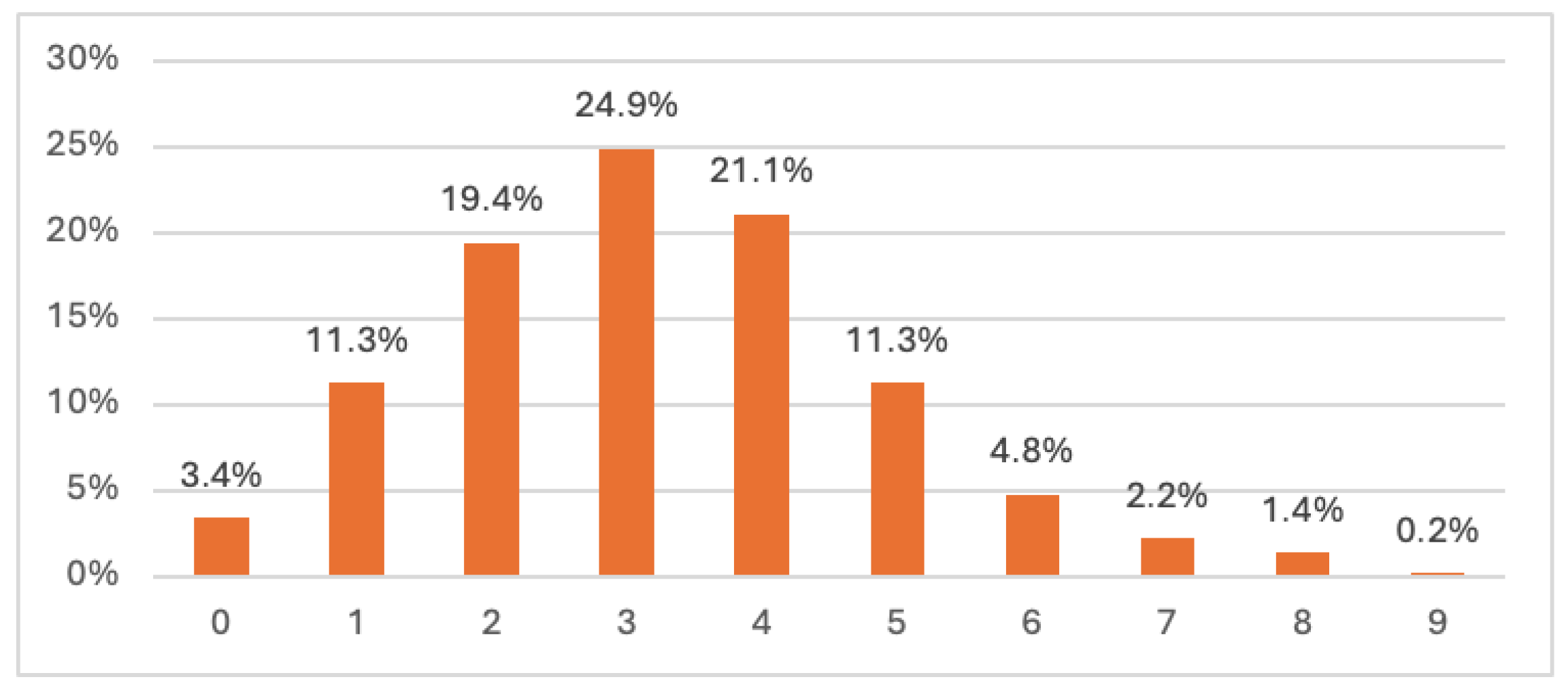
An analysis of the collected data (
Figure 1) shows that only 3.4% of companies had not implemented any solutions from this group, but only one did not intend to do so in the future. More than half of the companies had implemented three or fewer of the solutions discussed (56%), and as many as 88% of the respondents had implemented five or fewer. If a decision was made to implement one of the solutions discussed (which applied to 11.3% of the respondents), the investment was made primarily in PPAs (nearly half of these 11%), or in heat pumps, green procurement and supply chains, LED lighting and smart controls, electric vehicle fleets and photovoltaic installations (6.4–13% of entities in this group). On the other hand, a negligible proportion concerned joint energy purchases, energy storage, EMS and automatic ESG/carbon footprint reporting. The majority of respondents indicated that they had implemented three solutions, primarily electric vehicle fleets, photovoltaic installations, and LED lighting and smart controls. Only one in three companies with a photovoltaic installation (33.9%) also installed energy storage, although nearly half were planning to do so. If these plans were implemented, approximately one in three companies (33.5%) would have a photovoltaic installation with energy storage. At the time of the survey, this was the case in 15% of companies.
Table 6 presents the data on customers’ expectations perceived by the surveyed companies (in descending order) and the types of energy transformation innovations the companies had already implemented or intended to implement (also in descending order). The correspondence between a particular need and an innovation is denoted by “x”.
Table 6 demonstrates that the majority of the most commonly implemented energy transition innovations correspond with the perceived customers’ needs that were deemed by the surveyed companies to be the most important. This finding is consistent with the position expressed in the theoretical part of this paper, that perceived customers’ expectations shape SMEs’ decisions concerning energy transition.
7. Discussion
The results of the research allowed us to answer the research questions posed earlier, which can serve as a basis for discussion. The results of the study indicate a relatively high level of declared knowledge among SMEs in the field of energy transition. The vast majority of respondents rated their knowledge as average or high, which suggests that issues related to energy efficiency, the use of renewable energy sources, and reducing energy consumption are significantly present in the awareness of enterprises. At the same time, the marginal percentage of respondents indicating a very low level of knowledge suggests that a lack of basic knowledge about energy transition is not a major barrier in the SME sector. When it comes to the hierarchy of consumer expectations in the area of energy transition as perceived by entrepreneurs, reducing energy consumption in processes and products is by far the highest rated. The use of renewable energy sources ranks next. The expectation perceived as least important by entrepreneurs is environmental and energy certification. When it comes to implementing innovations in the area of energy transition in response to customer expectations as perceived by manufacturers, there is consistency in this regard: the most frequently implemented innovations (i.e., heat pumps, photovoltaic installations, electric vehicle fleets, EMS and energy storage) respond to the most frequently identified customer needs (reducing energy consumption in production processes and using renewable energy sources), while the least frequently implemented innovation (automatic ESG/carbon footprint reporting) responds to less frequently identified customer needs (transparency of energy activities and communication of the effects of activities).
The results of the study indicate that consumer expectations—understood as the market perception of companies, rather than directly measured customer attitudes—play a significant but indirect role in shaping the energy activities of SMEs. Companies, especially micro and small ones, respond primarily to market signals that they perceive as concrete, measurable and potentially translatable into purchasing decisions. This is consistent with the literature on growing environmental awareness and the willingness to accept higher costs in exchange for better environmental performance [
6], but at the same time shows that this mechanism is strongly filtered by the organisational constraints of SMEs.
In practice, consumer expectations influence the energy transition of enterprises only when they are interpreted as stable and economically justified. This means that they play a complementary role to cost and regulatory pressures rather than being an independent driver of systemic energy change. This mechanism explains the incremental nature of the energy transition in the SME sector. The results indicate that SMEs interpret consumer expectations primarily through the lens of specific, visible and economically justified energy measures, which is reflected in the structure of the most frequently implemented innovations.
The results confirm that the energy transition of SMEs is selective and incremental rather than systemic. Companies focus on solutions with low barriers to entry, short payback periods and high visibility, such as lighting upgrades, photovoltaic installations and transport changes. More complex tools, including advanced energy management systems, remain less frequently implemented, which is consistent with earlier observations regarding financial and competence barriers in the SME sector [
39,
58].
This model of transformation can be interpreted as a rational adaptation strategy in conditions of regulatory uncertainty and limited resources. At the same time, it reveals a gap between ambitious energy policy goals and the actual implementation capabilities of companies.
8. Conclusions and Recommendations
The most important implication for energy policy and support instruments arising from the study is the need to better align energy transition instruments with how SMEs perceive market expectations. The results indicate that policies that focus excessively on formal reporting and standardisation may be less effective in the micro and small business segment. Greater emphasis should be placed on supporting technical investments that have a direct impact on energy consumption and emissions, which are both economically transparent and perceived as valuable by the market.
This means that policy instruments need to be designed that combine regulatory objectives with market logic—through simplified energy efficiency support programmes, investment incentives for renewable energy sources, and communication focused on cost and operational benefits. This approach can increase the effectiveness of the energy transition of SMEs by integrating regulatory pressure, market incentives and the perception of customer expectations into a coherent strategy of action [
39,
58].
This article makes an important contribution to the literature on the energy transition of SMEs by focusing on the role of companies’ perceptions of consumer expectations as a factor that shapes energy strategies and investment decisions. Unlike studies that directly analyse consumer attitudes and behaviour [
5,
6], this article takes the perspective of businesses—particularly micro and small enterprises—showing how their interpretation of market signals influences the scope and nature of their actions in the area of energy efficiency and renewable energy.
Firstly, the study provides empirical identification of the hierarchy of consumer expectations perceived by SMEs in the context of energy transition. The results indicate that companies attach the greatest importance to expectations regarding operational and technical activities, such as reducing energy consumption and using renewable energy sources, while attaching relatively less importance to formal environmental communication tools, including certificates and reporting. This complements the literature pointing to the growing role of environmental awareness and consumers’ willingness to incur higher costs [
6], showing how these trends are filtered through the perception of companies.
Secondly, the article contributes to research on signalling mechanisms in the energy transition of SMEs, showing that from the perspective of companies, visible and measurable energy actions play a key role, rather than declarative marketing communication. These results develop the concept of environmental signaling [
8], indicating that for micro and small enterprises, investments in energy efficiency and renewable energy sources are perceived as a more credible market signal than highly formalised tools.
Thirdly, the article makes a methodological contribution by using CATI surveys conducted among enterprises, enabling a quantitative assessment of the relationship between company characteristics, their perception of market expectations and their declared energy policy directions. This approach complements the analyses based on regulatory and macroeconomic data that dominate the literature [
39,
58], providing insight into microeconomic decision-making mechanisms.
Finally, the article offers important practical implications for the design of energy policies and SME support instruments. The results suggest that the effectiveness of programmes promoting energy transition can be increased by better taking into account how companies interpret their customers’ expectations, rather than solely by imposing formal regulatory requirements [
39,
58].
9. Limitations and Further Research
This paper takes a somewhat subjective perspective, viewing the actions of SMEs not as pure, direct results of customers’ expectations, but also as the product of SMEs’ perception and interpretation of those expectations. In reality, any directly observable signals are coloured by the opinions, previous experiences and biases of decision-makers when decisions are based on them.
However, this perspective is also a limitation of the paper. While it is reasonable to assume that SMEs’ perception and interpretation of customers’ expectations are not dis-connected from reality, the exact extent to which customers’ actions and expectations are aligned with SMEs’ interpretation is not known. Therefore, further research in this area is called for.
We propose further research that addresses the possible discrepancy. A promising line of inquiry seems to be a between-subjects experimental study, where customers’ brand perception or willingness to pay is measured based on product descriptions that contain or do not contain mentions of specific energy transition innovations implemented by companies. This experimental design, where the respondents are largely unable to give ‘virtue signalling’ answers, and where other variables are controlled, should provide a clearer, analytical perspective on consumers’ actual preferences, uncoloured by entrepreneurs’ interpretations.
Author Contributions
Conceptualization, T.B., R.L., A.L.-M., K.S. and M.C.; Methodology, R.L., A.L.-M. and K.S.; Validation, T.B., R.L., A.L.-M. and K.S.; Formal Analysis, T.B., R.L. and K.S.; Investigation, T.B., R.L. and K.S.; Resources, T.B.; Data Curation, R.L.; Writing—Original Draft Preparation, A.L.-M. and M.C.; Writing—Review and Editing, A.L.-M. and M.C.; Visualization, A.L.-M. and M.C.; Supervision, A.L.-M. and M.C.; Project Administration, A.L.-M. and M.C.; Funding Acquisition, M.C. All authors have read and agreed to the published version of the manuscript.
Funding
This work was supported by the AGH University of Krakow through funds allocated for the development of research capacity at the Faculty of Management, as part of the ‘Excellence Initiative—Research University’ program.
Data Availability Statement
The original contributions presented in this study are included in the article. Further inquiries can be directed to the corresponding author.
Conflicts of Interest
The authors declare no conflicts of interest.
Abbreviations
The following abbreviations are used in this manuscript:
| B2B | Business-to-business |
| B2C | Business-to-consumer |
| SMEs | Small and medium-sized enterprises |
| RES | Renewable energy sources |
| PPA | Power purchase agreement |
| EMS | Energy management system |
| ESG | Environmental, Social, and Governance |
References
- European Union. Commission Regulation (EU) No 651/2014 of 17 June 2014 Declaring Certain Categories of Aid Compatible with the Internal Market in Application of Articles 107 and 108 of the Treaty; European Union: Brussels, Belgium, 2014. [Google Scholar]
- Park, H.J.; Lin, L.M. Exploring attitude–behavior gap in sustainable consumption: Comparison of recycled and upcycled fashion products. J. Bus. Res. 2020, 117, 623–628. [Google Scholar] [CrossRef]
- Rausch, T.M.; Kopplin, C.S. Bridge the gap: Consumers’ purchase intention and behavior regarding sustainable clothing. J. Clean. Prod. 2021, 278, 123882. [Google Scholar] [CrossRef]
- Dobbelstein, T.; Mason, R.B. Mind the Green Gap—Demographic Influences and Strategies to Close Recycled Product Intention-Behaviour Gaps in Germany and South Africa. Int. Rev. Manag. Mark. 2026, 16, 53–69. [Google Scholar] [CrossRef]
- Thøgersen, J. Country Differences in Sustainable Consumption: The Case of Organic Food. J. Macromark. 2010, 30, 171–185. [Google Scholar] [CrossRef]
- Nielsen. The Sustainability Imperative: New Insights on Consumer Expectations. Nielsen Global Survey. 2015. Available online: https://nielseniq.com/global/en/insights/analysis/2015/the-sustainability-imperative-2/ (accessed on 3 January 2026).
- Oyedun, A.O.; Owolabi, A.B.; Yakub, A.O.; Suh, D.; Akamo, D.O.; Bala, A.; Komolafe, D. Renewable energy adoption with business-to-consumer approach in Africa. Heliyon 2025, 11, e43056. [Google Scholar] [CrossRef]
- Delmas, M.A.; Burbano, V.C. The Drivers of Greenwashing. Calif. Manag. Rev. 2011, 54, 64–87. [Google Scholar] [CrossRef]
- Derksen, D.M.; Mithöfer, D. Consumer perspectives on corporate sustainability in floriculture. J. Clean. Prod. 2025, 522, 146119. [Google Scholar] [CrossRef]
- Vigneau, L.; Adams, C.A. The failure of transparency as self-regulation. Sustain. Account. Manag. Policy J. 2023, 14, 852–876. [Google Scholar] [CrossRef]
- European Commission. SME Strategy for a Sustainable and Digital Europe; European Commission: Brussels, Belgium, 2020. [Google Scholar]
- Khan, M.; Kadhum, M.; Syed, M. Green business strategies: Sustainable technologies and digital transformation. J. Sci. Lett. 2023, 4, 6–11. [Google Scholar] [CrossRef]
- Real, J.C.; Cepeda-Carrión, I.; Pérez-Bou, S. Road to sustainability with green practices: A look at SMEs in the textile-fashion industry in Spain. Eur. Bus. Rev. 2025, 37, 1040–1072. [Google Scholar] [CrossRef]
- Attah, R.; Garba, B.; Gil-Ozoudeh, I.; Iwuanyanwu, O. Digital transformation in the energy sector: Comprehensive review of sustainability impacts and economic benefits. Int. J. Adv. Econ. 2024, 6, 760–776. [Google Scholar] [CrossRef]
- Richter, L.-L. Social Effects in the Diffusion of solar Photovoltaic Technology in the UK. Cambridge Working Papers in Economics. 2013. Available online: https://www.repository.cam.ac.uk/items/3926264e-ec0c-4907-a390-955d6adb846f (accessed on 3 January 2026).
- Chatti, N.; Zaidi, A.; Makhlouf, H.; Lajnef, M.; Lakhal, L. Create sustainable competitive advantage and improve sustainable performance by implementing lean and green manufacturing practices: An empirical study on German manufacturing SMEs. Int. J. Product. Perform. Manag. 2025, 75, 153–179. [Google Scholar] [CrossRef]
- Camilleri, M.A. European environment policy for the circular economy: Implications for business and industry stakeholders. Sustain. Dev. 2020, 28, 1804–1812. [Google Scholar] [CrossRef]
- Yserte, R.; Rivera, M. The potential role of stakeholders in the energy efficiency of higher education institutions. Sustainability 2020, 12, 8908. [Google Scholar] [CrossRef]
- Komarnicka, A.; Komarnicki, M. Challenges in the EU banking sector as exemplified by Poland in view of legislative changes related to climate crisis prevention. Energies 2022, 15, 699. [Google Scholar] [CrossRef]
- Liu, C.; Liu, X.; Yao, L.; Liu, J. Consumer preferences and willingness to pay for eco-labelled eggs: A discrete choice experiment from Chongqing in China. Br. Food J. 2022, 125, 1683–1697. [Google Scholar] [CrossRef]
- Oyeyemi, O.; Anjorin, K.; Ewim, S.; Igwe, A.; Sam-Bulya, N. The intersection of green marketing and sustainable supply chain practices in FMCG SMEs. Int. J. Manag. Entrep. Res. 2024, 6, 3559–3576. [Google Scholar] [CrossRef]
- Kaczorowska, J.; Rejman, K.; Halicka, E.; Szczebyło, A.; Górska-Warsewicz, H. Impact of food sustainability labels on the perceived product value and price expectations of urban consumers. Sustainability 2019, 11, 7240. [Google Scholar] [CrossRef]
- Perrini, F.; Castaldo, S.; Misani, N.; Tencati, A. The impact of corporate social responsibility associations on trust in organic products marketed by mainstream retailers. Bus. Strategy Environ. 2010, 19, 512–526. [Google Scholar] [CrossRef]
- Cagno, E.; Trucco, P.; Trianni, A.; Sala, G. Quick-E-scan: A methodology for the energy scan of SMEs. Energy 2010, 35, 1916–1926. [Google Scholar] [CrossRef]
- Thollander, P.; Danestig, M.; Rohdin, P. Energy policies for increased industrial energy efficiency: Evaluation of a local energy programme for manufacturing SMEs. Energy Policy 2007, 35, 5774–5783. [Google Scholar] [CrossRef]
- König, W.; Löbbe, S.; Büttner, S.; Schneider, C. Establishing energy efficiency—Drivers for energy efficiency in German manufacturing SMEs. Energies 2020, 13, 5144. [Google Scholar] [CrossRef]
- Dong, J.; Huo, H. Identification of financing barriers to energy efficiency in small and medium-sized enterprises by integrating the fuzzy Delphi and fuzzy DEMATEL approaches. Energies 2017, 10, 1172. [Google Scholar] [CrossRef]
- Klement, L.; Vinczeová, M.; Klementová, V. What prevents businesses from carrying out eco-innovation activities? Empirical Research on barriers in Slovak SMEs. In Proceedings of the 16th International Conference Liberec Economic Forum, Liberec, Czech Republic, 5–6 September 2023. [Google Scholar] [CrossRef]
- Jalo, N.; Johansson, I.; Andrei, M.; Nehler, T.; Thollander, P. Barriers to and drivers of energy management in Swedish SMEs. Energies 2021, 14, 6925. [Google Scholar] [CrossRef]
- Warren, P. The potential of smart technologies and micro-generation in UK SMEs. Energies 2017, 10, 1050. [Google Scholar] [CrossRef]
- Palm, J.; Backman, F. Energy efficiency in SMEs: Overcoming the communication barrier. Energy Effic. 2020, 13, 809–821. [Google Scholar] [CrossRef]
- Southernwood, J.; Papagiannis, G.; Güemes, E.; Sileni, L. Energy efficiency solutions for small and medium-sized enterprises. In Proceedings of the 8th Annual International Sustainable Places Conference, Online, 28–30 October 2020. [Google Scholar] [CrossRef]
- Backman, F. Barriers to energy efficiency in Swedish non-energy-intensive micro- and small-sized enterprises—A case study of a local energy program. Energies 2017, 10, 100. [Google Scholar] [CrossRef]
- Johansson, I.; Mardan, N.; Cornelis, E.; Kimura, O.; Thollander, P. Designing policies and programmes for improved energy efficiency in industrial SMEs. Energies 2019, 12, 1338. [Google Scholar] [CrossRef]
- Testa, F.; Vigolo, V. Sustainability through energy efficiency: An Italian perspective. Sinergie Ital. J. Manag. 2018, 96, 93–111. [Google Scholar] [CrossRef][Green Version]
- Prieto-Sandoval, V.; Jaca, C.; Santos, J.; Baumgartner, R.; Ormazábal, M. Key strategies, resources, and capabilities for implementing circular economy in industrial SMEs. Corp. Soc. Responsib. Environ. Manag. 2019, 26, 1473–1484. [Google Scholar] [CrossRef]
- Gatto, F.; Re, I. Circular bioeconomy business models to overcome the valley of death. Sustainability 2021, 13, 1899. [Google Scholar] [CrossRef]
- Gonçalves, M.; Máximo, G. Circular economy in the food chain: Production, processing and waste management. Circ. Econ. Sustain. 2022, 3, 1405–1423. [Google Scholar] [CrossRef] [PubMed]
- European Commission. The European Green Deal; European Commission: Brussels, Belgium, 2019. [Google Scholar]
- Han, X.; Zhou, Y. Responding to consumer environmental awareness: A variational inequality approach to green manufacturing optimization. Comput. Ind. Eng. 2024, 191, 110174. [Google Scholar] [CrossRef]
- PwC—Voice of the Consumer Survey. 2024. Available online: https://www.pwc.com/gx/en/issues/c-suite-insights/voice-of-the-consumer-survey/2024.html (accessed on 3 January 2026).
- Peñasco, C.; del Río, P.; Romero-Jordán, D. Analysing the Role of International Drivers for Eco-innovators. J. Int. Manag. 2017, 23, 56–71. [Google Scholar] [CrossRef]
- Bernat, T.; Flaszewska, S.; Lisowski, B.; Lisowska, R.; Szymańska, K. Facing Environmental Goals for Energy—Efficiency Improvements in Micro and Small Enterprises Operating in the Age of Industry 4.0. Energies 2022, 15, 6577. [Google Scholar] [CrossRef]
- Lyon, T.P.; Montgomery, A.W. The means and end of greenwash. Organ. Environ. 2015, 28, 223–249. [Google Scholar] [CrossRef]
- Ma, J. The effect of innovative culture, organizational commitment and self-efficacy on innovation competence of SMEs’ managers in China. In Proceedings of the 5th Management Science Informatization and Economic Innovation Development Conference, MSIEID 2023, Guangzhou, China, 8–10 December 2023. [Google Scholar] [CrossRef]
- Diana Erlany, H.; Mutiara Savitri, F.; Ngatno, N.; Prabawani, B.; Widiartanto, W. SME digital transformation as a post-pandemic recovery facility in Pekalongan, Indonesia. Proc. Int. Conf. Multidiscip. Res. 2022, 5, 91–99. [Google Scholar] [CrossRef]
- Chandra, A.; Shukla, D.M.; Sharma, S.; Dwivedi, G. Fostering environmentally sustainable business: Analysis of factors from entrepreneurial ecosystem perspective. J. Clean. Prod. 2024, 476, 143667. [Google Scholar] [CrossRef]
- Bernat, T.; Flaszewska, S.; Lisowska, R.; Szymańska, K. Involving micro and small enterprises in the energy transition: Evidence from Poland. Energies 2024, 17, 847. [Google Scholar] [CrossRef]
- Chipambwa, W.; Moalosi, R.; Molwane, O.; Rapitsenyane, Y. Survival through innovation in manufacturing SMEs in emerging economies: Evidence from Zimbabwe. J. Innov. Entrep. 2023. Epub ahead of printing. [Google Scholar] [CrossRef]
- Khan, M.A. Barriers constraining the growth of and potential solutions for emerging entrepreneurial SMEs. Asia Pac. J. Innov. Entrep. 2022, 16, 38–50. [Google Scholar] [CrossRef]
- Urbano, E.M.; Martinez-Viol, V.; Kampouropoulos, K.; Romeral, L. Energy-investment decision-making for industry: Quantitative and qualitative risks integrated analysis. Sustainability 2021, 13, 6977. [Google Scholar] [CrossRef]
- Backman, F. Energy Efficiency in Swedish SMEs: Exploring Barriers, Knowledge Creation and the Role of Municipal Energy Efficiency Programs; Linköping University Electronic Press: Linköping, Sweden, 2018. [Google Scholar] [CrossRef]
- Indrawati, H.; Caska, N.; Suarman, N. Barriers to technological innovations of SMEs: How to solve them? Int. J. Innov. Sci. 2020, 12, 545–564. [Google Scholar] [CrossRef]
- Boutbhirt, N.; Adaskou, M. Financial innovation of small and medium enterprises in Morocco in the area of energy optimization: State of the art. E3S Web Conf. 2023, 412, 01084. [Google Scholar] [CrossRef]
- Sestino, A.; Prete, M.I.; Piper, L.; Guido, G. Internet of Things and big data as enablers for business digitalization strategies. Technovation 2020, 98, 102173. [Google Scholar] [CrossRef]
- Gennitsaris, S.; Oliveira, M.C.; Vris, G.; Bofilios, A.; Ntinou, T.; Frutuoso, A.R.; Queiroga, C.; Giannatsis, J.; Sofianopoulou, S.; Dedoussis, V. Energy efficiency management in small and medium-sized enterprises: Current situation, case studies and, best practices. Sustainability 2023, 15, 3727. [Google Scholar] [CrossRef]
- Statistics Poland. Local Data Bank. Available online: https://bdl.stat.gov.pl (accessed on 10 January 2025).
- European Commission. Energy Communities: An Initiative for Citizen-Led Renewable Energy Projects; European Commission: Brussels, Belgium, 2020. [Google Scholar]
| Disclaimer/Publisher’s Note: The statements, opinions and data contained in all publications are solely those of the individual author(s) and contributor(s) and not of MDPI and/or the editor(s). MDPI and/or the editor(s) disclaim responsibility for any injury to people or property resulting from any ideas, methods, instructions or products referred to in the content. |




 ,
,