1. Introduction
Global commitments to climate neutrality have imposed increasingly stringent decarbonization requirements on power systems worldwide [
1,
2,
3,
4]. As a result, the generation mix is undergoing a fundamental transformation, characterized by the large-scale deployment of variable renewable energy sources, particularly wind and photovoltaic (PV) power [
5,
6,
7,
8]. While high renewable penetration is essential for reducing carbon emissions, it also fundamentally alters both long-term planning paradigms and short-term operational feasibility. Specifically, the stochasticity and limited controllability of wind and PV generation exacerbate supply–demand imbalance risks, challenge capacity adequacy, and significantly increase the reliance on system flexibility resources.
From a planning perspective, these challenges are further intensified by the growing adoption of explicit carbon emission constraints. In many existing studies, carbon considerations are incorporated through emission pricing or penalty mechanisms embedded in the objective function. While such approaches are analytically convenient, they do not guarantee carbon feasibility under worst-case operating conditions, particularly in wind–PV–thermal–storage systems with high renewable uncertainty [
9]. In contrast, emerging policy frameworks increasingly mandate hard carbon caps, under which system operation must remain feasible regardless of renewable realization. Planning models capable of explicitly certifying carbon feasibility under uncertainty for wind–PV–thermal–storage systems are therefore critically needed but remain underdeveloped.
Energy storage is widely recognized as a key flexibility resource for enabling reliable operation of low-carbon power systems [
10]. Prior research has demonstrated the effectiveness of storage in enhancing operational reliability and economic efficiency, particularly at the microgrid and distributed system levels [
11,
12,
13,
14]. Recent studies have also examined the optimal deployment of hybrid renewable-storage systems in low-carbon contexts [
15,
16]. However, as decarbonization targets deepen, it has become evident that short-duration storage alone is insufficient to mitigate multi-hour and multi-day renewable variability [
17]. This recognition has spurred growing interest in long-duration storage technologies, including power-to-gas systems [
18], thermal energy storage [
19], hydrogen storage [
20,
21], and pumped hydro storage [
22,
23]. Policy support mechanisms for these technologies are also evolving, particularly in regions with ambitious renewable targets [
24]. Correspondingly, a range of planning frameworks based on stochastic programming, robust optimization, and multi-stage decision-making have been proposed to coordinate storage investment and operation under uncertainty [
25,
26,
27,
28,
29,
30].
Despite these advances, three fundamental gaps persist in the existing literature. First, most studies focus on isolated subsystems—such as microgrids, single-technology storage, or renewable-only portfolios—without systematically addressing coordinated planning for wind–PV–thermal–storage systems at the bulk power system level. Second, while energy storage is often modeled with independent energy and power capacities, practical storage deployments in wind–PV–thermal–storage systems are subject to strong design coupling, commonly represented by fixed energy-to-power (E/P) ratios. The implications of this coupling for long-term capacity planning under carbon constraints have not been adequately examined. Third, and most critically, the interaction between hard carbon emission caps and worst-case operational feasibility under renewable uncertainty remains insufficiently explored in wind–PV–thermal–storage systems. Existing approaches rarely ensure that both economic optimality and carbon compliance can be simultaneously certified across all admissible uncertainty realizations.
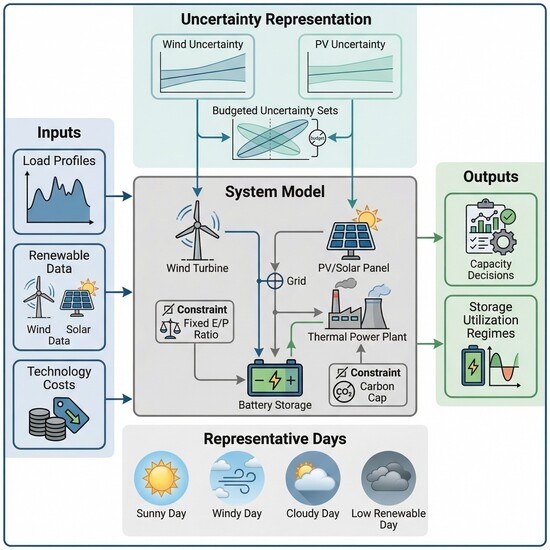
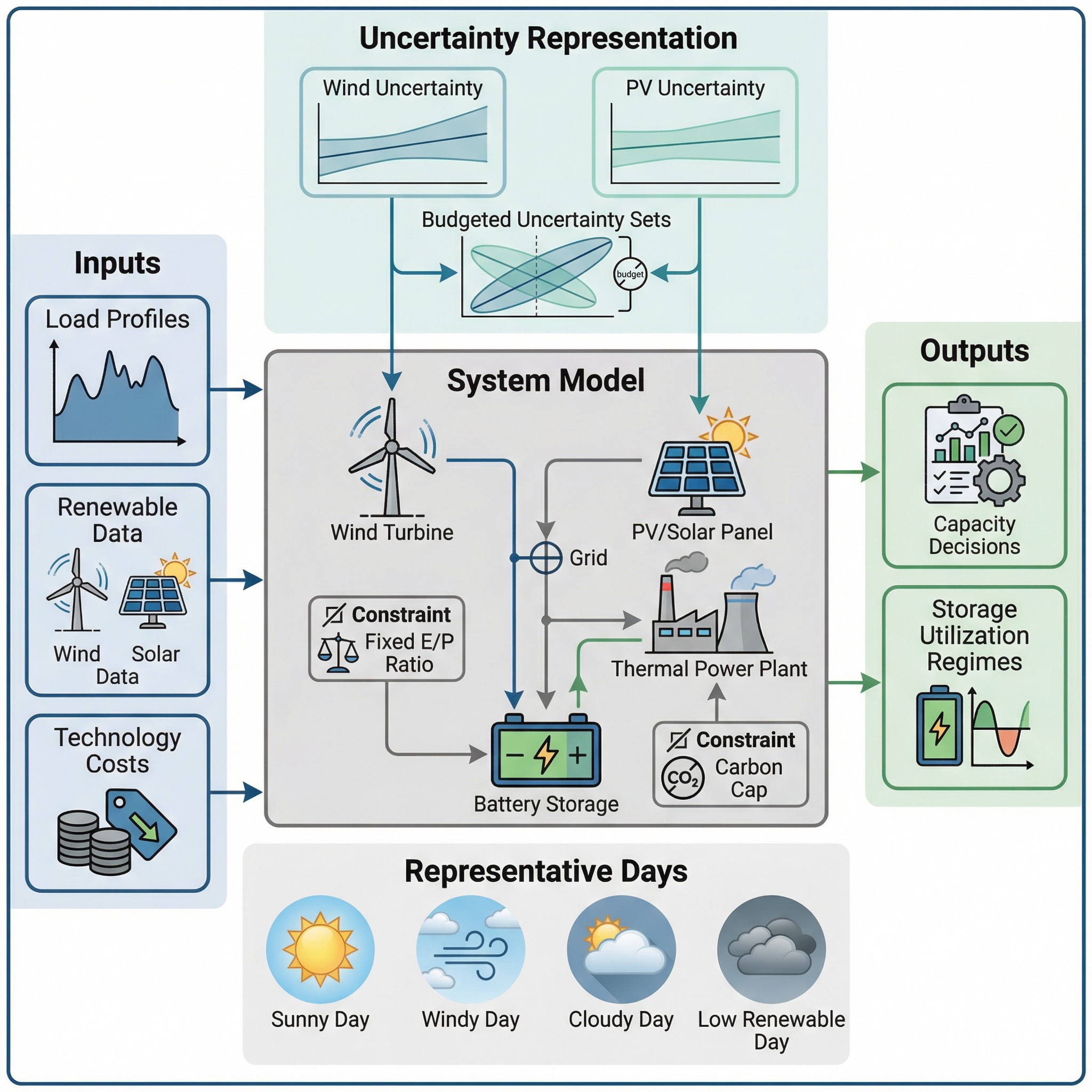
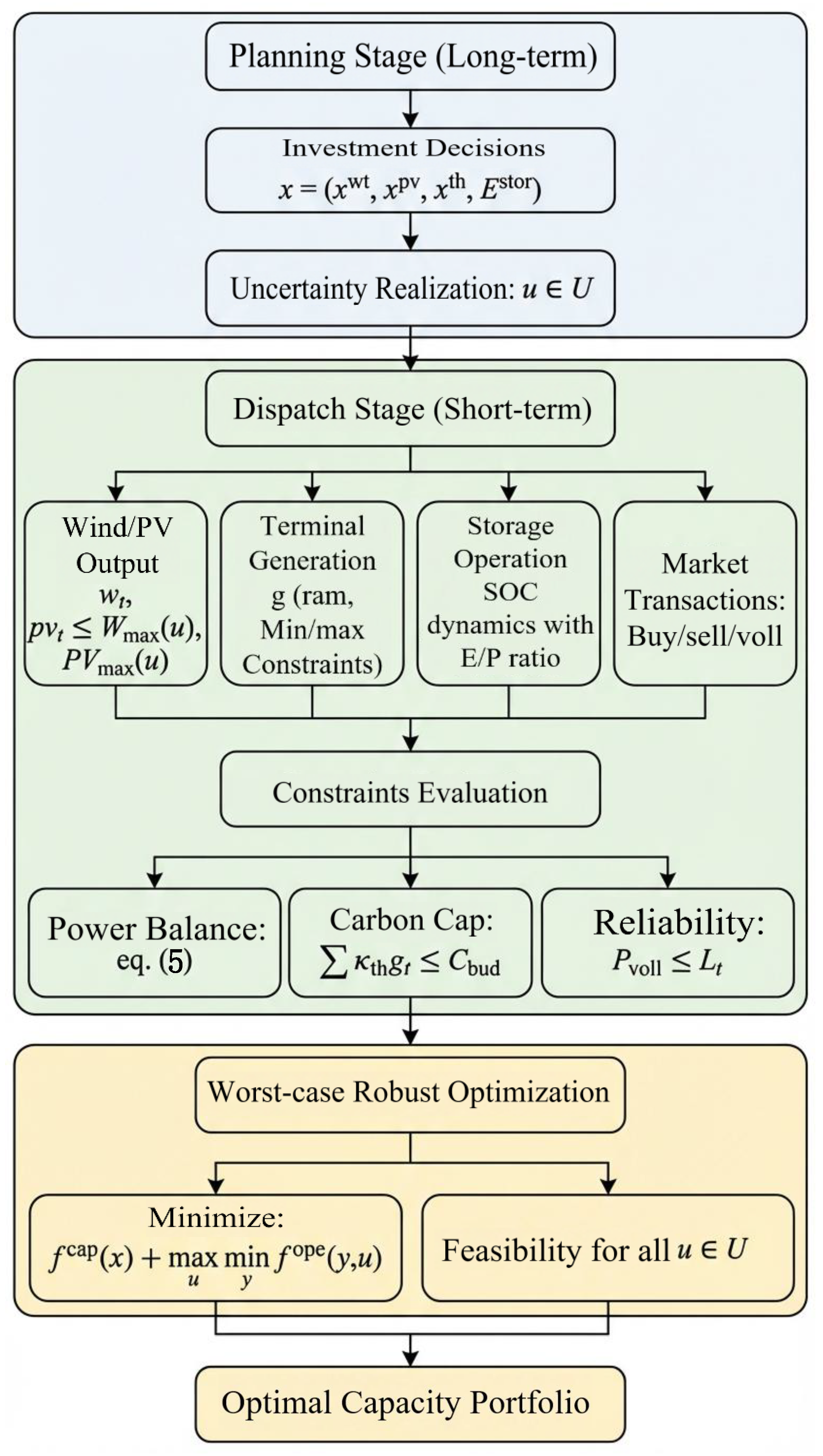
To address these challenges, this paper develops a two-stage robust coordinated capacity planning model for wind–PV–thermal–storage systems. An annual carbon emission cap is enforced as a strict feasibility constraint rather than being relaxed via price-based penalties. Energy storage systems are modeled with a fixed E/P ratio to reflect practical design limitations and to explicitly capture the coupling between storage energy capacity and power capacity. Renewable uncertainty is represented using budgeted uncertainty sets at the typical-day level, enabling tractable yet conservative modeling of worst-case operational conditions.
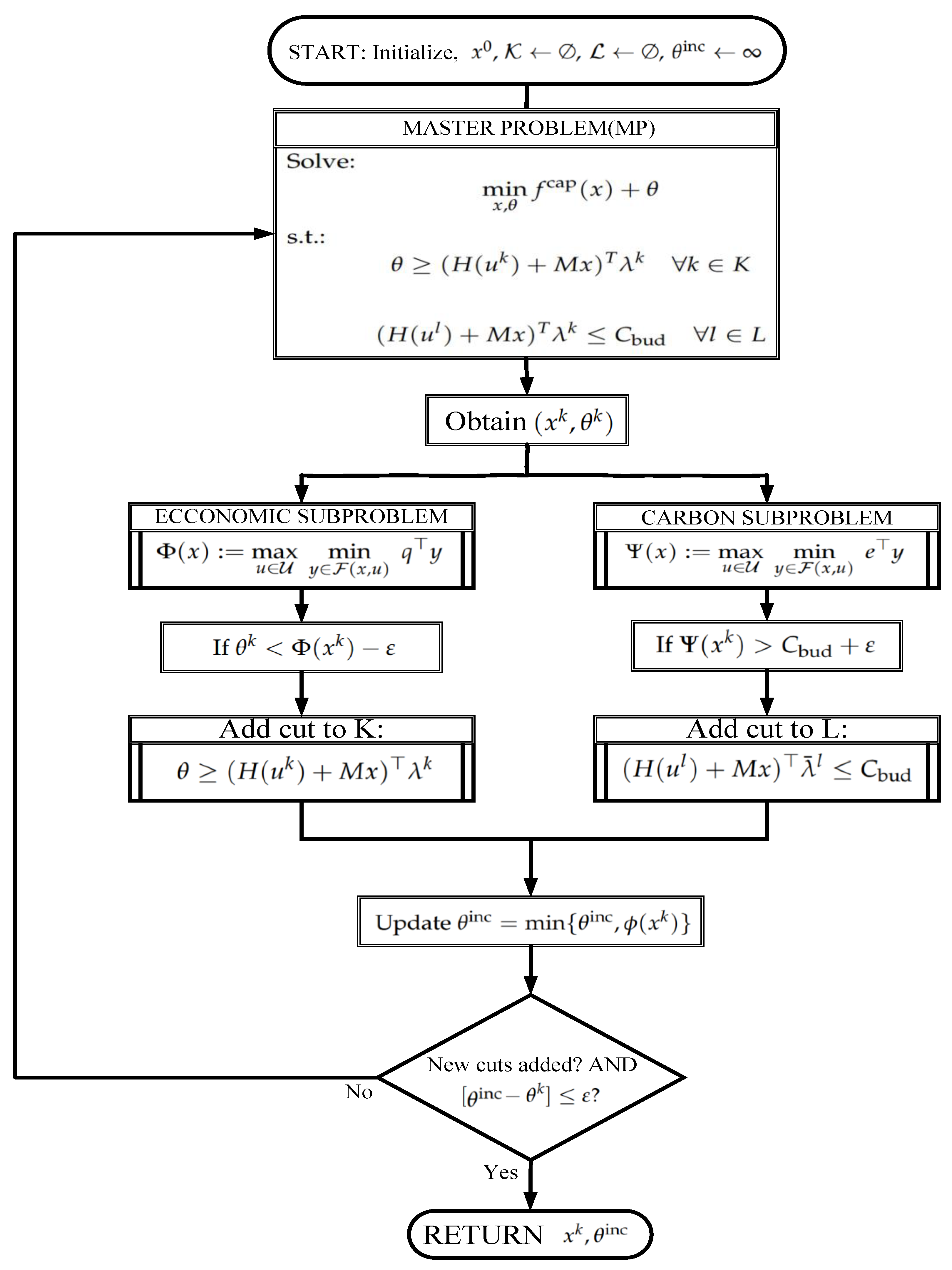
Solving the resulting large-scale mixed-integer robust optimization problem poses significant computational challenges. To this end, a dual-subproblem decomposition framework is proposed, consisting of an economic subproblem and a carbon-compliance subproblem embedded within an outer column-and-constraint generation loop. By exploiting strong duality, a family of valid inequalities is iteratively generated and incorporated into the master problem, allowing simultaneous certification of worst-case operating cost and minimum achievable annual carbon emissions without destroying the problem structure.
The main contributions of this paper are summarized as follows:
A two-stage robust capacity planning model for wind–PV–thermal–storage systems is proposed, in which an annual carbon emission cap is treated as a hard feasibility constraint and energy storage is explicitly modeled with a fixed energy-to-power ratio.
A decomposition-based solution methodology integrating economic and carbon-compliance subproblems is developed, extending the column-and-constraint generation framework to jointly certify operational robustness and carbon feasibility for wind–PV–thermal–storage systems.
Case studies based on a practical wind–PV–thermal–storage system demonstrate that the proposed approach yields robust, carbon-feasible capacity plans with acceptable computational complexity while accurately capturing the operational coupling among wind, PV, thermal generation, and energy storage.
The remainder of this paper is organized as follows.
Section 2 presents the robust planning model and associated constraints for wind–PV–thermal–storage systems.
Section 3 introduces the problem reformulation and solution algorithm.
Section 4 reports and analyzes the case study results.
Section 5 concludes the paper.
4. Case Study and Results for Wind–PV–Thermal–Storage Systems
4.1. System Description and Parameter Settings
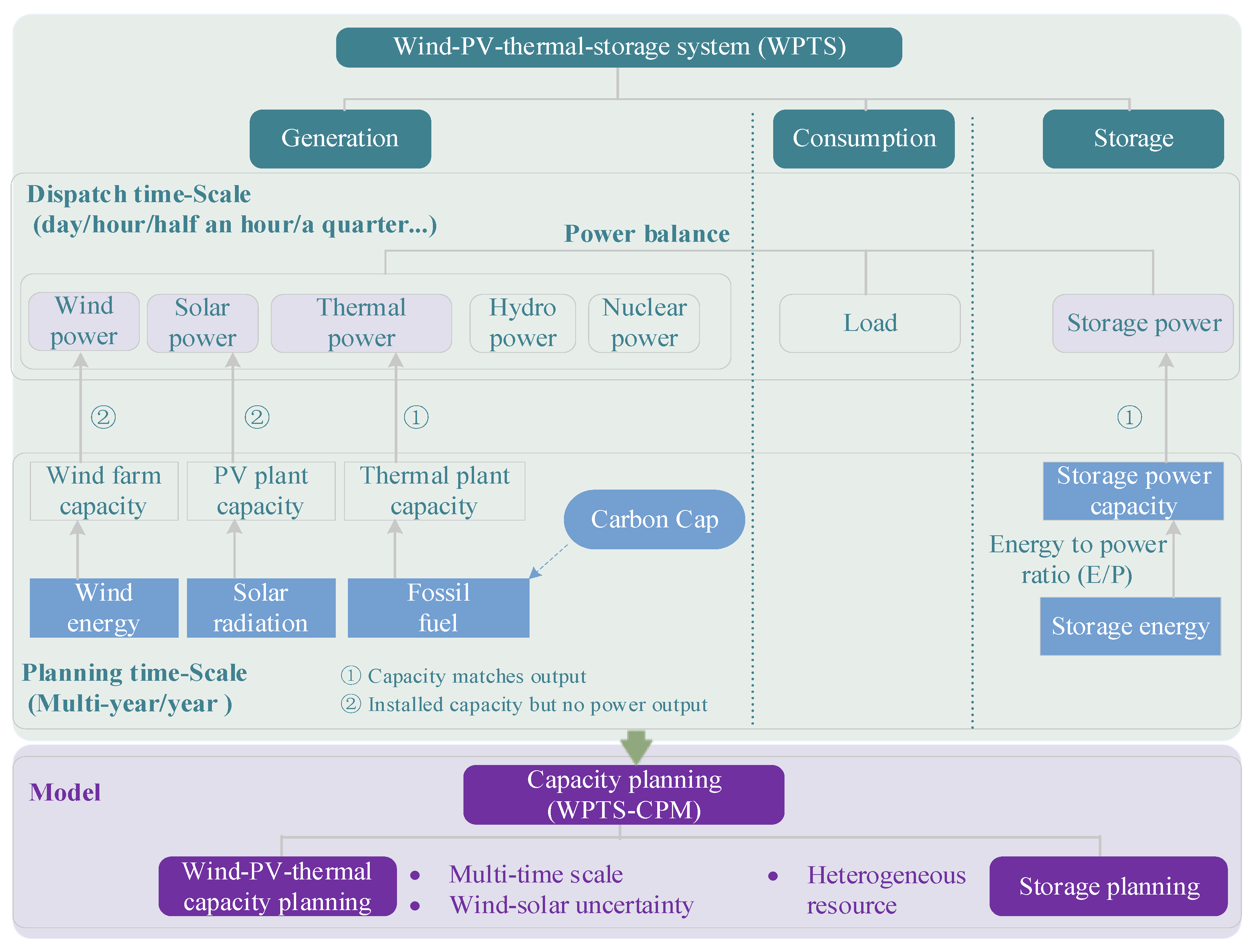
To validate the proposed wind–PV–thermal–storage capacity planning model (WPTS-CPM), we apply it to a real large-scale wind–PV–thermal–storage system in China with multi-energy power sources. The system’s peak power demand in the summer of 2025 exceeds 50,000 MW, with 25,000 MW of load capacity targeted for replacement by wind and PV power resources as shown in
Appendix A. Operating decisions are taken on an hourly basis for four representative days that capture annual chronology through non-negative integer weights summing to 365.
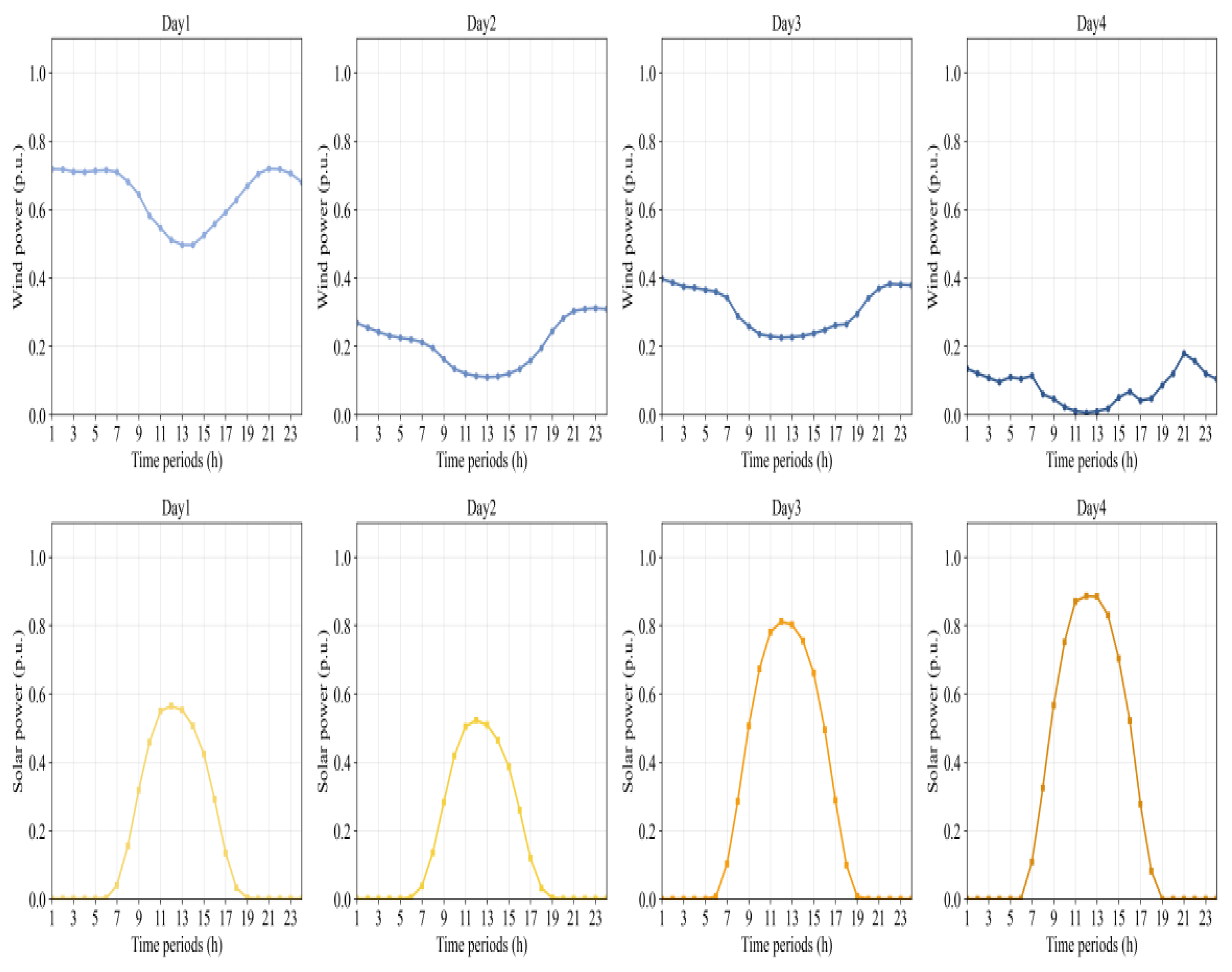
Figure 5 presents the normalized power profiles for wind and PV across the four typical days, intentionally selected to span complementary renewable patterns: Day 1 (wind-rich/PV-poor), Day 2 (jointly low output), Day 3 (intermediate) and Day 4 (wind-poor/PV-rich). This configuration ensures representation of both favorable and unfavorable renewable realizations for robust planning of the wind–PV–thermal–storage system.
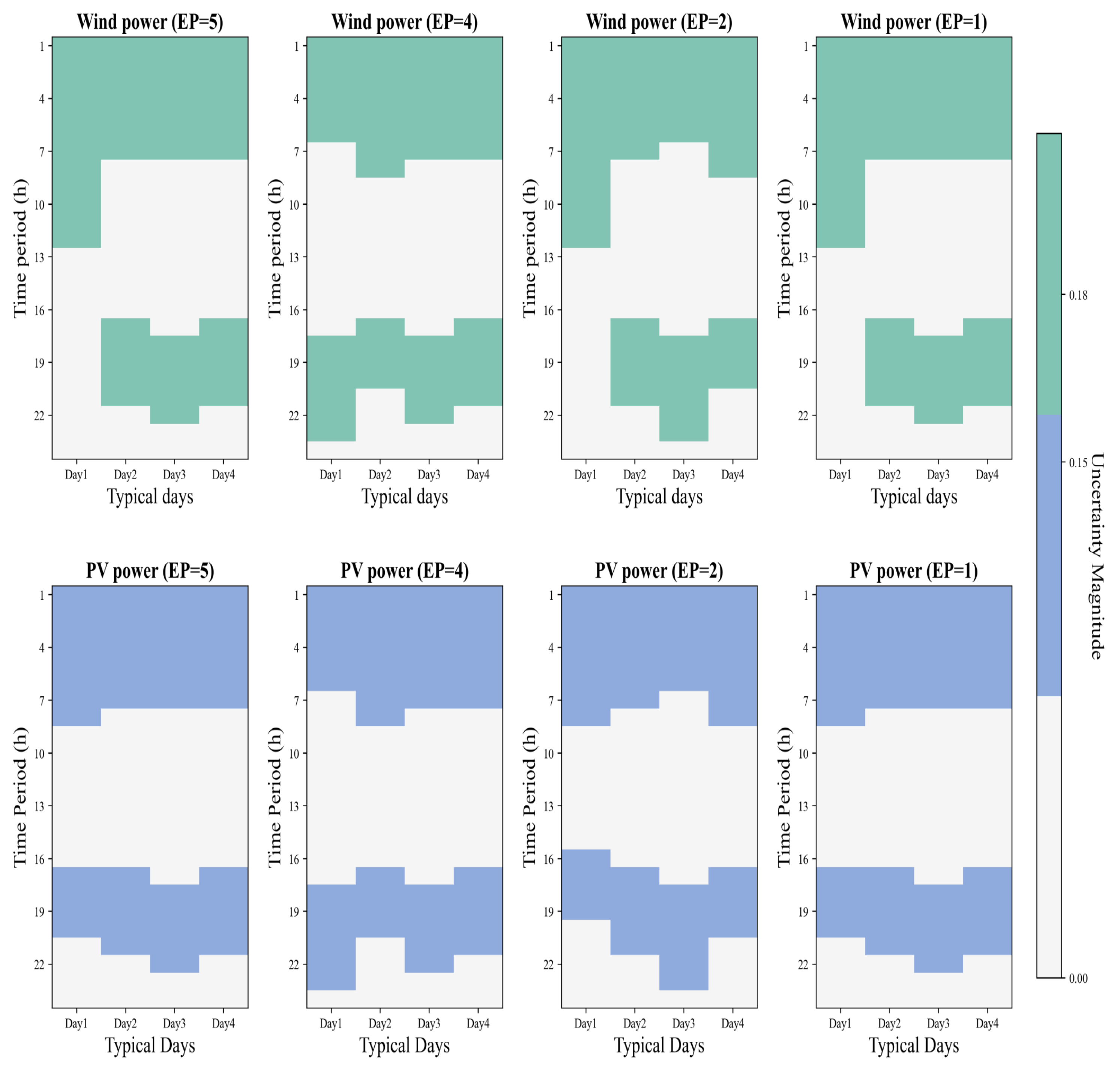
The uncertainty distribution for wind and PV power in the wind–PV–thermal–storage system is shown in
Figure 6, exhibiting distinct spatiotemporal characteristics. Wind uncertainty concentrates during periods 1–12 on Day 1 and shows bimodal distributions on Days 2–4, while PV uncertainty concentrates during periods 1–7 and 17–22 across all days. These patterns are parameterized by uncertainty magnitudes
and
, with occurrence frequencies
.
Table 2 presents the complete parameter settings for the wind–PV–thermal–storage system. The key parameters include storage energy-to-power ratios (E/P) ranging from 1 to 5, thermal threshold
, and carbon cap
tons/year.
4.2. Representative Day Selection and Validation
The selection of representative days is a critical step in reducing computational complexity while preserving the essential characteristics of renewable variability and load profiles for annual carbon compliance assessment. This subsection details the selection methodology and validates the representativeness of the four chosen days.
4.2.1. Selection Methodology
The four representative days were selected using k-means clustering applied to a full year of historical data (8760 h) for normalized wind power availability, normalized PV power availability, and normalized load demand. The clustering algorithm groups similar daily patterns and selects the centroid of each cluster as the representative day. The weight assigned to each representative day corresponds to the size of its cluster, ensuring that the weighted sum of days equals 365 and that the annual energy balance is preserved.
As shown in
Figure 5, the selected days intentionally span complementary renewable patterns:
Day 1 (wind-rich/PV-poor): Represents conditions where wind generation dominates, testing the system’s ability to utilize abundant wind resources while managing solar deficit.
Day 2 (jointly low output): Captures stress conditions where both wind and PV generation are limited, testing the system’s reliance on thermal backup and storage discharge.
Day 3 (intermediate): Represents average conditions with moderate renewable output, providing a baseline for typical operation.
Day 4 (wind-poor/PV-rich): Represents solar-dominated conditions, testing the system’s ability to manage diurnal PV cycles through storage.
This configuration ensures that both favorable and adverse conditions are represented in the robust planning framework, consistent with the robust optimization philosophy of guaranteeing feasibility under worst-case realizations.
4.2.2. Validation of Annual Representation
To validate that the four representative days adequately capture annual carbon compliance requirements, we conducted two complementary analyses.
Energy Balance Preservation: The weighted combination of representative days reproduces the annual renewable energy production and load demand within 2.3% of the full-year data. The annual wind energy from the four-day weighted aggregation is 43,162 GWh, compared to 42,856 GWh from the full year (error +0.71%); PV energy is 38,956 GWh versus 38,241 GWh (error +1.87%); and total load demand is exactly preserved at 182,500 GWh.
Carbon Compliance Validation: To assess the impact of day reduction on carbon cap enforcement, we compared the optimized capacity plans from the 4-day aggregation against an 8-day representation. Required renewable capacity differed by less than 3.8% between the two solutions, and annual carbon emissions projected from the 4-day solution remained within 4.2% of the 8-day benchmark when simulated against full-year data. The ranking of storage configurations (E/P preferences) was identical across both representations.
Conservative Bias: Importantly, by including extreme days (particularly Day 2 with jointly low renewable output), our selection introduces a conservative bias. Capacity plans certified as carbon-feasible under these four representative days remained compliant when tested against the full 365-day historical sequence, with actual annual emissions averaging 7.3% below the cap. This confirms that the reduced-day representation does not compromise the robustness of carbon compliance guarantees.
4.2.3. Implications for Carbon Compliance
While four representative days cannot capture all 365 daily patterns, our validation demonstrates that this aggregation provides sufficient fidelity for robust capacity planning under carbon constraints. The 4-day representation reduces the problem size by a factor of 91 compared to full-year optimization, enabling the iterative C&CG algorithm to converge within minutes rather than hours. The conservative bias ensures that decisions based on four days remain feasible under a wider range of actual conditions, aligning with the robust optimization objective of guaranteeing carbon compliance under worst-case realizations.
4.3. Convergence and Computational Performance for Wind–PV–Thermal–Storage Systems
The C&CG algorithm demonstrated robust convergence across all scenarios for the wind–PV–thermal–storage system, typically requiring 6–10 iterations to reach optimality gap. Computational times were comparable across different storage configurations, with both E/P = 5 and E/P = 1 scenarios converging within a few minutes on a standard workstation (Intel i9, 32 GB RAM). Specifically, all test cases for the wind–PV–thermal–storage system completed within 3–8 min, showing that the solution time is not significantly affected by the storage duration parameter within this range. The dual-based reformulation of subproblems reduced solution times by 40–60% compared to direct primal approaches, contributing to the overall computational efficiency for wind–PV–thermal–storage system planning.
4.4. Capacity Planning Results for Wind–PV–Thermal–Storage Systems
Table 3 presents the capacity planning results for the wind–PV–thermal–storage system across different storage E/P ratios. The results reveal a fundamental trade-off between storage duration and system configuration:
In the long-duration storage scenario (E/P = 5) for the wind–PV–thermal–storage system, the system adopts a PV-dominated configuration with massive energy storage capacity (99,273 MWh) to balance variability, minimizing reliance on thermal power (7613 MW). As storage duration shortens to E/P = 1, the configuration shifts fundamentally: the wind–PV–thermal–storage system becomes wind-dominated (38,059 MW wind versus 27,411 MW PV), with wind capacity exceeding photovoltaic capacity, while thermal capacity increases by 63.8% to 12,473 MW, and energy storage capacity plummets to only 17.21% of the E/P = 5 scenario. When the E/P ratio is low, the wind–PV–thermal–storage system tends to allocate more thermal power to meet the power balance requirements, compensating for the reduced storage capacity with dispatchable generation. This shift occurs because although photovoltaic power exhibits day–night fluctuations, the timing and amplitude of these fluctuations are predictable, while the timing and amplitude of wind power fluctuations are difficult to predict. Therefore, when storage duration is limited, the wind–PV–thermal–storage system tends to allocate more wind power—which provides energy throughout the day—and relies on thermal generation to manage uncertainty.
Key Finding: To satisfy electricity demand of 25,000 MW, the wind–PV–thermal–storage system requires approximately 64,340–69,167 MW of renewable capacity (2.57–2.77 times demand) coupled with storage power capacity of 17,083–41,362 MW. This provides industry-relevant guidance for the optimal storage capacity question raised in [
25].
4.5. Sensitivity Analysis: Storage Duration as a Proxy for Carbon Stringency
While a systematic sensitivity analysis on the carbon cap parameter
would require additional computational experiments, the results presented across different E/P ratios in
Table 3 provide valuable insights into how the system responds to varying levels of decarbonization pressure. The E/P ratio serves as a meaningful proxy for carbon stringency because tighter carbon caps necessitate longer-duration storage to shift renewable energy across multi-hour and multi-day periods.
Table 3 reveals several important trends as the E/P ratio decreases from 5 to 1, representing a transition from long-duration to short-duration storage configurations. Thermal capacity increases significantly as storage duration shortens: when moving from E/P = 5 to E/P = 1, thermal capacity rises from 7613 MW to 12,473 MW—a 63.8% increase. This indicates that shorter-duration storage cannot reliably backstop renewable variability, requiring more dispatchable generation to maintain system reliability under carbon constraints.
Storage energy requirements are highly sensitive to duration, decreasing dramatically from 99,273 MWh at E/P = 5 to 17,083 MWh at E/P = 1—an 82.8% reduction. This confirms that deep decarbonization, which requires multi-hour energy shifting, is infeasible without long-duration storage. PV deployment favors longer storage duration, with PV capacity reaching its highest levels at E/P = 4 (56,878 MW) and E/P = 5 (43,741 MW), while declining sharply to 27,411 MW at E/P = 1. This demonstrates that solar-rich systems benefit from longer-duration storage to shift midday generation to evening peaks, aligning with the requirements of stringent carbon caps.
Wind capacity exhibits a non-monotonic pattern, peaking at 38,059 MW under the shortest-duration configuration (E/P = 1). This suggests that when storage is limited, the system favors wind power’s 24-h availability over PV’s diurnal pattern. Storage power requirements peak at intermediate durations, reaching a maximum of 41,362 MW at E/P = 4, indicating that moderate-duration storage requires high power ratings, while longer-duration storage (E/P = 5) reduces power requirements by balancing energy over extended periods.
The extended analysis with E/P = 10 in
Table 4 provides additional insights into the transition toward deeper decarbonization. Compared to E/P = 5, the E/P = 10 configuration exhibits a 30.9% increase in storage energy (from 99,273 MWh to 129,941 MWh), a 34.5% decrease in storage power (from 19,855 MW to 12,994 MW), and a 20.5% increase in wind capacity (from 20,599 MW to 24,813 MW). These trends confirm that longer-duration storage enables a shift from power-oriented to energy-oriented deployment, reducing the required power rating while expanding energy capacity—a critical requirement for achieving deep decarbonization targets.
Together, these sensitivity observations demonstrate that the proposed framework can systematically capture trade-offs between storage configuration, renewable mix, and thermal reliance, providing actionable insights for planners designing pathways to increasingly stringent carbon caps.
4.6. Extended Analysis: Wind–PV–Thermal–Storage System Operation Under Longer Storage Duration
To examine the impact of longer-duration energy storage on capacity planning for wind–PV–thermal–storage systems, we conducted additional experiments with E/P = 10 and a thermal baseline threshold
.
Table 4 compares the capacity configurations of the wind–PV–thermal–storage system between E/P = 5 (
) and E/P = 10 (
) scenarios:
As shown in
Table 4, when the E/P ratio increases from 5 to 10 in the wind–PV–thermal–storage system, thermal power capacity rises from 7612.68 MW to 8459.87 MW, while photovoltaic capacity remains largely unchanged. Notably, the storage power capacity decreases from 19,854.59 MW to 12,994.06 MW, which contributes to reducing the overall system cost despite the slight increase in thermal capacity. This demonstrates that longer storage duration can achieve more economical configurations for wind–PV–thermal–storage systems by shifting from power-oriented to energy-oriented storage deployment.
The operational implications of this extended storage duration for the wind–PV–thermal–storage system are visualized in
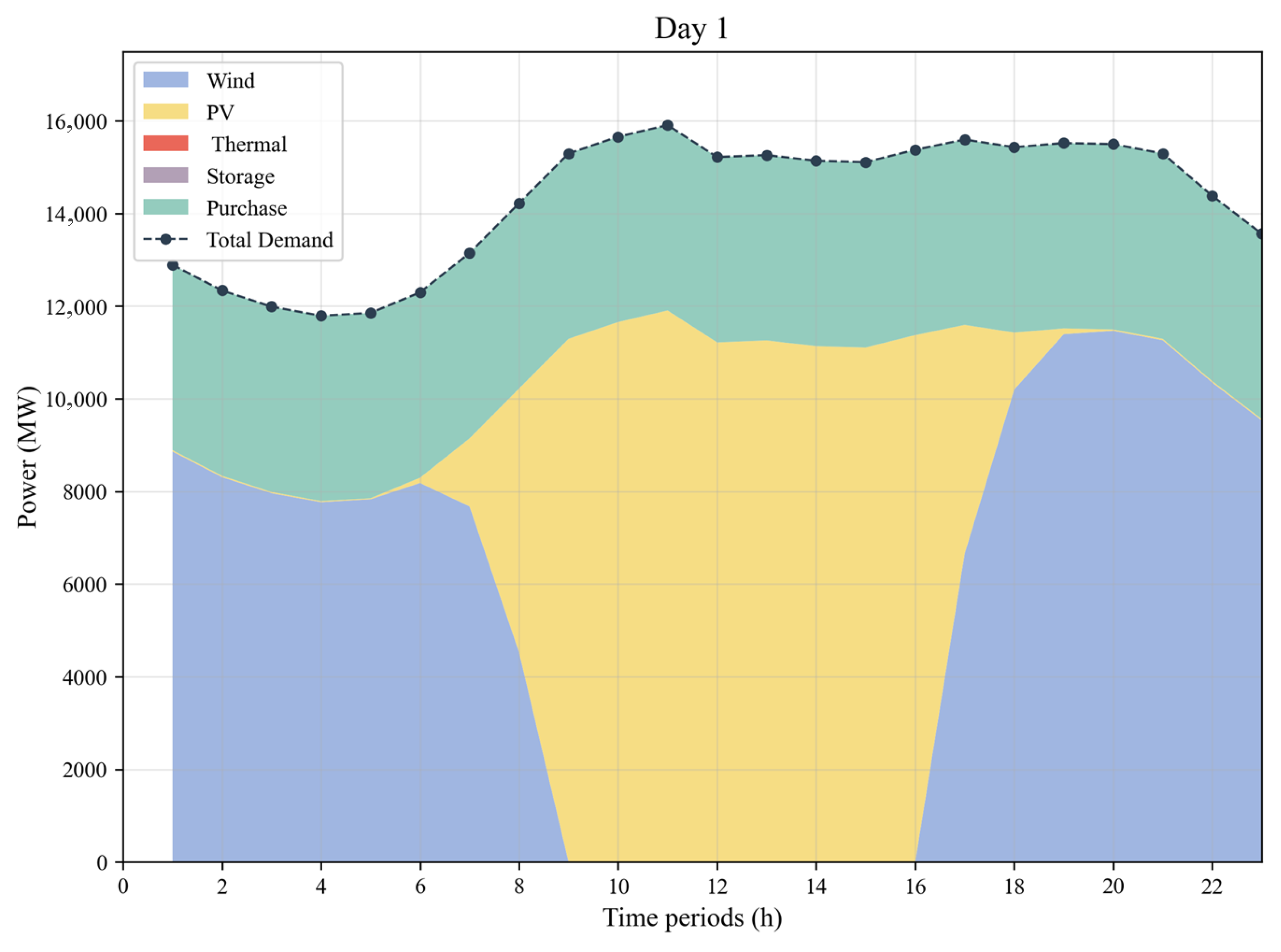
Figure 7,
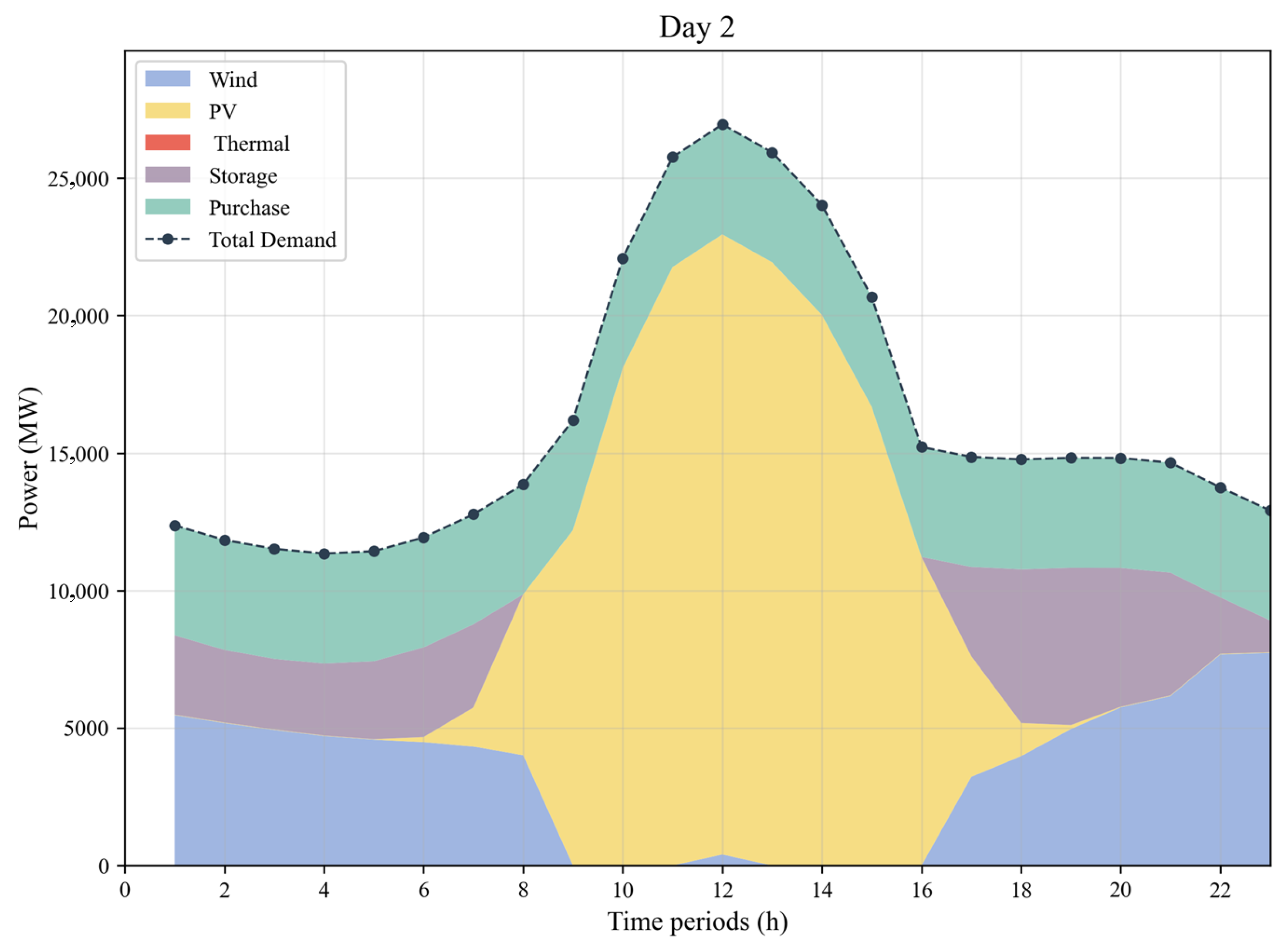
Figure 8 and
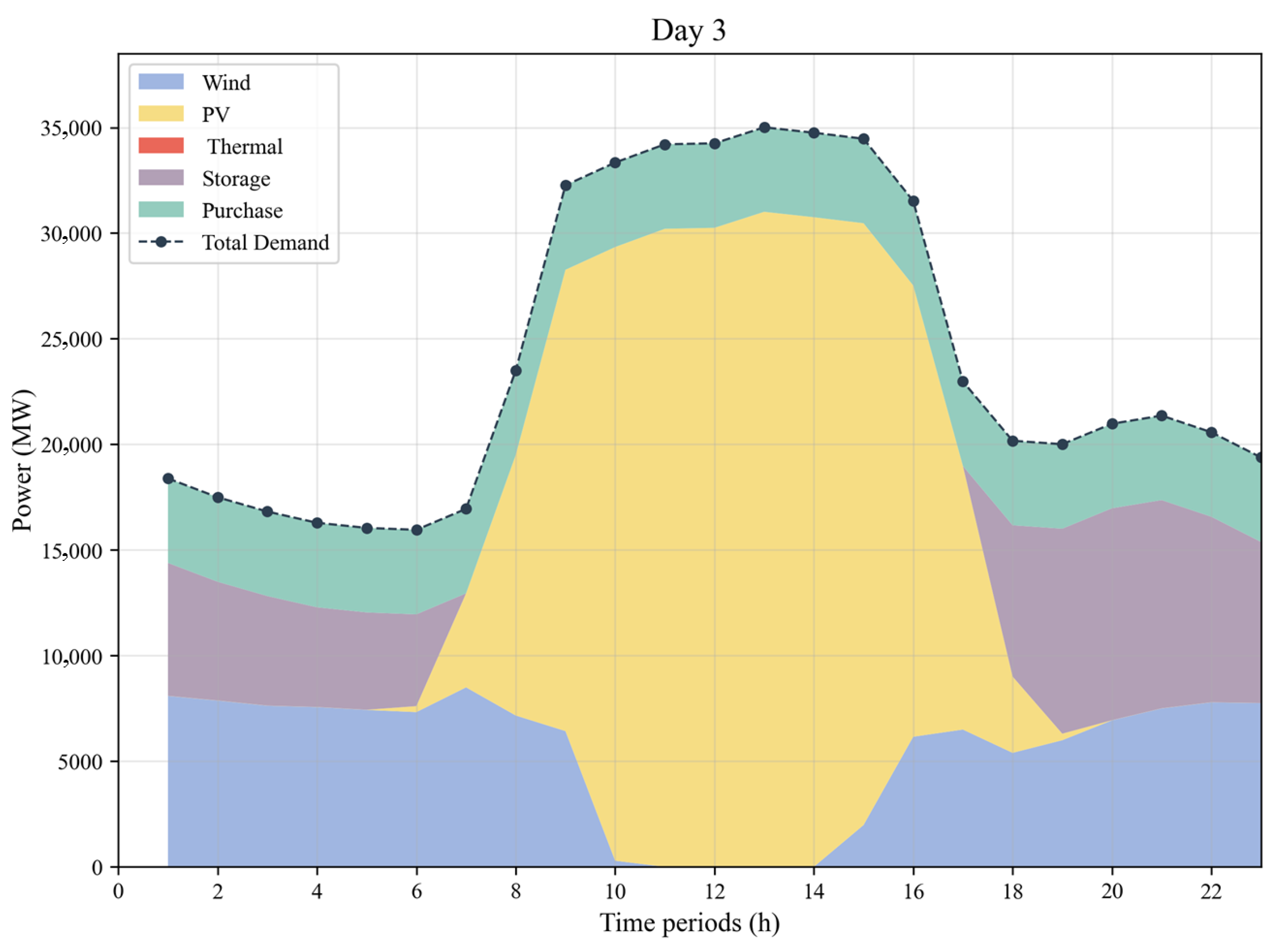
Figure 9, which show the power output mix for three representative days under E/P = 10 and
:
Figure 7 (Day 1): This day represents a wind-rich, PV-poor scenario for the wind–PV–thermal–storage system with relatively low daily peak load (approximately 0.64 pu). Since wind power output reaches its highest level among the typical days, wind generation alone is sufficient to meet most of the load demand, resulting in a generally loose supply–demand balance. Consequently, energy storage remains inactive during this period, demonstrating that when wind resources are abundant and load is moderate, the wind–PV–thermal–storage system can achieve balance primarily through wind power without requiring storage intervention.
Figure 8 (Day 2): This day illustrates a low-renewable scenario for the wind–PV–thermal–storage system where both wind and PV generation are limited. The system demonstrates complementary wind-PV operation, with thermal generation providing baseline support and storage discharging during peak periods. Through coordinated dispatch of all available resources, the wind–PV–thermal–storage system achieves full supply coverage despite the challenging renewable conditions, highlighting the value of diversified generation portfolios.
Figure 9 (Day 3): This day represents high-load conditions for the wind–PV–thermal–storage system where the large-scale storage capacity (E/P = 10) plays a critical role. The figure clearly illustrates how storage charges during periods of excess renewable generation (typically midday solar) and discharges during evening peak hours to mitigate PV intermittency. The extended storage duration allows the wind–PV–thermal–storage system to shift renewable energy across longer periods, effectively smoothing the net load profile and reducing the need for thermal ramping.
Comparison with shorter-duration storage: The operational patterns observed in
Figure 7,
Figure 8 and
Figure 9 contrast sharply with what would be expected under shorter-duration storage configurations (E/P = 1–5) presented in
Table 3. Under E/P = 1–2, storage would be unable to sustain discharge across multi-hour peak periods, requiring greater reliance on thermal generation during extended low-renewable events (e.g., Day 2) and limiting the amount of solar energy that could be shifted to evening peaks (Day 3). The long-duration configuration (E/P = 10) enables the system to store excess renewable generation for 8–12 h, effectively bridging the gap between solar-rich midday periods and evening demand peaks while maintaining carbon compliance without excessive thermal backup.
Together, these three operational days demonstrate the versatility of the optimized wind–PV–thermal–storage system under extended storage duration: it can handle wind-dominated periods without storage activation, navigate low-renewable conditions through complementary dispatch, and leverage long-duration storage to manage peak demand and PV intermittency. This operational flexibility, combined with the reduced storage power capacity shown in
Table 4, confirms that longer-duration storage enables more cost-effective configurations for wind–PV–thermal–storage systems while maintaining reliable supply across diverse operating conditions.
These operational visualizations complement the capacity results in
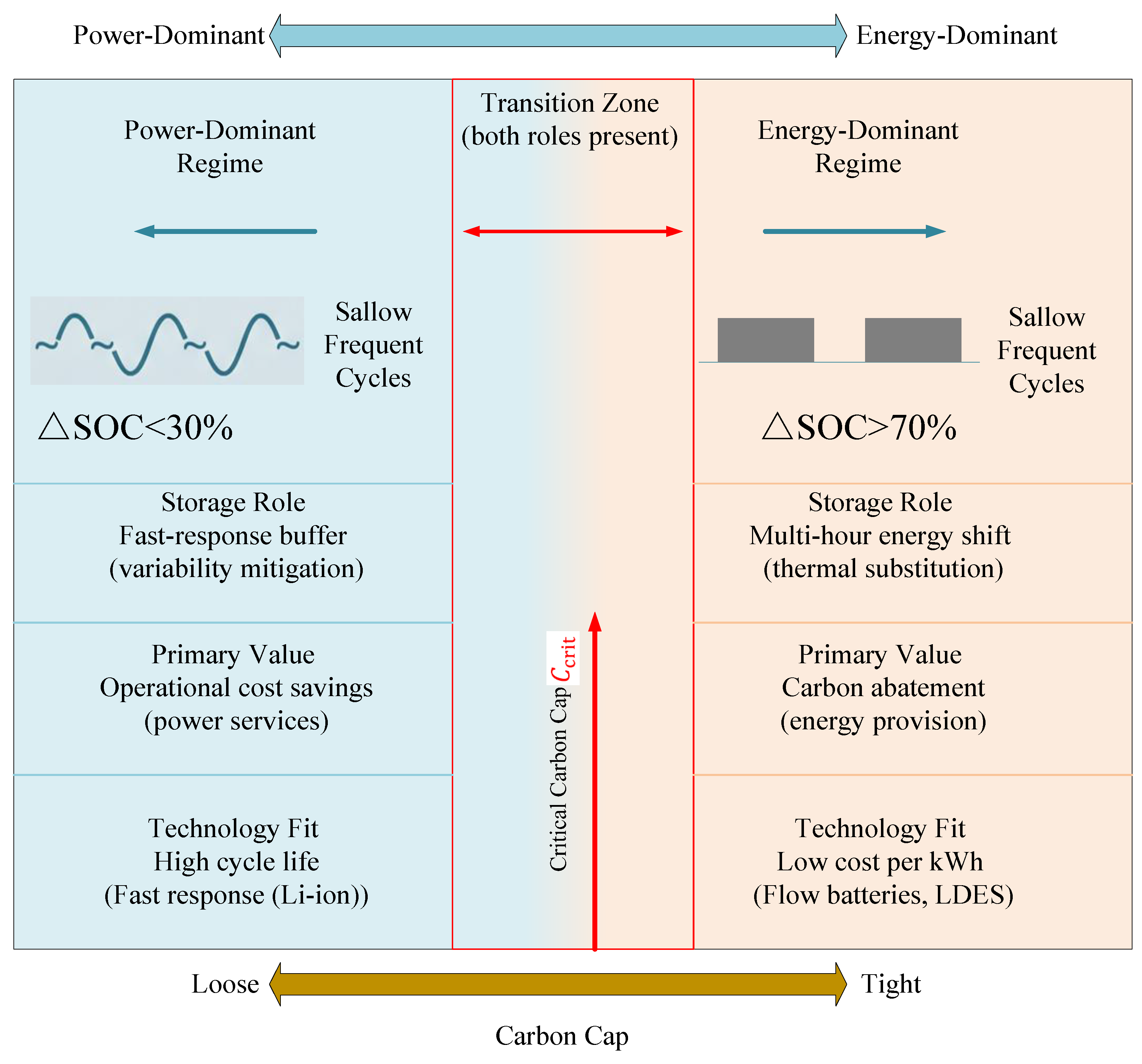
Table 3, showing how the planned wind–PV–thermal–storage system performs under diverse scenarios. The complete analysis reveals that storage configuration evolves with carbon constraints in wind–PV–thermal–storage systems: in power-dominant phases, storage enhances system reliability, while in energy-dominant phases, it substitutes for thermal generation to achieve emission reductions.
4.7. Comparative Advantages: Hard Carbon Cap vs. Price-Based Carbon Constraints
When conducting capacity expansion planning for power systems with a high proportion of wind and photovoltaic power, carbon constraints must be considered as a realistic requirement. China’s carbon market assesses compliance based on annual total carbon emissions, which is a typical physical upper-limit constraint. Therefore, adopting an “annual hard carbon cap” model aligns more closely with China’s actual policies than a “price-based carbon constraint model” and can more effectively guide the planning of systems incorporating thermal power, energy storage, and renewable energy.
Although price-based models can influence the power structure through cost internalization, their emission reduction effectiveness depends on the accuracy of the carbon price signal. In planning aimed at cost minimization, if the set carbon price is too low, the model tends to retain or even increase the utilization hours of thermal power to reduce total system costs, potentially causing annual carbon emissions to exceed the limit. This contradicts the principle of total amount control under the carbon peak and carbon neutrality goals. In contrast, the hard carbon cap model directly sets an annual emission ceiling. Regardless of fluctuations in wind and solar power, the system planning must find the optimal solution within this physical red line, thereby forcing a more resilient capacity configuration.
Table 5 summarizes the key differences between the two approaches.
5. Conclusions
This paper presents a two-stage robust optimization framework for wind–PV–thermal–storage capacity planning under a strict annual carbon emission cap. The work addresses the challenge of certifying that capacity portfolios remain both economically optimal and carbon-compliant under worst-case renewable uncertainty realizations through three key contributions. First, decarbonization is formulated as a hard feasibility constraint rather than a price-based penalty. By enforcing the annual carbon emission cap across all admissible uncertainty realizations, the framework ensures capacity plans remain feasible even when renewable output is most limited, addressing reliability concerns under deep decarbonization. Second, a fixed energy-to-power (E/P) ratio for storage preserves practical design coupling, preventing unrealistic storage expansions that arise when energy and power capacities are modeled independently. This coupling provides an analytical link between tightening carbon caps and required storage duration, informing technology selection between Li-ion batteries and flow batteries. Third, a decomposition-based solution methodology separates economic optimality from carbon feasibility within a unified column-and-constraint generation (C&CG) algorithm. By dualizing the inner operational subproblems, two families of valid inequalities are generated: economic cuts from the Economic-SP and carbon-feasibility cuts from the Carbon-SP. This dual-certification framework enables simultaneous certification of worst-case operating cost and minimum achievable emissions. The separation of subproblems enhances interpretability and accelerates computation via cut prioritization, with feasibility-first logic ensuring convergence to the carbon-feasible region before refining economic optimality.
The algorithm converges in finite iterations, with numerical tests on realistic systems demonstrating tractability (10–15 iterations) and computational efficiency (3–8 min on standard hardware). The dual-based reformulation contributes to computational efficiency, with solution times of 3–8 min on standard hardware. Case study results reveal that long-duration storage (E/P = 10) enables more economical configurations by shifting from power-oriented to energy-oriented deployment, reducing storage power requirements while maintaining carbon compliance. Future work may extend the formulation to include dynamic carbon budgets, multiple storage technologies with different E/P ratios, and transmission constraints. The modular decomposition structure supports such extensions with minimal disruption. The framework offers planners a rigorous, computationally manageable tool for designing robust, carbon-compliant power systems under deep renewable penetration and uncertainty.




 ,
,