Risk-Aware Joint Bidding Strategy for Cascade Hydropower and Wind Power in Electricity Spot Markets Considering Vibration Zone Impacts

Abstract
1. Introduction
2. Theory and Methods
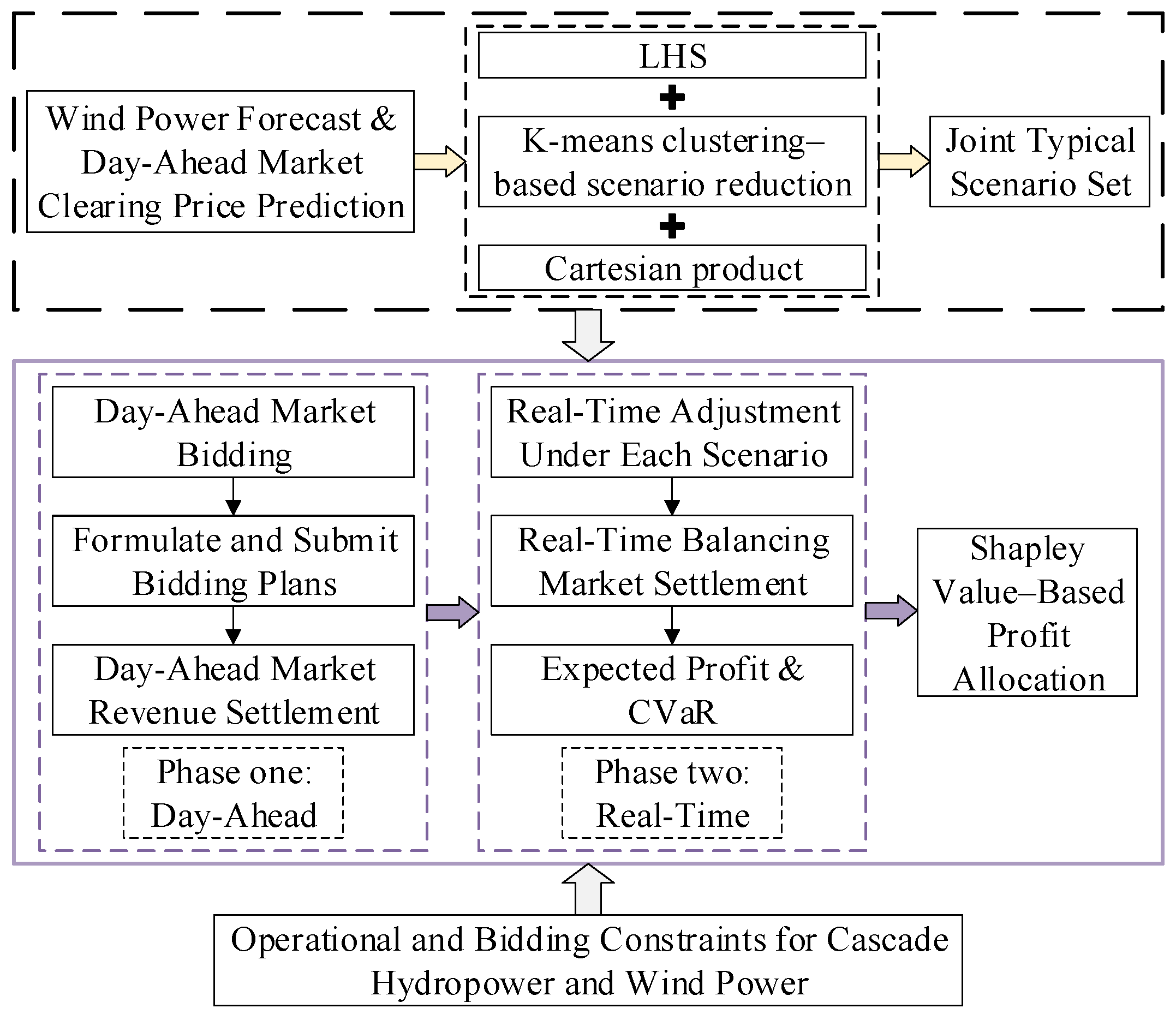
2.1. Research Framework
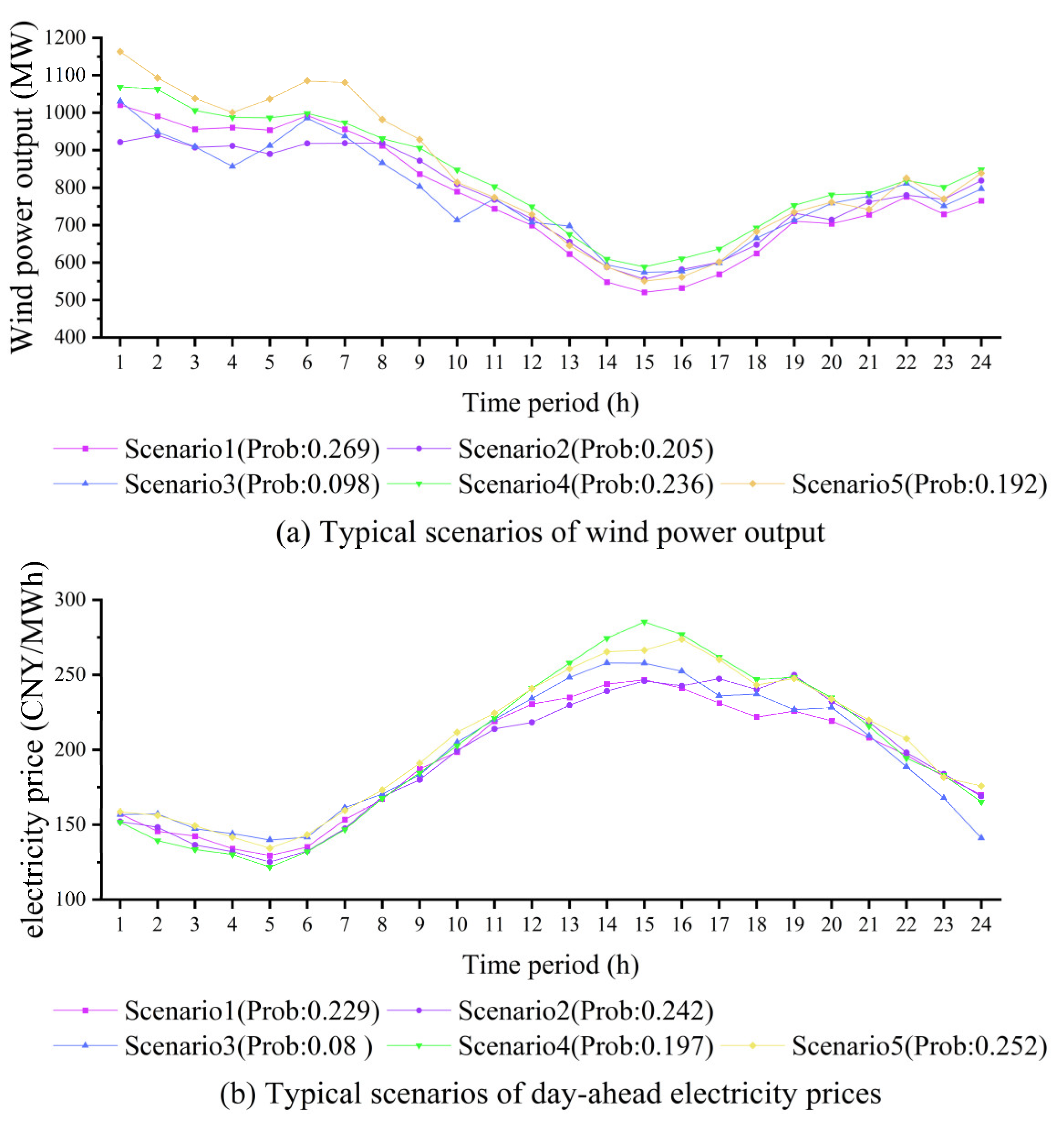
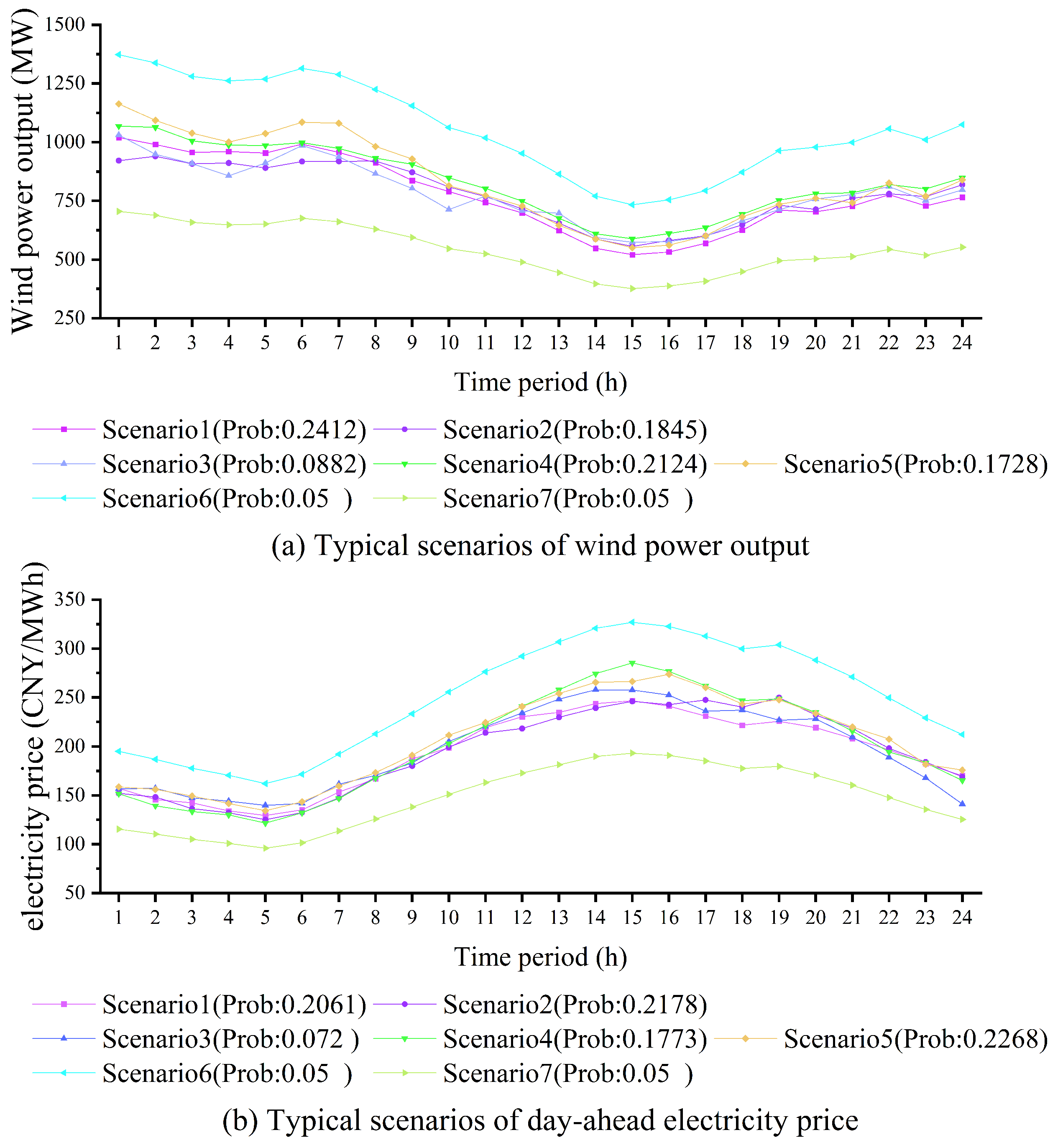
2.2. Representative Scenario Set
2.2.1. Generation of Original Random Scenarios Based on LHS
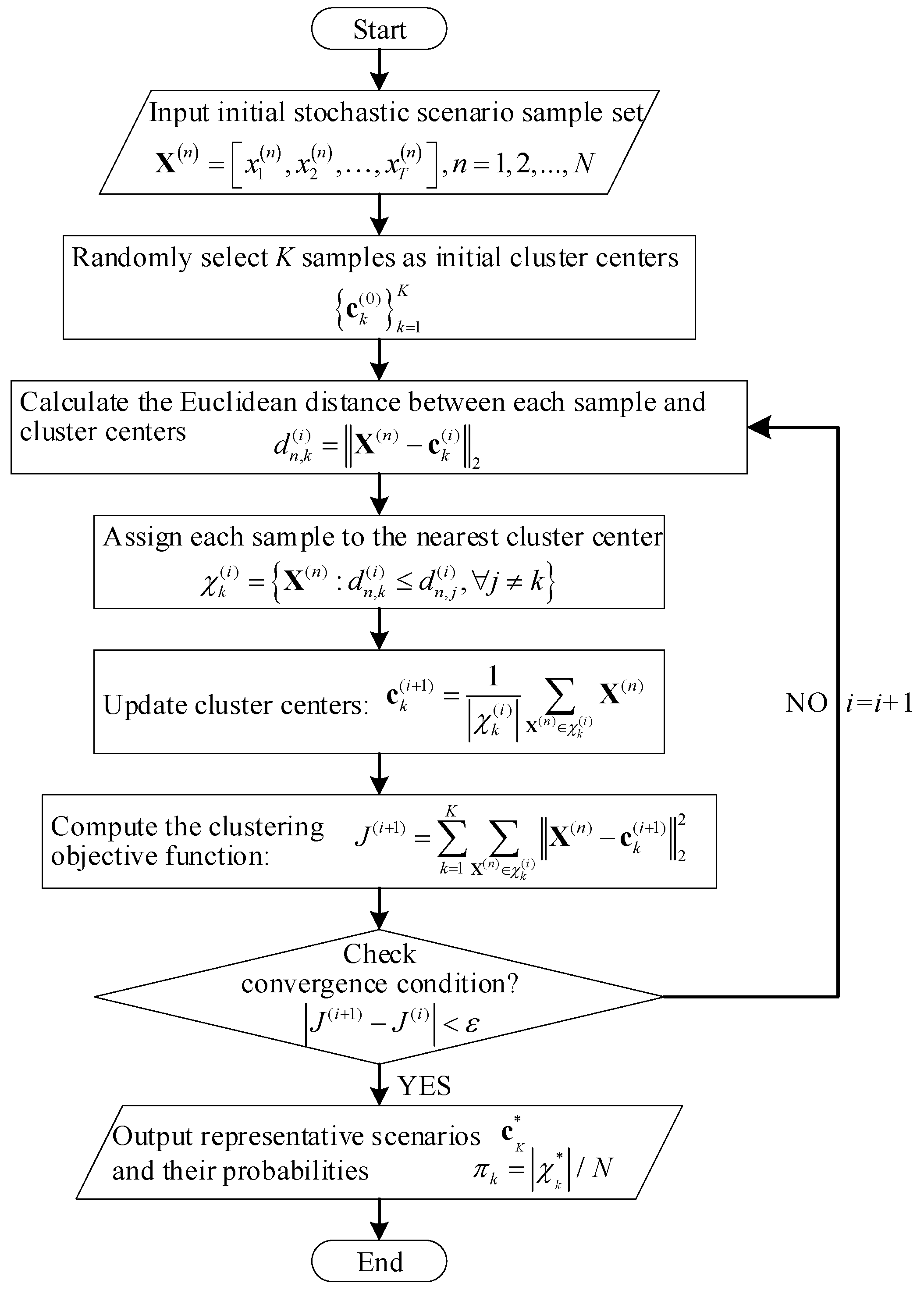
2.2.2. Representative Scenario Reduction Based on K-Means Clustering
2.2.3. Cartesian Product Combination
2.3. Risk Measure: CVaR
2.4. Vibration Zones and Water Flow Delay
2.4.1. Definition of Vibration Zone Crossing and Vibration Zone Avoidance
2.4.2. Dynamic Water Flow Delay
2.5. CVaR-Based Two-Stage Bidding Model
2.5.1. Objective Function
- (1)
- Day-ahead bidding revenue.where λs,t represents the forecasted day-ahead electricity price at time period t under scenario s; represents the bidding output of hydropower plant j at time period t; represents the bidding output of the wind farm at time period t; Δt is the length of the time interval; J represents the set of hydropower plants; and T represents the set of time periods.
- (2)
- Real-time imbalance penalty.where and represent the positive and negative imbalance power of the aggregated system at time period t under scenario s, respectively; and represent the actual outputs of the wind farm and hydropower plant j at time period t under scenario s, respectively; μup and μdown are the penalty coefficients for positive and negative imbalance energy, respectively.
- (3)
- Vibration zone crossing.where SNj represents the number of safe zones of hydropower plant j; is a binary indicator variable that represents whether the bidding output of hydropower plant j at time period t lies in the k-th safe zone; is a binary indicator variable that represents whether the actual output of hydropower plant j at time period t under scenario s lies in the k-th safe zone.
2.5.2. Constraints
- (1)
- Hydropower output limits and ramping constraints.where and represent the upper and lower limits of the output of hydropower plant j, respectively; represents the ramping limit of hydropower plant j.
- (2)
- Vibration zone avoidance constraints.where and represent the upper and lower bounds of the k-th safe output zone of hydropower plant j, respectively.
- (3)
- Reservoir water balance constraints.where QNj represents the number of discharge flow segments of hydropower plant j; , , , and represent the inflow, discharge flow, generation flow, spillage flow, and interval inflow (natural inflow) of hydropower plant j at time period t, respectively, with units of m3/s; wcrj represents the average water consumption rate of hydropower plant j, with units of m3/kWh; Vj,t represents the reservoir storage of hydropower plant j at the end of time period t, with units of 104 m3; and represents the initial reservoir storage of hydropower plant j.
- (4)
- Flow boundary constraints.where and represent the upper and lower limits of the discharge flow of hydropower plant j, respectively.
- (5)
- Water level boundary constraints.where Hj,t represents the water level of hydropower plant j at the end of time period t, with units of m; and represent the upper and lower limits of the water level of hydropower plant j, respectively; and and represent the upper and lower limits of the final water level of hydropower plant j, respectively.
- (6)
- Water level–reservoir storage curve.where represents the water level–storage curve of hydropower plant j.
- (7)
- Wind power constraints.where represents the installed capacity of wind power.
3. Model Solution Strategy
- (1)
- Linearization of water level–storage curve constraints.
- (2)
- Linearization of deviation power.
- (3)
- Linearization of vibration zone crossing–related constraints.
4. Results and Discussion
4.1. Joint Bidding Analysis
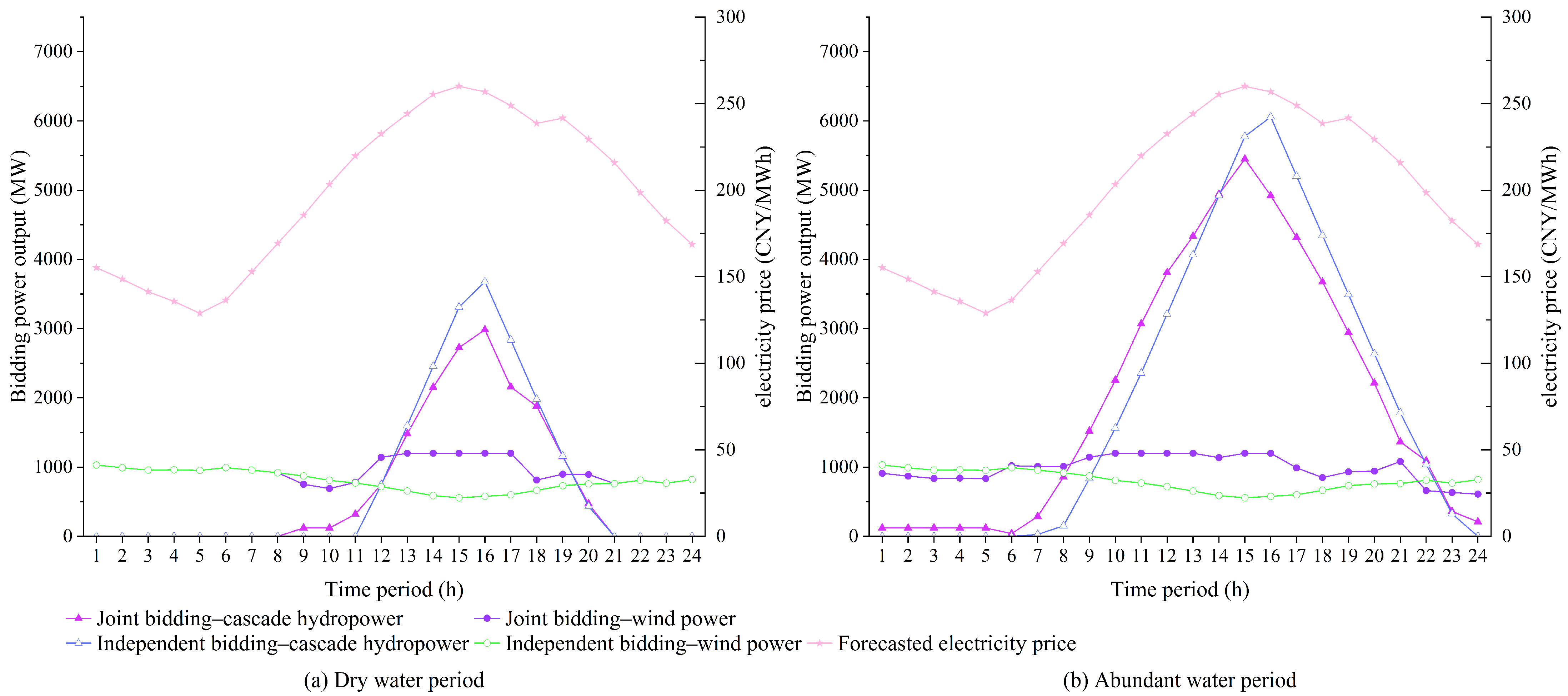
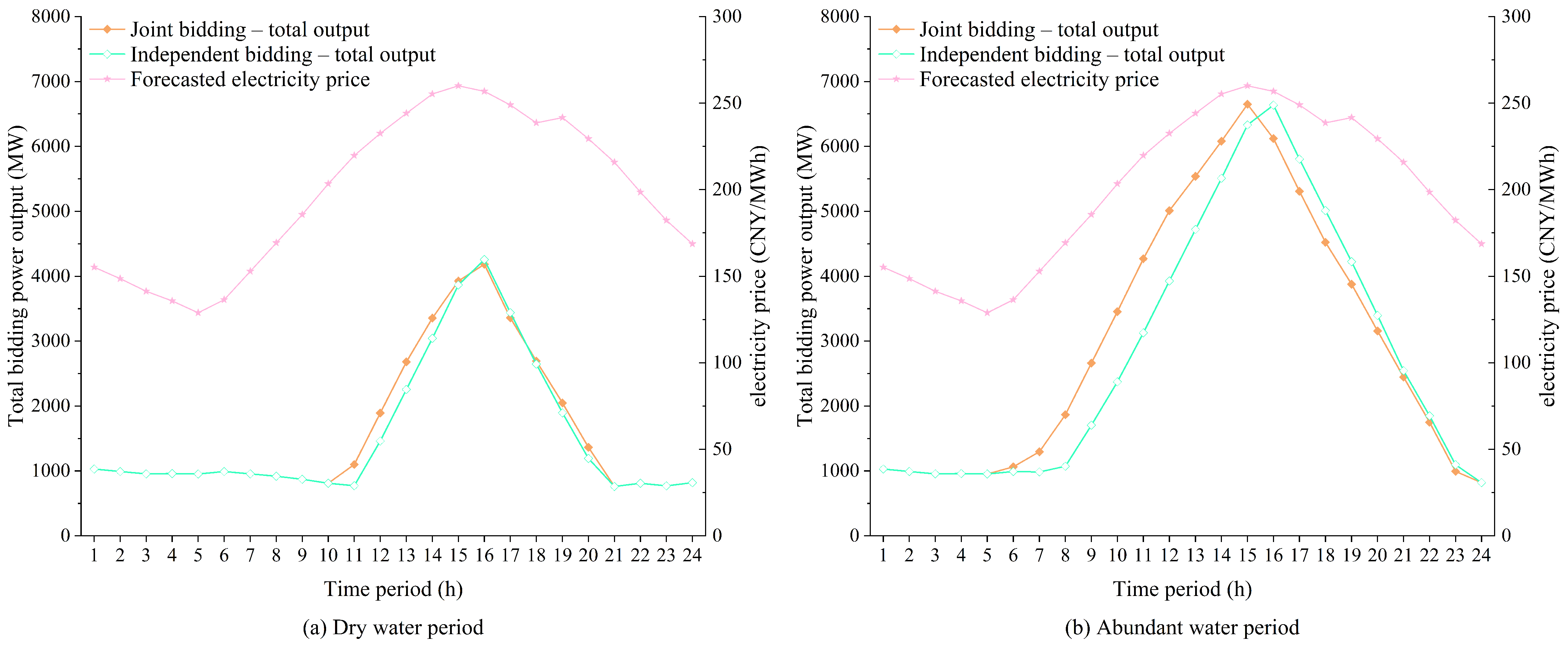
4.1.1. Analysis of the Joint Bidding Output Process
4.1.2. Expected Revenue, CVaR, and Revenue Distribution Characteristics Analysis
4.1.3. Supplementary Analysis with Additional Extreme Scenarios
4.2. Comparative Analysis of Different Cases
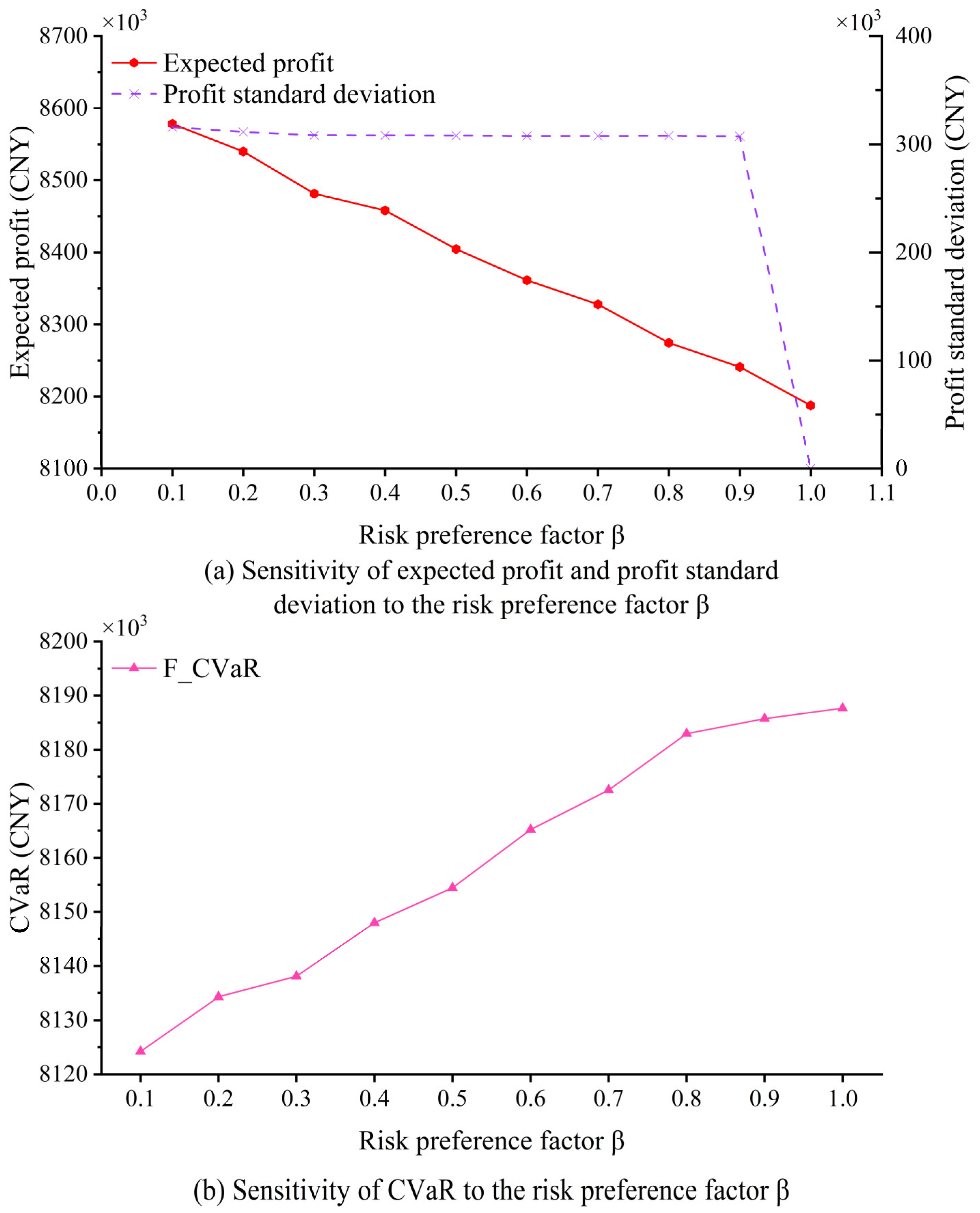
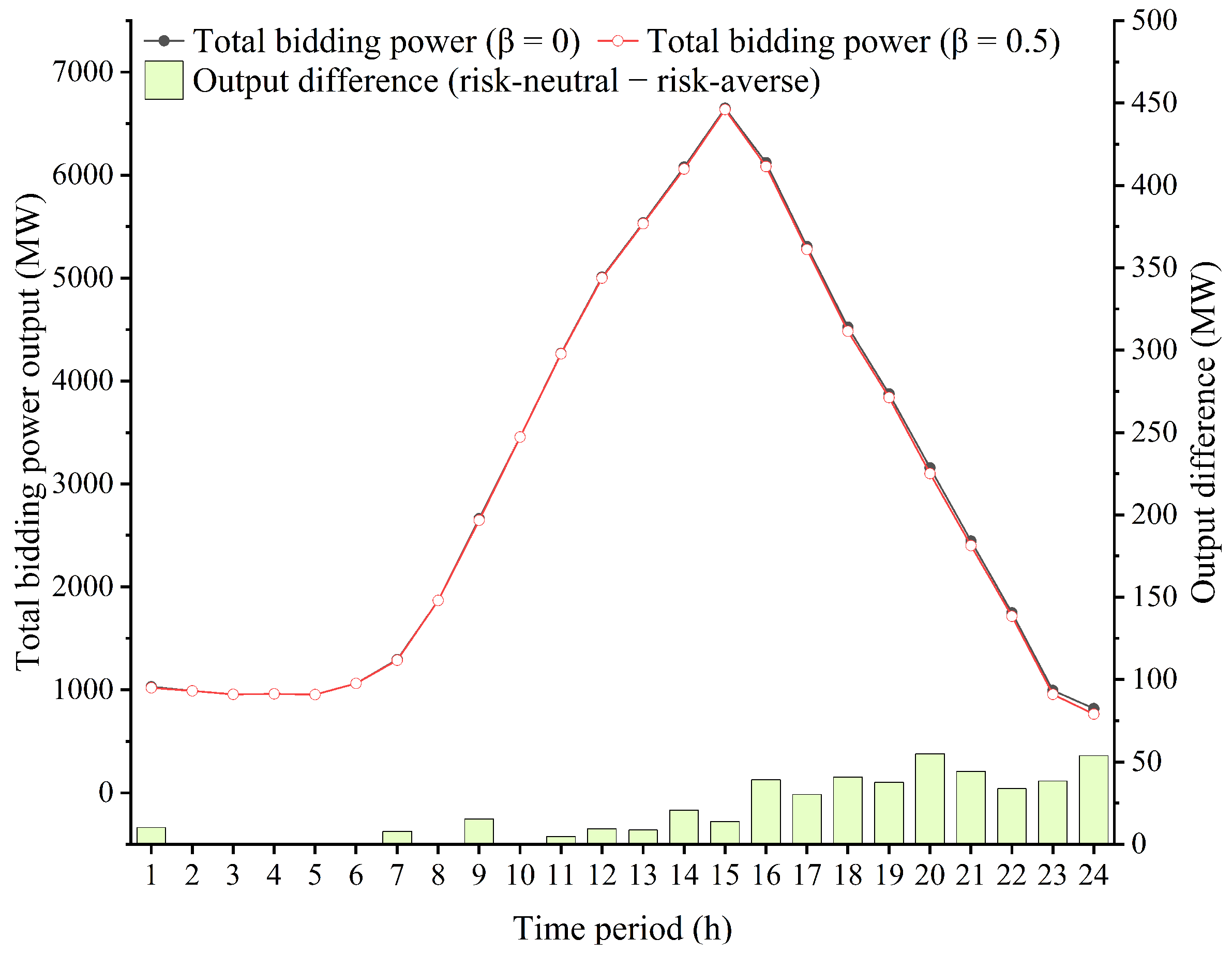
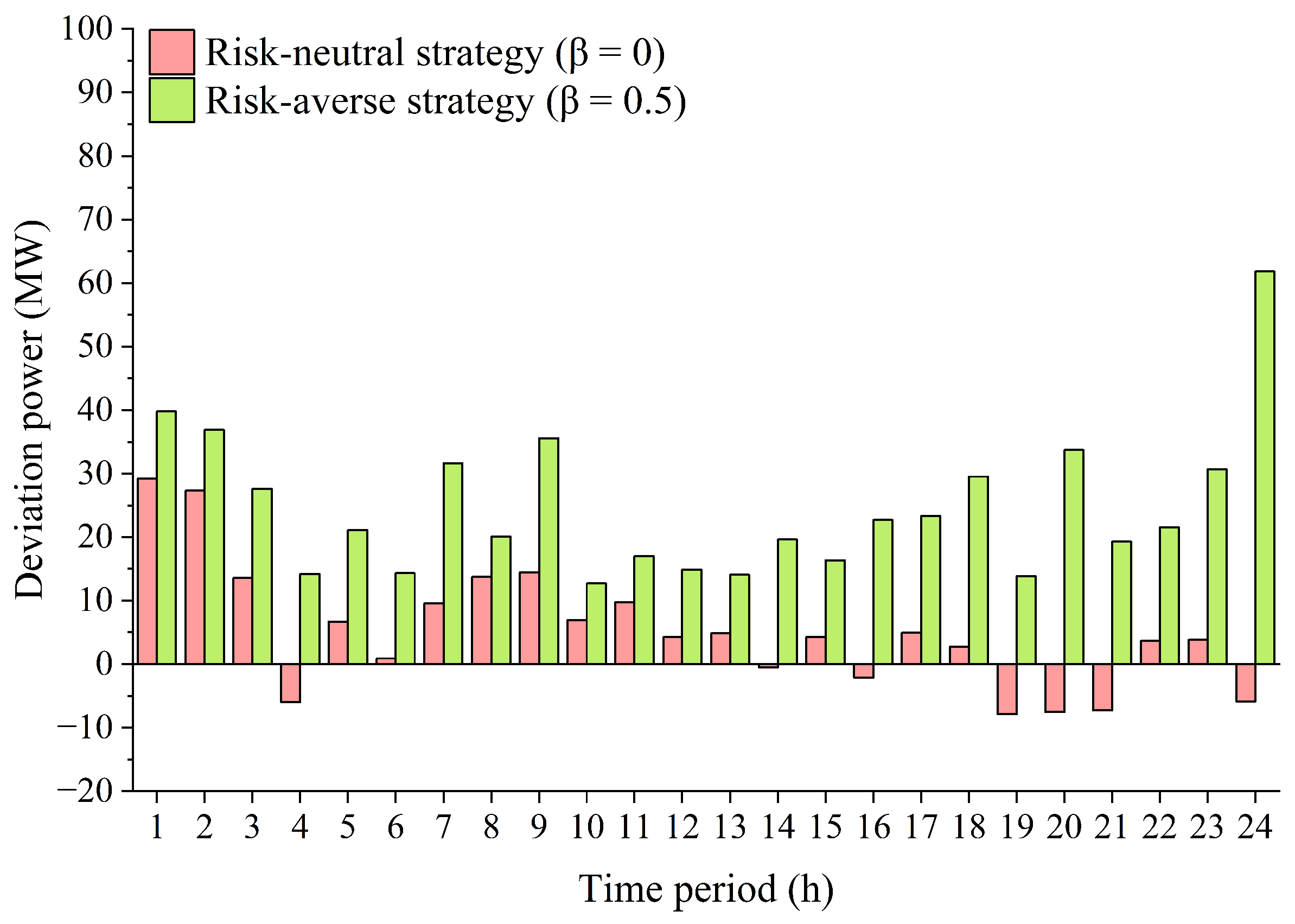
4.3. Risk Preference Analysis
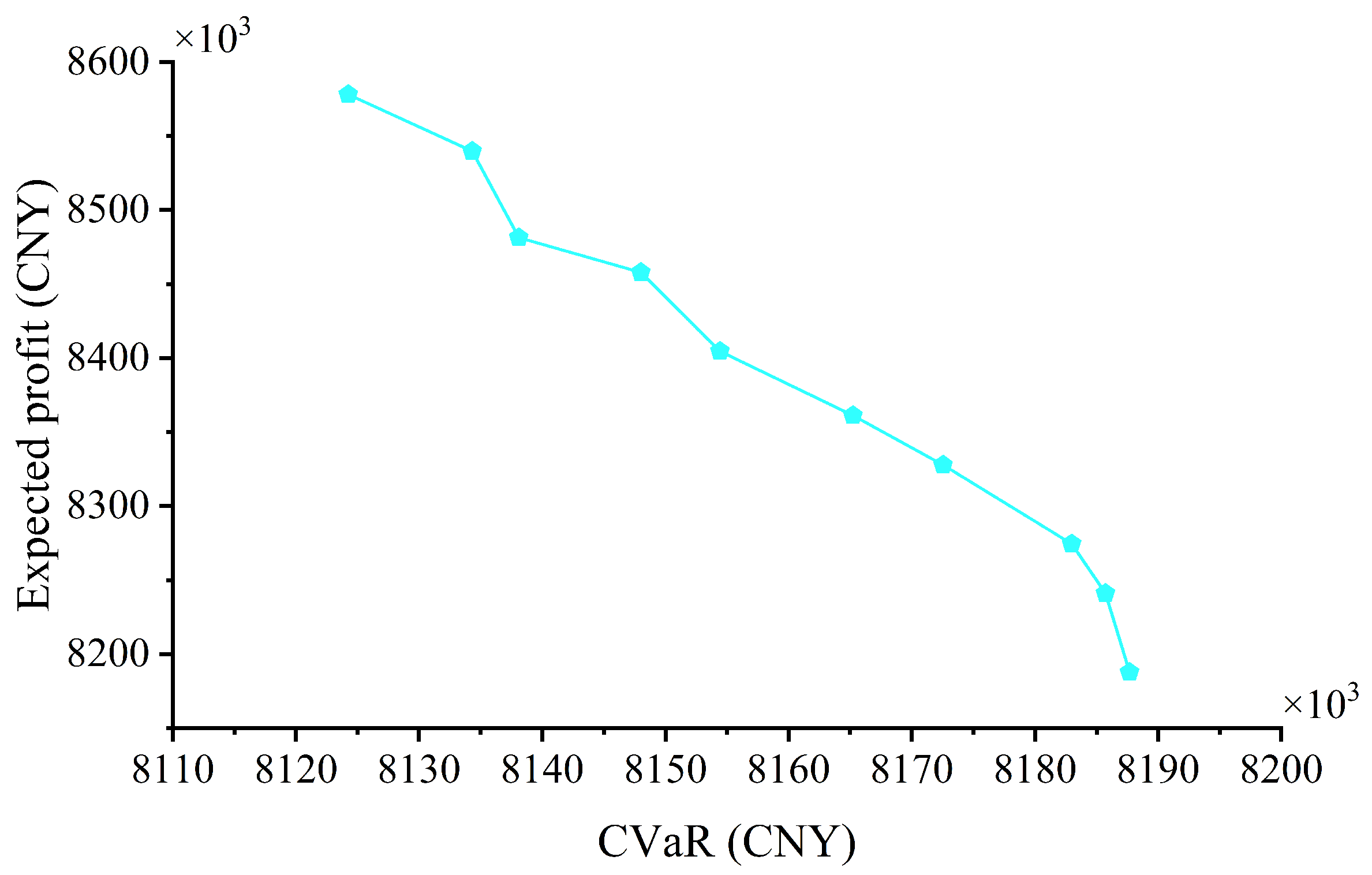
4.4. Impact of Decision-Maker Risk Preference on Bidding Strategy
5. Conclusions
- (1)
- The proposed CVaR-based risk-aware bidding framework can effectively characterize the trade-off between expected revenue and downside risk. As the risk factor increases, the alliance adopts more conservative bidding strategies, which reduces expected revenue while improving CVaR performance. This provides flexible decision-making support for market participants with different risk tolerance levels.
- (2)
- Joint bidding outperforms non-joint bidding in both revenue level and tail risk performance. In both the dry water period and abundant water period case studies, the regulation capability of cascade hydropower mitigates wind power deviations, reducing imbalance energy and the associated penalty costs, thereby increasing overall joint bidding revenue and improving CVaR performance.
- (3)
- Incorporating vibration zone factors as operational constraints and penalty terms can suppress crossing behavior with limited revenue impact. Vibration zone avoidance constraints ensure that hydropower output remains within safe operating zones, while vibration zone crossing penalties in the objective function further reduce the frequency of vibration zone crossings, thereby lowering potential operational risks and making the joint bidding scheme more consistent with unit safety requirements.
Author Contributions
Funding
Data Availability Statement
Acknowledgments
Conflicts of Interest
References
- Li, X. Nine Departments Including the National Development and Reform Commission Issue the “14th Five-Year Plan for Renewable Energy Development”. China Equip. Eng. 2022, 13, 1. [Google Scholar]
- State Council Information Office of the People’s Republic of China. Carbon Peaking and Carbon Neutrality: China’s Actions. Available online: http://english.www.gov.cn/archive/whitepaper/202511/08/content_WS690ee812c6d00ca5f9a076cd.html (accessed on 16 January 2026).
- Xie, K.; Liu, D.; Li, Z.; Sun, T.; Pang, B.; Liu, S.; Zhang, X. Multi-Dimensional Collaborative Electricity Market System for New Power System. Autom. Electr. Power Syst. 2024, 48, 2–12. [Google Scholar]
- Xiao, Y.; Zou, C.; Dong, M.; Chi, H.; Yan, Y.; Jiang, S. Feasibility Study: Economic and Technical Analysis of Optimal Configuration and Operation of a Hybrid CSP/PV/Wind Power Cogeneration System with Energy Storage. Renew. Energy 2024, 225, 120273. [Google Scholar] [CrossRef] [Scilit]
- Wu, Z.; Zhou, M.; Li, G.; Zhao, T.; Zhang, Y.; Liu, X. Interaction between Balancing Market Design and Market Behaviour of Wind Power Producers in China. Renew. Sustain. Energy Rev. 2020, 132, 110060. [Google Scholar] [CrossRef] [Scilit]
- Ahmed, S.D.; Al-Ismail, F.S.M.; Shafiullah, M.; Al-Sulaiman, F.A.; El-Amin, I.M. Grid Integration Challenges of Wind Energy: A Review. IEEE Access 2020, 8, 10857–10878. [Google Scholar] [CrossRef] [Scilit]
- Wang, H.; Sun, W.; Sang, B. Spot Market Bidding Strategy for a “Renewable Energy + Energy Storage” Power Station Considering Conditional Value at Risk. Power Syst. Technol. 2023, 47, 3620–3628. [Google Scholar]
- Khaloie, H.; Abdollahi, A.; Shafie-Khah, M.; Anvari-Moghaddam, A.; Nojavan, S.; Siano, P.; Catalão, J.P.S. Coordinated Wind–Thermal–Energy Storage Offering Strategy in Energy and Spinning Reserve Markets Using a Multi-Stage Model. Appl. Energy 2020, 259, 114168. [Google Scholar] [CrossRef] [Scilit]
- Khaloie, H.; Abdollahi, A.; Shafie-Khah, M.; Siano, P.; Nojavan, S.; Anvari-Moghaddam, A.; Catalão, J.P.S. Co-Optimized Bidding Strategy of an Integrated Wind–Thermal–Photovoltaic System in Deregulated Electricity Market under Uncertainties. J. Clean. Prod. 2020, 242, 118434. [Google Scholar] [CrossRef] [Scilit]
- Jin, X.; Liu, B.; Liao, S.; Cheng, C.; Jurasz, J.; Zhang, Y.; Lu, J. Exploring the Transition Role of Cascade Hydropower in 100% Decarbonized Energy Systems. Energy 2023, 279, 128086. [Google Scholar] [CrossRef] [Scilit]
- Li, X.; Yang, W.; Liao, Y.; Zhang, S.; Zheng, Y.; Zhao, Z.; Tang, M.; Cheng, Y.; Liu, P. Short-Term Risk-Management for Hydro–Wind–Solar Hybrid Energy System Considering Hydropower Part-Load Operating Characteristics. Appl. Energy 2024, 360, 122818. [Google Scholar] [CrossRef] [Scilit]
- Liu, B.; Liu, T.; Liao, S.; Lu, J.; Cheng, C. Short-Term Coordinated Hybrid Hydro–Wind–Solar Optimal Scheduling Model Considering Multistage Section Restrictions. Renew. Energy 2023, 217, 119160. [Google Scholar] [CrossRef] [Scilit]
- Li, H.; Li, X.; Zhang, Y.; Zhao, Y.; Pan, J.; Zhao, H. Declaration Strategy of Wind Power and Pumped Storage Participating in the Power Market Considering Multiple Uncertainties. Energy 2024, 293, 130624. [Google Scholar] [CrossRef] [Scilit]
- Tan, Q.; Wen, X.; Sun, Y.; Lei, X.; Wang, Z.; Qin, G. Evaluation of the Risk and Benefit of the Complementary Operation of the Large Wind–Photovoltaic–Hydropower System Considering Forecast Uncertainty. Appl. Energy 2021, 285, 116442. [Google Scholar] [CrossRef] [Scilit]
- Xu, Y.; Jiang, Z.; Peng, W.; Lu, P.; Wang, J.; Xu, Y.; Lu, J. Multi-Objective Optimization and Mechanism Analysis of Integrated Hydro–Wind–Solar–Storage System: Based on Medium-Long-Term Complementary Dispatching Model Coupled with Short-Term Power Balance. Energy 2025, 332, 137246. [Google Scholar] [CrossRef] [Scilit]
- Zhao, H.; Liao, S.; Ma, X.; Fang, Z.; Cheng, C.; Zhang, Z. Short-Term Peak-Shaving Scheduling of a Hydropower-Dominated Hydro–Wind–Solar Photovoltaic Hybrid System Considering a Shared Multienergy Coupling Transmission Channel. Appl. Energy 2024, 372, 123786. [Google Scholar] [CrossRef] [Scilit]
- Wang, Y.; Zhao, M.; Chang, J.; Wang, X.; Tian, Y. Study on the Combined Operation of a Hydro–Thermal–Wind Hybrid Power System Based on Hydro–Wind Power Compensating Principles. Energy Convers. Manag. 2019, 194, 94–111. [Google Scholar] [CrossRef] [Scilit]
- Cerejo, A.; Mariano, S.J.P.S.; Carvalho, P.M.S.; Calado, M.R.A. Hydro–Wind Optimal Operation for Joint Bidding in Day-Ahead Market: Storage Efficiency and Impact of Wind Forecasting Uncertainty. J. Mod. Power Syst. Clean Energy 2020, 8, 142–149. [Google Scholar] [CrossRef] [Scilit]
- Xiao, Y.; Li, C.; Li, S.; Zhu, Q.; Chang, P.; Wu, T. Bidding–Clearing–Scheduling Coordinated Optimization for Cascade Hydro–Wind–Photovoltaic Alliances in Electricity Spot Markets: A Multi-Stage Framework. Energy 2025, 335, 138185. [Google Scholar] [CrossRef] [Scilit]
- Li, Y.; Fang, N.; He, S.; Wu, F.; Li, O.; Shi, L.; Ding, R. Two-Stage Stochastic Scheduling of Cascaded Hydropower–Wind–Photovoltaic Hybrid Systems Considering Contract Decomposition and Spot Market. Sustainability 2024, 16, 1093. [Google Scholar] [CrossRef] [Scilit]
- Li, X.; Liu, P.; Cheng, L.; Cheng, Q.; Zhang, W.; Xu, S.; Zheng, Y. Strategic Bidding for a Hydro–Wind–Photovoltaic Hybrid System Considering the Profit beyond Forecast Time. Renew. Energy 2023, 204, 277–289. [Google Scholar] [CrossRef] [Scilit]
- Bai, Q.; Zhao, Z.; Jin, X.; Cheng, C.; Deng, Z.; Jia, Z. Hydro–Wind Power Joint Bidding Strategies for Electricity Spot Market Considering Uncertainties of Wind Power Output and Electricity Price. Autom. Electr. Power Syst. 2024, 48, 122–133. [Google Scholar]
- Aydoğdu, A.; Tör, O.B.; Güven, A.N. CVaR-based stochastic wind-thermal generation coordination for Turkish electricity market. J. Mod. Power Syst. Clean Energy 2019, 7, 1307–1318. [Google Scholar] [CrossRef] [Scilit]
- Wang, Y.; Wang, J.; Sun, W.; Zhao, M. Optimal day-ahead bidding strategy for electricity retailer with inner-outer 2-layer model system based on stochastic mixed-integer optimization. Math. Probl. Eng. 2019, 2019, 4185952. [Google Scholar] [CrossRef] [Scilit]
- Zoltowska, I. Risk Preferences of EV Fleet Aggregators in Day-Ahead Market Bidding: Mean-CVaR Linear Programming Model. Energies 2025, 18, 93. [Google Scholar] [CrossRef] [Scilit]
- He, M.; Han, S.; Chen, D.; Zhao, Z.; Jurasz, J.; Mahmud, A.; Liu, P.; Deng, M. Optimizing Cascade Hydropower–VRE Hybrid Systems: A Novel Approach Addressing Whole-Process Vibration to Enhance Operational Safety. Energy 2024, 304, 131965. [Google Scholar] [CrossRef] [Scilit]
- Wang, X.; Gao, C. Two-Stage Decision-Making Model of Power Generation and Coal Purchase Arrangement for Power Generation Companies in Medium- and Long-Term Market. Power Syst. Technol. 2021, 45, 3992–3999. [Google Scholar]
- Su, C.; Wang, P.; Wu, X. A Compact MILP Model for Short-Term Peak Shaving of Cascaded Hydropower Plants Considering Unit Commitment. Power Syst. Technol. 2018, 42, 1883–1891. [Google Scholar]
- Yu, S.; Fang, F.; Liu, Y.; Liu, J. Uncertainties of Virtual Power Plant: Problems and Countermeasures. Appl. Energy 2019, 239, 454–470. [Google Scholar] [CrossRef] [Scilit]



| Hydropower Plant | Installed Capacity (MW) | Max Outflow (m3/s) | Water Level (m) | Initial Water Level (m) | Lower Limit of Final Water Level (m) | Average Interval Inflow (m3/s) | ||||
|---|---|---|---|---|---|---|---|---|---|---|
| Max | Min | Dry | Abundant | Dry | Abundant | Dry | Abundant | |||
| A | 900 | 1890 | 1307 | 1303 | 1305.26 | 1306.35 | 1305.10 | 1306.15 | 96 | 332 |
| B | 4200 | 2103 | 1240.0 | 990.22 | 1139.50 | 1135.40 | 1139.35 | 1135.20 | 28 | 59 |
| C | 1760 | 2230 | 994 | 987.74 | 992.79 | 993.25 | 992.65 | 993.05 | 43 | 69 |
| Hydropower Plant | Flow Interval 1 (m3/s) | Delay Time (h) | Flow Interval 2 (m3/s) | Delay Time (h) | Flow Interval 3 (m3/s) | Delay Time (h) | Flow Interval 4 (m3/s) | Delay Time (h) |
|---|---|---|---|---|---|---|---|---|
| A to B | [0, 500) | 8 | [500, 1000) | 7 | [1000, 2000) | 6 | [2000, 3000) | 5 |
| B to C | [0, 1000) | 3 | [1000, 2000) | 2 | [2000, 3000) | 1 |
| Hydropower Plant | Vibration Zone 1 (MW) | Vibration Zone 2 (MW) |
|---|---|---|
| A | (120, 140) | |
| B | (0, 120) | (210, 240) |
| C | (0, 90) | (120, 140) |
| Bidding Strategy | Risk-Neutral (β = 0) | |||
|---|---|---|---|---|
| Expected Bidding Revenue (Thousand CNY) | CvaR (Thousand CNY) | |||
| Dry Water Period | Abundant Water Period | Dry Water Period | Abundant Water Period | |
| Joint bidding | 8568.78 | 16,059.68 | 8111.16 | 15,336.55 |
| Hydropower independent bidding | 4557.24 | 11,507.80 | 4302.69 | 10,961.98 |
| Wind power independent bidding | 3582.86 | 3582.86 | 3377.38 | 3377.38 |
| Sum of separate bidding | 8140.10 | 15,090.66 | 7680.07 | 14,339.36 |
| Incremental benefit | 428.68 | 969.02 | 431.09 | 997.19 |
| Allocated revenue of hydropower | 4771.58 | 11,992.31 | ||
| Allocated revenue of wind power | 3797.20 | 4067.37 | ||
| Bidding Strategy | Bidding Revenue Distribution (Thousand CNY) Risk-Neutral (β = 0) | |||||
|---|---|---|---|---|---|---|
| Standard Deviation | Maximum Revenue | Minimum Revenue | ||||
| Dry | Abundant | Dry | Abundant | Dry | Abundant | |
| Joint bidding | 318.92 | 555.08 | 9036.18 | 16,802.94 | 8111.16 | 15,337.34 |
| Hydropower independent bidding | 216.58 | 455.57 | 4852.49 | 12,091.45 | 4302.69 | 10,961.98 |
| Wind power independent bidding | 136.62 | 136.62 | 3844.11 | 3844.11 | 3377.38 | 3377.38 |
| Sum of separate bidding | 8696.60 | 15,935.56 | 7680.07 | 14,339.36 | ||
| Bidding Strategy | Risk-Neutral (β = 0) | |||
|---|---|---|---|---|
| Expected Bidding Revenue (Thousand CNY) | CVaR (Thousand CNY) | |||
| Dry Water Period | Abundant Water Period | Dry Water Period | Abundant Water Period | |
| Joint bidding | 8505.56 | 15,996.17 | 6335.54 | 13,079.95 |
| Hydropower independent bidding | 4557.05 | 11,507.61 | 4123.54 | 10,491.08 |
| Wind power independent bidding | 3519.94 | 3519.94 | 1930.76 | 1930.76 |
| Sum of separate bidding | 8076.99 | 15,027.55 | 6054.30 | 12,421.84 |
| Incremental benefit | 428.57 | 968.62 | 281.24 | 658.11 |
| Allocated revenue of hydropower | 4771.34 | 11,991.92 | ||
| Allocated revenue of wind power | 3734.22 | 4004.25 | ||
| Bidding Strategy | Bidding Revenue Distribution (Thousand CNY) Risk-Neutral (β = 0) | |||||
|---|---|---|---|---|---|---|
| Standard Deviation | Maximum Revenue | Minimum Revenue | ||||
| Dry | Abundant | Dry | Abundant | Dry | Abundant | |
| Joint bidding | 861.20 | 1462.39 | 11,450.69 | 20,857.11 | 5035.47 | 10,607.48 |
| Hydropower independent bidding | 423.28 | 1029.80 | 5725.64 | 14,461.72 | 3385.09 | 8550.01 |
| Wind power independent bidding | 523.21 | 523.21 | 5190.38 | 5190.38 | 1320.68 | 1320.68 |
| Sum of separate bidding | 10,916.02 | 19,652.10 | 4705.77 | 9870.69 | ||
| Case | Expected Bidding Revenue (Thousand CNY) | Number of Vibration Zone Crossings in the Day-Ahead Stage | Number of Vibration Zone Crossings Caused by Real-Time Deviation Adjustment | |||
|---|---|---|---|---|---|---|
| Dry Water Period | Abundant Water Period | Dry Water Period | Abundant Water Period | Dry Water Period | Abundant Water Period | |
| Case A | 8568.78 | 16,059.68 | 10 | 9 | 0 | 25 |
| Case B | 8578.90 | 16,069.76 | 10 | 12 | 220 | 275 |
| Case C | 8580.70 | 16,073.40 | — | — | — | — |
| Case | Abundant Water Period | |
|---|---|---|
| Expected Revenue (Thousand CNY) | CVaR (Thousand CNY) | |
| Risk-neutral (β = 0) | 16,059.68 | 15,336.55 |
| Risk-Averse (β = 0.5) | 15,726.32 | 15,394.82 |
| Difference | −333.36 | 58.27 |
Disclaimer/Publisher’s Note: The statements, opinions and data contained in all publications are solely those of the individual author(s) and contributor(s) and not of MDPI and/or the editor(s). MDPI and/or the editor(s) disclaim responsibility for any injury to people or property resulting from any ideas, methods, instructions or products referred to in the content. |
© 2026 by the authors. Licensee MDPI, Basel, Switzerland. This article is an open access article distributed under the terms and conditions of the Creative Commons Attribution (CC BY) license.
Share and Cite
Liao, Z.; Zhang, X.; Huang, Z. Risk-Aware Joint Bidding Strategy for Cascade Hydropower and Wind Power in Electricity Spot Markets Considering Vibration Zone Impacts. Energies 2026, 19, 1545. https://doi.org/10.3390/en19061545
Liao Z, Zhang X, Huang Z. Risk-Aware Joint Bidding Strategy for Cascade Hydropower and Wind Power in Electricity Spot Markets Considering Vibration Zone Impacts. Energies. 2026; 19(6):1545. https://doi.org/10.3390/en19061545
Chicago/Turabian StyleLiao, Zhiwei, Xiang Zhang, and Zesheng Huang. 2026. "Risk-Aware Joint Bidding Strategy for Cascade Hydropower and Wind Power in Electricity Spot Markets Considering Vibration Zone Impacts" Energies 19, no. 6: 1545. https://doi.org/10.3390/en19061545
APA StyleLiao, Z., Zhang, X., & Huang, Z. (2026). Risk-Aware Joint Bidding Strategy for Cascade Hydropower and Wind Power in Electricity Spot Markets Considering Vibration Zone Impacts. Energies, 19(6), 1545. https://doi.org/10.3390/en19061545