Article

Coupled Heat–Moisture Effects of Initial Soil Water Content on Seasonal Underground Thermal Energy Storage with Coaxial Borehole Heat Exchangers


School of Environment and Energy Engineering, Anhui Jianzhu University, Hefei 230601, China
*
Author to whom correspondence should be addressed.
Energies 2026, 19(6), 1523; https://doi.org/10.3390/en19061523
Submission received: 29 January 2026 / Revised: 25 February 2026 / Accepted: 5 March 2026 / Published: 19 March 2026
(This article belongs to the Section D: Energy Storage and Application)

Abstract

Engineering sizing of seasonal underground thermal energy storage (SUTES) systems remains constrained by the complex coupling of heat and moisture transport in unsaturated porous media. Neglecting these coupling effects can lead to significant errors in the design of borehole length and spacing. This study presents a three-dimensional numerical investigation of a coaxial borehole heat exchanger (CBHE) field over a full annual cycle, including storage, transition, extraction, and recovery stages. A coupled heat–moisture transfer model for the soil–CBHE system is developed and validated against experimental data, yielding mean relative errors of 6.8% for temperature and 7.7% for volumetric water content. The model is then used to quantify the sensitivity of SUTES performance to the initial volumetric water content (θ0). Increasing θ0 from 0.20 to 0.40 m3·m−3 enhances the average heat injection rate per unit depth by 6.6% (from 53.84 to 57.39 W·m−1) and the heat extraction rate by 7.1% (from 23.73 to 25.41 W·m−1). This enhancement is primarily attributed to increased effective thermal conductivity and heat capacity, together with moisture migration and the associated latent-heat effects within the soil matrix. While the variations in seasonal energy and exergy efficiencies are within 1 percentage point, radial soil-temperature uniformity and effective heat diffusion are significantly improved in moister soils. These findings clarify the coupled transport mechanisms in borehole seasonal storage and provide engineering guidance for sizing CBHE fields in unsaturated formations.

1. Introduction

Seasonal underground thermal energy storage (SUTES) shifts surplus heat from non-heating seasons to winter, mitigating the temporal and spatial intermittency of renewable heat supply and improving system-level efficiency [1]. Recent national-level advances in storage research, key technologies, and integrated demonstrations further support the large-scale deployment of seasonal storage systems [2]. As a key SUTES option, borehole thermal energy storage (BTES) leverages the high heat capacity of subsurface rock and soil to achieve cross-seasonal charging and recovery [3]. However, because soil acts as a complex porous medium, its heat-transfer characteristics are not purely conductive but are governed by pore-scale fluid flow and multiphase transport [4]. Consequently, the thermal performance of coaxial borehole heat exchangers (CBHEs)—the primary interface between the system and the ground—is heavily dependent on soil moisture conditions [5]. For a given thermal load, the required borehole length in moist soils can be substantially lower than in dry soils [6], highlighting the economic implications of moisture distribution. Recent numerical studies in Heat Transfer Research have also elucidated that multiphase flow dynamics within porous media strongly control overall heat and mass transfer [7].
In recent years, extensive research has examined factors that enhance ground heat exchanger (GHE) performance, ranging from structural optimization to hydro-thermal coupling. Rajeh et al. [8] proposed an oval multi-external-chamber CBHE to enhance heat transfer. Tsubaki et al. [9] used thermal response test (TRT) data to evaluate the performance of multi-tube GHEs, demonstrating the critical role of accurate field data in determining system capacity. Javadi et al. [10] and Zhang et al. [11] further developed high-conductivity grouts and phase change material (PCM) backfills to improve thermal response and storage density. Regarding hydrogeological conditions, the impact of groundwater advection (seepage) in saturated zones has been a major focus. Jiao et al. [12] and Huang et al. [13] quantified the effects of seepage velocity on thermal recovery, and Ba et al. [14] introduced surrogate models for seepage-affected deep BHEs. For seasonal operation, Shen et al. [15] performed numerical studies on the long-term performance of BTES systems, emphasizing the importance of soil thermal properties in system sizing. However, most such models treat the ground as a purely conductive medium or focus exclusively on saturated zones, often neglecting the complex coupled heat and moisture migration inherent in unsaturated soils.
In unsaturated porous media, the heat-transfer process is governed by more complex mechanisms: temperature gradients drive moisture migration, which in turn dynamically alters the effective specific heat capacity and thermal conductivity. Wang et al. [16] and Nguimeya et al. [17] demonstrated experimentally that this coupled convection and moisture movement significantly impacts borehole heat exchange. Xu et al. [18] combined tests and three-dimensional modeling to show that ignoring moisture migration underestimates near-pipe heat transfer, as vapor-related latent heat transfer raises the apparent conductivity. Further studies by Xu et al. [19] observed regime shifts in which the direction of moisture migration depends on the initial water content. Yang et al. [20] also noted that freezing–thawing phase changes in unsaturated zones can mitigate near-field temperature drops. While considering coupled heat–moisture–seepage effects can define GHE capacity more accurately, with deviations of 23–84% [21], thermal interference between boreholes in an array remains a critical limiting factor [22]. Although recent works have validated models against field data [23] and analyzed system-level coupling [24,25], most studies remain limited to short-term processes or simplified physics and seldom address full-cycle performance from a design perspective. Despite these advances, a critical gap remains in bridging the understanding of transport mechanisms with engineering sizing: there is a lack of quantitative guidance on how the initial volumetric water content (θ0) impacts the full annual-cycle performance of SUTES systems. Most existing studies isolate specific stages or focus on mechanistic physics without translating findings into practical design criteria or charts. For practicing engineers, quantifying the sensitivity of borehole unit-depth heat-transfer rates to soil moisture is essential to avoid over- or under-sizing borehole fields.
While prior studies have significantly advanced the fundamental understanding of heat-moisture coupling at the micro/meso-scale—often focusing on single-borehole dynamics or short-term transients—there is a critical lack of research translating these complex multiphase physical mechanisms into macro-scale, quantitative engineering sizing criteria for full-annual-cycle, multi-borehole arrays. The conceptual advancement of the present study lies in bridging this gap between theoretical soil physics and practical SUTES engineering. Rather than merely confirming the existence of thermal drying, this study specifically maps how variations in initial volumetric water content fundamentally alter the absolute thermal power density limits (unit-depth capacity) of a compact CBHE field over an 8760 h cyclic operation. By doing so, it provides quantitative bounds to correct the costly over-sizing typically induced by traditional conduction-only design methodologies.
Therefore, to investigate the evolution of soil temperature and moisture fields during the four operational stages—storage, transition, extraction, and recovery—this study develops a three-dimensional coupled heat–moisture transport model for a CBHE field in unsaturated porous media. The model is implemented in a finite-element framework and validated against measured data. Using this framework, the influence of initial volumetric water content on the unit-depth heat-transfer rate, seasonal energy and exergy efficiencies, and spatial temperature uniformity is quantified. The objective is to elucidate the role of moisture migration in long-term borehole thermal storage and to provide engineering-oriented design guidance for SUTES systems in unsaturated formations.

2. Model Establishment

2.1. Physical Description and Governing Equations

The SUTES system involves complex coupled transport phenomena within an unsaturated multiphase porous medium. The governing mathematical model accounts for transient heat transfer, liquid water migration driven by capillary and gravity forces, and water vapor diffusion induced by thermal gradients. The problem is formulated within the framework of heat and mass transfer in porous media, consistent with recent investigations into thermal flow in soil matrices [26].

2.1.1. Basic Assumptions

To balance physical fidelity with computational efficiency, the soil–air–water system is modeled based on the following key assumptions:
(1)
The porous medium (solid matrix, liquid water, and water vapor) is in local thermal equilibrium; a single temperature field T (x, t) represents the mixture.
(2)
The circulating fluid in the CBHE is incompressible and Newtonian. Heat-transfer coefficients are evaluated using the Gnielinski correlation for turbulent flow and classical correlations for laminar flow (Re < 2300).
(3)
Soil and backfill layers are piecewise homogeneous and isotropic. Effective thermophysical properties are functions of moisture content and temperature, with the effective thermal conductivity–moisture relationship described by the Johansen model.
(4)
Liquid water migration follows the Richards equation with the van Genuchten–Mualem constitutive model, while vapor transport is modeled as diffusion driven by vapor pressure gradients. Air advection is neglected (constant gas pressure), and the latent heat of phase change is coupled into the energy equation as a volumetric source term.
(5)
Thermal contact resistances at material interfaces are neglected. The computational domain extends sufficiently far from the borehole field (>20 m) to approximate a semi-infinite medium, a choice verified by domain-independence tests (deviation of borehole heat-transfer rate < 1%).

2.1.2. Soil Moisture Transport Equation

The coupled transport of moisture in unsaturated soil is formulated based on the classic Philip and de Vries framework, which considers the simultaneous flow of liquid water and water vapor driven by both pressure and temperature gradients [27,28].
The mass conservation equations for the liquid water and water vapor phases can be respectively expressed as
( ρ l θ l ) t + · q l = G
( ρ v θ v ) t + · q v = G
where θ l and θ v are the volumetric fractions of liquid water and water vapor (m3/m3); ρ l and ρ v are their respective densities (kg/m3); q l and q v are the mass flux vectors (kg/(m2·s)); and G is the internal phase-change source term representing the local evaporation/condensation rate (kg/(m3·s)).
To avoid the explicit calculation of the highly dynamic phase-change rate G and eliminate any risk of double counting, the total moisture conservation equation is obtained by summing the two phase equations:
( ρ l θ l + ρ v θ v ) t + · ( q l + q v ) = 0
According to the extended Darcy’s law and Fick’s law, the liquid and vapor fluxes are driven by the gradients of matric potential (isothermal) and temperature (non-isothermal). The vapor density is fundamentally linked to the temperature and matric potential via the Kelvin equation and thermodynamic equilibrium assumptions. Consequently, the total mass fluxes can be expanded into matric potential-driven and temperature-driven components:
q l + q v = ρ l ( D θ , l + D θ , v ) θ ρ l ( D T , l + D T , v ) T
where D θ , l and D θ , v are the isothermal moisture diffusivities for liquid and vapor (m2/s); D T , l and D T , v are the non-isothermal moisture diffusivities (m2/(s·K)). The term D T , v T explicitly quantifies the thermal diffusion (Soret effect), driving vapor migration from high-temperature regions (near the borehole) to colder regions, which constitutes the primary mechanism for the “thermal drying” effect during the heat injection stage.

2.1.3. Equation for Heat Transfer in Soil

Assuming local thermal equilibrium in the unsaturated soil, the macroscopic energy balance can be written as
ρ b C P , e f f T t + ρ l C p , l u l + ρ g C p , g u g T ( λ e f f T ) = Q
where ρ b and C P , e f f are the bulk density and effective specific heat capacity of unsaturated soil, respectively. ρ l , C p , l and u l are liquid density, specific heat capacity and velocity of the liquid phase; ρ g , C p , g and u g are gas density, specific heat capacity and velocity of the gas phase; λ e f f is the effective thermal conductivity of the unsaturated soil.
The first term in Equation (5) represents the change in soil temperature over time, and ρ b C P , e f f is the effective volumetric heat capacity of the soil. A simple averaging model that accounts for the soil particles, liquid water, and gas phase is adopted [29].
ρ b C P , e f f = 1 ε ρ s C P , s + ε 1 s l ρ g C P , g + s l ρ l C P , l
where ρ s and C P , s are the density and specific heat capacity of soil particles, respectively.
The internal heat-source term Q includes contributions from diffusive transport of water vapor, capillary diffusion of liquid water, and the latent heat associated with phase change of liquid water. It can be written as:
Q = C p , g g w + C p , l g l + Q e v a p
where g w is the diffusive flux of water vapor; g l is the diffusive flux of liquid water; Q e v a p is the volumetric heat source due to phase change (J·m−3).
Substituting Equation (7) into Equation (5), the governing equation for heat transfer in the soil becomes
ρ b C P , e f f T t + ρ g C p , g u g + ρ l C p , l u l T λ e f f T = C p , g g w + C p , l g l + Q e v a p
where g w is the diffusive flux of water vapor, g l is the diffusive flux of liquid water, and Q e v a p is the volumetric heat source term due to the phase change of liquid water (J·m−3·s−1).

2.1.4. Energy-Storage Efficiency and Exergy Efficiency

(1)
Energy storage efficiency
The seasonal energy-storage efficiency of the accumulator is defined as the ratio of the total heat extracted from the soil to the total heat injected into the soil over one operating cycle:
η = Q e x t Q i n j
where Q i n j and Q e x t are the total heat quantities injected into and extracted from the soil, respectively, during the seasonal cycle.
(2)
Exergy efficiency
The exergy efficiency is defined as the ratio of the useful exergy extracted from the soil during the heat-extraction process to the exergy stored in the soil during the heat-storage process. It is used to evaluate the energy grade and heat-loss level of the seasonal storage process. The exergy efficiency can be expressed as
φ = t s t a r t t e n d E e x t t s t a r t t e n d E i n j = t s t a r t t e n d T o u t T s T s l n T o u t T s d t t s t a r t t e n d T i n T s T s l n T i n T s d t
where E e x t and E i n j are the exergy rates associated with heat extraction and heat injection, respectively; T i n and T o u t are the inlet and outlet fluid temperatures; and T s is the soil temperature at which the accumulator reaches a quasi-steady state.

2.2. Numerical Model and Implementation

2.2.1. Geometric Configuration and Mesh Strategy

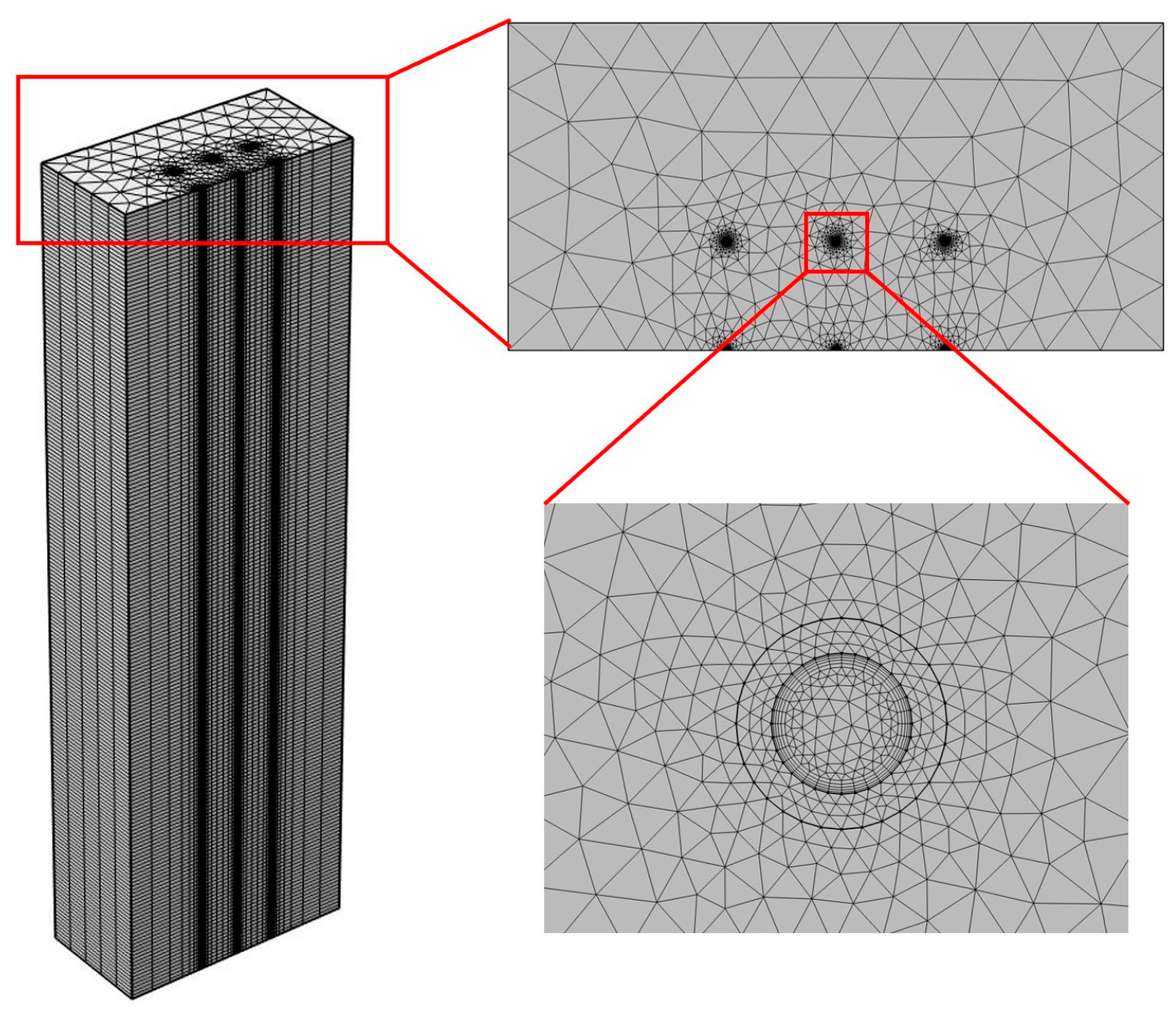
The three-dimensional coupled model was implemented in a finite-element framework (COMSOL Multiphysics v6.0) to solve the governing equations described in Section 2.1. To investigate heat and moisture transport within the soil domain while keeping the computational cost manageable, a computational domain representing a typical borehole field was constructed (Figure 1). A nine-borehole configuration was chosen over a single- or four-borehole layout to better represent real-world thermal energy storage systems. A single-borehole model cannot capture the thermal interference between adjacent ground heat exchangers. Although a four-borehole configuration introduces thermal interaction, all boreholes are located on the periphery, lacking a fully surrounded core region. The nine-borehole array is the minimal symmetric configuration that includes a distinct central borehole (subject to maximum thermal superposition from all sides), edge boreholes, and corner boreholes. This setup allows for a comprehensive analysis of the complex heat and moisture transfer dynamics—especially the severe heat accumulation at the center—typical of larger-scale arrays. The domain dimensions were set to 35 m × 35 m × 60 m (length × width × depth), which provides sufficient volume to contain the thermal plume without interference from the outer boundaries.
As shown in Figure 1, the domain is discretized using a spatially continuous unstructured tetrahedral mesh. To capture the steep radial gradients of temperature and moisture near the heat source, local mesh refinement is applied in the near-borehole regions. The coaxial borehole heat exchanger (CBHE) structure is simplified to an equivalent single-pipe model using the equivalent-diameter approach validated in previous borehole thermal-resistance studies [30]. While a fully resolved coaxial geometry with explicit internal fluid dynamics is ideal for capturing short-term (hourly) transient intra-borehole responses, implementing it for a multi-borehole array over a full 8760 h annual cycle coupled with highly nonlinear porous media transport equations is computationally prohibitive. For seasonal SUTES operation, the long-term system performance and overall energy balance are overwhelmingly dominated by the massive thermal inertia and the dynamic effective thermal resistance of the surrounding soil matrix, rather than the internal borehole resistance. Therefore, assuming a constant equivalent borehole thermal resistance through the single-pipe approximation is mathematically sufficient for macro-scale engineering capacity sizing, even though it inadvertently smooths out micro-scale, short-term wellbore fluctuations.
This simplification allows for accurate imposition of thermal boundary conditions on the tube wall while significantly reducing the mesh element count. Although complex internal convective flows in pipes have been investigated extensively in thermal engineering studies [31], the present work focuses on the macro-scale soil-moisture response, making the equivalent single-pipe assumption a reasonable engineering approximation for seasonal sizing.
To ensure that the numerical solution is independent of spatial discretization, a mesh-sensitivity analysis was carried out. Five mesh configurations with element counts ranging from approximately 7.8 × 10⁵ to 9.2 × 10⁵ were evaluated. Based on the convergence criterion that the relative variation in soil temperature and moisture at monitoring points is below 0.5%, the coarsest mesh (Mesh 1) was selected for all subsequent simulations. The detailed grid-independence results are given in Section 2.4.1.

2.2.2. Boundary and Initial Conditions

To reduce computational cost, geometric symmetry is exploited and symmetry boundary conditions (zero normal heat and moisture flux) are applied to the internal cut planes passing through the borehole array. The remaining thermal and hydraulic boundary conditions are specified as follows.
(1)
Borehole-wall boundary (equivalent pipe interface)
Consistent with the single-pipe simplification, heat exchange between the circulating fluid and the borehole wall is modeled using a third-type (Robin) boundary condition. The convective heat-transfer coefficient on the pipe wall is obtained from a constant circulation velocity of 0.2 m/s using standard pipe-flow correlations. The bulk fluid temperature Tf is imposed as a time-dependent function to represent the operating phases:
-
Heat-storage phase (injection): Tf = 40 °C;
-
Heat-extraction phase: Tf = 7 °C;
-
Transition/recovery phases: the mass flow rate is set to zero and the borehole wall is treated as adiabatic.
(2)
Soil-domain thermal and hydraulic boundaries
The exterior far-field boundaries (the outer lateral faces and the bottom of the computational domain, which are distinct from the internal symmetry planes) are maintained at the undisturbed initial soil temperature Tinit = 16.7 °C (Dirichlet condition), approximating a semi-infinite surrounding ground. To emulate a deep underground storage volume, the bottom and lateral faces are also defined as zero-flux boundaries for the moisture field, ensuring that moisture migration is driven internally.
For the top surface, both adiabatic (no normal heat flux) and zero-moisture-flux (impermeable) conditions are imposed. While natural geological surfaces are subjected to dynamic atmospheric interactions such as precipitation, evaporation, and ambient heat exchange, these closed-boundary assumptions are adopted for two crucial reasons. Firstly, in practical large-scale SUTES engineering, the surface directly above the borehole array is typically covered with thick engineered insulation materials and impermeable vapor barriers to prevent severe seasonal heat dissipation and uncontrollable groundwater infiltration. Secondly, from a modeling perspective, adopting a perfectly closed hydraulic control volume isolates the strictly thermally induced moisture migration driven by the CBHEs. Introducing stochastic weather boundary conditions would mathematically mask the internal coupled heat-moisture dynamics this study aims to quantify. Consequently, the results presented herein specifically reflect the performance of an engineered, top-insulated SUTES field and represent a conservative baseline for moisture redistribution.
(3)
Initial conditions
At t = 0, the entire domain is initialized at a uniform temperature T0 = 16.7 °C. The initial water content is the key parameter in this study. To quantify its influence on thermal performance, three uniform initial water-content scenarios are considered, corresponding to volumetric water contents θ0 = 0.20, 0.30, and 0.40 m3·m−3. The associated initial mass-based water content ω0 used in the moisture balance equation (Equation (1)) is obtained from ω0 = ρl θ0, where ρl is the density of liquid water.

2.3. Operational Schedule and Thermophysical Properties

2.3.1. Annual Operational Schedule

To evaluate the seasonal performance of the SUTES system, the simulation covers a full annual cycle (8760 h), divided into four distinct operational stages: heat storage, transition, heat extraction, and recovery. The specific calendar dates and durations are listed in Table 1. To ensure a continuous yearly cycle, the recovery period extends to the end of the simulation year.

2.3.2. Material Properties

The computational domain comprises four material zones: the circulating fluid (water), the pipe wall (galvanized steel), the backfill material (bentonite), and the surrounding unsaturated soil. The thermophysical properties of the solid components are summarized in Table 2.

2.3.3. Dynamic Soil Thermal Properties

In unsaturated soil, thermal transport properties are strongly coupled with moisture content. While the properties of the steel pipe and backfill remain constant, the effective thermal conductivity and specific heat capacity of the soil are treated as functions of the volumetric water content θ.
(1)
Effective Thermal Conductivity
The soil thermal conductivity increases non-linearly with moisture content due to the replacement of air in the pores with water and the formation of thermal bridges. This relationship is described by the empirical correlation
λ e f f = a + b θ + c θ d
where θ represents the volumetric water content (m3·m−3), and a, b, c, and d are fitting constants specific to the soil texture. In this study, the coefficients are taken as a = 0.147, b = −1.552, c = 3.166, and d = 0.5.
(2)
Effective Specific Heat Capacity
The effective volumetric heat capacity of the soil is updated at each time step based on the local phase saturations, strictly following the volume-averaging formulation described previously in Equation (6) (Section 2.1.3).

2.4. Validation of the Numerical Model

To ensure the reliability of the numerical results, a rigorous validation procedure is carried out, including grid and time-step independence tests and a comparison with experimental data.

2.4.1. Grid and Time-Step Independence Verification

(1)
Mesh Sensitivity Analysis
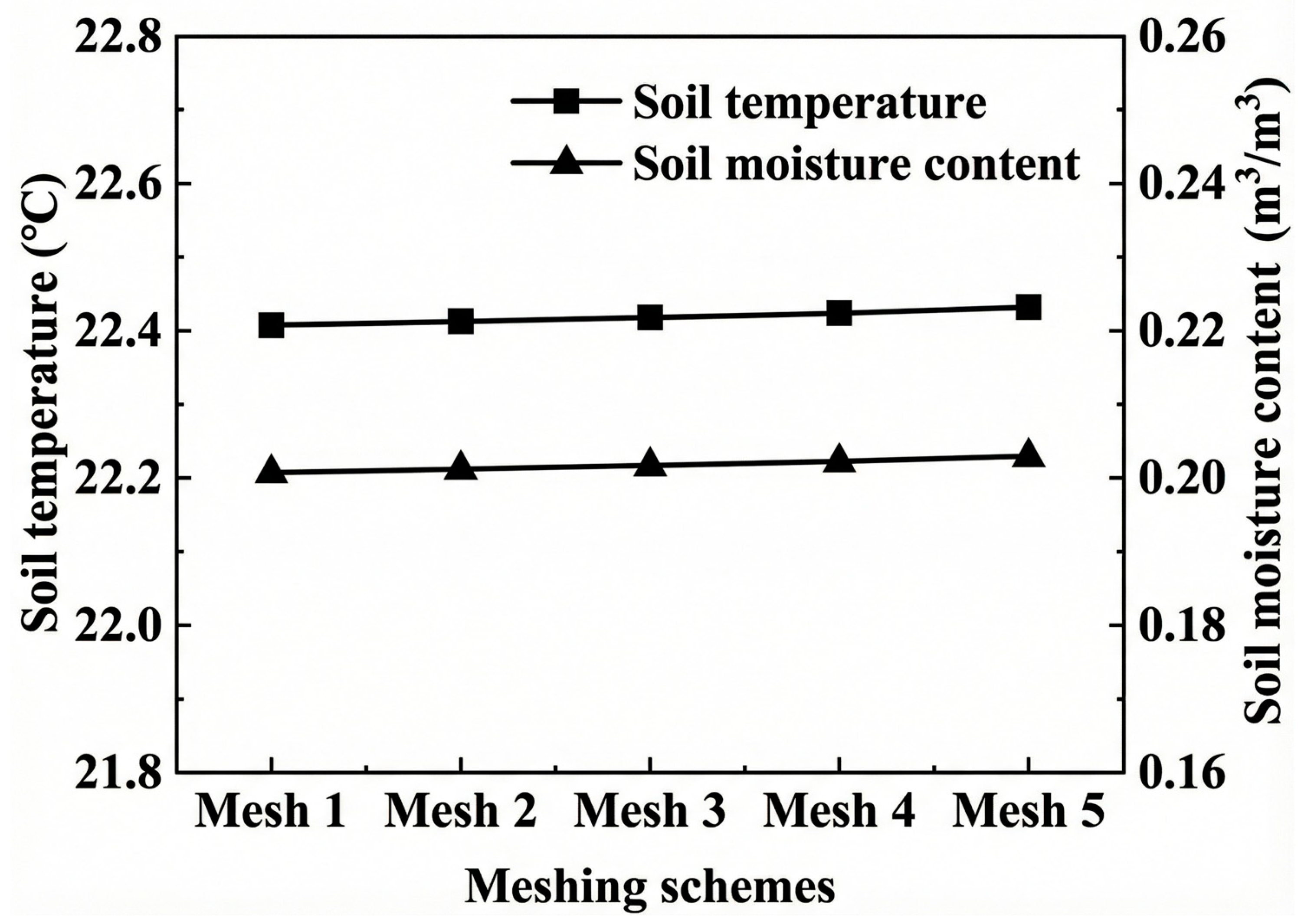
To eliminate the influence of spatial discretization on the simulation results, five unstructured mesh configurations with increasing element densities (Mesh 1 to Mesh 5) were generated, as listed in Table 3. The soil temperature and volumetric water content were monitored at a reference point (x = 0, y = 0.5, z = −30 m) on the 7th day of the heat storage stage. As shown in Figure 2, the numerical solution exhibits excellent stability over the tested range. The relative deviations in temperature and moisture content between the coarsest mesh (Mesh 1, 782,532 elements) and the finest mesh (Mesh 5, 920,153 elements) are less than 0.5%. This indicates that grid independence has effectively been achieved even at the lower element count. Consequently, Mesh 1 is adopted in all subsequent simulations to maximize computational efficiency without compromising accuracy.
(2)
Time-step sensitivity analysis and solver configuration
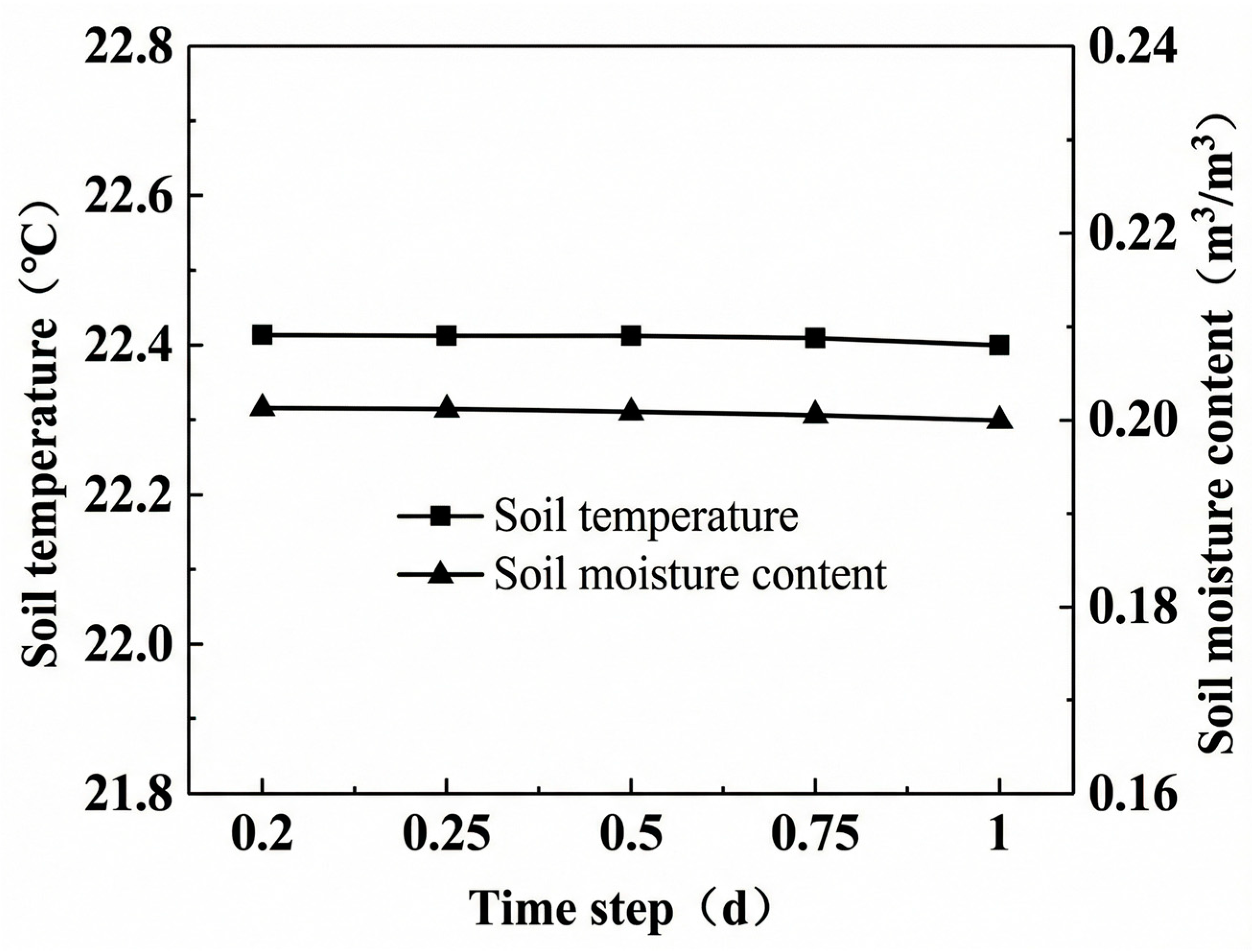
Time-step sizes of Δt = 0.2, 0.25, 0.5, 0.75, and 1.0 days were evaluated as the data output intervals. As shown in Figure 3, variations in macroscopic soil temperature and moisture content among these output steps are negligible. It is crucial to emphasize that to handle the severe non-linearities and steep local gradients induced by phase change, the numerical model employs a fully implicit Backward Differentiation Formula (BDF) solver with strictly adaptive time-stepping natively implemented in COMSOL. During periods of rapid transient variations (e.g., initial system startup or phase switching), the internal computational time step automatically refines to fractions of an hour to capture the underlying physics and ensure strict convergence. The relative tolerance was uniformly set to 1 × 10⁻³, and the absolute tolerance to 1 × 10⁻⁴ for all dependent variables. An output step of Δt = 0.5 days was ultimately selected, as it effectively bounds the relative output error within 2% compared with smaller intervals, achieving an optimal balance between recording seasonal dynamics and managing the massive data storage requirements of the 3D full-annual simulation.

2.4.2. Experimental Validation

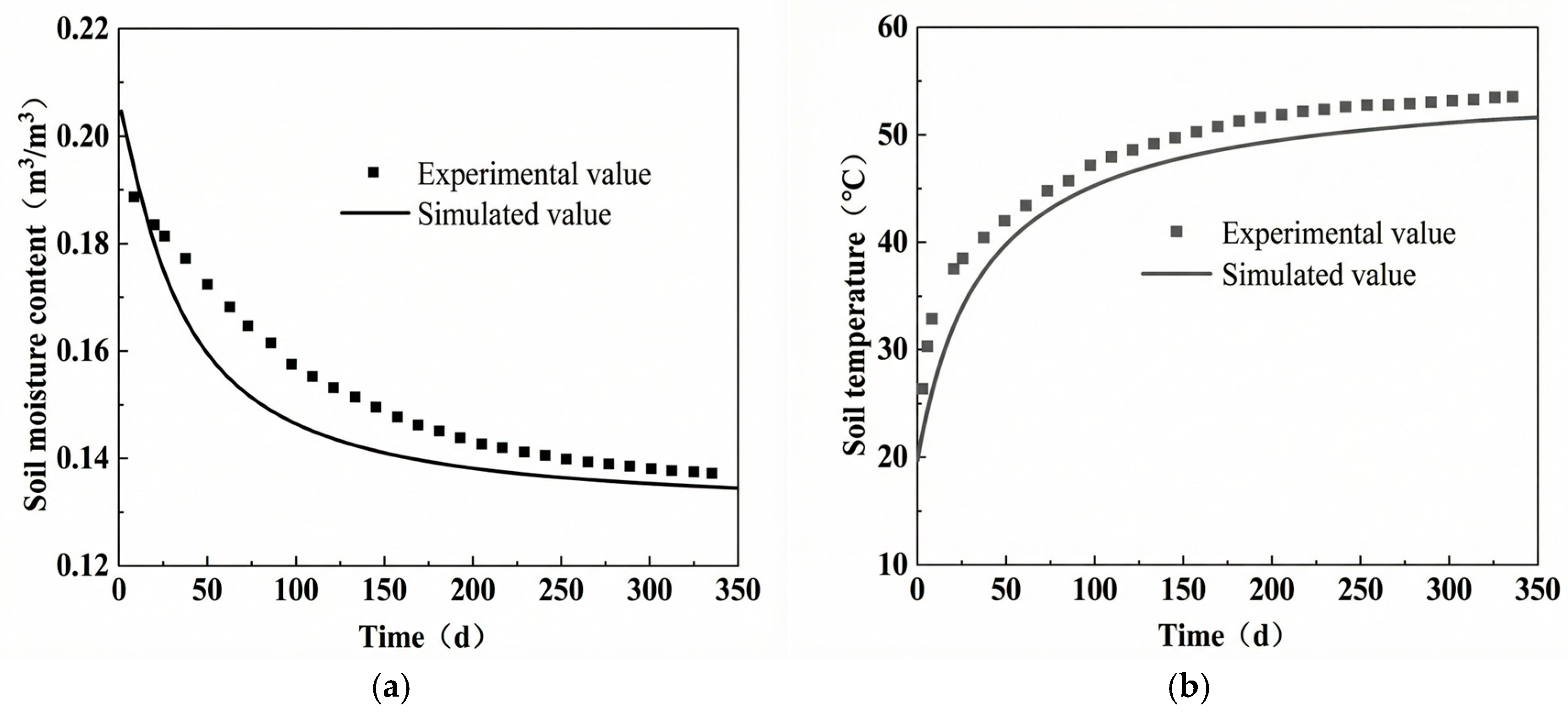
The numerical model is further validated against the experimental data reported by Ji [32], who investigated coupled heat and moisture transfer in unsaturated soil under high-temperature conditions. Figure 4 compares the simulated evolution of soil temperature and volumetric water content with the measured data at a radial distance of r = 0.6 m from the heat source.
(1)
The model accurately reproduces the thermal response, with the soil temperature rising rapidly during the initial stage and asymptotically approaching a steady state. The mean relative error (MRE) for temperature is approximately 6.8%, with a maximum absolute deviation of about 2.5 °C.
(2)
The volumetric water content exhibits a decreasing trend due to thermally induced moisture migration (thermal diffusion). The model successfully captures this drying effect near the heat source, yielding an MRE for moisture content of 7.7%.
(3)
The discrepancies between simulated and experimental values fall within an acceptable range for geotechnical and underground energy storage applications. The remaining deviations can be attributed to the following factors:
(a)
The numerical model assumes the soil is a homogeneous and isotropic porous medium. In reality, the experimental soil may contain local heterogeneities, fissures, or density variations that affect local heat and mass transfer.
(b)
The validation relies on empirical correlations (e.g., Johansen’s model) for effective thermal conductivity. Deviations between these empirical estimates and the actual properties of the soil used in the experiment can introduce errors.
(c)
The adiabatic surface assumption in the model (top boundary) may differ slightly from the actual insulation conditions in the experiment, where minor heat losses to the ambient environment could occur.
Furthermore, as observed in Figure 4a, the simulated initial rate of temperature rise is slightly slower than the experimental data. This discrepancy primarily stems from the simplifications made in the governing equations to ensure the computational feasibility of the full-annual-cycle simulation. Specifically, the current model assumes constant liquid density and does not explicitly resolve buoyancy-driven natural convection within the wellbore and the highly saturated near-borehole pores. In reality, at elevated temperatures during the heat injection stage, the density of liquid water decreases, which can trigger local natural convection cells that significantly enhance early-stage heat transfer compared to pure conduction. By neglecting this mechanism, the model slightly underestimates the initial thermal response. However, because this study focuses on the macro-scale, long-term (annual) seasonal engineering sizing rather than short-term transient wellbore dynamics, this localized early-stage deviation does not compromise the overall energy balance, and the long-term asymptotic behavior remains reliably captured.
Overall, the strong agreement between the simulations and measurements confirms that the proposed equivalent single-pipe model is robust and capable of capturing the key physics of coupled heat and moisture transfer for seasonal sizing purposes. It should be explicitly acknowledged that high-quality experimental data featuring continuous, three-dimensional moisture mapping for full-scale multi-borehole arrays over complete annual cycles is currently exceedingly rare in the literature. Consequently, the primary scope of this validation is to rigorously verify the accuracy of the fundamental coupled Partial Differential Equations (PDEs)—particularly the numerical handling of non-linear phase-change dynamics, thermal diffusion, and dynamic property updates around a single high-temperature source. Because the underlying micro-scale thermodynamic physics governing heat and moisture migration remain consistent irrespective of the macroscopic domain size, validating the core transport mechanisms locally establishes a robust and reliable mathematical foundation. Extending this locally validated physical framework to a multi-borehole array subsequently relies on the established mathematical principles of spatial continuity and thermal superposition in porous media.

3. Results and Discussion

3.1. Spatiotemporal Evolution of Soil Temperature and Moisture

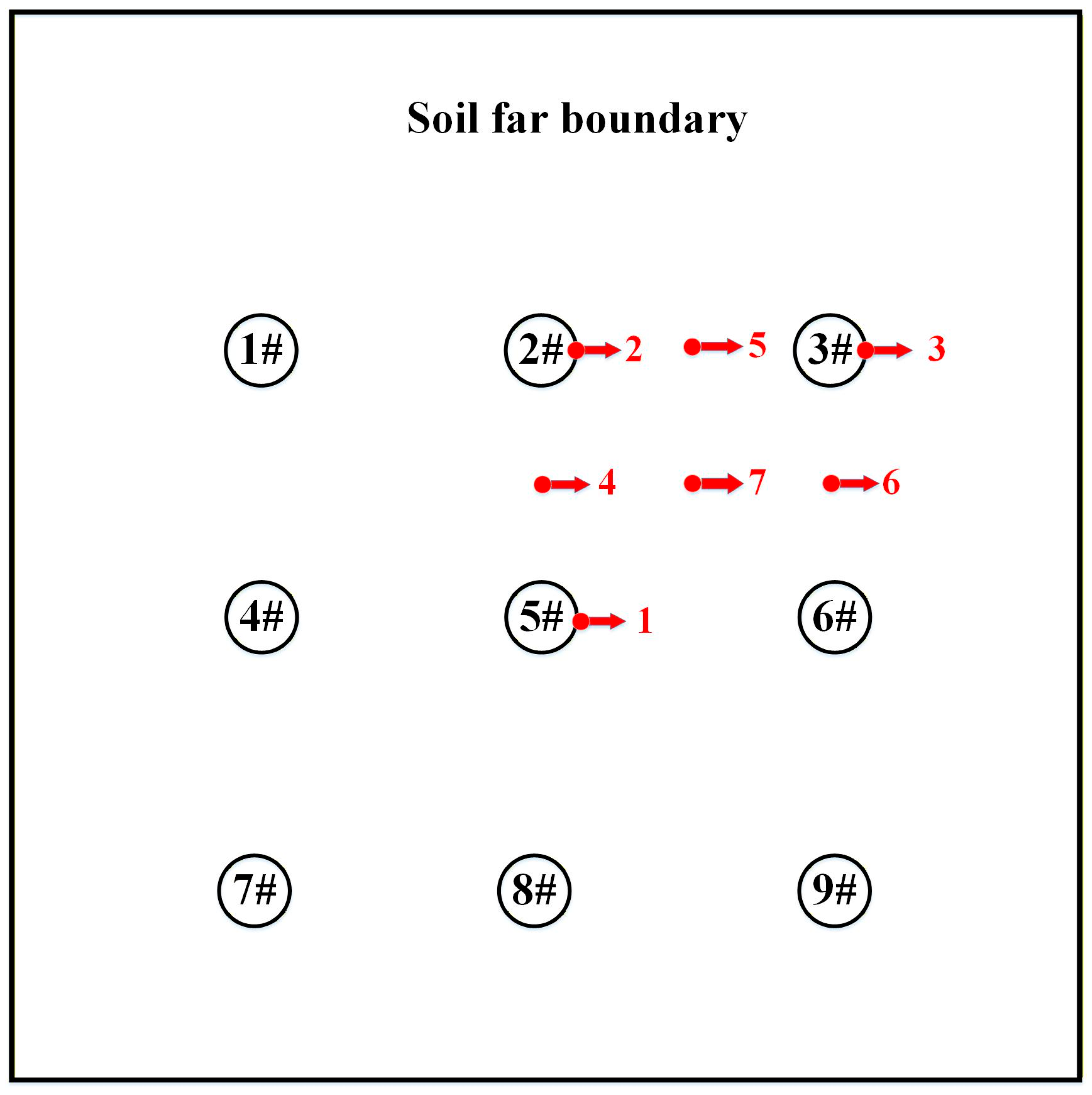
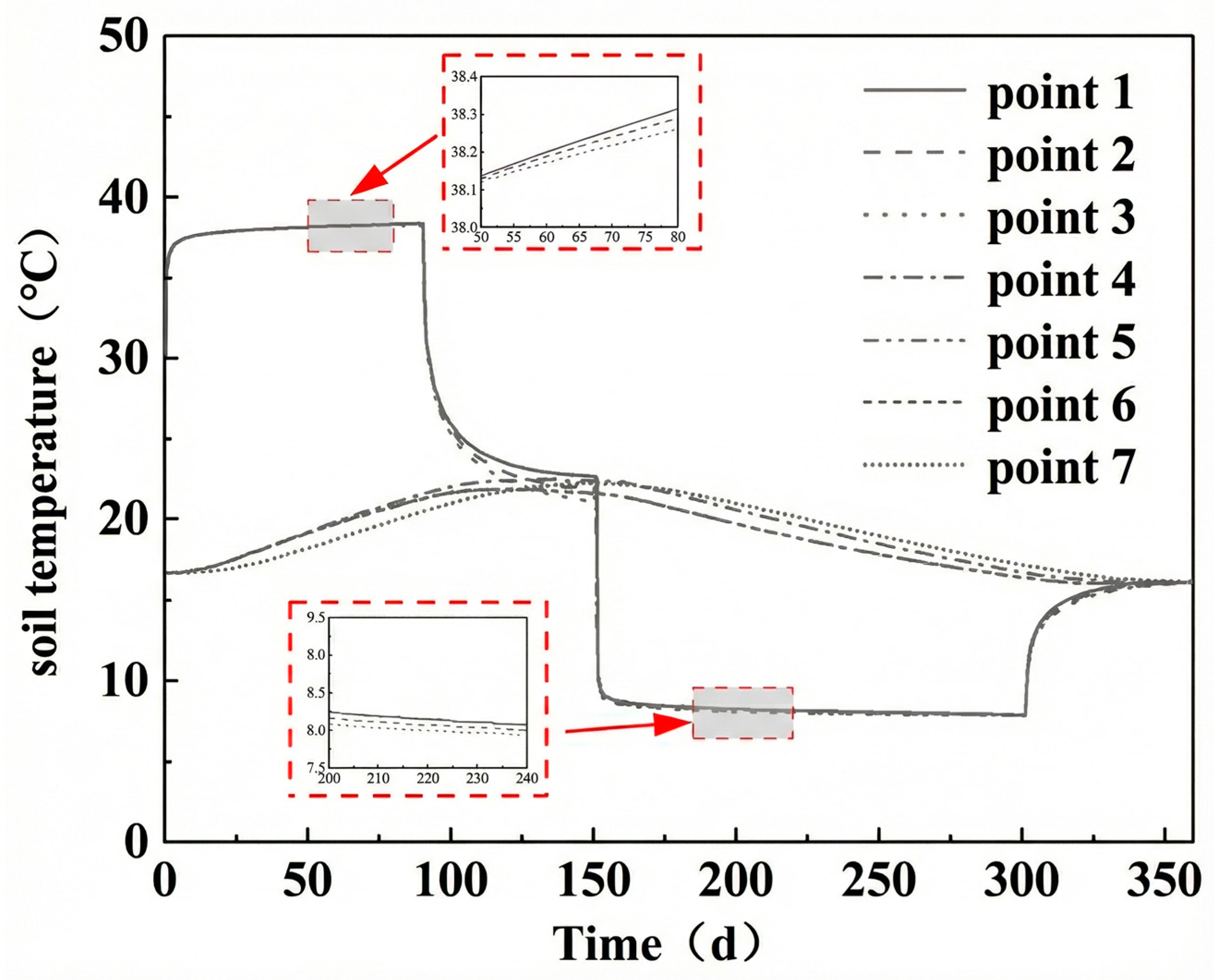
To characterize the dynamic coupling between heat and moisture transport, seven monitoring points were selected within the soil domain, extending from the borehole wall to the far-field boundary (Figure 5). Points 1–3 are located at varying depths along the borehole wall, while Points 4–7 lie along a radial line extending toward the far-field boundary to capture the propagation of thermal and moisture disturbances.
(1)
Thermal Response (Figure 6)
During the heat storage stage (0–90 days), soil temperature near the borehole (Points 1–3) rises rapidly due to the large imposed temperature difference, peaking at approximately 38.4 °C. A distinct spatial stratification is evident: the central region (Point 1) becomes notably hotter than the corner (Point 3) due to thermal superposition from adjacent boreholes. In the transition stage (90–150 days), near-field temperatures drop sharply as heat diffuses radially into the surrounding soil. Conversely, far-field points (e.g., Point 7) continue to warm slightly, demonstrating the significant thermal inertia of the soil matrix.
(2)
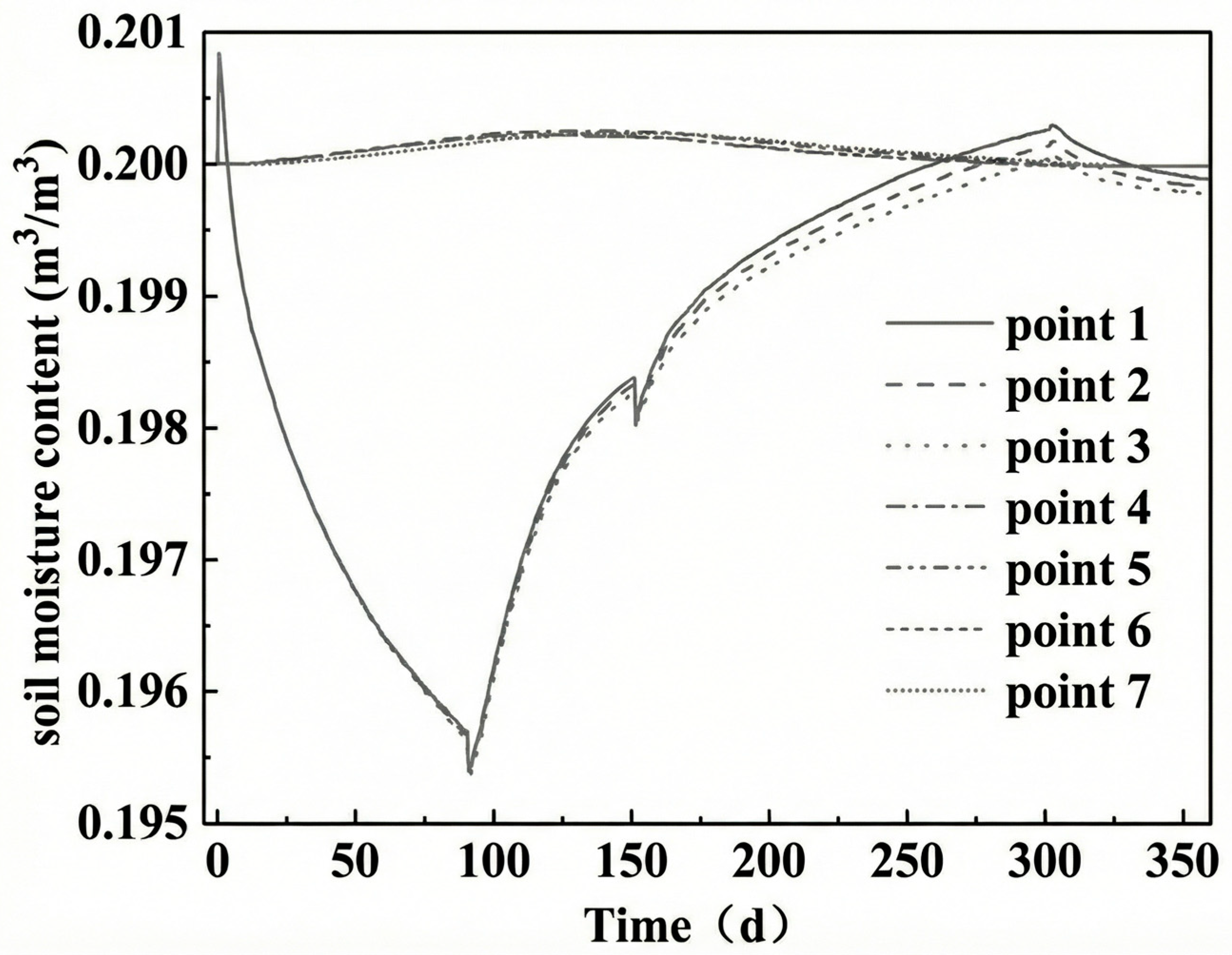
Moisture Migration Mechanism (Figure 7)
Figure 7 reveals a pronounced “thermal drying” effect. Driven by the temperature gradient, moisture migrates away from the heat source via thermally induced diffusion. Consequently, the volumetric water content at the borehole wall (Points 1–3) decreases from 0.20 to approximately 0.196 m3·m−3 during the heat storage stage. During the subsequent transition and heat extraction stages, moisture content partially recovers. This recovery is driven by capillary back-flow and the reversal of the thermal gradient. This cyclic moisture redistribution modifies the local effective thermal conductivity, a critical phenomenon often neglected in purely conductive soil models.

3.2. Evolution of Heat Carrier Fluid Temperature

The outlet temperature of the circulating fluid serves as a primary indicator of the heat exchange performance of the CBHE field.
(1)
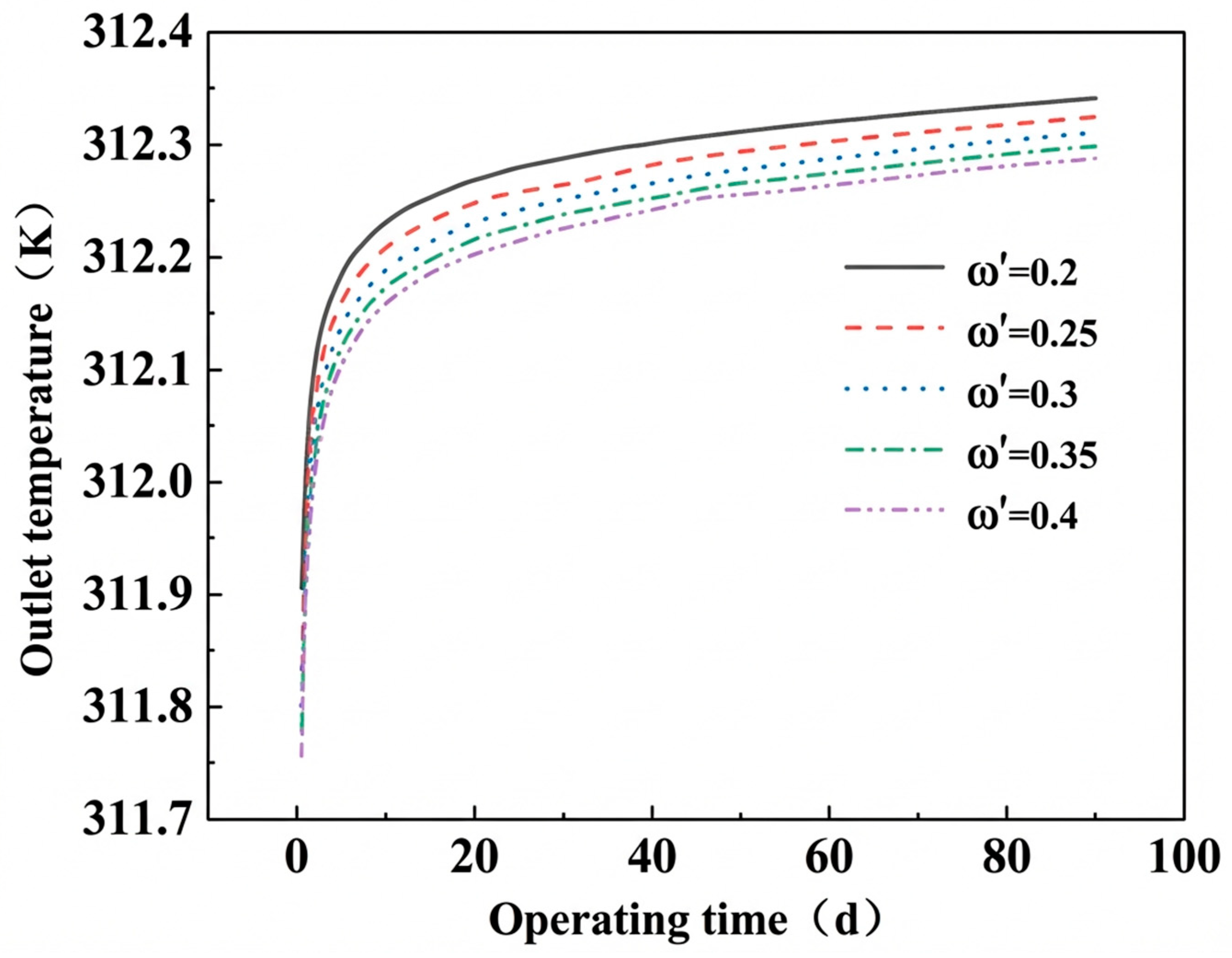
Heat-storage stage (Figure 8)
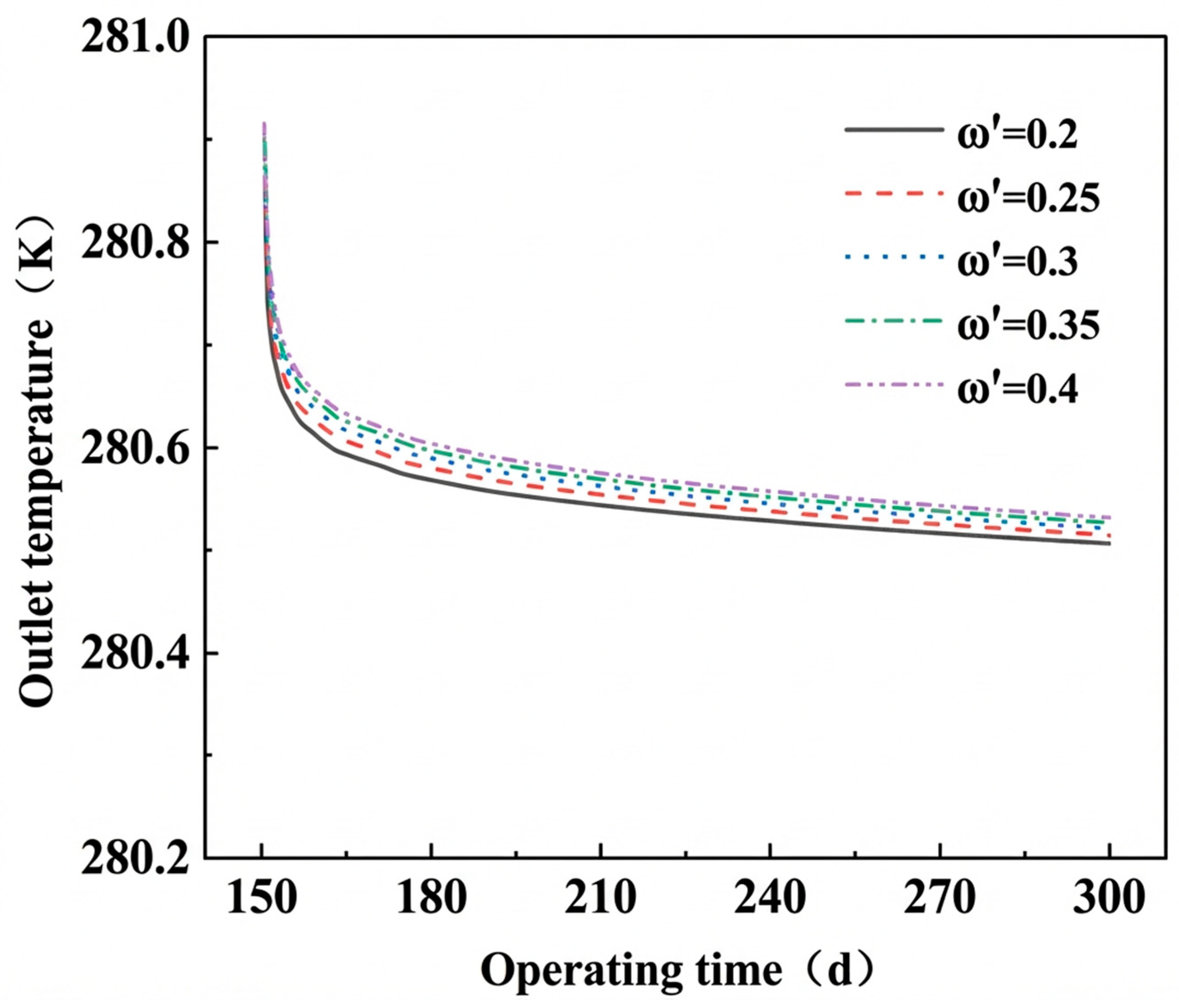
As the soil warms around the boreholes, the temperature difference between the fluid and the soil decreases, causing the outlet temperature to gradually approach the inlet temperature (40 °C). Higher initial soil moisture (θ0 = 0.40 m3·m−3) results in a slightly lower outlet temperature compared to drier soil (θ0 = 0.20 m3·m−3). This indicates that moist soil conducts heat away from the borehole more effectively, preventing localized heat buildup. This maintains a larger effective temperature difference, allowing for more heat to be injected into the ground.
(2)
Heat-extraction stage (Figure 9)
Conversely, during the winter heat extraction stage, high-moisture soil sustains a higher outlet temperature for the circulating fluid. The enhanced thermal conductivity and latent heat effects of moist soil support a more sustained heat flux from the far-field region toward the borehole. This mechanism mitigates the rapid depletion of near-borehole thermal energy, thereby improving the quality of useful heat delivered to the load.

3.3. Impact of Initial Soil Moisture on Engineering Sizing

(1)
Heat Transfer Rate per Unit Depth (Figure 10)
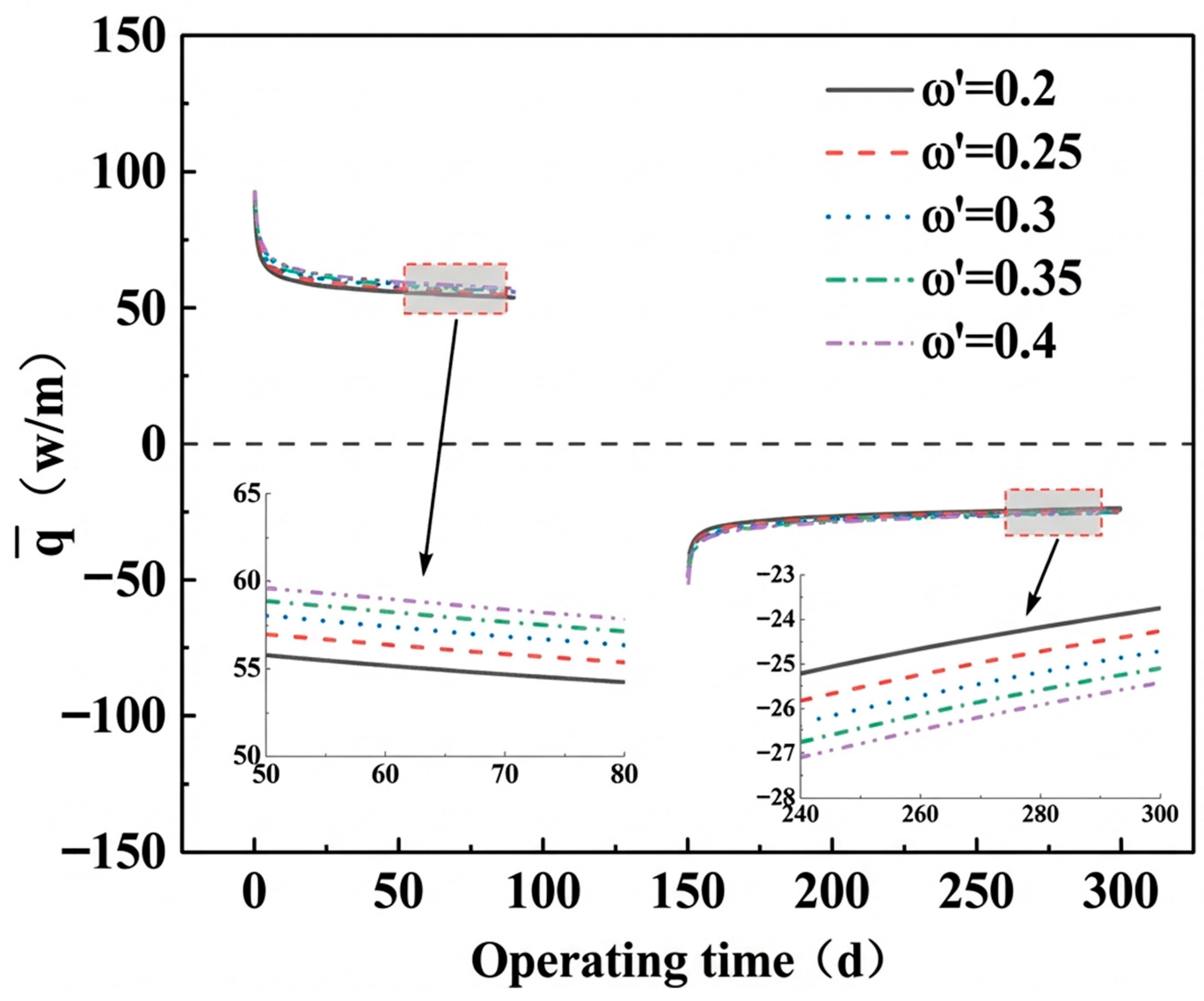
The average heat-transfer rate per unit borehole depth, q (W·m−1), is a critical parameter for system sizing. As shown in Figure 10, increasing θ0 from 0.20 to 0.40 m3·m−3 yields a noticeable performance enhancement: the heat injection rate increases from 53.84 to 57.39 W·m−1 (+6.6%), and the heat extraction rate increases from 23.73 to 25.41 W·m−1 (+7.1%).
Mechanistically, these improvements stem from two strongly quantified effects:
(a)
Enhanced Effective Thermal Conductivity: According to the established property correlations (Equation (11)), increasing the moisture content from 0.20 to 0.40 m3/m3 boosts the initial effective thermal conductivity ( λ e f f ) of the soil matrix from approximately 1.25 to 1.53 W/(m·K), representing a substantial 22.4% increase. This creates more continuous thermal bridges across the solid matrix, significantly facilitating radial heat diffusion.
(b)
Immense Latent Heat Buffering: Although the macroscopic moisture redistribution appears numerically modest (e.g., a localized drop from 0.20 to 0.196 m3/m3 near the borehole during injection), its thermodynamic impact is profound. A volumetric decrease of θ   = 0.004 corresponds to the vaporization of approximately 4 kg of liquid water per cubic meter of soil. Given the high latent heat of vaporization (L ≈ 2260 kJ/kg), this seemingly minor moisture migration absorbs roughly 9040 kJ/m3 of thermal energy locally. This massive latent heat absorption acts as a critical thermal buffer, suppressing premature thermal saturation at the borehole wall and sustaining the temperature gradient required for continuous high-rate heat injection.
(2)
Seasonal energy and exergy efficiencies (Figure 11 and Figure 12)
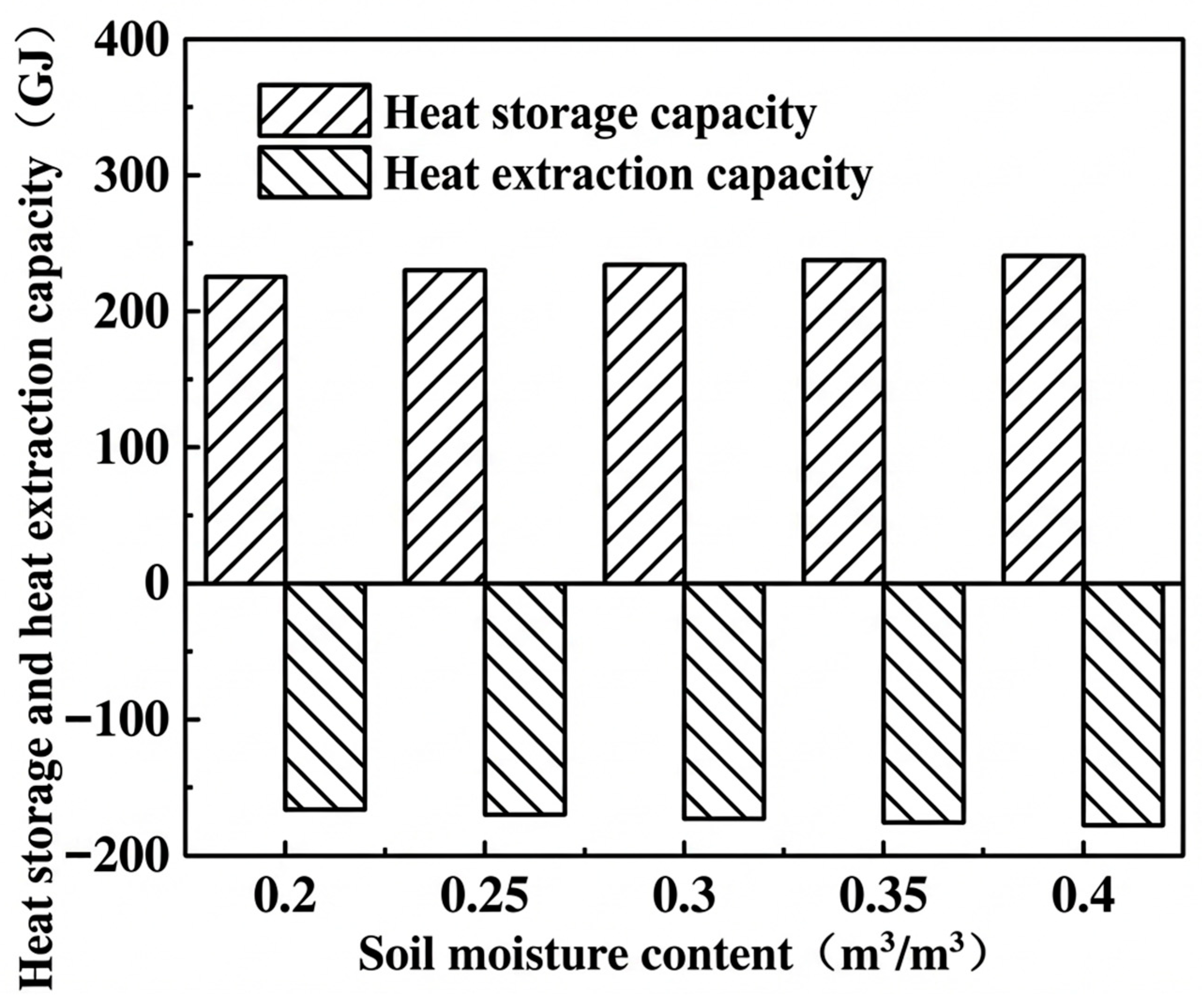
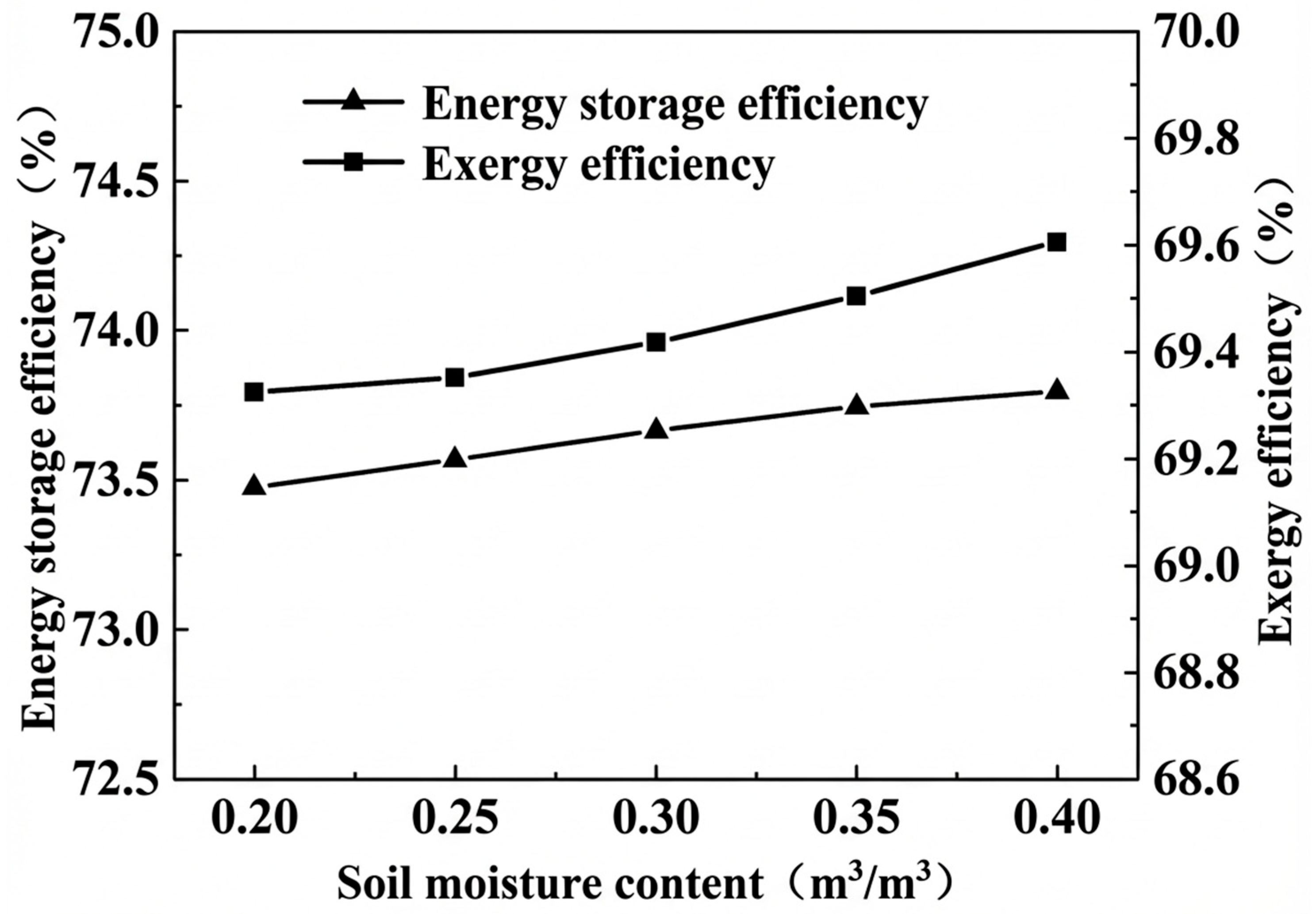
Figure 11 illustrates the total seasonal heat injected and extracted for different initial moisture contents. While absolute capacities increase with moisture, the seasonal energy storage efficiency η (defined in Equation (9)) exhibits only a modest increase from 73.48% to 73.80%. Similarly, the exergy efficiency φ (Equation (10)) improves slightly by about 0.29% (Figure 12).
From an engineering perspective, although soil moisture does not dramatically change the ratio of energy recovered (efficiency), it significantly enhances the absolute power density (W/m) of the CBHE field. For the same design thermal load, assuming idealized linear proportional scaling, this improvement suggests that the theoretical total drilling depth could be reduced by approximately 7% in moister soils compared to drier conditions. However, it must be emphasized that in real-world SUTES engineering, the sizing reduction is strictly non-linear. The severe thermal interference and long-term temperature drift within compact borehole arrays dictate that practical field length reductions will be slightly less than this theoretical upper bound, requiring iterative numerical resizing based on site-specific array geometries. Nevertheless, accurately accounting for moisture still yields undeniable direct savings in initial capital costs.
Thermodynamically, the conceptual discrepancy between the significantly enhanced absolute capacity and the nearly constant efficiency metrics can be explained by the symmetric enhancement of heat transport. Energy storage efficiency is fundamentally a ratio of recovered energy to injected energy (ŋ = Qext/Qinj). The increased initial soil moisture simultaneously elevates the effective thermal conductivity and volumetric heat capacity of the domain. During the summer charging phase, this allows the soil to act as a more capable thermal sink, preventing local thermal saturation and drastically increasing the total heat injected (Qinj). During the winter discharging phase, these same properties operate in reverse, allowing the highly conductive moist soil matrix to sustain a higher heat flux back toward the wellbore, maximizing the extracted heat (Qext). Because both the charging and discharging capacities scale up proportionally, the efficiency ratio remains highly stable. The slight increase in exergy efficiency (Φ) by 0.29% further confirms that the enhanced thermal conductivity reduces the temperature gradients required to drive heat flow at the borehole wall, thereby marginally reducing entropy generation and irreversible thermodynamic losses during the heat exchange processes.

4. Conclusions

This study presented a three-dimensional numerical investigation of coupled heat and moisture transfer in a seasonal underground thermal energy storage (SUTES) system using coaxial borehole heat exchangers. By establishing a coupled model that accounts for moisture-dependent thermophysical properties, the sensitivity of system performance to initial soil moisture was quantified. The key findings are summarized as follows:
(1)
Validation of coupled physics.
The proposed equivalent single-pipe model accurately captures complex hydrothermal phenomena, including the “thermal drying” effect and moisture hysteresis near the borehole. Validation against experimental data yields mean relative errors of only 6.8% for soil temperature and 7.7% for volumetric water content. These results confirm that the model is sufficiently robust for the engineering sizing and thermal analysis of SUTES-CBHE systems.
(2)
Enhancement of heat-transfer capacity.
Initial soil moisture acts as a critical enhancer of thermal performance. Increasing the initial volumetric water content (θ0) from 0.20 to 0.40 m3·m−3 improves the average heat injection rate per unit depth by 6.6% (from 53.84 to 57.39 W·m−1) and the heat-extraction rate by 7.1% (from 23.73 to 25.41 W·m−1). This enhancement is physically attributed to the higher effective thermal conductivity of moist soil and the latent heat transfer induced by moisture migration.
(3)
Decoupling of capacity and efficiency.
A distinction was observed between absolute capacity and cycle efficiency. While higher moisture content significantly increases the total energy stored and extracted, the improvement in efficiency metrics is marginal. The seasonal energy storage efficiency (ƞ) increases slightly from 73.48% to 73.80%, and exergy efficiency (φ) improves by approximately 0.29%. However, higher moisture plays a vital role in smoothing the radial temperature gradient, thereby mitigating local thermal buildup near the borehole wall.
(4)
Engineering implications.
Neglecting moisture transfer in unsaturated soils results in an overly conservative design and an underestimation of borehole capacity. For practical engineering, accounting for high local moisture conditions (θ0 ≈ 0.40 m3·m−3), allows the theoretical equivalent drilling depth to be reduced by up to 7% compared to drier conditions (θ0 ≈ 0.20 m3·m−3) for the same design thermal load. While actual field reductions will be non-linear due to array thermal interference, this finding highlights the economic necessity of avoiding overly conservative conductive-only models.

Author Contributions

Conceptualization, H.W.; Methodology, H.W. and D.Y.; Software, H.W. and D.Y.; Validation, J.Z.; Formal analysis, H.W.; Investigation, D.Y., J.Z. and B.D.; Data curation, D.Y., J.Z. and B.D.; Writing—original draft, H.W.; Writing—review & editing, H.W., D.Y., J.Z. and B.D.; Visualization, D.Y., J.Z. and B.D.; Supervision, H.W.; Project administration, H.W.; Funding acquisition, H.W. All authors have read and agreed to the published version of the manuscript.

Funding

This work was supported by the Anhui Provincial Department of Education Key Project (Grant No. 2024 AH050233).

Data Availability Statement

The data presented in this study are available on request from the corresponding author.

Conflicts of Interest

The authors declare no conflicts of interest.

References

  1. Emiliano, B.; Gabriel, Z.; Cabeza, L.F. Recent developments of thermal energy storage applications in the built environment: A bibliometric analysis and systematic review. Appl. Therm. Eng. 2021, 189, 116666. [Google Scholar] [CrossRef]
  2. Chen, H.; Li, H.; Xu, Y.; Xu, D.; Wang, L.; Zhou, X.; Chen, M.; Hu, D.; Yan, J.; Li, X.; et al. Research progress on energy storage technologies of China in 2023. Energy Storage Sci. Technol. 2024, 13, 1359–1397. (In Chinese) [Google Scholar] [CrossRef]
  3. Jiao, K.; Sun, C.; Yang, R.; Yu, B.; Bai, B. Long-term heat transfer analysis of deep coaxial borehole heat exchangers via an improved analytical model. Appl. Therm. Eng. 2021, 197, 117370. [Google Scholar] [CrossRef]
  4. Lai, T.; Liu, X.; Chu, J.; He, M.; Zhang, Y. Numerical Study of Flow and Heat Transfer in a Rectangular Channel Partially Filled with Porous Media at the Pore Scale Using Lattice Boltzmann Method. Heat Transf. Eng. 2022, 43, 818–829. [Google Scholar] [CrossRef]
  5. Kumar, A.; Bidarmaghz, A.; Khoshghalb, A.; Soga, K. Coupled heat and moisture migration in unsaturated soils subjected to thermal gradients. Comput. Geotech. 2025, 177, 106893. [Google Scholar] [CrossRef]
  6. Yang, J. Research on the Laws of Heat and Moisture Transfer Sensitivity in Soil. Ph.D. Thesis, Hebei University of Technology, Tianjin, China, 2015. (In Chinese) [Google Scholar]
  7. Skryleva, E.I. Numerical simulation of multiphase flow in a porous medium in the presence of heat and mass transfer between phases. Heat Transf. Res. 2023, 54, 1–10. [Google Scholar] [CrossRef]
  8. Rajeh, T.; Kbodi, B.H.A.; Zhao, J.; Li, Y. An enhanced multi-external-chamber oval-shaped coaxial borehole heat exchanger for improved GSHP systems: Dynamic thermal analysis and multi-parameter performance evaluation. Appl. Therm. Eng. 2025, 279, 127546. [Google Scholar] [CrossRef]
  9. Tsubaki, K.; Morikawa, T.; Yabuki, A.; Tanaka, Y.; Satoh, Y.; Okubo, H. Performance evaluation of an eight-tube ground heat exchanger using thermal response test data. Heat Transf. Res. 2021, 52, 1–10. [Google Scholar] [CrossRef]
  10. Javadi, H.; Urchueguía, J.F.; Badenes, B.; Mateo, M.A.; Ghafar, A.N.; Chaudhari, O.A.; Zirgulis, G.; Lemus, L.G. Laboratory and numerical study on innovative grouting materials applicable to borehole heat exchangers (BHE) and borehole thermal energy storage (BTES) systems. Renew. Energy 2022, 194, 788–804. [Google Scholar] [CrossRef]
  11. Zhang, J.J.; Wang, H.T.; Cheng, Z.D.; Li, S.Q. Study on heat transfer characteristics of directly buried casing energy storage body backfilled with phase change material. J. Energy Storage 2025, 114, 115857. [Google Scholar] [CrossRef]
  12. Jiao, K.; Yang, R.; Sun, C.; Yu, B.; Bai, B. Stratum temperature recovery considering groundwater advection in periodic operations of deep borehole heat exchangers. Appl. Therm. Eng. 2022, 206, 118113. [Google Scholar] [CrossRef]
  13. Huang, S.; Li, J.; Gao, H.; Zhu, K.; Dong, J.; Li, J.; Tao, J.; Jiang, Y. Numerical modeling and thermal performance analysis of deep borehole heat exchangers considering groundwater seepage. Appl. Therm. Eng. 2024, 250, 123508. [Google Scholar] [CrossRef]
  14. Ba, Z.; Wang, Y.; Zhao, Z.; Zhang, W.; Lu, Y. Efficient evaluation of the thermal performance of deep borehole heat exchangers affected by groundwater seepage. Appl. Therm. Eng. 2025, 280, 127955. [Google Scholar] [CrossRef]
  15. Shen, H.; Cao, Z.; Klemeš, J.J.; Wang, J.; Wang, E. Numerical Study on Heat Transfer and Performance of Seasonal Borehole Thermal Energy Storage. Heat Transf. Eng. 2023, 44, 2027–2039. [Google Scholar] [CrossRef]
  16. Wang, B.; Beyer, C.; Aydin, M.; Bauer, S. Experimental and numerical investigation of thermal interactions between high-temperature borehole heat exchangers in unsaturated and low-permeable soil. Appl. Therm. Eng. 2024, 248, 123184. [Google Scholar] [CrossRef]
  17. Nguimeya, N.V.D.; Christof, B.; Bo, W.; Sebastian, B. Experimental and numerical investigation of thermally induced convection along a high-temperature borehole heat exchanger. Appl. Therm. Eng. 2024, 236, 121345. [Google Scholar] [CrossRef]
  18. Xu, Y.; Zeng, Z.; Sun, D. Experimental and numerical investigation on the effect of heat and moisture coupling migration of unsaturated lateritic clay for the soil thermal storage system. Energy Build. 2022, 276, 112499. [Google Scholar] [CrossRef]
  19. Xu, Z.; He, W.; Wang, Y.; Jia, Z.; Zhu, M.; Yu, H. Experimental study on thermal and moisture characteristics of soil around buried pipe under intermittent operation. Acta Energiae Solaris Sin. 2024, 45, 44–50. (In Chinese) [Google Scholar] [CrossRef]
  20. Yang, W.; Kong, L.; Chen, Y. Numerical evaluation on the effects of soil freezing on underground temperature variations around ground heat exchangers. Appl. Therm. Eng. 2015, 75, 259–269. [Google Scholar] [CrossRef]
  21. Ji, Y.; Wang, S.; He, S.; Liu, J.; Wang, Y.; Cai, X. Analysis and optimization of ground heat exchangers for heat transfer capacity under stratified soil conditions with heat–moisture and heat–seepage coupling. Int. Commun. Heat Mass Transf. 2025, 165, 109047. [Google Scholar] [CrossRef]
  22. He, M.; Wang, Y.; Zhang, R.; He, F.; Behrendt, F.; Li, C. Numerical study of soil heat and moisture migration in seasonal ground heat storage. Geothermics 2024, 120, 103015. [Google Scholar] [CrossRef]
  23. Millar, C.; Lightstone, M.F.; Cotton, J.S. Reference data set for injection and extraction cycle of a borehole thermal energy storage field: A numerical and experimental study. J. Energy Storage 2025, 118, 116164. [Google Scholar] [CrossRef]
  24. Wang, H.T.; Li, S.Q.; Lei, K.K.; Zhang, J.J. Performance analysis of cross-seasonal thermal storage solar–soil source heat pump drying system. Renew. Energy 2025, 241, 122202. [Google Scholar] [CrossRef]
  25. Li, Z.; Sun, D.; Wang, Q.; Zhou, C.; Yu, B. Simulation research of a coupled heating system utilizing waste heat from supercomputer centers and solar energy based on seasonal soil heat storage. Acta Energiae Solaris Sin. 2024, 45, 384–393. (In Chinese) [Google Scholar] [CrossRef]
  26. Ragui, K.; Chen, L.; Bennacer, R. Transport Instabilities of Hazardous Contaminants in a Microscale Soil Sample Under Thermal Flow of Supercritical CO2. Heat Transf. Eng. 2025, 46, 1437–1456. [Google Scholar] [CrossRef]
  27. Datta, A.K. Porous media approaches to studying simultaneous heat and mass transfer in food processes. I: Problem formulations. J. Food Eng. 2007, 80, 80–95. [Google Scholar] [CrossRef]
  28. Yin, X.; Liu, E.; Song, B.; Zhang, D. Numerical analysis of coupled liquid water, vapor, stress and heat transport in unsaturated freezing soil. Cold Reg. Sci. Technol. 2018, 155, 20–28. [Google Scholar] [CrossRef]
  29. Ding, X.; Peng, C.; Wang, C.; Kong, G. Heat transfer performance of energy piles in seasonally frozen soil areas. Renew. Energy 2022, 190, 903–918. [Google Scholar] [CrossRef]
  30. Javed, S.; Spitler, J. Accuracy of borehole thermal resistance calculation methods for grouted single U-tube ground heat exchangers. Appl. Energy 2017, 187, 790–806. [Google Scholar] [CrossRef]
  31. Peng, Z.R.; Wang, Y.Z.; Amangeldiyev, S.; Fan, Y.W.; Cui, J.Z.; Liao, C.J.; Liu, J. Experimental Study on Convection Heat Transfer of CO2 in C/SiC Composite Porous Material at Subcritical, Transcritical, and Supercritical States. Heat Transf. Eng. 2025, 46, 1476–1490. [Google Scholar] [CrossRef]
  32. Ji, H. Study on Heat and Moisture Transfer at High Temperature in Wet Soil. Ph.D. Thesis, Hebei University of Technology, Tianjin, China, 2011. (In Chinese) [Google Scholar]
Figure 1. Schematic of the three-dimensional computational domain and the unstructured tetrahedral mesh strategy. The red box highlights the mesh refinement around the borehole heat exchangers to resolve steep local gradients.
Energies 19 01523 g001
Figure 2. Sensitivity analysis of soil temperature and moisture content under different mesh densities (Mesh 1–Mesh 5).
Energies 19 01523 g002
Figure 3. Sensitivity analysis of soil temperature and moisture content with varying time steps.
Energies 19 01523 g003
Figure 4. Comparison between numerical simulations (solid lines) and experimental data (symbols): (a) soil temperature; (b) soil moisture.
Energies 19 01523 g004
Figure 5. Schematic of boreholes and measurement points. The black circles with numbers (1#–9#) represent the nine coaxial borehole heat exchangers, while the red numbers (1–7) with arrows indicate the locations of the seven monitoring points.
Energies 19 01523 g005
Figure 6. Temporal evolution of soil temperature at the monitoring points.
Energies 19 01523 g006
Figure 7. Temporal evolution of soil volumetric water content at the monitoring points.
Energies 19 01523 g007
Figure 8. Outlet fluid temperature during the heat-storage stage for different initial soil moisture contents.
Energies 19 01523 g008
Figure 9. Outlet fluid temperature during the heat-extraction stage for different initial soil moisture contents.
Energies 19 01523 g009
Figure 10. Time evolution of average unit-depth heat-transfer rate for different initial soil moisture contents.
Energies 19 01523 g010
Figure 11. Seasonal heat storage and heat extraction capacities for different initial soil moisture contents.
Energies 19 01523 g011
Figure 12. Seasonal energy-storage and exergy efficiencies as functions of initial soil moisture content.
Energies 19 01523 g012
Table 1. Annual operational schedule and phase definitions.
PhaseHeat StorageTransition PeriodHeat ExtractionRecovery Period
date1 June–29 August30 August–28 October29 October–27 March of the following year28 March of the following year–31 May of the following year
days906015065
StatusInjection (40 °C)Idle (Adiabatic)Extraction (7 °C)Idle (Adiabatic)
Table 2. Thermophysical properties of the system components.
MaterialsDensity (ρ)
(kg·m−3)
Specific Heat (C) J·(kg·K)−1Thermal Conductivity
λ [W·(m·K)−1]
Porosity
ε (-)
Galvanized steel pipes785046045/
Soil (Solid Matrix)1800800Equation (11)0.45
Backfill (Bentonite)15009701.3/
Note: For the soil, the values represent the dry bulk properties or solid matrix inputs, while the effective thermal conductivity and heat capacity are updated dynamically based on moisture content.
Table 3. Mesh configurations and element counts for grid independence test.
Grid Division PlanNumber of Meshes
Mesh 1782,532
Mesh 2810,236
Mesh 3858,146
Mesh 4882,379
Mesh 5920,153
Disclaimer/Publisher’s Note: The statements, opinions and data contained in all publications are solely those of the individual author(s) and contributor(s) and not of MDPI and/or the editor(s). MDPI and/or the editor(s) disclaim responsibility for any injury to people or property resulting from any ideas, methods, instructions or products referred to in the content.