Digital Twin Technology in Wind Turbine Condition Monitoring, Predictive Maintenance, and RUL Estimation: A Systematic Literature Review

 , , ,
, , ,  , , , , , and
Abstract
1. Introduction
- (a)
- Through the application of a rigorous search protocol, scientific articles published in the last three years were selected and analyzed to identify the most relevant trends and advances in the use of DTs for wind turbine CM.
- (b)
- A detailed review of primary studies focused on the application of DTs for predictive maintenance and RUL estimation in wind turbines is conducted.
- (c)
- Four research questions are formulated and addressed to classify and analyze the most relevant studies according to the following criteria:
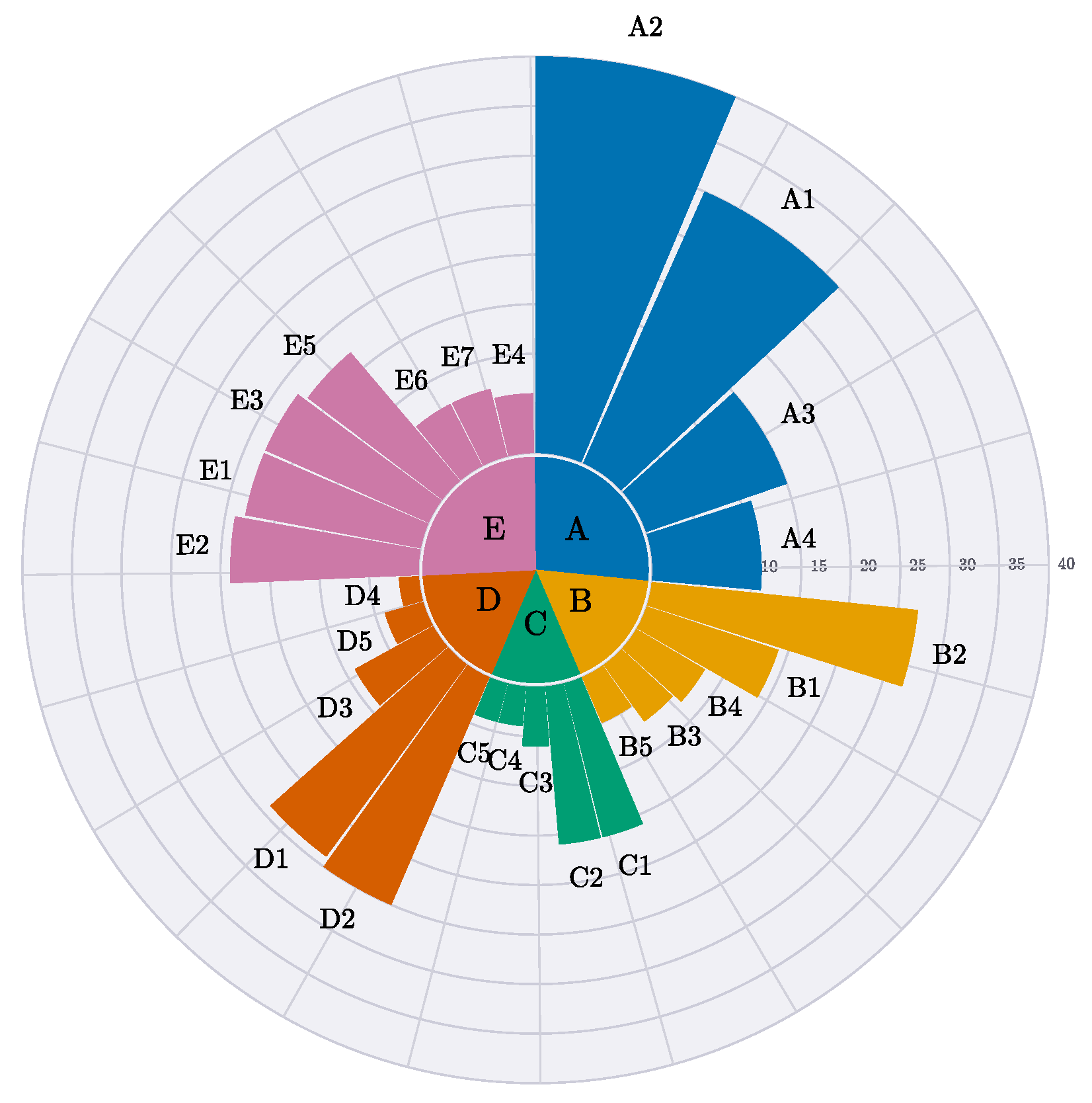
- Which wind turbine components or subsystems are most commonly modeled using DTs for CM and predictive maintenance tasks?
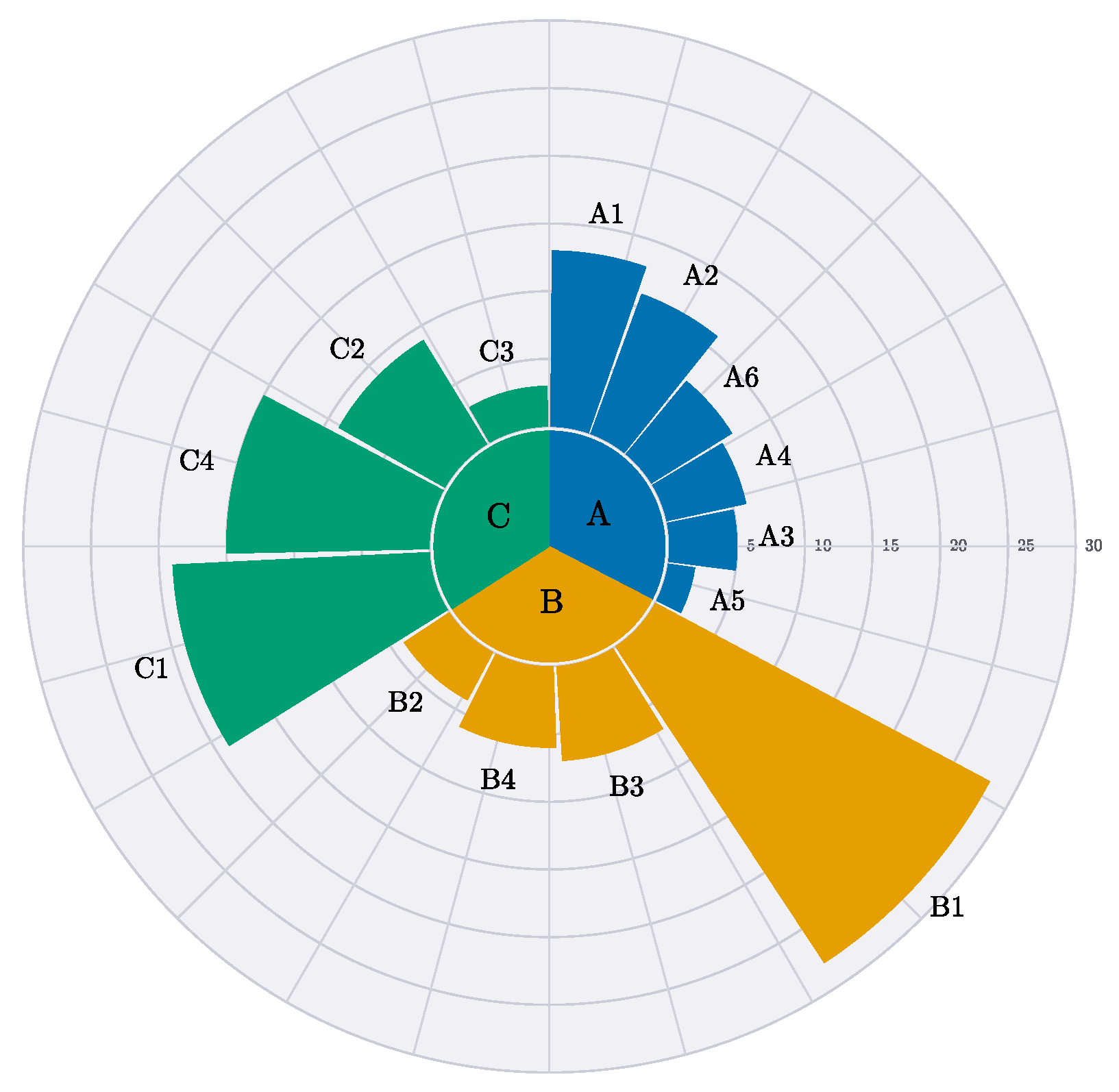
- What techniques are currently used for the development and implementation of DTs in wind turbines, and what are their main applications?
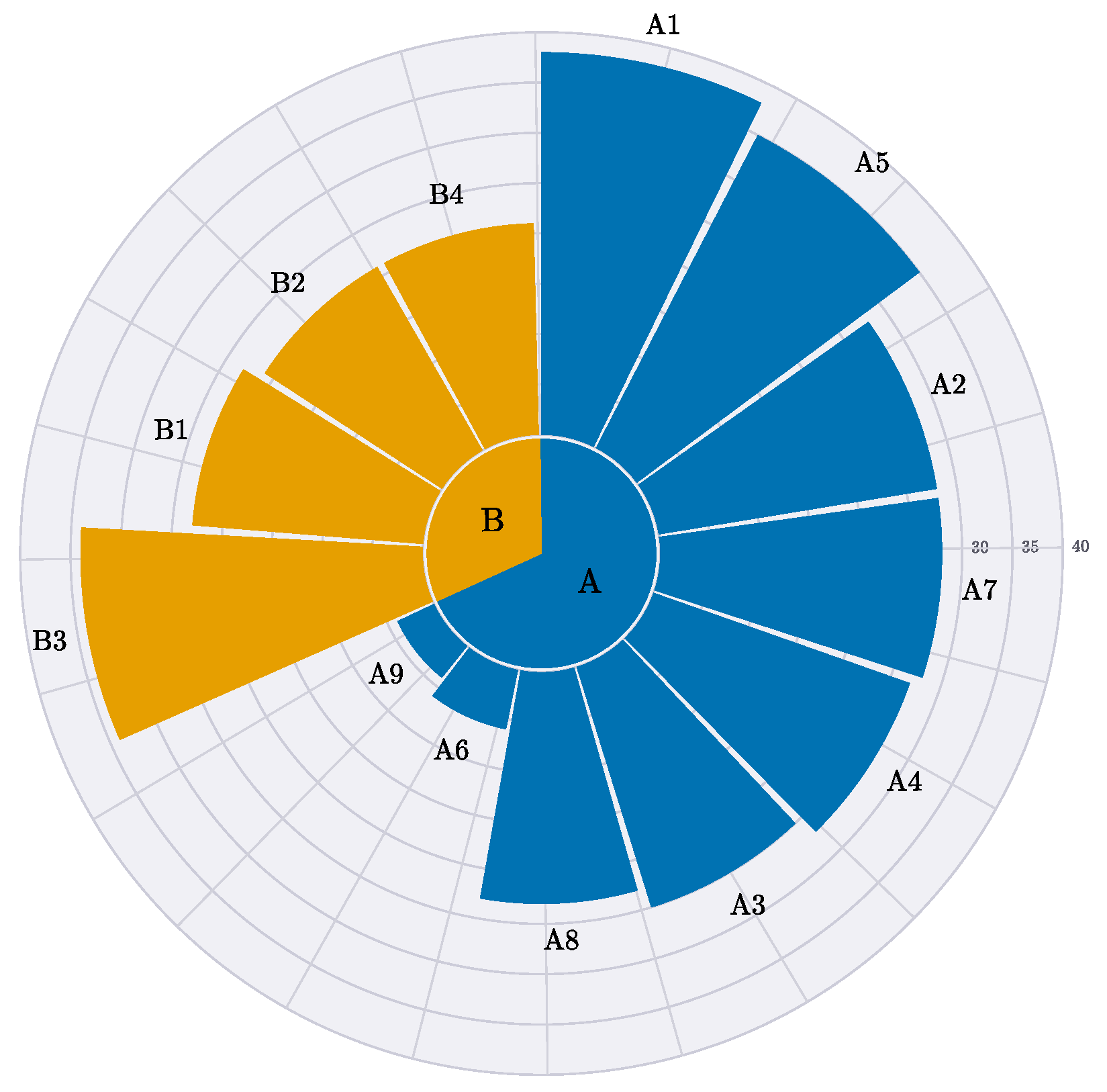
- What AI-based models are currently employed in wind turbine DTs for CM, fault prediction, and RUL estimation?
- What are the main challenges in the implementation and scalability of DTs for wind turbines, and what emerging trends guide their future development in the field of CM and predictive maintenance?
2. Materials and Methods
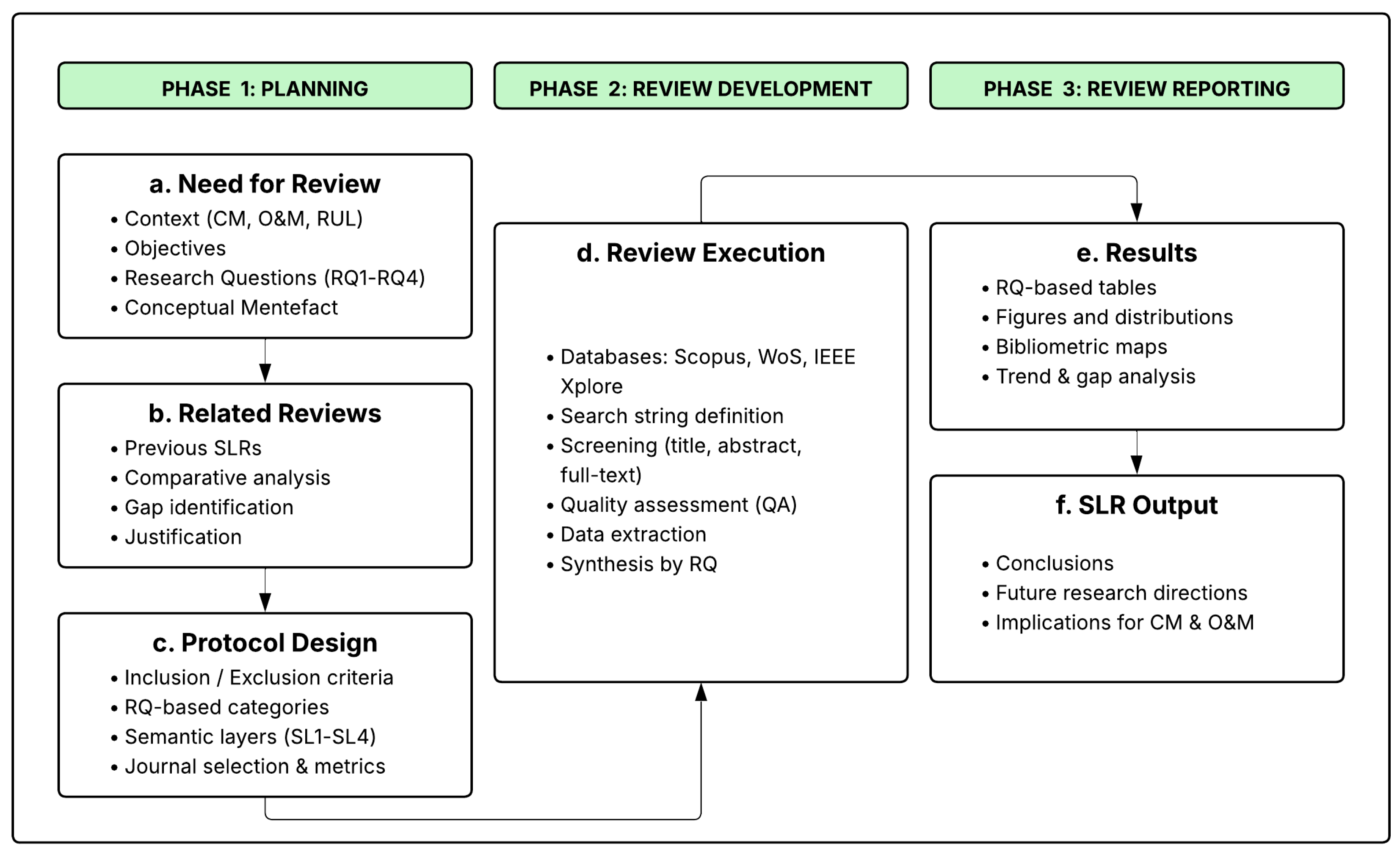
2.1. Phase 1: Planning
2.1.1. Identification of the Need for Review
- Research Questions
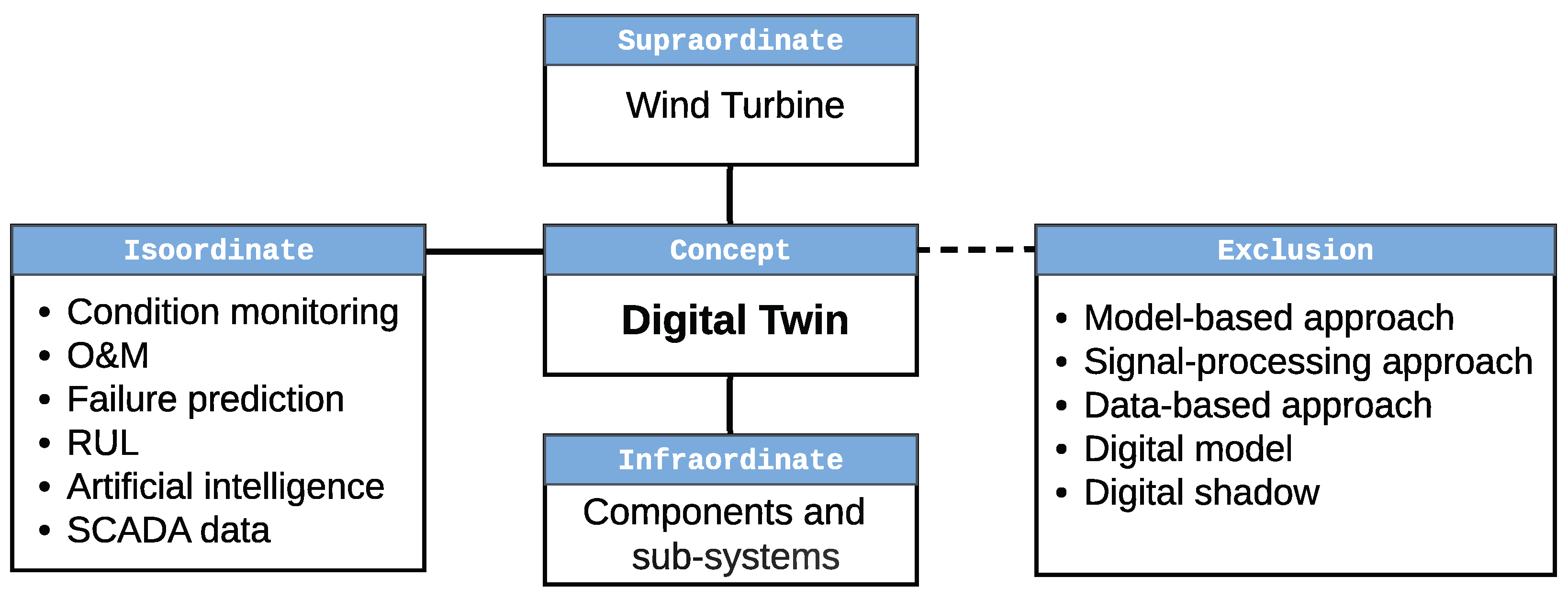
- Conceptual Mentefact
- (a)
- Concept: This class presents the central idea on which the literature review focuses. In this work, the concept is: DT.
- (b)
- Supraordinate: In this class, the concept is integrated into a higher or more general category that encompasses it, enabling the identification and understanding of its characteristics and properties. In this work, the supraordinate class corresponds to: Wind turbine.
- (c)
- Isoordinate: This class establishes partial relationships and conceptual links between related propositions, highlighting connections and correspondences without implying complete inclusion. In the present study, the following isoordinate classes have been defined: CM, O&M, failure prediction, RUL, AI, and SCADA data.
- (d)
- Exclusion: In this class, concepts or approaches that differ from or do not belong to the central concept are identified, allowing for a clearer delimitation of its theoretical scope. In this work, the following exclusions have been considered: model-based approaches, signal-processing approaches, data-based approaches, digital model, and digital shadow.
- (e)
- Infraordinate: This class defines the specific subcategories or components derived directly from the main concept. In this study, the defined infraordinate class corresponds to wind turbine components and subsystems.
- Semantic Search Structure
- Related Systematic Reviews
2.1.2. Development of the Review Protocol
- (a)
- Inclusion Criteria:
- Time range: Articles published between 2023 and 2026 were considered in order to capture the most recent advances in the field. The time window was restricted to the period 2023–2026 to focus the analysis on the most recent developments in DT technologies applied to wind turbines. In recent years, the DT paradigm has rapidly evolved due to advances in artificial intelligence, industrial IoT, and edge–cloud computing architectures. Restricting the search to this period allows the review to capture state-of-the-art implementations and emerging research directions. Earlier foundational studies are indirectly considered through the analysis of existing review articles summarized in Table 3, which provides a comparative synthesis of prior literature and helps contextualize the evolution of the field.
- Source type: Scientific journals and conference proceedings.
- Subject areas: Engineering and energy.
- Document type: Research articles and review articles.
- (b)
- Exclusion Criteria:
- Presence of keywords that, although related to the general domain, are conceptually excluded according to the mentefact, such as: Sustainable Development, Vibration Analysis, Prognostic and Health Management, and Digital Transformation.
- Language: The selection was restricted to documents written in English, excluding publications in Chinese and a small number of works published in Spanish.
- Document types not considered: Book chapters, full books, short surveys, conference reviews, and editorials.
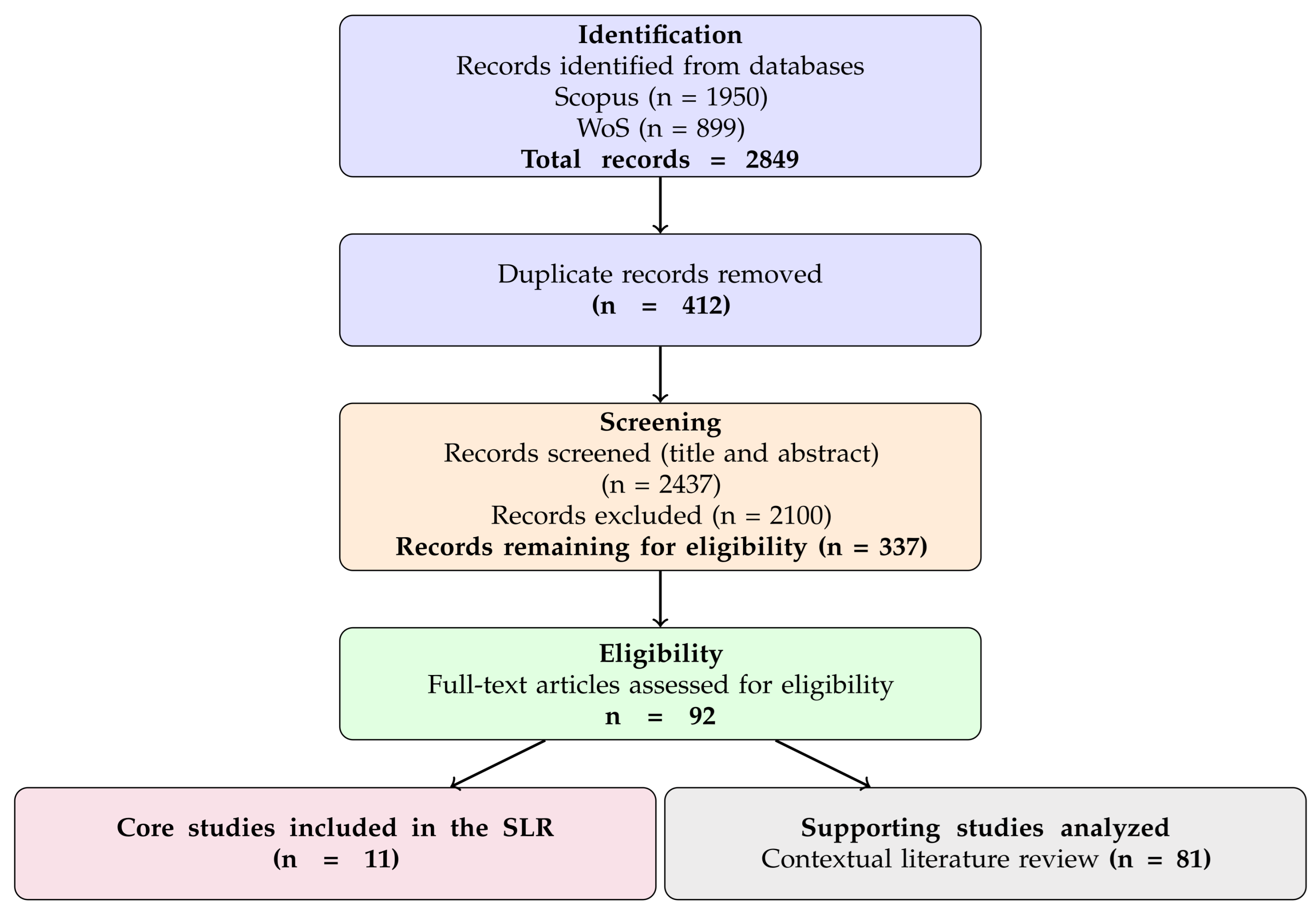
2.2. Study Selection Process
3. Results
4. Conclusions and Future Research Directions
Author Contributions
Funding
Data Availability Statement
Acknowledgments
Conflicts of Interest
Abbreviations
| AI | Artificial Intelligence |
| ANN | Artificial Neural Network |
| AR | Augmented Reality |
| AUC | Area Under the Curve |
| BDLM | Bayesian Dynamic Linear Model |
| BiLSTM | Bidirectional LSTM |
| CM | Condition Monitoring |
| CNN | Convolutional Neural Network |
| DL | Deep Learning |
| DRL | Deep Reinforcement Learning |
| FEM | Finite Element Method |
| GNN | Graph Neural Networks |
| IoT | Internet of Things |
| IRENA | International Renewable Energy Agency |
| JCR | Journal Citation Reports |
| LETCN | Lightweight/Enhanced Temporal Convolutional Network |
| LSTM | Long Short-Term Memory |
| MAE | Mean Absolute Error |
| ML | Machine Learning |
| O&M | Operation and Maintenance |
| PINN | Physics-Informed Neural Networks |
| RARNN | Recurrent Attention-based Recurrent Neural Network |
| RF | Random Forest |
| RMSE | Root Mean Square Error |
| ROC | Receiver Operating Characteristic |
| RUL | Remaining Useful Life |
| RQ | Research Question |
| SCADA | Supervisory Control and Data Acquisition |
| SHM | Structural Health Monitoring |
| SJR | SCImago Journal Rank |
| SL | Semantic Layers |
| SLR | Systematic Literature Review |
| SVM | Support Vector Machine |
| TCN | Temporal Convolutional Neural Network |
| VR | Virtual Reality |
| WoS | Web of Science |
References
- Østergaard, P.A.; Duic, N.; Noorollahi, Y.; Mikulcic, H.; Kalogirou, S. Sustainable development using renewable energy technology. Renew. Energy 2020, 146, 2430–2437. [Google Scholar] [CrossRef]
- IRENA. Renewable Capacity Statistics 2025; International Renewable Energy Agency: Abu Dhabi, United Arab Emirates, 2025. [Google Scholar]
- World Wind Energy Association (WWEA). Global Wind Power Growth Accelerates in the First Half of 2025; World Wind Energy Association: Bonn, Germany, 2025; Available online: https://www.wwindea.org (accessed on 15 January 2026).
- Chatterjee, J.; Dethlefs, N. Scientometric review of artificial intelligence for operations & maintenance of wind turbines: The past, present and future. Renew. Sustain. Energy Rev. 2021, 144, 111051. [Google Scholar] [CrossRef]
- Liu, X.; Du, J.; Ye, Z.-S. A condition monitoring and fault isolation system for wind turbine based on SCADA data. IEEE Trans. Ind. Inform. 2022, 18, 986–995. [Google Scholar] [CrossRef]
- Karim, F.R.B.; Liu, N.; Zhang, J. Early anomaly detection in wind turbine generators using SCADA data. In Proceedings of the 2025 IEEE Symposium on Diagnostics for Electric Machines, Power Electronics and Drives (SDEMPED); IEEE: Piscataway, NJ, USA, 2025; pp. 1–7. [Google Scholar] [CrossRef]
- Bing, Z.; Michael, E.; Amu-Darko, J.N.O.; Issaka, E.; Liu, H.; Rao, J.; Zhang, X. Digital twin on concepts, enabling technologies, and applications. J. Braz. Soc. Mech. Sci. Eng. 2024, 46, 420. [Google Scholar] [CrossRef]
- Leon-Medina, J.X.; Tibaduiza, D.A.; Parés, N.; Pozo, F. Digital twin technology in wind turbine components: A review. Intell. Syst. Appl. 2025, 26, 200535. [Google Scholar] [CrossRef]
- Semeraro, C.; Aljaghoub, H.; Al-Ali, H.K.M.H.; Abdelkareem, M.A.; Olabi, A.G. Harnessing the future: Exploring digital twin applications and implications in renewable energy. Energy Nexus 2025, 18, 100415. [Google Scholar] [CrossRef]
- Mbasso, W.F.; Harrison, A.; Dagal, I.; Jangir, P.; Khishe, M.; Kotb, H.; Shaikh, M.S.; Smerat, A.; Fendzi Donfack, E.; Kumar, R. Digital twins in renewable energy systems: A comprehensive review of concepts, applications, and future directions. Energy Strategy Rev. 2025, 61, 101814. [Google Scholar] [CrossRef]
- Song, M.; Kim, M.; Lim, J.; Ham, K.S.; Kim, T. Estimation of power-coefficient curve from SCADA data for digital-twin applications. Energies 2025, 18, 6394. [Google Scholar] [CrossRef]
- Ma, H.; Fan, C.; Zhang, Y.; Wang, Q.; Yu, K.; Ma, Z. Digital twin-inspired methods for rotating machinery intelligent fault diagnosis and remain useful life prediction: A state-of-the-art review and future challenges. Mech. Syst. Signal Process. 2025, 232, 112770. [Google Scholar] [CrossRef]
- Zhang, X.; Tao, J.; Noshadravan, A. Probabilistic digital twin for reliability-based maintenance optimization of offshore wind turbines. Renew. Energy 2026, 256, 123777. [Google Scholar] [CrossRef]
- Qaiser, M.T.; Ejaz, J.; Osen, O.; Hasan, A. Digital twin-driven energy modeling of Hywind Tampen floating wind farm. Energy Rep. 2023, 9, 284–289. [Google Scholar] [CrossRef]
- Kitchenham, B. Procedures for Performing Systematic Reviews; Keele University: Keele, UK, 2004. [Google Scholar]
- Bacca, J.; Baldiris, S.; Fabregat, R.; Graf, S.; Kinshuk. Augmented reality trends in education: A systematic review of research and applications. Educ. Technol. Soc. 2014, 17, 133–149. [Google Scholar]
- Maldonado-Correa, J.; Martín-Martínez, S.; Artigao, E.; Gómez-Lázaro, E. Using SCADA data for wind turbine condition monitoring: A systematic literature review. Energies 2020, 13, 3132. [Google Scholar] [CrossRef]
- Maldonado-Correa, J.; Solano, J.C.; Rojas-Moncayo, M. Wind power forecasting: A systematic literature review. Wind Eng. 2019, 45, 413–426. [Google Scholar] [CrossRef]
- Olatunji, O.O.; Adedeji, P.A.; Madushele, N.; Jen, T.-C. Overview of digital twin technology in wind turbine fault diagnosis and condition monitoring. In Proceedings of the 2021 IEEE 12th International Conference on Mechanical and Intelligent Manufacturing Technologies (ICMIMT); IEEE: Piscataway, NJ, USA, 2021; pp. 201–207. [Google Scholar] [CrossRef]
- Dinh, M.C.; Ngo, M.T.; Kim, C.; Lee, S.J.; Yu, I.K.; Park, M. Implementation of digital twin-assisted condition monitoring and fault diagnosis for wind turbines. In Proceedings of the 12th IEEE International Conference on Renewable Energy Research and Applications (ICRERA 2023); IEEE: Piscataway, NJ, USA, 2023; pp. 146–150. [Google Scholar] [CrossRef]
- Sivalingam, K.; Sepulveda, M.; Spring, M.; Davies, P. A review and methodology development for remaining useful life prediction of offshore fixed and floating wind turbine power converter with digital twin technology perspective. In Proceedings of the 2nd International Conference on Green Energy and Applications (ICGEA), Singapore, 24–26 March 2018; pp. 197–204. [Google Scholar] [CrossRef]
- Snyder, H. Literature review as a research methodology: An overview and guidelines. J. Bus. Res. 2019, 104, 333–339. [Google Scholar] [CrossRef]
- Santolamazza, A.; Dadi, D.; Introna, V. A data-mining approach for wind turbine fault detection based on SCADA data analysis using artificial neural networks. Energies 2021, 14, 1845. [Google Scholar] [CrossRef]
- Castellani, F.; Natili, F.; Astolfi, D.; Vidal, Y. Wind turbine gearbox condition monitoring through the sequential analysis of industrial SCADA and vibration data. Energy Rep. 2024, 12, 750–761. [Google Scholar] [CrossRef]
- Gnoli, C. Mentefacts as a missing level in theory of information science. J. Doc. 2018, 74, 1226–1242. [Google Scholar] [CrossRef]
- Torres-Carrión, P.V.; González-González, C.S.; Aciar, S.; Rodríguez-Morales, G. Methodology for systematic literature review applied to engineering and education. In Proceedings of the 2018 IEEE Global Engineering Education Conference (EDUCON); IEEE: Piscataway, NJ, USA, 2018; pp. 1364–1373. [Google Scholar] [CrossRef]
- Dextre Clarke, S.G. The information retrieval thesaurus. Knowl. Organ. 2019, 46, 439–459. [Google Scholar]
- Wang, S.; Vidal, Y.; Pozo, F. Recent advances in wind turbine condition monitoring using SCADA data: A state-of-the-art review. Reliab. Eng. Syst. Saf. 2026, 267, 111838. [Google Scholar] [CrossRef]
- Habbouche, H.; Amirat, Y.; Benbouzid, M. Leveraging digital twins and AI for enhanced gearbox condition monitoring in wind turbines: A review. Appl. Sci. 2025, 15, 5725. [Google Scholar] [CrossRef]
- Jiang, R.; Fang, F.; Rodríguez-Andina, J.J.; Song, Z.; Liu, J.; Chen, Y.; Wang, H. Artificial intelligence in wind turbine fault diagnosis: A systematic knowledge mapping and trend analysis. Renew. Sustain. Energy Rev. 2026, 226, 116321. [Google Scholar] [CrossRef]
- Xia, J.; Zou, G. Operation and maintenance optimization of offshore wind farms based on digital twin: A review. Ocean Eng. 2023, 268, 113322. [Google Scholar] [CrossRef]
- Chen, B.Q.; Liu, K.; Yu, T.; Li, R. Enhancing reliability in floating offshore wind turbines through digital twin technology: A comprehensive review. Energies 2024, 17, 1964. [Google Scholar] [CrossRef]
- Taze, I.E.; Hoda, M.A.; Miquelez, I.; Maddaloni, P.; Eftekhar Azam, S. A review of digital twinning applications for floating offshore wind turbines: Insights, innovations, and implementation. Energies 2025, 18, 3369. [Google Scholar] [CrossRef]
- Okenyi, V.; Bodaghi, M.; Mansfield, N.; Afazov, S.; Siegkas, P. A review of challenges and framework development for corrosion fatigue life assessment of monopile-supported horizontal-axis offshore wind turbines. Ships Offshore Struct. 2024, 19, 1–15. [Google Scholar] [CrossRef]
- Thomas, B.; Min, L.; Linda, N.; Havbro, F.M. Enhancing offshore wind turbine integrity management: A bibliometric analysis of structural health monitoring, digital twins, and risk-based inspection. Energies 2025, 18, 681. [Google Scholar] [CrossRef]
- Amin, U.; Kim, D.; Ahmed, F.N.; Ahmad, G.; Hossain, M.J. Digital twins for smart asset management in the energy industry: State-of-the-art. Expert Syst. Appl. 2025, 289, 128358. [Google Scholar] [CrossRef]
- Alves Ribeiro, J.; Alves Ribeiro, B.; Pimenta, F.; Tavares, S.M.O.; Zhang, J.; Ahmed, F. Offshore wind turbine tower design and optimization: A review and AI-driven future directions. Appl. Energy 2025, 397, 126294. [Google Scholar] [CrossRef]
- Stadtmann, F.; Rasheed, A.; Kvamsdal, T.; Johannessen, K.A.; San, O.; Kölle, K.; Tande, J.O.; Barstad, I.; Benhamou, A.; Brathaug, T.; et al. Digital twins in wind energy: Emerging technologies and industry-informed future directions. IEEE Access 2023, 11, 110762–110795. [Google Scholar] [CrossRef]
- Wang, Y.; Sun, W.; Liu, L.; Wang, B.; Bao, S.; Jiang, R. Fault diagnosis of wind turbine planetary gear based on a digital twin. Appl. Sci. 2023, 13, 4776. [Google Scholar] [CrossRef]
- Xu, T.; Zhang, X.; Sun, W. Intelligent fault warning method for wind turbine gear transmission system driven by digital twin and multi-source data fusion. Appl. Sci. 2025, 15, 8655. [Google Scholar] [CrossRef]
- Xu, T.; Zhang, X.; Sun, W.; Wang, B. Intelligent operation and maintenance of wind turbines gearboxes via digital twin and multi-source data fusion. Sensors 2025, 25, 1972. [Google Scholar] [CrossRef]
- Zhou, Y.; Zhou, J.; Cui, Q.; Wen, J.; Fei, X. Digital twin-driven online intelligent assessment of wind turbine gearbox. Wind Energy 2024, 27, 797–815. [Google Scholar] [CrossRef]
- Wei, J.; Yan, C.; Liu, Y.; Liu, B.; Wu, L. Digital twins assisted for fault diagnosis of rotating machinery: A review. Measurement 2026, 257, 118843. [Google Scholar] [CrossRef]
- Liu, Z.; Zheng, J.; Zhang, Q.; Xu, R. Advances and trends in intelligent maintenance for wind turbine systems. Sustain. Energy Technol. Assess. 2025, 80, 104398. [Google Scholar] [CrossRef]
- Wiens, M.; Steindl, G.; Tubeuf, C.; Birkelbach, F.; Burfeind, J.; Meyer, T. DigiWind—An open-source digital twin framework for wind energy systems. IEEE Access 2024, 12, 84046–84063. [Google Scholar] [CrossRef]
- Tian, M.; Su, X.; Chen, C.; An, W. A novel method for multistage degradation predicting the remaining useful life of wind turbine generator bearings based on domain adaptation. Appl. Sci. 2023, 13, 12332. [Google Scholar] [CrossRef]
- Llopis-Albert, C.; Rubio, F.; Devece, C.; García-Hurtado, D. Digital twin-based approach for a multi-objective optimal design of wind turbine gearboxes. Mathematics 2024, 12, 1383. [Google Scholar] [CrossRef]
- Mardanshahi, A.; Sreekumar, A.; Yang, X.; Barman, S.K.; Chronopoulos, D. Sensing techniques for structural health monitoring: A state-of-the-art review on performance criteria and new-generation technologies. Sensors 2025, 25, 1424. [Google Scholar] [CrossRef] [PubMed]
- Jiménez-Santín, D.; Cerrada, M.; Enríquez-Zárate, J.; Cabrera, D.; Sánchez, R.V. Digital model of a wind turbine oriented to broken tooth analysis. IFAC-PapersOnLine 2024, 58, 25–30. [Google Scholar] [CrossRef]
- Amirashkan, H.; Agus, H.; Ottar, O.; Tennfjord, M.E. Predictive digital twin for offshore wind farms. Energy Inform. 2023, 6, 1. [Google Scholar] [CrossRef]
- Dibaj, A.; Gao, Z.; Nejad, A.R. Fault detection of offshore wind turbine drivetrains in different environmental conditions through optimal selection of vibration measurements. Renew. Energy 2023, 203, 161–176. [Google Scholar] [CrossRef]
- Li, Y.; Shen, X.; Zhou, C. Dynamic multi-turbines spatiotemporal correlation model enabled digital twin technology for real-time wind speed prediction. Renew. Energy 2023, 203, 841–853. [Google Scholar] [CrossRef]
- Yucesan, Y.A.; Viana, F.A.C. Physics-informed digital twin for wind turbine main bearing fatigue: Quantifying uncertainty in grease degradation. Appl. Soft Comput. 2023, 149, 110921. [Google Scholar] [CrossRef]
- Du, Y.; Geng, X.; Zhou, Q.; Cheng, S.; Zhang, H.; Zhang, B. Full life cycle remaining useful life prediction of offshore wind turbine bearings based on digital twin and improved DeepESN. J. Clean. Prod. 2025, 525, 146515. [Google Scholar] [CrossRef]
- Faller, L.; Graßmann, M.; Lichtenstein, T. Machine learning based parameter estimation for an adapted finite element model of a blade bearing test bench. Energy AI 2024, 18, 100436. [Google Scholar] [CrossRef]
- Sun, B.; Zhu, Y.; Wei, Z. A digital twin-assisted algorithm for diagnosis of permanent magnet synchronous generator interturn short circuit fault and converter open circuit fault in wind power systems using Pearson correlation coefficient. Eng. Appl. Artif. Intell. 2025, 162, 112547. [Google Scholar] [CrossRef]
- Pujana, A.; Esteras, M.; Perea, E.; Maqueda, E.; Calvez, P. Hybrid-model-based digital twin of the drivetrain of a wind turbine and its application for failure synthetic data generation. Energies 2023, 16, 861. [Google Scholar] [CrossRef]
- Abdullahi, I.; Longo, S.; Samie, M. An enabling architecture for computational cost efficiency in predictive maintenance digital twins. In Proceedings of the 2024 International Conference on Cyber-Physical Social Intelligence (ICCSI 2024); IEEE: Piscataway, NJ, USA, 2024. [Google Scholar] [CrossRef]
- Al-Shetwi, A.Q.; Atawi, I.E.; El-Hameed, M.A.; Abuelrub, A. Digital twin technology for renewable energy, smart grids, energy storage and vehicle-to-grid integration. IET Smart Grid 2025, 8, 70026. [Google Scholar] [CrossRef]
- Ibrahim, M.; Rassølkin, A.; Vaimann, T.; Kallaste, A.; Zakis, J.; Hyunh, V.K.; Pomarnacki, R. Digital twin as a virtual sensor for wind turbine applications. Energies 2023, 16, 6246. [Google Scholar] [CrossRef]
- Li, Y.; Peng, X.; Kou, Y.; Li, K.; Yao, Q. Research on generator torque fault determination of wind turbines based on digital twin. In Proceedings of the IEEE International Conference on Industrial Informatics (INDIN); IEEE: Piscataway, NJ, USA, 2024. [Google Scholar] [CrossRef]
- Wileman, A.J.; Aslam, S.; Perinpanayagam, S. A component level digital twin model for power converter health monitoring. IEEE Access 2023, 11, 54143–54164. [Google Scholar] [CrossRef]
- Ye, W.; Liu, X.; Zhao, X.; Fu, H.; Cai, Y.; Sun, Y. Digital twin assisted improved transformer multidimensional time series for fault prediction of automatic transverse robots. Digit. Twin 2025, 2, 2512978. [Google Scholar] [CrossRef]
- Marykovskiy, Y.; Clark, T.; Deparday, J.; Chatzi, E.; Barber, S. Architecting a digital twin for wind turbine rotor blade aerodynamic monitoring. Front. Energy Res. 2024, 12, 1428387. [Google Scholar] [CrossRef]
- Luo, H.; Wang, L.; Sun, W.; Lu, C. Intelligent monitoring and maintenance of wind turbine blades driven by digital twin technology. In Proceedings of the 3rd International Conference on New Energy and Power Engineering (ICNEPE 2023); IEEE: Piscataway, NJ, USA, 2023; pp. 626–630. [Google Scholar] [CrossRef]
- von Benzon, H.H.; Chen, X. Mapping damages from inspection images to 3D digital twins of large-scale structures. Eng. Rep. 2025, 7, 12837. [Google Scholar] [CrossRef]
- Wang, Z.; Wang, Z. Risk twin: Real-time risk visualization and control for structural systems. Struct. Multidiscip. Optim. 2025, 68, 85. [Google Scholar] [CrossRef]
- Algolfat, A.; Wang, W.; Albarbar, A. Damage identification of wind turbine blades—A brief review. J. Dyn. Monit. Diagn. 2023, 2, 198–206. [Google Scholar] [CrossRef]
- Kong, K.; Dyer, K.; Payne, C.; Hamerton, I.; Weaver, P.M. Progress and trends in damage detection methods, maintenance, and data-driven monitoring of wind turbine blades—A review. Renew. Energy Focus 2023, 44, 390–412. [Google Scholar] [CrossRef]
- Feng, W.; Yang, D.; Du, W.; Li, Q. In situ structural health monitoring of full-scale wind turbine blades in operation based on stereo digital image correlation. Sustainability 2023, 15, 13783. [Google Scholar] [CrossRef]
- Evro, S.; Veith, J.; Akinwale, A.; Tomomewo, O.S. Enhancing floating offshore wind turbine systems through multi-scale coupled modeling. Sustain. Energy Technol. Assess. 2025, 77, 104299. [Google Scholar] [CrossRef]
- Guo, H.; Jiang, Y.; Zhao, D. Wind turbine blade fault diagnosis method based on digital twin and convolutional neural network. In Proceedings of the 2024 5th International Seminar on Artificial Intelligence, Networking and Information Technology (AINIT 2024); IEEE: Piscataway, NJ, USA, 2024; pp. 1805–1809. [Google Scholar] [CrossRef]
- Hu, W.; Fang, J.; Zhang, Y.; Liu, Z.; Verma, A.S.; Liu, H.; Cong, F.; Tan, J. Digital twin of wind turbine surface damage detection based on deep learning-aided drone inspection. Renew. Energy 2025, 241, 122332. [Google Scholar] [CrossRef]
- Zhang, J.; Zhao, X. Digital twin of wind farms via physics-informed deep learning. Energy Convers. Manag. 2023, 293, 117507. [Google Scholar] [CrossRef]
- Liu, H.; Sun, W.; Bao, S.; Xiao, L.; Jiang, L. Research on key technology of wind turbine drive train fault diagnosis system based on digital twin. Appl. Sci. 2024, 14, 5991. [Google Scholar] [CrossRef]
- Mousavi, Z.; Varahram, S.; Ettefagh, M.M.; Sadeghi, M.H.; Feng, W.Q.; Bayat, M. A digital twin-based framework for damage detection of a floating wind turbine structure under various loading conditions based on deep learning approach. Ocean Eng. 2024, 292, 116563. [Google Scholar] [CrossRef]
- Zheng, T.; Heng, J.; Song, J.; Zhou, D.; Luo, Y.; Dai, K. Prognostic digital twinning of lattice-tubular hybrid wind turbine towers exposed to deterioration. Structures 2025, 79, 109461. [Google Scholar] [CrossRef]
- Pacheco-Blazquez, R.; Garcia-Espinosa, J.; Di Capua, D.; Sanchez, A.P. A digital twin for assessing the remaining useful life of offshore wind turbine structures. J. Mar. Sci. Eng. 2024, 12, 573. [Google Scholar] [CrossRef]
- Santos, F.N.; D’Antuono, P.; Robbelein, K.; Noppe, N.; Weijtjens, W.; Devriendt, C. Long-term fatigue estimation on offshore wind turbines interface loads through loss function physics-guided learning of neural networks. Renew. Energy 2023, 205, 461–474. [Google Scholar] [CrossRef]
- Nechita, R.-M.; Cristoiu, C. A systematic review of digital twin applications in Industry 4.0: Sector-specific insights. Int. J. Mechatronics Appl. Mech. 2025, 1, 173–185. [Google Scholar] [CrossRef]
- Cao, Y.; Tang, X.; Li, J.; Chu, W.; Wang, F. Flow field distribution and structural strength performance evaluation of fixed offshore wind turbine based on digital twin technology. Ocean Eng. 2023, 288, 116156. [Google Scholar] [CrossRef]
- Ko, M.; Shafieezadeh, A. Robust wind turbine monitoring for digital twin integration: A physics-informed covariance-preserving deep learning approach. Renew. Energy 2025, 250, 123176. [Google Scholar] [CrossRef]
- Liu, S.; Ren, S.; Jiang, H. Predictive maintenance of wind turbines based on digital twin technology. Energy Rep. 2023, 9, 1344–1352. [Google Scholar] [CrossRef]
- Hu, W.; Wang, T.; Chu, F. A faulty simulation model guided Ramanujan digital twin architecture for rotating machine health monitoring. ISA Trans. 2025, 157, 408–418. [Google Scholar] [CrossRef] [PubMed]
- Naeem, G.; Asif, M.; Khalid, M. Industry 4.0 digital technologies for the advancement of renewable energy: Functions, applications, potential and challenges. Energy Convers. Manag. X 2024, 24, 100779. [Google Scholar] [CrossRef]
- Fahim, M.; Sharma, V.; Cao, T.V.; Canberk, B.; Duong, T.Q. Machine learning-based digital twin for predictive modeling in wind turbines. IEEE Access 2022, 10, 14184–14194. [Google Scholar] [CrossRef]
- Mahmood, M.; Chowdhury, P.; Yeassin, R.; Hasan, M.; Ahmad, T.; Chowdhury, N.U.R. Impacts of digitalization on smart grids, renewable energy, and demand response: An updated review of current applications. Energy Convers. Manag. X 2024, 24, 100790. [Google Scholar] [CrossRef]
- Men, C.H.; Han, Y.; Wang, P.; Tao, J.Y.; Huang, C.G. The interpretable reasoning and intelligent decision-making based on event knowledge graph with LLMs in fault diagnosis scenarios. IEEE Trans. Instrum. Meas. 2025, 74, 3550999. [Google Scholar] [CrossRef]
- Erturk, M.A.; Al-Dubai, A.; Gursu, K.; Canberk, B. A digital twin model for predicting wind turbine performance using federated learning. Energy 2025, 337, 138644. [Google Scholar] [CrossRef]
- Jorgensen, J.; Hodkiewicz, M.; Cripps, E.; Hassan, G.M. Requirements for the application of the digital twin paradigm to offshore wind turbine structures for uncertain fatigue analysis. Comput. Ind. 2023, 145, 103806. [Google Scholar] [CrossRef]
- Li, T.; Luan, Y.; Pang, Z.; Zhang, W. Structural digital twin modeling and adaptive pretrain-finetune learning for dynamic impact identification on wind turbine blades. IEEE Trans. Ind. Inform. 2024, 20, 10292–10303. [Google Scholar] [CrossRef]
- Issa, R.; Hamad, M.S.; Abdel-Geliel, M. Digital twin of wind turbine based on Microsoft® Azure IoT platform. In Proceedings of the IEEE Conference on Power Electronics and Renewable Energy (CPERE 2023); IEEE: Piscataway, NJ, USA, 2023. [Google Scholar] [CrossRef]
- Hu, J.; Xiao, H.; Ye, Z.; Luo, N.; Zhou, M. Research and prospects of digital twin-based fault diagnosis of electric machines. Sensors 2025, 25, 2625. [Google Scholar] [CrossRef] [PubMed]
- Kavousi-Fard, A.; Dabbaghjamanesh, M.; Sheikh, M.; Jin, T. A novel deep learning based digital twin model for mitigating wake effects in wind farms. Renew. Energy Focus 2025, 53, 100686. [Google Scholar] [CrossRef]
- Zhao, Z.; Chen, N.Z. Acoustic emission based damage source localization for structural digital twin of wind turbine blades. Ocean Eng. 2022, 265, 112552. [Google Scholar] [CrossRef]
- Babayigit, B.; Abubaker, M. Industrial Internet of Things: A review of improvements over traditional SCADA systems for industrial automation. IEEE Syst. J. 2024, 18, 120–133. [Google Scholar] [CrossRef]
- Kabir, M.R.; Halder, D.; Ray, S. Digital twins for IoT-driven energy systems: A survey. IEEE Access 2024, 12, 177123–177143. [Google Scholar] [CrossRef]
- Kandemir, E.; Liu, J.; Hasan, A. Digital twin-driven dynamic repositioning of floating offshore wind farms. Energy Rep. 2023, 9, 208–214. [Google Scholar] [CrossRef]
- Han, D.; Shin, C.; Lee, J.; Rho, S.; Nam, S.; Lee, Y.; Won, D. Digital twin technologies in active distribution network: A comprehensive review. Renew. Sustain. Energy Rev. 2026, 226, 116191. [Google Scholar] [CrossRef]
- Das, O.; Zafar, M.H.; Sanfilippo, F.; Rudra, S.; Kolhe, M.L. Advancements in digital twin technology and machine learning for energy systems: A comprehensive review. Energy Convers. Manag. X 2024, 24, 100715. [Google Scholar] [CrossRef]
- Leng, J.; Gardoni, P.; Wang, M.; Li, Z.; Krolczyk, G.; Feng, S.; Incecik, A.; Li, W. Condition-based structural health monitoring of offshore wind jacket structures: Opportunities, challenges, and perspectives. Struct. Health Monit. 2023, 22, 3558–3575. [Google Scholar] [CrossRef]
- D’Urso, D.; Chiacchio, F.; Cavalieri, S.; Gambadoro, S.; Khodayee, S.M. Predictive maintenance of standalone steel industrial components powered by a dynamic reliability digital twin model with artificial intelligence. Reliab. Eng. Syst. Saf. 2024, 243, 109859. [Google Scholar] [CrossRef]
- Khan, W.A.; Pakseresht, A.; Chua, C.; Yavari, A. Digital twin role for sustainable and resilient renewable power plants: A systematic literature review. Sustain. Energy Technol. Assess. 2025, 75, 104197. [Google Scholar] [CrossRef]
- Mahmoud, M.; Semeraro, C.; Abdelkareem, M.A.; Olabi, A.G. Designing and prototyping the architecture of a digital twin for wind turbine. Int. J. Thermofluids 2024, 22, 100622. [Google Scholar] [CrossRef]
- Su, H.; Zio, E.; Zhang, J.; Yang, Z.; Li, X.; Zhang, Z. A systematic hybrid method for real-time prediction of system conditions in natural gas pipeline networks. J. Nat. Gas Sci. Eng. 2018, 57, 31–44. [Google Scholar] [CrossRef]
- Maldonado-Correa, J.; Torres-Cabrera, J.; Martín-Martínez, S.; Artigao, E.; Gómez-Lázaro, E. Wind turbine fault detection based on the transformer model using SCADA data. Eng. Fail. Anal. 2024, 162, 108354. [Google Scholar] [CrossRef]
- Su, H.; Zio, E.; Zhang, J.; Xu, M.; Li, X.; Zhang, Z. A hybrid hourly natural gas demand forecasting method based on the integration of wavelet transform and enhanced Deep-RNN model. Energy 2019, 178, 585–597. [Google Scholar] [CrossRef]
- Li, R.; Ma, J.; Zhang, X.; Shi, X.; Sun, W.; Lu, X. Modeling and analysis of relative fatigue life under 3D mixed lubrication in marine helical gears. Tribol. Int. 2025, 211, 110834. [Google Scholar] [CrossRef]
- Wang, L.; Duan, J.; Fan, S.; Jiang, H. Online state of charge estimation of supercapacitor considering uncertain bias compensation. J. Energy Storage 2025, 134, 118038. [Google Scholar] [CrossRef]





| Layer | Category | Search Terms |
|---|---|---|
| SL 1 | DT | (“digital twin”) |
| SL 2 | Wind Energy | AND (wind W/1 (turbine OR farm OR “power plant”)) |
| SL 3 | Artificial Intelligence | AND (“AI” OR “machine learning” OR “artificial intelligence” OR “deep learning” OR “IoT”) |
| SL 4 | CM | AND (“condition monitoring” OR “fault prediction” OR “remaining useful life” OR “RUL” OR “predictive W/1 maintenance” OR “preventive W/1 maintenance” OR “operation W/1 maintenance” OR “O&M” OR “maintenance W/1 strategy” OR “maintenance W/1 optimization”) |
| Script |
|---|
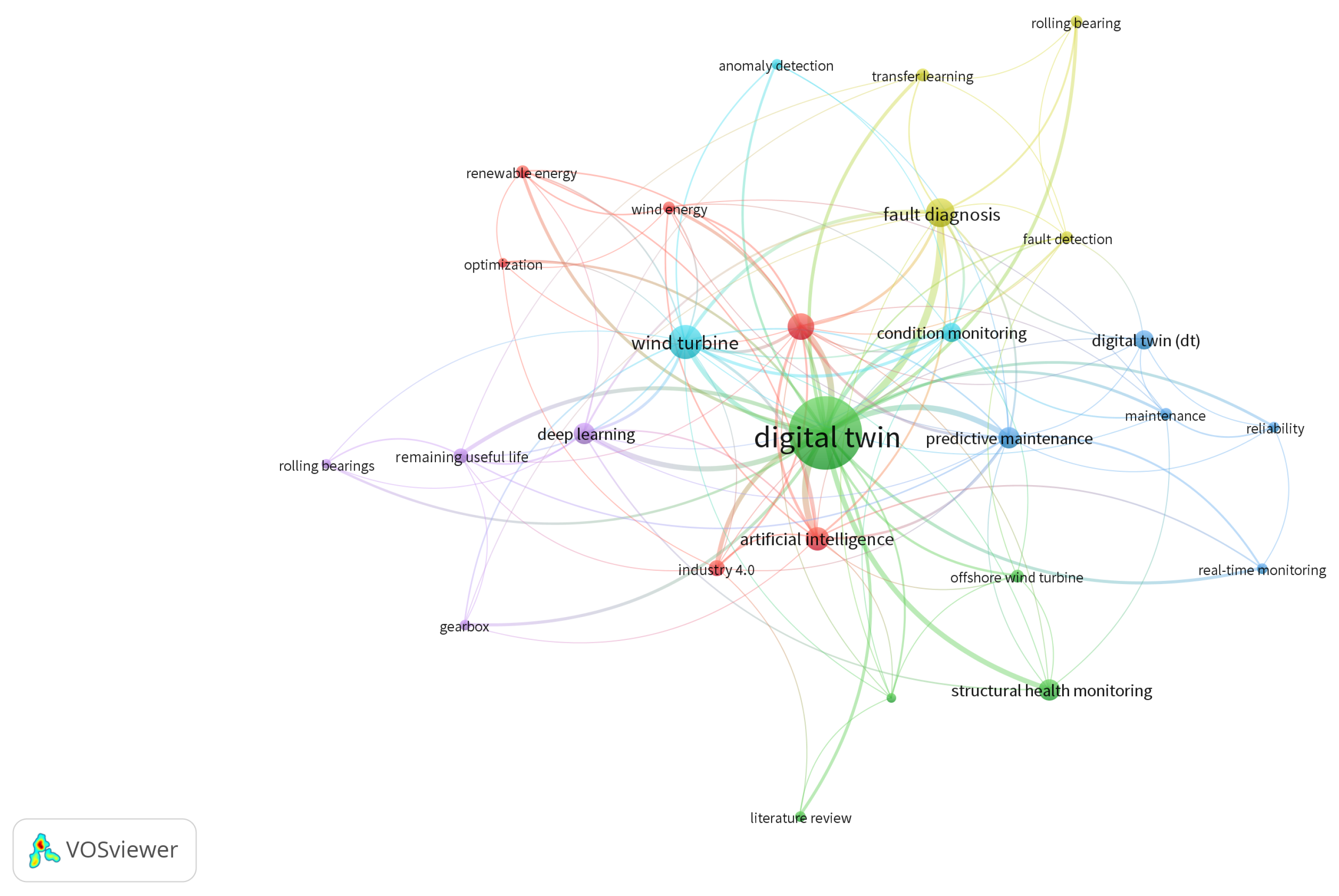
| ((“digital twin”) AND (wind W/1 (turbine OR farm OR “power plant”)) AND (“AI” OR “machine learning” OR “artificial intelligence” OR “deep learning” OR “IoT”) AND (“condition monitoring” OR “fault prediction” OR “remaining useful life” OR “RUL” OR “predictive W/1 maintenance” OR “preventive W/1 maintenance” OR “operation W/1 maintenance” OR “O&M” OR “maintenance W/1 strategy” OR “maintenance W/1 optimization”)) |
| Ref. & Year | RQ1—Main Components/Subsystems | RQ2—DT Techniques and Applications | RQ3—AI Models | RQ4—Challenges and Trends |
|---|---|---|---|---|
| [10] (2025) | Blades; Gearbox; Nacelle | Physics-based DT; Data-driven DT; Hybrid DT | ML; DL (unspecified) | No specific wind turbine focus; No real implementations |
| [28] (2026) | Gearbox; Generator; Bearings; Power electronics; Pitch and yaw (fault level) | Physics-based DT; Data-driven DT; Hybrid DT; Fault detection; Diagnosis | RF; SVM; ANN; CNN; LSTM | Low SCADA sampling frequency; Data heterogeneity; Lack of public datasets; Limited RUL analysis; Pre-DT stage; Deficient multiphysics modeling |
| [29] (2025) | Gearbox; Bearings; Gears | Physics-based DT; Data-driven DT; Hybrid DT; Prognostics; RUL estimation | CNN; LSTM; Transformers; GNN; GAN | High computational cost; Lack of scalability; Component-level DT |
| [30] (2026) | Gearbox; Bearings; Generator; Converters | AI-driven DT (trend, not implemented) | CNN; LSTM; Transformers; Autoencoders | Black-box models; No industrial deployment |
| [31] (2023) | Blades; Gearbox; Generator; Drivetrain; Tower; Offshore structures | Physics-based DT; Data-driven DT; Hybrid DT; O&M optimization; Decision support | Bayesian models; ANN; Stochastic models; Fuzzy logic | Mostly conceptual DTs; High computational cost; Limited scalability; Offshore data limitations |
| [32] (2024) | Floating platforms; Tower; Mooring lines; Blades; Gearbox (conceptual) | Physics-informed DT; Hybrid DT; Reliability-based DT; O&M optimization | ANN; Bayesian models | Mostly conceptual; No real-time DT; No cost analysis; Lack of standardized frameworks |
| [33] (2025) | Tower; Drivetrain; Blades; Floating platforms | Physics-based DT; Hybrid DT; Real-time SHM (conceptual) | ANN; Bayesian models; Kalman filters | No industrial real-time DT; Sensor limitations; Severe offshore conditions |
| [34] (2024) | Monopiles; Towers; Structural elements | FEM-based DT; Hybrid DT; Structural prognostics; Fatigue analysis | ANN; Neuro-fuzzy models | Exclusively structural focus; No SCADA integration; No system-level DT; No modern DL models |
| [35] (2025) | Structural systems; Electrical systems; Environmental systems (macro level) | DT + SHM + RBI; Integrity management | Not analyzed (bibliometric only) | Disciplinary fragmentation; Lack of integration; Low industrial adoption |
| [36] (2025) | Blades; Gearbox; Bearings; Generators; Converters | IoT-based DT; AI-driven DT; Intelligent asset management | ML; DL (unspecified) | Lack of standardization; No data pipelines; No benchmarking frameworks |
| [37] (2025) | Tower; Substructures; Foundations | FEM-based DT; ROM-based DT; SCADA-based DT | ANN | No system-level DT; No real-time DT |
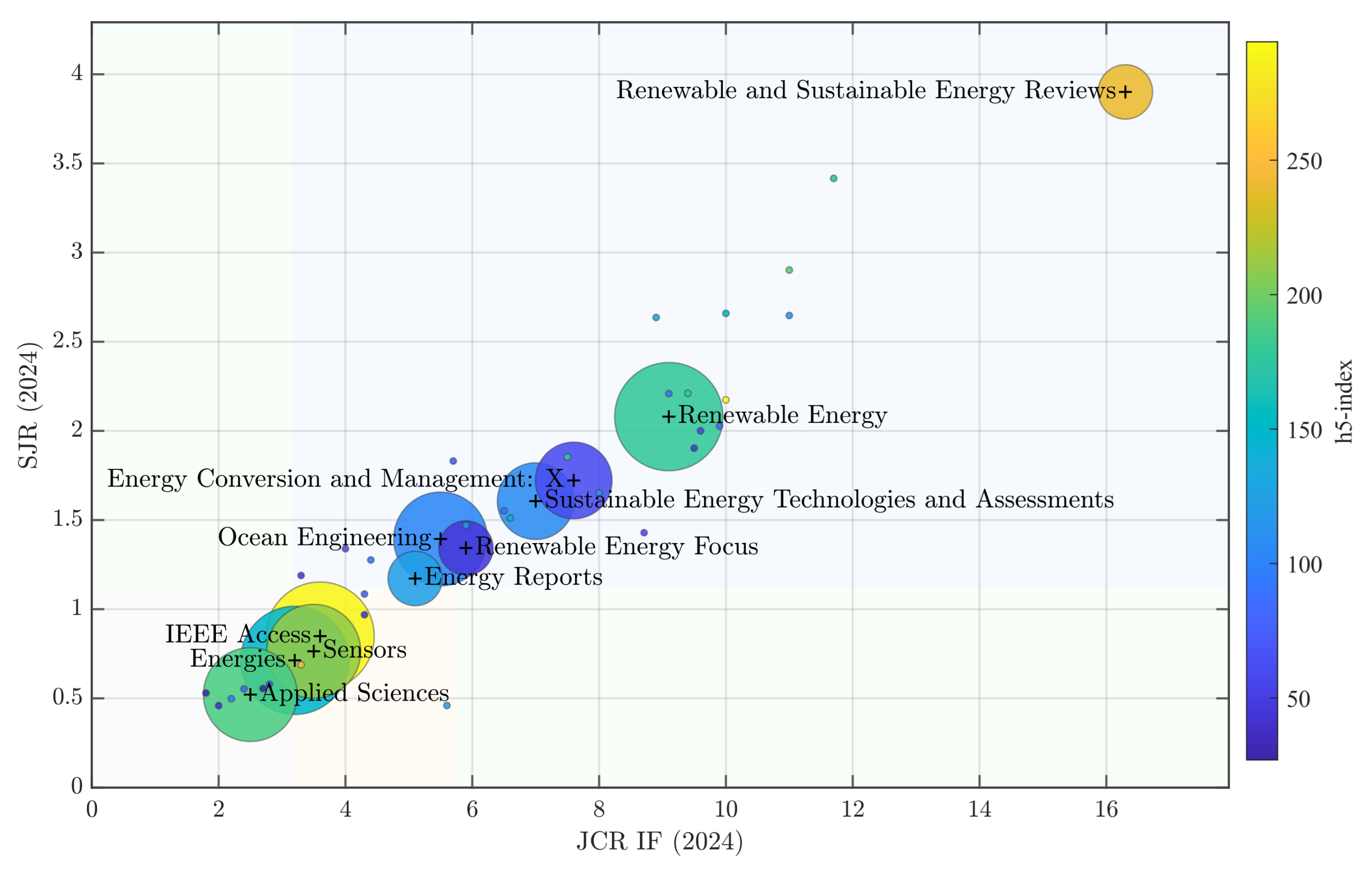
| Rank | Journal Name | No. Papers | JCR 2024 IF | JCR Quartile | SJR 2024 IF | SJR Quartile | h5-Index Google | Value |
|---|---|---|---|---|---|---|---|---|
| 1 | Renewable and Sustainable Energy Reviews | 2 | 16.3 | Q1 | 3.901 | Q1 | 240 | 7630.36 |
| 2 | Renewable Energy | 5 | 9.1 | Q1 | 2.08 | Q1 | 178 | 4211.48 |
| 3 | IEEE Transactions on Industrial Informatics | 1 | 11.7 | Q1 | 3.416 | Q1 | 174 | 1738.57 |
| 4 | Journal of Cleaner Production | 1 | 10 | Q1 | 2.174 | Q1 | 294 | 1597.89 |
| 5 | Applied Energy | 1 | 11 | Q1 | 2.902 | Q1 | 193 | 1540.24 |
| 6 | IEEE Access | 5 | 3.6 | Q2 | 0.849 | Q1 | 288 | 1100.30 |
| 7 | Energy Conversion and Management | 1 | 10 | Q1 | 2.659 | Q1 | 154 | 1023.72 |
| 8 | Energy | 1 | 9.4 | Q1 | 2.211 | Q1 | 180 | 935.25 |
| 9 | Sustainable Energy Technologies and Assessments | 3 | 7 | Q2 | 1.606 | Q1 | 109 | 919.03 |
| 10 | Reliability Engineering & System Safety | 1 | 11 | Q1 | 2.647 | Q1 | 114 | 829.83 |
| 11 | Ocean Engineering | 4 | 5.5 | Q1 | 1.394 | Q1 | 105 | 805.04 |
| 12 | Mechanical Systems and Signal Processing | 1 | 8.9 | Q1 | 2.636 | Q1 | 131 | 768.33 |
| 13 | Expert Systems with Applications | 1 | 7.5 | Q1 | 1.854 | Q1 | 183 | 636.15 |
| 14 | Energy Conversion and Management: X | 3 | 7.6 | Q1 | 1.722 | Q1 | 61 | 598.74 |
| 15 | Sensors | 4 | 3.5 | Q2 | 0.764 | Q1 | 210 | 561.54 |
| 16 | Computers in Industry | 1 | 9.1 | Q1 | 2.209 | Q1 | 88 | 442.24 |
| 17 | Energies | 5 | 3.2 | Q3 | 0.713 | Q1 | 148 | 422.10 |
| 18 | Energy Strategy Reviews | 1 | 9.9 | Q1 | 2.027 | Q1 | 81 | 406.36 |
| 19 | Engineering Applications of AI | 1 | 8 | Q1 | 1.652 | Q1 | 117 | 386.57 |
| 20 | Energy Reports | 2 | 5.1 | Q2 | 1.172 | Q1 | 125 | 373.58 |
| 21 | Applied Soft Computing | 1 | 6.6 | Q1 | 1.511 | Q2 | 144 | 359.01 |
| 22 | Energy and AI | 1 | 9.6 | Q1 | 2 | Q1 | 58 | 278.40 |
| 23 | IEEE Transactions on Instrumentation and Measurement | 1 | 5.9 | Q1 | 1.471 | Q1 | 124 | 269.05 |
| 24 | Applied Sciences | 4 | 2.5 | Q1 | 0.521 | Q2 | 188 | 244.87 |
| 25 | ISA Transactions | 1 | 6.5 | Q1 | 1.552 | Q1 | 89 | 224.46 |
| 26 | Energy Nexus | 1 | 9.5 | Q1 | 1.903 | Q1 | 47 | 212.42 |
| 27 | International Journal of Thermofluids | 1 | 8.71 | Q1 | 1.429 | Q1 | 60 | 186.70 |
| 28 | SHM | 1 | 5.7 | Q1 | 1.831 | Q1 | 71 | 185.25 |
| 29 | Sustainability | 1 | 3.3 | Q1 | 0.688 | Q1 | 250 | 141.90 |
| 30 | IEEE Systems Journal | 1 | 4.4 | Q1 | 1.276 | Q1 | 86 | 120.71 |
| 31 | Renewable Energy Focus | 2 | 5.9 | Q2 | 1.343 | Q1 | 46 | 182.25 |
| 32 | Structures | 1 | 4.3 | Q1 | 1.085 | Q1 | 74 | 86.31 |
| 33 | Structural and Multidisciplinary Optimization | 1 | 4 | Q1 | 1.339 | Q1 | 62 | 83.02 |
| 34 | Measurement | 1 | 5.6 | Q1 | 0.46 | Q2 | 124 | 79.86 |
| 35 | Wind Energy | 1 | 3.3 | Q2 | 1.189 | Q2 | 49 | 48.07 |
| 36 | Intelligent Systems with Applications | 1 | 4.3 | Q2 | 0.969 | Q1 | 43 | 44.79 |
| 37 | Journal of Marine Science and Engineering | 1 | 2.8 | Q2 | 0.579 | Q2 | 79 | 32.02 |
| 38 | Mathematics | 1 | 2.2 | Q1 | 0.498 | Q2 | 99 | 27.12 |
| 39 | Frontiers in Energy Research | 1 | 2.4 | Q3 | 0.553 | Q2 | 80 | 26.54 |
| 40 | Energy Informatics | 1 | 4.6 | - | 0.685 | Q2 | 32 | 25.21 |
| 41 | IET Smart Grid | 1 | 2.7 | Q2 | 0.555 | Q2 | 27 | 10.11 |
| 42 | Engineering Reports | 1 | 2 | Q2 | 0.459 | Q2 | 42 | 9.64 |
| 43 | Ships and Offshore Structures | 1 | 1.8 | Q2 | 0.53 | Q2 | 33 | 7.87 |
| 44 | IFAC Papers OnLine | 1 | 1.21 | - | 0.328 | - | 46 | 4.56 |
| 45 | IJOMAM | 1 | 0.7 | - | 0.174 | Q4 | 12 | 0.37 |
| 46 | IEEE INDIN | 1 | - | - | 0.257 | - | 20 | - |
| 47 | J. Dyn. Monit. Diagnost. | 1 | 9.67 | - | 1.939 | Q1 | - | - |
| 48 | ICCSI | 1 | - | - | - | - | 10 | - |
| 49 | CPERE | 1 | - | - | - | - | 23 | - |
| 50 | ICRERA | 1 | - | - | - | - | 18 | - |
| 51 | ICNEPE | 1 | - | - | - | - | - | - |
| 52 | DT | 1 | - | - | - | - | - | - |
| 53 | AINIT 2024 | 1 | - | - | - | - | - | - |
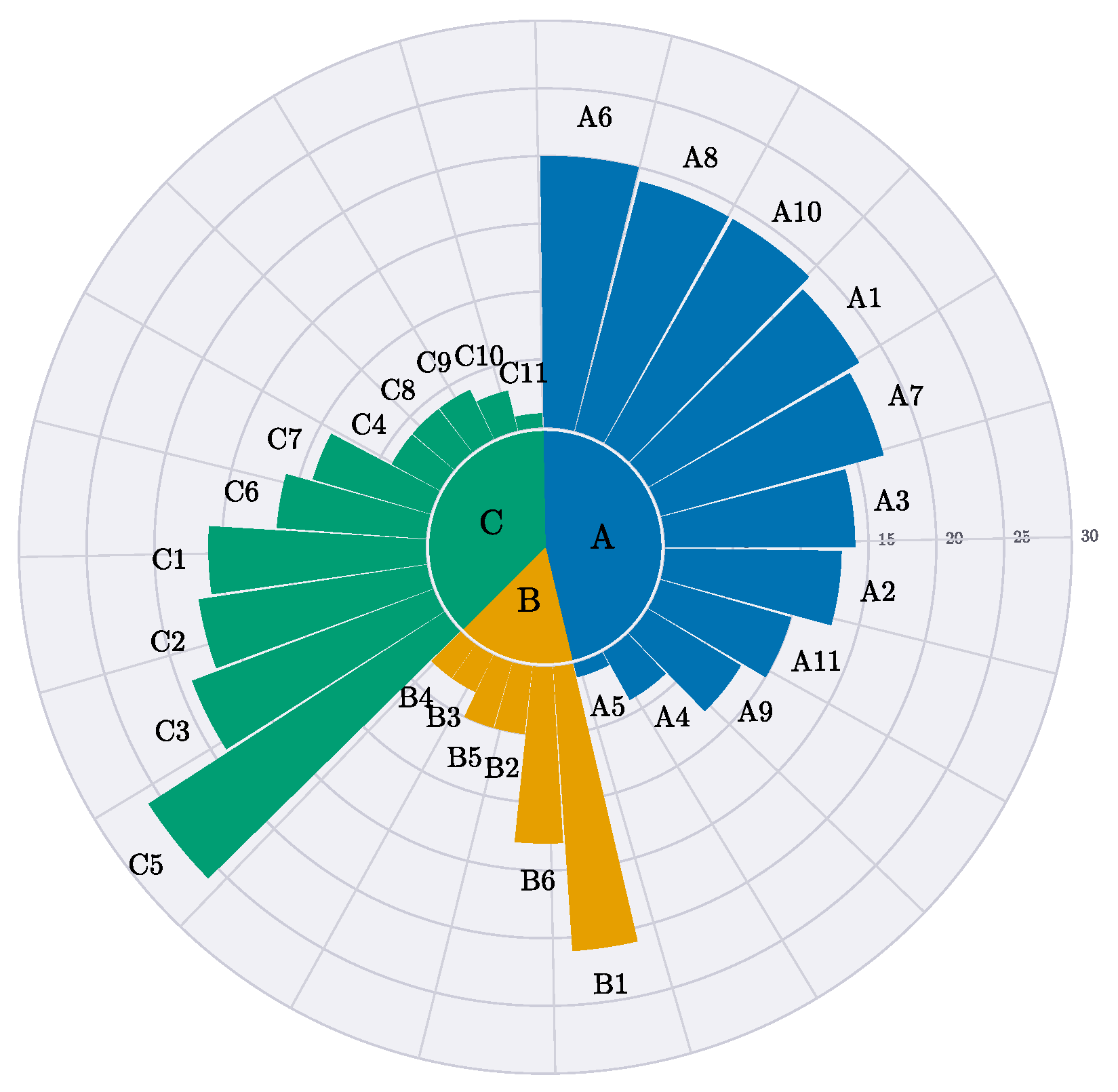
| Item | Description | References | f |
|---|---|---|---|
| A. Components | |||
| A1 | Gearbox | [8,12,31,38,39,40,41,42,43,44,45,46,47,48,49,50,51,52] | 18 |
| A2 | Bearings | [8,38,39,40,41,42,43,44,46,50,53,54,55] | 13 |
| A3 | Electrical Generator (PMSG/DFIG) | [9,30,31,32,36,38,44,45,56,57,58,59,60,61] | 14 |
| A4 | Power Converter (IGBT/DC-Link/ Power Module) | [38,45,56,62] | 4 |
| A5 | Power Transformer | [63] | 1 |
| A6 | Blades | [8,9,10,31,36,44,45,48,50,64,65,66,67,68,69,70,71,72,73,74] | 20 |
| A7 | Rotor and Hub (Hub–Shaft) | [8,10,12,31,37,50,52,55,64,65,67,70,71,72,73,75,76] | 17 |
| A8 | Tower | [8,31,32,33,34,35,37,38,58,68,72,77,78,79,80,81,82,83,84] | 19 |
| A9 | Foundation | [31,32,38,42,47,67,79,85] | 8 |
| A10 | Sensors and Multi-sensor Modules | [9,20,39,40,41,42,43,44,45,46,48,56,63,67,68,71,80,81,86] | 19 |
| A11 | Wind Turbine (Complete System) | [20,32,67,71,75,85,86,87,88,89] | 10 |
| B. Subsystem | |||
| B1 | Drivetrain | [8,12,30,36,38,39,40,41,42,45,46,50,51,53,57,58,60,61,64,76,90] | 21 |
| B2 | Electrical/Electronic Subsystem | [38,56,62,63,91] | 5 |
| B3 | Hydraulic and Lubrication System | [31,44,53] | 3 |
| B4 | Thermal and Cooling System | [40,41,45] | 3 |
| B5 | Pitch and Yaw Subsystems | [31,37,38,44,45] | 5 |
| B6 | Wind Farm, Power Grid | [31,32,36,37,38,44,45,53,64,67,75,85,88] | 13 |
| C. SCADA Variables | |||
| C1 | Wind Speed and Direction | [20,37,39,40,41,53,57,60,71,75,80,81,86,91,92,93] | 16 |
| C2 | Torque and Rotor Speed | [30,37,39,40,41,42,46,52,57,58,60,61,67,80,81,86,91] | 17 |
| C3 | Power and Generated Energy | [9,20,30,36,38,39,42,45,53,57,59,60,64,71,78,86,87,88,91] | 19 |
| C4 | Control Angles (Pitch–Yaw) | [30,37,67,94] | 4 |
| C5 | Dynamic and Vibration Variables | [9,10,12,31,34,36,40,41,42,43,45,46,49,51,52,54,58,63,68,69,71,72,73,76,80,90] | 26 |
| C6 | Structural Strain and Stress (Strain, Bending, Load) | [10,31,32,39,48,68,71,72,77,78,79] | 11 |
| C7 | Temperatures (Generator, Oil, Ambient) | [8,30,31,36,40,41,44,62,90] | 9 |
| C8 | Hydraulic Pressure/Lubrication State | [31,40,41,53] | 4 |
| C9 | Electrical Variables (Currents, Voltages, Frequency) | [43,56,62,63] | 4 |
| C10 | Acoustic Signals | [31,64,95] | 3 |
| C11 | Maintenance and Event Logs | [89] | 1 |
| Item | Description | References | f |
|---|---|---|---|
| A. Approaches | |||
| A1 | Data-driven: Data-based diagnostic and prognostic models | [8,30,31,34,36,38,39,40,41,42,43,44,45,46,56,58,59,63,64,65,66,70,76,80,81,87,90,91,96,97] | 30 |
| A2 | Hybrid physics–data: Integration of physical and data models | [8,9,12,30,31,32,35,36,38,42,45,47,48,49,52,53,54,55,57,58,60,61,62,67,68,69,71,72,73,75,76,78,79,80,82,83,84,90,96,98] | 40 |
| A3 | Multi-sensor and data fusion: Fusion of SCADA, Cloud, SHM, CM, IoT, visual data | [9,40,41,42,43,44,46,64,67,77,78,94,99,100,101] | 15 |
| A4 | Cognitive and adaptive twins | [31,33,38,39,40,41,42,44,45,67,102] | 11 |
| B. Platforms | |||
| B1 | DT development platforms: MATLAB–Simulink + Python/ OpenFAST/OpenSees/Simscape Electrical | [8,32,42,49,50,56,57,62,67,75,78,79,87,96] | 14 |
| B2 | Edge–Cloud and IoT infrastructure: Google Colab/Edge/Mosquitto/Telegraf/InfluxDB/Microsoft SQL Server | [20,31,35,36,40,41,42,43,45,48,58,59,63,64,67,77,79,81,85,86,88,91,94,99,100,102,103] | 27 |
| B3 | Interactive visualization and monitoring: Unity3D/ECharts/web interfaces 3D/O&M dashboards | [31,39,40,41,45,50,65] | 7 |
| B4 | Experimental validation platforms: CMS testbeds, UAV–RTK, multi-channel AE systems, converter laboratories | [9,39,40,41,46,53,62,66] | 8 |
| B5 | Open and modular frameworks: DigiWind/DT-as-a-Service (DTaaS)/open-source and scalable platforms | [31,32,38,45,79] | 5 |
| C. Architectures | |||
| C1 | Cyber–physical with feedback: CPS–DT with closed physical-virtual loop and adaptive updating | [12,32,39,40,41,42,43,44,45,57,66,67,76,79,81,88] | 16 |
| C2 | Modular and hierarchical architectures: Layered structures (Physical–Virtual–Diagnosis–Decision) | [31,38,40,41,42,43,45,46,50,63,67,78,79,83,88,94] | 16 |
| C3 | Federated and distributed: Federated and distributed DTs | [36,38,44,46,59,67] | 6 |
| C4 | Cognitive and autonomous hierarchical | [9,31,44,62] | 4 |
| C5 | Specific application architectures: Intelligent O&M, environmental safety, visual architecture | [30,31,39,62,66,87] | 4 |
| D. Software | |||
| D1 | Physical modeling and simulation: MATLAB–Simulink/Simscape/OpenFAST/OpenSees/FAST coupling/SAFE/COMSOL/ANSYS/Abaqus/Nastran/ RAMSeries/SIMPACK | [8,12,32,33,35,39,40,41,42,43,45,47,49,57,61,62,67,68,75,77,78,79,82,87] | 24 |
| D2 | Python: (NumPy, Pandas, SciPy, Matplotlib, Scikit-learn, TensorFlow/PyTorch/Keras/MindSpore/Spark MLlib) | [20,31,34,40,41,42,43,44,45,46,50,54,56,63,67,75,79,80,86,88,89,94,96,97,98] | 25 |
| D3 | 3D Visualization and interfaces: Unity3D/3DS Max/NX/ECharts/MATLAB App Designer/interactive 3D interfaces/Blender | [31,39,42,50,65,67,76,79,89] | 9 |
| D4 | Reconstruction and visual detection: ContextCapture/CAD-Fusion/AGU-Vallen Wavelet/YOLOv5/3D photogrammetry | [66,67] | 2 |
| D5 | Industrial and cloud ecosystems: Azure DTs/Siemens MindSphere/TimeScaleDB/HPC–Cloud/Big Data Analytics/Docker–OPC UA | [31,38,45,63] | 4 |
| E. Applications | |||
| E1 | Intelligent fault diagnosis | [12,30,39,40,41,42,45,49,52,55,56,57,62,73,74,76,89,91] | 18 |
| E2 | RUL prognosis and structural degradation | [8,31,32,36,40,41,42,45,46,53,54,59,67,68,78,79,80,84,104] | 19 |
| E3 | Risk assessment and structural monitoring | [8,9,10,30,39,40,41,45,48,67,68,72,78,82,83,90,104] | 18 |
| E4 | Intelligent operational and control optimization | [38,45,51,67,75,97] | 6 |
| E5 | Maintenance management and planning (O&M) | [12,31,32,36,38,44,45,50,58,59,60,61,69,81,88,89,96] | 17 |
| E6 | Dynamic simulation and operational visualization | [8,49,50,84,94,100,101] | 7 |
| E7 | Probabilistic and risk modeling | [32,45,67,79,84,104] | 7 |
| Item | Description | References | f |
|---|---|---|---|
| A. ML | |||
| A1 | Classic models (SVM, DT, RF, k-NN, XGBoost, Gradient Boosting Regressor) | [12,20,30,31,39,44,57,62,63,65,73,76,102] | 13 |
| A2 | Regression models | [20,31,32,41,42,53,58,71,79,85,94] | 11 |
| A3 | Bayesian and Probabilistic models (BDLM, Gaussian Process, Bayesian Optimization, Inference) | [33,35,67,78] | 5 |
| A4 | Metaheuristics and Evolutionary | [39,41,42,47,76,78] | 6 |
| A5 | Unsupervised Clustering (K-means) | [38,46] | 2 |
| A6 | Artificial Neural Networks (ANN) | [30,68,77,80,87,90,96] | 7 |
| B. DL | |||
| B1 | Deep neural networks and variants (CNN, RNN, LSTM, BiLSTM, TCN, LETCN, etc.) | [12,20,31,34,36,40,41,42,46,48,51,52,53,56,63,66,67,68,73,74,80,86,91,94,96,99,102] | 28 |
| B2 | Advanced attention and representation architectures (Transformers, GNN, DRL, RARNN) | [31,44,58,67] | 4 |
| B3 | Physics-informed networks (PINN, PI-DL, hybrid MLP-BP) | [42,67,75,80,90,96] | 7 |
| B4 | Unsupervised, generative, and federated learning | [38,43,44,45,57,65] | 6 |
| C. Evaluation Metrics | |||
| C1 | Classification and diagnostic performance (Accuracy, Precision, F1, ROC-AUC) | [30,31,34,36,39,43,44,51,56,58,59,62,63,68,74,80,94,96,96] | 19 |
| C2 | Error and predictive fit (RMSE, MAE, MAPE, R2) | [31,40,41,42,53,75,78,90,96] | 9 |
| C3 | Structural reliability and failure probability (, , ) | [53,67,78] | 3 |
| C4 | Others | [20,31,34,36,38,44,58,59,67,68,80,94,99,102] | 15 |
| Item | Description | References | f |
|---|---|---|---|
| A. Challenges | |||
| A1 | Real-time processing and computational latency | [12,31,32,35,38,39,40,41,42,43,44,45,46,47,48,51,53,56,57,58,61,63,64,65,66,67,68,71,72,76,79,80,81,82,89,94,103] | 38 |
| A2 | Synchronization and heterogeneity of multi-sensor data | [9,31,32,36,38,40,41,42,44,45,46,56,57,59,62,63,67,68,69,78,79,80,86,87,88,89,91,94] | 28 |
| A3 | Data scarcity and imbalance for training models | [20,32,34,35,40,41,42,43,44,45,46,53,54,55,57,58,63,66,67,71,73,75,79,96] | 25 |
| A4 | DT reliability and complexity | [8,9,31,33,38,39,40,41,42,43,44,45,46,47,49,56,63,65,66,67,69,75,76,78,94,98,103] | 27 |
| A5 | Interoperability, standardization, and cybersecurity | [12,20,31,32,36,38,39,40,41,43,44,45,46,50,56,57,59,61,62,63,65,67,71,79,81,84,85,88,94,98,99,101,103] | 35 |
| A6 | Environmental variability and severe loads (wind, waves, corrosion) | [12,32,68,77,79,80] | 6 |
| A7 | Physics–AI integration, modeling, and scaling | [12,20,40,41,42,44,46,48,53,54,55,56,57,61,62,64,67,68,71,72,75,77,78,80,81,88,89,102] | 28 |
| A8 | Experimental validation and scientific traceability | [10,31,40,41,42,44,46,48,53,61,62,63,67,70,72,73,77,80,82,83,84,90,104] | 23 |
| A9 | Governance and regulatory framework | [31,36,38,59] | 4 |
| B. Trends | |||
| B1 | Use of IoT, 5G, and edge-computing architectures for (near) real-time monitoring | [8,30,36,38,41,43,44,45,48,49,50,58,60,70,74,78,81,94,97,99,100,101,104] | 23 |
| B2 | Integration of hybrid wind turbine DTs in energy systems | [8,12,20,30,31,35,36,38,45,54,55,59,61,67,68,71,76,77,78,80,101] | 21 |
| B3 | Increased use of advanced AI and analytics in DT-based RUL and predictive maintenance approaches | [8,12,30,36,38,39,40,41,42,43,44,46,49,50,52,54,56,58,63,64,68,70,75,83,84,86,87,91,94,96,98,100,101,104] | 34 |
| B4 | Strengthening of SHM | [8,9,30,31,33,48,51,52,53,57,66,68,69,70,75,78,79,83,88,101,104] | 21 |
Disclaimer/Publisher’s Note: The statements, opinions and data contained in all publications are solely those of the individual author(s) and contributor(s) and not of MDPI and/or the editor(s). MDPI and/or the editor(s) disclaim responsibility for any injury to people or property resulting from any ideas, methods, instructions or products referred to in the content. |
© 2026 by the authors. Licensee MDPI, Basel, Switzerland. This article is an open access article distributed under the terms and conditions of the Creative Commons Attribution (CC BY) license.
Share and Cite
Maldonado-Correa, J.; Cuenca-Granda, J.; Torres-Cabrera, J.; Cerda Mejía, G.; Bastidas Barragan, W.D.; Guapulema, R.; Paccha-Herrera, E.; Solano, J.C.; Tapia-Peralta, D.; Benavides, J.; et al. Digital Twin Technology in Wind Turbine Condition Monitoring, Predictive Maintenance, and RUL Estimation: A Systematic Literature Review. Energies 2026, 19, 1477. https://doi.org/10.3390/en19061477
Maldonado-Correa J, Cuenca-Granda J, Torres-Cabrera J, Cerda Mejía G, Bastidas Barragan WD, Guapulema R, Paccha-Herrera E, Solano JC, Tapia-Peralta D, Benavides J, et al. Digital Twin Technology in Wind Turbine Condition Monitoring, Predictive Maintenance, and RUL Estimation: A Systematic Literature Review. Energies. 2026; 19(6):1477. https://doi.org/10.3390/en19061477
Chicago/Turabian StyleMaldonado-Correa, Jorge, José Cuenca-Granda, Joel Torres-Cabrera, Galo Cerda Mejía, Wilson Daniel Bastidas Barragan, Rocío Guapulema, Edwin Paccha-Herrera, Juan Carlos Solano, Darwin Tapia-Peralta, José Benavides, and et al. 2026. "Digital Twin Technology in Wind Turbine Condition Monitoring, Predictive Maintenance, and RUL Estimation: A Systematic Literature Review" Energies 19, no. 6: 1477. https://doi.org/10.3390/en19061477
APA StyleMaldonado-Correa, J., Cuenca-Granda, J., Torres-Cabrera, J., Cerda Mejía, G., Bastidas Barragan, W. D., Guapulema, R., Paccha-Herrera, E., Solano, J. C., Tapia-Peralta, D., Benavides, J., & Laverde-Albarracín, C. (2026). Digital Twin Technology in Wind Turbine Condition Monitoring, Predictive Maintenance, and RUL Estimation: A Systematic Literature Review. Energies, 19(6), 1477. https://doi.org/10.3390/en19061477