Article

A Novel SOC Estimation Method for Lithium-Ion Batteries Based on Serial LSTM-UKF Fusion

1
China Energy New Energy, Technology, Research Institute, Beijing 102206, China
2
Shenzhen Automotive Research Institute, Beijing Institute of Technology, Shenzhen 518118, China
*
Author to whom correspondence should be addressed.
Energies 2026, 19(6), 1467; https://doi.org/10.3390/en19061467
Submission received: 30 January 2026 / Revised: 5 March 2026 / Accepted: 12 March 2026 / Published: 14 March 2026

Abstract

Accurate estimation of the State of Charge (SOC) of lithium-ion batteries is one of the core functions of a battery management system and is of great significance for ensuring the safe operation of electric vehicles and optimizing energy utilization. However, due to the strong nonlinearity, time-varying characteristics, and interference from complex operating conditions within the battery, high-precision SOC estimation faces severe challenges. To address the problems that a single data-driven method lacks physical constraints and a single model-driven method struggles to characterize complex nonlinearities, this paper proposes a series-connected LSTM-UKF fusion estimation method. This method first utilizes a Long Short-Term Memory network to learn the dynamic characteristics of the battery from historical voltage and current data, capturing the long-term dependencies of SOC changes to achieve an initial prediction. Subsequently, using this predicted value as the observation input, an Unscented Kalman Filter based on a second-order RC equivalent circuit model is introduced for optimal state correction, effectively suppressing model uncertainty and measurement noise. Simulation validation under various dynamic conditions, such as constant current discharge and FUDS, shows that compared to single LSTM or UKF algorithms, the proposed fusion method has significant advantages in estimation accuracy, convergence speed, and robustness. Its root mean square error is reduced to 0.0031, and it maintains stable estimation performance under different operating conditions. This study provides an effective data-model fusion solution for high-precision SOC estimation of lithium-ion batteries under complex operating conditions.

1. Introduction

Against the backdrop of the increasingly prominent energy crisis and environmental pollution issues, new energy vehicles have become the core direction for the transformation and upgrading of the global automotive industry. Lithium-ion batteries, leveraging their advantages such as high energy density [1] and long cycle life, have emerged as the core energy storage components of the power systems in new energy vehicles [2]. The battery management system (BMS) is the key to ensuring the safe and efficient operation of lithium-ion batteries. As a core parameter of the BMS, the State of Charge (SOC) directly determines the accuracy of range prediction and driving safety of new energy vehicles. However, lithium-ion batteries exhibit complex nonlinear electrochemical characteristics internally, and their charging and discharging processes are susceptible to interference from external environmental factors such as temperature and current rate. How to achieve fast and accurate online estimation of SOC remains a key technical bottleneck restricting the large-scale application of lithium-ion batteries [3].
Research on SOC estimation technologies for lithium-ion batteries has evolved over many years. Traditional estimation methods are mainly the ampere-hour integral method and the open circuit voltage method. These methods, which obtain the remaining battery capacity through discharge tests, are regarded as the most direct and simple approaches to determine the SOC value of lithium-ion batteries [4]. The ampere-hour integral method features a simple principle and easy engineering implementation, but its accuracy is highly dependent on the initial SOC value, and the current measurement noise will accumulate over time to form estimation errors. The open circuit voltage method realizes SOC estimation by fitting the OCV-SOC curve; although it has high accuracy, it requires the battery to be left standing for a long time, making it difficult to meet the demand for online SOC estimation in new energy vehicles. To compensate for the shortcomings of traditional methods, scholars at home and abroad have carried out extensive improvement research. M. Einhorn et al. [5] optimized the OCV-SOC function curve using the linear interpolation method, which improved the estimation accuracy to a certain extent but still failed to solve the problem of long standing time. W. Waag et al. [6] attempted to estimate SOC by utilizing the correlation between electrochemical impedance spectroscopy and SOC; this method has high estimation accuracy, but its precision is vulnerable to the changes in the internal chemical characteristics of the battery, resulting in insufficient robustness.
With the development of control theory and artificial intelligence technology, SOC estimation methods have gradually upgraded towards intellectualization and precision. In the direction of Kalman filter improvement, Xiong Rui et al. [7,8] proposed a dynamic covariance estimation algorithm. By establishing the functional mapping relationship between the noise covariance matrix and the system input and output variables, the algorithm realized the closed-loop feedback optimization of the extended Kalman filter, effectively enhancing the robustness of the algorithm throughout the battery’s life cycle. In the direction of machine learning integration, Y. Shen et al. [9] combined the improved PID controller with a neural network to achieve adaptive interference adjustment for SOC estimation. H. F. Dai et al. [10] integrated the adaptive neuro-fuzzy inference system with the Kalman filter, solving the problem of decreased estimation accuracy in the scenario of series-connected multiple batteries. H. Sheng et al. [11] proposed a fuzzy weighted least square support vector regression algorithm, which enhanced the adaptability of the model to noisy data through a dual-weight mechanism.
In recent years, numerous cutting-edge research findings have emerged in the field of State of Charge (SOC) estimation, providing crucial support for method optimization. In terms of electrochemical-thermal coupling modeling, Hongjin Kuang et al. [12] proposed a dynamic Diels–Alder reaction crosslinked metal–organic framework/poly(ionic liquid) composite solid electrolyte (DA-PIL/MOF). Their research indicated that the regulatory effect of temperature on lithium-ion transport efficiency and interface stability directly influences the robustness of SOC estimation. Wenqian Hao et al. [13] further revealed through a mechanics-thermal-electrochemistry coupling model based on phase field theory that temperature gradients alter lithium-ion concentration distribution, thereby affecting dendrite growth morphology and indirectly leading to SOC estimation deviations. In the research on electrolyte and interface characteristics, Dong Lv et al. [14] developed a bioinspired cellulose nanofiber/poly(ionic liquid) gel electrolyte (CNP GPE). By virtue of its hierarchical porous structure, this electrolyte achieves dual-mode lithium-ion transport, with a lithium-ion transference number as high as 0.7, and can maintain stable cycling even at 80 °C. It thus provides reliable electrolyte system support for SOC estimation under extreme operating conditions.
Research on battery recycling and full-lifecycle characteristics has also brought new challenges and opportunities to SOC estimation. Feng Hu et al. [15]’s study on the spatial distribution of lithium battery recycling enterprises in China demonstrated that the inconsistency of retired batteries (such as capacity fading and internal resistance increase) stems from environmental differences and operational standards during the recycling process. Such characteristic differences can significantly reduce the accuracy of traditional SOC estimation models. In terms of multi-physics field coupling and dendrite suppression, Wenqian Hao et al. [13] found that physical parameters such as electric potential, anisotropic intensity, and modulus regulate dendrite growth morphology, leading to cumulative errors in SOC estimation. In contrast, the DA-PIL/MOF electrolyte forms a stable Solid Electrolyte Interphase (SEI) layer through dynamic DA bonds, which effectively inhibits dendrite growth. Such interface optimization technologies offer new engineering ideas for improving the robustness of SOC estimation.
Despite certain progress made by existing methods, their estimation accuracy and real-time performance under complex operating conditions still need to be improved. Based on this, this paper proposes an SOC estimation method based on the tandem fusion of LSTM and UKF. By utilizing the Long Short-Term Memory (LSTM) network to capture the long-term dependencies in SOC changes and combining it with the Unscented Kalman Filter (UKF) featuring superior nonlinear processing capabilities, the method achieves high-precision and high-robustness SOC estimation. A simulation model is built on the Matlab 2016A/Simulink 2016A platform to verify the performance of the proposed method under various operating conditions, providing a new technical idea for SOC estimation of lithium-ion batteries under complex working conditions.

2. LSTM-UKF Fusion Algorithm Framework

Serial Fusion Strategy of LSTM and UKF

Single methods (such as standalone LSTM or UKF) have obvious limitations in SOC estimation: UKF exhibits high computational complexity, especially in high-dimensional systems, which may restrict its application in certain real-time scenarios. Meanwhile, at the end of battery discharge, the LSTM model often suffers from unsatisfactory convergence speed due to the increased complexity of internal chemical reactions within the battery. Therefore, it is necessary to combine it with other methods to improve estimation accuracy. This paper proposes an LSTM-UKF fusion algorithm for SOC estimation of lithium-ion batteries. The algorithm first uses the LSTM network to make a preliminary SOC prediction, and then performs filtering optimization on the predicted value through UKF to enhance estimation accuracy and robustness [16,17]. The specific process is shown in Figure 1.

3. Design of LSTM Prediction Model

3.1. Structure and Principle of LSTM

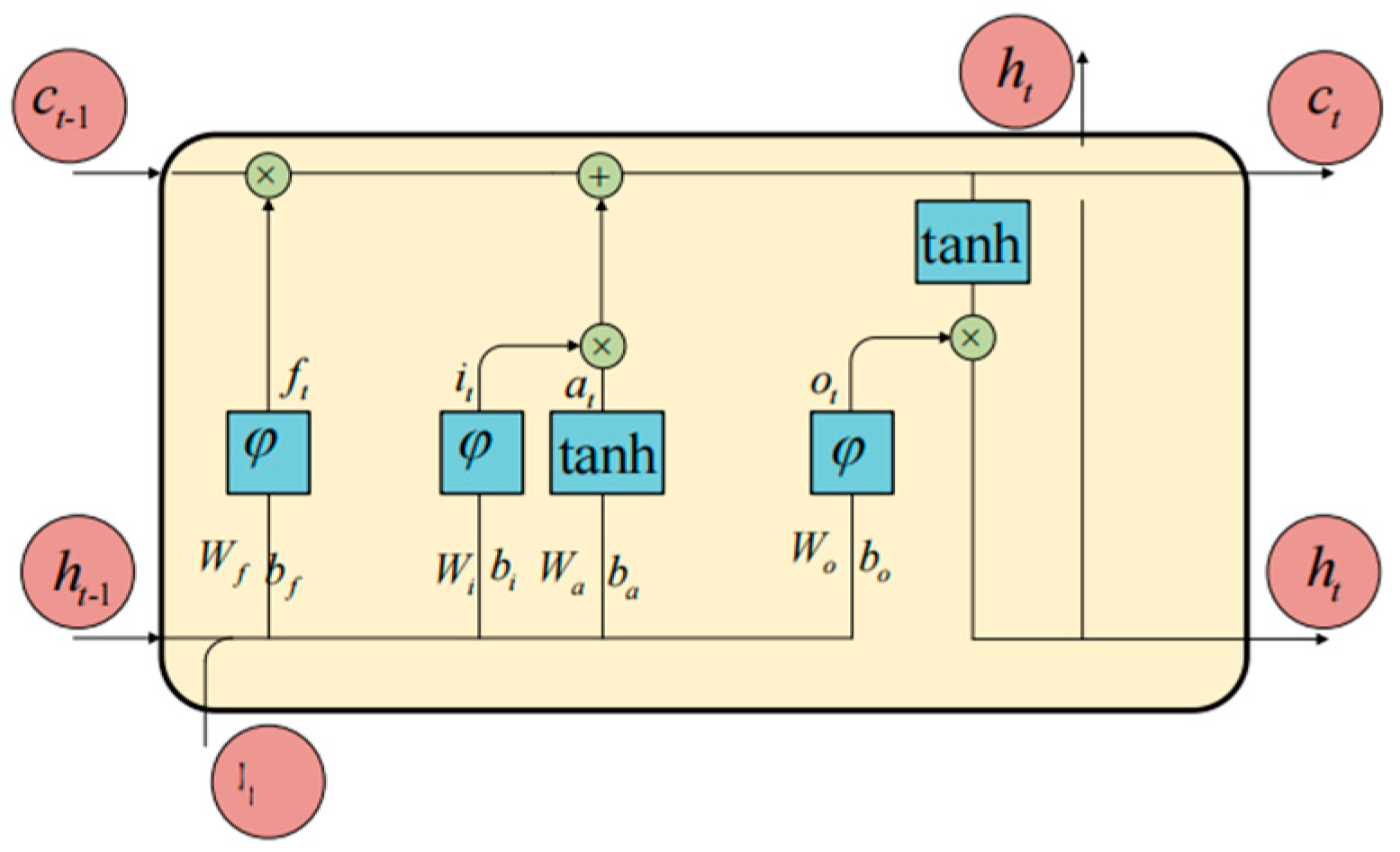
The Long Short-Term Memory (LSTM) network is an improved recurrent neural network structure. By introducing a gating mechanism to selectively update or forget information, it effectively addresses the gradient vanishing or exploding problem encountered by traditional RNNs when processing long sequences. This model can better capture long-term dependencies in time series [18]. The core of LSTM includes three gating units, namely the input gate, output gate, and forget gate, and its specific structure is shown in Figure 2.
The core of the Long Short-Term Memory (LSTM) network lies in its sophisticated gating system, including the following three key components: the input gate, forget gate, and output gate. These gating units collaboratively achieve precise control of the information flow of the cell state through nonlinear operations and parameterized weight matrices, enabling the network to selectively remember or forget features in time series. The calculations of LSTM mainly include the following steps:
(1) Input gate: determines the new information to be saved to the cell state at the current moment:
i t = ϕ ( W i , x x t + W i , h h t 1 + b i )
a t = tanh ( W a , x x t + W a , h h t 1 + b a )
This structure uses two activation functions, tanh and σ. tanh is used to generate candidate memory content, while σ controls which input information can be incorporated into the system.
(2) Forget gate: controls which historical information should be retained or discarded:
f t = ϕ ( W f , x x t + W f , h h t 1 + b f )
(3) State update: multiply the output of the forget gate f t with the state of the previous moment c t 1 , then add the processed result of the input gate i t and a t to update the current cell state:
c t = f t c t 1 + i t a t
where denotes the Hadamard product.
(4) Output gate: determines the output at the current moment based on the current cell state and hidden state:
o t = ϕ ( W o , x x t + W o , h h t 1 + b o )
h t = o t tanh ( c t )
(5) Fully connected layer:
y t = W h t + b W
The above process outlines the basic operational mechanism of LSTM. When applied to lithium-ion battery SOC estimation, this model typically requires training with a large amount of historical data to learn the complex nonlinear relationships between multiple variables such as voltage and current. Although LSTM exhibits good performance in SOC estimation, under certain abnormal conditions (such as extreme low temperatures), battery behavior shows high nonlinearity, and the processing capability of a single LSTM model is still insufficient. Therefore, the current common practice is to combine LSTM with filtering algorithms to improve the adaptability and robustness of the model [16].

3.2. Validation of LSTM-Based SOC Estimation Method

Before using LSTM for lithium-ion battery SOC estimation, the model needs to be trained and learned. This paper uses the public dataset INR18650-20r from the University of Maryland as training data and constructs the LSTM model based on the Pytorch library in the Python3.12 platform. The hardware environment configuration used for training is as follows: the operating system is Windows 10, the processor is Intel(R) Core(TM) i7-10870H CPU @ 2.20 GHz, the memory capacity is 16 GB, and the graphics card is RTX-3060.
Before model training, the raw data need to be cleaned and preprocessed. This study selects battery discharge data under the FUDS condition. First, denoising and outlier removal are performed on the original dataset, missing values are filled using the approximation method, the test time is converted into continuous timestamps, and the actual SOC value is calculated using the ampere-hour integration method. The final processed input features include: time, discharge voltage, discharge current, voltage change rate, and actual SOC value.
To ensure the reliability of the SOC labels, the following measures were adopted in this study to suppress the cumulative error of the ampere-hour integral method:
(1) The public CALCE dataset from the University of Maryland was used. The SOC reference values in this dataset are obtained by high-precision charge–discharge equipment combined with open circuit voltage (OCV) correction. The initial SOC is determined by the battery’s fully charged state (charge cut-off voltage of 4.2 V), and the terminal SOC is determined by the discharge cut-off voltage (2.5 V), providing clear boundary conditions.
(2) The selected FUDS operating condition is a single complete discharge process with a relatively short test duration, resulting in limited cumulative integration error.
(3) During the data preprocessing stage, outliers were removed, and missing values were filled using the approximation method, further ensuring data quality.
Through these multiple safeguards, the cumulative error potentially introduced by the ampere-hour integral method is effectively mitigated, ensuring the accuracy of the labels used for LSTM model training.
The final processed input features include time, discharge voltage, discharge current, voltage change rate, and the actual SOC value.
It should be noted that the testing environment for the public University of Maryland dataset INR18650-20r used in this study was constant temperature laboratory conditions (25 °C ± 1 °C), where the temperature remained substantially stable. Therefore, the temperature variable was not included in the input features of the LSTM model, and both model training and validation were completed under room temperature conditions. The SOC estimation performance under varying temperature environments has not been addressed in this study and will be further investigated in future work.
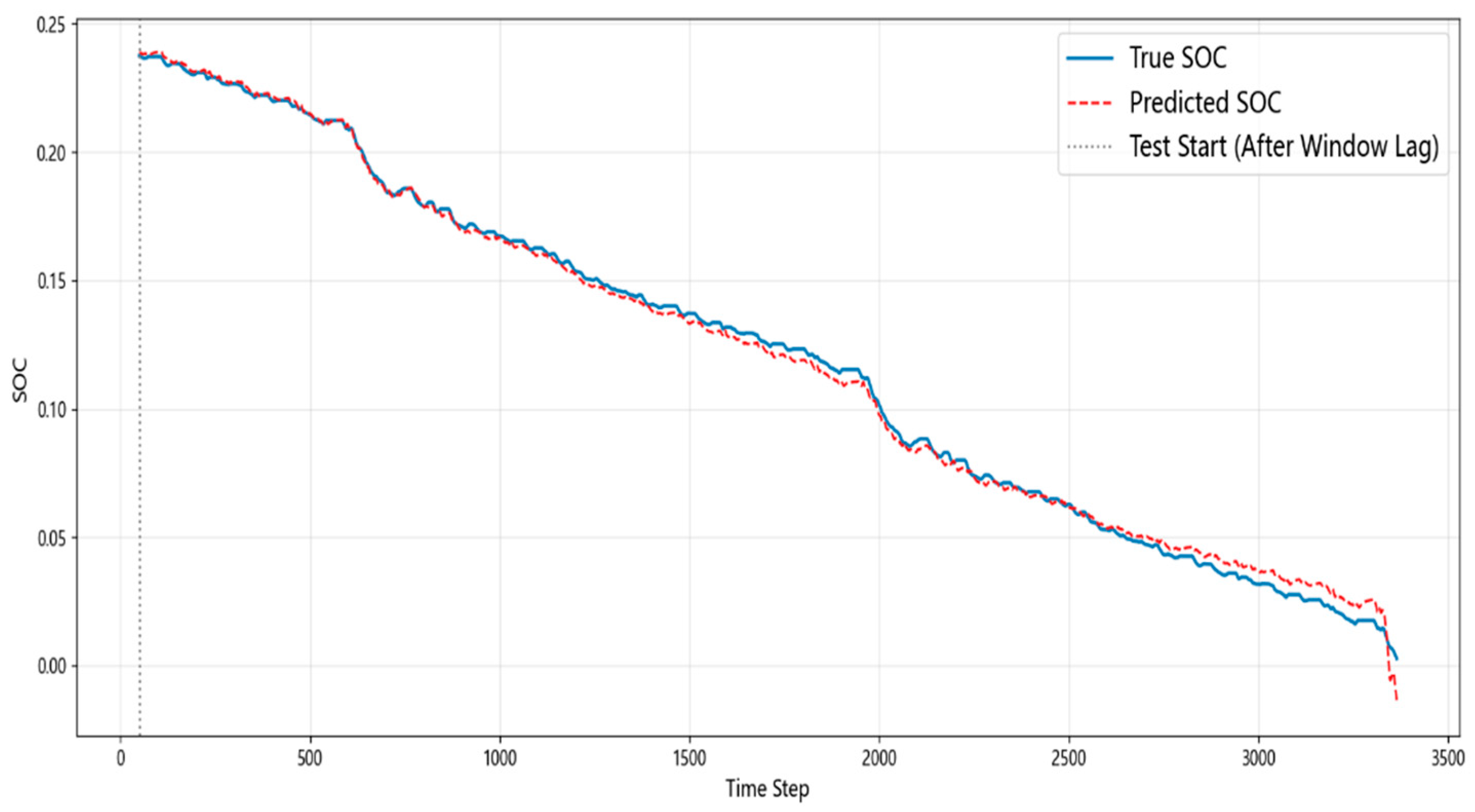
To further improve training efficiency and promote model convergence, all feature data are normalized before input. To ensure the independence and reliability of model training, tuning, and evaluation, the FUDS dataset was divided chronologically into training, validation, and test sets with a ratio of 70%:15%:15%. The training set was used to update network weights, the validation set for early stopping monitoring and hyperparameter tuning (e.g., number of layers, number of neurons), and the test set for final performance evaluation. All data were randomly shuffled before splitting to eliminate the impact of temporal correlation on the evaluation results. The model parameter settings include: a sliding window length of 50, a batch size of 32, a network structure with two hidden layers (64 and 32 neurons respectively), and a training epoch of 100. The selection of the aforementioned hyperparameters is determined after comprehensively considering model performance, computational efficiency, and dataset characteristics. The sliding window length is set to 50 to enable the model to effectively capture short-to-medium-term temporal dependencies in battery dynamic characteristics—too short a window would result in insufficient information, while too long a window would introduce redundant data and increase computational burden. The batch size is set to 32, a common choice that balances training stability and memory consumption. The network structure adopts a two-layer design with decreasing numbers of neurons (64→32), aiming to allow the model to hierarchically extract higher-level abstract features as follows: the first layer captures basic temporal patterns, and the second layer refines them. The number of training epochs is set to 100 combined with an early stopping mechanism, ensuring the model has sufficient opportunities to fully learn the data distribution while effectively preventing overfitting caused by excessive training, thereby improving the model’s generalization ability. An early stopping mechanism is also introduced to prevent overfitting. The training results are shown in Figure 3.
The performance indicators obtained from this training are as follows: the root mean square error (RMSE) is 0.0061, the Mean Absolute Error (MAE) is 0.0058, and the coefficient of determination (R2) reaches 0.9986. As can be seen from the result graph, the LSTM model has fast convergence characteristics and high prediction accuracy and can still maintain high precision even in the presence of cumulative errors. However, at the end of battery discharge, due to the increasingly complex internal chemical reactions, the convergence performance of the model decreases. Therefore, it is still necessary to combine with other methods to further improve its estimation precision.
The LSTM learns nonlinear mappings through historical voltage, current, and temperature data. However, when the training data fail to fully cover extreme operating conditions (such as the sharp drop in lithium-ion diffusion rate at low temperatures and the intensified polarization effect under high rates), the model exhibits insufficient generalization ability. Meanwhile, although the gating mechanism of LSTM can capture long-term dependencies, the complexity of internal chemical reactions in the battery increases at the end of discharge (e.g., SEI film growth and slight lithium dendrite precipitation [15]), leading to sudden changes in characteristic patterns. The network struggles to adapt rapidly, resulting in decreased convergence speed and error accumulation. In addition, there are minor cumulative errors in the “true SOC” calculated by the ampere-hour integration method in the training data, and these errors are transmitted to the model through labels, affecting the prediction accuracy.
As an efficient machine learning model, LSTM shows good application potential in lithium-ion battery SOC estimation. It can accurately capture the changing laws of battery states through learning from a large amount of historical operating data, providing effective technical support for high-precision SOC estimation. However, how to reduce computational resource consumption and improve robustness in interference environments remain key issues to be focused on in future research.

4. Construction of Unscented Kalman Filter State-Space Model

4.1. Unscented Kalman Filter Method

As an extended form of the classic Kalman Filter for nonlinear systems, the extended Kalman filter (EKF) features a core mechanism that achieves local linearization processing of nonlinear systems through first-order Taylor series expansion [19]. Compared with the traditional Kalman Filter algorithm, EKF demonstrates stronger applicability in handling complex systems with significant nonlinear characteristics. However, the linearization of nonlinear systems will introduce truncation errors, which exert a negative impact on estimation accuracy. As a state estimation algorithm suitable for nonlinear systems, the Unscented Kalman Filter (UKF) employs the Unscented Transform to approximate the probability distribution characteristics of nonlinear functions [20]. This method generates a set of Sigma points through deterministic sampling of state and observation variables, and directly transmits the input–output relationship of the nonlinear system using these sampling points [21]. This mechanism effectively avoids the error propagation problem caused by approximate processing in traditional linearization methods. Compared with the extended Kalman filter (EKF), UKF can not only more accurately describe the dynamic behavior of high-order nonlinear systems and avoid errors caused by Taylor series expansion truncation but can also eliminate the need for complex Jacobian matrix calculations, thereby improving the numerical stability and estimation accuracy of the algorithm. The standard implementation steps of UKF are as follows:
For the general equation of a discrete nonlinear system (8):
x k = f ( x k 1 , u k ) + ω k 1 y k = h ( x k , u k ) + v k
Initialize parameters x 0 / 0 , p 0 / 0 , R 0 , Q 0 .
Select the initial Sigma point set.
x k 1 ( 0 ) = x k 1 x k 1 i = x k 1 + ( n + λ ) P K 1 i = 1 n x k 1 i = x k 1 + ( n + λ ) P K 1 i = n + 1 2 n
where x k 1 is the mean value at time k − 1; n is the dimension of the posterior value of the state variable x k 1 .
Determine the weighting coefficients
λ = α 2 ( n + γ ) n W m ( 0 ) = λ λ + n W c ( 0 ) = λ λ + n + 1 α 2 + β W C ( i ) = W m ( i ) = 1 2 ( λ + n ) i = 1 , 2 2 n
where λ is the scaling factor used to control the distribution range of Sigma points; α is the spread factor that controls the dispersion range between Sigma points and the optimal estimate, generally taken between (10−5, 1); W m ( 0 ) ,   W c ( i ) are the weights of the mean and variance of the i-th Sigma point respectively; γ is the auxiliary factor, generally specified that n + γ ≠ 0, and its value is generally 0 or n − 3; β is the prior distribution factor, and its value is related to the state variable x, generally taking β = 2.
(4) Substitute the Sigma point set into the state equation to obtain the predicted value of the Sigma point set at time k.
x k / k 1 ( i ) = f ( x k 1 ( i ) , u k ) + ω k 1
(5) Calculate the weighted value of the predicted Sigma points to obtain the predicted state variable and predicted error covariance matrix at time k.
x k / k 1 = i = 0 2 n W m ( i ) x k / k 1 ( i ) P x x , k / k 1 = i = 0 2 n W c ( i ) ( x k / k 1 ( i ) x k / k 1 ) ( x k / k 1 ( i ) x k / k 1 ) T + Q k 1
(6) Substitute the Sigma point set into the observation equation to obtain:
y k / k 1 ( i ) = h ( x k / k 1 ( i ) , u k ) + v k 1
(7) Calculate the predicted value by weighting the Sigma point set and compute the covariance matrix.
y k / k 1 = i = 0 2 n W m ( i ) y k / k 1 ( i ) P y y , k / k 1 = i = 0 2 n W c ( i ) ( y k / k 1 ( i ) y k / k 1 ) ( y k / k 1 ( i ) y k / k 1 ) T + R k 1 P x y , k / k 1 = i = 0 2 n W c ( i ) ( x k / k 1 ( i ) x k / k 1 ) ( y k / k 1 ( i ) y k / k 1 ) T
(8) Calculate the Kalman gain and verify the predicted value of the state variable.
K k = P x y , k / k 1 P y y , k / k 1 x k = x k / k 1 + K k ( y k y k / k 1 )
(9) Calculate the posterior value of the covariance matrix.
P k = P k / k 1 K k P y y , k / k 1
By continuously predicting and correcting the lithium-ion battery SOC estimation value through the above method, the predicted value can be continuously converged to the actual value to achieve SOC estimation.

4.2. Equivalent Model of Lithium-Ion Battery

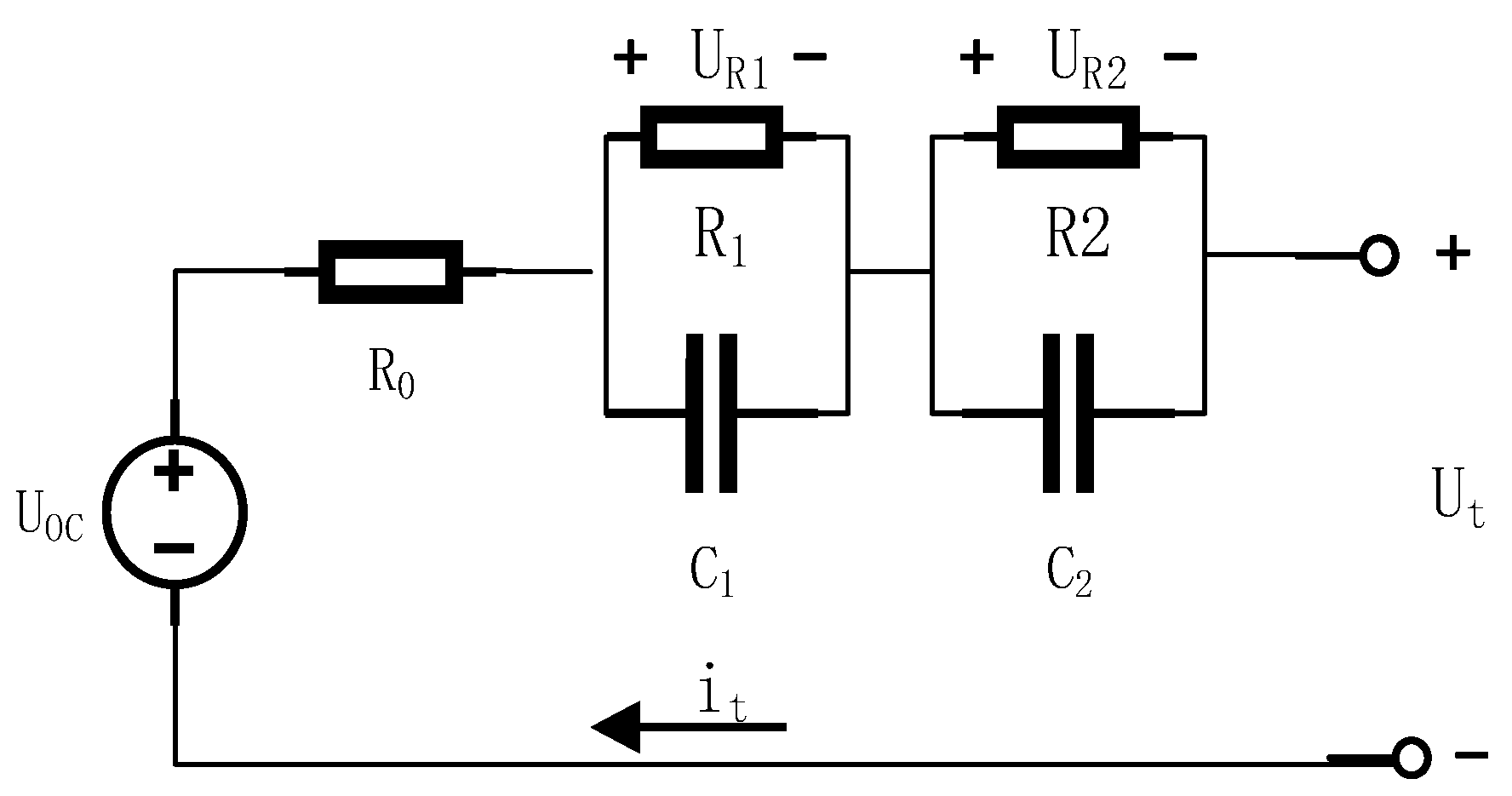
The second-order RC model improves the simulation accuracy of the internal battery by adding RC loops, while the computational complexity also increases. The second-order RC equivalent model of the lithium-ion battery is shown in Figure 4:

4.3. Lithium-Ion Battery Equivalent Model Parameter Identification

The parameters in the above second-order RC equivalent circuit model (ohmic internal resistance R0, polarization resistances R1, R2, polarization capacitances C1, C2, and battery rated capacity QN) need to be obtained through parameter identification. This paper employs the Hybrid Pulse Power Characterization (HPPC) test to perform offline parameter identification for the INR18650-20r battery. The specific steps are as follows:
(1) OCV-SOC curve calibration: the open-circuit voltage at different SOC points is obtained through the HPPC test, and a polynomial fitting is used to derive the OCV-SOC functional relationship.
(2) Parameter identification: The voltage response curve during the pulse discharge process is analyzed. The ohmic internal resistance R0 is calculated from the voltage jump at the moment of current sudden change. By performing second-order exponential fitting on the voltage variation curves during the discharge phase and the resting recovery phase, the time constants τ1 = R1C1and τ2 = R2C2 are obtained, from which the polarization resistances R1, R2 and polarization capacitances C1, C2 are subsequently solved.
By repeating the above process at different SOC points, the variation pattern of the model parameters with SOC can be obtained. These parameters are stored in the form of a lookup table. During the subsequent UKF iteration process, the corresponding parameter values are obtained through linear interpolation based on the current SOC estimate, thereby reflecting the dynamic characteristics of the parameters as they vary with SOC. It should be noted that these parameters are obtained through offline identification and remain fixed during operation. The validation of the parameters is carried out through simulation under constant current discharge conditions.

4.4. Simulation Validation of SOC Estimation Based on Second-Order RC Equivalent Circuit Model of Lithium-Ion Battery

Before conducting the UKF simulation verification, it is necessary to initialize its key parameters. The selection basis of the parameters is as follows:
EstaInitial State X0 and Covariance P0: The initial SOC0 is obtained by looking up the open circuit voltage (OCV) measured after the battery has rested, using the fitted OCV–SOC curve, to ensure the reasonableness of the initial estimate. The initial error covariance matrix P0 is set as a diagonal matrix diag([10−4,10−4,10−4])diag([10−4,10−4,10−4]), reflecting a high level of confidence in the initial state.
Noise Covariance Matrices: The process noise covariance matrix Q reflects the uncertainty of the model. Based on the accuracy of the equivalent circuit model, it is assigned a relatively small diagonal matrix diag([10−6,10−6,10−6])diag([10−6,10−6,10−6]). The measurement noise covariance matrix RR represents the measurement error of the voltage sensor and is set to 10−4 according to the sensor’s precision (e.g., ±0.1%).
UKF Scaling Parameters: according to standard UKF theory, α is set to 10−3 to control the spread of Sigma points, ensuring local approximation accuracy; β is set to 2 to optimize the error in higher-order terms under a Gaussian distribution; and the auxiliary factor γ is set to 0.
Estimate while still allowing the filter to perform rapid corrections during the initial stage. Establish the state equation and discretize the above-mentioned second-order RC equivalent circuit model of the lithium-ion battery. The parameters involved in the model, including R0, R1, C1, R2, C2, and the rated capacity QN are obtained through offline identification using the HPPC test described in Section 3.2 and are stored in the form of a lookup table. During the UKF iteration process, the corresponding parameter values are obtained through linear interpolation based on the SOC estimate at the current moment, thereby reflecting the dynamic variation characteristics of the parameters with SOC:
U 1 ( k + 1 ) U 1 ( k + 1 ) S O C ( k + 1 ) = 1 T s R 1 C 1 0 0 0 1 T s R 2 C 2 0 0 0 1 U 1 ( k ) U 2 ( k ) S O C ( k ) + T s C 1 T s C 2 T s Q N I ( k )
U L ( k + 1 ) = U O C ( S O C k + 1 ) R 0 I ( k ) U 1 ( k ) U 2 ( k )
Simplify to obtain the state equation and observation equation:
x k = A x k 1 + B I k y k = U O C V ( S O C ) + C x k + D I k
The values of each coefficient are as follows:
A = 1 T s R 1 C 1 0 0 0 1 T s R 2 C 1 0 0 0 1 ,   B = T s C 1 T s C 2 T s Q N
Substitute the coefficients into (19) to get:
x k = A x k 1 + B I k + ω k y k = U O C V ( x k ) + C x k I k R 0 + v k
where ω k denotes system noise; v k is measurement noise; R1, R2 are polarization resistances; C1, C2 are polarization capacitances; and y k is the terminal voltage.
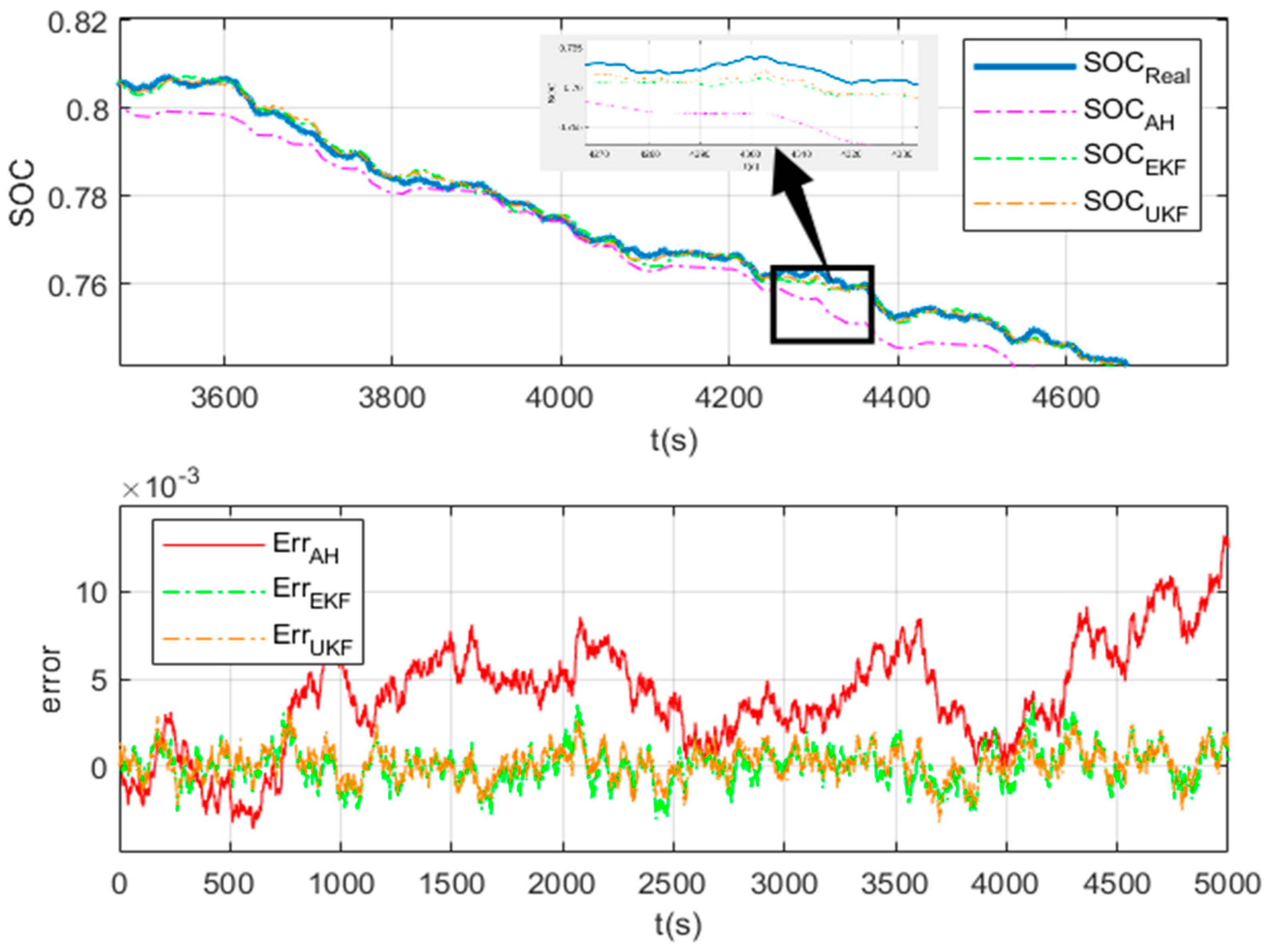
In the UKF algorithm, the values of the process noise covariance matrix Q and the measurement noise covariance matrix R significantly influence the accuracy of state estimation. In this study, these values are determined based on model uncertainty and sensor precision as follows: the process noise covariance matrix is set as Q = diag([10−6,10−6,10−6])Q = diag([10−6,10−6,10−6]), corresponding to the noise variances of the state variables U1, U2, and SOC; the measurement noise covariance matrix is set as R = 10−4, corresponding to the measurement error of the voltage sensor (with an accuracy of ±0.1%). To verify the reasonableness of the selected parameters, a sensitivity analysis was conducted. The results show that within the vicinity of the above values, the variation in the UKF estimation error is less than 0.5%, demonstrating good robustness. In the Matlab simulation environment, a lithium-ion battery model is established based on the aforementioned second-order RC equivalent circuit, which effectively reduces computational complexity while ensuring the reflection of internal battery characteristics. The experimental data of the INR18650-20r battery provided by the University of Maryland (College Park, MD, USA) are used to collect battery terminal voltage and current data under the condition of 1C constant current discharge. The ampere-hour integration method, EKF, and UKF algorithms are respectively applied for SOC estimation, and the final comparison of SOC estimation results is shown in Figure 5.
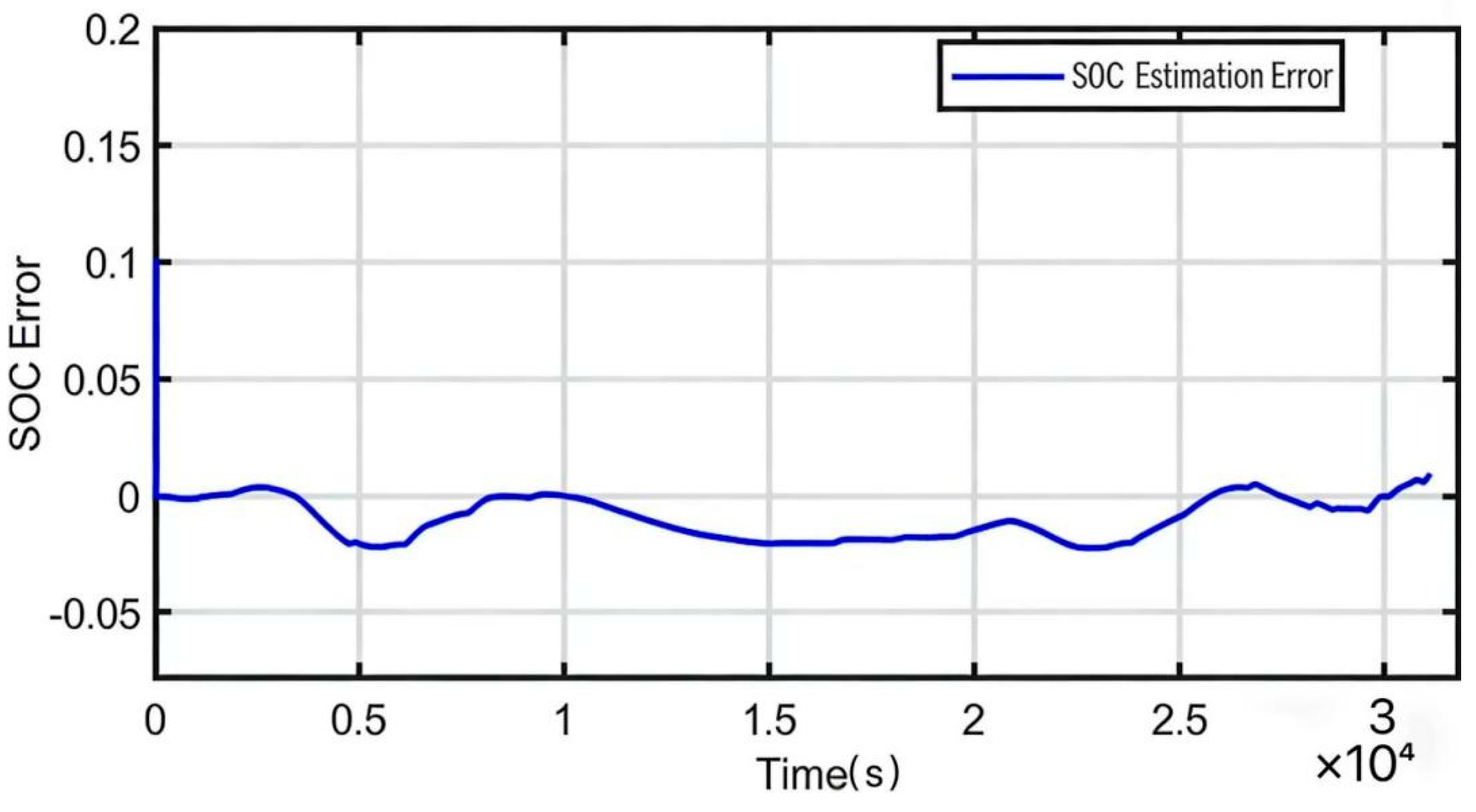
The simulation results show that the UKF algorithm is superior to the ampere-hour integration method and the EKF method in both SOC estimation precision and robustness. The UKF quickly converges to near the true value at the initial stage of discharge and maintains high estimation precision throughout the process as follows: the error is less than 1% when the SOC is higher than 80%, and still lower than 3% when the SOC is lower than 20%. In contrast, the ampere-hour integration method is significantly affected by initial errors and cumulative errors, with an initial error of up to 10% that continues to increase in the later stage; although the EKF tracks well in the initial stage, the error gradually increases over time. In addition, when 10% Gaussian white noise is added, the error of the UKF only increases by about 0.5% (Figure 6), showing excellent anti-interference ability. Although the UKF based on the second-order RC equivalent circuit model can reflect the battery polarization characteristics, it cannot fully characterize the electrolyte interface reactions and the differences in lithium-ion transport caused by temperature gradients. Meanwhile, although the process noise covariance matrix (Q) and measurement noise covariance matrix (R) of the UKF are determined through sensitivity analysis, the noise characteristics change dynamically under complex operating conditions (such as sudden current changes during pulse charging). The fixed matrix parameters are difficult to adapt in real time, leading to a decline in filtering accuracy. In addition, the parameters of the second-order RC model (such as R0, R1, and C1) are fixed values identified offline and cannot be adaptively updated with battery aging or temperature fluctuations, which further amplifies the error.
With its excellent nonlinear processing capability, UKF has become a widely used mainstream algorithm in lithium-ion battery SOC estimation. This algorithm can accurately describe the dynamic behavior of the system and exhibits good adaptability and robustness. However, UKF also has the problem of high computational burden, especially when processing high-dimensional systems; the high computational complexity may affect its application in real-time scenarios. Therefore, in practical engineering, it is necessary to balance estimation precision and computational efficiency according to specific requirements to obtain the optimal SOC estimation effect.

5. LSTM-UKF Joint SOC Estimation Method

5.1. LSTM-UKF Joint SOC Estimation

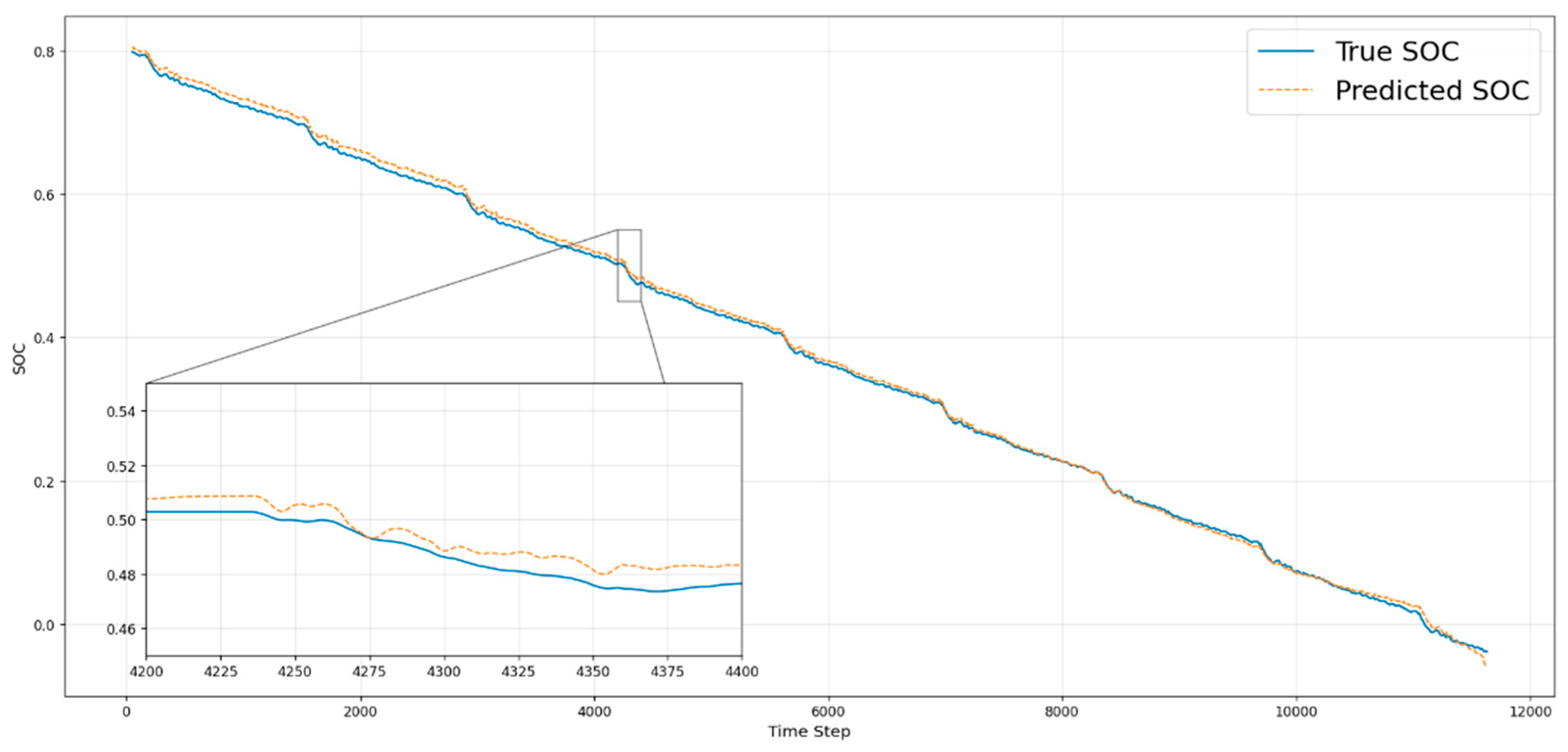
Using the trained model parameters, the discharge data under the FUDS condition is predicted, and the prediction results are shown in Figure 7.
Mathematical Description of the LSTM-UKF Fusion Mechanism:
In the series fusion framework proposed in this paper, the output of the LSTM network, denoted as SOCLSTM,k, is introduced into the UKF as a virtual measurement input, forming an augmented measurement vector together with the actual terminal voltage measurement. The specific implementation is as follows:
Let the state vector of the UKF be xk = [U1,k,U2,k,SOCk]T, and the system input be the current Ik. The fused measurement vector consists of the following two components:
z k = U L , k S O C L S T M , k
The corresponding measurement equations are:
U L , k = U O C V S O C k I k R 0 U 1 , k U 2 , k + v 1 , k S O C L S T M , k = S O C k + v 2 , k
Here, the first measurement equation represents the terminal voltage output of the second-order RC model, while the second equation treats the SOC prediction from the LSTM as a direct measurement of SOC. The variance of the noise term v2,k can be pre-determined based on the prediction error statistics of the LSTM on the validation set.
Through this augmented measurement vector approach, the LSTM output does not alter the original structure of the UKF’s state transition and measurement equations. Instead, it serves as an additional information source integrated into the filtering update process. This enables the UKF to effectively fuse the data-driven predictive information from the LSTM while leveraging the battery physical model, achieving a more optimal estimation of SOC.
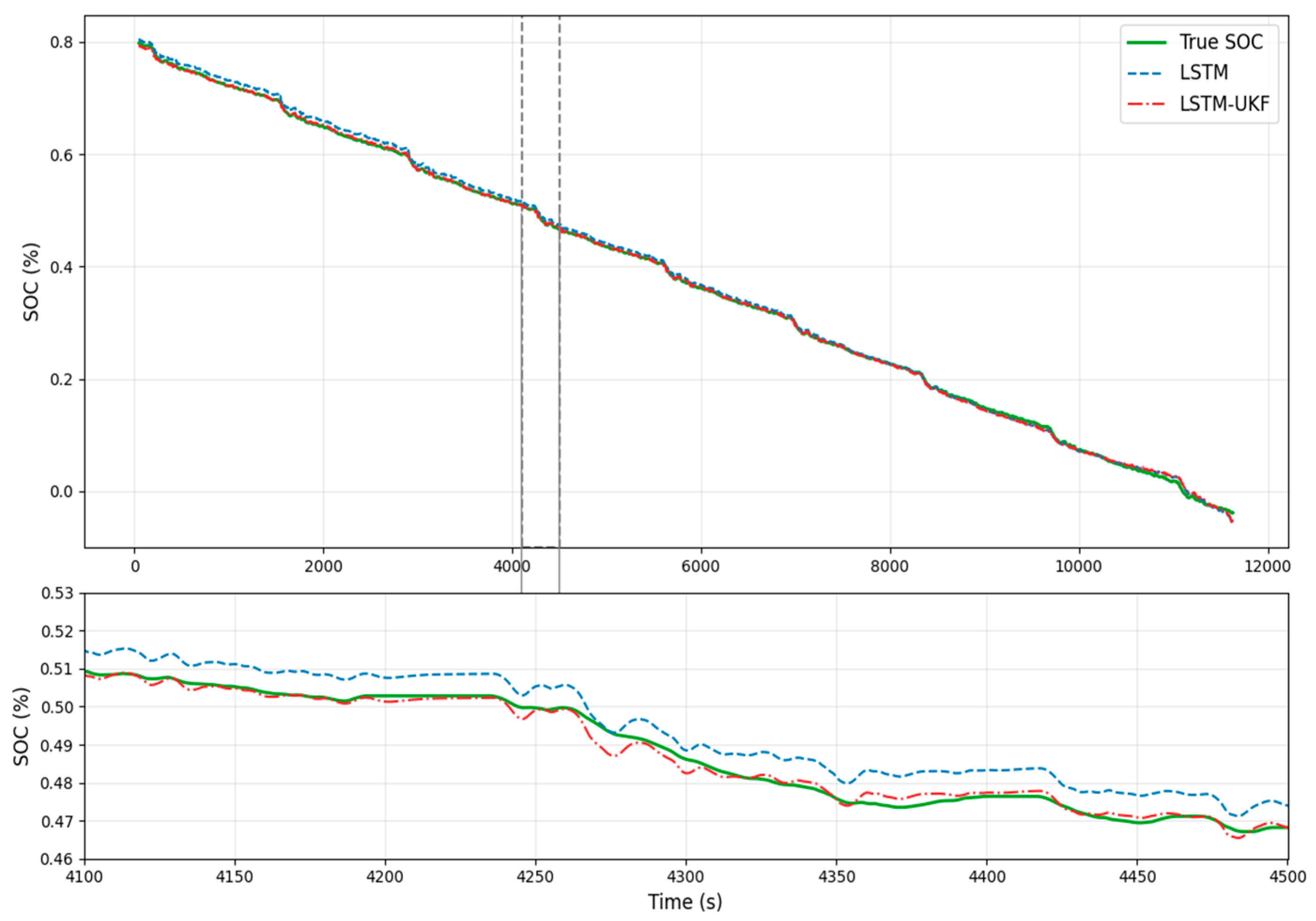
As shown in the figure, the LSTM model exhibits good overall accuracy in SOC prediction but suffers from insufficient convergence speed at the end of the cycle (RMSE = 0.0065, MAE = 0.0057, and R2 = 0.9993). To further improve estimation performance, the LSTM output is used as an observation value and input into the UKF algorithm constructed based on the second-order RC equivalent circuit for correction. The final estimation result of the fusion algorithm is shown in Figure 8.

5.2. Simulation Validation and Analysis

To verify the effectiveness of the LSTM-UKF fusion algorithm in lithium-ion battery SOC estimation, a second-order RC equivalent circuit model is established in MATLAB/Simulink, and parameter calibration is completed. This paper compares the performance of the traditional UKF, standalone LSTM, and LSTM-UKF fusion algorithms under three typical conditions (constant current discharge, pulse charging, and actual driving cycle), focusing on evaluating estimation error and convergence speed.
Under the constant current discharge condition (1C discharge, initial SOC = 100%), the initial error of UKF is 10%, converges in approximately 30 s, and the final error is ±2.5%; the LSTM has an initial error of 15% due to the need for training, and the error is ±1.8% after 500 batches; meanwhile, the initial error of LSTM-UKF is only 5%, converges within 10 s, and the final error is ±1.2%. Under the pulse condition (1C discharge, 2C pulse charging), the final error of UKF is ±3.0%, that of LSTM is ±2.2%, and that of LSTM-UKF is ±1.5%. In the actual driving cycle, the LSTM-UKF also performs the best, with a final error of ±1.8% and an average calculation time of only 12 ms, which is significantly better than the 25 ms of LSTM.
The RMSE comparison of the three algorithms is as Table 1: under the constant current condition, the RMSE values of UKF, LSTM, and LSTM-UKF are 0.025, 0.018, and 0.012 respectively; under the pulse condition, they are 0.030, 0.022, and 0.015 respectively; under the WLTC condition, they are 0.040, 0.028, and 0.018 respectively. The results consistently show that the LSTM-UKF fusion algorithm has higher estimation accuracy and faster convergence performance under various conditions, verifying its superiority and reliability in practical applications.
The preliminary prediction of the LSTM mitigates the UKF’s sensitivity to initial values, while the model-driven filtering of the UKF compensates for the data-dependent limitation of the LSTM. The remaining errors mainly stem from the coupling process of the two modules: when the predicted output of the LSTM is used as the virtual measurement input of the UKF, although the mapping relationship is clearly defined by the mathematical expression (23), the LSTM exhibits a large prediction deviation under extreme operating conditions (e.g., low temperature of −10 °C), which exceeds the range of single filtering correction by the UKF. Meanwhile, the fusion algorithm does not fully incorporate the multi-physics field coupling effects (such as capacity loss caused by lithium dendrite growth [15]), leading to minor errors in strongly nonlinear scenarios. However, the overall performance is significantly superior to that of individual algorithms.
It should be noted that the validation in this study mainly focused on the generalization capability under different operating conditions (constant current discharge, pulse profile, and WLTC), which confirms the effectiveness of the algorithm under dynamic loads. However, due to the limitations of the public dataset, generalization performance across different cells of the same type and different temperature conditions was not evaluated. Since cell-to-cell variations and ambient temperature significantly affect SOC estimation accuracy, future work will involve collecting experimental data covering multiple cells and temperature ranges to further test the robustness and universality of the proposed algorithm.
In summary, the LSTM-UKF fusion estimation algorithm proposed in this paper is superior to traditional methods in various performance indicators. It not only significantly improves SOC estimation accuracy and response speed but also exhibits strong adaptability under actual complex operating conditions. It is suitable for high-requirement battery management systems and has important practical promotion value.

6. Conclusions

This paper focuses on the key technical challenge of high-precision State of Charge (SOC) estimation for lithium-ion batteries. Addressing the limitations of single methods under complex operating conditions, a series-connected LSTM-UKF fusion estimation architecture is proposed. The research is systematically carried out following the logical main line of “problem analysis—method design—model construction—experimental verification”. The main achievements and conclusions are as follows:
(1) At the method design level, the complementary deficiencies of pure data-driven methods (LSTM), which lack physical constraints, and pure model-driven methods (UKF), which struggle to characterize complex nonlinear dynamics, are analyzed. Based on this, a strategy of serially fusing the two is proposed: leveraging the learning capability of LSTM to capture the nonlinear characteristics of the battery and utilizing the filtering mechanism of UKF to provide physical model constraints, thereby achieving complementary advantages.
(2) At the model construction level, the structural design of the LSTM prediction network and the parameter initialization of the UKF state-space model were completed respectively. The LSTM network adopts a two-layer structure with 64–32 neurons and a sliding window of 50 to learn battery dynamic characteristics from historical data. The UKF constructs the state equation based on a second-order RC equivalent circuit model and reasonably initializes the noise covariance matrix according to sensor accuracy and model uncertainty, ensuring good convergence performance of the filter.
(3) At the experimental verification level, comparative experiments were conducted under constant current discharge, pulse charge–discharge, and WLTC dynamic conditions based on the public dataset from the University of Maryland. The results show that the estimation accuracy of the LSTM-UKF fusion algorithm outperforms single algorithms under all conditions, with RMSE reduced to 0.012, 0.015, and 0.018, respectively. The initial error is reduced from 10~20% for single methods to 5~8%, and the convergence time is shortened by more than 40%. The average computation time is only 12 ms, meeting real-time requirements. These results fully validate the effectiveness, robustness, and engineering applicability of the fusion algorithm.
In summary, the LSTM-UKF series-connected fusion method proposed in this paper, through the organic combination of data-driven and model-driven approaches, effectively enhances the SOC estimation performance of lithium-ion batteries under complex operating conditions, providing a new technical pathway for the design of high-precision battery management systems. Future research will further explore multi-timescale estimation, cloud-based BMS integration, and adaptive update mechanisms under the influence of battery aging, promoting the development of this technology towards higher precision and greater adaptability.

Author Contributions

Conceptualization, Y.L. (Yao Li); Methodology, J.J.; Software, Y.L. (Yu Liu); Validation, Y.M.; Formal analysis, Y.J.; Investigation, Z.S. and Z.J.; Resources, H.L.; Data curation, R.W.; Writing—original draft, Y.L. and J.X.; Writing—review & editing, Y.T. All authors have read and agreed to the published version of the manuscript.

Funding

This work was financially supported by the Key Technology Research on Efficient Integration of Electrochemical Energy Storage Power Plants at GWh Scale Full Time Scale (GJNY-24-91).

Data Availability Statement

The data presented in this study are not publicly available due to strict confidentiality agreements associated with the key project funding.

Conflicts of Interest

Authors Yao Li, Rong Wang, Yi Jin, Zhenxin Sun, Hui Liu, Yu Liu, Yanhui Liu, Jiahuan Xu, Ye Tao, Zhaoyu Jiang and Yue Ma were employed by the China Energy New Energy, Technology, Research Institute. The authors declare that the research was conducted in the absence of any commercial or financial relationships that could be construed as a potential conflict of interest.

References

  1. Tian, Y.; Lai, R.; Li, X.; Xiang, L.; Tian, J. A Combined Method for State-of-Charge Estimation for Lithium-Ion Batteries Using a Long Short-Term Memory Network and an Adaptive Cubature Kalman Filter. Appl. Energy 2020, 265, 114789. [Google Scholar] [CrossRef]
  2. Li, Z.Y.; Lu, R.H.; Yu, Q.H.; Yan, F.Y. Research on Thermal Runaway Characteristics and Prevention and Control Technologies of Power Batteries. Automot. Eng. 2024, 46, 139–150. [Google Scholar] [CrossRef]
  3. Hannan, M.A.; Lipu, M.S.H.; Hussain, A. A Review of Lithium-Ion Battery State of Charge Estimation and Management System in Electric Vehicle Applications: Challenges and Recommendations. Renew. Sustain. Energy Rev. 2017, 78, 834–854. [Google Scholar] [CrossRef]
  4. Xu, Y.D. State of Power (SOP) Estimation of Lithium-Ion Batteries Based on Multi-State Parameters. Master’s Thesis, Chongqing University, Chongqing, China, 2020. [Google Scholar]
  5. Einhorn, M.; Conte, F.V.; Kral, C.; Fleig, J. A Method for Online Capacity Estimation of Lithium Ion Battery Cells Using the State of Charge and the Transferred Charge. In Proceedings of the IEEE International Conference on Sustainable Energy Technologies (ICSET), Kandy, Sri Lanka, 6–9 December 2010; IEEE: Piscataway, NJ, USA, 2010. [Google Scholar]
  6. Waag, W.; Sauer, D.U. Adaptive Estimation of the Electromotive Force of the Lithium-Ion Battery after Current Interruption for an Accurate State-of-Charge and Capacity Determination. Appl. Energy 2013, 111, 416–427. [Google Scholar] [CrossRef]
  7. Sun, F.; Xiong, R. A Novel Dual-Scale Cell State-of-Charge Estimation Approach for Series-Connected Battery Pack Used in Electric Vehicles. J. Power Sources 2015, 274, 582–594. [Google Scholar] [CrossRef]
  8. Sun, F.; Xiong, R.; He, H. A Systematic State-of-Charge Estimation Framework for Multi-Cell Battery Pack in Electric Vehicles Using Bias Correction Technique. Appl. Energy 2016, 162, 1399–1409. [Google Scholar] [CrossRef]
  9. Shen, Y.Q. Adaptive Online State-of-Charge Determination Based on Neuro-Controller and Neural Network. Energy Convers. Manag. 2010, 51, 1093–1098. [Google Scholar] [CrossRef]
  10. Dai, H.F.; Guo, P.; Wei, X.; Sun, Z.; Wang, J. ANFIS-Based Online State of Charge Correction Considering Cell Divergence for the Electric Vehicle Traction Batteries. Energy 2015, 80, 350–360. [Google Scholar] [CrossRef]
  11. Sheng, H.; Xiao, J. Electric Vehicle State of Charge Estimation: Nonlinear Correlation and Fuzzy Support Vector Machine. J. Power Sources 2015, 281, 131–137. [Google Scholar] [CrossRef]
  12. Kuang, H.; Liao, H.; Zhang, Z.; Huang, S.; Mao, B.; Shan, W.; Duan, X.; Feng, X.; Li, T. Dynamic diels-alder reaction crosslinked metal-organic framework/poly (ionic liquid) composite solid electrolyte for lithium-metal batteries. J. Colloid Interface Sci. 2026, 707, 139638. [Google Scholar] [CrossRef] [PubMed]
  13. Hao, W.; Guo, F.; Li, J.; Xie, J. Influence of Physical Parameters on Lithium Dendrite Growth Based on Phase Field Theory. Metals 2026, 16, 41. [Google Scholar] [CrossRef]
  14. Lv, D.; Huang, X.; Li, X.; Zhu, L.; Chai, J.; Gao, Y.; Liu, Z.; Yao, X. Bioinspired Ultrastrong and Ion-Selective Gel Electrolytes by Interfacial Coacervation for High-Performance Lithium-Metal Batteries. Carbon Energy 2026, e70153. [Google Scholar] [CrossRef]
  15. Hu, F.; Yang, H.; Zhou, X.; Zhao, S.; Qiu, L.; Wei, S.; Hu, J.; Chen, Y.; Hu, H.; Zhou, H. Spatial dynamics of lithium battery recycling enterprises in China: Implications for smart waste management and public health. Front. Public Health 2026, 13, 1729413. [Google Scholar] [CrossRef] [PubMed]
  16. Lei, Y.M. Research on Robust State of Charge Estimation Fusion Method Based on Data-Driven. Doctoral Dissertation, Xi’an University of Technology, Xi’an, China, 2024. [Google Scholar] [CrossRef]
  17. Li, H.P.; Liu, G.X.; Deng, W. State of Charge Estimation Method for Power Lithium-Ion Batteries Based on LSTM-UKF Fusion. China Meas. Test 2022, 48, 22–28. [Google Scholar]
  18. He, F.X. Research on Data-Driven State of Charge and State of Health Estimation of Lithium-Ion Batteries. Doctoral Dissertation, Xi’an University of Technology, Xi’an, China, 2021. [Google Scholar] [CrossRef]
  19. Ding, J.C.; Yu, X.T.; Wu, C.Y.; He, J.P. Lithium Battery SOC Estimation Based on 3DGRU-EKF. Autom. Instrum. 2025, 40, 1–5+10. [Google Scholar] [CrossRef]
  20. Wang, S. Research on Video Multi-Target Tracking Algorithm and Application Based on Deep Fusion Features. Doctoral Dissertation, East China Normal University, Shanghai, China, 2022. [Google Scholar] [CrossRef]
  21. Zhang, X.Y.; Zhang, Z.F.; Yu, Z.H. Joint Estimation of Lithium Battery SOC and SOP. Control Eng. China 2022, 29, 1255–1263+1309. [Google Scholar] [CrossRef]
Figure 1. LSTM-UKF hybrid framework for SOC estimation optimization.
Energies 19 01467 g001
Figure 2. Standard LSTM cell architecture.
Energies 19 01467 g002
Figure 3. Comparison of true SOC and model-predicted SOC during discharge.
Energies 19 01467 g003
Figure 4. RC-coupled high-pass filter cascade.
Energies 19 01467 g004
Figure 5. SOC estimation performance and error comparison of AH, EKF, and UKF algorithms.
Energies 19 01467 g005
Figure 6. Temporal variation in SOC estimation error.
Energies 19 01467 g006
Figure 7. Comparison between true SOC and predicted SOC with local magnification.
Energies 19 01467 g007
Figure 8. Performance comparison of LSTM and LSTM-UKF algorithms for battery SOC estimation.
Energies 19 01467 g008
Table 1. Comparison table of different conditions.
ConditionAlgorithmInitial Error (%)Stabilization Time (s)Final Error (%)RMSEAverage Calculation Time (ms)
Constant Current Discharge ConditionUKF1030±2.50.025-
LSTM15-±1.80.01825
LSTM-UKF510±1.20.01212
Pulse ConditionUKF1260±3.00.030-
LSTM18-±2.20.02225
LSTM-UKF620±1.50.01512
WLTC ConditionUKF15120±4.00.040-
LSTM20-±2.80.02825
LSTM-UKF840±1.80.01812
Disclaimer/Publisher’s Note: The statements, opinions and data contained in all publications are solely those of the individual author(s) and contributor(s) and not of MDPI and/or the editor(s). MDPI and/or the editor(s) disclaim responsibility for any injury to people or property resulting from any ideas, methods, instructions or products referred to in the content.