Article

Assessing the Costs of Hydropower at Non-Powered Dams Using a Reference Site Model


Environmental Sciences Division, Oak Ridge National Laboratory, 1 Bethel Valley Road, Oak Ridge, TN 37831, USA
*
Author to whom correspondence should be addressed.
Energies 2026, 19(6), 1463; https://doi.org/10.3390/en19061463
Submission received: 6 February 2026 / Revised: 5 March 2026 / Accepted: 12 March 2026 / Published: 14 March 2026
(This article belongs to the Section C: Energy Economics and Policy)

Abstract

Hydropower capacity in the United States currently stands at approximately 103 GW, and there are remaining water resources that could help meet the rapidly increasing demand for electricity and ancillary grid services. Existing dams that do not generate power, known as non-powered dams, are a near-term solution to enhance the contribution of hydropower to the US power grid. However, there are thousands of such sites, and the lack of detailed information about their specific characteristics and associated costs presents significant challenges for stakeholders. This study addresses these challenges by developing a reference site model to evaluate the potential costs of hydropower at non-powered dams using currently available technologies. An application of the model reveals a wide range of estimates for capacity, capital costs, levelized cost of electricity, and cost components. While many sites are competitive with current technologies, the majority would need cost-reducing innovations to be viable. Despite the limited available information, the model offers valuable insights into the relative competitiveness of hydropower projects at non-powered dams. The simulation results highlight the need for continued technological advancements in hydropower and provide a basis for evaluating the benefits of new innovations.

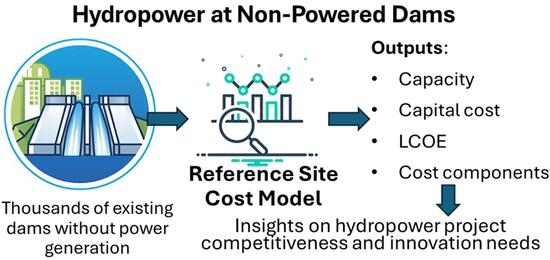
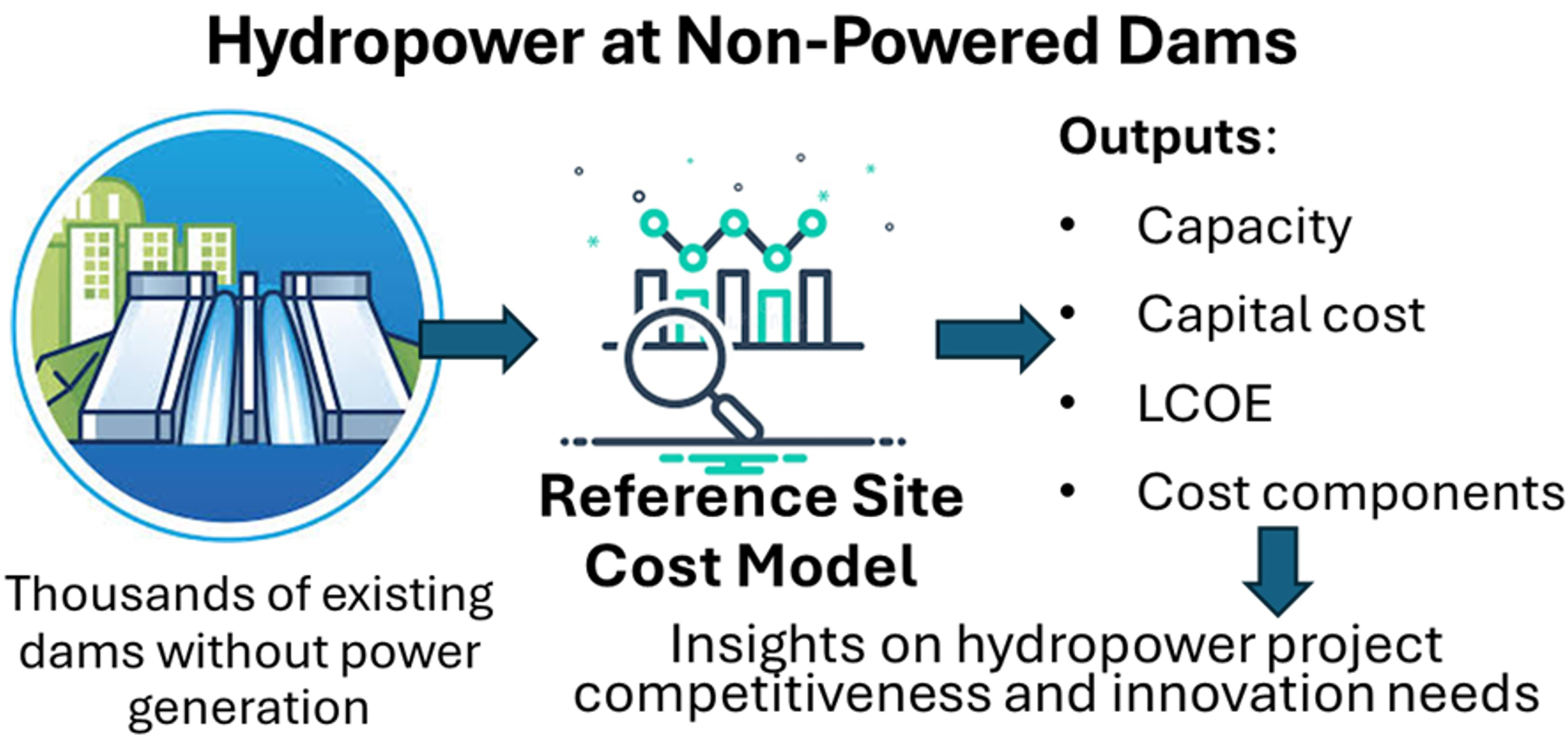
Graphical Abstract

1. Introduction

Hydropower contributed about 103 GW to the United States (US) power grid in 2023 [1], and there are remaining water resources to help supply the rapidly increasing demand for electricity and ancillary grid services [2,3,4]. Non-powered dams (NPD), which include more than 80,000 dams that do not currently produce electricity, represent one of the near-term options for adding new hydropower capacity in the US. Comparatively, fewer than 3500 dams account for the existing US hydropower capacity. However, NPD sites are characterized by smaller capacity potentials and highly variable water resources relative to existing hydropower sites. For example, a preliminary analysis estimated that nearly 54,000 NPD sites could provide about 12 GW of capacity [5], an overall average of less than 250 kW per site relative to 36 MW for existing US hydropower projects. NPD sites are also characterized by a variety of dam features that were initially designed for non-hydropower purposes, which may lead to non-optimal designs relative to entirely new hydropower projects. In addition, the costs of environmental requirements to protect fish and other ecosystem services tend to be lump-sum, placing a greater burden on smaller plants relative to large plants [6]. Lastly, the limited data available for the large number of NPD sites represents a significant source of uncertainty for potential hydropower developers. Combined, these challenges could be prohibitive for NPD hydropower development.
Increasing the pace of US NPD hydropower development requires innovations to reduce capital and operating costs while minimizing environmental impacts in accordance with regulatory requirements. As a first step toward this objective, there is a need to better understand the potential costs of developing hydropower at NPD sites using existing technologies. Such cost assessments would provide initial insights into the relative competitiveness of NPD sites and the underlying cost drivers. This information would reduce the burden of uncertainty on hydropower stakeholders and provide a basis for identifying innovation options to accelerate NPD hydropower development.
There are two broad approaches for evaluating hydropower costs, described in this study as “detailed” and “aggregate”. The “detailed” approach involves detailed engineering designs and cost assessments, which are usually performed for feasibility studies to support investment decisions and regulatory processes [7]. These detailed assessments require an extensive and costly set of cross-disciplinary expertise and activities, and the outputs of such efforts are often closely guided, proprietary information. The “aggregate” approach includes a variety of models often used for initial site appraisals, research, and other purposes. These models use aggregate equations to estimate total hydropower costs with limited data on water flow, head, and capacity. Given its ease of use, this approach is the most common in the literature [8,9,10,11,12].
Identifying cost drivers and innovations to accelerate US NPD hydropower development recommends the “detailed” cost analysis approach. However, the data, engineering, and computational requirements, as well as the implementation costs, make this approach infeasible for the thousands of potential US NPD sites. The “aggregate” approach serves an important purpose in the project development process by providing rapid estimates of project costs, but provides little to no insight into the underlying drivers of costs and opportunities for technological innovations. Existing efforts to address these shortcomings involve combining elements of “detailed” hydropower design with aggregate cost functions [13]. However, this still requires specific and detailed data that are infeasible when evaluating costs for a large number of sites with limited data. In addition, “aggregate” models are parameterized with data for existing hydropower plants, and may underestimate costs if they reflect the scale benefits of those larger plants relative to the hydropower potential at NPD sites.
This study uses a Reference System (RS) method to address the need for greater insights into the potential costs and innovation opportunities for the thousands of US NPD sites. The RS approach is useful for benchmarking, standardizing, and classifying members of a large population defined by multiple, varying attributes [14,15,16]. It uses a representative sample to capture the typical attributes of a large population [14]. The RS (equivalently, Reference Site in this study) approach is used to develop a model for evaluating the costs of hydropower at US NPD sites, adapted to the limited available data.
As applied to NPD sites, the RS method can be described as a three-step process: (1) selection of reference or representative NPD sites, (2) preliminary, but detailed evaluation of baseline designs and costs for the reference sites, and (3) extension of the reference cost functions to the population of NPD sites. The first two steps were implemented and reported in a previous study [17], resulting in a detailed design and cost dataset for reference sites that represent the broad characteristics of the US NPD population. The third step is the subject of this study, aimed at translating the results of the preliminary design and cost analysis for the reference sites from step (2) into an empirical NPD hydropower cost model (NPDHCM). An application of the NPDHCM to 36,000+ sites is used to demonstrate the model, showing that it reflects the technical characteristics of baseline technologies and provides significant insights into the cost structure of potential hydropower at US NPD sites.
This study addresses the limitations of the data- and resource-intensive requirements of the “detailed” approach, as well as the limited insights of the “aggregate” approach, by developing a scalable model that can be applied to thousands of sites. The study makes three main contributions. First, it combines elements of both the detailed and aggregate approaches using a reference site framework. Through this framework, we develop a reduced-form model that links basic site characteristics to major design and cost components, enabling quick and consistent evaluations when detailed data are unavailable. Second, we separately estimate key design and cost components to provide insights into the drivers of cost for different sites. Finally, we apply the model to a large number of NPD sites with transparent screening criteria for a pre-feasibility evaluation of capacity potentials, capital costs, and cost components. The simulation results demonstrate that the model captures the technical features in the reference sites’ data, provides insights into the relative competitiveness of the simulated sites, and identifies sites that could benefit from cost-reducing technological innovations. Collectively, these findings help reduce uncertainties and support efforts to guide innovation and investment in US NPD hydropower development.
The rest of the paper is organized as follows. Section 2 presents the empirical model and provides an overview of the estimated coefficients of the model’s equations. Section 3 applies the estimated model to US NPD sites, Section 4 provides a brief discussion of the model and simulation results, and the paper ends with conclusions.

2. Materials and Methods

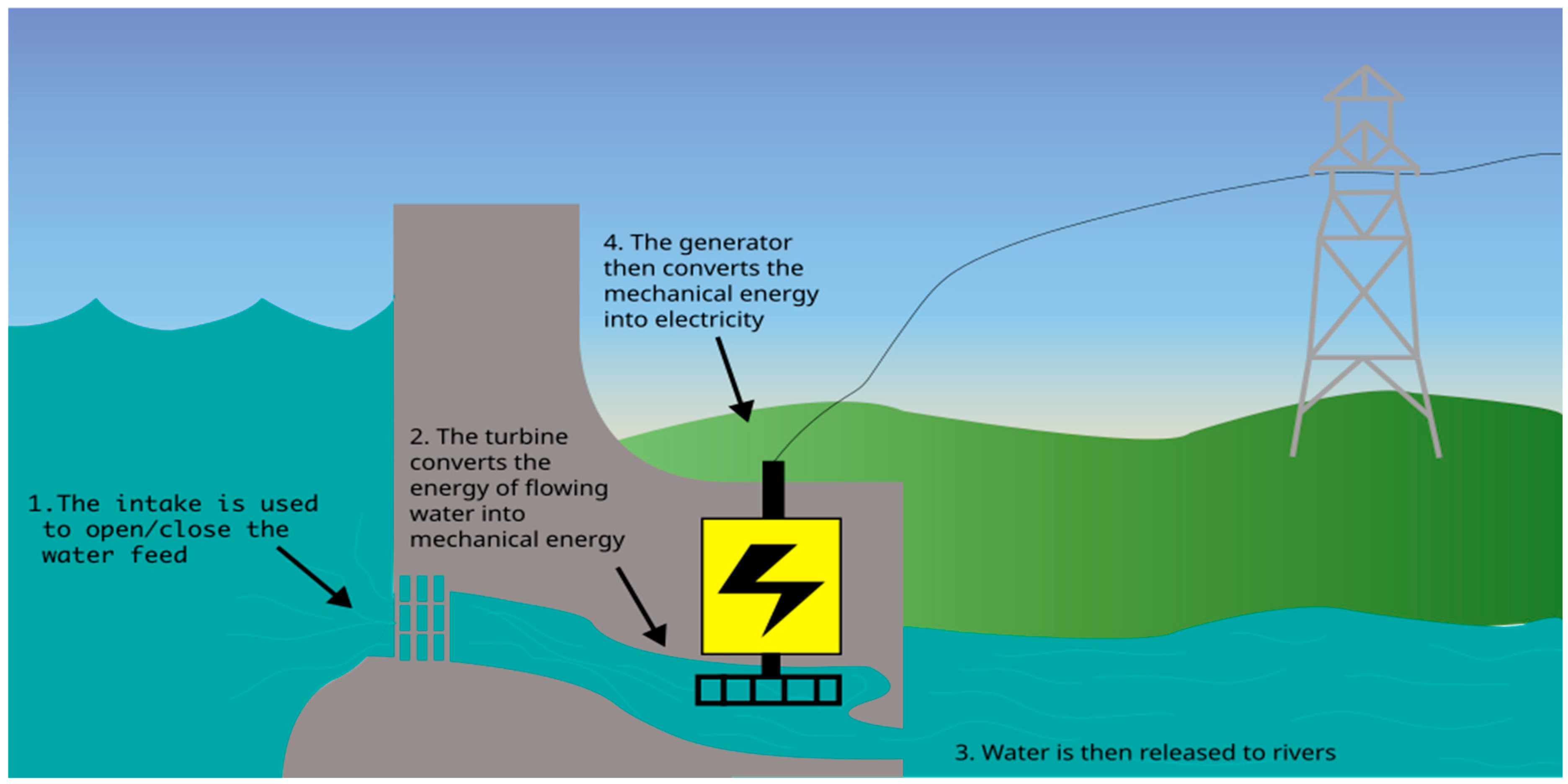
Figure 1 illustrates the multiple components of a hydropower plant, which can be broadly grouped into: (1) Reservoir—collects river inflow, and is already in place for NPD sites. (2) Conveyance—moves water from the reservoir, providing the water flow and hydraulic head (i.e., elevation drop) for electricity generation. (3) Electro-mechanical—receives water transported through the conveyance system and converts the flow and hydraulic head into electricity. (4) Transmission—connects the plant to the power grid. (5) Others—the balance of plant and environmental mitigation measures, among others.
These plant components are designed to minimize construction and operation/maintenance (O&M) costs, while maximizing capacity and efficiency. Given the constraints of site-specific characteristics, technological options, and regulatory requirements, the structure of a given hydropower plant can differ considerably from that shown in Figure 1. An overview of the reference site dataset, which captures variations in these factors across the population of US NPD sites and other data sources, is first presented below, followed by the model equations based on the data.

2.1. Data Overview

The empirical NPDHCM presented in this study consists of a set of equations with coefficients estimated using baseline designs and costs assessment data for nineteen reference NPD sites [17]. The key characteristics of these reference sites are shown in Table 1 (see Table A1 for a version in SI units). The underlying daily flow and hydraulic head data for the reference sites were used to characterize the water resources data for estimating the equations. Dam attributes were extracted from the National Inventory of Dams (NID) dataset [18].
The top-left portion of Table 2 shows the list of exogenous data and derivative variables in the NPDHCM. These include water resources, dam attributes, turbine options, interconnection requirements, and financial variables. The median, as well as the 10th, 30th, 70th, and 90th percentile values, are used to characterize water flow and hydraulic heads for each site. Dam attributes are represented by the dam height, non-exclusive dummy variables for dam construction types, and exclusive lake/lock dam dummy variables. The dam construction dummy variables are non-exclusive because a dam may include multiple construction types, with the three main categories included in the data for this study. The lake and lock indicators reflect important differences between hydropower design options for these two types of dams. Unlike lake dams, lock dams are equipped with navigation locks for water transportation and generally have much higher water flows and lower hydraulic heads.
Interconnection requirements are represented by the straight-line distance from an NPD site to the nearest substation, mainly reflecting the need for transmission lines. The turbine requirement for a site is specified with exclusive dummy variables indicating whether a Kaplan, Bulb, or Francis turbine is required. These three turbine classes are the most appropriate baseline technological options for the vast majority of US NPD sites, with lock dam sites typically using Bulb turbines. The two financial input variables used in the model are the real discount rate and capital recovery period, with baseline values of 5.4% and 30 years, respectively. Finally, reference site values for certain variables are integral to the NPDHCM, as discussed under the model specification section below, and are listed in the bottom section of Table 2. These variables include plant design values for flow, hydraulic head, capacity, capacity factor, and ratios of the 90th and 10th percentiles, as well as ratios of the 70th and 30th percentiles, for water flow and hydraulic head. The reference values are shown in Table 3 (see Table A2 for a version in SI units).

2.2. Model Specification Overview

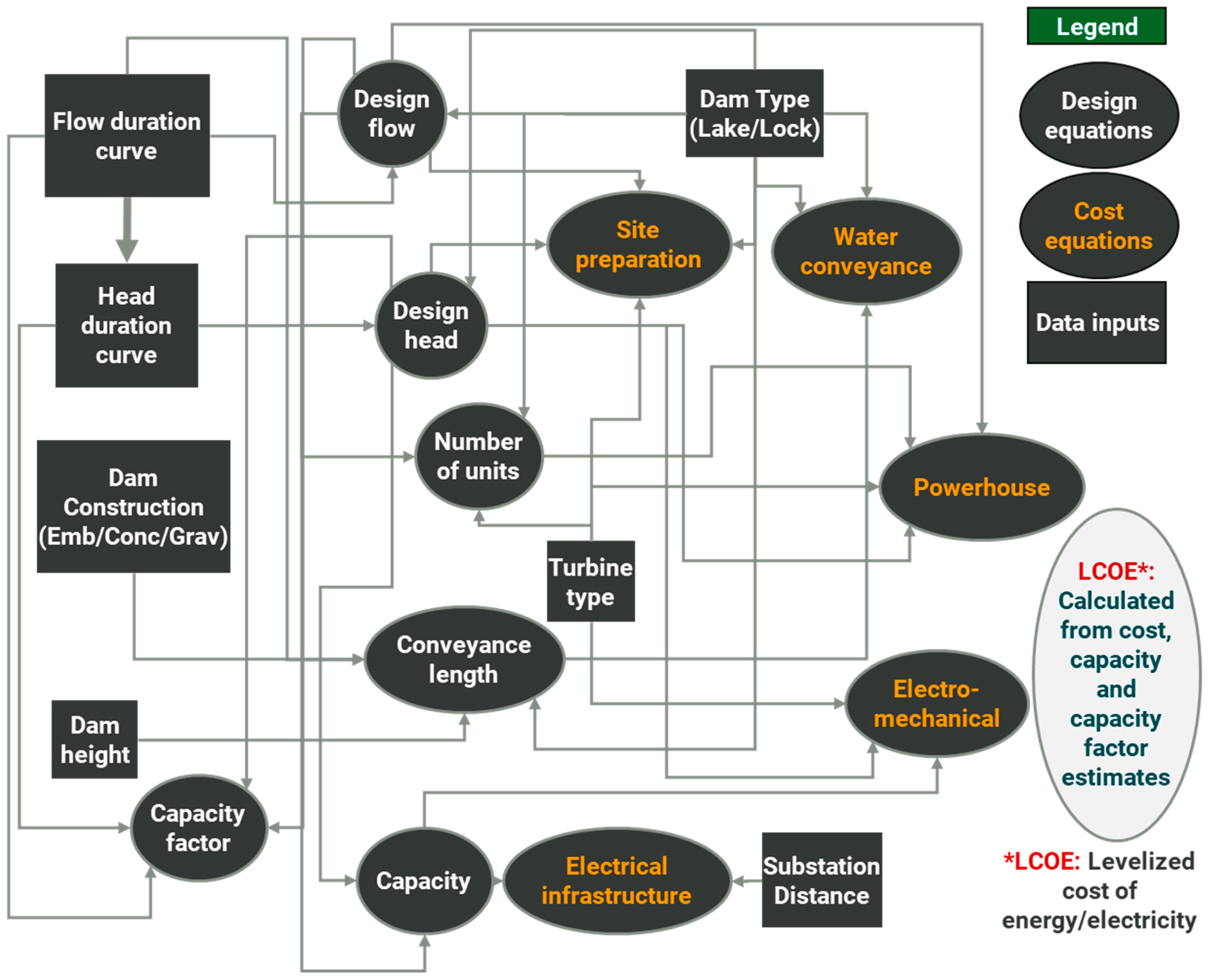
The empirical NPDHCM is based on the recognition that the limited available site and water resources data are reflections of their more detailed counterparts. For example, under common hydropower configurations, the height of a dam is correlated with the hydraulic head and its water conveyance requirements. On this basis, previous analyses have estimated the plant design head at NPD sites by adjusting the dam height [5]. The current study builds on this approach by accounting for other important determinants of hydropower designs and costs using the reference site dataset. The top-right section of Table 2 lists the endogenous variables of the NPDHCM, grouped into plant design and cost sub-models. Linkages among the variables in the model are illustrated in Figure 2. Details of each equation are discussed next, and the estimated coefficients are presented in Section 2.3. Table 4 defines the parameters of the model, categorized into intercepts, scaling factors, and variable coefficients. Intercepts and scaling factors have a single index corresponding to a model equation. The variable coefficients have two indices, with the first index corresponding to the model equation, while the second index identifies the exogenous or endogenous variables in the equation.

2.2.1. Plant Design Sub-Model

The plant design sub-model consists of Equations (1)–(6) for estimating plant design flow, hydraulic head, number of generating units, length of water conveyance, capacity, and capacity factor. The plant design flow, Equation (1), is a function of the dam’s median water flow and the ratio of its 70th and 30th percentiles, along with the lock dam indicator (lake dam as the control). Similarly, the design head, Equation (2), is a function of the dam’s median hydraulic head and the ratio of its 90th and 10th percentiles, along with the lock dam indicator. The number of generating units, Equation (3), is specified as the product of the design flow and the negative exponential function of indicators for Bulb and Francis turbines (Kaplan turbine as the control), and interactions of the plant design flow with the lake and lock indicators. The length of water conveyance, Equation (4), is a function of the median dam flow, dam construction type indicators, and interactions of dam height with lake and lock dam indicators.
Equation (5) is an identity for calculating plant design capacity by scaling the value for its reference site by the ratio of its nominal design capacity to that for its reference site, where the nominal design capacity is defined as the product of the plant design flow and hydraulic head. Note that there is a direct connection between Equation (5) and the usual hydropower capacity equation under the assumption that the plant efficiency for a site is the same as that of its reference site (g = gravitational acceleration constant; μ = plant efficiency), so that C a p d C a p d r e f = g μ Q d H d g μ Q d r e f H d r e f = Q d H d Q d r e f H d r e f   . Equation (6) specifies the capacity factor as a logistic function of the plant design flow, the ratio of the dam’s 70th to 30th flow percentiles, the ratio of the dam’s 90th to 10th head percentiles, and the interaction of the latter with the plant design head. This capacity factor specification ensures that estimated values are between 0 and 1, but is still a reduced-form formulation of the role of changes in water flow and hydraulic head on a plant’s available generation capacity. Since the capacity factor of a hydropower plant depends on many other variables apart from flow and head, lower and upper bounds of 10% and 70% are imposed on Equation (6) during model simulation. These limits are based on the range of reference capacity factors in Table 3 (0.31–0.61), which reflects industry data and emphasizes the fact that plants with very low capacity factors would be non-competitive and never considered for construction, and that hydropower plants typically operate at capacity factors below 70%.
Design flow (cfs):
Q d   =   γ q e β q , lc d lc   +   β q , qmed lnQ med   +   β q , q 7030 lnQ 7030
Design head (ft):
H d =   γ h e α h   +   β h , lc d lc +   β h , hmed lnH med +   β h , h 9010 lnH 9010  
Number of units (cfs):
U d =   γ u Q d e α u   + β u , lk q d lk +   β u , lc q d lc lnQ d   +   β u , blb d blb +   β u , frn d frn
Conveyance length (ft):
L d =   γ l e α l +   β l , qmed ln Q med + β l , lk nidh d lk +   β l , lc nidh d lc lnNIDH + β l , grv d grv + β l , emb d emb + β l , cnc d cnc + β l , emb grv d emb d grv
Design capacity (MW):
Cap d =   Cap dref Q d H d Q dref H dref
Capacity factor:
CapFac   = γ capfac 1 + e α capfac + β capfac , q ln Q d + β capfac , q 7030 ln Q 7030 + β capfac , h 9010 ln H 9010 + β capfac , h h 9010 ln H d ln H 9010

2.2.2. Plant Cost Sub-Model

The plant cost sub-model includes specifications for estimating the major capital cost components, including site preparation, water conveyance, powerhouse, electro-mechanical, electrical infrastructure, engineering and management, environmental requirements, and development costs, all in per kW terms. Equation (7) specifies the site preparation cost as a function of plant design head, Bulb and Francis turbine indicators, and interactions of the plant design flow with lock and lake dam indicators. Equation (8) specifies the water conveyance cost as a product of the water conveyance length and a multiplier that is different for lake and lock dams—these multipliers are in $/kW-ft units. Equation (9) specifies the cost of the powerhouse as a function of the plant design flow and hydraulic head, number of units, and Bulb and Francis turbine indicators. Equation (10) specifies the electro-mechanical cost (turbine, generator, and associated control equipment) as a function of the plant design capacity and head, number of units, and Bulb and Francis turbine indicators. These specifications reflect the role of turbine types, number of units, and the combination of capacity, flow, and hydraulic head levels in determining the requirements for hydropower equipment and its powerhouse and, consequently, the costs. Bulb turbines are used for NPD hydropower at lock dams, whereas Kaplan or Francis turbines are used for lake dams in the reference site data. The cost of electrical infrastructure to connect a hydropower plant to the transmission system is specified in Equation (11) as a linear function of design capacity, straight-line distance to the nearest substation, and their interaction, all divided by the design capacity.
Equations (12)–(15) are identities or proportional functions of other cost components. Equation (12) calculates the environmental mitigation cost, and Equation (13) calculates the engineering and management cost as fixed proportions of the sum of the costs in Equations (7)–(11). Equation (14) is an accounting identity to calculate total capital cost (initial capital cost) as the sum of the costs in Equations (7)–(13). Equation (15) calculates the development costs (costs of regulatory processes, studies, and analyses) as a fixed proportion of the initial capital cost. Equation (16) is the O&M cost equation from the 2015 hydropower Baseline Cost Model (BCM) [12], while Equations (17) and (18) are implementations of common formulas for the capital recovery factor and the levelized cost of energy (LCOE), respectively.
Site preparation cost ($/kW):
SP   =   γ sp e α sp   + β sp , lk q d lk +   β sp , lc q d lc ln Q d + β sp , h ln H d + β sp , blb d blb + β sp , frn d frn
Water conveyance cost ($/kW):
WC   =   γ wc L d e β wc , lk d lk   +   β wc , lc d lc
PH   =   γ ph e α ph +   β ph , q lnQ d   +   β ph , h lnH d +   β ph , u U d +   β ph , blb d blb +   β ph , frn d frn
Electro-mechanical cost ($/kW):
EM   =   γ em e α em + β em , q ln Cap d + β em , h ln H d + β em , u U d + β em , blb d blb + β em , frn d frn
Electrical infrastructure cost ($/kW):
EI   = γ ei α ei +   β ei , cap Cap d +   β ei , sb SB ds +   β ei , cap sb Cap d SB ds Cap d
Environmental mitigation cost ($/kW):
ENV   =   γ env PH   +   EM   +   EI   +   SP   +   WC
Engineering and management cost ($/kW):
ENG   =   γ eng PH   +   EM   +   EI   +   SP   +   WC
Capital cost ($/kW):
CAPEx   =   PH   +   EM   +   EI   +   SP   +   WC   +   ENV   +   ENG
Development cost ($/kW):
DEV   =   γ dev CAPEx
Annual Operation and maintenance ($/kW):
annOM   = 226544 × Cap d ) 0.547 1000 × Cap d
Capital recovery factor:
KRFac   = r   ( 1 +   r ) T ( 1 +   r ) T 1
Levelized Cost of Energy ($/kWh):
LCOE   =   KRFac   CAPEx   +   DEV +   annOM 8760 ×   CapFac  

2.3. Model Coefficient Estimates

The variable coefficients in Equations (1)–(4) and (6)–(11) were estimated using ordinary least squares (OLS) regression, and Table 5 provides an overview of the estimation statistics. The R2 values show that the model provides a good fit to the reference site data, and the F-Statistic rejects the joint null hypothesis on the coefficients with p-values close to zero. Thus, the variables explain the dependent variables, with adjusted R2 values lower than the R2 values by less than 3% in most cases. Only the equations for capacity factor and water conveyance cost have R2 values below 85%. These are among the three equations with large residuals as indicated by the MAPE statistic, with the other equations having MAPE values less than 4%. The coefficient estimates in Table 6 and Table 7 are discussed below. Given the limited number of data points, Table A3 and Table A4 present the median and the 5th and 95th percentiles of bootstrapped estimates of the coefficients using a leave-one-out approach with 1000 replicates. The bootstrapped median estimates are close to those in Table 6 and Table 7, particularly for the significant coefficients.

2.3.1. Plant Design Sub-Model Coefficient Estimates

Table 6 (rows are the model variables with bolded estimates indicating significance at the 5% level) shows coefficient estimates and standard errors for the plant design sub-model, Equations (1)–(4) and (6). For the design flow equation, coefficients for the median dam water flow and its 70th and 30th percentile ratios are both positive and significant at the 5% level. Given that traditional hydropower design flow is generally based on the 70th percentile flow level, the positive values of the 70th and 30th percentile flow ratios are expected. The coefficient of the lock dam indicator is significant and negative, implying that once differences in median dam water flow and its 70th to 30th percentile ratios are considered, lock dams have lower hydropower design flows relative to lake dams. In other words, lock dam hydropower plants use a smaller proportion of the available dam water flow relative to lake dams. For the plant design head equation, coefficients of the median dam hydraulic head and its 90th and 10th percentile ratios are significant at the 5% level. The former is positive, while the latter is negative, reflecting the fact that high variability of the dam hydraulic head tends to lead to more conservative hydropower design head levels, all else equal. The lock dam indicator coefficient is significant and negative, matching the generally lower hydraulic head available at lock dams relative to lake dams, after accounting for the dam’s median head.
For the number of generating units equation, coefficients of the interactions of design flow with lake and lock dam indicators are positive and significant at the 5% level. Coefficients for the Bulb and Francis turbine indicators are both negative but not significant at the 5% level. The magnitude of the Bulb turbine coefficient is more than four times that of the Francis turbine, reflecting the much larger “gulp size” (unit water flow) of Bulb turbines relative to Kaplan and Francis turbines. Bulb turbines are used for very large-flow/low-head sites, typical of lock dams in the US, reducing the number of units needed relative to the other two turbine types.
For the length of water conveyance equation, the median dam water flow coefficient is negative but not significant at the 5% level. Coefficients of the interactions of dam height with the lake and lock dam indicators are positive and significant at the 5% level. Equation (4) also includes indicators of dam construction types. The gravity dam indicator coefficient is negative, whereas the concrete dam indicator coefficient is positive, and both coefficients are significant at the 5% level. Coefficients for the embankment dam indicator and its interaction with the gravity dam indicator are both positive but insignificant. A dam can incorporate multiple construction types/materials, so the dam construction indicators are not mutually exclusive, with the particular combinations depending on the design for a given site. For the capacity factor equation, the 70th and 30th percentile dam flow ratio coefficients are significant at the 5% level and negative. The 90th and 10th percentile dam hydraulic head ratio coefficients are also negative and significant at the 5% level, but their interaction with the plant design head is positive and significant. The design flow coefficient is positive but insignificant. Overall, these coefficients imply that variations in water flow and hydraulic head reduce the ability to operate a hydropower plant at its full capacity.

2.3.2. Plant Cost Sub-Model Coefficient Estimates

Table 7 shows the coefficient estimates and standard errors for the plant cost sub-model. For the site preparation cost equation, coefficients of the plant design head and interactions of the plant design flow with the lake and lock dam indicators are negative and significant at the 5% level. Thus, larger plant design flow and hydraulic head reduce the per kW site preparation, which reflects its lump-sum cost nature and the role of plant size. The Bulb and Francis turbine indicators are included in the site preparation, powerhouse, and electro-mechanical cost equations. The Francis turbine coefficient is positive and significant at the 5% level in all three equations. The Bulb turbine coefficient is negative in all three equations. Although it is not significant at the 5% level, the sign and magnitude suggest that it reduces the per kW costs of the three components. In this case, the coefficient reflects the benefits of the large “gulp size” of Bulb turbines, relative to Kaplan and Francis turbines. For the water conveyance cost equation, coefficients of the lock and lake dam indicators are positive, but only that of the lake dam is significant at the 5% level. The value of the lake dam indicator coefficient is also one order of magnitude larger than for the lock dam, implying that lake dams have larger water conveyance costs than lock dams on a per kW-ft basis.
For the powerhouse cost equation, coefficients for the design flow and design head are positive and negative, respectively, and significant at the 5% level. The signs of these two coefficients match the general understanding that high-head sites increase the power density of hydropower equipment and, hence, lower costs on a per kW basis, whereas larger flows require larger equipment and higher power house costs on a per kW basis. The coefficient of the number of generating units variable is negative and significant at the 5% level in the powerhouse cost equation. For the electro-mechanical cost equation, coefficients of the design head and capacity are negative and significant at the 5% level, both indicating that larger plants have lower per kW costs for this component. The coefficient of the number of generating units in the electro-mechanical cost equation is positive but not significant at the 5% level. For the electrical infrastructure cost equation, the design capacity coefficient is positive and significant at the 5% level, but both terms involving the linear distance to a substation are insignificant. Given that, along with plant capacity, connection distance is an important determinant of transmission costs, the insignificance of the latter is likely due to inadequate variation in the substation distance data for this study, as the reference sites were generally within 10 miles of a substation.

2.3.3. Scaling Factors

In addition to the estimated coefficients in Table 6 and Table 7, scaling factors are used in the NPDHCM simulations. The scaling factors, γk, as defined in Table 4, are calculated by dividing the actual reference values of the variables by those predicted from Equations (1)–(4) and (6)–(11). The calculated scaling factors are shown in Table 8, with median values for each equation across sites between 0.95 and 1.05, except for the capacity factor and water conveyance cost equations. The standard deviations of the scaling factors across sites for each equation are generally below 0.5, except for the water conveyance cost and electrical infrastructure cost equations, with values of about two and four, respectively, in line with the corresponding R2 and MAPE values in Table 5. Thus, these scaling factors provide a measure of the accuracy of each equation for each reference site. The scaling factors are used in the NPDHCM simulations to ensure that differences in the simulated values for a given site, relative to its reference site, are driven by the determinant variables in each equation rather than the random residuals.

3. Results: Application of NPDHCM to US Data

A pre-feasibility analysis of the cost of potential hydropower development at US NPD sites was performed to illustrate the capabilities of NPDHCM. The sites included in the analysis were from a previous resource assessment study [5]. Stream flow data were obtained from the Dayflow dataset [19], which provides estimates of daily and monthly stream discharge from 1980 to 2015 (https://hydrosource.ornl.gov/data/datasets/dayflow-v1/; accessed on 5 February 2024). Daily flow data for about 36,000 of the slightly more than 54,000 sites in the resource assessment were obtained from the Dayflow dataset to calculate flow percentiles for the simulations. The paucity of hydraulic head data is a well-known issue when evaluating hydropower potential at US dam sites. Given this, hydraulic head values from the resource assessment were adopted for the pre-feasibility analysis, which means that the percentile values used in the model are all set to the same value. Other inputs to the NPDHCM, including dam height, lake/lock indicators, and dam construction types, were extracted from the NID database (https://nid.sec.usace.army.mil/nid/#/; accessed on 5 February 2024). Distances of NPD sites to the nearest US electric substation were calculated using the QGIS 3.83.3 distance function [20]. Results of the simulations with this data are presented in this section. Reference sites for each NPD site were selected by first identifying the lake or lock dam type of each site, and using a matching procedure to identify its reference site based on other site features. The matching procedure calculates the Gower distances [21] of each site to all nineteen reference sites and selects the smallest distance value. The variables used for calculating the distance values are based on those included in the original reference site analysis [17]. These variables include the dam’s primary purpose, construction types, height, median water flow, and hydraulic head. Once identified, the reference site variables and scaling factors are selected from Table 3 and Table 8 for the simulations.

3.1. Aggregate Hydropower Potential and Cost Estimates

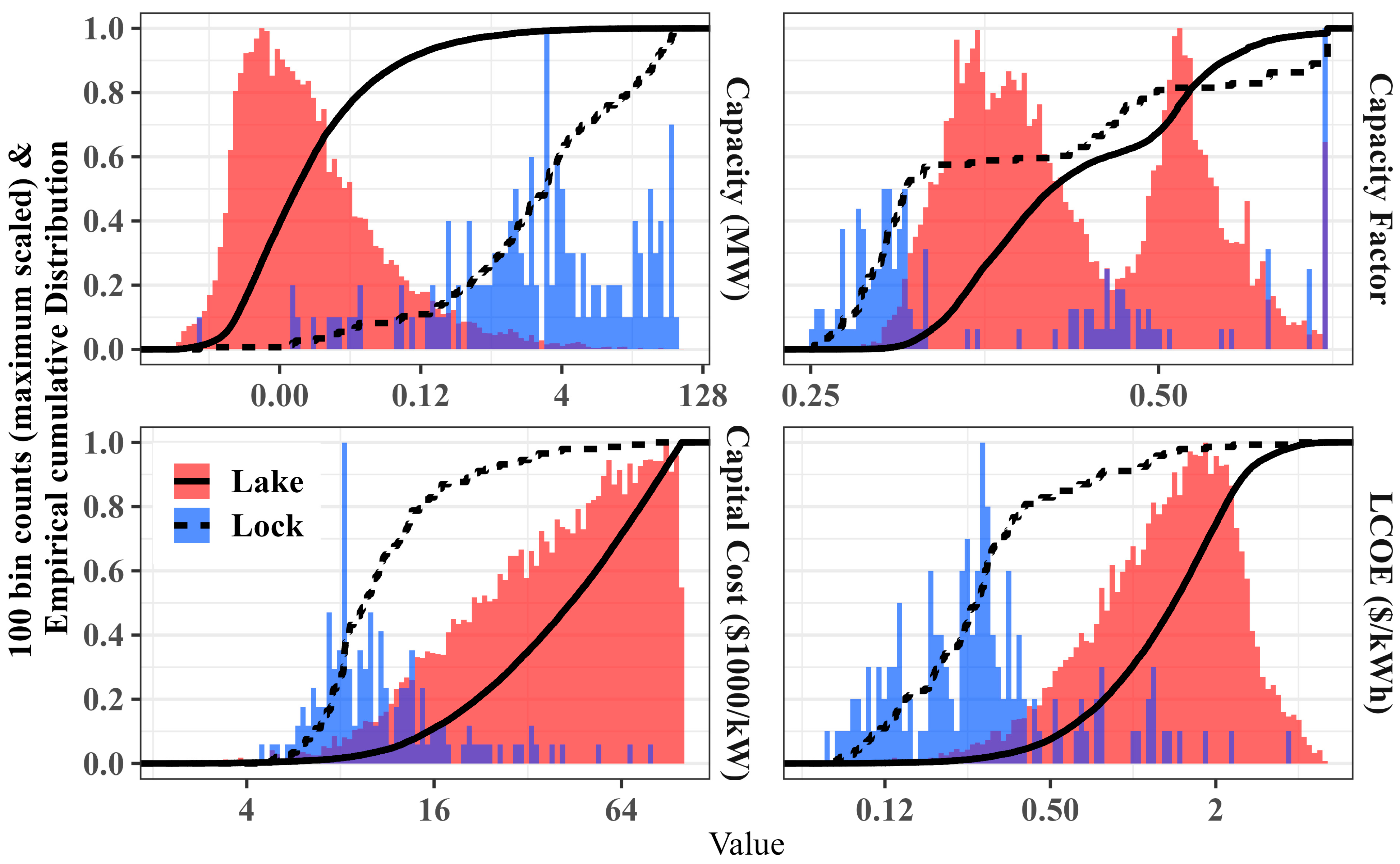
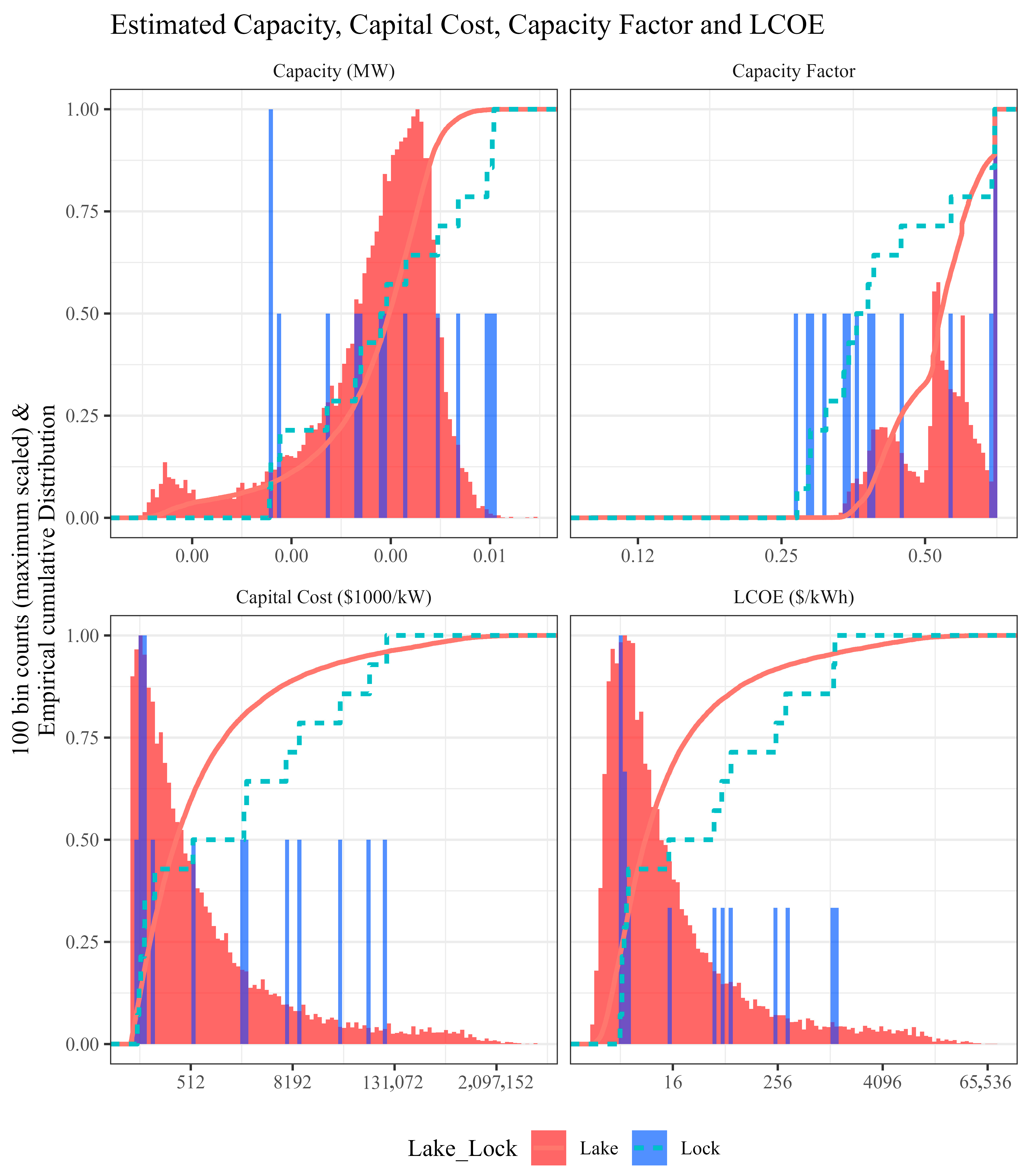
Figure 3 shows 100-bin histograms for the capacity, capacity factor, capital cost and LCOE estimates, with the counts scaled by the maximum number and overlaid by the empirical cumulative distribution curves. These are shown separately for lake and lock dams. Only sites with capital cost estimates less than $100,000/kW, consisting of 15,071 lake dams and 146 lock dams, are included in Figure 3. This upper bound is used to reflect uncertainties in the data and include sites with small capacity potentials that may benefit from future innovations. Still, more than half of the initial 36,000 sites in the simulation have larger capital cost estimates. The capacity histograms for lake and lock dams have limited overlaps, with the estimated capacity potentials for more than three-quarters of the lake NPD sites less than 20 kW. The capacity factor histograms are bimodal for both lock and lake dams, with a range of 0.25 to 0.7, but those for lock dams are concentrated on the lower end of the range. Thus, only the upper capacity factor limit of 0.7 is binding, but for less than 250 of the more than 15,000 sites. The capital cost histograms for lake and lock dams also have limited overlaps, reflecting the effects of decreasing scales on the cost of hydropower using baseline technologies. The LCOE estimates in Figure 3 incorporate the capacity factor and capital cost estimates according to Equation (18). The range of LCOE estimates for lake dams is wide, from $0.07/kWh to $5/kWh, with a median of $1.4/kWh. For lock dams, the range of LCOE estimates is $0.08/kWh to $3.7/kWh with a median of $0.30/kWh. Figure A1 shows plots similar to Figure 3 for sites with capital cost estimates greater than $100,000/kW. These sites include more than 20,000 sites with capacity estimates of less than 40 kW and a median of less than 1 kW, reflecting the small level of water resources at those sites in the data.

3.1.1. Supply Curves for Sites with LCOE ≤ $0.4/kWh

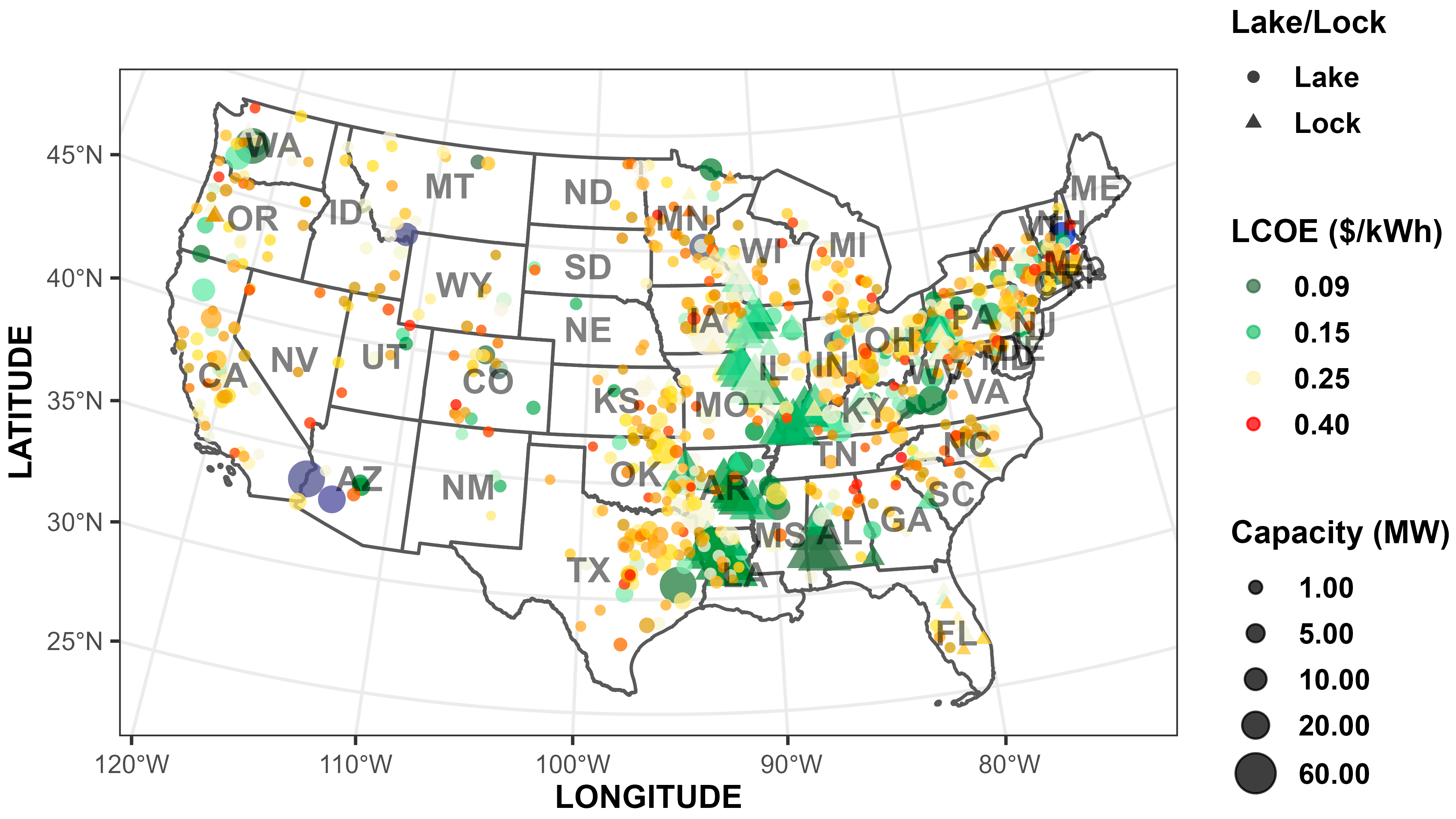
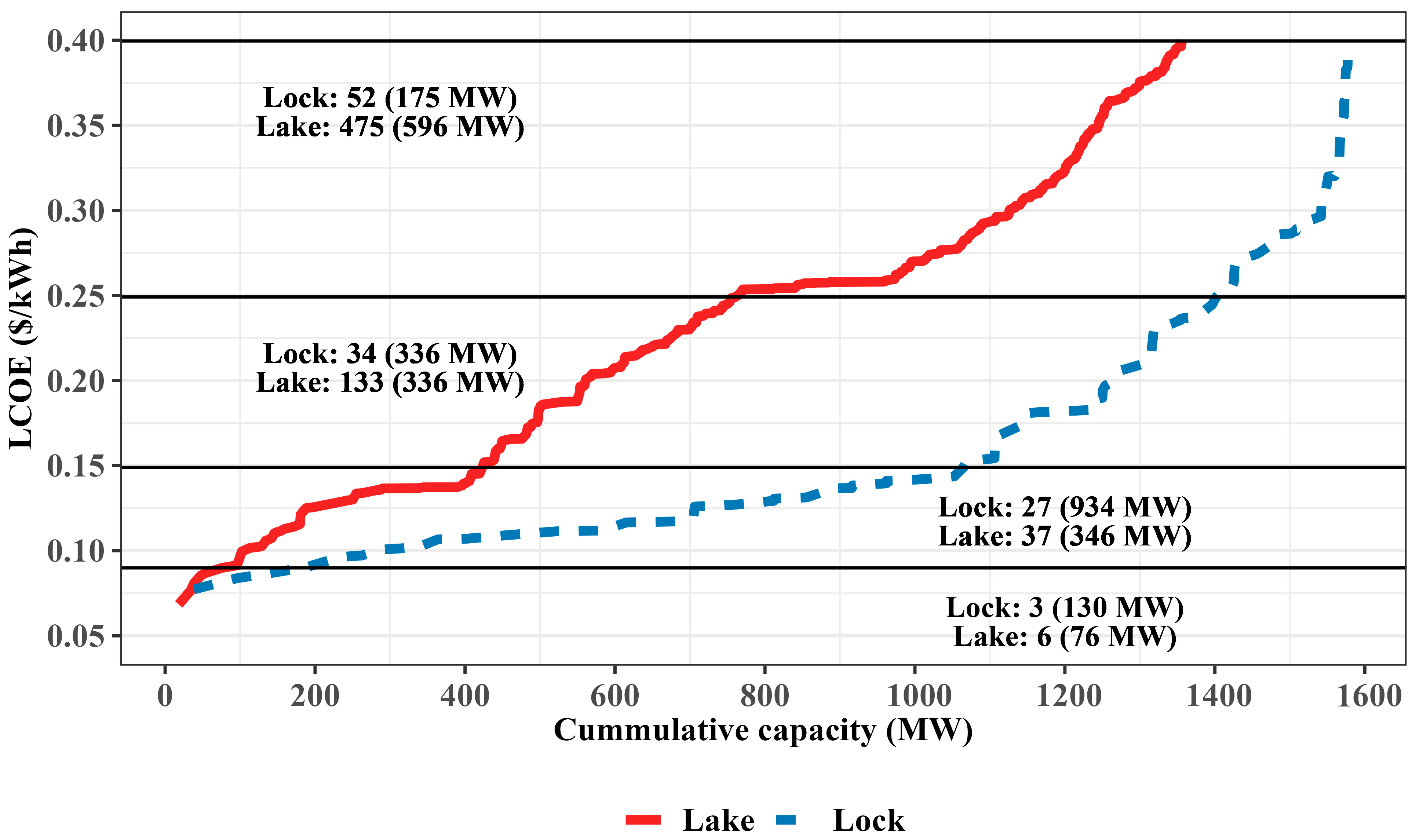
The rest of this section focuses on sites with estimated LCOE ≤ $0.4/kWh, which is about twice the threshold for existing hydropower plants in North America [22]. Figure 4 shows the geographical spread of these sites. Most of the sites are in the Eastern US, but there are also a considerable number in the Western US. These sites consist of 651 lake dams and 116 lock dams with total capacity estimates of 1357 MW and 1577 MW, respectively. Figure 5 presents separate supply curves for lake and lock dams, divided into four LCOE groups: (1) less than $0.09/kWh; (2) >$0.09/kWh to $0.15/kWh; (3) >$0.15/kWh to $0.25/kWh; (4) >$0.25/kWh to $0.40/kWh. The number of sites and total capacity within each LCOE group are shown for each dam type. The supply curve for lake dams is steeper than for lock dams over the first three groups. The cumulative capacity for lake dams increases almost linearly with the LCOE, whereas more than half of the cumulative capacity for lock dams is within the second LCOE group. On average, the potential capacity per site in the first LCOE group is sizable at about 12 MW for lake dams and 43 MW for lock dams, but there are only a few of these sites. In the second LCOE group, the average capacity per site is about 9 MW for lake dams and 35 MW for lock dams. The average capacity per site in the third group drops to about 3 MW for lake dams and 10 MW for lock dams, and is about 1.3 MW for lake dams and 3.4 MW for lock dams in the fourth group.

3.1.2. Capital Cost and Capacity Factor Estimates for Sites with LCOE ≤ $0.4/kWh

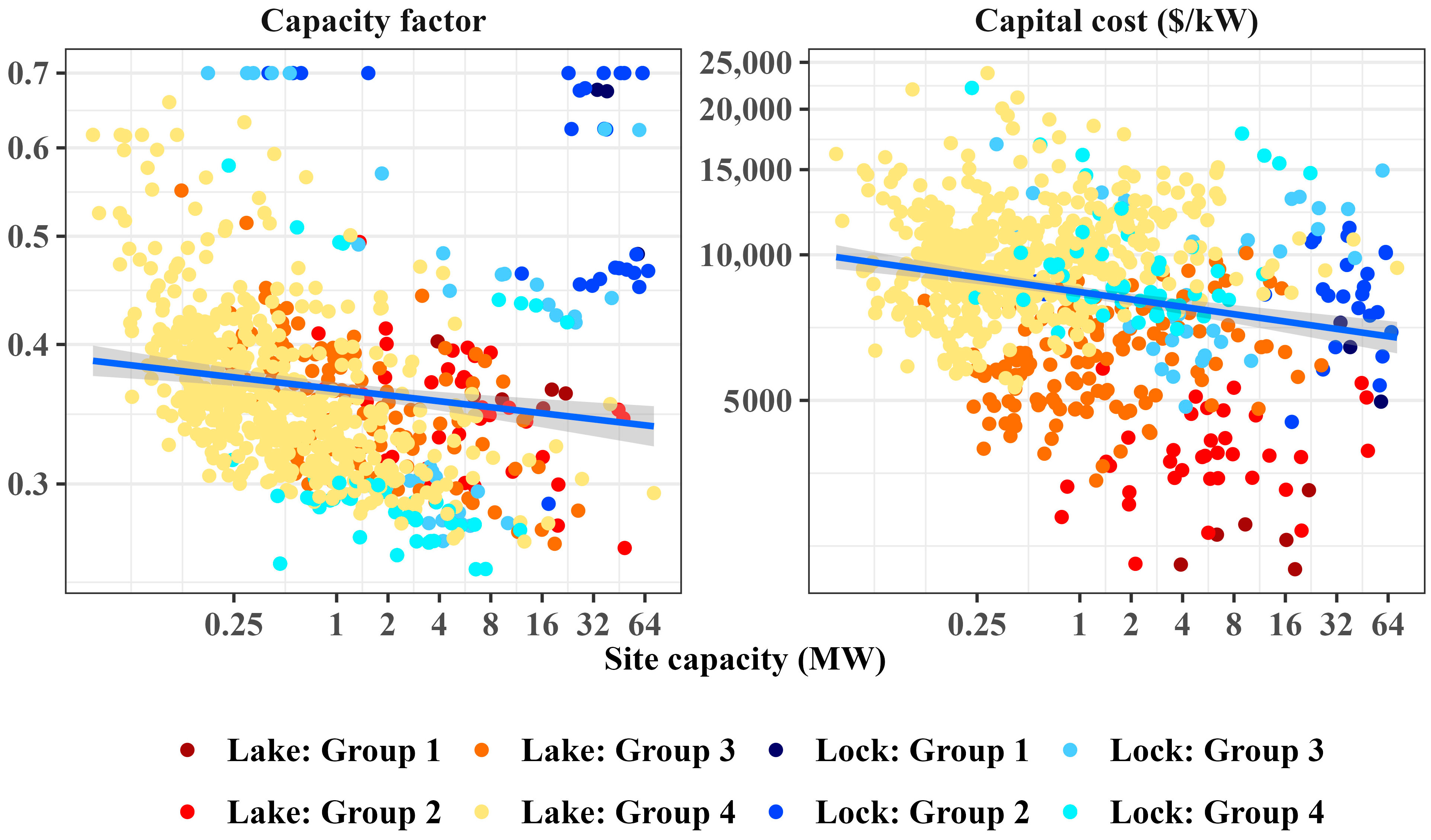
Figure 6 plots the capacity factor and capital cost estimates versus capacity for all sites with LCOE ≤ $0.4/kwh and provides insights into the spread across LCOE groups for each dam type. The capacity factor and capital cost estimates have small, negative linear correlations with capacity, so the estimates are widely distributed around this line. Only 15 of these sites are at the upper capacity factor limit of 0.7 and include only lock dams. Sites with capacities less than 10 MW have capacity factor estimates between 25% and 45%, but there is no clear distinction across the LCOE groups. Most sites with capacity factors above 45% are larger than 10 MW for lock dams, but below 1 MW for lake dams. Most of the lake and lock dams in the first LCOE group have capacities larger than 8 MW and capital costs below $10,000/kW. The majority of sites below $5000/kW are lake dams, cutting across all LCOE groups and capacity levels. The majority of lake and lock dams in LCOE groups 2 to 4 have capital costs between $10,000/kW and $15,000/kW.

3.2. Hydropower Components and Cost Estimates

3.2.1. Design Variables: Flow, Head, Turbine, and Conveyance Length

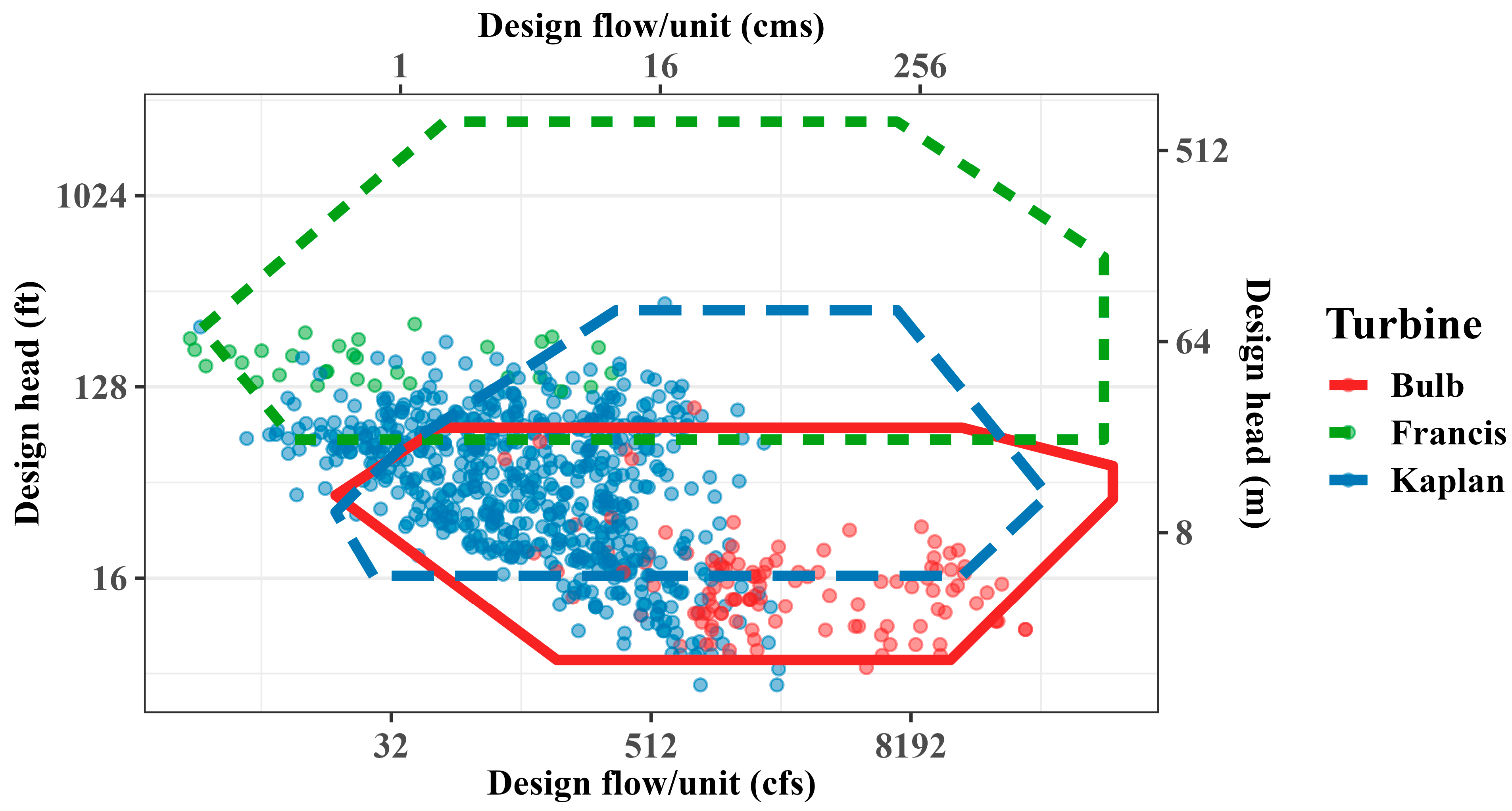
Figure 7 shows the pattern of design flow–head–turbine combinations in the simulation results. These results show that Francis turbines are used for sites with design heads of more than 100 ft and low to medium design flow levels, while Bulb turbines are mainly used for sites with low design heads and medium to high unit design flow levels. The Kaplan turbine straddles the space between the Francis and Bulb turbines but significantly overlaps sites using the latter turbine—the Bulb turbine is a member of the Kaplan class of turbines but adapted for low-head and high-flow sites. Turbine selection charts are often used to depict the general limits of head–flow combinations for different turbine classes, but there is a variety of these charts differing in both the number of turbine classes and limits [23]. Approximate lines of Kaplan, Francis, and Bulb turbine limits are overlaid on the flow–head–turbine simulation results in Figure 7. Although the turbine options in the NPDHCM are limited to those used for the reference sites in this study, these patterns are generally in line with the “turbine selection chart”.
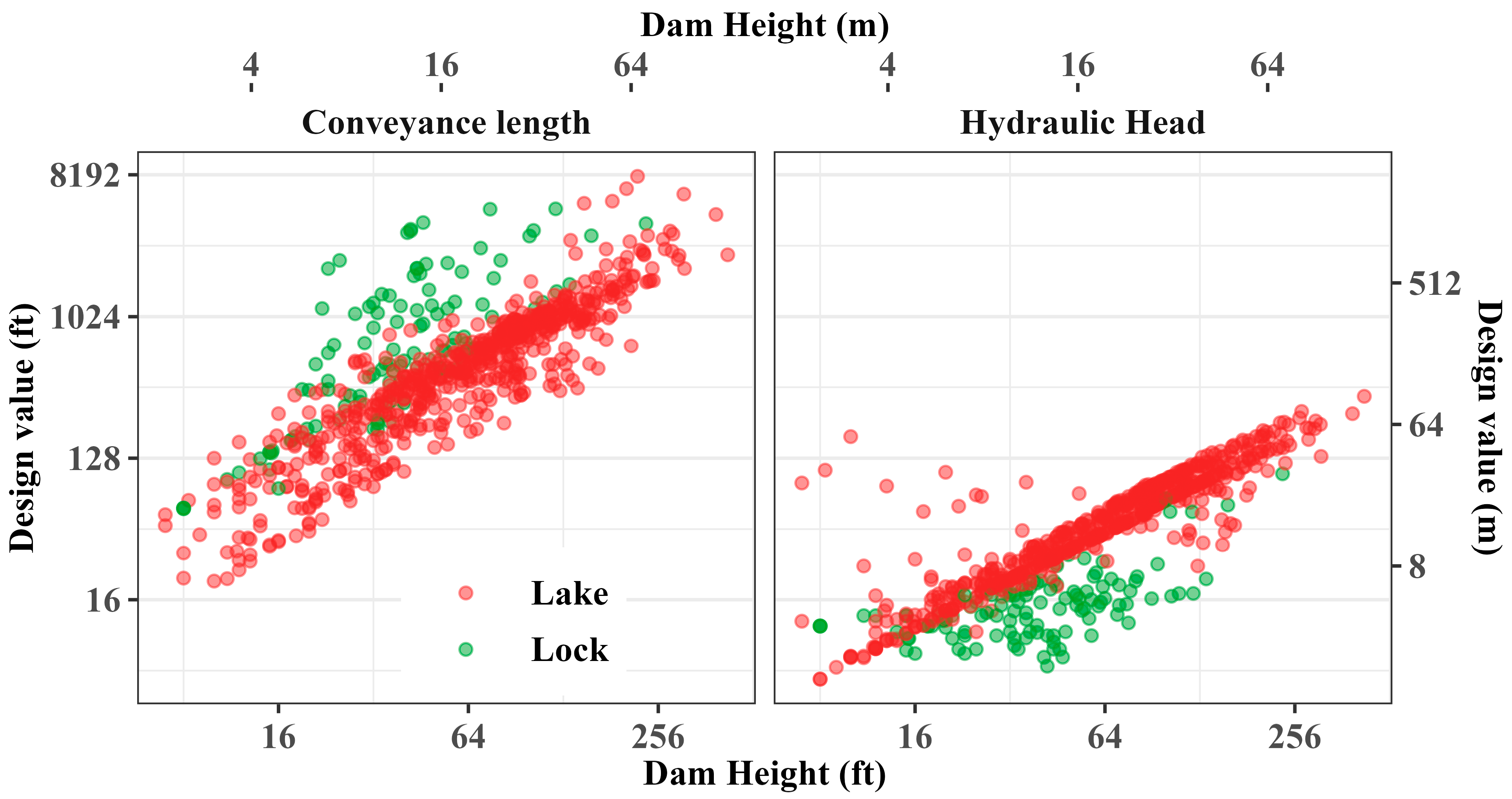
The plant design head and conveyance length are functions of the dam height in NPDHCM. Figure 8 shows that estimates of the design head and conveyance length for lake dams have a nearly linear log–log relationship with dam height. In contrast, the conveyance length for lock dams has a more linear log–log relationship with the dam height than the design head. The plant design head for lock dams is generally below 32 ft in the results, reflecting the operation characteristics and much lower hydraulic head available at these navigation dams relative to the dam height.

3.2.2. Capital Cost Shares of Major Hydropower Components

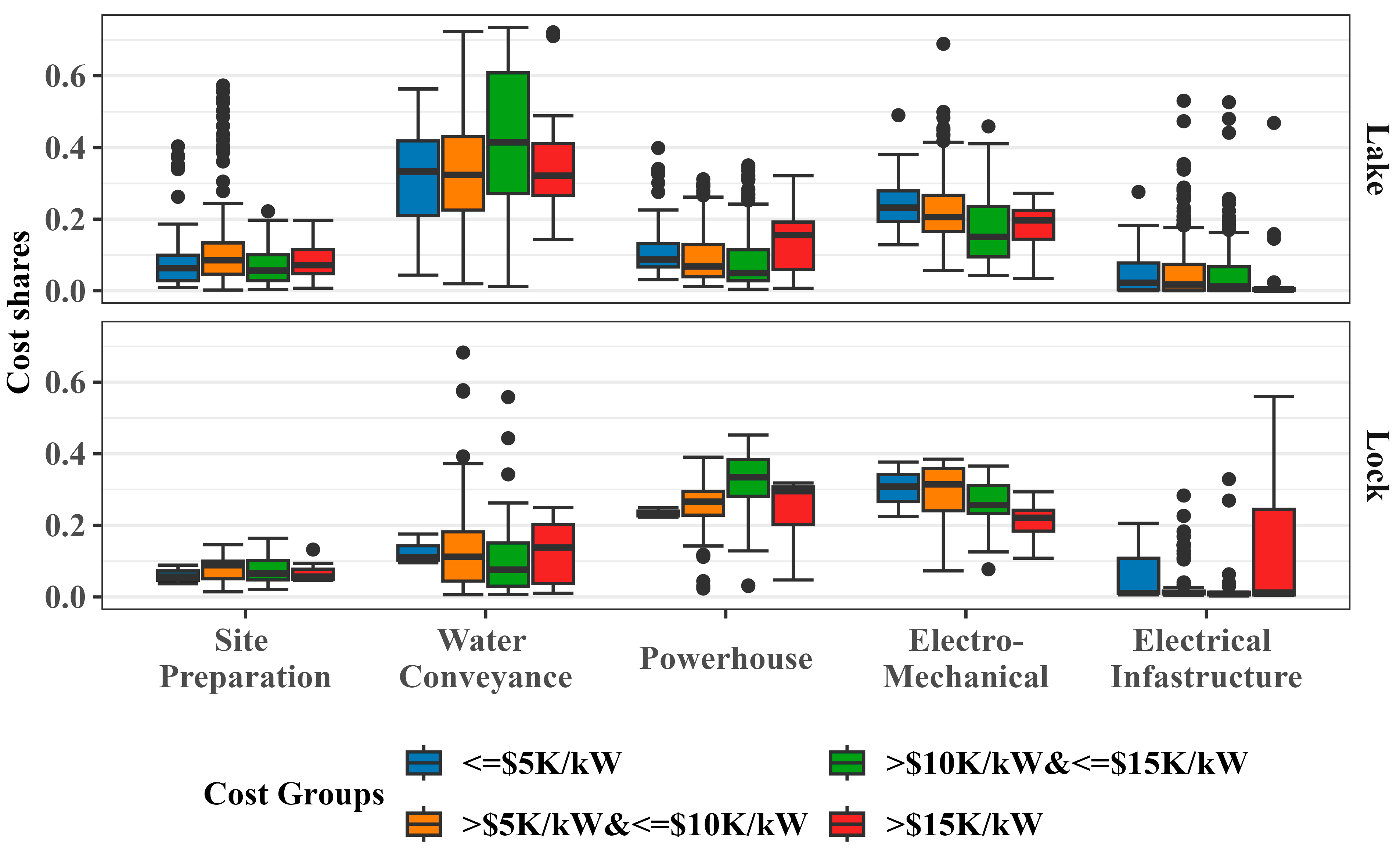
Figure 9 presents boxplots of the estimated per kW capital cost shares for the major hydropower cost components in the simulation results, excluding those for environmental mitigation, engineering/construction management, and development costs, which are proportional to the aggregates of other costs in the model. The distributions are shown separately for lake and lock dams and four capital cost groups. The results show significant variations in the shares of capital cost components across dam types and cost groups. Cost share patterns for site preparation are similar for lake and lock dam sites, with a median share close to 10%, but a slightly wider interquartile range for lake dams than for lock dams.
The median water conveyance cost shares for lake dams are 30% to 40% across the capital cost groups, but below 20% for lock dams. The interquartile ranges of the water conveyance cost shares are much wider for lake dams than for lock dams, reflecting the much different water conveyance design requirements at the two types of NPD sites. Powerhouse cost shares for lock dams have median values above 20% with third quartile values of 25% to 40%. Powerhouse cost shares for lake dams have a much different pattern from lock dams, with median values below 10% for the first three capital cost groups and third quartile values below 20% overall. The median electro-mechanical cost shares for lake dams are slightly lower than for lock dams but higher than for their powerhouse counterparts. Electrical infrastructure cost shares are similar across capital cost groups for lake dams but not for lock dams. Given the site-specific nature of hydropower plants, many of the cost component shares show significant outliers across the capital cost groups.

3.3. Sensitivity Analysis

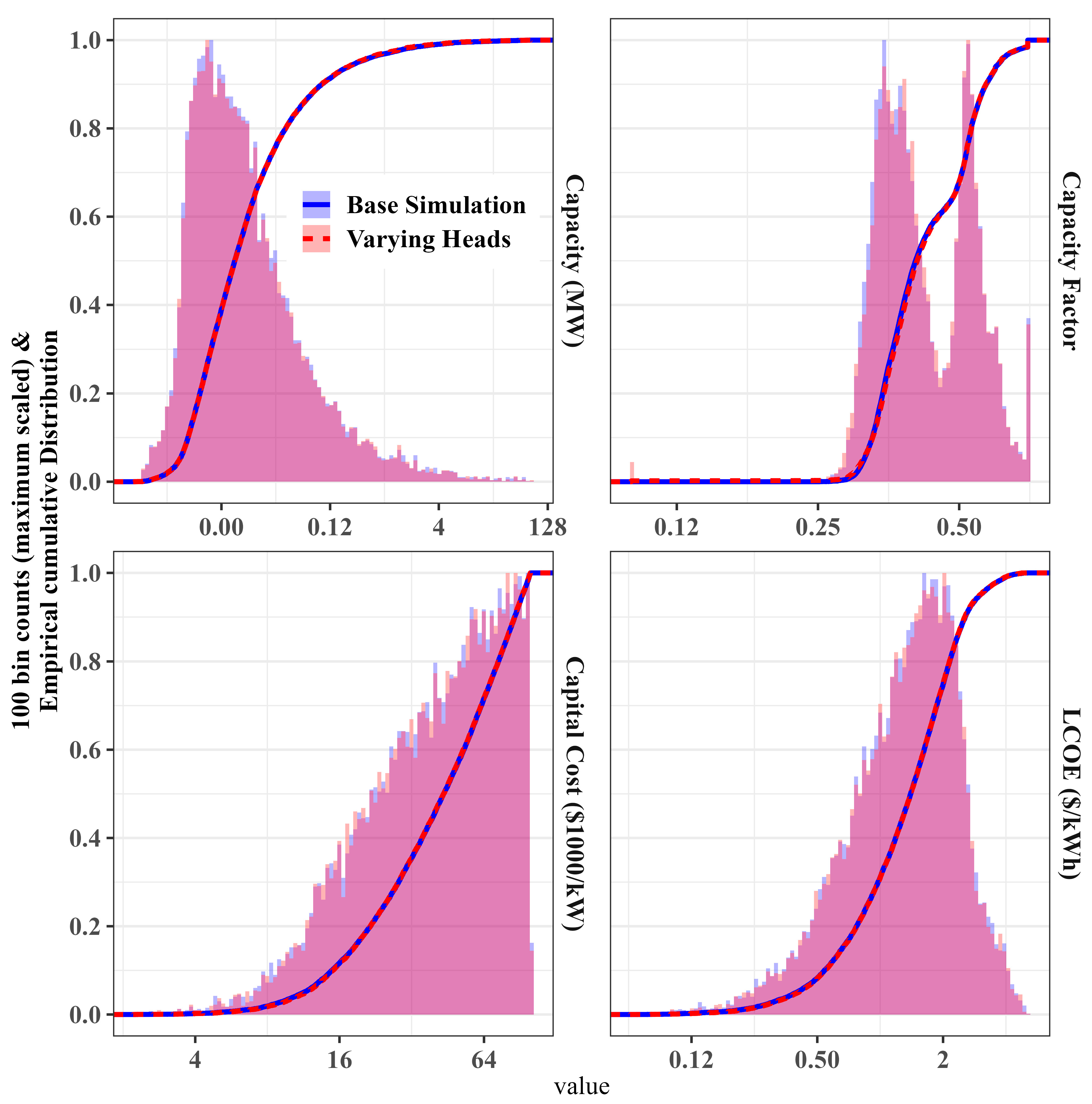
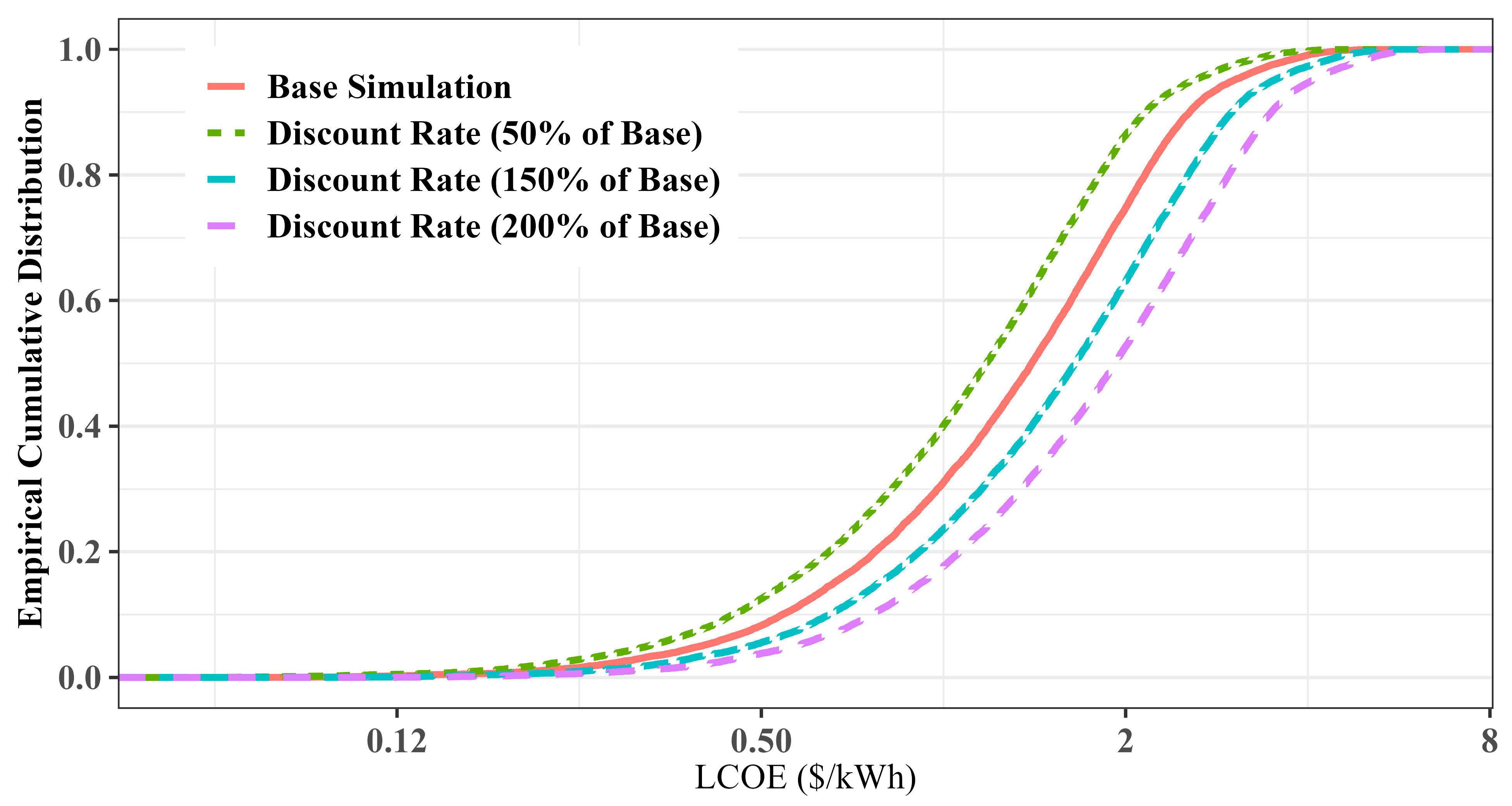
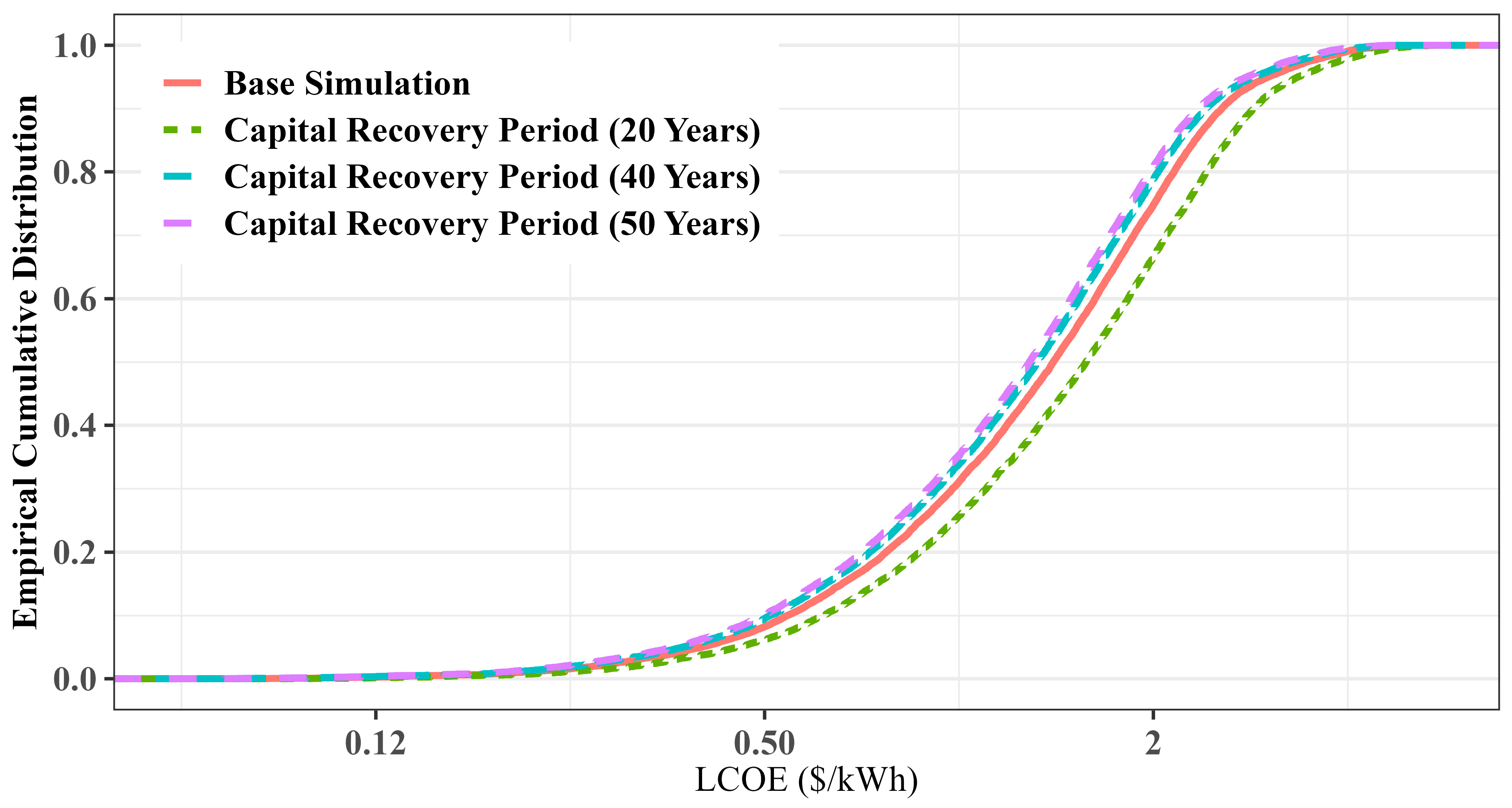
The limited available data for evaluating US NPD sites means that the NPDHCM simulation results are subject to uncertainties. These uncertainties can be explored with sensitivity simulations of the model. As a key parameter for hydropower supply, we perform a sensitivity analysis on the hydraulic head data in this study. Since dam hydraulic head levels are driven by river flow, reservoir management, and other crucial factors, simulations based on random head variations would be uninformative. As an alternative, we generated hydraulic head percentiles for each simulated site using the profile of percentiles for its corresponding reference site. Results of the base (constant head) and “varying heads” simulations are shown in Figure A2 of the Appendix. These results show that, while the variation in hydraulic heads influences the capacity, capacity factor, capital costs and LCOE estimates, the overall pattern did not shift dramatically. In addition, we evaluated the sensitivity of the LCOE estimates to different values of the real discount rate (r = 50%, 150% and 200% of the base rate of 5.4%) and capital recovery period (T = 20 years, 40 years and 50 years, versus the base period of 30 years). Results of these sensitivity simulations are shown in Figure A3 and Figure A4. The real discount rate shifts the distribution of LCOE values almost proportionally, whereas capital recovery periods higher than 30 years have diminishing effects in shifting the distribution of LCOE estimates to the left. Both of these results are as expected from Equations (17) and (18).

4. Discussion

The empirical NPD hydropower cost model (NPDHCM) presented in this study uses a reference site approach to strike a balance between the “detailed” and “aggregate” approaches to hydropower cost modeling. The “detailed” approach provides details of the underlying drivers of costs, but can only be applied to one or a few sites, while the “aggregate” approach is easy to exercise but provides few to no details on cost drivers. Thus, the NPDHCM enables insights into the drivers of hydropower costs and is scalable for application to the thousands of US NPD sites. Although the model coefficients were estimated using detailed data generated from a preliminary engineering design and cost analysis of reference sites, equations are specified as a function of variables that can be adapted to the more limited data commonly available for NPD sites. The model consists of plant design and cost sub-models, and the estimated coefficients were presented. The signs and magnitudes of these coefficients demonstrate that, while the equations are necessarily parsimonious, they capture important design factors and drivers of costs for NPD hydropower projects as reflected in the underlying reference sites data.
The model was demonstrated with an application to about 36,000 US NPD sites. The distribution of aggregate estimates across more than 15,000 sites with capital cost below a high bar of $100,000/kW was presented, and showed significant differences between lake and lock dams in the number of potential sites, capacity distributions, capital costs, and LCOE estimates. In general, the vast majority of NPD sites are lake dams, with about three-quarters having capacity potentials of less than 20 kW, whereas most lock dams have capacity potentials above 1 MW. Nearly 800 of these sites have LCOE estimates that are less than a threshold of $0.4/kWh—about twice the upper bound for existing hydropower plants in North America. These sites have an estimated capacity potential of ~3 GW or more than 3 MW per site, and were grouped into four LCOE categories. The first two LCOE groups can be considered competitive or marginally competitive using baseline technologies, while the other two groups are potentially competitive with near-term innovations. The most competitive category has LCOE values ≤ $0.09/kWh. It includes six (6) lake dams and three (3) lock dams, but the latter accounts for nearly two-thirds of the total capacity in this LCOE category. In addition, the cumulative capacity potential of the lake dams increases almost linearly with the LCOE values. In contrast, most of the capacity potential for lock dams falls into the second and third LCOE categories, indicating significant hydropower capacity potential for near-term development.
Drivers of hydropower costs at US NPD sites with estimated LCOE ≤ $0.4/kWh were evaluated by examining the relationship between the estimated plant design head and water conveyance length versus the dam height, the design flow–head–turbine configurations relative to approximate turbine selection charts, and the estimated per kW capital costs shares of major hydropower components for lake versus lock dams and four capital cost groups. These results found that despite the reduced-form equations of the NPDHCM, the design flow–head–turbine estimates are consistent with choices usually based on individual site evaluations. The cost share estimates show a wide range for most components of NPD hydropower under baseline technology conditions, and differ for lake versus lock dams. The largest cost shares for lake dams are for water conveyance, electro-mechanical, and powerhouse components in that order. For lock dams, the electro-mechanical and powerhouse cost shares are the highest followed by the water conveyance component. Thus, water conveyance is a key cost driver for hydropower development at lake dams, while electro-mechanical and powerhouse costs are jointly key drivers for lock dams. The capital cost shares include a significant number of outliers, emphasizing the site-specific nature of hydropower. These estimates provide information beyond the usual technology-agnostic aggregate cost estimates commonly available for the pre-feasibility evaluation of hydropower potential at NPD sites.

5. Conclusions

The empirical model (NPDHCM) in this study provides a parsimonious yet insightful approach for evaluating the prospects of hydropower at thousands of US NPD sites. Based on a reference site (RS) approach, the equations of the model reflect the underlying determinants of capacity potentials and costs associated with the features and water resources at these sites using baseline technologies. An application of the NPDHCM to US NPD data demonstrates that the model captures the preliminary engineering design and cost simulations underlying the reference site data. Overall, the pre-feasibility results indicate that there is a significant amount of potential NPD capacity that can be considered cost-competitive under the baseline design options in this study. These include about 800 sites with an estimated LCOE ≤ $0.40/kWh. For comparison, there are about 70 NPD sites captured in the ORNL US hydropower development pipeline dataset [24], 55 of which are among the most competitive sites identified in this study. For these 55 sites, the LCOE estimates range from $0.08/kWh to $0.37/kWh.
The approach used in this study advances the understanding of potential hydropower costs at the thousands of US NPD sites, but there are remaining limitations. The reference site data span a wide range of US NPD site features and water resource potentials, but the variations captured in these sites do not fully reflect that of the NPD population. The low number of samples, which is common in studies of hydropower costs due to the paucity of data, means that the model’s equations have limited degrees of freedom. Although the coefficient estimates demonstrate that the it reflects the practical characteristics of hydropower designs and costs, these data limitations suggest that the model should be interpreted in a “calibration” sense. The “calibration” interpretation is also appropriate because the equations are reduced-form representations of engineering structures and processes as defined by the specific baseline designs and other assumptions in the reference sample. Thus, while the reference site framework provides a practical solution to the difficulty of assessing cost drivers for thousands of NPD sites with limited data and resources, it would benefit from more detailed data. Therefore, future efforts would include collecting additional data on NPD hydropower sites to improve the model specification and application. The flow data used for the analysis in this study are derived from historical estimates. Efforts to analyze the effects of future changes in water flow would be desirable, along with the development of time series data for hydraulic head. In addition, the NPDHCM has been packaged as an Excel-based Workbook. This workbook will include default data for the top LCOE sites simulated in this study, and enable users to incorporate improved data for specific sites as they become available. The workbook includes options to fix most of the design variables to user-specified values, including the design flow, design head, design capacity, length of water conveyance, number of units, and capacity factor. When these variables are given exogenously, the cost equations of the model can be used to estimate the associated costs. Another important area for data improvements is interconnection costs, which have little variation in the data used to estimate the NPDHCM. However, this is a largely separable cost that users of the model can replace with alternative estimates. Therefore, the NPDHCM would provide significant support to developers and other stakeholders evaluating potential US NPD hydropower projects. The model is also potentially useful for non-US sites with characteristics similar to US NPD sites.

Author Contributions

G.O.: Conceptualization, Data curation, Methodology, Formal analysis, Supervision, Writing—original draft, Writing—review and editing. Y.M.: Writing—original draft, Writing—review and editing. All authors have read and agreed to the published version of the manuscript.

Funding

This research was funded by the DOE’s Hydropower and Hydrokinetic Office (H2O) under the Hydropower Cost Modeling (HCM) at ORNL, grant number DE-AC05-00OR22725.

Copyright Notice

This manuscript has been authored by UT-Battelle, LLC, under contract DE-AC05-00OR22725 with the US Department of Energy (DOE). The US government retains, and the publisher, by accepting the work for publication, acknowledges that the US government retains a nonexclusive, paid-up, irrevocable, worldwide license to publish or reproduce the submitted manuscript version of this work, or allow others to do so, for US government purposes. DOE will provide public access to these results of federally sponsored research in accordance with the DOE Public Access Plan (http://energy.gov/downloads/doe-public-access-plan).

Data Availability Statement

All the data used for this study are available from public sources as referenced in the text. The Excel 365 Workbook package based on the model presented in this study will also be publicly available.

Acknowledgments

The authors would like to acknowledge and express their appreciation to the US Department of Energy (DOE) Water Power Technologies Office (WPTO) for overseeing and funding the Hydropower Cost Modeling (HCM) project under which this study was performed. Special thanks to the following for valuable guidance and support for the study, and reviewing the report: Colin Sasthav; Shih-Chieh Kao; Scott Deneale.

Conflicts of Interest

The authors declare that they have no known competing financial interests or personal relationships that could have appeared to influence the work reported in this paper.

Appendix A

Table A1. Dam characteristics of the reference US NPD sites (Table 1 in SI Units).
Reference SitesLake or Lock Length (m)Height (m)Primary TypePrimary Purpose
Tioga DamLake82643EarthFlood control
Dillon DamLake42736EarthFlood control
R. D. Bailey DamLake42694RockfillFlood control
Monroe Lake DamLake41128EarthFlood control
Cowanesque DamLake94546EarthFlood control
Westville DamLake17122EarthFlood control
Cave Run Lake DamLake82345EarthFlood control
Proctor (Lake O’The Pines) DamLake396826EarthFlood control
William H. Harsha Lake DamLake44262EarthFlood control
Chouteau Lock and DamLock356316EarthNavigation
Jonesville Lock and Dam Lock28029GravityNavigation
Maynard Lock and DamLock237119ConcreteNavigation
Jennings Randolph DamLock64990EarthFlood control
Lock and Dam 24Lock139723ConcreteNavigation
John Overton Lock and DamLock27932GravityNavigation
Mississippi River Dam #14Lock87612ConcreteNavigation
Crooked CreekLake45144EarthFlood control
Tar RiverLake15211EarthRecreation
East SidneyLake61340GravityFlood control
Table A2. Reference NPD sites values for the model (Table 3 in SI Unites).
Reference SitesQdref (cms)Hdref (m)Q9010refH9010refQ7030refH7030refCapref (MW) CapFacrefTurbine
Cave Run342449.380.824.350.897.700.33Kaplan
Chouteau113583.850.4713.820.794.310.31Kaplan
Cowanesque102343.311.015.111.002.120.39Kaplan
Crooked Creek141340.180.993.800.961.670.46Kaplan
Dillon Dam291027.750.893.630.952.660.36Kaplan
East Sidney51527.970.825.350.900.730.33Kaplan
Harsha73441.871.006.570.972.130.37Kaplan
Jennings24737.561.012.131.0216.710.34Francis
Jonesville170517.490.016.320.258.210.35Bulb
L&D 24101935.130.052.080.4924.180.61Bulb
Maynard906541.000.674.500.9234.810.47Bulb
Miss. 14101934.280.701.990.8924.180.61Bulb
Monroe 171734.990.9110.210.972.720.36Kaplan
Overton1529511.080.502.380.8269.530.44Bulb
Proctor512107.920.804.910.980.630.34Kaplan
R.D Bailey284324.290.843.920.9011.130.41Kaplan
Tar River21518.360.773.810.810.870.35Kaplan
Tioga171531.040.964.100.982.430.38Kaplan
Westville10315.081.002.911.010.220.48Kaplan
Table A3. Bootstrapped coefficient estimates (median, 5th and 95th percentiles): plant design.
Estimated Plant Design Equations
Model VariablesDesign Flow
(1)
Design Head
(2)
Number of Units
(3)
Length of
Conveyance
(4)
Capacity Factor
(6)
Intercept-0.02 (−0.21, 0.34)2.71 (2.12, 3.95)2.18 (−4.54, 17.18)−0.51 (−1.40, 0.24)
lnQmed1.07 (1.01, 1.15)--−0.09 (−0.32, 0.01)-
lnQ70300.43 (0.14, 0.67)---−0.25 (−0.49, 0.07)
lnHmed-0.99 (0.92, 1.04)---
lnH9010-−0.12 (−0.17, 0.29)--−1.23 (−3.28, 0.47)
dlc−1.33 (−2.04, −0.88)−0.17 (−0.35, 0.10)---
dlk-----
lnQd----0.07 (−0.02, 0.15)
lnHd-----
lnHdlnH9010----0.46 (−0.05, 1.25)
dlklnQd--0.49 (0.28, 0.59)--
dlc lnQd--0.80 (0.70, 1.42)--
dlklnNIDH---1.03 (0.84, 1.21)-
dlclnNIDH---1.35 (−2.39, 3.10)-
dgrv---−0.55 (−0.98, −0.25)-
demb---0.18 (−15.73, 6.75)-
dcnc---1.16 (−0.46, 1.95)-
dgrvdemb---0.41 (−1.44, 2.13)-
dblb--−1.70 (−8.30, −0.52)--
dfrn--−0.36 (−0.49, −0.18)--
Ud-----
lnCapd-----
Capd-----
SBds-----
CapdSBds-----
Table A4. Bootstrapped coefficient estimates (median, 5th and 95th percentiles): plant cost.
Estimated Cost Equations
Model VariablesSite Preparation
(7)
Water
Conveyance
(8)
Powerhouse
(9)
Electro-
Mechanical
(10)
Electrical
Infrastructure
(11)
Intercept13.20 (11.94, 14.32)-10.15 (9.62, 10.77)9.63 (9.14, 9.97)123.68 (−34.86, 349.20)
lnQmed-----
lnQ7030-----
lnHmed-----
lnH9010-----
dlc-0.17 (−0.01, 0.34)---
dlk-1.68 (1.12, 2.23)---
lnQd--0.17 (0.04, 0.28)--
lnHd−1.01 (−1.19, −0.75)-−1.13 (−1.21, −1.00)−0.62 (−0.70, −0.52)-
lnHdlnH9010-----
dlklnQd−0.60 (−0.80, −0.49)----
dlclnQd−0.28 (−0.57, −0.16)----
dlklnNIDH-----
dlclnNIDH-----
dgrv-----
demb-----
dcnc-----
dgrvdemb-----
dblb−1.68 (−4.10, 1.45)-−0.26 (−0.59, 0.33)−0.05 (−0.20, 0.10)-
dfrn1.39 (1.02, 1.66)-2.08 (1.78, 2.30)0.28 (0.12, 0.35)-
Ud--−0.26 (−0.46, −0.13)0.03 (−0.03, 0.12)-
lnCapd---−0.12 (−0.18, −0.06)-
Capd----62.72 (−12.74, 84.92)
SBds----1.99 (−65.74, 52.78)
CapdSBds----−0.50 (−5.41, 29.43)
Figure A1. Distribution of estimated capacity, capacity factor, capital cost and LCOE for US NPD sites with capital cost > $100K/kW. Note: each X-axis is in logarithms (base 2).
Energies 19 01463 g0a1
Figure A2. Results of sensitivity simulations on head variation based on percentiles of head values for each site’s reference site.
Energies 19 01463 g0a2
Figure A3. Results of sensitivity analysis on real discount rate variation (Base rate: 5.4%).
Energies 19 01463 g0a3
Figure A4. Results of sensitivity analysis on capital recovery period (Base period: 30 years).
Energies 19 01463 g0a4

References

  1. Uria-Martinez, R.; Johnson, M.; Schmidt, E.H.; Oladosu, G.; Sasthav, C.; Desomber, K.; Ham, K.; Vezina, C.U.S. Hydropower Market Report, 2023 ed.; No. ORNL/SPR-2023/3076; Oak Ridge National Lab. (ORNL): Oak Ridge, TN, USA, 2023. [Google Scholar]
  2. EIA. Annual Energy Outlook 2023; US Energy Information Administration (EIA): Washington, DC, USA, 2023. Available online: https://www.eia.gov/outlooks/aeo/index.php (accessed on 5 February 2024).
  3. IEA. Electricity Mid-Year Update 2025; International Energy Agency: Paris, France, 2025. [Google Scholar]
  4. Poudineh, R. Global Electricity Demand: What’s Driving Growth and Why it Matters? Oxford Institute for Energy Studies: Oxford, UK, 2025. [Google Scholar]
  5. Hadjerioua, B.; Wei, Y.; Kao, S.-C. An Assessment of Energy Potential at Non-Powered Dams in the United States; Oak Ridge National Lab. (ORNL): Oak Ridge, TN, USA, 2012. [Google Scholar]
  6. Oladosu, G.A.; George, L.; Wells, J. 2020 Cost Analysis of Hydropower Options at Non-Powered Dams; No. ORNL/TM-2020/1656; Oak Ridge National Laboratory (ORNL): Oak Ridge, TN, USA, 2021. [Google Scholar] [CrossRef]
  7. FERC. FERC Engineering Guidelines for the Evaluation of Hydropower Projects|Federal Energy Regulatory Commission. 2023. Available online: https://www.ferc.gov/industries-data/hydropower/dam-safety-and-inspections/eng-guidelines (accessed on 5 February 2024).
  8. Cavazzini, G.; Santolin, A.; Pavesi, G.; Ardizzon, G. Accurate estimation model for small and micro hydropower plants costs in hybrid energy systems modelling. Energy 2016, 103, 746–757. [Google Scholar] [CrossRef]
  9. Filho, G.L.T.; Santos, I.F.S.D.; Barros, R.M. Cost estimate of small hydroelectric power plants based on the aspect factor. Renew. Sustain. Energy Rev. 2017, 77, 229–238. [Google Scholar] [CrossRef]
  10. Klein, S.J.W.; Fox, E.L.B. A review of small hydropower performance and cost. Renew. Sustain. Energy Rev. 2022, 169, 112898. [Google Scholar] [CrossRef]
  11. Kosnik, L. The potential for small scale hydropower development in the US. Energy Policy 2010, 38, 5512–5519. [Google Scholar] [CrossRef]
  12. O’Connor, P.; Zhang, Q.F.; DeNeale, S.; Chalise, D.R.; Centurion, E.; Maloof, A. Hydropower Baseline Cost Modeling, Version 2 (ORNL TM-2015/471); Oak Ridge National Laboratory: Oak Ridge, TN, USA, 2015. [Google Scholar]
  13. Tsuanyo, D.; Amougou, B.; Aziz, A.; Nka Nnomo, B.; Fioriti, D.; Kenfack, J. Design models for small run-of-river hydropower plants: A review. Sustain. Energy Res. 2023, 10, 3. [Google Scholar] [CrossRef]
  14. Corgnati, S.P.; Fabrizio, E.; Filippi, M.; Monetti, V. Reference buildings for cost optimal analysis: Method of definition and application. Appl. Energy 2013, 102, 983–993. [Google Scholar] [CrossRef]
  15. Hwang, T.; Choi, M.; Kang, S.; Lee, I. Design of application-level reference models for micro energy grid in IT perspective. In Proceedings of the 2012 8th International Conference on Computing and Networking Technology (INC, ICCIS and ICMIC), Gyeongju, Republic of Korea, 27–29 August 2012; pp. 180–183. [Google Scholar]
  16. Jamasb, T.; Pollitt, M. Reference models and incentive regulation of electricity distribution networks: An evaluation of Sweden’s Network Performance Assessment Model (NPAM). Energy Policy 2008, 36, 1788–1801. [Google Scholar] [CrossRef]
  17. Oladosu, G.A.; Werble, J.; Tingen, W.; Witt, A.; Mobley, M.; O’Connor, P. Costs of mitigating the environmental impacts of hydropower projects in the United States. Renew. Sustain. Energy Rev. 2021, 135, 110121. [Google Scholar] [CrossRef]
  18. USACE. National Inventory of Dams; United States Army Corp of Engineers (USACE): Washington, DC, USA, 2024. [Google Scholar]
  19. Ghimire, G.R.; Hansen, C.; Gangrade, S.; Kao, S.; Thornton, P.E.; Singh, D. Insights From Dayflow: A Historical Streamflow Reanalysis Dataset for the Conterminous United States. Water Resour. Res. 2023, 59, e2022WR032312. [Google Scholar] [CrossRef]
  20. Moyroud, N.; Portet, F. Introduction to QGIS. In QGIS and Generic Tools; Baghdadi, N., Mallet, C., Zribi, M., Eds.; Wiley: Hoboken, NJ, USA, 2018; pp. 1–17. [Google Scholar] [CrossRef]
  21. Gower, J.C. A general coefficient of similarity and some of its properties. Biometrics 1971, 27, 857–871. [Google Scholar] [CrossRef]
  22. IRENA. Renewable Power Generation Costs in 2021; International Renewable Energy Agency (IRENA): Abu Dhabi, United Arab Emirates, 2021. [Google Scholar]
  23. Haas, R.; Hiebert, M.; Hoatson, E. Francis Turbines Fundamentals and Everything Else You Didn’t Know that You Wanted to Know; Colorado State University: Fort Collins, CO, USA, 2014. [Google Scholar]
  24. Johnson, M.; Uría-Martínez, R.U.S. Hydropower Development Pipeline Database. 2023. Available online: https://hydrosource.ornl.gov/data/datasets/us-hydropower-development-pipeline-data-2023/ (accessed on 5 February 2024).
Figure 1. Illustration of the typical components of a hydropower plant—a non-powered dam (NPD) has the reservoir but no hydropower infrastructure (Source: Wikimedia under the Creative Commons Attribution-Share Alike 4.0 International license—https://commons.wikimedia.org/wiki/File:Hydropower_Dam_Diagram.svg; accessed on 2 December 2025).
Energies 19 01463 g001
Figure 2. Schematic of the linkages among exogenous and endogenous variables in NPDHCM.
Energies 19 01463 g002
Figure 3. Distribution of estimated capacity, capacity factor, capital cost and LCOE for US NPD sites with capital cost ≤ $100K/kW. Note: each X-axis is in logarithms (base 2).
Energies 19 01463 g003
Figure 4. Geographical spread of US NPD sites with estimated LCOE ≤ $0.4/kwh.
Energies 19 01463 g004
Figure 5. Estimated supply curves for the lake and lock US NPD sites with LCOE ≤ $0.4/kWh.
Energies 19 01463 g005
Figure 6. Estimated capital cost vs. capacity for US NPD sites with LCOE ≤ $0.4/kwh. Note: both axes are in logarithms (base 2).
Energies 19 01463 g006
Figure 7. Estimated design flow, head, and turbine type for US NPD sites with LCOE ≤ $0.4/kWh. Note: both axes are in logarithms (base 2).
Energies 19 01463 g007
Figure 8. Estimated conveyance length and design head vs. dam height for US NPD sites with LCOE ≤ $0.4/kWh. Note: both axes are in logarithms (base 2).
Energies 19 01463 g008
Figure 9. Estimated per kW capital cost shares of hydropower components for US NPD lake and lock dam sites with LCOE ≤ $0.4/kWh. Points outside the range of boxplots represent outliers.
Energies 19 01463 g009
Table 1. Dam characteristics of the reference US NPD sites.
Reference SitesLake or Lock Length (ft)Height (ft)Primary TypePrimary Purpose
Tioga DamLake2710140EarthFlood control
Dillon DamLake1400118EarthFlood control
R. D. Bailey DamLake1397310RockfillFlood control
Monroe Lake DamLake135093EarthFlood control
Cowanesque DamLake3100151EarthFlood control
Westville DamLake56072EarthFlood control
Cave Run Lake DamLake2700148EarthFlood control
Proctor (Lake O’The Pines) DamLake13,02086EarthFlood control
William H. Harsha Lake DamLake1450205EarthFlood control
Chouteau Lock and DamLock11,69053EarthNavigation
Jonesville Lock and Dam Lock92094GravityNavigation
Maynard Lock and DamLock778061ConcreteNavigation
Jennings Randolph DamLock2130296EarthFlood control
Lock and Dam 24Lock458476ConcreteNavigation
John Overton Lock and DamLock914104GravityNavigation
Mississippi River Dam #14Lock287439ConcreteNavigation
Crooked CreekLake1480143EarthFlood control
Tar RiverLake50035EarthRecreation
East SidneyLake2010130GravityFlood control
Table 2. Definitions of exogenous inputs and endogenous model variables.
Exogenous Input DataEndogenous Variables/Equations
Water resource DataPlant design sub-model
Qmed = Median dam water flow/discharge (cfs)Qd = Design flow (cfs)
Q10, Q30, Q70 and Q90 = 10th, 30th, 70th and 90th percentile flow (cfs)Hd = Design head (ft)
Q9010 and Q7030 = Ratio of Q90 to Q10 and Q70 to Q30Ud = Number of units (cfs)
Hmed = Median dam water head (ft)Ld = Water conveyance length (ft)
H10, H30, H70 and H90 = 10th,30th,70th and 90th percentile head (ft)Capd = Design capacity (MW)
H9010 and H7030 = Ratio of H90 to H10 and H70 to H30CapFac = Capacity factor
Dam attributesPlant cost sub-model
NIDH = Dam heightPH = Powerhouse cost ($/kW)
dgrv = 1 (Gravity dam); 0 (Otherwise)EM = Electro-mechanical cost ($/kW)
demb = 1 (Embankment dam); 0 (Otherwise)EI = Electrical infrastructure cost ($/kW)
dcnc = 1 (Concrete dam); 0 (Otherwise)SP = Site preparation cost ($/kW)
dlk = 1 (Lake site); 0 (Otherwise)WC = Water conveyance cost ($/kW/ft)
dlc = 1 (Lock site); 0 (Otherwise)ENV = Environmental mitigation cost ($/kW)
Turbine optionsENG = Eng. and Const. Mgmt. cost ($/kW)
dkpl = 1 (Kaplan); 0 (Otherwise)CAPEx = Initial capital cost ($/Kw)
dblb = 1 (Bulb); 0 (Otherwise)DEV = Development cost ($/kW)
dfrn = 1 (Francis); 0 (Otherwise)KRFact = Capital recovery factor
InterconnectionLCOE = Levelized cost of energy ($/kWh)
SBds = Site distance from nearest substation (miles)annOM = Annual O&M cost ($/kW)
Financial
r = Real discount rate (%): 5.4%
T = Capital recovery period (years): 30 years
Reference site variables
RefName = Reference site name
Qdref = Reference site value of Qd
Hdref = Reference site value of Hd
Q9010ref = Reference site value of Q9010
H9010ref = Reference site value of H9010
Q7030ref = Reference site value of Q7030
H7030ref = Reference site value of H7030
CapFacref = Reference site value of capacity factor
Capdref = Reference site value of design capacity
Note: cfs = cubic feet per second; ft = feet; kW = kilowatt, kWh = kilowatt-hour, MW = megawatt. m (meter) = 3.28084 ft; cms (cubic meters per second) = 35.3147 cfs.
Table 3. Reference NPD sites’ values for the model.
Reference SitesQdref (cfs)Hdref (ft)Q9010refH9010refQ7030refH7030refCapref (MW) CapFacrefTurbine
Cave Run12007949.380.824.350.897.700.33Kaplan
Chouteau40001583.850.4713.820.794.310.31Kaplan
Cowanesque3407743.311.015.111.002.120.39Kaplan
Crooked Creek4924240.180.993.800.961.670.46Kaplan
Dillon Dam10303227.750.893.630.952.660.36Kaplan
East Sidney1805027.970.825.350.900.730.33Kaplan
Harsha24011241.871.006.570.972.130.37Kaplan
Jennings8612407.561.012.131.0216.710.34Francis
Jonesville60001817.490.016.320.258.210.35Bulb
L&D 2436,000115.130.052.080.4924.180.61Bulb
Maynard32,0001541.000.674.500.9234.810.47Bulb
Miss. 1436,000114.280.701.990.8924.180.61Bulb
Monroe 6105534.990.9110.210.972.720.36Kaplan
Overton54,0001711.080.502.380.8269.530.44Bulb
Proctor19041107.920.804.910.980.630.34Kaplan
R.D Bailey100014024.290.843.920.9011.130.41Kaplan
Tar River7501618.360.773.810.810.870.35Kaplan
Tioga6005031.040.964.100.982.430.38Kaplan
Westville3401115.081.002.911.010.220.48Kaplan
Table 4. Definitions of model parameters and indices.
Model Parameters
αk = Intercept term for model equation k (see parameter indices below)
βk,j = Coefficient estimate for variable j in model equation k. Note: When j combines two indices with an underscore (“_”), it refers to the coefficient of the interaction of two variables, e.g., j = “lk_q” refers to the interaction of variables indexed by “lk” (lake) and “q” (plant design flow) in the parameter indices below.
γk = Scaling variables are the ratios of actual to fitted values of reference site variables for the k model variable/equation
Parameter indices
q = plant design flowqmed = dam median flow
h = plant hydraulic head hmed = dam median head
u = number of unitsq7030 = dam’s 70th to 30th percentile flow ratio
l = water conveyance lengthh9010 = dam’s 90th to 10th percentile head ratio
cap = plant capacitysb = substation distance
ph = powerhouse costlk = lake dam
em = electromechanical costlc = lock dam
ei = electrical infrastructure costnidh = dam height
sp = site preparation costgrv = gravity dam
wc = water conveyance costemb = embankment dam
dev = development costcnc = concrete dam
capfac = capacity factorblb = Bulb turbine
ref = indicates a reference site valuefrn = Francis turbine
Note: italics are used to indicate that these serve as indices in the equations.
Table 5. Summary of model estimation statistics.
Model EquationsNumber of ParametersR-SquaredAdjusted R-SquaredF-Statistic (p-Value)RMSEMAPE
Plant Design Sub-model
Plant design flow (1)30.9980.9970.0000.3643.408
Plant design head (2) 40.9880.9860.0000.0992.303
Number of units (3)50.9870.9830.0000.1792.282
Length of water conveyance (4)80.8900.8200.0000.1681.703
Capacity factor (6)50.6880.5990.0020.20156.769
Plant Cost Sub-model
Site preparation (7)60.9560.9400.0000.1581.808
Water conveyance (8)20.6510.6300.0001.020143.721
Powerhouse (9)60.9910.9880.0000.0871.085
Electro-mechanical (10)60.9950.9940.0000.0370.404
Electrical infrastructure (11)50.9820.9780.000137.36755.814
Note: RMSE = Root Mean Squared Error; MAPE = Mean Absolute Percentage Error.
Table 6. Coefficient estimates and standard errors of the plant design equations.
Estimated Plant Design Equations
Model VariablesDesign Flow
(1)
Design Head
(2)
Number of Units
(3)
Length of
Conveyance
(4)
Capacity Factor
(6)
Intercept-0.01 (0.16)2.74 (0.59)2.23 (0.92)−0.46 (0.36)
lnQmed1.07 (0.04)--−0.10 (0.09)-
lnQ70300.44 (0.13)---−0.27 (0.12)
lnHmed-0.99 (0.04)---
lnH9010-−0.12 (0.03)--−1.12 (0.52)
dlc−1.34 (0.30)−0.17 (0.08)---
dlk-----
lnQd----0.06 (0.04)
lnHd-----
lnHdlnH9010----0.41 (0.18)
dlklnQd--0.48 (0.10)--
dlclnQd--0.79 (0.09)--
dlklnNIDH---1.04 (0.17)-
dlclnNIDH---1.36 (0.24)-
dgrv---−0.58 (0.20)-
demb---0.18 (0.28)-
dcnc---0.98 (0.27)-
dgrvdemb---0.35 (0.32)-
dblb--−1.66 (1.03)--
dfrn--−0.36 (0.22)--
Ud-----
lnCapd-----
Capd-----
SBds-----
CapdSBds-----
Bolded coefficients are significant at the 5% level.
Table 7. Coefficient estimates and standard errors of the plant cost equations.
Estimated Cost Equations
Model VariablesSite
Preparation
(7)
Water
Conveyance
(8)
Powerhouse
(9)
Electro-
Mechanical
(10)
Electrical
Infrastructure
(11)
Intercept13.22 (0.60)-10.18 (0.28)9.66 (0.16)134.82 (97.34)
lnQmed-----
lnQ7030-----
lnHmed-----
lnH9010-----
dlc-0.17 (0.44)---
dlk-1.68 (0.30)---
lnQd--0.17 (0.05)--
lnHd−1.01 (0.08)-−1.14 (0.04)−0.63 (0.03)-
lnHdlnH9010-----
dlklnQd−0.61 (0.09)----
dlclnQd−0.27 (0.08)----
dlklnNIDH-----
dlclnNIDH-----
dgrv-----
demb-----
dcnc-----
dgrvdemb-----
dblb−1.75 (0.95)-−0.28 (0.17)−0.06 (0.07)-
dfrn1.40 (0.24)-2.06 (0.15)0.29 (0.07)-
Ud--−0.26 (0.06)0.02 (0.03)-
lnCapd---−0.11 (0.02)-
Capd----63.11 (5.86)
SBds----1.45 (24.76)
CapdSBds----−0.59 (0.90)
Bolded coefficients are significant at the 5% level.
Table 8. Reference site scaling factors for the reduced-form model equations in the NPDHCM.
Design EquationsCost Equations
(1)(2)(3)(4)(6)(7)(8)(9)(10)(11)
Reference SitesDesign FlowDesign HeadNumber of UnitsLength of
Conveyance
Capacity
Factor
Site
Preparation
Water
Conveyance
Powerhouse Electro-
mechanical
Electrical
Infrastructure
Cave Run1.191.040.810.940.521.020.470.961.020.97
Chouteau1.420.931.020.970.471.091.310.961.040.95
Cowanesque0.841.010.771.130.611.071.171.060.970.93
Crooked Creek1.001.021.281.100.760.930.600.921.012.64
Dillon Dam0.930.980.871.090.601.091.410.860.991.11
East Sidney1.231.201.071.020.500.941.451.040.961.87
Harsha0.941.000.921.010.560.941.171.160.990.78
Jennings1.311.041.001.090.621.000.051.001.000.00
Jonesville0.451.080.930.900.520.880.830.850.990.63
L&D 240.530.910.960.651.601.091.341.091.042.38
Maynard1.111.021.311.550.870.980.801.130.991.38
Miss. 141.041.280.961.061.271.091.131.091.040.91
Monroe 0.761.021.141.110.531.051.300.941.020.19
Overton2.540.840.881.120.880.900.750.920.9117.95
Proctor1.380.981.040.810.520.923.551.010.960.01
R.D Bailey0.800.940.890.920.661.120.271.061.054.61
Tar River1.230.841.540.940.580.621.561.020.960.31
Tioga0.890.981.150.870.621.051.400.931.021.26
Westville1.060.990.771.010.811.459.831.101.040.09
Median1.041.000.961.010.611.021.171.011.000.95
Standard deviation0.430.100.190.170.280.152.060.090.043.90
Disclaimer/Publisher’s Note: The statements, opinions and data contained in all publications are solely those of the individual author(s) and contributor(s) and not of MDPI and/or the editor(s). MDPI and/or the editor(s) disclaim responsibility for any injury to people or property resulting from any ideas, methods, instructions or products referred to in the content.