Article

Monitoring of Liquid Metal Reactor Heater Zones with Recurrent Neural Network Learning of Temperature Time Series

1
Nuclear Science and Engineering Division, Argonne National Laboratory, Lemont, IL 60439, USA
2
School of Nuclear Engineering, Purdue University, West Lafayette, IN 47906, USA
*
Author to whom correspondence should be addressed.
Energies 2026, 19(6), 1462; https://doi.org/10.3390/en19061462
Submission received: 16 January 2026 / Revised: 5 March 2026 / Accepted: 10 March 2026 / Published: 14 March 2026

Abstract

Advanced high-temperature fluid reactors (ARs), such as sodium fast reactors (SFRs) and molten salt cooled reactors (MSCRs) utilize high-temperature fluids at ambient pressure. To melt the fluid during reactor startup and prevent fluid freezing during cooldown, the thermal–hydraulic systems of such ARs include heater zones consisting of specific heaters with controllers, temperature sensors, and thermal insulation. The failure of heater zones due to insulation material degradation or improper installation, resulting in parasitic heat losses, can lead to fluid freezing. The detection of faults using a heat-transfer model is difficult because of a lack of knowledge of the experimental details. Data-driven machine learning of heater zone temperature time series offers a viable alternative. In this study, we benchmarked the performance of recurrent neural networks (RNNs) in an analysis of heat-up transient temperature time series of heater zones installed on a liquid sodium vessel. The RNN models include long short-term memory (LSTM) and gated recurrent unit (GRU) networks, as well as their bi-directional variants, BiLSTM and BiGRU. Anomalous temperature points were designated using a percentile-based threshold applied to residual fluctuations in the detrended temperature time series. Additionally, the impact of the exponentially weighted moving average (EWMA) method on detection accuracy was examined. The RNN models’ performance was assessed using precision, recall, and F1 score metrics. Results demonstrated that RNN models effectively detect anomalies in temperature time series with the best models for each heater zone achieving F1 scores of over 93%. To explain the variations in RNN model performance across different heater zones, we used Kullback–Leibler (KL) divergence to quantify the relative entropy between training and testing data, and the Detrended Fluctuation Analysis (DFA) to assess long-range temporal correlations. For datasets with strong long-range correlations and minimal relative entropy between training and testing data, GRU is the best-performing model. When the data exhibits weaker long-term correlations and a significant relative entropy between training and testing distributions, BiGRU shows the best performance. For the data sets with intermediate values of both KL divergence and DFA, the best performance is obtained with LSTM and BiLSTM, respectively.

1. Introduction

Advanced high-temperature fluid reactors (ARs), such as sodium fast reactors (SFRs) [1] and molten salt cooled reactors (MSCRs) [2] are promising nuclear reactor options that use liquid sodium and liquid salt coolants, respectively, at ambient pressure. Compared to existing commercial pressurized water reactors, ARs offer a potential for better fuel utilization and longer operating intervals between refueling. At ambient pressure, liquid sodium and typical nuclear reactor liquid salt (e.g., FLiBe—mixture of lithium fluoride and beryllium fluoride) have melting temperatures of approximately 100 °C and 450 °C, respectively. To melt fluids during reactor startup and prevent freezing during cooldown, all thermal–hydraulic components of the ARs are instrumented with heater zones. For example, Mechanisms Engineering Test Loop (METL) liquid sodium facility, developed for the research of the SFR thermal–hydraulic system, has 300 heater zones consisting of specific heaters with controllers, temperature sensors, and thermal insulation [3,4,5]. The heater zones installed on the METL piping system utilize mineral-insulated cable heaters. Ceramic band heaters are mounted on the outer walls of the critical components, including the dump tank, expansion tank, test vessels, cold trap, and the plugging meter. To minimize heat loss and ensure energy efficiency, the heaters are protected by a layered insulation system consisting of Cerablanket directly over the heaters, followed by a layer of Pyrogel XT-E. The temperature of the heater zones is monitored by nuclear-grade K-type process control thermocouples (PCTCs) [6].
The failure of heater zones due to insulation material degradation or improper installation, leading to parasitic heat losses, can lead to fluid freezing. An analysis of the time series of the temperature readings of embedded thermocouples can potentially reveal the faults of the heater zones. The detection of faults using a heat-transfer model is difficult because of a lack of knowledge of experimental loss terms. On the other hand, data-driven machine learning (ML) analysis, which does not require detailed knowledge of the heater zone experimental setup, can be efficient in the detection of incipient anomalies [5,7,8,9,10]. The performance of ML is frequently not known a priori and requires a benchmarking study to identify the most efficient ML model for the specific problem. To the best of our knowledge, this paper is the first work to investigate fault detection in liquid sodium reactor heater zones using ML. In this study, we focus on benchmarking the performance of recurrent neural network (RNN) architectures for detecting anomalies in heater zone time series. RNNs offer a promising approach for analyzing time series, as they excel at capturing sequential dependencies and modeling complex, nonlinear relationships within the data [11].
Prior studies of fault detection in nuclear systems have explored the performance of different ML methods, including deep belief networks (DBNs) [12], Singular Value Decomposition (SVD) [13], Principal Component Analysis (PCA) [14,15], transformers [16], and recurrent neural networks (RNNs) [17,18,19,20,21,22]. While DBN shows high sensitivity to small variations in data, the inability to explicitly model temporal dependencies and sequential patterns limits DBN efficiency in anomaly detection in time series data. PCA and SVD struggle with capturing the nonlinear and dynamic nature of time series data. SVD is more resilient to noise compared to PCA but requires the careful selection of singular values to avoid omitting important variations or retaining excessive noise. Transformers frequently require extensive training datasets and, unlike RNNs, do not have an inherent structure for processing ordered sequences.
The RNN models in this study include the Long Short-Term Memory (LSTM) and Gated Recurrent Unit (GRU) networks, as well as their bi-directional variants BiLSTM and BiGRU. LSTMs have recently been studied for anomaly detection applications due to their ability to retain long-range temporal information [23,24,25,26,27,28,29]. For example, LSTMs have been used to monitor temperature fluctuations under different flow regimes [23], perform fault diagnosis in pressurized water reactors [28], support dynamic system identification [29], monitor nuclear power production [30], and detect anomalies in nuclear power plant operation [31,32]. The performance of BiLSTM in anomaly detection has been investigated for the cybersecurity of nuclear power plant applications [33]. GRU networks, which are a computationally efficient variant of LSTM, have also demonstrated strong performance in nuclear applications [34], wind turbine monitoring [35] and traffic flow prediction [36]. Studies have shown that GRUs can perform similarly or better than LSTM models in certain forecasting tasks, while requiring fewer parameters and less training time [37].
The data in this study consists of the time series of PCTCs of heater zones obtained from vessel heat-up transients at the METL facility. The anomaly in time series is designated as the outlier values of temperatures. The performance of the four RNN models was evaluated with the precision, recall and F1 score metrics. The exponentially weighted moving average (EWMA) smoothing technique was applied to the residual errors of the RNN models to reduce the false positive rate (FPR) and false negative rate (FNR). Results demonstrated that RNN models effectively detect anomalies in temperature time series with the best models for each heater zone achieving F1 scores of over 93%. To understand the performance of RNN models in each heater zone, we calculated the Kullback–Leibler (KL) divergence between the training and testing data for each zone and the Detrended Fluctuation Analysis (DFA) to measure the long-term correlation properties of thermocouples in each heater zone’s dataset. Our results indicate that for datasets with strong long-range correlations and minimal relative entropy between training and testing data, GRU is the best-performing model. When the data exhibits weaker long-term correlations and significant relative entropy between training and testing distributions, BiGRU shows the best performance. Finally, for the data sets with intermediate values of both KL divergence and DFA, the best performance is obtained with LSTM and BiLSTM, respectively.
The paper is organized as follows. Section 2 introduces the RNN architectures, describes their implementation details, and defines the performance evaluation metrics for time series characterization. Section 3 describes the data acquisition process in the METL liquid sodium facility and discusses the labeling of anomaly regions in the time series. In Section 4, we present the results of the anomaly detection method, including the values of key performance metrics, and provide quantitative evidence demonstrating the reliability of the detection method. Section 5 contains a discussion on the characterization of the PCTC for each heater zone of the vessel and the optimal ML model for each heater zone. Finally, Section 6 summarizes the main findings of the study.

2. Machine Learning Algorithms and Time Series Characterization Methods

2.1. Long Short-Term Memory (LSTM) Cell Structure

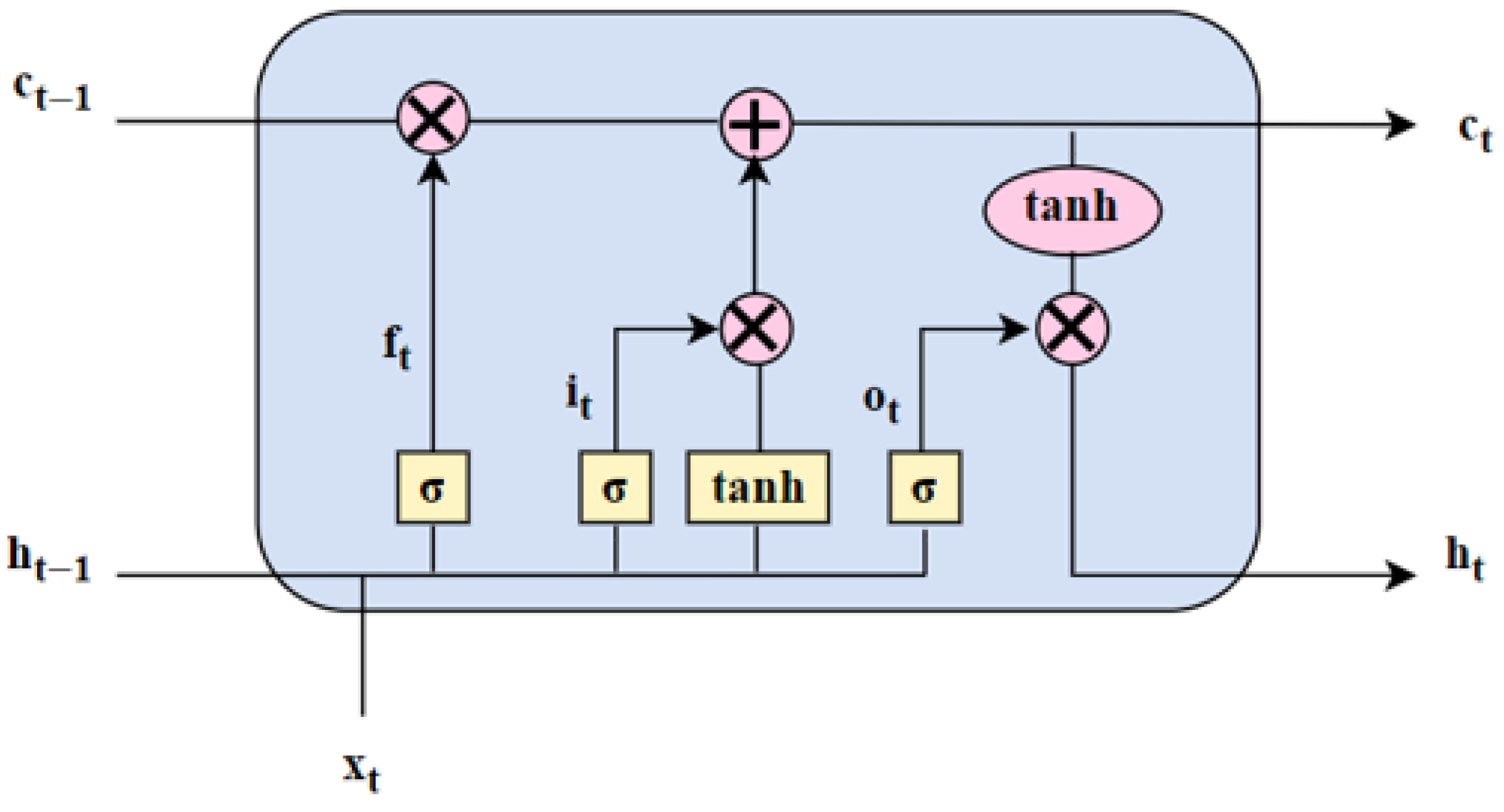
The LSTM architecture has a unique memory cell that can selectively store, modify, and erase information over time, making it particularly effective in learning long-term dependencies in sequential data. The schematic structure of an LSTM cell is shown in Figure 1. An LSTM cell consists of an input gate, a forget gate, and an output gate. The input gate is used to decide which relevant information can be added from the current step. The forget gate decides which information needs attention and which can be ignored. The output gate determines what the next hidden state will be. The two outputs of the LSTM cell are the updated and hidden states of the cell.
The current values of the input gate ( i t ), forget gate ( f t ), output gate ( o t ), the updated state of the cell ( c t ) and the updated hidden state of the cell ( h t ) are calculated as:
i t = σ W i x t + U i h t 1
f t = σ W f x t + U f h t 1
o t = σ W o x t + U o h t 1
c t = f t c t 1 + i t tanh W c x t + U c h t 1
h t = tanh c t o t
Here, W is the weight matrix that connects the inputs to the hidden layer, U is the recurrent connection between the previous and the current hidden layers, x t is the current information and h t 1 is the hidden state information from previous step. The subscripts i , f , o and c indicate the input, forget, output gates and updated cell state, respectively. The sigmoid activation function σ outputs values in the range of [0, 1], with values near 0 interpreted as “forget” and those near 1 as “retain”.

2.2. Gated Recurrent Unit (GRU) Cell Structure

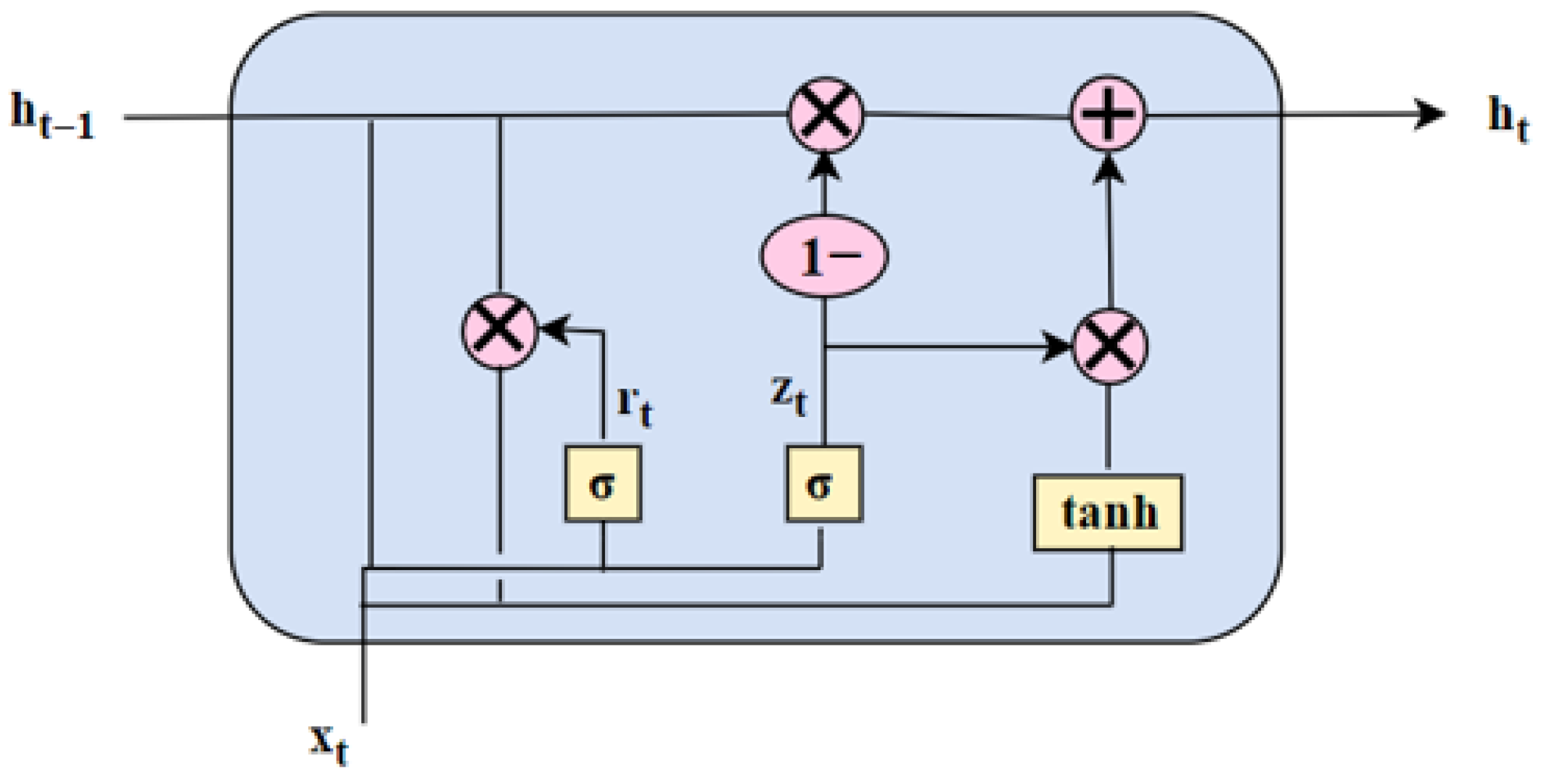
A schematic drawing of a GRU cell is shown in Figure 2. The key difference between LSTM and GRU cells is the less complex structure of the latter. To solve the vanishing gradient problem, the GRU uses a combination of only two gates, a reset gate and an update gate. The reset gate ( r t ) decides the amount of past information that needs to be forgotten, which determines whether the previous cell state is important or not. The update gate ( z t ) helps the model to determine the amount of information from previous time steps that needs to be passed along to the next state.
The two gates of the GRU cell and the next hidden state ( h t ) are calculated as
r t = σ W r x t + U r h t 1
z t = σ W z x t + U z h t 1
h t = z t tanh W h x t z t + r t U h h t 1 + 1 z t h t 1
Subscripts r and z indicate the relevance to the reset and output gates, respectively. It should also be mentioned that W , U , x t and h t 1 represent the same parameters as for the LSTM cell.

2.3. Bidirectional Recurrent Neural Network Structure

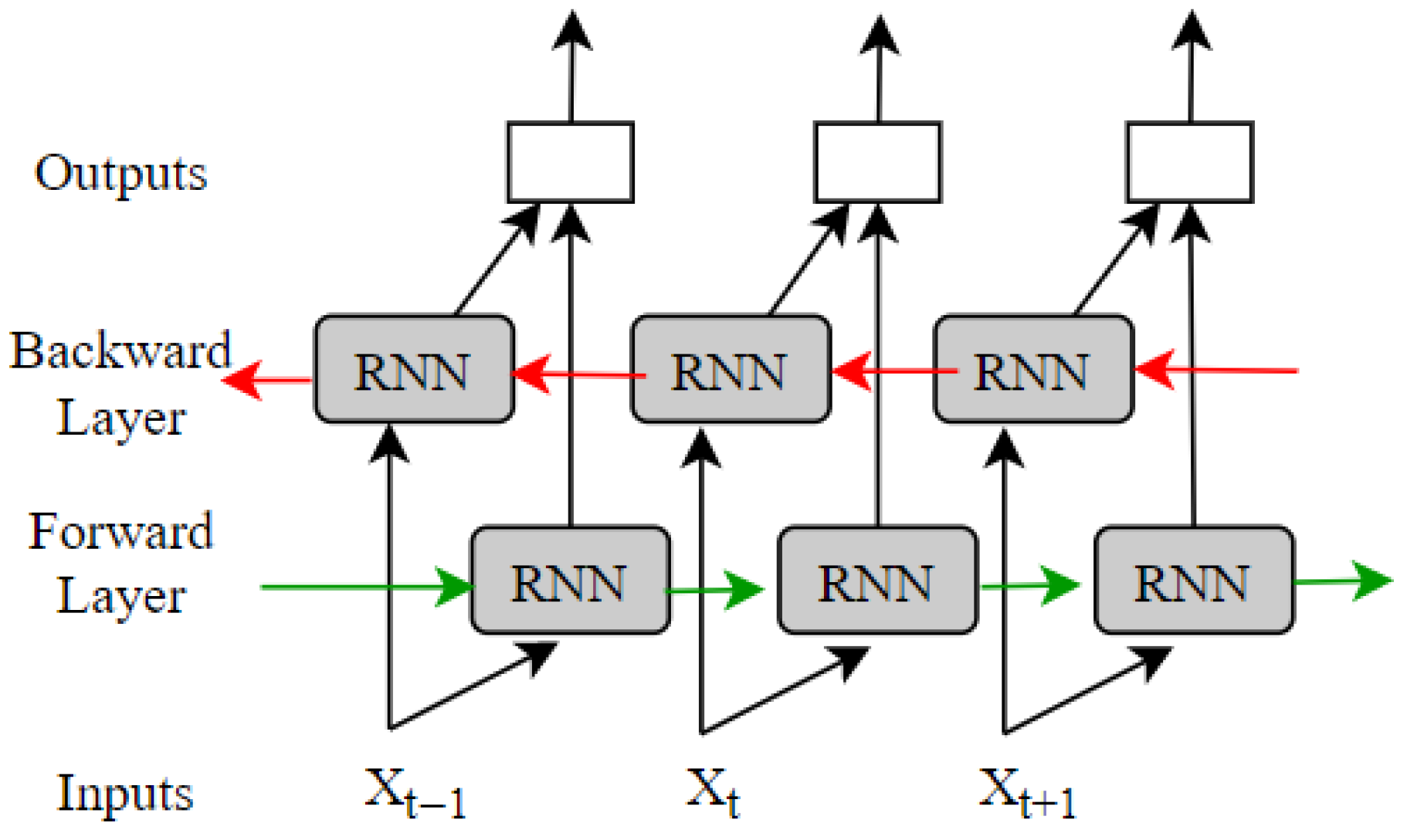
In addition to unidirectional LSTM and GRU networks, this work is investigating the performance of their bidirectional variants, BiLSTM and BiGRU, respectively. Compared to unidirectional models, bidirectional networks process input in both forward and backward directions, allowing them to account for both past and future contexts [38,39,40,41]. Bidirectional RNNs add one more layer, reversing the information flow direction. The two outputs from both layers are then combined and provide the final output. Figure 3 shows the general structure of a bidirectional RNN.

2.4. Recurrent Neural Network Implementation

All RNN models in this study were implemented using the Python Tensorflow 2.18.0 library. The database of the time series was split into 70% for training (20% of which was used for validation) and 30% for testing. The loss function used during the training process was the Mean Absolute Error (MAE), defined as
M A E = n = 1 N y n y ^ n N
where y n is the original data, y ^ n is the predicted data, and N is the number of measurements. All models were trained using the Adam optimizer for 20 epochs, where both training and validation loss curves reached saturation.
The LSTM, the GRU, the BiLSTM and the BiGRU models consisted of one respective layer for each network, followed by a dropout layer with the dropout rate set to 20%. This means that one in five inputs is randomly excluded from each update cycle to avoid overfitting and to improve model performance. The number of hidden nodes in the LSTM and BiLSTM layer was selected to be 55. A larger number of 80 hidden nodes was chosen for the GRU and BiGRU layers.
All RNN model implementations use a single-step look-back window. However, the recurrent nature of the LSTM and GRU cells ensures that the system maintains a hidden state of long-term history. The models were trained using a small, stable learning rate of 0.0001 with the Adam optimizer and a large batch size of 4096. To ensure the models generalized well without over-training, we used the Early Stopping callback with a patience of 15 epochs, which stopped training once the validation loss reached saturation. Also, we used a StandardScaler 1.5.1 to normalize the dataset values, ensuring that input temperatures were scaled to a mean of 0 and a variance of 1, which is essential for the proper functioning of the RNN’s internal gating mechanisms.

2.5. Performance Testing Metrics

To evaluate the performance of the four models in time series anomaly detection, we utilized three key metrics: precision, recall and F1 score. Precision measures the accuracy of positive predictions made by the model:
P r e c i s i o n = T P T P + F P
where TP is the number of true positives—anomalies correctly detected as anomalies—and FP is the number of false positives—normal points incorrectly detected as anomalies. Higher precision indicates fewer false positives. Recall, also known as sensitivity or true positive rate, measures the ability of the model to correctly detect the anomalies in the data:
R e c a l l = T P T P + F N
where FN is the number of false negatives—anomalies incorrectly detected as normal points. Higher recall indicates fewer false negatives. The F1 score is the harmonic mean of precision and recall, providing a balanced metric that takes both false positives and false negatives into account.
F 1 = 2 × P r e c i s i o n × R e c a l l P r e c i s i o n + R e c a l l

2.6. Characterization of Time Series with Detrended Fluctuation Analysis (DFA) and Kullback–Leibler (KL) Divergence

Because the data in this study consists of a transient with high-frequency fluctuations superimposed on a linear trend, Detrended Fluctuation Analysis (DFA) is used to quantify the presence of long-range correlations in time-series data [42]. Given the time series x ( i ) of length N, we first compute Y j , its partial cumulative sum:
Y j = i = 1 j x i
The new data is then divided into non-overlapping segments of length l . Within each segment of length l , we calculate a linear fit of Y j to obtain the local trend Y l , j . The detrended signal Y j is obtained by subtracting the fitted trend Y l , j from the accumulated walk Y j
Y j = Y j Y l , j
The root mean square fluctuation function F l is calculated for each segment length l
F l = Y j Y l , j 2
where · represents averaging over all segments. The process is repeated over a range of segment lengths l to obtain a relationship between F ( l ) and l . If the data exhibits power-law scaling, the fluctuation function can be expressed as
F l   ~   l α
The scaling exponent α can be obtained from the slope of a linear fit in a log-log plot of F ( l ) versus l . For stationary signals exhibiting power-law correlations, the DFA exponent α takes on values in the range from 0 to 1. When α > 0.5 , the time series exhibits positive power-law correlations, whereas α < 0.5 indicates anticorrelations. The value of α = 0.5 indicates the absence of correlations or white noise. DFA can also be applied to non-stationary signals with long-range correlations, such as those described by fractional Brownian motion, where 1 < α < 2 .
The Kullback–Leibler (KL) divergence D K L is a measure of how one probability distribution diverges from another reference distribution [43,44]. The D K L quantifies the information loss incurred when the reference distribution is used to approximate the true distribution:
D K L ( P | | Q ) = x P x l o g P x Q x
where P(x) is the true or observed probability distribution and Q(x) is the reference or approximating distribution. A higher value of D K L indicates more information loss, while a lower value implies the two distributions are more similar.

3. Data Acquisition and Pre-Processing

3.1. Data Collection in Liquid Sodium Facility

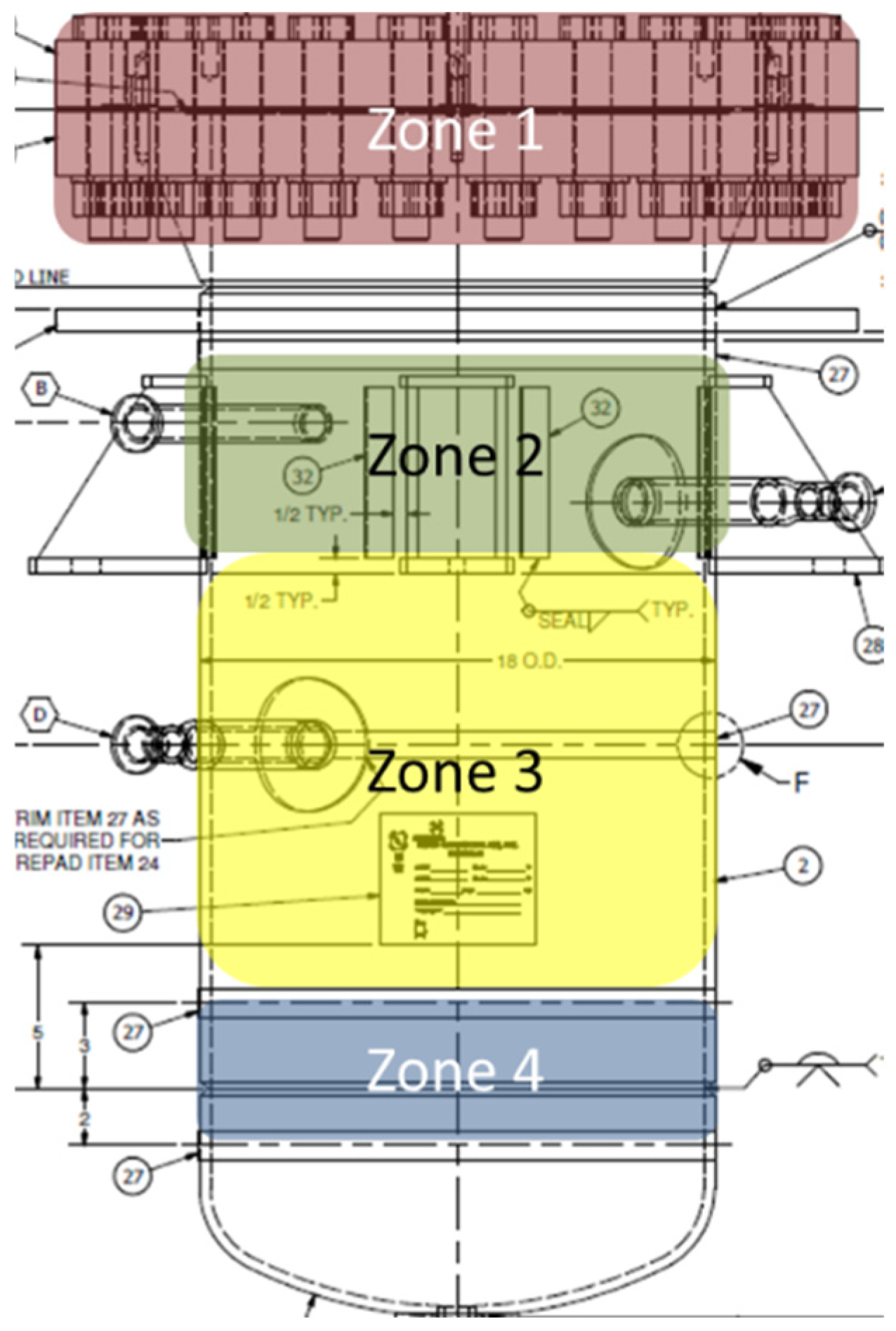
The data in this paper was obtained from a vessel heat-up experiment at the METL liquid sodium facility (Argonne National Laboratory, Lemont, IL, USA) [3]. The experiment was conducted on an 18-inch liquid sodium vessel that has a maximum temperature of 538 °C and total volume of about 40 gallons. The test vessel is equipped with ceramic band heaters which are in a “clamshell” form factor to clamp onto the circumference of the vessels/tanks. The vessel is separated into four individually controlled ceramic band heater zones, as shown in Figure 4.
The heat-up transient started with an initial temperature of 102 °C, with a temperature ramp forced by setting the four-zone PID controller (Eurotherm, St. Louis, MO, USA) set points to 250 °C. PID controllers’ heat-up rate was set to 0.02 °C/min to minimize the temperature differential across stress concentration areas in the vessel. Temperature measurements in the four heater zones were obtained using nuclear-grade K-type PCTCs made from Chromel–Alumel alloys, which have an operating temperature range of −270 °C to 1260 °C and have a standard limit of error of ±2.2 °C or ±0.75% of the reading. Thermocouples are ungrounded, stainless-steel-sheathed and have a high-temperature mini male connector. The time series were measured over the course of three days using the LabViewTM 2020 data acquisition interface.
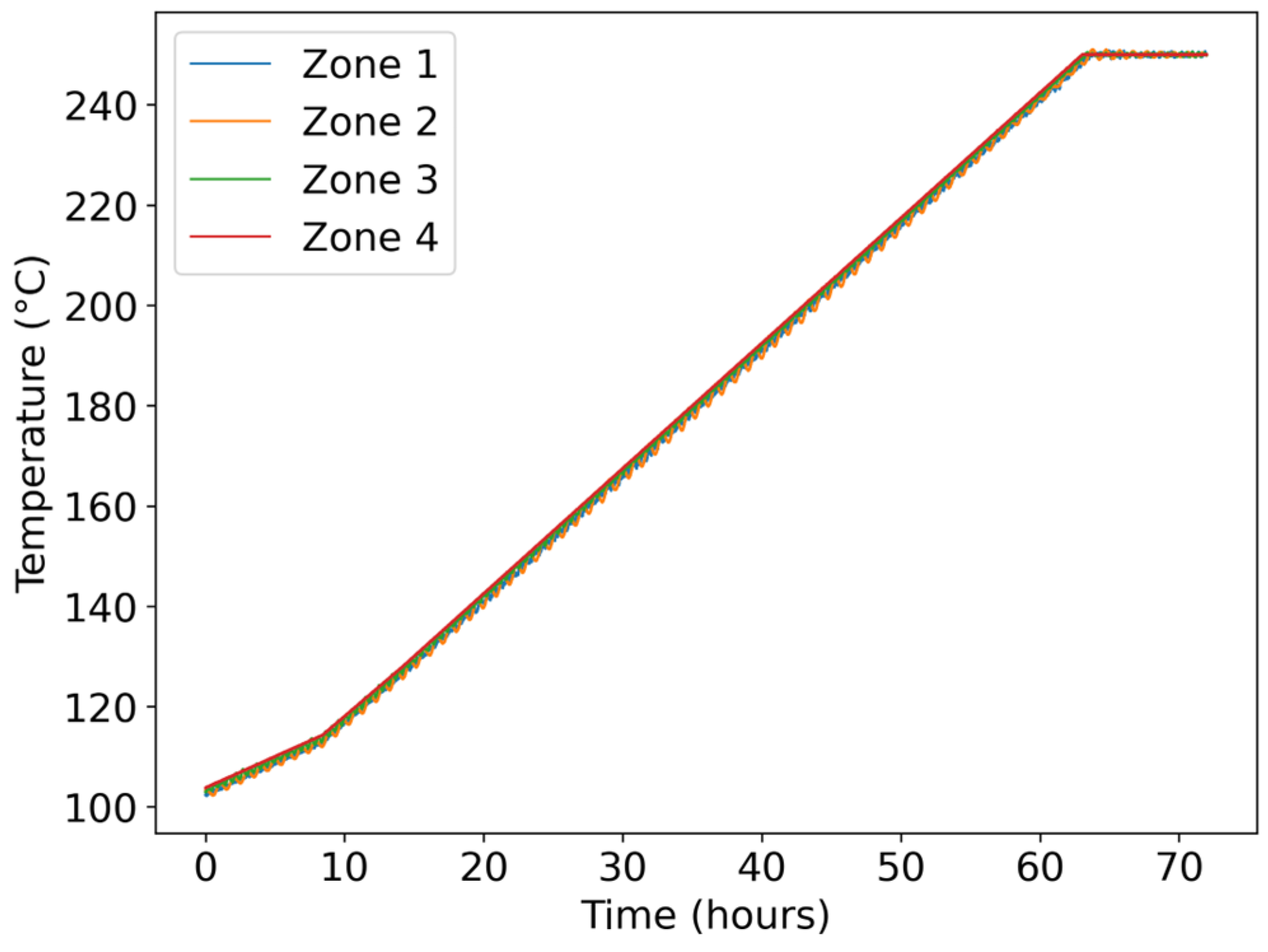
The time series of measurements with PCTCs in heater zones Z1 through Z4 are shown in Figure 5. The total duration of the transient was 259,200 s. Temperature measurements are indicated in blue for Zone 1, in orange for Zone 2, in green for Zone 3 and in red for Zone 4. Since the temperature range for the four heater zones in the dataset is 102–250 °C, the measurement uncertainty of the thermocouples for this experiment is ±2.2 °C.

3.2. Labeling Anomaly Regions in Detrended Zero-Mean Time Series

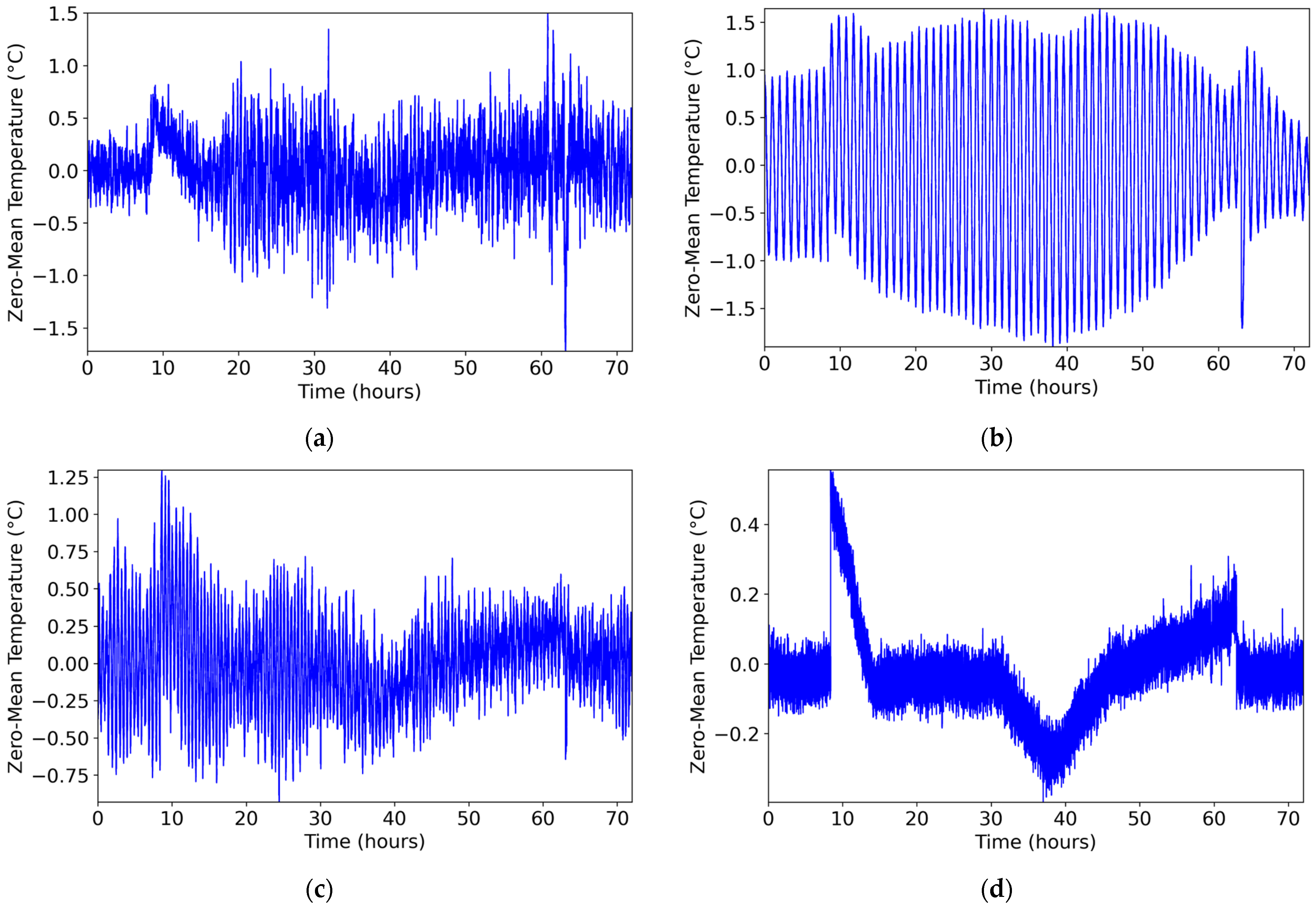
The linear trend component of the temperature transient can be estimated using a linear regression model. Figure 6a–d show the detrended zero-mean temperature time series for the heater Zones 1 through 4, respectively. The objective of RNNs is to detect the anomalies in the high-frequency residual signal, which, in this work, are taken to be the statistical outliers in the data.
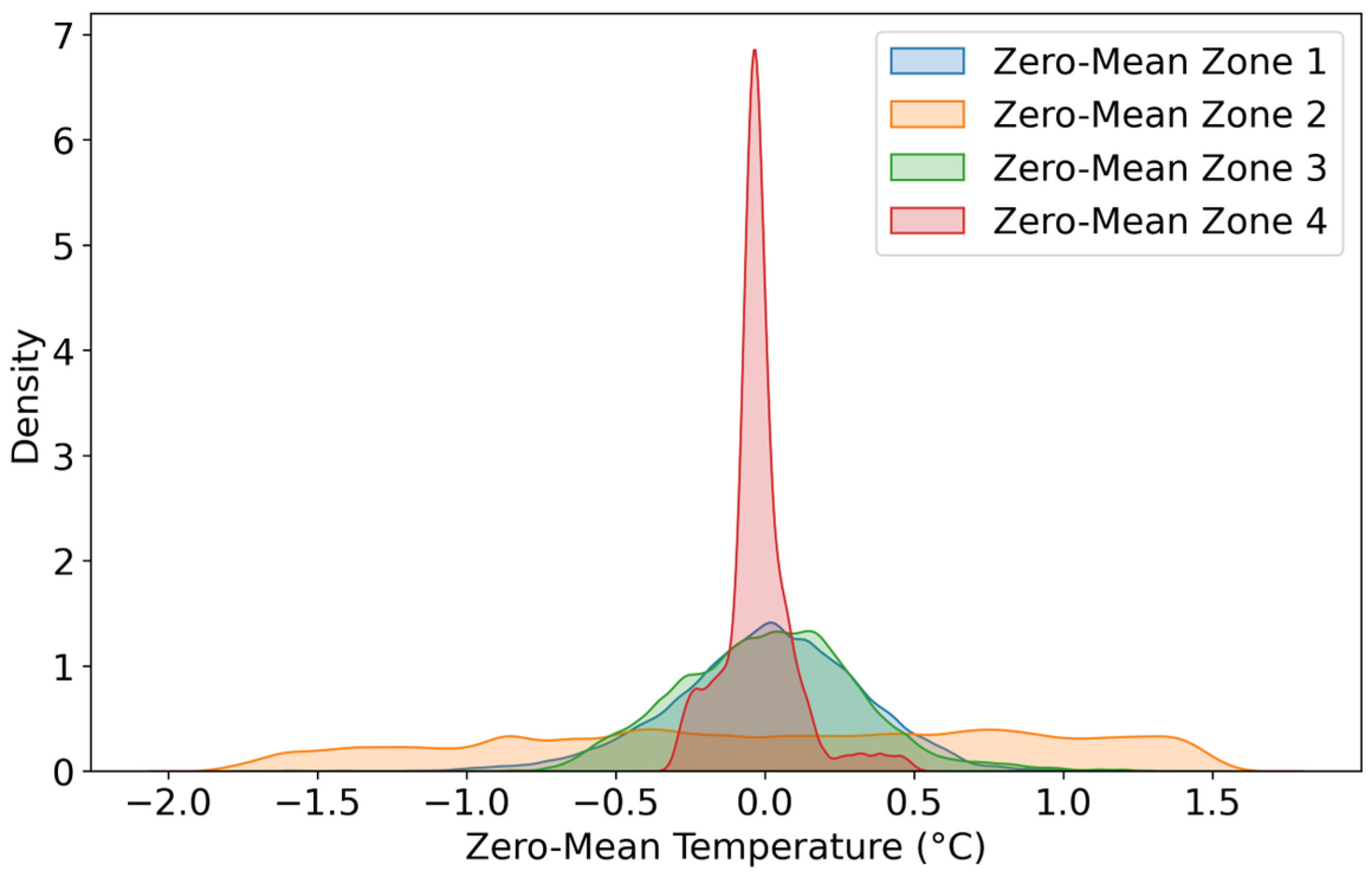
The kernel density estimate (KDE) of the time series is presented in Figure 7. The mean (μ) and standard deviation (σ) values for each zone are (μΖ1 = 0.0091, σZ1 = 0.3251), (μΖ2 = 0.0092, σZ2 = 0.8753), (μΖ3 = 0.0150, σZ3 = 0.3032), (μΖ4 = −0.0219, σZ4 = 0.1211). Typically, the Z-score is used to identify outliers by flagging points that exceed a chosen threshold, as such deviations are statistically rare in a normal distribution. However, since the standard deviations differ across heater zones, applying a uniform Z-score threshold would not accurately label anomalies in all heater zones. As an alternative, we adopted a percentile-based method, which focuses on extreme values, such as those falling outside the 5th and 95th percentiles, regardless of the underlying distribution. Unlike the Z-score, the percentile method does not assume a specific distribution and can be more robust when the data is skewed or has outliers.
The heat-up transient plot in Figure 5 consists of three distinct regions that have different linear ramps. To develop the RNN models, we selected the testing dataset to consist of the two short segments at the start and at the end of the heat-up transient. The first segment corresponds to the time interval [0, 13.1 h], starting at the beginning of the heat-up transient. The second segment corresponds to the time interval [62.9 h, 72 h] at the end of the heat-up transient. The longest linear ramp segment corresponding to the [13.1, 62.9 h] interval was used for RNN model training and validation.
Anomalies in the testing dataset were detected using a double-threshold approach. The first threshold was established based on the smoothed testing errors. Specifically, we calculated the mean of the absolute smoothed errors and adjusted it by a multiple of their standard deviation. This method identifies points that significantly deviate from the typical error patterns observed in the testing set. The second threshold was computed based on the distribution of the smoothed training errors. Since the training dataset also includes anomalous points, extreme values in the training errors were excluded using the Interquartile Range (IQR) method before the threshold calculation. The IQR is a measure of statistical dispersion that determines the range of the central 50% of data points:
I Q R = Q 3 Q 1
where Q 1 and Q 3 are the first and third quartiles, respectively. Typically, data points that fall outside the range [ Q 1 1.5 I Q R ,     Q 3 + 1.5 I Q R ] are considered outliers, as the 1.5 factor is a widely accepted rule in statistics for identifying unusually large deviations [45]. In our approach, we determined the lower and upper bounds for non-anomalous smoothed training errors using this standard IQR-based rule, filtering out smoothed training errors outside these bounds. After filtering, we computed the second threshold using the mean of the filtered absolute smoothed training errors, adjusted by a multiple of their standard deviation.
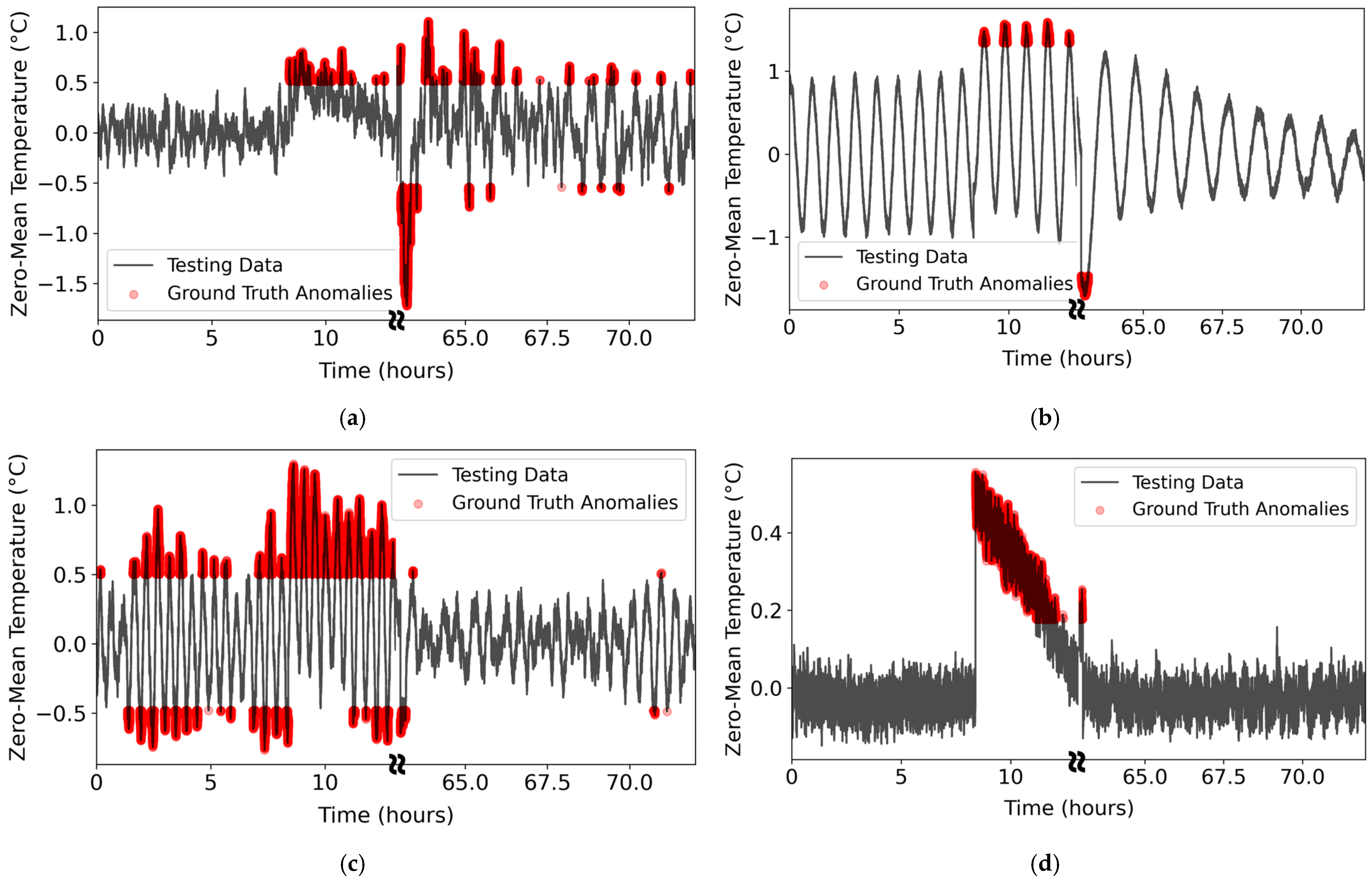
Ground truth anomalies in the testing dataset are displayed in Figure 8a–d for the zero-mean time series of Zone 1, Zone 2, Zone 3 and Zone 4, respectively. The anomaly data points are shown in red.
With this designation of the anomaly data points, the resulting class imbalance across the heater zones is summarized in Table 1. This table displays class imbalance as the class imbalance ratio (Normal: Anomaly) and the anomaly concentration (%) for the training and testing datasets. One can observe that the class imbalance ratio is modest for the training and testing data for all four heater zones. The largest imbalance ratio of 25.8:1 is observed for the testing data of Zone 2.

4. Anomaly Detection Results

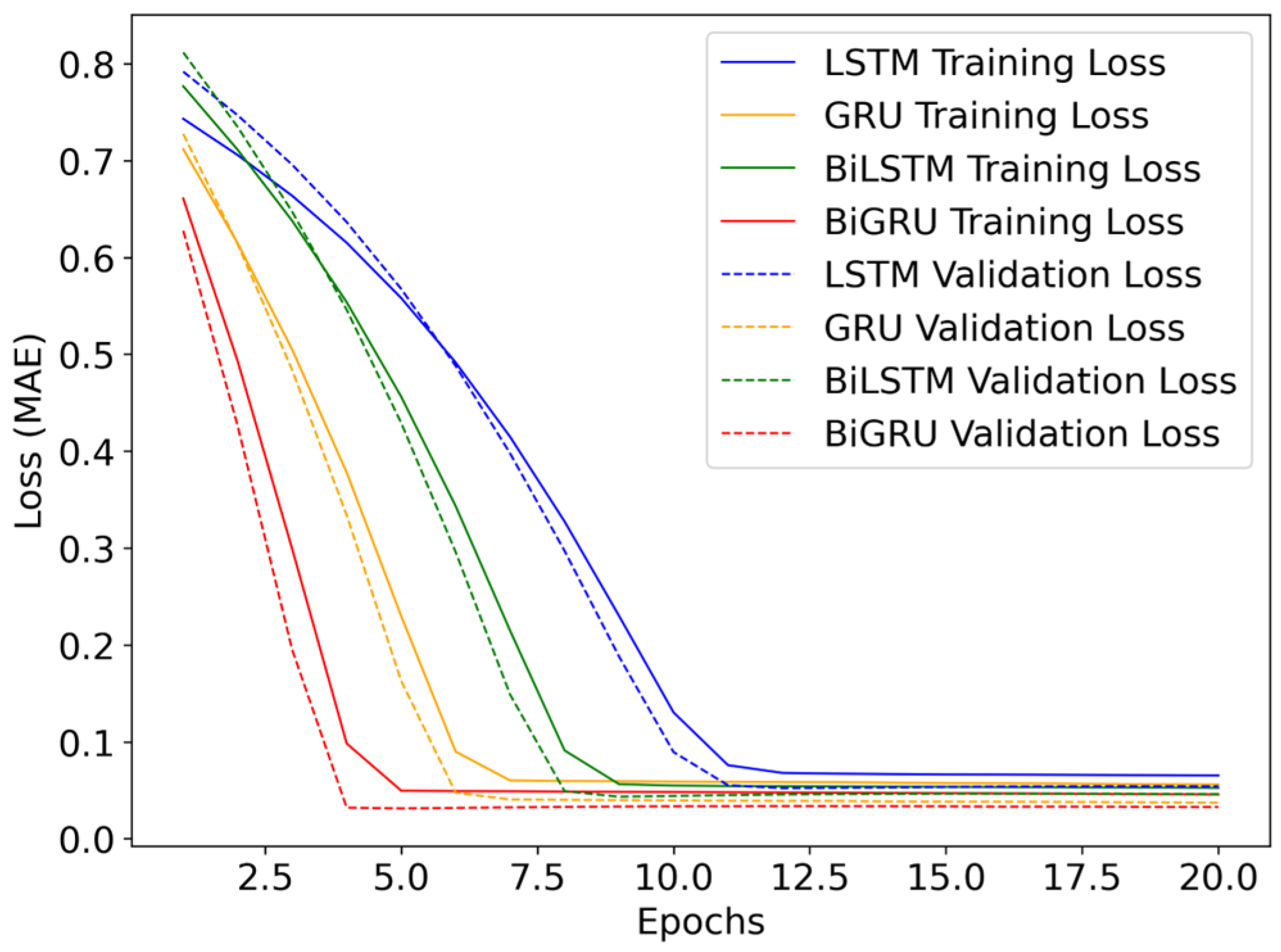
After training and testing the RNN models, we computed the training and testing residual errors, representing the differences between the predicted and actual values. Figure 9 shows the training and validation loss curves of the four RNN models using the detrended Zone 1 data. The solid lines represent the training losses, while the dashed lines represent the validation losses. The blue, orange, green, and red lines correspond to the LSTM, GRU, BiLSTM, and BiGRU models, respectively.
To enhance the efficiency of anomaly detection in the data, we implemented the exponentially weighted moving average (EWMA) error-smoothing method [46]. The EWMA is a statistical technique that assigns exponentially decreasing weights to past observations, giving more significance to recent data points. The EWMA value at time t , denoted as S t , is computed as:
S t = a X t + 1 a S t 1
where X t is the observation at time t , S t 1 is the EWMA value at time t 1 , and a is the smoothing factor, which is a constant with a value between 0 and 1 that controls the weight that is given to most recent and past observations.
The data acquisition system for the heater zones records PCTC measurements with a sampling rate of 250 ms. The EWMA smoothing process for each test sample requires approximately 0.635 µs on a regular desktop computer, which is an order of magnitude smaller than the sampling time. Therefore, EWMA smoothing has negligible impact on the time delay in anomaly detection.
The EWMA method was applied to the training and testing errors as part of the data before defining the thresholds for anomaly detection. To demonstrate the advantages of EWMA smoothing, Table 2 shows the percentage change in the false positive rate (FPR) and false negative rate (FNR) anomaly detection results for the four RNN models after smoothing the errors. The FPR represents the proportion of normal instances that are incorrectly classified as anomalies. The FNR measures the proportion of actual anomalies that are incorrectly classified as normal instances. Across all zones, FPR decreases substantially after smoothing, in some cases showing the complete elimination of false alarms. The reductions are particularly pronounced for GRU and BiGRU, followed closely by BiLSTM. LSTM also benefits from smoothing but retains slightly more false positives in certain zones, as compared to the other models. Error smoothing generally reduces the FNR across most RNN models, though the extent of improvement varies. LSTM exhibits significant reductions in some zones, nearly eliminating false negatives in certain cases. GRU also shows notable improvement, achieving complete elimination of false negatives in one zone while showing mixed reductions elsewhere. BiLSTM follows a similar trend, with strong reductions in some zones but less pronounced improvements in others. In contrast, BiGRU does not consistently benefit from smoothing, showing only minor reductions in some cases and even slight increases in others.
With the EWMA method implemented, we calculated the precision, recall, and F1 scores for the four RNN models for the detection of anomaly data points in detrended times series of Zones 1 through 4. The performance scores are displayed in Table 3. For Zone 1, all models exhibit high precision, with GRU, BiLSTM, and BiGRU reaching near-perfect precision, indicating that false positives are minimal. However, recall varies significantly across models. LSTM achieves the best balance between precision and recall, resulting in the highest F1 score. The GRU and BiLSTM models have lower recall values, leading to moderate F1 scores. BiGRU demonstrates the weakest recall, suggesting that it misses a substantial number of actual anomalies. For Zone 2, GRU and BiLSTM outperform the other models in terms of recall, which contributes to their strong F1 scores. LSTM exhibits a more moderate recall, while BiGRU again shows the lowest recall, resulting in the weakest overall performance. In Zone 3, BiLSTM achieves the highest F1 score, demonstrating a strong balance between precision and recall. LSTM also performs well with the highest recall and a strong F1 score. GRU maintains high precision but has a lower recall, reducing its overall F1 score. BiGRU exhibits the lowest recall, leading to the weakest performance among the models. For Zone 4, LSTM, GRU, and BiLSTM achieve perfect recall, meaning they successfully detect all anomalies. Among them, BiGRU attains the highest F1 score, making it the best-performing model in this zone. While BiGRU has slightly lower recall compared to the other models, its near-perfect precision allows it to achieve the highest overall F1 score.

5. Discussion

For each heater zone temperature time series, we obtained the best F1 score with a different RNN model: LSTM for Zone 1 (96%), GRU for Zone 2 (93%), BiLSTM for Zone 3 (97%), and BiGRU for Zone 4 (96%). The results do not seem to depend on the imbalanced class ratios for the four zones listed in Table 1. To understand the variations in RNN model performances for different heater zones, we calculated the KL divergence, also known as relative entropy, between the training and testing data for each zone. We estimated the probability distributions of the testing and training data for each heater zone using histograms. The KL divergence values for each zone are presented in Table 4.
Additionally, we performed Detrended Fluctuation Analysis (DFA) to measure the long-term correlation properties of each detrended temperature time series for the entire dataset, the training dataset and the testing dataset. The values are listed in Table 4, where α d corresponds to the DFA exponent of the entire dataset, α t r corresponds to the DFA exponent of the training dataset and α t e corresponds to the DFA exponent of the testing dataset.
The results obtained indicate an inverse relationship between KL divergence and DFA exponents across the heater zones. The data in heater zones with higher DFA values exhibit lower KL divergence, whereas the data in the zones with lower DFA values exhibit higher KL divergence. This relationship has implications for model selection. For instance, for the data in Zone 2, which exhibits the largest value of the DFA exponent and the smallest value of KL divergence, the best performance results are obtained with the GRU model. This suggests that for datasets with strong long-range correlations and minimal relative entropy between training and testing, the GRU model would be the best option. On the other hand, for the data in Zone 4, which has the lowest DFA exponent and the highest KL divergence, the best performance is achieved with the BiGRU. This may indicate that when data exhibits weaker long-term correlations and a significant relative entropy between training and testing distributions, the more complex architecture of BiGRU performs better. Finally, for the data in Zones 1 and 3, which exhibit intermediate values of both K divergence and the DFA exponent compared to the other two zones, the best performance is obtained with LSTM and BiLSTM, respectively. Notably, the second-best performing model for Zone 1 is BiLSTM, while for Zone 3 it is LSTM, further supporting the observation that moderately correlated data with intermediate relative entropy can be effectively modeled using either LSTM or BiLSTM architectures.

6. Conclusions

In this study, we investigated the performance of four RNN models for anomaly detection in time series data from a vessel heat-up experiment conducted in the METL liquid sodium facility at the Argonne National Laboratory. The analysis focused on detecting anomalies in the detrended heater zone time series to capture deviations in the residual fluctuations of the measured data. Given the varying statistical properties of these time series, a percentile-based method was chosen for anomaly regions labeling. Anomaly detection was then performed using a double-threshold approach derived from both training and testing error distributions to ensure robust anomaly characterization. Our results demonstrate that this method achieved high precision, recall, and F1 score metrics in most cases, highlighting the effectiveness of RNN models for anomaly detection. However, model performance varied across heater zones, with the BiGRU model showing the weakest F1 scores in three of the four zones. The application of the exponentially weighted moving average (EWMA) method to smooth residual errors before setting detection thresholds was shown to be effective in improving the RNN model performance. This method led to substantial reductions in false positive and false negative rates in nearly all cases. Finally, to explain the variations in RNN model performance across zones, we used KL divergence to quantify relative entropy between training and testing data, and DFA to assess long-range temporal correlations. These metrics provided insight into why certain models performed better for data in some heater zones, suggesting that statistical and temporal properties of the data play a role in determining the most effective model.
Future work will extend this approach to other METL facility transients, such as those observed in the cold trap sodium purification system operation. Alternative anomaly detection techniques, such as one-class support vector machines (SVMs) and Isolation Forest, will be explored for benchmarking analysis. We will also consider multimodal data fusion of PCTC time series data with structural health monitoring of the vessel and thermal–hydraulic process sensing measurements.

Author Contributions

Conceptualization, A.H. and M.P.; methodology, M.P. and A.H.; software, M.P.; validation, M.P. and A.H.; formal analysis, M.P. and A.H.; investigation, M.P., A.H. and D.K.; resources, A.H. and L.T.; data curation, D.K.; writing—original draft preparation, M.P.; writing—review and editing, A.H.; visualization, M.P.; supervision, A.H. and L.T.; project administration, A.H.; funding acquisition, A.H. All authors have read and agreed to the published version of the manuscript.

Funding

This research was funded in part by the U.S. Department of Energy, Advanced Research Projects Agency-Energy (ARPA-E) Generating Electricity Managed by Intelligent Nuclear Assets (GEMINA) program, and in another part by a Nuclear Energy University Program (NEUP) Infrastructure Revitalization Project, both under Contract DE-AC02-06CH11357.

Data Availability Statement

The data presented in this study are available on request from the corresponding author due to restrictions related to privacy.

Acknowledgments

Experimental data was obtained from the Mechanisms Engineering Test Loop (METL) liquid sodium facility at Argonne National Laboratory.

Conflicts of Interest

The authors declare no conflicts of interest. The funders had no role in the design of the study; in the collection, analyses, or interpretation of data; in the writing of the manuscript; or in the decision to publish the results.

References

  1. Aoto, K.; Dufour, P.; Hongyi, Y.; Glatz, J.P.; Kim, Y.; Ashurko, Y.; Hill, R.; Uto, N. A Summary of Sodium-Cooled Fast Reactor Development. Prog. Nucl. Energy 2014, 77, 247–265. [Google Scholar] [CrossRef]
  2. Serp, J.; Allibert, M.; Beneš, O.; Delpech, S.; Feynberg, O.; Ghetta, V.; Heuer, D.; Holcomb, D.; Ignatiev, V.; Kloosterman, J.L.; et al. The Molten Salt Reactor (MSR) in Generation IV: Overview and Perspectives. Prog. Nucl. Energy 2014, 77, 308–319. [Google Scholar] [CrossRef]
  3. Kultgen, D.; Grandy, C.; Kent, E.; Weathered, M.; Andujar, D.; Reavis, A. Mechanism Engineering Test Loop—Phase I Status Report—FY2018; Update to FY2017 Report, ANL-ART-148; Argonne National Laboratory: Lemont, IL, USA, 2018.
  4. Kultgen, D.; Heifetz, A.; Ogren, E.; Kent, T.; Weathered, M.; Grandy, C.; Rein, J.; Grannan, A. High-Temperature Sodium System Structural Health Monitoring (SHM) Technologies at the Mechanisms Engineering Test Loop (METL); Argonne National Laboratory: Lemont, IL, USA, 2023; ANL-ART-266.
  5. Appiah, R.; Heifetz, A.; Nguyen, T.; Ponciroli, R.; Ley, H.; Kultgen, D.; Vilim, R.B. Advanced Monitoring and Control in the ANL METL Facility Using an Engineering Digital Twin; Argonne National Laboratory: Lemont, IL, USA, 2023; ANL/NSE-23/80.
  6. Akamatsu, M.; Yasuhara, K.; Osaka, I.; Usui, S.; Higano, M. Specific Heat Capacities of K-Type Thermocouple Materials in the Temperature Range 304K-574K. Jpn. J. Thermophys. Prop. 2014, 27, 69–76. [Google Scholar] [CrossRef][Green Version]
  7. Ma, J.; Jiang, J. Applications of Fault Detection and Diagnosis Methods in Nuclear Power Plants: A Review. Prog. Nucl. Energy 2011, 53, 255–266. [Google Scholar] [CrossRef]
  8. Rao, N.S.V.; Greulich, C.; Ramuhalli, P.; Gurgen, A.; Zhang, F.; Cetiner, S.M. Estimation of Sensor Measurement Errors in Reactor Coolant Systems Using Multi-Sensor Fusion. Nucl. Eng. Des. 2021, 375, 111024. [Google Scholar] [CrossRef]
  9. Sandhu, H.K.; Bodda, S.S.; Gupta, A. A Future with Machine Learning: Review of Condition Assessment of Structures and Mechanical Systems in Nuclear Facilities. Energies 2023, 16, 2628. [Google Scholar] [CrossRef]
  10. Hossain, R.; Ahmed, F.; Kobayashi, K.; Koric, S.; Abueidda, D.; Alam, S.B. Virtual Sensing-Enabled Digital Twin Framework for Real-Time Monitoring of Nuclear Systems Leveraging Deep Neural Operators. Npj Mater. Degrad. 2025, 9, 21. [Google Scholar] [CrossRef]
  11. Belloni, E.; Forconi, F.; Lozito, G.M.; Palermo, M.; Quercio, M.; Riganti Fulginei, F. Development of Recurrent Neural Networks for Thermal/Electrical Analysis of Non-Residential Buildings Based on Energy Consumptions Data. Energies 2025, 18, 3031. [Google Scholar] [CrossRef]
  12. Mandal, S.; Santhi, B.; Sridhar, S.; Vinolia, K.; Swaminathan, P. Nuclear Power Plant Thermocouple Sensor Fault Detection and Classification Using Deep Learning and Generalized Likelihood Ratio Test. IEEE Trans. Nucl. Sci. 2017, 64, 1526–1534. [Google Scholar] [CrossRef]
  13. Mandal, S.; Santhi, B.; Sridhar, S.; Vinolia, K.; Swaminathan, P. A Novel Approach for Fault Detection and Classification of the Thermocouple Sensor in Nuclear Power Plant Using Singular Value Decomposition and Symbolic Dynamic Filter. Ann. Nucl. Energy 2017, 103, 440–453. [Google Scholar] [CrossRef]
  14. Yu, Y.; Peng, M.; Wang, H.; Ma, Z.; Li, W. Improved PCA Model for Multiple Fault Detection, Isolation and Reconstruction of Sensors in Nuclear Power Plant. Ann. Nucl. Energy 2020, 148, 107662. [Google Scholar] [CrossRef]
  15. Wang, H.; Peng, M.; Yu, Y.; Saeed, H.; Hao, C.; Liu, Y. Fault Identification and Diagnosis Based on KPCA and Similarity Clustering for Nuclear Power Plants. Ann. Nucl. Energy 2021, 150, 107786. [Google Scholar] [CrossRef]
  16. Yi, S.; Zheng, S.; Yang, S.; Zhou, G.; Cai, J. Anomaly Detection for Asynchronous Multivariate Time Series of Nuclear Power Plants Using a Temporal-Spatial Transformer. Sensors 2024, 24, 2845. [Google Scholar] [CrossRef]
  17. Tokgoz, A.; Unal, G. A RNN Based Time Series Approach for Forecasting Turkish Electricity Load. In Proceedings of the 2018 26th Signal Processing and Communications Applications Conference (SIU), Izmir, Turkey, 2–5 May 2018; IEEE: Izmir, Turkey, 2018; pp. 1–4. [Google Scholar]
  18. Hewamalage, H.; Bergmeir, C.; Bandara, K. Recurrent Neural Networks for Time Series Forecasting: Current status and future directions. Int. J. Forecast. 2021, 37, 388–427. [Google Scholar] [CrossRef]
  19. Hüsken, M.; Stagge, P. Recurrent neural networks for time series classification. Neurocomputing 2003, 50, 223–235. [Google Scholar] [CrossRef]
  20. Che, Z.; Purushotham, S.; Cho, K. Recurrent Neural Networks for Multivariate Time Series with Missing Values. Sci. Rep. 2018, 8, 6085. [Google Scholar] [CrossRef] [PubMed]
  21. Nketiah, E.A.; Li, C.; Jing, Y.; Aram, S.A. Recurrent neural network modeling of multivariate time series and its application in temperature forecasting. PLoS ONE 2023, 18, E0285713. [Google Scholar] [CrossRef]
  22. Kim, M.; Ou, E.; Loh, P.-L.; Allen, T.; Agasie, R.; Liu, K. RNN-based online anomaly detection in nuclear reactors for highly imbalanced datasets with uncertainty. Nucl. Eng. Des. 2020, 364, 110699. [Google Scholar] [CrossRef]
  23. Pantopoulou, S.; Ankel, V.; Weathered, M.T.; Lisowski, D.D.; Cilliers, A.; Tsoukalas, L.H.; Heifetz, A. Monitoring of Temperature Measurements for Different Flow Regimes in Water and Galinstan with Long Short-Term Memory Networks and Transfer Learning of Sensors. Computation 2022, 10, 108. [Google Scholar] [CrossRef]
  24. Pantopoulou, S.; Weathered, M.; Lisowski, D.; Tsoukalas, L.H.; Heifetz, A. Temporal Forecasting of Distributed Temperature Sensing in a Thermal Hydraulic System With Machine Learning and Statistical Models. IEEE Access 2025, 13, 10252–10264. [Google Scholar] [CrossRef]
  25. Pantopoulou, S.; Cilliers, A.; Tsoukalas, L.H.; Heifetz, A. Transformers and Long Short-Term Memory Transfer Learning for GenIV Reactor Temperature Time Series Forecasting. Energies 2025, 18, 2286. [Google Scholar] [CrossRef]
  26. Appiah, R.; Heifetz, A.; Kultgen, D.; Tsoukalas, L.H.; Vilim, R.B. Dynamic Control of Sodium Cold Trap Purification Temperature Using LSTM System Identification. Energies 2024, 17, 6257. [Google Scholar] [CrossRef]
  27. Akins, A.; Kultgen, D.; Heifetz, A. Anomaly Detection in Liquid Sodium Cold Trap Operation with Multisensory Data Fusion Using Long Short-Term Memory Autoencoder. Energies 2023, 16, 4965. [Google Scholar] [CrossRef]
  28. Wang, P.; Zhang, J.; Wan, J.; Wu, S. A Fault Diagnosis Method for Small Pressurized Water Reactors Based on Long Short-Term Memory Networks. Energy 2022, 239, 122298. [Google Scholar] [CrossRef]
  29. Wang, Y. A New Concept Using LSTM Neural Networks for Dynamic System Identification. In Proceedings of the 2017 American Control Conference (ACC); IEEE: Seattle, WA, USA, 2017; pp. 5324–5329. [Google Scholar]
  30. Liu, L.; Liu, S.; He, S.; Xu, K.; Lan, Y.; Fang, H. Anomaly Detection in Nuclear Power Production Based on Neural Normal Stochastic Process. Sensors 2025, 25, 4358. [Google Scholar] [CrossRef]
  31. Kim, S.; Zhang, F. A Robust Anomaly Detection System for Nuclear Power Plants Under Varying Environmental Conditions and Malfunction Levels. Nucl. Technol. 2025, 211, 1625–1644. [Google Scholar] [CrossRef]
  32. Wang, H.; Chen, H.; Yu, F.; Xu, Z.; Peng, M. Anomaly Detection and Reconstruction of Sensors in Nuclear Power Plants Based on Principal Component Analysis and Improved Deep Neural Networks. Prog. Nucl. Energy 2026, 191, 106088. [Google Scholar] [CrossRef]
  33. Chaudhary, A.; Han, J.; Kim, S.; Kim, A.; Choi, S. Anomaly Detection and Analysis in Nuclear Power Plants. Electronics 2024, 13, 4428. [Google Scholar] [CrossRef]
  34. Chen, Z.; Dai, M.; Liu, J.; Jiang, W. Research on Fault Prediction of Nuclear Safety-Class Signal Conditioning Module Based on Improved GRU. Energies 2024, 17, 4063. [Google Scholar] [CrossRef]
  35. Encalada-Davila, A.; Moyon, L.; Tutiven, C.; Puruncajas, B.; Vidal, Y. Early Fault Detection in the Main Bearing of Wind Turbines Based on Gated Recurrent Unit (GRU) Neural Networks and SCADA Data. IEEE/ASME Trans. Mechatron. 2022, 27, 5583–5593. [Google Scholar] [CrossRef]
  36. Fu, R.; Zhang, Z.; Li, L. Using LSTM and GRU Neural Network Methods for Traffic Flow Prediction. In Proceedings of the 2016 31st Youth Academic Annual Conference of Chinese Association of Automation (YAC), Wuhan, China, 11–13 November 2016; pp. 324–328. [Google Scholar]
  37. Yamak, P.T.; Yujian, L.; Gadosey, P.K. A Comparison between ARIMA, LSTM, and GRU for Time Series Forecasting. In Proceedings of the 2019 2nd International Conference on Algorithms, Computing and Artificial Intelligence, Sanya, China, 20 December 2019; pp. 49–55. [Google Scholar]
  38. Schuster, M.; Paliwal, K.K. Bidirectional Recurrent Neural Networks. IEEE Trans. Signal Process. 1997, 45, 2673–2681. [Google Scholar] [CrossRef]
  39. Siami-Namini, S.; Tavakoli, N.; Namin, A.S. The Performance of LSTM and BiLSTM in Forecasting Time Series. In Proceedings of the 2019 IEEE International Conference on Big Data (Big Data), Los Angeles, CA, USA, 9–12 December 2019; pp. 3285–3292. [Google Scholar]
  40. Yin, X.; Liu, Z.; Liu, D.; Ren, X. A Novel CNN-based Bi-LSTM parallel model with attention mechanism for human activity recognition with noisy data. Sci. Rep. 2022, 12, 7878. [Google Scholar] [CrossRef] [PubMed]
  41. Zhang, S.; Gurusamy, S.; James-Chakraborty, K.; Basu, B. Short-term office temperature forecasting through a data-driven approach integrated with bidirectional gated recurrent neural network. Energy Build. 2024, 314, 114231. [Google Scholar] [CrossRef]
  42. Carpena, P.; Gómez-Extremera, M.; Bernaola-Galván, P.A. On the Validity of Detrended Fluctuation Analysis at Short Scales. Entropy 2022, 24, 61. [Google Scholar] [CrossRef]
  43. Pérez-Cruz, F. Kullback-Leibler divergence estimation of continuous distributions. In Proceedings of the 2008 IEEE International Symposium on Information Theory, Toronto, ON, Canada, 6–11 July 2008; pp. 1666–1670. [Google Scholar]
  44. Wang, W.; Yu, J.; Xu, T.; Zhao, C.; Zhou, X. On-line abnormal detection of nuclear power plant sensors based on Kullback-Leibler divergence and ConvLSTM. Nucl. Eng. Des. 2024, 428, 113489. [Google Scholar] [CrossRef]
  45. Vinutha, H.P.; Poornima, B.; Sagar, B.M. Detection of outliers using interquartile range technique from intrusion dataset. In Information and Decision Sciences: Proceedings of the 6th International Conference on Ficta; Springer: Singapore, 2018; pp. 511–518. [Google Scholar]
  46. Yu, J.; Kim, S.B.; Bai, J.; Han, S.W. Comparative Study on Exponentially Weighted Moving Average Approaches for the Self-Starting Forecasting. Appl. Sci. 2020, 10, 7351. [Google Scholar] [CrossRef]
Figure 1. Structure of LSTM unit cell.
Energies 19 01462 g001
Figure 2. Structure of GRU cell.
Energies 19 01462 g002
Figure 3. The structure of a bidirectional recurrent neural network (RNN).
Energies 19 01462 g003
Figure 4. A schematic diagram of a test vessel separated into four individually controlled heater zones.
Energies 19 01462 g004
Figure 5. The time series of PCTC measurements from the four vessel heater zones Z1 through Z4, taken during vessel heat up transient from 102 °C to 250 °C. The total duration of the transient is 259,200 s.
Energies 19 01462 g005
Figure 6. Detrended time series of thermocouple measurements from (a) Zone 1, (b) Zone 2, (c) Zone 3, and (d) Zone 4 during vessel heat up.
Energies 19 01462 g006
Figure 7. KDE plot showing the distributions of the zero-mean heater zones time series. Zone 1: mean 0.0091, std = 0.3251. Zone 2: mean 0.0092, std = 0.8753. Zone 3: mean 0.0150, std = 0.3032. Zone 4: mean −0.0219, std = 0.1211.
Energies 19 01462 g007
Figure 8. Ground truth anomalies in the testing dataset of detrended temperature time series of (a) Zone 1, (b) Zone 2, (c) Zone 3, and (d) Zone 4. The anomaly data points are shown in red.
Energies 19 01462 g008
Figure 9. Training and validation loss curves using the four RNN models for the detrended signal of Zone 1.
Energies 19 01462 g009
Table 1. Class imbalance ratios for training and testing data of the four heater zones.
Heater ZoneTraining DataTesting Data
Class Imbalance Ratio (Normal: Anomaly)Anomaly
Concentration (%)
Class Imbalance Ratio (Normal: Anomaly)Anomaly
Concentration (%)
18:111.112.4:17.5
26.8:112.825.8:13.7
314:16.74.7:117.5
411.6:185.8:114.6
Table 2. Advantages of error smoothing with EWMA for LSTM, GRU, BiLSTM and BiGRU shown as percentage change in FPR and FNR.
Heater ZoneLSTMGRUBiLSTM BiGRU
FPRFNRFPRFNRFPRFNRFPRFNR
1−97.47−93.89−100.00−49.40−100.00−58.45−100.00−23.20
2−66.67−31.67−90.79−84.41−98.78−69.67−94.20−26.94
3−41.32−92.90−98.74−13.33−99.01−54.42−99.753.81
4−50.630.00−71.01−100.00−59.83−100.00−100.003.56
Table 3. Precision, recall and F1 score for anomaly detection with LSTM, GRU, BiLSTM and BiGRU in detrended times series of Zones 1 through 4.
Time SeriesRNN ModelPrecisionRecallF1 Score
Zone 1LSTM0.97540.95300.9641
GRU0.99990.57310.7286
BiLSTM0.99990.64690.7856
BiGRU0.99990.27980.4372
Zone 2LSTM0.96130.64880.7747
GRU0.97930.88560.9301
BiLSTM0.99640.81770.8983
BiGRU0.94790.39460.5573
Zone 3LSTM0.86570.99610.9263
GRU0.99610.75810.8609
BiLSTM0.99790.93800.9670
BiGRU0.99910.55810.7162
Zone 4LSTM0.79931.00000.8885
GRU0.88331.00000.9380
BiLSTM0.83971.00000.9129
BiGRU0.99970.92140.9590
Table 4. KL divergence values of the testing data relative to the training data and DFA exponents for the entire dataset ( α d ) , the training dataset ( α t r ) , and the testing dataset ( a t e ) for the heater zones.
Heater Zone D k l α d α t r α t e
11.2961.3011.3111.391
20.2791.4801.5311.531
30.3211.3161.3121.459
41.7691.1701.0561.200
Disclaimer/Publisher’s Note: The statements, opinions and data contained in all publications are solely those of the individual author(s) and contributor(s) and not of MDPI and/or the editor(s). MDPI and/or the editor(s) disclaim responsibility for any injury to people or property resulting from any ideas, methods, instructions or products referred to in the content.