1. Introduction
Underground gas storage (UGS) has emerged as a cornerstone of global energy security, playing a pivotal role in balancing supply and demand, mitigating price volatility, and ensuring stable energy supply during peak consumption periods [
1]. By the end of 2023, the global working gas capacity of UGS facilities reached 437 billion cubic meters (bcm), representing a 2% year-on-year increase—the largest growth since 2015 [
1]. This expansion is driven by heightened security concerns, changing market dynamics, and the increasing integration of renewable energy sources, with UGS working gas capacity projected to reach 500 bcm by 2030 [
1].
Underground gas storage facilities are typically developed in three types of geological formations: depleted oil and gas reservoirs, aquifers, and salt caverns [
2]. Depleted reservoirs constitute approximately 74% of global working gas volume, benefiting from well-characterized geology and existing infrastructure [
3]. Salt caverns, while representing a smaller share of total capacity, offer significant operational advantages, including high deliverability, low cushion gas requirements, and immediate availability during peak demand periods [
4]. Aquifer storage provides additional flexibility in regions lacking suitable depleted reservoirs [
5].
The optimization of well trajectory and placement represents a critical engineering challenge in UGS development, directly impacting project economics, operational efficiency, and reservoir management [
6]. Well trajectory optimization encompasses the design of drilling paths that minimize total well length while satisfying geological, mechanical, and operational constraints [
7,
8]. Traditional well design approaches often rely on engineering judgment and simplified analytical models, which may not adequately capture the complex interplay between geological heterogeneity, reservoir dynamics, and drilling constraints [
9,
10].
Recent advances in computational optimization have revolutionized well trajectory design and placement strategies. Genetic algorithms (GAs) have been extensively applied to well placement problems, demonstrating their effectiveness in handling discrete optimization variables and complex constraint sets [
11,
12]. The genetic algorithm framework enables efficient exploration of large solution spaces while incorporating domain-specific knowledge through customized operators [
13,
14]. Studies have shown that GA-based optimization can significantly improve net present value (NPV) compared to traditional placement methods, particularly in heterogeneous reservoirs [
15]. The multiobjective nature of well trajectory optimization necessitates specialized solution approaches capable of handling competing objectives simultaneously [
16,
17]. Pareto optimization, which identifies the set of non-dominated solutions representing optimal trade-offs between objectives, provides a rigorous framework for multi-criteria decision-making in drilling engineering [
18,
19]. The minimization of total well length constitutes a primary objective in drilling well design optimization, directly impacting drilling costs, completion time, and operational complexity [
20]. Reducing well length decreases the authorization for expenditures (AFE) by minimizing well construction time and associated expenses [
21,
22]. Studies have demonstrated that intelligent optimization methods can achieve up to 50% reduction in offshore drilling costs through rigorous performance management and optimized well design [
23,
24].
For underground gas storage applications, well trajectory and placement optimization must address unique operational requirements, including cyclic injection-withdrawal operations, storage capacity maximization, and deliverability constraints [
25]. Horizontal wells have demonstrated superior performance in UGS applications, providing enhanced reservoir contact and improved injection-withdrawal efficiency [
26,
27].
The present study addresses the optimization of well trajectory and placement for underground gas storage facilities, with particular emphasis on minimizing total well length while satisfying storage performance requirements. A multiobjective optimization framework based on Pareto optimality is developed to balance competing objectives, including well construction costs, reservoir coverage, and storage deliverability.
2. Methodology
2.1. Single Well Model
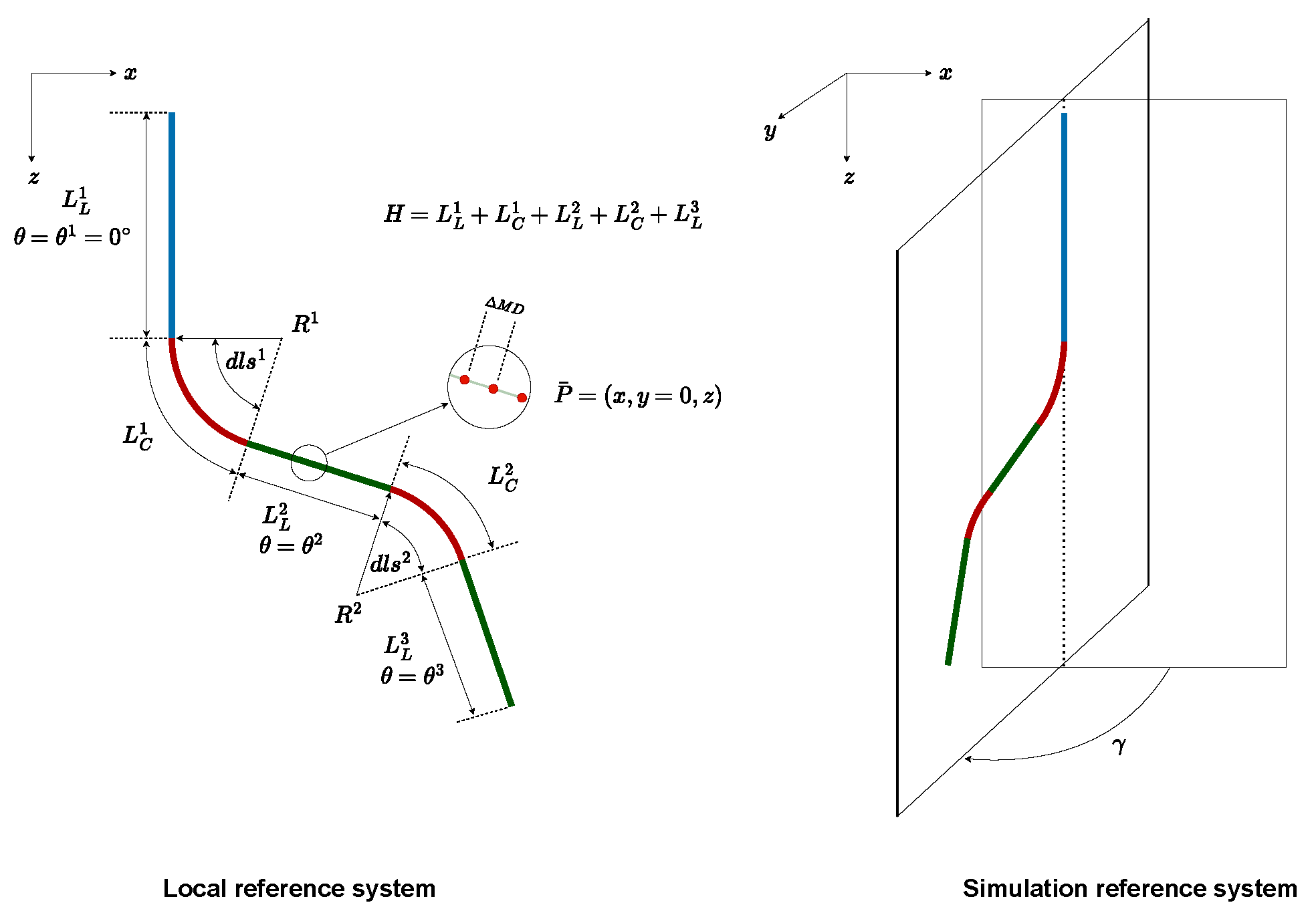
The single-well trajectory model is composed of any number of linear and curvilinear segments connected sequentially. To simplify geometric construction and reduce computational complexity, the trajectory is initially generated in a two-dimensional XZ plane, referred to as the local reference system. This approach allows the well inclination profile to be defined independently from its azimuth, which significantly streamlines the calculation of curvature, dogleg severity, and segment lengths. By separating inclination and azimuth, the trajectory-building process becomes modular.
In the local coordinate system, the deviation of the wellbore occurs only in the vertical plane. Consequently, the
y-coordinate of every point is initially fixed at zero. The trajectory is represented as an ordered set of points
, where
capture the horizontal and vertical components of the well path, respectively. Well trajectory,
, in a local coordinate system is represented as (Equation (
1)):
where
n are total trajectory points and
is the wellhead location. The linear segment is defined by its measured depth
and inclination
[°] while the curvilinear segment is characterized by its arc length
[m] and dogleg severity
. All segments are discretized using a uniform calculation step size
[m], ensuring a consistent resolution along the trajectory.
Once the trajectory geometry is constructed in the local system, it must be mapped into the three-dimensional simulation grid used by the reservoir model. This mapping requires two transformations:
Rotation (azimuth assignment): The trajectory is rotated around the vertical axis by the prescribed azimuth angle [°] using a right-handed, clockwise rotation convention. This step assigns the well its spatial orientation within the reservoir.
Translation (wellhead positioning): After rotation, the trajectory is shifted to its final spatial location according to the wellhead position vector . This translation aligns the starting point of the modeled trajectory with the actual wellhead coordinates.
The overall transformation sequence is therefore
This modular workflow enables efficient construction of large numbers of trajectories during optimization, as inclination modeling, azimuth orientation, and spatial positioning are handled independently.
A schematic representation of the single-well geometry and transformation process is shown in
Figure 1.
2.1.1. Well Model Initialization
Single well model is initialized with empty trajectory and inclination set, then the local well head position is added as starting point of well trajectory.
2.1.2. Linear Well Section Model
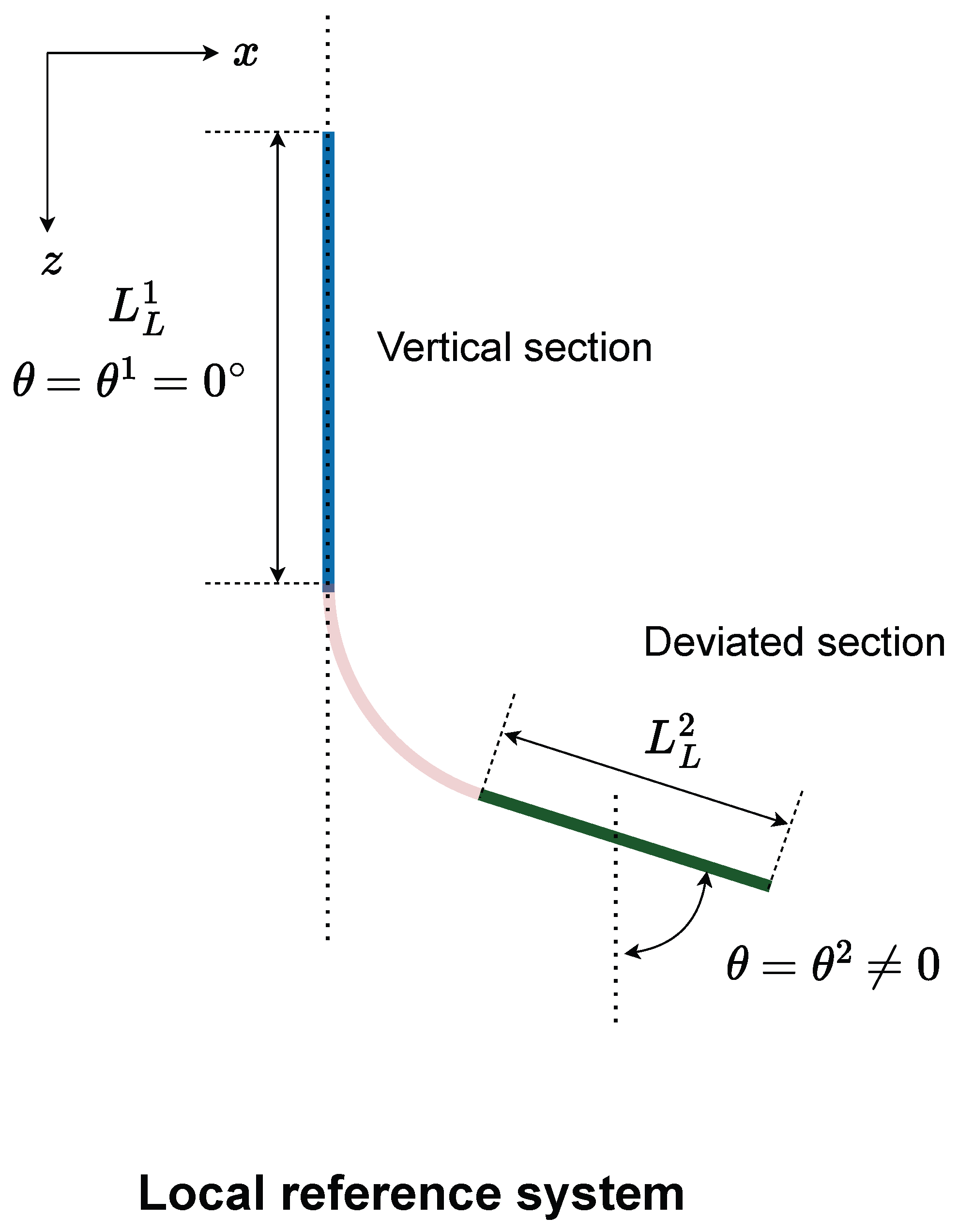
The linear well section represents a straight-line segment of the trajectory constructed in the local XZ reference plane, where the Z-axis is oriented downward. The section originates at the last known trajectory point and extends over a prescribed measured depth interval
. The inclination
[°] is defined as the angle between the segment and the vertical axis, as presented in
Figure 2.
If the inclination is not provided explicitly, it is inferred from the direction of the last two trajectory points, ensuring geometric continuity of the well path. The incremental displacement for each MD step
is given by (Equation (
2)):
For
the section is vertical, producing
, whereas for
the section deviates in the x direction with a magnitude proportional to
. The algorithm proceeds by subdividing the section length into uniform MD steps, updating coordinates sequentially. The section produces a sequence of trajectory points:
Because the user-specified length may not be divisible by , the procedure divides the section into full steps of size and a final remaining step of length , which is processed using the same inclination. This guarantees an exact final measured depth.
In general, a linear well section model can be represented as a transformation function
M (Equation (
4)),
2.1.3. Curvilinear Well Section Model
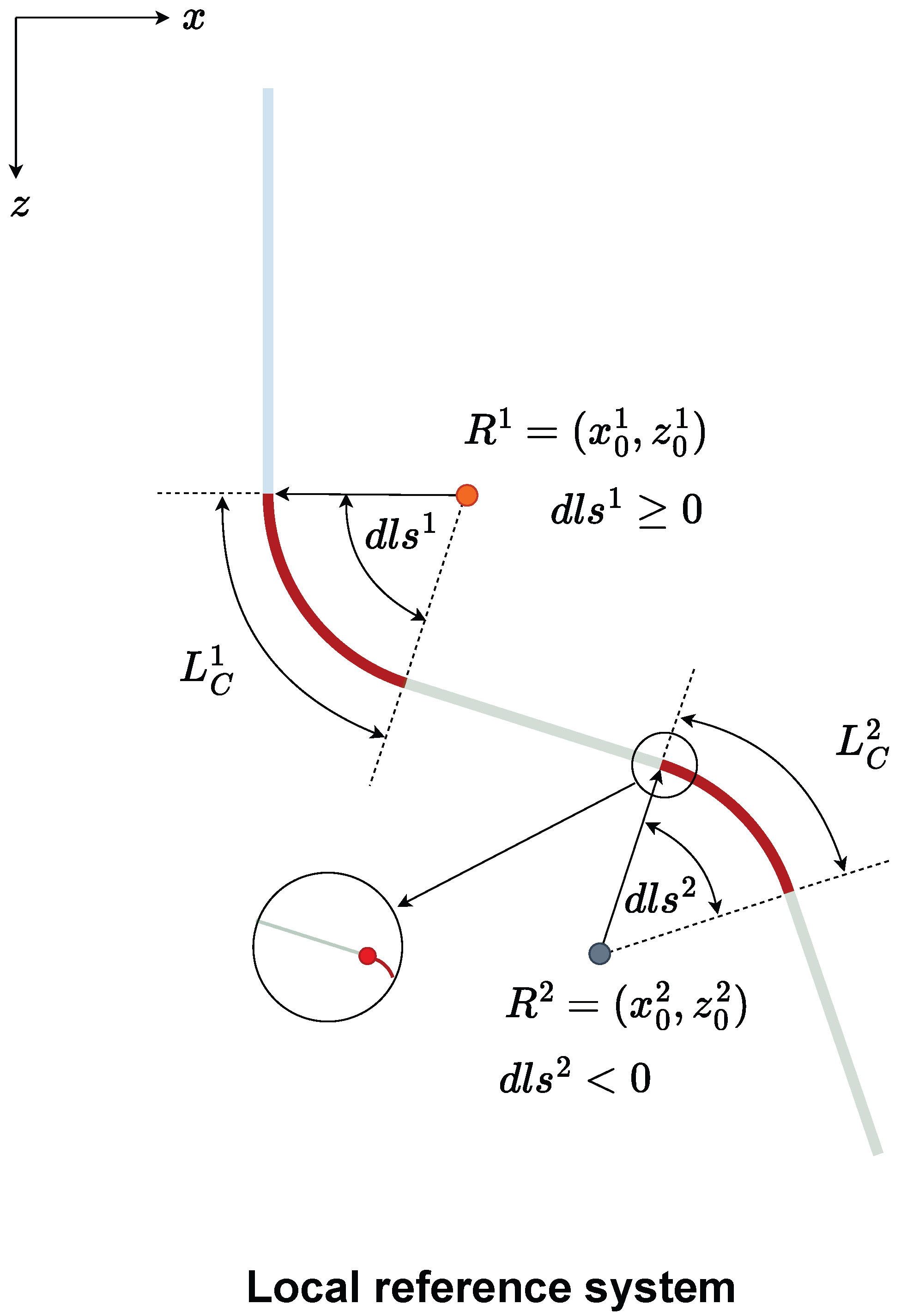
The curvilinear well section represents a segment of the well trajectory in which the inclination changes continuously at a constant rate (
Figure 3). As with the linear section, the geometry is constructed in the local
reference plane, where the
Z-axis is oriented downward. Whereas the linear section advances along a straight line defined by a fixed inclination angle
, the curvilinear section introduces controlled curvature governed by the dogleg severity
expressed in °/30 m. A constant dogleg rate implies a constant curvature, so the corresponding wellpath follows an arc of a circle. The section begins at the last known trajectory point and extends over a prescribed measured depth interval
[m]. The combined signs of inclination and dogleg severity determine the direction of curvature and the circle center location.
The dogleg severity specifies the rate of angular change, and its value uniquely determines the radius of curvature
R [m]. With the radius known, the next step in the geometric construction is to determine the position of the circle center. Since the trajectory must begin tangent to the circular arc, the center must lie on a line perpendicular to the local tangent direction defined by the inclination
. The displacement between the start point
and the center
must have magnitude
R and an orientation consistent with the required curvature direction. The sign conventions used to enforce this are (Equation (
5))
where
These rules ensure that the center lies in the correct place relative to the tangent direction, thereby guaranteeing that the curvature develops in the intended rotational sense. Once the circle center is known, the start point of the section is expressed in a polar coordinate system centered at
. Defining the relative coordinates (Equation (
7)):
The starting polar angle
must be chosen to identify the correct location on the circle. Because the angle must reflect both the quadrant and the curvature direction, its value is assigned based on the following cases. For the special situation
(typically corresponding to
):
while for the general case
:
With
determined, the trajectory can be generated by increasing the polar angle in proportion to the measured depth. Because arc length and angular displacement are related by
, a measured-depth increment
corresponds to an angular increase
Thus after
i steps, the cumulative rotation is
and the corresponding trajectory point is given by the circular parameterization
The sequence of points constructed in this manner yields a smooth, continuously bending trajectory whose curvature and direction conform precisely to the prescribed dogleg severity.
In general, a curvilinear well section model can be represented as a transformation function
N (Equation (
14))
2.1.4. Trajectory Rotation Model
The rotation module applies an azimuthal rotation to the completed well trajectory, transforming it from the local construction plane into its final spatial orientation. The well geometry is initially generated in the local XZ reference plane, where the Y coordinate is identically zero for all points. A rotation around the vertical Z-axis by angle
is applied using the standard 2D rotation operator (Equation (
15)):
The horizontal coordinates of each trajectory point are transformed as
2.1.5. Trajectory Translation Model
This operator performs a rigid-body displacement of an already constructed well trajectory in three-dimensional space. In the workflow of well construction, translation is applied after the trajectory is generated in the local reference plane and optionally rotated around the vertical axis. Its principal role is to relocate the entire curve so that the wellhead and subsequent survey points match the global reservoir simulation coordinate frame. The coordinates of each trajectory point are transformed as (Equation (
17)):
where
is a translation vector.
2.1.6. Well Builder
The construction of a directional well trajectory in this study is based on a modular procedure that enables the combination of an arbitrary sequence of geometric segments. Each segment represents a section of the well path, such as a vertical or slanted straight section, or a curved section characterized by a prescribed dogleg severity. The method allows the creation of any directional configuration, including classical J-, S-, and horizontal geometries, as well as more complex, multi-bend trajectories that may arise through optimization. Because each section determines only its internal geometry and references the final state of the preceding segment, the full trajectory can consist of any number of sections, in any order, with arbitrary alternation between straight and curved phases. This structure allows the creation of complex, multi-bend well paths without modifying the underlying methodology. In general, well builder is a co-routine incrementally added the dedicated section to existing well trajectory for given input data
and can be express as transfer function
(Equation (
18)):
where input data are defined as follows:
The dots at the end mean that any combination of linear and curvilinear sections are supported and the sections are processed in order of placement in the input data vector. The discretization step is selected as a trade-off between accuracy and computational cost. In practice, should not exceed typical drilling stand length (≈25–30 m), but for simulation purposes finer sampling (0.25–1 m) is used to ensure geometric smoothness and accurate perforation mapping. In this study, = 0.5 m is selected empirically as a convergence-safe resolution.
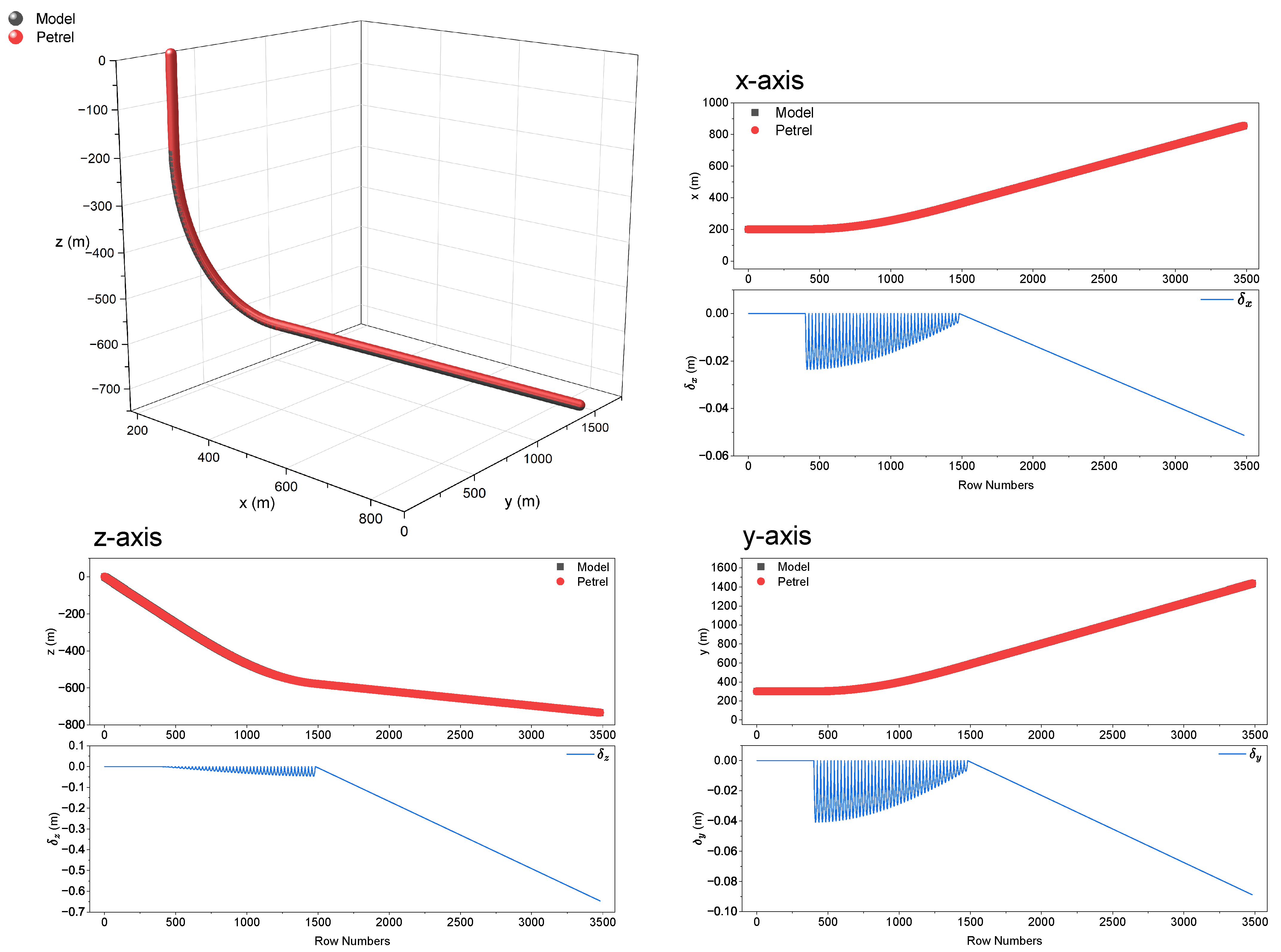
In order to validate the developed well trajectory model, a validation by comparing the obtained trajectory with the well trajectory generated by industrial reference (Petrel). Validation assumptions:
J-type well trajectory;
Vertical section length: = 200 [m];
Build up arc length: = 540 [m];
Build up dls: = 4.5 [°/30 m];
Hold section length: = 1000 [m];
Well head position ;
Rotation azimuth ;
Discretization step = 0.5 [m].
Validation was performed by exporting trajectory points from Petrel’s Well Templates module and comparing them point-by-point with the generated trajectory. No API coupling was used; instead, exported survey tables were used as a reference. Petrel was not used to generate trajectories during optimization because (1) its internal template generator cannot be embedded in an iterative optimization loop, (2) computational cost and licensing restrictions prevent automated repeated calls, and (3) builder allows parametric flexibility (arbitrary section sequences) not supported by Petrel templates.
The validation results in
Figure 4 reveals good match, where the errors (
) on x,y axis does not exceed 0.07 [m] and for z axis 0.7 [m].
2.2. Integration with Reservoir Simulator
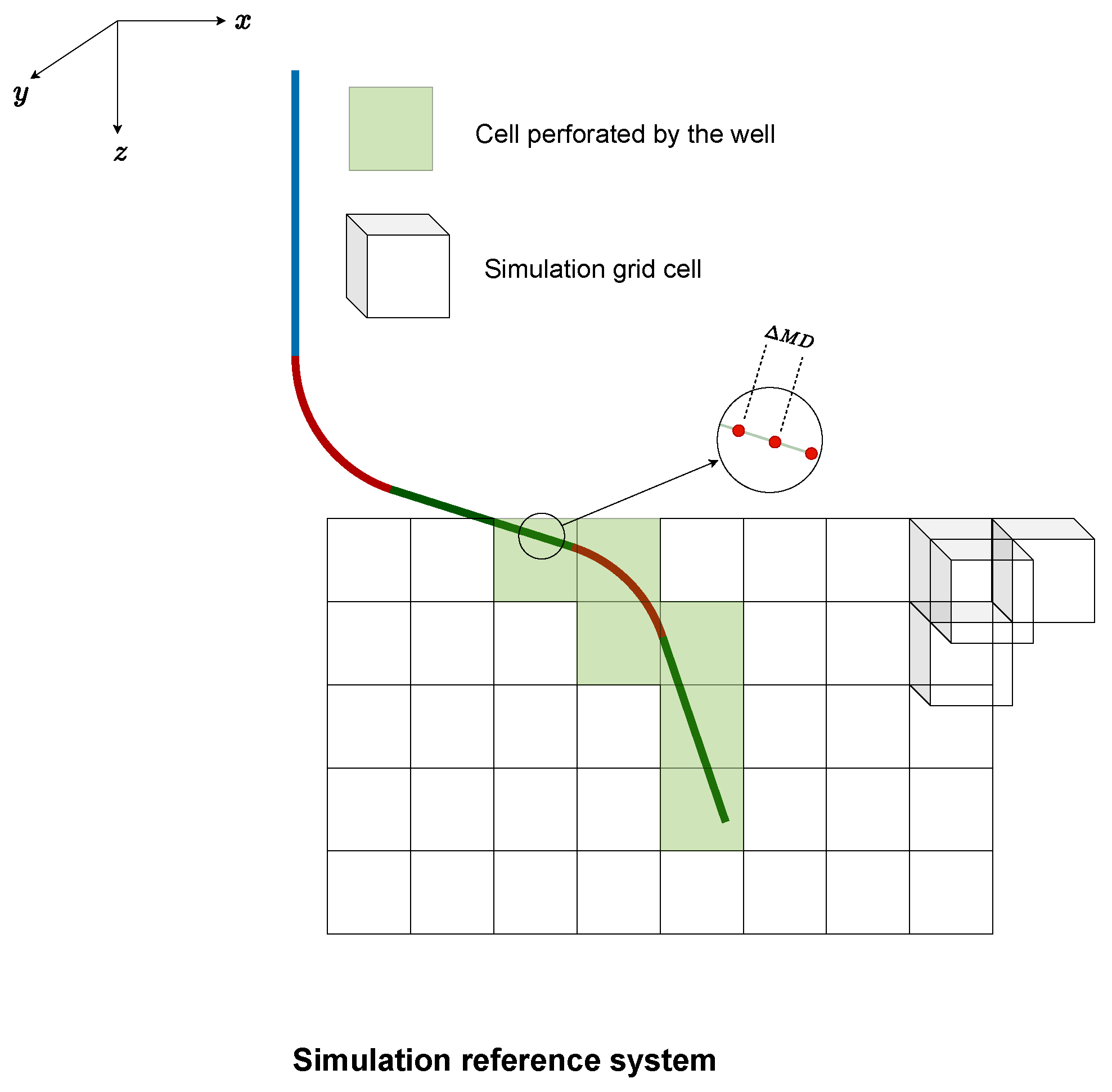
The integration of the generated well trajectory with the numerical reservoir simulator constitutes a crucial stage of the workflow, as it establishes the correspondence between the continuous geometric well path and the discretized reservoir representation. The simulator evaluates the hydraulic connectivity of the well exclusively through its intersections with grid cells; therefore, precise identification of perforated cells directly affects calculated transmissibilities, productivity, injectivity, and ultimately the value of the objective function. The integration workflow follows the general concept illustrated in
Figure 5 where the well is analyzed against the reservoir grid geometry.
The perforation module determines which cells of the reservoir grid are intersected. Denoting the simulation grid by
, consisting of structured hexahedral cells with unique indices
. The perforation mapping procedure
returns an ordered list of perforated cells (Equation (
20)):
Here, u denotes the total number of unique perforated grid cells intersected by the trajectory. The ordering reflects the sequence of well penetration along measured depth, ensuring consistency with the simulator’s well-connection reconstruction.
Each identified cell represents a possible flow connection point between the numerical well representation and the reservoir grid. The mapping procedure must remain both geometrically accurate and computationally efficient, since it is invoked repeatedly during the optimization loop. An kd tree built from cell centroids is used to decrease the neighborhood of possibly intersecting cells at each trajectory point. For large-scale reservoir models, this preselection greatly reduces the number of candidate cells that need geometric checks. Following the identification of the candidates, each point is compared to the appropriate hexahedral blocks’ geometry. If a point meets barycentric coordinate requirements in at least one tetrahedral decomposition of the hexahedron, it is deemed to lie inside that cell. As the trajectory points are processed sequentially with respect to measured depth, each newly identified cell is appended to the perforation set only if it was not previously included, naturally producing an ordered list of grid connections. This ordered structure mirrors the physical penetration of the wellbore and guarantees that the simulator can reconstruct the perforated interval in the correct downhole sequence. After the perforated cell set is constructed, it is encoded into the simulator input file according to the format specific for the simulator used. The reliability of the integration procedure is influenced by several factors. First, the discretization step plays a central role: if the sampling interval is too coarse, the trajectory may bypass thin layers or small grid blocks, leading to incomplete perforation detection. Second, the geometric quality of the reservoir grid affects the robustness of the point-in-cell evaluation; highly distorted hexahedral cells increase the numerical sensitivity of the inside–outside checks. Finally, the physical meaning of a perforation must be interpreted with care. Most reservoir simulators assign a well connection to the center of a grid block rather than to the exact spatial position of the borehole, which introduces an inherent abstraction between the geometric trajectory and the simulator’s flow model. In the present implementation, the discretization step is set to m, which corresponds to approximately 2% of the horizontal grid dimension (25 m), yielding a discretization-to-grid ratio of roughly 1:50. Under this resolution, potential misclassification due to sampling would affect at most a single grid block per penetration segment and therefore has a second-order impact on field-scale objective metrics.
2.3. Numerical Experiment Framework
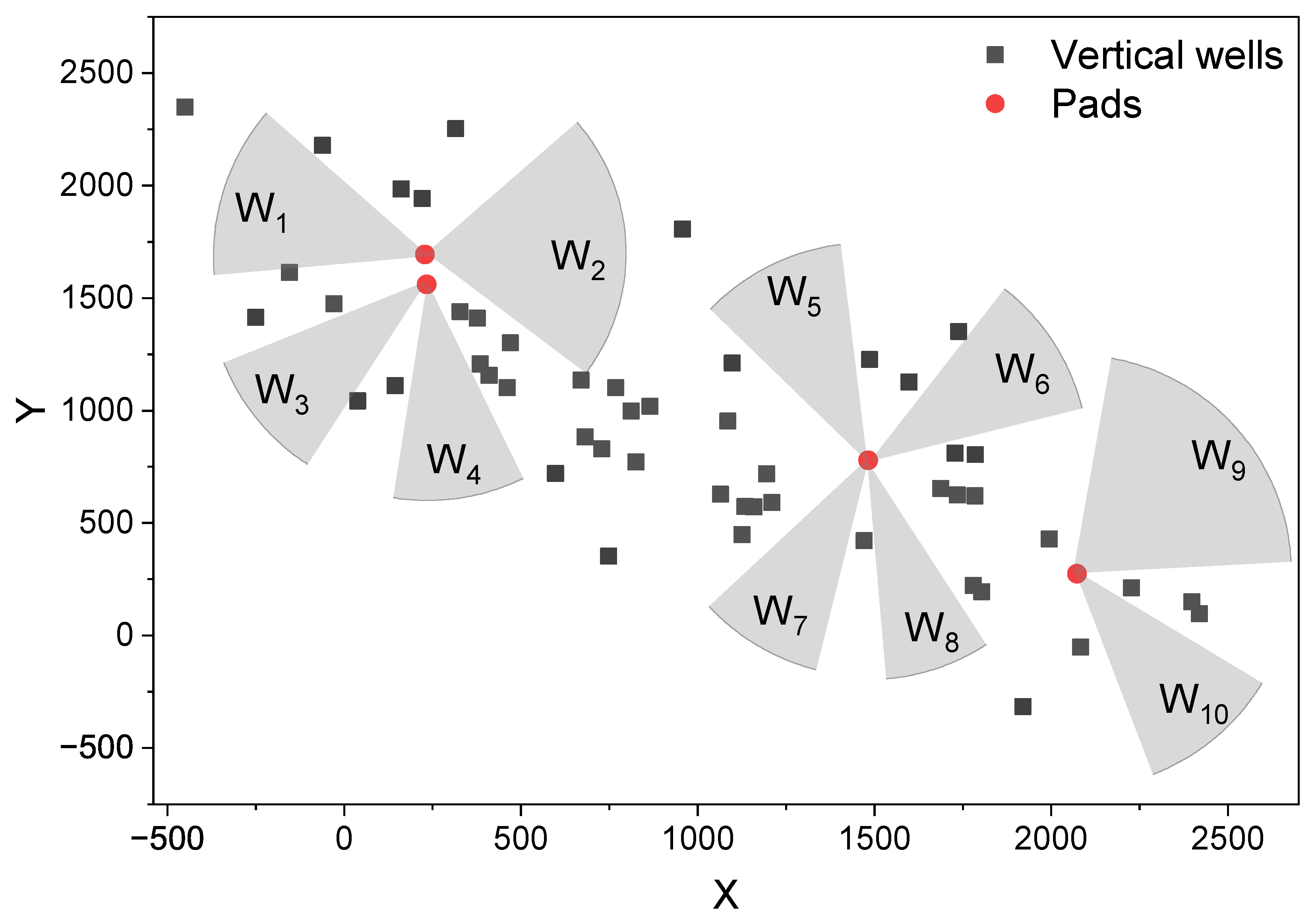
The numerical experiment was performed using a high-fidelity underground gas storage (UGS) reservoir model with more than 30 years of calibrated production and injection history. The model has been updated annually using well-test data, ensuring accurate representation of long-term reservoir behavior. Each well in the field operates under its individual production and injection constraints derived from yearly well testing, with a characteristic tubing-head-pressure (THP) differential of approximately 40 bar between maximum injection and minimum production conditions. All optimization scenarios were evaluated over three complete production–injection cycles, separated by 14-day shut-in periods, reflecting typical operational practice in seasonal gas storage. Actual well locations and pads for new wells are presented in
Figure 6.
To provide a minimum level of drilling safety and prevent trajectory collisions, azimuthal drilling sectors were predefined for each well based on engineering design constraints provided by the field operator. For wells drilled from the same pad, non-overlapping azimuth intervals were assigned such that each trajectory remains confined within its dedicated directional sector. These sectors were determined by projecting the maximum achievable horizontal reach for admissible combinations of trajectory parameters, thereby defining a geometric envelope of possible well paths.
Operational Constraints and Control Policy
All simulations were performed under fixed well control and facility constraints reflecting real UGS operational practice. During the withdrawal cycle, each well was subject to (i) minimum tubing-head pressure (THP) constraints required for integration with the transmission network, (ii) maximum production-rate limits associated with sand production and water coning risk, and (iii) minimum production rates required to ensure stable liquid lifting conditions. During the injection cycle, constraints included (i) maximum THP limited by compressor capacity and reservoir fracture pressure considerations, and (ii) maximum injection-rate limits imposed by compressor performance and reservoir integrity criteria. Additionally, field-level group constraints restricted total injection and production rates according to surface transmission infrastructure capacity.
All constraints were implemented directly in the reservoir simulator using standard Eclipse keywords (WCONPROD, WCONINJE, GCONPROD, GCONINJE). Wells were primarily rate-controlled, with automatic switching to pressure control whenever THP limits were reached. No re-optimization of control parameters was performed during the trajectory optimization process. Consequently, only well trajectories were modified, while operational policies and facility constraints remained unchanged across all evaluated configurations.
2.4. Optimization
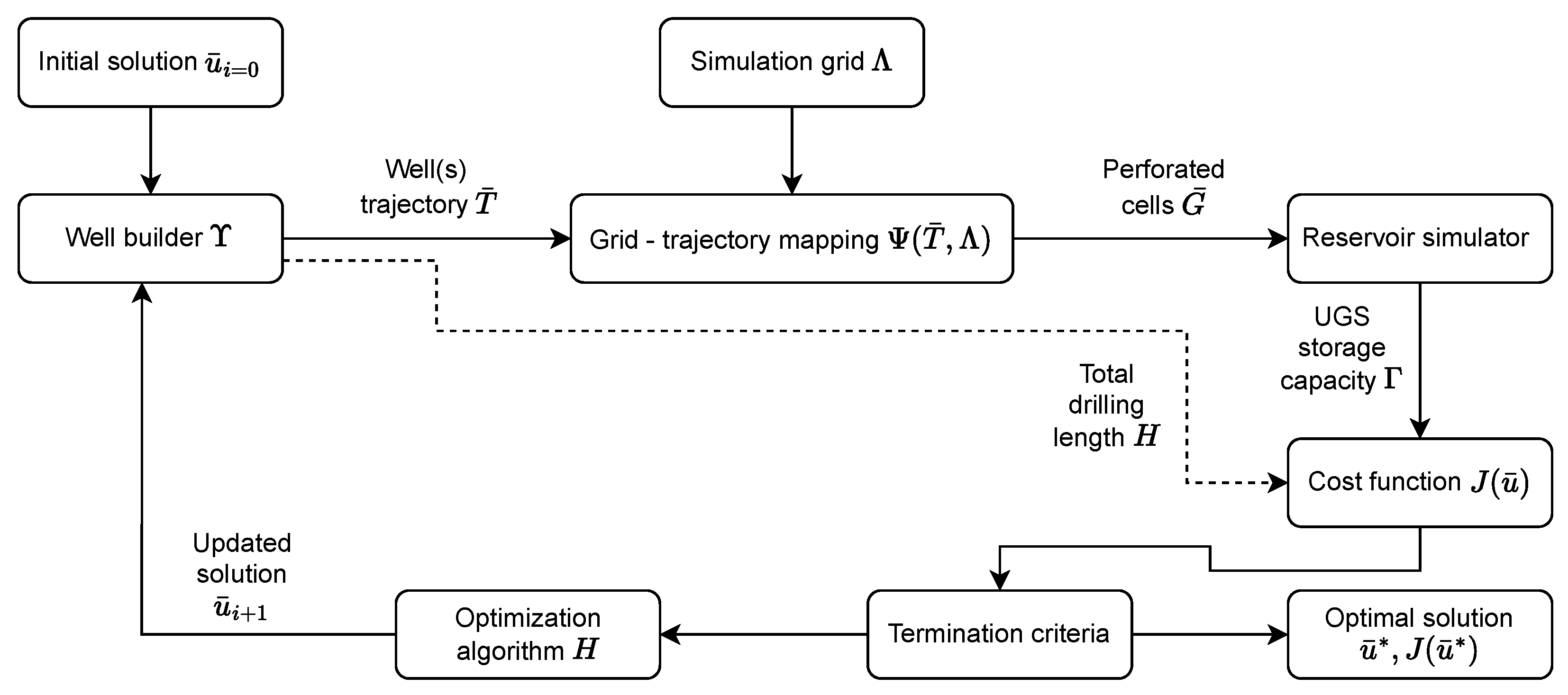
The optimization task is formulated as a simulation-based multiobjective problem in which well trajectories are parameterized, transformed into operational well paths, evaluated in an underground gas storage reservoir model, and iteratively improved using a Pareto-based evolutionary algorithm. Because the reservoir response is nonlinear, history-dependent, and non-differentiable, no analytical relationship exists between the decision variables and the objective functions. Consequently, the workflow implements a closed loop (
Figure 7) in which (i) the decision vector is mapped into 3D trajectories through the well-builder module; (ii) perforations are identified using KD-tree search [
28] and hexahedral inside–outside tests; (iii) a full reservoir simulation run provides the production and injection profiles; and (iv) an optimization engine evaluates each solution, updates the population, and generates a new set of candidate designs. This workflow follows the established simulation-based optimization paradigm, where each objective function evaluation requires a forward simulation but guarantees physically consistent results.
Collision risk between optimized wells is primarily controlled through an engineering anti-collision scheme defined during the development planning stage of the investigated UGS facility. For wells drilled from the same surface pad, predefined azimuth sectors were assigned such that each trajectory must remain within a dedicated directional envelope (
Figure 6). These envelopes were determined by projecting the maximum achievable horizontal reach of a well for admissible combinations of trajectory parameters. Based on this reach analysis, non-overlapping azimuth intervals were defined for individual wells to ensure that the domains of possible trajectories remain geometrically separated. During optimization, these limits are implemented as hard bounds on the azimuth decision variable, forcing each candidate trajectory to remain within its assigned drilling sector. Consequently, trajectories originating from the same pad cannot intersect within the admissible design space. Existing wells within the reservoir structure were also considered during the sector-definition stage to ensure safe stand-off distances from historical wellbores. At the numerical level, an additional implicit separation effect arises from the reservoir simulator representation. Wells are modeled as source/sink terms assigned to grid-block centers, and if multiple wells perforate the same grid cell, superposition effects reduce effective productivity or injectivity, thereby negatively impacting the objective function. Given the grid dimensions of approximately 25 × 25 × 30 m, the minimum spatial separation explicitly resolved by the simulator corresponds to the grid scale. Although sub-grid spacing cannot be evaluated directly within this representation, the optimization naturally favors solutions accessing distinct grid blocks. Future extensions of the framework may incorporate explicit centerline-distance or minimum-clearance constraints to further enhance geometric verification.
2.4.1. Control Vector
In this study, each directional well is parameterized through a compact set of geometric decision variables defining the J-type trajectory used by the well-builder module. For a single well, the well-trajectory model is represented as (Equaiton (
21)):
The trajectory parameterization adopted in this study corresponds to a J-type configuration. This restriction was imposed by the field operator to ensure uniform completion design and equipment configuration across all storage wells. The well-builder module itself is not limited to J-type geometries and supports arbitrary combinations of linear and curvilinear segments; therefore, the reported results are conditional on the imposed trajectory class rather than a limitation of the methodology.
In the numerical experiment, ten wells are optimized concurrently, yielding the control vector
The discretization step is held constant for all wells ( = 0.5 [m]). In the present study, wellhead coordinates are fixed and correspond to existing surface pad locations defined by the field operator. These positions represent hard boundary conditions imposed by surface infrastructure and were not treated as optimization variables. Consequently, the obtained Pareto front is conditional on fixed wellhead locations. It should be emphasized that the optimization framework itself allows variable wellhead positioning; however, in this case study, surface infrastructure constraints were preserved to reflect realistic industrial design conditions.
Each decision variable is bounded within technologically feasible limits, ensuring drillability and compliance with UGS operational constraints. In addition, azimuth bounds were assigned individually for each well to enforce the engineering anti-collision sector allocation described earlier. These limits restrict the trajectory orientation to predefined directional slots associated with each pad, guaranteeing geometric separation between wells drilled from the same location.
The admissible azimuth intervals for individual wells are defined as
To justify the upper dogleg severity bounds used in our model, we note that modern high-build rotary steerable systems (RSS) can reliably achieve curvature levels approaching those applied here. Standard RSS tools typically deliver 2.1–2.6°/30 m, while new-generation high-build systems are capable of up to 4.5°/30 m [
29,
30]. Field applications have demonstrated even higher build-up rates in specific contexts, including 6.7°/30 m in horizontal drilling operations and up to 7.5°/30 m in directional coring tests [
31]. From a mechanical integrity perspective, casing stress remains largely unaffected for curvatures below 4°/30 m, with deformation risks increasing only beyond 4.29°/30 m [
32]. Taken together, these data support use of 3.4–4.8°/30 m as technologically feasible values that fall within the demonstrated performance envelope of current drilling systems.
The lower dogleg severity bound (3.4°/30 m) reflects a design assumption that purely vertical configurations are suboptimal under clustered pad drilling conditions. Because all new wells will be drilled from existing pads, insufficient curvature would result in limited lateral displacement and increased superposition of well drainage/injection areas. The reservoir structure is located at a relatively shallow depth, requiring a minimum build-up rate to achieve meaningful horizontal reservoir contact. Consequently, zero-curvature (purely vertical) trajectories were excluded after consultation with the field operator to ensure effective spatial distribution and hydraulic performance.
The adopted bounds reflect engineering feasibility constraints provided by the field operator rather than optimization tuning parameters. In particular, the build-up length interval m results from the combination of shallow reservoir depth and required lateral displacement to mitigate superposition effects between clustered wells. Shorter build sections would not provide sufficient horizontal reach, whereas substantially longer curvature sections would introduce unnecessary drilling complexity without proportional hydraulic benefit under the given geological configuration.
2.4.2. Cost Function
The optimization problem is defined as a biobjective task seeking to simultaneously (i) maximize the increase in UGS working capacity and (ii) minimize the total drilling length of the ten new directional wells. The objective vector is expressed as (Equation (
25)):
where
denotes the simulated working-gas capacity of UGS, and
is the cumulative drilling length associated with the proposed well trajectories.
The working-gas capacity is reported directly from the simulator as the total gas-in-place within the storage structure (FGIP keyword), converted to standard surface conditions (15 °C, 1 bar), and reduced by the operator-defined cushion-gas volume. Thus, is derived from the thermodynamic reservoir state at a specified time step rather than inferred solely from cumulative production or injection volumes.
The evaluation point corresponds to the end of two injection cycles and one withdrawal cycle (approximately 1.5 years of simulated operation). To ensure that represents physically recoverable working capacity, a verification withdrawal cycle is performed. If the working-gas volume cannot be fully reduced to zero under imposed operational constraints, the configuration is rejected from the optimization process. The baseline capacity is defined analogously at the same reference time using the expert-designed trajectory set. Therefore, the ratio quantifies the relative change in recoverable working-gas capacity resulting exclusively from trajectory redesign.
The total drilling length is computed directly from the geometric definition of each well:
These two objectives are inherently conflicting: trajectories that maximize reservoir contact tend to require longer build-up and hold sections, whereas shorter wells reduce drilling effort but may result in lower storage efficiency. Pareto optimization, therefore, provides a natural framework for generating a spectrum of optimal compromise solutions instead of enforcing a priori weighting between the two objectives.
2.4.3. Optimization Algorithm
The multiobjective optimization problem formulated in this study requires the simultaneous improvement of two conflicting objectives—extension of underground gas storage (UGS) capacity and reduction in total drilling length. To efficiently explore the trade-off surface between these objectives, the Non-Dominated Sorting Genetic Algorithm II (NSGA-II) was employed [
33]. NSGA-II is a widely recognized evolutionary optimization framework designed for complex engineering problems in which objectives cannot be linearly combined or reduced to a single scalar score without loss of information [
34]. NSGA-II operates on a population of candidate solutions, each representing a full control vector defining the trajectories of all optimized wells. The algorithm follows three key principles [
35]:
Fast non-dominated sorting—individuals in the population are ranked according to Pareto dominance. Solutions that are not dominated by any other population member form the first Pareto front. The second front consists of individuals dominated only by members of the first front, and so forth. This hierarchical classification ensures explicit preservation of the multiobjective nature of the problem.
Crowding-distance estimation—to maintain diversity along the Pareto front, NSGA-II computes a crowding distance for each individual, reflecting the local density of solutions in objective space. Larger crowding distances are preferred because they represent more isolated solutions and prevent premature convergence to a small region of the Pareto set.
Elitism through population selection—unlike earlier GA-based multiobjective methods (e.g., NSGA-I), NSGA-II introduces an explicit elitist strategy, preserving the best-ranked solutions across generations. Parents and offspring are merged into a single intermediate population, which is then sorted into Pareto fronts. The next generation is selected by filling the population with entire fronts until capacity is reached. If the next front would exceed the population limit, individuals are selected based on descending crowding distance.
The algorithm operates on a population of candidate solutions that evolves over successive generations. In the present study, a population size of 15 individuals was employed; 14 were initialized randomly within the admissible bounds, and one represented an expert-designed reference trajectory set. The expert-designed configuration was included solely as a reference individual within the initial population and was not explicitly privileged during evolutionary operations. Its role was to provide a performance baseline for relative capacity evaluation (). The Pareto front presented in the Results section corresponds to the best-performing realization among five independent multistart runs. The optimization terminated when either the predefined maximum of 21 generations was reached or when the improvement in the Pareto-front hypervolume measure fell below a tolerance threshold for five consecutive generations, indicating stagnation. The computational cost of the simulation-based optimization is non-negligible. Due to licensing constraints, reservoir simulations were executed sequentially (one simulation per CPU core: Intel(R) Core(TM) i7-5960X @ 3.00GHz). A single reservoir simulation required approximately 15 min of wall-clock time. With a population size of 15 individuals over 21 generations (315 simulations per run), a single NSGA-II execution required approximately 79 h. Using five independent random seeds (multistart strategy), the total computational time amounted to approximately 394 h. The computational cost of trajectory generation and perforation mapping was negligible compared to reservoir simulation time. The framework is compatible with parallel evaluation of individuals, and significant runtime reduction can be achieved under multi-core or HPC deployment.
3. Results and Discussion
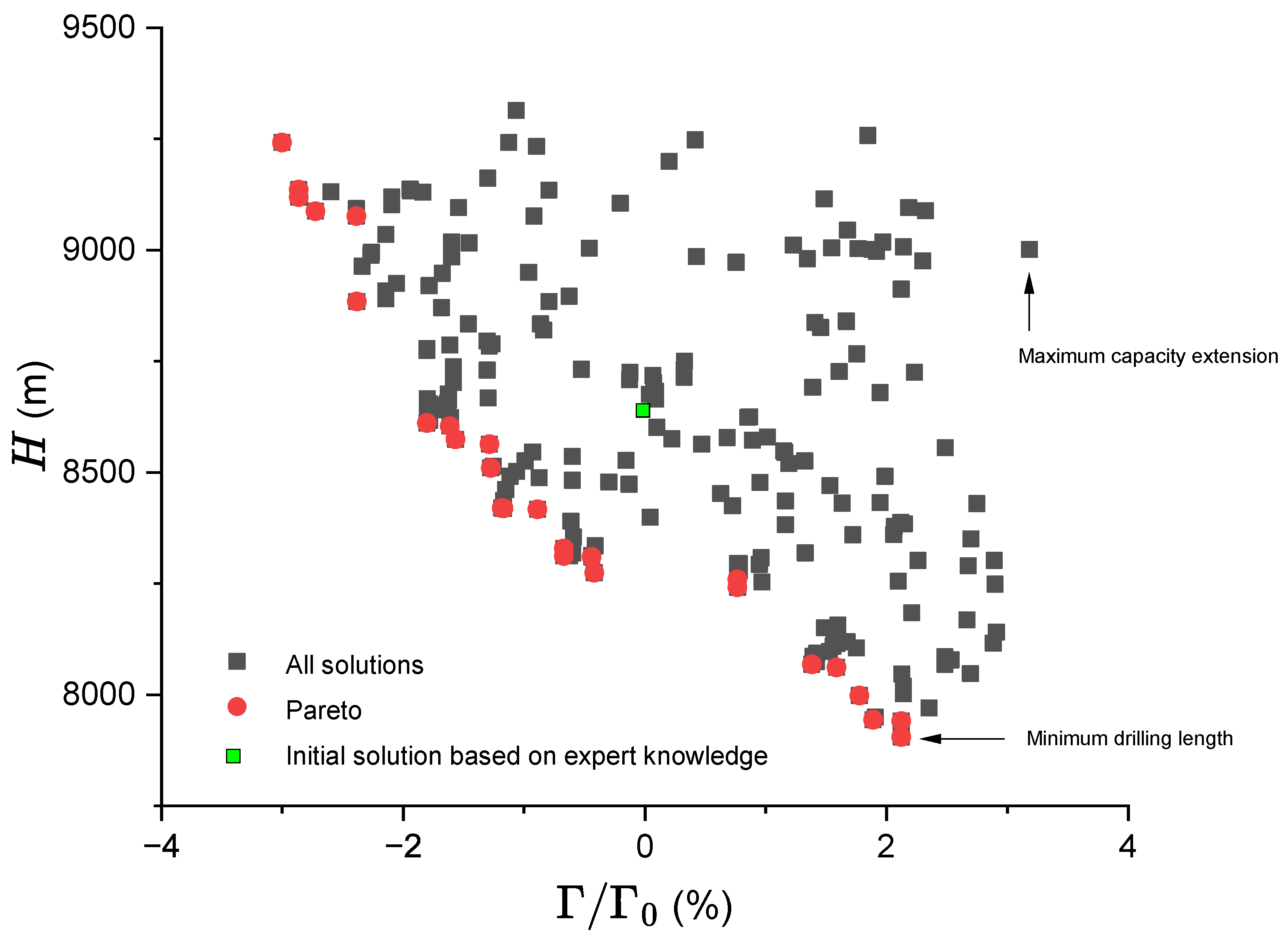
The optimization produced evaluated well-configuration portfolios (10-well designs), each encoded in the dataset by a pair of objective-function values: the relative storage-capacity change (
) and the corresponding total drilling length
H, presented in
Figure 8. These solutions represent the unions of populations collected over successive GA generations, including dominated and non-dominated individuals.
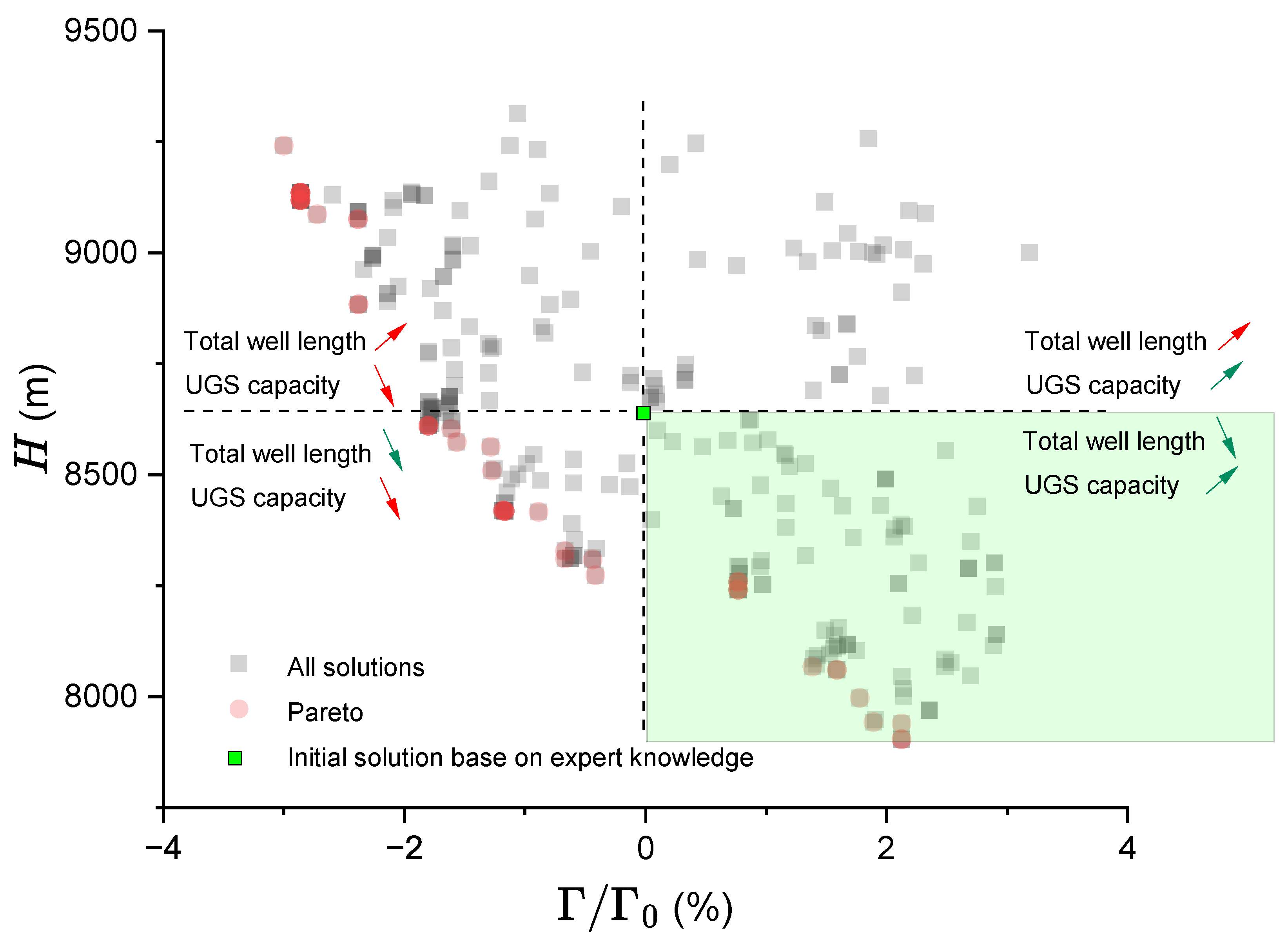
The optimization results were benchmarked against an expert-designed well configuration, characterized by total drilling length = 8650 [m], and relative storage capacity change = 0.0%. This baseline represents the reference point used to evaluate whether each optimized solution improves, matches, or degrades the UGS system performance.
The relative capacity change spans a wide interval with both positive and negative capacity shifts achieved depending on the drilling-length characteristics of the well set. The total drilling length exhibits substantial variability . The minimum drilling length (7904 m) corresponds to one of the Pareto-optimal portfolios achieving a +2.124% capacity gain, clearly demonstrating the possibility of simultaneous improvements in both objectives. Conversely, the maximum capacity increase (+3.182%) is obtained at 9000.9 m, representing an approximate 4.0% increase in drilling effort relative to the expert-based baseline (8650 m).
To contextualize the magnitude of the observed improvements, the calibrated reservoir model reproduces historical bottomhole pressures with errors below 0.5%, wellhead pressures below 0.3%, and water-production indicators within approximately 1%. In absolute terms, a 3% increase in working-gas capacity corresponds to approximately 15 million Nm3 of additional storage volume for the investigated facility. Given that the improvement magnitude exceeds model-matching residuals and represents a commercially relevant gas volume, the reported gains are considered operationally meaningful within the deterministic modeling framework applied in this study.
To assess convergence robustness, the optimization was repeated using five independent random seeds. The Pareto-front hypervolume (HV) was selected as the convergence metric because it simultaneously captures convergence and diversity properties of the solution set. Using the reference point r = (2.5%, 9300 m), which remained non-dominated across runs, the obtained HV values were: 4770.61, 4820.61, 4855.61, 4895.61, and 4860.61. The mean hypervolume equaled 4840.61 with a standard deviation of 47.3, corresponding to a coefficient of variation of approximately 0.98%. This variability below 1% indicates high repeatability and a stable Pareto structure within the adopted computational budget.
To interpret the multiobjective landscape, the two objectives—total drilling length and relative UGS capacity—were analyzed jointly with the expert-based reference point, enabling classification of all outcomes into four distinct behavioral regions (
Figure 9). The reference configuration acts as a pivot separating improvements from degradations in each objective. Of particular interest are solutions in the green region, which simultaneously reduce total drilling length and enhance UGS capacity, representing strictly superior alternatives to the baseline.
Beyond visual inspection, statistical evaluation of the full dataset provides additional insight into the structure of the objective space:
Region of mutual improvement—solutions that simultaneously reduce drilling length below the baseline and increase capacity. The best-performing designs in this region achieve drilling-length reductions of 8.6% relative to the expert case (8650 m) while increasing capacity by more than 2%.
Capacity-driven region—portfolios with 2.5% cluster in a narrow band between 8900 and 9100 m. These are high-capacity designs with moderate drilling-length penalties.
Length-minimizing region—solutions with H < 8300 m show capacities between −2.1% and +2.7%, highlighting that aggressive drilling-length minimization does not necessarily imply capacity degradation; many short-length solutions still preserve or improve storage capacity.
Dominated region—configurations with longer wellbores (e.g., >9200 m) and negative capacity impact represent strongly dominated solutions.
Statistical correlation analysis reveals a moderately negative Pearson correlation () and Spearman correlation () between the two objectives, suggesting that shorter configurations tend to achieve higher capacity improvements within the explored region. However, a simple linear regression explains only 35% of the variance, confirming that the relationship between well length and capacity is strongly nonlinear. Correlation analysis indicates a moderate negative association between total drilling length and relative capacity change within the sampled design space. However, linear regression explains only a limited fraction of variance, indicating pronounced nonlinearity and interaction effects between well geometry and heterogeneous reservoir properties. Surrogate-model analysis was performed for exploratory interpretation but is not used to formulate generalized conclusions regarding well-length effects. The observed relationships are therefore considered case-specific within the investigated parameter space.
To evaluate the robustness of the trajectory discretization parameter
, a sensitivity analysis was performed using a representative well configuration defined by a fixed decision vector. Well trajectories were generated for
m,
m,
m, 1 m, 10 m, 20 m, and 25 m. Each trajectory was mapped to the reservoir grid using the perforation-identification procedure described earlier, followed by a full dynamic reservoir simulation under identical operational controls. The resulting working-gas capacity was compared relative to the baseline case
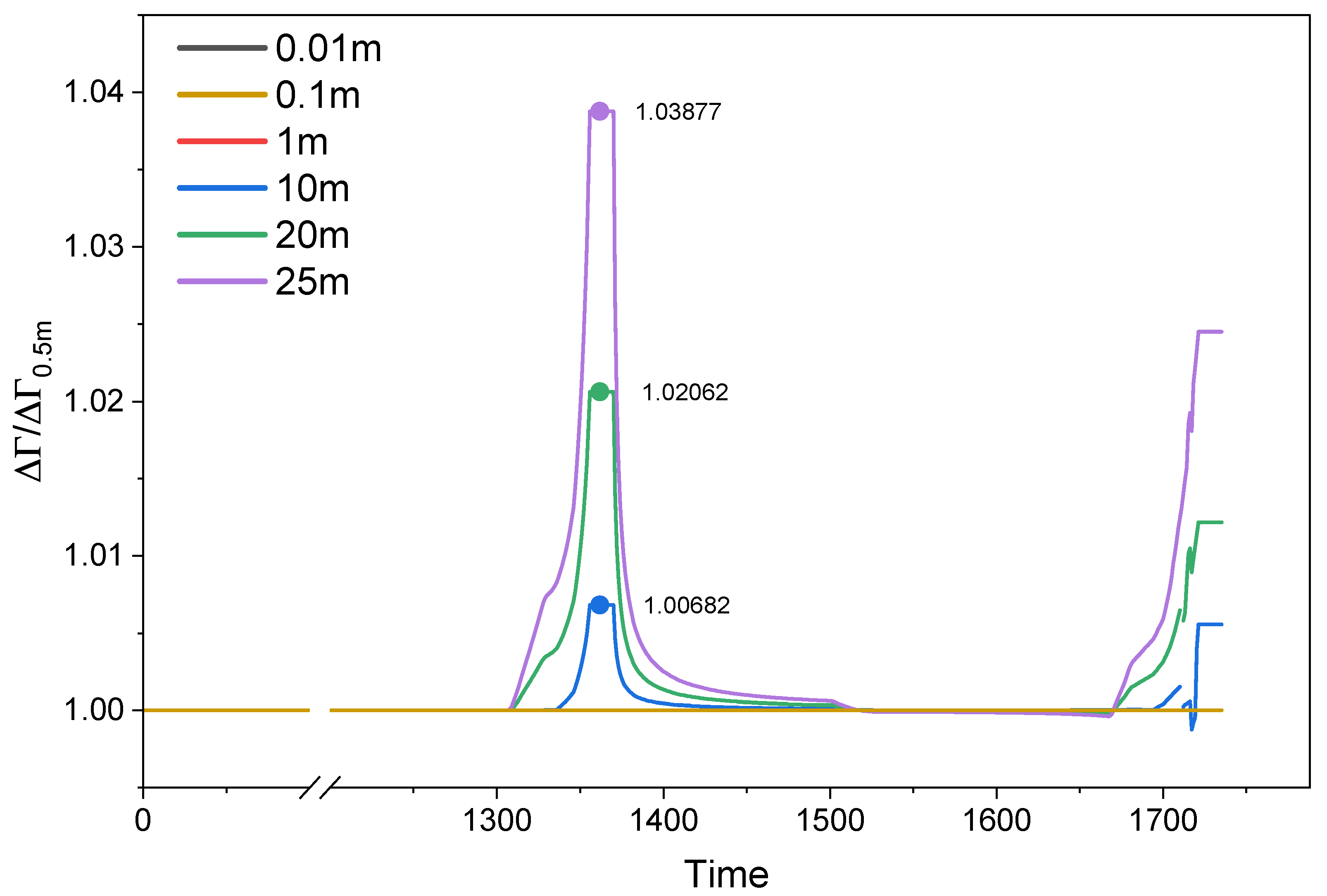
m. The results (
Figure 10) show that no measurable differences occur for discretization values below 1 m at the current reservoir-grid resolution. For coarser discretizations the deviations increase, reaching approximately
for
m,
for
m, and
for
m. For values larger than 25 m the mapping algorithm was unable to correctly export all wells to the dynamic simulation model due to incomplete grid-intersection detection. These results confirm that the adopted discretization step
m provides a stable and sufficiently fine representation of the well trajectory relative to the reservoir-grid dimensions (approximately 25 m), ensuring reliable well-to-grid mapping.
Importantly, because variations in remain negligible for m, the discretization resolution used in the optimization does not introduce bias in the evaluated objective functions. Consequently, the structure of the Pareto front obtained during the optimization process is not affected by the chosen trajectory discretization resolution within this range.
4. Conclusions
This study introduces an integrated framework for the multiobjective optimization of directional well trajectories in underground gas storage (UGS) systems, combining a modular well-path construction model with simulation-driven evaluation and evolutionary optimization. The proposed methodology enables simultaneous improvement of two conflicting objectives—extension of working-gas capacity and reduction in total drilling length—while ensuring full compatibility with reservoir-scale numerical simulation. By formulating the problem as a Pareto-optimal design task, the workflow provides decision-makers with a diverse set of technically feasible and economically meaningful solutions instead of a single prescriptive design.
A key contribution of this work is the development of a generalized well-trajectory generator, capable of assembling complex multi-segment deviation profiles within a local reference frame and transforming them into global coordinates through azimuthal rotation and translation. The modular structure of the model, reflected in the underlying computational routines (e.g., linear and curved section construction, rotation and translation operators), allows the creation of arbitrary directional geometries and ensures consistent discretization for grid–well intersection mapping. The integration procedure, based on KD-tree candidate selection and point-in-cell checks, guarantees robust identification of perforated cells for reservoir simulation. Because the model is independent of reservoir discretization and does not rely on built-in trajectory generators (e.g., Petrel), it remains transferable to diverse reservoir models and grid topologies.
The optimization experiment, performed on a fully calibrated UGS model with over 30 years of production history, demonstrates the practical value of the proposed workflow. Across 21 generations of NSGA-II optimization, a rich and diverse set of non-dominated solutions was obtained. The best designs achieved either an 8.6% reduction in total drilling length while still improving storage capacity by 2.12%, or a 3.18% increase in working-gas capacity change at the expense of only a modest increase in drilled length.
These results highlight that well-trajectory redesign alone—without altering well spacing, controls, or completion strategy—can measurably influence the dynamic working capacity of a mature gas-storage reservoir. Notably, capacity improvements were achieved even for shorter total drilling lengths, indicating nonlinear reservoir responses and underscoring the value of multiobjective exploration rather than single-metric optimization.
Beyond numerical outcomes, the study demonstrates several conceptual advantages:
Joint optimization of well placement in azimuthal space and well geometry.
Ability to embed technological constraints such as dogleg severity, drillability, and segment lengths.
compatibility with future extensions including well-collision checks, perforation optimization, or adaptive well-control optimization, and
Suitability for large multiwell field-optimization problems where manual trajectory design becomes impractical.
Overall, the proposed workflow constitutes a flexible, extensible, and computationally tractable tool for UGS planning. It provides a quantitative basis for strategic decisions by exposing the full trade-off landscape between drilling effort and storage performance. The demonstrated improvements confirm that even in long-producing, highly constrained UGS systems, capacity enhancement can be achieved through the careful redesign of directional wells. Future work may involve coupling the trajectory optimizer with economic objectives, uncertainty quantification, real-time drilling feasibility constraints, and operational optimization across seasonal cycles.
It should be emphasized that the reported results are conditional on fixed operational controls, fixed wellhead locations, J-type trajectory restrictions, grid-resolution well representation, and the adopted optimization budget. These boundary conditions reflect realistic industrial constraints but define the scope within which conclusions are valid. The modular structure of the proposed framework enables future extensions, including explicit anti-collision constraints, refined discretization sensitivity analysis, and coupled operational-control optimization.
Author Contributions
Conceptualization, P.W. and D.J.; methodology, P.W. and D.J.; formal analysis, P.W.; writing—original draft preparation, D.J.; writing—review and editing, D.J.; supervision, P.W. All authors have read and agreed to the published version of the manuscript.
Funding
This research was partially supported by the AGH University of Krakow under statutory Research Grant No. 16.16.190.779 (Faculty of Drilling, Oil and Gas, Department of Petroleum Engineering) and by the European Union’s Horizon Europe Research and Innovation Programme under Grant Agreement No. 101147467 (URGENT Project). The well-builder model presented in this study will be further developed within the URGENT Project, with a particular focus on its application to geothermal drilling.
Data Availability Statement
The datasets generated during and/or analyzed during the current study are available from the corresponding author on reasonable request.
Acknowledgments
During the preparation of this manuscript/study, the author(s) used ChatGPT 5.2 for the purposes of grammar checking. The authors have reviewed and edited the output and take full responsibility for the content of this publication.
Conflicts of Interest
The authors declare no conflicts of interest. The funders had no role in the design of the study; in the collection, analyses, or interpretation of data; in the writing of the manuscript; or in the decision to publish the results.
Abbreviations
The following abbreviations are used in this manuscript:
| AFE | Authorization for Expenditures |
| UGS | Underground Gas Storage |
| NSGA | Non-dominated Sorting Genetic Algorithm |
References
- International Gas Union. Underground Gas Storage—A Critical Pillar for Energy Security Report. Tech. Rep., IGU (October 2025). Available online: https://www.datocms-assets.com/146580/1761301320-underground-gas-storage_report.pdf (accessed on 15 December 2025).
- Huang, L.; Hou, Z.; Fang, Y.; Luo, J.; Wu, L.; Wang, Q.; Guo, Y.; Zhang, X.; Shi, T.; Liu, J. The development, frontier and prospect of large-scale underground energy storage: A bibliometric review. J. Energy Storage 2024, 103, 114293. [Google Scholar] [CrossRef]
- GTI Energy. Underground Gas Storage in Natural Gas Infrastructure: Gulf Coast Insights. Technical Report, GTI Energy, NZIP UGS Report, March 2025. Available online: https://www.gti.energy/wp-content/uploads/2025/07/RAISE-UGS-Report_070925.pdf (accessed on 12 December 2025).
- U.S. DOE/NETL. Cavern Roof Stability for Natural Gas Storage in Bedded Salt. Technical Report, National Energy Technology Laboratory, 2023. Available online: https://netl.doe.gov/sites/default/files/2018-03/41651_FinalReport.pdf (accessed on 20 December 2025).
- American Gas Association. Assessing the Value of Natural Gas Storage. Technical Report, AGA, April 2022. Available online: https://www.aga.org/wp-content/uploads/2022/04/Value-of-Storage-FINAL.pdf (accessed on 3 January 2026).
- Yousefzadeh, R.; Kazemi, A.; Al-Hmouz, R.; Al-Moosawi, I. Determination of optimal oil well placement using deep learning under geological uncertainty. Geoenergy Sci. Eng. 2025, 246, 213621. [Google Scholar] [CrossRef]
- Gao, Y.; Cui, J.; Wang, N. Multi-objective drilling trajectory optimization under parameter uncertainty. In Proceedings of the 2024 4th International Conference on Computer Science and Blockchain (CCSB), Shenzhen, China, 6–8 September 2024; pp. 11–14. [Google Scholar] [CrossRef]
- Xiao, Y.; Zhou, T.; Su, H.; Li, J.; Song, L.; Kong, X.; Qian, F. Research and application of quantitative model for optimal well trajectory selection. Sci. Rep. 2025, 15, 42710. [Google Scholar] [CrossRef] [PubMed]
- Raji, O.Q.; Volkov, O.; Kovscek, A.R.; Durlofsky, L.J. Optimization of well placement for geological CO2 storage to minimize fault slip tendency. In Proceedings of the SPE Energy Transition Symposium, Sugar Land, TX, USA, 8–10 September 2025; SPE: Richardson, TX, USA, 2025. [Google Scholar] [CrossRef]
- Gu, H.; Wu, Y.; Li, X.; Hou, Z. Research on wellbore trajectory optimization and drilling control based on the TD3 algorithm. Appl. Sci. 2025, 15, 7258. [Google Scholar] [CrossRef]
- Mahmood, H.A.; Al-Fatlawi, O.F.; Al-Janabi, M.A.; Sadeq, D.J.; Al-Jumaah, Y.M.; Khan, M. Optimizing well placement with genetic algorithms: A case study. J. Pet. Res. Stud. 2024, 14, 37–51. [Google Scholar] [CrossRef]
- He, Y.; Chang, P.; Liu, Y.; Chen, J.; Li, C. Optimize well placement based on genetic algorithm and productivity potential maps. Front. Energy Res. 2022, 10, 860220. [Google Scholar] [CrossRef]
- Wang, N.; Chang, H.; Zhang, D.; Xue, L.; Chen, Y. Efficient well placement optimization based on theory-guided convolutional neural network. J. Pet. Sci. Eng. 2022, 208, 109545. [Google Scholar] [CrossRef]
- Irawan, S.; Wayo, D.D.K.; Satyanaga, A.; Kim, J. Global genetic algorithm for automating and optimizing petroleum well deployment in complex reservoirs. Energies 2024, 17, 2151. [Google Scholar] [CrossRef]
- Hamida, Z.; Azizi, F.; Saad, G. An efficient geometry-based optimization approach for well placement in oil fields. J. Pet. Sci. Eng. 2017, 149, 383–392. [Google Scholar] [CrossRef]
- Wang, Z.; Shen, S.-L.; Chen, D.; Li, W.; Li, W.; Fan, Z. Multi-objective optimization of the wellbore trajectory considering both geological and engineering factors. Geoenergy Sci. Eng. 2025, 246, 213647. [Google Scholar] [CrossRef]
- Xu, J.; Chen, X.; Cao, W.; Wu, M. Multi-objective trajectory planning in the multiple strata drilling process: A bi-directional constrained co-evolutionary optimizer with pareto front learning. Expert Syst. Appl. 2024, 238, 122119. [Google Scholar] [CrossRef]
- Wang, J.; Yan, Z.; Pan, T.; Zhu, Z.; Song, X.; Yang, D. Drilling parameters multi-objective optimization method based on pso-bi-lstm. Appl. Sci. 2023, 13, 11666. [Google Scholar] [CrossRef]
- Zheng, J.; Li, Z.; Dou, B.; Lu, C.; Zheng, J.; Li, Z.; Dou, B.; Lu, C. Multi-objective cellular particle swarm optimization and rbf for drilling parameters optimization. Math. Biosci. Eng. 2019, 16, 1258–1279. [Google Scholar] [CrossRef]
- Chen, X.; Wang, R.; Yang, J.; Gao, D.; Li, G.; Li, P. A new intelligent optimization method for drilling parameters of extended reach wells based on mechanical specific energy and machine learning. Pet. Res. 2025, 10, 485–500. [Google Scholar] [CrossRef]
- Lukawski, M.Z.; Anderson, B.J.; Augustine, C.; Capuano, L.E.; Beckers, K.F.; Livesay, B.; Tester, J.W. Cost analysis of oil, gas, and geothermal well drilling. J. Pet. Sci. Eng. 2014, 118, 1–14. [Google Scholar] [CrossRef]
- Bahari, A.; Baradaran Seyed, A. Drilling cost optimization in a hydrocarbon field by combination of comparative and mathematical methods. Pet. Sci. 2009, 6, 451–463. [Google Scholar] [CrossRef]
- Lashari, S.Z.; Takbiri-Borujeni, A.; Fathi, E.; Sun, T.; Rahmani, R.; Khazaeli, M. Drilling performance monitoring and optimization: A data-driven approach. J. Pet. Explor. Prod. Technol. 2019, 9, 2747–2756. [Google Scholar] [CrossRef]
- Yang, L.; Lu, Z.; Ren, W.; Liu, T. Improving the drilling parameter optimization method based on the fireworks algorithm. ACS Omega 2022, 7, 38074–38083. [Google Scholar] [CrossRef]
- Eren, T.; Polat, C. Natural gas underground storage and oil recovery with horizontal wells. J. Pet. Sci. Eng. 2020, 187, 106753. [Google Scholar] [CrossRef]
- Brkić, V.; Zelenika, I.; Mijić, P.; Medved, I. Underground gas storage process optimisation with respect to reservoir parameters and production equipment. Energies 2021, 14, 4324. [Google Scholar] [CrossRef]
- Chang, H.; Duo, T.; Li, B.; Wen, K.; Meng, T.; Bai, C.; Zhang, H. Optimization of the injection-production process of underground gas storage in depleted gas reservoir. Gas Sci. Eng. 2025, 138, 205605. [Google Scholar] [CrossRef]
- Bentley, J.L. Multidimensional binary search trees used for associative searching. Commun. ACM 1975, 18, 509–517. [Google Scholar] [CrossRef]
- Bryan, S.; Cox, J.; Blackwell, D.; Slayden, F.; Naganathan, S. High Dogleg Rotary Steerable System: A Step Change in Drilling Process. In Proceedings of the SPE Annual Technical Conference and Exhibition; SPE: Richardson, TX, USA, 2009; Volume 4, pp. 2333–2340. [Google Scholar]
- Khattab, H.; Ismail, A.; Abdalla, M.; Deraz, S.; Helmy, A.; Okasha, M.; Samad, H.; Ibrahim, A.; Mansour, M.; Muir, D.; et al. High Build Up Rate Rotary Steerable System Leads to Revolutionize Onshore Horizontal Drilling in Western Desert of Egypt. In SPE/IADC Middle East Drilling Technology Conference and Exhibition; SPE: Richardson, TX, USA, 2016. [Google Scholar]
- Shi, X.; Huang, W.; Gao, D.; Zhu, N.; Li, W. Extension Limit Analysis of Drillstring with Drag Reduction Oscillators in Horizontal Drilling. Geoenergy Sci. Eng. 2023, 228, 211996. [Google Scholar] [CrossRef]
- Xie, Y.; Liu, J.; Wang, L.; Li, Z. Risk Assessment and Prevention Measures for Casing Deformation in the Geological–Engineering Integration of a Block in Jiaoshiba Shale Gas Field. Nat. Gas Ind. B 2025, 12, 623–635. [Google Scholar] [CrossRef]
- Deb, K.; Pratap, A.; Agarwal, S.; Meyarivan, T. A fast and elitist multiobjective genetic algorithm: NSGA-II. IEEE Trans. Evol. Comput. 2002, 6, 182–197. [Google Scholar] [CrossRef]
- Grygar, D.; Fabricius, R. An efficient adjustment of genetic algorithm for pareto front determination. Transp. Res. Procedia 2019, 40, 1335–1342. [Google Scholar] [CrossRef]
- Ganjehkaviri, A.; Mohd Jaafar, M.; Hosseini, S.; Barzegaravval, H. Genetic algorithm for optimization of energy systems: Solution uniqueness, accuracy, pareto convergence and dimension reduction. Energy 2017, 116, 167–177. [Google Scholar] [CrossRef]
Figure 1.
Concept of the single-well model in 3D geometry. The trajectory consists of combined linear (blue—vertical, green—slanted) and curvilinear (red) sections. It is computed in a local coordinate system and subsequently translated to the wellhead location and rotated to match the desired azimuth.
Figure 1.
Concept of the single-well model in 3D geometry. The trajectory consists of combined linear (blue—vertical, green—slanted) and curvilinear (red) sections. It is computed in a local coordinate system and subsequently translated to the wellhead location and rotated to match the desired azimuth.
Figure 2.
Linear well section model, both cases whereas (blue) and (green) are presented.
Figure 2.
Linear well section model, both cases whereas (blue) and (green) are presented.
Figure 3.
Curvilinear well section model, both cases whereas dls and dls are presented (red).
Figure 3.
Curvilinear well section model, both cases whereas dls and dls are presented (red).
Figure 4.
Well builder validation against industrial reference builder (Petrel). Each axis is validated separately.
Figure 4.
Well builder validation against industrial reference builder (Petrel). Each axis is validated separately.
Figure 5.
Conceptual representation of well trajectory embedded in the simulation reference system. The well path (vertical, build-up, and hold sections) intersects multiple hexahedral grid cells. Cells identified as perforated (highlighted) form the basis for well–reservoir connection.
Figure 5.
Conceptual representation of well trajectory embedded in the simulation reference system. The well path (vertical, build-up, and hold sections) intersects multiple hexahedral grid cells. Cells identified as perforated (highlighted) form the basis for well–reservoir connection.
Figure 6.
Engineering anti-collision concept applied in the numerical experiment. Each well drilled from a pad is assigned a predefined azimuth sector (W1–W10), ensuring that trajectories remain within non-overlapping directional envelopes. Existing vertical wells are shown as black squares, while pad locations are marked in red. The sector boundaries define hard constraints on the azimuth decision variable during optimization, guaranteeing geometric separation between wells originating from the same pad.
Figure 6.
Engineering anti-collision concept applied in the numerical experiment. Each well drilled from a pad is assigned a predefined azimuth sector (W1–W10), ensuring that trajectories remain within non-overlapping directional envelopes. Existing vertical wells are shown as black squares, while pad locations are marked in red. The sector boundaries define hard constraints on the azimuth decision variable during optimization, guaranteeing geometric separation between wells originating from the same pad.
Figure 7.
Optimization workflow for multiobjective well-trajectory design.
Figure 7.
Optimization workflow for multiobjective well-trajectory design.
Figure 8.
Optimization results, for 10 wells run. Maximum UGS capacity can be establish outside Pareto front, where minimum drilling length is one of the Pareto solution.
Figure 8.
Optimization results, for 10 wells run. Maximum UGS capacity can be establish outside Pareto front, where minimum drilling length is one of the Pareto solution.
Figure 9.
Multiobjective landscape defined by total drilling length and relative UGS capacity, partitioned into four behavioral regions relative to the expert-based reference configuration. The green region denotes solutions that simultaneously reduce drilling length and increase UGS capacity, representing strictly superior alternatives to the baseline.
Figure 9.
Multiobjective landscape defined by total drilling length and relative UGS capacity, partitioned into four behavioral regions relative to the expert-based reference configuration. The green region denotes solutions that simultaneously reduce drilling length and increase UGS capacity, representing strictly superior alternatives to the baseline.
Figure 10.
Sensitivity analysis of the trajectory discretization parameter on simulated working-gas capacity (). Results are expressed relative to the baseline discretization m used in the optimization workflow. The analysis demonstrates that discretization values below 1 m do not affect the computed capacity at the adopted grid resolution, confirming that the selected trajectory sampling provides stable well-to-grid mapping and does not bias the objective functions used in the Pareto optimization.
Figure 10.
Sensitivity analysis of the trajectory discretization parameter on simulated working-gas capacity (). Results are expressed relative to the baseline discretization m used in the optimization workflow. The analysis demonstrates that discretization values below 1 m do not affect the computed capacity at the adopted grid resolution, confirming that the selected trajectory sampling provides stable well-to-grid mapping and does not bias the objective functions used in the Pareto optimization.
| Disclaimer/Publisher’s Note: The statements, opinions and data contained in all publications are solely those of the individual author(s) and contributor(s) and not of MDPI and/or the editor(s). MDPI and/or the editor(s) disclaim responsibility for any injury to people or property resulting from any ideas, methods, instructions or products referred to in the content. |