Article

Dynamic Simulation and Flexible Operation Strategy of Green Methanol Process Under Renewable Energy Fluctuations

School of Chemical Engineering, Sichuan University, Chengdu 610065, China
*
Author to whom correspondence should be addressed.
These authors contributed equally to this work.
Energies 2026, 19(6), 1431; https://doi.org/10.3390/en19061431
Submission received: 22 January 2026 / Revised: 4 March 2026 / Accepted: 10 March 2026 / Published: 12 March 2026
(This article belongs to the Special Issue Clean and Efficient Use of Energy: 3rd Edition)

Abstract

The increasing deployment of renewable energy introduces significant dynamic challenges to green methanol synthesis systems due to its inherent intermittency and variability. However, loop-level dynamic stability and controllability under multi-scenario transient conditions remain insufficiently explored. To address this gap, a steady-state and dynamic model of a renewable-driven methanol synthesis loop was developed in UniSim Design and evaluated under various realistic transient scenarios. Baseline simulations reveal recurring dynamic amplification within the synthesis loop, with pressure deviations exceeding 600 kPa during load increase and persistent oscillatory behavior under fluctuating conditions. To mitigate these instability mechanisms, a control-oriented refinement strategy incorporating first-order feed filtering, load-dependent temperature setpoint scheduling, and gain scheduling of key control loops was implemented. Within the simulation framework, the optimized strategy reduces maximum transient deviations of pressure and temperature by approximately 50–70% and mitigates startup pressure overshoots by over 60%. Under wind–solar-driven operation, pressure integral absolute error (IAE) decreases by up to 42%, and system trajectories become more bounded and better damped. These results provide quantitative insight into renewable-induced instability mechanisms and highlight the potential of control-oriented strategies to enhance dynamic operability in flexible power-to-methanol systems.

1. Introduction

Methanol is a versatile chemical widely used in manufacturing and energy sectors [1]. Its potential is reinforced by favorable attributes such as established infrastructure, superior CO2 utilization compared to methane, and applicability in emerging fuel cell technologies [2,3]. Global methanol production has increased steadily over recent decades, with China, the United States, Europe, and the Middle East being the major production regions [4]. Among them, China has become the world’s largest methanol producer [5]. However, currently, most methanol production relies on coal gasification [6] and natural gas reforming [7], processes that are highly energy-intensive and associated with significant carbon emissions [8]. Consequently, achieving low-carbon methanol production under large-scale industrial conditions has become a critical challenge.
To support sustainable development, alternative methanol production pathways such as biomass gasification [9] and CO2 hydrogenation [10] have garnered increasing attention. In particular, Power-to-X (PTX) [11,12] technologies based on green hydrogen have emerged as a promising pathway, coupling renewable electricity with carbon utilization to produce high-value chemicals [13]. This approach offers dual benefits: renewable electricity can be stored in chemical form, and fully renewable products can be produced to replace fossil-based methanol. Life-cycle assessment studies indicate that CO2 hydrogenation to methanol can reduce greenhouse gas emissions by up to 59% compared with conventional production routes [14].
Although renewable methanol remains economically constrained by electricity, hydrogen, and CO2 capture costs [15,16,17,18], its environmental advantages and declining green hydrogen prices suggest increasing future viability [19,20,21,22].
However, the renewable energy sources on which future energy systems rely are inherently intermittent and volatile. In other energy uses, demand-side flexibility is often introduced to address the variability and intermittency of renewable energy [23], while traditional chemical processes typically operate continuously under steady-state conditions, imposing constant energy demands. Previous studies often assume that hydrogen buffer storage can fully absorb fluctuations in hydrogen supply [24] or that production units can perfectly follow variations in hydrogen flow rates to deliver completely stable outputs [25]. Such simplifications neglect fundamental physical constraints of chemical processes: fluctuations in green hydrogen introduce uncertainty into production units, while reactors and compressor systems have limited tolerance to off-design operation [26]. Reactor predictions are sensitive to kinetic model selection, as demonstrated by Bisotti et al. [27], highlighting the importance of clearly defining modeling assumptions when assessing dynamic operability. Dynamic limitations may arise not only from reaction kinetics but also from compressor surge margins and anti-surge control interactions [28]. Recycle systems are well known to exhibit strong nonlinear interactions that complicate control performance [29]. Therefore, maintaining stable chemical production under fluctuating renewable energy supply remains a major challenge.
One commonly proposed solution is energy storage, particularly in the form of compressed hydrogen, to balance renewable energy output. This approach has been demonstrated in green ammonia [30] and methanol production systems [15]. González-Aparicio et al. [31] and Gu et al. [32] also emphasize that energy storage is required to compensate for an insufficient renewable power supply when intermittent energy sources are used [33]. While various energy storage technologies have matured in power systems [34,35,36,37,38], full reliance on large-scale hydrogen storage remains economically and operationally challenging for chemical plants [39].
To reduce the storage burden associated with integrating renewable energy into the chemical industry, an alternative approach is to exploit process flexibility. Traditionally, flexibility has received limited attention in chemical engineering [39], as most production systems are optimized for steady-state operation and long-term scheduling [40,41]. Although definitions of flexibility vary, it is generally understood as a system’s ability to effectively adjust to changes, particularly its capacity to respond rapidly to unforeseen external disturbances [42]. Chemical plants typically consist of multiple units performing different functions, such as reaction and separation, and the heterogeneous flexibility characteristics of these units make plant-wide load adjustment highly challenging. Flexible chemical processes enable systems to adapt to renewable energy fluctuation patterns, facilitating demand-side management and balancing electricity generation with end-use demand.
With respect to PTM flexibility, most existing studies focus on individual units, with electrolyzers and methanol synthesis reactors identified as key components [43]. For example, Andika et al. [44] provide a comprehensive review of solid oxide electrolysis cell (SOEC) applications in PtM systems, highlighting the importance of plant flexibility under fluctuating renewable power. Felix Herrmann et al. [45] investigate the flexibility limits of individual units, such as electrolyzers and methanation reactors. Furthermore, Mucci et al. [46] optimize methanol production for representative months, emphasizing that intermediate storage is indispensable under both steady and flexible operation modes. Similarly, Chen et al. [39] demonstrated that oversizing flexible process units and introducing intermediate storage can significantly improve overall system performance, revealing that dynamic load management must balance flexibility constraints with the minimization of intermediate storage capacity to reduce costs [15,47,48]. Qin et al. [49] also implemented semi-flexible load control strategies at discrete levels based on CO2 productivity allocation. Overall, these studies predominantly emphasize steady-state techno-economic optimization and equipment-level flexibility limits.
In addition to economic and scheduling-oriented studies, dynamic modeling of methanol synthesis processes has recently been investigated. Abrol and Hilton [50] developed a dynamic recycle-loop model of a methanol synthesis process and evaluated its transient behavior under variable syngas feed conditions, further proposing a linear model predictive control strategy for disturbance rejection. At the reactor scale, Mbatha et al. [47] conducted detailed startup and load-flexibility assessments for CO2 hydrogenation to methanol, quantifying ramp-rate limits and thermal stabilization characteristics of different reactor configurations. More recently, Fogel et al. [51] established a system-level dynamic model of a Power-to-Methanol process to evaluate transient operating windows and feedback control performance under fluctuating renewable power input.
Despite these significant advances, detailed investigations into how renewable energy fluctuations affect the dynamic load transitions of the entire methanol synthesis process remain limited. Existing dynamic studies typically focus on disturbance rejection near nominal conditions, isolated reactor-scale thermal transients, or predefined step changes. Loop-level dynamic stability under wide load transitions, stochastic renewable disturbances, and frequent startup/shutdown events has rarely been evaluated in a unified framework. Furthermore, the recurrence of structural instability mechanisms across these diverse transient scenarios has not been systematically examined. To clearly position the present work within the context of existing renewable methanol flexibility and dynamic control studies, a structured comparison of representative literature is provided in Table 1. In contrast to the studies, which primarily emphasize unit-level flexibility, steady-state techno-economic optimization, or single-scenario disturbance rejection, the present work systematically investigates loop-level dynamic operability across multiple transient operating modes. Particular attention is given to the structural propagation of disturbances within the recycle–compression–reaction loop and to the identification of recurring instability mechanisms that manifest consistently across various realistic transient scenarios.
From a process-systems perspective, the concept of operability emphasizes the ability of a system to remain within feasible and safe operating regions under disturbances and structural constraints [53,54]. In reactor–separator systems with recycle, strong loop interactions and nonlinear coupling may significantly influence dynamic behavior, especially under large-amplitude load transitions [29]. Recent studies also stress that process optimization and intensification should not be evaluated solely from steady-state economic or energy perspectives, but must account for operational robustness and inherent safety under off-nominal conditions [55,56].
From an industrial perspective, dynamic operability is closely linked to plant reliability and economic feasibility. Excessive pressure oscillations, thermal fluctuations, or slow settling behavior during renewable-driven load transitions may narrow the feasible operating window, increase compressor surge risk, accelerate equipment fatigue, and potentially trigger protective shutdowns. Such dynamic constraints may require conservative operating policies or oversized intermediate storage, thereby increasing capital and operational expenditures. Furthermore, the impact of frequent startup and shutdown of methanol plants is rarely documented, as these facilities traditionally operate under stable conditions [43]. However, under high-frequency renewable energy fluctuations, periodic supply shortages are inevitable, making startup and shutdown behavior increasingly relevant for green methanol production systems. Therefore, a systematic understanding of dynamic stability limits at the synthesis-loop scale is essential.
In summary, although green methanol offers significant decarbonization potential and system-integration advantages, its dynamic operability under renewable-driven conditions remains insufficiently understood. Existing studies predominantly emphasize steady-state techno-economic optimization, scheduling-level flexibility, or reactor-scale transient behavior. Loop-level dynamic stability under wide load transitions, stochastic renewable disturbances, and frequent startup/shutdown events has rarely been evaluated in a unified framework, and the recurrence of structural instability mechanisms across scenarios has not been systematically examined.
To address these gaps, this study develops a steady-state and dynamic simulation model of a renewable-driven methanol synthesis loop in UniSim Design R460.1 and conducts a multi-scenario transient operability assessment over a wide load range of 40–100%, including hot startup, hot shutdown, and wind–solar-driven stochastic feed conditions. Unlike prior studies focusing on single-scenario analysis or advanced control-layer optimization, the present work investigates the structural propagation of disturbances within the recycle loop and identifies recurring dynamic instability mechanisms across operating scenarios. A control-oriented refinement strategy, compatible with industrial base-layer control architectures, is further proposed to enhance dynamic robustness without relying on additional storage or advanced MPC layers.
The objective of this study is to systematically investigate the dynamic operability of a renewable methanol synthesis process under flexible load operation induced by variable renewable energy supply, with particular emphasis on transient stability limits and disturbance propagation mechanisms. The findings provide quantitative insight into loop-level dynamic limitations and offer practical guidance for renewable-integrated methanol plant operation and future integrated scheduling–control optimization.

2. Methods

2.1. Overview

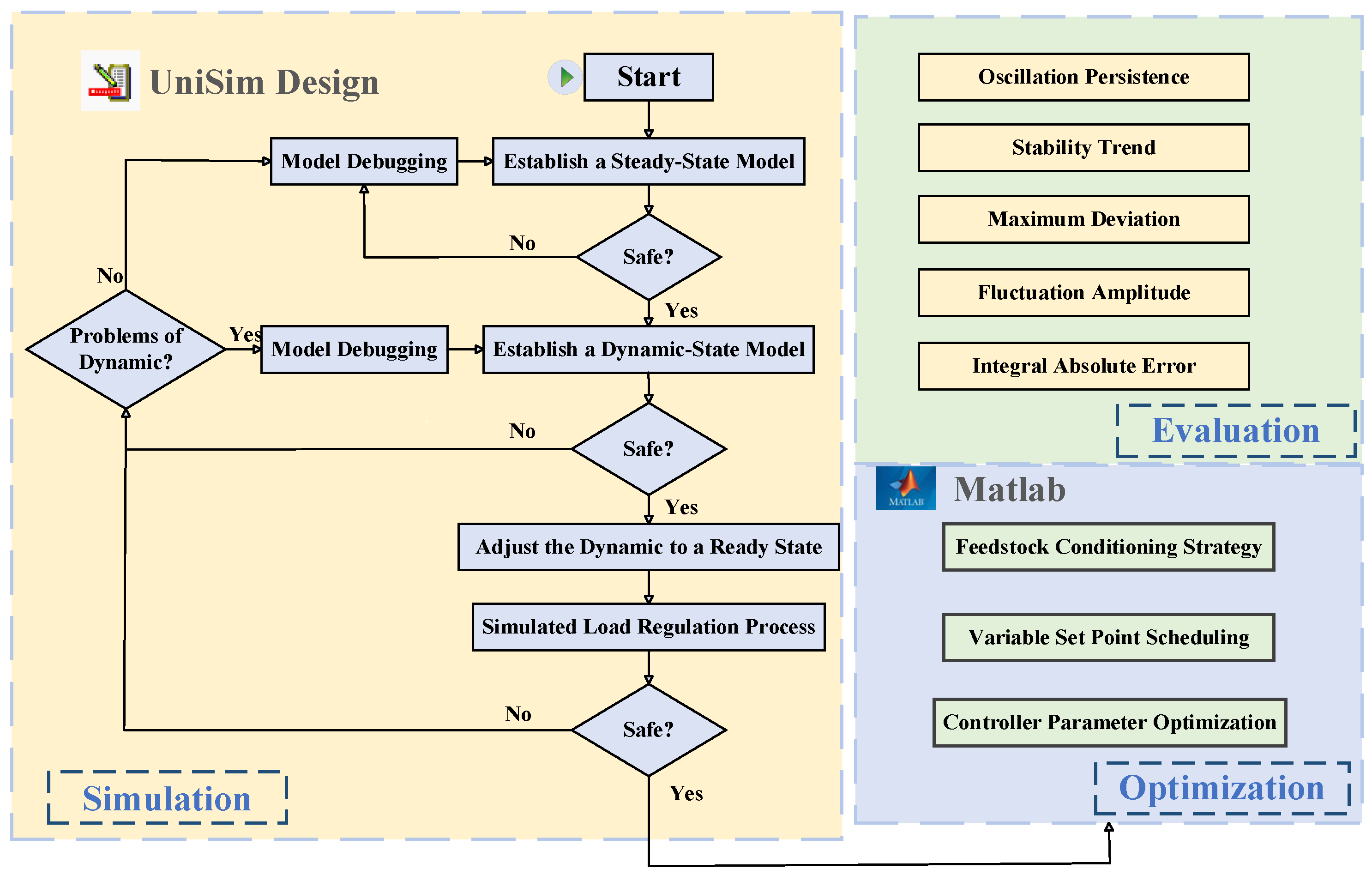
As shown in Figure 1, a control-oriented methodological framework based on simulation is proposed, integrating dynamic process simulation, structured load transition scenarios, and operability-driven disturbance management strategies. The framework is designed to capture the essential physical and control interactions governing flexibility while maintaining a level of model complexity that is consistent with industrial practice.
The overall research workflow consists of four main steps. First, a dynamic PtM process model is developed to represent the coupled behavior of synthesis, compression, and recycle units under non-steady-state conditions. Second, representative flexible load transition scenarios—including wide load ramps, hot start-up and shut-down, and renewable-driven stochastic disturbances—are defined to emulate realistic operating challenges. Third, control-oriented disturbance management strategies are introduced to mitigate instability during load transitions, focusing on feed signal conditioning, load-dependent temperature scheduling, and ramp-rate shaping. Finally, a set of dynamic operability performance metrics is employed to quantitatively evaluate system responses and compare different operating strategies.
It is emphasized that the proposed framework aims to complement existing steady-state optimization and system-level dispatch studies by addressing the often-overlooked dynamic dimension of PtM flexibility. By prioritizing transient stability and controllability under practical operating constraints, this methodology provides insights into the feasibility and limitations of flexible PtM operation in renewable-integrated energy systems.

2.2. Process Modeling

2.2.1. Steady-State Process Simulation

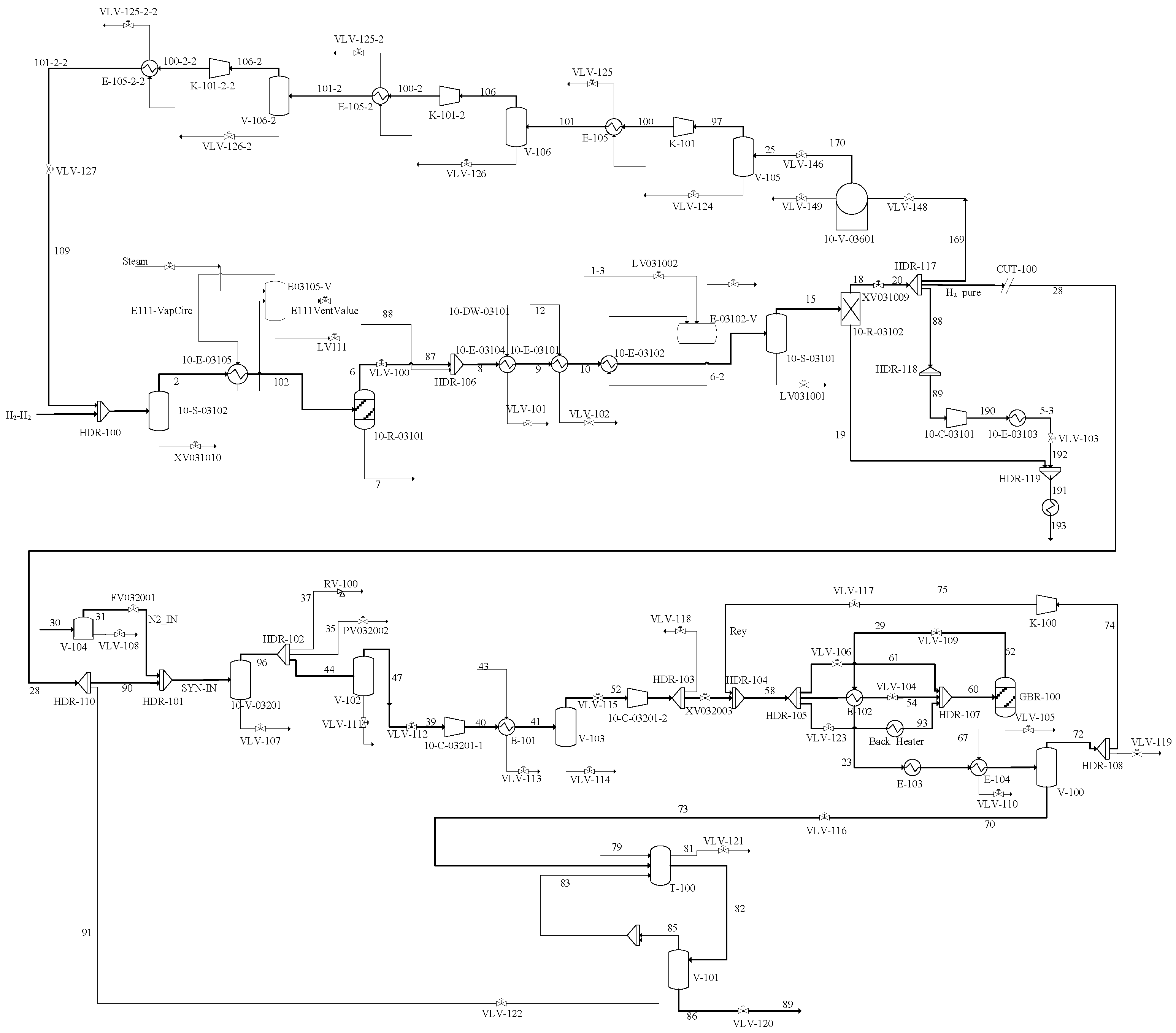
The green methanol production process investigated in this study was developed using UniSim Design R460.1. Figure 2 displays the steady-state process flowsheet of the green methanol synthesis system, corresponding to the nominal operating condition at 100% load. This steady-state model acts as the reference operating point for all subsequent dynamic simulations and flexibility analyses.
For clarity, a simplified conceptual block diagram of the renewable-driven methanol synthesis loop and its key control elements is provided in Figure S5 (Supplementary Information), complementing the detailed UniSim flowsheets.
The entire process can be divided into three integrated sections: hydrogen pretreatment, synthesis gas compression, and methanol synthesis with product separation.
(1)
hydrogen pretreatment
In this study, the hydrogen was produced by electrolysis from renewable energy sources. The renewable hydrogen supplied from an upstream source first enters a pretreatment section designed to ensure that its purity and thermodynamic conditions meet the requirements for methanol synthesis. The hydrogen stream is initially preheated to promote deoxygenation reactions and to mitigate potential oxidative damage to downstream catalysts. Subsequently, the gas passes through three consecutive cooling stages, enabling the condensation and removal of moisture.
After bulk dehydration, the hydrogen stream enters a molecular sieve dryer for fine drying, ensuring ultra-low moisture content prior to synthesis gas preparation. This pretreatment process effectively reduces oxygen and water concentrations to levels compatible with long-term catalyst stability, while maintaining thermal continuity across different operating conditions.
(2)
synthesis gas compression
Following dehydration, the purified hydrogen stream is mixed with a recycled hydrogen stream recovered from the downstream separation section. This recycle configuration enhances overall hydrogen utilization and contributes to stabilizing the synthesis loop under variable operating conditions. The combined hydrogen stream is then mixed with carbon dioxide, which is assumed to meet industrial purity specifications suitable for catalytic methanol synthesis to form the synthesis gas.
The synthesis gas is pressurized using a two-stage hybrid compression system, consisting of an upstream reciprocating compressor followed by a downstream centrifugal compressor. Interstage cooling is applied between the compression stages to limit temperatures and reduce specific compression energy consumption.
The reciprocating compressor is selected for its robust performance under low-flow and variable-load conditions, enabling reliable pressure build-up during deep load reduction and hot standby operation. In contrast, the centrifugal compressor provides high-efficiency compression at elevated flow rates and near-design conditions. By positioning the reciprocating compressor upstream, the centrifugal compressor is effectively protected from surge during low-load operation and rapid load transitions.
This hybrid compression configuration, together with the recycle recompression loop, forms the foundation for maintaining stable synthesis loop operation over a wide operating window.
(3)
Methanol Synthesis and Separation Section
Methanol synthesis is modeled as a thermodynamic equilibrium process representative of an industrial fixed-bed reactor. The reactor is described using a Gibbs free energy minimization approach, in which the outlet composition is determined by minimizing the total Gibbs free energy of the reacting system at a specified temperature and pressure. A rigorous thermodynamic framework considered the following main equilibrium reactions, where Reaction (1) is the main reaction of carbon dioxide and hydrogen, and (2)–(3) are side reactions:
CO2 + 3H2 → CH3OH + H2O
CO + 2H2 → CH3OH
CO2 + H2 → CO + H2O
It should be noted that alternative modeling approaches based on detailed fixed-bed reactor kinetics have been widely adopted to investigate startup, shutdown, and thermal management behavior of methanol synthesis reactors under PTX applications, with particular emphasis on reactor-scale temperature profiles and heat removal characteristics [47].
In contrast, the present study focuses on the dynamic stability and flexibility of the overall methanol synthesis loop, including the strong interactions among the reactor, compression system, recycle loop, and control structure under wide load variations. Therefore, a Gibbs free energy minimization reactor model is employed to represent the methanol synthesis unit at the process level, allowing robust and computationally efficient dynamic simulations while preserving the essential thermodynamic constraints governing product distribution.
In this formulation, the reactor is assumed to be spatially homogeneous, with no explicit resolution of axial temperature gradients or local heat transfer limitations within the catalyst bed. Catalyst deactivation, intra-particle diffusion resistance, and detailed kinetic rate expressions are not explicitly modeled. These assumptions are consistent with the objective of the present work, which is to investigate system-level dynamic operability and disturbance propagation within the recycle loop rather than reactor-scale thermal management phenomena. By adopting an equilibrium-based representation, the model captures the dominant thermodynamic constraints governing methanol formation while enabling stable simulation of large-amplitude transient scenarios across multiple operating conditions.
However, it should be recognized that the equilibrium-based formulation may influence the predicted transient response amplitude. Because instantaneous chemical equilibrium is assumed, kinetic rate limitations, intra-particle diffusion, and detailed intra-bed thermal gradients are not explicitly represented. In practical fixed-bed reactors, finite reaction kinetics and heat transfer processes introduce additional damping and delay effects. As a result, the equilibrium model may overestimate the magnitude of initial transient thermal spikes due to the absence of kinetic constraints, while it may underestimate prolonged settling behavior associated with catalyst-bed thermal inertia. The exact bias direction depends on the relative balance between thermodynamic sensitivity and kinetic damping under specific operating conditions. Nevertheless, for the purpose of evaluating loop-level disturbance propagation and recycle–pressure coupling mechanisms, the equilibrium approach remains appropriate and computationally efficient.
The hot reactor effluent is subsequently cooled through a series of heat exchangers to recover sensible heat and promote phase separation. The cooled stream enters a high-pressure vapor–liquid separator, where condensed crude methanol and water are withdrawn as the liquid product. The vapor phase, consisting mainly of unreacted hydrogen, carbon dioxide, and trace methanol, is separated for recycling.
To maximize the overall carbon conversion and reactant utilization efficiency, the vapor stream is recompressed in a dedicated recycle compressor and mixed with the compressed fresh synthesis gas upstream of the reactor. This recycle configuration not only enhances the overall yield but also plays a critical role in pressure regulation within the synthesis loop during transient operation.
In the present study, the separation section is modeled as a single-stage high-pressure flash unit to effectively isolate the crude methanol product. This approach captures the essential mass balance of the loop dynamics, yielding a liquid stream suitable for subsequent purification in a downstream distillation section.

2.2.2. Dynamic Model Development

Based on the validated steady-state model, a dynamic simulation (DS) was developed to evaluate the system’s transient behavior under flexible operating conditions. To ensure the simulation reflects realistic time-dependent responses, the geometric dimensions and effective volumes of all key process units were specified (see Table 2). These parameters determine the residence time and material holdup within the system, which are essential for capturing the buffering effects on pressure and temperature during rapid load changes.
A regulatory control structure was implemented to maintain the stability of the synthesis loop. Standard feedback control loops are used to regulate critical variables, including reactor temperature, system pressure, and separator liquid levels. The control scheme is designed to manage the interactions between the feed section, the recycle compressor, and the reactor, ensuring that the synthesis loop remains stable even when the production load varies significantly.
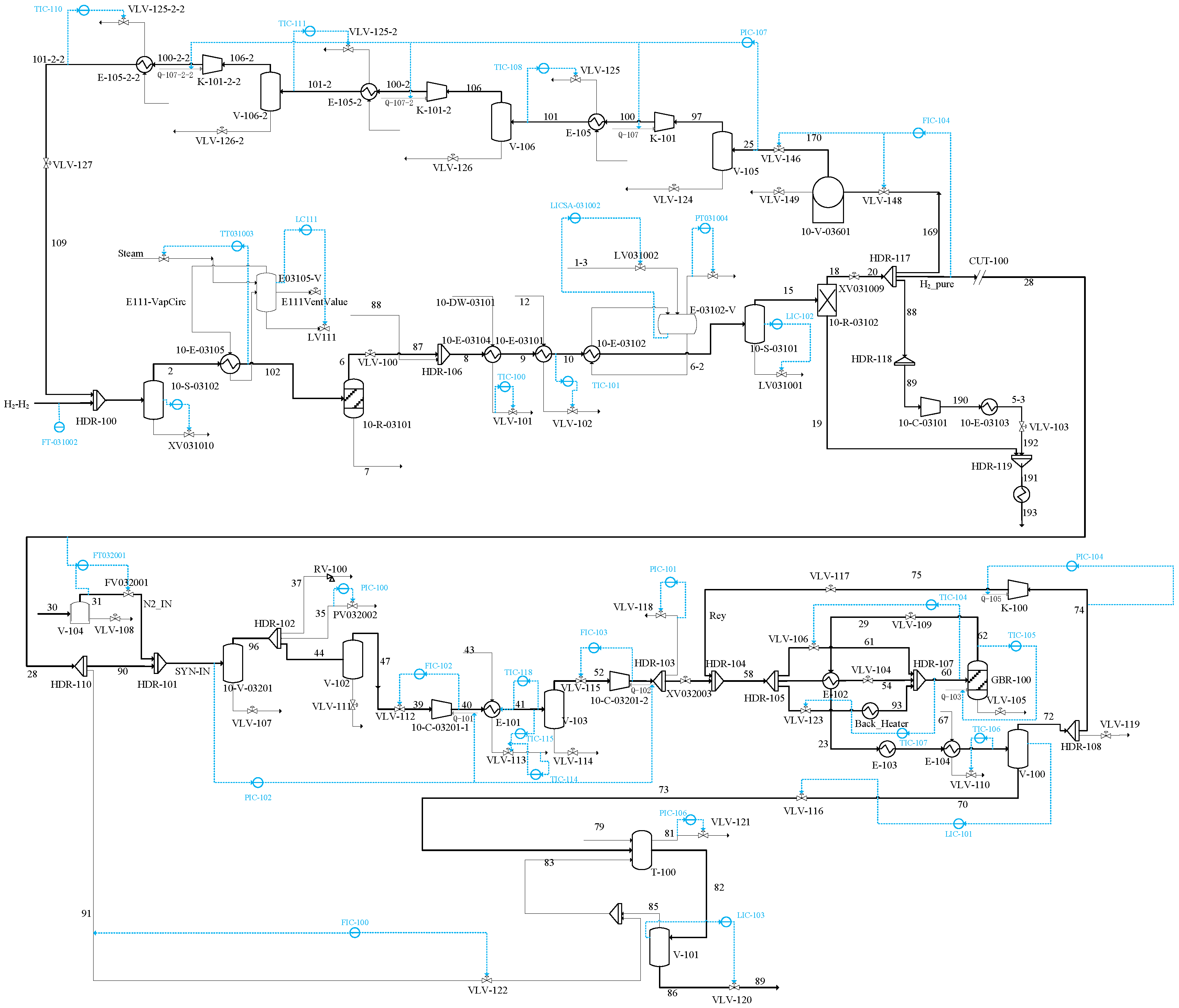
The dynamic flowchart with control is shown in Figure 3. Under nominal operating conditions, all control loops operate in closed-loop automatic mode to ensure stable steady-state operation. During load transition scenarios, however, a hybrid control strategy was adopted. Selected manipulated variables—primarily those related to feed flow rates—were temporarily switched from automatic to manual mode. The feed flow rates are adjusted according to predefined ramping profiles to ensure a smooth transition. At the same time, safety-critical controllers such as reactor temperature and pressure remain active to reject disturbances. This strategy effectively balances the need for fast load following with operational safety. Table 3 summarizes the key controllers, including their controlled variables and manipulated variables.
Since the hydrogen supply from renewable sources fluctuates, independent control of hydrogen and carbon dioxide flow rates could lead to mismatched reactants. To solve this, a ratio control strategy was implemented (Controller XIC-101). In this configuration, the renewable hydrogen flow acts as the master signal, and the carbon dioxide inlet valve is automatically manipulated to maintain the precise stoichiometric ratio at the reactor inlet. This ensures that the carbon supply dynamically tracks the hydrogen fluctuations, thereby stabilizing the reactor composition and minimizing the impact of feed variability on the downstream process.

2.3. Flexible Load Transition and Most Relevant Variables

To systematically evaluate the dynamic flexibility of the green methanol process, specific load transition scenarios were defined alongside a set of key process variables. The selection of these scenarios and variables aims to establish a rigorous basis for analyzing system stability and control performance.

2.3.1. Definition of Load Transition Scenarios

Three categories of load transition scenarios are considered to represent realistic operating challenges under renewable-driven operation:
(1)
Wide-Range Load Ramps between 40% and 100%
The primary test scenario involved a linear load reduction from 100% of rated capacity to 40%, followed by a return to 100%.
Recent reactor-level studies have reported that adiabatic and water-cooled methanol reactors can tolerate load ranges down to approximately 20%, while gas-cooled configurations are typically limited to around 40% under dynamic conditions [47]. However, it is important to distinguish reactor-level flexibility from integrated system-level operability.
In the present study, the methanol synthesis loop includes centrifugal recycle compression. At low throughput, the minimum flow constraint of the centrifugal compressor becomes the dominant limiting factor due to surge margin restrictions. Furthermore, the poor performance of the initial dynamic simulation at loads below 40% indicates that continuous operation within this load range requires discrete switching of operating modes, rather than load adjustment.
Therefore, 40% was selected as a conservative and industrially relevant lower bound for continuous base-layer regulation, ensuring operation within the compressor adjustment range. Simultaneously, a linear feed was selected as the baseline stability test to assess the stability and reliability of the constructed process. Moreover, to determine a practical and safe operating time, ramp rate sensitivity analysis was integrated into the scenario, simulating load transitions over discrete durations of 30, 60, 90, and 120 min. This method aims to identify a representative dynamic time scale balancing responsiveness and controllability.
(2)
Hot Start-up and Shut-down Strategy
Given the intermittent nature of renewable energy, short-term power shortages or surpluses are more likely to cause temporary load interruption rather than complete plant shutdown. This study employs a “hot standby” strategy, rather than the traditional, time-consuming, and thermally stressful “cold start” procedure.
Cold starts are typically associated with maintenance or long-term shutdowns and are primarily influenced by equipment-specific safety protocols, temperature rise limits, and material constraints. While crucial from an engineering perspective, the dynamic characteristics of cold starts do not accurately represent the high-frequency operational challenges posed by fluctuations in renewable energy generation.
In contrast, hot start-up and shut-down directly reflect the system’s ability to accommodate intermittent feed interruptions while retaining residual thermal and pressure states. Such scenarios place strong demands on control coordination, disturbance rejection, and dynamic stability, making them more relevant for assessing flexible operation and control-oriented disturbance management.
(3)
Feed Disturbances Induced by Wind–Solar Variability
Building upon the stability verified in the linear feed scenarios, the system is subjected to stochastic feed disturbances to emulate the inherent intermittency of renewable energy. Unlike deterministic ramping, real-world wind and solar outputs exhibit diurnal variability and high-frequency fluctuations, imposing stringent requirements on dynamic stability.
In this study, a representative 24 h renewable power profile was synthetically generated. The photovoltaic (PV) component follows a diurnal sinusoidal pattern, being active between 06:00 and 18:00, with random disturbances added to simulate the effects of cloud cover. In contrast, the wind power profile shows a complementary trend, featuring a higher average output during nighttime hours along with increased random variability to represent wind gusts.
The total renewable input is calculated by equally weighting the contributions from wind and solar sources and then normalizing the combined profile against the nominal operating load. This method reflects a balanced hybrid supply scenario, preventing over-reliance on a single energy source while testing the system’s resilience against the combination of diurnal cycles and high-frequency noise. The resulting wind, solar, and combined load profiles are illustrated in Figure S1 (Supplementary Information).

2.3.2. Selection of Most Relevant Variables

Rather than monitoring the full spectrum of process states, this study focuses on a specific set of critical variables that are most sensitive to load transitions and most indicative of dynamic stability. These variables were selected based on their independent physical significance in defining catalytic safety, mechanical constraints, loop inventory stability, and overall process performance, rather than through statistical dimensionality reduction methods. The selection follows two guiding principles: (i) strong physical coupling to input disturbances, and (ii) direct relevance to operational safety and production performance.
Accordingly, the following four variables are identified as the primary indicators of dynamic operability:
(1)
Reactor Temperature: This is the overarching safety and kinetic variable. Due to the highly exothermic nature of methanol synthesis, the reactor temperature is the most critical indicator of potential thermal runaway or reaction extinction during rapid load ramping.
(2)
Compressor Outlet Pressure: This variable serves as a proxy for mechanical integrity and surge risk. Monitoring the pressure is essential for detecting rapid pressure spikes that could violate equipment design limits or drive the compressor towards surge conditions, particularly during sudden feed interruptions.
(3)
Recycle Loop Pressure: Unlike local equipment pressures, the recycle loop pressure reflects the global mass balance and inventory of the synthesis system. It captures the coupling effects between the feed supply and the reaction consumption rate, providing insight into the accumulation or depletion of reactants within the closed loop.
(4)
Methanol Product Flow Rate: This variable provides a direct measure of production continuity and dynamic settling time. Monitoring the product flow is essential to quantify the time delay (dead time) between feed changes and production response and to verify that the plant successfully stabilizes at the new production target after a disturbance.
Collectively, these four variables provide a comprehensive view of the system’s dynamic behavior, enabling a focused evaluation of how well the control strategies handle thermal risks, pressure fluctuations, and production stability.

2.4. Optimization of Dynamic Control Strategies

2.4.1. Design Rationale

The proposed control optimization strategy is founded on the systematic identification of three distinct instability mechanisms inherent to flexible operation. These mechanisms pose significant threats to process integrity during wide load transitions, hot start-up/shutdown sequences, and renewable-driven operation:
(i)
High-frequency disturbance propagation: Direct coupling of stochastic renewable fluctuations to the feed control valves, without prior conditioning, leads to the rapid amplification and transmission of noise to the reactor and compression systems. This results in pressure instability and accelerates the mechanical wear of actuators.
(ii)
Process nonlinearity and variable gain effects: The methanol synthesis reactor exhibits markedly different thermal inertia and process gain characteristics across varying load levels. Fixed-parameter controllers tuned for nominal conditions become sub-optimal during load transitions, leading to sluggish responses, insufficient damping, and potentially inducing limit cycle oscillations (rather than “limiting loop behavior”).
(iii)
Integral windup during extreme transitions: Under non-steady-state conditions—such as hot start-up or deep load shedding—control loops may accumulate error due to actuator saturation or dynamic response lags. This phenomenon, known as integral windup, causes severe overshoot once the system returns to a controllable range.
Based on these mechanisms, the overarching objective of the control optimization is to effectively attenuate disturbances before they enter sensitive units, ensure that temperature and pressure evolve along physically feasible continuous trajectories, and decouple the interaction between integral action and slow process dynamics. This preserves equipment safety margins and maintains systemic dynamic stability.

2.4.2. Control-Oriented Optimization Measures

Guided by the design philosophy, control optimization is implemented through three coordinated measures at the supervisory and regulatory layers:
First, a feedstock conditioning strategy is introduced by applying a first-order lag filter to the hydrogen feed signal. Functioning as a low-pass signal conditioner, this measure effectively suppresses high-frequency spectral components originating from renewable power variability while preserving the low-frequency trends required for load following. Consequently, this prevents downstream controllers from responding to stochastic noise.
Second, a variable set-point scheduling strategy is adopted during load transitions. By coordinating temperature and pressure set points with the load trajectory, abrupt set point step-changes are avoided. This ensures continuous and smooth thermal and pressure evolution across different operating ranges, thereby mitigating dynamic mismatches arising from process nonlinearity.
Third, gain scheduling is implemented for critical loops, including reactor temperature, compressor outlet pressure, and recycle loop pressure. By dynamically optimizing controller gains and integral time constants based on the real-time load range, this approach reduces the risk of integral accumulation during transients, improves system damping characteristics, and suppresses disturbance amplification under wide load changes.
It is emphasized that these optimization measures are applied consistently across all investigated scenarios, including deterministic wide-range ramping, hot start-up/shutdown, and stochastic renewable fluctuations.
The proposed control strategy is fully compatible with standard industrial Distributed Control Systems (DCS). Feedstock conditioning is realized via conventional first-order lag blocks, while parameter adaptation and set point scheduling utilize standard gain scheduling and supervisory control logic. No additional hardware, computationally expensive Model Predictive Control layers, or real-time optimizers are required. Consequently, the strategy maintains high engineering feasibility and operational transparency, allowing for deployment in industrial green methanol systems without significant modifications to the existing control architecture.

2.4.3. Formulation of the Control Optimization Problem

To ensure reproducibility and methodological transparency, the proposed control-oriented optimization strategy is formulated as a structured parameter tuning problem under dynamic operability constraints.
The optimization focuses on a set of supervisory and regulatory control parameters that directly influence disturbance propagation and loop stability. The decision variable vector is defined as:
θ = α , T m a x , K c , T i
where α is the first-order feed filter coefficient applied to the hydrogen flow signal, T m a x is the maximum temperature boost applied during low-load operation, K c is the proportional gain of the LIC-103 controller, T i is the integral time constant of the LIC-103 level control loop.
The feed signal conditioning is implemented using a discrete first-order lag filter:
r f k =   α r f k 1 + 1 α r k
where r ( k ) is the raw renewable-driven load command and r f k is the filtered signal applied to the process.
For a simulation sampling interval of Δt = 1 min, the filter coefficient α corresponds to an equivalent continuous-time first-order system with a time constant:
τ t l n α
Within the investigated range 0.85 ≤ α ≤ 0.98, the equivalent time constant varies approximately between 6 and 50 min. This filtering suppresses high-frequency stochastic components originating from renewable variability while preserving low-frequency load-following trends. The selected parameter range balances disturbance attenuation and acceptable load-following delay.
For gain adjustment and feed filtering, a discrete two-region parameter strategy was implemented based on the filtered load ratio with a single threshold at 30%.
For low-load operation (load < 30%), the following parameter set was applied:
Kc = 0.5
Ti = 1500 s
α = 0.96
This configuration provides stronger filtering and milder proportional action to suppress oscillations during startup and shutdown phases.
For higher-load operation (load ≥ 30%), the following parameter set was used:
Kc = 0.6
Ti = 1200 s
α = 0.90
This configuration increases responsiveness while maintaining stable damping characteristics under normal throughput.
In the wind–solar disturbance scenario, fixed parameters were applied across the entire load range:
Kc = 0.6
Ti = 1200 s
α = 0.96
Parameter switching is triggered solely by the filtered load measurement without interpolation or adaptive computation, ensuring full reproducibility and compatibility with conventional DCS implementation.
Parameter search ranges were defined based on industrial tuning practice, preliminary sensitivity tests, and physical feasibility considerations:
0.85 α 0.98 0 T m a x 20   ° C 0.3 K C 1.5 800 T i 1800   s
These bounds ensure that controller aggressiveness and signal conditioning remain within realistic operational limits.
Rather than solving a strict mathematical programming problem, a multi-indicator evaluation framework was adopted.
For each candidate set, dynamic responses were simulated in UniSim Design R460.1, and performance metrics (which will be introduced in Section 2.5) were computed in MATLAB R2023b. This iterative evaluation process ensures transparency and reproducibility while avoiding reliance on black-box metaheuristic algorithms. A composite performance index is defined as:
J θ = ω 1 y m a x + ω 2 A f l u c + ω 3 I A E
where ω1, ω2 and ω3 are weighting coefficients selected to balance transient extremity, sustained oscillation intensity, and cumulative control error. Equal weights were applied unless otherwise specified.
The control refinement problem can therefore be expressed in constrained form:
  J θ θ Θ m i n
Subject to dynamic operability constraints:
T r e a c t t ; θ T s a f e P l o o p t , θ P n o m P a l l o w θ m i n θ θ m a x
where Θ represents the bounded parameter domain defined by industrial tuning limits. To ensure physical safety and reproducibility, the constraint thresholds are explicitly defined:   T s a f e is set based on typical industrial upper operating limits for methanol synthesis reactors (≈285 °C) [47], and P a l l o w is restricted to 10% of the nominal pressure ( P n o m ) to preserve the Pressure Safety Valve (PSV) and compressor surge margins.
Because the dynamic UniSim model behaves as a nonlinear black-box simulator, a bounded parameter screening approach was adopted rather than gradient-based optimization. Candidate parameter sets were systematically generated within the feasible region and evaluated under representative transient scenarios. Feasible solutions satisfying operability constraints were ranked using the composite index J(θ), and the final parameter set was selected based on hierarchical dominance across multiple disturbance categories.
Although detailed mechanical design elements such as PSV set pressures or compressor surge maps are not explicitly modeled, reactor temperature and loop pressure are continuously monitored as safety-relevant operability indicators throughout all dynamic simulations.
In all investigated scenarios, reactor temperature remains within commonly reported industrial operating ranges for methanol synthesis reactors and pressure excursions remain within a moderate deviation range relative to nominal operating pressure and do not approach compressor rated capacity limits. No simulation case exhibits uncontrolled thermal escalation, pressure runaway, or sustained divergence. Therefore, all evaluated operating conditions remain within commonly reported industrial operating ranges from a process operability perspective.

2.5. Evaluation Metrics and Analysis

To enable a systematic and reproducible assessment of dynamic operability under flexible operation, both qualitative and quantitative performance metrics were employed. The selected indicators are designed to capture complementary aspects of system behavior, including transient extremity, sustained oscillatory intensity, convergence characteristics, and cumulative control deviation.

2.5.1. Qualitative Dynamic Performance Indicators

Qualitative indicators are used to characterize the overall response patterns and stability trends that cannot be fully represented by single numerical values. The following aspects are evaluated for each operating scenario:
(i)
Oscillation persistence: whether sustained or weakly damped oscillations are present during or after load transitions, startup, shutdown, or renewable-driven operation.
(ii)
Stability trend: whether process trajectories exhibit clear convergence toward a stable operating region or remain scattered and irregular over time.
These qualitative observations provide essential context for interpreting quantitative metrics and are particularly valuable for identifying instability mechanisms and control limitations under non-nominal operating conditions.

2.5.2. Quantitative Peak-Based Metrics

Two peak-related quantitative metrics are employed to evaluate transient severity and operational safety margins.
(i)
Maximum Deviation
The maximum deviation is used to quantify extreme transient excursions during dynamic events such as load ramps, startup, and shutdown. It is defined as the maximum absolute deviation of a process variable from its reference trajectory:
y m a x = m a x y t y r e f t
This metric directly reflects short-term thermal or mechanical stress imposed on equipment and control loops and is therefore particularly relevant for assessing operational safety under rapid transients.
(ii)
Fluctuation Amplitude
To characterize sustained oscillatory behavior while excluding isolated extreme events, the fluctuation amplitude is introduced. Rather than relying on the absolute maximum–minimum range, which can be dominated by rare spikes, this metric represents the dominant operating band of a variable.
In this work, the fluctuation amplitude is quantified using the 95% confidence interval of the variable over the analyzed time window. Statistically, the 95% interval (defined as the range between the 2.5th and 97.5th percentiles) is employed instead of variance or RMS. Dynamic process variables under nonlinear control and disturbance propagation often exhibit non-Gaussian and skewed distributions, making variance-based descriptors less representative of actual oscillation intensity. The percentile-based approach robustly isolates the dominant, sustained fluctuation band by filtering out rare extreme transient spikes. These extreme excursions are independently captured by the Maximum Deviation metric. This complementary definition ensures that both short-term safety-critical peaks and long-duration oscillatory behavior are systematically evaluated.

2.5.3. Integral Absolute Error (IAE)

In addition to peak-based metrics, the Integral Absolute Error (IAE) is employed to evaluate overall control performance over time. The IAE is defined as:
I A E = 0 t y t y r e f t d t i = 1 N e i × t
This metric captures the cumulative deviation of a process variable from its reference trajectory and reflects both oscillation magnitude and settling behavior. Unlike peak-based indicators, the IAE penalizes prolonged deviations and slow convergence, making it particularly suitable for assessing control effectiveness under sustained disturbances and long-duration transient operations.

2.5.4. Definition of Reference Trajectories

The reference trajectory y r e f ( t ) is defined in a scenario-dependent manner to ensure physically meaningful and fair comparisons. For load transition scenarios, nominal setpoints are used as references (e.g., reactor temperature of 235 °C, compressor outlet pressure, and full-load methanol production rate). For startup and shutdown scenarios, reference trajectories follow predefined ramping or standby profiles consistent with hot operation strategies. Under renewable-driven operation, the reference trajectory corresponds to the intended load-following trend imposed by the fluctuating feed profile.
This approach ensures that performance metrics evaluate deviation relative to realistic operational targets rather than enforcing a single fixed set point across fundamentally different operating modes.

3. Results and Discussions

3.1. Baseline Dynamic Behavior

To establish a reliable reference for subsequent control-oriented optimization, the dynamic behavior of the green methanol synthesis loop under wide-range load transitions is first investigated using the baseline control configuration. The ramp duration was determined, and both the load reduction from 100% to 40% and the load increase from 40% to 100% scenarios are considered, focusing on the transient responses of key process variables, including reactor temperature, compressor outlet pressure, and compressor outlet pressure.

3.1.1. Influence of Ramp Duration on Baseline Dynamic Stability

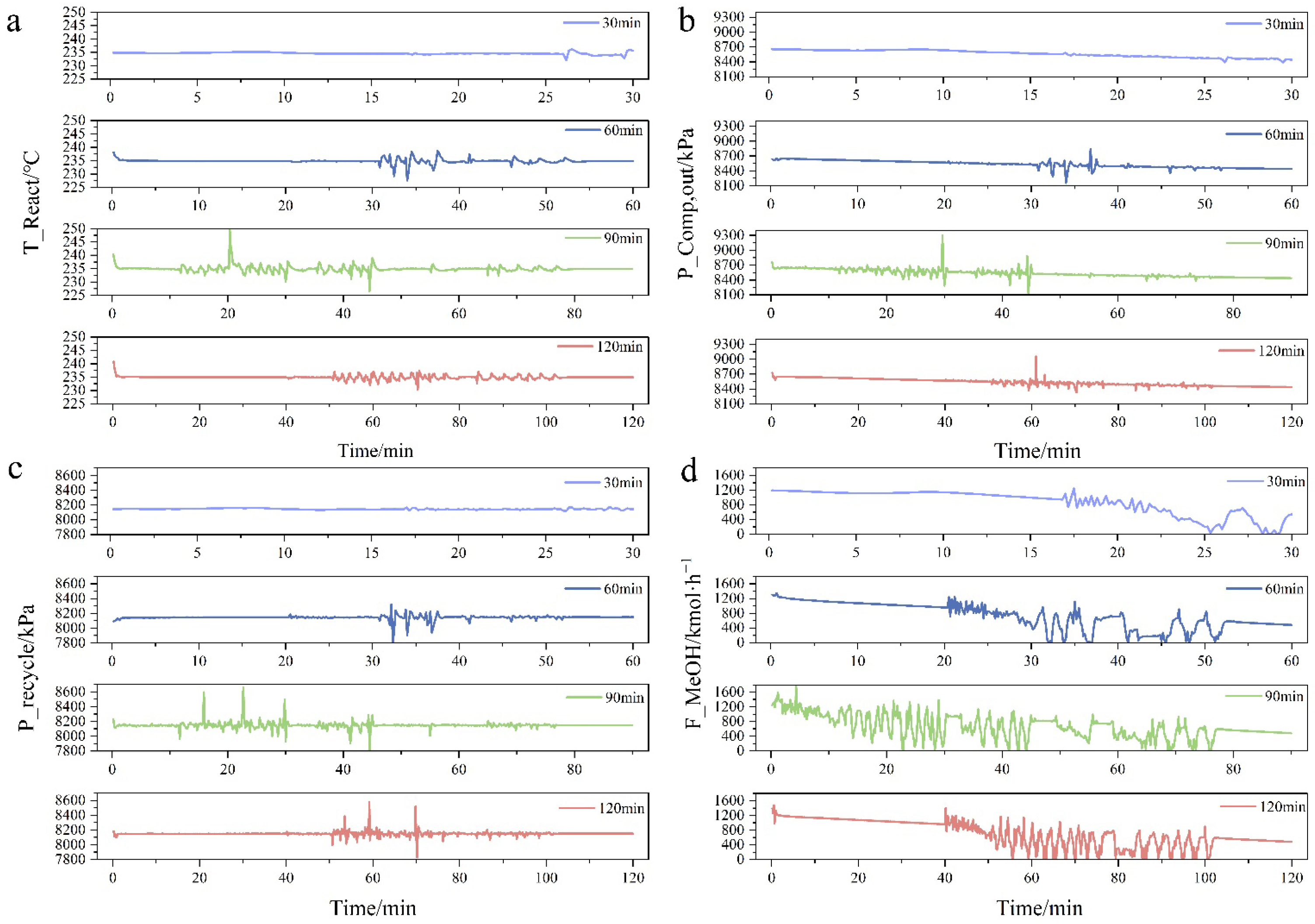
To assess the sensitivity of the baseline system to the rate of load change, three different ramp durations—30 min, 60 min, and 90 min—were examined, taking a load change from 100% to 40% as an example, under the same operating conditions. The dynamic responses of reactor temperature and compressor outlet pressure are compared, as shown in Figure 4.
Counter-intuitively, the results indicate that extending the ramp duration to 60 min or longer exacerbates oscillatory behavior, particularly as the system enters the low-to-medium load region. The 30 min ramp appears to exhibit smaller oscillation amplitudes and better damping characteristics compared to the 60 min case. Further prolongation to 90 and 120 min results in even larger amplitudes and degraded stability. This phenomenon can be attributed to the system’s substantial thermal inertia, which effectively “masks” the feedback loop dynamics during rapid transitions before significant integral action accumulates in the controllers.
However, the apparent dynamic smoothness observed in the 30 min case should be interpreted carefully. As illustrated in Figure S4 (Supplementary Information), the controller output exhibits relatively limited integral accumulation during the rapid ramp. The shorter disturbance duration reduces sustained error persistence and limits the development of loop-level interaction effects.
In contrast, intermediate ramp durations (e.g., 60 min) allow sufficient time for dynamic coupling mechanisms to manifest while avoiding excessive oscillation persistence associated with longer ramps. Therefore, the ramp-duration comparison in this study serves to identify a representative dynamic time scale. Based on overall controllability characteristics and cumulative performance indicators, the 60 min ramp is selected as the baseline scenario for subsequent multi-scenario evaluation.

3.1.2. Baseline Dynamic Response Under Load Transitions

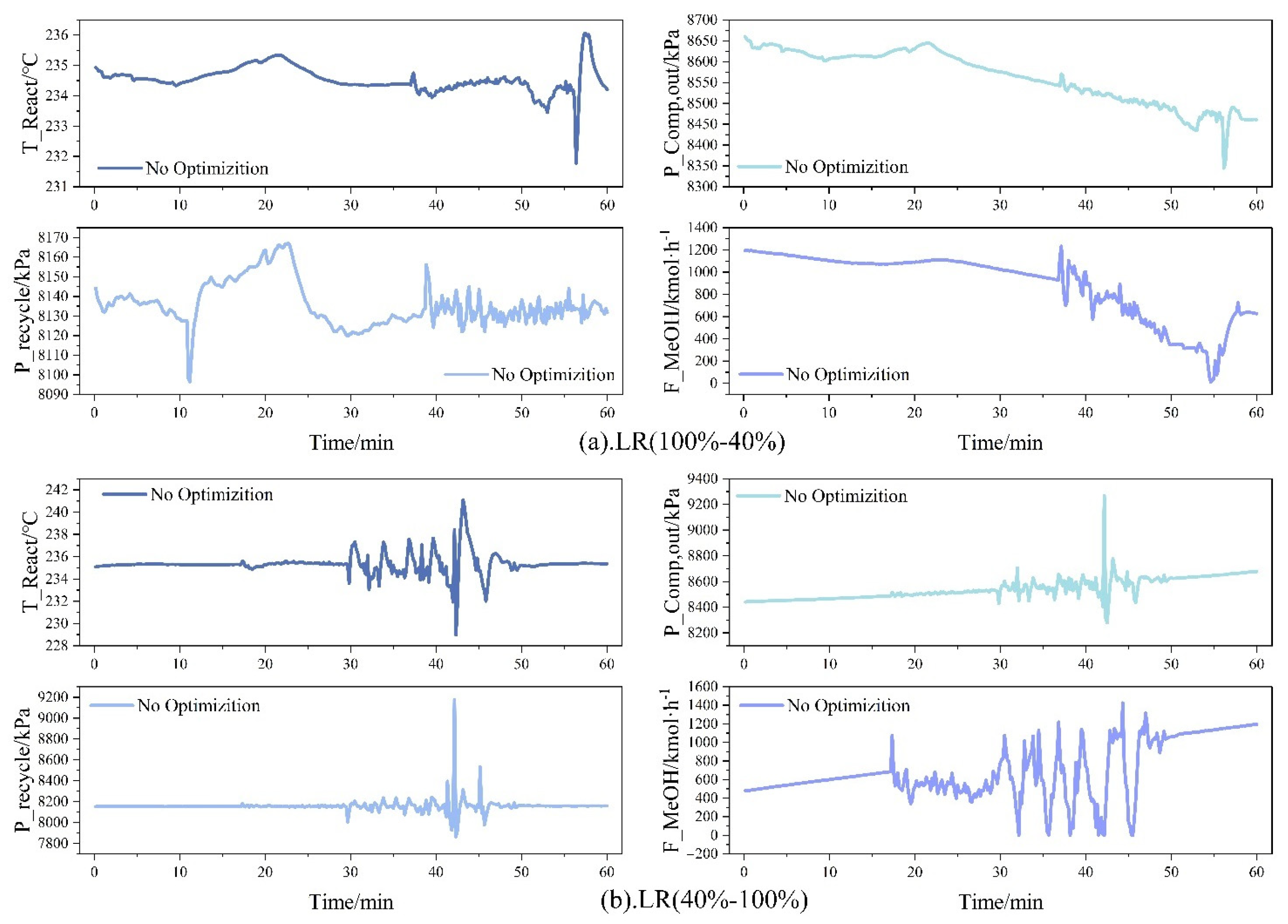
The baseline load scenario analysis focuses on operational stability and equipment safety to verify system stability. Figure 5a shows the dynamic response during the load reduction process from 100% to 40%, and Figure 5b shows the dynamic response during the load increase process from 40% to 100%. The transition duration in both cases was set to 1 h. Table 4 summarizes the key parameter changes observed during the two load transitions.
As summarized in Table 5, the baseline control system maintains basic operational continuity during linear load reduction, although localized oscillatory behaviors are observed. The reactor temperature remains relatively stable with a maximum deviation of 3.23 °C, suggesting that thermal runaway risks are contained. However, pressure dynamics reveal stronger nonlinear coupling; the compressor outlet pressure exhibits pronounced disturbances (maximum deviation of 305 kPa), indicating that the baseline control struggles to smoothly decouple flow variations from pressure regulation.
In contrast, the load recovery process from 40% to 100% imposes significantly more severe dynamic challenges. As the system ramps up, dynamic non-linearities are amplified, nearly doubling the reactor temperature deviation and triggering a massive compressor outlet pressure surge (deviation of 617 kPa).
The prolonged settling times, reflected by the high IAE values, confirm that while the baseline system physically achieves the load target, its stability margins are severely degraded during rapid capacity recovery. These findings highlight the intrinsic limitations of the baseline control strategy and underscore the necessity for targeted optimization.

3.2. Dynamic Performance Under Optimized Control Strategy

3.2.1. Optimized Load Transition Performance

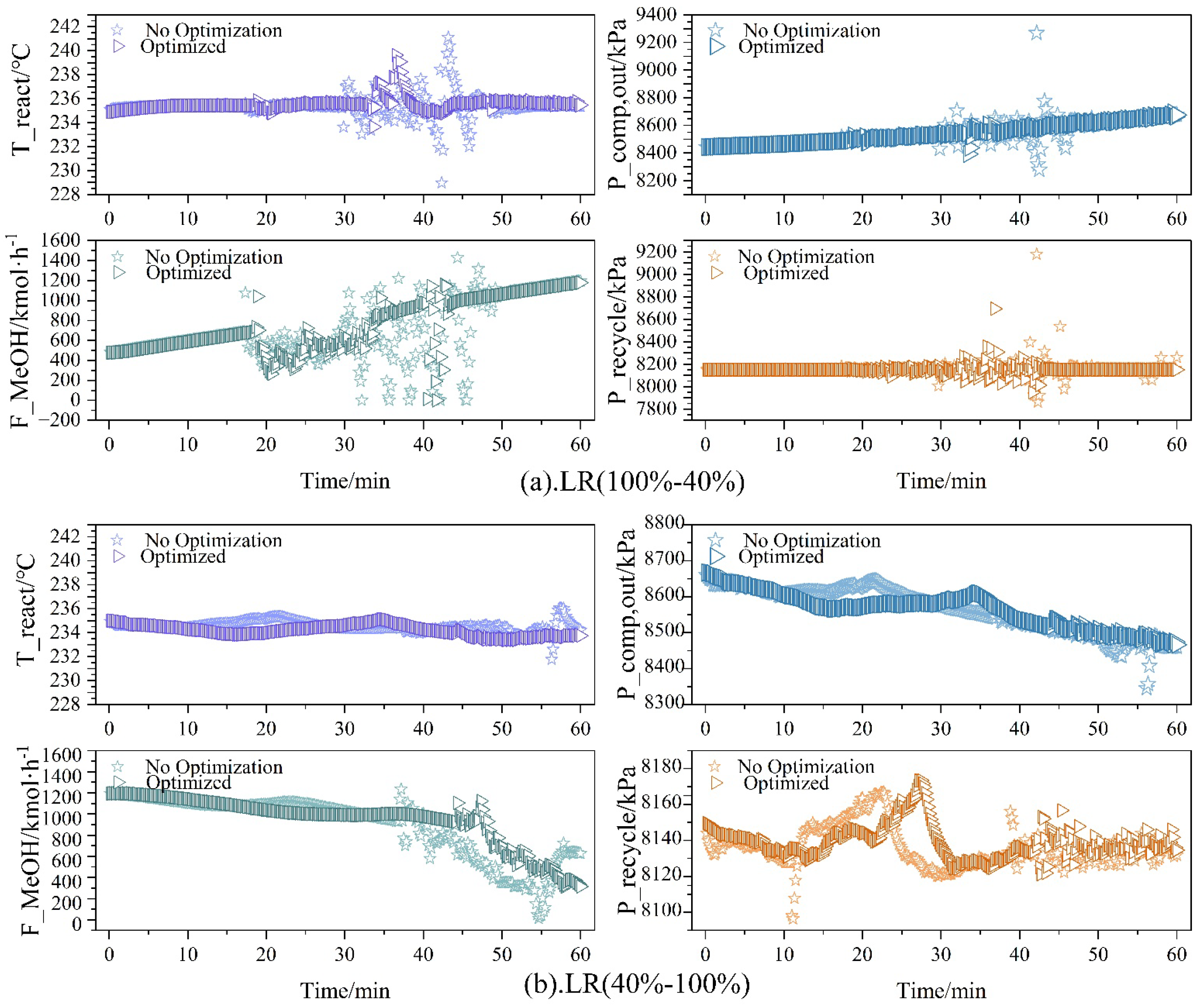
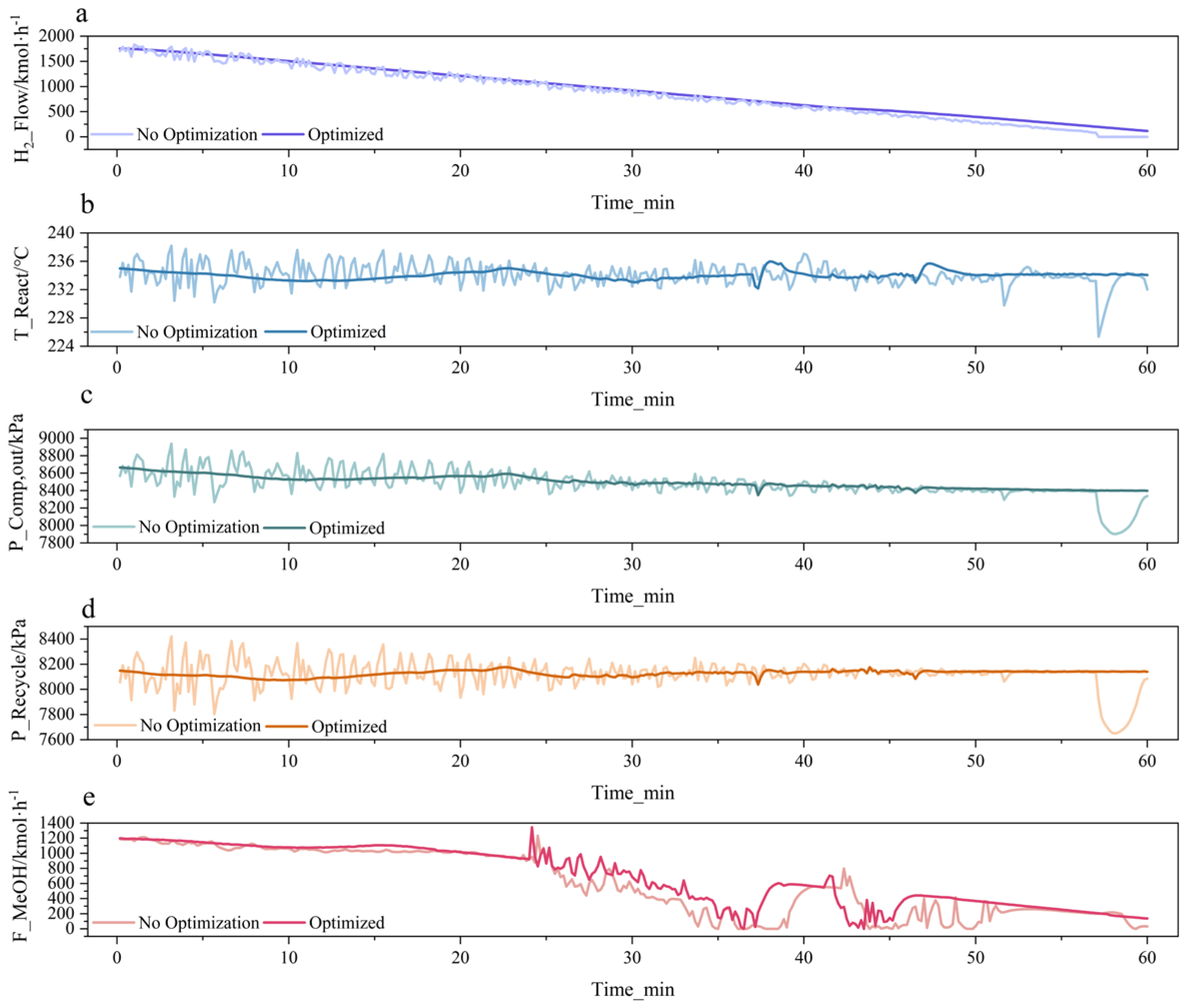
Based on the baseline load transition analysis in Section 3.1, the control-oriented optimization strategy described in Section 3.2 was still applied to both load reduction from 100% to 40% and load increase from 40% to 100% scenarios, using the same ramp duration of 60 min. Figure 6 compares the dynamic responses of key process variables under baseline and optimized control, while Table 5 summarizes the corresponding quantitative performance indicators.
The application of the optimized control strategy yields systematic improvements in dynamic performance across all monitored variables, as quantitatively summarized in Table 5. Under load reduction, the maximum transient deviations for reactor temperature, compressor outlet pressure, and recycle loop pressure are reduced by approximately 49%, 40%, and 46%, respectively. The fluctuation amplitude of the methanol production rate also contracts by over 38%, indicating a substantially tighter operating envelope. These improvements are corroborated by reduced IAE values, reflecting smaller instantaneous deviations and faster settling times.
Qualitatively, the optimized trajectories exhibit smooth convergence toward new steady states, effectively eliminating the persistent, scattered oscillations observed in the baseline case. This enhanced damping characteristic is even more pronounced during load recovery. The optimized strategy successfully suppresses the severe pressure surges and thermal overshoots that plagued the baseline ramp-up, reducing the compressor pressure deviation by 66% and ensuring a monotonic, stable transition to full capacity without prolonged oscillatory behavior.

3.2.2. Validation Under Different Load Change Rates

To further verify the robustness of the proposed control optimization, additional simulations were conducted for the load reduction scenario from 100% to 40% using different ramp durations. The dynamic responses under optimized control for various ramp times are shown in Figure S2 (Supplementary Information). The same optimized control parameters were applied across all cases to assess their performance under different load change rates.
Compared with the baseline results discussed in Section 3.1, the optimized system exhibits consistently improved dynamic responses for all ramp durations considered. Reactor temperature, compressor outlet pressure, recycle pressure, and methanol production rate all show reduced oscillation amplitudes and faster settling behavior, even under slower or faster load transitions. Notably, the amplification of oscillations previously observed at longer ramp durations under baseline control is alleviated after optimization. This indicates that integral windup and slow-loop interaction effects have been effectively mitigated.
These results demonstrate that the optimized control strategy not only improves system stability under the nominal ramp duration but also maintains satisfactory performance over a wide range of load change rates. Consequently, the proposed control optimization significantly enhances the operational flexibility of the green methanol synthesis process and enables safe and stable operation under dynamic load-following conditions.

3.3. Startup and Shutdown Performance Under Fluctuating Feed Conditions

In this study, hot startup and hot shutdown are considered, representing a realistic operational strategy in which the synthesis loop remains pressurized and thermally active, thereby avoiding energy-intensive cold-start procedures. Both startup and shutdown processes are examined under fluctuating hydrogen feed conditions, and the dynamic responses obtained with baseline and optimized control strategies are compared.

3.3.1. Startup and Shutdown Without Optimization

Baseline simulations were conducted under fluctuating hydrogen feed conditions using conventional control settings, without feed conditioning or controller refinement. Startup and shutdown behaviors are analyzed independently to highlight their distinct dynamic characteristics.
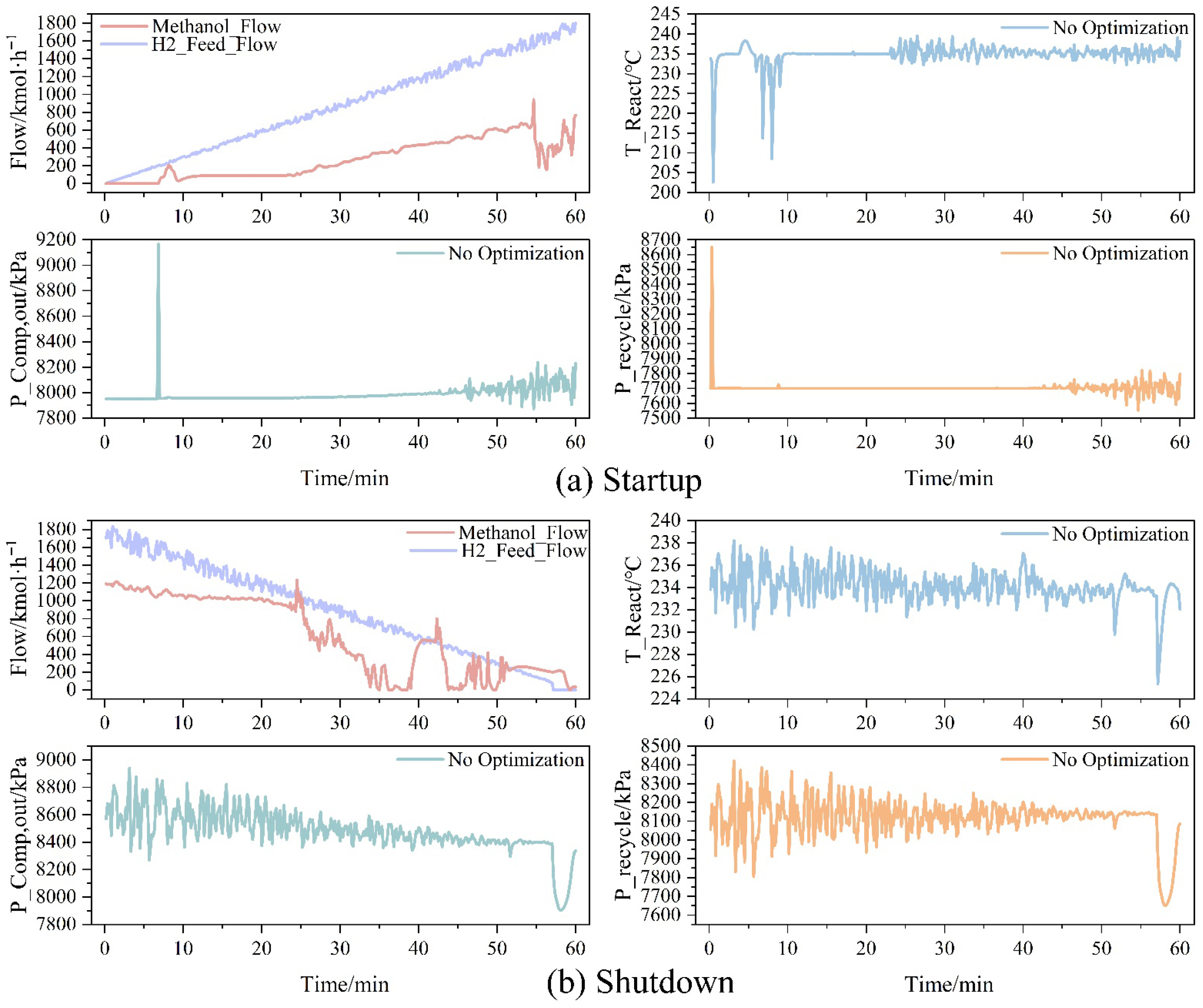
Figure 7 illustrates the dynamic responses of the green methanol synthesis system during hot startup and hot shutdown under fluctuating hydrogen feed conditions with the baseline control strategy. And the key process variables during startup and shutdown are summarized in Table 6.
Baseline simulations under fluctuating feed conditions reveal that startup dynamics are dominated by early-stage extreme transient deviations. Insufficient damping during initial feed reintroduction leads to abrupt temperature excursions and sharp pressure spikes, indicating strong dynamic coupling between the compression system and the synthesis loop. Conversely, shutdown dynamics is characterized by prolonged, high-frequency oscillations and late-stage pressure instability, such as sudden pressure collapse, reflecting the diminishing control authority as the system approaches near-idle conditions. These behaviors confirm that the baseline control configuration is insufficient to guarantee stable and predictable operation during frequent hot startup and shutdown under renewable-driven feed fluctuations, thereby motivating the need for dedicated control optimization.

3.3.2. Startup and Shutdown with Optimized Control Strategy

Figure 8 and Figure 9 present the dynamic responses of the system during hot startup and hot shutdown under fluctuating hydrogen feed conditions with the proposed control optimization applied. The same operating scenarios as those in Section 3.3.1 are considered to enable a direct comparison with the baseline behavior. Table 7 summarizes the corresponding quantitative performance indicators.
During hot startup, the optimized control strategy leads to a substantial improvement in dynamic stability across all monitored variables. As shown in Figure 9, the optimized temperature and pressure profiles follow smooth, asymptotic approaches to their nominal setpoints. The maximum transient deviation of reactor temperature is reduced by 31%, and the dangerous compressor pressure spike is effectively eliminated (69% reduction in maximum deviation). This confirms that feed disturbance conditioning and controller retuning effectively suppress the amplification of stochastic feed fluctuations during the sensitive early startup phase.
For the shutdown scenario, the optimization filters out high-frequency “chattering” and prevents late-stage pressure collapse via dead-zone interlock logic. The reactor temperature decreases in a controlled and continuous manner, exhibiting minimal oscillatory behavior throughout the entire shutdown process, with the maximum transient deviation decreasing from 9.64 °C to 2.82 °C, and the IAE decreasing from 84.34 to 59.02. The recycle pressure maintains a stable holding value, with the maximum deviation from 399.58 kPa to 127.12 kPa, ensuring the system enters the hot standby mode safely with sufficient pressure inventory and thermal stability for a subsequent restart.
It should be clarified that the largest reported reactor temperature deviation (32.41 °C in Table 7 occurs during the hot-startup transient, immediately after the restart, when the reactor is still in a low-temperature stabilization stage (temperature around 210 °C). Therefore, this deviation does not represent an excessive temperature rise; instead, it reflects a short-duration extreme departure from the nominal setpoint during early startup. Consistently, the sustained fluctuation envelope during flexible operation remains within approximately ±5 °C (pre-optimization: +3.3/−4.2 °C; post-optimization: +2.33/−0.12 °C), indicating that the dominant behavior is bounded oscillation rather than persistent thermal escalation. Throughout all scenarios, reactor temperature remains below the upper operating limit reported in the literature of 285 °C [47], supporting that the observed extremes remain within an acceptable operability envelope in the simulation context.
Importantly, these improvements are achieved without discrete equipment-level interventions or compressor mode switching. These results confirm that the proposed control-oriented optimization framework provides a consistent and effective means of stabilizing the methanol synthesis loop during the most challenging transient operating modes, thereby enabling reliable hot startup and shutdown under renewable-driven operation.

3.4. System Response Under Renewable Power Fluctuations

After investigating wide-range load transitions and startup/shutdown behavior under deterministic scenarios, the system performance was further evaluated under realistic renewable-driven operating conditions. In this section, a time-varying wind–solar hybrid profile was mapped to the hydrogen feed, introducing stochastic and high-frequency disturbances that more closely represent actual power-to-methanol operation.
Under the baseline control configuration, renewable-driven feed variability is directly transmitted into the synthesis loop. As shown in Figure S3 (Supplementary Information), the hydrogen feed exhibits pronounced high-frequency fluctuations with irregular amplitude, which propagate rapidly through the reactor, compression system, and recycle loop.
The reactor temperature shows persistent oscillations throughout the entire simulation horizon. Although the average temperature remains close to its nominal value, frequent short-term deviations are observed, indicating insufficient damping against stochastic disturbances. Similarly, the compressor outlet pressure and recycle loop pressure display continuous scattered fluctuations, reflecting strong dynamic coupling between feed disturbances and pressure control loops.
The methanol production rate exhibits the most irregular behavior. Instead of following a clear operating trajectory, the product flow oscillates intermittently with sharp drops and recoveries. This behavior suggests that upstream feed disturbances are amplified by downstream holdup effects and valve actions, resulting in unstable production under renewable-driven operation.
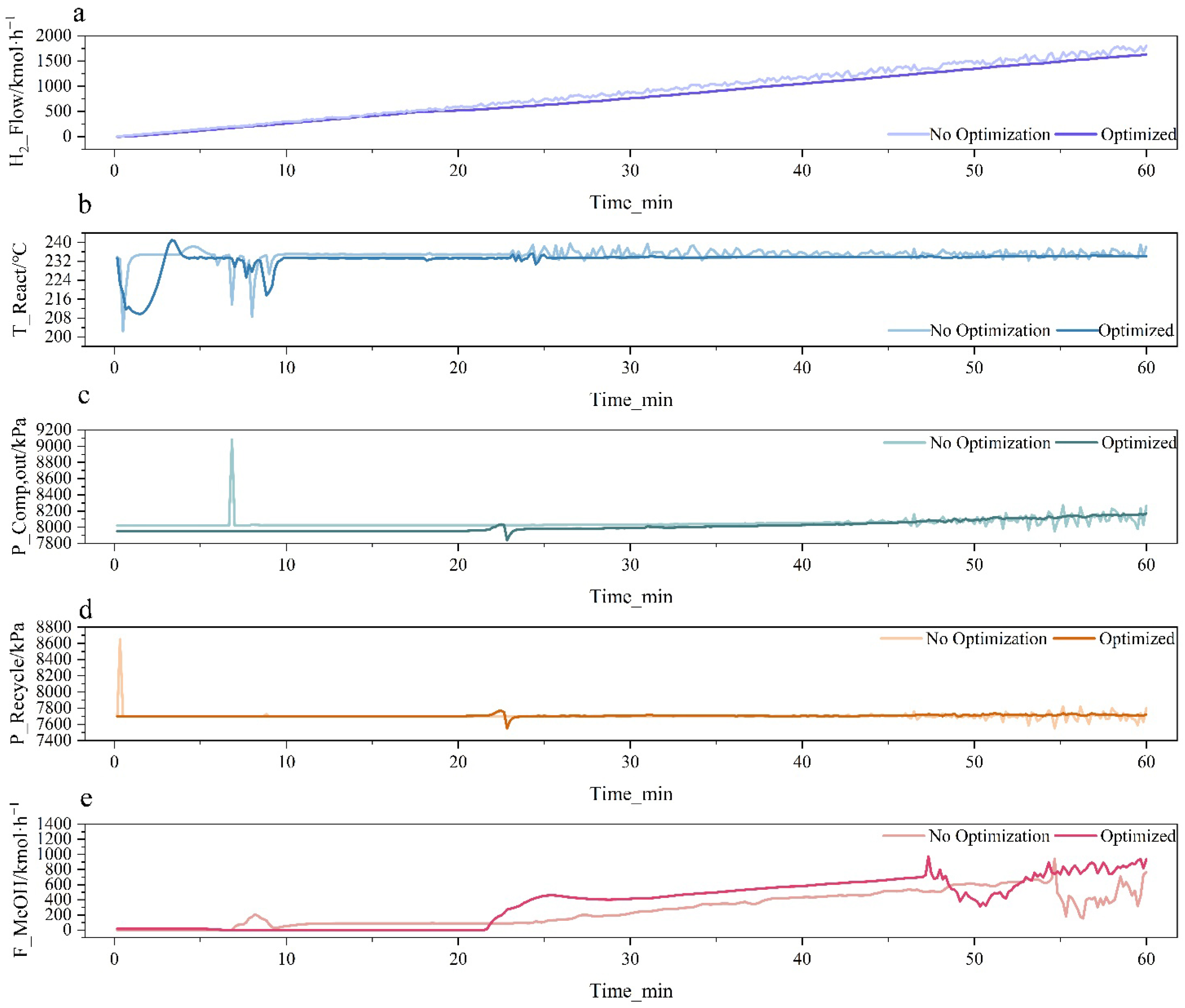
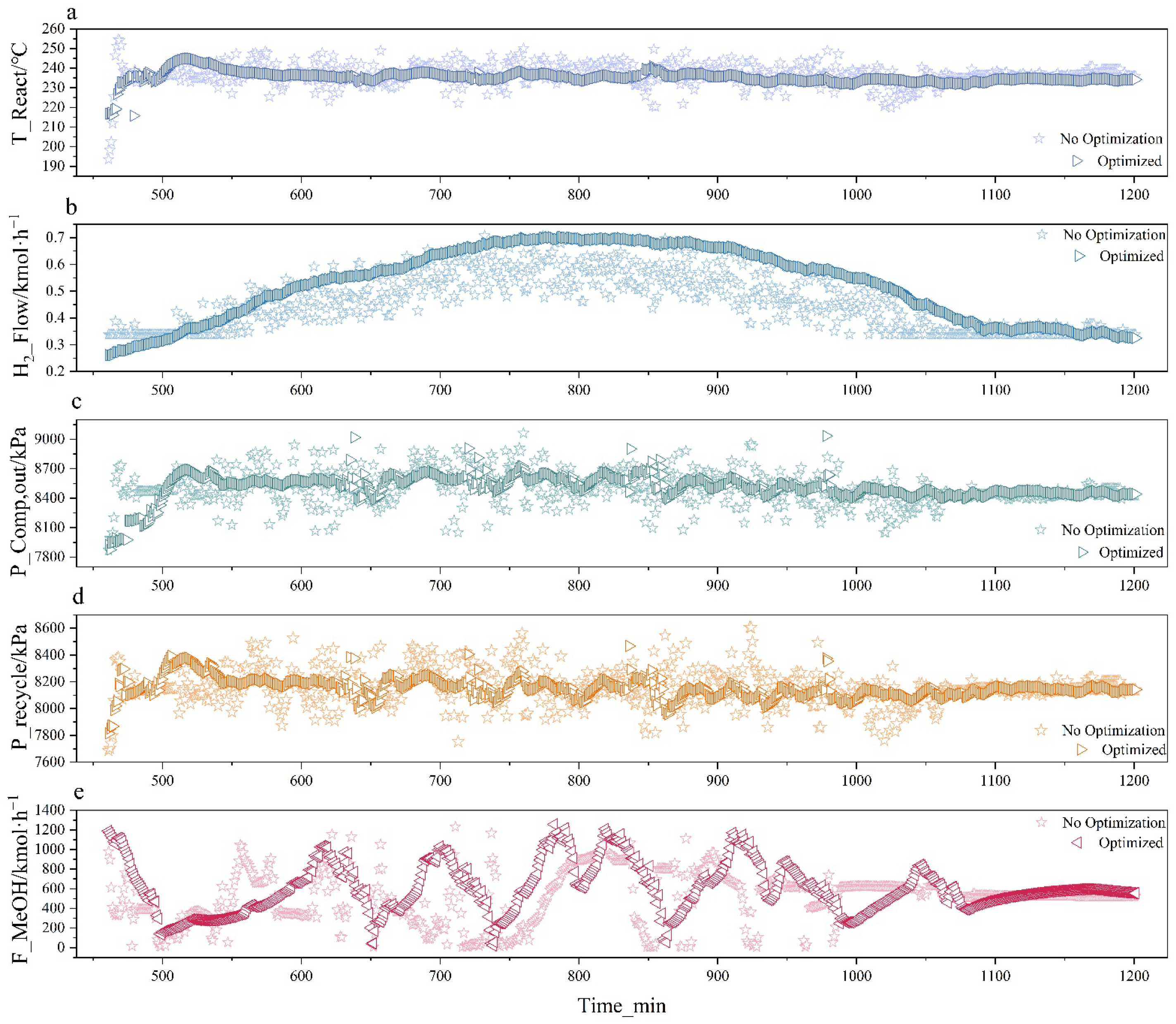
The optimized control strategy was subsequently applied using the same wind–solar feed profile to ensure strict comparability. The corresponding dynamic responses are shown in Figure 10. Table 8 shows a comparison of the quantitative indicators for wind-sun fluctuations before and after optimization.
Compared with the baseline case, a substantial improvement in dynamic behavior is observed across all key variables. Oscillation persistence is markedly reduced, and all variables follow stable trajectories without loss of controllability or abrupt transitions. High-frequency fluctuations in the hydrogen feed are effectively attenuated before entering sensitive process units, resulting in smoother reactor temperature and pressure trajectories.
As shown in Figure 10a, the optimized temperature trajectory becomes noticeably more compact and continuous, with high-frequency fluctuations effectively attenuated. More pronounced improvements are observed in pressure-related variables. For the compressor outlet pressure, the optimized strategy significantly suppresses extreme deviations and scattered oscillations. The IAE decreases substantially by 23%, demonstrating enhanced damping and reduced cumulative control effort under fluctuating operation. A similar stabilization effect is evident for the recycle loop pressure, where the maximum deviation drops from 463.33 kPa to 335.87 kPa and the IAE is reduced by approximately 42%. In addition to reduced peak deviations, the optimized pressure trajectories exhibit smoother and more coherent evolution, with fewer abrupt excursions.
The methanol production rate remains the most sensitive variable under renewable-driven operation, reflecting intrinsic process holdup and downstream valve dynamics. Nevertheless, the optimized case shows a fundamental change in fluctuation characteristics. Instead of irregular and scattered oscillations, the production rate varies within a more structured and bounded envelope, indicating improved coordination between upstream feed control and downstream material balance.
Overall, the results confirm that the proposed control-oriented optimization strategy substantially enhances the robustness of the methanol synthesis loop under realistic wind–solar power fluctuations. By suppressing sustained oscillations, limiting extreme deviations, and improving trajectory continuity, the optimized control enables stable and reliable operation under long-term renewable-driven conditions, which is essential for the deployment of flexible renewable methanol systems.

3.5. Discussion and Limitations

Across all investigated operating modes—including wide-range load ramps, hot startup and shutdown, and stochastic renewable disturbances—the baseline configuration exhibits pronounced dynamic amplification within the recycle–compression–reaction loop. Rather than behaving as isolated external perturbations, renewable-driven load variations propagate through the recycle inventory and compression dynamics, forming an internal feedback structure that amplifies pressure and flow deviations.
This behavior is highly consistent with theoretical analyses of recycle systems (e.g., Larsson et al. [29]), which demonstrate that mass recycle streams can introduce effective positive feedback paths that significantly reduce system damping and increase sensitivity to upstream disturbances. Furthermore, in the specific context of methanol synthesis, Abrol and Hilton [50] similarly observed that variable feed conditions can trigger severe transient oscillations within the recycle loop, underscoring the necessity of dedicated control strategies to decouple these nonlinear interactions.
The proposed control refinement consistently improves dynamic robustness across scenarios by reducing maximum deviation, shortening settling time, and limiting oscillation persistence. The cross-scenario improvement suggests that the strategy effectively mitigates disturbance propagation within the recycle loop and enhances structural dynamic resilience under variable renewable input.
From a production perspective, improved dynamic stability directly contributes to enhanced operational continuity. Under baseline control, load transitions and startup events induce prolonged transient deviations in methanol production rate, leading to temporary underutilization of reactor capacity. The optimized configuration accelerates stabilization of key state variables, allowing the synthesis loop to return more rapidly to effective conversion conditions after load changes. As a result, transient production losses during renewable-driven variability are reduced, and average effective output during dynamic operation is improved.
Improved pressure and temperature stabilization also promote more consistent reactant utilization within the synthesis loop. By limiting excessive transient deviations, the system operates closer to its intended thermodynamic operating region, reducing inefficient accumulation–release cycles in the recycle stream. Although detailed energy efficiency quantification is beyond the scope of this study, smoother dynamic behavior is expected to reduce unnecessary compression and thermal fluctuations associated with aggressive corrective control actions.
From an operational and economic standpoint, enhanced process-level flexibility reduces the intensity of buffering required to accommodate renewable intermittency. While the process configuration includes a hydrogen buffer tank to absorb short-term supply fluctuations, improved controllability decreases reliance on extreme buffer utilization and may reduce the required sizing of additional storage capacity in future large-scale deployment. Moreover, mitigation of large pressure excursions and sustained oscillations contributes to more stable compressor and valve operation, which may lower mechanical stress and maintenance frequency over long-term operation.
Despite these findings, several modeling limitations should be acknowledged. The methanol reactor is represented using a Gibbs equilibrium model, which captures system-level thermodynamic behavior but does not resolve intra-reactor spatial gradients or catalyst aging effects. Mechanical protection elements such as detailed PSV dynamics or compressor surge maps are not explicitly modeled; instead, pressure and temperature are evaluated from a process operability perspective. Renewable disturbances are synthetically generated to represent representative fluctuation patterns rather than being derived from plant-level measurement data. In addition, experimental validation of the dynamic model is not included in the present study. Future work integrating detailed kinetic reactor models, mechanical operating envelopes, real renewable datasets, and pilot-scale validation would further strengthen quantitative industrial applicability.

4. Conclusions

This study presents a dynamic operability assessment of a renewable-driven methanol synthesis loop under wide-ranging transient scenarios, including large-amplitude load ramps, hot startup and shutdown, and wind–solar-induced stochastic feed fluctuations. By moving beyond steady-state assumptions, the work systematically examines how renewable variability propagates through the synthesis loop and influences overall system stability.
Across all investigated scenarios, the simulations reveal consistent instability mechanisms governing transient performance. Renewable-induced feed disturbances tend to amplify pressure and flow oscillations in the recycle loop, particularly during load increases and startup operations where nonlinear interactions are more pronounced. Under baseline control, these transient amplifications are associated with prolonged convergence and persistent oscillatory behavior. These findings suggest that renewable variability has the potential to affect not only dynamic stability but also production continuity and effective operating margins.
Based on this understanding, control-oriented optimization was applied to mitigate the identified instability mechanisms. Quantitative comparisons indicate that, under the modeled conditions, the optimized strategy significantly improves dynamic stability across the evaluated scenarios. For wide-range load transitions, the maximum transient deviations of key variables are reduced by approximately 50–70%, resulting in narrower fluctuation envelopes. During hot startup and shutdown under fluctuating feed conditions, extreme transient excursions are notably mitigated, with pressure overshoots reduced by over 60% and oscillation persistence shortened. Under wind–solar-driven operation, the optimized control leads to more bounded and damped responses, maintaining critical variables within acceptable dynamic operating ranges.
Overall, the results indicate that dynamic instability in flexible power-to-methanol operation is governed by a specific set of recurring mechanisms, namely: (i) high-frequency disturbance propagation originating from stochastic renewable fluctuations, (ii) process nonlinearity and variable gain effects associated with recycle–pressure–reaction coupling and thermal inertia, and (iii) integral windup during sustained load transitions and extreme operating conditions. The findings indicate that targeted control-oriented measures can effectively mitigate the impact of these mechanisms within the modeled system. It should be emphasized that this study is entirely simulation-based and relies on thermodynamic equilibrium modeling. While this approach effectively captures system-level mass and energy dynamics, it does not resolve detailed kinetic or mechanical constraints. Therefore, future experimental, pilot-scale, and integrated techno-economic studies are necessary to further validate and quantify the practical benefits suggested by the simulations. Nevertheless, by systematically characterizing dynamic behavior across multiple representative transient scenarios, this work provides insight into the operability challenges of renewable-integrated methanol synthesis and supports the development of more resilient flexible operation strategies.

Supplementary Materials

The following supporting information can be downloaded at: https://www.mdpi.com/article/10.3390/en19061431/s1, Figure S1: Synthetic 24-h renewable power profiles used for dynamic simulations: PV power output, wind power output, and the resulting combined renewable load normalized to the nominal operating capacity; Figure S2: Dynamic responses of key process variables during load reduction from 100% to 40% under optimized control using different ramp durations; Figure S3: Dynamic responses of key process variables under wind–solar-induced load fluctuations using the baseline control structure; Figure S4: Controller output (TIC-105) comparison under 30-min and 60-min ramp durations; Figure S5: Simplified conceptual block diagram of the renewable-driven methanol synthesis loop.

Author Contributions

Conceptualization, W.F. and Y.D.; Methodology, W.F.; Writing—original draft preparation, W.F. and Y.C.; Investigation, Y.C. and Y.L.; Visualization, Y.C.; Validation, Y.L.; Resources, Z.J.; Supervision, Z.J. and Y.D.; Writing—review & editing, Y.L. and X.J.; Methodology Refinement, X.J.; Project administration, Z.J. and Y.D. All authors have read and agreed to the published version of the manuscript.

Funding

This research was funded by the National Key Research and Development Program of China (2021YFB4000505).

Data Availability Statement

The original contributions presented in this study are included in the article material. Further inquiries can be directed to the corresponding author.

Acknowledgments

The authors would like to thank the School of Chemical Engineering at Sichuan University for providing computational resources and technical support for this study. The authors also appreciate the valuable discussions and suggestions from colleagues in the research group during the development of the dynamic simulation framework.

Conflicts of Interest

The authors declare no conflict of interest.

Abbreviations

PTMPower-to-Methanol
SOECSolid Oxide Electrolysis Cell
PVPhotovoltaic
ESSEnergy Storage Systems
LRLoad Ramping
PIDProportional–Integral–Derivative
IAEIntegral Absolute Error
PTXPower-to-X
H2Hydrogen
CO2Carbon dioxide
MeOHMethanol
SSSteady State
DSDynamic Simulation
DCSDistributed Control Systems

References

  1. Bertau, M.; Offermanns, H.; Plass, L.; Schmidt, F.; Wernicke, H.-J. Methanol: The Basic Chemical and Energy Feedstock of the Future; Springer: Berlin/Heidelberg, Germany, 2014; Volume 1. [Google Scholar]
  2. Parigi, D.; Giglio, E.; Soto, A.; Santarelli, M. Power-to-Fuels through Carbon Dioxide Re-Utilization and High-Temperature Electrolysis: A Technical and Economical Comparison between Synthetic Methanol and Methane. J. Clean. Prod. 2019, 226, 679–691. [Google Scholar] [CrossRef]
  3. Leonzio, G.; Foscolo, P.U.; Zondervan, E. An Outlook towards 2030: Optimization and Design of a CCUS Supply Chain in Germany. Comput. Chem. Eng. 2019, 125, 499–513. [Google Scholar] [CrossRef]
  4. Jaggai, C.; Imkaraaz, Z.; Samm, K.; Pounder, A.; Koylass, N.; Chakrabarti, D.P.; Guo, M.; Ward, K. Towards Greater Sustainable Development within Current Mega-Methanol (MM) Production. Green Chem. 2020, 22, 4279–4294. [Google Scholar] [CrossRef]
  5. Li, C.; Bai, H.; Lu, Y.; Bian, J.; Dong, Y.; Xu, H. Life-Cycle Assessment for Coal-Based Methanol Production in China. J. Clean. Prod. 2018, 188, 1004–1017. [Google Scholar] [CrossRef]
  6. Kim, H.; Byun, M.; Lee, B.; Lim, H. Carbon-Neutral Methanol Synthesis as Carbon Dioxide Utilization at Different Scales: Economic and Environmental Perspectives. Energy Convers. Manag. 2022, 252, 115119. [Google Scholar] [CrossRef]
  7. Blumberg, T.; Morosuk, T.; Tsatsaronis, G. A Comparative Exergoeconomic Evaluation of the Synthesis Routes for Methanol Production from Natural Gas. Appl. Sci. 2017, 7, 1213. [Google Scholar] [CrossRef]
  8. Sarvestani, M.E.; Norouzi, O.; Di Maria, F.; Dutta, A. From Catalyst Development to Reactor Design: A Comprehensive Review of Methanol Synthesis Techniques. Energy Convers. Manag. 2024, 302, 118070. [Google Scholar] [CrossRef]
  9. Nugroho, Y.K.; Zhu, L.; Heavey, C. Building an Agent-Based Techno-Economic Assessment Coupled with Life Cycle Assessment of Biomass to Methanol Supply Chains. Appl. Energy 2022, 309, 118449. [Google Scholar] [CrossRef]
  10. Lonis, F.; Tola, V.; Cau, G. Assessment of Integrated Energy Systems for the Production and Use of Renewable Methanol by Water Electrolysis and CO2 Hydrogenation. Fuel 2021, 285, 119160. [Google Scholar] [CrossRef]
  11. Nong, K.; Sun, W.; Shen, L.; Sun, D.; Lin, J. Future Pathways for Green Hydrogen: Analyzing the Nexus of Renewable Energy Consumption and Hydrogen Development in Chinese Cities. Renew. Energy 2024, 237, 121507. [Google Scholar] [CrossRef]
  12. Bhandari, R.; Adhikari, N. A Comprehensive Review on the Role of Hydrogen in Renewable Energy Systems. Int. J. Hydrogen Energy 2024, 82, 923–951. [Google Scholar] [CrossRef]
  13. Oyewo, A.S.; Lopez, G.; Elsayed, M.; Galimova, T.; Breyer, C. Power-to-X Economy: Green e-Hydrogen, e-Fuels, e-Chemicals, and e-Materials Opportunities in Africa. Energy Rep. 2024, 12, 2026–2048. [Google Scholar] [CrossRef]
  14. von der Assen, N.; Jung, J.; Bardow, A. Life-Cycle Assessment of Carbon Dioxide Capture and Utilization: Avoiding the Pitfalls. Energy Environ. Sci. 2013, 6, 2721–2734. [Google Scholar] [CrossRef]
  15. Bos, M.J.; Kersten, S.R.; Brilman, D.W.F. Wind Power to Methanol: Renewable Methanol Production Using Electricity, Electrolysis of Water and CO2 Air Capture. Appl. Energy 2020, 264, 114672. [Google Scholar] [CrossRef]
  16. Yuan, W.; Chen, L.; Wang, C.; Wang, Z. Bi-Level Optimal Scheduling of Power-to-Ammonia Coupling Wind-Photovoltaic-Thermal Integrated Energy System Based on Ammonia Energy Storage Technology. Proc. CSEE 2023, 43, 6992–7002. [Google Scholar]
  17. Chen, C.; Yang, A.; Bañares-Alcántara, R. Renewable Methanol Production: Understanding the Interplay between Storage Sizing, Renewable Mix and Dispatchable Energy Price. Adv. Appl. Energy 2021, 2, 100021. [Google Scholar] [CrossRef]
  18. Hank, C.; Gelpke, S.; Schnabl, A.; White, R.J.; Full, J.; Wiebe, N.; Smolinka, T.; Schaadt, A.; Henning, H.-M.; Hebling, C. Economics & Carbon Dioxide Avoidance Cost of Methanol Production Based on Renewable Hydrogen and Recycled Carbon Dioxide–Power-to-Methanol. Sustain. Energy Fuels 2018, 2, 1244–1261. [Google Scholar] [CrossRef]
  19. Wang, T.; Tang, X.; Huang, X.; Qian, W.; Cui, Y.; Hui, X.; Yang, W.; Wei, F. Conversion of Methanol to Aromatics in Fluidized Bed Reactor. Catal. Today 2014, 233, 8–13. [Google Scholar] [CrossRef]
  20. Chen, Z.; Hou, Y.; Yang, Y.; Cai, D.; Song, W.; Wang, N.; Qian, W. A Multi-Stage Fluidized Bed Strategy for the Enhanced Conversion of Methanol into Aromatics. Chem. Eng. Sci. 2019, 204, 1–8. [Google Scholar] [CrossRef]
  21. Gao, P.; Xu, J.; Qi, G.; Wang, C.; Wang, Q.; Zhao, Y.; Zhang, Y.; Feng, N.; Zhao, X.; Li, J.; et al. A Mechanistic Study of Methanol-to-Aromatics Reaction over Ga-Modified ZSM-5 Zeolites: Understanding the Dehydrogenation Process. ACS Catal. 2018, 8, 9809–9820. [Google Scholar] [CrossRef]
  22. Tabibian, S.S.; Sharifzadeh, M. Statistical and Analytical Investigation of Methanol Applications, Production Technologies, Value-Chain and Economy with a Special Focus on Renewable Methanol. Renew. Sustain. Energy Rev. 2023, 179, 113281. [Google Scholar] [CrossRef]
  23. Li, P.-H.; Pye, S. Assessing the Benefits of Demand-Side Flexibility in Residential and Transport Sectors from an Integrated Energy Systems Perspective. Appl. Energy 2018, 228, 965–979. [Google Scholar] [CrossRef]
  24. Li, Q.; Khosravi, A.; Farsaei, A.; Sun, L. Thermodynamics, Economic and Carbon Emission Analysis of Power-to-Methanol Process through Alkaline Electrolysis and Monoethanolamine (MEA) Carbon Capture. Chem. Eng. Sci. 2024, 293, 120029. [Google Scholar] [CrossRef]
  25. Ye, J.; Zhang, Y.; Hao, Y.; Lee, K.Y.; Sun, L. Configuration Optimization and Techno-Economic Analysis of Integrated Energy Production Unit of Methane and Methanol. Sustain. Energy Technol. Assess. 2024, 69, 103902. [Google Scholar] [CrossRef]
  26. Li, J.; Lin, J.; Song, Y. Capacity Optimization of Hydrogen Buffer Tanks in Renewable Power to Ammonia (P2A) System. In Proceedings of the 2020 IEEE Power & Energy Society General Meeting (PESGM), Montreal, QC, Canada, 2–6 August 2020; IEEE: New York, NY, USA, 2020; pp. 1–5. [Google Scholar]
  27. Bisotti, F.; Fedeli, M.; Prifti, K.; Galeazzi, A.; Dell’Angelo, A.; Manenti, F. Impact of Kinetic Models on Methanol Synthesis Reactor Predictions: In Silico Assessment and Comparison with Industrial Data. Ind. Eng. Chem. Res. 2022, 61, 2206–2226. [Google Scholar] [CrossRef]
  28. Greitzer, E.M. Surge and Rotating Stall in Axial Flow Compressors—Part I: Theoretical Compression System Model. J. Eng. Power 1976, 98, 190–198. [Google Scholar] [CrossRef]
  29. Larsson, T.; Skogestad, S.; Yu, C.-C. Control of Reactor and Separator, with Recycle. In Proceedings of the AIChE Annual Meeting, Dallas, TX, USA, 1–5 November 1999. [Google Scholar]
  30. Nayak-Luke, R.; Bañares-Alcántara, R.; Wilkinson, I. “Green” Ammonia: Impact of Renewable Energy Intermittency on Plant Sizing and Levelized Cost of Ammonia. Ind. Eng. Chem. Res. 2018, 57, 14607–14616. [Google Scholar] [CrossRef]
  31. González-Aparicio, I.; Kapetaki, Z.; Tzimas, E. Wind Energy and Carbon Dioxide Utilisation as an Alternative Business Model for Energy Producers: A Case Study in Spain. Appl. Energy 2018, 222, 216–227. [Google Scholar] [CrossRef]
  32. Gu, Y.; Wang, D.; Chen, Q.; Tang, Z. Techno-Economic Analysis of Green Methanol Plant with Optimal Design of Renewable Hydrogen Production: A Case Study in China. Int. J. Hydrogen Energy 2022, 47, 5085–5100. [Google Scholar] [CrossRef]
  33. Moioli, E.; Mutschler, R.; Züttel, A. Renewable Energy Storage via CO2 and H2 Conversion to Methane and Methanol: Assessment for Small Scale Applications. Renew. Sustain. Energy Rev. 2019, 107, 497–506. [Google Scholar] [CrossRef]
  34. Guo, R.; Shen, W. Recent Advancements in Battery State of Power Estimation Technology: A Comprehensive Overview and Error Source Analysis. J. Energy Storage 2024, 103, 114294. [Google Scholar] [CrossRef]
  35. Odoi-Yorke, F.; Abbey, A.A.; Frimpong, T.A.; Asante, E.; Amewornu, E.M.; Davis, J.E.; Agyekum, E.B.; Atepor, L. A Bird’s Eye View of Pumped Hydro Energy Storage: A Bibliometric Analysis of Global Research Trends and Future Directions. J. Energy Storage 2024, 103, 114339. [Google Scholar] [CrossRef]
  36. Bamisile, O.; Cai, D.; Adun, H.; Dagbasi, M.; Ukwuoma, C.C.; Huang, Q.; Johnson, N.; Bamisile, O. Towards Renewables Development: Review of Optimization Techniques for Energy Storage and Hybrid Renewable Energy Systems. Heliyon 2024, 10, e37482. [Google Scholar] [CrossRef]
  37. Zhao, Y.; Wang, Y.; Li, J.; Xiong, J.; Li, Q.; Abdalla, K.K.; Zhao, Y.; Cai, Z.; Sun, X. Thermodynamic and Kinetic Insights for Manipulating Aqueous Zn Battery Chemistry: Towards Future Grid-Scale Renewable Energy Storage Systems. eScience 2025, 5, 100331. [Google Scholar] [CrossRef]
  38. Krishnamurthy, S.; Adewuyi, O.B.; Luwaca, E.; Ratshitanga, M.; Moodley, P. Artificial Intelligence-Based Forecasting Models for Integrated Energy System Management Planning: An Exploration of the Prospects for South Africa. Energy Convers. Manag. X 2024, 24, 100772. [Google Scholar] [CrossRef]
  39. Chen, C.; Yang, A. Power-to-Methanol: The Role of Process Flexibility in the Integration of Variable Renewable Energy into Chemical Production. Energy Convers. Manag. 2021, 228, 113673. [Google Scholar] [CrossRef]
  40. Wu, Y.; Zhang, Z.; Zhang, D.; Zheng, L.; Ma, J. Flexible Off-Grid Renewable Power-to-Methanol System: Techno-Economic Optimization. Fuel Process. Technol. 2025, 279, 108351. [Google Scholar] [CrossRef]
  41. Ma, X.; Li, J.; Zhang, Y.; Liu, H.; Zhang, X.; Chen, Z. Modeling and Optimal Dispatch of an Electric-Thermal-Hydrogen-Methanol Integrated Energy System Considering Flexible Loads under Ladder-Type Carbon Trading Mechanism. Energy 2026, 344, 139974. [Google Scholar] [CrossRef]
  42. Lange, H.; Klose, A.; Lippmann, W.; Urbas, L. Technical Evaluation of the Flexibility of Water Electrolysis Systems to Increase Energy Flexibility: A Review. Int. J. Hydrogen Energy 2023, 48, 15771–15783. [Google Scholar] [CrossRef]
  43. Taslimi, M.; Khosravi, A. Flexibility and Profitability in Power-to-Methanol Plants: Integrating Storage Solutions and Reserve Market Participation. Energy 2025, 327, 136438. [Google Scholar] [CrossRef]
  44. Andika, R.; Nandiyanto, A.B.D.; Putra, Z.A.; Bilad, M.R.; Kim, Y.; Yun, C.M.; Lee, M. Co-Electrolysis for Power-to-Methanol Applications. Renew. Sustain. Energy Rev. 2018, 95, 227–241. [Google Scholar] [CrossRef]
  45. Herrmann, F.; Grünewald, M.; Riese, J. Flexibility of Power-to-gas Plants: A Case Study. Chem. Ing. Tech. 2020, 92, 1983–1991. [Google Scholar] [CrossRef]
  46. Mucci, S.; Mitsos, A.; Bongartz, D. Cost-Optimal Power-to-Methanol: Flexible Operation or Intermediate Storage? J. Energy Storage 2023, 72, 108614. [Google Scholar] [CrossRef]
  47. Mbatha, S.; Cui, X.; Panah, P.G.; Debiagi, P.; Everson, R.C.; Musyoka, N.M. Detailed Assessment of Dynamic Startup, Shutdown, and Flexibility of the Adiabatic, Gas-and Water-Cooled Methanol Fixed Bed Reactor: Comparison for Power to Methanol Application. Chem. Eng. Sci. 2025, 302, 122280. [Google Scholar] [CrossRef]
  48. Heide, D.; Greiner, M.; Von Bremen, L.; Hoffmann, C. Reduced Storage and Balancing Needs in a Fully Renewable European Power System with Excess Wind and Solar Power Generation. Renew. Energy 2011, 36, 2515–2523. [Google Scholar] [CrossRef]
  49. Qin, Y.; Zhao, K.; Wu, X.; Li, P.; Liu, T.; Pei, G.; Liu, Q. Near-Zero-Emission Multifunctional System for Combined Electricity and Methanol with Synergistic Conversion of Solar Energy and Natural Gas. Energy Convers. Manag. 2024, 305, 118246. [Google Scholar] [CrossRef]
  50. Abrol, S.; Hilton, C.M. Modeling, Simulation and Advanced Control of Methanol Production from Variable Synthesis Gas Feed. Comput. Chem. Eng. 2012, 40, 117–131. [Google Scholar] [CrossRef]
  51. Fogel, S.; Unger, S.; Hampel, U. Dynamic System Modeling and Simulation of a Power-to-Methanol Process Based on Proton-Conducting Tubular Solid Oxide Cells. Energy Convers. Manag. 2024, 300, 117970. [Google Scholar] [CrossRef]
  52. Bai, M.; Liu, S.; Qi, M.; Kim, M.; Liu, S.; Moon, I.; Feng, W.; Liu, Y. A Novel Multi-Period Proactive Flexible Load Management Strategy for Low-Cost off-Grid Green Methanol Production. Energy 2025, 320, 135446. [Google Scholar] [CrossRef]
  53. Georgakis, C.; Uztürk, D.; Subramanian, S.; Vinson, D.R. On the Operability of Continuous Processes. Control Eng. Pract. 2003, 11, 859–869. [Google Scholar] [CrossRef]
  54. Lima, F.V.; Jia, Z.; Ierapetritou, M.; Georgakis, C. Similarities and Differences between the Concepts of Operability and Flexibility: The Steady-state Case. AIChE J. 2010, 56, 702–716. [Google Scholar] [CrossRef]
  55. Jin, Z.; Liu, H.; Dai, Z.; Gao, M.; Dai, Y. Inherent Safety Evaluation and Optimization for the Separating Tetrahydrofuran/Methanol/Water Ternary System. Sep. Purif. Technol. 2025, 377, 134503. [Google Scholar] [CrossRef]
  56. Jin, Z.; Liu, H.; Dai, Z.; Dai, Y. Novel Heterogeneous Extraction Methods for Adiponitrile Electrolyte Recycling. Ind. Eng. Chem. Res. 2024, 63, 11591–11601. [Google Scholar] [CrossRef]
Figure 1. Flowchart of the integrated simulation, evaluation, and optimization framework. UniSim Design R460.1 was used for steady-state and dynamic modeling as well as load regulation simulations, while MATLAB R2023b was employed to evaluate dynamic performance and optimize control strategies to enhance operability under transient conditions.
Energies 19 01431 g001
Figure 2. Steady-State Process Flowsheet.
Energies 19 01431 g002
Figure 3. Dynamic-State Process Flowsheet.
Energies 19 01431 g003
Figure 4. Dynamic responses of key process variables during a baseline 100–40% load reduction under different ramp durations (30, 60, 90, and 120 min). The monitored variables include (a) reactor temperature, (b) compressor outlet pressure, (c) recycle pressure, and (d) methanol production rate. All simulations were conducted using the same baseline control configuration without control or operational optimization.
Energies 19 01431 g004
Figure 5. Baseline load transition performance under idealized conditions. (a) Load ramp-down from 100% to 40%; (b) Load ramp-up from 40% to 100%. The most relevant variables for both are reaction temperature, compressor outlet pressure, recycle pressure, and methanol flow rate.
Energies 19 01431 g005
Figure 6. Comparison of dynamic responses under baseline and optimized control strategies. (a) Load ramp-down from 100% to 40%; (b) Load ramp-up from 40% to 100%. The most relevant variables for both are reaction temperature, compressor outlet pressure, recycle pressure, and methanol flow rate.
Energies 19 01431 g006
Figure 7. Comparison of dynamic responses under baseline and optimized control strategies during startup and shutdown under fluctuating hydrogen feed conditions. (a) Startup process. (b) Shutdown process. The monitored variables include hydrogen feed flow, methanol production rate, reactor temperature, compressor outlet pressure, and recycle loop pressure.
Energies 19 01431 g007
Figure 8. Comparison of startup dynamics under fluctuating feed conditions with and without optimization: (a) hydrogen feed flow, (b) reactor temperature, (c) compressor outlet pressure, (d) recycle back pressure, and (e) methanol production rate.
Energies 19 01431 g008
Figure 9. Comparison of shutdown dynamics under fluctuating feed conditions with and without optimization: (a) hydrogen feed flow, (b) reactor temperature, (c) compressor outlet pressure, (d) recycle back pressure, and (e) methanol production rate.
Energies 19 01431 g009
Figure 10. Dynamic responses of key process variables under wind–solar-induced load fluctuations with the optimized control strategy. The monitored variables include (a) hydrogen feed rate, (b) reactor temperature, (c) compressor outlet pressure, (d) recycle pressure, and (e) methanol flow rate. Compared with the baseline case, fluctuations in pressure, temperature, and feed-related variables are significantly attenuated.
Energies 19 01431 g010
Table 1. Structured comparison of representative studies on renewable methanol flexibility and dynamic operation.
StudyScopeMain Method FocusStartup/ShutdownLoop-Level Recycle/Compressor InteractionControl-Oriented RefinementQuantitative Focus and Metrics
Chen & Yang [39] (2021)PtM plant conceptFlexibility + Coordination + CostNoRecycle represented in a steady-state process model; No transient loop analysisIndirect (design/oversizing)Steady-state load range (20–100%); Storage sizing metrics; No transient control metrics
Bai et al. [52]
(2025)
Off-grid green methanol systemMulti-period load management + LCONoNoYes (load management strategy)Hourly scheduling resolution (Δt = 1 h); LCOE-based economic optimization; No minute-level transient control metrics
Abrol & Hilton [50] (2012)Variable syngas feed + Methanol synthesis recycle loopDynamic loop modeling under variable syngas + Controller designNoRecycle-loop dynamics included (compressor dynamics not modeled)Yes (linear MPC for disturbance rejection)±10–20% feed disturbance tests; Qualitative transient response; No percentage-based stabilization metrics reported
Mbatha et al. [47]
(2025)
Reactor configuration-level (no recycle loop)Dynamic startup/shutdown + flexibilityYesNoNo (not loop control)Reactor-level limits: 20–110% load; 2.22%/min ramp; 15–39 min startup; no loop-level pressure deviation quantified
This workRenewable- methanol feed + Synthesis loop (with recycle)Multi-scenario transient simulation + Stability/controllability evaluationYesYesYesLoop-level limits: 40–100% load range; Optimized control reduced max T and P by approximately 50–70%, and IAE under wind–solar–driven decreases by up to 42%
Table 2. Key Equipment Sizing and Geometry.
Equipment TagDiameter/mHeight/mVolume/m3
V-1001.6192.4295
V-1011.6192.4295
V-1021.7212.5816
V-1031.7212.5816
V-1045.0317.546150
V-1051.1931.7892
V-1061.1931.7892
V-106-21.1931.7892
V-1161.6192.4295
Table 3. Controller Configuration and Tuning Parameters.
Loop TagProcess VariableControlled VariableAction
XIC-101Syngas Stoichiometric RatioCO2 Feed ValveReverse
PIC-107Hydrogen Reflux PressureCompressor Capacity ControlDirect
PIC-102Synthesis gas inlet pressureCompressor Capacity ControlDirect
PIC-104Post-reaction reflux pressureCompressor Capacity ControlDirect
TIC-104Reaction Feed TemperatureMain Heat Exchanger BypassDirect
TIC-107Reaction Feed TemperatureMain Heat Exchanger BypassReverse
TIC-105Reactor Bed TemperatureReactor Cooling DutyReverse
LIC-103Methane Separator Liquid LevelLiquid Outlet ValveDirect
Table 4. Summary of key process variables during baseline load transitions.
DescriptionUnitLR (100–40%)LR (40–100%)
Initial StateFinal StateInitial StateFinal State
Hydrogen Feed Ratekmol/h1750.1701.2704.11753.0
Carbon Dioxide Feed Ratekmol/h607.6309.2287.6611.8
Compressor Output PressurekPa8660.48460.68438.98683.7
Recycle PressurekPa8144.28131.88152.28159.5
Reactor Output Temperature°C234.9234.2234.7235.9
Product Flow Ratekmol/h1193.6627.5481.31194.3
Table 5. Comparison of optimized and unoptimized quantitative performance indicators for wide load range.
VariablesIndicatorsLR (100–40%)LR (40–100%)
Pre-OptPost-OptPre-OptPost-Opt
T_react/°CMaximum Deviation3.231.646.124.64
Fluctuation Amplitude0.33/−1.210/−1.62.57/−1.652.33/−0.12
IAE47.8431.8936.9534.10
P_comp, out/kPaMaximum Deviation305.22183.69617.94208.17
Fluctuation Amplitude7.43/−202.24.89/−174.5723.76/−206.0917.39/−204.3
IAE5246.175211.316869.316633.16
P_recycle/
kPa
Maximum Deviation53.5728.891027.85544.19
Fluctuation Amplitude13.08/−28.8712.85/−25.0181.21/−91.353.17/−74.32
IAE973.90773.851332.88862.81
F_MeOH
Kmol/h
Maximum Deviation530.26494.071020.24982.34
Fluctuation Amplitude7.82/−219.7817.58/−124.48162.27/−881.634.78/−442.37
IAE7945.037865.559740.645984.36
Table 6. Summary of key process variables during startup and shutdown under fluctuating feed conditions without optimization.
DescriptionUnitStart StepStop Step
Initial StateFinal StateInitial StateFinal State
Hydrogen Feed Ratekmol/h4.91800.81705.50
Compressor Output PressurekPa7950.68230.18568.98338.5
Recycle PressurekPa7700.07797.18057.58085.3
Reactor Output Temperature°C233.8238.1233.8232.0
Product Flow Ratekmol/h0767.61190.032.7
Table 7. Comparison of optimized and unoptimized quantitative performance indicators for start-up and shutdown.
VariablesIndicatorsStart StepStop Step
Pre-OptPost-OptPre-OptPost-Opt
T_react/°CMaximum Deviation32.4122.159.642.82
Fluctuation Amplitude3.3/−4.22.33/−0.1152.03/−3.710.314/−1.77
IAE72.9482.4284.3459.02
P_comp, out/kPaMaximum Deviation1014.75311.96746.30302.03
Fluctuation Amplitude−19.69/−198.761.66/−199.72134.03/−594.52−10.11/−249.26
IAE10,159.288271.4511,401.249117.36
P_recycle/
kPa
Maximum Deviation949.58147.27399.58127.12
Fluctuation Amplitude46.84/−55.4131.55/−0.0008246.07/−292.68110.22/−25.69
IAE668.61504.056400.428271.45
F_MeOH
Kmol/h
Maximum Deviation964.70684.50524.02630.53
Fluctuation Amplitude−13.65/−1170.53−26.92/−991.187.78/−206.4725.58/−213.87
IAE19,605.6714,205.419233.169030.47
Table 8. Comparison of optimized and unoptimized quantitative indicators for wind-solar hybrid power generation.
VariablesIndicatorsWind-Solar Fluctuation Simulation
Pre-OptPost-Opt
T_react/
°C
Maximum Deviation22.9619.28
Fluctuation Amplitude5.3/−5.98.08/−2.9
IAE1501.451453.00
P_comp, out/
kPa
Maximum Deviation779.21775.70
Fluctuation Amplitude213.27/−504.11537.06/−482.415
IAE140,592.36108,164.67
P_recycle/
kPa
Maximum Deviation463.33335.87
Fluctuation Amplitude294.74/−275.513201.45/−129.67
IAE68,649.5039,910.92
Disclaimer/Publisher’s Note: The statements, opinions and data contained in all publications are solely those of the individual author(s) and contributor(s) and not of MDPI and/or the editor(s). MDPI and/or the editor(s) disclaim responsibility for any injury to people or property resulting from any ideas, methods, instructions or products referred to in the content.