


Abstract
This study develops and optimizes a hybrid plant that couples a recompression sCO2 Brayton cycle to a central-tower particle receiver with a bottoming Organic Rankine Cycle (ORC), including environmental and exergy balances. The two scenarios revealed Pareto points that raised the exergy efficiency to 0.65 in winter and reduced the fuel flow to 15 kg/s. Scenario number two achieves an overall thermal efficiency of 0.50 with total daily emissions of 2520 t CO2 and 2850 kg NOx, enabling nearly constant net power. Exergy destruction is concentrated in the high-temperature recuperator (HTR) and ORC turbines (27% each) and the ORC condenser (25%). Compared to a non-optimized baseline, the best solutions increased the ORC and Brayton efficiencies by 6.8–12.66% and 33.4–33.5%, respectively; cut gas-turbine power by 34% and ORC power to 10%; and lowered daily CO2 and NOx emissions by 52%. The gains stem from the coordinated adjustments of key levers: lower gas-turbine inlet temperature (about 10%), reduced Brayton mass flow (23%), and tuned ORC turbine inlet pressure.
1. Introduction
The decarbonization of the power sector has renewed interest in central tower solar thermal plants coupled with supercritical CO2 (sCO2) Brayton cycles because of their high efficiency at elevated temperatures and compactness. In particular, particle receivers allow operation above 700–800 K and improve the thermal coupling with sCO2 in central tower configurations, making them strong candidates for the next generation of CSP plants. Recent studies have confirmed the suitability of the recompression Brayton cycle for central receivers and demonstrated advances in thermal performance and reductions in receiver losses [1].
To take advantage of medium/low-temperature waste heat, a common strategy is to hybridize the sCO2 Brayton cycle with an Organic Rankine cycle (ORC) as a bottoming cycle, which improves the energy and environmental performance of the power block. In this sense, Heller et al. [2] developed a model with six supercritical CO2 (sCO2) Brayton configurations (simple recuperated, recompression, and partial-cooling at turbine inlet temperatures of 550 and 650 °C) for particle-tower CSP compared with a subcritical steam reference using hourly simulations and thermo–economic modeling. None of the sCO2 variants achieve cost parity: the best sCO2 Levelized Cost of Energy (LCOE) remains 9–13% above the steam case, with plant optima around solar multiple – and energy thermal storage of 14–16 h. At 550 °C, the simple recuperated cycle is the most competitive, and raising the turbine inlet temperature (TIT) does not reduce LCOE once realistic particle–sCO2 primary heat exchanger (PHX) costs are included. Off-design analyses show efficiency losses in hot ambient conditions and only marginal gains in cold weather; thus, the annual performance remains close to the design values. Cost attribution indicates that heat exchangers (recuperators, coolers, PHX) and compressors dominate the penalty; even a 50% reduction in the specific sCO2 component costs fails to reach parity. Overall, for the utility-scale particle-receiver CSP under the conditions studied, modern steam cycles still deliver the lowest LCOE and should remain the reference option. Tovar et al. [3] compared the energy and exergy balances and life-cycle assessment of two heat recovery strategies coupled to a supercritical carbon dioxide Brayton cycle powered by a concentrating solar power tower: a dual-loop organic Rankine cycle and a Kalina cycle. The results show that the dual-loop ORC, particularly with acetone, achieves the highest overall thermal efficiency and net power output, whereas the Kalina cycle attains superior exergy recovery of the residual heat, with the largest irreversibilities and dominant environmental contribution arising from the solar field and receiver, with the construction phase driving the most significant impacts. At the service level, the climate impact per kWh was very similar between the configurations (0.0111 kg CO2-eq/kWh), with differences below 0.1%.
On the other hand, Merchán et al. [4] developed a techno-economic evaluation of a natural-gas–hybrid solar tower plant, scaled from SOLUGAS (5 MWe), using an integrated model of a heliostat field, receiver, and Brayton cycle. The study considered two locations of the plan: the original one in Sevilla and another location in Salamanca, 500 km to the north of Seville, latitude 40.4 °N. The operation maintains near-constant power by fixing and using combustion backup. In the base case with a recuperator, the efficiency, LCoE 158 USD/MWh, solar share 20%, and 453 kg CO2/MWh were driven by an undersized solar field. Heat recovery versus the non-recovered layout cuts LCoE by 16.8% (184.7 to 158.1), reduces annual fuel by 40%, and increases efficiency by 28%. Salamanca yields 2% higher annual efficiency but 3.5% higher LCoE (163.7 vs. 158.1), while Seville shows 4.6% higher solar subsystem efficiency. The LCoE is minimum at a compression ratio of 9; increasing from 1300 to 1500 K lowers LCOE from 188 to 150; taller towers add 2.24% to LCoE; and receiver aperture diameter is critical (closly 4 m optimum). The capital expenditure, CAPEX = 30.74 MUSD, and the operation and maintenance costs, O&M = 3.26 MUSD/year; key levers are raising and reducing aperture via higher optical concentration.
Multi-objective optimization applied to this type of system is highly relevant, as it allows for the improvement of the overall energy performance and reduction of pollutant emissions. In this context, metaheuristic algorithms [5] are widely employed for power cycle optimization. Among these algorithms, genetic algorithms stand out, with the NSGA-II being one of the most commonly used. This algorithm has proven effective in various fields, ranging from the optimization of miniature refrigeration systems [6] to the optimization of models for early COVID-19 diagnosis [7]. In this framework, Sánchez-Orgaz et al. [8] conducted a multi-objective and multiparametric optimization of a recuperative multi-stage solar Brayton cycle using the NSGA-II algorithm. The optimization simultaneously maximized the overall efficiency and dimensionless power output. The results indicate that the choice of working gas and pressure ratio are critical factors for achieving an optimal trade-off between objectives. Increasing the number of compression and expansion stages enhanced the overall cycle performance, with the five-stage configuration yielding the best results. Moreover, Cui et al. [9] developed a model to compare three transcritical CO2 Rankine cycles coupled with parabolic trough solar collectors from thermoeconomic and environmental perspectives. Response surfaces were constructed, and multi-objective optimization using the NSGA-II technique was applied, considering the turbine inlet temperature and thermal oil mass flow rate as optimization parameters. The results show that increasing the inlet temperature reduces the LCOE and that an optimal thermal energy storage duration exists, ranging from 6 to 9 h. On the other hand, Mortazavi et al. [10] presented a solar EORC–TCRC system study that combined an Organic Rankine Cycle with an ejector and a two-stage refrigeration cycle with a cascade condenser. Energy, exergy, economic, and environmental analyses and NSGA-II multi-objective optimization were conducted, showing that the proposed configuration enhanced the cooling capacity by 220.06 kW and improved the thermal and exergetic efficiencies by 11.67% and 17.07%, respectively, compared to the conventional scheme. Optimal performance was achieved at specific evaporation and cascade temperatures, with the main exergy losses occurring in the generator, ejector and first condenser. Experimental validation and the use of alternative working fluids are recommended for future research. Regarding the latter, there is growing interest in supercritical CO2 Brayton systems coupled with bottoming cycles and integrated with solar energy systems to reduce pollutant emissions. In addition, several studies have performed multi-objective optimizations to determine the appropriate operating parameters that enable improved energetic performance of the system [3,11,12,13,14,15,16].
In this context, the present work focuses on a particular recompression sCO2 Brayton–ORC arrangement adopted here, and two studies are particularly relevant: our central tower particle receiver that uses a fluidized bed as a heat transfer fluid [17] and the original thermoeconomic optimization of the combined SCRB/ORC cycle by Akbari and Mahmoudi [18]. Akbari and Mahmoudi demonstrated that using an ORC to recover the waste heat of the recompression Brayton cycle can increase the exergy efficiency by 11.7% and reduce the product unit cost by 5–6% compared with the stand-alone Brayton cycle; however, a generic nuclear heat source under steady design conditions was considered, and the study focused solely on exergoeconomic criteria without addressing solar integration, pollutant emissions, or present decarbonization targets. In the current context of high-temperature CSP and stringent climate policies, it is timely to revisit this combined-cycle concept by embedding it in a hybrid solar natural gas plant with a particle receiver, selecting a low Global Warming Potential (GWP) working fluid, explicitly formulating exergy and CO2/NOx balances, and conducting a multi-objective NSGA-II optimization under realistic hourly irradiance profiles and seasonal conditions.
Following this line of research, this study first presents the hybrid power block, a recompression sCO2 Brayton cycle integrated with a central-tower particle receiver and coupled to a bottoming Organic Rankine Cycle, detailing the layout and role of each component during heat addition, expansion, recuperation, cooling, and waste-heat recovery (Section 2). The modeling framework is then developed (Section 3): operating assumptions are stated, the solar receiver is represented via a fluidized dense particle suspension model, mass–energy balances for the Brayton and ORC subsystems are established, and environmental (CO2/NOx) and exergetic formulations are introduced alongside the decision variables for a multi-objective optimization based on NSGA-II. The model fidelity was verified against a reference configuration to validate the state points and component behavior (Section 4). The subsequent analysis (Section 5) examines seasonal solar availability and its impact on receiver operation, quantifies daily fuel demand and pollutant emissions under hybrid operation, maps the distribution of exergy destruction across components, and explores Pareto fronts for competing goals, enhancing thermal and exergetic performance while reducing fuel use and emissions. Finally, the most relevant conclusions of the study (Section 5) are presented, maintaining a balance between the quantitative and qualitative aspects.
2. System Description
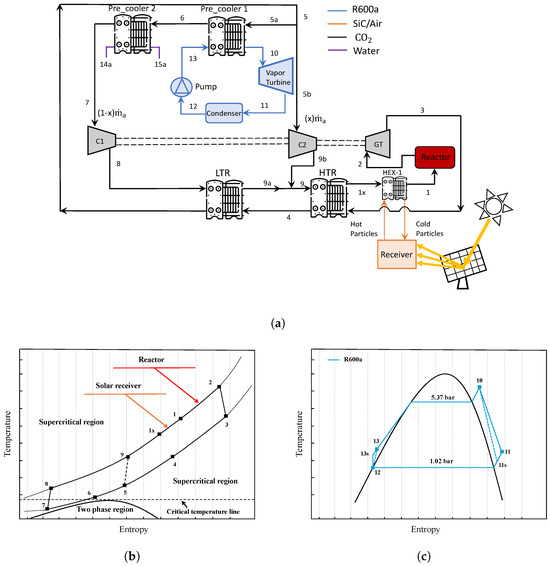
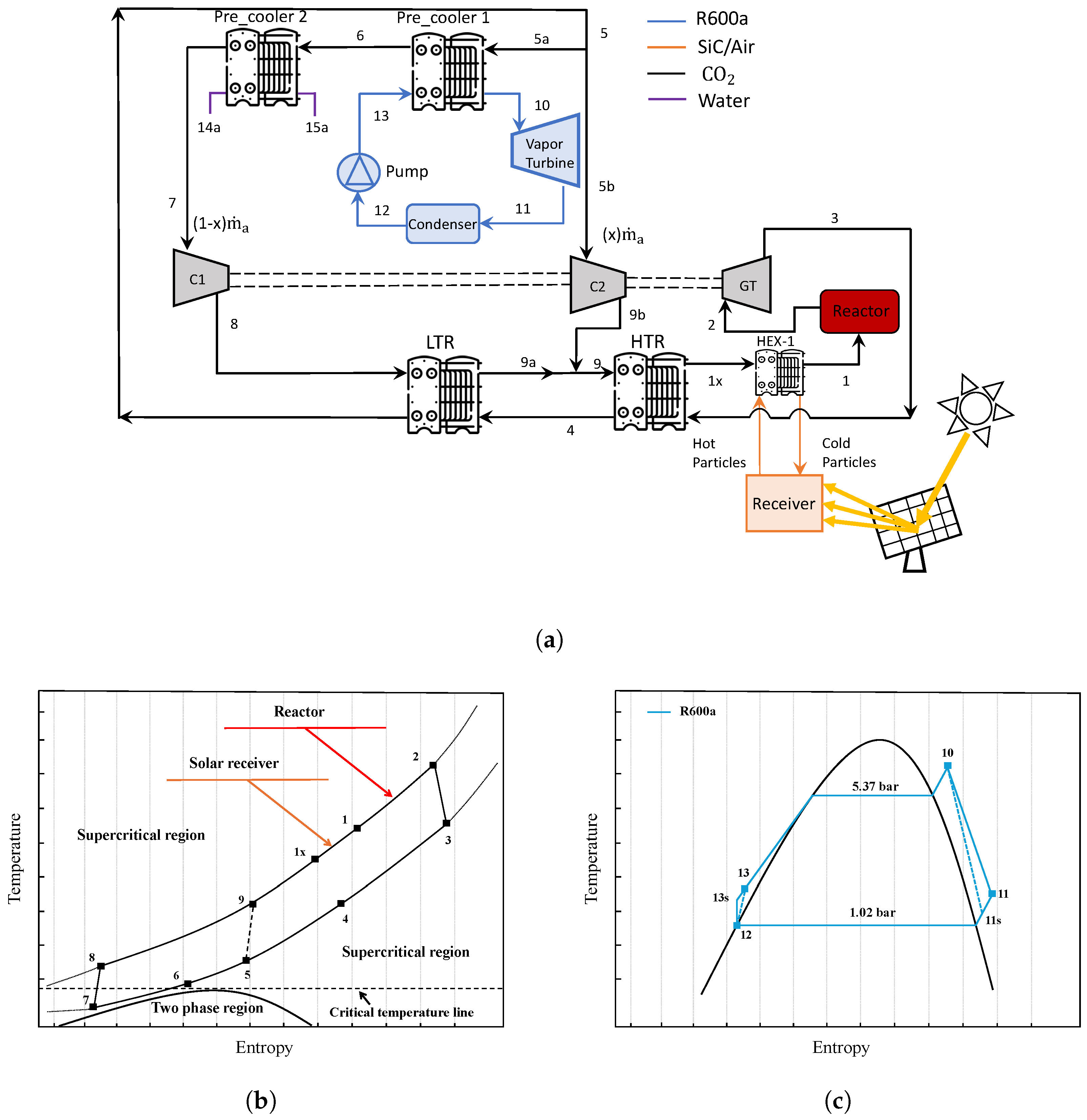
The system proposed in this study is based on the scheme developed by Akbari and Mahmoudi [18], with two main differences: (i) the incorporation of a central tower solar receiver and (ii) the use of a different working fluid in the bottoming organic cycle. The configuration consists of a recompression supercritical CO2 Brayton cycle (RCBC) coupled to a central tower solar system operating in a hybrid manner (solar receiver + reactor). In addition, an organic Rankine cycle (ORC) is integrated through Pre-cooler 1 to recover part of the residual heat. The complete configuration and state numbering are presented in Figure 1a.
Figure 1.
(a) Schematic diagram of the recompression Brayton cycle coupled to an organic Rankine cycle in a bottoming configuration, integrated into a central tower solar receiver. (b) Temperature versus entropy diagram of the RCBC recompression cycle. (c) Temperature versus entropy diagram of the ORC. Black lines refer to CO2, blue ones to R600a, orange ones to SiC/Air, and purple ones to water. Red color stands for reactor.
The system incorporates a central tower solar receiver that employs a fluidized bed as the heat transfer medium. The bed consisted of a gaseous phase (air) and a solid phase of silicon carbide (SiC) particles. The concentrated radiation from the heliostat field heats the receiver, increasing the temperature of the fluidized bed and circulating particles. These hot particles deliver heat to the CO2 stream in the primary heat exchanger (HEX-1), whereas the reactor provides an additional high-temperature heat input downstream, thereby enabling hybrid operation. In the model considered, for variable thermal power from the solar field, the fluidized-bed temperature can range from 450 K to values exceeding 900 K [17].
The thermodynamic analysis starts at state 1x, where the supercritical CO2 receives heat in HEX-1 from the hot fluidized bed (solar) stream. At the outlet of HEX-1 (state 1), the CO2 enters the reactor and reaches temperatures above 950 K. The heated CO2 then expands in the gas turbine (GT), producing mechanical work that is converted into electricity (state 2 to state 3). Despite the pressure drop at the turbine outlet (state 3), the CO2 remains at a high temperature, allowing heat recovery in the high-temperature recuperator (HTR) and subsequently in the low-temperature recuperator (LTR) before cooling.
At state 5, the CO2 mass flow was split into two streams, 5a and 5b. Stream 5a is routed to pre-cooler 1 and then to compressor 1 (C1), whereas stream 5b bypasses pre-cooler 1 and is sent directly to compressor 2 (C2). In pre-cooler 1 (state 6 at the CO2 outlet), the CO2 rejected heat from the ORC working fluid (R600a). The CO2 is further cooled in pre-cooler 2 using water as a coolant, approaching ambient temperature to improve the compression performance, and then recompressed (state 8). After passing through the LTR, the two CO2 streams are mixed (states 9a and 9b) to restore the total mass flow in state 9, thereby closing the RCBC loop.
The ORC operates as follows. Starting at state 13, the organic fluid (R600a) enters pre-cooler 1, where it absorbs heat from the CO2 stream and vaporizes, reaching state 10. The vapor expands in the ORC turbine, generating mechanical work that is converted into electricity (state 10 to state 11). At the turbine outlet (state 11), the working fluid condensed and returned to the liquid phase (state 14). Finally, the pump pressurizes the liquid back to state 13, completing the ORC.
3. Modeling
The Python programming language, version 3.11 [19], was used to implement the numerical calculations required for the evaluation of the models described in this study, as well as the systems coupled to the RCBC-ORC and multi-objective optimization.
The following assumptions were made to simplify the analysis of the RCBC-ORC cycle:
- The systems operate at steady state condition.
- The heat loss and pressure drop in the pipes connecting the components are negligible [20].
- Potential and kinetic energy are considered negligible [20].
- The state of ORC working fluid is saturated vapor or superheated at the turbine inlet and saturated liquid at the condenser’s outlet.
3.1. Solar System
Both the heliostat field and the solar receiver models considered in the present work have been widely described in previous works [17,21], respectively, by this work authors. The heliostat field efficiency was computed based on the methodology developed in ref. [21] for a surrounding heliostat field of 873, 120 m2-heliostats disposed around a 150 m height tower. The solar radiation data used in this study correspond to measurements taken throughout the day in the city of Seville (Spain) [22]. Consequently, the thermal power of the heliostat field () varies, causing the temperature of the fluidized bed at the receiver outlet to change as well. The solar receiver was modeled as a bundle of vertical tubes traversed by a dense particle suspension (DPS) of silicon carbide (SiC) particles, fluidized with air. The other parameters used in the solar receiver are listed in Table 1. The thermodynamic properties of the fluidized bed were evaluated at the average temperature and as a function of the volumetric fraction of the particles. This provides the mass flow rate per unit area of the fluidized bed, , and thermodynamic properties of the DPS, which govern the heat transfer and geometric sizing.
where corresponds to the density of the fluidized bed, and is the specific heat of the fluidized bed. Table 1 presents the definitions of these variables. The bed energy balance is connected with the particle mass flow (), gas mass flow (), and DPS mass flow () as follows:
Table 1.
Input data for the solar receiver simulation.
The geometric and heat transfer analyses performed on the solar receiver are described in detail in [17], along with information on the thermal efficiency values of the receiver.
3.2. Recompression Brayton Cycle
The supercritical CO2 Brayton cycle is a highly attractive option for converting heat into electricity because of its elevated thermal efficiency and reduced component size compared with those of conventional power generation systems [23]. This cycle employs carbon dioxide in its supercritical region, i.e., above the critical temperature (31.1 °C) and pressure (73.8 bar). In this regime, CO2 simultaneously exhibits gas-like and liquid-like characteristics, which differentiates it from typical thermodynamic states, as depicted in Figure 1a.
Moreover, the thermodynamic formulation of the particle receiver and hybrid Brayton–ORC cycle builds on the model previously developed by the authors for a supercritical Brayton cycle coupled to an ORC and integrated into a central-receiver particle tower [17]. In that study, the receiver model was benchmarked against literature data by comparing geometric parameters and heat transfer coefficients, whereas the power block model was assessed through a comparative consistency check by matching key state points against TRNSYS simulations using air as the working fluid, with relative deviations of less than 5% in the characteristic cycle temperatures. Although the configuration analyzed in the present work is not identical, the model structure (mass, energy, and exergy balances, together with the description of the particle receiver and the sCO2/ORC cycles) remains essentially the same. Therefore, the previously established framework is employed here, and only the specific extensions required for the present analysis are described in this section.
In this study, a recompression configuration of the Brayton cycle was analyzed, which incorporated both high-temperature (HTR) and low-temperature (LTR) recuperators. Mass and energy balances were applied to each component, allowing the evaluation of the stream temperatures, heat transfer, and work interactions, as expressed in Equations (7) and (8). The efficiencies of the heat exchangers (HTR, LTR, precooler 1, and precooler 2) were considered in the energy balance equation. The operating parameters adopted for the Supercritical CO2 Recompression Brayton Cycle (RCBC) are summarized in Table 2.
Table 2.
Input data for supercritical RCBC and ORC simulation [18].
For the design and performance assessment of HEX-1, an energy balance was established between the fluidized bed and sCO2 side. Equation (9) characterizes the heat transfer mechanism in this system, where and correspond to the inlet and outlet temperatures of the particle flux in the concentrated solar tower system, respectively. In contrast, represents the enthalpy of the sCO2 at the outlet of HEX-1, which is the key parameter used to determine the inlet temperature at the supercritical RCBC turbine. The enthalpies of the system were obtained from the CoolProp database [24] after the temperature and pressure of the thermodynamic state were determined.
The heat exchangers HTR, LTR, Precooler1, and Precooler2 are described by Equations (7) and (8), which establish the mass and energy balances between hot and cold streams. In these expressions, the heat transferred on both sides of the exchanger is equated, incorporating the effectiveness parameters and into the analysis. The application of this balance makes it possible to determine the enthalpy values, thereby enabling the continuation of the cycle analysis.
The analysis inside the combustion chamber was performed using Equation (10) [25], where is the combustion efficiency, is the mass flow of the fuel, and is the lower value of the heat combustion of the fuel. Thus, the total heat absorbed by the Brayton cycle is the sum of the contributions of the solar heat exchanger and the combustion of fuel, that is, . Finally, the waste heat released to the organic Rankine cycle, , is evaluated using Equation (11).
where the variable “x” is the mass flow fraction divided at state 5 that goes to state 5b. The system performance was evaluated using Equation (12), where is the net power produced by the Brayton cycle and is calculated using Equation (13), where is the power produced by the gas turbine, which is calculated using Equation (14).
3.3. Organic Rankine Cycle
The ORC analysis was conducted using the energy balance for each component. The selection of the working fluid plays a key role in system performance. The employed refrigerants must exhibit negligible Ozone Depletion Potential (ODP) and low Global Warming Potential (GWP). This study uses R600a refrigerant owing to its environmentally friendly nature and adequate energy and exergy performance in this type of system, which was previously proven by the authors in [17]. The choice of this refrigerant was based on its environmental friendliness, practically zero ODP, GWP lower than 150, low toxicity, and low flammability [26,27]. The properties of the fluids considered are listed in Table 3. The ORC cycle analysis was based on the input values listed in Table 2.
Table 3.
Properties of the fluids considered in the ORC [18,28,29,30].
The energy balance in precooler1 heat exchanger between the sCO2 side and ORC working fluid is evaluated using Equation (15).
The vapor turbine was modeled using Equation (8) and considering an isentropic efficiency of . The Equation (16) describes this process.
Temperature is evaluated by knowing the actual enthalpy at the vapor turbine outlet and pressure . For the condenser, it was assumed that the fluid at the outlet was in a saturated liquid state. The thermal capacity of the condenser was determined using Equation (17), where the enthalpy is calculated at the condenser pressure . Finally, the pump power was obtained using Equation (18).
3.4. Environmental Analysis
The growing concern over environmental issues, particularly due to global warming and climate change, has brought greenhouse gas emissions from energy systems under heightened scrutiny in recent years. Major contributors include conventional fuel thermal power systems, gas turbines, engine waste heat, boiler exhausts, and power cycles such as supercritical CO2 and Brayton systems, which impose significant environmental burdens on the environment. A highly effective approach to mitigate these impacts is to integrate renewable energy sources into the thermal cycles. In the proposed system, environmental analysis is centered on measuring the mass flow of CO2 and NOx generated by fuel combustion in the reactor. Equations (21) and (22) show the calculations for the mass flow of these pollutants.
where is the fuel mass per unit of time, is the CO2 emissions factor per unit mass of natural gas (NG), and is the emissions factor per unit mass of NG. The value of each factor was (kg CO2/kg NG) [31] and (kg NOx/kg NG) [32].
The Equations (25) and (26) allow for the evaluation of the total daily emissions, that is, the sum of all hours of plant production during the day, which is set in a window from 7:00 a.m. to 8:00 p.m. CO2 emissions are expressed in tons/day, and NOx emissions are expressed in kg/day, respectively.
3.5. Exergetic Analysis
The exergy balance in each component of the RCBC/ORC power block and particle receivers was computed by performing an exergy analysis [33,34]:
where is the rate of work produced in the control volume and is the rate of exergy destruction in each component. refers to the exergy rate of heat transfer. is the input rate exergy to the control volume, and is the exit rate exergy to the control volume. In this study, the magnetic, chemical, electrical, nuclear, kinetic, and potential energy effects on the exergy analysis were not considered. The specific exergy can be calculated using the following equation:
where is the dead state enthalpy and is the dead state entropy, respectively. To evaluate these dead states, K and bar were used.
The exergy efficiency of the combined cycle is defined as:
where . Then, is the exergy input to the power block from the combustion chamber and particle receiver:
The solar contribution in Equation (33) is evaluated following the methodology proposed by Padilla et al. [35], is the heat transferred in the solar heat exchanger, is the efficiency of the heliostat field, for which in the present work it is considered a value of 0.6 [36], and is the temperature of the combustion chamber. Finally, is the dimensionless maximum useful work available from solar radiation, which can be calculated using Petela’s equation [37].
where is the temperature of the Sun, considered as a black body 5800 K).
3.6. Multi-Objective Optimization
In this study, the elitist nondominated sorting genetic algorithm of the second generation (NSGA-II) was employed. These algorithms are widely adopted for tackling multi-objective optimization problems because of their inherent capability to avoid local optima, adaptability to a broad range of multi-objective formulations, and straightforward integration of both linear and nonlinear equality and inequality constraints [38]. In general, a multi-objective optimization problem can be mathematically formulated as
where is the number of objective functions, and X is the vector of decision variables. In this study, six decision variables were considered, as presented in Table 4. Two scenarios were proposed in this study. In the first scenario, there were two objective functions: maximizing the exergy efficiency and minimizing the fuel mass flow rate. In the second scenario, there were three objective functions: maximizing the overall thermal efficiency of the power cycle, minimizing the total CO2 emissions per day, and minimizing the total NOx emissions per day.
Table 4.
Magnitude of the decision variables.
Nondominated Sorting Genetic Algorithms II (NSGA-II)
In this study, the NSGA-II algorithm is employed based on the method described in ref. [39], which is an enhanced version of the NSGA algorithm [40], where the authors made an improvement to counter the computational complexity of the NSGA. In NSGA-II, the authors proposed removing a shared parameter and replacing it with a crowded comparison operator. This operator functions as a selection guide for the nondominated solutions achieved by the algorithm, producing an effective Pareto front. Algorithm 1 presents the algorithm’s implementation. For this study, the following parameters for the algorithm were employed: population size set to 200, SBX crossover probability fixed at 95%, polynomial mutation probability defined as , and a stopping criterion of 5000 iterations.
| Algorithm 1 Algorithm NSGA-II. |
Start
|
4. Results and Discussion
This section is devoted to the energy, exergy, environmental, and multi-objective optimization of the particle receiver, as well as the coupling of the receiver to both the recompression Brayton and organic Rankine cycles.
4.1. Seasonal Analysis of Solar Radiation and Its Effects on the Solar Receiver
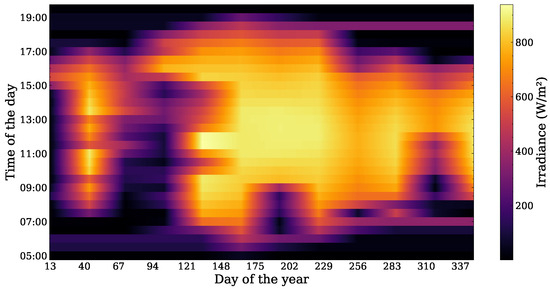
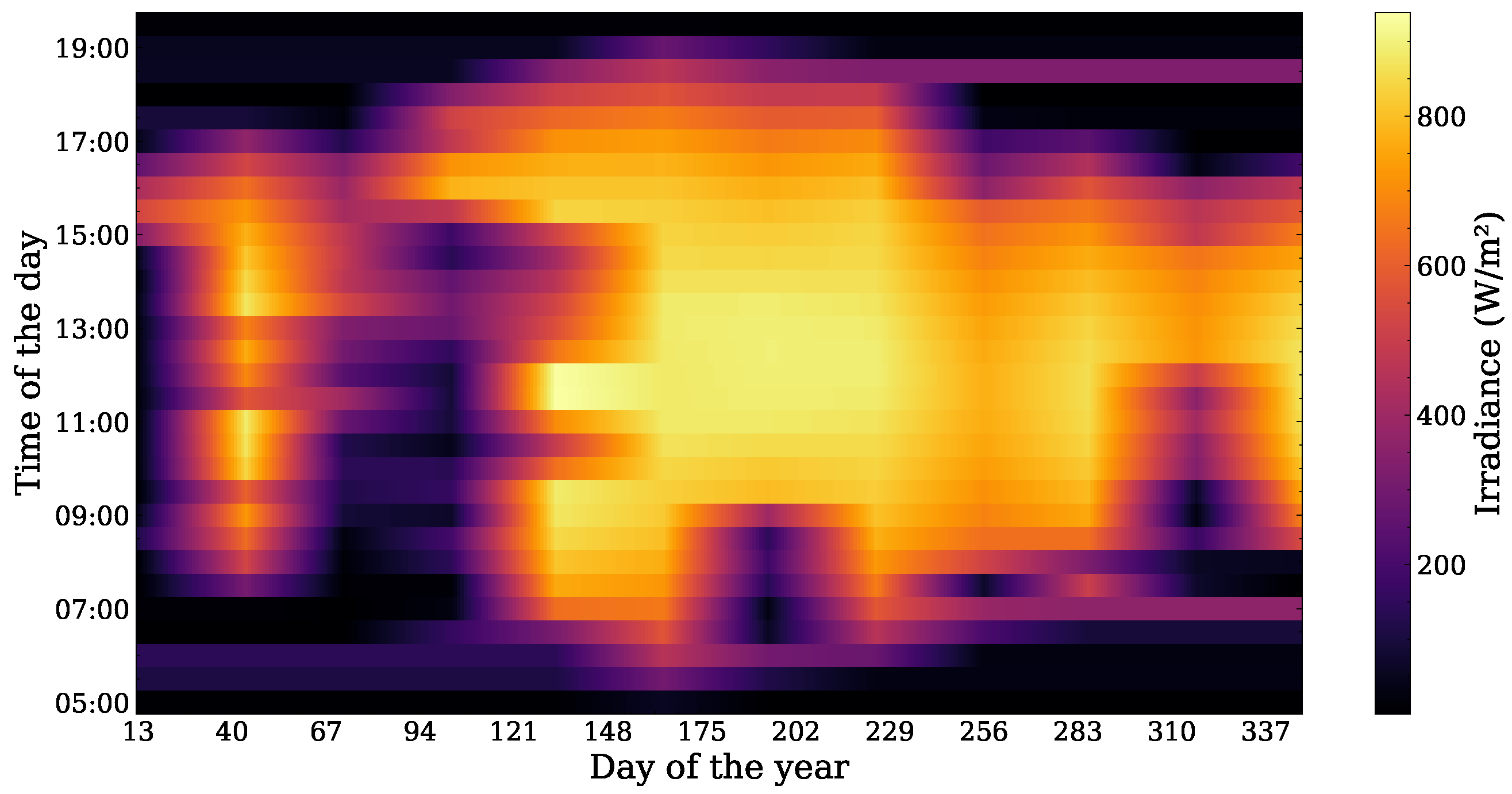
This section analyzes the influence of solar resources in the study area (Seville, Spain). Full-year meteorological data [22] were used, which were categorized by season (winter, spring, summer, and autumn). Figure 2 shows the global solar irradiance in Seville, which exhibits significant temporal variations. The daily operating window widens from spring to late summer and narrows in winter, with maximum hourly values concentrated between 11:00 and 15:00, with peaks close to 800–900 W/m2, whereas in the cold months, both the length of the day and the intensity of the peaks decrease. The pattern was mostly symmetrical between the morning and afternoon, with no obvious systematic bias. For a central tower fluidized bed solar receiver, this profile implies that the seasonal bottleneck occurs in winter and that the operation should focus on managing the midday peak by adjusting the heliostat field pointing strategies to maintain the allowable thermal flux over the aperture, controlling the bed flow rate and surface velocity for hydrodynamic stability and heat transfer, and using thermal energy storage or load management to shift midday surpluses to off-peak hours. These actions help ensure receiver performance and material limits under daily and seasonal variations in irradiance.
Figure 2.
Temporal variation of solar irradiance in Seville, Spain, considering daily hourly and seasonal evolution throughout the year.
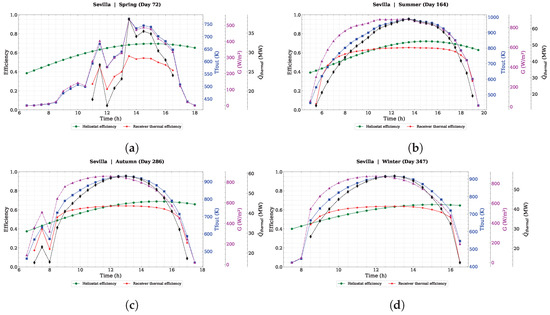
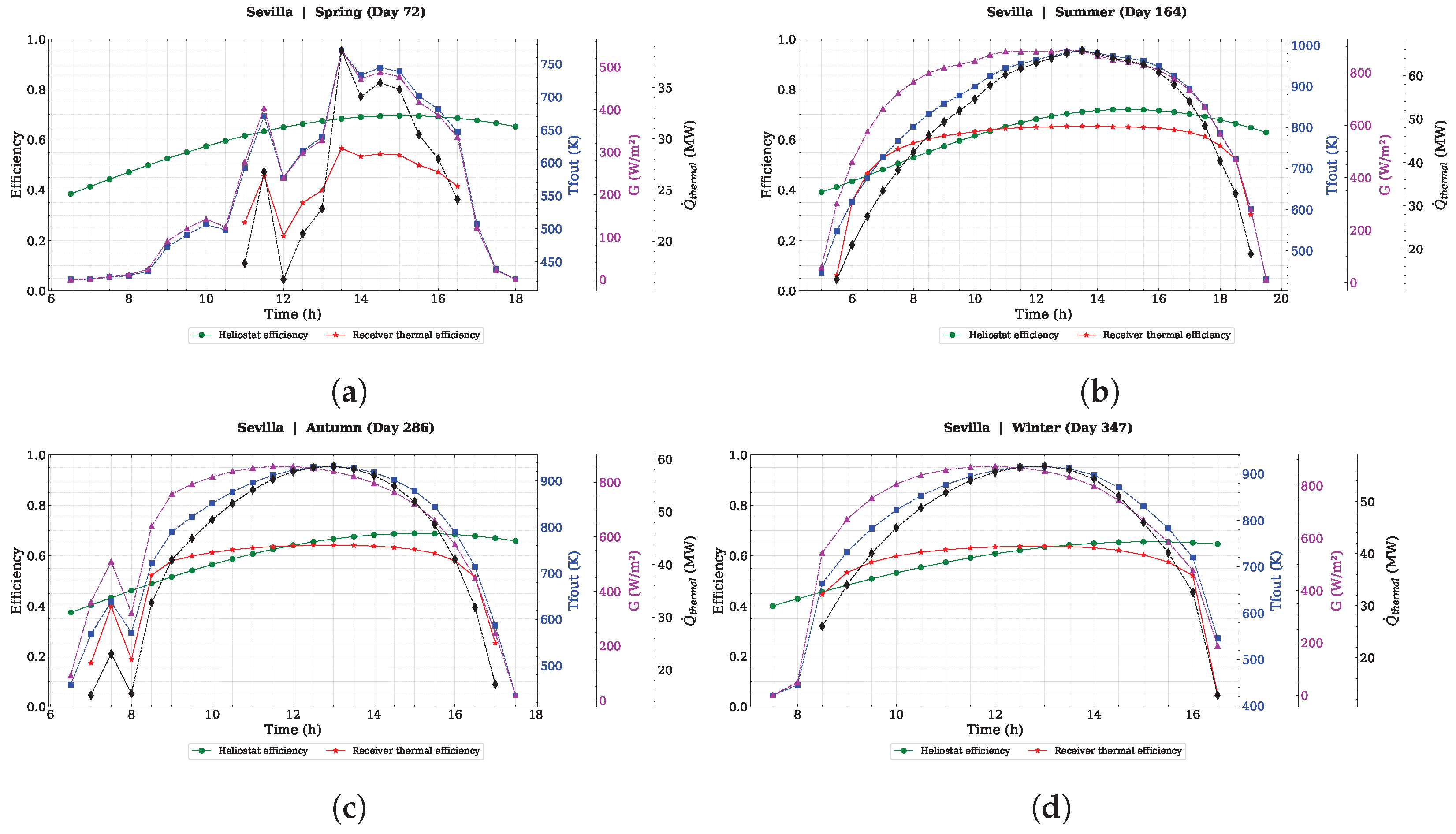
Figure 3 shows representative days from each season throughout the year; one day was selected from each season to illustrate typical seasonal conditions, the efficiencies of the heliostat field and solar receiver throughout the day on the left axis, and the temperature of the fluidized bed at the receiver outlet, solar Direct Normal Irradiance (DNI), and thermal power generated by the heliostat array and entering the solar receiver on the right axis. It can be observed that the solar irradiance on the selected days exceeded 800 W/m2, except for the spring day, where the irradiance showed significant fluctuations throughout day 72, reaching a maximum value of 500 W/m2. Furthermore, the duration of solar exposure increased during summer days, reaching 13 h of effective irradiance, whereas on the other selected days, it remained below 10 h. Spring Day 72 was intentionally selected because its pronounced irradiance fluctuations provided a stress test for the proposed hybrid solar fuel operation. This choice makes the dependence of the system on short-term solar variability explicit, because fluctuations in the solar input translate into variations in the receiver outlet temperature and solar heat contribution, and under the constant net power assumption, propagate to changes in the required supplementary fuel mass flow rate . Consequently, the instantaneous CO2 and NOx emissions, as well as the cycle efficiencies, were affected.
Figure 3.
Meteorological data of solar irradiance (purple lines), receiver thermal power input (black lines) and fluidized bed outlet temperature at the solar receiver (blue lines), as well as heliostat field efficiency (green lines) and receiver thermal efficiency (red lines) for days (a) 72, (b) 164, (c) 286 and (d) 347 of the 2017 year in Seville.
The blue line represents the outlet temperature of the fluidized bed in the solar receiver (), which follows a trend that closely corresponds to solar irradiance. Maximum temperatures occurred when solar radiation reached its peak, indicating a direct relationship between these two variables. Notably, during spring, the outlet temperature exhibited pronounced variations throughout the day, which could adversely affect the stability and overall performance of the system. Finally, the performance of the heliostat field and solar receiver efficiencies are presented. The maximum efficiency of the solar receiver remained 0.6, across all seasons. Once again, this efficiency is notably affected during the spring day, where the maximum value reaches 0.58 under the peak solar irradiance conditions. However, the instability of the solar resource throughout the day leads to fluctuations that negatively influence the receiver efficiency, as shown in the figure.
The black line shows the trend of the heliostat-field thermal power, , and the thermal energy transferred to the solar receiver. In this case, is directly proportional to the solar irradiance, as the thermal power delivered to the receiver increases with the increase in irradiance. The highest values occurred in summer and autumn, reaching 60 MW, whereas the lowest values were observed in winter and spring, ranging from 35 to 55 MW. In all cases, the maximum values were attained around solar noon (12:00–13:00 h). Overall, these results indicate that the selected days provide a representative and realistic depiction of the thermal power input to the solar receiver.
4.2. Environmental Analysis
In this section, the mass flow rate of the fuel, as well as the mass flow rates of carbon dioxide (CO2) and nitrogen oxides (NOx) generated by combustion, are analyzed for the different seasons of the year.
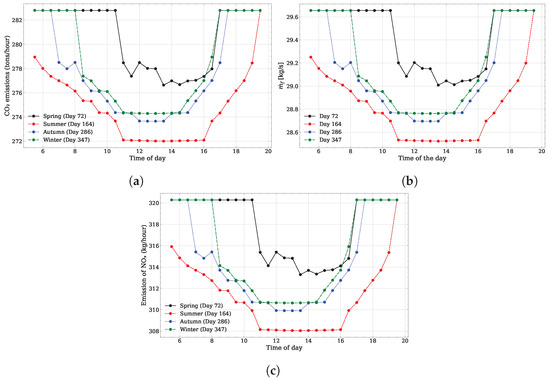
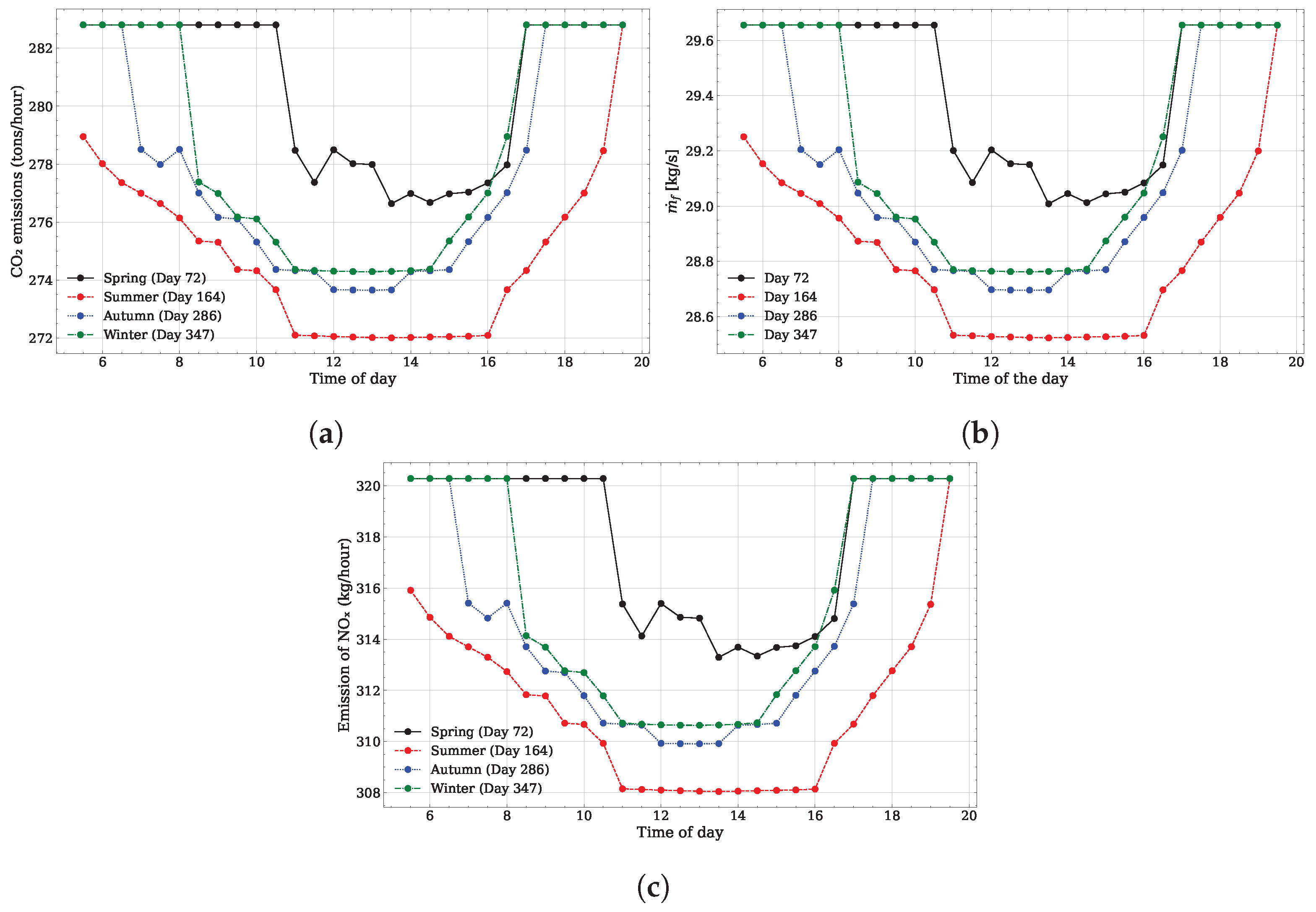
Figure 4a shows the CO2 emissions resulting from fuel combustion in the system reactor. Assuming a constant electrical power output throughout the day, it can be observed that during winter, spring, and autumn, power production in the early hours of the day relies entirely on the fuel combustion. This is reflected in the figure, where these three seasons start at 282.75 tons/h. In contrast, during the summer season, this value decreases to 279 tons/h in the early hours and progressively declines to nearly 272 tons/h as the day advances, representing the minimum CO2 emission level of the system. Furthermore, during the chosen day of spring, the carbon dioxide emissions remain the highest throughout the day of operation. The integration of a solar system into the supercritical RCBC/ORC cycle allows for an average reduction of 10.75 tons per hour during the summer, which is equivalent to a daily reduction of 53.75 tons, considering the selected operating range. This performance means that, over the three months of summer, 4837.5 tons of CO2 emissions into the atmosphere are avoided, thus contributing to the reduction of the environmental impact associated with the process of electricity generation.
Figure 4.
Environmental analysis of the supercritical RCBC/ORC cycle. (a) CO2 emissions throughout the day for different seasons of the year. (b) Fuel mass flow rate over the course of the day for the selected days. (c) NOx emissions throughout the day for different seasons of the year.
Figure 4b shows the fuel mass flow for the different seasons. As in the previous graph, the fuel consumption was the lowest during summer, whereas in the other months, it increased. The mass flow values varied between 28.5 and 29.65 kg/s. Likewise, it can be seen that the three graphs show a similar trend and behavior because CO2 and NOx emissions depend directly on fuel mass flow.
Figure 4c shows the emissions of nitrogen oxides, which are highly harmful to human health and the environment. Once again, the highest emissions were recorded during the spring, fall, and winter seasons, with values ranging between 310 and 320.25 kg/h, respectively. In contrast, during summer, the emissions of this pollutant decreased to 308 kg/h, particularly during the peak sunlight hours. In this season, owing to the incorporation of the solar system coupled with the supercritical RCBC/ORC cycle, the emission of 5400 kg of NOx was avoided during the three summer months, demonstrating the positive impact of the system in reducing atmospheric pollutants.
4.3. Exergy Analysis
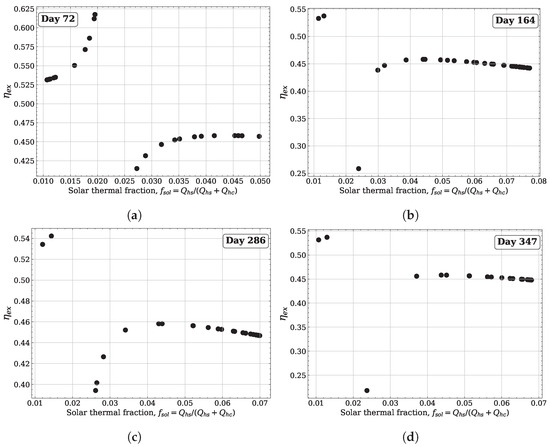
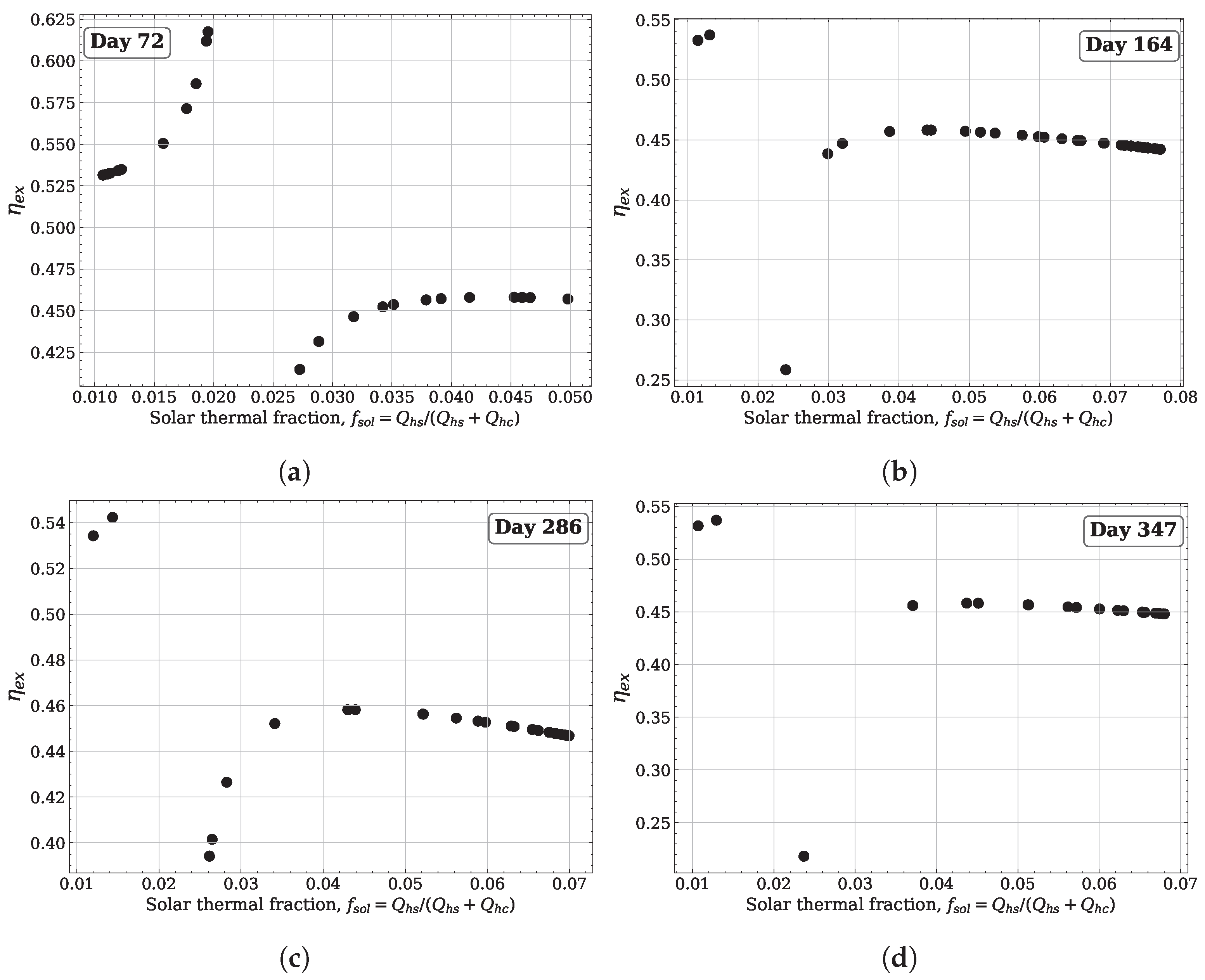
In this section, an exergy-based analysis is performed to assess the influence of the solar thermal contribution on the overall system performance under hybrid solar–fuel operation, considering representative days of the year. Figure 5a shows the relationship between the solar thermal fraction and exergy efficiency on Day 72 (spring conditions). In this case, the solar contribution remained very low, generally below 5%, indicating that the system operation was largely dominated by fuel input. A wider dispersion in the exergy efficiency was observed at very low solar fractions, mainly corresponding to the early and late hours of the day, when the solar input was marginal. The asymptotic behavior observed in the plot is due to the fact that, during the early hours of the day, the system is supplied only by fuel, and as the day progresses, the solar receiver begins to contribute to the system. Figure 5b corresponds to Day 164 (summer conditions) and presents the highest solar thermal fraction among the analyzed cases, reaching values close to 7–8%. This reflects the increased solar radiation during the summer. Nevertheless, despite the higher solar contribution, the system remained predominantly fuel-driven, and the exergy efficiency varied within a relatively narrow range, indicating limited sensitivity to the increased solar share.
Figure 5.
Sensitivity of exergy efficiency to the solar thermal fraction in hybrid solar–fuel operation. (a) Day 72 (b) Day 164 (c) Day 286 (d) Day 347.
In Figure 5c, representing Day 286 (autumn conditions), the solar thermal fraction decreased compared to summer and remained below 7%. The exergy efficiency exhibited trends similar to those observed in spring, confirming that under autumn conditions, solar contribution plays a secondary role in the overall exergy performance of the system. Finally, Figure 5d illustrates the results for Day 347 (winter conditions), where the solar thermal fraction is again low because of reduced winter irradiance. The exergy efficiency remained relatively stable across the observed range of solar fractions, further indicating that the system behavior was mainly governed by the fuel-based Brayton–ORC cycle rather than the solar input.
Overall, Figure 5 demonstrate that, under the selected hybrid operating strategy, the solar contribution is relatively small throughout the year, with the most significant impact occurring during summer (Day 164), whereas the exergy efficiency is primarily controlled by the fuel-driven power block. This low solar contribution is also explained by the fact that the mass flow rates in the RCBC are very high compared with those through the solar receiver.
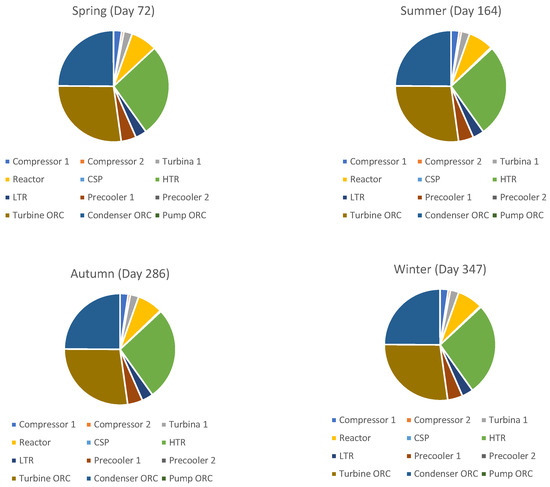
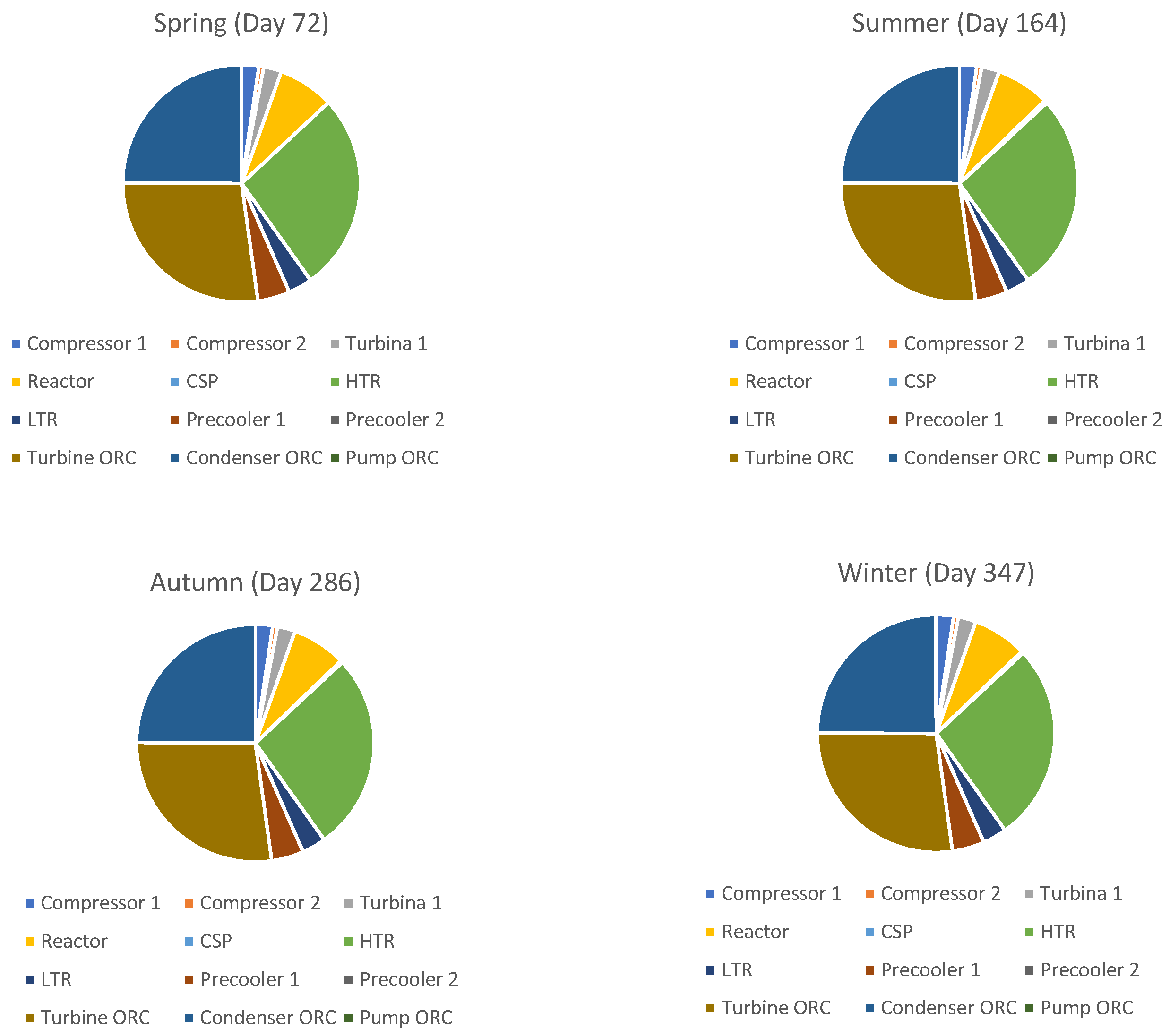
The exergy destruction of each system component was evaluated for all four seasons. Figure 6 presents the results in terms of the relative percentage of exergy destruction for each case. A consistent pattern was observed: the largest irreversibilities occurred in the ORC turbine, HTR, and ORC condenser, and this hierarchy remained unchanged throughout the seasons. In contrast, the smallest contributions to exergy destruction were found in precooler 2, ORC pump, and compressor 2. This distribution reflects the different magnitudes of the energy fluxes and characteristic temperature gradients of each unit, which govern the entropy generation and, consequently, exergy destruction.
Figure 6.
Exergy destruction in the different components of the RCBC-ORC system during the seasons of the year.
The percentages of exergy destruction corresponding to the ORC turbine, ORC condenser, and HTR were 27%, 25%, and 27%, respectively. These values represent the total proportion of exergy destruction among the different components of the system and were similar in all four seasons (spring, summer, fall, and winter). Improvement actions can range from more thorough maintenance of each subsystem to the incorporation of new components with a more efficient design.
4.4. Multi-Objective Optimization
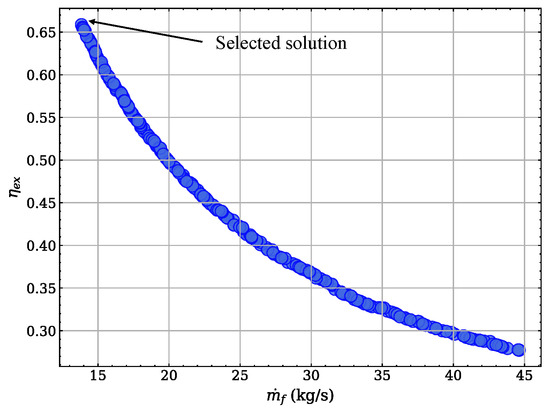
In this section, the multi-objective optimization implemented in the supercritical RCBC/ORC system coupled to a central tower solar concentration system is analyzed. jMetalPy [41] and Python software were used to develop the optimization scenarios. The optimization was carried out for day 347, corresponding to the winter season, when solar resource availability was low. System optimization is usually performed on a perfect day with ideal solar radiation. Figure 7 presents the Pareto front of the first proposed scenario, where the exergy efficiency, to be maximized, and the fuel consumption, to be minimized, are considered objective functions. Although these two objective functions may initially be expected to exhibit non-conflicting behavior, a multi-objective optimization is carried out to verify this hypothesis and provide formal evidence. The resulting Pareto front confirms the absence of a required trade-off between both objectives, thereby supporting the selection of an extreme solution. It can be observed that the exergy efficiency reaches a maximum value of 0.65 with a mass flow rate of 15 kg/s. These results were obtained by analyzing the decision variables that enabled the optimal combination of system performance.
Figure 7.
Pareto front obtained for the first optimization scenario, in which the fuel mass flow is minimized and exergy efficiency is maximized.
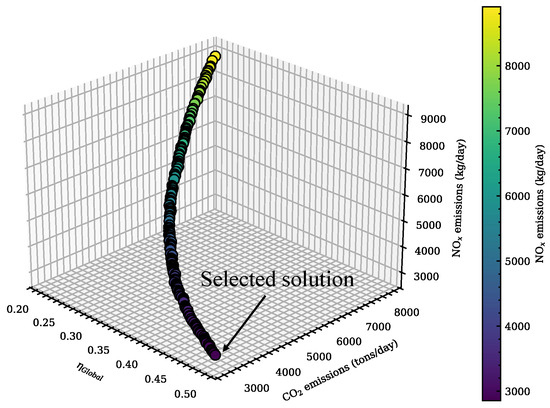
Figure 8 shows the Pareto front corresponding to the second scenario, in which the overall thermal efficiency of the system is maximized while the CO2 and NOx emissions are minimized for a selected day. It can be observed that a thermal efficiency of 0.50 can be achieved, with CO2 emissions of 3000 tons/day and NOx emissions close to 3000 kg/day.
Figure 8.
Pareto front of the second scenario, in which the CO2 and NOx mass flows are minimized and the overall thermal efficiency of the supercritical RCBC/ORC cycle is maximized.
All points shown in Figure 7 and Figure 8 correspond to the optimized solutions. Therefore, the selection of a specific point depends on the desired objective. In this study, the aim is to achieve the highest possible system efficiency while minimizing fuel consumption and pollutant emissions. Consequently, the points with the highest exergetic and overall efficiencies were selected for further analysis. These points are presented in Table 5, where they are compared with the non-optimized supercritical RCBC-ORC system. The data in the Non-optimized column represent the values of the baseline system, that is, the results obtained using the input data listed in Table 2.
Table 5.
Comparison between the non-optimized and optimized systems in first and second scenarios. The points selected in the optimized scenarios correspond, in the first scenario, to the point with the highest exergy efficiency, and in the second scenario, to the point with the highest overall efficiency.
An analysis of Table 5 shows that both the output data and decision variables obtained from the optimization process are provided, which define the conditions required to reach optimal points. These results are valid only for the points corresponding to the first and second scenarios, respectively. The output data included the thermal efficiencies of the ORC and Brayton cycles, power generated by the gas and vapor turbines, fuel mass flow rate, and CO2 and NOx emissions.
The optimization results demonstrated significant improvements. In the first scenario, the ORC efficiency increased by 6.8% compared to the non-optimized point, whereas the Brayton cycle efficiency increased by 33.4%. However, the power output of both turbines decreased, with the Brayton cycle and ORC powers decreasing by 34.6% and 2.2%, respectively. Nevertheless, the total daily CO2 and NOx emissions decreased by 52.44%, representing a substantial environmental improvement.
In the second scenario, compared with the non-optimized case, the ORC and Brayton cycle efficiencies increased by 12.66% and 33.5%, respectively. However, the gas turbine and ORC powers decreased by 34.18% and 10%, respectively. Similar to the first scenario, the total daily CO2 and NOx emissions were reduced by 52%, confirming the effectiveness of the proposed optimization. Another important factor is the solar fraction, which is presented in Table 5. It can be observed that the solar fraction is very low in the three scenarios; however, the increase in this solar fraction from the non-optimized case to the second scenario is 40%.
These improvements can be explained by the variations in the decision variables obtained during optimization. As shown in Table 5, the gas turbine inlet temperature decreased by 10.5% and 10.3 % in the first and second scenarios, respectively, compared with the non-optimized case. The mass flow rate of the RCBC was reduced by 23.4% in both scenarios. Moreover, the pressure at thermodynamic state 10, corresponding to the inlet of the ORC turbine, increased by 12.1% in the first scenario and decreased by 5.4% in the second scenario.
5. Conclusions
Based on the RCBC-ORC model coupled to a central particle receiver and on two NSGA-II optimization scenarios, the study shows that thermodynamic performance can be increased while the environmental impact of the hybrid power block is reduced. Under winter conditions (day 347), the Pareto front of Scenario 1 provides an exergy efficiency of 0.65 with a fuel mass flow of 15 kg/s. In Scenario 2, the Pareto front locates an overall thermal efficiency of 0.50 with total daily emissions of 2520 t CO2 and 2850 kg NOx, providing operating points that balance performance and emissions for constant net power. Compared with the non-optimized case, the selected solutions increased the ORC efficiency by 6.8–12.66% and the Brayton-cycle efficiency by 33.4–33.5%, while reducing the gas-turbine power by 34%, ORC turbine power by 10%, and total daily CO2 and NOx emissions by 52%. System optimization also increased the solar fraction by 48%. These gains stem from coordinated adjustments of key levers: lower gas-turbine inlet temperature (10–11%), reduced RCBC mass flow (−23%), and tuned ORC turbine inlet pressure (±5–12%).
The seasonal analysis corroborates the benefit of the solar power fraction: in summer, solar coupling reduces the fuel flow and the instantaneous emissions (272–279 t CO2/h and 308 kg NOx/h during peak irradiance), avoiding 4837.5 t CO2 and 5400 kg NOx across the summer quarter within the operating window considered. Spring day irradiance variability introduces thermal instability in the receiver and penalizes its efficiency, whereas summer days provide the largest effective solar window and enable fuel displacement, confirming the value of managing bed flows and preventing thermal overrun. Exergy losses were concentrated in the high-temperature recuperator (HTR), ORC turbine, and ORC condenser (27%, 27%, and 25%, respectively), defining improvement priorities and supporting the technical viability of the proposed solar-hybrid RCBC-ORC scheme. In summary, this study provides quantitative guidelines (decision ranges and achievable gains) and qualitative insights (trade-offs among efficiency, power, and emissions) that facilitate the detailed engineering and operational control of RCBC–ORC plants with central-tower particle receivers.
Author Contributions
Conceptualization, J.A.M.-H., R.P.M. and J.M.M.R.; methodology, J.A.M.-H., R.P.M. and J.G.-A.; software, J.A.M.-H.; validation, J.A.M.-H.; formal analysis, J.A.M.-H., R.P.M. and J.M.M.R.; investigation, J.A.M.-H., R.P.M. and J.M.M.R.; resources, J.A.M.-H., R.P.M. and J.M.M.R.; data curation, J.A.M.-H., R.P.M. and J.G.-F.; writing—original draft preparation, J.A.M.-H.; writing—review and editing, J.A.M.-H., R.P.M., J.G.-F., J.G.-A. and J.M.M.R.; visualization, J.A.M.-H.; supervision, R.P.M. and J.M.M.R.; project administration, J.M.M.R.; funding acquisition, J.A.M.-H., R.P.M., J.G.-A. and J.M.M.R. All authors have read and agreed to the published version of the manuscript.
Funding
J.A.Moctezuma-Hernández acknowledges financial support from Secretaría de Ciencia-México CVU 1006749. The authors acknowledge Universidad de Salamanca and funding from the Ministerio de Ciencia, Innovación y Universidades of Spain under grant PID2023-147201OB-I00 and Junta de Castilla y León: SA071G24.
Data Availability Statement
Dataset available on request from the authors.
Conflicts of Interest
The authors declare no conflict of interest.
Nomenclature
| Symbols | u | velocity (mm/s) | |
| specific heat (J/kgK) | d | diameter (mm) | |
| heat transfer rate (MW) | compression ratio (-) | ||
| power (MW) | T | temperature (K) | |
| p | pressure (bar) | A | area (m2) |
| mass flow rate (kg/s) | critical | ||
| solar thermal fraction (-) | Gas turbine | ||
| G | mass flow per unit area (kg/m2s) | Vapor turbine | |
| k | thermal conductivity (W/mK) | heat exchanger | |
| x | mass flow fraction (-) | particle receiver | |
| Greek symbols | f | fuel | |
| density (kg/m3) | p | particle | |
| volumetric fraction (-) | Abbreviations | ||
| effectiveness (%) | ORC | Organic Rankine Cycle | |
| efficiency (%) | CSP | Concentrating Solar Power | |
| dimensionless maximum work (-) | RCBC | Recompression Brayton Cycle | |
| viscosity (kg/ms) | GWP | Global Warming Potential | |
| Subscripts | ODP | Ozone Depletion Potential | |
| exergy | DPS | Dense Particle Suspension | |
| c | compressor | EF | Emissions Factor |
| isentropic | LTR | Low Temperature Recuperators | |
| low heating value | HTR | High-Temperature Recuperators | |
References
- Stamatellos, G.; Stamatelos, T. Effect of actual recuperators’ effectiveness on the attainable efficiency of supercritical CO2 Brayton cycles for solar thermal power plants. Energies 2022, 15, 7773. [Google Scholar] [CrossRef] [Scilit]
- Heller, L.; Glos, S.; Buck, R. Cost benefit analysis of supercritical CO2 cycles in next-generation solar thermal power plants. Renew. Energy 2025, 256, 123613. [Google Scholar] [CrossRef] [Scilit]
- Tovar, J.M.; Valencia Ochoa, G.; Mendoza Casseres, D. Thermodynamic and environmental comparative analysis of a dual loop ORC and Kalina as bottoming cycle of a solar Brayton sCO2. Int. J. Thermofluids 2024, 24, 100895. [Google Scholar] [CrossRef] [Scilit]
- Merchán, R.P.; Santos, M.J.; García-Ferrero, J.; Medina, A.; Hernández, A.C. Thermo-economic and sensitivity analysis of a central tower hybrid Brayton solar power plant. Appl. Therm. Eng. 2021, 186, 116454. [Google Scholar] [CrossRef] [Scilit]
- Abdel-Basset, M.; Abdel-Fatah, L.; Sangaiah, A.K. Metaheuristic algorithms: A comprehensive review. In Computational Intelligence for Multimedia Big Data on the Cloud with Engineering Applications; Academic Press: Cambridge, MA, USA, 2018; pp. 185–231. [Google Scholar] [CrossRef] [Scilit]
- Moctezuma-Hernandez, J.A.; Belman-Flores, J.M.; Soria-Alcaraz, J.A.; Espinal-Jiménez, A.; Rubio-Maya, C. Modeling and multi-objective optimization of a miniature refrigeration system. J. Therm. Sci. Eng. Appl. 2022, 14, 101007. [Google Scholar] [CrossRef] [Scilit]
- Soui, M.; Mansouri, N.; Alhamad, R.; Kessentini, M.; Ghedira, K. NSGA-II as feature selection technique and AdaBoost classifier for COVID-19 prediction using patient’s symptoms. Nonlinear Dyn. 2021, 106, 1453–1475. [Google Scholar] [CrossRef] [Scilit]
- Sánchez-Orgaz, S.; Pedemonte, M.; Ezzatti, P.; Curto-Risso, P.L.; Medina, A.; Hernández, A.C. Multi-objective optimization of a multi-step solar-driven Brayton plant. Energy Convers. Manag. 2015, 99, 346–358. [Google Scholar] [CrossRef] [Scilit]
- Cui, X.; Wang, Y.; Yang, J.; Li, Y.; Han, Y.; Yin, M. Performance analysis and multi-objective optimization of CO2 transcritical Rankine cycle systems driven by solar energy. Sol. Energy 2025, 286, 113179. [Google Scholar] [CrossRef] [Scilit]
- Mortazavi, H.; Beni, H.M.; Nadooshan, A.A.; Islam, M.S.; Ghalambaz, M. 4E analysis and triple objective NSGA-II optimization of a novel solar-driven combined ejector-enhanced power and two-stage cooling (EORC–TCRC) system. Energy 2024, 294, 130803. [Google Scholar] [CrossRef] [Scilit]
- Park, J.S.; Koushaeian, M.; Choi, M.G.; Lee, H.Y.; Chung, J.D. Cascaded sCO2 Brayton–Transcritical ORC–Adsorption Cooling Cycle for Gas-Turbine Waste-Heat Trigeneration: Thermodynamic and Exergy Optimization. Case Stud. Therm. Eng. 2025, 76, 107383. [Google Scholar] [CrossRef] [Scilit]
- Zhou, T.; Liu, Z.; Li, X.; Zhao, M.; Zhao, Y. Thermodynamic design space data-mining and multi-objective optimization of sCO2 Brayton cycles. Energy Convers. Manag. 2021, 249, 114844. [Google Scholar] [CrossRef] [Scilit]
- Yilmaz, F.; Ozturk, M.; Selbas, R. Design and performance evaluation of a biomass-based multigeneration plant with supercritical CO2 Brayton cycle for sustainable communities. Int. J. Hydrogen Energy 2024, 59, 1540–1554. [Google Scholar] [CrossRef] [Scilit]
- Zhang, J.; Wang, J.; Liu, W.; Hu, B.; Lou, J.; Zhao, P. Multi-objective optimization design of a solar-powered integrated multi-generation system based on combined sCO2 Brayton cycle and ORC using machine learning approach. Appl. Therm. Eng. 2024, 252, 123684. [Google Scholar] [CrossRef] [Scilit]
- Zhu, H.; Xie, G.; Berrouk, A.S. Multi-objective optimization of a sCO2 Brayton/zeotropic ORC combined cycle based on machine learning regression and classification. Appl. Therm. Eng. 2025, 281, 128402. [Google Scholar] [CrossRef] [Scilit]
- Qiu, Y.; Erqi, E.; Li, Q. Triple-objective optimization of sCO2 Brayton cycles for next-generation solar power tower. Energies 2023, 16, 5316. [Google Scholar] [CrossRef] [Scilit]
- Moctezuma-Hernandez, J.A.; Merchán, R.P.; Roco, J.M.M. Supercritical CO2 hybrid Brayton-Organic Rankine Cycle integrated with a solar central tower particle receiver: Performance, exergy analysis, and choice of the organic refrigerant. Renew. Energy 2025, 250, 123231. [Google Scholar] [CrossRef] [Scilit]
- Akbari, A.D.; Mahmoudi, S.M.S. Thermoeconomic analysis & optimization of the combined supercritical CO2 (carbon dioxide) recompression Brayton/organic Rankine cycle. Energy 2014, 78, 501–512. [Google Scholar] [CrossRef] [Scilit]
- Python Software Foundation. Python Language Reference, Version 3.11. 2023. Available online: https://www.python.org (accessed on 24 February 2026).
- Kim, Y.M.; Kim, C.G.; Favrat, D. Transcritical or supercritical CO2 cycles using both low- and high-temperature heat sources. Energy 2012, 43, 402–415. [Google Scholar] [CrossRef] [Scilit]
- Merchán, R.P.; Santos, M.J.; Heras, I.; Gonzalez-Ayala, J.; Medina, A.; Hernández, A.C. On-design pre-optimization and off-design analysis of hybrid Brayton thermosolar tower power plants for different fluids and plant configurations. Renew. Sustain. Energy Rev. 2020, 119, 109590. [Google Scholar] [CrossRef] [Scilit]
- Copernicus Atmosphere Monitoring Service (ECMWF). CAMS Radiation Service. 2023. Available online: https://atmosphere.copernicus.eu/ (accessed on 24 February 2026).
- Chen, L.; Deng, B.-L.; Zhang, X.-R. Experimental study of trans-critical and supercritical CO2 natural circulation flow in a closed loop. Appl. Therm. Eng. 2013, 59, 1–13. [Google Scholar] [CrossRef] [Scilit]
- Bell, I.H.; Wronski, J.; Quoilin, S.; Lemort, V. Pure and pseudo-pure fluid thermophysical property evaluation and the open-source thermophysical property library CoolProp. Ind. Eng. Chem. Res. 2014, 53, 2498–2508. [Google Scholar] [CrossRef] [Scilit]
- Olivenza-León, D.; Medina, A.; Hernández, A.C. Thermodynamic modeling of a hybrid solar gas-turbine power plant. Energy Convers. Manag. 2015, 93, 435–447. [Google Scholar] [CrossRef] [Scilit]
- Wu, C.; Wang, S.-S.; Li, J. Exergoeconomic analysis and optimization of a combined supercritical carbon dioxide recompression Brayton/organic flash cycle for nuclear power plants. Energy Convers. Manag. 2018, 171, 936–952. [Google Scholar] [CrossRef] [Scilit]
- Giménez-Prades, P.; Navarro-Esbrí, J.; Arpagaus, C.; Fernández-Moreno, A.; Mota-Babiloni, A. Novel molecules as working fluids for refrigeration, heat pump and organic Rankine cycle systems. Renew. Sustain. Energy Rev. 2022, 167, 112549. [Google Scholar] [CrossRef] [Scilit]
- Lemmon, E.W.; Huber, M.L.; McLinden, M.O. NIST Standard Reference Database 23: Reference Fluid Thermodynamic and Transport Properties-REFPROP, Version 7. 2002. Available online: www.nist.gov/publications/nist-standard-reference-database-23-nist-thermodynamic-and-transport-properties-refprop (accessed on 24 February 2026).
- García-Pabón, J.J.; Méndez-Méndez, D.; Belman-Flores, J.M.; Barroso-Maldonado, J.M.; Khosravi, A. A review of recent research on the use of R1234yf as an environmentally friendly fluid in the organic Rankine cycle. Sustainability 2021, 13, 5864. [Google Scholar] [CrossRef] [Scilit]
- Grljušić, M.; Medica, V.; Račić, N. Thermodynamic analysis of a ship power plant operating with waste heat recovery through combined heat and power production. Energies 2014, 7, 7368–7394. [Google Scholar] [CrossRef] [Scilit]
- Campanari, S.; Mastropasqua, L.; Gazzani, M.; Chiesa, P.; Romano, M.C. Predicting the ultimate potential of natural gas SOFC power cycles with CO2 capture—Part A: Methodology and reference cases. J. Power Sources 2016, 324, 598–614. [Google Scholar] [CrossRef] [Scilit]
- U.S. Environmental Protection Agency (EPA). Emission Factor Documentation for AP-42 Section 1.4: Natural Gas Combustion; Prepared for the Office of Air Quality Planning and Standards; Eastern Research Group, Inc.:: Morrisville, NC, USA, 1998. Available online: https://www.epa.gov/sites/default/files/2020-09/documents/background_document_ap-42_section_1.4_natural_gas_combustion.pdf (accessed on 24 February 2026).
- Moran, M.J.; Shapiro, H.N.; Boettner, D.D.; Bailey, M.B. Fundamentals of Engineering Thermodynamics; John Wiley & Sons: Hoboken, NJ, USA, 2010. [Google Scholar]
- Dincer, I.; Rosen, M.A. Exergy: Energy, Environment and Sustainable Development; Newnes: Oxford, UK, 2012. [Google Scholar]
- Padilla, R.V.; Too, Y.C.S.; Benito, R.; Stein, W. Exergetic analysis of supercritical CO2 Brayton cycles integrated with solar central receivers. Appl. Energy 2015, 148, 348–365. [Google Scholar] [CrossRef] [Scilit]
- Ho, C.K.; Iverson, B.D. Review of high-temperature central receiver designs for concentrating solar power. Renew. Sustain. Energy Rev. 2014, 29, 835–846. [Google Scholar] [CrossRef] [Scilit]
- Boehm, R. Maximum performance of solar heat engines. Appl. Energy 1986, 23, 281–296. [Google Scholar] [CrossRef] [Scilit]
- Giagkiozis, I.; Purshouse, R.C.; Fleming, P.J. An overview of population-based algorithms for multi-objective optimisation. Int. J. Syst. Sci. 2015, 46, 1572–1599. [Google Scholar] [CrossRef] [Scilit]
- Deb, K.; Pratap, A.; Agarwal, S.; Meyarivan, T.A.M.T. A fast and elitist multiobjective genetic algorithm: NSGA-II. IEEE Trans. Evol. Comput. 2002, 6, 182–197. [Google Scholar] [CrossRef] [Scilit]
- Srinivas, N.; Deb, K. Multiobjective optimization using nondominated sorting in genetic algorithms. Evol. Comput. 1994, 2, 221–248. [Google Scholar] [CrossRef] [Scilit]
- Benítez-Hidalgo, A.; Nebro, A.J.; García-Nieto, J.; Oregi, I.; Ser, J.D. jMetalPy: A Python framework for multi-objective optimization with metaheuristics. Swarm Evol. Comput. 2019, 51, 100598. [Google Scholar] [CrossRef] [Scilit]

Disclaimer/Publisher’s Note: The statements, opinions and data contained in all publications are solely those of the individual author(s) and contributor(s) and not of MDPI and/or the editor(s). MDPI and/or the editor(s) disclaim responsibility for any injury to people or property resulting from any ideas, methods, instructions or products referred to in the content. |
© 2026 by the authors. Licensee MDPI, Basel, Switzerland. This article is an open access article distributed under the terms and conditions of the Creative Commons Attribution (CC BY) license.