Article

Advances in Hydrogen Pipeline Joints: Materials, Sealing Structures, and Intelligent Monitoring for Safe Hydrogen Transport

1
National & Local Joint Engineering Research Center of Harbor Oil & Gas Storage and Transportation Technology, Zhejiang Key Laboratory of Pollution Control for Port-Petrochemical Industry, Zhejiang Key Laboratory of Petrochemical Environmental Pollution Control, School of Petrochemical Engineering & Environment, Zhejiang Ocean University, Zhoushan 316022, China
2
Beijing Design Branch of China Petroleum Engineering & Construction Corporation, Beijing 100084, China
3
College of Safety and Ocean Engineering, China University of Petroleum Beijing, Beijing 102249, China
*
Authors to whom correspondence should be addressed.
Energies 2026, 19(6), 1408; https://doi.org/10.3390/en19061408
Submission received: 19 January 2026 / Revised: 27 February 2026 / Accepted: 5 March 2026 / Published: 11 March 2026

Abstract

Against the backdrop of the accelerating global energy transition toward clean and low-carbon sources, hydrogen energy is emerging as a vital component of future energy systems due to its zero-carbon emissions, high energy density, and renewable nature. The safe and efficient transportation of hydrogen is a critical link in the hydrogen energy industry chain. As core connecting components in hydrogen transmission systems, the sealing integrity, hydrogen embrittlement resistance, and long-term service reliability of hydrogen pipeline joints directly impact the stable operation of entire hydrogen transmission systems and the feasibility of large-scale application. This study systematically reviews the research literature on hydrogen pipeline joints from 2014 to 2025 using bibliometric and knowledge graph analysis methods based on the Web of Science Core Collection database. It constructs co-occurrence networks and clustering graphs of keywords to identify core research themes in this field, including hydrogen embrittlement failure mechanisms, degradation of sealing material properties, structural design optimization of joints, and intelligent monitoring and fault diagnosis. Furthermore, this study highlights existing research gaps in evaluating joints’ long-term service performance, developing low-cost and efficient manufacturing technologies, and verifying reliability under complex operating conditions. This study provides a systematic bibliometric perspective on hydrogen pipeline joint technology development, aiding in identifying research frontiers and technological evolution pathways. It offers theoretical support and decision-making references for the safe construction and standardized development of hydrogen energy infrastructure.

1. Introduction

Against the backdrop of the accelerating global energy transition toward clean and low-carbon solutions, hydrogen energy is emerging as a vital pillar for future energy systems due to its zero-carbon, high-efficiency, and renewable characteristics. Large-scale utilization of hydrogen depends not only on advances in production and storage technologies but also on the establishment of safe and reliable delivery systems. Pipeline transportation is widely regarded as the core component of future hydrogen infrastructure, offering distinct advantages for large-scale, long-distance, and continuous hydrogen supply [1]. According to the International Hydrogen Council, global hydrogen demand is projected to reach 550 million tons by 2050, with approximately 70% transported via pipelines [2].
Within hydrogen pipeline systems, joints serve as critical connections between pipes, valves, and equipment. Their sealing integrity, mechanical strength, corrosion resistance, and resistance to hydrogen embrittlement directly affect the safety and operational lifespan of the entire transport system [3]. Compared to natural gas, hydrogen’s higher diffusivity, lower molecular weight, and stronger permeation capacity impose stricter requirements on joint materials, sealing structures, and connection processes. Moreover, under high-pressure transport conditions, hydrogen can readily induce embrittlement in metallic materials, making joints one of the most vulnerable components in pipeline networks [4]. Therefore, research into the performance, structural optimization, and standardization of hydrogen pipeline joints has become a key priority for ensuring the safe operation of hydrogen infrastructure.
In recent years, several countries and regions—including those in Europe, the United States, Japan, and China—have launched pilot projects and systematic studies on hydrogen pipeline joints. For instance, the EU’s “H2Future” project conducted long-term sealing tests on flange joints under high-pressure hydrogen and found that conventional rubber materials are prone to aging and failure, necessitating the use of fluororubber or metal sealing structures [5]. In China, the National Pipeline Network Group has carried out tests on hydrogen-blended natural gas pipelines, focusing on the mechanical behavior of welded and mechanically connected joints under varying hydrogen concentrations [6]. These efforts have laid a foundation for understanding joint performance in hydrogen environments.
Despite these advances, significant research gaps remain. First, most existing studies are experiment-driven and focus on isolated aspects such as material compatibility or sealing performance under steady-state conditions, lacking a systematic and quantitative overview of the field’s evolution and knowledge structure. Second, while several narrative reviews have summarized hydrogen embrittlement mechanisms or welding technologies [7,8], they often rely on subjective selection of the literature and fail to capture the dynamic trends, emerging topics, and collaborative networks that define the research frontier. Third, current standards for pipeline joints are still largely based on natural gas or industrial gas applications, with limited adaptation to the unique challenges posed by high-pressure hydrogen, such as hydrogen-induced cracking and permeation [9]. These limitations highlight the need for a comprehensive, data-driven synthesis of the literature to guide future research and policy development.
Bibliometrics offers a powerful tool to address this gap by enabling quantitative analysis of publication trends, research hotspots, and knowledge diffusion patterns. In recent years, bibliometric methods have been increasingly applied in energy and materials research to map the intellectual landscape and identify emerging directions [10]. However, to the best of our knowledge, no systematic bibliometric analysis has yet been conducted specifically on hydrogen pipeline joints. A comprehensive review of this field can provide valuable insights into the evolution of research themes, core research groups, and technological frontiers, thereby offering a scientific basis for standard development and engineering practice. As a non-renewable resource, the depletion of fossil fuels has forced us to find new renewable resources that are more abundant and environmentally friendly. Presently, hydrogen (H2) is a potential energy carrier that can meet the requirement of green energy [11].
To fill this gap, this study conducts a systematic bibliometric analysis of hydrogen pipeline joint research from 2014 to 2025 using the Web of Science Core Collection database and tools such as CiteSpace 6.3.R2 and VOSviewer 1.6.20. The main contributions of this work are as follows:
(1)
Revealing the research evolution trajectory: by constructing time-series analysis, this study traces the development path from material exploration and structural optimization to intelligent monitoring, clarifying the policy and industrial drivers behind technological advancements.
(2)
Identifying core research groups and collaboration patterns: a three-level knowledge diffusion network covering countries, institutions, and authors is constructed to identify sustained influential teams and transnational collaboration models in this field.
(3)
Extracting technological hotspots and future directions: based on keyword co-occurrence, clustering, and citation burst analysis, this study proposes a four-dimensional technology roadmap for hydrogen pipeline joints—“Materials–Structure–Intelligence–Standards”—and identifies key development directions toward 2030, including multiscale hydrogen-resistant design, zero-leakage self-tightening seals, digital twin-enabled operation and maintenance, extreme-condition validation, modular assembly, and full-lifecycle low-carbon optimization.
This study not only enhances the comprehensive understanding of knowledge structures and innovation pathways in hydrogen pipeline joints but also provides theoretical support and decision-making references for the safe, efficient, and standardized development of hydrogen energy infrastructure [12].

2. Materials and Methods

The key to hydrogen transport safety lies in joints, and the complexity of the joint knowledge system necessitates an integrated “macro-meso-micro” measurement strategy. This study utilizes a sample of 960 high-quality publications from the Web of Science Core Collection spanning 2014–2025 to construct a four-tier progressive framework: data cleansing, statistical description, network mining, and evolutionary interpretation. First, Python is employed for deduplication, normalization, and foundational metrics to establish a quantitative foundation. Subsequently, VOSviewer 1.6.20 is used to map co-occurrence networks of countries, institutions, and keywords, identifying core collaboration circles and thematic clusters. Finally, CiteSpace 6.3 R2 is utilized for emergence analysis, temporal tracking, and citation burst monitoring, revealing dynamic shifts in technological hotspots [13]. The complementary strengths of these three tools ensure consistent data standards while bridging the gap from “high-frequency terms” to “evolutionary pathways.” This approach establishes a repeatable, scalable methodological paradigm for visualizing specialized themes like hydrogen embrittlement mechanisms, sealing structures, and intelligent monitoring. It also provides a comprehensive knowledge foundation for standardizing China’s hydrogen infrastructure development.

2.1. Selecting Bibliometric Analysis Tools

In efficient bibliometric research, scientists employ multiple tools to create complementary workflows. This combination enables comprehensive analysis ranging from macro-level data overviews to micro-level knowledge structure dissection.
Python primarily handles large-scale, structured data statistics and batch processing tasks in this workflow. Its strengths lie in processing raw files exported from databases and rapidly performing precise statistics and quantification on the following foundational metadata: (1) Research output trends: Counting the number of publications by year. (2) Publication statistics: Tracking inclusion rates across different publishers and journals. (3) Disciplinary distribution: Quantifying contribution ratios across fields (e.g., materials science, chemistry, engineering). This provides a clear quantitative foundation and descriptive analysis for research.
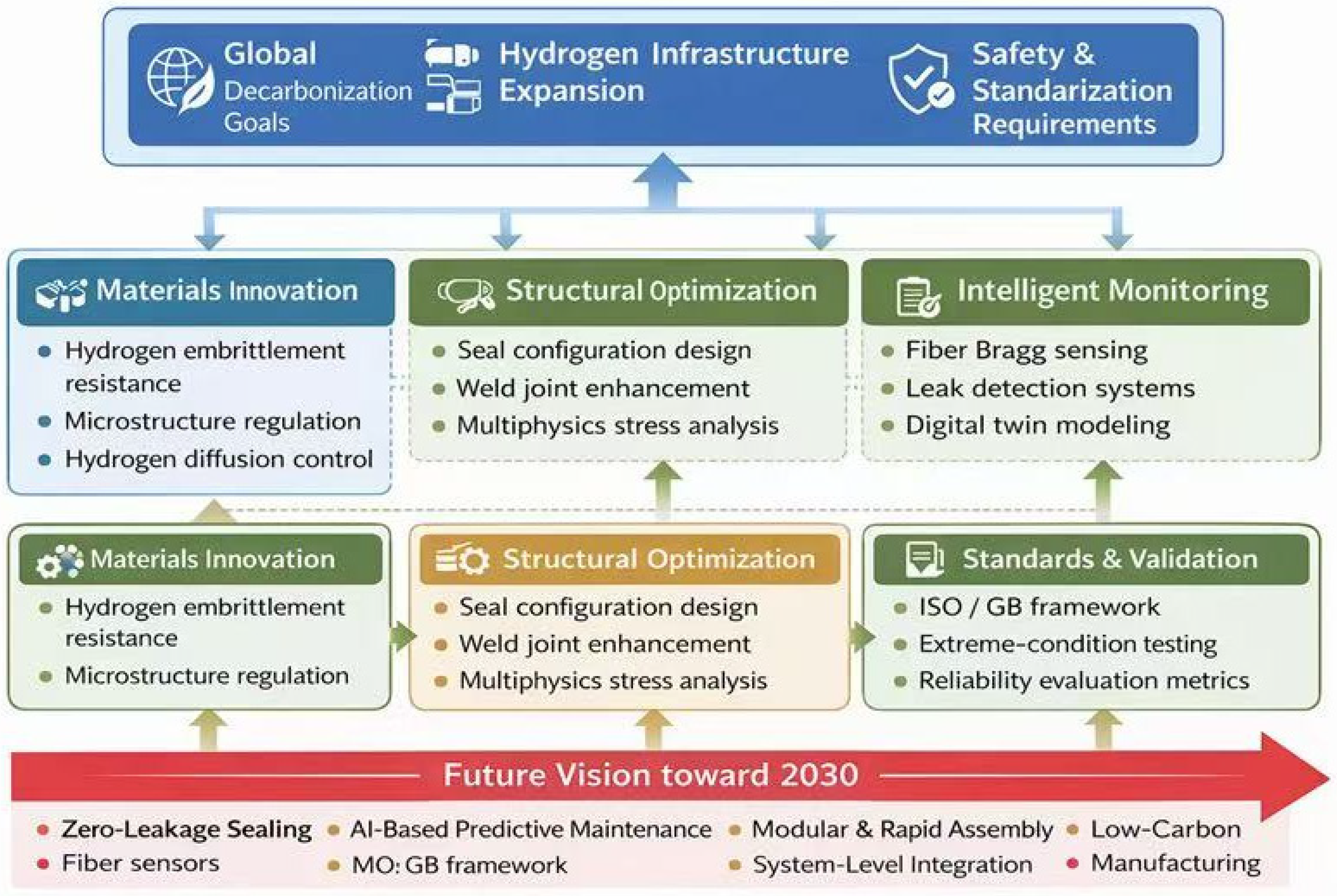
CiteSpace 6.3.R2 and VOSviewer 1.6.20 build upon this foundation to perform advanced, intelligent network construction and clustering analysis. For the clustering analysis presented in this study, CiteSpace 6.3.R2 was configured with the following parameters to ensure robustness and clarity: a time slicing from 2014 to 2025 with 1-year slices, selecting the Top 50 most cited or co-occurring items from each slice. The Pathfinder network scaling algorithm was applied to prune the merged network, simplifying it while preserving its main structural backbone and highlighting the most salient connections between keywords. This approach effectively reduces network density and accentuates the principal research clusters. They focus on: (1) Knowledge map construction and clustering: Building keyword co-occurrence networks and clustering maps to identify research themes with high cohesion, such as hydrogen embrittlement failure mechanisms and seal structure optimization. (2) Temporal evolution analysis: Tracking shifts in research hotspots over time, such as fundamental mechanism exploration from 2014 to 2018, and engineering applications and multi-physics coupling from 2023 to 2025. (3) Core node analysis: Identifying highly cited publications, key countries, institutions, and international collaboration networks among authors. This division of labor enables the research to delve into and visualize knowledge structures while ensuring the statistical accuracy of foundational data, effectively revealing research frontiers and technological evolution pathways in hydrogen pipeline joint technology. The proposed technology roadmap systematically illustrates the evolution of hydrogen pipeline joint research from fundamental exploration to intelligent upgrading (Figure 1).

2.2. Data Collection and Analysis

The literature data were retrieved from the Web of Science Core Collection (WoSCC), selected for its standardized bibliographic format and complete citation indexing suitable for bibliometric analysis. To ensure both retrieval precision and coverage, a structured Boolean search strategy was constructed within the Topic (TS) field (including title, abstract, and author keywords): TS = ((“hydrogen pipeline” OR “hydrogen transport pipeline”) AND (“joint” OR “weld joint” OR “flange” OR “connection”) AND (“hydrogen embrittlement” OR “sealing” OR “leak” OR “failure” OR “monitor”)). The first term group defines the hydrogen transport infrastructure boundary; the second captures structural connection forms; and the third restricts the dataset to hydrogen-related degradation, sealing, reliability, and monitoring issues. This combination ensures thematic consistency with hydrogen pipeline joint performance and excludes unrelated hydrogen production or storage-only studies. Table 1 outlines the specific inclusion and exclusion criteria applied during the literature screening process.
The time span was limited to 2014–2025 to reflect the accelerated development stage of hydrogen infrastructure under global decarbonization policies. Only peer-reviewed articles and review papers were retained. Conference papers, editorials, corrections, and notes were excluded to maintain data quality and citation comparability. The initial retrieval yielded 1247 records. After deduplication and metadata standardization using Python 3.11, 1082 records remained. Manual screening of titles and abstracts was conducted by two independent reviewers according to predefined inclusion criteria requiring explicit relevance to hydrogen pipeline joints under hydrogen service conditions. After screening and full-text sampling verification, 960 publications were retained as the final dataset. The inter-reviewer agreement reached 97.8%, ensuring dataset reliability.
Bibliometric analysis was performed using Python 3.11 for descriptive statistics, VOSviewer 1.6.20 for collaboration and keyword co-occurrence network construction, and CiteSpace 6.3.R2 for co-citation clustering, burst detection, and temporal evolution analysis. CiteSpace 6.3.R2 parameters were set to 1-year time slices, Top 50 items per slice, and Pathfinder pruning. The clustering performance indicators (Modularity Q = 0.8058; Weighted Mean Silhouette = 0.9205) confirm high structural stability and thematic separation. The explicit reporting of search expression, screening protocol, and parameter configuration ensures methodological transparency and reproducibility.
Although other databases such as Scopus, Google Scholar, and IEEE Xplore also index hydrogen-related publications, this study restricts data retrieval to the Web of Science Core Collection (WoSCC) to ensure metadata standardization and citation consistency. WoSCC shows a substantial overlap with Scopus in core peer-reviewed journals within materials and energy research, while Google Scholar includes non-peer-reviewed sources that may introduce citation noise. Although IEEE Xplore provides strong coverage in engineering, its journal overlap with WoSCC in hydrogen pipeline research is considerable. Considering the objectives of bibliometric knowledge mapping and the need for clustering stability, WoSCC is regarded as sufficiently representative for the present study.
It should be noted that although 960 publications were included in the bibliometric dataset, only representative and essential references are cited in the text to support key arguments and methodological explanations. This approach is consistent with standard practice in bibliometric reviews, where the objective is quantitative knowledge mapping rather than exhaustive narrative citation. Concurrently, industry reports and technical standards issued by the International Energy Agencyand national energy departments, along with academic papers from relevant research institutions and universities, are examined to ensure data comprehensiveness and timeliness.
The period 2014–2025 was selected because research on hydrogen pipeline safety and structural reliability began to expand significantly after 2014 in response to global hydrogen economy initiatives. Publications prior to 2014 were limited and dispersed, contributing marginally to large-scale knowledge network formation. The year 2025 represents the most recent complete data year at the time of retrieval, while early 2026 records were incomplete and therefore excluded to avoid statistical bias.

2.3. Citation Analysis and Co-Citation Analysis

Citation analysis and co-citation analysis are core methods in bibliometrics for identifying the knowledge foundation of research fields, classic literature, and the intrinsic structural connections among research themes. By statistically examining citation relationships between documents, these methods reveal academic lineage chains and theoretical dependencies among different research outcomes. Co-citation analysis, meanwhile, constructs knowledge graphs by identifying groups of simultaneously cited documents, thereby reflecting latent research themes, core knowledge communities, and their evolutionary trends within a field. This study employs CiteSpace 6.3.R2 and VOSviewer 1.6.20 to conduct a visualization analysis of the literature related to hydrogen pipeline joints from 2014 to 2025. Through metrics such as citation networks, co-citation clusters, and the emergent literature, it systematically depicts the knowledge structure and research paradigms within this field.
Through citation and co-citation analysis, this study effectively identifies the core theoretical foundations and key technological directions in the field of hydrogen pipeline joints, including hydrogen-induced damage mechanisms, seal structure optimization, weld joint reliability, non-destructive testing techniques, and scenario-based joint design, revealing a significant trend in the evolution of studies from “materials–structure” to “monitoring–intelligentization–system–level reliability” [14]. This study not only identifies current research hotspots and technical bottlenecks but also pinpoints research teams with enduring influence and highly cited literature. It provides credible knowledge foundations and academic support for subsequent sections covering hotspot analysis, technological evolution studies, and future development direction predictions.

3. Results and Discussion

3.1. Research Publication Timeline Trends

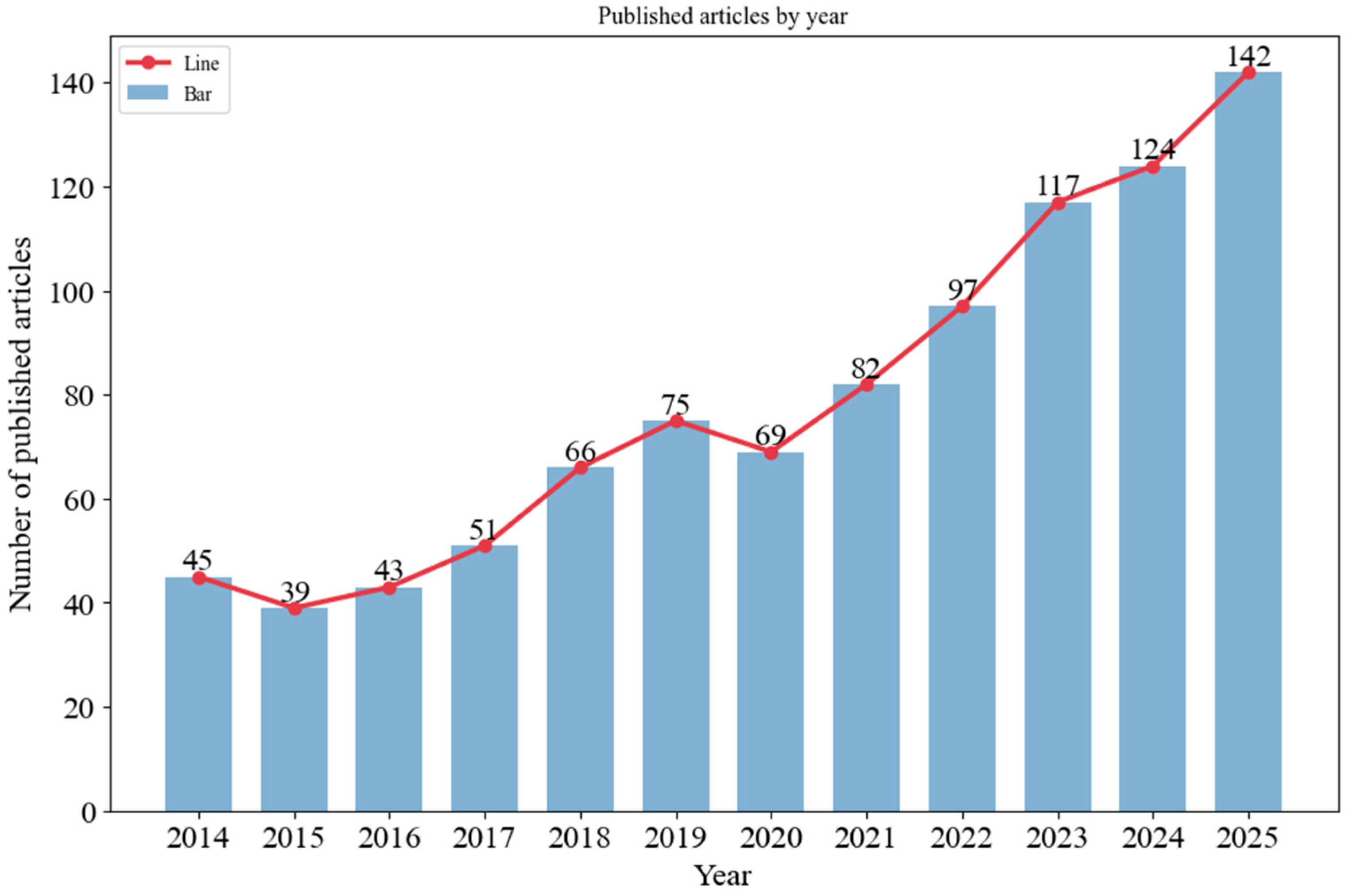
Research on hydrogen pipeline joints has undergone distinct phased progression from 2014 to 2025. From 2014 to 2017, the field remained in an early accumulation phase, with annual publications stabilizing between 40 and 50 articles. During this period, hydrogen energy had not yet achieved large-scale development, and joint research often served as a subsidiary component of hydrogen storage and transportation systems, lacking an independent research framework [15]. As Dwivedi and Vishwakarma noted, “hydrogen embrittlement poses a formidable challenge to diverse materials, involving complex microstructural mechanisms and multiscale effects” [16], laying the theoretical foundation for early research. Research efforts primarily focused on material hydrogen embrittlement characteristics and fundamental sealing structures. Regarding material hydrogen embrittlement studies, Liu and Atrens conducted a systematic review of hydrogen embrittlement effects on medium-strength steels [17]. Zhao et al. performed in-depth investigations into hydrogen permeation and embrittlement sensitivity in X80 welded joints under high-pressure gas environments [18]. Notably, Jebaraj et al.’s investigation of hydrogen diffusion coefficients in Inconel 718 revealed that “microstructure decisively influences hydrogen permeation behavior” [19]. As Yang et al. emphasized, “welding residual stresses act as both mechanical and chemical drivers of hydrogen embrittlement, while heterogeneous microstructures render welded joints the weakest link in pipeline structures” [20]. As shown in Figure 2, the publication timeline reveals three distinct phases: early accumulation (2014–2017), accelerated growth (2018–2021), and explosive expansion (2022–2025).
From 2018 to 2021, the field entered an accelerated growth phase, with publications surging from approximately 65 in 2018 to over 80 in 2021. Global hydrogen energy policies intensified support, exemplified by the EU’s Hydrogen Strategy and China’s Medium-to-Long-Term Plan for Hydrogen Energy Industry Development.
The study demonstrates the interdisciplinary nature of materials–structure–performance and the emerging focus on full-life-cycle studies [21]. Hugo et al. employed a multi-objective optimization approach, comprehensively considering multiple dimensions such as investment costs, environmental impacts, safety, and social impacts, thereby providing a systematic analytical framework for strategic planning of hydrogen infrastructure. Carrera and Azzaro-Pantel developed a dual-objective optimization design method for hydrogen and methane supply chains based on electro-synthesis systems, achieving synergistic optimization of technical performance and economic viability [22].
Since 2022, publications have entered an explosive growth phase, reaching nearly 100 papers in 2022, over 115 in 2023, approximately 125 in 2024, and exceeding 140 in 2025. This trend correlates with the deepening of global “dual carbon” goals and large-scale hydrogen infrastructure construction. The International Energy Agency noted that after 2022, the hydrogen industry shifted from “technology validation” to “engineering implementation” [23]. For instance, in 2023, researchers embedded optical fiber sensors in joints to enable real-time monitoring of leaks and stress concentrations [24]. In 2024, virtual joint models based on digital twin technology were developed to simulate failure pathways under complex operating conditions [25]. Additionally, 2023 saw the design of “low-temperature toughness materials + thermal insulation structures” for hydrogen pipeline joints in cold regions [26]. In 2024, field validation of large-diameter joints in western China’s hydrogen pipeline network demonstrated close alignment between research and engineering needs. The same year saw the proposal of an “ultrasonic + radiographic” composite non-destructive testing solution to meet international standards for hydrogen pipeline joint inspection. In 2025, the European Commission promoted mutual recognition of joint standards across nations, providing support for cross-regional hydrogen pipeline network connectivity.
The number of publications on hydrogen pipeline joints in 2025 indicates that research activity in this field continues to grow (currently exceeding 140 papers). Based on current research trends, future directions will focus on low-carbon and green manufacturing, such as reducing carbon emissions in joint production through recyclable alloys and low-carbon processes [27]; extreme environmental adaptability, such as development of hydrogen pipeline connectors for specialized scenarios such as deep-sea and high-altitude environments (e.g., high-pressure resistance and corrosion-resistant designs) [28]; and intelligent operation and maintenance upgrades, such as development of AI-Based Joint Failure Early Warning and Lifespan Prediction Systems, etc. [29]. In summary, research on hydrogen pipeline joint technology has evolved from early fundamental exploration into a mature, multidisciplinary, and engineering-oriented field. Considering temporal trends and research content evolution, this domain is now at a critical juncture of deep integration between technology, engineering, and industry. As hydrogen energy infrastructure continues to advance, breakthroughs in safety, efficiency, intelligence, and low-carbon solutions are anticipated, providing core technological support for the large-scale application of hydrogen energy.

3.2. Publisher and Journal Publication Statistics Related to Research

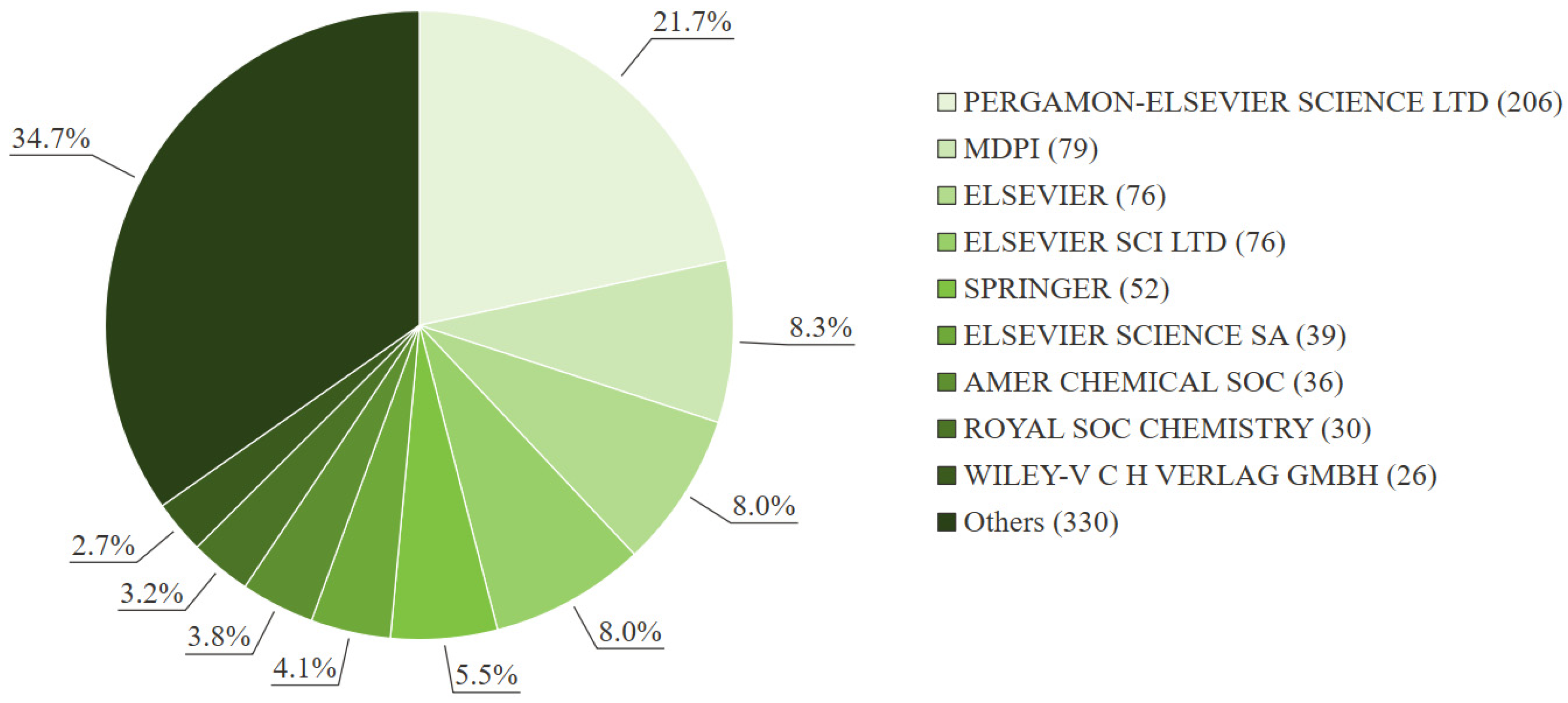
As illustrated in the “Article attribution to publisher statistics” chart, research publications on hydrogen pipeline joints exhibit a distinct pattern of both high concentration and diversity among publishers. International publishing giant Elsevier, leveraging its deep expertise in energy, materials, and engineering, has established a dominant publishing matrix in this field: its subsidiary PERGAMON-ELSEVIER SCIENCE LTD leads with 206 publications, capturing 21.7% market share as the absolute publishing powerhouse; ELSEVIER and ELSEVIERSCILTD each published 76 articles, accounting for 8.3% and 8.0% respectively, further cementing Elsevier’s dominance in specialized segments; ELSEVIERSCIENCESA, with 39 articles accounting for 4.1%, focuses on interdisciplinary research at the intersection of chemical engineering and materials science, providing a specialized publishing channel for chemical compatibility analysis of hydrogen pipeline joints. Figure 3 presents the distribution of publications among major publishers, highlighting Elsevier’s dominant position with its subsidiaries accounting for over 40% of the total output.
Beyond Elsevier, other specialized publishers provide strong complementary contributions: MDPI, a leading open-access publisher, contributes 79 articles accounting for 8.0%, facilitating rapid dissemination of research outcomes in this field; SPRINGER publishes 52 articles accounting for 5.5%, with its journals in mechanical engineering and materials characterization extensively covering joint structural design and performance testing studies; AMERCHEMICALSOC contributes 36 articles accounting for 3.8%, focusing on chemical mechanism studies of joint materials, such as molecular dynamics analysis of hydrogen-induced cracking; ROYALSOCCHEMISTRY, with 30 papers accounting for 3.2%, provides a specialized publication channel for hydrogen corrosion protection research in joints within the corrosion sciencefield; and WILEY-VCHVERLAGGMBH, with 26 papers accounting for 2.7%, publishes industry application studies of hydrogen pipeline joints in engineering standards and specifications journals.
Notably, the “Others” category accounts for 34.7% with 330 papers. This substantial proportion reflects the interdisciplinary nature of hydrogen pipeline joint research—numerous small-to-medium publishers or cross-disciplinary publishing houses, such as industry publishers specializing in oil and gas storage and transportation, or technical journals focused on mechanical manufacturing, participate in the literature dissemination within this field, demonstrating broad coverage of research needs spanning academia to engineering.
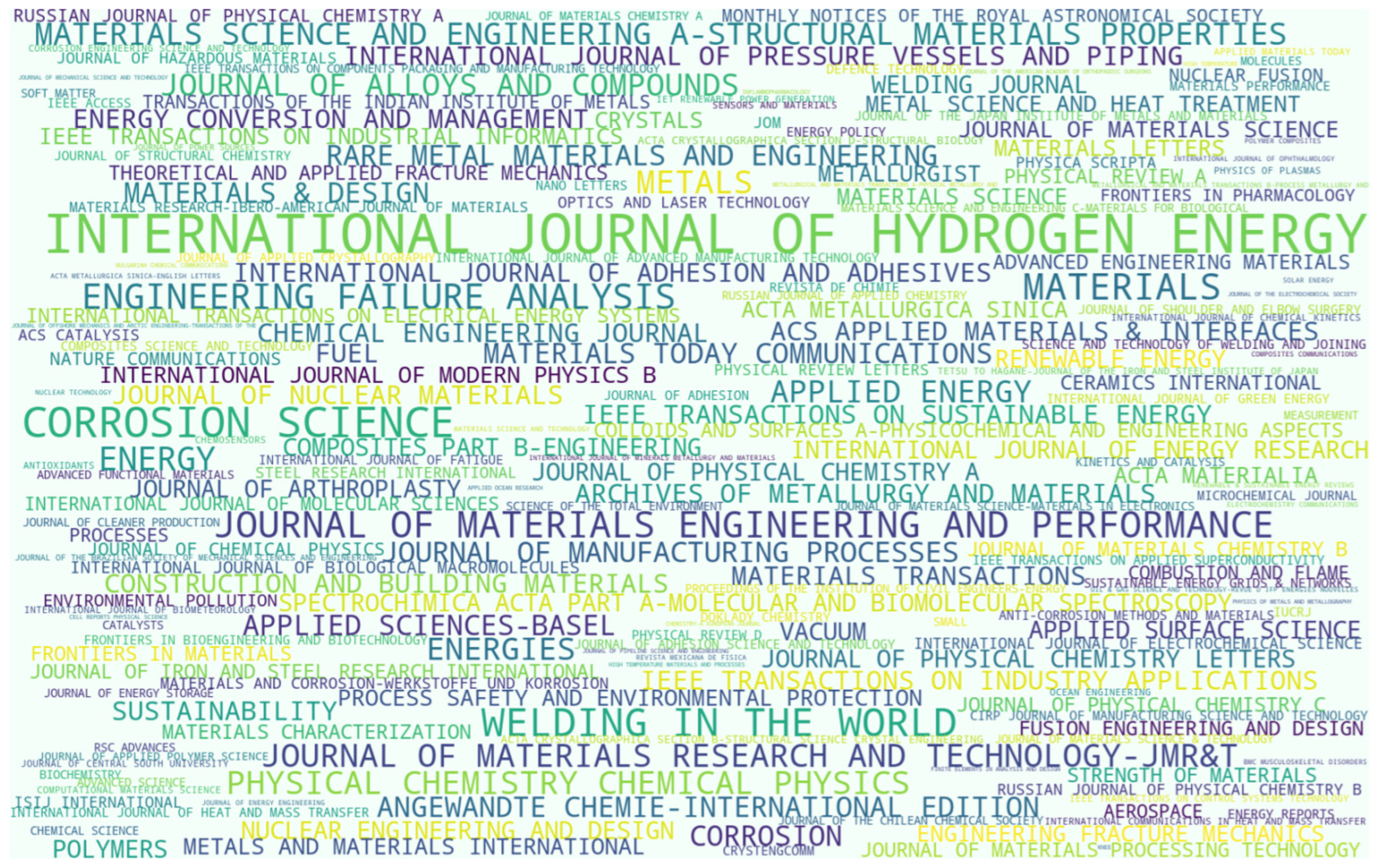
Visualized through journal word clouds, the International Journal of Hydrogen Energy stands out as the undisputed flagship publication in hydrogen pipeline joint research, evidenced by its prominent font size and position within the word cloud. As a top-tier journal in hydrogen energy, it consistently publishes cutting-edge research on joint material development, sealing structure innovations, and failure mechanism analysis. For instance, the 2023 article “High-pressure hydrogen sealing performance of metal-to-metal joints” systematically investigated the sealing reliability of metal-to-metal joints under 70 MPa hydrogen environments [30]. With over 50 citations, it has become a benchmark publication in the field. The journal word cloud in Figure 4 visually demonstrates that the International Journal of Hydrogen Energy serves as the undisputed flagship publication in this research domain.
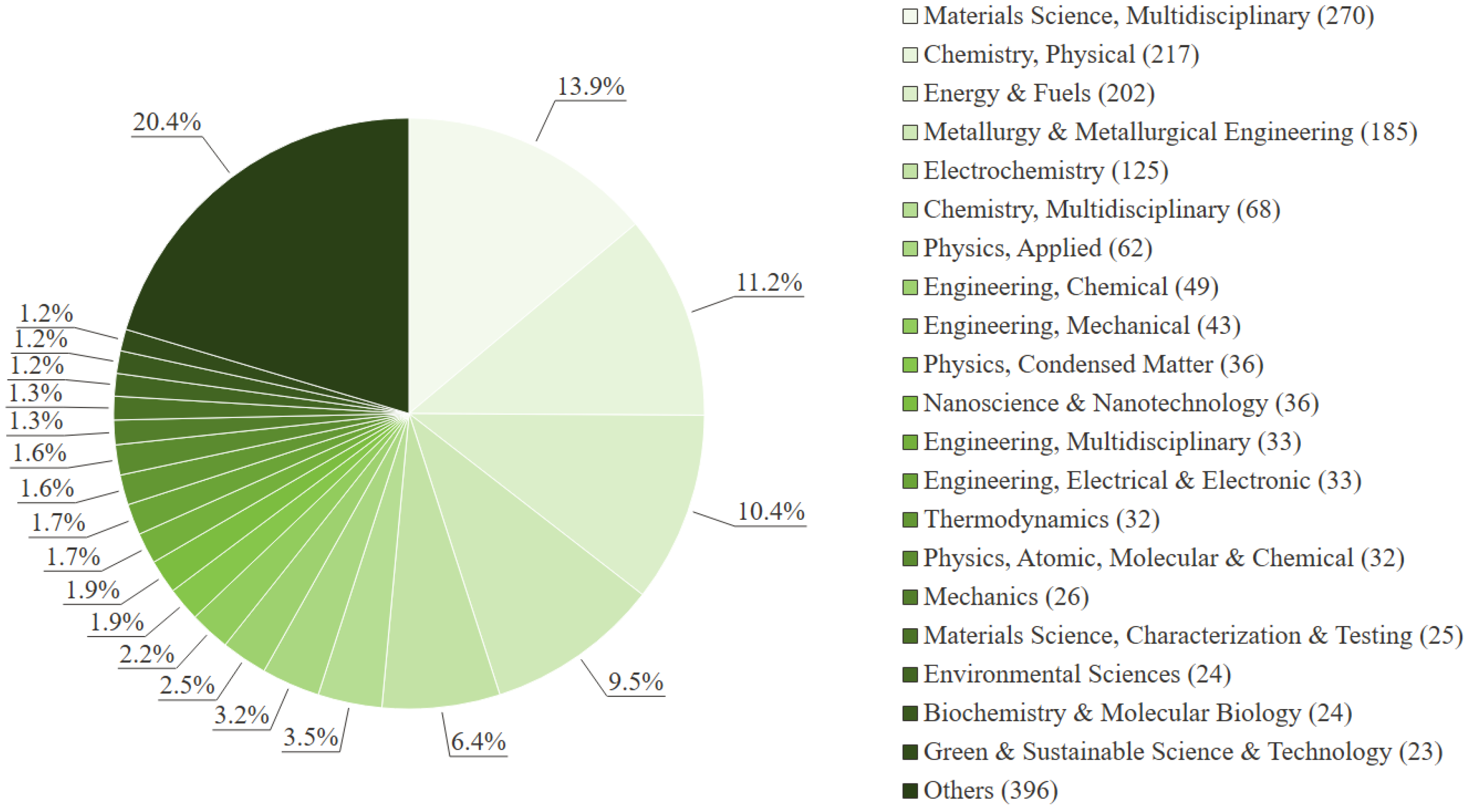
Beyond flagship journals, the prominent position of Journal of Materials Chemistry A in the word cloud reflects its significance in joint material design, such as the development of hydrogen embrittlement-resistant alloys. Corrosion Science focuses on hydrogen corrosion and protection technologies for joints; its 2022 article “Hydrogen-induced stress corrosion cracking of pipeline girth welds” provides an in-depth analysis of hydrogen-induced stress corrosion cracking mechanisms in girth welds, offering theoretical foundations for optimizing field welding processes. Engineering Failure Analysis contains numerous joint failure case studies, providing direct references for joint quality control in engineering practice, such as the 2024 paper “Failure investigation of a hydrogen pipeline compression fitting” [31]. According to Figure 5, Materials Science, Multidisciplinary leads the discipline classification with 13.9% of total publications, underscoring the centrality of material innovation in joint technology development.
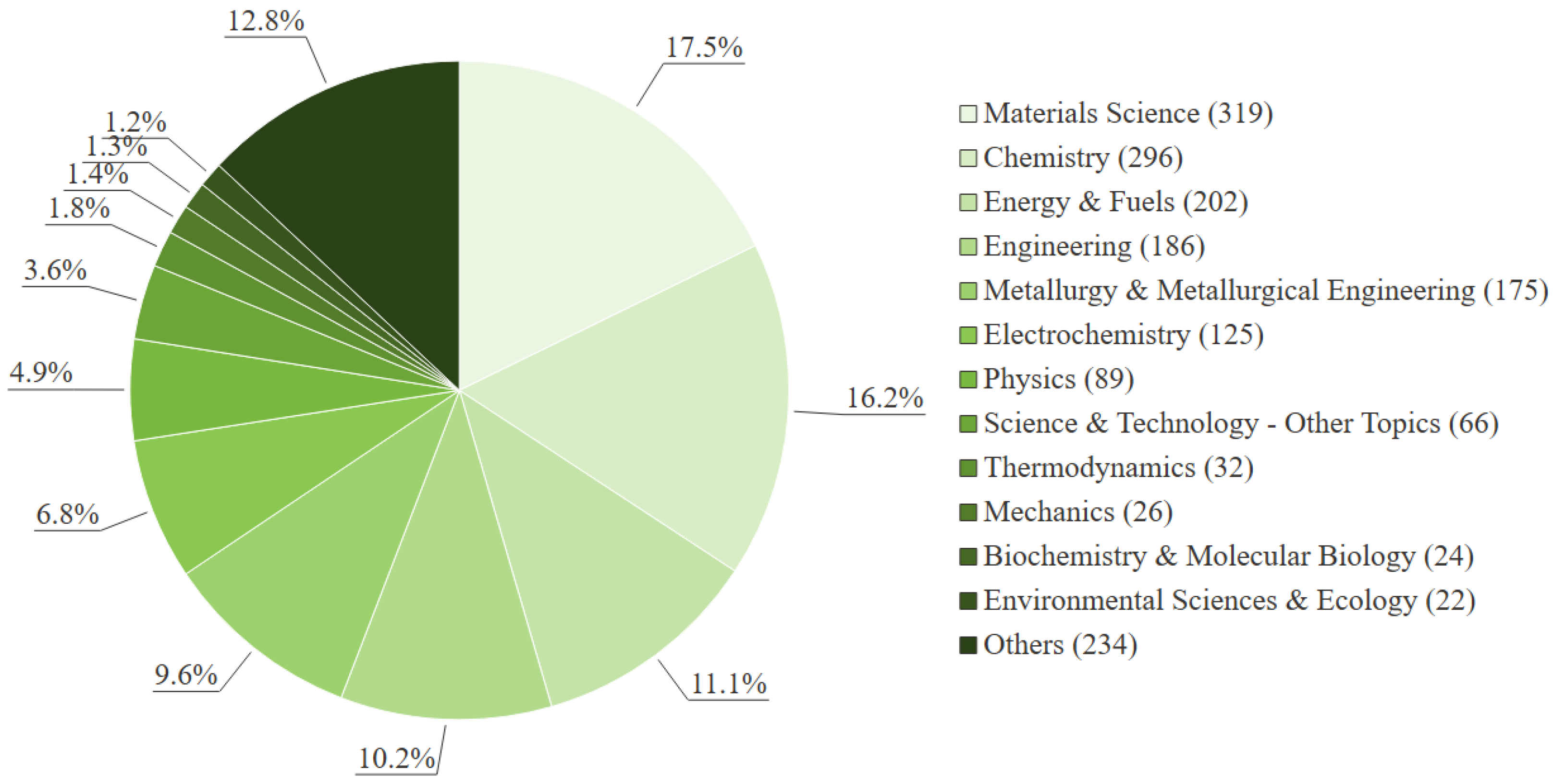
Cross-analysis of the “Statistics by discipline” and “Research field statistics” charts reveals that hydrogen pipeline joint research exhibits typical multidisciplinary characteristics: Materials Science, Multidisciplinary leads with 270 articles accounting for 13.9% in the discipline statistics and 319 articles accounting for 17.5% in the research field statistics, directly addressing the core requirement for hydrogen pipeline joints: developing materials that combine high strength, high sealing performance, and resistance to hydrogen embrittlement. For instance, the 2023 Acta Materialia paper “Microstructural control for hydrogen embrittlement resistance in pipeline steels” enhances hydrogen embrittlement resistance in joint steels through microstructural regulation, garnering over 30 citations [32]. Figure 6 further corroborates the multidisciplinary nature of this field, with Chemistry, Physical and Energy & Fuels ranking as the second and third most prominent research areas, respectively.
Chemistry, Physical follows closely with 217 papers accounting for 11.2% by discipline and 296 papers representing 16.2% by research field, highlighting that the chemical interactions between hydrogen and material interfaces constitute key scientific issues for understanding joint failures, such as hydrogen adsorption, permeation, and chemical reactions. The 2022 Journal of Physical Chemistry C article “Surface chemistry of hydrogen interaction with pipeline coatings” reveals the surface reaction mechanisms between joint coatings and hydrogen, providing chemical theoretical support for coating protection technologies [33]. Energy and Fuels ranks third with 202 papers accounting for 10.4% of total publications in the discipline and 202 papers accounting for 11.1% of total publications in the research field, reflecting the significant value of engineering application research on hydrogen pipeline joints as critical components of energy transportation systems (e.g., pressure loss and life prediction for long-distance hydrogen pipeline joints). Fuel’s 2024 article “Techno-economic analysis of hydrogen pipeline joints for large-scale transport” compares the application prospects of different joint configurations from an economic perspective [34]. Metallurgy and Metallurgical Engineering stands out with 185 papers accounting for 9.5% by discipline and 175 papers accounting for 10.2% by research field, indicating that metallurgical processes are core technical elements determining joint performance (e.g., welding, heat treatment, forging). The 2023 paper “Welding Metallurgy of High-Strength Pipeline Steels for Hydrogen Service” in Metallurgical and Materials Transactions A details the welding metallurgy principles for high-strength steel joints [35]. Electrochemistry, with 125 papers accounting for 6.4% by discipline and 125 papers accounting for 6.8% by research field, demonstrates technological extensions in related areas such as hydrogen fuel cell supply systems and pipelines for electrochemical hydrogen production. For example, the 2022 paper “Electrochemical hydrogen permeation through pipeline joint seals” in the Journal of The Electrochemical Society investigates the electrochemical hydrogen permeation behavior of sealing materials [36].
Additionally, disciplines such as physics, chemical engineering, and mechanical engineering are represented in varying proportions, further validating that hydrogen pipeline joint research requires an integrated multidimensional technical system encompassing “material design–chemical mechanisms–mechanical design–engineering applications.” [37].
Based on the above analysis, the literature characteristics of hydrogen pipeline joint research provide clear insights for academic exploration and engineering practice in this field: At the publication and literature retrieval level, researchers should prioritize Elsevier’s specialized journal matrix, such as the International Journal of Hydrogen Energy and Journal of Materials Chemistry A, and niche journals from publishers like Springer and ACS. Concurrently, the engineering application literature from industry publishers categorized under “Others” should be considered to achieve comprehensive coverage from fundamental research to engineering practice. At the interdisciplinary research level, fundamental studies in materials science and chemistry must be strengthened, such as developing first-principles-based hydrogen embrittlement prediction models for joint materials, referring to the 2023 theoretical research in Physical Review Materials. Concurrently, performance validation of joints under long-distance, high-pressure hydrogen transport scenarios should be conducted based on energy engineering requirements, referring to engineering case studies in the Journal of Pipeline Science and Engineering. Regarding technological breakthroughs, future efforts should focus on three key areas: first, developing novel hydrogen embrittlement-resistant materials, such as high-entropy alloys and intermetallic compounds for joint applications [38]; second, innovating intelligent sealing technologies by integrating sensors with adaptive materials to enable real-time monitoring and regulation of joint seals; third, deepening digital design and simulation by utilizing machine learning and finite element methods to optimize joint structures and manufacturing processes. These directions represent areas with growth potential in the current literature and align with the urgent demand for efficient, safe hydrogen transportation technologies under the dual carbon goals.

3.3. Research Hotspot Analysis

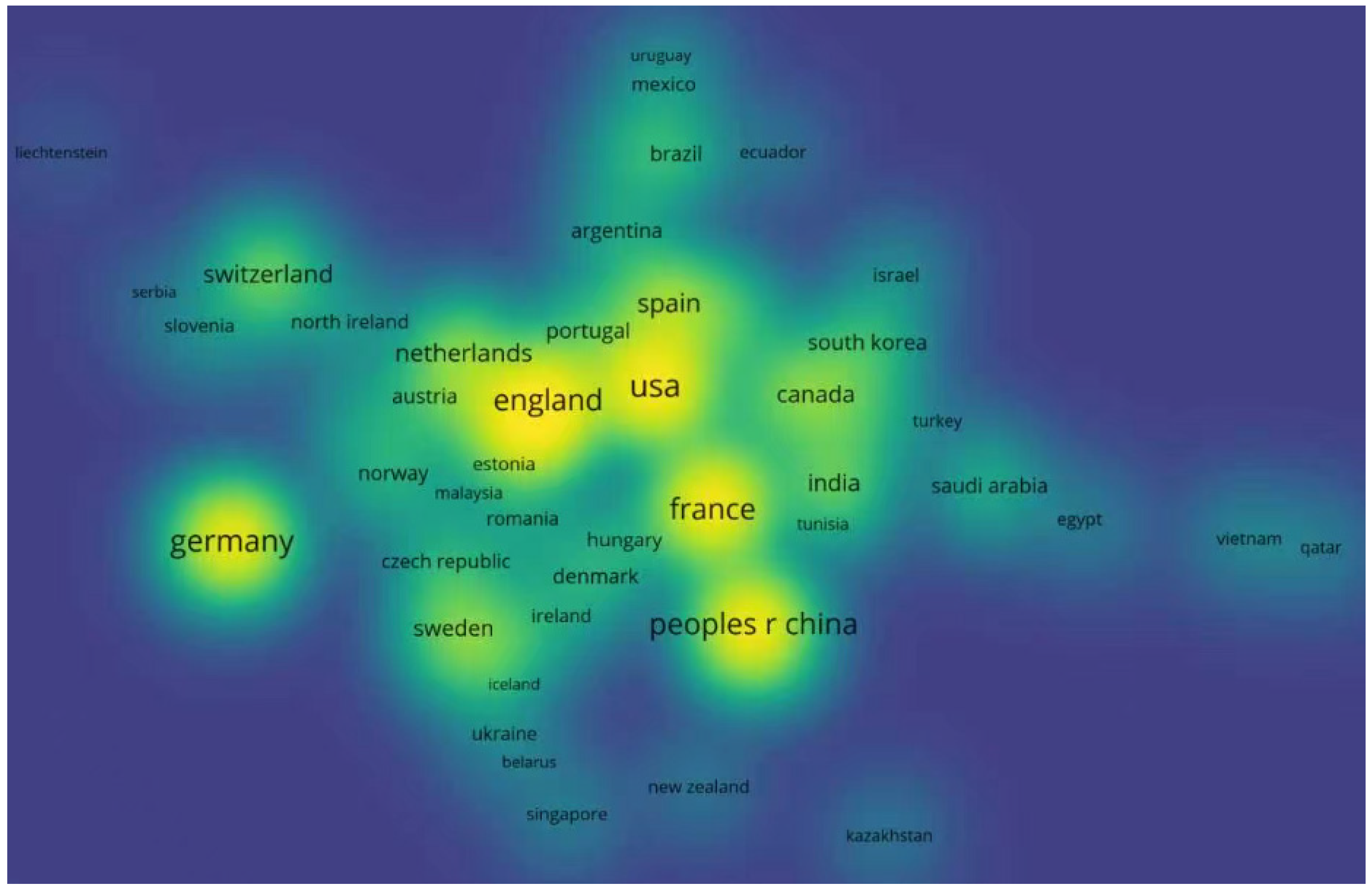
Figure 7 presents a two-dimensional map of “academic output–collaboration density” for major countries in the hydrogen pipeline joint research field from 2014 to 2025. Node size corresponds to the number of publications from each country (or region), while node color ranges from blue to red, reflecting the intensity of transnational collaboration (deeper red indicates a higher proportion of co-authored papers with other nations). China, the United States, and Germany feature the largest nodes in deep red, indicating not only leading overall output but also deep integration into international collaboration networks. Japan, the United Kingdom, Canada, France, and Australia occupy mid-range positions with reddish hues, reflecting a “high-quality, strong-collaboration” profile. Smaller nodes in orange–red represent regionally active clusters, such as South Korea, Italy, the Netherlands, and Spain. Additionally, nodes for Latin American nations like Uruguay, Mexico, Brazil, and Argentina, along with Middle Eastern countries such as Saudi Arabia, Qatar, and Egypt, are the smallest yet they have moved beyond the cool-color spectrum, signaling emerging collaboration hotspots. The overall pattern forms a high-density belt spanning “Asia-Pacific–North America–Western Europe,” closely aligning with global hydrogen infrastructure planning. This visually confirms the spatial clustering of hydrogen pipeline joint research driven by the integrated policy–industry–research ecosystem. The country collaboration density map in Figure 7 reveals a high-density research belt spanning Asia-Pacific, North America, and Western Europe, closely aligned with global hydrogen infrastructure planning.
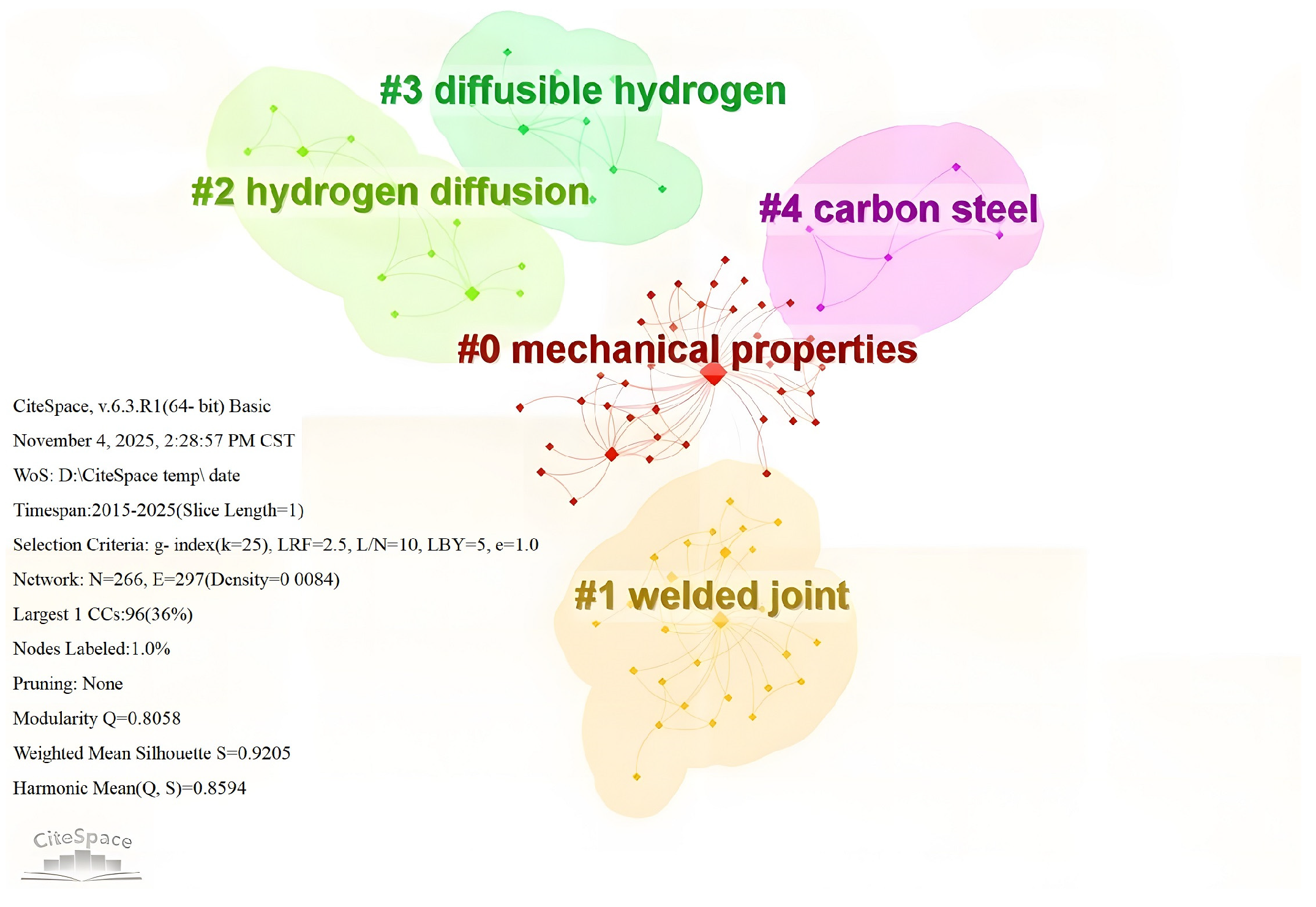
Clustering hotspots in the literature records using CiteSpace 6.3.R2 yielded Figure 8. As detailed in the methodology (Section 2.2), the clustering process was guided by robust quality metrics. The Modularity Q-value reaches 0.8058, while the Weighted Mean Silhouette S-value achieves 0.9205. These metrics are key indicators for evaluating clustering quality. Modularity Q-value serves as a core metric for assessing the quality of network community structure division, with its numerical value directly reflecting the clarity of thematic clustering. Generally, a Q-value exceeding 0.3 indicates a well-defined community structure. The exceptionally high Q-value of 0.8058 in this study demonstrates highly pronounced clustering characteristics within the keyword network—research themes exhibit strong internal cohesion while maintaining sparse cross-connections between distinct clusters. The S-value of 0.9205, very close to the maximum of 1, further validates the excellence of this clustering, meaning the keywords within each identified hotspot are highly similar and conceptually coherent. This confirms CiteSpace 6.3.R2’s successful identification and delineation of multiple research domains with clear boundaries and independent conceptual content, which are discussed in detail below. Figure 8 presents the keyword clustering results obtained from CiteSpace 6.3.R2, with a Modularity Q-value of 0.8058 and a Weighted Mean Silhouette S-value of 0.9205, indicating highly coherent and well-separated research themes.
The Weighted Mean Silhouette S-value further validates clustering effectiveness through cohesion and dissimilarity dimensions. Ranging from −1 to 1, values closer to 1 indicate superior clustering quality, which means that the similarity of keywords in the same cluster is high, and the difference in keywords between different clusters is significant. The S-value of 0.9205 achieved in this study represents an exceptionally high level, robustly confirming that all keywords are accurately assigned to their corresponding clusters. The clustering results demonstrate high reliability and stability, laying a solid foundation for in-depth analysis of research hotspots in the field of hydrogen pipeline joints. Research on hydrogen pipeline joints has crystallized into five core hotspots, each supported by retrievable authoritative literature and highly aligned with industrial practical needs.

3.3.1. Hydrogen-Induced Damage Mechanisms and Material Optimization

This foundational core (32% of the literature) addresses HE and hydrogen permeation. Research establishes 3D finite element models for metal joints, finding that precise bolt preload control prevents gasket deformation [39]. Comparative studies of welding processes show that GTAW + SMAW yields superior HE resistance due to fine-grained microstructures [40]. Long-term studies confirm that conventional pipeline steels used for hydrogen transport suffer significant toughness reduction, providing an experimental basis for repurposing existing pipelines [41].

3.3.2. Seal Structure Design and Performance Optimization

Addressing hydrogen leakage as the core risk accounting for 60% of joint failures, research focuses on innovative sealing surfaces and seal compatibility.
A Chinese team proposed a “hot-melt butt welding-labyrinth seal” composite structure for RTP hydrogen pipelines. By optimizing the heating temperature at 180–200 °C and pressure at 0.8–1.2 MPa, the joint sealing surface melt width is controlled at 5–8 mm. Combined with a labyrinth seal groove design, this achieves a leakage rate as low as 3 × 10⁻³ Pa·m3 at 10 MPa hydrogen pressure, representing a two-order-of-magnitude improvement over conventional hot-melt butt welding. This method has been incorporated into China’s Enhanced Thermoplastic Hydrogen Pipeline Connection Technical Specifications [42].
CNOOC Gas & Power Group proposed the “Socket-Type Flexible Hydrogen Transfer Hose Joint” technical solution. This innovation integrates a sealing system with a leak monitoring unit. Through the close cooperation of wedge components and the sealing system, combined with the tightening effect of reinforced clamps on the overall structure, it achieves multi-layered sealing protection under ±5 mm axial displacement and marine salt spray environments. Simultaneously, an integrated resistance monitoring system provides real-time leak detection. Experimental validation confirms a leakage rate below 1 × 10⁻¹¹ Pa·m3/s at 35 MPa hydrogen pressure, with a detection response time under 0.5 s. This solution demonstrates broad applicability for both onshore and offshore flexible hydrogen pipeline scenarios.

3.3.3. Dynamic Operating Condition Reliability and Life Prediction

Dynamic scenarios, such as vehicle-mounted, offshore hydrogen transport, drive development in this area, accounting for 18% of research. The core focus is on establishing multi-factor coupled life models [43].
China University of Petroleum (Beijing) constructed a three-dimensional welding model for X80 steel hydrogen pipeline ring welds using sequential indirect coupling methods to simulate the interaction between temperature fields, stress fields, and hydrogen diffusion. The study reveals that the transition zone between the second and third weld passes exhibits stress concentration with maximum residual stress reaching 380 MPa and serves as a core hydrogen accumulation region, where hydrogen concentration is 2.3 times higher than in the base metal. By optimizing welding parameters, increasing filler wire energy by 15% and reducing cover pass energy by 10%, hydrogen accumulation in this zone can be reduced by 40%, extending joint fatigue life by 50%. This model achieves less than 9% prediction error for welded joint life under dynamic conditions and has been applied to formulate maintenance plans for the trial section of the China–Russia Eastern Route hydrogen pipeline [44].
In journal research, the Northwestern Polytechnical University team focus on common sealing materials for hydrogen energy equipment. Based on accelerated aging test data, they propose a unified performance degradation trajectory model optimized for time scale. This confirms that sealing material degradation rates follow the Arrhenius exponential law. By extrapolating room-temperature lifetimes from high-temperature degradation data, they find that sealing rubber exhibits significantly higher absolute activation energy than grease, and superior aging resistance. This method has been applied to assess the service life of PTFE-sealed joints in liquid hydrogen pipelines, calculating a theoretical seal lifespan of 8 years at −253 °C [45].

3.3.4. Non-Destructive Testing and Health Monitoring

This emerging field is driven by full-lifecycle safety management requirements, with mainstream technologies focusing on precise identification of hydrogen-induced defects. Norwegian University proposed a “combined ultrasonic guided wave-infrared thermal imaging technique”. This method inspected X80 steel joints containing hydrogen-induced microcracks with a minimum size of 0.05 mm. By utilizing 50 kHz low-frequency guide wave excitation combined with infrared thermal imaging temperature field analysis, a threefold improvement in detection efficiency is achieved compared to standalone ultrasonic testing, with a false negative rate below 2%. This technology has been applied in Norway’s North Sea offshore hydrogen pipeline project [46].
Zhejiang University in China developed fiber-optic grating integrated joints. By embedding sensors within the joint sealing layer, they achieved real-time monitoring of a hydrogen concentration range of 0–1000 ppm, accuracy of ±3 ppm, and a temperature range of −50 °C to 100 °C, accurate to ±0.5 °C. Data was transmitted via 5G modules to a cloud platform, enabling 24/7 online early warning in Shanghai Lingang’s hydrogen pipeline network. After 18 months of operation, no false alarms have been recorded [47].

3.3.5. Application Scenario Adaptability Design

Scenario segmentation shows a significant trend, accounting for 10% of applications, with research demonstrating site and pressure adaptation characteristics.
Researchers from China National Offshore Oil Corporation (CNOOC) proposed an ion liquid–epoxy composite coating modification for hydrogen-carrying pipelines. By selecting ion liquid components with high CH4/H2 solubility ratios, they enhanced competitive adsorption of CH4 over H2 on steel surfaces. Experimental validation showed that at 20% hydrogen blending and a H2 partial pressure of 5 MPa, the modified joint exhibited a hydrogen embrittlement coefficient below 25%, representing a reduction of over 32% compared to untreated joints. The modification cost is only 60% of replacing the joint with a new one. This technology has been applied in natural gas hydrogen-blended demonstration pipeline networks [48].
The table lists the top 16 most cited references in this dataset. These highly cited studies indicate a research trend in hydrogen pipeline joints shifting from theoretical modeling toward practical deployment. Key research hotspots include hydrogen-induced damage mechanisms and material optimization, seal structure design and performance enhancement, reliability and life prediction under dynamic conditions, and non-destructive testing techniques and health monitoring. Simultaneously, with the scaled application of end-use scenarios such as vehicle-mounted systems, urban pipeline networks, and offshore hydrogen transport, the scenario adaptability and dynamic flexibility design of joints are gaining increasing attention. As the core connecting components of hydrogen energy delivery systems, hydrogen pipeline joints not only fulfill the fundamental function of sealing and leak prevention but are also progressively becoming key hubs for balancing system pressure fluctuations and suppressing hydrogen-induced damage. Their technological maturity directly impacts the safe and efficient operation of the hydrogen energy industry chain [49]. Overall, research on hydrogen pipeline joints is continuously advancing toward the direction of “scenario adaptation–intelligent reliability–material innovation.” Table 2 lists the top 20 most cited publications in the field of hydrogen pipeline joints from 2014 to 2025, highlighting the foundational studies that have shaped current research directions.

3.4. Analysis of Research Evolution Trends

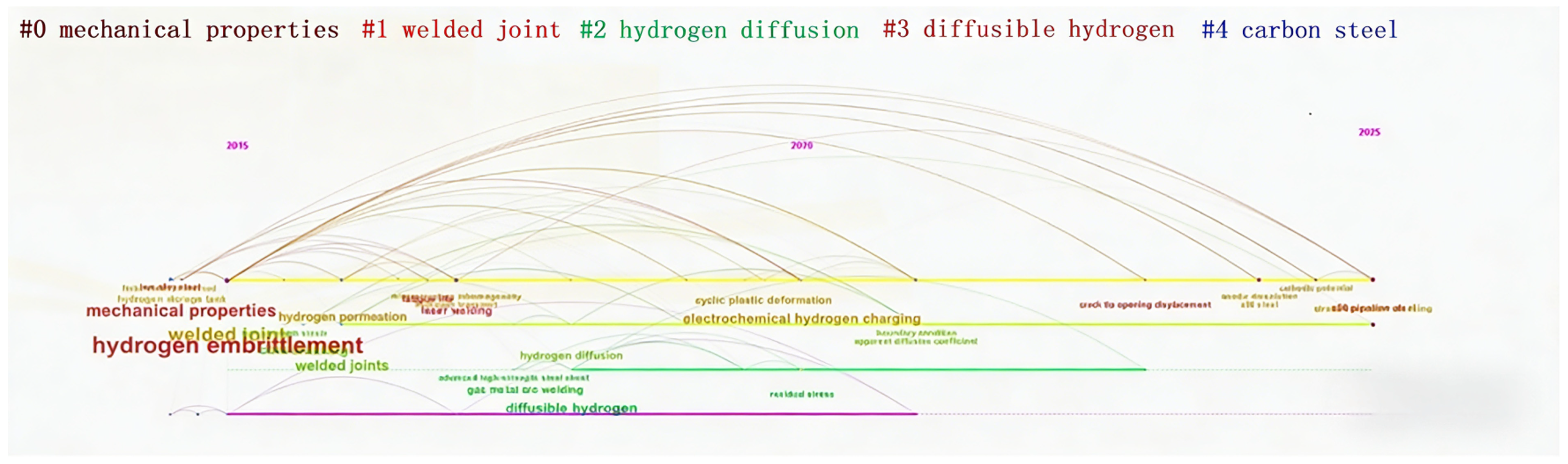
The evolution of hydrogen pipeline joint research is deeply intertwined with technological iterations, policy directions, and advances in materials science within the hydrogen energy industry. Based on a bibliometric analysis of the Web of Science database (2015–2025), four distinct phases can be clearly delineated: “Fundamental Exploration,” “Problem Focus,” “Technology Convergence,” and “Intelligent Upgrading.” Each phase exhibits a progressive progression in research priorities and core achievements. The temporal evolution of research hotspots from 2014 to 2025 is visualized in Figure 9, clearly delineating the four developmental phases: fundamental mechanism exploration, process optimization, engineering application, and intelligent upgrading.

3.4.1. Fundamental Mechanism Exploration Phase (2014–2018)

This phase focused on fundamental HE mechanisms and compatibility with conventional materials. Researchers studied materials like X80 steel, revealing that the heat-affected zone in welded joints exhibits significantly higher HE sensitivity than the base metal due to its coarse-grained structure [64]. Electrochemical hydrogen loading quantified that the apparent diffusion coefficient of hydrogen in 316 L stainless steel increases with stress [65]. Research outcomes from this phase laid the theoretical foundation for subsequent process optimization.

3.4.2. Process Optimization and Technological Breakthrough Phase (2019–2022)

As industry demands increased, research shifted to welding process innovation and hydrogen diffusion control. Laser welding emerged as a key technology for reducing hydrogen-induced cracking risks due to grain refinement [66]. Friction stir welding gained attention as a solid-state process that avoids fusion welding issues [67]. Optimized welding processes combining low-hydrogen electrodes with pre/post-heating reduced residual stresses in X80 steel joints by 25% [68]. Keywords like “hydrogen embrittlement,” “material modification,” and “finite element simulation” saw significant growth.

3.4.3. Engineering and Multiphysics Coupling Phase (2023–2025)

This phase exhibits engineering-oriented and multidisciplinary characteristics, focusing on joint reliability in real-world scenarios. Research integrates crack tip opening displacement (CTOD) testing with anodic dissolution to precisely identify crack propagation pathways [69]. It evolves toward multi-physics coupling, integrating hydrogen diffusion, cyclic plastic deformation, and electrochemical corrosion to establish comprehensive failure models. As pipelines advance toward higher pressures, research on high-strength steel welded joints (e.g., X100) and intelligent monitoring technologies has emerged as new focal points.
From a technological integration perspective, hydrogen pipeline joints will evolve toward comprehensive system integration encompassing “materials-structure-monitoring-operation and maintenance.” On one hand, the integration of novel hydrogen-resistant materials, such as titanium-aluminum alloys and metal matrix composites, with topologically optimized structural designs will achieve synergistic improvements in joint light weighting and hydrogen embrittlement resistance [70]. On the other hand, the deep integration of intelligent monitoring technologies, such as hydrogen-sensitive sensor arrays and wireless passive RFID systems, with digital twin technology will establish a digital management system covering the entire joint lifecycle, enabling intelligent decision-making from design and manufacturing to operation and maintenance [71].
Future research will be driven by policy initiatives and system integration. Policy-guided standardization (e.g., ISO, GB standards) will accelerate industrialization. Technologically, joints will evolve toward system integration encompassing “materials–structure–monitoring–operation and maintenance.” This includes novel HE-resistant materials, intelligent monitoring with digital twins, and deep coupling with other system components like compressors and storage tanks.

3.5. Research Outlook

Aiming for the full commercialization of hydrogen’s “production–storage–transportation–consumption” chain beyond 2030, hydrogen pipeline joints will continue to evolve under the compound demands of higher pressures, larger diameters, lower temperatures, and more complex environments. Future research should focus on the following directions:
(1)
Multiscale Hydrogen Damage Coupling Mechanisms and Hydrogen-Resistant Design
Combining high-resolution EBSD, in situ neutron diffraction, and molecular dynamics simulations to deeply elucidate the dynamic occupation–deposition behavior of hydrogen atoms at grain boundaries, phase boundaries, and microcrack tips, establishing quantitative relationships between “composition–process–microstructure–hydrogen embrittlement sensitivity.” [72].
(2)
Zero-Leakage Sealing Structures and Self-Sealing Connections
For high-pressure differential, thermal cycling, and micro-vibration coupled conditions, explore self-compensating composite seal configurations such as double-tapered surfaces, C-ring + O-ring series arrangements, and shape memory alloy self-tightening mechanisms to achieve stable, controllable nanoliter/hour-level leakage rates over 104 cycles [73].
(3)
Smart Joints and Digital Twin Operations and Maintenance
Integrate micro-nano hydrogen sensing, acoustic emission-fiber Bragg grating multi-mode perception, and ultra-low-power wireless transmission technologies to develop an integrated “sensing–assessment–early warning” chip embeddable within joint bodies. Simultaneously, construct a digital twin driven by a hybrid physical–data approach [74] to enable real-time prediction of a joint’s remaining life, leakage risk, and maintenance windows, supporting the transition from “scheduled maintenance” to “condition-based maintenance.”
(4)
Extreme Scenario Resilience Verification and Standard Upgrades
Establish an extreme service testing platform covering temperatures from −50 °C to 150 °C, pressure cycles from 0 to 120 MPa, and combined external loads involving tension, compression, bending, and torsion. Develop multi-disaster coupling test methods integrating fire exposure, seismic events, and impact to comprehensively evaluate joint performance stability under extreme conditions [75]. Simultaneously, drive dynamic revisions to ISO, GB, ASME, and other standards concerning joint materials, design factors, testing procedures, and certification protocols. This will establish a flexible standard system aligned with the pace of hydrogen infrastructure development. The Technical White Paper on Hydrogen Transmission Pipelines issued by China National Petroleum Corporation provides practical guidance for standardization. Future efforts should further enhance international standard coordination and unification to facilitate cross-regional and transnational hydrogen transportation [76].
(5)
Rapid Assembly/Disassembly and Modular Construction Technologies
For remote scenarios such as offshore wind-to-hydrogen production and desert solar-to-hydrogen transmission, develop welding-free technologies including crimp-and-sleeve composite connections, cryogenic induction heating for disassembly, and robotic automated tightening processes. This enables “plug-and-play” modular installation, reducing on-site construction complexity and overall costs. Advancements in this technical direction can leverage existing pipeline connection technologies while innovating and optimizing for the unique requirements of hydrogen transportation, providing robust support for the rapid deployment of hydrogen projects in remote areas [77].
(6)
Carbon Footprint–Economic Synergy Optimization
Incorporating the full lifecycle carbon emissions and costs of joint manufacturing, surface treatment, transportation, installation, and decommissioning into a multi-objective optimization framework, this research explores the application potential of green metallurgy, additive manufacturing, and remanufacturing technologies in joint bodies and sealing components. Against the backdrop of global carbon neutrality and carbon peaking goals, this research direction holds significant importance. It aims to provide a “safety–low carbon–economy” triadic balanced ultimate solution for hydrogen transportation, driving the sustainable development of the hydrogen energy industry [78].
In summary, hydrogen pipeline joint research will continue to deepen along a four-dimensional, parallel path of “materials–structure–intelligence–standards.” Future efforts must further strengthen multidisciplinary integration and international collaboration to overcome key technical challenges and refine the standards system. This will provide core technological support for the large-scale, long-life, low-cost deployment of global hydrogen pipeline networks, enabling hydrogen to play a greater role in the global energy transition.

4. Conclusions

Hydrogen pipeline joints are the critical “last mile” component for large-scale hydrogen transportation, directly determining the operational reliability of the entire pipeline network. Research has expanded from early material compatibility verification to encompass multiple dimensions, including multi-physics coupled damage, intelligent micro-leakage monitoring, rapid assembly processes, and standard system development.
The field has established a comprehensive research paradigm encompassing “materials–structure–process–evaluation.” Materials research centers on HE mechanisms and microstructural design. Structure-wise, synergistic optimization of static and dynamic sealing is pursued for configurations like metal-to-metal and self-sealing joints. Process-wise, surface modification techniques are explored for their effects in suppressing hydrogen permeation and enhancing fatigue life. For evaluation, an integrity metric system encompassing slow-strain-rate tensile testing, high-pressure hydrogen cyclic fatigue, and multi-disaster coupling tests has been established.
Research methodologies exhibit deep multidisciplinary integration, incorporating fracture mechanics, molecular dynamics, and reliability theory, enabling a paradigm shift from “empirical trial-and-error” to “quantitative design.” International standards organizations have released specialized specifications, accelerating the translation of research into engineering applications.
Nevertheless, existing research exhibits several limitations. Most of the literature focuses on steady-state performance, with fragmented studies on complex service scenarios like transient depressurization or extreme temperature cycling. Intelligent sensing and digital twin technologies for joints remain in the proof-of-concept stage, yet to mature into scalable commercial solutions. Overall, hydrogen pipeline joint research is transitioning from isolated technological breakthroughs to integrated system validation, providing essential foundations for constructing long-distance, highly reliable hydrogen transportation networks.

Author Contributions

Conceptualization, S.H., X.M., Y.Z., M.Z., C.L. and B.H.; methodology, S.H., X.M., Y.Z., J.L., Y.W., C.L. and B.H.; software, S.H., Y.Z., J.L., C.L. and B.H.; validation, S.H., Y.Z., M.Z., J.L., C.L. and B.H.; formal analysis, B.H.; investigation, X.M., Y.Z., M.Z., J.L., Y.W. and B.H.; resources, B.H.; data curation, S.H., X.M., C.L. and B.H.; writing—original draft preparation, S.H., X.M., M.Z., C.L. and B.H.; writing—review and editing, Y.W.; visualization, M.Z. and B.H. All authors have read and agreed to the published version of the manuscript.

Funding

This work was supported by “Pioneer” and “Leading Goose” R&D Program of Zhejiang (No. 2025C01152), Zhejiang Provincial Natural Science Foundation of China under Grant No. LQ23E040004, and the Students’ Science and Technology Innovation Plan of Zhejiang Province (Xinmiao Talents Program) (No. 2025R411A020).

Data Availability Statement

The original contributions presented in this study are included in the article. Further inquiries can be directed to the corresponding authors.

Conflicts of Interest

Authors Yapan Zhao, Jun Luo and Yuanzhi Wang were employed by the company Beijing Design Branch of China Petroleum Engineering & Construction Corporation. The remaining authors declare that the research was conducted in the absence of any commercial or financial relationships that could be construed as a potential conflict of interest.

References

  1. Zhao, S.; Wang, W.; Li, Y.; Liu, C. Pipeline Transportation Strategy and Key Technological Breakthroughs for High-Quality Development of Hydrogen Energy Industry under the Dual Carbon Goals. J. Pipeline Sci. Eng. 2025, 100391, 21564–21570. [Google Scholar] [CrossRef]
  2. Algburi, S.; Munther, H.; Al-Dulaimi, O.; Fakhruldeen, H.F.; Sapaev, I.; Al Seedi, K.F.K.; Khalaf, D.H.; Jabbar, F.I.; Hassan, Q.; Khudhair, A.; et al. Green Hydrogen Role in Sustainable Energy Transformations: A Review. Results Eng. 2025, 26, 105109. [Google Scholar] [CrossRef]
  3. Zhang, R.; Wang, C.; Zhang, T.; Zhang, H.; Liu, C.; Zhu, M.; Zhang, J.; Ning, Y.; Xia, Z.; Li, Y. Effect of welding processes on hydrogen embrittlement susceptibility of pipeline steel welded joints. Corros. Sci. 2026, 258, 113396. [Google Scholar] [CrossRef]
  4. Caprili, S.; Mattei, F.; Salvatore, W.; Valentini, R.; Mori, M. Hydrogen-embrittlement phenomena in post-tensioned cables of prestressed concrete bridges. Constr. Build. Mater. 2025, 467, 140336. [Google Scholar] [CrossRef]
  5. Ma, Y.; Wu, L.; Li, C.; Meng, X.; Peng, X.; Jiang, J. Thermal-mechanical-diffusion multi-field coupling behavior of rubber seals in high-pressure hydrogen environment. Int. J. Hydrog. Energy 2025, 112, 333–346. [Google Scholar] [CrossRef]
  6. Miao, X.; Ma, Y.; Sun, X.; Zhao, H. Residual strength prediction of hydrogen-blended natural gas pipelines based on incremental knowledge distillation. Energy 2025, 341, 139456. [Google Scholar] [CrossRef]
  7. Zhu, Y.; Tuluhong, M.; Ji, Y.; Lu, X.; Zhou, X.; Shen, J.; Zhang, H.; Zou, D. Thermo-hydrogen coupling characteristics of Mg-based hydrogen storage materials and thermal management. Energy Storage Mater. 2025, 83, 104720. [Google Scholar] [CrossRef]
  8. Liu, J.; Gao, W.; Fan, Y.; Li, X.; Chen, Z.; Hu, H. Hydrogen embrittlement resistance Enhancement in L245 pipeline steel and welded joint by laser shock peening. Opt. Laser Technol. 2026, 193, 114290. [Google Scholar] [CrossRef]
  9. Hmaimid, Z.; Varghese, R.T.; Finger, D.C.; Guðlaugsson, B.; Costa, D.A.; Ahmed, T.; Narayanan, J.A. A comprehensive review on the compatibility of polymeric materials for hydrogen transportation and storage. Int. J. Hydrog. Energy 2025, 192, 152366. [Google Scholar] [CrossRef]
  10. Tang, J.; Chen, C.; Wang, B.; Li, C.; Li, J.; Yang, M.; Salzano, E. A bibliometric review of hydrogen storage and transportation safety research. J. Pipeline Sci. Eng. 2025, 100425. [Google Scholar] [CrossRef]
  11. Naseem, K.; Khalid, F.; Qin, F.; Zhu, J.; Suo, G.; Shah, B.A.; Mubasher. The catalytic role of cubic iron oxide coated graphene oxide for hydrogen generation via hydrolysis of Magnesium. Renew. Energy 2025, 256, 124515. [Google Scholar] [CrossRef]
  12. Karimi Dehkordi, M.; Sattari, F.; Lefsrud, L. Exploring incident patterns in the hydrogen value chain using knowledge graphs: A roadmap toward targeted risk control. Reliab. Eng. Syst. Saf. 2026, 267, 111790. [Google Scholar] [CrossRef]
  13. Fan, S.-K.S.; Chang, Y.-J. An integrated advanced process control framework using run-to-run control, virtual metrology and fault detection. J. Process Control 2013, 23, 933–942. [Google Scholar] [CrossRef]
  14. Li, S.; Xu, Y.; Zhou, X.; Li, J.; Wang, S.; Chen, Y.; Chen, J.; Jiang, Z.; Hao, Y.; Li, K.; et al. Mitigating chlorine-induced damage: Advances in chlorine corrosion mechanisms and anti-corrosion strategies for anode catalysts in hydrogen production via seawater electrolysis. J. Energy Chem. 2026, 113, 484–503. [Google Scholar] [CrossRef]
  15. Mujie, S.; Liu, S. Fostering energy innovation: Integrating working capital management strategies for sustainability in hydrogen entrepreneurship industries ecosystem. Int. J. Hydrog. Energy 2025, 160, 150393. [Google Scholar] [CrossRef]
  16. Zekun, Y.; Zhanli, Y.; Hao, Y.; Yan, Z.; Kai, X. Hydrogen embrittlement in welded joints of high-strength pipeline steels: A review of mechanisms, characterization, and mitigation strategies. Int. J. Press. Vessels Pip. 2025, 218, 105615. [Google Scholar] [CrossRef]
  17. Elsheikh, A.; Ali, A.; Essa, F.A.; Omer, M.A.; Abou-Ali, M.G.; Ma, N. Hydrogen Embrittlement in Storage Tank Materials and Welded Joints. Mater. Today Sustain. 2025, 33, 101282. [Google Scholar] [CrossRef]
  18. Wu, X.; Song, Z.; Tan, M.; Jia, W.; Liu, J. Hydrogen-induced failure mechanism of X80 pipeline steel welded joints based on macro-and micro-scale experimental analysis: Embrittlement enhancement effect caused by high hydrogen trap density. Eng. Fail. Anal. 2026, 183, 110190. [Google Scholar] [CrossRef]
  19. Zhao, W.; Zhang, T.; Zhao, Y.; Sun, J.; Wang, Y. Hydrogen permeation and embrittlement susceptibility of X80 welded joint under high-pressure coal gas environment. Corros. Sci. 2016, 111, 84–97. [Google Scholar] [CrossRef]
  20. Jebaraj, J.J.M.; Morrison, D.J.; Suni, I.I. Hydrogen diffusion coefficients through Inconel 718 in different metallurgical conditions. Corros. Sci. 2014, 80, 517–522. [Google Scholar] [CrossRef]
  21. Ji, J.; Chi, Y.; Yin, X. The blue treasure of hydrogen energy: A research of offshore wind power industry policy in China. Int. J. Hydrog. Energy 2024, 62, 99–108. [Google Scholar] [CrossRef]
  22. Rodriguez Calzado, E.; Razm, S.; Lin, N. Assessing spatial feasibility for hydrogen hub development in South-Central U.S.: Challenges, infrastructure synergy, and strategic planning. Int. J. Hydrog. Energy 2025, 111, 171–182. [Google Scholar] [CrossRef]
  23. Shahbazbegian, V.; Ameli, H.; Strbac, G.; Laaksonen, H.; Shafie-khah, M. Optimal possibilistic-robust operation of multi-energy microgrids considering infrastructure hydrogen storage capability. Results Eng. 2025, 28, 108167. [Google Scholar] [CrossRef]
  24. Song, T.; Liu, C.; Yu, Y.; Kang, K.; Meng, F.; Wu, B.; Duan, D. Fretting-induced leakage of hydraulic pipe joints in civil aircraft: Failure analysis and suppression by coatings. Eng. Fail. Anal. 2026, 184, 110308. [Google Scholar] [CrossRef]
  25. Ren, J.; Wang, H.; Che, J.; Zhang, Y.; Liu, Y.; Ren, F. Modeling and stress analysis of fusion-bonded joints in reinforced thermoplastic pipes under combined internal pressure and axial tension. Structures 2026, 84, 110978. [Google Scholar] [CrossRef]
  26. Hu, Q.; Che, D.; Zhang, Q.; Zhou, J.; Wang, F.; Zhang, Z.; Song, Z. Improving underground pipeline resilience: Prediction and interpretability analysis of urban water distribution network pipe failures during cold waves using machine learning. Tunn. Undergr. Space Technol. 2025, 163, 106717. [Google Scholar] [CrossRef]
  27. Sbiti, M.; Riane, F.; Jghamou, A. Joint production planning optimization in a centralized industrial symbiosis: Assessing the impact of carbon emission regulation. IFAC Pap. 2025, 59, 2088–2093. [Google Scholar] [CrossRef]
  28. Wan, H.; Du, C.; Liu, Z.; Song, D.; Li, X. The effect of hydrogen on stress corrosion behavior of X65 steel welded joint in simulated deep sea environment. Ocean Eng. 2016, 114, 216–223. [Google Scholar] [CrossRef]
  29. Peng, L.; Bai, H.; Wu, Y.; Yuan, J.; Li, J.; Yuan, H.; Wang, Y. AI detection of poor contact faults in optical fiber jumper joints based on Elman neural network. Opt. Commun. 2026, 600, 132692. [Google Scholar] [CrossRef]
  30. Lototskyy, M.; Davids, M.; Swanepoel, D.; Ehlers, R.; Klochko, Y.; Gizer, G.; Pasupathi, S.; Linkov, V.; Yartys, V. Development of a high-pressure 700 bar metal hydride hydrogen compressor. J. Energy Storage 2024, 98, 113072. [Google Scholar] [CrossRef]
  31. Wan, Z.; Lian, Z.; Shi, J.; Wang, H.; Zhang, Q.; Zhao, Z.; Shi, T. Failure and prevention analysis of joints and pipe bodies during the process of lifting and lowering drill pipes in ultra deep wells. Eng. Fail. Anal. 2026, 183, 110274. [Google Scholar] [CrossRef]
  32. Pourazizi, R.; Mohtadi-Bonab, M.A.; Zadeh Davani, R.K.; Szpunar, J.A. Effect of thermo-mechanical controlled process on microstructural texture and hydrogen embrittlement resistance of API 5L X70 pipeline steels in sour environments. Int. J. Press. Vessels Pip. 2021, 194, 104491. [Google Scholar] [CrossRef]
  33. Quan, D.; Wang, C.; Zhao, Y. A new simplified local density competitive adsorption model: Exploring the competitive adsorption mechanism of hydrogen storage in depleted shale gas reservoirs. Int. J. Hydrog. Energy 2026, 202, 152998. [Google Scholar] [CrossRef]
  34. Fu, B.; Xia, R.; Jiang, Z.; Wang, Z.; Yao, R.; Lin, X.; Shi, J. Techno-economic analysis and computational model construction of metal, HDPE and composite hydrogen pipelines. Int. J. Hydrog. Energy 2026, 198, 152777. [Google Scholar] [CrossRef]
  35. Long, L.; Liu, X.; Duan, Z. Microstructural evolution and mechanical properties in solid-state powder metallurgy and refill friction stir spot welding repair of defects in 7075 aluminum alloy. Mater. Lett. 2026, 406, 139852. [Google Scholar] [CrossRef]
  36. Beyss, O.; Akuata, C.K.; Kopruch, L.; Zander, D. Understanding hydrogen diffusion and trapping in overaged 7xxx series Al alloys using a reliable electrochemical hydrogen permeation method. Corros. Sci. 2026, 259, 113496. [Google Scholar] [CrossRef]
  37. Zhao, X.; Wang, H.; Liu, G.; Liu, Y.; Xu, D. Research on the hydrogen assisted fatigue damage in X80 pipeline steel welded joint. Mater. Today Commun. 2022, 31, 103524. [Google Scholar] [CrossRef]
  38. Maurya, H.S.; Akhtar, F. Hydrogen embrittlement mitigation by surface modification: A review on current advances and future perspectives. Int. J. Hydrog. Energy 2026, 199, 152737. [Google Scholar] [CrossRef]
  39. Levitas, V.I. Strain-induced phase transformations, chemical reactions, microstructure evolution, and severe plastic deformations under high pressure. Prog. Mater. Sci. 2026, 158, 101625. [Google Scholar] [CrossRef]
  40. Weyns, M.; Razumovskiy, V.; Galler, M.; Verbeken, K.; Depover, T. Improving the hydrogen embrittlement resistance of high-strength fastener steels. Mater. Sci. Eng. A 2026, 951, 149560. [Google Scholar] [CrossRef]
  41. Montazeri-Gh, M.; Moeinian, M.; Khazaei, A.M.; Golestani, Z. Hydrogen -natural gas mixture as a fuel in gas turbines for carbon reduction in gas transmission pipelines. Int. J. Hydrog. Energy 2026, 199, 152818. [Google Scholar] [CrossRef]
  42. Mustaffa, Z.; Edmund, J.E.; Al-Bared, M.A.M.; Hanizan, D.F.; Ben Seghier, M.E.A. Failure mechanisms of reinforced thermoplastic pipe (RTP) with crack defects at longitudinal and circumferential orientations. Eng. Fail. Anal. 2023, 151, 107401. [Google Scholar] [CrossRef]
  43. Bicer, Y.; Dincer, I. Clean fuel options with hydrogen for sea transportation: A life cycle approach. Int. J. Hydrog. Energy 2018, 43, 1179–1193. [Google Scholar] [CrossRef]
  44. Abdoh, D.A. Three-dimensional peridynamic modeling of deformations and fractures in steel beam-column welded connections. Eng. Fail. Anal. 2024, 160, 108155. [Google Scholar] [CrossRef]
  45. Qiu, B.; Wu, J.; He, J.; Chen, R.; Nie, Q.; Zhu, J.; Li, Y. Numerical simulation of water hammer in liquid hydrogen pipeline considering unsteady friction and cavitation. Int. J. Hydrog. Energy 2025, 180, 151771. [Google Scholar] [CrossRef]
  46. Kang, L.Z.; Lu, Y.H.; Shi, Z.J.; Xin, L.; Han, Y.M. Hydrogenation influence on crack initiation and fretting corrosion mechanism of zirconium alloy under partial slip regime in high temperature pressurized water environment. Corros. Sci. 2025, 256, 113178. [Google Scholar] [CrossRef]
  47. Xu, H.; Liu, H.; Li, Q.; Zhang, B.; Xu, X.; Zhang, D.; Qian, P. Structural and sealing health monitoring of subsea watertight connectors using embedded fiber Bragg grating sensors. Measurement 2026, 258, 119367. [Google Scholar] [CrossRef]
  48. Chen, J.; Hou, Y.; Li, G. Synergistic regulation of hydrogen trapping-diffusion at grain boundaries and interfacial hydrogen resistance in La2O3/Y-doped Cr2O3-based coatings. Surf. Coat. Technol. 2025, 513, 132464. [Google Scholar] [CrossRef]
  49. Zhao, D.; Chen, W. Resilience measurement and spatial-temporal differentiation of hydrogen energy industry chain in Beijing-Tianjin-Hebei region. Int. J. Hydrog. Energy 2025, 138, 193–205. [Google Scholar] [CrossRef]
  50. Fu, Z.H.; Yang, B.; Shan, M.; Zhu, Z.; Ma, C.; Zhang, X.; Gou, G.; Wang, Z.; Gao, W. Hydrogen embrittlement behavior of SUS301L-MT stainless steel laser-arc hybrid welded joint localized zones. Corros. Sci. 2020, 164, 108337. [Google Scholar] [CrossRef]
  51. Koyama, M.; Springer, H.; Koyama, M.; Merzlikin, S.V.; Tsuzaki, K.; Akiyama, E.; Raabe, D. Hydrogen embrittlement associated with strain localization in a precipitation-hardened Fe–Mn–Al–C light weight austenitic steel. Int. J. Hydrog. Energy 2014, 39, 4634–4646. [Google Scholar] [CrossRef]
  52. Tarzimoghadam, Z.; Rohwerder, M.; Merzlikin, S.; Bashir, A.; Yedra, L.; Eswara, S.; Ponge, D.; Raabe, D. Multi-scale and spatially resolved hydrogen mapping in a Ni–Nb model alloy reveals the role of the δ phase in hydrogen embrittlement of alloy 718. Acta Mater. 2016, 109, 69–81. [Google Scholar] [CrossRef]
  53. Widera, B. Renewable hydrogen implementations for combined energy storage, transportation and stationary applications. Therm. Sci. Eng. Prog. 2020, 16, 100460. [Google Scholar] [CrossRef]
  54. Sakamoto, J.; Sato, R.; Nakayama, J.; Kasai, N.; Shibutani, T.; Miyake, A. Leakage-type-based analysis of accidents involving hydrogen fueling stations in Japan and USA. Int. J. Hydrog. Energy 2016, 41, 21564–21570. [Google Scholar] [CrossRef]
  55. Pandey, C.; Mahapatra, M.M.; Kumar, P.; Saini, N.; Srivastava, A. Microstructure and mechanical property relationship for different heat treatment and hydrogen level in multi-pass welded P91 steel joint. J. Manuf. Process. 2017, 28, 220–234. [Google Scholar] [CrossRef]
  56. Zhang, T.; Zhao, W.; Deng, Q.; Jiang, W.; Wang, Y.; Wang, Y.; Jiang, W. Effect of microstructure inhomogeneity on hydrogen embrittlement susceptibility of X80 welding HAZ under pressurized gaseous hydrogen. Int. J. Hydrog. Energy 2017, 42, 25102–25113. [Google Scholar] [CrossRef]
  57. Gan, L.; Huang, F.; Zhao, X.; Liu, J.; Cheng, Y.F. Hydrogen trapping and hydrogen induced cracking of welded X100 pipeline steel in H2S environments. Int. J. Hydrog. Energy 2018, 43, 2293–2306. [Google Scholar] [CrossRef]
  58. Aceves, S.M.; Espinosa-Loza, F.; Elmer, J.W.; Huber, R. Comparison of Cu, Ti and Ta interlayer explosively fabricated aluminum to stainless steel transition joints for cryogenic pressurized hydrogen storage. Int. J. Hydrog. Energy 2015, 40, 1490–1503. [Google Scholar] [CrossRef]
  59. Pandey, C.; Mahapatra, M.; Kumar, P.; Saini, N. Effect of Weld Consumable Conditioning on the Diffusible Hydrogen and Subsequent Residual Stress and Flexural Strength of Multipass Welded P91 Steels. Metall. Mater. Trans. B 2018, 49, 2881–2895. [Google Scholar] [CrossRef]
  60. Cui, L.; Peng, Z.; Chang, Y.; He, D.; Cao, Q.; Guo, X.; Zeng, Y. Porosity, microstructure and mechanical property of welded joints produced by different laser welding processes in selective laser melting AlSi10Mg alloys. Opt. Laser Technol. 2022, 150, 107952. [Google Scholar] [CrossRef]
  61. Zhao, W.; Yang, M.; Zhang, T.; Deng, Q.; Jiang, W.; Jiang, W. Study on hydrogen enrichment in X80 steel spiral welded pipe. Corros. Sci. 2018, 133, 251–260. [Google Scholar] [CrossRef]
  62. da Silva, B.R.S.; Salvio, F.; dos Santos, D.S. Hydrogen induced stress cracking in UNS S32750 super duplex stainless steel tube weld joint. Int. J. Hydrog. Energy 2015, 40, 17091–17101. [Google Scholar] [CrossRef]
  63. Świerczyńska, A.; Fydrych, D.; Landowski, M.; Rogalski, G.; Łabanowski, J. Hydrogen embrittlement of X2CrNiMoCuN25-6-3 super duplex stainless steel welded joints under cathodic protection. Constr. Build. Mater. 2020, 238, 117697. [Google Scholar] [CrossRef]
  64. Xue, H.; Li, X.; Sun, J.; Zhang, T. The influence of forced alignment on the bearing capacity of welded joints in X80 pipeline steel. Int. J. Press. Vessels Pip. 2026, 219, 105685. [Google Scholar] [CrossRef]
  65. Fallahmohammadi, E.; Bolzoni, F.; Lazzari, L. Measurement of lattice and apparent diffusion coefficient of hydrogen in X65 and F22 pipeline steels. Int. J. Hydrog. Energy 2013, 38, 2531–2543. [Google Scholar] [CrossRef]
  66. Zhang, R.; Nishimoto, D.; Ma, N.; Lu, F.; Suga, T.; Tabuchi, T.; Shimada, S. Numerical modelling of laser welding pool thermal-dynamics and dissimilar materials mixing of cast iron, carbon-steel and nickel-alloy wire for weld crack prevention. J. Manuf. Process. 2025, 156, 398–410. [Google Scholar] [CrossRef]
  67. Esperto, V.; Cozzolino, E.; Astarita, A.; Carlone, P.; Rubino, F. Friction stir lap welding of AA 2139 and AA 7075: Processing and sustainability analysis. CIRP J. Manuf. Sci. Technol. 2026, 65, 1–17. [Google Scholar] [CrossRef]
  68. Li, X.; Huang, W.; Jiang, P.; Fatemeh, B.; Wang, X.V.; Cao, H. Welding heat source parameter optimization using a dynamic hybrid surrogate model. Eng. Appl. Artif. Intell. 2026, 166, 113637. [Google Scholar] [CrossRef]
  69. Kuwabara, K.; Miyagi, T.; Aota, K. Crack propagation of CoCrFeNiTi-based multiprincipal element alloys formed by laser powder bed fusion in electrolytic hydrogen and high-pressure hydrogen gas environments. Mater. Charact. 2025, 220, 114651. [Google Scholar] [CrossRef]
  70. Zhou, H.; Shao, F.; Zhang, K.; Liu, H.; Bai, L.; Yuan, J.; Xu, Q.; Gao, F. Axial Compression Bearing Performance of Large-Scale Explosively Welded TA10 Titanium Alloy/6061 Aluminum Alloy Composite Pipes. Thin-Walled Struct. 2025, 216, 113629. [Google Scholar] [CrossRef]
  71. Qiu, S.; Chai, L.; Yuan, J.; Liu, B.; Zu, L.; Wang, K.; Yan, B.; Sang, X.; He, X.; Wu, Q. Highly sensitive hydrogen sensor based on a U-shaped microfiber interferometer coated with Pt/WO3. Opt. Laser Technol. 2025, 192, 113427. [Google Scholar] [CrossRef]
  72. Wang, C.; Wang, Y.; Xu, S.; Song, A.; Ding, W.; Li, W.; Wang, S. Effect of stray current interference on hydrogen embrittlement sensitivity of Q235 pipeline steel considering local deformation on the steel surface and environmental pH value. Constr. Build. Mater. 2025, 501, 144223. [Google Scholar] [CrossRef]
  73. Zhang, Z.; Wang, C.; Guo, F.; Huang, J.; Zheng, Q.; Ren, Z. Study on the mechanical and sealing performance of metal braided rubber-elastomer composite seals. Tribol. Int. 2026, 214, 111184. [Google Scholar] [CrossRef]
  74. Bai, J.; Zhang, M.; Ma, H.; Li, Z.; Mao, W.; Li, J.; Zhang, J. Investigation of hydrogen embrittlement in welded joints of the L360MH pipeline steel for hydrogen transportation. Corros. Sci. 2025, 251, 112940. [Google Scholar] [CrossRef]
  75. Garro, A.; Sorrenti, A. Designing an ISO 23247-compliant Hybrid Digital Twin Architecture for industry. Inf. Softw. Technol. 2026, 193, 108039. [Google Scholar] [CrossRef]
  76. Zhao, C.; Song, X.; Yuan, M. Mitigating resource mismatches-oriented optimal cross-regional green hydrogen supply strategy considering cost and risk. Transp. Res. Part E Logist. Transp. Rev. 2025, 204, 104433. [Google Scholar] [CrossRef]
  77. Nagappan, B.; Reddy, K.N.; Patel, P.; Mb, S.; Singh, S.; Pradhan, S.; Singh, R.P.; K, K.P. Renewable Hydrogen storage pathways for decentralized energy systems in remote Indian communities: A review of technologies, optimization strategies, and policy perspectives. Results Eng. 2026, 29, 108525. [Google Scholar] [CrossRef]
  78. Salvi, B.L.; Subramanian, K.A. Sustainable development of road transportation sector using hydrogen energy system. Renew. Sustain. Energy Rev. 2015, 51, 1132–1155. [Google Scholar] [CrossRef]
Figure 1. Integrated technology roadmap for hydrogen pipeline joint development (2014–2030). The diagram illustrates the evolution from fundamental research areas (left) toward future vision goals (right). Solid arrows indicate direct technology progression pathways, while colored branches represent parallel development directions within each research theme: blue for materials innovation, green for structural optimization, orange for intelligent monitoring, and red for standards and validation.
Energies 19 01408 g001
Figure 2. Research publication timeline.
Energies 19 01408 g002
Figure 3. Publisher statistics in Relate.
Energies 19 01408 g003
Figure 4. Journal statistics in Related. Font size represents publication frequency, with larger fonts indicating higher numbers of articles published in that journal. The prominence of the International Journal of Hydrogen Energy confirms its role as the flagship journal in this field, followed by specialized journals in materials science, corrosion engineering, and failure analysis.
Energies 19 01408 g004
Figure 5. Statistical breakdown of discipline classification.
Energies 19 01408 g005
Figure 6. Statistics on related research.
Energies 19 01408 g006
Figure 7. Density map of popular countries. Node size represents publication output, with larger nodes indicating more publications. Node color from blue to yellow reflects international collaboration intensity, with darker yellow indicating a higher proportion of co-authored papers with other countries. The high-density yellow nodes (China, USA, Germany) demonstrate their central roles in global research networks.
Energies 19 01408 g007
Figure 8. Keyword clustering of research. Each # number represents a research cluster (e.g., #0 mechanical properties), with smaller numbers indicating larger clusters. Different colors represent different thematic groups. High modularity (Q = 0.8058) and silhouette score (S = 0.9205) confirm well-defined clustering.
Energies 19 01408 g008
Figure 9. Research hotspots by year. Bubble size represents keyword frequency, with larger bubbles indicating higher occurrence. Color intensity from light blue to dark red reflects citation burst strength, with darker red indicating stronger citation bursts (sudden increases in attention). The vertical axis displays representative keywords, showing the shift from fundamental mechanisms (e.g., hydrogen embrittlement, 2014–2018) toward intelligent monitoring and digital twin technologies (2023–2025).
Energies 19 01408 g009
Table 1. Inclusion and exclusion criteria for literature selection.
Criterion TypeSpecific CriteriaJustification
Time Span2014–2025To capture the accelerated development stage of hydrogen infrastructure under global decarbonization policies.
Document TypesIncluded: Article, Review
Excluded: Conference Paper, Editorial Material, Proceeding Paper, Book Chapter, Correction, Note
To maintain data quality and citation comparability, focusing on peer-reviewed, full-length research.
LanguageEnglishTo ensure consistency in indexing and analysis, as WoSCC primarily indexes English-language journals.
Subject CategoriesNo restrictions applied. All relevant categories (e.g., materials science, engineering, chemistry) were includedTo capture the interdisciplinary nature of hydrogen pipeline joint research.
Manual ScreeningTitle and abstract review for explicit relevance to hydrogen pipeline joints under hydrogen service conditionsTo exclude records that mention hydrogen and pipelines but focus on unrelated topics (e.g., hydrogen production, storage tanks not connected to pipelines).
Table 2. Top 20 most cited publications [19,28,50,51,52,53,54,55,56,57,58,59,60,61,62,63].
Article NameDOICitations
Hydrogen embrittlement behavior of SUS301L-MT stainless steel laser-arc hybrid welded joint localized zones [50]10.1016/j.corsci.2019.108337300
Hydrogen embrittlement associated with strain localization in a precipitation-hardened Fe-Mn-Al-C light weight austenitic steel [51]10.1016/j.ijhydene.2013.12.171205
Multi-scale and spatially resolved hydrogen mapping in a Ni-Nb model alloy reveals the role of the 8 phase in hydrogen embrittlement of alloy 718 [52]10.1016/j.actamat.2016.02.053172
Renewable hydrogen implementations for combined energy storage, transportation and stationary applications [53]10.1016/j.tsep.2019.100460171
Hydrogen permeation and embrittlement susceptibility of X80 welded joint under high-pressure coal gas environment [19]10.1016/j.corsci.2016.04.029145
Leakage-type-based analysis of accidents involving hydrogen fueling stations in Japan and USA [54]10.1016/j.ijhydene.2016.08.060133
Microstructure and mechanical property relationship for different heat treatment and hydrogen level in multi-pass welded P91 steel joint [55]10.1016/j.jmapro.2017.06.00996
Effect of microstructure inhomogeneity on hydrogen embrittlement susceptibility of X80 welding HAZ under pressurized gaseous hydrogen [56]10.1016/j.ijhydene.2017.08.08194
Hydrogen trapping and hydrogen induced cracking of welded X100 pipeline steel in H2S environments [57]10.1016/j.ijhydene.2017.11.15584
Comparison of Cu, Ti and Ta interlayer explosively fabricated aluminum to stainless steel transition joints for cryogenic pressurized hydrogen storage [58]10.1016/j.ijhydene.2014.11.03870
The effect of hydrogen on stress corrosion behavior of X65 steel welded joint in simulated deep sea environment [28]10.1016/j.oceaneng.2016.01.02069
Effect of Weld Consumable Conditioning on the Diffusible Hydrogen and Subsequent Residual Stress and Flexural Strength of Multipass Welded P91 Steels [59]10.1007/s11663-018-1314-868
Porosity, microstructure and mechanical property of welded joints produced by different laser welding processes in selective laser melting AlSi10Mg alloys [60]10.1016/j.optlastec.2022.10795261
Study on hydrogen enrichment in X80 steel spiral welded pipe [61]10.1016/j.corsci.2018.01.01160
Hydrogen induced stress cracking in UNS S32750 super duplex stainless steel tube weld joint [62]10.1016/j.ijhydene.2015.08.02859
Hydrogen embrittlement of X2CrNiMoCuN25-6-3 super duplex stainless steel welded joints under cathodic protection [63]10.1016/j.conbuildmat.2019.11769759
Disclaimer/Publisher’s Note: The statements, opinions and data contained in all publications are solely those of the individual author(s) and contributor(s) and not of MDPI and/or the editor(s). MDPI and/or the editor(s) disclaim responsibility for any injury to people or property resulting from any ideas, methods, instructions or products referred to in the content.