An Assessment of the Non-Repeatability of a Diesel Engine Cycle-by-Cycle Operation Under Variable Load and Speed Conditions



Abstract
1. Introduction
- <2%—stable operation;
- 2–5%—normal operation, limits of perceptible instability;
- 5–10%—noticeable instability of operation, vibrations, decrease ηi;
- >10%—instability of operation, noticeable torque variation, significant decrease ηi and increased vibrations, occurrence of so-called misfires.
2. Materials and Methods
2.1. Subjects of the Research
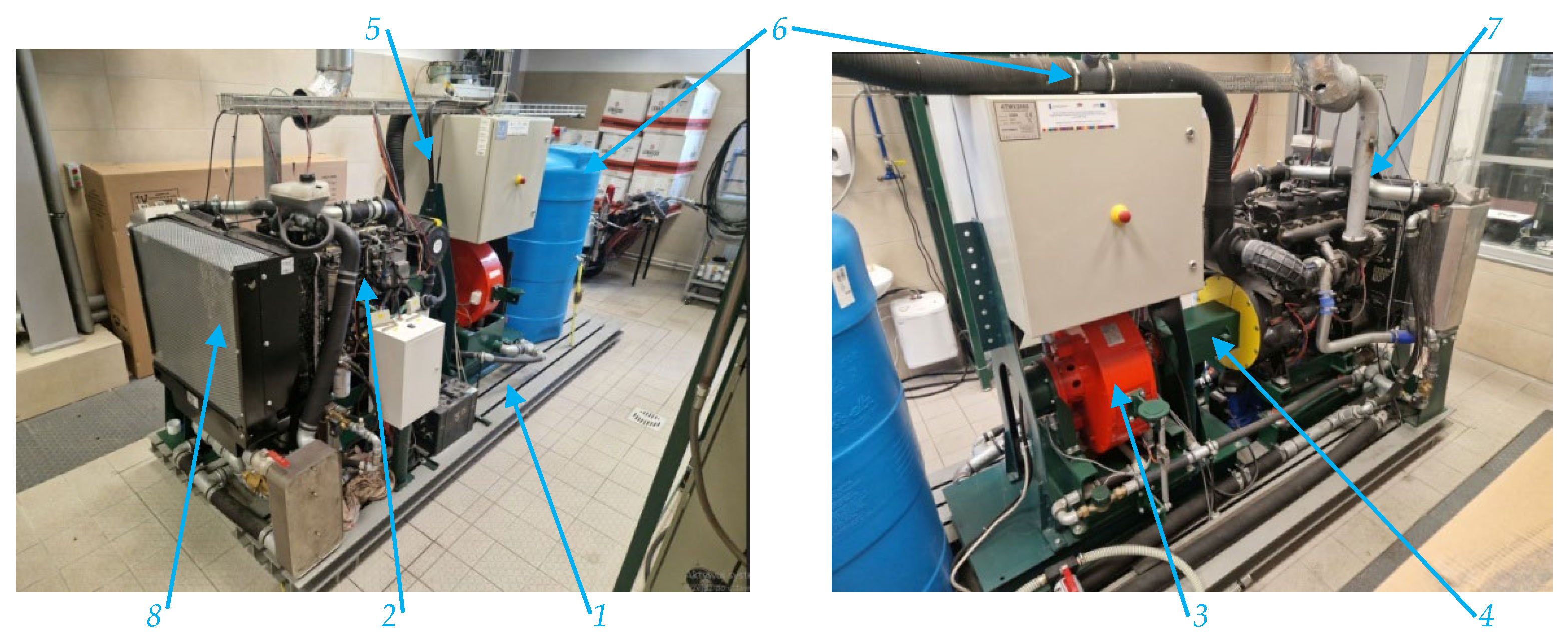
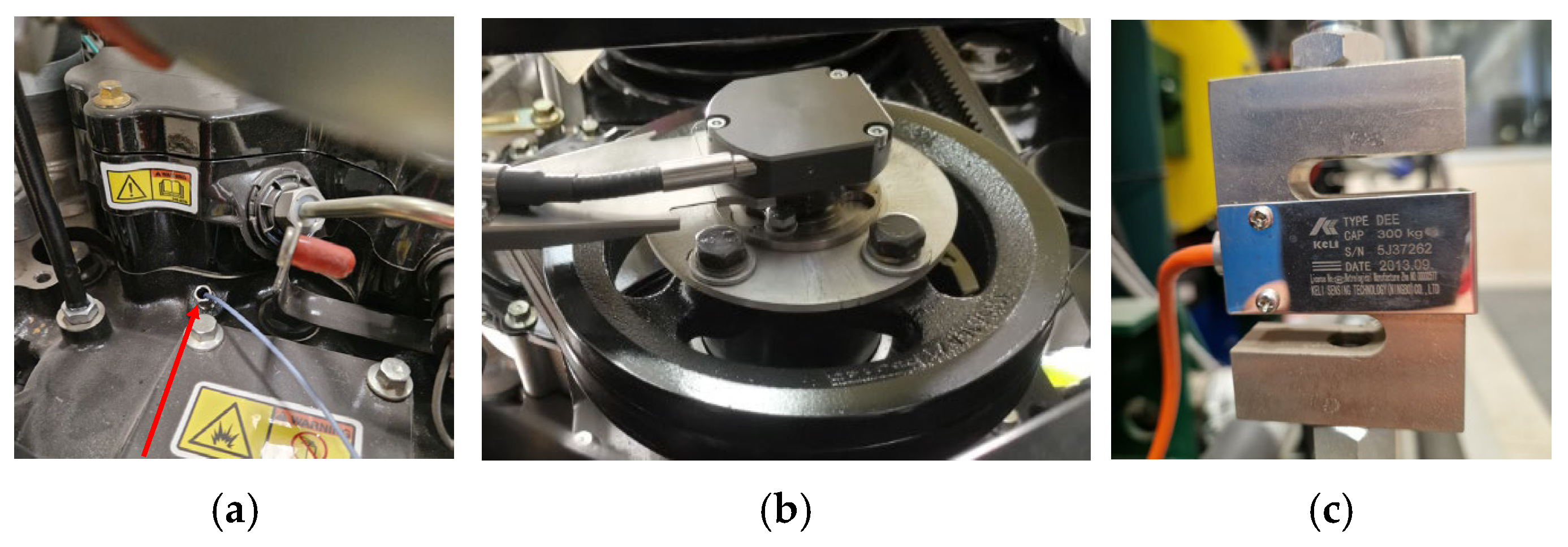
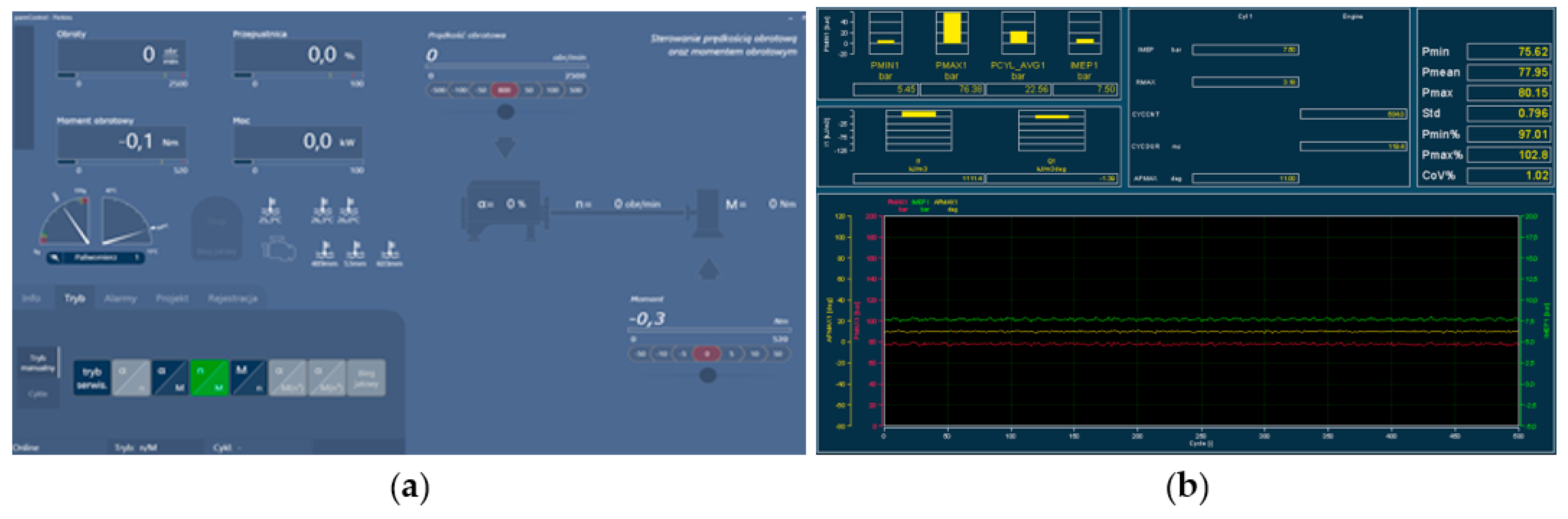
2.2. Test Stand
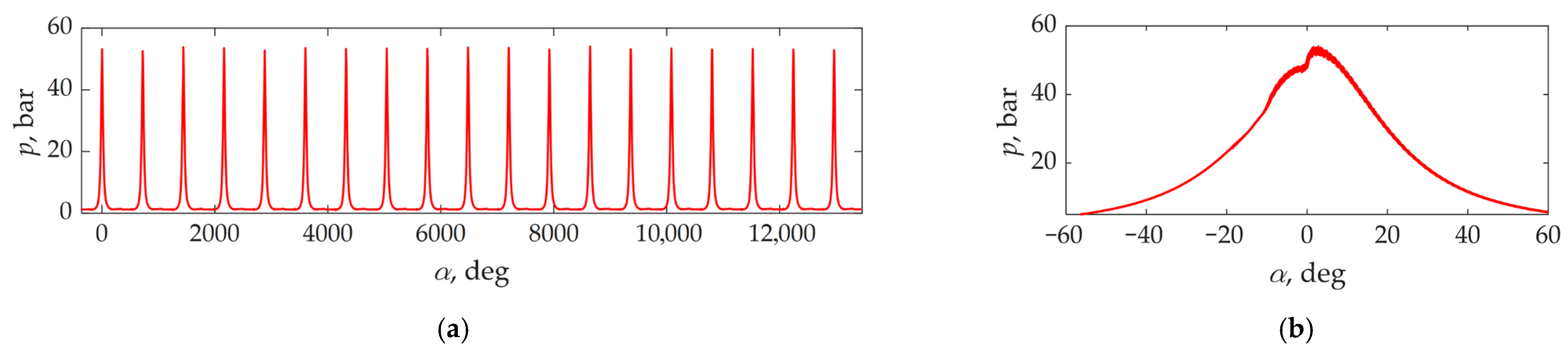
2.3. Research Methods
- maximum cylinder pressure—pmax;
- mean indicated pressure—IMEP;
- crankshaft rotation angle at which pmax occurs—α.
- In general, IMEP is determined on the basis of the relationship [12].
- The standard deviation was calculated.
- The average value.
- Based on Equation (1), COV was calculated for pmax, IMEP, and α.
3. Results
3.1. Analysis of the Non-Repeatability of Maximum Pressure in the Cylinder
3.2. Analysis of the Non-Repeatability of the Indicated Mean Effective Pressure
3.3. Analysis of the Non-Repeatability of the Angle at Which Maximum Pressure Occurs in the Cylinder
4. Discussion
5. Conclusions
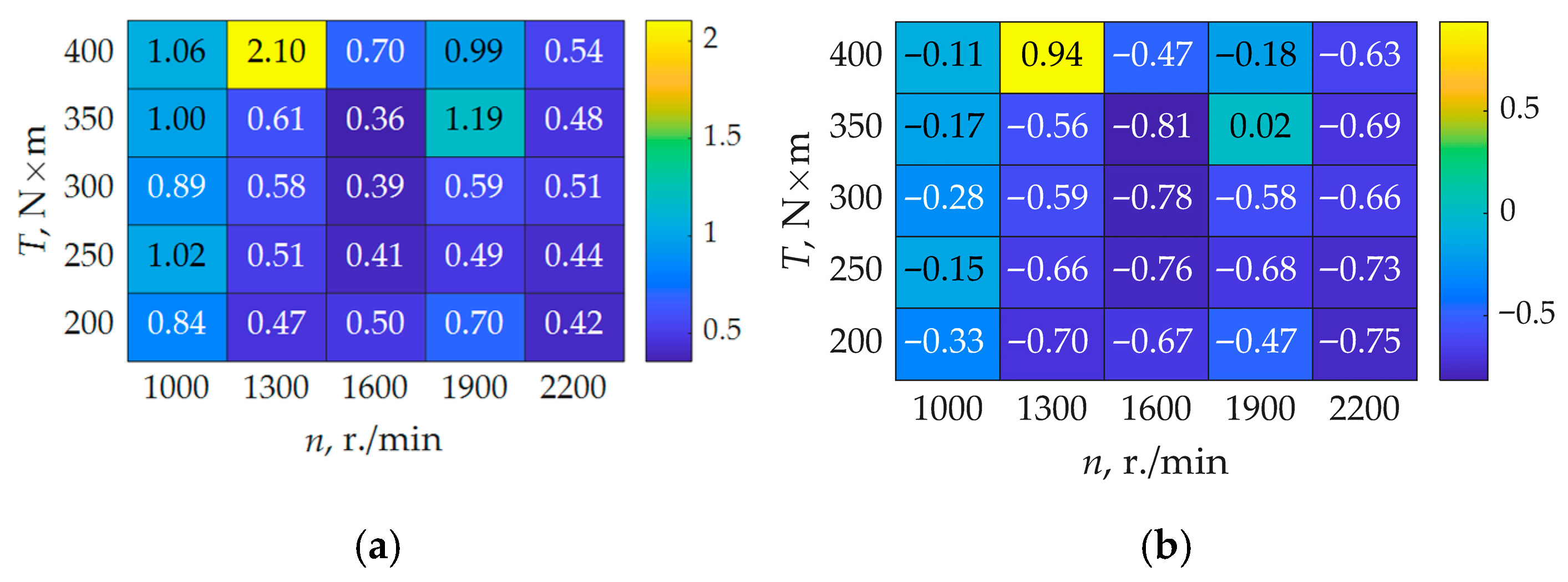
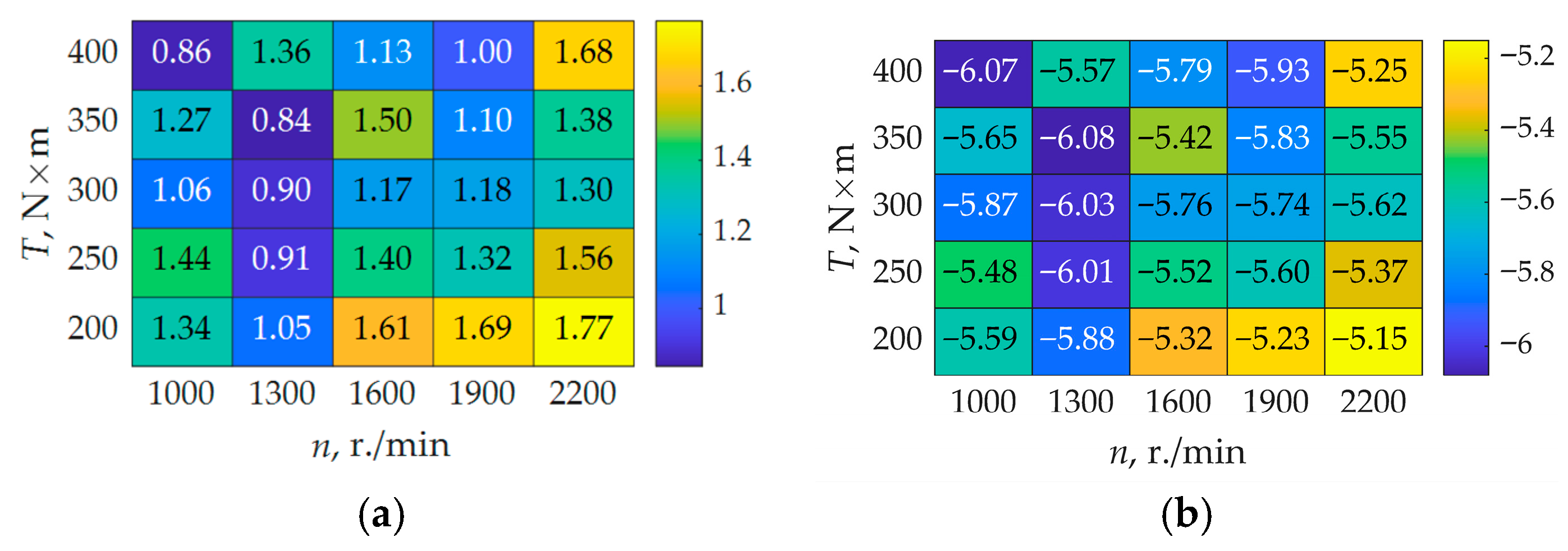
- The most stable engine operation was achieved in the range of medium rotational speeds 1600–2200 r./min and moderate loads 250–350 N × m, where COVpmax values were lower than 0.5% and COVIMEP did not exceed 1.0%.
- The maximum non-repeatability of the maximum cylinder pressure was COVpmax = 2.10% and occurred at 1300 r./min and 400 N × m, which represented an increase of 0.94% compared to idling (COVpmax = 1.696%).
- The indicated mean effective pressure IMEP was characterized by less variability than pmax; compared to idle speed (COVIMEP = 6.92%), a decrease in IMEP non-repeatability in the range of 5.1–6.1% was obtained at all measurement points.
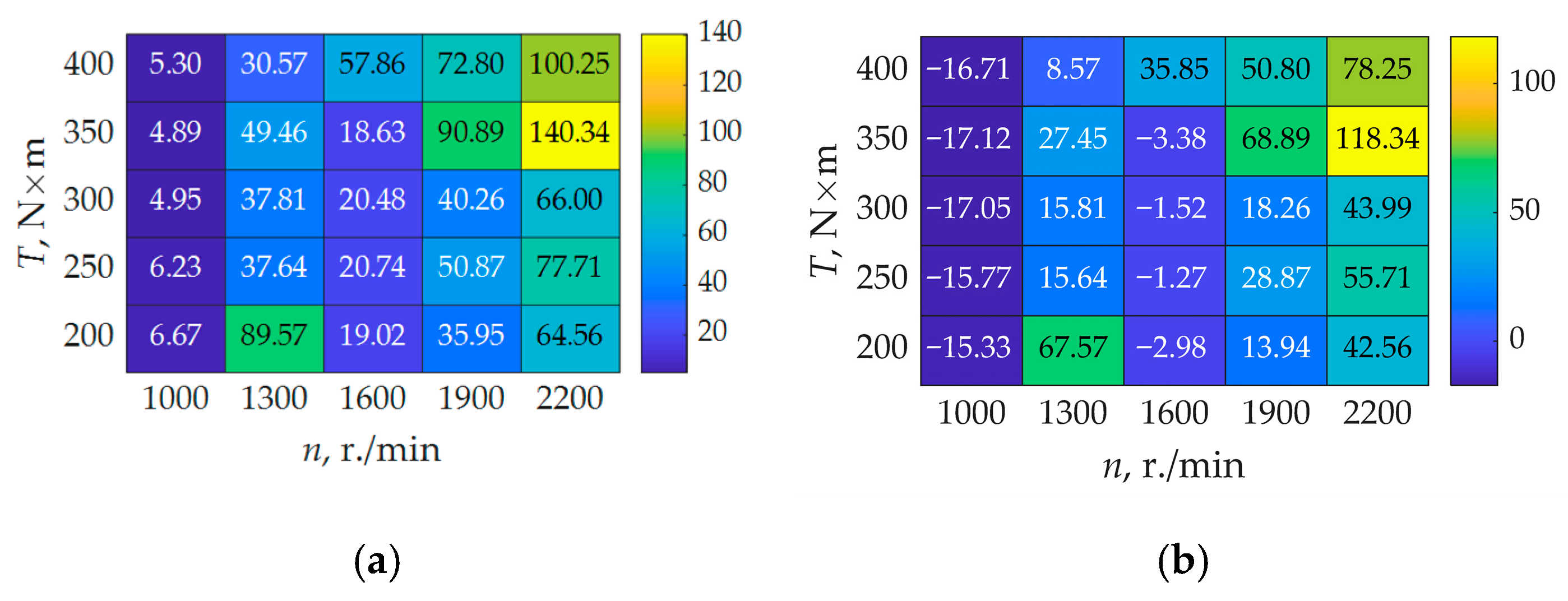
- The angle of maximum cylinder pressure was the most sensitive indicator of engine stability. The lowest COVα values 4.89–6.23% were obtained at speeds 1000–1300 r./min and loads 250–400 N × m, while the highest values, reaching 100–140%, occurred at 2200 r./min and high loads. High COVα values could result from the mathematical relationship itself.
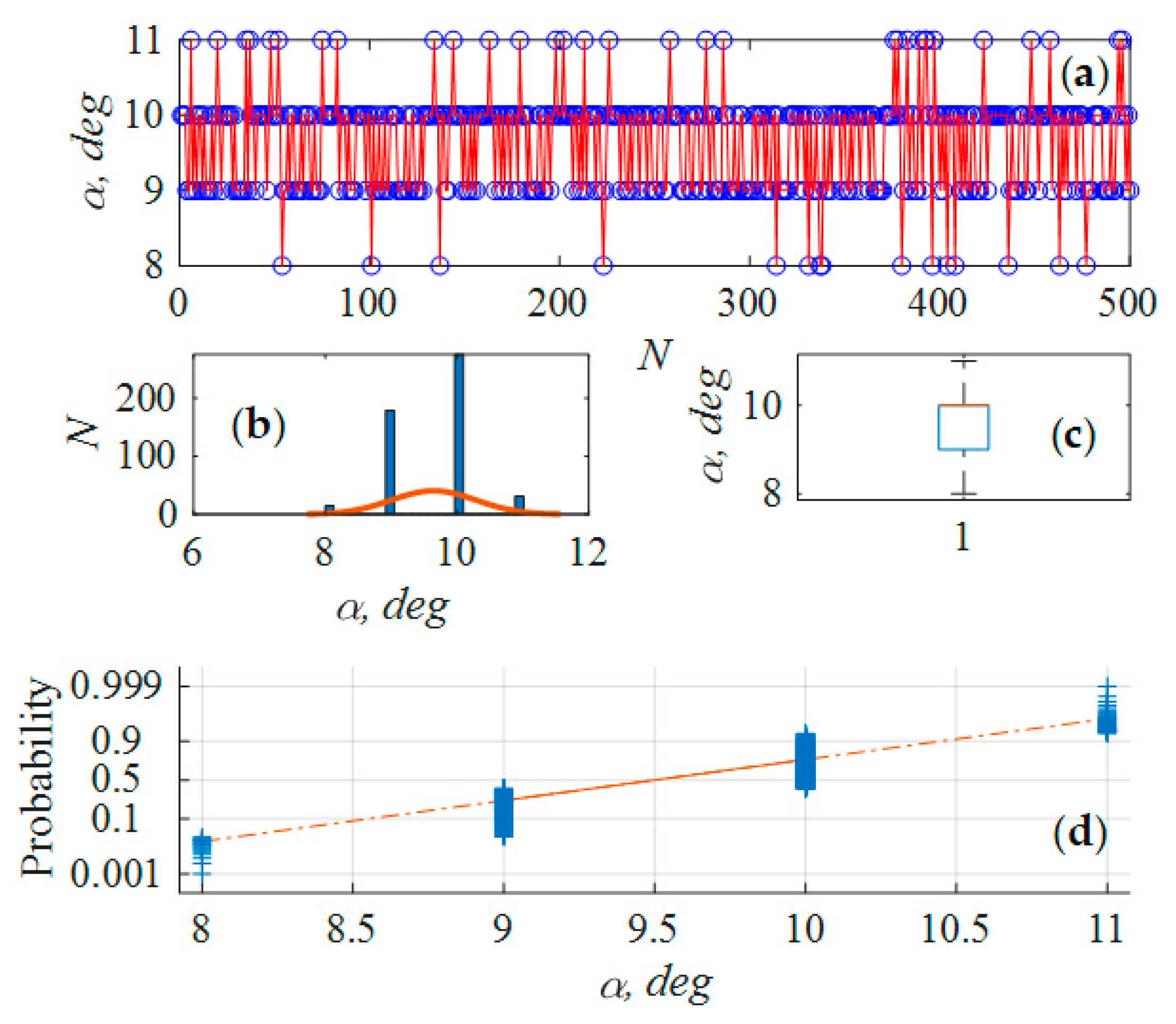
- An increase in engine speed caused a shift in the average angle of pmax occurrence towards TDC—from approximately 10 deg CA for 1000 r./min to approximately 1 deg CA for 2200 r./min—with a simultaneous increase in the spread of α values (0.64–1.16).
- A clear correlation was found between the non-repeatability of pmax, IMEP, and angle α, confirming the usefulness of their combined analysis as a diagnostic tool in assessing combustion stability and optimizing engine control strategies.
6. Future Work
Author Contributions
Funding
Data Availability Statement
Acknowledgments
Conflicts of Interest
Abbreviations
| BSFC | Brake-specific fuel consumption |
| CA50 | Crank angle position where 50% of the fuel mass has burned within an internal combustion engine cylinder |
| CCV | Cycle-to-cycle variations |
| CI | Compression ignition engine |
| CO | Carbon monoxide |
| CO2 | Carbon dioxide |
| COV | Coefficient of variation |
| DF | Diesel fuel |
| ECU | Engine control unit |
| EGR | Exhaust gas recirculation |
| Euro 6/7 | European vehicle emissions standards |
| FAME | Fatty acid methyl ester |
| HC | Hydrocarbon |
| HVO | Hydrotreated vegetable oil |
| IEA | International Energy Agency |
| IMEP | Indicated mean effective pressure |
| K&S | Kołmogorow and Smirnow tests |
| LCA | Life cycle assessment |
| N-RCC | Non-repeatability cycle-by-cycle |
| PM | Particulate matter; |
| Stage II/IIIA/V | Non-road engines—emission standards |
| TDC | Top dead center |
| Tier 2/3 | EPA non-road diesel emission standards |
| WHTC | World harmonized transient cycle |
| WHSC | World Harmonized Stationary Cycle |
| M | Mean value |
| Me | Median |
| Mo | Dominant value |
| N | Number of points assessed |
| p | Cylinder pressure |
| pmax | Maximum pressure in the cylinder |
| Q1 | 1 quartile |
| Q3 | 3 quartile |
| s | Skewness |
| W | Volume work of the cycle |
| Vsc | Swept volume per cylinder |
| xi | Value in each i-point |
| α | Angle at which pmax occurs |
| ηi | Engine efficiency |
| κ | Kurtosis |
| σ | Standard deviation |
Appendix A

| Par./Seq. | 1. | 2. | 3. | 4. | 5. | 6. | 7. | 8. | 9. | 10. | 11. | 12. | 13. |
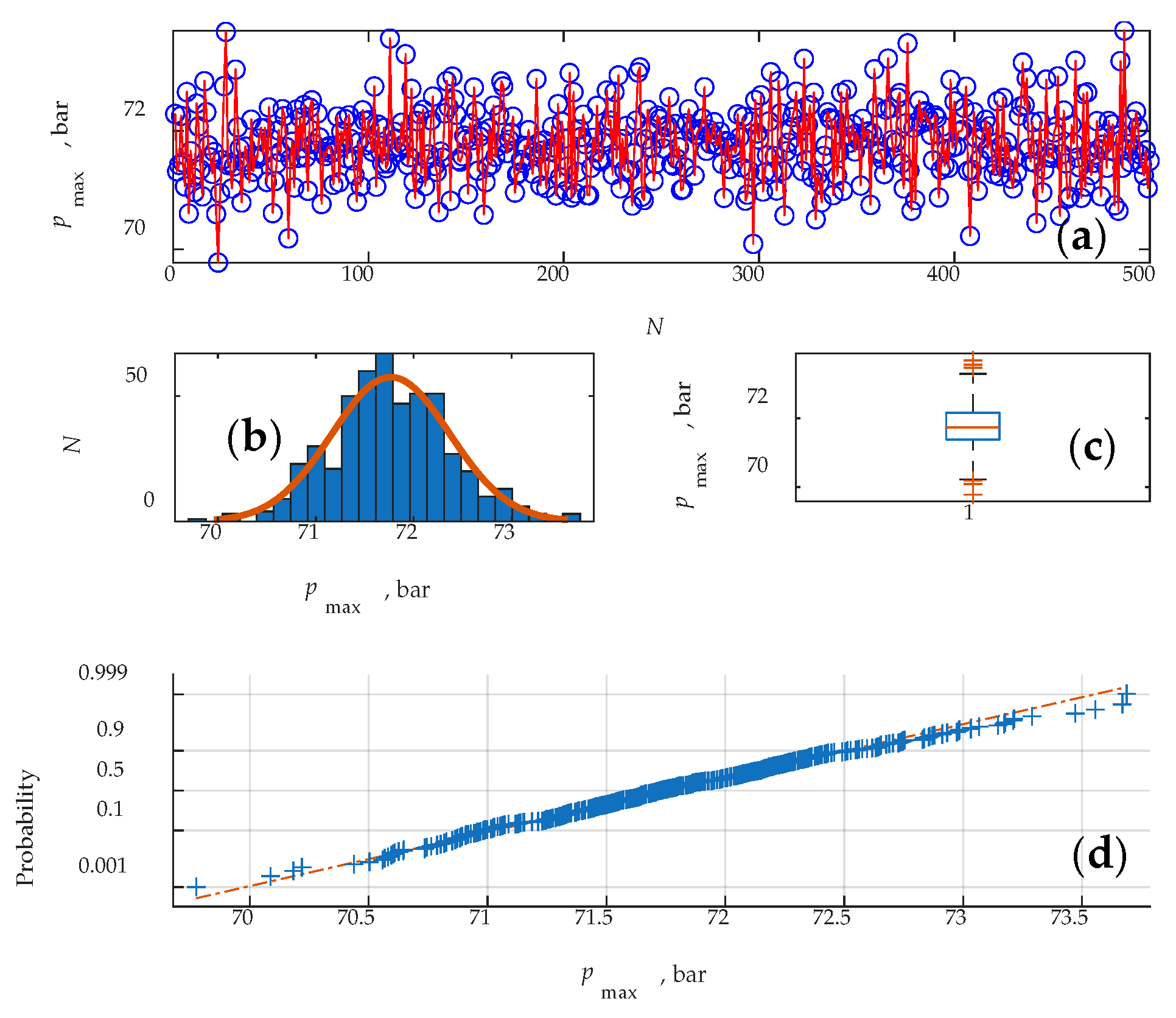
| M, bar | 71.767 | 77.947 | 84.976 | 92.269 | 94.292 | 66.505 | 71.771 | 76.484 | 81.037 | 93.623 | 79.507 | 85.803 | 92.616 |
| Me, bar | 71.731 | 77.966 | 84.995 | 92.268 | 94.270 | 66.501 | 71.777 | 76.475 | 81.045 | 93.830 | 79.517 | 85.794 | 92.608 |
| max., bar | 73.687 | 80.150 | 87.186 | 95.592 | 96.951 | 67.360 | 72.885 | 77.870 | 82.602 | 97.483 | 80.624 | 86.992 | 93.930 |
| min., bar | 69.776 | 75.618 | 82.631 | 89.476 | 91.398 | 65.572 | 70.340 | 75.157 | 79.308 | 88.032 | 78.272 | 84.968 | 91.650 |
| Mo, bar | 71.864 | 77.728 | 84.542 | 90.726 | 93.601 | 66.482 | 71.561 | 76.184 | 80.850 | 89.703 | 79.351 | 85.343 | 92.625 |
| σ | 0.603 | 0.796 | 0.754 | 0.926 | 1.001 | 0.313 | 0.367 | 0.441 | 0.492 | 1.970 | 0.396 | 0.350 | 0.360 |
| σ2 | 0.363 | 0.634 | 0.569 | 0.857 | 1.003 | 0.098 | 0.135 | 0.194 | 0.242 | 3.883 | 0.157 | 0.123 | 0.130 |
| κ | 3.286 | 3.010 | 2.950 | 3.447 | 2.621 | 3.072 | 3.556 | 3.258 | 2.985 | 2.959 | 2.821 | 2.905 | 3.548 |
| s | 0.173 | −0.106 | −0.053 | 0.093 | 0.040 | −0.153 | 0.015 | 0.109 | −0.031 | −0.648 | 0.086 | 0.285 | 0.349 |
| COV, % | 0.840 | 1.021 | 0.888 | 1.003 | 1.062 | 0.471 | 0.512 | 0.576 | 0.607 | 2.105 | 0.498 | 0.408 | 0.389 |
| K&S | 1 | 1 | 1 | 1 | 1 | 1 | 1 | 1 | 1 | 1 | 1 | 1 | 1 |
| par./seq. | 14. | 15. | 16. | 17. | 18. | 19. | 20. | 21. | 22. | 23. | 24. | 25. | idle |
| M, bar | 99.538 | 105.326 | 88.004 | 97.390 | 102.994 | 106.885 | 108.441 | 97.665 | 101.948 | 106.278 | 107.995 | 111.763 | 52.589 |
| Me, bar | 99.530 | 105.370 | 88.055 | 97.388 | 102.955 | 106.420 | 108.160 | 97.657 | 101.930 | 106.230 | 107.940 | 111.790 | 52.526 |
| max., bar | 100.740 | 107.510 | 89.588 | 98.848 | 104.720 | 109.990 | 112.860 | 99.073 | 103.560 | 108.410 | 109.680 | 113.470 | 54.206 |
| min., bar | 98.670 | 103.140 | 86.350 | 95.889 | 101.410 | 105.060 | 106.950 | 96.587 | 100.680 | 104.870 | 106.710 | 109.910 | 51.102 |
| Mo, bar | 99.570 | 105.260 | 87.518 | 97.227 | 102.850 | 106.080 | 107.820 | 97.657 | 101.960 | 106.100 | 107.790 | 111.860 | 52.569 |
| σ | 0.355 | 0.735 | 0.618 | 0.481 | 0.611 | 1.270 | 1.073 | 0.406 | 0.447 | 0.545 | 0.513 | 0.606 | 0.615 |
| σ2 | 0.126 | 0.540 | 0.382 | 0.231 | 0.373 | 1.613 | 1.150 | 0.165 | 0.200 | 0.298 | 0.264 | 0.367 | 0.378 |
| κ | 3.042 | 2.829 | 2.687 | 3.139 | 2.641 | 2.475 | 6.993 | 3.305 | 3.210 | 3.465 | 3.125 | 3.085 | 2.207 |
| s | 0.228 | −0.081 | −0.273 | 0.072 | 0.232 | 0.869 | 1.965 | 0.281 | 0.207 | 0.434 | 0.340 | −0.240 | 0.227 |
| COV, % | 0.357 | 0.698 | 0.702 | 0.493 | 0.593 | 1.188 | 0.989 | 0.416 | 0.438 | 0.513 | 0.475 | 0.542 | 1.170 |
| K&S | 1 | 1 | 1 | 1 | 1 | 1 | 1 | 1 | 1 | 1 | 1 | 1 | 1 |
| Par./Seq. | 1. | 2. | 3. | 4. | 5. | 6. | 7. | 8. | 9. | 10. | 11. | 12. | 13. |
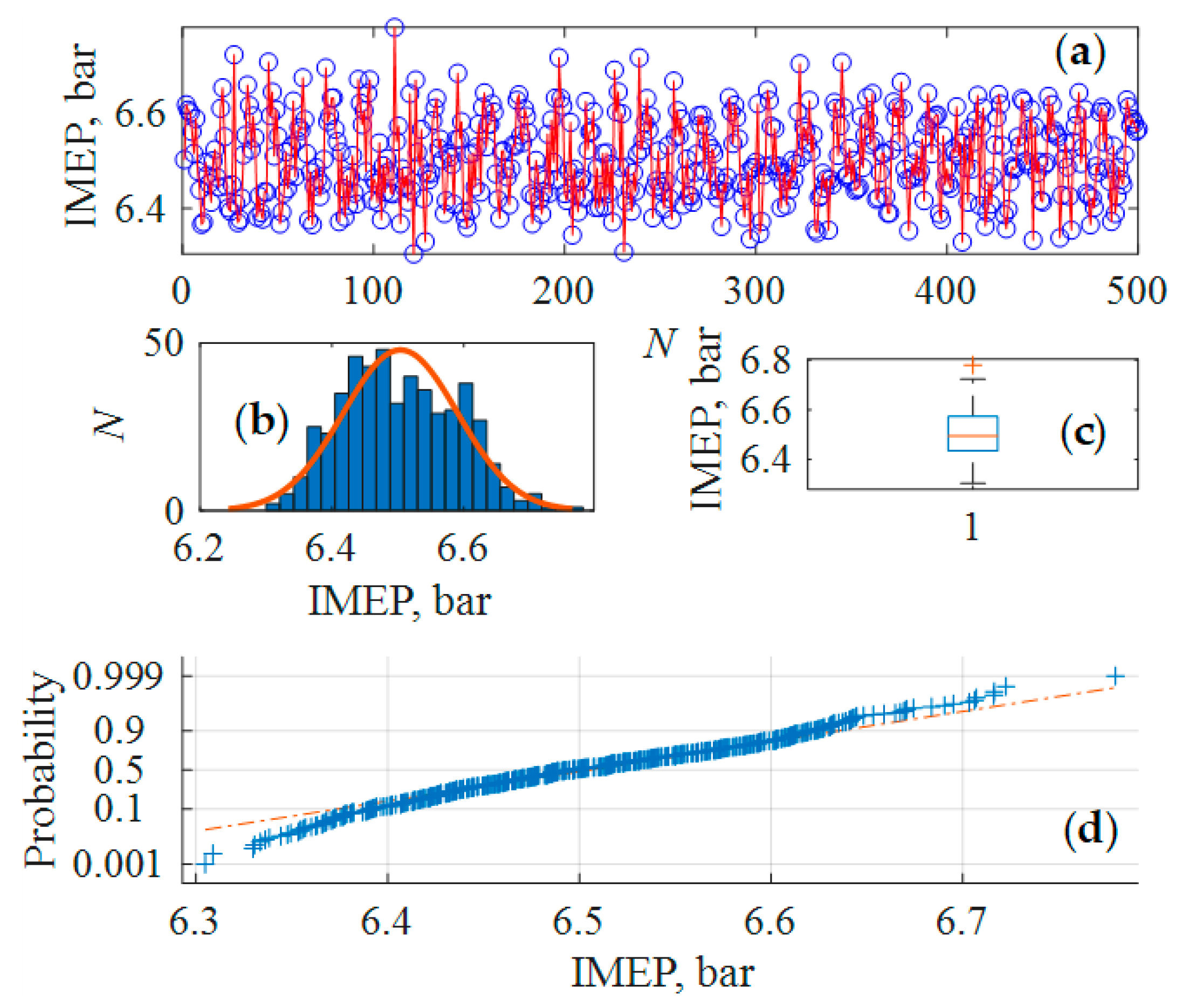
| M, bar | 6.504 | 7.694 | 8.825 | 10.016 | 10.743 | 6.719 | 8.024 | 9.186 | 10.345 | 11.575 | 6.999 | 8.200 | 9.386 |
| Me, bar | 6.495 | 7.687 | 8.819 | 10.019 | 10.747 | 6.723 | 8.021 | 9.189 | 10.345 | 11.574 | 7.000 | 8.205 | 9.392 |
| max., bar | 6.780 | 8.035 | 9.155 | 10.306 | 10.960 | 6.924 | 8.240 | 9.405 | 10.584 | 11.987 | 7.320 | 8.513 | 9.649 |
| min., bar | 6.305 | 7.400 | 8.584 | 9.698 | 10.483 | 6.521 | 7.819 | 8.929 | 10.109 | 11.134 | 6.680 | 7.869 | 9.043 |
| Mo, bar | 6.550 | 7.529 | 8.780 | 10.017 | 10.673 | 6.653 | 8.004 | 9.180 | 10.296 | 11.616 | 6.798 | 8.110 | 9.226 |
| σ | 0.087 | 0.111 | 0.093 | 0.127 | 0.092 | 0.071 | 0.073 | 0.082 | 0.087 | 0.157 | 0.112 | 0.115 | 0.110 |
| σ2 | 0.008 | 0.012 | 0.009 | 0.016 | 0.009 | 0.005 | 0.005 | 0.007 | 0.008 | 0.025 | 0.013 | 0.013 | 0.012 |
| κ | 2.409 | 2.724 | 2.906 | 2.577 | 2.381 | 2.934 | 3.119 | 3.165 | 2.722 | 2.534 | 2.618 | 2.615 | 2.683 |
| s | 0.209 | 0.137 | 0.174 | −0.109 | −0.208 | −0.170 | 0.069 | −0.193 | −0.133 | 0.030 | 0.122 | −0.188 | −0.161 |
| COV, % | 1.337 | 1.444 | 1.059 | 1.271 | 0.859 | 1.049 | 0.912 | 0.895 | 0.844 | 1.357 | 1.606 | 1.402 | 1.167 |
| K&S | 1 | 1 | 1 | 1 | 1 | 1 | 1 | 1 | 1 | 1 | 1 | 1 | 1 |
| par./seq. | 14. | 15. | 16. | 17. | 18. | 19. | 20. | 21. | 22. | 23. | 24. | 25. | idle |
| M, bar | 10.565 | 12.161 | 7.490 | 8.725 | 9.904 | 11.003 | 12.242 | 7.571 | 8.906 | 10.311 | 11.510 | 12.657 | 1.275 |
| Me, bar | 10.570 | 12.160 | 7.483 | 8.711 | 9.893 | 10.995 | 12.233 | 7.580 | 8.911 | 10.318 | 11.517 | 12.654 | 1.268 |
| max., bar | 10.928 | 12.526 | 7.823 | 9.070 | 10.354 | 11.407 | 12.786 | 7.975 | 9.248 | 10.659 | 12.007 | 13.302 | 1.491 |
| min., bar | 10.144 | 11.823 | 7.151 | 8.441 | 9.629 | 10.693 | 11.925 | 7.177 | 8.501 | 9.944 | 10.991 | 12.045 | 1.073 |
| Mo, bar | 10.458 | 12.171 | 7.478 | 8.683 | 9.840 | 10.945 | 12.207 | 7.476 | 8.756 | 10.400 | 11.459 | 12.614 | 1.164 |
| σ | 0.159 | 0.138 | 0.127 | 0.115 | 0.117 | 0.121 | 0.122 | 0.134 | 0.139 | 0.134 | 0.158 | 0.212 | 0.088 |
| σ2 | 0.025 | 0.019 | 0.016 | 0.013 | 0.014 | 0.015 | 0.015 | 0.018 | 0.019 | 0.018 | 0.025 | 0.045 | 0.008 |
| κ | 2.399 | 2.513 | 2.968 | 2.924 | 2.911 | 3.305 | 3.708 | 3.112 | 2.902 | 2.820 | 3.314 | 2.796 | 2.137 |
| s | −0.191 | 0.010 | 0.071 | 0.365 | 0.278 | 0.488 | 0.613 | −0.178 | −0.297 | −0.129 | −0.073 | −0.152 | 0.148 |
| COV, % | 1.502 | 1.131 | 1.691 | 1.321 | 1.185 | 1.099 | 0.998 | 1.775 | 1.559 | 1.302 | 1.377 | 1.677 | 6.925 |
| K&S | 1 | 1 | 1 | 1 | 1 | 1 | 1 | 1 | 1 | 1 | 1 | 1 | 1 |
| Par./Seq. | 1. | 2. | 3. | 4. | 5. | 6. | 7. | 8. | 9. | 10. | 11. | 12. | 13. |
| M, deg | 9.644 | 9.794 | 9.776 | 9.886 | 10.750 | 0.804 | 1.444 | 1.206 | 1.346 | 2.498 | 2.786 | 2.370 | 2.452 |
| Me, deg | 10.000 | 10.000 | 10.000 | 10.000 | 11.000 | 1.000 | 1.000 | 1.000 | 1.000 | 3.000 | 3.000 | 2.000 | 2.000 |
| max., deg | 11.000 | 11.000 | 11.000 | 11.000 | 12.000 | 2.000 | 3.000 | 3.000 | 3.000 | 4.000 | 4.000 | 4.000 | 4.000 |
| min., deg | 8.000 | 8.000 | 9.000 | 9.000 | 9.000 | 0.000 | 1.000 | 0.000 | 0.000 | −1.000 | 2.000 | 2.000 | 2.000 |
| Mo, deg | 10.000 | 10.000 | 10.000 | 10.000 | 11.000 | 1.000 | 1.000 | 1.000 | 1.000 | 3.000 | 3.000 | 2.000 | 2.000 |
| σ | 0.644 | 0.610 | 0.484 | 0.483 | 0.569 | 0.720 | 0.544 | 0.456 | 0.666 | 0.764 | 0.530 | 0.492 | 0.502 |
| σ2 | 0.414 | 0.372 | 0.234 | 0.234 | 0.324 | 0.519 | 0.296 | 0.208 | 0.443 | 0.583 | 0.281 | 0.242 | 0.252 |
| κ | 2.923 | 3.209 | 2.949 | 3.918 | 3.029 | 1.964 | 2.313 | 6.491 | 3.176 | 5.459 | 2.880 | 1.671 | 1.181 |
| s | −0.186 | −0.228 | −0.492 | −0.292 | −0.216 | 0.311 | 0.673 | 1.999 | 0.454 | −0.980 | −0.164 | 0.640 | 0.240 |
| COV, % | 6.673 | 6.230 | 4.951 | 4.888 | 5.296 | 89.571 | 37.643 | 37.815 | 49.458 | 30.571 | 19.019 | 20.739 | 20.481 |
| K&S | 1 | 1 | 1 | 1 | 1 | 1 | 1 | 1 | 1 | 1 | 1 | 1 | 1 |
| par./seq. | 14. | 15. | 16. | 17. | 18. | 19. | 20. | 21. | 22. | 23. | 24. | 25. | idle |
| M, deg | 2.058 | 1.168 | 1.418 | 1.204 | 1.512 | 0.848 | 1.082 | 1.212 | 1.058 | 1.186 | 0.754 | 1.158 | 2.542 |
| Me, deg | 2.000 | 1.000 | 1.000 | 1.000 | 1.500 | 1.000 | 1.000 | 1.000 | 1.000 | 1.000 | 1.000 | 1.000 | 3.000 |
| max., deg | 3.000 | 3.000 | 3.000 | 3.000 | 3.000 | 3.000 | 3.000 | 3.000 | 3.000 | 3.000 | 3.000 | 4.000 | 4.000 |
| min., deg | 1.000 | 0.000 | 1.000 | 0.000 | 0.000 | −1.000 | −1.000 | 0.000 | −1.000 | −1.000 | −1.000 | −2.000 | 1.000 |
| Mo, deg | 2.000 | 1.000 | 1.000 | 1.000 | 1.000 | 1.000 | 1.000 | 1.000 | 1.000 | 1.000 | 0.000 | 2.000 | 3.000 |
| σ | 0.383 | 0.676 | 0.510 | 0.613 | 0.609 | 0.771 | 0.788 | 0.783 | 0.822 | 0.783 | 1.058 | 1.161 | 0.559 |
| σ2 | 0.147 | 0.457 | 0.260 | 0.375 | 0.371 | 0.594 | 0.621 | 0.612 | 0.676 | 0.613 | 1.120 | 1.348 | 0.313 |
| κ | 6.490 | 4.241 | 1.699 | 2.788 | 2.639 | 3.212 | 3.391 | 2.436 | 2.618 | 3.365 | 2.394 | 2.700 | 2.402 |
| s | 0.575 | 0.837 | 0.514 | 0.010 | 0.114 | 0.504 | −0.022 | 0.088 | −0.367 | 0.214 | 0.218 | −0.264 | −0.510 |
| COV, % | 18.626 | 57.859 | 35.945 | 50.871 | 40.262 | 90.893 | 72.803 | 64.561 | 77.711 | 65.996 | 140.341 | 100.252 | 22.004 |
| K&S | 1 | 1 | 1 | 1 | 1 | 1 | 1 | 1 | 1 | 1 | 1 | 1 | 1 |
References
- Diouf, B. The Electric Vehicle Transition. Environ. Sci. Adv. 2024, 3, 332–345. [Google Scholar] [CrossRef]
- ExxonMobil Energy Demand: Three Drivers|ExxonMobil. Available online: https://corporate.exxonmobil.com/Energy-and-innovation/Outlook-for-Energy/Energy-demand?print=true (accessed on 20 December 2025).
- British Petroleum BP Energy Outlook 2019 Edition. The Energy Outlook Explores the Forces Shaping the Global Energy Transition out to 2040 and the Key Uncertainties Surrounding That. BP Energy Outlook 2019 2019, 22–24, 72–76, 144–118. Available online: https://www.bp.com/content/dam/bp/business-sites/en/global/corporate/pdfs/energy-economics/energy-outlook/bp-energy-outlook-2019.pdf (accessed on 20 December 2025).
- Koszalka, G.; Hunicz, J. Comparative Study of Energy Losses Related to the Ring Pack Operation in Homogeneous Charge Compression Ignition and Spark Ignition Combustion. Energy 2021, 235, 121388. [Google Scholar] [CrossRef]
- European Commission. CO2 Emission Performance Standards for Cars and Vans; European Commission: Brussels, Belgium, 2020; p. 2. [Google Scholar]
- International Energy Agency (IEA) Global EV Outlook 2024. Outlook for Electric Mobility. Available online: https://www.iea.org/reports/global-ev-outlook-2024/outlook-for-electric-mobility (accessed on 20 December 2025).
- Kalghatgi, G.; Agarwal, A.K.; Leach, L.; Senecal, L. Engines and Fuels for Future Transport; Springer: Berlin/Heidelberg, Germany, 2022; ISBN 9789811687167. [Google Scholar]
- Heywood, J.B. Internal Combustion Engine Fundamentals, 2nd ed.; McGraw Hill: New York, NY, USA, 2018; 1056p. [Google Scholar]
- Jhavar, R.; Rutland, C.J. Using Large Eddy Simulations to Study Mixing Effects in Early Injection Diesel Engine Combustion. In Proceedings of the SAE Technical Papers; SAE International: Warrendale, PA, USA, 2006. [Google Scholar]
- Kyrtatos, P.; Brückner, C.; Boulouchos, K. Cycle-to-Cycle Variations in Diesel Engines. Appl. Energy 2016, 171, 120–132. [Google Scholar] [CrossRef]
- Colban, W.F.; Miles, P.C.; Oh, S. On the Cyclic Variability and Sources of Unburned Hydrocarbon Emissions in Low Temperature Diesel Combustion Systems. In Proceedings of the SAE Technical Papers; SAE International: Warrendale, PA, USA, 2007. [Google Scholar]
- Szpica, D.; Gęca, M.S.; Hunicz, J.; Jakubowski, M.; Krzemiński, A.; Mieczkowski, G. Cycle-by-Cycle Performance Evaluation of a Diesel Engine Fueled with a Mixture of Hydrotreated Vegetable Oil Mixed with Waste Plastic Pyrolysis Oils. Combust. Engines 2025, 202, 109–117. [Google Scholar] [CrossRef]
- Ceviz, M.A.; Çavuşoĝlu, B.; Kaya, F.; Öner, I.V. Determination of Cycle Number for Real In-Cylinder Pressure Cycle Analysis in Internal Combustion Engines. Energy 2011, 36, 2465–2472. [Google Scholar] [CrossRef]
- Ghaderi Masouleh, M.; Keskinen, K.; Kaario, O.; Kahila, H.; Karimkashi, S.; Vuorinen, V. Modeling Cycle-to-Cycle Variations in Spark Ignited Combustion Engines by Scale-Resolving Simulations for Different Engine Speeds. Appl. Energy 2019, 250, 801–820. [Google Scholar] [CrossRef]
- Duan, X.; Feng, L.; Xia, Y. The Mechanism and Effect Factors of the Combustion Cycle-to-Cycle Variations in the Spark Ignition Engine. Energy Sci. Eng. 2024, 12, 4773–4787. [Google Scholar] [CrossRef]
- Yang, L.; Zare, A.; Bodisco, T.A.; Nabi, N.; Liu, Z.; Brown, R.J. Analysis of Cycle-to-Cycle Variations in a Common-Rail Compression Ignition Engine Fuelled with Diesel and Biodiesel Fuels. Fuel 2021, 290, 120010. [Google Scholar] [CrossRef]
- Dec, J.E. A Conceptual Model of Di Diesel Combustion Based on Laser-Sheet Imaging. In Proceedings of the SAE Technical Papers; SAE International: Warrendale, PA, USA, 1997. [Google Scholar]
- Welch, C.; Schmidt, M.; Illmann, L.; Dreizler, A.; Böhm, B. The Influence of Flow on Cycle-to-Cycle Variations in a Spark-Ignition Engine: A Parametric Investigation of Increasing Exhaust Gas Recirculation Levels. Flow Turbul. Combust. 2023, 110, 185–208. [Google Scholar] [CrossRef]
- Chen, Z.; He, J.; Chen, H.; Geng, L.; Zhang, P. Experimental Study on Cycle-to-Cycle Variations in Natural Gas/Methanol Bi-Fueled Engine under Excess Air/Fuel Ratio at 1.6. Energy 2021, 224, 120233. [Google Scholar] [CrossRef]
- Shi, J.; Wang, T.; Zhao, Z.; Wu, Z.; Zhang, Z. Cycle-to-Cycle Variation of a Diesel Engine Fueled with Fischer-Tropsch Fuel Synthesized from Coal. Appl. Sci. 2019, 9, 2032. [Google Scholar] [CrossRef]
- Sen, A.K.; Litak, G.; Taccani, R.; Radu, R. Wavelet Analysis of Cycle-to-Cycle Pressure Variations in an Internal Combustion Engine. Chaos Solitons Fractals 2008, 38, 886–893. [Google Scholar] [CrossRef]
- Longwic, R.; Sen, A.K.; Górski, K.; Lotko, W.; Litak, G. Cycle-to-Cycle Variation of the Combustion Process in a Diesel Engine Powered by Different Fuels. J. Vibroeng. 2011, 13, 120–127. [Google Scholar]
- Sun, L.; Liu, Y.; Zhou, L.; Zeng, K. Experimental Investigation of Cycle-by-Cycle Variations in a Natural Gas/Diesel Dual Fuel Engine with EGR. In Proceedings of the SAE Technical Papers; SAE International: Warrendale, PA, USA, 2013; Volume 2. [Google Scholar]
- Lou, D.; Ren, Y.; Zhang, Y.; Sun, X. Study on the Effects of EGR and Spark Timing on the Combustion, Performance, and Emissions of a Stoichiometric Natural Gas Engine. ACS Omega 2020, 5, 26763–26775. [Google Scholar] [CrossRef] [PubMed]
- Hokimoto, S.; Kuboyama, T.; Moriyoshi, Y.; Iida, M.; Watanabe, T. Analyses of Cycle-to-Cycle Variation of Combustion and In-Cylinder Flow in a Port Injection Gasoline Engine Using PIV and PLIF Techniques. In Proceedings of the SAE Technical Papers; SAE International: Warrendale, PA, USA, 2017; Volume 2017. [Google Scholar]
- Amin, M.I.; Elmaihy, A.; Shahin, M. Cyclic Variability Correlations to Operating Conditions for Spark-Ignition Engines. Commun.-Sci. Lett. Univ. Žilina 2023, 25, B118–B129. [Google Scholar] [CrossRef]
- CORDIS-EU research results. Large-Eddy and System Simulation to Predict Cyclic Combustion Variability in Gasoline Engines. 2012. Available online: https://cordis.europa.eu/projects (accessed on 20 December 2025).
- Karczewski, M.; Chojnowski, J.; Szamrej, G. A Review of Low-CO2 Emission Fuels for a Dual-Fuel RCCI Engine. Energies 2021, 14, 5067. [Google Scholar] [CrossRef]
- McCaffery, C.; Zhu, H.; Sabbir Ahmed, C.M.; Canchola, A.; Chen, J.Y.; Li, C.; Johnson, K.C.; Durbin, T.D.; Lin, Y.H.; Karavalakis, G. Effects of Hydrogenated Vegetable Oil (HVO) and HVO/Biodiesel Blends on the Physicochemical and Toxicological Properties of Emissions from an off-Road Heavy-Duty Diesel Engine. Fuel 2022, 323, 124283. [Google Scholar] [CrossRef] [PubMed]
- Li, N.; Liu, H.; Cheng, Z.; Yan, B.; Chen, G.; Wang, S. Conversion of Plastic Waste into Fuels: A Critical Review. J. Hazard. Mater. 2022, 424, 127460. [Google Scholar] [CrossRef]
- Suardi, S.; Uswah, M.U.P.; Alamsyah, A.; Arham, M.A.B.; Mahmuddin, F. Analysis of Diesel Engines Using Biodiesel Blended from Waste Cooking Oil and LDPE Plastic Waste Pyrolysis Oil. J. Adv. Res. Fluid Mech. Therm. Sci. 2025, 130, 64–76. [Google Scholar] [CrossRef]
- Hunicz, J.; Krzaczek, P.; Gęca, M.; Rybak, A.; Mikulski, M. Comparative Study of Combustion and Emissions of Diesel Engine Fuelled with FAME and HVO. Combust. Engines 2021, 184, 72–78. [Google Scholar] [CrossRef]
- Hunicz, J.; Yang, L.; Rybak, A.; Ji, S.; Gęca, M.S.; Mikulski, M. Comparison of Diesel and Hydrotreated Vegetable Oil as the High-Reactivity Fuel in Reactivity-Controlled Compression Ignition. Energy Convers. Manag. 2025, 323, 119264. [Google Scholar] [CrossRef]
- Valeika, G.; Matijošius, J.; Orynycz, O.; Rimkus, A.; Kilikevičius, A.; Tucki, K. Compression Ignition Internal Combustion Engine’s Energy Parameter Research Using Variable (HVO) Biodiesel and Biobutanol Fuel Blends. Energies 2024, 17, 262. [Google Scholar] [CrossRef]
- Cheng, Q.; Tuomo, H.; Kaario, O.T.; Martti, L. Spray Dynamics of HVO and EN590 Diesel Fuels. Fuel 2019, 245, 198–211. [Google Scholar] [CrossRef]
- Górski, K.; Smigins, R.; Matijošius, J.; Tziourtzioumis, D. Cycle-to-Cycle Variation of the Combustion Process in a Diesel Engine Fueled with Rapeseed Oil—Diethyl Ether Blends. Energies 2023, 16, 720. [Google Scholar] [CrossRef]
- Attai, Y.A.; Abu-Elyazeed, O.S.M.; Elbeshbeshy, R.; Gassour, H.; Gad, M.S. Experimental Cyclic Variations of Diesel Engine Burning Pyrolysis Castor Oil Blends. Adv. Mech. Eng. 2020, 12. [Google Scholar] [CrossRef]
- Perkins Engines Company Limited. 1104D-E44TA Industrial Diesel Engine. 2018. Available online: https://www.perkins.com/en_GB/products/new/perkins/industrial/industrial-diesel-engines/1000002332.html (accessed on 20 December 2025).
- ISO PN-EN-ISO 5165; Petroleum Products—Determination of the Ignition Quality of Diesel Fuels—Cetane Engine Method. Energy Institute: London, UK, 2015.
- Elektromex Centrum. Available online: https://www.elektromex.arg.pl/page3.html (accessed on 20 December 2025).
- AVL List GmbH. AVL GH13P. 2010. Available online: https://www.avl.com/en (accessed on 15 May 2015).
- AVL List GmbH. AVL 365C. 2010. Available online: https://www.avl.com/en/testing-solutions/all-testing-products-and-software/advanced-measurement-technologies/angle-encoder-366c (accessed on 15 May 2015).
- Keli Electric Manufacturing Co., Ltd. DEE/DEF-A/-SS/-ASS Loadcell; Keli Electric Manufacturing Co., Ltd.: Ningbo, China, 2010. [Google Scholar]
- Wojciechowski, K.T.; Schmidt, M.; Zybala, R.; Merkisz, J.; Fuć, P.; Lijewski, P. Comparison of Waste Heat Recovery from the Exhaust of a Spark Ignition and a Diesel Engine. J. Electron. Mater. 2010, 39, 2034–2038. [Google Scholar] [CrossRef]
- AVL Indipar—Acquisition Parameter Editor AVL Indicom 2011. User’s Guide. 2010. Available online: https://www.avl.com/en (accessed on 15 May 2015).
- Perkins Engines Company Limited. 1100 Series 1104D-E44TA Diesel Engine–Industrial Open Power Unit. 2012. Available online: https://www.perkins.com/en_GB/products/new/perkins/industrial/industrial-open-power-units/1000002393.html (accessed on 20 December 2025).
- Pietras, D.; Stelmasiak, Z.; Pietras, P. Comparison of Operational Parameters and Stability of Performance of an Automotive SI Engine Powered by Methyl and Ethyl Alcohols. Combust. Engines 2023, 194, 129–140. [Google Scholar] [CrossRef]
- Azeem, N.; Beatrice, C.; Vassallo, A.; Pesce, F.; Gessaroli, D.; Biet, C.; Guido, C. Experimental Study of Cycle-by-Cycle Variations in a Spark Ignition Internal Combustion Engine Fueled with Hydrogen. Int. J. Hydrogen Energy 2024, 60, 1224–1238. [Google Scholar] [CrossRef]
- Tutak, W.; Jamrozik, A.; Pyrc, M. Experimental Investigations on Combustion, Performance and Emissions Characteristics of Compression Ignition Engine Powered by B100/Ethanol Blend. In Proceedings of the E3S Web of Conferences; EDP Sciences: Les Ulis, France, 2017; Volume 14. [Google Scholar]
- Geete, P.N. Computational statistics with matlab. Int. J. Math. Comput. Res. 2024, 12, 3937–3940. [Google Scholar] [CrossRef]
- Panão, M.R.O.; Moreira, A.L.N.; Durão, D.F.G. Statistical Analysis of Spray Impact to Assess Fuel Mixture Preparation in IC Engines. Fuel Process. Technol. 2013, 107, 64–70. [Google Scholar] [CrossRef]
- Cho, M.; Martinez, W.L. Statistics in MATLAB; Chapman and Hall/CRC: Boca Raton, FL, USA, 2014. [Google Scholar]
- Panão, M.R.O.; Moreira, A.L.N. A Real-Time Assessment of Measurement Uncertainty in the Experimental Characterization of Sprays. Meas. Sci. Technol. 2008, 19, 095402. [Google Scholar] [CrossRef]
- Mikulski, M.; Ambrosewicz-Walacik, M.; Hunicz, J.; Nitkiewicz, S. Combustion Engine Applications of Waste Tyre Pyrolytic Oil. Prog. Energy Combust. Sci. 2021, 85, 100915. [Google Scholar] [CrossRef]
- Mikulski, M.; Bekdemir, C. Understanding the Role of Low Reactivity Fuel Stratification in a Dual Fuel RCCI Engine—A Simulation Study. Appl. Energy 2017, 191, 689–708. [Google Scholar] [CrossRef]
- Alalo, A.M.A.; Babaie, M.; Shirneshan, A.; Bodisco, T.A.; Ristovski, Z.D.; Brown, R.J.; Zare, A. Exergy and Energy Analysis During Cold-Start and Warm-Up Engine Operation. Fuel 2022, 330, 125580. [Google Scholar] [CrossRef]


| Parameter | Description, Value |
|---|---|
| engine type | CI, TDI, with intercooler |
| number of cylinders/valves | 4/16 |
| diameter × piston stroke | 105 mm × 127 mm |
| displacement | 4400 cm3 |
| compression ratio | 16.2:1 |
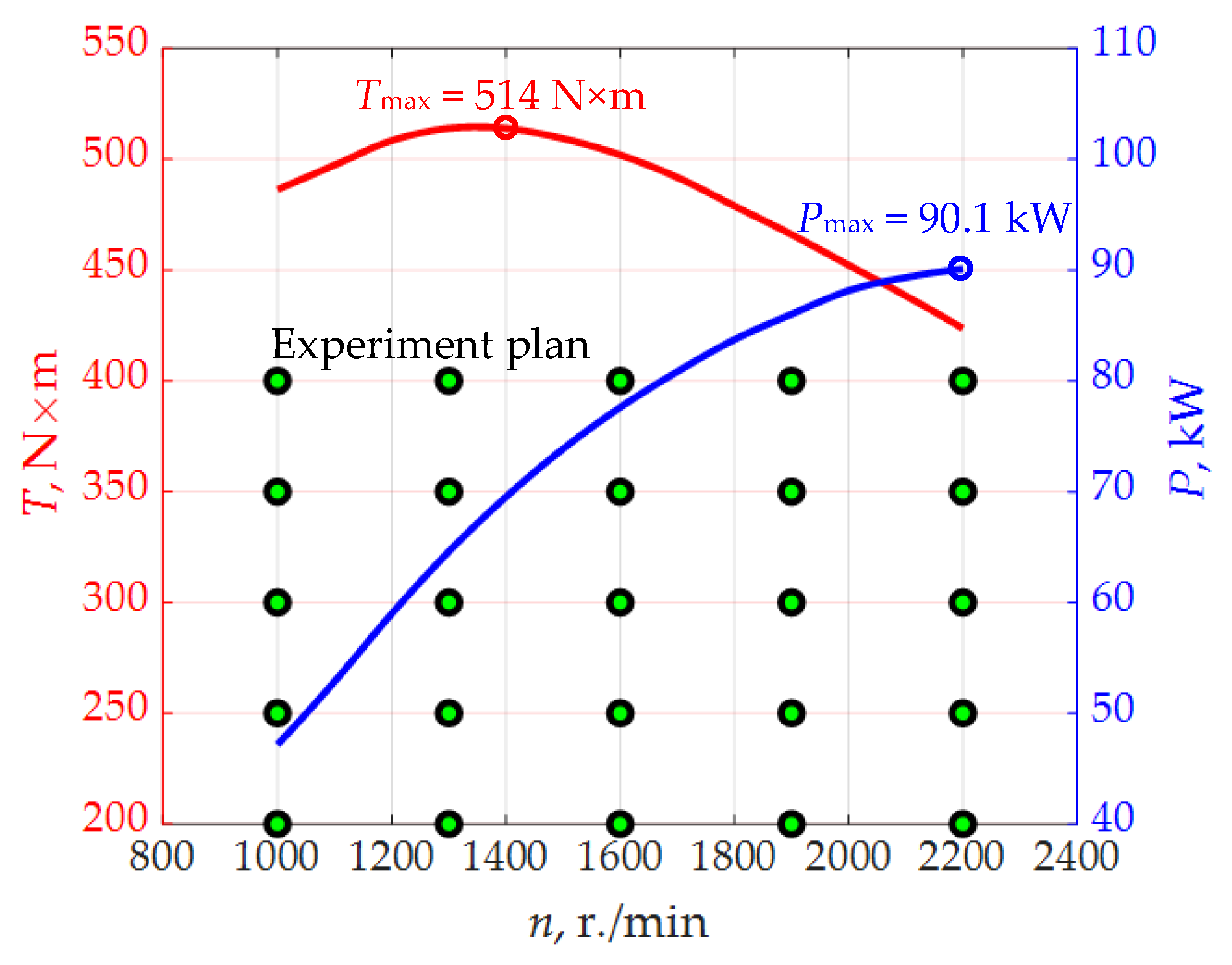
| max. power/rotational speed | 90.1 kW/2200 r./min |
| max. torque/rotational speed | 514 N × m/1400 r./min |
| combustion chamber | ω type |
| max. boost pressure | 1.8 bar |
| fuel system | high-pressure, 2-phase common-rail |
| number of openings in the injector | 6 |
| max. fuel pressure | 1800 bar |
| crank radius | 63.5 mm |
| connecting rod length | 219.1 mm |
| Parameter | Value |
|---|---|
| max. power consumption | 200 kW |
| max. speed | 6000 r./min |
| max. torque | 700 N × m |
| coolant requirement | 6 m3/h |
| Parameter | Value |
|---|---|
| measuring range | (0–250) bar |
| nominal sensitivity | 15 pC/bar |
| sampling frequency | every 0.1 deg (~150 kHz at 1500 r./min) |
| linearity | </= ±0.3% FSO |
| operating temp. range | to 400 °C |
| Parameter | Value |
|---|---|
| max. rotational speed | 20,000 r./min |
| overload capacity | ok. 400 g |
| permissible operating temp. (electronics) | −40 °C to 70 °C |
| permissible operating temp. (mechanical/optical) | −40 °C to 120 °C |
| type of analysis | rotating, swiveling |
| output resolution I | 3600, 1800, 720, …, 36 pulses/rotation |
| output resolution II | 720, …, 36 pulses/rotation |
| Parameter | Value |
|---|---|
| rated capacities | 300 kg |
| sensitivity | 2 ± 0.003 mV/V |
| TC zero | ±0.002% F.S. 10 °C |
| TRC span | ±0.002% F.S. 10 °C |
| operating temp. | −30 to +70 °C |
| max. safe overland | 120% F.S. |
| T N × m | 400 | 5. | 10. | 15. | 20. | 25. |
| 350 | 4. | 9. | 14. | 19. | 24. | |
| 300 | 3. | 8. | 13. | 18. | 23. | |
| 250 | 2. | 7. | 12. | 17. | 22. | |
| 200 | 1. | 6. | 11. | 16. | 21. | |
| idle | 1000 | 1300 | 1600 | 1900 | 2200 | |
| n, r./min | ||||||
| n, r./min | ||||||
|---|---|---|---|---|---|---|
| T, N × m | 1000 | 1300 | 1600 | 1900 | 2200 | |
| 400 |  |  |  |  |  | |
| 350 |  |  |  |  |  | |
| 300 |  |  |  |  |  | |
| 250 |  |  |  |  |  | |
| 200 |  |  |  |  |  | |
| idle |  | |||||
| n, r./min | ||||||
|---|---|---|---|---|---|---|
| T, N × m | 1000 | 1300 | 1600 | 1900 | 2200 | |
| 400 |  |  |  |  |  | |
| 350 |  |  |  |  |  | |
| 300 |  |  |  |  |  | |
| 250 |  |  |  |  |  | |
| 200 |  |  |  |  |  | |
| idle |  | |||||
| n, r./min | ||||||
|---|---|---|---|---|---|---|
| T, N × m | 1000 | 1300 | 1600 | 1900 | 2200 | |
| 400 |  |  |  |  |  | |
| 350 |  |  |  |  |  | |
| 300 |  |  |  |  |  | |
| 250 |  |  |  |  |  | |
| 200 |  |  |  |  |  | |
| idle |  | |||||
Disclaimer/Publisher’s Note: The statements, opinions and data contained in all publications are solely those of the individual author(s) and contributor(s) and not of MDPI and/or the editor(s). MDPI and/or the editor(s) disclaim responsibility for any injury to people or property resulting from any ideas, methods, instructions or products referred to in the content. |
© 2026 by the authors. Licensee MDPI, Basel, Switzerland. This article is an open access article distributed under the terms and conditions of the Creative Commons Attribution (CC BY) license.
Share and Cite
Szpica, D.; Kluczyński, K. An Assessment of the Non-Repeatability of a Diesel Engine Cycle-by-Cycle Operation Under Variable Load and Speed Conditions. Energies 2026, 19, 1343. https://doi.org/10.3390/en19051343
Szpica D, Kluczyński K. An Assessment of the Non-Repeatability of a Diesel Engine Cycle-by-Cycle Operation Under Variable Load and Speed Conditions. Energies. 2026; 19(5):1343. https://doi.org/10.3390/en19051343
Chicago/Turabian StyleSzpica, Dariusz, and Kamil Kluczyński. 2026. "An Assessment of the Non-Repeatability of a Diesel Engine Cycle-by-Cycle Operation Under Variable Load and Speed Conditions" Energies 19, no. 5: 1343. https://doi.org/10.3390/en19051343
APA StyleSzpica, D., & Kluczyński, K. (2026). An Assessment of the Non-Repeatability of a Diesel Engine Cycle-by-Cycle Operation Under Variable Load and Speed Conditions. Energies, 19(5), 1343. https://doi.org/10.3390/en19051343