1. Introduction
Energy price volatility plays a critical role in shaping energy system stability and energy security [
1]. Recent discourse in Nature Energy highlights that extreme volatility in fossil fuel markets, such as the shocks observed during the 2022 global energy crisis, exposes the structural fragility of energy systems and complicates the policy landscape for a low-carbon transition [
2]. Despite the ongoing energy transition, steam coal remains a fundamental component of the energy mix in many countries, particularly in large emerging economies. Sharp fluctuations in coal prices can disrupt power generation costs, industrial production, and overall energy system resilience [
3].
As highlighted by Zhao et al. [
4] and Lin and Shi [
5], the stability of energy prices is not merely a sectoral concern but a macroeconomic imperative, as energy serves as a critical input for industrial value added. Although the global consensus on decarbonization is strengthening [
6], the “lock-in” effect of coal-fired power infrastructure implies that coal will continue to act as a anchor for energy security in the medium term [
7]. Furthermore, scholars writing in Nature Climate Change argue that ignoring the supply-side dynamics of the coal sector—including its political economy and infrastructure lock-in—can lead to severe market distortions that undermine climate goals [
8]. Consequently, unexpected volatility in coal prices can transmit shocks through the “coal-electricity-economy” nexus, affecting downstream inflation and industrial competitiveness [
9,
10]. Therefore, understanding the pricing mechanisms of coal is essential for maintaining the stability of the entire energy system.
In recent years, global and domestic coal markets have experienced unprecedented price surges. In China, steam coal prices surged sharply in 2021, reaching historical highs within a short period. This extreme episode cannot be fully explained by conventional supply–demand fluctuations alone, suggesting the presence of structural constraints such as inventory depletion, logistics bottlenecks, and cross-energy price spillovers. Wang et al. [
11] characterized these movements as “extreme price bubbles” driven by a mismatch between rigid supply constraints and recovering demand. During this period, physical constraints—specifically the depletion of port inventories and disruptions in logistics networks—severed the traditional link between marginal cost and price, leading to market failures [
12]. Furthermore, the 2021 crisis highlighted how external shocks, such as fluctuations in international oil and gas prices, can amplify domestic volatility through substitution effects and market sentiment [
13].
Existing studies have primarily examined coal price fluctuations through supply and demand fundamentals, inventory effects, and policy interventions. Methodologically, various approaches have been utilized, including Computable General Equilibrium (CGE) and Vector Autoregression (VAR) models. These models help analyze the impact of production capacity [
14], macroeconomic growth [
5], and import policies [
15] on coal prices. However, most studies focus on isolated factors or static relationships, with limited attention to the dynamic interaction among inventory adjustment, logistics constraints, and external energy price shocks, particularly under extreme market conditions. For instance, while the “Theory of Storage” is well-established in financial economics [
16,
17], its application to the dynamic modeling of China’s specific “North-to-South” coal logistics bottlenecks remains underexplored. As a result, the transmission mechanisms of coal price volatility within the energy system remain insufficiently understood.
Compared to prior static VAR or classical storage-theory-based studies, this research explicitly captures the dynamic intertemporal interactions between port inventory buffers and logistics bottlenecks under extreme external shocks. To address this gap, this study makes the following contributions to the literature and energy system analysis: (1) It conceptualizes an “effective coal supply” framework by integrating inventory availability and logistics constraints, moving beyond nominal production indicators. (2) It empirically distinguishes between persistent substitution-driven shocks (international oil prices) and transient logistics-driven pulse shocks (ocean freight rates). (3) It provides long-term and short-term evidence on how inventory functions as a stabilizing mechanism for energy security under extreme volatility. (4) It offers policy-relevant insights for energy price stabilization from a logistics- and reserve-oriented perspective.
3. Materials and Methods
3.1. Conceptual Framework
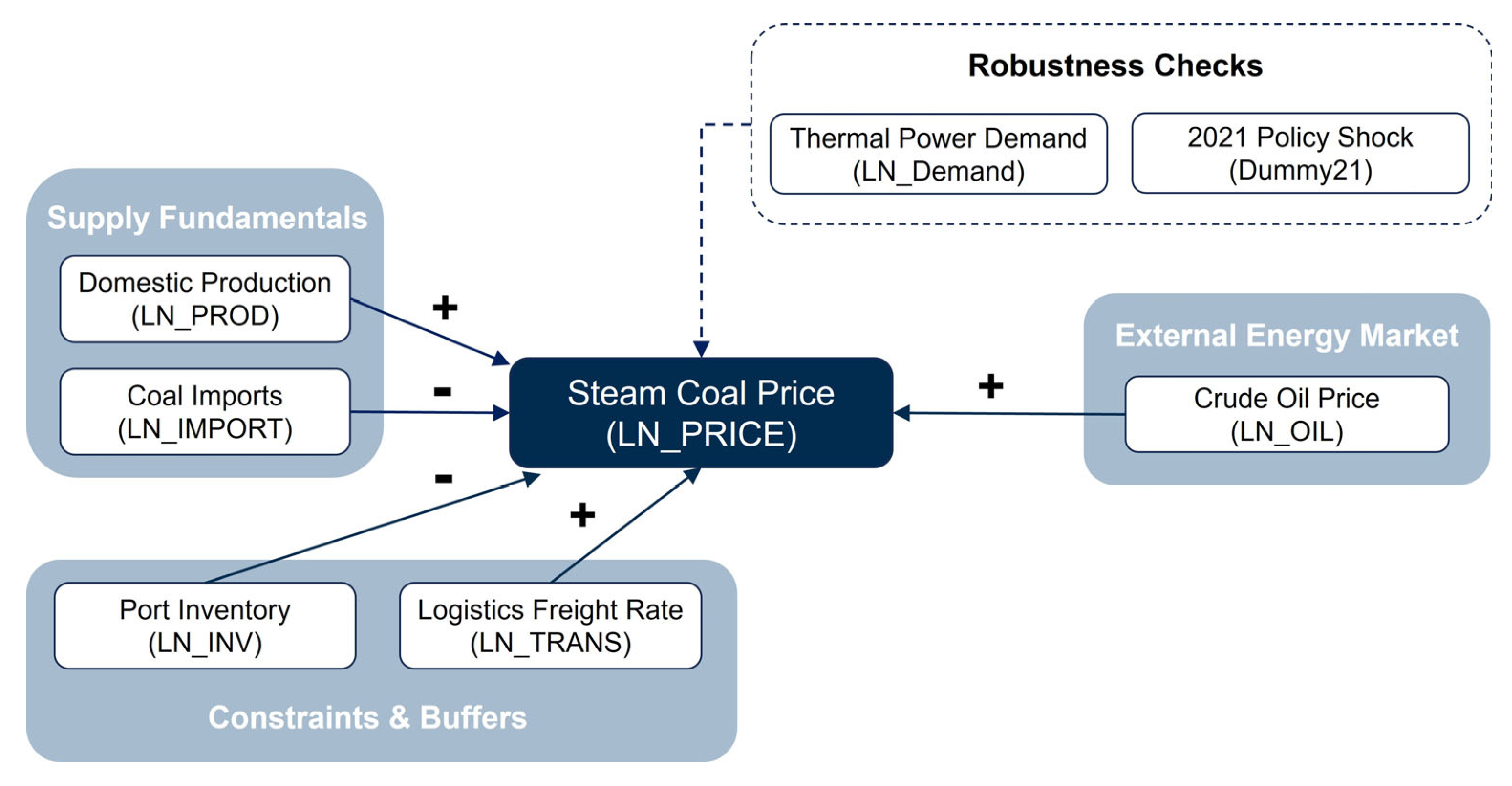
As illustrated in
Figure 1, the dynamic transmission mechanisms of steam coal prices are driven by three main modules: (1) Supply Fundamentals: Domestic production (LN_PROD) and coal imports (LN_IMPORT) constitute the supply side. A positive relationship (+) is expected between production and price, reflecting a lagged capacity release driven by robust demand. Conversely, coal imports are expected to exert a negative effect (−) by increasing market supply and suppressing price spikes. (2) Constraints and Buffers: Port inventory (LN_INV) and logistics freight rates (LN_TRANS) act as critical market buffers. High port inventories signal sufficient supply, placing downward pressure on prices (−). In contrast, rising logistics costs directly elevate the arrival price of coal (+). (3) External Energy Market: The crude oil price (LN_OIL) captures the cross-market linkage. As a primary energy substitute, an increase in oil prices often drives up the demand and price for steam coal (+). Robustness Checks: To ensure the reliability of the baseline model, thermal power demand (LN_DEMAND) and a 2021 policy shock dummy (Dummy21) are introduced as exogenous variables to verify the structural stability of the system under varying demand conditions and extreme policy interventions.
3.2. Variables and Data Sources
While macroeconomic indicators and specific policy interventions also influence coal prices, this study prioritizes variables that represent the critical nodes of the physical supply chain and cross-energy interactions. Specifically, international oil prices serve as a proxy for both macro-market sentiment and energy substitution effects, while production and import volumes directly reflect the outcomes of supply-side policies. This focused selection ensures model parsimony while capturing the primary drivers of the ‘effective supply’ mechanism.
This study employs monthly time-series data covering the period from May 2016 to August 2025, yielding a total of 112 observations. The primary data sources include the National Bureau of Statistics of China (NBS), the China Coal Market Network (CCTD), and the General Administration of Customs. To eliminate heteroscedasticity and interpret the regression coefficients as elasticities, all variables are transformed into their natural logarithms. The specific definitions, measurement units, and economic implications of the selected variables are presented in
Table 1.
The selection of these variables is grounded in the specific mechanisms of the Chinese coal market. The Steam Coal Price (PRICE) is represented by the spot price at Qinhuangdao Port, which serves as the primary distribution hub for the “North-to-South Coal Transport” network and acts as the market’s price barometer. On the supply side, Raw Coal Production (PROD) represents the fundamental domestic supply capacity, while Coal Import Volume (IMPORT) acts as a marginal adjustment variable often influenced by policy quotas and arbitrage opportunities. A critical component of this study is the inclusion of Port Inventory (INV). Based on the theory of storage, inventory levels are inversely related to price volatility. However, considering commercial practices such as information lags and contract execution cycles, current pricing decisions are often driven by the inventory levels observed at the end of the previous period. Therefore, this study adopts the one-period lagged inventory ( to better capture the intertemporal adjustment mechanism. Additionally, Ocean Freight Rates (TRANS) are included to proxy for logistics constraints. Specifically, the Qinhuangdao-Guangzhou route is selected as the benchmark because it represents the critical artery of China’s ‘North-to-South Coal Transport’ network, linking the largest dispatch hub in the north to the primary consumption centers in the Pearl River Delta. A spike in freight rates not only increases landed costs but also signals transportation bottlenecks that can exacerbate supply tightness in consumption regions.
3.3. Empirical Methodology
Given that macroeconomic time-series data often exhibit non-stationarity, traditional Ordinary Least Squares (OLS) regression may lead to spurious results. Therefore, this study adopts the Vector Error Correction Model (VECM) to analyze the dynamic transmission mechanisms of coal price fluctuations [
45]. While the sample size of 112 monthly observations is relatively compact for a six-variable system, it covers the critical period following China’s coal supply-side structural reform, ensuring a consistent policy and institutional environment. According to econometric requirements for VECM, this sample size provides sufficient degrees of freedom to yield reliable cointegration vectors, as further evidenced by our robust results in the stability and residual tests. Furthermore, broader macroeconomic and policy variables are excluded as endogenous variables to preserve degrees of freedom and focus strictly on the physical mechanisms of the energy market. The rationale for selecting the VECM over alternative frameworks is three-fold. First, unlike the ARDL model which is primarily designed for single-equation estimation, the VECM allows for the analysis of multiple endogenous interactions among coal prices, inventory, and logistics, capturing the feedback loops inherent in the energy market. Second, while SVAR focuses on short-term structural innovations, the VECM uniquely incorporates the Error Correction Term (ECT), which is essential for quantifying the speed at which coal prices return to long-run equilibrium after a market shock. Third, regarding the Regime-switching model suggested for the 2021 volatility, we contend that the long-term cointegration relationship among variables remained structurally stable. By incorporating dummy variables for the 2021 extreme events and passing the CUSUM stability tests, the VECM provides a more parsimonious and interpretable framework for policy analysis without the risk of over-parameterization associated with non-linear models. The empirical procedure follows a three-step strategy: First, the Augmented Dickey–Fuller (ADF) test is conducted to verify the integration order of the variables. Second, the Johansen cointegration test is employed to determine whether a long-term equilibrium relationship exists among the non-stationary variables. Finally, a VECM is constructed to capture both the long-term equilibrium and the short-term dynamic adjustments.
3.4. Model Specification
The VECM framework distinguishes between long-run relationships and short-run dynamics. Based on the theoretical framework discussed above, the long-term equilibrium equation for steam coal prices is specified in a log-linear form as follows:
In this equation, represents the constant term, and through represent the long-term elasticities of production, lagged inventory, freight rates, oil prices, and imports on coal prices, respectively. The term denotes the error term. The VECM allows us to observe how deviations from this long-term equilibrium are corrected over time through the error correction term (ECT). Following the model estimation, structural analysis techniques, including impulse response functions and variance decomposition, are applied to quantify the dynamic impact and contribution of structural shocks from each variable on coal prices.
4. Empirical Results
4.1. Stationarity and Cointegration Tests
To ensure the validity of the time series analysis and avoid spurious regressions, the Augmented Dickey–Fuller (ADF) test was first employed to examine the stationarity of the logarithmic variables. As shown in
Table 2, the results exhibit mixed integration characteristics at the level. However, after first-order differencing, all variables reject the null hypothesis of a unit root at the 1% significance level, indicating that the series are stationary in their differenced form.
Given that the variables satisfy the stationarity condition after differencing, the Johansen cointegration test was conducted to identify long-term equilibrium relationships. The Trace statistic and Max-Eigen statistic were utilized to determine the number of cointegrating vectors. The results in
Table 3 show that the null hypotheses of “None” and “At most 1” cointegrating equation are rejected at the 5% significance level.
The test confirms the existence of two cointegrating vectors among the variables. The results indicate that the variables share stable long-run cointegration relationships, justifying the use of a VECM framework.
4.2. Granger Causality Tests
Although the cointegration test confirms the existence of a long-term equilibrium relationship among the variables, it does not directly reveal the lead-lag relationships or the direction of causality. To further clarify the dynamic interaction mechanisms between steam coal prices and their influencing factors, and to determine the endogeneity and exogeneity of each variable within the system, this study conducted pairwise Granger Causality Tests on the core variables. The results are presented in
Table 4.
Based on the test results, the primary empirical findings are as follows.
First, a bidirectional Granger causal relationship exists between steam coal prices and port inventory. The F-statistic for inventory affecting price is as high as 16.84 (p < 0.01), indicating that inventory changes significantly lead price fluctuations. This validates the effectiveness of the “reservoir” function; that is, inventory levels serve as a robust predictor for future price trends. Conversely, the causality from price to inventory (p = 0.0433) reflects a feedback mechanism driven by expectations: price levels influence the willingness of traders to stockpile or destock, thereby triggering adjustments in inventory levels.
Second, cost-side variables exert a significant unidirectional drive on coal prices. Both international oil prices (OIL) and ocean freight rates (TRANS) are Granger causes of coal prices (PRICE), rejecting the null hypothesis at significance levels of 4.41% and 4.59%, respectively. This suggests that external energy cost shocks (oil prices) and circulation costs (freight rates) are leading indicators of domestic coal price increases. Oil price volatility transmits to the coal market through energy substitution and market sentiment, while rising freight rates directly translate into increased landed costs; both constitute key external drivers of price volatility.
Third, significant “price-driven supply” and “substitution-complementarity” mechanisms exist on the supply side. The test shows that coal price is the Granger cause of production (PROD), indicating that price signals effectively guide capacity release. This reflects the supply-side response mechanism under the policy of “guaranteeing supply and stabilizing prices.” Meanwhile, import volume (IMPORT) is the Granger cause of production (PROD), suggesting that the supplementary effect of imported coal influences domestic production scheduling, forming a dynamic balance between the two. Furthermore, the impact of coal price on imports holds at a marginally significant level (p = 0.0504), implying that the arbitrage space driven by domestic-international price spreads is an important motivator for import supplementation.
In summary, the Granger causality test results further support the rationale for constructing the VECM and provide a statistical basis for the subsequent analysis of inventory mechanisms, cost transmission, and supply response.
4.3. Long-Run Relationships
Based on the VECM estimation, the normalized long-run cointegrating equation reveals the structural drivers of steam coal prices in China. The estimated coefficients and model diagnostics are presented in
Table 5.
The long-run equilibrium relationship can be expressed as:
The empirical results confirm the distinctive roles of inventory, external shocks, and logistics constraints in the price formation mechanism:
First, inventory functions as a critical market stabilizer, validating the “Theory of Storage”. The coefficient for lagged inventory is −0.153, indicating a robust negative feedback mechanism. In the long run, higher inventory levels act as a “buffer pool” and increase the convenience yield, effectively dampening price volatility by reducing market anxiety regarding potential supply shortages. Conversely, when inventory falls below a critical threshold, the scarcity effect dominates, driving prices up disproportionately.
Second, international oil prices generate persistent upward pressure through the cross-energy substitution effect. The elasticity of 0.257 highlights the strong structural linkage between domestic coal markets and global energy markets. A rise in oil prices not only increases the demand for coal as a substitute in the chemical and industrial sectors but also elevates the valuation of energy assets through global inflation expectations.
Third, logistics constraints significantly amplify cost-push transmission. The positive coefficient of 0.141 for ocean freight rates suggests that transportation costs are more than just a component of the final price; they serve as a leading indicator of supply bottlenecks. A spike in freight rates typically signals congestion in the “North-to-South” coal transport passages, exacerbating supply tightness in consumption regions and reflecting the structural inelasticity of coal logistics.
Finally, domestic production and imports exhibit a positive correlation with prices, reflecting the endogeneity of supply under demand-pull shocks. While seemingly counterintuitive for a classical static supply curve, the positive coefficient of 0.467 for production reflects the “price-driven supply response” characteristic of the Chinese market. Due to safety regulations and capacity planning lag, production often functions as an endogenous response to rising prices rather than an exogenous lead. Similarly, imports (0.062) play a supplementary role, driven by arbitrage opportunities when domestic-international price spreads allow.
4.4. Short-Run Dynamics
The VECM estimation results demonstrate a dynamic interaction between restoring forces and deviating factors within the Chinese steam coal market. The system’s ability to restore equilibrium is empirically evidenced by the behavior of inventory and the convergence of model residuals.
The lagged port inventory functions as the primary stabilizing factor. The estimated coefficient of −0.153 indicates a significant negative feedback mechanism. In the short run, a deviation in inventory levels triggers an inverse price adjustment in the subsequent period. This validates the convenience yield hypothesis, where inventory accumulation dampens volatility by signaling sufficient supply availability, whereas inventory depletion below critical thresholds accelerates price correction. The efficacy of this adjustment mechanism is further corroborated by the residual analysis.
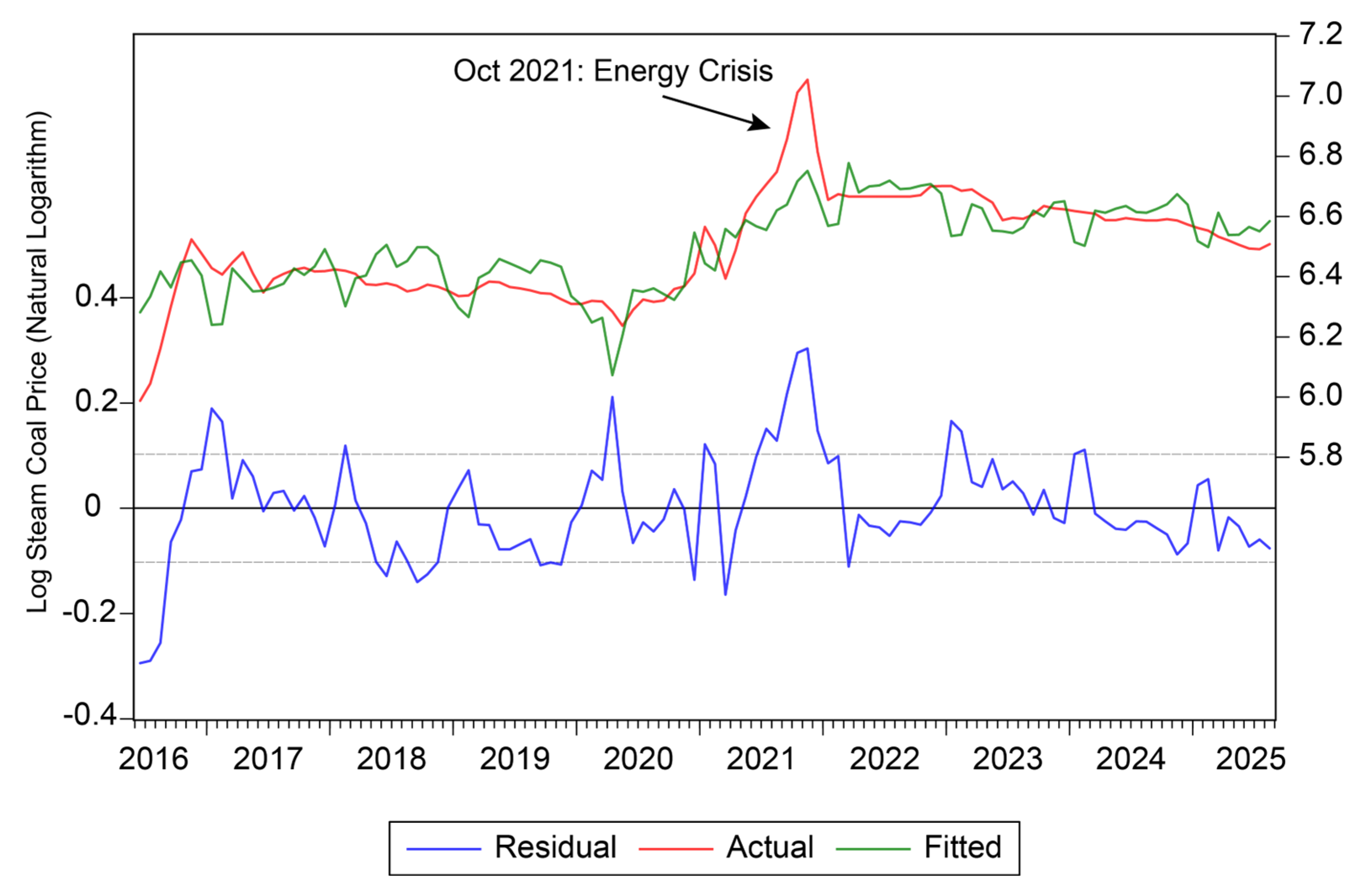
As illustrated in
Figure 2, the model residuals fluctuate around the zero axis during stable periods (2016–2020 and post-2022), indicating that the endogenous variables effectively correct short-term disequilibrium. However, the significant structural break observed in late 2021 highlights that extreme external shocks can temporarily override this restoring mechanism, necessitating policy intervention to re-establish the cointegration relationship.
Conversely, deviations from equilibrium are primarily driven by external costs and substitution effects. International oil prices exhibit the highest elasticity (0.257), suggesting that global energy inflation creates persistent upward pressure on domestic coal prices through the energy substitution channel. Additionally, ocean freight rates , with a coefficient of 0.141, introduce high-frequency volatility. The high coefficient of variation for freight rates (0.308) implies that logistics bottlenecks act as pulse shocks, causing rapid but transient price spikes.
4.5. Impulse Response Analysis
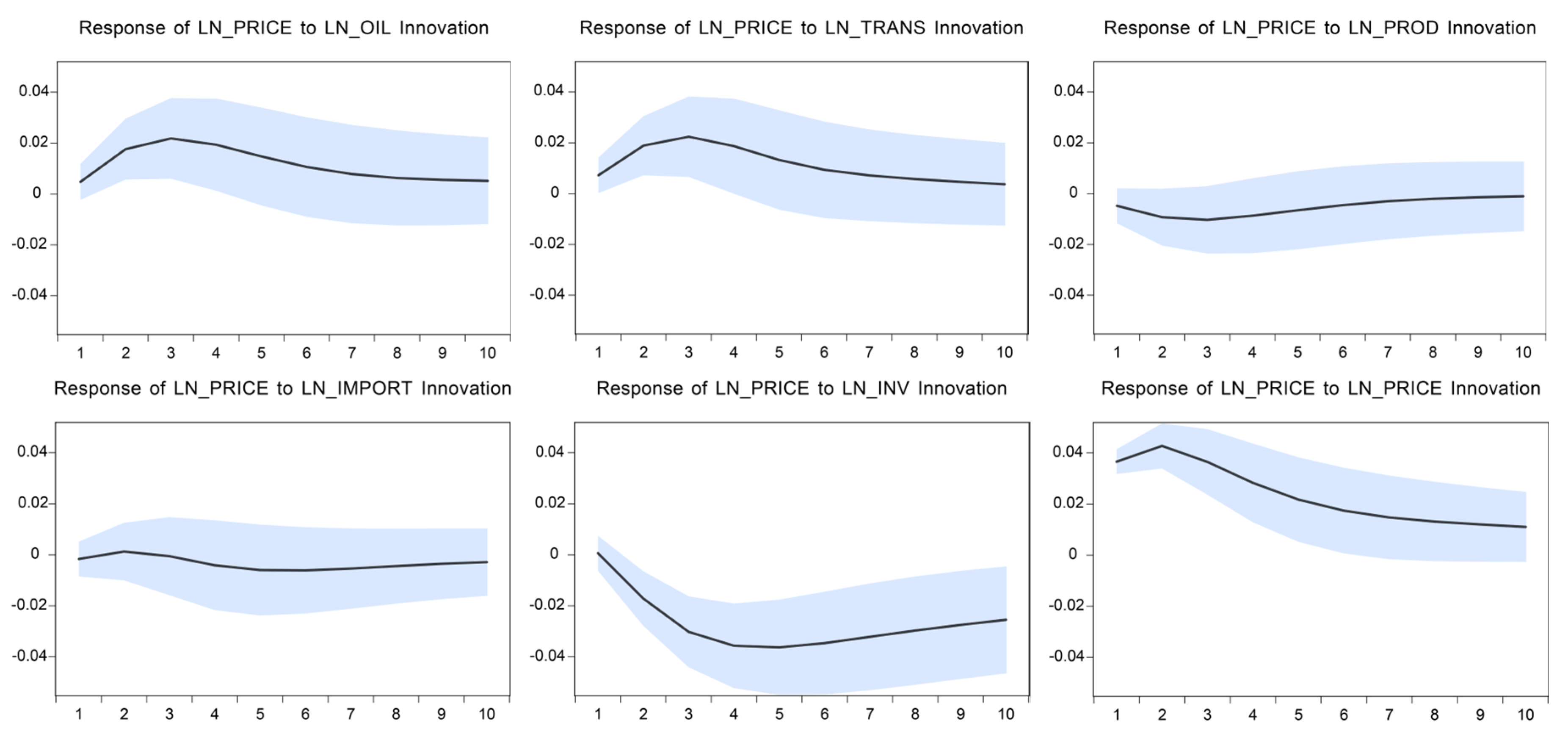
To quantify the dynamic transmission paths and persistence of structural shocks, we employ orthogonalized impulse response functions (OIRF) over a 12-month horizon, as shown in
Figure 3.
Response to Port Inventory Shocks. A positive shock to port inventory elicits an immediate and sustained decline in coal prices. The response reaches its maximum negative intensity between the fourth and fifth months and remains negative throughout the 12-month period. This confirms the intertemporal lag effect of inventory: high stock levels not only increase immediate physical availability but also anchor market expectations, suppressing speculative pricing behavior.
Response to Ocean Freight Rate Shocks. The impact of ocean freight rates is characterized by a short-term volatility pulse. Prices rise rapidly following a shock, peaking at the third month, but the effect decays significantly by the sixth month. This pattern indicates that logistics constraints—often caused by weather or scheduling issues—result in temporary cost-push inflation. Once the physical transport bottleneck is resolved, the premium on the delivered price dissipates quickly.
Response to International Oil Price Shocks. International oil prices demonstrate a persistent positive effect with significant stickiness. The response curve remains positive across the entire observation window, reflecting the deep integration of global energy markets. Oil price shocks transmit to the coal market through dual channels: the industrial substitution effect and the synchronization of financialized energy asset valuations, making oil-driven inflation more difficult to dissipate than logistics-driven spikes.
Response to Domestic Production Shocks. Domestic production shocks exhibit a lagged and mild negative response. Significant price suppression does not occur until the third month. This delay reflects the physical and regulatory time lags inherent in the coal supply chain, where policy-directed capacity expansion requires time to translate into effective market supply.
4.6. Model Stability Test
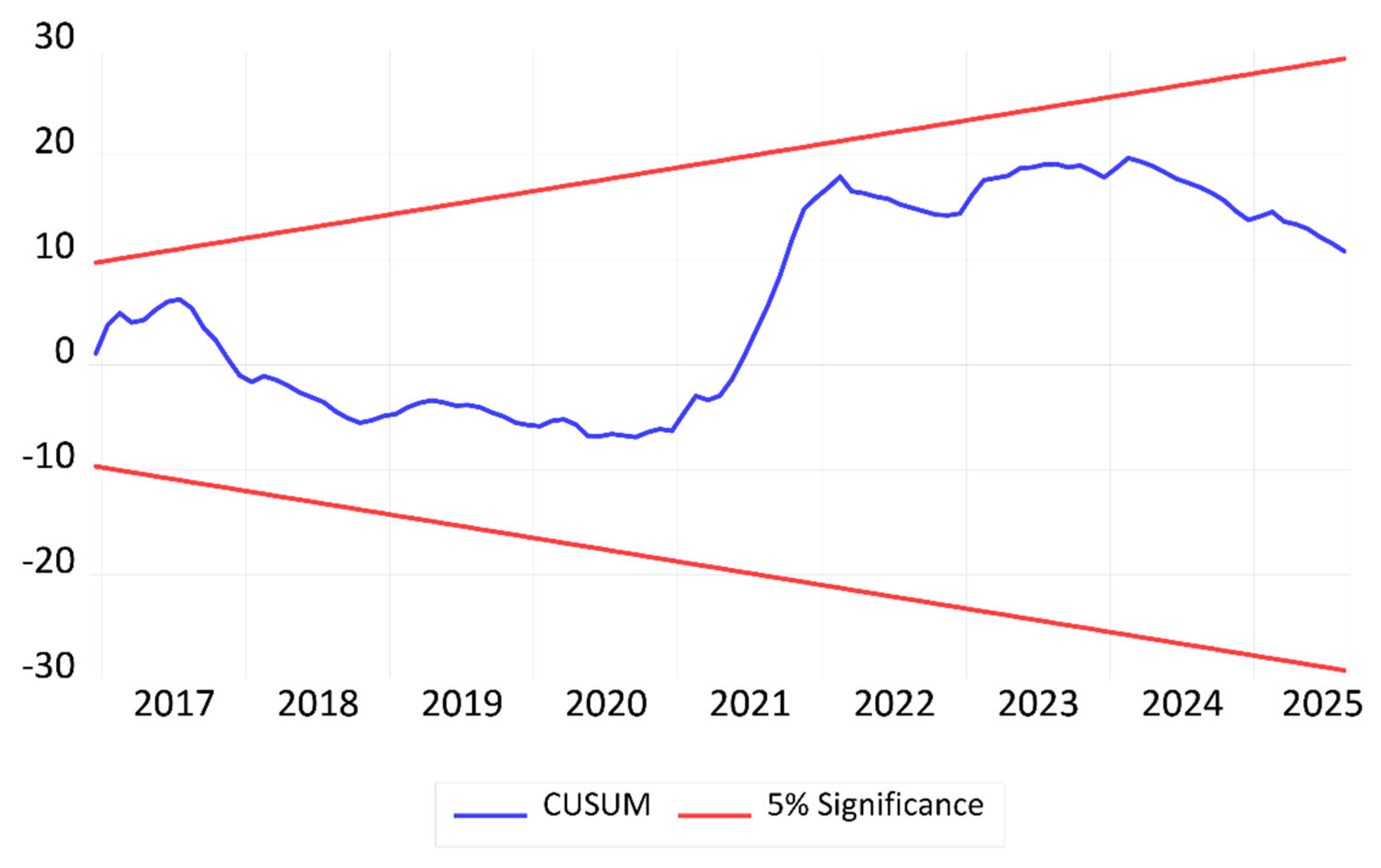
To verify the structural stability of the estimated VECM parameters over the sample period, we employ the Cumulative Sum of Recursive Residuals (CUSUM) test. Parameter instability can lead to biased estimates, especially given the extreme volatility observed in the coal market in 2021.
As shown in
Figure 4, the CUSUM statistic curve fluctuates but consistently remains within the critical boundaries at the 5% significance level throughout the entire observation period (2016–2025). Although the curve exhibits an upward trend and approaches the upper critical bound during the extreme market volatility of 2021–2022, it does not cross the threshold. This result confirms that the coefficients of the VECM model are structurally stable. The estimated long-term equilibrium relationships and dynamic transmission mechanisms remain valid even in the presence of significant external shocks.
4.7. Robustness Checks
To ensure the reliability of the empirical results and address the concerns regarding omitted variable bias and structural breaks, two rigorous robustness exercises were conducted.
First, acknowledging that steam coal demand is strictly tied to power system dispatch, the logarithmic thermal power generation (LN_DEMAND) was introduced as an exogenous demand-side proxy into the short-run dynamics of the VECM, as shown in
Table 6. The results indicate that even after controlling for demand-side shocks, the core coefficients for port inventory and ocean freight rates remain statistically significant with their expected signs. This confirms that the supply/logistics buffering effects are distinct from demand fluctuations.
Second, as presented in
Table 7, a crisis-period dummy variable (Dummy21, set to 1 for September 2021 to March 2022) was introduced as an exogenous control to account for the extreme price volatility and policy interventions in 2021. The re-estimated error correction term (ECT) and the long-run cointegrating relationship remained highly stable. This demonstrates that the fundamental market adjustment mechanisms are robust despite the structural policy shocks experienced in 2021.
It is worth noting that the coefficient for international oil prices (LN_OIL) becomes statistically insignificant in both robustness models. This is econometrically sound and carries important economic implications. In the first model, the inclusion of explicit domestic demand (LN_DEMAND) absorbs the macroeconomic variance previously captured by oil, highlighting that domestic fundamentals (demand and inventory) strictly dominate the Chinese coal market. In the second model, the Dummy21 variable captures the extreme domestic supply-chain disruptions of 2021, during which internal policy shocks temporarily decoupled domestic coal prices from global energy cycles. Most importantly, despite these controls, the core logistics (LN_TRANS) and inventory (LN_INV) mechanisms remain highly significant, underscoring the absolute robustness of our central hypotheses.
5. Discussion
This study provides new insights into the dynamic transmission of steam coal prices in China by embedding inventory adjustment, logistics constraints, and cross-energy substitution into a unified energy system framework. The findings indicate that coal price volatility is not solely the outcome of supply–demand imbalances but rather the result of interactions among physical buffers, circulation capacity, and external energy shocks. The discussion below interprets these results from an energy system and energy security perspective.
5.1. Inventory as an Active Stabilizer in Energy Price Systems
The empirical results highlight port inventory as the most critical stabilizing mechanism in China’s steam coal market. The significant negative long-run elasticity of lagged inventory and the persistent negative response observed in the impulse response analysis confirm that inventory operates as an active intertemporal buffer, rather than a passive outcome of market clearing.
This finding extends the classical theory of storage by demonstrating that, under conditions of geographically segmented production and consumption, accessible inventory at key transit hubs plays a more decisive role in price stabilization than nominal production capacity. In China’s “North-to-South” coal transport system, port inventory effectively decouples short-term demand fluctuations from rigid upstream production schedules, thereby dampening price volatility during normal periods.
From an energy security perspective, this implies that maintaining adequate inventory levels at strategic nodes can significantly enhance system resilience. Inventory scarcity not only tightens physical supply but also amplifies market expectations of shortage, triggering speculative behavior and accelerating price escalation. Therefore, inventory management should be viewed as a core component of energy system operation rather than a residual market outcome.
5.2. Logistics Constraints as Transient but Amplifying Shock Channels
Unlike inventory, which provides sustained stabilization, logistics constraints function as short-lived but powerful amplifiers of price volatility. The positive long-run coefficient and the impulse response pattern of ocean freight rates indicate that logistics costs generate rapid price increases that peak within a few months and dissipate once transportation bottlenecks are resolved.
This pulse-shock characteristic suggests that freight rates are not merely cost components embedded in coal prices but serve as real-time signals of congestion in the energy supply chain. When transport capacity becomes constrained—due to weather disruptions, port congestion, or scheduling inefficiencies—the effective supply reaching consumption regions declines sharply, even if upstream production remains unchanged.
Such dynamics imply that energy system vulnerability often arises from circulation bottlenecks rather than resource scarcity. Consequently, traditional policies focused solely on expanding production capacity may be insufficient to prevent short-term price spikes. Enhancing transport flexibility, reserve shipping capacity, and coordination across logistics nodes is therefore essential for mitigating transient but disruptive price shocks.
5.3. Persistent Cross-Energy Transmission Under Energy Transition
Among all explanatory variables, international oil prices exert the most persistent influence on domestic coal prices. The strong and durable response to oil price shocks reflects the deepening integration of energy markets under the ongoing energy transition.
This persistence operates through two interconnected channels. First, higher oil prices increase the relative competitiveness of coal in industrial and chemical applications, reinforcing physical substitution effects. Second, global energy price inflation synchronizes expectations across energy markets, transmitting external shocks to domestic coal prices through financial and macroeconomic channels.
Unlike logistics-driven shocks, which fade as physical constraints ease, oil-driven shocks exhibit considerable stickiness. This highlights a structural challenge for energy price stability in an increasingly interconnected global energy system. As energy markets become more financialized, domestic coal prices are increasingly exposed to geopolitical risks and global energy cycles beyond national control.
5.4. Implications for Energy System Stability and Security
The findings of this study carry important implications for energy system governance and price stabilization strategies. First, energy security should shift from a capacity-centric paradigm toward an effective supply framework that integrates inventory availability and logistics capability. Nominal production alone is insufficient to ensure price stability if circulation constraints limit deliverable supply.
Second, a dual-reserve strategy is recommended. In addition to physical coal stockpiles at key consumption hubs, maintaining reserve logistics capacity—such as flexible shipping and port handling capability—can substantially reduce the likelihood and magnitude of short-term price spikes.
Third, the strong spillover from international oil markets suggests that energy risk management should adopt a cross-energy perspective. Energy enterprises and policymakers should consider coordinated hedging strategies across coal and oil markets to mitigate imported inflation risks associated with global energy price volatility.
Overall, this study underscores that under energy transition conditions, coal price stability is increasingly determined by system-level interactions rather than isolated market fundamentals. Strengthening inventory management, logistics resilience, and cross-energy coordination is therefore essential for maintaining energy system stability during periods of extreme uncertainty.
6. Conclusions
This study examined the dynamic transmission mechanism of steam coal prices in China from 2016 to 2025 using a Vector Error Correction Model (VECM). By jointly incorporating inventory adjustment, logistics constraints, and cross-energy price spillovers, the analysis moves beyond a conventional supply–demand perspective and reveals the system-level drivers of coal price volatility under energy transition conditions.
The results demonstrate that China’s steam coal pricing mechanism has evolved into a multi-layered system shaped by intertemporal buffers, circulation capacity, and external energy shocks. Port inventory plays a central stabilizing role by acting as an intertemporal buffer that anchors market expectations and mitigates price volatility. In contrast, logistics constraints, proxied by ocean freight rates, function as short-term amplifiers that generate rapid but transient price spikes when circulation bottlenecks emerge. International oil prices exert the most persistent influence, reflecting deepening cross-energy substitution and the increasing exposure of domestic coal prices to global energy cycles. In addition, the positive relationship between production and prices highlights the policy-constrained nature of supply adjustment, indicating that nominal production capacity alone is insufficient to explain price dynamics without accounting for effective deliverable supply.
Based on these findings, several policy-relevant implications emerge. First, a tiered inventory early-warning system should be established. Specifically, when the Qinhuangdao Port inventory drops below the 20th percentile of its historical three-year moving average (a proxy for the storage buffer threshold), it should automatically trigger a ‘Dual-Track Supply Recovery’ protocol: (1) an immediate 15% expansion of monthly coal import quotas to bridge the physical gap, and (2) the prioritization of ‘Green Channel’ railway slots for north-to-south transport to prevent local scarcity from evolving into a national price bubble. Second, to mitigate the ‘transient pulse shocks’ from ocean freight rates, we suggest creating a National Energy Logistics Reserve Pool. This involves pre-negotiating standby shipping capacity that can be deployed at fixed rates when the Qinhuangdao-Guangzhou freight index exceeds a predefined volatility threshold. This mechanism targets the structural inelasticity of coal logistics, ensuring that ‘effective supply’ remains deliverable even during maritime bottlenecks. Third, given the persistent spillover from international oil prices, the government should implement a Coal-Oil Price Parity Monitoring Mechanism. Since oil shocks demonstrate higher stickiness than logistics shocks, energy-intensive industries (e.g., coal-to-chemicals) should be incentivized through tax credits to adopt long-term hedging instruments. This will decouple domestic industrial costs from global energy inflation and reduce the substitution-driven demand spikes observed during international oil crises.
Overall, this study underscores that under the energy transition, coal price stability is increasingly determined by interactions within the broader energy system rather than isolated market fundamentals. Enhancing inventory management, improving logistics resilience, and strengthening cross-energy coordination are therefore critical for maintaining energy security and price stability during periods of heightened uncertainty.
Limitations and Future Research
This study has two main limitations. First, due to data availability, the analysis relies on port inventory as the primary storage buffer. While highly representative of coastal market dynamics, it cannot fully capture plant-level end-user “social inventory”. Future studies should aim to incorporate broader inventory proxies. Second, the findings strictly apply to the thermal/steam coal market (e.g., Qinhuangdao 5500 kcal FOB). Metallurgical and coking coal, which are driven by different fundamentals such as steel cycles and distinct logistics channels, may exhibit different dynamic mechanisms and warrant separate investigation.