1. Introduction
In Taiwan, air-conditioning systems have become indispensable to daily life, accounting for more than 40% of the total electricity consumption. Consequently, their share of overall power demand has been steadily increasing, particularly due to the rapid proliferation of small- and medium-sized air-conditioning systems (ACS), which has driven peak electricity loads to new record levels. Furthermore, climate change induced by the greenhouse effect is projected to raise the average temperature on peak demand days in Taiwan. For most users, ACS is primarily operated during daytime high-temperature periods, significantly increasing electricity expenditures. In addition, the annual operating hours of ACS have shown a continuous upward trend [
1]. In response, industries have been actively investing in the research and development of energy-efficient technologies to reduce electricity consumption and mitigate energy costs. Therefore, improving the efficiency of ACS has become an urgent and indispensable issue [
2,
3].
In an ACS, the power consumption of chillers accounts for approximately 60% of the total energy use. Energy-saving analyses indicate that implementing appropriate control strategies and improving the Coefficient of Performance (COP) of the chiller units are among the most effective approaches to reducing the substantial power demand associated with peak loads [
4]. The most common energy-saving strategies for chillers include: (1) operating the chiller at its optimal efficiency point, and (2) increasing the chilled water outlet temperature [
5,
6]. In general, chillers operate most efficiently at 60% to 95% of their rated cooling capacity, and the COP exhibits an approximately linear relationship with the cooling capacity [
7]. The operating efficiency of a chiller depends on the combined performance of the compressor, evaporator, and condenser [
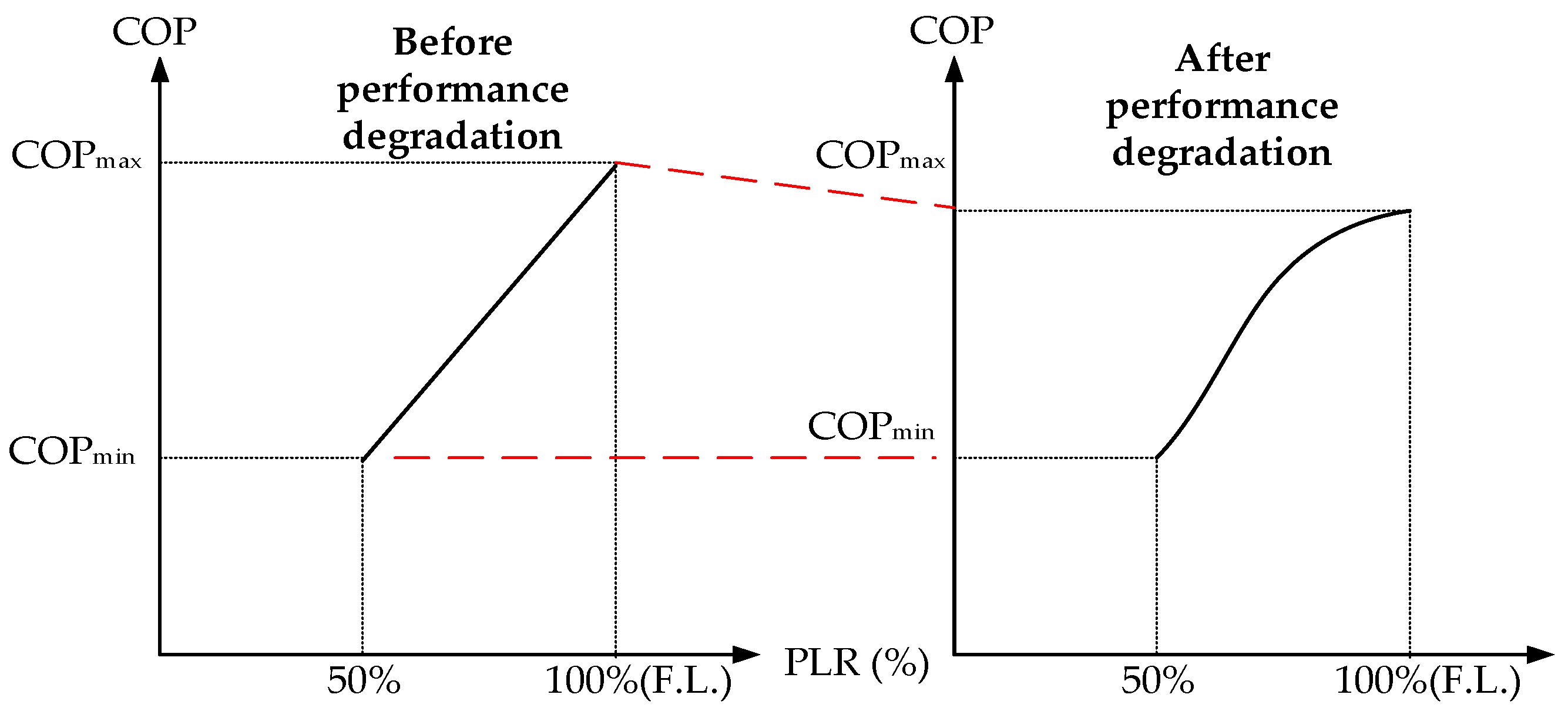
8]. If a chiller’s capacity becomes insufficient due to poor design or prolonged operation, operating it near full load will only increase energy consumption without improving cooling performance. In an ACS, avoiding the operation of multiple chillers at low efficiency levels can yield significant energy savings and enhance overall system performance. Therefore, implementing real-time capacity control among multiple chillers to maintain operation near their optimal efficiency points is essential for improving the overall energy efficiency of the system.
In the field of energy-saving optimization for ACS, most studies have concentrated on the economic scheduling of chillers. These studies employ a wide range of optimization algorithms, such as particle swarm optimization [
9], dynamic programming [
10], Hopfield neural networks [
11], genetic algorithms [
12,
13], simulated annealing [
14], differential evolution [
15], cuckoo search [
16], and the firefly algorithm [
17]. These algorithms adjust the chillers’ capacity outputs based on the required cooling load to determine load distribution and power consumption for each unit, thereby ensuring the system operates at its most energy-efficient state and minimizing electricity costs. In recent years, with the rapid development of energy-saving technologies and equipment for ACS, various energy-conservation techniques have been widely adopted [
18,
19,
20]. Intelligent control strategies for ACS can dynamically regulate the cooling capacity of chillers in response to fluctuations in a building’s cooling demand. This enables chillers to operate at or near their highest efficiency points, further enhancing the overall energy efficiency of the system.
In the research on capacity control for ACS, Tu et al. proposed a control model for multi-unit ACSs to ensure stable and reliable operation while achieving both high cooling performance and energy efficiency [
21]. You et al. employed a load-based sequencing control strategy to coordinate the sequencing of multiple devices and introduced a deep recurrent DRQN network that effectively utilizes historical data to optimize the operating parameters of air-conditioning water systems with chiller control [
22]. Lee et al. analyzed the heat transfer process of a central variable water/air flow chiller system using a thermal resistance approach and further optimized capacity matching, with a particular focus on addressing excess condensing heat—an aspect that previous studies had often oversimplified—while considering overall energy performance [
23]. Xiao et al. proposed a novel performance index, the capacity utilization rate, to illustrate the impact of indoor units on system performance, and developed a performance model based on this index [
24]. The proposed model was validated through field tests in real buildings to examine the operational characteristics of variable refrigerant flow systems. Moreover, the use of diverse hybrid nanolubricant composition ratios has been shown to enhance the COP of ACSs [
25]. Liu et al. presented an optimal strategy for improving chiller sequencing control to achieve energy-efficient and reliable operation [
26], while Hui et al. proposed an available regulation capacity model for residential air conditioners to enhance power system flexibility and resilience [
27]. Ko et al. designed a test facility that determines system capacity through refrigerant-side capacity measurement, thereby reducing fuel consumption and saving energy [
28]. Wang et al. developed a reinforcement learning (RL)-based control framework for optimizing the cooling operation of chiller plants to enhance building energy efficiency [
29]. Despite these advancements in chiller control technologies, a gap remains in integrating real-time optimization with control feasibility. These limitations stem from the imitation of prior optimization-based and rule-based chiller control studies, as well as the absence of simple and deployable control strategies for multi-chiller systems. There is still no widely adopted method that explicitly quantifies and leverages the marginal relationship between COP and cooling capacity in real-time chiller scheduling. Consequently, existing strategies often fail to effectively respond to dynamic variations in building loads. As a result, chillers frequently operate at suboptimal efficiency points, leading to energy waste, reduced system reliability, and increased operational costs. Therefore, enhancing the efficiency of ACSs is not only a technical challenge but also an issue of economic sustainability. The novelty of using the RC ratio for real-time marginal efficiency assessment is proposed in this paper.
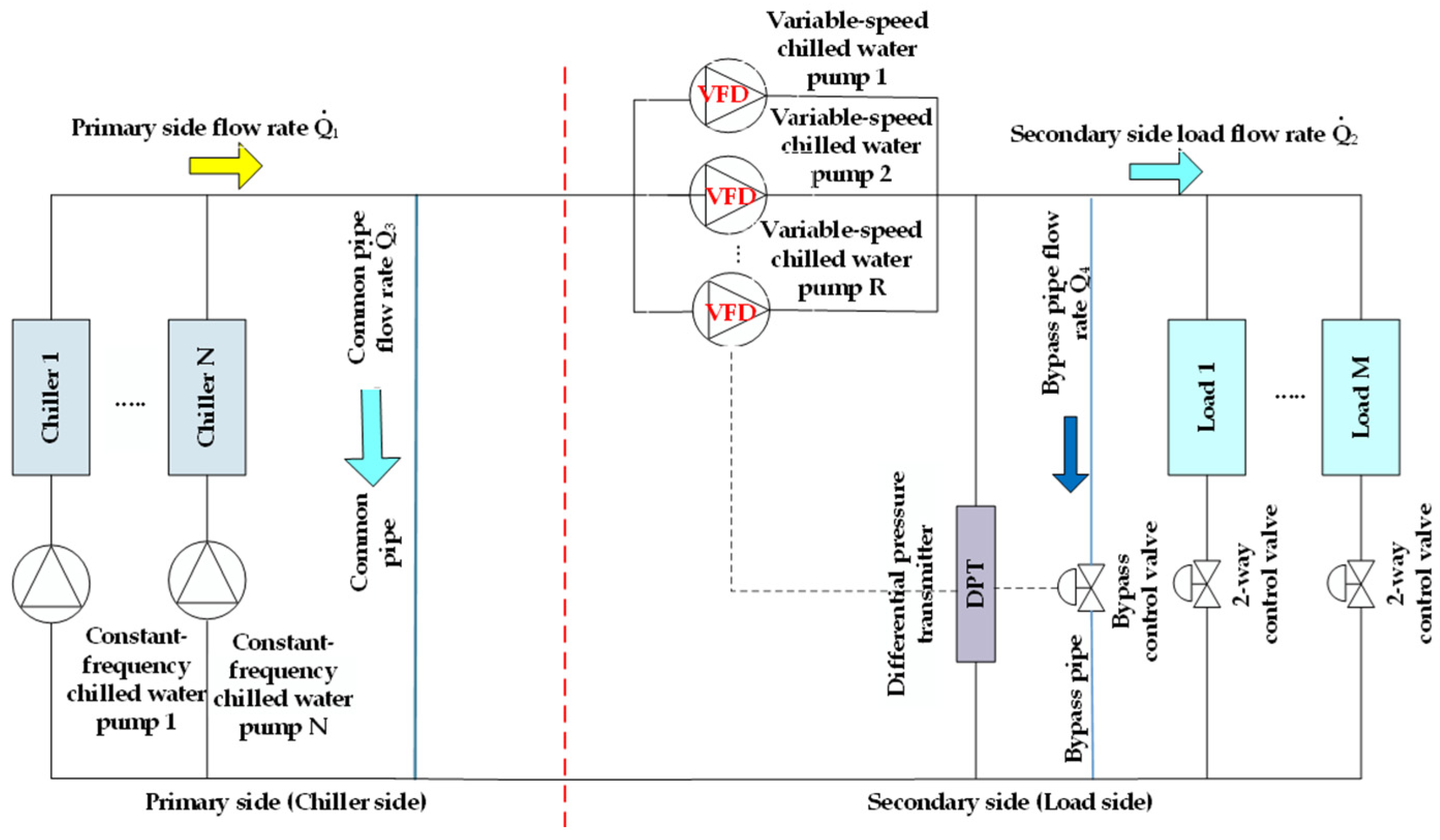
This paper proposes a real-time Optimal Capacity Control (OCC) strategy for chillers in an ACS equipped with Variable Water Volume (VWV) technology [
30]. The proposed method introduces a fine-tuning mechanism, the Ratio of COP variation to capacity variation (RC ratio), for real-time scheduling. This mechanism enables dynamic adjustment of the operating capacity of chillers based on real-time cooling load data, ensuring that each unit operates near its optimal COP. By continuously monitoring the performance of multiple chillers, the OCC strategy dynamically determines which units should be loaded or unloaded to achieve the highest overall system efficiency while satisfying the required cooling load. To verify the effectiveness of the proposed strategy, a numerical analysis was developed using operational data from an existing ACS. Comparative simulations were performed to evaluate the OCC strategy against a TCC strategy. The results demonstrate that OCC achieves substantial energy savings across all operating conditions. It is demonstration of improved COP and energy savings across seasonal scenarios. These findings emphasize the importance of coupling between capacity and efficiency in ACS design and offer a practical framework for developing intelligent energy-saving control strategies. Furthermore, the OCC strategy significantly improves overall system efficiency and reduces energy consumption under various load conditions.
3. Formulation of the OCC Strategy
The objective of the OCC strategy is to dynamically distribute the total cooling load among multiple chillers so as to maximize the overall COP of the system.
3.1. Problem Formulation
The optimization problem is formulated to maximize the sum of the COP of all chillers. The objective function can be expressed as follows:
The relative constraints are described as follows.
Load satisfaction constraint: The total cooling output from all chillers must match the total cooling load of the system.
Operational constraint: The operating capacity of each chiller must remain within its allowable minimum and maximum limits.
3.2. Traditional Capacity Control (TCC)
The formulated optimization problem is solved using the Lagrange multiplier method [
33]. The Lagrangian function (
) is constructed by combining the objective function with the equality constraint, as shown in Equation (7).
For the objective function to be at its maximum, the partial derivatives of the Lagrangian function with respect to each variable (
and
λ) must be equal to zero. The partial derivative of the Lagrangian function with respect to
for each chiller is given as follows:
Equation (8) can be rearranged as follows:
By applying the chain rule, since
, the derivative of the part-load ratio can be expressed as
Substituting Equation (10) into Equation (9), a new equation can be expressed as
Equation (11) reveals the fundamental principle of the proposed OCC strategy, λ represents the rate of change of each chiller’s COP with respect to its cooling capacity. In other words, λ quantifies how much the COP of chiller i increases (or decreases) when its cooling load is slightly adjusted.
3.3. OCC Strategy
Since the capacity and COP values vary continuously during chiller operation, recording the COP and cooling capacity of each chiller at regular intervals enables continuous determination of the RC value. The ratio of COP change to capacity change is expressed in Equation (12).
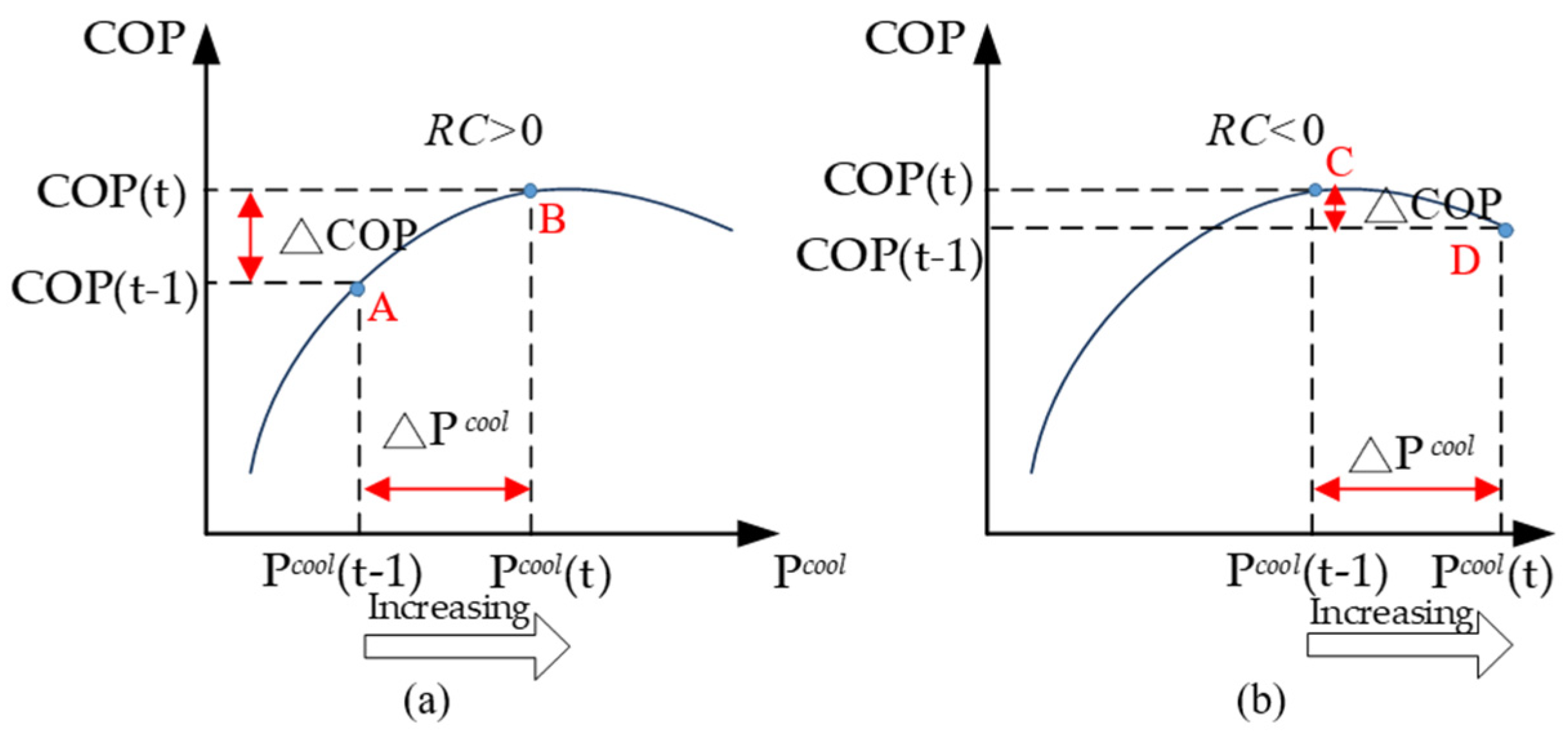
The RC ratio provides essential information about the chiller’s marginal performance. The fine-tuning mechanism is designed to take actions that achieve the highest possible efficiency improvement for the entire system. This control strategy operates in two primary modes: loading and unloading.
Loading Mode: When the total system cooling load increases (), a chiller must be selected to increase its cooling output. The algorithm prioritizes the chiller that provides the greatest increase in COP for a given increase in capacity.
A positive RC ratio (RC > 0) during the loading process indicates that the chiller’s COP increases as its capacity increases. The COP operating curve from point A to point B is illustrated in
Figure 3a.
A negative RC ratio (RC < 0) indicates that the COP decreases as cooling capacity increases. The COP operating curve from point C to point D is illustrated in
Figure 3b. To maximize system efficiency, the controller selects the chiller with the highest RC ratio to accommodate the additional cooling load.
Figure 3.
Illustration of COP change during the loading process.
Figure 3.
Illustration of COP change during the loading process.
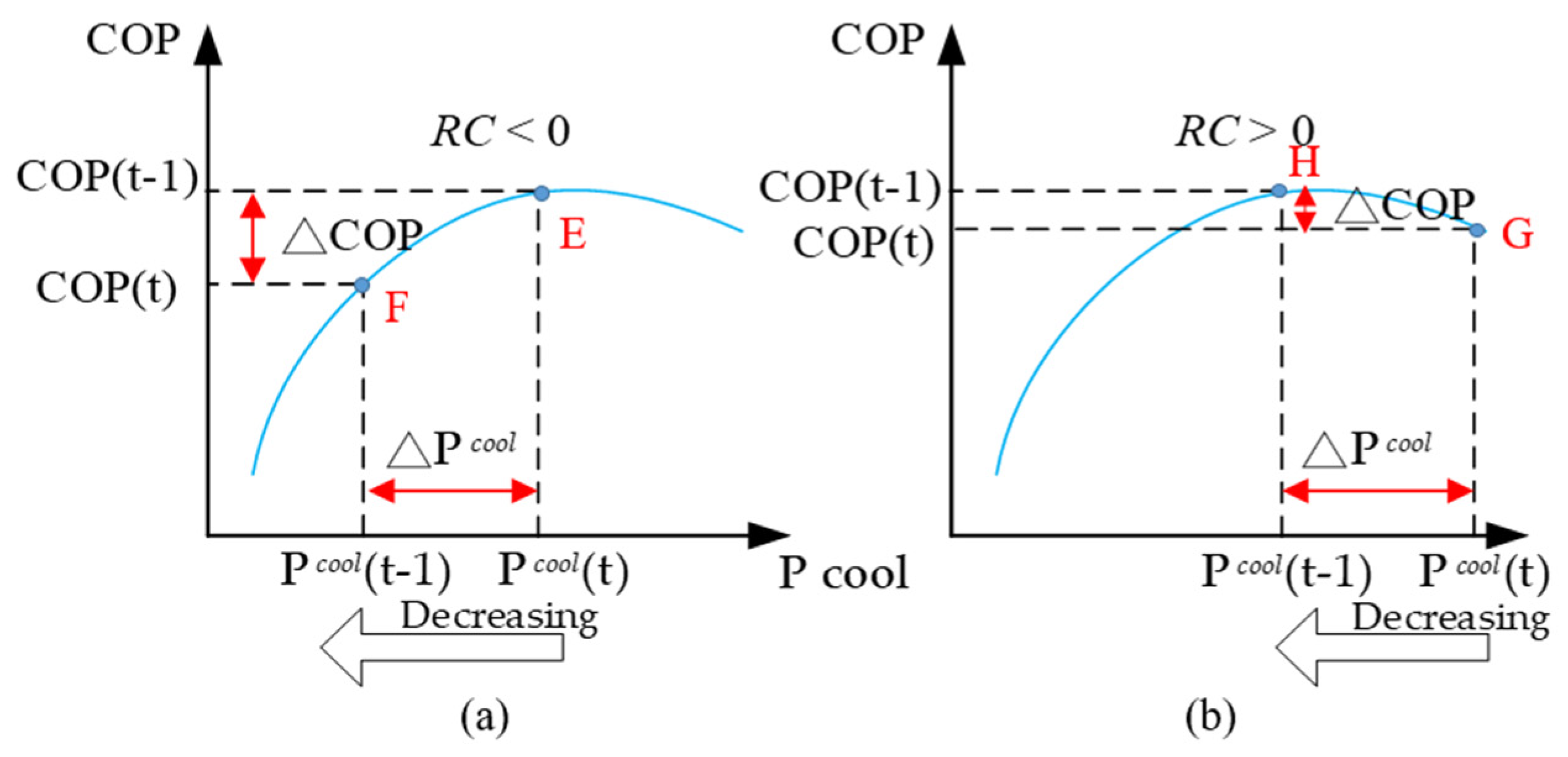
Unloading Mode: When the total system cooling load decreases (), a chiller must be selected to reduce its cooling output. In this scenario, the objective is to select the chiller whose reduction in cooling capacity yields the greatest improvement or smallest degradation in its COP.
RC < 0 indicates that the COP value of the chiller decreases as the operating capacity adjustment decreases as shown in
Figure 4a. The COP operating curve from point E to point F is illustrated in
Figure 4a. RC > 0 indicates that the COP value of the chiller increases as the operating capacity adjustment decreases as shown in
Figure 4b. The COP operating curve from point G to point H is illustrated in
Figure 4b.
To clarify, during unloading, the change in capacity is negative. A high positive RC value indicates that a small reduction in cooling load results in a substantial increase in the COP. This represents the most favorable condition for unloading. Therefore, when the system needs to shed load, the controller also selects the chiller with the highest RC ratio for unloading.
Figure 4.
Illustration of COP change during the unloading process.
Figure 4.
Illustration of COP change during the unloading process.
In summary, at any control interval
that requires an adjustment in total cooling output, the system identifies the chiller with the maximum RC ratio among all active units to perform either loading or unloading. This relationship can be formally expressed as follows:
This unified criterion ensures that the system continuously seeks the operating point of highest marginal efficiency, dynamically adapting to load variations to maintain optimal overall performance.
3.4. Implementation of the OCC
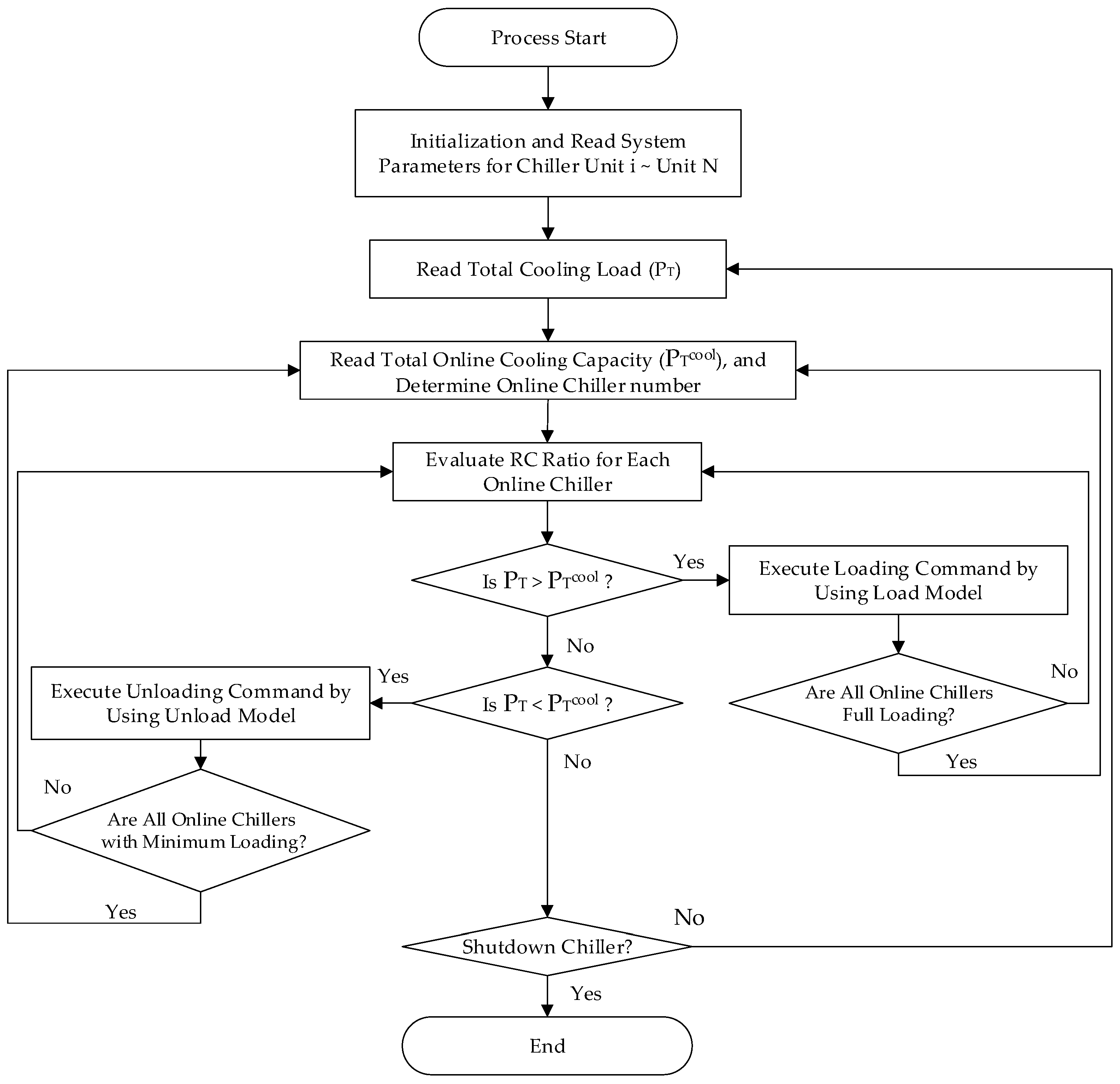
The principles of the fine-tuning mechanism are integrated into a comprehensive control strategy that is executed at each control interval. The overall operational flow of the OCC strategy is illustrated in the flowchart shown in
Figure 5. The procedure of the fine-tuning mechanism can be summarized as follows:
System Initialization: The control program initializes by reading the predefined system parameters, including the number of chillers and their corresponding performance curve models.
Load Calculation: The system calculates the real-time total cooling load, , based on sensor data collected from the building.
Capacity Evaluation: The current total online capacity, , is determined by summing the outputs of all active chillers. This value is then compared with the required load, .
Load Distribution (Modulation):
- (a)
The system computes the RC ratio for each online chiller based on its current and previous operational data.
- (b)
The chiller with the maximum RC ratio is identified.
- (c)
The selected chiller then adjusts its cooling capacity—either loading or unloading—to align the total online capacity with the required system load.
Chiller Staging (Startup/Shutdown): After the load distribution, the system evaluates the operating state of all chillers. If the total load exceeds the combined capacity of the online units, a standby chiller is activated. Conversely, if a chiller operates below its minimum load threshold for a sustained period, it is shut down to avoid inefficient operation.
Loop: The system waits for the next control time step and repeats the entire process from Step 2, thereby ensuring continuous and dynamic optimization of the unit’s overall performance.
Figure 5.
Flow Chart of the OCC process.
Figure 5.
Flow Chart of the OCC process.
4. Case Study
This study uses an office building as the test case. The analysis focuses on a single representative day from a typical summer week. Three chiller units, KLSB-01, KLSB-02, and KLSB-03, are employed in the test. The corresponding cooling load and electricity price during summer are presented in
Table 1.
Table 2 shows the specification of the ACS. The numerical computations were performed using MATLAB R2018b on a PIV-2.6GHZ computer with 512MB RAM. The optimization procedures, RC ratio calculation, load redistribution logic, and seasonal energy consumption analysis were implemented through custom-developed scripts. The simulation model was constructed based on actual operational data collected from the ACS of the studied office building. The monitored dataset includes cooling capacity, electrical power consumption, chilled water temperature, and part-load ratio (PLR) under stable operating conditions. Polynomial regression was applied to derive the COP–PLR characteristic curves for each chiller. These fitted curves serve as the performance model for simulation.
4.1. Implement of RC Ratio
This study employs a monitoring system to record the COP values corresponding to chiller capacity adjustments from 10% to 100% of the PLR, as shown in
Table 3. The measurement environment was at an outdoor temperature of 35 °C and an indoor temperature of 28 °C. Data are obtained directly from the existing monitoring system of the building’s ACS. The ACS is equipped with a commercial-grade control and monitoring system capable of continuously measuring chilled-water temperatures, flow rates, cooling capacities, condenser-side parameters, and the power consumption of each chiller. Based on these recorded data, a curve-fitting method was applied to derive the operating characteristic curve of the chillers.
By applying curve fitting method, the operating characteristic curves of chillers for units KLSB-01, KLSB-02, and KLSB-03 are derived as shown in Equations (15)–(17).
By taking the first differential of the capacity–COP relationship, the corresponding first-derivative trend curves
,
, and
are obtained as shown in Equations (18)–(20).
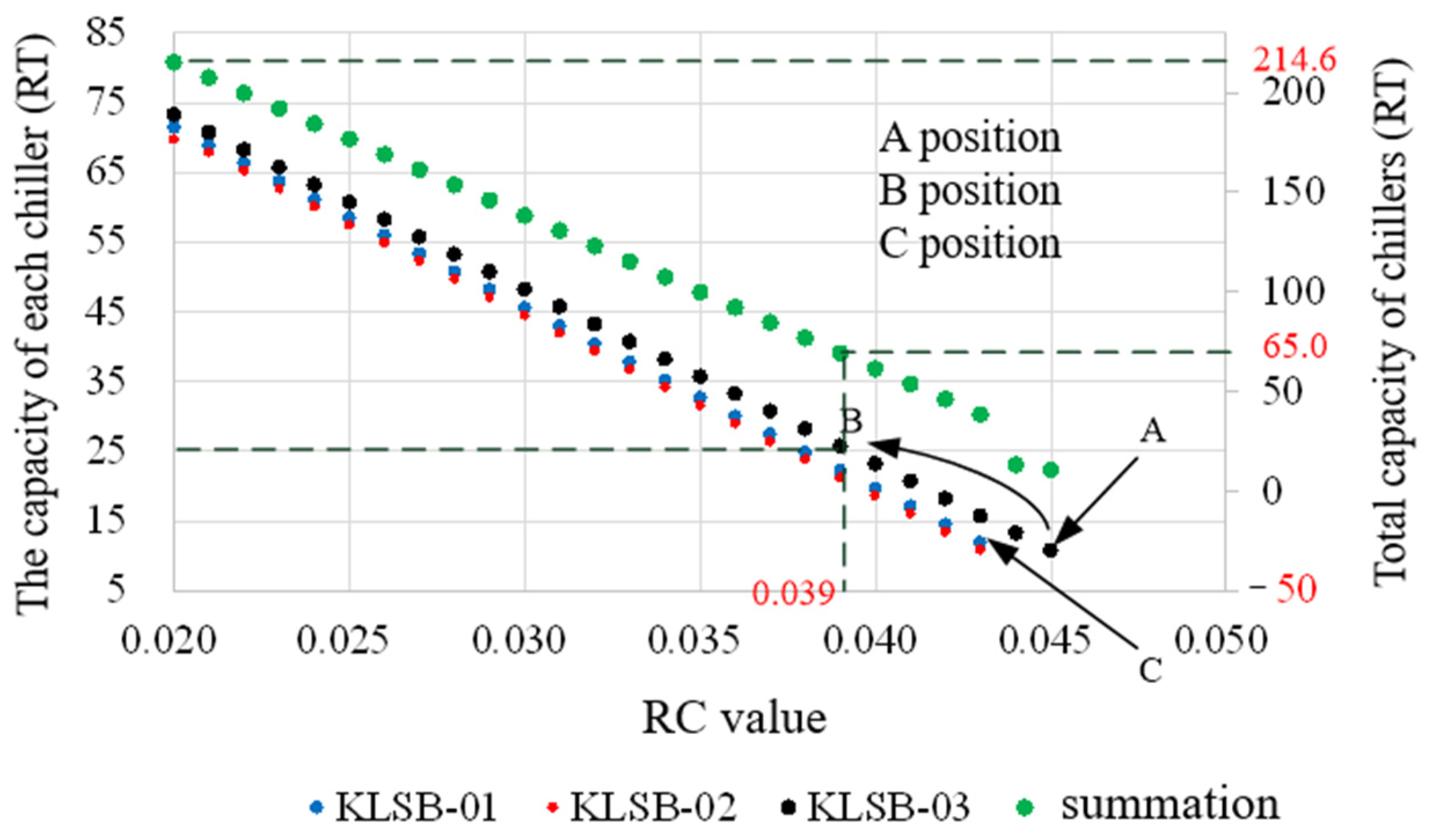
Figure 6 presents the relationship between the RC value and the operating capacity of each chiller under the OCC strategy. In this figure, the horizontal axis represents the RC value, defined as the marginal variation of COP with respect to cooling capacity. The left vertical axis indicates the individual operating capacity of each chiller, while the right vertical axis represents the total combined capacity of the three chillers. In this case, the system cooling load is 214.6 RT. The OCC strategy adjusted the chiller capacities based on their respective RC values. The procedure for the fine-tuning mechanism based on RC values is summarized as follows:
The RC value corresponds to the first-order derivative of the COP–capacity relationship derived from Equations (18)–(20), and it reflects the marginal efficiency improvement per unit of capacity adjustment. According to the optimality condition derived from the Lagrangian formulation in
Section 3, the optimal operating point is achieved when the marginal COP variation of all operating chillers becomes equal. Therefore, the OCC strategy sequentially adjusts chiller capacities by always selecting the unit with the highest RC value.
At the initial stage, all chillers operate at their minimum allowable capacity. Among them, KLSB-03 exhibits the highest RC value (approximately 0.045) at 10% loading, indicating that increasing its capacity will yield the greatest COP improvement per unit of load increase. Therefore, KLSB-03 is selected first for loading, as shown at Point A in
Figure 6. As its capacity increases toward approximately 25% (Point B), its RC value gradually decreases due to the downward trend of the derivative curve.
Once the RC value of KLSB-03 decreases to a level comparable to the other chillers, the controller evaluates the RC values of all units again. The chiller with the highest current RC value is then selected for further loading. This iterative process continues such that the operating points of the chillers gradually converge toward a state where their RC values are approximately equal (around 0.039 in this case). At this stage, the marginal efficiency contributions of all operating chillers are balanced, indicating that the system has reached a locally optimal capacity distribution.
The loading sequence is repeated until the total combined cooling capacity matches the required system load of 214.6 RT. This marginal equalization mechanism ensures that each incremental increase in load is assigned to the chiller that provides the highest efficiency gain, thereby maximizing the overall system COP.
During unloading, the same marginal principle applies. Because capacity reduction implies a negative change in cooling output, the RC value is evaluated accordingly, and the chiller with the highest RC value (i.e., yielding the greatest efficiency improvement per unit of capacity reduction) is selected for unloading. This unified marginal-efficiency criterion guarantees that the system continuously operates at the most energy-efficient configuration under both increasing and decreasing load conditions.
Because the cooling capacity and COP vary simultaneously, optimizing one without accounting for the other may result in operational inefficiency. By calculating the RC values of all chillers in operation, the control system can identify the unit that provides the greatest efficiency gain per unit of capacity adjustment. This approach ensures that the system’s overall COP is maximized while fully satisfying the cooling load demand.
Figure 6.
Relationship between RC value and chiller capacity output under the OCC.
Figure 6.
Relationship between RC value and chiller capacity output under the OCC.
4.2. Daily OCC Strategy in Summer
The capacity control of each chiller was performed using both the TCC and the OCC strategies. The daily capacity allocation results are presented in
Table 4 and
Table 5. Under the TCC strategy, as shown in
Table 4, the capacity of KLSB-03 was set to a minimum of 50%, while the remaining cooling load was evenly distributed between KLSB-01 and KLSB-02. This approach represents the optimal configuration for traditional chiller capacity control under low-efficiency operating constraints. Consequently, units KLSB-01 and KLSB-02 were forced to operate at higher COP levels, providing a suitable benchmark for comparison with the OCC strategy’s performance.
A comparison in
Table 5 shows that the capacity of KLSB-03 under the OCC is consistently higher than that of the other chillers. The variation in KLSB-03’s operating capacity is also greater than that of the other units at every operating point. Consequently, whenever the ACS load increases, KLSB-03 is prioritized for capacity adjustment. After KLSB-03’s capacity increases, its RC value becomes lower than those of the other two chillers. At the same operating capacity, KLSB-01 exhibits a higher RC value than KLSB-02; therefore, KLSB-01 and KLSB-02 are loaded sequentially in that order. KLSB-01’s RC value will then reach the maximum among the three chillers, and this cycle continues until the combined operating capacity of all chillers satisfies the ACS load.
Table 6 and
Table 7 present the daily COP values and daily power consumption in summer. The total COP achieved under the OCC strategy is higher than that of the TCC strategy, while the total power consumption with OCC is slightly lower. The TCC strategy uses the Lagrange multiplier method to solve this problem, which yields a solution close to a local optimum. OCC utilizes RC fine-tuning technology to further search the optimal operating point. However, the difference between the two strategies is not substantial because the TCC strategy was already optimized, with KLSB-01 and KLSB-02 operating at higher COP levels. The cooling load of the chillers in the ACS fluctuates continuously due to the VWV regulation rate. Therefore, the chiller capacities must be continuously adjusted to match these fluctuations. The OCC strategy ensures that all chillers in the system operate at high efficiency at all times, thereby avoiding excessive energy consumption within the ACS.
The OCC strategy was applied under the same load conditions, and the results were compared with those of the TCC strategy. The analysis demonstrates that:
- ⮚
OCC strategy remains applicable in heterogeneous configurations.
- ⮚
Load redistribution becomes more differentiated, with high-efficiency units prioritized under marginal equalization principles.
- ⮚
The performance improvement over TCC is more pronounced in heterogeneous systems due to increased variability in marginal efficiency.
- ⮚
Certain operational constraints may introduce staging discontinuities.
4.3. Energy Consumption Across Four Seasons
The seasonal analysis is based on monitored operational data from representative weeks in each season. The selected periods and corresponding outdoor temperature characteristics are as follows:
Spring: April 8–12; average outdoor temperature 23–27 °C; peak daytime temperature approximately 29 °C.
Summer: July 10–14; average outdoor temperature 30–34 °C; peak daytime temperature approximately 35–36 °C.
Autumn: October 16–20; average outdoor temperature 24–29 °C; peak daytime temperature approximately 31 °C.
Winter: December 4–8; average outdoor temperature 18–23 °C; peak daytime temperature approximately 25 °C.
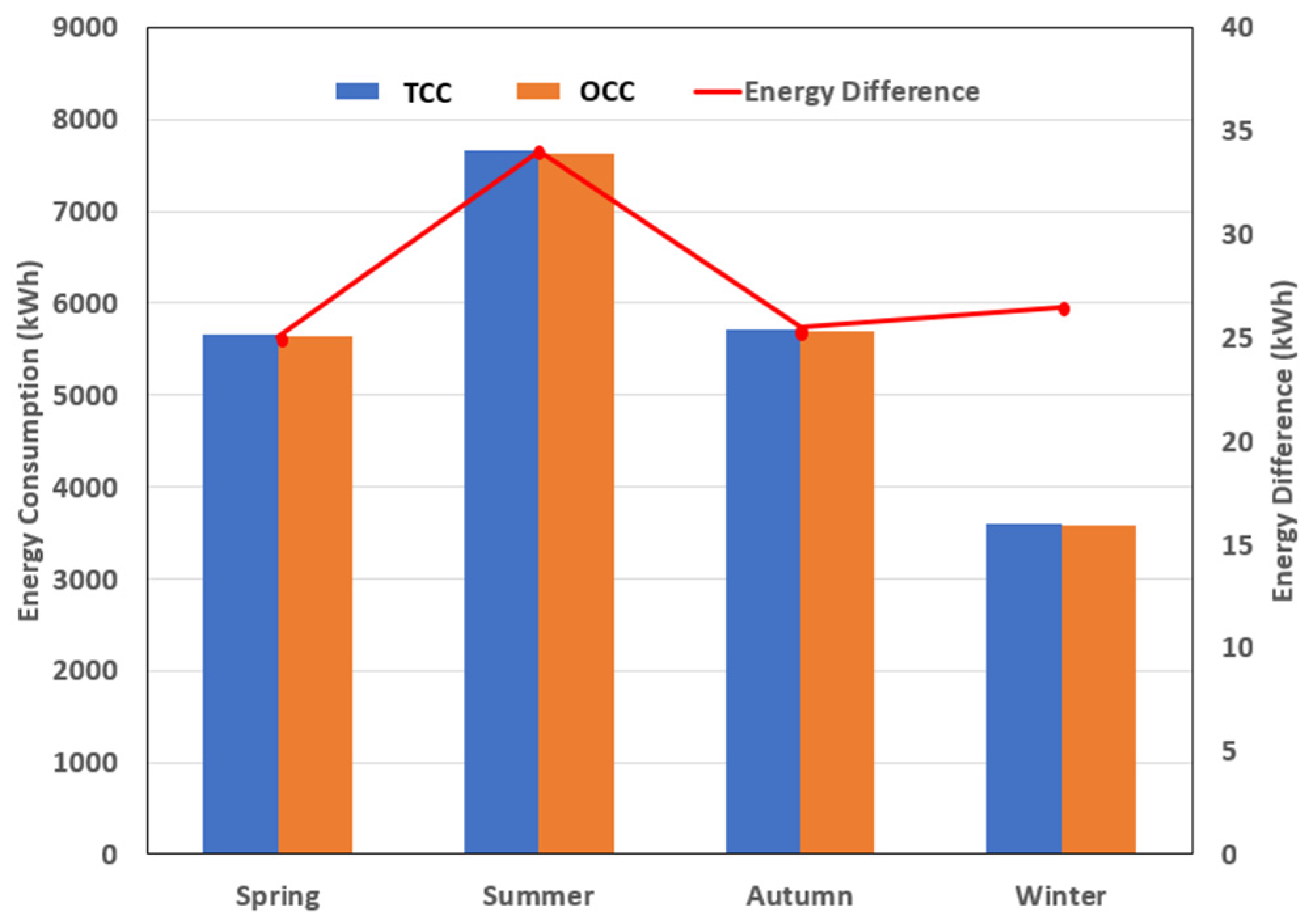
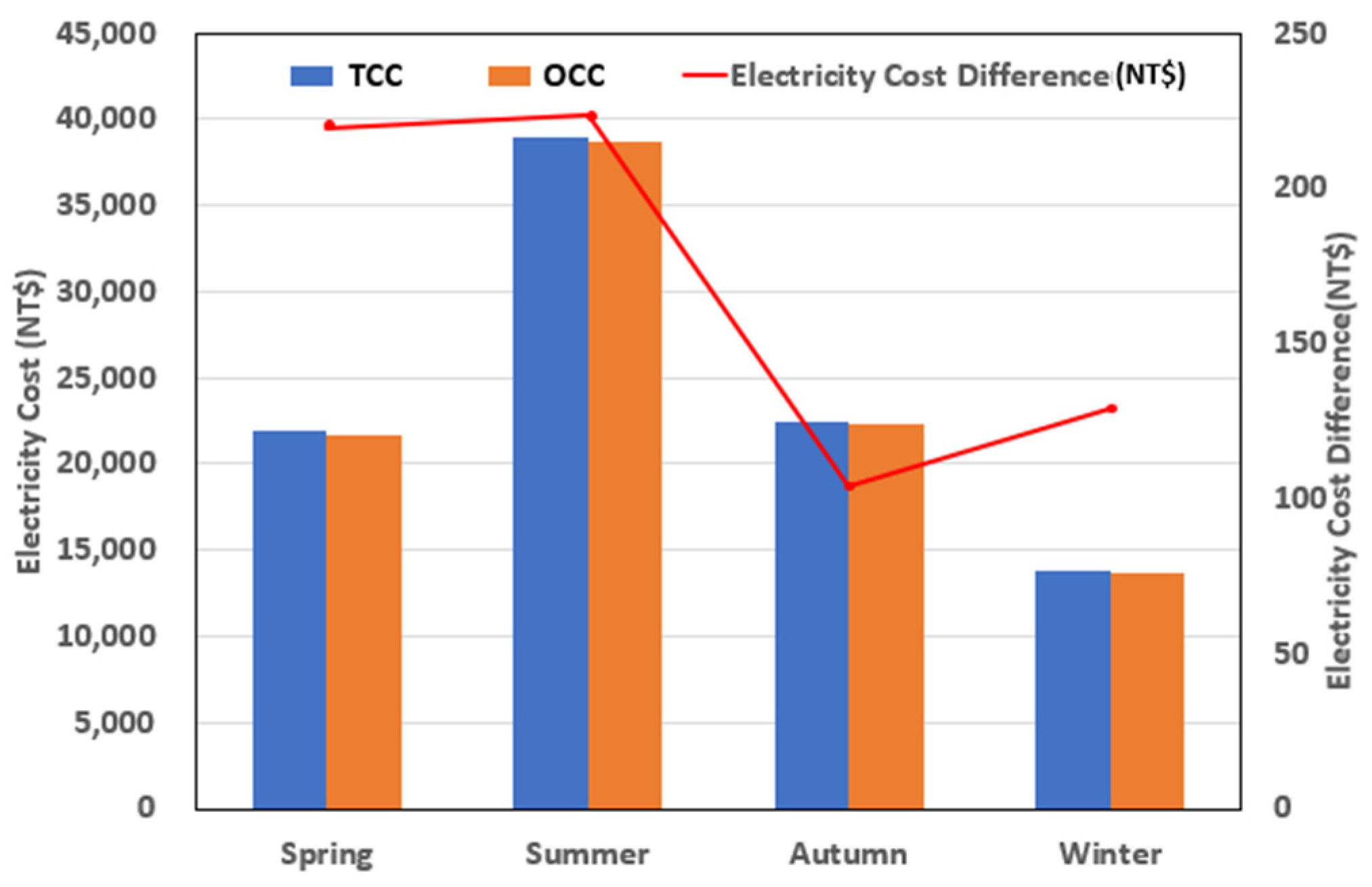
The selected weeks represent typical climatic conditions in southern Taiwan and reflect actual cooling demand observed in the building. The energy consumption and electricity price for each season are illustrated in
Figure 7 and
Figure 8.
Figure 7 compares the energy consumption of the TCC and OCC strategies across the four seasons. The results show that OCC consistently achieves lower energy consumption than TCC, particularly during summer and autumn when cooling loads are high. This improvement demonstrates OCC’s ability to maintain high operating efficiency by dynamically adjusting chiller capacities in response to varying load conditions. Similarly,
Figure 8 compares the seasonal electricity costs under both strategies. OCC achieves lower total electricity expenditure compared to TCC throughout the year, confirming its effectiveness in reducing operating costs while maintaining sufficient cooling performance. Although the energy savings during spring and winter are less pronounced due to lighter cooling loads, OCC still provides a more balanced and adaptive response to load fluctuations. Overall, these results indicate that the OCC strategy not only enhances system efficiency but also contributes to long-term economic and energy-saving benefits across varying climatic conditions.
4.4. Applicable Scenarios and Practical Limitations of the OCC Strategy
The proposed OCC strategy is primarily designed for centralized multi-chiller air-conditioning systems, such as chiller plants in large commercial buildings, hospitals, campuses, industrial facilities, and district cooling systems. In such systems, multiple chillers operate in parallel, and load redistribution among units is feasible. The RC-based marginal equalization mechanism can dynamically determine loading and unloading priorities, thereby improving overall plant efficiency.
However, in small-scale air-conditioning systems equipped with only a single chiller, the OCC strategy cannot be directly applied. Since load redistribution among multiple units is not possible, the marginal equalization principle becomes inapplicable. In such cases, system optimization should instead focus on enhancing the part-load performance of the individual chiller, improving chilled water temperature control, or optimizing variable-speed pump operation.
For buildings with two chillers operating under simplified staging logic, partial implementation of the RC-based marginal principle may still be feasible. The strategy could be adapted to assist in startup/shutdown sequencing decisions or to support fine-tuning around medium-load operating ranges.
Future research may explore simplified OCC variants tailored for small-scale systems, such as:
Integrating marginal COP estimation into single-chiller part-load optimization.
Combining the RC concept with predictive load forecasting.
Developing hybrid control strategies that coordinate chiller operation with auxiliary components.
By clarifying the applicable deployment context, the OCC strategy should be understood as a plant-level optimization framework rather than a universal solution for all air-conditioning configurations.
5. Conclusions
This study aims to develop an OCC strategy for chillers in ACS. The proposed method uses a fine-tuning mechanism to dynamically adjust the operating capacity of the chillers according to the real-time cooling load, ensuring that each unit operates near its optimal efficiency point. This strategy enables a precise match between chiller capacity and cooling load, thereby maximizing system efficiency while reducing both energy consumption and operating costs. The OCC strategy employs the RC ratio algorithm to determine loading and unloading actions by calculating the ratio between the changes in the COP and cooling capacity for each chiller. To verify the effectiveness of the proposed strategy, numerical simulations were conducted to compare the OCC and TCC strategies. The analytical results confirm the validity of the proposed optimization method.
During a typical summer day, the total power consumption under the OCC strategy was 1527.2 kWh, slightly lower than the 1534.0 kWh consumed under TCC. Furthermore, the system COP increased from 113.9 (TCC) to 114.8 (OCC), highlighting the OCC strategy’s superior performance even under peak load conditions. This study integrates theoretical optimization, empirical data modeling, numerical simulation, and control strategy design, all grounded in established engineering methodologies. It not only demonstrates the real-time control mechanism but also aligns with the principles of feedback-based adaptive control systems in engineering.
Future research may focus on large-scale validation, integration with predictive or model-based control strategies, and incorporation of dynamic electricity pricing into the objective function. Hybrid approaches combining marginal-efficiency control with advanced optimization or learning-based algorithms may further enhance robustness and global optimality. Overall, the proposed OCC strategy provides a practical and physically interpretable framework for improving chiller plant efficiency. By explicitly leveraging the marginal relationship between capacity and COP, the method bridges theoretical optimization principles and real-time operational control, offering a scalable solution for energy-efficient air-conditioning system management.