Article

Modeling and Performance Analysis of a Solar Energy and Above-Ground Biogas Digester Complementary Coupling Energy Supply System
1
School of New Energy and Power Engineering, Lanzhou Jiaotong University, Lanzhou 730070, China
2
School of Marine Science and Technology, Northwestern Polytechnical University, Xi’an 710072, China
*
Author to whom correspondence should be addressed.
Energies 2026, 19(5), 1267; https://doi.org/10.3390/en19051267
Submission received: 15 January 2026 / Revised: 7 February 2026 / Accepted: 26 February 2026 / Published: 3 March 2026
(This article belongs to the Topic Advanced Bioenergy and Biofuel Technologies)

Abstract

Rural households in cold regions still rely heavily on coal for cooking and domestic hot water, while single renewable energy sources suffer from intermittency and limited system-level assessment. This study proposes a solar–biogas complementary energy supply system integrating evacuated-tube solar collectors, an above-ground anaerobic digester, thermal storage, and biogas utilization for rural residential applications in Minqin, Northwest China. A dynamic system-wide model was developed by coupling TRNSYS with nonlinear representations of anaerobic fermentation and biogas boilers, enabling hour-by-hour simulation of energy production, conversion, storage, and consumption. Field measurements were used for validation, and the root mean square deviation between simulated and measured temperatures and gas production remained below 10%. During the heating season, the solar subsystem supplied 10% of the digester heating demand and 90% of the domestic hot-water load, while the biogas subsystem contributed 9.29% and 90.71%, respectively. The system delivered 4728.96 MJ of heat against a seasonal demand of 4636.22 MJ, fully meeting user requirements. A comprehensive 3E (energy–environment–economic) assessment shows that, compared with traditional rural energy supply modes, the proposed system reduces CO2 and NOx emissions by 65.85% and 98.13%, respectively, and demonstrates favorable economics with a benefit–cost ratio of 2.41 and a discounted payback period of 3.27 years. The proposed modeling and evaluation framework provides a replicable solution for clean energy substitution and circular waste utilization in rural areas.

1. Introduction

Rural energy consumption is an important part of China’s energy consumption, and rural areas are also important contributors to achieving China’s “dual-carbon” goals, namely peaking carbon dioxide emissions before 2030 and achieving carbon neutrality by 2060. Rural regions, with their rich renewable resources, play a vital role in this national endeavor. In order to optimize the rural energy system, consolidate and expand the results of poverty alleviation, build a beautiful countryside, and help the “dual-carbon” strategic goal, on 5 January 2022, the National Energy Administration and other departments put forward the following policy [1]: take energy green development as the driving force, build a new rural energy system, and promote the high-quality development of energy. A comprehensive deployment was made for rural energy transformation and beautiful countryside construction.
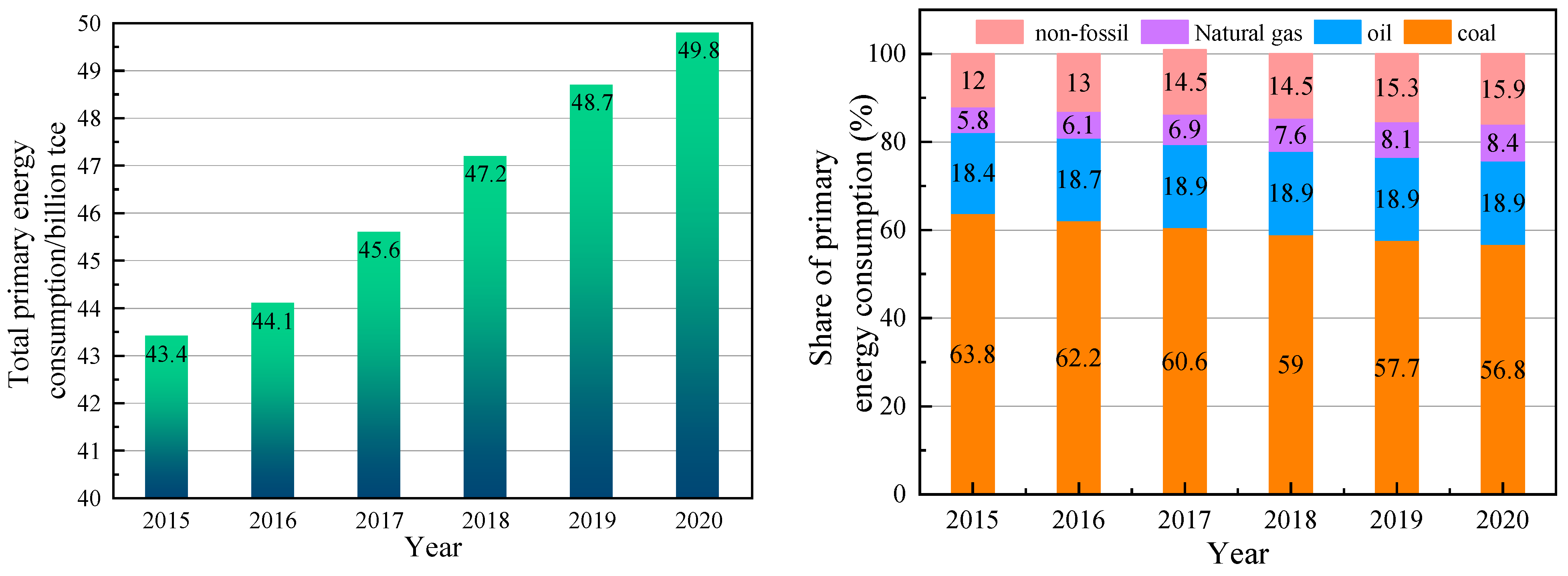
Figure 1. Changes in China’s total primary energy consumption and consumption structure during the “13th Five-Year Plan” period [2].
Energies 19 01267 g001
As illustrated in Figure 1, intensifying global attention to climate change and warming trends has accelerated the expansion of renewable energy deployment worldwide. In 2024, the total installed capacity of renewable energy systems increased by nearly 50%, reaching approximately 4448.1 GW when accounting for solar, wind, hydropower, geothermal, marine, and biogas resources. Among these, solar thermal installations dedicated to domestic hot-water supply totaled about 560 GWth, while electricity generation capacity derived from biomass approached 96.8 GW. Together, these statistics reflect a sustained global transition toward low-carbon and sustainable energy technologies [3].
Compared with single-source energy configurations, hybrid renewable systems generally exhibit enhanced operational stability, higher reliability, and reduced lifecycle cost [4,5]. Rural regions typically possess abundant biomass resources, and when coupled with favorable solar availability, the integration of solar and biomass energy presents considerable development potential [6]. To ensure stable and diversified energy services for end users, extensive international research has investigated the coordinated utilization of these two renewable resources.
For example, Tan H. et al. [7] established an AC/DC hybrid microgrid framework incorporating wind, solar, biogas, and energy storage technologies. Roldán-Porta C. et al. [8] developed a biomass–photovoltaic hybrid generation system that demonstrated improved supply reliability and reduced carbon emissions in rural energy communities. Wang Yilin et al. [9] proposed a solar-assisted biogas-based combined cooling, heating, and power configuration, confirming the feasibility of multi-level energy complementarity between solar and biogas resources. Omidvar M. R. et al. [10] employed corn stover as a biomass feedstock together with solar thermal collectors to construct a solar-assisted polygeneration system capable of efficient hydrogen and electricity production. Assareh E. et al. [11] further enhanced system efficiency and environmental performance by integrating solar energy, biomass conversion, and waste-heat recovery technologies, providing a pathway for clean electricity and hydrogen generation. In addition, Alhijazi et al. [12] summarized multiple case studies evaluating the techno-economic and energy performance of hybrid solar–biomass systems across different geographical contexts.
Nassar Y. et al. [13] proposed an optimized configuration for flat-plate solar collectors, highlighting the importance of selecting an appropriate number of transparent covers to maximize thermal performance. Existing research further suggests that solar–biomass hybrid systems can simultaneously achieve high energy output and relatively low unit energy cost. Zhang X. et al. [14] performed combined experimental and theoretical investigations on a rural solar/biomass hybrid heating system, demonstrating notable improvements in energy efficiency, environmental impact mitigation, and residential heating conditions. In the modeling, simulation, and performance evaluation of integrated solar–biomass energy systems, the anaerobic fermentation process within biogas digesters is commonly represented using mathematical formulations. Nevertheless, most previous studies have primarily concentrated on thermal balance characteristics of digestion systems [15,16], analyses of energy loss mechanisms [17], and temperature-field distributions within the fermentation slurry [18]. Although Zhou M. et al. [19] carried out dynamic load analysis, the nonlinear energy-transfer interactions among system components have not yet been comprehensively characterized. Ritonja et al. [20] mentioned nonlinear state-space models of the fermentation process (such as microbial growth and substrate consumption), but these models are primarily used for general fermentation control and have not been integrated with the energy flow of biogas systems. Compared with Zhou et al. [19], which focuses on capacity demand analysis of biogas power generation systems from a power-system perspective, this study targets rural residential energy supply at the building level and emphasizes the coupled modeling and 3E evaluation of solar thermal utilization, anaerobic digestion, and end-use heat and cooking demands.
For system performance evaluation, different systems have different performance evaluation indicators. For multi-energy complementary systems with solar and biomass energy as input sources, many scholars have adopted environmental evaluation attributes such as emission factors and reduction factors. However, single evaluation indicators have certain limitations. Zhang C et al. [21] pointed out that a single indicator such as the emission factor cannot fully reflect the system’s impact at different life cycle stages. Assareh E et al. [11] noted that a single reduction factor cannot reflect the necessity of technological optimization. Kourkoumpas D S et al. [22] listed additional environmental KPIs, such as global warming potential and emission reduction quantities, indicating that a single indicator cannot cover multidimensional impacts.
From the above research, it can be seen that the integrated application of solar energy and biomass energy has significant advantages in terms of energy utilization efficiency and environmental benefits. For the overall performance of the research system, it is crucial to establish a theoretical model for the entire process of the system by comprehensively considering the hourly energy load, energy input and output, energy transfer relationships between system equipment, and the characteristics of nonlinear modules such as various equipment. For system performance evaluation, it is necessary to establish a comprehensive evaluation index system applicable to multi-energy complementary systems through complementary coupling and energy balance relationships and conduct a multi-dimensional comprehensive performance analysis of the system. The innovative points of this paper are as follows:
(1) A comprehensive mathematical model integrating energy supply, production, and consumption was established for a complementary coupled energy supply system combining solar energy and above-ground biogas digesters using numerical modeling and simulation methods.
(2) The characteristics of nonlinear modules such as biomass anaerobic fermentation, biogas boiler and solar collector are systematically considered to simulate the multi-energy complementary system.
(3) A 3E multi-attribute comprehensive evaluation index system was proposed, and a multi-dimensional comprehensive performance analysis of the multi-energy complementary system was conducted.

2. System Design and Energy Flow

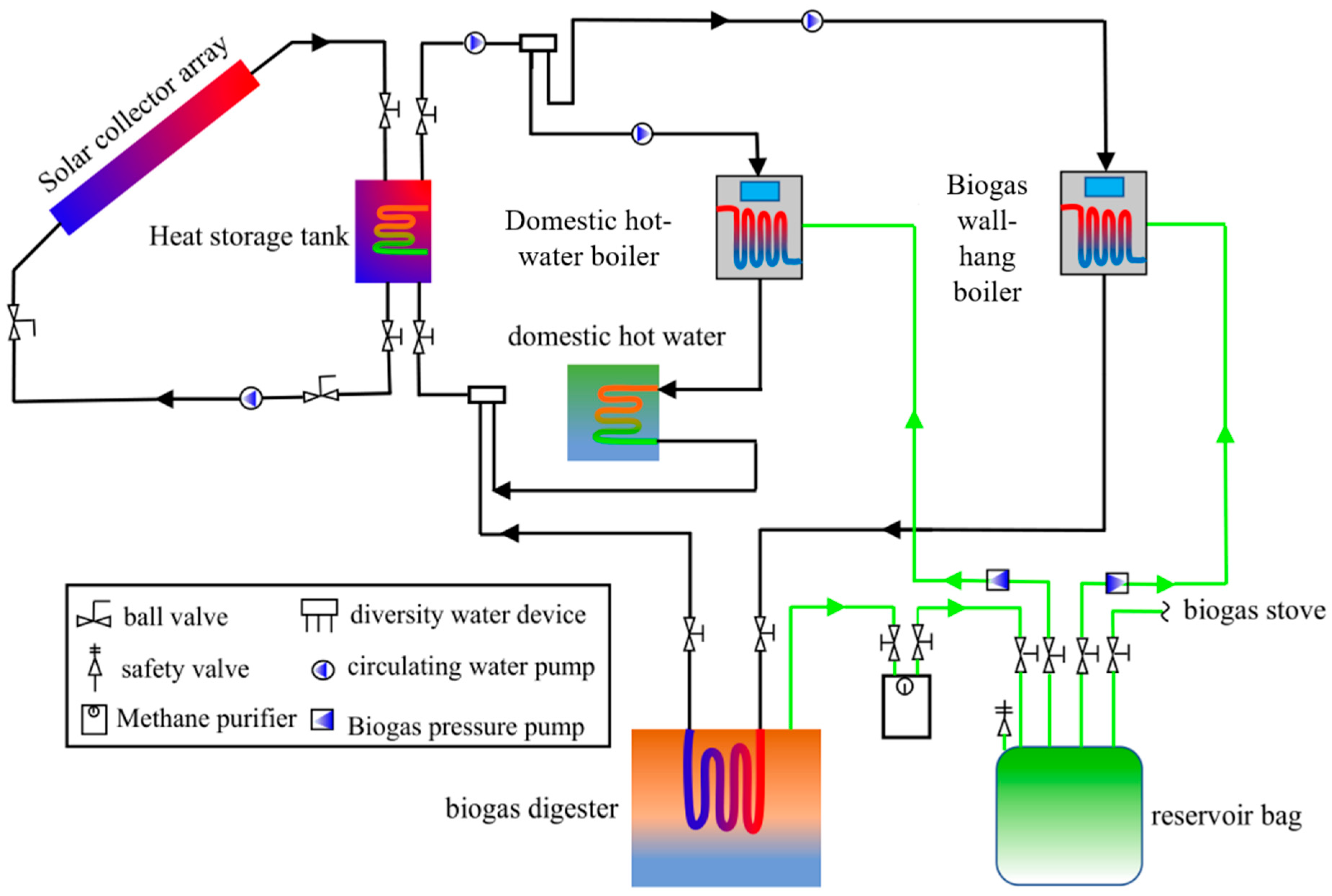
The proposed system employs solar and biomass resources as primary energy inputs to satisfy household demands for domestic hot water and cooking gas, as illustrated in Figure 2. To maintain stable thermal operation, the solar thermal energy collected by the collectors is initially stored in a heat storage tank. A biogas circulation pump, supplied by grid electricity, continuously transfers hot water between the storage tank and the digester jacket to sustain the anaerobic fermentation temperature at approximately 28 °C. Meanwhile, a domestic hot-water circulation pump also driven by a small grid-powered motor delivers thermal energy from the storage tank to the household water supply loop, thereby maintaining an outlet water temperature close to 45 °C. The biogas circulation pump and the domestic hot-water circulation pump are powered by grid electricity. In the revised 3E assessment, this auxiliary electricity consumption is explicitly included in the system boundary, and its impacts on primary energy use, CO2 emissions, and operating costs are quantified based on the rated pump power and operating time under the implemented control strategy.
The raw livestock manure is mixed with water at an appropriate ratio and fed into the above-ground biogas digester. The produced biogas is primarily used as a clean fuel for household cooking through the biogas stove, while the surplus gas is directed to the biogas boiler to provide auxiliary heating for the digester and domestic hot-water circuits. This configuration enables coordinated utilization of thermal and gaseous energy resources, forming an integrated hybrid energy supply system.
To facilitate clear understanding of the system configuration, the main components are briefly described as follows. The solar collector array and heat storage tank are responsible for absorbing and storing solar thermal energy for subsequent use. The biogas pressure pump and domestic hot-water circulation pump are driven by small grid-powered motors, which circulate hot water between the storage tank and corresponding thermal loads. The biogas digester and reservoir bag work to convert biomass substrates into biogas and regulate the gas supply pressure to downstream devices. The biogas boiler burns biogas to provide auxiliary heat for the digester and domestic hot-water loop when solar radiation is insufficient. The biogas stove is utilized for residential cooking purposes.
In rural household digesters, “manure accumulation” typically refers to the progressive build-up of undegraded solids or scum when the effective biodegradation capacity becomes lower than the incoming solids loading. This situation is most likely to occur under low-temperature operation, insufficient mixing, short hydraulic retention time (HRT), and/or high influent substrate concentration, which jointly reduce microbial activity and mass-transfer efficiency. In the present system, the digester temperature is actively maintained around the mesophilic set-point (~28 °C) to mitigate such risks, while the kinetic model explicitly links methane production to slurry temperature, influent substrate concentration and HRT.
This complementary arrangement ensures continuous energy supply and enhances the system’s overall energy efficiency.
The anaerobic digestion module adopted in this work is formulated for quasi-steady mesophilic operation. Temperature variations are explicitly accounted for through temperature-dependent kinetic parameters, such that the simulated biogas yield responds to the time-varying slurry temperature predicted by the coupled thermal model. Cyclic manure feeding and short-term microbial acclimation dynamics are not modeled as a fully transient biochemical process. Instead, the substrate characteristics are assumed to be approximately constant within each stable operation period, and model validation is performed using the stable gas-production stage prior to the first feed-change event, consistent with the field monitoring protocol.

3. System Mathematical Model

3.1. Model of Solar Collector

The overall efficiency expression of the solar collector can be derived based on the Hottel–Whillier formulation [23]:
η = Q u A I T = m ˙ C p f T o T i A I T = F R τ α n F R U L T i T a I T
In this formulation, Qu denotes the useful thermal energy gained by the collector, A represents the total collector area (m2), and IT is the total solar irradiance incident on the collector surface (kJ·h−1 ·m−2). The mass flow rate of the working fluid under operating conditions is expressed as (kg·h−1), while Cpf refers to the specific heat capacity of the collector fluid (kJ·kg−1 ·K−1). The inlet temperature of the working fluid is denoted by Ti (°C). FR represents the heat removal factor of the collector, UL is the overall heat-loss coefficient per unit collector area, τ indicates the shortwave transmittance of the collector cover, and (τα)n corresponds to the optical efficiency at normal incidence.
The relationship between the loss coefficient UL and the temperature is not constant. Considering the linear correlation between UL and T i T a , the following expression can be obtained:
η = Q u A I T = F R τ α n F R U L T i T a I T F R U L / T T i T a 2 I T
where  U L / T is the temperature-dependent collector heat loss coefficient.
The above equation can be written as:
η = a 0 a 1 Δ T I T a 2 Δ T 2 I T
In this context, a0 represents the intercept efficiency, a1 denotes the linear efficiency coefficient, and a2 corresponds to the curvature coefficient of the efficiency curve. The parameter ΔT indicates the temperature difference between the collector inlet and the ambient environment. Collector performance tests are typically carried out under clear-sky conditions with normal solar incidence. Under such circumstances, the transmittance–absorptance product τα approximates the normal-incidence value (τα)n, and the intercept efficiency FR(τα)n is adjusted for off-normal radiation through the ratio (τα)/(τα)n. By definition, τα represents the proportion of incident solar radiation that is effectively absorbed. Accordingly, the general expression for (τα)/(τα)n can be written as [24]:
τ α τ α n = I b T τ α b τ α n + I d 1 + cos β 2 τ α d τ α n I T + ρ g I 1 cos β 2 τ α g τ α n I T
where  τ α / τ α n is the total angle of incidence correction; I b T is the beam radiation incident per unit area; τ α b / τ α n is the angle of incidence correction for beam radiation; τ α g / τ α n is the angle of incidence correction for diffuse ground radiation; ρ g is the ground reflectance; β is the collector tilt as measured from the horizontal direction; I d is the horizontal diffuse radiation per unit area; and β is the collector slope.
The evacuated-tube solar collector is modeled using a second-order efficiency formulation implemented in TRNSYS Type 71. Although no additional experimental efficiency tests were conducted in this study, the adopted efficiency coefficients are consistent with typical performance ranges reported for commercially available evacuated-tube collectors under similar operating conditions.
According to recent literature and standard test reports, the instantaneous thermal efficiency of evacuated-tube collectors generally falls within the range of 45–65% under typical heating-season conditions. The present study adopts this established modeling framework to ensure realistic thermal performance representation while focusing on system-level energy coupling behavior.

3.2. Model of Anaerobic Fermentation Gas Production

BUSWELL and MUELLER proposed the following expressions for calculating the production of CH4 and CO2 [25,26]:
C n H a O b + n a 4 b 2 H 2 O n 2 a 8 b 4 C O 2 + n 2 a 8 b 4 C H 4
PEAVY and ROWE proposed the transformation relationship for Type C n H a O b N c fermentation [27]:
C n H a O b N c + n a 4 b 2 + 3 c 4 H 2 O n 2 a 8 + b 4 + 3 c 8 C O 2 + n 2 + a 8 b 4 3 c 8 C H 4 + c N H 3
Theoretical maximum methane production is calculated using the aforementioned stoichiometric model:
B 0 , T = 22.4 × 1000 × n 2 + a 8 b 4 3 c 8 12 n + a + 16 b + 14 c
where  B 0 , T is the theoretical maximum methane yield, mL CH4/g VS.
CHEN and HASHIMOTO established a kinetic model describing methane generation during the anaerobic digestion of organic substrates [28].
For a fully mixed continuous fermentation reactor, the temporal variations in microbial biomass concentration and substrate concentration can be described using the following governing equations [29]:
d M d τ = μ M M θ
d S d τ = F ˙ S 0 S θ
where M is the microbial cell mass concentration, kg/m3; μ is the microbial growth rate, 1/d; θ is the hydraulic retention time, d; F ˙ is the fermentation substrate utilization rate, kg/(m3·d); S is the effluent organic matter concentration, kg VS/m3; S 0 is the influent organic matter concentration, kg VS/m3; and τ is the time [29].
For a fully mixed fermentation system, the hydraulic retention time is equal to the average solid retention time. The relationship between F ˙ and μ is as follows:
μ = Y q = Y F ˙ M
For a steady-state fermentation system, it can be obtained from Equations (8)–(10):
μ = 1 θ
F ˙ = S 0 S θ
M = Y S 0 S
The relationship between microbial growth rate and fermentation substrate concentration is:
μ μ m = S / S 0 K + 1 K S / S 0
where μ m is the maximum microbial growth rate, 1/d; K is the fermentation kinetic parameter. When the fermentation substrate is unavailable, μ = 0, when S S 0 , μ μ m , therefore, θ m = 1 / μ m .
From Equations (11) and (14), it can be obtained:
θ = 1 μ m + K μ m S 0 S S
For a specific fermentation substrate, μ m and K can be obtained through θ and S 0 S / S , and the relationship between S and S 0 is as follows:
S S 0 = K θ / θ m 1 + K
If the CH4 production rate of organic fermentation substrate is represented by B, and the maximum CH4 production rate of organic fermentation substrate is denoted as B0, ( θ ) then the directly degradable VS for anaerobic fermentation in the biogas digester can be expressed as [29]:
B 0 B B 0 = K θ / θ m 1 + K
B = B 0 1 K θ / θ m 1 + K
The above equation indicates that if θ / θ m > 1 K , B linearly changes with 1 / θ when θ , B B 0 . Equation (17) can be expressed as:
θ = θ m 1 + K B B 0 B
The above equation indicates that θ changes linearly with B / B 0 B , with an intercept of θ m and a slope of K θ m [24].
The calculation formula for CH4 volumetric gas production rate is as follows [24]:
γ V = B S 0 θ = B 0 S 0 θ 1 K θ / θ m 1 + K
HASHIMOTO studied the influence of fermentation temperature (35 °C and 55 °C), fermentation substrate concentration ( S 0 = 43, 64, 82, 100, 128 kg VS/m3), and hydraulic retention time ( θ = 4, 5, 8, 10, 15, 25 d) on the CH4 production rate of cow dung and found that when S 0 = 40~100 kg VS/m3, the empirical correlation of K is as follows [30]:
K = 0.8 + 0.0016 e 0.06 s 0
The maximum microbial growth rate is related to the slurry temperature in the biogas digester, and its calculation formula is:
μ m = 0.013 t s 0.129
where t s is the slurry fermentation temperature in the biogas digester, and the temperature range of the equation is t s = 20~60 °C.
PHAM et al. fitted the relationship for the maximum microbial growth rate using experiments with cow dung as the fermentation substrate [31]:
μ m = 0.0046 e 0.109 t s   ( R 2   =   0.9191 ,   t s = 10 ~ 30   ° C )
μ m = 0.013 t s 0.129   ( R 2 = 0.9435 ,   t s = 15 ~ 30   ° C )

3.3. Assumptions, Research Limitations, and Outcome Uncertainty

In this study, we make the following assumptions to ensure model stability: Solar-thermal subsystem. The evacuated-tube collector is represented by the TRNSYS library model with a second-order efficiency formulation combined with incidence-angle correction factors. Thermal-loss coefficients, IAM factors and the effective heat capacity are taken from type-test data and applied as fixed parameters throughout the heating season. Frosting, fouling, edge effects and wind-driven transients are not explicitly modelled. Meteorological boundary conditions. Hourly ambient temperature, solar irradiance and wind speed are read from the site-specific weather file and used as exogenous inputs to the simulation; spatial variability and short-term extremes beyond the hourly resolution are neglected. Controls and hydraulics. Temperature-difference control is implemented with a TRNSYS differential controller; circulation pumps are modeled with constant flow and prescribed efficiencies, valve and actuator delays are represented implicitly via control deadbands.
The lumped parameter representation does not capture intra-tank stratification and non-uniform mixing, sensor placement and finite response times are not fully reproduced, insulation ageing and moisture ingress may increase actual heat losses relative to nominal values, weather file conditions may deviate from the actual hours during field testing, and the digestion model is valid primarily for steady mesophilic operation. These limitations should be considered when interpreting short-term discrepancies between measured and simulated temperatures and flows. When the auxiliary grid electricity for pumps is included within the 3E boundary, the net CO2 reduction decreases accordingly; however, the proposed system still maintains a clear emission advantage over the coal-based baseline due to the substantial displacement of direct coal combustion. A sensitivity check using conservative pump-duty assumptions is provided to demonstrate the robustness of the environmental conclusions.
Accordingly, the present model is intended for seasonal energy-flow evaluation under controlled mesophilic conditions rather than for predicting short-term start-up transients, shock-load responses, or cycle-by-cycle feeding dynamics.

4. System Dynamic Load Measurements

Field measurements were conducted on typical new rural residential houses in Minqin, Gansu Province. These single-story buildings have a total floor area of 117 m2, comprising three bedrooms, one living room, one kitchen, one bathroom, and accommodating four residents. The household load is mainly divided into two categories: (1) domestic hot water load, calculated according to the “GB50555 [32] Design Standard for Water Saving in Civil Buildings” and relevant research; (2) cooking gas load, calculated based on monthly and hourly uneven coefficients [33]. Using the typical meteorological data of Minqin, Gansu as a basis, a hot water supply temperature of 45 °C is established. Subsequently, the annual heat load is calculated based on the “GB50555 Design Standard for Water Saving in Civil Buildings,” combined with per capita water usage. Additionally, the cooking gas load for households is obtained by using the monthly and hourly uneven coefficients for natural gas usage, in conjunction with the cooking gas calculation formula, resulting in the hourly biogas load and the annual biogas load for households. It should be emphasized that the domestic hot-water demand in this study refers to household sanitary uses in rural residences, and does not include agricultural production water, which is predominantly cold-water consumption.
The hot water load for residential use is closely related to the amount of hot water consumed and the temperature of the tap water. According to the “GB50555 Civil Building Water-Saving Design Standard,” the amount of hot water consumed is 25–70 L/(person·day) [34], and the formula for calculating the tap water temperature is as follows [35]:
t w , r = 4.717 e 0.041 t a
In the formula, tw,r is the tap water temperature, °C; ta is the ambient temperature, °C.
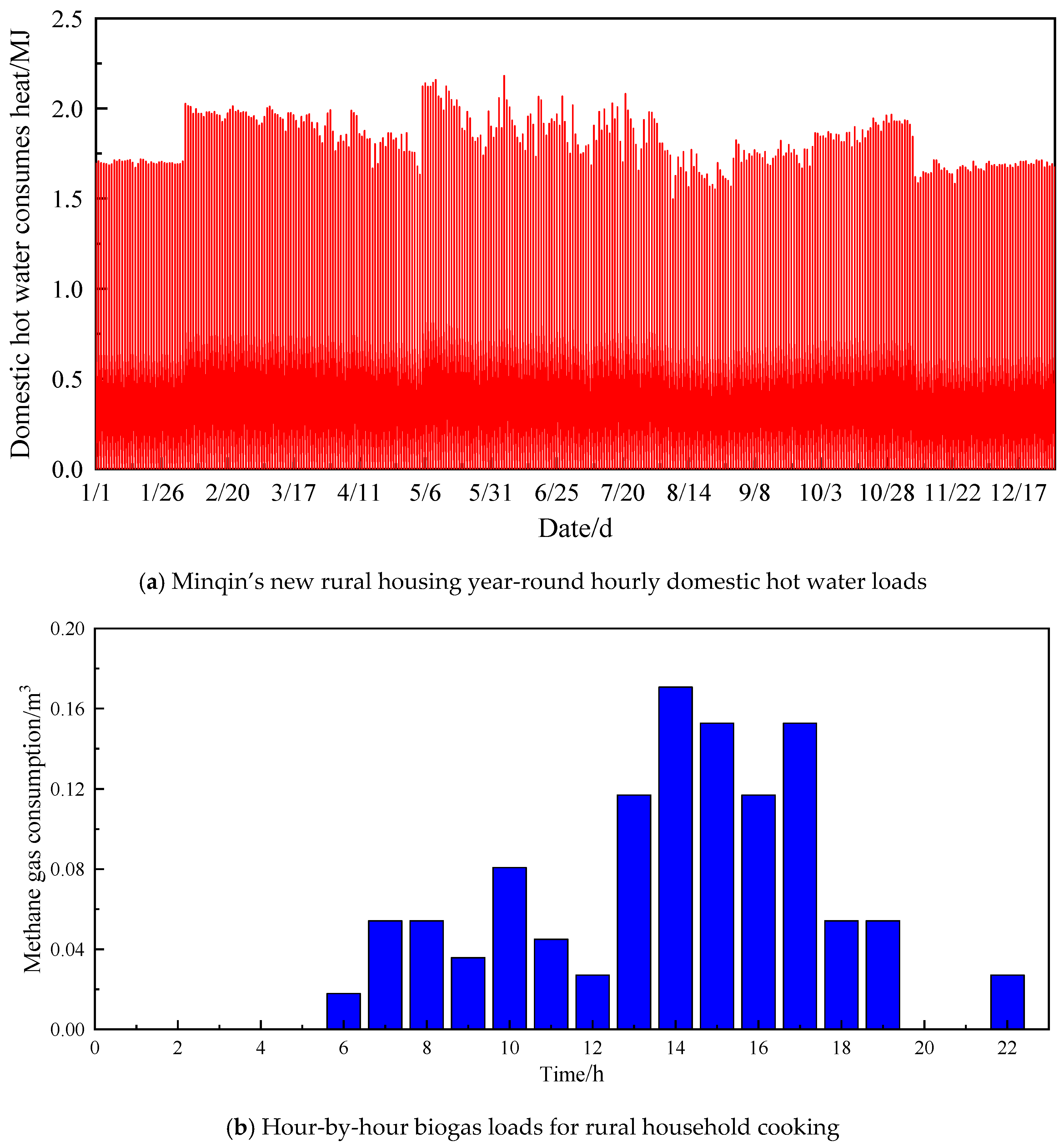
Based on Wang Shanshan’s [32] field study tracking residents’ hot water usage across different time periods, the hourly hot water consumption patterns for residential use throughout the year in Minqin were determined. Figure 3a shows the hourly changes in domestic hot water load throughout the year. The domestic hot water load of rural residential buildings fluctuates significantly with the seasons, with large fluctuations over short periods and rapid changes in frequency, resembling “high-frequency equal-amplitude oscillations” in a waveform. During winter, when domestic hot water usage is lower, the domestic hot water load is significantly lower than in other seasons. The peak domestic hot water load on a typical winter day is 1.71 MJ, while in summer it is 1.81 MJ.
The gas usage varies with residents’ daily schedules, and the peak usage of biogas is mainly concentrated between 14:00 and 19:00 in the afternoon. Seasonal and holiday factors also affect biogas usage. For example, during the months of July and August in summer, due to the summer vacation for students, there is an increase in biogas consumption. Additionally, around the Chinese New Year, when students are on winter break and celebrating the festival, the gas usage also increases. The temporal pattern of gas consumption is represented by the monthly unevenness coefficient, daily unevenness coefficient, and hourly unevenness coefficient [33]. Through calculation, the daily gas usage per household is 1.16 m3. The hourly cooking gas load of each household is shown in Figure 3b. Using a daily gas usage of 1.16 m3 as a benchmark, the monthly gas usage per household is 34.8 m3. Influenced by the monthly uneven coefficient, the monthly cooking biogas load does not change significantly, maintaining at around 35 m3.

5. System Simulation and Operational Performance Analysis

5.1. System-Wide Simulation Model

This paper uses TRNSYS 18.0 to build a system simulation model and perform simulation calculations. The meteorological data in the simulation model is exported from the Meteonorm 8 software as typical annual meteorological data for the Minqin region. The components directly called in the model, their setting parameters, and input variables are shown in Table 1.
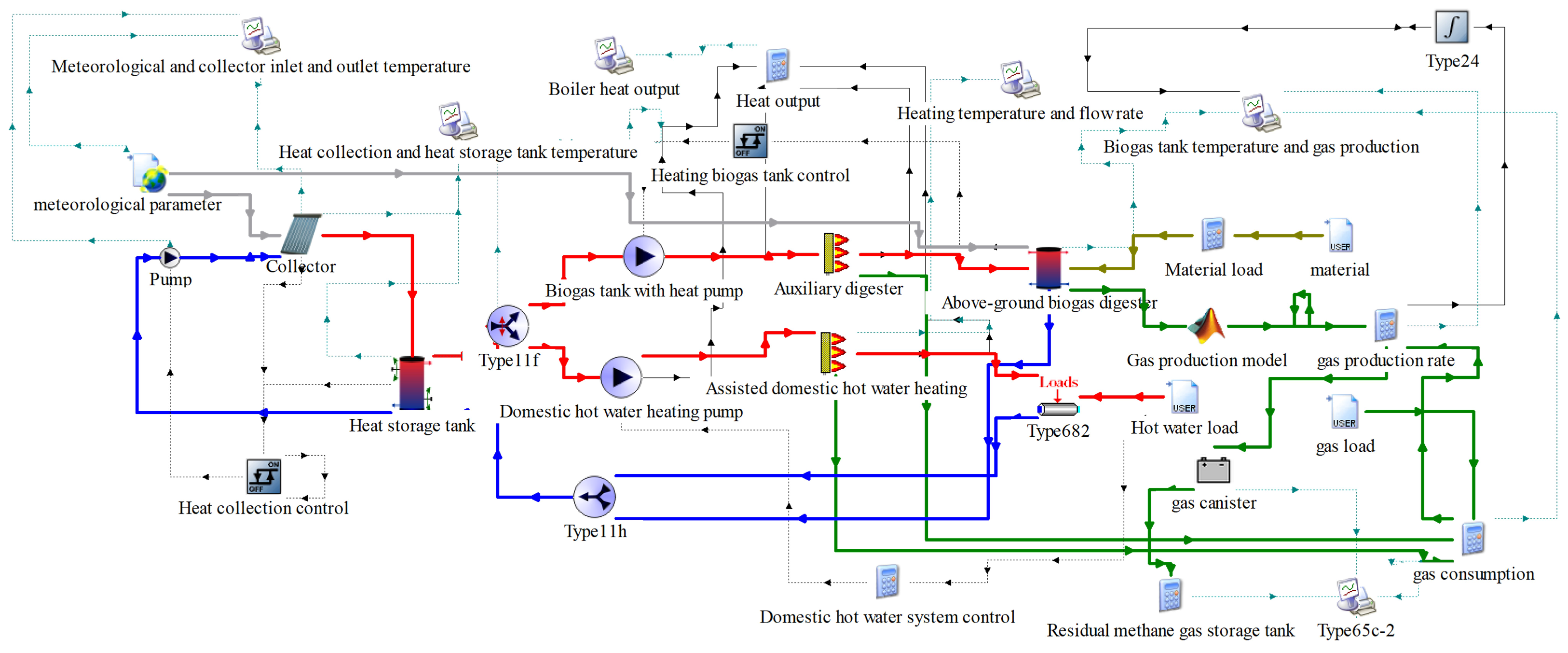
A comprehensive mathematical TRNSYS simulation model integrating system energy supply, production capacity, and energy consumption is shown in Figure 4. The solar thermal subsystem was simulated using the Type 71 component from the TRNSYS Standard [36] Component Library, which represents an evacuated-tube solar collector. This model employs a quadratic thermal efficiency formulation combined with incidence-angle modifiers for both beam and diffuse irradiance, in accordance with the testing methodologies prescribed by Test methods for the performance of solar collectors. The nominal mass flow rate under test conditions was specified as 50 kg·h−1·m−2, consistent with the manufacturer’s recommended operating parameters. The specific parameter settings are shown in Table 2. The heat collected by the solar collector is stored in the Type 4c thermal storage tank. Through the Type 11f diverter valve, part of the heat is used by the biogas pressure pump to maintain the fermentation temperature of the biogas digester at approximately 28 °C, while the remaining portion is used by the domestic hot-water circulation pump to provide domestic hot water at approximately 45 °C. The biogas produced by the above-ground biogas tank is partially used to meet the cooking gas requirements, with the remaining portion entering the auxiliary biogas tank boiler and auxiliary domestic hot water boiler to meet the energy demands of the above-ground biogas tank and domestic hot water.

5.2. The Requirements Change

Compared with conventional stand-alone rural energy devices, the proposed solar–biogas complementary system integrates multiple thermal–fluid loops and automated control components, including circulation pumps, differential temperature control, valves, gas storage and pressure regulation, as well as biogas boiler operation. Therefore, the required qualifications of maintenance personnel shift from “single-device routine upkeep” to “multi-subsystem inspection plus basic control and safety management”. In practice, the O&M tasks can be stratified into two levels.
(1) Routine operator (village/household level): capable of daily/weekly visual inspection, basic cleaning (collector surface and filters), leak checking for water and gas pipelines, monitoring of key operating indicators (tank temperature, digester temperature, and gas pressure), and execution of standard operating procedures for start-up/shut-down under abnormal conditions.
(2) Technical maintainer (township/county level): capable of periodic preventive maintenance and troubleshooting, including pump/valve performance checking, calibration/verification of temperature and pressure sensors, inspection of insulation degradation and heat-loss related parameters, and adjustment/verification of controller setpoints and interlocks.

5.3. Operational Performance Analysis

The simulation run time and control scheme of the system are consistent with the experimental system. The local heating season from November 29th to March 28th is selected, with a simulation time step of 0.125 h. The TRNSYS simulation model of the solar energy and above-ground biogas digester complementary coupling energy supply system is run for simulation, and the simulation results are compared with the experimental results. The main comparison parameters are outdoor air temperature, thermal storage tank temperature, biogas tank slurry temperature, and biogas tank gas production. The root mean square error between the simulated values and the measured values is shown in Table 3, which is less than 10%, verifying the accuracy of the system simulation model.
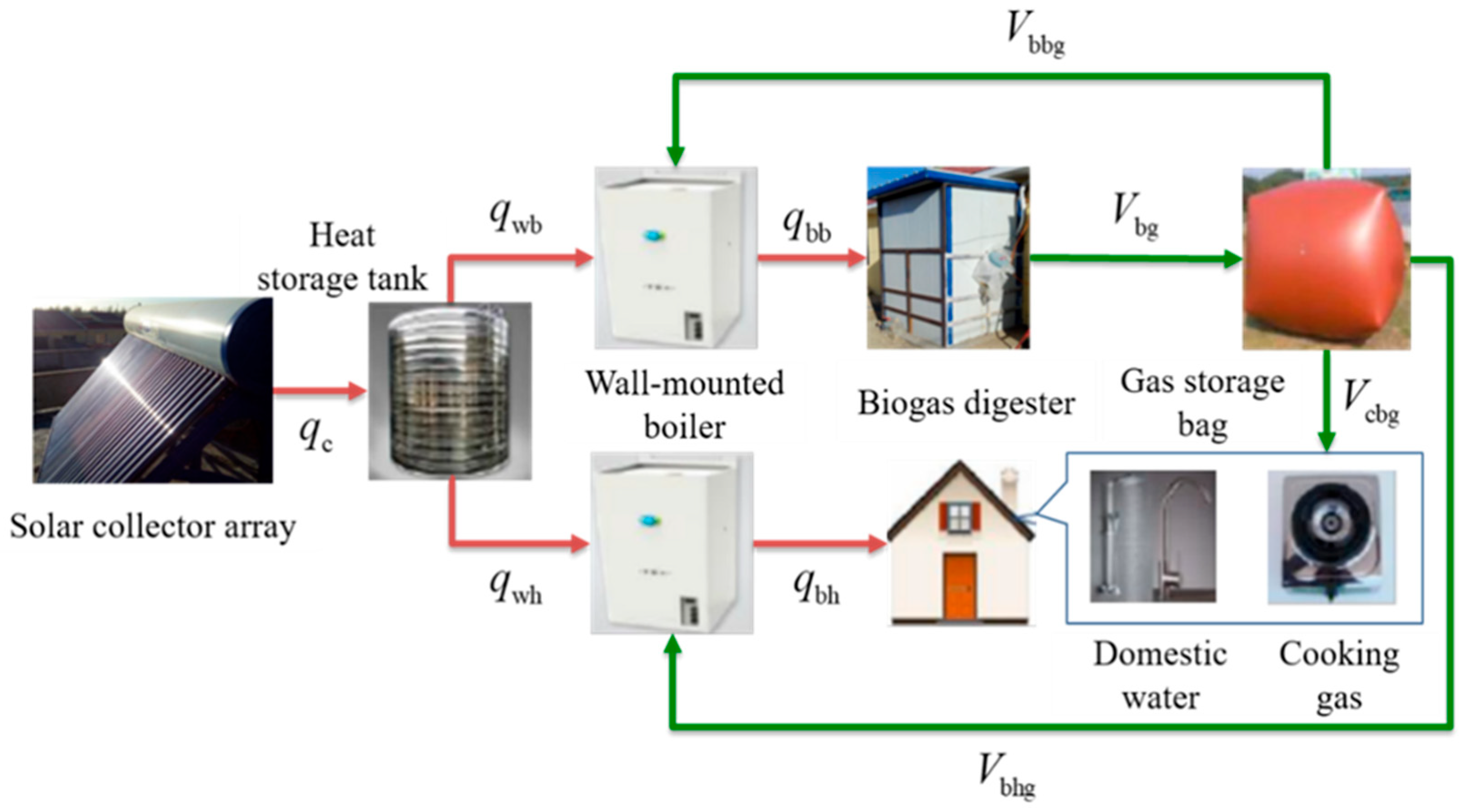
The hybrid system adopts a complementary control strategy to coordinate the intermittent solar heat supply and the continuous biogas production. The specific energy relationship diagram is shown in Figure 5. At a certain point in time, the heat collected by the solar collectors is qc, through the heat storage tank to the auxiliary digester heating wall boiler qwb to provide heat to the auxiliary domestic hot water heating boiler qwh; the above ground digester produces biogas Vbg, through the red mud flexible gas storage bag to the cooking gas delivery Vcbg, the remaining biogas again to the auxiliary digester heating wall boiler to provide heat Vbbg to the auxiliary domestic hot water heating boiler Vbhg.
The balance relationship is as follows:
q c = q wh + q wb + c M Δ T
V bg = q b h + q b b η b R b g + V cbg + V rbg
q hw = q wh + q bh
q cg + c b s M b s Δ T b s = q wb + q bb
During daytime, when solar radiation is sufficient, the solar collector field provides the main thermal energy for both the digester heating and domestic hot-water demand. The biogas boiler remains off until the collector outlet temperature drops below the preset threshold of 55 °C. At night or under low-radiation conditions, the biogas boiler is automatically activated to compensate for the thermal deficit and to maintain the digester temperature within the desired range of 28 ± 1 °C. The energy management controller compares the temperature difference between the storage tank and the digester as shown in Equation (26).
ΔT = Ts − Td.
In the formula, Ts is the temperature of the heat storage tank, Td is the temperature of the biogas digester. When ΔT falls below 3 °C, a signal is sent to open the gas valve and ignite the biogas boiler; when ΔT exceeds 6 °C, the boiler is turned off. This on–off control logic is implemented in TRNSYS using the Type 2b differential controller component.
The biogas storage bag serves as a buffer between the continuous biogas production and the fluctuating consumption by the stove and boiler. The gas pressure is maintained within 15 kPa by means of a diaphragm-type regulator equipped with a pressure sensor and solenoid valve. The daily pressure variation is typically within ±10%, as the gas generated during the daytime is partly stored and subsequently used at night for auxiliary heating. In the simulation, the biogas subsystem was modeled under a quasi-constant pressure assumption, with gas flow adjusted dynamically according to the instantaneous heat demand. This approach effectively captures the overall thermal balance while simplifying the transient gas dynamics. The combined operation ensures stable 24-h energy supply and efficient utilization of both renewable sources.
It should be noted that the coupled operating state in this study does not aim to maximize instantaneous component-level efficiency. Instead, the coupling strategy is designed to enhance operational stability and renewable energy utilization by switching between solar-dominant and biogas-support modes based on temperature thresholds. The performance of the coupled system is therefore evaluated through energy contribution ratios and emission reduction outcomes rather than a single aggregated efficiency index.

5.3.1. Outdoor Air Temperature

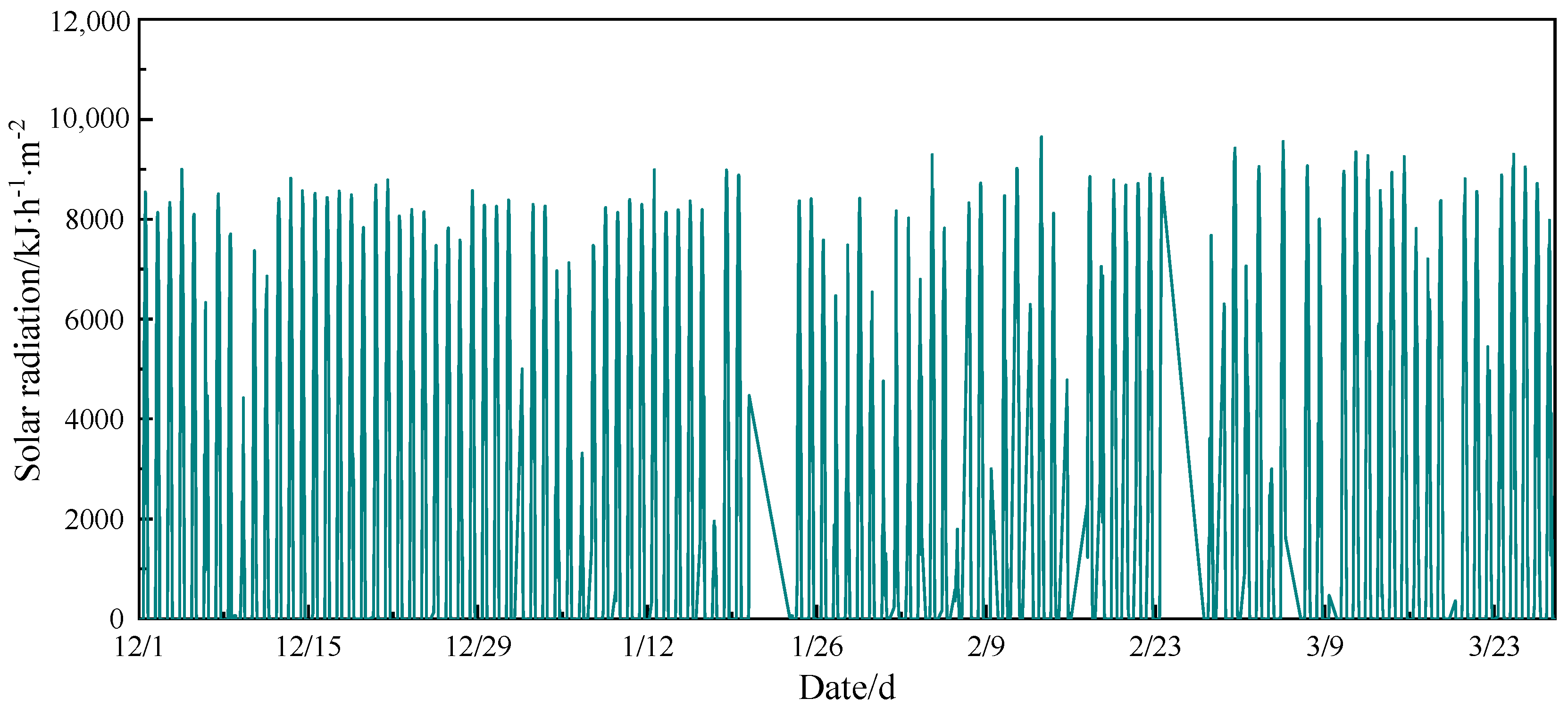
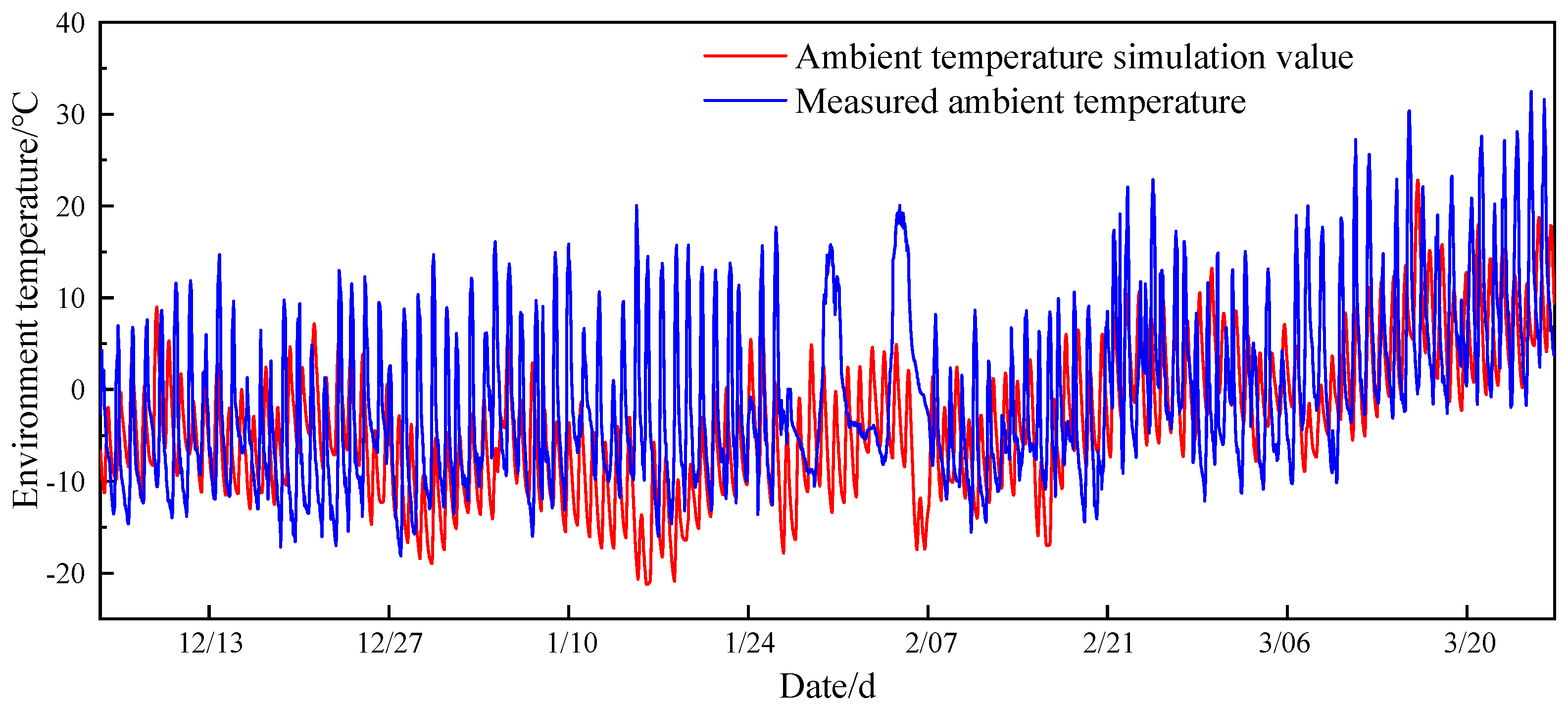
Figure 6 illustrates the amount of solar radiation during the test period. Figure 7 shows the hourly variation comparison curve of the outdoor air temperature from 29 November to 28 March. The simulated values represent the typical annual environmental temperature, with a relatively small variation range of −21.2 °C to 22.8 °C, and an average environmental temperature of −3.67 °C. Starting from March, the environmental temperature begins to rise. Due to the annual variation in environmental data, the actual environmental temperature fluctuates significantly, with an overall range of −18.14 °C to 32.46 °C and an average environmental temperature of −0.87 °C, which is higher than the simulated value.

5.3.2. Domestic Hot Water Temperature and Flow Rate

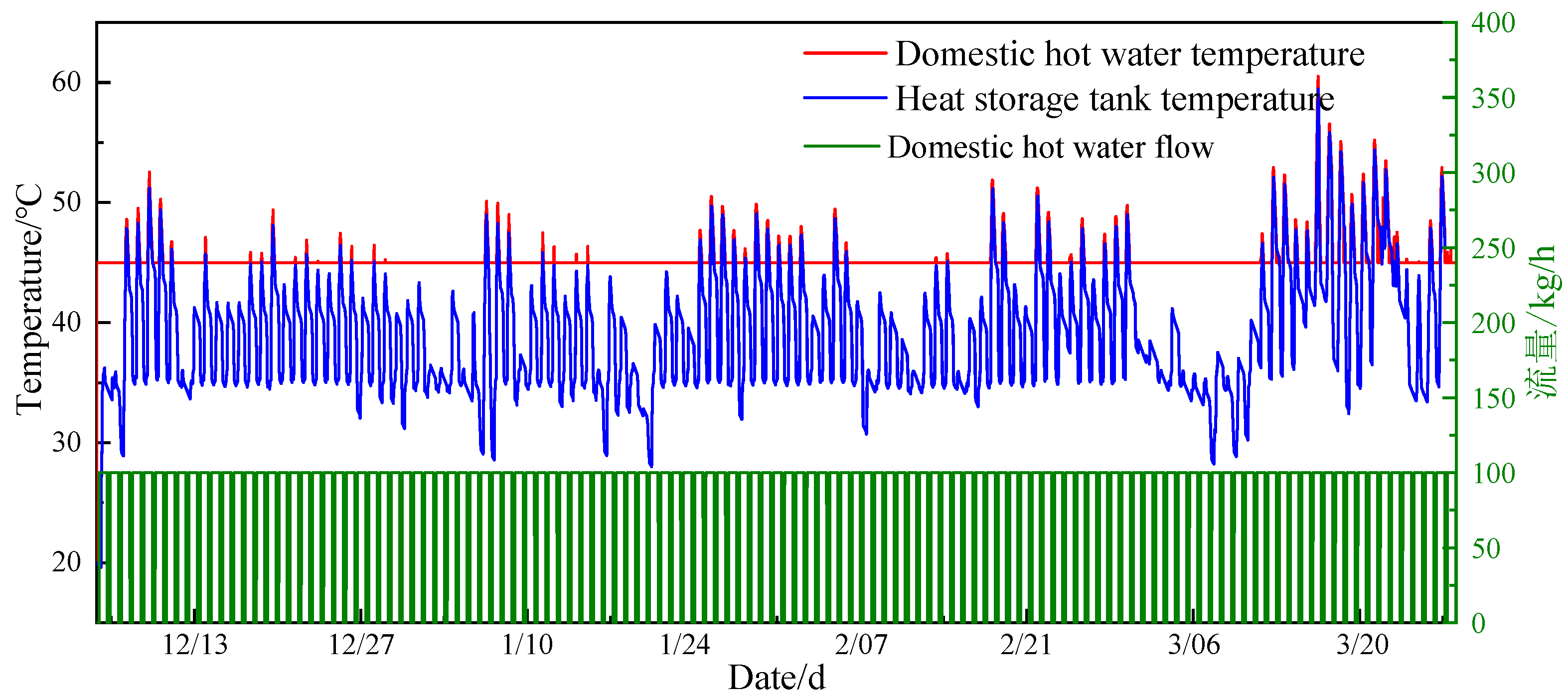
By controlling the domestic hot water heating pump, the supply water temperature is maintained at around 45 °C, as shown in Figure 3a. Figure 8 displays the variations in domestic hot water supply temperature and flow rate. When the domestic hot water heating pump is running, the circulation flow rate of domestic hot water is 100 kg/h, and the trend of the domestic hot water temperature change aligns with that of the thermal storage tank. When the thermal storage tank temperature falls below 45 °C, the required heat for domestic hot water is provided by the biogas digester, maintaining the temperature at 45 °C. If the thermal storage tank temperature exceeds 45 °C, the domestic hot water is heated by the thermal storage tank, showing consistent temperature changes.

5.3.3. Biogas Digester Slurry Temperature

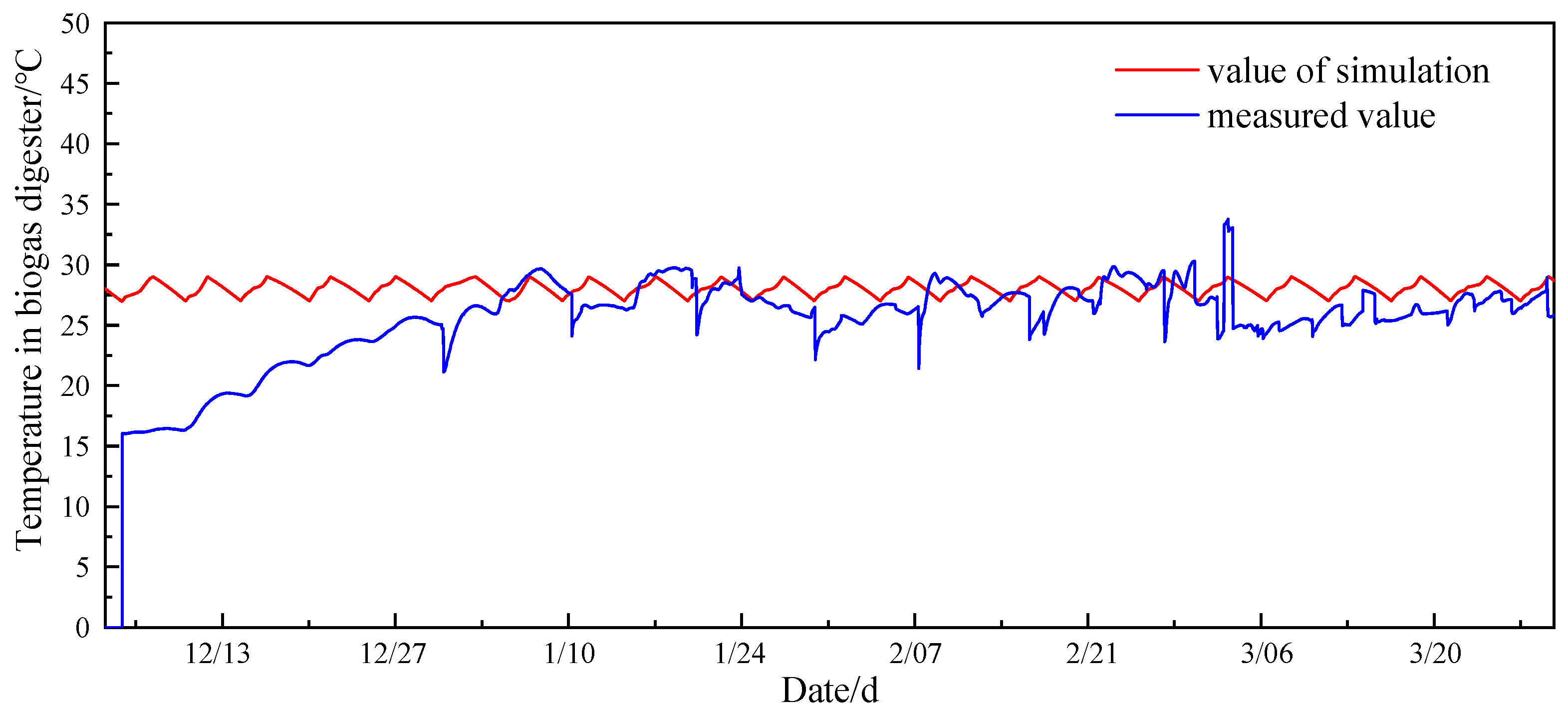
The biogas digester was initially charged at the end of November using cow dung collected from local farmers as the primary feedstock, while the inoculum was sourced from the Biomass Energy Laboratory of Lanzhou Jiao tong University to ensure stable microbial activity. Data acquisition and performance monitoring commenced on 1 December, following the establishment of steady fermentation conditions. The gas production in the digester is directly affected by the temperature in the digester, and the stable gas production stage before the first feed change is taken for comparison, and the comparison of the simulated and measured changes in the temperature in the digester is shown in Figure 9 below, which shows that the temperature in the digester is maintained at about 28 °C, and the gas production is maintained at about 1.5 m3 by the anaerobic fermentation gas production model in 2.2, and the simulation step is taken as 0.125 in the whole simulation period. 0.125, the daily biogas production can meet the cooking gas demand, and the remaining part of the heat is used to meet the domestic hot water demand; the measured value of the temperature in the digester is also maintained at about 28 °C during the stable gas production stage, which is influenced by the actual operation, and fluctuates more than the simulated value. This discrepancy primarily arises from these factors.
(1) Sensor placement and dynamics. The experimental probe was located near the digester wall, where radial temperature gradients exist during pump on/off transients; in addition, the thermistor’s finite response time introduces an apparent lag not represented in the lumped TRNSYS state, which assumes a spatially uniform node.
(2) Thermal losses and insulation ageing. The model uses nominal heat-loss coefficients, whereas the actual insulation is subject to moisture ingress and ageing, leading to higher effective heat transfer to ambient especially during night-time than assumed.
(3) Control hysteresis and actuation delays. Although a differential controller is implemented, field operation exhibits pump delays and broader hysteresis bands, causing overshoot/undershoot events that are smoothed in the simulation.
But the overall maintenance is at the optimal fermentation temperature, and the root mean square deviation of the simulated value of the system is 1.78, which indicates that the simulated value matches the measured value better, and the accuracy of the anaerobic fermentation model is verified. The accuracy of the anaerobic fermentation model was verified.
The digester was initially charged in late November and the monitoring campaign started after a stable fermentation condition was established; therefore, the model validation in this study focuses on the quasi-steady gas-production stage prior to the first feed-change event. The start-up performance can vary substantially with operating conditions. Specifically, lower slurry temperature, higher influent substrate concentration, and shorter HRT are expected to prolong the start-up period and increase the likelihood of intermediate accumulation, as indicated by classical kinetic studies on cattle-manure digestion.
The model’s limitations include its inability to describe short-term fluctuations in microbial activity or stratification within the reactor, as well as its assumption of homogeneous mixing and steady environmental conditions. Therefore, the model is valid primarily for steady-state mesophilic digestion and may underestimate transient variations in gas yield caused by feeding cycles or microbial adaptation.

5.3.4. Comparison of Heat Supply and Demand in the System

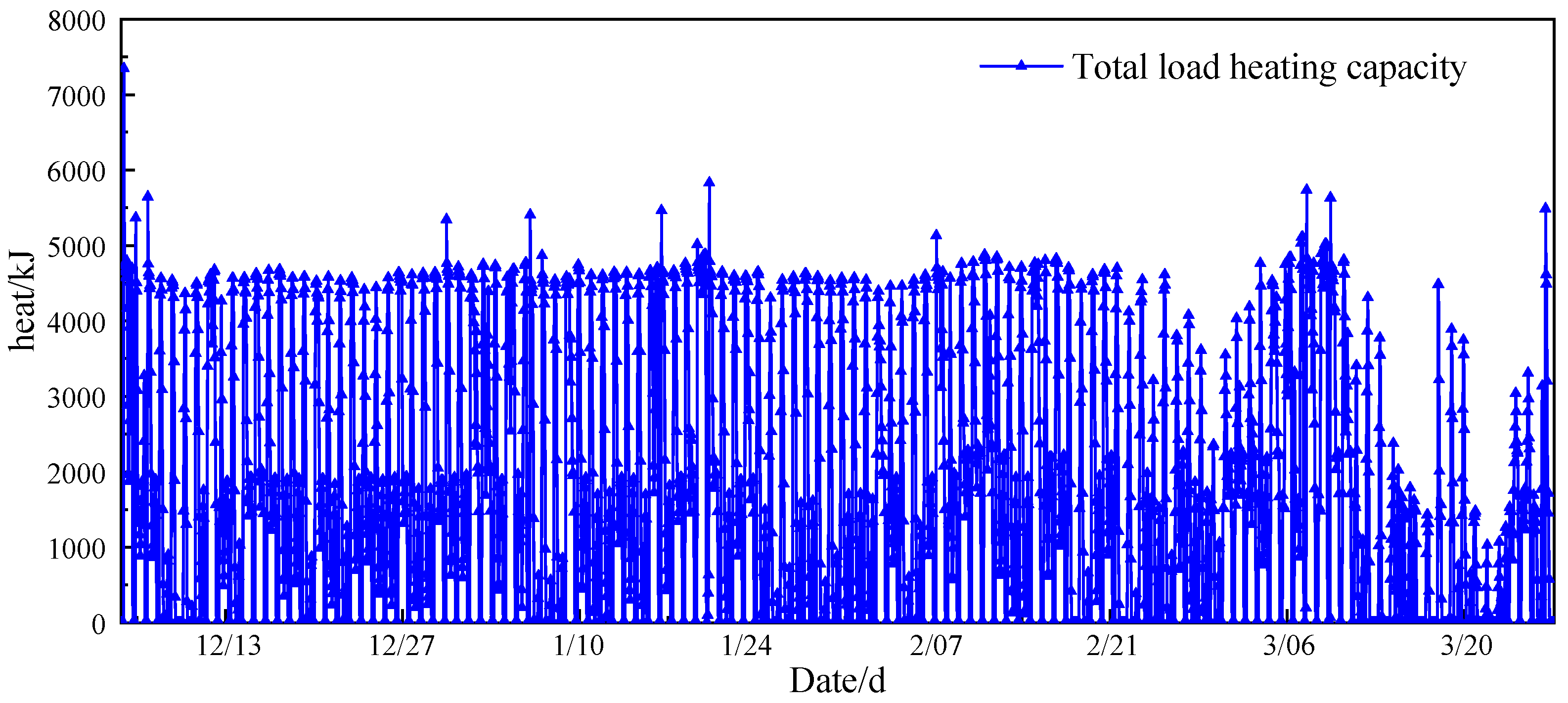
Throughout the entire simulation period, the total heat output of the solar collector is maintained at approximately 4000 kJ/h, while the total heat output of the biogas production subsystem is maintained at around 480 kJ/h. Table 4 shows the heat contribution rates of each subsystem to the biogas digester and domestic hot water during the heating season. To maintain the biogas digester temperature at around 28 °C, solar collector heating is sufficient, and only a small portion of time requires supplementary heat from the biogas production subsystem. The contribution ratios of heat supplied to domestic hot water by each subsystem are relatively high. The biogas produced by the digester, in addition to meeting the demand for cooking gas, is used to compensate for situations where solar collector heat is insufficient. The heat supplied by each subsystem for domestic hot water is concentrated from 5:00 AM to 11:00 PM daily, which corresponds to the period when residents use hot water. Figure 10 shows the total heating load supplied throughout the entire heating season. It is evident from the figure that the total heating load is 4728.96 MJ. Based on load prediction and analysis, it is known that the system’s heat demand during the heating season is 4636.22 MJ. Therefore, this complementary coupling energy supply system can meet the energy needs of users during the heating season.

5.3.5. Error Analysis

To improve the interpretability of the model validation, an error analysis is provided to explain the discrepancies between simulated and measured results. The deviations are mainly attributable to three factors.
(1) Sensor placement and measurement dynamics. The experimental probe was installed near the digester wall, where radial temperature gradients can occur during pump on/off transients. In addition, the thermistor has a finite response time, which introduces an apparent lag in the measured signal that is not represented in the lumped TRNSYS state assuming a spatially uniform node.
(2) Thermal losses and insulation ageing. The model adopts nominal heat-loss coefficients, whereas the actual insulation is subject to moisture ingress and ageing. This leads to higher effective heat transfer to the ambient, particularly at night, than assumed in the simulation.
(3) Control hysteresis and actuation delays. Although a differential controller is implemented in the model, field operation exhibits pump delays and broader hysteresis bands. As a result, overshoot/undershoot events are more pronounced in measurements, while the simulated profiles appear smoother.
Overall, these factors explain the remaining mismatch while the model still reproduces the steady mesophilic operation level reasonably well, as evidenced by the reported RMSD for slurry temperature.

5.4. Assessment of Equipment Selection Under Optimal Operating Modes

The appropriateness of the selected equipment was evaluated by examining whether each key component operates predominantly within its effective and stable operating range under the implemented control strategy. During periods of sufficient solar irradiance, the evacuated-tube collector and thermal storage subsystem provide the primary heat supply for both digester temperature maintenance and domestic hot-water demand, allowing the collector to function within its typical high-efficiency temperature range. When solar availability decreases, the biogas boiler is activated only when the temperature difference between the storage tank and the digester falls below the predefined threshold, thereby avoiding unnecessary start–stop cycling and ensuring stable auxiliary heating. Meanwhile, the anaerobic digestion unit is maintained near the mesophilic set-point (approximately 28 ± 1 °C), which corresponds to favorable microbial activity and steady methane production.
The simulated seasonal energy contribution ratios and the agreement between measured and simulated operating variables (root-mean-square deviation below 10%) further indicate that the capacities and control coordination of the solar collector, thermal storage, biogas digester, and auxiliary boiler are mutually compatible. Therefore, the adopted equipment configuration enables most components to operate close to their intended optimal or quasi-optimal conditions over the heating season, supporting the technical rationality of the equipment selection for rural household energy supply applications.

6. 3E Analysis of Complementary Coupling Energy Supply Systems

The selection of comprehensive evaluation indicators should be comprehensive, multi-faceted, non-redundant, and non-biased. The comprehensive evaluation indicator system for multi-functional complementary energy systems mainly includes indicators such as energy efficiency, low carbon, economic, and social indicators [37]. This paper uses multi-attribute evaluation indicators such as primary energy utilization rate, primary energy savings rate, CO2 emissions, NOx emissions, system initial investment, and annualized costs to conduct research and analysis on the energy benefits, environmental benefits, and economic benefits (3E) of the system.

6.1. Energy Efficiency

(1) Primary Energy Utilization Rate
The first law of thermodynamics mainly applies the principle of thermal balance, including primary energy utilization rate, primary energy saving rate, etc. [29]. The higher the primary energy utilization rate, the better the energy saving performance. The calculation formula for the primary energy utilization rate of the system is as follows:
P E R 1 = Q h , w + Q g a s F 1
In the formula, P E R 1 is the System primary energy utilization rate; Q h , w is the Minqin residential building domestic hot water load; Q g a s is the Rural cooking gas heat load; and F 1 is the System primary energy consumption.
(2) Primary Energy Saving Rate
Using only the primary energy utilization rate to reflect the efficiency of the system’s utilization of primary energy lacks practical significance and cannot accurately indicate the energy saving performance [38]. A relative index, primary energy saving rate, is used. The primary energy saving rate indicates the ratio of the primary energy consumption of the complementary coupling energy supply system to that of the traditional energy utilization form when satisfying the domestic hot water and cooking gas load demands [39]:
ξ = P E R 1 P ERf P E R 1 = 1 P ERf P E R 1
In the formula, ξ is the Primary energy saving rate; P E R 1 is the Complementary coupling energy supply system primary energy utilization rate; and P ERf is the Traditional rural energy supply mode system primary energy utilization rate.
The day-by-day primary energy utilization rate of the system during the heating season is not high, mainly due to the low primary energy utilization rate of the system caused by the high residual heat of the system. The primary energy utilization rate of the traditional energy supply mode in the heating season is kept around 0.35, and that of the complementary coupled energy supply system is 0.07. This shows that the complementary coupled energy supply system does not save the primary energy, and the primary energy consumed by the complementary coupled energy supply system is solar energy and cow dung, compared with that of the traditional energy supply mode. Energy consumption is solar energy and cow dung, and the primary energy consumed by the traditional energy supply mode is coal, and the primary energy consumed by the two energy supply modes has a great difference in terms of energy grade and type. The complementary coupled energy supply system consumed 19,256.16 kW∙h (equivalent to 2368.5 kg of standard coal) of cow dung during the heating season, which mitigated the environmental pollution caused by dung and fossil energy.
It should be noted that PER1 is highly sensitive to the definition of “primary energy” and the system boundary. In the proposed system, solar radiation is treated as a primary energy input, and thus the denominator includes the incident solar energy on the collector surface. This accounting convention can result in a low PER1 value even when the collector and boiler operate with reasonable thermal efficiencies, because the available environmental energy input is large and of low energy grade. Therefore, PER1 should not be interpreted as a direct indicator of component-level inefficiency for renewable-based systems; it is mainly used here as a consistent first-law indicator under the defined boundary, while environmental and economic indicators are jointly considered in the 3E assessment.

6.2. Environmental Benefits

(1) CO2 Emission and Reduction Rate
The emission of pollutants is calculated using a predictive model based on emission factors, as follows [40,41,42]:
m x = u x E E
In the equation, m x is the emission volume of system x gas, kg; u x E is the emission factor of x gas, kg/kW·h; E is the energy output of the system, kW·h. The emission volume of any greenhouse gas in any energy system can be calculated using the above model, and different situations have different emission factors, which require specific analysis and determination. In this system, CO2 emissions mainly include the emission from biogas boiler combustion, residential biogas cooking, and the CO2 emission considering the reduction of manure pollution such as cattle dung.
Comparing with the evaluation of the primary energy saving rate of the system, the CO2 reduction efficiency is defined as follows [29].
Δ m c o 2 = m c o 2 TM m c o 2 m c o 2 TM = 1 m c o 2 m c o 2 TM
In the equation, Δ m c o 2 is the CO2 reduction efficiency; m c o 2 is the System CO2 gas emission volume, kg; and m c o 2 TM is the CO2 emission volume of traditional energy supply mode, kg.
(2) NOx Emission and Reduction Rate
Similar to the calculation of CO2 reduction volume, the NOx emission volume also includes the emission from biogas boiler combustion, residential biogas cooking, and the NOx emission volume considering the reduction of manure pollution such as cattle dung.
The NOx reduction efficiency is defined as follows:
Δ m NO x = m NO x TM m NO x m N O x TM = 1 m NO x m N O x TM
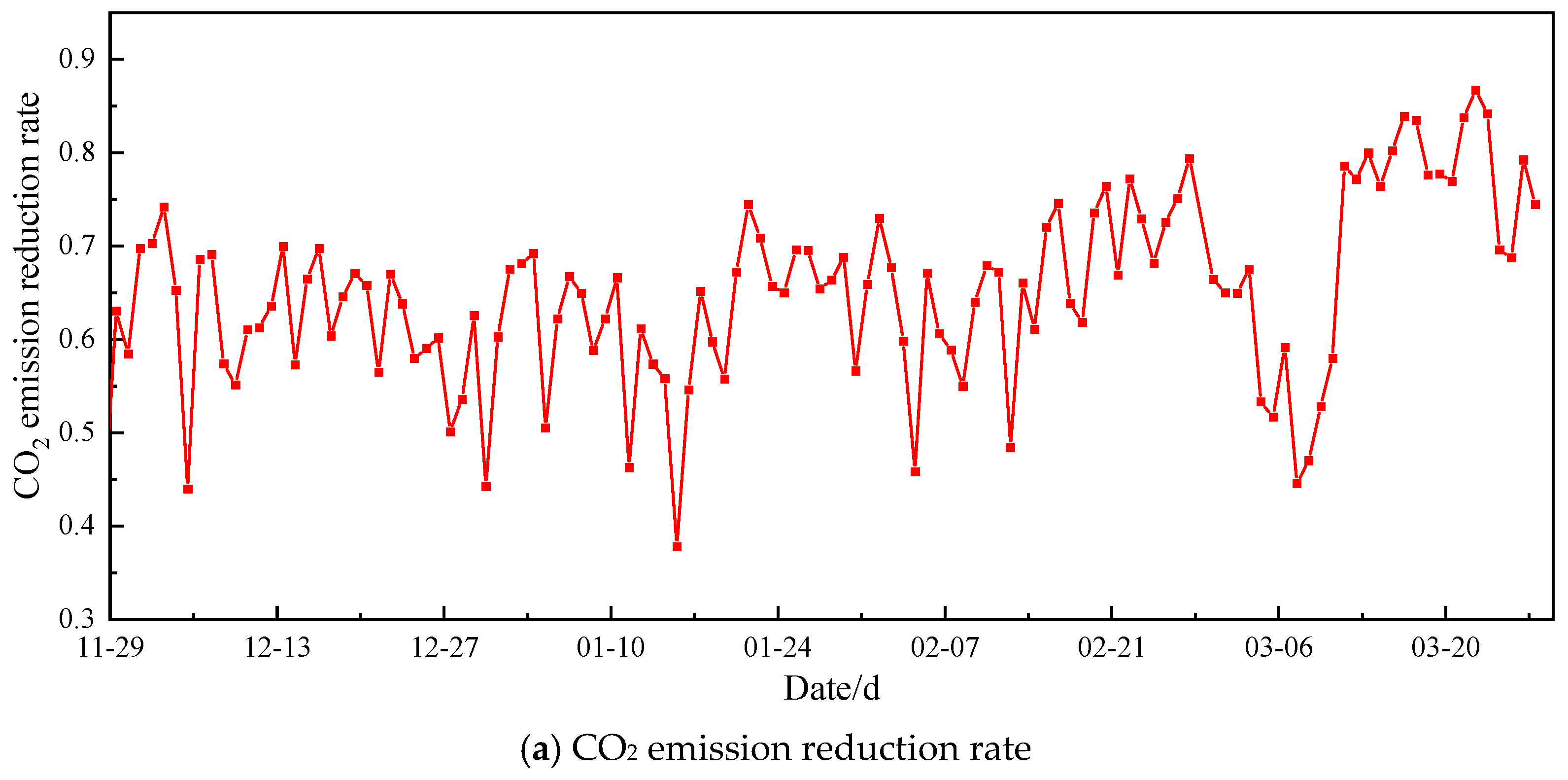
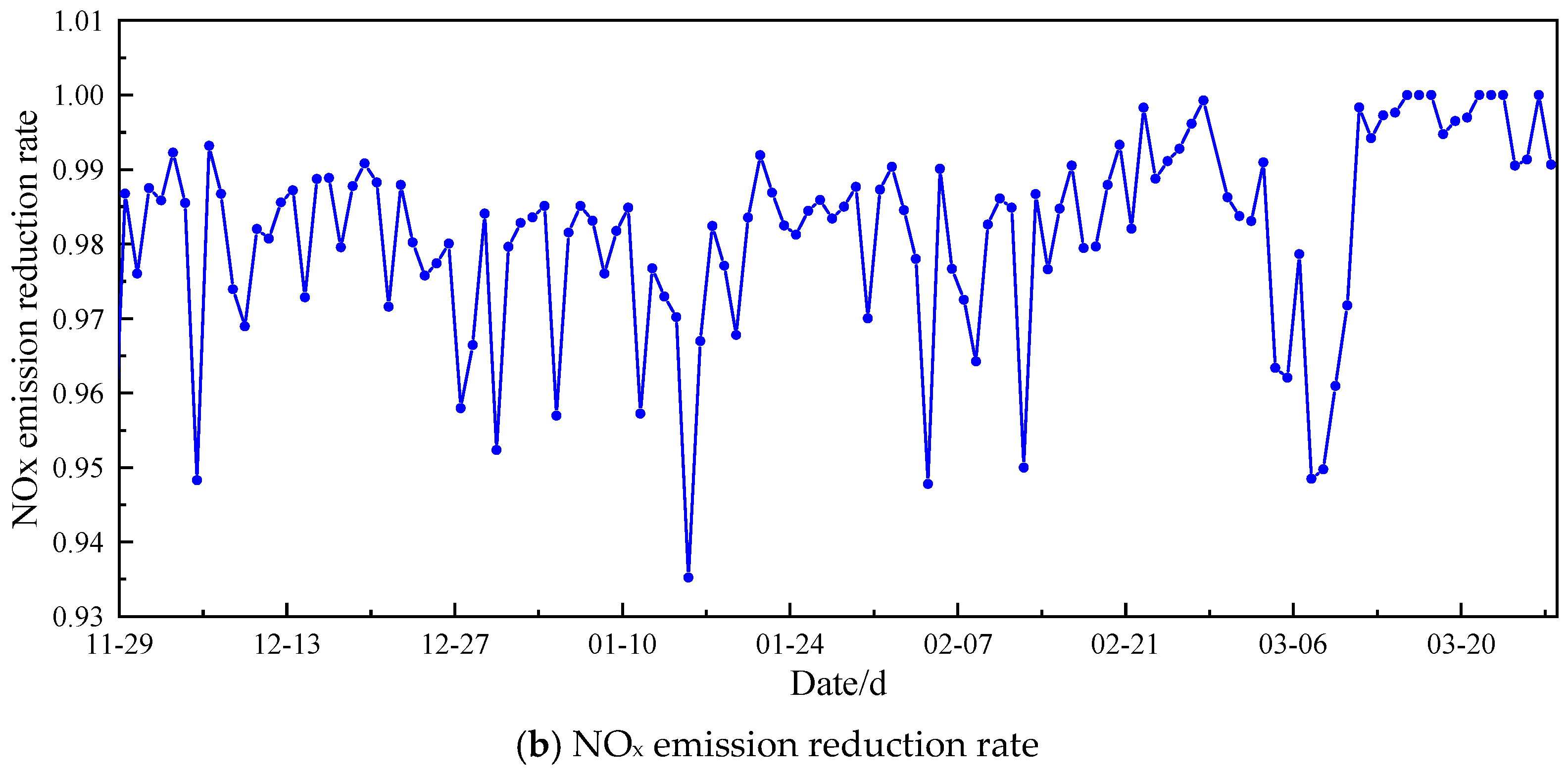
The curve of CO2 reduction rate and NOx reduction rate variation in the heating season of the complementary coupling energy supply system is shown in Figure 11, with a value greater than 40% during the heating season, reaching a maximum of 86.7%, and an average of 65.85%. Unlike the complementary coupling energy supply system’s primary energy saving rate, this indicates that the complementary coupling energy supply system does not save primary energy during the heating season compared to the traditional energy supply mode. However, it has great potential in terms of CO2 reduction rate, with a total reduction volume of 410.26 kg during the heating season. The NOx reduction rate of the complementary coupling energy supply system remains above 90% during the heating season, with an average of 98.13%. Due to the low NOx emission volume of the complementary coupling energy supply system, the total heating season volume is 0.10 kg, resulting in a high overall reduction rate of the system, indicating that the complementary coupling energy supply system has great potential in terms of NOx reduction rate.

6.3. Economic Benefits

(1) Initial Investment of the System
The initial investment of the system mainly includes the investment in various equipment and pipeline systems. The complementary and coupled energy supply system mainly consists of solar energy collection subsystem, biogas production subsystem, biogas boiler, biogas stove, control system, and pipeline system. Therefore, the initial investment of the system can be further expressed as:
C = I V c + I V bd + I V b + I V bs + I V cs + I V pipe
where  I V c , I V bd , I V b , I V bs , I V cs , I V pipe are the initial investment of the solar energy collection subsystem, biogas production subsystem, biogas boiler, biogas stove, control system, and pipeline system, with the unit being yuan.
(2) Annualized Cost
The feasibility of large-scale deployment of the rural complementary coupled energy supply system is fundamentally determined by its economic performance. Consequently, the operational cost-effectiveness of the system serves as a critical criterion for evaluation. The annualized cost of the system can be calculated as follows [21]:
C ax = 1 S v P WF i , n C o x + m = 1 n F m P WF i , m C R F i , n
where  C ax is the annualized cost, yuan per year; C o x is the initial investment, yuan; S v is the residual value coefficient after economic service life; P WF i , n is the cash flow factor; F m is the operating cost spent in year m, yuan; C R F i , n is the capital recovery factor; i is the benchmark interest rate, referring to bank interest; n is the system service life, years.
In the conventional household energy-use pattern, coal and firewood combustion constituted the primary energy sources, with grid electricity serving as a supplementary supply. Field survey results indicate that the annual coal consumption of a typical household was approximately 5500 kg, corresponding to an annual expenditure of about 7150 CNY at a local coal price of 1.3 CNY per kilogram. Electricity costs were estimated at roughly 600 CNY per year, while the economic contribution of firewood used for heating and cooking was not included in the assessment.
After adoption of the proposed system, auxiliary heating during the heating season is provided by a coal stove with an annual coal demand of approximately 1838 kg. Based on the above comparison, the implementation of the cogeneration system yields an estimated annual economic benefit of approximately 4360 CNY.
The initial investment cost of the system directly affects its economy. The complementary coupling energy supply system consists of solar collector subsystem (vacuum tube solar collector, heat storage tank), biogas production subsystem (above-ground constant temperature room, gas storage bag), biogas boiler, biogas stove, control system (temperature difference controller) and piping system (water segregator, return header, circulating pump), and other pieces of equipment, The price of a single unit of solar collector is 1900 yuan, and the heat storage tank is 1100 yuan; the main investment of the biogas production subsystem includes 3500 yuan of constant temperature room and 1500 yuan of red mud soft biogas bag The total cost of the system is 13,800 yuan; the specific cost of the system is shown in Table 5 below.
The investment recovery performance of the solar energy and above-ground biogas digester complementary coupling energy supply system was further evaluated by analyzing its payback period. The Net Present Value (NPV) of the system is calculated according to the following expression:
N P V = t = 0 n C I C O t 1 + i t
In the above expression, (CI−CO)t represents the net cash flow, and i denotes the discount rate, which is taken as 1.5%. A larger NPV value indicates improved project feasibility and stronger investment profitability.
The Benefit–Cost Ratio (BCR) is determined using the following relationship:
B C R = P V B P V C
where PVB and PVC correspond to the present values of total benefits and total costs, respectively.
The investment payback period is evaluated according to:
P t = A 1 + E F
where Pt denotes the payback period, A is the discounted payback duration, E represents the absolute value of the cumulative discounted net cash flow at the end of the preceding year, and F is the present value of the net cash flow in the year when the cumulative value becomes positive.
The solar collector lifetime is about 12 years. The biogas boiler lifetime is about 8 years. Hence, the system operating lifetime is set to 8 years. The bank interest rate is 1.5%, and the salvage value coefficient after the economic lifetime is 0.05. The resulting cash flow factor is 0.89, and the capital recovery factor is 0.13. The corresponding depreciation of the initial equipment investment is 1714.17 CNY.
The annual maintenance expenditure of the system is estimated at 300 CNY. Based on the above economic evaluation, the complementary coupled energy supply system requires an initial capital investment of 13,800 CNY and yields an annualized cost of 2014.17 CNY. The calculated Net Present Value (NPV) reaches 19,451.82 CNY, with a Benefit–Cost Ratio (BCR) of 2.41 and a discounted payback period of 3.27 years.
Based on the investigated annual household energy expenditure within the defined economic boundary, the baseline annual energy cost is approximately 7750 CNY·yr−1, including 7150 CNY·yr−1 for coal consumption and about 600 CNY·yr−1 for electricity. With the proposed solar energy and above-ground biogas digester complementary coupling energy supply system, the estimated annual economic benefit is 4360 CNY·yr−1. Therefore, the proposed equipment can offset approximately 56.3% of the baseline annual energy expenditure under the same demand conditions. It should be noted that the cost of firewood was not included in the baseline energy expenditure; hence, the above proportion represents a conservative estimate of the achievable energy-cost coverage.
The overall economic evaluation indicates that the proposed complementary coupled energy supply system is both technically practicable and financially advantageous for rural applications. Through the coordinated utilization of solar and biomass resources, the system achieves substantial reductions in greenhouse gas emissions while ensuring a reliable and sustainable energy supply. These results underscore the capacity of multi-energy complementary configurations to facilitate rural energy transition and environmental improvement, thereby contributing to long-term sustainability and carbon neutrality objectives.
Future work will extend the present steady-state coupling model toward transient operation by incorporating cyclic feeding, variable microbial activity and detailed start-up dynamics of anaerobic digestion. In addition, auxiliary electricity consumption and a quantitative reliability assessment will be included to further refine the 3E performance evaluation. Finally, broader field validation under different climates and user demand profiles will be conducted to improve model generality and support large-scale rural deployment.

7. Conclusions

This study investigated a solar–biogas complementary coupled energy supply system for new rural residences in Minqin (Northwest China) using field monitoring and TRNSYS-based dynamic simulation. The main conclusions are as follows:
(1) Domestic hot-water (DHW) demand exhibits clear daily peaks (morning, noon, and evening), while cooking-gas demand concentrates in the afternoon (approximately 14:00–19:00). The calculated daily biogas demand for cooking is 1.16 m3 per household.
(2) During the heating season, the solar subsystem provides the dominant share of DHW heating, whereas the biogas subsystem primarily serves as an auxiliary heat source under low-radiation or night-time conditions. The solar subsystem supplies 10% of the heat required for digester temperature maintenance and 90% of the DHW load, while the biogas subsystem contributes 9.29% and 90.71%, respectively. The total seasonal heat demand is 4636.22 MJ and the supplied heat is 4728.96 MJ, indicating that the proposed system can satisfy user needs over the heating period.
(3) The coupled model was validated against field data for key variables (outdoor temperature, tank temperature, slurry temperature, and biogas production). The root mean square deviation remains below 10%, and the slurry-temperature deviation is particularly small (1.78%), supporting the adequacy of the quasi-steady mesophilic digestion representation for seasonal energy-flow evaluation.
(4) Under the adopted 3E boundary, the proposed system achieves substantial emission reductions relative to conventional rural energy supply. The average CO2 reduction rate is 65.85%, and the average NOx reduction rate is 98.13% over the heating season. Meanwhile, the reported primary energy utilization rate (PER1) is lower than that of the coal-based baseline because solar radiation is treated as a primary-energy input and differs fundamentally in energy grade and accounting convention. Therefore, PER1 should be interpreted as a boundary-dependent first-law indicator rather than a direct proxy for component-level inefficiency in renewable-based systems.
(5) The system shows favorable economic performance for rural applications: the initial investment is 13,800 CNY, the annualized cost is 2014.17 CNY·yr−1, the net present value is 19,451 CNY, the benefit–cost ratio is 2.41, and the discounted payback period is 3.27 years. These results indicate that the proposed system can provide a practical pathway for clean energy substitution and waste-to-energy utilization in rural areas.
(6) The current model focuses on seasonal quasi-steady operation; start-up transients, cycle-by-cycle feeding dynamics, and short-term microbial acclimation are not explicitly resolved. Future work will extend the model toward transient digestion behavior and refine boundary-consistent 3E evaluation by incorporating auxiliary electricity consumption and broader field validation under diverse climates and demand profiles.

Author Contributions

Conceptualization, X.Z. and L.F.; methodology, L.F.; software, L.F. and T.X.; validation, L.F. and M.L.; formal analysis, L.F.; investigation, L.F. and T.X.; resources, X.Z.; data curation, L.F.; writing original draft preparation, L.F.; writing review and editing, X.Z.; visualization, L.F. and T.X.; supervision, X.Z.; project administration, X.Z.; funding acquisition, X.Z. All authors have read and agreed to the published version of the manuscript.

Funding

This research was funded by the National Natural Science Foundation of China (Grant No. 52206255), the Gansu Province Outstanding Youth Fund Program (Grant No. 25JRRA143), the Gansu Province 2024 Provincial Social Science Planning Key Commissioned Project (Grant No. 2024ZD002), and the Key Research and Development Program of Gansu Province-Industrial Project (Grant No. 25YFGF002).

Data Availability Statement

The data supporting the findings of this study are available from the corresponding author upon reasonable request.

Acknowledgments

The authors would like to thank the Biomass Energy Laboratory of Lanzhou Jiaotong University for technical support during the field experiments.

Conflicts of Interest

The authors declare no conflict of interest.

Abbreviations

SymbolDescription
3EEnergy, Environmental, and Economic assessment
BCRBenefit–Cost Ratio
CAPEXCapital Expenditure
DHWDomestic Hot Water
GHGGreenhouse Gas
HRTHydraulic Retention Time
IAMIncidence Angle Modifier
LHVLower Heating Value
NPVNet Present Value
O&MOperation and Maintenance
TRNSYSTransient System Simulation Tool

References

  1. Central People’s Government of the People’s Republic of China. Implementation Opinions on Accelerating the Development of Rural Energy Transformation to Help Rural Revitalization. Available online: https://www.gov.cn/zhengce/zhengceku/2022-01/07/content_5666809.htm (accessed on 2 January 2026).
  2. Wang, S. Development trend of China’s energy resources in the 14th Five-Year Plan period and proposals for low-carbon transition. Environ. Prot. 2022, 50, 36–41. [Google Scholar] [CrossRef]
  3. REN21. 2024.Scili Renewables 2024 Global Status. Report Collection, Energy Demand, (Paris: REN21 Secretariat). Available online: https://www.fxbaogao.com/detail/4823866 (accessed on 4 January 2026).
  4. Nassar, Y.F.; El-Khozondar, H.J.; Ahmed, A.A.; Alsharif, A.; Khaleel, M.M.; El-Khozondar, R.J. A new design for a built-in hybrid energy system, parabolic dish solar concentrator and bioenergy (PDSC/BG): A case study—Libya. J. Clean. Prod. 2024, 441, 140944. [Google Scholar] [CrossRef]
  5. Awad, H.; Nassar, Y.F.; Elzer, R.S.; Mangir, I.; Khaleel, M.; Ahmed, A.; Alsharif, A.; Salem, M.; Hafez, A. Energy, economic and environmental feasibility of energy recovery from wastewater treatment plants in mountainous areas: A case study of Gharyan city—LIBYA. Acta Innov. 2023, 50, 46–56. [Google Scholar] [CrossRef]
  6. Zhen, X.F.; Li, J.P.; Yang, A.R.; Yang, J. Experimental study on winter performance of combined thermoelectric biogas supply system. China Biogas 2017, 35, 53–57. [Google Scholar] [CrossRef]
  7. Tan, H.; Wang, X.; Xu, T.; Zhao, K.; Su, L.; Zhang, W.; Xin, Z. Study on the economic and technical optimization of hybrid rural microgrids integrating wind, solar, biogas, and energy storage with AC/DC conversion. EAI Endorsed Trans. Energy Web 2024, 11, 1–10. [Google Scholar] [CrossRef]
  8. Roldán-Porta, C.; Roldán-Blay, C.; Dasí-Crespo, D.; Escrivá-Escrivá, G. Optimising a biogas and photovoltaic hybrid system for sustainable power supply in rural areas. Appl. Sci. 2023, 13, 2155. [Google Scholar] [CrossRef]
  9. Wang, Y.; Su, B.; Huang, Z. Simulation analysis of a novel solar-assisted chemical recuperation-based combined cooling, heating and power (CCHP) system with biogas. J. Power Eng. 2024, 44, 213–220+231. [Google Scholar] [CrossRef]
  10. Omidvar, M.R.; Meghdadi Isfahani, A.H.; Kumar, R.; Mohammadidoust, A.; Bewoor, A. Thermal performance analysis of a novel solar-assisted multigeneration system for hydrogen and power generation using corn stalk as biomass. Biomass Convers. Biorefinery 2021, 15, 29803–29821. [Google Scholar] [CrossRef]
  11. Assareh, E.; Agarwal, N.; Paul, M.C.; Ahmadi, P.; Ghodrat, M.; Lee, M. Investigation and development of a novel solar-biomass integrated energy system for clean electricity and liquid hydrogen production. Therm. Sci. Eng. Prog. 2023, 42, 101925. [Google Scholar] [CrossRef]
  12. Alhijazi, A.A.K.; Almasri, R.A.; Alloush, A.F. A hybrid renewable rnergy (solar/wind/biomass) and multi-use system principles, types, and applications: A Review. Sustainability 2023, 15, 16803. [Google Scholar] [CrossRef]
  13. Nassar, Y.; Alatrash, A.; Elzer, R.; Alkhazmi, A.; El-Khozondar, H.; Alsharif, A.; Ahmed, A.; Khaleel, M. Optimum number of glass covers of thermal flat plate solar collectors. Wadi Alshatti Univ. J. Pure Appl. Sci. 2024, 2, 1–10. Available online: https://www.waujpas.com/index.php/journal/article/view/35. (accessed on 4 January 2026).
  14. Zhang, X.; Yang, J.; Fan, Y.; Zhao, X.; Yan, R.; Zhao, J.; Myers, S. Experimental and analytic study of a hybrid solar/biomass rural heating system. Energy 2020, 190, 116392. [Google Scholar] [CrossRef]
  15. Li, J.; Zhang, J.; Wen, Z.; Yu, C.; Li, X. Differential selective etching of functional groups strategy for preparation of organic hollow porous silica. E3S Web Conf. 2021, 246, 03001. [Google Scholar] [CrossRef]
  16. Janša, J.; Hradílek, Z. Model of electric and heat balance of biogas station. Adv. Electr. Electron. Eng. 2016, 14, 490–497. [Google Scholar] [CrossRef]
  17. Morozov, Y.P.; Zhokhin, A.S. Modeling of the thermal regime of a biogas plant in the conditions of the far north. Renew. Energy 2022, 4, 71–82. [Google Scholar] [CrossRef]
  18. Liu, E.; Zang, W.; Hhang, Q.; Wan, E.; Wang, S. Design and numerical analysis of a composite system of a household biogas digester and solar greenhouse in cold regions. Therm. Sci. 2023, 27, 763–774. [Google Scholar] [CrossRef]
  19. Zhou, M.; Liu, J.; Tang, A.; You, X. Capacity demand analysis of rural biogas power generation system with independent operation considering source-load uncertainty. Energies 2024, 17, 1880. [Google Scholar] [CrossRef]
  20. Ritonja, J. Adaptive control of CO2 production during milk fermentation in a batch bioreactor. Mathematics 2021, 9, 1712. [Google Scholar] [CrossRef]
  21. Zhang, C.; Sun, J.; Ma, J.; Xu, F.; Qiu, L. Environmental assessment of a hybrid solar-biomass energy supplying system: A case study. Int. J. Environ. Res. Public Health 2019, 16, 2222. [Google Scholar] [CrossRef] [PubMed]
  22. Kourkoumpas, D.-S.; Benekos, G.; Nikolopoulos, N.; Karellas, S.; Grammelis, P.; Kakaras, E. A review of key environmental and energy performance indicators for the case of renewable energy systems when integrated with storage solutions. Appl. Energy 2018, 231, 380–398. [Google Scholar] [CrossRef]
  23. Ghanem, T.H.; Badr, M.M.; Hafez, H.; Eissa, A.S. Some engineering factors affecting the performance of solar powered adsorption refrjgeartion system. Misr J. Agric. Eng. 2018, 35, 975–998. [Google Scholar] [CrossRef]
  24. Echiegu, E.A. Kinetic models for anaerobic fermentation processes-A review. Am. J. Biochem. Biotechnol. 2015, 11, 132. [Google Scholar] [CrossRef]
  25. Buswell, A.M.; Mueller, H.F. Mechanism of methane fermentation. Ind. Eng. Chem. 1952, 44, 550–552. [Google Scholar] [CrossRef]
  26. Peavy, H.S.; Rowe, D.R.; Tchobanoglous, G. Environmental Engineering; McGraw Hill: New York, NY, USA, 1985; p. 719. [Google Scholar]
  27. Chen, Y.R.; Hashimoto, A.G. Kinetics of Methane Fermentation; Science and Education Administration: Clay Center, NE, USA; Meat Animal Research Center: Clay Center, NE, USA, 1978. [Google Scholar]
  28. Zhang, D.; Zheng, Y.; Wu, J.; Li, B.; Li, J. Annual energy characteristics and thermodynamic evaluation of combined heating, power and biogas system in cold rural area of Northwest China. Energy 2020, 192, 116522. [Google Scholar] [CrossRef]
  29. Hashimoto, A.G. Methane from cattle waste: Effects of temperature, hydraulic retention time, and influent substrate concentration on kinetic parameter (K). Biotechnol. Bioeng. 1982, 24, 2039–2052. [Google Scholar] [CrossRef]
  30. Pham, C.H.; Triolo, J.M.; Sommer, S.G. Predicting methane production in simple and unheated biogas digesters at low temperatures. Appl. Energy 2014, 136, 1–6. [Google Scholar] [CrossRef]
  31. Wang, S.S.; Hao, B.; Peng, C.; Guo, J.; Chen, X.; Lu, Y. Investigation and analysis of residential hot water use. Constr. Technol. 2016, 16, 20–24. [Google Scholar] [CrossRef]
  32. Pei, S.; You, Y. Gas load and usage patterns of natural gas users. Chem. Ind. Manag. 2021, 32, 17–18. [Google Scholar] [CrossRef]
  33. GB 50015-2019; Code for Design of Building Water Supply and Drainage. Ministry of Housing and Urban-Rural Development of the People’s Republic of China. China Planning Press: Beijing, China, 2019. Available online: http://www.jxida.com.cn/download/1585125631817543.pdf (accessed on 2 January 2026).
  34. Li, K.; Hao, H.; Zhuang, C.; Pu, L. A new formula for estimating natural river water temperature using meteorological factors. J. Sichuan Univ. (Eng. Sci. Ed.) 2006, 38, 1–4. [Google Scholar] [CrossRef]
  35. GB/T 4271-2021; Solar Collector Performance Test Method. Standardization Administration of the People’s Republic of China: Beijing, China, 2021. Available online: https://openstd.samr.gov.cn/bzgk/gb/index (accessed on 4 January 2026).
  36. Qu, X.; Wu, M.; Li, Q.; Ding, B.; Zhao, F.; Kou, L. Review on comprehensive evaluation of multi-energy complementary integrated energy systems. China Electr. Power 2021, 54, 153–163. [Google Scholar] [CrossRef]
  37. Wang, Q.G.; Yang, M.C.; Zhu, Y.Z.; Zhou, Y.; Lei, J.; Gong, T. Review of evaluation methods for renewable energy multi-energy complementary thermal and electrical cogeneration systems. Power Grid Technol. 2021, 45, 937–950. [Google Scholar] [CrossRef]
  38. Han, Z.; Qi, C.; Xiang, P.; Liu, M.; Wang, S. Benefit analysis and comprehensive evaluation for distributed energy system. Therm. Power Gener. 2018, 47, 31–36. [Google Scholar] [CrossRef]
  39. Rosato, A.; Sibilio, S.; Scorpio, M. Dynamic performance assessment of a residential building-integrated cogeneration system under different boundary conditions. Part I: Energy analysis. Energy Convers. Manag. 2014, 79, 731–748. [Google Scholar] [CrossRef]
  40. Chicco, G.; Mancarella, P. Assessment of the greenhouse gas emissions from cogeneration and trigeneration systems. Part I: Models and indicators. Energy 2008, 33, 410–417. [Google Scholar] [CrossRef]
  41. Mancarella, P.; Chicco, G. Assessment of the greenhouse gas emissions from cogeneration and trigeneration systems. Part II: Analysis techniques and application cases. Energy 2008, 33, 418–430. [Google Scholar] [CrossRef]
  42. Abdelhady, S.Z. Performance and cost evaluation of solar dish power plant: Sensitivity analysis of levelized cost of electricity (LCOE) and net present value (NPV). Renew. Energy 2021, 168, 332–342. [Google Scholar] [CrossRef]
Figure 2. Solar energy and ground biogas digester complementary coupling energy supply system.
Energies 19 01267 g002
Figure 3. Domestic hot water and cooking gas load of Minqin residents.
Energies 19 01267 g003
Figure 4. TRNSYS simulation model of the whole process of system energy supply, production capacity and energy use.
Energies 19 01267 g004
Figure 5. Energy distribution of complementary coupled solar and above ground biogas digester energy supply system.
Energies 19 01267 g005
Figure 6. Solar radiation during the test period.
Energies 19 01267 g006
Figure 7. Comparison of outdoor ambient temperature change.
Energies 19 01267 g007
Figure 8. Change of domestic hot water supply temperature and flow. The term “流量” here refers to “flow”.
Energies 19 01267 g008
Figure 9. Comparison of temperature change in biogas digester.
Energies 19 01267 g009
Figure 10. Variation of total heating quantity under seasonal heating load.
Energies 19 01267 g010
Figure 11. The emission reduction rate of the complementary coupled energy supply system is higher than that of the traditional energy supply mode.
Energies 19 01267 g011aEnergies 19 01267 g011b
Table 1. Power supply system component settings and input variables.
NameEquipment NameComponent ModelSetting Parameters/Input Variables
Meteorological databaseMeteorological data readerEnergies 19 01267 i001Setting parameters: file type, logical unit, inclined surface radiation pattern, snow-free and snow-covered surface radiation and surface slope, etc.
Solar subsystemsSolar vacuum tube collectorEnergies 19 01267 i002Input variables: inlet temperature and flow rate, ambient temperature, total and incident solar radiation on horizontal surfaces, solar zenith angle, solar azimuth angle, solar incidence angle and collector inclination, etc.
Thermal storage tankEnergies 19 01267 i003Input variables: inlet temperature, flow rate and ambient temperature on the load side as well as on the heat source side
Biogas subsystemBiogas digesterEnergies 19 01267 i004Input variables: inlet feed temperature and flow rate, inlet temperature and flow rate of the heat exchanger coil, loss temperature of each wall, etc.
Gas storage bagEnergies 19 01267 i005Input variables: energy supply to or from the module,
energy supply to or from components
Biogas boilerEnergies 19 01267 i006Input variables: inlet temperature and flow rate, control function, modulating point temperature, total heat loss coefficient, boiler efficiency, etc.
Control systemsTemperature difference controllerEnergies 19 01267 i007Input variables: high input temperature, low input temperature, high deadband temperature difference, and low deadband temperature difference.
Diverter ValveEnergies 19 01267 i008Input variables: inlet temperature and flow rate and control signal
Combined valveEnergies 19 01267 i009Input variables: each inlet water temperature and flow rate
Circulation pumpsEnergies 19 01267 i010Input variables: inlet water temperature and flow rate, control signal, total pump efficiency, and motor efficiency
User sideData readerEnergies 19 01267 i011Setting parameters: data interval and average or instantaneous values, etc.
values, etc.
Energies 19 01267 i012Input variables: inlet temperature and flow rate, load, minimum heating temperature, and maximum cooling water temperature
Result processingInstantaneous values
Integration
Energies 19 01267 i013Setting parameters: integration period, relative time, or absolute time
Online display
Outputs
Energies 19 01267 i014Input variables: left and right axis variables
Table 2. Specific parameter design of simulation model.
NameValueUnit
Slope of surface45degrees
Azimuth of surface0degrees
Collector area3.85m2
Fluid specific heat4.190kJ/kg·K
Flow rate at test conditions50.0kg/h·m2
Negative of first order efficiency coefficient10kJ/h·m2·K
Negative of second order efficiency coefficient0.03kJ/h·m2·K2
Tank volume0.500m3
Fluid density1000.0kg/m3
Tank loss coefficient2.5kJ/h·m2·K
Height of node-1 to 60.3m
Upper input temperature Th20.0°C
Lower input temperature Tl10°C
Monitoring temperature Tin20°C
Table 3. Model parameter error.
ParametersRoot Mean Square Deviation/%ParametersRoot Mean Square Deviation/%
Outdoor air temperature8.72tank temperature9.14
Slurry temperature1.78gas production6.21
Table 4. Contribution of subsystems to digester and domestic hot water during the heating period.
SubsystemsHeating of the Digester
Heat Contribution (%)
Heating Domestic Hot Water
Heat Contribution (%)
Solar collector subsystems1090
Biogas production subsystems9.2990.71
Table 5. Initial investment in complementary coupled energy supply systems.
InstallationsUnit CostCapacity/NumberInitial Investment/Yuan
Solar energy collection subsystem 300013000
Biogas production subsystem500015000
Biogas boiler100022000
Control system38003800
Disclaimer/Publisher’s Note: The statements, opinions and data contained in all publications are solely those of the individual author(s) and contributor(s) and not of MDPI and/or the editor(s). MDPI and/or the editor(s) disclaim responsibility for any injury to people or property resulting from any ideas, methods, instructions or products referred to in the content.