Article

Diagnosis and Location of Internal Short Circuit Faults in Pumped Storage Transformers Using Recurrent Surge Oscillography


1
CSG PGC Energy Storage Research Institute, Guangzhou 511499, China
2
State Key Laboratory of Alternate Electrical Power System with Renewable Energy Resources, North China Electric Power University, Baoding 071003, China
*
Author to whom correspondence should be addressed.
Energies 2026, 19(5), 1238; https://doi.org/10.3390/en19051238
Submission received: 2 February 2026 / Revised: 23 February 2026 / Accepted: 26 February 2026 / Published: 2 March 2026

Abstract

In this paper, a fault diagnosis and location method for internal short circuit faults of transformer winding in pumped storage power stations based on recurrent surge oscillography is proposed, and the comprehensive performance of three injection pulses of square wave, lightning pulse and sine pulse is compared. Firstly, the winding structure of the pumped storage transformer is analyzed, and a pulse injection scheme suitable for its structural characteristics is proposed. On this basis, the wave process and response characteristics of the injected pulse under inter-turn and inter-phase short circuit faults are analyzed, and a fault diagnosis scheme is proposed. Furthermore, the improved complete ensemble empirical mode decomposition with adaptive noise (ICEEMDAN) and the novel Teager energy operator (NTEO) are used to obtain the time taken by the injection pulse to reach the fault point, and the precise location of the fault coil is realized by combining the traveling wave theory. Finally, the simulation results show the effectiveness of the proposed fault diagnosis and location method. At the same time, the comparative analysis shows that the comprehensive performance of the square wave pulse is the best.

1. Introduction

With the large-scale construction of pumped storage power stations and their key role in the peak regulation and frequency modulation of the power grid, the capacity and voltage level of transformers, which are the core of power transmission and conversion, are also increasing. In this context, the risk of large-capacity transformer failure increases accordingly [1]. Among all kinds of faults in transformers, inter-turn short circuit has the highest proportion and is the most common fault type in winding faults [2]. Due to the frequent start–stop, rapid load change and possible short circuit current impact and cumulative effect, the winding of the pumped storage transformer, especially the inter-turn insulation, is easily damaged. The initial slight inter-turn short circuit has little effect on the operation, and the traditional protection device is often difficult to identify sensitively. If the pumped storage transformer continues to operate in this state, the insulation condition will accelerate and deteriorate, which may develop into an inter-phase short circuit. In severe cases, the pumped storage transformer will be damaged, which directly affects the reliable operation of the pumped storage unit and the adjustment ability of the power grid [3,4]. Therefore, it is of great significance to accurately diagnose the type of short circuit fault of pumped storage transformer winding and locate the fault location for shortening the maintenance time and ensuring the safe and stable operation of the pumped storage power station and the whole power system [5,6].
In recent years, the problem of fault diagnosis and the location of the internal short circuit in transformer winding has become a hot issue in industry research. The existing fault diagnosis methods can be divided into four categories: mechanical response method, power analysis method, physical state method and intelligent learning method. For the mechanical response method, reference [7] proposed a transformer slight fault diagnosis method that combines amplitude-frequency characteristics with phase-frequency characteristics. Reference [8] proposed a transformer early fault defense method based on optical fiber sensing technology. The mechanical response method is not sensitive to the slight fault of the winding, and may be missed, and so the maintenance personnel need to have certain curve analysis experience. For the electric quantity analysis method, reference [9] and reference [10] respectively use input impedance and short circuit impedance to realize the fault diagnosis of transformer windings. In reference [11], a fault detection method based on leakage flux is proposed. Although the electric quantity analysis method can identify the early fault of the transformer winding, its anti-interference ability is weak, and misjudgment may occur in practical engineering. For the physical state method, reference [12] proposed a transformer fault diagnosis method based on the characteristic gas type and its content ratio, which is only applicable to oil-immersed transformers. In reference [13], an online transformer fault diagnosis method based on a vibration signal is proposed, but it is difficult to extract and analyze the fault features. For the intelligent learning method, reference [14] proposed an improved transformer fault diagnosis method based on a residual back propagation neural network. In reference [15], a transformer fault diagnosis model based on chemical reaction optimization and a double support vector machine is proposed. Reference [16] proposed to use the hunter prey optimization algorithm to optimize the support vector machine to identify and classify transformer faults. In reference [17], the random forest feature selection method is proposed to optimize the extreme learning machine to realize transformer fault diagnosis. In reference [18], a transformer fault diagnosis method based on an automatic multi-scale peak detection algorithm is proposed. In reference [19], the fault diagnosis of a transformer is realized by combining a deep belief network with dissolved gas analysis in oil. The intelligent learning method requires a large number of training samples, and the engineering practice is weak. Although the above method can identify whether the fault occurs, it cannot locate the fault.
At present, the fault location methods of transformers mainly include the sweep frequency response analysis method [20], the ultrasonic method [21], and recurrent surge oscillography (RSO). Most of the existing methods cannot realize fault diagnosis and location at the same time, while RSO can realize the integration of fault diagnosis and location. It has the advantages of high sensitivity to early minor faults, simple operation, rapid diagnosis, accurate location and strong adaptability, and is widely used in fault diagnosis and the location of power equipment [22].
RSO often combines a signal decomposition algorithm with a wave head extraction algorithm to realize fault location. Among signal decomposition algorithms, empirical mode decomposition (EMD) is prone to mode aliasing. Ensemble empirical mode decomposition (EEMD) suffers from high computational complexity and noise residual. Complementary ensemble empirical mode decomposition (CEEMD) is also limited by low decomposition efficiency, while complete ensemble empirical mode decomposition with adaptive noise (CEEMDAN) is plagued by redundant decomposition layers and insufficient computational efficiency. By contrast, improved complete ensemble empirical mode decomposition with adaptive noise (ICEEMDAN) can not only effectively preserve the distortion characteristics of fault signals and realize efficient noise reduction, but can also circumvent the limitations of manual parameter tuning for variational mode decomposition (VMD) and the dependence of wavelet transform on preset basis functions, thus satisfying the requirements of on-site real-time diagnosis [23,24]. In the wave head extraction algorithm, the traditional Teager energy operator (TEO) is sensitive to noise, and it is difficult to accurately identify the fault characteristics under strong interference. However, the novel Teager energy operator (NTEO) can effectively break through this limitation, accurately capturing the instantaneous energy and frequency changes in weak faults in a strong noise environment, and does not need multi-step decomposition and reconstruction, which simplifies the processing flow and reduces information loss [25]. Therefore, this paper uses ICEEMDAN and NTEO algorithms to efficiently detect minor faults and significantly compress maintenance time.
It should be noted that, while the injection pulse parameters of RSO used in the field of fault diagnosis and localization are largely consistent, its types are highly diverse [26,27]. Compared with other pulse types, square, lightning and sine pulses better align with the core requirements for fault excitation and characteristic response in RSO, featuring simple hardware implementation and controllable costs of pulse generation devices. Therefore, these three types of pulses are commonly adopted as injection sources for RSO [28,29]. Although the above pulses can be used for fault diagnosis and location, the selection of which injection pulse has the best effect and how to apply the RSO to fault diagnosis and location in the pumped storage transformer still needs further research.
Therefore, this paper proposes a fault diagnosis and location method for internal short circuit faults of transformer winding in a pumped storage power station based on RSO. In Section 2, a pulse injection scheme adapted to the winding structure of the pumped storage transformer is proposed. Section 3 analyzes the wave process of the injected pulse under different short circuit faults. Section 4 compares the response characteristics of different injection pulses, proposes a fault type diagnosis scheme, and proves the effectiveness of the proposed fault diagnosis method. In Section 5, ICEEMDAN and NTEO algorithms are used to obtain the time required for the injection pulse to reach the fault point, and the accurate location of the fault coil is realized by combining the traveling wave theory. In Section 6, the effectiveness of the proposed fault location method is proved by simulation analysis. In addition, the relevant comparative analysis shows that the comprehensive performance of the square wave pulse is the best.

2. Internal Short Circuit Fault Identification Principle of Pumped Storage Transformer Winding

Taking a 509.3 MVA pumped storage transformer in operation as an example, the internal short circuit fault model of the winding is established. The pumped storage transformer is a three-phase dual-winding pumped storage transformer, and its main parameters are shown in Table 1.
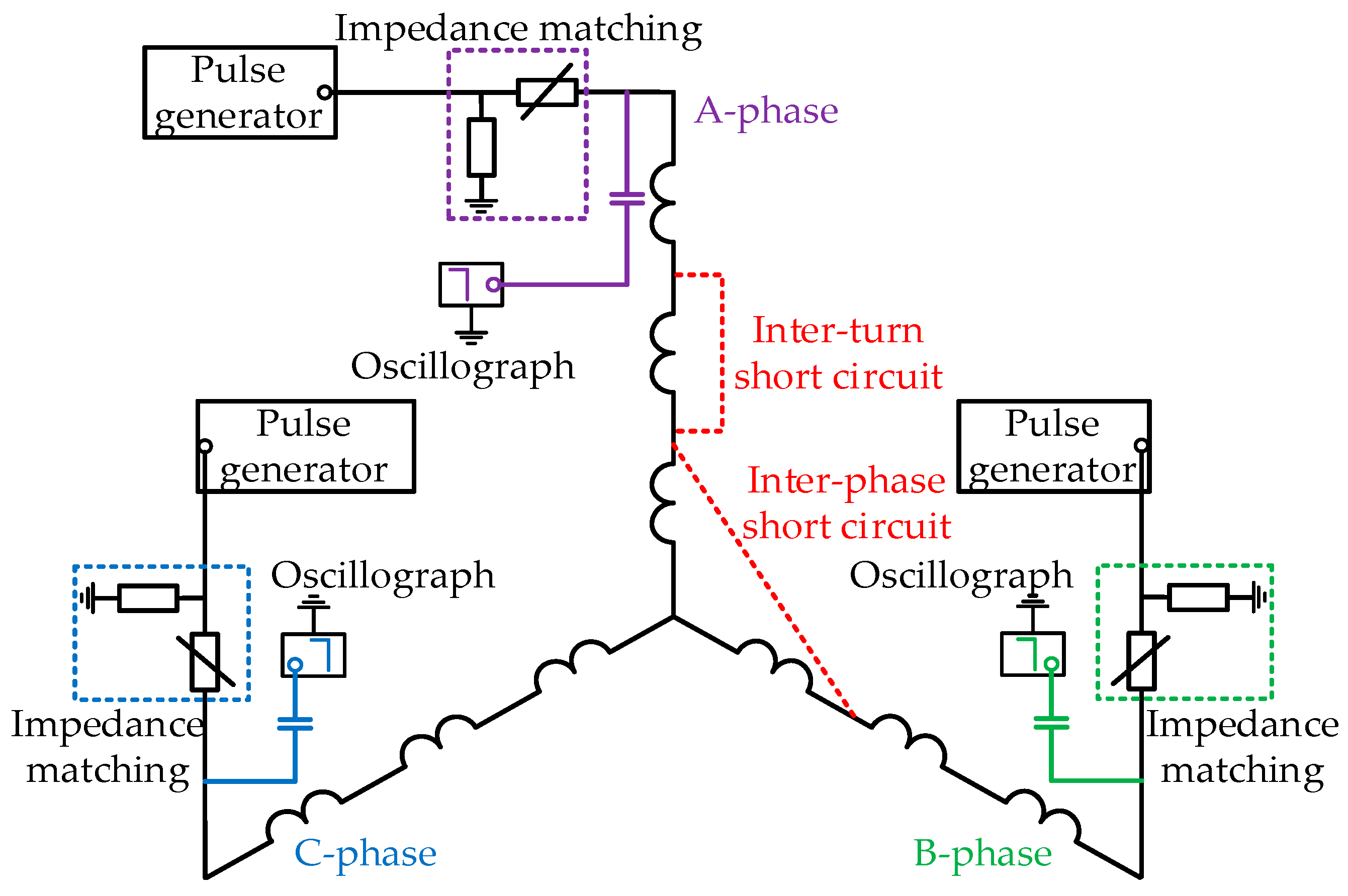
Figure 1 is a schematic diagram of an internal short circuit fault diagnosis of pumped storage transformer windings based on RSO. There are two types of internal short circuit faults in pumped storage transformer windings: inter-turn short circuit and inter-phase short circuit. The injection scheme is as follows: After the pumped storage transformer is shut down, the pulse signal is repeatedly injected into the head of the high- and low-voltage three-phase windings of the pumped storage transformer by the pulse generator at the same time. The characteristic waveforms u AB , u BC and u CA are obtained by the difference between the voltage response waveforms, and the internal short circuit fault of the pumped storage transformer winding is identified according to the characteristic waveform. It should be noted that, because the internal short circuit fault identification methods of high- and low-voltage windings are the same, this paper only analyzes the high-voltage windings, and the proposed method is also suitable for three-phase three-winding/multi-winding pumped storage transformers. The injection sources commonly used in the RSO are square wave, lightning pulse and sine pulse, and the main parameters are shown in Table 2.

3. Wave Process Analysis of Different Pumped Storage Transformer Winding Internal Short Circuit Faults

3.1. Wave Process Analysis of Inter-Turn Short Circuit

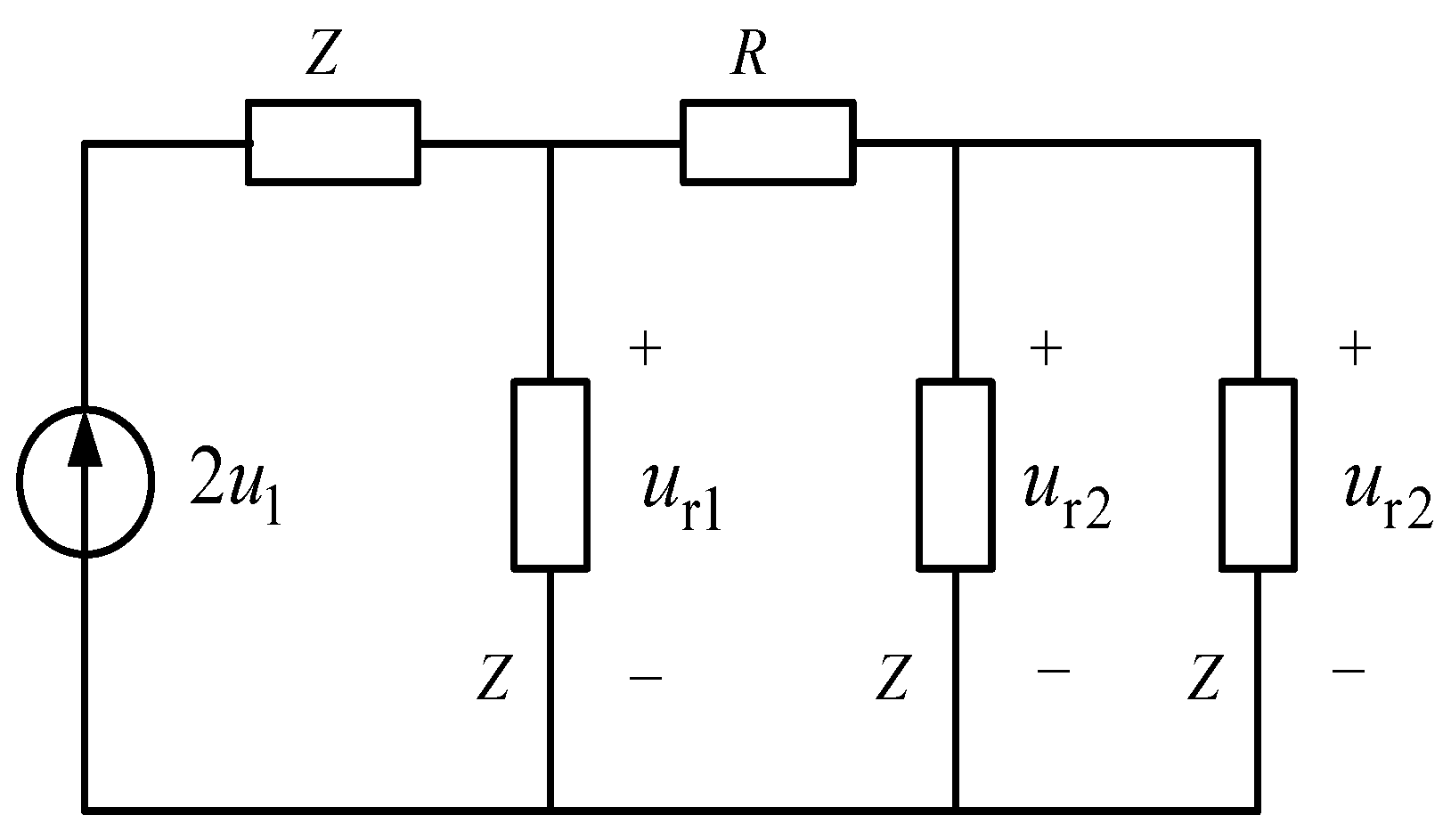
The concentrated parameter equivalent circuit when a short circuit occurs inside the winding of the pumped storage transformer is shown in Figure 2. The relationship between the refracted wave voltage, the reflected wave voltage and the incident wave voltage is shown in Equations (1)–(3).
u r 1 = Z / / R + Z 2 Z + Z / / R + Z 2 · 2 u 1 = 2 R + Z 2 R + 2 Z u 1
u r 2 = Z 2 R + Z · u r 1 = Z 2 R + 2 Z u 1
u f = u r 1 u 1 = Z 2 R + 2 Z u 1
where u r 1 and u r 2 are the refracted wave voltage; u 1 is the incident wave voltage; u f is the reflected wave voltage; Z is the wave impedance of the single-phase winding of the pumped storage transformer; and R is the short circuit fault resistance. The fault resistance R in the actual short circuit fault condition is often smaller than the single-phase winding wave impedance Z of the pumped storage transformer. Therefore, u r 1 u r 2 u 1 / 2 , u f u 1 / 2 can be approximately obtained.
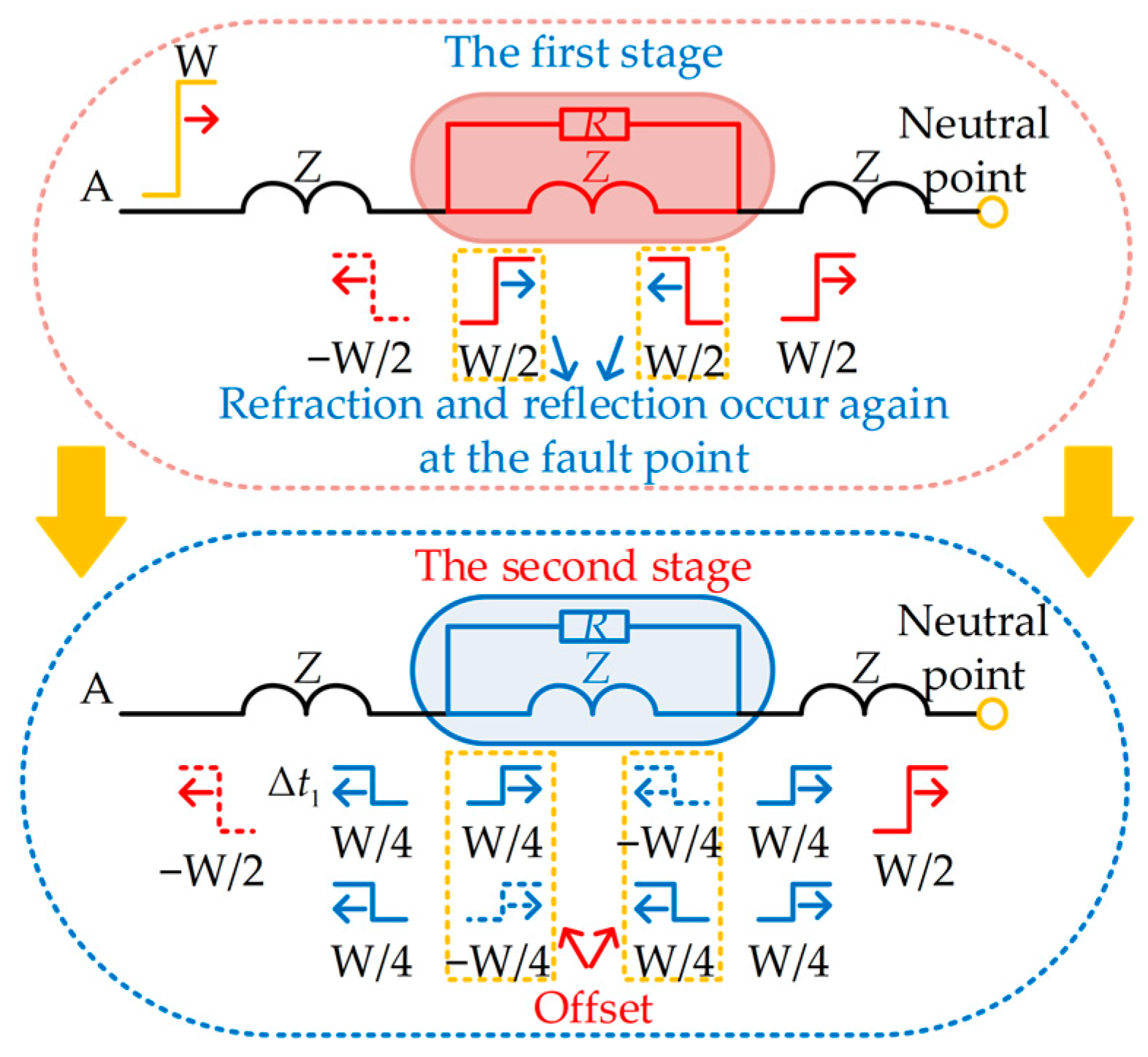
Taking the inter-turn short circuit of phase A as an example, the non-fault phase is omitted, and different types of injection pulses are replaced by right-angle pulses for analysis. The refraction and reflection of phase A injection pulses at the fault point are divided into two stages, as shown in Figure 3, where “W” represents the amplitude of the incident wave. The red pulses are generated by the first stage of refraction and reflection, the blue pulses are generated by the second stage of refraction and reflection, and the remaining color pulses are incident waves. The pulses represented by the imaginary lines are negative, and the pulses represented by the real lines are positive.
In the first stage, when the A-phase pulse reaches the proximal short circuit point, refraction and reflection occur, resulting in a negative reflection wave and three positive refraction waves, and their amplitudes are 1/2 of the incident wave. After passing through Δ t 1 (the propagation time of the wave on the short-circuited winding), the second stage is entered. The two refracted waves in the short-circuited winding reach the short circuit points on both sides and the above refraction and reflection occur again. Both of them produce a negative reflection wave and three positive refraction waves, but the amplitude is 1/4 of the incident wave. The amplitude of the reflected wave and that of the refracted wave in the same direction in the short circuit winding are equal, and the polarity is opposite. The two cancel each other, and the remaining four refracted waves propagate in pairs in the direction of the winding head and the neutral point, respectively. The reflection wave produced in the first stage is equal to the refraction wave produced in the second stage, and the polarity is opposite, but the time difference is Δ t 1 . According to Figure 3, the dislocation of the two waveforms will cause the A-phase voltage response waveform to decrease first and then increase, thus forming a touch-down region.

3.2. Analysis of Wave Process in Inter-Phase Short Circuit

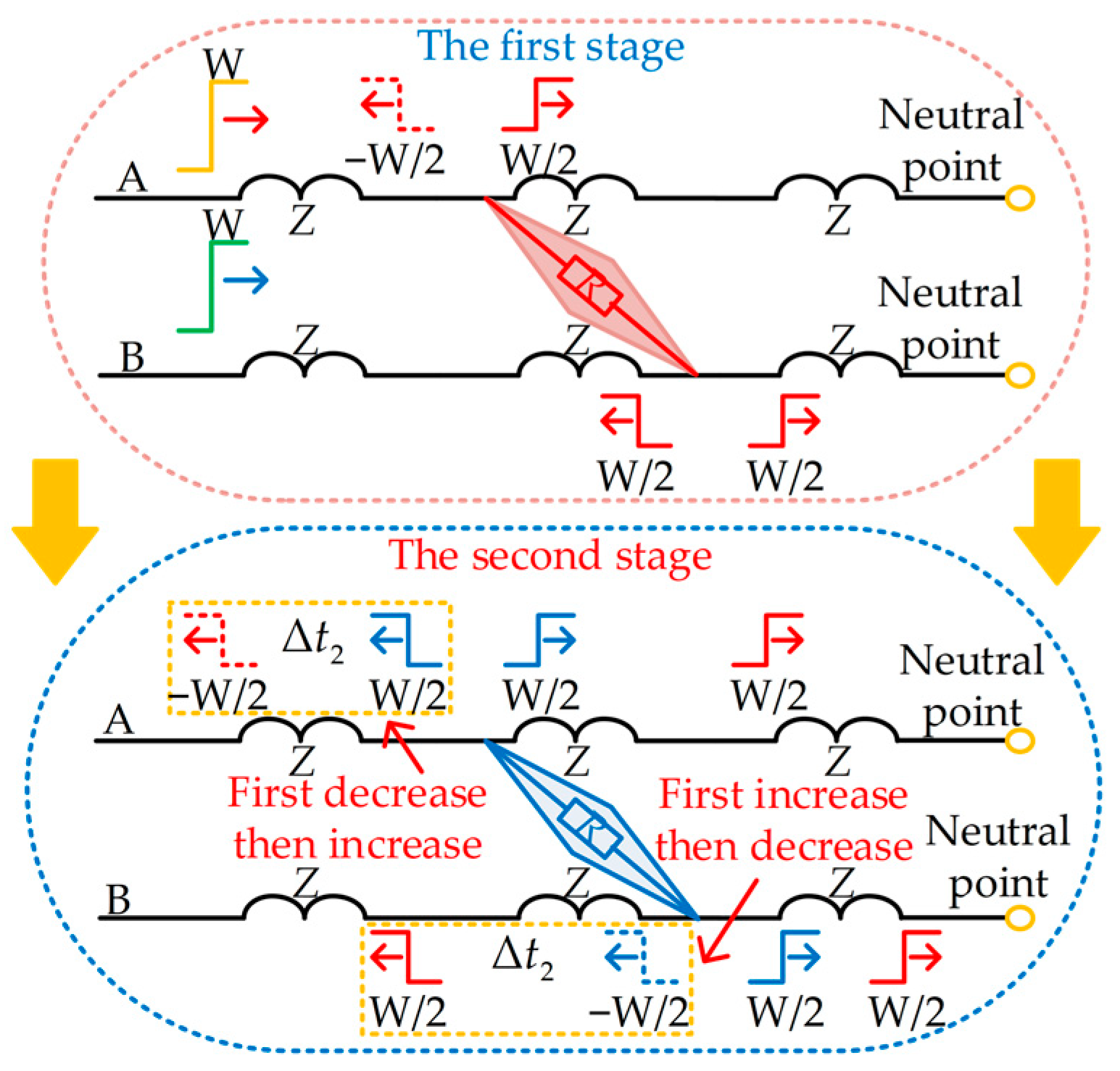
Taking the inter-phase short circuit between phase A and phase B as an example, the proximal short circuit point is located in phase A, and the distal short circuit point is located in phase B. The refraction and reflection process of the injected pulse is also divided into two stages. Because the short circuit point crosses two phases, the refraction and reflection waves generated by the original injection pulse at the short circuit point will return to the two-phase detection point in two ways, and the refraction and reflection process is shown in Figure 4.
In the first stage, the A-phase pulse first reaches the proximal short circuit point and refracts and reflects, generating one reflected wave and three refracted waves. After passing through Δ t 2 (the propagation time of the wave on the difference distance between the two-phase short circuit points), the second stage is entered, and the B-phase pulse will reach the distal short circuit point and undergo refraction and reflection similar to the A-phase. In the above process, the refractive wave is positive, the reflected wave is negative, and the amplitude is 1/2 of the incident wave. According to Figure 4, the A-phase voltage response waveform will be reduced first and then increased, so that it forms a touch-down region; the B-phase voltage response waveform will increase first and then decrease, so that it forms a touch-top region.

4. Comparison of Response Characteristics and Fault Identification Effects Under Different Injection Pulses

4.1. Response Characteristics During Normal Operation

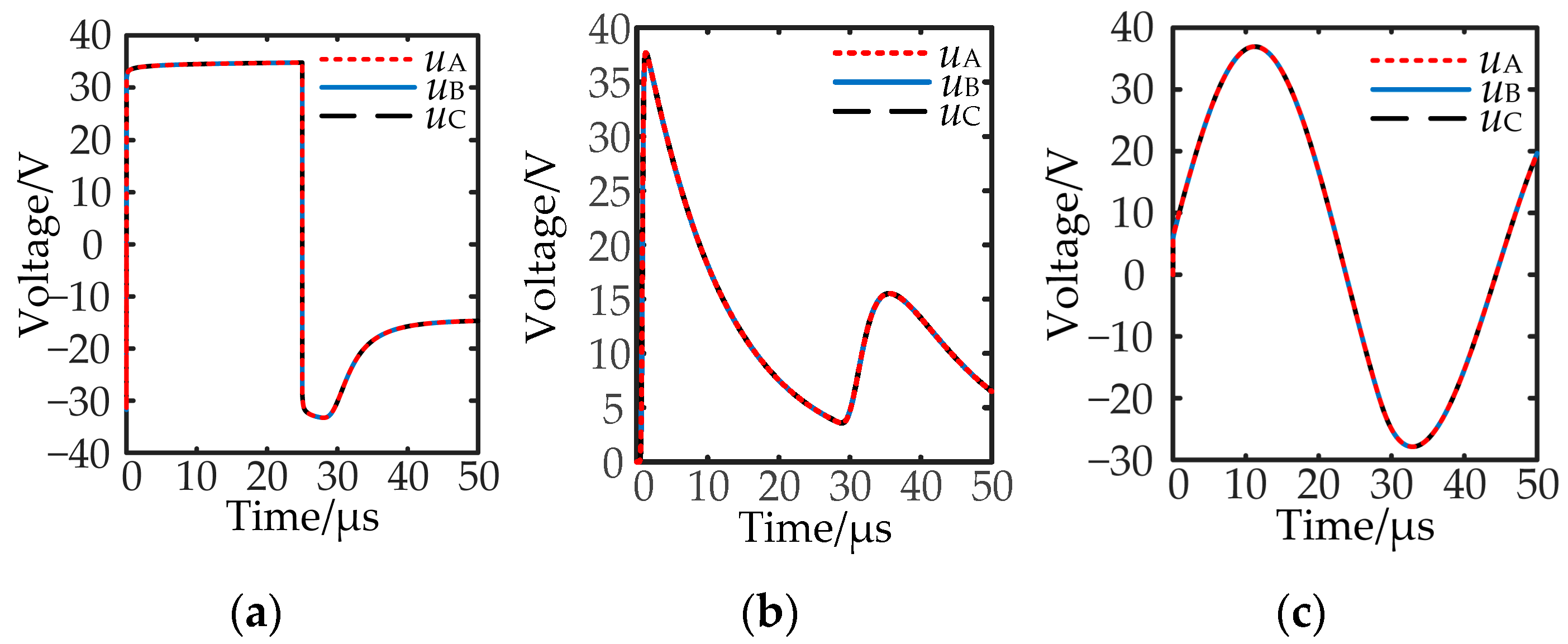
In this paper, the injection pulse amplitude is 40 V, the pulse frequency is 20 kHz, the sampling frequency is 100 MHz, and a single cycle is 50 μs. In a single cycle, the square wave pulse and the sine pulse can be divided into two half cycles of positive and negative, each of which is 25 μs. It should be noted that the simulation model in this paper is based on the finite element simulation software and is combined with the actual parameters of the pumped storage transformer. It can fully consider the key factors such as the core saturation effect, hysteresis effect and parasitic capacitances, and can effectively simulate the electromagnetic characteristics and fault response of the power transformer winding, realize multi-dimensional fault high-precision simulation, and adapt to the fault diagnosis and location of the pumped storage transformer winding [30,31].
Because the winding of the pumped storage transformer is a three-phase symmetrical structure, the three-phase voltage response waveforms obtained by each are the same regardless of the type of injection pulse, and the characteristic waveforms are zero lines. However, the injection pulse will be reflected at the neutral point of the winding of the pumped storage transformer, which will cause the voltage response waveform to change on the basis of the injection pulse waveform (standard square wave, lightning, sine pulse), and then make it different from the injection pulse waveform. The response characteristics in normal operation are shown in Figure 5.

4.2. Response Characteristics of Inter-Turn Short Circuit

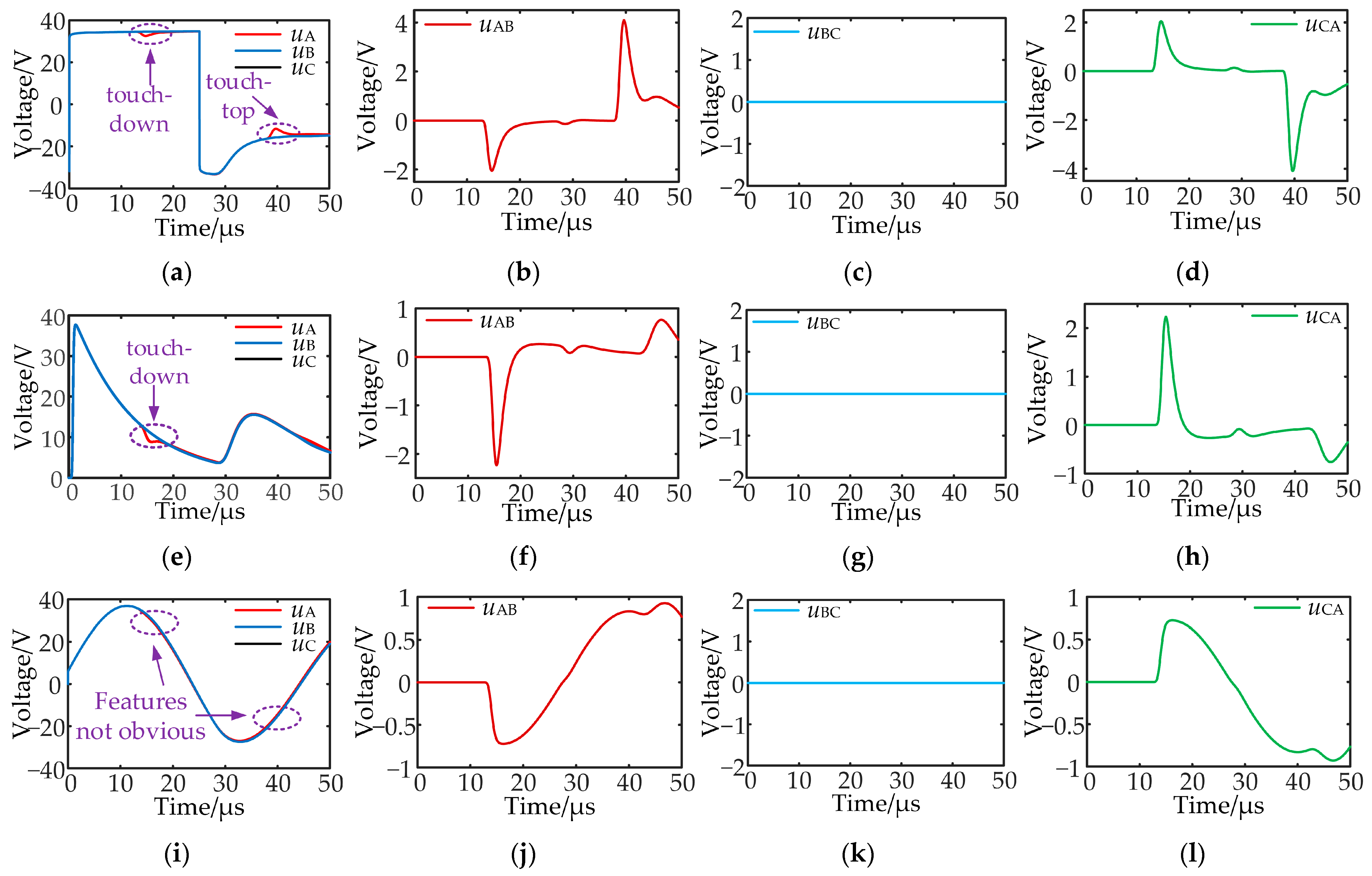
The response characteristics of square wave, lightning pulse and sine pulse when a metal inter-turn short circuit occurs in phase A are shown in Figure 6. It should be noted that the touch-down and touch-top regions in the voltage response waveform are determined by the relative magnitude of the instantaneous value of the fault phase voltage response waveform and the sound phase voltage response waveform, and the touch-down and touch-top regions also correspond to the peaks in the characteristic waveform. The peak in the characteristic waveform is determined by the instantaneous value of the characteristic waveform, which is essentially a point or region with a local maximum value in the waveform.
For the square wave pulse, the A-phase voltage response waveform forms a touch-down region in the positive half cycle and a touch-top region in the negative half cycle, as described above. For the lightning pulse, it will only form a touch-down region. For the sine pulse, because of its gentle rising edge, the A-phase voltage response waveform does not exhibit more obvious touch-down and touch-top regions, but it is still slightly different from the sound phase voltage response waveform, which changes the characteristic waveforms u AB and u CA . Therefore, the concept of touch-down and touch-top in square wave and lightning pulse is still used.
When the fault phase voltage response waveform u A appears to the touch-down region or touch-top region, the characteristic waveforms u AB and u CA containing the fault phase will have peaks. Due to the three-phase symmetrical structure of the pumped storage transformer winding, the voltage response waveforms u B and u C of the two healthy phases are exactly the same, and the characteristic waveform u BC obtained by the difference is a zero line.

4.3. The Response Characteristics of Inter-Phase Short Circuit

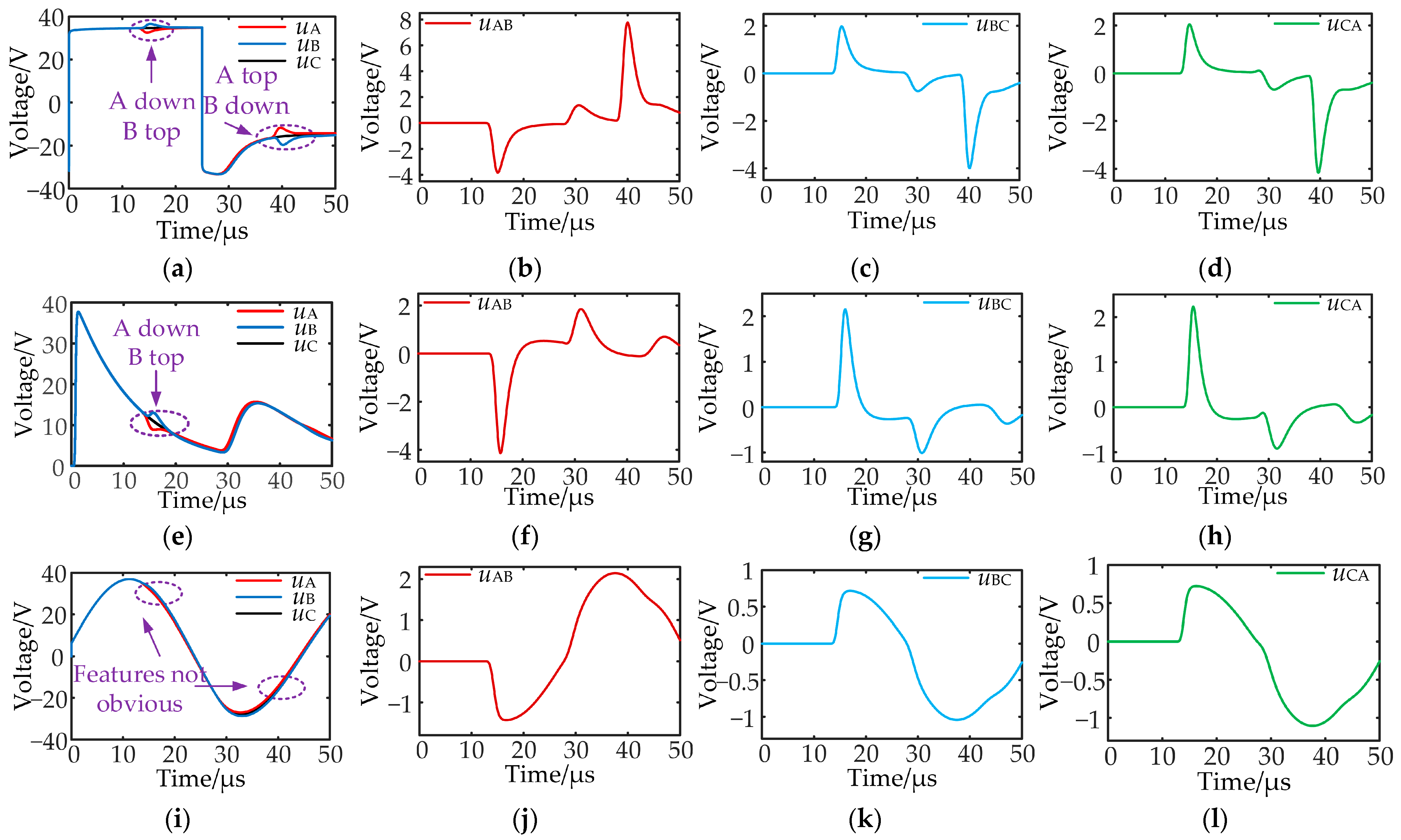
The response characteristics of square wave, lightning pulse and sine pulse are shown in Figure 7, when the metallic inter-phase short circuit occurs between phase A and phase B.
The proximal short circuit point is located in phase A, while the distal short circuit point is located in phase B. For the square wave pulse, the voltage response waveform of phase A forms a touch-down region in the positive half cycle and a touch-top region in the negative half cycle, while the voltage response waveform of phase B is the opposite. For the lightning pulse, the A and B two-phase voltage response waveforms form a touch-down and touch-top region, respectively. For sine pulses, the fault characteristics of the fault phase voltage response waveform are not obvious, but there are still subtle differences compared with the sound phase voltage response waveform.
Because the fault phase is A and B, the two-phase voltage response waveforms exhibit the touch-down and touch-top regions, respectively, so the characteristic waveform u AB with two fault phases has a larger amplitude than the characteristic waveforms u BC and u CA with only one fault phase.

4.4. Internal Short Circuit Fault Type Identification Process of Pumped Storage Transformer Winding

The identification parameters used in the fault identification method proposed in this paper are shown in Equations (4) and (5).
S = t s t e u ( t ) d t
where u(t) is the characteristic waveform obtained by selecting any two-phase injection pulse; t s is the starting time of the characteristic waveform; t e is the end time of the characteristic waveform; and S is the area enclosed by the characteristic waveform and the zero line, and its unit is V·μs.
S set = k · M
where S set is the setting value of S; M is the amplitude of the injected pulse; k is the empirical setting value related to the structural parameters of the transformer. In this paper, k is 0.0125, S set is 0.5 V·μs.
The specific process of fault identification is as follows:
(1)
According to the three characteristic waveforms, the area S surrounded by the zero line is calculated.
(2)
Judging the relationship between S AB , S BC , S CA and S set , if the three are less than S set , there is no fault in the winding of the pumped storage transformer.
(3)
If the three are greater than S set , it is judged to be an inter-phase short circuit, and the two phases corresponding to the maximum calculated value of S are the fault phases.
(4)
If neither of the above two judgments is satisfied, it must be an inter-turn short circuit. There are two calculation values of S greater than S set , and the phase common to their characteristic waveforms is the fault phase.
The calculated value of S corresponding to the response characteristics of normal operation, inter-turn short circuit and inter-phase short circuit mentioned above is shown in Table 3. Combined with the data in Table 3 and the fault identification method proposed in this paper, it can be seen that the three injection pulses can effectively identify the operation status of the pumped storage transformer, and it is easy to distinguish the metal inter-turn and inter-phase short circuit.

4.5. The Influence of Short Circuit Resistance on Fault Identification Effect

The inter-turn short circuit takes the A-phase as the fault phase, and the inter-phase short circuit takes the A and B phases as the fault phases. The short circuit resistance is set to 100 Ω, 500 Ω, and 1000 Ω, respectively. The calculated S values of various injection pulses are shown in Table 4.
It can be seen from the data in Table 4 that the larger the short circuit resistance is, the smaller the calculated value of S is. When the short circuit faults of 100 Ω and 500 Ω occur in the winding of the pumped storage transformer, the three injection pulses can effectively distinguish the inter-turn short circuit and the inter-phase short circuit. When a short circuit fault of 1000 Ω occurs in the winding of the pumped storage transformer, the square wave and lightning pulse can still effectively identify the fault type, but the fault identification parameter margin of the lightning pulse is smaller than that of the square wave pulse. The sine pulse can effectively identify the inter-phase short circuit, but when the inter-turn short circuit occurs, the S calculation value issmaller, which will cause a misjudgment. In summary, the identification effect of the square wave pulse is the best, followed by the lightning pulse, and the sine pulse is the worst.

5. Fault Location Algorithm

After identifying the fault type, accurate fault location can help maintenance personnel quickly determine the fault coil and take corresponding treatment measures. Therefore, this paper combines ICEEMDAN with NTEO and proposes a fault location method based on ICEEMDAN-NTEO.
ICEEMDAN is improved on the basis of CEEMDAN, which solves the problems of noise signal, pseudo component, and a large amount of calculation in the CEEMDAN algorithm decomposition. ICEEMDAN first decomposes the Gaussian white noise by EMD, and then adds the decomposed intrinsic mode function (IMF) to the original signal s(t). Then, a unique residual is obtained by calculation, and the average value of the unique residual is obtained. The IMF is defined as the difference between the existing residual signal and the local mean of the unique residual. In order to achieve the balance between anti-interference ability and computational efficiency and avoid modal aliasing, the noise standard deviation of ICEEMDAN is set to 0.2, and the number of noise samples is 50. In order to adapt to the time-frequency characteristics of winding fault signals and completely extract weak fault features, the maximum number of iterations is set to 2000, and the number of decomposition layers is 10. The specific decomposition steps of ICEEMDAN are as follows:
(1)
Set δ k k = 1 , 2 , , K as a set of Gaussian white noise, G · as the residual component after obtaining EMD, and F h · as the hth IMF component output using EMD.
(2)
The first residual signal r 1 t and the first IMF component c 1 t are obtained by adding K noise components to the original signal s(t).
s k t = s t + ε 0 F 1 δ k t
r 1 t = 1 K k = 1 K G s k t
c 1 t = s t r 1 t
where ε 0 is the original signal-to-noise ratio.
(3)
The second residual signal r 2 t and the second IMF component c 2 t are obtained by adding K Gaussian white noises to the residual signal r 1 t .
r 2 t = 1 K G r 1 ( t ) + ε 1 F 2 δ k t
c 2 t = r 1 t 1 K G r 1 ( t ) + ε 1 F 2 δ k t
where ε 1 is the signal-to-noise ratio of the first stage.
(4)
Similarly, the hth residual signal r h t and the hth IMF component c h t can be obtained.
r h t = 1 K k = 1 K G r h 1 t + ε h 1 F h δ k t
c h t = r h 1 t 1 K k = 1 K G r h 1 t + ε h 1 F h δ k t
where r h 1 t is the h − 1 residual signal; and ε h 1 is the signal-to-noise ratio of the h − 1 stage, h = 3 , 4 , , H .
(5)
Repeat the above steps until the decomposition stops. The original signal can be expressed as follows:
s t = h = 1 H c h t + r h t
In the wave head extraction algorithm, although the TEO energy operator can extract the wave head, it is greatly affected by noise and has poor location accuracy in a noisy environment. By introducing the resolution parameter i, the NTEO energy operator enhances the frequency domain characteristics of the signal and improves the sensitivity to the signal frequency. It has good anti-noise performance and high location accuracy. It can effectively extract the energy of the signal and reflect the instantaneous change in the signal energy in the noisy environment. For the discrete signal y(n), the TEO and NTEO definitions are shown in Equation (14) and Equation (15), respectively.
ψ y n = y 2 n y n + 1 · y n 1
where y(n − 1) and y(n + 1) are the first sequence values before and after y(n), respectively.
ψ y n = y 2 n y n + i · y n i
where y(ni) and y(n + i) are the first and the last i sequence values of y(n), respectively; i is the resolution parameter; i < f s / 8 f 0 , f s are the sampling frequency; and f 0 is the fundamental frequency. It should be noted that the value of i is not a fixed value, and the value close to the median can be selected within the value range of i. In order to take into account the identification and location accuracy of dual fault points, this paper takes i = 130.
Since NTEO uses y(n) and its previous and subsequent ith sample data to calculate the energy value of the signal source at a certain time, it can track the waveform change in the measured signal in real time in a noisy environment and perform fast detection processing and local analysis of the signal.
The specific steps of ICEEMDAN-NTEO fault location are as follows:
(1)
The voltage response waveform signals obtained by injecting pulses from the first end of the three-phase winding of the pumped storage transformer are collected, and three characteristic waveform signals are obtained by subtracting them from each other.
(2)
The three characteristic waveform signals are decomposed by ICEEMDAN to obtain their corresponding IMF components.
(3)
The high-frequency modal components of their respective IMF components are selected for NTEO analysis, and the instantaneous energy spectrum is obtained.
(4)
The corresponding moment of the extreme value mutation point in the instantaneous energy spectrum is the moment when the injection pulse reaches the impedance discontinuity point and returns to the signal acquisition point (the head end of the winding). The fault coil is located according to this moment.

6. Fault Location Effect and Comparison of Different Injection Pulses

6.1. Fault Location Effect of Inter-Turn Short Circuit

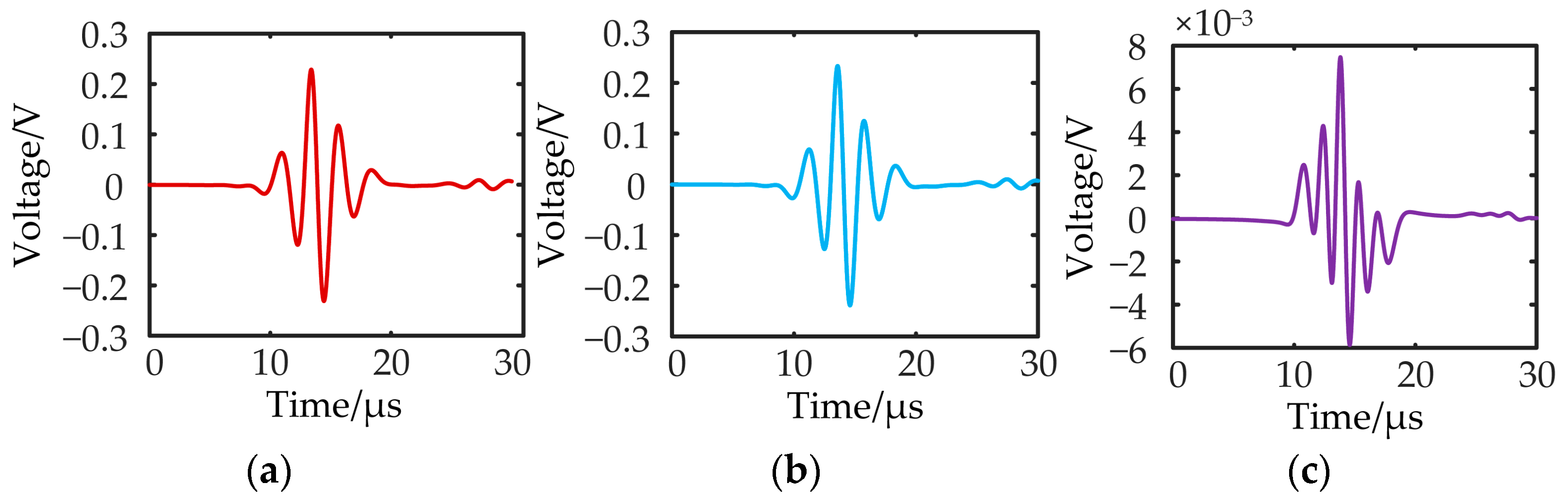
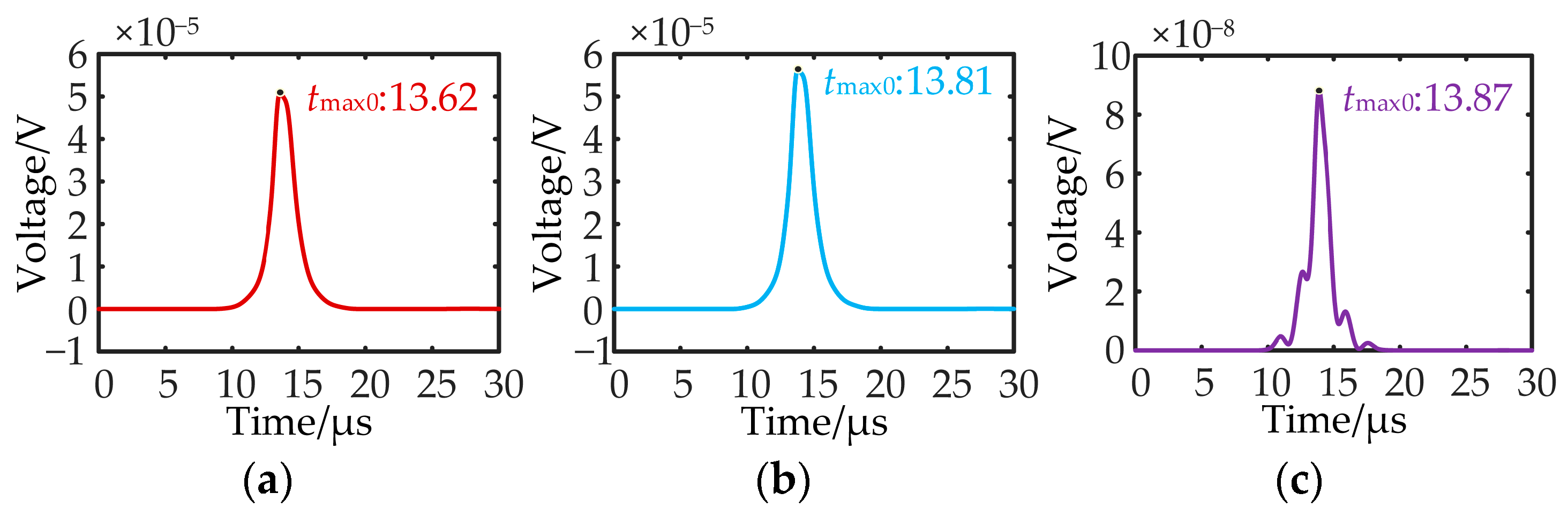
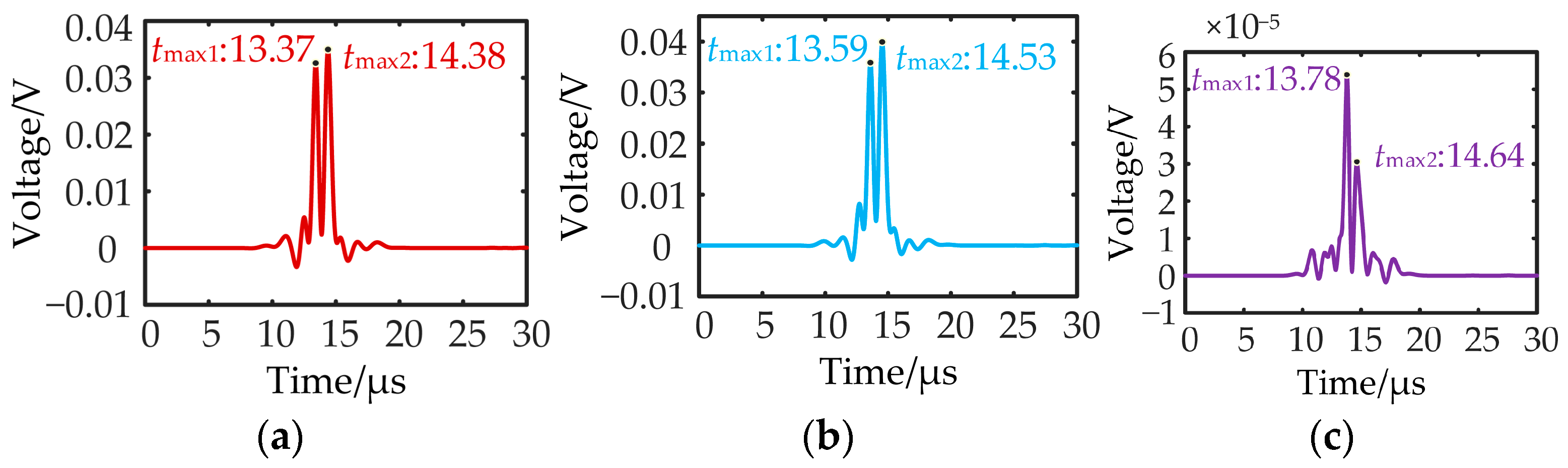
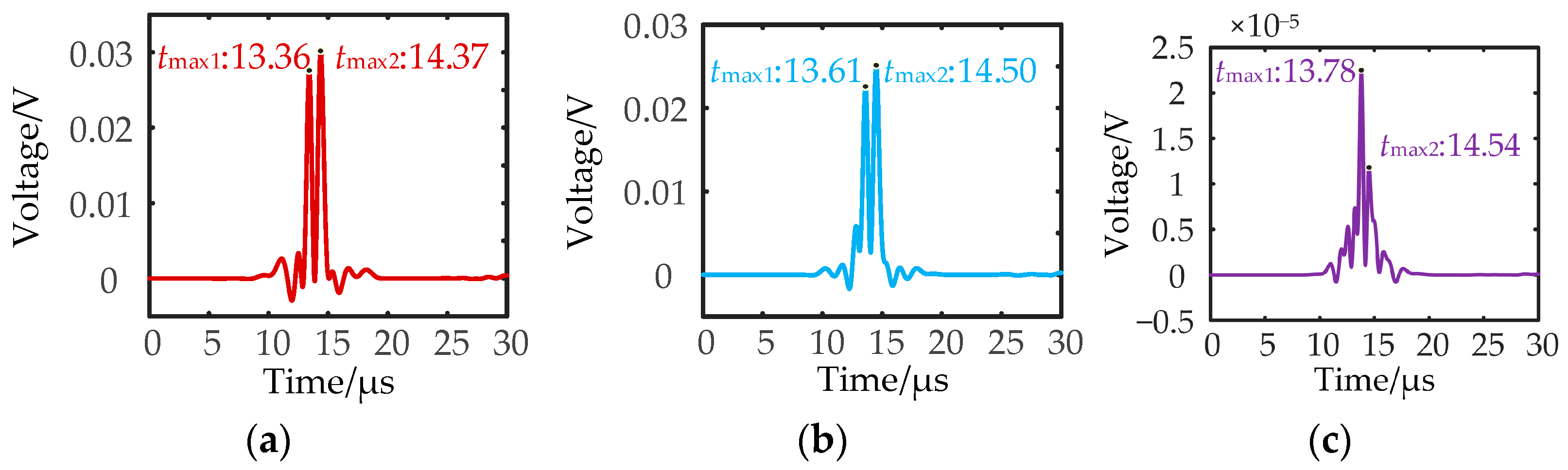
Taking the metal inter-turn short circuit in phase A, the proximal short circuit point is located in A-257, and the distal short circuit point is located in A-277, that is, the short circuit point is located in the 257th and 277th coils of the phase A high-voltage winding, respectively. The instantaneous energy spectrum of u AB and u CA is the same because the winding of the pumped storage transformer is three-phase symmetrical, while the instantaneous energy spectrum of u BC is a zero line, so only the instantaneous energy spectrum of u AB can be selected for analysis. The high-frequency IMF components of the characteristic waveforms of square wave, lightning pulse and sine pulse are shown as a, b and c in Figure 8, respectively. The corresponding TEO and NTEO instantaneous energy spectra are shown as a, b and c in Figure 9 and Figure 10, respectively. The time window is selected from 0 to 30 μs. Equation (16) is the fault location formula, and the results of inter-turn short circuit location are shown in Table 5.
m = t max · ν 2 l + 1
where m is the fault coil, that is, the fault occurs on the mth turn from the first end of the winding; [·] is an integer symbol; t max is the time when the injected pulse reaches the fault point from the head of the winding and returns to the head of the winding; ν is the propagation velocity of traveling wave in the transformer winding; and l is the coil length per turn of the winding.
It can be seen from Table 5 that, when TEO is used to locate the fault coil, only one fault coil can be located between the proximal and distal fault coils. When the NTEO is used to locate the fault coil, two fault coils can be located, in which the square wave pulse can accurately locate it and the location error is very small. Although lightning pulse and sine pulse can locate two fault coils, the location error is large. The NTEO location results at different fault locations during inter-turn short circuit are shown in Table 6.
It can be seen from Table 6 that the square wave pulse can still accurately locate the proximal and distal fault coils under different fault locations when the inter-turn short circuit occurs, and the maximum location error is less than a 1-turn coil length. However, the location results of lightning and sine pulses still have large location errors, and the maximum location error of the lightning pulse is greater than the length of 8-turn coils. The maximum location error of the sine pulse is greater than the length of 10-turn coils.

6.2. Fault Location Effect of Inter-Phase Short Circuit

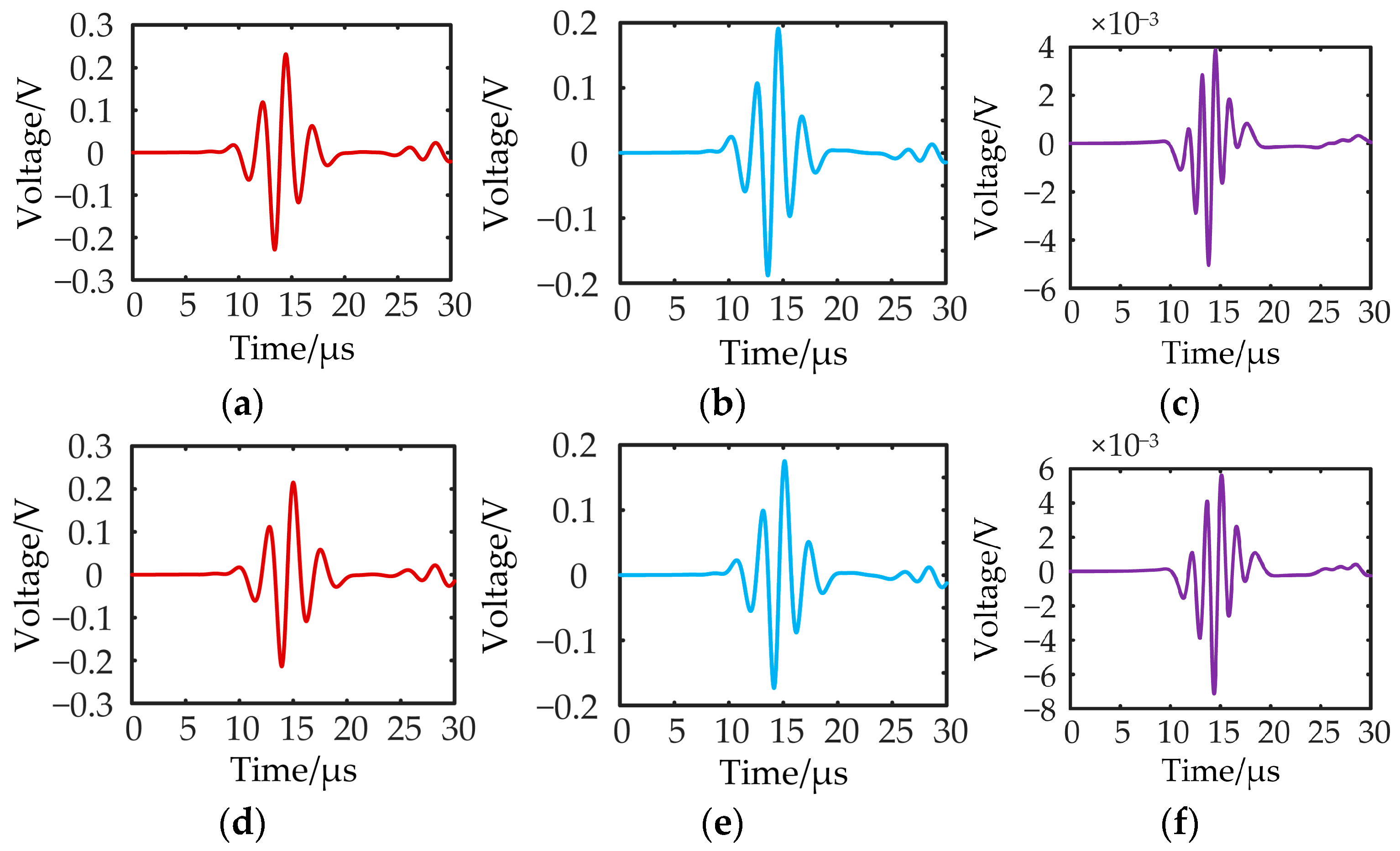
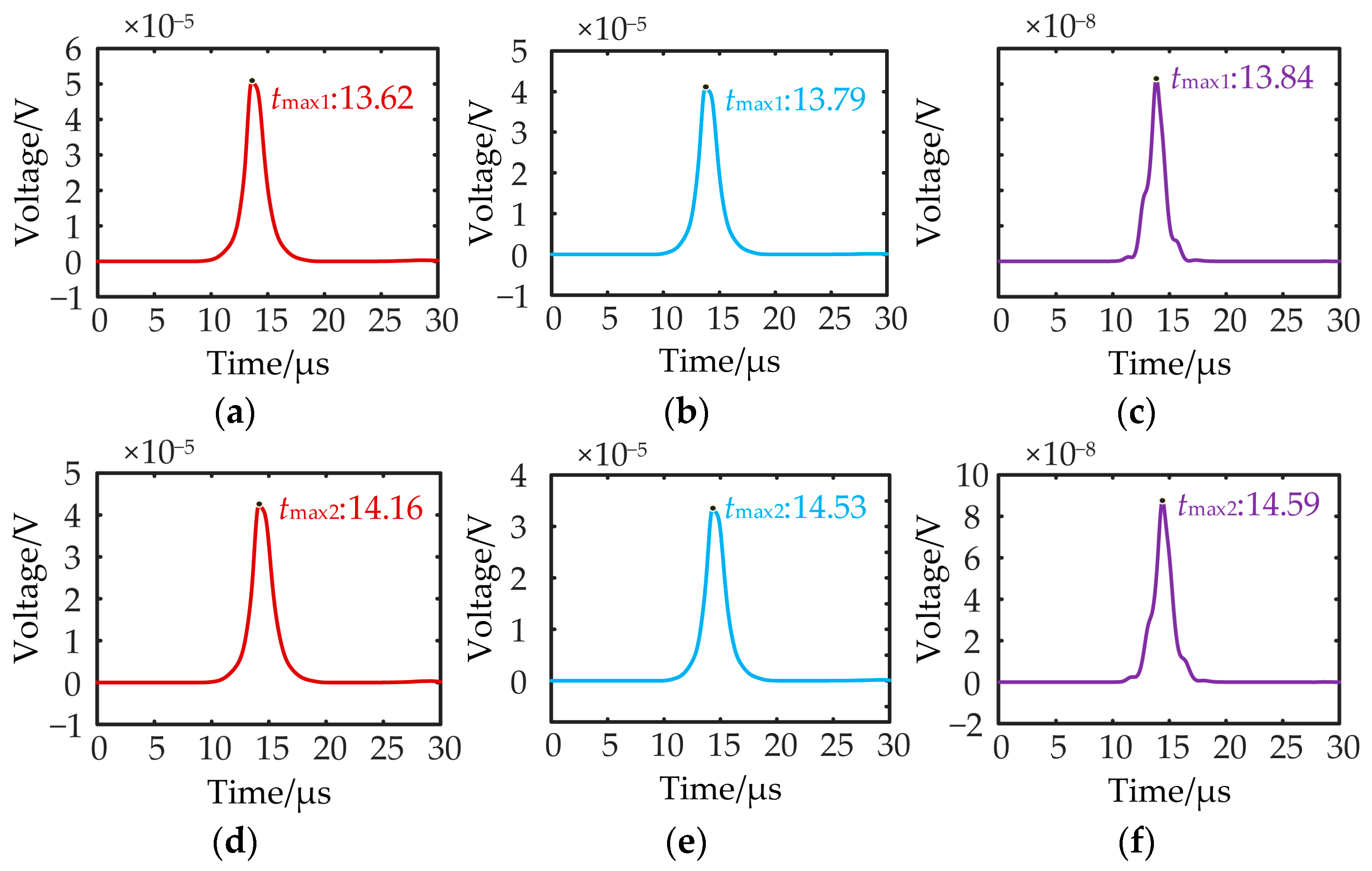
Taking the metal in the inter-phase short circuit between A and B phases, the proximal short circuit point is located at A-257, and the distal short circuit point is located at B-277 as an example for analysis. It should be noted that, when the inter-phase short circuit occurs, the high-frequency IMF components of the characteristic waveforms u BC and u CA with only one phase as the fault phase are processed by TEO, which can realize the location of the proximal and distal fault coils. Because NTEO has higher resolution than TEO, it can locate two fault coils by processing the high-frequency IMF component of any characteristic waveform. Here, the high-frequency IMF component of the characteristic waveform u CA is selected for NTEO processing. The high-frequency IMF components of the characteristic waveforms u CA and u BC of different injection pulses are shown in Figure 11, and the instantaneous energy spectra of TEO and NTEO are shown in Figure 12 and Figure 13, respectively. The location results are shown in Table 7.
It can be seen from Table 7 that, although both TEO and NTEO can locate two fault coils, the location result error of NTEO is smaller. Under the above two processing methods, the location error of the square wave pulse is the smallest, the lightning pulse is the second, and the sine pulse is the largest. The NTEO location results at different fault locations during inter-phase short circuit are shown in Table 8.
It can be seen from Table 8 that the location error of the square wave pulse is the smallest under different fault locations when the inter-phase short circuit occurs, and the maximum location error is less than the length of the 1-turn coil. The error of lightning pulse location is second, and its maximum location error is greater than the length of 6-turn coils. The location error of the sine pulse is the largest, and the maximum location error is greater than the length of the 10-turn coils.

6.3. The Influence of Short Circuit Resistance on Fault Location Effect

The inter-turn short circuit takes phase A as the fault phase, and the proximal and distal fault points are located at A-257 and A-277, respectively. The inter-phase short circuit takes the A and B phases as the fault phases, and the proximal and distal fault points are located at A-257 and B-277, respectively. The short circuit resistance is set to 100 Ω, 500 Ω, and 1000 Ω, respectively. The NTEO location results of various injection pulses are shown in Table 9.
It can be seen that the location effect of the square wave pulse is not affected by the short circuit resistance; the short circuit resistance has little effect on the location effect of the lightning pulse. However, it has a great influence on the location effect of the sine pulse. The square wave pulse edge is steep, the time-frequency characteristics are rich, the energy is concentrated in the effective frequency band and the attenuation is stable, which is convenient for the ICEEMDAN-NTEO algorithm to extract features; lightning pulse exhibits rapid attenuation and is prone to signal aliasing, which degrades the location accuracy under high-resistance faults; the sine pulse frequency is single, the sensitivity to minor faults is low, and the high-resistance fault scene signal is easy to be submerged, which is difficult to meet the precise requirements. In summary, the square wave pulse has the best location effect, followed by the lightning pulse, and the sine pulse is the worst.

7. Conclusions

In this paper, a fault diagnosis and location method based on RSO is proposed for the internal short circuit fault of the winding of the pumped storage transformer, and the comprehensive performance of the three injection pulses of square wave, lightning pulse and sine pulse is compared. The main conclusions are as follows:
(1)
Combined with the principle of RSO and the winding structure of the pumped storage transformer, an injection scheme suitable for its structural characteristics is proposed. By analyzing the wave process response characteristics of the injected pulse under inter-turn and inter-phase short circuit faults, a fault diagnosis method is proposed. Simulation results demonstrate the effectiveness of the proposed method.
(2)
By combining the ICEEMDAN with NTEO algorithms, a method for accurately locating the internal short circuit fault coil of the pumped storage transformer winding is proposed, and the fault location effects of square wave, lightning and sine injection pulses at different fault locations are compared and analyzed. The results show that the maximum location error of the square wave pulse is less than a 1-turn coil length under inter-turn and inter-phase short circuit faults. The maximum location error of the lightning pulse under inter-turn and inter-phase short circuit faults is greater than the length of 8-turn and 6-turn coils, respectively. The maximum location error of the sine pulse under inter-turn and inter-phase short circuit faults is greater than the length of 10-turn coils.
(3)
The effects of short circuit resistance on the fault diagnosis and location of square wave, lightning and sine injection pulses are compared and analyzed. The results show that the square wave and lightning pulse can still effectively identify the fault type under high-resistance faults, but the fault identification parameter margin of the lightning pulse is smaller than that of the square wave pulse, and the sine pulse has the risk of misjudgment. The location effect of the square wave pulse is not affected by short circuit resistance, the location effect of the lightning pulse is less affected by short circuit resistance, and the location effect of the sine pulse is greatly affected by short circuit resistance. The comparative analysis shows that the comprehensive performance of the square wave pulse is the best.
Although this paper can realize the diagnosis and location of the internal short circuit fault of the winding of the pumped storage transformer, because the pumped storage transformer is a large-scale power core equipment, the physical fault experiment needs to destructively transform the winding, which is easy to cause irreversible damage to the equipment, has a high cost and is a potential safety hazard. The effectiveness of the method is not verified by physical experiments. In the future, a special experimental platform will be built to carry out entity verification, and the proposed method will be optimized with the measured data.

Author Contributions

Conceptualization, R.H. and J.Q.; Methodology, R.H.; Software, F.H.; Validation, X.Z. and Y.P.; Formal analysis, X.Z. and F.H.; Investigation, R.H. and Y.P.; Resources, Y.P. and K.W.; Data curation, X.Z. and Y.L.; Writing—original draft, K.W.; Writing—review and editing, Y.L., K.W. and J.Q.; Visualization, F.H.; Supervision, K.W. and J.Q.; Project administration, K.W. All authors have read and agreed to the published version of the manuscript.

Funding

This research was funded by Science and Technology Project of China Southern Power Grid Corporation, grant number STKJXM20210102.

Data Availability Statement

The original contributions presented in this study are included in the article. Further inquiries can be directed to the corresponding author.

Conflicts of Interest

Authors R.H., X.Z., F.H., Y.P. and Y.L. were employed by the CSG PGC Power Storage Research Institute. The remaining authors declare that the research was conducted in the absence of any commercial or financial relationships that could be construed as a potential conflict of interest. The authors declare that this study received funding from Science and Technology Project of China Southern Power Grid Corporation. The funder was not involved in the study design, collection, analysis, interpretation of data, the writing of this article or the decision to submit it for publication.

References

  1. Geißler, D.; Leibfried, T. Short-Circuit Strength of Power Transformer Windings—Verification of Tests by a Finite Element Analysis-Based Model. IEEE Trans. Power Deliv. 2017, 32, 1705–1712. [Google Scholar]
  2. Ding, H.B.; Zhao, W.L.; Diao, C.W.; Li, M. Electromagnetic Vibration Characteristics of Inter-Turn Short Circuits in High Frequency Transformer. Electronics 2023, 12, 1884. [Google Scholar] [CrossRef]
  3. Chothani, N.; Kumar, S. Dynamic Differential Protection of Transformer Considering CT Saturation Based on Waveform Distortion Estimation. IEEE Access 2025, 13, 163832–163843. [Google Scholar] [CrossRef]
  4. Ruan, J.H.; Tian, L.; Liang, K.B.; Ou, L.; Xu, P.; Peng, P.; Liu, Y.; Zhong, L. An Investigation Into the Impact of Typical Defects on Transformer Oil Pressure: Unveiling the Potential for Fault Localization. IEEE Access 2025, 13, 43919–43932. [Google Scholar] [CrossRef]
  5. Oliveira, L.M.R.; Cardoso, A.J.M. Leakage Inductances Calculation for Power Transformers Interturn Fault Studies. IEEE Trans. Power Deliv. 2015, 30, 1213–1220. [Google Scholar] [CrossRef]
  6. Moradzadeh, A.; Pourhossein, K.; Mohammadi-Ivatloo, B.; Mohammadi, F. Locating Inter-Turn Faults in Transformer Windings Using Isometric Feature Mapping of Frequency Response Traces. IEEE Trans. Ind. Inform. 2021, 17, 6962–6970. [Google Scholar] [CrossRef]
  7. Li, Z.H.; He, Y.G.; Xing, Z.K.; Chen, M. Minor Fault Diagnosis of Transformer Winding Using Polar Plot Based on Frequency Response Analysis. Int. J. Electr. Power Energy Syst. 2023, 152, 109173. [Google Scholar] [CrossRef]
  8. Wang, J.C.; Liu, Y.Q.; Mao, J.; Liu, S.; Tong, Z.; Deng, X.; Tan, W. Research on Active Defense System for Transformer Early Fault Based on Fiber Leakage Magnetic Field Measurement. Energies 2025, 18, 4497. [Google Scholar] [CrossRef]
  9. Al-Shaher, M.; Saied, M. Recognition and Location of Transformer Winding Faults Using the Input Impedance. Electr. Power Compon. Syst. 2007, 35, 785–802. [Google Scholar] [CrossRef]
  10. Abu-Siada, A.; Islam, S.M. A Novel Online Technique to Detect Power Transformer Winding Faults. IEEE Trans. Power Deliv. 2012, 27, 849–857. [Google Scholar] [CrossRef]
  11. Hajaghasi, S.; Ahmadi, M.M.H.; Goleij, P.; Salemnia, A. Transformer Inter-Turn Failure Detection Based on Leakage Flux and Vibration Analysis. IET Electr. Power Appl. 2021, 15, 998–1012. [Google Scholar] [CrossRef]
  12. Wani, S.R.; Ankur, S.; Sohail, S.; Rahman, O.; Parveen, S.; Khan, S.A. Advances in DGA Based Condition Monitoring of Transformers: A Review. Renew. Sustain. Energy Rev. 2021, 149, 111347. [Google Scholar] [CrossRef]
  13. Yuan, F.T.; Yan, Z.W.; Zhang, R.J.; Yang, Y.; Jian, S.; Tang, B. Research on Vibration Characteristic Analysis and Fault Diagnosis Method of Oil-Immersed Transformer Based on Multi-Physics Coupling. IEEJ Trans. Electr. Electron. Eng. 2024, 19, 1621–1630. [Google Scholar] [CrossRef]
  14. Jin, Y.S.; Wu, H.; Zheng, J.F.; Zhang, J.; Liu, Z. Power Transformer Fault Diagnosis Based on Improved BP Neural Network. Electronics 2023, 12, 3526. [Google Scholar] [CrossRef]
  15. Yuan, F.; Guo, J.; Xiao, Z.H.; Zeng, B.; Zhu, W.; Huang, S. A Transformer Fault Diagnosis Model Based on Chemical Reaction Optimization and Twin Support Vector Machine. Energies 2019, 12, 960. [Google Scholar] [CrossRef]
  16. Wang, J.X.; Zhao, Z.S.; Zhu, J.; Li, X.; Dong, F.; Wan, S. Improved Support Vector Machine for Voiceprint Diagnosis of Typical Faults in Power Transformers. Machines 2023, 11, 539. [Google Scholar] [CrossRef]
  17. Kari, T.; He, Z.Y.; Rouzi, A.; Zhang, Z.; Ma, X.; Du, L. Power Transformer Fault Diagnosis Using Random Forest and Optimized Kernel Extreme Learning Machine. Intell. Autom. Soft Comput. 2023, 37, 691–705. [Google Scholar] [CrossRef]
  18. Jiang, H.J.; Feng, J.; Zhao, N.; Xu, H.; Wang, B.; Zhang, B. Fault Diagnosis of Transformer Inter-Turn Short Circuit Based on Automatic Multiscale-Based Peak Detection Algorithm Combined with Magnetic Flux Leakage Analysis. In Proceedings of the 13th IEEE Data Driven Control and Learning Systems Conference, Kaifeng, China, 17–19 May 2024; pp. 1668–1672. [Google Scholar]
  19. Miao, X.Y.; Quan, H.D.; Cheng, X.W.; Xu, M.; Huang, Q.; Liang, C.; Li, J. Fault Diagnosis of Oil-Immersed Transformers Based on the Improved Neighborhood Rough Set and Deep Belief Network. Electronics 2024, 13, 5. [Google Scholar] [CrossRef]
  20. Kumar, A.; Bhalja, B.R.; Kumbhar, G.B. Approach for Identification of Inter-Turn Fault Location in Transformer Windings Using Sweep Frequency Response Analysis. IEEE Trans. Power Deliv. 2022, 37, 1539–1548. [Google Scholar] [CrossRef]
  21. Duan, H.; Cheng, L.; Luo, C.X.; Zhang, J.; Su, Z. Research on Propagation Law of Partial Discharge Ultrasonic Signal in Converter Transformer. AIP Adv. 2024, 14, 065023. [Google Scholar] [CrossRef]
  22. Lu, Q.H.; Yin, X.G.; Qiao, J.; Wang, Y.; Tan, L.; Zhu, L. Short Circuit Fault Identification and Diagnosis Analysis of Rotor Winding for Variable Speed Pumped Storage Unit. Energy Rep. 2022, 8, 34–43. [Google Scholar] [CrossRef]
  23. Ali, M.; Prasad, R. Significant Wave Height Forecasting via an Extreme Learning Machine Model Integrated with Improved Complete Ensemble Empirical Mode Decomposition. Renew. Sustain. Energy Rev. 2019, 104, 281–295. [Google Scholar] [CrossRef]
  24. Ke, Z.; Di, C.; Bao, X.H. Adaptive Suppression of Mode Mixing in CEEMD Based on Genetic Algorithm for Motor Bearing Fault Diagnosis. IEEE Trans. Magn. 2022, 58, 8200706. [Google Scholar] [CrossRef]
  25. Gu, J.; Peng, Y.X. An Improved Complementary Ensemble Empirical Mode Decomposition Method and Its Application in Rolling Bearing Fault Diagnosis. Digit. Signal Process. 2021, 113, 103050. [Google Scholar] [CrossRef]
  26. Hou, K.; Kang, Z.; He, D.; Ren, F.; Li, Q. Research on the influence of transformer winding on partial discharge waveform propagation. Energies 2025, 18, 5308. [Google Scholar] [CrossRef]
  27. Yun, H.; Zhang, Y.; Sun, Y.; Wang, L.; Xu, L.; Zhang, D.; Cheng, J. Transformer winding fault locating using frequency domain reflectometry (FDR) technology. Electronics 2025, 14, 3117. [Google Scholar] [CrossRef]
  28. Mahankali, S.; Velpula, R.; Rao, K.D. Experimental investigation of transformer fault diagnosis using integrated DGA and physical inspection. Electr. Power Syst. Res. 2026, 254, 112669. [Google Scholar] [CrossRef]
  29. Zhang, X.Y.; Xu, B.Y.; Han, Z.R.; Shi, F. Improvement of traveling wave-based fault location method for overhead distribution lines. Prot. Control. Mod. Power Syst. 2026, 11, 157–172. [Google Scholar] [CrossRef]
  30. da Silva, J.R.; Bastos, J.P.A. Analysis of Power Transformer Geometry Simplifications on Electromagnetic and Thermodynamic Simulations. IEEE Trans. Magn. 2015, 51, 8400404. [Google Scholar] [CrossRef]
  31. Jimenez-Mondragon, V.M.; Escarela-Perez, R.; Melgoza, E.; Arjona, M.A.; Olivares-Galvan, J.C. Quasi-3-D Finite-Element Modeling of a Power Transformer. IEEE Trans. Magn. 2017, 53, 7401604. [Google Scholar] [CrossRef]
Figure 1. Fault diagnosis diagram.
Energies 19 01238 g001
Figure 2. Centralized parameter equivalent circuit for internal short circuit fault of pumped storage transformer winding.
Energies 19 01238 g002
Figure 3. Analysis of refraction and reflection of injected pulse during inter-turn short circuit.
Energies 19 01238 g003
Figure 4. Analysis of refraction and reflection of injected pulse during inter-phase short circuit.
Energies 19 01238 g004
Figure 5. The response characteristics in normal operation: (a) square wave; (b) lightning pulse; (c) sine pulse.
Energies 19 01238 g005
Figure 6. Response characteristics of different injection pulses during inter-turn short circuit: (a) uA, uB, uC of square wave; (b) uAB of square wave; (c) uBC of square wave; (d) uCA of square wave; (e) uA, uB, uC of lightning pulse; (f) uAB of lightning pulse; (g) uBC of lightning pulse; (h) uCA of lightning pulse; (i) uA, uB, uC of sine pulse; (j) uAB of sine pulse; (k) uBC of sine pulse; (l) uCA of sine pulse.
Energies 19 01238 g006
Figure 7. Response characteristics of different injection pulses during inter-phase short circuiting: (a) uA, uB, uC of square wave; (b) uAB of square wave; (c) uBC of square wave; (d) uCA of square wave; (e) uA, uB, uC of lightning pulse; (f) uAB of lightning pulse; (g) uBC of lightning pulse; (h) uCA of lightning pulse; (i) uA, uB, uC of sine pulse; (j) uAB of sine pulse; (k) uBC of sine pulse; (l) uCA of sine pulse.
Energies 19 01238 g007
Figure 8. High-frequency IMF during inter-turn short circuit: (a) square wave; (b) lightning pulse; (c) sine pulse.
Energies 19 01238 g008
Figure 9. TEO during inter-turn short circuit: (a) square wave; (b) lightning pulse; (c) sine pulse.
Energies 19 01238 g009
Figure 10. NTEO during inter-turn short circuit: (a) square wave; (b) lightning pulse; (c) sine pulse.
Energies 19 01238 g010
Figure 11. High-frequency IMF during inter-phase short circuit: (a) uCA of square wave; (b) uCA of lightning pulse; (c) uCA of sine pulse; (d) uBC of square wave; (e) uBC of lightning pulse; (f) uBC of sine pulse.
Energies 19 01238 g011
Figure 12. TEO during inter-phase short circuit: (a) uCA of square wave; (b) uCA of lightning pulse; (c) uCA of sine pulse; (d) uBC of square wave; (e) uBC of lightning pulse; (f) uBC of sine pulse.
Energies 19 01238 g012
Figure 13. NTEO during inter-phase short circuit: (a) square wave; (b) lightning pulse; (c) sine pulse.
Energies 19 01238 g013
Table 1. Main parameters of pumped storage transformer.
ParameterValueParameterValue
Capacity (MVA)509.3Core height (m)4.133
Voltage (kV)530/172.8Core window height (m)2.740
Frequency (Hz)50Cooling typeOFAF
Low-voltage
winding turns
152High-voltage winding turns533
Low-voltage winding single turn coil length (m)3High-voltage winding single turn coil length (m)5
Low-voltage winding length (m)456High-voltage winding length (m)2665
Low-voltage winding ground capacitance (pF)280High-voltage winding ground capacitance (pF)130
Low-voltage winding inter-turn capacitance (pF)2.5High-voltage winding inter-turn capacitance (pF)1.2
Copper wire diameter of low-voltage winding (mm)32Copper wire diameter of high-voltage winding (mm)18
Winding resistivity (Ω·m)1.72 × 10⁻⁸Winding density (kg/m3)8960
Inter-turn insulation materialPolyimideWinding and iron core insulation materialEpoxy resin
Lead insulation materialXLPELead length (m)5.8
Initial permeability of iron core (H/m)2.2 × 10−4Maximum permeability of iron core (H/m)1.8 × 10−2
Iron core hysteresis loss coefficient (W/kg)0.12Iron core eddy current loss coefficient (W/kg)0.03
Iron core lamination loss coefficient (W/kg)0.015Iron core resistivity (Ω·m)4.5 × 10⁻⁷
Iron core density (kg/m3)7650Iron core laminated thickness (mm)0.35
Table 2. Main parameters of different injection pulses.
TypeAmplitude (V)Pulse Frequency (kHz)Sampling Frequency (MHz)
Square8–601–10010–100
Lightning
Sine
Table 3. Calculated values of S under metallic short circuit.
SituationSquare Wave Pulse (V·μs)Lightning Pulse (V·μs)Sine Pulse (V·μs)
SABSBCSCASABSBCSCASABSBCSCA
Normal000000000
Inter-turn23.278023.27812.722012.72221.637021.637
Inter-phase49.89924.85525.17625.62912.76912.92246.37322.8923.49
Table 4. Calculated values of S under different short circuit resistances.
Resistance (Ω)Fault TypeSquare Wave Pulse (V·μs)Lightning Pulse (V·μs)Sine Pulse (V·μs)
SABSBCSCASABSBCSCASABSBCSCA
100Inter-turn8.95208.9525.10905.1093.44703.447
Inter-phase38.99919.37219.64920.21410.12110.15435.61517.55818.064
500Inter-turn2.75302.7531.4501.450.75500.755
Inter-phase19.3019.5679.73511.5915.8195.78618.3929.0759.321
1000Inter-turn1.47001.4700.76200.7620.38200.382
Inter-phase11.6545.7755.8857.8013.9143.89411.6165.7385.881
Table 5. Location results during inter-turn short circuit.
Fault LocationTEO Location ResultsNTEO Location Results
ProximalDistalSquareLightningSineSquareLightningSine
A-257A-277A-262A-266A-267A-257
A-277
A-262
A-280
A-265
A-282
Table 6. NTEO location results for different fault locations during inter-turn short circuit.
Fault LocationSquare WaveLightning PulseSine Pulse
ProximalDistalProximalDistalProximalDistalProximalDistal
A-100A-105A-100A-105A-99A-106A-100A-109
A-160A-185A-160A-185A-162A-182A-165A-181
A-200A-205A-200A-205A-201A-209A-202A-211
A-260A-285A-265A-285A-263A-286A-264A-290
A-300A-305A-300A-305A-305A-312A-305A-314
A-360A-385A-360A-385A-364A-391A-366A-393
A-400A-405A-400A-405A-406A-413A-408A-415
A-460A-485A-460A-485A-467A-490A-467A-494
Table 7. Location results during inter-phase short circuit.
Fault LocationTEO Location ResultsNTEO Location Results
ProximalDistalSquareLightningSineSquareLightningSine
A-257B-277A-262A-266A-266A-257A-262A-265
B-273B-280B-281B-277B-279B-280
Table 8. NTEO location results for different fault locations during inter-phase short circuit.
Fault LocationSquare WaveLightning PulseSine Pulse
ProximalDistalProximalDistalProximalDistalProximalDistal
A-100B-105A-100B-105A-100B-107A-101B-108
A-160B-185A-160B-185A-161B-187A-161B-187
A-200B-205A-200B-205A-200B-210A-202B-211
A-260B-285A-260B-285A-262B-286A-264B-288
A-300B-305A-300B-305A-303B-308A-304B-310
A-360B-385A-360B-385A-366B-389A-366B-392
A-400B-405A-400B-405A-405B-411A-406B-415
A-460B-485A-460B-485A-465B-490A-468B-492
Table 9. NTEO location results of various injection pulses under different short circuit resistances.
Resistance/ΩFault TypeSquare WaveLightning PulseSine Pulse
ProximalDistalProximalDistalProximalDistal
100Inter-turnA-257A-277A-262A-278A-264A-283
Inter-phaseA-257B-277A-262B-280A-266B-279
500Inter-turnA-257A-277A-262A-276A-264A-280
Inter-phaseA-257B-277A-262B-280A-265B-285
1000Inter-turnA-257A-277A-263A-275A-266A-277
Inter-phaseA-257B-277A-263B-279A-265B-285
Disclaimer/Publisher’s Note: The statements, opinions and data contained in all publications are solely those of the individual author(s) and contributor(s) and not of MDPI and/or the editor(s). MDPI and/or the editor(s) disclaim responsibility for any injury to people or property resulting from any ideas, methods, instructions or products referred to in the content.