1. Introduction
The intensive exploitation of coal resources [
1], alongside rapid strides in new energy technologies, is propelling the transformation of China’s energy landscape towards distributed renewable energy [
2]. VPP technology offers a flexible and efficient novel approach for energy dispatch [
3,
4], enhancing the coupling utilization efficiency of energy sources. With the continuous advancement of renewable energy technologies [
5], users are progressively installing photovoltaic generation systems [
6], which facilitates the transformation of energy consumption patterns and increases the flexibility of power dispatch.
Existing research indicates that current studies primarily focus on the internal architecture of VPP [
7,
8], while limited attention has been paid to scenarios where users are equipped with related devices such as photovoltaic generation systems or electric heating devices (EHD). Such scenarios allow for a more holistic consideration of flexible resources on the user side [
9,
10,
11]. By deploying relevant equipment, users can achieve flexible energy conversion and enhance their own benefits. Moreover, in previous studies, the impact of energy storage devices on the user side has seldom been taken into account [
12,
13]. The introduction of an energy storage mechanism can improve the utilization rate of renewable energy and regulate user-side response [
14,
15].
In summary, the current literature lacks a comprehensive solution to address issues such as the adjustment of the internal equipment portfolio within a VPP, the response to user demand, and the integration of photovoltaic (PV) generation devices and energy storage mechanisms. Moreover, it is necessary to demonstrate how the model achieves a balance between the VPP and user aggregators, as well as the uniqueness of the results obtained. Against this background, this paper employs a distributed collaborative optimization strategy under a Stackelberg game framework to resolve the revenue conflict between the two parties [
16]. The VPP acts as the leader, while the user aggregators and their internal devices serve as followers. This process optimizes the equipment output and pricing strategy of the VPP as well as the energy demand of users [
17]. A collaborative optimization mathematical model based on Stackelberg game theory is established, and the proposed strategy is solved using a combined method of genetic algorithm and quadratic programming. Case study simulations verify the efficiency and advantages of the proposed method.
Based on the above analysis, given the increasing demand for user-side loads and the diversification of user energy supply methods, innovation and rational reduction of energy costs have become imperative. To this end, this paper aims to overcome the limitations of traditional energy supply equipment and the single-source nature of user energy acquisition. It addresses the conflicting interests between parties and data privacy concerns by proposing a novel regional integrated energy system and a solution for mutual benefit. The main contributions of this paper are as follows:
- (1)
The deployment of PV units and electric heating systems on the user side not only facilitates energy conversion but also empowers end-users with self-supply capability. This thereby broadens their options for energy sources, reduces reliance on external power supply, and enhances both operational flexibility and autonomy.
- (2)
The integration of electrical and thermal energy storage within the system enhances its adaptability to fluctuations in renewable energy supply. This enables the spatiotemporal transfer of energy, addressing the inherent limitations of renewable energy provision: low supply during peak demand periods and excess supply during off-peak periods, which leads to waste. The introduced equipment improves both economic efficiency and system stability.
- (3)
A Stackelberg game equilibrium model balancing the interests of VPPs and users was established to derive the equilibrium solution for both parties, providing a theoretical foundation for the coordinated optimization of multi-agent energy systems. A distributed optimization architecture protecting data privacy was constructed using a distributed solution method combining genetic algorithms (upper layer) with the CPLEX solver (lower layer). This approach promotes the decentralized and intelligent development of energy systems while balancing computational efficiency and accuracy, making it suitable for optimizing large-scale complex systems.
2. Integrated Energy Microgrid System Framework
This paper constructs a community-scale integrated energy system consisting of three components: a VPP, electrical and heat loads on the user side, and an electro-heat energy storage system. Given the large number and geographically dispersed nature of user groups, which complicates unified optimization and scheduling, these user groups are aggregated into equivalent user aggregators, and their response strategies are analyzed [
18].
As the initiator of energy transactions, the VPP engages in energy trading with user aggregators, supplying both heat and electricity to meet the energy demands on the user side [
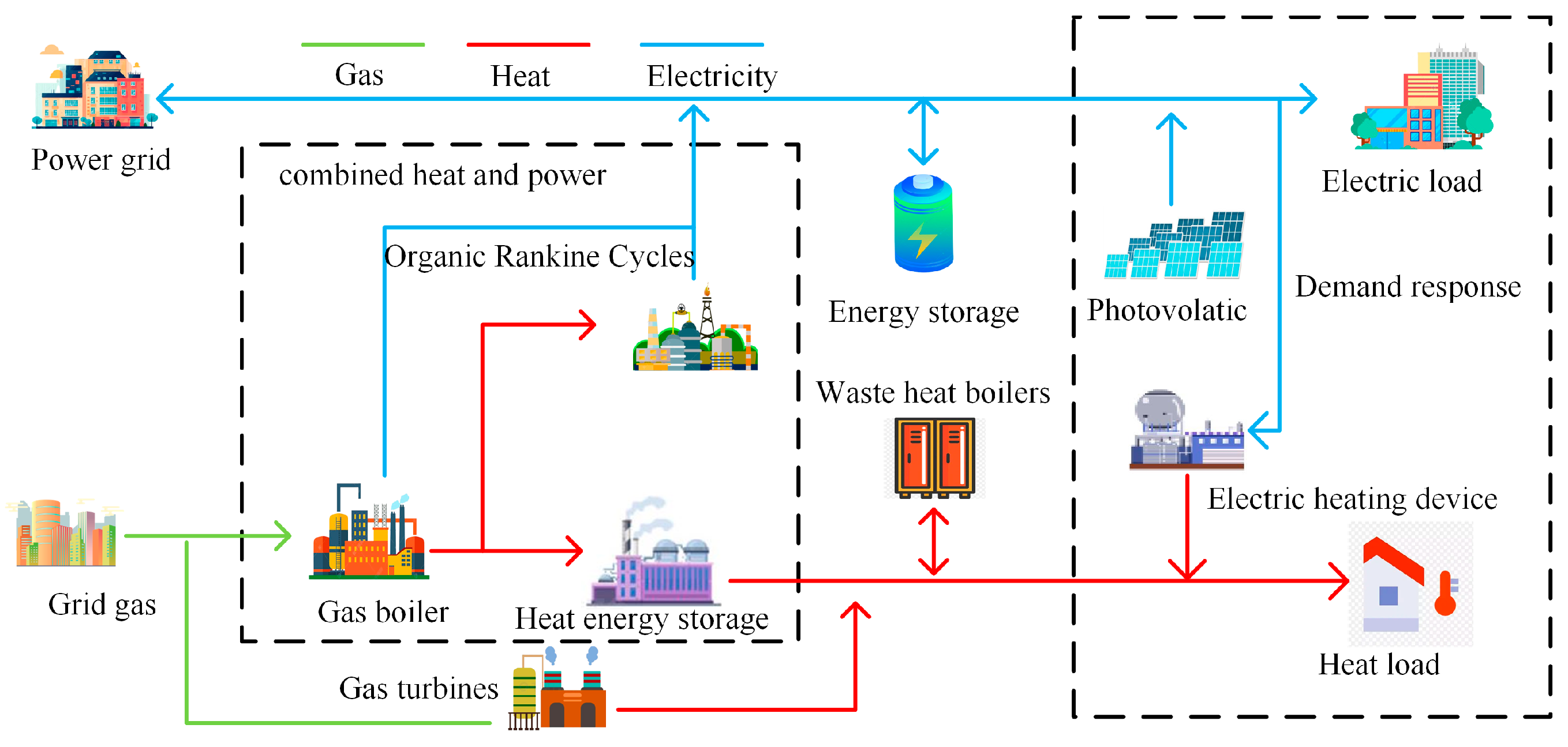
19]. From a market-transaction perspective, the VPP sets corresponding electricity and heat prices based on the energy consumption patterns of user aggregators to enhance its own profitability. From an asset-composition perspective, the VPP is equipped with a combined heat and power (CHP) unit (which includes a gas turbine (GT), a waste heat boiler (WHB), and an organic Rankine cycle (ORC)), a gas boiler (GB), electrical energy Storage (EES), and heat energy storage (HES) devices to provide the necessary heat and electrical energy for user aggregators [
20]. The specific framework is illustrated in
Figure 1.
Currently, we analyze energy consumption patterns to meet the primary energy demands of end-users. Based on the types of electrical demand equipment, loads can be categorized into rigid loads and flexible loads. Flexible electrical loads allow users to adjust their energy demand, thereby enhancing the flexibility of electricity consumption. Currently, the installation of PV generation systems and EHD at the user end is feasible. Besides expanding the sources of electricity, users can autonomously choose and adjust the sources of heat loads based on the cost of electric heating and the price of heat energy, thereby avoiding profit losses due to high prices. This structure addresses the issue of single-source energy supply for users and improves the flexibility of integrated demand response without compromising user experience.
The system is equipped with electrical and heat energy storage devices, which enhance the utilization rate of renewable energy [
21], reduce price fluctuations caused by photovoltaic curtailment, and strengthen bidirectional energy flow. Through energy storage facilities, energy interaction is achieved, providing energy access services to the user side. This reflects the energy interaction response on the user side based on renewable energy integration and price-based mechanisms.
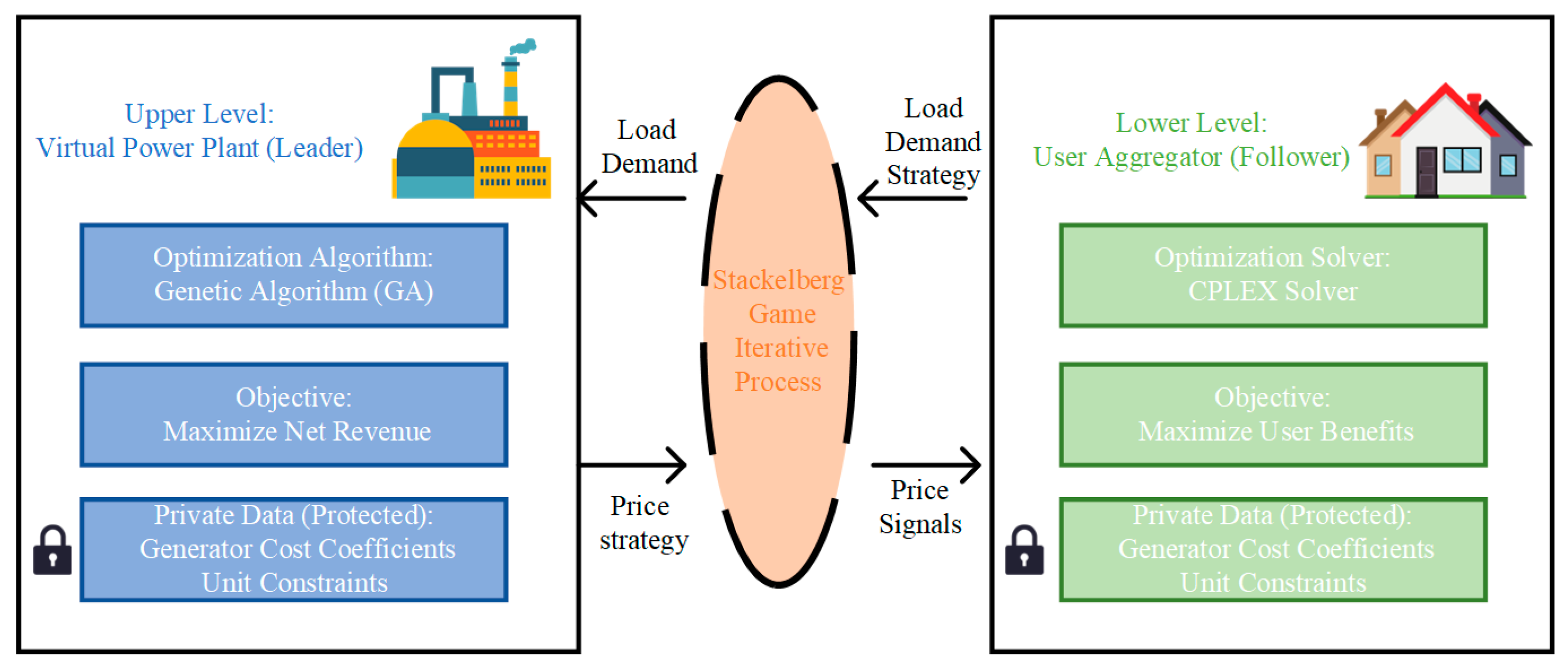
The operational framework of entities within the integrated energy system is as follows: the VPP formulates appropriate pricing strategies for electricity and heat based on forecasted market prices for the following day. In response to these price signals and their own energy requirements, the user side adjusts the daily load distribution, optimizing the allocation of electrical and heat loads to maximize their own profit. A diagram of this game structure is presented in
Figure 2.
3. System Energy Output Model
3.1. CHP Unit Model
The CHP unit comprises three core components: a GT, an ORC, and a WHB. This integrated system enables the comprehensive utilization of energy resources:
In the equation, denotes the electrical energy generated by GT burning natural gas at time t. denotes the thermal power output of the gas turbine at time t. denote the natural gas power input to the GT during time period t. symbolizes how effectively GT transforms natural gas input into electrical energy, represents the gas-to-heat efficiency of GT, and represent the upper and lower limits of GT input power, respectively, and represent the upper and lower limits of GT ramping, respectively.
The GT generates heat energy, part of which is utilized for waste heat power generation in the ORC, while the remainder is supplied to the heat load via the WHB. The gas turbine, organic Rankine cycle, and waste heat boiler collectively form the CHP system [
22]
In the equation, and represent the relative heat power inputs to ORC and WHB; and symbolize the heat and electrical power output of WHB and ORC, respectively; represents the conversion efficiency of ORC; represents the heat loss of WHB; and represent the upper and lower limits of the input power of ORC; and represent the upper and lower limits of the ramp-up constraints of ORC.
The final expressions for the heat and electrical output of the CHP are:
3.2. Gas Boiler Output Model
The heat load required by the user side cannot be fully met by the heat output of the CHP unit. Therefore, a GB is incorporated into the virtual power plant as the primary heating unit to address the heat load demand.
GB produces heat energy by burning natural gas. The conversion relationship between the output heat power
and the input natural gas power
is as follows:
In the formula, is the heat conversion ratio of GB; and represent the maximum and minimum values of the output heat power of GB.
3.3. Electrical Energy Storage Systems
Energy storage systems enable the temporary storage of electrical energy, allowing power to be shifted over time to accommodate the variability of renewable energy generation. To mitigate the adverse effects on battery lifespan caused by operation at low charge/discharge rates and a low state of charge (SOC), the energy storage unit must comply with charging/discharging power constraints and SOC limits. Within any given time period, the total charging or discharging power of all users must not exceed the rated power of the energy storage system.
In the formula,
is the state of charge of the battery (kWh);
and
are the charging and discharging power of the battery (kW), respectively;
and
are the charging and discharging efficiency of the battery, respectively;
and
are the charging and discharging status bits of the battery, where 0 means shutdown and 1 means operation; and satisfy the mutual exclusion constraint and charging and discharging frequency constraint.
To prevent the energy storage system from entering an invalid state of simultaneous charging and discharging, the state variables must be controlled. Furthermore, to optimize the full life-cycle cost of the battery, the proposed operational strategy strictly limits frequent state-switching behaviors. This strategy aims to prevent excessive electrochemical degradation caused by micro-cycles, thereby maximizing the service life of the battery pack while maintaining system flexibility. It enforces a battery operation pattern that is smooth, health-conscious, and aligned with its physical characteristics.
During actual operation, the battery must satisfy the charge and discharge ramp rate constraints shown in the following equation:
In the formula, / and / represent the minimum/maximum charging and discharging power (kW) of the battery in the charging and discharging states, respectively.
Additionally, to maintain continuous service provision and compensate for energy conversion losses, the energy stor-age system must satisfy the energy balance constraint. This requires that the SOC at the end of the scheduling period equals the initial SOC, thereby ensuring the sustainability of the cycle.
3.4. Heat Energy Storage
HES device can store heat when there is a surplus and release it during periods of heat shortage or high heating costs, thereby enhancing system flexibility and economic efficiency. Their capacity limits as well as heat storage and release power constraints are as follows.
In the equation,
is the stored heat energy of the heat energy storage device (kWh);
and
are the heat storage and heat release power of the HES device (kW), respectively;
is the energy loss rate of the HES device;
and
are the heat storage efficiency and heat release efficiency, respectively;
and
are the charge and discharge status indicators of the HES device, where 0 indicates stop and 1 indicates operation; and they satisfy the mutual exclusion constraint:
The HES device must satisfy the following ramping rate constraints:
In the formula, / and / represent the minimum/maximum heat storage and heat release power (kW) of the HES device in the states of heat release and storage, respectively.
3.5. Virtual Power Plant Operation Revenue Model
Acting as an energy hub with bidirectional energy flow, the VPP serves as the leader and coordinator in the system, performing functions related to energy production, transmission, and supply. It acts as the manager, balancing energy interactions between generation, load, and storage to facilitate user interaction with integrated energy equipment via demand response. The pricing strategy is formulated based on the production plan of its own equipment and the load demand of the consumption side. The ultimate objective is to maximize revenue, which can be expressed as:
Among these,
represents the revenue obtained from supplying power to users during time period
t,
denotes the grid interaction cost. A negative value indicates purchasing electricity from the grid, while a positive value indicates selling electricity to the grid, respectively.
represents the fuel consumption cost of each unit within the virtual power plant, and
represents the maintenance cost that each unit needs to consider based on its output. The above equations can be expressed as:
In the equation,
and
represent the user’s electrical load and heat load, respectively.
and
represent the operator’s electricity and heat sales prices to the user, respectively.
and
represent the operator’s electricity sales and purchase prices to the external grid, respectively.
represents the operator’s total electricity supply.
represents the operation and maintenance cost coefficient of the equipment,
and
represent the gas turbine’s electrical power output and the heat power output of the gas boiler, respectively. Additionally, the parameters
ae,
be,
ce and
ah,
bh,
ch denote the fuel cost coefficients for the gas turbine and gas boiler, respectively. Furthermore, to prevent model degeneracy by avoiding direct transactions between consumers and the grid, it must be ensured that the prices offered by the operator are slightly lower than market prices. This requirement is enforced by the following constraint:
4. User Aggregation Model
4.1. User Aggregation Commercial Application Scenarios
User aggregators contain a variety of complex load resources. This paper considers the main demand loads of users, namely the two energy usage scenarios on the user side: electrical load and heat load.
The electrical loads on the user side can be categorized into flexible electrical loads and rigid electrical loads: rigid loads have fixed usage times and quantities, making them difficult to adjust; flexible loads, on the other hand, possess flexibility, allowing their consumption patterns to be adjusted based on real-time electricity prices. These flexible loads can be further subdivided into curtailable loads and shiftable loads. Building on this, the user aggregator achieves electricity demand response by coordinating these two types of loads. The electrically heated devices installed within the aggregator, while introducing additional electrical losses and increasing electricity demand, also provide users with diversified pathways for acquiring heat energy, helping to mitigate the risk of relying on a single heat source. Considering the above, the electricity consumed by the user aggregator during the t-th time interval of a day can be expressed as:
In the formula, represents the total electricity consumption of the user aggregation service provider within a day, represents the rigid electricity load in the electricity load, and represent the flexible electricity load and the additional electricity load generated by electric heating device, respectively.
The adjustment of electricity consumption should consider practical applications to avoid affecting essential production and daily activities. Due to the complexity of actual conditions on the user side, it is difficult to determine specific amounts of electrical load curtailment. This paper temporarily excludes curtailable loads and thus only requires that the following condition be satisfied:
In the formula, represents the maximum amount of load that the user can transfer, represents the total transferable load within T time periods, i.e., the total amount of shiftable load must be kept constant before and after demand response.
The modeled heat loads encompass fixed and shiftable types. End-user access to heat energy has been diversified, moving beyond exclusive dependence on VPP-supplied heat to include on-site electro-heat conversion, which boosts operational flexibility. Therefore, electric heating systems are utilized when VPP electricity prices are strategically low or when their operational cost undercuts the VPP’s heat tariff. This operational strategy augments the user aggregator’s economic benefits. The aggregate heat load and its associated constraints for a typical day are formulated below:
In the equation, represents the heat power supplied by the VPP, and represents the fixed heat load; represents the transferable heat load, which can be transferred in a certain proportion based on user comfort and energy supply adequacy; represents the upper limit of the transferable heat load. represents the heat energy supplied by the user aggregator’s own electric heating device at the t-th time step; where is the heating scheme factor selected by the user aggregator at the t-th time step within a day. When μh is 1, it indicates that the heat energy is supplied by the virtual power plant, and when is 0, it indicates that the heat energy comes from the user-side electric heating device.
The response constraints for user-side electric heating device are as follows:
In the formula, is the electric heating output of the user side during the t-th time period of the day; represents the operational efficiency of end-use electric heating devices; denotes the maximum permissible operational output of end-use electric heating devices.
By comparing the two energy consumption patterns using the following formula, the selection scheme for the user-side heating coefficient
can be determined.
4.2. Simplified Treatment of Heat Load
It is acknowledged that the proposed model treats heat load flexibility similarly to electrical load shifting, thereby neglecting the explicit thermodynamic processes of buildings. While incorporating a full dynamic thermal model would theoretically improve physical accuracy, it is omitted in this study for two critical reasons:
Computational Tractability: The proposed bilevel framework employs a GA in the upper level, which requires iterative solving of the lower-level problem. Introducing state-coupled differential equations for thermal dynamics would transform the lower-level model into a complex differential-algebraic system, rendering the bilevel optimization computationally intractable for practical dispatch horizons.
Data Privacy and Availability: Accurate thermal modeling requires specific physical parameters of individual buildings. In a privacy-preserving VPP context, acquiring such sensitive physical data from heterogeneous users is unrealistic.
To prevent the overestimation of flexibility resulting from this simplification, this paper implements a dual-safeguard mechanism:
The shiftable and reducible proportions of the heat load are strictly constrained within a narrow range. This ensures that the adjusted heat supply effectively respects the thermal retention limits of buildings without requiring explicit temperature calculations.
The quadratic utility function serves as a soft constraint. The parameters ν and α are calibrated to impose a steep marginal utility loss on load shedding. This economic penalty mimics the physical discomfort caused by temperature deviations, forcing the optimizer to avoid unrealistic load cuts even in the absence of thermal inertia constraints.
4.3. Photovoltaic Power Output Model
Research in the field emphasizes the substantial capacity of photovoltaic power generation. Estimates suggest that the total available solar energy resource is many times larger than all other domestic energy resources combined. Moreover, if fully converted into electricity, it could potentially yield an output multiple times China’s present total energy production. Photovoltaic systems offer the key advantages of producing zero carbon emissions and other wastes during operation, and are not subject to the limitations of regional resource distribution [
23,
24].
The power output of photovoltaic systems is characterized by significant variability, primarily driven by natural factors such as weather. Acknowledging this stochastic nature is critical for ensuring the credibility of the modeling data. The power of a PV unit is fundamentally dependent on local conditions, including solar irradiance and ambient temperature. Its mathematical representation is given as follows:
In the equation, denotes the derating factor of the unit, PPVZ represents the rated output power of the system, At. is the actual irradiance at time t, and As denotes the standard irradiance under fixed conditions (kW/m2). The coefficient αT represents the temperature coefficient, and Tstp signifies the standard temperature. Given that the value of αT is relatively very small, the temperature variation exerts a negligible impact on the output of the PV unit. Consequently, the PV generation power can be approximated as proportional to the actual irradiance At.
This paper employs the Latin Hypercube Sampling method to mitigate errors arising from PV uncertainty. By generating sample values that reflect the overall distribution of random variables, a large number of PV output scenarios are produced, ensuring comprehensive coverage of the sampling range and guaranteeing the reliability of the generated data. Concurrently, to avoid analytical complexity and computational redundancy caused by an excessive number of scenarios, a scenario reduction technique based on the Kantorovich distance is applied to process and reduce the scenarios, ultimately yielding a reduced set of scenarios with corresponding probabilities.
4.4. User Aggregator Revenue
Based on the announced energy selling prices, the user side adjusts its electrical and heat loads to maximize its own profit, which is defined as the difference between the end-user’s utility function and the total energy cost. The specific formulation is as follows:
In the formula,
represents user satisfaction, which indicates the level of satisfaction users obtain from purchasing electricity and heat at different time periods [
25]. It is typically non-decreasing and convex, with several forms such as quadratic and logarithmic. This paper uses a quadratic function to represent it:
In the formula, the coefficients ve, αe, vh, αh represent the preference coefficients for consuming electricity and heat, respectively, reflecting the user’s demand preferences for different energy types and influencing the magnitude of demand.
The above formulation, grounded in the “representative agent” theory of microeconomics, rigorously captures the heterogeneity of the user population. The aggregated parameters are mapped from individual preferences as follows: α represents the collective elasticity of the entire group, derived from the harmonic sum of individual sensitivities, reflecting that the aggregator’s total demand flexibility is the accumulation of all individual flexibilities. v characterizes the group’s weighted average valuation of energy, obtained by averaging individual preference coefficients with weights determined by their respective price sensitivities. This formulation is a mathematically equivalent expression of the collective behavior of heterogeneous users, ensuring that the model preserves the diversity of individual demand responses at the macro level. These parameters are identified through curve fitting of historical aggregate load data, enabling the VPP to optimize its strategy without accessing individual preference data.
4.5. System Constraints
To ensure the secure, reliable, and stable operation of the VPP, once the objective function is established, the system constraints must be considered, including the power balance constraint, generator output limits, as well as generator ramping constraints.
4.5.1. Constraint on Power Supply Balance
During power transmission, the power balance of the grid must be maintained. When power generation exceeds load demand, the grid frequency rises; conversely, when generation decreases, the grid frequency drops.
In the formula, and Pdzr represent the electrical power output of the photovoltaic unit and electric heating device, respectively. and represent the power purchased from and sold to the utility grid, respectively.
4.5.2. Limitations on Heating Balance
In a heating system, the heat transfer balance must be maintained. This paper ignores the heat losses due to transmission. The heating balance constraint is expressed as follows:
4.5.3. Power Exchange Constraints
In the formula, / and / represent the maximum/minimum power purchase capacity of the power grid and the upper/lower limits of the ramp rate, respectively.
5. Stackelberg Game Model
5.1. Microgrid Game Theory Framework
The VPP determines its production schedule and formulates the energy selling strategy for each time slot. Based on the published pricing scheme from the VPP, the user side adjusts its energy consumption distribution to achieve reasonable load planning and optimized energy utilization.
The players are the VPP and the end-users. Their respective payoff functions are the VPP’s payoff function and the user-side payoff function mentioned earlier. For the two-sided Stackelberg game comprising multiple investors, the Stackelberg game
G can be represented as:
Once a game equilibrium is reached, no participant can unilaterally alter their strategy to achieve higher returns. In the equation, the VPP acts as the leader in the game process, the user aggregator l as the follower, ce,s represents the set of electrical price strategies published by the virtual power plant, and ch,s denotes the set of heat price strategies issued by the VPP. Psl denotes the set of strategies available to the user aggregator for flexible load adjustment within a day; Hsl represents the set of heat load strategies that the user aggregator can transfer within a day. EVPP and Fuser respectively represent the revenue of the virtual power plant and the revenue of the user aggregator.
The game attains a Stackelberg equilibrium when the followers select their best responses to the leader’s strategy, and the leader simultaneously achieves its optimal strategy.
5.2. Existence and Uniqueness of the Equilibrium Solution
To theoretically prove the existence and uniqueness of the Stackelberg equilibrium solution, we perform a continuous relaxation of the discrete binary variables in the lower-level model. Under this relaxation assumption, the strategy spaces of both the leader and the followers become compact and convex sets, thereby satisfying the following three conditions: (1) the strategy spaces of both the leader and the followers are non-empty, compact, and convex sets; (2) for any given strategy set of the leader, an optimal solution exists and is unique for all followers; and (3) for any given strategy set of the followers, an optimal solution exists and is unique for the leader.
- (1).
Based on the Stackelberg model, the payoff functions of both the VPP and the user aggregator are continuous with respect to their respective strategy sets. The optimal strategy for the leader (VPP) must satisfy constraints (19)–(20) and (32)–(34), while the optimal strategy for the follower (user aggregator) must satisfy constraints (21)–(28). Consequently, the strategy set of each participant is non-empty, compact, and convex.
- (2).
Taking the second partial derivatives of with respect to and respectively, we obtain:
Under the parameter settings of this paper, αe > 0 and αh > 0. Therefore, it can be concluded that the function attains a maximum point with respect to each strategy variable.
- (3).
Substituting the set of optimal solutions for the user aggregator, = (ve−)/ae and = (vh − )/ah, into the energy sales revenue function, and then taking the second partial derivatives with respect to and respectively, yields:
Furthermore, the Hessian matrix for the microgrid operator is given by:
Based on the above proof, the Stackelberg game model proposed in this paper possesses a unique equilibrium solution.
5.3. Model Solving Methods and Processes
For the Stackelberg game model, this study adopts a distributed optimization algorithm to solve the payoff functions of each investment entity. While the existence and uniqueness of the equilibrium solution is theoretically established under relaxed conditions, the actual engineering problem involves binary constraints associated with equipment scheduling, as formulated in Equations (7) and (12). These constraints render the lower-level optimization a nonconvex mixed-integer nonlinear programming problem. Conventional gradient-based solvers are prone to becoming trapped in local optima or may fail entirely due to discontinuities in the decision variables. Moreover, gradient-based methods typically require the VPP to have access to users’ private utility parameters. To address both nonconvexity and data privacy concerns, this paper adopts a distributed algorithm that integrates a GA with CPLEX. The GA enables the VPP to optimize its pricing strategy using only user-side feedback, without needing to access sensitive internal parameters of the users.
The use of a genetic algorithm in the upper-layer optimization eliminates the need for sharing sensitive lower-level parameters, ensuring strict data privacy. It also inherently handles discrete variables and non-convex constraints, removing the requirement for strict convexity. The game-theoretic solution procedure is outlined below.
The system is designed with upper and lower operational levels. The upper level optimizes VPP energy prices using a genetic algorithm; subsequently, the lower-level user aggregator employs CPLEX to determine optimal load and device scheduling in response to these prices.
- (1)
The following parameters are configured for the initial iteration (k = 0) of the algorithm applied to the VPP, Shared Energy Storage, and User Aggregator models: a population size (m) of 20, a maximum of 30 iterations, a mutation rate of 5%, a crossover rate of 80%, and an inter-generational convergence tolerance of ≤0.01.
- (2)
Using the genetic algorithm, m sets of electricity and heat prices are randomly generated and are then passed to the user aggregator. The iteration counter is updated as k = k + 1.
- (3)
Utilizing the acquired electricity and heat prices, the user aggregator leverages the CPLEX solver to determine the corresponding optimal power/heat load profiles and storage dispatch. It then calculates the resulting revenue across different user-side energy scenarios, and transmits the compiled consumption data to the VPP.
- (4)
Based on the actual electricity and heat purchases from the user side, the VPP calculates its operational revenue.
- (5)
The selection, crossover, and mutation operations of the genetic algorithm are employed to produce new electricity and heat prices. This iterative process, repeating steps (3) through (4), facilitates the calculation of a new round of payoffs for all participating entities.
- (6)
The payoff results obtained from successive iterations are compared and analyzed.
- (7)
If convergence is achieved, the procedure terminates; otherwise, it reverts to step (3).
6. Case Simulation and Analysis
The user side incorporates PV and electric heating systems; the VPP side consists of a CHP unit, a gas boiler, and wind turbines. The key parameters, energy storage parameters, and economic parameters are listed in
Table 1 and
Table 2 and
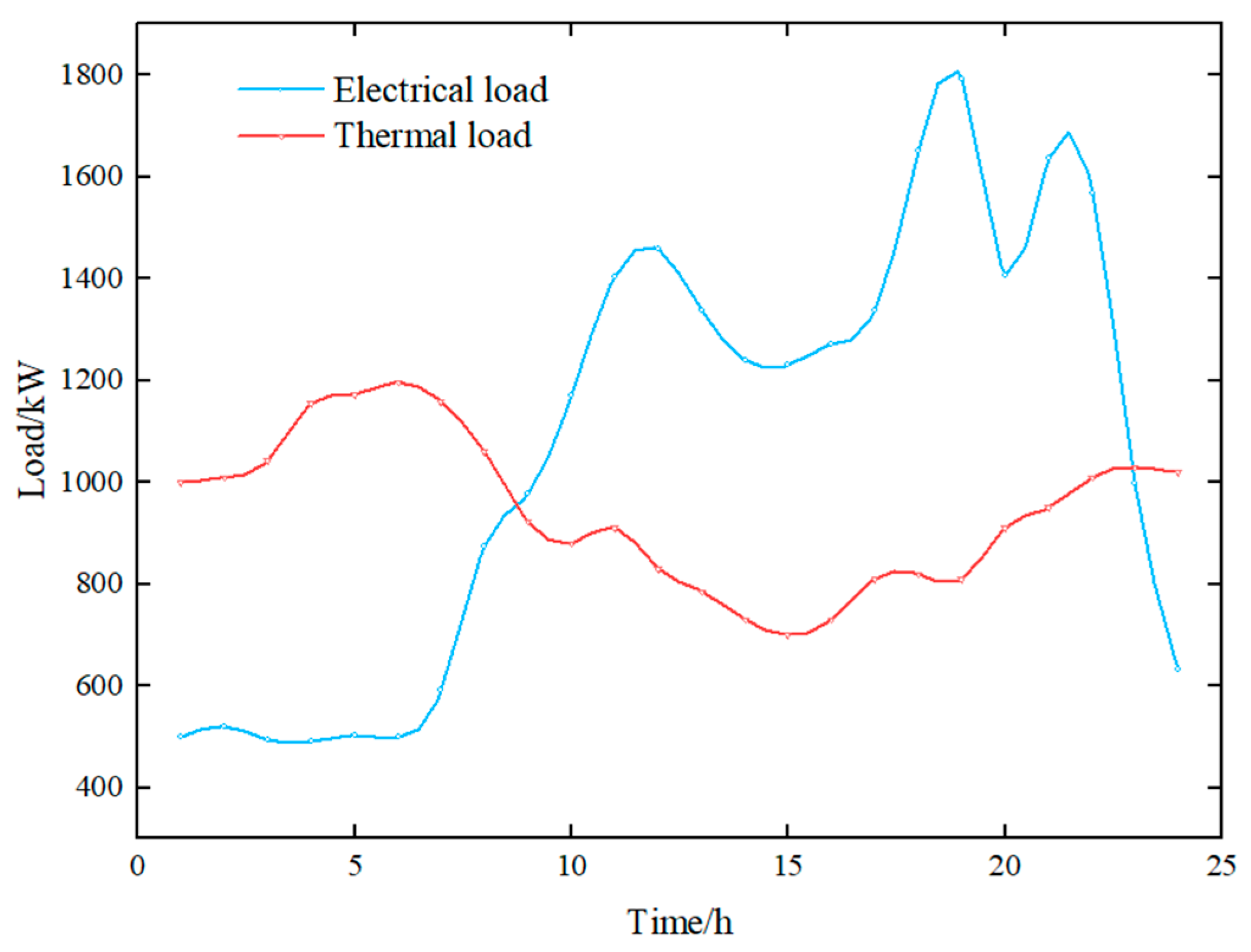
Table 3, respectively. With a 24-interval daily scheduling period, the corresponding load forecasts are shown in
Figure 3.
Flexible electrical loads on the user side account for 20% of the total electrical load. Due to the high sensitivity of users to thermal comfort, and to prevent excessive adjustments of thermal loads—even if aimed at higher gains—from compromising satisfaction, the adjustable portion of the thermal load is typically capped at 10% of the total thermal demand.
The user preferences for electricity and heat are represented by the coefficients
νe,
αe,
νh, and
αh which are 1.5, 0.0012, 1.4, and 0.001, respectively. The fuel cost coefficients for the integrated energy operator are
ae,
be,
ce (
ah,
bh,
ch), which are 0.0015, 0.16, and 0 (0.0008, 0.13, 0), respectively. Energy storage equipment parameters are shown in
Table 2.
A simulation framework was developed in MATLAB based on the model to compare five scenarios. The genetic algorithm used a population of 20, a 5% mutation rate, and an 80% crossover rate. Scenario configurations are detailed in
Table 4, with × and √ indicating whether the corresponding equipment is installed, and the computed optimal benefits are presented in
Table 5.
As presented in
Table 2, integrating user-side PV, electric heating, and energy storage significantly enhances the end-users’ net profit compared to the baseline scenario where only the VPP supplies energy. Compared with Scenario 2, user profit increased substantially by 1300.4 CNY, while VPP profit decreased by 805.7 CNY, owing to the improved load regulation capability enabled by energy storage and the reduced dependence on VPP generation.
In Scenario 3, the users’ profits increased by 1613.2 CNY and VPP profit dropped by 1076.6 CNY, reflecting the enhanced flexibility of demand response achieved through coordinated electric heating and heat load management. From Scenario 4, PV generation reduced electricity purchased from the VPP and improved user economics, yielding an increase of 2646.9 CNY in user profit and a decrease of 2022.4 CNY in VPP profit, indicating optimized electrical load distribution and effective utilization of renewable energy. In Scenario 5, user profit increased notably by 7205 CNY, whereas VPP profit declined by 2601.4 CNY, as the combined operation of all devices maximized load flexibility and user autonomy. Furthermore, the computation time for all scenarios remained within 1 to 1.5 h, meeting the requirements for practical applications.
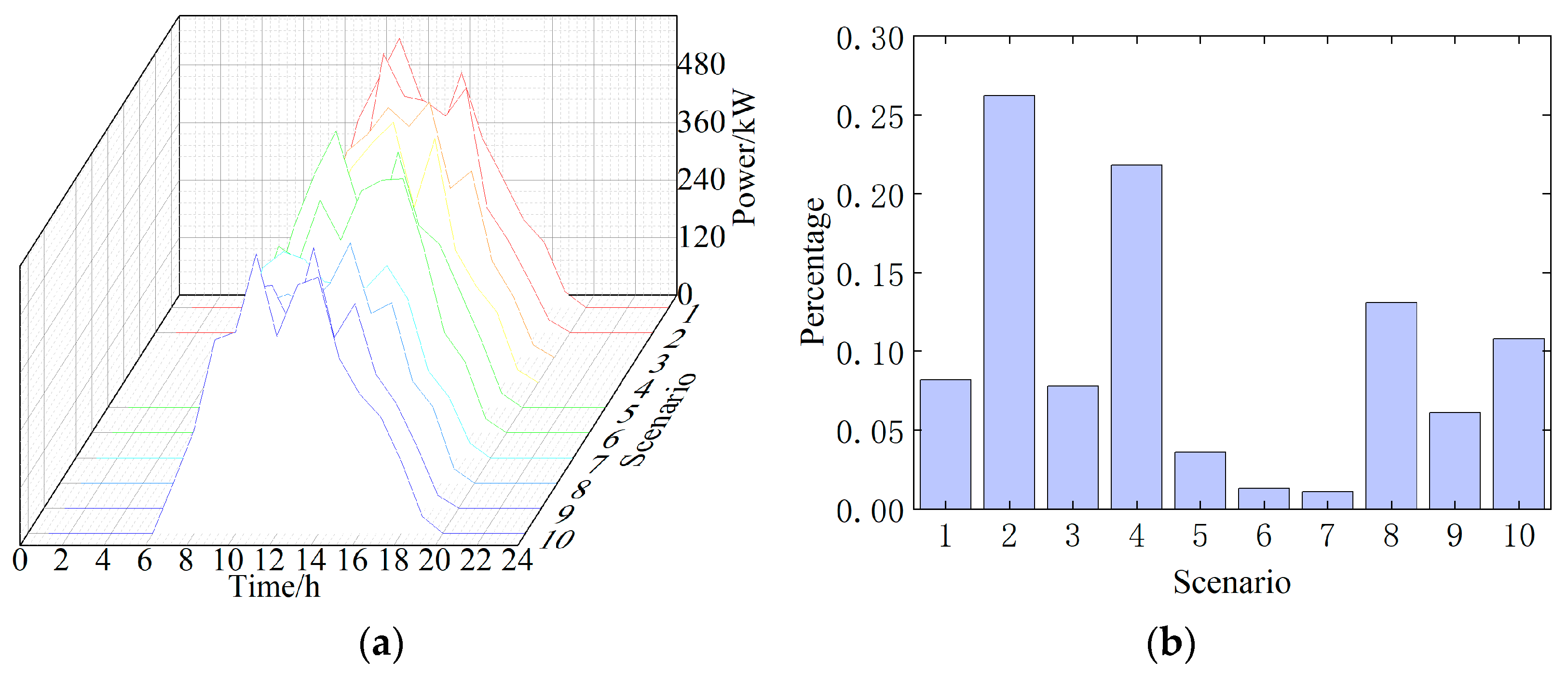
A two-step modeling approach is adopted for PV generation. A large set of stochastic output scenarios is generated via Latin Hypercube Sampling to reflect weather-induced fluctuations; subsequently, scenario reduction based on probability distance is applied to obtain ten typical scenarios, each weighted by its probability. This results in a set of probabilistic PV output profiles.
As shown in
Figure 4, By forecasting ten sets of photovoltaic (PV) output scenarios, each scenario is represented by a different color, and the iterative results for each scenario are calculated separately. The final outcome is then derived through probability-weighted averaging based on the likelihood of each scenario, thereby mitigating the risk associated with PV generation uncertainty.
For brevity, the analysis focuses on contrasting Scenario 1 with Scenario 5. The configuration in Scenario 5—integrating PV and electric heating—substantially improves operational flexibility, which demonstrates the advantage of the presented model.
Figure 5 and
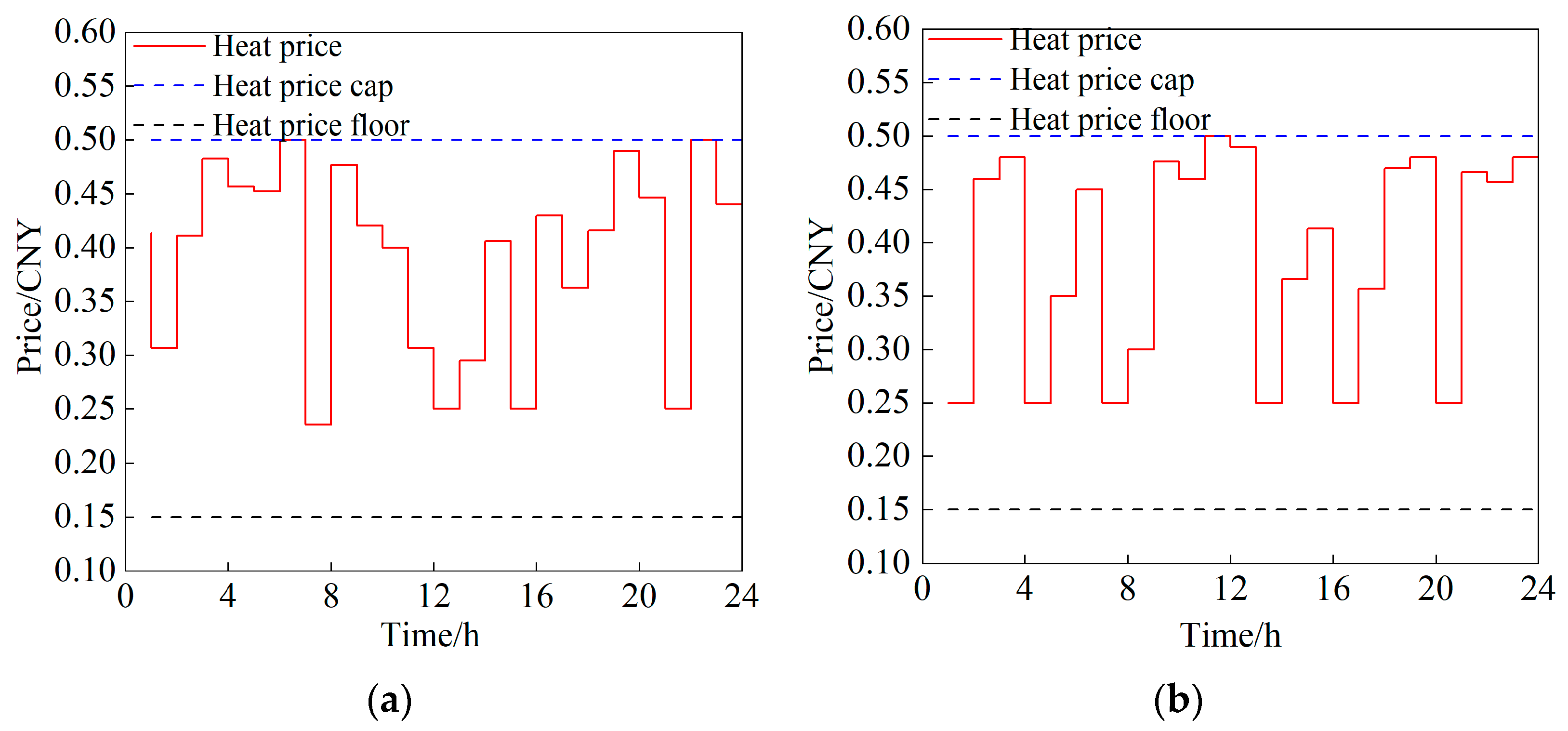
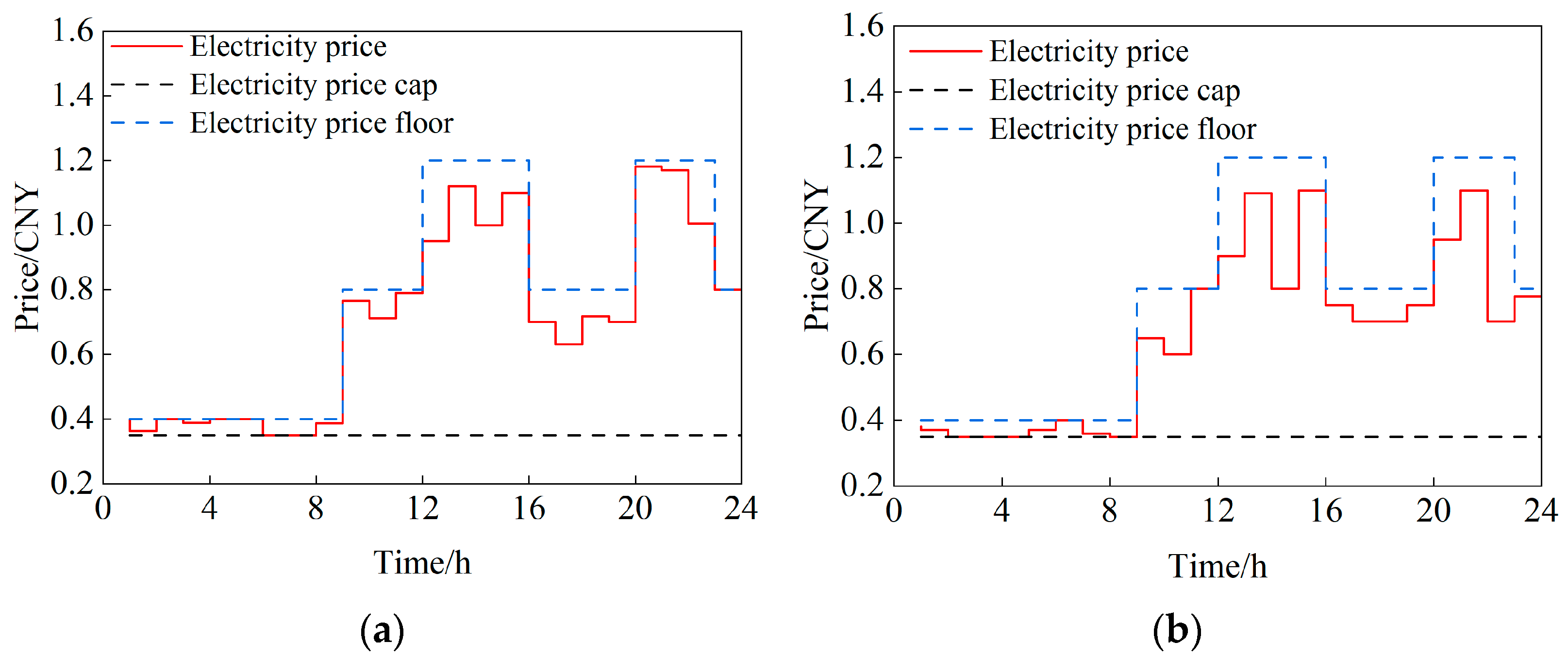
Figure 6 demonstrate distinct electricity and heat prices across the scenarios. The variation stems from the user-side electric heating and heat energy storage in Scenario 5, which enables flexible operational strategies and consequently leads to more optimal game-theoretic results for all parties.
To validate the effectiveness of the game-theoretic pricing mechanism, a detailed analysis of the pricing constraints is conducted. As illustrated in
Figure 5, the heat price constraint remains inactive during the vast majority of operating periods, with prices rarely reaching the upper or lower bounds. Throughout the day (including the period from 00:00 to 08:00), heat prices exhibit significant fluctuations and are not constrained by a single boundary. Furthermore, as shown in
Figure 6, the optimized electricity prices do not consistently align with the grid price limits; instead, they demonstrate distinct strategic adaptability. During the 00:00–08:00 period, electricity prices remain at the upper bound due to the absence of photovoltaic (PV) generation during nighttime hours. However, this does not imply model degradation: during daytime hours (09:00–17:00), PV generation provides room for price reductions, allowing prices to fluctuate between the upper and lower bounds for approximately 50% of the scheduling horizon, thereby confirming the VPP’s active game-playing capability. Prices are only constrained by the boundaries during a few extreme peak or valley periods.
These results demonstrate that the VPP dynamically adjusts prices within feasible ranges to achieve an optimal balance between revenue maximization and user demand satisfaction, which strongly validates the effectiveness of the proposed pricing mechanism.
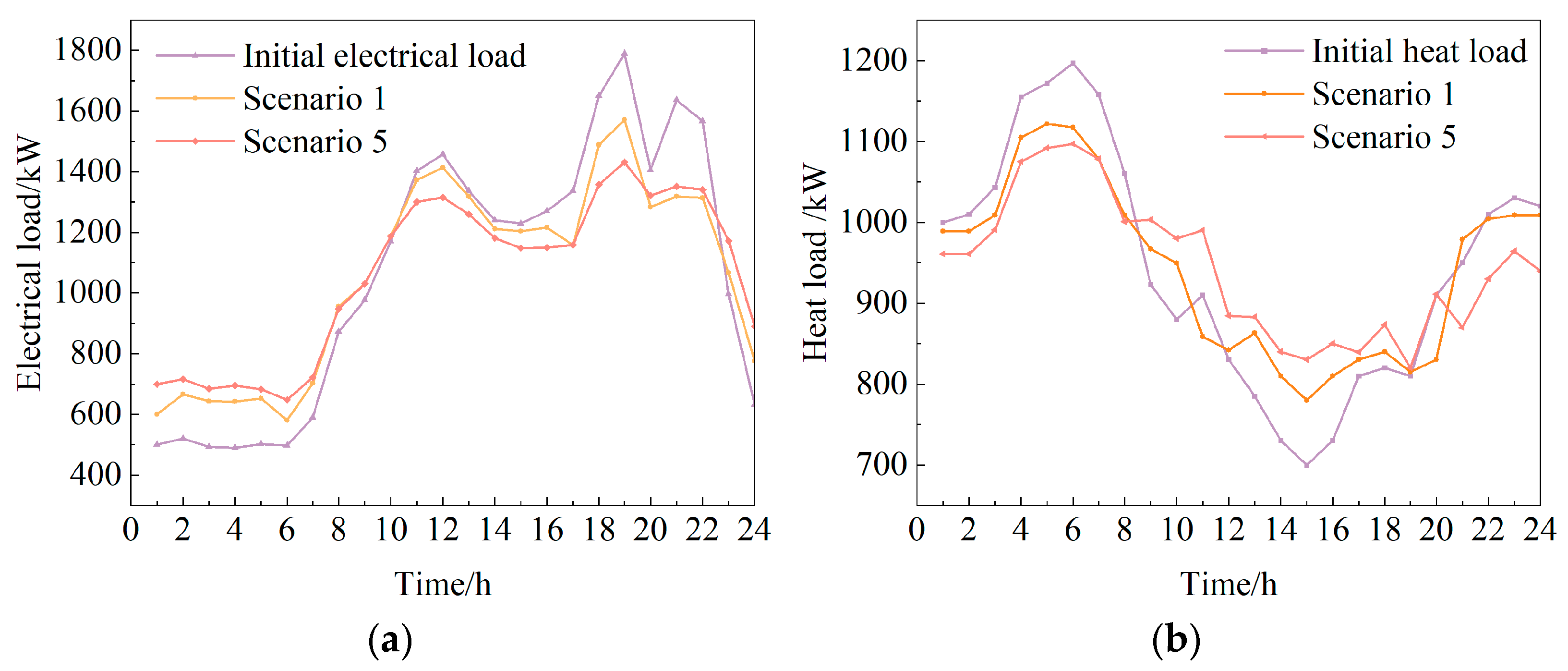
The user-side load fluctuations in
Figure 7 show that electricity use in Scenarios 1 and 5 rises in the early morning (00:00–08:00) and late evening (22:00–24:00), but falls during daytime hours (08:00–22:00). The consistency of this pattern with the VPP’s optimized electricity price in
Figure 6a confirms the result’s credibility. Users gain increased revenue by shifting load from peak to off-peak periods. The lower revenue in Scenario 1 compared to Scenario 2 is attributed to the user’s lack of adjustment ability, which excludes them from power trading or storage-assisted interactions, underscoring the critical role of storage in enabling demand response. Furthermore, while not analyzed in a dedicated scenario, PV generation is shown to reduce both the purchased electricity volume and associated costs for users, as evidenced by the PV forecast and load profile analysis. As observed in
Figure 7a and
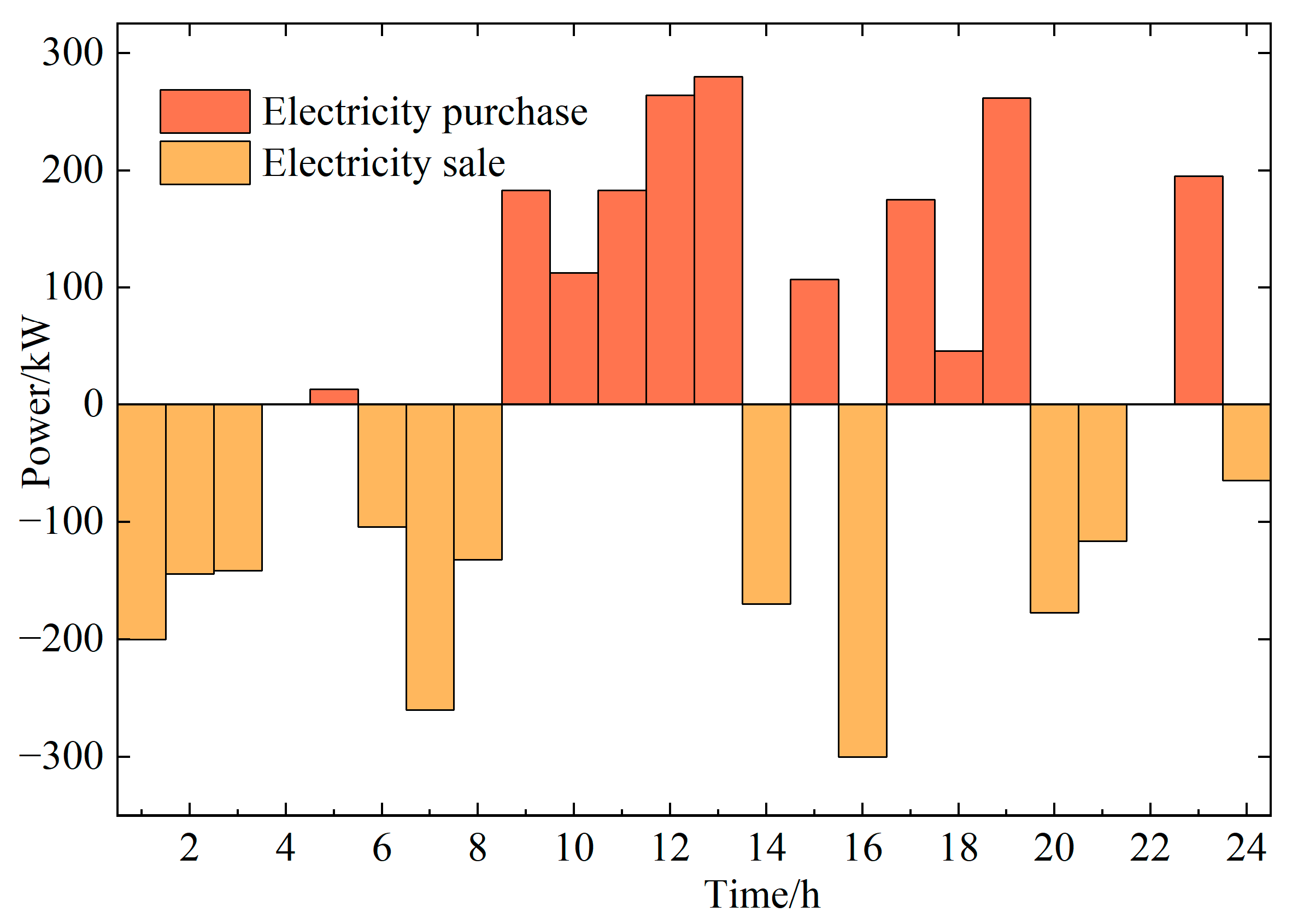
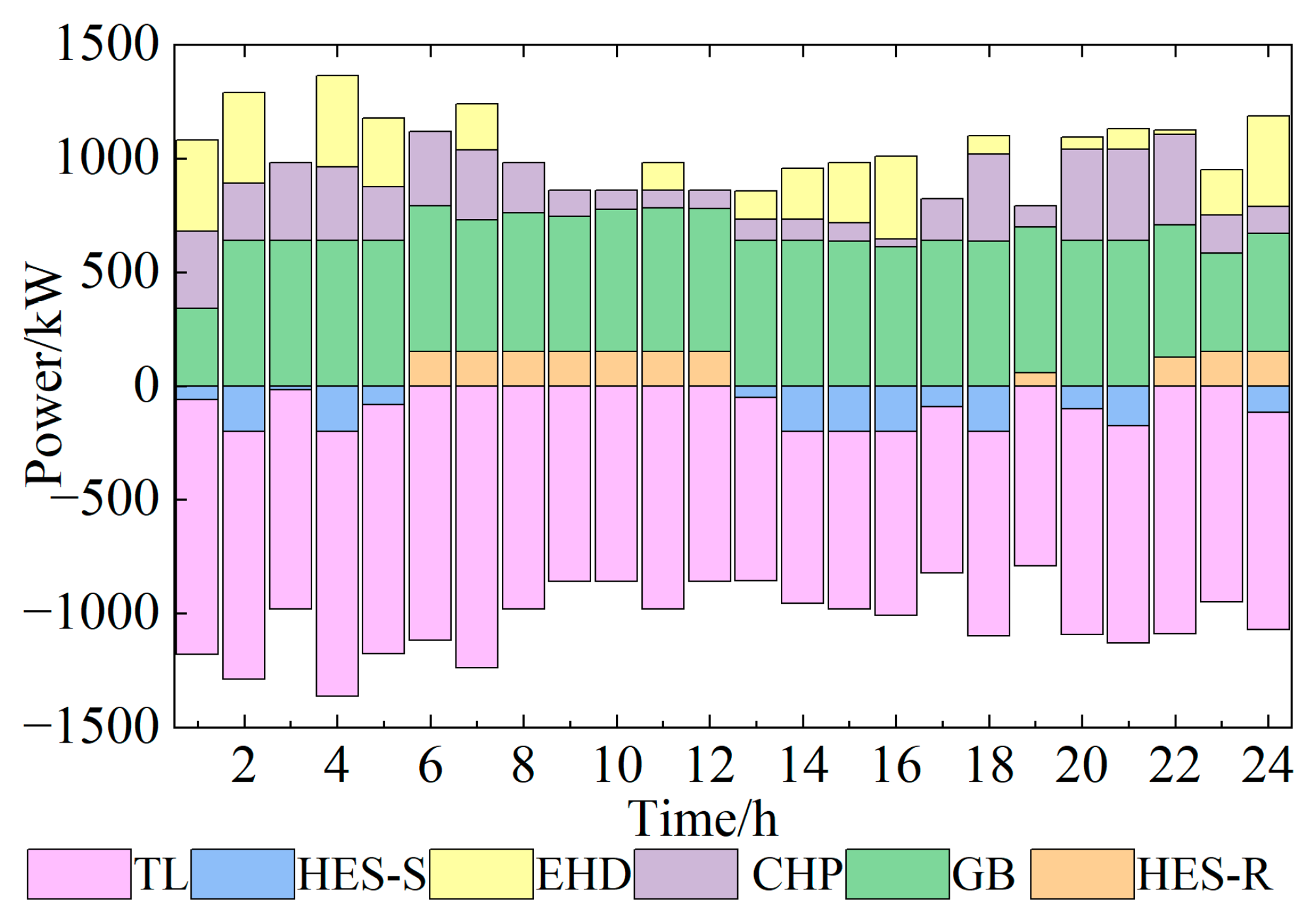
Figure 8, low electrical load demand occurs from 00:00 to 04:00. The surplus power is stored in the EES to maintain system operation, while during peak hours (09:00–13:00 and 17:00–19:00), energy is retrieved from the EES. This achieves cross-temporal energy scheduling and enhances user profits.
As shown in
Figure 7b, heat load adjustability varies between Scenarios 1 and 5. Any heat load regulation must account for user comfort requirements to avoid compromising satisfaction. The user adjusts its heat load—lowering it from 00:00 to 07:00 and 21:00 to 24:00, and raising it from 07:00 to 21:00—to enhance revenue. In Scenario 5, the integration of electric heating devices breaks the constraint of a single heat source, which enables a diversified heating supply. Analysis of
Figure 9 reveals that users flexibly plan their energy use based on prices, opting for electric heating during 23:00–02:00 and 14:00–16:00 to secure heat via a low-cost method and boost profits.
Figure 8 illustrates that surplus power is stored in the ESS during low-load periods (00:00–04:00); simultaneously, this energy is dispatched during peak hours (09:00–13:00, 17:00–19:00) to support the grid. This enables energy shifting across time, thus improving economic outcomes.
To further demonstrate the value of the proposed game-theoretic strategy, a centralized optimization model is introduced for comparison. In contrast to the distributed game model, where the Virtual Power Plant (VPP) and user aggregators optimize their respective objectives sequentially, the centralized optimization model assumes full access to all system information, including users’ private preference parameters. Its objective is to maximize the global social welfare, defined as the sum of the VPP’s net profit and the user aggregators’ net utility, subject to all physical constraints of the system.
Under the exact same parameter settings, the theoretical maximum global social welfare achieved by the centralized optimization is RMB 40,634.3. In the proposed game-strategy scenario, the total social welfare achieved by our distributed game-theoretic algorithm amounts to RMB 38,855.2. The results indicate that the proposed distributed algorithm attains 95.6% of the theoretical global optimum. Two main conclusions can be drawn from this analysis:
The proposed distributed algorithm achieves 95.6% of the theoretical global optimum. This demonstrates that the algorithm can effectively guide the system toward a high-quality equilibrium state through price signals.
Although the centralized model yields slightly higher welfare, it requires complete transparency of sensitive user data. The game-theoretic approach proposed in this paper sacrifices a marginal amount of economic efficiency to safeguard data privacy and user autonomy, making it more suitable for practical applications where data sharing is limited.