Review

Technological Synergies in Community Energy Systems in Cold Climates

by
Caroline Hachem-Vermette
1,
Orcun Koral Iseri
1,*,
Ashok Subedi
1,
Ahmed Nouby Mohamed Hassan
1,
Christopher McNevin
2 and
Fatemeh Razavi
2
1
Department of Building, Civil and Environmental Engineering, Concordia University, Montreal, QC H3G 1M8, Canada
2
Natural Resources Canada (NRCAN), Government of Canada, Ottawa, ON K1A 0E4, Canada
*
Author to whom correspondence should be addressed.
Energies 2026, 19(5), 1198; https://doi.org/10.3390/en19051198
Submission received: 29 December 2025 / Revised: 9 February 2026 / Accepted: 13 February 2026 / Published: 27 February 2026
(This article belongs to the Special Issue New Trends and Challenges in Modern Electrical Grids)

Abstract

This review systematically synthesizes technological synergies within a Community Energy System (CES), emphasizing cold-climate contexts where heating-dominant demand profiles and strong seasonality create distinct operational challenges. Drawing on 115 studies (2010–2024), the paper explores how integrated thermal, electrical, and digital infrastructures support net-zero and climate-resilient communities in regions with substantial heating requirements. Thermal–electrical coupling emerges as a foundational mechanism in cold climates, where heating loads dominate annual energy demand and drive winter peak constraints. Power-to-Heat (P2H) systems, cold-climate heat pumps, and hybrid configurations combining Thermal Energy Storage (TES) with Battery Energy Storage Systems (BESS) enable multi-timescale flexibility, allowing renewable energy to be shifted from hours to seasons. District Energy Systems (DES) act as a thermal backbone, enabling this integration across extended heating seasons and transforming thermal demand into a grid-balancing resource. Digital technologies further enhance system coordination under variable climatic conditions. Artificial Intelligence (AI), the Internet of Things (IoT), and Advanced Metering Infrastructure (AMI) support real-time optimization, demand response, and cross-vector control within Renewable Energy Communities (RECs) and Virtual Power Plants (VPPs). At the system level, decentralized architectures—including microgrids, Non-Wire Alternatives (NWAs), and peer-to-peer (P2P) trading—strengthen resilience by maintaining thermal and electrical continuity during grid disruptions. Building on these findings, the review synthesizes cross-cutting technological synergies and proposes deployment pathways tailored to cold-climate CES, supported by comparative case studies. Despite demonstrated benefits, widespread adoption remains constrained by high upfront costs, interoperability challenges, and fragmented regulatory frameworks. The review concludes with policy, governance, and research recommendations to enable scalable, equitable, and climate-responsive CES deployment in heating-dominated regions.

1. Introduction

Escalating climate risks and rising greenhouse gas (GHG) emissions have driven ambitious decarbonization strategies transforming energy production, transmission, and consumption for different industries [1]. Global agreements such as the Paris Agreement, aim to limit the global temperature increase to below 1.5 °C [2,3]. National clean energy policies are backing net-zero commitments from over 140 countries. Renewables like solar and wind are central to this shift. Renewable energy presents challenges to grid stability and reliability due to its intermittency [4]. Consequently, bolstering resilience against extreme weather events, cyberattacks, and supply chain disruptions has become a critical concern in the energy sector [2].
Addressing these dual imperatives requires integrated energy systems that combine diverse sources, storage, and controls across electricity, heating, and cooling sectors [5]. Sector coupling, through technologies like heat pumps and Power-to-Heat (P2H), improves flexibility and efficiency [6]. When linked with thermal energy storage (TES), batteries, smart controls, and demand response, renewable energy sources can achieve real-time balancing, reduce peak loads, and enhance energy security. Coupling thermal and electrical infrastructures further strengthens grid stabilization in high-renewable contexts [7] and supports resilience through decentralized, self-sufficient energy communities [8]. Yet, academic and professional debates often treat renewable generation and TES independently: electrical storage and grid-side flexibility on one side, district heating and seasonal TES on the other.
This integration is particularly urgent in cold-climate regions, where the energy transition faces a distinct “seasonal paradox.” Unlike cooling-dominated climates where peak demand often coincides with solar availability, cold climates experience a severe mismatch: photovoltaic generation is at its minimum during winter months when thermal demand for space heating is at its peak [9]. This seasonal imbalance places immense strain on electrical grids, especially as heating becomes increasingly electrified via heat pumps. Consequently, generic energy management strategies are often insufficient; successful decarbonization in these latitudes requires robust thermal backbones capable of high-density seasonal storage and “passive survivability” to ensure energy continuity during extreme winter weather events.
There is an urgent demand for smart buildings, community systems, and flexible demand strategies which link thermal–electric infrastructures with intelligent load management [5,7]. Existing studies typically isolate technological or policy measures, overlooking their interplay in real-time control, leaving synergies, trade-offs, and system-level efficiencies across P2H, batteries, smart thermostats, EV charging, and virtual power plants underexplored [4,6].
The overarching objective of this review is to evaluate how a portfolio of emerging and established technologies, including district energy systems (DES) and community energy systems (CES), can be integrated to support net-zero and climate-resilient futures. District energy systems refer to thermal networks that distribute heating or cooling through centralized plants. These plants serve multiple buildings within a defined service area. In contrast, CES are locally governed configurations that coordinate distributed resources including generation, storage, and controllable loads, across buildings and districts to meet community objectives for cost, decarbonization, and resilience [10]. In this review, CES are treated as multi-vector systems that integrate electricity with thermal networks and demand-side controls to deliver flexibility services and support high renewable penetration. This review examines how technologies such as thermal and electrical storage, smart thermostats, demand response, and sector-coupling strategies interact to strengthen CES performance. Reviewing these technologies not only maps their individual functions but also explores their synergies, trade-offs, and combined contributions to overall system efficiency.
Several recent reviews have examined district energy systems, thermal energy storage, power-to-heat technologies, and smart grids as individual technology domains. In contrast, this review does not aim to re-survey each technology in isolation. Instead, it synthesizes these technologies as an integrated community energy system, explicitly interpreted through the constraints of cold and heating-dominant climates. The novelty of this review lies in (i) reframing CES design around winter peak risk, thermal dominance, and passive survivability; (ii) identifying cross-vector synergies between thermal, electrical, and digital infrastructures across multiple timescales; and (iii) translating this synthesis into deployment pathways for resilient cold-climate communities. This integrative, climate-specific perspective is largely absent from existing single-technology reviews.
By linking thermal and electrical infrastructures with intelligent load management, these integrated technologies enable demand flexibility, renewable integration, and resilience against climate- and grid-related disruptions. The synthesis presented here shows how CES can evolve into coordinated, multi-layered systems that connect localized networks, such as DES and microgrids, within the broader energy grid. Ultimately, the review aims to provide actionable insights for researchers, policymakers, and practitioners working toward sustainable and interconnected energy communities.

2. Systematic Review Methodology and Source Selection

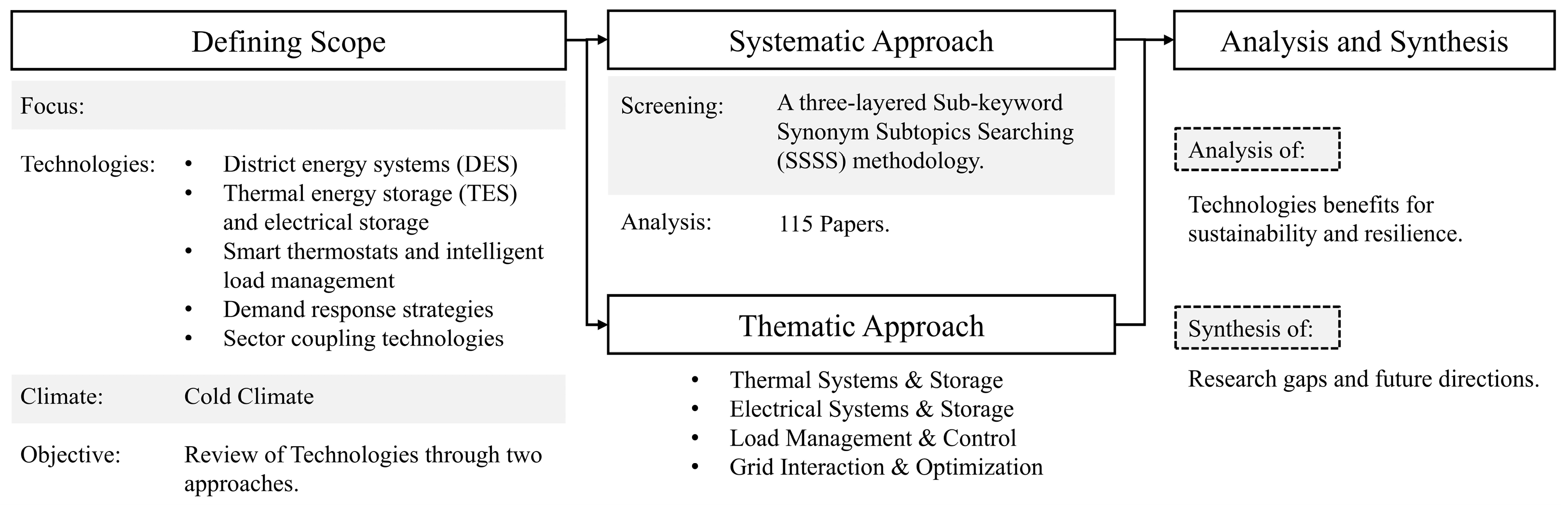
This study applies a combined systematic and thematic approach to review integrated CES. As shown in Figure 1, the scope defines key technologies, i.e., DES, storage, demand response, and sector coupling. These are focused on cold-climate contexts. A systematic review was conducted using the Sub-keyword Synonym Subtopics Searching (SSSS) method, in which three structured layers of sub-keywords were systematically combined to identify, screen, and select relevant studies in a manner consistent with standard systematic review practices [11]. In parallel, a thematic review organized findings into four main clusters: which are presented in Figure 1. The final synthesis connected these themes to provide a comprehensive perspective on CES, emphasizing their benefits for resilience and sustainability while identifying research gaps, technological pathways, and the importance of stakeholder involvement and user engagement.
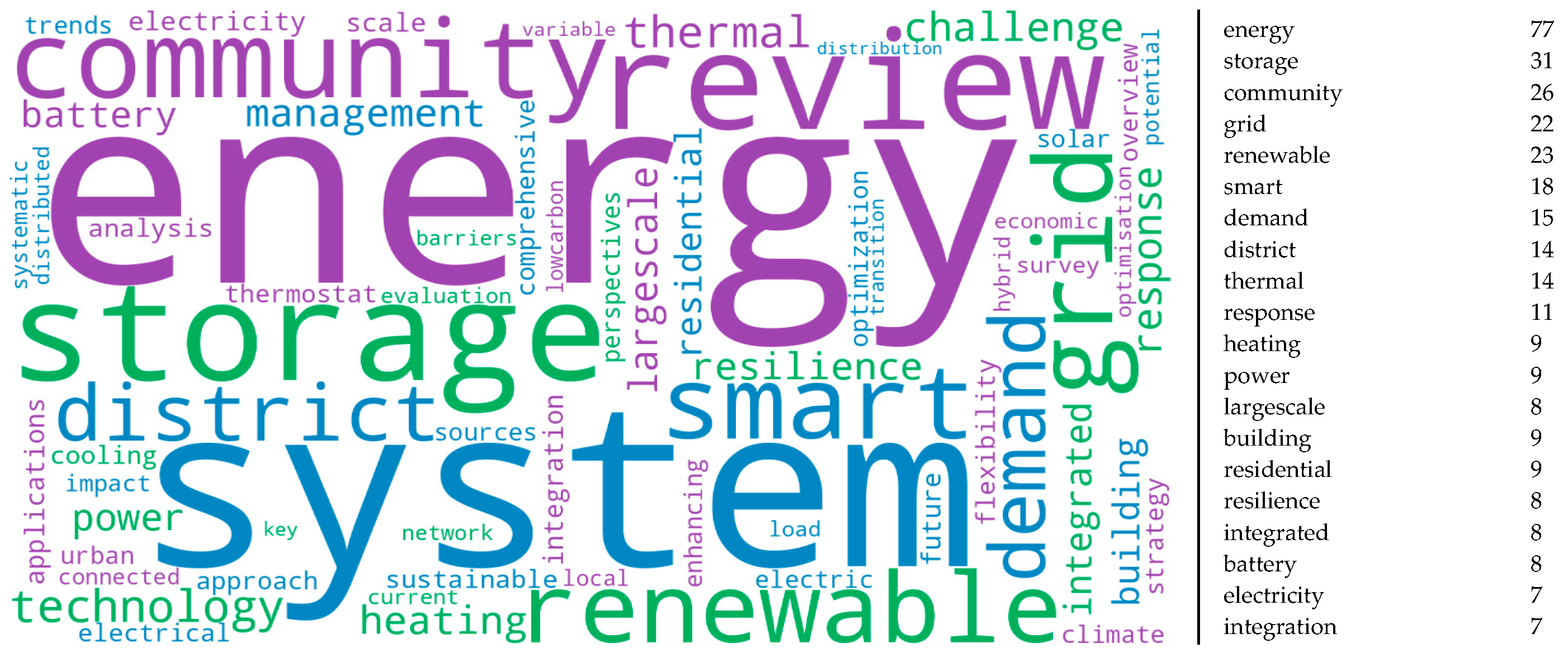
In Table 1, three layers of sub-keywords generated 300 combinations (5 × 5 × 12), with up to 20 papers retrieved for each combination between 2010 and 2024. From this initial pool, studies addressing community energy systems, grid stability, smart buildings, and policy frameworks were shortlisted through title, abstract, and keyword screening, resulting in 115 papers selected for in-depth review. Notably, few publications prior to 2015 examined community energy systems with flexible loads for grid services. To better visualize thematic emphasis, a word cloud analysis was produced from the publication titles, using lemmatization techniques to remove redundant terms. Figure 2 shows a word cloud of the reviewed papers, where word size is proportional to frequency of occurrence, highlighting the most dominant themes in the literature. Larger terms indicate recurring research focus areas, while smaller words represent less frequently discussed or emerging topics.
To ensure quality and relevance, clear inclusion and exclusion criteria were established. Only peer-reviewed journal and conference papers published between 2010–2024 were considered. Eligible studies focused on at least one of six thematic areas: district energy systems, TES, aggregated community energy loads, smart building controls, large-scale energy storage integration, or demand response strategies. Additional priority was given to studies addressing renewable integration, energy storage technologies, or digital control mechanisms such as smart thermostats and automated load management systems. Only English-language publications were included for consistency. Exclusions applied to non-English studies, editorials, opinion pieces lacking systematic analysis, fossil-fuel–centric studies without renewable or demand-side components, and the grey literature such as technical reports or non-peer-reviewed online sources, to maintain academic rigor. Together, the layered keyword construction, database searches, and explicit screening criteria ensure transparency and reproducibility of the literature selection process.

3. Thematic Review Sections

This section presents an integrated analysis of the foundational technologies of advanced community energy systems, shifting the focus from individual components to their synergistic operation for delivering grid flexibility, enhancing resilience, and enabling high renewable energy penetration. The section starts with thermal systems and storage, which dominate energy demand in cold climates, then covers electrical storage, load management and control, and finally, grid-level enablers that integrate community assets with markets. Throughout, sector coupling (i.e., P2H) and aggregation are emphasized as the mechanisms that turn buildings and districts into system-level flexibility resources.

3.1. Thermal Energy Systems & Storage

Thermal energy systems and storage are foundational components of integrated community energy systems, especially in cold climates where thermal loads dominate (Figure 3). The core strategy involves using P2H technologies and TES to convert and store surplus renewable electricity as heat. This process decouples heat generation from immediate use, allowing the community energy management system to reduce electricity curtailment and alleviate stress on the wider grid. This enhances the resilience and economic viability of CES and Renewable Energy Communities (RECs) [12,13].
Evidence from the literature indicates that supportive policy frameworks and market incentives play a critical role in enabling large-scale deployment of P2H and TES [10]. From an economic perspective, electrochemical storage systems require substantial capital investments when applied to long-duration storage applications. In contrast, Seasonal Thermal Energy Storage (STES) achieves substantially lower capacity costs, making it the most financially viable option for inter-seasonal energy shifting.

3.1.1. District Energy Systems

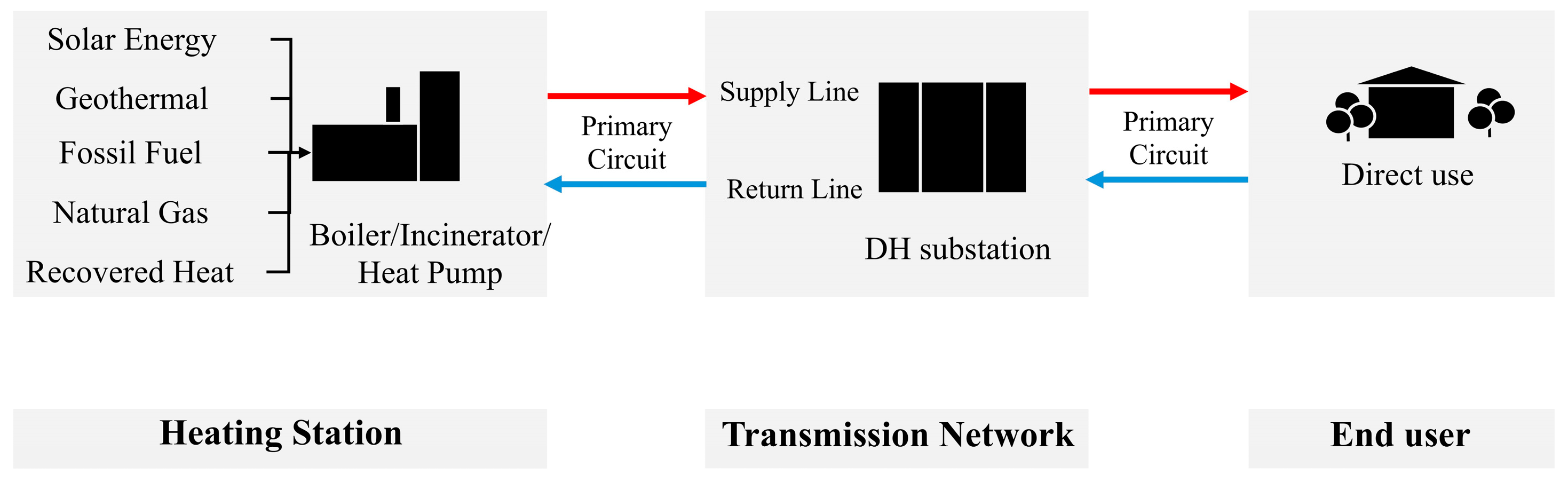
DES are crucial for community energy infrastructure, having advanced considerably through the integration of TES, hybrid cooling solutions, and fifth generation DES [14,15]. By providing scalable strategies to balance energy supply and demand, DES offer essential grid services such as frequency regulation, voltage support, and load balancing, thereby strengthening stability and efficiency [16]. Figure 4 illustrates key system components, including storage units, sources, distribution, and user interfaces related to DES.
The strategic importance of DES is particularly evident in their ability to enhance community autonomy by absorbing surplus renewable electricity through technologies like P2H [6,9], storing it as heat, and redistributing it when needed. This process transforms thermal demand into a grid-balancing resource and reduces renewable curtailment, which is especially valuable in cold-climate communities where heating demand dominates. Combined Heat and Power (CHP) systems further strengthen this autonomy by enabling simultaneous production of electricity and heat at the local level. This reduces dependence on centralized generation while improving overall energy efficiency and system resilience. Fifth generation DES models demonstrate a 65% reduction in GHG emissions [15]. Despite these benefits, DES face persistent challenges including high upfront costs, limited economic models, interoperability gaps, and fragmented regulatory frameworks [17,18,19]. Addressing these barriers requires coordinated policy instruments, digital integration platforms, and sustained community engagement which are discussed further in Section 5 [10].

3.1.2. Thermal Energy Storage

TES decouples heat generation from demand. This provides effective load leveling and peak shaving. The main forms of TES include sensible, latent (using phase-change materials), and thermochemical storage. Specific applications like Borehole and Aquifer Thermal Energy Storage (BTES and ATES) are crucial in Low-Temperature District Heating (LTDH) systems [20,21,22,23,24,25,26,27]. Across multiple applications, TES has been shown to enable high renewable penetration and substantial emissions reduction when integrated with P2H, CHP, and waste heat recovery systems [28,29,30]. Despite its strong system-level benefits, TES deployment is shaped by site-specific constraints, including capital cost, land availability, and the complexity of predictive control integration [26,27]. Tailored incentives and supportive regulatory frameworks are therefore essential to enable large-scale adoption of TES in low-carbon energy systems [19,28,30,31,32,33,34,35,36,37,38,39,40,41].

3.1.3. Power-to-Heat and Heat Pumps

Power-to-heat (P2H) technologies and heat pumps provide the primary interface between electrical and thermal systems in CES, converting surplus renewable electricity into usable heat. When combined with TES, these technologies enable short-term balancing via hot-water storage and long-duration shifting through seasonal storage systems such as BTES and ATES [6,29,42]. At the community scale, coordinated control of P2H and TES within Renewable Energy Communities enables dispatch optimization, load shifting, and emission reductions large district systems also demonstrate real-world absorption of excess renewables using electric boilers and high-COP heat pumps.
Performance of P2H and heat pumps is often evaluated using indicators such as COP, avoided curtailment in megawatt-hours, and responsiveness to dynamic pricing. Large-scale heat pumps typically achieve COP values between 2.5 and 4.5 under moderate conditions, illustrating their efficiency advantage compared with direct electric heating. Extreme cold temperatures may reduce air-source COPs to ~1.2–1.8 due to defrost cycles [6,43]. Deployment remains constrained by investment costs, integration challenges, and regulatory fragmentation, necessitating dynamic tariffs, targeted subsidies, and standardized cross-vector control frameworks [6,29].
It might be argued that direct combustion of biofuels or synthetic gas can achieve higher primary energy efficiency than the P2H pathway, particularly at very low ambient temperatures. Nevertheless, P2H provides significant environmental and sustainability advantages, including enhanced renewable energy utilization, emission reductions, and system flexibility. This highlights a clear trade-off between peak energy efficiency and broader sustainability goals: although direct fuel combustion may outperform renewable-based pathways during extreme cold events, the integrated renewable approach delivers greater long-term resilience, supports decarbonization targets, and promotes environmentally sustainable urban energy infrastructures.

3.1.4. Heat Demand Management

Heat demand management is a critical strategy for energy system optimization that involves strategically shifting electrical demand to thermal resource [22,44]. TES acts as a core enabler of demand-side management (DSM) by storing surplus electricity as heat across residential, district, and industrial applications. Advanced management strategies are applied at multiple scales. Within RECs, centralized control of heat pumps and TES optimize energy dispatch [34,35,44]. In Smart Community Energy Systems (SCES) shared storage enhances efficiency and equity [45], while at the residential level, automated load shifting reduces costs and maximizes self-consumption [46]. These approaches enhance flexibility, resilience, and cost efficiency, although deployment continues to be shaped by capital costs and regulatory fragmentation [47].

3.2. Electrical Systems & Storage

The modernization of electrical systems hinges on the large-scale deployment of energy storage technologies, which are critical for ensuring grid stability and accommodating high penetrations of variable renewable energy such as wind and solar. These storage systems provide fast-response balancing on short and medium timescales, enabling flexibility and reliability in real time [48]. Among the available options, battery energy storage systems (BESS) have become particularly prominent due to their modularity, rapid response times, and declining costs. Significant advancements in battery chemistries, management systems and Power Conversion Systems (PCS) now allow BESS to support grid-level functions including frequency regulation, peak shaving, and energy arbitrage [49].
Within Community Energy Systems (CES), electrical storage operates in close synergy with thermal systems. The critical link for this sector coupling is provided by P2H technologies, such as heat pumps and electric boilers, which convert surplus electricity from renewables into storable heat [50]. This captured thermal energy is then stored in TES systems allowing communities to decouple generation from demand and reduce curtailment (as discussed in Section 3.1).
Through this coordinated operation, BESS provide rapid balancing, while P2H and TES facilitate longer-term load shifting, transforming heating demand into a valuable grid service. The orchestration of these assets depends on smart grid infrastructures including advanced metering, communication networks, and control algorithms that manage real-time dispatch for efficiency and reliability [36]. Despite these advances, scaling electrical storage faces barriers such as high upfront costs, interoperability gaps, and fragmented regulation, requiring targeted policies, subsidies, and standardized frameworks. The following subsections examine electrical storage pathways, from battery-based solutions to hybrid and renewable-integrated configurations, within a thematic CES framework.

3.2.1. Battery Performance and Limitations

BESS are essential for grid stability, energy arbitrage, and resilience, as they provide storage capacity for both generated and distributed energy. Their viability across scales is assessed through metrics such as power and energy capacity (MW/MWh), cycle life, Levelized Cost of Storage (LCOS), and response time. BESS help mitigate renewable intermittency by absorbing surplus photovoltaic (PV) and wind energy, stabilizing supply, and reducing reliance on fossil peaking plants. At the community scale, they strengthen local stability, reduce transmission losses, and support demand response [51]. At the utility scale they focus on bulk shifting, peak shaving, and ancillary grid services.
Advances in Battery Management Systems (BMS) and PCS have increased efficiency and lifespan [37], while AI-driven dispatch is increasingly applied to optimize performance under variable conditions. Lithium-ion batteries (LIBs) dominate current deployment due to high energy density and fast response, whereas sodium-ion batteries (SIBs), sodium–sulfur (NAS), and flow batteries offer cost-effective or durable alternatives but remain limited by economic and scalability barriers [38].
Deployment in cold climates introduces distinct challenges. Sub-zero temperatures degrade Lithium-ion capacity and efficiency, necessitating auxiliary heating that creates parasitic loads. While BESS remains superior for rapid frequency regulation, these inefficiencies diminish its economic viability for long-duration winter storage compared to thermal options. Specifically, critical threshold is between −20 °C and −30 °C where the parasitic energy required for thermal management consumes 25–40% of the system’s daily throughput. Consequently, it pushes the system into ‘energy bankruptcy’ where heating costs exceed potential arbitrage revenue. This reinforces the importance of hybrid CES configurations, in which batteries address fast power fluctuations while thermal systems manage seasonal heating demand. Persistent challenges include capital costs, material supply constraints, and equity considerations in community ownership models.

3.2.2. Hybrid Storage Systems

Hybrid energy storage systems combine complementary technologies to manage energy across multiple timescales [40]. Common configurations include pairing TES with BESS, Pumped Thermal Energy Storage (PTES; electro-thermal systems), or Pumped Hydro Storage (PHS). In addition, hybrid solar plants, such as Concentrated Solar Power (CSP) combined with PV, TES, and BESS, provide dispatchable renewable generation [41]. By stacking services that range from fast-response batteries (seconds to minutes) to TES or seasonal storage (hours to months), hybrid systems strengthen both flexibility and resilience. Their competitiveness depends on reducing costs and securing multiple value streams, which are typically assessed through combined Levelized Cost of Storage, revenues from stacked services, and system reliability indices.

3.2.3. Renewables and Storage in District/Community Networks

Integrating renewable energy sources with storage in district thermal networks and community energy networks is crucial for reducing curtailment, enabling islanding, and balancing local feeders [39]. Smart grid integration enhances demand-side flexibility and local balancing, while decentralized configurations improve energy access and reliability in both urban and rural areas [52]. System performance is commonly assessed through reductions in renewable curtailment, increased shares of renewable energy, and reliability indicators such as SAIDI and SAIFI. In CES, microgrids supported by TES and BESS provide localized backup during outages, enabling islanded operation during extreme weather and maintaining critical services [53]. In summary, renewable–storage integration strengthens grid stability, supports higher renewable penetration, and enhances the resilience of community energy systems against climate risks and grid disruptions.

3.3. Load Management & Control

Load management and control transform energy demand into a dynamic, controllable resource, allowing communities to optimize the use of storage, enhance flexibility, and support renewable integration. Within CES, these strategies ensure that consumers, buildings, and aggregated loads actively contribute to grid stability while improving local resilience. Key enablers include smart thermostat technologies, demand response programs, aggregated community loads, and microgrid islanding, each addressing a different layer of flexibility from individual households to community-wide systems.

3.3.1. Smart Thermostats and Thermal Inertia Utilization

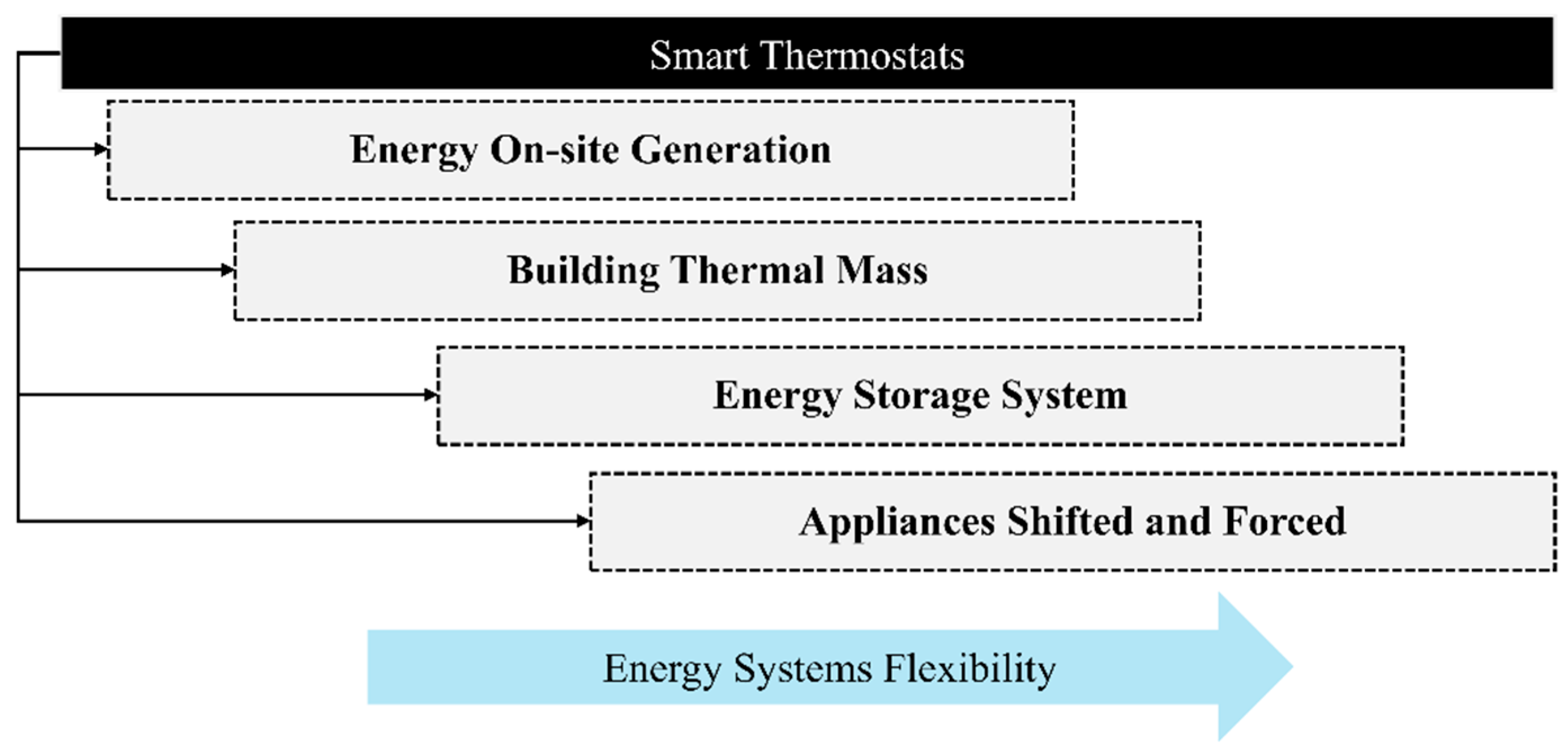
Smart thermostats have emerged as key enablers of energy-efficient building management, reducing GHG emissions and supporting demand-response integration by aligning HVAC operations with real-time grid conditions, predictive analytics, and thermal modeling [54,55,56]. Their effectiveness is enhanced when integrated with on-site generation, TES, batteries, EVs, and appliance load management [57]. This can increase the overall flexibility of energy systems (Figure 5). AI-driven approaches further enhance performance through demand forecasting, load optimization, and smart appliance coordination with the grid [58].
In cold climates, the value of smart thermostats is amplified by the high thermal inertia of well-insulated building envelopes. Unlike cooling-dominated contexts, cold-climate buildings can maintain indoor comfort for extended periods without active heating, enabling pre-heating during periods of surplus renewable generation or low electricity prices. This effectively allows the building fabric to function as a short-term thermal storage resource during winter peak periods. Economic feasibility remains a decisive factor, as benefits are particularly evident in cold, high-cost regions [55]. Incentives and regulatory support are critical to offset upfront costs and address payback uncertainties [54,59].
User engagement plays a critical role in realizing these benefits. While active participation improves energy savings and peak load reduction, adoption is often hindered by interface complexity, privacy concerns, and limited awareness. Studies suggest that gamification, real-time feedback, and incentive programs can effectively drive behavioral change [60]. Scaling deployment further requires interoperability standards and data-driven control frameworks, including predictive analytics and integration with TES and P2H to extend flexibility across thermal and electrical domains [44,57,58,61,62,63,64].

3.3.2. Demand Response & Grid Stability Applications

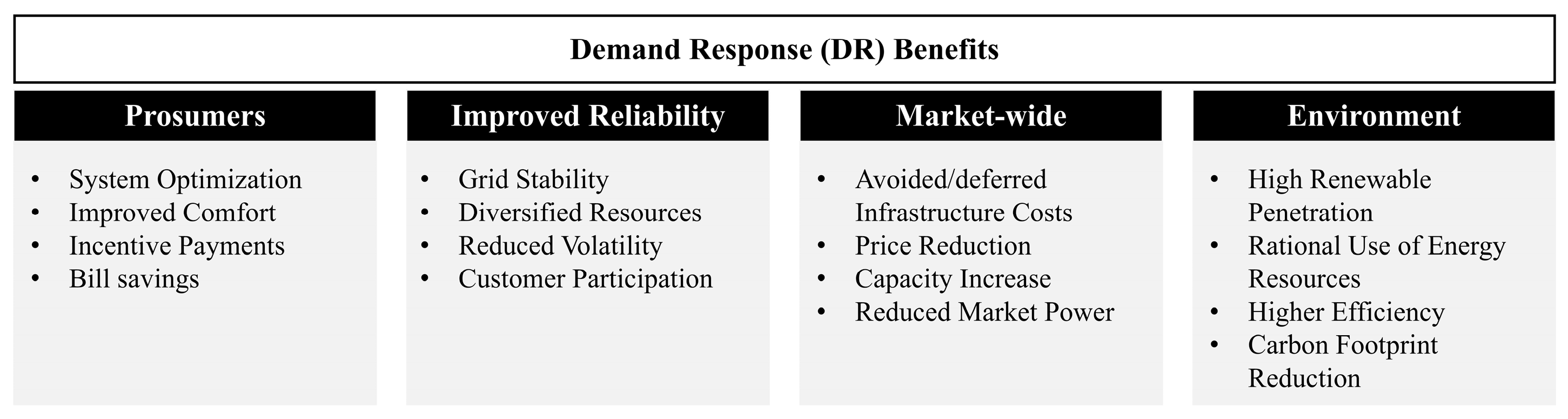
Demand Response (DR) is a key element in CES, enhancing grid stability, renewable integration, and cost efficiency for both utilities and consumers [65] (Figure 6). DR strategies are categorized as price-based Time-of-Use (TOU), Real-Time Pricing (RTP), and Critical Peak Pricing (CPP) or incentive-based such as direct load control, and demand bidding [66,67]. These approaches rely on enabling infrastructure including Advanced Metering Infrastructure (AMI), Automated Demand Response (ADR), and building or energy management systems [68,69,70]. Optimization techniques range from classical control algorithms to AI-based and hybrid approaches [67].
Decentralized demand response (DR) that uses Model Predictive Control (MPC) and Reinforcement Learning (RL) enhance user autonomy but introduce challenges related to privacy, incentives, and trust [65]. DR can also provide ancillary services such as frequency regulation, which helps stabilize the grid during fluctuations [70]. The integration of Artificial Intelligence and the Internet of Things (AIoT) enable real-time data analysis, predictive load forecasting, and adaptive controls that are essential for managing renewable variability and minimizing curtailment [71,72]. Complementary advances in edge computing, machine learning, and 5G communication enhance responsiveness and scalability [73]. Despite these capabilities, large-scale deployment remains constrained by high infrastructure costs, interoperability gaps, cybersecurity vulnerabilities, and regulatory uncertainty [74]. Addressing these barriers requires clear [75,76] clear standards, financial incentives, and participatory governance frameworks to ensure consumer trust and equitable participation. Ultimately, DR operates at the intersection of technology, policy, and behavior, and its effectiveness depends as much on governance structures as on technical innovation [77,78].

3.3.3. Aggregated Community Loads

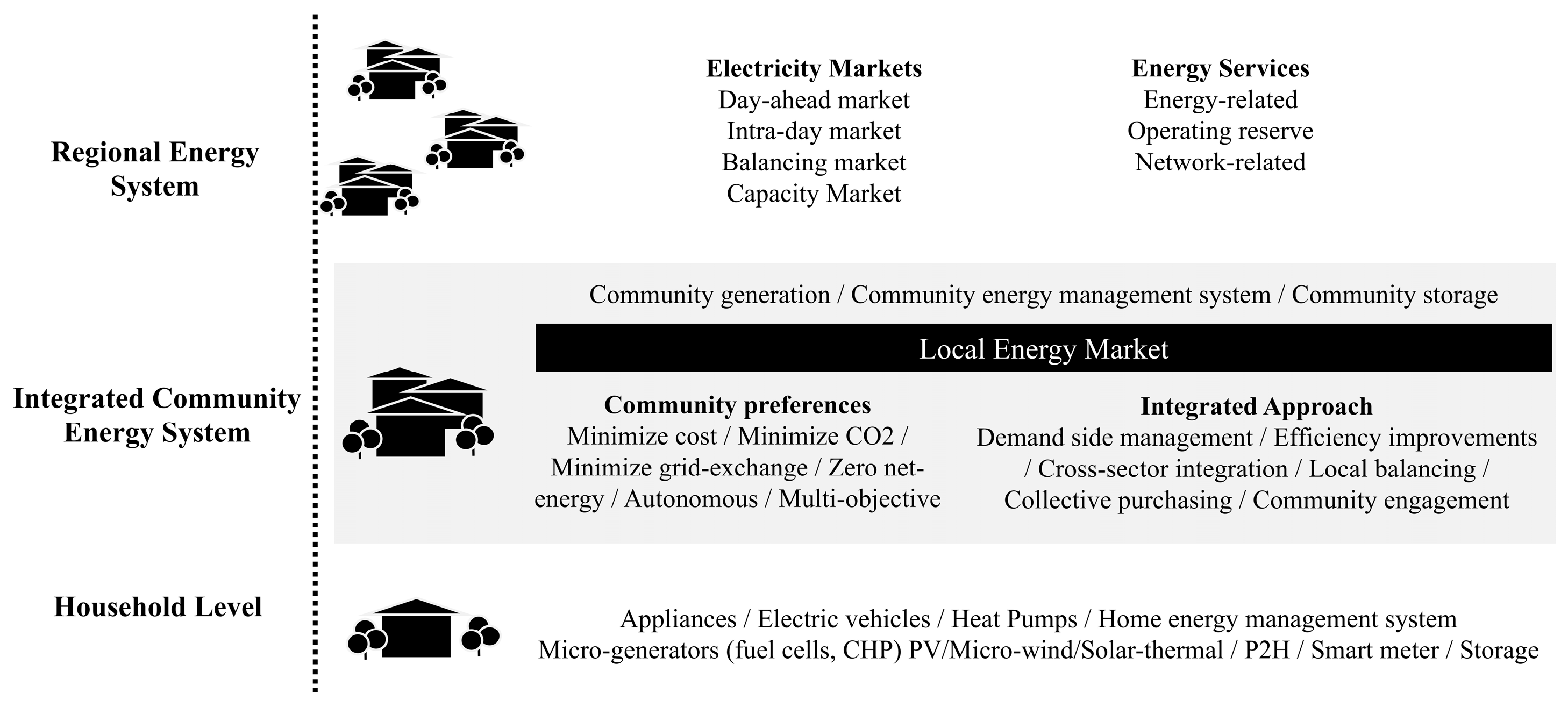
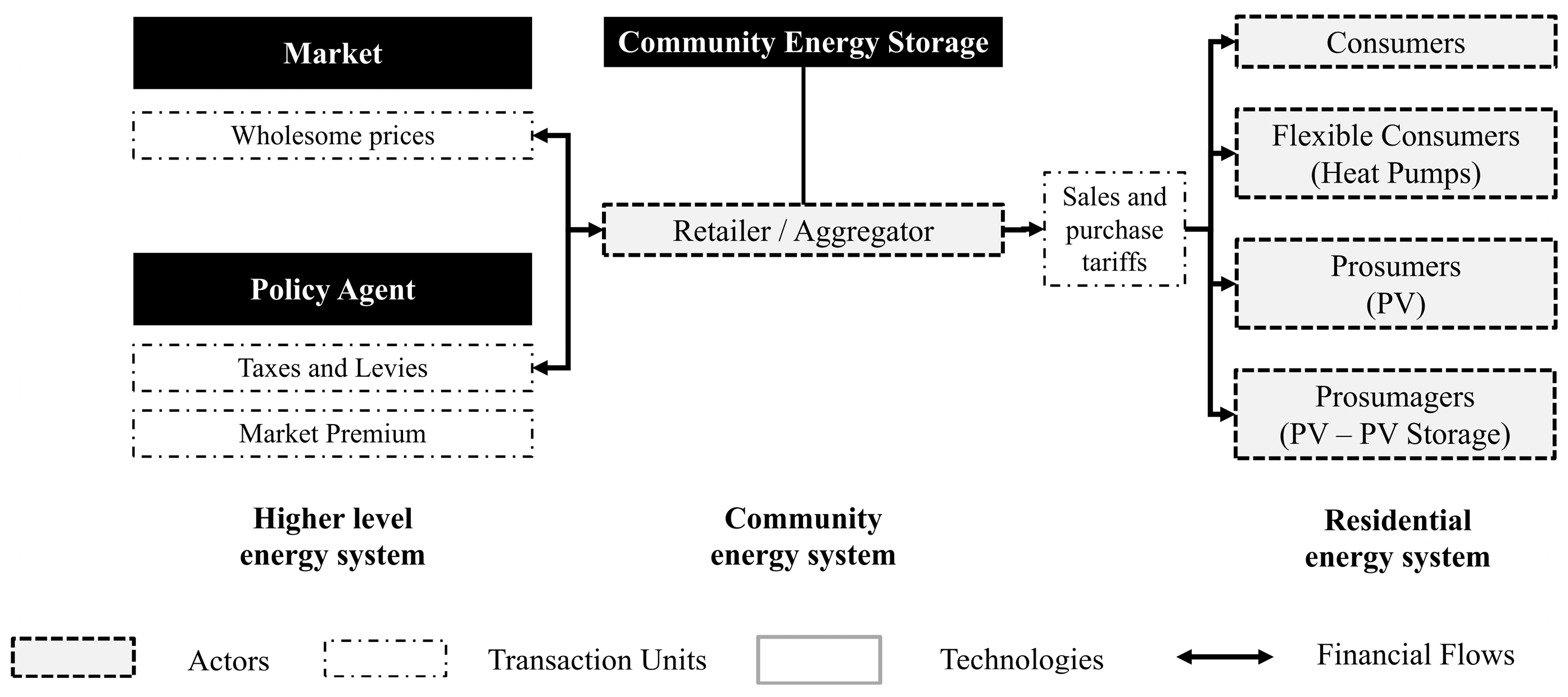
Aggregated community energy models, including Renewable Energy Communities (RECs) and Virtual Power Plants (VPPs) enable distributed resources s to operate collectively, enhancing grid reliability and resilience [79,80] (Figure 7). Their primary function is to aggregate solar PV, storage assets, and demand-side flexibility, supported by digital infrastructure such as smart meters, energy management systems, and predictive analytics [81,82]. Research demonstrates that aggregation improves load predictability and system reliability, particularly when supported by advanced forecasting and appropriately sized community storage systems [83,84].
Aggregated systems face significant face persistent socio-technical barriers including low consumer engagement, interoperability challenges, and high upfront costs [85,86]. Policy-driven solutions such as standardized participation frameworks, incentives for shared storage, and clear aggregator definitions are critical to long-term success [52,87,88,89]. These challenges underscore the importance of equitable governance and behavioral alignment within CES.

3.3.4. Microgrids & Islanding

Microgrids with islanding capabilities strengthen community resilience by integrating renewables, BESS, and TES to operate independently of the main grid when needed [39,87,88]. This ensures localized energy security and reduces reliance on centralized infrastructure, particularly during outages or extreme weather events [89]. Within cold-climate contexts, the integration of TES is particularly critical, as it ensures continuity of heating services during prolonged outages, while BESS primarily support electrical backup [70].
Microgrid flexibility is further enhanced by IoT-enabled demand-side management (DSM), AI-driven analytics, and 5G communication which optimize load allocation and reduce single points of failure [73]. This is particularly important for critical facilities like hospitals and data centers. Despite these advantages, deployment remains shaped by regulatory inconsistency, coordination complexity, investment costs, and cybersecurity concerns.

3.4. Grid Interaction for Community Energy Systems

As extreme weather events and grid disruptions intensify, energy system resilience has become a critical dimension of climate adaptation. Within Community Energy Systems (CES), resilience depends on integrating distributed energy resources (DERs), DES, advanced storage, and smart grid infrastructure into cohesive frameworks [90]. Ongoing grid digitalization through demand-side management, IoT-enabled monitoring, and self-healing technologies enhances system observability, controllability, and adaptive response [74].
In cold climates grid interaction is increasingly defined by resilience against winter storm events. Unlike summer outages where cooling is largely a comfort issue, winter outages pose immediate safety risks, such as pipe freezing and hypothermia. Therefore, CES in these regions must prioritize “passive survivability”, defined as the ability of the system to maintain critical heating loads using islanded PV and stored thermal energy during extended grid failures. This specific resilience requirement dictates larger storage sizing and more robust thermal backbones compared to systems designed for temperate climates.
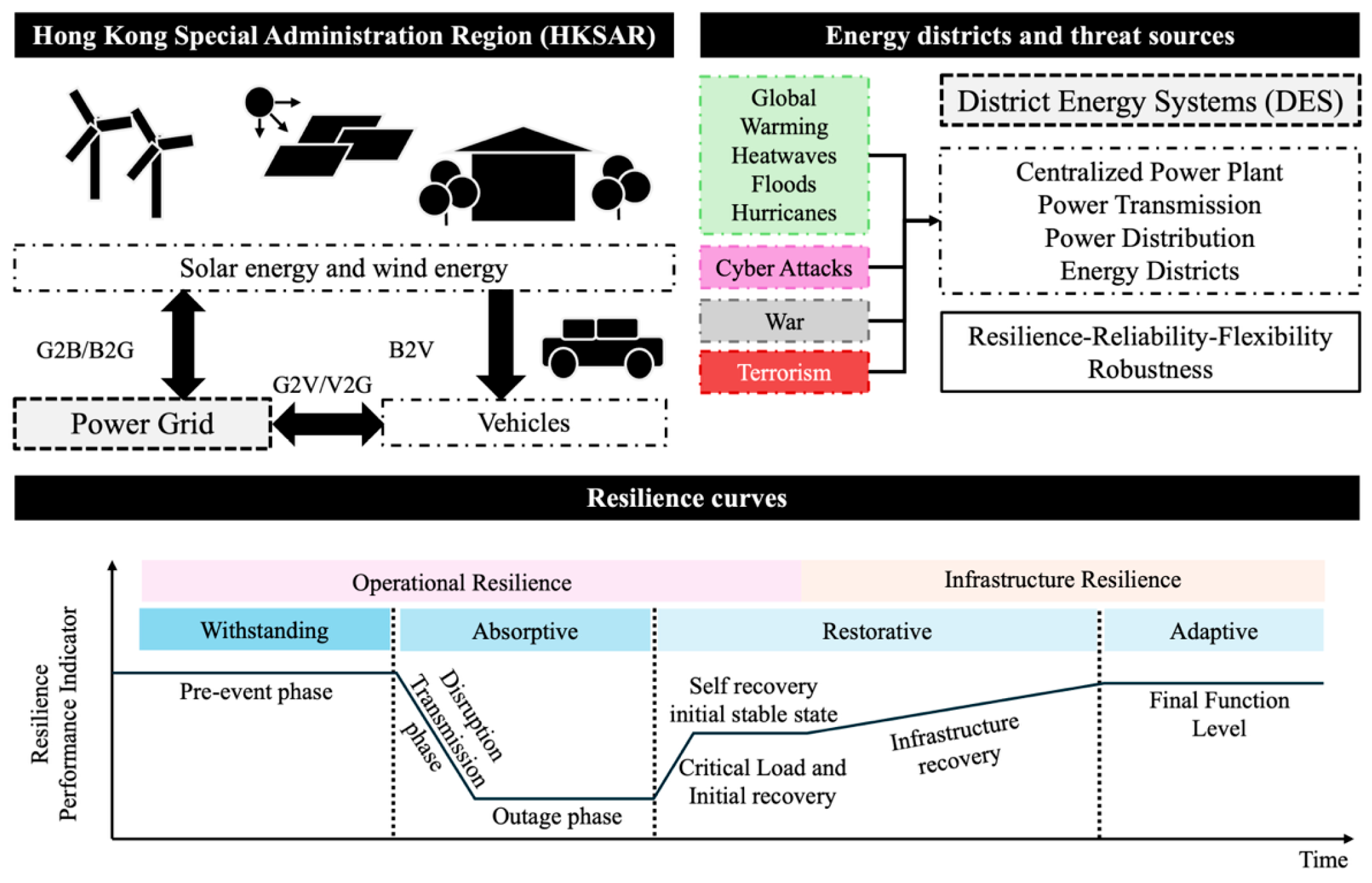
These technologies are most effective when deployed through two structural strategies: decentralization and grid flexibility (Figure 8). Decentralization is driven by microgrids and community-based energy systems and it reduces single points of failure and strengthens local control [87,91]. In parallel, grid-interactive approaches link DERs and sector-coupled systems, expanding opportunities for resource sharing across electricity, heat, and mobility [90]. Smart grids add another layer of adaptability, providing AI-driven management, predictive analytics, and automated fault detection to maintain supply during disruptions [91,92]. Realizing these benefits requires alignment between technical integration, regulatory frameworks, and community participation (see Section 5). The following subsections examine grid-interaction mechanisms thematically.

3.4.1. Smart Grid Technologies

Smart grid technologies are foundational to energy system modernization, enabling renewable integration, demand-side flexibility, and long-term resilience [5,51]. By transforming energy demand from a passive load into a controllable and optimizable resource, smart grids provide ancillary services such as frequency regulation and peak shaving through real-time monitoring, adaptive control, and machine learning–based optimization [38,69,71]. Smart grids enable coordinated [NO_PRINTED_FORM]operation of both Thermal Energy Storage (TES) and BESS by leveraging predictive analytics and real-time coordination. Furthermore, they support new market models, such as P2P energy trading that uses blockchain and IoT-based smart contracts for secure transactions [93,94].
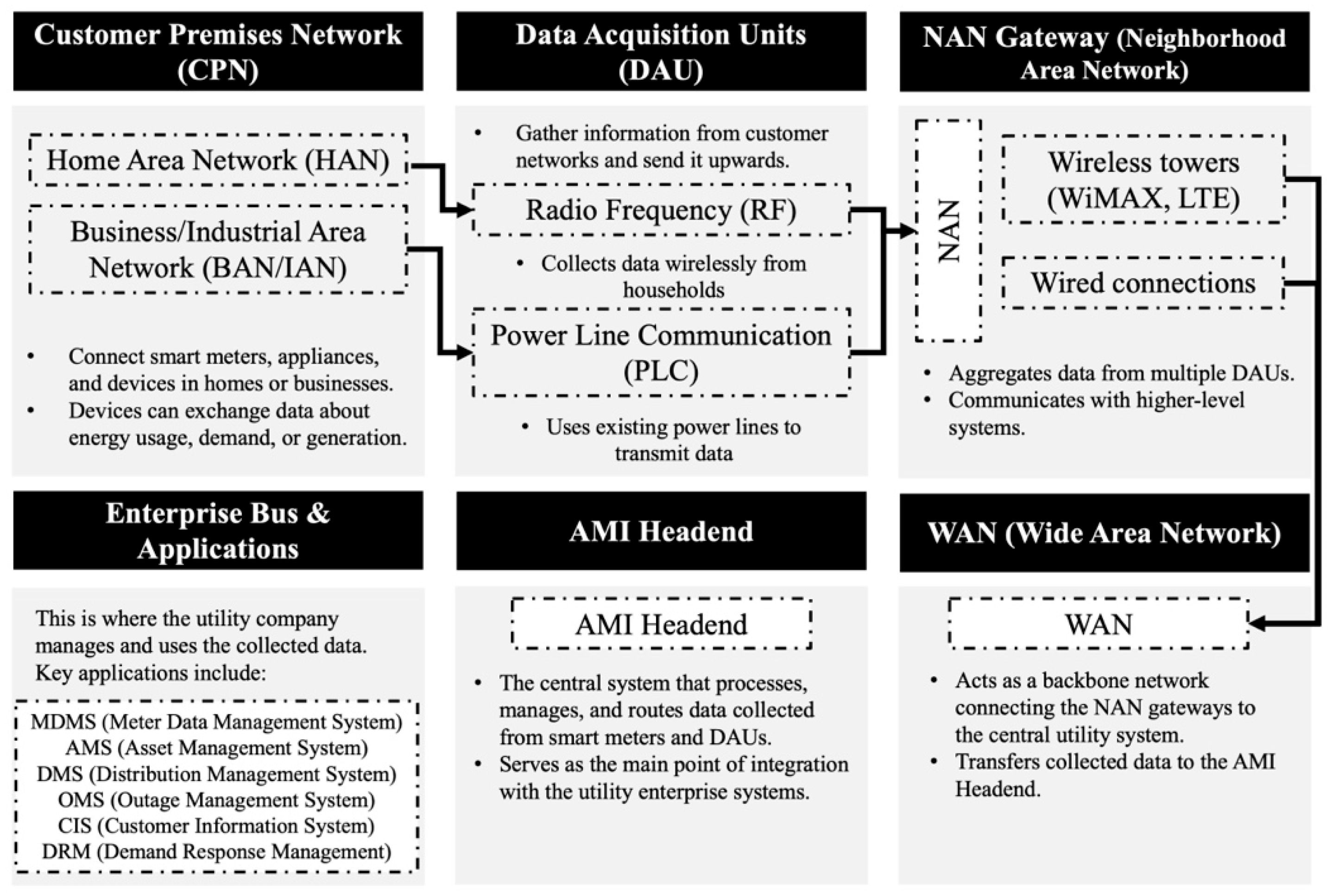
The smart grid relies on a layered technological architecture. At its core, AMI enables two-way communication between utilities and consumers, while the IoT provides real-time monitoring and analytics. AI/ML support forecasting and optimization, all connected through a communication backbone from Home Area Networks (HAN) to Wide Area Networks (WAN) for scalable operation [95]. Complementary technologies include blockchain to secure decentralized markets and cloud/edge computing to expand flexibility in managing DERs [74,76].
While smart grids improve efficiency through automation [76] and enhance resilience by supporting microgrid operation, deployment remains constrained by high upfront costs, cybersecurity risks, interoperability challenges, and outdated regulatory frameworks. Technical limitations such as data latency and forecast uncertainty also persist. Smart grid platforms are already deployed in DES, RECs, and Virtual Power Plants, aggregating distributed assets for grid services [86]. Their continued evolution depends on deeper integration of AI, blockchain, and IoT, supported by adaptive policy reform.

3.4.2. Non-Wire Alternatives (NWAs) for Grid Expansion Mitigation

Non-wire alternatives (NWAs) offer a cost-effective strategy for managing rising energy demands by deferring or avoiding traditional transmission and distribution investments [96]. The core strategy involves coordinated deployment of DERs, demand-side management, and energy efficiency measures to optimize existing infrastructure capacity [97]. DSM strategies like time-of-use pricing reduce grid stress by shifting consumption away from peak periods, while DERs such as rooftop solar and CHP enhance local generation. When paired with storage, these resources improve both flexibility and energy independence. In urban contexts, efficiency measures combined with smart technologies and hybrid systems have proven effective at improving performance, achieving high renewable penetration, and delivering significant cost savings [23,27,98,99]. Scaling NWAs requires strong public–private collaboration and regulatory clarity, positioning them as a key pathway for community-centered grid modernization.

3.4.3. P2P Trading & Decentralized Markets

Peer-to-peer (P2P) energy trading models enable consumers to act as prosumers, allowing surplus electricity to be exchanged directly within local markets [93,100,101]. Enabled by blockchain-secured transactions, IoT-based smart contracts, and dynamic pricing frameworks, P2P markets reduce reliance on centralized utilities and enhance local autonomy [94].
Within CES, P2P trading supports local balancing, reduces transmission losses, and strengthens community engagement through participatory governance and co-ownership models [85]. However, regulatory uncertainty, limited scalability beyond pilot projects, cybersecurity risks, and data privacy concerns continue to constrain broader deployment. Long- term effectiveness is typically assessed employing indicators such as transaction volume, settlement cost, and user retention, indicators of long-term viability.

3.4.4. Multi-Energy Systems

Multi-energy systems (MES), often referred to as energy hubs, provide an advanced framework for cross-vector optimization by integrating electricity, heat, and gas networks into a single, resilient infrastructure. By coupling technologies like heat pumps, CHP, photovoltaics, and various forms of storage, MES enable optimized energy flows across multiple carriers. Technical potential of MES is well established, but scaling deployment remains constrained by capital intensity, regulatory barriers, and coordination complexity [102]. Incentive mechanisms, including thermal storage subsidies, carbon pricing, and digital market platforms, play a critical role in enabling adoption [94,102,103]. Transparent communication and community engagement are equally essential to ensure social acceptance and long-term system viability.

4. Cross-Cutting Insights & Synthesis

This section synthesizes how thermal, electrical, and digital components interact to deliver winter resilience, multi-timescale flexibility, and grid services in cold-climate community energy systems.

4.1. Technological Synergies

The integration of thermal, electrical, and digital technologies adds layered flexibility to community energy systems, supporting higher renewable penetration, lowering costs, and strengthening resilience. Previous research shows that technologies deliver the greatest benefits for net-zero pathways when combined synergistically rather than used in isolation [103]. This section explains the mechanisms by which these technologies interact to create added value, focusing on three primary synergy mechanisms. It is important to note that such synergies are not easily quantified as they strongly depend on operational context, temporal scale, and system configuration.

4.1.1. Smart Technologies Integration

The synergy of smart technologies begins at the building and appliance level, primarily through the intelligent control of thermal loads. Smart thermostats and building controls use predictive analytics and thermal modeling to align the operation of HVAC and P2H systems with real-time grid signals [54,55,56,64]. This automated coordination enables effective load shifting, reduces peak demand, and increases the utilization of renewable energy, often in conjunction with TES to decouple heat generation from immediate use [44,57,64]. At the residential scale, automated appliance scheduling further empowers consumers to reduce costs and maximize self-consumption [104]. Digital control transforms building thermal inertia into an operational flexibility resource by enabling heating demand to be shifted in time relative to electricity supply. In cold climates, this mechanism is particularly effective during winter peaks, where pre-heating and controlled thermal storage reduce instantaneous electrical demand without compromising indoor comfort.
These building-level capabilities are then aggregated and optimized at the community scale through shared resources and centralized management. Within Renewable Energy Communities and Smart Community Energy Systems (SCES), the centralized control of assets like TES and heat pumps improves energy dispatch and ensures equitable access to flexibility services [43]. Shared Energy Storage (SES) models further enhance the overall efficiency and economic viability of these community systems by facilitating energy sharing and demand response [46].
At the system level, a broader suite of smart grid technologies that enable advanced market models and cross-vector optimization. Core components like AMI, the IoT, AI/ML, and blockchain are essential for operationalizing MES and P2P trading. These technologies provide two-way communication, real-time monitoring, predictive forecasting, and secure transaction capabilities needed to coordinate electricity, heat, and storage, thereby enhancing system-wide flexibility and improving local balancing [95].

4.1.2. Hybrid Systems Across Timescales

Coupling thermal and electrical storage across different timescales creates a layered and resilient system [91,92]. In practice, this is achieved through hybrid solutions and MES that “stack” grid services [103]. MES optimize energy flows across electricity, heating, and gas by integrating technologies such as heat pumps and CHP [25].
An important component of this layering is Thermal Energy Storage (TES). This includes Sensible Heat Storage (SHS) used in CSP, higher-density Latent Heat Storage (LHS), and newer options like PTES [105,106]. At the community level, Seasonal TES (STES) is essential for long-term energy balancing. In parallel, Electric Energy Storage (EES), led by LIBs, provides fast-response capacity [38,107]. Hybrid systems that combine TES and BESS are gaining attention. They offer resilient, dispatchable power by using the strengths of both storage types [41]. The underlying mechanism of hybrid TES–BESS is composed of timescale specialization, where fast electrochemical storage manages short-term variability while thermal storage absorbs longer-duration and seasonal imbalances.
This layered design shows the complementary roles of each storage type: BESS provides short-term stability, TES manages medium-duration balancing, and STES ensures seasonal capacity. Innovative frameworks like SESTIN further validate this synergy. They demonstrate the efficiency gains from combining TES and BESS in integrated systems. The deployment of these technologies is guided by methods such as Levelized Cost of Storage [108]. However, progress is slowed by high costs and regulatory gaps [109,110]. Addressing these barriers requires a mix of policies, including subsidies [49,106], R&D investment [111,112], and updated regulations that rewardstorage for grid services [110]. Ultimately, large-scale adoption depends on continuous innovation and strong public–private partnerships.
Table 2 summarizes these synergistic relationships, highlighting the functional division between technologies. While BESS dominates fast frequency regulation, the analysis confirms that Seasonal TES and P2H are superior for winter peak shaving and seasonal load shifting. Furthermore, resilience strategies for cold climates benefit most from microgrid islanding and smart thermostats, which leverage passive survivability better than standalone electrical storage.

4.1.3. Decentralized Resilience

Integrating DES, TES, and BESS within microgrids enhances local autonomy while maintaining overall grid stability. DES with TES addresses long-term and seasonal demand shifts, whereas BESS provides fast, second-level response to short-term variability, and dynamic simulations confirm that this DES–BESS pairing improves grid resilience, dynamic reliability, and voltage support [16,86]. Microgrids equipped with islanding capabilities leverage TES, BESS, and renewable generation to operate independently of the main grid, ensuring localized energy security during outages [90].
Several synergistic strategies underpin decentralized resilience. First, the combination of DES as a thermal backbone with BESS as a rapid-response resource allows multi-timescale balancing, enhancing grid reliability and enabling the provision of ancillary services. Second, TES integrated with microgrids, and islanding functions ensure thermal continuity during disruptions, while BESS and on-site renewables sustain electrical supply, collectively increasing local resilience and backup capability [51]. Third, the deployment of NWAs, such as demand-side management measures and DERs, in combination with DES and strategies like pre-cooling, shifts peak loads and defers grid upgrades, providing cost-effective relief to local networks [113].
Together, these integrated approaches illustrate how decentralized energy systems, leveraging multi-vector storage and smart grid functionalities, can enhance community-level resilience while supporting broader system stability. Mechanistically, decentralized resilience emerges from the spatial and functional decoupling of energy services, where thermal continuity is maintained through DES and TES, while electrical reliability is ensured via BESS and islanding-capable microgrids. This separation of functions allows communities to withstand prolonged outages and extreme cold events more effectively than centralized, electricity-only solutions.

4.2. Pathways for CES Deployment (Cold-Climate Regions)

This section translates the previously discussed technological synergies into concrete deployment pathways tailored for cold climates. Rather than presenting these technologies as equivalent options, they are organized here as a hierarchy of necessity for northern latitudes. In heating-dominant regions, system design must explicitly address winter peak demand, long-duration thermal loads, and resilience during extreme cold events.
Foremost is the establishment of a DES as a “Thermal Backbone” which is a critical infrastructure for dense cold-climate cities where decentralized electric heating alone creates unmanageable winter peak loads [110]. By contrast, in warmer climates, distributed cooling and short-duration electrical flexibility often play a dominant role, reducing the need for large shared thermal infrastructures.
It outlines pathways for developing CES: (1) building integrated systems around a DES as a thermal backbone; (2) implementing thermal-electrical coupling through P2H technologies; and (3) deploying enabling grid technologies to provide advanced grid services. These pathways are not mutually exclusive; rather, they represent layered strategies that can be combined depending on urban density, climate severity, and governance context. Their effectiveness is supported by real-world case studies discussed in Section 4.3.

4.2.1. DES-Based Integrated Energy Systems Pathway

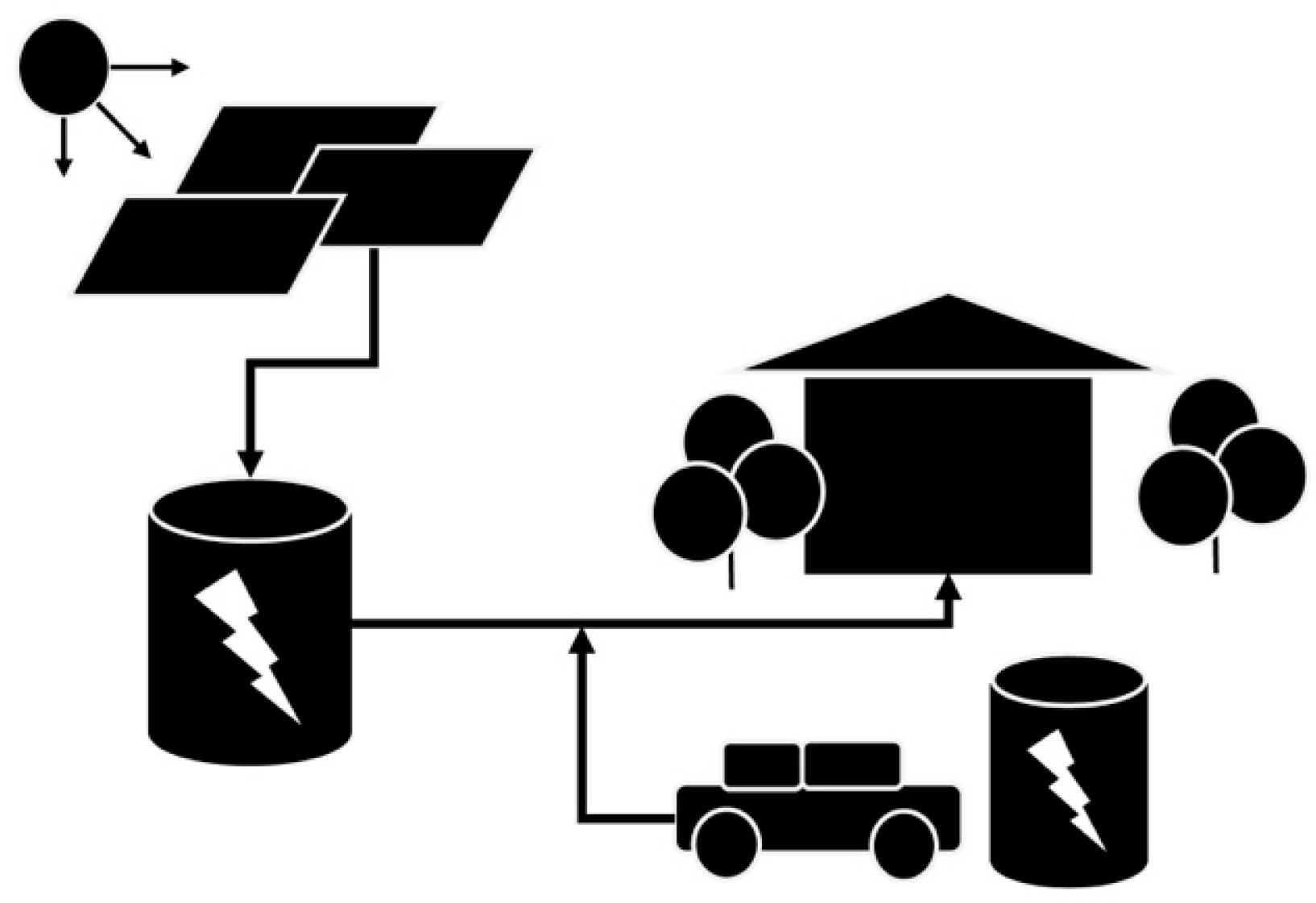
The DES-based pathway is a primary strategy for decarbonization and grid support in cold climates. In practice, DES integrated with CHP and TES have shown strong decarbonization potential [39]. These systems provide valuable grid services like frequency regulation [114] and are effective in supporting rural energy access [115]. Beyond their technical functions, they also deliver socio-economic benefits by lowering costs and enabling community-centric models like P2P trading that strengthen participation and equity. Figure 9 illustrates this system-of-systems framework, where PV generation, storage, and household consumption are coordinated to improve efficiency.
This DES backbone is often complemented by other decentralized assets, such as CES, which play a direct role in renewable integration and grid balancing [51,83]. Specific examples include hybrid mini grids that expand energy access [52] and community batteries that improve local stability [116]. A particularly powerful synergy within these integrated systems is the combination of the slow, high-capacity thermal backbone of DES with the rapid electrical response of BESS [42]. This pairing is highly effective for managing renewable intermittency across different timescales [16]; DES with TES addresses long-term demand shifts, while BESS provides second-level response to short-term variability [87,91]. Dynamic simulation models and optimization frameworks confirm that this integration improves grid stability, reduces downtime, and enhances dynamic reliability, demonstrating the value of multi-vector integration [13].
Despite the clear benefits of this integrated pathway, its deployment faces significant challenges. High capital costs for both DES and CES infrastructure remain a primary barrier [83,115]. Furthermore, interoperability issues between thermal and electric networks add technical complexity [42,114], while existing regulatory frameworks often favor centralized generation, which can limit community-scale adoption [39]. Overcoming these barriers requires a concerted effort involving policy reforms, targeted subsidies, and strong community engagement.

4.2.2. Thermal–Electrical Coupling Pathway

The thermal–electrical coupling pathway leverages P2H technologies and large-scale heat pumps to absorb excess renewable electricity into TES, providing both short- and long-term grid balancing. Coupling P2H and TES with BESS reduces renewable curtailment and manages intermittency across multiple timescales. Large district systems demonstrate real-world implementation of this approach, using electric boilers and high-COP heat pumps to convert surplus renewable generation into heat. Denmark’s district heating sector, for example, utilizes large heat pumps and TES to electrify space heating and store surplus wind and solar energy as thermal energy.
Sector coupling is central to this pathway, turning buildings and districts into system-level flexibility resources by integrating P2H, TES, and MES [6,10,13]. By decoupling heat production from immediate consumption, TES lowers operational costs while enhancing flexibility and efficiency [31]. The critical enabler of this mechanism is P2H technology, including heat pumps and electric boilers, which convert excess renewable electricity into storable thermal energy, thereby linking the electrical and thermal sectors for optimized, multi-vector energy management [50].

4.2.3. Enabling Technologies for Grid Services Pathway

Smart grid technologies are essential for enabling the grid services offered by community energy systems [51,95,117]. The core enabling technologies include AMI for two-way communication, Energy Storage Systems (ESS) to stabilize fluctuations, and Distributed Generation (DG) to enhance local resilience. These are orchestrated by AI-driven automation, predictive maintenance, and layered communication networks to ensure seamless control [51,95] (Figure 10).
Beyond these core functions, smart technologies also enable advanced services. Power-to-X (P2X) solutions help balance supply and demand, while Vehicle-to-Grid (V2G) systems transform electric vehicles into mobile storage assets [51,117]. At the community scale, blockchain-enabled P2P trading enhances transparency, while 5G and AI improve microgrid coordination [95]. However, the deployment of these technologies faces specific technical hurdles, primarily interoperability and communication issues between diverse platforms [79], as well as heightened cybersecurity risks associated with widespread IoT and cloud dependence [117].

4.3. Case Studies on CES

This section presents illustrative case studies that demonstrate how the deployment pathways outlined in Section 4.2 are realized in practice. Rather than offering a comprehensive comparative evaluation, these cases are used to validate key integration mechanisms, highlight enabling conditions, and extract transferable lessons for cold-climate community energy systems.

4.3.1. DES-Based Thermal Backbone and Sector Coupling

Denmark’s district heating (DH) systems exemplify the DES-based integrated energy systems pathway (Section 4.2.1), where large-scale thermal networks act as a system-level flexibility resource. The widespread integration of large heat pumps and electric boilers enables surplus wind and solar electricity to be converted into heat through Power-to-Heat (P2H), which is subsequently stored in Thermal Energy Storage (TES) [118]. This configuration directly addresses winter peak demand by decoupling heat production from consumption, reducing renewable curtailment while stabilizing the electricity grid [31].
Denmark’s success is not solely technological but institutional and structural. Long-term policy consistency, carbon pricing, and strong municipal ownership models enabled coordinated investment in DES infrastructure and large shared TES. These conditions allowed thermal systems to function as a slow, high-capacity balancing layer, complementing faster electrical flexibility. As discussed in Section 4.1.2 and Section 4.2.2, this timescale specialization is critical in cold climates, where seasonal heating demand dominates system design. Regions seeking to replicate this model require not only P2H and TES technologies, but also regulatory frameworks that reward thermal flexibility and enable coordinated, community-scale ownership of infrastructure [16,32].

4.3.2. Context-Dependent DES Integration

Norway provides a contrasting example that highlights the importance of regional context. Urban DH systems in Oslo and Drammen integrate waste incineration with carbon capture and fjord-based heat pumps, respectively [119,120]. These projects demonstrate the technical feasibility of DES integration with renewable and low-carbon heat sources.
However, Norway’s abundant hydropower has reduced the economic urgency for large-scale DES expansion. As a result, DH penetration remains limited compared to Denmark. This case underscores that DES deployment is not universally optimal, but most effective where electrification alone would exacerbate winter peak loads [121]. DES-based pathways (Section 4.2.1) are most compelling in regions where electricity systems face seasonal stress from heating demand, reinforcing the climate-specific framing of this review.

4.3.3. Microgrids for Decentralized Resilience

The community microgrid in Panton, Vermont illustrates the decentralized resilience pathway described in Section 4.1.3. The system integrates renewable generation with Battery Energy Storage Systems (BESS) and grid connectivity, allowing both grid-connected and islanded operation during outages. In cold-climate contexts, this configuration enhances electrical resilience, ensuring continuity of critical services during extreme weather events. However, the absence of large-scale TES limits its ability to sustain heating loads during prolonged outages, highlighting the distinction between electrical backup and thermal survivability emphasized in Section 4.1.3 and Section 4.2.1. Microgrids are essential for resilience, but in cold climates they are most effective when complemented by thermal storage or DES to maintain heating continuity [122].

4.3.4. Thermal Storage and Demand Response at Community Scale

Summerside’s virtual power plant (VPP) demonstrates the thermal–electrical coupling pathway (Section 4.2.2) combined with enabling grid technologies (Section 4.2.3). The system aggregates distributed TES assets including electric thermal storage units and electric water heaters, across residential and commercial customers, coordinated through real-time control and OpenADR communications [123,124,125]. Integrated with 21 MW of wind capacity, this configuration absorbs excess renewable generation, reduces curtailment by approximately 17%, improves distribution system utilization, and lowers household heating costs. Importantly, it achieves these outcomes without large-centralized DES infrastructure, illustrating a modular pathway suitable for smaller or lower-density communities [126,127]. Distributed TES combined with demand response and smart grid control can deliver meaningful flexibility and emissions reductions, even in the absence of full DES deployment [118].

4.3.5. Cross-Case Synthesis

Across these cases, several consistent patterns emerge: Thermal flexibility is decisive in cold climates: systems that integrate TES, whether centralized (Denmark) or distributed (Summerside), outperform electricity-only solutions for winter peak management (Table 3). Timescale specialization matters: DES and TES manage long-duration and seasonal loads, while BESS and microgrids provide fast response and outage resilience. Governance and policy enable scale: successful deployment depends on regulatory clarity, market access for flexibility services, and community or municipal ownership models. These findings directly support the deployment pathways outlined in Section 4.2 and reinforce the central argument of this review: resilient, low-carbon energy systems in cold climates require coordinated thermal–electrical integration rather than isolated technology adoption [15,16,17,18,19].

5. Conclusions

This review consolidates existing evidence on community energy systems into a cold-climate–focused integrative perspective that highlights the synergistic interaction of district energy systems, thermal and electrical energy storage, power-to-heat technologies, and digital control infrastructures. Building on this synthesis, the conclusion brings together three core outcomes of the review: (i) the technological synergies that enable multi-vector flexibility and resilience across thermal, electrical, and digital domains; (ii) the economic, regulatory, technical, and social barriers that continue to constrain large-scale deployment; and (iii) priority directions for policy and research needed to support resilient, low-carbon community energy systems in cold and heating-dominant climates.

5.1. Opportunities and Technological Synergies

The findings of this review confirm that the transformative potential of community energy systems lies not in individual technologies, but in their synergistic integration across electricity, thermal, and digital infrastructures. The strategic coupling of fast-responding electrical storage with high-capacity, long-duration TES and DES are fundamentals to apply this approach. This combination allows for the effective management of renewable intermittency across all timescales. Furthermore, technologies like P2H and MES are crucial for enabling sector coupling. They help break down silos between energy vectors to create a more flexible and optimized system.
This multi-vector approach yields tangible benefits that are essential for energy transition. AI and IoT embedded smart grids leverage these combined assets to provide critical grid stability services and absorb high penetrations of renewable energy. In parallel, decentralization through microgrids and islanding capabilities provides robust resilience against grid disruptions and climate-related threats. Case studies confirm that integrated systems can achieve major reductions in greenhouse gas emissions, deliver significant gains in energy efficiency, and meet a substantial portion of heating demand with renewable sources. Collectively, these coordinated strategies offer a clear and scalable pathway toward a flexible, resilient, and net-zero energy future, and they are illustrated in Table 4.

5.2. Challenges and Barriers

Despite the clear technological opportunities, significant economic and regulatory barriers hinder the widespread deployment of integrated CES. High upfront costs for infrastructure such as district energy, storage, and smart controls remain a major barrier. This challenge is compounded by immature business models and uncertain investment returns. These economic challenges are often exacerbated by fragmented and outdated regulatory frameworks that fail to provide clear market structures for decentralized energy or adequately compensate the valuable grid services that these systems provide.
Beyond these structural challenges, significant technical and social challenges emerge during implementation. Technically, ensuring interoperability between diverse thermal and electrical platforms is a persistent issue. Increasing digitalization also heightens cybersecurity risks. Socially, the success of these systems hinges on sustained community engagement. This is often difficult to achieve due to low consumer participation, data privacy concerns, and behavioral complexities. Collectively, these intertwined economic, regulatory, technical, and social hurdles underscore the complexity of transitioning CES from promising pilot projects to mainstream adoption. They highlight the need for a holistic set of solutions, as summarized in Table 5.

5.3. Recommendations and Future Directions

To unlock the full potential of CES, future deployment must be guided by several strategic priorities. First, a foundation of supportive policy and financial mechanisms is essential. This includes targeted incentives to overcome high upfront investment costs and regulatory modernization to establish clear market structures for decentralized systems. Second, technological advancement and standardization must be prioritized. Continued investment in AI-driven forecasting and advanced control algorithms will optimize system performance. In addition, standardized interoperability frameworks are critical for integrating diverse thermal and electrical platforms.
Alongside these foundational elements, success is critically dependent on robust community engagement and equitable governance. Participatory approaches such as co-ownership models and P2P trading are essential for empowering local actors and building social acceptance. To ensure the long-term fairness and durability of these systems, it is crucial to establish equitable governance structures that reflect the community-centric nature of CES.
Looking ahead, focused future research is required to address remaining knowledge gaps. Priority areas include cross-vector optimization, the development of market mechanisms for thermal flexibility, and comprehensive lifecycle analyses of storage materials. Finally, the integration of hydrogen-based technologies emerges as one potential research direction for long-duration and seasonal energy storage in Arctic contexts. If validated, such approaches could complement BESS in supporting extended resilience during prolonged disruptions. Critically, cybersecurity-by-design must be integrated into all systems, and the data gap from real-world deployments must be closed to validate their transformative potential. Ultimately, achieving a net-zero and climate-resilient future depends on a holistic approach that harmonizes technological innovation with supportive regulation and strong community participation. By systematically addressing these interconnected challenges, CES can evolve into infrastructures that are not only efficient and resilient but also equitable and sustainable.
In summary, integrating DES, energy storage, and community-driven solutions provides a transformative pathway toward resilient, low-carbon energy infrastructures. Achieving this vision demands not only technological innovation but also supportive governance, equitable policy frameworks, and strong public–private collaboration. Together, these efforts will advance energy independence, accelerate decarbonization, and build the foundations for a more adaptive, inclusive, and sustainable energy future.

Author Contributions

Conceptualization, C.H.-V.; methodology, C.H.-V., O.K.I. and A.S.; software, A.S.; validation, C.H.-V., C.M. and F.R.; formal analysis, C.H.-V.; investigation, C.H.-V., O.K.I. and A.S.; resources, C.H.-V., O.K.I. and A.S.; data curation, C.H.-V., O.K.I., A.S. and A.N.M.H.; writing—original draft preparation, C.H.-V., O.K.I., A.S. and A.N.M.H.; writing—review and editing, C.H.-V. and O.K.I.; visualization, C.H.-V. and A.N.M.H.; supervision, C.H.-V., C.M. and F.R.; project administration, C.H.-V.; funding acquisition, C.H.-V. All authors have read and agreed to the published version of the manuscript.

Funding

This research was supported by the Voltage Impact Grant and the NSERC Discovery Grant held by Caroline Hachem-Vermette.

Data Availability Statement

The original contributions presented in this study are included in the article. Further inquiries can be directed to the corresponding authors.

Acknowledgments

The authors also acknowledge the use of AI-assisted tools for language editing and consistency checks during manuscript preparation.

Conflicts of Interest

The authors declare that there are no conflicts of interest regarding the publication of this paper.

Abbreviations

The following abbreviations are used in this manuscript:
ADRAutomated Demand Response
AIArtificial Intelligence
AI/MLArtificial Intelligence/Machine Learning
AIoTArtificial Intelligence and the Internet of Things
AMIAdvanced Metering Infrastructure
ATESAquifer Thermal Energy Storage
BESSBattery Energy Storage Systems
BMSBattery Management Systems
BTESBorehole Thermal Energy Storage
CESCommunity Energy Systems
CHPCombined Heat and Power
COPCoefficient of Performance
CPPCritical Peak Pricing
CSPConcentrated Solar Power
DERsDistributed Energy Resources
DESDistrict Energy Systems
DGDistributed Generation
DHDistrict Heating
DRDemand Response
DSMDemand Side Management
EESElectric Energy Storage
ESSEnergy Storage Systems
EVsElectric Vehicles
GHGGreenhouse Gases
HANHome Area Networks
HVACHeating, Ventilation, and Air Conditioning
IoTInternet of Things
LCOSLevelized Cost of Storage
LHSLatent Heat Storage
LIBsLithium-ion Batteries
LTDHLow-Temperature District Heating
MESMulti-Energy Systems
MPCModel Predictive Control
NaSSodium–Sulfur
NWAsNon-Wire Alternatives
P2GPower-to-Gas
P2HPower-to-Heat
P2PPeer-to-Peer
P2XPower-to-X
PCSPower Conversion Systems
PEDsPositive Energy Districts
PHSPumped Hydro Storage
PTESPumped Thermal Energy Storage
PVPhotovoltaic
RECsRenewable Energy Communities
RESRenewable Energy Sources
RLReinforcement Learning
RTPReal-Time Pricing
SAIDISystem Average Interruption Duration Index
SAIFISystem Average Interruption Frequency Index
SCESSSmart Community Energy Systems
SESTINSynergetic Electrothermal Storage Integrated Trigeneration Nanogrid
SESShared Energy Storage
SHSSensible Heat Storage
SIBsSodium-Ion Batteries
SSSSSub-keyword Synonym Subtopics Searching
STESSeasonal Thermal Energy Storage (or Seasonal TES)
TESThermal Energy Storage
TOUTime-of-Use
V2GVehicle-to-Grid
VPPsVirtual Power Plants
WANWide Area Network

References

  1. International Energy Agency. Net Zero by 2050—A Roadmap for the Global Energy Sector; International Energy Agency: Paris, France, 2021. [Google Scholar]
  2. International Energy Agency. The Role of Critical World Energy Outlook Special Report Minerals in Clean Energy Transitions; International Energy Agency: Paris, France, 2021. [Google Scholar]
  3. United Nations. Adoption of the Paris Agreement; United Nations: New York, NY, USA, 2015. [Google Scholar]
  4. Asmelash, E.; Prakash, G.; Gorini, R.; Gielen, D. Role of IRENA for Global Transition to 100% Renewable Energy. In Accelerating the Transition to a 100% Renewable Energy Era; Uyar, T.S., Ed.; Springer International Publishing: Cham, Switzerland, 2020; pp. 51–71. ISBN 978-3-030-40738-4. [Google Scholar]
  5. Lund, H.; Østergaard, P.; Connolly, D.; Mathiesen, B. Smart Energy and Smart Energy Systems. Energy 2017, 137, 556–565. [Google Scholar] [CrossRef]
  6. Bloess, A.; Schill, W.-P.; Zerrahn, A. Power-to-Heat for Renewable Energy Integration: A Review of Technologies, Modeling Approaches, and Flexibility Potentials. Appl. Energy 2018, 212, 1611–1626. [Google Scholar] [CrossRef]
  7. Connolly, D. Heat Roadmap Europe: Quantitative Comparison between the Electricity, Heating, and Cooling Sectors for Different European Countries. Energy 2017, 139, 580–593. [Google Scholar] [CrossRef]
  8. International Renewable Energy Agency IRENA. World Energy Transitions Outlook 2022: 1.5 °C Pathway; IRENA: Abu Dhabi, United Arab Emirates, 2022; ISBN 9789292604295. [Google Scholar]
  9. Abdelsalam, M.Y.; Friedrich, K.; Mohamed, S.; Chebeir, J.; Lakhian, V.; Sullivan, B.; Abdalla, A.; Van Ryn, J.; Girard, J.; Lightstone, M.F.; et al. Integrated Community Energy and Harvesting Systems: A Climate Action Strategy for Cold Climates. Appl. Energy 2023, 346, 121291. [Google Scholar] [CrossRef]
  10. Koirala, B.P.; Koliou, E.; Friege, J.; Hakvoort, R.A.; Herder, P.M. Energetic Communities for Community Energy: A Review of Key Issues and Trends Shaping Integrated Community Energy Systems. Renew. Sustain. Energy Rev. 2016, 56, 722–744. [Google Scholar] [CrossRef]
  11. Zhang, L.; Wen, J.; Li, Y.; Chen, J.; Ye, Y.; Fu, Y.; Livingood, W. A Review of Machine Learning in Building Load Prediction. Appl. Energy 2021, 285, 116452. [Google Scholar] [CrossRef]
  12. Enescu, D.; Chicco, G.; Porumb, R.; Seritan, G. Thermal Energy Storage for Grid Applications: Current Status and Emerging Trends. Energies 2020, 13, 340. [Google Scholar] [CrossRef]
  13. Ramsebner, J.; Haas, R.; Ajanovic, A.; Wietschel, M. The Sector Coupling Concept: A Critical Review. WIREs Energy Environ. 2021, 10, e396. [Google Scholar] [CrossRef]
  14. Lake, A.; Rezaie, B.; Beyerlein, S. Review of District Heating and Cooling Systems for a Sustainable Future. Renew. Sustain. Energy Rev. 2017, 67, 417–425. [Google Scholar] [CrossRef]
  15. Simpson, J.G.; Long, N.; Zhu, G. Decarbonized District Energy Systems: Past Review and Future Projections. Energy Convers. Manag. X 2024, 24, 100726. [Google Scholar] [CrossRef]
  16. Li, Y.; Rezgui, Y.; Zhu, H. District Heating and Cooling Optimization and Enhancement—Towards Integration of Renewables, Storage and Smart Grid. Renew. Sustain. Energy Rev. 2017, 72, 281–294. [Google Scholar] [CrossRef]
  17. Bürger, V.; Steinbach, J.; Kranzl, L.; Müller, A. Third Party Access to District Heating Systems—Challenges for the Practical Implementation. Energy Policy 2019, 132, 881–892. [Google Scholar] [CrossRef]
  18. Reda, F.; Ruggiero, S.; Auvinen, K.; Temmes, A. Towards Low-Carbon District Heating: Investigating the Socio-Technical Challenges of the Urban Energy Transition. Smart Energy 2021, 4, 100054. [Google Scholar] [CrossRef]
  19. Wehkamp, S.; Schmeling, L.; Vorspel, L.; Roelcke, F.; Windmeier, K.-L. District Energy Systems: Challenges and New Tools for Planning and Evaluation. Energies 2020, 13, 2967. [Google Scholar] [CrossRef]
  20. Kim, M.-H.; Kim, D.; Heo, J.; Lee, D.-W. Techno-Economic Analysis of Hybrid Renewable Energy System with Solar District Heating for Net Zero Energy Community. Energy 2019, 187, 115916. [Google Scholar] [CrossRef]
  21. Skandalos, N.; Karamanis, D. Net-Zero Energy Communities at Local Climate Zones: Integrating Photovoltaics and Energy Sharing for a Social Housing Neighborhood. Energy Ecol. Environ. 2025, 10, 352–369. [Google Scholar] [CrossRef]
  22. Zeyen, E.; Hagenmeyer, V.; Brown, T. Mitigating Heat Demand Peaks in Buildings in a Highly Renewable European Energy System. Energy 2021, 231, 120784. [Google Scholar] [CrossRef]
  23. Barone, G.; Buonomano, A.; Forzano, C.; Giuzio, G.F.; Palombo, A. Increasing Renewable Energy Penetration and Energy Independence of Island Communities: A Novel Dynamic Simulation Approach for Energy, Economic, and Environmental Analysis, and Optimization. J. Clean. Prod. 2021, 311, 127558. [Google Scholar] [CrossRef]
  24. Pham, A.T.; Kinzer, B.; Jain, R.; Chandran, R.B.; Craig, M.T. Assessing the Value of Coupling Thermal Energy Storage with Air Source Heat Pumps for Residential Space Heating in US Cities. Cell Rep. Sustain. 2025, 2, 100460. [Google Scholar] [CrossRef]
  25. Chicco, G.; Mancarella, P. Distributed Multi-Generation: A Comprehensive View. Renew. Sustain. Energy Rev. 2009, 13, 535–551. [Google Scholar] [CrossRef]
  26. Ding, Y.; Patel, S.; Mallapragada, D.; Stoner, R.J. Repurposing Coal Power Plants into Thermal Energy Storage for Supporting Zero-Carbon Data Centers. In Proceedings of the 2024 IEEE Power & Energy Society General Meeting (PESGM), Seattle, WA, USA, 21–25 July 2024; IEEE: Piscataway, NJ, USA, 2024. [Google Scholar]
  27. Ghilardi, L.M.P.; Castelli, A.F.; Moretti, L.; Morini, M.; Martelli, E. Co-Optimization of Multi-Energy System Operation, District Heating/Cooling Network and Thermal Comfort Management for Buildings. Appl. Energy 2021, 302, 117480. [Google Scholar] [CrossRef]
  28. Zhang, T.; Dewancker, B.J.; Gao, W.; Zhao, X.; Wei, X.; Liu, Z.-A.; Chen, W.; Zhao, Q. Research on Performance and Potential of Distributed Heating System for Peak Shaving with Multi-Energy Resource. Sci. Rep. 2024, 14, 25350. [Google Scholar] [CrossRef] [PubMed]
  29. Salpakari, J.; Mikkola, J.; Lund, P.D. Improved Flexibility with Large-Scale Variable Renewable Power in Cities through Optimal Demand Side Management and Power-to-Heat Conversion. Energy Convers. Manag. 2016, 126, 649–661. [Google Scholar] [CrossRef]
  30. Ebrahimi, M. Storing Electricity as Thermal Energy at Community Level for Demand Side Management. Energy 2020, 193, 116755. [Google Scholar] [CrossRef]
  31. Thomsen, P.D.; Overbye, P.M. 7—Energy Storage for District Energy Systems. In Advanced District Heating and Cooling (DHC) Systems; Wiltshire, R., Ed.; Woodhead Publishing Series in Energy; Woodhead Publishing: Oxford, UK, 2016; pp. 145–166. ISBN 978-1-78242-374-4. [Google Scholar]
  32. Sarbu, I.; Mirza, M.; Muntean, D. Integration of Renewable Energy Sources into Low-Temperature District Heating Systems: A Review. Energies 2022, 15, 6523. [Google Scholar] [CrossRef]
  33. International Renewable Energy Agency IRENA. Innovation Outlook Thermal Energy Storage; IRENA: Abu Dhabi, United Arab Emirates, 2020; ISBN 978-92-9260-279-6. [Google Scholar]
  34. Pasqui, M.; Vaccaro, G.; Lubello, P.; Milazzo, A.; Carcasci, C. Heat Pumps and Thermal Energy Storages Centralised Management in a Renewable Energy Community. Int. J. Sustain. Energy Plan. Manag. 2023, 38, 65–82. [Google Scholar] [CrossRef]
  35. Bashir, A.A.; Lund, A.; Pourakbari-Kasmaei, M.; Lehtonen, M. Optimizing Power and Heat Sector Coupling for the Implementation of Carbon-Free Communities. Energies 2021, 14, 1911. [Google Scholar] [CrossRef]
  36. Monie, S.W.; Hesamzadeh, M.R.; Åberg, M. Power-to-Heat on the Reserve Capacity Market—Policy Implications Considering Economic Constraints and Competing Heat Production. J. Renew. Sustain. Energy 2022, 14, 055901. [Google Scholar] [CrossRef]
  37. Mohanty, A.; Ramasamy, A.K.; Verayiah, R.; Mohanty, S. Neighborhood and Community Battery Projects: A Systematic Analysis of Their Current State and Future Prospects. J. Energy Storage 2024, 95, 112525. [Google Scholar] [CrossRef]
  38. Wali, S.B.; Hannan, M.A.; Ker, P.J.; Rahman, S.A.; Le, K.N.; Begum, R.A.; Tiong, S.K.; Mahlia, T.M.I. Grid-Connected Lithium-Ion Battery Energy Storage System towards Sustainable Energy: A Patent Landscape Analysis and Technology Updates. J. Energy Storage 2024, 77, 109986. [Google Scholar] [CrossRef]
  39. Zhu, Z.; Jiang, T.; Ali, M.; Meng, Y.; Jin, Y.; Cui, Y.; Chen, W. Rechargeable Batteries for Grid Scale Energy Storage. Chem. Rev. 2022, 122, 16610–16751. [Google Scholar] [CrossRef]
  40. Elkhatat, A.; Al-Muhtaseb, S.A. Combined “Renewable Energy–Thermal Energy Storage (RE–TES)” Systems: A Review. Energies 2023, 16, 4471. [Google Scholar] [CrossRef]
  41. Zurita Villamizar, A.; Mata Torres, C.; Felbol, C.; Valenzuela, C.; Guzmán, A.; Cardemil, J.; Escobar, R. Techno-Economic Evaluation of a Hybrid CSP + PV Plant Integrated with Thermal Energy Storage and a Large-Scale Battery Energy Storage System for Base Generation. Sol. Energy 2018, 173, 1262–1277. [Google Scholar] [CrossRef]
  42. Abuelhamd, M.; Cañizares, C.A. Dynamic Model of Integrated Electricity and District Heating for Remote Communities. Appl. Energy 2024, 376, 124337. [Google Scholar] [CrossRef]
  43. Stavrakas, V.; Flamos, A. A Modular High-Resolution Demand-Side Management Model to Quantify Benefits of Demand-Flexibility in the Residential Sector. Energy Convers. Manag. 2020, 205, 112339. [Google Scholar] [CrossRef]
  44. Gjorgievski, V.Z.; Markovska, N.; Abazi, A.; Duić, N. The Potential of Power-to-Heat Demand Response to Improve the Flexibility of the Energy System: An Empirical Review. Renew. Sustain. Energy Rev. 2021, 138, 110489. [Google Scholar] [CrossRef]
  45. Kathirgamanathan, A.; De Rosa, M.; Mangina, E.; Finn, D.P. Data-Driven Predictive Control for Unlocking Building Energy Flexibility: A Review. Renew. Sustain. Energy Rev. 2021, 135, 110120. [Google Scholar] [CrossRef]
  46. Hou, L.; Tong, X.; Chen, H.; Fan, L.; Liu, T.; Liu, W.; Liu, T. Optimized Scheduling of Smart Community Energy Systems Considering Demand Response and Shared Energy Storage. Energy 2024, 295, 131066. [Google Scholar] [CrossRef]
  47. Nan, S.; Zhou, M.; Li, G. Optimal Residential Community Demand Response Scheduling in Smart Grid. Appl. Energy 2018, 210, 1280–1289. [Google Scholar] [CrossRef]
  48. Tang, W.; Li, Y.; Walker, S.; Keviczky, T. Model Predictive Control Design for Unlocking the Energy Flexibility of Heat Pump and Thermal Energy Storage Systems. In Proceedings of the 2024 IEEE Conference on Control Technology and Applications (CCTA), Newcastle upon Tyne, UK, 21–23 August 2024; IEEE: Piscataway, NJ, USA, 2024. [Google Scholar]
  49. Kebede, A.A.; Kalogiannis, T.; Van Mierlo, J.; Berecibar, M. A Comprehensive Review of Stationary Energy Storage Devices for Large Scale Renewable Energy Sources Grid Integration. Renew. Sustain. Energy Rev. 2022, 159, 112213. [Google Scholar] [CrossRef]
  50. Fan, X.; Liu, B.; Liu, J.; Ding, J.; Han, X.; Deng, Y.; Lv, X.; Xie, Y.; Chen, B.; Hu, W.; et al. Battery Technologies for Grid-Level Large-Scale Electrical Energy Storage. Trans. Tianjin Univ. 2020, 26, 92–103. [Google Scholar] [CrossRef]
  51. Dileep, G. A Survey on Smart Grid Technologies and Applications. Renew. Energy 2020, 146, 2589–2625. [Google Scholar] [CrossRef]
  52. Trivedi, R.; Patra, S.; Sidqi, Y.; Bowler, B.; Zimmermann, F.; Deconinck, G.; Papaemmanouil, A.; Khadem, S. Community-Based Microgrids: Literature Review and Pathways to Decarbonise the Local Electricity Network. Energies 2022, 15, 918. [Google Scholar] [CrossRef]
  53. Ugwoke, B.; Adeleke, A.; Corgnati, S.P.; Pearce, J.M.; Leone, P. Decentralized Renewable Hybrid Mini-Grids for Rural Communities: Culmination of the IREP Framework and Scale up to Urban Communities. Sustainability 2020, 12, 7411. [Google Scholar] [CrossRef]
  54. Barone, G.; Buonomano, A.; Cipolla, G.; Forzano, C.; Giuzio, G.F.; Russo, G. Designing Aggregation Criteria for End-Users Integration in Energy Communities: Energy and Economic Optimisation Based on Hybrid Neural Networks Models. Appl. Energy 2024, 371, 123543. [Google Scholar] [CrossRef]
  55. Tamas, R.; O’Brien, W.; Agee, P. Thermostat Standardization, Technology Trends, Future Considerations: Expert Interviews. Energy Build. 2024, 325, 114946. [Google Scholar] [CrossRef]
  56. Schäuble, D.; Marian, A.; Cremonese, L. Conditions for a Cost-Effective Application of Smart Thermostat Systems in Residential Buildings. Appl. Energy 2020, 262, 114526. [Google Scholar] [CrossRef]
  57. Vallianos, C.; Athienitis, A.; Delcroix, B. Automatic Generation of Multi-Zone RC Models Using Smart Thermostat Data from Homes. Energy Build. 2022, 277, 112571. [Google Scholar] [CrossRef]
  58. Chen, Y.; Xu, P.; Gu, J.; Schmidt, F.; Li, W. Measures to Improve Energy Demand Flexibility in Buildings for Demand Response (DR): A Review. Energy Build. 2018, 177, 125–139. [Google Scholar] [CrossRef]
  59. Durmus Senyapar, H.N.; Colak, I.; Bayindir, R. AI-Driven Smart Homes and Smart Grids: Marketing Strategies for Seamless Integration and Consumer Adoption. In Proceedings of the 2024 12th International Conference on Smart Grid (icSmartGrid), Setubal, Portugal, 27–29 May 2024; pp. 480–486. [Google Scholar]
  60. Kianpour rad, S.; Agee, P.; Akanmu, A.; Iorio, J.; Zhang, L. A Summative User Evaluation of Connected Thermostats. Build. Environ. 2024, 262, 111814. [Google Scholar] [CrossRef]
  61. Kim, H.; Ham, S.; Promann, M.; Devarapalli, H.; Bihani, G.; Ringenberg, T.; Kwarteng, V.; Bilionis, I.; Braun, J.E.; Rayz, J.T.; et al. MySmartE—An Eco-Feedback and Gaming Platform to Promote Energy Conserving Thermostat-Adjustment Behaviors in Multi-Unit Residential Buildings. Build. Environ. 2022, 221, 109252. [Google Scholar] [CrossRef]
  62. Ekim, Z.; Mattsson, P.; Bernardo, R. Assessments of Users’ Interactions with Energy-Efficient Solutions: A Systematic Review. Build. Environ. 2023, 242, 110522. [Google Scholar] [CrossRef]
  63. Große-Kreul, F. What Will Drive Household Adoption of Smart Energy? Insights from a Consumer Acceptance Study in Germany. Util. Policy 2022, 75, 101333. [Google Scholar] [CrossRef]
  64. Duman, A.C.; Erden, H.S.; Gönül, Ö.; Güler, Ö. A Home Energy Management System with an Integrated Smart Thermostat for Demand Response in Smart Grids. Sustain. Cities Soc. 2021, 65, 102639. [Google Scholar] [CrossRef]
  65. Pallonetto, F.; De Rosa, M.; Finn, D.P. Impact of Intelligent Control Algorithms on Demand Response Flexibility and Thermal Comfort in a Smart Grid Ready Residential Building. Smart Energy 2021, 2, 100017. [Google Scholar] [CrossRef]
  66. Pallonetto, F.; De Rosa, M.; D’Ettorre, F.; Finn, D.P. On the Assessment and Control Optimisation of Demand Response Programs in Residential Buildings. Renew. Sustain. Energy Rev. 2020, 127, 109861. [Google Scholar] [CrossRef]
  67. Paterakis, N.G.; Erdinç, O.; Catalão, J.P.S. An Overview of Demand Response: Key-Elements and International Experience. Renew. Sustain. Energy Rev. 2017, 69, 871–891. [Google Scholar] [CrossRef]
  68. Jordehi, A.R. Optimisation of Demand Response in Electric Power Systems, a Review. Renew. Sustain. Energy Rev. 2019, 103, 308–319. [Google Scholar] [CrossRef]
  69. Iqbal, S.; Sarfraz, M.; Ayyub, M.; Tariq, M.; Chakrabortty, R.K.; Ryan, M.J.; Alamri, B. A Comprehensive Review on Residential Demand Side Management Strategies in Smart Grid Environment. Sustainability 2021, 13, 7170. [Google Scholar] [CrossRef]
  70. Stanelyte, D.; Radziukyniene, N.; Radziukynas, V. Overview of Demand-Response Services: A Review. Energies 2022, 15, 1659. [Google Scholar] [CrossRef]
  71. Alaba, F.A.; Sani, U.; Dada, E.G.; Mohammed, B.H. AIoT-Enabled Smart Grids: Advancing Energy Efficiency and Renewable Energy Integration. In Artificial Intelligence of Things for Achieving Sustainable Development Goals; Misra, S., Siakas, K., Lampropoulos, G., Eds.; Springer: Cham, Switzerland, 2024; pp. 59–79. ISBN 978-3-031-53433-1. [Google Scholar]
  72. McPherson, M.; Stoll, B. Demand Response for Variable Renewable Energy Integration: A Proposed Approach and Its Impacts. Energy 2020, 197, 117205. [Google Scholar] [CrossRef]
  73. Esenogho, E.; Djouani, K.; Kurien, A.M. Integrating Artificial Intelligence Internet of Things and 5G for Next-Generation Smartgrid: A Survey of Trends Challenges and Prospect. IEEE Access 2022, 10, 4794–4831. [Google Scholar] [CrossRef]
  74. Babar, M.; Tariq, M.U.; Jan, M.A. Secure and Resilient Demand Side Management Engine Using Machine Learning for IoT-Enabled Smart Grid. Sustain. Cities Soc. 2020, 62, 102370. [Google Scholar] [CrossRef]
  75. Kong, C.; Wei, J.; Zhao, Z. A Pool-Based Electricity Retail Markets Integrating Renewable Energy Sources and Electric Vehicles in the Presence of Demand Response Program and Conditional Value at Risk to Enhance Energy Security. Comput. Electr. Eng. 2024, 118, 109421. [Google Scholar] [CrossRef]
  76. Olatunde, T.M.; Okwandu, A.C.; Akande, D.O.; Sikhakhane, Z.Q. The Impact of Smart Grids on Energy Efficiency: A Comprehensive Review. Eng. Sci. Technol. J. 2024, 5, 1257–1269. [Google Scholar] [CrossRef]
  77. Laugs, G.A.H.; Benders, R.M.J.; Moll, H.C. Balancing Responsibilities: Effects of Growth of Variable Renewable Energy, Storage, and Undue Grid Interaction. Energy Policy 2020, 139, 111203. [Google Scholar] [CrossRef]
  78. Stephanie, F.; Karl, L. Incorporating Renewable Energy Systems for a New Era of Grid Stability. Fusion Multidiscip. Res. Int. J. 2020, 1, 37–49. [Google Scholar] [CrossRef]
  79. Ceglia, F.; Esposito, P.; Marrasso, E.; Sasso, M. From Smart Energy Community to Smart Energy Municipalities: Literature Review, Agendas and Pathways. J. Clean. Prod. 2020, 254, 120118. [Google Scholar] [CrossRef]
  80. Gjorgievski, V.Z.; Cundeva, S.; Georghiou, G.E. Social Arrangements, Technical Designs and Impacts of Energy Communities: A Review. Renew. Energy 2021, 169, 1138–1156. [Google Scholar] [CrossRef]
  81. Antonopoulos, I.; Robu, V.; Couraud, B.; Kirli, D.; Norbu, S.; Kiprakis, A.; Flynn, D.; Elizondo-Gonzalez, S.; Wattam, S. Artificial Intelligence and Machine Learning Approaches to Energy Demand-Side Response: A Systematic Review. Renew. Sustain. Energy Rev. 2020, 130, 109899. [Google Scholar] [CrossRef]
  82. Shayegan-Rad, A.; Badri, A.; Zangeneh, A. Day-Ahead Scheduling of Virtual Power Plant in Joint Energy and Regulation Reserve Markets under Uncertainties. Energy 2017, 121, 114–125. [Google Scholar] [CrossRef]
  83. Koirala, B.P.; van Oost, E.; van der Windt, H. Community Energy Storage: A Responsible Innovation towards a Sustainable Energy System? Appl. Energy 2018, 231, 570–585. [Google Scholar] [CrossRef]
  84. Morcilla, R.V.; Enano, N.H. Sizing of Community Centralized Battery Energy Storage System and Aggregated Residential Solar PV System as Virtual Power Plant to Support Electrical Distribution Network Reliability Improvement. Renew. Energy Focus 2023, 46, 27–38. [Google Scholar] [CrossRef]
  85. Sarfarazi, S.; Deissenroth-Uhrig, M.; Bertsch, V. Aggregation of Households in Community Energy Systems: An Analysis from Actors’ and Market Perspectives. Energies 2020, 13, 5154. [Google Scholar] [CrossRef]
  86. Sudhoff, R.; Schreck, S.; Thiem, S.; Niessen, S. Operating Renewable Energy Communities to Reduce Power Peaks in the Distribution Grid: An Analysis on Grid-Friendliness, Different Shares of Participants, and Economic Benefits. Energies 2022, 15, 5468. [Google Scholar] [CrossRef]
  87. Jasiūnas, J.; Lund, P.D.; Mikkola, J. Energy System Resilience—A Review. Renew. Sustain. Energy Rev. 2021, 150, 111476. [Google Scholar] [CrossRef]
  88. Kiehbadroudinezhad, M.; Hosseinzadeh-Bandbafha, H.; Rosen, M.A.; Kumar Gupta, V.; Peng, W.; Tabatabaei, M.; Aghbashlo, M. The Role of Energy Security and Resilience in the Sustainability of Green Microgrids: Paving the Way to Sustainable and Clean Production. Sustain. Energy Technol. Assess. 2023, 60, 103485. [Google Scholar] [CrossRef]
  89. Ponds, K.T.; Arefi, A.; Sayigh, A.; Ledwich, G. Aggregator of Demand Response for Renewable Integration and Customer Engagement: Strengths, Weaknesses, Opportunities, and Threats. Energies 2018, 11, 2391. [Google Scholar] [CrossRef]
  90. Perera, A.T.D.; Hong, T. Vulnerability and Resilience of Urban Energy Ecosystems to Extreme Climate Events: A Systematic Review and Perspectives. Renew. Sustain. Energy Rev. 2023, 173, 113038. [Google Scholar] [CrossRef]
  91. Zhou, Y. Climate Change Adaptation with Energy Resilience in Energy Districts—A State-of-the-Art Review. Energy Build. 2022, 279, 112649. [Google Scholar] [CrossRef]
  92. Parra, D.; Swierczynski, M.; Stroe, D.I.; Norman, S.A.; Abdon, A.; Worlitschek, J.; O’Doherty, T.; Rodrigues, L.; Gillott, M.; Zhang, X.; et al. An Interdisciplinary Review of Energy Storage for Communities: Challenges and Perspectives. Renew. Sustain. Energy Rev. 2017, 79, 730–749. [Google Scholar] [CrossRef]
  93. Tushar, W.; Yuen, C.; Saha, T.K.; Morstyn, T.; Chapman, A.C.; Alam, M.J.E.; Hanif, S.; Poor, H.V. Peer-to-Peer Energy Systems for Connected Communities: A Review of Recent Advances and Emerging Challenges. Appl. Energy 2021, 282, 116131. [Google Scholar] [CrossRef]
  94. Wu, Y.; Wu, Y.; Cimen, H.; Vasquez, J.C.; Guerrero, J.M. P2P Energy Trading: Blockchain-Enabled P2P Energy Society with Multi-Scale Flexibility Services. Energy Rep. 2022, 8, 3614–3628. [Google Scholar] [CrossRef]
  95. Emmanuel, M.; Rayudu, R. Communication Technologies for Smart Grid Applications: A Survey. J. Netw. Comput. Appl. 2016, 74, 133–148. [Google Scholar] [CrossRef]
  96. Kahrl, F.; Mills, A.; Lavin, L.; Ryan, N.; Olsen, A.; Schwartz, L. The Future of Electricity Resource Planning; Energy and Environmental Economics, Inc.: San Francisco, CA, USA, 2016. [Google Scholar]
  97. Horowitz, K.; Peterson, Z.; Coddington, M.; Ding, F.; Sigrin, B.; Saleem, D.; Baldwin, S.E.; Lydic, B.; Stanfield, S.C.; Enbar, N.; et al. An Overview of Distributed Energy Resource (DER) Interconnection: Current Practices and Emerging Solutions; NREL: Golden, CO, USA, 2019. [Google Scholar]
  98. Santamouris, M. Innovating to Zero the Building Sector in Europe: Minimising the Energy Consumption, Eradication of the Energy Poverty and Mitigating the Local Climate Change. Sol. Energy 2016, 128, 61–94. [Google Scholar] [CrossRef]
  99. O’Dwyer, E.; Pan, I.; Acha, S.; Shah, N. Smart Energy Systems for Sustainable Smart Cities: Current Developments, Trends and Future Directions. Appl. Energy 2019, 237, 581–597. [Google Scholar] [CrossRef]
  100. Afzalan, M.; Jazizadeh, F. Quantification of Demand-Supply Balancing Capacity among Prosumers and Consumers: Community Self-Sufficiency Assessment for Energy Trading. Energies 2021, 14, 4318. [Google Scholar] [CrossRef]
  101. Giotitsas, C.; Pazaitis, A.; Kostakis, V. A Peer-to-Peer Approach to Energy Production. Technol. Soc. 2015, 42, 28–38. [Google Scholar] [CrossRef]
  102. Aziz, S.; Ahmed, I.; Khan, K.; Khalid, M. Emerging Trends and Approaches for Designing Net-Zero Low-Carbon Integrated Energy Networks: A Review of Current Practices. Arab. J. Sci. Eng. 2024, 49, 6163–6185. [Google Scholar] [CrossRef]
  103. Bartolini, A.; Carducci, F.; Muñoz, C.B.; Comodi, G. Energy Storage and Multi Energy Systems in Local Energy Communities with High Renewable Energy Penetration. Renew. Energy 2020, 159, 595–609. [Google Scholar] [CrossRef]
  104. Egan, J.; Finn, D.; Deogene Soares, P.H.; Rocha Baumann, V.A.; Aghamolaei, R.; Beagon, P.; Neu, O.; Pallonetto, F.; O’Donnell, J. Definition of a Useful Minimal-Set of Accurately-Specified Input Data for Building Energy Performance Simulation. Energy Build. 2018, 165, 172–183. [Google Scholar] [CrossRef]
  105. Alva, G.; Lin, Y.; Fang, G. An Overview of Thermal Energy Storage Systems. Energy 2018, 144, 341–378. [Google Scholar] [CrossRef]
  106. Palacios, A.; Barreneche, C.; Navarro, M.E.; Ding, Y. Thermal Energy Storage Technologies for Concentrated Solar Power—A Review from a Materials Perspective. Renew. Energy 2020, 156, 1244–1265. [Google Scholar] [CrossRef]
  107. Kabeyi, M.J.B.; Olanrewaju, O.A. Types of Grid Scale Energy Storage Batteries. In Advances in Clean Energy Systems and Technologies; Chen, L., Ed.; Springer Nature Switzerland: Cham, Switzerland, 2024; pp. 181–203. ISBN 978-3-031-49787-2. [Google Scholar]
  108. Lai, C.S.; Locatelli, G. Economic and Financial Appraisal of Novel Large-Scale Energy Storage Technologies. Energy 2021, 214, 118954. [Google Scholar] [CrossRef]
  109. Gur, T. Review of Electrical Energy Storage Technologies, Materials and Systems: Challenges and Prospects for Large-Scale Storage. Energy Environ. Sci. 2018, 11, 2696–2767. [Google Scholar] [CrossRef]
  110. Jafarizadeh, H.; Yamini, E.; Zolfaghari, S.M.; Esmaeilion, F.; Assad, M.E.H.; Soltani, M. Navigating Challenges in Large-Scale Renewable Energy Storage: Barriers, Solutions, and Innovations. Energy Rep. 2024, 12, 2179–2192. [Google Scholar] [CrossRef]
  111. Rabi, A.M.; Radulovic, J.; Buick, J.M. Pumped Thermal Energy Storage Technology (PTES): Review. Thermo 2023, 3, 396–411. [Google Scholar] [CrossRef]
  112. Shamsi, S.S.M.; Barberis, S.; Maccarini, S.; Traverso, A. Large Scale Energy Storage Systems Based on Carbon Dioxide Thermal Cycles: A Critical Review. Renew. Sustain. Energy Rev. 2024, 192, 114245. [Google Scholar] [CrossRef]
  113. Gilani, I.; Amjad, M.; Sher, W.; Saeed, T.; Saeed, H.; Saeed, T. Transmission System Expansion Plan, Methodologies, Framework, and Financial Appraisal Parameters: A Review. Int. J. Emerg. Technol. 2021, 12, 77–84. [Google Scholar]
  114. Bell, K.; Gill, S. Delivering a Highly Distributed Electricity System: Technical, Regulatory and Policy Challenges. Energy Policy 2018, 113, 765–777. [Google Scholar] [CrossRef]
  115. Soussi, A.; Zero, E.; Bozzi, A.; Sacile, R. Enhancing Energy Systems and Rural Communities through a System of Systems Approach: A Comprehensive Review. Energies 2024, 17, 4988. [Google Scholar] [CrossRef]
  116. Beck, A.L.; Chan, G.; Rai, V.; Cornwell, J.; Shastry, V.; Kanoglu, D.; Matos, C.; Smith, K.; Lee, M.; Funkhouser, E.; et al. Scaling Community Solar in Texas; TEXASLBJ School: Austin, TX, USA, 2020. [Google Scholar]
  117. Refaat, S.S.; Ellabban, O.; Bayhan, S.; Abu-Rub, H.; Blaabjerg, F.; Begovic, M. Smart Grid and Enabling Technologies; John Wiley & Sons: Hoboken, NJ, USA, 2021; ISBN 9781119422464. [Google Scholar]
  118. Wong, S.; Gaudet, G.; Proulx, L.-P. Capturing Wind with Thermal Energy Storage—Summerside’s Smart Grid Approach. IEEE Power Energy Technol. Syst. J. 2017, 4, 115–124. [Google Scholar] [CrossRef]
  119. Kauko, H.; Brækken, A.; Askeland, M. Flexibility through Power-to-Heat in Local Integrated Energy Systems with Renewable Electricity Generation and Seasonal Thermal Energy Storage. Energy 2024, 313, 134017. [Google Scholar] [CrossRef]
  120. Hennig, C. WP2 Case Study Report Contribution of IEA Bioenergy Task 36 to Inter-Task Project (ITP) Management of Biogenic CO2: BECCUS Phase 2; International Energy Agency: Paris, France, 2025. [Google Scholar]
  121. Gaballo, F.; Nielsen, P.; Siddique, M.B.; Heller, A. The Role of District Heating in the Future European Energy System. In Proceedings of the 2022 IEEE International Conference on Power and Energy (PECon), Langkawi, Malaysia, 5–6 December 2022; IEEE: Piscataway, NJ, USA, 2022; pp. 420–425. [Google Scholar]
  122. Muttaqee, M.; Furqan, M.; Boudet, H. Community Response to Microgrid Development: Case Studies from the U.S. Energy Policy 2023, 181, 113690. [Google Scholar] [CrossRef]
  123. Siano, P. Demand Response and Smart Grids—A Survey. Renew. Sustain. Energy Rev. 2014, 30, 461–478. [Google Scholar] [CrossRef]
  124. Nguyen, H.T.; Le, L.B.; Wang, Z. A Bidding Strategy for Virtual Power Plants With the Intraday Demand Response Exchange Market Using the Stochastic Programming. IEEE Trans. Ind. Appl. 2018, 54, 3044–3055. [Google Scholar] [CrossRef]
  125. Dehghanpour, K.; Nehrir, M.H.; Sheppard, J.W.; Kelly, N.C. Agent-Based Modeling of Retail Electrical Energy Markets With Demand Response. IEEE Trans. Smart Grid 2018, 9, 3465–3475. [Google Scholar] [CrossRef]
  126. Lannoye, E.; Flynn, D.; O’Malley, M. Transmission, Variable Generation, and Power System Flexibility. IEEE Trans. Power Syst. 2015, 30, 57–66. [Google Scholar] [CrossRef]
  127. Hedegaard, K.; Balyk, O. Energy System Investment Model Incorporating Heat Pumps with Thermal Storage in Buildings and Buffer Tanks. Energy 2013, 63, 356–365. [Google Scholar] [CrossRef]
Figure 1. Methodology approach.
Energies 19 01198 g001
Figure 2. Word cloud visualization of paper with word frequency.
Energies 19 01198 g002
Figure 3. Foundational components of an integrated community energy system and their relations to larger and smaller systems.
Energies 19 01198 g003
Figure 4. Key components of a district heating system.
Energies 19 01198 g004
Figure 5. Increasing flexibility of energy systems with more technologies integrated with smart thermostats.
Energies 19 01198 g005
Figure 6. Recognized benefits from DR programs in buildings.
Energies 19 01198 g006
Figure 7. Energy Community Model.
Energies 19 01198 g007
Figure 8. Overall view of integrated approach based on the work of [29].
Energies 19 01198 g008
Figure 9. Residential level integration of PV, battery, and EVs.
Energies 19 01198 g009
Figure 10. Advanced Metering Infrastructure (AMI) Architecture.
Energies 19 01198 g010
Table 1. Parameters setting for literature pruning engine.
ParametersValues
Sub-keyword level 1Community energy, smart grid, thermal energy storage, district heating and cooling, renewable energy
Sub-keyword level 2Demand response, energy management, simulation, policy framework, intelligent control
Sub-keyword level 3Grid flexibility, battery storage, heat pump, resilience, energy sharing, Artificial Intelligence/Machine Learning (AI/ML), user behavior, smart thermostats, multi-energy system, digital twin, peer-to-peer trading, power-to-heat
Number of searches per keyword set and per year20
Start year to end year2010–2024
Table 2. Assessment of Technological Synergies for Cold-Climate Community Energy Services.
TechnologyWinter Peak ShavingSeasonal Load ShiftingPassive SurvivabilityFast Freq. RegulationRenewable Curtailment
Seasonal TES (STES)HighHighMediumNoneHigh
Short-Term TESMediumLowLowNoneMedium
BESS (Batteries)LowNoneLowHighMedium
P2H (Heat Pumps)MediumLowLowLowHigh
Smart ThermostatsHighNoneMediumLowLow
Microgrid (Islanding)MediumNoneHighMediumMedium
Table 3. Example Case Studies.
CaseCold ClimatePrimary Pathway Key Flexibility MechanismPrimary Outcome
Denmark DHYesDES-based thermal backboneP2H + TESCurtailment reduction
Norway DHYesContext-dependent DESHeat pumps + waste heatEmissions reduction
Panton microgridYesDecentralized resilienceBESS + islandingOutage resilience
Summerside VPPYesThermal–electrical couplingTES + DREfficiency + GHG reduction
Table 4. Comparative Analysis of Key Technologies Supporting DES and Grid Services.
TechnologyFunctionBenefitsChallenges
TESStores surplus energy as heatCuts peak demand, supports renewablesHigh cost, space needs
CHPProduces heat and electricity togetherBoosts efficiency, lowers grid relianceExpensive setup, emission concerns
P2HConverts extra electricity into heatUses renewables efficiently, reduces curtailmentEnergy losses, costly infrastructure
BESSStores electricity short- or long-termStabilizes grid, enables demand responseHigh cost, lithium limits
Smart Grid AI-driven control and monitoringReal-time balancing, higher efficiencyCybersecurity risks, lack of standards
Microgrid Local operation separates from main gridImproves resilience, ensures supply in outagesRegulatory hurdles, complex integration
DRShifts demand via smart loads, pricingLowers peaks, strengthens grid, saves costsNeeds consumer buy-in, policy limits
TechDecentralized energy trading and automationMore efficient markets, empowers prosumers, transparentUnclear rules, scalability issues
Table 5. Challenges and potential solutions to facilitate effective DES–grid integration.
ChallengesPotential Solutions
Grid InteroperabilitySmart grids, AI controls, advanced communication protocols
Energy Storage CostsSubsidies for TES, battery hybrids, shared storage models
Regulatory BarriersClear market rules for DES and demand response
Demand–Supply MismatchAI forecasting, automated load control, sector coupling
Community EngagementParticipatory planning, energy cooperatives
Technical ExpertiseWorkforce training in smart grids and DES operation
Disclaimer/Publisher’s Note: The statements, opinions and data contained in all publications are solely those of the individual author(s) and contributor(s) and not of MDPI and/or the editor(s). MDPI and/or the editor(s) disclaim responsibility for any injury to people or property resulting from any ideas, methods, instructions or products referred to in the content.