1. Introduction
In response to climate change and population growth, there has been a global surge in the transition to renewable energy. This is mainly for limiting the global temperature increase to 1.5 °C, which is required for the global net-zero CO
2 emissions aim, by 2050 [
1]. Furthermore, the challenge of global electricity access, emphasises the importance of distributed generation and reducing centralised power generation in developed nations’ energy sectors [
2,
3,
4].
Solar power, as one of the most important renewable energy resources, can be harnessed through photovoltaic (PV) and concentrated solar power (CSP) technologies [
5,
6]. CSP technology can supply process heat at temperatures of up to 1500 °C [
7]. Therefore, CSP systems with efficient thermodynamic engines, offer high efficiency and power density, making them suitable for distributed power generation in regions with high Direct Nominal Irradiance (DNI) [
8]. Additionally, CSP systems can provide on-demand power due to their integration with thermal energy storage and hybridisation with other renewable fuels [
9].
Therefore, the integration of solar CSP with gas turbines as a thermodynamic engine has been mostly investigated in hybrid configurations [
10,
11,
12,
13]. Regardless of the configuration, evaluating the transient performance of the gas turbine is crucial for reliable operation, especially in a solar-powered system. Factors like load variations, environmental shifts, and start-up/shutdown processes contribute to transient events, particularly in CSP-MGT systems where these transient behaviours can be more significant [
14,
15]. Reliability concerns include compressor surges and solar receiver thermal safety [
16]. Therefore, sophisticated and accurate mathematical models are essential for investigating the reliability of the system, optimal parameter definitions, and enhancing components design [
17,
18,
19].
Gas turbine transient modelling began in the 1950s with twin-spool engines [
20]. Kim et al. [
21] developed a model for recuperated natural gas-fuelled MGTs, which lacked volume dynamics and heat soakage considerations. Traverso [
22] addressed these gaps in the Transeo model, which made the model suitable for modelling the MGT for all operating modes including start-up, generation and shutdown. Considering volume dynamics causes delays in MGT response, leading to two methodologies: iterative constant mass flow (ICMF) and inter-component volume (ICV) [
23,
24]. On the one hand, ICV allows pressure variations before large volumes like recuperators and is preferred for smoother operation in turbomachinery performance maps [
25,
26]. It offers precise transient representation, which is beneficial in control design. ICV is preferred in real-time simulations for faster computation, despite the capabilities of the full dynamic model [
27]. On the other hand, ICMF includes complex iterative calculations for mass continuity equations and limited real-time applicability [
28].
Transient modelling of gas turbine systems, especially during start-up, must consider thermal transients or heat soakage, where heat accumulates inside the metal of the components of the system. This feature is not taken into account in off-design models [
17]. Kim et al. [
29] studied this in a large gas turbine start-up, finding 8.3% of fuel energy absorbed by metal due to heat soakage. While large gas turbines are less affected by thermal effects, MGTs are significantly impacted due to their more compact design, necessitating the consideration of heat soakage, especially during start-up analysis where temperature differences are significant.
Start-up analyses for gas turbines often overlook crucial early stages for assessing compressor safety and estimating starter capacity. Studying the transient behaviour from standstill (zero speed) requires compressor and turbine maps, which are usually unavailable for low speeds. Generating such maps involves complex extrapolation methods [
29] which are prone to unreliability [
30]. Efforts have been made to enhance the accuracy of generated maps at the low-speed range including virtual zero-speed lines [
31], locked rotor compressor experimental tests [
32], and CFD methods [
33,
34]. However, for turbines, introducing a zero-speed line may cause non-matching issues which were resolved by introducing a zero point [
35].
In addition to the mentioned challenges, it is worth noting that many existing transient models for MGTs in the literature belong to the fuelled ones or hybrid configurations where input thermal power is controlled by altering the fuel flow rate [
36,
37,
38,
39]. Nonetheless, no research has been conducted regarding the development of a transient model for a CSP-MGT system where there is no controllable input of thermal power. Apart from that, most of the studies predominantly focus on the thermo-mechanical aspects, giving less attention to the electrical component. Typically, they only incorporate electrical efficiency without delving into a detailed electrical system model that factors in power loss, dependent on voltage and current.
In CSP-MGTs, understanding electric current values during start-up and acceleration is critical due to the established drive plausibility limits on this parameter. Additionally, it is essential to track the voltage of the permanent magnet synchronous machine (PMSM), a primary speed control parameter. Consequently, this research aims to develop a comprehensive transient model capable of encompassing the thermodynamic, mechanical, and electrical parts of CSP-MGTs, with a specific focus on the start-up phase, although it has potential applications in other operational modes as well. Afterwards, it will be validated against measurements obtained from the project of an Optimised Microturbine Solar Power system (OMSoP).
2. General Model Description
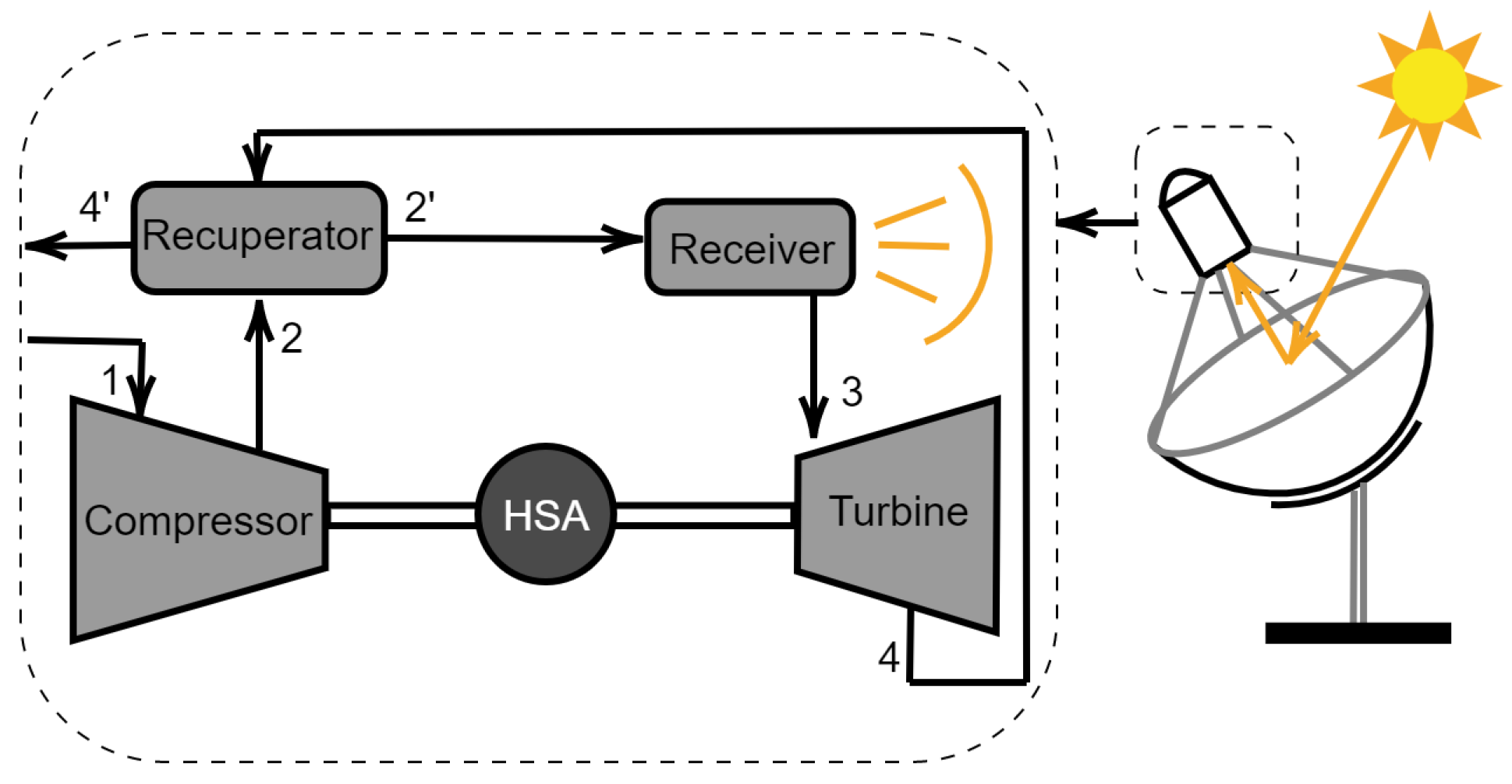
The CSP-MGT cycle comprises four key components: a compressor, a heat source (e.g., combustion chamber or solar receiver), a turbine, and a recuperator (shown in
Figure 1). Furthermore, there is a high-speed alternator (HSA), capable of transforming mechanical power into electrical power or operating as a motor during start-up. In CSP-MGT, the compressor pressurises air to receive thermal energy from a heat source. After receiving thermal energy, the air is of high temperature and high pressure. Afterwards, the hot air passes through the turbine, expanding and generating mechanical work before exiting to the recuperator, where a proportion of waste heat is transferred to the incoming compressor air, enhancing the thermal efficiency of the cycle.
A lumped-volume approach is used for the CSP-MGT transient model, making simulation speed suitable for real-time applications. Having a zero-dimensional model for each component, the recuperator and solar receiver are modelled by a one-dimensional approach to consider the volumetric and thermal capacitance effects within the components. Mass, momentum, and energy conservation equations are solved for each component. Implemented in MATLAB/Simulink, this model comprises three system-level parts: the thermodynamic, electrical, and control system models. The first two are interconnected through a mechanical interface within the rotating shaft (thermo-mechanical model), dealing with mechanical and electric torque, losses, and rotational speed alterations. The governing equations of each component are explained in the following paragraphs.
Modelling assumptions that are used throughout the modelling procedure are as follows:
(a) Air is modelled as a semi-ideal gas that adheres to the ideal gas law while allowing its thermo-physical properties to vary with temperature.
(b) Thermodynamic effects within the pipes and connections, including pressure drops and heat losses, are neglected in this analysis.
(c) Conductive heat transfer within the metal components is neglected due to the dominance of convective heat transfer, which is significantly higher in magnitude.
(d) Flow leakage is assumed to be negligible due to the presence of effective sealing.
(e) Natural convection heat losses in the compressor, turbine, and recuperator are neglected due to insulation.
3. Thermo-Mechanical Model
The thermo-mechanical model comprises the following key components: a centrifugal compressor, radial turbine, recuperator, solar receiver, shaft and plenum (artificial component). The operating conditions of the components are determined through performance maps or conservation laws. Detailed governing equations for each component are explained in this section.
3.1. Turbomachinery Components Models
The compressor and turbine model follows a sequentially structured thermal modelling approach, consisting of two distinct segments. The first segment employs a zero-dimensional quasi-steady-state approach to determine operating points based on steady-state performance maps [
40]. The second segment incorporates a lumped-volume method to capture thermal transients and their influence on airflow temperatures [
29]. Furthermore, to enhance the accuracy of performance maps at low rotational speeds, interpolation techniques are applied, introducing a zero-speed reference point for the turbine and a zero-speed characteristic curve for the compressor [
35].
3.1.1. Compressor Model
The operating point of the MGT on the compressor map is found by linear interpolation in the performance maps. By using the pressure ratio and isentropic efficiency from the performance map, the steady-state outlet air temperature of the compressor is calculated:
where
,
,
,
and
are the steady-state compressor outlet air temperature, inlet temperature of the compressor, compressor isentropic efficiency, compressor pressure ratio and specific heat ratio. The subscripts of 1, 2,
and
c present the compressor inlet, compressor outlet, steady-state compressor outlet and compressor. The power requirement of the compressor is calculated by the steady-state outlet air of the compressor:
where
and
are the required power by the compressor and specific heat.
For the second segment of the compressor model, the energy conservation equations related to the heat soakage in compressor metal are solved for an equivalent duct. To calculate the heat transfer coefficient, the Dittus–Boelter correlation for the Nusselt number is used [
41]. The Dittus–Boelter correlation was employed for heat transfer calculations in the compressor and later on in the turbine because the present model is a lumped, system-level transient simulation rather than a blade-resolved aerodynamic model. Under normal MGT operating conditions, the internal flows in compressor and turbine passages are fully turbulent and characterised by high Reynolds numbers, making classical turbulent forced-convection correlations appropriate. This modelling approach is consistent with the established literature on transient micro gas turbine simulations, where simplified Nusselt number correlations are commonly used to represent average gas-casing heat transfer while detailed aerodynamic effects are captured through component performance maps rather than local heat transfer models. Similar assumptions and correlation-based heat transfer formulations are adopted, for example, by Henke et al. in their validated DLR micro gas turbine cycle simulation framework [
42]. The heat transfer between compressor metal and air is calculated as follows:
where
,
,
,
,
,
,
and
are heat transfer rate, convective heat transfer coefficient, heat transfer area, Nusselt, Reynolds and Prantdl number, thermal conductivity of air and hydraulic diameter of the equivalent duct of the compressor and the subscripts of
and
refer to the mean-wall of the compressor and air as the compressor working fluid. The temperature of
which is the inside air of the compressor is calculated by getting an average between the inlet and outlet temperature of the compressor (
). This results in a different compressor outlet temperature. As shown in Equation (7), the heat transfer rate which is delivered to or taken from the compressor working fluid is the difference of the heat transfer rate from the required power of the compressor:
where
and
represent compressor metal mass and specific heat capacity. This equation implies that the work done to compress the air is independent of the heat transfer between the air and the metal. The reason is that the air has already received its compression power before transferring heat to the metal.
3.1.2. Turbine Model
The modelling procedure of the turbine is similar to the compressor using a two-segment strategy. The steady-state outlet temperature of the turbine is computed as follows:
where
,
,
,
are the steady-state turbine inlet air temperature, outlet air temperature, turbine isentropic efficiency and turbine pressure ratio. The subscripts of 3, 4, 4,
and
t subscripts account for the inlet air of the turbine, outlet air of the turbine, steady-state outlet of the turbine and the turbine. The governing equations of the second segment of the turbine model are written below:
where
,
,
are turbine heat transfer rate, convective heat transfer coefficient, heat transfer area, and the subscripts of
and
refer to the mean-wall of the turbine and air as the turbine working fluid. The convective heat transfer coefficient (
) of the second segment is found using the same correlation that was used for the compressor. The temperature of
as the inside air of the turbine is calculated with a similar strategy to the compressor. The generated power of the turbine in case of not considering the heat soakage (
) is calculated as follows:
Consequently, the final generated power that includes heat soakage is found with the help of the following equation:
This means that the generated power of the turbine considering the heat soakage is less than the case where no heat transfer is taken into account. The outlet temperature of the turbine is therefore calculated by using the actual generated power:
where
is the turbine outlet temperature by considering the heat soakage.
3.2. Recuperator Model
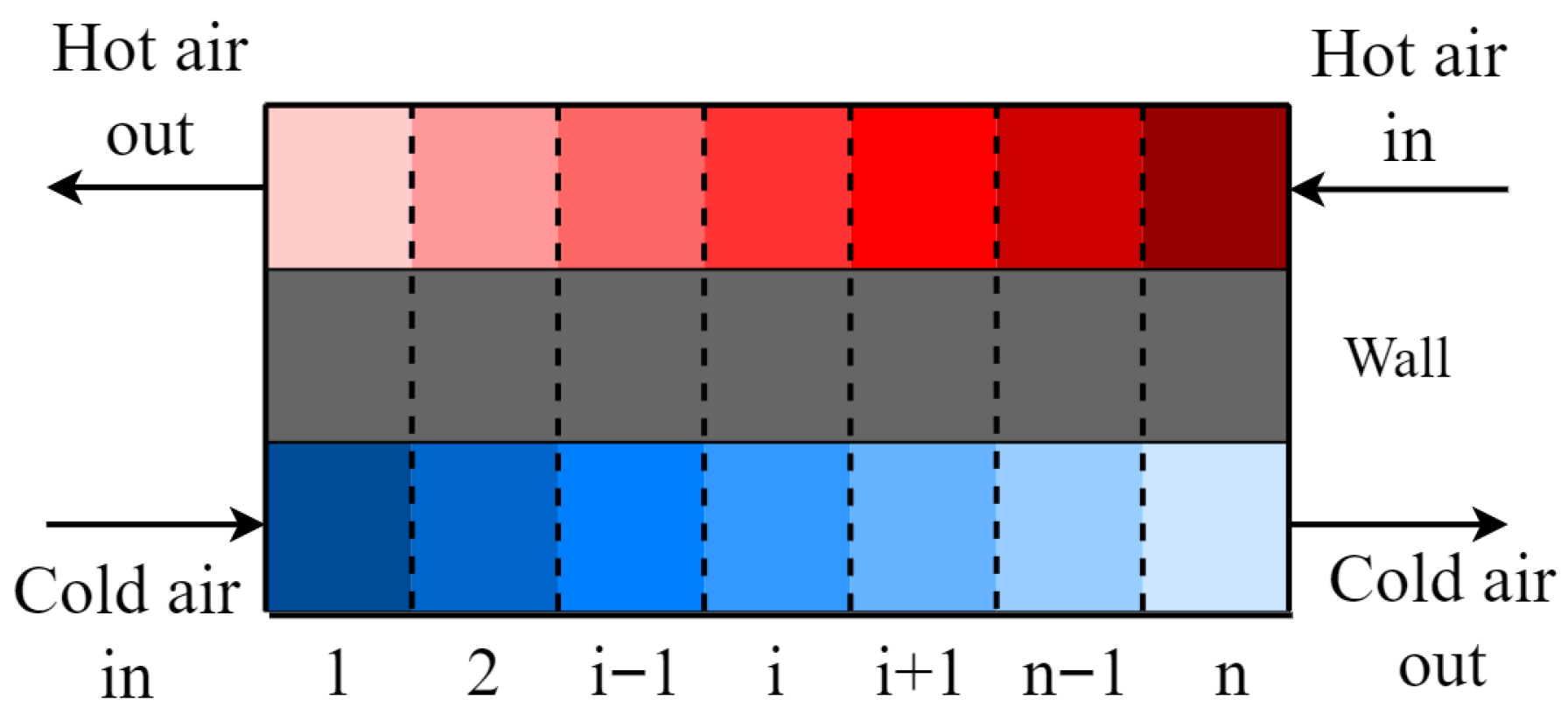
The recuperator is modelled as a counterflow heat exchanger with 1D approach, divided into unit volumes using lumped-volume approximations, as seen in
Figure 2.
Energy conservation is applied for each cell of the recuperator wall with Equation (14). The energy conservation for fluid cells in both cold and hot sides is seen in Equations (15) and (16).
where
,
,
,
,
and
are recuperator wall mass, recuperator wall specific heat capacity, hot- and cold-side air mass flow rates, and hot- and cold-side air specific heat capacity. The temperatures of
,
and
are the mean-wall temperatures of the recuperator metal and the hot-side and cold-side air temperature for cell of number
i. The parameter of
n refers to the number of cells and the subscript of
i accounts for the particular cell number. The energy conservation equations for the hot- and cold-side air are shown in Equations (15) and (16).
This computation includes the difference between the average wall temperature of the recuperator at cell index
i and the average temperature of the incoming and outgoing airflow, denoted by subscripts
i and
. The heat transfer areas (
and
) and coefficients of the hot (
) and cold sides (
) are determined using the geometric details of a heat exchanger with similar performance parameters from [
43]. The selected heat exchanger is a plate-fin heat exchanger that is an offset strip fin type. The heat transfer coefficient in this type of heat exchanger is found by the below equation which is shown for fluid 1 developed by Manglik and Bergles [
44]:
where
j is Colburn number [
44] which is defined as the ratio of the convective heat transfer coefficient to the product of the fluid’s heat capacity and its velocity.
G is fluid mass velocity based on the minimum free-flow area (
) where
is the cross-section of fluid 1.
The pressure drop for a plate-fin heat exchanger on both sides is found with Equation (
18) [
45]:
where
f, L,
and
are the fanning friction factor, airflow length on one side of the heat exchanger, hydraulic diameter, and the average of inlet and outlet fluid density, respectively. The term of
is calculated by
where
and
refer to the inlet and outlet air of one side of the recuperator.
3.3. Concentrated Solar Power Dish and Solar Receiver Models
The solar parabolic dish is defined by an optical efficiency (
) which is the ratio between the thermal power entering the receiver window and the power intercepted on the mirror surface. The solar receiver, functioning as a heat exchanger like the recuperator, utilises an impinging cavity design in this study [
46] due to efficient heat transfer from the impinging jet [
47], assuming uniform heat transfer coefficients and wall temperatures along the air flow is impractical [
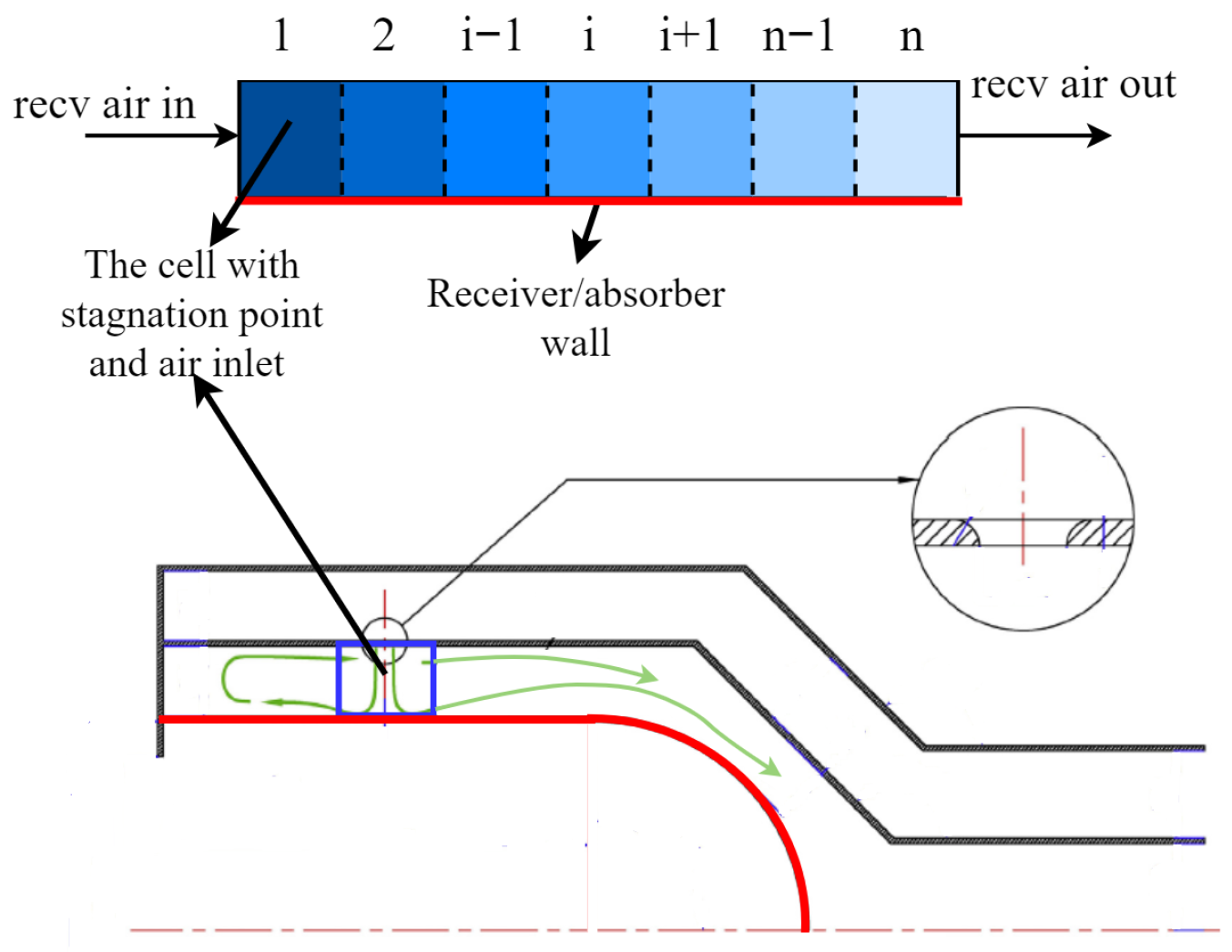
48]. Therefore, a one-dimensional modelling approach, maintaining uniform cell temperatures around the cavity receiver perimeter, is more reasonable.
Figure 3 illustrates the one-dimensional receiver modelling approach.
The schematic in
Figure 3 depicts the fluid path (green arrows) and the receiver/absorber wall (red line), divided into n cells. The first cell (blue square) contains the stagnation point from the impinging jet, where high-velocity fluid meets the surface, creating zero velocity and increased pressure. Cells 2 to n follow the flow path towards the air outlet, starting from the left side of the jet and then the right. Each cell acts as a lumped volume, addressing conservation equations for energy in the receiver’s metal. The governing equation for a single cell is expressed below:
where the subscripts of
,
,
,
and
refer to the input heat to the solar receiver, heat loss, absorbed heat by the air inside the ith cell, the receiver and mean-wall of the receiver. All values of the heat transfer rates of Equation (
19) are found below.
The intercepted heat on the cavity receiver wall is calculated based in the below equation:
where
is the effective area of the solar parabolic dish.
Heat loss of the solar receiver mainly accounts for two main losses, convection and radiation heat loss, which are calculated with the below equations. The heat transfer coefficients are found based on the equations provided in [
49].
where
U is the radiative heat transfer coefficient and the subscripts of
,
,
,
refer to convection loss, radiation loss, ambient condition and mean-wall of the receiver.
The absorbed heat by the air for each cell is attributed to the heat transfer coefficient and the heat transfer area between the air and the absorber wall in that specific cell:
in which the subscripts of
,
and
refer to absorbed heat by air in the ith cell, the receiver inlet and outlet air associated with the ith cell.
The heat transfer coefficient in each cell is calculated differently depending on the distance from the stagnation point. The local heat transfer coefficient for the cells that are affected by the impinging jet, is calculated as follows [
50]:
where
x,
d,
and
are the distance from the stagnation point, nozzle diameter, air thermal conductivity and the number of nozzles on the receiver. The subscripts of
x and
are referred to as the distance from the stagnation point to represent the local parameter and stagnation point. This equation is only valid for a limited distance from the stagnation point. For the cells, where
is higher than the value of 8, the heat transfer coefficient is calculated by using the Dittus–Boelter Nusselt empirical correlation [
41]. Since the flow is in the fully turbulent regime and the flow path length is sufficiently large compared to the characteristic diameter, the use of the Dittus–Boelter correlation is appropriate. Although the overall mass flow rate can be low, the local Reynolds number based on the jet diameter remains high due to the small nozzle size, resulting in fully turbulent flow. Consequently, the heat transfer coefficients are not highly sensitive to small variations in mass flow rate.
The main pressure drop in the receiver is attributed to the jet impingement on the absorber wall. Therefore, it is reasonable to compute the pressure drop by computing the maximum existing pressure drop [
48,
51]:
in which
,
are jet air density, discharge coefficient and
is the air jet velocity that is calculated as
where
and
d are the total nozzle number in the receiver geometry and the diameter of the nozzle exit hole.
3.4. Plenum Model
The plenum is an artificial component that has been added to the thermodynamic model to take into account mass imbalances which are implemented by solving the mass conservation equation. To account for this effect, an equation is formulated to describe the change in compressor outlet pressure associated with the inlet and outlet mass flow rates which are found using the compressor and turbine performance maps, as discussed earlier:
where
R and
represent the gas constant and the plenum volume, respectively. The plenum volume is a combination of the air side volumes of the cold side of the recuperator and solar receiver.
Shaft Model
The shaft is the component that represents the mechanical model of the system. It undergoes four main sources of torque: Compressor, turbine, PMSM and torque losses. Therefore, by writing the energy conservation for the MGT shaft, the differential equation of the shaft is given by
where
,
and
J are torque in
., rotational speed in
and shaft inertia, and the subscripts of
t,
c,
A and
refer to the turbine, compressor, high-speed alternator (PMSM) and mechanical loss. The compressor and turbine torques for each time step are calculated as follows:
The torque loss is linked to the power reduction caused by the presence of bearings along the shaft. The power loss of the shaft called mechanical loss is calculated as follows for one bearing [
30] and will be multiplied by the number of bearings on the shaft:
where
D,
and
are pitch circle diameter of the bearing, oil viscosity and oil mass flow rate. The value of the oil mass flow rate is assumed to be constant in this study. By dividing the power loss over rotational speed, the torque loss is calculated.
4. Electric Model
In the CSP-MGT system, the electrical components play a crucial role in converting mechanical to electrical power and electrical to mechanical power. These components operate in both modes of generation and motoring, with a focus on the latter during start-up. The CSP-MGT electrical system includes three main elements: a PMSM as the high-speed alternator, grid-side or load-side bi-directional converter, and PMSM-side bi-directional converter (see
Figure 4). These converters can perform AC/DC and DC/AC transformations. During motoring mode in a grid-connected system, the grid-side converter converts three-phase AC from the grid (50 Hz, 400 V) to DC, and the PMSM-side converter generates the required three-phase AC with the desired voltage and frequency for the PMSM. In off-grid mode, with a battery as the power source, only one converter is needed to provide AC current to the PMSM during start-up. In generation mode, the grid-side converter can be used depending on the consumer’s AC or DC current requirements.
4.1. PMSM
PMSM control is complicated due to its three-phase AC current. To simplify control, a Park–Clark transformation converts three-phase variables into a two-dimensional coordinate system (d-q frame) using DC values, aligning with classical linear control theory [
52]. The equations below describe the PMSM mathematical model with DC- transformed parameters.
where
,
,
,
,
,
,
,
,
,
and
are q-axis current, d-axis current, q-axis voltage, d-axis voltage, the resistance of PMSM stator, q-axis inductance, d-axis inductance, flux induced by the permanent magnets of the rotor, electromagnetic speed, electromagnetic torque and pole pairs of the PMSM. The electromagnetic speed is calculated as follows:
where
is the mechanical rotational speed of the shaft.
In this study, the PMSM model is simplified by assuming negligible dynamics in PMSM current (
and
are set to zero). This is reasonable, as electric current dynamics are much faster than shaft dynamics. Consequently, the equations for RMS voltage, RMS current, and PMSM power are as follows. The
component, which does not generate torque, is typically controlled to be 0 which is coming from the field-oriented control strategy [
52]. RMS values represent the effective equivalent of varying voltage or current, derived from mean squared values over an interval.
The calculated electric power is what the PMSM provides to the MGT during start-up. Yet, the power source needed for the PMSM is higher, accounting for PMSM power losses. Two main losses have been considered in this study. One is the copper loss coming from stator resistance. The other loss is accounted for by additional losses that is calculated by using a coefficient of speed [
17]. Thus, the electric power source required for PMSM feeding voltage is calculated accordingly.
in which
,
, and
N are the electric power required for the PMSM, HSA multiplier for additional losses provided by the manufacturer, and shaft speed in rpm.
4.2. Bi-Directional Converter
A bi-directional converter, utilising insulated-gate bipolar transistors (IGBTs), transforms DC to three-phase AC for the PMSM. This process incorporates Pulse Width Modulation (PWM) to generate variable-width pulses, simulating continuous voltage [
52]. Typically, six IGBTs handle three-phase currents that cause power losses in addition to transforming AC/DC or DC/AC, encompassing conduction and switching losses [
53]. This power loss leads to finding the necessary power input for the bi-directional converter.
where
refers to the bi-directional converter and
is the power of the current to be fed to the converter. The power loss of the converter, denoted as
, consists of two components: conduction and switching power loss.
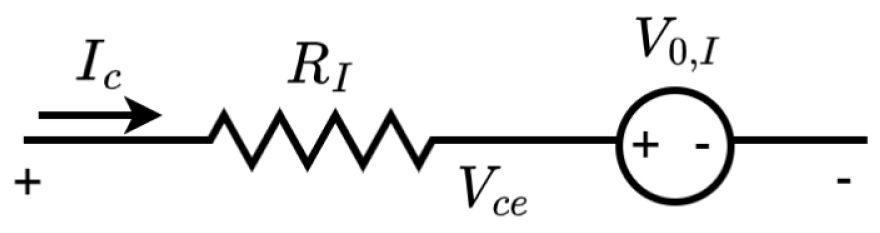
When the IGBT carries current in its on-state, it behaves like a series of components: a resistor and a DC voltage source. The equivalent circuit is shown in
Figure 5. Power losses occur in both the resistor and DC source, contributing to IGBT conduction losses. The zero current voltage
can be obtained from the IGBT datasheet [
54].
Based on the equivalent circuit shown in the figure, the conduction power loss is calculated by Equation (
49) [
53]:
where
is the resistance of the IGBT on collector–emitter current (on-state resistance) and
is the average current that is calculated by using RMS current (
). The subscript of
stands for conduction loss.
Since IGBTS are switching devices, some of the energy is lost during switching on and off. The values for
and
, which are the energy loss for switching on and off respectively, are provided by the manufacturer in the datasheet for IGBT energy losses in specific test conditions. However, test conditions differ from actual operating conditions. According to [
55],
and
are proportional to the current through IGBT in on-state conditions and voltage in off-state conditions. Therefore the actual energy losses are estimated based on Equations (
50) and (
51) [
53] using on-state current and off-state voltage:
where the subscripts of
and
refer to
DC voltage source and reference value respectively.
The calculated energy is for a duty cycle of PWM. In order to find out the power loss of the switching devices, the calculated energy should be multiplied by the frequency of the switching:
where
and
are the switching loss and switching frequency.
5. Control System
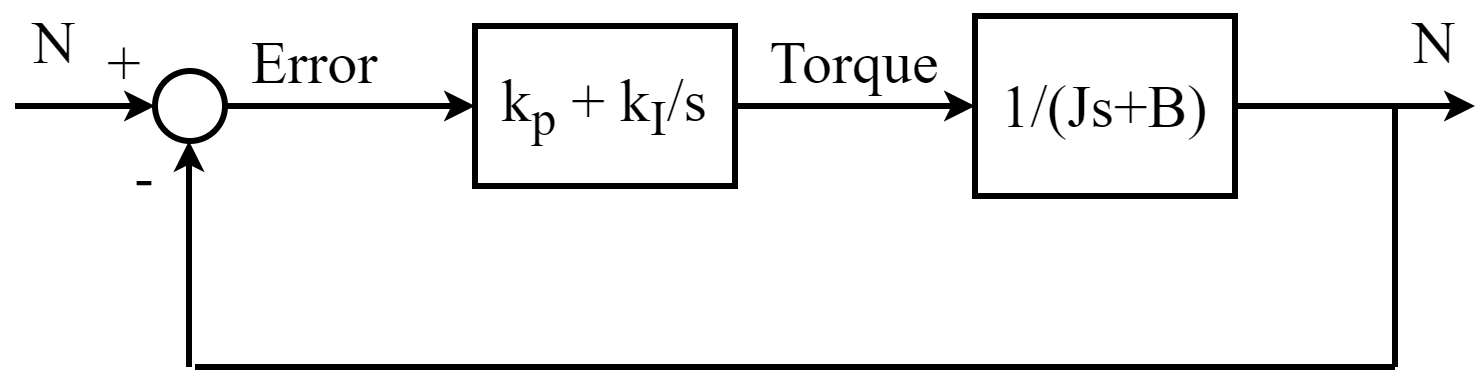
The controlled parameter in CSP-MGTs, shaft speed, utilises a Proportional-Integral (PI) controller. Design coefficients, proportional gain () and integral gain () require determination for controller design via system transfer function derivation.
To derive the system’s transfer function, the governing equations should be extracted.
Figure 6 depicts speed as the controlled parameter and torque as the controlling parameter. Although PMSM voltage is ideal, this study does not consider voltage and current dynamics, using a steady-state model for calculation. Consequently, torque becomes the controlling parameter instead of voltage.
The CSP-MGT system has six primary transient sources: heat soakage in the compressor and turbine, the recuperator and solar receiver, mass imbalances, and shaft speed. The differential equation for shaft speed (Equation (
32)) is used for the transfer function, with
termed
. Torque loss is estimated as a linear function of shaft speed (
), where
B is viscosity friction and it is derived from Equation (
35). Laplace transformation of Equation (
32) shifts the equations to the frequency domain.
The PI controller function in the frequency domain is as follows:
Therefore, the closed-loop becomes as follows.
As it can be observed from
Figure 6, the open-loop function of the system is
. Based on the general form of the function of the first-order systems which is
(where C is a constant value and
is the time constant), it can be deduced that
.
By using the closed-loop system shown in
Figure 6, the whole system transfer function with the controller can be written as below:
With the help of the standard form of the second-order equations which has a denominator of
, the two coefficients of the PI controller are found. The values for the PI controller coefficients are provided in the next sections.
6. Simulation Process
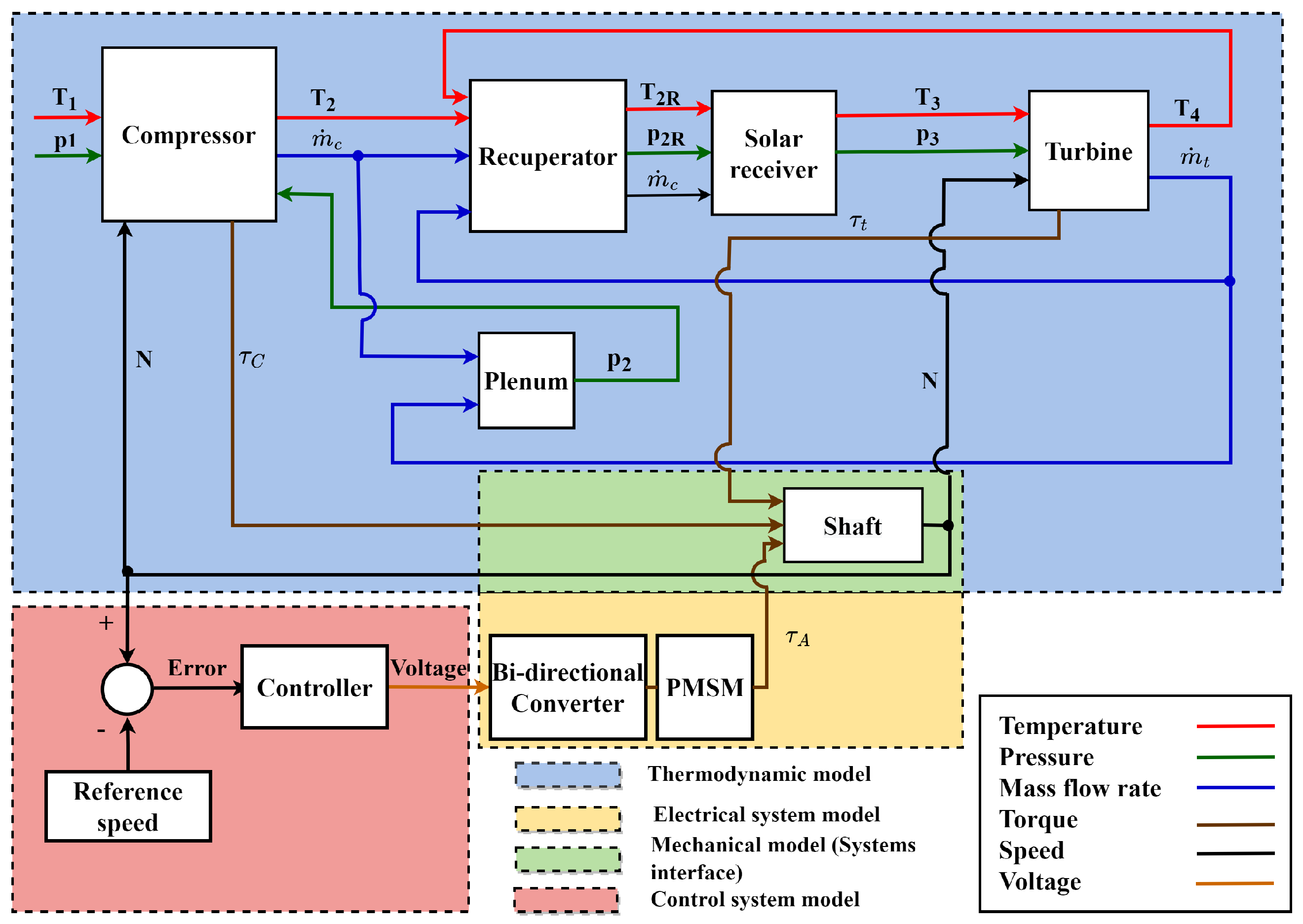
Figure 7 illustrates the overall structure of the coupled electro-thermo-mechanical CSP–MGT model, highlighting the interactions between the thermodynamic components, shaft dynamics, electrical system, and control architecture.
This study primarily focuses on simulating the off-grid operation of the CSP-MGT during its start-up phase. To simulate this scenario, it is assumed that the battery is the primary power source, supplying DC electric current during the system’s start-up phase. The electric power calculated at each time step represents the power required for the bi-directional converter positioned before the PMSM. The transient model of the entire CSP-MGT system comprises a set of ordinary differential equations, resulting from the modelling of each subsystem. Specifically, there is one equation for the compressor, one for the turbine, five for the recuperator, seven for the solar receiver, one for the shaft, and one for the plenum. Five primary state variables are considered: , , , , , and N. Among these variables, and represent composite variables with five and seven temperatures, respectively, as they describe the one-dimensional models of the recuperator and solar receiver. The initial values of these state variables depend on the system’s initial conditions, determined by the type of start-up, whether cold or warm. The model receives inputs from two sources: ambient conditions and PMSM voltage. The PMSM voltage is sourced from the bi-directional converter, which receives it from the assumed battery. The voltage value is determined by the controller. Once the initial conditions and inputs are established, the simulation commences with calculations starting from the compressor, following a predefined sequence. At each time step, the six state variables are updated based on computations within each model component. To determine the new value of the N state variable, the required torque by the compressor (), the generated torque by the turbine (), and the mechanical torque loss () are added to the torque from the PMSM (). Solving the resulting differential equation yields the updated value of the state variable of N. The speed feedback signal is then relayed to the controller, which generates the necessary PMSM voltage to produce the torque.
7. Results and Discussion
7.1. Model Validation
To evaluate the model, validation and verification are conducted in two stages. First, individual components are validated using available experimental data, focusing on transient behaviour. Second, all the CSP-MGT model results are compared with the experimental measurements to consider the interactions of the components. The experimental data are for a 6 kW
e CSP-MGT which was tested at the ENEA (Italian National Agency for New Technologies, Energy and Sustainable Economic Development) Casaccia site for the OMSoP project. The design parameters of this system are listed in
Table 1. However, the available measurements from this test are for the motoring mode, and not for the generation mode.
The key model parameters and material properties used in the simulations are summarised in
Table 2,
Table 3 and
Table 4. These parameters include thermo-mechanical properties of the main components, solar dish characteristics, and electrical and shaft parameters.
7.1.1. Turbomachinery Components
As previously mentioned, the low-speed curves for turbomachinery components are generated by interpolating existing curves, employing a zero-speed line for the compressor and a zero-speed point for the turbine. However, this mathematical approach requires calibration with experimental data. Each speed curve encompasses various operating points with differing pressure ratios and modified mass flow rates. Ideally, multiple measurements per speed curve would ensure accurate calibration, but often only one operating point per curve is available and this is also the case for this study. These speed curves are calibrated using experimental data from City, University of London, gathered from tests on a 6 kWe MGT in the laboratory. This has to be noted that since the MGT was designed to operate mostly at the design point and not low speeds that are far from the design points, the measurements were exposed to higher measurement uncertainty compared to the points close to design conditions.
Tuning the Generated Map
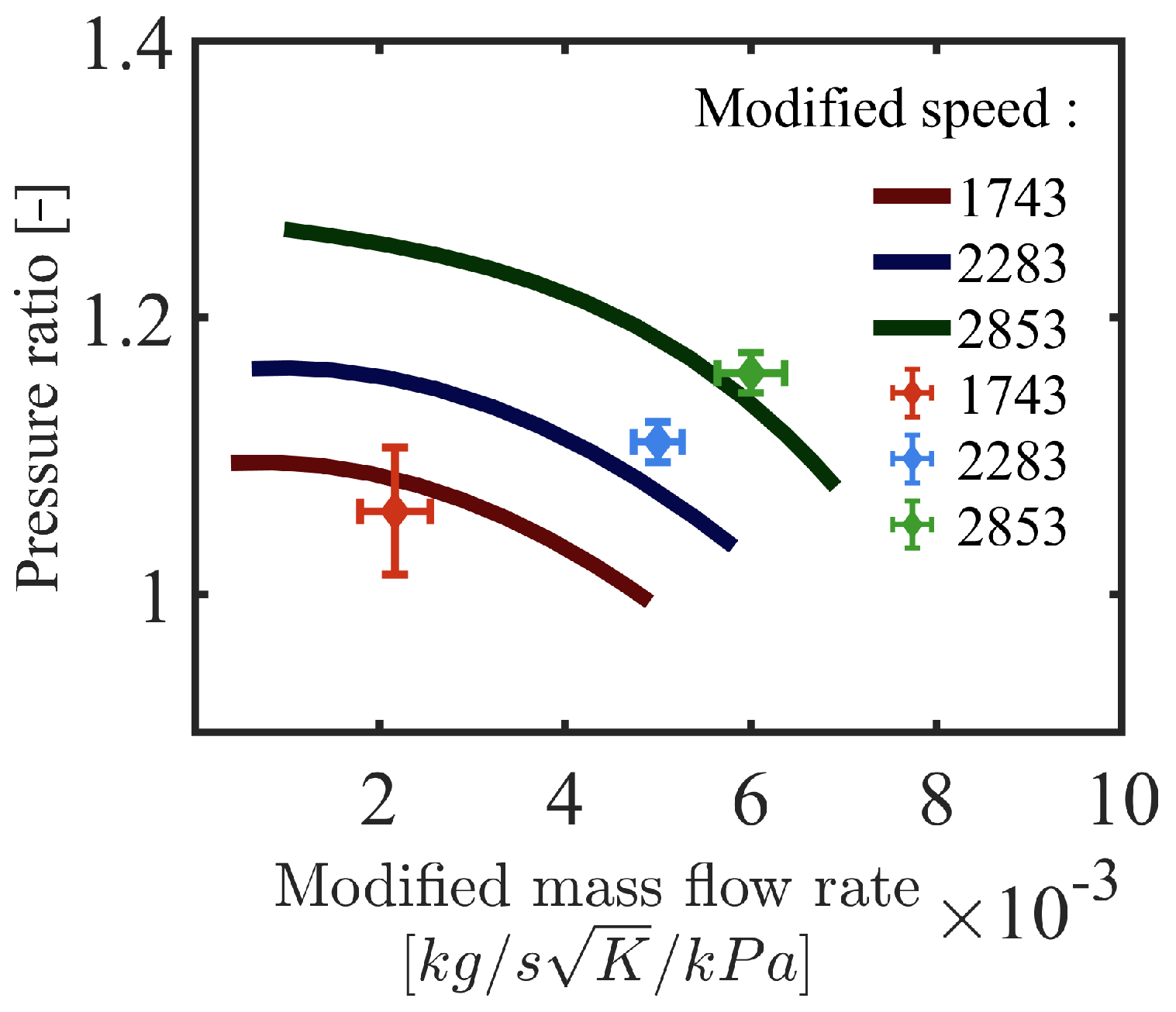
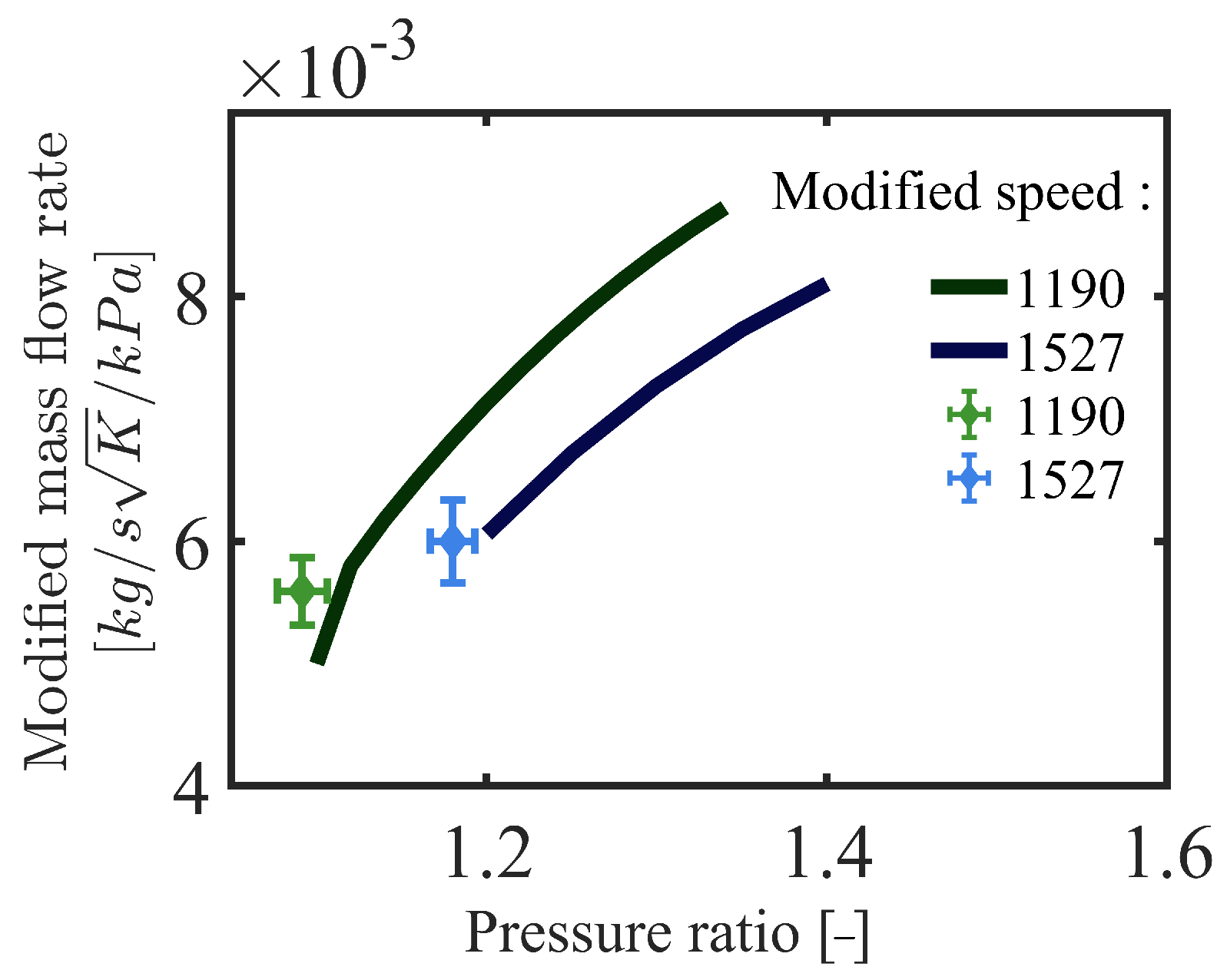
To adjust the generated map at lower speeds according to the measured data, the position of the speed lines was modified slightly, while maintaining their shape, until they matched the measured data while considering the relative uncertainty according to the measurements [
57]. The interpolation and curve fitting were performed using polynomial
-lines. The tuning results for the compressor and turbine maps can be observed in
Figure 8 and
Figure 9, respectively. It is evident from the figures that the generated speed curves pass through the operating points or the uncertainty zones.
Once the generated performance map has been tuned with the actual steady-state operating points for the low-speed region, it is necessary to confirm the validity of the interpolation methodology for all operating ranges of the performance map. For this purpose, the performance map of the Turbec T100PH Series as reported by the German Aerospace Center (DLR) was used [
61]. The validation results are shown in
Table 5. Since the experimental data were only available for the compressor, the validation was only done for the compressor. The parameters of validations were chosen to be the air mass flow rate and the steady-state compressor outlet temperature.
As illustrated in
Table 5, this validation shows that the linear interpolation methodology could be used in this study for the following stages.
7.1.2. Recuperator
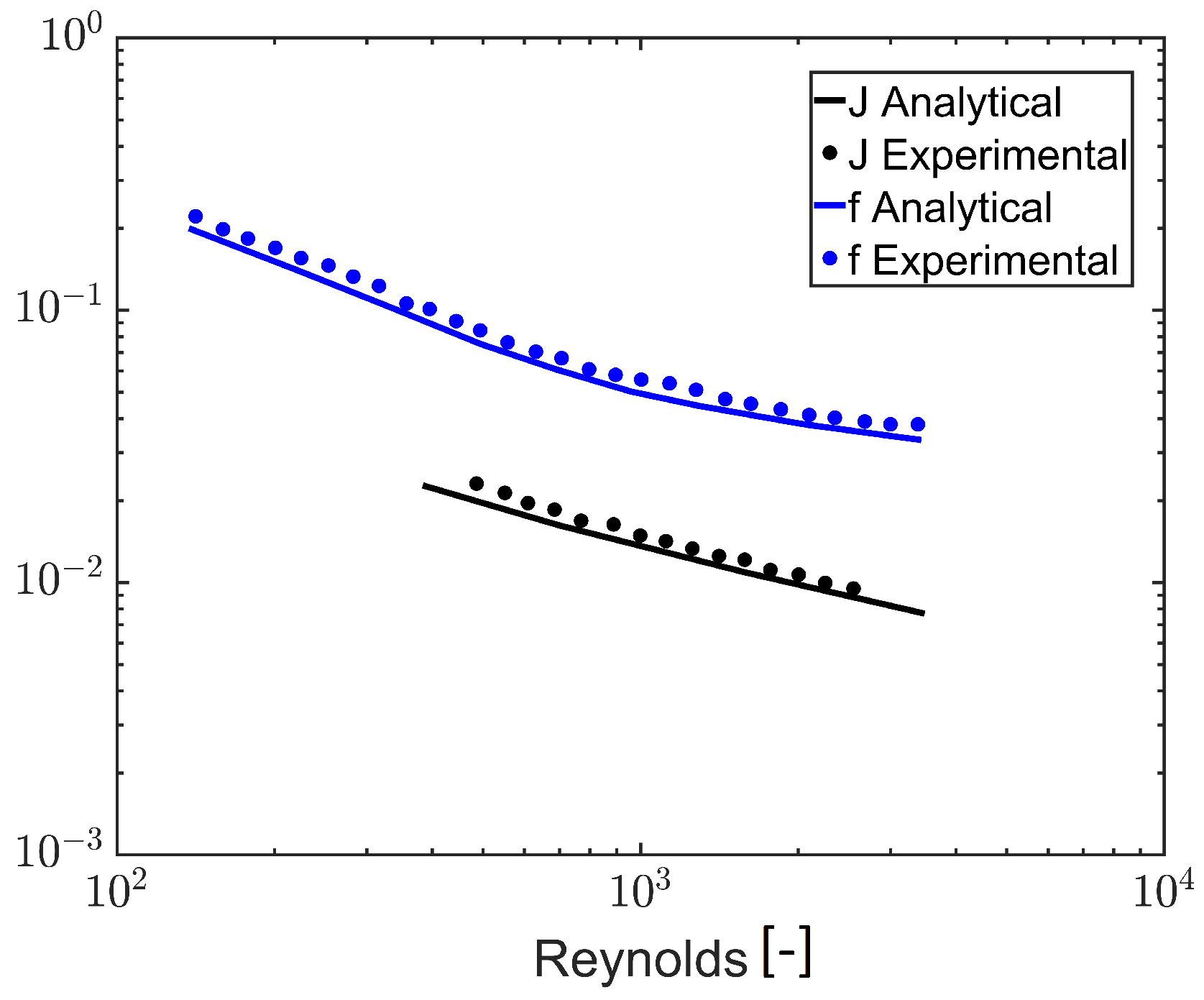
The initial validation of the recuperator focused on the Colburn and friction factors, utilising experimental data. This validation process was applied to a plate-fin heat exchanger with dimensions of 1/10-27.03 as detailed in a study by [
45], with the geometric specifications, sourced from Kays and London’s work,
Figure 10 [
62].
This result ensures that the heat transfer coefficients used in the energy conservation equation and the friction factor used in calculating the pressure drop are in agreement with experimental data. The comparison between the model predictions and experimental data for the Colburn factor j and friction factor f is shown as a function of Reynolds number. The model replicates the experimental trends accurately across the full range, including the low Reynolds number regime corresponding to low mass flow rates. The maximum relative deviation is about 3% [
43]. This demonstrates that the model’s sensitivity to variations in the heat transfer coefficient is small, even at low flow conditions, and confirms the robustness of the predicted recuperator performance.
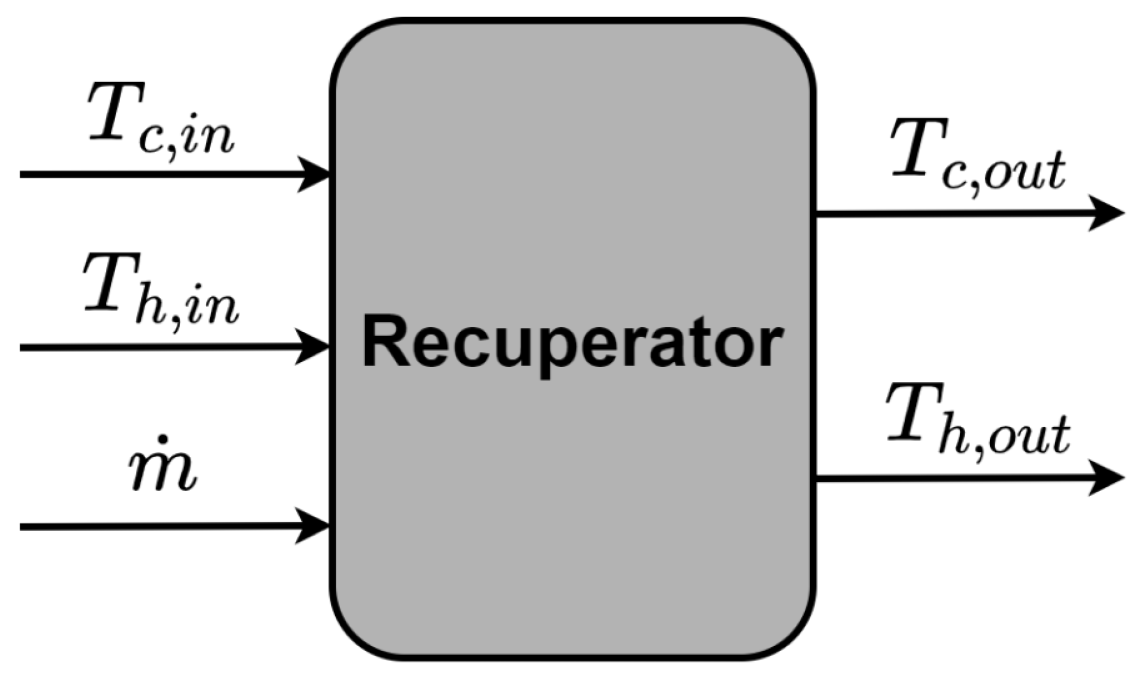
Additionally, thermal validation of the recuperator was performed by comparing the predicted outlet temperatures with experimental measurements. Accordingly, a dedicated recuperator model layout was defined, as shown in
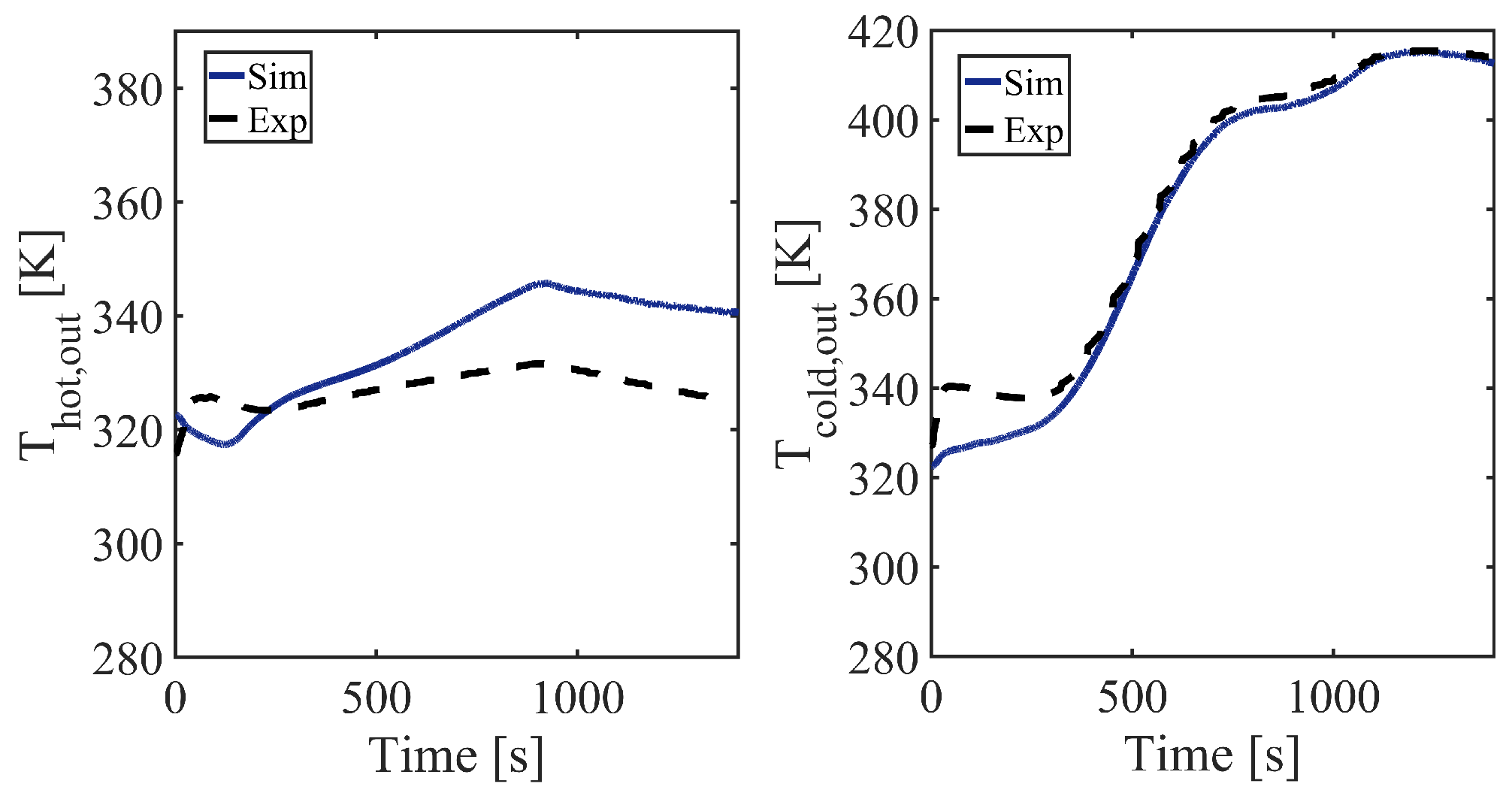
Figure 11. To assess the sensitivity of the one-dimensional recuperator model to spatial discretisation, the number of discretised cells was increased from three to seven, and the resulting outlet temperatures were evaluated. It was observed that increasing the number of cells beyond five did not lead to a noticeable change in the predicted outlet temperature. Based on this observation, five discretised cells were selected as a compromise between numerical accuracy and computational efficiency. The inputs to the model are the measured hot- and cold-side inlet air temperatures and mass flow rates, while the predicted hot- and cold-side outlet air temperatures are compared against their experimental counterparts,
Figure 12.
The results show a maximum deviation of 4.6% and 4.7% for hot- and cold-side outlet air temperatures, respectively, compared to experimental values. The temperature trend is generally well-replicated, but an initial deviation is likely due to sudden air mass flow rate changes and possible measurement uncertainties at low flow rates. Model inaccuracies may also result from limited initial recuperator metal temperature data.
7.1.3. Solar Receiver
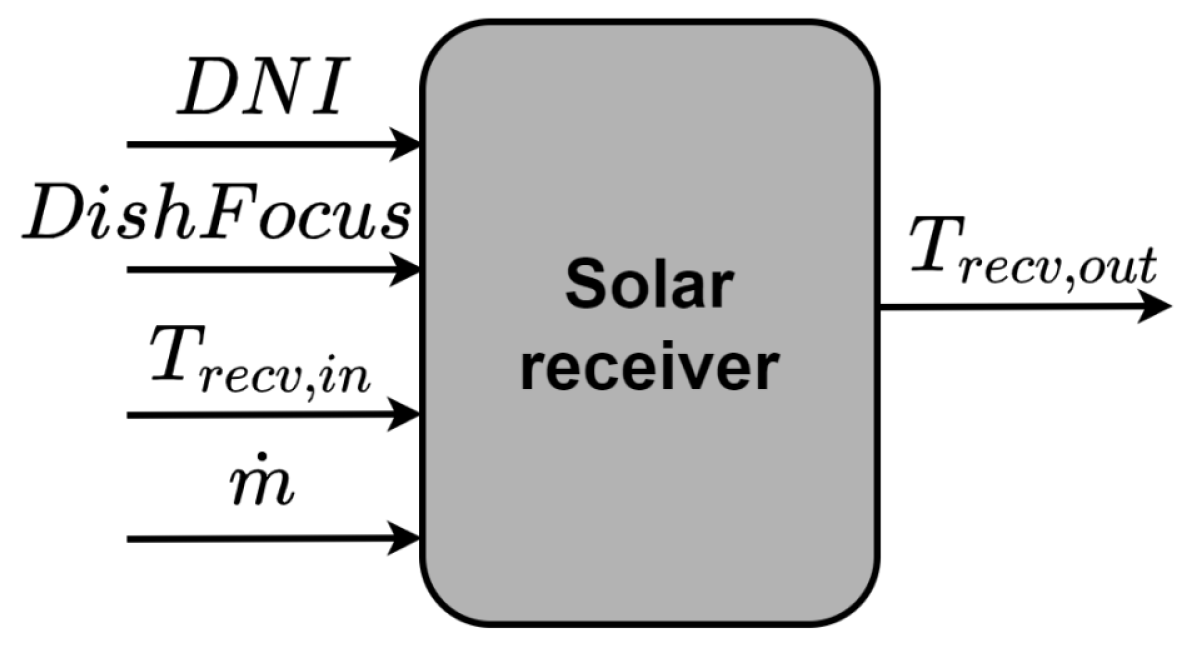
The approach used to validate the thermal model of the solar receiver follows the same methodology adopted for the recuperator. In addition, the discretisation of the receiver into a finite number of cells is similar with the approach used for the recuperator. Therefore, the same validation strategy was applied to this component. The layout of the thermal model of the solar receiver is shown in
Figure 13.
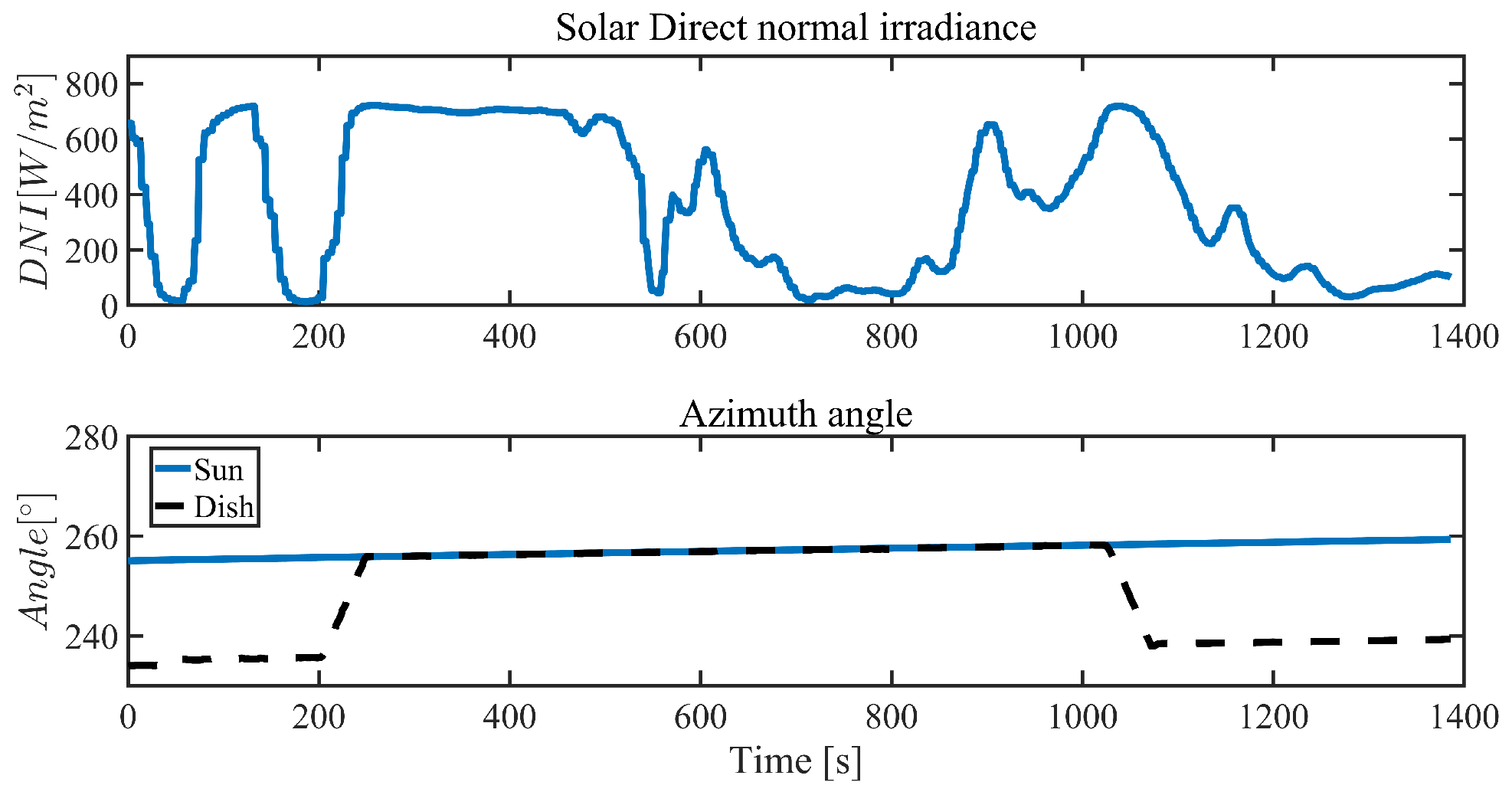
The solar receiver thermal model has four inputs: DNI, dish focus schedule, receiver inlet air temperature (
) and mass flow rate (
). The dish focus schedule determines focused and unfocused periods based on sun and dish azimuth angles, where unfocused periods were due to practical limits during tests to prevent turbine bearing overheating (see
Figure 14 for the solar receiver’s focusing schedule).
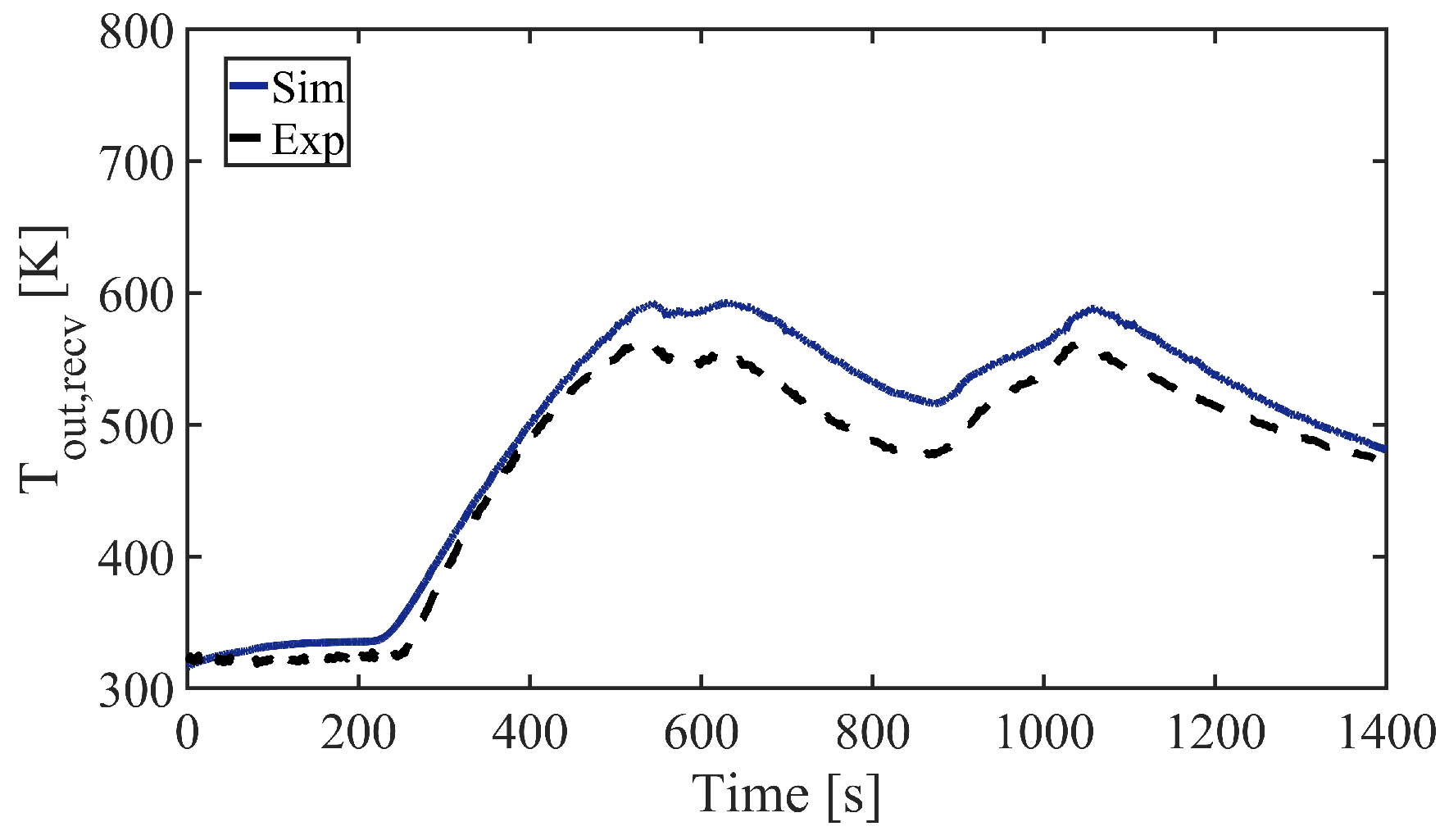
Using the inputs given to the solar receiver model, the outlet air temperature of the receiver is found. The results of the model and the corresponding experimental measurements are presented in
Figure 15 for comparison. The validation of the solar receiver model focused solely on its thermal aspects since the validation of pressure drop has been already provided in [
46].
As depicted in
Figure 15, the maximum deviation of the solar receiver’s outlet air temperature is approximately 8%, indicating a relatively high level of error. One of the main reasons for this deviation is the underestimation of receiver heat loss. The model’s convective/radiative loss terms depend strongly on assumed correlations, emissivity, effective loss area, and boundary conditions. Another reason is due to heat transfer modelling simplifications inside the receiver. Since the impinging-jet local correlation near stagnation with Dittus–Boelter elsewhere were mixed, and the receiver was discretised into 1D cells, there could be a mismatch between real flow distribution and the assumed correlation regions.
It should be noted, however, that due to limited access to the experimental plant, a comprehensive understanding of the system’s components was not possible.
7.1.4. PMSM and Bi-Directional Converter
Since the experimental data for electrical current was not available, validation of the PMSM was done at the design conditions where power is 6 kW
e and 130 krpm with electric torque of 0.44 at RMS voltage/current of 170 V/13 A. The RMS current is linearly proportional to the electric torque which is linked to the compressor/turbine inlet and outlet temperatures and air mass flow rate. Therefore, validated temperatures ensure precise electric current prediction. RMS voltage, on the other hand is tied to speed which was verified at 170 V [
63] by calculating the voltage value of PMSM. This yielded 168.1 V, with a 1% deviation. PMSM efficiency at nominal conditions was also calculated with less than 1% difference from the reference value.
The selection of an IGBT converter is crucial in determining its performance in a given operating condition. The main parameters that are considered when selecting an IGBT converter include its nominal voltage and electric current ratings. As mentioned earlier, a six IGBT topology has been chosen for this study. This ensures a stable and efficient power transfer, making it a popular choice for many applications. Based on the datasheet from [
54], the chosen IGBT for the study was selected to ensure its suitability for the intended application. It has to be noted that since the bi-directional converter operates in both motoring and generation conditions, the efficiency in the two operating modes is different. This is due to the dependency of the power loss on the upstream voltage. This means that when the converter is working in the motoring mode, the DC link voltage is used in Equations (
50) and (
51) and when it is working in the generation mode, the RMS voltage of the three-phase voltage after the generator is used. The assumed switching frequency for calculating the IGBTs’ switching losses is determined to be 16 kHz based on experimental data.
7.1.5. Control System Design
Designing the controller can be done by considering the system’s transfer function. For the transfer function as a second-order equation, damping ratio (
) and natural frequency (
) define system behaviour, enabling controller coefficient determination, as depicted in
Table 6.
7.1.6. CSP-MGT System
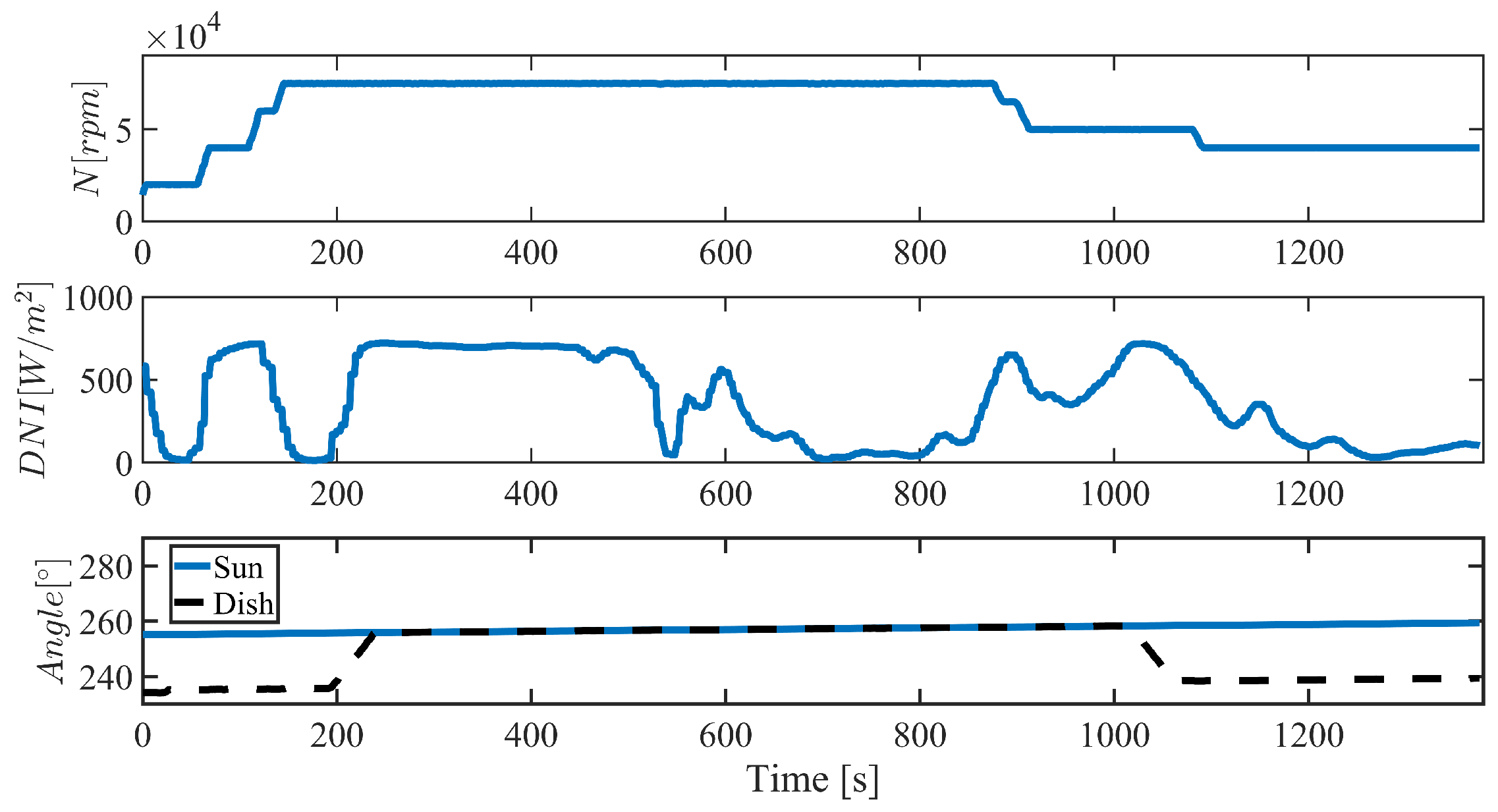
After validating each subsystem using experimental measurements and defining the parameters of the control model, validation of the entire CSP–MGT system is required to ensure that the full transient behaviour is captured accurately. Integrating all components allows their thermal, mechanical, and electrical interactions to be represented, enabling evaluation of system dynamics beyond what isolated component tests can show. For system-level validation, the complete transient model is provided with the same input conditions used during testing, including ambient temperature, ambient pressure, DNI and the implemented dish focusing schedule, as illustrated in
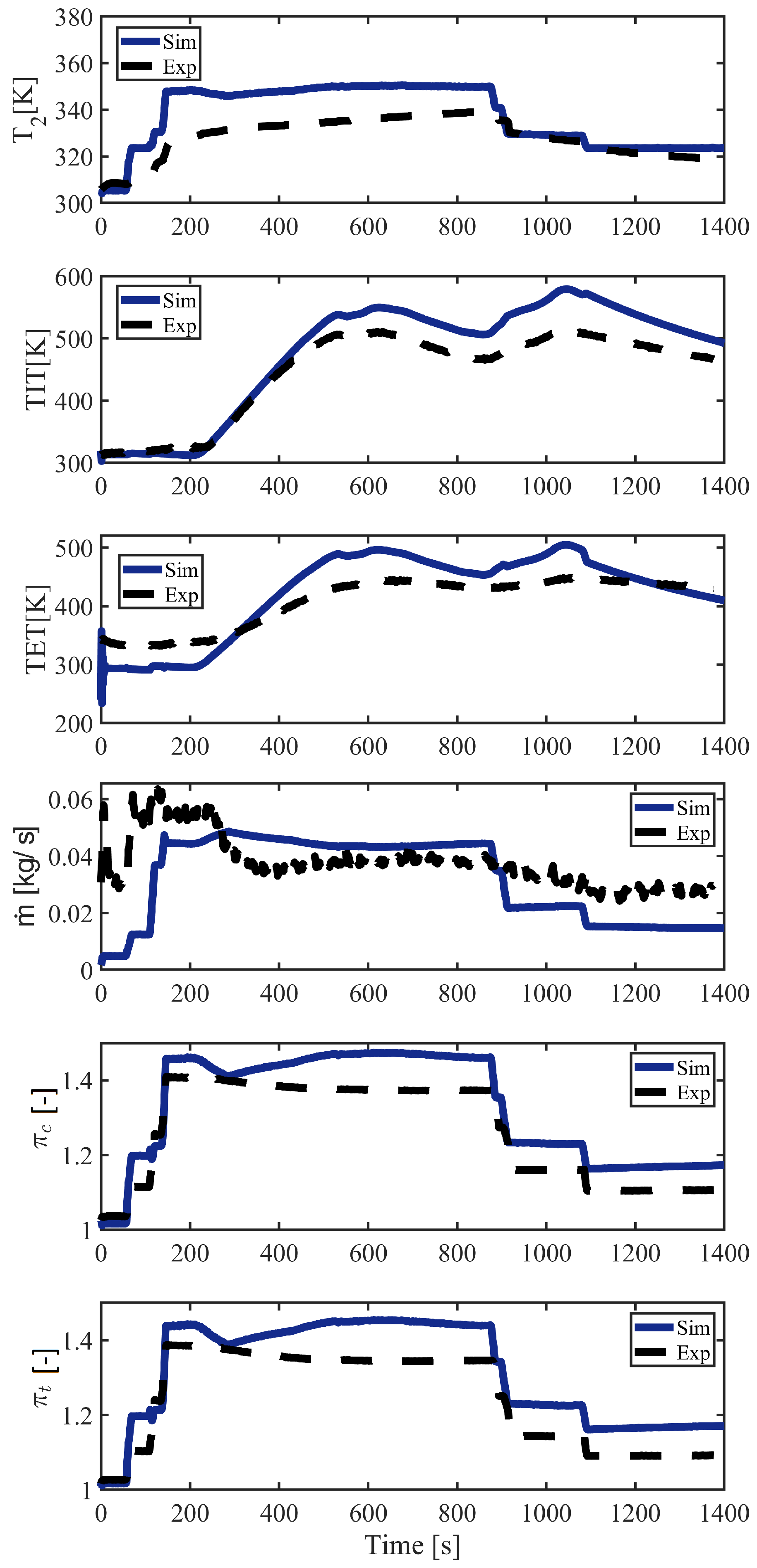
Figure 16. The resulting outputs of the model—TIT, TOT, compressor outlet temperature (COT), air mass flow rate, compressor pressure ratio and turbine pressure ratio—are compared directly with the corresponding experimental measurements, presented in
Figure 17.
As discussed previously in the solar receiver section, continuous full-focus operation of the dish was not possible due to the risk of bearing overheating. Instead, a focusing schedule was applied to intermittently reduce the concentration at the receiver. This schedule was not optimised and was selected based on operator feedback to maintain thermal safety during testing. By applying the same input conditions to the model, the transient outputs can be compared fairly against experimental results.
Figure 17 demonstrates a strong agreement between simulation and experiment, confirming that the transient behaviour of the CSP–MGT system is well-represented. The predicted COT shows a maximum deviation of 4%, reflecting an accurate reproduction of the thermal trend influenced by isentropic efficiency, pressure ratio, ambient conditions and heat soakage. TIT and TOT differ from the measurements by up to 8%, which is acceptable for transient receiver operation and consistent with the observations made during component-level validation. The largest discrepancy appears in air mass flow rate, which is expected due to the high measurement uncertainty during testing and the fact that the system was originally designed for steady-state rather than transient operation. Compressor and turbine pressure ratios show a maximum deviation of 7% and follow the experimental trends closely throughout the transient cycle.
The results confirm that the developed transient model accurately captures the dynamic response of the CSP–MGT system at both the component and system levels. Although validation was performed during the start-up phase, the model remains applicable to power generation, as the start-up phase represents the most demanding operating regime, requiring accurate representation of heat soakage effects and coupled thermo-mechanical–electrical behaviour. The uncertainty associated with the experimental measurements was estimated based on manufacturer-specified instrument accuracies and was considered when interpreting the validation results. It should be noted that a substantial portion of the validation data corresponds to off-design operating conditions, particularly during start-up and low-speed operation. Under these conditions, measurement uncertainty increases and the system response becomes highly sensitive to small variations in mass flow rate and temperature, such that relatively small absolute measurement errors can result in larger relative deviations between the simulation and experimental results.
7.2. Start-Up Transients with Heat Soakage
Another contribution of this study lies in the explicit inclusion of heat soakage in the metal components of the MGT. Unlike off-design models, which assume an instantaneous thermal response, the present model accounts for the thermal mass and conductive heat absorption of the metals, giving it genuine transient fidelity. This feature is particularly critical during start-up, when steep changes in DNI and shaft speed occur, and turbine metal temperatures evolve dynamically rather than immediately.
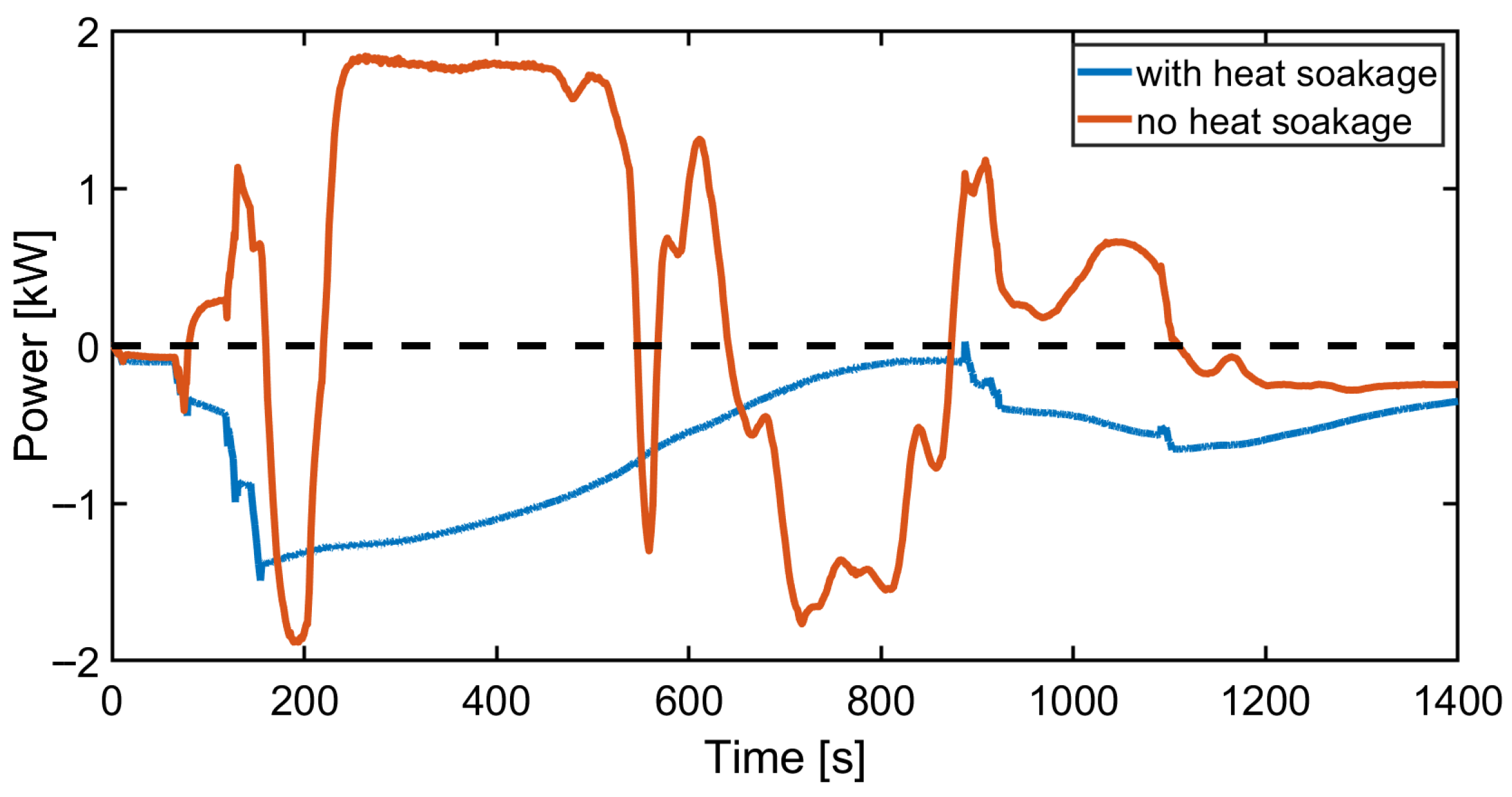
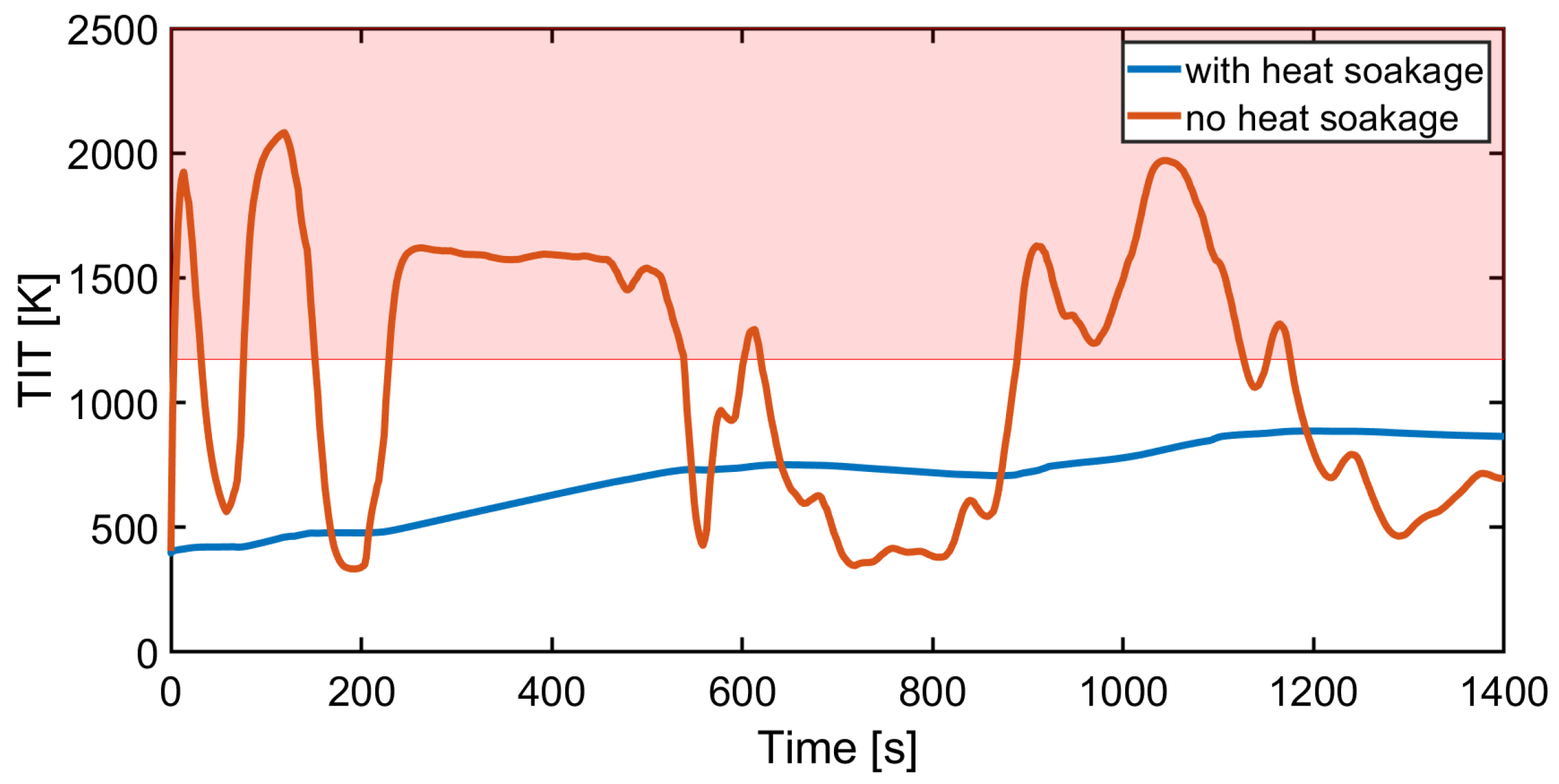
In addition, the bi-directional coupling between the electrical and thermo-mechanical sub-models enables assessment of how thermal transients influence shaft power production, and, conversely, how electrical load affects thermal state. To illustrate this, two simulations were performed using the same speed schedule and DNI profile from the OMSoP validation dataset: one including heat soakage and one with component mass removed. The results are presented in
Figure 18 and
Figure 19.
Figure 18 shows that when heat soakage is neglected, electrical power responds almost instantaneously to DNI fluctuations. In this artificial case the power trace closely mirrors the irradiance input, and during the interval from 200–600 s, where both shaft speed (~80 krpm) and DNI (~700 W/m
2) remain steady, the system produces nearly 1.8 kW of electrical power. This behaviour does not appear in the physically representative case including heat soakage, where no power generation occurs—consistent with experimental observation—demonstrating that thermal inertia strongly suppresses power recovery during start-up.
The underlying mechanism is clarified in
Figure 19, where the turbine inlet temperature (TIT) rises sharply without heat soakage, tracking DNI with minimal lag. The shaded region highlights temperatures exceeding the material limit, indicating that neglecting heat absorption by the metal structure leads to unrealistically high TIT transients. In contrast, when heat soakage is included, TIT evolves gradually and remains within acceptable limits throughout the cycle.
The results show that exclusion of heat soakage leads to a superficial decrease of up to 140% in the estimated electrical energy consumption during the start-up phase. This effect is attributed to the small scale of the micro gas turbine, for which thermal mass effects are significantly more influential than in larger gas turbines, where corresponding deviations are typically of the order of 30% [
30].
These findings emphasise that an off-design, steady-state thermal representation is insufficient for start-up analysis. The transient soakage behaviour is a dominant driver of both temperature evolution and shaft power capability, meaning that start-up optimisation, component life prediction, and thermal–electrical control strategies cannot be reliably evaluated without a fully transient heat soakage-aware model.
8. Conclusions
In this study, the development of a transient model for a CSP-MGT comprising of thermo-mechanical and electrical models was presented in detail. The thermo-mechanical part of the model is based on a lumped-volume and one-dimensional discretisation approach which is capable of simulating the transient performance of the system in response to the intermittent nature of the input thermal power. Thermodynamics, heat transfer to the casing and surroundings, shaft rotation, electrical system, control system dynamics as well as mass and heat storage are simulated together to account for their interactions. The model can also be used for real-time simulations due to having three hundred times less simulation time than the real transient process. Furthermore, the following points can be concluded from the results presented in this study.
A transient electro-thermo-mechanical model was developed for the start-up phase of CSP-MGT. The model has the capability of modelling electrical components which gives an insight into the electrical current and electrical power dynamics affected by the thermal and mechanical dynamics in the the CSP-MGT system.
A transient model was validated for individual components and the entire CSP-MGT system. At the component level, the solar receiver outlet temperature showed the highest validation error (8% error). At the system level, validation revealed significant deviation in predicted air mass flow rate due to measurement inaccuracies at lower speeds.
The comparison between the transient simulations with and without heat soakage demonstrated that neglecting thermal inertia leads to unrealistic, instantaneous temperature response to DNI, emphasising the importance of including heat soakage in the model.
The developed model has the potential to be applied in diverse analyses concerning various operations of the CSP-MGT. With its incorporation of an electrical system model, it has the capacity to offer transient insights into both electrical and thermo-mechanical parameters. This model is aimed to be used for the optimisation of the start-up phase of CSP-MGT in future study.