Article

Optimal Scheduling Strategies for Smart Homes Integrated with Grid-Connected Hybrid Renewable Energy Systems


1
Department of Electrical and Electronic Engineering Technology, University of Johannesburg, Johannesburg 2006, South Africa
2
Department of Human Anatomy and Physiology, Faculty of Health Sciences, University of Johannesburg, Johannesburg 2094, South Africa
3
Department of Electrical Engineering, Malaviya National Institute of Technology, Jaipur 302017, India
*
Author to whom correspondence should be addressed.
Energies 2026, 19(5), 1174; https://doi.org/10.3390/en19051174
Submission received: 27 November 2025 / Revised: 24 January 2026 / Accepted: 30 January 2026 / Published: 26 February 2026

Abstract

The increasing demand for sustainable energy in residential buildings and public concerns on greenhouse gas (GHG) emissions has driven the integration of smart homes with hybrid renewable energy systems (HRESs). This research proposes an optimal scheduling strategy for home energy consumption in a grid-connected HRES that comprises a grid, wind turbines, photovoltaics and battery storage systems. The objective of the study is to reduce the net energy cost, scheduling inconvenience cost (SIC), GHG cost and battery degradation cost. An ant colony optimization algorithm is utilized in the MATLAB environment, with load profiles and meteorological data of Upington, South Africa, obtained from NASA and a residential consumption dataset to accomplish the objectives of the study. The outcomes of the study show that case study 3 is the most feasible configuration based on a net energy revenue cost of $9.8382, GHG cost of $0.0627, battery degradation cost of $0.461 and SIC of $0.66. Simulation results demonstrate that energy purchased from the grid has been reduced by 98% and 48% relative to case studies 1 and 2. The results of the study can assist households to improve the sustainability and resilience of the power system in residential environments where the grid supply is unstable and electricity costs are high.

1. Introduction

The global energy crisis is one of the critical challenges of the twenty-first century that affects economic stability, standard of living and environmental sustainability. This crisis has increased electricity tariffs, caused pressures on economies and renewed global commitment to energy diversification and autonomy [1]. The global power demand growth has been attributed to urbanization, economic development, technological advancement, population growth and industrial revolution [2]. According to the International Energy Agency (IEA) report of 2024, fossil fuels accounted for 80% of the global energy demand despite the adoption of cleaner and sustainable energy alternatives by many countries [3]. Over-reliance on fossil fuels has posed critical threats such as depletion of non-renewable energy reserves, proliferation of GHG emissions and aggravation of global warming [4]. This has forced many countries to transform their centralized energy systems into decentralized renewable systems with localized smart grids to reduce dependence on fossil fuels and associated hazardous effects. The IEA report of 2024 also shows that over 600 million Africans do not have access to an affordable and reliable power supply due to load shedding, frequent power outages, aging infrastructure, underdeveloped utility grids and limited power generation capacity [5]. This has led to economic losses, the reduction of job creation, industrialization constraints, education disruption and the interruption of healthcare delivery in African countries [6,7]. The global power system is currently going through a significant transformation in response to the urgent need to improve the security of power supply, reduce climate change and increase access to affordable electricity [8]. The transition is based on the international benchmarks to fast-track global deployment of renewable energy sources (RESs), improve the sustainability of the power system and achieve net-zero carbon emissions [9,10,11].
The sudden increase in power consumption is reflected in all sectors of the economy by creating supply challenges and increased energy prices [12]. The global power demand grew by 2.2% in 2024 based on deeper structural trends and short-term factors. This shows that energy demand grew at a faster rate in 2024 than the annual average of 1.3% recorded between 2013 and 2023 [2]. The global electricity demand has been projected to grow by 30% in 2030 as power consumption increases in different sectors of the economy based on the annual growth of 3.3% from 2023 to 2030 [13]. According to the global status report of 2025, industry accounted for 34% of global power consumption, followed by buildings (31%), transport (31%), agriculture (2.5%) and other energy uses (1.5%) [14]. This shows that the residential building plays a vital role in the energy market since it consumes three-quarters of the global energy generated from different sources. The breakdown of GHG emissions from the energy sector consists of electricity and heat (29.7%), transportation (13.7%), manufacturing and construction (12.7%) and buildings (6.6%) [15]. This report indicates that residential sector is a significant contributor to climate change. Carbon footprint emissions and energy demand from the construction and buildings account for almost a fifth of global GHG emissions [16]. The residential building alone accounts for nearly 30–40% of the global energy consumption, which makes it a key area for energy efficiency improvements and RES integration [17]. The environmental concerns, coupled with climate change, fossil fuel depletion, the urgent need for sustainable development and public health challenges have intensified the transition of fossil fuels to RESs [18]. The residential sector constitutes a significant portion of global electricity consumption, and improving household energy efficiency has emerged as a significant approach for the reduction of energy demand and GHG emissions [19]. Smart homes equipped with RESs and scheduling of appliances have been acknowledged as promising solutions that can be utilized to reduce electricity bills and improve user comfort [20].
The rapid increase in global power consumption, depletion of fossil fuels and mitigation of climate change has necessitated the application of sustainable energy systems to satisfy load demand [21]. Renewable energy sources have been globally accepted as potential alternative solutions to conventional fossil-based generation units because they are clean, affordable, sustainable and environmentally friendly [22]. An HRES that consists of multiple sources is a promising solution to overcome the intermittency and variability challenges of using a single source. The integration of multiple sources in HRESs can be used to increase energy availability, enhance efficiency and reduce over-dependence on the utility grid [23]. The stochastic characteristics of wind and solar resources present several challenges in maintaining a reliable and continuous power supply at the load points [24]. The improper management of the power system can cause a deficit of power supply and over-reliance on the utility grid during low-generation hours and wastage of excess renewable energy during high-generation periods [25]. These challenges can be overcome by using an optimization technique that coordinates household appliances, renewable generation, BSS and grid interaction and optimizes charging and discharging cycles of battery systems. The scheduling of home appliances and integration of renewable energy in the conventional power system can be used to achieve cost savings, improve the efficiency and resilience of the power system and minimize the net energy cost, reliance on the utility grid SIC and carbon footprint [26]. The benefits of HRESs in smart homes cannot be fully realized without scheduling of household appliances and effective energy flow in the power system. Therefore, it is imperative to coordinate energy flow within the power system to avert unnecessary stress on the battery system and utility grid, increased GHG emissions and reduced user comfort. The convergence of RESs and smart home technologies offers several significant benefits that can be utilized for the sustainability of HRESs. The effectiveness of RESs and smart home technologies depends on the optimization techniques applied to control home appliances, photovoltaics (PVs), wind turbines (WT), battery storage systems (BSSs) and utility grids [27]. Ant colony optimization (ACO) is applied to achieve the objective of the study due to its flexibility, adaptability, easy hybridization and robustness [28]. ACO is a powerful tool that can be used for complex optimization problems in energy management, routing and scheduling systems [29]. Therefore, appliance scheduling is applied in this study to harness the full potential of smart homes integrated with grid-connected HRESs and ensure that energy is efficiently managed to improve the economic feasibility and sustainability of the proposed power system.
Many research works have been carried out on the optimization of smart homes integrated with grid-connected HRESs. Deng et al. [30] presented model predictive control (MPC) for smart homes with PV, electric vehicle (EV) and battery systems to mitigate forecast uncertainty and improve cost savings while satisfying real-time computation constraints. Luna et al. [31] proposed MPC for energy demand management of smart houses based on optimal scheduling of appliances, variation of battery state of charge and market signals. Fan and Zhou [32] applied the harmony search method for techno-economic analysis, optimization of total annual cost and reliability of a residential-based HRES that consists of PVs, WTs, BSSs and a diesel generator (DG). Meanwhile, Gunmi et al. [33] proposed a methodology that jointly considered optimal sizing of PV and battery systems designed for a residential standalone microgrid (RSMG) and scheduling of loads under techno-economic constraints. The proposed scheme is incorporated into forecasting, economic dispatch and sizing decisions to minimize the lifecycle cost of an RSMG. Ibrahim et al. [34] presented an energy management strategy to reduce CO2 emission, cost of energy (COE) and net present cost (NPC) and increase the renewable fraction of WTs, PVs, BSSs and DGs in HRESs. Liu et al. [35] proposed an improved dung beetle optimization algorithm that used step size as a convergence factor. The main objective of the study was achieved by reducing the lifecycle cost and COE and obtaining optimal sizing of PV, WT and BSS units. Nassar et al. [36] presented a grid-connected HRES to reduce energy shortages and scheduling strategies for deficit mitigation. The study laid more emphasis on the adaptive scheduling of load demand for unstable grid access in regions with protracted power deficit challenges. Molu et al. [37] applied HOMER Pro to design a grid-connected PV/DG HRES for a community in Douala, Cameroon. The authors focused on tariff sensitivity, dispatch scheduling, reliability and economic feasibility of HRESs in sub-Saharan Africa. Similarly, Shaban et al. [38] applied new mixed-integer quadratic programming for optimization of the energy cost and self-consumption of domestic PV systems in Egypt. The effectiveness of the proposed model was confirmed based on the minimum cost of energy obtained from various categories of Egyptian households. The literature review of other previous works is presented in Table 1.
Based on the previous studies, significant progress has been made in the areas of home management systems by focusing on the optimization and economic analysis of HRESs. The research gaps found in the literature review are briefly summarized as follows: Most of the previous studies presented in the literature review are primarily focused on one or two objective functions without considering a multi-objective function that captures critical objectives such as GHG emissions reduction, net energy cost, SIC and battery degradation cost. It can be established from the above-mentioned literature review that the effects of battery degradation have not been fully addressed by considering degradation costs. This affects the economic performance of the system and leads to unrealistic scheduling strategies that shorten battery lifetime. It can be seen from previous studies that many scheduling models assume full flexibility of household loads and disregard scheduling inconvenience cost. This creates a gap between theoretical models and the real-time adoption of a smart home scheduling scheme. In addition, there is a limited study that addressed the challenges of developing countries such as unreliable grid supply, net energy cost, high cost of fossil fuels, over-reliance on utility grids and the need for affordable and sustainable energy solutions for each household. The trade-off between economic savings and GHG emissions is not fully analyzed in some studies. These research gaps strongly justify the novelty and contributions of the paper to the body of knowledge. This paper contributes a practical and sustainable scheme for smart homes integrated with grid-connected HRESs by addressing the above-mentioned research gaps.
The findings of the research can be used by academic researchers, international organizations, utility companies, policymakers and households to transit from fossil fuel-based power systems to clean and reliable power solutions. The outcomes of the study can be used to improve residential energy management, economic feasibility and environmental effect of smart homes within the context of the emerging power system. The originality of the current research work encompasses the following contributions to the existing body of knowledge and addresses the above-mentioned research gaps with novelty measures:
(i)
Development of the models of a grid-connected HRES that consists of PVs, WTs and BSSs for smart home applications;
(ii)
Formulation of an ACO-based multi-objective scheduling strategy to optimize GHG emissions, net energy cost, scheduling inconvenience cost and battery degradation cost;
(iii)
Application of an ACO-based dispatch strategy for coordination of PVs, WTs, BSSs and utility grids to reduce energy purchased from the grid and improve energy sales;
(iv)
Integration of battery degradation model into the scheduling of smart home system to improve the sustainability and cost effectiveness of the system;
(v)
Development of scheduling inconvenience cost that can be used to measure satisfaction of consumers and integration of SIC into the multi-objective function for practical application;
(vi)
Presentation of a multi-objective function that balances economic, environmental and comfort-related goals of a grid-connected HRES;
(vii)
Contextual application of grid-connected HRESs in one of the developing countries where management of smart home energy systems is critical owing to load shedding and high electricity tariffs.
The rest of the paper is structured as follows: The mathematical model of each component of HRESs is presented in Section 2. Problem formulation of the objective function and associated constraints is presented in Section 3. Specifications for each component of the HRESs used in the study are presented in Section 4. The results and discussion are presented in Section 5. Finally, the study’s conclusion is presented in Section 6.

2. Smart Home Energy Management System

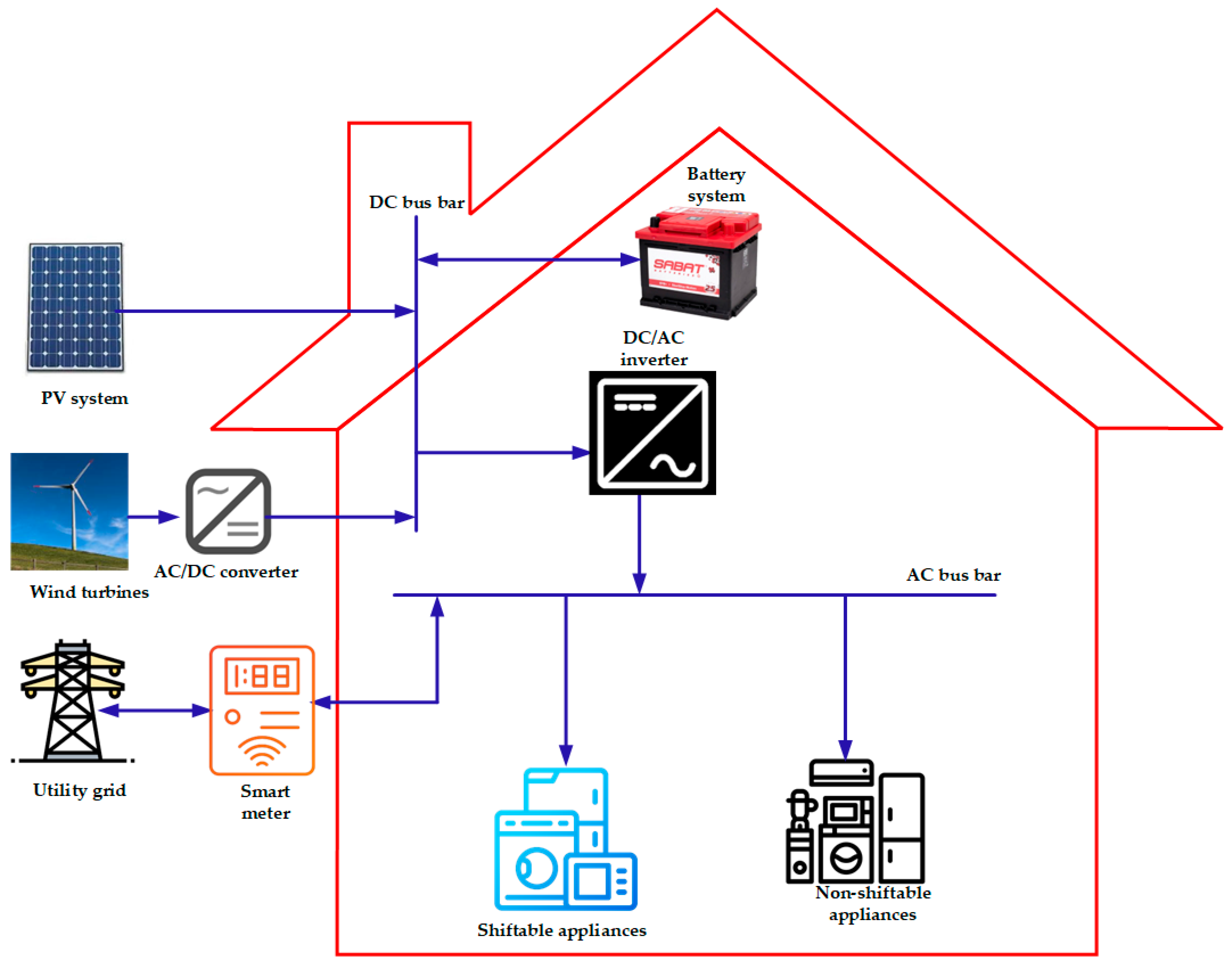
A smart home energy management system (SHEMS) is an intelligent control system that is designed to coordinate energy generation, storage and energy demand within residential buildings [49]. It integrates RESs, battery storage systems, smart appliances and the utility grid by using a control system. The energy flow of the system is monitored using smart meters and optimization algorithms to schedule energy usage based on electricity tariffs, user preferences and abundant wind and solar resources. The primary objectives of SHEMSs are to minimize net energy cost, maximize renewable energy utilization, reduce GHG emissions, improve user satisfaction, improve energy efficiency and sustainability in residential buildings [50]. The operation of a SHEMS that integrates RESs, a BSS and the utility grid to achieve efficient energy utilization in a smart home is shown in Figure 1. The appliances of SHEMSs are categorized into non-shiftable and shiftable loads based on their operational flexibility [51]. The electrical power from the wind turbines, PV system and utility grid is designed to satisfy household power demand, while surplus PV and WT energy generation can be injected into the grid or used to charge BSSs.

2.1. Hybrid Renewable Energy System

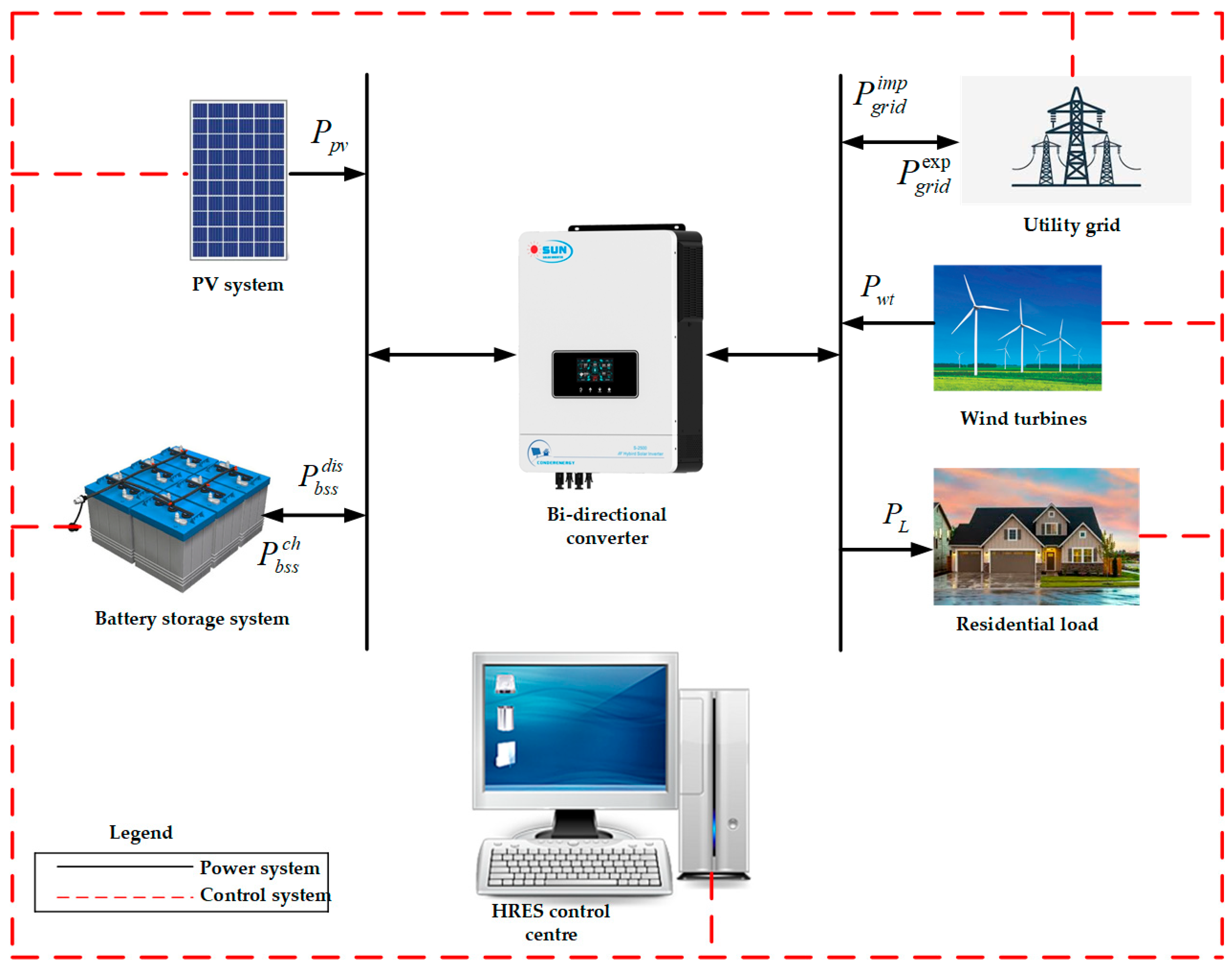
An HRES is an integrated energy system that combines two or more RESs, non-renewable backup sources and a BSS to supply reliable and sustainable electricity to the residential loads, as shown in Figure 2 [52]. Hybridization of numerous RESs such as PVs, WTs, BSSs and grid solar can be used to increase the reliability of power supply, improve efficiency and reduce over-reliance on fossil fuels [43]. The strength of one energy source can be used to compensate for the weakness of other sources of energy. HRESs are designed to provide cost-effective and sustainable electricity by overcoming the limitations of individual renewable energy sources, utilizing complementary characteristics of different sources, minimizing intermittent characteristics of solar and wind resources, optimizing energy utilization and increasing resilience of the system [53]. The components of HRESs are briefly explained as follows:

2.1.1. Photovoltaic System

A photovoltaic system is a renewable energy technology that utilizes the photovoltaic effect of semiconductor materials to convert solar radiation into electrical energy [54]. The installed capacity of PV systems varies in size from residential rooftop power supply to utility-scale solar farms that supply electricity to the utility grid [55]. PV systems are one of the widely used clean energy solutions for commercial and industrial energy applications, rural electrification, solar-powered water pumping and street lighting due to their technical and economic benefits. The power output of the PV system is expressed in Equation (1) as [56]:
P p v = G × A × η ( T )
where A is the module surface area (m2), G is the solar irradiance on the module surface (W/m2), and η (T) is the module efficiency at operating cell temperature Tcell.

2.1.2. Wind Turbines

A wind turbine is a renewable energy generation technology that utilizes rotor blades and a generator to convert the kinetic energy extracted from wind speed into electrical energy [57]. Wind turbines are extensively used for both onshore and offshore applications to generate clean and affordable energy based on the unique design characteristics and economic considerations of each location [58]. The electrical power output of wind turbines is expressed in Equation (2) as:
P w t = 1 2 ρ A v 3 C p ( λ , β ) η s y s
where ρ is the air density (kg/m3), A is the rotor swept area (m2), v is the wind speed at hub height (m/s), C p ( λ , β ) is the power coefficient, λ is the function of the tip speed ratio, β is the pitch, and η s y s is the balance of plant/system efficiency (generator, gearbox and electrical losses).

2.1.3. Battery Storage System

Battery storage systems are electrochemical technologies that store electrical energy in chemical form and discharge it as electricity when required. A BSS is a technology that serves as a critical component in power systems by providing energy balancing, peak shaving and frequency regulation. It supports the regulation of power flow under varying conditions and backup supply [59]. The state of charge (SOC) of the BSS is presented in Equation (3) as:
S O C ( t ) = S O C ( t 1 ) + P b s s c h ( t ) × η c h × Δ t E b s s P b s s d i s ( t ) η d i s × Δ t E b s s
where P b s s c h ( t ) is the battery discharge power (kW), P b s s d i s ( t ) is the battery charge power (kW), η c h is the charge efficiency of the BSS, η d i s is the discharge efficiency of the BSS, E b s s is the nominal capacity of the BSS, and Δ t is the time step (h).

2.1.4. Utility Grid

The utility grid is a centralized electrical network that supplies power to consumers and acts as a backup source and an energy balance source for HRESs [34]. The application of a utility grid in HRESs can be utilized to increase economic efficiency and the sustainability of power supply to the load points [60]. The utility grid power exchange is presented in Equation (4).
P g r i d i m p ( t ) P g r i d exp ( t ) = P L o a d ( t ) + P b s s c h ( t ) P p v ( t ) + P w t ( t ) + P b s s d i s ( t )
Here, P g r i d i m p ( t ) is the power imported from the grid (kW), P g r i d exp ( t ) is the power exported to the grid (kW), P L o a d ( t ) is the load demand, P p v ( t ) is the power generated by PV system (kW), and P w t ( t ) is the power generated by wind turbines (kW).

2.2. Electricity Tariffs

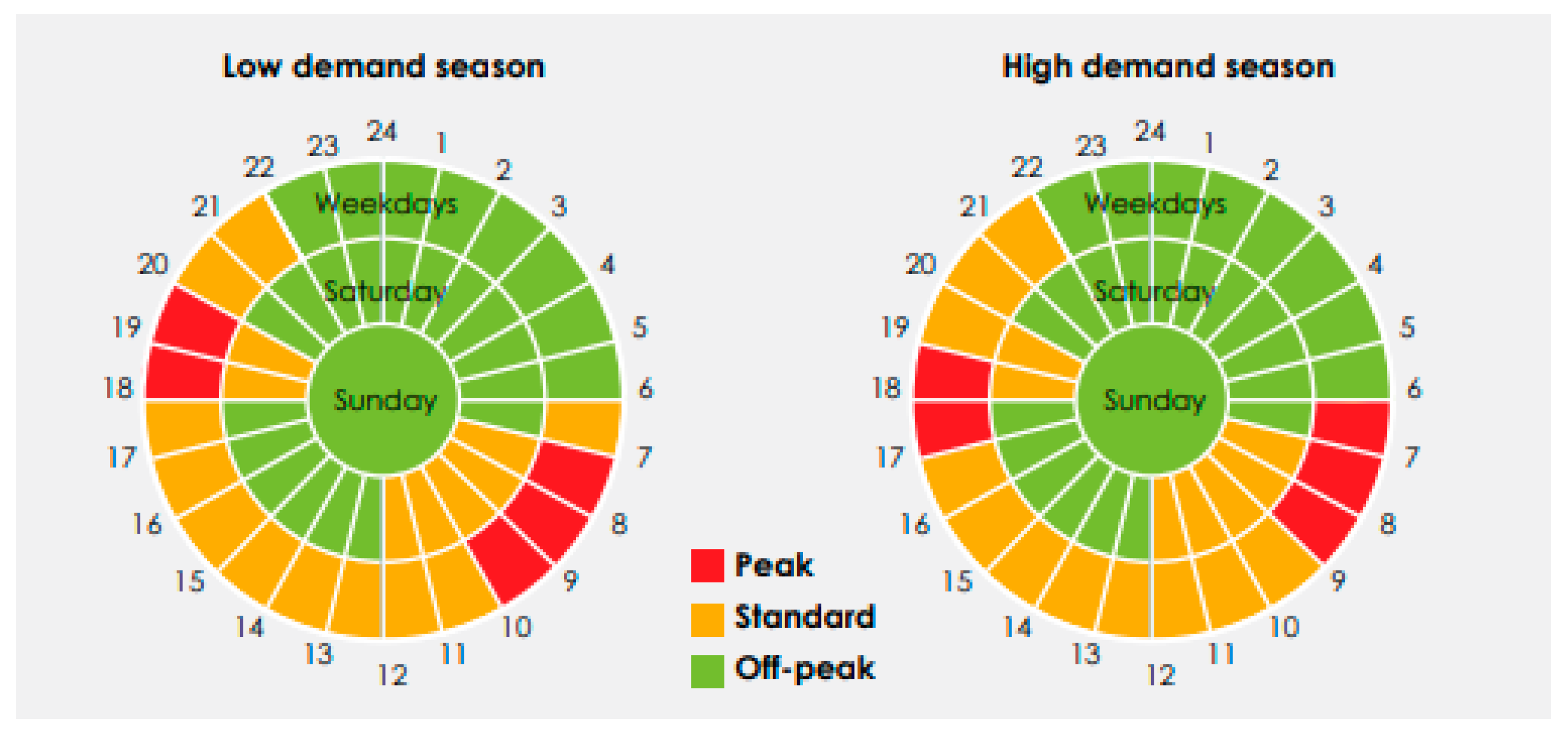
An electricity tariff is a pricing structure set by utility companies to determine the amount of money that consumers pay for their electricity usage [61]. The cost of production and distribution, type of customers, location, government policies and subsidies are some of the variables that affect electricity tariffs [62]. The Eskom Time-of-Use (TOU) tariff based on the low demand season and high demand is shown in Figure 3 [63]. The grid-tied TOU tariff based on Eskom Homeflex is presented in Equation (5) as [64]:
p i m p ( t ) = p o = 0 . 14 $ / kWh i f t 0 , 6 22 , 24 p s = 0 . 17 $ / kWh i f t 6 , 7 10 , 18 20 , 22 p p = 0 . 25 $ / kWh i f t 7 , 10 18 , 20
where p o , p s and p p are the pricing models for off-peak, standard and peak periods.
The small-scale embedded generation (SSEG) rate is the feed-in tariff introduced by Eskom to pay customers who generate their own electricity from RESs and export surplus power back to the utility grid [65]. The SSEG feed-in tariff based on Eskom Gen-offset Homeflex is presented in Equation (6) [64]:
p exp ( t ) = p o = 0 . 087 $ / kWh i f t 0 , 6 22 , 24 p s = 0 . 12 $ / kWh i f t 6 , 7 10 , 18 20 , 22 p p = 0 . 19 $ / kWh i f t 7 , 10 18 , 20

3. Objective Function of the Study

The primary objective of the research is to reduce net energy cost, scheduling inconvenience cost, GHG cost and battery degradation cost based on optimal utilization of RESs and scheduling of home appliances. The objective of the study is achieved through the optimal usage of the power supply by wind turbines, battery systems, PV systems and utility grids. The objective function of the study is presented in Equation (6) as:
min x J = i = 1 n E H , i T ( t ) + δ s i c , i i = 1 n S I C , i ( t ) + i = 1 n G H G , i ( t ) + i = 1 n B deg , i ( t )
where E H , i T ( t ) is the net energy cost, S I C , i ( t ) is the scheduling inconvenience cost, G H G , i ( t ) is the cost of GHG emissions based on the value of power purchased from the grid, δ s i c , i is a decision variable of SIC, and B deg , i ( t ) is the battery degradation cost.
The first component of the objective function is the net energy cost that depicts the difference between the monetary value of energy purchased from the grid and energy injected into the grid. It is presented in Equation (7) as:
E H , i T ( t ) = i = 1 n ( P g r i d , i i m p ( t ) × π t , i b u y ) i = 1 n ( P g r i d , i exp ( t ) × π t , i s e l l )
where π t , i b u y is the TOU import tariff ($/kWh), and π t , i s e l l is the TOU export tariff ($/kWh).
The second component of the objective function is the scheduling inconvenience cost that depicts the financial cost that is associated with user dissatisfaction when the operations of household appliances are shifted from the scheduled time of the user to the preferred time [66]. Scheduling inconvenience cost is introduced in this paper to capture the trade-off between economic optimization and occupant comfort of a residential building that is integrated with appliance scheduling. It plays a proactive role in bridging this gap by accounting for occupant comfort and lifestyle preference. Consumers can shift their appliances operation from peak periods to off-peak periods to harness the benefits of lower electricity prices. The SIC for each appliance can be estimated by using the inconvenient time deviation and discomfort cost rate.
S I C i = t = 1 T α i ( t ) × T s , i ( t ) T p , i ( t )
Here, α i is the discomfort cost rate ($/h), T s , i ( t ) is the scheduled start time, T p , i ( t ) is the preferred start time for appliance I, and T is the total scheduling period.
The total SIC can be expressed by summing the SIC values across all appliances. The total scheduling inconvenience cost is expressed as:
S I C t o t a l = l = 1 n S I C i
δ s i c , i is a decision variable of SIC that is set to 1 or 0, as expressed in Equation (10).
δ s i c , i = 1 0 A p p l i c a t i o n o f a p p l i n a c e s c h e d u l i n g O t h e r w i s e
The third component of the objective function is the GHG cost that consists of CO2, SO2 and NOx emissions based on the power purchased from the utility grid. It is expressed in Equation (11) as:
G H G , i ( t ) = i = 1 n P g r i d , i i m p ( t ) × E F C O 2 , i ( t ) × E g r i d C O 2 ( t ) + i = 1 n P g r i d , i i m p ( t ) × E F N O x , i ( t ) × E g r i d N O x ( t ) + i = 1 n P g r i d , i i m p ( t ) × E F S O 2 , i ( t ) × E g r i d S O 2 ( t )
where E F C O 2 , i ( t ) , E F N O x , i ( t ) and E F S O 2 , i ( t ) are emission factors of carbon dioxide, nitrogen oxide and sulfur dioxide based on energy purchased from the utility grid, while E g r i d C O 2 ( t ) , E g r i d S O 2 ( t ) and E g r i d N O x ( t ) are emission externality factors of CO2, SO2 and NOx emissions.
The fourth component of the objective function is battery degradation cost, which shows a gradual deterioration of the capability of the battery system due to charge and discharge of energy over time [67]. Battery degradation cost is expressed in Equation (12) as:
B deg , i ( t ) = i = 1 n C deg η c h × P b s s c h ( t ) Δ t + P b s s d i s ( t ) Δ t η d i s
where C deg is the cycle cost per kWh throughput of the battery system ($/kWh).
The battery energy price is presented in Equation (13) as:
C deg ( t ) = C b s s c a p 2 × E b s s u s a b l e × N c y c l e
where C b s s c a p depicts the capital cost of the battery system ($), E b s s u s a b l e is the usable energy of the BSS (kWh), and N c y c l e is the life cycle of the BSS.
The usable energy of the battery system is presented in Equation (14) as:
E b s s u s a b l e = E b s s n S O C max ( t ) S O C min ( t )
where E b s s n is the nominal capacity of the BSS (kWh), S O C max ( t ) is the maximum SOC of the BSS, and S O C min ( t ) is the minimum SOC of the BSS.

3.1. Constraints of the Power System

The objective function of the study that is presented in Equation (6) is subject to the following constraints:

3.1.1. Power Balance Limits

The power balance of the proposed HRES is expressed in Equation (15) as:
i = 1 n P g r i d , i i m p ( t ) + i = 1 n P p v , i ( t ) + i = 1 n P w t , i ( t ) + i = 1 n P b s s , i d i s ( t ) = i = 1 n P g r i d , i exp ( t ) + i = 1 n P b s s , i c h ( t ) + i = 1 n P L , i ( t )

3.1.2. Generating Limits

The generation capacity of PVs, WTGs, BSSs and utility grids should operate within the minimum and maximum limits to be efficient and produce power according to their capacities. The generating limitations of each component of the proposed HRES are presented in Equation (16) as:
P g r i d , i i m p , min ( t ) P g r i d , i i m p ( t ) P g r i d , i i m p , max ( t ) P g r i d , i exp , min ( t ) P g r i d , i exp ( t ) P g r i d , i exp , max ( t ) P p v , i min ( t ) P p v , i ( t ) P p v , i max ( t ) P w t , i min ( t ) P w t , i ( t ) P w t , i max ( t ) P b s s , i c h , min ( t ) P b s s , i c h ( t ) P b s s , i c h , max ( t ) P b s s , i d i s , min ( t ) P b s s , i d i s ( t ) P b s s , i d i s , max ( t )

3.1.3. State of Charge of the Battery System Limits

The capacity of the battery system used in the proposed smart home HRES operates within the minimum and maximum limits based on the technical specifications of the manufacturers. The SOC of the BSS operates within lower and upper limits, as expressed in Equations (17) and (18):
S O C min S O C ( t ) S O C max
S O C min S O C ( 0 ) + η c i = 1 n P b s s , i c h ( t ) 1 η d i s i = 1 n P b s s , i d i s ( t ) S O C max

3.2. Selected Location for the Study

Upington is geographically situated in the Northern Cape province of South Africa with a latitude of −28.44776°, a longitude of 21.25612° and a coverage area of about 580.8 km2. The town currently boasts a population of 91,107 people and a population density of 156.9/km2 [68]. Upington is located on the Northern banks of the Orange River, with an elevation of 835 m. Solar irradiance of Upington is among the top in South Africa, with an estimated global horizontal irradiance of 2600–2800 kWh/m2-yr [69]. The wind speed is not the highest in South Africa, but it is suitable to spine wind turbines based on the technical specifications of the manufacturers. The capacity of wind generation can complement solar generation in the evening and winter season. The proposed HRES is designed for a smart home integrated with the scheduling of household appliances in Upington since the electricity tariff has been increased by 4.1% in the 2025/2026 financial year. The proposed HRES components are chosen in accordance with the energy requirements of the selected residential building, such as shiftable loads and non-shiftable loads. Optimal scheduling strategies are applied in the study to reduce unnecessary stress on the utility grid and optimize energy consumption. RESs are utilized in this research work to increase access to electricity in Upington and boost economic activities, education and healthcare delivery services, which are heavily affected by load shedding.

3.3. Ant Colony Optimization Algorithm

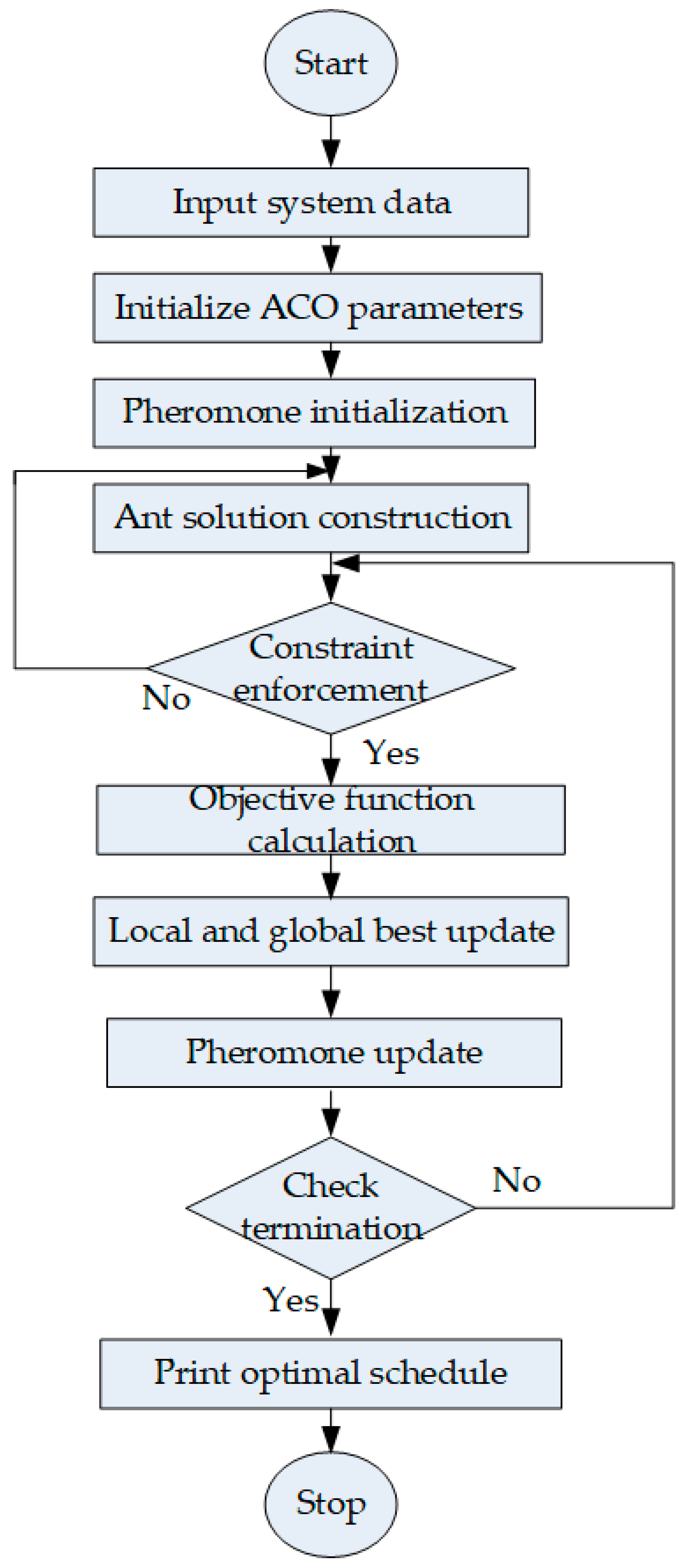
ACO is a population-based metaheuristic optimization technique inspired by the foraging behavior of ant colonies. Marco Dorigo developed the algorithm in the early 1990s to search for an optimal path in a graph based on the exploitation of food resources by ants. It is motivated by the foraging behavior of ant colonies in which individual ants find the shortest path between a food source and their nest. These trails guide subsequent ants in a probabilistic manner towards optimum routes. This observation is the basis of utilizing the ACO algorithm to search for optimal solutions to a given optimization problem. The applications of the ACO algorithm in the power system span across optimal scheduling of smart grid systems, optimization of microgrid systems or hybrid energy systems, load scheduling of smart homes, energy management of electric vehicles, optimal power flow, multi-objective optimization of smart grid and microgrid systems, optimal sizing of renewable energy resources and energy storage management. The ACO algorithm comprises eight principal steps that form the optimization loop, as presented in Figure 4. The following steps are implemented to achieve the objectives of the study: input system data, initialize ACO parameters, pheromone initialization, ant solution construction, constraint enforcement, objective function calculation, local and global best update, pheromone update, check termination and print the optimal schedule. The ant colony optimization algorithm is applied in this study owing to its proficiency to solve complex, discrete and non-linear problems that are associated with home appliance scheduling. The optimization of home appliance operation, renewable energy sources, battery system dispatch and utility grid interaction is a complex decision that traditional techniques cannot efficiently solve. ACO has a very strong global search capability, ability to prevent premature convergence and production of high-quality solutions under dynamic load demands and variability of solar and wind resources. It also supports the optimization of multi-objective functions like net energy cost, GHG cost, battery degradation and SIC. The capabilities of ACO such as scalability, robustness against renewable energy uncertainty and computational efficiency have made it an ideal choice for optimizing grid-connected HRES operation.

4. Technical and Economic Specifications of Hybrid Renewable Energy System

The technical specifications and economic details of the components of the proposed HRES are presented in this section. The proposed techniques are applied in the MATLAB environment by utilizing MATLAB software version R2025a in HP Laptop 14-ep0026ni 14′, Intel (R) Core i5-1334U, 4.6 GHz CPU and installed RAM of 16 GB. The technical and economic assessment of the proposed HRES is implemented by using the technical specifications and cost parameters of the components presented in Table 2. The key performance indicators (KPIs) of the study can be evaluated by using the technical specifications and cost parameters of the proposed HRES. The above-mentioned KPIs are used to select the optimal results based on the optimization technique applied in the study. The performance of the HRES is evaluated by considering a typical load profile of a consumer in Upington, Northern Cape Province, South Africa. The home appliances based on their operating hours and rated power are presented in Table 3.
The technical and economic specifications of the components are utilized to assess the feasibility and operational performance of the power system. Technical specifications of the components, as presented in Table 2, are used in the study as input parameters to evaluate the physical feasibility and operational performance of the power system. The economic specifications are utilized in the study to achieve financial viability and sustainability of the proposed power system. The optimal operation of grid-connected HRESs is based on coordination of technical and economic specifications of each component. The technical specifications of the components are selected from the datasheet of original equipment manufacturer. The residential loads that consist of shiftable and non-shiftable home appliances are considered in this study. The home appliances based on their operating hours and rated power are presented in Table 3. The operating hours of each appliance are selected to reflect energy usage characteristics of a residential building. The rated capacity of home appliances is the nominal power consumption during normal operation periods. It can be used for modeling of residential energy, optimization of HRESs and home appliance scheduling. The rated values of the selected appliances are based on manufacturer specifications to achieve realistic load representation.

5. Results and Discussion

The impacts of RESs and appliance scheduling on a grid-connected HRES are assessed in this study by using some KPIs. This section presents the results of the three case studies and evaluates the performance of optimal scheduling strategies in a grid-connected HRES for smart home applications. The following three operational scenarios are considered in the study:
Case study 1: Grid-only without appliance scheduling;
Case study 2: Grid-connected HRES without appliance scheduling;
Case study 3: Grid-connected HRES with optimal appliance scheduling.
The simulation results of each case study based on the associated KPIs are presented as follows:

5.1. Case Study 1: Grid-Only Supply Without Appliance Scheduling

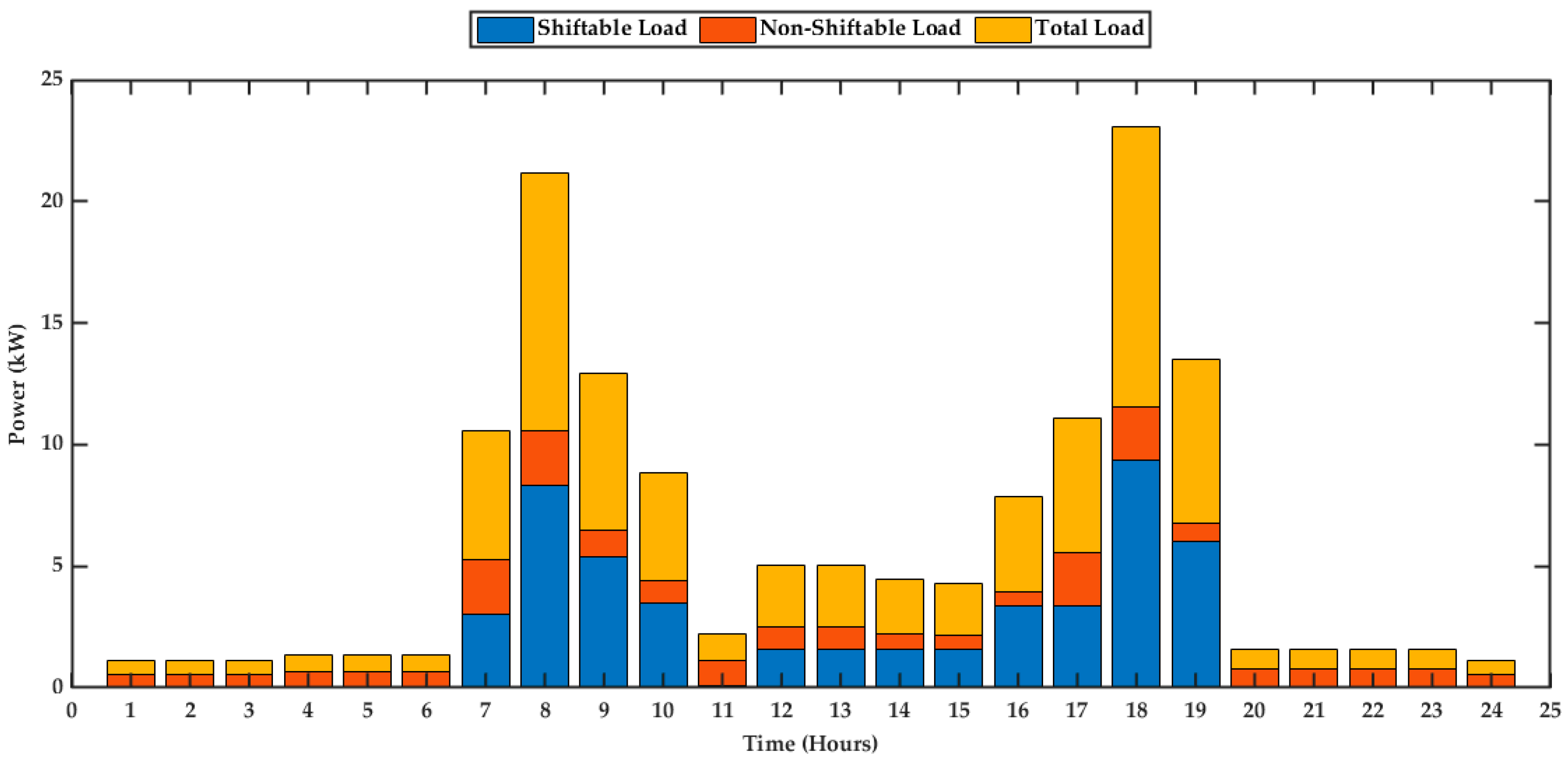
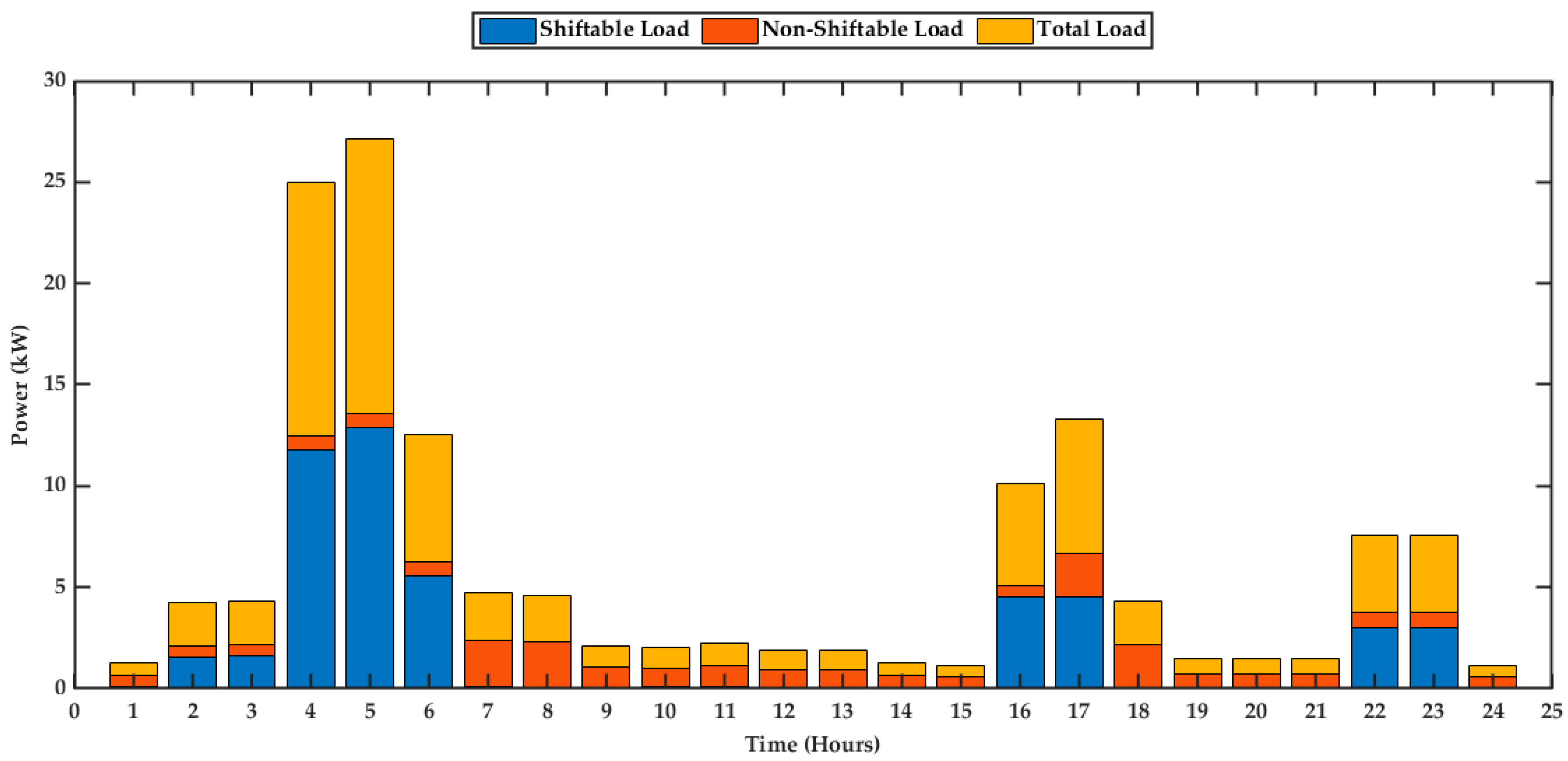
The residential building that operates by using the utility grid alone to meet the load demand is presented in case study 1. The appliances of the residential building on an hourly basis under a grid standalone system to highlight their load characteristics are presented in Figure 5. The home appliances in this case study are divided into both shiftable loads and non-shiftable loads to identify opportunities for RES integration and application of home appliance scheduling in later case studies. It can be seen from Figure 5 that shiftable loads contribute a significant part of the total load demand from 7.00 to 10.00 and 12.00 to 19.00 h of the day, while non-shiftable loads contribute more uniformly throughout the day.
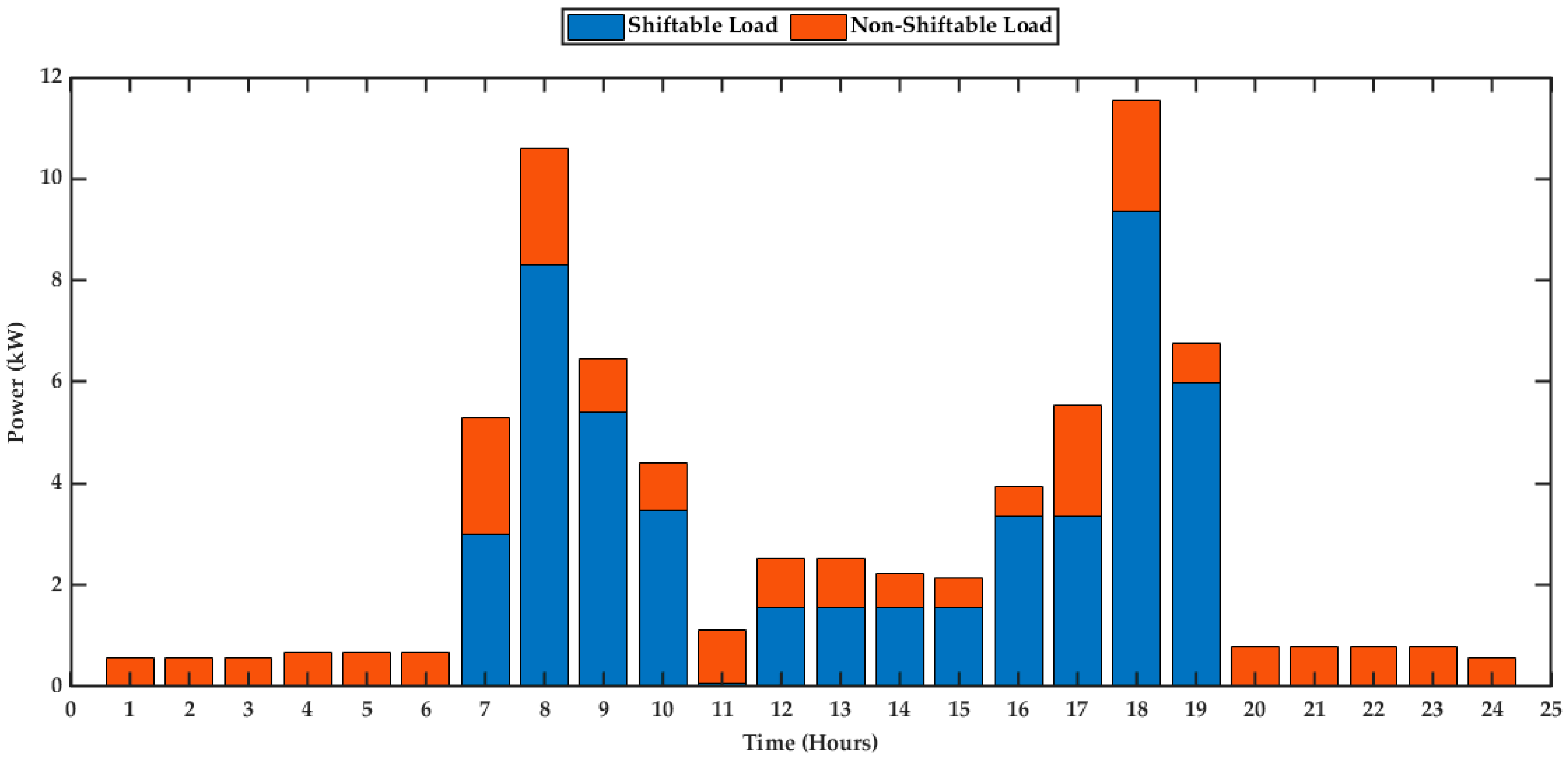
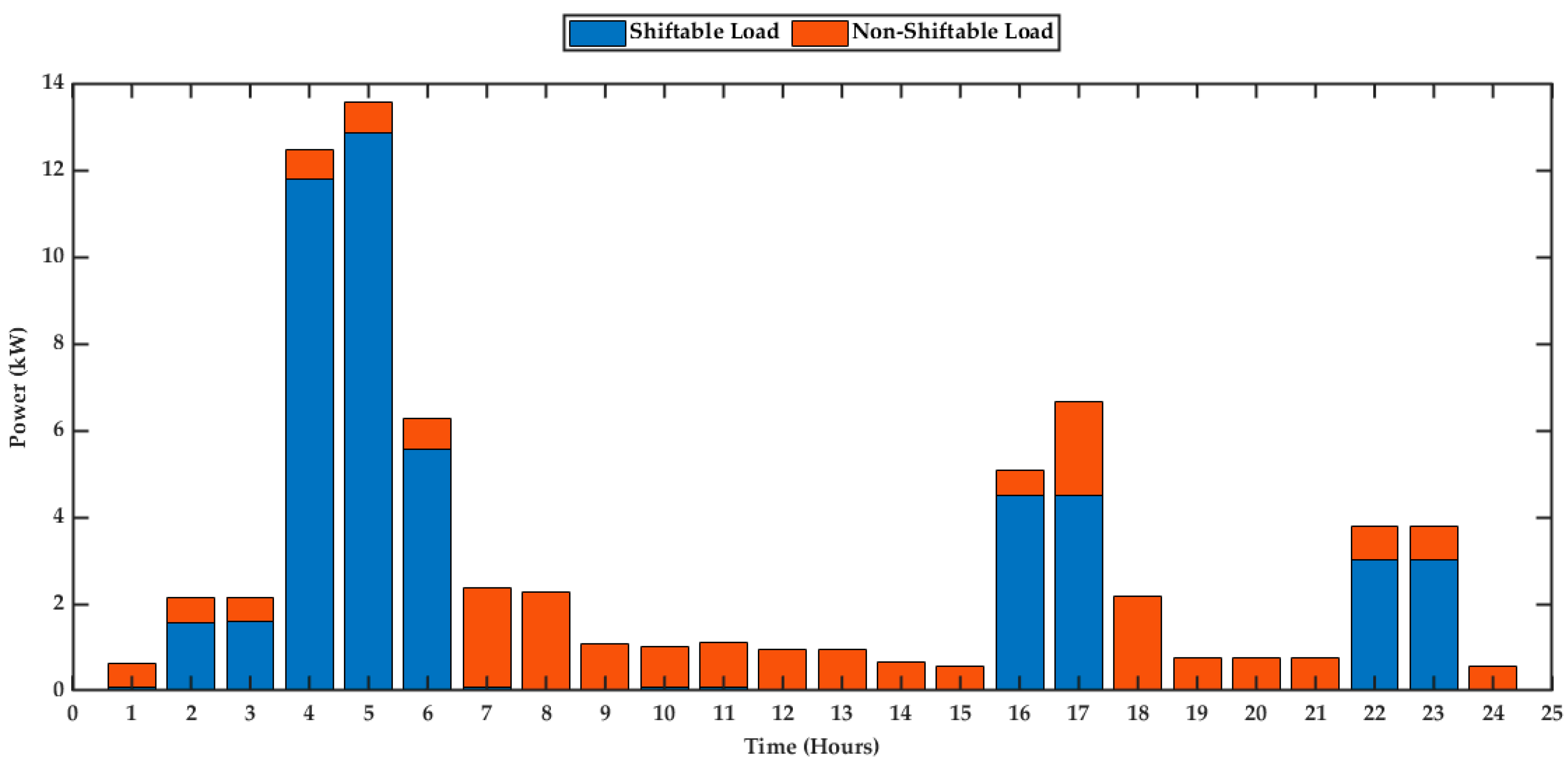
The characteristics of shiftable and non-shiftable loads are further illustrated in Figure 6. Shiftable loads dominate consumption during the morning and evening peak period, with load demands of about 3–10 kW, while non-shiftable loads remain relatively constant around 0.5–3 kW throughout the 24 h. The flexibility of the residential load demands can be established based on the distribution of shiftable and non-shiftable load demands. The overall performance of the proposed HRES can be improved by rescheduling the operation of shiftable appliances to off-peak hours. The low contribution of non-shiftable loads to total load demand indicates that more efforts should be focused on shiftable appliances to reduce energy purchase from the grid, net energy cost and GHG cost.
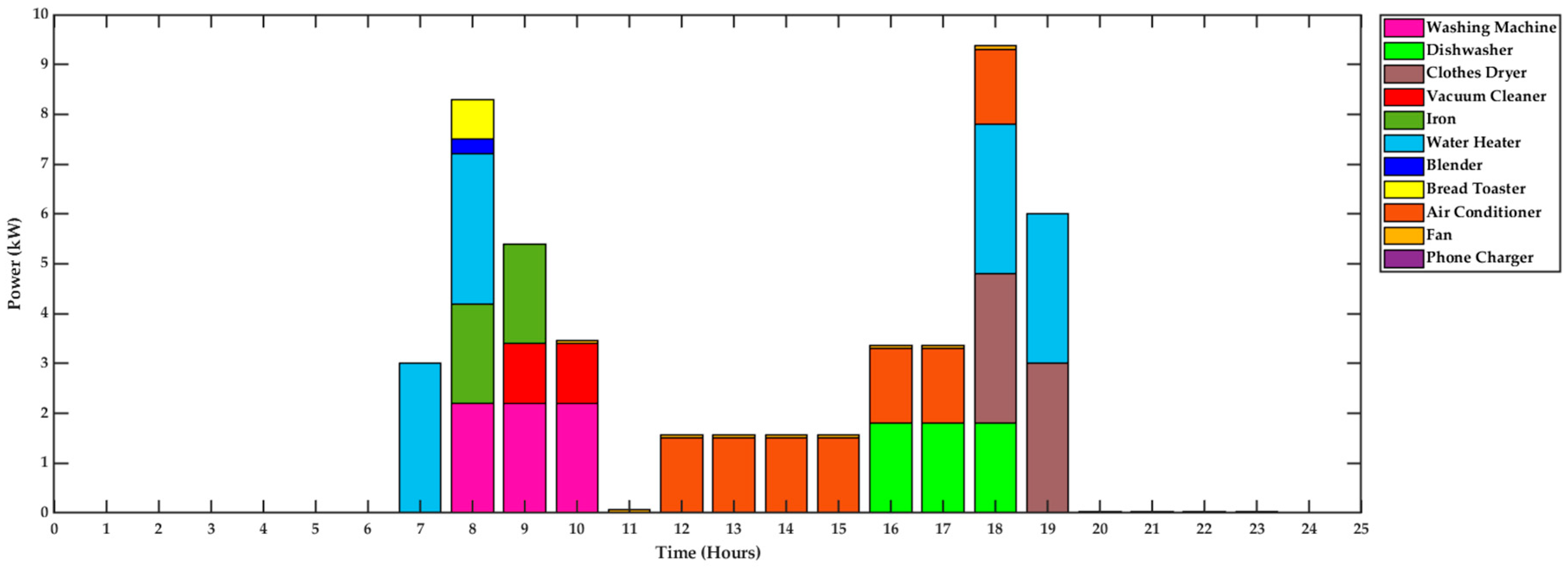
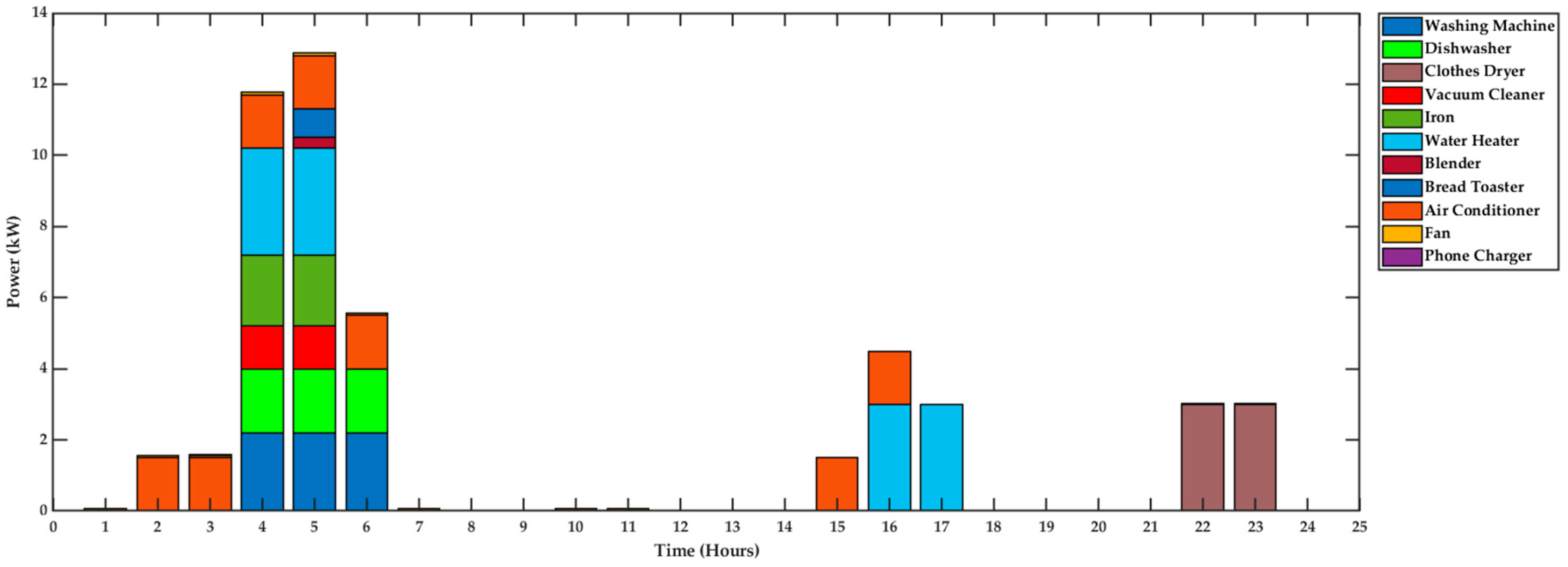
The shiftable load profile based on individual appliances and hourly operation patterns is presented in Figure 7. The most energy-intensive shiftable appliances such as washing machines, dishwashers and water heaters are frequently utilized in the morning (08:00–10:00) and evening (16:00–19:00) periods. Other appliances, such as vacuum cleaners, irons, blenders, bread toasters, fans and phone chargers have shorter and less frequent operational cycles. The use of shiftable loads during peak periods demonstrates that appliance scheduling can improve the performance of the proposed grid-connected HRES.
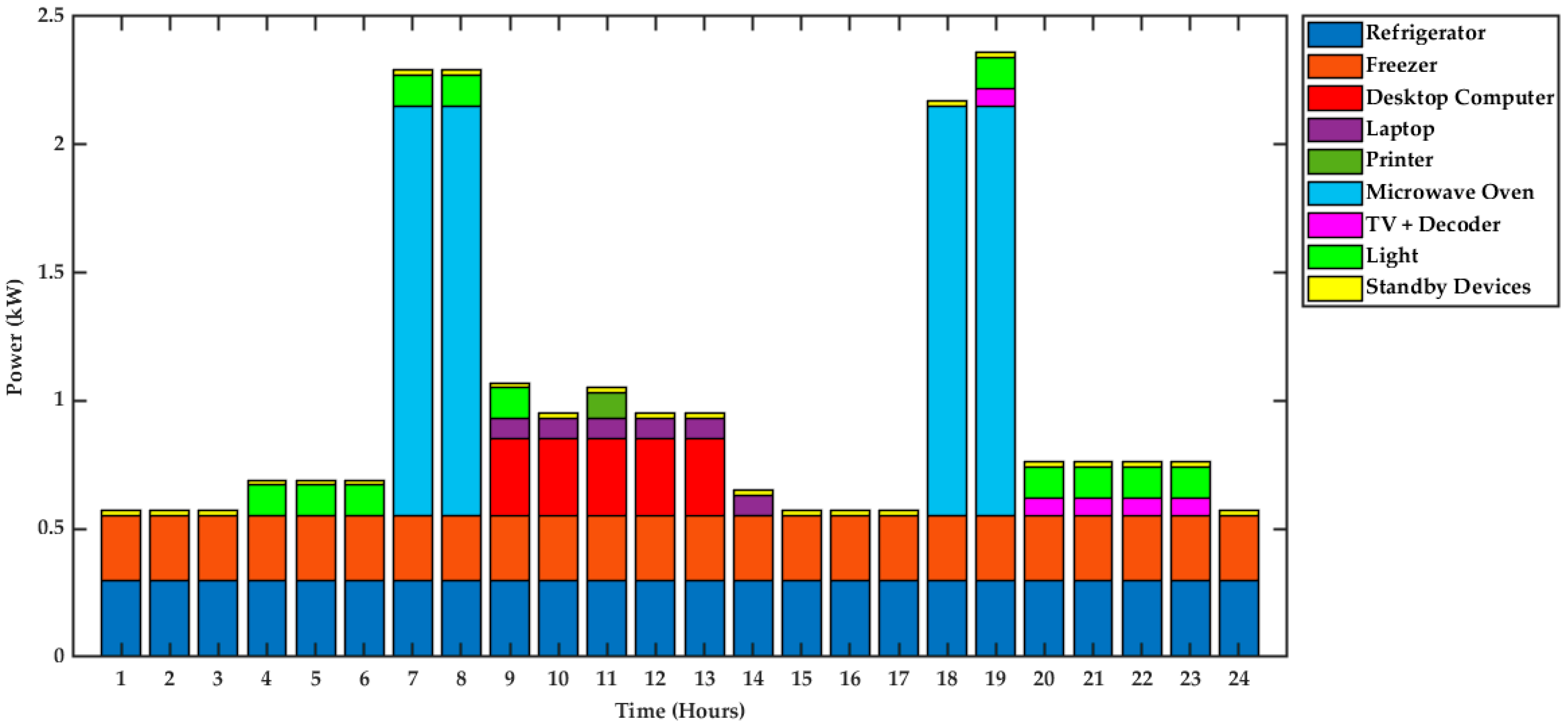
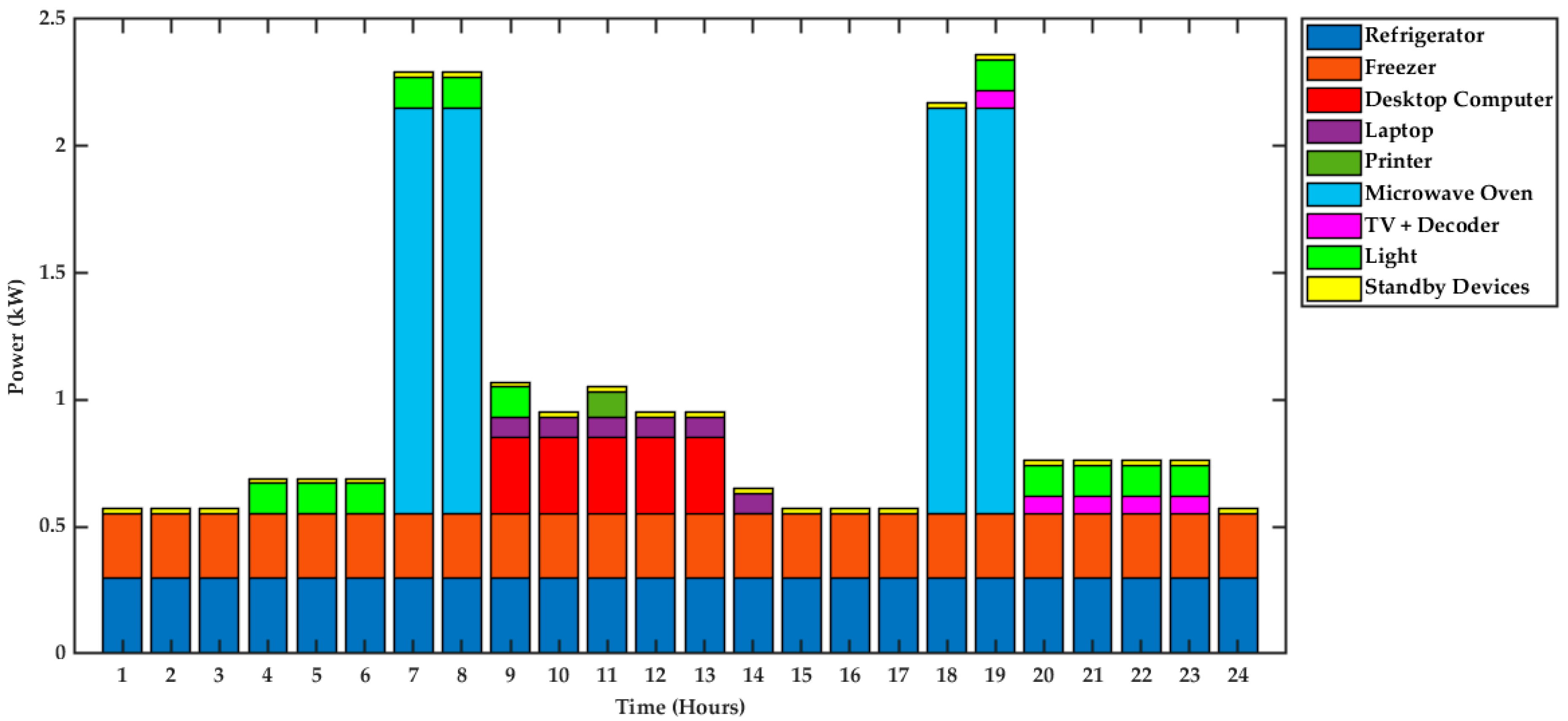
The non-shiftable appliances, such as such as lighting, refrigeration and freezers, operate continuously or frequently on an hourly basis, as depicted in Figure 8. The power consumption of non-shiftable appliances is nearly constant throughout the 24 h horizon, typically between 0.5 and 3 kW. The non-shiftable loads have become an integral part of the base load of the household energy demand, since these loads cannot be rescheduled without affecting user safety. Therefore, non-shiftable loads are treated as fixed load demands while focusing on optimizing the key components of the objective function.
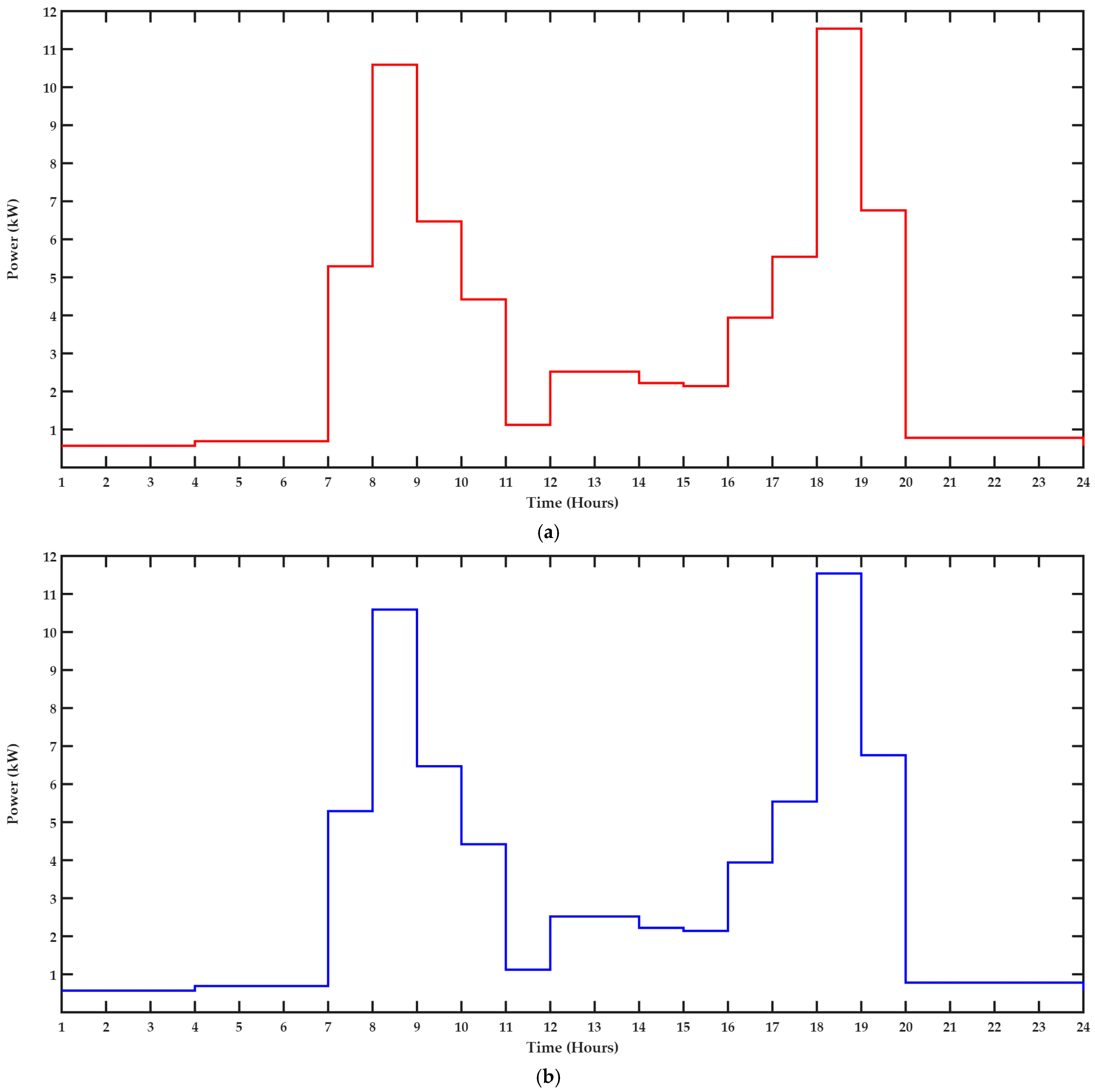
In this case study, the load demand is purchased from the utility grid without the utilization of PVs, WTs and BSSs and scheduling of household appliances. The hourly variation of residential load demand and power purchased from the grid over 24 h is presented in Figure 9a,b. Figure 9a shows that peak periods occur early in the morning (06:00–09:00) and later in the evening (17:00–20:00). These peak periods reflect the consumption pattern of residential consumers based on their appliance usage during times when occupants prepare for daily activities or return home from work. It can be established from Figure 9b that the pattern of power demand from the grid is the same as the load demand pattern, since the household depends on the utility grid only to meet its daily power demand without contribution from RESs and BSSs and scheduling of home appliances.
The detailed results of the simulation, as presented in Table 4, show that the grid-only configuration incurred the highest value of net energy cost among the three case studies owing to its total reliance on the grid to supply electricity, high tariff rates and significant GHG emissions. This indicates that 100% of the power demand by the household is obtained from the utility grid with a net incurred energy cost of $14.988, GHG emission cost of $2.693 and energy purchased of 75.138 kWh. The optimization results show a high net incurred energy cost and environmental impact of using the grid standalone configuration to satisfy load demand owing to the absence of load scheduling or renewable energy integration. This demonstrates that the uncoordinated operation of household appliances during peak tariff periods can cause economic inefficiency and increase unnecessary stress on the utility grid. The simulation results obtained in case study 1 demonstrate that the cost of energy purchased from the utility grid has become a significant component that determines the values of net incurred energy cost in the absence of renewable energy generation and appliance scheduling.
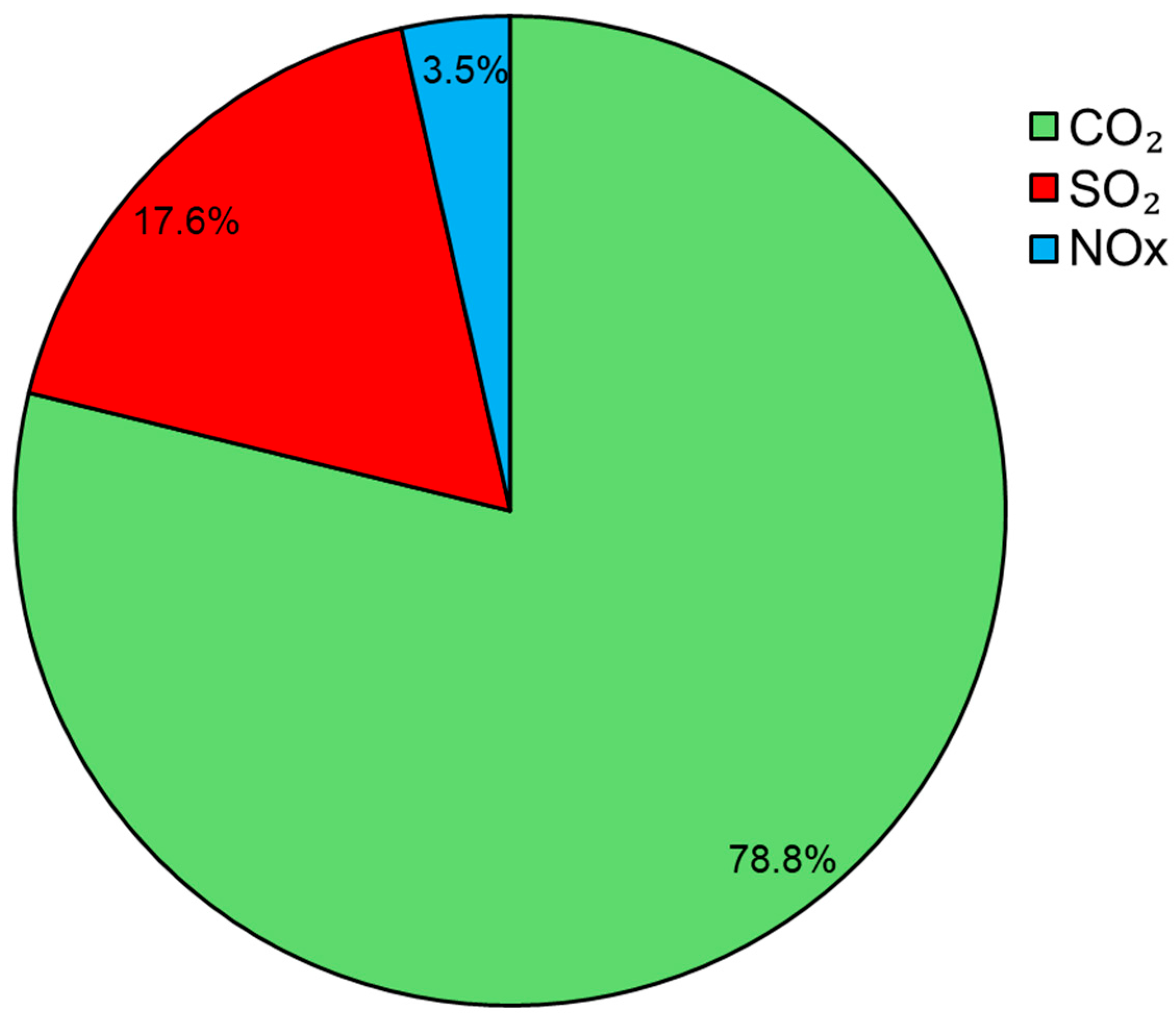
The GHG cost of $2.693 obtained in this case study is based on intensive application of coal-based thermal plants in South Africa for electricity generation. The GHG-related costs show that CO2, SO2 and NOx contribute $2.123, $0.475 and $0.095 to the total emission cost of $2.693. Specifically, CO2 emissions accounted for the largest percentage of the total GHG costs (78.8%), while SO2 and NOx contributed 17.6% and 3.5%, as shown in Figure 10. These results have reflected the typical emission profile of thermal-based generation plants. The values of CO2, SO2 and NOx emissions obtained in this case study are 70.780 kg, 0.522 kg and 0.317 kg based on the contribution of each pollutant, emission factors and the amount of power purchased from the grid. The high values of GHG costs and net energy cost obtained in this case study indicate that over-reliance on the utility grid to satisfy the load demand of households is not economically and environmentally sustainable. The results show that the cost of energy purchased from the utility grid dominates the total cost while GHG emissions contribute significantly to environmental costs. It is obvious from the results obtained from case study 1 that over-reliance on the utility grid can cause higher net energy cost and GHG emissions. This case study can be used as the baseline scenario to compare the technical, economic and environmental benefits of RESs and BSS integration in case studies 2 and 3. The results clearly demonstrate the necessity of using RESs and appliance scheduling to achieve cost reduction and sustainability of power supply. Hence, the outcomes of this case study can be utilized as a benchmark for assessing the benefits of distributed energy generation and scheduling of home appliances strategy in subsequent case studies.

5.2. Case Study 2: Grid-Connected HRES Without Appliance Scheduling

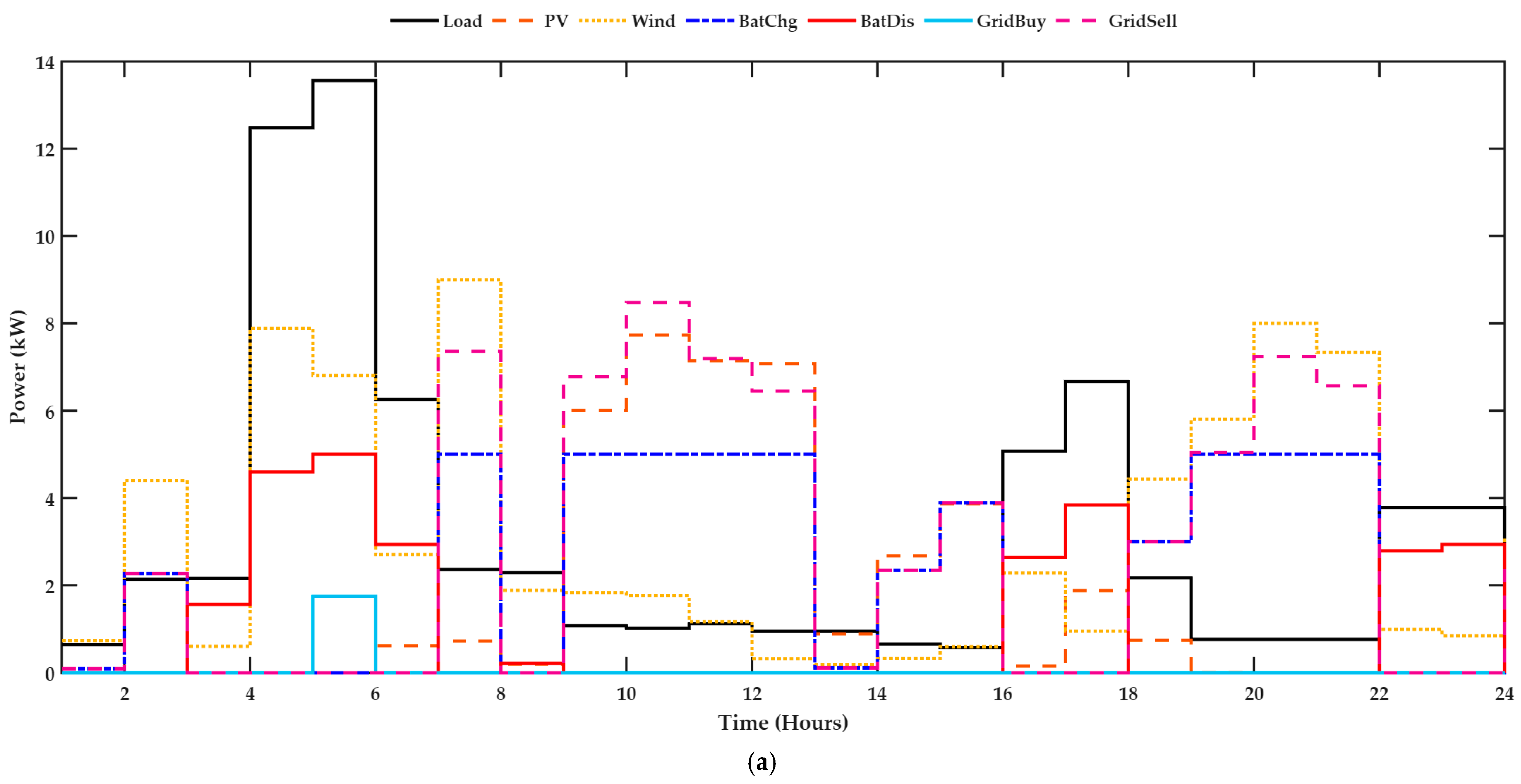
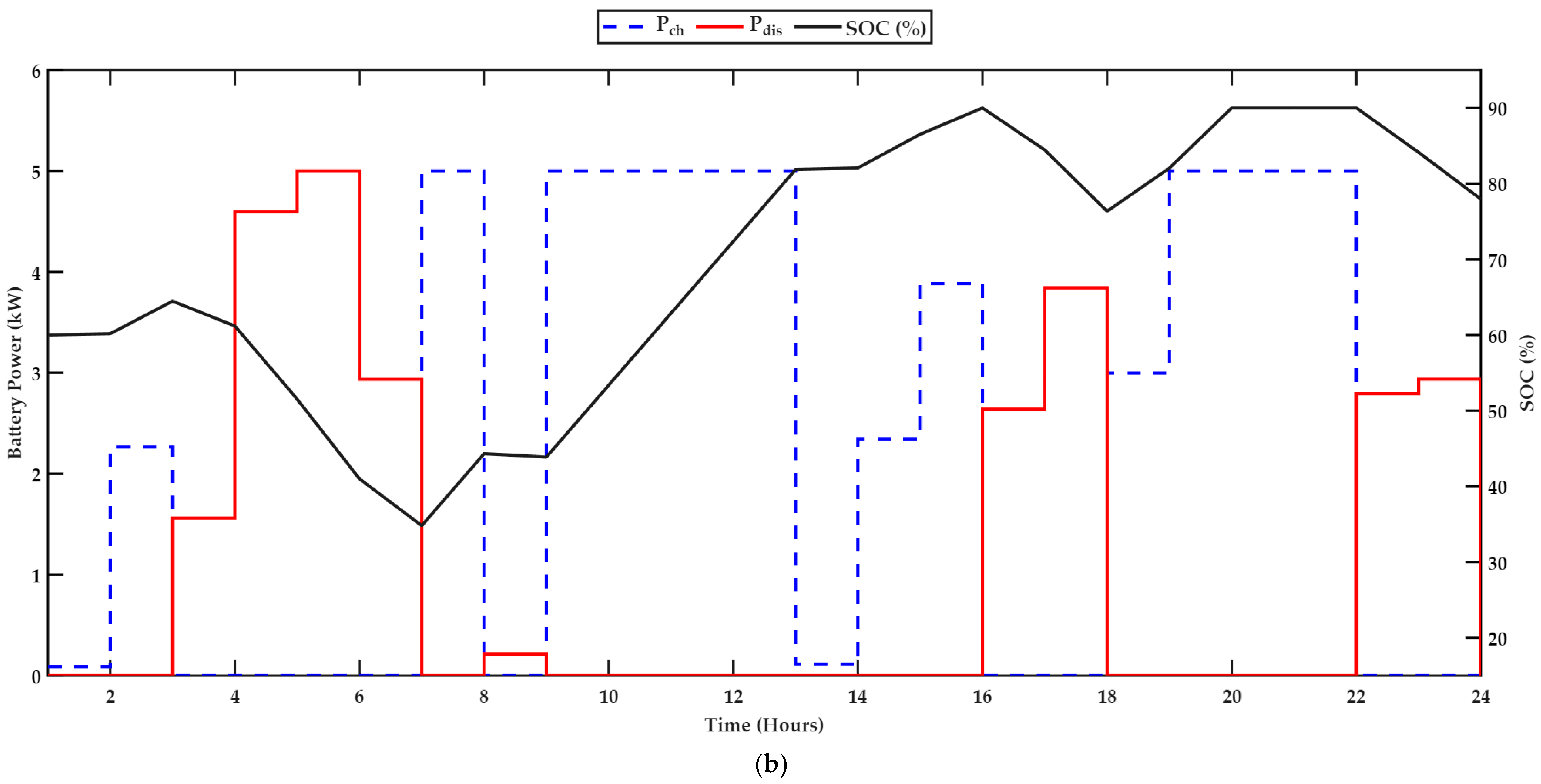
In this case study, the residential energy system is integrated into a grid-connected HRES to utilize generated renewable energy and reduce reliance on the utility grid. The present configuration allows the exchange of energy between the utility grid and distributed energy generation units without scheduling of home appliances. This shows that home appliances operate according to their normal usage patterns shown in Figure 5, Figure 6, Figure 7 and Figure 8. The power distribution profiles of the proposed HRES, which consists of load demand, power generated from PVs and wind turbines, as well as power purchase from the grid, power sold to the grid, battery discharge power and battery charge power, are presented in Figure 11a. The load demand of this case study is similar to case study 1 since there is no scheduling of home appliances. The power generation from the PV system contributed a considerable amount to the system between 9:00 and 16:00, while the contribution of the wind turbines to the entire power system varied intermittently throughout the day. The system is designed to charge BSSs during periods of surplus power from PVs and wind turbines and discharge during periods of deficit power from renewable energy sources. The relationship between the discharge power, charge power and SOC of the BSS throughout the day is presented in Figure 11b. The SOC of the BSS operates between the acceptable minimum and maximum limits to extend the lifespan of the BSS. The value of the battery degradation cost of $0.47 that is obtained in this case study is relatively low. This confirms that the battery operates with the marginal value of the battery degradation cost under unscheduled operation and ensures that the health status of the battery is maintained based on the energy management strategy that was used in the study.
The net energy revenue cost of $7.438 obtained in this case study confirmed the competence of the ACO technique to effectively optimize HRESs with grid interactions. This is the value of net revenue earned by the household when the amount of energy injected into the grid is more than the amount of energy purchased from the grid. The net energy revenue cost of $7.438 demonstrates a significant financial benefit that the household has derived from using the proposed HRES owing to the renewable energy generation potential of PVs and wind turbines and revenue obtained from selling excess energy to the utility grid. The summary of the results presented in Table 4 shows that 3.138 kWh of energy was purchased from the utility during low renewable energy generation hours, while 69.176 kWh of energy was injected into the utility grid when energy from PVs, WTs and BSSs exceeded local load demand. The amount of energy purchased from the utility grid has reduced by 96% relative to case study 1. This demonstrates that the system effectively utilized RESs to meet the local power demand. The excess energy from PVs and WTs contributed to the reduction of over-reliance utility grid and net energy cost as well the generation of economic credits.
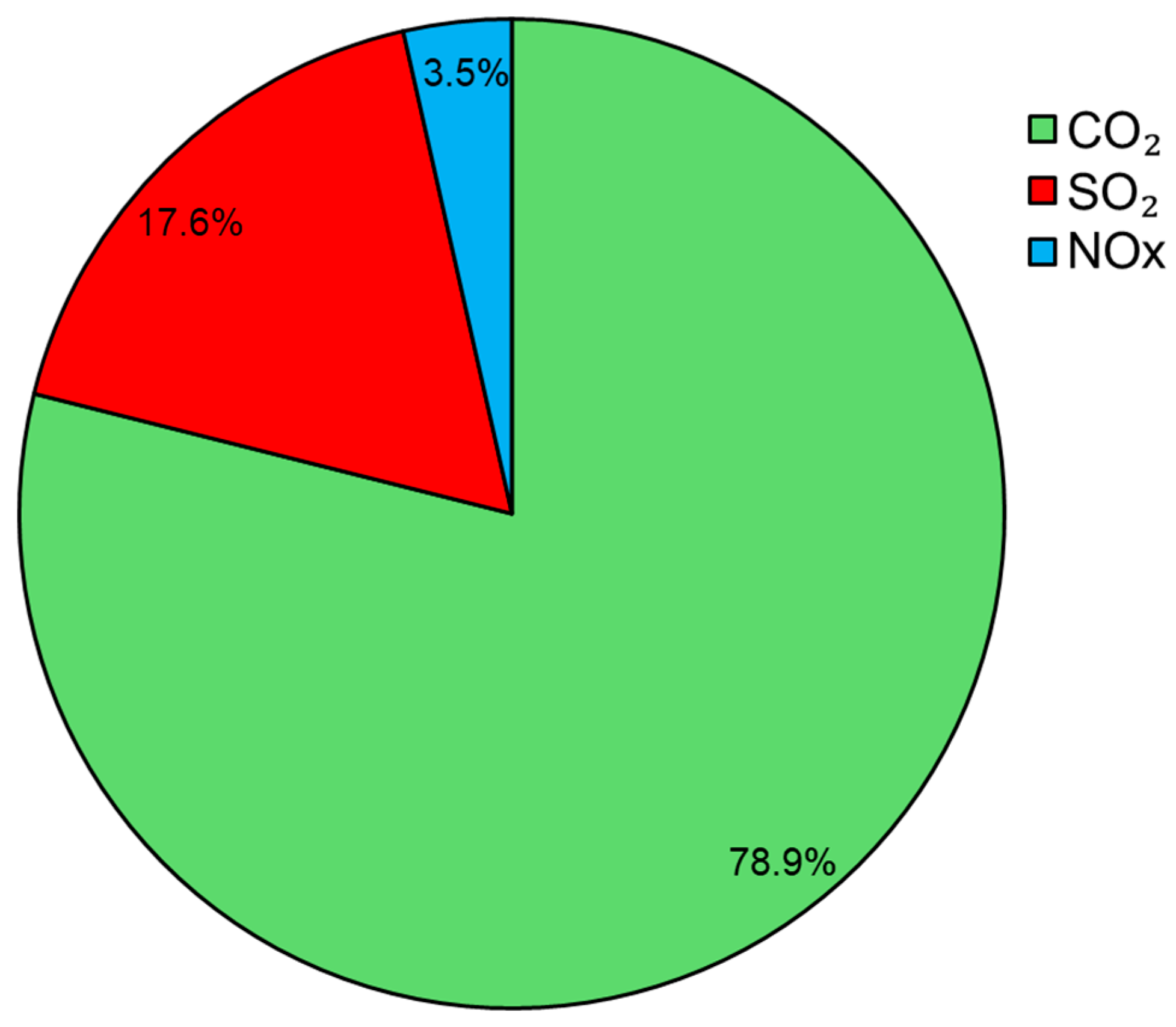
The value of GHG cost has reduced from $2.693 in case study 1 to $0.113 in case study 2 because RESs and BSSs are used in the existing power system. This indicates a strong positive environmental impact of using RESs in the proposed HRES. The breakdown of emission costs obtained in this case study shows that CO2, SO2 and NOx contribute $2.956, $0.021 and $0.013 to the GHG cost of $0.113. It can be seen in Figure 12 that CO2 contributed 78.9% of the total GHG cost, followed by SO2 (17.6%) and NOx (3.5%). CO2 emissions accounted for the largest percentage of the total GHG emissions with 2.956 kg, while SO2 and NOx contributed 0.022 kg and 0.013 kg. This shows that CO2 emissions account for the majority of the environmental impact. The values of CO2, SO2 and NOx costs obtained in this case study have reduced by approximately 96% when compared with case study 1. The significant reduction of CO2, SO2 and NOx costs is attributed to the dominance of green energy technologies that displaced power obtained from the fossil fuel-based utility grid. The reduction of the amount of GHG emissions corresponds to a considerable reduction of GHG costs compared to the utility grid-only configuration, since most of the energy is sourced from clean renewable resources. Therefore, GHG emissions and associated costs are minimized. The significant reduction in the net energy cost, energy purchased from the grid and emission metrics recorded in this case study confirms the environmental and economic superiority of grid-connected HRESs over a grid-only configuration. The combined operation of PV and WT units significantly improved cost savings and reduced the carbon footprint in the absence of appliance scheduling. The system is not only satisfied local demand but also improved revenue through grid energy sales, reduced GHG emissions and improved the sustainability of the power system through the prospect of renewable energy generation. The scheduling of home appliances is introduced in case study 3 to coincide with high renewable energy generation or off-peak periods. It is anticipated that this will increase system efficiency and further maximize renewable self-consumption.

5.3. Case Study 3: Grid-Connected HRES with Optimal Appliance Scheduling

The HRES that consists of PVs, WTs, a BSS and a utility grid is considered in this case study with the scheduling of home appliances. The time-based appliance scheduling was introduced in this case study to shift shiftable loads to periods of higher renewable energy generation or off-peak periods when the electricity tariffs are low. The total load demand of the household is divided into shiftable and non-shiftable loads after rescheduling of home appliances, as presented in Figure 13. The figure shows that energy consumption is distributed across the 24 h horizon to align with renewable energy generation or low electricity tariffs. The shiftable loads of this case study are shifted towards high renewable generation or low tariff periods, especially early in the morning (3:00–6:00) and late in the evening (16:00–23:00) to achieve the objectives of the study.
The hourly variation of shiftable and non-shiftable loads after the implementation of appliance scheduling in the grid-connected HRES is presented in Figure 14. The figure illustrates the contributions of shiftable and non-shiftable appliances to the total load demand profile across a 24 h horizon. The shiftable loads dominate the total load demand in the early morning and later in the evening, while the non-shiftable loads remain steady throughout the day with a lower magnitude. This behavior demonstrates how appliance scheduling provides flexibility in modifying the load profile to increase the performance of the system. The introduction of load scheduling can be used to enhance the efficiency of HRESs, reduce energy purchase from the utility grid and improve the coordination of household energy demand and hybrid energy supply.
The operational pattern of individual shiftable appliances after the implementation of optimal scheduling in the grid-connected HRES is presented in Figure 15. The figure shows that energy-intensive appliances such as the washing machine, water heater, clothes dryer and air conditioner are scheduled to operate during off-peak periods of 0:00–6:00 and 22:00–24:00 when tariffs are low or during high renewable generation. The scheduling of shiftable loads can be used to reduce scheduling inconvenience costs and GHG costs and ensure that load demand aligns with renewable energy generation and low-tariff hours. This has established the role of scheduling mechanisms in achieving the objectives of smart home energy systems.
The power demand of individual non-shiftable loads within the grid-connected HRES is presented in Figure 16. These non-shiftable loads must operate continuously or at fixed times to maintain essential services. They cannot be rescheduled without affecting normal household functionality or user comfort. It can be seen in the figure that non-shiftable loads maintain a baseline energy demand throughout the day, with significant increases during early morning (6:00–9:00) and evening hours (18:00–20:00). Shiftable and non-shiftable loads play complementary roles in achieving an optimal energy management strategy within smart residential systems.
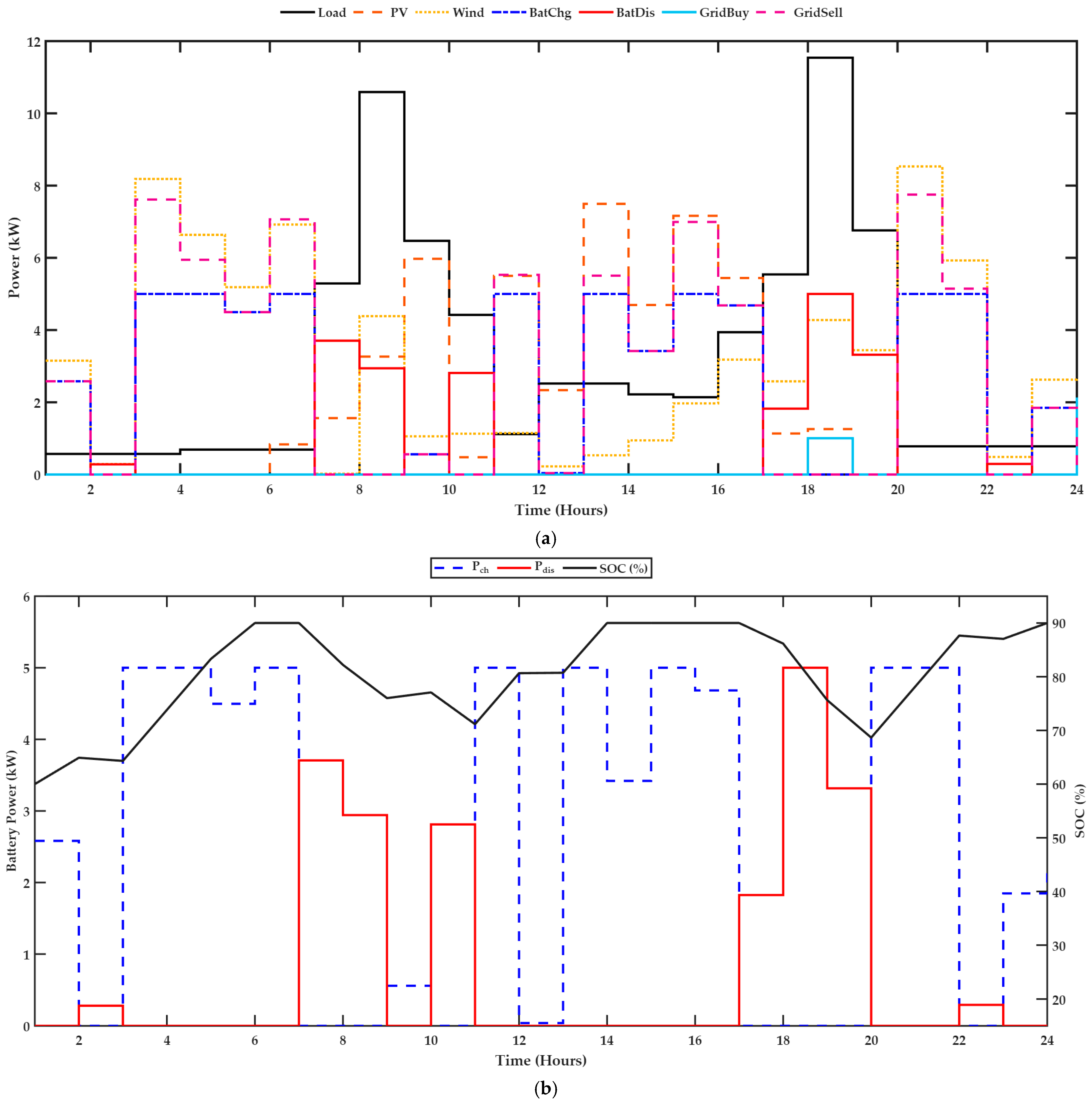
The ACO technique was used in this case study to coordinate the operation of household devices, renewable generation and energy obtained from the grid and battery system. The power flows between the components of the proposed HRES, such as the WT, PV system, BSS and utility grid, under the scheduling of appliance operation is presented in Figure 17a. The figure shows that the PV system supplied a large percentage of the load demand during the daytime. The excess power from the PV system is utilized to charge the battery system or exported to the grid. A WT is utilized in the system to support the weakness of the PVs at night and early in the morning when solar radiation is low. The HRES is designed in such a way that grid power purchase only occurs in a situation when the power outputs of the PVs and WT and battery discharge are not sufficient to satisfy the load requirements. The pattern of power exchange among the components of the HRES demonstrates how appliance scheduling allows the system to operate in a coordinated manner. The SOC of the BSS, coupled with its charge and discharge power, is presented in Figure 17b. The introduction of home appliance scheduling in this case study has made the charging and discharging patterns of the BSS more dynamic than case study 2. The battery system is charged when the power outputs of renewable energy sources are more than the load demand and discharged during low renewable energy periods. The control cycling of the battery system has reduced over-dependency on the utility grid. The battery degradation cost of $0.461 obtained in this case study indicates effective utilization of the battery system and moderate cycling. The efficient use of the BSS in this case study has improved the performance of the HRES and minimized the battery degradation cost relative to case study 2.
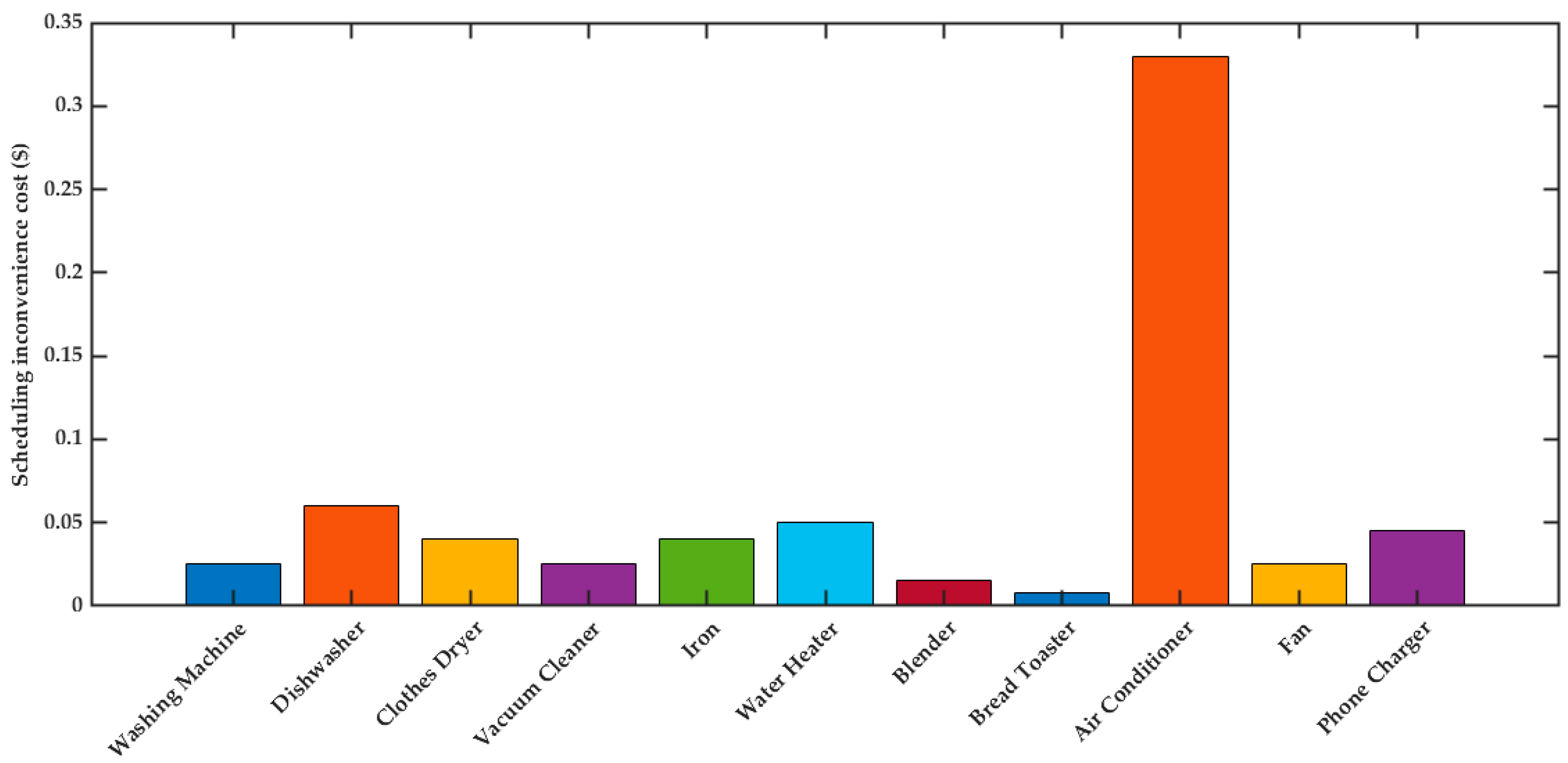
The net energy revenue cost of $9.838 obtained in this case study has signified a significant net financial benefit caused by excess energy generation from the WT and PV units and the amount of energy injected into the utility grid. The values of total energy purchased from the grid and energy injected into the grid are 1.750 kWh and 69.3 kWh. This illustrates a significant export of energy resulting from surplus energy generation from photovoltaics and wind turbines. The amount of energy purchased from the utility grid has reduced by 98% and 44% when compared to case studies 1 and 2. Conversely, the monetary value of energy injected into the grid also increased by 28% when compared to case study 2. This shows that case study 3 has not only reduced reliance on the utility grid but also increased generated revenue from the sale of electricity. The value of SIC obtained in this case study is $ 0.66 with negligible user discomfort while achieving significant cost reduction. The SICs of individual appliances are presented in Figure 18 based on the application of appliance scheduling. The comparative performance of the three case studies as presented in Table 4 show that the integration of RESs and appliance scheduling caused reductions in the net energy cost, SIC, battery degradation cost and GHG cost.
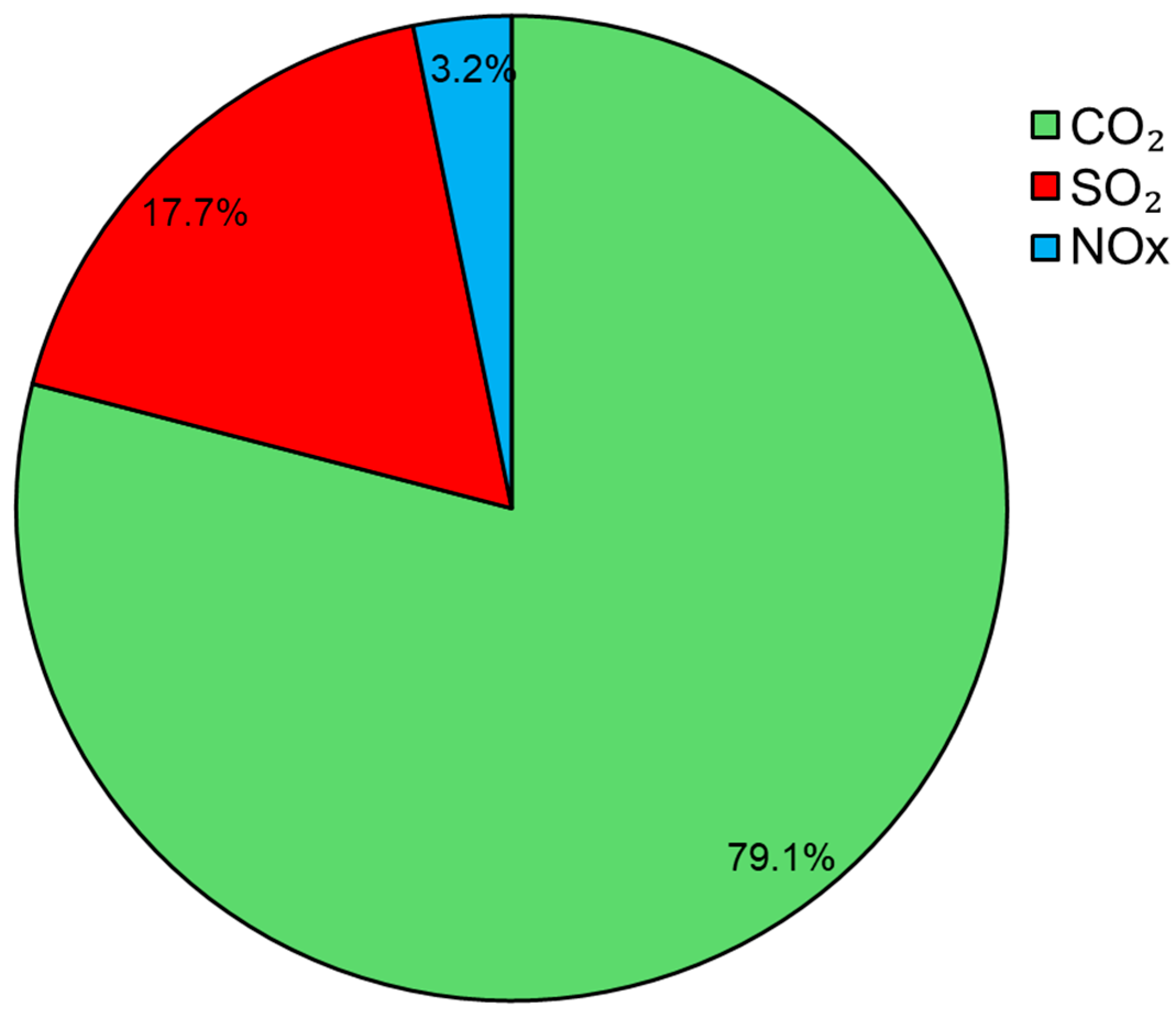
The GHG cost of $0.063 obtained in this case study is due to the environmental benefit of integrating the scheduling of home appliance strategies into the operation of HRESs. The costs of CO2, SO2 and NOx emissions obtained in this case study are $0.05, $0.011 and $0.002. It can be seen in Figure 19 that CO2 contributed 79.1% of the total GHG cost, followed by SO2 (17.7%) and NOx (3.2%). The value of GHG cost has reduced by 97% and 32% when compared to case studies 1 and 2. This case study recorded the lowest value of GHG emissions with CO2 of 1.649 kg, SO2 of 0.012 kg and NOx of 0.007 kg. The values of CO2 emissions have been reduced by 98% and 44% when compared to case studies 1 and 2. Similar trends are observed for SO2 and NOx to indicate that load scheduling aligns energy consumption more closely with renewable availability to reduce power purchased fossil-based utility grid. The application of appliance scheduling in this case study has considerably reduced utility grid dependency, environmental impacts, net energy cost, degradation cost of battery system and SIC. The outcomes of case study 3 show that a grid-connected HRES with appliance scheduling is more economically and environmentally feasible than case studies 1 and 2. The significant amount of energy that was injected into the utility grid and low GHG emissions demonstrate the environmental and technical feasibility of integrating RESs into the grid. The outcomes of the study show that case study 3 is the best configuration based on the superior performance of the system with the integration of renewable energy and appliance scheduling strategy.

5.4. Comparative Performance of the Three Case Studies

The comparative performance of the three case studies is summarized in this section to demonstrate the effectiveness of appliance scheduling and RESs in improving the overall performance of the power system. The results of case studies 1 to 3 demonstrate that the integration of RESs and the application appliance scheduling strategy significantly improved the economic and environmental performances of the power system. Case study 1 has the highest GHG cost of $2.693 and net incurred energy cost of $14.988 to demonstrate 100% dependency on the utility grid and fossil-based sources. The application of RESs in case study 2 has achieved a significant reduction in the values of GHG cost, net energy revenue cost and battery degradation cost to $0.113, $7.438 and $0.47. This signifies improved net cost savings and GHG cost reduction of 149% and 96% relative to case study 1 through renewable integration and partial grid interaction. The minimum values of GHG cost of $0.0627 and battery degradation cost of $0.461 are achieved in case study 3 with the implementation of a grid-connected HRES and appliance scheduling. The net energy revenue cost of $9.8382 with a small scheduling inconvenience cost of $0.66 to quantify user discomfort is owing to the introduction of appliance scheduling in case study 3. This demonstrates that the values of net energy cost and GHG cost have been reduced by 165% and 97% relative to case study 1. The outcomes of the study show that the application of a scheduling strategy in the HRES significantly improved energy efficiency and cost effectiveness while achieving considerable GHG emission and SIC reduction.
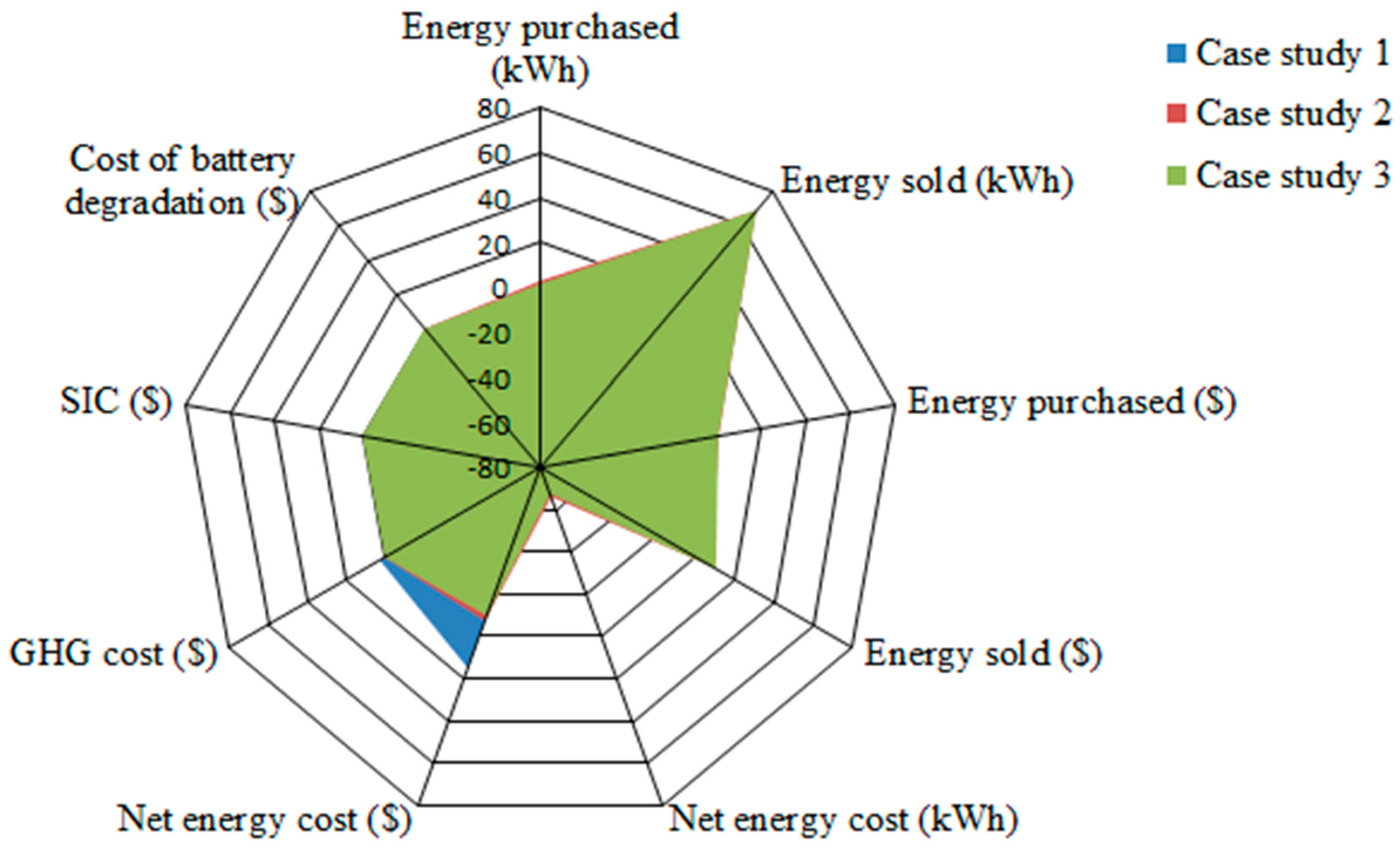
The inherent trade-offs among economic, environmental, technical and scheduling inconvenience costs of the proposed grid-connected HRES are presented in this subsection. A radar diagram that illustrates the trade-offs among energy purchased, energy sold, GHG cost, net energy cost, battery degradation cost and scheduling inconvenience cost among the three case studies is presented in Figure 20. The figure provides a holistic visualization of the competing objectives and deeper representation of trade-offs among the three case studies. Case study 1, which operates without appliance scheduling and an HRES, has the highest value of energy purchase from the grid, GHG cost and net energy cost. This demonstrates that utility grid-only operation cannot be used to achieve cost-effective and environmentally sustainable energy management. The outcomes of case study 2, as reflected in Figure 20, show a significant reduction in energy purchased, energy sold, net energy cost and GHG cost through the integration of PVs, WTs and BSSs. It is obvious from the results of case study 2 that there is a clear trade-off between economic, technical and environmental benefits. The full benefits of local renewable energy sources cannot be fully harnessed in case study 2 due to the absence of appliance scheduling. The best overall technical, economic, environmental performance indicators are achieved in case study 3 with minimum net energy cost, energy purchase, energy sold, GHG cost, battery degradation cost and scheduling inconvenience cost. The improved performance of case study 3 reflects the mutual collaboration between load shifting and user comfort.

6. Conclusions

The technical, economic and environmental effectiveness of using RESs and appliance scheduling to improve the performance of residential power systems is presented in this study using an ACO algorithm and three case studies. Simulation results reveal that case study 1 has the highest GHG emission cost of $2.693, energy purchased of 75.138 kWh and net incurred energy cost of $14.988. The application of RESs in case study 2 led to a reduction in GHG emission cost (96%) and net energy cost (149%) relative to case study 1. The values of GHG emission cost of $0.113 and net revenue energy cost of $7.438 obtained in case study 2 are further optimized in case study 3 by using an appliance scheduling mechanism. The best performance is achieved in case study 3 where the values of GHG emission cost and net revenue energy cost have been improved by 165% and 98% relative to case study 1. The findings of the study show that appliance scheduling and RES integration can be used to reduce grid dependency, improve environmental performance and improve the overall performance of grid-connected HRESs. This work can be extended by focusing on the real-time implementation of blockchain mechanisms and dynamic electricity pricing.

Author Contributions

Conceptualization, T.A. and G.S.; methodology, P.N.B. and R.K.; investigation, T.A.; resources, T.A. and G.S.; writing—original draft preparation, T.A.; writing—review and editing, G.S. and P.N.B.; visualization, R.K.; supervision, G.S. and P.N.B.; project administration, R.K. All authors have read and agreed to the published version of the manuscript.

Funding

This research received no external funding.

Institutional Review Board Statement

Not applicable.

Informed Consent Statement

Not applicable.

Data Availability Statement

The original contributions presented in the study are included in the article; further inquiries can be directed to the authors.

Conflicts of Interest

The authors declare no conflicts of interest.

Abbreviations

The following abbreviations are used in this manuscript:
APV Module Surface Area
ACOAnt Colony Optimization
BSSBattery Storage System
COECost of Energy
DGDiesel Generator
EVElectric Vehicle
GSolar Irradiance
GHGGreenhouse Gas
HRESHybrid Renewable Energy System
IEAInternational Energy Agency
LCOELevelized Cost of Energy
MPCModel Predictive Control
NPCNet Present Cost
PVPhotovoltaic
RESsRenewable Energy Sources
RSMGResidential Standalone Microgrid
SHEMSSmart Home Energy Management System
SICScheduling Inconvenience Cost
SOCState of Charge
SSEGSmall-Scale Embedded Generation
TOUTime of Use
WTsWind Turbines

References

  1. Farghali, M.; Mohamed, I.M.A.; Chen, Z.; Chen, L.; Ihara, I.; Yap, P.; Rooney, D.W. Strategies to save energy in the context of the energy crisis: A review. Environ. Chem. Lett. 2024, 21, 2003–2039. [Google Scholar] [CrossRef]
  2. Global Energy Review 2025: Global Trends. Available online: https://www.iea.org/reports/global-energy-review-2025/global-trends (accessed on 20 October 2025).
  3. Pathways for the Energy Mix. Available online: https://www.iea.org/reports/world-energy-outlook-2024/pathways-for-the-energy-mix?utm (accessed on 16 November 2025).
  4. Bajoria, A.; Kanpariya, J.; Bera, A. Greenhouse gases and global warming. In Advances and Technology Development in Greenhouse Gases: Emission, Capture and Conversion; Elsevier Inc.: Amsterdam, The Netherlands, 2025; pp. 121–135. [Google Scholar]
  5. Financing Electricity Access in Africa. Available online: https://www.iea.org/reports/financing-electricity-access-in-africa (accessed on 22 October 2025).
  6. Avordeh, T.K.; Salifu, A.; Quaidoo, C.; Opare-Boateng, R. Impact of power outages: Unveiling their influence on micro, small, and medium-sized enterprises and poverty in Sub-Saharan Africa-an in-depth literature review. Heliyon 2024, 10, 33782. [Google Scholar] [CrossRef]
  7. Mossisa, A.T.; Han, A.T. Transitioning to renewable electric energy in rapidly urbanizing Sub-Saharan Africa: Challenges and opportunities. Energy Strategy Rev. 2025, 61, 101842. [Google Scholar] [CrossRef]
  8. Transition to Renewables Calls for New Approach to Energy Security. Available online: https://www.irena.org/News/pressreleases/2024/Apr/Transition-to-Renewables-Calls-for-New-Approach-to-Energy-Security?utm_source (accessed on 12 November 2025).
  9. The UAE Consensus Foreword. Available online: https://www.cop28.com/en/the-uae-consensus-foreword?utm_source (accessed on 25 November 2025).
  10. The United Nations Inter-Agency Mechanism on Energy Issues. Available online: https://www.un.org/en/energy/page/sdg-7-overview?utm_source (accessed on 13 October 2025).
  11. The Paris Agreement. Available online: https://unfccc.int/process-and-meetings/the-paris-agreement (accessed on 8 October 2025).
  12. Gajdzik, B.; Wolniak, R.; Nagaj, R.; Žuromskaitė-Nagaj, B.; Grebski, W.W. The influence of the global energy crisis on energy efficiency: A comprehensive analysis. Energies 2024, 17, 947. [Google Scholar] [CrossRef]
  13. Global Electricity Review 2025. Available online: https://energychangemakers.com/wp-content/uploads/2025/04/Report-Global-Electricity-Review-2025.pdf?utm_source (accessed on 11 October 2025).
  14. Renewables 2025 Global Status Report. Available online: https://www.ren21.net/gsr-2025/ (accessed on 18 November 2025).
  15. Where Do Emissions Come From? 4 Charts Explain Greenhouse Gas Emissions by Sector. Available online: https://www.wri.org/insights/4-charts-explain-greenhouse-gas-emissions-countries-and-sectors (accessed on 12 October 2025).
  16. González-Torres, M.; Pérez-Lombard, L.; Coronel, J.F.; Maestre, I.R.; Paolo, B. Activity and efficiency trends for the residential sector across countries. Energy Build. 2022, 273, 112428. [Google Scholar] [CrossRef]
  17. Ghiasi, M.; Ghiasi, V.; Siano, P. Renewable energy integration into industrial and residential buildings: A study across urban, rural and coastal areas. IET RPG 2025, 19, e70108. [Google Scholar] [CrossRef]
  18. Emezirinwune, M.U.; Adejumobi, I.A.; Adebisi, O.I.; Akinboro, F.G. Synergizing hybrid renewable energy systems and sustainable agriculture for rural development in Nigeria. E-Prime—Adv. Electr. Eng. Electron. Energy 2024, 7, 100492. [Google Scholar] [CrossRef]
  19. Ma, Z.; Awan, M.B.; Lu, M.; Li, S.; Aziz, M.S.; Zhou, X.; Du, H.; Sha, X.; Li, Y. An overview of emerging and sustainable technologies for increased energy efficiency and carbon emission mitigation in buildings. Buildings 2023, 13, 2658. [Google Scholar] [CrossRef]
  20. Juyal, V.D.; Kakran, S. Smart home energy management and active power loss analysis of a residential community. J. Build. Eng. 2024, 91, 109548. [Google Scholar] [CrossRef]
  21. Awan, T.I.; Afsheen, S.; Mushtaq, A. Carbon-free energy—Free energy supply. In Influence of Noble Metal Nanoparticles in Sustainable Energy Technologies; Springer: Cham, Switzerland, 2025; pp. 19–47. [Google Scholar] [CrossRef]
  22. Chang, L.; Li, Z.; Tian, X.; Su, J.; Chang, X.; Xue, Y.; Li, Z.; Jin, X.; Wang, P.; Sun, H. A two-stage distributionally robust low-carbon operation method for antarctic unmanned observation station integrating virtual energy storage and hydrogen waste heat recovery. Appl. Energy 2025, 400, 126578. [Google Scholar] [CrossRef]
  23. Ali, E.S.; Elkholy, M.H.; Senjyu, T.; Abd Elazim, S.M.; Hassan, E.S.; Alaas, Z.; Lotfy, M.E. A flexible multi-agent system for managing demand and variability in hybrid energy systems for rural communities. Sci. Rep. 2025, 15, 16255. [Google Scholar] [CrossRef]
  24. Manjula, A.; Niraimathi, R.; Rajarajeswari, M.; Devi, S.C. Grid integration of renewable energy sources: Challenges and solutions. In Green Machine Learning and Big Data for Smart Grids; Elsevier Inc.: Amsterdam, The Netherlands, 2025; pp. 263–286. [Google Scholar] [CrossRef]
  25. Shi, D.; Cui, Y.; Shen, X.; Gao, Z.; Ma, X.; Li, X.; Fang, Y.; Wang, S.; Fang, S. A review of the combined effects of environmental and operational factors on lithium-ion battery performance: Temperature, vibration, and charging/discharging cycles. RSC Adv. 2025, 15, 13272–13283. [Google Scholar] [CrossRef] [PubMed]
  26. Dragomir, O.E.; Dragomir, F. Application of scheduling techniques for load-shifting in smart homes with renewable-energy-sources integration. Buildings 2023, 13, 134. [Google Scholar] [CrossRef]
  27. Han, B.; Zahraoui, Y.; Mubin, M.; Mekhilef, S.; Seyedmahmoudian, M.; Stojcevski, A. Home energy management systems: A review of the concept, architecture, and scheduling strategies. IEEE Access 2023, 11, 19999–20025. [Google Scholar] [CrossRef]
  28. Ibrahim, A.O.; Elfadel, E.M.E.; Hashem, I.A.T.; Syed, H.J.; Ismail, M.A.; Osman, A.H.; Ahmed, A. The artificial bee colony algorithm: A comprehensive survey of variants, modifications, applications, developments, and opportunities. Arch. Computat. Methods Eng. 2025, 32, 3499–3533. [Google Scholar] [CrossRef]
  29. Islam, R.; Kabir, S.; Shufian, A.; Rabbi, M.S.; Akteruzzaman, M. Optimizing renewable energy management and demand response with ant colony optimization: A pathway to enhanced grid stability and efficiency. In Proceedings of the IEEE Texas Power and Energy Conference (TPEC), College Station, TX, USA, 10–11 February 2025. [Google Scholar] [CrossRef]
  30. Deng, X.; Li, J.; Bao, H.; Zhao, Z.; Su, X.; Huang, Y. Efficient Energy Management for Smart Homes with Electric Vehicles Using Scenario-Based Model Predictive Control. Sustainability 2025, 17, 7678. [Google Scholar] [CrossRef]
  31. de Oliveira Luna, J.D.F.; Naspolini, A.; dos Reis, G.N.G.; da Costa Mendes, P.R.; Normey-Rico, J.E. A novel joint energy and demand management system for smart houses based on model predictive control, hybrid storage system and quality of experience concepts. Appl. Energy 2024, 369, 123466. [Google Scholar] [CrossRef]
  32. Fan, J.; Zhou, X. Optimization of a hybrid solar/wind/storage system with bio-generator for a household by emerging metaheuristic optimization algorithm. J. Energy Storage 2023, 73, 108967. [Google Scholar] [CrossRef]
  33. Gunmi, M.A.; Hu, F.; Abu-Ghunmi, D.; Abu-Ghunmi, L. A smart home energy management system methodology for techno-economic optimal sizing of standalone renewable-storage power systems under uncertainties. J. Energy Storage 2024, 85, 111072. [Google Scholar] [CrossRef]
  34. Ibrahim, M.M. Energy management strategies of hybrid renewable energy systems: A review. Wind Eng. 2024, 48, 133–161. [Google Scholar] [CrossRef]
  35. Liu, X.; Wang, J.; Zhang, S.; Guan, X.; Gao, Y. Optimization scheduling of off-grid hybrid renewable energy systems based on dung beetle optimizer with convergence factor and mathematical spiral. Renew. Energy 2024, 237, 121874. [Google Scholar] [CrossRef]
  36. Nassar, Y.F.; El-Khozondar, H.J.; Fakher, M.A. The role of hybrid renewable energy systems in covering power shortages in public electricity grid: An economic, environmental and technical optimization analysis. J. Energy Storage 2025, 108, 115224. [Google Scholar] [CrossRef]
  37. Molu, R.J.J.; Naoussi, S.R.D.; Bajaj, M.; Wira, P.; Mbasso, W.F.; Das, B.K.; Tuka, M.B.; Singh, A.R. A techno-economic perspective on efficient hybrid renewable energy solutions in Douala, Cameroon’s grid-connected systems. Sci. Rep. 2024, 14, 13590. [Google Scholar] [CrossRef]
  38. Shaban, A.; Salhen, M.; Shalaby, M.A.; Abdelmaguid, T.F. Optimal household appliances scheduling for smart energy management considering inclining block rate tariff and net-metering system. Comput. Ind. Eng. 2024, 190, 110073. [Google Scholar] [CrossRef]
  39. Oueslati, H.; Mabrouk, S.B. Techno-economic analysis of an on-grid PV/Wind/Battery hybrid power system used for electrifying building. Energy Sources Part A Recovery Util. Environ. Eff. 2023, 45, 9880–9893. [Google Scholar] [CrossRef]
  40. Vaka, S.S.K.R.; Matam, S.K. Optimal sizing of hybrid renewable energy systems for reliability enhancement and cost minimization using multiobjective technique in microgrids. Energy Storage 2023, 5, 419. [Google Scholar] [CrossRef]
  41. Paul, K.; Jyothi, B.; Kumar, R.S.; Singh, A.R.; Bajaj, M.; Hemanth Kumar, B.; Zaitsev, I. Optimizing sustainable energy management in grid connected microgrids using quantum particle swarm optimization for cost and emission reduction. Sci. Rep. 2025, 15, 5843. [Google Scholar] [CrossRef] [PubMed]
  42. Lim, S.; Lee, J.; Lee, S. Model Predictive control-based energy management system for cooperative optimization of grid-connected microgrids. Energies 2025, 18, 1696. [Google Scholar] [CrossRef]
  43. Adefarati, T.; Potgieter, S.; Sharma, G.; Bansal, R.C.; Onaolapo, A.K.; Borisade, S.G.; Oloye, A.O. Optimization of Renewable Energy based Hybrid Energy System using Evolutionary Computational Techniques. Smart Grid Sustain. Energy 2025, 10, 15. [Google Scholar] [CrossRef]
  44. Li, R.; Jin, X.; Yang, P.; Sun, X.; Zhu, G.; Zheng, Y.; Zheng, M.; Wang, L.; Zhu, M.; Qi, Y.; et al. Techno-economic analysis of a wind-photovoltaic-electrolysis-battery hybrid energy system for power and hydrogen generation. Energy Convers. Manag. 2023, 281, 116854. [Google Scholar] [CrossRef]
  45. Ma, B.; Li, P.H. Optimal flexible power allocation energy management strategy for hybrid energy storage system with genetic algorithm based model predictive control. Energy 2025, 324, 135958. [Google Scholar] [CrossRef]
  46. Jasim, A.M.; Jasim, B.H.; Flah, A.; Bolshev, V.; Mihet-Popa, L. A new optimized demand management system for smart grid-based residential buildings adopting renewable and storage energies. Energy Rep. 2023, 9, 4018–4035. [Google Scholar] [CrossRef]
  47. Shafiei, K.; Seifi, A.; Hagh, M.T. A novel multi-objective optimization approach for resilience enhancement considering integrated energy systems with renewable energy, energy storage, energy sharing, and demand-side management. J. Energy Storage 2025, 115, 115966. [Google Scholar] [CrossRef]
  48. Güven, A.F.; Yörükeren, N.; Tag-Eldin, E.; Samy, M.M. Multi-objective optimization of an islanded green energy system utilizing sophisticated hybrid metaheuristic approach. IEEE Access 2023, 11, 103044–103068. [Google Scholar] [CrossRef]
  49. Ameur, A.; Berrada, A.; Emrani, A. Intelligent energy management system for smart home with grid-connected hybrid photovoltaic/gravity energy storage system. J. Energy Storage 2023, 72, 108525. [Google Scholar] [CrossRef]
  50. Adefarati, T.; Sharma, G.; Bokoro, P.N.; Kumar, R. Advancing renewable-dominant power systems through internet of things and artificial intelligence: A comprehensive review. Energies 2025, 18, 5243. [Google Scholar] [CrossRef]
  51. Ghosh, A.; Goswami, A.K.; Basu, A.; Bose, M.; Basu, T.K. An IoT-based smart building energy management using DSM strategies. In Proceedings of the 3rd International Conference on Power Electronics and IoT Applications in Renewable Energy and Its Control (PARC), Mathura, India, 23–24 February 2024. [Google Scholar]
  52. Bamisile, O.; Cai, D.; Adun, H.; Dagbasi, M.; Ukwuoma, C.C.; Huang, Q.; Johnson, N.; Bamisile, O. Towards renewables development: Review of optimization techniques for energy storage and hybrid renewable energy systems. Heliyon 2024, 10, 37482. [Google Scholar] [CrossRef]
  53. Agajie, T.F.; Ibrahim, F.S.; Amoussou, I.; Agajie, E.F.; Paddy, E.Y.; Awoke, Y.A.; Nsanyuy, W.B.; Bajaj, M. Comparative techno-economic analysis of grid-connected solar PV-battery and PV-fuel cell systems for educational institutions sustainable academic laboratories. Discov. Sustain. 2025, 6, 674. [Google Scholar] [CrossRef]
  54. Dada, M.; Popoola, P. Recent advances in solar photovoltaic materials and systems for energy storage applications: A review. Beni Suef Univ. J. Basic Appl. Sci. 2023, 12, 66. [Google Scholar] [CrossRef]
  55. Wang, Y.; Lee, S.; Li, C.; Umair, M.; Yakhyaeva, I. Techno-economic evaluation of solar photovoltaic power production in China for sustainable development and the environment. Environ. Dev. Sustain. 2024, 1–30. [Google Scholar] [CrossRef]
  56. Bawonda, F.I.; Adefarati, T. Evaluation of solar energy potential in six geopolitical regions of Nigeria using analytical and simulation techniques. Energy Convers. Manag. 2023, 290, 117193. [Google Scholar] [CrossRef]
  57. Barbosa, N.B.; Nunes, D.D.G.; Santos, A.A.B.; Machado, B.A.S. Technological advances on fault diagnosis in wind turbines: A patent analysis. Appl. Sci. 2023, 13, 1721. [Google Scholar] [CrossRef]
  58. Tumse, S.; Bilgili, M.; Yildirim, A.; Sahin, B. Comparative analysis of global onshore and offshore wind energy characteristics and potentials. Sustainability 2024, 16, 6614. [Google Scholar] [CrossRef]
  59. Sahoo, S.; Timmann, P. Energy storage technologies for modern power systems: A detailed analysis of functionalities, potentials, and impacts. IEEE Access 2023, 11, 49689–49729. [Google Scholar] [CrossRef]
  60. Wang, Y.; He, X.; Liu, Q.; Razmjooy, S. Economic and technical analysis of an HRES (Hybrid Renewable Energy System) comprising wind, PV, and fuel cells using an improved subtraction-average-based optimizer. Heliyon 2024, 10, e32712, Retraction in Heliyon 2026, 12, e44550. [Google Scholar] [CrossRef] [PubMed]
  61. Baiden, J.K. The Electricity Tariff and Utility Performance: Evidence from Ghana, Uganda, and Namibia Electricity Market. In Energy Regulation in Africa: Dynamics, Challenges, and Opportunities; Springer: Cham, Switzerland, 2024; pp. 235–253. [Google Scholar] [CrossRef]
  62. Liu, J.; Hu, H.; Yu, S.S.; Trinh, H. Electricity pricing and its role in modern smart energy system design: A review. Designs 2023, 7, 76. [Google Scholar] [CrossRef]
  63. Resource Efficiency and Cleaner Production. Available online: https://www.industrialefficiency.co.za/wp-content/uploads/2020/09/How-to-Read-Your-Electricity-guide-Book-2.pdf (accessed on 10 October 2025).
  64. Residential Electricity Tariffs. Available online: https://mes.midstream.co.za/ViewDocumentAsPdf.aspx?dId=db8769c8-da9a-4683-89ae-b0d98f1d45fb&fn=1.+Residential+Tariffs+%281+April+2025+-+31+March+2026%29.pdf&utm_source (accessed on 3 October 2025).
  65. Jaglin, S. Urban electric hybridization: Exploring the politics of a just transition in the Western Cape (South Africa). J. Urban Technol. 2023, 30, 11–33. [Google Scholar] [CrossRef]
  66. Ramachandra, N.; Natarajan, R. State-of-the-art and real-time implementation of an IoT-based home energy management system for a cluster of dwellings. Heliyon 2024, 10, 35887. [Google Scholar] [CrossRef]
  67. Li, R.; Kirkaldy, N.D.; Oehler, F.F.; Marinescu, M.; Offer, G.J.; O’Kane, S.E. The importance of degradation mode analysis in parameterising lifetime prediction models of lithium-ion battery degradation. Nat. Commun. 2025, 16, 2776. [Google Scholar] [CrossRef] [PubMed]
  68. Upington Population. Available online: https://worldpopulationreview.com/cities/south-africa/upington (accessed on 21 October 2025).
  69. Modern, Growing, Successful Province. Available online: http://www.northern-cape.gov.za/index.php/component/content/article?id=78 (accessed on 21 October 2025).
  70. Bifacial Dual Glass Monocrystalline Module. Available online: https://solarbay.com.mx/FC/TRINA_495.pdf (accessed on 3 October 2025).
  71. 2KW Wind Turbine Generator Complete Hybrid off and On-Grid System. Available online: https://www.permanent-magnetalternator.com/sale-36571638-2kw-wind-turbine-generator-complete-hybrid-off-and-on-grid-system.html (accessed on 2 October 2025).
  72. 5 kW Deye Hybrid Inverter. Available online: https://www.solarwaysuppliers.co.za/wp-content/uploads/2014/01/5kW-Deye-Sunsynk-Hybrid-PV-Inverter-Datasheet.pdf (accessed on 3 October 2025).
  73. Innovative Battery Solutions. Available online: https://discoverbattery.com/products/tubular-batteries (accessed on 22 October 2025).
Figure 1. Schematic diagram of a smart home energy management system.
Energies 19 01174 g001
Figure 2. Typical diagram of a grid-connected HRES for a residential building.
Energies 19 01174 g002
Figure 3. South Africa’s schedule of standard prices for ESKOM tariffs.
Energies 19 01174 g003
Figure 4. Flowchart of the ACO algorithm based on the optimal scheduling of smart home HRESs.
Energies 19 01174 g004
Figure 5. Total load demand, shiftable load and non-shiftable load on hourly basis for case study 1.
Energies 19 01174 g005
Figure 6. Shiftable load and non-shiftable load on hourly basis for case study 1.
Energies 19 01174 g006
Figure 7. Individual shiftable loads on hourly basis for case study 1.
Energies 19 01174 g007
Figure 8. Individual non-shiftable loads on hourly basis for case study 1.
Energies 19 01174 g008
Figure 9. (a). Load demand on hourly basis. (b). Power purchase from the utility grid on hourly basis.
Energies 19 01174 g009
Figure 10. Breakdown of GHG costs by using the utility grid alone without scheduling of home appliances.
Energies 19 01174 g010
Figure 11. (a). Power profile of the grid-connected HRES for case study 2. (b). Charge and discharge power and state of charge of the battery system for case study 2.
Energies 19 01174 g011
Figure 12. Breakdown of GHG costs by using HRESs without scheduling of home appliances.
Energies 19 01174 g012
Figure 13. Total load demand, shiftable load and non-shiftable load on an hourly basis for case study 3.
Energies 19 01174 g013
Figure 14. Shiftable load and non-shiftable load on an hourly basis for case study 3.
Energies 19 01174 g014
Figure 15. Individual shiftable loads on an hourly basis for case study 3.
Energies 19 01174 g015
Figure 16. Individual non-shiftable loads on an hourly basis for case study 3.
Energies 19 01174 g016
Figure 17. (a). Power profile of the grid-connected HRES for case study 3. (b). Charge and discharge power and state of charge of the battery system for case study 3.
Energies 19 01174 g017aEnergies 19 01174 g017b
Figure 18. Scheduling inconvenience costs of individual appliances.
Energies 19 01174 g018
Figure 19. Breakdown of GHG costs by using HRES with the scheduling of home appliances.
Energies 19 01174 g019
Figure 20. Radar diagram of economic, environmental, technical and comfort trade-offs of the proposed grid-connected HRES.
Energies 19 01174 g020
Table 1. Summary of literature review based on the existing techniques.
Configuration of the SystemUtility GridPVWTBSSHydroDGEVTechniquesPerformance IndicatorsGaps
Grid-connected HRES [39]HOMER softwareNPC and levelized cost of energy (LCOE)Did not include battery degradation
Grid-connected HRES [40]Multi-objective particle swarm optimization algorithmsLCOE and power supply reliability factorIgnored user comfort and battery degradation cost
Grid-connected microgrid system [41]Quantum particle swarm optimization Cost and emissionDid not include
user comfort and battery degradation
Grid-connected HRES [42]MPCOperating costsDid not cover appliance scheduling
Standalone HRES [43]Particle swarm optimization and genetic algorithm (GA)Total cost of the system and COE Excluded user comfort and battery degradation
Grid-connected HRES [44]HOMERNet present value, internal rate of return, LCOE and payback period Ignored comfort and battery degradation
Electric vehicle and utility grid system [45]Hybrid GA–MPC approachBattery life and ultra-capacitor utilizationLimited smart homes application
Grid-connected HRES [46]Earth worm optimization algorithm and virulence optimization algorithmElectricity bills, load factor and energy demandOnly tested with TOU tariffs and no integration with RESs
Grid-connected HRES [47]Gravity search algorithmCarbon emission and economic benefits Limited scalability for real-time use
Islanded HRES [48]GA, firefly algorithm and PSONPC, energy of cost and renewable energy fractionLack of field validation in real African homes
Table 2. Technical and economic data of the proposed HRES [70,71,72,73].
DescriptionPV SystemWind TurbinesBattery SystemConverter
Installed capacity10 kW10 kW6.22 kWh15 kW
Nominal rating500 W2000 W260 Ah 5 kW
Efficiency 20.7%45%80%97.6%
Lifetime 25 yr25 yr5 yr10 yr
Operational
temperature
−40~+85 °C−40–50 °C−0 ~ +55 °C−25–60 °C
ModelTSM-DEG18MC.20(II)GH-2KWCP48200SUN-5k-SG-01LPI
Other technical parametersShort-circuit current (ISC) = 12.13 A,
open-circuit voltage (VOC) = 51.5 V, maximum power current = 11.53 A, maximum power voltage = 43.4 V, module dimensions = 2187 × 1102 × 35 mm,
temperature coefficient of Pmax = −0.35%/°C, temperature coefficient of VOC = −0.25%/°C and temperature coefficient of ISC = 0.04%/°C
Start wind speed = 3 m/s, rated wind speed = 8 m/s,
working wind speed = 3–25 m/s, safety wind speed =
40 m/s and
blade rotor diameter = 3.2 m
Nominal volage = 12 V, nominal capacity = 3.11 kWh, maximum capacity = 260 Ah, capacity ratio = 0.563, roundtrip efficiency = 80%, maximum charge current = 43 A and cost of battery = $220/unitOutput voltage = 220/230/240 V,
output frequency = 50/60 Hz, AC output rated current = 21.7 A and maximum AC current = 25 A
Table 3. Classification and scheduling parameters of home appliances.
ApplianceRated Power (kW)ShiftableOperating Hours (h/Day)
Washing Machine2.2012
Dishwasher1.8012
Clothes Dryer3.0011
Vacuum Cleaner1.2011
Iron2.0011
Water Heater3.0012.5
Blender0.3010.5
Bread Toaster0.8010.3
Refrigerator0.30024
Freezer0.25024
Desktop Computer0.3004
Laptop0.0805
Printer0.1000.5
Electric Oven2.5002
Microwave Oven1.6001
Air Conditioner1.5016
Fan0.0718
TV + Decoder0.0705
Light0.1205
Phone Charger0.0213
Standby Devices0.02024
Table 4. Summary of the results obtained from the three case studies.
DescriptionCase Study 1Case Study 2Case Study 3
CO2 (kg)70.7802.9561.6487
SO2 (kg)0.5220.0220.0121
NOx (kg)0.3170.0130.0074
CO2 ($)2.1230.0890.0495
SO2 ($)0.4750.01980.011
Nox ($)0.0950.0040.002
Energy purchased (kWh)75.1383.1381.750
Energy sold (kWh)-69.17669.3
Energy purchased ($)14.9880.4700.245
Energy sold ($)-7.90810.083
Net energy cost (kWh)-−66.038−67.55
Net energy cost ($)14.988−7.438−9.838
GHG cost ($)2.6930.1130.063
SIC ($)--0.66
Cost of battery degradation ($)-0.4700.461
ACO finished; best cost ($)17.681−6.869−8.654
Disclaimer/Publisher’s Note: The statements, opinions and data contained in all publications are solely those of the individual author(s) and contributor(s) and not of MDPI and/or the editor(s). MDPI and/or the editor(s) disclaim responsibility for any injury to people or property resulting from any ideas, methods, instructions or products referred to in the content.