Article

Integrated Sliding Mode Control and Adaptive-Step P&O MPPT Strategy for DC–DC Boost–Buck Converter in Photovoltaic Systems


by
Jesús A. González-Castro
1,
Guillermo J. Rubio-Astorga
1,
Jesús R. Castro-Rubio
1,
Martin A. Alarcón-Carbajal
1,
Julio C. Picos-Ponce
1,
Juan Diego Sánchez-Torres
2 and
David E. Castro-Palazuelos
1,*
1
División de Estudios de Posgrado e Investigación, Tecnológico Nacional de México/IT de Culiacán, Culiacán 80220, Mexico
2
Department of Mathematics and Physics, Instituto Tecnológico y de Estudios Superiores de Occidente (ITESO), Tlaquepaque 45604, Mexico
*
Author to whom correspondence should be addressed.
Energies 2026, 19(5), 1123; https://doi.org/10.3390/en19051123
Submission received: 20 January 2026 / Revised: 14 February 2026 / Accepted: 21 February 2026 / Published: 24 February 2026

Abstract

The efficient utilization of solar energy largely depends on the capability of a photovoltaic system to operate at its maximum power point under variable irradiance and temperature conditions. In this context, a control strategy that combines a sliding mode control scheme with a Perturb-and-Observe-based maximum power point tracking (MPPT) algorithm with adaptive step size is proposed and applied to a DC–DC boost–buck converter. The proposed approach aims to improve the dynamic stability of the system, ensure robustness against model uncertainties, and enhance conversion efficiency. The MPPT algorithm employs an adaptive perturbation step that reduces steady-state oscillations and accelerates convergence toward the optimal operating point, while the sliding mode controller guarantees accurate tracking of the converter voltage reference under external disturbances. Simulation and experimental results validate the effectiveness of the proposed strategy, achieving an overall efficiency of 99.42% and a startup time of 180 ms in the implemented version. These results confirm improved transient response, reduced steady-state error, and high efficiency compared to competing control strategies reported in the literature.

1. Introduction

The generation of electrical energy from renewable sources has become a global priority, driven by the need to reduce carbon dioxide emissions released into the Earth’s atmosphere and thereby mitigate the effects of climate change. This approach aims to gradually replace the use of fossil fuels with cleaner and more sustainable alternatives, such as solar, wind, hydropower, and geothermal energy, while simultaneously promoting a more environmentally friendly energy model [1].
Photovoltaic systems allow the direct transformation of solar radiation into electricity through the photovoltaic effect in semiconductor materials. This clean technology can be applied in both small-scale residential installations and large solar farms. However, factors such as the limited efficiency of the modules, cost, and intermittency due to environmental conditions are critical aspects that must be considered when planning their implementation [2].
Due to the nonlinear dependence of the output power of photovoltaic systems on solar irradiance, cell temperature, and environmental conditions, it is essential to employ maximum power point tracking (MPPT) algorithms. These algorithms enable the optimization of the harvested solar energy and enhance the overall system performance [3,4,5,6,7,8].
MPPT techniques can be classified, according to the control strategy employed to allocate and maintain the optimal operating point of the photovoltaic system, into four main categories. First, classical methods are characterized by their simplicity and low computational cost. Second, intelligent methods incorporate learning schemes or logical reasoning to improve system adaptability under variations in irradiance and temperature. Third, optimization-based methods employ metaheuristic or global search algorithms to maximize the extracted power. Finally, hybrid methods combine two or more of the strategies to exploit the advantages of each approach while compensating for their individual limits [9,10,11].
The Perturb and Observe (P&O) method is one of the most widely used algorithms in commercial MPPT controllers [12]. Essentially, this approach monitors the variation of the photovoltaic module’s power. During this process, the sign of the change in the module voltage is also analyzed in order to adjust the duty cycle and perform the necessary corrections to maintain operation at the maximum power point [13].
In photovoltaic systems, the inclusion of power electronics blocks is fundamental to maximizing conversion efficiency and, therefore, the benefits derived from harnessing solar energy [14]. Among the different power electronics devices, DC-DC (direct current–direct current) converters play a fundamental role because they facilitate efficient conversion between different voltage levels, allowing the integration of various renewable energy sources, energy storage systems, and loads [15].
Among the most used DC–DC converter topologies are buck, boost, buck–boost, Ćuk, and SEPIC converters. Each topology exhibits distinct characteristics that determine its performance in terms of energy conversion efficiency, achievable voltage range, dynamic behavior, and circuit complexity. Consequently, each presents specific advantages and limitations, making it more suitable for certain applications depending on the operational requirements [16].
In addition to these topologies, the literature reports the use of two or more converters connected in cascade, also referred to as multistage configurations, which represent an effective solution for power conversion applications [17]. By distributing the voltage stress among the power devices, these architectures enable higher voltage gain and increased power density, making them particularly suitable for applications that require wide conversion ratios and enhanced performance [18,19].
The literature reports numerous studies aimed at enhancing the efficiency of photovoltaic systems through the implementation of DC–DC converters, advanced digital control strategies, and MPPT algorithms.
The authors in [20] present the development of a sliding mode controller (SMC) for fast and accurate MPPT in grid-connected photovoltaic systems, based on a single-stage control architecture. The proposed strategy reduces controller complexity by avoiding cascaded structures, and its performance is validated through PSIM simulations under environmental and load disturbances, additionally reporting a photovoltaic system start-up time of approximately 650 ms.
The system presented in [21] integrates a photovoltaic array with a boost converter using a P&O-based MPPT, a sliding mode current controller, and a PI voltage loop. Its performance was validated through simulation tests under irradiance variations, demonstrating stable MPPT operation even in the presence of severe disturbances and DC-bus oscillations.
In [22], a sliding-mode controller for a DC–DC boost converter is proposed for photovoltaic applications, using a two-loop scheme with MPPT-based voltage control and current regulation. Experimental validation shows improved steady-state performance and transient response compared to lead-lag control and sliding mode controllers with proportional–integral action (SMPI), achieving efficiencies of 95–98% and settling times of 8–18 ms.
The authors in [23] propose a variable step perturb and observe (VSPO) MPPT algorithm that adjusts the step size according to the distance from the MPP to improve tracking under rapidly changing irradiance. Simulations with a boost converter and grid-tied inverter demonstrate faster tracking and reduced oscillations compared to conventional P&O and Incremental Conductance methods, increasing efficiency from 91.39% to 96.40%, although performance under uniform irradiance is similar to incremental conductance.
The article in [24] presents the analysis of a conventional boost converter and a two-stage interleaved boost converter (IBC) with a P&O-based MPPT. Simulation results show that the IBC reduces voltage and current ripple and improves dynamic performance and efficiency compared to the conventional boost topology.
The authors in [25] present a photovoltaic system based on a buck converter with a sliding mode and P&O-based MPPT scheme, along with a three-mode battery management system. Simulation results show robust power regulation under variable solar conditions, achieving efficiencies above 95% and settling times of around 120 ms.
The authors in [26] present a complete MPPT-based solar battery charger powered by a 1.918 kWp PV array for a 24 V, 150 Ah lithium-ion battery. The system uses an interleaved synchronous buck converter controlled by a modified P&O algorithm, along with a bidirectional converter for charging regulation and battery protection. Simulation results report MPPT efficiencies between 87% and 100% under rapidly varying irradiance conditions, demonstrating its practical viability.
In [27], a solar-powered PMSM drive system using a cascaded boost–buck converter is presented. The control strategy combines MPPT with a PI controller to ensure maximum power extraction and DC bus stability, while vector control regulates motor speed. Experimental validation using a dSPACE 1104 board reports a PV output power of 312 W under partial shading conditions.
In [28], the efficiency of a wireless power transfer (WPT) system is analyzed, proposing a cascaded boost–buck converter to improve impedance matching for different types of loads. The control scheme combines a P&O-based MPPT with PI loops. Experimental results show that the proposed system, operating at 13.56 MHz, achieves efficiencies exceeding 70%.
In [29], a photovoltaic-powered water pumping system using a cascaded boost–buck converter and a permanent magnet brushless DC (BLDC) motor is presented. The topology enables voltage regulation and MPPT through a PI-based control scheme, offering reduced voltage stress and a non-inverting output. Simulation and experimental results validate the approach, reporting up to 99.96% efficiency in simulation and 81–86% in experimental implementation.
In [30], the authors propose a novel cascaded boost–buck converter architecture designed to significantly improve the transient response of DC–DC converters. The integrated boost and buck stages share an intermediate capacitor, and by exploiting the energy stored in this capacitor, the system achieves a transient response of 2 μs under load variations, with an output voltage ripple of only 15 mV.
In [31], a hybrid photovoltaic system employs a fuzzy logic discrete PID (FL-DPID) MPPT to control a boost converter, followed by a PID-controlled buck converter for battery charging. Simulations of a 200 W system show improved efficiency and reduced battery losses, achieving efficiencies up to 99.8%.
In [32], the authors present a battery charger based on a cascaded boost–buck converter powered by a photovoltaic panel. The system operates in boost or buck mode using a single duty cycle and adapts to irradiance and state-of-charge conditions, enabling MPPT, constant current, constant voltage, and float charging modes. Simulation results confirm its suitability for photovoltaic battery management applications.
Although the reviewed studies report significant advances in converter topologies, MPPT strategies, and control techniques, certain limitations remain. Many works focus exclusively on simulation results without comprehensive experimental validation. Furthermore, in cascaded boost–buck topologies, limited attention has been given to the combined use of adaptive MPPT strategies and sliding mode control to simultaneously reduce power ripple and transient response, particularly during start-up conditions. Therefore, there remains a need for an experimentally validated control framework that integrates adaptive MPPT with robust nonlinear control while maintaining implementation simplicity and practical feasibility.
This work presents the analysis, simulation, and implementation of a photovoltaic system composed of a solar panel, a DC-DC boost buck converter based on the cascaded connection of boost and buck stages, and a resistive load. The system incorporates a P&O algorithm with adaptive step size, as well as a dual loop control strategy that integrates a PI controller and an SMC, in addition to an independent PI control loop. All control and MPPT algorithms are implemented on an embedded platform, enabling validation of their performance under real operating conditions.
The main contribution of this article lies in the integration of a P&O algorithm with adaptive step size, together with an SMC applied to a cascaded DC-DC boost–buck converter. This control strategy reduces power ripple, leading to an improvement in overall system efficiency. Additionally, it reduces the transient response, particularly during start-up, outperforming other studies reported in the literature that use the same plant topology.
The content of this document is organized as follows: Section 2 presents the mathematical modeling of the DC–DC boost–buck converter and the solar cell; Section 3 describes the system components and the values associated with each of their parameters; Section 4 details the mathematical and algorithmic development of the employed MPPT algorithm, as well as the PI and SMC; Section 5 presents the figures corresponding to the simulation of the photovoltaic system with each of its blocks; Section 6 shows the graphical results of the system’s physical implementation; Section 7 analyzes the obtained results, and finally, Section 8 presents the conclusions of the work.

2. Mathematical Modeling

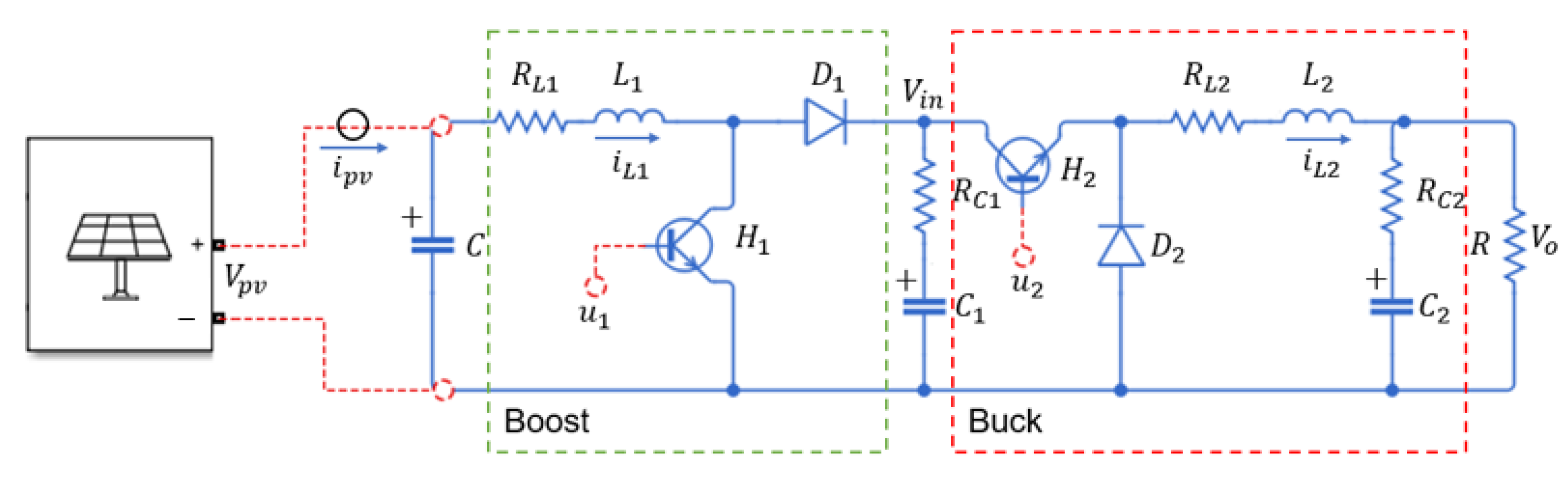
This section presents the mathematical modeling of the step-up and step-down stages of the boost–buck DC–DC converter. Subsequently, both models are integrated and jointly analyzed to describe the overall behavior of the converter. Finally, a photovoltaic solar cell model is developed to carry out the mathematical analysis of the complete system. Figure 1 illustrates the system interconnection and the configuration used for maximum power extraction from the photovoltaic solar cell. Table 1 presents the meaning of each of the parameters shown in Figure 1.

2.1. Boost Stage

The mathematical modeling of the proposed converter topology is derived under the assumption of continuous conduction mode (CCM), which is ensured by the selected inductor values and the expected operating power range. Additionally, ideal switching devices and negligible parasitic resistances are assumed in the analytical model in order to simplify the derivation of the control laws.
Following the methodology described in [33], the large-signal averaged model of the boost stage is obtained. Unlike the analysis reported in [34], this formulation additionally includes the current i b , which represents the current flow between the two stages that make up the boost–buck converter. This model is defined by (1),
d i L 1 d t = 1 L 1 V p v D C 1 R R + R C 1 v C 1 + R C i b R C 1 R R + R C 1 + R L 1 i L 1   d v C 1 d t = 1 C 1 R i n R + R C 1 i L 1 v C 1 R i b ,
where v C 1 represents the voltage across the capacitor of the boost converter, R i n corresponds to the equivalent load that the buck stage presents to the boost stage, and D C 1 denotes the averaged value of the control signal u 1 , that is, the effective duty cycle.
The representation of the boost stage model presented in (1) can be expressed in state–space form as shown in (2), where ψ = R i n R i n + R C 1 , x 1 = i L 1 , and x 2 = v C 1 .
x 1 ˙ x 2 ˙ = ( ψ R C 1 + R L 1 ) L 1 ψ L 1 ψ R C 1 ψ C 1 x 1 x 2 + V p v L 1 0 D C 1 + ψ R C 1 i b L 1 ψ i b C 1 .  

2.2. Buck Stage

Based on the methodology described in [33] and the previous analysis presented in [35], the large-signal averaged model for the buck stage is obtained, which is shown in (3)
d i L 2 d t = 1 L 2 V i n D C 2 V o i L 2 R L 2   d v C 2 d t = 1 C 2 i L 2 V o R i o ,
where v C 2 represents the voltage across the capacitor of the buck converter, and D C 2 denotes the averaged value of the control signal u 2 , that is, the effective duty cycle.
The representation of the buck stage model presented in (3) can be expressed in state-space form as shown in (4), where ζ = R R + R C 2 , i o is the output current of the buck converter, x 3 = i L 2 , and x 4 = v C 2 .
x 3 ˙ x 4 ˙ = ( R C 2 ζ + R L 2 ) L 2 ζ L 2 ζ R C 2 ζ C 2 x 3 x 4 + V i n L 2 0 D C 2 + ζ R C 2 i o L 2   ζ i o C 2 .  

2.3. Boost–Buck Converter

Based on the analysis of the boost and buck stages, the large-signal averaged model of the boost–buck converter is obtained, represented by the dynamic equations in (5),
d i L 1 d t = 1 L 1 V p v D C 1 R R + R C 1 v C 1 + R C i b R C 1 R R + R C 1 + R L 1 i L 1 ,   d v C 1 d t = 1 C 1 R i n R + R C 1 i L 1 v C 1 R i b ,   d i L 2 d t = 1 L 2 V i n D C 2 V o i L 2 R L 2 ,   d v C 2 d t = 1 C 2 i L 2 V o R i b ,
where R i n can be approximated by the R i n V i n 2 R V o 2 .
As a result of the continuous-time plant analysis presented in (5), a discretized model of the boost–buck converter is obtained. The discretization is carried out using the Forward Euler method, considering the approximations d i L d t ( i L k + 1 i L [ k ] ) / T and d v C d t ( v C k + 1 v C [ k ] ) / T . The equations that describe the discrete-time dynamics of the converter are presented in (6).
i L 1 k + 1 = i L 1 k + T s L 1 V p v D C 1 R R + R C 1 v C 1 k + R C i b k R C 1 R R + R C 1 + R L 1 i L 1 [ k ] ,   v C 1 k + 1 = v C 1 k + T s C 1 R i n R + R C 1 i L 1 [ k ] v C 1 k R i b [ k ] ,   i L 2 k + 1 = i L 2 k + T s L 2 V i n D C 2 V o k i L 2 k R L 2 ,   v C 2 k + 1 = v C 2 k + T s C 2 i L 2 [ k ] V o k R i b [ k ] ,
where T s denotes the sampling period, and k corresponds to the discrete index that identifies each sample of the system.

2.4. Solar Cell

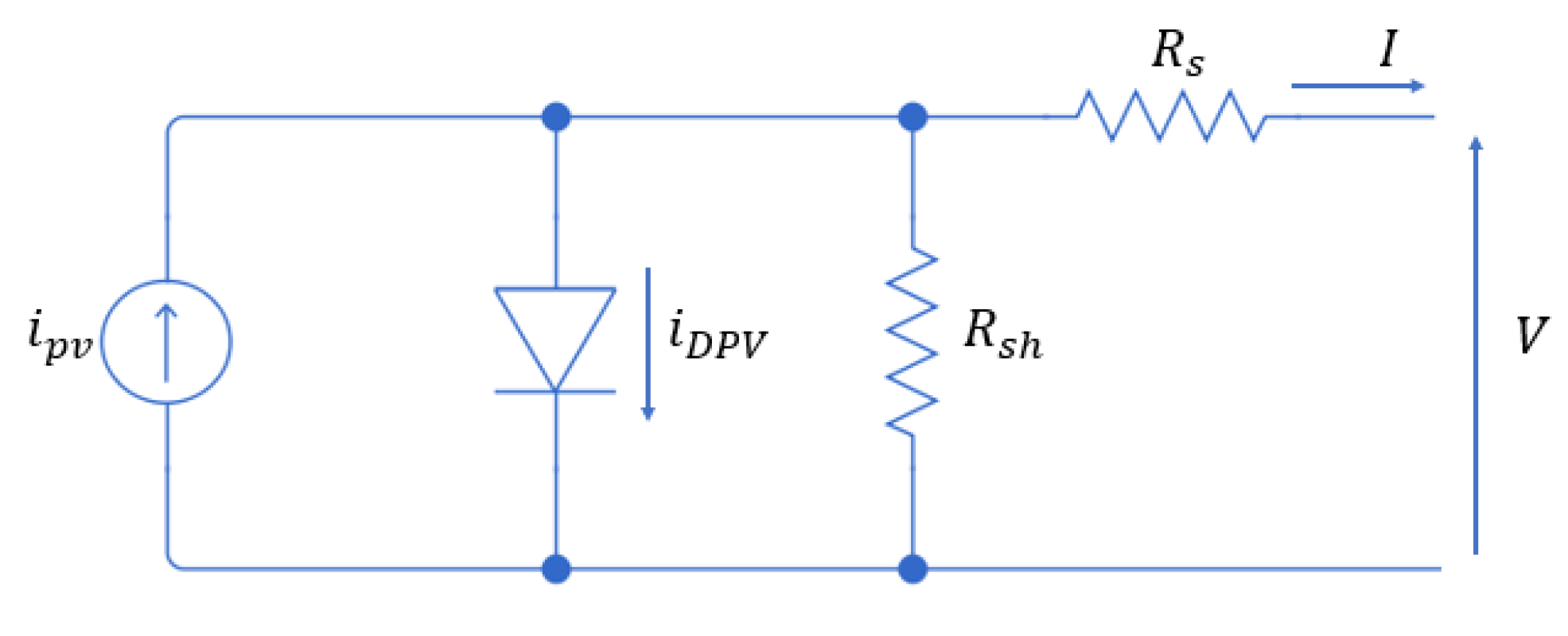
For the representation of the solar cell, the single-diode model (SDM) approximation is employed, which is depicted in Figure 2, where i D P V is the current flowing through the diode, I is the current delivered by the cell to the external circuit, R s h is a shunt resistance that accounts for internal leakage due to imperfections and alternative current paths, R s represents losses in contacts, cables, or internal layers of the circuit, and V is the potential difference at the cell terminals [36].
For the specific case of the SDM approximation, the equations that relate the current and voltage parameters for an array composed of N s cells in series and N p cells in parallel are described in (7).
I = N p i P V I s e V + N s N p R s I N s α V t 1 V + N s N p R s I N s R s h V = N s α V t ln V N s R s h + I 1 N p + R s N p R s h i p v I s I s N s N p R s I .
The resistive parameter R s can be defined by means of (8) as
R s = R c p + R b p + R c n + R b n ,    
where R c p is the contact resistance between the p-type material and the metal on the lower surface, R b p is the intrinsic resistance of the p-type material, R c n is the resistance generated by the contact between the p-type and n-type materials, and R b n is the intrinsic resistance of the n-type material.
Environmental factors such as irradiance and temperature have an effect on i p v . These effects are summarized in [37] through (9),
i p v = I s c . S T C + K i T T S T C G G S T C ,    
where I s c . S T C is the short-circuit current under standard test conditions (STC), T is the cell temperature, T S T C is the cell temperature at STC (25 °C), G is the irradiance on the cell surface ( W / m 2 ), G S T C is the irradiance at STC (1000 W / m 2 ), and K i is a coefficient associated with the short-circuit current provided by the cell manufacturer.
The expression that defines the short-circuit current I s c is given by (10)
I s c = I s c * G G * + a 1 T T * ,
where a 1 is a correction coefficient, while I s c * is the short-circuit current at a reference irradiance G * and temperature T * . The mathematical expression used to represent the open-circuit voltage V o c of the solar cell is presented in (11). This parameter mainly depends on the cell temperature, which can vary due to three primary causes: the operation of the photovoltaic cell itself, the energy emitted in the infrared region of the spectrum that produces a heating effect on the cell, and an increase in insolation [37],
V o c = V o c * + a 2 T T * I s c I s c * R s ,  
where V o c * is the reference open-circuit voltage and a 2 is a correction factor.
Other solar cell parameters are temperature dependent, such as the conventional saturation current I o and the reverse saturation current I r s [38,39]. The relationship between both parameters is defined in (12)
I o T = I r s T T r e f 3 e q E g o n K 1 T r e f 1 T   I r s T = I s c e q V o c n N s K T 1 ,
where T r e f is the absolute reference temperature (usually 298 °K), q is the elementary charge of the electron, E g o is the bandgap energy of the semiconductor, n is the diode ideality factor, and K is the Boltzmann constant.

3. System Components

The selection of the components for both the buck and boost stages is carried out using the methodology presented in [40]. The photovoltaic solar cell considered in this research is the Sunergy SYM 90 P module, and the most important parameters associated with this device are obtained from its datasheet.
Table 2 presents the values of the components that make up the boost–buck converter, also considering the commercial availability of the selected devices. In turn, Table 3 summarizes the electrical parameters associated with the solar cell used in the study under STC.

4. Boost–Buck Converter Control

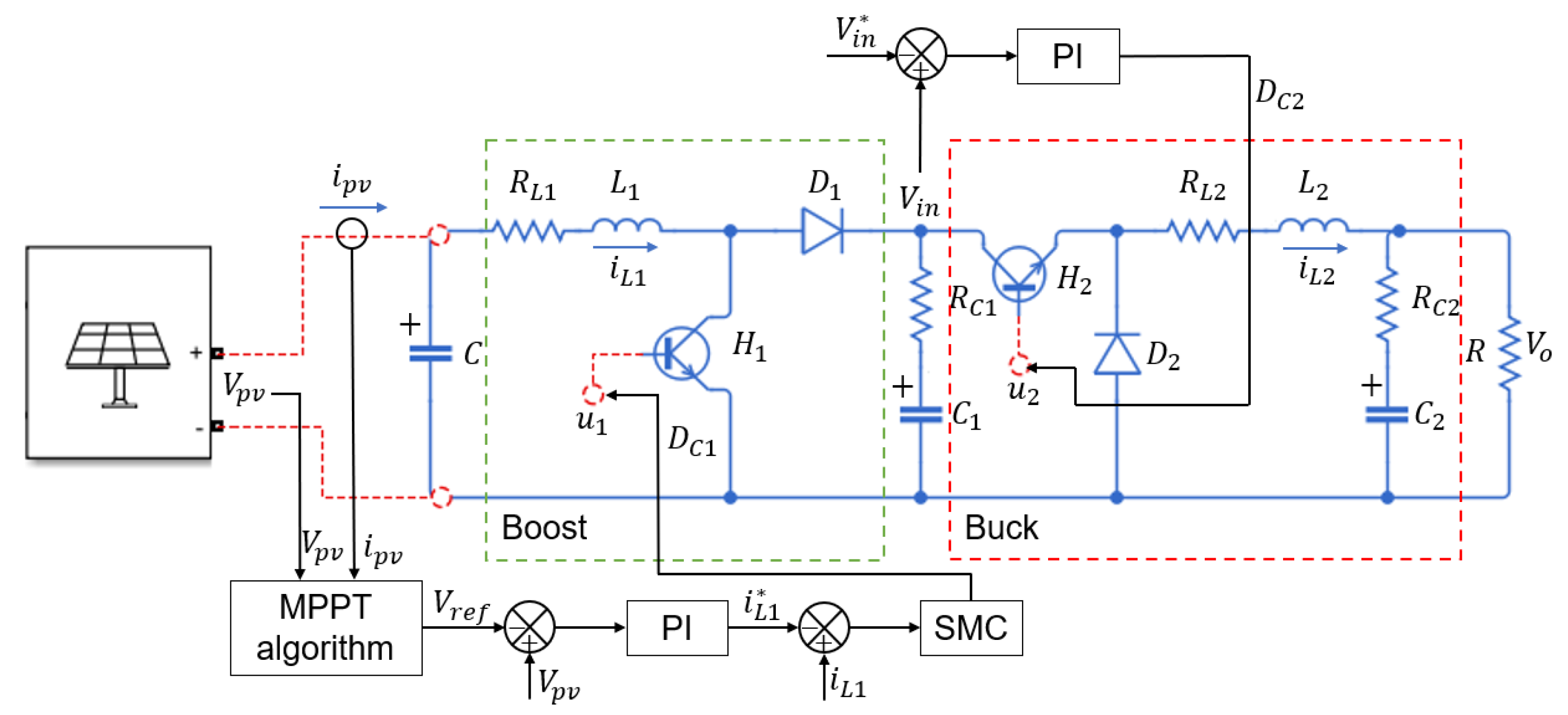
A control strategy for the boost–buck DC-DC converter is proposed. In particular, the boost stage is governed by a triple control loop, while the buck stage is regulated by an independent loop. The control of the boost stage incorporates an MPPT algorithm based on the classical P&O method, featuring modifications aimed at reducing steady-state ripple and maintaining an adequate dynamic response under rapid variations of environmental conditions. This algorithm aims to generate a reference voltage V r e f that places the system at the maximum power point (MPP).
The reference voltage obtained from the MPPT is used as the input to a PI controller, which is responsible for establishing the desired value of the inductor current i L 1 * . Additionally, an SMC scheme is implemented for the regulation of i L 1 , in order to ensure robustness against parametric uncertainties and external disturbances.
On the other hand, a dedicated PI controller regulates the buck stage, ensuring seamless coupling between the converter stages and maintaining overall system stability. The control architecture of the boost–buck converter is illustrated in Figure 3.

4.1. MPPT Algorithm

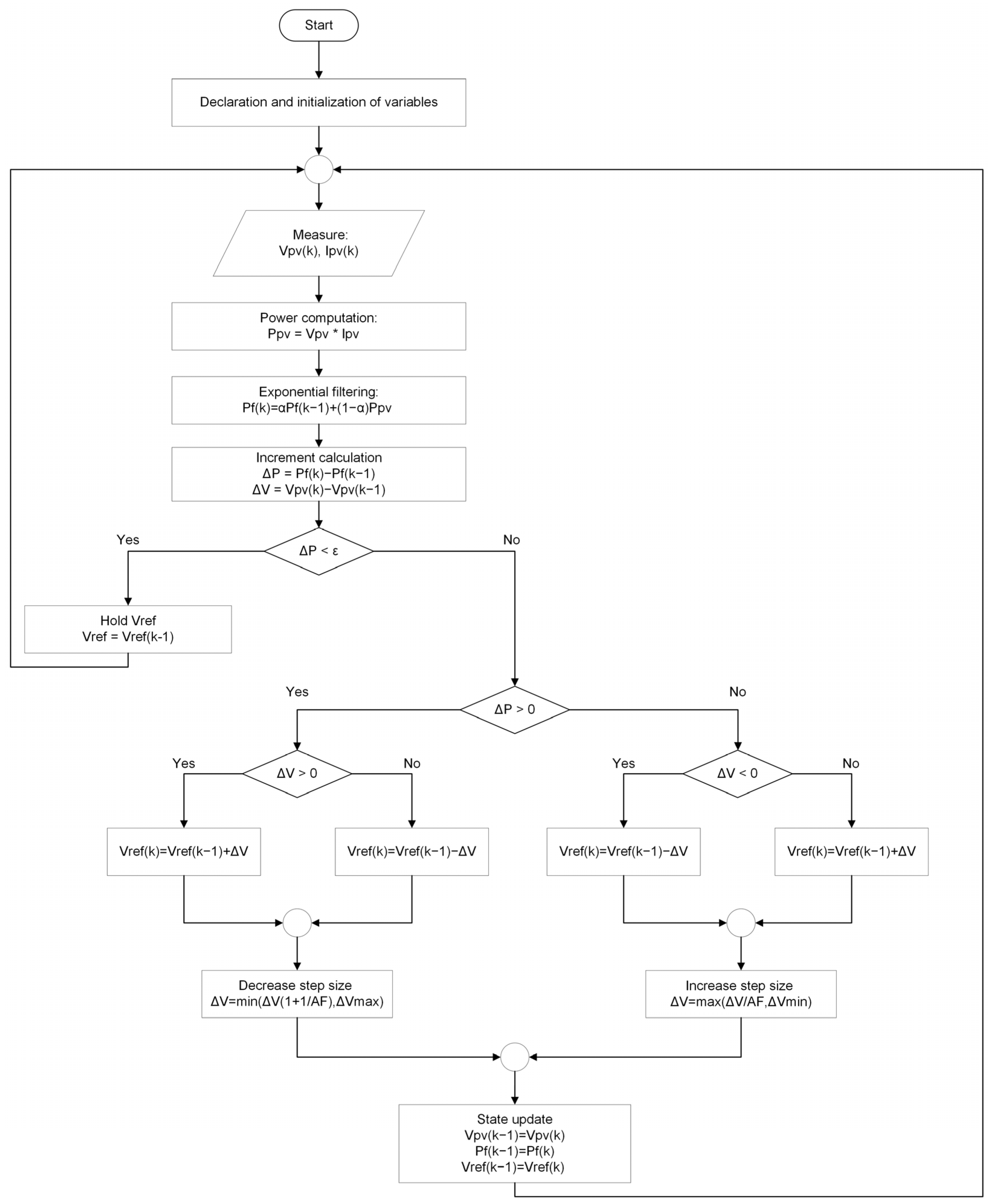
The MPPT algorithm presented in this work is based on the classical P&O method and incorporates enhancements aimed at reducing steady-state ripple without compromising the dynamic response under rapid variations in irradiance or temperature.
First, the photovoltaic power is obtained from the instantaneous measurements of voltage and current of the photovoltaic solar cell. To mitigate the effect of measurement noise and prevent erratic decisions by the algorithm, the measured power is processed through a first-order exponential filter, whose smoothing constant strikes an appropriate balance between response speed and oscillation suppression.
Subsequently, the algorithm evaluates the discrete variations of power and voltage between consecutive sampling instants. Unlike the conventional P&O method, a decision dead band is introduced such that, when the change in the filtered power is below a predefined threshold, the reference voltage is kept constant. This strategy significantly reduces oscillations around the MPP under steady-state conditions.
Additionally, an adaptive step-size mechanism perturbs the reference voltage. Once the algorithm identifies a correct trajectory toward the MPP, the step size increases toward a maximum value to enhance convergence speed. On the other hand, if a power decrease occurs, the step size is minimized to ensure stable operation in the neighbor of the optimal point.
Finally, the generated reference voltage is constrained by a controlled saturation scheme, ensuring that its value remains within the physical operating limits of both the converter and the photovoltaic generator. The result is a robust MPPT algorithm with a reduced steady-state ripple and the ability to adapt to external disturbances, while maintaining adequate MPP tracking efficiency.
Figure 4 presents the block diagram of the proposed MPPT algorithm, illustrating its main stages schematically. This diagram clearly depicts the information flow and the interaction among the different functional blocks of the algorithm for generating the reference voltage that positions the system at the MPP.

4.2. Boost Stage Controller

In addition to the MPPT algorithm, the boost stage is regulated by two complementary control loops: a PI controller and an SMC. The discrete-time PI controller, responsible for establishing the reference current i L 1 * , is described by (13)
u P I k = u k 1 + k p e k e k 1 + k i T s e k 1 ,  
where u P I k is the output of the PI controller, which defines the current reference i L 1 * used as the input to the SMC; k p and k i represent the proportional and integral gains, respectively; e k is the error at the discrete instant k, and T s denotes the sampling period. The controller gains k p and k i were tuned using the MATLAB 2016 Control System Designer, specifically through Root Locus analysis and step response evaluation. Furthermore, the sampling period T s was selected to match the switching frequency of the converter’s power switches ( 40   k H z ), resulting in k p = 1.03 , k i = 10 , and T s = 25   μ s .
The SMC presented in this article is obtained using the methodology described in [34,42] and is defined by a sliding surface s [ k ] shown in (14).
s k = i L 1 k i L 1 * k .  
This choice guarantees asymptotic tracking of the reference once the system reaches the sliding surface.
To ensure that the sliding surface is reached, the conditions presented in (15) must be satisfied.
s k + 1 < 0       i f       s k > 0 ,   s k + 1 > 0       i f       s k < 0 ,
where s k is the increment of the sliding surface. This increment is represented by (15).
s k = s k + 1 s k .
In this work, the equivalent control strategy is adopted with the objective of determining the duty cycle of the PWM signal that governs the switching behavior of the power converter. Based on the discrete-time system analysis, the corresponding equivalent control expression is derived and presented in (17), where the equivalent control input u e q is directly associated with the duty cycle D C 1 .
u e q k = L 1 T s V C 1 [ k ] i L 1 * k + 1 i L 1 k + 1 v C 1 k v C 1 k V p v .      
The duty cycle D C 1 k is constrained to the interval 0 D C 1 1 . Accordingly, the saturation function defined in (18) is employed to enforce this limitation during the control implementation.
D C 1 =               0     u e q [ k ] < 0         u e q k     0 u e q [ k ] 1   1 u e q > 1 .
To analyze discrete-time stability, the Lyapunov candidate function shown in (19) is proposed, which is positive definite for all s [ k ] 0 .
V k = 1 2 s 2 k .  
The increment of the Lyapunov function between two consecutive sampling instants is defined in (20).
V k = V k + 1 V k = 1 2 s 2 k + 1 s 2 k .  
Under the application of the equivalent control law and once the sliding regime is established, the condition s k + 1 = 0 is satisfied. Consequently, the increment of the Lyapunov function can be expressed as (21).
V k = 1 2 s 2 k 0 .  
This implies that V k < 0 for all s [ k ] 0 , while V k = 0 only at the equilibrium point. Therefore, the Lyapunov function strictly decreases at each sampling instant if the system remains away from equilibrium, which constitutes a sufficient condition to guarantee global asymptotic stability in discrete time.

4.3. Buck Stage Controller

The discrete-time PI controller for the buck stage is mathematically described by (13), where the proportional and integral gains are set to k p = 10 , and k i = 100 respectively.

5. Testing Through Simulation

This section presents the results obtained from the simulation of the complete system, including the photovoltaic cell, the boost–buck converter, the MPPT algorithm, the PI controllers, the SMC, and the load, as illustrated in Figure 3. All simulations reported in this work are carried out using a fixed-step numerical solver based on the Forward Euler method, with a fundamental sampling interval of 2.5 × 10 5 s.
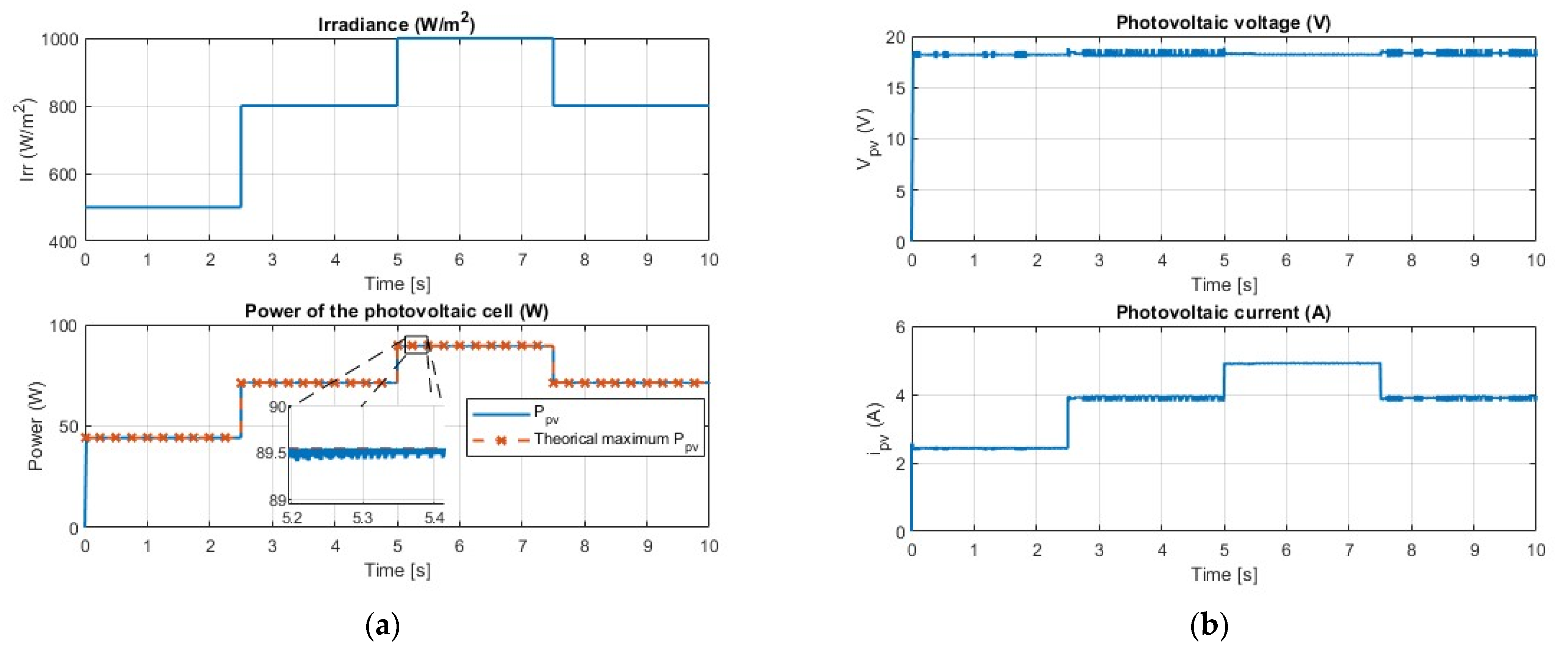
Figure 5 illustrates the dynamic behavior of the photovoltaic system under irradiance variations and a constant temperature of 25 °C. Figure 5a shows an irradiance profile with abrupt variations applied to the photovoltaic cell together with the generated electrical power P p v , which allows analyzing the direct relationship between the incident solar radiation and the power generation capability of the system. Figure 5b presents the time evolution of the photovoltaic voltage and current, highlighting the system response to irradiance changes and the action of the control strategy.
For the calculation of the theoretical maximum photovoltaic power P p v ( P m a x ), which is shown in Figure 5a, expression (22) is employed.
P m a x = V m I m ,
where V m denotes the theoretical maximum value of V p v and I m represents the theoretical maximum value of i p v . Expression (23) establishes the relationship between V m and I m .
I m = I p v I s e V p v + R s I m α V t 1 V m + R s I m R p   V m = α V t ln i p v + I s V m R s I m 1 + R s h R s I s R s I m .
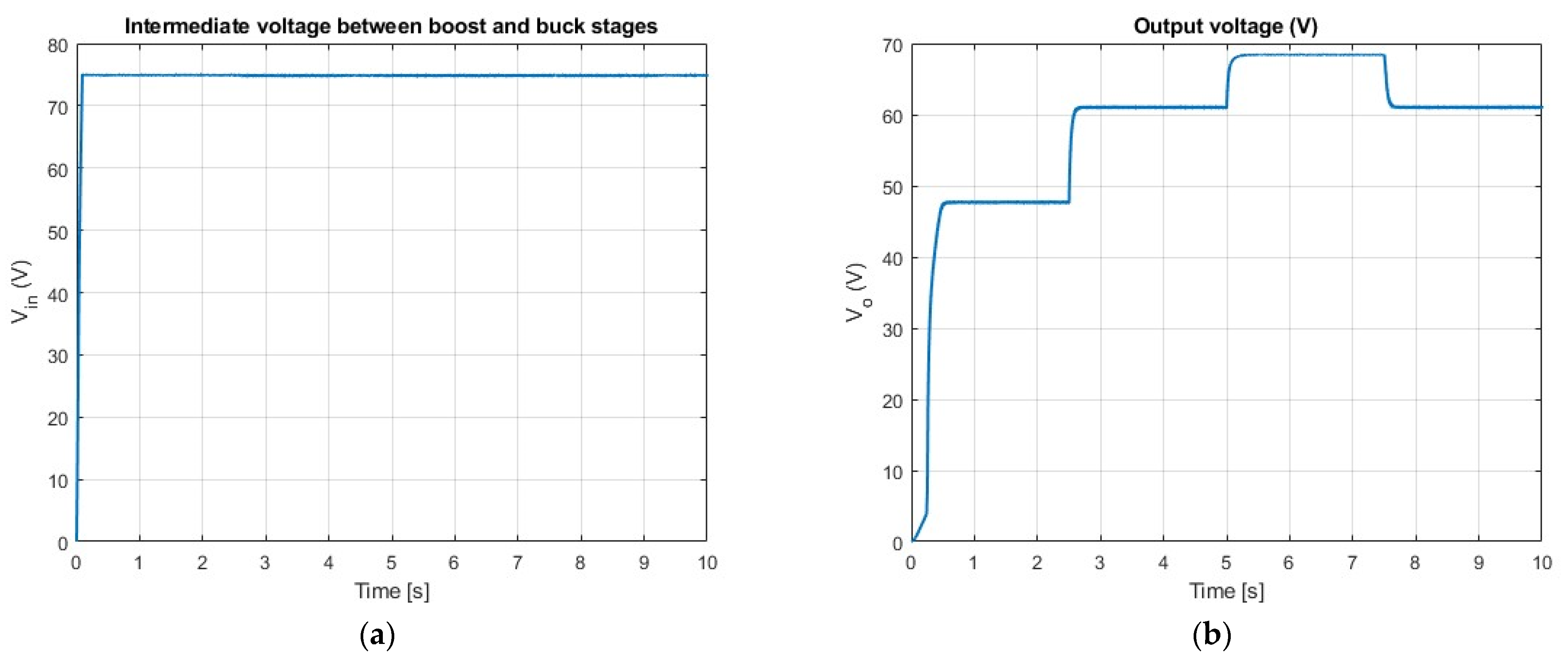
Figure 6 illustrates the dynamic behavior of the DC–DC power converter under the operating conditions considered in Figure 5. Figure 6a shows the time evolution of the intermediate voltage between the boost and buck stages V i n , which reflects the energy transfer and regulation at the DC-link. Figure 6b presents the output voltage waveform. For this case study, the input voltage is set to V i n * = 75   V , and R = 60   Ω ; however, this value can be modified by the specific application and the associated load.
These simulations demonstrate an adequate tracking of the MPP, even under abrupt irradiance variations. The results confirm that the proposed control and MPPT algorithm can maintain operation around the optimal operating point despite rapid changes in environmental conditions.

6. Implementation

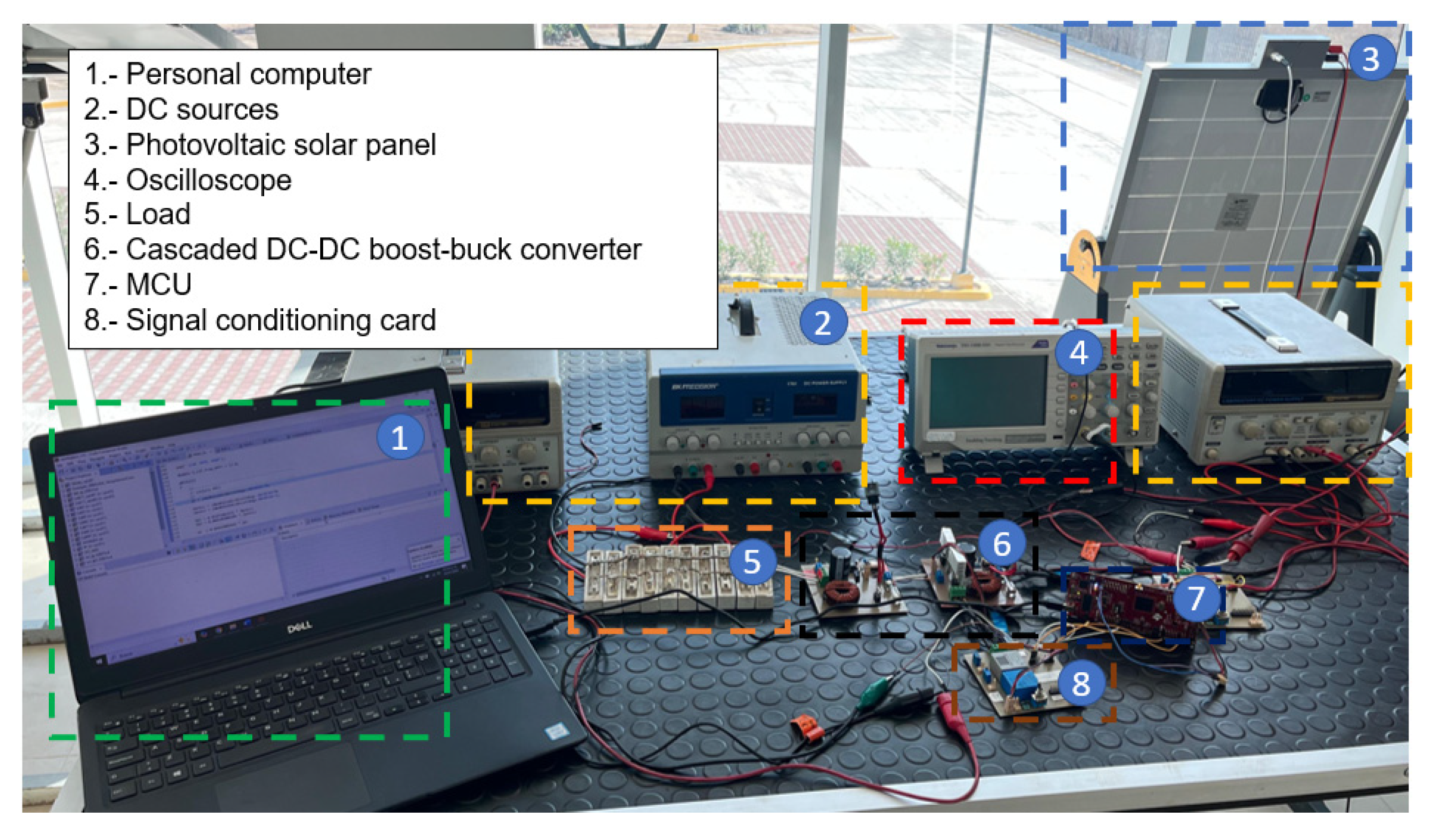
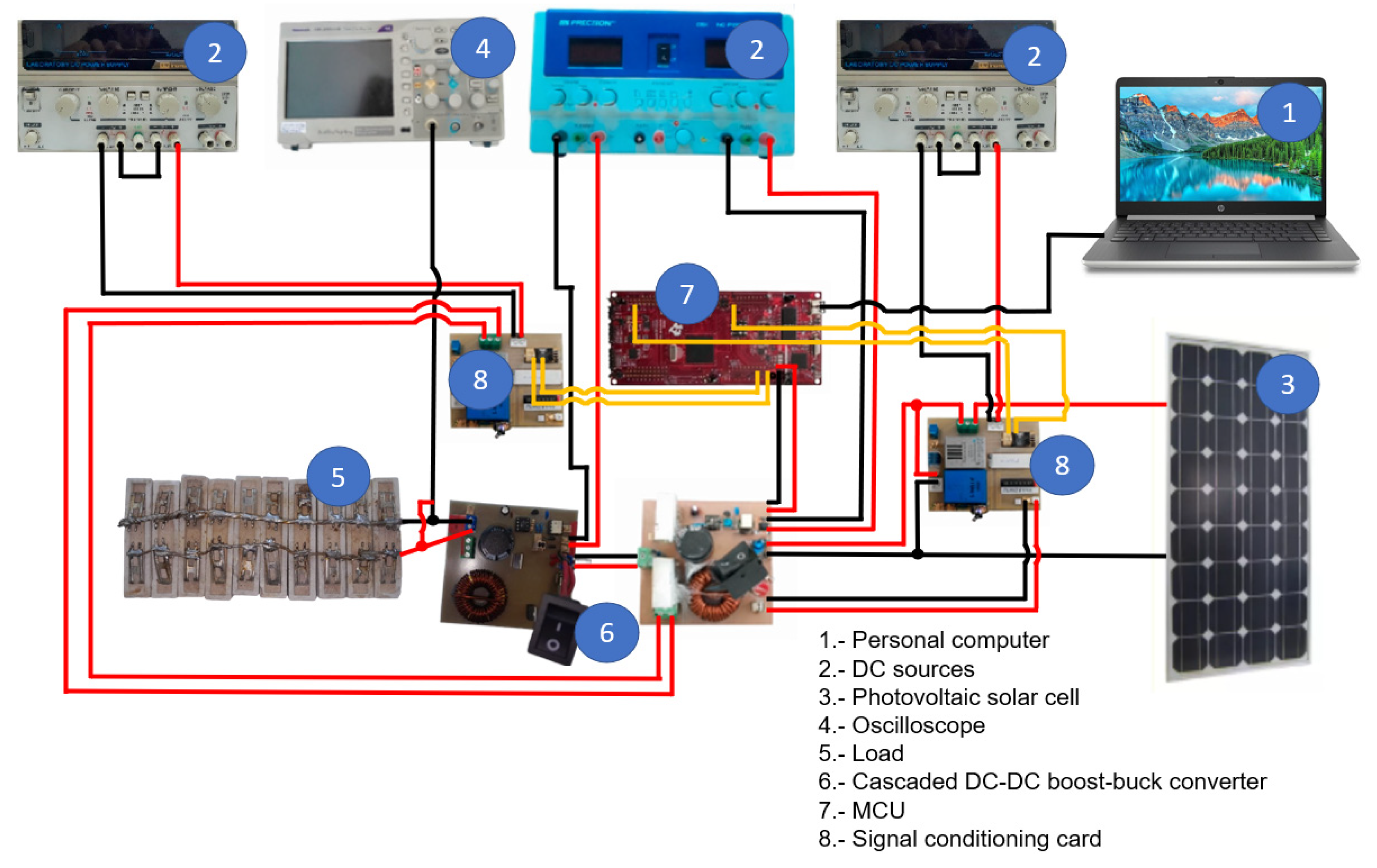
The experimental implementation of the system consists of an SYM 90 P photovoltaic solar panel of the Sunergy brand, a prototype boost–buck DC–DC converter, and a LAUNCHXL-F28379D microcontroller unit (MCU) from Texas Instruments (Dallas, TX, USA), responsible for executing the digital control algorithms, which were programmed using the Code Composer Studio development environment from the same manufacturer. Additionally, two signal conditioning boards equipped with voltage and current sensors are used for the acquisition of the system’s electrical variables. Complementary DC power supplies are employed to provide energy to the sensors, and an oscilloscope is used for signal monitoring and experimental validation. Figure 7 illustrates the integration of all components employed in the implementation and physical experimental testing of the complete system, while Figure 8 presents the connection diagram used for the physical implementation tests.
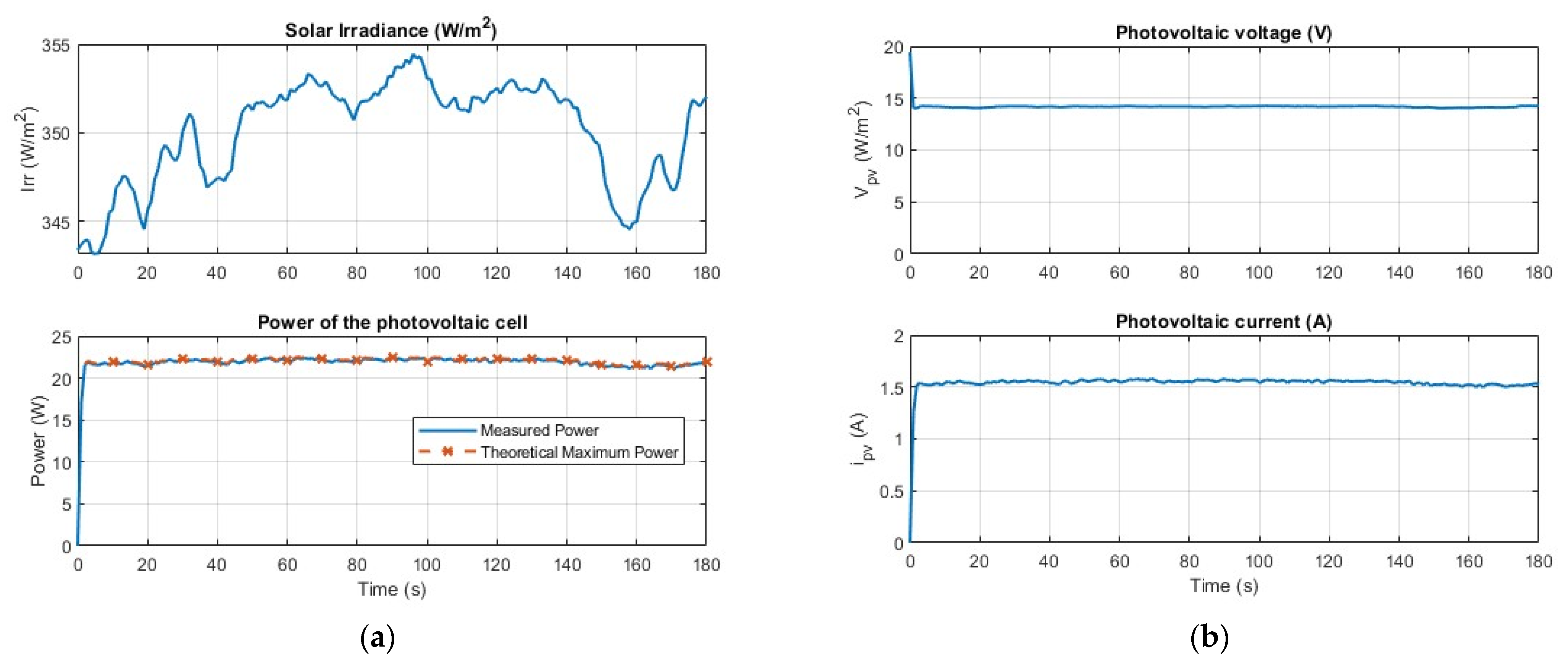
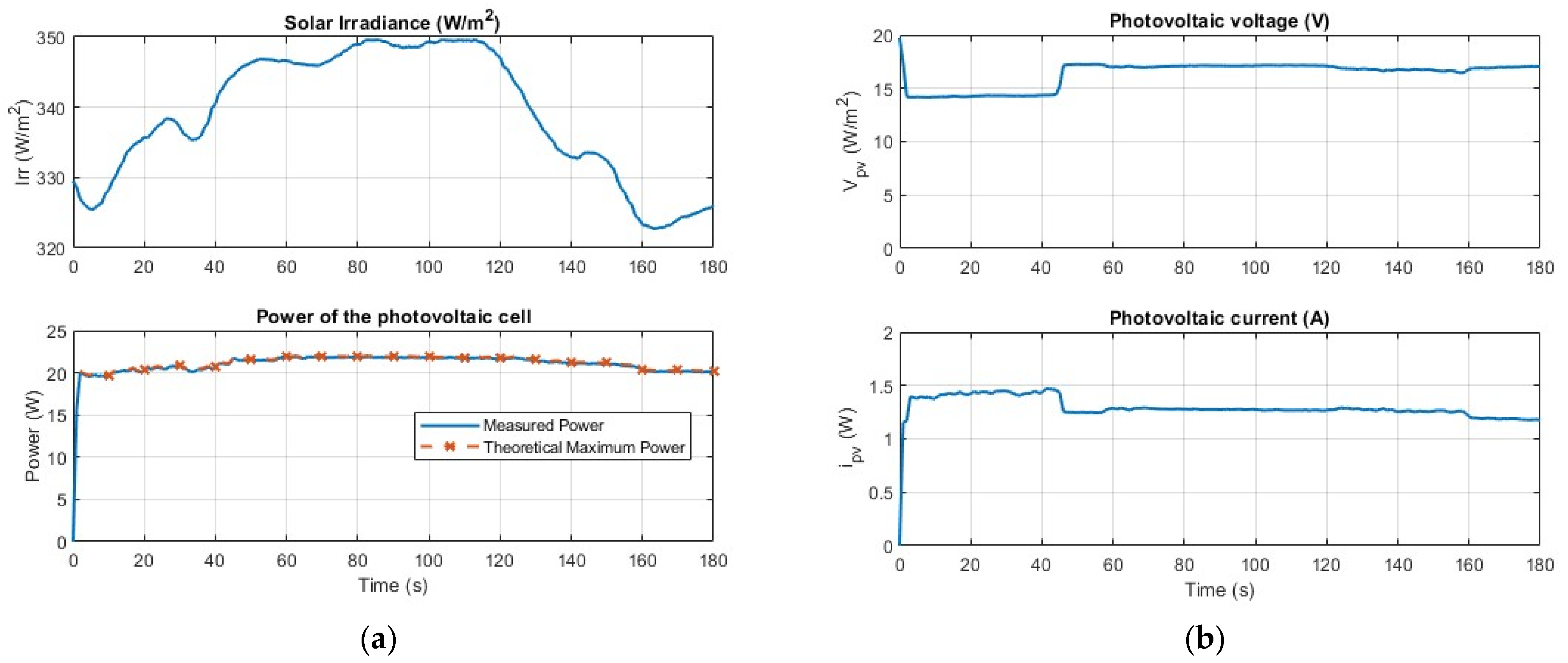
Figure 9 illustrates the experimental performance of the photovoltaic system under real operating conditions, where both solar irradiance and ambient temperature correspond to measured data from a representative day in the city of Culiacán, Sinaloa, Mexico. Figure 9a presents the irradiance profile together with the generated photovoltaic power P p v , enabling the evaluation of the system response to naturally occur irradiance fluctuations throughout the day. Figure 9b depicts the time evolution of the photovoltaic voltage and current, highlighting the dynamic behavior of the system under real environmental variations and demonstrating the effectiveness of the proposed control strategy in tracking the operating point despite simultaneous changes in irradiance and temperature. In addition, Figure 10 presents the same experimental analysis as Figure 9 but corresponding to measurements acquired on a different day and at a different time, further validating the robustness and repeatability of the proposed control approach under varying real-world conditions.

7. Result Analysis

In this section, an analysis of the results obtained through both simulation and experimental implementation of the system is presented. Table 4 provides a quantitative comparison of the results corresponding to both approaches, enabling an assessment of the level of agreement between the simulated model and the behavior observed in the practical implementation. The overall efficiency of the system η ( t ) can be calculated using (24).
η t = t 1 t 2 P p v t d t t 1 t 2 P m a x t d t .    
Since, in this work, the measurements are acquired at discrete time instants, a discretized version of (24) is employed, as presented in (25).
η [ k ] = k = k 1 k n 1 P p v [ k ] k = k 1 k n 1 P m a x [ k ] .  
The differences observed between the simulation results and the experimental implementation can be mainly attributed to noise in the measurements of the sensed variables, inherent discrepancies between the mathematical models and the actual physical components, as well as external disturbances encountered during the experimental tests.
The increase in transient time observed in the experimental implementation compared to simulation is mainly associated with non-idealities not considered in the mathematical model, including switching delays, sensor dynamics, quantization effects, and computational latency of the embedded platform. Additionally, parasitic elements and measurement filtering introduce extra damping that slightly slows down the dynamic response. Despite this increase, the experimental start-up time remains competitive with respect to previously reported works.
Table 5 presents a comparative analysis between the proposed approach and some strategies reported in the literature that employ similar architectures, specifically considering photovoltaic systems based on buck, boost, and cascaded boost–buck DC–DC converters, in conjunction with MPPT control algorithms and a load.
Compared to previous studies summarized in Table 5, the proposed approach demonstrates a favorable trade-off between transient response and efficiency. While some works report comparable efficiencies in simulation, many lack full experimental validation or exhibit significantly longer start-up times. In contrast, this work integrates SMC with an adaptive P&O-based MPPT strategy, achieving 99.42% experimental efficiency with full hardware validation on a low-cost embedded platform. The nonlinear nature of SMC enhances robustness against disturbances and parameter variations, while the adaptive step mechanism improves start-up dynamics. These features highlight the practical viability and competitive performance of the proposed system.
Another advantage of the proposed approach is its suitability for implementation on low-cost embedded platforms, in accordance with the design and implementation philosophy presented in [31]. In this work, the control and MPPT algorithms are implemented on the Texas Instruments LAUNCHXL-F28379D microcontroller, which represents a highly economical cost–benefit alternative, offering significantly lower overall cost compared to rapid prototyping systems such as dSPACE, which are commonly employed in similar applications.
Considering that the load was modeled as a constant resistive element in this study, abrupt variations in load resistance may introduce transient deviations in the voltage and current, which can temporarily affect the operating point of the PV array. However, due to the inherent robustness of the sliding mode control strategy, the system preserves closed-loop stability under sudden load perturbations, as SMC is designed to handle parameter variations and external disturbances. From the MPPT perspective, abrupt load changes may cause a temporary displacement from the maximum power point; nevertheless, the adaptive P&O algorithm can re-adjust the duty cycle and restore MPP tracking after a short transient interval.
Although the experimental validation was conducted at approximately 90 W, the proposed control strategy is not inherently limited to low-power applications. The mathematical model and SMC design remain valid for higher power levels, provided the converter operates in continuous conduction mode. Therefore, in the case of higher-power photovoltaic arrays, an appropriate redesign and scaling of the boost–buck converter components would be required. From the control perspective, the adaptive P&O-based MPPT algorithm is not restricted to a particular power level since its nature is independent of the system’s nominal power. Moreover, the inherent robustness of SMC against parameter variations and external disturbances supports stable operation under scaled conditions, even in the presence of disturbances or uncertainties typically observed in photovoltaic systems.

8. Conclusions

This paper presents an integrated control strategy for a boost–buck DC-DC converter applied to photovoltaic energy conversion systems. The proposed approach is based on a cascade control architecture that combines an adaptive-step P&O MPPT algorithm with nonlinear SMC and PI controllers. The mathematical modeling of the boost and buck stages was carried out using average large-signal representations, which were subsequently discretized. For the solar cell model, the Sigma–Delta Modulation (SDM) approximation was employed.
The adaptive-step P&O algorithm demonstrated an effective reduction of steady-state oscillations around the maximum power point while maintaining a fast dynamic response to rapid changes in irradiance and temperature. The inclusion of a dead-band decision mechanism and controlled saturation further enhanced the robustness and stability of the MPPT scheme. Simultaneously, the SMC ensured precise current tracking and robustness against parametric uncertainties and external disturbances, outperforming conventional linear control approaches.
The simulation and experimental results validated the effectiveness of the proposed strategy, showing an improvement in the overall photovoltaic system efficiency compared to linear control solutions, as well as a reduction in transient durations, particularly during system start-up. Specifically, the system start-up time was reduced by approximately 10–77 ms in simulation and about 210 ms in experimental implementation when compared to other works reported in the literature. In addition, the proposed strategy achieved an improvement of around 12% in overall efficiency obtained in experimental implementation relative to systems with similar control structures and converter topologies.
Due to the adopted development philosophy, a favorable cost–benefit ratio from an economic standpoint is ensured, as it enables the implementation of the system on low-cost embedded platforms without compromising overall system performance.
The proposed approach described in this article presents potential for deployment in a wide range of renewable energy applications. However, a limitation of the present study lies in the use of a purely resistive load, which simplifies the system analysis but does not fully represent the dynamic behavior of practical energy storage systems. Therefore, future work will consider the incorporation of a mathematical model of a battery array, enabling a more comprehensive evaluation of the proposed control strategy under realistic operating conditions. Additionally, further research is envisioned to focus on the implementation of the proposed control strategy and MPPT algorithm in electromobility applications, specifically as a functional block within electric vehicle charging stations.

Author Contributions

Conceptualization, J.A.G.-C., M.A.A.-C., G.J.R.-A. and D.E.C.-P.; methodology, G.J.R.-A., J.D.S.-T. and D.E.C.-P.; software, J.A.G.-C., J.R.C.-R. and D.E.C.-P.; validation, G.J.R.-A., J.D.S.-T. and D.E.C.-P.; formal analysis, J.A.G.-C., J.R.C.-R., G.J.R.-A., J.D.S.-T. and D.E.C.-P.; investigation, J.A.G.-C., J.R.C.-R., G.J.R.-A. and D.E.C.-P.; resources, M.A.A.-C., G.J.R.-A. and J.R.C.-R.; data curation, J.A.G.-C., J.R.C.-R. and J.C.P.-P.; writing—original draft preparation, J.A.G.-C., D.E.C.-P. and G.J.R.-A.; writing—review and editing, J.D.S.-T., G.J.R.-A., J.C.P.-P. and M.A.A.-C.; visualization, G.J.R.-A. and D.E.C.-P.; supervision, G.J.R.-A. and D.E.C.-P.; project administration, D.E.C.-P. All authors have read and agreed to the published version of the manuscript.

Funding

This research was funded by Tecnológico Nacional de México through the Instituto Tecnológico de Culiacán, project number 23636.25-P.

Data Availability Statement

The original contributions presented in the study are included in the article.

Acknowledgments

The authors appreciate the support of Secretaría de Ciencia, Humanidades, Tecnología e Innovación (SECIHTI) and Tecnológico Nacional de México (TecNM).

Conflicts of Interest

The authors declare no potential conflicts of interest.

References

  1. Borges, T.A.R.; Brito, F.C.; dos Santos, R.G.O.; Nascimento, P.d.T.; da Silva, C.B.; Panizio, R.M.; Saba, H.; Nascimento Filho, A.S. Smart Technologies Applied in Microgrids of Renewable Energy Sources: A Systematic Review. Energies 2025, 18, 2676. [Google Scholar] [CrossRef]
  2. Nagaraja, M.R.; Biswas, W.K.; Selvan, C.P. Advancements and Challenges in Solar Photovoltaic Technologies: Enhancing Technical Performance for Sustainable Clean Energy—A review. Sol. Energy Adv. 2025, 5, 100084. [Google Scholar] [CrossRef]
  3. Katche, M.L.; Makokha, A.B.; Zachary, S.O.; Adaramola, M.S. A Comprehensive Review of Maximum Power Point Tracking (MPPT) Techniques Used in Solar PV Systems. Energies 2023, 16, 2206. [Google Scholar] [CrossRef]
  4. Lyden, S.; Haque, M.E. Maximum Power Point Tracking techniques for photovoltaic systems: A comprehensive review and comparative analysis. Renew. Sustain. Energy Rev. 2015, 52, 1504–1518. [Google Scholar] [CrossRef]
  5. Saravanan, S.; Babu, N.R. Maximum power point tracking algorithms for photovoltaic system—A review. Renew. Sustain. Energy Rev. 2016, 57, 192–204. [Google Scholar] [CrossRef]
  6. Van Beuzekom, I.; Gibescu, M.; Slootweg, J.G. A review of multi-energy system planning and optimization tools for sustainable urban development. In Proceedings of the 2015 IEEE Eindhoven PowerTech, Eindhoven, The Netherlands, 29 June–2 July 2015; pp. 1–7. [Google Scholar] [CrossRef]
  7. Fazelpour, F.; Soltani, N.; Rosen, M.A. Feasibility of satisfying electrical energy needs with hybrid systems for a medium-size hotel on Kish Island, Iran. Energy 2014, 73, 856–865. [Google Scholar] [CrossRef]
  8. Ludin, N.A.; Affandi, N.A.A.; Purvis-Roberts, K.; Ahmad, A.; Ibrahim, M.A.; Sopian, K.; Jusoh, S. Environmental impact and levelised cost of energy analysis of solar photovoltaic systems in selected Asia pacific region: A cradle-to-grave approach. Sustainability 2021, 13, 396. [Google Scholar] [CrossRef]
  9. Bollipo, R.B.; Mikkili, S.; Bonthagorla, P.K. Hybrid, optimization, intelligent and classical PV MPPT techniques: A Review. CSEE J. Power Energy Syst. 2021, 7, 9–33. [Google Scholar] [CrossRef]
  10. Kavya, M.; Jayalalitha, S. Developments in perturb and observe algorithm for maximum power point tracking in photo voltaic panel: A review. Arch. Comput. Methods Eng. 2020, 28, 2447–2457. [Google Scholar] [CrossRef]
  11. Motahhir, S.; El Hammoumi, A.; El Ghzizal, A. The most used MPPT algorithms: Review and the suitable low-cost embedded board for each algorithm. J. Clean. Prod. 2019, 246, 118983. [Google Scholar] [CrossRef]
  12. Mousa, H.H.; Youssef, A.-R.; Mohamed, E.E. State of the art perturb and observe MPPT algorithms based wind energy conversion systems: A technology review. Int. J. Electr. Power Energy Syst. 2020, 126, 106598. [Google Scholar] [CrossRef]
  13. Jiang, J.-A.; Su, Y.-L.; Kuo, K.-C.; Wang, C.-H.; Liao, M.-S.; Wang, J.-C.; Huang, C.-K.; Chou, C.-Y.; Lee, C.-H.; Shieh, J.-C. On a hybrid MPPT control scheme to improve energy harvesting performance of traditional two-stage inverters used in photovoltaic systems. Renew. Sustain. Energy Rev. 2017, 69, 1113–1128. [Google Scholar] [CrossRef]
  14. Jagadeesh, I.; Indragandhi, V. Comparative Study of DC-DC Converters for Solar PV with Microgrid Applications. Energies 2022, 15, 7569. [Google Scholar] [CrossRef]
  15. Hashemi, T.; Jafari Kaleybar, H. The Modeling and Simulation of Non-Isolated DC–DC Converters for Optimizing Photovoltaic Systems Applied in Positive Energy Districts. Designs 2024, 8, 130. [Google Scholar] [CrossRef]
  16. Raghavendra, K.V.G.; Zeb, K.; Muthusamy, A.; Krishna, T.N.V.; Kumar, S.V.S.V.P.; Kim, D.-H.; Kim, M.-S.; Cho, H.-G.; Kim, H.-J. A Comprehensive Review of DC–DC Converter Topologies and Modulation Strategies with Recent Advances in Solar Photovoltaic Systems. Electronics 2020, 9, 31. [Google Scholar] [CrossRef]
  17. Rosas-Caro, J.C.; Ramirez, J.; Peng, F.Z.; Valderrabano, A. A DC-DC multilevel boost converter. IET Power Electron. 2010, 3, 129–137. [Google Scholar] [CrossRef]
  18. Akca, H. A two-stage dc–dc converter with high voltage gain and reduced current ripple for efficient PV energy harvesting. Sci. Rep. 2025, 15, 43614. [Google Scholar] [CrossRef]
  19. Abolghasemi, M.; Soltani, I.; Shivaie, M.; Vahedi, H. Recent advances of step-up multi-stage DC-DC converters: A review on classifications, structures and grid applications. Energy Rep. 2025, 13, 3050–3081. [Google Scholar] [CrossRef]
  20. Valencia, P.A.O.; Ramos-Paja, C.A. Sliding-Mode Controller for Maximum Power Point Tracking in Grid-Connected Photovoltaic Systems. Energies 2015, 8, 12363–12387. [Google Scholar] [CrossRef]
  21. Bianconi, E.; Calvente, J.; Giral, R.; Mamarelis, E.; Petrone, G.; Ramos-Paja, C.A.; Spagnuolo, G.; Vitelli, M. Perturb and Observe MPPT algorithm with a current controller based on the sliding mode. Int. J. Electr. Power Energy Syst. 2013, 44, 346–356. [Google Scholar] [CrossRef]
  22. Inomoto, R.S.; de Almeida Monteiro, J.R.B.; Sguarezi Filho, A.J. Boost Converter Control of PV System Using Sliding Mode Control with Integrative Sliding Surface. IEEE J. Emerg. Sel. Top. Power Electron. 2022, 10, 5522–5530. [Google Scholar] [CrossRef]
  23. Ali, A.I.; Sayed, M.A.; Mohamed, E.E. Modified efficient perturb and observe maximum power point tracking technique for grid-tied PV system. Int. J. Electr. Power Energy Syst. 2018, 99, 192–202. [Google Scholar] [CrossRef]
  24. Kumar, M.; Panda, G. Analysis of Conventional and Interleaved Boost Converter with Solar Photovoltaic System. In Proceedings of the 2022 International Conference on Intelligent Controller and Computing for Smart Power (ICICCSP), Hyderabad, India, 21–23 July 2022; pp. 1–6. [Google Scholar] [CrossRef]
  25. Fekik, A.; Hamida, M.L.; Azar, A.T.; Ghanes, M.; Hakim, A.; Denoun, H.; Hameed, I.A. Robust Power Control for PV and Battery Systems: Integrating Sliding Mode MPPT with Dual Buck Converters. Front. Energy Res. 2024, 12, 1380387. [Google Scholar] [CrossRef]
  26. Osmani, K.; Haddad, A.; Alkhedher, M.; Lemenand, T.; Castanier, B.; Ramadan, M. A Novel MPPT-Based Lithium-Ion Battery Solar Charger for Operation under Fluctuating Irradiance Conditions. Sustainability 2023, 15, 9839. [Google Scholar] [CrossRef]
  27. Dubey, M.; Shamra, S.K.; Saxena, R. Cascaded boost buck converter for solar power driven stand-alone PMSM drive. Renew. Energy Focus 2020, 35, 32–40. [Google Scholar] [CrossRef]
  28. Fu, M.; Ma, C.; Zhu, X. A Cascaded Boost-Buck Converter for High Efficiency Wireless Power Transfer Systems. IEEE Trans. Ind. Inform. 2014, 10, 1972–1980. [Google Scholar] [CrossRef]
  29. Kumar, R.; Singh, B.; Chandra, A.; Al-Haddad, K. Solar PV Array Fed Water Pumping Using BLDC Motor Drive with Boost-Buck Converter. In Proceedings of the 2015 IEEE Energy Conversion Congress and Exposition (ECCE), Montreal, QC, Canada, 20–24 September 2015. [Google Scholar] [CrossRef]
  30. Kurniawan, F.; Lasmadi, L.; Dinaryanto, O.; Sudibya, B.; Nasution, M.R.E. A novel Boost-Buck converter architecture for improving transient response and output-voltage ripple. J. Ict Res. Appl. 2020, 14, 149–164. [Google Scholar] [CrossRef]
  31. Pathak, P.K.; Yadav, A.K. Design of battery charging circuit through intelligent MPPT using SPV system. Sol. Energy 2019, 178, 79–89. [Google Scholar] [CrossRef]
  32. Triki, Y.; Bechouche, A.; Seddiki, H.; Abdeslam, D.O. A smart battery charger based on a cascaded boost-buck converter for photovoltaic applications. In Proceedings of the IECON 2018-44th Annual Conference of the IEEE Industrial Electronics Society, Washington, DC, USA, 21–23 October 2018; pp. 3466–3471. [Google Scholar] [CrossRef]
  33. Bacha, S.; Munteanu, I.; Bratcu, A.I. Power Electronic Converters Modeling and Control; Springer: London, UK, 2014. [Google Scholar]
  34. González-Castro, J.A.; Rubio-Astorga, G.J.; Alarcón-Carbajal, M.A.; Sánchez-Torres, J.D.; Medina-Melendrez, M.; Cabanillas-Noris, J.C.; Castro-Palazuelos, D.E. Low-Cost Platform Implementation of Discrete Controllers for DC-DC Boost Converter. Energies 2024, 17, 4097. [Google Scholar] [CrossRef]
  35. Alarcón-Carbajal, M.A.; Carvajal-Rubio, J.E.; Sánchez-Torres, J.D.; Castro-Palazuelos, D.E.; Rubio-Astorga, G.J. An Output Feedback Discrete-Time Controller for the DC-DC Buck Converter. Energies 2022, 15, 5288. [Google Scholar] [CrossRef]
  36. Navada, H.G.; Singh, S.V.; Shubhanga, K.N. Modelling of a solar photovoltaic power plant for power system studies. In Proceedings of the 2017 IEEE International Conference on Signal Processing, Informatics, Communication and Energy Systems (SPICES), Kollam, India, 8–10 August 2017; pp. 1–6. [Google Scholar] [CrossRef]
  37. Podder, A.K.; Roy, N.K.; Pota, H.R. MPPT methods for solar PV systems: A critical review based on tracking nature. IET Renew. Power Generation. 2019, 13, 1615–1632. [Google Scholar] [CrossRef]
  38. Hussein, K.H.; Muta, I.; Hoshino, T.; Osakada, M. Maximum photovoltaic power tracking: An algorithm for rapidly changing atmospheric conditions. IEE Proc.-Gener. Transm. Distrib. 1995, 142, 59–64. [Google Scholar] [CrossRef]
  39. Piegari, L.; Rizzo, R. Adaptive perturb and observe algorithm for photovoltaic maximum power point tracking. IET Renew. Power Generation. 2010, 4, 317–328. [Google Scholar] [CrossRef]
  40. Hart, D. Power Electronics; Tata McGraw-Hill: New York, NY, USA, 2011. [Google Scholar]
  41. EnergyPal. Sunergy SYM-90 Solar Panel Baseline. Available online: https://energypal.com/best-solar-panels-for-homes/sunergy/sym-90 (accessed on 4 January 2026).
  42. Vidal-Idiarte, E.; Marcos-Pastor, A.; Gracia, G.; Cid-Pastor, A.; Martinez-Salamero, L. Discrete-time sliding-mode-based digital pulse width modulation control of a boost converter. IET Power Electron. 2015, 8, 708–714. [Google Scholar] [CrossRef]
  43. Shetty, D.; Sabhahit, J.N.; Kudva, G. A Methodology to Optimize PMSM Driven Solar Water Pumps Using a Hybrid MPPT Approach in Partially Shaded Conditions. Clean Technol. 2024, 6, 1229–1259. [Google Scholar] [CrossRef]
  44. Pamuk, N. Performance Analysis of Different Optimization Algorithms for MPPT Control Techniques under Complex Partial Shading Conditions in PV Systems. Energies 2023, 16, 3358. [Google Scholar] [CrossRef]
Figure 1. Interconnection scheme between the solar cell and the boost–buck converter.
Energies 19 01123 g001
Figure 2. SDM approximation of the solar cell [37].
Energies 19 01123 g002
Figure 3. Control structure of the boost–buck DC-DC converter.
Energies 19 01123 g003
Figure 4. Block diagram of the MPPT algorithm.
Energies 19 01123 g004
Figure 5. Dynamic response of the photovoltaic system: (a) irradiance and power output of the photovoltaic cell; (b) photovoltaic voltage and current waveforms.
Energies 19 01123 g005
Figure 6. Voltage waveforms of the DC–DC converter: (a) intermediate voltage between the boost and buck stages; (b) output voltage.
Energies 19 01123 g006
Figure 7. Photograph of the experimental setup used for the implementation and testing of the proposed photovoltaic system.
Energies 19 01123 g007
Figure 8. Connection diagram for the physical implementation and experimental testing of the proposed system.
Energies 19 01123 g008
Figure 9. Dynamic response of the photovoltaic system implemented on 9 December 2025, in the city of Culiacán, Sinaloa, at 12:05 p.m.: (a) irradiance and power output of the photovoltaic cell; (b) photovoltaic voltage and current waveforms.
Energies 19 01123 g009
Figure 10. Dynamic response of the photovoltaic system implemented on 15 December 2025, in the city of Culiacán, Sinaloa, at 9:32 a.m.: (a) irradiance and power output of the photovoltaic cell; (b) photovoltaic voltage and current waveforms.
Energies 19 01123 g010
Table 1. Meaning of each of the parameters.
ParameterStageMeaning
V p v Photovoltaic cellVoltage
i p v Photovoltaic cellCurrent
C Photovoltaic cell and boostDecoupling capacitor
L 1 BoostInductance
R L 1 BoostEquivalent serial resistor (ESR) of L 1
H 1 BoostTransistor
D 1 BoostRectifier diode
u 1 BoostControl input signal
i L 1 BoostCurrent in the inductor
C 1 BoostCapacitance
R C 1 BoostEquivalent serial resistor (ESR) of C 1
V i n BuckInput voltage
H 2 BuckTransistor
D 2 BuckRectifier Diode
u 2 BuckControl input signal
L 2 BuckInductance
R L 2 BuckEquivalent serial resistor (ESR) of L 2
i L 2 BuckCurrent in the inductor
C 2 BuckCapacitance
R C 2 BuckEquivalent serial resistor (ESR) of C 2
R BuckLoad resistance
V o BuckOutput voltage
Table 2. Values of the boost–buck converter components.
ParameterStageValue
L 1 Boost250 μH
R L 1 Boost0.32 Ω
C 1 Boost1000 μF
R C 1 Boost0.041 Ω
L 2 Buck900 μH
R L 2 Buck0.48 Ω
C 2 Buck1000 μF
R C 2 Buck0.053 Ω
R Buck3–120 Ω
Component values were selected based on the design methodology described in [40] and considering the commercial availability of the selected devices.
Table 3. Electrical parameters of the solar cell [41].
ParameterValor
P m a x : Maximum power90 W
V p m a x : Maximum power voltage 18.37 V
I p m a x : Maximum power current4.9 A
V o c : Open circuit voltage22.05 V
I s c : Short circuit current5.15 A
The electrical parameters correspond to standard test conditions (STC), with an irradiance of 1000 W/m2 and a cell temperature of 25 °C.
Table 4. Comparison between simulation and experimental implementation results.
Parameter SimulationImplementation
Transient time23 ms180 ms
Overall efficiency99.92%99.42%
Steady-state oscillation (power ripple)0.04 Watts0.08 Watts
The data presented correspond to the average of the results obtained from the different tests conducted.
Table 5. Comparison between the proposed approach and existing works reported in the literature.
WorkControl
Strategies
Approximate Start-Up Time in SimulationOverall Efficiency in SimulationApproximate Start-Up Time in ImplementationOverall Efficiency
in Implementation
Hardware
Implementation
[20]SMC260 msIs not presentedWithout implementation------
[23]Variable step P&O50 ms95.4%Without implementation------
[25]SMC and P&O100 ms99.77%Without implementation------
[26]Modified P&O500 ms87–100%Without implementation------
[27]PI and P&O33 ms99.67%The data is not reportedThe data is not reporteddSPACE 1104
[29]InC70 ms99.96%390 ms86.6%dSPACE 1104
[31]FL-DPID20 ms99.8%Without implementation------
[32]P&OThe data is not reported99.59%Without implementation------
[43]InC-GWOThe data is not reported96.40–99.92%Without implementation------
[44]P&O, InC, CSA and GWO100 ms92.82–99.96%Without implementation------
This workSMC, PI, and P&O23 ms99.92%180 ms99.42%LAUNCHXL-F28379D
Inc: Incremental Conductance. InC-GWO: Incremental Conductance—Grey Wolf Optimizer. CSA: Crow Search Algorithm. GWO: Grey Wolf Optimizer. ---: The referenced work does not present this approach.
Disclaimer/Publisher’s Note: The statements, opinions and data contained in all publications are solely those of the individual author(s) and contributor(s) and not of MDPI and/or the editor(s). MDPI and/or the editor(s) disclaim responsibility for any injury to people or property resulting from any ideas, methods, instructions or products referred to in the content.