Review

Frontier Research and Application Advances in Energy-Saving Technologies for Aluminum Electrolysis

by
Yu Zhou
1,
Chaoxian Zhao
1,
Jin Xiao
1,2,
Liuzhou Zhou
1,
Minxu Wang
1,
Sen Huang
1,
Jiyuan Yang
1,
Qiuyun Mao
3,
Zihan You
1,* and
Qifan Zhong
1,2,*
1
School of Metallurgy and Environment, Central South University, Changsha 410083, China
2
National Engineering Research Center for Low-Carbon Non-Ferrous Metallurgy, Central South University, Changsha 410083, China
3
Department of Educational Science, Hunan First Normal University, Changsha 410205, China
*
Authors to whom correspondence should be addressed.
Energies 2026, 19(4), 959; https://doi.org/10.3390/en19040959
Submission received: 1 January 2026 / Revised: 29 January 2026 / Accepted: 6 February 2026 / Published: 12 February 2026

Abstract

The Hall–Héroult aluminum electrolysis process remains highly energy-intensive, making energy efficiency improvement crucial for sustainable aluminum production. Recent progress has focused on four key areas: electrolyzer structure optimization, advanced electrode materials, intelligent process control, and waste heat recovery. Structural innovations such as reducing the anode to cathode distance (ACD) and improving magnetohydrodynamic stability have lowered operating voltage and thermal losses. Novel carbon-based and conductive electrode materials have improved current efficiency and extended service life. Intelligent control methods, including model predictive control, adaptive dynamic programming, and Kalman filtering, have optimized alumina feeding, stabilized operations, and reduced perfluorocarbon emissions. Moreover, recovering waste heat from anode gases and electrolyzer sidewalls has created new opportunities for energy reuse. The integration of these strategies is advancing aluminum electrolysis toward higher efficiency, lower carbon emissions, and intelligent operation. Future directions include digital twin modeling, artificial-intelligence-driven control, ultra-low ACD designs, and efficient heat recovery systems to promote sustainable industrial transformation.

1. Introduction

As a foundational industrial metal, aluminum plays a critical role in enabling the high-quality development of sectors such as materials manufacturing, transportation, and energy equipment [1,2,3,4]. At present, the Hall–Héroult process remains the only mature technology for primary aluminum production worldwide [5,6,7]. Despite extensive engineering optimization over the past decades, it remains, at its core, a highly energy-intensive electrochemical process in which electricity costs dominate overall production expenditures [7,8,9,10]. In the context of global energy transitions, increasingly stringent carbon-emission constraints, and evolving dynamics between electricity supply and demand, the electrolytic aluminum industry is confronted with several escalating challenges: high energy intensity, mounting carbon-emission pressures, and ever-more demanding requirements for operational stability [1,11,12,13,14].
The aluminum electrolysis process involves strongly coupled multi-physical fields, encompassing electrical, magnetic, thermal, and fluid dynamics. Operational conditions exert substantial influence on both energy-efficiency performance and overall process stability [15,16,17]. However, under increasingly volatile power-supply conditions, sustained fluctuations in energy prices, and rising demands for low-carbon production, the potential for additional energy savings through conventional process adjustments has become progressively constrained [15,18,19]. In line with the objectives of “energy conservation, consumption reduction, emission mitigation, and efficiency enhancement,” the central scientific and engineering challenges in aluminum electrolysis now focus on improving energy-utilization efficiency, optimizing thermal–electrical balance, and reducing specific energy consumption, all while maintaining stable and reliable operation [20,21,22,23].
In recent years, research on aluminum electrolysis has made sustained progress across fundamental mechanisms, material systems, structural design, process optimization, and energy-utilization strategies, shifting the understanding of the process from an experience-driven paradigm toward a mechanism-based one [24,25,26,27]. However, the field spans multiple disciplines such as materials science, electrochemistry, thermophysics, multiphysics coupling simulation, and energy engineering, and is characterized by numerous research focuses, diverse methodological pathways, and heterogeneous evaluation criteria. A systematic synthesis and comparison of existing advances is therefore essential for elucidating the field’s developmental trajectory, identifying critical bottlenecks, distilling generalizable principles, and clarifying future technological directions. Against this backdrop, this paper reviews major recent advances in energy conservation for aluminum electrolysis. The aim is to provide a more comprehensive and systematic perspective that can guide further improvements in energy-efficiency performance, process-system optimization, and the broader transition toward green and low-carbon development.

2. Electrolyzer Structure Optimization

Optimizing energy efficiency through electrolyzer structural design primarily focuses on improving electrolytic performance, reducing energy consumption, and achieving sustainability goals [28]. As the core component of the electrolysis process, the electrolyzer’s design directly influences electrolyte flow, heat distribution, current uniformity, and thermal efficiency [29]. By optimizing the electrolyzer structure, upgrading electrode materials, and enhancing electrolyte circulation and thermal management systems, energy waste during electrolysis can be effectively minimized. This reduces both heat loss and resistive losses, thereby improving energy utilization efficiency. Moreover, such structural improvements not only extend the lifespan of equipment but also lower operational costs and reduce environmental impact, supporting greener, low-carbon aluminum production.

2.1. Anode Structure and Material Optimization

Optimizing energy efficiency from the anode perspective is essential because the anode directly affects current conduction and energy losses during electrolysis [5]. Its resistance, electrical conductivity, and corrosion resistance largely determine the overall energy efficiency of the electrolyzer [25,30]. Improvements in anode materials and structural design can effectively reduce energy losses associated with anode overheating or uneven resistance distribution [31]. In addition, the careful selection and enhancement of anode materials not only improve current efficiency but also extend equipment service life. These advancements lower maintenance costs and overall energy consumption, thereby promoting a more efficient and energy-conserving electrolytic process.
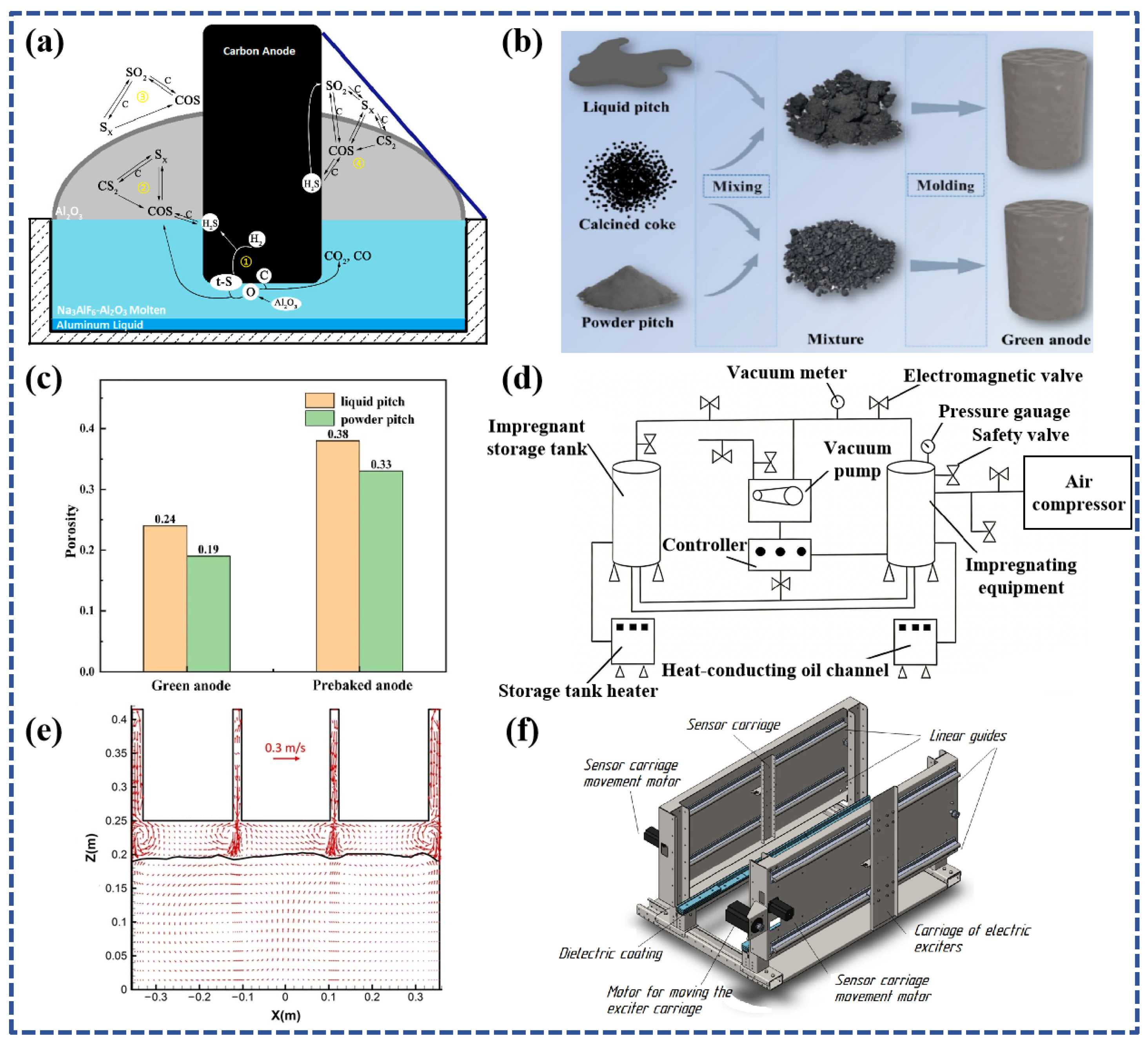
In the pursuit of low-energy operation and enhanced performance of carbon anodes in aluminum electrolysis, the quality of raw materials remains the fundamental determinant of anode efficiency and durability. Focusing on the transformation behavior of sulfur species during electrolysis, Zhong et al. [32] combined high-temperature thermodynamic calculations with experimental validation to elucidate the mechanisms of sulfur evolution. Their study identified carbonyl sulfide (COS) as the principal sulfur-containing product, which accelerates anode degradation through additional carbon consumption and releases environmentally harmful gases (as shown in Figure 1a). This finding provides critical theoretical guidance for anode desulfurization and supports the development of environmentally optimized anode materials.
To mitigate issues of cracking and premature degradation that shorten anode service life and elevate energy consumption, Bai et al. [33] optimized the anode preparation process by introducing fusible B2O3 and powdered asphalt as functional additives (as shown in Figure 1b). The resulting carbon anodes exhibited lower porosity, finer and more uniformly distributed pores, and significantly improved density and electrical performance under optimized forming and sintering conditions (as shown in Figure 1c). The B2O3 additive effectively sealed internal pores and formed a surface protective layer, substantially reducing gas permeability and enhancing oxidation resistance. This dual-layer protection mechanism ensures superior anode stability at both microstructural and compositional levels.
Further innovations have emerged in integrated processing. To improve prebaked anode quality and reduce carbon consumption, Hou et al. [34] developed a coupled “anode impregnation-calcination” process (as shown in Figure 1d). A mass-transfer model for pitch impregnation was established to quantify and optimize impregnation kinetics, followed by parametric optimization of the calcination stage. Industrial-scale validation demonstrated a 0.1 g·cm−3 increase in bulk density, a 0.54 nPm reduction in gas permeability, a 9.43 MPa enhancement in compressive strength, and a 10 μΩ·m decrease in resistivity. These improvements extended anode service life to 35 days, raised current efficiency by 0.44%, and lowered electrolyzer voltage by 17 mV, collectively yielding a substantial reduction in electrolytic energy consumption.
From a structural perspective, Sun et al. [35] investigated the influence of slotted anodes on gas bubble dynamics using numerical simulations (as shown in Figure 1e). Compared with conventional solid anodes, the slotted configuration enhanced bubble removal efficiency from 36% to 63%, shortened bubble trajectories and residence time, reduced coalescence probability, and decreased the average bubble layer thickness by 3.5 mm. These effects significantly stabilized the molten aluminum–electrolyte interface, reduced interfacial resistance, and improved overall energy efficiency and operational stability of the electrolyzer.
In the area of quality assurance, Mishurov et al. [36] addressed the inefficiency of conventional destructive testing by developing a non-destructive inspection system based on electrical resistance measurement and magnetic field mapping (as shown in Figure 1f). The system calculates internal defect signatures from resistance data and compares measured and simulated magnetic field distributions in three dimensions to identify hidden structural flaws. Dual laboratory and industrial validations achieved an 82% defect-detection accuracy, successfully identifying 13.5% of defective anodes within nominally “qualified” batches. The strong correlation with destructive test results underscores the method’s reliability and practicality for real-time, high-throughput anode quality control.
Collectively, these advances from material design and process integration to structural innovation and intelligent inspection illustrate a comprehensive approach to improving carbon anode performance, extending service life, and reducing energy consumption in modern aluminum electrolysis.

2.2. Cathode Structure and Material Optimization

The cathode is a critical component in aluminum electrolyzers, influencing energy consumption and current distribution. Its structure, electrical conductivity, and material properties directly affect electrolyzer voltage, current efficiency, and thermal balance [37]. By optimizing cathode design and materials, cathode voltage drop and contact resistance can be reduced, improving current distribution and electromagnetic field stability while minimizing energy loss. This approach also slows cathode erosion, extends service life, and enhances electrolyzer operational stability and production efficiency [38]. Therefore, cathode optimization represents a critical pathway for achieving energy savings and efficiency gains in the aluminum electrolysis process.
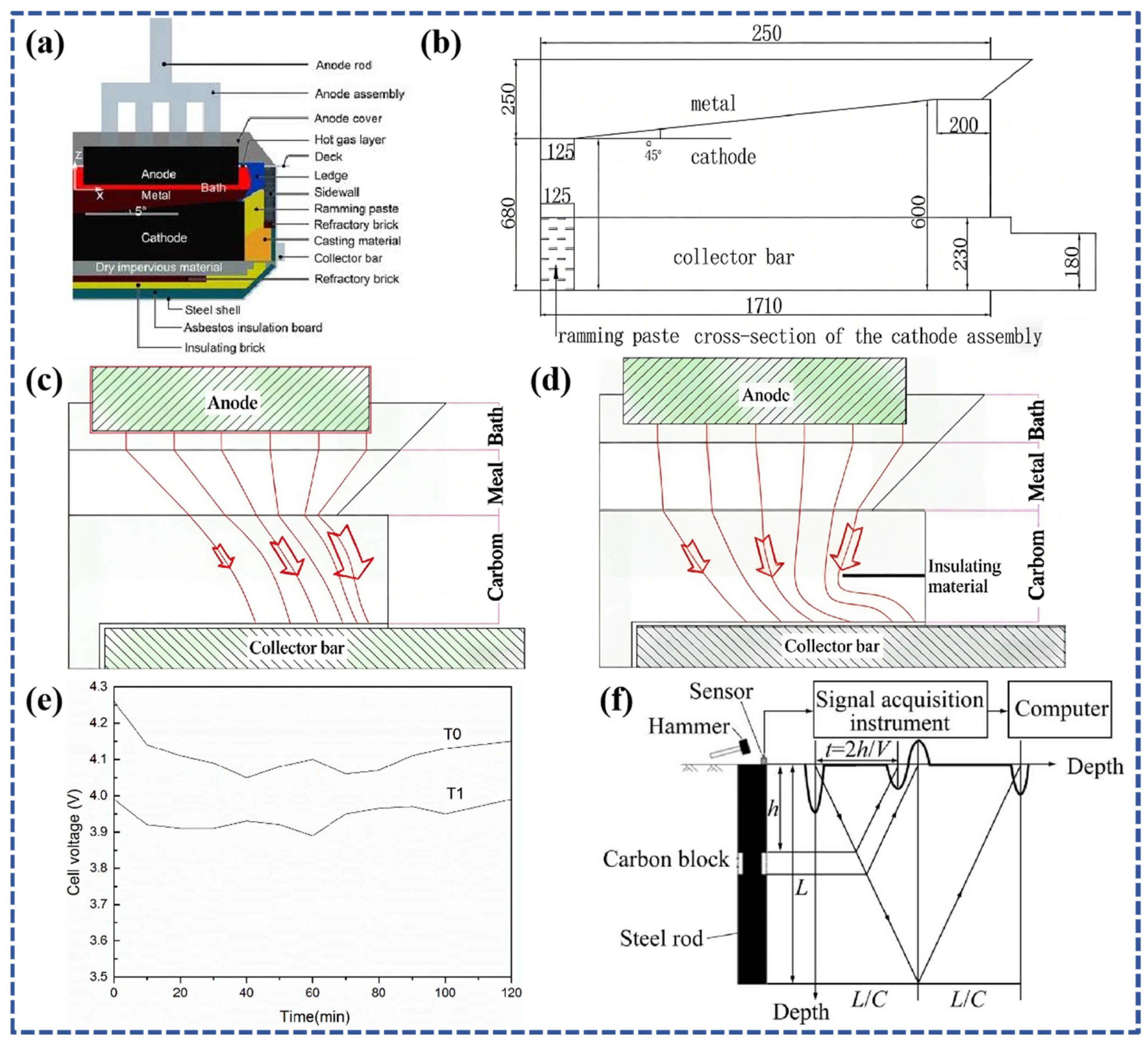
Continuous optimization of cathode performance remains central to improving energy efficiency and operational stability in industrial aluminum electrolyzers. Peng et al. [39] proposed a modified cathode structure incorporating a 5° inclined surface and an increased collector-bar height of 230 mm (as shown in Figure 2a,b). Using a coupled electrothermal model developed in ANSYS, they demonstrated that this configuration reduced electrolyzer voltage by approximately 200 mV compared with traditional flat-bottom designs. During initial operation, however, the reduced ACD caused the furnace wall toe to intrude 12 cm into the anode shadow zone, inducing reverse horizontal currents of about 0.7 A·cm−2 and increasing metal flow velocity. After optimizing the insulation materials, the furnace wall position was restored, effectively lowering metal flow velocity and wave amplitude, thereby fully realizing the energy-saving benefits of the modified cathode.
To mitigate excessive horizontal current density in the metal pad, a persistent cause of instability, Tao et al. [40] introduced a novel cathode configuration featuring slotted carbon blocks. Finite element simulations revealed that increasing slot length markedly redistributed current flow within the metal pad: both horizontal and vertical current maxima shifted toward the electrolyzer center (as shown in Figure 2c,d), and when the slot length reached 400 mm, the maximum horizontal current density decreased by 50.4%. Although cathode voltage increased slightly (by 43 mV at b = 400 mm) and temperature distribution remained largely unaffected, the improved current uniformity enhanced overall electrolysis stability and efficiency.
Addressing the limited lifespan and mechanical weakness of TiB2-coated cathodes, Huang et al. [41] developed a TiB2-TiB/Ti gradient composite using metallic titanium as a substrate via boron diffusion electrolysis in Na2B4O7-K2CO3-B4C molten salt. XRD, SEM, and EDS analyses confirmed the formation of a dense, continuous TiB2 layer (8–10 μm thick) on the surface, with TiB whiskers embedded within the Ti matrix and well bonded to the TiB2 layer. The strong reducing capacity of B4C promoted rapid growth of both TiB2 and TiB phases. This gradient structure significantly improved mechanical strength and extended cathode service life under industrial electrolytic conditions.
Further insights into the graphitization mechanisms of TiB2–carbon composite cathodes were provided by Wang et al. [42], who employed an improved Rapoport electrolyzer to monitor sodium expansion during electrolysis. Using XRD, SEM, and TEM analyses, they explored the catalytic effects of TiC microcrystals in a multilayer composite cathode composed of a TiB2-rich base layer, a TiB2/C functional interlayer, and a graphite top layer. The persistence of three distinct TiC phases after electrolysis reflected catalytic processes involving dissolution-precipitation and carbide transformation mechanisms. Compared with conventional graphite cathodes, the TiB2-C composite exhibited a voltage drop reduction of approximately 120 mV, enhanced graphitization, and improved resistance to sodium penetration and molten salt corrosion (as shown in Figure 2e).
In the domain of cathode quality inspection and degradation assessment, Luo et al. [43] applied ultrasonic wave velocity analysis to evaluate carbon blocks before installation (as shown in Figure 2f). A clear linear relationship was established between wave velocity, porosity, and the square root of inverse density, allowing high-quality large carbon blocks to be selected through combined wave velocity and voltage drop criteria. Additionally, impact-echo testing was introduced for in situ evaluation of cathode steel rods during electrolyzer operation, enabling differentiation among three damage types: minor surface defects, localized melting without penetration, and through-crack formation. This quantitative diagnostic method provides a practical framework for assessing cathode integrity and extending electrolyzer lifespan.
Collectively, these advances in cathode structure design, material innovation, and non-destructive evaluation represent a multifaceted strategy for reducing electrolyzer voltage, improving stability, and prolonging operational life in modern aluminum electrolysis.

2.3. Optimization of Anode Conductive Devices

The anode conductive structure primarily consists of conductive rods and steel claws, which directly influence current distribution, conductive losses, and the overall energy efficiency of the electrolyzer. Its design rationality determines the uniformity of anode current density and the level of voltage drop. By optimizing the arrangement of the conductive structure, contact interfaces, and conductive materials, it is possible to effectively reduce resistive losses and localized overheating, improve current distribution and gas discharge conditions, and decrease the frequency of anode effects. This leads to lower electrolyzer voltage, increased current efficiency, and extended anode lifespan. Therefore, optimizing the anode conductive structure is one of the key approaches to achieving energy conservation, reduced consumption, and stable operation in the aluminum electrolysis process.
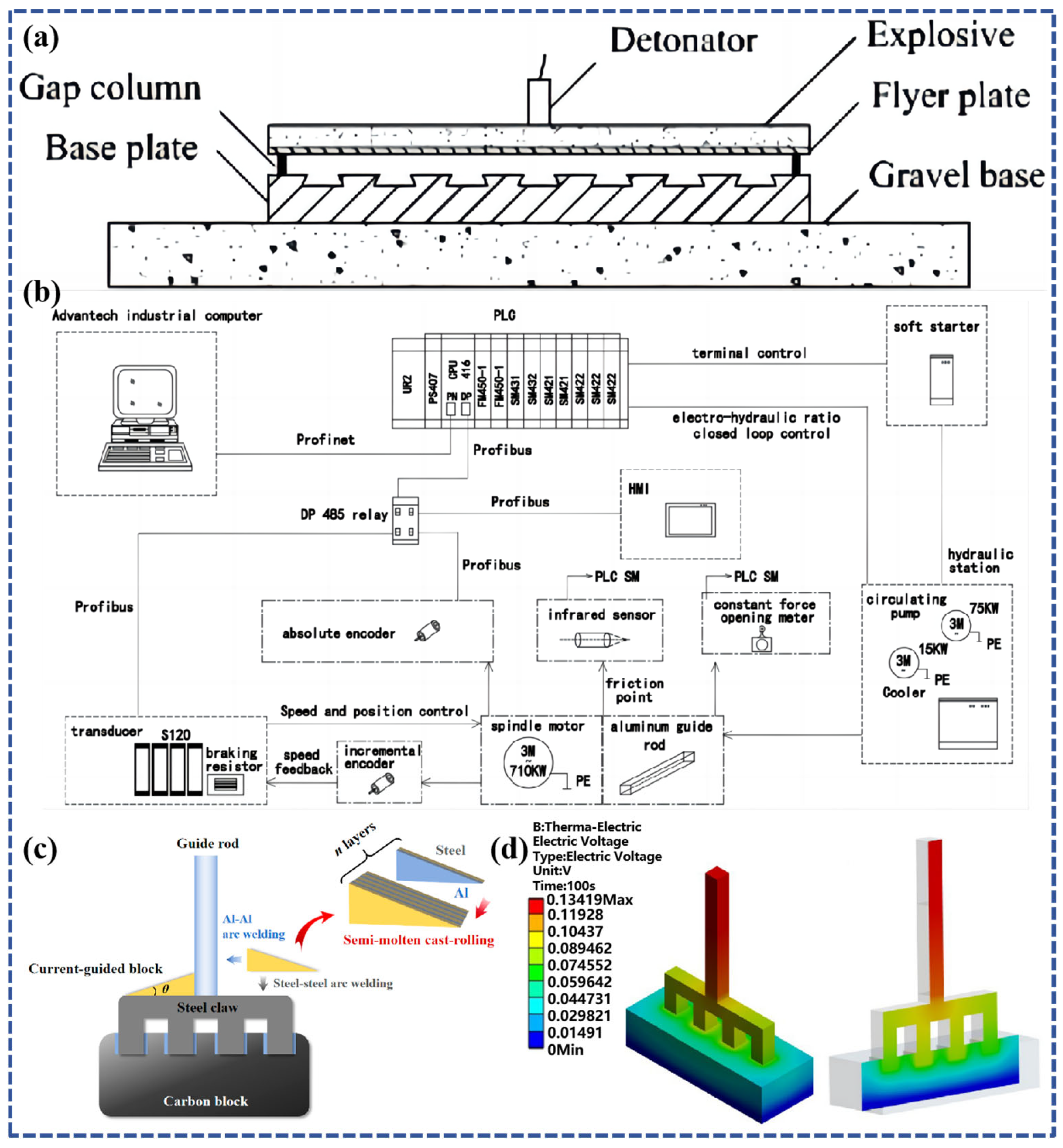
Technological optimization and performance enhancement across different stages of aluminum production remain central to advancing process efficiency and energy conservation. In the area of composite plate manufacturing, Li et al. [44] investigated the interfacial bonding mechanisms of an explosively welded 5083 aluminum alloy-Q345 steel composite, employing the aluminum alloy as the flyer plate and dovetail-grooved Q345 steel as the substrate. Welding parameters were selected near the lower boundary of the weldability window to explore the process limits. Mechanical property evaluation and microstructural analyses revealed that reliable bonding was achieved through combined metallurgical fusion and mechanical interlocking within the dovetail geometry (as shown in Figure 3a). The composite plate exhibited tensile and shear strengths that met industrial requirements for Al/Fe laminates. The interfacial morphology showed predominantly direct bonding with localized fusion zones at the upper and lower dovetail surfaces, while continuous fusion layers formed along inclined surfaces. Brittle FeAl2 and Al5Fe2 intermetallic compounds were identified at the interface, and fracture surfaces displayed ductile-quasi-cleavage features, collectively elucidating the metallurgical bonding behavior of the 5083/Q345 system.
In the field of equipment control optimization, Feng et al. [45] developed an integrated control system for a 5000 kN large-scale friction welding machine used in the production of prebaked anodes (as shown in Figure 3b). The system combines an S7-400 PLC and S120 frequency converters within a Profibus-DP network, employing electro-hydraulic proportional closed-loop control and automatic phase synchronization strategies. Field validation demonstrated safe, reliable performance, achieving an automatic phase control error of ≤0.7965° and a stopping time of approximately six seconds. The system also yielded an average power reduction of 8 mV in anode conductors, indicating substantial potential for energy efficiency improvement in aluminum electrolysis operations.
Addressing the long-standing problem of uneven current distribution and excessive energy loss in conventional steel claws, Han et al. [46] proposed a current-equalizing, energy-saving steel claw design featuring triangular steel–aluminum composite current blocks inclined at 15° (as shown in Figure 3c). Thermal–electrical simulations conducted in ANSYS demonstrated a more uniform current density distribution, reduced voltage drop by approximately 36 mV, and improved thermal uniformity, thereby mitigating risks of cracking and deformation. Industrial validation on a 400 kA electrolyzer confirmed an energy saving of 114.1 kWh/t Al. On a national scale, large-scale implementation could potentially reduce annual electricity consumption by 475 million kWh, lower standard coal use by 5800 tons, and decrease CO2 emissions by approximately 4.7 million tons, substantially advancing the sustainability of aluminum electrolysis.
Focusing on thermoelectric behavior and parameter optimization of anode systems, Zhang et al. [47] established a coupled thermoelectric finite element model for a 400 kA anode working group using ANSYS. The model simulated steady-state and natural cooling conditions to analyze the interplay between temperature and electric fields (as shown in Figure 3d). Orthogonal optimization using the Box–Behnken method examined the effects of steel-claw spacing, insertion depth, and length on anode voltage drop. Both simulation and experimental validation indicated that insertion depth had the greatest influence, followed by spacing and length. The optimal configuration, with a spacing of 294 mm, insertion depth of 150 mm, and length of 235 mm, reduced the simulated voltage drop by 50.6 mV and the experimental voltage drop by 34.3 mV. Despite minor discrepancies caused by structural simplifications and idealized contact conditions, the results showed consistent trends and provided valuable reference data for energy-saving optimization and engineering design of aluminum electrolyzers.
Collectively, these studies from interfacial bonding mechanisms and intelligent control systems to structural redesign and thermoelectric optimization illustrate the ongoing technological evolution of the aluminum industry toward higher efficiency, improved equipment performance, and reduced energy consumption.

3. Improvements in Electrolysis Technology

The primary reason for optimizing the electrolytic process to achieve energy savings in aluminum electrolysis lies in the process’s immense energy consumption, particularly in the traditional Hall–Héroult process [48,49]. In this process, the electrical energy required to electrolytically reduce alumina into aluminum metal accounts for the majority of production costs. By optimizing the electrolytic process, the energy efficiency of the electrolyzers can be effectively enhanced, reducing electrical energy losses while simultaneously increasing both the yield and quality of aluminum electrolysis. This approach achieves energy conservation and consumption reduction. Specific measures include optimizing electrolyte composition ratios, temperature control, and dynamic regulation of electrolyzers. These approaches can significantly reduce energy consumption, lessen environmental impact, and ultimately enhance the economic efficiency and sustainability of the entire aluminum production process.

3.1. Electrolyte Formulation Optimization

The electrolyte formulation is critical for energy efficiency in aluminum electrolysis. Optimizing the formulation enhances the electrolyte’s conductivity, stability, and thermal effects, thereby reducing energy losses in the electrolyzer [50]. By adjusting aluminum fluoride concentration and selecting appropriate additives and solvents, it is possible to reduce electrical resistance and side reactions during electrolysis, lower the electrolyte’s melting point, improve electrolytic efficiency, and extend equipment lifespan. Therefore, a well-designed electrolyte formulation is a key factor in achieving energy-efficient and high-performance aluminum electrolysis processes.
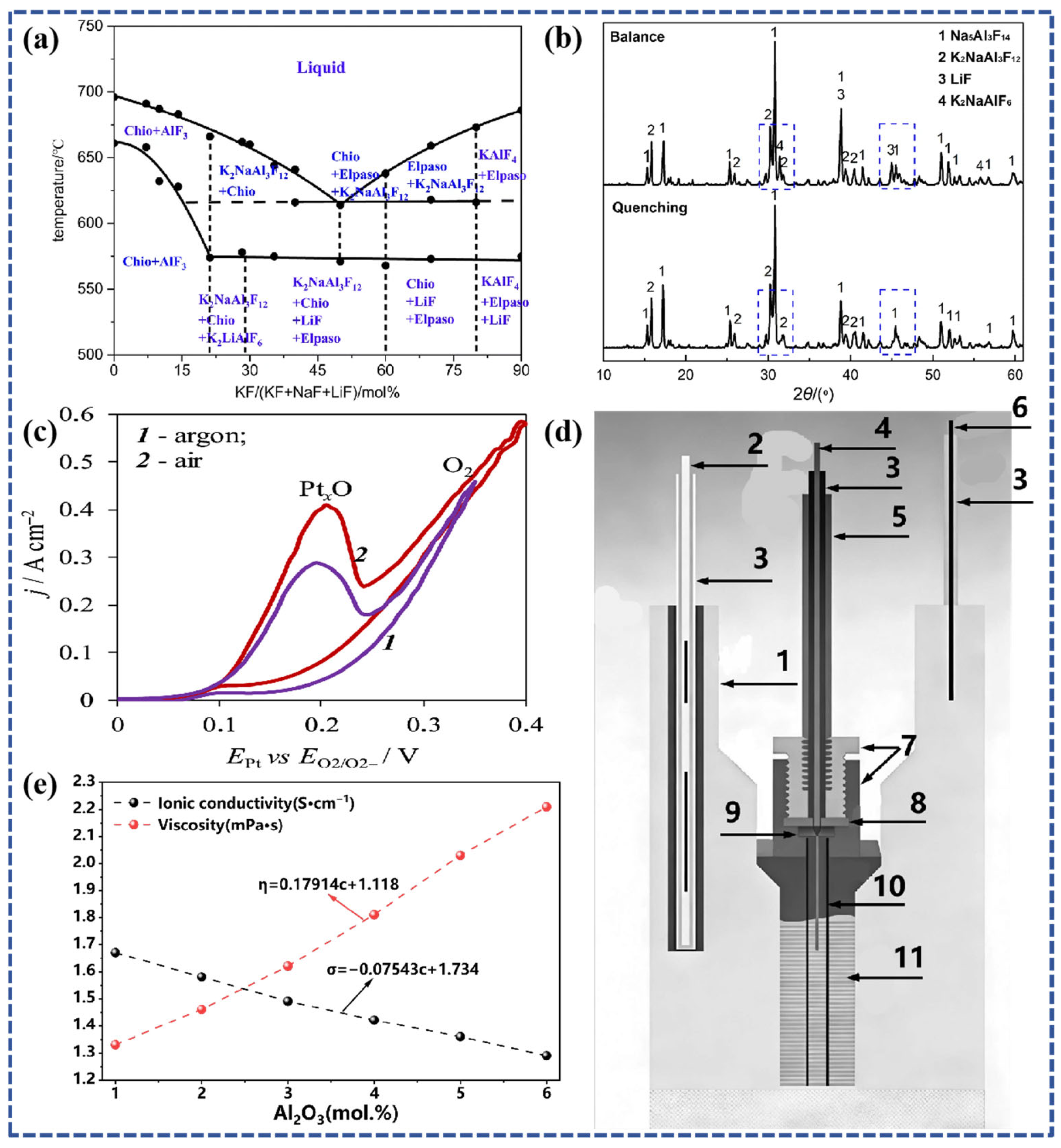
Advances in the compositional optimization and performance regulation of molten salt systems are crucial to enhancing the efficiency and stability of aluminum electrolysis. Focusing on the NaF-KF-LiF-AlF3 system with cryolite ratios (CR) of 1.3 and 1.4, Chen et al. [51] investigated its phase transition characteristics and compositional control potential. Liquidus temperatures were determined via cooling curve analysis and differential thermal analysis (DTA), and the effects of KF and LiF additions were systematically examined. A pseudo-binary phase diagram of (NaF-LiF-AlF3)-KF at fixed LiF concentrations was constructed, and phase identification of equilibrium and non-equilibrium samples was performed using XRD (as shown in Figure 4a,b). Results revealed that the liquidus temperature depends on the combined KF and LiF concentrations relative to total alkali metals; both components lower the liquidus temperature within certain composition ranges. At a cryolite ratio of 1.4, LiF introduced an arched temperature region corresponding to 0.142–0.283 in total alkali fraction. The pseudo-binary diagram exhibited simple eutectic and quasi-peritectic behavior, with eutectic phases identified as Na5Al3F14, K2NaAlF6, K2NaAl3F12, and LiF, effectively dividing the system into five solidification and five liquid-solid coexistence zones. Under equilibrium conditions, LiF showed limited compound formation, serving primarily as a structural component of the molten salt.
In practical low-temperature electrolysis applications, Suzdaltsev et al. [52] examined the electrochemical behavior of KF-AlF3- and NaF-AlF3-based melts operating at 700–850 °C. Using steady-state polarization and voltammetric methods, they characterized the kinetics of electrode processes on both carbon and metal electrodes in KF-AlF3-Al2O3 melts, while electrolytic experiments elucidated mass transfer mechanisms within the anode–cathode spacing (as shown in Figure 4c). Their findings demonstrated that material flow in this region plays a decisive role in determining cathode current efficiency. At 750–800 °C, optimal cathode current density was identified within 0.4–0.55 A·cm−2; exceeding this threshold resulted in the formation of solid salt blockages on the cathode surface, leading to efficiency loss. The study recommended employing a KF-NaF-AlF3-Al2O3 electrolyte with ([KF] + [NaF])/[AlF3] = 1.5 mol·mol−1 for efficient operation at 800–820 °C.
Recognizing that electrolyte conductivity directly affects electrolysis efficiency, Kubiňáková et al. [53] employed electrochemical impedance spectroscopy with a tubular electrolyzer (as shown in Figure 4d) to investigate multicomponent sodium cryolite systems containing high AlF3 concentrations (up to 45 mol%; NaF/AlF3 = 1.2–2.0) and additives such as Al2O3, CaF2, MgF2, and LiF. Regression equations were developed to describe conductivity as a function of both composition and temperature. The results showed that AlF3, Al2O3, CaF2, and MgF2 reduce electrolyte conductivity but enable low-temperature operation (~700 °C). At a molar ratio of 1.2, conductivity decreased by approximately 13% relative to the binary system. LiF was the only additive to enhance conductivity, yielding a modest 1.88% increase with 1 wt% addition. The derived regression models accurately captured the temperature- and concentration-dependent conductivity behavior of the system.
To further elucidate the microstructural origins of transport properties in molten salts, Guo et al. [54] performed first-principles molecular dynamics simulations on the KF-NaF-AlF3-Al2O3 system at a cryolite ratio of 1.3 and a temperature of 877 °C. Analysis of the radial distribution function, coordination numbers, bond angles, ion distributions, self-diffusion coefficients, ionic conductivity, and viscosity revealed that the dominant complex ions were [AlF4], [AlF5]2−, and [AlF6]3−. Increasing Al2O3 concentration reduced [AlF4] content while increasing Al-F coordination numbers, leading to more extensive formation of Al-F-Al, Al-O-Al, and Al-O-F linkages. The ionic diffusivity followed the order Na > K > F > O > Al. Ionic conductivity decreased linearly with increasing Al2O3 concentration (σ = −0.07543c + 1.734), while viscosity rose correspondingly (η = 0.17914c + 1.118) (as shown in Figure 4e). These insights provide a fundamental atomistic understanding of how structural evolution governs macroscopic transport phenomena in complex molten salt electrolytes.
Together, these studies provide a coherent understanding of molten salt electrolytes under low-temperature operating conditions. The results are not intended to propose a direct replacement for conventional large-scale Hall–Héroult electrolytes, but to illustrate compositional trends, structure–property relationships, and general design principles for electrolyte optimization. When combined with appropriate operational strategies, these insights are relevant to advanced Hall–Héroult operation as well as to inert-anode and carbon-free aluminum electrolysis technologies, offering guidance for the development of energy-efficient and stable aluminum electrolysis systems.

3.2. Optimization of Electrolysis Process Control

Energy conservation optimization in electrolytic process control hinges on precisely regulating key parameters to achieve efficient energy utilization. In aluminum electrolysis, factors such as current density, electrolyte temperature, and anode–cathode spacing all influence energy consumption [55,56,57]. Optimizing these parameters reduces energy losses in the electrolyzer, for example, by adjusting current density to prevent excessive heat loss from excessively high currents, or by maintaining the electrolyte temperature within an optimal range to minimize energy waste. Simultaneously, optimizing process control enhances current efficiency and electrode lifespan, minimizes excessive current wastage and material consumption, and ensures more stable, efficient electrolysis. This approach not only lowers production costs through energy savings but also reduces environmental impact, advancing sustainable industrial practices.
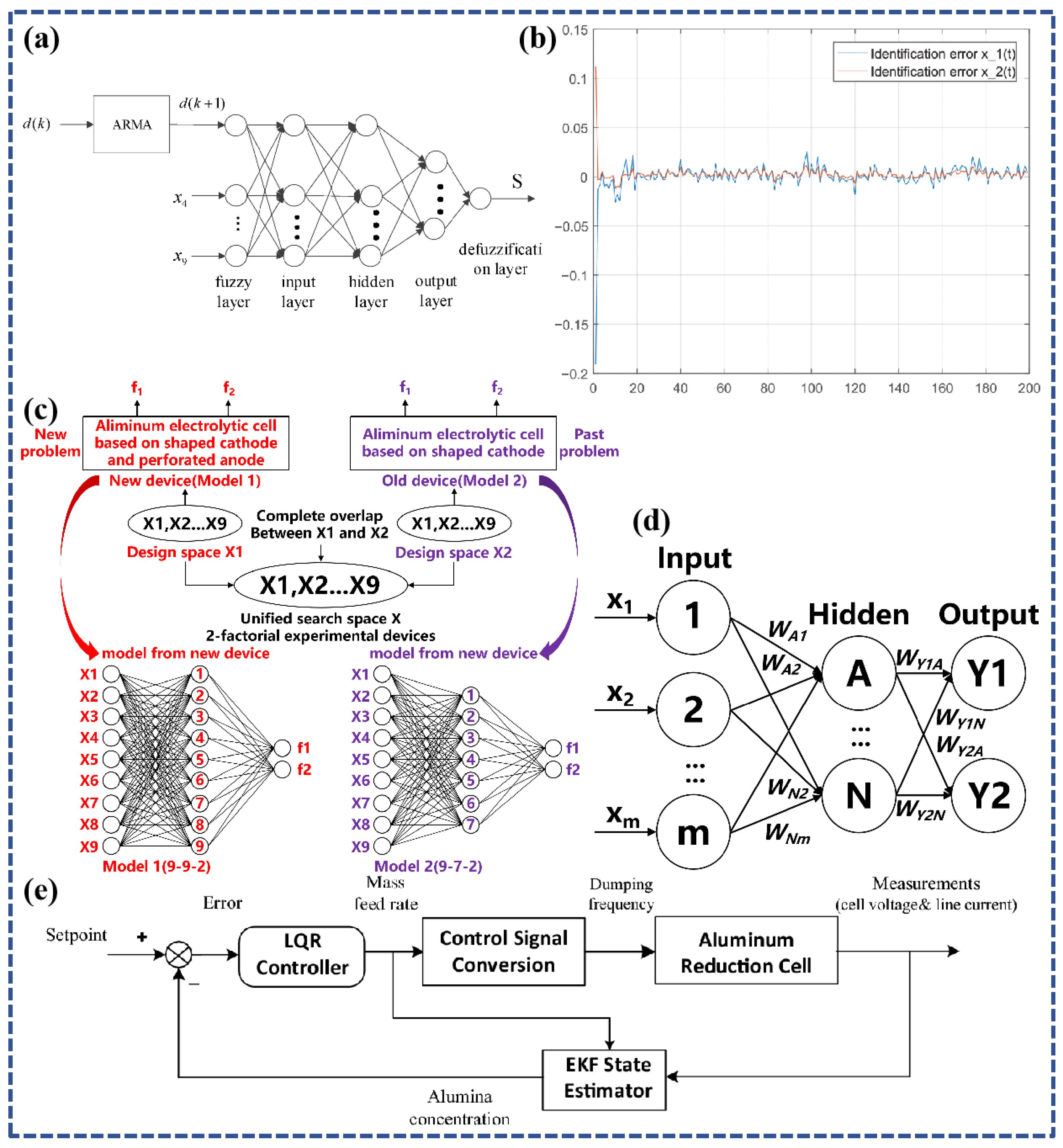
Advances in electrolytic process control have increasingly focused on overcoming limitations associated with manual parameter tuning, inadequate modeling accuracy, and slow commissioning of new equipment. To support data-driven optimization of electrolyzer operation, Xu et al. [27] developed a multi-objective process control framework based on a comprehensive electrolyzer-state evaluation model integrating energy balance, material balance, and operational stability (as shown in Figure 5a). Eight key indicators, including excess AlF3, electrolyte temperature, average electrolyzer voltage, current efficiency, and anode-effect duration, were selected to characterize electrolyzer performance. Adaptive fuzzy C-means clustering was used to classify electrolyzer states into three categories, while an ant lion optimization-enhanced ARMA-FNN (autoregressive moving average—fuzzy neural network) model enabled state prediction over a 24-h horizon. The resulting multi-objective optimization method (MOALO) achieved a 96.78% classification accuracy and 82% prediction accuracy, outperforming particle swarm optimization and effectively guiding electrolyzers back toward optimal operating conditions.
In scenarios involving the deployment of new equipment, Yao et al. [58] addressed the challenge of lengthy commissioning periods caused by insufficient historical data by introducing the Problem-Based Past Problem Accelerated Optimization (PPPFO) framework (as shown in Figure 5c,d). By conceptualizing legacy equipment as “teachers” and new equipment as “students,” the method uses BP neural networks to model their respective design spaces, resolves cross-domain discrepancies via random-key mapping, and integrates Non-dominated Sorting Genetic Algorithm II (NSGA-II) with multi-objective multifactor evolutionary algorithms to facilitate efficient knowledge transfer. Benchmark testing on ZDT series and CEC21-MTMO-CPLX functions, along with industrial validation, demonstrated superior Inverted Generational Distance (IGD) and Hypervolume (HV) performance compared with NSGA-II and SPEA2 (Strength Pareto Evolutionary Algorithm 2), as well as significantly faster convergence driven by the online learning strategy.
To address difficulties in dynamic model construction and input-constrained optimal control, Zhou et al. [59] proposed a robust optimal control approach for the aluminum electrolysis process based on adaptive dynamic programming. A recurrent neural network was employed to reconstruct system dynamics directly from operational input-output data, enabling control without reliance on an accurate first-principles model (as shown in Figure 5b). A non-quadratic performance index ensured compliance with actuator limits, and a single-evaluation network was used to approximate the Hamilton–Jacobi–Bellman equation to obtain the optimal control policy. Validation on a 300 kA industrial electrolyzer showed rapid convergence to the target electrolyzer temperature (945 °C) and average voltage (3645 mV), with stable network weights and no overshoot under constrained conditions.
Addressing alumina concentration fluctuations and the associated risk of PFC emissions under traditional overfeeding-base feeding–underfeeding control logic, Shi et al. [60] proposed a model-based estimation and optimization strategy for Hall–Héroult electrolyzers. A material-balance model incorporating Faraday-based consumption dynamics and ACD variation was combined with an extended Kalman filter for continuous estimation of alumina concentration and ACD using real-time voltage and current measurements (as shown in Figure 5e). On this basis, an extended base-feed strategy and an EKF-LQR (extended Kalman filter—Linear Quadratic Regulator) optimal control method were developed to stabilize concentration levels, with a conversion algorithm enabling direct application to industrial point-feeding systems. Industrial experiments demonstrated a reduction in concentration standard deviation from 0.127 wt% to 0.022 wt%, along with markedly reduced voltage fluctuations and declining PFC emissions. The computational efficiency of the method enables deployment on existing control hardware.
Collectively, these studies highlight a transition toward intelligent, model-based, and optimization-driven control technologies capable of improving operational stability, reducing emissions, and enhancing the energy efficiency of modern aluminum electrolysis operations.

4. Exploration of Energy Utilization Systems

Optimizing energy efficiency in electrolyzers primarily aims to enhance energy conversion efficiency during the electrolysis process and minimize energy waste [61,62]. Electrolyzers consume substantial electrical energy during aluminum electrolysis, yet a portion of this energy is converted into heat and not effectively utilized for the electrolytic reaction [11,48]. By optimizing energy utilization in electrolyzers, improvements can be made in thermal management, current efficiency, and the selection of electrolyte and electrode materials, thereby reducing heat loss and resistance losses. For instance, enhancing the thermal insulation design of the electrolyzer, improving the conductivity of electrode materials, or adopting more efficient current distribution methods can direct more input electrical energy toward effective electrolytic reactions rather than wasting it as useless heat or electromagnetic interference. This achieves energy savings, not only reducing production costs but also alleviating environmental burdens and promoting sustainable energy utilization.

4.1. Flexible Power Supply Adaptation

Flexible power supply technology plays a crucial role in enhancing energy efficiency for aluminum electrolyzers. By dynamically adjusting power delivery, optimizing electrical loads, and refining electrolyzer operating conditions, it significantly improves energy utilization during aluminum electrolysis [19,63,64]. Since flexible power supply requires real-time adjustments based on fluctuating electrolyzer loads, the power delivery system must exhibit high responsiveness and adaptability while ensuring uninterrupted power quality. Furthermore, flexible power supply technology imposes stringent demands on control system precision and algorithms, necessitating accurate load fluctuation prediction to prevent equipment damage or reduced production efficiency caused by power instability. Achieving flexible yet reliable power regulation while maintaining economic viability and technical feasibility remains a key challenge in advancing this technology.
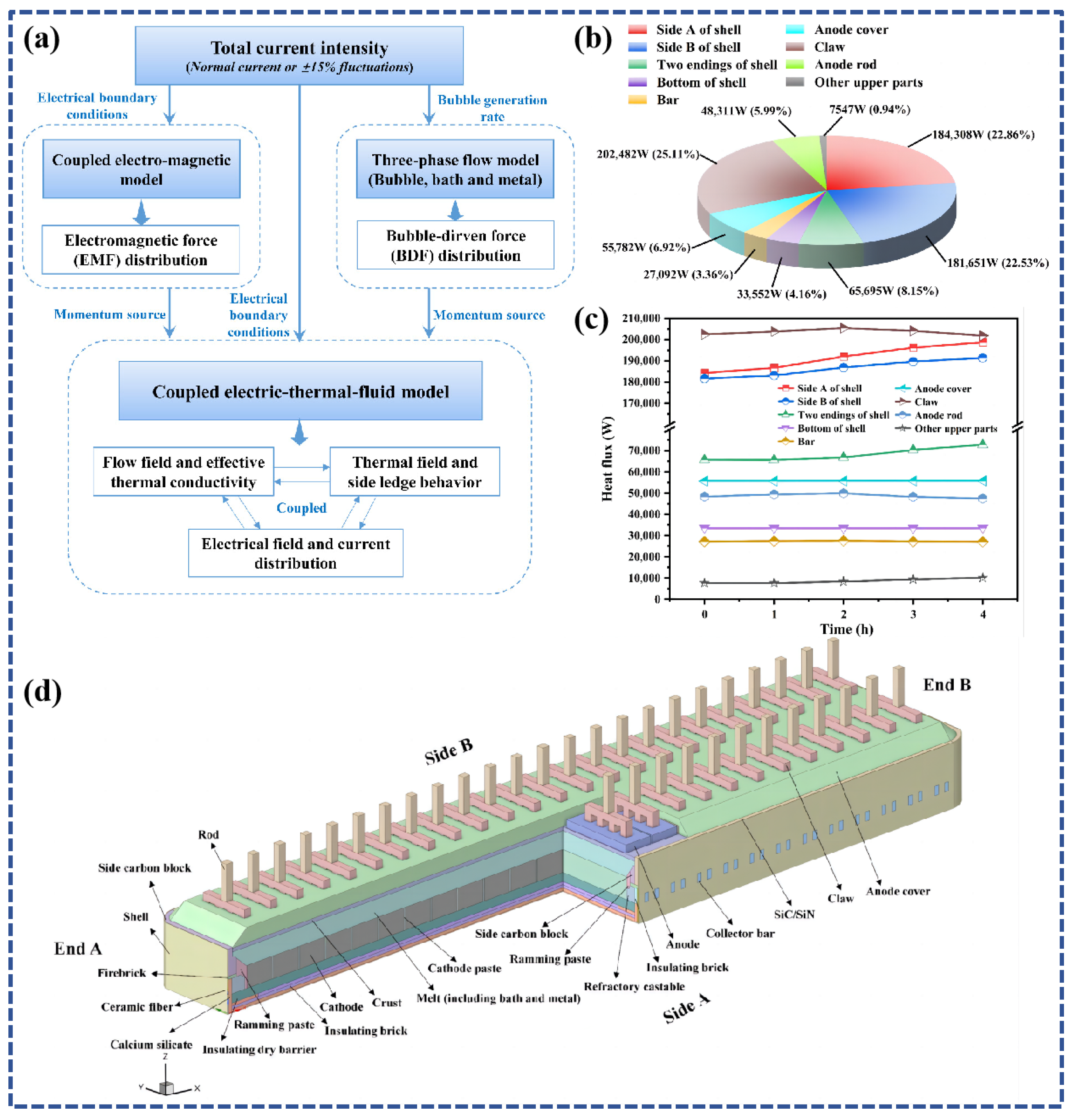
With the increasing penetration of renewable energy into industrial systems, aluminum electrolyzers face growing demands for flexible operation under fluctuating power inputs. Yet, most existing models inadequately capture the coupled interactions among electrical, thermal, and fluid fields, as well as the influence of melt flow on crust formation. This gap in multi-physics understanding has constrained the development of adaptive operating strategies. To address these limitations, Ran et al. [65] developed a fully coupled transient electro-thermal-fluid model for a full-scale 420 kA industrial electrolyzer (as shown in Figure 6d). Using FLUENT, the model integrates contact voltage drops and Joule heating into the electrical field, incorporates latent heat effects associated with crust phase transitions into the thermal field, and introduces both electromagnetic and bubble-driven forces into the fluid field. The enthalpy-porosity method is used to describe slurry-zone behavior (as shown in Figure 6a).
Validation against measurements from an operating electrolyzer in Chongqing demonstrated strong predictive accuracy, with relative errors below 5.7% for metal-layer velocity, 8.82% for crust thickness, and 5% for crust temperature differences. Model analysis shows that melt flow is the dominant factor controlling crust distribution. The convective heat transfer coefficient directly governs crust thickness, leading to thinner crusts in regions of high flow velocity and thicker deposits in low-velocity areas. Crust evolution in turn affects the current distribution inside the electrolyzer.
The research team analyzed heat dissipation distribution and thermal equilibrium, finding that approximately 50% of heat is dissipated by the side shell, while 40% originates from the anode claws, rods, and cover (as shown in Figure 6b). Heat dissipation regulation from the side shell and upper flue is critical, and the dynamic characteristics of the rock shelf also significantly impact heat dissipation. When the current fluctuates by 15%, heat dissipation from the anode region initially increases, then decreases with current changes, while heat dissipation from the side shell continues to rise, indicating delayed release of Joule heating (as shown in Figure 6c).
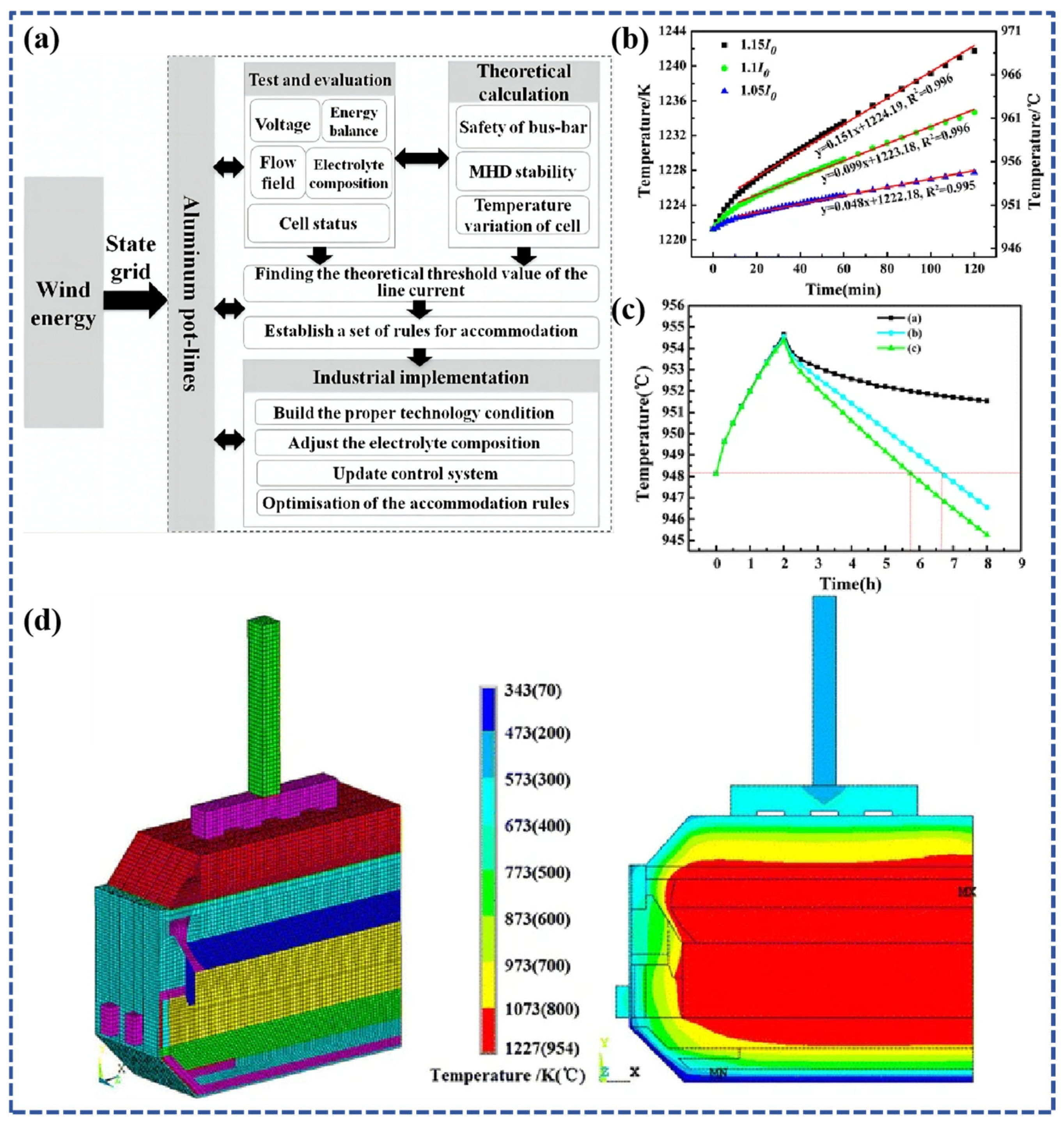
To address the mismatch between China’s significant wind power curtailment and the high electricity demand of the aluminum electrolysis industry, which share highly overlapping geographic distribution, Zhang et al. [66] proposed an integrated wind-electrolysis operation strategy (as shown in Figure 7a). Early industrial experience from Zhengzhou Faxiang Aluminum showed that regulating current fluctuations within the range of 190 to 220 kA reduces production costs by approximately 190 CNY/t Al, demonstrating that electrolyzers can withstand moderate current variations while maintaining stable operation.
Building upon this evidence, the researchers identified four essential challenges for large-scale wind power integration into aluminum electrolysis. First, busbar temperatures must remain below 80 percent of the melting point to ensure safe equipment operation. Second, thermal equilibrium must be reestablished after current fluctuations by adjusting process parameters such as ledge thickness and electrolyte height. Third, magnetohydrodynamic stability must be preserved, as significant deviations from the design current can induce operational instability. Fourth, economic justification is required to ensure that the additional revenue from flexibility services offsets the cost of wind power and any increase in energy consumption.
To systematically address these issues, the team proposed a three-stage implementation framework consisting of industrial testing and evaluation, theoretical calculation, and full-scale industrial application. This framework involves measuring magnetic and fluid field parameters inside the electrolyzer, determining current limits through busbar finite element analysis, and conducting large-scale implementation in an aluminum smelter in Gansu Province. Simulations of a 420 kA electrolyzer subjected to current fluctuations of plus or minus 15 percent indicate that operational adjustments, including reducing the ACD and enhancing sidewall convection, are necessary to maintain stable operation. The results suggest that wind power integration should be limited to within 10 percent of the design current. Exceeding this threshold substantially increases the difficulty of maintaining magnetohydrodynamic and thermal stability. For example, a 15 percent current increase causes the vertical magnetic field component to rise above 30 gauss, significantly accelerates melt flow, and results in a temperature increase rate of 9.06 degrees Celsius per hour (as shown in Figure 7b–d).
Economic analysis further indicates that when a 50-electrolyzer, 420 kA series integrates wind power equivalent to 10 percent of its design current, annual aluminum production increases by approximately 2471 tons, and total wind power absorption reaches 57.84 million kilowatt-hours. This corresponds to a profit increase of roughly 3.86 million CNY, provided that electricity pricing is jointly negotiated among the aluminum producer, the power grid, and the wind farm. Overall, this integrated approach not only offers a practical means of alleviating wind power curtailment but also provides a pathway to reduce operating costs in the aluminum electrolysis industry. It establishes a complete cycle linking theoretical analysis, technical solutions, and economic benefit verification.

4.2. Waste Heat Recovery Technology

Waste heat recovery technology plays a crucial role in energy conservation for aluminum electrolyzers [18]. By converting high-temperature waste heat generated during production into useful thermal or electrical energy, it not only significantly reduces energy consumption and production costs but also lowers carbon emissions, thereby promoting environmental protection [10,67,68]. Additionally, this technology enhances equipment thermal efficiency, extends operational lifespan, and facilitates the adoption of combined heat and power systems. These benefits collectively elevate overall energy efficiency levels, providing vital support for the green transformation and sustainable development of the aluminum electrolysis industry.
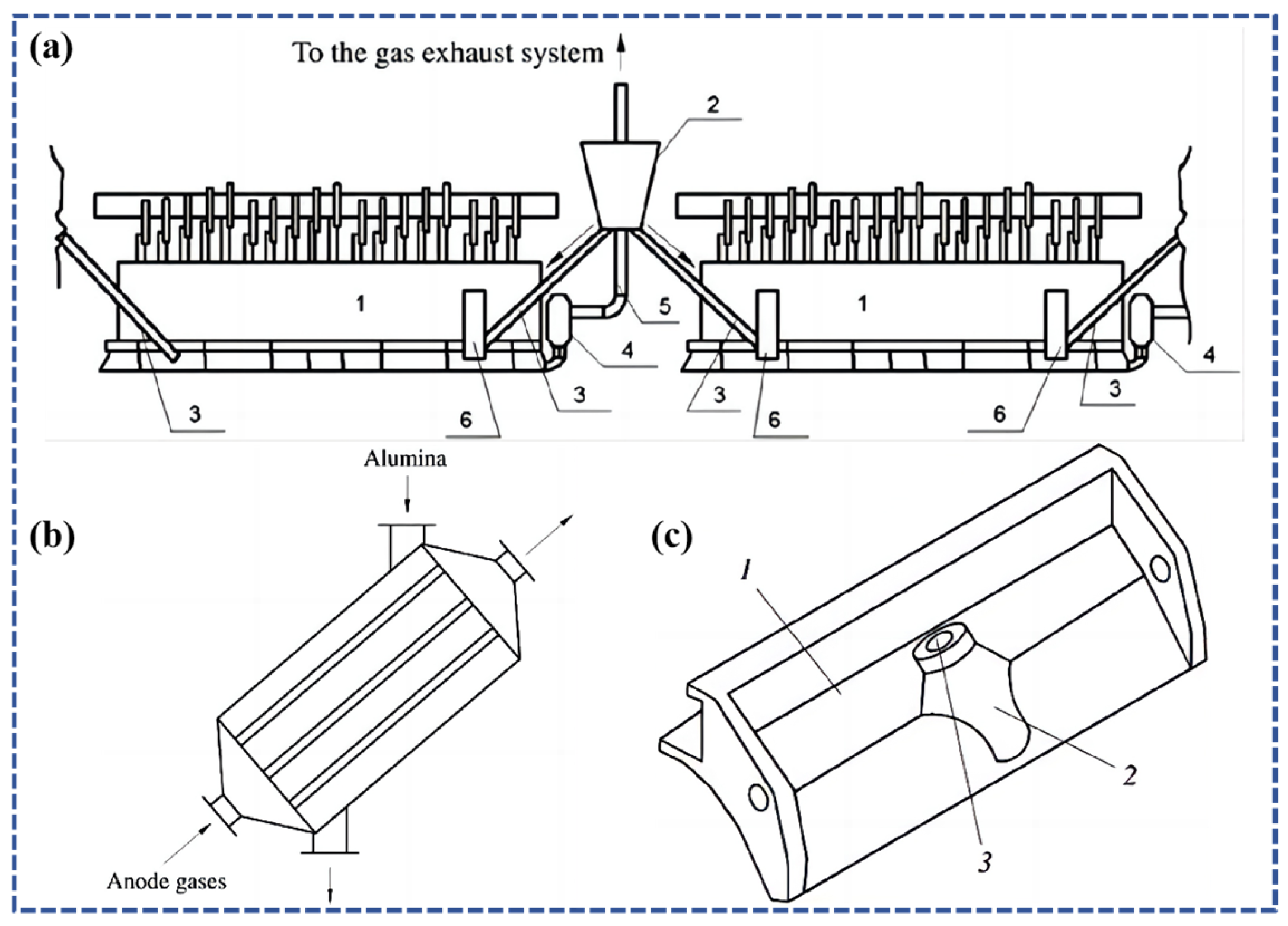
In the field of energy conservation, consumption reduction, and waste heat utilization within the aluminum electrolysis industry, researchers have developed multiple targeted solutions addressing different waste heat sources (anode gas, electrolyzer walls) and technical challenges, forming differentiated technological pathways. To tackle the high energy consumption and significant waste of anode gas heat in Russia’s mainstream self-baked anode vertical-insertion aluminum electrolyzers, Shakhrai et al. [69] proposed a technical solution utilizing this waste heat to heat alumina: The automatic alumina feeding system hopper was modified into a 1.5 m3 external counterflow shell-and-tube heat exchanger. Counterflow heat exchange between anode gas and alumina achieved 10–15% waste heat recovery (heating alumina to 200–250 °C) (as shown in Figure 8a–c). Additionally, an insulation layer was added to the hopper exterior, and a fluoride collection chamber was installed beneath the gas collection hood. Experimental results confirm this solution not only reduces electricity consumption by 135–170 kWh/t Al (equivalent to a 0.7–1.0% improvement in current efficiency), reduces solid and gaseous fluoride emissions by 0.4–0.7 kg/ton of aluminum, compresses anode gas volume by 2–2.5 times (lowering flue gas energy consumption and duct material usage), and improves production conditions by halving hopper quantities and reducing anode frame jack load by 6–8 tons. This provides a tailored solution for environmental and energy optimization in this specific type of electrolyzer.
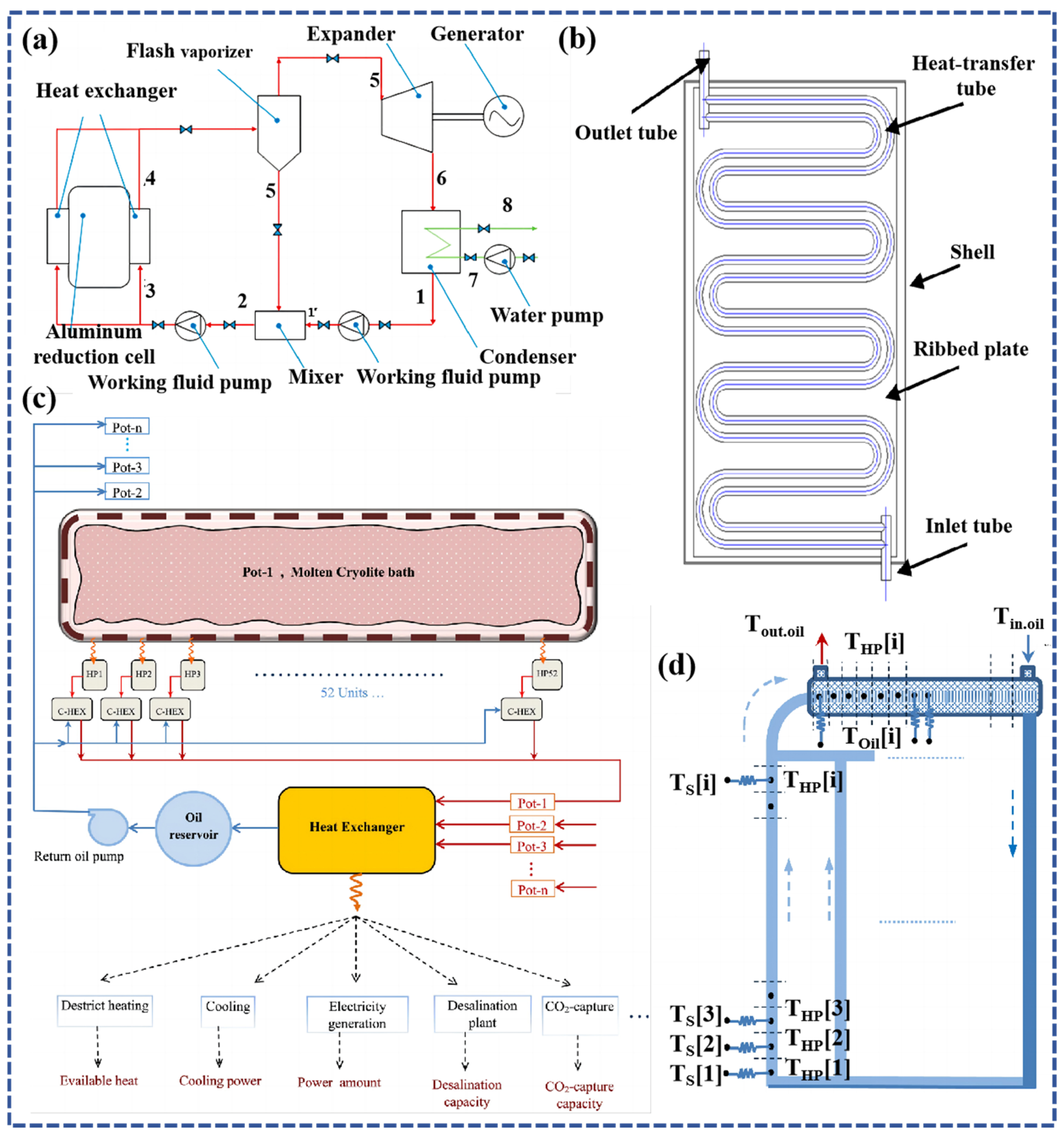
Beyond anode gas recovery, the utilization of low-grade residual heat from the side walls of aluminum electrolyzers (200–300 °C) represents a more widespread industry need. To address this, as shown in Figure 9a,b, Ming et al. [70] proposed a waste heat power generation system (WHPGS) based on an organic Rankine cycle (ORC) utilizing low-boiling-point working fluids: By establishing a one-dimensional steady-state heat transfer model for the electrolyzer wall (calculated in nine iterative layers) and a thermodynamic cycle model incorporating a flash process, coupled with a copper serpentine heat exchanger filled with high-thermal-conductivity insulating alumina powder outside the tubes, analysis was conducted on a 200 kA electrolyzer (equipped with 36 heat exchangers). Results indicate that wall heat transfer resistance critically influences working fluid heat absorption. Reducing the frozen layer thickness or increasing electrolyte temperature enhances heat transfer rates. System pressure and working fluid selection require careful matching (at 3.0 MPa, R123 achieves 5907 W single-electrolyzer power with 15.7% efficiency; R141b performs better above 2.0 MPa). The system can be retrofitted onto existing tanks (1200 kW capacity from 200 tanks), providing a feasible pathway for waste heat power generation from tank walls. In advancing tank wall waste heat recovery technology, as shown in Figure 9c,d, the Barzi et al. [71] further integrated the high-efficiency heat transfer properties of heat siphon (HS) heat pipes to propose an active system coupling HS with ORC: designing HS units with distilled water as the working fluid and flexible metal casings (adapting to tank shell deformation), validating performance via an electric furnace simulating tank wall conditions, and establishing a MATLAB one-dimensional model, Simultaneously, a thermal oil (Paratherm NF) pipeline system with 52 parallel heat pipes was constructed (single-tank pressure drop: 0.09–0.75 bar, achieving uniform oil distribution). This was ultimately integrated with an R134a-based ORC system (including intermediate water circulation and a backup heat exchanger). Simulations indicate that extracting 180 kW of waste heat per tank yields 18.27 kW of net ORC power generation with 9.15% overall efficiency. Each tank can stably extract 90–250 kW of heat (thermal oil temperature 100–220 °C). Enhancing turbine efficiency significantly boosts power generation output, laying the foundation for large-scale recovery (100 tanks extracting 20,000 kW of heat).
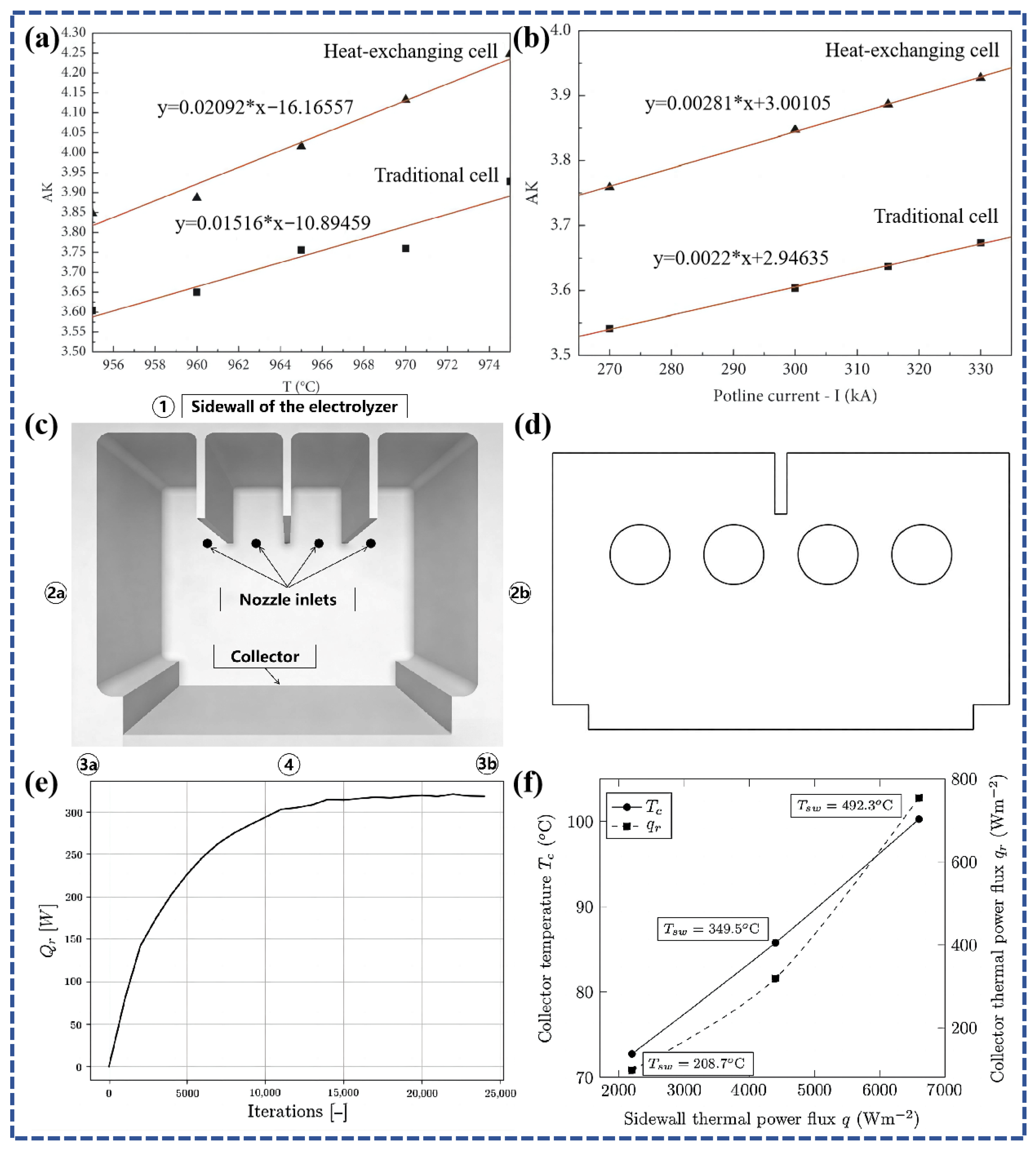
Considering the additional challenge of traditional tanks’ low tolerance for current fluctuations (only 0–10%), Yang et al. [72] introduced a NaNO2-KNO3-NaNO3-based molten salt as a heat transfer medium for tank wall waste heat recovery. This solution addresses waste heat utilization while accommodating flexible operation requirements: This molten salt demonstrated thermal stability between 150 and 650 °C via DTA-TGA verification (maximum operational temperature 600 °C, suitable for recovering 250–350 °C waste heat from electrolyzer walls). The team designed a 2kA laboratory electrolyzer (with an integrated heat exchanger positioned close to SiC bricks for enhanced efficiency), constructed a molten salt circulation system, and established a thermoelectric coupling model using ANSYS (including SOLID69 elements). This achieved high agreement between simulated and measured temperatures (simulated heat exchanger temperature: 385 °C; measured: 379 ± 2 °C). Research confirms this system recovers nearly 80% of sidewall waste heat (370–380 °C, directly supplying alumina tubular leaching or power generation) and can control the thickness of the freeze layer by adjusting the convective heat transfer rate of the heat exchanger. This enhances the tank’s tolerance to current fluctuations to 20–40%, making it compatible with clean energy sources like wind power (estimated wind farm utilization rate increased from 0.177 to 0.27), achieving the dual goals of waste heat recovery and flexible operation. Additionally, heat-exchanging electrolyzers exhibit greater tolerance to current fluctuations at higher operating temperatures (as shown in Figure 10a,b). From a safety-recovery perspective, Cascella et al. [73] addressed the challenge of safely and efficiently utilizing wall residual heat by replacing conventional approaches with a Low Temperature Difference (LTD) Stirling engine: Using OpenFOAM to establish a thermo-electrical coupling model, they compared k-ε and k-ω turbulence models and determined k-ε was better suited for simulating tank wall heat exchange and air jets. They then coupled conduction, convection, and radiation heat transfer processes to analyze the effects of tank wall heat flux, cooling air parameters, and ACD (as shown in Figure 10c,d). The team designed two scenarios: “radiation-only recovery via collector” and “direct thermal contact.” Results indicate the radiation scenario offers greater engineering feasibility, consistently recovering 318.8 W·m−2 of waste heat (collector 80–98 °C), and is compatible with models like Tavakolpour (efficiency 4.5%, power generation 14.3 W·m−2), outperforming thermoelectric modules capped at 7.3% efficiency (as shown in Figure 10e,f). The direct contact scenario, however, faces safety risks due to interference with cooling airflow and obstruction by vertical fins. This research offers a novel approach for safely recovering waste heat from trough walls.
In addition, to better compare various optimization schemes and intuitively reflect their energy-saving potential and application characteristics, Table 1 summarizes the quantitative performance metrics of key energy-saving technologies for aluminum electrolysis, enabling direct comparison of voltage reduction, energy savings per ton of aluminum, efficiency improvement, and other core indicators across different technical routes.

5. Summary and Outlook

This review synthesizes recent progress in energy-saving technologies for aluminum electrolysis, focusing on electrolyzer structural optimization, electrode materials, and process enhancement. The reviewed studies consistently show that substantial reductions in energy consumption are most effectively achieved through coordinated improvements in materials performance, electrolyzer design, and operational control, highlighting the importance of system-level optimization rather than isolated technological changes.
At the same time, several limitations and trade-offs remain. Ultra-low anode–cathode distance operation can significantly reduce voltage, but long-term stability is challenged by increased sensitivity to magnetohydrodynamic effects, alumina concentration fluctuations, and stricter process control requirements. Advanced cathode materials, particularly TiB2-based systems, reduce cathodic voltage losses, yet their industrial application is still constrained by material degradation, thermal stress, interfacial stability, and large-scale reliability. Intelligent control algorithms demonstrate strong potential in simulations and pilot studies; however, their practical deployment is limited by sensor reliability, model uncertainty, computational demands, and the need for robust real-time performance under complex operating conditions. Addressing these challenges is essential for translating laboratory advances into durable industrial solutions.
From a short-term perspective covering the next five years, the most practical pathways involve incremental improvements compatible with existing industrial infrastructure, including optimized electrolyzer structures, electrode configurations, electrolyte compositions, and operating parameters. In the medium term, future progress is expected to rely increasingly on integrated optimization strategies, with research focusing on improved thermal management and more adaptive, data-informed process control. Over the longer term, development may be shaped by potentially disruptive concepts such as inert anodes, digital twins, and flexible smelting systems, although these approaches currently face significant technical and economic uncertainties.
Overall, advancing aluminum electrolysis toward greener and more energy-efficient production requires a balanced strategy that combines near-term deployable solutions, medium-term system integration, and long-term innovation, while explicitly recognizing the limitations and trade-offs associated with emerging technologies.

Author Contributions

Y.Z.: Writing—review and editing, Writing—original draft, Methodology, Investigation, Conceptualization. C.Z.: Writing—review and editing, Supervision, Resources. J.X.: Writing—review and editing, Resources, Funding acquisition. L.Z.: Methodology, Investigation, Conceptualization. M.W.: Writing—review and editing, Supervision, Resources. S.H.: Writing—review and editing, Supervision, Resources. J.Y.: Writing—review and editing, Supervision, Resources. Q.M.: Supervision, Resources. Z.Y.: Writing—review and editing, Supervision, Investigation, Conceptualization. Q.Z.: Writing—review and editing, Resources, Funding acquisition. All authors have read and agreed to the published version of the manuscript.

Funding

This work was supported by the National Key R&D Program of China (No. 2024YFC2910800), the National Natural Science Foundation of China (52374421 and 52404318), the Science and Technology Innovation Program of Hunan Province (2024RC3039), Central South University Innovation-Driven Research Programme (No. 2023CXQD005), Education Department of Hunan Provincial Government (23B0841), Guizhou Provincial Department of Education Science and Technology Project ([2023] 057), and Guizhou Provincial Science and Technology Projects No. [2023] General212. This work was supported in part by the High-Performance Computing Center of Central South University, National Engineering Research Centre of Low-carbon Nonferrous Metallurgy, and XIAOMI Foundation.

Data Availability Statement

No new data were created or analyzed in this study.

Acknowledgments

The authors wish to thank Ankit Singhania for the High-Performance Computing Center of Central South University, National Engineering Research Centre of Low-carbon Nonferrous Metallurgy, and Xiaomi Foundation. Energy Laboratory (NREL) for their support of this research.

Conflicts of Interest

The authors declare no conflicts of interest.

References

  1. Dardor, D.; Flórez-Orrego, D.; Germanier, R.; Margni, M.; Maréchal, F. Decarbonizing the aluminium industry: A comprehensive review of pathways and process integration perspectives. Energy Strategy Rev. 2025, 61, 101853. [Google Scholar] [CrossRef]
  2. Cullen, J.M.; Allwood, J.M. Mapping the Global Flow of Aluminum: From Liquid Aluminum to End-Use Goods. Environ. Sci. Technol. 2013, 47, 3057–3064. [Google Scholar] [CrossRef] [PubMed]
  3. Li, X.; Lin, J.; Liu, C.; Liu, A.; Shi, Z.; Wang, Z.; Jiang, S.; Wang, G.; Liu, F. Research on Aluminum Electrolysis from 1970 to 2023: A Bibliometric Analysis. JOM 2024, 76, 3265–3274. [Google Scholar] [CrossRef]
  4. Reyes-Bozo, L.; Fúnez-Guerra, C.; Luis Salazar, J.; Vyhmeister, E.; Valdés-González, H.; Jaén Caparrós, M.; Clemente-Jul, C.; Carro-De Lorenzo, F.; De Simón-Martín, M. Green hydrogen integration in aluminum recycling: Techno-economic analysis towards sustainability transition in the expanding aluminum market. Energy Convers. Manag. X 2024, 22, 100548. [Google Scholar] [CrossRef]
  5. Haarberg, G.M. Electrowinning of Aluminum—Challenges and Possibilities for Reducing the Carbon Footprint. Electrochemistry 2024, 92, 043002. [Google Scholar] [CrossRef]
  6. Guo, B.; Wang, Y.; Huang, Y.; Peng, J.; Di, Y.; Wang, C.; Wang, K. Upcycling of scrap aluminum to pure aluminum through molten salt electrolysis. Process Saf. Environ. Prot. 2024, 191, 94–101. [Google Scholar] [CrossRef]
  7. Mcgeer, J.P. Hall-Heroult: 100 Years of Processes Evolution. JOM 1986, 38, 27–33. [Google Scholar] [CrossRef]
  8. Gupta, A.; Basu, B. Sustainable Primary Aluminium Production: Technology Status and Future Opportunities. Trans. Indian Inst. Met. 2019, 72, 2135–2150. [Google Scholar] [CrossRef]
  9. Dokl, M.; Strajnar, G.; Vujanović, A.; Puhar, J.; Kravanja, Z.; Čuček, L. Environmental impact assessment of organic Rankine cycle using waste heat from the aluminium industry. Clean. Eng. Technol. 2025, 27, 101022. [Google Scholar] [CrossRef]
  10. Nowicki, C.; Gosselin, L. An Overview of Opportunities for Waste Heat Recovery and Thermal Integration in the Primary Aluminum Industry. JOM 2012, 64, 990–996. [Google Scholar] [CrossRef]
  11. Brough, D.; Jouhara, H. The aluminium industry: A review on state-of-the-art technologies, environmental impacts and possibilities for waste heat recovery. Int. J. Thermofluids 2020, 1, 100007. [Google Scholar] [CrossRef]
  12. Liu, G.; Müller, D.B. Addressing sustainability in the aluminum industry: A critical review of life cycle assessments. J. Clean. Prod. 2012, 35, 108–117. [Google Scholar] [CrossRef]
  13. Flórez-Orrego, D.; Dardor, D.; Germanier, R.; Margni, M.; Maréchal, F. A systemic study for decarbonizing secondary aluminium production via waste heat recovery, carbon management and renewable energy integration. Energy Convers. Manag. 2025, 341, 120021. [Google Scholar] [CrossRef]
  14. Dardor, D.; Flórez-Orrego, D.; Domingos, M.E.R.; Germanier, R.; Margni, M.; Maréchal, F. Towards carbon-negative primary aluminium production: Integrating biomass resources and renewable electricity. J. Clean. Prod. 2025, 534, 146994. [Google Scholar] [CrossRef]
  15. Ilyushin, Y.V.; Boronko, E.A. Analysis of Energy Sustainability and Problems of Technological Process of Primary Aluminum Production. Energies 2025, 18, 2194. [Google Scholar] [CrossRef]
  16. Chen, S.; Ebe, F.; Morris, J.; Lorenz, H.; Kondzialka, C.; Heilscher, G. Implementation and Test of an IEC 61850-Based Automation Framework for the Automated Data Model Integration of DES (ADMID) into DSO SCADA. Energies 2022, 15, 1552. [Google Scholar] [CrossRef]
  17. Musii, R.; Lis, M.; Pukach, P.; Chaban, A.; Szafraniec, A.; Vovk, M.; Melnyk, N. Analysis of Varying Temperature Regimes in a Conductive Strip during Induction Heating under a Quasi-Steady Electromagnetic Field. Energies 2024, 17, 366. [Google Scholar] [CrossRef]
  18. Yang, Y.; Li, S.; Wang, S.; Zhang, R. Low-Carbon Economic Dispatch Method for Integrated Energy in Aluminum Electrolysis Considering Production Safety Constraints. Processes 2025, 13, 3442. [Google Scholar] [CrossRef]
  19. Wang, X.; Chen, B.; Xie, H.; Ye, X.; Bai, J. Participation of electrolytic aluminum loads in grid interaction control strategies considering process flow and regulation costs. Front. Energy Res. 2025, 12, 1493558. [Google Scholar] [CrossRef]
  20. Li, Y.; Wang, S.; Wang, N.; Liu, Y.; Xin, H.; Sun, H.; Zhang, R. Exploring the paths of energy conservation and emission reduction in aluminum industry in Henan province, China. J. Clean. Prod. 2024, 467, 142997. [Google Scholar] [CrossRef]
  21. Tan, C.; Yu, X.; Li, D.; Lei, T.; Hao, Q.; Guan, D. Different technology packages for aluminium smelters worldwide to deliver the 1.5 °C target. Nature Climate Change 2025, 15, 51–58. [Google Scholar] [CrossRef]
  22. Boudreau, P.; Johnson, M.; Bergthorson, J.M. Techno-economic assessment of aluminum as a clean energy carrier to decarbonize remote industries. Energy Adv. 2024, 3, 1919–1931. [Google Scholar] [CrossRef]
  23. Eskin, D.G. Conversion of Aluminum to Hydrogen: A Metallurgical Point of View. Adv. Eng. Mater. 2024, 26, 2401125. [Google Scholar] [CrossRef]
  24. Sgouridis, S.; Ali, M.; Sleptchenko, A.; Bouabid, A.; Ospina, G. Aluminum smelters in the energy transition: Optimal configuration and operation for renewable energy integration in high insolation regions. Renew. Energy 2021, 180, 937–953. [Google Scholar] [CrossRef]
  25. He, Y.; Zhou, K.-C.; Zhang, Y.; Xiong, H.-W.; Zhang, L. Recent progress of inert anodes for carbon-free aluminium electrolysis: A review and outlook. J. Mater. Chem. A 2021, 9, 25272–25285. [Google Scholar] [CrossRef]
  26. Einarsrud, K.E.; Eick, I.; Bai, W.; Feng, Y.; Hua, J.; Witt, P.J. Towards a coupled multi-scale, multi-physics simulation framework for aluminium electrolysis. Appl. Math. Model. 2017, 44, 3–24. [Google Scholar] [CrossRef]
  27. Xu, C.; Zhang, W.; Liu, D.; Cen, J.; Xiong, J.; Luo, G. Multi-Objective Optimization of Cell Voltage Based on a Comprehensive Index Evaluation Model in the Aluminum Electrolysis Process. Mathematics 2024, 12, 1174. [Google Scholar] [CrossRef]
  28. Liu, W.; Zhou, D.; Zhao, Z. Progress in Application of Energy-Saving Measures in Aluminum Reduction Cells. JOM 2019, 71, 2420–2429. [Google Scholar] [CrossRef]
  29. Mohammad, I.; Kelley, D.H. Stabilizing a Low-Dimensional Model of Magnetohydrodynamic Instabilities in Aluminum Electrolysis Cells. In Light Metals 2022; Springer International Publishing: Berlin/Heidelberg, Germany, 2022. [Google Scholar]
  30. Xu, G.; Ding, Y.; Bai, F.; Zhang, Y.; Yin, J.; Chen, C. AlF3-Modified Carbon Anodes for Aluminum Electrolysis: Oxidation Resistance and Microstructural Evolution. Inorganics 2025, 13, 165. [Google Scholar] [CrossRef]
  31. Arkhipov, A.; Ahli, N.; Necheporenko, I.; Mukhanov, A.; Potocnik, V. Review of Thermal and Electrical Modelling and Validation Approaches for Anode Design in Aluminium Reduction Cells. In Proceedings of the 36th International ICSOBA Conference 2023, Dubai, United Arab Emirates, 6–9 November 2023; Volume 589. [Google Scholar]
  32. Zhong, Q.; Xiao, J.; Du, H.; Yao, Z. Thiophenic Sulfur Transformation in a Carbon Anode during the Aluminum Electrolysis Process. Energy Fuels 2017, 31, 4539–4547. [Google Scholar] [CrossRef]
  33. Bai, F.; Xu, G.; Wang, A.; Chen, C. Optimized fabrication and enhanced performance of low-porosity carbon anodes for aluminum electrolysis. Carbon Lett. 2025, 35, 2111–2123. [Google Scholar] [CrossRef]
  34. Hou, W.; Li, M.; Liu, L.; Li, H. A new approach for improving the quality of the carbon anode for aluminum electrolysis—An impregnation-baking process. Alex. Eng. J. 2024, 96, 195–205. [Google Scholar] [CrossRef]
  35. Sun, M.; Li, B.; Li, L.; Wang, Q.; Peng, J.; Wang, Y.; Cheung, S.C.P. Effect of Slotted Anode on Gas Bubble Behaviors in Aluminum Reduction Cell. Metall. Mater. Trans. B 2017, 48, 3161–3173. [Google Scholar] [CrossRef]
  36. Mishurov, A.V.; Bezrukikh, A.I.; Puzanov, I.I.; Zavadyak, A.V.; Evstratko, V.V.; Volkov, N.A.; Konovalenko, A.I.; Konstantinov, I.L.; Voroshilov, D.S.; Baykovskiy, Y.V. Quality diagnostics of the baked anodes for aluminum electrolytic cells by non-destructive control method. Int. J. Adv. Manuf. Technol. 2024, 130, 437–457. [Google Scholar] [CrossRef]
  37. Blais, M.; Désilets, M.; Lacroix, M. Optimization of the cathode block shape of an aluminum electrolysis cell. Appl. Therm. Eng. 2013, 58, 439–446. [Google Scholar] [CrossRef]
  38. Padamata, S.K.; Singh, K.; Haarberg, G.M.; Saevarsdottir, G. Wettable TiB2 Cathode for Aluminum Electrolysis: A Review. J. Sustain. Metall. 2022, 8, 613–624. [Google Scholar] [CrossRef]
  39. Peng, J.; Song, Y.; Di, Y.; Wang, Y.; Feng, N. Increasing the Energy Efficiency of Aluminum-Reduction Cells Using Modified Cathodes. JOM 2017, 69, 1767–1772. [Google Scholar] [CrossRef]
  40. Tao, W.; Li, T.; Wang, Z.; Gao, B.; Shi, Z.; Hu, X.; Cui, J. Impact of the Usage of a Slotted Cathode Carbon Block on Thermoelectric Field in an Aluminum Reduction Cell. JOM 2015, 67, 929–937. [Google Scholar] [CrossRef]
  41. Huang, Y.-G.; Wang, Y.; Zhang, X.-H.; Wang, H.-Q.; Li, Q.-Y. Preparation of wettable TiB2-TiB/Ti cathode by electrolytic boronizing for aluminum electrolytic. J. Cent. South Univ. 2019, 26, 2681–2687. [Google Scholar] [CrossRef]
  42. Wang, W.; Zhang, Z.; Wang, W. Effect of TiC on TiB2-carbon inert cathodes for aluminum electrolysis. Diam. Relat. Mater. 2022, 125, 108987. [Google Scholar] [CrossRef]
  43. Luo, Y.; Li, S.-X.; Chen, D.-L.; Liu, X.-L.; Ma, C.-D.; Li, X.-B. Evaluation of cathode quality and damage of aluminium electrolytic cell based on non-destructive technology. Trans. Nonferrous Met. Soc. China 2021, 31, 3929–3942. [Google Scholar] [CrossRef]
  44. Li, X.; Ma, H.; Shen, Z. Research on explosive welding of aluminum alloy to steel with dovetail grooves. Mater. Des. 2015, 87, 815–824. [Google Scholar] [CrossRef]
  45. Feng, X.; Mao, H.; Liu, C.; Liu, M. The Control System of Friction Welding Machine for 5000 kN Large Electrolytic Aluminum Prebaked Anode Conductor. J. Phys. Conf. Ser. 2021, 1748, 052016. [Google Scholar] [CrossRef]
  46. Han, J.; Feng, B.; Chen, Z.; Liang, Z.; Chen, Y.; Liang, X. Simulation and Application of a New Type of Energy-Saving Steel Claw for Aluminum Electrolysis Cells. Sustainbility 2024, 16, 8061. [Google Scholar] [CrossRef]
  47. Zhang, X.; Hu, X.; Zhao, J.; Chen, C.; He, G.; Zhang, L. The study of thermal-electrical coupling numerical simulation of aluminum electrolytic cell anode assembly and parameter optimization of steel claws. Results Eng. 2025, 26, 104738. [Google Scholar] [CrossRef]
  48. Gunasegaram, D.R.; Molenaar, D. Towards improved energy efficiency in the electrical connections of Hall–Héroult cells through Finite Element Analysis (FEA) modeling. J. Clean. Prod. 2015, 93, 174–192. [Google Scholar] [CrossRef]
  49. Obaidat, M.; Al-Ghandoor, A.; Phelan, P.; Villalobos, R.; Alkhalidi, A. Energy and Exergy Analyses of Different Aluminum Reduction Technologies. Sustainbility 2018, 10, 1216. [Google Scholar] [CrossRef]
  50. Wu, J.; Xie, P.; Hao, W.; Lu, D.; Qi, Y.; Mi, Y. Ionic liquids as electrolytes in aluminum electrolysis. Front. Chem. 2022, 10, 1014893. [Google Scholar] [CrossRef]
  51. Chen, B.; Peng, J.; Wang, Y.; Di, Y. Study on Liquidus Temperature of NaF-KF-LiF-AlF3 System with Low Cryolite Ratio. Metall. Mater. Trans. B 2020, 51, 1181–1189. [Google Scholar] [CrossRef]
  52. Suzdaltsev, A.V.; Nikolaev, A.Y.; Zaikov, Y.P. Towards the Stability of Low-Temperature Aluminum Electrolysis. J. Electrochem. Soc. 2021, 168, 046521. [Google Scholar] [CrossRef]
  53. Kubiňáková, E.; Danielik, V.; Híveš, J. Electrochemical characterization of multicomponent sodium cryolite electrolytes with high content of aluminium fluoride. Electrochim. Acta 2018, 265, 474–479. [Google Scholar] [CrossRef]
  54. Guo, H.; Li, J.; Zhang, H.; Luo, J.; Wang, J.; Mou, C.; Wu, S.; Zong, C. Study on micro-structure and transport properties of KF-NaF-AlF3-Al2O3 system by first-principles molecular dynamics simulation. J. Fluor. Chem. 2020, 235, 109546. [Google Scholar] [CrossRef]
  55. Constantin, V. Influence of the operating parameters over the current efficiency and corrosion rate in the Hall–Heroult aluminum cell with tin oxide anode substrate material. Chin. J. Chem. Eng. 2015, 23, 722–726. [Google Scholar] [CrossRef]
  56. Feng, L.; Xue, J.; Ndong, G.K.; Li, X.; Lang, G.; Lin, R.; Li, W.; Xu, X. Effects of Current Density and Temperature on Anode Carbon Consumption in Aluminum Electrolysis. Light Metals 2015, 2015, 1157–1161. [Google Scholar]
  57. Yang, Y.; Zhang, Y.; Yu, J.; Wang, Z.; Shi, Z. Study on the Inter-Electrode Process of Aluminum Electrolysis (II)—Digital Analysis of the Anode Gas Distribution Patterns on the Anode Surface Using A See-Through Cell. Appl. Sci. 2021, 11, 7702. [Google Scholar] [CrossRef]
  58. Yao, L.; He, T.; Luo, H. Piggybacking on past problem for faster optimization in aluminum electrolysis process design. Eng. Appl. Artif. Intell. 2023, 126, 106937. [Google Scholar] [CrossRef]
  59. Zhou, W.; Shi, J.; Yin, G.; He, W.; Yi, J. Optimal Control for Aluminum Electrolysis Process Using Adaptive Dynamic Programming. IEEE Access 2020, 8, 220374–220383. [Google Scholar] [CrossRef]
  60. Shi, J.; Yao, Y.; Bao, J.; Skyllas-Kazacos, M.; Welch, B.J.; Jassim, A.; Mahmoud, M. Advanced Model-Based Estimation and Control of Alumina Concentration in an Aluminum Reduction Cell. JOM 2022, 74, 706–717. [Google Scholar] [CrossRef]
  61. Li, X.; Liu, Y.; Zhang, T.-A. A comprehensive review of aluminium electrolysis and the waste generated by it. Waste Manag. Res. 2023, 41, 1498–1511. [Google Scholar] [CrossRef]
  62. Li, J.; Chen, Y.; Liu, G.; Han, R. Low-Carbon Economic Collaborative Scheduling Strategy for Aluminum Electrolysis Loads with a High Proportion of Renewable Energy Integration. Appl. Sci. 2025, 15, 10919. [Google Scholar] [CrossRef]
  63. Yu, Q.; Xu, J.; Liao, S.; Liu, H. Adaptive load control of electrolytic aluminum for power system frequency regulation based on the aluminum production operation state. Energy Rep. 2022, 8, 1259–1269. [Google Scholar] [CrossRef]
  64. Wang, J.; Liu, W.; He, B.; Cao, Z.; Liu, G.; Chuan, B.; Zhang, Q.; Cao, Y. Multi-Objective Optimization Strategy for Integrated Energy System Considering Mixed Participation of Aluminum Electrolysis and Hydrogen Production Industries. Energies 2025, 18, 6109. [Google Scholar] [CrossRef]
  65. Ran, L.; Li, J.; Zou, Z.; Zhang, B.; Li, Q.; Yang, S.; Zhang, H. Fully-Coupled Electric-Thermal-Flow Modeling and Investigation of Dynamic Thermal-Ledge Behavior in Aluminum Electrolysis Cell. J. Electrochem. Soc. 2024, 171, 093507. [Google Scholar] [CrossRef]
  66. Zhang, H.; Ran, L.; He, G.; Wang, Z.; Li, J. Analysis and Countermeasures of Wind Power Accommodation by Aluminum Electrolysis Pot-Lines in China. Metall. Mater. Trans. B 2017, 48, 2526–2534. [Google Scholar] [CrossRef]
  67. Wang, T.; Yang, C.; Cheng, J.; Duan, Z.; Wei, Z.; Li, L.; He, Z.; Zhou, X. Review on Waste Heat Recovery and Utilization of Aluminum Electrolysis Cells. Shanxi Metall. 2024, 47, 74–79. [Google Scholar] [CrossRef]
  68. Zhang, Y.; Zhang, Y.; Yu, Q.; Liang, G.; Guan, Y. Industrial Experimental Study on Efficient Recovery Technology of Waste Heat from the Side of Aluminum Electrolysis Cells. Nonferrous Met. Eng. 2023, 13, 160. [Google Scholar] [CrossRef]
  69. Shakhrai, S.G.; Kondrat’ev, V.V.; Belyanin, A.V.; Nikolaev, V.N.; Gron, V.A. Cooling of the Anode Gases of Aluminum Reduction Cells in Alumina-Heating Heat Exchangers. Metallurgist 2015, 59, 126–130. [Google Scholar] [CrossRef]
  70. Ming, Y.; Zhou, N. Thermodynamic Performance Analysis of a Waste Heat Power Generation System (WHPGS) Applied to the Sidewalls of Aluminum Reduction Cells. Entropy 2020, 22, 1279. [Google Scholar] [CrossRef]
  71. Barzi, Y.M.; Assadi, M.; Parham, K. A waste heat recovery system development and analysis using ORC for the energy efficiency improvement in aluminium electrolysis cells. Int. J. Energy Res. 2018, 42, 1511–1523. [Google Scholar] [CrossRef]
  72. Yang, Y.; Tao, W.; Wang, Z.; Shi, Z. A Numerical Approach on Waste Heat Recovery through Sidewall Heat-Exchanging in an Aluminum Electrolysis Cell. Adv. Mater. Sci. Eng. 2021, 2021, 3573306. [Google Scholar] [CrossRef]
  73. Cascella, F.; Gaboury, S.; Sorin, M.; Teyssedou, A. Proof of concept to recover thermal wastes from aluminum electrolysis cells using Stirling engines. Energy Convers. Manag. 2018, 172, 497–506. [Google Scholar] [CrossRef]
Figure 1. (a) Schematic of thiophenic S transformations during electrolysis in an aluminum electrolyzer. (b) Preparation process flow diagram. (Note: The cylindrical anode is only for experimental testing and is not intended for actual production.) (c) Porosity of carbon anodes with different additives (B2O3/powdered asphalt) after sintering. (d) Schematic diagram of anode impregnation equipment. (e) Predicted velocity field of bath and metal in slotted anode electrolyzer. (f) Installation frame of baked anodes.
Energies 19 00959 g001
Figure 2. (a) Structure and lining materials of an aluminum electrolyzer. (b) Cathode dimensions (unit: mm) Graphical representation of the current path (c) before improvement and (d) after improvement. (e) Electrolyzer voltage fluctuations of the traditional graphite cathode (T0) and TiB2-C composite cathode (T1) during 120 min electrolysis. (f) Schematic of impact echo method.
Energies 19 00959 g002
Figure 3. (a) Schematic diagram of explosive welding set-up. (b) The structure diagram of the control system. (c) Schematic Diagram. (d) Temperature field simulation results of the anode working group.
Energies 19 00959 g003
Figure 4. (a) Analysis of compositions of phase diagram of NaF-KF-4 pct LiF-43.5 pct AlF3 system. (b) Phase analysis of non-equilibrium samples and equilibrium samples at the value of KRKF of 0.3. (c) Voltammograms on Pt in the KF-AlF3-Al2O3 ([KF]/[AlF3] = 1.3 mol mol−1) melt at 750 °C and Voltage sweep rate of 0.1 Vs−1. (d) Electrolyzer: 1—graphite crucible, 2—thermocouple, 3—alumina tube, 4—tungsten electrode, 5—stainless steel tube, 6—steel contact rod, 7—electrolyzer body of hot pressed BN, 8—insulating ring of hot pressed BN, 9—terminative stainless steel ring, defining the diameter of the tungsten rod, 10—pyrolytic BN tube, 11—molten electrolyte. (e) Ionic conductivity (σ) and viscosity (η) of the KF-NaF-AlF3-Al2O3 system as a function of Al2O3 molar concentration (c) at 877 °C.
Energies 19 00959 g004
Figure 5. (a) Structure of electrolyzer-state prediction model. (b) Identification error of aluminum electrolytic system. (c) The core experimental structure in the aluminum electrolysis process design. (d) A basic structure of neural networks with multiple inputs and 2 outputs. (e) Feedback control block diagram of the proposed optimal alumina feed control method.
Energies 19 00959 g005
Figure 6. (a) Flowchart of the full-scale electric–thermal-flow coupling model. (b) Proportions of heat flux across different external surfaces under normal current intensity. (c) Variations in heat flux with time. (d) Three-dimensional architecture of the full-scale.
Energies 19 00959 g006
Figure 7. (a) Accommodation implementation plan of wind power by aluminum electrolyzers. (b) Maximum temperature variation in a 420 kA aluminum electrolyzer over time under different wind power accommodation currents (±5%, ±10%, ±15% of the design current). (c) The highest temperature variation in an electrolyzer with time for different current loads. (d) Thermal meshes and temperature distribution of the aluminum electrolyzer for 2 h of wind power accommodation at 5 pct of the design current.
Energies 19 00959 g007
Figure 8. (a) System for recovering heat from anode gases to heat alumina: 1—electrolyzer; 2—hopper/heat exchanger of the AAP system; 3—tubes delivering heated alumina to the electrolyzer; 4—burner of electrolyzer; 5—flue that removes gases from the electrolyzer; 6—punch of the AAP system. (b) Diagram of the movement of anode gases and alumina in the hopper/heat exchanger. (c) Section of gas-collecting bell (GCB) for charging alumina into the melt: 1—GCB section; 2—chamber to collect fluorides formed as raw materials are charged into the melt; 3—opening to admit raw materials into the melt.
Energies 19 00959 g008
Figure 9. (a) Schematic diagram of the waste heat power generation system. (b) Structure of a wall heat exchanger. (c) Schematic diagram of the proposed system for heat recovery of a primary aluminum production line. (d) Geometrical model used for the loop heat pipe numerical simulation.
Energies 19 00959 g009
Figure 10. (a) The relationships between value and electrolyte temperature for the traditional electrolyzer and heat-exchanging electrolyzer, respectively (300 kA). (b) The relationships between the value and potline current for the traditional electrolyzer and heat-exchanging electrolyzer, respectively (960 °C). (c) Top view of the control volume. (d) Bottom surface of the fluid region. (e) Radiative thermal power at the Stirling engine heat collector. (f) Effect of the sidewall thermal power flux on the collector average temperature and the thermal power flux recovered by radiation.
Energies 19 00959 g010
Table 1. Data classification of energy-saving technologies for aluminum electrolysis.
CategorySub-CategoryCore Optimization MeasuresKey Performance Improvement DataLiterature Source
1. Electrolyzer Structure Optimization1.1 Anode Structure and Material OptimizationFocus on raw material quality and sulfur species transformation to guide anode desulfurization and material optimizationCOS identified as the main sulfur product, contributing to increased carbon consumption and anode degradation.Zhong et al. [32]
B2O3 and asphalt additives introduced to optimize anode forming and sintering, improving pore structureLower porosity, higher density, improved electrical and oxidation resistanceBai et al. [33]
Integrated anode impregnation-calcination process with optimized pitch mass transfer and calcination parametersCompressive strength +9.43 MPa; gas permeability −0.54 nPmHou et al. [34]
Slotted anode design for enhanced bubble releaseBubble removal efficiency 36→63%; bubble layer −3.5 mmSun et al. [35]
Non-destructive inspection via resistance and magnetic field mappingDefect detection accuracy 82%; 13.5% hidden defective anodes identifiedMishurov et al. [36]
1.2 Cathode Structure and Material Optimization5° inclined cathode with raised collector barElectrolyzer voltage −200 mVPeng et al. [39]
Slotted cathode configurationMaximum horizontal current density −50.4%Tao et al. [40]
TiB2-TiB/Ti gradient composite cathodeImproved sodium penetration and corrosion resistanceHuang et al. [41]
TiB2-C composite cathode with TiC catalysisVoltage drop −120 mV; reduced metal flow instabilityWang et al. [42]
Ultrasonic wave velocity and impact-echo testing for cathode carbon blocks and steel rodsQuality selection via wave velocity-voltage drop criteria; three damage types identified in situLuo et al. [43]
1.3 Optimization of Anode Conductive DevicesExplosive welding of aluminum-steel composite conductorsEnhanced stability of anode guide rodLi et al. [44]
Large-scale friction welding process controlAnode conductor voltage −8 mVFeng et al. [45]
15° inclined current-equalizing steel clawEnergy saving 114.1 kWh/t Al; voltage −36 mVHan et al. [46]
Optimized steel-claw geometry parametersVoltage drop −34.3 mVZhang et al. [47]
2. Improvements in Electrolysis Technology2.1 Electrolyte Formulation OptimizationNaF-KF-LiF-AlF3 electrolyte systemLower liquidus temperatureChen et al. [51]
KF-NaF-AlF3-Al2O3 electrolyte systemOptimal current density 0.4–0.55 A·cm−2 at 750–800 °CSuzdaltsev et al. [52]
LiF addition in multicomponent cryolite meltConductivity +1.88% (1 wt% LiF)Kubiňáková et al. [53]
First-principles MD simulations of KF-NaF-AlF3-Al2O3 melt at CR = 1.3 and 877 °C.Dominant species: [AlF4], [AlF5]2−, [AlF6]3−; diffusivity order: Na > K > F > O > Al; σ = −0.07543c + 1.734; η = 0.17914c + 1.118Guo et al. [54]
2.2 Optimization of Electrolysis Process ControlARMA-FNN-based multi-objective controlState classification accuracy 96.78%Xu et al. [27]
PPPFO + NSGA-II optimization frameworkImproved IGD and HV performanceYao et al. [58]
Adaptive dynamic programming controlFast convergence to 945 °C and 3645 mVZhou et al. [59]
EKF-LQR control for alumina feedingAlumina SD 0.127→0.022 wt%; PFC reductionShi et al. [60]
3. Exploration of Energy Utilization Systems3.1 Flexible Power Supply AdaptationElectro-thermal-fluid coupled modelingPrediction errors: metal-layer velocity <5.7%, crust thickness <8.82%, crust temperature difference <5%Ran et al. [65]
Wind-electrolysis integrated operationWind power absorption 57.84 million kWhZhang et al. [66]
3.2 Waste Heat Recovery TechnologyAnode gas-alumina heat exchangerEnergy saving 135–170 kWh/t AlShakhrai et al. [69]
ORC waste heat power generationSingle-cell power 18.27 kW; efficiency 9.15%Barzi et al. [71]
Heat pipe + ORC combined systemSidewall heat recovery ~80%Yang et al. [72]
LTD Stirling engine recoveryStable power density 14.3 W·m−2Cascella et al. [73]
Disclaimer/Publisher’s Note: The statements, opinions and data contained in all publications are solely those of the individual author(s) and contributor(s) and not of MDPI and/or the editor(s). MDPI and/or the editor(s) disclaim responsibility for any injury to people or property resulting from any ideas, methods, instructions or products referred to in the content.