


Abstract
This study presents the results of electrochemical impedance spectroscopy (EIS) conducted on a commercial 38120S cylindrical LiFePO4 cell with a nominal capacity of 10 Ah. Measurements were performed at various states of charge, and the parameters of an equivalent circuit model were subsequently identified. The model consists of an inductance, ohmic resistance, two resistor–constant phase element (R-CPE) pairs, and a CPE representing diffusion effects. To ensure high measurement repeatability and minimize data dispersion, a surrogate model was used for equipment calibration, and a custom fixture was designed to maintain consistent cell positioning. Each measurement session was preceded by an open-circuit voltage reading and a relaxation period of approximately 24 h to ensure steady-state conditions. Furthermore, impedance spectra were analyzed over a range of frequencies by simulating model responses using various CPE constants. These simulations were visualized in LTspice and discussed, providing practical insights into the initialization of equivalent circuit model identification algorithms.
1. Introduction
In the face of increasing energy demand, the need to reduce greenhouse gas emissions, and the reduction in coal extraction, battery energy storage systems (BESS) play a crucial role in integrating renewable energy sources into the power grid [1,2,3]. BESS are typically made from a single type of electrical cell or supercapacitors [4,5]. Among the various cell production technologies, lithium iron phosphate (LiFePO4) cells are gaining popularity due to their unique properties [6].
First and foremost, LiFePO4 cells are significantly safer than other lithium cells, with higher thermal stability, greatly reducing the risk of ignition [7,8]. LiFePO4 cells can withstand up to 5000 charge and discharge cycles, which, with daily cycles, equates to about 13 years of operation [3]. The output power of the energy storage system is also high due to the ability to charge and discharge the cell with a large current of around 3C, which, with a 200 Ah cell, results in a current of 600 A. This allows for up to 2 kW of power from a single cell [9].
Due to the flat discharge characteristic of LiFePO4 cells, it is not easy to accurately assess the state of charge (SOC) based solely on the measurement of the open-circuit voltage (OCV) in steady-state conditions [10,11]. In many practical cases, achieving a true steady state is challenging, as the battery energy storage system is often in continuous operation. Even when the BESS operates in a quasi-steady-state condition—maintaining a constant SOC level—the individual cells are still undergoing relaxation processes [12,13]. To enable SOC and state of health (SOH) estimation, as well as to predict output voltage behavior under dynamic load variations, dedicated cell models have been developed [4,14,15,16,17,18].
Dynamic models of LiFePO4 cells were characterized by the ability to predict the behavior of the cell under varying operating conditions, taking into account parameters such as voltage, temperature, current, SOC, and SOH [19,20]. These models aim to accurately simulate the cell’s response to dynamic load changes, which is critical for applications such as battery management systems (BMS) in electric vehicles or energy storage systems [18,21].
Currently, several types of models were used [15,17,22,23], with the two main categories being equivalent circuit models (ECM)—which represent the cell’s behavior using electrical components such as resistors, inductors, capacitors, and voltage sources—and physical and electrochemical models—which describe the actual mechanisms occurring in the cells, such as ion transport, double-layer properties, and the formation of the solid electrolyte interface (SEI) layer [14,24]. The SEI layer forms on the surface of the anode during the first charge cycles, as a result of a reaction between the electrolyte and the anode’s active material. It consists of the products of these reactions, creating a thin, insulating layer that has both electrical and chemical properties [19].
The equivalent circuit model can be identified using the EIS method. This technique involves measuring the system’s response to applied voltage or current signals over a range of frequencies. By varying the frequency, it is possible to investigate how the system responds to dynamic load conditions. The measured response enables the calculation of impedance as a function of frequency, which can be decomposed into resistive and reactive components (inductive and capacitive). This, in turn, facilitates the identification of the cell’s electrical ECM and allows for the analysis of changes in the Nyquist plot in relation to specific model parameters.
In recent years, the EIS method has attracted significant interest due to its ability to directly reflect the internal electrochemical properties of cells, and even entire battery packs, in a non-invasive manner [14,25,26,27]. EIS can represent internal electrochemical reaction processes in lithium-ion batteries, such as polarization and diffusion processes [14,28,29,30]. Because of its non-destructive nature and detailed insight into electrochemical processes, there are many studies on battery state estimation, aging pattern analysis, and the monitoring of internal faults using EIS [31,32,33].
The main challenge was the selection of an appropriate ECM model that would be universal across the entire SOC range while simultaneously enabling the identification of parameters associated with SOC. It was essential to distinguish parameters that are strongly independent of SOC from those that are weakly dependent on SOC, as this separation allows subsequent studies to focus on the variability of these parameters with respect to temperature or pressure. After numerous attempts at model selection, a model incorporating two R–CPE pairs were ultimately adopted, as it best satisfied the stated objectives.
1.1. ECM-Type Dynamic Model
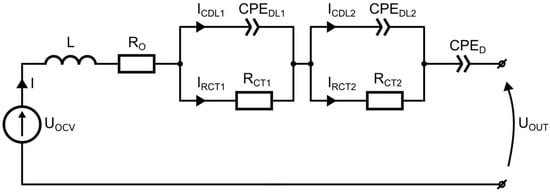
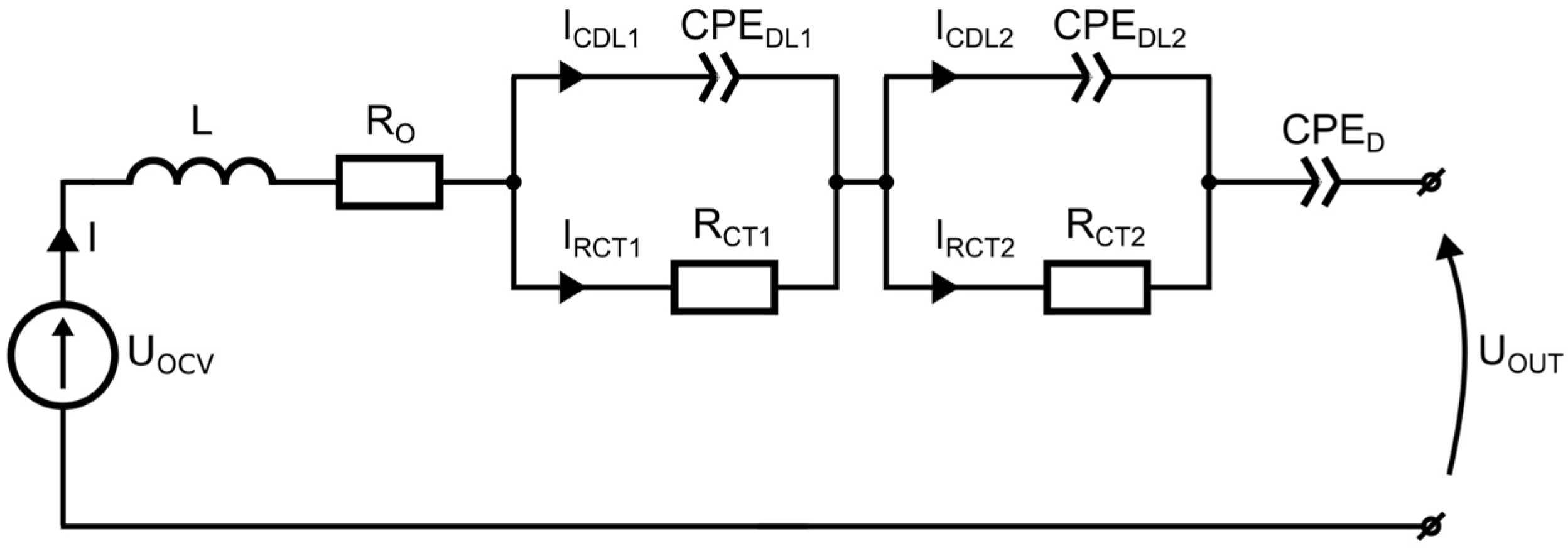
An equivalent circuit model is proposed, consisting of an inductance (L), ohmic resistance (R0), two R-CPE pairs, and a CPED representing the diffusion process. The CPED was used instead of the traditional Warburg element to avoid fixing the fractional exponent. The R-CPE pairs are responsible for accurately modeling the high- and mid-frequency responses and can be associated with charge transport and double-layer effects at the electrode–electrolyte interfaces. Although the model is somewhat more complex than those commonly used, it enables highly accurate representation of the real behavior of the cell.
The model (Figure 1) contains the minimum number of elements necessary to accurately reflect the dynamics of a LiFePO4 cell in various SOC. The effects of the double-layer and charge transport related to the electrodes are represented by a dual R-CPE pair. In cases where there are no significant differences in the double-layer capacitances of the electrodes, two R-CPE pairs connected in a series of overlays in the EIS spectrum, so, in that case, a singular R-CPE pair can represent both capacitances. It is always advisable to use a CPE instead of a pure capacitor C, since a CPE can replicate a capacitor when α equals 1.
Figure 1.
Dynamic model (ECM).
The impedance of CPE is shown below (Equation (1)):
The CPED element reflects the phenomenon of diffusion within the cell. It dominates at the lowest frequency range, usually below 10 Hz (depending on the capacity of the cell). On a Nyquist plot, it appears as a straight line. =the l often states that the diffusion element is well represented by Warburg resistance [34,35], but after performing numerous EIS measurements, it is clear that for LiFePO4-type cells, the CPE exponent α is certainly not 0.5, but varies between 0.3 and 0.8 depending on the specific cell and the SOC level.
The application of a CPED in the diffusive branch of the ECM model arises from the fact that the actual mass transport processes in LiFePO4 electrodes deviate from the assumptions of ideal Warburg diffusion. The heterogeneous electrode structure, the distribution of active particle sizes, and the two-phase lithium intercalation mechanism lead to the dispersion of diffusion time constants [11,36]. The CPED enables these effects to be accounted for through the phase exponent, which describes the degree of non-ideality of the diffusion process [18]. The improved fitting of impedance spectra in the low-frequency range confirms the validity of this approach [36,37,38].
The two parallel RCT and CPEDL components correspond to the high- and mid-frequency ranges in EIS analysis. When they appear independently, they are represented as characteristic semi-ellipses on the Nyquist plot, but they are often at least partially overlapped.
The RO element is simply the ohmic resistance related to current flow through the internal conductors of the cell as well as the external terminals. RO manifests as a rightward shift in the entire Nyquist plot by the value of RO. The L component is related to inductance, which begins to dominate at the high end of the frequency spectrum during EIS—typically at frequencies of about 1 kHz. The influence of L may cause the cell’s behavior to become inductive at these high frequencies.
The voltage UOCV represents the open-circuit voltage of the cell after relaxation has occurred. Naturally, UOCV is not constant and varies with the cell’s state of charge. There are various methods of parameterizing UOCV, which have been described in the literature [21,39,40,41]. The output of the model is the terminal voltage UOUT, which changes due to the charging or discharging current “I” applied to the cell (Equation (2)).
The output voltage at the cell terminals is equal to the open-circuit voltage after the relaxation process, reduced by the voltage drops across the individual elements of the model.
The Laplace transform of UOUT was calculated from Ohm’s law (Equation (3)).
The voltage source UOCV can be identified using the GITT method [42,43,44]. The remaining parameters—R, L and CPE elements—were identified using electrochemical impedance spectroscopy. All of these parameters are influenced by SOC in different ways.
1.2. Simulation and Analysis of the Dual R-CPE Model in LTspice
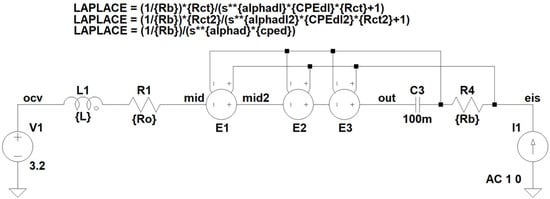
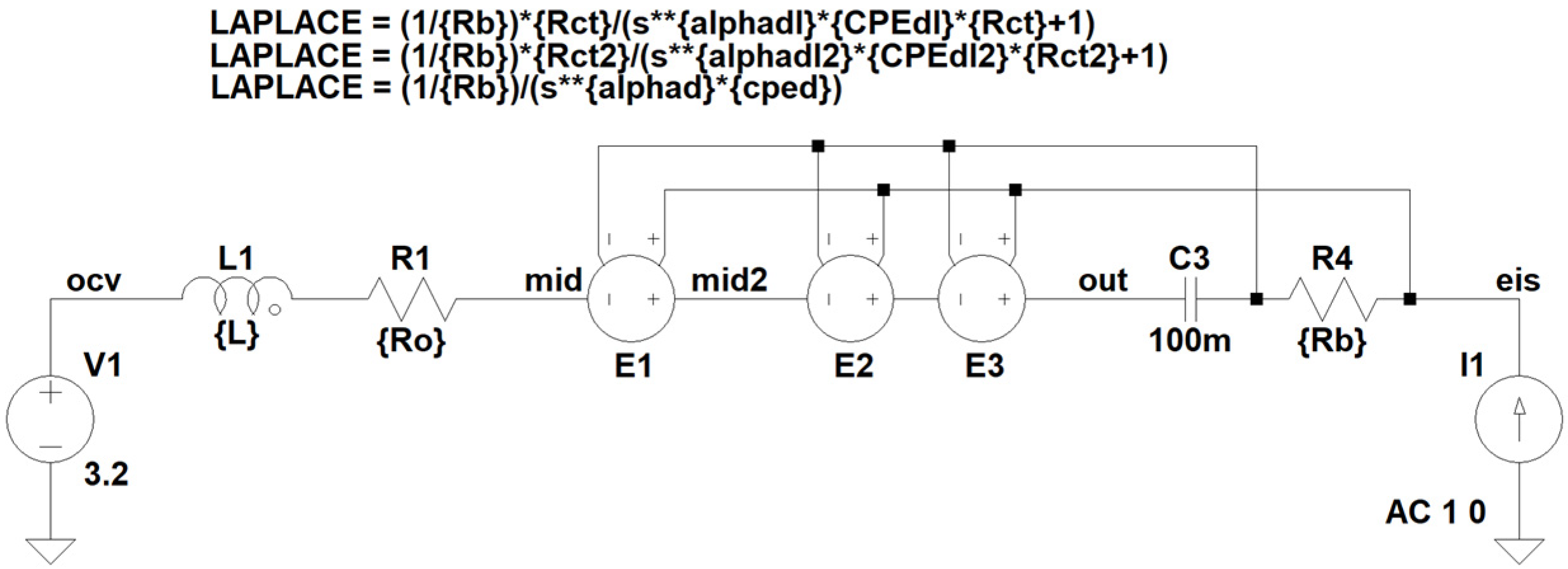
The simulations were carried out using LTspice, a program that enables the simulation of electronic circuits and, through the use of controlled sources, the analysis of elements described by the Laplace transform.
The above model (Figure 2) accurately represents the ECM shown in Figure 1. The controlled sources E1, E2 and E3 implement the Laplace equations containing CPE elements. In this case, E1 and E2 represent the parallel combination of RCT1 and CPEDL1 as well as the parallel combination of RCT2 and CPEDL2, while E3 corresponds to CPED.
Figure 2.
The schematic of the model simulated in LTspice.
It is assumed that the individual parts of the model correspond to distinct effects that can be distinguished in the Nyquist plot. However, these effects will overlap if the constants of the CPEs have similar values. The constants that differ significantly, for example by one or two orders of magnitude, will cause the effects originating from the individual elements to be clearly separated.
Moreover, inductance can affect the high-frequency region by lowering the overall reactance. In some cases, inductance can introduce uncertainty when reading RO directly from the Nyquist plot. When the reactance of CPEDL1 cancels out the reactance of the inductance L, the resulting impedance is purely resistive—not only the ohmic resistance, but also the resistive component of CPEDL1, in parallel with RCT1 This can lead to an overestimation of RO.
A significant inductance value will strongly influence the characteristics related to the double-layer and charge transport.
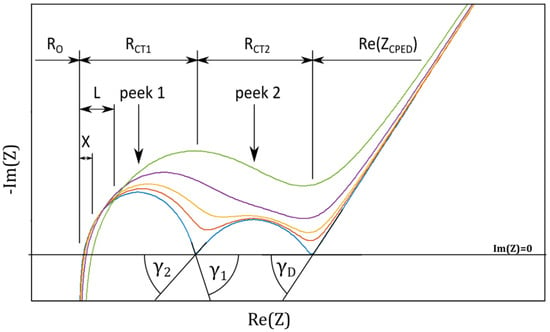
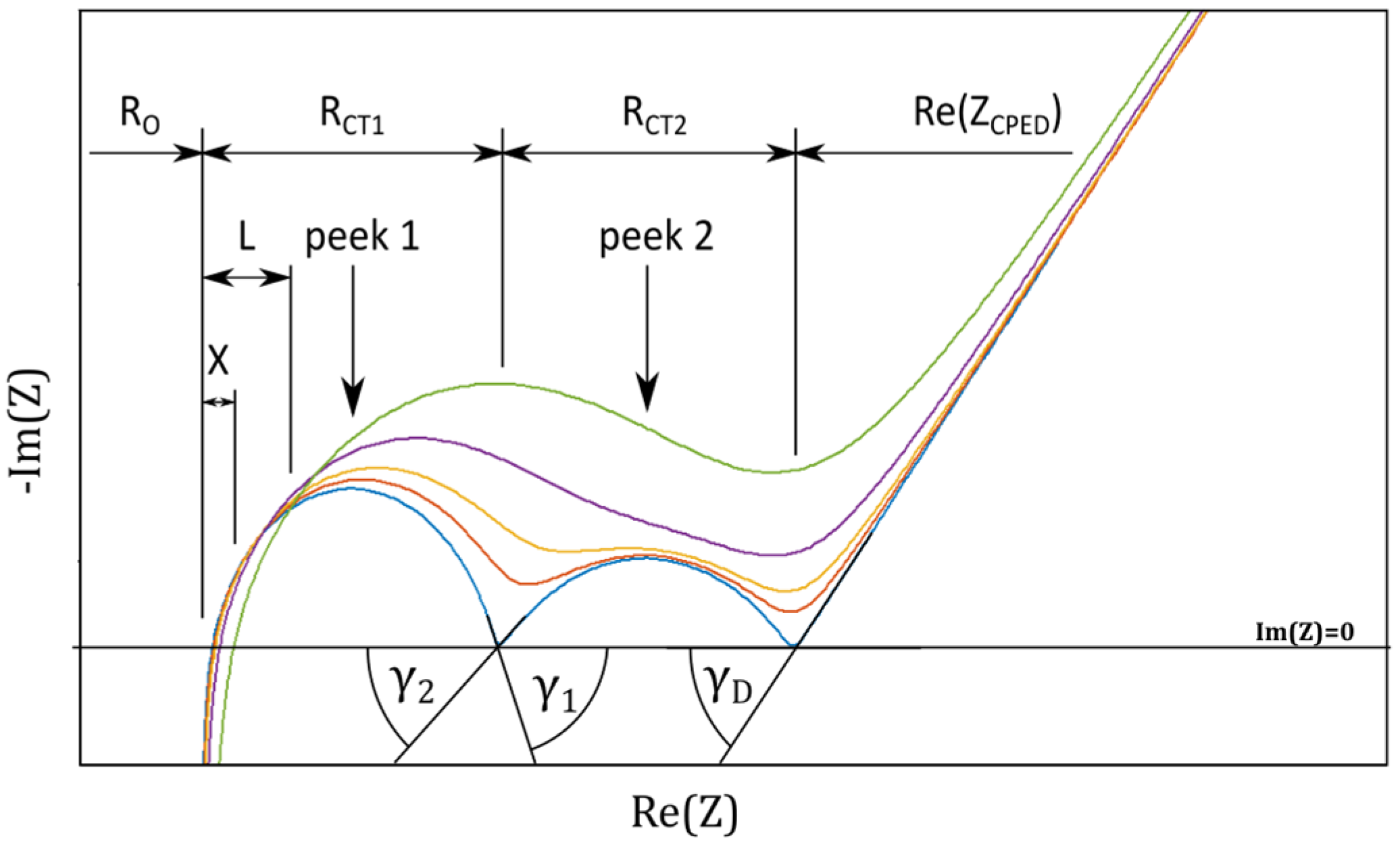
Resistances, on the other hand, determine the size and shift in the characteristic. Resistances connected in parallel with CPEs correspond to the size of the semi-ellipses. When alpha equals 1, which corresponds to a regular capacitance, RCT is equal to the diameter of the semicircle; when alpha is less than 1, RCT represents the chord of an ellipse.
The CPED representing the diffusion phenomenon forms a straight line—essentially a half-line starting at the real axis at the point RO + RCT1 + RCT2, inclined at an angle γD = αD·90° to the real axis.
Figure 3 shows six Nyquist plots corresponding to the dual R-CPE model presented in Figure 1. The model parameters are mostly identical, with RCT1 being equal to RCT2. The only differences are found in the values of CPEDL2 and CPED, which were varied to illustrate how different CPE constants affect the Nyquist plot. The plots that exhibit two distinct peaks correspond to cases with a large difference between the CPE constants.
The peak frequency can be calculated from Equation (4):
As the shape of the plots becomes smoother, the spacing between the constants decreases. In Figure 3, the letter “L” indicates the influence of inductance on the shape of the R-CPE model, shifting the Nyquist plot to the right. Inductance has a non-negligible impact on the reading of RO from the plot. Therefore, the difference between RO and the additional part of Re(Z) that is not attributed to RO is marked with the letter “X”. This additional real part arises directly from the CPE, which does not behave as an ideal capacitor. While the inductance is compensated by the capacitive response, the CPE still contributes a residual real component, even after reactance compensation.
2. Materials and Methods
Parameter identification of the model was conducted through laboratory experiments using the electrochemical impedance spectroscopy method. A dedicated test setup was prepared for the experiments: an electronic load (ITECH IT8511, Itech Electronic Co.,Ltd., New Taipei City, Taiwan), a frequency response analyzer (PSM3750, Newtons4th Ltd., Leicester, UK) working together with a high-precision power amplifier (AE Techron 7224, Elkhart, IN, USA), and a measurement shunt (N4L BATT470m-200, Newtons4th Ltd., Leicester, UK) designed for voltage excitation spectroscopy in the frequency range 0.01 Hz–1 MHz.
The EIS technique was employed to determine the complex impedance of the LiFePO4 cell and its variation with frequency at different SOCs. Data analysis and model parameter identification were conducted using a MATLAB R2016a script developed specifically for this study, in addition to widely used EIS analysis software, including FitMyEIS and LinKK (version 1.3). The FitMyEIS was used to fit model frequency response to measured data. The LinKK program was used for checking the Krammers–Kroning relations, for which the modulus weighting method was used and a sequential type of fitting. The weights are equal for the imaginary and real parts of each point of the impedance. They are represented as Equation (5):
This makes the weights proportional to the inverse of the modulus of the impedance. For each fitted model parameter, a fitting quality was assessed as the Weighted Residual Sum of Squares (WRSS) (Equation (6)):
Parameter identifiability and robustness were ensured by constraining the range of parameter variability during the identification process. The ranges were selected to be as wide as possible so as not to restrict the algorithm’s ability to search for the correct value of the identified component, while also ensuring that none of the identified parameters reached the boundaries of the admissible range.
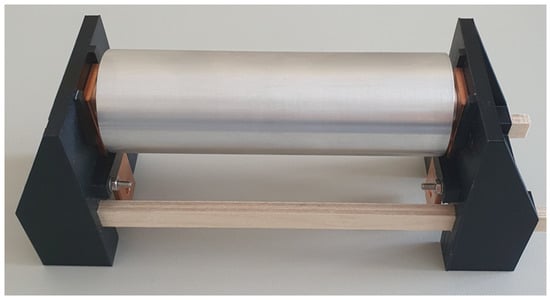
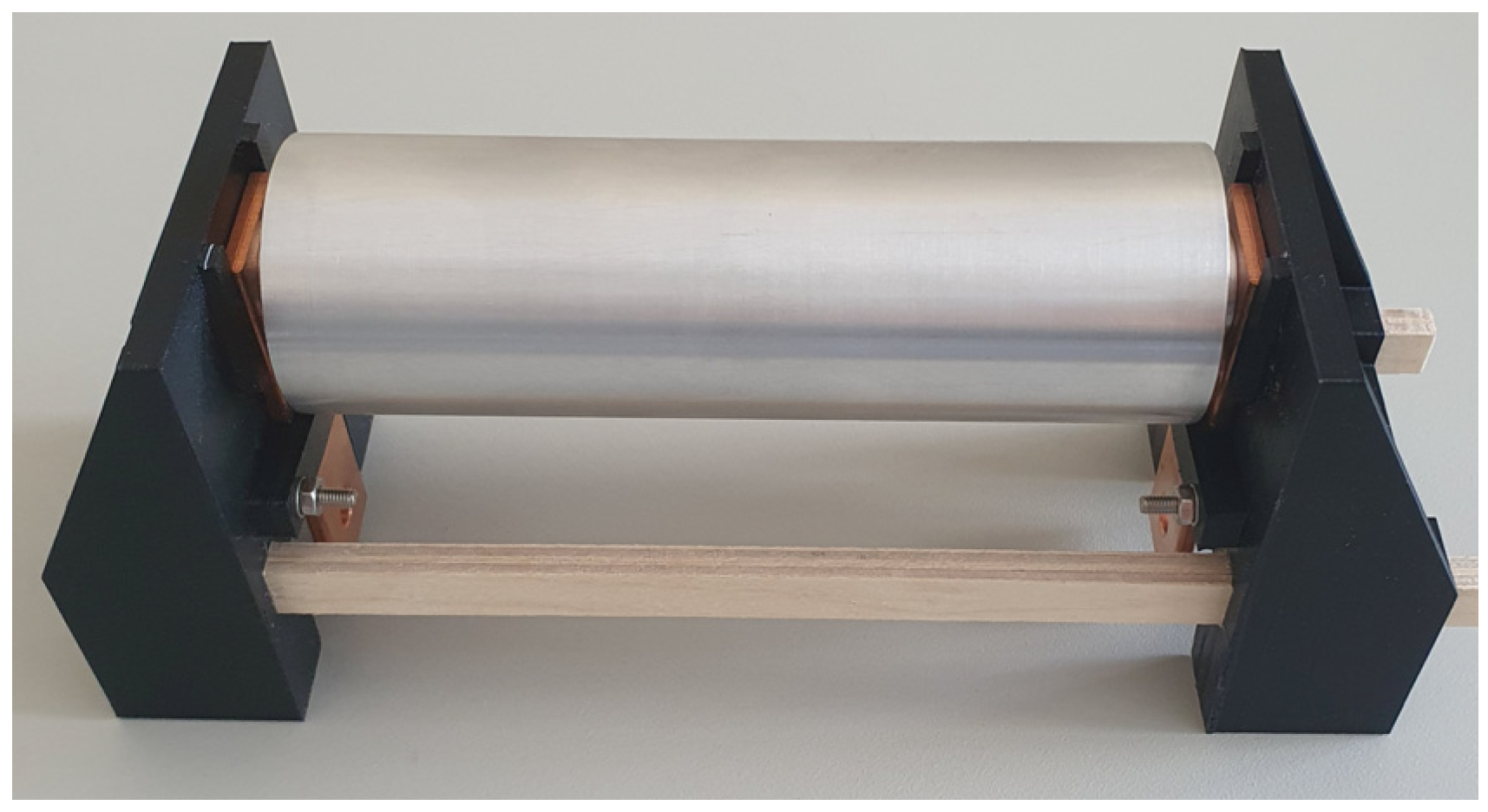
The experimental procedure included setup calibration using surrogate aluminum model EN AW-2017, EIS measurements at constant temperature, and subsequent ECM identification. The surrogate model resistance was measured using the four-wire method, applying a 100 A DC current for a very short duration and measuring the resulting voltage drop. The measured resistance was below R = 7 uΩ, consistent with the model’s geometry and the material’s known resistivity.
System calibration was performed using a surrogate cell through a short-circuit procedure (Figure 4). This calibration was conducted at the same 60 frequencies used for the actual cell measurements, ensuring frequency-consistent correction of the measurement system. A sinusoidal excitation signal with a logarithmic frequency sweep was applied, maintaining identical frequency points across all measurement series. The amplitude and phase of both voltage and current were recorded directly, from which the real and imaginary components of the cell impedance—resistance and reactance—were derived.
Figure 4.
Surrogate model. Aluminum EN AW-2017 cylinder. R = 7 uΩ.
EIS measurements were conducted at various states of charge. The SOC was determined by coulomb-counting during cell discharge at a constant current rate of 0.1C. The SOC 0% was equal to 2.0 V OCV.
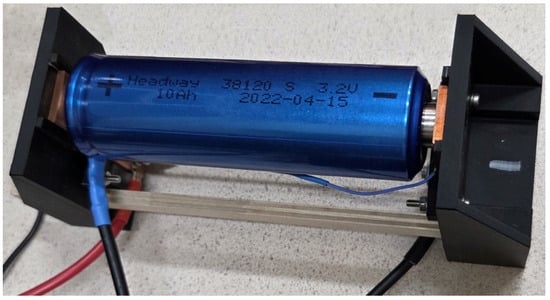
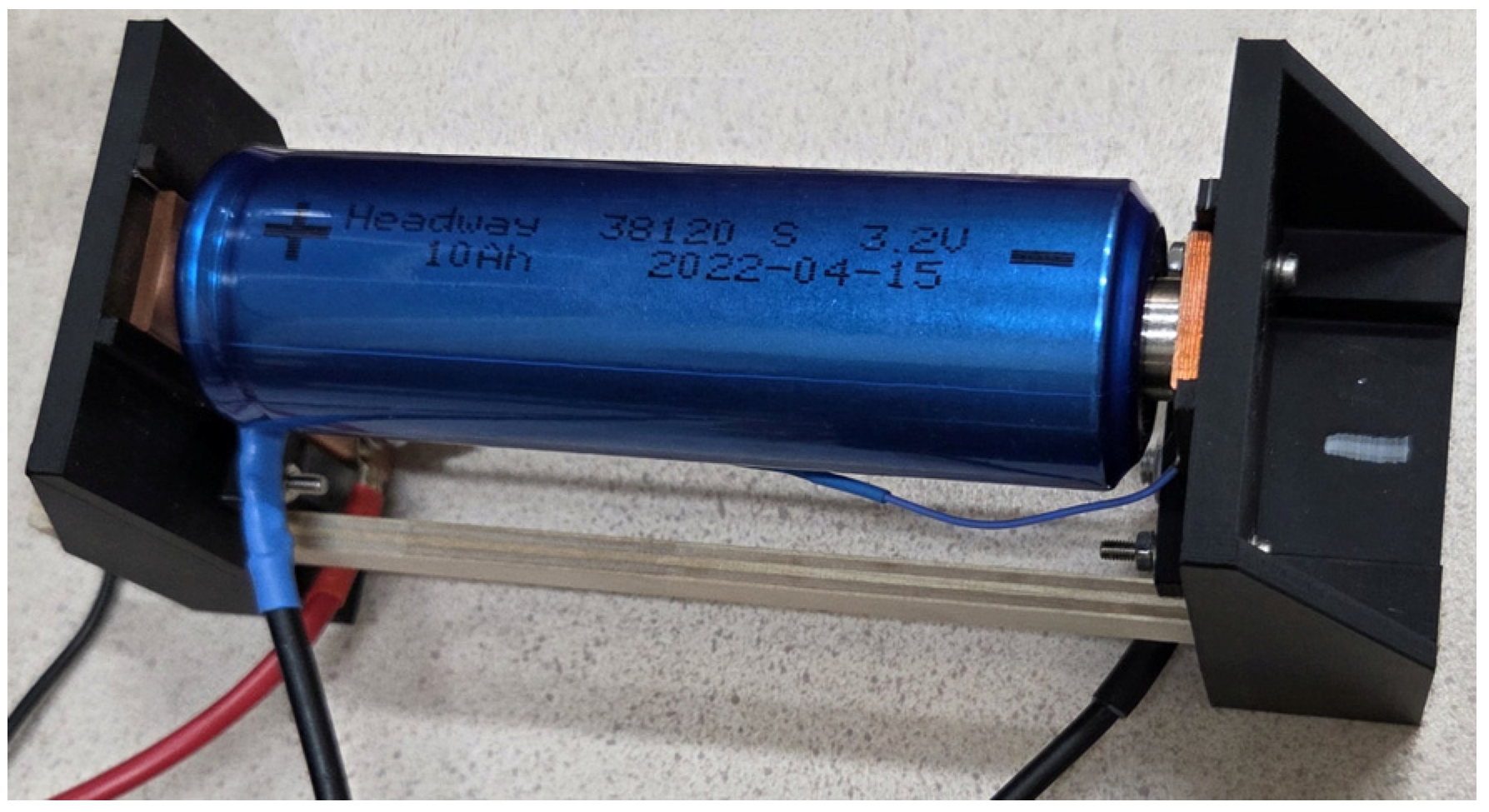
The tested cell was a LiFePO4 HW 38120S with a capacity of 10 Ah and a nominal voltage of 3.2 V (Table 1, Figure 5).
Table 1.
Parameters of the tested cell.
Figure 5.
Tested LiFePO4 cell HW 38120S.
The measurement frequency range spanned from 0.1 Hz to 1 kHz. The current forcing voltage changes at the cell terminals was approximately 1.5 A at the peak, while the measured voltage varied from 600 µV (0.1 Hz) to 7.5 mV (1.5 Hz). The measurement range was divided into three subranges: 0.1–4 Hz (24 points), 4–64 Hz (18 points), and 64 Hz–1 kHz (18 points). This division was necessary to adjust the gain of the power amplifier, which was carried out manually. The temperature was measured using a contact thermometer placed on the external surface of the cell. Throughout all measurements, the ambient temperature was controlled and kept at 23 °C ± 0.8 °C.
Within each range, the generator voltage was automatically adjusted according to the load current to ensure that the current through the shunt did not exceed its maximum rated value of 1.5 Arms while maintaining a sufficiently high voltage across the shunt. The cell itself was capable of higher operating currents, permitting discharge currents up to 30 A and charge currents up to 20 A.
3. Results
The experimental results comprise 12 Nyquist plots corresponding to evenly spaced states of charge (SOC) between 0% and 100%. Each plot consists of 60 measurement points.
The data are presented in the form of Nyquist plots.
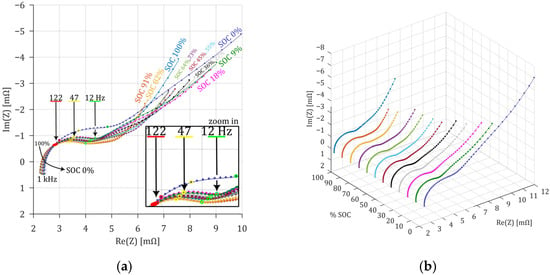
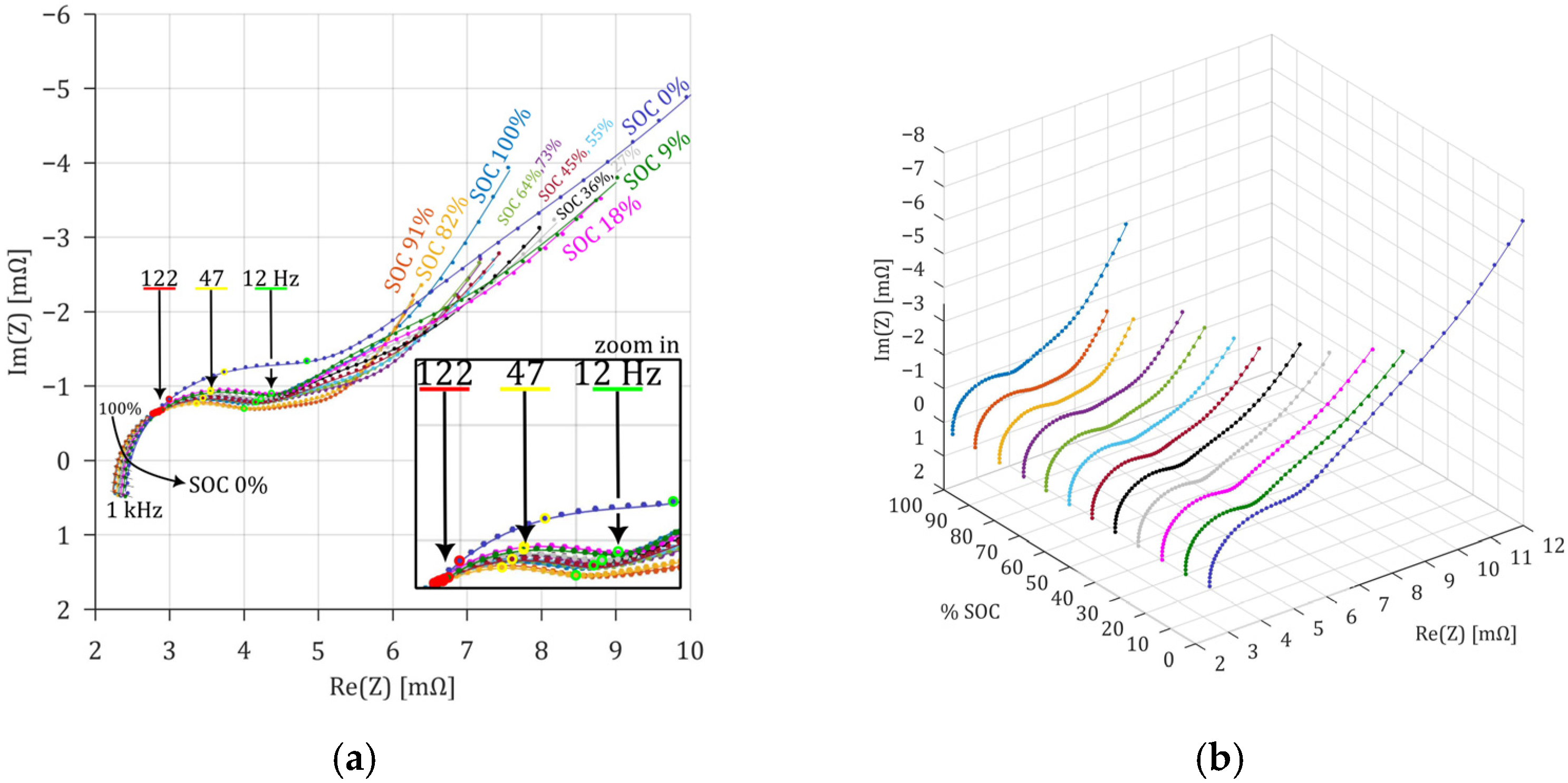
Figure 6 presents twelve Nyquist plots. The data points represent the experimental measurements, while the continuous lines correspond to the fitted equivalent circuit model. The differences between the experimental data and the fitted curves are minimal, indicating that the equivalent electrical circuit was appropriately selected for the investigated cell and that a high quality of fit was achieved.
Figure 6.
Nyquist plot based on measurement data for the frequency range 0.1 Hz–1 kHz: (a) shows characteristic points frequency; (b) shows the fitting quality for each dataset.
The most significant changes between different SOCs occurred at low frequencies below 12 Hz. In this range, the frequency responses of the double-layer, represented in the model by the elements CPEDL2 and RCT2, overlapped with the diffusion-related processes, modeled as CPED. Initially, at high SOC values near full charge, the magnitude of CPED was approximately five times greater than that of CPEDL2, which was sufficient for the second double-layer branch of the model to be clearly distinguishable and identifiable. As the cell was discharged, this second branch was gradually absorbed into the diffusion branch. At full discharge, the high-frequency branch showed increased resistance, while the resistance of the second branch also increased significantly, ultimately leading to the diminishing and blurring of the second branch effect (RCT2 || CPEDL2).
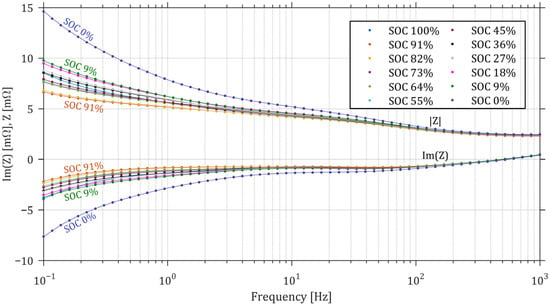
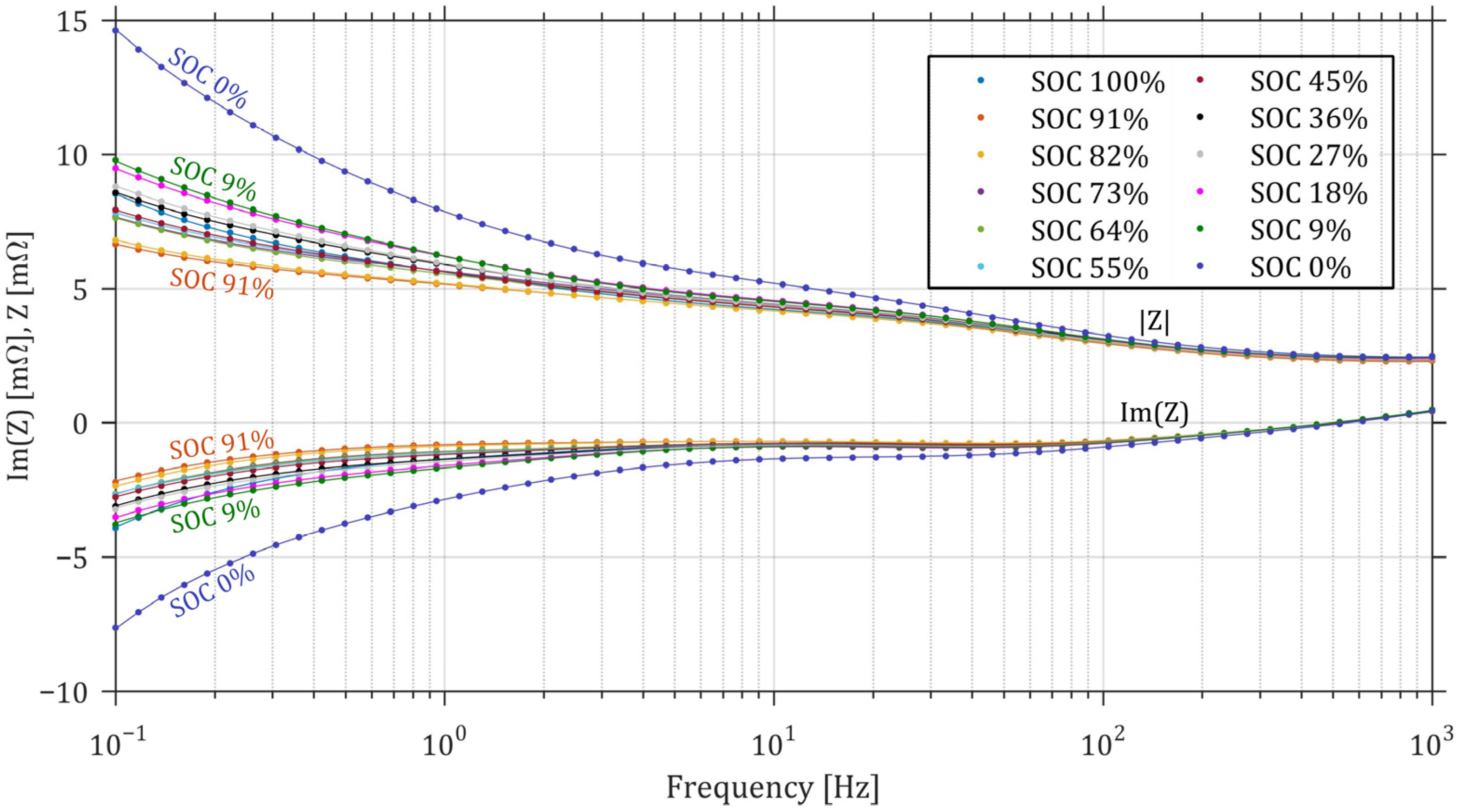
In the Bode plot (Figure 7), the data is shown by marked points and fitting by lines that represent the changes over different frequencies. The impedance curves for most SOC levels are closely clustered, indicating similar electrochemical behavior across this range. A noticeable deviation is observed for the 0% SOC curve, which shifts toward higher impedance values. The 100% SOC curve lies between the others, with slight undulations suggesting minor measurement variability or dynamic changes at full charge.
Figure 7.
Bode plot based on experimental data in the frequency range 0.1 Hz to 1 kHz. Measurement points are indicated by markers, and the fitted model is represented by lines.
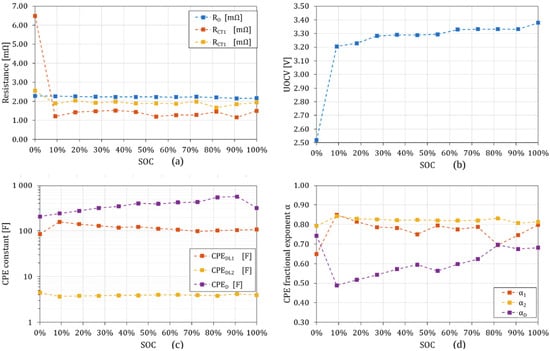
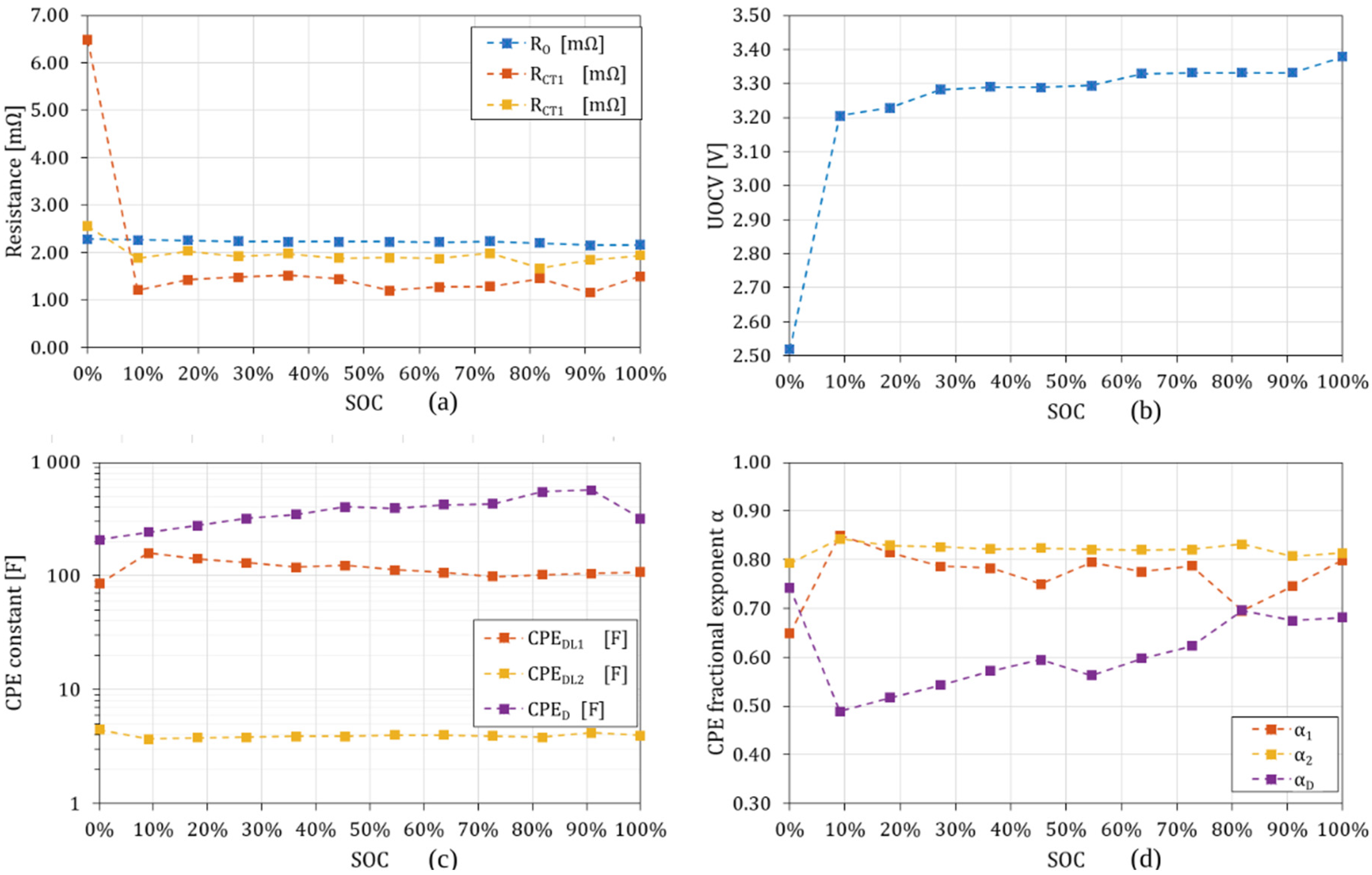
Changes in the individual model parameters as a function of SOC were observed, as confirmed by the Table 2. For certain parameters, such as RO and α1, deviations from the median remained below 4% (Figure 8a), indicating a very minor impact of SOC on these parameters. For inductance L, deviations from the median were less than 7%, although a slight trend was noted: as SOC increased, inductance diminished. Changes in CPEDL1 relative to the median reached up to 14%; however, it should be noted that the largest variations occurred at SOC <10%, with values for other SOC levels not exceeding 7%. The exponents of the remaining CPEs, namely α2 and αD, varied by no more than 18% and 25%, respectively (Figure 8d). For αD, the trend was increasing as SOC grew. The resistance RCT1 remained relatively stable at approximately 1.9 mΩ, with deviations not exceeding 7%, except for two cases: at SOC 82%, the deviation reached 12.4%, possibly due to model underfitting (higher WRSS factor; see Table 2), and for a discharged cell, this value increased by 34% compared to the median. The largest changes were observed for CPEDL2, RCT2, and CPED; among these, CPED exhibited a distinctly increasing tendency with rising SOC, while CPEDL2 generally decreased (Figure 8c). RCT2 showed the greatest change among all parameters at complete discharge, with resistance increasing 3.5× bigger compared to the median. For other SOC levels, RCT2 fluctuations did not exceed 26% peak-to-peak.
Table 2.
Identified model parameters.
Figure 8.
Changes in ECM parameters over the SOC level: (a) ohmic resistance and current transfer resistances changes over the SOC; (b) open-circuit voltage changes; (c) constant-phase element value changes; (d) changes in the fractional exponents of the CPEs over the SOC.
For 45% SOC, the WRSS value was slightly higher compared to the remaining results. This increase originated from a somewhat poorer model fitting at this operating point, which in turn was related to instrumentation- and methodology-related factors. Specifically, during the transition of the frequency range from 0.1–4 Hz to 4–64 Hz—required due to an adjustment of the power amplifier gain—a minor shift in the measured data occurred, thereby increasing the uncertainty of the obtained results. Such a change in the frequency range requires a settling period to allow for transient, non-stationary processes associated with the interruption of the EIS measurement and the change in signal amplification to decay. Although the impact on the measured data was small, it was noticeable and resulted in an increased WRSS value.
Figure 8 presents the majority of the model parameters as a function of the state of charge. Some parameters remained invariant with respect to SOC or exhibited no clear trend. However, several parameters showed systematic changes across the SOC range from 10% to 80%, maintaining consistent tendencies. The most pronounced variations were observed at the fully discharged state of the cell. The open-circuit voltage increased with SOC, following a characteristic and well-documented profile typical for LiFePO4 cells (Figure 8b).
4. Discussion
The selection of the ECM model aimed to achieve the most accurate possible representation of the Nyquist impedance characteristics. In some cases, a model with a single R–CPE pair proves sufficient for a given state of charge. However, in order to correctly represent the cell behavior over the entire SOC range, it is necessary to include a second R–CPE pair. Many authors employ simpler models [4,45]. Other studies indicate that models containing capacitors in RC pairs are sufficient for accurate cell modeling [46]. Still others use a Warburg resistance connected in series with a capacitor and placed in parallel with a resistor in the second pair [47,48]. Nevertheless, none of these models accurately reproduces the behavior of the investigated cell across all SOC values.
Models that include capacitors instead of CPE elements tend to produce semicircular shapes after parameter identification, since an RC element corresponds to a semicircle in the Nyquist plot, whereas an R–CPE element forms a segment of an ellipse, which better reflects real electrochemical behavior. Although the Warburg impedance is a natural choice for representing diffusion phenomena, it has a fixed fractional order of α = 0.5. This may explain why some authors incorporate the Warburg impedance into an RC pair (the Randles model), allowing the linear tail of the Nyquist characteristic to be distorted and thus creating an approximation that is slightly closer to reality. This topic is discussed in detail in [35].
For the investigated cell, the low-frequency tail of the impedance characteristic is nearly perfectly linear. However, at the transition between the diffusion-dominated region and the mid-frequency range, a double-layer effect becomes evident and shows a strong dependence on SOC, which necessitates the inclusion of this phenomenon in the ECM.
5. Conclusions
Measuring the impedance of lithium cells, in this case LiFePO4 cells, is difficult due to a number of limitations and the many factors affecting the measurement setup. A significant challenge is measuring impedance where the resistive part is on the order of single milliohms, and the reactive part is in the hundreds of microohms, as was the case for the tested 10 Ah cell. When testing a 100 Ah cell, one can expect impedance values to be an order of magnitude lower, which is directly supported by the cell manufacturer’s documentation, where the internal resistance is <6 mΩ for 10 Ah cells versus <0.6 mΩ for 100 Ah cells. For larger cells or parallel battery packs, it may be necessary to supply a very high current to measure the voltage, whose value can be at least five (or possibly six) orders of magnitude lower than the current amplitude. This requires very precise measurement, with a significant contribution from the measurement equipment used. Increasing the current can lead to a rise in cell temperature, causing measurement errors. Maintaining a constant current amplitude requires fine-tuning the generator settings, since the sinusoidal signal has a much higher output impedance than the measured object, and the variable impedance of the object as a function of measurement frequency forces the amplitude.
Despite the numerous challenges associated with EIS measurements and model identification, it is worth pursuing highly accurate EIS measurements in order to observe and correctly interpret changes in the characteristics arising from factors that influence the cell properties.
The results indicate the variability of the exponent αD in the CPED diffusion element. For the investigated cell, this value ranged from 0.49 to 0.74, reaching extreme values at a very low SOC, specifically 9% and 0%. For SOC values equal to or greater than 9%, αD generally shows an increasing trend with SOC. This behavior stems from the non-ideal nature of the mass transport processes in LiFePO4 electrodes, which deviate from the theoretical Warburg diffusion model due to the heterogeneous electrode structure, particle size distribution of the active material, and the two-phase lithium intercalation mechanism, leading to the significant dispersion of diffusion time constants. Moreover, intercalation processes and the associated dynamics of the SEI layer at different SOC levels induce mechanical stresses that alter effective diffusion pathways and the availability of an active surface area. The application of the CPED element with a variable exponent αD thus allows for a significantly more accurate fitting of the model to the real impedance spectrum of the LFP cell, accounting for these physicochemical non-idealities.
EIS allows for an understanding of the internal properties of cells and the factors affecting them through repeated measurements at given parameters, such as temperature, humidity, applied pressure, relaxation time, state of charge, and state of health.
EIS enables identification the cell and allows for it to be represented as a model, which can be used, for example, to build an energy storage simulator or to further model the processes of energy storage and release—this is crucial in research work on the development or diagnostics of energy storage systems.
Funding
This research received no external funding.
Data Availability Statement
The data presented in this study are available on request from the corresponding author due to legal reasons.
Acknowledgments
The article was financed by Fundusz Badań Własnych (FBW) Instytutu Mechaniki Górotworu PAN. Project number D/07/2023. We gratefully acknowledge Polish high-performance computing infrastructure PLGrid (HPC Center: ACK Cyfronet AGH) for providing computer facilities and support within computational grant no. PLG/2022/016038.
Conflicts of Interest
The author declares no conflicts of interest.
Abbreviations
The following abbreviations are used in this manuscript:
| BESS | Battery Energy Storage Systems |
| CPE | Constant Phase Element |
| EIS | Electroimpedance Spectroscopy |
| ECM | Equivalent Circuit Models |
| LFP | Lithium Ferrophosphate |
| OCV | Open-Circuit Voltage |
| SEI | Solid Electrolyte Interface |
| SOC | State of Charge |
| SOH | State of Health |
| WRSS | Weighted Residual Sum of Squares |
References
- Zhao, C.; Andersen, P.B.; Træholt, C.; Hashemi, S. Grid-connected battery energy storage system: A review on application and integration. Renew. Sustain. Energy Rev. 2023, 182, 113400. [Google Scholar] [CrossRef] [Scilit]
- Zhang, Z.; Li, Y.; Wang, H.; Lu, L.; Han, X.; Li, D.; Ouyang, M. A comparative study of the LiFePO4 battery voltage models under grid energy storage operation. J. Energy Storage 2024, 75, 109696. [Google Scholar] [CrossRef] [Scilit]
- Xu, J.; Li, H.; Hua, S.; Wang, H. Experimental investigation of grid storage modes effect on aging of LiFePO4 battery modules. Front. Energy Res. 2025, 13, 1528691. [Google Scholar] [CrossRef] [Scilit]
- Bae, J.-Y. Electrical modeling and impedance spectra of lithium-ion batteries and supercapacitors. Batteries 2023, 9, 160. [Google Scholar] [CrossRef] [Scilit]
- Perdana, M.Y.; Johan, B.A.; Abdallah, M.; Hossain, M.E.; Aziz, M.A.; Baroud, T.N.; Drmosh, Q.A. Understanding the behavior of supercapacitor materials via electrochemical impedance spectroscopy: A review. Chem. Rec. 2024, 24, e202400007. [Google Scholar] [CrossRef] [Scilit]
- Jin, G.; Zhao, W.; Zhang, J.; Liang, W.; Chen, M.; Xu, R. High-temperature stability of LiFePO4/carbon lithium-ion batteries: Challenges and strategies. Sustain. Chem. 2025, 6, 7. [Google Scholar] [CrossRef] [Scilit]
- Chen, H.; Yang, K.; Liu, Y.; Zhang, M.; Liu, H.; Liu, J.; Qu, Z.; Lai, Y. Experimental investigation of thermal runaway behavior and hazards of a 1440 Ah LiFePO4 battery pack. Energies 2023, 16, 3398. [Google Scholar] [CrossRef] [Scilit]
- Jia, Z.; Wang, S.; Qin, P.; Li, C.; Song, L.; Cheng, Z.; Jin, K.; Sun, J.; Wang, Q. Comparative investigation of the thermal runaway and gas venting behaviors of large-format LiFePO4 batteries caused by overcharging and overheating. J. Energy Storage 2023, 61, 106791. [Google Scholar] [CrossRef] [Scilit]
- Hao, P.; Wei, Q.; Yang, Z.; Yan, X.; Chen, G. Enhancing electrochemical simulations by identifying the open circuit potential curve of the positive electrode for a 105 Ah LiFePO4/graphite battery. J. Energy Storage 2025, 134, 118212. [Google Scholar] [CrossRef] [Scilit]
- Chen, Y.; Mitsubori, K. Experimental investigation on the temperature dependence of open-circuit voltage hysteresis in LiFePO4 lithium-ion batteries. Meet. Abstr. 2024, MA2024-01, 376. [Google Scholar] [CrossRef] [Scilit]
- Sulaiman, M.H.; Mustaffa, Z. State of Charge Estimation for Electric Vehicles Using Random Forest. Green Energy Intell. Transp. 2024, 3, 100177. [Google Scholar] [CrossRef] [Scilit]
- Bartsch, C.H.; Jin, L.; Bereck, F.P.; Mertens, A.; Eichel, R.-A.; Scheurer, C.; Granwehr, J. Uncertainty weighted distribution of relaxation time analysis of battery impedance spectra using Gaussian process regression for noise estimation. Meet. Abstr. 2023, MA2023-01, 428. [Google Scholar]
- Du, X.; Meng, J.; Amirat, Y.; Gao, F.; Benbouzid, M. Voltage hysteresis cancellation for fast impedance measurements of lithium-ion batteries in short relaxation process. IEEE Trans. Transp. Electrif. 2024, 11, 972–980. [Google Scholar]
- Han, X.; Ouyang, M.; Lu, L.; Li, J. Simplification of physics-based electrochemical model for lithium-ion battery on electric vehicle. Part I: Diffusion simplification and single particle model. J. Power Sources 2015, 278, 802–813. [Google Scholar] [CrossRef] [Scilit]
- AbdelAty, A.M.; Fouda, M.E.; Elwakil, A.S.; Radwan, A.G. Fractional-order equivalent-circuit model identification of commercial lithium-ion batteries. J. Electrochem. Soc. 2024, 171, 050553. [Google Scholar] [CrossRef] [Scilit]
- Bai, L.; Bae, J.-Y. Electrical modeling and characterization of electrochemical impedance spectroscopy-based energy storage systems. Batteries 2024, 10, 263. [Google Scholar] [CrossRef] [Scilit]
- Aghdam, T.S.; Alavi, S.M.M.; Saif, M. Structural identifiability of impedance spectroscopy fractional-order equivalent circuit models with two constant phase elements. Automatica 2022, 144, 110463. [Google Scholar] [CrossRef] [Scilit]
- Lyu, C.; Xu, S.; Li, J.; Pecht, M. Digital Twin Modeling Method for Lithium-Ion Batteries Based on Data-Mechanism Fusion Driving. Green Energy Intell. Transp. 2024, 3, 100162. [Google Scholar] [CrossRef] [Scilit]
- Ekström, H.; Lindbergh, G. A model for predicting capacity fade due to SEI formation in a commercial graphite/LiFePO4 cell. J. Electrochem. Soc. 2015, 162, A1003–A1007. [Google Scholar] [CrossRef] [Scilit]
- Vennam, G.; Sahoo, A.; Ahmed, S. A novel coupled electro-thermal-aging model for simultaneous SOC, SOH, and parameter estimation of lithium-ion batteries. In Proceedings of the 2022 American Control Conference (ACC), Atlanta, GA, USA, 8–10 June 2022; IEEE: New York, NY, USA; pp. 5259–5264.
- Tremblay, O.; Dessaint, L.-A.; Dekkiche, A.-I. A generic battery model for the dynamic simulation of hybrid electric vehicles. In Proceedings of the 2007 IEEE Vehicle Power and Propulsion Conference, Arlington, TX, USA, 9–12 September 2007; IEEE: New York, NY, USA; pp. 284–289. [CrossRef] [Scilit]
- Jin, L.; Bereck, F.P.; Granwehr, J.; Eichel, R.-A.; Reuter, K.; Scheurer, C. Battery modeling: Fusing equivalent circuit models with data-driven surrogate modeling. Meet. Abstr. 2023, MA2023-02, 320. [Google Scholar] [CrossRef] [Scilit]
- Thakkar, R. Electrical equivalent circuit models of lithium-ion battery. In Management and Applications of Energy Storage Devices; Okedu, K., Ed.; IntechOpen: London, UK, 2022; pp. 1–24. [Google Scholar]
- Scipioni, R.; Jørgensen, P.S.; Graves, C.; Hjelm, J.; Jensen, S.H. A physically-based equivalent circuit model for the impedance of a LiFePO4/graphite 26650 cylindrical cell. J. Electrochem. Soc. 2017, 164, A2017–A2030. [Google Scholar] [CrossRef] [Scilit]
- Trivella, A.; Corno, M.; Radrizzani, S.; Savaresi, S.M. Non-invasive experimental identification of a single particle model for LiFePO4 cells. IFAC-PapersOnLine 2023, 56, 11491–11496. [Google Scholar] [CrossRef] [Scilit]
- Yan, Z.; Wang, X.; Wei, X.; Dai, H.; Liu, L. State-of-health estimation of LiFePO4 batteries via high-frequency EIS and feature-optimized random forests. Batteries 2025, 11, 321. [Google Scholar] [CrossRef] [Scilit]
- Ria, A.; Manfredini, G.; Gagliardi, F.; Vitelli, M.; Bruschi, P.; Piotto, M. Online high-resolution EIS of lithium-ion batteries by means of compact and low power ASIC. Batteries 2023, 9, 239. [Google Scholar] [CrossRef] [Scilit]
- Gagneur, L.; Driemeyer-Franco, A.L.; Forgez, C.; Friedrich, G. Modeling of the diffusion phenomenon in a lithium-ion cell using frequency or time domain identification. Microelectron. Reliab. 2013, 53, 784–796. [Google Scholar] [CrossRef] [Scilit]
- Csomós, B.; Fodor, D.; Vajda, I. Estimation of battery separator area, cell thickness and diffusion coefficient based on non-ideal liquid-phase diffusion modeling. Energies 2020, 13, 6238. [Google Scholar] [CrossRef] [Scilit]
- Zhu, X.; Soult, M.C.; Wouters, B.; Mamme, M.H. Study of solid-state diffusion impedance in Li-ion batteries using parallel-diffusion Warburg model. J. Electrochem. Soc. 2024, 171, 060539. [Google Scholar] [CrossRef] [Scilit]
- Nováková, K.; Papež, V.; Sadil, J.; Knap, V. Review of electrochemical impedance spectroscopy methods for lithium-ion battery diagnostics and their limitations. Monatshefte Chem. 2024, 155, 227–232. [Google Scholar] [CrossRef] [Scilit]
- Mc Carthy, K.; Gullapalli, H.; Ryan, K.M.; Kennedy, T. Use of impedance spectroscopy for the estimation of Li-ion battery state of charge, state of health and internal temperature. J. Electrochem. Soc. 2021, 168, 080517. [Google Scholar] [CrossRef] [Scilit]
- Wang, X.; Wei, X.; Zhu, J.; Dai, H.; Zheng, Y.; Xu, X.; Chen, Q. Modeling, acquisition, and application of lithium-ion battery impedance for onboard battery management: A review. eTransportation 2021, 7, 100093. [Google Scholar] [CrossRef] [Scilit]
- Barbero, G.; Lelidis, I. Analysis of Warburg’s impedance and its equivalent electric circuits. Phys. Chem. Chem. Phys. 2017, 19, 24934–24944. [Google Scholar] [CrossRef] [Scilit] [PubMed]
- Orazem, M.E.; Ulgut, B. On the proper use of a Warburg impedance. J. Electrochem. Soc. 2024, 171, 040526. [Google Scholar] [CrossRef] [Scilit]
- Lasia, A. Impedance of Porous Electrodes. Curr. Opin. Electrochem. 2025, 54, 101764. [Google Scholar] [CrossRef] [Scilit]
- Ugata, Y.; Motoki, C.; Dokko, K.; Yabuuchi, N. Fundamental Methods of Electrochemical Characterization of Li Insertion Materials for Battery Researchers. J. Solid State Electrochem. 2024, 28, 1387–1401. [Google Scholar] [CrossRef] [Scilit]
- Lasia, A. The Origin of the Constant Phase Element. J. Phys. Chem. Lett. 2022, 13, 580–589. [Google Scholar] [CrossRef] [Scilit]
- Baccouche, I.; Jemmali, S.; Manai, B.; Omar, N.; Amara, N. Improved OCV model of a Li-ion NMC battery for online SOC estimation using the extended Kalman filter. Energies 2017, 10, 764. [Google Scholar] [CrossRef] [Scilit]
- Kai, W.; Feng, X.; Pang, J.; Ren, J.; Duan, C.; Li, L. State of charge estimation of lithium-ion battery based on adaptive square root unscented Kalman filter. Int. J. Electrochem. Sci. 2020, 15, 9499–9516. [Google Scholar] [CrossRef] [Scilit]
- Bae, K.; Choi, S.; Kim, J.; Won, C.; Jung, Y. LiFePO4 dynamic battery modeling for battery simulator. In Proceedings of the 2014 IEEE International Conference on Industrial Technology (ICIT), Busan, Republic of Korea, 26–28 February 2014; IEEE: New York, NY, USA; pp. 354–358. [CrossRef] [Scilit]
- Geng, Z.; Thiringer, T.; Lacey, M.J. Intermittent current interruption method for commercial lithium-ion batteries aging characterization. IEEE Trans. Transp. Electrif. 2022, 8, 2985–2995. [Google Scholar] [CrossRef] [Scilit]
- Ovejas, V.J.; Cuadras, A. Effects of cycling on lithium-ion battery hysteresis and overvoltage. Sci. Rep. 2019, 9, 14875. [Google Scholar] [CrossRef] [Scilit] [PubMed]
- Wu, Z.; Zhu, G.; Wang, Q.; Yang, S.; Wang, J.V.; Kang, J. Study on adaptive cycle life extension method of Li-ion battery based on differential thermal voltammetry parameter decoupling. Energies 2021, 14, 6239. [Google Scholar] [CrossRef] [Scilit]
- Tran, M.-K.; DaCosta, A.; Mevawalla, A.; Panchal, S.; Fowler, M. Comparative study of equivalent circuit models performance in four common lithium-ion batteries: LFP, NMC, LMO, NCA. Batteries 2021, 7, 51. [Google Scholar] [CrossRef] [Scilit]
- Alavi, S.M.M.; Mahdi, A.; Payne, S.J.; Howey, D.A. Identifiability of generalized Randles circuit models. IEEE Trans. Control Syst. Technol. 2017, 25, 2112–2120. [Google Scholar] [CrossRef] [Scilit]
- Wu, Y.; Balasingam, B. A comparison of battery equivalent circuit model parameter extraction approaches based on electrochemical impedance spectroscopy. Batteries 2024, 10, 400. [Google Scholar] [CrossRef] [Scilit]
- Tahir, M.U.; Ibrahim, T.; Kerekes, T. Battery passport and online diagnostics for lithium-ion batteries: A technical review of materials–diagnostics interactions and online EIS. Batteries 2025, 11, 442. [Google Scholar] [CrossRef] [Scilit]

Disclaimer/Publisher’s Note: The statements, opinions and data contained in all publications are solely those of the individual author(s) and contributor(s) and not of MDPI and/or the editor(s). MDPI and/or the editor(s) disclaim responsibility for any injury to people or property resulting from any ideas, methods, instructions or products referred to in the content. |
© 2026 by the author. Licensee MDPI, Basel, Switzerland. This article is an open access article distributed under the terms and conditions of the Creative Commons Attribution (CC BY) license.