1. Introduction
Global urbanization is accelerating, and projections indicate that by 2050 nearly 68% of the world’s population will reside in cities, underscoring the urgency of developing sustainable and resilient urban energy systems. Urban growth intensifies the demand for water, energy, and materials, increasing pressure on non-renewable resources and complicating the transition toward low-carbon development. In Mexico, rapid metropolitan expansion and population densification make it essential to rethink energy production and distribution frameworks. Demographic forecasts estimate that the national population will reach 138 million by 2030 and 146 million by 2050 [
1], while nearly 90% of municipalities will be predominantly urban by mid-century [
2].
This context highlights a growing need for distributed renewable energy technologies capable of operating efficiently within complex urban environments. Small-scale wind systems offer an opportunity to exploit localized wind resources on rooftops or integrated architectural surfaces [
3]. By decentralizing generation, such systems can reduce grid congestion, lower local emissions, and enhance energy resilience during peak-demand periods or supply disruptions. As emphasized by the United Nations, access to clean and efficient energy systems is a cornerstone of safe, resilient, and sustainable cities, aligning with Sustainable Development Goals (SDGs) 7, 11, and 13 [
4]. Accordingly, integrating decentralized wind energy into urban planning strategies represents a viable pathway for climate adaptation and improved energy security.
Urbanization trends further reinforce this motivation. Mexico’s major metropolitan regions, including the Valle de México, Monterrey, and Guadalajara, which are projected to grow by approximately 5 million inhabitants by 2030, while state capitals and medium-sized cities will incorporate an additional 8.3 million residents [
5]. This increasing concentration of population and infrastructure strengthens the case for compact, low-impact energy technologies that can operate within existing built environments without extensive land-use requirements.
Among the available technologies, micro wind turbines particularly vertical-axis wind turbines (VAWTs) stand out as promising candidates for urban deployment [
6]. The highly turbulent and multidirectional wind fields typical of cities often favor VAWTs over horizontal-axis turbines. Their key advantages include omnidirectional operation, low cut-in wind speeds, reduced acoustic emissions, and suitability for low-Reynolds-number flow regimes, all of which are critical for dense urban settings. Accordingly, the present study focuses on lift-driven, Darrieus-type VAWTs, for which aerodynamic performance is governed primarily by airfoil characteristics and can be consistently assessed using blade-element-based models.
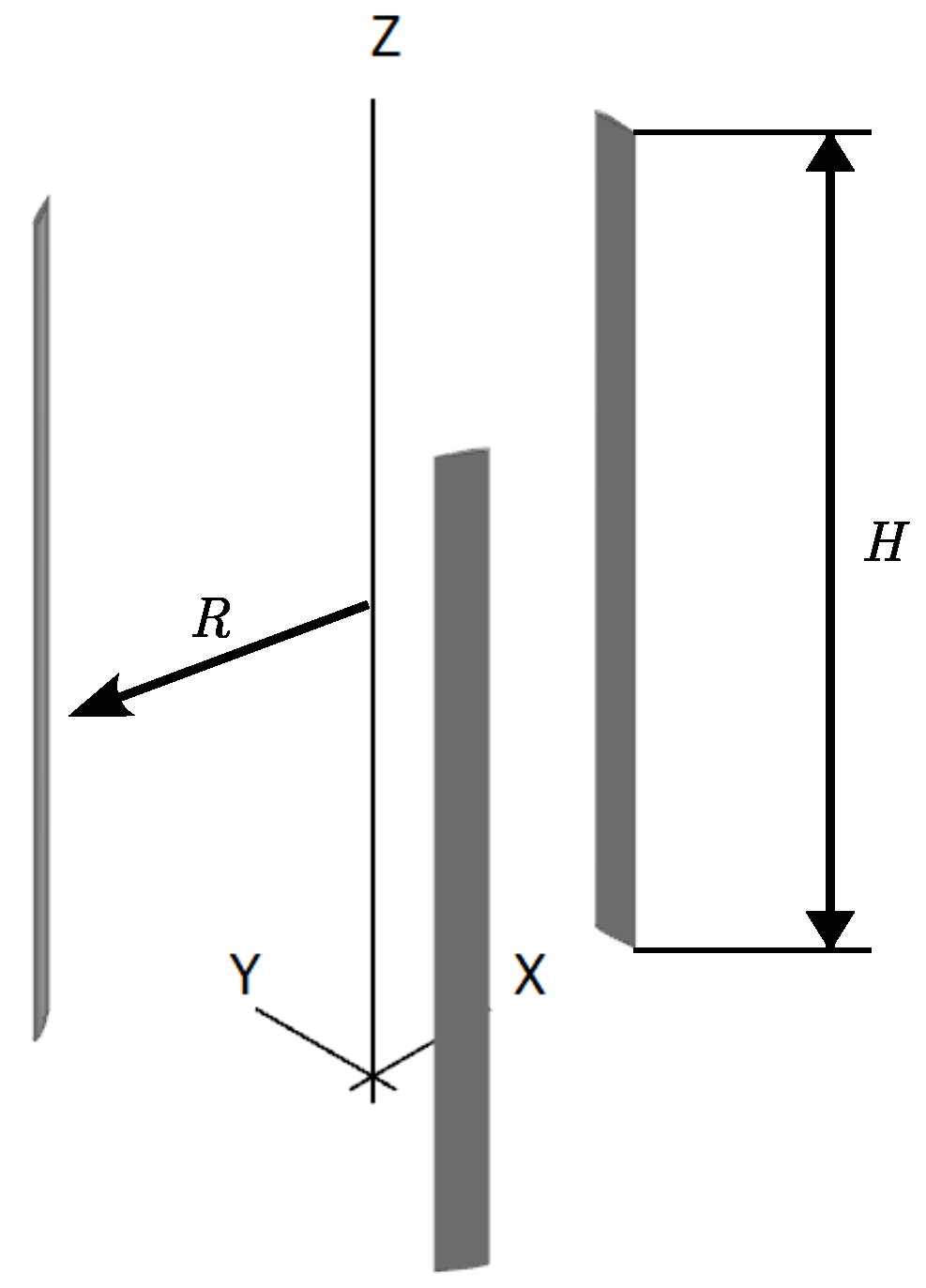
A Darrieus-type VAWT consists of straight or curved blades mounted vertically around a central axis. As the rotor rotates, each blade experiences periodic variations in angle of attack, generating lift and torque [
7]. The resulting power output depends on blade geometry, chord length, rotor radius, and operating tip-speed ratio [
8]. Despite relatively high efficiency at optimal tip-speed ratios (
), conventional Darrieus turbines exhibit poor self-starting performance due to low initial torque [
9], which remains a critical limitation for autonomous operation in low-wind urban environments.
Urban wind conditions differ markedly from those of conventional wind energy sites. Mean wind speeds in cities are typically reduced due to surface roughness and flow obstruction [
10,
11], with reported average velocities between 2 m/s and 6 m/s and gusts reaching 6 m/s to 9 m/s [
12,
13]. In addition, urban flows exhibit strong wind direction variability and elevated turbulence intensity, frequently exceeding 20–30%, driven by building-induced flow distortion and shear [
14]. These characteristics pose significant aerodynamic challenges for micro-scale wind turbines and accentuate the importance of airfoil behavior under unsteady, low-Reynolds-number conditions.
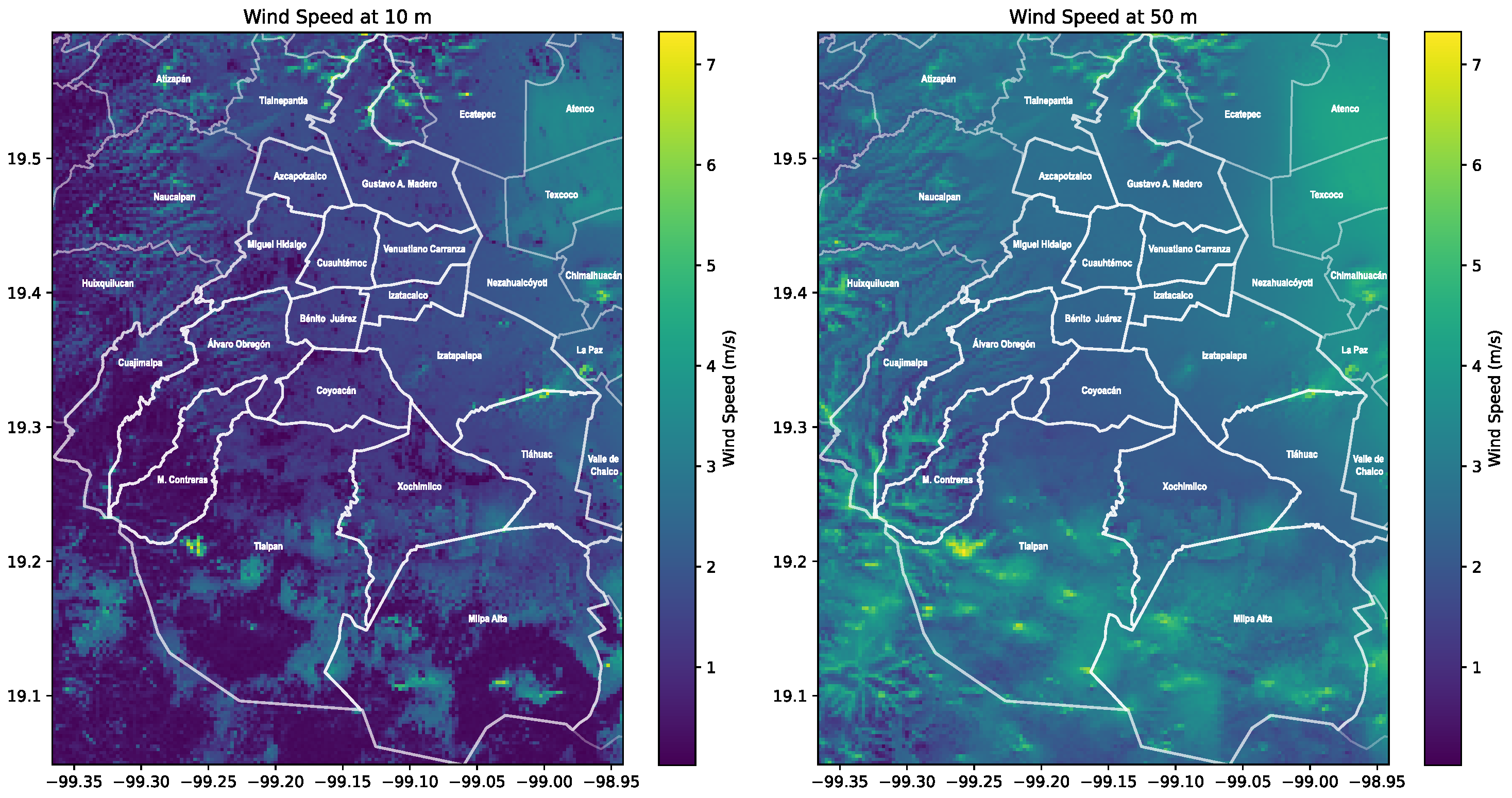
As a representative example of a large, densely built metropolitan area, wind conditions in the Zona Metropolitana del Valle de México (ZMVM) are considered in this study. Data from the Global Wind Atlas indicate mean wind speeds of approximately 1.75 m/s at 10 m height and 3.14 m/s at 50 m, with observed values ranging from 0.19 to 7.32 m/s (
Figure 1). While local wind characteristics vary among cities worldwide, these values are broadly representative of the low-speed, highly disturbed environments in which urban micro-scale turbines are expected to operate.
Despite growing interest in urban VAWTs, their aerodynamic design remains challenging due to the combined effects of low Reynolds numbers, cyclic variations in angle of attack, and strong sensitivity to airfoil characteristics. Existing studies employ a wide range of modeling approaches, including momentum-based methods such as the Double Multiple Streamtube (DMST) model, vortex-based methods, and high-fidelity CFD simulations [
15,
16]. While CFD provides detailed insight into unsteady flow phenomena, its computational cost often limits its applicability in early-stage design and parametric studies [
17,
18]. Consequently, low- and medium-fidelity models remain widely used but rely heavily on airfoil polar data and modeling assumptions, particularly under low-Reynolds-number and high-incidence conditions.
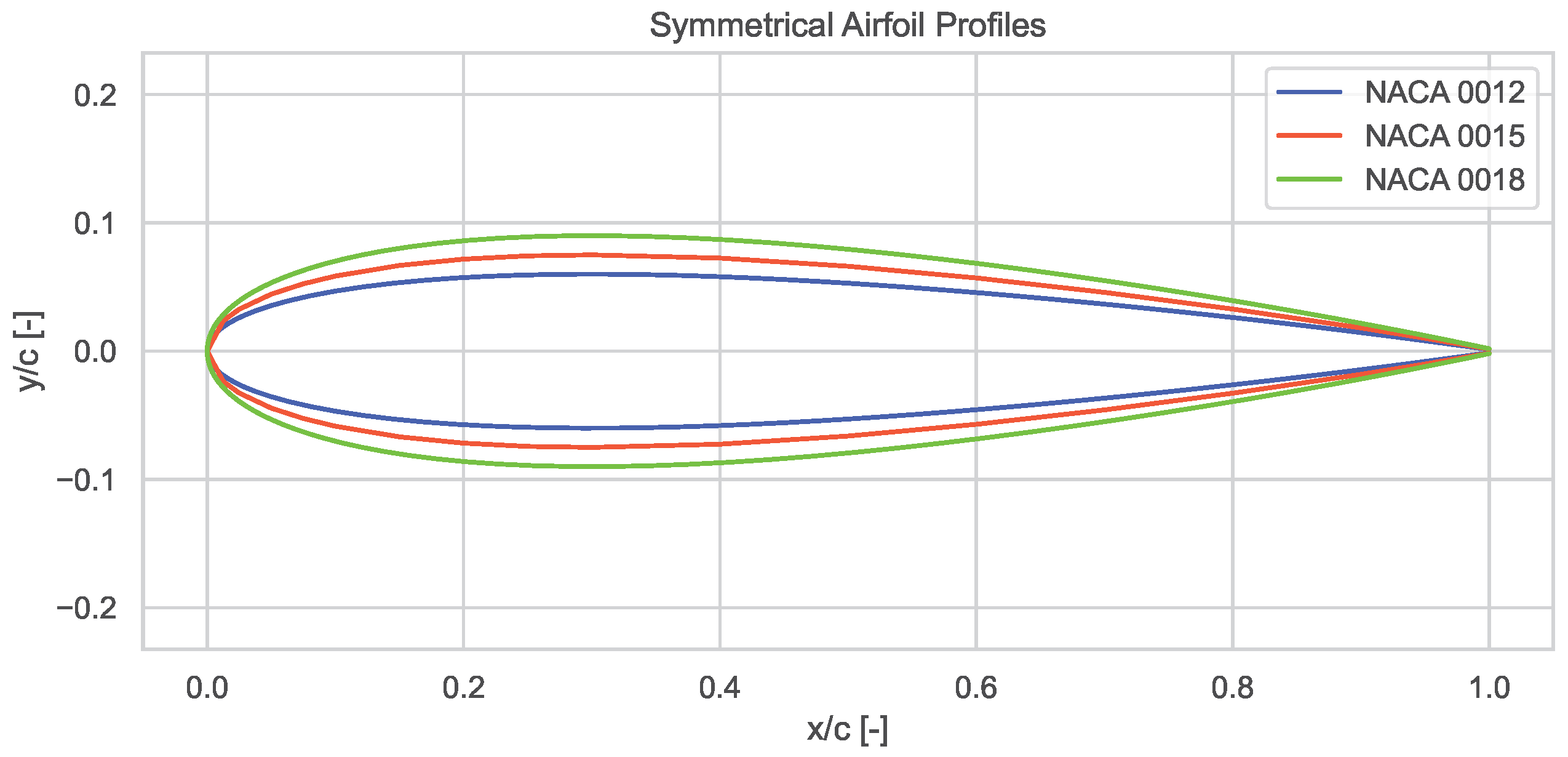
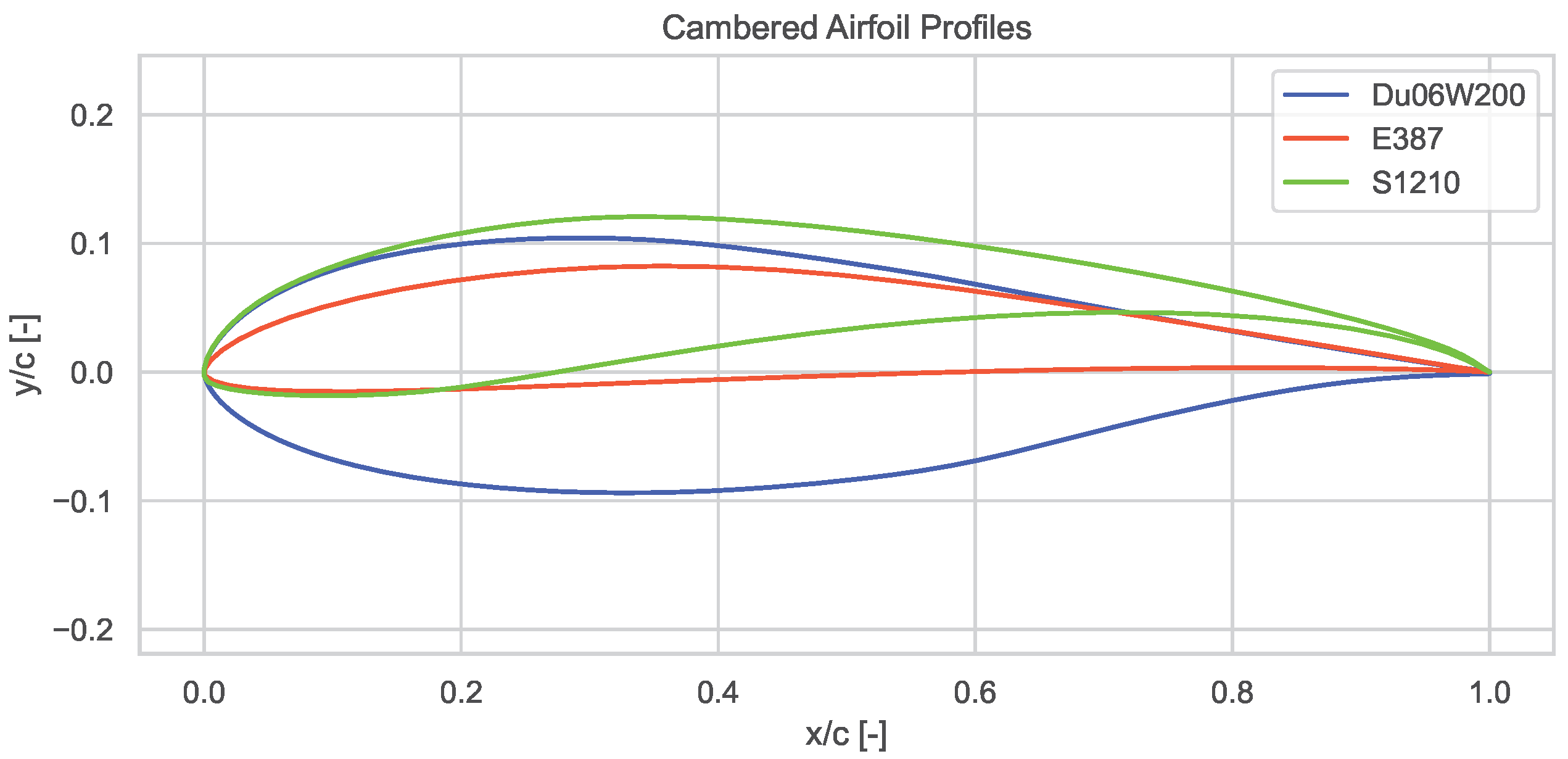
As a result, airfoil selection studies for VAWTs often focus on either symmetric profiles or general-purpose low-Reynolds-number airfoils, whereas fewer works systematically assess VAWT-specific airfoils designed to sustain large angles of attack and mitigate dynamic stall [
19]. Moreover, many investigations emphasize optimal operating conditions, while self-starting behavior at low tip-speed ratios critical for urban micro-scale applications is less consistently addressed [
20,
21]. This motivates the need for comparative studies that assess airfoil performance trends across different aerodynamic models and operating regimes relevant to urban wind environments.
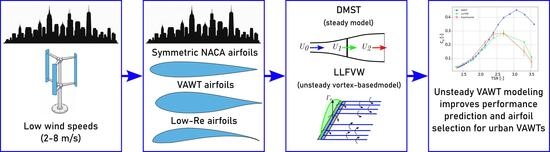
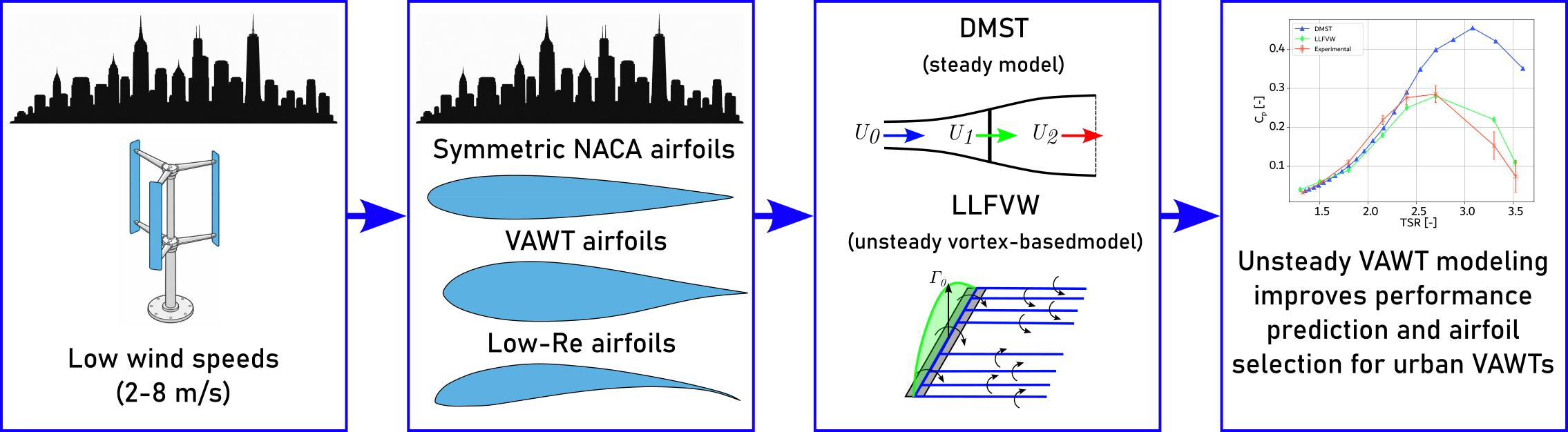
The present study addresses this gap through a systematic comparative analysis of six airfoil profiles commonly considered for small-scale, low-Reynolds-number VAWTs operating under typical urban wind speeds (2–8 m/s). Two aerodynamic modeling approaches of differing fidelity are employed: the Double Multiple Streamtube (DMST) model and the Lifting Line Free Vortex Wake (LLFVW) method, both implemented within the open-source QBlade framework. While several low- and medium-fidelity solvers such as CACTUS [
22], OpenFAST, and other BEM-based tools reported in the literature [
23,
24] are available for VAWT performance prediction, QBlade is selected because it enables multiple aerodynamic models to be applied within a unified environment using identical airfoil polar data and rotor definitions. Rather than introducing new aerodynamic formulations, this work focuses on evaluating the consistency and robustness of airfoil performance trends across modeling approaches, with particular emphasis on the trade-off between self-starting capability at low tip-speed ratios and power efficiency under nominal operating conditions.
The analysis is intentionally restricted to lift-driven, Darrieus-type VAWTs, for which aerodynamic performance is governed primarily by airfoil characteristics and can be consistently assessed using blade-element-based models. Drag-based configurations, such as Savonius or hybrid rotors, rely on fundamentally different operating principles and performance metrics, and are therefore excluded to preserve methodological consistency and ensure that the conclusions remain directly applicable to airfoil selection and early-stage aerodynamic design.
Although urban wind environments are characterized by high turbulence intensity and strong temporal variability [
25], these effects are not explicitly modeled in the present simulations. This simplification is adopted to isolate baseline aerodynamic trends associated with airfoil geometry and to enable consistent comparisons across airfoils and modeling approaches. Neglecting atmospheric turbulence is expected to primarily influence unsteady loading and dynamic stall intensity, while mean power coefficient trends and relative airfoil ranking are expected to remain qualitatively robust. The implications of this assumption are discussed in
Section 5.5.
The main contributions of this work are threefold: (i) a comparative evaluation of startup torque and power coefficient for six airfoils representative of low-Reynolds-number, VAWT-specific, and symmetric profiles under urban wind conditions; (ii) a cross-model assessment of airfoil performance using both DMST and LLFVW, highlighting model-dependent and model-independent conclusions; and (iii) validation of LLFVW predictions against experimental benchmark data to establish confidence bounds for design-oriented simulations.
This article is structured as follows.
Section 2 introduces the aerodynamic principles governing VAWT operation and key performance coefficients.
Section 3 presents the airfoil profiles, turbine geometry, and simulation setup.
Section 4 compares numerical predictions against experimental data.
Section 5 reports the main findings, and
Section 6 summarizes the conclusions of the study.
2. Background: Fundamental VAWT Aerodynamics
This section summarizes the governing aerodynamic principles of Darrieus-type vertical-axis wind turbines (VAWTs) to provide the physical foundation for the modeling and performance analysis presented in later sections.
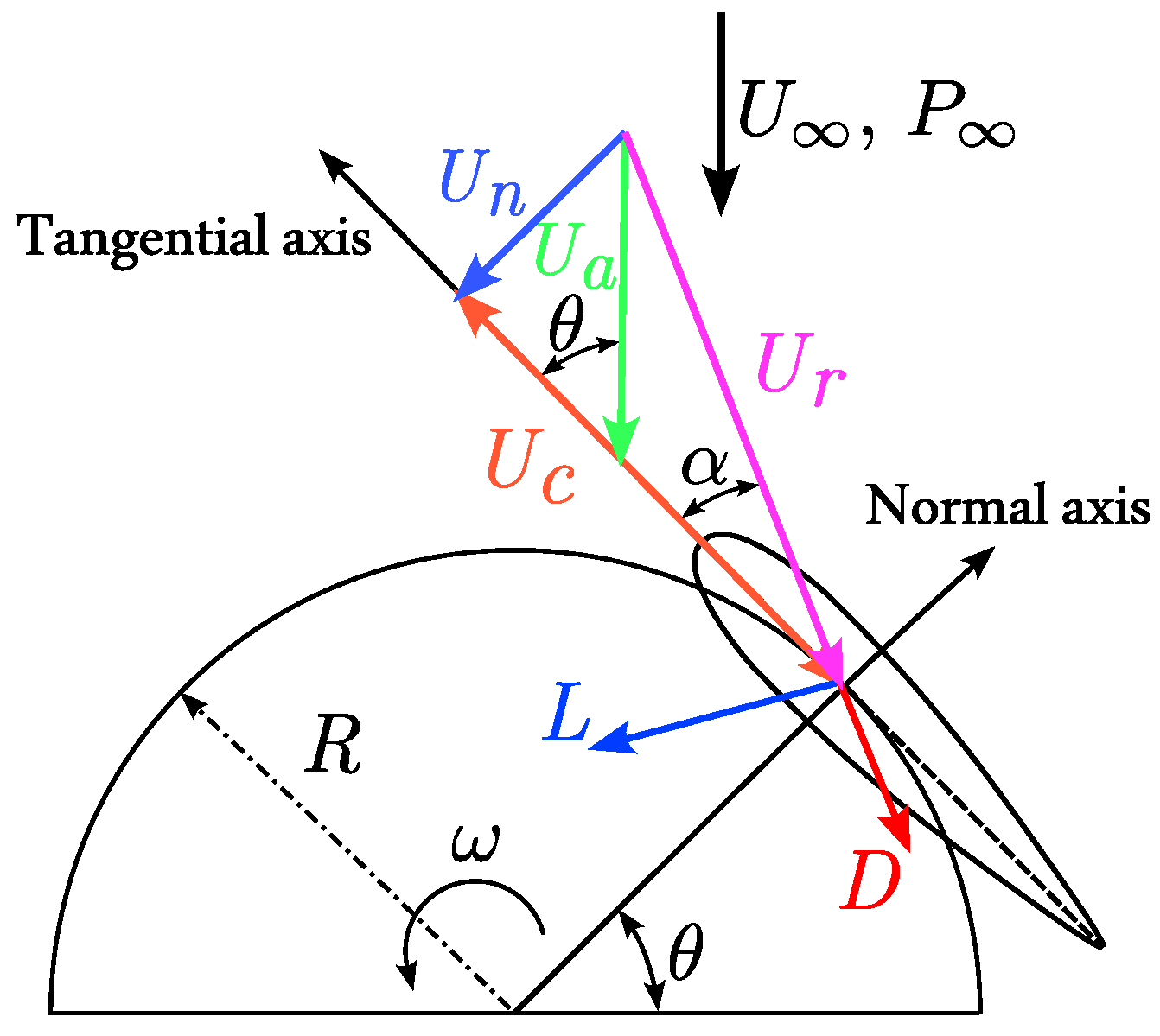
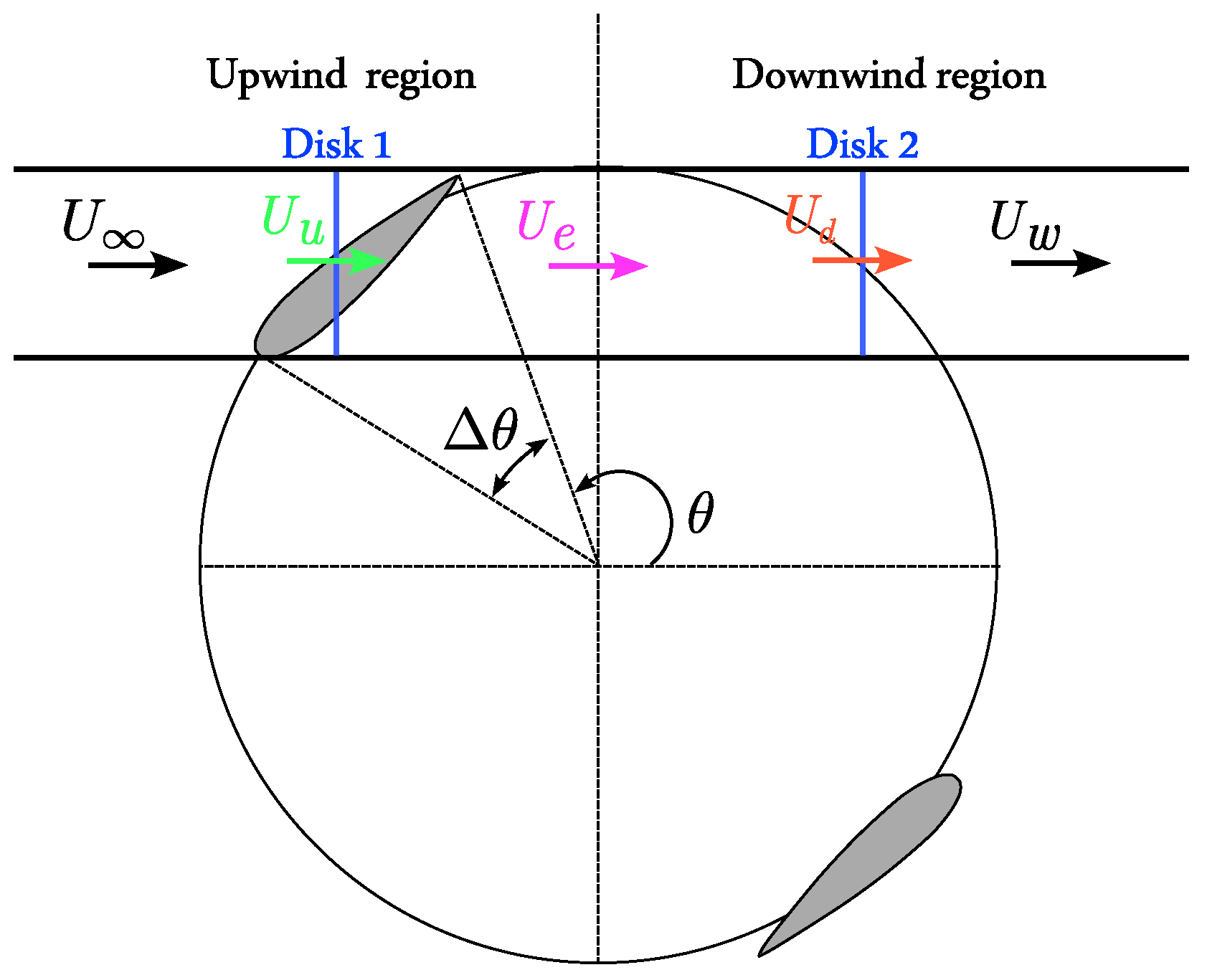
A VAWT extracts kinetic energy from the wind through the aerodynamic forces acting on its rotating blades. These forces depend on the free-stream wind speed
, the turbine angular velocity
, and the instantaneous azimuthal position of the blade
. The blade element experiences a relative velocity that can be decomposed into tangential
(chordwise) and normal components
with respect to the rotor trajectory. These components are given by
where
is the local axial (induced) velocity,
R is the rotor radius, and
is the blade azimuthal angle. The magnitude of the relative velocity is
These velocity relationships are illustrated in
Figure 2. The relative velocity defines the instantaneous angle of attack,
where
is the pitch angle (set to zero in the present study). Introducing the tip-speed ratio (TSR),
and the axial induction factor
, Equation (
4) can be expressed in nondimensional form as
2.1. Aerodynamic Forces on the Blade
The lift
L and drag
D generated by the blade element are
where
is the blade planform area, and
and
are the sectional lift and drag coefficients. These forces are resolved into tangential and normal components with respect to the rotor trajectory:
The tangential force is the component responsible for torque generation and directly governs both the startup behavior and the nominal efficiency of the turbine. Because varies strongly over the revolution, the VAWT operates under inherently unsteady aerodynamic conditions involving dynamic stall, flow curvature effects, and Reynolds number sensitivity.
2.2. Time-Averaged Aerodynamic Loads and Power Output
The time-averaged thrust force
T and torque
Q are obtained by integrating the instantaneous aerodynamic loads over one full rotor revolution:
The mean mechanical power is
2.3. Aerodynamic Coefficients
The aerodynamic performance of a VAWT is expressed using the nondimensional coefficients
where
is the rotor swept area. The power coefficient
represents the ratio of the extracted mechanical power to the available wind power. The tangential force coefficient
describes the instantaneous nondimensional torque-producing load on a blade. The torque coefficient
quantifies the nondimensional torque delivered to the shaft.
The applicability and assumptions of the quasi-steady framework are discussed in
Section 3.2. The relationships summarized in this section provide the aerodynamic framework used by the numerical models described in
Section 3.3.
4. Validation
4.1. Aerodynamic Coefficient Extrapolation
Because XFOIL does not converge reliably beyond static stall, the computed aerodynamic coefficients were extrapolated to obtain full
polars for both the DMST and LLFVW simulations. QBlade provides two commonly used post-stall extrapolation approaches for this purpose: the Montgomerie method [
53] and the Viterna–Corrigan model [
56]. Although both methods extend pre-stall airfoil data into the fully separated flow regime, they rely on different physical assumptions and are suited to different operating conditions.
The Viterna–Corrigan model was originally developed for horizontal-axis wind turbines operating at high angles of attack and relatively high Reynolds numbers. Beyond stall, lift and drag are extrapolated using empirical relationships derived from flat-plate theory and momentum considerations, with the drag coefficient asymptotically approaching a maximum value governed by airfoil aspect ratio. This approach has been shown to perform well for mildly cambered airfoils with gradual stall characteristics and is therefore widely adopted in blade element momentum solvers for HAWTs. However, under the operating conditions typical of vertical-axis wind turbines characterized by large and rapid angle-of-attack variations, frequent flow reversal, and pronounced dynamic stall the quasi-steady flat-plate assumptions underlying the Viterna–Corrigan model can lead to unrealistic force predictions, particularly at low Reynolds numbers. These include overestimated lift recovery and underestimated drag during deep stall phases.
An alternative approach is provided by the Montgomerie post-stall extrapolation method, which is widely implemented in VAWT performance tools, including QBlade [
57]. The Montgomerie method assumes that, beyond static stall, airfoil behavior gradually approaches that of an idealized thin plate, with lift decreasing smoothly and drag increasing toward limiting post-stall values. Using geometric and aerodynamic constraints, the method constructs a continuous and physically plausible
polar by smoothly connecting pre-stall XFOIL data to asymptotic post-stall estimates.
The Montgomerie method was selected for the present study because it provides consistent and smooth aerodynamic coefficients over the full angle-of-attack range without requiring extensive airfoil-specific calibration. In contrast to the Viterna–Corrigan model, which is best suited to high-Reynolds-number HAWT applications, the Montgomerie approach is more robust under the large-amplitude, rapidly varying incidence conditions characteristic of vertical-axis rotors. Its physically consistent polar extension is well aligned with the quasi-steady aerodynamic inputs required by both DMST and LLFVW formulations, making it an appropriate choice for comparative airfoil performance analysis in VAWT applications.
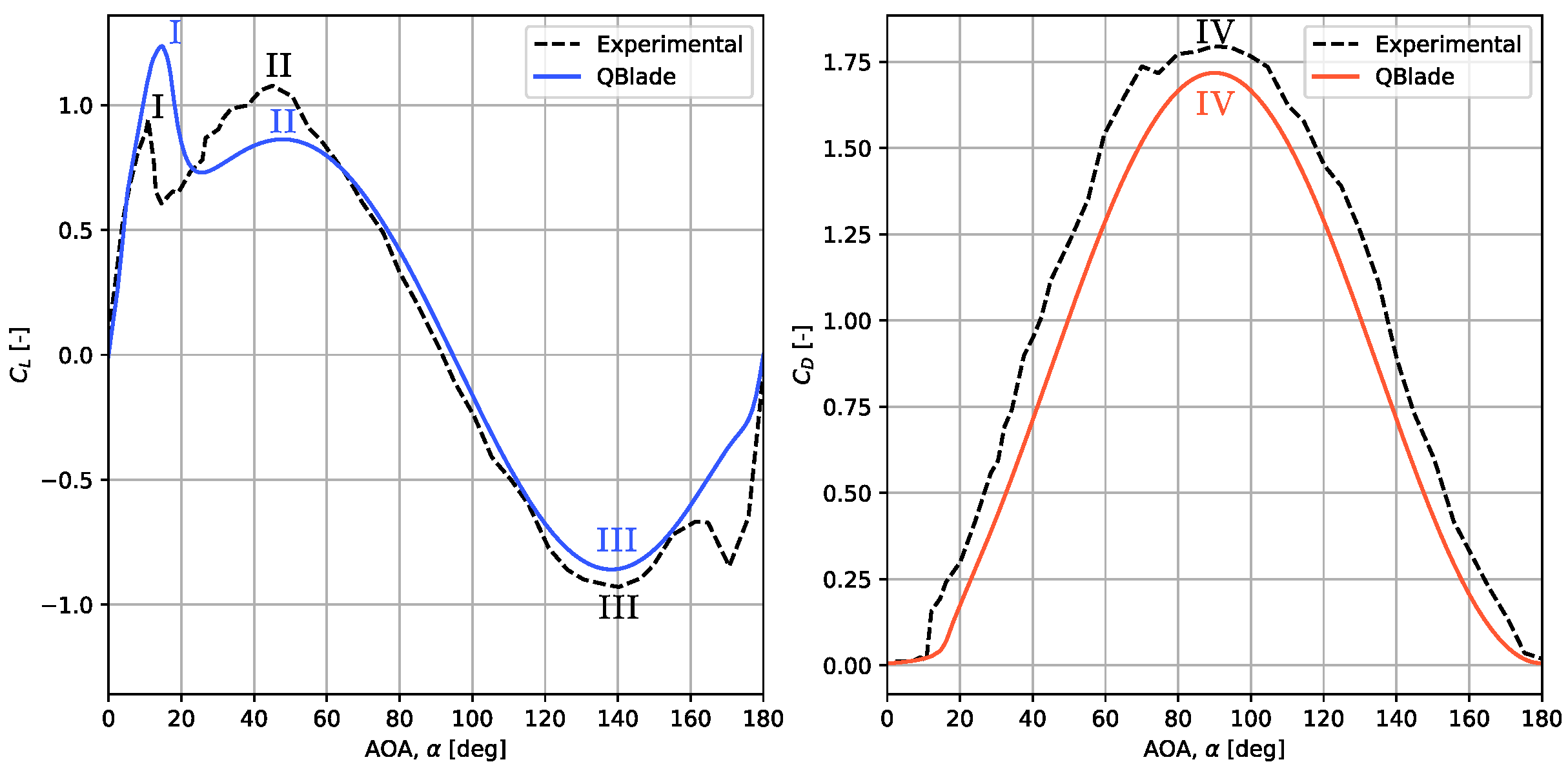
To assess the reliability of the extrapolated polars, the QBlade-generated
and
curves for the NACA 0012 airfoil at
were compared with the experimental measurements of Sheldahl and Klimas [
58]. As shown in
Figure 8, the extrapolated lift and drag curves reproduce the pre-stall, stall, and post-stall trends of the experimental data, including the characteristic inverted parabolic shape of the drag coefficient associated with fully separated flow.
The relative deviation was quantified using
with the results summarized in
Table 4. The Montgomerie method reproduces extreme lift and drag values within 5–35%, which is consistent with previously reported uncertainty ranges for semi-empirical extrapolation methods in VAWT modeling [
59]. This level of accuracy is sufficient for the comparative DMST and LLFVW analyses conducted in this study.
Although only the NACA 0012 airfoil is directly compared against experimental polar data, this validation is intended to assess the reliability of the extrapolation methodology rather than to individually validate each airfoil. Accurate post-stall aerodynamic data extending to
are essential for VAWT analysis, particularly at low tip-speed ratios encountered during startup; however, such data remain scarce. Consequently, semi-empirical extrapolation methods are widely employed in VAWT modeling, often under the assumption that fully separated post-stall behavior is only weakly dependent on airfoil shape [
60]. While cambered low-Reynolds-number airfoils may exhibit increased uncertainty in deep stall, the present results are therefore interpreted in a comparative sense, consistent with the scope of the study and the objective of identifying robust performance trends rather than absolute load predictions.
4.2. DMST and LLFVW Model Validation
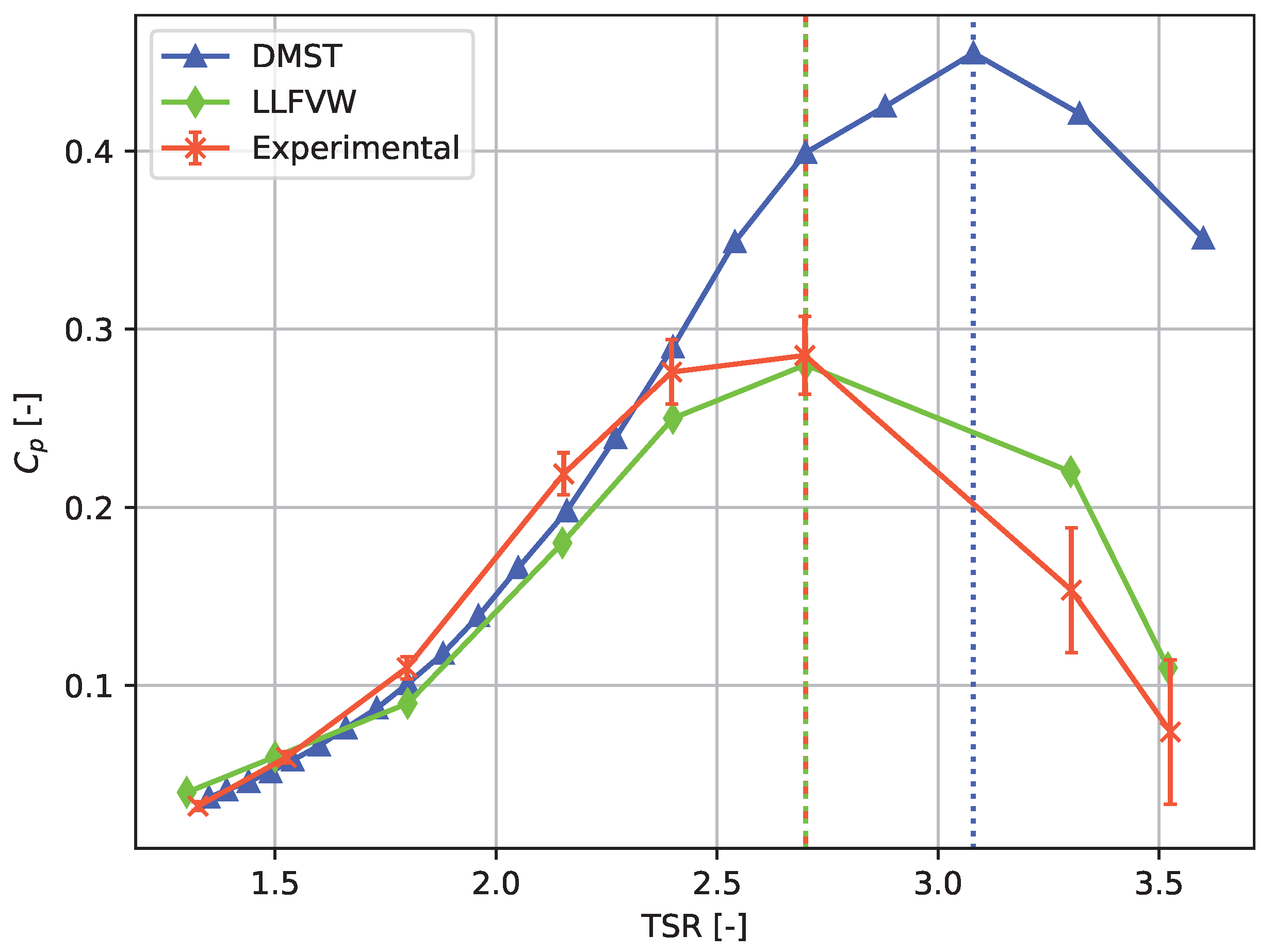
The performance of the DMST and LLFVW approaches was evaluated by comparing the predicted power coefficient
against the experimental measurements of Battisti et al. [
34].
Figure 9 presents the validation curves, and
Table 5 summarizes representative numerical values and corresponding percentage deviations.
Both models reproduce the onset of power generation and the low-TSR behavior. At , the DMST and LLFVW predictions differ from the experimental value by only 4.62% and 1.57%, respectively, demonstrating good agreement in the regime dominated by attached-flow aerodynamics.
As the TSR increases, the differences between the two approaches become more evident. Near the performance peak (
), the LLFVW model maintains a close match to the experiment, with an error of 2.50%, while DMST overpredicts the power coefficient by nearly 40%. This behavior is consistent with the trend in
Figure 9, where the DMST curve exhibits a sharper rise relative to the experimental data.
At higher TSR values, where wake expansion, induction losses, and unsteady effects become increasingly dominant, the limitations of DMST are particularly pronounced. At , the DMST prediction exceeds the experimental value by over 400%, while the LLFVW method although still overpredicts it shows a markedly lower deviation of 49.80%. The LLFVW curve also captures the experimentally observed drop in more faithfully, reflecting its more accurate representation of vortex dynamics and wake development.
Overall, the LLFVW method provides consistently superior agreement across the full operating range, reproducing both the magnitude and the location of the performance peak more accurately than DMST. For this reason, the LLFVW model is deemed the more reliable predictor of turbine performance in this study.
The markedly improved agreement of LLFVW with experimental data, relative to DMST, indicates that wake dynamics and unsteady induction effects play a dominant role in determining turbine performance, outweighing uncertainties associated with the XFOIL airfoil polar generation.
5. Results and Discussion
This section provides a thorough evaluation of the aerodynamic performance of six selected airfoil profiles using QBlade DMST and LLFVW simulations across wind speeds representative of urban environments. In line with the study’s objective of comparatively evaluating startup torque generation and nominal power performance for classical symmetric NACA, low-Reynolds number, and VAWT-specific profiles, the results are organized around three complementary operating regimes: (i) overall
-TSR trends at fixed inflow velocity, (ii) startup (
), and (iii) nominal operation (
). Particular emphasis is placed on identifying the extent to which low-Re profiles facilitate self-starting under the weak winds typical of urban micro-turbines, as well as which airfoils offer increased efficiency once operational TSRs are reached. These analyses are interpreted alongside the tangential force as a function of the azimuth in
Section 5.4, offering a comprehensive understanding of the mechanisms behind the observed performance differences.
5.1. Overall Performance Trends (–TSR)
The aerodynamic performance of the six selected airfoil is evaluated by examining the power coefficient (
) as a function of tip-speed ratio (
) across several free-stream velocities (
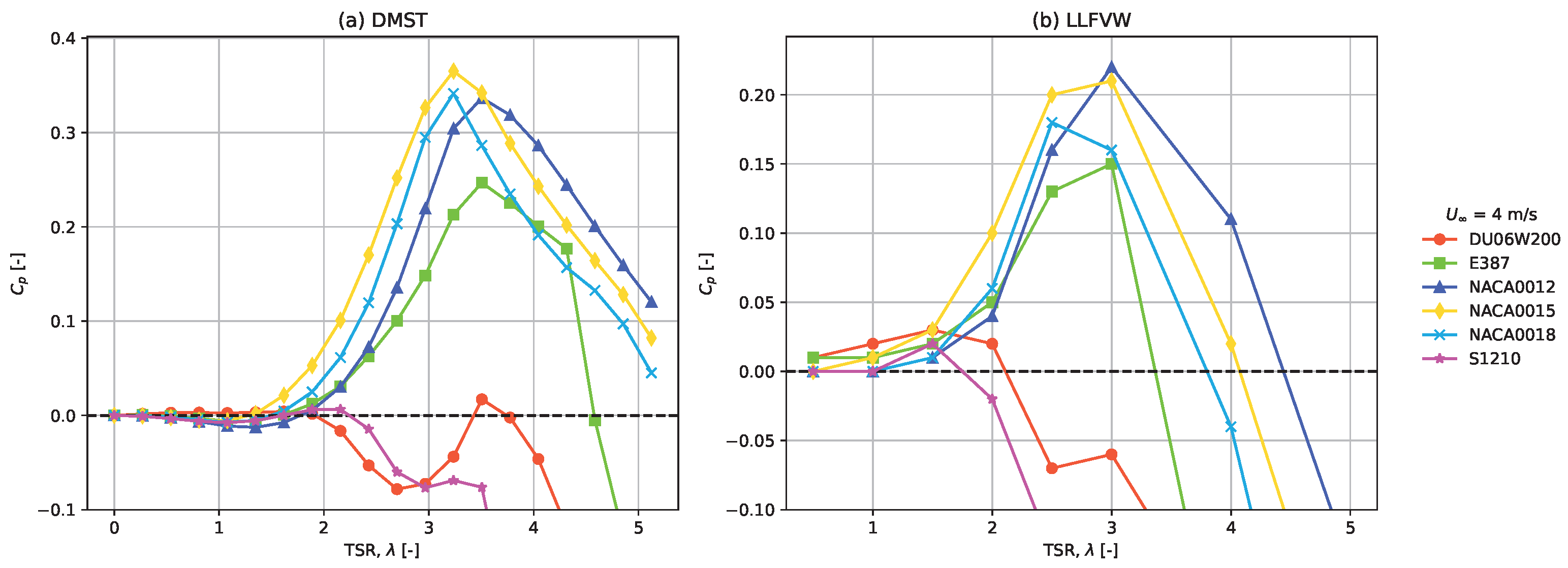
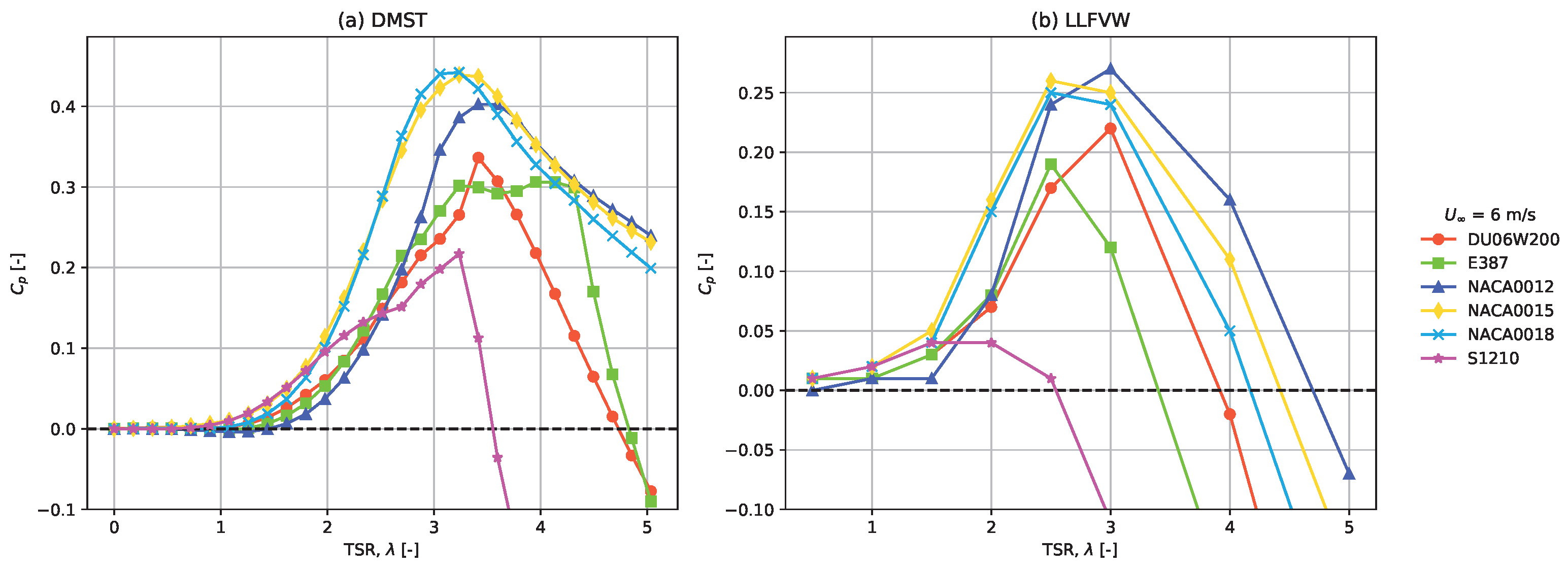
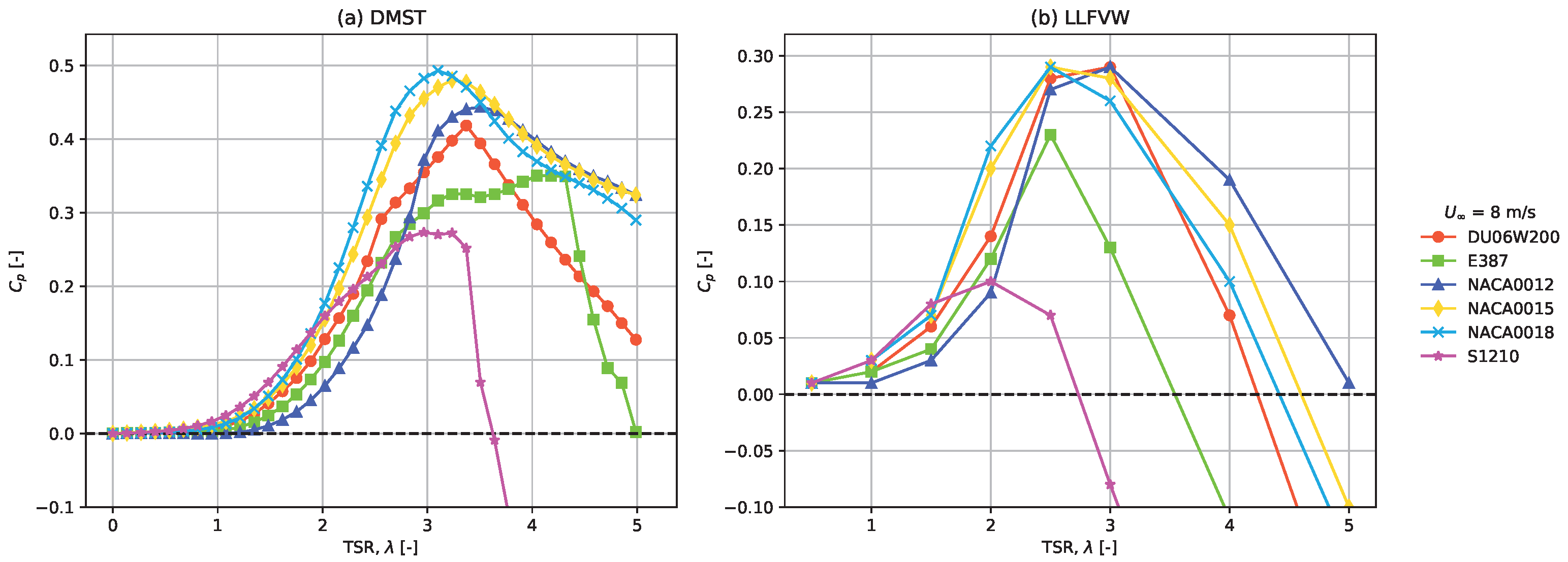
). Each figure is divided into two panels: panel (a) reports Double-Multiple Streamtube (DMST) predictions, representing a quasi-steady design-oriented model, whereas panel (b) presents Lifting-Line Free Vortex Wake (LLFVW) results, which incorporate unsteady aerodynamic effects and wake-induced velocity deficits. The latter therefore provides a more realistic estimate of operational performance, particularly in regimes characterized by dynamic stall and strong induction. These results complement the model-verification study reported in
Section 4.2.
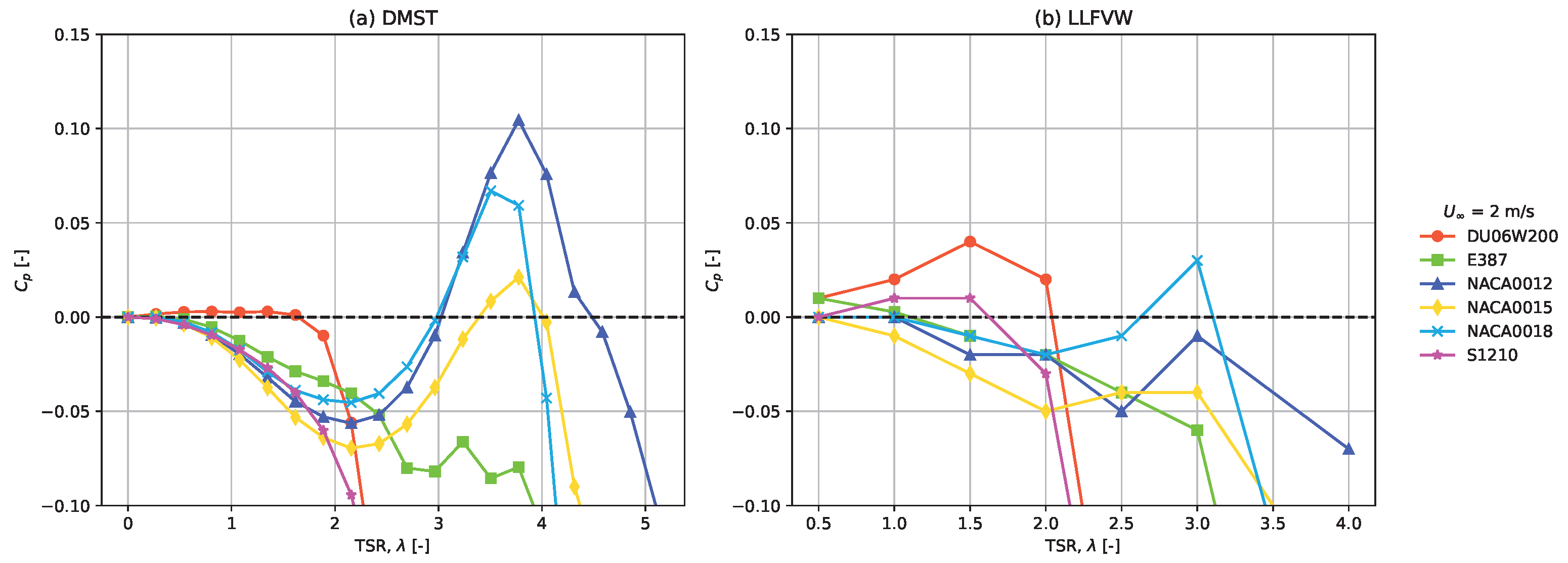
Figure 10 summarizes the behavior at
m/s, corresponding to a low Reynolds-number regime
. Under these conditions both models predict severe performance degradation:
for
possibly to early laminar separation. The LLFVW curves lie below their DMST counterparts, consistent with the expected increase in unsteady losses. Notably, LLFVW predicts positive
for the DU 06-W-200 and S1210 at
, suggesting that these airfoils are capable of generating sufficient torque to overcome inertial and bearing losses during startup. In contrast, the symmetric NACA profiles show limited power extraction at this velocity, with NACA 0018 producing only a narrow positive peak near
.
At the intermediate velocity case (
m/s), shown in
Figure 11, both models converge to similar qualitative rankings: the NACA 0012, 0015, and 0018 yield the highest performance, whereas the E387 consistently underperforms. As expected, DMST predicts larger peak values (up to
) and a broader optimal operating range. LLFVW predictions are more conservative, producing peaks of approximately
–
and exhibiting a steeper decline beyond
, reflecting stronger induction and pronounced dynamic-stall effects at increasing rotational speeds. The DU 06-W-200 and S1210 achieve positive
only for low TSRs and experience a rapid decay thereafter.
Figure 12 highlights the divergence between the models at
m/s. DMST continues to overpredict performance with broadened peaks reaching up to
. In contrast, LLFVW predicts narrower maxima of approximately
–
and a sharp drop beyond
, consistent with the onset of strong dynamic stall. For LLFVW, the three symmetric NACA airfoils again exhibit superior performance. The DU 06-W-200 and E387 provide moderate performance with peaks near
–
, while the S1210 shows substantial degradation, remaining below
for most of the TSR range.
The highest velocity case,
m/s, is shown in
Figure 13. Here, the discrepancies between DMST and LLFVW become most pronounced. The DMST model predicts high peak efficiencies between
–
at
, and maintains unrealistically elevated values at large TSRs due to its quasi-steady formulation. LLFVW predictions, however, indicate that the true operational peaks occur earlier (around
) with maximum values between
and
. Across both models, NACA 0018 remains the best performer, although the LLFVW curves show relatively small differences among the NACA family and DU 06-W-200. In contrast, DMST suggests diminished performance for the DU 06-W-200, while LLFVW indicates a more competitive behavior. The E387 provides intermediate performance in both models. The S1210 persists as the weakest airfoil, with LLFVW predicting early stall and negative
for
.
Overall, results across all velocities demonstrate (i) the consistent overprediction of performance by the DMST method, especially at higher TSRs; (ii) the superior behavior of the NACA family across these wind velocities; and (iii) the clear underperformance of the S1210 profile under all conditions examined.
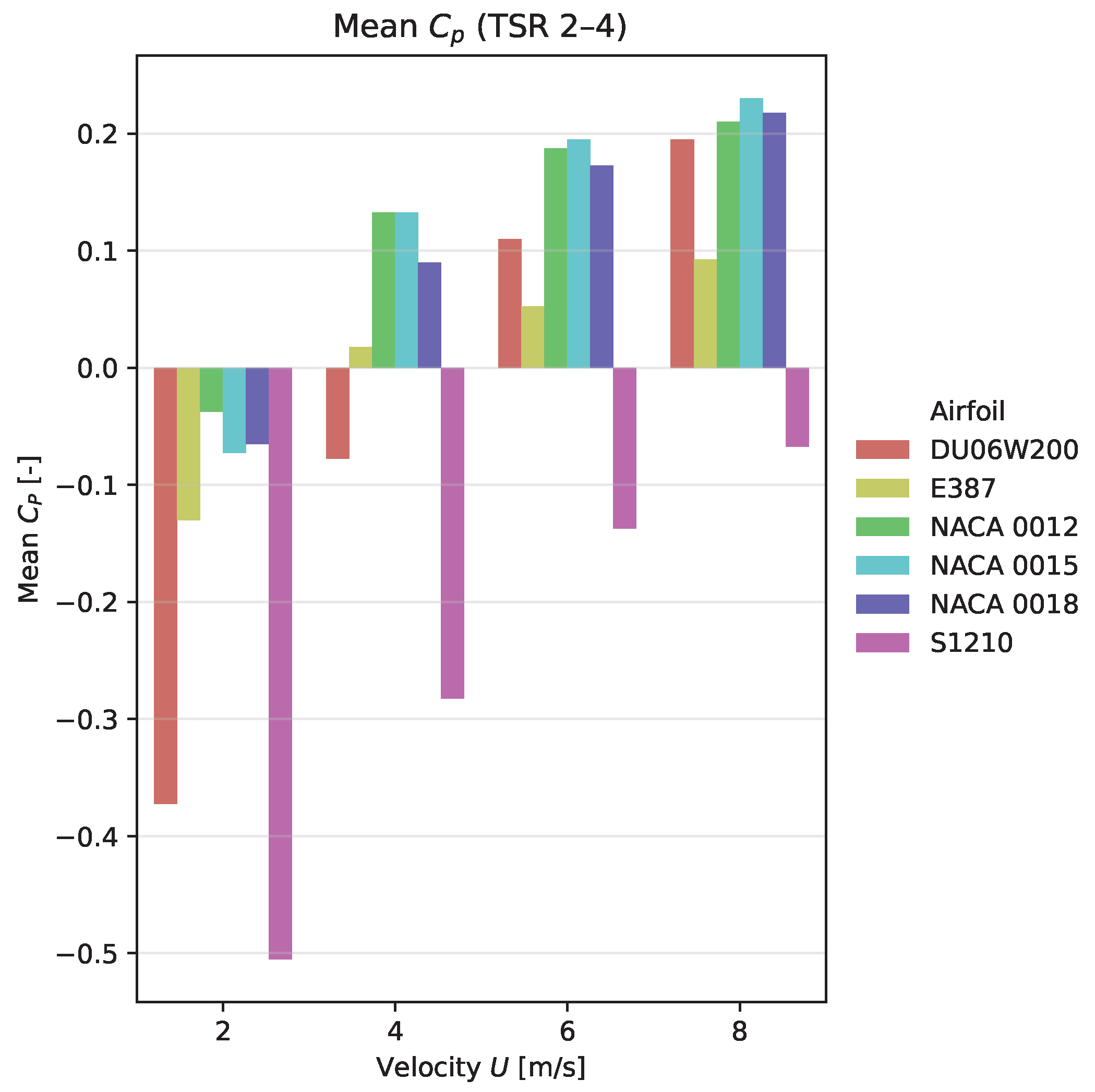
5.2. Startup Performance ()
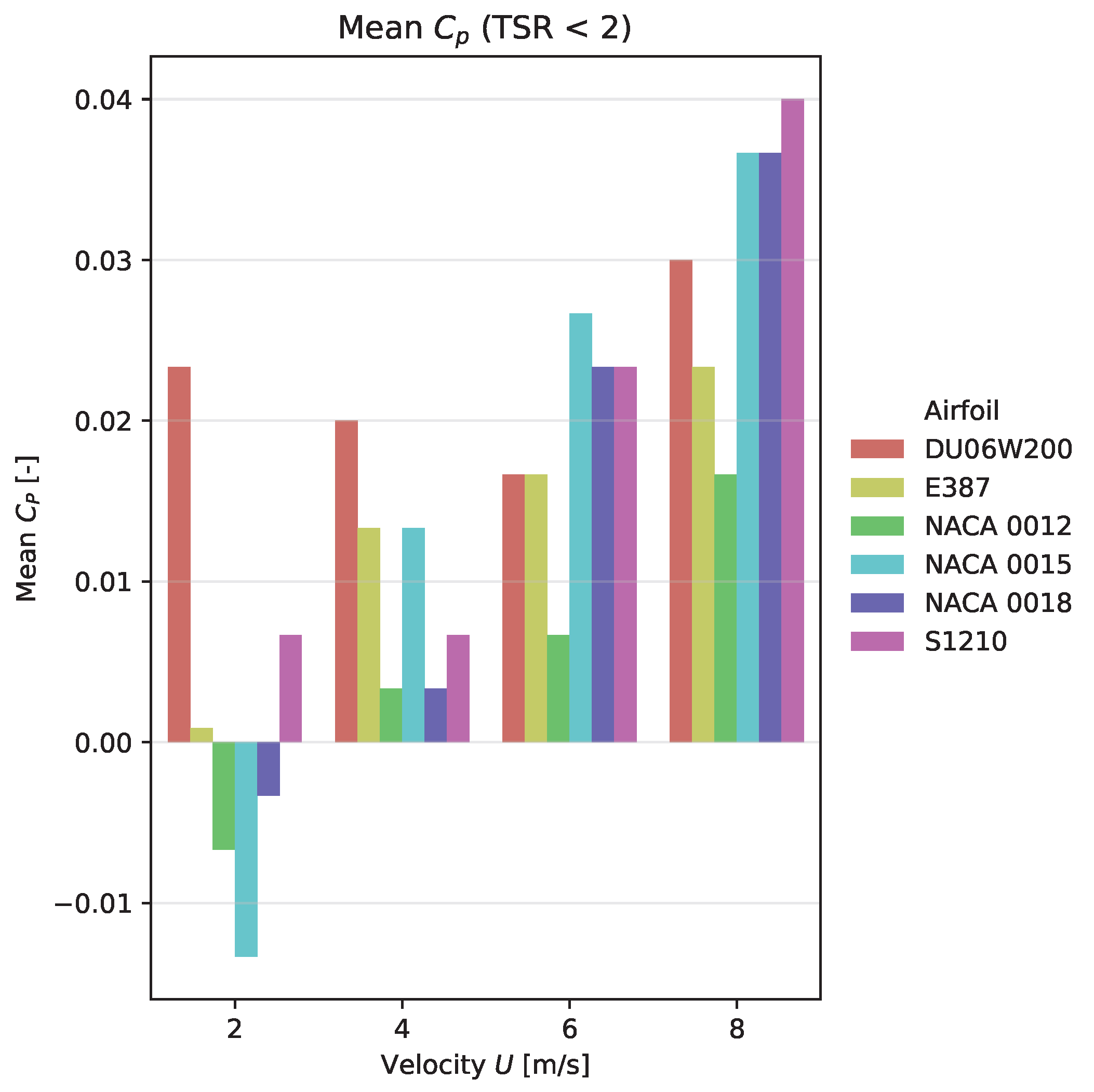
To complement the
-TSR curves presented in
Section 5.1, the startup behavior of each airfoil is assessed using the mean power coefficient,
, computed from LLFVW simulations over the interval
.
Figure 14 summarizes the resulting trends for inflow velocities between 2 and 8 m/s.
It is noted that the present startup analysis considers aerodynamic torque only and neglects the rotational inertia of the rotor–generator system. This modeling choice is intentional and is adopted to isolate the influence of airfoil aerodynamic characteristics on self-starting behavior under identical geometric and mass assumptions. Rotational inertia primarily governs the transient acceleration rate and the time required to overcome static equilibrium, rather than the sign and relative magnitude of the aerodynamic torque available during startup.
Similar aerodynamic-only startup analyses have been adopted in recent VAWT studies focused on low-TSR performance and self-starting trends, where the objective is to compare relative aerodynamic behavior rather than to predict startup time histories or cut-in dynamics [
61,
62]. Under such conditions, inertial effects act as a common scaling factor and do not alter the qualitative ranking of airfoils when rotor mass and geometry are held constant. Accordingly, the present results are interpreted in a comparative sense, emphasizing relative self-starting potential rather than absolute startup duration.
At m/s, most airfoils exhibit negative or near-zero , indicating insufficient torque to overcome aerodynamic and mechanical resistance. The DU 06-W-200 and S1210 represent clear exceptions, both generating consistently positive mean torque and thus demonstrating superior low-wind self-starting capability. By contrast, the NACA 0012, 0015, and 0018 profiles remain unable to initiate rotation at this speed.
When the wind velocity increases to 4.0 m/s, all airfoils achieve positive within the startup regime, though their relative performance diverges. The DU 06-W-200 retains the highest mean torque, while the S1210 shows a moderate but steady improvement. The NACA 0012 and the low-Re E387 display the greatest increase from their low wind values, whereas the NACA 0015 and 0018 remain comparatively modest.
At higher inflow velocities (6–8 m/s), all profiles produce positive startup torque. The NACA 0015, NACA 0018, and S1210 exhibit the largest increases in , with the S1210 achieving the highest value at 8.0 m/s. The DU 06-W-200 maintains favorable performance but is less sensitive to velocity increases, consistent with its broad low-Re operating envelope. The E387 improves incrementally but remains moderate across all speeds, while the NACA 0012 consistently delivers the lowest values.
The consistently poor startup performance of the NACA 0012 can be attributed to its symmetric and relatively thin geometry, which is unfavorable under the low tip-speed ratio and low Reynolds number conditions characteristic of the startup phase. At
, the blades operate at large instantaneous angles of attack and experience highly unsteady inflow, where symmetric airfoils generate limited lift and undergo early flow separation. This results in intermittent torque production with frequent sign changes, as reflected by the negative
values and the highest torque ripple index (TRI) reported in
Table 6. Consequently, the NACA 0012 fails to sustain a stable positive aerodynamic moment, leading to systematically low
values across all wind speeds.
Table 6 summarizes the corresponding torque behavior. The DU 06-W-200 exhibits the highest and most stable torque production, characterized by the largest mean
and the lowest torque ripple index (TRI), indicating smooth and reliable self-starting. In contrast, the NACA profiles and the S1210 show pronounced cycle-to-cycle variability, including intermittent negative torque, resulting in relatively high TRI values. The E387 demonstrates the lowest mean torque and frequent negative excursions, confirming its limited suitability for autonomous startup. Overall, the DU 06-W-200 emerges as the most favorable airfoil for consistent torque generation in the startup regime.
5.3. Nominal Operating Performance ()
To provide a consolidated view of the airfoil performance within the typical operating TSR range of a VAWT,
Figure 15 presents the mean power coefficient
obtained from the LLFVW simulations for
across the inflow velocities considered (2–8 m/s). At
m/s, all airfoils exhibit negative
values, confirming that none of the configurations can extract net positive power at such low wind speed. As the velocity increases, the NACA 0012, 0015, and 0018 profiles show a consistent improvement, with the 0015 and 0018 achieving the highest
values at 6–8 m/s.
In contrast, both the S1210 and the dedicated VAWT airfoil DU 06-W-200 produce substantially negative at 4.0 m/s, indicating that they function as net drag devices and dissipate rather than generate energy within this TSR range. The DU 06-W-200 transitions to positive performance only at velocities above 4.0 m/s, reaching levels comparable to those of the NACA airfoils at 8.0 m/s. The E387 remains inefficient throughout the nominal TSR range, exhibiting negative coefficients at low velocities and failing to match the performance of the NACA family at higher wind speeds.
A more detailed view of the nominal regime is provided in
Table 7, which summarizes the torque behavior over the same TSR interval. The torque ripple index (TRI) is defined as
where
is the standard deviation of the torque coefficient over one revolution and
is its mean value. The NACA 0012, 0015, and 0018 profiles deliver the highest mean torque coefficients and exhibit relatively low torque-ripple indices, indicating efficient and stable power production. The E387 performs moderately, remaining below the NACA series but maintaining predominantly positive torque throughout this regime.
The DU 06-W-200, which excelled in the startup region (
Section 5.2), displays highly inconsistent nominal behavior characterized by frequent negative torque excursions, large standard deviations, and the highest TRI value among all airfoils. This confirms that although DU 06-W-200 supports self-starting, it provides poor efficiency and stability once the turbine reaches operational TSRs. The S1210 performs worst overall: it exhibits negative mean torque, pronounced deep-stall characteristics, and highly asymmetric torque fluctuations, further reinforcing its unsuitability for sustained power production.
These trends highlight a clear decoupling between startup and nominal performance. Airfoils that are adequate for self-starting (such as DU 06-W-200 and S1210) tend to underperform once operating TSRs are reached, whereas the NACA 0015 and 0018 provide superior efficiency and torque stability during nominal operation at the expense of limited startup capability. This reinforces the need to balance both regimes when selecting airfoils for small scale VAWT applications.
Negative TRI values are non-physical and resulted from a sign inconsistency in the original post-processing; all TRI values are reported here as non-negative fluctuation metrics.
5.4. Aerodynamic Loads on the Rotor Blades
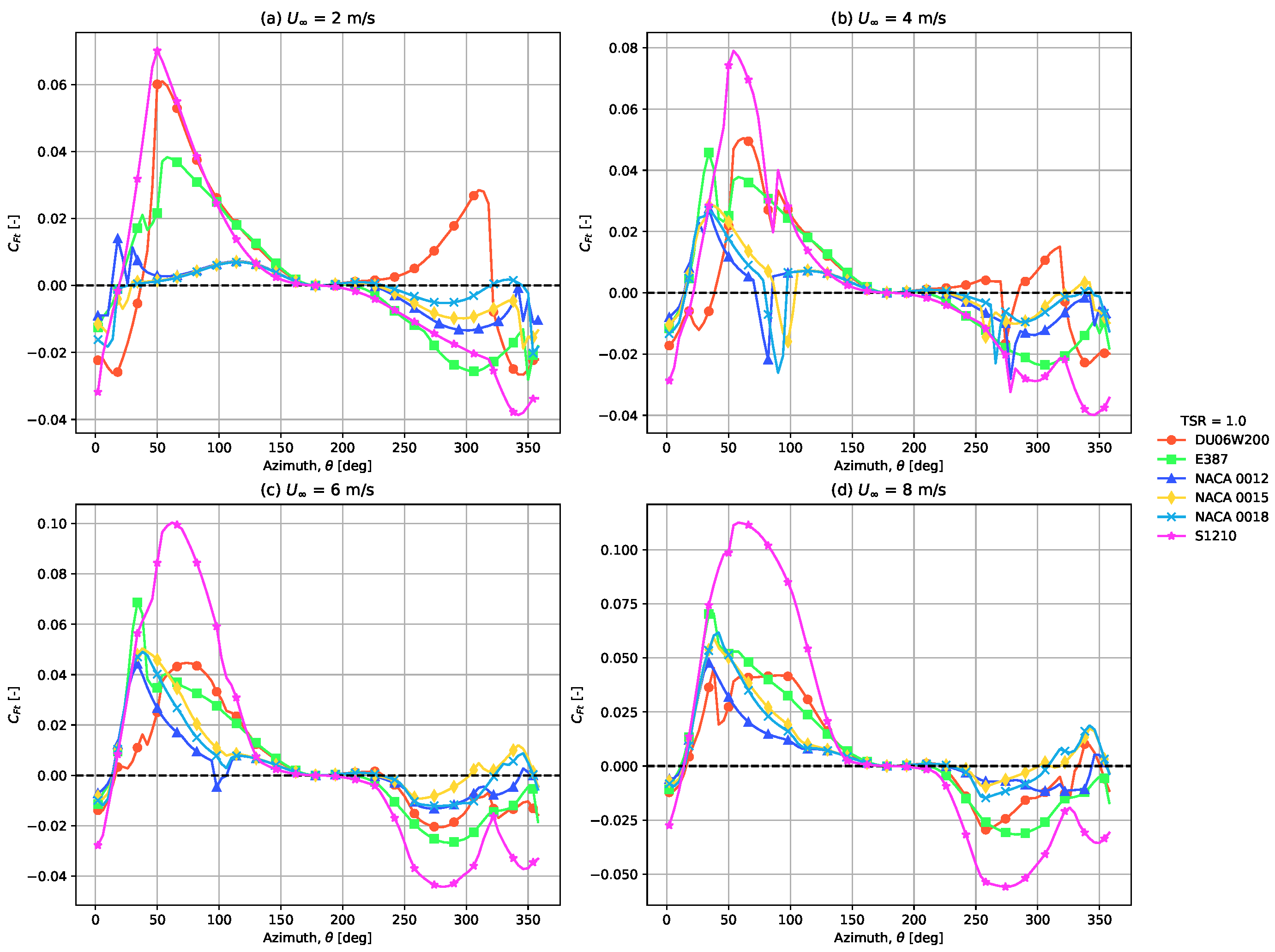
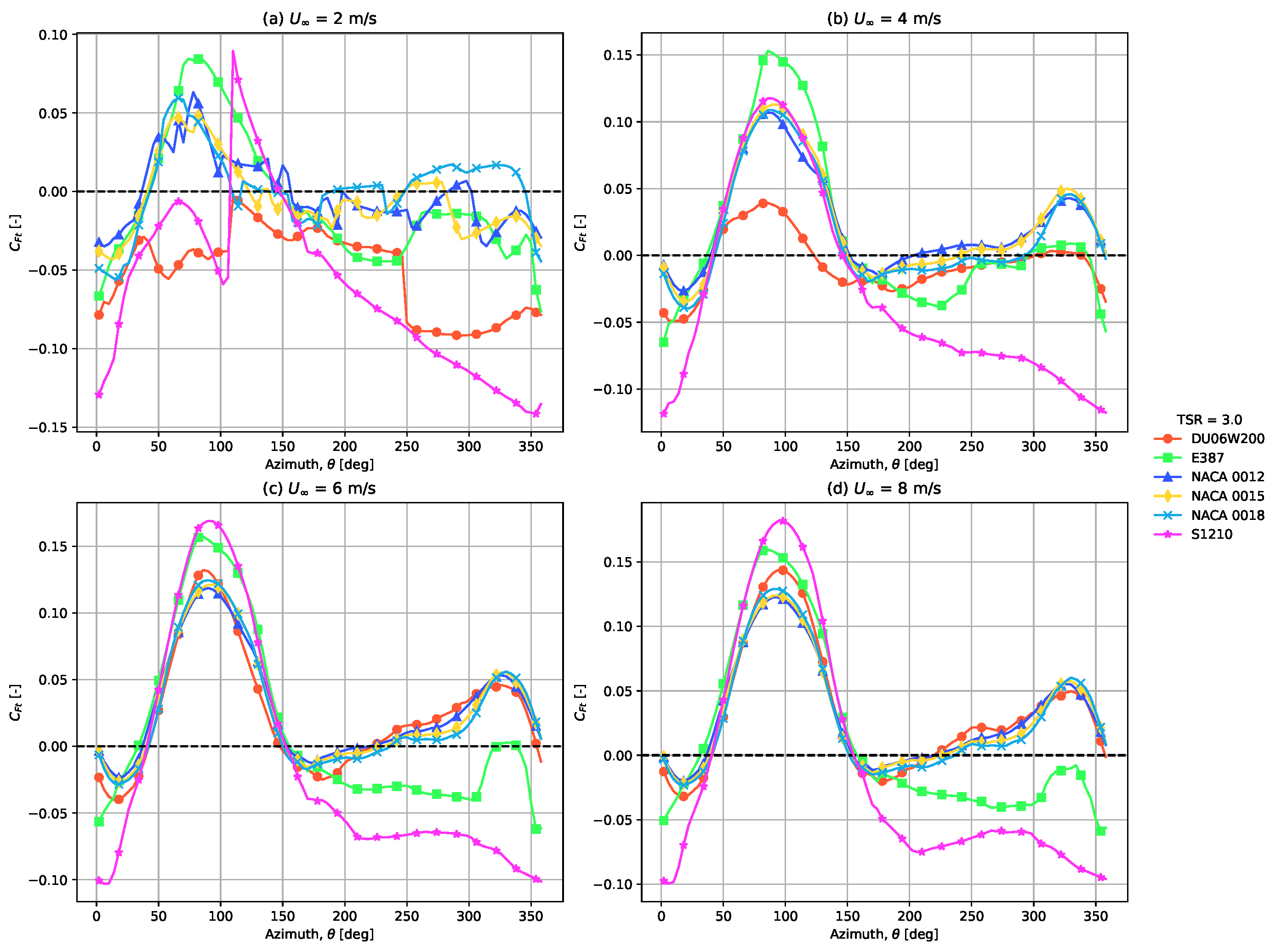
To further interpret the power-generation trends discussed in the previous subsections, this section examines the azimuthal variation of the tangential force coefficient,
, which directly governs torque production.
Figure 16 and
Figure 17 show
for all airfoils at two representative operating conditions:
, characteristic of the startup regime, and
, representative of nominal operation. Results correspond to the LLFVW simulations. Azimuth angles between
and
denote the upwind half-cycle, whereas
–
correspond to the downwind (leeward) half-cycle.
Positive values of
indicate net driving torque; negative values denote torque loss, typically associated with drag-dominated or stalled flow. Across all profiles, energy extraction occurs primarily within a narrow sector around
–
, consistent with the classical Darrieus torque-production mechanism [
63,
64].
At
–4 m/s, the S1210 and DU 06-W-200 profiles exhibit the largest positive
values on the upwind side, reflecting their design optimization for low Reynolds numbers. The E387 follows with moderate, yet consistently positive, tangential force. In contrast, the NACA 0012, 0015, and 0018 airfoils produce
values near zero or weakly negative over much of the cycle, explaining their limited self-starting capability noted in
Section 5.2.
Over the complete azimuthal cycle, all profiles except DU 06-W-200 experience extended intervals of negative , particularly on the downwind side, indicating strong drag penalties at low TSR. As the inflow velocity increases to 6–8 m/s, all airfoils generate higher positive in the upwind half-cycle. In this regime, the S1210 displays the strongest peak values, while the DU 06-W-200 maintains the broadest positive interval. These characteristics are consistent with the high values observed in the startup regime for both profiles, and with the DU 06-W-200’s notably low torque-ripple index.
The trend of
changes markedly. At
m/s, all airfoils show irregular and low-magnitude tangential forces, consistent with the negative
values reported earlier. For higher velocities (4–8 m/s), the NACA family exhibits well-defined double-peaked positive
distributions, indicating increased aerodynamic efficiency and reduced flow separation. These trends correlate with their superior nominal performance documented in
Section 5.3.
The DU 06-W-200 also develops a coherent double-peaked structure at these velocities, though with slightly weaker magnitudes than the NACA profiles. In contrast, the S1210 and E387 show only a single positive peak in the upwind half-cycle and notably negative values over most of the downwind region. This behavior explains their low or negative values in the nominal TSR interval despite their good startup performance.
Among the NACA series, performance improves with increasing thickness: the NACA 0018 produces the highest upwind peak, followed by the NACA 0015 and NACA 0012. This hierarchy mirrors the ordering observed in both the startup () and nominal () mean-power trends. Although the S1210 exhibits the single largest upwind peak among all profiles, its strongly negative downwind fundamentally limits its ability to generate net positive torque at high TSR, consistent with the deterioration of its –TSR curve.
Overall, the azimuthal force distributions confirm the key conclusions of the preceding sections: the DU 06-W-200 and S1210 provide strong low-speed torque but suffer from downwind losses at higher TSR, while the NACA 0015 and 0018 develop balanced and sustained positive tangential loading across a wide operating range, resulting in superior nominal efficiency.
5.5. Discussion
Aerodynamic Mechanisms Governing Startup and Nominal Performance
The observed differences in startup capability and nominal efficiency among the airfoil families can be interpreted in terms of their pressure distribution characteristics and flow-separation behavior under the unsteady angles of attack experienced by VAWT blades. During the startup regime (), blades encounter large instantaneous angles of attack and frequent flow reversal, leading to early leading-edge separation and predominantly separated flow over much of the azimuthal cycle. Under these conditions, airfoils designed for low Reynolds numbers, such as the DU 06-W-200 and S1210, maintain relatively stable pressure-side suction and delayed separation due to increased camber and favorable pressure gradients near the leading edge. This results in broader azimuthal regions of positive tangential force and reduced sensitivity to intermittent stall, explaining their superior self-starting performance.
In contrast, symmetric NACA airfoils exhibit limited pressure asymmetry at low Reynolds numbers and large angles of attack, leading to rapid leading-edge separation and weak lift generation during startup. The resulting flow is largely drag-dominated, with frequent sign changes in the tangential force, which manifests as low mean torque and high torque-ripple indices. These characteristics fundamentally limit their ability to sustain positive aerodynamic torque during the initial acceleration phase.
As the turbine transitions to nominal operation (), the effective angles of attack decrease and the flow becomes more periodically attached during the upwind passage. Under these conditions, thicker symmetric NACA profiles develop more stable suction peaks and smoother pressure recovery, delaying large-scale separation and reducing dynamic stall severity. This leads to coherent double-peaked tangential force distributions and relatively small downwind penalties, consistent with their higher mean power coefficients and lower torque ripple.
Conversely, the DU 06-W-200 and S1210 airfoils experience extensive flow separation during the downwind half-cycle at nominal TSRs. Although these airfoils can generate high instantaneous lift peaks on the upwind side, their strongly cambered geometry promotes asymmetric pressure recovery and deep stall in the leeward region, resulting in large negative tangential forces that offset the upwind gains. This explains why airfoils optimized for low-Re startup performance exhibit diminished efficiency and stability once operational tip-speed ratios are reached.
Together, the results highlight a clear distinction between low-speed self-starting capability and nominal aerodynamic efficiency, which is central for VAWTs intended for deployment in low-wind urban environments. The dedicated VAWT airfoil DU 06-W-200 and the low-Re S1210 consistently generate positive torque at
and
m/s, demonstrating the strongest self-starting potential. Conversely, the symmetric NACA airfoils exhibit insufficient torque at low velocities and LLFVW results indicate negligible or negative
in the startup regime. These trends are consistent with the azimuthal distributions presented in
Section 5.4, where the DU 06-W-200 and S1210 demonstrate extended upwind intervals of positive
and limited downwind losses at low TSRs.
A fundamentally different behavior is observed once the rotor reaches its nominal operating regime (). In this case, the NACA 0015 and NACA 0018 airfoils demonstrate the highest mean power coefficients and the lowest torque-ripple indices. This indicates that they are capable of efficient energy extraction and reduced unsteady penalties. Conversely, the DU 06-W-200 and S1210 suffer pronounced negative torque excursions and deep-stall behavior, indicating that their low-Re benefits did not translate into consistent nominal performance. The E387 exhibits moderate performance in both regimes but is clearly inferior to the NACA family at operational TSR.
The comparison between DMST and LLFVW across all velocities further reveals the limitations of quasi-steady models in predicting high-TSR efficiency, with DMST systematically overestimating and extending the apparent operational envelope. LLFVW predictions indicate earlier peak locations and sharper performance deterioration at large , consistent with increased induction and dynamic stall. Under the more realistic LLFVW model, the NACA airfoils maintain superior ranking, while the S1210 remains the weakest performer.
These analyses confirm the necessity of balancing startup and nominal performance when selecting airfoils for small-scale urban VAWTs. Airfoils optimized exclusively for low Reynolds numbers facilitate self-starting at low wind speeds, an essential requirement given the characteristic urban wind velocities summarized in
Section 1. However, these same airfoils often exhibit suboptimal efficiency once design TSRs are reached. In contrast, thicker, symmetric NACA airfoils possess robust nominal efficiency but limited self-starting capability. The integration of
-TSR curves, torque metrics, and azimuthal load distributions provides a coherent explanation of the observed performance hierarchy across the operating regimes relevant to urban deployment.
In the present analysis, atmospheric turbulence characteristic of urban environments was intentionally excluded in order to isolate baseline aerodynamic trends and enable a consistent comparison across airfoils and modeling approaches. Similarly, the present startup assessment neglects system inertia; this simplification is consistent with the aerodynamic focus of the study and does not affect the comparative trends reported herein. This assumption primarily affects the magnitude of unsteady aerodynamic phenomena rather than the qualitative ranking of airfoil performance. Recent URANS-based CFD studies have demonstrated that increased turbulence intensity can significantly enhance the power coefficient of small-scale VAWTs by more than 20% in some cases while exhibiting negligible influence on large-scale turbines, highlighting the scale-dependent nature of turbulence effects [
65]. Consequently, the absolute values of startup torque and power coefficient reported here may be optimistic, especially for airfoils already prone to deep-stall behavior, such as the DU 06-W-200 and S1210. However, because all airfoils were evaluated under identical inflow conditions, the observed relative trends namely, the superior self-starting capability of low-Re airfoils and the higher nominal efficiency of symmetric NACA airfoils are expected to remain qualitatively robust. The incorporation of stochastic inflow or prescribed turbulence intensity is therefore anticipated to shift performance levels but not alter the fundamental trade-off identified between startup and nominal efficiency. Quantifying these effects represents a significant extension of the present work.
High-fidelity numerical studies have demonstrated that unsteady and three-dimensional effects play a significant role in the aerodynamic behavior of VAWTs operating at low tip-speed ratios. For example, Gharaati et al. [
66] employed large-eddy simulation coupled with an actuator line method to investigate the turbulent wake dynamics of straight- and helical-bladed VAWTs at TSRs of 0.4 and 0.6, showing that blade geometry strongly influences wake topology, turbulence transition, and the temporal variability of torque and power coefficients. Such studies provide detailed insight into wake evolution and load fluctuations but come at a substantial computational cost. In contrast, the present work does not aim to resolve wake turbulence or blade–wake interactions; instead, it focuses on assessing the consistency of airfoil performance trends across low- and intermediate-fidelity aerodynamic models, which remain valuable for early-stage design and parametric studies of small-scale VAWTs.
Finally, it is important to note that aerodynamic airfoil selection constitutes only one aspect of realizing effective small-scale VAWT deployment in urban environments. The heterogeneous and often sub-optimal wind conditions typical of cities, characterized by low mean speeds, high turbulence, and flow blockage, suggest that turbine siting plays a crucial role in performance. Recent studies support rooftop or elevated installations as a promising strategy to enhance exposure to usable wind, mitigate ground-level turbulence, and improve overall energy yield [
3,
67,
68]. Integrating the airfoil performance results of the present study with thoughtful placement strategies may thus enable more realistic and efficient use of VAWTs in urban buildings or dense metropolitan contexts.
6. Conclusions
This study evaluated the aerodynamic performance of six airfoil profiles for a small-scale Darrieus VAWT operating under the low wind speeds characteristic of urban environments, using QBlade simulations based on DMST and LLFVW models. Across the operating envelope considered (2–8 m/s), the results consistently reveal a trade-off between self-starting capability at low tip-speed ratios and aerodynamic efficiency at nominal operating conditions.
Low-Reynolds-number airfoils such as the S1210 and the VAWT-oriented DU 06-W-200 exhibit superior starting torque and are the only airfoils capable of producing positive mean power at . This behavior is primarily attributed to their camber and low-Re optimization, which promote higher lift at low relative velocities. However, at higher TSRs these same features lead to earlier stall onset, pronounced hysteresis, and increased negative torque excursions, ultimately reducing their mean power coefficient under nominal operating conditions.
In contrast, symmetric NACA airfoils display limited self-starting capability but outperform the low-Re airfoils once operational TSRs are reached. Within the nominal operating range (), the NACA 0015 and NACA 0018 achieve the highest mean and reduced torque ripple, confirming their suitability for sustained energy extraction. While the DU 06-W-200 reaches power coefficients comparable to those of the NACA airfoils at the highest wind speed considered (8.0 m/s), this occurs at the expense of increased torque unsteadiness. The E387 remains less efficient across all regimes and does not reach the performance levels of the NACA airfoils.
A comparison between DMST and LLFVW indicates that DMST systematically overpredicts performance at intermediate and high TSRs, highlighting the importance of resolving unsteady aerodynamic effects when dynamic stall and induction play a significant role. Validation against experimental reference data suggests that the LLFVW approach captures the overall power coefficient trends with reasonable accuracy, although discrepancies remain near peak efficiency and in stall-dominated conditions.
Within the set of airfoils examined in this study, no single profile simultaneously maximizes self-starting capability and nominal power output. For urban applications, where wind speeds typically range from 2 to 8 m/s, airfoil selection must therefore prioritize either autonomous startup under weak winds or higher efficiency once operational TSRs are achieved. Future work will focus on experimental validation and on hybrid blade concepts, defined here as spanwise airfoil variation along a single blade, combining sections optimized for startup near the blade root with profiles optimized for nominal efficiency toward the tip. Such configurations offer a physically motivated pathway to mitigating the identified startup–efficiency trade-off in micro-scale urban VAWTs.
Limitations and future work:
Urban turbulence characteristics, including boundary layer effects, inflow variability, and rooftop–induced turbulence, were not considered and should be incorporated in future studies.
The aerodynamic input polars were generated using XFOIL and extended using empirical post-stall extrapolation methods. While this approach is suitable for comparative studies, XFOIL exhibits limited accuracy in strongly separated and transitional flows, and post-stall extrapolation can introduce significant uncertainty in absolute load predictions. As a result, the present analysis emphasizes relative performance trends rather than precise force estimation.
The coupling between aerodynamic performance, structural design, and noise constraints requires further investigation for practical micro-scale deployment.
High fidelity CFD and experimental measurements are needed to validate LLFVW predictions and to quantify dynamic stall and induction mechanisms under realistic turbulence conditions.





 ,
,