Perspective

On-Demand Solar Hydrogen: From Photochemical Charge Storage to Stimuli-Responsive Fuel Release

Department of Chemistry “Giacomo Ciamician”, University of Bologna, Via Piero Gobetti 85, 40129 Bologna, Italy
*
Authors to whom correspondence should be addressed.
Energies 2026, 19(4), 941; https://doi.org/10.3390/en19040941
Submission received: 15 January 2026 / Revised: 29 January 2026 / Accepted: 9 February 2026 / Published: 11 February 2026
(This article belongs to the Section A5: Hydrogen Energy)

Abstract

Solar-driven hydrogen production is a cornerstone of sustainable energy systems, yet its implementation remains intrinsically constrained by reliance on continuous illumination, limiting temporal control and compatibility with intermittent renewable sources. This perspective articulates the emerging concept of on-demand solar hydrogen generation, in which photon absorption is intentionally decoupled from hydrogen evolution through reversible charge storage and stimuli-responsive catalytic activation. We introduce a systematic classification of on-demand approaches across molecular, semiconductor, and device-level platforms, highlighting how these architectures enable programmable hydrogen release triggered by electrical, chemical, or thermal stimuli and sustained operation beyond illumination periods. Moving beyond a descriptive survey, we propose key performance metrics, including Switching Efficiency, Response Time, and Cycle Fidelity, to enable consistent evaluation and comparison of on-demand systems. Recent advances demonstrate substantial progress in charge storage, catalytic reversibility, and dynamic control, directly addressing the intermittency limitations of conventional photocatalytic and photoelectrochemical technologies. While challenges remain in kinetic synchronization, durability, and scalability, on-demand hydrogen concepts establish a coherent design framework for flexible and dispatchable solar fuels. By enabling integration with variable renewable inputs, this paradigm points toward adaptive and intelligent solar-fuel systems applicable from grid stabilization to off-grid and extraterrestrial environments.

1. Introduction

1.1. Context: Global Need for Sustainable Hydrogen Production and the Challenge of Intermittency

The accelerating demand for clean energy, together with the imperative to reduce greenhouse gas emissions, has made the deployment of renewable power sources a global priority. Solar, wind, and hydropower are rapidly expanding, yet their intrinsic intermittency complicates grid stability and industrial reliability. Solar irradiance fluctuates with diurnal and meteorological cycles; wind availability is geographically irregular; hydropower is sensitive to drought and ecological constraints. These temporal mismatches between generation and demand highlight the necessity of long-duration and flexible energy-storage strategies [1].
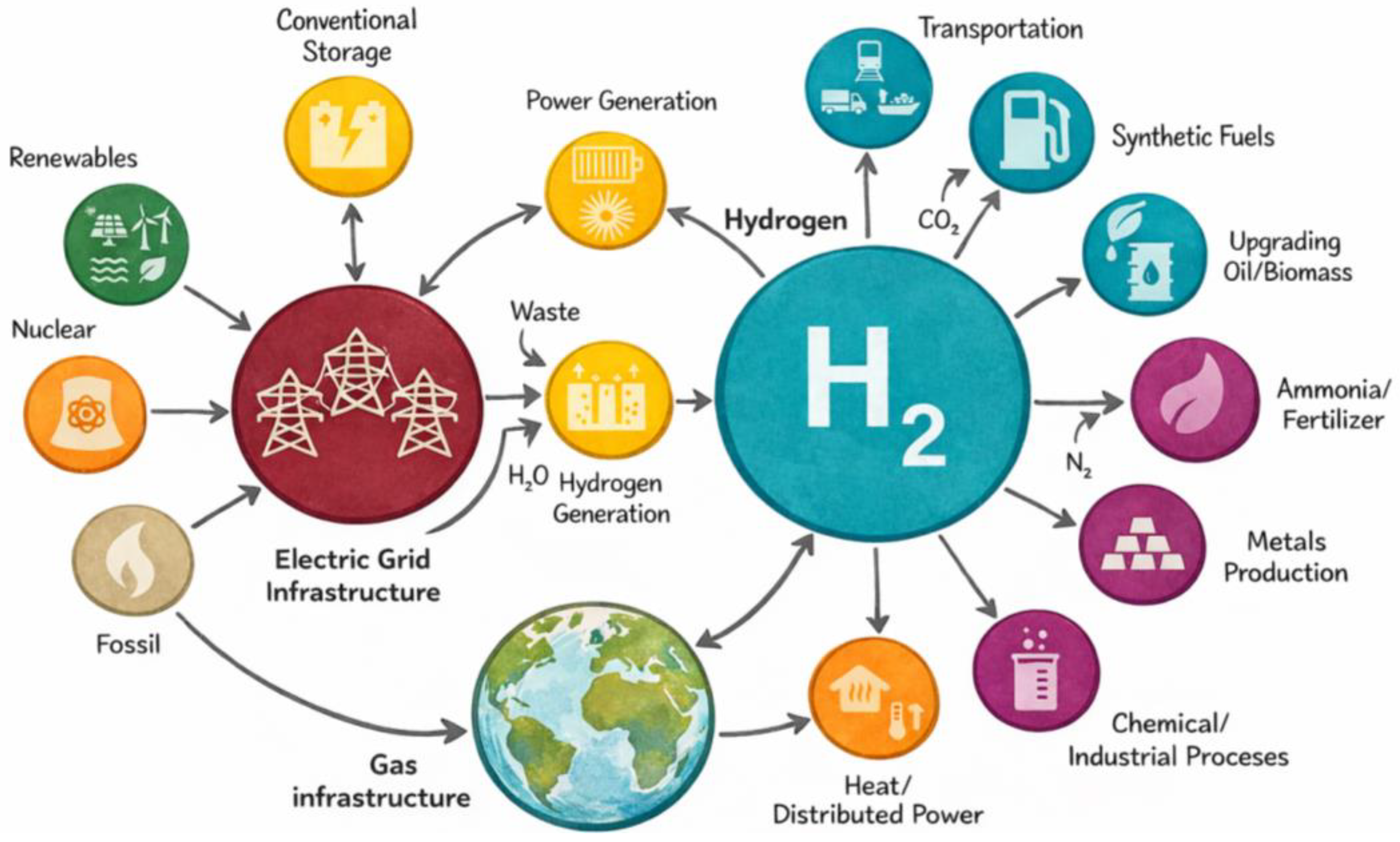
Solar-to-chemical conversion provides a compelling solution by transforming intermittent photon flux into storable fuels. Within this framework, hydrogen offers unmatched versatility: it possesses the highest gravimetric energy density among clean fuels, can be produced from water using sunlight or renewable electricity, and emits only water upon utilization [2,3,4,5]. Hydrogen potential to decarbonize sectors such as heavy industry, aviation, shipping, and chemical manufacturing underscores its central role in the low-carbon transition, as schematically represented in Figure 1 [6,7].
Yet the temporal variability of renewable sources demands hydrogen-production technologies capable of responding dynamically to fluctuating energy availability.

1.2. Problem: Light-Dependent Water-Splitting Systems Lack Temporal Control

Despite half a century of research following the pioneering 1972 work by Fujishima and Honda [8], practical solar-to-hydrogen conversion technologies remain constrained by their strict dependence on continuous illumination [9]. Both photocatalytic (PC) and photoelectrochemical (PEC) systems evolve hydrogen only under light exposure; gas production ceases almost immediately in darkness. This inherent coupling between illumination and hydrogen generation introduces three critical limitations: (i) the poor temporal control, as hydrogen demand is often continuous or process-driven, while sunlight availability is intermittent and unpredictable; (ii) the operational and safety challenges, because fluctuating production rates require auxiliary storage or compression systems, which add cost, inefficiency, and risk due to hydrogen low volumetric density and high diffusivity; and (iii) difficult integration with chemical processes and grid operations, given that uncontrolled gas evolution under variable illumination leads to inconsistencies in supply and complicates downstream coupling.
Even photovoltaic–electrolyzer hybrids inherit the temporal mismatch intrinsic to solar power, relying on electrical buffering rather than resolving the fundamental absence of controllability in conventional photochemical systems [10].

1.3. Concept: “On-Demand” Hydrogen Generation as a Paradigm Shift

To overcome these constraints, the emerging concept of on-demand hydrogen generation decouples light absorption from hydrogen release. Instead of relying on continuous illumination, the system stores photogenerated charges or metastable intermediates and subsequently releases hydrogen upon an external stimulus, such as electrical bias, temperature, redox triggers, or chemical modulation, even in the dark. This provides programmable control over the timing, rate, and duration of hydrogen evolution.
Such systems naturally integrate with solar–electric or solar–thermal infrastructures, using peak irradiance to accumulate chemical potential and enabling hydrogen evolution during off-sun periods. This hybridization makes on-demand hydrogen not merely an alternative to solar-driven water splitting, but a complementary technology capable of stabilizing fluctuations in renewable power. It transforms hydrogen from a “passively produced” fuel into a dispatchable clean energy vector.
Achieving this vision requires materials and devices capable of long-lived charge storage, reversible catalytic activation, and stable multi-cycle operation, essentially enabling solar-to-hydrogen systems that can think, pause, and restart without continuous illumination.

1.4. Scope and Purpose of This Perspective

This Perspective defines on-demand hydrogen generation as a reversible, stimuli-responsive hydrogen-evolution process in which photon absorption and catalytic turnover occur at distinct, controllable times. Two criteria establish true on-demand functionality: (i) long-lived and reversible charge or intermediate storage under idle or dark conditions; and (ii) stimuli-responsive hydrogen release whose rate and duration can be externally modulated without structural degradation.
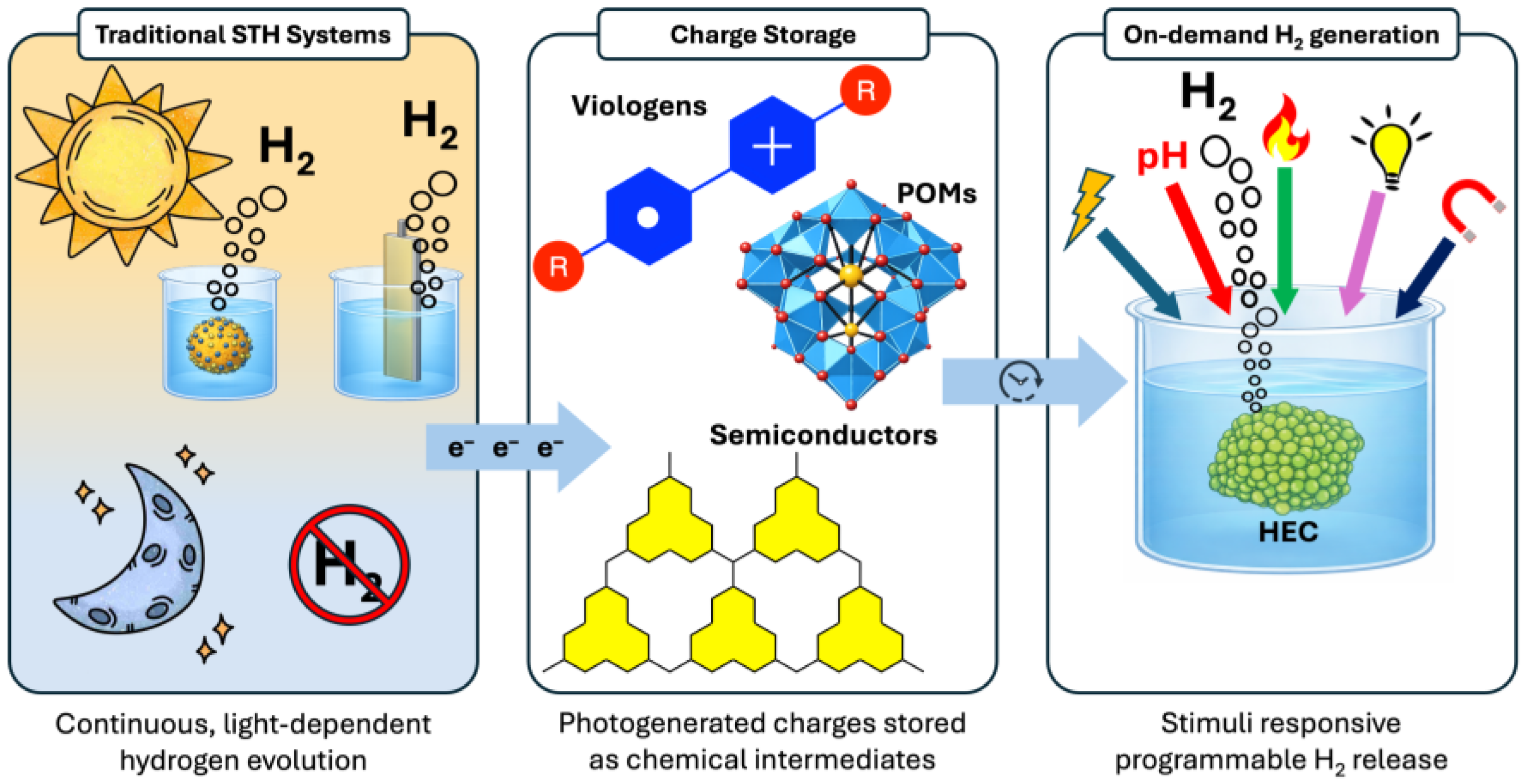
While photovoltaic–electrolyzer pairs can mimic on-demand behavior through electrical control, their multistage energy losses and engineering complexity motivate the search for integrated photochemical alternatives [11,12]. This Perspective synthesizes the fundamental photochemistry, mechanistic principles, materials strategies, and device architectures underlying emerging on-demand hydrogen systems. The goal is to articulate a coherent design framework and identify pathways for translating laboratory advances into scalable, intelligent solar-hydrogen technologies, as illustrated in Figure 2.

2. Basis of Photochemical Hydrogen Production

2.1. Fundamental Principles: Photophysics, Charge Separation, and Proton Reduction

Efficient solar-to-chemical energy conversion relies on three interconnected steps: (i) Light absorption and exciton generation in molecular chromophores or semiconductor materials, (ii) charge separation and migration to prevent recombination and deliver electrons and holes to catalytic sites, and (iii) proton reduction to H2, mediated by molecular catalysts or heterogeneous surfaces.
Photon absorption generates excited states whose lifetimes, typically femto- to microseconds, define the window for charge separation. In molecular systems, excited-state quenching occurs via dynamic electron transfer or static complex formation; classical examples include [Ru(bpy)3]2+, Ir(ppy)3, or donor–acceptor dyads [13]. In semiconductors, band-edge energetics, defect density, and carrier mobility determine the efficiency of exciton dissociation and charge transport.
A key challenge is bridging the kinetic gap between ultrafast photophysics and much slower catalytic turnover (milliseconds to seconds). Maintaining separated charges long enough for productive reduction requires mediators, trap states, or redox-active matrices capable of storing electrons.
Hydrogen evolution requires catalysts (HECs) with low overpotential, fast kinetics, and high stability. Noble metals (Pt, Pd) remain benchmarks [14], but earth-abundant alternatives (Co, Ni, Mo, Fe) and single-atom catalysts are rapidly advancing.
Over the past decade, metal oxides have emerged as increasingly important HECs in on-demand and decoupled solar-to-hydrogen systems, providing robust and chemically tolerant alternatives to conventional noble-metal catalysts [15]. Among them, ruthenium(IV) oxide (RuO2) has attracted particular attention, as it exhibits hydrogen-evolution activities comparable to Pt-based materials while offering substantially broader operational versatility. Notably, RuO2 retains catalytic activity in organic solvents and under conditions that typically deactivate molecular or metallic HECs, including in the presence of sulfur-containing species such as thiols [16,17]. These attributes make RuO2 especially well-suited for multicomponent photochemical architectures employing organic redox mediators or molecular charge-storage units, where catalyst poisoning and solvent compatibility represent critical bottlenecks.
Overall, the efficiency of solar-driven hydrogen generation reflects the synchronization of three processes: photon capture, charge dynamics, and catalytic activity.

2.2. Traditional Approaches: Photocatalytic and Photoelectrochemical Systems

Traditional approaches to solar-to-hydrogen (STH) conversion, primarily based on photocatalytic and photoelectrochemical water splitting systems, were fundamentally conceived to couple solar photon absorption directly with the redox chemistry required to produce hydrogen. In photocatalytic systems, either molecular chromophores or suspended semiconductor nanoparticles absorb incident sunlight and generate electron–hole pairs that drive hydrogen evolution on catalytic surfaces. Although conceptually simple and potentially scalable, these systems suffer from intrinsic limitations, including modest light-harvesting efficiency, rapid charge-carrier recombination, and practical challenges related to catalyst deployment, stability, and recovery on large scales.
Photoelectrochemical architectures mitigate some of these shortcomings by spatially separating light absorption from catalytic turnover. Semiconductor photoelectrodes harvest sunlight and supply photogenerated carriers to electrocatalysts located at the electrode–electrolyte interface. This configuration enables improved control over charge separation dynamics and interfacial reaction kinetics, yielding some of the highest STH efficiencies reported to date [18]. Nonetheless, PEC systems face their own technological barriers, such as photocorrosion and instability of semiconductor materials under operational conditions, reliance on scarce elements, and the engineering complexity associated with fabricating durable, large-area tandem absorbers [19,20].
Despite their foundational importance to the field, both PC and PEC systems share a critical limitation: their strict reliance on continuous illumination. While such dependence may seem inherent to any solar-driven process, it remains the most substantial obstacle to 24/7 industrial deployment. In all conventional PC and PEC architectures, hydrogen evolution halts immediately in the absence of light, whether due to nightfall, cloud cover, or intermittent solar flux. Overcoming this intrinsic light-dependence is therefore a primary motivation for pursuing next-generation STH strategies that decouple photon absorption from catalytic hydrogen release, enabling temporally controlled, on-demand operation.

2.3. Key Performance Metrics: Efficiency, Kinetics, and Durability

A comprehensive evaluation of solar hydrogen systems requires a combination of optical, kinetic, and stability metrics, which together describe how effectively a system captures light, separates charges, and catalytically generates hydrogen. Among kinetic descriptors, turnover number (TON) and turnover frequency (TOF) quantify the intrinsic catalytic performance independently of light-harvesting efficiency or reactor design. TON measures the total number of product molecules evolved per catalyst molecule over its lifetime and thus reflects robustness and resistance to deactivation (Equation (1)) [21,22]:
T O N   =   M o l e c u l e s   o f   P r o d u c t M o l e c u l e s   o f   C a t a l y s t .
Equation (1), true only for molecular catalysts, became the following in case heterogeneous systems:
T O N   =   M o l e c u l e s   o f   P r o d u c t C a t a l y t i c   A c t i v e   S i t e s .
Consequently, TON does not encode any temporal information and therefore fails to capture the kinetic profile of the catalytic process, which is essential for assessing systems viability in practical applications. To address this limitation and characterize the reaction rate more accurately, the TOF is defined as:
T O F   =   T O N T i m e   U n i t .
In on-demand hydrogen systems, high TON is particularly critical to sustain repeated on/off cycling, whereas high TOF enables rapid hydrogen release upon activation, making the simultaneous optimization of both parameters essential for practical deployment.
For photoelectrochemical systems, Faradaic efficiency provides a direct measure of selectivity, indicating the fraction of transferred electrons that are quantitatively converted into molecular hydrogen:
η F   =   2 · E v o l v e d   H y d r o g e n   M o l e c u l e s T r a n s f e r r e d   E l e c t r o n s .
Values approaching unity not only maximize charge utilization but also enhance durability by suppressing parasitic reactions that generate deleterious by-products. Heterogeneous systems, including Co-, Pt- and Ru-based composites, routinary show Faradaic efficiencies close to unity, alongside sustained activity over hundreds of cycles [23,24].
Optical performance is captured by the apparent quantum yield (AQY), which quantifies the efficiency of photon-to-charge conversion and reflects the extent to which charge recombination is suppressed:
A Q Y   =   M o l e c u l e s   o f   P r o d u c t I n c i d e n t   P h o t o n s .
High AQY values, approaching unity in optimized semiconductor and nanocrystal-based systems, are especially important for on-demand architectures, as efficient charge generation is a prerequisite for accumulating sufficient redox equivalents to sustain hydrogen evolution in the dark. State-of-the-art semiconductor systems, such as g–C3N4, SrTiO3:Al, and ZnO-based photoelectrodes have reported AQY values approaching 60% under monochromatic illumination [25,26,27,28], while CdSe@CdS nanostructures developed by Amirav and co-workers reached the 100% [29]; thus highlighting the potential for unitary photon utilization.
At the device level, solar-to-hydrogen (STH) efficiency represents the overarching figure of merit, integrating light absorption, charge separation, transport, and catalytic turnover into a single energetic metric:
η S T H   =   ( m o l   H 2 / s ) · ( 237   k J / m o l ) P t o t a l W / m 2 · A r e a ( m 2 ) A M   1.5 G .
While state-of-the-art systems have achieved high instantaneous STH efficiencies in the range of 30% under laboratory conditions [18,30], in on-demand solar hydrogen generation this parameter must be considered alongside charge-storage capability, reversibility, and temporal control, as high peak efficiency does not necessarily translate into dispatchable hydrogen beyond illumination periods.

2.4. Limitations for On-Demand Operation

Classical photocatalytic systems require immediate consumption of photogenerated charges; otherwise, recombination annihilates stored energy. This instantaneous coupling between light absorption and fuel formation prevents temporal control and precludes hydrogen evolution in darkness.
Stimulus-controlled strategies, such as pH modulation or ion coordination, can introduce partial gating of hydrogen evolution, yet they often rely on changes in electrolyte composition, suffer from limited reversibility, and face challenges in scalability and long-term stability. Moreover, uncontrolled gas evolution under fluctuating illumination can induce pressure transients and safety concerns, further complicating practical implementation.
Achieving true on-demand operation therefore requires materials and architectures capable of stabilizing photogenerated electrons in metastable states, suppressing self-discharge, and releasing hydrogen with externally controllable kinetics, while maintaining structural integrity over repeated switching cycles. These unmet requirements motivate the conceptual shift toward decoupled and programmable solar-to-hydrogen systems discussed in the next section.

3. What Does “On-Demand” Mean?

On-demand hydrogen generation refers to systems capable of controlling the timing and rate of hydrogen release via external stimuli, independently of illumination. This decoupling transforms solar-driven devices from passive converters into programmable chemical reactors.
Two central paradigms define the field, specifically kinetic gating (external triggers modulate catalytic rates or active-site accessibility), and thermodynamic storage (photogenerated charges or intermediates are stabilized and later released for hydrogen production).
A defining feature is then temporal decoupling, analogous to the separation of light and dark reactions in natural photosynthesis [31,32].
Natural photosynthesis demonstrates how light harvesting and catalytic fuel formation can be functionally and temporally decoupled through a network of reversible redox mediators. Photosystem II generates charge-separated states that persist long enough to drive multi-electron water oxidation, while downstream mediators (plastoquinone and ferredoxin) relay electrons to enzymatic dark reactions. This separation of light-driven charge generation from chemical synthesis provides a direct analogue for on-demand hydrogen production.
Hydrogenases offer an equally compelling model: their active sites reversibly interconvert between proton-bound, hydride, and reduced states with minimal overpotential [33]. The electronic coupling with distal Fe-S clusters creates an intrinsic buffer that regulates electron flow and provides feedback control when intracellular H2 concentration rises. These natural architectures inspire synthetic systems that integrate reversible storage motifs with catalytic centers capable of switching between active and inactive states.
Together, these biological paradigms reveal three design rules for artificial on-demand systems: (i) spatial segregation of light absorption and catalysis; (ii) reversible redox buffering; and (iii) responsive catalytic gating. These principles directly inform the design strategies discussed in Section 4.

4. Design Strategies for On-Demand Functionality

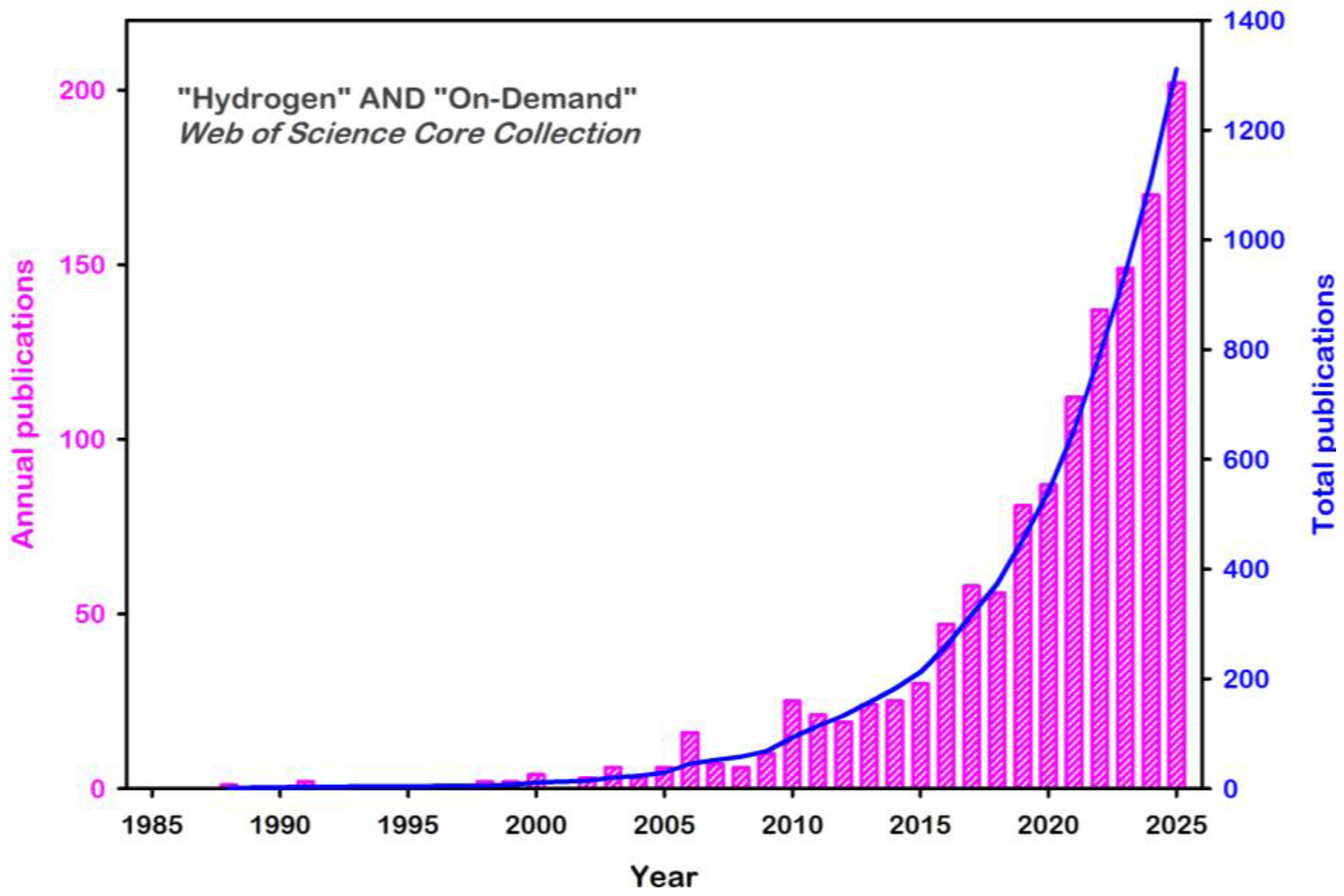
On-demand hydrogen evolution requires integrating molecular-level design principles with material architectures and device concepts that collectively enable reversible activation, long-lived charge storage, and stimulus-responsive catalytic behavior. While the conceptual foundations lie in decoupling photon absorption from hydrogen release, practical implementation depends on strategies that convert external triggers, such as chemical, thermal, electrical, optical, or mechanical, into controlled catalytic states. Research over the past decade (see Figure 3) has shown that diverse systems, from molecular hydride complexes to semiconductor-metal hybrids and magnetically actuated devices, can embody this responsiveness when their structural and electronic properties are engineered accordingly.
The following subsections describe three complementary design domains, specifically molecular/supramolecular frameworks, semiconductor and hybrid platforms, and device-level engineering, and illustrate how concrete examples from the literature demonstrate the principles necessary for achieving true on-demand control. These examples are not presented as a separate classification but are woven into the narrative to highlight how different systems express the same underlying logic of reversible gating, energy buffering, and temporal control.

4.1. Molecular and Supramolecular Systems

Molecular photocatalysts and coordination complexes offer unmatched precision in tuning redox potentials, ligand-field environments, and proton-relay functionalities [13]. Such fine control enables the rational construction of reversible catalytic cycles that respond predictably to external stimuli. As previously said, the majority of the developed photochemical systems work only under direct illumination, entering dormant states in the dark, generally without structural decomposition. Their behavior is then sometimes classified as one of the possible on-demand approaches but, due to inherent dependance by light, it is not able to effectively decouple the light absorption step from the hydrogen evolution reaction, thus not allowing a true orthogonal on/off behavior [34,35,36,37].
Temperature-responsive molecular systems provide an easy way to control hydrogen evolution. Catalysts designed around Lewis-acidic borane motifs illustrate how subtle changes in thermal energy modulate the equilibrium between inactive precursors and active hydride-transfer species. This creates a reversible activation barrier that toggles hydrogen release simply through heating or cooling, without introducing chemical additives or altering catalyst composition [38,39,40,41].
Hydrogen evolution may be triggered by introducing an HEC into the charge-storing phase [42]. While efficient, this methodology suffers from poor recyclability and insufficient modularity. The primary drawback lies in the inability to selectively quench the catalytic process; because termination necessitates the extraction of the HEC from the medium, the approach is frequently incompatible with established homogeneous or heterogeneous frameworks that do not facilitate rapid catalyst removal.
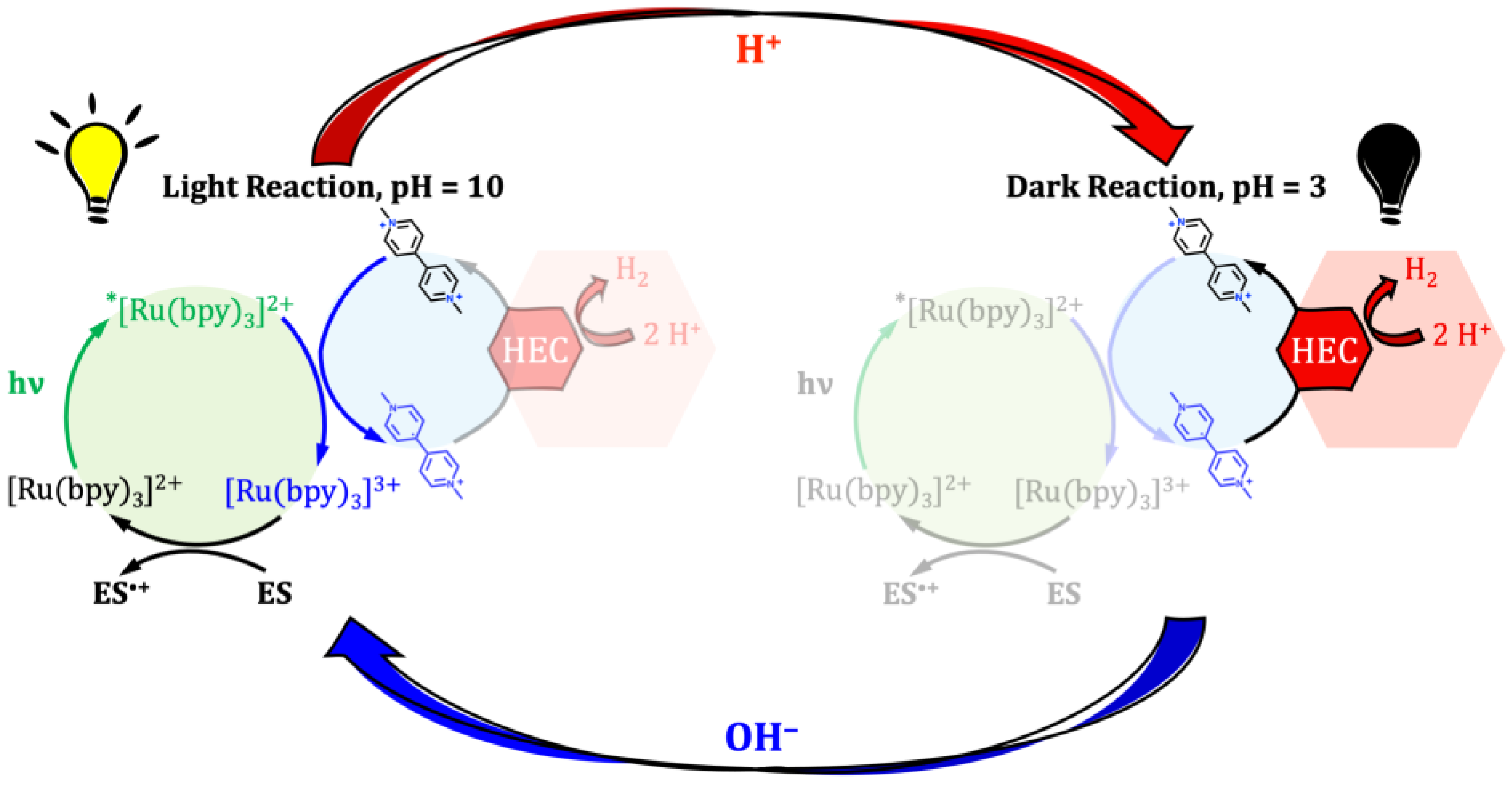
A particularly powerful molecular strategy to achieve true on-demand operation relies on storing photogenerated redox equivalents in discrete, metastable molecular species that function as chemical charge reservoirs, thereby decoupling light absorption from catalytic hydrogen evolution. Viologens, most prominently methyl viologen (MV2+), are among the most established molecular electron-storage relays for artificial photosynthesis, because their one-electron reduction yields the deeply colored and strongly reducing viologen radical cation (MV•+), which can be accumulated and later discharged to drive proton reduction. As a recent example in this field, we provided a particularly clear on-demand blueprint with a pH-switchable three-component system (TCS) based on [Ru(bpy)3]2+/MV2+/triethanolamine (TEOA), where light-driven photoreduction is carried out under alkaline conditions to accumulate MV•+, and hydrogen generation is then triggered in the dark by acidification in the presence of a hydrogen-evolution catalyst (HEC). In this design, pH is not a mere “condition”, but a functional control knob: alkaline media sustain the photochemical cycle and stabilize the stored radical, while acidic media promote rapid discharge of MV•+ at the catalyst interface to form H2, as represented in Figure 4 [43].
Importantly for an on-demand framework, we show that MV•+ stability under anaerobic alkaline conditions enables long storage times.
Mechanistically, viologen-based on-demand operation hinges on (i) efficient charge accumulation and (ii) selective, triggered discharge. In that system, MV•+ accumulation is easily quantified spectroscopically under anaerobic conditions, highlighting a practical constraint for viologen storage: oxygen leakage induces slow radical loss, so O2 removal and robust sealing become design requirements at scale.
Beyond this archetypal TCS, recent literature expands viologen-based on-demand concepts in three directions. First, molecular catalyst coupling: viologen radicals can serve as chemically generated hydride or proton–electron equivalents that feed defined HER catalysts through Proton-Coupled electron Transfer (PCET)-like steps, enabling mechanistic control and improved selectivity. For example, a recent study analyzes viologen-radical-driven HER with cobalt catalysts and discusses how radical reactivity and scavengers can reshape pathways, relevant to designing robust, switchable discharge chemistry in complex electrolytes [44]. Second, materials integration: embedding viologen motifs into semiconductors or porous frameworks can merge “charge storage” and “light harvesting” into single architectures. A 2025 report shows that incorporating methyl viologen into carbon nitride modifies charge separation introducing storage-like behavior through electron extraction by the viologen unit, illustrating how viologens can be used to engineer photogenerated charge retention in polymeric photocatalysts [45]. Third, polymeric and framework viologens: viologen-based polymers and COF-like materials provide higher mediator density and reduced crossover relative to freely diffusing MV2+, and a recent mini-review summarizes design strategies (backbone electronics, ionic transport, and radical stabilization) for tailoring viologen polymers toward photocatalysis and charge-management roles [46]. Although many of these materials are discussed primarily for continuous operation, the same features such as high redox capacity, controllable ion pairing, and confinement are precisely those needed for long-lived “charged” states and programmed discharge in on-demand systems.
A key practical challenge is that viologen radicals can undergo dimerization and disproportionation, nucleophilic attack (especially in strong base), and oxidative loss, all of which shorten storage lifetimes and introduce hysteresis in cycling. Interestingly, the adjacent field of aqueous organic redox-flow batteries has developed a detailed molecular toolkit for suppressing these pathways, which can be directly repurposed for solar-fuel buffering. For instance, studies on improving viologen radical stability and cycling in aqueous systems highlight approaches to mitigate radical decay processes and maintain high coulombic efficiency over hundreds of cycles [47,48]; conceptually aligned with the “cycle fidelity” (see Section 5.3.3) requirement in on-demand hydrogen generation.
Polyoxometalates (POMs) represent a unique and highly versatile class of redox-active metal–oxide clusters that are particularly well suited for on-demand hydrogen evolution, owing to their exceptional ability to reversibly store multiple electrons while maintaining structural integrity. Their discrete molecular nature, rich redox chemistry, and compatibility with covalent functionalization make POMs ideal platforms for temporally decoupling light absorption, charge storage, and catalytic fuel release.
Early work by Cronin and co-workers established the foundational concept of POM-mediated decoupled water splitting, in which reduced POMs function as electron–proton buffers that separate hydrogen and oxygen evolution in time [49]. Building on this principle, subsequent studies demonstrated that POMs can act not merely as passive redox mediators, but as active charge-storage units capable of enabling delayed, light-independent hydrogen production. These developments positioned POMs at the interface between homogeneous and heterogeneous solar-fuel strategies, bridging molecular control with macroscopic functionality.
A major advance in this direction is the development of fully integrated photosensitizer–polyoxometalate (PS-POM) dyads, as reported by Streb and co-workers [42].
In this system, a ruthenium polypyridyl photosensitizer is covalently linked to a lacunary Dawson-type polyoxotungstate, creating a single molecular assembly that combines visible-light absorption, charge separation, multielectron storage, and hydrogen evolution capability. Crucially, the covalent linkage ensures strong electronic coupling between the photosensitizer and the POM, enabling rapid intramolecular electron transfer and suppressing deleterious photodegradation pathways that typically limit non-linked systems.
Upon visible-light irradiation, the PS-POM dyad undergoes efficient photoinduced charge separation, followed by reductive quenching of the excited photosensitizer and subsequent electron transfer to the POM cluster. Spectro-electrochemical and transient absorption studies demonstrate that, in this specific case, the POM unit can reversibly store up to two electrons per molecule, associated with well-defined W(VI/V) redox couples, without compromising cluster stability.
The resulting reduced PS-POM species exhibits long-lived charge-separated states, effectively functioning as a liquid solar fuel that can be stored in the dark under inert conditions for extended periods (half-life > 24 h).
The defining feature of this system is its stimulus-triggered hydrogen release. Hydrogen evolution does not occur spontaneously upon photoreduction; instead, H2 is generated only upon addition of a proton source, enabling precise temporal control over fuel release, but only for a single-shot H2 evolution process.
Beyond this specific example, the broader POM family offers substantial opportunities for rational design. The redox potential, electron-storage capacity, and proton-coupling behavior of POMs can be systematically tuned through heteroatom substitution, lacunary site engineering, and organic or organometallic functionalization. Compared to purely organic redox mediators, POMs exhibit superior resistance to radical degradation and self-discharge, while their multielectron storage capability directly addresses the kinetic mismatch between fast photophysical charge generation and slower catalytic hydrogen evolution.
From the perspective of on-demand hydrogen technologies, POM-based systems occupy a strategically important niche. They enable true temporal decoupling without relying on external electrical storage, batteries, or high-pressure hydrogen containment. Moreover, their molecular definition allows direct correlation between structure, redox state, and function, facilitating mechanistic insight that is difficult to achieve in extended solids. Remaining challenges include improving hydrogen-release yields, minimizing background dark reactions, and integrating POM-based charge storage into scalable device architectures. Nonetheless, PS–POM dyads establish a compelling design blueprint for responsive, multielectron solar-fuel systems capable of storing solar energy chemically and releasing hydrogen strictly on demand.
Collectively, molecular and supramolecular strategies demonstrate how reversible catalysis, charge retention, and stimulus-gated activation can be programmed within well-defined chemical frameworks.
In this context, a qualitative comparison between the two molecular systems described above can be undertaken by examining key features relevant to on-demand hydrogen generation, including the system architecture, the nature of the charge-storage species and its half-life once reduced, the stimulus used to trigger hydrogen evolution, the Coulombic Efficiency of the process (see Section 5.3.2), and the number of on–off cycles demonstrated. These parameters are compiled and summarized in Table 1.

4.2. Semiconductor and Hybrid Systems

Semiconductors and hybrid materials translate molecular-level responsiveness into solid-state platforms suitable for long-term stability and scalable operation. Their ability to absorb light, store photogenerated charges, and mediate redox reactions positions them at the core of solar-driven on-demand hydrogen generation.
Photocatalysts based on graphitic carbon nitride, metal oxides, or sulfides can accumulate electrons in defect states or engineered trap sites, enabling hydrogen evolution to continue after illumination ceases. When coupled with metal nanoparticles or plasmonic structures, these materials exhibit amplified responsiveness: illumination can lower activation barriers or activate surface sites, while darkness restores the system to a less reactive state [50,51,52,53]. Certain core–shell nanostructures exemplify this behavior by using a plasmonic core to harvest light and a catalytic shell to mediate hydrogen release, effectively converting optical input into dynamic modulation of catalytic turnover [54,55].
To achieve true on-demand operation, the illumination used to trigger hydrogen evolution must be fully decoupled from natural sunlight and can instead rely on artificial light sources deliberately tailored to match the plasmonic absorption characteristics of the material.
Chemical gating can also be embedded into semiconductor-supported catalysts. For example, transition-metal nanoparticles anchored on carbon nitride or oxide platforms can be reversibly deactivated by coordinating ions and subsequently reactivated by chelating agents [56,57]. This mechanism preserves catalyst integrity while enabling precise control over hydrogen release, demonstrating that semiconductor supports can host reversible, stimuli-responsive catalytic states that operate independently of light.
Altogether, semiconductor and hybrid systems embody the synergy between light harvesting, charge storage, and gated catalysis, making them key components of on-demand hydrogen technologies.

4.3. Device-Level Integration

Realizing practical on-demand hydrogen systems requires device architectures capable of translating reversible catalytic behavior into controlled hydrogen flow. This involves managing catalyst placement, interfacial transport, and multiphase interactions on spatial and temporal scales relevant to real-world operation.
Catalyst-positioning strategies, such as immobilizing active materials on conductive foams, monolithic substrates, or porous scaffolds, allow mechanical or flow-based repositioning to function as an on/off switch [58,59]. These systems respond immediately when brought into contact with the reactive medium and cease hydrogen evolution when withdrawn, demonstrating the effectiveness of spatial manipulation as a gating mechanism.
Magnetically responsive catalysts represent a refined form of this approach. By embedding ferromagnetic components within catalytic nanoparticles or composite structures, external magnetic fields can cluster, disperse, or entirely remove active species from the reaction zone [60,61,62]. This enables rapid cycling with minimal catalyst loss and highlights how physical manipulation at the device level can achieve temporal control without altering chemical conditions.
Phase-transfer devices introduce another layer of responsiveness by relocating catalysts between immiscible phases under external triggers [63]. Systems in which catalytic clusters transfer between aqueous and organic media, or where emulsification/demulsification redistributes active sites, demonstrate how interfacial engineering can be leveraged to toggle hydrogen evolution [64,65].
Finally, device-level integration also encompasses coupling photochemical reactors with established hydrogen-storage media such as formate, borohydrides, or metal hydrides [58,59]. Designing photochemical systems that generate these species as stable, hydrogen-rich intermediates can convert inherently intermittent catalytic activity into continuous and dispatchable hydrogen release, effectively smoothing fluctuations in light intensity or catalyst availability. Taken together, device-level strategies demonstrate that mechanical, magnetic, or interfacial control plays a central role in translating molecular- and materials-level responsiveness into functional on-demand hydrogen technologies.

5. Current Challenges and Opportunities

The integration of responsive, stimuli-regulated hydrogen evolution into practical solar-fuel architectures requires addressing several interconnected challenges. Although significant strides have been made in molecular design, materials engineering, and reactor integration [14,49,58,59], substantial gaps remain between laboratory demonstrations and deployable technologies. These challenges are not purely technical; they span scales from photophysical mismatches to system-level integration within renewable infrastructures.

5.1. Kinetic Mismatches Between Photophysics and Catalysis

Achieving synchronized operation between ultrafast photophysics and comparatively slow catalytic hydrogen evolution remains one of the most fundamental scientific bottlenecks. While photon absorption and exciton formation proceed in femto- to picosecond timescales, proton reduction at catalytic sites unfolds over milliseconds to seconds. This disparity, spanning up to twelve orders of magnitude, ensures that a majority of photogenerated carriers recombine before contributing to hydrogen evolution. Even in systems that exhibit on-demand responsiveness, such as plasmon-enhanced catalysts or photo-switchable molecular hydrides, the underlying kinetic gap limits charge-storage capacity and temporal fidelity.
Hybrid systems featuring engineered trap states, redox-active mediators, or defect-rich semiconductor scaffolds offer promising strategies for bridging this timescale divide. Plasmonic nanostructures, for instance, can locally enhance electromagnetic fields and inject hot carriers into catalytic sites, partially alleviating recombination. Similarly, redox polymers and viologen-based systems can indefinitely extend photogenerated electron lifetimes, allowing real delayed hydrogen production [43,45]. Nevertheless, a fully integrated resolution will likely require adaptive catalytic interfaces capable of dynamically tuning turnover rates to real-time carrier flux; an area where machine-learning-guided design may provide transformative insights.

5.2. Reversibility and Structural Durability

Stimuli-responsive hydrogen-evolution systems operate far from steady state and experience frequent transitions between active and dormant conditions. These toggling events introduce mechanical, thermal, and chemical stress that can degrade catalytic surfaces, disrupt coordination environments, and compromise electron-transport pathways. For example, in Zn2+/EDTA-gated systems, repeated cycles of ion adsorption and desorption can induce subtle restructuring at metal–support interfaces [66]. Similarly, magnetically actuated nanoparticle catalysts may experience aggregation under repeated field exposure [61].
Ensuring long-term reversibility requires materials capable of accommodating repeated perturbations without structural decay. Promising strategies include embedding active sites within flexible carbonaceous matrices, using single-atom catalysts stabilized by strong metal-nitrogen coordination, and integrating self-healing polymers capable of reorganizing their bonding networks after mechanical disruption.

5.3. Quantitative Metrics for On-Demand Performance

While established metrics such as solar-to-hydrogen efficiency, apparent quantum yield, turnover number, and turnover frequency effectively quantify steady-state performance, they are inherently insufficient to describe the dynamic behavior that defines on-demand hydrogen systems. Because temporal controllability, charge storage, and reversible activation are central to these architectures, we propose a new suite of metrics specifically designed to capture time-dependent performance. We strongly encourage the adoption of these metrics in future studies to enable direct, quantitative comparison between on-demand hydrogen systems, even when they differ substantially in composition, architecture, or operating principles. Establishing a shared metric framework is essential for benchmarking progress and accelerating the rational design of responsive and programmable solar-hydrogen technologies.

5.3.1. Quantum Yield for Stored Charges

This parameter quantifies the fraction of absorbed photons converted into long-lived charge carriers that remain available for subsequent catalytic turnover in the dark. It is defined as the following ratio:
Q Y S C   =   S t o r e d   E l e c t r o n s A b s o r b e d   P h o t o n s .
Time-resolved spectroscopic techniques, as transient absorption or time-correlated photoluminescence, allow direct determination of QYSC by monitoring decay kinetics of photo-reduced intermediates. In practical operation, maintaining QYSC above 30% over multiple illumination cycles can be considered a benchmark for efficient on-demand solar-chemical systems.

5.3.2. Coulombic Efficiency for Stored Charges

While Faradaic efficiency relates total evolved hydrogen to electrical current, Coulombic Efficiency (CESC) evaluates how completely stored charges are selectively utilized for productive H2 evolution. It can be expressed as:
C E S C   =   2 · E v o l v e d   H y d r o g e n   M o l e c u l e s S t o r e d   E l e c t r o n s .
CE therefore measures both redox reversibility and suppression of parasitic pathways (e.g., self-discharge, recombination). For instance, Pd/CNT–Zn2+/EDTA systems achieve CESC ≈ 95% [66], demonstrating nearly complete recovery of stored electrons upon reactivation, whereas polyoxometalate mediators typically exhibit 70–80% due to slow back-electron transfer [42,67].

5.3.3. Switching Efficiency, Response Time, and Cycle Fidelity

Switching efficiency (ηS), response time (tR), and cycle fidelity (CF) dynamic descriptors complement QYSC and CESC by describing how rapidly and reproducibly a system transitions between active and dormant states. Switching efficiency can be defined as follows:
η S   =   H E R o n     H E R o f f H E R o n .
The equation above indicates the fraction of catalytic output suppressed during the “off” phase; while response time can be defined as the latency between stimulus application and measurable hydrogen evolution. Response times on the order of seconds are desirable for grid-responsive hydrogen release.
Cycle fidelity measures the retention of both QY and CE after n switching cycles, integrating chemical and mechanical durability into a single metric.
Establishing standardized testing protocols is essential for reproducibility. Illumination-dark cycling experiments should report not only instantaneous rates but also integrated hydrogen yield per cycle, total stored-charge capacity, and self-discharge constants. In the long term, consensus on quantitative benchmarks (QYSC, CESC, ηS, tR, and CF) will enable meaningful cross-comparison of emerging systems, accelerate materials screening, and guide the rational engineering of next-generation adaptive solar-hydrogen devices.

5.4. Scalability and Reactor Engineering

Translating laboratory-scale on-demand systems to industrially viable devices introduces new physical constraints associated with photon transport, heat management, and fluid dynamics [5,68]. At scale, light attenuation, temperature gradients, and gas accumulation alter reaction kinetics and selectivity. Uniform illumination becomes increasingly difficult in dense slurries or stacked PEC cells, while bubble formation at high rates leads to mass-transport limitations and localized overpotentials.
Microreactor and modular designs provide an effective route to scalability. Microfluidic PEC cells maintain consistent photon flux and enable efficient removal of gaseous products, while modular reactors can be networked in parallel to achieve continuous production even under fluctuating sunlight. Additive manufacturing techniques allow precise fabrication of structured catalysts with optimized geometry for light capture and gas flow. Flexible, transparent conductive substrates mitigate delamination and thermal stress during cycling, improving reliability.
The integration of ion-exchange membranes and compartmentalized flow channels ensures selective transport of protons and mediators while preventing crossover or recombination. Continuous-flow photoreactors incorporating these design principles already demonstrate operational lifetimes exceeding 500 h without performance loss [69,70].
At present, these systems remain largely confined to laboratory-scale development, showing low value of Technology Readiness Level (TRL ≤ 4); however, their progression toward higher TRL and eventual industrial implementation can be enabled through coordinated advances across multiple fields of research and engineering.
The next step is coupling these architectures with automated control systems capable of monitoring and adjusting light intensity, flow rate, and pressure to maintain uniform operation across multiple reactor modules.

5.5. Integration with Renewable Infrastructures

On-demand hydrogen systems must ultimately function as part of broader renewable-energy ecosystems. Integrating them with solar-electric or solar-thermal fields, electrolyzers, and hydrogen pipelines requires control architectures capable of predicting irradiance patterns, dynamically modulating catalyst state, and coordinating hydrogen flow in real time. Automated controllers, fed by optical, thermal, and electrochemical sensors, can preemptively adjust operational conditions to ensure that hydrogen availability matches grid or process demand.
Safety considerations also become paramount at scale. Fluctuating hydrogen evolution introduces pressure transients, gas-composition variations, and thermal fluctuations that must be mitigated by automated feedback loops, relief valves, and membrane-based oxygen exclusion. As on-demand reactors evolve toward distributed networks of modular units, such safety and synchronization protocols will form the backbone of a resilient hydrogen infrastructure.

6. Outlooks

The development of on-demand solar hydrogen technologies signals a shift from passive, illumination-driven systems toward adaptive and controllable solar-to-chemical platforms. Realizing this transition will require coordinated advances in materials design, reactor engineering, and system-level integration, aimed at enabling reliable operation under dynamic, real-world conditions.
On the materials side, data-driven and machine-learning-assisted approaches are increasingly effective in identifying catalysts capable of reversible activation and long-lived charge storage. While such strategies have already demonstrated their potential, further progress will depend on extending these tools toward durability-oriented descriptors, including resistance to self-discharge, structural drift, and degradation under repeated switching.
At the device level, reactor miniaturization and modular design offer promising routes to scalability. Microreactor architectures with controlled illumination, efficient gas management, and integrated membranes can mitigate mass-transport and safety issues while enabling distributed hydrogen production. Coupling these reactors with chemical hydrogen carriers provides an additional buffering layer that smooths fluctuations in solar input and stabilizes hydrogen delivery.
A key enabling element for future systems is intelligent control. Autonomous platforms capable of interpreting sensor feedback such as irradiance, temperature, redox state, and pressure will be essential to synchronize charge accumulation, catalytic activation, and hydrogen release across multiple timescales. Adaptive control strategies can improve switching efficiency, cycle fidelity, and long-term reliability, particularly under fluctuating environmental conditions.
Despite these opportunities, several challenges remain. Multi-cycle reversibility under realistic operating conditions is still difficult to achieve, as repeated switching induces cumulative chemical, mechanical, and thermal stresses that degrade catalysts and charge-storage components. Temporal synchronization between charge storage and catalytic turnover is another critical bottleneck, especially under intermittent illumination, where self-discharge and hysteresis can compromise performance. Scaling on-demand systems beyond laboratory reactors introduces additional constraints related to light distribution, mass transport, pressure management, and safety, requiring redesigned architectures suitable for continuous operation.
Finally, the field lacks standardized metrics to evaluate dynamic performance. Conventional steady-state figures of merit are insufficient to capture switching behavior, response time, and cycle stability. Establishing unified testing protocols and dynamic descriptors will be essential to benchmark emerging technologies and guide rational system design.
Addressing these challenges will require the convergence of reversible materials, operando diagnostics, and autonomous control frameworks. Together, these efforts define the near-term research frontier and will determine whether on-demand solar hydrogen can evolve from a conceptual innovation into a robust component of future energy infrastructures.

7. Concluding Remarks

On-demand solar hydrogen generation marks a fundamental transition from continuous, illumination-bound operation toward temporally programmable and responsive solar-to-chemical conversion. By decoupling photon absorption from catalytic hydrogen release, these systems directly address the intermittency of renewable energy sources and align hydrogen production with real demand rather than instantaneous irradiance. The advances reviewed here demonstrate that such control is no longer a conceptual aspiration but a realizable function across molecular, heterogeneous, and hybrid platforms.
Recent progress in stimuli-responsive catalysis, including pH-gated systems, ion-coordination switches, thermally activated molecular catalysts, light-modulated hybrid nanostructures, and device-level catalyst-transfer architectures, has established a diverse toolbox for achieving reversible hydrogen evolution. These developments reveal that temporal control can be embedded at multiple levels: within molecular coordination environments, at semiconductor–catalyst interfaces, and through physical or interfacial manipulation at the device scale. At the same time, they expose common scientific challenges that transcend specific materials, namely kinetic synchronization between charge storage and catalytic turnover, long-term structural durability under repeated switching, and the absence of standardized metrics to quantify dynamic performance.
Looking forward, the maturation of on-demand hydrogen technologies will depend on the integration of charge-storage motifs with robust catalytic frameworks and feedback-controlled reactor architectures. Performance evaluation must evolve beyond steady-state figures of merit to include switching and Coulombic efficiency, response time, and cycle fidelity, thereby establishing a quantitative language for programmable catalysis. Addressing these challenges will require coordinated advances in materials chemistry, operando characterization, and system engineering.
In the longer term, the convergence of photochemistry, materials science, and intelligent control systems opens a pathway toward autonomous solar-to-hydrogen platforms capable of sensing, storing, and releasing chemical energy in response to environmental and operational cues. Such systems would transform hydrogen from a passively generated energy carrier into an adaptive and dispatchable fuel, suitable for distributed production, chemical manufacturing, off-grid energy supply, and extreme environments. In this perspective, on-demand hydrogen generation represents not merely an incremental improvement in solar fuel technology but a redefinition of how chemical energy conversion can be dynamically integrated into a renewable and resilient energy infrastructure.

Author Contributions

All authors contributed to the writing of the manuscript. All authors have read and agreed to the published version of the manuscript.

Funding

This research was funded by European Union—NextGenerationEU—PNRR investimenti M2.C2. I3.5 “PRIDE: PRoduzione sostenibile di IDrogeno tramite sistemi fotoElettrochimici attivati dalla luce solare”; Project ID RSH2A_000037-CUP F57G25000320006. The authors are grateful to the European Union—NextGenerationEU under the National Recovery and Resilience Plan Project IR0000027, CUP: B33C22000710006−iENTRANCE@ENL: Infrastructure for Energy Transition and circular Economy @ EuroNanoLab.

Data Availability Statement

No new data were created or analyzed in this study. Data sharing is not applicable to this article.

Conflicts of Interest

The authors declare no conflicts of interest.

Abbreviations

The following abbreviations are used in this manuscript:
AQYApparent Quantum Yield
CESCCoulombic Efficiency for Stored Charges
CFCycle Fidelity
HECHydrogen Evolution Catalyst
MLMachine Learning
MV2+Methyl Viologen
PCPhotocatalytic
PCETProton-Coupled Electron Transfer
PECPhotoelectrochemical
POMPolyoxometalate
PSPhotosensitizer
PS-POMPhotosensitizer-Polyoxometalate
QYSCQuantum Yield for Stored Charges
STHSolar-to-Hydrogen
TOFTurnover Frequency
TONTurnover Number
tRResponse Time
TRLTechnology Readiness Level
ηFFaradaic Efficiency
ηSSwitching Efficiency

References

  1. Gowrisankaran, G.; Reynolds, S.S.; Samano, M. Intermittency and the Value of Renewable Energy. J. Political Econ. 2016, 124, 1187–1234. [Google Scholar] [CrossRef]
  2. Rifkin, J. The Hydrogen Economy; Penguin: London, UK, 2003; Available online: https://www.penguinrandomhouse.com/books/292244/the-hydrogen-economy-by-jeremy-rifkin/ (accessed on 15 January 2026).
  3. Momirlan, M.; Veziroglu, T.N. The Properties of Hydrogen as Fuel Tomorrow in Sustainable Energy System for a Cleaner Planet. Int. J. Hydrogen Energy 2005, 30, 795–802. [Google Scholar] [CrossRef]
  4. Bockris, J.O.M. The Hydrogen Economy: Its History. Int. J. Hydrogen Energy 2013, 38, 2579–2588. [Google Scholar] [CrossRef]
  5. Tashie-Lewis, B.C.; Nnabuife, S.G. Hydrogen Production, Distribution, Storage and Power Conversion in a Hydrogen Economy—A Technology Review. Chem. Eng. J. Adv. 2021, 8, 100172. [Google Scholar] [CrossRef]
  6. Hou, Y.; Vidu, R.; Stroeve, P. Solar Energy Storage Methods. Ind. Eng. Chem. Res. 2011, 50, 8954–8964. [Google Scholar] [CrossRef]
  7. Kousksou, T.; Bruel, P.; Jamil, A.; El Rhafiki, T.; Zeraouli, Y. Energy Storage: Applications and Challenges. Sol. Energy Mater. Sol. Cells 2014, 120, 59–80. [Google Scholar] [CrossRef]
  8. Fujishima, A.; Honda, K. Electrochemical Photolysis of Water at a Semiconductor Electrode. Nature 1972, 238, 37–38. [Google Scholar] [CrossRef]
  9. Song, H.; Luo, S.; Huang, H.; Deng, B.; Ye, J. Solar-Driven Hydrogen Production: Recent Advances, Challenges, and Future Perspectives. ACS Energy Lett. 2022, 7, 1043–1065. [Google Scholar] [CrossRef]
  10. Landman, A.; Halabi, R.; Dias, P.; Dotan, H.; Mehlmann, A.; Shter, G.E.; Halabi, M.; Naseraldeen, O.; Mendes, A.; Grader, G.S.; et al. Decoupled Photoelectrochemical Water Splitting System for Centralized Hydrogen Production. Joule 2020, 4, 448–471. [Google Scholar] [CrossRef]
  11. He, Y.; Wang, D. Toward Practical Solar Hydrogen Production. Chem 2018, 4, 405–408. [Google Scholar] [CrossRef]
  12. Wallington, T.J.; Woody, M.; Lewis, G.M.; Keoleian, G.A.; Adler, E.J.; Martins, J.R.R.A.; Collette, M.D. Green Hydrogen Pathways, Energy Efficiencies, and Intensities for Ground, Air, and Marine Transportation. Joule 2024, 8, 2190–2207. [Google Scholar] [CrossRef]
  13. Esswein, A.J.; Nocera, D.G. Hydrogen Production by Molecular Photocatalysis. Chem. Rev. 2007, 107, 4022–4047. [Google Scholar] [CrossRef]
  14. Li, C.; Baek, J.-B. Recent Advances in Noble Metal (Pt, Ru, and Ir)-Based Electrocatalysts for Efficient Hydrogen Evolution Reaction. ACS Omega 2020, 5, 31–40. [Google Scholar] [CrossRef]
  15. Zhu, Y.; Lin, Q.; Zhong, Y.; Tahini, H.A.; Shao, Z.; Wang, H. Metal Oxide-Based Materials as an Emerging Family of Hydrogen Evolution Electrocatalysts. Energy Environ. Sci. 2020, 13, 3361–3392. [Google Scholar] [CrossRef]
  16. Over, H. Surface Chemistry of Ruthenium Dioxide in Heterogeneous Catalysis and Electrocatalysis: From Fundamental to Applied Research. Chem. Rev. 2012, 112, 3356–3426. [Google Scholar] [CrossRef] [PubMed]
  17. Bianco, A.; Gradone, A.; Morandi, V.; Bergamini, G. RuO2 Nanostructure as an Efficient and Versatile Catalyst for H2 Photosynthesis. ACS Appl. Energy Mater. 2023, 6, 6243–6250. [Google Scholar] [CrossRef]
  18. Jia, J.; Seitz, L.C.; Benck, J.D.; Huo, Y.; Chen, Y.; Ng, J.W.D.; Bilir, T.; Harris, J.S.; Jaramillo, T.F. Solar Water Splitting by Photovoltaic-Electrolysis with a Solar-to-Hydrogen Efficiency over 30%. Nat. Commun. 2016, 7, 13237. [Google Scholar] [CrossRef]
  19. Hisatomi, T.; Kubota, J.; Domen, K. Recent Advances in Semiconductors for Photocatalytic and Photoelectrochemical Water Splitting. Chem. Soc. Rev. 2014, 43, 7520–7535. [Google Scholar] [CrossRef]
  20. Yang, W.; Prabhakar, R.R.; Tan, J.; Tilley, S.D.; Moon, J. Strategies for Enhancing the Photocurrent, Photovoltage, and Stability of Photoelectrodes for Photoelectrochemical Water Splitting. Chem. Soc. Rev. 2019, 48, 4979–5015. [Google Scholar] [CrossRef]
  21. Serpone, N.; Terzian, R.; Lawless, D.; Kennepohl, P.; Sauvé, G. On the Usage of Turnover Numbers and Quantum Yields in Heterogeneous Photocatalysis. J. Photochem. Photobiol. A Chem. 1993, 73, 11–16. [Google Scholar] [CrossRef]
  22. Costentin, C.; Passard, G.; Savéant, J.M. Benchmarking of Homogeneous Electrocatalysts: Overpotential, Turnover Frequency, Limiting Turnover Number. J. Am. Chem. Soc. 2015, 137, 5461–5467. [Google Scholar] [CrossRef] [PubMed]
  23. Wu, X.; Zhou, S.; Wang, Z.; Liu, J.; Pei, W.; Yang, P.; Zhao, J.; Qiu, J. Engineering Multifunctional Collaborative Catalytic Interface Enabling Efficient Hydrogen Evolution in All PH Range and Seawater. Adv. Energy Mater. 2019, 9, 1901333. [Google Scholar] [CrossRef]
  24. Kweon, D.H.; Okyay, M.S.; Kim, S.J.; Jeon, J.P.; Noh, H.J.; Park, N.; Mahmood, J.; Baek, J.B. Ruthenium Anchored on Carbon Nanotube Electrocatalyst for Hydrogen Production with Enhanced Faradaic Efficiency. Nat. Commun. 2020, 11, 1278. [Google Scholar] [CrossRef]
  25. Lin, L.; Ou, H.; Zhang, Y.; Wang, X. Tri-s-Triazine-Based Crystalline Graphitic Carbon Nitrides for Highly Efficient Hydrogen Evolution Photocatalysis. ACS Catal. 2016, 6, 3921–3931. [Google Scholar] [CrossRef]
  26. Guo, H.L.; Du, H.; Jiang, Y.F.; Jiang, N.; Shen, C.C.; Zhou, X.; Liu, Y.N.; Xu, A.W. Artificial Photosynthetic Z-Scheme Photocatalyst for Hydrogen Evolution with High Quantum Efficiency. J. Phys. Chem. C 2017, 121, 107–114. [Google Scholar] [CrossRef]
  27. Lyu, H.; Hisatomi, T.; Goto, Y.; Yoshida, M.; Higashi, T.; Katayama, M.; Takata, T.; Minegishi, T.; Nishiyama, H.; Yamada, T.; et al. An Al-Doped SrTiO3 Photocatalyst Maintaining Sunlight-Driven Overall Water Splitting Activity for over 1000 h of Constant Illumination. Chem. Sci. 2019, 10, 3196–3201. [Google Scholar] [CrossRef]
  28. Cao, S.; Piao, L.; Chen, X. Emerging Photocatalysts for Hydrogen Evolution. Trends Chem. 2020, 2, 57–70. [Google Scholar] [CrossRef]
  29. Kalisman, P.; Nakibli, Y.; Amirav, L. Perfect Photon-to-Hydrogen Conversion Efficiency. Nano Lett. 2016, 16, 1776–1781. [Google Scholar] [CrossRef]
  30. Fehr, A.M.K.; Agrawal, A.; Mandani, F.; Conrad, C.L.; Jiang, Q.; Park, S.Y.; Alley, O.; Li, B.; Sidhik, S.; Metcalf, I.; et al. Integrated Halide Perovskite Photoelectrochemical Cells with Solar-Driven Water-Splitting Efficiency of 20.8%. Nat. Commun. 2023, 14, 3797. [Google Scholar] [CrossRef]
  31. Blankenship, R.E. The Basic Principles of Photosynthetic Energy Storage. In Molecular Mechanisms of Photosynthesis; John Wiley & Sons: Hoboken, NJ, USA, 2002; pp. 1–10. [Google Scholar]
  32. Blankenship, R.E.; Tiede, D.M.; Barber, J.; Brudvig, G.W.; Fleming, G.; Ghirardi, M.; Gunner, M.R.; Junge, W.; Kramer, D.M.; Melis, A.; et al. Comparing Photosynthetic and Photovoltaic Efficiencies and Recognizing the Potential for Improvement. Science 2011, 332, 805–809. [Google Scholar] [CrossRef]
  33. Vincent, K.A.; Parkin, A.; Armstrong, F.A. Investigating and Exploiting the Electrocatalytic Properties of Hydrogenases. Chem. Rev. 2007, 107, 4366–4413. [Google Scholar] [CrossRef] [PubMed]
  34. Liu, Q.; Lu, H.; Shi, Z.; Wu, F.; Guo, J.; Deng, K.; Li, L. 2D ZnIn2S4 Nanosheet/1D TiO2 Nanorod Heterostructure Arrays for Improved Photoelectrochemical Water Splitting. ACS Appl. Mater. Interfaces 2014, 6, 17200–17207. [Google Scholar] [CrossRef] [PubMed]
  35. Xu, Y.; Zhang, H.; Song, J.; Wang, D.; Gu, X. Boosting the On-Demand Hydrogen Generation from Aqueous Ammonia Borane by the Visible-Light-Driven Synergistic Electron Effect in Antenna-Reactor-Type Catalysts with Plasmonic Copper Spheres and Noble-Metal-Free Nanoparticles. Chem. Eng. J. 2020, 401, 126068. [Google Scholar] [CrossRef]
  36. Sofue, Y.; Nomura, K.; Inagaki, A. On-Demand Hydrogen Production from Formic Acid by Light-Active Dinuclear Iridium Catalysts. Chem. Commun. 2020, 56, 4519–4522. [Google Scholar] [CrossRef] [PubMed]
  37. Xu, S.H.; Wang, J.F.; Valério, A.; Zhang, W.Y.; Sun, J.L.; He, D.N. Activating Co Nanoparticles on Graphitic Carbon Nitride by Tuning the Schottky Barrier via P Doping for the Efficient Dehydrogenation of Ammonia-Borane. Inorg. Chem. Front. 2021, 8, 48–58. [Google Scholar] [CrossRef]
  38. Lu, Z.; Schweighauser, L.; Hausmann, H.; Wegner, H.A. Metal-Free Ammonia–Borane Dehydrogenation Catalyzed by a Bis(Borane) Lewis Acid. Angew. Chem. Int. Ed. 2015, 54, 15556–15559. [Google Scholar] [CrossRef]
  39. Liu, Y.; Hu, X.; Liu, Z.; Meng, M.; Pan, J.; Jiang, Y.; Ni, L.; Wu, W. A Novel Dual Temperature Responsive Mesoporous Imprinted Polymer for Cd(II) Adsorption and Temperature Switchable Controlled Separation and Regeneration. Chem. Eng. J. 2017, 328, 11–24. [Google Scholar] [CrossRef]
  40. Palanisamy, A.; Albright, V.; Sukhishvili, S.A. Upper Critical Solution Temperature Layer-by-Layer Films of Polyamino Acid-Based Micelles with Rapid, On-Demand Release Capability. Chem. Mater. 2017, 29, 9084–9094. [Google Scholar] [CrossRef]
  41. Huang, H.; Wang, J.; Xu, Y.; Xu, R.; Li, W. Thermo-Controllable Dehydrogenation of Ammonia Borane by Luminescent and Thermo-Responsive Catalysts Based on SiO2@Pt@PABI-Tb@PNIPAM. Appl. Catal. A Gen. 2020, 594, 117463. [Google Scholar] [CrossRef]
  42. Amthor, S.; Knoll, S.; Heiland, M.; Zedler, L.; Li, C.; Nauroozi, D.; Tobaschus, W.; Mengele, A.K.; Anjass, M.; Schubert, U.S.; et al. A Photosensitizer–Polyoxometalate Dyad That Enables the Decoupling of Light and Dark Reactions for Delayed on-Demand Solar Hydrogen Production. Nat. Chem. 2022, 14, 321–327. [Google Scholar] [CrossRef]
  43. Bianco, A.; Mancini, F.; Bergamini, G. A PH-Switchable System for On-Demand Solar Hydrogen Production. ChemSusChem 2025, 18, e202500029. [Google Scholar] [CrossRef] [PubMed]
  44. Yamauchi, K.; Kawano, K.; Yatsuzuka, K.; Kawamura, K.; Kan, M.; Sakai, K. Viologen-Radical-Driven Hydrogen Evolution from Water Catalyzed by Co-NHC Catalysts: Radical Scavenging by Nitrate and Volmer-Heyrovsky-like CPET Pathway. J. Am. Chem. Soc. 2025, 147, 5602–5614. [Google Scholar] [CrossRef] [PubMed]
  45. Bu, F.; Yuan, R.; Zhang, Z.; Wang, J.; Liu, J.; Yong, Y.-C. Viologen Doping Induced Charge Storage in Carbon Nitride for Enhanced Photocatalytic Hydrogen Production. Inorg. Chem. Front. 2025, 12, 801–811. [Google Scholar] [CrossRef]
  46. Kanagaraj, M.; Vijayaprabhakaran, A.; Kathiresan, M. Recent Advances in Viologen-Based Polymers and Their Photocatalytic Applications. Polym. Chem. 2025, 16, 3995–4008. [Google Scholar] [CrossRef]
  47. Hu, B.; Tang, Y.; Luo, J.; Grove, G.; Guo, Y.; Liu, T.L. Improved Radical Stability of Viologen Anolytes in Aqueous Organic Redox Flow Batteries. Chem. Commun. 2018, 54, 6871–6874. [Google Scholar] [CrossRef]
  48. Liu, L.; Yao, Y.; Wang, Z.; Lu, Y.-C. Viologen Radical Stabilization by Molecular Spectators for Aqueous Organic Redox Flow Batteries. Nano Energy 2021, 84, 105897. [Google Scholar] [CrossRef]
  49. Chen, J.-J.; Symes, M.D.; Cronin, L. Highly Reduced and Protonated Aqueous Solutions of [P2W18O62]6− for on-Demand Hydrogen Generation and Energy Storage. Nat. Chem. 2018, 10, 1042–1047. [Google Scholar] [CrossRef]
  50. Wang, W.; Du, L.; Xia, R.; Liang, R.; Zhou, T.; Lee, H.K.; Yan, Z.; Luo, H.; Shang, C.; Phillips, D.L.; et al. In Situ Protonated-Phosphorus Interstitial Doping Induces Long-Lived Shallow Charge Trapping in Porous C3−xN4 Photocatalysts for Highly Efficient H2 Generation. Energy Environ. Sci. 2023, 16, 460–472. [Google Scholar] [CrossRef]
  51. Xu, Z.; Li, J.; Zhan, D.; Liu, Y.; Xu, W.; Wang, J.; Yu, Z. The n–Π* Electronic Transition Induced by Nitrogen Vacancies Enhances Photocatalytic Hydrogen Production in Carbon Nitride. Chem. Eng. J. 2024, 501, 157670. [Google Scholar] [CrossRef]
  52. Alagöz, E.Ö.; Jahangiri, H.; Kaya, S. Profound Influence of Surface Trap States on the Utilization of Charge Carriers in CdS Photoanodes. Mater. Adv. 2024, 5, 1513–1522. [Google Scholar] [CrossRef]
  53. Kaur, B.; Singh, P.; Dinh, D.A.; Luu, X.-C.; Yadav, K.K.; Alreshidi, M.A.; Nguyen, V.-H.; Raizada, P. Round-the-Clock Photocatalysts in the Post-Irradiation Dark Period: From Light Charging to “Memory” Dark Discharging Toward Hydrogen Production. Trans. Tianjin Univ. 2025, 31, 645–668. [Google Scholar] [CrossRef]
  54. Van Dao, D.; Nguyen, T.T.D.; Le, T.D.; Kim, S.-H.; Yang, J.-K.; Lee, I.-H.; Yu, Y.-T. Plasmonically Driven Photocatalytic Hydrogen Evolution Activity of a Pt-Functionalized Au@CeO2 Core–Shell Catalyst under Visible Light. J. Mater. Chem. A Mater. 2020, 8, 7687–7694. [Google Scholar] [CrossRef]
  55. Xu, P.; Lu, W.; Zhang, J.; Zhang, L. Efficient Hydrolysis of Ammonia Borane for Hydrogen Evolution Catalyzed by Plasmonic Ag@Pd Core–Shell Nanocubes. ACS Sustain. Chem. Eng. 2020, 8, 12366–12377. [Google Scholar] [CrossRef]
  56. Chen, W.; Lv, G.; Liu, X.; Yan, J.; Zhang, Q.; Li, D.-S. A Universal High-Efficient and Reusable “on–off” Switch for the on-Demand Hydrogen Evolution. Chem. Eng. J. Adv. 2021, 7, 100128. [Google Scholar] [CrossRef]
  57. Shang, C.; Shi, L.; Zhou, S.; Muhammad, S.; Isimjan, T.T.; Hu, H.; Yang, X. Interface Engineering of Co2B–MoO3/MOF Heterojunctions with Rich Cobalt Defects for Highly Enhanced NaBH4 Hydrolysis. Inorg. Chem. Front. 2024, 11, 7142–7151. [Google Scholar] [CrossRef]
  58. Liu, X.; Zhang, X.; Li, D.-S.; Zhang, S.; Zhang, Q. Recent Advances in the “on–off” Approaches for on-Demand Liquid-Phase Hydrogen Evolution. J. Mater. Chem. A Mater. 2021, 9, 18164–18174. [Google Scholar] [CrossRef]
  59. Santra, D.C.; Kawanami, H. Recent Development in Catalysts for the Production, Storage and Release of Hydrogen. Chem. Commun. 2025, 61, 14565–14579. [Google Scholar] [CrossRef]
  60. Sahiner, N.; Ozay, O.; Aktas, N.; Inger, E.; He, J. The on Demand Generation of Hydrogen from Co-Ni Bimetallic Nano Catalyst Prepared by Dual Use of Hydrogel: As Template and as Reactor. Int. J. Hydrogen Energy 2011, 36, 15250–15258. [Google Scholar] [CrossRef]
  61. Wang, D.; Deraedt, C.; Ruiz, J.; Astruc, D. Magnetic and Dendritic Catalysts. Acc. Chem. Res. 2015, 48, 1871–1880. [Google Scholar] [CrossRef]
  62. Kong, Z.; Kong, Z.; Zhang, D.; Liu, J.; Ji, X.-Y.; Cai, P.; Pu, X. Magnetic Separable Non-Precious Metal Schottky Heterojunction Photocatalyst toward Photothermal-Assisted Photocatalytic Hydrogen Evolution. Sep. Purif. Technol. 2025, 361, 131429. [Google Scholar] [CrossRef]
  63. Shirakawa, S.; Maruoka, K. Recent Developments in Asymmetric Phase-Transfer Reactions. Angew. Chem. Int. Ed. 2013, 52, 4312–4348. [Google Scholar] [CrossRef] [PubMed]
  64. Zhang, S.-Y.; Kochovski, Z.; Lee, H.-C.; Lu, Y.; Zhang, H.; Zhang, J.; Sun, J.-K.; Yuan, J. Ionic Organic Cage-Encapsulating Phase-Transferable Metal Clusters. Chem. Sci. 2019, 10, 1450–1456. [Google Scholar] [CrossRef] [PubMed]
  65. Zhang, Y.; Zhang, H.; Liu, P.; Sun, H.; Li, B.-G.; Wang, W.-J. Programming Hydrogen Production via Controllable Emulsification/Demulsification in a Switchable Oil–Water System. ACS Sustain. Chem. Eng. 2019, 7, 7768–7776. [Google Scholar] [CrossRef]
  66. Liu, X.; Jin, X.; Yan, J.; Fan, S.; Wang, Y.; Astruc, D. “On-off” Control for on-Demand H2 Evolution upon Si-H Bond Hydrolysis: A Combined Experimental and Theoretical Study. Appl. Catal. B 2023, 324, 122261. [Google Scholar] [CrossRef]
  67. Streb, C. New Trends in Polyoxometalate Photoredox Chemistry: From Photosensitisation to Water Oxidation Catalysis. Dalton Trans. 2012, 41, 1651–1659. [Google Scholar] [CrossRef] [PubMed]
  68. Wei, D.; Shi, X.; Qu, R.; Junge, K.; Junge, H.; Beller, M. Toward a Hydrogen Economy: Development of Heterogeneous Catalysts for Chemical Hydrogen Storage and Release Reactions. ACS Energy Lett. 2022, 7, 3734–3752. [Google Scholar] [CrossRef]
  69. Zhang, X.; Bo, C.; Cao, S.; Cheng, Z.; Xiao, Z.; Liu, X.; Tan, T.; Piao, L. Stability Improvement of a Pt/TiO2 Photocatalyst during Photocatalytic Pure Water Splitting. J. Mater. Chem. A Mater. 2022, 10, 24381–24387. [Google Scholar] [CrossRef]
  70. Liu, S.; Huang, Y.; Cui, S.; Wang, X.; Zhang, Y.; Deng, P. Efficient and Ultra-Stable Zr-MOF Membranes for Photocatalysis: Synergistic Influence of Pt and Lattice Defects. Int. J. Hydrogen Energy 2025, 145, 129–138. [Google Scholar] [CrossRef]
Figure 1. Schematic representation of hydrogen-based energy system, adapted from DOE H2@Scale webpage.
Energies 19 00941 g001
Figure 2. Schematic representation of On-Demand Hydrogen Evolution Systems.
Energies 19 00941 g002
Figure 3. Annual and total number of publications containing the keywords Hydrogen AND On-Demand from 1988 to 2025. Total number of publications 1311 (retrieved from Web of Science Core Collection).
Energies 19 00941 g003
Figure 4. Schematic representation of the above-described decoupled Three-Component System. Left side represents the photocycle which, in alkaline media, the excited state of the photosensitizer *[Ru(bpy)3]2+ brings to the MV•+ accumulation; right side represents the H2 evolution phase, which takes place in acidic media. Reprinted from Ref. [43] under CC-BY 4.0 license.
Energies 19 00941 g004
Table 1. On-demand hydrogen evolving system type, charge-storage species and their half-life, H2 evolution trigger, Coulombic Efficiency, and the number of cycles demonstrated.
System
Type
ReferenceCharge-Storage
Species
Half-LifeH2
Trigger
Coulombic
Efficiency
Number of
Cycles
TCS[43]MV2+>24 daysH+ addition≈33%4
PS-POM[42]Dawson-POM>24 hH+ addition≈40%1
Disclaimer/Publisher’s Note: The statements, opinions and data contained in all publications are solely those of the individual author(s) and contributor(s) and not of MDPI and/or the editor(s). MDPI and/or the editor(s) disclaim responsibility for any injury to people or property resulting from any ideas, methods, instructions or products referred to in the content.