Review

Financial Opportunities and Challenges in Energy Communities: Revenue, Costs, and Capital Structures


Department of Astronautical, Electrical, and Energy Engineering (DIAEE), Sapienza University of Rome, 00185 Rome, Italy
*
Author to whom correspondence should be addressed.
Energies 2026, 19(4), 937; https://doi.org/10.3390/en19040937
Submission received: 20 December 2025 / Revised: 26 January 2026 / Accepted: 7 February 2026 / Published: 11 February 2026
(This article belongs to the Section C: Energy Economics and Policy)

Abstract

Energy Communities (ECs) have emerged as central legal instruments for decentralized renewable energy deployment across Europe; however, their long-term viability depends critically on financial sustainability mechanisms that remain inadequately understood. This study examines the economic foundations of ECs through a narrative literature review of revenue generation, cost allocation, and the capital mobilization pathways in three representative European markets (Germany, Spain, and Italy). A structured Scopus database search identified 280 peer-reviewed studies published between 2019 and 2025. Following systematic screening, 89 articles were selected for analysis through bibliometric mapping in R (Biblioshiny) and qualitative synthesis in NVivo. The analysis reveals that stable feed-in tariffs, tax incentives, and self-consumption remuneration schemes form the primary revenue mechanisms, while cost management effectiveness varies substantially across countries due to differing grid-charge structures and administrative frameworks. Capital access remains constrained for smaller communities despite hybrid financing innovations combining public grants, cooperative equity, and emerging crowdfunding mechanisms. Regulatory heterogeneity, high upfront investment requirements, and limited institutional credit availability continue to impede scalability. The findings emphasize that achieving widespread EC adoption requires harmonized policy frameworks, transparent cost-sharing arrangements, and diversified investment instruments that align local participation with national decarbonization objectives while ensuring equitable access across diverse socio-economic contexts.

1. Introduction

The global energy system is at a moment of transition. It has been established over decades around large, centralized infrastructure; however, it now faces urgent challenges: climate mitigation, energy security, and sustainable transition. Policy frameworks have accelerated the shift toward renewable sources, decentralized generation, and a greater role for consumers in energy markets. Within the European Union, the Clean Energy Package (CEP) has established an integrated framework for decarbonization and citizen engagement in the energy transition [1]. Against this backdrop, distributed generation, prosumer participation, and local energy systems are increasingly seen as key elements for climate neutrality with social acceptance and economic inclusiveness.
Energy Communities (ECs) have emerged as a central policy instrument within this evolving energy landscape [2]. The Renewable Energy Directive (RED II) 2018/2001 [3] and the Internal Electricity Market Directive (IEMD) 2019/944 introduced the legal foundation for these citizen-driven entities, which are defined, respectively, as Renewable Energy Communities (RECs) and Citizen Energy Communities (CECs) [4], granting them the right to produce, consume, share, and sell renewable energy. Beyond regulatory and governance dimensions, ECs play an essential economic role by pooling investments, channeling financial incentives, and distributing revenues among members. They enable collective ownership and shared benefit from clean energy assets, helping communities reduce costs, manage risks, and mobilize capital for local energy initiatives [5]. As such, ECs represent not only a social and environmental innovation but also a financial mechanism for inclusive and sustainable energy development.
The financial and economic aspects of ECs are critical to their long-term sustainability. While existing studies have broadly examined these initiatives through operational, technological, and policy lenses, significant gaps persist in understanding the financial mechanisms that enable their viability and growth. Kyriakopoulos et al. [6] and Ahmed et al. [7] emphasize the importance of fair cost-sharing arrangements and renewable self-consumption models, yet their analyses reveal persistent limitations in linking cost allocation, pricing, and market participation within cohesive financial frameworks. Zatti et al. [8] highlight the challenges of designing financial models adapted to local economic contexts, particularly noting that such models often fail to capture the dynamic relationship between pricing strategies and trading structures. Similarly, Khorrami et al. [9] identify the inflexibility of current subsidy and incentive schemes in addressing diverse market conditions and evolving tariff dynamics, while Gianaroli et al. [10] underscore the need for comprehensive evaluations of financing instruments and market integration strategies to overcome fragmented adoption across Europe.
Domenteanu et al. [11] and Koltunov et al. [12] provide a comprehensive bibliometric analysis of RECs, highlighting their regulatory evolution, operational models, and governance frameworks across Europe. Their work sheds light on institutional arrangements and policy drivers shaping the growth of such initiatives. However, while offering valuable insights into the development and academic landscape of community energy initiatives, this study offers a limited discussion on the financial and economic mechanisms that underpin the long-term sustainability of such initiatives. The present work extends that foundation by offering a complementary perspective focused explicitly on the financial dynamics of EC development. Applying a structured Revenue, Cost, and Capital approach, this study examines how ECs generate income through incentives and market participation, how costs and risks are distributed among members, and howthey mobilize capital through different financing pathways. This financial lens enables a deeper exploration of the economic factors that influence the scalability and resilience of ECs within evolving European energy markets.
Building on this approach, the paper aims to uncover and synthesize the mechanisms that drive EC financial performance, evaluate how cost-sharing and investment strategies are represented in the literature, and highlight the constraints that continue to limit their expansion. By focusing on these interrelated financial dimensions, the study contributes to a clearer understanding of how ECs can achieve long-term economic sustainability and equitable market participation.
To address these financial dimensions comparatively, this study focuses on Germany, Spain, and Italy as representative cases of distinct regulatory-financial approaches within Europe’s energy transition. These three countries were selected based on three complementary criteria. First, they address a significant gap in the existing literature, which predominantly examines EC financial mechanisms in single-country isolation, limiting identification of generalizable mechanisms versus country-specific adaptations. Second, all three completed RED II transposition by 2020–2021, enabling temporal comparability and sufficient maturity of financial frameworks for systematic analysis [13]. Third, they exemplify three distinct financial-regulatory patterns observable across Europe: Germany’s cooperative-equity model emphasizing stable feed-in tariffs and collective ownership structures [14]; Spain’s self-consumption pattern prioritizing net-billing and market-responsive revenue [15]; and Italy’s incentive-driven approach combining tax deductions with production-based premiums [16]. As demonstrated in Section 5.2, comparative analysis reveals that financial mechanisms in these three countries reflect patterns with documented multi-country applicability across seven European nations, validating the comparative design’s relevance beyond isolated case studies.
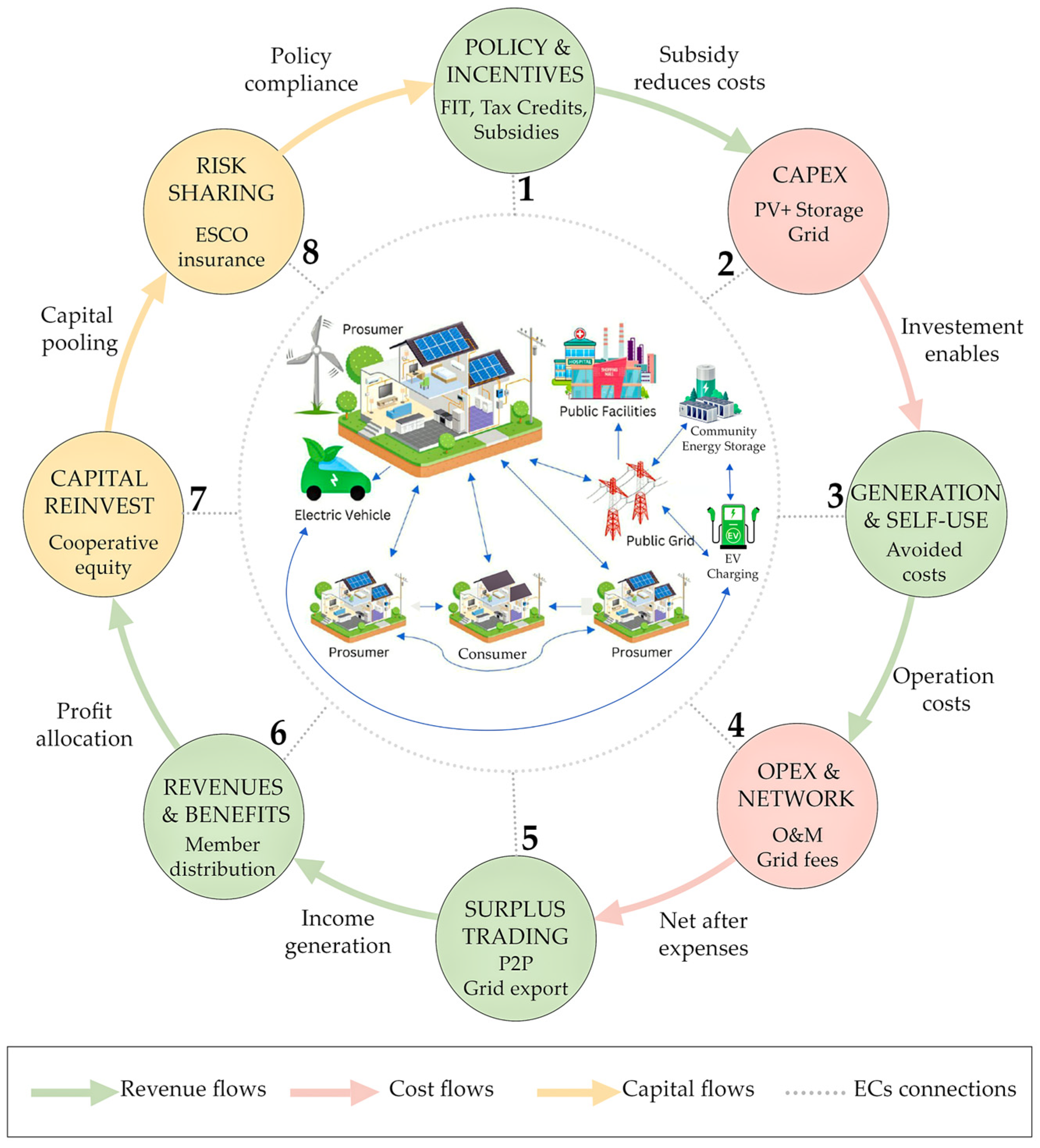
Figure 1 demonstrates the conceptual framework guiding this review, illustrating how policy incentives, capital investments, and operational costs interact to determine EC financial viability. The framework captures three core flow types: revenue flows (green) generated through policy support, self-consumption, and surplus trading; expense flows (red) covering capital and operational expenditures; and capital flows (orange) enabling reinvestment through cooperative equity and risk-sharing mechanisms. These interconnected dimensions collectively shape the economic sustainability of community-based energy systems across different regulatory contexts.
The rest of the study is structured as follows: Section 2 presents the regulatory and financial context of ECs in Germany, Spain, and Italy. Section 3 describes systematic literature review methodology, including data sources, selection criteria, and analytical procedures. Section 4 presents the main findings, organized according to the Revenue–Cost–Capital framework, synthesizing financial mechanisms and their implications for EC sustainability. Section 5 discusses key challenges and policy pathways for strengthening the financial resilience of ECs. Finally, Section 6 concludes by summarizing insights, outlining limitations, and proposing future research directions.

2. Regulatory and Financial Context of Energy Communities

The evolution of ECs in Europe has been closely linked to regulatory developments that shape their financial viability [17]. National transpositions of EU directives have defined the legal and operational boundaries of EC activities, while the economic success of these communities depends on their capacity to establish stable revenue streams, manage costs efficiently, and mobilize sufficient investment capital [13]. Germany, Spain, and Italy, three of Europe’s most mature EC markets, illustrate how different regulatory instruments directly influence financial outcomes and long-term sustainability.
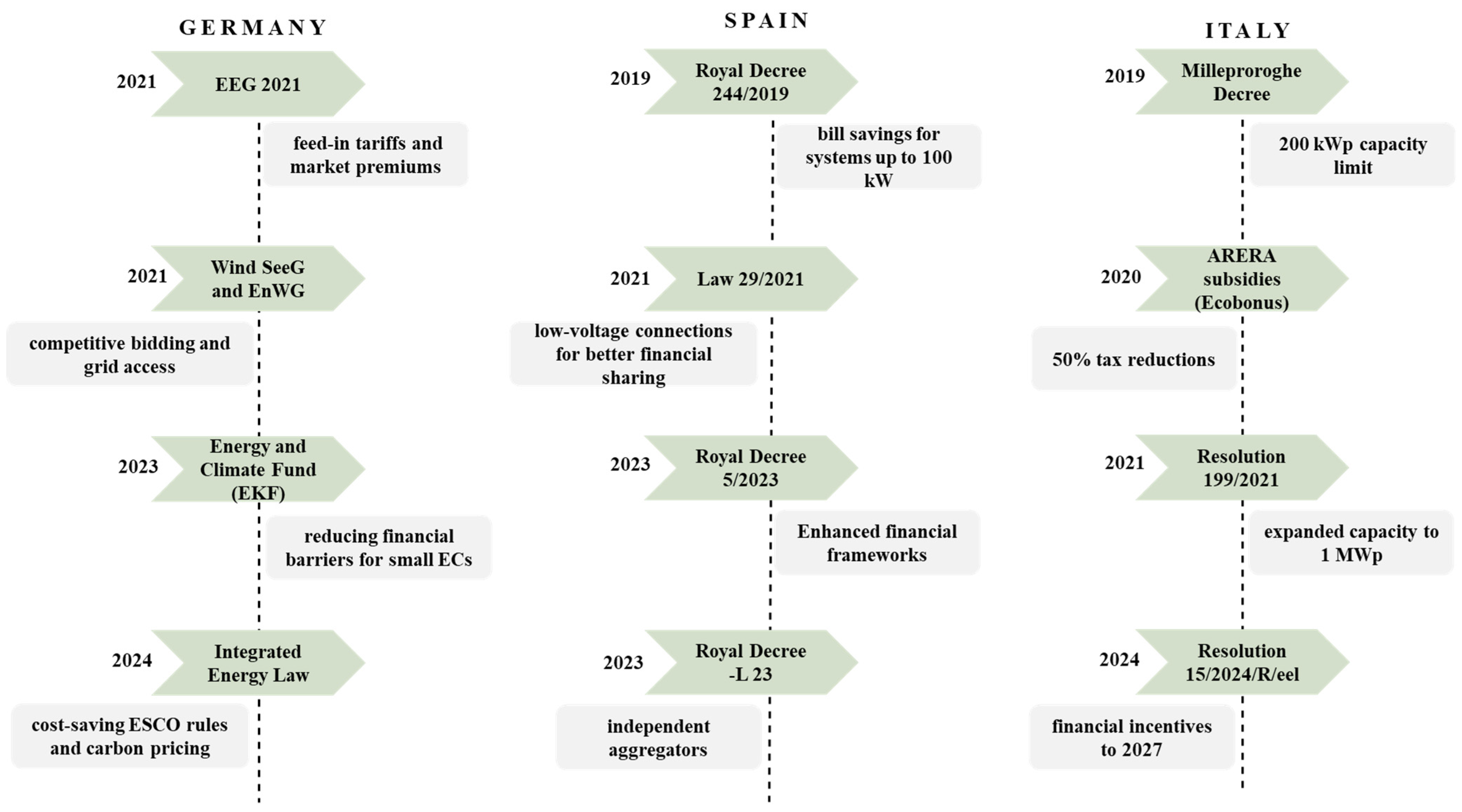
This section consolidates insights from prior studies and national regulations, examining how financial instruments and policy measures influence EC revenue generation, cost management, and investment. By analyzing these financial dimensions across the three national contexts, the review highlights the mechanisms through which legislation, incentives, and market structures shape EC economic performance within the broader European energy transition. Figure 2 summarizes the main policy and financial instruments that have influenced the development of ECs in Germany, Spain, and Italy. These instruments demonstrate how regulatory evolution has progressively shaped revenue generation, cost management, and capital financing mechanisms across different national contexts.

2.1. Revenue Mechanisms

Stable and predictable revenues are fundamental to EC sustainability. The literature shows that national frameworks have progressively evolved from fixed-price incentives toward market-oriented remuneration models.
In Germany, the Renewable Energy Sources Act (EEG 2021) remains the main instrument supporting EC income generation. It introduced feed-in tariffs (FITs) and market-premium schemes that reward renewable production and local energy sharing. Amendments to the Wind Energy at Sea Act (WindSeeG) and the Energy Industry Act (EnWG) in 2021 expanded competitive bidding procedures and improved grid access, strengthening revenue certainty for community projects [18,19]. Later revisions under the Integrated Energy Law (2024) emphasized cost savings through Energy Service Company (ESCO) models and raised carbon prices within the EU Emissions Trading Scheme (ETS), indirectly improving the profitability of renewable ECs [20,21].
In Spain, Royal Decree 244/2019 defined economic rules for renewable self-consumption and established compensation for surplus electricity fed into the grid. Royal Decree 5/2023 and Law 29/2021 subsequently enhanced these provisions for Collective Energy Communities (CECs) by expanding eligibility and simplifying grid connections [15,22]. Nevertheless, the absence of long-term remuneration mechanisms continues to constrain revenue stability, particularly in rural areas. The literature points to emerging peer-to-peer trading and aggregation services as promising tools for improving profitability and flexibility [23].
In Italy, the Milleproroghe Decree-Law 162/2019 established the Renewable Energy Community (REC) framework, while the Ecobonus fiscal deduction scheme (Article 14, D.L. 63/2013) provides 50% deductions distributed across 10 annual installments for photovoltaic and storage investments [24]. Subsequent Resolutions 199/2021 and 15/2024/R/eel by the Italian Regulatory Authority (ARERA) extended production incentives and optimized network tariffs to 2027, ensuring attractive revenue conditions for community-based generation [16,25]. Together, these developments mark a broader shift from fixed incentives toward more dynamic, market-responsive revenue structures.

2.2. Cost Structures

Cost management is another decisive factor in EC financial performance. Studies emphasize that national regulations directly affect how operational expenditures, grid charges, and administrative fees are distributed among community members.
In Germany, the Energy and Climate Fund (EKF) provides grants to offset high upfront costs for distributed generation and storage. The Integrated Energy Law (2024) introduces ESCO-based cost-sharing mechanisms, allowing ECs to pool maintenance and service expenses, while rising carbon prices under the ETS add complexity by influencing overall electricity costs [26,27].
In Spain, Royal Decree-Law 23/2020 simplified low-voltage connections and reduced administrative expenses for small ECs. It also facilitated integration of storage and aggregation services that lower per-unit energy costs through efficiency gains [22]. Despite these advances, uneven grid-fee structures and limited remuneration for surplus energy still challenge cost optimization.
In Italy, the ARERA Integrated Text on Widespread Self-Consumption (TIAD) established transparent rules for allocating operating and maintenance costs among EC participants. Resolutions 199/2021 and 15/2024/R/eel further refined network charges to support economically balanced energy exchange [28,29]. However, regional disparities in administrative procedures continue to hinder consistent cost management.
Across the literature, studies indicate that while reforms have improved cost visibility and fairness, few comparative studies quantify how different tariff structures affect EC economics. Standardized evaluation approaches are still needed to benchmark cost efficiency across EU contexts.

2.3. Capital Mobilization and Financing Pathways

Access to capital is a critical determinant of EC scalability. Recent literature links financing success to the availability of grants, cooperative equity, and innovative instruments such as green loans and community bonds.
In Germany, the EKF and regional programs offer low-interest loans and grants for renewable cooperatives, reducing entry barriers for small-scale projects [30]. Cooperative ownership remains dominant, but concerns persist regarding long-term self-sufficiency once public funding declines.
In Spain, Royal Decree 5/2023 created pilot funds for storage and R&D in distributed generation, while local cooperative banks have begun financing CECs. Citizen-investment models and public–private partnerships are emerging as diversified capital sources [15]. Yet, financing availability remains uneven across regions, limiting scalability.
In Italy, fiscal instruments such as tax deductions for energy efficiency improvements and Conto Termico provide generous tax incentives and capital subsidies for renewable and storage projects [24]. ARERA Resolution 199/2021 expanded the capacity limit for ECs to 1 MWp, stimulating larger investments, but smaller communities still struggle to access bank loans due to perceived risk. Strengthening cooperative financing mechanisms and EU-level green-fund participation are widely seen as essential for sustainable capital formation.

2.4. Synthesis of Financial Insights

The comparative evidence from Germany, Spain, and Italy demonstrates that financial design and regulation are closely interconnected. Revenue mechanisms are evolving from fixed incentives to market-responsive remuneration; cost structures are being refined through tariff reform and ESCO models; and capital mobilization increasingly relies on hybrid public–private financing. Despite these advances, disparities in policy implementation and financing accessibility persist across member states. A comprehensive understanding of how revenue generation, cost management, and capital financing interact is therefore essential for developing resilient and economically sustainable local energy collectives within the European energy transition.

3. Materials and Methods

3.1. Literature Selection Approach

This study employs a narrative literature review approach adapted from PRISMA (Preferred Reporting Items for Systematic Reviews and Meta-Analyses) standard procedures for search transparency. The analysis is focused on economic and financial mechanisms of ECs [31]. The primary bibliographic source was the Scopus database. Scopus was selected as the sole database due to its extensive coverage (more than 95% of engineering and environmental journals) [32], ensuring comprehensive disciplinary representation for this exploratory engineering literature review. The search query used was as follows:
TITLE-ABS-KEY (“energy communities” OR “renewable energy communities” OR “collective self-consumption” OR “local energy collective”) AND TITLE-ABS-KEY (“financial” OR “economic” OR “cost” OR “revenue” OR “investment” OR “tariff”).
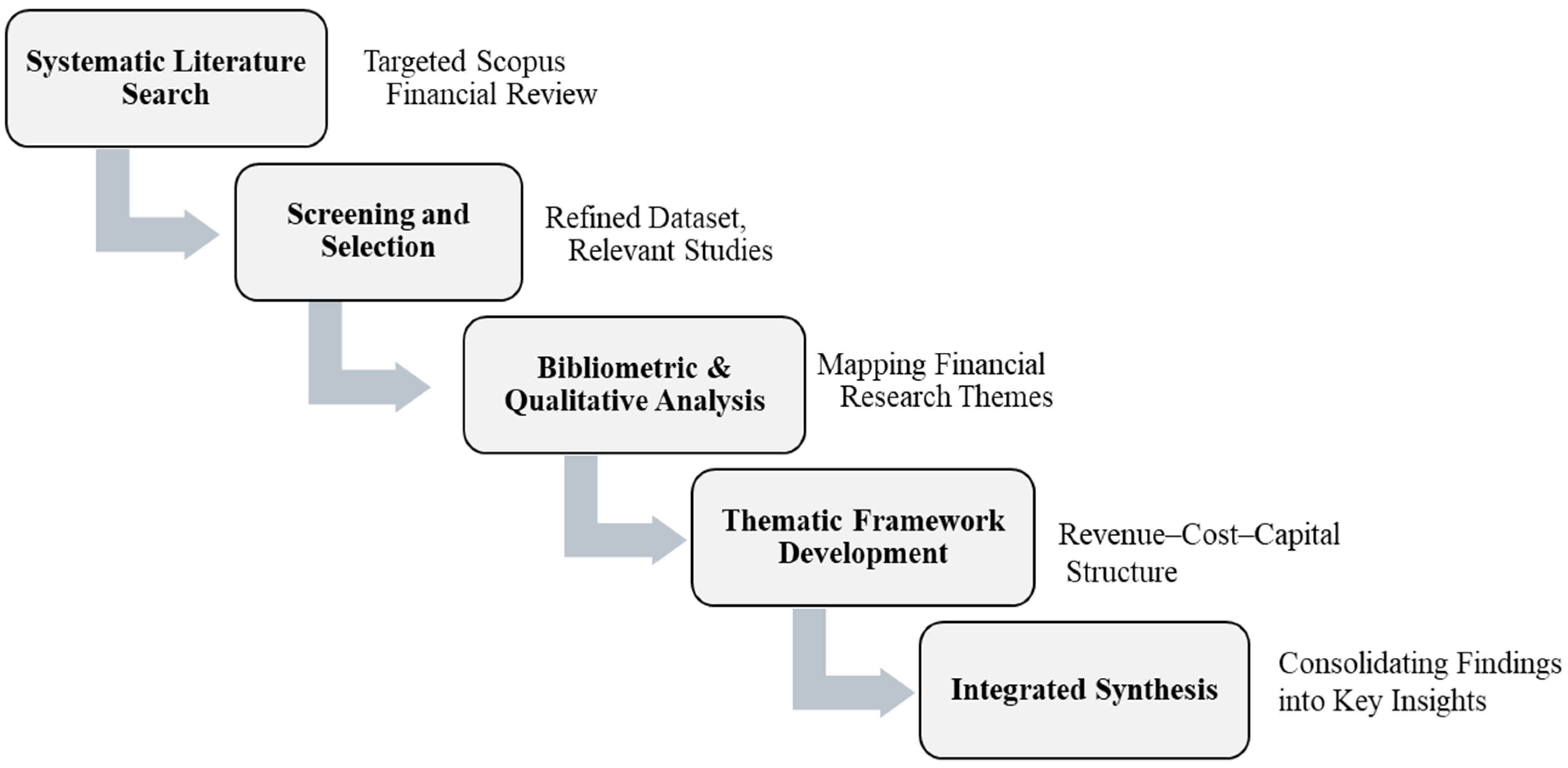
The search was executed on 1 January 2025 to ensure coverage of the most recent literature within a single, consistently indexed database. The initial search yielded 1083 records and was followed by the screening procedures. This period was chosen because the EU Clean Energy Package (RED II and IEMD) adopted in 2019 marks the start of the contemporary regulatory regime for ECs. Figure 3 illustrates the step by step review process from Scopus data collection and eligibility screening to bibliometric mapping and thematic synthesis used to analyze the financial dimensions of community-based energy systems through a Revenue, Cost, Capital framework.

3.2. Screening and Selection

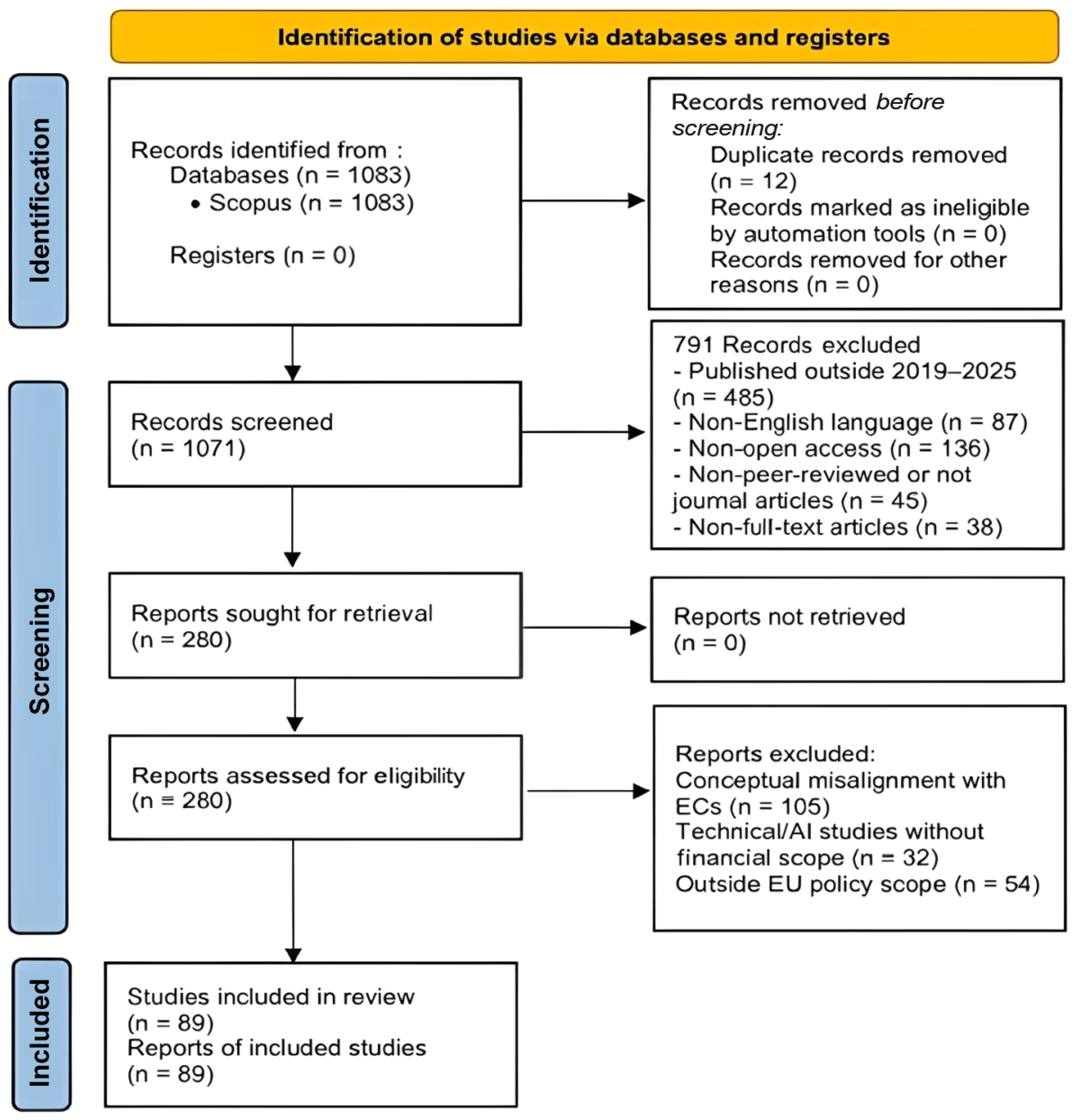
Figure 4 shows the PRISMA-adapted flowchart illustrating how the systematic screening process works. The first search on Scopus found 1083 records. After removing duplicates, filtering by subject area, and applying exclusion criteria, 791 items were excluded, leaving 280 papers for screening of their titles and abstracts. After full-text assessment of qualified studies, 89 articles met all of the criteria for final analysis.
A title/abstract screening was conducted against predefined inclusion criteria: (i) focus on ECs or closely related community-based renewable models; (ii) explicit treatment of financial or economic aspects (revenues, costs, financing); (iii) peer-reviewed journal articles. After title/abstract screening and subject area exclusions, 280 papers remained; then, full-text assessment produced a final sample of 89 studies for analysis. All screening steps were independently verified by the authors to reduce selection and analysis bias also to ensure reproducibility. This PRISMA-adapted approach ensures transparent search procedures while allowing thematic analysis of financial mechanisms across different regulatory contexts.

3.3. Bibliometric and Qualitative Analysis

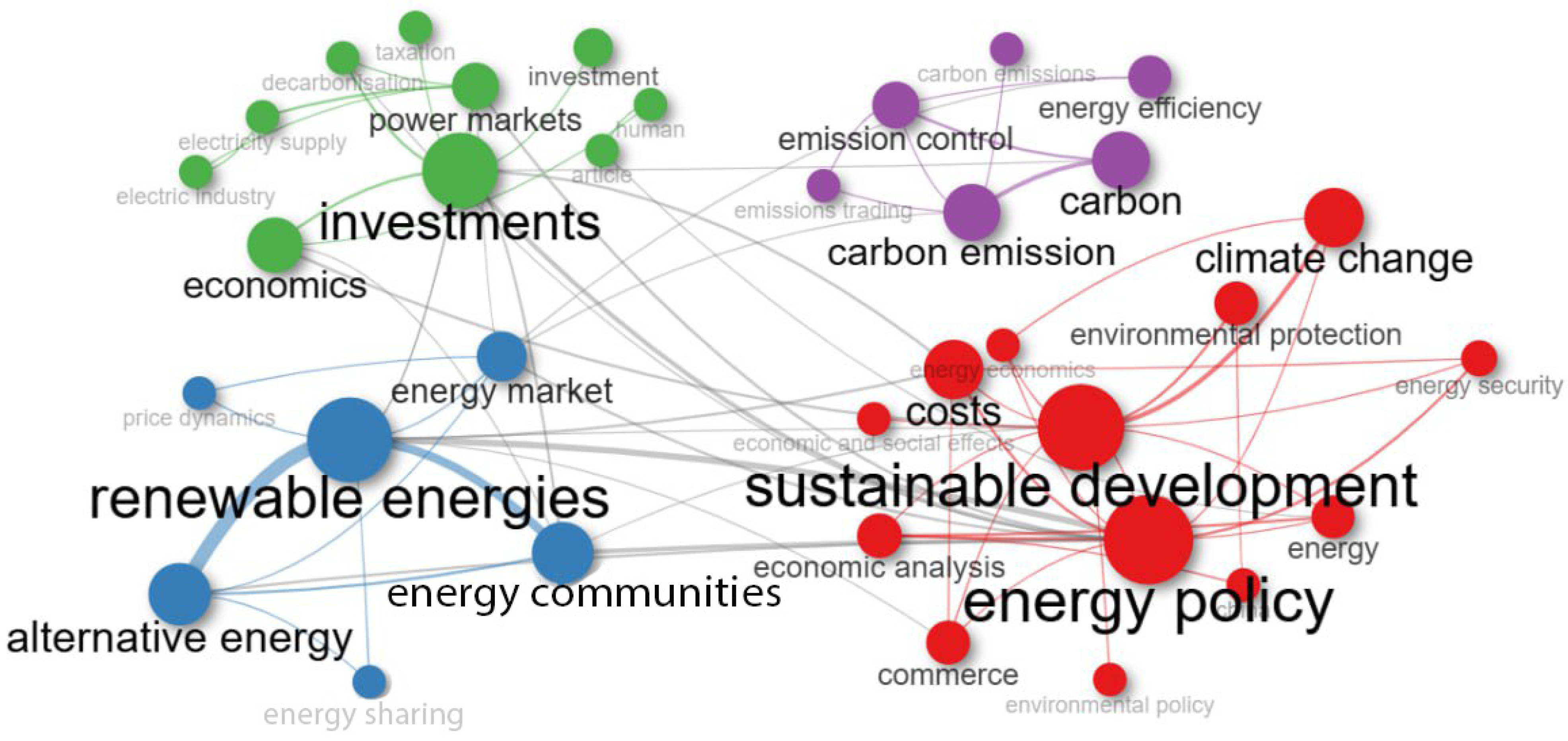
Key themes related to regulatory and financial mechanisms in ECs were analyzed through bibliometric network analysis using bibliometrix (version 4.1.4) in R via the Biblioshiny interface. The keyword co-occurrence network in Figure 5 reveals four distinct thematic clusters within the reviewed literature.
The green cluster (top-left) consolidates financial terminology including investments, economics, power markets, and taxation, representing the economic infrastructure that underpins EC operations and corresponding to capital mobilization and revenue dimensions. The purple cluster (top-right) encompasses policy objectives and environmental outcomes such as carbon emission, energy efficiency, and climate change, reflecting regulatory targets driving EC development. The blue cluster (bottom-left) emphasizes operational foundations with terms like renewable energies and energy market, highlighting technical implementation of decentralized generation. The red cluster (bottom-right) bridges governance and sustainability through sustainable development, energy policy, and costs, linking local mechanisms to national strategies.
Network interconnections demonstrate that community-based research inherently integrates economic, environmental, technical, and regulatory dimensions. The positioning of costs at the interface between red and green clusters emphasizes its dual role as economic barrier and policy target. These empirically derived clusters validate the Revenue, Cost, Capital framework, ensuring alignment between quantitative mapping and qualitative synthesis.

3.4. Thematic Framework Development

The bibliometric clusters directly informed qualitative coding in NVivo 14. The framework emerged inductively from these clusters, mapping green cluster financial terms to Revenue/Capital codes, blue cluster operational terms to Cost codes, and red/purple clusters to governance context. This creates the epistemological connection from bibliometric patterns to NVivo coding structure. All 89 studies were coded according to the Revenue, Cost, and Capital framework, with each node subdivided into specific subcodes: feed-in tariffs, tax incentives (revenue); CAPEX, OPEX, grid charges (costs); grants, cooperative equity, loans (capital).
The analysis was carried out by using NVivo 14, implementing a stringent two-stage hybrid approach to minimize limitations associated with single-coder analysis. In Stage 1, automated text searches with specific keywords were conducted across all 89 papers, ensuring consistency and preventing coder drift. Stage 2 included complete manual validation of all outcomes with full paper-level relevance review. Stage 3 involved comprehensive authors review of all 89 papers to validate coding alignment with research objectives. This hybrid method provides (1) systematic consistency through automation, (2) accuracy through thorough validation, (3) methodological coherence from bibliometric-to-NVivo linkage, and (4) reproducibility via transparent audit trail.
Iterative refinement and author cross-checking ensured consistency. This integration of quantitative mapping and qualitative synthesis formed the analytical foundation for subsequent results and discussion.

4. Results

Germany, Spain, and Italy were selected for comparative analysis due to their shared financial characteristics and regulatory challenges in EC development. Although each country has a unique regulatory framework rooted in common EU directives, they share challenges integrating decentralized renewable energy and ensuring fair financial outcomes. This section analyzes EC financial mechanisms under three dimensions: Revenue Mechanisms, Cost Allocation and Risk Sharing, and Capital Mobilization and Financing Sources.

4.1. Revenue Mechanisms for ECs

Revenue generation represents the foundational pillar of EC financial sustainability. Across Germany, Spain, and Italy, distinct yet interrelated mechanisms—namely incentives, tariffs, and trading models—define the profitability and attractiveness of community-based renewable energy (Table 1).
In Germany, feed-in tariffs and government subsidies remain the primary financial instruments supporting EC profitability, contrasting with Spain’s market-based approach and Italy’s tax-driven model [33,34]. The Renewable Energy Sources Act (EEG), aligned with pricing model reforms, has supported decentralized energy markets and promoted fairness among EC participants [35]. EU Emission Trading Scheme (ETS) reforms have increased fossil-fuel costs, pushing ECs toward renewable generation [36,37]. Competitive pricing strategies, especially those targeting customer-centric models and digitalized local trading, have improved market efficiency [38,39]. The System for Guarantees of Regional Origin (SGRO) further promotes green electricity marketing and local revenue generation [40,41]. Emerging peer-to-peer (P2P) trading platforms, such as ENKO, enable ECs to earn additional revenues through decentralized energy exchange [42,43]. These mechanisms collectively underpin Germany’s stable revenue approach for community clean energy implementations.
Table 1. Comparative analysis of revenue mechanisms supporting ECs.
GermanySpainItaly
Incentive Schemes
and Subsidies
Feed-in tariffs (EEG 2021)
remain a primary support tool [34], while market premiums encourage renewable integration [37]. The EU Emissions Trading Scheme (ETS) raises CO2 prices, enhancing the competitiveness of local renewables [44]. Subsidies for PV installations sustain financial feasibility [14,35].
The Royal Decree 244/2019 introduced self-consumption remuneration mechanisms [15], but surplus compensation remains limited [45,46]. RD-Law 23/2020 enhanced support for energy storage and collective EC models [22].The Ecobonus scheme provides a 50% tax deduction for PV and battery systems [47,48] complemented by MISE Decree 09/2020 that adds exchange premiums [47,49].
Tariff and
Pricing Models
Tenant electricity (Mieterstrom) schemes promote direct local supply [33,38]. supported by Regional Guarantees of Origin that improve transparency [40,50]. Uniform pricing, however, distorts market signals [51].The dynamic pricing tariff defines variable electricity pricing [15], while net-billing schemes link surplus energy value to market rates [52]. Lack of stable FITs limits investment return [53].Virtual self-consumption (VSC) models [47] and distribution-loss reimbursements [54] lower OPEX and stabilize revenue flows [49].
Market
Participation and Trading
Peer-to-Peer trading platforms [42] and projects like ENKO [43] and SINTEG [39] advance decentralized market participation. Regional markets and SGRO certification improve local engagement [41].Emerging P2P trading [55,56] and aggregation services [57,58] strengthen market access but face tariff barriers [22].Cooperative energy-sharing systems allow dynamic trading and surplus allocation [54] expanding EC financial flexibility [59].
Financial
Outcomes
Strong local participation and renewable adoption supported by public funding [14], yet profitability remains moderate due to grid charges [60].PV projects with surplus sales achieve 12-year payback, while rural systems without surplus extend up to 28 years [61,62].Incentive alignment under Ecobonus and premium models shortens payback and ensures higher NPV [63,64].
Unlike Germany’s stable FiT framework, Spain’s Royal Decree 244/2019 introduced market-responsive revenue structures where surplus compensation remains limited compared to Germany’s guaranteed tariffs [45,46]. Installations under 15 kW enjoy full consumption rights, while those between 15 kW and 100 kW benefit from bill credits for exported electricity [53]. The introduction of peer-to-peer trading and aggregation services has begun to increase community income despite regulatory complexity [55,56]. Energy-export revenues also contribute to EC income; prosumers may sell excess electricity to the grid at €0.0338/kWh, with the value tied to hourly market prices [52,65]. Community energy trading, both physical and virtual, enhances economic performance when designed with centralized market configurations [66].
Italy diverges from both models through incentive-driven mechanisms combining Ecobonus 50% tax deductions with production premiums achieving shorter payback periods than Spain’s market-based approach but requiring stronger fiscal support than Germany’s tariff system. The Milleproroghe Decree-Law 162/2019 enabled RECs establishment, with Ecobonus fiscal deductions remaining applicable to individual household investments within community-scale projects [47,67]. This initiative offers tax deductions for PV and storage systems, substantially reducing payback period [48,49]. The MISE Decree 09/2020 and ARERA Resolution 199/2021 provide premiums for shared energy and distribution-loss reimbursements, improving revenue predictability [47]. These mechanisms promote steady financial returns and encourage long-term EC participation.

4.2. Cost Allocation and Risk Sharing

Cost management and equitable risk distribution are critical to EC financial sustainability. As summarized in Table 2, cost structures vary significantly across Germany, Spain, and Italy, encompassing capital expenditures (CAPEX), operational expenses (OPEX), grid charges, and risk-sharing mechanisms that determine long-term viability.
In Germany, ECs face high initial capital costs for PV and battery storage [30], while fluctuating operational costs continue to challenge project viability [36]. Policy measures under the EEG and Integrated Energy Law now emphasize joint service contracts via Energy Service Companies (ESCOs), reducing CAPEX and OPEX [33,68]. Increased CO2 pricing under the ETS ensures that the environmental costs of fossil generation are internalized, indirectly improving the cost competitiveness of renewables [44,73]. However, the lack of clear business models and outdated pricing regulations (tenant-electricity schemes) still distort grid signals, limiting EC flexibility [33]. Implementing location-based nodal pricing could enhance transparency and better reflect grid constraints [51].
In Spain, cost-effectiveness remains a major concern. Studies show that only 40% of households achieve profitability without subsidies, and that battery storage remains uneconomical unless prices fall to €250–500 per kWh [45]. Rural projects often face payback periods of up to 28 years, compared with 12 years for projects selling surplus electricity [74]. Regulatory inefficiencies and limited surplus remuneration reduce returns, especially in low-demand regions [53]. However, reforms such as Law 29/2021 have lowered administrative costs and improved low-voltage grid access [75]. Demand-side management and aggregation services also allow EC members to share operating costs and reduce market-price risks [57,76].
In Italy, cost structures are influenced by both incentive design and infrastructure efficiency. Economic analyses indicate that PV self-consumption and installation profitability depend on investment costs and discount-rate assumptions [64,77]. The Ecobonus significantly decreases household expenditure, while ARERA and TIAD regulations reduce internal network-use fees [47]. Energy-retrofit projects, such as those studied by Dolores et al. [49], cut energy bills by roughly 50%, balancing immediate savings with long-term mortgage commitments. Regulatory adjustments under Resolution 15/2024/R/eel have optimized dispatching costs and refined grid-charge calculations, improving transparency and equity [54]. Collectively, these developments strengthen cost efficiency and risk-sharing arrangements among community participants.
Across all three countries, CAPEX remains the dominant barrier, yet cost-mitigation strategies diverge: Germany leverages ESCO pooling to distribute fixed costs, Spain struggles with 28-year rural paybacks absent surplus sales, while Italy’s fiscal deduction effectively halve upfront barriers, demonstrating that fiscal instruments outperform cooperative models for initial cost reduction (Table 2).
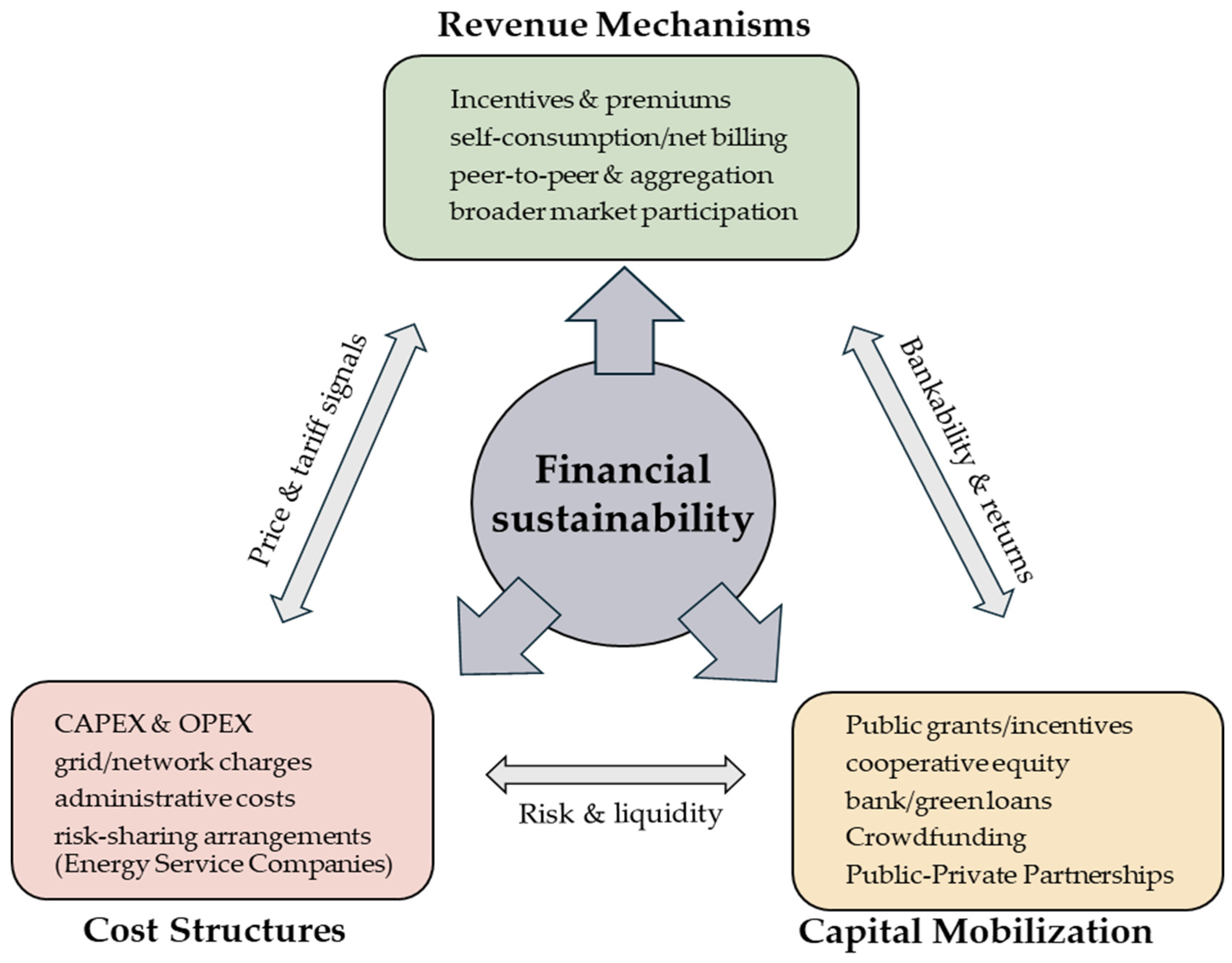
Overall, the analysis of cost structures and risk-sharing arrangements highlights that operational efficiency and equitable cost allocation are central to ECs’ long-term financial stability. Yet, these mechanisms cannot be assessed in isolation. Figure 6 illustrates the financial interdependence within community-based energy systems, showing how revenue mechanisms (incentives, self-consumption, market participation), cost structures (CAPEX, OPEX, grid charges, and risk-sharing), and capital mobilization (public funding, cooperative equity, private and green finance) interact to bidirectionally through price signals, stability mechanisms, and liquidity management determine overall financial sustainability.

4.3. Capital Mobilization and Financing Sources

Capital availability determines whether ECs can move from concept to implementation. As shown in Table 3, diverse financing pathways public grants, cooperative equity, bank lending, and crowdfunding define the investment ecosystem in which ECs operate.
In Germany, green energy cooperatives are designed to adjust initial and operational costs according to technology cost reductions and changing fuel prices [33]. Despite these efficiencies, high upfront investment remains a key barrier [68]. The EKF and regional cooperatives have improved financing availability, while community-owned utilities such as Grünstromwerke GmbH and Bürgerwerke eG facilitate citizen investment and financial circulation within ECs [14]. Nonetheless, the absence of clear trading regulations for regional green electricity continues to limit investor confidence [60].
In Spain, the growth of ECs depends on hybrid capital sources. Limited private investment results from unclear market conditions and low surplus remuneration [56]. Policy reforms have introduced regional and EU-level support schemes, while community cooperatives strengthen participation in local markets [75]. Infrastructure investment remains vital to reduce congestion costs and balance financial risks between investors and consumers [70].
In Italy, capital mobilization benefits from stable national incentives and strong cooperative traditions. The ARERA 199/2021 and Ecobonus programs provide certainty for investors by reducing fiscal risk [67]. Studies report NPV returns of €2136–8084 per kW for PV plants and €4712–5737 per kW for self-consumption systems [63,80]. Crowdfunding and public–private partnerships are emerging to finance large projects. The dual-discounting model proposed by Nesticò et al. [59] integrates economic and environmental values into investment decisions, while virtual energy-sharing models distribute surplus energy to improve cash flow and minimize infrastructure upgrades [54]. Together, these instruments reveal a capital resilience gradient: Germany’s cooperative model faces scalability limits from public fund dependence, Spain’s hybrid sources require policy guarantees, and Italy’s stable incentives (€2136–8084/kW NPV) attract institutional investors, suggesting fiscal certainty trumps cooperative equity for capital mobilization (Table 3).

5. Discussion

5.1. Opportunities for Energy Communities

The comparative analysis identifies several structural and financial opportunities strengthening EC viability in Germany, Spain, and Italy. Stable incentive mechanisms, decentralized market participation, and diversified financing have created favorable conditions for EC expansion across Europe.
A significant opportunity arises from the establishment of predictable and transparent revenue mechanisms. Stable feed-in tariffs, market premiums, and self-consumption remuneration schemes, as seen in Germany and Spain, enhance the financial confidence of EC investors. Similarly, Italy’s long-term tax incentives, such as the Ecobonus and ARERA’s energy-sharing compensations, improve the economic feasibility of local renewable systems. These instruments provide continuity and reduce the financial risks associated with fluctuating energy prices, ensuring that community-based projects remain profitable over their operational lifespan.
Another key opportunity is the evolution of market participation models. The increasing adoption of P2P trading, local market aggregation platforms, and regional energy markets enable ECs to monetize surplus generation and provide grid-balancing services. Initiatives such as the ENKO P2P platform in Germany or the emerging energy-sharing frameworks in Spain and Italy demonstrate how digitalized energy exchanges can reduce curtailment, enhance network flexibility, and foster active citizen engagement. These developments reinforce the economic and social value of ECs within decentralized energy systems, advancing Europe’s energy transition toward decarbonization.
Financial opportunities also stem from collective ownership and shared-cost arrangements. The diffusion of ESCOs and cooperative investment structures distributes financial responsibilities and ensures equitable participation among members. This shared-risk approach enhances resilience and strengthens the economic inclusiveness of ECs, particularly in urban buildings and suburban contexts.
Furthermore, capital diversification offers a foundation for long-term sustainability. Public–private partnerships, municipal grants, cooperative shares, and emerging crowdfunding models contribute to a broader pool of financial resources. Across the three countries, multi-source financing has proven effective in lowering capital barriers and attracting institutional investors. Such diversified models can support EC replication across different socio-economic contexts, aligning financial incentives with climate and social objectives.
Germany’s stable revenue mechanisms succeed because the long-term FiT contracts (15–20 years) reduce financial risk for cooperative members. Also enabling collective investment without individual market exposure, as documented by Ehrtmann et al. [14] in cooperative governance analyses. Conversely, Spain’s limited surplus compensation constrains revenue predictability, directly explaining the 28-year rural payback documented by Dasí-Crespo et al. [61] that was nearly twice as long as urban installations with grid export rights. Italy’s Ecobonus effectiveness stems from fiscal familiarity: tax deductions integrate into existing household financial planning, lowering cognitive barriers compared to market-based compensation requiring energy price forecasting [47,48].
These mechanisms converge on a common finding across this review: financial instrument effectiveness depends on matching complexity to community capacity. Cooperative models thrive under regulatory stability (Germany) but struggle under market volatility (Spain); tax incentives work when aligned with existing fiscal behaviors (Italy); P2P platforms require digital infrastructure and market literacy [42,43]. The reviewed studies consistently show that revenue stability matters more than subsidy magnitude explaining why Italy’s modest €110/MWh premium achieves shorter payback than Spain’s theoretically more flexible market-based system.

5.2. European Applicability of Financial Mechanisms

While the preceding analysis examines Germany, Spain, and Italy, systematic review of RED II transposition frameworks reveals that financial mechanisms in these three countries reflect broader approaches observable across Europe. Table 4 synthesizes documented evidence identifying nine EU countries with comparable financial structures based on peer-reviewed literature and recent EC mapping studies [81,82].
Germany’s cooperative-equity model demonstrates documented equivalents in Denmark’s aggregator markets, The Netherlands’ (wind-focused projects achieving €1500/year cooperative savings, postal code collective investment scheme), and Belgium’s regional green certificate frameworks [13,81,82,83]. Spain’s self-consumption framework aligns with Greece [22], Portugal’s flexible proximity rules [17], Italy’s shared energy incentives (€110/MWh RECs, €100/MWh collective self-consumption, 7-year), and The Netherlands’ net metering. Italy’s incentive-driven scheme finds parallels in The Netherlands’ postal code incentives and Belgium’s regional green certificate pilots [13,81,82].
The Netherlands and Italy exhibit hybrid approaches integrating multiple mechanisms: The Netherlands combines cooperative structures, net metering, and investment incentives across wind-focused generation; Italy emphasizes solar self-consumption with tax-based support. Belgium similarly employs multi-mechanism regional frameworks [81,82,85].
Austria shares Italy’s incentive-driven approach, it employs condominium-based community structures at medium-voltage levels. France, conversely, represents different model focused on social housing energy justice without relying on FiTs, net-billing, or tax incentives [17,84,85]. Eastern European countries show limited development with insufficient documented mechanisms [13], while Nordic and Southern European nations beyond those identified may exhibit alternative approaches requiring future analysis.
The three financial approaches in Germany, Spain, and Italy span nine EU countries (around 30% of EU-27), revealing key similarities in how the Revenue, Cost, Capital framework extends to observable European structures beyond the three primary cases [13,81,82]. Our classification remains illustrative of documented diversity rather than exhaustive taxonomy. Central/Eastern European nations, Nordic countries beyond Denmark, and post-Brexit UK contexts may employ distinct mechanisms not captured due to different policy trajectories or insufficient peer-reviewed documentation (2019–2025), highlighting opportunities for future comparative research as EC frameworks mature. Therefore, our Revenue, Costs, and Capital Structures apply primarily to Western/Southern European regulatory contexts; applicability to Central/Eastern European models requires further validation.
5.3. Challenges and Barriers to Financial Sustainability

Despite these advances, the reviewed literature documents persistent barriers, revealing design trade-offs in EC financial mechanisms. One persistent challenge is the heterogeneity of regulatory and administrative frameworks. Germany’s location-based nodal pricing absence persists due to uniform tariffs protecting cooperatives from locational costs; Spain’s 28-year rural paybacks stem from insufficient surplus remuneration that eliminates revenue streams; Italy’s Ecobonus excludes low-income households who lack the required around 10-year tax liability. These design choices create trade-offs: Germany’s ESCOs improve CAPEX distribution but increase complexity; Spain’s market approach minimizes public cost but requires sophisticated participants.
Another constraint relates to mechanisms optimized to address one barrier often worsen others: stable incentives reduce risk but create fiscal dependency (Italy); market integration excludes unsophisticated participants (Spain); cooperatives face scalability limits (Germany). Although shared-cost mechanisms and cooperative models partially mitigate this barrier, operational expenditures and rising grid fees under carbon-pricing schemes remain burdensome. The persistence of long payback periods, particularly in Spain’s rural regions, underscores the need for targeted support measures that ensure equitable access to EC participation.
Limited access to conventional finance also restricts EC development. Many small or newly established communities lack the creditworthiness or collateral to secure loans from commercial banks. While alternative instruments such as crowdfunding, cooperative shares, and EU structural funds offer partial solutions, they remain insufficient to fully replace institutional financing. Establishing standardized investment frameworks and financial guarantees would enhance investor confidence and enable ECs to scale beyond local initiatives.
Finally, challenges persist in integrating community-based energy systems into broader energy markets. P2P trading and local exchange mechanisms still operate at pilot scales, constrained by data management, interoperability, and transaction-cost barriers. Without supportive digital infrastructure and regulatory recognition, these innovative models risk remaining marginal rather than becoming integral components of the future electricity market.
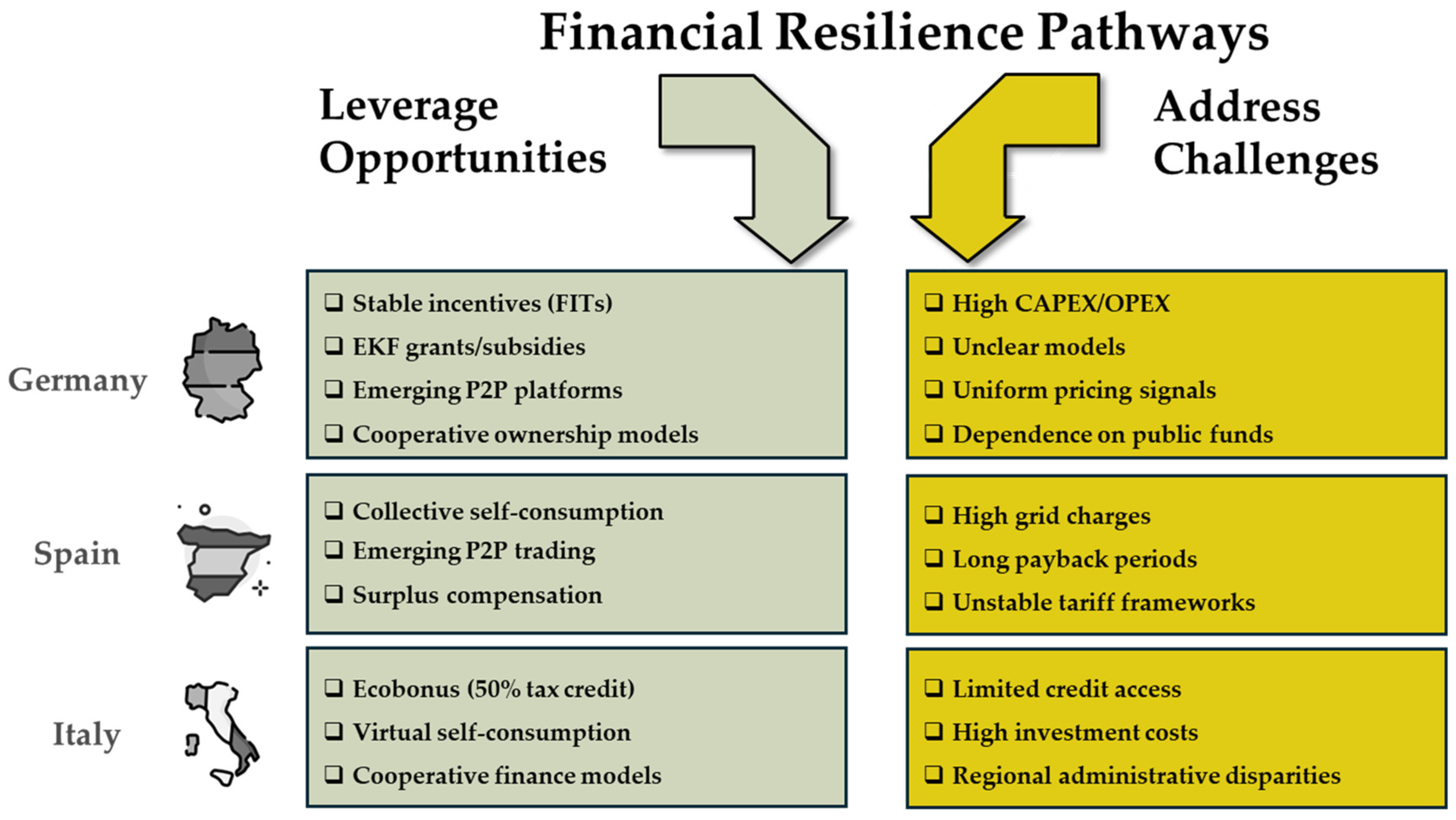
The financial performance documented in Section 4.1, Section 4.2 and Section 4.3 reveals how enabling and constraining factors interact differently across regulatory contexts. Figure 7 synthesizes these financial resilience pathways, illustrating how stable feed-in tariffs, cooperative ownership models, and targeted tax incentives strengthen EC viability, while high capital expenditures, long payback periods, and limited credit access continue to constrain scalability across different regulatory contexts. These pathways reflect the Revenue, Cost, and Capital framework applied throughout this review, demonstrating that financial sustainability requires integrated policy support across all three dimensions rather than isolated interventions.

6. Conclusions

This review advances understanding of the financial and economic dimensions of ECs through a structured Revenue, Cost, and Capital framework, providing a comparative financial analysis of Germany, Spain, and Italy, which represent distinct regulatory-financial approaches. By synthesizing findings from 89 peer-reviewed studies. The analysis reveals that financial performance and scalability in ECs are fundamentally shaped by national incentive schemes, cost-allocation mechanisms, and the diversity of financing sources not apparent in single-country studies.
The study identifies that stable revenue mechanisms, such as feed-in tariffs, tax incentives, and self-consumption remuneration, remain essential to EC profitability and investor confidence. Italy’s €110/MWh premium achieves shorter payback (7–8 years) than Spain’s market-based compensation (28 years rural) due to payment certainty. However, reforms toward market-responsive pricing and peer-to-peer trading are increasingly redefining revenue models, enhancing flexibility and fostering integration within local energy markets while creating trade-offs that exclude unsophisticated participants.
Cost management and risk sharing remain uneven across Europe. While ESCO frameworks and cooperative structures have improved economic fairness and operational efficiency, rising grid fees, administrative complexity, and inconsistent regulatory frameworks still limit participation for smaller or rural communities. Transparent tariff reforms and standardized cost-sharing approaches are necessary to ensure equitable inclusion and long-term financial sustainability.
Capital mobilization emerges as both an opportunity and a persistent challenge. Hybrid financing models combining public grants, cooperative equity, and green finance have demonstrated success in lowering entry barriers and supporting project scalability. Yet, many ECs continue to face difficulties accessing institutional credit and private investment. Expanding community-tailored financial instruments, enhancing access to EU-level funds, and establishing risk-mitigation mechanisms will be crucial to broadening participation and sustain growth.
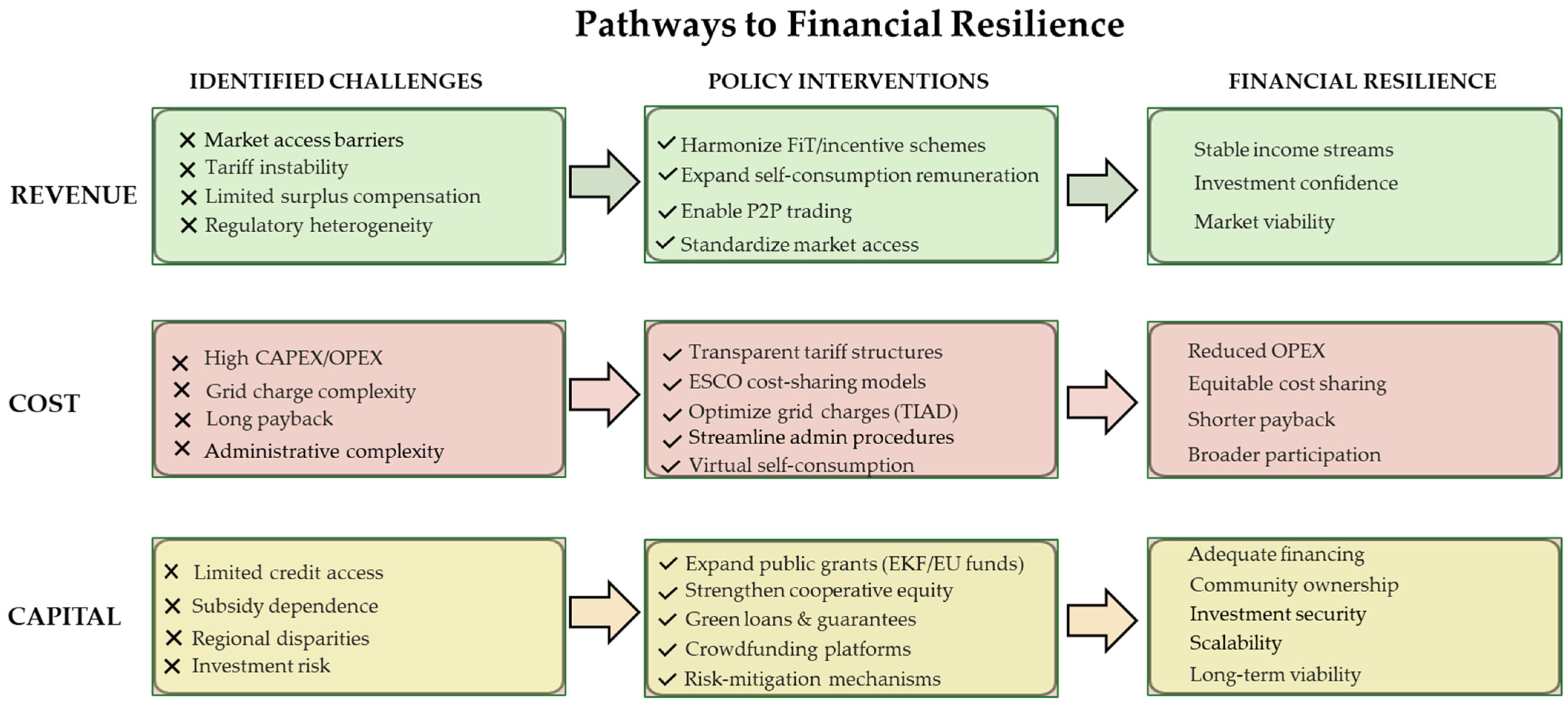
This study’s findings emphasize that effective EC implementation depends on coherent interaction between policy, finance, and outcomes. Stable regulatory incentives (EEG 2021, Royal Decree 244/2019, and MISE Decree 09/2020) support financial mechanisms that determine the economic feasibility and social inclusiveness of ECs. Figure 8 synthesizes the key findings of this review, mapping identified challenges against recommended policy interventions and their expected outcomes across three financial dimensions.
The parallel pathways illustrate that achieving financial resilience requires simultaneous progress in revenue generation, cost management, and capital mobilization integrated policy support across all dimensions is essential for sustainable community based energy systems.
Overall, ECs represent a promising instrument for achieving Europe’s decarbonization and social inclusion goals. The financial resilience pathways synthesized in Figure 7 demonstrate that strengthening EC viability requires context-specific rather than harmonized interventions. Spain’s 28-year rural payback challenge (Table 2) necessitates targeted surplus monetization mechanisms rather than generic self-consumption policies. Germany’s cooperative model requires transitioning from public fund dependency to hybrid EU green financing while preserving 15–20 year FiT stability that enables long-term planning. Italy’s Ecobonus success (7–8 year payback) validates fiscal instruments. But it requires converting tax deductions to direct grants for low-income households lacking 10-year tax liability, addressing Figure 7’s cost pathway equity gap identified in Section 4.2.
Further research should focus on quantifying the long-term financial performance of ECs under evolving regulatory contexts and examining trade-offs between adoption speed and sustainability across these regulatory archetypes documented in Section 4.1, Section 4.2 and Section 4.3. Examining how digital platforms modify the instrument-capacity alignment mechanisms validated in Figure 7 and exploring the integration of digital and blockchain-enabled financing mechanisms. Comparative evaluations across different EU member states would also provide deeper insights into whether sequenced transitions from stable incentives to market integration enable sustainable exits from public support across diverse European contexts beyond the three regulatory frameworks analyzed. Such analyses can guide policymakers and investors in designing adaptive financial frameworks that support equitable, resilient, and community-driven energy transitions across Europe.

Author Contributions

Conceptualization, S.K. and M.C.F.; methodology, S.K.; software, S.K.; validation, S.K. and M.C.F.; formal analysis, S.K.; investigation, S.K.; resources, S.K. and M.C.F.; data curation, S.K.; writing—original draft preparation, S.K.; writing—review and editing, S.K. and M.C.F.; visualization, S.K.; supervision, M.C.F.; project administration, M.C.F. and M.P.; funding acquisition, S.K. and M.C.F. All authors have read and agreed to the published version of the manuscript.

Funding

This work was supported in part by a Ph.D. scholarship at the Sapienza University of Rome, under the program “PE2 Network 4 Energy Sustainable Transition (NEST), SPOKE 8 Final use optimization, sustainability and resilience in energy supply chain” funded by the Italian Ministry under Grant CUP: B53C22004070006 and in part by the National Recovery and Resilience Plan (PNRR), funded by the European Union (EU)–Next Generation EU.

Data Availability Statement

All raw data used in this study were extracted from publicly accessible peer-reviewed scientific articles. The datasets supporting the findings of this study are available from the corresponding author upon reasonable request.

Conflicts of Interest

The authors declare no conflicts of interest.

References

  1. Lowitzsch, J.; Hoicka, C.E.; van Tulder, F.J. Renewable Energy Communities under the 2019 European Clean Energy Package–Governance Model for the Energy Clusters of the Future? Renew. Sustain. Energy Rev. 2020, 122, 109489. [Google Scholar] [CrossRef]
  2. Khorrami, S.; Falvo, M.C.; Pompili, M. A Review on Energy Communities Development, Opportunities and Challenges in Germany, Spain, and Italy. IEEE Access 2025, 13, 103385–103404. [Google Scholar] [CrossRef]
  3. Council of European Energy Regulators (CEER) Customers and Retail Markets and Distribution Systems Working Groups Regulatory Aspects of Self-Consumption and Energy Communities. Available online: https://www.ceer.eu/documents/104400/-/-/8ee38e61-a802-bd6f-db27-4fb61aa6eb6a (accessed on 3 May 2024).
  4. European Parliament and Council Directive (EU) 2019/944 of the European Parliament and of the Council of 5 June 2019. Available online: https://eur-lex.europa.eu/eli/dir/2019/944/oj (accessed on 2 May 2024).
  5. Meitern, M. Unlocking Carbon Finance: Empowering Energy Communities for Mutual Benefit. Renew. Sustain. Energy Rev. 2024, 199, 114499. [Google Scholar] [CrossRef]
  6. Kyriakopoulos, G.L. Energy Communities Overview: Managerial Policies, Economic Aspects, Technologies, and Models. J. Risk Financ. Manag. 2022, 15, 521. [Google Scholar] [CrossRef]
  7. Ahmed, S.; Ali, A.; D’Angola, A. A Review of Renewable Energy Communities: Concepts, Scope, Progress, Challenges, and Recommendations. Sustainability 2024, 16, 1749. [Google Scholar] [CrossRef]
  8. Zatti, M.; Moncecchi, M.; Gabba, M.; Chiesa, A.; Bovera, F.; Merlo, M. Energy Communities Design Optimization in the Italian Framework. Appl. Sci. 2021, 11, 5218. [Google Scholar] [CrossRef]
  9. Khorrami, S.; Falvo, M.C.; Pompili, M. Energy Communities Development: A Review of Challenges and Opportunities. In 2024 IEEE International Conference on Environment and Electrical Engineering and 2024 IEEE Industrial and Commercial Power Systems Europe (EEEIC/I&CPS Europe); IEEE: New York, NY, USA, 2024; pp. 1–6. [Google Scholar] [CrossRef]
  10. Gianaroli, F.; Preziosi, M.; Ricci, M.; Sdringola, P.; Ancona, M.A.; Melino, F. Exploring the Academic Landscape of Energy Communities in Europe: A Systematic Literature Review. J. Clean. Prod. 2024, 451, 141932. [Google Scholar] [CrossRef]
  11. Domenteanu, A.; Delcea, C.; Florescu, M.S.; Gherai, D.S.; Bugnar, N.; Cotfas, L.A. United in Green: A Bibliometric Exploration of Renewable Energy Communities. Electronics 2024, 13, 3312. [Google Scholar] [CrossRef]
  12. Koltunov, M.; De Vidovich, L. Energy Communities in Social Sciences: A Bibliometric Analysis and Systematic Literature Review. Renew. Sustain. Energy Rev. 2025, 220, 115871. [Google Scholar] [CrossRef]
  13. Hoicka, C.E.; Lowitzsch, J.; Brisbois, M.C.; Kumar, A.; Camargo, L.R. Implementing a Just Renewable Energy Transition: Policy Advice for Transposing the New European Rules for Renewable Energy Communities. Energy Policy 2021, 156, 112435. [Google Scholar] [CrossRef]
  14. Ehrtmann, M.; Holstenkamp, L.; Becker, T. Regional Electricity Models for Community Energy in Germany: The Role of Governance Structures. Sustainability 2021, 13, 2241. [Google Scholar] [CrossRef]
  15. Villalonga Palou, J.T.; Serrano González, J.; Riquelme Santos, J.M.; Álvarez Alonso, C.; Roldán Fernández, J.M. Sharing Approaches in Collective Self-Consumption Systems: A Techno-Economic Analysis of the Spanish Regulatory Framework. Energy Strategy Rev. 2023, 45, 101055. [Google Scholar] [CrossRef]
  16. Giannoccaro, I.; Ceccarelli, G.; Fraccascia, L. Features of the Higher Education for the Circular Economy: The Case of Italy. Sustainability 2021, 13, 11338. [Google Scholar] [CrossRef]
  17. Magni, G.U.; Battistelli, F.; Trovalusci, F.; Groppi, D.; Garcia, D.A. How National Policies Influence Energy Community Development across Europe? A Review on Societal, Technical, and Economical Factors. Energy Convers. Manag. X 2024, 23, 100624. [Google Scholar] [CrossRef]
  18. Hanke, F.; Guyet, R. The Struggle of Energy Communities to Enhance Energy Justice: Insights from 113 German Cases. Energy Sustain. Soc. 2023, 13, 16. [Google Scholar] [CrossRef]
  19. Möller, T.; Spangehl, T.; Hüttl-Kabus, S.; Hahn, J.; Andersson, A.; Kühn, B.; Grüter, M. Recent Developments in the Provision of Wind Information for Site Tenders for German Offshore Wind Farms According to WindSeeG. In Proceedings of the EMS Annual Meeting 2023, Bratislava, Slovakia, 4–8 September 2023; Copernicus GmbH: Göttingen, Germany, 2023; Volume 20. [Google Scholar] [CrossRef]
  20. Reppert, T. Local-Level Ownership of Electricity Grids: An Analysis of Germany’s Distribution System Operators (DSOs). Util. Policy 2023, 85, 101678. [Google Scholar] [CrossRef]
  21. López, I.; Goitia-Zabaleta, N.; Milo, A.; Gómez-Cornejo, J.; Aranzabal, I.; Gaztañaga, H.; Fernandez, E. European Energy Communities: Characteristics, Trends, Business Models and Legal Framework. Renew. Sustain. Energy Rev. 2024, 197, 114403. [Google Scholar] [CrossRef]
  22. Losada-Puente, L.; Blanco, J.A.; Dumitru, A.; Sebos, I.; Tsakanikas, A.; Liosi, I.; Psomas, S.; Merrone, M.; Quiñoy, D.; Rodríguez, E. Cross-Case Analysis of the Energy Communities in Spain, Italy, and Greece: Progress, Barriers, and the Road Ahead. Sustainability 2023, 15, 4016. [Google Scholar] [CrossRef]
  23. Correa, M.; GOMEZ, T.; Cossent, R. Local Flexibility Mechanisms for Electricity Distribution Through Regulatory Sandboxes: International Review and a Proposal for Spain. In 2021 IEEE Madrid PowerTech; IEEE: New York, NY, USA, 2021; pp. 1–6. [Google Scholar] [CrossRef]
  24. Cielo, A.; Margiaria, P.; Lazzeroni, P.; Mariuzzo, I.; Repetto, M. Renewable Energy Communities Business Models under the 2020 Italian Regulation. J. Clean. Prod. 2021, 316, 128217. [Google Scholar] [CrossRef]
  25. ARERA Valori Della Materia Energia per Il Servizio a Tutele Graduali. Available online: https://www.arera.it/consumatori/valori-della-materia-energia-per-il-servizio-a-tutele-graduali (accessed on 8 March 2024).
  26. Neij, L.; Palm, J.; Busch, H.; Bauwens, T.; Becker, S.; Bergek, A.; Buzogány, A.; Candelise, C.; Coenen, F.; Devine-Wright, P.; et al. Energy Communities—Lessons Learnt, Challenges, and Policy Recommendations. Oxf. Open Energy 2025, 4, oiaf002. [Google Scholar] [CrossRef]
  27. Gruber, L.; Wogrin, S. Cost versus Resilience in Energy Communities: A Multi-Objective Member-Focused Analysis. arXiv 2025, arXiv:2503.23096. [Google Scholar] [CrossRef]
  28. Castellini, M.; D’Alpaos, C.; Moretto, M.; Pioletti, M. Paving the Way for the Widespread Activation of Renewable Energy Communities in Italy [Verso Un’attivazione Diffusa Delle Comunità Energetiche Rinnovabili in Italia]. Valori Valutazioni 2025, 37, 5–37. [Google Scholar] [CrossRef]
  29. Tatti, A.; Ferroni, S.; Ferrando, M.; Motta, M.; Causone, F. The Emerging Trends of Renewable Energy Communities’ Development in Italy. Sustainability 2023, 15, 6792. [Google Scholar] [CrossRef]
  30. Di Nucci, M.R.; Krug, M.; Schwarz, L.; Gatta, V.; Laes, E. Learning from Other Community Renewable Energy Projects: Transnational Transfer of Multi-Functional Energy Gardens from The Netherlands to Germany. Energies 2023, 16, 3270. [Google Scholar] [CrossRef]
  31. Page, M.J.; McKenzie, J.E.; Bossuyt, P.M.; Boutron, I.; Hoffmann, T.C.; Mulrow, C.D.; Shamseer, L.; Tetzlaff, J.M.; Akl, E.A.; Brennan, S.E. The PRISMA 2020 Statement: An Updated Guideline for Reporting Systematic Reviews. BMJ 2021, 372, n71. [Google Scholar] [CrossRef]
  32. Gusenbauer, M.; Haddaway, N.R. Which Academic Search Systems Are Suitable for Systematic Reviews or Meta-Analyses? Evaluating Retrieval Qualities of Google Scholar, PubMed, and 26 Other Resources. Res. Synth. Methods 2020, 11, 181–217. [Google Scholar] [CrossRef]
  33. Lüth, A.; Weibezahn, J.; Zepter, J.M. On Distributional Effects in Local Electricity Market Designs-Evidence from a German Case Study. Energies 2020, 13, 1993. [Google Scholar] [CrossRef]
  34. Wagner, O.; Venjakob, M.; Schröder, J. The Growing Impact of Decentralised Actors in Power Generation: A Comparative Analysis of the Energy Transition in Germany and Japan. J. Sustain. Dev. Energy Water Environ. Syst. 2021, 9, 1080334. [Google Scholar] [CrossRef]
  35. Barnes, J.; Hansen, P.; Kamin, T.; Golob, U.; Musolino, M.; Nicita, A. Energy Communities as Demand-Side Innovators? Assessing the Potential of European Cases to Reduce Demand and Foster Flexibility. Energy Res. Soc. Sci. 2022, 93, 102848. [Google Scholar] [CrossRef]
  36. van Ouwerkerk, J.; Hainsch, K.; Candas, S.; Muschner, C.; Buchholz, S.; Günther, S.; Huyskens, H.; Berendes, S.; Löffler, K.; Bußar, C.; et al. Comparing Open Source Power System Models—A Case Study Focusing on Fundamental Modeling Parameters for the German Energy Transition. Renew. Sustain. Energy Rev. 2022, 161, 112331. [Google Scholar] [CrossRef]
  37. Wagner, O.; Adisorn, T.; Tholen, L.; Kiyar, D. Surviving the Energy Transition: Development of a Proposal for Evaluating Sustainable Business Models for Incumbents in Germany’s Electricity Market. Energies 2020, 13, 730. [Google Scholar] [CrossRef]
  38. Hanny, L.; Wagner, J.; Buhl, H.U.; Heffron, R.; Körner, M.-F.; Schöpf, M.; Weibelzahl, M. On the Progress in Flexibility and Grid Charges in Light of the Energy Transition: The Case of Germany. Energy Policy 2022, 165, 112882. [Google Scholar] [CrossRef]
  39. Fridgen, G.; Michaelis, A.; Rinck, M.; Schöpf, M.; Weibelzahl, M. The Search for the Perfect Match: Aligning Power-Trading Products to the Energy Transition. Energy Policy 2020, 144, 111523. [Google Scholar] [CrossRef]
  40. Lehmann, N.; Sloot, D.; Ardone, A.; Fichtner, W. The Limited Potential of Regional Electricity Marketing—Results from Two Discrete Choice Experiments in Germany. Energy Econ. 2021, 100, 105351. [Google Scholar] [CrossRef]
  41. Stößel, L.; Poddie, L.; Spratte, T.; Schelenz, R.; Jacobs, G. County Clustering with Bioenergy as Flexible Power Unit in a Renewable Energy System. Energies 2021, 14, 5227. [Google Scholar] [CrossRef]
  42. Buschmann, P.; Moser, P.; Nadaï, A.; Régnier, Y. A-Disciplinary Considerations of Two Networks of Local Climate Energy Initiatives: Paper Part of the Special Issue Entitled: “Unlocking Energies, Unpacking the Entanglements and Temporalities of Local Initiatives”. Local Environ. 2019, 24, 1053–1072. [Google Scholar] [CrossRef]
  43. Lüth, A.; Zepter, J.M.; Crespo del Granado, P.; Egging, R. Local Electricity Market Designs for Peer-to-Peer Trading: The Role of Battery Flexibility. Appl. Energy 2018, 229, 1233–1243. [Google Scholar] [CrossRef]
  44. Kittel, M.; Goeke, L.; Kemfert, C.; Oei, P.-Y.; von Hirschhausen, C. Scenarios for Coal-Exit in Germany-a Model-Based Analysis and Implications in the European Context. Energies 2020, 13, 2041. [Google Scholar] [CrossRef]
  45. Gallego-Castillo, C.; Heleno, M.; Victoria, M. Self-Consumption for Energy Communities in Spain: A Regional Analysis under the New Legal Framework. Energy Policy 2021, 150, 112144. [Google Scholar] [CrossRef]
  46. López Prol, J.; Steininger, K.W. Photovoltaic Self-Consumption Is Now Profitable in Spain: Effects of the New Regulation on Prosumers’ Internal Rate of Return. Energy Policy 2020, 146, 111793. [Google Scholar] [CrossRef]
  47. Mutani, G.; Usta, Y. Design and Modeling Renewable Energy Communities: A Case Study in Cagliari (Italy). Int. J. Sustain. Dev. Plan. 2022, 17, 1041–1051. [Google Scholar] [CrossRef]
  48. De Santi, F.; Moncecchi, M.; Prettico, G.; Fulli, G.; Olivero, S.; Merlo, M. To Join or Not to Join? The Energy Community Dilemma: An Italian Case Study. Energies 2022, 15, 7072. [Google Scholar] [CrossRef]
  49. Dolores, L.; Macchiaroli, M.; De Mare, G. Financial Impacts of the Energy Transition in Housing. Sustainability 2022, 14, 4876. [Google Scholar] [CrossRef]
  50. Scheer, D.; Dreyer, M.; Schmidt, M.; Schmieder, L.; Arnold, A. The Integrated Policy Package Assessment Approach: Elaborating Ex Ante Knowledge in the Fiof Urban Mobility. Energy Sustain. Soc. 2022, 12, 36. [Google Scholar] [CrossRef]
  51. Rövekamp, P.; Schöpf, M.; Wagon, F.; Weibelzahl, M.; Fridgen, G. Renewable Electricity Business Models in a Post Feed-in Tariff Era. Energy 2021, 216, 119228. [Google Scholar] [CrossRef]
  52. Parreño-Rodriguez, A.; Ramallo-González, A.P.; Chinchilla-Sánchez, M.; Molina-García, A. Community Energy Solutions for Addressing Energy Poverty: A Local Case Study in Spain. Energy Build. 2023, 296, 113418. [Google Scholar] [CrossRef]
  53. Tomás, M.; García-Muros, X.; Alonso-Epelde, E.; Arto, I.; Rodríguez-Zúñiga, A.; Monge, C.; González-Eguino, M. Ensuring a Just Energy Transition: A Distributional Analysis of Diesel Tax Reform in Spain with Stakeholder Engagement. Energy Policy 2023, 177, 113558. [Google Scholar] [CrossRef]
  54. Cutore, E.; Volpe, R.; Sgroi, R.; Fichera, A. Energy Management and Sustainability Assessment of Renewable Energy Communities: The Italian Context. Energy Convers. Manag. 2023, 278, 116713. [Google Scholar] [CrossRef]
  55. Alonso, À.; de la Hoz, J.; Martín, H.; Coronas, S.; Matas, J. Individual vs. Community: Economic Assessment of Energy Management Systems under Different Regulatory Frameworks. Energies 2021, 14, 676. [Google Scholar] [CrossRef]
  56. Peña-Ramos, J.A.; Del Pino-García, M.; Sánchez-Bayón, A. The Spanish Energy Transition into the Eu Green Deal: Alignments and Paradoxes. Energies 2021, 14, 2535. [Google Scholar] [CrossRef]
  57. Cruz, C.; Alskaif, T.; Palomar, E.; Bravo, I. Prosumers Integration in Aggregated Demand Response Systems. Energy Policy 2023, 182, 113745. [Google Scholar] [CrossRef]
  58. Crespo-Vazquez, J.L.; Alskaif, T.; Gonzalez-Rueda, A.M.; Gibescu, M. A Community-Based Energy Market Design Using Decentralized Decision-Making under Uncertainty. IEEE Trans. Smart Grid 2021, 12, 1782–1793. [Google Scholar] [CrossRef]
  59. Nesticò, A.; Maselli, G.; Ghisellini, P.; Ulgiati, S. A Dual Probabilistic Discounting Approach to Assess Economic and Environmental Impacts. Environ. Resour. Econ. 2023, 85, 239–265. [Google Scholar] [CrossRef]
  60. Maiwald, J.; Schuette, T. Decentralised Electricity Markets and Proactive Customer Behaviour. Energies 2021, 14, 781. [Google Scholar] [CrossRef]
  61. Dasí-Crespo, D.; Roldán-Blay, C.; Escrivá-Escrivá, G.; Roldán-Porta, C. Evaluation of the Spanish Regulation on Self-Consumption Photovoltaic Installations. A Case Study Based on a Rural Municipality in Spain. Renew. Energy 2023, 204, 788–802. [Google Scholar] [CrossRef]
  62. Blanco-Díez, P.; Díez-Mediavilla, M.; Alonso-Tristán, C. Review of the Legislative Framework for the Remuneration of Photovoltaic Production in Spain: A Case Study. Sustainability 2020, 12, 1214. [Google Scholar] [CrossRef]
  63. D’Adamo, I.; Mammetti, M.; Ottaviani, D.; Ozturk, I. Photovoltaic Systems and Sustainable Communities: New Social Models for Ecological Transition. The Impact of Incentive Policies in Profitability Analyses. Renew. Energy 2023, 202, 1291–1304. [Google Scholar] [CrossRef]
  64. Khorrami, S.; Khazaee, M.; Roldán-Fernández, J.M.; Martirano, L. Cost-Benefit Analysis of PV Self-Consumption in Residential Sector in Italy. In 2024 11th Iranian Conference on Renewable Energy and Distribution Generation (ICREDG); IEEE: New York, NY, USA, 2024; pp. 1–8. [Google Scholar] [CrossRef]
  65. Casalicchio, V.; Manzolini, G.; Prina, M.G.; Moser, D. From Investment Optimization to Fair Benefit Distribution in Renewable Energy Community Modelling. Appl. Energy 2022, 310, 118447. [Google Scholar] [CrossRef]
  66. Seven, S.; Yoldas, Y.; Soran, A.; Yalcin Alkan, G.; Jung, J.; Ustun, T.S.; Onen, A. Energy Trading on a Peer-to-Peer Basis between Virtual Power Plants Using Decentralized Finance Instruments. Sustainability 2022, 14, 3286. [Google Scholar] [CrossRef]
  67. Ghiani, E.; Trevisan, R.; Rosetti, G.L.; Olivero, S.; Barbero, L. Energetic and Economic Performances of the Energy Community of Magliano Alpi after One Year of Piloting. Energies 2022, 15, 7439. [Google Scholar] [CrossRef]
  68. Candas, S.; Muschner, C.; Buchholz, S.; Bramstoft, R.; van Ouwerkerk, J.; Hainsch, K.; Löffler, K.; Günther, S.; Berendes, S.; Nguyen, S.; et al. Code Exposed: Review of Five Open-Source Frameworks for Modeling Renewable Energy Systems. Renew. Sustain. Energy Rev. 2022, 161, 112272. [Google Scholar] [CrossRef]
  69. Löffler, K.; Burandt, T.; Hainsch, K.; Oei, P.-Y.; Seehaus, F.; Wejda, F. Chances and Barriers for Germany’s Low Carbon Transition—Quantifying Uncertainties in Key Influential Factors. Energy 2022, 239, 121901. [Google Scholar] [CrossRef]
  70. Costa-Campi, M.T.; Davi-Arderius, D.; Trujillo-Baute, E. Locational Impact and Network Costs of Energy Transition: Introducing Geographical Price Signals for New Renewable Capacity. Energy Policy 2020, 142, 111469. [Google Scholar] [CrossRef]
  71. Espinoza, R.; Muñoz-Cerón, E.; Aguilera, J.; de la Casa, J. Feasibility Evaluation of Residential Photovoltaic Self-Consumption Projects in Peru. Renew. Energy 2019, 136, 414–427. [Google Scholar] [CrossRef]
  72. Maselli, G.; Nesticò, A. The Role of Discounting in Energy Policy Investments. Energies 2021, 14, 6055. [Google Scholar] [CrossRef]
  73. Abuzayed, A.; Hartmann, N. MyPyPSA-Ger: Introducing CO2 Taxes on a Multi-Regional Myopic Roadmap of the German Electricity System towards Achieving the 1.5 °C Target by 2050. Appl. Energy 2022, 310, 118576. [Google Scholar] [CrossRef]
  74. González, A.; Arranz-Piera, P.; Olives, B.; Ivancic, A.; Pagà, C.; Cortina, M. Thermal Energy Community-Based Multi-Dimensional Business Model Framework and Critical Success Factors Investigation in the Mediterranean Region of the EU. Technol. Soc. 2023, 75, 102328. [Google Scholar] [CrossRef]
  75. Lode, M.L.; Felice, A.; Martinez Alonso, A.; De Silva, J.; Angulo, M.E.; Lowitzsch, J.; Coosemans, T.; Ramirez Camargo, L. Energy Communities in Rural Areas: The Participatory Case Study of Vega de Valcarce, Spain. Renew. Energy 2023, 216, 119030. [Google Scholar] [CrossRef]
  76. Lupi, V.; Candelise, C.; Calull, M.A.; Delvaux, S.; Valkering, P.; Hubert, W.; Sciullo, A.; Ivask, N.; van der Waal, E.; Iturriza, I.J.; et al. A Characterization of European Collective Action Initiatives and Their Role as Enablers of Citizens’ Participation in the Energy Transition. Energies 2021, 14, 8452. [Google Scholar] [CrossRef]
  77. Khorrami, S.; Loggia, R.; Falvo, M.C.; Martirano, L. Assessment of Demand-Side Management Strategies in PV-Integrated Residential Systems. In 2025 IEEE International Conference on Environment and Electrical Engineering and 2025 IEEE Industrial and Commercial Power Systems Europe (EEEIC/I&CPS Europe); IEEE: New York, NY, USA, 2025; pp. 1–6. [Google Scholar] [CrossRef]
  78. Delicado, A.; Pallarès-Blanch, M.; García-Marín, R.; del Valle, C.; Prados, M.-J. David against Goliath? Challenges and Opportunities for Energy Cooperatives in Southern Europe. Energy Res. Soc. Sci. 2023, 103, 103220. [Google Scholar] [CrossRef]
  79. Cirone, D.; Bruno, R.; Bevilacqua, P.; Perrella, S.; Arcuri, N. Techno-Economic Analysis of an Energy Community Based on PV and Electric Storage Systems in a Small Mountain Locality of South Italy: A Case Study. Sustainability 2022, 14, 13877. [Google Scholar] [CrossRef]
  80. Khazaee, M.; Hosseinzadeh, S.; Khorrami, S.; Astiaso Garcia, D.; Ricci, M. Volumetric Add-On Retrofit Strategy with Multi-Benefit Approach toward Nearly Zero Energy Buildings Target. Sustainability 2024, 16, 5822. [Google Scholar] [CrossRef]
  81. Koltunov, M.; Pezzutto, S.; Bisello, A.; Lettner, G.; Hiesl, A.; van Sark, W.; Louwen, A.; Wilczynski, E. Mapping of Energy Communities in Europe: Status Quo and Review of Existing Classifications. Sustainability 2023, 15, 8201. [Google Scholar] [CrossRef]
  82. Sciullo, A.; Gilcrease, G.W.; Perugini, M.; Padovan, D.; Curli, B.; Gregg, J.S.; Arrobbio, O.; Meynaerts, E.; Delvaux, S.; Polo-Alvarez, L.; et al. Exploring Institutional and Socio-Economic Settings for the Development of Energy Communities in Europe. Energies 2022, 15, 1597. [Google Scholar] [CrossRef]
  83. Oteman, M.; Wiering, M.; Helderman, J.K. The Institutional Space of Community Initiatives for Renewable Energy: A Comparative Case Study of The Netherlands, Germany and Denmark. Energy Sustain. Soc. 2014, 4, 11. [Google Scholar] [CrossRef]
  84. Biresselioglu, M.E.; Limoncuoglu, S.A.; Demir, M.H.; Reichl, J.; Burgstaller, K.; Sciullo, A.; Ferrero, E. Legal Provisions and Market Conditions for Energy Communities in Austria, Germany, Greece, Italy, Spain, and Turkey: A Comparative Assessment. Sustainability 2021, 13, 11212. [Google Scholar] [CrossRef]
  85. Vernay, A.-L.; Sebi, C. Energy Communities and Their Ecosystems: A Comparison of France and The Netherlands. Technol. Forecast. Soc. Change 2020, 158, 120123. [Google Scholar] [CrossRef]
Figure 1. Overview diagram of Revenue–Cost–Capital interactions in energy communities: green arrows (revenue flows from incentives/market participation), red arrows (CAPEX/OPEX cost flows), orange arrows (capital mobilization/reinvestment pathways).
Energies 19 00937 g001
Figure 2. Key national policy instruments shaping revenue, cost, and capital mechanisms in energy communities in Germany, Spain, and Italy.
Energies 19 00937 g002
Figure 3. Workflow of the review adapted for financial analysis of energy communities.
Energies 19 00937 g003
Figure 4. PRISMA-inspired literature selection flowchart for narrative review, documenting systematic search, and screening procedures (1083 initial records to 89 final studies).
Energies 19 00937 g004
Figure 5. Bibliometric keyword co-occurrence network revealing four thematic clusters across reviewed literature.
Energies 19 00937 g005
Figure 6. Revenue, Costs, and Capital structures showing financial interdependence through stability mechanisms, risk-sharing, liquidity, and market signals interactions in energy communities.
Energies 19 00937 g006
Figure 7. Financial resilience pathways for energy communities in Germany, Spain, and Italy.
Energies 19 00937 g007
Figure 8. Framework from challenges to financial resilience across three financial dimensions for energy communities in Germany, Spain, and Italy.
Energies 19 00937 g008
Table 2. Key cost allocation structures and risk-sharing approaches in ECs.
GermanySpainItaly
Capital
Expenditures (CAPEX)
Initial costs for PV and battery storage remain high [36,68], and large-scale renewables like offshore wind demand significant investment [35,69]. Financial instruments such as FITs and subsidies mitigate these burdens [34].High infrastructure costs and grid congestion raise CAPEX, especially in rural areas [45,70]. Concentrating RES in optimal regions increases congestion risks [71].Ecobonus tax credits reduce upfront investment for households [63,72], while cooperative funding models enhance capital leverage [59].
Operational
Expenditures (OPEX)
Operational costs fluctuate with CO2 price dynamics under ETS [44]. Marginal cost pressures challenge small ECs [36].OPEX levels vary with electricity tariffs and network inefficiencies [53,61].Shared infrastructure and incentives reduce OPEX burdens [49].
Grid and
Network Charges
Uniform grid pricing fails to reflect real-time constraints [51], while outdated tariffs hinder local flexibility [38].Grid congestion and limited remuneration mechanisms increase costs for EC operators [70,71].Virtual energy sharing minimizes grid upgrades and redistributes savings among members [54].
Risk-Sharing ApproachesCooperative and ESCO-based models distribute cost and profit among members [33,39].Market pooling and aggregation strategies spread risk across participants [55,58].Community equity schemes and mixed PPPs strengthen long-term resilience [59].
Table 3. Comparative overview of capital mobilization pathways for ECs.
GermanySpainItaly
Public Grants and SubsidiesThe Energy and Climate Fund (EKF) provide grants for decentralized energy projects [14], and CO2 cost compensation supports renewable competitiveness [44].RD-Law 23/2020 and national storage programs enhance EC investment [22,70].MISE and ARERA mechanisms incentivize renewable integration and exchange premiums [49,67].
Cooperative Equity ModelsBürgerwerke eG and Grünstromwerke models promote collective ownership [14], encouraging local reinvestment.Renewable cooperatives and local markets foster citizen participation [58,78].Cooperative PV and fairness-based models strengthen electricity costs’ profitability [47,65].
Bank and
Institutional Loans
Small ECs face limited credit access due to collateral restrictions [60].Uncertainty in policy and profitability limits loan availability [55,56].Growing access to EU supported green credit improves investment feasibility [79].
Crowdfunding and
Hybrid Models
Emerging local crowdfunding and public–private partnerships support EC pilots [14].Cooperative and crowdfunding initiatives are tested in rural markets [78].Hybrid models combining community bonds and public funds are expanding [54].
Financial
Resilience
Impact
Heavy dependence on public funds restricts scalability [60].Community-based capital enhances resilience but requires policy-backed guarantees [55].Hybrid financing ensures long-term sustainability and mobilizes citizen trust [59].
Table 4. Financial mechanisms in Germany, Spain, and Italy compared with similar approaches across nine EU countries.
Financial ApproachPrimary CaseSimilar CountriesKey CharacteristicsReferences
Cooperative ModelGermanyDenmark, Belgium,
Netherlands
Stable FiT; Cooperative ownership; Collective benefit distribution; Green certificates[13,81,82,83]
Self-consumption
Framework
SpainGreece, Portugal,
Italy
Net-billing; Self-consumption Framework; Solar-dominant; Market-based revenue[17,22,81,84]
Incentive-Driven
Scheme
ItalyNetherlands, Austria, Greece, SpainTax deduction; tariffs; RED II expansion; Incentive-Driven[22,81,84]
Disclaimer/Publisher’s Note: The statements, opinions and data contained in all publications are solely those of the individual author(s) and contributor(s) and not of MDPI and/or the editor(s). MDPI and/or the editor(s) disclaim responsibility for any injury to people or property resulting from any ideas, methods, instructions or products referred to in the content.