1. Introduction
Graph-theoretic methods are widely used for structural analysis and problem decomposition in power system applications [
1,
2,
3,
4,
5]. In power systems, ensuring full topological observability (TO) is a critical factor for effective and reliable network management. Achieving complete observability plays a crucial role in the proper functioning of essential applications in control centers, such as state estimation, power flow, optimal power flow, Voltage Var Dispatch, N-1 security analysis, etc. In modern transmission power systems, observability must be ensured not only at the topological level but also at the numerical level, since topological coverage does not necessarily imply a full-rank measurement model.
In this paper, both TO and numerical observability (NO) are considered. TO ensures that the network contains no unobserved islands (i.e., every node is either directly measured or connected to a measured node). NO requires that the measurement set provides full rank of the system matrix (i.e., no linear dependencies exist among the state equations). This implies accurate monitoring of the state of the system through measuring devices known as PMUs (Phasor Measurement Units). PMUs acquire measurements from current and voltage measuring transformers. This data is then synchronized in time, making it a key component for the advanced management, measurement and analysis of power systems. The optimal PMU placement problem is challenging because the number of PMUs is typically limited while complete observability must still be ensured. This problem is further complicated by various network topologies and operational conditions. Traditional approaches typically rely on heuristic or metaheuristic techniques, each addressing either TO or NO, but rarely both in an integrated manner.
Various works have formulated PMU placement with linear or integer programming under ZIB and/or channel constraints [
6,
7,
8,
9]. Recent research has also highlighted the importance of considering channel capacity limitations and global optimality when formulating the OPP. For instance, paper [
10] formulated both single-channel and multi-channel PMU placement as mathematical optimization problems solved using branch-and-bound methods. These approaches can provide globally optimal solutions but are computationally intensive for large-scale systems. Other studies address channel limits and reliability under contingencies [
11,
12,
13,
14].
The Gröebner bases technique is applied in [
15]. The proposed model is capable of obtaining the full set of optimal solutions instead of only one or partial solutions. Sequential quadratic programming (SQP) is presented in [
16], offering multiple solution options and evaluating them with the System Observability Redundancy Index (SORI). However, SQP and other nonlinear optimization methods may suffer from the Maratos effect, which has been addressed in PMU placement through piecewise convexity models [
17]. Reference [
18] presents a solution to the PMU placement problem for state estimation in smart grids by addressing observability constraints and optimizing measurement accuracy through mean squared error minimization and mutual information maximization. The study employs advanced binary nonlinear optimization techniques suitable for large-scale power networks.
In [
19] authors formulate optimal PMU placement as a quadratic minimization problem with continuous decision variables. The formulation includes nonlinear observability constraints. These constraints are addressed via an unconstrained nonlinear weighted least squares (WLS) method. Research works in [
20,
21,
22] suggest new methods of maximum PMU placement in power systems, integrating ZIBs and conventional measurements to enhance the system observability and reliability under contingencies.
Firstly, the problem of PMU placement with graph theory was presented in [
23], where authors introduced the power domination concept (PDS) in electric power networks, establishing that the OPP corresponds to a minimum dominating set problem. The main differences between this work and the present study lie in the depth of modeling, algorithmic approach, and practical applicability. Unlike the theoretical and limited practical framework of [
23], this study offers a robust, scalable, and directly applicable algorithm tested on IEEE and real-world networks.
Hybrid methods have been proposed in [
24], where a two-phase approach that combines graph decomposition with local-search heuristics improves computational efficiency and solution quality. The authors in [
25] present a Genetic algorithm (GA)- based method for optimal PMU placement, aiming to minimize the number of PMUs while maximizing measurement redundancy under N-1 contingencies. A method that balances minimizing the number of PMUs and maximizing voltage stability using a fuzzified Binary Artificial Bee Colony (BABC) algorithm is presented in [
26]. Further improvements using heuristic techniques such as GA and BPSO have been explored to ensure high-quality solutions with reduced computational time [
27,
28]. However, these approaches often treat TO and NO separately, or implicitly assume that TO implies NO, which does not necessarily hold in practical systems.
Iterated Local Search (ILS) for PMU placement optimization is discussed in [
29]. Paper [
30] proposes Tabu Search-based methods for optimal PMU placement with redundancy, while [
31] analyzes PSO variants to ensure observability with minimal PMUs.
Despite extensive research, a major gap remains: few methods explicitly guarantee both TO and NO within a unified optimization framework while maintaining scalability and practical applicability to real-world large networks.
This paper presents a hybrid PMU placement method that treats TO and NO as two distinct requirements. Here, TO means that the network becomes observable under the placement rules based on its connectivity, while NO means that the selected measurements are sufficient for reliable state estimation, i.e., the associated Jacobian has full rank [
32]. The proposed workflow addresses these requirements in two stages: first, the HNS procedure constructs a practical configuration that guarantees TO under the “one PMU per feeder” principle while directly using ZIB information. Second, a GA refines this configuration to enforce NO and improve redundancy. By combining graph-guided selection with GA-based refinement, the method reduces the number of PMUs while remaining scalable and applicable to both IEEE benchmark systems and real transmission networks, as demonstrated on the Serbian grid.
Ensuring both topological and numerical observability not only improves state-estimation accuracy but also strengthens the reliability of protection and control functions, thereby increasing the power grid’s resilience to faults and disturbances.
A concise comparison of recent PMU placement methods is presented in
Table 1, highlighting key differences in optimization techniques, observability targets, ZIB handling, and PMU modeling assumptions.
The main contributions of this paper are summarized as follows:
A novel “one PMU one feeder” approach (
Section 2.1) is proposed, reflecting common TSO practice and avoiding wiring challenges, limited space in substations, lack of equipment, etc.
The proposed HNS procedure inherently produces PMU configurations with high observability redundancy, as measured by the SORI. The obtained solutions consistently achieve SORI values matching the highest attainable levels under the adopted observability definition, providing strong robustness to PMU outage.
An effective two-phase algorithm is designed for optimal PMU placement in power systems, which makes it well-suited for planning applications. While execution time is not a critical factor for offline planning, the efficiency of the proposed method enables extensive scenario-based analysis for large-scale networks.
Most studies use individual optimization algorithms (LP, ILP, GA, PSO), but combinations of classical and metaheuristic methods have not been sufficiently explored [
33]. In contrast, this work integrates graph-theoretic dominance analysis with a genetic algorithm within a unified optimization framework.
A HNS algorithm is developed to achieve fast TO, significantly reducing the search space before the numerical optimization algorithm is performed. In contrast to the classical PDS approach presented in [
23], the HNS algorithm introduces the concepts of core tree and node cutsets for dynamic node selection, thereby enhancing scalability.
Table 1.
The comparison of existing approaches.
Table 1.
The comparison of existing approaches.
| Paper | Method | Objective | Observability Target | ZIB Handling | PMU Assumption |
|---|
| [6] | BILP + GA | Min PMUs | NO | none | multi-channel |
| [7] | BTLBOA + MST | Min PMUs | TO | none | multi-channel |
| [8,22,34] | ILP | Min PMUs | TO | constraints/topology | multi-channel |
| [9] | PSO | Min PMUs | TO | constraints | multi-channel |
| [10] | ILP + BnB | Min PMUs | TO | none | multi and single channel |
| [11] | Greedy (info-theory) | Max info (SE)/ Min PMUs | TO | none | limited channel |
| [12] | BILP | Min PMUs/channel limits | TO | topology | limited-channel |
| [13] | Heuristic (3-stage) | Min PMUs | TO+NO | constraints | multi-channel |
| [14] | ILP | Min PMUs, N-1 | TO | none | limited channel |
| [15] | Groebner bases | Min PMUs | TO | topology | multi-channel |
| [16] | SQP | Min PMUs, max redun. | TO | constraints | multi-channel |
| [17] | ILP | Min PMUs + bad data detect | TO | none | multi-channel |
| [18] | BNO | maximize mutual information | TO | constraints | limited channel |
| [19] | WLS | Min PMUs | TO | none | multi-channel |
| [20,21] | ILP | Min PMUs | TO | topology/constraints | multi-channel |
| [23] | Graph-theoretic | Min PMUs | TO | none | multi-channel |
| [35] | BABC | Min PMUs | TO | constraints | multi-channel |
| [25] | GA | Min PMUs + contingencies | NO | constraints | multi-channel |
| [26] | BTLBO | Min PMUs + comm reliab. | TO | none | multi-channel |
| [28] | BnB | Min PMUs | TO | none | multi-channel |
| [29] | ILS | Min PMUs | NO | none | multi-channel |
| [30] | TS | Min PMUs + redundancy | TO | constraints | multi-channel |
| [31] | BPSO | Min PMUs ( cont) | TO | topology | multi-channel |
| [36] | NLP + SQP | Min PMUs | NO | none | multi-channel |
| [37] | Two-stage (ILP + SEA) | Min PMUs | TO + NO | topology | multi-channel |
| [38] | CRO | Min PMUs | TO | constraints | multi-channel |
| proposed HNS + GA | HNS + GA | Min PMUs | TO + NO | direct using ZIB information | single channel |
Unlike most existing methods that assume TO guarantees NO, this study explicitly ensures NO by optimizing PMU placement using a GA after the HNS phase. Thus, the focus is on unique contributions such as achieving full NO with fewer PMUs.
The HNS algorithm has been adapted to operate in networks containing ZIB nodes with minimal modifications, avoiding topological or set-based transformations typically employed in existing literature.
The proposed method is validated on IEEE standard power systems (14, 24, 30, 57, 118, and 300 buses) and the real Serbian power system, demonstrating high scalability and adaptability to different grid configurations.
The hybrid HNS + GA structure also improves computational efficiency by reducing the GA search space through graph-informed initialization.
The paper is organized as follows.
Section 2 presents the problem formulation for optimal PMU placement in a practical manner.
Section 3 introduces the proposed algorithm with two detailed examples.
Section 4 discusses ZIB handling and its integration into the proposed HNS procedure.
Section 5 is dedicated to the definition and achievement of numerical observability using the HNS algorithm as an initializer in a genetic algorithm. In
Section 6 BOI (Bus Observability Index) and SORI are explained, and in
Section 7 the obtained results for the mentioned networks are presented, where both topological and numerical observability were achieved with high SORI index. The conclusion is drawn in
Section 8.
2. Definitions and Problem Formulation
In order to properly define the optimal PMU placement problem, there is a need to introduce some basic graph theory concepts that serve as the basis for the methodology discussed in this manuscript. A power network can be represented mathematically as a graph, in which nodes are equivalent to buses (substations) and edges are transmission lines. The definitions below set the basic terminologies and mathematical concepts employed in this research.
Definition 1. For the definition of a graph, a visual representation is not necessary, and it can be defined as an ordered pair of sets , where G denotes the graph, is a non-empty set of vertices, and is a set of edges, where n is the total number of vertices and k is the total number of edges. Each edge is uniquely associated with an ordered pair of vertices , , , denoted as . The unique mapping of edges to pairs of vertices is called the incidence function. A more complete definition of a graph is an ordered triple , in which the incidence function is explicitly specified.
Definition 2. If corresponds to the pair of vertices , then and are said to be adjacent, to belong to the edge , and to be its endpoints. Additionally, we say that connects these vertices, is incident to them, and that they are incident to .
Definition 3. Edges that are incident to the same pair of vertices are called parallel edges. Edges that are incident to at least one common vertex are adjacent. Parallel edges are also adjacent.
Definition 4. The degree of a vertex is the number of edges that are connected (incident) to the vertex. A vertex is isolated if its degree is 0. A vertex is pendant or radial if its degree is 1.
Definition 5. A tree is a connected subgraph without loops that contains all vertices. A graph can have multiple trees.
Definition 6. A cutset is a bipartition of the vertices of a graph, i.e., a division of the set of vertices of the graph into two disjoint subsets whose union is the set of all vertices of the graph. A node cutset is a cutset that contains only one tree edge. The number of node cutsets is equal to the number of edges in the tree.
Definition 7. A radial node is one that is connected to only one neighbor in the graph.
Definition 8. Core tree (CT) represents a special spanning tree of the graph . It is formed by iteratively selecting nodes with the highest degree of connectivity and adding their neighbors in descending degree order. CT is built in a way that includes all nodes of the network, but eliminates redundant links.
2.1. Connection Problem of PMUs
The analog inputs of PMU devices are set up to bring the three-phase signal from the secondary side of the voltage and current measurement transformers for further processing. The obtained waveforms of voltage and current are then timestamped, with the Global Positioning System (GPS) used for time synchronization of the measurements. Such synchronized time data are of great importance as they can be placed on the same phasor diagram, enabling various analyses.
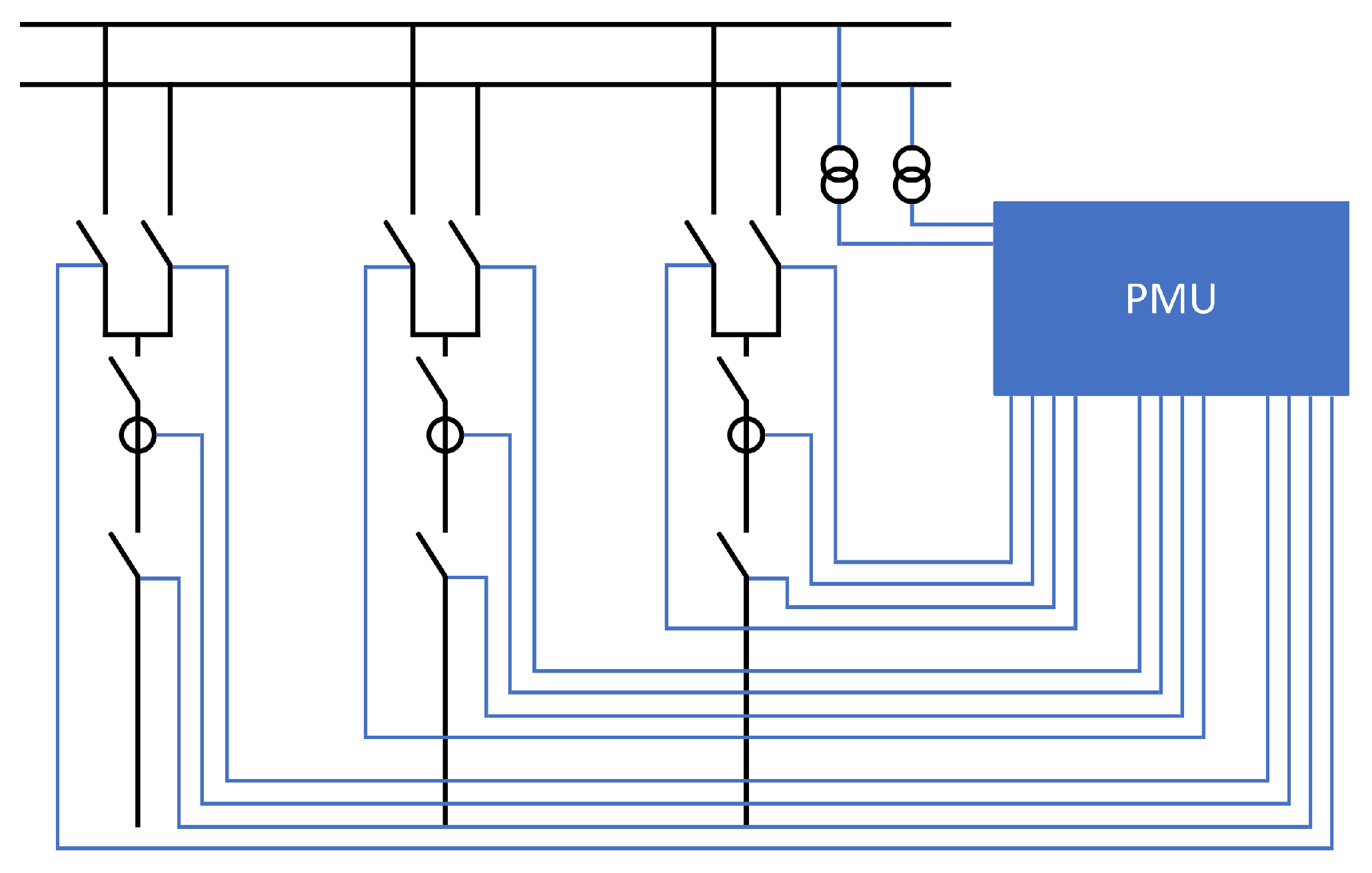
The method of connecting PMU devices can be one PMU multi-busbar multi-feeder and is shown in
Figure 1.
In many PMU placement papers, a multi-feeder (multi-channel) PMU is assumed, meaning that a single device installed at a substation can observe several or all feeders and, in simplified graph models, may even be treated as monitoring the whole substation (i.e., one network node). This assumption is convenient for academic formulations because it can reduce the number of PMUs, but it can also blur several practical limitations. In real substations, wiring quickly becomes complex and the number of available measurement channels is finite, especially when a station contains many bays/feeders. Moreover, feeder-level observability is not determined only by the network topology. It often depends on which busbar system a feeder is connected to, which in turn requires reliable disconnector status signals. In practice, relying on large volumes of binary status data may introduce additional processing and communication delays that are not desirable for real-time monitoring and control. Finally, voltage measurement transformers may not be available in all three phases for every bus. Consequently, the formulation changes. Rather than a single “PMU-at-bus” decision, the feeder-level rule works at bay/feeder granularity and directly matches placement variables to available measurements. For these reasons, and to keep the formulation aligned with practical deployment, we adopt a stricter “one PMU per feeder” principle, where each monitored feeder is associated with a dedicated measurement chain. This provides a clear, implementable mapping between the placement decision and the measurements used in the observability analysis.
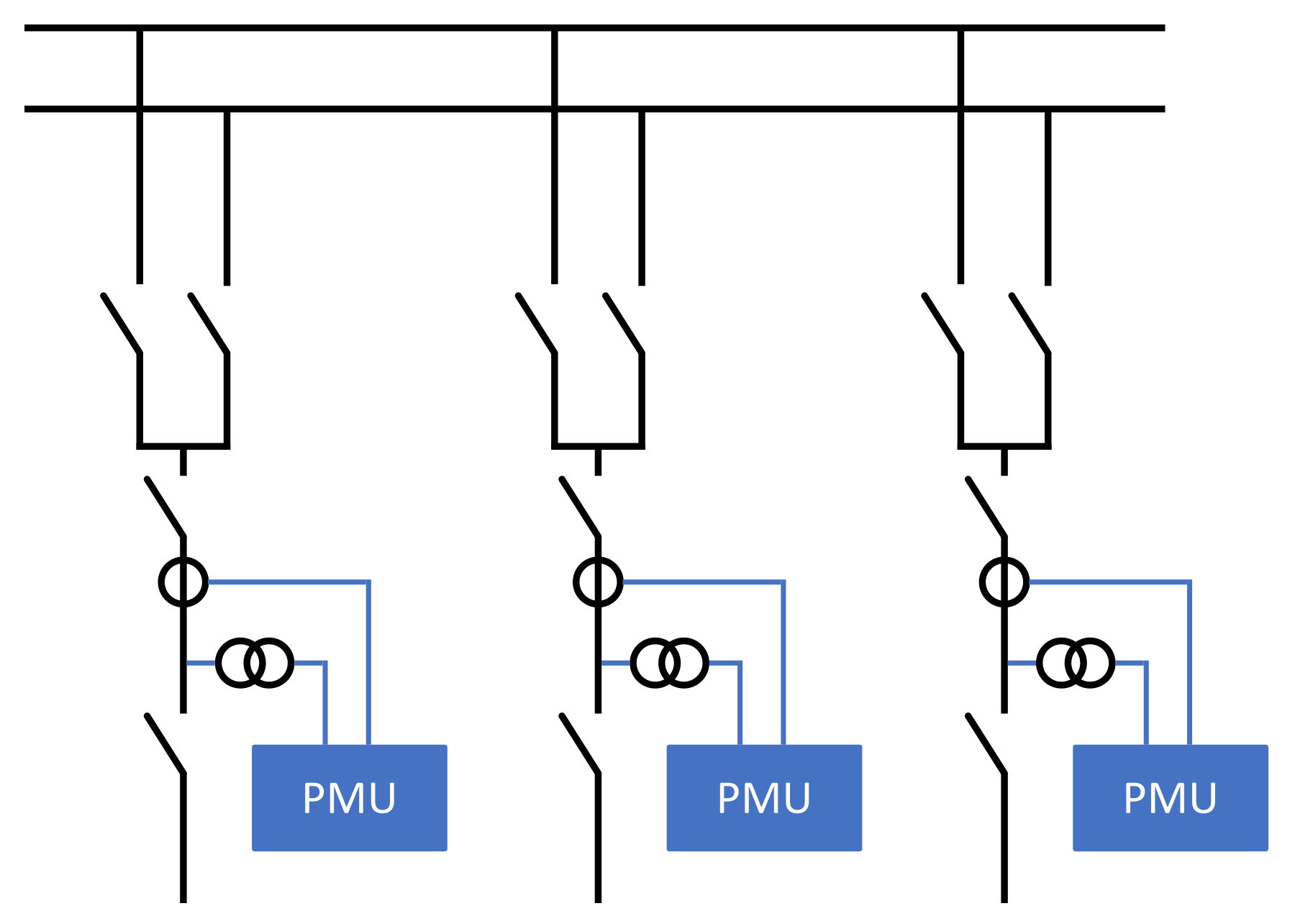
For this reason the solution used by TSOs (Transmission system operator) in Europe is based on PMU device having possibility to cover only one feeder as shown in
Figure 2.
This is a one PMU one feeder setup. Information about topology is not required, the connection is simple, wiring is straightforward, all additional calculations are possible, and there is no need to account for the limit on the number of channels. The downside of this method is that multiple PMU devices are needed for a single substation, determined by the number of feeders originating from the substation.
In this paper, a one PMU one feeder configuration is adopted.
2.2. Problem Formulation
Therefore, the formulation of the optimal PMU placement problem is extended, and the criterion function takes the following form:
where
is a variable representing the total number of PMU devices located at node
i. This total includes PMU devices required due to the number of edges connected to that node, in accordance with the “one PMU per feeder” configuration. Since each node must be observable, a PMU must be installed either at the node itself or at any of its adjacent nodes. For the
i-th node, this implies the following conditions:
where
denotes all nodes that are neighbors of node
i. The binary variable
x is defined as follows:
If the PMU device is placed in node
i, then the total number of PMU devices corresponding to that node is equal to
, where
is obtained as the sum of the branches that depart from node
i and one additional PMU device for the voltage of that node, and in accordance with the methodology described in
Section 2.1. Accordingly, if the optimization process gives
, this means that PMU devices need to be installed at node 3. Their total number is given by
, where
corresponds to the number of feeders (currents) originating from node 3.
The algorithm presented in this paper is organized in two stages to address this formulation. It starts with HNS—for topological observability and continuing with GA to ensure numerical observability.
3. Proposed Algorithm
An efficient algorithm has been developed for optimal PMU placement in the power system. This algorithm is particularly suitable for planning tasks. Although execution time is not a strict limitation in planning studies, the efficiency of the proposed algorithm allows planners to perform a large number of analyses, taking into account various scenarios that may occur in a power system. This flexibility enables planners to evaluate PMU placement options under diverse operating conditions and enhance system reliability against potential disturbances.
The proposed algorithm not only identifies high-quality PMU placement configurations, but also provides a foundation for comprehensive scenario-based analysis that is essential for long-term planning and maintaining system stability.
The algorithm will be explained in the following text. In the initial step, it is checked whether there is a radial node in the graph. If such a node exists, the node adjacent to it will belong to the set of nodes included in the optimal solution. In this way, we ensure the observability of multiple nodes in the network. If a PMU device were placed only in the radial node, it would make only that node and its adjacent node observable. By placing the PMU device in the node adjacent to the radial one, we ensure the observability of additional nodes, which makes this step both effective and justified.
To proceed with further steps in the algorithm, it is necessary to state that each node in the graph has a dominance number. The dominance of a node is calculated according to the equation
All variables from Equation (
4) will be thoroughly explained mathematically in the following text and later illustrated through an example.
Variable
is the incidence degree calculated by the equation
where
is an element of the incidence matrix that is 1 if there is an edge between nodes
v and
u, and 0 if there is not. In other words, this is the number of edges originating from a given node in the graph.
Core Tree (CT) represents a reduced version of the initial graph, where redundant nodes and edges have been removed to simplify the analysis. All key connections between nodes are retained in the CT. The number
represents the degree of the node in the CT structure (Definition 8). It can be defined as
where
is an element of the incidence matrix that is 1 if there is an edge between nodes
v and
u, and 0 if there is not. More precisely, this is the number of edges originating from a CT.
Each fundamental cutset consists of a set of edges (Definition 6). To obtain the variable for each node, it is necessary to count how many times each edge appears in the cutsets and then calculate how many times each node is part of those edges.
For this purpose, we will define an indicator function that denotes whether the edge
is part of the cutset
:
The total number of occurrences of edge
e in all cutsets is:
Now the number
for node
v, which represents the sum of occurrences of all edges containing node
v in all cutsets, can be defined as:
where
is the set of all edges containing node
v.
The new Optimal PMU Placement Algorithm is presented in Algorithm 1.
| Algorithm 1 Optimal PMU Placement |
- 1:
Input: Network graph , Incidence matrix - 2:
Output: Set of nodes for PMU placement - 3:
Check for radial nodes - 4:
if there is a radial node then - 5:
Place PMU in the adjacent node to the radial node - 6:
Ensure that this adjacent node remains in further calculations - 7:
end if - 8:
Form the Core Tree (CT) structure - 9:
Calculate node dominance - 10:
for each node i in V do - 11:
Calculate , , - 12:
, , - 13:
end for - 14:
Select the node with maximum - 15:
- 16:
if there exists more than one node with then - 17:
Select among them the node with larger - 18:
end if - 19:
Place PMU in the node with - 20:
Update graph G by removing and its non-radial neighbors, along with connected edges - 21:
if there are still uncovered nodes in G then - 22:
Repeat from step 3 - 23:
end if - 24:
End: The algorithm terminates when all nodes are covered
|
To describe the algorithm in the best possible way, two examples will be provided.
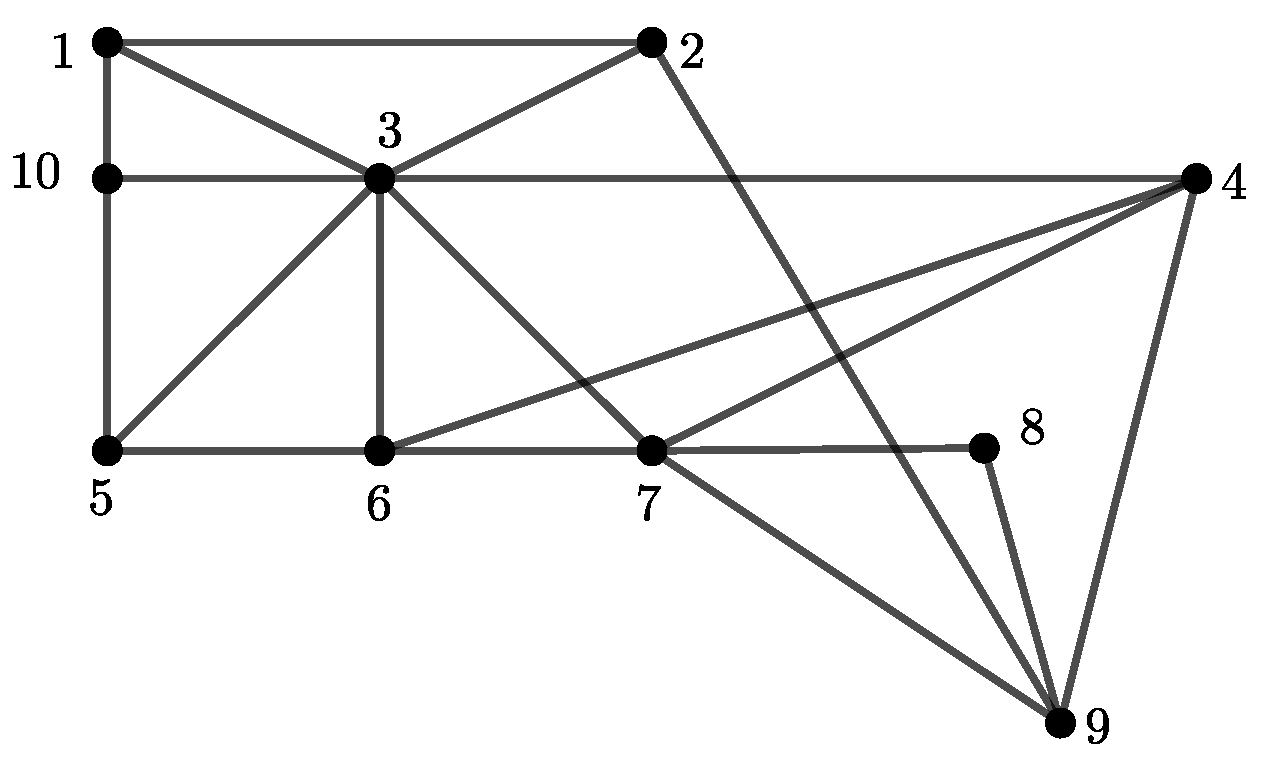
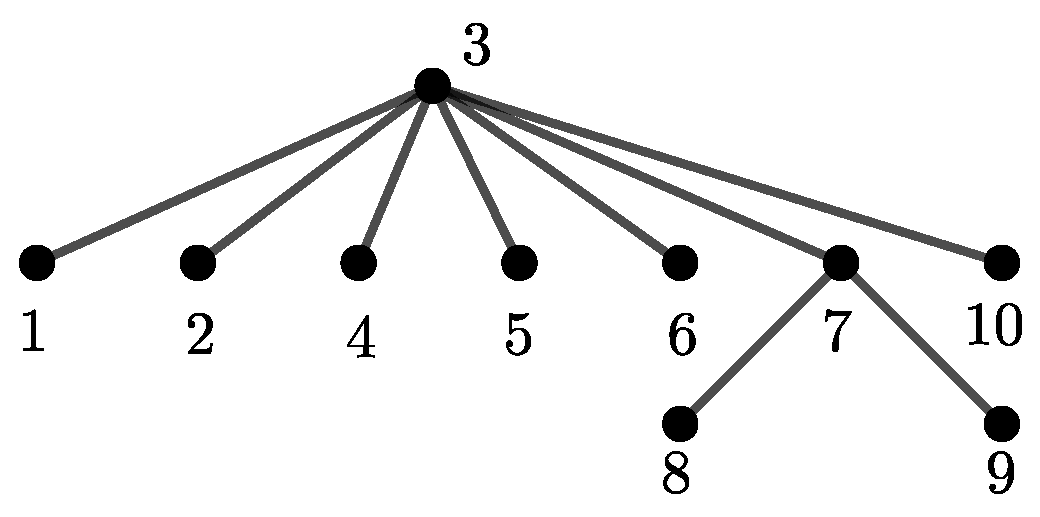
Example 1. Consider the following network with 10 nodes represented in Figure 3. There are no radial nodes in the network. The incidence degree for each node is calculated and presented in
Table 2.
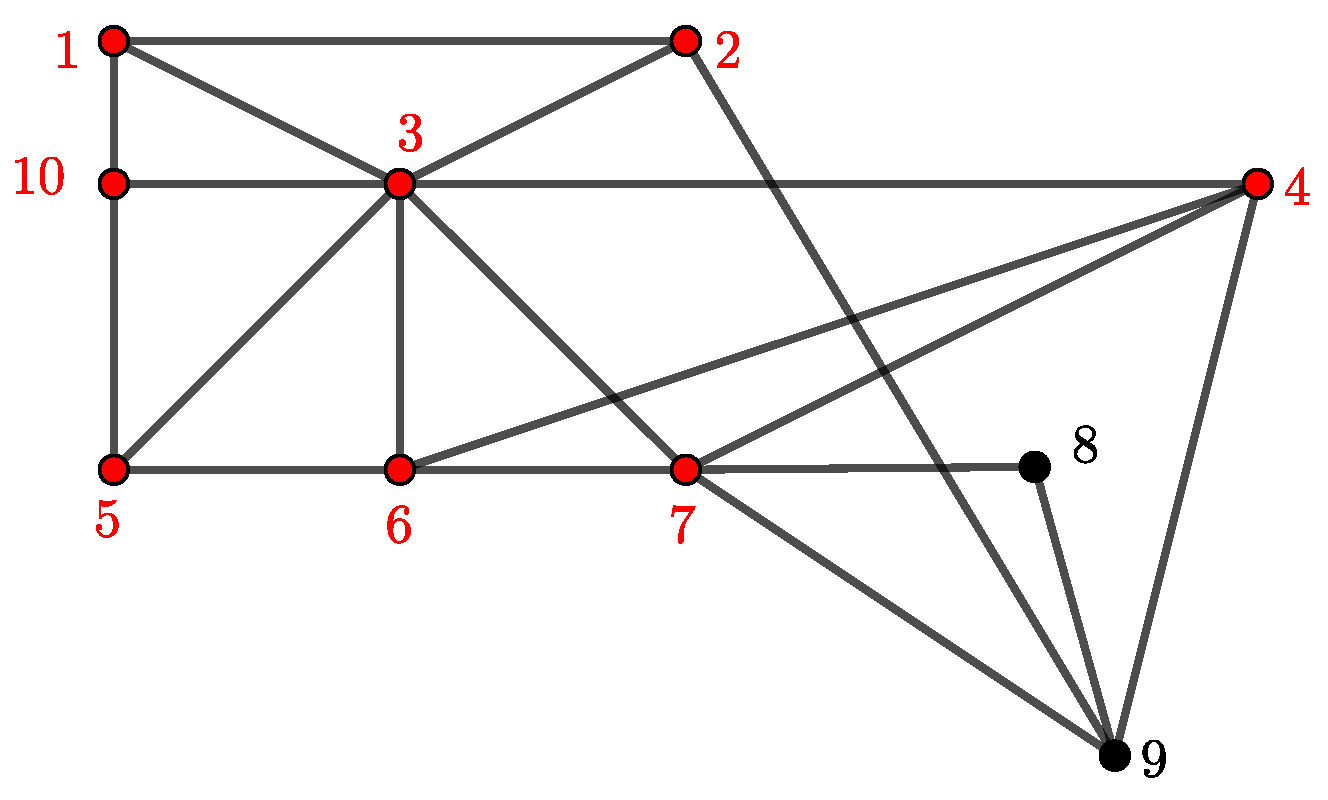
The maximum value of
is for node 3. Node 3 becomes the parent, and all nodes adjacent to it, in this case
, become first-degree children and all of them are colored red in
Figure 4.
For example, in the next iteration, the incidence degree of node 4 becomes . This results from the fact that nodes have already been reached, and all connections between node 7 and these nodes are eliminated. Only the connection of node 4 with node 9 remains, so .
After the first iteration,
Table 3 presents the updated incidence degrees. It can be observed that
since node 1 has no more unreached adjacent nodes. Nodes with an incidence degree of zero no longer participate in the process. The incidence degree of node 7 is
(because node 7 has two remaining unreached neighbors—8 and 9). Given that this node has the highest incidence degree, it is selected for the next step. If another node had the same incidence degree, one of them would be arbitrarily selected to be in the CT.
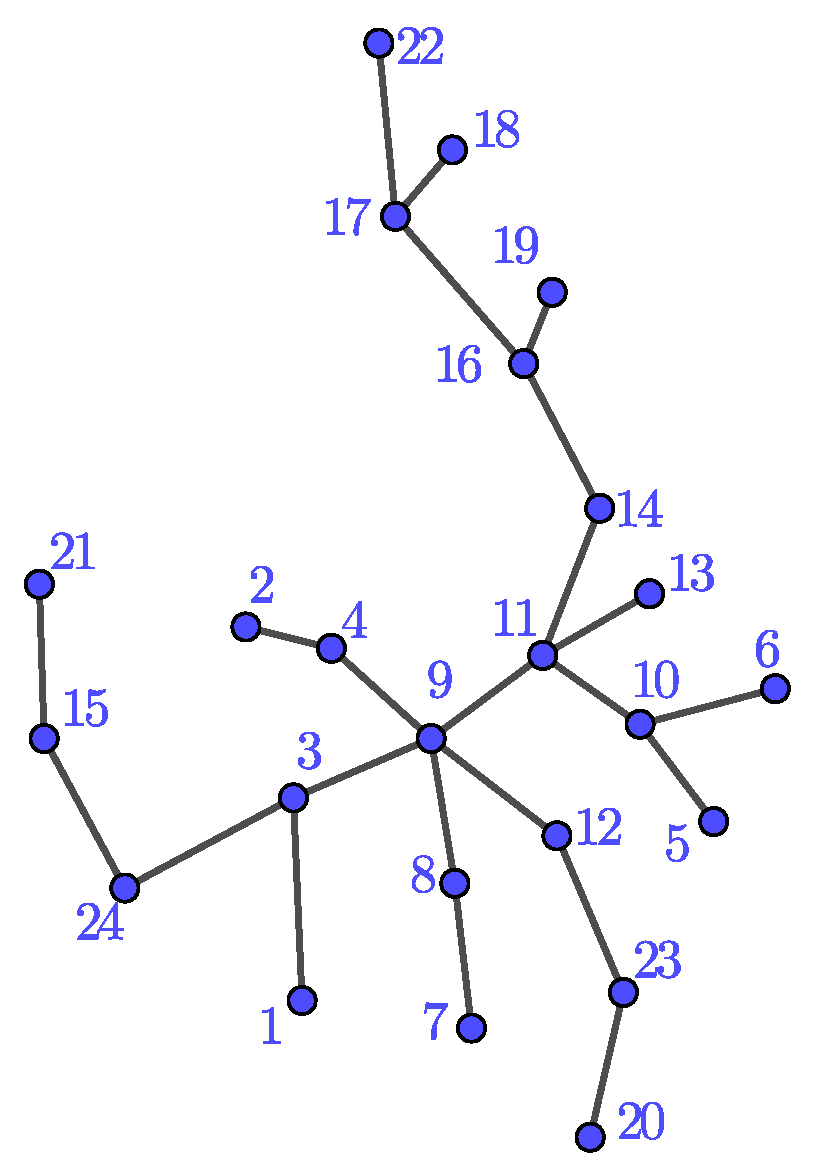
Since all the nodes have been reached, the process concludes. The resulting CT is presented in
Figure 5.
From the CT (see
Figure 5), it is necessary to obtain the node degree,
, as shown in
Table 4.
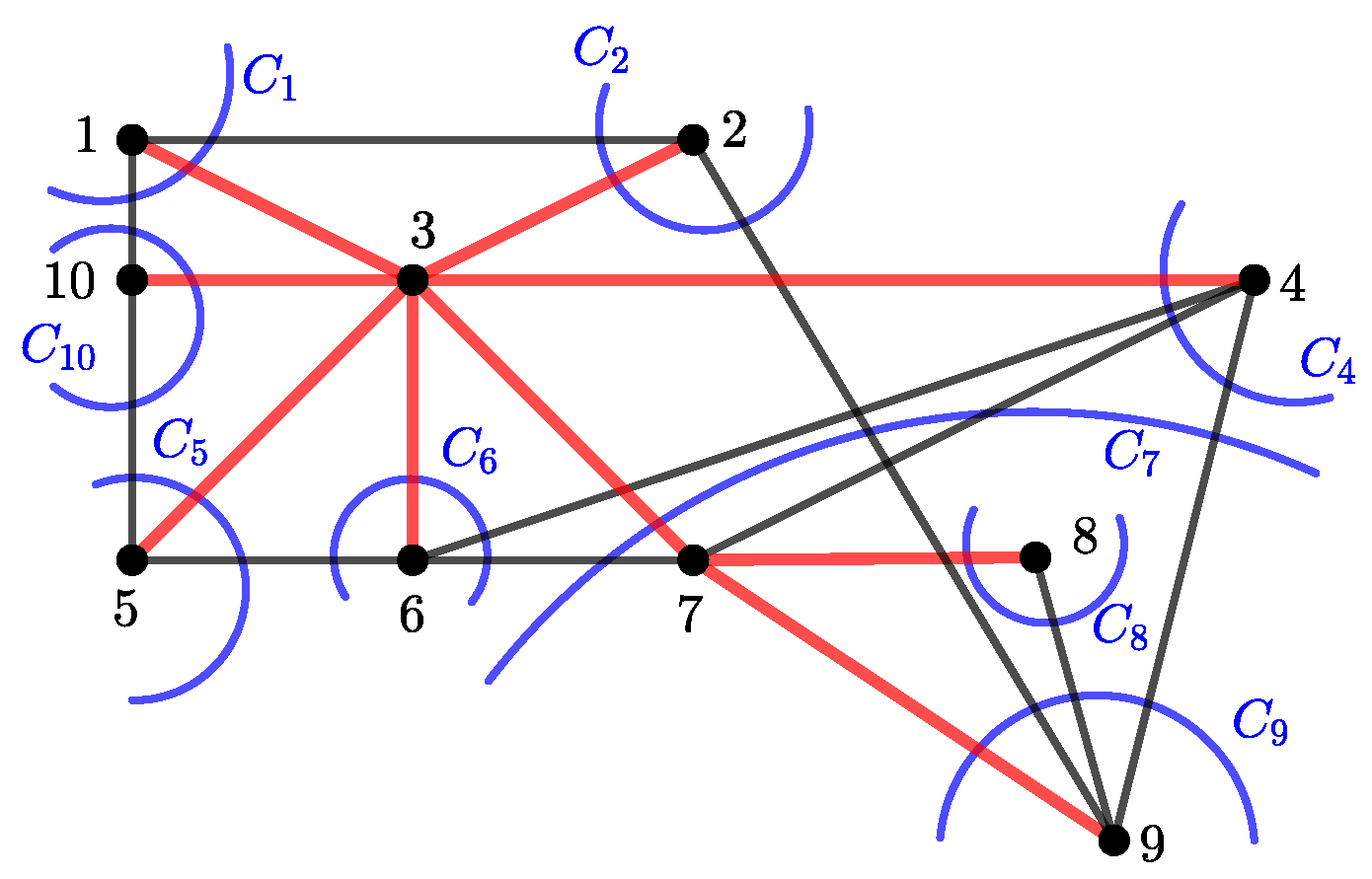
Node cutsets are created based on the obtained tree.
Figure 6 shows the network graph with the core tree highlighted in red and the node cutsets highlighted in blue.
For each node, the degree of the node cutset is calculated. For clarity, the construction of the
will be explained. As we can see from
Figure 6, the cutset
intersects the branches 7-6, 7-3, 7-4, 2-9, 4-9. Thus, node 7 appears 3 times, node 4 appears twice etc. Following this principle,
Table 5 is created.
In the final phase, the dominance of each node is calculated using Equation (
4), and the results are summarized in
Table 6.
Based on
Table 6, it can be concluded that node 3 has the highest degree of dominance, making it a reliable candidate for PMU placement.
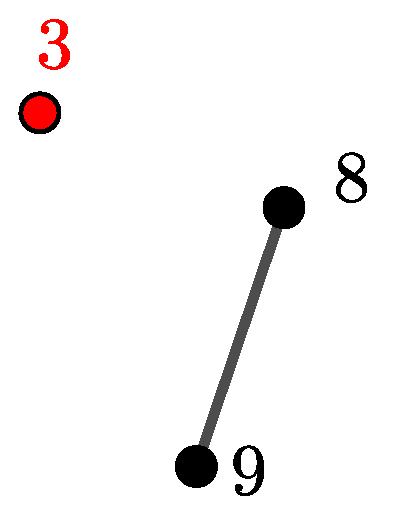
A step that significantly accelerates the process is the breaking of the graph. All edges originating from node 3 are removed. We also remove all nodes adjacent to node 3. In this way, we obtain the graph shown in
Figure 7. Now the PMU device can be placed either in node 8 or node 9, but since
and
, from
Table 3, PMU will be placed in node 9.
The set of all PMU devices for ensuring complete topological observability is .
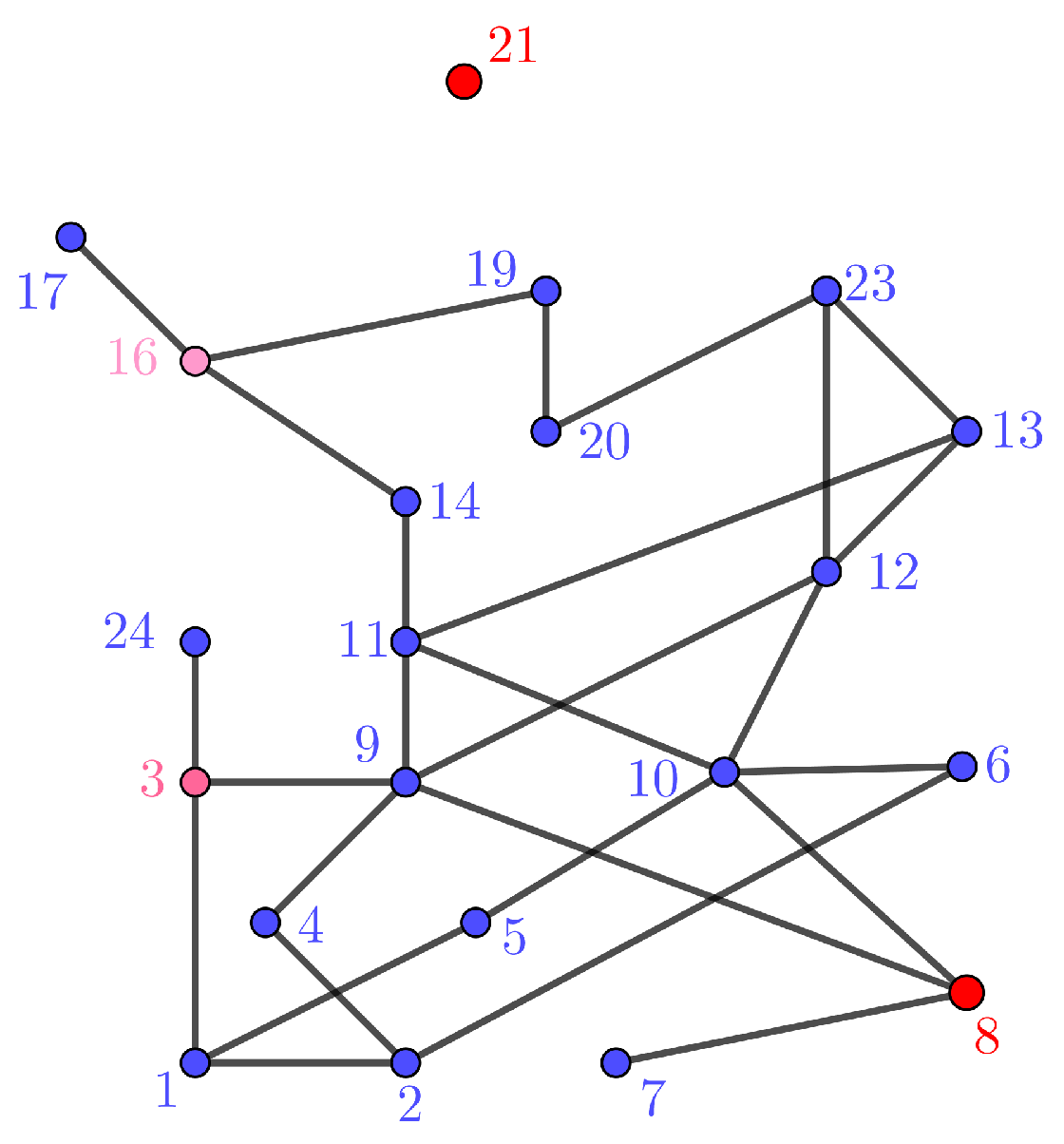
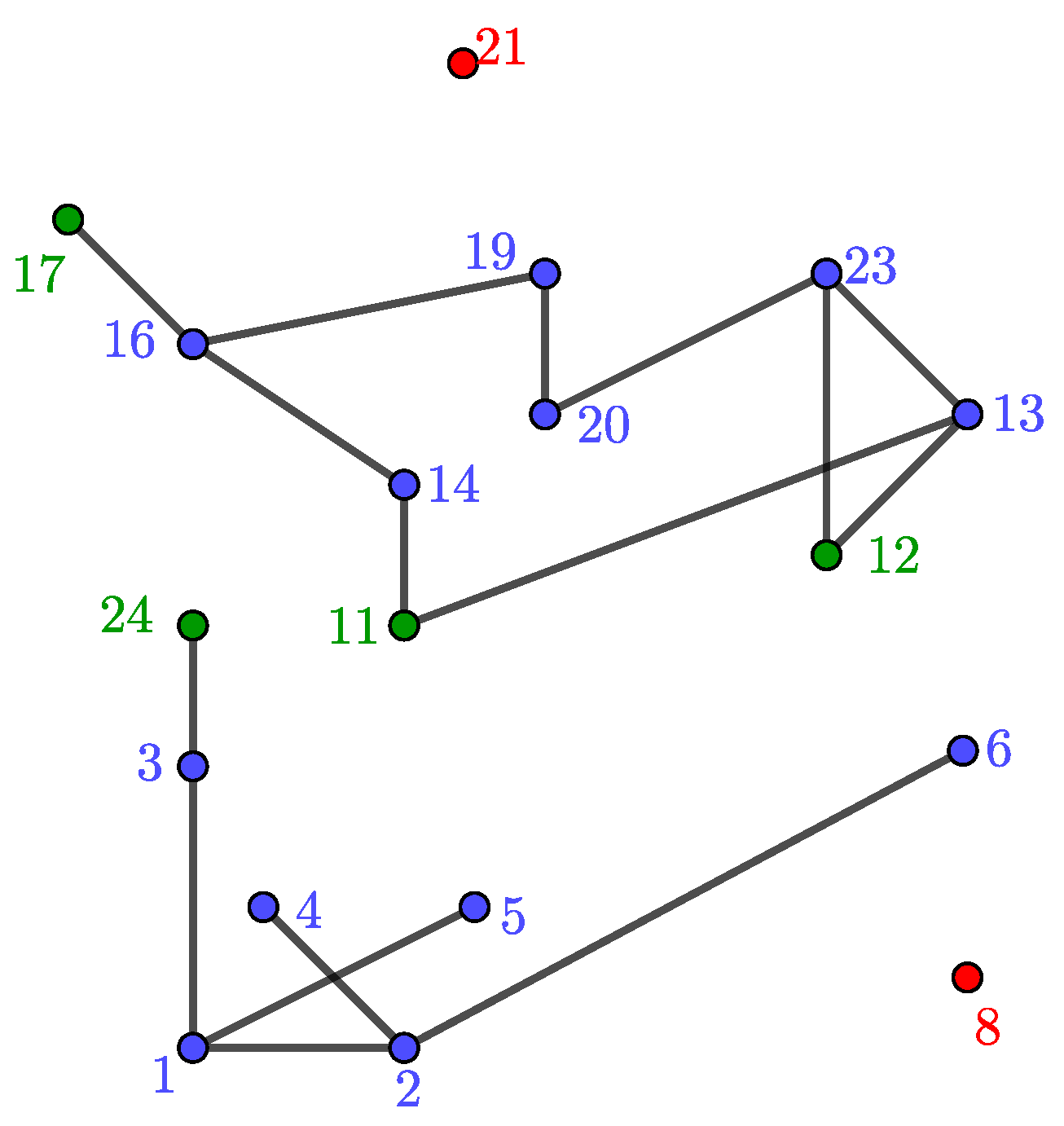
Example 2. The IEEE network with 24 nodes is observed. From the initial step, it is determined that node 7 is radial, so the PMU device is placed in node 8, as shown in Figure 8. Since the initial step is imposed and not derived through the algorithm, all nodes in the graph participate. The next step is CT forming, as it is shown in
Figure 9, and based on it, the cutset is derived, from which the values of
are obtained.
In summary, all values are provided in
Table 7.
Based on the presented algorithm, it is concluded that
is at node 21, where the PMU needs to be placed. In the next iteration, node 21 and all its adjacent nodes are removed, resulting in the graph shown in
Figure 10.
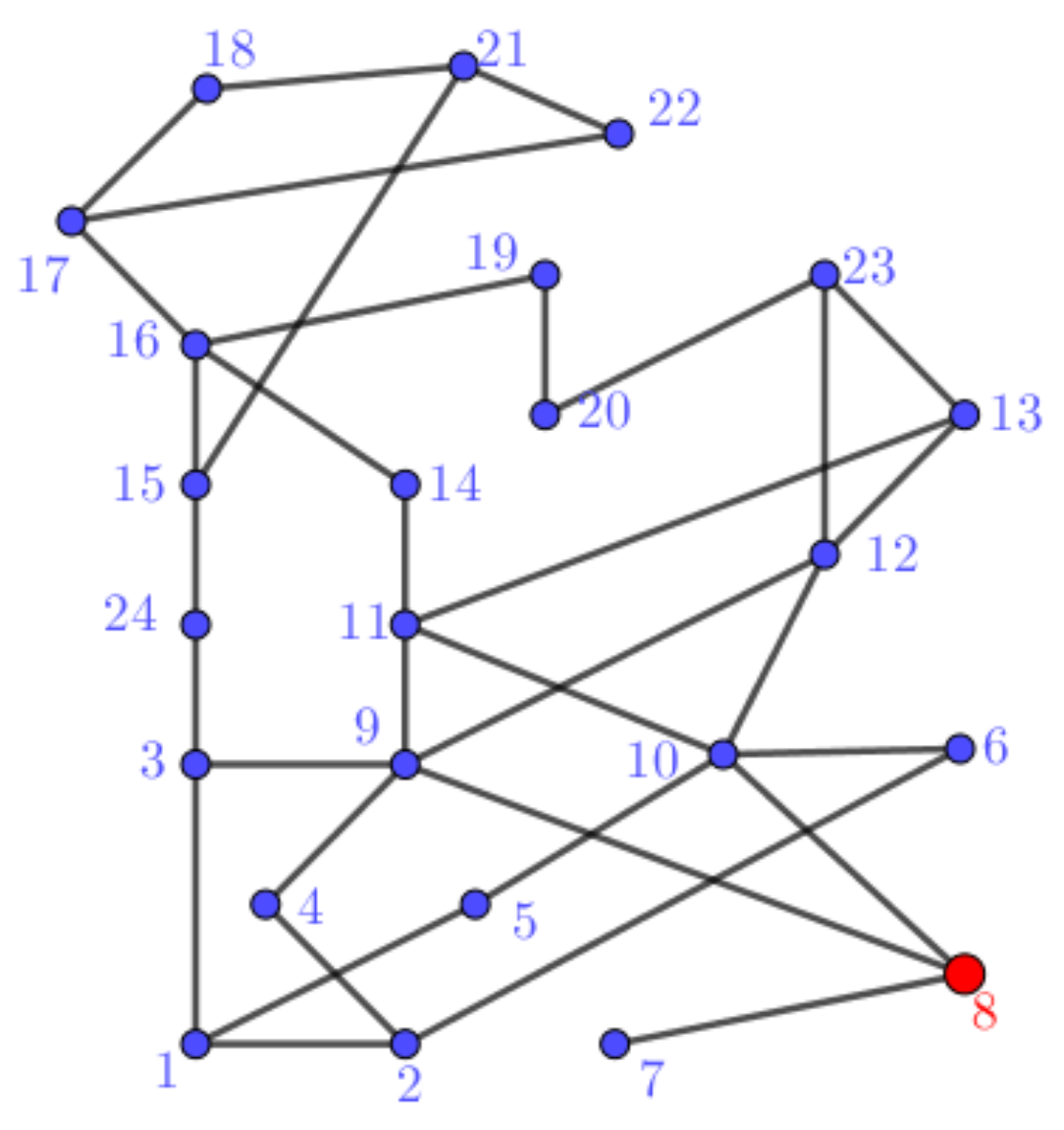
The presence of radial nodes is checked. These are nodes 17 and 24, so PMU devices are placed in nodes 16 and 3. In the second iteration,
Table 8 is obtained. The PMU needs to be placed in node 10. Node 10, along with all its adjacent nodes and corresponding edges, are then removed.
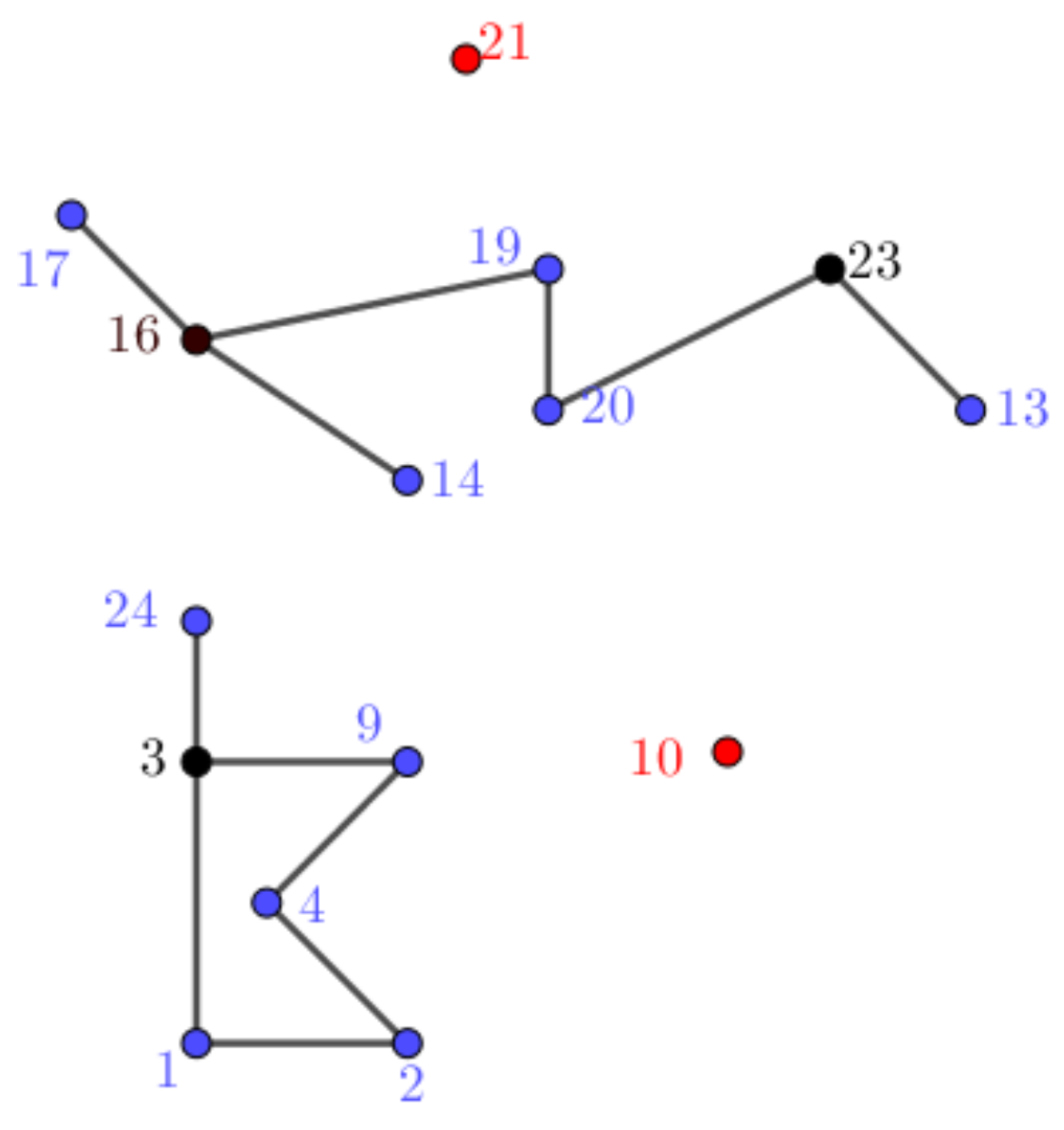
The radial nodes are now 13, 14, 17 and 24 (see
Figure 11), and the PMU devices are placed in its adjacent nodes 23, 16, 16 and 3, respectively, and these nodes still participate in the calculation.
In the third iteration, two disconnected graphs are obtained, as shown in
Figure 11. In that case, the algorithm is applied to both graphs, resulting in
Table 9.
It is necessary to place PMUs in node 3 and node 16; however, since PMUs are already installed at these locations, node 3 and node 16, along with all their adjacent nodes, are removed from consideration.
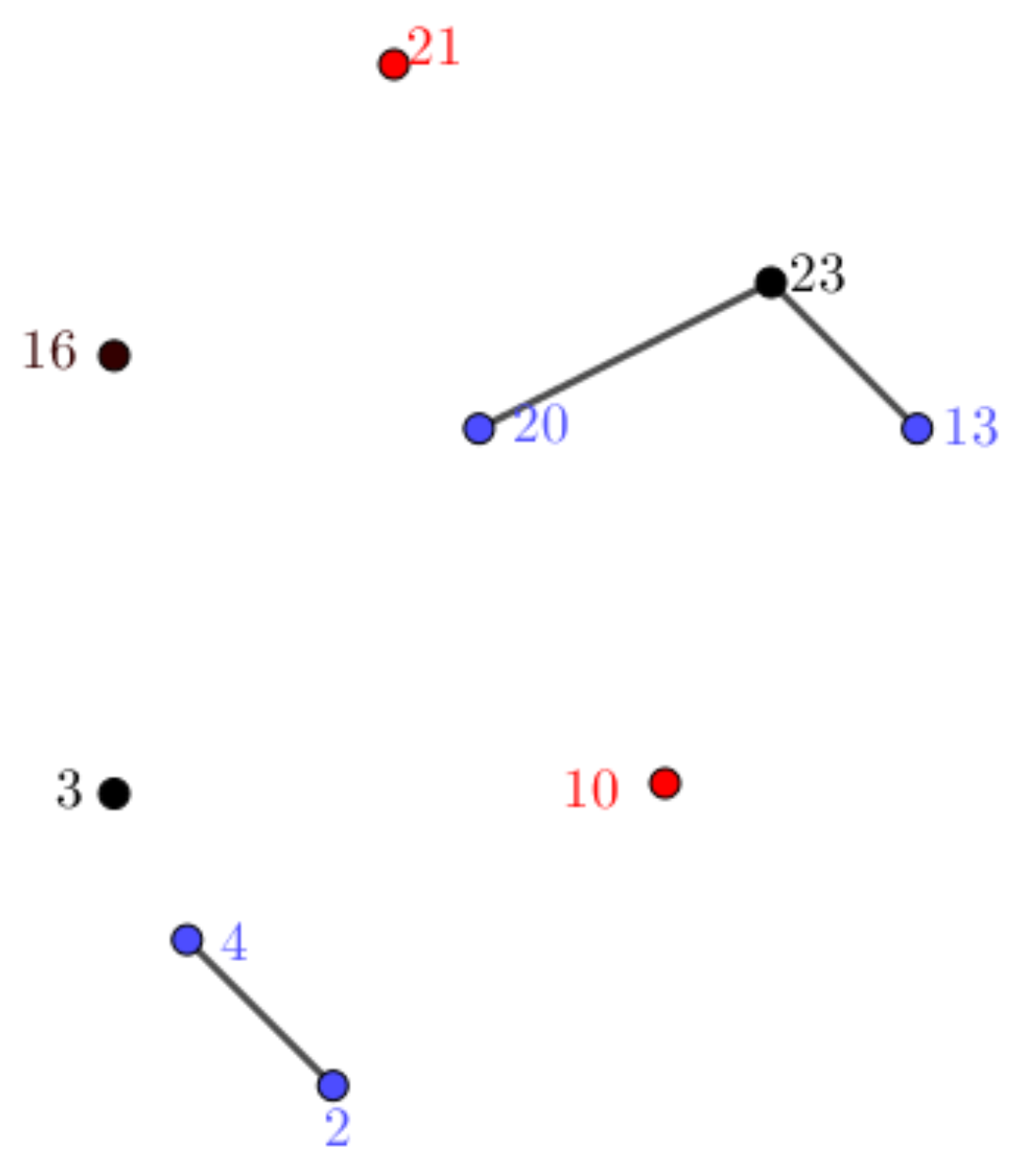
In the fourth iteration, as shown in
Figure 12, a PMU device can be placed in either node 2 or node 4. Since
and
, PMU will be placed in node 2.
In this way, the algorithm concludes, and we obtain the optimal selection of locations
4. Impact of Zero Injection Bus
Zero Injection Bus (ZIB) is a bus in the power system where the net injection (total generation minus total load) is zero. This means total power coming in is equal to total power going out. These buses are used in various analysis to simplify the calculations as known power injections reduce the number of measurements required to achieve system observability. ZIBs can be treated as pseudo-measurements at the corresponding bus. In practice a ZIB can occur due to:
Transformer with zero load: Transformers that are not connected to a load or generation.
Connection point: A bus that connects only lines or branches without active sources or consumers.
Distribution: Buses in distribution systems where power is balanced or there is no load.
ZIBs are important in PMU placement algorithms because they allow the reduction of the number of PMU devices required to achieve system observability. There are two approaches in the literature to handle ZIBs: one approach modifies the constraints in the optimization process [
36,
39] and the other achieves these constraints through topological modifications of the graph [
34]. While these treatments are physically well motivated, they typically introduce an extra layer in the workflow—either through additional constraint modeling, a graph transformation, or a corrective post-processing step. The methodology proposed in this paper introduces a fundamentally different perspective: instead of treating ZIB rules as a secondary constraint or a post-processing step, the extended HNS algorithm directly incorporates ZIB-induced observability into the graph dominance estimation and node selection mechanism. This creates a unique framework where the physical KCL (Kirchhoff’s Current Law) constraints are inherently represented by the graph’s topology, representing a methodological step that, to the best of the authors’ knowledge, has not been previously reported in the literature.
The authors adapted the proposed HNS algorithm to account for the presence of ZIB nodes within the network. The following rules are applied when handling ZIB nodes [
20,
21,
22]:
Rule 1: If a ZIB node is not observable, but all of its neighboring nodes are observable (either directly by PMU placement or through adjacency to a PMU), then the ZIB node becomes observable by applying Kirchhoff’s Current Law (KCL).
Rule 2: If a ZIB node is observable and all but one of its neighboring nodes are observable, the remaining unobservable node becomes observable using the node potential method based on KCL.
Rule 3: If there exists a group of unobservable ZIB nodes, the entire group becomes observable if all nodes adjacent to the group are observable.
To facilitate understanding, the algorithm is demonstrated on the IEEE 24-bus test system. Node 7 is a radial node, with node 8 as its neighbor. A PMU is placed at node 8, which is not removed from the graph in this iteration. According to
Table 7, node 21 has the highest dominance number, and a PMU is placed at this location. Its adjacent non-ZIB nodes (15, 18, and 22), along with all branches originating from these nodes, are removed. Additionally, all nodes adjacent to node 8 are also removed. The resulting state is illustrated in
Figure 13.
If a ZIB node is radial, it can be merged with its single neighbor without loss of generality. To justify this, the node potential method derived from Kirchhoff’s Current Law (KCL) is applied, and the corresponding node equation is written for node 3.
If a PMU is placed at node 1, the voltage phasors
and
are obtained. Using Equation (
10), the phasor
can then be determined. As a result, nodes 3 and 24 are combined into a single equivalent node 3*, while nodes 16 and 17 form node 16*. The new node 3* becomes radial, and the PMU remains at node 1, which continues to participate in the current iteration. In the lower graph, node 2 exhibits the highest dominance, while in the upper graph, it is node 23. Accordingly, PMUs are placed at these locations. Their adjacent nodes—4, 6 (adjacent to node 2) and 13, 20 (adjacent to node 23)—are removed from the graph. Node 12, identified as a ZIB, is retained in the network due to the benefits ZIB nodes can provide.
In the next iteration, node 5 is removed, as it is observable via node 1. The only remaining node is node 16. The final PMU placement set is . It is important to note that if a ZIB node is identified as having the highest dominance number during the algorithm, it is skipped, and the next highest dominance value is selected. This approach is justified by KCL, from which the aforementioned ZIB-related rules are derived. Furthermore, the primary distinction between applying the HNS algorithm to networks with and without ZIB nodes lies in the treatment of ZIB nodes and their branches: in the presence of ZIBs, neither the ZIB nodes nor the branches connected to them are removed, in order to fully exploit the observability contributions of ZIB nodes.
In many PMU placement studies, ZIBs are handled in one of two ways. They are either incorporated by embedding additional KCL-based observability constraints directly into the optimization model, or exploited via ZIB inference as a post-processing step after an initial PMU configuration has been obtained [
9]. While these approaches are physically well motivated, they usually add an extra layer to the workflow: either the optimization problem becomes more constrained and harder to formulate, or the initial placement must be corrected afterward. In this work, ZIB reasoning is incorporated directly into the HNS dominance logic, meaning that ZIB-based observability is used during the node selection process. As a result, ZIB benefits are realized early, the procedure remains straightforward to implement, and the subsequent GA stage can operate on a more informative and reduced candidate space.
5. Numerical Observability
Numerical observability is of crucial importance for reliable monitoring and management of power systems in control centers [
40,
41]. Numerical observability enables correct operation of various applications such as state estimation, fault detection and maintenance of system stability in various operating conditions. Achieving numerical observability with a minimal number of PMU devices represents a significant challenge that is considered in this paper.
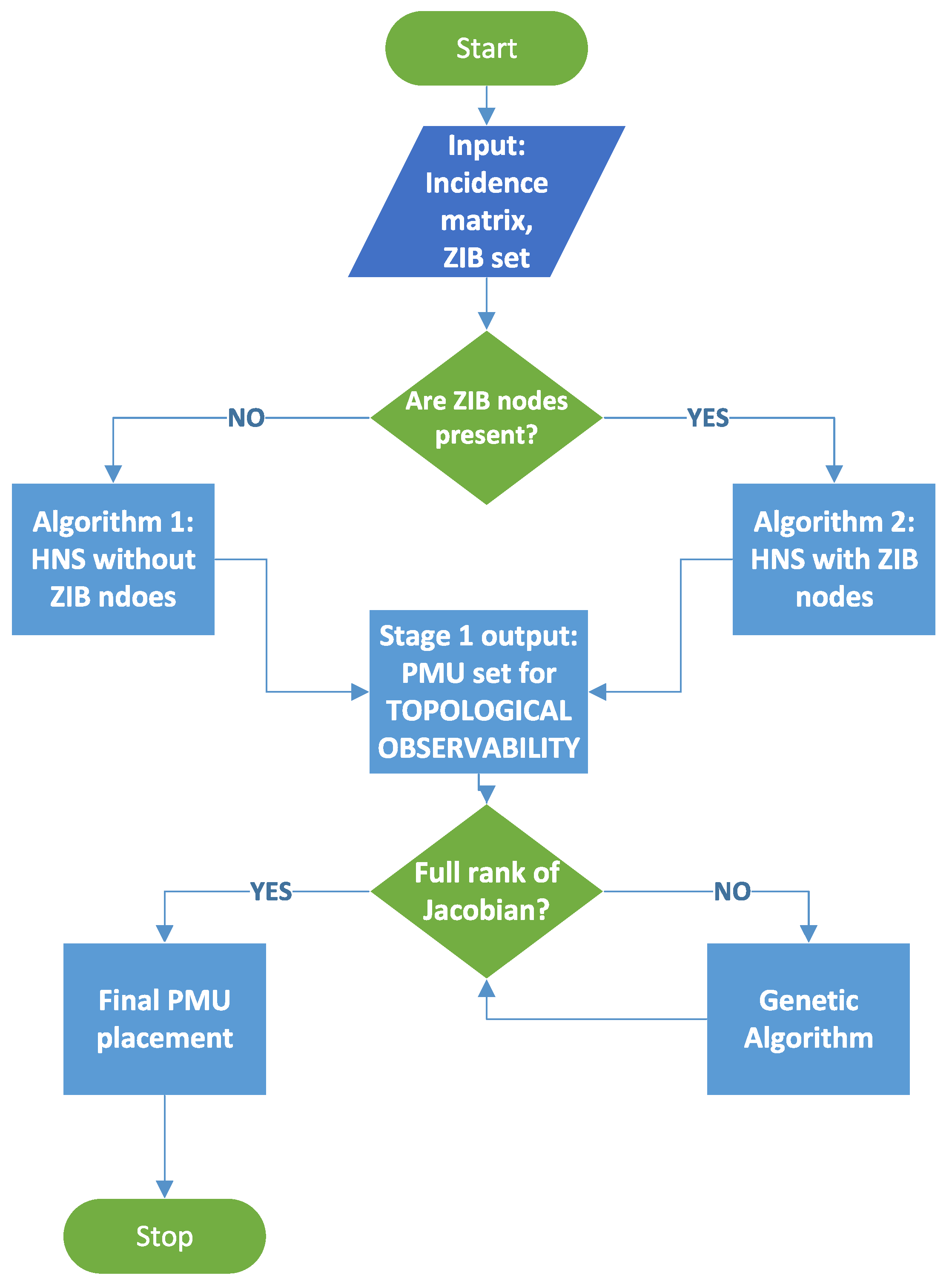
After the end of the HNS phase, the initial PMU placement is known. The next step is to evaluate whether that placement ensures numerical observability. This is done by forming a measurement matrix (Jacobian) and calculating its rank. If the rank is not full, it moves to the second stage—optimization with the genetic algorithm.
For clarity, the proposed method follows a two-stage workflow. In Stage 1, HNS is applied to obtain a TO feasible PMU placement (Algorithm 1 without ZIB or Algorithm 2 with ZIB nodes). The resulting placement is then evaluated for numerical observability by building the Jacobian matrix and checking whether
. If the rank is full, the Stage 1 placement is accepted as the final solution; otherwise, Stage 2 applies a GA refinement using chromosome
and the fitness in Equation (
11) until a full-rank placement is achieved, while minimizing the number of PMUs as a secondary objective. The Flowchart is presented in
Figure 14.
Since PMU measurements are usually used with SCADA/EMS, especially with the state estimation (SE) numerical observability is of the utmost importance [
4,
18]. For
n nodes system we will consider the linear decoupled measurement equation
where
is a
measurement vector,
is the decoupled Jacobian matrix
of the real power measurements, in this case only PMU measurements,
is the vector of node phase angles and
e is the measurement error vector. Since DC power flow model is used, only real power is considered, all branch impedances have only reactances
p.u (
, all node voltages are assumed to be 1 p.u. Thus, the active power is
and
These are standard simplifications used in power flow analysis [
42], resulting in a linear relationship between voltage phase angles and active power, thus simplifying the formulation and analysis of the Jacobian matrix. As the main goal is to determine only the rank of the Jacobian matrix, the use of the DC power flow model is justified.
| Algorithm 2 HNS for grid with ZIB nodes |
- 1:
Input: Network graph , set of ZIB nodes - 2:
Output: Set P of nodes for PMU placement - 3:
while there are uncovered nodes in G do - 4:
Check for radial nodes - 5:
if there is a radial node r (including ZIB) then - 6:
Contract r with its neighbor if , else place PMU at neighbor of r - 7:
end if - 8:
Form HNS - 9:
Calculate node dominance for each node i - 10:
- 11:
if then - 12:
Place PMU at - 13:
end if - 14:
Update G by removing and its non-radial neighbors (except ZIB) - 15:
Apply ZIB Rules: - 16:
for each do - 17:
if Rule 1 is satisfied then - 18:
Mark z as observed - 19:
else if Rule 2 is satisfied then - 20:
Mark the only unobserved neighbor of z as observed - 21:
end if - 22:
end for - 23:
Apply Rule 3: For each group of ZIB nodes, if all neighbors are observed, mark all ZIBs as observed - 24:
end while - 25:
return P
|
If PMU is located in node
i it can measure the voltage phasor of node
i and current phasors
, where
and
is a set of nodes adjacent to the node
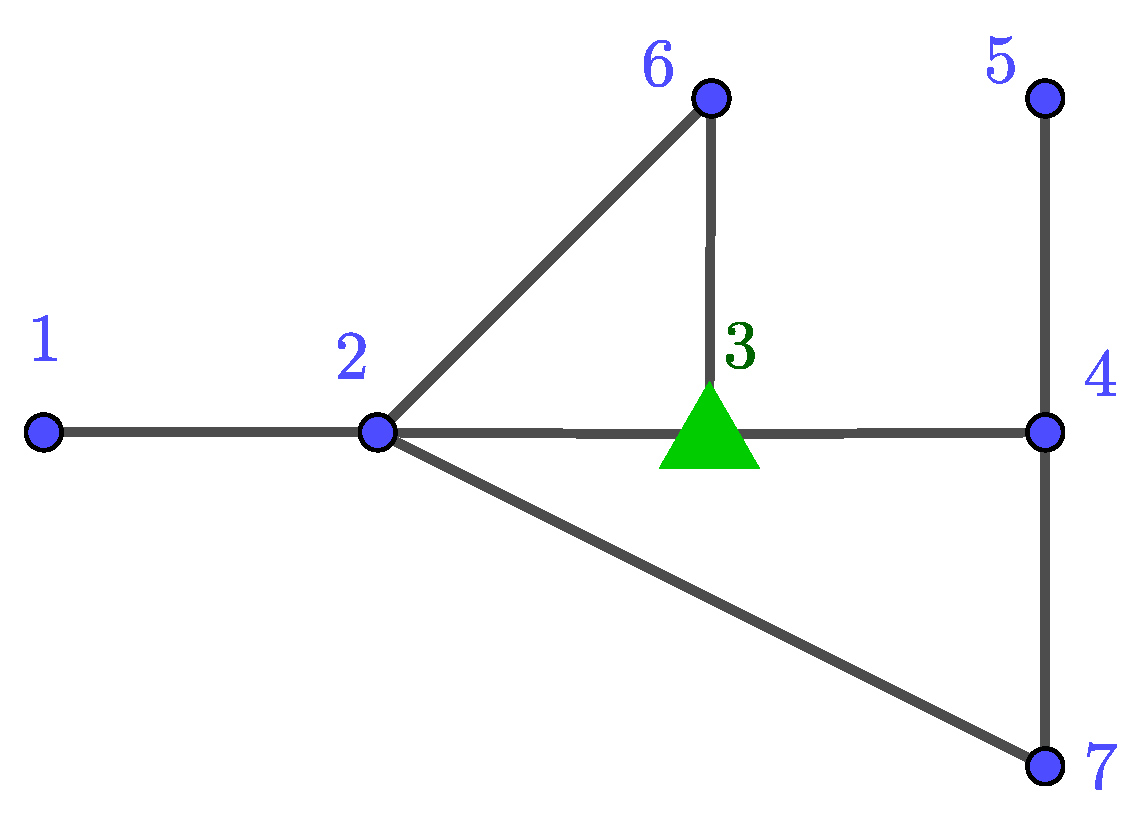
i. For example, for the IEEE 7-bus system, shown in
Figure 15, if PMU is placed only in node 2, the Jacobian matrix (with columns corresponding to nodes 1, 2, …, 7) is given by
The power system will be observable if and only if
[
37,
40]. In this case, it is obvious that power system is not observable because
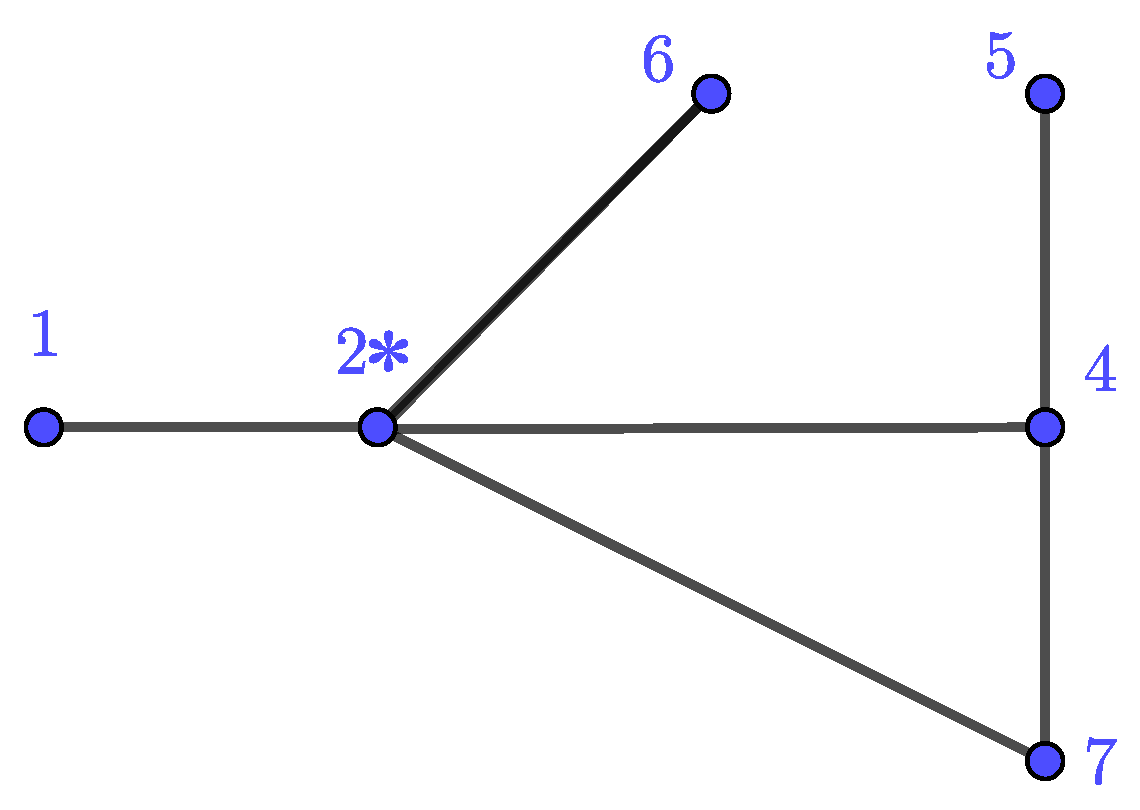
. If we apply proposed topology transformation, ZIB number 3 should be integrated with node 2. We get power system presented on
Figure 16.
The Jacobian matrix is
and its rank is
. Thus, additional PMUs have to be placed in the system.
Since PMU devices have already been placed in certain nodes, it is first necessary to check if the rank of the Jacobian matrix is full. If not, an optimization method is applied, specifically the genetic algorithm supported with the HNS algorithm.
The objective function is
where
is a binary vector representing the presence of a PMU at node
i. The constants
and
are selected to enforce a clear priority structure: numerical observability is treated as the primary requirement, while the number of PMUs is optimized second. Each chromosome represents a possible PMU placement in the network. The binary vector
is a chromosome of dimension
n. The initial population is generated randomly, and tournament selection is used, where 3 chromosomes are chosen randomly, and the best one is selected for further reproduction. The crossover rate is set to 80%, and the mutation rate to 1%. The best 2 chromosomes will be passed on without any changes.
The first term in the objective function introduces a penalty for any deviation from complete numerical observability. A quadratic form was chosen to severely penalize deviations. The second term represents the number of placed PMU devices. Constants and are set in such a way that achieving numerical observability is strongly prioritized. Numerical observability has a significantly higher priority compared to reducing the number of PMU devices. This ensures that the algorithm primarily aims for complete numerical observability, optimizing the number of PMUs only after this critical requirement is fully satisfied. The weights are chosen to enforce strict prioritization: achieving numerical observability () is treated as a hard requirement, while the number of PMUs is optimized only within the full-rank solution set. Consequently, is set large enough to strongly penalize lack of rank, but when a candidate reaches full rank, the first term becomes exactly zero, and the second term directly directs the search towards placements with fewer PMUs. In this sense, is not ignored. It manages the choice among feasible (full-rank) placements.
The advantages of this approach lie in the efficiency of the initial PMU placement based on the HNS algorithm, which significantly reduces the solution search space for the genetic algorithm. The proposed method is successfully applicable to networks with various topologies, including those with and without ZIB nodes. Through the presented approach, the genetic algorithm adaptively seeks optimal solutions, even in the case of complex networks.
Hybrid algorithm which combines HNS algorithm and Genetic algorithm is presented in Algorithm 3.
| Algorithm 3 Hybrid Algorithm for PMU Placement |
- 1:
Input: Graph - 2:
Output: Optimal PMU placement set P - 3:
{Initial PMU placement using HNS} - 4:
Jacobian matrix for - 5:
if then - 6:
return {Numerical observability achieved} - 7:
end if - 8:
Initialize population with individuals containing - 9:
for each generation do - 10:
for each individual do - 11:
Jacobian matrix for - 12:
Compute fitness using Equation ( 11) with - 13:
end for - 14:
Select best individuals using tournament selection - 15:
Apply crossover and mutation to generate new individuals - 16:
Apply elitism: keep the best individuals unchanged - 17:
Update with new generation - 18:
if any individual achieves then - 19:
return Best feasible individual as P - 20:
end if - 21:
end for - 22:
return Best found solution P
|
6. BOI and SORI
One of the distinguishing features of the proposed HNS algorithm is that it systematically produces PMU configurations with exceptionally high observability redundancy. In all analyzed IEEE and real transmission system cases, the HNS + GA framework achieved SORI values that were higher than, or at least equal to, those obtained by any of the benchmark methods used for comparison.
This behavior is a direct consequence of the dominance-based node selection strategy embedded in the HNS procedure, which favors structurally influential buses and thus yields PMU placements that monitor a large portion of the network both directly and indirectly.
A detailed comparative analysis of SORI values across several established approaches is presented in the
Section 7, where it is shown that the proposed method consistently attains the highest SORI among all tested techniques.
Mathematically, the BOI (Bus Observability Index) is defined as the number of PMUs that monitor a given network node, either directly or indirectly. If node i in the network is the one with the largest number of incident nodes j, then it is clear that the BOI cannot be greater than the number , i.e., .
The SORI is defined as the sum of all BOI indices. If the network has
N nodes, then the SORI index is given by the expression:
The higher the SORI, the greater the number of nodes that will remain observable in case of a PMU outage. SORI can also be obtained by applying the formula
, where
u is an
N-dimensional unit vector
is the incidence matrix, formed by the expression (
3), and
is a binary vector.
7. Calculation Results
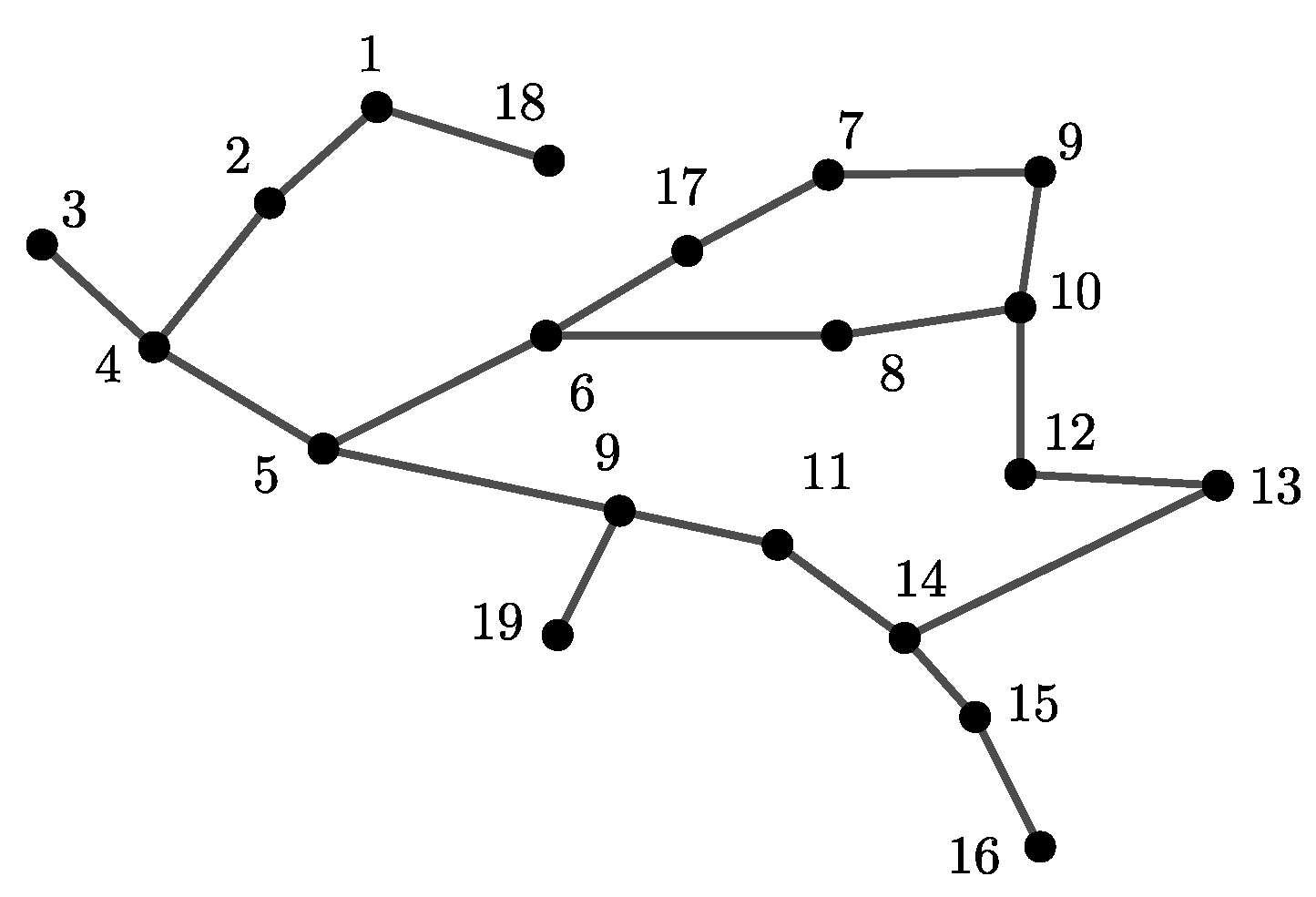
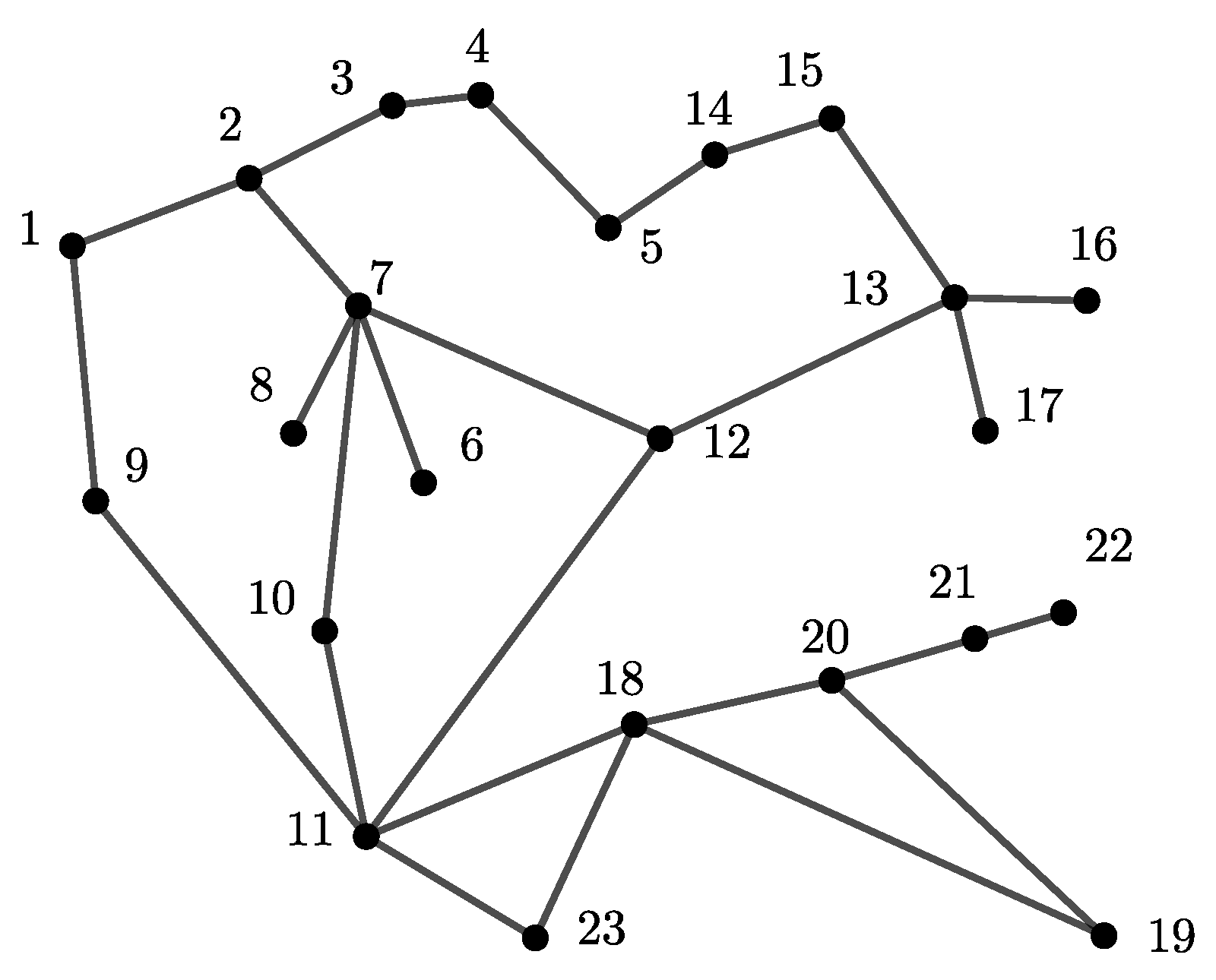
The proposed algorithm was applied to standard IEEE networks with 14, 24, 30, 57, 118 and 300 nodes. Calculations were also performed for real networks: Serbian 400 kV and 220 kV networks which are shown in
Figure 17 and
Figure 18, respectively (Serbian networks do not have ZIB nodes).
The results presented in the
Table 10 show that, in networks without ZIB nodes, topological observability inherently guarantees numerical observability. This highlights the simplified requirements for PMU placement in such scenarios, as no additional devices are needed to achieve full numerical observability. For better understanding of
Table 10, the first row will be explained, using the IEEE 14-bus network as an example. The HNS algorithm resulted in PMU devices being placed at nodes 2, 6, 7, and 9. The required number of PMU devices is
for all feeders originating from these nodes, respectively.
Table 11 provides a detailed comparison of PMU placement for achieving both topological and numerical observability in networks with ZIB nodes. The first column lists the systems under observation, the second column shows the nodes where PMU devices should be placed to achieve complete topological observability, while the third column provides their count, calculated using (
1). The fourth column presents the additional PMU positions that, together with the positions from the second column, provide topological and numerical observability simultaneously. The last column shows the total number of PMUs required to achieve this.
Table 11 highlights the additional PMU devices required to achieve numerical observability, which depend on the presence and configuration of ZIB nodes in the network. For example, while the IEEE 14-bus network requires only 1 additional PMUs, the IEEE 30-bus network demonstrates a more complex scenario, requiring
additional PMU devices.
These results show the big impact of ZIB nodes on the optimization process. The need for additional PMUs comes from the linear dependencies introduced by ZIB nodes which limits the rank of the Jacobian matrix. The proposed approach combining the HNS algorithm and the Genetic algorithm, solves this problem, ensuring full numerical observability of the system while minimizing the number of PMUs required. This further proves the robustness and flexibility of the method to handle different network topologies.
The proposed method can be applied directly in real-time state estimation, so operators can make informed decisions based on full system observability. Also it can be used post-event to identify system weaknesses and improve operational strategies. These applications show the practicality of the method in modern power system operations.
The comparative results for the considered IEEE test systems are presented in
Table 12 and
Table 13.
Table 12 shows the results obtained in scenarios without ZIB nodes, while
Table 13 presents the corresponding results when ZIBs are included in the analysis. The proposed method is compared with several existing approaches. For each method, the minimal number of PMU locations required to achieve complete network observability is provided for each test case.
The results in
Table 12 indicate that, if the grid is without ZIB nodes, the proposed HNS + GA algorithm yields solutions that are equal to those obtained by other methods. Similarly, the results in
Table 13 shows that the proposed method also performs well when there are ZIB nodes, compared to the state-of-the-art approaches.
To further consider the efficiency of the proposed method,
Table 14 presents a comparison of the execution times of a few well-known algorithms, including ILP, BPSO, nonlinear programming, and WLS with the proposed HNS + GA method. The runtime consists of a one-time graph-guided preprocessing (HNS) followed by repeated GA fitness evaluations. In practice, the runtime is dominated by the GA stage, since each evaluated candidate placement requires a numerical observability check through a Jacobian rank computation. A key scalability benefit of the proposed framework is that the HNS stage performs an early search-space reduction. It constructs a topologically observable baseline and produces a reduced candidate pool, so the GA does not operate over all possible locations but over a smaller set of meaningful candidates. This directly shortens the chromosome length (fewer decision variables) and decreases the total number of costly rank evaluations across the GA generations. As a result, the two-stage design improves scalability without relaxing the observability requirements.
The result verifies that, along with ensuring secure and scalable PMU placement, the proposed method efficiently reduces the computation time, particularly for large networks.
Table 15 presents a comparison of the SORI index obtained by the proposed HNS + GA hybrid algorithm and several well-known methods from the literature for a range of IEEE test systems. The proposed method consistently achieves equal or higher SORI values compared to existing approaches, demonstrating its ability to provide highly redundant measurement configurations while maintaining minimal number of PMUs. In particular, on larger test systems such as IEEE-118 and IEEE-300, the proposed algorithm yields the highest SORI values among all compared methods, indicating excellent robustness to measurement loss and network contingencies.