This section provides the contextualized findings to examine how to engage citizens to participate in renewable energy initiatives for sustainable transition in LEC. Key findings from this section are centered on providing answers to the research questions being investigated in this study. Qualitative analysis is employed to present key findings in sub-sections.
3.1. Current State of Local Energy Communities
Local communities mainly consist of different actors, e.g., citizens or residents, local governments, and non-governmental organizations (NGOs) [
17]. Evidence from Pacheco et al. [
18] mentioned that communities are mostly vulnerable to climate change and are partly dependent on fossil-based fuels and energy imports for the national power grid [
18]. Similarly, local communities face a set of energy challenges related due to climatic conditions and their specific geographic location has necessitated the transition to sustainable energy initiatives by adopting novel technologies and employing innovative approaches [
18]. Sustainable energy transition is crucial in attaining sustainable development and addressing climate actions. This has triggered local communities to engage citizens to increase the development and use of distributed energy resources [
19]. Heuninckx et al. [
19] and Anthony et al. [
20] stated that the actualization of sustainable energy transition is embodied by a shift from centralized energy systems to decentralized energy systems, supporting the active transition of energy consumers into energy prosumers [
19,
20].
This has resulted in enabling the democratization of the overall energy system by shifting more decisions and autonomy over to local energy prosumers, giving rise to a new form of organizational management of energy supply and demand termed as local energy communities (LECs) that support local energy exchange [
19,
21]. Intrinsically, there has been a recent surge of interest in LEC in producing and supplying renewable energy. This development has prompted the involvement of “energy prosumers” who previously were passive consumers and are now termed as energy prosumers who both produce and consume energy [
21,
22]. As such, LEC are now being characterized by a network of prosumers that have reasonably similar energy sharing interests and behavior to pursue a common goal to jointly contribute to the local energy market [
20,
22].
Researchers such as Jnr [
7] maintained that LEC steams from the concept of energy communities (EC) which was formed into the European Union legislation via the “Clean energy for all Europeans” package (
https://eur-lex.europa.eu/legal-content/EN/TXT/HTML/?uri=CELEX:52016DC0860 (accessed on 29 January 2026)), aimed at improving citizen energy communities as well as renewable energy communities. Energy community initiatives promote energy democracy and justice, thereby mitigating energy poverty, and thus fostering socially just energy transition [
7]. Overall ECs are built on the idea that non-commercial legal entities can locally collaborate to produce, supply, consume, and manage their energy services grounded on democratic and open participation [
19]. LECs offer a sense of localism, identity, place, and shared values [
22] by enabling different types of stakeholders to mutually invest and participate in (renewable) energy assets [
19]. LEC offers opportunities for citizens and local alliances of actors to actively contribute to the local energy market, not only as energy consumers but also as energy prosumers in deciding on the procedure and extent to which energy is generated [
23].
LECs deploy local energy systems such as integrated community energy systems (ICESs) by different actors such as communities, local governments, system operators and energy suppliers as an effective means to ensure the self-provision of clean energy. Presently, LECs face energy challenges related to their geographical location and climatic conditions. But they are poised to transition to cleaner energy by adopting digital technologies and innovative solutions [
18]. Findings from Shortall [
4] and Anthony Jnr et al. [
24] highlighted that LEC also provides social benefits, including local job creation, social cohesion, financial paybacks, training and education, zero-emission energy, energy autonomy, and the reduction in air pollution [
4,
24]. While many benefits are to be derived from community energy initiatives, their efficiency in promoting sustained citizen engagement, inclusion, equity, and empowerment has not been well-addressed [
4]. Hence, there is a need to explore which best practices are to be employed when engaging citizens in human-centric energy exchange in local districts [
25].
3.2. Overview of Human-Centric Energy Transition in LEC
Humans are the underlying component of community energy systems and as such, it is important to enhance their participation in sustainable energy initiatives [
26]. Likewise, van de Grift et al. [
17] pointed out that achieving participation from the local community is, in general, important for community energy projects. The adoption of a human-centric energy transition is needed to support the functioning of technical solutions and the engagement of citizens in LEC. The human-centricity in LEC involves the influence of the way citizens interact with the proposed energy projects and the factors that affect citizens’ involvement or participation in LEC initiatives [
16]. Accordingly, several studies such as Pacheco et al. [
18] have focused on investigating the integration of renewable energy sources (RES), energy storage systems and demand side management solutions in local communities, including the energy solutions that allow sector coupling and flexibility [
18]. Sector coupling combines heating, gas, electricity, and transport sectors to create an efficient and holistic system, whereas flexibility in energy systems is concerned with adjusting energy demand and supply. As such, local energy communities are aiming at having 100% net-renewable electricity resolutions [
27].
Koirala et al. [
22] stated that by deploying local energy systems, LEC can contribute to the overall sustainable energy transition by addressing local energy needs to reduce energy costs, provide valuable flexibility in the local energy market, decrease carbon dioxide (CO
2) emissions, and reduce reliance on the national power grid [
22]. In renewable energy initiatives, policy makers and decision makers tend to focus on informing the local communities rather than involving the citizens from the beginning of the project, which has led to a lack of meaningful participatory decision-making. This top-down approach often fails to capture the real needs of local communities, which has prompted the need for a human-centric approach that improves community engagement towards the transition to cleaner energy initiatives [
6]. Moreover, Hindmarsh [
8] mentioned that there is a need to address societal challenges, including consuming sufficient renewable energy from local utilities, adhering to existing energy regulations, balancing costs with other community needs, and convincing citizens of the advantages of utilizing renewable energy in their residents and businesses [
8].
Overall, in LEC, the role of citizens is commonly conceived in relation to energy systems, from being just “passive” and “individualistic” (energy consumer), towards a more “participative” and “communitarian” state (energy prosumer) [
25]. Whilst the literature on community-driven energy developments has emerged, to date, there has been moderately little attention directed to human-oriented energy research [
25]. Successful uptake of renewable energy projects requires adopting collaborative strategics that positively integrate citizen’s worldviews [
28].
3.3. Background of Community Engagement in LEC
A community comprises a set of inhabitants or groups of people residing together in a predefined geography, interacting in an organized way to represent their shared interests [
17]. Hence, engagement offers an adequate medium for organizations or institutions to gain insights and respond to stakeholders’ expectations [
29]. Engagement refers to a dynamic and interactive process where meaning is created or co-created via communication, ultimately achieving the understanding needed to support decision-making. In a societal context, engagement is an outcome of interactive sense-making processes [
29]. Social acceptance has been a key focus for both academics and practitioners engaged in renewable energy initiatives [
27,
30]. Thus, citizen engagement and/or community or public engagement is important as it influences the social acceptance of any innovation provided to society. In local communities, engagement fosters collaboration, dialogs, and communication, characterized by openness, mutuality, reciprocity, and commitment [
29]. In communities, engagement is shaped by different factors, such as technology, culture, norms, and public expectations.
Community engagement involves public participation via an ongoing, two-way or multi-directional process, mainly emphasizing building relationships and trust with the citizens to foster social acceptance [
16,
31]. Typically, community engagement is aimed at individual inhabitants and social groups [
17]. Effective engaging with stakeholders is necessary for ensuring the successful implementation of renewable energy initiatives, thereby maximizing their positive impacts on sustainable energy development [
5]. Although citizen engagement and community engagement are interchangeably used in the literature, this study argues that citizen engagement focuses mostly on individual interaction with renewable energy sources (RES), whereas community engagement underscores mutual collaboration between organizations and groups of people involved in RES in LEC. While community engagement has been explored in relation to specific technologies such as solar and wind, more broadly, little is known about community engagement strategies with a focus on the integration of low-carbon energy production within geographically defined regions such as in LEC [
9]. Furthermore, there is need to investigate community engagement strategies needed in ensuring a democratic and just transition towards a decarbonized energy system in LEC [
32].
Community engagement actively entails involving communities in decision-making processes, promoting trust, capacity building, relationship development, and fostering collaboration [
1]. Community engagement contributes to the success and sustainability of renewable energy initiatives, as it ensures that local concerns and interests are addressed [
5]. Effective community engagement fosters higher public empowerment and support [
5]. Findings from the literature reveal that in renewable energy initiatives, community engagement involves interactions between different actors (e.g., citizens, businesses, governments, and cooperatives deploying energy projects) [
17]. In LEC, community engagement focuses on promoting legitimate participation that encourages cooperation and empowerment [
33]. Overall,
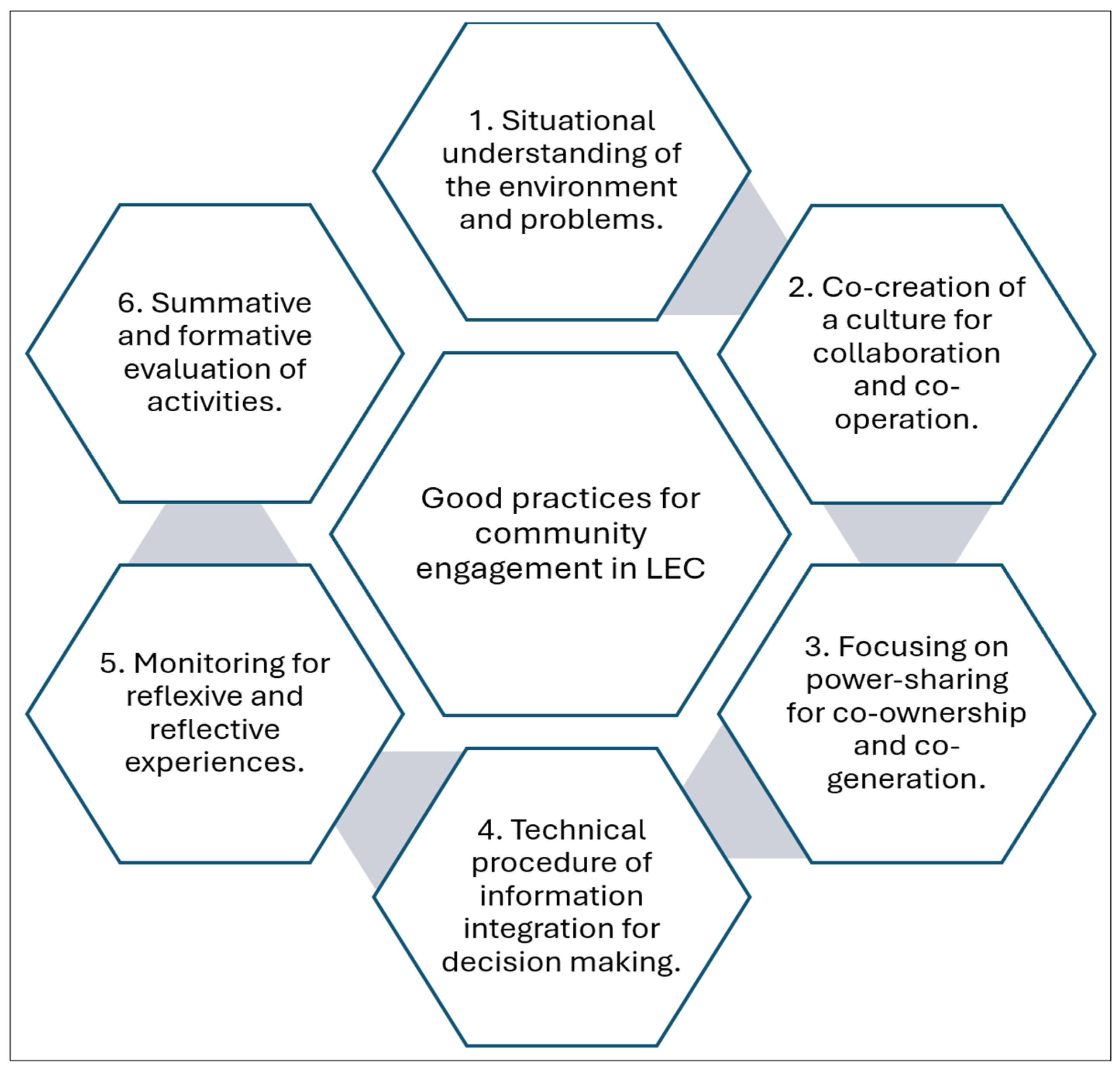
Figure 1 depicts good practices for community engagement in LEC, extending the findings from the literature [
31].
As seen in
Figure 1, the specified six community engagement process involves engaging the public through various activities to ensure their support and involvement. Moreover, other activities include carrying out public meetings where the local community residents can learn about proposed energy initiatives and voice their views and opinions. Other activities include opening workshops that gather feedback and provide information, using surveys to collect opinions and data from a larger population of the community, and outreach events carried out to inform and involve the local community [
5]. Findings from prior studies [
5,
16] reveal that the use of public meetings, open workshops, surveys, and outreach events positively impacts community collaboration for the urban project’s success in gaining public acceptance. This also contributes to economic sustainability through job creation, ensuring the energy projects’ viability for long-term sustainability [
2,
5].
3.4. State-of-the-Art of Citizen Engagement in LEC
The decarbonization of community energy systems is not centered around digital technologies alone but involves the role of people and communities which are seen as central to the entire energy system [
9]. Whilst energy research has generally focused on technical issues, much recent research has highlighted the importance of drawing on community-based perspectives, for instance, regarding citizen engagement. As such, policy makers, decision makers, and project stakeholders have now acknowledged the importance of citizen engagement in tackling energy challenges. However, there are often conflicting methods of defining, conceptualizing and categorizing citizen engagement for inclusive and fair energy transitions [
34]. Findings from the literature highlight the importance of inclusive governance structures via citizen involvement, offering a participatory approach contributing towards “just transition” from fossil-dependent economies. Effective citizen engagement has been found to include prospects for public input and deliberation [
28]. Moreover, including citizens in decision-making of energy projects may be of significant value, as including a diversity of knowledge from the community can help to improve the governing of cleaner energy transition [
9].
Thus, including citizens at an early stage of technological development provides opportunities for residents to present their concerns and expectations towards RES innovation. It is believed that early citizen engagement can enable a more socially acceptable and robust RES development [
29]. Engaging citizens and community actors can result in job creation, local revenue generation, and development of energy community infrastructure [
5]. Citizen engagement should be methodically integrated into the development activities in renewable energy initiatives to lower energy project risks, avoid grievances and disagreements as well as avoid time and cost overruns during the project implementation [
6]. First, citizen engagement is often regarded as an instrumental necessity in gathering the acceptance of infrastructural and technological changes [
9]. Furthermore, community engagement enables decision makers to establish partnerships with local organizations and businesses, accelerating economic growth and promoting resilience in the face of the global energy transitions [
5].
In addition, findings from the literature advise that local groups are faced with poor communication, poor understanding and trust between stakeholders, and inattention to social needs often make citizens feel disempowered [
35]. This result is analogous with findings from Hindmarsh [
8], where the author mentioned that inadequate communal engagement is one of the key governance issues contributing to social opposition around the installation of wind farms in Australia. Citizen engagement can often be seen as a tool for coopting to foster consent or cooperation, thus preventing controversies among the community who are familiar with RES innovation before it is installed in their local community [
29]. But currently, most citizens lack adequate information and opportunities to voice their challenges early in community energy projects [
36].
By actively involving citizens, stakeholders, and local communities who stand to benefit from renewable energy initiatives in LEC, there is a need to foster social acceptance, aligning with urban sustainability goals [
5]. Findings from the literature mention that there is a need to specify the feasible process and relevant criteria to be employed to involve all community members [
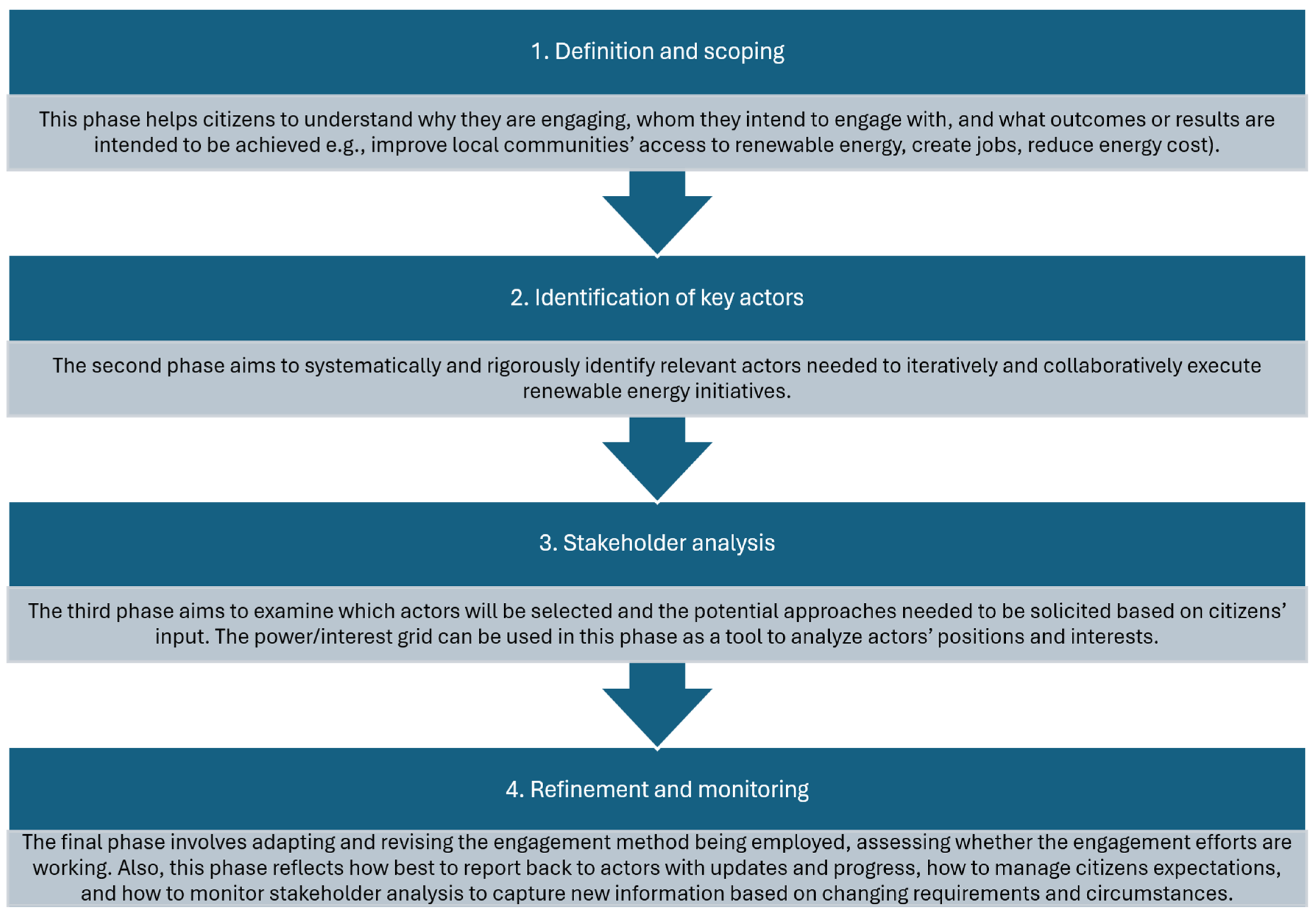
29]. Accordingly,
Figure 2 depicts the phases needed for successful citizen engagement processes that can be applied to the LEC context based on recommendations from Romero–Lankao et al. [
31], who cited Solar Market Pathways.
Figure 2 depicts citizen engagement processes in LEC which can be adopted to guide engagement planning for RES initiatives, including why, how, when, and who will be engaging with community stakeholders in specific RES initiatives [
28]. Furthermore, as seen in
Figure 2, effective citizen engagement in energy projects entails the provision of the environment for effective participation and arrangement for the allocation of tasks among actors by specifying the scope of the project, identification of actors, and analysis of stakeholder needs and lastly refinement and monitoring or requirements. Moreover, citizen engagement in renewable energy projects can provide a medium for effective management of social, technical, political and governance challenges faced in RES initiatives in the LEC structure. Also, engaging citizens at different stages of the projects can lessen citizens’ resistance to RES initiatives, thereby lessening energy poverty and promoting energy justice [
37]. The citizen engagement processes presented in
Figure 2 can be employed in LEC to address how community engagement can be legitimately carried out in a democratic society. It also lays the foundation for a socially viable transition to RES for addressing social, environmental, and economic issues arising in local communities [
35].
3.5. Citizen Participation in Sustainable Energy Transition in LEC
One of the challenges highlighted by the European Commission (EC) is community transition to a more efficient, clean, and secure energy generation and supply [
38]. As such, in recent years, prior research has focused on investigating the integration of renewable energy sources (RES) in LEC, particularly in the use of energy demand side management and storage solutions, including energy services that allow sector coupling and flexibility [
18]. Although LEC connecting local grid and centralized energy systems are viable, the deployment of RES is important for self-sufficiency and sustainability in LEC [
22]. As sustainable energy transition accelerates, there is a need for effective engagement among key actors in LEC [
5]. Thus, sustainable energy transition requires broader involvement and changes in the existing institutional structure by involving different stakeholders for participatory governance, including the residents that will benefit from the transition [
39]. Participation refers to the involvement of the public in renewable energy policies and decisions [
31].
Citizen-led engagement and capacity building fosters renewable energy acceptance in LEC by improving transparency and trust [
16]. Citizen participation provides job opportunities, apprenticeships, and training programs in LECs, thereby providing economic benefits to communities, particularly in geographical locations that historically rely on fossil energy sources [
5]. Thus, citizen participation in community energy initiatives promote sustainable behavior and environmental protection [
4]. Accordingly, citizens’ participation is mostly identified as a major defining characteristic for the development of LEC, encompassing a wide range of community initiatives such as collective purchasing of energy services, green associations, communal or local authority-led programs for renewable energy systems, community programs that mitigate energy poverty, etc. [
40]. These energy cooperatives contributed to the production of renewable energy that meets their residential needs and the advancement of energy-related projects. This has contributed to inclusive governance policies by fostering an inclusive community engagement process that governs the exchange of energy [
7].
Moreover, such initiatives also aid in supporting national energy policies that include the allocation of new financial schemes for public investment in renewable energy, distribution of support incentives, and initiation of schemes that promote community and cooperative energy groups [
41]. However, existing participatory approaches often fail to challenge and change the bureaucratic and centralized governmental structures that control resource allocation and decision-making in local communities. The current way in which citizen participation is deployed often fails to adequately take the views of the marginalized, vulnerable, and rural population into account [
6]. Also, there are fewer studies that systematically investigate the internal procedures needed for citizen participation in energy initiatives through codetermination, collaboration, and social learning processes [
42]. Likewise, there is a need to assess the outcomes of participatory governance strategies employed in community energy initiatives [
4].
3.6. Inclusive Community Energy Initiatives in LEC
Community energy is defined as the collective action needed for managing the generation and the purchasing of energy to improve the wellbeing of citizens in local communities. For a while now, community energy initiatives have been advocated as a potential source that supports sustainable energy transitions [
1]. Community energy initiatives are crucial to support LEC for achieving low-carbon energy transitions [
18]. Thus, the implementation of renewable energy initiatives can provide a means for communities to grow their local economies, decrease their carbon footprints, and democratize their energy services to become more secure and independent [
31]. Generally, community energy initiatives aim to improve energy security by decreasing reliance on non-renewables, mitigating climate change via decarbonization policies, and delivering financial gains by decreasing energy bills [
1,
7]. Community energy initiatives build trust and legitimacy, raise awareness and acceptance on the use of RES and further broaden the knowledge base of citizens [
43]. In addition to these benefits, community energy initiatives also foster wider socioeconomic outcomes for LEC including increasing community cohesion and resilience [
1].
In governing sustainable energy transition, there is a need for LEC to invest in small-scale distributed renewable energy developments by initiating energy cooperatives. This enables citizens as energy prosumers to participate, control, and have local ownership in renewable energy generation and distribution towards efficient energy use [
41]. There are different challenges in achieving citizen participation and engagement in community energy initiatives ranging from distrust of government, regulatory bureaucracies, etc. [
35]. Community energy participation and engagement seek to prioritize local needs, improve the relationship with the citizens, and inform on the progress of the project [
1]. This provides a participatory approach that ensures that energy-related projects are equitable, open and transparent to existing community networks [
39]. Community energy participation and engagement foster communication to publicize energy events, identifying opportunities that support meaningfully stakeholder participation [
16]. Accordingly, the community energy participation and engagement model offers a participatory and inclusive governance approach needed to engage citizens to participate in sustainable energy initiatives.
To foster energy citizenship, citizen participation ensures that citizens can gain autonomy to make decisions over community energy issues that impact their livability [
41]. Overall, it is highlighted that one of the key barriers to sustainable energy transition is not entirely related to the technical issues faced, but the level of citizen participation and engagement has been mentioned as a key determinant needed for successful community energy and cleaner policy implementation [
44]. Therefore, there is a need for consensus-building and participatory approaches that tend to foster civic participation and engagement for more inclusive and flexible energy governance in LEC. Grounded on the Arnstein [
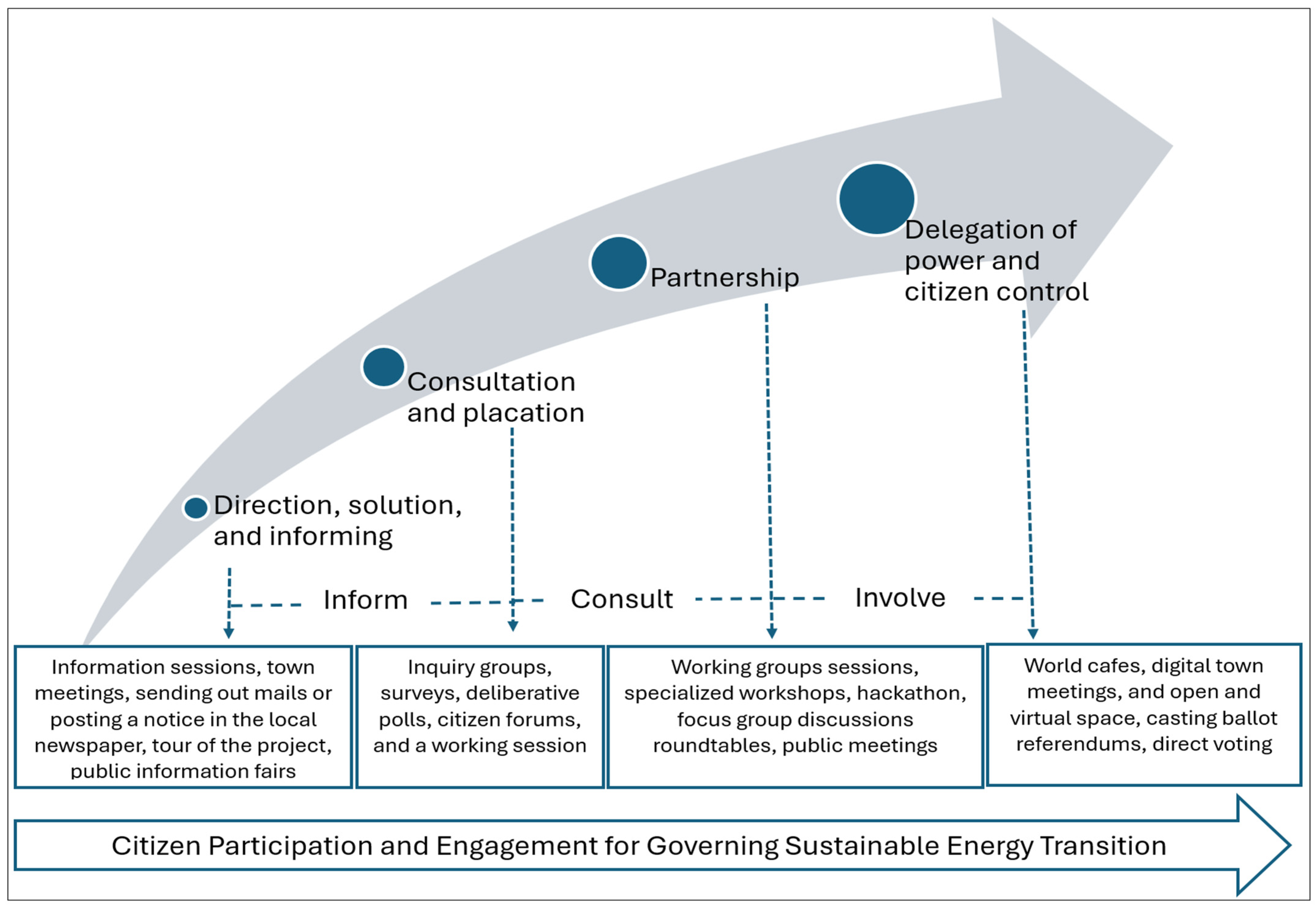
45] “ladder of citizen participation”, this study develops a community energy participation and engagement model for governing sustainable energy transitions in LEC as seen in
Figure 3.
The developed community energy participation and engagement model for governing sustainable energy transition in LEC differs from Arnstein’s [
45] “ladder of citizen participation” by introducing the inform, consult, and involve phases which are not well-addressed in the rural energy community’s context. This theoretically and practically extends pre-existing frameworks by providing strategies and tools to be implemented to engage citizens in various phases of community renewable energy initiatives in LEC. Also, Arnstein’s ladder and the IAP2 spectrum are more aligned to examine public participation. The proposed model is extended to go beyond participation but to also address how to engage citizens to be involved in renewable energy initiatives in a holistic manner.
The following key performance indicators (KPIs) as seen in
Table 1 can be integrated with the proposed community energy participation and the engagement model in LEC, and it can also be measured in practice by using a survey questionnaire to be used by municipalities.
As seen in
Figure 3, the community energy participation and engagement model encompasses different stages: direction, solution, informing, consultation, placation, partnership, delegation of power, and citizen control.
Each of the phases and related strategies which comprise numerous strategies, verbal and non-verbal, virtual and face-to-face [
46], are discussed below.
In the “direction, solution, and informing” phase, the citizens are (non-participation) not yet involved in the community energy initiatives. As such, this phase helps to inform and notify citizens regarding community energy initiatives towards renewable energy development, e.g., via information sessions, town meetings, sending out mails to citizens or posting a notice in the local newspaper. As such, this early phase is truly anchored as “non-participation” as the citizens are introduced to RES and will not automatically participate and engage in community energy initiatives.
Next, for “consultation and placation”, citizens should be allowed to provide input either in the form of oral or written testimony at public meetings, or via inquiry groups, surveys, deliberative polls, citizen forums, and a working session to formalize suggestions from the input citizens provided [
32]. This still does not lead to a two-way discussion with policy makers.
Next is the “partnership” as suggested by Arnstein [
45], where citizens should recommend opinions and decisions based on their energy needs. This may include organizing working group sessions, roundtables or public meetings that provide recommendations for community energy initiatives.
In the final phase, “delegation of power and citizen control”, citizens should be empowered to have total control and sovereignty to make decisions via world cafes, digital town meetings, and open and virtual space personally or via local representatives. This also involves citizens owing and being involved in community energy initiatives or being involved in casting ballot referendums that allow for direct voting on renewable energy development [
32].
The stages and flow (inform, consult, and involve), depicted in
Figure 3, allow for the adoption of more contextually appropriate and effective community energy initiatives employed to enable broader adoption of sustainable energy solutions. Findings from Abdulkareem [
36] revealed that the initiation of small community group meetings has been found to provide valuable opportunities to locals in learning about planned renewable energy projects [
36]. Embedding community stewardship, equity, citizen engagement, and participation provides an opportunity to foster clean energy transition in LEC. This also ensures that RES are equitably distributed to all inhabitants, particularly to rural communities [
47]. By employing the proposed stages (as seen in
Figure 3), LEC can engage more households, improve sustainable energy awareness, and facilitate communication and participation for citizens to be involved as prosumers [
46]. The engaging of citizens in community energy initiatives fosters sustainable behavior among inhabitants who may not have been pro-environmental [
4].
Researchers such as Hindmarshn and Matthews [
35], as well as Soutar et al. [
9], advocated diverging from traditional passive or one-way citizen participatory tools, e.g., information sessions, town meetings, websites, press releases, etc., to consultative tools (e.g., surveys, webinars and exhibits, etc.) and more participative tools (e.g., workshops). Thus, a participatory method is suggested as it offers an inclusive governance approach that encourages early involvement of citizens, providing transparency information, participant diversity, and inclusiveness in LEC. This includes deploying citizen participation and engagement techniques (as seen in
Figure 3), such as inquiry groups, citizen forums, roundtables, deliberative polls, world cafes, digital town meetings, and open and virtual spaces that support deliberative dialog [
35].
The designed community energy participation and engagement model in LEC as seen in
Figure 3 also aligns with the “Clean Energy for all Europeans” package (CEP). The CEP proposed an EU legislative framework that aims to decarbonize the entire energy system. The model designed in this study (
Figure 3) contributes to fostering the use of renewable energy, promoting energy efficiency, empowering consumer energy engagement and participation (as prosumers), and improving energy sharing, thereby contributing towards carbon-neutral societies. Essentially, the designed model in this study (
Figure 3) contributes to the “Clean Energy for all Europeans” package by fostering REC transitioning to a citizen-focused energy future, promoting clean energy for citizens in Europe.
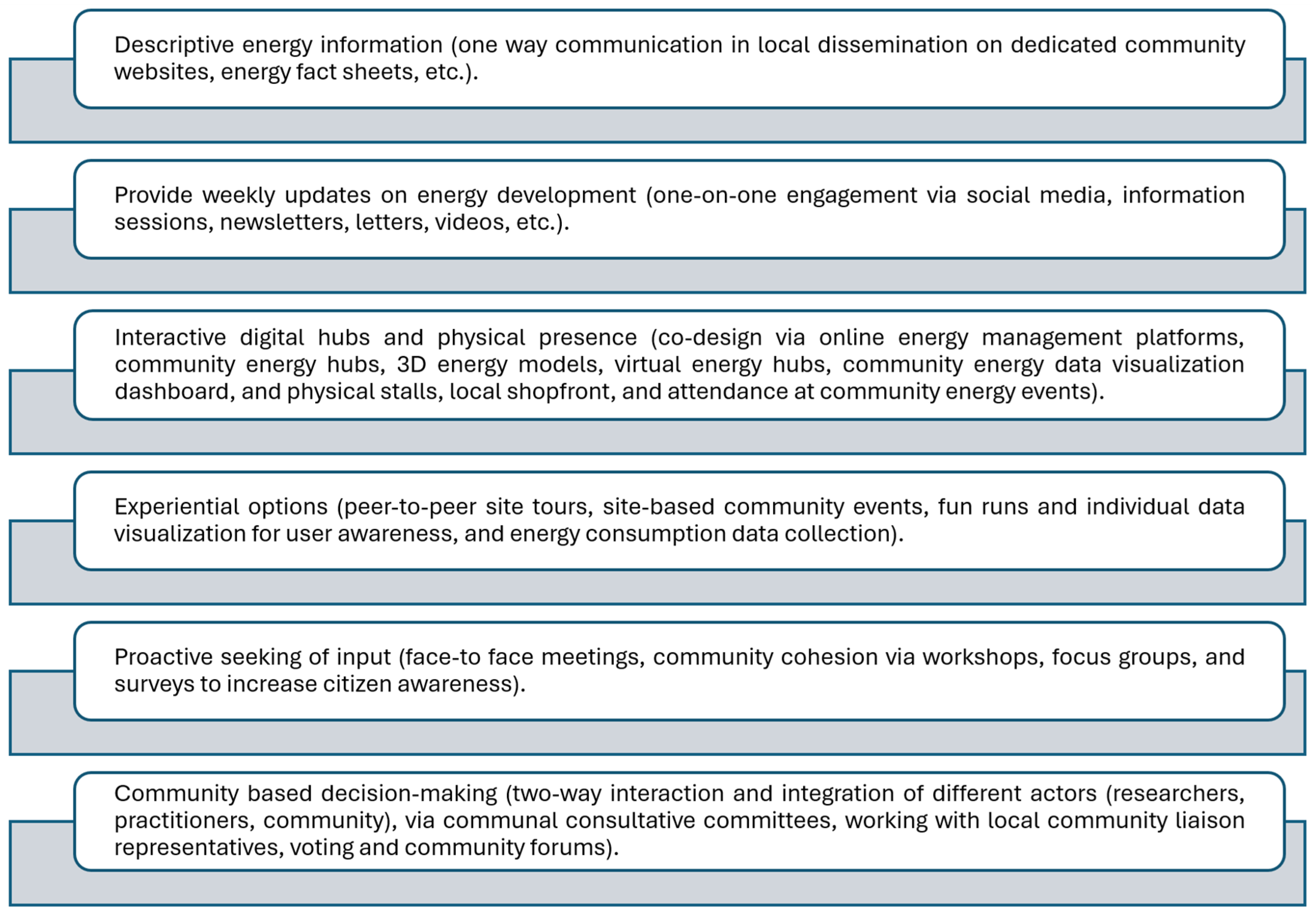
Findings from
Figure 4 supplement the community energy participation and engagement strategies in LEC. The designed citizen engagement processes in LEC (
Figure 2) can be used as a suggested paradigm by policy makers as benchmarks to gauge “successful citizen engagement. This strategy helps to reach out to many citizens in the local community and supports communication and information flow for dialog and discussions with different actors. This also helps to improve citizen energy awareness by providing information related to community energy initiatives (e.g., providing information explaining for how renewable energy is generated, stored and exchanged as prosumers).
Further participatory strategies to be employed to foster an inclusive governance in community energy initiatives are illustrated in
Figure 4.
3.7. Energy Practices for Citizen Engagement for Community Energy Initiatives
Presently, sustainable energy transition involves a variety of actors who are willing to actively engage in renewable energy initiatives and contribute to participatory governance-led low-carbon policies [
39]. As such, citizen participation is an important driver for the actualization of sustainable energy development and deployment, as it ensures that LECs actively participate in the sustainable transition to RES. By involving citizens in the planning and decision-making processes, initiators of community energy initiatives can garner support, address concerns, and create shared value [
5]. The International Association for Public Participation (
https://www.iap2.org/mpage/Home (accessed on 29 January 2026)) designed the Spectrum of Public Participation which comprised five levels (inform, consult, involve, collaborate, and empower), which is to be employed to increase citizen participation in community-driven initiatives. For instance, grassroots activities where citizens were enthusiastic to actively contribute to energy transition has contributed to speeding up transition in several European municipalities and cities. For example, in Germany, an increasing number of citizen and energy cooperatives actively contributed as investors into community energy initiatives in their constituencies [
39].
In Retenergie, Italy, an innovative Italian energy cooperative was established and citizens can choose to participate in the renewable energy initiatives by either purchasing equity of the cooperative investment, funded through social lending, or merely by acquiring membership to benefit wider energy and public services [
40]. In community energy initiatives, citizens participate in strategic decision-making, sharing in the risks related to the growth of the energy cooperatives regarding returns and profit redistribution offered to citizens [
40]. This contributes to empowering and revitalizing the communities, fosters a sense of trust, and increases community identity [
40]. Citizen participation fosters a sense of empowerment and ownership, enabling inhabitants to contribute to the design and implementation of community energy initiatives in ways that align with their energy needs and priorities [
5]. Evidence from the literature indicates that citizens’ participation in energy-related communal initiatives is linked to a successful cleaner energy transition. Moreover, citizen participation enhances social sustainability by enhancing inclusive job creation and economic development. Cooperating with local actors’ policy makers can identify opportunities for human development, foster energy supplier diversity, and promote social investment [
5].
Moreover, findings from the literature indicate that there is strong support for renewable energy generation from wind farms across regions such as Australia [
28]. However, these developments at times are faced with community opposition due to reasons such as citizen attitudes regarding renewable energy production (including from wind), largely based on how the energy project is initiated, including how the local community is involved within the project [
28]. In rural communities across Australia, achieving constant energy supply is usually a challenge because the rural communities are often too distant and this makes connecting to conventional power grid less viable. As such, most of these communities install and use diesel generators, but these are mostly expensive to run and maintain, as it also requires diesel to be transported over long distances, and these generators are highly polluting and noisy. As such, LECs are implementing renewable energy systems that employ technologies such as photovoltaic solar cells, wind turbines, hydropower generators, etc. [
44].
Researchers such as Romero–Lankao et al. [
31] argued that renewable energy initiatives may negatively impact existing local businesses, quality of life, as well as the livelihoods of citizens in LEC. Indeed, evidence from regions such as Scotland reveals that community energy initiatives can be instrumental in attaining broader citizen acceptance of renewable energy sources and in archiving national goals while promoting local economies [
1]. Increasingly, LEC are becoming more engaged in energy sharing or exchange in energy markets to ensure the security of a sustainable energy future [
1,
2]. In other regions in Europe such as in Ireland, there are policies being put in place to promote a decarbonization pathway for sustainable energy transition where citizens in smart communities are becoming integral in managing energy generation and the trading of clean energy within local communities [
48]. Moreover, in Ireland, local communities are rolling-out sustainable energy activities such as a residential energy management, an energy planning scheme, and energy training and education on the use of emerging technologies for residents [
48].
Additionally, in Norway (Trondheim Kommune) and Ireland (Limerick City), communities are deploying ICT platforms and architectures to achieve smart positive energy solutions in actualizing a common energy market [
20,
24] within the +CityxChange project (
https://cityxchange.eu/about-cityxchange/ (accessed on 29 January 2026)). Thus, the +CityxChange involved different stakeholders (governments, utilities, and marginalized populations) in the community to foster inclusive participation in the implementation of positive energy blocks within their respective districts and cities. Finally, prior studies [
2,
3,
7] investigated the application of digital or emerging technologies (such as blockchain, EMS, and peer-to-peer trading platforms), highlighting how they facilitate citizen participation and engagement within community renewable energy initiatives in LECs.
3.8. Barriers and Recommendations for Citizen Participation and Engagement in LEC
It has always been a concern for the municipalities and government to engage citizens to participate in community energy initiatives. Thus, there is a need to empower citizens to contribute to sustainable energy transition by changing their day-to-day energy behaviors, adopting cleaner transport and heating options, contributing to energy trading and demand response operations, implementing energy-efficient technologies, and, particularly, involving local energy initiatives [
48]. Existing policy and project planning related to community energy initiatives are mostly focused on informing and consulting with the local communities [
6]. However, there are barriers and complexities that influence citizen participation and engagement for sustainable energy transition in LEC in a widespread way. Among these factors, the lack of citizens’ trust in the government structures around renewable energy generation and supply continues to be an important barrier to citizens’ engagement [
49]. Trust is an important factor that impacts citizens’ willingness to participate in community energy initiatives [
4]. The lack of trust usually results from policy makers not appropriately enacting participatory processes, which excludes residents from decision-making [
31].
Successful community energy initiatives are more likely when there is interpersonal trust and a strong connection with the local community [
4]. Thus, trust is seen as a fundamental element in the acceptance of renewable energy invention and has been suggested as the basis for any intervention [
33]. Trust provides the baseline that enables citizens to join and cooperate, as well as participate in collective causes such as in community energy initiatives [
27]. In local communities, the dissemination and exchange of information from the grassroots can help to build public trust to change residents’ willingness to participate in community-based renewables initiatives. The deployment of education platforms may also foster trust, thereby influencing citizens’ participation in cleaner energy transition [
36]. Furthermore, trust can be promoted by implementing accessible, inclusive, transparent, accountable and accurate information flow throughout all phases of the project across the local community. This will help to counter misinformation by renewable energy opponents [
35,
50].
As highlighted in
Figure 3 and
Figure 4, the deployment of community participatory strategies such as training, hackathon, focus group workshops, or other community activities can contribute to building trust and strengthening energy community identity. Also, the KPIs presented in
Table 1 can be adopted as governance tools for concretely aiding decision-making as policy instruments. Citizen participation and engagement in community energy initiatives is also impacted by social norms connected to peers’ or the neighborhoods’ expectations regarding issues related to cleaner energy transition. Social norms refer to an individual’s perception of social pressure to carry out or not carry out the behavior under consideration [
7,
50]. Skill et al. [
51] advocated that social norms related to green behaviors were a key factor that stimulates and champions renewable energy practices. Similarly, findings from the literature [
50] maintained that the influence of social norms on environmental-related behaviors for engaging citizens to be involved in sustainable community energy projects has been addressed in prior studies. Citizens’ actions are positively influenced by social norms, and evidence from prior research suggests that individuals will implement green behaviors and practices that they perceive as commonly accepted and normal [
51]. The results further reveal that social norms influence people’s behavior and consequently their intention to contribute to sustainable community energy projects [
2,
50].
Another concern relates to the perceived lack of transparency and consistency in leaders conducting community energy initiatives, and a consequent failure to recognize how the opinions of local communities are considered in the execution process, as the views of citizens are often ignored in largescale renewable energy projects [
35,
42]. This is due to inadequate or non-existent community consultation processes. Moreover, there are issues related to inadequate information that has directly resulted in increased community disagreements, division, and conflict [
35]. Thus, community energy initiatives should provide transparent communication that clearly defines the medium for citizens to provide their input and contribute to decisions [
28]. It is important to identify the citizens’ energy; hence, for effective collaboration and engagement with the local community, key stakeholders’ vision, concerns and expectations should be considered through interviews organized with all actors [
33]. Similarly, the need for energy policies that are aligned with community values and energy expectations has been mentioned [
35]. In addition, the cultural and social appropriateness of community energy initiatives is a central concern for rural communities [
44].
Social learning in the form of accessible renewable energy education and training that raises awareness and informs rural communities on various sustainable energy activities among local citizens can contribute to boosting social acceptance of community energy initiatives [
37]. Likewise, the availability of institutional and infrastructural support is indispensable; thus, there is a need for organized community participation and engagement. A notable factor is the availability of fewer incentives and policies that support community renewable energy development [
35]. The incentivization of prosumers in the form of economic support, flexible community funding, grants, discretionary funding, and subsidies on the initial capital cost for infrastructures, as well as direct renewable energy production schemes, can increase citizens’ uptake of RES such as solar and wind in the energy mix of LEC [
22,
47]. Citizens have very different knowledge and experience as well as different skills and access to resources that influence how they effectively participate and engage with community energy initiatives [
41]. Furthermore, fewer implementation documentation of community energy initiatives has led to limited meaningful community participation and engagement [
32].